INTRODUCTION.
Gilbert Goudie translation
I. Earliest Historical Notices of the Orkneys.
The historical notices of the Orkneys previous to the Norse occupation are few in number, and exceedingly obscure. We learn little more from the allusions of the Roman writers than that scarcely anything was known to them with certainty of these remote localities. It may be inferred, however, that the first wave of Celtic population that overspread the northern mainland of Britain must have gradually extended northward to the outlying Isles. The correspondence of the early remains found in the Islands with those of northern Scotland is of itself a striking testimony to the connection of their early population with the Celtic stock of the northern mainland of Scotland. We gather from these remains that the earliest population of the Islands, of which we have any reliable evidence, lived in the same manner as the natives of the northern mainland, fought with the same varieties of weapons of stone and bronze, erected the same forms of defensive structures, practised the same funereal rites, and constructed similar forms of sepulchral chambers, over which they piled the great mounds which are among the most striking features of an Orkney landscape.[1] The xnumber and magnitude of these monuments and structural remains bear witness in a most remarkable manner to the activity, intelligence, and social organisation of the times that have no other record.
It is not until the middle of the 5th century of the Christian era that the early chronicles begin to cast occasionally a feeble and uncertain light upon the history of the northern isles. It is stated in the “Historia Britonum” of Nennius that the Saxon chiefs Ochtha and Ebissa, who came over with “forty keels” in the year 449, laid waste the Orkney Islands, and seized a great many regions beyond the Frisic Sea.[2] At that time, and for a long period previously (according to Nennius), the Picts had been in possession of the Orkneys. Whatever value may be attached to these statements as referring to events which took place 400 years before the author’s own time, there can be no reason for discrediting his testimony when he says that the Picts continued in possession of the Orkneys in his day.[3]
Adamnan, in his Life of St. Columba, mentions that the saint being on a visit to Bruide Mac Meilcon, king of the Northern Picts, at his stronghold on the river Ness, requested the king to recommend to the reguli of the Orkneys (one of whom was then present, and whose hostages were then in the king’s hands) that Cormac and the clerics who had accompanied him on a missionary voyage to the Orkneys should receive no harm; and it is added that this was the means of saving them from a violent death. But if the authority and influence of the king of the Northern Picts extended to these islands in the reign of Bruide, it does not seem to have been effectual in protecting them from foreign invasion. Bruide Mac Meilcon died in 584, and some time before his death the new and rising power of the Dalriadic kings had made itself xifelt as far as the Orkneys. In the Annals of Ulster there is a notice under the year 580 of an expedition against the Orkneys by Aedan, son of Gabran, seventh king of the Dalriad Scots, who, coming over from Ireland (then called Scotia) about the year 503, had established themselves in Argyle and the Western Highlands, and founded the kingdom of Dalriada. From the date of Aedan’s expedition in 580 we have no mention of the islands in the native chronicles for a whole century, and the next entry, which occurs under the year 682, gives colour to the supposition that they may have been under Dalriadic rule in the interval. The record in 682 is simply, that the Orkneys were wasted by Bruide Mac Bile, the king of the Northern Picts, and apparently brought once more under the rule of the Northern Pictish kings.
II. Early Christianity of the Islands.
It is probable that both the island groups of Orkney and Shetland were visited at a very early period by wandering clerics of the Irish Church, whose missionary efforts contributed so much to the diffusion of Christianity in Scotland. But we have no record of an earlier visitation than that of the companions of St. Columba, although there are indications that between that time and the colonisation of the islands by the heathen Northmen, these Irish clerics were no strangers in any of the island groups.
The Irish monk Dicuil, who wrote his treatise “De Mensura Orbis Terrarum” in or about the year 825, states that “thirty years before that time some clerics had told him that they had lived in an island which they supposed to be Thule, where at the summer solstice the sun only hid himself behind a little hill for a short time during the night, which was quite light; and that a day’s sail towards the north would bring them from thence into the frozen sea.” This island is obviously xiiIceland. He then states that there are many other islands in the northern British sea, which lie at the distance of two days and two nights from the northern islands of Britain, in a straight course, and with a fair wind and a full sail. “One of these,” he says, “a certain honest monk told me he had visited one summer after sailing a day, a night, and another day, in a two-benched boat.” These appear to be the Shetland Islands. Dicuil further states that “there are also some other small islands, almost all divided from each other by narrow sounds, inhabited for about a century by hermits proceeding from our Scotia;[4] but as they had been deserted since the beginning of the world, so are they now abandoned by these anchorites on account of the Northern robbers; but they are full of countless sheep, and swarm with sea-fowl of various kinds. We have not seen these islands mentioned in the works of any author.” Here the reference to the “small isles separated by narrow sounds” is distinctive of the Faroes, of which the long narrow sounds are the peculiar physical feature; while the statement that they are full of countless sheep, taken in connection with the fact that the Northmen named them “Sheep-isles” (Fær-eyiar), establishes the identity of the group which Dicuil describes. The Faroes were colonised by “the Northern robbers,” led by Grim Kamban, in 825, the very year in which Dicuil was writing.
The first Norwegian settlement was made in Iceland in 875, by Leif and Ingulf, who carried with them a number of Irish captives; and the Landnamabók states that “before Iceland was colonised from Norway, men were living there whom the Northmen called Papas; they were Christians, and it is thought they came over the sea from the west, for after them were found Irish books, and bells, and crosiers, and other things, so that one could see that they were Westmen: these things were found in Papey, eastwards, and in Papyli.” Again, xiiiin the Islendingabók of Ari Frodi the same reason is assigned for the departure of the monks as is given by Dicuil. Ari Frodi also says, speaking of Iceland:—“Christian men were here then called by the Northmen Papa, but afterwards they went their way, for they would not remain in company with heathens; and they left behind them Irish books, and bells, and pastoral staves, so that it was clear that they were Irishmen.”
Thus by the concurrent testimony of Adamnan, the biographer of St. Columba, himself an abbot of the monastery of Hy; of the Irish monk Dicuil, writing during the lifetime of the men who had fled from the Northern robbers; and lastly, of the Icelandic historians themselves—it is established that the whole of the northern islands were visited by Christian teachers, and probably, in part at least, converted to the Christian faith, before they were overrun by the Norwegian invaders, and the new faith swallowed up in the rising tide of heathenism thrown upon their shores from the land of Odin and the Aser.
In the absence of all record we cannot expect to ascertain to what extent these early missionary settlements had succeeded in leavening the Celtic population of the islands of Orkney and Shetland with the Christian faith. But it seems probable that during the three centuries that intervened between the coming of Cormac in his coracle and the arrival of Harald Harfagri with his fleet of war galleys, the new faith had been firmly established and widely extended both in the northern mainland of Scotland and in the remoter isles.
The indications which point to a Christian occupation of the isle, of no inconsiderable extent and continuance, previous to their occupation by the Norsemen, are:—The dedications of the early ecclesiastical foundations; the occurrence of monumental stones sculptured in the style peculiar to the earliest Christian monuments of the mainland of Scotland, and bearing inscriptions in the Ogham character; the finding xiv(as at Saverough and Burrian) of ecclesiastical bells of the square-sided form, peculiar to the early ages of the Church; and the occurrence in the Norse topography of the islands of place-names indicative of the previous settlement of Celtic Christian priests.
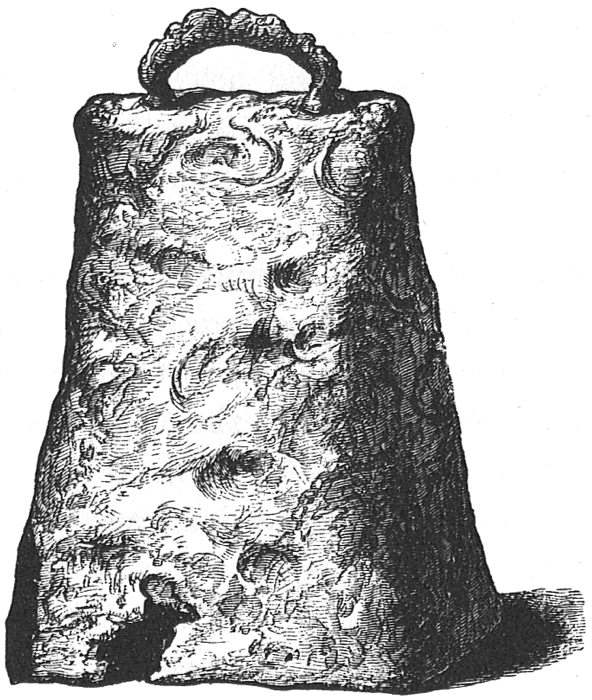
SQUARE-SIDED BELL FOUND AT SAVEROUGH, ORKNEY.
The earliest dedications were probably those to St. Ninian and St. Columba, St. Brigid, and St. Tredwell. It may be significant that in the south parish of South Ronaldsay, where in all probability the companions of St. Columba would make their first landing in Orkney, there were no fewer than three chapels dedicated to him.[5]
xvThe sculptured monuments furnish us with three collateral lines of inference, tending to the same conclusion. These inferences are derived from the inscriptions, the ornamentation, and the symbols of the monuments.
Two of these monuments bear inscriptions in the Ogham character, a style of cryptographic writing characteristic of the early inscribed stone monuments of Ireland, but occurring also in Cornwall, in Wales, and in Scotland. One of these two was found near the ancient church of Culbinsbrugh, in the island of Bressay in Shetland. It is a slab of chlorite slate, 4 feet in length, about 16 inches wide at the top, tapering to a little less than a foot at the bottom, and about 1¾ inch thick. It is sculptured on both sides in low relief, and the inscription is incised on the edges of the stone. On one of its sculptured faces it bears the Christian emblem of the cross, and among the figures sculptured on it are those of two ecclesiastics with pastoral staves (see Plates). The other inscribed stone was found by Dr. William Traill in the Pictish Tower or “Broch” of Burrian, in North Ronaldsay in Orkney. The inscription scratched on it has not yet been deciphered. It also bears the Christian emblem of the cross. The association of the cross with these Ogham inscriptions[6] points xvito a period anterior to the Norse occupation of the islands.
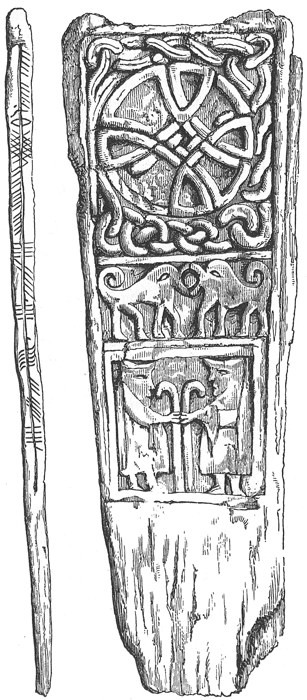
THE BRESSAY STONE. Showing one side and Ogham inscription on edge.
xvii
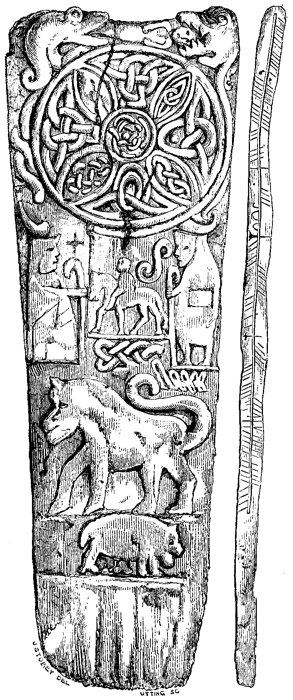
THE BRESSAY STONE. Showing the other side and Ogham inscription on edge.
xviiiIn examining the characteristics of the art of these monumental stones, we are guided to similar conclusions. The Bressay stone bears none of the symbols peculiar to the Scottish monuments, and in its artistic features it comes nearer to some of the Irish than to the general style of the Scottish sculptures. It is sculptured in low relief, while all the Orkney examples are merely incised. But some of the forms of their ornamentation are also characteristic of the art of the illuminated Irish manuscripts of the 7th and 8th centuries, and others are equally characteristic of the art of the bronzes of what has been styled the late Celtic period.
The Scottish sculptured monuments scattered over the territory ranging from the Forth to the Orkneys are characterised by a peculiar set of symbols of unknown significance, which are often associated with the Christian emblem of the cross.[7] The symbol which is of most frequent occurrence, and which may therefore be said to be the most characteristic of the period of the monuments, is a crescent conjoined with what has been called a double sceptre, as represented in the first figure of the accompanying Plate.
xix
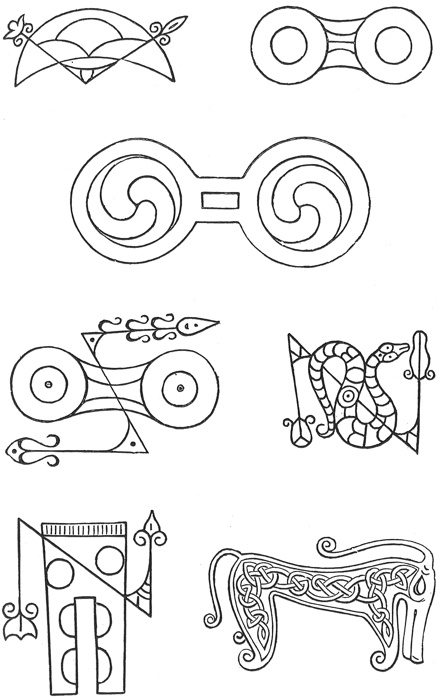
SYMBOLS ON THE SCULPTURED STONES OF SCOTLAND.
This characteristic symbol occurs on a sculptured slab which was found built into St. Peter’s Church in South Ronaldsay, and which had evidently formed part of a monument older than the church. It occurs also on the slab found at Firth, on the mainland of Orkney. Most singularly, it occurs on the phalangial bone of an ox which was found in the Broch of Burrian along with the slab previously described xxas bearing an Ogham inscription and a peculiar form of cross. It occurs associated with the same form of cross on the elaborately-sculptured stone at Ulbster in Caithness. We have this crescent symbol also associated with the cross on the inscribed stone of St. Vigeans in Forfarshire. This stone bears the only inscription which is known to have been left to us in the Pictish language:—[8]
DROSTEN IPE VORET ELT FORCUS
“Drost, son of Voret, of the race of Fergus,”
and is believed to refer to that Drost, king of the Picts, who fell at the battle of Blathmig, according to the Annals of Tighearnac, in A.D. 729.
The indications afforded by the Norse topography of the Islands, if taken in connection with the passages previously quoted from the Landnamabók and the Islendingabók of Ari Frodi regarding the origin of the names Papa and Papyli in Iceland, require only to be mentioned. The most obvious of these are the frequency with which the name Papa[9] occurs both in the topography of Orkney and Shetland, and the occurrence of such names as St. Ninian’s Isle in Shetland, Rinansey (Ringan’s-ey, St. Ninian’s Isle) in Orkney, Daminsey, now Damsey (St. Adamnan’s Isle), and Enhallow (Eyin-Helga, Holy Isle), given, we must suppose, intelligently by the Norsemen.
xxiThus, at the very starting-point of their recorded history, we find indications of Christianity, with suggestions even of its civilisation and its art shedding their benign influence over the isles.
III. Arrival of the Northmen, and Establishment of the Earldom of Orkney and Caithness.
The earliest notice we have of the visits of the Northmen to the shores of Britain occurs in the Anglo-Saxon Chronicle under the date A.D. 787:—
“In this year King Beorhtric took Eadburh, King Offa’s daughter, to wife. And in his days first came three ships of Northmen from Hæretha-land; and then the reeve rode thereto, and would drive them to the king’s vill, for he knew not what they were, and they there slew him. These were the first ships of Danish men that sought the land of the English race.”
As they came from Hæretha-land, now Hördaland, on the west coast of Norway, they were Norwegians, not Danes.
The Irish Annals and the Welsh Chronicles agree in representing the first inroads of the Norsemen on the Irish coasts as having commenced in the year 795. In 798 they plundered Inispatrick of Man and the Hebrides; in 802, and again in 806, they ravaged Iona, slaying in the latter year sixty-eight of the monastic family there. In 807 they established themselves on the mainland of Ireland; and a few years afterwards we find a Norseman making Armagh the capital of his kingdom.
In 852, Olaf the White, a chieftain descended from the same family as Harald Harfagri, conquered Dublin, and founded the most powerful and permanent of the Norse kingdoms in Ireland.
By the victory of Hafursfiord in 872, Harald Harfagri made himself sole monarch of Norway. Large numbers of the wealthy and powerful odallers, whom he had dispossessed of their territorial possessions, fled to the islands of Orkney xxiiand Shetland, which, for a full century previous to this time, had been well known to the Norsemen as the viking station of the western haf—the rendezvous of the Northern rovers, who swept the coasts of the Hebrides and swarmed in the Irish Seas. Being fugitives from their country, and outlaws of the new kingdom which Harald had succeeded in establishing in Norway, they settled themselves permanently in the islands. Then they turned their haven of refuge into a base of operations for retaliatory warfare, harrying the coasts of Norway during the summer months, and living at leisure in the islands during winter on the plunder. At length King Harald, irritated by their incessant ravages, collected a powerful fleet, and visiting Shetland, Orkney, and the Hebrides, in succession, he swept their coasts clear of the plunderers, subduing the whole of the Northern and Western islands as far south as Man.
In this expedition Ivar, a son of Rögnvald, Earl of Moeri, was killed.[10] In order to recompense Rögnvald for the loss of his son, King Harald bestowed on him the territory of the subjugated isles of Orkney and Shetland, with the title of Earl of the Orkneys. Harald seems to have dealt similarly with the Hebrides, but his conquest of the vikings in these remote isles was not so complete as in the Orkneys. Ketil Flatnef (Flat nose), who, according to the Laxdæla Saga, had emigrated to the Hebrides because he could not resist King Harald in Norway, had married his daughter Aud to Olaf the White, the powerful king of Dublin, and had established himself in a kind of independent sovereignty in the Hebrides; and though he seems to have migrated from them to Iceland in consequence of King Harald’s expedition, the continued hostility to King Harald’s rule is evinced by the fact that the second earl whom he sent to the Hebrides, AsBjörn Skerablesi, was slain by two relatives of Ketil Flatnef, his wife and daughter taken captive, and the latter sold as a xxiiislave. Rögnvald, however, returned to his own Earldom in Norway, and made over his newly-acquired possessions to his brother Sigurd, the “first earl” of the Saga.
IV. The Earldom in the Norse Line, 872-1231.
Thorstein the Red, son of Olaf the White, king of Dublin, came then to the north, and allying himself with Earl Sigurd, they crossed over to the mainland of Scotland, and subdued Caithness and Sutherland as far as Ekkialsbakki, and afterwards carried their conquests into Ross and Moray. In this invasion Earl Sigurd killed Maelbrigd the buck-toothed (Melbrigda tönn), a Scottish maormor of Ross or Moray; and having tied his head to his saddle-bow, “the tooth,” which was very prominent, inflicted a wound on his leg, and the wound inflaming caused the death of the earl, who was hoy-laid (buried in a mound or cairn) on Ekkialsbakki.[11] After his death, Thorstein the Red reigned as king over the conquered districts of Scotland, which at that time, says the Landnamabók,[12] comprehended “Caithness and Sutherland, Ross and Moray, and more than the half of Scotland.” The Laxdæla Saga[13] says that in his engagements with the Scots Thorstein was always successful, “until at length he became reconciled with the King of the Scots, and obtained possession of the half of Scotland, over which he became king.” But he was shortly afterwards slain in Caithness by the treachery of the Scots; and after his death Aud, his mother, migrated to Iceland. Previous to her departure she had given Groa, the daughter of Thorstein, in marriage to Duncan, earl or maormor of Duncansby in Caithness. Thus the Norse earldom xxivof Caithness passed for a time into the family of one of its native chiefs. But by the subsequent marriage of Grelauga, the daughter of Duncan and Groa, with Thorfinn Hausakliuf, son of Torf-Einar, Earl of Orkney, the Scottish earldom was again added to the earldom of the Isles.
While Thorstein the Red ruled on the northern mainland of Scotland, Guttorm, the son of Sigurd Eysteinson, had succeeded to the Orkney earldom on the death of his father, but after having held it for one year he died childless.
Meantime, when Rögnvald, Earl of Moeri, heard in Norway of the death of his brother Sigurd, he obtained a grant of the earldom of Orkney from King Harald for his own son Hallad. Hallad found the Islands so much infested by vikings that he soon gave up the earldom in disgust, and returned to Norway, preferring the life of a farmer to that of an earl.[14]
Then Rögnvald sent another son, Einar, to take possession of the earldom. Einar was a man of a different stamp from Hallad. He soon made his power felt among the western vikings, and freed his possessions entirely from their ravages. The sons of Harald Harfagri, Halfdan Hálegg and Guthrod, grew up to be men of great violence. One spring they went north to Moeri and burnt Earl Rögnvald in his own house with sixty of his men. Halfdan Hálegg then sailed west to Orkney to dispossess Einar of the earldom, but having allowed himself to be surprised by Einar, he was captured in Rinansey, and killed by having a blood-eagle cut on his back.[15] Harald Harfagri came west, and fined the Orkneys in sixty marks of gold for the death of his son. Earl Einar offered to the Bœndr[16] that he would pay the money on condition that he should have all the odal possessions in the islands—a condition to which they agreed the xxvmore readily, says the Saga, “that all the poorer men had but small lands, while those who were wealthy said they would redeem theirs when they pleased.”[17] But the odal lands remained in the possession of the earl till Einar’s great-grandson, Sigurd Hlödverson, was obliged to buy the assistance of the odallers against the Scots when hard pressed by the Scottish earl Finnleik.[18]
When Einar died he left three sons, two of whom, Arnkell and Erlend, were killed with King Erik Bloodyaxe in England. The third, Thorfinn Hausakliuf, married Grelauga, daughter of Duncan, earl of Duncansbay, and thus reunited in the Norse line the two earldoms of Orkney and Caithness. Earl Thorfinn Hausakliuf left five sons. Arnfinn, the eldest, who was married to Ragnhild, a daughter of King Erik Bloodyaxe, was killed by his wife at Myrkhol (Murkle) in Caithness. She then married Havard, his brother. She soon tired of him, and instigated Einar Klining, his sister’s son, to kill him. Havard fell in the fray at Stennis, and was buried there.[19] Ragnhild had promised to marry Einar if he killed her husband Havard. When the deed was done, however, she refused to perform her promise, and instigated another Einar, by the promise of her hand, to slay Einar Klining. This he did, but again Ragnhild was faithless. Then she married Liot, the third son of Earl Thorfinn Hausakliffer, and brother of the two husbands whom she had already had and slain. Meanwhile Skuli, a fourth brother, had gone to Scotland and obtained an earl’s title for Caithness from the King of Scots.[20] He was defeated by Liot, and slain in the Dales of Caithness, and thus Liot became sole earl of Caithness and Orkney. He fell in battle with a native chieftain, named Magbiód[21] in the xxviSagas, at Skida Myre[22] (Skitten) in Caithness, and was succeeded in the earldom by Hlödver, the last of the five brothers.
Earl Hlödver married Audna, the daughter of the Irish king Kiarval. He died shortly after his accession to the earldom, and was buried at Hofn (Huna) in Caithness.[23] His son Sigurd, sometimes called “the Stout,” succeeded him. He is said to have been a mighty warrior, and to have driven the Scots completely from Caithness.[24] But he was not left in undisturbed possession of his Scottish earldom. The Scottish earl or maormor, Finlay (MacRuari?) invaded Caithness and gave him battle at Skida Myre, where his uncle Liot had fallen before another Scottish maormor not long previously. Finlay had so large a force that there were no less than seven Scotsmen to one of Sigurd’s men, and the Orkneymen who were with Earl Sigurd were unwilling to fight against such odds. Then Sigurd offered to restore to the Bœndr their allodial lands, which they had resigned to Earl Einar, his great-grandfather. By this means, more than by the charmed raven-banner made for him by his Irish mother, he obtained the victory. “After this,” says the Njal Saga,[25] “Earl Sigurd became ruler over these dominions in Scotland, Ross and Moray, Sutherland and the Dales” (of Caithness), which seem also to include the old Strathnaver. But his troubles with the Scots were not yet over. Caithness was invaded by two Scottish maormors, called Hundi and Melsnati in the Saga.[26] A battle took place at Duncansbay, in which Melsnati was slain, but Hundi fled, and the Norsemen, learning that another xxviiScottish earl, Malcolm, was assembling an army at Duncansbay, gave up the pursuit and returned to Orkney. Afterwards Sigurd became reconciled to Malcolm, King of the Scots, and obtained his daughter in marriage.
But the most notable event in the life of Earl Sigurd was that which befel him as he lay in the harbour of Osmondwall shortly after his accession to the earldom. Olaf Tryggvason, King of Norway, returning from a western cruise, happened to run his vessels into the same harbour, as the Pentland Firth was not to be passed that day. On hearing that the earl was there he sent for him on board his ship, and told him, without much parley, that he must allow himself to be baptized, and make all his people profess the Christian faith. The Flateyjarbók says that the king took hold of Sigurd’s boy, who chanced to be with him, and drawing his sword, gave the earl the choice of renouncing for ever the faith of his fathers, or of seeing his boy slain on the spot. In the position in which he found himself placed, Sigurd became a nominal convert, but there is every reason to believe that the Christianity which was thus forced upon the Islanders was for a long time more a name than a reality. Nearly twenty years afterwards we find Earl Sigurd bearing his own raven-banner “woven with mighty spells,” at the battle of Clontarf, against the Christian king Brian; and Sigurd’s fall was made known in Caithness by the twelve weird sisters (the Valkyriar of the ancient mythology) weaving the woof of war:—[27]
“The woof y-woven
With entrails of men,
The warp hardweighted
With heads of the slain.”
An incident which occurred just before he set out for Ireland gives a striking illustration of the fierce manners of the times. King Sigtrygg, who had come from Dublin to obtain Earl Sigurd’s aid, was being entertained at the Yule-feast xxviiiin Earl Sigurd’s hall in Hrossey (the Mainland of Orkney), and was set on the high seat, having Earl Sigurd on the one side and Earl Gilli, who had come with him, on the other. Gunnar Lambi’s son was telling the company the story of the burning of Njal and his comrades, but giving an unfair version of it, and every now and then laughing out loud. It so happened that as, in answer to an inquiry of King Sigtrygg’s how they bore the burning, he was saying that one of them had given way to tears, one of Njal’s friends, Kari by name, who had just arrived in Orkney, chanced to come into the hall. Hearing what was said, Kari drew his sword, and smote Gunnar Lambi’s son on the neck with such a sharp blow that his head spun off on to the board before the king and the earls, so that the board was all one gore of blood, and the earls’ clothing too. Earl Sigurd called out to seize Kari and kill him, but no man stirred, and some spoke up for him, saying that he had only done what he had a right to do, and so Kari walked away, and there was no hue and cry after him.
The battle of Clontarf, in which Earl Sigurd fell, is the most celebrated of all the conflicts in which the Norsemen were engaged on this side of the North Sea. “It was at Clontarf, in Brian’s battle,” says Dasent, “that the old and new faiths met in the lists face to face for their last struggle,” and we find Earl Sigurd arrayed on the side of the old faith, though nominally a convert to the new. The Irish account of the battle[28] describes it as seen from the walls of Dublin, and likens the carnage to a party of reapers cutting down a field of oats. Sigurd is described as dealing out wounds and slaughter all around—“no edged weapon could harm him, and there was no strength that yielded not, and no thickness that became not thin before him.” Murcadh, son of Brian Borumha, was equally conspicuous on the side of the Irish. He had thrice passed through the phalanx of the foreigners, slaying a mail-clad man at every stroke. Then perceiving xxixSigurd, he rushed at him, and by a blow of his right-hand sword, cut the fastenings of his helmet, which fell back, and a second blow given with the left-hand sword cut into his neck, and stretched him lifeless on the field. In the Njal Saga the incidents connected with Earl Sigurd’s death are differently related. His raven-banner, which was borne before him, was fulfilling the destiny announced by Audna, when she gave it to him at Skida Myre, that it would always bring victory to those before whom it was borne, but death to him who bore it. Twice had the banner-bearer fallen, and Earl Sigurd called on Thorstein, son of Hall of the Side, next to bear the banner. Thorstein was about to lift it, when Asmund the White called out, “Don’t bear the banner, for all they who bear it get their death.” “Hrafn the Red!” cried Earl Sigurd, “bear thou the banner.” “Bear thine own devil thyself,” said Hrafn.[29] Then said the earl, “’Tis fittest that the beggar should bear the bag,” and with that he took up the banner, and was immediately pierced through with a spear. Then flight broke out through all the host.
When the news of Earl Sigurd’s death reached Scotland King Malcolm gave the earldom of Caithness to Thorfinn, his daughter’s son by Sigurd, then only five years of age, and Sumarlidi, Brúsi, and Einar, Sigurd’s sons by his former marriage, divided the Orkneys between them. Sumarlidi soon died, and Einar got his portion. Einar made himself unpopular by the violence with which he exacted his services xxxfrom the Bœndr for his viking expeditions, and was killed by Thorkel Fóstri (Amundi’s son) at Sandwick, in Deerness. Brúsi then took possession of the whole earldom of the Orkneys, as Thorfinn had that of Caithness. Thorfinn, however, claimed a share of the Islands, and as he had the assistance of his grandfather Malcolm, the King of Scots, Brúsi felt himself unable to cope with him. He therefore went to Norway to negotiate with King Olaf Haraldson for a grant of the whole of the earldom of the Islands. Thorfinn followed him on the same errand, but the king was more than a match for them both, and the result was that he gave each a third of the Islands, declaring the third which had belonged to Earl Einar to be forfeited to himself for the murder of his friend and henchman Eyvind Urarhorn, whom Einar had slain in revenge for Eyvind’s helping the Irish king Conchobhar against him at Ulfreksfiord. After Thorfinn’s departure, however, he gave Brúsi to understand that he was to have the forfeited third of the earldom, as well as his own third, to enable him to hold his own against Thorfinn. An arrangement was afterwards made between Brúsi and Thorfinn that the latter should receive two-thirds of the Islands on condition of his undertaking the defence of the whole, as they were at that time much exposed to the predatory incursions of Norse and Danish vikings.
When Thorfinn’s maternal grandfather, King Malcolm, died, Kali Hundason[30] took the kingdom in Scotland. He attempted to exact tribute from Thorfinn for his dominions in the north of Scotland, and failing in this he sent his sister’s son, Moddan, into Caithness, giving him the title of Earl. Thorfinn was supported by the inhabitants, however, and after an unsuccessful attempt to establish himself in Caithness, Moddan returned to King Kali with the news that Thorfinn was plundering in Ross and Sutherland. King Kali embarked a considerable force in eleven ships at Beruvik (apparently Berriedale on the southern frontier of Caithness), and sent Moddan northwards xxxiby land with another division of his army, intending to enclose Thorfinn in the north-east corner of Caithness, and attack him from two sides at once. Thorfinn, however, was aware of the trap laid for him, and retired to the Islands. There Kali came up with him off Deerness, in Orkney, and a fierce battle took place, in which Kali was defeated. He fled southwards, and Thorfinn, following him, obliged him again to give battle at Baefiord, where he was again defeated, while Thorkel Fóstri fell upon Moddan at Thurso and slew him. Then, say the Sagas, Earl Thorfinn overran Scotland as far south as Fife, burning and slaying, and subduing the land wherever he went. By these conquests he became the most powerful of all the Earls of Orkney.
Rögnvald Brusison was in Norway when he heard of his father’s death, and being odal-born to his father’s third of the Islands, and having received from King Magnus Olafson a grant of that third which King Olaf had declared forfeited to himself for Eyvind Urarhorn’s murder, he went west to the Orkneys, prepared to maintain his rights against the claims of Thorfinn, who had taken possession of the whole. An amicable arrangement was made between the kinsmen, and they joined their forces for viking forays upon the Hebrides, venturing even upon an extensive foray in England during the absence of Hardicanute in Denmark. After an eight years’ alliance, however, discord broke out between the kinsmen, and in a sea-fight in the Pentland Firth, off Rauda Biorg,[31] in Caithness, Rögnvald was defeated and fled, and Thorfinn reduced the whole of the Islands. Rögnvald went to Norway, and stayed some time with King Magnus. Then he came west to the Islands in a single ship, and surprising Thorfinn in a house on the Mainland of Orkney, he set fire to it. Thorfinn broke down part of the wall of the house and leapt out, carrying his wife Ingibiorg in his arms, and escaped through the smoke. Rögnvald, believing that xxxiiThorfinn had perished, took possession of the Islands. Thorfinn, who had got secretly over to his dominions in Caithness, returned shortly afterwards, and surprising Rögnvald in a house on Papa Stronsay, burnt the house and all who were in it, except Rögnvald, who sprang over the heads of the men who surrounded him, and got away in the darkness. He concealed himself among the rocks by the shore, but was discovered by the barking of his dog, and slain by Thorkel Fóstri. Thus Thorfinn was again sole ruler of the Orkney earldom, as well as that of Caithness. He went to Norway to make his peace with King Magnus, who was foster-brother to Earl Rögnvald, and therefore would seek vengeance for his death. At that time Magnus was at war with Swein Ulfson, King of Denmark. While he lay with his fleet at Seley two war-ships rowed up to the king’s vessel, and a man in a white cloak went straight aboard, and up to the quarter-deck, where the king sat at meat. Saluting the king, the man reached forth his hand, took a loaf from the table, broke it, and ate of it. The king handed the cup to him when he saw that he had broken bread at his table, and then he learned that it was Earl Thorfinn, who, having broken his bread and drunk from his cup, was, for the present at least, safe from his vengeance, according to the ancient laws of hospitality. He deemed it wise, however, to take his departure without having obtained a formal reconciliation. King Magnus died shortly afterwards, and was succeeded by his uncle Harald Hardradi. Thorfinn again went to Norway on hearing of King Magnus’ death, and effected a reconciliation with King Harald, so that he was now established in the earldom of Orkney by consent of the over-lord, the King of Norway.
From Norway he went to Denmark, visiting King Swein at Aalborg, and proceeded thence through Germany on a pilgrimage to Rome, where he obtained absolution for all his deeds. After his return from Rome it is said that he turned his mind more to the government of his dominions xxxiiiand the welfare of his people than he had previously done in his career of conquest. He built Christ’s Kirk in Birsay, and established there the first bishop’s see in the Orkneys. He died in 1064, having been Earl, by the Saga account, for “seventy winters,” and the most powerful and wide-landed of all the Earls of the Orkneys. After his death, as the Saga states, his widow Ingibiorg was married to King Malcolm Canmore,[32] and became the mother of Duncan, whom, however, the Scottish historians have always represented as a bastard.
Thorfinn was succeeded by his two sons, Paul and Erlend, who were with King Harald Hardradi in his unfortunate expedition to England. After the battle of Stamford Bridge, in which King Harald fell, the Orkney earls were allowed to go home by the victorious Harold Godwinson, and they ruled their dominions jointly in great harmony till their sons grew up to manhood, when there began to be discord between the families. Hakon, the son of Paul, was of a turbulent and overbearing disposition. He seems to have had a lingering attachment to the Pagan faith of his forefathers, for, while in Sweden (which was longer in being converted to Christianity than Norway), he is said to have sought out the Pagan spaemen to learn his future from them. Coming to Norway he tried hard to induce King Magnus Barelegs to undertake an expedition to the Orkneys and the Western Isles, hoping that the king would conquer the Islands for the glory of the conquest, and hand them over to him, as Harald Harfagri had given them to Rögnvald, Earl of Mœri. He was more successful than he anticipated. King Magnus, fired with the love of conquest, did make the expedition, but he deposed Paul and Erlend, and carried them to Norway, placing his own son Sigurd, a mere child, over the Orkneys.
Although the Saga speaks as if there had been only one expedition by King Magnus to Scotland, there were in reality xxxivthree. Fordun[33] states that when Donald Bane, Duncan, and Edgar, were struggling for the kingdom on the death of Malcolm in 1093, King Magnus was ravaging the gulfs of the Scottish seaboard, and it is stated in the Saga[34] that he assisted Murcertach in the capture of Dublin in 1094. In his second expedition in 1098 he carried off the Earls Paul and Erlend, and made his own son Sigurd Earl of Orkney. Munch surmises that the motives of this expedition were two-fold—to secure his power in the Orkneys, and to assist his protégé Donald Bane, who had again usurped the crown of Scotland on the death of Duncan in 1095, and was in 1097 hard pressed by Edgar with an English army. King Magnus took with him from the Orkneys Magnus Erlend’s son (afterwards St. Magnus), and proceeded southwards to the Hebrides, where he ravaged Lewis, Skye, Uist, Tiree, and Mull, sparing Iona on account of its sanctity. The Saga says that he opened the door of the little church of Columbkill (St. Oran’s chapel), and was about to enter, but stopped suddenly, closed the door, forbade any one to enter, and gave the inhabitants peace. Then he went on to Isla and Kintyre, and thence to Man and Anglesea, where he fought the battle with the two Hughs, Earls of Chester and Shrewsbury. On his return northward he caused his vessel to be drawn across the isthmus of Tarbert, in imitation of the fabulous sea-king Beite, of whom a similar story is told. He returned to Norway in 1099, and during the next two years was occupied with the Swedish war. In 1102 he returned to the west, married his son Sigurd to Biadmynia, the daughter of Murcertach, and fell in a skirmish with the Irish in Ulster in 1103. He was buried in St. Patrick’s church in Down.[35]
Sigurd, the son of King Magnus, remained Earl of the Orkneys until his father’s death, when he succeeded to the throne of Norway.
Hakon Paul’s son, and Magnus Erlend’s son, then succeeded xxxvto the earldom, and held it jointly until Magnus was murdered in Egilsey by Hakon on the 16th April, A.D. 1115.[36]
After the murder of Magnus, Hakon became sole earl. He went on a pilgrimage to Rome and the Holy Land, and after his return became a good ruler, and was so popular “that the Orkneymen desired no other rulers than Hakon and his issue.”
Earl Hakon left two sons, Harald and Paul (the silent). Harald, who had succeeded to the earldom of Caithness, which “he held from the King of Scots,” was in some way unintentionally put to death by his mother Helga and her sister Frákork. As the Saga tells the story, he met his death by insisting on putting on a poisoned shirt which the sisters intended for his half-brother Paul, who, on Harald’s death, became sole Earl of the Orkneys.
A new claimant arose, however, in the person of Kali, son of Kol, a nobleman resident at Agdir, in Norway, who had married a sister of Earl Magnus the saint. Kali received from King Sigurd the gift of half the Orkneys, which had belonged to his uncle Magnus, and his name was changed from Kali Kolson to Rögnvald, because his mother said that Rögnvald Brusison was the most accomplished of all the Earls of Orkney, and thought the name would bring her son good fortune.
Rögnvald had many romantic adventures in the prosecution of his attempt to obtain possession of half of the earldom held by Paul, which are detailed at length in the Saga. At last he was advised by his father Kol to make a vow to St. Magnus, that if he should succeed in establishing himself in the Orkneys he would build and endow a “stone minster” at Kirkwall, dedicated to St. Magnus, “to whom the half of the earldom rightly belonged.” The vow was made, and Rögnvald’s next expedition was successful. He landed in Shetland, and by a dexterous stratagem the beacons on Fair Isle and in the Orkneys were made to xxxvigive a false alarm of his descent upon the Orkneys, so that when he did land there he was unopposed. Then he secured the intervention of the bishop, and an agreement that he should have half the Islands was concluded between him and Earl Paul. Shortly thereafter Earl Paul was captured by Swein Asleifson, a notable leader at that time in the Islands, and the last and greatest of the Orkney vikings. Swein carried the earl off in his vessel, and, landing him on the southern shore of the Moray Firth, delivered him into the safe keeping of Maddad, Earl of Athole,[37] who was married to Margaret, a sister of Earl Paul. What became of the earl is not known, “but this,” says the Saga, “is well known, that he came never again to the Orkneys, and had no dominions in Scotland.” Swein Asleifson returned to Orkney, and by the joint consent of Earl Rögnvald, Bishop William of Orkney, and Bishop John of Athole, Harald, the son of Maddad, earl of Athole, was made Earl, along with Rögnvald, though he was at that time a child of only five years old. This arrangement was afterwards confirmed by a meeting, held in Caithness, of the Bœndr and chiefs of the Orkneys and Caithness.
The Earls Rögnvald and Harald visited King Ingi by invitation at Bergen, and there Earl Rögnvald met with Eindridi Ungi, a returned Crusader, and became possessed by a strong desire to visit the Holy Land. On his return voyage to Orkney, Earl Rögnvald was shipwrecked at Gulberwick in Shetland, and narrowly escaped with his life. Bishop William strongly approved of his project to go on a pilgrimage to the Holy Land, and agreed to accompany him. Accordingly he went back to Norway to organise the expedition, and returned to the Orkneys followed by a large number of Jorsala-farers—mostly adventurers of very indifferent character, if we are to judge by their turbulent and lawless behaviour during their stay in the Orkneys, where they spent the winter previous to xxxviitheir departure for the East. Early in the spring of the year 1152 Earl Rögnvald called a Thing-meeting of the inhabitants of the Islands, and told them of his purposed voyage, announcing that he was to leave the sole government in the hands of Harald during his absence, and asking them all to obey him and help him faithfully as their lawful lord. The summer was far advanced before he sailed, but he had a prosperous voyage, the adventures of which are detailed in the Saga; and after visiting Jerusalem and bathing in the Jordan, he returned by way of Constantinople, Durazzo, Apulia, and Rome, and so overland to Norway, the whole expedition occupying about three years.
In the same summer that Earl Rögnvald left the Orkneys on his pilgrimage, King Eystein came from Norway with a large force, and seizing Earl Harald Maddadson as he lay at Thurso with a single ship, made him pay a ransom of three marks of gold, and swear fealty to him for Orkney and Shetland. Earl Maddad of Athole was now dead, and Margaret, the mother of Earl Harald, had come to the Orkneys. Erlend, the son of the Earl Harald (Slettmali), who was killed by the poisoned shirt, had set up his claim to half the earldom after Rögnvald’s departure. His cause was favoured by King Eystein, and espoused by Swein Asleifson, and Earl Harald was obliged to make peace by taking oath to allow Erlend to remain in possession of the Islands, an arrangement which was afterwards confirmed by a Thing-meeting of the Bœndr of the Orkneys, Earl Rögnvald’s claim to his share of the Islands being, however, reserved. Earl Harald (Maddadson) was thus denuded of all power in the Islands. He fled across to Caithness, but after a time he returned to the Orkneys with four ships and a hundred men, and after an unsuccessful attempt to surprise Erlend[38] he was obliged to abandon the enterprise for a time. Meanwhile, Erlend had carried off Harald’s mother Margaret (who seems to have been still a xxxviiibeautiful woman, though of very indifferent character), and fled with her to the island of Mousa in Shetland, where they fortified themselves in the old Pictish tower or borg of Mousa, which about two centuries before had given shelter during a whole winter to a pair of lovers from Norway, under circumstances somewhat similar.[39] Harald pursued them, and laid siege to the borg, which could not be taken by assault, but the two earls came to a mutual understanding, and the siege was abandoned. Erlend married Margaret, and the same summer he and Harald went each on a visit to Norway to meet Earl Rögnvald on his return from the Holy Land.
Erlend succeeded in making an alliance with Earl Rögnvald. Earl Harald was not aware of this till he returned from Norway, and heard the news in Orkney. He and Rögnvald met at Thurso, and a skirmish took place between their respective followers, in which thirteen of Rögnvald’s men were slain, but by the efforts of their mutual friends the two earls were brought to an agreement of peace. Erlend and his faithful ally Swein Asleifson surprised the squadron of the two earls at Scapa, taking fourteen ships, and putting both the earls to flight. They crossed over to Caithness during the night, each in a separate boat, and returning some time after with a fresh force, they surprised Erlend in Damsey, and slew him. Then they made peace with Erlend’s old ally, Swein Asleifson, although this was not effected without some difficulty. Harald and Rögnvald then ruled the two earldoms jointly, and apparently in great harmony, until the death of the latter in 1158. Rögnvald was slain at Calder, in Caithness, by Thorbiörn Klerk, the former friend and counsellor of Earl Harald, who had been made an outlaw by Earl Rögnvald for a murder committed in Kirkwall, following on a series of acts of violence.[40]
xxxixEarl Harald Maddadson now became sole ruler of the earldoms of Orkney and Caithness. But by his second marriage he had allied himself with Hoarflad (Gormlath), daughter of Malcolm MacHeth, the so-called Earl of Moray, ex-bishop Wimund, and pretender to the Scottish throne, and consequently there could be no pacific relations between him and King William the Lion. The events of this period are somewhat confusedly told in the chronicles, but it seems probable that Harald was one of the six earls who rebelled against King Malcolm in 1160, in order to place William of Egremont, grandson of Duncan, on the throne,[41] and that he also supported Donaldbane, the son of William who aspired to the throne, and from 1180 maintained himself in Moray and Ross, till he was slain at the battle of Macgarvey, 1187.[42] When Harald Ungi, son of Eirik Slagbrellir, by Ingigerd (or Ingirid), daughter of Earl Rögnvald, appeared as a rival claimant to the earldom of Orkney, having received from King Magnus Erlingson a grant of his grandfather’s share of the Islands, King William embraced his interests, and gave him a grant of half of Caithness, which was thus taken from Earl Harald. Then Earl Harald became involved in difficulties with his other suzerain, the reigning King of Norway, through the expedition of the Eyarskeggiar or partisans of Sigurd, son of Magnus Erlingson, whom they endeavoured to place upon the throne in opposition to King Sverrir. Sigurd’s cause was largely espoused by the Orkneymen, and the expedition (which was organised and fitted out in Orkney) did much mischief in Norway. Earl Harald was obliged to present himself before King Sverrir in Bergen. He went from Orkney accompanied by Bishop Bjarni. In presence of a great assembly in the Christ’s Kirk garth, the earl confessed his fault, saying that he was now an old man, as his beard bore witness; that he had bent the knee before many kings, sometimes in closest friendship, but oftener in circumstances xlof misfortune; that he had not been unfaithful to his allegiance, although some of his people might have done that which was contrary to the king’s interests; and that he had not been always able to rule the Orkneys entirely according to his own will; and that now he came to yield up himself and all his possessions into the king’s power. So saying, he advanced, and casting himself to the earth, he laid his head at King Sverrir’s feet. The king granted him pardon, but took from him the whole of Shetland,[43] “which never after that formed part of the Norwegian earldom of Orkney,” though after the time of the Saga-writer, Shetland as well as Orkney was granted to Henry St. Clair in 1379 by King Hakon Magnusson, the second of that name.
Yet though humiliated in this manner, and stripped of a great part of his dominions, Earl Harald, according to Hoveden, dared to contest the possession of Moray with King William, instigated no doubt by his wife, in whose right alone he could have had any feasible claim to its possession.
Roger de Hoveden, chaplain to Henry II., a contemporary chronicler, thus records the events that followed:—[44]
“In the same year (1196) William, King of Scots, having gathered a great army, entered Moray to drive out Harald MacMadit, who had occupied that district. But before the king could enter Caithness, Harald fled to his ships, not wishing to risk a battle with the king. Then the King of Scots sent his army to Turseha (Thurso), the town of the aforesaid Harald, and destroyed his castle there. But Harald, seeing that the king would completely devastate the country, xlicame to the king’s feet and placed himself at his mercy, chiefly because of a raging tempest in the sea, and the wind being contrary, so that he could not go to the Orkneys; and he promised the king that he would bring to him all his enemies when the king should again return to Moray. On that condition the king permitted him to retain a half of Caithness, and the other half he gave to Harald, the younger, grandson of Reginald (Rögnvald), a former Earl of Orkney and Caithness. Then the king returned to his own land, and Harald to the Orkneys. The king returned in the autumn to Moray, as far as Ilvernarran (Invernairn), in order to receive the king’s enemies from Harald. But though Harald had brought them as far as the port of Lochloy near Invernairn, he allowed them to escape; and when the king returned late from hunting, Harald came to him, bringing with him two boys, his grandchildren, to deliver them to the king as hostages. Being asked by the king where were the king’s enemies whom he had promised to deliver up, and where was Thorfinn his son, whom he had also promised to give as a hostage, he replied, ‘I allowed them to escape, knowing that if I delivered them up to you they would not escape out of your hands. My son I could not bring, for there is no other heir to my lands.’ So, because he had not kept the agreement which he had made with the king, he was adjudged to remain in the king’s custody until his son should arrive and become a hostage for him. And because he had permitted the king’s enemies to escape, he was also adjudged to have forfeited those lands which he held of the king. The king took Harald with him to Edinburgh Castle, and laid him in chains until his men brought his son Thorfinn from the Orkneys; and on their delivering him up as a hostage to the king, Harald was liberated.
“So Harald returned to Orkney, and there remained in peace and quiet, until Harald the younger, having received a grant of the half of the Orkneys from Sverrir Birkebein, the King of Norway, joined himself to Sigurd Murt, and many xliiother warriors, and invaded Orkney. Harald the elder, being unwilling to engage with him in battle, left the Orkneys and fled to the Isle of Man. He was followed by Harald the younger, but Harald the elder had left Man before his arrival there, and gone by another way to the Orkneys with his fleet, and there he killed all the adherents of the younger Harald whom he found in the Islands. Harald the younger returned to Caithness to Wick, where he engaged in battle with Harald the elder, and in that battle Harald the younger and all his army were slain. Harald the elder then went to the King of Scots, on the safe conduct of Roger and Reginald, the bishops of St. Andrews and Rosemarkie, and took to the king a large sum in gold and silver for the redemption of his lands of Caithness. The king said he would give him back Caithness if he would put away his wife (Gormlath), the daughter of Malcolm MacHeth, and take back his first wife, Afreka, the sister of Duncan, Earl of Fife, and deliver up to him as a hostage Laurentius his priest,[45] and Honaver the son of Ingemund, as hostages. But this Harald was unwilling to do; therefore came Reginald, son of Sumarlid, King of Man and the Isles, to William, King of Scots, and purchased from him Caithness, saving the king’s annual tribute.”
Reginald, being supplied with auxiliary forces from Ireland by his brother-in-law, John of Courcy, overran Caithness, and, returning home, left the conquered earldom in charge of three deputies. Harald procured the murder of one of them, xliiiand then, coming over from Orkney with a strong force, landed at Scrabster, where the bishop met him and endeavoured to mollify him. But Harald had a special grudge against Bishop John, which added to his rage at what he considered the defection of his Caithness subjects. The bishop had refused to collect from the people of Caithness a tax of one penny annually from each inhabited house, which Earl Harald had some years previously granted to the papal revenues. Accordingly he stormed the “borg” at Scrabster, in which the bishop and the principal men of the district had taken refuge, slew almost all that were in it, and caused the bishop to be blinded and his tongue to be cut out.[46] The two xlivremaining deputies of King Reginald fled to the King of Scots, whose first act was to take revenge on Harald’s son Thorfinn. He was blinded and castrated after the barbarous manner of the times, and died miserably in the dungeon of Roxburgh Castle. King William, then collecting a great army, marched north to Eysteinsdal on the borders of Caithness in the spring of 1202. Though Harald had collected a force of 6000 men, he felt himself unable to cope with the king, and was obliged to sue for peace, which was obtained on the hard condition of the payment of every fourth penny to be found in Caithness, amounting to 2000 marks of silver.
Earl Harald’s career was now drawing to a close. He died in 1206, at the advanced age of seventy-three, having had the earldom for twenty years jointly with Earl Rögnvald, and forty-eight years after Rögnvald’s death.
His sons John and David succeeded him, and ruled jointly for seven years, when David died and John became sole Earl of Orkney and Caithness. The most notable event of his time was the burning of Bishop Adam at Halkirk in Caithness.
Bishop Adam was a man of low birth. According to the Saga he was a foundling, and had been exposed at a church door. Previous to his consecration to the see of Caithness, in 1214, he had been Abbot of Melrose.[47] He arbitrarily increased the exaction of the bishop’s seat to such an extent that the populace rose in a body, and proceeding tumultuously to Halkirk, where he was residing, demanded abatement of the unjust exactions. Earl John, who was in the neighbourhood at the time, declined to interfere, and the exasperated populace, finding the bishop indisposed to treat them more liberally, first killed his adviser, Serlo, a monk of Newbottle, and then burnt the bishop. In the quaint language of Wyntoun—
“Thre hundyre men in cumpany
Gaddyrt on hym suddanly,
Tuk hym owt quhare that he lay
Of his chawmyre befor day,
xlvModyr naked hys body bare;
Thai band hym, dang hym, and woundyt sair
In-to the nycht or day couth dawe.
The monk thai slwe thare, hys falawe,
And the child that in hys chawmyr lay,
Thare thai slwe hym before day.
Hymself bwndyn and wowndyt syne
Thai pwt hym in hys awyn kychyne,
In thair felny and thare ire
Thare thai brynt hym in a fyre.”
The Saga tells that when the tidings of this outrage reached King Alexander he was greatly enraged, and that the terrible vengeance he took was still fresh in memory when the Saga was written. Fordun states that the king had the perpetrators of this deed mangled in limb and racked with many a torture. The Icelandic Annals are more precise. They say that he caused the hands and feet to be hewn from eighty of the men who had been present at the burning, and that many of them died in consequence.
With this tragic and ill-omened event the chequered history of the line of the Norse Earls draws to a close. Earl John sought to clear himself from the guilt of complicity in the murder of the bishop by the testimony of “good men” that he had no hand in it; but seeing that he had neither assisted the bishop nor sought to punish his murderers, he was heavily fined by King Alexander, and deprived of part of his Scottish earldom. Subsequently he had an interview with the king at Forfar, and bought back his lands. In the summer of 1224 he was summoned by King Hakon to Norway, having fallen under suspicion of a desire to aid the designs of Earl Skule against Hakon’s power in Norway; and after a conference with the king at Bergen he returned to Orkney, leaving his only son Harald behind him as a hostage. In 1226 Harald was drowned at sea, probably on his passage home from Norway. In 1231, Earl John having become involved in a feud with Hanef Ungi, a commissioner whom King Hakon had sent over to the Orkneys, Snækoll xlviGunnason, grandson of Earl Rögnvald (Kali Kolson), and Aulver Illteit, they attacked him suddenly in an inn at Thurso, set fire to the house, and slew him in the cellar, where he had sought to conceal himself.
Thus the ancient line of the Norse Earls, that had ruled the Orkneys since 872—a period of 350 years—became extinct, and the earldom passed into the possession of the house of Angus.
V. The Earldom in the Angus Line—1231-1312.
On the failure of the line of the Norse Earls by the death of Earl John in 1231, King Alexander II. of Scotland, in 1232, granted the earldom of North Caithness to Magnus,[48] the second son of Gilbride, Earl of Angus. Sutherland, or the southern land of Caithness, was now made a separate earldom, and given to William, son of Hugh Freskyn, who was thus the first of the Earls of Sutherland.
Magnus seems to have been confirmed in the earldom of Orkney by the King of Norway; but from this time the notices of Orkney and its earls in the Icelandic or Norwegian records are so few and obscure, that but little is to be gathered from them. The Iceland Annals, however, record the death of Magnus, Earl of Orkney, in 1239.
In the Diploma of Bishop Thomas Tulloch, drawn up circa 1443,[49] it is stated that this Magnus was succeeded by xlviiEarl Gilbride, to whom succeeded Gilbride his son, who held both the earldoms of Orkney and Caithness in Scotland. The Annals only notice one Gilbride, whom they call “Gibbon, Earl of Orkney.” His death is placed in the year 1256.
According to the Diploma, Gilbride had one son, Magnus, and a daughter, Matilda. This Magnus is mentioned in the Saga of Hakon Hakonson as accompanying the ill-fated expedition of that monarch against Scotland in 1263. “With King Hakon from Bergen went Magnus, Earl of Orkney, and the king gave him a good long-ship.” Pilots had previously been procured from the Orkneys, and the fleet, after being two nights at sea with a gentle wind, put into Bressay Sound in Shetland, where they remained nearly half a month. Then they sailed for the Orkneys, and lay for some time in Elwick Bay, opposite Inganess, near Kirkwall. Then they moved round South Ronaldsay, and lay some time in Ronaldsvoe, while men were sent over to Caithness to levy a contribution from the inhabitants,[50] of which the scald sings that “he imposed tribute on the dwellers on the Ness, who were terrified by the steel-clad exactor of rings.” Ordering the Orkneymen to follow him as soon as they were ready, the king sailed south to Lewis and Skye, where he was xlviiijoined by Magnus, King of Man. The fleet, which now consisted of more than a hundred vessels, for the most part large and all well equipped, was divided into two squadrons, one of which, consisting of fifty ships, plundered the coasts of Kintyre and Mull, rejoining King Hakon at Gigha. A detached squadron now plundered Bute, and the fleet cast anchor in Arran Sound, from which King Hakon sent Gilbert, Bishop of Hamar, and Henry, Bishop of Orkney, with three other envoys, to treat for peace with the Scottish King. The negotiations failed, and soon after the fleet was disabled by a storm, and the power of the Norwegian King utterly broken in the battle of Largs. King Hakon, gathering together the shattered remnants of his fleet and army, retired slowly northwards, meeting with no impediment until they arrived off Durness, in Sutherlandshire, when the wind fell calm, and the fleet steered into the sound, where seven men of a boat’s crew, who had been sent ashore for water, were killed by the Scots. In passing through the Pentland Firth one vessel went down with all on board in the “Swelkie,” a dangerous whirlpool in certain states of the tide, and another was carried by the current helplessly through the Firth, and made straight for Norway. King Hakon laid up his fleet in Midland Harbour and Scapa Bay. He then rode to Kirkwall, and lay down to die. He was lodged in the bishop’s palace, and after having been confined to his bed for some days, he recovered so much that he attended mass in the bishop’s chapel, and walked to the cathedral to visit the shrine of St. Magnus. But there came a relapse, and he was again laid prostrate. He caused the Bible and Latin books to be read to him to beguile the tedium of the sick bed, until he was no longer able to bear the fatigue of reflecting on what he heard; and then he desired that Norwegian books should be read to him night and day—first the Sagas of the Saints, and then the Chronicles of the Kings, from Halfdan the Black through all the succession of the Kings of Norway. Then he set his xlixaffairs in order, caused his silver plate to be weighed out to pay his troops, and received the sacrament. He died at midnight on Saturday, 15th December 1263. On Sunday the corpse, clothed in the richest garments, with a garland on the head, was laid in state in the upper hall of the palace. The king’s chamberlains stood round it with tapers, and all day long the people came to view the remains of their king. The nobles kept watch over the bier through the night; and on Monday the royal remains were borne to St. Magnus’ Cathedral, where they lay in state all that night. On Tuesday they were temporarily interred in the choir of the church, near the steps leading to the shrine of St. Magnus. Before his death the king had given directions that his body should be carried east to Norway, and buried beside the remains of his father and his relatives in Bergen. In the month of March the corpse was exhumed and conveyed to Scapa, where it was placed on board the great ship in which he had sailed on the unfortunate expedition to Largs, and taken to Bergen, where it was interred in the choir of Christ’s Church.
Magnus Gilbride’s son, who was Earl of Orkney at the time of King Hakon’s expedition, died (according to the Annals) in 1273.
He was succeeded by a son of the same name. The Annals have the entry under the year 1276:—“Magnus, King of Norway, gave to Magnus, son of Earl Magnus of Orkney, the title of Earl, at Tunsberg.” He appears also as Earl of Orkney in the document, dated 5th February 1283, declaring Margaret, the Maiden of Norway, the nearest heir to the Scottish throne.[51] The death of Earl Magnus, Magnus’ son, is recorded in the year 1284,[52] along with that of Bishop Peter of Orkney and Sturla the Lawman. The Diploma states that he died without issue, and was succeeded by his brother John in the earldom of Orkney and Caithness.
John, as Earl of Caithness, appears in 1289 as one of the lsignatories to the letter addressed by the nobles to King Edward of England proposing that the young Prince Edward should marry Margaret, the Maid of Norway. His name also occurs in the list of those summoned to attend the first parliament of Balliol. He swore fealty to King Edward at Murkle in Caithness, in 1297.
King Eirik of Norway in 1281 had married the Scottish princess Margaret, daughter of Alexander III. She died in 1283, leaving one daughter, Margaret, “the Maid of Norway,” who became sole heiress to the crown of Scotland, and in 1289 was formally betrothed to Prince Edward of England. She died at sea off the coast of Orkney,[53] on her way to Scotland, in September or October 1290. There is no record of the circumstances of her death,[54] but we learn from a letter liof Bishop Audfinn of Bergen,[55] written twenty years after the event in connection with the case of the false Margaret, who was burned at Bergen in 1301 (as will be detailed hereafter), that her remains were brought back to Bergen in charge of the Bishop (most probably of the Orkneys) and Herr Thore Hakonson, whose wife, Ingibiorg Erlingsdatter, was Margaret’s attendant on the voyage. In 1293 Eirik married Isabel, who is styled in the Iceland Annals “daughter of Sir Robert, son of Robert, Earl of Brus.”[56] It appears that on the 24th of July of that year King Edward gave permission to Robert Bruce, Earl of Carrick, the father of Isabella Bruce, to go to Norway,[57] and to remain there for a time; and Munch, the Norwegian historian, conjectures that he had then brought over his daughter, and stayed till the marriage took place,[58] and that King Eirik may have hoped by this alliance to bring the crown of Scotland once more into the possession of a branch of his own royal line. In 1297 Isabella bore him a daughter named Ingibiorg. King Eirik died 13th July 1299, and was succeeded by his brother Hakon (Magnusson).
John, Earl of Orkney, seems to have gone to Norway to take the oath of allegiance to King Hakon immediately after his accession, for we find in the Icelandic Annals that he was betrothed to King Eirik’s daughter in 1299. The statement is explicit, and though it may seem strange to us that an infant scarcely two years of age should be betrothed to a man of forty, Munch makes the remark that such unlikely contracts were by no means so unusual in those days as to liioblige us to discredit the statement. In fact, we find this same King Hakon betrothing his own daughter when an infant of one year to a man who, though he was much younger than Earl John, was nevertheless a full-grown man. But Earl John seems to have died shortly after the betrothal, for we find that Ingibiorg was betrothed anew in 1311, and John’s successor in the earldom appears on record in 1312, with Ferquhard, Bishop of Caithness, witnessing the confirmation by King Robert I. and Hakon V. (at Inverness, 28th October) of the prior treaty executed at Perth, 6th July 1266, between King Alexander III. and Magnus IV. (the son of the unfortunate Hakon), by which the Kings of Norway ceded for ever the Isle of Man and all the other islands of the Sudreys, and all the islands in the west and south of the great Haf, except the isles of Orkney and Shetland, which were specially reserved to Norway. In consideration of this the King of Scotland became bound to pay to the King of Norway and his heirs for ever an annual sum of 100 marks, within St. Magnus’ church, in addition to a payment of 4000 marks to be paid within the space of four years.
It was about the time of Earl John’s visit to the court of King Hakon, on the occasion above referred to, that there occurred in Norway one of the most extraordinary instances of imposture on record. A woman appeared in Bergen, in 1300, declaring that she was the princess Margaret, daughter of King Eirik, and heiress to the crown of Scotland, who was believed by all in Norway and in Britain to have died off the coast of Orkney some ten years previously. She had come over in a ship from Lubeck,[59] and her story was that she had been “sold” or betrayed by her attendant Ingibiorg Erlingsdatter, in the interest of certain persons who wished her out of the way, and had falsely given her out for dead. Although her appearance and circumstances were strongly against the credibility of her story, it seems to have taken a strong hold of the popular mind, and not a few of the clergy and the higher classes, possibly influenced by political liiimotives, appear to have given her countenance. She was a married woman, and was accompanied by her husband, a German. She is described by Bishop Audfinn as being well up in years, her hair was greyish, and partially whitened with age, and to all appearance she was at least twenty years older than the date of King Eirik’s marriage with Margaret of Scotland, and consequently about seven years older than King Eirik himself, who was but thirteen when he was married. “Yet,” says Munch, “though the king’s daughter Margaret had died in the presence of some of the best men of Norway, though her corpse had been brought back by the bishop and Herr Thore Hakonson, to King Eirik, who himself had laid it in the open grave, satisfied himself of the identity of his daughter’s remains, and placed them in the Christ’s Kirk by the side of her mother’s;—though this woman, in short, was a rank impostor, yet she found many among the great men to believe her story, and not a few of the priests also gave her their countenance and support. That this German woman, purely of her own accord, should have attempted to personate the princess Margaret ten years after her death, and should have ventured to appear publicly in Norway on such an enterprise, seems hardly credible. It is more likely that she may have been persuaded to it by some parties perceiving in her a certain personal resemblance, who schooled her in the story she must tell to give her personation an air of reality.” King Hakon was away from Bergen, and no action was taken in regard to her case until he returned in the early part of the winter of 1301. It was natural that he should wish personally to see and examine the impostor, and confront her with the princess’s attendants, especially to hear the testimony of Ingibiorg Erlingsdatter, before deciding on anything. There is no record of the trial, but soon after the king’s arrival the “false Margaret” was burnt at Nordness in Bergen, as an impostor, and her husband was beheaded. As she was being taken through the Kongsgaard gate to the place of execution, she is reported to have livsaid—“I remember well when I as a child was taken through this self-same gate to be carried to Scotland. There was then in the High Church of the Apostles an Iceland priest, Haflidi[60] by name, who was the court priest of my father King Eirik; and when the clergy ceased singing, then Sir Haflidi struck up with the ‘Veni Creator,’ and the hymn was sung out to the end just as I was being taken on board the ship.” Notwithstanding the manifest nature of the imposture she was regarded by the multitude as a martyr; a chapel was erected on the spot where she suffered, and the number of pilgrimages made to it increased to such an extent that Bishop Audfinn interfered and forbade them.[61]
Earl John’s successor in the earldom of Orkney and Caithness was his son Magnus, the fifth of the name, and last of the Angus line. He first appears on record in 1312 in the treaty between King Robert Bruce and Hakon Magnusson, concluded at Inverness. In 1320, as Earl of Caithness and Orkney, he subscribed the famous letter to the Pope, asserting the independence of Scotland.[62] It seems as if he had been lvdead in 1321, for in a document addressed by King Robert Bruce to the “ballivi” of the King of Norway in Orkney, and dated at Cullen, 4th August 1321, he complains that Alexander Brun, “the king’s enemy,” convicted of lese majestatis, had been received into Orkney and had been refused to be given up, though instantly demanded by “our ballivus in Caithness, Henry St. Clair.” He was certainly dead in 1329, for in that year Katharina, as his widow, executes two charters in her own name as Countess of Orkney and Caithness, by which she purchases from the Lord High Steward (Drottset), Herr Erling Vidkunnson, certain lands in Rögnvaldsey, including the Pentland Skerries.[63] In one of these documents she speaks of Earl John as he from whom her husband had inherited his possessions which he left to her, thus corroborating the statement of the Diploma that Magnus was the son of John.[64]
VI. The Earldom in the Stratherne Line—1321-1379.
The Diploma states that the earldom now passed by lineal succession to Malise, Earl of Stratherne, Magnus V. having left no male issue. In 1331 Malise, Earl of Stratherne, possessed lands in Caithness,[65] doubtless in right of his wife, probably a daughter of Magnus V. Malise fell in the lvibattle of Halidon Hill in 1333, and was succeeded by his son, also named Malise, who became heir to the three earldoms of Stratherne, Caithness, and Orkney.
Malise (the younger) styles himself Earl of Stratherne, Caithness, and Orkney, in a document dated at Inverness in 1334,[66] in which he grants his daughter Isabella in marriage to William, Earl of Ross, granting her also the earldom of Caithness failing heirs male of himself and his wife Marjory.[67]
William, Earl of Ross, succeeded his father Hugh, who fell at Halidon Hill in 1333, but it is stated that he was not confirmed in the earldom for three years, on account of his absence in Norway.[68]
It seems that Earl Malise must have passed over to Norway about the same period, in all probability to obtain formal investiture of the earldom of Orkney from the Norwegian King Magnus, and William, Earl of Ross, may have accompanied his father-in-law. There is no record of Malise’s movements, but we learn incidentally that he had betaken himself to his northern possessions,[69] when he lost the earldom of Stratherne, which was declared forfeited by King Edward and given to John de Warrenne, Earl of Surrey. It is stated that Malise, apparently seeking to preserve the lviiearldom in a branch of his own family, gave one of his daughters in marriage to John de Warrenne, and that King David then declared the earldom forfeited,[70] and bestowed it on his nephew, Maurice de Moravia,[71] son of Sir John de Moravia of Abercairny, who had married Malise’s sister Mary.[72]
Malise appears to have made an effort to recover the earldom of Stratherne in 1334. In that year King Edward, by a letter dated 2d March, directed Henry de Beaumont, Earl of Boghan, not to allow any process to be made before him respecting the earldom of Stratherne forfeited for treason by Earl Malise. He also wrote a letter of the same date to Edward Balliol, stating that he has heard that Malise, Earl of Stratherne, claims the county of Stratherne, which he had granted to John de Warrenne, Earl of Surrey, and requesting Balliol to act with deliberation.[73]
The Diploma states that Malise was first married to Johanna, daughter of Sir John Menteith, and that by her he had a daughter Matilda, married to Wayland de Ard. But there is a record of a confirmation by Robert I. (1306-1329) of a grant of the lands of Carcathie (Cortachy) in Forfarshire, and half of Urkwell in the earldom of Stratherne, by Malise, Earl of Stratherne, to his wife Johanna, daughter of the late John de Monteith.[74] As Malise the younger only became lviiiEarl of Stratherne on the death of his father in 1333, if the confirmation be correctly ascribed to Robert I., this must refer to the Malise who was earl previous to 1333, and who had a daughter Matilda contracted to Robert de Thony in 1293, “being not yet in her 20th year.”[75]
The Diploma further states that Malise (the younger) was married the second time to a daughter of Hugh, Earl of Ross, consequently a sister of William, Earl of Ross, who married Malise’s daughter Isabella. From the deed of 1334 we learn that Malise’s wife’s name was Marjory. In a deed of 1350 we find William, Earl of Ross, styling his sister Marjory Countess of Caithness and Orkney,[76] and with her consent appointing his brother Hugh his heir in the event of his own death without male issue. From this it would appear that Malise was then dead. He must have been dead before 1353, when his son-in-law, Erngils Suneson, obtained the title of Earl of Orkney from the King of Norway. He is mentioned as dead in 1357 and 1358,[77] and the Earl of Ross is then said to have entered to his lands in Caithness, doubtless in right of his wife Isabella, and in terms of that deed of 1334 previously noticed.[78]
lixWhile Malise was in Norway and Sweden two of his daughters had been married to Swedish noblemen—one to Arngils[79] or Erngisl, son of Sune Jonsson, and another to Guttorm Sperra.[80] On the death of Malise, or shortly thereafter, Erngisl Suneson claimed his wife’s share of the earldom. In the year 1353 we find him executing a deed on the 10th April as plain Erngisl Suneson, and on the 6th May thereafter his signature appears to a document drawn up at Vagahuus concerning the queen’s dowry, occupying the foremost place among the nobles of Norway, and with the title of Earl of Orkney.[81] Although the Diploma states that he held only his wife’s share of the earldom, it is plain from this document that he must have received the title of Earl of the Orkneys from the King of Norway. He soon became involved with the Swedish party in favour of King Eirik of Pomern, and in 1357 King Magnus sequestrated his estates in Norway, and declared his title forfeited. His right to the earldom would have lapsed with the death of his wife, who died childless before 1360.[82] Nevertheless he continued to style himself Earl of Orkney during his lifetime.[83] He died in 1392.
On the sequestration of Erngisl’s rights by the king, a certain Duncan Anderson, who appears to have been a Scotchman, and probably agent for Alexander de Ard, the son of Matilda, called the eldest daughter of Malise, issued a manifesto, notifying to the inhabitants of Orkney that he has lxthe true and legitimate heir of Earl Malise, the former Earl of Orkney, under his guardianship; that this heir has now the full and undeniable right to the earldom; and that, as he has heard that the King of Norway has recently sequestrated the revenues of the earldom, he warns the inhabitants not to allow these revenues to be taken furth of the land till the true heir be presented to them, which will be ere very long, if the Lord will. The inhabitants, who seem to have been somewhat disquieted by the missive, sent a representation on the subject to the court of Norway. It would seem that a representation must have been made by the court of Norway to the Scottish King regarding the troubling of the islands by the claimants or their friends in Scotland, for an edict was issued by King David from Scone, in 1367, forbidding any of his subjects, of whatever rank or condition, to pass into Orkney, or frequent its harbours, on any other errand than that of lawful commerce.
In 1375, King Hakon of Norway granted the earldom of Orkney for a single year till next St. John’s Day to Alexander de Ard,[84] naming him, however, in the document not as Earl but simply as Governor and Commissioner for the King, and declaring, in the document addressed to the Islanders, that this grant is given provisionally until the said Alexander shall establish his claim to the earldom. He seems not to have been regarded with much favour by the king, for this grant was not renewed, and in 1379 Henry St. Clair and Malise Sparre preferred their claims to the earldom.
Alexander de Ard had succeeded to the earldom of Caithness by the law and custom of Scotland, in right of his mother as heir to Earl Malise. In 1375 he resigned the castle of Brathwell (Brawl), and all the lands in Caithness or any other part of Scotland which he inherited in right of his mother, Matilda de Stratherne, to King Robert II., who bestowed them on his own son, David Stewart.
Earl David Stewart appears in 1377-78 as Earl Palatine lxiof Stratherne and Caithness. King Robert III. gave the earldom of Caithness to his brother, Walter Stewart, of Brechin, who held it till about 1424. He then resigned it to his son Alan, who was slain at Inverlochy in 1431. The earldom reverted to his father, who in 1437 was forfeited for his share in the murder of King James I. The earldom remained in possession of the crown till 1452, when it was granted by King James II. to Sir George Crichtoun, Admiral of Scotland. On his death in 1455 King James granted the earldom of Caithness to William St. Clair, then Earl of Orkney, in whose line it has continued till the present day.
VII. The Earldom in the Line of St. Clair—1379-1469.
The genealogical questions connected with the succession of the St. Clairs of Roslin to the earldom of Orkney are involved in apparently inextricable confusion.
So early as 1321 we find a Henry St. Clair acting as the “ballivus” of King Robert Bruce in Caithness,[85] and in 1364 we also find a Thomas St. Clair installed at Kirkwall as the “ballivus” of the King of Norway, an Alexander St. Clair, and a Euphemia de Stratherne, styling herself one of the heirs of the late Malise, Earl of Stratherne.[86]
The Diploma states explicitly that one of the four daughters of Malise, Earl of Stratherne,[87] by his wife Marjory, daughter of Hugh, Earl of Ross, was married to William St. Clair. This must be William St. Clair, son of the Sir William lxiiSt. Clair who fell with the Douglas in Spain fighting against the Saracens in 1330.[88] The Diploma goes on to narrate that Henry St. Clair, the son of William St. Clair and this daughter of Malise, succeeded to the earldom of Orkney apparently in right of his mother. We know from the deed of investiture that his accession to the earldom took place in 1379.
In a charter of 1391 Earl Henry names his mother Isabella St. Clair. It is usually said that his father, William St. Clair, married Isabella, daughter of Malise, Earl of Stratherne. But, as we have seen from the deed of 1334, Isabella was married to William, Earl of Ross, not to William, Earl of Roslin. Yet it appears from the deed of 1391 that Henry’s mother’s name was Isabella, and though he does not style her a daughter of Malise, the terms of the document imply that she was heiress to lands in Orkney and Shetland. The Diploma only mentions one of the Earls Malise, and it may be that the Isabella whom William St. Clair married was the daughter of the elder and sister of the younger Malise of Stratherne.
If he had married one of the four daughters of the younger Malise it seems unaccountable why he did not claim his wife’s portion of the earldom. We find that the representatives of the other sisters were claimants, and that one of them, Erngisl Suneson, actually received his wife’s share, and enjoyed the title of Earl of Orkney, while Alexander de Ard is said to have succeeded to the earldom of Caithness in virtue of a similar claim, and had his rights to the earldom of Orkney so far recognised by the King of Norway on the forfeiture of Erngisl Suneson. The Earl of Ross, as we have seen, also succeeded to the share falling to his wife Isabella. But no claim seems to have been made for the Isabella who is said to have been married to William St. Clair. If she had been a daughter of the younger Malise it can scarcely be doubted that such a claim would have been made, and if made, established as readily as that of the other lxiiisisters. William St. Clair was alive in 1358, five years after the claim of the sister married to Erngisl Suneson had been made good, and one year after Erngisl’s title to the earldom had been declared forfeited.
But a more fatal objection to the statement of the Diploma, that William’s wife was a daughter of the younger Malise, arises from the fact that in the attestation by the Lawman and Canons of Orkney in favour of James of Cragy (1422) it is expressly certified that Henry Sinclair was himself married to a daughter of the younger Malise, styled “Elizabeth de Stratherne, daughter of the late reverend and venerable Malise, Earl of Orkney,” and that by her he had a daughter, Margaret, who was married to James of Cragy. The Diploma, on the other hand, states that Henry was married to Janet Haliburton, daughter of Walter Haliburton of Dirleton, and by her had a son Henry, who succeeded him. It is quite possible, however, that both these statements might be true, the attestation in favour of James of Cragy having no reason to mention the second wife, and the Diploma having no special reason to mention the first wife in connection with the succession which it derives through the mother, making her, moreover, such a remarkable instance of longevity that she survived her husband, her son, and all her younger sisters, and all their sons and daughters, and became sole heiress to the earldom after Earl Henry’s death, although he left a son who ought to have succeeded him, but who, according to the Diploma, succeeded to her, his grandmother.
In whatever way these apparently contradictory statements are to be reconciled, the statement of the Diploma that Henry St. Clair was the first of the line who enjoyed the title of Earl of Orkney is undoubtedly borne out by the records. In the summer of 1379 he passed over to Norway and received formal investiture from King Hakon of the earldom of Orkney and also of the lordship of Shetland,[89] lxivwhich, since the time of its forfeiture to King Sverrir by Earl Harald Maddadson, had been in the possession of the crown of Norway. The conditions on which he accepted the earldom are set forth at length in the deed of investiture, and contrasting them with the semi-independence of the ancient earls a recent writer has remarked that they left him little more than the lands of his fathers.[90] Although the Earls of Orkney had precedence of all the titled nobility of Norway, and their signatures to the national documents stand always after the Archbishops, and before the Bishops and nobles, though the title was the only hereditary one permitted in Norway to a subject not of the blood royal, yet it was now declared to be subject to the royal option of investiture. The earl was to govern the Islands and enjoy their revenues during the king’s pleasure, but he was taken bound to serve the king beyond the bounds of the earldom, with a hundred men fully equipped, when called on by the king’s message; he was to build no castle or place of strength in the Islands, make no war, enter into no agreement with the bishop, nor sell or impignorate any of his rights, without the king’s express consent; and moreover he was to be answerable for his whole administration to the king’s court at Bergen. At his death the earldom and all the Islands were to revert to the King of Norway or his heirs, and if the earl left sons they could not succeed to their father’s dignity and possessions without the royal investiture. At the following Martinmas lxvhe was taken bound to pay to the king 1000 English nobles.[91] It was part of the compact also that Malise Sperra, son of Guthorm Sperra, should depart from all his claims to the earldom in right of his mother;[92] and he left with King Hakon, as hostages for the due fulfilment of his share of the contract, the following from among his friends and followers:— William Daniel, knight, Malise Sperra, and David Crichton.
But King Hakon died in the year after Earl Henry’s investiture, and the events that took place in the Orkneys during the reign of King Olaf, his successor, are entirely unknown to the Norwegian chroniclers. Earl Henry seems neither to have courted the favour of his suzerain nor to have stood in awe of his interference. He built the castle of Kirkwall in defiance of the prohibition contained in the deed of his investiture, and seems to have felt himself sufficiently independent to rule his sea-girt earldom according to his own will and pleasure.
The fact that King Hakon’s investiture of Earl Henry took him bound not to enter into any league with the bishop nor to establish any friendship with him without the king’s express consent, shows us that the bishop was then acting in opposition to the king and the representatives of the civil power. The likelihood is that Earl Henry found this lxviopposition of the bishop favourable to his own design of making himself practically independent, and represented it as the excuse for the erection of the castle of Kirkwall, contrary to the terms of his agreement with the crown. Munch attributes the discord to the growing dislike of the Norwegian inhabitants of the Islands to Scotsmen, whose numbers had been long increasing through the influence of the Scottish family connections of the later earls. Whatever may have been its origin, the end of it was that in some popular commotion, of which we have no authentic account, the bishop was slain in the year 1382.[93]
Malise Sperra appears to have endeavoured to establish himself in Shetland[94] in opposition to Earl Henry. He had seized, it is not stated upon what grounds, the possessions in Shetland which had belonged to Herdis Thorvaldsdatter, and of which Jón Hafthorson and Sigurd Hafthorson were the lawful heirs. It seems as if a court had been about to be held by the earl to settle the legal rights of the parties concerned. The court would be held at the old Thingstead, near Scalloway, but a conflict took place, the dispute was terminated by the strong hand, and Malise Sperra was slain.[95] As a number of his men were slain with him, it seems probable that he had been the aggressor. As both he and the earl are among those who were present at the assembly of nobles at Helsingborg, on the accession of King Eirik of Pomern in September 1389, and the Iceland Annals place the death of Malise Sperra in this same year, it is probable that the earl lxviilanded in Shetland on his way home from Norway for the express purpose of seeing justice done in the cause of the heirs of Thordis. In 1391, by a deed executed at Kirkwall (and subsequently confirmed by King Robert III.), he dispones the lands of Newburgh and Auchdale in Aberdeenshire,[96] to his brother David for his services rendered, and in exchange for any rights he may have to lands in Orkney and Shetland, derived from his mother Isabella St. Clair. In 1396 a deed was executed at Roslin by John de Drummond of Cargyll, and Elizabeth, his wife, in favour of Henry, Earl of Orkney, Lord Roslyn, “patri nostro,” by which they renounce in favour of the earl’s male issue, and for them and their heirs, all claims to the earl’s lands “infra regnum Norvagie.”[97]