VOLUME IV PART 3
Reading edition
ESTREMOZ to FELSPAR
PLATES
Page
Ethnology 304
MAPS IN COLOUR
Europe 322
KEY TO PRONUNCIATION
The method of marking pronunciations here employed is either (1) by marking the syllable on which the accent falls, or (2) by a simple system of transliteration, to which the following is the Key:—
VOWELS
ā, as in fate, or in bare.
ä, as in alms, Fr. âme, Ger. Bahn = á of Indian names.
a˙, the same sound short or medium, as in Fr. bal, Ger. Mann.
a, as in fat.
a¨, as in fall.
a, obscure, as in rural, similar to u in but, ė in her: common in Indian names.
ē, as in me = i in machine.
e, as in met.
ė, as in her.
ī, as in pine, or as ei in Ger. mein.
i, as in pin, also used for the short sound corresponding to ē, as in French and Italian words.
eu, a long sound as in Fr. jeûne = Ger. long ö, as in Söhne, Göthe (Goethe).
eu, corresponding sound short or medium, as in Fr. peu = Ger. ö short.
ō, as in note, moan.
o, as in not, soft—that is, short or medium.
ö, as in move, two.
ū as in tube.
u, as in tub: similar to ė and also to a.
u¨, as in bull.
ü, as in Sc. abune = Fr. û as in dû, Ger. ü long as in grün, Bühne.
u˙, the corresponding short or medium sound, as in Fr. but, Ger. Müller.
oi, as in oil.
ou, as in pound; or as au in Ger. Haus.
CONSONANTS
Of the consonants, b, d, f, h, j, k, l, m, n, ng, p, sh, t, v, z, always have their common English sounds, when used to transliterate foreign words. The letter c is not used by itself in re-writing for pronunciation, s or k being used instead. The only consonantal symbols, therefore, that require explanation are the following:—
ch is always as in rich.
d, nearly as th in this = Sp. d in Madrid, &c.
g is always hard, as in go.
h represents the guttural in Scotch loch, Ger. nach, also other similar gutturals.
n˙, Fr. nasal n as in bon.
r represents both English r, and r in foreign words, which is generally much more strongly trilled.
s, always as in so.
th, as th in thin.
th, as th in this.
w always consonantal, as in we.
x = ks, which are used instead.
y always consonantal, as in yea (Fr. ligne would be re-written lēny).
zh, as s in pleasure = Fr. j.
Estremoz´, a town of Portugal, in the province of Alemtejo, 22 miles west of Elvas. Pop. about 8000.
Eszek (es-sek´), or Esseg, a town of Yugo-Slavia, formerly in Hungary, on the Drave, 13 miles from its confluence with the Danube. It has barracks, town house, normal school, an important trade, and several fairs. Pop. 31,000.
Étampes (ā-tän˙p), a town of France, department of Seine-et-Oise, 30 miles s. by w. of Paris. Pop. 9450.
Étaples, a town of Northern France, department of Pas-de-Calais, on the right bank of the estuary of the Canche, 17 miles south of Boulogne. During the European War, Étaples became a place of great importance. It was a huge British encampment, including many hospitals, and a cemetery with over 11,000 graves. It was also of importance as a training-centre, and the famous 'Bull-ring' was there. Pop. 6000.
Etap´pen (Ger.), a department in Continental armies the business of which is to relieve the commanders of the field army of all responsibility for their communications in the rear. The officers of this department supervise all arrangements for loading and unloading at stations, forwarding, feeding, and billeting.
Eta´wah, a town, Hindustan, United Provinces, capital of district of the same name, on left bank of the Jumna, picturesquely situated among ravines, and richly planted with trees. It has some good buildings, and a considerable trade. Pop. 45,350.—The district has an area of 1694 sq. miles, and a pop. of 760,120.
Etching, a method of engraving lines upon a metal plate by means of acid, whence the term has come to denote an impression taken on paper or similar material from the etched plate. Sometimes, though incorrectly, applied to a line-drawing in pen and ink. The usual process is to cover the plate (generally of copper) with an etching-ground of waxes and resins, on which the lines are opened up by means of a sharp-pointed etching-needle, either from a design transferred to the ground, or by the artist working directly. The lines are then bitten by putting the plate into dilute nitric or hydrochloric acid, the back and edges being protected by stopping-out varnish. The plate is removed when the lightest lines are sufficiently bitten. If some lines need deeper biting, the rest may be covered with stopping-out varnish, and the plate replaced in the acid; or acid may be applied locally. If a plate is removed before biting is complete, in order to take a trial impression, it is recovered with a transparent ground, additional lines opened up if necessary, and rebitten. In soft-ground etching, the ground is mixed with tallow, thin paper laid upon it, and the design firmly drawn thereon with a pencil. When the paper is removed, the ground adheres to it where the lines were drawn. The plate is bitten in the usual way. This produces the effect of a chalk or pencil drawing. Dry-point is a method of working direct on to the copper with a sharp point, which raises a burr on each side of the line, giving it a characteristic quality. Dry-point, etching proper, and engraving proper are often combined in one plate; and a mixture of etching with mezzotint or aquatint is not uncommon. In printing, a matter of first-rate importance, the ink is rubbed into the lines and superfluous ink wiped from the surface of the plate, ink being left in any place where a tint is required. Impressions may then be taken by hand; but a press is generally used, being more expeditious and yielding more even results. The papers used are various, but those of Japanese make are most popular. The number of good impressions possible from one plate is limited by the wearing of the plate; in particular, the burr of dry-point soon disappears. A state is the name given to each stage in the progress of a print, which is the result of new work on the plate. Differences due to variations in the amount of ink used, or to wiping, do not constitute states; but the addition of a title, artist's signature, &c., will make a state. As distinct from the engraved line, the etched line has a freedom and spontaneity resembling that made by pen or pencil.
The process was apparently used as a means of decorating metal some time before prints were taken. The earliest-known etching is dated 1513. Among the first to use the process was Albrecht Dürer (1471-1528), who between 1515 and 1518 produced six plates on iron, showing great power and precision, but hardly realizing all the qualities of the medium. Among his followers, the German Little Masters, Hans Sebald Beham and Albrecht Altdorfer were responsible for some interesting plates, as was Lucas van Leyden (1494-1533), the Dutchman. Among the earliest Italian etchers were Francesco Mazzuoli (1503-40) and Andrea Schiavone (1522-82), who show more freedom and delicacy than the Germans. But at this time etching was mainly the by-product of artists whose chief work was painting or engraving. Its great period opened in the seventeenth century. Jacques Callot (1592-1635), born at Nancy, who worked there and at Rome, produced about one thousand plates of small size, the most important being two series of the Miseries of War. He is remarkable for his fine sense of design, the fantastic, grotesque quality of his figures, and the delicacy and variety of his line, obtained by rebiting and by combining engraving with etching. Claude Lorrain (1600-82), the landscape painter, possibly under the influence of Callot, produced some fifty plates, very delicately etched, and suggestive of atmosphere. Sir Anthony Van Dyck (1599-1641), beside being court painter to Charles I of England, was the greatest Flemish etcher of his day. His eighteen etched portraits of famous contemporaries (fifteen of which were included in his Iconography, published 1645), in their direct handling and vivid characterization, are among the finest work of the kind ever done. But the central figure in etching, not only of the seventeenth century but of all time, is Rembrandt van Ryn (1606-69), whose work is unrivalled both in quality and influence. His etchings show the same realism, understanding of humanity, and creative imagination which mark all his work. Roughly, they fall into three groups, according to the time at which they were produced. In the first period, the ordinary etched line is mainly used, and the artist is evidently feeling his way; in the second, chiaroscuro is more marked, and dry-point used freely; in the third, the handling is very free and vigorous, chiaroscuro becomes the dominant feature, and dry-point the usual method. Development on these lines marks all his plates, which consist of (1) portraits, e.g. Jan Six (c. 1646) and Clement de Jonghe (1651); (2) figure compositions, many of scriptural subjects, which include the masterpiece Christ receiving Little Children (c. 1650), commonly known as 'The Hundred Guilder Print'; (3) landscapes, e.g. The Goldweigher's Field, the least numerous class, but one which has inspired the greatest mass of work. The Dutch painters contemporary with or following Rembrandt were in some cases prolific etchers, notably Ferdinand Bol and Adrian van Ostade, and reproduce in that medium the characteristics of their painting. In the eighteenth century etching fell somewhat into disuse, save in Italy, where G. B. Tiepolo (1696-1770), the decorative painter, produced some fifty plates, and Antonio Canale (Canaletto, 1697-1768) showed in his few etchings the same power to express structure and aerial perspective as in his painting. More prolific was G. B. Piranesi (1720-88), who published a series of views of the Classical and Renaissance architecture of Rome, professedly with an archæological aim, but of great artistic interest. His imaginative power, bold design, and vigorous handling are best seen in the fantastic plates of his Carceri. In England, William Hogarth (1697-1764) produced a few etchings; Thomas Rowlandson (1756-1827), the caricaturist, used etching as the basis of his aquatints; and John Crome (1768-1821), the landscape painter, etched some characteristic plates. But it was Francisco Goya (1746-1828) whose work ushered in a new era. His bitterly satirical Caprichos (1793-6, 72 plates), Proverbios (1810-5, 18 plates), Desastres de la Guerra (c. 1810, 82 plates), and the more popular but no less remarkable Tauromaquia (c. 1815, 33 plates illustrating bull-fighting), in all of which the bitten line is allied with aquatint, show a powerful and fantastic imagination, brilliant design and draughtsmanship, and superb technique. Widely different in character are the 71 plates of the Liber Studiorum, one of the most remarkable works of J. M. W. Turner (1775-1851). In these etching merely provides the ground plan for the use of mezzotint, or, more rarely, aquatint. In the nineteenth century the revival inaugurated by Goya was carried on in France by several of the Barbizon group of landscape painters, notably by J. F. Millet (1814-75), responsible for some simple but impressive plates. A more important figure as an etcher is Alphonse Legros (1837-1911), whose admirable portraits recall those of Van Dyck, though elsewhere he shows something of Goya's taste for the grotesque. This last also appears in the work of Charles Méryon (1821-68), one of the greatest of French etchers, whose feeling for decorative design and decisive handling are best seen in his views of Paris. Apart from other etchers of the period are Jules Jacquemart and Félix Braquemond, remarkable for their exquisite delicacy in the reproduction of surface texture. Of the Impressionist painters, Camille Pissarro (1830-1903) produced some very individual plates, marked by the use of broken lines and much rebiting, in the effort to secure atmospheric effect. Similarly, by means of open shading and absence of outline, Anders Zorn (1860-1918), the Swede, has aimed at reproducing the play of light round objects; but his portraits are his best work. The chief figure in nineteenth-century etching, however, is J. A. M‘N. Whistler (1834-1903), whose French Set (1858), Thames Set (1871), Venice Set (1880), and Twenty-six Etchings (1886) show his delicate yet decisive handling, his economy of means, his feeling for design, and his power of securing luminosity and atmosphere. Part of his success was due to insistence upon printing his own plates. His brother-in-law, Sir Francis Seymour Haden (1818-1910), the distinguished doctor, also took a prominent part in the revival of etching, and in his plates showed remarkable skill. The same accomplishment marks the work of William Strang, A.R.A. (died 1921), who has produced many notable portraits of contemporary celebrities, including R. L. Stevenson and Thomas Hardy. Another artist of great technical skill, excelling in the use of dry-point, is Félicien Rops (1833-98), a Belgian, whose work is remarkable for its union of satire and licentiousness. The most notable living etchers are chiefly found in England, and include Sir Frank Short, famous also for his mezzotints; D. Y. Cameron, a disciple of Whistler, though of marked individuality in his treatment of architecture; Muirhead Bone, whose architectural work is unrivalled and has inspired many followers; James M‘Bey; and Augustus John, who stands apart from his contemporaries in his preference for figure subjects. In France, Jean-Louis Forain has produced some remarkable work, notably series dealing with the life of Christ, and with Lourdes, which show his satiric power and a very distinctive technique. See Engraving.—Bibliography: A. M. Hind, A Short History of Engraving and Etching (very complete and authoritative). For technical details, M. Lalanne, Etching; Paton, Etching and Mezzotint Engraving.
Ete´ocles and Polyni´ces, two heroes of ancient Greek legend, sons of Œdipus, King of Thebes. After their father's banishment from Thebes, Eteocles usurped the throne to the exclusion of his brother, an act which led to an expedition of Polynices and six others against Thebes. This war is known as the Seven against Thebes, and forms the basis of Æschylus's The Seven against Thebes. The two brothers fell by each other's hand. See Antigone.
Ete´sian Winds (Gr. etos, year), winds which, blowing over the Mediterranean regions from a general northerly direction during some weeks of the summer, replace the heated air that rises from the Sahara and other parts of Africa. By carrying with them moisture from the sea, they add greatly to the fertility of Egypt.
Ethane, (C2H6), a hydrocarbon belonging to the paraffin series. It is a colourless inflammable gas, and is found amongst the gaseous constituents of the Pennsylvanian oil-wells.
Eth´elbert, King of Kent, born about A.D. 560, died 616. He succeeded his father, Hermenric, and reduced all the English states, except Northumberland, to the condition of his dependents. Ethelbert married Bertha, the daughter of Caribert, King of Paris, and a Christian princess, an event which led indirectly to the introduction of Christianity into England by St. Augustine. Ethelbert was the first English king to draw up a code of laws.
Ethelbert, King of England, son of Ethelwulf, succeeded to the government of the eastern side of the kingdom in A.D. 857, and in 860, on the death of his brother Ethelbald, became sole king. His reign was much disturbed by the inroads of the Danes. He died in 866.
Eth´elred I, King of England, son of Ethelwulf, succeeded his brother Ethelbert in A.D. 866. The Danes became so formidable in his reign as to threaten the conquest of the whole kingdom. Ethelred died in consequence of a wound received in an action with the Danes in 871, and was succeeded by his brother Alfred.
Ethelred II, King of England, son of Edgar, born A.D. 968, succeeded his brother, Edward the Martyr, in 978, and, for his want of vigour and capacity, was surnamed the Unready. In his reign began the practice of buying off the Danes by presents of money. After repeated payments of tribute, he effected, in 1002, a massacre of the Danes; but this led to Sweyn gathering a large force together and carrying fire and sword through the country. They were again bribed to depart; but, upon a new invasion, Sweyn obliged the nobles to swear allegiance to him as King of England; while Ethelred, in 1013, fled to Normandy. On the death of Sweyn he was invited to resume the government, and died at London in the midst of his struggle with Canute (1016).
Eth´elwulf, King of England, succeeded his father, Egbert, about A.D. 837, died 857. His reign was in great measure occupied in repelling Danish incursions; but he is best remembered for his donation to the clergy, which is often quoted as the origin of the system of tithes. Alfred the Great was the youngest of his five children.
Eth´endun, Battle of, the victory which Alfred the Great gained over the Danes (878), and which led to the treaty with Guthrum, the Danish king of East England. The locality is doubtful.
Ether, or Æther, sometimes called luminiferous ether to prevent confusion with the well-known volatile liquid of the same name, a hypothetical medium filling the whole of what seems to be empty space, and even the interstices between the atoms of material bodies. Most thinkers believe that such a medium must be postulated if we are to explain the transmission of physical actions between bodies at a distance from one another. With the exception of ordinary mechanical pressures and tensions, the simplest examples of influences that can pass across space are sound and light. Sound, we know, is carried by the air, a medium more subtle than solid or liquid bodies, but still easily recognizable by its effects on our senses, and by its mechanical, physical, and chemical properties. We know a good deal about air, and about the process that goes on when sound is passing through it. But the ether is incomparably more elusive than air. It affects the sense of sight, indeed, as the air affects the sense of hearing; but, so far as we know, it has no weight, no specific heat, no chemical affinity. Except that it is the medium which conveys light, electric and magnetic actions, and possibly gravitation, we know extremely little about it. An extreme school of modern physicists is even inclined to deny, or at least to ignore, its existence altogether.
Early speculators regarded the ether as a species of fluid, which could be displaced by ordinary matter, so that upholders of the wave theory of light necessarily thought of waves like those of sound, in which the direction of vibration is in the line of transmission, for no other kind of wave can occur in a fluid. Young and Fresnel, however, insisted on the view that the movements of the medium are at right angles to the direction of propagation, and pointed out that this might be explained by supposing the medium to possess elasticity of shape. The obvious objection to the conception of a solid which permits the planets to move through it with apparently perfect freedom was met long afterwards by Stokes and Kelvin, who instanced such substances as shoemaker's wax and jelly, which are rigid enough to be capable of elastic vibration, and yet permit bodies to pass through them with more or less ease. Fresnel's work called attention to the subject of the elasticity of bodies, and led to the discovery of the general equations of vibration of an elastic solid by Navier in 1821. Navier's equations, slightly generalized, were used by Cauchy with a certain amount of success to explain reflection, refraction, and the phenomena of crystal-optics. In 1837 George Green published a variety of elastic solid theory which was a decided improvement on Cauchy's, but many difficulties remained, and it is now almost universally agreed that the vibrations of an ordinary elastic solid do not furnish an exact parallel to the vibrations which constitute light. One of the chief difficulties is that in an ordinary elastic solid two types of waves can occur, one distortional, with the displacement of a particle perpendicular to the direction of transmission, and the other dilatational, with the displacement along the line of transmission, as in sound. Waves of light must be of the distortional kind, and the velocity of the other kind of wave may be quite different from the velocity of light. A kind of ether in which this difficulty of the longitudinal wave does not occur was imagined by Cauchy and afterwards discussed by Lord Kelvin, who called it the contractile, or labile, ether. This is an elastic body with negative compressibility, like homogeneous foam which is prevented from collapsing by attachment to the sides of a containing vessel. Another type of quasi-elastic solid was brought forward by James MacCullagh in 1839. MacCullagh's solid possesses what may be called elasticity of rotation, but offers no resistance to deformations in which elementary parts of the solid preserve their orientation. The equations of motion of this ether devised by MacCullagh are very similar to those obtained much later from a very different physical point of view by Clerk Maxwell. Elastic solid theories, however, have fallen into the background before the advancing popularity of the electromagnetic theory of James Clerk Maxwell. Maxwell's equations of the electromagnetic field are deduced from easily demonstrable experimental facts, supplemented by the characteristic hypothesis that the electric current always travels in a closed circuit, even in cases where, as in the discharge of a condenser, the material circuit is open, so that the path of the current has to be completed through the ether. Other essential features of Maxwell's view are that electric, magnetic, and electromagnetic action is transmitted by means of stresses in a medium which possesses some sort of elasticity and inertia not exactly of an ordinary mechanical kind, and that the energy of all such action resides in the medium. 'Maxwell's equations', especially as modified by H. A. Lorentz so as to take account of the atomic structure of electricity, are fundamental in modern electrodynamics and the electron theory of matter. The form of Maxwell's equations shows that electromagnetic action can be propagated in waves with a definite velocity, which depends on the specific inductive capacity and the magnetic permeability of the medium. Maxwell had no difficulty in showing from experimental data that the velocity given by his theory, which turns out to depend on the ratio of the electrostatic and electromagnetic units of charge, is identical with the known velocity of light. He concludes that waves of light are electric waves. The actual production of waves by electrical means was experimentally demonstrated by Sir Oliver Lodge, and more completely by Heinrich Hertz, and is now a commonplace of wireless telegraphy and telephony. The question of the nature of the mechanical process by which physical actions are carried on in the ether weighed heavily on Maxwell, as on other nineteenth-century physicists. Mechanical models of many kinds have been devised to represent ethereal action. Were it sufficient for the purpose, certainly nothing could be simpler than the elastic solid model. Other models of much interest are the gyrostatic ether and the vortex sponge ether of Lord Kelvin, and the molecular vortex ether of Maxwell. It is recorded that the celebrated mathematician Gauss had made out a theory of electrodynamics, but always declined to publish it because he was unable to devise a mental picture of the physical action represented by his mathematics; and it was probably a similar reason that led Lord Kelvin to declare, so late as 1904, that "the electromagnetic theory has not helped us hitherto". Sir J. J. Thomson has developed a theory of moving tubes of electric force, which produce magnetic fields by their motion. Possibly light may consist of tremors in these tubes, and if the tubes are discrete, it may become practicable to reconcile the modern quantum theory (q.v.) with the phenomena of interference of light, with which at present it seems to be utterly inconsistent.
The extraordinary developments in both theoretical and experimental physics during recent years have diverted attention to some extent from the question of the constitution of the ether, and the problem of its mode of working is more frequently considered from a mathematical and pseudo-metaphysical point of view than from the old standpoint of Newtonian dynamics. It was from a question about the ether, however, that the theory of relativity, the most important of recent speculations, took its origin. Is the ether fixed, or does it move? Is it carried along with the earth in its motion round the sun, or does the ether pass through the atoms of material bodies as the sea passes through the meshes of a net? The elastic solid analogy, and the simplicity of the classical explanation of the aberration of light, are evidence in favour of a fixed ether. But the celebrated interference experiment of Michelson and Morley, which was capable of detecting a comparatively small relative velocity of earth and ether, gave a null result. Various electrical experiments also point to the conclusion that the medium in which optical and electrical effects take place is carried along with the earth in its motion. We are thus placed in a dilemma. We must either reconcile the idea of a fixed ether with the Michelson-Morley and kindred experiments, or we must explain aberration on the supposition that earth and ether move together. Both alternatives have had their supporters. Those who, like Sir Joseph Larmor and Sir Oliver Lodge, believe in a fixed ether rely on the hypothesis of the 'Fitzgerald contraction', according to which bodies moving through the ether with velocity v are contracted in the direction of their motion by the fraction √(1 - v2/c2) of their length, c being the velocity of light. This contraction is in ordinary cases very small, amounting only to a few inches for the diameter of the earth when moving round the sun. The hypothesis follows naturally enough from the accepted theory of the motion of electrons, and leads to a perfectly simple explanation of the Michelson-Morley result. The most prominent champion of a moving ether was Sir George Stokes. He assumed that, so far as the earth's motion through it is concerned, the ether behaves as a perfect liquid, so that it moves along with the earth, and he proved that aberration would be unaffected by this motion, provided it is everywhere irrotational, or free from spin. Stokes's theory has been extended by Larmor so as to cover a very important set of phenomena found by Arago and Airy, and explained in a general way by Fresnel. These phenomena relate to the velocity of light in material media which are in motion relative to the earth, running water for example. Fresnel proved that all the experimental results are explained if the velocity of light in the water, with respect to the earth, is given by the formula c´ + v(1 - 1/m2), where c´ is the velocity of light in still water, v is the velocity of the water relative to the earth, and m is the index of refraction of water. At present the fashionable view of all the phenomena is that taken in Einstein's theory of relativity (q.v.), which makes revolutionary suppositions with respect to the measurement of space and time, and assumes that the velocity of light is a universal constant, independent of the motion either of the source of light or of the observer. Once its initial assumptions are granted, the theory undoubtedly gives simple and natural explanations of the chief optical and electrical phenomena, and in particular leads at once to Fresnel's formula given above. Most English writers on the subject, among whom A. S. Eddington, E. Cunningham, and A. N. Whitehead are prominent, continue to believe that an ether exists, in spite of the fact that as relativists they hold that no experiment can ever enable us to determine our motion through it.—Bibliography: E. T. Whittaker, History of the Theories of Æther and Electricity; Sir Joseph Larmor, Æther and Matter; A. S. Eddington, Space, Time, and Gravitation; O. W. Richardson, Electron Theory of Matter; R. W. Wood, Physical Optics.
Ether, or Ethyl Ether, (C2H5)2O, a colourless, inflammable liquid produced by distillation of alcohol with concentrated sulphuric acid. It is almost immiscible with water, lighter than alcohol, has a sweet taste, and evaporates rapidly in air, producing extreme cold. The vapour of ether mixed with air forms an explosive mixture. Ether is a valuable solvent for many organic substances, fats, oils, &c., and is also used in surgery as an anæsthetic.
Etherege (eth´ė-rej), Sir George, English writer of comedy, born about 1635, died about 1691. He studied at Cambridge, travelled afterwards on the Continent, and then returned to enter himself at one of the Inns of Court. Devoting himself less to legal studies than to literature and society, he wrote several plays. In 1664 he had his first comedy represented, The Comical Revenge, or, Love in a Tub, which was well received. Four years later his She Would if She Could appeared, a brilliant play, though frivolous and immoral. Eight years afterwards (1676) he produced his best comedy, The Man of Mode, or Sir Fopling Flutter. Etherege's plays are witty and sparkling, and the characters, genuine portraits of the men and women he saw, are vividly if lightly drawn.
Ethical Culture. It has been said by a prominent leader of the movement for ethical culture that the one dogma admitted is the doctrine of personality. The movement eliminates from its teaching all hitherto received religions, admits no Christian symbolism, and acknowledges neither a personal Creator nor a personal Saviour. Christ is, however, highly reverenced as a man. The world as it should be is regarded not as an unattainable though beautiful ideal to be admired and longed for, but as a possible reality to be achieved by strenuous concerted action. The means by which it is hoped to bring about this much-to-be-desired result is the reaction on each other of carefully selected and highly cultivated personalities. Such virtues, therefore, as kindness, pity, justice, charity, temperance, and chastity are deemed less necessary as a personal moral duty in each human being than as a means by which a perfect world may be attained. Man's duty is towards no divine being, but to his fellow-man. In place of that help from above which theologians deem needful to attain even a short step in the direction of perfection, the power of conscience is considered as sufficient for all needs, and disciples are counselled that they should
More strictly, then, the inward judge obey,
since they no longer believe in divine anger or approval.
Germs of the movement may be found in many writers, and Emerson seems to have foreseen it when he said: "The mind of this age has fallen away from theology to morals. I conceive it to be an advance." But the obvious founder of ethical societies was Felix Adler (born 1851), who, in 1876, established in New York a Society of Ethical Culture. He also set in motion such useful work as training-schools, kindergartens, and nursing. In 1885 his associate, W. Salter, established the Chicago Ethical Society. Both have written extensively on the subject; while English supporters of the movement include Sir Leslie Stephen, Sir J. Seeley, Professor Sidgwick, and others. Several ethical societies exist in Britain, carrying out much educational and philanthropic work. There are both Sunday services and Sunday schools, and in many cases the branches are more or less closely affiliated with labour and its associations. With regard to this community of work and aim, it may be noted that while ethical culturists look forward to a time when no man shall exploit his fellow human beings for personal ends, absolute equality for all is not promised, being recognized as impossible.—Bibliography: Felix Adler, Creed and Deed; W. M. Salter, Ethical Religion.
Eth´ics, otherwise called Moral Philosophy or Morals, is the science which treats of the nature and laws of the actions of intelligent beings, considered as to whether they are right or wrong, good or bad. Its subject-matter is human conduct and character in view of a standard or ideal. It refers to constant elements in human nature, and, like æsthetics and logic, is of universal application. The science is more or less closely connected with theology, psychology, politics, political economy, and jurisprudence, but what most strictly belongs to it is the investigation of the principles and basis of duty or the moral law, and an inquiry into the nature and origin of the faculty by which duty is recognized. Various answers have been given to the question why we call an action good or bad, such as that it is consistent or not with the will of God, or with the nature of things, or with the greatest happiness of the greatest number, or that an inward faculty decides it to be such or such; and a great variety of ethical systems has been proposed. The foundations of the leading systems were laid in antiquity, the names of Socrates, Plato, Aristotle, Epicurus, the Cynics, and the Stoics being especially prominent. All the Greek philosophers, however, considered ethics from an individualistic standpoint, and paid little attention either to politics or to sociology. The introduction of Christianity brought a new element into ethical speculation, and among Christians ethics were intimately associated with theology, and morality was regarded as based on and regulated by a definite code contained in the sacred writings. The speculations of the Greeks were not, however, disregarded, and some of the ablest Christian moralists (as Augustine, Peter Lombard, Erigena, Anselm, and Aquinas) endeavoured to harmonize the Greek theories with the Christian dogmatics. Most modern ethical systems consider the subject as apart from theology and as based on independent philosophical principles, and they fall into one of two great classes—the utilitarian systems, which recognize as the chief good, happiness, or the greatest possible satisfaction of the tendencies of our nature; and the rationalistic systems, which recognize that ideas of law and obligation can have their source only in reason. Utilitarianism has been rightly called universal hedonism, as distinguished from the hedonism of Epicurus, which was egoistic. The first of the modern Utilitarian school in England was Hobbes (1588-1679). Among subsequent names are those of Cudworth, Locke, Clarke, Shaftesbury, Butler, Hutcheson, Hume, Adam Smith, Reid, Paley, Whewell, Bentham, J. S. Mill, &c. Paley held that men ought to act so as to further the greatest possible happiness of the race, because God wills the happiness of men, and rewards and punishes them according to their actions, the divine commands being ascertained from Scripture and the light of nature. Bentham's utilitarianism is considerably different from Paley's. It was entirely dissociated from theology or Scripture, and maintained that increase of happiness ought to be the sole object of the moralist and legislator, pleasure and pain being the sole test of actions. To utilitarianism as a special development belong the later 'evolution ethics' represented by Herbert Spencer, in which biological conceptions, such as 'the preservation of the human race', take the place of the Benthamite criterion for determining what is good and bad in actions. Another theory of ethics places the moral principle in the sentimental part of our nature, that is, in the direct sympathetic pleasure or sympathetic indignation we have with the impulses which prompt to action or expression. By means of this theory, which he treats as an original and inexplicable fact in human nature, Adam Smith explains all the phenomena of the moral consciousness. In considering the ethical systems of the Rationalistic school, systems which recognize that the ideas of law and obligation can have their source only in reason, the question, what is the source of the laws by which reason governs, gives rise to a number of psychological theories, amongst which we may notice Clarke's view of the moral principles as rational intuitions or axioms analogous to those of mathematics; Butler's theory of the natural authority of conscience; the position of Reid, Stewart, and other members of the later Intuitional school, who conceive a moral faculty implanted in man which not only perceives the 'rightness' or 'moral obligation' of actions, but also impels the will to perform what is seen to be right. Very similar, as far as classification goes, is the position of Kant, who holds that reason recognizes the immediate obligation of certain kinds of conduct, and that an action is only good when done from a good motive, and that this motive must be essentially different from a natural inclination of any kind.—Bibliography: H. Sidgwick, The Method of Ethics; A. C. Bradley, Ethical Studies; H. Spencer, Principles of Ethics; L. Stephen, The Science of Ethics; The English Utilitarians; W. Wundt, Ethics; J. Martineau, Types of Ethical Theory; A. Sutherland, The Origin and Growth of the Moral Instinct; E. Westermarck, The Origin and Development of Moral Ideas; W. R. Sorley, The Moral Life; C. Read, Natural and Social Morality.
Ethiopia, or Æthiopia (Heb. Cush), in ancient geography, the country lying to the south of Egypt, and comprehending the modern Nubia, Kordofan, Abyssinia, and other adjacent districts; but its limits were not clearly defined. It was vaguely spoken of in Greek and Roman accounts as the land of the Ichthyophagi or fish-eaters, the Macrobii or long-livers, the Troglodytes or dwellers in caves, and of the Pygmies or dwarf races. In ancient times its history was closely connected with that of Egypt, and about the eighth century B.C. it imposed a dynasty on Lower Egypt, and acquired a predominant influence in the valley of the Nile. In sacred history Ethiopia is repeatedly mentioned as a powerful military kingdom (see particularly Is. xx, 5). In the sixth century B.C. the Persian Cambyses invaded Ethiopia; but the country maintained its independence till it became tributary to the Romans in the reign of Augustus. Subsequently Ethiopia came to be the designation of the country now known as Abyssinia (q.v.), and the Abyssinian monarchs still call themselves rulers of Ethiopia.
Ethiopian Language, The, or more accurately the Geez language, is the old official and ecclesiastical language of Abyssinia, introduced into that kingdom by settlers from South Arabia. In the fourteenth century it was supplanted as the language of the Christian Church of Abyssinia by the Amharic. It is a Semitic language resembling Aramaic and Hebrew as well as Arabic. It has a Christian literature of some importance. The principal work is a translation of the Bible, including the Old and New Testaments and Apocrypha, to which are appended some non-canonical writings, such as the Shepherd of Hermas and the Book of Enoch. The language is to some extent represented by the modern dialects of Tigre, and by that spoken by some nomadic tribes of the Sudan. For the Ethiopian or Abyssinian Church, see Abyssinia and Copt.
Eth´moid Bone (Gr. ēthmoeides, like a sieve), a light spongy bone situated in the upper part of the cavity of the nose. The olfactory nerves pass upward through its numerous perforations to reach the brain.
Ethnol´ogy and Ethnog´raphy, sciences dealing with man, the aim of the former being to analyse and interpret the meaning of the social phenomena of mankind, as shown in their customs, languages, institutions, &c., the latter being more concerned with descriptive details and the orderly collection of facts relating to particular tribes and localities. Both terms, however, are used very loosely and in a variety of ways, often being confused with anthropology, the general science or natural history of mankind, of which the other two are parts. Anthropology, again, is sometimes used in the narrower sense implied in the word somatology, the study of the physical structure and distinctive characteristics of the various races of mankind. When the term ethnology is used by the politician or journalist, in most cases it is intended to refer to the racial components in a given territory; in other words, it is used in the sense in which the scientific writer would employ the word anthropology. For instance, when the endeavour was made in the earlier part of the nineteenth century to liberate the Greeks from Turkish dominion, the plea was put forward that they differed in race; and the delimitation of the territory of the Greek state was claimed on what was called 'the ethnological basis', the geographical distribution of people of Greek nationality. Even since then, and especially during the European War and the subsequent attempt at a settlement, claims have been put forward to fix the boundaries of Italy, Yugo-Slavia, Czecho-Slovakia, Poland, &c., on the basis of race and nationality. But further confusion arises from the attempt to apply this anthropological or ethnological test in deciding whether physical type, language, religion, or social traditions and usages are to be the test of nationality. In this article it will be convenient to give the term ethnology its widest meaning, and to consider not merely the customs, beliefs, and institutions of various peoples, but also the early history of the human family, its differentiation into races and the significance of their geographical distribution, and the different phases of culture which are found in the various communities even of the same race.
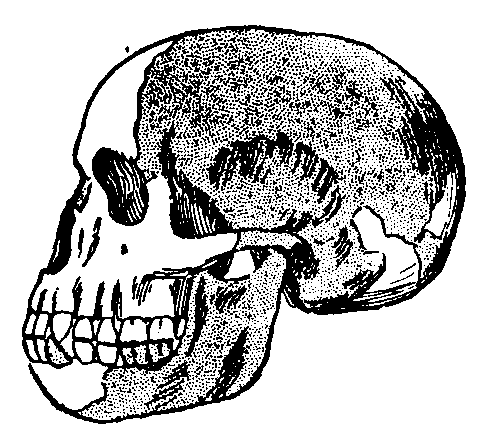
The Piltdown Skull.
As restored by Dr. Smith Woodward and Mr. Frank O'Barlow. The dark portions are those actually recovered.
During the last eighty years the discovery of a series of fossilized remains of extinct genera and species of the human family and of apes has given us a glimpse of the origin and early history of mankind. Man's ancestors probably parted company with those of the anthropoid apes somewhere in the neighbourhood of Northern India early in the Miocene period; and before the close of the Pliocene period their descendants had gradually acquired the highly developed brain and the intelligence which imply the emergence of the distinctively human characteristics. The most significant token of the attainment of the status of men was the acquisition of the power of speech, which enabled its possessors to hand on the accumulated knowledge and the fruits of experience, and so enormously to increase their powers. The earliest-known representative of the human family was the Ape-man, Pithecanthropus, who at the end of the Pliocene period wandered east as far as Java, where the fossilized remains of a skull were found thirty years ago by Professor Eugen Dubois. At a later date a much more highly developed type, one, moreover, that was much closer to the ancestry of modern men than the aberrant Ape-man of Java, wandered as far west as England, where a representative of this extinct genus was discovered by the late Mr. Charles Dawson in 1912 at Piltdown, in Sussex. This very primitive member of the human family has been called the 'Dawn-man' or Eoanthropus by Dr. Smith Woodward. He has a brain which, though poorly developed, is definitely human, but his face (and especially the jaws) retains considerable resemblance to that of an ape. Of the other fossilized remains of extinct varieties of the human family, the most important are those known respectively as Heidelberg man and Neanderthal man. The former is almost as old as the Piltdown man, and its former existence was revealed by the discovery in the Mauer Sands, near Heidelberg, in 1908, of a very massive and chinless jaw. At a much later date Europe was inhabited by a brutal species of mankind, Neanderthal man, which became extinct when in the Neoanthropic Age men of our own species made their way into Europe and completely superseded the less efficient Neanderthal species. The latter were men of vast strength, with short, clumsy, thick-set limbs, a stooping gait, thick neck, and a great flattened head with a coarse face. These people inhabited Europe in the days when the elephant and the woolly rhinoceros lived there; they made the rough stone implements known as Mousterian. But, in spite of their enormous strength, these people were not able to hold their own in competition with the nimbler wits and the more skilled hands of Homo sapiens, who introduced into Europe a more finished technique in making implements, and revealed his genius and manual dexterity in the remarkable pictures which he painted on the walls of caves, especially in Southern France and Northern Spain. We have no information concerning the place of origin or the course of the wanderings of these earliest members of our own species.
But an extremely primitive race has survived until the present time to demonstrate the original type of Homo sapiens. The aboriginal Australian, like all existing races of men, belongs to the same species as ourselves, but it represents with singularly little modification the original type and colouring of Homo sapiens. Fossilized remains of the proto-Australian race have been found in Queensland (at Talgai) and in Java (at Wadjak); but the wandering of the race from its original Asiatic centre of characterization is indicated by the survival of remnants of this people in the pre-Dravidian jungle tribes of India (mainly in the Deccan), the Vedda of Ceylon, the Sakai of the Malay Peninsula, the Toala of Celebes, and other peoples of the Malay Archipelago, whose existence blazes the track from India to Australia.
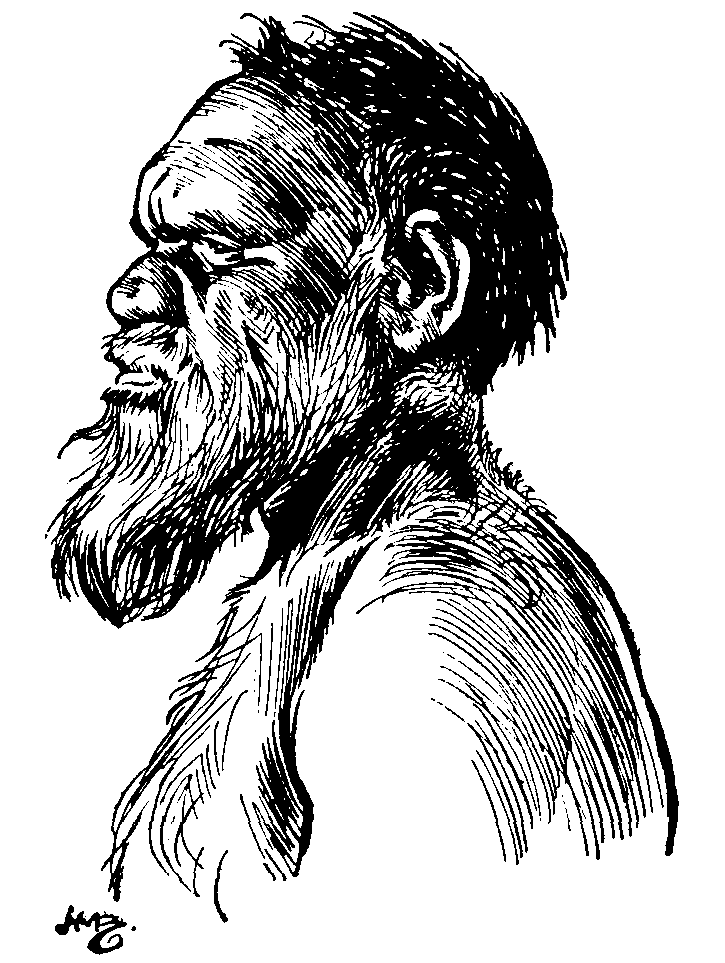
The Australian race is on the average about 5 feet 2 inches in height; their skin is dark-brown or black; hair black and wavy or curly; skull typically long (dolichocephalic), with a relatively small brain-case; the nose is flat and broad, and the jaws large and prominent. What lowly culture these people now possess has been mainly acquired within relatively recent times by contact with more civilized peoples.
Australian Aborigine, from east side of Lake Eyre.
Long after the proto-Australians separated from the rest of mankind and wandered east, another group wandered west, and, probably in tropical Africa, became specialized in structure to become the Negro race. The negro, like the Australian, retains many primitive characters, such as the black skin, and the small brain, but in other respects, such, for example, as the extremely flattened and curved hair ('pepper-corns'), he has become highly specialized and sharply differentiated from all other varieties of mankind. At an early period in the history of the race the negro divided into two groups—a pygmy variety or Negrillo, and the ordinary tall negro. One of the branches of the pygmy stock became further specialized in structure (in the course of which the black colour of the skin was lost), and became the Bushman race which has gradually been pushed into the deserts of South Africa (see Hottentot).
After the differentiation of the Negro race into pygmy and tall varieties, representatives of both divisions spread along the southern coast of Asia, the former, known in the East as Negritos, reaching the Andaman Islands, the Malay Peninsula (Semangs), the Philippines (Aetas), and New Guinea (Pygmies), and the taller Negroids to Melanesia, New Guinea, and the neighbouring islands of the Malay Archipelago. Many authorities regard the extinct Tasmanian people as a branch of this race.
But the vast majority of the Negro race is found in Africa south of the Sahara Desert and the populations sprung from them in the American continent and the West Indies.
The African negro is subdivided into two main groups known respectively as Nilotic and Bantu; but in addition there are the pygmies of the equatorial and Congo regions, and the Bushmen and Hottentots of the Kalahari Desert, Namaqualand, Lake Ngami, and the Orange River. The Nilotic negro ranges across the continent from Somaliland to Nigeria, and is differentiated from the Bantu chiefly from the fact that along this belt there has been a constant passing to and fro of Hamitic and Semitic peoples for many centuries, leading not only to very considerable recent racial admixture, but also to cultural and especially linguistic influences, which have brought about the breaking up of the population into a series of nations of varied speech and customs. Among the Bantus, on the other hand, although their culture is lower than that of the Nilotic negroes, there is more uniformity both of race and customs. In race they are negro mixed in early times with the proto-Hamitic peoples of East Africa, whence the mongrel population moved south, driving the Bushmen and Hottentots before them.
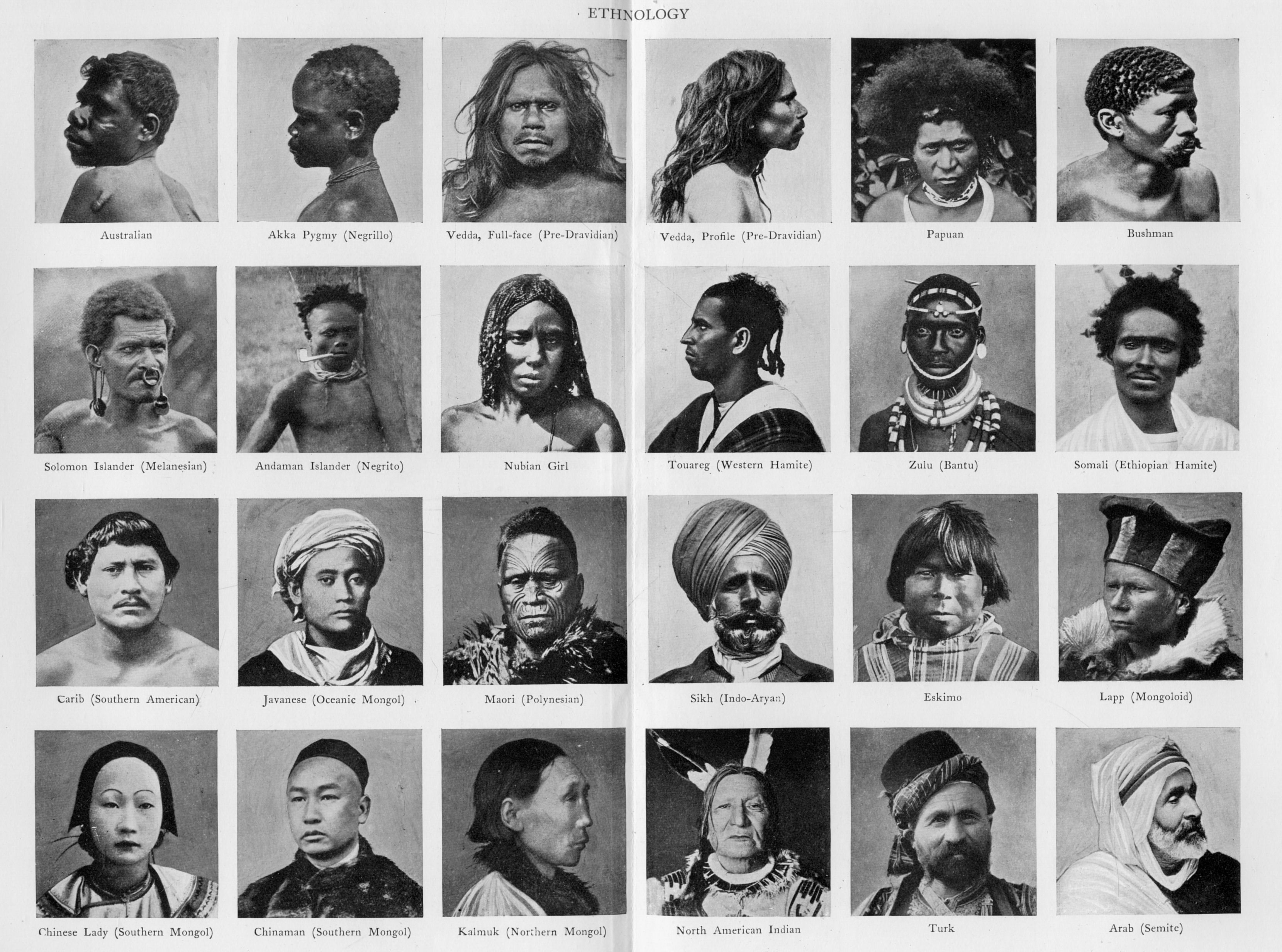
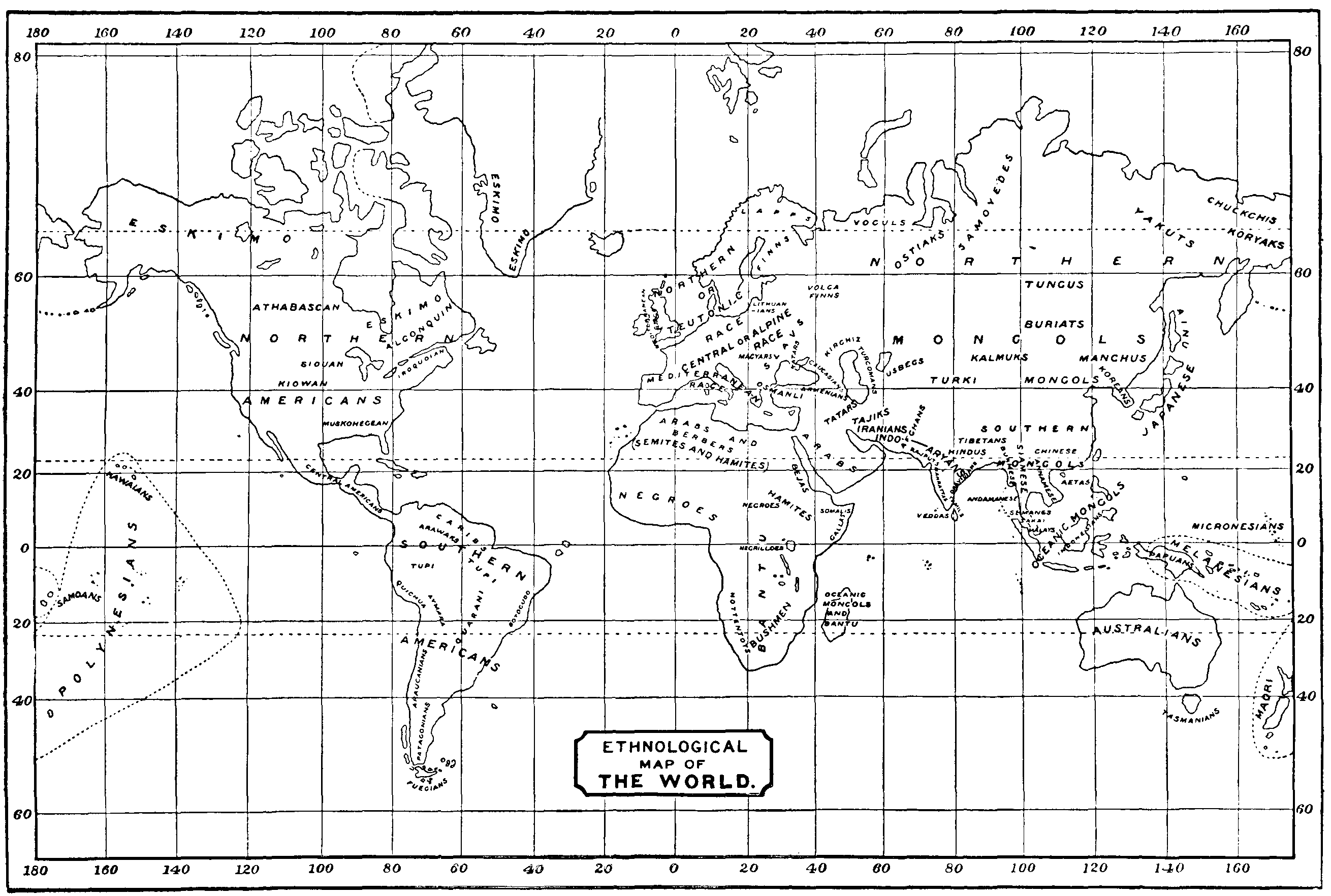
After the ancestors of the Australian and Negro races had separated from the rest of mankind, which had spread throughout a great part of Asia, North-Eastern Africa, and Europe, the coming of the Glacial epoch created barriers of ice which shut up the various groups each within its own domain. Somewhere in Eastern Asia, possibly in the basin of the Yellow River, the proto-Mongolian race gradually assumed its characteristic traits. In East Africa and the neighbouring tract of Asia the ancestors of the Brown or so-called Mediterranean race were free to roam east and west from India to the African and European coasts of the Atlantic. Farther north, probably in Europe, the Nordic or Blond race (in the map labelled Northern or Teutonic race) assumed its distinctive features; and somewhere in the region between its area of characterization and that of the Yellow race—probably in the region to the north-east of the Caspian—the so-called Alpine (Armenoid) or proto-Slav race developed. It is distinguished from the Brown and Blond races by the broad skull and heavy jaw, no less than by the robustness of build and the great tendency to hairiness; from the Mongolian people the Armenoids are distinguished by the prominence of the nose, the character of the hair, and the colour of the skin. The term Alpine, which is usually applied to this race, is singularly inappropriate; for, although in Europe and Asia Minor the members of this race show a partiality for high mountains, the vast majority of the members of the race dwell in the plains of Russia, which also may have been the original home of the race. In view of the topographical relationship of the area of characterization of this race to the homes of the other races, Nordic, Brown, Negro, Australian, and Mongol, arranged in a great arc around it, it might not be inappropriate to call the so-called Alpine (Armenoid or proto-Slav) race by the non-committal title 'Central'. At the close of the Glacial epoch, when the melting of the ice unlocked the domains of these races, members of the Central race poured into Asia Minor and Syria, and down to the head of the Persian Gulf; they also made their way north of the Caspian and Black Sea into Europe, mingling there with the Nordic people. But they also moved east in Siberia and mingled with the proto-Mongolian race. It was soon after this event that members of the proto-Mongolian stock, possibly with some admixture of people of the Central race, wandered to North-Eastern Asia and crossed the Behring Strait to colonize America for the first time. From the north-west coast of America these immigrants in course of time made their way south and east, until eventually the whole of the New World from Hudson Bay to Cape Horn was inhabited. Many centuries afterward (especially between 300 B.C. and A.D. 1000) there was a great influx of a variety of other peoples from Polynesia and the Old World on to the Pacific coast of the Americas, which profoundly altered the physical type of the population of Central America and the Andean coast.
The members of the proto-Mongolian race who remained in Asia spread over a large area from the Arctic Ocean south to Tibet, China, Indo-China and the Malay Archipelago, the Philippines, Formosa, Nicobar Islands, and Madagascar. Their domain became divided geographically into three minor areas of characterization, of the Northern, Southern, and Oceanic Mongols respectively. In the Northern Mongols are included the Koreans, the Japanese and the people of Liu-Kiu, the Tungus (including the Manchu, Gold, &c.), the Kalmuks, Buriats, Koryaks, Chuckchis, Kamchadales, Gilyaks.
The Central race became differentiated into a considerable number of varieties. Apart from the Slavs, there were several groups which became isolated the one from the other in Asia Minor and Syria. One of these developed in an extreme degree the characteristic features of the race—the brachycephaly, the prominence of the nose and the high-ramus of the jaw. These are the Armenian and kindred people. Another branch gave origin to the Northern Semites, who made their way into Palestine and Mesopotamia. (The Southern Semites belong to another race—the Brown.) Another branch of the Central race preceded these two in making their way to the sea-coasts of the Levant and the Persian Gulf—this may be called the Maritime branch of the Central race.
The Slav branch of the Central race was making its way into Europe long before the Neolithic phase of culture there. It passed north of the Black Sea via Poland. But at the end of the Neolithic phase there were two streams of other branches of the race—the true Alpine subdivision passing from Anatolia into the Carpathians and the Alps, to Switzerland, Bavaria, Savoy, and Brittany, and the Maritime division passing round the coasts to the Iberian Peninsula, the British Isles, and Western Europe.
The Brown race spread in East Africa from Somaliland to the Mediterranean and all its coasts, to Western Europe, and the British Isles; in the other direction to Arabia, the shores of the Persian Gulf, and eastward along the coast to India, where it mingled with the pre-Dravidian (proto-Australian) population to give rise to the mongrel Dravidian people. The spread of these Brown people farther east into the Malay Archipelago explains the origin of the Indonesians, who occupied the islands before the coming south of the Mongols, but after the proto-Australians and the proto-Negroes had passed through towards Australia and Melanesia respectively.
From very early times there has been an intermingling of the different races. In East Africa every degree of intermingling of the Hamitic branch of the Brown race has been taking place for more than sixty centuries with negroes, both of the Sudanese and the Bantu stocks. At a later time Arabs poured into Africa and added their quota to the mixture. In India the original pre-Dravidian (proto-Australian) aborigines became diluted with a large influx of the Brown race to form the Dravidian people, who acquired a high civilization from the west. At a later date people of the Central race speaking an Aryan language swarmed through the north-western frontier and introduced their language and culture into India.
Before this happened the Brown race had extended farther east and provided the basis for the population of Indonesia, supplanting to a great extent the earlier proto-Australian and Negroid peoples there. Then the Malays came down from the north and added to the Indonesian mixture a strong Mongolian element. Colonists from the Malay Archipelago settled in Madagascar and added to its mixture of Brown (Semites and Hamites) and Black (Bantu) elements representatives of the Mongolian (Malay) race. In the course of their maritime expeditions the Malay Archipelago gave to Japan a not inconsiderable contribution both of people and culture.
But the area of the most complex admixture of races in ancient times was Siberia. With the melting of the ice barriers at the close of the Glacial epoch the proto-Mongolian and proto-Central peoples came into intimate contact; and to this mixture was added a proto-Nordic element, as well as a not inconsiderable influx of members of the Brown race, who came from the south through Turkestan to exploit the gold and copper of the Yenesei region. The presence of their dolichocephalic skulls in a region where brachycephaly is the rule has been a perpetual puzzle to anthropologists, who at the present time attempt to solve the problem by assuming the presence of an aboriginal race of long-headed people, who were exterminated by the Mongols and the Turks. The greed for the riches of the head-waters of the Yenesei has made Siberia the home of strife for fifty centuries. This has led not only to a puzzling admixture of races in the affected area, but has started raids of Mongols and Turks, which at various times extended as far as Europe (Huns and Avars), India, and China. So mixed are the races in Siberia that it is not easy to determine whether some of them should be classed as mainly Turki or mainly Mongol; and this applies also to the colonies (Bulgars, Magyars, Finns, Lapps, &c.) which at various times the Asiatic invaders left behind them in Europe, each of which has been profoundly altered by admixture since then.
In the great Mongolian domain that occupies so great a part of Northern and Eastern Asia there are certain definitely alien elements. The Yakuts (of the region near the Lena River) are definitely Turki in race, and the curious hairy Ainus (of Yezo, Sakhalin, and some of the Kurile Islands) are certainly members of the Central race.
A peculiar branch of the northern Mongols is clearly differentiated from the rest to form the Eskimo people who occupy Greenland and Arctic America. They present a marked contrast to the American Indians. The American Indian may be regarded essentially as a branch of the proto-Mongolian race mixed to some extent with a proto-Central element. But on the Pacific littoral there has been considerable admixture with a variety of peoples from Eastern Asia and Oceania for several centuries (c. 300 B.C. to A.D. 1000). Although the peoples conform on the whole to a definite type as regards the characters of their hair and features, there is a considerable range of variation as regards height, skull-form, and other racial features. The people of the states where a high civilization prevailed ten centuries ago—Mexico, Central America, Peru, and Chile—are clearly differentiated from the rest of the American population by the more obtrusive evidence of admixture with Polynesian and Asiatic peoples. In addition to the peoples of the north-west coast (Haidas and Salish) and of the ancient civilizations (Mayas and Aztecs) of Central America and Mexico, the population of North America can be divided (see map) into the following tribes: (1) Athabascan, (2) Algonquin, (3) Iroquoian, (4) Siouan, (5) Shoshonean (in the map called 'Kiowan'), (6) Muskhogean, and (7) Pueblo (not indicated in the map, but in Arizona, north of Mexico).
In South America the centre of the ancient civilization was in the region of the Quichua (Inca) and Aymara peoples. The semi-civilized Chibcha people occupied the table-land of Bogota. To the south of Peru the coastal people (Araucanians) were to some extent influenced by the more highly civilized Incas to their north. The presence of gold in the Matto Grosso region of Brazil attracted men from Peru, and set in motion migrations of people towards the Rio de la Plata in the south and towards Venezuela in the north. Among the linguistically distinct peoples found in the latter area are the Tupi, Arawaks, and Caribs. A very primitive people, the Botocudo, occupy the eastern coast of Brazil south of the River San Francisco.
From the beginning man was a maker of implements of stone and bone: but for a vast number of centuries he was merely a hunter who did not attempt anything more in the way of industry. Civilization probably originated in the Nile Valley when men found barley growing there naturally, and discovered that it provided them with a supply of food which could maintain them throughout the year. When the population in the valley increased, so that the natural supply of barley became inadequate, men learned to imitate the inundation, and by scraping channels in the sand to render the desert fertile. Thus was agriculture and irrigation invented, and thus were men led to organize the labour of the community under the direction of a leader who was primarily an irrigation engineer, but eventually became a king and the god Osiris, the dead king, whose reputation as the bestower of life-giving water became apotheosized as the giver of life and immortality.
Pottery was probably invented as an outcome of the mode of life and the needs of these early agriculturists, and the domestication of cattle and the use of their milk for food helped to neutralize the ill-effects of a too exclusively cereal diet. Other events followed in the train of this first adoption of a settled mode of life. The disposal of the dead in the sands that fringed the area of cultivation, and the natural preservation of the corpse that often resulted, shaped the beliefs of the people with reference to the fate of the dead. Incidentally it led to the invention of the arts of the carpenter, the stone-mason, and the embalmer; and as an outcome of these practices architecture, as well as the ritual of the temple, had its origin.
Long before these events primitive man had begun to ponder over the meaning of death. At first he associated it with such injuries as he had learned by experience killed animals that he hunted; and as the escape of blood caused unconsciousness and death, he framed the belief that blood was the substance of consciousness and of life. To exchange blood was to share knowledge; to give blood was to confer fresh vital substance, i.e. to minimize the risk of extinction or prolong the existence of living or dead. This is the fundamental idea underlying all religious belief and ritual—the giving of life and immortality.
But the act of birth is also a process of life-giving. The cowrie-shell (and subsequently other shells and the pearls contained in them) came to be regarded as a symbol of this life-giving power, and an amulet which could protect both the living and the dead from the risk of extinction. The demand for these precious elixirs of life became so intense that they acquired a fictitious value as currency, and models of them were made to serve as amulets in their stead. The beauty and the lightness of the models of such shells made of the soft useless plastic metal found in the Egyptian and Nubian deserts was probably the means by which gold first acquired any value, and afterwards by confusion came to be credited with the same life-giving attributes as were at first bestowed merely upon the form of the amulets made from it. Thus gold came to be regarded as an elixir of life, and men began to search for the precious substance far and wide, incidentally spreading abroad the germs of the arts and crafts, the beliefs and practices of our common civilization. The use of malachite as a cosmetic provided the circumstances that eventually led men to discover how a gold-like substance, copper, could be obtained from the green ore; and in course of time it came to be realized that the metal was useful for other purposes than the mere making of amulets and jewellery. When the full value of copper as a material for making tools and weapons was fully appreciated, the ore became of tremendous economic importance, and men sought for it far and wide, as they had previously prospected for flint and gold.
The people who introduced the Neolithic culture into Europe brought with them from Egypt a knowledge of agriculture, of pottery-making, of domestication of animals, of linen, and of the characteristic burial customs and religious beliefs. But these rudiments of civilization were also diffused to Crete and Cyprus, to Syria and Asia Minor, to Elam and Sumer by prospectors searching for the things which the growth of civilization was making valuable, the incense and the timber, the gold and precious stones, the copper and other metals. It is probable that the germs of Egyptian civilization were first planted in Elam by men prospecting for copper, and that Sumerian and Babylonian civilization received their initial inspiration in this way. Crete was inoculated with the germs of civilization by Egypt directly, as well as indirectly, from Asia Minor, which was subjected to the double influence of Egyptian and Sumerian culture. In the Age of Copper, Elamite culture was diffused abroad by miners to Turkestan and Baluchistan, thence respectively to Siberia and China (Shensi province), and to India. In the neighbourhood of the south-eastern corner of the Caspian the alloy bronze was probably invented soon after 3000 B.C. by mixing tin and copper; and the influence of this epoch-making event rapidly spread to Babylonia, to Crete, and to Europe, where it inaugurated the Age of Bronze. It also spread to China, to India, and many centuries later across the Pacific to Central America.
The needs of the early Egyptians compelled them to devise sea-going ships, which in turn became the models of the Cretans, the people of East Africa, the Babylonians, the Phœnicians, and the Greeks. These ships trafficked in the Eastern Mediterranean and the Red Sea, then farther west and east, to the Atlantic seaboard of Western Europe and the shores of the Indian Ocean. The search for gold and pearls led early mariners to Southern India and Ceylon, to Burmah and Indonesia, to the whole coast-line of Eastern Asia, New Guinea, and Melanesia, and in course of time to Polynesia and the coasts of Central America and Peru. Wherever these adventurers found gold or copper, pearls or precious stones, they settled to exploit these sources of wealth, and incidentally planted the germs of their methods of cultivation, their stonework, their burial customs and beliefs. Such expeditions were probably responsible for introducing into Polynesia its first colonists, a mixture of people of Brown and Maritime Central races, mingled with other elements in the course of their easterly wanderings. The earliest movement into Polynesia apparently took with it a considerable element of Melanesian blood, which eventually was carried to New Zealand and the Moriori Islands in the south, and to Easter Island and the American coast in the east. The germs of the ancient civilizations of Central America and Peru were carried across the Pacific from Cambodia and Indonesia between the years 300 B.C. and A.D. 1000, the periods of greatest activity being probably the third and fourth centuries A.D.
The elements of this imported culture were planted in Honduras and Guatemala and the Isthmus region (Costa Rica, Panama, and Colombia), and from there spread in the fifth century A.D. to Yucatan and then to Mexico. It also spread from the isthmus down the Pacific littoral of South America, the earliest centre of civilization being the region around Lake Titicaca. From Mexico the culture spread in a degraded form up the Mississippi to the Great Lakes, as well as north-west into Arizona.—Bibliography: A. H. Keane, Man, Past and Present, revised edition by A. Hingston Quiggin and A. C. Haddon, is a useful guide to the literature of anthropology and ethnology; see also Robert Munro, Prehistoric Britain; W. J. Sollas, Ancient Hunters and their Modern Representatives; M. Boule, Les Hommes fossiles; G. Elliot Smith, The Migrations of Early Culture; such periodicals as the Journal of the Royal Anthropological Institute, Man, and especially L'Anthropologie, give the current literature.
Eth´yl, the name given to the radicle C2H5, contained in ether, (C2H5)2O, alcohol, C2H5OH, &c. Ethyl has not been isolated, as it immediately combines with another ethyl group forming diethyl or butane, C2H5—C2H5. Ethyl chloride, C2H5Cl, formed by the action of hydrochloric acid on alcohol, is much used for the production of low temperature—as a local anæsthetic. Ethyl nitrite, C2H5NO2, constitutes sweet spirits of nitre when dissolved in alcohol.
Eth´ylamine, C2H5NH2, an organic base formed by the substitution of 1 atom of hydrogen in ammonia by ethyl group. Thus ammonia ethylamine. It has the odour and many of the characteristic reactions of ammonia, but unlike ammonia it is inflammable and liquid at ordinary temperature.
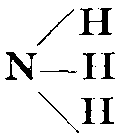

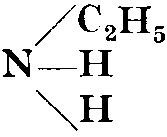
Eth´ylene, or Olefiant Gas, C2H4, an unsaturated hydrocarbon, the first member of the olefine series. It is a colourless gas with a faint odour, and burns with a bright luminous flame. It is a constituent of ordinary coal-gas, and may be obtained from alcohol by heating it with twice its volume of concentrated sulphuric acid.
Étienne (ā-ti-ān), St., a town of Southern France, department of Loire, on the Furens, 32 miles S.W. of Lyons. It has spacious streets with substantial houses, but, owing to the number of public works, presents a dingy appearance. The principal buildings and institutions are the cathedral, an ancient Romanesque structure; the town house, court-house, exchange, communal college, mining school, gallery of arts, library, and museum. The town stands in the centre of one of the most valuable mineral fields of France; and in addition to the extensive collieries, blast-furnaces, and other ironworks in the vicinity, has manufactures of ribbons, silks, cutlery, and fire-arms. Pop. 148,656.
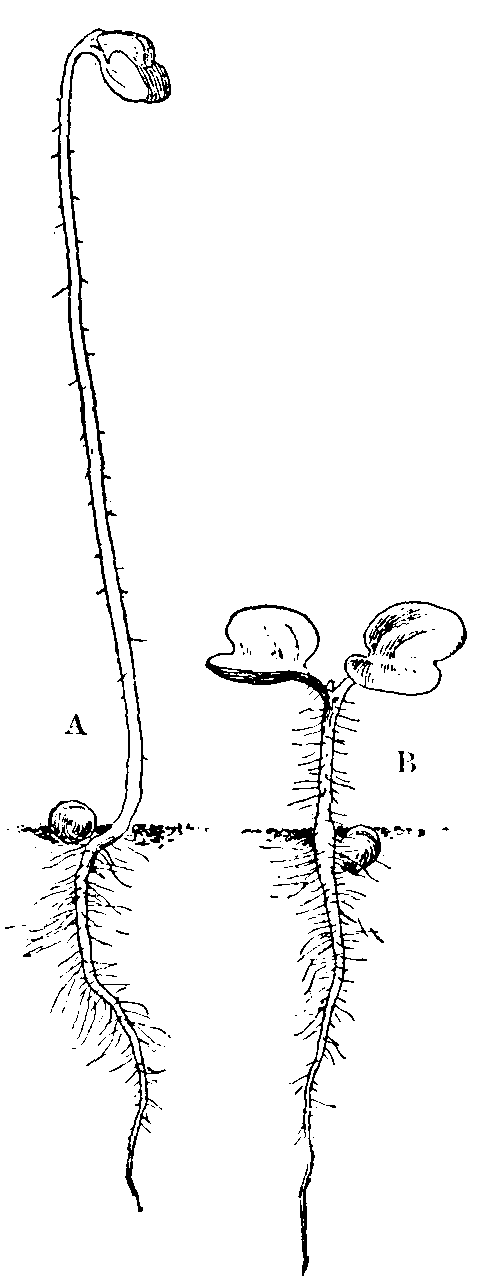
Two Seedlings of
Sinapis alba
of Equal Age
A, Grown in the dark, etiolated.
B, Grown in ordinary daylight, normal. The roots bear root-hairs.
Etiolation (Fr. étioler, to blanch), or Blanching, of plants, is a state produced by the absence of light, by which the green colour is prevented from appearing. It is effected artificially, as in the case of celery, by raising up the earth about the stalks of the plants; by tying the leaves together to keep the inner ones from the light; by covering with pots, boxes, or the like, or by setting in a dark place. The green colour of etiolated plants may be restored by exposure to light. Etiolated plants are also abnormal in other respects; the stems, or in some cases the leaves, become extraordinarily elongated, and the internal structure undergoes modification in various ways.
Etiology (Gr. aitia, cause, and logos, discourse, account), a biological term introduced by Huxley, and denoting that branch of biology which deals with the origin and mode of development of organic beings. In medicine the word etiology, signifies the study of the causes and origin of disease. The term is also applied in philosophy to the science of Cause and Effect.
Etive (et´iv), Loch, an inlet of the sea on the west coast of Scotland, Argyleshire, nearly 20 miles long, of very unequal breadth, but at the broadest part about 1½ miles. The scenery of its shores is very beautiful. About 3 miles from the sea, at Connel Ferry, a ridge of sunken rocks crossing it causes a turbulent rapid, which at half-tide forms a sort of waterfall.
Etna, or Ætna, Mount, the greatest volcano in Europe, a mountain in the province of Catania in Sicily; height, 10,758 feet. It rises immediately from the sea, has a circumference of more than 100 miles, and dominates the whole north-east part of Sicily, having a number of towns and villages on its lower slopes. The top is covered with perpetual snow; midway down is the woody or forest region; at the foot is a region of orchards, vineyards, olive groves, &c. Etna thus presents the variety of climates common to high mountains in lower latitudes, oranges and lemons and other fruits growing at the foot, the vine rather higher up, then oaks, chestnuts, beeches, and pines, while on the loftiest or desert region vegetation is of quite a stunted character. A more or less distinct margin of cliff separates the mountain proper from the surrounding plain; and the whole mass seems formed of a series of superimposed mountains, the terminal volcano being surrounded by a number of cones, all of volcanic origin, and nearly 100 of which are of considerable size. The different aspects of the mountain present an astonishing variety of features—woods, forests, pastures, cultivated fields, bare rocky precipices, streams of lava, masses of ashes and scoriæ, as also picturesque towns and villages. From the summit the view presents a splendid panorama, embracing the whole of Sicily, the Lipari Islands, Malta, and Calabria. The eruptions of Etna have been numerous, and many of them destructive. That of 1169 overwhelmed Catania and buried 15,000 persons in the ruins. In 1669 the lava spread over the country for forty days, and 10,000 persons are estimated to have perished. In 1693 there was an earthquake during the eruption, when over 60,000 lives were lost. One eruption was in 1755, the year of the Lisbon earthquake. There were also eruptions in 1832, 1865, 1874, 1879, and 1886. Among more recent eruptions are those of 1892, 1899, 1911, and 1914. An eruption is ordinarily preceded by premonitory symptoms of longer or shorter duration. The population of the district of Etna is about 300,000.
E´ton, a town of England, in Buckinghamshire, on the left bank of the Thames, 22 miles west of London. An iron bridge connects it with Windsor, on the opposite side of the river. Eton derives its celebrity wholly from its college, called the King's College of Our Lady of Eton beside Windsor, one of the great public schools of England, founded by Henry VI in 1440. The building, which was commenced in 1441 and finished in 1523, has received important additions in recent times in the shape of mathematical and science schools, and a museum. The college foundation now consists of provost, headmaster, lower master, seventy scholars, and two conducts (or chaplains). The oppidans, or boys not on the foundation, number about 1100. They are mostly lodged and boarded in the masters' houses. Pop. 3366.
Etrépilly, (1) a small town of France, department of Aisne, is situated near Château-Thierry. Millstones are obtained from quarries in the neighbourhood. (2) A small town of France, department of Seine-et-Marne, stands on the left bank of an affluent of the Marne. Agricultural implements are manufactured.
Etru´ria (Gr. Tyrrhenia), the name anciently given to that part of Italy which corresponded partly with the modern Tuscany, and was bounded by the Mediterranean, the Apennines, the River Magra, and the Tiber. The name of Tusci or Etrusci was used by the Romans to designate the race of people anciently inhabiting this country, but the name by which they called themselves was Rasena (or perhaps more correctly Ta-rasena). These Rasena entered Italy at a very early period from the north, and, besides occupying Etruria proper, extended their influence to Campania, Elba, and Corsica. Etruria proper was in a flourishing condition before the foundation of Rome, 753 B.C. It was known very early as a confederation of twelve great cities, each of which formed a republic by itself. Amongst the chief were Veii, Clusium, Volsinii, Arretium, Cortona, Falerii, and Faesulae; but the list may have varied at different epochs. The chiefs of these republics were styled lucumōnes, and united the office of priest and general. They were elected for life. After a long struggle with Rome, the Etruscan power was completely broken by the Romans in a series of victories, from the fall of Veii in 396 B.C. to the battle at the Vadimonian Lake (283 B.C.). The Etruscans had attained a high state of civilization. They carried on a flourishing commerce, and at one time were powerful at sea. They were less warlike than most of the nations around them, and had the custom of hiring mercenaries for their armies. Of the Etruscan language little is known, although about 6000 inscriptions have been preserved. It was written in characters essentially the same as the ancient Greek. The Etruscans were specially distinguished by their religious institutions and ceremonies, which reveal tendencies gloomy and mystical. Their gods were of two orders, the first nameless, mysterious deities, exercising a controlling influence in the background on the lower order of gods, who manage the affairs of the world. At the head of these is a deity resembling the Roman Jupiter (in Etruscan Tinia). But it is characteristic of the Etruscan religion that there is also a Vejovis or evil Jupiter. The Etruscan name of Venus was Turan, of Vulcan Sethlans, of Bacchus Phuphluns, of Mercury Turms. Etruscan art was in the main borrowed from Greece. For articles in terra-cotta, a material which they used mainly for ornamental tiles, sarcophagi, and statues, Etruscans were especially celebrated. In the manufacture of pottery they had made great advances; but most of the painted vases popularly known as Etruscan are undoubtedly productions of Greek workmen. The skill of the Etruscans in works of metal is attested by ancient writers, and also by numerous extant specimens, such as necklaces, ear-rings, and bracelets. The bronze candelabra, of which many examples have been preserved, were eagerly sought after both in Greece and Rome. A peculiar manufacture was that of engraved bronze mirrors. These were polished on one side, and have on the other an engraved design, taken in most cases from Greek legend or mythology. The Etruscans showed great constructive and engineering skill. They were acquainted with the principle of the arch, and the massive ruins of the walls of their ancient cities still testify to the solidity of their constructions. Various arts and inventions were derived by the Romans from the Etruscans.—Bibliography: G. Dennis, Cities and Cemeteries in Etruria; Seymour, Up Hill and Down Dale in Ancient Etruria.
Etruria, a village of England, in Staffordshire, between Hanley and Burslem, famous as the place where Josiah Wedgwood established his pottery works in 1769. Pop. 8056.
Etruria, Kingdom of, in Italy, founded by Napoleon I in 1801. Its capital was Florence. In 1807 Napoleon incorporated it with the French Empire.
Etruscan Pottery (from Veii)
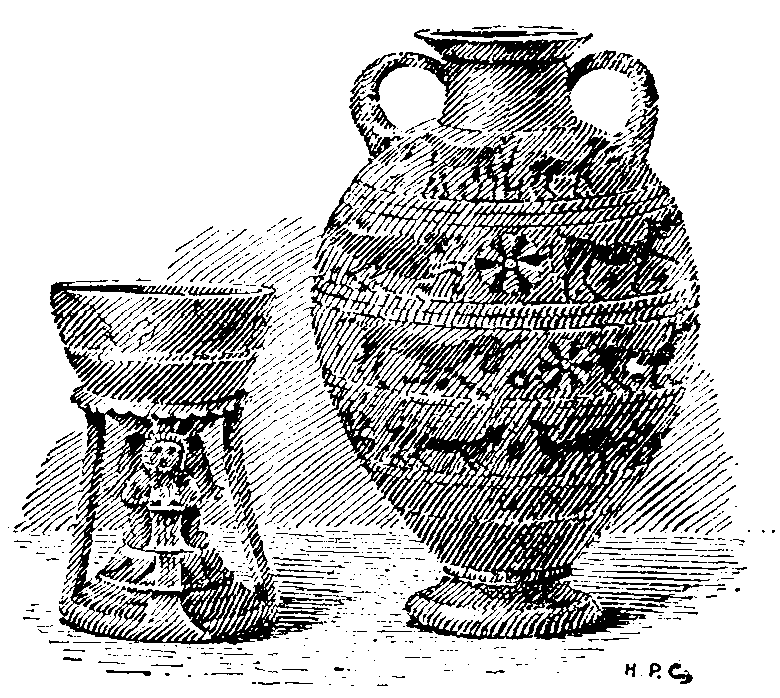
Etruscan Vases, a class of beautiful ancient painted vases made in Etruria, but not strictly speaking a product of Etruscan art, since they were really the productions of a ripe age of Greek art, the workmanship, subjects, style, and inscriptions being all Greek. They are elegant in form and enriched with bands of beautiful foliage and other ornaments, figures and similar subjects of a highly artistic character. One class has black figures and ornaments on a red ground—the natural colour of the clay; another has the figures left of the natural colour and the ground painted black. The former class belong to a date about 600 B.C., the latter date about a century later, and extend over a period of about 300 or 350 years, when the manufacture seems to have ceased. During this period there was much variety in the form and ornamentation, gold and other colours besides the primitive ones of black and red being frequently made use of. The subjects represented upon these vases frequently relate to heroic personages of the Greek mythology, but many scenes of an ordinary and even of a domestic character are depicted. The figures are usually in profile: temples are occasionally introduced; and many curious particulars may be learned from these vase pictures regarding the Hellenic ritual, games, festivities, and domestic life.
Ett´rick, a pastoral district of Scotland, in Selkirkshire, watered by the Ettrick, and anciently part of Ettrick Forest, which included Selkirk with parts of Peebles and Edinburgh. The Ettrick receives the Yarrow 2 miles above Selkirk, and enters the Tweed 3 miles below. The Ettrick Shepherd, the Scottish poet James Hogg, was a native of this district.
Etty, William, an English painter, born in 1787, died in 1849. He studied at the Royal Academy, worked long without much recognition, but at length in 1820 he won public notice by his Coral Finders. In 1828 he was elected an academician. Among his works, which were greatly admired, are a series of three pictures (1827-31) illustrating the Deliverance of Bethulia by Judith, Benaiah (one of David's mighty men), and Women Interceding for the Vanquished. All these are very large pictures, and are now in the National Gallery of Scotland (Edinburgh). Others of note are: The Judgment of Paris; The Rape of Proserpine; and Youth at the Prow, and Pleasure at the Helm. Etty especially excelled at painting undraped figures.
Etymol´ogy (Gr. etymos, true, and logos, account), a term applied (1) to that part of grammar which treats of the various inflections and modifications of words and shows how they are formed from simple roots; (2) to that branch of philology which traces the history of words from their origin to their latest form and meaning. Etymology in this latter sense, or the investigation of the origin and growth of words, is amongst the oldest of studies. Plato and other Greek philosophers, the Alexandrian grammarians, the scholiasts, the Roman Varro, and others wrote much on this subject. Their work, however, is made up of conjectures at best ingenious rather than sound, and very often wild and fantastic. It was not till recent times, and particularly since the study of Sanskrit, that etymology has been scientifically studied. Languages then began to be properly classed in groups and families, and words were studied by a comparison of their growth and relationship in different languages. It was recognized that the development of language is not an arbitrary or accidental matter, but proceeds according to general laws. The result was a great advance in etymological knowledge and the formation of a new science of philology.—Cf. W. W. Skeat, The Science of Etymology.
Eu (eu), a town in Northern France, department of Seine-Inférieure, about 17 miles north-east of Dieppe. It is notable for its old twelfth-century church and the celebrated Château d'Eu, part of which was destroyed in 1902. Pop. 4900.
Eubœ´a, formerly called Negropont, a Greek island, the second largest island of the Ægean Sea. It is 90 miles in length; 30 in greatest breadth, reduced at one point to 4 miles. It is separated from the mainland of Greece by the narrow channels of Egripo and Talanta. It is connected with the Bœotian shore by a bridge. There are several mountain peaks over 2000 feet in height, and one over 7000 feet. The island is well-wooded and remarkably fertile. Wine is a staple product, and cotton, wool, pitch, and turpentine are exported. The chief towns are Chalcis and Karysto. The island was anciently divided among seven independent cities, the most important of which were Chalcis and Eretria, and its history is for the most part identical with that of those two cities. With some small islands it forms a modern nomarchy, with a pop. of 116,900.
Eubu´lus, a Greek comic poet, who flourished at Athens about 375 B.C. His subjects were chiefly mythological, and he delighted in ridiculing the tragic poets, especially Euripides.
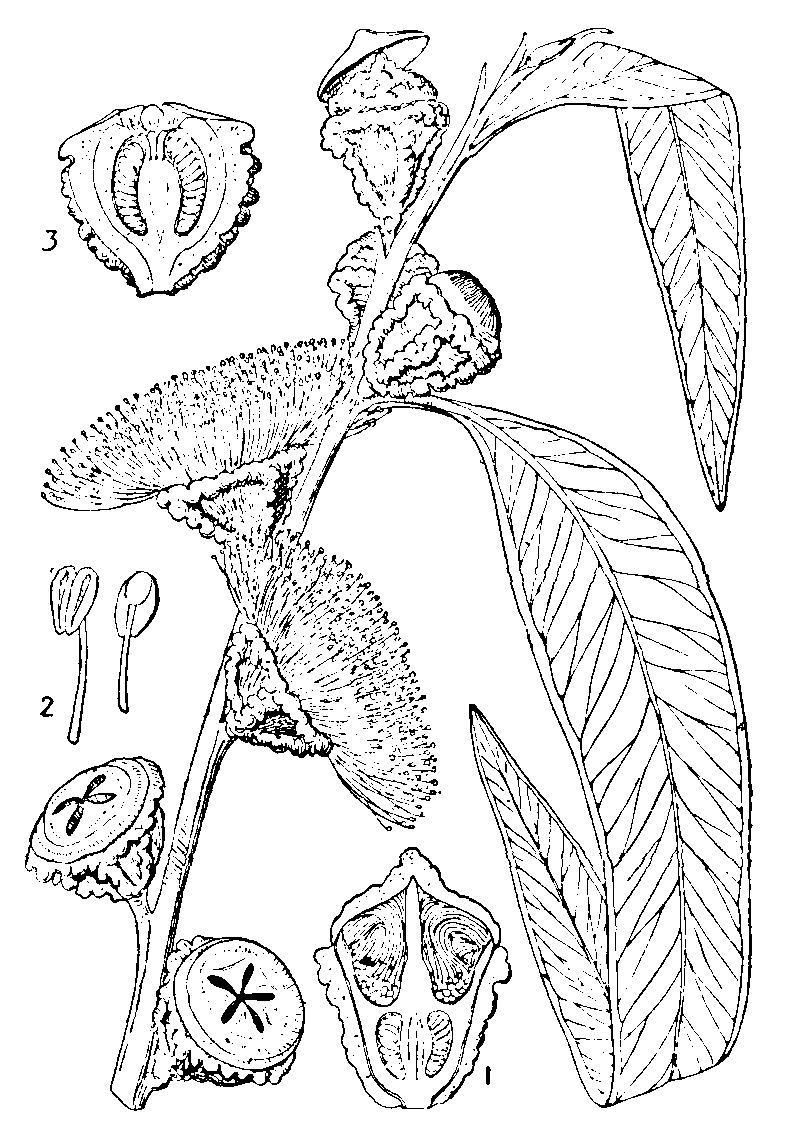
Eucalyptus globulus
1, Section of unopened flower. 2, Anthers. 3, Section of fruit.
Eucalyp´tus, a genus of trees, nat. ord. Myrtaceæ, mostly natives of Australia, and remarkable for their gigantic size, some of them attaining the height of 480 or 500 feet. In the Australian colonies they are known by the name of gum trees, from the gum which exudes from their trunks; individual species are known as 'stringy bark', 'iron bark', karri, or jarrah. The wood of some is excellent for building and many purposes. The E. globŭlus, or blue gum, yields an essential oil which is valuable as a febrifuge, antasthmatic, and antispasmodic. The medicinal properties of this tree also make it useful as a disinfectant, and as an astringent in affections of the respiratory passages, being employed in the form of an infusion, a decoction, or an extract, and cigarettes made of the leaves being also smoked. The E. globŭlus and the E. amygdalina are found to have an excellent sanitary effect when planted in malarious districts such as the Roman Campagna, parts of which have already been reclaimed by their use. This result is partly brought about by the drainage of the soil (the trees absorbing great quantities of moisture), partly perhaps by the balsamic odour given out. E. mannifĕra and others yield a sweet secretion resembling manna. Some, especially E. rostrata, yield a kind of gum kino. The Eucalyptus has been introduced with success into India, Palestine, Algiers, and Southern France.
Eucharist (ū´ka-rist; Gr. eucharistia, from eu, well, and charis, grace), a name for the sacrament of the Lord's Supper, in reference to the blessing and thanksgiving which accompany it.
Eucharistic Congresses, gatherings of the Roman Catholic clergy and laity, held with the object of glorifying the Sacrament of the Eucharist, were inaugurated by Bishop de Sègur, of Lille. The first congress, held in that city (1881) excited little but local interest; but the movement rapidly developed, succeeding congresses being held at Avignon (1882), Liège (1883), Paris (1888), Jerusalem (1893), Lourdes (1899), Rome (1905), and elsewhere. In 1908 the congress held in London was attended by Cardinal Vannutelli, the first Papal legate to visit England for three centuries, by six other cardinals, fourteen archbishops, and seventy bishops. A proposal to carry the Sacrament through London in procession aroused much opposition, and the project was abandoned on the personal intervention of Mr. Asquith, then Premier.
Euchre (ū´kėr), a card-game very popular in America, is usually played by two or four persons. After the cut for deal five cards are dealt (either by twos and threes or by threes and twos) to each player, and the uppermost card of those undealt is turned up for trump. The first player has the option either to 'order up' (namely to make this card trump) or to pass. In the latter case it is left to the next player to decide if he will play first or pass, and so on till the turn of the dealer comes. He must either play on this trump or turn it down, when all the players have again in turn their choice of making a new trump or passing. If a trump is 'ordered up' or taken in the first round, the dealer may take it into his cards, discarding in its place his poorest card. If the player who elects to play wins five tricks, he counts two; if he wins three tricks, he counts one; if he wins fewer than three tricks, he is euchred, and each independent opponent counts two. The cards rank as at whist, except that the knave of the trump suit, called the right bower (from the Ger. bauer, a peasant), is the highest card, the knave of the other suit of the same colour being the second highest.
Eucken, Rudolf Christoph, German philosopher and theologian, born in East Friesland in 1846. Educated at the Universities of Göttingen and Berlin, he was professor of philosophy at Basel from 1871 to 1874, when he obtained a similar appointment at Jena. Opposed both to utilitarianism and positivism. Eucken is one of the leaders of those German philosophers who maintain that the spiritual interests of man should be taken into consideration, and oppose the philosophic systems which treat life only from the physical and biological points of view. His spiritualistic philosophy has found many adherents, and his works are very popular. In 1908 he won the Nobel prize for literature, and in 1910 he was made a D.D. of the University of Glasgow. His works include: The Life of the Spirit (1909), The Problem of Human Life as viewed by the Great Thinkers (1909), The Meaning and Value of Life (1909), Main Currents of Modern Thought (1911), Life's Basis and Life's Ideal (1911), Can we still be Christians? (1913).
Euclid (Eucleidēs), of Alexandria, a distinguished Greek mathematician, who flourished about 300 B.C. His Stoicheia (Elements of Geometry), in thirteen books, are still extant, and form the most usual introduction to the study of geometry. The work was known to the Arabs, translations of it having appeared in the time of Harun-al-Rashid and of Al-Mamun. It was translated from the Arabic into Latin by Adelard of Bath, and an English translation from the Latin appeared in 1570. The severity and accuracy of Euclid's methods of demonstration have as a whole never been surpassed. Besides the Elements, some other works are attributed to Euclid.—Cf. R. S. Heath, The Thirteen Books of Euclid's Elements.
Euclid (Eucleidēs), of Megara, an ancient Greek philosopher, the founder of the Megaric school of philosophy, and a pupil of Socrates.
Eudiom´eter (Gr. eudios, serene), an instrument originally designed for ascertaining the purity of the air or the quantity of oxygen it contains, but now employed generally in the analysis of gaseous mixtures. It consists of a graduated glass tube, either straight or bent in the shape of the letter , hermetically sealed at one end and open at the other. Two platinum wires, intended for the conveyance of electric sparks through any mixture of gases, are inserted through the glass near the closed end of the tube, and approach but do not touch each other. To determine the proportion of oxygen in a given specimen of air, hydrogen is introduced into the tube with a measured volume of the air, and the mixture is fired by an electric spark. Water is formed, and the quantity of oxygen can be estimated from the diminution of volume. In a mixture of gases, chemical absorbents may be used to remove the gases one by one, the amounts present being determined by the successive changes of volume.

Eugene (ū-jēn´), or François Eugène, Prince of Savoy, fifth son of Eugène Maurice, Duke of Savoy-Carignan, and Olympia Mancini, a niece of Cardinal Mazarin. He was born at Paris 18th Oct., 1663, and died in Vienna 21st April, 1736. Offended with Louis XIV, he entered the Austrian service in 1683, serving his first campaign as a volunteer against the Turks. Here he distinguished himself so much that he received a regiment of dragoons. Later, at the sieges of Belgrade and Mayence, he increased his reputation, and on the outbreak of war between France and Austria he received the command of the Imperial forces sent to Piedmont to act in conjunction with the troops of the Duke of Savoy. At the end of the war he was sent as commander-in-chief to Hungary, where he defeated the Turks at the battle of Zenta (11th Sept., 1697). The War of the Spanish Succession brought Eugene again into the field. In Northern Italy he outmanœuvred Catinat and Villeroi, defeating the latter at Cremona (1702). In 1703 he commanded the Imperial army in Germany, and in co-operation with Marlborough frustrated the plans of France and her allies. In the battle of Blenheim, Eugene and Marlborough defeated the French and Bavarians under Marshal Tallard, 13th Aug., 1704. Next year Eugene, returning to Italy, forced the French to raise the siege of Turin, and in one month drove them out of Italy. During the following years he fought on the Rhine, took Lille, and, in conjunction with Marlborough, defeated the French at Oudenarde (1708), and Malplaquet (1709), where he himself was dangerously wounded. After the recall of Marlborough, which Eugene opposed in person at London, without success, and the defection of England from the alliance against France, his further progress was in a great measure checked. In the war with Turkey, in 1716, Eugene defeated two superior armies at Peterswardein and Temesvar, and, in 1717, took Belgrade, after having gained a decisive victory over a third army that came to its relief. During fifteen years of peace which followed, Eugene served Austria as faithfully in the Cabinet as he had done in the field. He was one of the great generals of modern times.—Cf. G. B. Malleson, Prince Eugene of Savoy.
Euge´nia (so named in honour of Prince Eugene), a genus of Myrtaceæ, nearly related to the myrtle. It contains numerous species, some of which produce delicious fruits. Cloves are the dried flower-buds of E. caryophyllata.
Eugenics has been defined as "the study of agencies under social control that may improve or impair the racial qualities of future generations, either physically or mentally". It is concerned with the investigation of the physical, mental, and moral traits of mankind, and especially with the factors of inheritance of desirable and undesirable qualities. The interest in the subject is largely due to the untiring zeal of the late Sir Francis Galton, who devoted most of his life to the study of the manifold problems that came within the scope of 'eugenics', and, in accordance with the terms of his will (1908), founded the Galton Chair of Eugenics in the University of London. The library and laboratory of the Galton benefaction form part of the Department of Applied Statistics, under the direction of Professor Karl Pearson, F.R.S., at University College, London, who is also the editor of the journal Biometrika, which is devoted to the statistical side of the problems of anthropology and heredity. The aim of the Galton laboratory is to collect material relating to human heredity, and to investigate its significance; and also to extend the knowledge of eugenics by professional instruction, lectures, publications, and experimental work. The scope of its activities will best be appreciated by the study of such works as the late Sir Francis Galton's Natural Inheritance (1889) and Essays in Eugenics (1909), and Professor Karl Pearson's Groundwork of Eugenics (1909), Practical Problems of Eugenics (1909), and State of National Eugenics (1909). The Treasury of Human Inheritance, issued in parts from the Galton laboratory, is a monumental record of facts relating to the hereditary transmission of human qualities. The Eugenics Education Society, under the presidency of Major Leonard Darwin, has for its aim the stimulation of public interest in the subject, and the discussion of the problems of heredity. It issues a journal, The Eugenics Review, now in its twelfth year.
It has long been known that by means of careful selection of parents it was possible to breed horses, cattle, dogs, &c., and a great variety of food- and flowering-plants, with desirable qualities highly developed. But it is obvious that such direct methods cannot be applied to human beings for the purpose of breeding men and women with special traits. What the eugenic societies aim at doing is to educate the people to realize the far-reaching effects of the inheritance of good or bad qualities, in the hope that such knowledge may exert some influence in the choice of partners in matrimony. But their efforts are especially directed to the exposure of the disastrous results that may ensue from the contamination of a family by the intermarriage of one of its members with an individual subject to some hereditary defect of a physical, mental, or moral nature.
The study of eugenics is intimately related to a wide range of subjects: to genetics, which explains the laws that govern the heredity of specific traits in man, and suggests certain practical applications of the rules of breeding to race improvement by cutting off undesirable strains and by selecting mates desirable from the eugenic standpoint; to the study of biographies of individuals and the genealogies of families, for the purpose of obtaining data for the investigation of the working of inheritance; to anthropology, history, and archæology, law and politics, economics and sociology, medicine and psychology, and statistical science.
The tremendous stimulus which the rapid development of eugenics has given to the wider recognition of the significance of heredity in human affairs has tended to obscure the importance of social environment and individual experience, especially in children of tender age, in shaping the attitude of the individual. Education is a vastly more important factor—the manner and attitude of the teacher, rather than the subject-matter of his or her lessons—than the eugenic enthusiasts, with their over-emphasis on the dominance of hereditary influences, are willing to admit. In the causation of many diseases, commonly reputed to be hereditary, such as tuberculosis and certain forms of insanity, the social and physical circumstances probably play a more important part than heredity in determining the onset of the illness, even when some undoubted hereditary aptitude to fall a victim to one or other of these affections is admitted. In no branch of medicine or sociology is this fallacy more fruitful of error than in the domain of mental disease. Apart from certain physical defects of the nervous system and specific infections, such as syphilis, the causes of mental alienation are to be sought rather in some maladjustment to the individual's social circumstances, often the result of some emotional disturbance, even in early childhood, which created the attitude of mind that eventually determined the mental conflict expressed by the insanity. The study of the effects of the strain of war has shown that anxiety, if sufficiently intense and prolonged, can produce mental disturbance in anyone, whatever his heredity and antecedents. By over-emphasizing the importance of inheritance in the causation of such conditions as insanity and epilepsy, and ignoring the effects of the profound social disturbance an insane parent may inflict upon any home, and especially upon the impressionable minds of young children in it, the eugenic societies have been responsible for raising up a growing body of opposition to their views. Not only in the domains of medicine and psychology, but also in those of ethnology and sociology, there is a feeling that the eugenic claims have been pushed too far. But when the subject of eugenics has been pruned of these extravagances, it will exert a far-reaching influence upon social and political organization and events by compelling respect for the vast importance of heredity as a factor that plays some part in determining the physical, mental, and moral qualities of mankind. References to the voluminous literature will be found in The Eugenics Review (published by the Eugenics Education Society, Kingsway, London).