VOLUME IV PART 3 (continued 3)
Reading edition
General Ruzsky had already made his mark in the opening campaign in Galicia, where the Austro-Hungarian armies, after invading Russian Poland at the opening of the war, were driven back in a series of mighty battles which left the Russians in possession of Lemberg and all Eastern Galicia. Brussiloff was meantime sweeping on towards the Carpathian passes, while Ivanoff, commanding the Russians in Poland, forced back the invading armies under Dankl and the Archduke Joseph Ferdinand beyond the Vistula and Cracow. Przemysl alone held out in Galicia, and this was invested by the Russians towards the end of September, when the Germans, far to the north on the Niemen, were rapidly losing the advantage and prestige they had won at Tannenberg. Hence Germany's increasing need for help from the Western front.
In order to check the Russian advance on the key position of Cracow, Hindenburg was now called from the East Prussian front to take over the supreme command of the unified German and Austro-Hungarian armies in a crushing blow at the Russian centre in Poland. Hindenburg's advance on Warsaw was planned by his Chief of Staff, Ludendorff, to keep pace with a parallel advance of the Austro-German armies in the south, intended to raise the siege of Przemysl and turn the Russians out of Lemberg. The combined forces of the Central Powers amounted to some two million men, outnumbering the Russians by at least half a million, and outgunning them completely. It speaks volumes not only for the fighting spirit of the Russian armies at this period of the war, but also for the strategy inspired by the Grand Duke Nicholas, that in both the first and second battles of Warsaw the combined Austro-German armies were both outfought and outmanœuvred. "The Grand Duke Nicholas", to quote from Lord French's tribute to his leadership some years later, "proved that he possessed that highest of military gifts—the power of renunciation, of 'cutting down', of sacrificing the less essential for the more."
Foreseeing the danger of Hindenburg's march on Warsaw, the Grand Duke promptly recalled the first great Russian advance on Cracow, and the armies concerned were safely withdrawn behind the Vistula and the San before the enemy could cut the main line from Warsaw to Kiev. Ivanoff's army in Galicia conformed to the general movement. While thus suggesting the abandonment of Poland and a general retirement on Brest-Litovsk, the Grand Duke placed a field army in defence of Warsaw, assisted by Japanese heavy artillery, and prepared a great counter-offensive from the north-west, under cover of the guns of Novo Georgievsk.
Hindenburg's main blow was delivered at Josefov, higher up the Vistula, with the intention of taking Warsaw in the rear. Ruzsky had been brought down to take command at Josefov, and here repeated the disaster which he had recently inflicted on the Germans at Augustovo. This time he lured the enemy across the river before falling on him in difficult country, and cut him to pieces. Rennenkampf was equally successful with the counter-attack from Novo Georgievsk, striking so hard that the German left centre was forced back from the Vistula with heavy losses. With both flanks turned—for Ruzsky had followed up his victory by himself crossing the river at Novo Alexandriev, and driving the Germans back first to Radowa (15th Oct.) and then to Kielce (3rd Nov.)—Hindenburg had no alternative but to seek safety within the German frontier, and prepare another counter-stroke. The only success of the first advance on Warsaw was achieved by the Austrians under the Archduke Joseph Ferdinand and Generals Woyrsch and Dankl, who succeeded in temporarily relieving Przemysl and recovering Jaroslav. Hindenburg's retreat, however, compelled them to withdraw in conformity to that movement. Przemysl was again invested, the Austrians again fell back in Galicia, and the Russian advance on Cracow was renewed, the Grand Duke Nicholas having set his heart on reaching that convenient gateway both to Berlin and Vienna before the end of the year.
The second Russian advance on Cracow commenced with the second German advance on Warsaw, and both operations naturally reacted on each other. The Russians were at the very gates of Cracow by 5th Dec., but were then checked by an Austro-Hungarian counter-offensive which threatened both their flanks. The loss of the Dukla Pass (12th Dec.) forced a general retreat on this front, and was followed by the loss in turn of the Lupkow and Uszok Passes. By 20th Dec., however, the Russians, who had fallen back behind the River Nida, turned on their pursuers and drove them north again until they were once more in possession of the Carpathian passes.
The Germans were no more successful in their second advance on Warsaw than the Russians had been in their march on Cracow. Hindenburg's urgent call for reinforcements, which had helped to relieve the pressure on the Western front in those critical days round Ypres, enabled him to attack all along the line on 18th Nov. The main assault was delivered by von Mackensen on the line held by Ruzsky from Gombin, on the Vistula, to Uniejov, on the Warta. Ruzsky's retreat to the Bzura in face of Mackensen's terrific onrush was one of the brilliant episodes of the war. It continued, with an increasing bulge, until Mackensen, on 23rd Nov., burst right through this and split it in halves. The halves held, and began to close up, with two German army corps all but bottled up within. But for some blunder in timing, for which Rennenkampf was held responsible, their only way of escape would have been cut off. As it was, after three days of desperate fighting, the German corps fought their way out—but only in remnants.
The Russians themselves had suffered heavy losses and were running short of ammunition, and when Hindenburg retaliated by blow upon blow in every sector, the Grand Duke Nicholas shortened his front, evacuated Lodz, and defended Warsaw from behind the Rawka and the Bzura. Here he sustained repeated onslaughts for nearly three weeks, the fiercest fighting taking place between the 19th Dec. and Christmas Eve against Bolimov and Sochaczew. In the end the Germans failed to hack a way through to Warsaw, just as they had failed a few weeks previously in their efforts to break through to Ypres and the Channel ports on the Western front. They were still 35 miles from the Polish capital at the close of 1914.
Opening Campaign in Serbia
In the meantime the Austro-Hungarian armies, which had somewhat atoned for their earlier failures by their successes in the recent advance which had temporarily relieved Przemysl, were making little headway in their campaign against Serbia. That heroic little nation, though sadly depleted in her manhood by two years of Balkan warfare, was more than a match for her mightier neighbours in the opening stages of the European War. Austria's first punitive expedition, heralded by the bombardment of Belgrade on 29th July, was easily checked, the main invading forces being withdrawn to meet the new situation on the Russian front. Serbia and Montenegro thereupon invaded Bosnia, and an unproductive campaign of withdrawals and advances led, towards the end of October, when Turkey threw in her lot with the Central Powers, to an Austrian invasion of Serbia in earnest. At first the Austrians, an army corps strong, and advancing in three columns, carried all before them. Valjevo fell on 29th Nov., and Belgrade ten days later. In withdrawing, however, the Serbians, ably led by the Crown Prince, Marshal Putnik, and General Mishitch, were falling back towards their bases and new supplies of ammunition; and in the battle of Rudnik, or 'Battle of the Ridges', which followed, turned on their pursuers and practically destroyed them. The battle lasted three days, at the end of which the remnants of the Austrian army corps, with the victorious Serbians hard on their heels, were in full flight to the frontier, leaving behind them 15,000 prisoners and 19 guns. All told their casualties amounted to some 80,000 and the bulk of their guns before the survivors were back in their own country, across the Danube, the Drina, and the Save.
First Months of the War at Sea
At sea the first months of the war had seen the Germans very discreetly sheltering in Kiel and Wilhelmshaven, leaving it to submarines, mine-layers, raiders, and a few commerce-destroyers to do as much damage as possible and reduce the disparity between its own force and that of the Allied fleets.
The first naval action of any importance took place in the Bight of Heligoland, on 23rd Aug., when a force of destroyers, led by Commander Tyrwhitt in the new light cruiser Arethusa, with another light cruiser, the Fearless, and a flotilla of submarines under Commodore Keyes, served as a lure to draw out the Germans. They drew first a German force of destroyers and two cruisers (Ariadne and Strasburg) from Heligoland. The Arethusa greatly distinguished herself in the general engagement which followed, but, though she played the main part in driving the Germans back, she was so badly cut up that she had to be taken in tow at the end of the action. This was not until the Germans, deceived into the belief that the British ships were unsupported, sent out their heavier cruisers, the Mainz, Köln, and Aurora, just in time for Beatty's battle-cruisers, which arrived at the critical moment, led by the Lion, to settle the issue by sinking the three enemy cruisers above mentioned, besides a number of their destroyers. No British units were lost. Apart from this engagement the war in home waters for the next few months resolved itself into such isolated incidents as the sinking of the three old sister cruisers Aboukir, Hogue, and Cressy by the German submarine commanded by Otto Weddigen (22nd Sept.); the destruction of four German destroyers by the British light cruiser Undaunted, supported by destroyers, on 17th Oct.; and raids by fast German cruisers on Yarmouth (3rd Nov.), on Scarborough, Whitby, and the Hartlepools (16th Dec.), the first of which led to the loss of the German cruiser Yorck while crossing the minefield at Wilhelmshaven.
The scattered units of the German navy in other seas were gradually bottled up or destroyed. The Dreadnought Goeben, and the light cruiser Breslau, which were in the Mediterranean on the outbreak of hostilities, succeeded in evading the British fleet and reached the Dardanelles, where they played no small part in persuading the pro-German Turks, a few months later, openly to side with the Central Powers. Other German warships caught by the war in more distant waters included the light cruiser Emden, on the China station. The Emden disappeared for six weeks and then turned up in the Bay of Bengal, bombarding Madras on 22nd Sept., and capturing some twenty British steamers in the same month. On 28th Oct. she sank a Russian cruiser in Penang Roads, as well as a French destroyer, but twelve days later (9th Nov.) ended her eventful cruise off Cocos (Keeling) Islands, where she called to destroy the cable and wireless station. The telegraphists on the island sent out a warning message which reached the Sydney, a British cruiser of the Australian squadron then escorting Australian and New Zealand troops to the war. Within three hours the Sydney arrived on the scene, and having the range of the Emden with 6-inch guns to 4.1-inch guns, forced the German cruiser ashore. After losing 7 officers and 104 men the Emden, burning and half-sunk, surrendered.
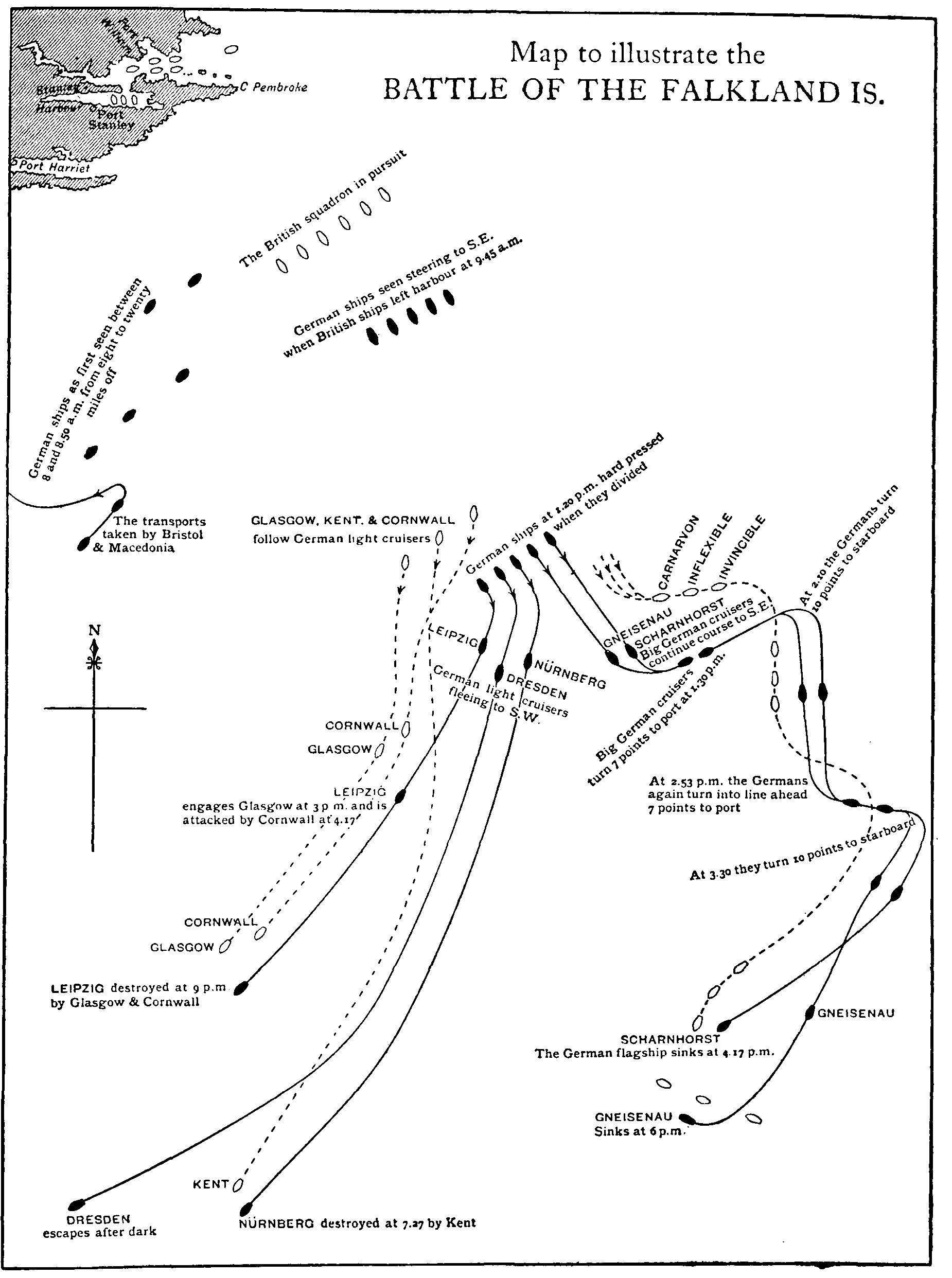
Map to illustrate the BATTLE OF THE FALKLAND IS.
Map illustrating approximately—from Admiral Sturdee's Dispatch—the Battle of the Falkland Islands from start to finish. The map must not be regarded as showing the proper scale of distances, &c.
More dangerous than the Emden was the German cruiser squadron under Admiral Graf von Spee, which concentrated in the South Pacific from Kiao-Chau and elsewhere. The squadron consisted of the twin cruisers Scharnhorst and Gneisenau, each of 11,400 tons, 22 knots speed, and an armament which included eight 8.2-inch guns; and three smaller cruisers, Dresden, Nürnberg, and Leipzig, each of 3500 tons, and carrying ten 4.1-inch guns. On 1st Nov. von Spee fell in with the weak British squadron under Admiral Cradock, who had been sent in August to protect the South Pacific trade, and was expecting reinforcements to cope with the German concentration. Cradock's squadron consisted of old ships like the cruisers Good Hope and Monmouth; the light cruiser Glasgow, and the armed liner Otranto; the pre-Dreadnought battleship Canopus, which had been left behind for repairs, being some twelve hours away. Outsteamed and outranged—though the Good Hope (14,000 tons) had two 9·2-inch guns on board—with the setting sun silhouetting their surfaces against the sky, they were no match for the Germans, who made the most of the added advantage which their inshore position gave them, obscuring their outlines when, as the light began to fail, they drew nearer to Cradock's ships and opened fire. The Good Hope's two 9.2-inch guns could not find their target in the fading light, and were soon put out of action by von Spee's flagship, the Scharnhorst, whose eight 8.2-inch guns, like those of the Gneisenau, which meantime was engaged in a similar duel with the Monmouth, now had the British at their mercy. The 6-inch guns of Cradock's ships, almost awash in the rolling seas, were useless. At 7.50 p.m. the Good Hope blew up, but not before Cradock had ordered the Glasgow to get away with all speed and warn the Canopus. The useless Otranto had been ordered away before the battle opened. The Monmouth, after being silenced and set on fire by the 8.2-inch guns of the Gneisenau, was finally sunk by the Nürnberg. No survivors were picked up by the Germans, either from the Good Hope or the Monmouth. With Cradock perished in this naval disaster off Coronel some 1500 officers and men.
Meanwhile the Glasgow, making full use of her 25-knot speed, had warned the slow old Canopus, and together they made their way back to the Falkland Islands to await developments. Four days later Lord Fisher, who had just succeeded Prince Louis of Battenberg as First Lord of the Admiralty (20th Oct.), dispatched Admiral Sturdee with a squadron bent on avenging Cradock, and protecting the valuable base and coaling-station of the Falklands. Sturdee's squadron included the two first battle-cruisers built—the Invincible and Inflexible, each of 17,250 tonnage, with a speed of 27 knots, and eight 12-inch guns, besides sixteen 4-inch guns and five torpedo tubes. There were also four lighter cruisers—Carnarvon, Kent, Cornwall, and Bristol; and to these were added the Canopus when Sturdee reached the Falklands on 7th December. The Glasgow had already been picked up in the South Atlantic. The superiority both in number and weight of guns was now overwhelmingly on the side of the British.
Von Spee, who claimed to have suffered little loss in his victory off Coronel, had returned in the meanwhile to Valparaiso to refit, leaving again for the Falklands on 15th Nov. His programme apparently was to do as much damage as possible to the British base and coaling-station at Port Stanley; account for the Canopus and Glasgow, which he expected to find defending the port; and thence make for South Africa in support of the rebellion there. Only some twenty-four hours before he approached Port Stanley Admiral Sturdee had arrived, and the news sent by the signallers on the island at 8 a.m., that the unsuspecting enemy was approaching, found the crews grimy from coaling, but alert and ready. Von Spee sent the Gneisenau and Nürnberg ahead to shell the wireless station, but a salvo of 12-inch shells from the Canopus in the harbour at 9.20 a.m. caused them to change their course. It was not, however, until 9.45 a.m., when the Invincible and Inflexible put out to sea with the Glasgow and Kent, that the presence of the battle-cruisers was revealed to them. It was then too late to escape. The German ships were no match for the British battle-cruisers either in speed or gun-power. With the conditions of Coronel thus reversed, Von Spee, abandoning the attempt to run as hopeless, decided to die fighting, and met his death as gallantly as Cradock had done some five short weeks before. Both the Scharnhorst and her sister the Gneisenau, battered by the two British battle-cruisers, who were later joined by the Carnarvon, until they were mere helpless hulks, fought to the last before they capsized, the first at 4.15 p.m., the second just after six. Boats were ordered out to save survivors, and some 200 Germans were picked up from these and other ships that were sunk. The Leipzig, pursued by the Glasgow and Cornwall, kept up a running fight for three hours, and then, hammered to pieces, hauled her flag, but afterwards sank. The Nürnberg, after a longer chase, suffered a similar fate at the hands of the Kent, sinking an hour after surrendering. Only the Dresden escaped, seeking refuge at Juan Fernandez, but three months later she was called to account there by the Kent and Glasgow (14th March, 1915), when, after a five minutes' action, she was blown up by her commander.
With no enemy fleet at sea the task of the British navy was reduced to guarding British commerce from submarines and raiders, keeping watch and ward in the North Sea, and conveying troops to and from the widely scattered theatres of war. Every month added to Britain's commitments in various parts of the globe. All hope of an early peace had vanished by the end of 1914.
Mobilizing the Empire
Happily for the British Empire, Lord Kitchener had from the first anticipated a long-drawn struggle. His call for volunteers "for three years, or the duration of the war", showed how clearly he realized the gravity of the situation. One of his first demands had been for another half-million men to go on with, and history has recorded how nobly the young manhood of the nation responded to his call. All the Dominions and Overseas possessions rallied to the Motherland with equal enthusiasm. We have shown how Indian troops—fighting for the first time on European soil—had already stepped into the breach on the Western front. The Canadians, nearest at hand, were the first of the Dominions to follow suit, but Australia and New Zealand, before their campaigns in Egypt and Gallipoli—and subsequently in France and Flanders—had already occupied Samoa, the Bismarck Archipelago, and other German islands in the Pacific.
South Africa, 1914
South Africa, on the outbreak of hostilities, had offered to carry the war into the German territory of South-West Africa, but General Botha had first to crush a revolt of Colonel Maritz's force; and this was succeeded by a more formidable rising in the Orange River Colony under De Wet, and in the Transvaal under Beyers. The response to Botha's call to arms proved the striking loyalty of the rest of the Union, and with the force thus mustered the South African Prime Minister completely defeated the rebels before the end of November. De Wet was captured, and Beyers was drowned in attempting to escape. The colonial campaign which followed will be dealt with subsequently.
1915 on the European Fronts
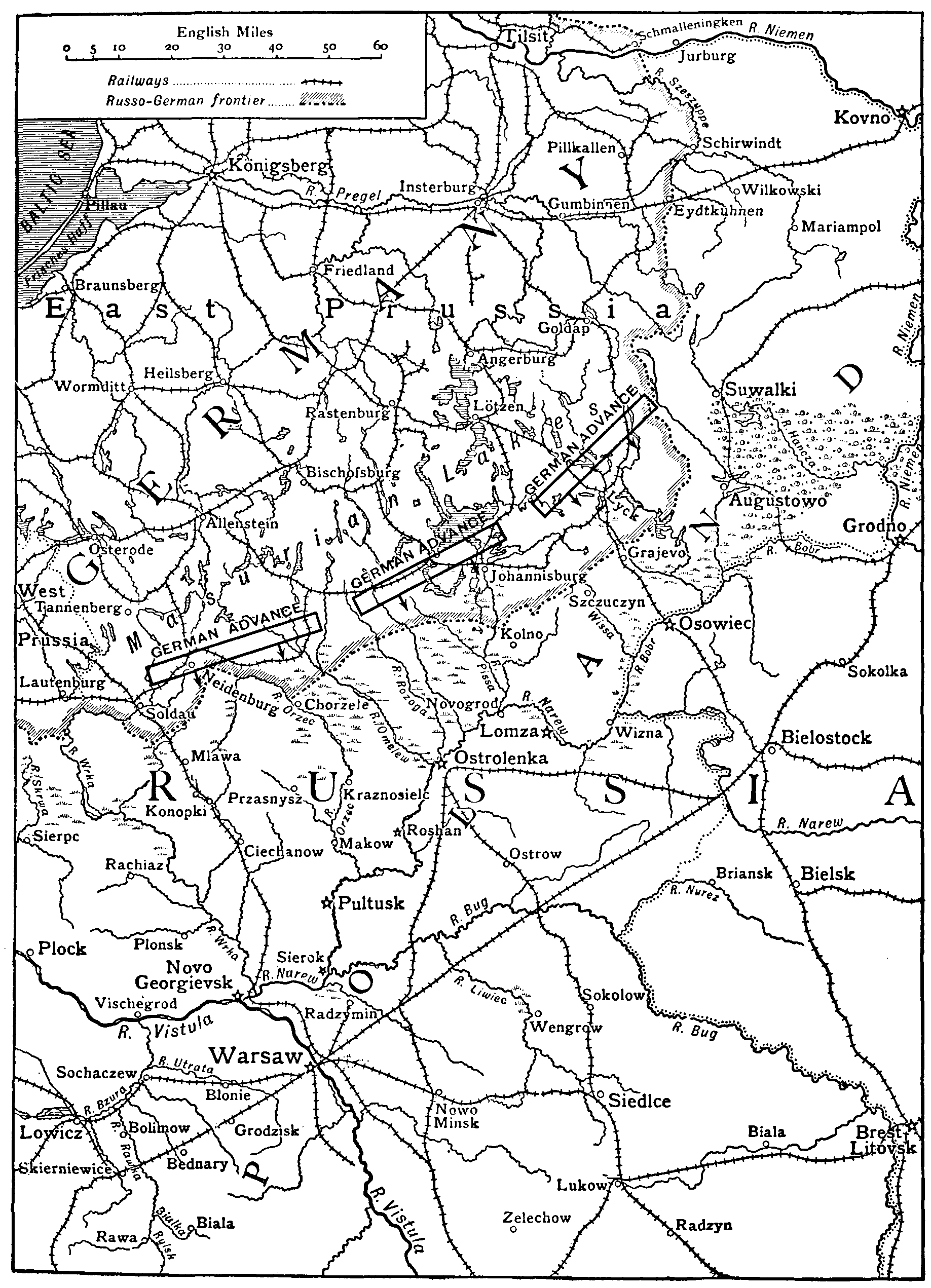
The Russian Campaign.—The heaviest burden of the war on the main fronts was now borne by Russia. Having failed to force a decision in the West, Germany looked to the Eastern front for compensating triumphs, confident that she could maintain her defensive positions against the Franco-British armies until such time as, with Austria-Hungary's help, she had brought Russia to her knees. It was also necessary to overawe Roumania and any other hesitating Balkan state that might be disposed to throw in its lot with Russia and her allies. Russia herself was provoking this reversal of German strategy by her renewed advances both on the Carpathian and East Prussian fronts. Hindenburg made two attacks on Warsaw early in the year (February and March), one by way of the Narew and the other by that of the Niemen, but both failed, thanks chiefly to the indomitable spirit of the Russian infantrymen, ill-equipped though they were. It was not until Mackensen's great 'drive' began on the southern flank in Galicia that Germany's new strategy revealed itself. Russia had then reached the culminating point in her military career. Besides holding up the German offensive in Poland, she had made herself mistress of all East Galicia, Przemysl having fallen to General Selivanoff on 22nd March after an investment of five months, thus releasing 100,000 men to reinforce the armies under Ivanoff, Dmitrieff, and Brussiloff—then battling for the passes which led through the Carpathians into the Plain of Hungary. Przemysl alone yielded 126,000 Austrian prisoners, including the commander, General von Kusmanek, and 1000 guns. Between that period and the middle of April, when the Russians claimed possession of all the Carpathian heights along a front of 70 miles from south of the Dukla Pass to north of the Uszok Pass, another 70,000 Austrian prisoners were taken.
It was a dazzling, but an illusory triumph. The Russians had been deliberately led by the Austrians—under instructions from the German Higher Command—into their hazardous Carpathian adventure as part of the secret preparations for Mackensen's mighty blow elsewhere. Von Falkenhayn, then Chief of Staff, afterwards gave the credit for the plan to the German General Head-quarters. Germany, with all her factories turning out munitions of war far in excess of anything that the Allies could then muster, had been accumulating guns and ammunition for this purpose for months past, together with poison-gas and liquid fire, and a total force of some 2,000,000 well-armed men. Russia, on the other hand, though she might oppose this force with fully as many men, was coming to the end of her resources, and her troops were ill-equipped to meet the massed guns of the artillery brought against them when the German phalanx, after minor thrusts to left and right to cloak the real designs of the German Higher Command, began its overpowering advance on 1st May against the Dunajec lines, where Dmitrieff's Russian army believed itself securely entrenched. Mackensen's guns, opening up a way for the strongest army yet mustered under one general, blew the Dunajec lines to fragments. The Russian infantry clung to their positions to the last moment, but their rifles, often empty, were useless against high-explosive shells, or the waves of poison-gas which preceded the advance of Mackensen's shock troops.
Map to illustrate the German Attack north of Warsaw in February, 1915
On 5th May, with its front wholly turned, Dmitrieff's shattered army withdrew as best it could from the Dunajec lines to the San River. All Russia's gains in Galicia were destined to be sacrificed in similar fashion. Brussiloff's advance through the Carpathians was at once arrested; by 14th May, when Everts' army on the Nida had also fallen back, all the passes had been evacuated, though not without appalling losses. In the Bukovina, however, the Russian army under General Lechitsky maintained a stubborn resistance south of the Dniester until 27th June, when it fell back to the Gnila Lipa. It was high time to retreat. Przemysl had again fallen into Austro-German hands (2nd June) as the first outstanding result of Mackensen's advance; Lemberg followed suit on 22nd June; and Halicz, abandoned by Brussiloff, fell on the day on which Lechitsky's army retreated from the Dniester to the Gnila Lipa. The end of June saw these positions abandoned and a further retreat in progress towards the line of the Lublin-Cholm railway.
Not cheaply were these spectacular triumphs won by the advancing armies of Mackensen and the Archduke Joseph Ferdinand. Their troops had been twice thrown back on the Dniester before that river had been finally won—a passage which cost them, all told, some 150,000 men; and in the successive retreats which followed, the Russian infantrymen turned repeatedly on their pursuers to prove that they were still capable of enforcing a price for every yard of ceded territory.
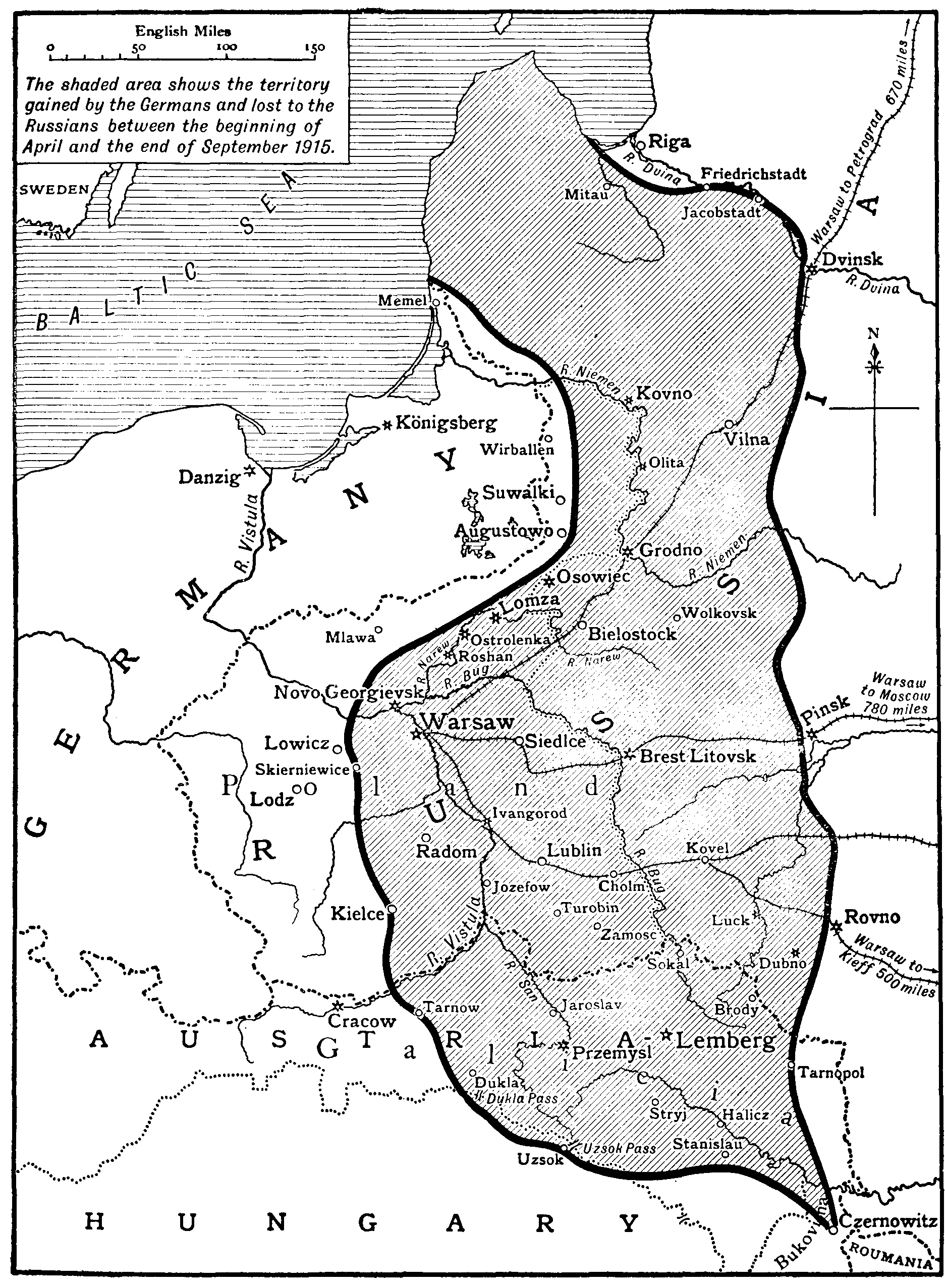
Mackensen's 'drive' was only part of the German Higher Command's plan for destroying the Russian armies in 1915. While the Austro-German phalanx was thus thrusting its way towards the Lublin-Cholm railway line, a simultaneous movement was in progress in the north, which had for its first objectives the great fortresses of the Polish salient, and Warsaw itself. Here Hindenburg, who was still in supreme command of the Austro-German forces on the Eastern front, had no longer General Ruzsky opposing him, Ruzsky having handed over the Russian northern command to Alexieff owing to ill-health. No matter how bravely the Russian infantrymen fought, or how ably they were led, they could not stand up against the hurricane of shot and shell which now blasted a path for the fully-equipped armies of von Below, von Eichhorn, von Gallwitz, von Scholtz, Leopold of Bavaria, and von Woyrsch. Prasnysz was won by von Gallwitz after a fierce battle in the middle of July, the Russians retiring to the shelter of the Narew fortresses guarding Warsaw from the north-east. Mackensen's advance to the south was resumed the next day, and the Grand Duke Nicholas, foreseeing the peril of this double threat, realized that his only hope lay in flattening the Warsaw salient and thus shortening his line. This sealed the fate of Warsaw, which was entered by Prince Leopold of Bavaria on 4th Aug. Ivangorod fell on the following day; Kovno on the 17th; Novo Georgievsk on the 19th. These losses, though deplorable, were not vital while the Russian armies still retained power to retaliate and recoup. Hindenburg strained every nerve to crush them once and for all. Ossowiec fell on 22nd Aug., the Russians resuming their retreat from the Niemen and Bobhr. Brest-Litovsk had already been threatened by the converging movement of Mackensen and Prince Leopold of Bavaria. Seeing no hope of saving it in the face of the continued pressure, the Grand Duke Nicholas evacuated this most easterly of the Polish quadrilateral of forts on the 25th, having previously stripped it, as in the case of the other evacuated fortresses, of all war material.
Hindenburg strove to complete the discomfiture of the main Russian armies by a fresh advance on his extreme left, where von Below was ordered to push through Courland towards Riga, with Petrograd as the ultimate goal in the following year. On this front the Russians had already been forced to relinquish Memel, just across the German frontier, as well as Libau. German naval forces had shared in the operations on the Riga coast-line, and when von Below, after carrying Mitau, some 30 miles from Riga itself, met with prolonged resistance, they made an ill-fated attempt to capture the port from the sea. This was on 18th Aug., when the Russian fleet appeared on the scene while the German naval contingents were attempting to land in flat-bottomed barges at Pernau. The landing forces were annihilated, and the German ships beaten off with a loss of two cruisers and eight torpedo-boats. The Russians only lost an old gunboat in this one-sided action.
The naval operations, however, had little effect on the main issue. Russian fortresses continued for another month to fall like ninepins before the Austro-German armies. Grodno was evacuated at the beginning of September, and though General Everts escaped from Brest-Litovsk with his supplies and guns, he could not hold up Mackensen's irresistible march on Pinsk, even in the Pripet marshes, which were dry at that season of the year. Pinsk was occupied on 16th Sept. Nowhere was the pressure relaxed. In the south, where the flood-tide of the Teutonic advance had never set so strongly, the attack on the Volhynian fortresses had been vigorously opposed by Ivanoff; but Boehm-Ermolli entered Lutsk on 1st Sept., and the Austrians recaptured Brody on the same day.
The vital blow at this stage was being delivered in the north, where von Below, bent on reaching Riga for his winter quarters, was marching on the Dvina lines with the immediate object of crossing that river and turning the whole Russian front as far as Dvinsk. The extreme left flank of the Germans fought desperately for the Dvina crossing at Friedrichstadt, but failed to make it good, and the danger-point shifted towards Vilna, the ten days' battle for which was decided at Meiszagowla on 12th Sept. Though two Russian divisions of the Imperial Guard were brought up to defend this key position, they were powerless to hold it against the great weight of German artillery. With its capture on 12th Sept., Vilna's fall became merely a matter of days. Before the Vilna armies could make good their escape, Hindenburg endeavoured to crown his triumph by outflanking them on both sides, von Eichhorn's cavalry sweeping round from Vilkomir in the north, and von Scholtz pressing forward, though less rapidly, on the southern side of the salient.
The Germanic Slice out of Russian Territory at the end of the Summer Campaign of 1915.
In this supreme crisis on the Eastern front, Ruzsky, recovered from his illness, returned to his command of the northern battlefields, and signalized his reappearance—not for the first time—by changing the whole complexion of affairs. Reinforcements enabled him in the first place methodically to evacuate the Vilna salient under their protection. Hindenburg endeavoured to counter this by rushing up cavalry reinforcements, with 140 guns, to support his outflanking thrust in the north, which, reaching Vidzy on the 16th and Vileika on the following day—this being well to the rear of the Vilna armies—threatened irremediable disaster to the retreating Russians. They were saved by the series of flank-guard battles securing their one avenue of retreat, and Ruzsky's counter-offensive from Dvinsk—a stroke so effective that the long German cavalry arm was in itself now in danger of being cut off. Vidzy was recaptured on the 20th; Smorgon, south of Novo Grodek, on the 21st; and Vileika before the end of the month.
On 15th Sept. Lord Kitchener had publicly declared that the Germans had "shot their bolt" on the Eastern front; and, so far as the immediate destruction of the Russian army as a force in being was concerned, this was true, though it was hard to believe while the wide sweep of the German advance was in full force. Ivanoff's reaction was equally marked in the south, where Brussiloff and Lechitsky took von Bothmer and Pflanzer-Baltin by surprise. Before the end of September the Austro-Germans had not only been pushed back to the Strypa, but had also lost both Dubno and Lutsk (23rd).
Germany's great summer offensive was over, but Hindenburg tried hard to secure good winter quarters in the north by a renewed advance on Dvinsk and Riga. A frontal attack was launched on Dvinsk on 3rd Oct. and was a costly failure. Ruzsky had defended Dvinsk with a semicircle of far-flung trenches on the Verdun model, against which the German shock-troops and guns could make practically no progress. After three weeks of vain endeavour Hindenburg shifted the attack to Riga, with no better success and heavy additional casualties. Thrust and counter-thrust succeeded one another with little change in the general situation until the end of November, when, after temporarily securing a crossing at Dahlend Island, south-east of Riga, in the River Dvina, Hindenburg was forced to abandon the attempt as futile. With the help of their fleet the Russians won their way back to Kemmern; and in their counter-offensive from Dvinsk in the same month recaptured Illutsk. All hope was then abandoned by the Germans of taking either Riga or Dvinsk that year. The German effort in the south, below the Pripet marshes, also slackened. Ivanoff not only maintained the ground he had won, but scored several notable victories in the Strypa sector; but both here and along the Styr, where Lechitsky was opposing Bothmer, there was both give and take and nothing decisive—apart from the fact that Roumania was saved by this evidence of Russia's recuperative powers from choosing the wrong side.
In order further to influence the dubious attitude of Roumania, a fresh Russian offensive in the Bukovina was begun in the last days of the year, with Czernowitz as the objective; but as this rightly belongs to 1916 it will be dealt with in our summary of the operations for that year. Though Russia had not succumbed as a military power under the staggering blows she had received in 1915, she had lost 2,000,000 of her best fighting men, and the moral of her army was never so high again. Falkenhayn has hinted in his Memoirs that the Germans knew that the blind faith of the Russians in their rulers was already shaken before they started Mackensen's 'drive'. It could not be expected to endure in face of the criminal neglect and corruption which every day added to their hardships and losses at the front. The Russian court at that period has been described as a mixture of folly and intrigue, with 'dark forces' at work under pro-German influence, led by the impostor Rasputin. The Grand Duke Nicholas, who was above the treacherous influences now undermining all departments of the Russian system, had been transferred to the command in the Caucasus in the most critical hours of the Austro-Germanic advance, the supreme command of the Russian armies being taken over by the Tsar himself (5th Sept.), with Alexieff as Chief of Staff. The Tsar's motives were above suspicion; but he lacked the efficiency and generalship of the Grand Duke, and stood for a system which, under the searching test of war, was proving itself unworthy of the continued sacrifices of his subjects. The sacrifices were repeated in 1916, but the seeds were already sown of the red harvest which was to lead to Russia's downfall and the end of the Romanoffs.
The Balkans, 1915
The progress of German arms in 1915 had decided Bulgaria to throw in her lot with the Central Powers. Her price—fixed by secret treaty with Germany in July of that year—was the whole of Macedonia possessed by Serbia, and other valuable slices of territory. It was not until 12th Oct. that formal war was declared by Bulgaria against Serbia, five days after the fresh invasion of Serbia had begun under Mackensen's leadership, with two Austro-German armies, one under General Koevess, advancing west of Belgrade in a wide flanking movement along the old roads over the Save and the Drina, and the other, under General von Gallwitz, advancing east of Belgrade against the main Serbian forces. Against this new Mackensen 'drive', with fully-equipped forces larger than the whole Serbian army, organized with all the Teutonic thoroughness which marked the same leader's Galician triumph, the Serbians had no chance, though they fought, as ever, with stoic resistance, and exacted a price for every inch of ceded territory. While they were thus stubbornly retreating, Bulgaria threw in two of her armies on the Eastern front, thus threatening, with the advancing Austro-German forces, to enclose them in a wide loop. The tragedy of it was that Serbia's allies were powerless to save her; and that Greece, who by the terms of her treaty with Serbia should have gone to her assistance as soon as Bulgaria attacked her, declined through King Constantine to do so, notwithstanding the insistent advice of his Prime Minister, M. Venizelos. Convinced, like King Ferdinand of Bulgaria, that Germany was winning the war, King Constantine maintained to the end an attitude which, though he chose to call it neutral, was never friendly towards the Allies. Russia had her hands too full to go to Serbia's aid, and though a Franco-British attempt was made as the net closed round the encircled Serbians, it was too late to save the situation.
The story of the Serbian disaster of 1915, when the fall of Monastir on 2nd Dec. robbed the Serbians of their last stronghold, is that of a desperate flight across the frontier and over the mountains of Albania and Montenegro to the Adriatic. Thanks to the Serbians' heroic efforts, the Austro-German armies had not been able to close the net tight, and though the Bulgarians followed hard on their heels, they could not quite complete their victory. All told, however, the Serbians lost some 50,000 men, killed, wounded, captured, or starved, in the retreat, together with their guns and equipment. Their aged monarch shared the retreat and succeeded in reaching Brindisi.
Meanwhile the Franco-British force, which, as already related, arrived too late to prevent this final act of the Serbian tragedy, had established a strong base at Salonika, notwithstanding Greek protests on the grounds of neutrality. It was not until 14th Oct. that the combined force, under the leadership of General Sarrail—the British column being commanded by General Mahon—began to move up the Vardar valley, the British advancing on the right towards Lake Doiran, and the French towards Strumnitza. Both forces were soon in touch with the Bulgarians, and fought a number of minor engagements in their forlorn hope of effecting a junction with the hard-pressed Serbians. Besides being too late, however, the Franco-British forces were not strong enough to effect their purpose, and when the remnants of the Serbian army had been forced across the frontier towards the Adriatic, they were themselves attacked by powerful Bulgarian columns. The object of his expedition having been eliminated, General Sarrail prepared for retreat to his base. The Bulgarians did their best to harry his retirement. They launched a determined attack, which he repulsed with heavy loss; and then endeavoured to isolate the two columns by an assault on the British force at Lake Doiran. Though some 1300 casualties were sustained in defeating this attack, the British, acting as flank-guard to the French, enabled the retreat to be made jointly. By 13th Dec. the Allied troops, having administered a severe check to the pursuing Bulgarians two days previously, were across the Greek frontier in good order, and in due course had entrenched themselves about Salonika.
With the fall of Serbia came the collapse of Montenegro, in circumstances considerably less heroic than those which marked the Serbian retreat. The key position of Mont Lovtchen was abandoned to the Austrians with little if any show of resistance, and Cettinje, the capital, similarly entered by the invaders. King Nicholas of Montenegro sought refuge in Paris; Prince Mirko of Montenegro in Vienna.
The Serbian soldiers who survived the great retreat, numbering some 100,000 in all, were met on the Adriatic coast by units of the Italian fleet and transferred to Corfu—to recoup and refit for the later campaigns which were to lead to the recovery of their country.
Italy, 1915
Italy, whose warships were thus instrumental in salving the Serbian army, had thrown in her lot with the Allies by declaring war against Austria-Hungary on 23rd May, 1915. Austria had refused to offer adequate 'compensation' for her disturbance of the Balkans; and, moreover, the time had obviously arrived to complete Italian unity. A few weeks previously Italy had signed the Treaty of London, under which the Allies agreed to satisfy most of her territorial ambitions when the time came to share the spoils of victory an agreement which led to some of the most difficult problems in the final peace settlement. To Italy's honour be it added that she joined forces with the Allies when their prospects were none too bright, when they were able to report little or no progress either on the Western front or in Gallipoli, and Austro-German arms, on the other hand, were beginning to carry all before them in Mackensen's great drive in Galicia.
Italy was in no position to throw her whole weight into the struggle in 1915. Though her war strength was reckoned at a million men, her army was ill-equipped with guns, especially with modern heavy artillery and machine-guns, and her industrial resources were wholly inadequate to make good the deficiency. The mountainous frontier which she had to defend, too, gave every advantage to the Austrians. She succeeded in seizing three of the passes, the Stelvio, Tonale, and Guidriari, on the east side of the Trentino, and in blocking others on the west side, as the opening moves of her campaign, the object being to secure her flank in the subsequent offensive operations which aimed at Trieste by an advance across the Isonzo. Though these operations succeeded in pinning to the Italian front considerable forces of Austro-Hungarian troops which might have been thrown into the Russian furnace, the Italian effort fell far short of its objectives. General Cadorna, the Italian Commander-in-Chief, won a number of small successes in deploying his Third Army on the right bank of the Isonzo during June and July, securing the bridge-heads at Caporetto—the scene of Italian disaster two years later—Plava, Gradisca, and Monfalcone, thus holding the western bank of the river from Tolmino down to the sea. But the Italians were now faced with powerful defences, buttressed by the Carso Plateau in the south, which could only be carried at that time at prohibitive cost. All attempts to capture these strongholds broke down, and though a footing was gained on the Carso, and slight gains were constantly reported from the Trentino, the operations along the Italian front settled down before the year was out to the give-and-take fighting which characterized the siege operations in the West.
Western Front in 1915
On the Western front neither France nor Great Britain was ready in 1915 to undertake any advance comparable with the great offensives of the Central Powers in the East. Russia in her agony complained that France was not doing enough, but all the Allies' efforts this year were crippled by their inability to supply the wholly unprecedented demands for munitions of war. Great Britain was still struggling months behind to catch up a foe who had been preparing for years. Mr. Lloyd George subsequently related how, in the month of May, 1915, when the Germans were turning out 250,000 shells a day, most of them high-explosives, Great Britain was producing a mere 2500 a day in high-explosives, and 13,000 in shrapnel. The French, accustomed to supplying the demands of armies on a Continental scale, had naturally done considerably better than this, but even their most strenuous efforts were inadequate to cope with the enormous output of the German arsenals. Mr. Lloyd George retired from the Chancellorship of the Exchequer in order to assume control of the newly created Ministry of Munitions, which in due course more than made good all these defects. That, however, was not in 1915. Up to the end of that year, according to Lord French, "the scanty supply of munitions of war paralysed all our power of initiative, and at critical times menaced our defence with irretrievable disaster".
At the end of the first long winter of dreary trench warfare the British Commander-in-Chief deemed it necessary to undertake an offensive in order to prevent the moral of his army from deteriorating. Hence the battle of Neuve Chapelle, which, begun on 10th March, was fought with a small reserve of ammunition accumulated for the purpose, and had to be broken off after three days' struggle through lack of further supplies. The troops chosen for the main assault were Rawlinson's Fourth Army Corps, with the Indian Corps on the right. Following the preliminary bombardment, they quickly overran Neuve Chapelle itself and made 1000 yards progress on a 3-mile front. But to left and right the attacks were held up, and two further days' fighting failed to add to the gains—purchased at the excessive cost of 562 officers and 12,239 men. The total German losses, including 1680 officers and men as prisoners, were estimated as rather higher than this, but the net result, though ranking as a British victory, was admittedly disappointing.
Earlier in the year Lord French had endeavoured to convince Joffre that the proper rôle for the British army to fulfil was an advance on the extreme north in co-operation with the British navy. Joffre was unsympathetic, though he held out hopes of co-operating in such an advance with the French army at a later date. His plan for the 1915 campaign was to break through the German line from the south at Rheims, and from the west at Arras. To do this he must mass as many French corps as possible behind these points, meanwhile keeping the enemy busy elsewhere in order to prevent him from reinforcing the threatened positions. This general strategic idea, as Lord French has pointed out, was the foundation of all the Allied efforts in the West throughout 1915. It led to numerous local successes along many parts of the line, but no real advance was made towards the main objectives. These were not defined until the combined offensive was launched in September.
The Germans themselves, though content to leave to the Allies most of the attacking in the West in 1915, maintained a sufficiently active offensive-defensive. While the French in Alsace were making a fresh advance on Mulhouse at the beginning of the year, they counter-attacked at Soissons, after bombarding the cathedral on 9th Jan. It was only after a week's desperate fighting and heavy French losses—including a bridge-head on the Aisne—that they were checked. In Champagne the French managed to capture Perthes (8th Jan.), and strove valiantly but vainly to wipe out the St. Mihiel salient. The most ambitious effort of the opening months of the year was the British offensive at Neuve Chapelle, which, as already pointed out, failed largely through lack of ammunition. In his report on that battle the British Commander-in-Chief referred to the pressing need of "an almost unlimited supply of ammunition"; and the lack of it was the real explanation of the Allied failure in 1915.
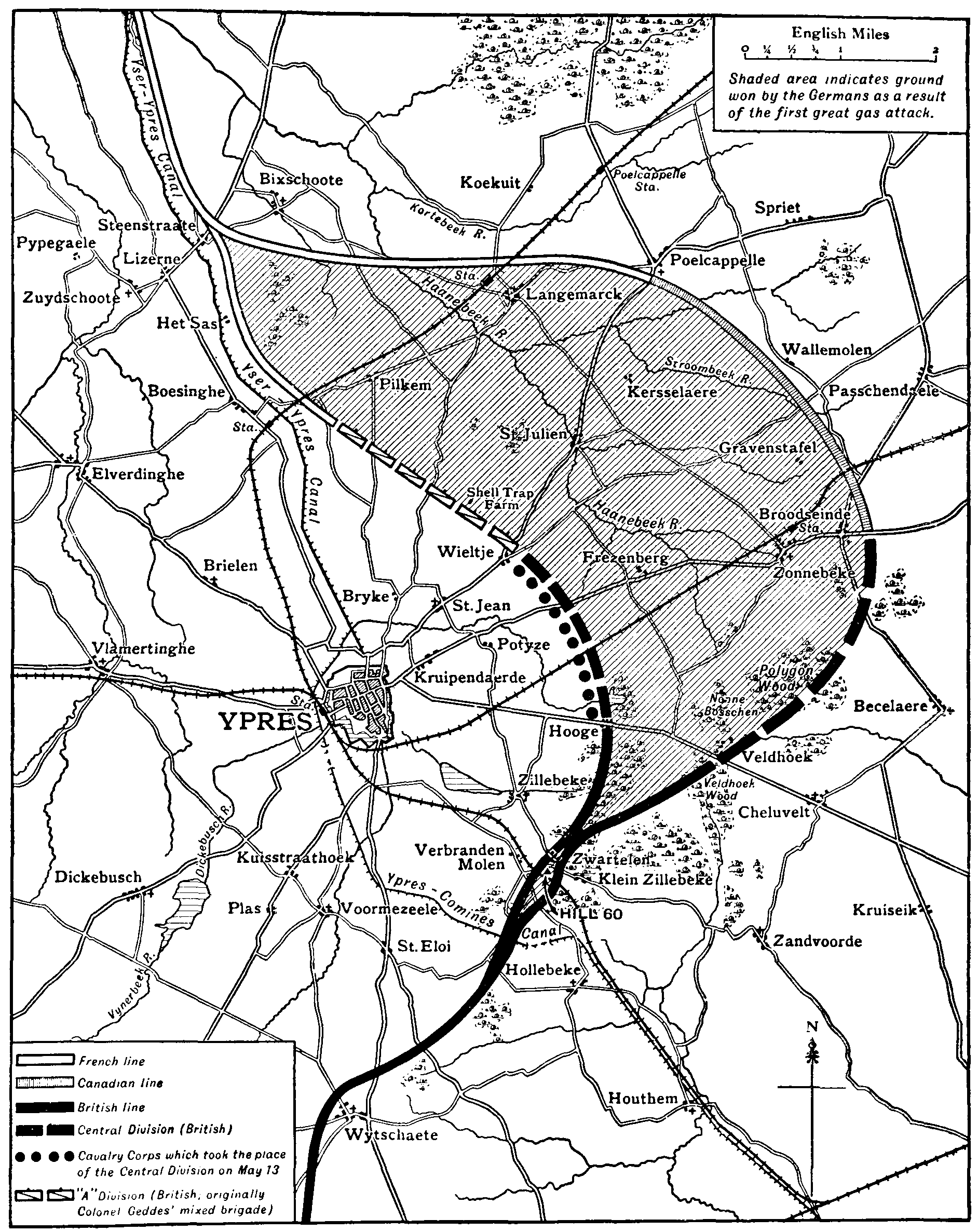
Germany knew well enough how matters stood in this respect, and added ruthlessly to the handicap which their own superior supplies gave them by suddenly attacking with chlorine gas—the first use of poison-gas in the war. This was on 22nd April, following a grim struggle south-east of Ypres for Hill 60, the flattened remains of which, after five days' incessant fighting, remained in British possession. Having been careful beforehand to accuse the French of using poison-gas near Verdun on the 14th—a charge without justification—the Germans launched it in dense volumes from pipes previously laid down for the purpose north-east of Ypres. The attack was preceded by a heavy bombardment, the gas-clouds following at 5 p.m. on the 22nd. The Allied line was held at this point by French Colonial and Territorial troops, with the Canadian Division on their right. All unprotected as they were against this diabolical form of warfare, the French troops, gasping for breath, broke and fled. Many fell asphyxiated. With a gap in the Allied line 5 miles wide, the Canadians suddenly found their flank left in the air. Less affected by the gas than the French, they were chiefly instrumental in saving the situation by a valiant resistance until reinforcements could be sent to fill the gap.
The gap was evidently wider than the Germans either anticipated or realized; otherwise the disaster might have been irretrievable. As it was, the situation remained precarious until the 27th, when a counter-attack in conjunction with the French recovered some of the ground, and a large portion of the sorely tried Canadian Division was relieved by the Lahore Indian Division. Altogether seven British divisions were involved in this hard-fought battle, the net result of which was to bring the Germans 2 miles nearer to Ypres on a 5-mile front, and to give the Allies a worse line to hold. Eight batteries of French field-guns were lost and four British guns of position. These last were recaptured by the Canadians, but the enemy had already destroyed them. In all the Allied casualties amounted to nearly 25,000. The Germans estimated theirs at 16,000. In his report on the gas-attack Sir John French declared that protest against this form of warfare would probably be useless, and Lord Kitchener intimated in the House of Lords on 18th May that retaliation might be inevitable. Respirators more or less effective were supplied to the troops, and the use of poison-gas, followed by liquid-fire—another German innovation—became permanent additions to the horrors of modern warfare.
Before the new battle round Ypres died down—it lasted, indeed, until the end of May—the storm centre shifted to the southern end of the British line, where it joined hands with the French left. Here General French began the battle of Festubert, undertaken to relieve the intense pressure on the troops at Ypres, but also serving as part of Joffre's general plan of attack in the direction of Lens and Lille. British and French alike were launched against the German lines on 9th May, the British taking the offensive between Rougebanc and Givenchy, and the French between Neuville St. Vaast and Notre Dame de Lorette. The renewed struggle for Ypres, however, had drawn heavily on the scanty British reserves of ammunition, and the preliminary bombardment of forty minutes proved wholly inadequate to crush the resistance offered by the enemy's numerous fortified posts when the First Army advanced to the attack. This disastrous engagement, in which the greatest bravery was displayed against overwhelming odds, cost over 12,000 casualties. It achieved nothing in the field, but the lessons which it taught led to the formation of the Coalition Government, with Mr. Lloyd George as Minister of Munitions. The second stage of the battle of Festubert, which began at midnight on 15th May, was more successful, the enemy's front-line trenches being captured on a front of 3000 yards; but the losses incurred in winning and holding the positions were disproportionately high.
The Ypres Salient before and after the Second Battle of Ypres, 22nd April-13th May, 1915
The French effort began more auspiciously as a result of the longer and more intense bombardment which preceded their attack on the 9th, but the series of minor successes which they won round Souchez, after weeks of incessant fighting, made little real impression on the defences of Lens. The truth was that Germany had so expanded her war-material factories that, with the aid of the Austrians, she could turn out sufficient shells and guns for her main offensive on the Eastern front, and at the same time overweight the Allies in the West.
Throughout the summer the line, though never quiescent, and often breaking out in furious bombardments, minor attacks and counter-attacks, and raids on both sides, remained little altered. The hardest fighting of all was round the war-scarred salient of Ypres, still held, as in the first gas-attack, by the Second Army, to which some of 'Kitchener's Men' were now attached. It fell to this advance-guard of the New Army to bear the brunt of the first attack on the British with liquid-fire, the Germans, who had already used this new device of the flammenwerfer against the French, employing it in another desperate assault on the British lines round Hooge. The New Army units fought with almost incredible gallantry, but were blinded by the unexpected, burning sheets of flame, and while they were still blind the enemy charged and took the first-line trenches on a front of some 500 yards. The losses were avenged on 9th Aug., when the 6th Division recovered all the captured positions, and 400 yards of German trench into the bargain.
With the arrival of the reinforcing British divisions of the New Army, General French was able to take over some 17 miles of additional front, the British line thus extending over about 50 miles, with the Belgians on the left holding the remaining 18 miles to the sea. This still left the French army 500 miles to hold, from the British right to the Alps.
The summer of 1915 passed away without any great offensive on either side. The Germans, now at the flood-tide of their sweeping advance against Russia, were content to continue their vigorous offensive-defensive in the West. Besides the fighting already referred to, there was incessant warfare in the Argonne Forest, where the German Crown Prince was noisily active throughout the summer, threatening Verdun, but making no serious advance. The French continued the deadly trench-to-trench warfare in the Souchez area and the 'Labyrinth' region nearer Arras, and steadily tightened their hold on the reconquered corner of Alsace, consolidating their positions on the Hartmannsweilerkopf, which had been the scene of continuous fighting in the renewed advance towards Mulhouse. For the most part, however, the French, like the British, were now storing up reserves of ammunition and completing their dispositions for the joint offensive planned for the autumn, when the main objects of Joffre's general strategic idea for 1915 were for the first time clearly defined, though unattained.
A great Allied offensive in the West had become increasingly necessary in view of the prestige gained by the Central Powers, not only by their tremendous advance into Russia, but also by the Allies' disastrous campaign in Gallipoli, where the failure of the Suvla Bay landing—subsequently dealt with in our account of the operations against Turkey—had just given the enemy additional cause for rejoicing. Joffre's plan of attack, designed "to drive the Germans out of France", was not ripe for execution until towards the end of September. Even then, though General French had for months been gradually accumulating troops and ammunition for the blow—the British army now numbering nearly a million men—full strength in both respects was still only half developed.
There were two main assaults in the combined offensive, launched on 25th Sept., 1915, the chief of which was in the French centre in Champagne, where de Castlenau, Joffre's right-hand man, attacked with Langle de Cary's Fourth Army on a 16-mile front between Auberive and Massiges, the object being to force the Germans back on the Aisne, and, if possible, cut off the army of the German Crown Prince in the Argonne. Second in importance was the Franco-British advance on the same day in Artois, General French's object being to push through between Lens and La Bassée on the north, while Generals Foch and d'Urbal, on his right, stormed the Vimy heights and attacked Lens from the south. Secondary operations were carried out at various other points in order to distract the enemy's attention, feint attacks being made by Sir Herbert Plumer with the 5th Corps—part of the Second Army—east of Ypres, where Bellewarde was temporarily taken; as well as by those units of the First Army occupying the line north of the Béthune-La Bassée Canal. Similar demonstrations were made at Bois Grenier, and along the slopes of the Aubers Ridge, where British and Indian troops alike fought heroically for ground which, though captured in the first onrush, could not be held under the powerful fire concentrated against them.
Battle of Loos
Map showing approximately the battle-lines of the First Army under Sir Douglas Haig at daybreak and at nightfall on 25th September, 1915
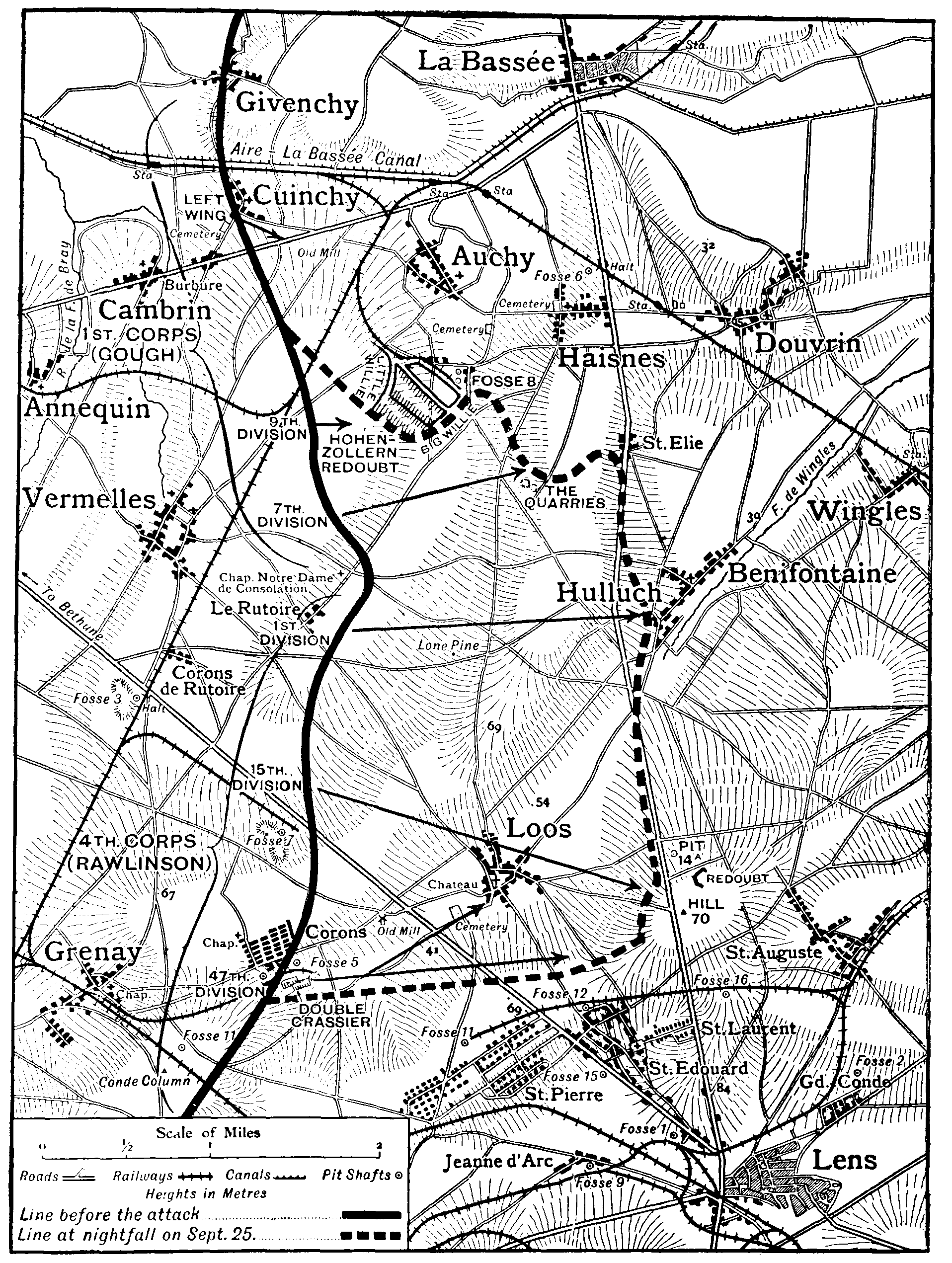
The main British attack was delivered by the First Army under Sir Douglas Haig along a front extending from La Bassée Canal in the north to the mining village of Grenay on the south, and is conveniently named the battle of Loos. The task of the 4th Corps (Rawlinson), with the 47th (London Territorial) Division on the right, the 15th (New Army) Division in the centre, and the 1st Division on the left, was to carry, as its first objective, Loos and the heights between Lens and Hulluch. The 1st Corps (Hubert Gough), with the 7th Division on its right, the 9th (New Army) Division in the centre, and the 2nd Division (Horne) on the left extended to the canal, was to link up with the Fourth Army at Hulluch, taking in its stride the Hohenzollern Redoubt and the formidable German fortresses in the Quarries and Fosse 8. Had this general plan succeeded, and the Tenth French Army on the British right advanced in line with it, a great gap would have been made in the German positions in Artois, which, with a similar success from the mightier French blow in Champagne, would at least have brought relief to the hard-pressed Russians in the East, if it did not achieve all that Joffre had hoped for it. As it was, the Allied victory, both in Artois and Champagne, fell far short of its aims, and, save for insubstantial advances, was fruitful chiefly in bloody experience.
An intense bombardment for four days preceded the main British advance, and was followed by a gas-attack—used by the British on this occasion for the first time.[1] Many parts of the German defences along the 7-mile front, however, were far from obliterated when the infantry advanced to the attack, especially on the left, where the 2nd Division was held up by impassable wire defences. The 9th Division had a similar experience on its left wing, where the undemolished defences of the Hohenzollern Redoubt became a veritable shambles. On its right, however, the leading Scottish battalions scored a fine success in reaching Fosse 8. On their right the 7th Division did equally well, capturing the Quarries and reaching Cité St. Elie, north of Hulluch, though subsequently forced to rest on the Quarries. In the meantime the 4th Corps, like the 1st, had been repulsed on the left and victorious on the right. Held up on the left by unbroken wire and undamaged German defences, the 1st Division could make no appreciable advance on the Lens-Hulluch road, thus exposing the left flank of the next division in line—the 15th (Scottish). The Scotsmen on their part had made a magnificent advance, first sharing with the Londoners of the 47th Division the honour of capturing Loos, and then rushing on impetuously to Hill 70, and beyond as far as Cité St. Auguste, on the outskirts of Lens. Had reserves been available at once to consolidate the gains thus won, Lens itself might have been taken, and a door flung open leading to Lille. But as it was impossible to say at which part of the long British line they would be needed, Sir John French had retained his reserves far in the rear. When at last they were forthcoming—the new 21st and 24th Divisions, hitherto untried—they were put into the battle-line after nightfall, tired and hungry after a heavy 8-mile march.
It was impossible to hold all the ground won during the day. Without reinforcements, and no sufficient artillery support, the 15th Division had already been forced to relinquish its hold on Cité St. Auguste, and fell back to the western slopes of Hill 70 on the Lens-Hulluch road. Misdirected and drenched with rain, the two tired reinforcing divisions could do little to help amid the confusion of the battlefield. Their supporting attacks at various points broke against the still intact German wire or simultaneous counter-attacks by the enemy. One brigade alone (the 72nd) lost 78 officers and 2000 men out of the 3600 with which it started. Altogether the losses of these two divisions amounted to 8000. Along the southern section they succeeded in maintaining contact with the 47th Division, and in the north helped the Scots of the 9th Division to maintain their hold on Fosse 8; but the Quarries, close by, were lost, and along most of this northern front the day's gains were gradually whittled away.
Another heavy handicap was the fact that the French Tenth Army, on the right of Rawlinson's Corps, had to postpone its advance until one o'clock in the afternoon—the British attack had been launched at 6.30 a.m.—and then was forced to direct the corps operating on its left in a south-easterly direction. This involved a considerable gap on the British right, when Rawlinson's men made their victorious advance. The Londoners of the 47th Division, however, not only held on to Loos, but formed a strong defensive flank which averted what might have been a complete disaster. Apart from the captured positions, 57 German officers and 3000 other prisoners had been taken during the day on the British front, together with 26 field-guns and 40 machine-guns.
On the following day the Germans counter-attacked in force and recovered Fosse 8, but on the 27th the Guards Division, under the Earl of Cavan, was sent forward and almost restored the earlier gains, including Chalk Pit Wood and the slopes of Hill 70. It cost the Guards 3000 casualties to make good the restored British line. They continued to hold it until the end of the month, when they were relieved. The 15th (Scottish) Division had also been withdrawn, after suffering no fewer than 6000 casualties. All told, the British losses in the battle of Loos amounted to 50,000 men and 2000 officers, including three divisional commanders—Major-General Sir Thompson Capper (7th Division), Major-General G. H. Thesiger (9th Division), and Major-General F. D. V. Wing (12th Division)—each of whom was killed. A series of costly counter-attacks on the enemy's part failed to make much impression on the new British line, and mounted up the German casualties until they were estimated at many more than those of the British. The battle died down; the gains were consolidated; but the murderous struggle at close quarters for the Hohenzollern Redoubt and its adjoining entrenchments continued for weeks and months, an outstanding feature of which was the attempt of the 46th (North Midland Territorial) Division to carry the redoubt by storm on 13th Oct. The Midlanders' task was handicapped, like so many British operations at this period, by inadequate artillery preparation, and though they fought like veterans they could only win the western side of the stronghold at a cost of 4000 casualties.
The advance of the 10th French Army on the right of the British was held up in front of Souchez on the opening day of the combined offensive, but made better progress on 26th Sept., when d'Urbal's troops made themselves masters not only of long-contested Souchez, but also of Thelus, La Folie Farm, and most of the Givenchy Wood. But the Vimy heights, notwithstanding that some progress was made along their slopes, still barred the road to Lens from the south. On the 28th the French 9th Corps, at the British Commander-in-Chief's request, took over the defence of Loos, and the British line was rearranged.
The main French effort in 1915, as already pointed out, was in Champagne, where a solid week's bombardment paved the way for the great advance on 25th Sept. Inspired by Joffre's stirring Order of the Day, "Remember the Marne: Conquer or Die!", the French troops carried all before them on the greater part of the front. General Marchand's Colonial Division broke clean through 2 miles of the main German defences, Marchand himself falling severely wounded at the head of his men. The greatest advance was made on Marchand's right, from Navarin Farm to the Butte de Tahure, where an advance of 2½ miles was made before the day closed. But the troops in the centre were robbed of decisive victory by a double check on the wings. On the right the two German strongholds at the Butte de Mesnil and the Main de Massiges—comparable with the Hohenzollern Redoubt in their strength—held out stubbornly until, after days and nights of ceaseless combat, both fell into the attackers' hands. On the extreme left the assailants could make practically no headway.
Thenceforward the French advance made little progress towards the main objectives, though a breach was made in the enemy's second line in a fresh attack on the 29th; and a third advance (6th Oct.) won the village and Butte de Tahure. On 20th Oct. the Germans recovered the Butte de Tahure, and in other counter-attacks prevented the French from developing their first initial advance into the greater victory which Joffre had hoped for it. The battle had yielded an impressive list of captures—the total number of German prisoners being over 23,000 before the end of September, and the captured guns 80—but the Allies' long line had not materially altered before the autumn offensive gave place to another winter of tedious siege warfare.
The year closed with the appointment of Joffre as Commander-in-Chief of all the French forces, General de Castlenau taking over the immediate command of the French troops in France; and the resignation of Sir John French—now created a Viscount of the United Kingdom, and appointed to the Home Command—after more than sixteen months of severe and incessant strain at the front. Lord French was succeeded by General Sir Douglas Haig, who had been singled out for promotion by his brilliant achievements since the British army first landed in France.
The Naval War in 1915
Throughout 1915 the operations at sea contained no movements so striking as some of those which marked the opening months of the war. The careers of all the scattered German cruisers were over, the last of them, the Königsberg, being finally destroyed in the Rufigi River, German East Africa, by the shallow-draught monitors Severn and Mersey, sent out for the purpose from Great Britain. The German High Seas Fleet remained in harbour, waiting for Lord Jellicoe to be tempted or goaded into some imprudent disposition of his forces. Hence the sudden raids on the British East Coast, begun in the closing months of 1914. They repeated them once too often, on 24th Jan., 1915, when the raiders, consisting of 4 battle-cruisers, 6 light cruisers, and a force of destroyers, were encountered off the Dogger Bank by the British battle-cruiser squadron under Admiral Beatty, consisting of the Lion, Tiger, and Princess Royal, as well as the New Zealand and Indomitable, and the light cruisers Southampton, Nottingham, Birmingham, and Lowestoft, together with the Arethusa, Aurora, and Undaunted. Outmatched by the 13.5-inch guns of Beatty's 'Cat' Squadron of battle-cruisers, the Germans made for home. In the hot chase which followed, the Blücher, last in line of the German battle-cruisers, was hit repeatedly, fell behind, and was eventually sunk by a torpedo from the destroyer Meteor. Her survivors were picked up by the Arethusa. Beatty's flagship, the Lion, which was leading the pursuit, was partly disabled by a chance shot and had to be towed home, Beatty himself following the chase at some distance in a destroyer. Before he could pick up his place in the pursuit he met his three battle-cruisers returning, these having broken off the action owing to the increasing risk of straying into an enemy mine-field or of falling foul of the mines which the retreating Germans were strewing in their path. Two other German battle-cruisers had been set on fire by the British shells, the Seydlitz and the Derfflinger, but, with the rest of the German ships, they made good their escape. Taught by this experience, the Germans made no further naval raids on the East Coast.
In the following month (4th Feb.) Vice-Admiral von Pohl, Chief of the German Admiralty Staff, proclaimed a submarine blockade of the whole of the British Isles, declaring all the waters round Great Britain and Ireland a military area in which Allied merchant-ships were to be destroyed and neutral ships would incur danger of running the same risk. If the Germans thought they could scare British shipping away by these means, they were soon undeceived. They took heavy toll of peaceful shipping from the first, and shocked the rest of the world by the lengths to which they were prepared to go in developing this ruthless policy, but all their efforts failed to paralyse British trade as they anticipated. The crowning tragedy of this submarine campaign was the sinking of the Cunard liner Lusitania off the south coast of Ireland on 7th May, 1915, with its loss of upwards of 1000 non-combatants, including over 100 Americans. It was one of the German crimes against humanity in general and Americans in particular which brought the United States into the war on the side of the Allies in 1917.
1916 on the European Fronts
The Western Campaign.—During the year 1916 the unity of command which was postulated as an indispensable preliminary to the victory of the Allies so long before it became a fact was achieved neither as between Britain and France in the West and Russia in the East, nor even as between Britain and France along the Western front. The most that can be said of the co-ordination between the forces under the British and French Commanders-in-Chief is that liaison was established between them, and that as far as was possible each endeavoured to help the other by diverting to itself the energies of the German forces. The Western fighting embraced two main episodes: the powerful German attacks on Verdun, eventually unsuccessful; and the Allied offensive on the Somme, in which by far the greater share was borne by the British.
The year began with numerous German attacks widely separated in locality, and intended to mask the main offensive while keeping the French and British occupied. Hartmannsweilerkopf, in Alsace (2nd to 8th Jan.); Champagne (9th Jan.); Givenchy, Arras, Neuville, Loos (14th Jan. to 6th Feb.); Vimy Ridge, Frise, Soissons, Ypres-Comines area, and Tahure (9th to 20th Feb.) were among them.
On 21st Feb. the new battle of Verdun began. This enterprise, though officially accredited to the German Crown Prince, was the design of General von Falkenhayn. Verdun was one of the four fortresses, of which the other three were Belfort, Toul, and Épinal, on which French armies defending the capital and the country from an invasion from the east would base themselves. The town lies sunk in the Meuse valley, and the German invasion in 1914 flowed past it along the heights of the Meuse down to St. Mihiel. At the beginning of the war Verdun was protected by an outer line of forts, with batteries pushed out in a circuit of 30 miles. The forts were not, however, strong enough in 1914, nor the perimeter of defence extended enough, to withstand the new artillery that had reduced Liége and Namur, and a fierce struggle went on during 1915 along the Meuse heights on the east of Verdun and beyond the low hills on the western side of the town and river, with a view to pushing out the defences all round. As previously pointed out, much had been done in this direction by General Sarrail, but not enough to deter von Falkenhayn and the German General Staff from selecting Verdun as a point for an attack which, if successful, would disorganize seriously the continuity of the French defences. In 1916, as for two years more, the problem of either combatant was to break through a line of trenches which extended continuously from the sea to Switzerland; and failing a complete break-through, comparable to that which had crippled Russia in 1915, to effect a fracture or a deep dent which would compel the loser to reconstruct his system of communications. At the best such a thrust might disclose a fatal weakness in the assailed; at the next best it would disastrously hamper his future activities.
Verdun as a fortress had strong and modern defences. West of the Meuse, north of the town, are low hills the chief of which is the Charny Ridge with dominating strategic points beyond known as Hill 304, Hill 295, Hill 265. The French lines were pushed beyond these into the woods of Avocourt and Forges, but below the heights of Montfaucon, which were the Crown Prince's head-quarters. On the east of the Meuse the heights rise to a tableland severed by wooded ravines and overlooking the plain of the Woevre. The line of French trenches embraced all this tableland and a good deal of the plain beyond. Its outer line ran in a bold convex curve from Forges and Consenvoye on the Meuse to Fresnes on the Woevre, but it did not penetrate the woods of Forges or Spincourt, and it was below the gun positions on the hills of Ornes. Inside this outer circle was the inner line of Samogneux, Beaumont, Fosses Wood, and Bezonvaux. Inside that again the line of Bras, Douaumont Fort, Hardaumont Wood, Vaux Fort, and Eix.
The multiple defences were most elaborate between these two inner lines. A weak point was that though such defences would be very exacting of life and effort, yet the outer ones were not pushed out far enough to place the bridges of the Meuse out of reach of long-range gun-fire; and an overwhelming attack might have jammed a defending army on the east of the Meuse against the river. The French had provided against the possibility by the multiplication of transport, as well as of inner defences. The Germans hoped by the weight, volume, and suddenness of their attack to bring about the not impossible catastrophe. They massed an amount of artillery which, though surpassed afterwards in the war, was at that time the greatest assemblage that had ever been seen together, and accumulated a supply of ammunition exceeding the quantity which all previous experience prescribed. The heavier guns were placed at Ornes, Spincourt, and Forges. The woods below afforded cover for a concentration of men; and this concentration, amounting to fourteen divisions, with others in immediate reserve, was at first thrown at the 7-mile sector from Brabant-sur-Meuse to Herbebois, which was held by three French divisions under General Humbert.
The attack began on the morning of 21st Feb. with an artillery bombardment lasting four hours. The great weight of shell demolished the French first-line defences, so that the German troops had little to do but walk over them, while a remnant of the defenders fell back to their supporting positions. These were not sufficiently strong or well constructed to enable weak forces to hold them long against the force of three army corps (18th, 3rd, and 10th, with a Bavarian Division) which the Germans sent in after the guns had done their work. The effectiveness of the German artillery was due in part to its weight, and in part to the fact that French counter-battery work effected little, owing to the thick weather.
The trench systems in the Haumont and Caures Woods were carried, but the resistance of parts of the first line at Brabant, Herbebois, and elsewhere was even at this dangerous moment reducing the speed of the German advance, though the momentum was far from exhausted. It was not till next day that the first line was definitely abandoned by the French; and on 23rd Feb. the line Samogneux-Herbebois was temporarily held. Before the morning of 24th Feb. the French contracted their line still further by drawing in their outposts from the Woevre. It seemed a matter for surprise at the time that no flank attack was made by the Germans in the Woevre; it had been perhaps thought an unnecessary extension of their general scheme, though the weather, which was bitter and snowy, was unfavourable for operations in that sodden plain.
But the German second wave of attack was now rising in fury, and General Pétain, who had undertaken the command of operations on the French side, was still awaiting reinforcements. The character of von Falkenhayn's attack had become clear, and while to the French the need for holding on was imperative, the Germans had a need no less urgent for hastening operations and exploiting their preliminary success to a point at which General Pétain could not repair the breach. They had, in fact, two days in which to achieve their aim—24th and 25th Feb. On the 24th they flowed round the Beaumont Woods and came close to the Talou Ridge, the Poivre Ridge, and the rest of the French line where it ran past Haudremont and Douaumont to Vaux. On the 25th they attacked the Poivre Ridge without much success, but pressed the more important sector of their attack close to Douaumont.
Next day, 26th Feb., brought the fateful hour of the struggle. Pétain's reinforcements were at hand. The Germans made their supreme effort on a 2-mile front at Douaumont, and the picked 24th Brandenburger Regiment was the spear-head of an assault which at one moment burst its way into the Fort Douaumont trenches between the village and redoubt—a fine feat of arms which evoked this telegram from the Crown Prince's head-quarters: "Douaumont, the eastern pillar of the Verdun defences, is solidly in German hands". The adverb alone was misplaced. The position was not held solidly, for Pétain's reserves, thrown in at the exact moment, flung back the Germans and prevented the leak in the defences from being widened by any further inrush.
This counter-attack, made by men of Balfourier's 20th Corps, marked, indeed, the turn of the struggle, for though Douaumont, and Vaux after it, were subsequently to be lost, together with many other historic redoubts and shell-battered points of vantage on either side of the Meuse, and though many thousands of lives were to be swept away in attack and counter-attack on the barren hills about Verdun, yet henceforward the assaults were no different, except in weight, from others which in 1916 and 1917 were projected by the Germans or the Allies on the amplifying complexities of the armoured defence lines. Von Falkenhayn's subsequent comment on the operations, which marked the beginning of the creeping paralysis of his plan, was that violent French counter-attacks began, and the German forward movement on the heights was stayed.
Though the crisis was over there were many great moments of sleepless effort, of anxiety, and heroism in the months to come, for the last purposeful German assaults on the fortress were made on 15th June, and on 14th July the Germans were still occupying the French with assaults developing from the Thiaumont redoubts, which marked the farthest point southwards to which their long-sustained efforts had taken them. Following on these attacks was a considerable pause, during which the Germans were fully occupied elsewhere in dealing with the British attacks on the Somme. The last phase at Verdun in 1916 was that in which the French, inspired by the methods of General Nivelle, thrust the Germans out of all the positions so painfully won, and re-occupied by mid-December very much the same lines as those from which the great push of the last week in February had ejected them. The story of Verdun cannot here be told in detail; its principal events are dated as follows:
27th Feb.—Germans take Talou Ridge.
3rd March.—Germans enter Douaumont village.
7th March.—Germans, transferring their efforts to the west of the Meuse, capture Hills 360 and 265.
14th March.—Germans penetrate west of Verdun the line Béthincourt-Mort Homme.
20th March.—Germans enter Avocourt Wood.
29th March.—French recover Avocourt Redoubt.
1st April.—Germans, renewing their attacks east of Verdun, capture part of Vaux village.
10th April.—Germans make extended attack on both sides of the Meuse, failing at the Mort Homme, but gaining at Poivre Ridge.
5th May.—Germans, renewing westerly attacks, gain a footing on Hill 304.
20th May.—Germans in a great attack on Mort Homme capture summit of Hill 295. The attack next day enlarged the gains.
24th May.—Cumières and Fort Douaumont captured by Germans.
1st June.—Fresh German attack at Fort Vaux east of Verdun.
7th June.—Fort Vaux captured after six days' fighting.
17th June.—Attack renewed at Mort Homme. The attacks on both sides of the Meuse were prosecuted with increasing vigour till 28th, during which period the Germans took Hills 321 and 320, as well as Thiaumont Fort (23rd June) and Fleury (24th June). Fleury marked the point of their farthest advance towards the inner line of defences east of the Meuse at Forts Souville and Tavannes. The tide now paused, and on 30th June, a day before the British attack on the Somme, the French retook Thiaumont. The fighting went on in a restricted but incessant way through the rest of June and July, the French gradually improving their position. In August activity was renewed at Thiaumont and Fleury.
18th Aug.—French retake whole of Fleury.
9th Sept.—French retake trenches between Fleury and Douaumont.
24th Oct.—The French, after a long pause for readjustment, and now under the direction of General Nivelle, recapture village and fort of Douaumont, Haudremont quarries, and 4500 prisoners. They thus advanced to lines held in May.
3rd Nov.—Vaux recaptured. On 30th Nov. the German Crown Prince resigned the command of the Verdun front.
15th to 16th Dec.—General Nivelle (who succeeded General Joffre as French Commander-in-Chief on 12th Dec.) orders new attack at Verdun. Vacherauville, Poivre Ridge, Bezonvaux, Hardaumont recaptured with 11,000 prisoners.
In early 1916 the British army was still finding itself, and its new Commander-in-Chief, Sir Douglas Haig, regarded it as insufficiently trained and equipped for the great tasks which lay before it. As an instrument of war it was still not yet ready. It also remained, if not in a water-tight compartment in respect of the French armies at its side, yet with a separate command and in separate control. This may have been merely the necessary consequence of its state of training; but it is certain that in 1916 there was no one with authority to compel that unity of action and command which in 1918, but not till then, directed the Franco-British armies as one force. Fortunately, perhaps, the German High Command elected to attack the French at Verdun instead of throwing their whole weight on the British, though there were numerous smaller actions along the worn and dangerous Ypres front and elsewhere in the first half of the year.
On 14th Feb. the enemy captured some 600 yards of 'International Trench', south-east of Ypres, but they were regained on 17th March, when a bitter and protracted struggle also began for the mine craters at St. Eloi. These were lost and recovered more than once, with heavy casualties on both sides. The Canadians, who had their full share of these costly operations, were again sorely tried at the beginning of June, when the Germans penetrated their front trenches in a surprise attack on the 2nd of that month. Major-General Mercer was killed in this assault, and General Williams captured. Eleven days later the Canadians atoned for this set-back by completely re-establishing their broken line. Throughout the first half of 1916 the enemy, not only round Ypres, but also round Loos, at Ploegsteert, Givenchy, and elsewhere, persevered in similar local attempts to keep the British occupied and upset their plans, while he was concentrating his chief efforts towards beating down the French defences at Verdun. The attack on Verdun, as already related, ultimately broke down, and the period in which it was at its height was utilized by Sir Douglas Haig to bring his forces as near as possible to the point at which they could undertake with success an attack of the first magnitude against the entrenched German lines. The date of the attack was premature, and was hurried on in order to take some weight off the harassed French armies at Verdun. It began on 1st July; the chosen terrain was the River Somme, and the great offensive, in which the French joined, was over a 28-mile front from Gommecourt, north of the Somme, to Dompierre, south of that river.
First Battle of the Somme
The German position in the Somme area was situated on the high ground which is the watershed between the Scheldt and the Somme. The ground runs east-south-east, and its hills fall into long irregular spurs divided by wide valleys. On the forward slopes of the hills the German first-line defences ran from the Somme at Curlu to Fricourt; at Fricourt the defence line turned north, crossing the Ancre, thence passing over the summit of the watershed near Hébuterne and Gommecourt to Arras. Between the Somme and the Ancre a second line of defence had been constructed 2 miles behind the first, and on it had been lavished all the ingenuities of fortification which the German engineers afterwards developed in the so-called Hindenburg lines. South of the Somme, where the French were to co-operate with Sir Douglas Haig, the defences were not so elaborate; it was not here that the Germans, who were fully aware of the impending British attack, expected the blow to fall. They expected the greatest weight to be felt towards the Ancre.
The British preparatory bombardment, delivered by a force of artillery far greater than any British army had heretofore possessed, began on 24th June, and deluged the German positions with shells for a week. It was aided by the efforts of the Royal Flying Corps, which, at this time, had a decided superiority over that of the Germans. The British attack on 1st July began in broad daylight, and was delivered principally by Rawlinson's Fourth Army of five corps, with a subsidiary attack by the Third Army (Allenby) opposite Gommecourt, where one corps only was sent forward. The sectors attacked, beside that at Gommecourt, may be designated: Beaumont-Hamel; River Ancre, including Thiepval; La Boisselle and Contalmaison; Fricourt; River Somme at Montauban. The French attack, designed by Foch and delivered by the French Sixth Army (Fayolle), and Tenth Army (Micheler), was delivered along an 8-mile front, taking in a sector on either side of the Somme from Maricourt, through Frise and Dompierre, to Fay.
Severe as were the British preparatory and final bombardments, they did not succeed in demolishing the German systems of defences, and had left machine-gun nests intact. The efficacy of the machine-gun was one of the bitterest lessons to be learnt by the flower of the British armies of 1916, and the great losses of 1st July were largely due to the German handling of this weapon. Taking the British and French attack as a whole, it may be said to have failed towards the north and succeeded towards the south. The heaviest rebuff was inflicted on the corps of Allenby's Third Army which operated opposite Gommecourt. From Thiepval, across the Ancre, the Germans had massed their best fighting material and the greatest weight of their artillery. The 10th Corps (Morland), which included the famous 36th (Ulster) Division, Highlanders, and North Countrymen, did wonders, and actually penetrated the Thiepval Redoubt but could not hold on to its gains. Hunter-Weston's 8th Corps of picked troops, including the 29th Division from Gallipoli, found the task of assaulting Beaumont-Hamel too strong for them. Farther south there were successes which increased in value towards the Somme. The 13th Corps (Congreve) carried Montauban and Mametz; the 15th Corps (Horne) surrounded Fricourt; the 3rd Corps (Pulteney) forced its way at great cost into La Boisselle.
The Allied Battlefield on the Somme: map showing approximately by the shaded area the Franco-British gains from 1st July to 18th September, 1916
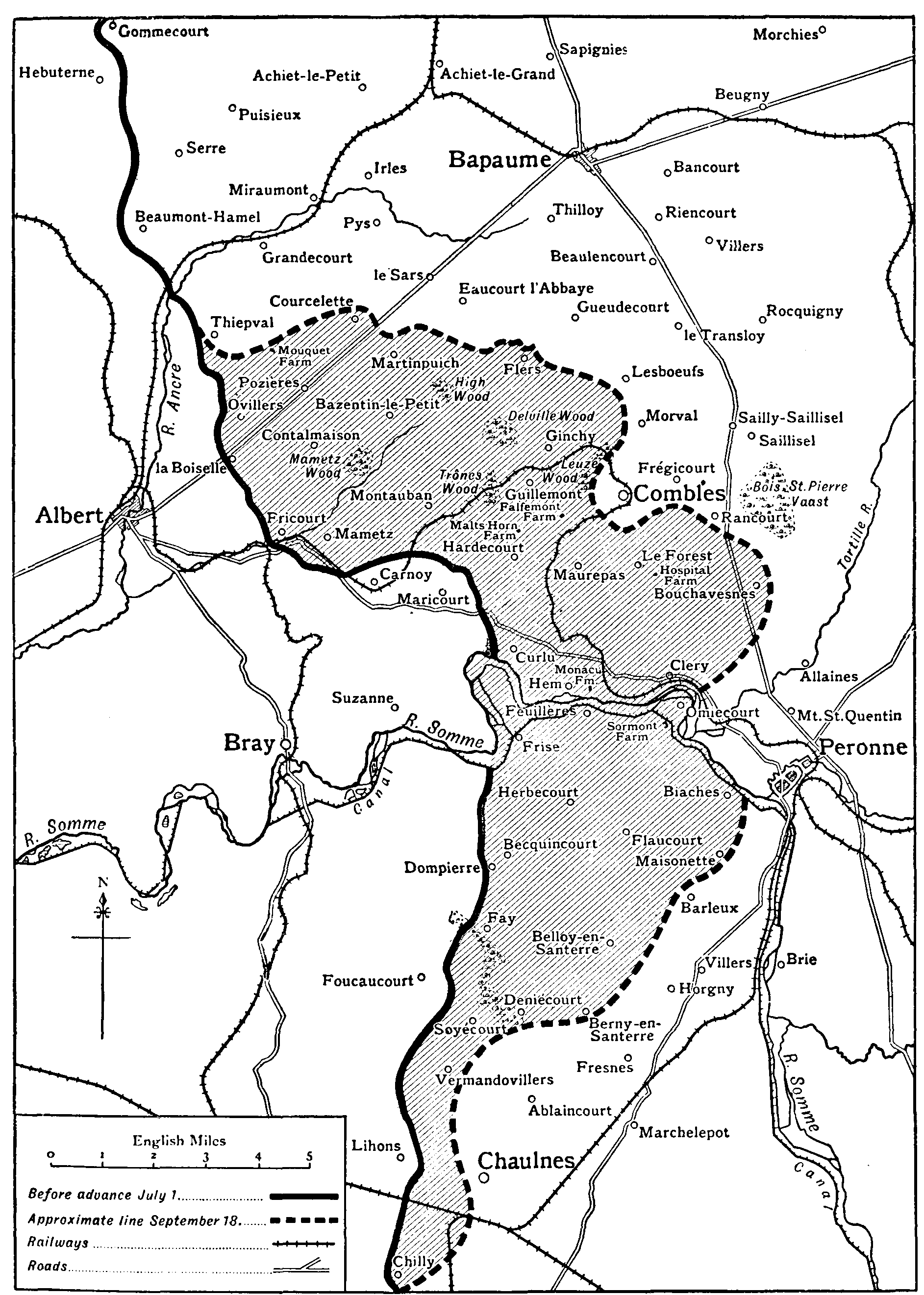
The French armies, well handled, and aided by the advantage of finding the Germans less on their guard, made ground on either side of the Somme. Three corps participated in the assault—the 20th (Balfourier) from Maricourt to the Somme, where the hardest fighting was at Curlu and Hardicourt; the 1st Corps (Brandelat); and the 35th Corps (Allonier). The last two walked through the Germans, and the French losses were light. As the result of the day's fighting along the whole extent of the front, the British captured 3500, and the French 6000 prisoners; but the casualties of the assailants were close on 50,000. The second day's fighting, though it emphasized the certainty that no great German defeat had been inflicted, enabled both the French and British commanders to enlarge the ground they had won, and the advantage was further exploited in the few days that followed. By the 5th of July over a front of 6 miles the Germans had been pushed back a mile; the British had captured 6000, the French 8000 prisoners.
This was the first blow in the Somme battle. Its results, compared with those of the German attack at Verdun, do not afford warrant for regarding it as a great victory. It became clear that there was no precedent to follow other than that set by the Germans at Verdun, namely that of systematically reducing the enemy's position. This heavy task was entered on by the British forces with unbroken determination; and the effort relaxed scarcely any of its vigour till 18th Sept., while the last big British attack on the Ancre began on 13th Nov. The principal events in this protracted struggle for positions and fortified strongholds after the opening phase already described were:
14th to 15th July.—British attack German second line, capturing Longueval, Trônes Wood, Delville Wood, and 2000 prisoners.
23rd July.—Second phase of Somme battle begun. Pozières captured 26th July.
16th Aug.—French take Belloy near the Somme; 1300 prisoners.
29th Aug.—Total British captures on Somme to date: 266 officers, 15,203 men, 86 guns.
15th Sept.—British advance (third phase of Somme battle) using tanks for the first time; Martinpuich and High Wood taken. Lesbœufs and Morval captured 25th Sept. Combles and Thiepval captured 26th Sept.
30th Sept.—Thiepval Ridge captured.
10th Oct.—French take Ablaincourt, south of Somme, and 1300 prisoners.
21st to 23rd Oct.—British take 1018 prisoners.
12th Nov.—French take Saillisel.
13th Nov.—Battle of the Ancre (fourth phase of Somme battle). British take 4000 prisoners.
29th Dec.—Sir D. Haig's dispatches relating to Somme battle. During the period 1st July to 18th Nov. were captured 38,000 prisoners, 125 guns, 514 machine-guns. The number of casualties inflicted on the Germans has not been made known. Those of the British amounted to 22,923 officers and 476,553 men. A number of these were, of course, not permanent casualties.
Russian Campaign, 1916
During the winter of 1915-6 the Russian armies were reorganized by General Alexieff under the nominal command of the Tsar. The Grand Duke Nicholas, as already stated, went to the Caucasus in 1915, and while Viceroy there the successful advance of General Yudenitch to Erzerum (captured 16th Feb.) was made. The Russian armies of the north were placed under General Kuropatkin (Riga to Dvinsk) and General Everts (Vilna to the Pripet), and the commands embraced respectively the Twelfth, Fifth, and First; and the Second, Tenth, Fourth, and Third Armies. In the southern group of armies, commanded by General Ivanoff till April, and by General Brussiloff afterwards, were included the Eighth Army (Kaledin) in the Rovno sector, Eleventh Army of Volhynia (Sakharoff), Seventh Army of Eastern Galicia (Scherbatcheff), and Ninth Army of the Dniester (Lechitsky). Facing the northern group of armies were German forces directed nominally by General Hindenburg, actually by General Ludendorff. The local commanders were von Below and von Scholtz (Riga to Dvinsk), von Eichhorn (Lake Narotch), von Fabeck and von Woyrsch with an Austrian army corps. A force under the nominal command of Prince Leopold of Bavaria connected these German armies with those which faced General Brussiloff (successor to Ivanoff). The Volhynian sector (Third Austro-Hungarian Army) was under von Brlog; Rovno sector (Fourth Army) under the Archduke Joseph Ferdinand, stiffened by a reserve under von Linsingen. Farther south were General Boehm-Ermolli's army (Second), and the two armies of Bothmer and Pflanzer-Baltin. The Russians, who had been recruiting far larger numbers than they could feed or employ, were much more numerous. The Germans were well entrenched and superior in artillery.
The German effort in 1916 was diverted to the West. The Russians, who were now better supplied in guns and ammunition than heretofore, seized the opportunity to take and keep the initiative in the East. They began before the end of 1915 with an offensive in Galicia on the Styr and Strypa, and continued their attacks through January; while in February there was severe fighting on the Dniester, in the Bukovina, and in Volhynia. The first full-dress attack was made, however, in the northern sector, where General Everts began the battle of Lake Narotch on 18th March. Fighting here was renewed eight times before 14th April, and the Russian gain on the Vilna road did not warrant the heavy losses (12,000), which were increased by a German counter-attack on 28th April.
The important part of the Russian campaign took place in the southern group of armies commanded by Brussiloff, who used his superiority of numbers against the Austrian generals and their very mixed troops with brilliant effect. On 4th June the Russian armies from the Pripet to the Bukovina were set in motion simultaneously against the long unequally guarded Austrian front, seeking the weak places. Generals Kaledin and Sakharoff, in the sectors nearest the Pripet, engaged the armies of von Brlog and the Archduke Joseph Ferdinand; and the Russian columns, though held up in the marshes supporting von Brlog near Kolki, swept through the archduke's defences like paper. They marched swiftly forward over rolling country to the Styr, driving the Austro-Hungarian levies before them. By 16th June the leading Russian columns were 12 miles from Vladimir Volhynok. North of this apex Kolki and Svidniki, on the Stokhod, were captured; south of the so-called Lutsk salient thus created Sakharoff captured Dubno, and was outside Brody on the 16th. In twelve days this most damaging attack captured 70,000 men, 83 guns, and created a salient which, at its greatest depth, was 50 miles from the 80-foot base from which it had been started. Von Linsingen's reserves were sent in, and Ludendorff took matters in hand.
General Scherbatcheff had simultaneously attacked von Bothmer from Kozlov to the Dniester. The Russian general reached Bucacz (8th June) and crossed the Strypa. He also captured 17,000 prisoners and 30 guns, but von Bothmer, athwart a good line of railway, could not be enveloped, and fell back sullenly and without disaster.
General Lechitsky, in the most southerly sector, struck with fury at Pflanzer-Baltin, and cut through his centre on the hills between the Dniester and the Pruth while turning his flank at the Dniester bridge-heads at Zaleszczyki and Biskupie. The net result was the wreck of Pflanzer-Baltin's army, which was forced to retreat across the Pruth to the Carpathians. Lechitsky captured 39,000 men; and Brussiloff's great attack had succeeded triumphantly on both wings. It had made less headway in the centre. There were two lines of subsequent pressure or advance open to him, one, the more northerly, towards Kovel; the other, with, as object, the further destruction of the southern Austro-Hungarian armies, towards Halicz.
Map illustrating the extent of Russian Recovery in the Summer Campaign of 1916
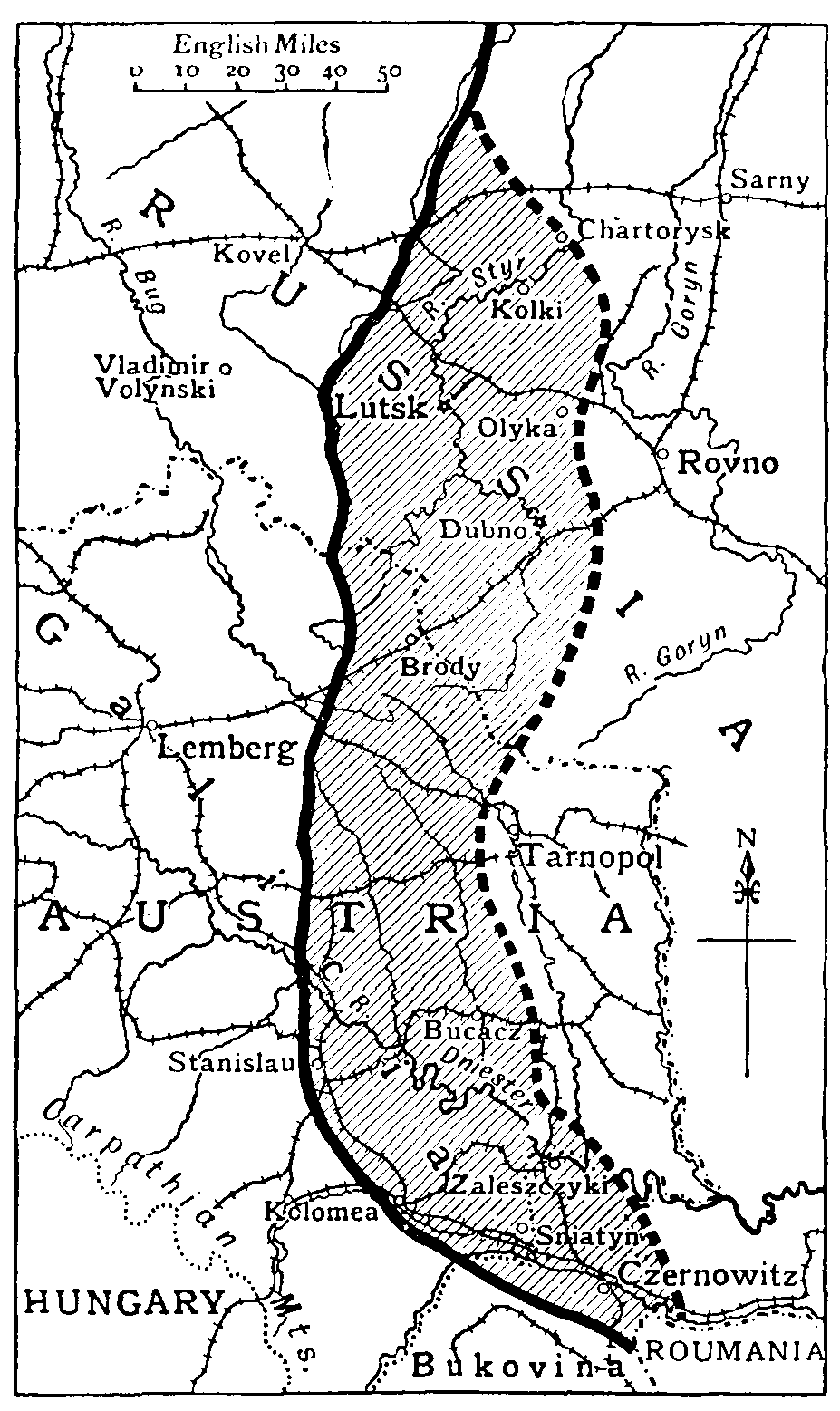
Ludendorff, however, had by this time formed his plans for the restoration of equilibrium; and Linsingen, with his reserves, was employed to make amplification of the Russian success at the most northerly portion of the salient impracticable. Linsingen struck at the Stokhod River crossings. Brussiloff countered by bringing up a fresh army under General Lesch with the object of outflanking Linsingen in his turn; and another army, under General Rogoza, was ordered to occupy General Woyrsch's attention farther north. These manœuvres had considerable success, Lesch and Rogoza capturing 17,000 men. But though in these and subsequent engagements the largest numbers of captures fell to the Russians, and though in the extreme south they were again able to advance to the Carpathian passes, no disaster on the largest scale was inflicted. The Germans were able to withdraw their allies and to allow the Russian attack to wear itself out.
Nevertheless, the Russian victories were of immense service to the Allies, and by the autumn of 1916 it seemed that the prospects of the Central Empires were darker than at any period of the war. The Russian advance, in its resolution and generalship, need not shrink from a comparison with that with which Foch ended the war two years later. By the middle of September, Generals Kaledin, Lesch, Sakharoff, Scherbatcheff, with Bezobrazoff and Lechitsky in the south, had captured 370,000 prisoners, 450 guns, and an amount of supplies as great as that which fell into Ludendorff's hands at St. Quentin in 1918.