Volume 4 — F
Reading edition
F, the sixth letter of the English alphabet, is a labio-dental articulation, formed by the passage of breath between the lower lip and the upper front teeth. It is classed as a surd spirant, its corresponding sonant spirant being v, which is distinguished from f by being pronounced with voice instead of breath, as may be perceived by pronouncing ef, ev. The figure of the letter F is the same as that of the ancient Greek digamma, which it also closely resembles in power. As a mediæval Roman numeral F stands for 40, and with a bar above it, it is 40,000. F, in music, is the fourth note of the diatonic scale.
Faam-tea, or Faham-tea, a name given to the dried leaves of the Angræcum fragrans, an orchid growing in the Mauritius and in India, and much prized for the fragrance of its leaves, an infusion of which is used as a stomachic and as an expectorant in pulmonary complaints.
Faber, Frederick William, D.D., a theologian and hymn-writer, the nephew of George Stanley Faber, born at Durham in 1814, died 26th Sept., 1863. In 1845 he became a convert to Roman Catholicism, and founded the oratory of St. Philip Neri, afterwards transferred to Brompton.
Fabian Society, a Socialist organization, founded in 1888, whose object, as defined by the basis which members are required to sign, is the nationalization of all land and industrial capital for the benefit of the whole community; this result to be attained, not by any violent upheaval, but by educating the minds of the masses and gradually extending the control of the State over the factors of production. Its policy, as expounded in Fabian Essays (1889) by a number of its early members, is frankly opportunist, and contemplates the use of existing political machinery and the acceptance of any measure of reform which will further the ultimate aims of the society. The name is derived from that of the Roman general, Quintus Fabius Maximus, known as Cunctator from the cautious tactics by which he ultimately defeated Hannibal. Prominent members of the society at different times have been Bernard Shaw, Sidney Webb, H. G. Wells, and J. A. Hobson. The society has branches in Great Britain, the Colonies, and America, and has issued a number of publications, notably Fabian Tracts. A research department recently established has done useful work. The growth of the labour movement has rather diminished the importance of the society, and has led to some secessions from its ranks.
Fabii (fā´bi-ī), an ancient and renowned family of Rome, who, having undertaken the duty of defending Roman territory against the incursions of the Veientines, established themselves at a post on the River Cremera. Being drawn into an ambush, they were killed to a man (477 B.C.). A boy who happened to be left in Rome became the second founder of the family. Among its celebrated members in aftertimes was Fabius Maximus, whose policy of defensive warfare was so successful against Hannibal in the second Punic War (218-201 B.C.); and Quintus Fabius Pictor, who lived about the same time and wrote a history of Rome in Greek, thus being the earliest Roman historian.
Fable (Lat. fabula, narrative), in literature, a term applied originally to every imaginative tale, but confined in modern use to short stories, either in prose or verse, in which animals and sometimes inanimate things are feigned to act and speak with human interests and passions for the purpose of inculcating a moral lesson in a pleasant and pointed manner. The fable consists properly of two parts—the symbolical representation and the application, or the instruction intended to be deduced from it, which latter is called the moral of the tale, and must be apparent in the fable itself. The oldest fables are supposed to be the Oriental; among these the Indian fables of Pilpay or Bidpai, and the fables of the Arabian Lokman, are celebrated. Amongst the Greeks, Æsop is the master of a simple but very effective style of fable. The fables of Phædrus are a second-rate Latin version of those of Æsop. In modern times Gellert and Lessing among the Germans, Gay among the English, the Spanish Yriarte, the Italian Pignotti, and the Russian Ivan Krylov, are celebrated. The first place, however, amongst modern fabulists belongs to the French writer La Fontaine. R. L. Stevenson wrote a collection of fables.—Cf. Walter Jerrold, The Big Book of Fables.
Fabliaux (fab´li-ō; O.F. fabliaus, Lat. fabella, dim. of fabula, story), in French literature, the short metrical tales of the Trouvères, or early poets of the Langue d'Oil, composed for the most part in the twelfth and thirteenth centuries. These productions were intended merely for recitation, not for singing, and had as their principal subjects the current gossip and news of the day, which were treated in a witty and sarcastic way. The fabliaux lashed not only the clergy and nobility in their degeneracy, but even mocked the religious chivalrous spirit, and the religious and knightly doctrines and ceremonies.
Fabre, Jean Henri, French entomologist, born at Sainte-Leone, Aveyron, in 1823, died 11th Oct., 1915. The son of very poor parents, he received a free education at Rodez, and then went to the normal school at Vaucluse, and at the age of eighteen he began his career as teacher. He was in charge of a primary school, and in his spare time studied mathematics and physics. He subsequently became professor of physics at the College of Ajaccio, and his interest in insects having in the meantime been aroused, he turned his entire attention to entomological pursuits. His reputation as a naturalist increased, and his work was praised by Darwin. He was particularly noted for the remarkable patience with which he investigated the life-history of insects, and for his minute and painstaking observations. His works first appeared in the Annales des sciences naturelles from 1855-8, and were afterwards amplified in his Souvenirs Entomologiques in 10 volumes, published between 1878 and 1907. He was made a chevalier of the Legion of Honour, and in 1912 the French Government granted him a pension. His works were translated into English by A. Texeira de Mattos.
Fabria´no, an episcopal city of Italy, province of Ancona. Pop. 23,750.
Fabricius, Gaius (with the cognomen Luscinus), an ancient Roman, celebrated on account of his fearlessness, integrity, moderation, and contempt of riches. After having conquered the Samnites and Lucanians, and enriched his country with the spoils, of which he alone took nothing, he was sent on an embassy to Pyrrhus, King of Epirus, who tried in vain to corrupt him by large presents. When consul in 279 B.C., Fabricius delivered up to Pyrrhus his treacherous physician, who had offered to poison his royal master for a sum of money. In gratitude for the service the king released the Roman prisoners without ransom. In 275 B.C. Fabricius was chosen censor. He died about 250 B.C.
Fabricius, Johann Albrecht, a German scholar, born at Leipzig in 1668, died in 1736. He became professor of rhetoric and moral philosophy at Hamburg, and published many learned works, amongst which are his Bibliotheca Latina, Bibliotheca Ecclesiastica, and Bibliotheca Antiquaria.
Fabricius, Johann Christian, German entomologist, born 1743, died 3rd March, 1808. After studying at Copenhagen, Leyden, Edinburgh, and under Linnæus at Upsala, he obtained the post of professor of natural history in the University of Kiel. In 1755 appeared his Systema Entomologiæ, which gave to this science an entirely new form. In 1778 he published his Philosophia Entomologica, written upon the plan of the well-known Philosophia Botanica of Linnæus.
Facciolati (fa˙t-cho-lä´tē), Jacopo, Italian classical scholar, born 1682, died 1769; professor in the University of Padua. The most important work with which he was connected was the Totīus Latinitātis Lexicon, compiled by Forcellini under his direction and with his co-operation.
Face, the front part of the head, the seat of most of the sense-organs. The bony basis of the face, exclusive of the thirty-two teeth (these not being in the strict sense bones), is composed of fourteen bones, called, in anatomy, the bones of the face. The anterior part of the brain-case (frontal bone) also forms an important feature of the face. Of all these bones the lower jaw only is movable, being articulated with the base of the skull. The other bones are firmly joined together and incapable of motion. In most mammals the jaws project much more than in men, and form the prominent feature of the face, while the forehead recedes. See Facial Angle.
Face´tiæ, humorous sayings, witticisms, jests. There have been many collections of such. Amongst the most notable are the Asteia (Jests) of Hierocles, an old Greek collection, the Liber Facetiarum of Poggio Bracciolini, and Joe Miller's Jest-Book.
Facial Angle, an angle of importance in the method of skull measurement introduced by Camper, the Dutch anatomist, who sought to establish a connection between the magnitude of this angle and the intelligence of different animals and men, maintaining that it is always greater as the intellectual powers are greater. Suppose a straight line drawn at the base of the skull, posteriorly across the external orifice of the ear to the bottom of the nose, and another straight line from the bottom of the nose, or from the roots of the upper incisors, to the most prominent part of the forehead, then both lines will form an angle which will be more or less acute. In apes this angle is only from 45° to 60°; in the skull of a negro, about 70°; in a European, from 75° to 85°. In another mode of drawing the lines the angle included between them varies in man from 90° to 120°, and is more capable of comparison among vertebrate animals than the angle of Camper. Though of some importance in the comparison of races, this angle is fallacious as a test of individual capacity.
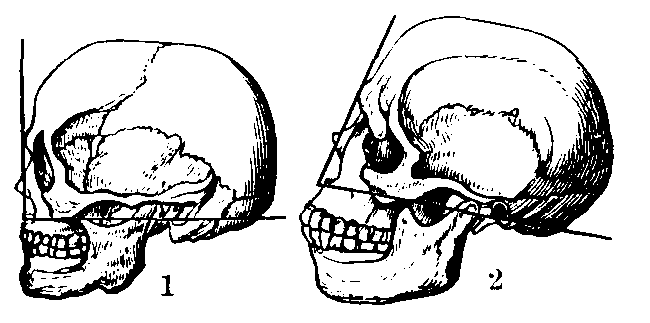
Facial Angle.
1, European. 2, Negro.
Facial Nerve, a motor nerve which supplies the muscles of expression on either side of the face. Injury to this nerve produces facial paralysis, the result of which is that the affected side is smooth, unwrinkled, and motionless, the eyelids are wide open and cannot be closed, and the muscles of the sound side having it all their own way drag the mouth to that side.
Factor, in arithmetic, is any number which divides a given number without a remainder, thus 3, 5, 7 are all factors of 105. In algebra, any expressions multiplied together to form a product are said to be factors of the product; for example, x + 1, x + 2, x + 3 are factors of x3 + 6x2 + 11x + 6.
Factor, in commerce, an agent employed to do business for another in buying or selling, or in the charge of property. A factor differs from a broker in holding a wider and more discretionary commission from his employer, in being able to buy and sell in his own name, and in having a lien on goods for his outlay. The difference, however, depends so much upon the usage of the particular trade, or upon the special instructions constituting the agency, that no exact line of demarcation can really be drawn between them. The term factor has in common usage generally given place to the terms agent and broker, the former applied in the more general, the latter in the more restricted sense. It is still retained in some special cases, as in that of house-factors and factors on landed property in Scotland, who have charge of the letting and general management of house property, farms, &c.; called in England estate agents.
Fac´tory (from factor), a name which appears originally to have been given to establishments of merchants and factors resident in foreign countries; it now more commonly signifies a place in which the various processes of a particular manufacture are carried on simultaneously. The rapid growth of factories in this sense is a comparatively recent development of industry, resulting from the free use of machinery and the consequent subdivision of labour. Amongst the advantages of the factory system are generally counted: first, increased productiveness arising from the minute division of labour; second, the mechanical accuracy and the cheapness of the product turned out by machinery; third, the facilities for union and co-operation for common improvement afforded by bringing large masses of workmen together. But this last consideration is probably more than counter-balanced by the smaller amount of independent intelligence called forth in the individual worker, through the monotony of the minutely subdivided operations. Decided disadvantages of the factory system are the unhealthiness of the crowded rooms, where the air is full of deleterious elements; and the increasing demand on the labour of women and children, interfering as it does with the economy of domestic life.—Bibliography: R. W. Cooke-Taylor, Factory System and Factory Acts; B. L. Hutchins, A History of Factory Legislation.
Factory Acts, Acts passed for the regulation of factories and similar establishments. Considering that women and children were not qualified fully to protect themselves against the strain of competition, the British legislature has passed a series of Acts to regulate the conditions of their employment in factories. The immediate occasion of the first Act passed to regulate factory employment in England was the outbreak of an epidemic disease which committed great havoc among the younger persons employed in factories in the district round Manchester at the beginning of the nineteenth century. An Act was passed (1802) in which provision was made for the regular cleansing and ventilation of mills and factories, and also for limiting the hours of labour to twelve daily. In 1819 an Act followed which prescribed an hour and a half for meals in the course of a working day, and prohibited children under nine years of age being employed in factory work at all. Various Acts were passed up to 1878, when a general Factory and Workshop Act was passed, consolidating the previous series of statutes. Its scope was extended by a further series of enactments, until in the year 1901 the last general Act was passed, which consolidates and amends all previous legislation. The Act contains general provisions regarding drainage, sanitary conveniences, overcrowding, ventilation, fencing of dangerous machinery, &c. Factories are distinguished from workshops as making use of steam or other mechanical power. In textile factories the hours of labour for women and young persons (the latter between 14 and 18 years of age) are restricted to 10, but only 6½ on Saturday and 56 in the week. In non-textile factories and workshops the hours may be 10½ per day and 60 per week at most. Children (of 12 to 14 years) were not allowed to be employed more than 6½ hours on any one day. (The Education Acts now prohibit almost entirely the employment of 'school children' in factories and workshops.) Provision is made for a certain number of annual holidays. Special provisions for particular kinds of factories are made, and under these the employment of females and young persons is regulated in bleaching- and dyeing-works, lace-factories, manufactories of earthenware, lucifer matches, percussion caps, cartridges, blast-furnaces, copper-mills, forges, foundries, manufactories of machinery, metal, india-rubber, gutta-percha, paper, glass, tobacco, letterpress printing, bookbinding, &c. The Act of 1901 included laundries carried on by way of trade or for the purposes of gain. An Act of 1907 extended the Act of 1901 to laundries carried on as ancillary to another business or incidentally to the purposes of any public institution. A short Act passed in 1911 gave power to make regulations applicable to cotton-cloth factories. Certain exceptions in regard to working over-time are provided for; thus women may sometimes work 14 hours a day. So far there has been no direct interference in any of the Factory Acts with the labour of adult male persons; but it is obvious that indirectly the position of the male labourer also is affected by legislation of this sort.
Fac´ulæ (Lat. facula, a torch), bright markings on the sun's disc, i.e. portions more brilliant than the general surface. They are supposed to be parts of the luminous surface, or photosphere, which are elevated to a greater height, and therefore suffer less absorption of their light in its passage through the overlying gases and vapours. Like the spots, they are in a state of constant change, and exhibit a similar periodicity in numbers and extent.
Faculties, Court of, in English law, a jurisdiction or tribunal belonging to the archbishop. It does not hold pleas in any suits, but has power to grant licences or dispensations, such as, to marry without banns, or to remove bodies previously buried.
Faculty, the members, taken collectively, of the medical or legal professions; thus we speak of the medical faculty, and (in Scotland) of the faculty of advocates. The term is also used for the professors and teachers collectively of the several departments in a university; as, the faculty of arts, of theology, of medicine, or of law.
Faculty, in law, is a power to do something, the right to do which the law admits, or a special privilege granted by law to do something which would otherwise be forbidden.
Fæces, the excrementitious part evacuated by animals. It varies, of course, with different species of animals, according to their diet. The main constituents are unassimilable parts of the food, on which the digestive process has no effect, and other portions, quite nutritious, but which have escaped digestion, also certain waste matters, &c. In disease the composition varies extremely.
Faed (fād), John, R.S.A., artist, born in Kirkcudbrightshire in 1820, died in 1902. He showed artistic talent at an early age, and in 1841 went to Edinburgh to study. Some years later he acquired a considerable reputation, and was elected to the Royal Scottish Academy in 1851. Among his principal works are: Shakespeare and his Contemporaries; An Incident of Scottish Justice; The Morning after Flodden; A Wappenshaw; two series of drawings illustrating The Cotter's Saturday Night and The Soldier's Return; John Anderson, My Jo; Auld Mare Maggie; The Gamekeeper's Daughter; The Hiring Fair.
Faed, Thomas, R.A., younger brother of the preceding, born at the same place in 1826, died in 1900. He studied in Edinburgh, where at an early age he became known as a clever painter of rustic subjects. In 1852 he settled in London, where he won a high reputation. The subjects he painted are for the most part domestic or pathetic, and in these he invented and told his own story, and that with a success that emulates Wilkie. Among his principal works are: Sir Walter Scott and his Friends (1849), The Mitherless Bairn (1855), The First Break in the Family (1857), Sunday in the Backwoods (1859), His Only Pair (1860), From Dawn to Sunset (1861), The Last o' the Clan (1865). A number of Faed's works have been engraved in large size, and have been very popular.
Faenza (fa˙-en´za), an episcopal city of N. Italy, in the province of and 19 miles south-west of Ravenna. It is supposed to have been the first Italian city in which the earthenware called faience (q.v.) was introduced. The manufacture still flourishes here, and there is also a considerable trade in spinning and weaving silk. Pop. (commune), 40,164.
Fagaceæ, a nat. ord. of apetalous Dicotyledons, all trees and shrubs, mostly natives of temperate regions. It includes the beeches and oaks, and the sweet chestnut (Castanea).
Fagging, a custom which formerly prevailed generally at most of the English schools, and is still practised at Eton, Winchester, Harrow, Rugby, and one or two other places. It consists in making the junior boys act as servants or 'fags' in the performance of multifarious menial offices for elder boys, such as carrying messages or preparing breakfast for their master, in return for which the elder boy accepts a certain responsibility for keeping order, and becomes the recognized adviser and protector of his 'fags'.
Faggot-vote, a term formerly applied in Britain to a vote procured by the purchase of property so as to constitute a nominal qualification without a substantial basis. Faggot-votes were chiefly used in county elections for members of Parliament. The way in which they were usually manufactured was by the purchase of a property which was divided into as many lots as would constitute separate votes, and given to different persons, who need not be resident members of the constituency. The practice disappeared after the Reform Act of 1884.
Faguet, Émile, French literary historian, critic, and journalist, born at La Roche-sur-Yon in 1847, died in 1916. He became professor of poetry at the Sorbonne in 1897. Endowed with a keen power of analysis and a wealth of original ideas, he was one of the most brilliant French critics of the nineteenth century. Whilst praising the literature of the seventeenth century, Faguet somewhat depreciated the writers of the eighteenth century. Among his numerous works are: Le théâtre contemporain (1880-91), Dix-huitième siècle (1890), Seizième siècle (1893), Drame ancien et drame moderne (1898), Histoire de la littérature française (1900), Propos littéraires (1902), Initiation into Literature, and Initiation into Philosophy.
Fagus. See Beech.
Fahlerz (fäl´erts), or grey copper ore, is of a steel-grey or iron-black colour. It occurs crystallized in the form of the tetrahedron, also massive and disseminated. Its fracture is uneven or imperfectly conchoidal. Specific gravity, 4.5-5.1. Tetrahedrite, the typical species, is composed of copper, sulphur, and antimony. Part of the copper is often replaced by iron, zinc, silver, or mercury, and part of the antimony by arsenic.
Fahlunite, a mineral of a greenish colour occurring in six-sided prisms. It is a pseudomorph after iolite, and consists mainly of hydrous aluminium silicate. It takes its name from Fahlun in Sweden.
Fahrenheit (fä´rėn-hīt), Gabriel Daniel, German physicist, known for his arrangement of the thermometer, was born at Danzig in 1686, died in 1736. Abandoning the commercial profession for which he had been designed, he settled in Holland to study natural philosophy. In 1720 he effected a great improvement by the use of quicksilver instead of spirits of wine in thermometers. He invented the Fahrenheit scale (see Thermometer), and made several valuable discoveries in physics. He was elected a fellow of the Royal Society of London in 1724.
Faidherbe (fā-derb), Louis Léon César, a French general, born in 1818, died in 1889. He entered the army in 1840, served in Africa and the West Indies, was appointed Governor of Senegal in 1854, and afterwards of a district in Algiers from 1867 to 1870. After the fall of Napoleon III, he was summoned by the Government of the National Defence to France and appointed commander of the army of the north. He fought some bloody but indecisive battles with the Germans under Manteuffel and Goeben. After the war he was elected to the Assembly by Lille, his native place, but on the triumph of Thiers retired from politics to private life. He wrote Épigraphie Phénicienne, and valuable monographs on Senegal, the Sudan, and other parts of Africa.
Faience (fa˙-yens´), imitation porcelain, a kind of fine pottery, superior to the common pottery in its glazing, beauty of form, and richness of painting. Several kinds of faience are distinguished by critics. It derived its name from the town of Faenza, in Italy, where a fine sort of pottery called majolica was manufactured as early as the fourteenth century. The majolica reached its greatest perfection between 1530 and 1560. In the Louvre, the Musée de Cluny, the British and Victoria and Albert Museums, at Berlin, and at Dresden are rich collections of it. The modern faience appears to have been invented about the middle of the sixteenth century, at Faenza, as an imitation of majolica, and obtained its name in France, where a man from Faenza, having discovered a similar kind of clay at Nevers, had introduced the manufacture of it. True faience is made of a yellowish or ruddy earth, covered with an enamel which is usually white, but may be coloured. This enamel is a glass rendered opaque by oxide of tin or other suitable material, and is intended not only to glaze the body, but to conceal it entirely. See Pottery.—Cf. M. L. Solon, The Old French Faience.
Failly (fa˙-yē), Pierre Louis Charles Achille de, French general, born in 1810, died in 1892. He distinguished himself in the Crimean War, and commanded a division against the Austrians in 1859. He was the means of introducing the Chassepôt rifle into the French army, and commanded the troops which dispersed Garibaldi's irregulars at Mentana. At the outbreak of the Franco-German War Failly received the command of the 5th Corps, but was very unfortunate or unskilful in his organization of operations. His masterly inactivity in the early weeks of the war caused great popular indignation in France. Sedan ended his career as a soldier.
Failsworth, a town of England, in Lancashire, 4 miles north-east of Manchester, with cotton-mills. Silk-weaving and hat-making are also carried on. Pop. 16,972.
Fainéants (fā-nā-a˙n˙; Fr., 'do-nothings'), a sarcastic epithet applied to the later Merovingian kings of France, who were puppets in the hands of the mayors of the palace. Louis V, the last of the Carlovingian dynasty, received the same designation.
Fainting, or Syncope, a sudden suspension of the heart's action, of sensation, and the power of motion. It may be produced by loss of blood, pain, emotional disturbance, or organic or other diseases of the heart. It is to be treated by placing the patient on his back in a recumbent position or even with head slightly depressed, sprinkling cold water on his face, applying stimulant scents to the nostrils, or anything which tends to bring back the blood to the brain. The admission of fresh cool air and the loosening of any tight articles of dress are important.
Fairbairn, Patrick, Scottish theologian, born 1805, died 1874. He became a minister of the Established Church, but joined the Free Church at the disruption in 1843. In 1853 he was appointed professor of divinity in the Free Church College, Aberdeen, and in 1856 principal of the Free Church College, Glasgow. Among his works are: Typology of Scripture; Jonah: his Life, Character, and Mission; Ezekiel; Prophecy; Hermeneutical Manual; Pastoral Epistles of St. Paul. He edited and wrote extensively for the Imperial Bible Dictionary.
Fairbairn, Sir William, British civil engineer, born at Kelso, Roxburghshire, in 1789, died 18th Aug., 1874. He was apprenticed as an engine-wright at a colliery in North Shields, and commenced business on his own account in Manchester with James Lillie in 1817, where he made many improvements in machinery, such as the use of iron instead of wood in the shafting of cotton-mills. About 1831, his attention having been attracted to the use of iron as a material for shipbuilding, he built the first iron ship. His firm became extensively employed in iron shipbuilding at Manchester and at Millwall, London, and had a great share in the development of the trade. He shares with Stephenson the merit of constructing the great tubular bridge across the Menai Strait. Fairbairn was one of the earliest members of the British Association for the Advancement of Science, of which he was president in 1861 and 1862. He was created a baronet in 1869. Sir William wrote many valuable professional books and papers, amongst which are: On Canal Steam Navigation (1831); Iron: its History, Properties, and Manufacture (1841); Application of Iron to Building Purposes (1854); Iron Ship-building (1865). His brother Sir Peter, born 1799, died 1861, had also great mechanical ability, and founded large machine-works at Leeds.
Fairfax, Edward, the translator into English verse of Tasso's Jerusalem Delivered, was the natural son of Sir Thomas Fairfax of Denton, and born in the last quarter of the sixteenth century. He settled at Newhall, in the parish of Fewston, Yorkshire, to a life of studious leisure. The first edition of his translation bears the date of 1600. One or two eclogues by him also remain. He died in 1635.
Fairfax, Thomas, Lord, parliamentary general during the English Civil War, born in 1611 at Denton, in Yorkshire, died at Nun Appleton, Yorkshire, 12th Nov., 1671. He was the son and heir of Ferdinando, Lord Fairfax, to whose title and estates he succeeded in 1648. After serving in the Netherlands with some reputation, he returned to England, and on the rupture between Charles I and the Parliament joined the forces of the latter. In 1642 he was appointed General of the Horse, and two years later held a chief command in the army sent to co-operate with the Scots. In 1645, on the resignation of the Earl of Essex, Fairfax became general-in-chief of the Parliamentary army. After the victory at Naseby he marched into the western counties, quelling all opposition, put down the insurgents in Kent and Essex in 1647, and captured Colchester. In April, 1649, he was occupied along with Cromwell in suppressing revolt in the army; but positively declined to march against the Scottish Presbyterians. He was a member of Cromwell's first Parliament. He co-operated in the restoration of Charles II, being one of the committee charged to secure his return.
Fairford, a town in Gloucestershire, England, 8 miles east by south of Cirencester, with a church the twenty-eight windows of which are filled with beautiful stained glass, formerly ascribed to Albert Dürer, but now known to have been designed and executed in England. Fairford was the birth-place of John Keble. Pop. 1410.
Fair Head, a basaltic promontory on the north coast of Ireland, County Antrim, rising to the height of 636 feet.
Fairies and Elves. The fairies of folk-belief must be distinguished from the fairies of imaginative literature. Shakespeare, for instance, drew upon the fairy-lore of living tradition to create a new fairy mythology (as in A Midsummer Night's Dream) which became a literary convention. In the fairy stories of Hans Andersen the folk-material was similarly used in a free and individual manner. A distinction must likewise be drawn between the Celtic fairies and the Teutonic elves. The former are mainly females, like the nymphs of Homer, ruled over by a fairy queen, while the latter are mainly males, ruled over by an elf-king. Mab, the fairy queen, had no consort in British fairy literature until Oberon, King of the Fairies, was imported from mediæval romance. His name 'Auberon', anciently 'Alberon', is identical with that of the German elfin king 'Alberich'. Indeed, the very names 'fairy' and 'fay' were introduced into these islands from abroad. More than one class of supernatural beings referred to in Gaelic as the side (Irish) or sith (Scottish), and pronounced shee, are now called 'fairies'. These include the Danann deities of Irish mythology and 'the mothers' (Y Mamau) of Welsh folk-lore. The word side or sith has the secondary meaning of 'peace', and refers to the silence of death and the silence of fairy movements. It may also be translated as 'supernatural', 'Otherworld', or 'unearthly'. Mysterious diseases that come in epidemics and afterwards disappear are referred to as diseases of the side or sith. Cat demons are cait shith, the cuckoo is eun sith, the mythical 'water horse' is each sith, a monstrous dog that passes over land and sea by night is cu sith, while the 'will-o'-the-wisp' is teine sith ('supernatural fire'). In Iceland side refers to the dwellings (earth mounds, &c.) of the Dananns, &c., as well as to the supernatural inhabitants. The fairies of folk-belief always come from the west on eddies of wind, and cannot be seen except by those who have 'second sight', or those whose eyes have been anointed with a green balsam possessed by fairies. Sometimes the fairies render themselves visible to all, but one who grasps the garment of a fairy finds his hand closing on nothing. The usual height of fairies is about 3 feet, but they have power to shrink and pass through a crack in a door. They may also assume great stature. The Danann side of Ireland are of human or above human height. In Scotland 'green ladies' are of ordinary human size. The chief fairy colours are blue (the eyes), golden (the hair), and green, red, and grey (for clothing). Occasionally fairy beings are white and black. A black fairy with a red spot above the heart is referred to in Scottish stories, but is rare. He can be slain by piercing the red spot. The side or sith may be attired entirely in green with red caps, or have red cloaks and green skirts. A beautiful fairy queen may suddenly transform herself into an ugly old hag with black and white face and garments, as did the fairy who carried off Thomas the Rhymer to the Underworld. The dead were supposed to go to Fairyland, the Pagan Paradise. Those who died before their time were doomed to visit their former haunts as 'green ladies', i.e. green ghosts, until their measure of life was completed. Stories that tell of visions of the dead in the Underworld refer to them feasting and dancing, or reaping corn and plucking fruit in well-watered valleys. The resemblance of the Celtic Agricultural Paradise to the Otherworld of the Egyptian Osiris, which was originally situated under the ground, is of special interest. Both in the Underworld Paradise and on the 'Isles of the Blest' (the Celtic Avalon or 'apple land' and 'Land of the Ever-Young') is a tree of life, which may be an apple tree, a hazel tree, or a rowan tree. The apples, nuts, or berries confer longevity on the gods and the souls of human beings that partake of them. On those human beings who have won their favour, the fairies bestow weapons, implements, musical instruments, songs, tunes, and medicines, and the power to work charms and foretell future events. In the Underworld, fairies engage in metal working and other industries. Sometimes they visit houses, and spin and weave with supernatural skill and speed in a single night big bales of clothing material, or make beautiful garments. Fairies possess gems, gold, silver, and copper in their underground dwellings. Cornish miners hear them working in their mines. The 'banshee' (Ir. ben-side) is a Fate who is seen washing the blood-stained clothing, or the 'death clothes', of those who are doomed to die a sudden death. She either howls, or sings a weird song, or can be heard 'knocking' as she strikes the clothing with a beetle during the washing, when a tragedy is at hand. Fairy women of great beauty have human lovers, but vanish for ever after a few meetings, with the result that their lovers become demented. Fairy men (fer-side) likewise upset the minds of girls. The fairies abduct human children, leaving 'changelings' in cradles, or carry off wives to act as 'wet nurses' or midwives. Men who die suddenly are supposed to be transported to Fairyland. King Arthur, the Rev. Mr. Kirk of Aberfoyle, Thomas the Rhymer, and others were removed to the Fairy Paradise. Among the Celtic side are pixies, geniti-glinni (valley genii), Bocanachs (male goblins), Bananachs (female goblins), Demna aeir (spirits of the air), &c. Fairies may appear in animal forms, chiefly as beautiful birds. Elves are workers in metals, like Wayland Smith, and guardians of treasure who assume the forms of fish, otters, serpents, &c. Black elves dwell under the ground, and white elves haunt the air and the sea. Sea-elves are 'nikkers'. The Greek 'Fates', like the Celtic fairies, spin, weave, and embroider wedding and other garments in a single night for those they favour, and sometimes appear in groups of three, as old hags, to foretell tragic events or work spells. Celtic 'women of the side' sometimes appear in groups of three. The nereids are, like the fairy ladies, beautiful and capricious, and are likewise invariably blue eyed and golden haired. 'Nereid born' refers to the changeling idea. Nereids travel on whirlwinds, and, like the Celtic fairies, cause spinning spirals of dust on highways. They confer gifts on mortals, and accept offerings of food. Lacon the poet sings, "I will set a great bowl of white milk for the nymphs". In the Scottish Highlands the milk offering was poured on the ground for those 'under the earth', or into a hollowed stone (clach-na-gruagaich). The Indian 'nagas' have power to change from serpent to human form, or to appear as half-human, half-reptile beings. Like the Celtic fairies, they have been referred to by some writers as aborigines who hid from invaders in earth-houses, in forests, and among the hills. In this connection P. C. Roy, the translator of the Mahábhárata, writes: "Nagas are semi-divine and can move through air and water and ascend to high heaven itself when they like, and have their home at Patala (the Underworld). To take them for some non-Aryan race, as has become the fashion with some ... is the very height of absurdity.... None of these writers, however, is acquainted with Sanskrit, and that is their best excuse." The fairies and elves of China and Japan resemble those of Europe. In Polynesia there are fairy-like beings. They are called Patupaiarehe, and dwell in lonely places, appearing only at night. Human beings receive gifts from them, or knowledge of how to make nets, weapons, &c. The changeling idea is as prevalent as in Europe. It is of special interest to find that the Polynesian fairies have, like the Celtic, fair hair and white skins. Other peoples believe in the existence of fairy-like beings. See Folklore.—Bibliography: T. Keightley, Fairy Mythology; E. S. Hartland, Science of Fairy Tales; Delattre, English Fairy Poetry from the Origins to the Seventeenth Century; H. A. Giles, China and the Chinese; J. G. Lawson, Modern Greek Folklore and Ancient Greek Religion; Sir George Grey, Polynesian Mythology; P. W. Joyce, Social History of Ancient Ireland.
Fair Isle, an island lying nearly midway between the Orkney and Shetland Islands, 3 miles long by 2 broad. It is inaccessible except at one point, and rises to the height of 711 feet. Some grain is grown, but the surface is mostly in pasture. The men engage in fishing; the women knit a well-known variety of hosiery, introduced, it is said, by Spaniards who escaped from the wreck of one of the vessels belonging to the Spanish Armada. There are two lighthouses. Pop. 147.
Fair Oaks, Battle of, fought at Fair Oaks, in Virginia, 7 miles east of Richmond, between the Confederates under General Johnston and the Union troops under General M‘Clellan, 31st May, 1862. The loss on each side was nearly 6000 men; the result was indecisive.
Fairs (Lat. feria, holiday, connected with festus, feast), periodical meetings of persons having goods or wares for sale in an open market held at a particular place, and generally for the transaction of a particular class of business. The origin of fairs is obviously to be traced to the convenience of bringing together at stated times the buyers and sellers of the stock-produce of a district. In Europe the numerous festivals of the Church afforded the most favourable opportunity for the establishment of these markets. This association is indicated in the German name of a fair, which is identical with that used for the ceremony of the mass. In the Middle Ages fairs were of great importance, and were specially privileged and chartered by princes and magistrates, public proclamation being made of their commencement and duration. But modern facilities of communication have much diminished the necessity for periodical markets, and it is now chiefly amongst agriculturists that they are of much importance, large agricultural meetings being held in various districts for the sale of cattle and horses, and for the exhibition of agricultural implements. There are also, especially in Scotland, a considerable number of hiring fairs for farm servants. In the less developed commerce of the East, however, they still retain much of their ancient importance and magnitude. In Europe the most important fairs of the present day are those at Leipzig and Frankfort-on-the-Main in Germany, at Lyons in France, and Nijni-Novgorod in Russia. The last is, indeed, the largest fair in the world. The fairs of Great Britain now mostly consist of the weekly market-days of country towns and the agricultural meetings already mentioned. In many places the old fair-days are still kept, but are now merely an assemblage of penny-theatres, peep-shows, and such amusements. Amongst the fairs which were once celebrated saturnalia, or rather bacchanalia, may be mentioned Donnybrook Fair in the county of Dublin; Bartholomew and Greenwich Fairs, London; and Glasgow Fair. The first three are now extinct. Fairs in the sense of markets are unknown in the United States, but the term is usually given to ladies' fancy bazaars, collections of fine art or the higher industries for public exhibition.—Cf. C. Walford, Fairs, Past and Present.
Fair Trade, an economical policy advocated by many in Britain, which, while not opposed to free trade in principle, would meet the prohibitory tariffs that foreign countries may put on British goods by placing equally heavy duties on goods sent from these countries to Britain. See Free Trade.
Fairweather, Mount, on the west coast of North America, in Alaska territory. It rises to the height of 14,900 feet, and is covered with perpetual snow.
Fairy Ring, a circle, or part of a circle of grass, of a darker colour and more luxuriant growth than the surrounding herbage, superstitiously associated with fairy revels. Actually it is due to the growth of a subterranean fungus-mycelium, which gradually spreads outwards from a central point of origin, the older parts dying and serving as manure for the grass, which appears even more vigorous than it really is by contrast with that on the outermost edge of the ring, where the living mycelium has a bad effect upon the grass-roots. The commonest fairy-ring fungus is Marasmius oreades, the fairy-ring champignon.
Faith, the assent of the mind to the truth of what is declared by another, resting on his authority and veracity, either without other evidence or on probable evidence of any kind. In a special sense the term faith is used for the assent of the mind to what is given forth as a revelation of man's relation to God and the infinite, i.e. a religious faith. In Christian theology we have: first, historical or speculative faith, or belief in the historic truthfulness of the Scripture narrative and the claims of Scripture to an inspired and supernatural origin; second, evangelical or saving faith, that emotion of the mind (as Dwight defines it) which is called trust, or confidence exercised towards the moral character of God, and particularly of the Saviour.—Cf. W. R. Inge, Faith and its Psychology.
Faith-healing. The tenets of the Peculiar People and of other believers in healing by faith differ from the views of Christian Scientists in this respect: that, while the latter hold pain and disease to be illusions of the imagination, the faith-healer admits their existence, but affirms the possibility of their removal by non-scientific means. Some make use of anointing with oil, while others hold prayer and the laying-on of hands to be the only requisites. Faith-healing traces its source to the raising of the apparently dead, the curing of the sick, the restoration of sight to the blind, and other recorded miracles of Christ; thence through the miracles of the disciples and their successors, down to the performances of Dorothy Trudel in Switzerland, and the displays of Dowie in London (1904). Faith-healers flourish extensively in Sweden and America, while even in England 'Bethshans' (houses of cure) have been established. Faith, or some may say credulity, attributes the alleged cures to supernatural agency; science sees in them the action of 'suggestion', with an exalted and emotional state of mind in the patient, more especially when surrounded and encouraged by a crowd of expectant and credulous lookers-on. Excessive reliance on his or her own powers has not seldom brought a faith-healer within the menace of the law, owing to neglect to employ a qualified medical man, and the consequent death of the sufferer. In a broad sense of the term the belief in healing by faith has been at the root of 'touching' for the King's Evil, a practice followed by several English and French sovereigns (see Macbeth, iv, 3, 141); of the value placed on relics; of alleged cures effected at such 'holy places' as St. Winifred's Well in Wales, and the miraculous grotto at Lourdes; and of the firm belief, not yet entirely extinct, in many rustic remedies, such as the removal of children's ailments by immuring a live shrew in a cleft ash tree.—Bibliography: F. Podmore, Mesmerism and Christian Science; G. B. Cutten, Three Thousand Years of Mental Healing.
Fakirs (fa˙-kērz'; literally 'poor men'), a kind of fanatic met with chiefly in India and the neighbouring countries, who retire from the world and give themselves up to contemplation. They are properly of the Mohammedan religion, but the term is often used for a mendicant of any faith. They are found both living in communities and solitary. The wandering fakirs gain the veneration of the lower classes by absurd penances and self-mutilations.
Falaise (fa˙-lāz), a town, France, department of Calvados, picturesquely situated on a rocky precipice (Fr. falaise) 23 miles S.S.E. of Caen. It contains several objects of interest, among others the ruined castle of the Dukes of Normandy, where William the Conqueror was born. Pop. 6850.
Falashas, inhabitants of Amhara, in Abyssinia, who claim descent from Jewish emigrants during the reign of Jereboam. See Abyssinia.
Falckenstein, Edward Vogel von, a Prussian general, born in 1797, died in 1885. In 1813 he entered the Prussian army, distinguishing himself at the battles of Katzbach and Montmirail. In 1848 he served in the Holstein campaign, and he acted as colonel and chief of staff in the war with Denmark in 1864. In the war of 1866 he commanded the Seventh Army Corps. On the outbreak of the Franco-German War in 1870 he was appointed military governor of the maritime provinces.
Greenland Falcon (Falco candicans)
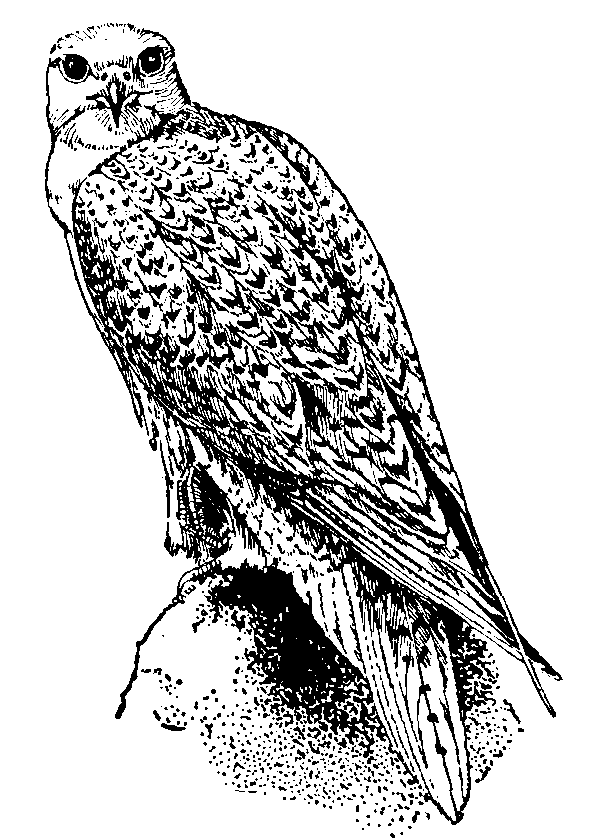
Falcon (fa¨´kn), a name of various birds of prey, members of the family Falconidæ. The falcons proper (genus Falco), for strength, symmetry, and powers of flight are the most perfectly developed of the feathered race. They are distinguished by having the beak curved from the base, hooked at the point, the upper mandible with a notch or tooth on its cutting edge on either side, wings long and powerful, the second feather rather the longest, legs short and strong. The largest European falcons are the jerfalcon or gyrfalcon proper (Falco gyrfalco), a native of the Scandinavian Peninsula, and the Iceland falcon (F. islandus); to which may be also added the Greenland falcon (F. candicans). Between these three species much confusion at one time prevailed, but they are now distinctly defined and described. These three Arctic falcons are often referred to the special genus Hierofalco. In the Greenland falcon the prevailing colour at all ages is white, in the Iceland falcon dark. The latter more nearly resembles the true gyrfalcon of Norway, which, however, is generally darker, rather smaller, but with a longer tail. The average length of any of these falcons is about 2 feet. The Greenland species used to be the most highly prized by falconers. Its food consists chiefly of ptarmigans, hares, and water-fowl. It is found over a wide range of northern territory. The peregrine falcon (F. peregrīnus) is not so large as the jerfalcon, but more graceful in shape. It chiefly inhabits wild districts, and nestles among rocks. It preys on grouse, partridges, ptarmigans, pigeons, rabbits, &c. Its flight is exceedingly swift, said to be as much as 150 miles an hour. The peregrine falcon was one of those most frequently used in falconry. Other British falcons are the hobby (Hypotriorchis subbuteo), formerly a great favourite for the chase of small game when falconry was in fashion; the merlin or stone-falcon (Æsalon regulus), small but swift and spirited; the kestrel or wind-hover (Tinnunculus alaudarius), one of the most common British falcons. The term falcon is by sportsmen restricted to the female, the male, which is smaller and less courageous, being called tiercel, tersel, tercelet, or falconet. See Falconry.
Falco´ne, Aniello, Italian painter, born in 1600, studied along with Salvator Rosa under Spagnoletto. His paintings, consisting chiefly of battle-pieces, are masterpieces, but very rare. He died in 1665.
Falconer (fa¨k´nėr), Hugh, Scottish naturalist, born in 1808, died, 1865. After having graduated in arts at Aberdeen and medicine at Edinburgh, he went to India as a surgeon in 1830. Here he made valuable geological researches, and turned his attention to the introduction of tea cultivation. In 1837 he accompanied Barnes's second mission to Cabul. He visited England in 1843 and published an illustrated descriptive work entitled Fauna Antigua Sivalensis (Ancient Fauna of the Siválik Hills). He returned to India in 1848, where he had been appointed superintendent of the botanic gardens at Calcutta. In 1855 he returned to England, where he died.
Falconer, William, poet and writer on naval affairs, born at Edinburgh in 1732. He went to sea in the merchant service, was wrecked, and wrote a poem (The Shipwreck) descriptive of the incidents, published in 1762. He then entered the navy, and was rated as midshipman on board the Royal George. In 1769 he published a Universal Marine Dictionary. The same year he sailed for Bengal as purser of the Aurora frigate, which is believed to have foundered at sea.
Falcon´idæ, a family of diurnal birds of prey, in which the destructive powers are most perfectly developed. The family includes the different species of eagles as well as the hawks and falcons properly so called, and comprises the sub-families Gypaëtinæ (lammergeiers), Polyborinæ (carrion hawks), Accipitrinæ (hawks and harriers), Aquilinæ (eagles), Buteoninæ (kites and buzzards), and Falconinæ (falcons).
Falcon with Hood
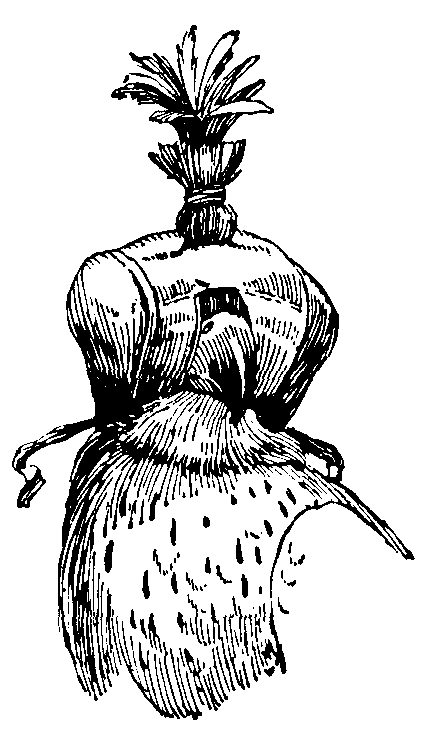
Falconry (fa¨´kn-ri), also called hawking, the pursuit of game by means of trained hawks or falcons. Falconry is a sport of great antiquity in Asia, having been followed in China as early as 2000 B.C. In Europe it was, during the Middle Ages, the favourite amusement of princes and nobles, and, as ladies could take part in it, became very general. Charlemagne passed laws in regard to falconry, while in Germany Henry the Fowler and the Emperor Frederick the Second were greatly addicted to it, and the latter wrote a work on the subject. In France it reached its greatest popularity under Francis I, whose grand falconer controlled an establishment of fifteen nobles and fifty falconers, at an annual cost of about 40,000 livres. In Britain the sport was practised before the Norman Conquest, but became still more popular after it, and till about 1650 enjoyed the prominence now held by fox-hunting. One of the most interesting of English works on the subject is that which forms the first part of the Boke of St. Albans, first printed in 1481. George Turberville's Booke of Faulconrie or Hawking (1575), and Simon Latham's The Faulcon's Lure and Cure (1633), may also be mentioned. Though the invention of fire-arms gradually superseded this amusement, it is not yet entirely extinct. The Duke of St. Albans is still hereditary grand falconer, and presents the king with a cast (or pair) of falcons on the day of his coronation. In Persia and other Eastern countries hawking is still in favour. The game hunted includes hares and rabbits, and, in the East, gazelles; with herons, wild geese, and many smaller birds. The training of a hawk is a work requiring great patience and skill, the natural wildness and intractable nature of the birds being very difficult to overcome. When a hawk suffers itself to be hooded and unhooded quietly, and will come to the trainer's hand to receive food, its education is considered far advanced, and the work of accustoming it to the lure may be proceeded with. The lure may be a piece of leather or wood, covered with the wings and feathers of a bird, and with a cord attached. The falcon is fed from it, and is recalled from flight by the falconer swinging the lure round his head with a peculiar cry. When the bird has been taught to obey the lure, it is next practised in the art of seizing its game, being initiated with prey fastened to a peg, and flown later at free game. When fully trained and being used for sport, the falcon is kept hooded until actually required to fly. Among the many technical terms connected with falconry may be mentioned that of mew (= moult), from which is derived the familiar name mews, originally places where hawks were kept while moulting.—Bibliography: J. E. Harting, Bibliotheca accipitraria; Salvin and Broderick, Falconry in the British Isles; E. B. Michell, The Art and Practice of Hawking; H. Cox, C. Richardson, and G. Lascelles, Coursing and Falconry (The Badminton Library).
Fald´stool (O.H.Ger. falden, to fold, and stol, chair), a folding stool provided with a cushion for a person to kneel on during the performance of certain acts of devotion, especially a kind of stool placed at the south side of the altar, on which the Kings of England kneel at their coronation. The term is also given to a small desk at which the litany is enjoined to be sung or said.
Faler´nian Wine, an ancient wine of great repute amongst the Romans. It was made from the grapes grown on Mount Falernus in Campania. It was strong and generous, probably much resembling modern sherry.
Falie´ro, Marino, Doge of Venice, born in 1274, commanded the troops of the republic at the siege of Zara in Dalmatia, where he gained a brilliant victory over the King of Hungary. He succeeded Andrea Dandolo, 11th Oct., 1354, was accused of the design of overthrowing the republic and making himself sovereign of the state, and beheaded 17th April, 1355. The last scenes of his life are depicted in Byron's tragedy of Marino Faliero.
Fal´kirk, a parliamentary burgh of Scotland, in Stirlingshire, 21½ miles west by north of Edinburgh. The older portion of it is old-fashioned and irregularly built. There are several modern suburbs. In the town or its vicinity are the Carron Ironworks, the Falkirk Foundry, and others works, collieries, chemical-works, and distilleries. Falkirk is connected with the port of Grangemouth by a railway 3 miles long. The Trysts of Falkirk, held on Stenhousemuir, 3 miles to the N.N.W., are the largest cattle-fairs in Scotland. Falkirk is an old town, with many historical associations. In the neighbourhood was fought the battle of Falkirk in 1298 between Sir William Wallace and Edward I, the Scots, who were much inferior in numbers, being defeated. About 1 mile south-west from the town the Highlanders under Prince Charles defeated the Royal forces under General Hawley, 17th Jan., 1746. Stirling and Falkirk Burghs return one member to the House of Commons. Pop. of Falkirk, 33,312.
Falkland (fa¨k´land), Lucius Gary, Viscount, an English man of letters, born about 1610. His father being then Lord-Deputy of Ireland, he was educated at Trinity College, Dublin. After passing a short time abroad, he devoted himself to a life of retirement and literary studies, chiefly residing at his seat at Burford, near Oxford, which he made a kind of academy for the learned men of the neighbouring universities. In 1639 he joined the expedition against Scotland; and in 1640, his peerage being Scottish, he was chosen member of the House of Commons for Newport, in the Isle of Wight. In the first instance he warmly supported the Parliament, but doubts of the ultimate objects of the parliamentary leaders caused him to modify his attitude; and in 1642 he accepted from Charles I the office of Secretary of State. When hostilities began, he embraced decidedly the cause of the king, though he desired peace rather than victory. He was slain at the battle of Newbury, 20th Sept., 1643. He left behind him a work entitled A Discourse on the Infallibility of the Church of Rome, several pamphlets and published speeches, and a few poems, but nothing that explains the universal praises bestowed on him by contemporaries.
Falkland (fa¨k´land), an ancient royal burgh of Scotland, county of Fife, 21 miles north of Edinburgh. It was once the residence of the Scottish kings, and possesses remains of an ancient palace and some curious old houses. There was formerly a castle here, in which David, eldest son of Robert III, was starved to death by order of his uncle the Duke of Albany, but no trace of it now remains. Falkland Palace was garrisoned by Rob Roy in 1715. Pop. 781.
Falkland Islands, an island group belonging to Great Britain, in the South Atlantic Ocean, about 300 miles east of the Straits of Magellan. They consist of two larger islands, East Falkland and West Falkland, containing respectively about 3000 and 2300 sq. miles, with a great number of smaller ones surrounding them; total area, 6500 sq. miles. They are hilly and boggy, entirely destitute of trees, but covered with a variety of grasses very nutritive for the sheep and cattle the rearing of which is the principal industry. Fish and sea-fowl abound. Wool, frozen meat, hides, and tallow are the chief exports; value in some years £600,000. The climate is equable and very healthy. The Falkland Islands were discovered by Davis on the 14th Aug., 1592. In 1710 a French vessel from St. Malo touched at them, and named them Îles Malouines. Settlements were afterwards formed on them by the French, Spaniards, and British alternately, but the British have ultimately retained possession of them. They now form a Crown colony which has a Governor and other officers appointed by the Government. Port Stanley, in East Falkland, is a thriving settlement, and has now a wireless station. During the European War the Germans suffered a naval defeat off the Falkland Islands in Dec., 1914. Pop. of the group, 3275.
Fal´lacy (Lat. fallax, apt to mislead), in logic, is when an argument is used as decisive of a particular issue, which in reality it does not decide. Properly a fallacy is a fault in the form of reasoning (see Logic), but the term is applied also to faults in the substance of the argument such as the petitio principii, or proving one proposition by assuming another which is identical with it; ignoratio elenchi, or mistaking the point at issue; post hoc ergo propter hoc, or arguing as if sequence were the same thing as cause and effect.
Fallières, Clément Armand, eighth President of the French Republic, born at Mézin, department of Lot-et-Garonne. The son of peasants, he studied law, was mayor of Nérac for some years, and in 1876 was elected to the Chamber of Deputies. Under-Secretary of State in the Ministry of the Interior in 1880, he became Minister of the Interior in 1882, Minister of Public Instruction from 1883 to 1885, and subsequently Minister of Justice and Public Instruction. He entered the Senate in 1890. In 1899 he became President of the Senate, and on 16th Jan., 1906, was elected President of the Republic. During his tenure of office Fallières displayed decided democratic principles and a tendency towards the Left. It was due to his initiative that a Ministry of Labour was formed in 1909. His term of office ended in Jan., 1913. Fallières was one of France's most democratic Presidents.
Fall of Bodies. All bodies on the earth, by virtue of the attraction of gravitation, tend to the centre of the earth. A ball held in the hand presses downward; if dropped, it descends vertically; if placed on an inclined plane, it rolls down, in doing which it presses the plane with a part of its weight. In the air bodies fall with unequal velocities, a piece of paper, for instance, more slowly than a ball of lead; and it was formerly thought that the velocity of the fall of bodies was in proportion to their weight. This error was attacked by Galileo, who, experimenting with balls of different substances which he dropped from the tower of Pisa, was led to the conclusion that the resistance of the air acting on different extents of surface was the cause of the unequal velocities, and that in a vacuum all bodies would fall with the same velocity. The truth of this last proposition was first demonstrated by Newton in his celebrated 'guinea-and-feather' experiment, where a guinea and feather are shown to fall side by side in the vacuum of the air-pump. This experiment proves that the force of gravitation in bodies is proportional to their inertia, that is, to their mass. The laws of falling bodies, that is of bodies falling freely in a straight line and through a distance short in comparison with that of the earth's centre, are the following:
1. When a body falls from rest it acquires velocity at the rate of about 32.2 feet per second every second. This number, which represents the acceleration due to the force of gravity, varies slightly with the locality, increasing from the equator to the poles, and diminishing as we recede from the surface of the earth. (See Gravity.) At the end of five seconds, therefore, the body would be found to be moving at the rate of 5 × 32.2, that is, 161 feet per second.
2. The space fallen through in the first second is half of 32.2, that is, 16.1 feet; and the space fallen through in any given time is found by multiplying the square of the number of seconds by 16.1. Thus in three seconds a body falls 9 × 16.1 feet, or 144.9 feet.
3. The square of the velocity acquired by falling through any number of feet is found by multiplying twice that number by 32.2. Thus if a body falls 9 feet, the square of the velocity acquired is 2 × 32 × 9, or 576 if we take 32 instead of 32.2; and taking the square root of 576, we find that a velocity of 24 feet is acquired in a fall of 9 feet.
4. When a body is projected vertically upward with a given velocity, it continues to rise during a number of seconds found by dividing the number that expresses the velocity of projection by 32.2; and it rises to a height found by dividing the square of that number by 2 × 32.2, or 64.4. For a machine used in verifying the laws of falling bodies, see Attwood.
Fall of Man, a commonly received doctrine of Christianity, founded upon the historical narrative contained in the third chapter of the book of Genesis, together with the allusions to the same matter in other parts of Scripture. Adam, having eaten of the forbidden fruit, is said to have fallen; and the relation of mankind in general to this fall is stated by St. Paul in the words: "By one man's disobedience many were made sinners" (Rom. v. 19). Thus, in the fall of Adam, all men are held to have fallen and to have contracted 'original sin', alienating them from God and rendering them morally inadequate. The doctrine of the fall does not stand alone in Scripture. It is argued by some interpreters that in the original sentence pronounced on the transgressors there is contained the promise of a redemption, and that the whole scope of Scripture is directed to the development of this promise, and of the divine scheme of providence associated with it.
Fallopian Tubes, in anatomy, are two ducts each of which opens by one extremity into the womb, at either angle of the fundus, and terminates at the other end in an open trumpet-shaped mouth, which receives the ovum as it escapes from the ovary and transmits it to the womb. They are named after Fallopius or Fallopio, an Italian anatomist of the sixteenth century, who first recognized their functions.
Fallow Deer (Cervus dama)
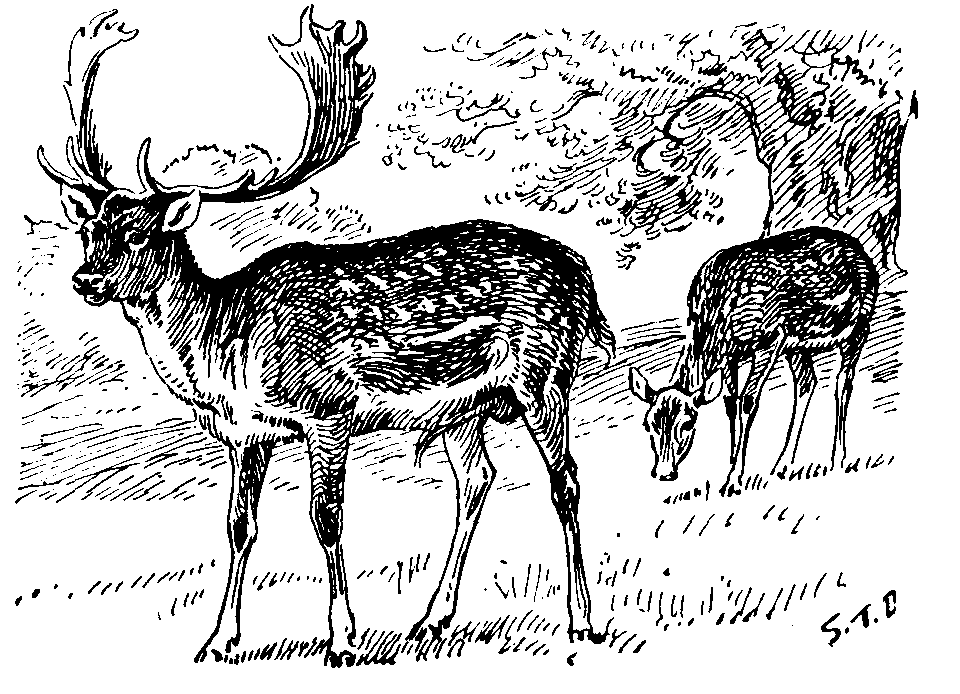
Fallow Deer, a European and Western Asiatic deer, the Cervus dama. It is smaller than the stag, of a brownish-bay colour, whitish beneath, on the insides of the limbs, and beneath the tail. The horns, which are peculiar to the male, are very different from those of the stag; they are not properly branched, but are broader towards the upper part, and divided into processes down the outside. A simple snag rises from the base of each, and a similar one at some distance from the first. It was introduced at an early period into Britain, possibly by the Romans, and is kept in many English parks.
Fallow Land, ground that has been left uncultivated for a time, in order that it may recover itself from an exhausted state. Strictly speaking, fallow ground is left altogether without crops; but in agricultural usage strict fallow is not always adopted, and the term fallow is applied to various modes of treatment, of which at least three distinct varieties are recognized: bare fallow, bastard fallow, and green-crop fallow. Bare fallow is that in which the land remains completely bare for a whole year; in bastard fallow it is ploughed up and worked after the removal of a spring or summer crop, preparatory to the sowing of a root or forage crop, to occupy the ground during autumn or winter; in green-crop fallow the land is sown with a root-crop, such as turnips or potatoes, placed in rows far enough apart to admit of the intermediate spaces being stirred, pulverized, and cleaned, during its growth, by horse or hand implements.
Fall River, a city and port, Bristol County, Massachusetts, United States, on an arm of Narraganset Bay, on Taunton River, 53 miles S.S.W. of Boston. It is at the head of deep-water navigation, and the terminus of a line of steamers from New York. It contains several handsome streets, and has extensive cotton, woollen, and calico-printing factories, as well as ironworks. Pop. 129,828.
Falmouth, a seaport and municipal borough of England, in Cornwall, 250 miles W.S.W. of London. There is a good harbour there, with a fine roadstead affording excellent refuge for shipping. Falmouth was at one time an important packet station, but is now chiefly a port of call, its principal trade being in supplies and stores for shipping. Falmouth and Penryn together give name to a parliamentary division of the county, returning one member to Parliament. Pop. 13,318.
False Imprisonment, the unlawful imprisonment or detention of any person. Every confinement of the person is imprisonment, whether in a common prison or a private house, or even by forcibly detaining one in the streets or highways. The law punishes false imprisonment as a crime, besides giving reparation to the party injured, through an action of trespass.
False Personation (English law). All forms of false personation, for the purpose of obtaining the property of others, are made penal by express statute. To personate the owner of any share, stock, or annuity, &c., is felony, and renders the offender liable to penal servitude for life, or to a modified term of penal servitude or imprisonment. The false personation of voters at an election is a misdemeanour punishable with imprisonment and hard labour, for a term not exceeding two years.
Falset´to (It.) applies, in singing, to the notes above the natural compass of the voice. It is also called the head or throat voice, in contradistinction to the chest voice, which is the natural one. The falsetto voice is produced by tightening the ligaments of the glottis.
False Weights and Measures. The using of false weights and measures is an offence at law punishable by fine. By various British statutes standards are provided for weights and for measures of capacity or dimension, and all contracts of sale, &c., are referred to such standards unless there is a special agreement to the contrary. See Weights and Measures.
Fal´ster, an island belonging to Denmark, situated at the entrance of the Baltic, east of Laaland, from which it is separated only by a narrow strait; flat, well watered, and wooded; productive in grain, pulse, potatoes, and, above all, fruit; area, 183 sq. miles. The principal town is Nykjöbing. Pop. 37,460.
Falun, or Fahlun (fä´lu¨n), a town of Sweden, on Lake Runn, 130 miles north-west of Stockholm. It has an excellent mining-school, museums, and mineralogical collections. Within the town boundary is the famous Falun copper-mine, formerly the richest in Sweden, and worked for 500 years. Pop. 11,966.
Fama Clamo´sa ('a clamant report'), in the ecclesiastical law of Scotland, is a public report imputing immoral conduct to a clergyman, licentiate, or office-bearer of the Church. When the fama has become so notorious that it cannot be overlooked, the presbytery, after due inquiry, and if no particular party comes forward to institute a process, usually appear as accusers themselves.
Famagos´ta, or Famagusta, a seaport on the east coast of Cyprus. It is of remote antiquity, was an important place during the Middle Ages under the Lusignan kings of Cyprus and the Venetians, but, after being captured by the Turks in 1571, it declined. It has improved under the British, and has got a new harbour. Pop. 5327.
Famati´na, a district and mountain range in the Argentine Republic, province of La Rioja, rich in copper; highest summit, the Nevada de Famatina, 19,758 feet high.
Familiar Spirits, demons or evil spirits supposed to be continually within call and at the service of their masters, sometimes under an assumed shape, sometimes attached to a magical ring, or the like, sometimes compelled by magic skill, and sometimes doing voluntary service. We find traces of this belief in all ages and countries, under various forms.
Family, in zoological classification, a group of species more comprehensive than a genus and less so than an order, a family usually containing a number of genera, while an order contains so many families. Family names usually terminate in -ĭdæ (after Latin patronymics, such as Æacĭdæ, sons or descendants of Æacus). In botany it is sometimes used as a synonym of natural order.
Family Compact, the name given to an alliance organized by the Duc de Choiseul, first minister of Louis XV, between the various members of the Bourbon family, then sovereigns of France, Spain, the Two Sicilies, Parma, and Piacenza, mutually to guarantee each other's possessions. It was signed 15th Aug., 1761, and entailed on Spain a war with England.
Famine, an extreme scarcity of food affecting considerable numbers of people at the same time. Its causes are either natural, such as crop failures due to disease or to excessive or deficient rainfall, the effect of these being aggravated when the crop concerned is one on which the population mainly depends; or political and economic, such as war, or defects in the organization of production and distribution. In the Early and Middle Ages famines were frequent; but the rapidity of modern communication and transport made famines rare in Europe, until the conditions caused by the Great War produced great scarcity in Central Europe. In Ireland the years 1814, 1816, 1822, 1831, 1846 were marked by failure of the potato crop, and in the last-mentioned year the dearth was so great that £10,000,000 were voted by Parliament for relief of the sufferers. India has been the seat of many great famines, which recur at more or less regular intervals; but of late the British officials have been successful in organizing preventive and relief measures, such as improvement in railways and irrigation, the multiplication of industries, and the institution of a famine insurance grant. Amongst the more recent famines are that in North-West India (1837-8), in which above 800,000 perished; that in Bengal and Orissa (1865-6), when about a million perished; that in Bombay, Madras, Mysore (1877); that of 1896-7; and that of 1900 in Bombay, Punjab, &c., perhaps the most serious on record, when the Government spent £10,000,000 in relief. In China a great famine took place in 1877-8, in which over 9 millions are said to have perished; another took place in 1888-9, owing to the overflow of the Yellow River.
Fan, the name of various instruments for exciting a current of air by the agitation of a broad surface. (1) An instrument made of wood or ivory, feathers, thin skin, paper, variously constructed and mounted, and used by ladies to agitate the air and cool the face. As an article of luxury the fan was well known to the Greeks and Romans. Fans are said to have been introduced into England from Italy in the reign of Henry VIII, and Queen Elizabeth was very fond of them. There is a collection of fans at the Victoria and Albert Museum, London. (2) Any contrivance of vanes or flat discs revolving by the aid of machinery, as for winnowing grain, for cooling fluids, urging combustion, or assisting ventilation, is also so called.
Fanar´iots, or Phanariots, the inhabitants of the Greek quarter, or Phanar, in Constantinople, particularly the noble Greek families resident there since the times of the Byzantine emperors. The dragoman or interpreter of the Porte and other high officials used to be taken from their number. They have now mostly lost their influence at Constantinople, and have in many cases transferred themselves to Athens.
Fanat´icism, a term applied more particularly to the extravagance manifested in religious matters by those who allow themselves to be hurried away by their fancy and feelings, to the adoption not only of wild enthusiastic views, but also of inordinate and not infrequently persecuting measures. By an extension of the term it is also sometimes applied to other forms of extravagance.
Fancy, a term approaching imagination in meaning. In its general acceptation it refers both to the forms of the imagination and to the mental faculty which produces them; but it is used frequently for the lighter or more fantastic forms of the imagination, and for the active play of that faculty which produces them. See Imagination.
Faneuil Hall (fan´ū-il), a public building in Boston, famous as the place where stirring speeches were made at the outbreak of the war for American independence. It was built between 1740 and 1742 by a Huguenot merchant named Peter Faneuil.
Fanfare (Sp. fanfárria, brag), a short, lively, loud, and warlike piece of music, composed for trumpets and kettle-drums. Also small, lively pieces performed on hunting-horns, in the chase.
Fan-foot, a name given to a North African lizard of the genus Ptyodactylus (P. lobatus), one of the geckoes, much dreaded in Egypt for its supposed venomous properties.
Fanning Island, a coral island in the centre of Polynesia, lat. 3° 51' N., long. 159° 22' W. Since 1888 it belongs to Britain, is a landing-place of the Canada-Australia cable, and the stretch from this to Vancouver, 3458 miles, is the longest in the world. The island was discovered by Edmund Fanning in 1798. Area, 15 sq. miles; pop. about 200. It forms one of a small group sometimes called Fanning Islands.
Fano, a seaport of Italy, on the Adriatic, province of Pesaro e Urbino, 29 miles north-west of Ancona. It is a handsome town, and has a triumphal arch erected to Augustus, and other antiquities. Pop. (commune), 25,000.
Fan-palm, a name sometimes given to the talipot palm or Corўpha umbraculifĕra, a native of Ceylon and Malabar. See Talipot Palm.
Fans, an African race of people inhabiting the region of the west coast about the Gaboon River and the Ogoway. They are an energetic race, skilled in various arts, and are rapidly increasing in numbers (about 300,000). They are cannibals, but contact with Europeans is leading them to give up the practice.
Fanshawe, Sir Richard, an English diplomatist, poet, and translator, born in 1608, died at Madrid in 1666. He studied at Cambridge, was secretary of the English Embassy at Madrid, and took the Royal side on the outbreak of the Civil War in 1641. He was made a baronet in 1650, was taken prisoner at Worcester, but permitted to go at large on bail. After the Restoration he was employed on several diplomatic missions, and in 1664, as Ambassador at Madrid, negotiated a peace between England, Spain, and Portugal. His poetical abilities were above mediocrity, as is evinced by his translations of the Lusiads of Camoens, the Pastor Fido of Guarini, the Odes of Horace, and the fourth book of the Æneid.
Fan-tail Pigeon
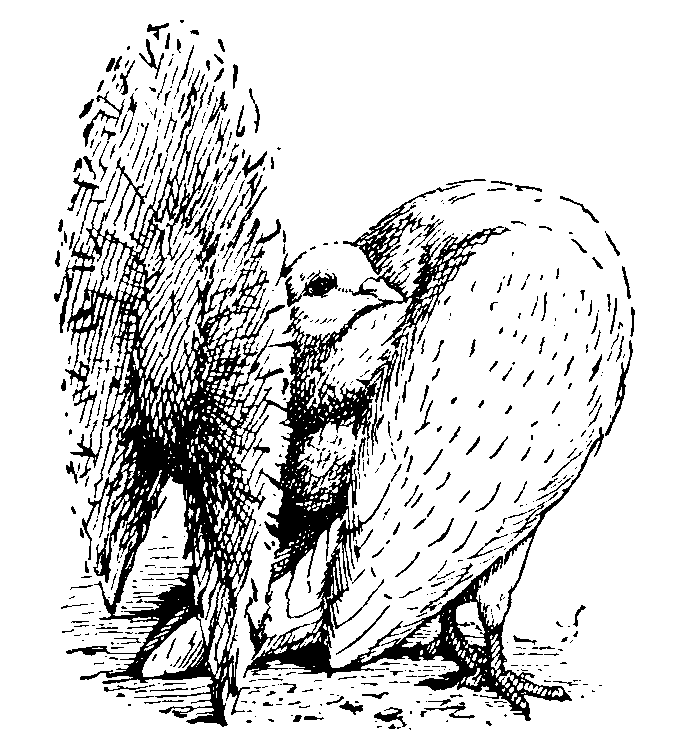
Fan-tail, a variety of the domestic pigeon, so called from the fan-like shape of their tails. Also a name applied to certain birds (species of Rhipidura) of the fly-catcher family, native to India, Australia, and New Zealand.
Fantees´, a people of West Africa inhabiting the coast district of the Gold Coast Colony, between the Ashantis and the sea. They were at one time the most numerous and powerful people situated immediately on the Gold Coast seaboard; but their power was almost entirely broken after 1811 by repeated invasions of the Ashantis, and they have since lived under British protection. The soil is fertile, producing fruits, maize, and palm-wine.
Fan-tracery Vaulting, Gloucester Cathedral
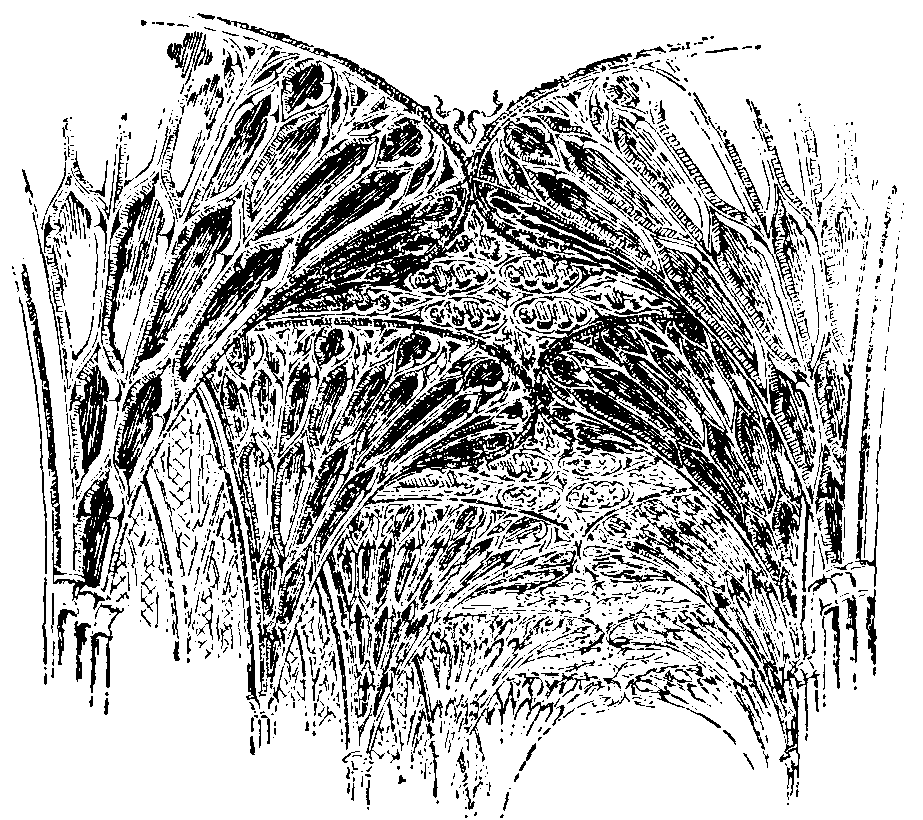
Fan-tracery, in architecture, elaborate geometrical curved work, which spreads over the surface of a vaulting, rising from a corbel and diverging like the folds of a fan. Fan-tracery vaulting is much used in the Perpendicular style, in which the vault is covered by ribs and veins of tracery, of which all the principal lines diverge from a point, as in Henry VII's chapel, Westminster Abbey.
Farad, the practical unit of capacity for electricity, in the electromagnetic system of units. The capacity of a conductor or condenser whose potential is raised by one volt when given a charge of one coulomb. This unit is too large for most purposes, and capacities are usually expressed in microfarads (q.v.).
Far´aday, Michael, one of the greatest of English chemists and physicists, was born in humble circumstances at Newington Butts, near London, 22nd Sept., 1791, died 25th Aug., 1867. Early in life he was apprenticed to a bookbinder in London, but occupied himself in his leisure hours with electrical and other scientific experiments. Having been taken by a friend to Sir Humphry Davy's lectures, he attended the course, and became so interested that he decided to abandon his trade. With this end he sent his notes of the lectures to Sir Humphry Davy, who was so struck with the great ability they showed that he appointed him his assistant at the Royal Institution. In 1829 he became lecturer at the Royal Military Academy at Woolwich, and in 1833 he was appointed to the newly established chair of chemistry at the Royal Institution. It was while in this office that he made most of his great electrical discoveries. His communications to the Philosophical Transactions were published separately in three volumes (1839, 1844, 1855). In 1832 he received the honorary degree of D.C.L. from Oxford, and was made an honorary member of the Academy at Berlin. In 1835 he received a pension of £300 a year from Lord Melbourne. As an experimentalist Faraday was considered the very first of his time. As a popular lecturer he was equally distinguished, and used to draw crowds to the Friday evening lecture at the Royal Institution. Amongst his published works we may mention the following: Researches in Electricity (1831-55), Lectures on Non-metallic Elements (1853), Lectures on the Forces of Matter (1860), Lectures on the Chemical History of a Candle (1861).—Bibliography: J. Tyndall, Faraday as a Discoverer; S. P. Thompson, Michael Faraday: his Life and Work.
Faradization, or Faradism, the medical application of the induced currents which Faraday discovered in 1831.
Farallo´nes, a group of small islands in the Pacific, about 30 miles from the entrance to the Bay of San Francisco.
Faran´dola, an exciting dance popular amongst the peasants of the south of France and the neighbouring part of Italy. The men and women, placed alternately and facing different ways, form a long line winding out and in with a waving motion.
Farce, a subdivision of comedy, characterized chiefly by exaggeration and lack of rational character drawing. Farce stands in the same relationship to comedy as melodrama does to tragedy. Many farces commence with an impossible postulate, such as The Comedy of Errors. Jonson's Silent Woman is one of the best English farces. Gilbert's Engaged and Foggerty's Fairy are notable modern examples.
Farcy, a disease to which horses are liable, intimately connected with glanders, the two diseases generally running into each other. It is supposed to be a disease of the absorbents of the skin, and its first indication is generally the appearance of little tumours called farcy buds on the face, neck, or inside of the thigh. By an order in Council animals affected with farcy must be destroyed.
Fardel-bound, a term applied to cattle and sheep affected with a disease caused by the retention of food in the maniplies or third stomach, between the numerous plaits of which it is firmly impacted. Over-ripe clover, vetches, or rye-grass are liable to produce the disease.
Fareham, a town of England, in Hampshire, at the north-west extremity of Portsmouth harbour, giving name to a parliamentary division of the county. It has building-yards, potteries, and brickworks, and a considerable trade. Pop. 10,066.
Farel, Guillaume, one of the earliest and most active of the Swiss reformers, was born in 1489 in Dauphiny, died in 1565. At an early period he was led by his intercourse with the Waldenses to adopt similar views. After preaching in various parts of Switzerland, he came to Geneva, where he was so successful at the religious conferences of 1534 and 1535 that the Council formally embraced the Reformation. He was instrumental, also, in persuading Calvin to take up his residence in Geneva. At attempt on the part of the two reformers to enforce too severe ecclesiastical discipline was the cause of their having to leave the city in 1538. Farel took up his residence at Neufchâtel, where he died.
Fargo, a town of N. Dakota, United States, on the Red River of the North and the N. Pacific Railroad. Pop. 14,330.
Faria y Sousa, Manuel de, Portuguese historian and poet, born 1590, of an ancient and illustrious family, died about 1649. Among his writings are: Discursos Morales y Politicos, Epitome de las Historias Portuguesas; Comentarios sobre la Lusiada; and a collection of poems.
Faribault, a town of Minnesota, United States, 53 miles south of St. Paul's. Here are the State asylum for the deaf, dumb, and blind, and an episcopal divinity college. Pop. 9000.
Faridpur (fa-rēd-pör´), a district of India, in Eastern Bengal; area, 2267 sq. miles; pop. 1,937,650. Chief town, Faridpur, on the Mará Padmá. Pop. 11,000.
Fari´na, a term given to a soft, tasteless, and commonly white powder, obtained by trituration of the seeds of cereal and leguminous plants, and of some roots, as the potato. It consists of gluten, starch, and mucilage.
Farinel´li, Carlo, an Italian singer, born at Naples in 1705, died in 1782. His true name was Carlo Broschi, and to develop his vocal powers he was made a eunuch. He sang in Vienna, Paris, and London with the greatest success. On visiting Spain, where he intended only a brief sojourn, he found King Philip V plunged in a profound melancholy. He succeeded in rousing him from it by the powers of his voice, and became his prime favourite and political adviser. But the penalty of his advancement was that for ten years he had to sing every night to his royal master the same six airs. On his return to Italy, in 1762, he found himself almost forgotten, but continued to exercise a splendid hospitality in his country house, near Bologna.
Fari´ni, Luigi Carlo, an Italian statesman and author, born in 1812, died 1st Aug., 1866. He studied medicine at Bologna, and practised as a physician. He became known as a nationalist and patriot in the political movements of 1841, had to leave the country for a time, but returned and was made a member of the Reform Ministry at Rome during the disturbances of 1848. Disapproving equally the views of the old Conservative and the extreme Republican party, he went to Piedmont, where he was elected a Deputy, and fought with great energy both in pamphlets and in Parliament on behalf of Cavour and the Piedmontese Constitutionalists. After the peace of Villafranca, he was chosen dictator of the duchies of Parma and Modena, and was mainly instrumental in inducing them to unite with the Piedmontese monarchy. His History of the Papal States from 1814 to 1850 is well known. In 1862 he became President of the Ministry, but lost his reason in 1863.
Farmers-general (Fr. Fermiers généraux), private contractors, to whom under the old French monarchy was let out the collection of various branches of the revenue, poll-tax, duties on salt and tobacco, and customs. These contractors made enormous profits on the farming of the public revenues. A revenue collected in this way not only imposed a much heavier burden on the people, but the merciless rigour of irresponsible and uncontrolled exactors subjected them to hardships and indignities to which they could not submit without degradation. In 1790 the system was suppressed by the Constituent Assembly, and many of the farmers-general were sent to the guillotine by the Revolutionary Tribunal.
Farne, or Ferne, Islands, a group of seventeen islets, England, separated from the coast of Northumberland by a channel about 1¾ miles wide. They have been the scene of some disastrous shipwrecks, including that of the Forfarshire in 1838. (See Darling, Grace.) There are two lighthouses. Pop. 15.
Farnese (fa˙r-nā´ze), an illustrious family of Italy, whose descent may be traced from about the middle of the thirteenth century, and which gave to the Church and the Republic of Florence many eminent names, amongst which the following may be mentioned: Pietro Farnese (died 1363), a general of the Florentines in the war against Pisa; Alessandro, who became Pope as Paul III (1534-49), and whose gifts to his natural son Pier Luigi of the duchies of Parma and Piacenza laid the foundation of the wealth and greatness of the family; Ottavio (1520-85), son and successor of Pier Luigi, spent a long and peaceful reign in promoting the happiness of his subjects. Alessandro (1546-92), elder son of Ottavio, became famous as a most successful general of the Spaniards in the wars with the Netherlands and France. Ranuzio (1569-1622), son of Ottavio, was a gloomy and suspicious tyrant. The line became extinct with Antonio in 1731. The name of the Farnese is associated with several famous buildings and works of art. The Farnese Palace, at Rome, was built for Pope Paul III, while he was cardinal, by Sangallo and Michel Angelo. It now belongs to France, and is occupied by the French Embassy. Its sculpture gallery was formerly very celebrated, but the best pieces have been removed to Naples, including the following: the Farnese Bull, a celebrated ancient sculpture representing the punishment of Dirce, discovered in 1546 in the Baths of Caracalla at Rome; Farnese Hercules, a celebrated ancient statue of Hercules by Glycon, found in the Baths of Caracalla in 1540; Farnese Flora, a colossal statue of great merit, found in the Baths of Caracalla; Farnese Cup, an antique onyx cup, highly ornamented with figures in relief.
Farnham, a town of England, county of Surrey, 3 miles S.W. of Aldershot; a well-built place. North of the town is Farnham Castle, the residence of the Bishops of Winchester. The staple trade is in hops. Farnham was the home of Swift's 'Stella' (Hester Johnson). Pop. 12,133.
Farnworth, a manufacturing and mining town of Lancashire, England, 3 miles from Bolton. Pop. (urban district), 27,901.
Faro, a seaport of Portugal, province of Algarve, 62 miles S.E. of Cape St. Vincent. It is surrounded by Moorish walls, and has a convenient harbour. Its trade is considerable. Pop. 12,680.
Faro, a promontory forming the north-east point of Sicily at the entrance to the Strait of Messina. The point is strongly fortified, and on it there is a lighthouse over 200 years old.
Faroe Islands (fā´rō; Dan. Färöer, 'Sheep Islands'), a group of islands in the North Atlantic, lying between Iceland and Shetland. They belong to Denmark, and are twenty-one in number, of which seventeen are inhabited. The islands generally present steep and lofty precipices to the sea. Barley is the only cereal that comes to maturity; turnips and potatoes thrive well. There is no wood, but plenty of excellent turf, and also coal. The inhabitants are chiefly engaged in fishing and the rearing of sheep. Thorshavn, in Strömö, the largest island, is the seat of government. Pop. 18,000.
Farquhar (fär´ka˙r), George, Irish playwright, was born in Londonderry in 1677, and died in 1707. He was for a short time at Trinity College, Dublin, but was, according to one account, sent down for making a profane though clever joke on the miracle of walking on the sea. He became an actor, but left the stage after inadvertently injuring a fellow-actor, owing to his forgetting to substitute a stage-sword for the genuine article. He produced his first comedy, Love and a Bottle, in 1698. It is a lively and amusing comedy, and was well received. The Constant Couple (1699) was also successful, as was its sequel Sir Harry Wildair. His other best-known plays are The Recruiting Officer (1706), and his masterpiece The Beaux' Stratagem (1707), written when he knew that death was fast approaching him. Farquhar was in dire poverty most of his life; he had a commission in the army for a while, but gave it up owing to some false hopes of promotion held out by the Duke of Ormond. He increased his embarrassments by marrying in 1703 a penniless woman who had fallen in love with his appearance, and pretended to be an heiress. Although he lived and died in great distress, his gaiety never flagged; and The Beaux' Stratagem is one of the most mirthful comedies of the time.
Farquhar was a great playwright, and not much of a literary man. His comedies are all good acting comedies. He had been an actor himself, and so was much more closely in touch with the stage than the aristocratic Congreve. Farquhar stands above his contemporaries by reason of his realism. He did not go to other dramatists for his characters, but went straight to life. Indeed, in several cases his plays seem to have been in part autobiographical; the bard was the hero of the story. His plots are well constructed, especially his later ones. His characters are most of them genial rogues, and while he is no Puritan his morality compares very favourably with the cynical indecency of his contemporaries. His influence upon Fielding, and therefore upon the rise and development of the English novel, was great, as he introduced a return to real models, and eschewed artificiality. Personally Farquhar was a most loveable man, and he appears to have lived and died a very gallant gentleman.
Far´ragut, David Glascoe, admiral of the United States, born in 1801, died 13th Aug., 1870. He entered the navy as midshipman at the age of eleven, was promoted to a lieutenancy in 1821, and was actively engaged in his profession up till 1851, when he was appointed assistant inspector of ordnance. In 1855 he received a commission as captain. In 1861 he was appointed to command the expedition against New Orleans, undertaken on the formation of the Confederacy, and sailed in January of the following year. New Orleans surrendered to the combined attack of the land and naval forces on 28th April, and Farragut proceeded to Vicksburg, which he attacked unsuccessfully. In consequence of his success at New Orleans he was promoted to the rank of vice-admiral, and placed in command of the blockading squadron of the Gulf of Mexico. In Aug., 1864, he attacked the Confederate fleet in the Bay of Mobile, and forced it to surrender, thus making the fall of Mobile merely a question of time. After this exploit he was made admiral, a grade which had not hitherto existed in the United States navy.
Far´rant, Richard, one of the earliest English composers of music. Very little is known of his history. He was a gentleman of the Chapel Royal in 1564, and subsequently organist and choir-master. He is supposed to have died about 1580. His music, which is ecclesiastical, is distinguished by purity, simplicity, tenderness, and elevation. The anthems Call to Remembrance, and Hide not Thou Thy Face, composed by him, are well known.
Farrar, Frederic William, English divine, son of a clergyman, born in Bombay, 7th Aug., 1831, died 22nd March, 1903. He graduated at Cambridge, 1854, was assistant master at Harrow in 1855, headmaster of Marlborough College in 1871, Archdeacon of Westminster, 1883, and Dean of Canterbury, 1895. He wrote various popular theological works and works of fiction, and was Bampton Lecturer in 1885. Among his principal works are: The Life of Christ (1874), Life of St. Paul (1879), The Early Days of Christianity (1882), Lives of the Fathers (1889), Darkness and Dawn.
Fars, or Farsistan, a maritime province in the south-west of Persia, abutting on the Persian Gulf. It is mountainous, but has many rich and well-cultivated districts. The most important products are grain, fruit, wine, oil, cotton, tobacco, silk, cochineal, and attar of roses. The manufactures include woollen, silk, and cotton goods; and in these and other articles an active trade is carried on, chiefly with Hindustan. Pop. estimated at 1,700,000.
Farsan, two islands on the east side of the Red Sea on the coast of Yemen, called respectively Farsan Kebîr and Farsan Segîr.
Farthingale
Farthingale, or Fardingale, an article of ladies' attire worn in the days of Queen Elizabeth, and closely resembling the more recent crinoline. It was formed of circles of whalebone hoops, and protruded more at the waist than the Victorian crinoline.
Farukhabad, or Farrakhabad (far-ak-ä-bäd´), a city in Agra division, United Provinces of British India, 2 or 3 miles from the Ganges, a handsome, well-built town, with avenues of trees in many of its streets. Pop. 59,647.
Fasces (fas´sēz), in Roman antiquities, a bundle of polished rods, in the middle of which was an axe, carried by lictors before the superior magistrates. The number of fasces and lictors varied with the dignity of the magistrate. In the city the axe was laid aside.
Fas´cia (Lat., a bandage), in anatomy, signifies any thin sheet of fibrous tissue, such, for example, as the covering which surrounds the muscles of the limbs and binds them in their places.
Fascination (Lat. fascinare, to charm), the exercise of an overpowering and paralysing influence upon some animals attributed to certain snakes. Squirrels, mice, and the smaller birds are said to be the most subject to this power; but the fact is far from clearly explained, and is not perhaps even sufficiently demonstrated. Most of the accounts agree in describing the animal fascinated as having a painful consciousness of its danger, and the power exercised over it, but to be unable to resist the desire to approach the fascinator. It is probable, however, that the real explanation of the phenomenon is to be found in the influence of the intense emotion of fear upon the muscles.
Fascines (fa-sēnz´), in field engineering, bundles of boughs or rods from 6 to 18 feet in length and usually 1 foot in diameter, used in raising batteries, strengthening parapets, or revetting slopes. The twigs are drawn tightly together by a cord, and bands are passed round them at the distance of 2 feet from each other. Very long thin ones are called saucissons or battery-sausages.
Fasho´da, a station in the Anglo-Egyptian Sudan, on the Bahr-el-Abiad or White Nile, 400 miles south of Khartoum, and about 70 miles north-east of the confluence of the Sobat with the Nile. In July, 1898, it was occupied by a French force under Colonel Marchand, but some months later was claimed by the British for Egypt. The affair threatened to involve the two countries in war, but ultimately the French evacuated the place, which was then formally occupied by Sudanese troops. It has been renamed Kodok.