VOLUME IV PART 3 (continued 2)
Reading edition
Eugénie (eu-zhā-nē), Marie de Guzman, ex-Empress of the French, born at Granada, in Spain, 5th May, 1826, died at Seville 11th July, 1920. Her father, the Count de Montijo, was of a noble Spanish family; her mother was of Scotch extraction, maiden name Kirkpatrick. On 29th Jan., 1853, she became the wife of Napoleon III and Empress of the French. On 16th March, 1856, a son was born of the marriage. When the war broke out with Germany, she was appointed regent (15th July, 1870) during the absence of the emperor, but on the 4th Sept. the Revolution forced her to flee from France. She went to England, where she was joined by the Prince Imperial and afterwards by the emperor. Camden House, Chislehurst, became the residence of the imperial exiles. On 9th Jan., 1873, the emperor died, and six years later the Prince Imperial was slain while with the British army in the Zulu War. In 1881 the empress transferred her residence to Farnborough, in Hampshire. During the European War she established a hospital at Farnborough. In 1918 she handed over to Clemenceau the letters which she had received from William I in 1870. The letters shed a striking light upon the ambitions of Prussia. She was buried in the mausoleum at Farnborough.—Bibliography: De Lano, The Empress Eugénie; Tschuddi, Eugéne, Empress of the French; Stoddart, The Life of Empress Eugénie; E. Legge, The Empress Eugénie and her Son.
Euge´nius, the name of four Popes.—1. Eugenius I, elected 8th Sept., 654, while his predecessor, Martin I, was still living; died in 657 without having exerted any material influence on his times.—2. Eugenius II held the see from 824-827.—3. Eugenius III, born at Pisa, was a disciple of St. Bernard of Clairvaux. He was raised to the popedom in 1145; was obliged to quit Rome in 1146 in consequence of the commotions caused by Arnold of Brescia; returned with the help of King Roger of Sicily in 1150, and died in 1153.—4. Eugenius IV, from Venice, originally called Gabriel Condolmero, was raised to the popedom in 1431. In consequence of his opposition to the Council of Basel he was deposed. He died in 1447.
Eugenol, or Allylguaiacol, is found in cloves, the leaves of cinnamon, and other plants. About 90 per cent of clove oil is composed of eugenol.
Eu´gubine Tables, the name given to seven bronze tablets or tables found in 1444 at the town of Gubbio, the ancient Iguvium or Eugubium, now in the Italian province of Perugia, bearing inscriptions in the language of the ancient Umbrians, which seems to have somewhat resembled the ancient Latin as well as the Oscan. They seem to have been inscribed three or four centuries B.C., and refer to sacrificial usages and ritual.
Euhem´erism, a method or system (so named from its founder Euhemerus, a Greek philosopher) of interpreting myths and mythological deities, by which they are regarded as deifications of dead heroes and poetical exaggerations of real histories.
Eulenspiegel (oi´len-spē-gl), Till, a name which has become associated in Germany with all sorts of wild, whimsical frolics, and with many amusing stories. Some such popular hero of tradition and folk-lore seems to have really existed in Germany, probably in the first half of the fourteenth century, and a collection of popular tales of a frolicsome character, originally written in Low German, purports to contain his adventures. The earliest edition of such is a Strasbourg one of the year 1515 in the British Museum. Better known, however, is that of 1519, published also at Strasbourg by Thomas Mürner (under the title Howle-glass). The work was early translated into English and almost all European tongues. A modern English translation appeared in 1890.
Euler (oi´lėr or ü´lėr), Leonard, a distinguished mathematician, born at Basel in 1707, died at St. Petersburg (Petrograd) in 1783. He was educated at the University of Basel under the Bernouillis, through whose influence he procured a place in the Academy of St. Petersburg. In 1741 he accepted an invitation from Frederick the Great to become professor of mathematics in the Berlin Academy, but in 1766 returned to St. Petersburg, where he became director of the mathematical class of the academy. Euler's profound and inventive mind gave a new form to the science. He applied the analytic method to mechanics, and greatly improved the integral and differential calculus. He also wrote on physics, and employed himself in metaphysical and philosophical speculations. Amongst his numerous writings are: the Theoria Motuum Planetarum et Cometarum, Introductio in Analysin Infinitorum, and Opuscula Analytica.
Eu´menes (-nēz), the name of two kings of Pergamus.—1. Eumenes I succeeded his uncle Philetærus 263 B.C. He reigned for twenty-two years, and then died in a fit of drunkenness.—2. Eumenes II succeeded his father Attalus 197 B.C., and, like him, attached himself to the Romans, who, as a reward for his services in the war against Antiochus of Syria, bestowed upon him the Thracian Chersonesus and almost all Asia on this side of the Taurus. He died in 159 B.C.
Eumenides (ū-men´i-dēz). See Furies.
Eumycetes, or Higher Fungi, a common name for those Fungi which possess a septate mycelium. They also have a well-marked type of 'principal' spore—either the ascospore (Ascomycetes) or the basidiospore (Basidiomycetes)—and rarely produce definite sexual organs. Opposed to Phycomycetes.
Eunomians, the followers of Eunomius, Bishop of Cyzicum, in the fourth century A.D., who held that Christ was a created being of a nature unlike that of the Father.
Eu´nuch, an emasculated male. The term is of Greek origin (eunouchos, from eunē, a couch or bed, echein, to hold or guard); but eunuchs became known to the Greeks no doubt from the practice among Eastern nations of having them as guardians of their women's apartments. Eunuchs were employed in somewhat similar duties among the Romans in the luxurious times of the empire, and under the Byzantine monarchs they were common. The Mohammedans still have them about their harems. Emasculation, when effected in early life, produces singular changes in males and assimilates them in some respects to women, causing them in particular to have the voice of a female. Hence it was not uncommon in Italy to castrate boys in order to fit them for soprano singers when adults.
Euon´ymus, the spindle trees or prickwoods, a genus of shrubs or trees, nat. ord. Celastrineæ, containing about fifty species, natives of the temperate regions of the northern hemisphere. The root-bark of E. atropurpureus is the source of euonymin, a bitter principle with a powerful stimulating effect on the liver.
Eupato´ria, formerly Koslov, a seaport on the western coast of the Crimea, government of Taurida. It was here that the allied forces landed at the commencement of the Crimean War (14th to 18th Sept., 1854). Pop. 30,432.
Eupato´rium, a genus of plants, chiefly natives of America, belonging to the nat. ord. Compositæ. Their roots are perennial, possessing a rough, bitter, or aromatic taste; the flowers are small, white, reddish, or bluish, in corymbs. Amongst the many species are E. cannabīnum, or hemp-agrimony, a British plant.
Eupen (oi´pen), a town and district of Belgium, formerly part of Rhenish Prussia, 7 miles S.S.W. of Aix-la-Chapelle. It has manufactures of woollen and linen cloth, hats, soap, leather, and chemicals; paper, flax, and worsted mills; and an important trade. The town was ceded to Prussia at the Peace of Paris in 1814. On 26th May, 1919, Eupen was occupied by Belgian troops, and by the Treaty of Versailles Eupen and Malmédy were handed over to Belgium. Pop. 13,540.
Eupho´nium, a brass bass instrument, generally introduced into military bands, and frequently met with in the orchestra as a substitute for the superseded ophicleide. It is one of the saxhorn family of instruments. It is tuned in C or in B flat, and is furnished with three or four valves or pistons.
Euphorbia. See Spurge.
Euphorbia´ceæ, the spurgeworts, a nat. ord. of herbaceous plants, shrubs, or very large trees, which occur in all regions of the globe. Most of them have an acrid milky juice, and diclinous or monœcious flowers. The fruit is dry or slightly fleshy, and three-lobed. Among the genera are: Euphorbia, which yields an oil used as a powerful cathartic; Croton, affording croton-oil; the Ricĭnus commŭnis, or castor-oil plant; the Buxus sempervirens, or box-wood plant; the Manihot utilissima, which yields the food known as tapioca or cassava. In most members of the genera the milky juice contains caoutchouc.
Euphor´bium, a yellowish-white body, which is the solidified juice of certain plants of the genus Euphorbia, either exuding naturally or from incisions made in the bark. It is a powerfully acrid substance, virulently purgative and emetic.
Euphra´tes, or El Frat, a celebrated river of Western Asia, Mesopotamia, having a double source in two streams rising in the Anti-Taurus range. Its total length is about 1750 miles, and the area of its basin 260,000 sq. miles. It flows mainly in a south-easterly course through the great alluvial plains of Babylonia and Chaldæa till it falls into the Persian Gulf by several mouths, of which only one in Persian territory is navigable. About 100 miles from its mouth it is joined by the Tigris, when the united streams take the name of Shatt-el-Arab. It is navigable for about 1200 miles, but navigation is somewhat impeded by rapids and shallows. The melting of snow in the Taurus and Anti-Taurus causes a flooding in spring. The water is highest in May and June, when the current, which rarely exceeds 3 miles an hour, rises to 5. In the Bible (Gen. XV, 18) the Euphrates is The River, or The Great River.
Eu´phuism (Gr. euphues, well endowed by nature), an affected style of speech which distinguished the conversation and writings of many of the wits of the court of Queen Elizabeth. The name and the style were derived from Euphues, the Anatomy of Wit (about 1580), and Euphues and his England (about 1582), both written by John Lyly (1554-1606). A well-known euphuist in fiction is Sir Piercie Shafton in Scott's Monastery. Scott, however, had not studied Lyly sufficiently, and Sir Piercie raves bombastically rather than talks euphuistically. The chief characteristics of genuine euphuism were extreme artificiality and numerous allusions to natural history embellished by imagination.
Eu´polis, an Athenian comic poet, who flourished about 429 B.C. Neither the date of his birth nor that of his death is known with certainty. He belongs, like Aristophanes and Cratinus, to the Old Comedy. His works are all lost except small fragments. According to Suidas, he produced seventeen plays, seven of which won the first prize. His best-known plays are the Kolakes (Flatterers), in which he attacked the prodigal Callias, and the Baptæ (Dippers), in which he attacked Alcibiades and the exotic ritual practised at his clubs.
Eura´sians (syncopated from European-Asians), a name euphemistically given to the 'half-castes' of India, the offspring of European fathers and Indian mothers. They are particularly common in the three presidential capitals—Calcutta, Madras, and Bombay. Belonging strictly to neither race, Eurasians are not infrequently ostracized by both; and their anomalous position often exerts a baneful influence upon their character. They generally receive a European education, and the young men are often engaged in Government or mercantile offices. The girls, in spite of their dark tint, are generally very pretty and often marry Europeans.
Eure (eur), a river of North-West France, which rises in the department of the Orne, and falls into the Seine after a course of 124 miles, being navigable for about half the distance. It gives its name to a department in the north-west of France, forming part of Normandy; area, 2330 sq. miles. The surface consists of an extensive plain, intersected by rivers, chief of which is the Seine. It is extensively cultivated; apples, pears, plums, and cherries form important crops, and a little wine is produced. The mining and manufacturing industries are extensive, and the department has a considerable trade in woollen cloth, linen and cotton fabrics, carpets, leather, paper, glass. Evreux is the capital. Pop. 303,092.
Eure-et-Loir (eur-ė-lwär), a department in the north-west of France, forming part of the old provinces of Orléannais and Île-de-France; area, 2293 sq. miles. A ridge of no great height divides the department into a north and a south basin, traversed respectively by the Eure and the Loire. The soil is extremely fertile, and there is scarcely any waste land. A considerable portion is occupied by orchards and vineyards, but the greater part is devoted to cereal crops. The department is essentially agricultural, and has few manufactures. The capital is Chartres. Pop. 251,259.
Eure´ka (Gr. heurēka, I have found it), the exclamation of Archimedes when, after long study, he discovered a method of detecting the amount of alloy in King Hiero's crown. Hence the word is used as an expression of triumph at a discovery or supposed discovery.
Eurhythmics, a general term, but usually used to denote a system of education evolved by Émile Jaques-Dalcroze of Geneva. This form of training bears on all art, but especially on the art of music. Eurhythmics is essentially an original contribution to education. It aims at training musical sense on the broadest lines, using the body as an instrument of expression. Breaking away from preconceived ideas of music as a phenomenon of sound only, M. Dalcroze claims that music is innate. From this standpoint it follows that musicality as such is capable of cultivation apart from instrumental performance. Rhythm, not being a quality confined to music, but found common to all art, and fundamental to life, can, therefore, be developed from within the human being. This the Dalcroze system claims to do. Rhythm of sound plays a leading part in that it is allied to movement. Exercises at the piano are played to which the pupil listens, and to which he responds in movement—movement so closely allied to the music that it is a form of musical imagery. The technique is developed on simple lines to serve this end only. The system is progressive, starting from elementary rhythmic structure, and ending with complete musical form. It is far-reaching in educative purpose. It claims to free innate rhythm, to develop it for individual self-expression; to bring mind and body into closer unity, and in their interaction to give poise to both; to train accurate musical listening, ready assimilation of musical language and its spontaneous translation into terms of movement; to give musical experiences which shall be heard and felt; to cultivate musical expression and creation (in movement); to blend self-discipline with emotion.
Eurip´ides, the last of the three great Greek writers of tragedies, was born about 480 B.C., and died 406 B.C. Tradition declares that he was born at Salamis, on the very day of the Greek naval victory there. He was, as far as we can tell, of good birth; at any rate, he was well educated, and was able to live a life of ease and leisure, and to collect one of the largest libraries of the time. The comic poets, especially Aristophanes, delighted to say that his mother, Cleito, was a cabbage-woman, but there is probably little or no truth in this statement. Euripides was originally trained as an athlete, but conceived an intense dislike for that occupation. Greatly daring, he expressed his view openly (Fragment 284). Like a popular modern dramatist, his recreation was probably 'anything except sport'. He then took to painting, but abandoned it in favour of writing tragedies. His first play (not preserved), the Peliades, was produced when he was twenty-five years of age. He is said to have written ninety-two dramas, eight of which were satyr-plays. Ancient critics allow seventy-five of these to have been genuine. During his long career he only won the first prize five times. Euripides did not take any part in public life, but devoted himself entirely to a life of speculation and to writing plays. There is a tradition, not, however, on a very firm basis, that he was twice married, and that both marriages were failures. He is represented by Aristophanes as a woman-hater, but indeed he portrays women more sympathetically than Æschylus or Sophocles. The women had little cause to congratulate themselves on securing Aristophanes as a champion, for his scorpions are far more stinging then Euripides' whips. Euripides left Athens about 409 B.C., and went to the court of King Archelaus in Macedonia. There he died in 406 B.C.; according to some accounts, he was killed by savage dogs which were set on him by some of his rivals at the king's court.
Seventeen tragedies and one satyr-play have been preserved to us. The latter (The Cyclops) is interesting as being the only example of a satyr-play which we possess. In itself it is not amusing. It has been admirably translated by Shelley. The seventeen tragedies in the order of their production are: Alcestis, Medea, Hippolytus, Hecuba, Andromache, Ion, Suppliants, Heracleidæ, Hercules Furens, Iphigenia among the Tauri, Trojan Women, Helena, Phœnissæ, Electra, Orestes, Iphigenia at Aulis, and The Bacchæ. The Rhesus, a feeble production long attributed to Euripides, is almost certainly not his work.
The work of Euripides still retains the power of arousing strong likes and dislikes. He has had sturdy supporters and fanatical detractors. The truth is that if the tragedies of Æschylus and Sophocles are looked upon as models for all Greek tragedy, Euripides falls far short of his models. Euripides, however, though he died shortly before Sophocles, belonged to a younger and quite different generation, and held different views about art, morality, religion, and almost everything of importance. His aim was rather different from that of the earlier poets, and he must be judged, not by their standards, but on his own merits. His own merits are amply sufficient to justify the high opinion held of him in the ancient world, and supported by many of the greatest of the moderns. The dethroning of Euripides was the result of a German conspiracy, carried out with much energy by Niebuhr, and with even more by Schlegel. They enjoyed themselves while pulling Euripides to pieces much as schoolboys who have detected a flaw in the armour of their master. Many proofs can be adduced that Euripides was not a sophistical trifler; but one glance at his bust is enough to assure anyone of unbiased judgment that he was a man of remarkable breadth of mind and intellectual gifts. The fact remains, however, that the extant plays of Euripides are of very unequal merit. The Helena is not a good play; it was ridiculed by Aristophanes, but he did not succeed in making it much more absurd than it was already. The Hecuba and the Heracleidæ are not well constructed, and the Electra and Orestes challenge too directly the masterpieces of the earlier tragedians. In his greatest plays, however, Euripides can bear comparison with any poet. The Medea is a play which still never fails to please; the Hippolytus and the Ion are admirable dramas and admirably constructed; above all, the Bacchæ is a masterpiece, more picturesque than any other Greek tragedy, a play not unworthy to be set near The Tempest and Cymbeline.
Euripides has been accused by his detractors of degrading his art, because he opened his plays with a prologue and ended them with the intervention of a god. Both devices, if not desirable, are quite pardonable. Possible plots were becoming more and more scarce; Euripides did not wish to adopt trite themes, and so went into the by-ways of mythology, or adopted a less well-known alternative version of a well-known legend. He could not count on his audience already possessing enough knowledge of the story to enable them to understand his plays without a prologue. The deus ex machina, as the god who ends some of the plays is called, was often warranted or required by the plot which called for a conventional ending. Euripides has also been accused, by Aristophanes and by many less entertaining writers, of taking away all the dignity of tragedy. It is quite true that he is a realist. Sophocles represented men as they ought to be, Euripides represented them as they were. This was an unforgiveable offence in the eyes of the 'men of Marathon' at Athens. The tragic heroes were not mere stage characters, they considered; they were often ancestors or national heroes, and it was impious to represent them as speaking ordinary language, or sharing the weaknesses of ordinary men. Euripides did do this, did it intentionally, and did it excellently. He came at an awkward transition period, and the lack of success of some of his work is owing to the impossibility of pouring new wine into old bottles. The old tragedy was too tightly bound by convention to suit Euripides, who wished to portray living men and women, and to have an exciting plot. The new comedy—the romantic comedy of Menander—had not yet been invented. Had it been, Euripides would surely have written comedies. The comic poets of the next century turned to him for a model, and it was one of them, Philemon, who said that if he were quite sure that dead men retained their perception he would hang himself to see Euripides. Euripides is, in fact, the earliest writer of romantic plays, a fact well illustrated by his Alcestis, which is one of his best plays. In it tragedy and comedy are harmoniously blended, and it has a happy ending.
For better and for worse Euripides is a very modern poet, and makes a special appeal to the present generation. But his pathos, his wide sympathies, and his wonderful poetry have appealed to the best judges in all ages. Theocritus, Virgil, Ovid, Horace, Milton, and Browning have been among his admirers; his detractors include a few Teutonic professors, and a few who honour the memory of Æschylus and Sophocles on the other side idolatry.—Bibliography: A. W. Verrall, Euripides the Rationalist; G. G. A. Murray, Euripides and his Age (Home University Library); W. B. Donne, Euripides (Ancient Classics for English Readers); Sir J. P. Mahaffy, Euripides: an Account of his Life and Works; N. J. Patin, Étude sur Euripide; P. Masqueray, Euripide et ses idées. There is a complete verse translation by A. S. Way, and verse translations of several plays by G. G. A. Murray. There is a 'transcript' of the Alcestis in Browning's Balaustion's Adventure, and of the Hercules Furens in his Aristophanes' Apology.
Euripus (ū-rī´pus), in ancient geography, the strait between the Island of Eubœa and Bœotia in Greece.
Euroc´lydon, a tempestuous wind of the Levant, which was the occasion of the shipwreck of the vessel in which St. Paul sailed, as narrated in Acts, XXVII, 14-44. The north-east wind is the wind evidently meant in the narrative; and an alternative reading adopted in the revised version is euraculon (euraquilo) or north-easter.
Euro´pa, in Greek mythology, the daughter of Agēnor, King of the Phœnicians, and the sister of Cadmus. The fable relates that she was abducted by Jupiter, who for that occasion had assumed the form of a white bull, and swam with his prize to the Island of Crete. Here Europa bore to him Minos, Sarpēdon, and Rhadamanthus.
Europe, the smallest of the great continents, but the most important in the history of civilization for the last two thousand years. It forms a huge peninsula projecting from Asia, and is bounded on the north by the Arctic Ocean; on the west by the Atlantic Ocean; on the south by the Mediterranean, the Black Sea, and the Caucasus Range; on the east by the Caspian Sea, the Ural River, and the Ural Mountains. The most northerly point on the mainland is Cape Nordkyn, in Lapland, in lat. 71° 6´; the most southerly points are Punta da Tarifa, lat. 36° N., in the Strait of Gibraltar, and Cape Matapan, lat. 36° 17´, which terminates Greece. The most westerly point is Cape Roca in Portugal, in long. 9° 28´ W., while Ekaterinburg is in long. 60° 36´ E. From Cape Matapan to North Cape is a direct distance of 2400 miles, from Cape St. Vincent to Ekaterinburg, north-east by east, 3400 miles; area of the continent, about 3,865,000 sq. miles. Great Britain and Ireland, Iceland, Novaya Zemlya, Corsica, Sardinia, Sicily, Malta, Crete, the Ionian and the Balearic Islands are the chief islands of Europe. The shores are very much indented, giving Europe an immense length of coast-line (estimated at nearly 50,000 miles). The chief seas or arms of the sea are: the White Sea on the north; the North Sea on the west, from which branches off the great gulf or inland sea known as the Baltic; the English Channel, between England and France; the Mediterranean, communicating with the Atlantic by the Strait of Gibraltar (at one point only 19 miles wide); the Adriatic and Archipelago, branching off from the Mediterranean: and the Black Sea, connected with the Archipelago through the Hellespont, Sea of Marmora, and Bosporus.
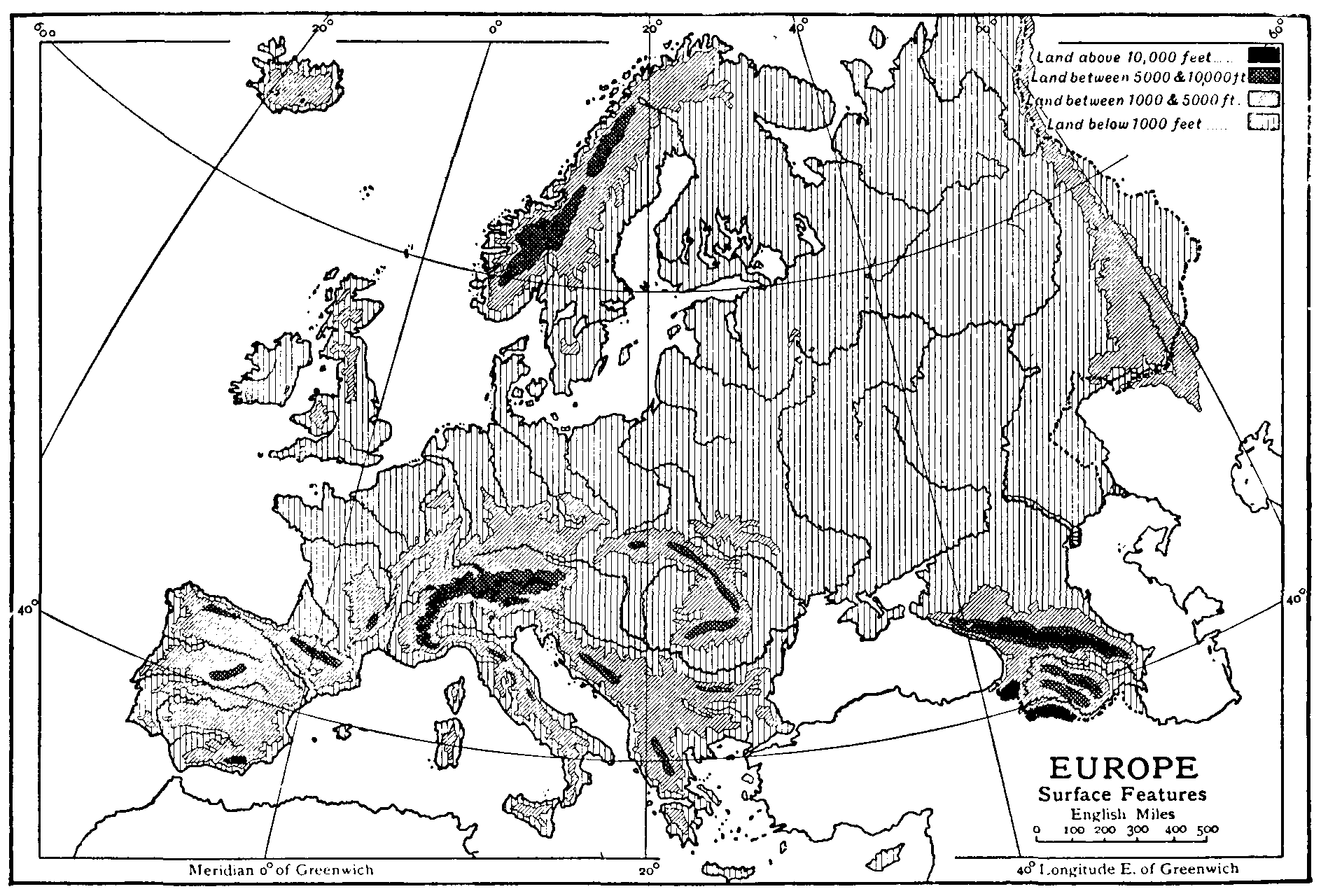
Surface.—The mountains form several distinct groups or systems of very different geological dates, the loftiest mountain masses being in the south central region. The Scandinavian mountains in the north-west, to which the great northern peninsula owes its form, extend above 900 miles from the Polar Sea to the south point of Norway. The highest summits are about 8000 feet. The Alps, the highest mountains in Europe (unless Mount Elbruz in the Caucasus is claimed as European), extend from the Mediterranean first in a northerly and then in an easterly direction, and attain their greatest elevation in Mont Blanc (15,780 feet), Monte Rosa, and other summits. Branching off from the Alps, though not geologically connected with them, are the Apennines, which run south-east through Italy, constituting the central ridge of the peninsula. The highest summit is Monte Corno (9541 feet). Mount Vesuvius, the celebrated volcano in the south of the peninsula, is quite distinct from the Apennines. By south-eastern extensions the Alps are connected with the Balkan and the Despoto-Dagh of the south-eastern peninsula of Europe. Among the mountains of South-Western Europe are several massive chains, the loftiest summits being in the Pyrenees, and in the Sierra Nevada in the south of the Iberian Peninsula. The highest point in the former, La Maladetta or Mount Maudit, has an elevation of 11,165 feet; Mulahacen, in the latter, is 11,703 feet, and capped by perpetual snow. West and north-west of the Alps are the Cevennes, Jura, and Vosges; north and north-east, the Harz, the Thüringerwald Mountains, the Fichtelgebirge, the Erzgebirge and Böhmerwaldgebirge. Farther to the east the Carpathian chain encloses the great plain of Hungary, attaining an elevation of 8000 or 8500 feet. The Ural Mountains between Europe and Asia reach the height of 5540 feet. Besides Vesuvius, other two volcanoes are Etna in Sicily, and Hecla in Iceland. A great part of Northern and Eastern Europe is level. The great plain of North Europe occupies part of France, Western and Northern Belgium, Holland, the northern provinces of Germany, and the greater part of Russia. A large portion of this plain, extending through Holland and North Germany, is a low sandy level not infrequently protected from inroads of the sea only by means of strong dykes. The other great plains of Europe are the Plain of Lombardy (the most fertile district in Europe) and the Plain of Hungary. Part of Southern and South-Eastern Russia consists of steppes.
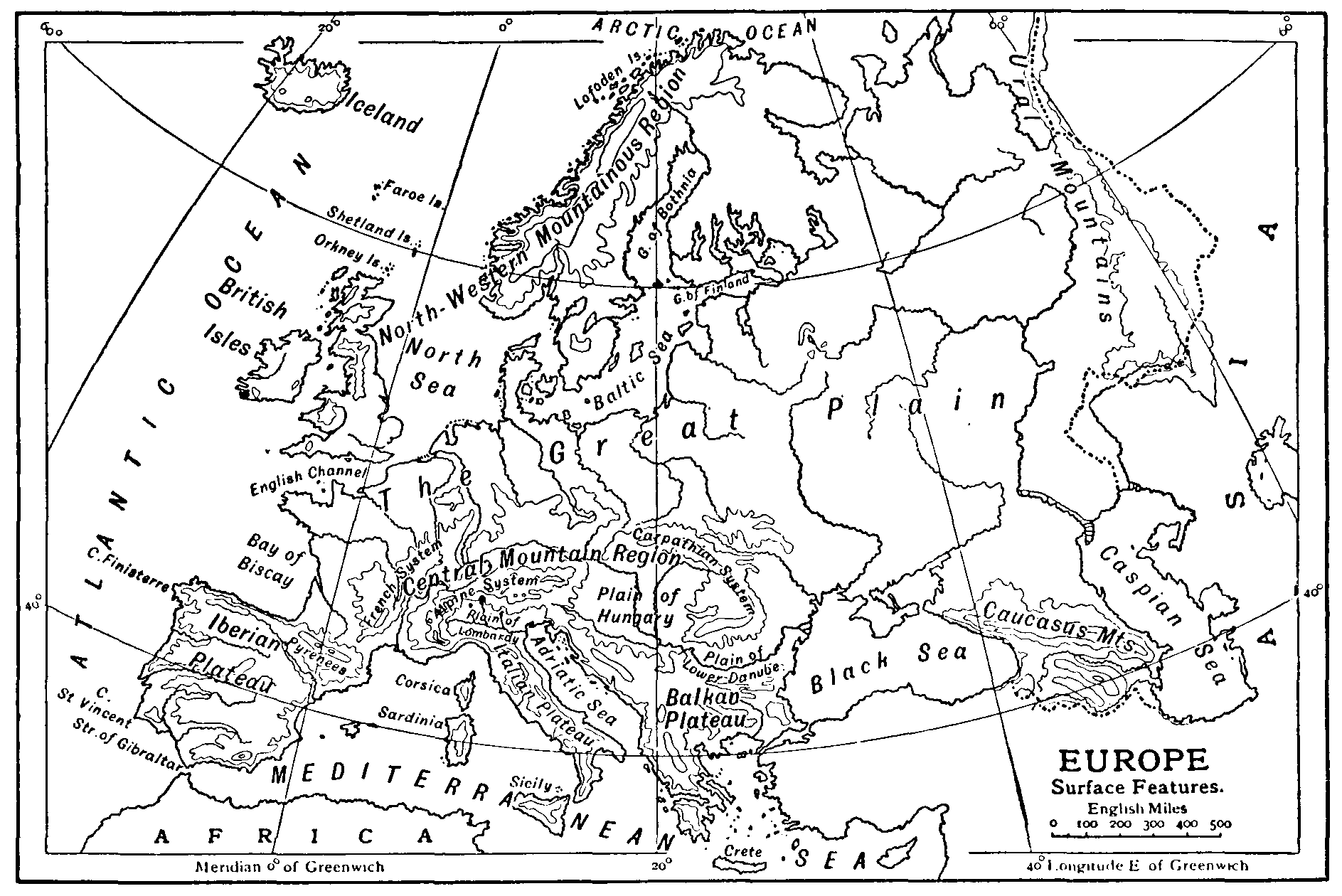
Rivers and Lakes.—The main European watershed runs in a winding direction from south-west to north-east, at its north-eastern extremity being of very slight elevation. From the Alps descend some of the largest of the European rivers, the Rhine, the Rhône, and the Po, while the Danube, a still greater stream, rises in the Black Forest north of the Alps. The Volga, which enters the Caspian Sea, an inland sheet without outlet, is the longest of European rivers, having a direct length of nearly 1700 miles, including windings 2400 miles. Into the Mediterranean flow the Ebro, the Rhône, and the Po; into the Black Sea, the Danube, Dnieper, Dniester, and Don (through the Sea of Azov); into the Atlantic, the Guadalquivir, the Guadiana, the Tagus, and Loire: into the English Channel, the Seine; into the North Sea, the Rhine, Elbe; into the Baltic, the Oder, the Vistula, and the Duna; into the Arctic Ocean, the Dvina. The lakes of Europe may be divided into two groups, the southern and the northern. The former run along both sides of the Alps, and among them, on the north side, are the lakes of Geneva, Neuchâtel, Thun, Lucerne, Zürich, and Constance; on the south side, Lago Maggiore, and the lakes of Como, Lugano, Iseo, and Garda. The northern lakes extend across Sweden from west to east, and on the east side of the Baltic a number of lakes, stretching in the same direction across Finland on the borders of Russia, mark the continuation of the line of depression. It is in Russia that the largest European lakes are found—Lakes Ladoga and Onega.
Geology.—The geological features of Europe are exceedingly varied. The older formations prevail in the northern part as compared with the southern half and the middle region. North of the latitude of Edinburgh and Moscow there is very little of the surface of more recent origin than the strata of the Upper Jura belonging to the Mesozoic period, and there are vast tracts occupied either by eruptive rocks or one or other of the older sedimentary formations. Denmark belongs to the Cretaceous period, as does also a large part of Russia between the Volga and the basin of the Dnieper. Middle and Eastern Germany, with Poland and the valley of the Dnieper, present on the surface Eocene formations of the Tertiary period. The remainder of Europe is remarkable for the great diversity of its superficial structure, rocks and deposits belonging to all periods being found within it, and having for the most part no great superficial extent. Europe possesses abundant stores of those minerals which are of most importance to man, such as coal and iron, Britain being particularly favoured in this respect. Coal and iron are also obtained in France, Belgium, and Germany. Gold is found to an unimportant extent, and silver is widely spread in small quantities. The richest silver ores are in Norway, Spain, the Erzgebirge, and the Harz Mountains. Spain is also rich in quicksilver. Copper ores are abundant in the Ural Mountains, Thuringia, Cornwall, and Spain. Tin ores are found in Cornwall, the Erzgebirge, and Brittany.
Climate.—Several circumstances concur to give Europe a climate peculiarly genial, such as its position almost wholly within the temperate zone, and the great extent of its maritime boundaries. Much benefit is also derived from the fact that its shores are exposed to the warm marine currents and warm winds from the south-west, which prevent the formation of ice on most of its northern shores. The eastern portion has a less favourable climate than the western. The extremes of temperature are greater, the summer being hotter and the winter colder, while the lines of equal mean temperature decline south as we go east. The same advantages of mild and genial temperature which western has over eastern Europe, the continent collectively has over the rest of the Old World. The diminution of mean temperature, as well as the intensity of the opposite seasons, increases as we go east. Peking, in lat. 40° N., has as severe a winter as Petrograd in lat. 60° N.
Vegetable Productions.—With respect to the vegetable kingdom, Europe may be divided into four zones. The first, or most northern, is that of fir and birch. The birch reaches almost to North Cape; the fir ceases a degree farther south. The cultivation of grain extends farther north than might be supposed. Barley ripens even under the seventieth parallel of north latitude; wheat ceases at 64° in Norway, 62° in Sweden. Within this zone, the southern limit of which extends from lat. 64° in Norway to lat. 62° in Russia, agriculture has little importance, its inhabitants being chiefly occupied with the care of reindeer or cattle, and in fishing. The next zone, which may be called that of the oak and beech, and cereal produce, extends from the limit above mentioned to the forty-eighth parallel. The Alps, though beyond the limit, by reason of their elevation belong to this zone, in the moister parts of which cattle husbandry has been brought to perfection. Next we find the zone of the chestnut and vine, occupying the space between the forty-eighth parallel and the mountain chains of Southern Europe. Here the oak still flourishes, but the pine species become rarer. Rye, which characterizes the preceding zone on the continent, gives way to wheat, and in the southern portion of it to maize also. The fourth zone, comprehending the southern peninsulas, is that of the olive and evergreen woods. The orange flourishes in the southern portion of it, and rice and even cotton are cultivated in some places in Italy and Spain.
Animals.—As regards animals, the reindeer and polar-bears are peculiar to the north. In the forests of Poland and Lithuania the urus, a species of wild ox, is still occasionally met with. Bears and wolves still inhabit the forests and mountains; but, in general, cultivation and population have expelled wild animals. The domesticated animals are nearly the same throughout. The ass and mule lose their size and beauty north of the Pyrenees and Alps. The Mediterranean Sea has many species of fish, but no great fishery; the northern seas, on the other hand, are annually filled with countless shoals of a few species, chiefly the herring, mackerel, cod, and salmon.
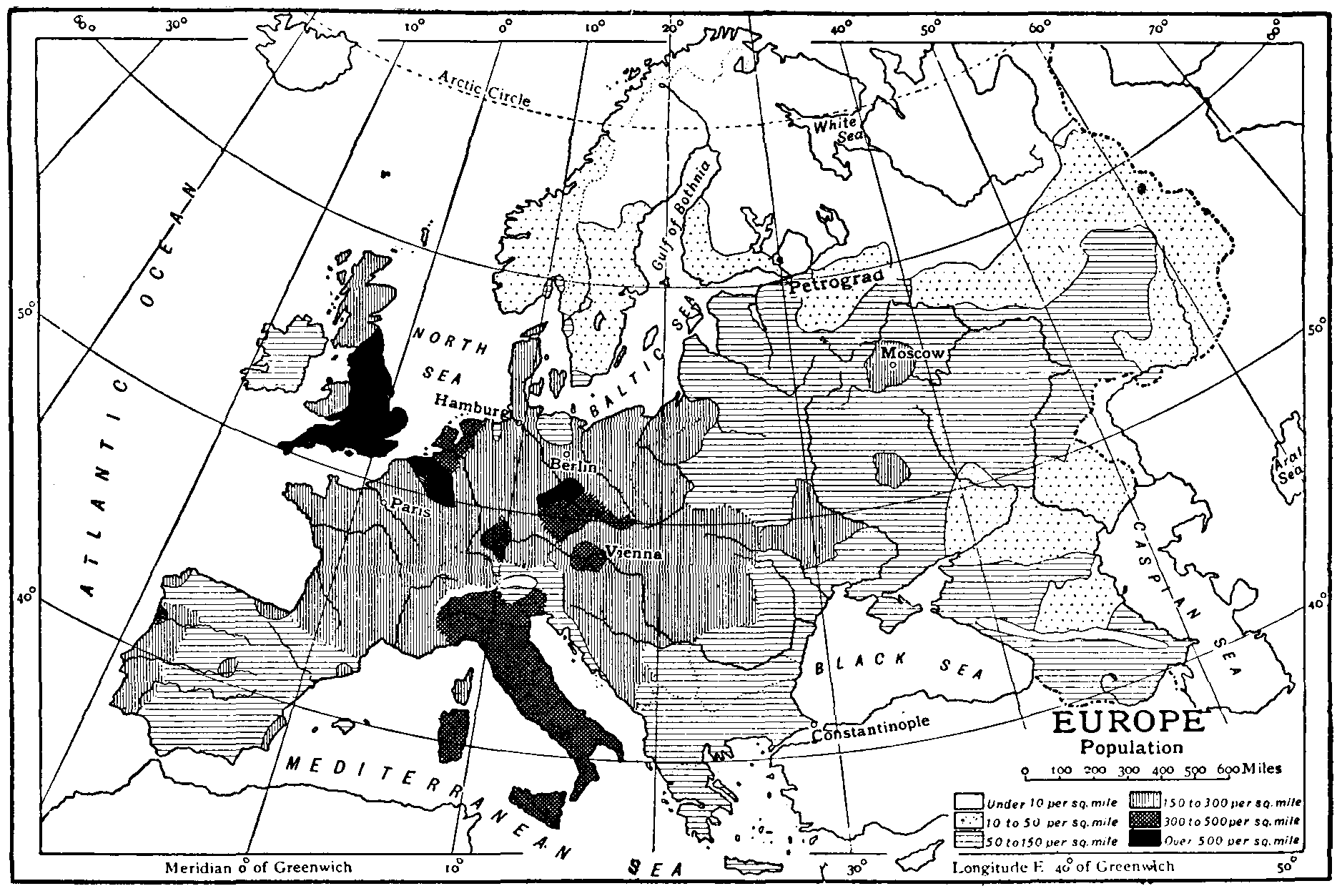
Inhabitants.—Europe is occupied by several different peoples or races, in many parts now greatly intermingled. The Celts once possessed the west of Europe from the Alps to the British Islands. But the Celtic nationalities were broken by the wave of Roman conquest, and the succeeding invasions of the Germanic tribes completed their political ruin. At the present day the Celtic language is spoken only in the Scottish Highlands (Gaelic), in some parts of Ireland (Irish), in Wales (Cymric), and in Brittany (Armorican). Next to the Celtic comes the Teutonic race, comprehending the Germanic and Scandinavian branches. The former includes the Germans, the Dutch, and the English. The Scandinavians are divided into Danes, Swedes, and Norwegians. To the east, in general, of the Teutonic race, though sometimes mixed with it, come the Slavonians, that is, the Russians, the Poles, the Czechs or Bohemians, the Serbians, Croatians, &c. In the south and south-east of Europe are the Greek and Latin peoples, the latter comprising the Italians, French, Spanish, and Portuguese. All the above peoples are regarded as belonging to the Indo-European or Aryan stock. To the Mongolian stock belong the Turks, Finns, Lapps, and Magyars or Hungarians, all immigrants into Europe in comparatively recent times. The Basques at the western extremity of the Pyrenees are a people whose affinities have not yet been determined. The total population of Europe is about 400 millions; nine-tenths speak the languages of the Indo-European family, the Teutonic group, the Slavonic, and the Latin. The prevailing religion is the Christian, embracing the Roman Catholic Church, which is the most numerous, the various sects of Protestants (Lutheran, Calvinistic, Anglican, Baptists, Methodists, &c.), and the Greek Church. A part of the inhabitants profess the Jewish, a part the Mohammedan religion.
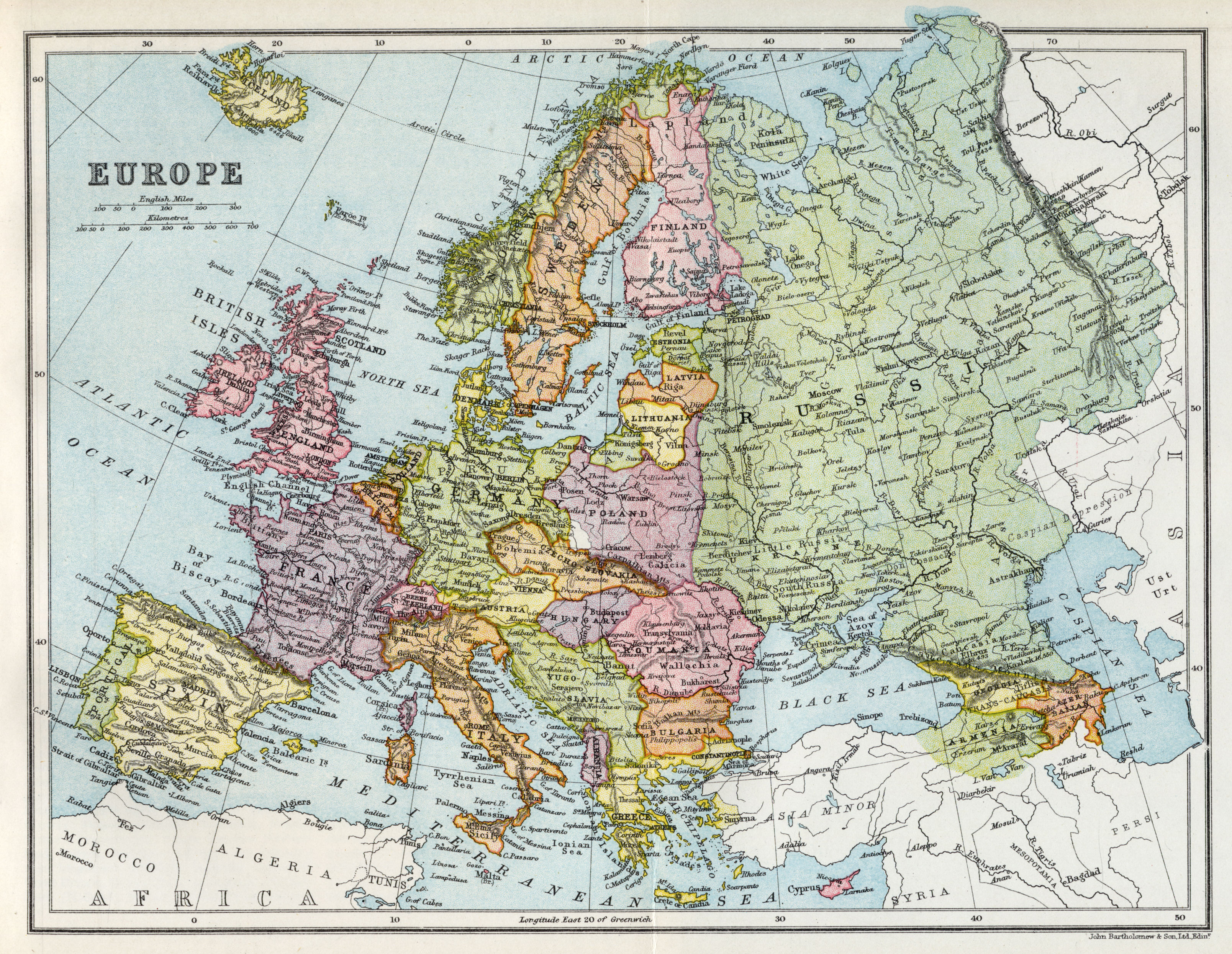
Political Divisions.—In 1921 Europe consisted of the following independent states, kingdoms, or republics: Albania, Armenia, Austria, Azerbijan, Belgium, Bulgaria, Czecho-Slovakia, Denmark, Esthonia, Finland, France, Georgia, Germany, Great Britain and Ireland, Greece, Hungary, Italy, Latvia, Lithuania, Luxemburg, Monaco, Montenegro, Netherlands (Holland), Norway, Poland, Portugal, Roumania, Russia, Serbia (Yugo-Slavia), Spain, Sweden, Switzerland, Turkey, Ukraine. Of these the following were kingdoms: Belgium, Bulgaria, Denmark, Great Britain, Greece, Italy, Montenegro, Netherlands (Holland), Norway, Serbia (Yugo-Slavia), Spain, and Sweden. Turkey (whose possessions in Europe were limited to Constantinople) was an empire, Luxemburg was a grand-duchy, Liechtenstein and Monaco principalities, whilst all the other European states were republics.
History.—Europe was probably first peopled from Asia, but at what date we know not. The first authentic history begins in Greece at about 776 B.C. Greek civilization was at its most flourishing period about 430 B.C. After Greece came Rome, which by the early part of the Christian era had conquered Spain, Greece, Gaul, Helvetia, Germany between the Danube and the Alps, Illyria, and Dacia. Improved laws and superior arts of life spread with the Roman Empire throughout Europe, and the unity of government was also extremely favourable to the extension of Christianity. With the decline of the Roman Empire a great change in the political constitution of Europe was produced by the universal migration of the northern nations. The Ostrogoths and Lombards settled in Italy, the Franks in France, the Visigoths in Spain, and the Anglo-Saxons in South Britain, reducing the inhabitants to subjection, or becoming incorporated with them. Under Charlemagne (771-814) a great Germanic empire was established, so extensive that the kingdoms of France, Germany, Italy, Burgundy, Lorraine, and Navarre were afterwards formed out of it. About this time the northern and eastern nations of Europe began to exert an influence in the affairs of Europe. The Slavs, or Slavonians, founded kingdoms in Bohemia, Poland, Russia, and the north of Germany; the Magyars appeared in Hungary; and the Normans agitated all Europe, founding kingdoms and principalities in England, France, Sicily, and the East. The Crusades and the growth of the Ottoman power are amongst the principal events which influenced Europe from the twelfth to the fifteenth century. The conquest of Constantinople by the Turks (1453), by driving the learned Greeks from this city, gave a new impulse to letters in Western Europe, which was carried onwards by the invention of printing and the Reformation. The discovery of America was followed by the temporary preponderance of Spain in Europe, and next of France. Subsequently Prussia and Russia gradually increased in territory and strength. The French revolution (1789) and the Napoleonic wars had a profound effect on Europe, the dissolution of the old German Empire being one of the results. The most important events in European history from the revolution of 1789 to 1914, the beginning of the European War, were: the establishment of the independence of Greece; the disappearance of Poland as a separate state; the unification of Italy under Victor Emmanuel; the Franco-German War, resulting in the consolidation of Germany into an empire under the leadership of Prussia: and the partial dismemberment of the Turkish Empire. The European War, 1914-8 (q.v.), revolutionized the continent and altered the map of Europe. The chief results were the disintegration of the Dual Monarchy and of Russia, the abolition of the German Empire, and the deposition of hereditary rulers in the smaller German states, which instituted republican Governments. The following new states were formed from the constituent parts of Russia and Austria-Hungary: Albania, Armenia, Azerbijan, Czecho-Slovakia, Esthonia, Finland, Georgia, Latvia, Lithuania, Yugo-Slavia, and Ukraine. Poland, dissolved in the eighteenth century, was again reconstituted. France regained Alsace and Lorraine, Turkey lost almost all her possessions in Europe, whilst Belgium, Denmark, Greece, Italy, and Roumania were greatly enlarged, acquiring new territories. All these alterations of boundaries and additions of territories were based on ethnological grounds, the new states being inhabited by peoples belonging to the same ethnical group and speaking the same language. See articles on the various countries.—Bibliography: E. A. Freeman, General Sketch of European History; A. Hassall (editor), Periods of European History; European History Chronologically Arranged; A. S. Rappoport, History of European Nations; O. Browning, General History of the World; H. S. Williams, The Historian's History of the World.
European War, 1914-8. The European War, which began in Aug., 1914, and involved the greater part of the globe before the last shot was fired in Nov., 1918, had its ostensible origin in the assassination of the Austrian heir-apparent, the Archduke Franz Ferdinand, and his wife, at Serajevo, capital of Bosnia, once part of the ancient kingdom of Serbia. This crime was committed by a Bosnian student, but Austria-Hungary held Serbia responsible, and, inspired by Germany, sent an ultimatum on 23rd July, amounting to a demand that Serbia should surrender her independence. Two days later, notwithstanding that Serbia conceded every demand, with two reservations which she offered to submit to the Hague Tribunal, Austria-Hungary declared war on her. Germany, who had seen in the Serajevo tragedy a pretext for making her long-premeditated bid for world dominion, "knew very well what she was about in backing up Austria-Hungary in this matter", as the German Ambassador in Vienna frankly told the British representative at the time; and when Russia, as the traditional protector of the Slavs, mobilized her southern armies to save Serbian independence if necessary, she threatened instant mobilization on her own part unless Russia stopped these military measures within twelve hours. It was technically impossible for Russia to do anything of the kind, but her protest to this effect was unavailing. Germany declared war on Russia on 3rd Aug., and as this inevitably involved war at the same time with Russia's ally France, she sent a note on the following day to Belgium demanding safe passage for German troops through Belgian territory, though Prussia as well as Great Britain, France, Russia, and Austria had guaranteed the neutrality and independence of Belgium by the treaty of 1839, repeatedly confirming this on subsequent occasions. When the British Ambassador in Berlin protested against the threatened violation of treaty rights, the German Chancellor, Bethmann-Hollweg, repudiated the treaty as a mere "scrap of paper".
On 3rd Aug., when Germany formally declared war on France—though her troops had already invaded French territory at various points—Belgium refused Germany's demands, and called on Great Britain and France for assistance. It was this call, and Germany's refusal on the following day to accede to the British demands that Belgian neutrality should be respected—declaring war on Belgium instead and violating her territory early that morning—which decided Great Britain to range herself wholly on the Franco-Russian side. The German Ambassador in London had already been warned (on 31st July) that we should be drawn into the struggle if Germany persisted in her threatened attack on France. Two days previously Germany had made the 'infamous bid' to Great Britain that if she would remain neutral no territory would be taken from France herself, though no undertaking could be given with regard to the French colonies. British mobilization orders were issued on 4th Aug., and at 11 p.m. on that date Great Britain declared war on Germany.
Fortunately the British navy was ready for any emergency, with the Grand Fleet—the command of which was given to Admiral Sir John Jellicoe—still assembled in full strength at Portland, after the manœuvres, the order for its dispersal having been countermanded on 27th July. Lord Kitchener, home on leave from Egypt, had also been stopped by a telegram from Mr. Asquith, then Prime Minister, as he was stepping on the Channel boat at Dover on his return journey (3rd Aug.), and two days later was appointed Secretary of State for War. Meantime the Austrians had already bombarded Belgrade (29th July); Italy had declined (1st Aug.) to be drawn into the conflict with her Austro-German partners of the Triple Alliance on the grounds that their war was an aggressive one; and German troops, as already mentioned, had invaded France at several points on 2nd Aug., before formally declaring war on that country.
Western Front, 1914
The struggle on the Western front began in earnest on the following day, when war was declared on France and the Germans captured Trieux, near Briey, and Lunéville was bombarded by German aeroplanes. The German system of mobilization had been quicker than the French and Russian, but the opening moves filled the Allied commanders with too-confident hopes. Although slower to mobilize than the Germans, a Russian army under Rennenkampf succeeded in invading East Prussia in force; the Belgians made a magnificent stand for their frontier fortresses when the Germans, denied the right of way which they had demanded, endeavoured to force the great highway of Western Europe which passes through Liége; and the French, besides checking the enemy at Dinant, had already recovered part of the lost provinces of Alsace-Lorraine.
On 16th Aug. the First British Expeditionary Force, under General Sir John French, completed its landing at Boulogne, and four days later had arrived and concentrated on the line Avesnes-Le Cateau, on the left or exposed flank of the French Fifth Army under General de Lanzerac. It consisted of 50,000 infantry with its artillery, and five brigades of cavalry—some 70,000 troops altogether, a mere drop in the ocean compared with the millions of men who were marching to battle for the great military powers, but destined to play a part in the forthcoming struggle out of all proportion to its size.
The position at this juncture was, briefly, as follows: the Germans having at length captured the last forts of Liége, with its gallant commander General Leman, were overrunning Belgium. Brussels had just been evacuated (20th Aug.), and the main Belgian army, menaced by greatly superior forces of the enemy, and disappointed in its hope of effective support from the Franco-British troops, was retiring to seek the protection of the forts of Antwerp. Having occupied Brussels on the 20th, the German Higher Command appointed Baron von der Goltz as Governor. A reign of terror in Belgium had already been inaugurated as part of Germany's deliberate policy of 'frightfulness', including the ruthless execution of civilians on unsubstantiated charges of shooting at the invaders.
The French armies, under the supreme command of General Joffre, who, like Lord Kitchener, had been an engineer student when the Franco-Prussian War broke out, and had been Chief of the General Staff since 1911, were now disposed for the double purpose of meeting the threatened German onslaught and preparing the counter-offensive on which French doctrines of strategy had been based. Starting from the Swiss frontier there were nine divisions forming the Alsace force, the main offensive group, consisting of the French First and Second Armies, being extended along the Lorraine frontier, and the Third Army about Verdun. The Fourth Army formed the mass of manœuvre held in reserve behind the centre, while the Fifth, whose left wing was now extended by the British Expeditionary Force, faced the Ardennes as far as the Belgian frontier.
Germany was not seriously alarmed by the spectacular advance of the French into their lost provinces. It suited the strategy of her War Staff to keep the French mass of manœuvre as far as possible from the point at which it would soon be sorely needed; and their feint attacks in the direction of Longwy, Lunéville, and Belfort were designed to strengthen the belief that their real offensive would come in the frontal assault which the French dispositions had assumed. Germany, however, had always intended to strike through Belgium when the time came to deliver the knock-out blow to France before Russia had time to mobilize her millions.
The German advance was proceeding according to the plan which had been worked out in detail as far back as 1904 by the soldier-scholar of the Garde-Ulanen, Count von Schlieffen, who died two years before his great scheme was put into execution. Based on the assumption that Germany and Austria-Hungary would have to fight France, Russia, Great Britain, and Belgium without the aid of Italy, it provided for an immediate attack by the right wing of the German army of such weight and ferocity as to destroy the French left by a single blow, and then roll up the main French armies one after the other. The South and Russian fronts were meantime to be lightly held, everything being staked on the sudden, overwhelming blow in the north through Belgium. One of the bitter controversies in Germany, after the war, raged round the responsibility for the failure of this plan, the execution of which devolved on General von Moltke, nephew of the great strategist of the Franco-Prussian War. The Kaiser believed that the name of Moltke would strike terror into the hearts of Germany's enemies, but the second Moltke lacked the genius of his predecessor, and the course of events proved that he was not equal to the task of carrying out so prodigious a plan.
It was doubly necessary to strike at once with an immediate maximum of strength now that Britain had already ranged herself alongside the Allies. This maximum of strength was attained long before France had completed her mobilization, and enabled Germany to launch her unexpected blow with crushing effect. She had reckoned, however, without the stubborn defence of the Belgians in the opening moves of the game, a defence which clogged the wheels of her mighty war machine at the critical moment; and was wholly unprepared for Britain's great achievement in transporting her 'insignificant' but indomitable army, without a hitch, complete in every detail, and establishing it in its place in the line of battle, hundreds of miles from its base, in less than three weeks from the declaration of war. Clearly there was no time to be lost in solving the military problem on the Western front before the Russians could throw their full weight into the scales.
The secret of Germany's sudden attempt to overwhelm the Allied left by an outflanking movement was well kept. The position in Belgium was obviously grave; but Joffre still clung to the belief that if the Germans attacked the Allied left in force, they would leave their own position in front of the French Fifth Army so exposed as to give him an opening for a successful counter-stroke with de Lanzerac's troops in co-operation with the British. Up to the 22nd General French's preparations were all in the direction of offensive action on these lines; his two corps had taken up their positions through Binche and Mons and along the canal to Condé.
The German tide which now swept through the plains of Belgium entirely upset the Allied calculations. General French woke on 22nd Aug. to find the troops of the French Fifth Army on his right in unmistakeable retreat. The full force of the German blow, delivered by von Buelow's Second Army, had been felt by de Lanzerac's troops on the Sambre at daybreak, and had pressed them back from the river. The British position held by the 1st Corps (1st and 2nd Divisions) under General Sir Douglas Haig, the 2nd Corps (3rd and 5th Divisions) under General Sir H. Smith-Dorrien, and the Cavalry Division under General Allenby, became isolated by the retreat of de Lanzerac—"the most complete example", as Lord French long afterwards described him, "of the Staff College pedant whose 'superior education' had given him little idea of how to conduct war". De Lanzerac asked General French if he would attack the flank of the German columns which were pressing him back from the Sambre, but the British Commander, who had received definite instructions from Lord Kitchener that his command was to be an entirely independent one, "and that you will in no case come in any sense under the orders of any Allied general", replied that with his own position so seriously threatened by the retreat of de Lanzerac's troops such an operation was impracticable, but he agreed to retain his present position for the next twenty-four hours.
The British army fulfilled this pledge, and the barrier thus held and maintained during the subsequent retreat, though shattered in parts, saved the French left from being outflanked by the invading right wing of the Germans under von Kluck. The whole situation became extremely critical on the following day (23rd Aug.). Namur, the forts of which had been regarded as impregnable, fell before the crushing attack of the heavy Austrian howitzers brought up by the advancing Germans; the French thrust into Alsace-Lorraine had just been countered by the German Fifth Army under the Crown Prince Rupprecht of Bavaria, which compelled the French to retreat from all but a corner of Alsace; and the main German attack, launched at the other end of the line, forced the French back both from the Sambre and the Meuse. The French Fifth Army, the position of which was considerably weakened by the fall of Namur, was attacked both by von Buelow's army in front, and by a Saxon army under von Hausen on its right. It was forced back until von Hausen found a gap on its right flank, through which he proceeded to pour his Saxons with the object of rolling up the French Third and Fourth Armies under Ruffey and Langle de Cary. These retreated in turn, to recover alignment with de Lanzerac's Fifth Army, which had retreated from the British right. The British army was thus left 'in the air', outflanked not only on the right, where von Buelow was now advancing on it from Charleroi, but also on the left, where von Kluck's right wing was sweeping down in full force from the north-west.
The onslaught on the British front began shortly after noon with a bombardment of some 600 guns along the whole line of 25 miles; followed by a great frontal attack in mass formation. The British troops, all experts at musketry, used their rifles with such deadly effect that the frontal attack crumpled up. The line held; but with the German tide surging round on either flank the position became increasingly critical. Under the threatened turning movement General Smith-Dorrien withdrew from the Mons salient, and before nightfall took up a fresh line some 3 miles south of the canal. The advanced troops of the 1st Corps had not been seriously engaged, and held their ground. It was not until late that night that the desperate situation on his right was fully revealed to General French; and when news also arrived from Joffre that the British army would probably be attacked the next day by at least three German corps and two cavalry divisions, it became clear that a general and immediate retirement was inevitable. What actually happened was that the enemy attacked with no fewer than four corps, and at least two cavalry divisions.
The Retreat from Mons
The great retreat began shortly after dawn on the 24th with a feint attack by the 1st Division, under cover of which the 2nd Corps moved back 5 miles, and then stood in turn to protect the retirement of the 1st Corps. Further withdrawals were effected that day by alternate corps, covered by heavy rear-guard actions, until the 1st Corps had reached the line between Maubeuge and Bavai, with the 2nd Corps extending the line from Bavai to Bry. Von Kluck's army, though kept in check by the retreating troops, followed closely on their heels and round their left flank, their design apparently being to turn the British left and press them back on Maubeuge, the fortress close on their right rear, which, well fortified and provisioned as it was, offered, as General French afterwards pointed out (in 1914), a terrible temptation to an army seeking shelter against overwhelming odds. Bazaine's example at Metz in 1870, and a shrewd suspicion that the German move was deliberately planned with that end in view, proved sufficient reasons for avoiding the trap. A further retreat was accordingly ordered to the line Le Cateau-Cambrai, some miles farther back.
Tournai, which was held by a French Territorial brigade, fell that day. There was nothing apparently to prevent the German host at this juncture from continuing its course to the coast and seizing the Channel ports as far as the Seine. That, doubtless, would have been included in the programme had the Germans anticipated a campaign of any considerable duration. The Kaiser, however, had promised his troops that they should be home again "before the leaves fall"; and to bring this about it was necessary to settle with the Allied army once and for all. Where von Moltke failed, according to Ludendorff and other critics after the war, was in not striking farther to the north or north-west, and in not throwing still more weight into the scale from his left wing.
On the 25th the French were still retreating all along the line save at Maubeuge, the garrison of which held out until 7th Sept., and at Longwy, north of Verdun, which fell on 28th Aug. The British army, battle-worn and suffering severely from the heat, but resisting all the German efforts to turn its western flank, marched stubbornly back, gallantly assisted by Allenby's cavalry. The French were a day's march ahead of them when the British reached the Le Cateau position. General French decided, therefore, that, sorely as the troops needed rest, there was nothing for it but to resume the retreat at daybreak, and issued orders to that effect. The hardest fighting on the 25th had fallen to the 1st Corps at Landrecies, where Haig's weary troops were violently attacked at nightfall, before they could snatch any rest, by fresh enemy troops sent forward in pursuit in motors and lorries. The German infantry paid dearly for their temerity in advancing through the narrow streets of the town in close order, two or three British machine-guns mowing them down in hundreds. The attack was a disastrous failure.
The 2nd Corps did not reach Le Cateau until ten or eleven o'clock that night, thoroughly exhausted after a hard day's fighting and marching. Smith-Dorrien had lost heavily in the operations, and was so convinced that his troops were unfit to resume the march at daybreak that he elected to stand and abide by the result. The magnificent fight put up by his troops on the following day, assisted by Allenby and Sordet's cavalry, and two divisions of French Territorial troops under d'Amade, which had been detailed to guard the British left flank, saved the situation, and averted, in the considered opinion expressed by General French five years later, "a stupendous repetition of Sedan". The actual result was a total loss of some 14,000 officers and men, about 80 guns, and numbers of machine-guns, as well as quantities of ammunition and material. According to General French, these losses heavily handicapped the British army in the subsequent stages of the retreat, and were felt throughout the first battle of the Marne and the early operations on the Aisne. In his dispatch of Sept., 1914, the British Commander-in-Chief had written of this battle in eulogistic terms. It was not till some time later, he explains, that he came to know the full details of the battle and to appreciate it in all its details. For General Smith-Dorrien it is urged that his stand at Le Cateau broke the full force of the German pursuit, and checked its course in time.
On the 27th the shattered 2nd Corps, having broken off the action, continued the retreat with the 1st Corps. On the 28th Gough, with the 3rd Cavalry Brigade at St. Quentin, and Chetwode, with the 5th at Cérizy, turned on the leading German cavalry at both these places and threw them back on their main bodies in confusion. For the first time since the retreat began the worn-out British infantry, having reached the line of the Oise between Noyon and La Fère, were able to rest and sleep in peace.
On the 29th the British troops reached the line Compiègne-Soissons, the Germans on the same day occupying La Fère and Amiens, as well as Rethel and other towns along the French front. Bapaume held out until the rolling-stock had been removed from Amiens, but the flood-tide of invasion now seemed to be carrying everything before it. Uhlans threatened to cut Sir John French's communications with his base at Boulogne and Dieppe. The base was accordingly transferred to St. Nazaire, at the mouth of the Loire. Timely help came to the retiring British troops on the 29th by a brilliant counter-stroke near Guise on the part of the French Fifth Army on their right; but neither the British nor the French troops on de Lanzerac's right were in a position to make a stand in support of that reaction. The Aisne was forced by the invaders on the 28-29th, and Rheims, Châlons, and Laon abandoned to them within the ensuing forty-eight hours. Falling back doggedly from the Aisne and the Oise, the British troops withdrew on 2nd Sept. to Chantilly-Nanteuil, the German advance having been checked on the previous day by the 4th (Guards) Brigade in a stiff rear-guard action at Villers-Cotterets.
The great retreat was coming to an end. Victory and Paris seemed within the enemy's grasp. He had—as he thought—so shattered the British army that it was now entirely negligible as a fighting force. He was ignorant of the real strength of the force that was gathering on the British left north of Paris—the new French Sixth Army under General Maunoury. It seemed both to von Kluck and the German Higher Command that they had only the shaken French Fifth Army seriously to reckon with on the Allied left, and, as von Kluck was considered more than strong enough for the task, von Moltke took the Garde Reserve Corps and 11th Army Corps from his right wing to East Prussia, where the Russians were now carrying the war well into the Fatherland.
The help rendered by the Russians at this critical phase of the war was invaluable, and played no small part in the approaching struggle on the Marne. In his fears for the safety of Paris, Joffre was naturally anxious to profit by this relief, and discussed with Sir John French the possibility of taking the offensive at the earliest possible moment. There appears to have been some misunderstanding as to Sir John's plans at this point. The British Commander-in-Chief declares that he had every intention of remaining in the line and filling the gap between the French Fifth and Sixth Armies, but the French Higher Command was apparently under the impression that he was determined not to fight any more until his troops had been given a week to reorganize and refit. Lord Kitchener himself hurried to Paris to clear the matter up, but "full accord", according to President Poincaré, long afterwards, "was not re-established without trouble". As soon, however, as the offensive was ordered, continued the same authority, the British Commander-in-Chief gave his assistance without reserve. "His army fought with magnificent courage, and Great Britain played a brilliant part in the common victory."
In the meantime the retreat continued, the British, on 2nd Sept., reaching the line of the Marne towards Lagny and Meaux, with the French Fifth Army, now under the command of Franchet d'Esperey, on their right, retiring on Château-Thierry, and Maunoury's new Sixth Army, on their left, retiring towards Paris. It was at this point that von Kluck made the fatal mistake of dismissing the British army as practically crushed and out of action. Diverting the advance of the German First Army, he left Paris on his right in order to deal what he hoped would be a decisive blow at the French Fifth Army south of the Marne. By 5th Sept. the British army had fallen back to the Forest of Crécy to bring it in line with the French Fifth Army.
Not only was the British army at length receiving sorely needed reinforcements, but the French army was every moment increasing in strength and numbers as it fell back on its reserves. Besides the French Sixth Army on the British left, another new French army had sprung into being behind the marshes of St. Gond—the Ninth, under Foch, who filled the gap between Franchet d'Esperey's Fifth and Langle de Cary's Fourth Army—behind Vitry. Eastward the line was continued by the French Third Army, now commanded by Sarrail in place of Ruffey; and Castlenau's Second Army, now fighting the battle of the Grand Couronné de Nancy which stemmed the German invasion at this point, and prevented the threatened envelopment on the Allies' right, where the Kaiser himself had gone to inspire the troops of Prince Rupprecht of Bavaria.
First Battles of Marne and Aisne
Secure on the right, Joffre was at last able to deliver the great counter-stroke on the left which the Germans had invited by their tremendous bid for swift and decisive victory. The retreat came to an end on 5th Sept., when Joffre gave Sir John French his final plans for the coming offensive, and von Kluck, ignorant of the recuperative powers of the British, as well as of the strength of the French Sixth Army on their left, marched across their front in pursuit of d'Esperey's Fifth. That night the Germans crossed the Marne, and the Grand and Petit Morin—two streams which branch off roughly parallel to one another south of the Marne—while some of their patrols reached the Seine, there catching a fleeting glimpse of the capital where they confidently hoped the French would soon be brought to terms.
When at last the retreat came to an end, the British army had been reinforced by the 4th Division, which, with the 19th Infantry Brigade—and subsequently the 6th Division—became the Third Army Corps under General Pulteney, who arrived in France to take command of it on 30th Aug. Deficiencies in armament and material had also been partially made good, but, most important of all, Sir John French bore witness, "the promise of an immediate advance against the enemy had sent a thrill of exultation and enthusiasm throughout the whole force".
The first battle of the Marne had scarcely opened on 6th Sept., 1914, when von Kluck, realizing that Maunoury's force on his extreme right was becoming dangerous, sent two army corps northwards to deal with it. Maunoury had already crossed the Marne and fought the first battle of the Ourcq on the 5th. The dispatch of the two German corps to keep him in check made a way now for the British troops, when, according to plan, they turned on the invaders with the object of assailing their flank with the French Sixth Army on their left; while the French Fifth Army, and the French armies to its right, made a simultaneous frontal attack.
Both Joffre and French were under the impression that the German thrust was still in full career when their counter-stroke was delivered. Already, however, the tide had begun to turn. Von Kluck, realizing too late—what should have been obvious from the first—that his communications were being seriously threatened on the Ourcq, saw that retreat was inevitable unless he could crush the forces gathering so ominously against his right flank. The opening of the battle of the Marne thus became on von Kluck's part an effort to overwhelm Maunoury on his right, while he kept the British army and French Fifth Army at bay with strong rear-guards and cavalry. The surprise of the day to the Germans was probably the remarkable part played by the British, who, instead of being practically wiped out, as the enemy fondly believed, attacked with an energy and dash which carried everything before them, and, but for filling their allotted rôle of maintaining alignment with the French armies on each flank, would doubtless have advanced farther than they did. As it was, the progress made was considerable. The Germans were driven back to the Grand Morin, and the line of that stream made good on the following day.
Meantime the French Fifth Army on their right, materially helped by this success, had also recovered a good deal of ground, while Foch and Langle de Cary, farther east, held their own against the fierce assaults of the German centre. A last desperate effort was being made to hack a way through at this point, and Sarrail, on Langle de Cary's right, had to give way a little along the Meuse. That day the Germans reached the most southerly point of their advance, at Provins. The deciding phase of the battle, however, was developing with dramatic swiftness on von Kluck's right wing. Maunoury was hard pressed by the repeated onslaughts of the enemy, whose heavy reinforcements at this point held the issue in the balance for several days. General Gallieni, the Governor of Paris, hurried up fresh troops to Maunoury in motor-buses and taxis, and the French line held.
The British army helped matters considerably by driving the Germans across the Grand Morin at Coulommiers on the 7th, and on the following day from the Petit Morin, thus also helping d'Esperey with the French Fifth Army, on its right, to continue his advance farther east as far as Montmirail. On the 9th came the decisive blows which removed all doubts as to the issue of the battle. Von Kluck's retreat on his left flank exposed the right of von Buelow's Second Army, which was further jeopardized by a gap which appeared on its left, where it should have linked up with von Hausen's Third Army. This double opening gave Foch, facing von Buelow in the marshes of St. Gond, the opportunity which he sought of smashing the enemy's centre. He seized it by a series of lightning blows which drove the German centre back on the morning of the 10th in complete disorder, pursued by Foch's victorious infantry.
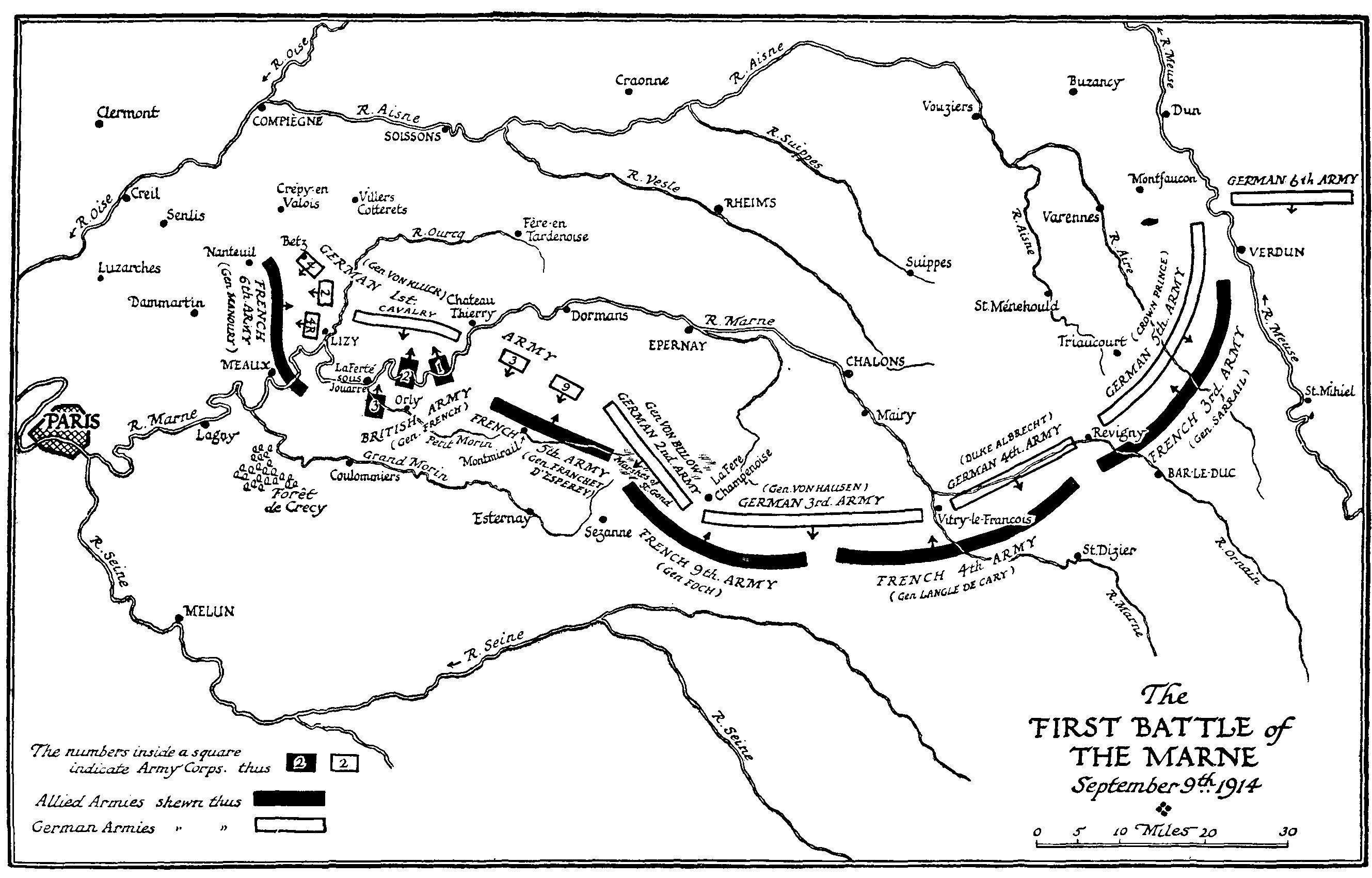
All the reinforcements sent to von Kluck were now of no avail against the French Sixth Army, which had been fighting against odds since 6th Sept., helped not a little by Pulteney's 3rd Corps on its right flank. Maunoury carried the Ourcq on the 9th, and Pulteney's corps was able to cross the Marne, after stiff fighting at La Ferté-sous-Jouarre, at dawn on the following day, when the German retreat became general. The left of the British 2nd Corps had crossed the Marne at Nanteuil, where the bridges were found unbroken and the enemy gone, on the morning of the 9th, but was ordered not to advance too far north until the 1st and 2nd Corps were firmly established on the northern bank. The 1st crossed later in the day at Charly-sur-Marne and Saulchéry, clearing the ground of the enemy and making many captures; but the 3rd Corps had a harder task at La Ferté-sous-Jouarre, and, as already mentioned, was not completely established on the other side until the following morning. The first battle of the Marne ended on the night of the 10th with the enemy in full retreat to the north and north-east and the Allies in hot pursuit. By the 12th he had been driven back from the Seine a distance of 65 miles, and the great German plan of a sudden crushing defeat of the Allies in the West had collapsed like a house of cards.
The hopes thus raised among the Allies of a speedy termination of the war in their favour were, on the other hand, equally illusory. Though the Germans lost heavily in officers and men, as well as in guns and other war material, their retreat was no disorderly flight. Many desperate rear-guard actions were fought all along the line, but the enemy retired steadily to prepared positions on the Aisne, where the eyes of all the commanders were to be opened to the possibilities of trench warfare under modern conditions. It needed many hard lessons before the truth was driven home.
When the first battle of the Aisne opened on 13th Sept., the British army already had its outposts on that river, the main body being in positions somewhat to the south, between Soissons and Bourg. Throwing bridges across during the night, the advance was continued on the opposite bank on the following day, though not without heavy British casualties, amounting to between 1500 and 2000, including 3 commanding officers. The 6th Division arrived from England at this stage, and joined its own 3rd Corps on the left. Further advance was stayed by the strength of the enemy's entrenched positions, in which he now determined to make his stand. Here he was backed by an overpowering superiority in artillery which, with fierce counter-attacks on the part of his infantry, gallantly repulsed though they were, caused such severe losses that the British Commander-in-Chief was forced to assume a defensive rôle, while Maunoury, de Castlenau, and Foch each made stupendous efforts to break the enemy's line and renew the war of movement and manœuvre on which their military principles had been based. All, however, ended in the same dreary deadlock of entrenchments.
Failing to shift the enemy from these impregnable positions, Joffre endeavoured to outflank the German right wing, already threatened by Maunoury's advance along the Oise. Two new French armies were formed from the reserves to extend the Allied left—the Seventh, entrusted to de Castlenau, whose Second Army was transferred to Dubail, and the Tenth, the command of which was given to Maud'huy. De Castlenau's Seventh Army, though it failed to turn the enemy's flank—the movement having been anticipated by him—succeeded in extending the pressure of Maunoury's left, which had swung round by the 20th until it ran north from Compiègne to west of Lassigny, and in building the first section of Joffre's great besieging wall which, gradually extending from the Alps to the sea, became the impenetrable barrier between the enemy and his main objectives. The Allies' line was continued by de Castlenau through Roye to Albert, and thence, by Maud'huy's Tenth Army, through Arras to Lens.
Von Moltke had now been superseded in the German Higher Command by Falkenhayn, who promptly countered Joffre's new strategy by similar extensions of the German front, thus beginning the outflanking race destined only to end in stalemate on the coast. While extending their right the Germans made a strenuous effort to regain the initiative by a blow with the army group nominally commanded by the German Crown Prince on Sarrail's flank on the Meuse. It was a blow aimed at Verdun and the whole of the Allied line, which it hoped to break through at this point and so take in the rear. Verdun, however, had been rendered impenetrable by miles of powerfully protected outer defences, and practically the only success which fell to the Crown Prince on this occasion was the capture of the Camp-des-Romains and St. Mihiel on the Meuse, thus creating the remarkable salient east of Verdun which was destined to remain until the Franco-American force flattened it out in the victorious advance of the Allies four years later. The German Crown Prince fared even worse a week later, when he attacked along the main road through the Argonne towards Verdun, only to be flung back. It was after this double failure that the Germans bombarded Rheims and shattered her noble cathedral.
The crucial phase of the struggle in the West had shifted towards the coast as the first battle of the Aisne died down on 28th Sept., and the campaigns began in Artois which led in due course to the fierce struggles for the Labyrinth, the Vimy Ridge, Lens, and Loos. The extension of the French left placed the British army in an anomalous position. Even before Joffre had begun to build his barrier in this direction the British Commander-in-Chief had felt strongly that his proper sphere of action was on the Belgian frontier on the left flank of the French armies, for the two-fold purpose of defending the Channel ports and being in position to concert combined action with the British navy. He suggested this move to the north to Joffre on 29th Sept., pointing out its strategical advantages and the possibility of doing so now that the position of his force on the right bank of the Aisne had been thoroughly well entrenched. Joffre agreed in principle to General French's proposal, but postponed the movement until 3rd Oct.
Retreat from Antwerp
By this time the critical situation of the Belgian army at Antwerp had become hopeless, and the danger of a German descent on the Channel ports suddenly became acute. Since their retreat towards Antwerp after their evacuation of Brussels on 20th Aug., the Belgians had kept the Germans at bay by vigorous counter-attacks, and threatened their communications by sundry sorties from the fortress. These sorties and counter-attacks, calling for reinforcements at a time when every soldier was needed on the main fighting fronts, infuriated the Germans and led to the reign of terror which included the deliberate destruction of Louvain and similar outrages at Malines, Termonde, and elsewhere.
Having made his position secure on the Aisne, and brought up his heavy guns, the enemy began his bombardment of the outer forts of Antwerp on 28th Sept. By the 3rd of Oct. the Belgians were endangered not only by the besieging army, but also by the ever-lengthening German line which, having now been extended from Lassigny to Lille—only 38 miles from the sea—threatened to isolate the Belgian forces from the Franco-British armies. They accordingly decided that plans must be made at once to withdraw from Antwerp in the direction of Ghent, both to protect the coast-line and gain touch with the Allies. The British troops hurriedly sent to reinforce the Belgians—a brigade of Royal Marines and part of the recently formed Naval Division—had no influence on the fate of the fortress, but helped in protecting the flight of the citizens and in the final retreat of the Belgian army. Some 1500 of the Royal Naval Division were forced across the Dutch frontier and interned, and about 800 were made prisoners. The remnants of the British force, and the bulk of the Belgian army, escaped westward, leaving the Germans on 9th Oct. in possession of the deserted city. A little more and the German commander (von Beseler) might have closed the gap beyond the Scheldt through which this retreat had been made. Luckily for the Allies, too, the German Higher Command failed, as Lord French long afterwards expressed it, to gather the richer harvest which had been put within its grasp by the capture of Antwerp. There was then apparently no insuperable obstacle to an immediate German advance on Dunkirk, Calais, and Boulogne, before the Allied troops could arrive from the main theatres to prevent it. "As on the Marne, so at Antwerp, they were not prepared to seize the psychological moment and to play boldly for the great stake".
General French, who had been given no voice in the Antwerp dispositions, was now in the midst of the British move from the Aisne front to the north, where he was to be reinforced by the 7th Infantry and 3rd Cavalry Divisions, which had been landed on the Belgian coast to defend Zeebrugge and Ostend under Rawlinson's command, and the Indian contingent, which had just arrived at Orleans under Willcocks.
First Battle of Ypres
The two corps under de Castlenau and de Maud'huy were now under the supreme command of General Foch, who had orders to control all the French armies operating in the northern theatre, and was confident that it was still possible to outflank the Germans and bend them back behind the Scheldt. At the end of a fortnight the British army had been successfully transported to the north from the Aisne—after successfully holding the line of that river for twenty-five days against many desperate efforts of the enemy to break through—and had taken up its position on the left of Maud'huy's corps, the Allies' line being extended thence into Flanders by the French 8th Corps (under d'Urbal), which had been called up by Joffre to this end, as well as to help the sorely tried Belgians. Meantime the Germans, besides pressing Maud'huy hard in front of Arras, and forcing his Territorials out of Lille, had driven the retreating Belgian army out of Houthulst Forest to the line of the Yser north of Ypres, whence it took refuge behind the Yser and completed the Allied line to the coast. Rawlinson's 4th Corps, covering the retreat of the Belgian army, had hard fighting most of the way before it succeeded in joining the main British army, the German forces from Antwerp concentrating westwards in ever increasing numbers. By the 15th Capper's 7th Division was east of Ypres, while Byng's 3rd Cavalry Division, a day earlier, had connected up with Gough's 2nd Cavalry Division in front of Kemmel and assisted in the capture of that position, a gain which proved of the utmost importance in the subsequent struggle for Ypres. Allenby's Cavalry Corps had greatly distinguished itself during the two previous days, driving the enemy back all the way in a magnificent sweep to the north and north-east.
A brilliant series of advances by Pulteney's 3rd Corps on 12-15th Oct., leading to the capture of Bailleul and Meteren, and the line Sailly-Nieppe, confirmed French in the belief which he shared with Foch that the enemy had exhausted his strength, and that the time was ripe for a strong offensive eastwards. The advance had scarcely been started, however, before reports arrived of a powerful offensive on the part of the Germans towards Ypres and the Yser. The power and weight of the enemy's opposition on the British front increased each day. Armentières and the Bois Grenier were won by 15th Oct., but the failure of the 4th Corps in its advance on Menin was one of numerous indications that the Germans were being heavily reinforced. By the 21st all General French's worst forebodings were realized by the certainty established that the small German force which had been operating between Ostend and Menin on the 18th had been increased by no fewer than four corps. This discovery, in the British Commander-in-Chief's own words, "came like a veritable bolt from the blue". There was no longer any hope of continuing the offensive on the part of the comparatively weak British line, extended as it was on too long a front. It was a case of holding on now until relief arrived.
The threat was twofold. Not only were the Germans massing in tremendous strength in the north; they were also seriously threatening the British right. Maud'huy, round Arras, was fighting a battle which, like that which the British were waging round Ypres, was one of the landmarks of the war. He sent word on the 16th that the enemy was intent on driving in a wedge between Ypres and La Bassée—a threat which, had it matured, would have finally separated the Allies, and compelled the British either to surrender or be driven into the sea. Faced by this double threat, General French decided to risk the possible disaster on his right, and concentrate against the German tide in the north, which otherwise must gain the seaboard, with possibly fatal consequences to the whole British campaign.
Fortunately the First Army under Haig had already been ordered in the direction best calculated to meet the new situation, though there was no longer any hope of its original orders—to turn the enemy's flank and drive him back to Ghent—being carried out. In this first phase of the battle of Ypres, which lasted until the night of 26th Oct., the northern portion of the British line, notwithstanding the enemy's immense reinforcements, progressed slowly but surely, and took heavy toll in killed, wounded, and prisoners. A certain amount of ground was lost to the south, between Zonnebeke and La Bassée—the commanders of both the 2nd and 3rd Corps being anxious about their positions on more than one occasion—but at no point was any serious break made in the line. Maud'huy at the same time was gallantly keeping the enemy in check in the Arras region, though he could not drive him from Lens and the Vimy Ridge; while on the left the French and Belgians were withstanding repeated assaults on the swaying front between Dixmude and the sea. The line held, and was now more or less firmly established.
The second phase of the battle of Ypres consisted in the repeated attempts of the Germans to break through this line at all costs. It began on 27th Oct., and lasted through five of the most momentous days in the history of the British army. On this day the French 9th Corps, which had been sent by Joffre to the assistance of the sorely tried British troops, took over the trenches in the northern part of the British salient. Capper's 7th Division, exhausted by incessant fighting and fearful losses, was temporarily attached to Haig's 1st Corps in the centre, and took over the ground south of the Ypres-Menin road. Byng's 3rd Cavalry Division was at the same time placed under Allenby. The 4th Corps was thus temporarily broken up, Rawlinson being sent home to supervise the preparation of the 8th Division for France.
The British line was further reduced in numbers during the opening days of this new phase of the battle by the repeated but unavailing attempt of the enemy to advance, the Germans meantime mounting up reserves of reinforcements for a decisive blow until, by the 30th, they outnumbered the battle-worn British by two to one. Then came the onslaught in full, almost overpowering strength. "October 31st and November 1st", afterwards wrote the British Commander-in-Chief in his story of 1914, "will remain for ever memorable in the history of our country, for during those two days, no more than one thin and straggling line of tired-out British soldiers stood between the Empire and its practical ruin as an independent first-class Power." The storm centre of the British battle-line was the Wytschaete-Messines ridge, where Allenby's Cavalry Corps and Shaw's 9th Brigade of the 3rd Division withstood for forty-eight hours the supreme efforts of two and a half German army corps to dislodge them. The honours of those heroic days were shared by the French 9th Corps and the British 1st Corps (with the 7th Division attached) in their continued defence of the Ypres salient; and the British 2nd Corps, which held a long line on the right in difficult country, and, though forced to give up Neuve Chapelle on the 28th, withstood repeated attacks by superior numbers until the Indian Corps took over their positions.
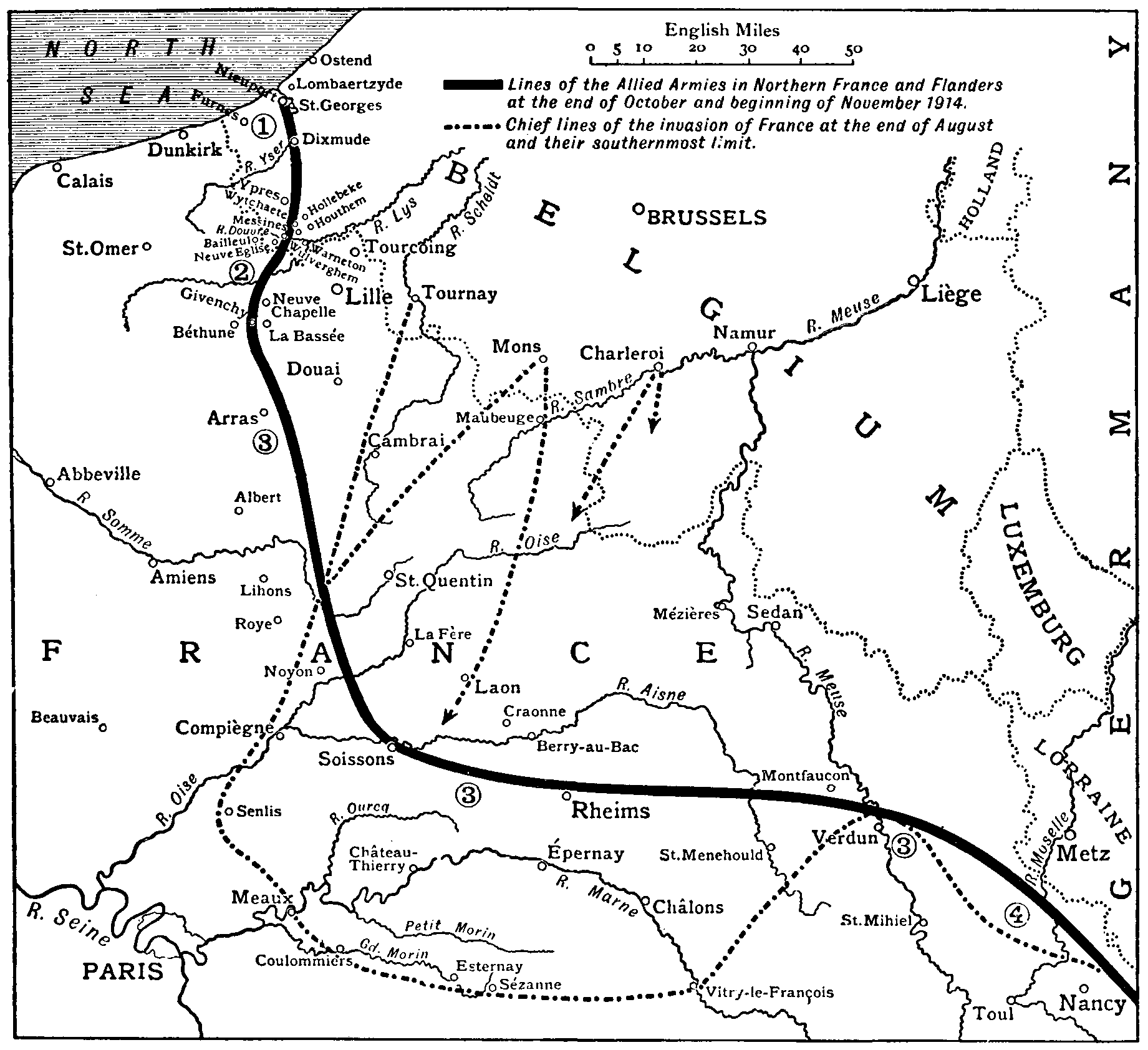
Map showing lines of the Allied Armies in Northern France at the end of October and beginning of November, 1914
1, Yser line, defended by Franco-Belgian forces.
2, Ypres to La Bassée line, guarded chiefly by British troops.
3, French lines to a point above Verdun.
4, French lines adjacent to the Alsace-Lorraine frontier.
The culminating phase of the battle began on the 29th, when overwhelming masses of the enemy stormed the centre of the Ypres salient, held by Haig's 1st Corps and the 7th Division, and forced our troops back on Gheluvelt. The ground was recovered before nightfall, but fighting of the fiercest character continued all round and beyond the salient, the critical sector of the 31st extending from Gheluvelt to Messines, on the south, where the 1st Cavalry Division was heavily pressed, and the London Scottish received their costly baptism of fire. The Germans got into Messines that day, but were hurled out again, and the line in this sector was completely restored by nightfall. The climax of the crisis had been reached shortly after midday in the Gheluvelt area, when the 1st Corps, after doing more than could be expected of any men in their prolonged stand against the heaviest odds, was at last broken, part of the 1st Division falling back rapidly along the Ypres-Menin road, with the Germans at their heels. "I felt", afterwards wrote General French, who was not more than a mile or so away at the time, "as if the last barrier between the Germans and the Channel seaboard was broken down", and he spent the worst half-hour his life had ever known. The situation was saved by Brigadier-General FitzClarence, V.C., commanding the 1st Guards Brigade of the 1st Division, who, on his own initiative, and in the nick of time, ordered the 2nd Worcesters to counter-attack. The Worcesters, who were in reserve to the 2nd Division, rushed up to fill the gap, and, saving the South Wales Borderers, drove the Germans out of Gheluvelt and re-established the line, which was completely restored before dark. FitzClarence was killed only a week or two later in the same part of the field.
The third phase of the battle of Ypres lasted from 1st Nov. to the 10th. Its most dangerous hours were at the very beginning, when both Messines and Wytschaete were lost, and only the timely arrival of the French 16th Corps, which partially restored the situation, and the devoted bravery of Allenby's Cavalry Corps, staved off this new threat of disaster. It is impossible here to follow all the confused operations in the remainder of this phase, in which fighting continued with varying intensity, and mingled success, all along the line from La Bassée to the sea.
The outstanding feature of the fourth and final phase, which extended from 11th Nov. to the 21st, was the succession of heavy assaults by the pick of the Prussian Guard, ordered by the Kaiser personally to carry the Ypres salient at all hazards. It failed, but not before the Germans had pierced the front along the Menin road in the first clash of arms on the morning of the 11th, a battalion of Royal Fusiliers being practically wiped out in gallantly disputing their passage. Haig met the situation "with the same grim determination, steadfast courage, and skilful forethought"—the words are those of Lord French—"which had characterized his handling of the operations throughout". The line was re-established, but only after fearful losses on both sides. The 1st (Guards) Brigade mustered at night only 4 officers and 300 men.
The French and Belgians were also attacked all along their line between Ypres and the sea—where British monitors swept the coast with shells for 6 miles inland—but the enemy was held off, save at Dixmude, which he captured and held. Between Dixmude, which had been stubbornly defended by Admiral Ronarc'h and his French marines, and Nieuport the sluices of the Yser had been opened by the Belgians, and the low-lying country across which the Germans were striving to force a way so flooded as to render all their efforts futile.
It was during this final effort of the Germans to reach the Channel ports in 1914 that Lord Roberts arrived at the front to visit the Indian Corps, who had withstood some heavy assaults on the old line of the Second Army, between Armentières and La Bassée. Lord Roberts had scarcely fulfilled his mission, inspiring the troops with his presence at a critical time, when he was taken suddenly ill on 13th Oct. and died on the following day.
North of Armentières the British 3rd Corps under Pulteney, which held the line thence towards Messines, had its share of fighting on the left bank of the Lys, and though its deeds in maintaining its positions were overshadowed by the epic struggles in the salient, its minor battles played their part in the victory of First Ypres. The great battle died down with the failure of the supreme effort of the Prussian Guard. Rains and floods and mud combined to call a halt in the struggle for the Channel ports, and the Western front was now established for the winter. There were occasionally attacks by the Germans at Ypres and Festubert, and more than one attempt on their part to cross the flooded Yser on rafts; but all to no purpose; and before the end of the year (20th Dec.) a five days' battle between the Indian troops and the Germans round Givenchy left matters much as they were before, the British positions, with the aid of British troops, being held. The French also broke the monotony of trench warfare with encouraging advances in Alsace, towards Noyon, in the Argonne, and elsewhere, but no vital changes took place in the general situation.
Eastern Front, 1914
Foiled in their grandiose plans in the West, the Germans were forced to rest content with their valuable territorial gains in France and Belgium, and remain on the defensive there while they turned to the more threatening situation on the Eastern front. As already noted, the Germans had under-estimated the rapidity of the Russian mobilization. They had not anticipated an offensive on that front until they could spare as many reserves as necessary from the West, and the forces left to guard their vulnerable frontier of East Prussia were as inadequate to stay the unexpected advance which the Grand Duke Nicholas, who was in supreme command of the Russian armies, ordered under Generals Rennenkampf and Samsonoff, as were the Belgians to prevent the march of the Germans across their territory. By 25th Aug. the Russian armies, whose advance had begun as early as the 7th, had pushed so far ahead that all East Prussia seemed in danger of falling into their hands. General von François, commanding the German troops, had been driven into Königsberg, the cradle of the Prussian monarchy; Gumbinnen, Justerberg, Allenstein, Soldau, had all been captured; and the hopes of a flight to Berlin before the Russian 'steam-roller'—too often raised in the early stages of the war—seemed not unlikely to be realized.
Germany's hour of danger, however, produced the man who was destined to play a ruling part in the remaining phases of the struggle—Paul von Hindenburg, a veteran of the Franco-Prussian War, then on the retired list. Hindenburg knew the topography of East Prussia by heart, and had commanded army corps in manœuvres along that frontier for many years. Appointed at this critical moment to supersede General von François, he collected 160,000 men from every available source, and by means of Germany's unequalled strategic railway system had concentrated them in a favourable position between Allenstein and Soldau for delivering the blow which would cut the communications of the southern army under Samsonoff, and smash it piecemeal in the treacherous marshes of the Masurian Lakes, the tracks through which, though well known to Hindenburg, were a veritable tangle to the Russians.
Tempted by their initial triumphs, the Russians had themselves courted disaster by placing themselves in precarious positions. Samsonoff's southern army had not only lost touch with the northern force under Rennenkampf, which had occupied Insterberg on the 23rd on its march on Königsberg, but had also failed to secure either Allenstein or Soldau. Hindenburg was quick to seize every advantage, and his lethal thrust on the 26th, when he retook Soldau and outflanked the Russian left, was followed by a similar enveloping movement on their right before they realized what had happened. Masses of German guns came up and completed the move. Too late the Russians fled along the only road left open to them—by way of Ortelsberg and Johannisberg, across a narrow slip of land between the marshes. Save for little more than one corps, which succeeded in escaping along this route before it was closed, practically the whole of Samsonoff's army was wiped out in this decisive battle of Tannenberg, as the victors named it. Samsonoff himself was killed by a shell on 31st Aug. Altogether the Russians lost in killed and wounded some 30,000; no fewer than 90,000 were taken prisoners.
Hindenburg, whose Chief of Staff was General von Ludendorff—already distinguished in the war as the leader in the assault on Liége—at once became a national hero throughout Germany. The Central Powers, however, had little further cause for rejoicing on the Eastern front in 1914, once Hindenburg had been enticed to the Niemen by the rapid retreat of Rennenkampf after the Tannenberg débâcle. The Grand Duke Nicholas had sent General Ruzsky from Galicia to retrieve the situation, and the new leader made as good use of the Niemen River—a formidable obstacle to cross with its width of some 200 yards—as Hindenburg had done of the Masurian Lakes. The operations, which ended in the failure of the Germans to cross the river, and their heavy defeat at Augustovo after a sanguinary nineteen days' battle beginning on 1st Oct., restored confidence to the Russian army.