VOLUME IV PART 3 (continued 5)
Reading edition
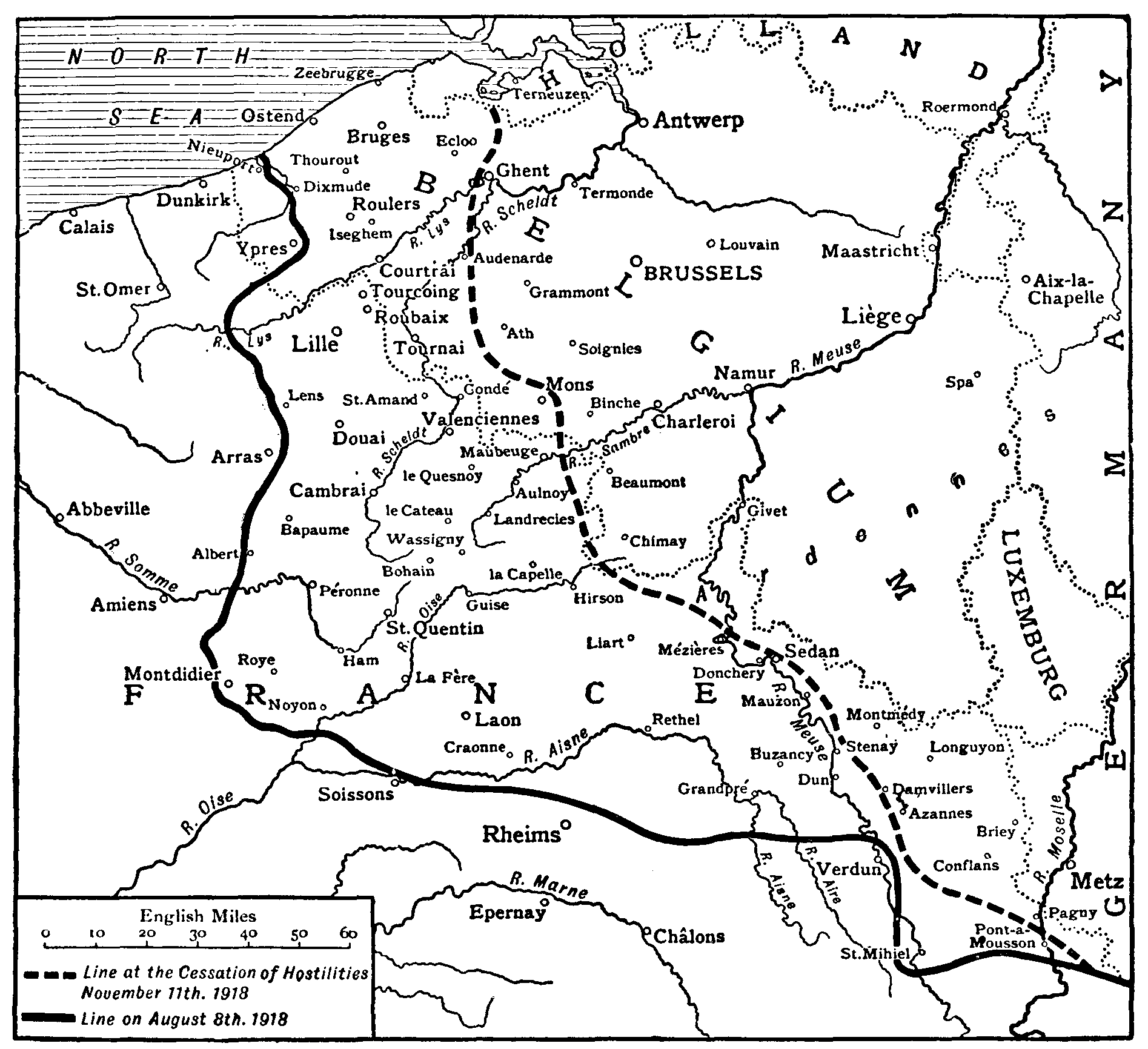
The second stage of Foch's plan now had been reached. The German armies had again been brought back to the line which they had chosen in 1914, after their first rush had recoiled. It was less threatening by the loss of the St. Mihiel salient, but it had been enormously strengthened by four years of engineering. North of the defence line was the railway which, running through Brussels, Mons, Maubeuge, Mézières, Sedan, and Metz, was the chief artery of German communications, and Foch's plan was to cut this artery on either side of the great curve which the German line made when, after coming north to south from the coast, it turned west to east at La Fère. The right half of the thrust was to be made by Gouraud's army at Rheims and the Americans on the Argonne, where they were being steadily accumulated. The more deadly attack was to be made by the First, Third, and Fourth British, and the First French Armies, which should break through Cambrai and St. Quentin towards Maubeuge.
Complementary operations were designed for the armies of Humbert and Mangin at the nose of the curve, and it was expected that, under this comprehensive pressure, Ludendorff would be compelled to withdraw divisions from the coastal sector, where an attack by the British Second Army (Plumer) and the Belgian Army might then be successful against a weakened front. A portion of Degoutte's army was sent northward in readiness for such a blow, and to the Fifth British Army (now commanded by Birdwood) was assigned a task at Lille and Lens similar to that of Humbert and Mangin at St. Gobain.
There was a pause of nearly a week, in which the Germans awaited, and the Allies prepared the new move; and then, on 27th Sept., Haig's armies struck what Foch declared to be the blow from which there was no recovery. The battle of Epéhy had given the requisite positions for the attack on that section of the Hindenburg defences which the Germans named the Siegfried line. The plan was to send forward the First (Horne) and Third (Byng) British Armies to clear the way on a line from Sauchy-Lestrée to Gouzeaucourt, seizing the crossings of the Canal du Nord, and so preparing the way for an attack by the Fourth Army. The dangerous movement was accomplished (27th Sept.): the crossings seized, the canal held, and Cambrai threatened. On 29th Sept. the Fourth Army took up the combat, and in a tremendous action along a front of 20 miles, supported by attacks from the other British armies and the First French Army, got across the vital defences of the St. Quentin Canal in the Siegfried zone. The next day the fighting spread furiously along the front of all four armies: the breach was widened; a portion of the Scheldt Canal taken; and by 3rd Oct. the Fourth Army had pierced the Siegfried line vitally. By 9th Oct. the German defences were no longer defences, and in this decisive encounter they had lost 36,000 prisoners and 380 guns.
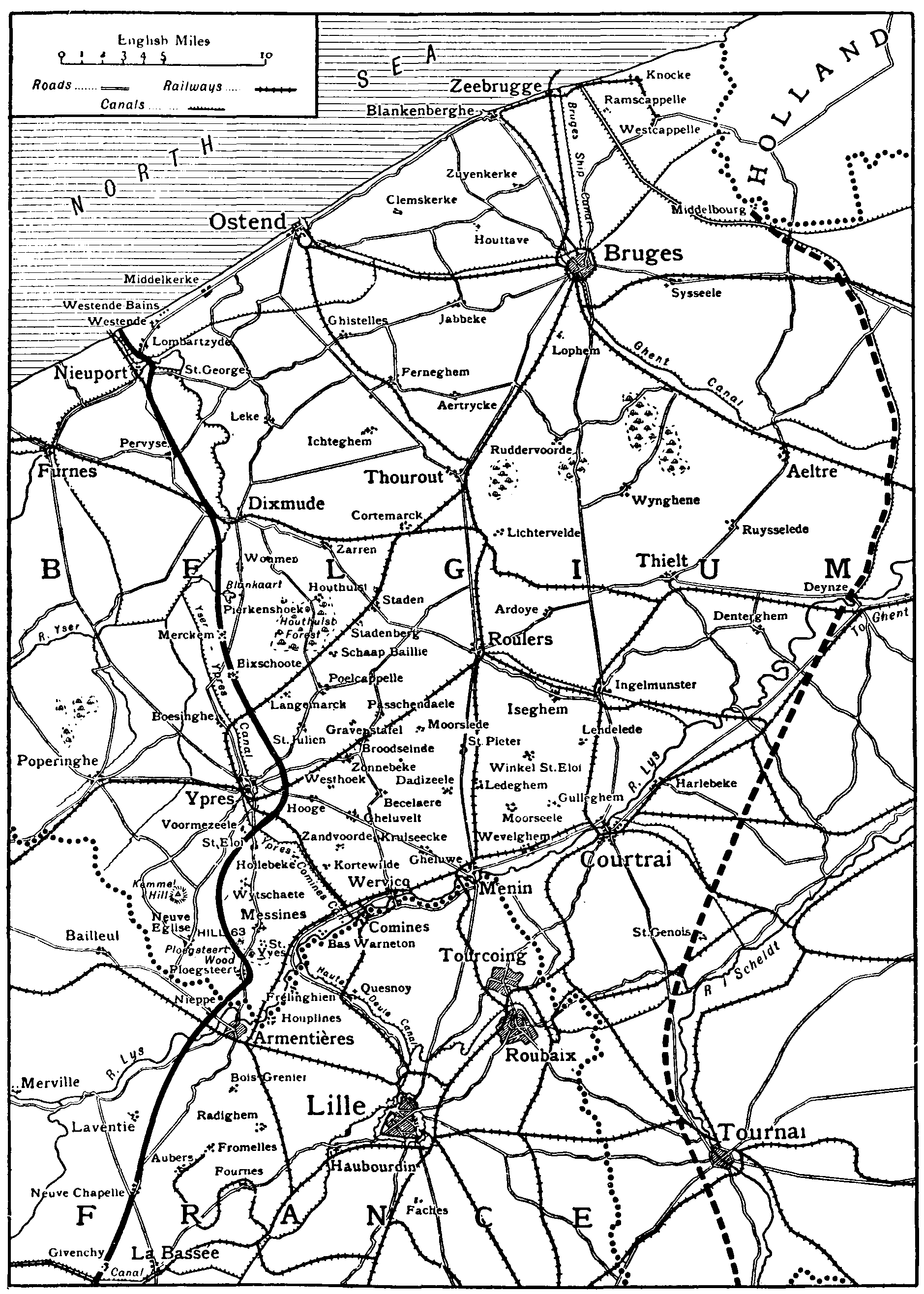
The Liberation of the Belgian Coast, 1918: map showing approximately the Allies' line on 28th Sept.—represented by the solid line—and on 25th Oct.—represented by the broken line
Elsewhere victories had been won which appear minor only by comparison. American divisions had been transferred to the left bank of the Meuse at Verdun, and, supported by French divisions, had carried Montfaucon and Varennes (10,000 prisoners); on the other side of the Argonne Gouraud was advancing, and by 1st Oct. was 9 miles from his starting-point below Moronvilliers, and had accumulated 13,000 prisoners and 300 guns.
Map showing approximately the Allied line on 8th Aug., 1918, and on Armistice Day, 11th Nov., 1918
The results of these attacks were at once apparent, as Foch had predicted, in the north. His plan of an attack by Plumer's Second British Army, and by the Belgian Army stiffened by French divisions, was as successful as he had hoped. Under the weight of the Franco-Belgian-British attack on 28th Sept. the thinly held German front melted away. By nightfall the British held all the ridge between Wytschaete and the canal north of Hollebeke; the Belgians were in Houthulst Forest. By the end of September the blood-drenched ridge of Passchendaele, and all its tragic surroundings, had passed into the Allies' hands, and the German grip on the coast had been finally unloosed. This marked the beginning of the end. Since Foch attacked between the Aisne and the Marne on 15th July the Allies had taken a quarter of a million prisoners, 3669 guns, and 23,000 machine-guns. The rest of the campaign must either be a disaster of the first magnitude to the Germans, or, at best, a painful and ineffective retreat to the line of the Meuse.
What remained of the campaign was the work of clearing up; but this was not an easy task, because, though Ludendorff was aware that victory remained permanently with the Allies, he assured the German Government that delaying actions could be fought till the following spring. Against such an undesirable protraction of the war, Foch was preparing a final stroke in the neighbourhood of Metz with the aid of a Second American Army, which was being organized by General Pershing, who had relinquished the command of the First American Army to General Leggett. But the progress of the First American Army in the Argonne, where the fighting was conducted under circumstances of great difficulty, and where the transport was admittedly defective, was slow; and, lacking the place and the resources for another outflanking blow against the retreating Germans, the Allied armies could do no more than press their retreat.
In that retreat position after position was forced from their hands. Cambrai fell on 9th Oct.; on 15th Oct. von Einem's army was far from the coast; on 17th Oct. Ostend had fallen; Horne's First Army had taken Douai, and Birdwood's Second Army had liberated Lille. King Albert re-entered Bruges on 25th Oct. Farther south the British Third and Fourth Armies were close to Le Cateau on 17th Oct.; and Mangin and the French had re-entered Laon—so long the German Great Head-quarters—on 13th Oct. The story of the rest of the campaign, though it involved much severe fighting in breaking the resistance of German rear-guards, is the record of the steady drive of all the British, French, and Belgian Armies which had produced the German collapse, while the right wing of Foch's greater pincers, comprising the only great new reinforcements he could bring to bear, namely, Gouraud with the Americans on the extreme right, worked its way up for a last decisive blow.
It was a slow operation; but by 4th Nov. Gouraud and Leggett had joined hands north of the Bourgogne Forest; and by 6th Nov. Gouraud entered Rethel and an American division reached Sedan. Thus, though behind schedule time, Foch's right wing approached its decisive position in the first week in November; and in the second week the left wing (British) had occupied Maubeuge. What would have been the consequence had Foch advanced his right wing farther and with effect is a matter for the military expert. That Ludendorff was in no doubt of its disastrous results to the German armies is shown by his request for an Armistice on 9th Nov.
The Balkans, 1918
Bulgaria, thoroughly war-weary, and dissatisfied with Germany's refusal to give her the whole of the Dobrudja when terms were made with Roumania, had surrendered to the Allies on 30th Sept. The last Balkan campaign had been swift and decisive. No major operations had taken place during the earlier months of 1918, but on 15th Sept. General Franchet d'Esperey, who had succeeded General Sarrail in supreme command of the Allied forces, launched an offensive which rapidly transformed the whole military situation. French and Serbian troops, on the left or Monastir front, with the eager Serbians as the spear-head of the attack, penetrated the Bulgarian positions with an impetuosity which in two days carried them 12 miles behind the enemy's lines on a 22-mile front, and drove a wedge between the First and Second Bulgarian Armies. Meanwhile the British and Greek divisions were engaged in a far more difficult task on the Doiran front, where they suffered heavy losses in storming impregnable positions between the Dopropolje Ridge and Vetrenik, but succeeded in preventing the Bulgarians opposing them from sending reinforcements to their hard-pressed troops along the Monastir front. This 'wing of sacrifice' pinned the Second Bulgarian Army to the Doiran front until it was too late to join its retreating First Army. Realizing the plight in which it stood, it hurriedly evacuated its positions on the night of 21st Sept. and fled in confusion towards Sofia. The pursuit of the Bulgarians was now taken up by all the Allied armies from Doiran to Monastir, the vengeful Serbians in particular harrying the retreating Second Army with a remorseless energy which drove it head-long through Northern Serbia in increasing disaster towards Belgrade, while the British and Greek forces under General Milne entered Bulgaria hard on the heels of the demoralized First Army. By 26th Sept. the Bulgarian politicians realized that the whole position was hopeless, and sent a parlementaire under a white flag to the Allied head-quarters. Four days later they signed an armistice at Salonika, handing over complete control of the Bulgarian railways and communications, demobilizing the Bulgarian armies, and surrendering their arms and ammunition. On 4th Oct. King Ferdinand abdicated, and his eldest son reigned in his stead as King Boris III.
Italian Campaign, 1918
In less than a month—on 3rd Nov. to be exact—Austria-Hungary, after experiences in the field similar to those which had fallen to Bulgaria's lot, surrendered to the Italians. This turn of the tide in the Italian campaign in 1918, which amply atoned for the disaster of Caporetto in the preceding year, and crowned Italian arms with triumph, followed a final attempt of the Austro-Hungarian army, now under the direction of General von Arz, to crush the Italian front in conjunction with Ludendorff's great offensive in the West. General von Arz's main attack was delivered on 15th June on a 46-mile front along the Piave, and extended across the mountain positions between the Piave and the Brenta. The two British divisions west of Asiago played a great part in hurling the enemy back in this sector, the French divisions similarly distinguishing themselves on their right. Elsewhere some progress was made at certain points, and the Piave was crossed in two places; but by the third day it was already obvious that the attack had failed. Then the weather broke; rainstorms swept down the hills and turned the Piave, which had been low when the enemy crossed, into full flood, sweeping away a number of his bridges. Hurried efforts were made to get the marooned troops back, and though General Diaz was unable to bring up enough divisions in time to complete their discomfiture, they lost heavily enough in the retreat, their casualties before the battle died down on the other side the river amounting to some 200,000. Biding his time for his own great counter-offensive until Foch could be assured about the situation in the West, where Italian troops distinguished themselves in the operations round Rheims, General Diaz gradually pushed the Austrians back, until by 7th July he had cleared the whole Piave delta. It was not until 24th Oct. that his final blow was delivered. Its success was immediate and overwhelming. Launched on the night of 23rd-24th Oct., the main attack consisted of an advance across the Piave with the Tenth Italian Army—placed under the command of Lord Cavan—now including three British divisions, together with the Eighth and Twelfth Italian Armies. Cavan's force formed the spear-head of the thrust, and ensured the success of the battle by seizing the Island of Grave di Papadopoli in the Piave mid-stream, held by the enemy as an advance post. This was captured in a daring surprise attack by night, without any artillery preparation, and paved the way for the passage of the troops across the swollen river. At the same time the Fourth Italian Army, with a French division, advanced across the old battle-ground of Asiago and Monte Grappa, where, however, the Austrians counter-attacked, holding up the advance until the whole front collapsed with the triumphant progress of the main attack across the Piave. By 27th Oct. the breach had widened until it spread across the entire front of the three Italian armies, which thereupon swept the plains and mountain heights until all the enemy's positions between the Brenta and the Piave had been regained. The Austrian retreat became a rout. By the end of the month the Italians claimed 50,000 prisoners, had cut the railway between the plains and the mountains at Conegliano, and occupied Feltre. With Germany in similar plight; Turkey and Bulgaria already finished; and her own internal affairs rapidly going from bad to worse, Austria appealed to General Diaz for an armistice. When the end came on 3rd Nov. with the signing of the agreement which involved the demobilization of the Austrian army; the surrender of the Austrian fleet; the occupation by the Allies of the Trentino, the Istrian peninsula, and a portion of the Dalmatian coast and islands, the Italians had just captured both Trent and Trieste, a landing-force having arrived at Trieste for the occupation that very day. The wholesale nature of the Austro-Hungarian surrenders during the closing phase of this decisive campaign may be gauged from the fact that by 3rd Nov. they had amounted to no fewer than 300,000 prisoners and 5000 guns.
Germany accepts Defeat
The complete collapse of the Great War, and with it all the Pan-Germanic dreams of world-power, came with dramatic swiftness. Ludendorff resigned, and though the Kaiser had entreated Hindenburg to make one last stand on the line of the Meuse, his appeal had been in vain. Hindenburg knew the hopelessness of the position, not only of the German army but also of the German home front. Ominous disturbances were breaking out in all parts of the Fatherland, including a mutiny at Kiel. Turkey (30th Oct.) as well as Bulgaria and Austria-Hungary had surrendered, and Germany was in no position to face the Allies alone. The Armistice terms, with all their crushing humiliations, had perforce to be accepted, and were signed on 11th Nov. They included, besides evacuation of territory, the surrender of the bulk of the German navy, 5000 additional guns, 30,000 machine-guns, 3000 trench-mortars, and 2000 aeroplanes. A zone of territory on the Rhine was to be occupied by the Allies, and the Treaties of Brest-Litovsk (signed by the Bolshevik Government with the Central Powers on 3rd March, 1918, in defiance of Russia's solemn engagement not to make separate peace with them) and Bucharest (forced on Roumania in March, 1917, at the close of von Mackensen's drive) were declared null and void.
Unable to face his subjects, William II abdicated on 9th, slipped across the frontier into Holland on 10th Nov., and on the 28th of that month signed the formal document of his abdication, the Crown Prince, who also sought refuge in Holland, following suit three days later. With the Kaiser fell all the rulers of the German states. On 10th Nov. the Imperial Chancellor, Prince Max of Baden, resigned in favour of Herr Friedrich Ebert, ex-shoemaker, who became 'First Imperial President of the German Republic', with a Government formed from both wings of the Socialist party.
Last year of Naval War
The war had been won at sea as well as on land, though the British navy had far fewer opportunities than the army of getting to grips with the enemy. The hazards of naval warfare never ceased by day or night; and by the end of the war the range of the submarine had extended from the eastern end of the Mediterranean to the American coast. All the reckless efforts of the Germans to win the war by these means failed. With the adoption of new methods to cope with the danger—including the employment of 'Q' boats, or mystery ships—and the invaluable help of the American reinforcements, the monthly shipping losses in the closing year of the war grew progressively less, falling, indeed, from the total of 1,494,473 tons in the September quarter of 1917, to 915,513 tons in the corresponding quarter of 1918. Meantime the new tonnage under construction to make good these losses was as rapidly increasing. The U-boat war, in short, had failed; and the Germans knew it had failed.
The outstanding operation at sea in the closing year of the war was the raid on Zeebrugge and Ostend on St. George's Day under Vice-Admiral Sir Roger Keyes, the object being to block the outlet of the German submarines and destroyers from their depot at Bruges. Since all the neighbouring coast was strongly fortified, the attack was fraught with the gravest danger, and had to take the Germans as far as possible by surprise. The chief ship of the expeditionary force was the old cruiser Vindictive (Captain Carpenter), which, with the ferry-boats Iris II and Daffodil, were told off to act as shield to the three blocking-ships intended for Zeebrugge—Thetis, Intrepid, and Iphigenia. Two old submarines were also taken, charged with explosives, and ordered to ram themselves below the viaduct connecting Zeebrugge Harbour with the Mole, and then blow themselves up. One of them carried out her orders to the letter; the other's rope parted while she was being towed into position, and she was too late to help. The simultaneous attempt to land, shortly after midnight, followed a bombardment from a squadron of monitors, and was supported by a flotilla of destroyers and a fleet of motor-boats. The Vindictive ran alongside the Mole within five minutes of being discovered by the German garrison, and was kept in position by the Daffodil and Iris while landing-parties jumped ashore to do what damage they could and the blocking-ships were being rammed at the entrance. This successfully accomplished—both the Intrepid and Iphigenia being blown up in the fairway—the battered Vindictive, taking her landing-parties aboard, backed out and returned with her supports to Dover. The first attack on Ostend, which took place the same day, was a comparative failure owing to the undetected removal of a buoy, the two blocking-ships sent for the purpose being sunk outside the harbour. Three weeks later the commander of the Brilliant (Commander Godsal), who was in charge of that operation, tried again, this time successfully—the old Vindictive, patched up as a blocking-ship, being sunk 200 yards up the channel of Ostend—but Commander Godsal was killed by a shell just after completing his task.
The German navy made one more appearance on the high seas—when, under the terms of the Armistice, 6 battle-cruisers, 10 battleships, 8 light cruisers, 50 destroyers, and all her submarines were surrendered, the bulk of them to the Grand Fleet at Rosyth under Sir David Beatty on 21st Nov. On the following day the captive ships were sent to Scapa Flow, where, exactly seven months later, their German crews, while the British battle-fleet was absent on gunnery practice, scuttled practically every vessel. A week later—on 28th June, 1919—Germany signed the Peace Treaty at Versailles, involving unconditional acceptance of all the Allies' terms.
Turkey and the War
In Aug., 1914, the German war-ships Goeben and Breslau escaped the British squadron stationed to intercept them near Messina, the escape arising partly through delay in correcting orders, and partly through the fact that the German commander had no scruple about violating neutrality in the course he sailed through the Straits of Messina. The ships reached the Dardanelles on 11th Aug., and were sold to Turkey. This was a symptom of Turkish relations with Germany rather than a determining cause of Turkey's entrance into the war as an ally of the Central Powers; but many efforts were made to change Turkey's attitude before the British, Russian, and French Ambassadors left Constantinople (1st and 2nd Nov.) and Great Britain declared war on her (5th Nov.). The first act of war undertaken by Turkey was the dispatch to the Caucasus front of three army corps, with a plan of campaign designed by General Liman von Sanders, and commanded by Enver Pasha. They were decisively beaten by the Russian forces at Sarikamish in December. Had the Russians possessed abundance of transport, or had the roads been less difficult, this victory might have been pressed. But Russia wanted all her resources elsewhere, and it was not till 1916, two years later, that she made any serious attempt to carry the war into Turkish territory. Then, under the direction of the Grand Duke Nicholas, and General Yudenitch, who was some years later to come into prominence as the leader of an unsuccessful attempt to reach Petrograd and overthrow the Bolsheviks (1920), a Russian expedition drove back the Turkish forces on Erzerum and captured it (16th Feb., 1915). On 16th April, after another pause to gather transport, the Russians found their way to Trebizond on the Black Sea, and during the next few months spread over the Asiatic Peninsula to Bitlis, Musk, Van, Mosul, Erzingan, and Diarbekr, fighting generally with local success, but with no concerted plan of campaign. The effort expired in the autumn, and was not revived.
Gallipoli Campaign
Before, however, the Russians undertook their own expedition, they were urgent in pressing on France and Great Britain the desirability of opening up the Dardanelles so as to bring the Allies into touch with each other through the Black Sea ports. In response to this invitation, the naval possibilities of which were insufficiently considered by the advisers of the British Admiralty, and the prospects of which had been roundly condemned by all who had previously considered the problem, Admiral Carden began a bombardment of the Dardanelles forts with old battleships, British and French, on 19th Feb., 1915. The bombardment was renewed on 25th Feb. and 6th March. Admiral Carden resigned on 16th March owing to ill-health, and was succeeded by Admiral de Robeck, who favoured the idea of breaking into the Sea of Marmora by rushing the straits. Four big ships, one the Queen Elizabeth, engaged the guardian forts, Chanak and Kalid Bahr, at long range (18th March); other ships closed in, and a French squadron penetrated as far as Kephez Point. But the hidden batteries, the mines, and various other devices frustrated the attempt, which was a practical failure by the afternoon. Two good ships, Irresistible and Inflexible, were put out of action, and two others, Bouvet and Ocean, sunk. After this Admiral de Robeck accepted the professional view that a fleet operation should be combined with one on land. Lord Kitchener, who had been as little disposed towards the Dardanelles adventure as Lord Fisher, reluctantly consented, and General Sir Ian Hamilton was appointed to command the British expedition, while General d'Amade was in charge of the less numerous French Colonial Corps.
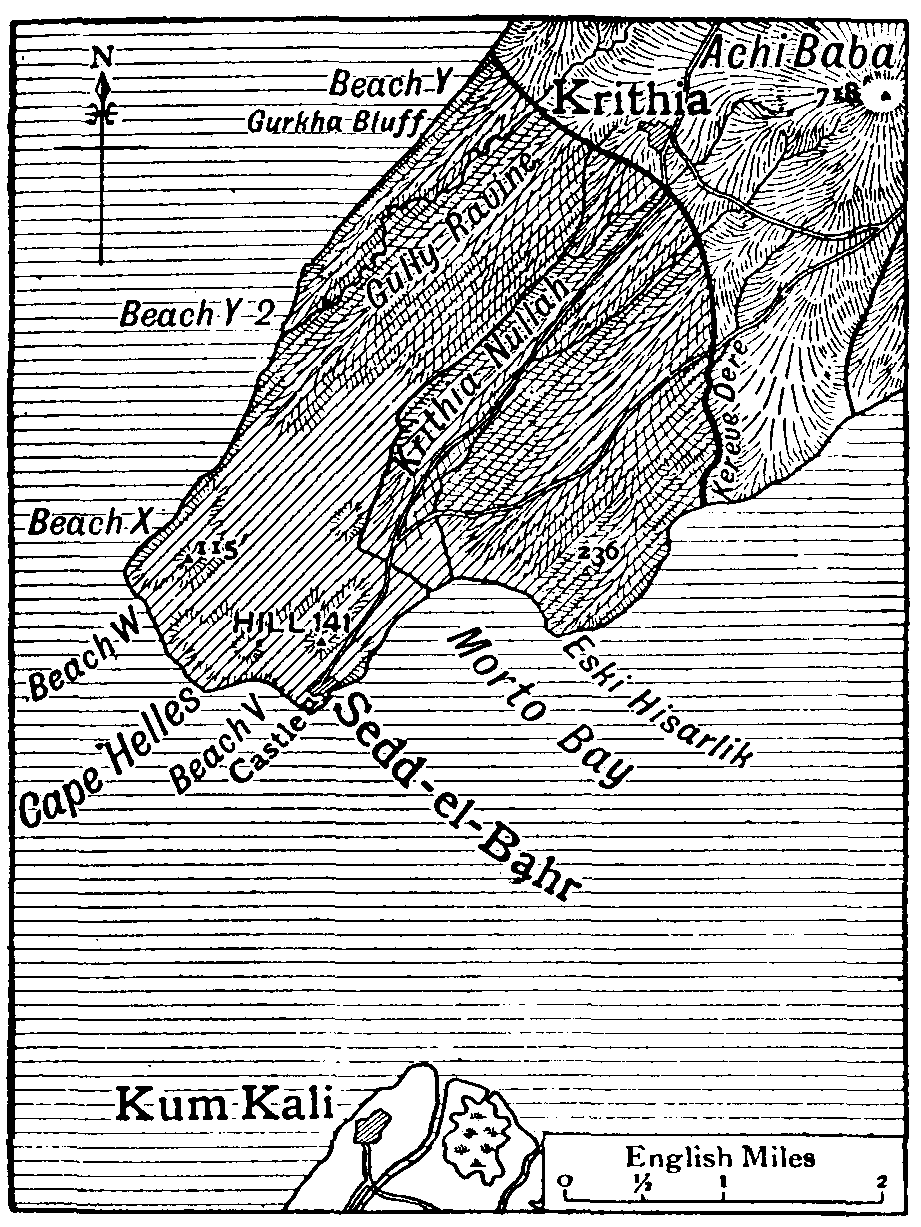
Sir Ian Hamilton's force eventually comprised the 29th Division, the Australian and New Zealand (Anzac) Corps, the East Lancashire Territorial Division, and part of the Royal Naval Division. There was an unfortunate delay in getting the expedition off from its Egyptian base, and the Turks had ample time to prepare for its landing (25th April), which they did not believe to be a possible feat. The landing was effected, nevertheless, with incomparable gallantry, at five beaches on the nose of the Gallipoli Peninsula, and at Gaba Tepe (by the Anzac Corps) farther north. Some 8000 men were got ashore in twelve hours, and an advance was made on the following day (26th April). On 28th April the French Corps, which had made a feint attack on the other side of the Narrows, was brought across to assist in a general advance on the dominating height of Achi Baba. The resulting engagement, the battle of Krithia, revealed the fact that the Turkish field fortifications, the Turkish artillery, and the Turkish numbers had all been too well organized under von Sanders to admit of being rushed. Evidence accumulated that Achi Baba, which was the key to the Dardanelles forts, could only be taken at ruinous cost by a frontal attack, though an attack in force on 6th May went nearer to success than any other, and appeared to fail only through a culminating misfortune of misdirected artillery. Fighting continued in May and June, both here and at Gaba Tepe, where General Birdwood commanded the Anzac Corps. Engagements in which local advances were made took place on 29th May (Anzac Corps), 4th and 21st June (French Corps), 28th June (29th Division), and though the climate and the insufficient protection inflicted appalling losses on the hard-tried British and French troops, it was on the Gallipoli Peninsula that the flower of the Turkish army also was lost. Of the naval forces the Queen Elizabeth was summarily ordered home just before a new Turco-German submarine campaign set in; three more old battleships were torpedoed; but the English submarines retaliated by torpedoing a Turkish battleship, gunboats, and transports in the Straits.
General Gouraud relieved General d'Amade in the middle of May, but was badly wounded by a shell (30th June), and returned to France. General Sir Ian Hamilton, who had unceasingly asked for more guns and more men, received some part of the aid he asked in order to put a new plan into operation. The plan was to land a force at Sari Bair, on the neck of the Peninsula, where it could co-operate with the Anzac Corps in forcing a way to the commanding heights there, and ultimately might take the Turks in the flank. One force was to land at Anzac Cove; two other of the three new divisions sent out to Sir Ian Hamilton were to be landed 4 miles north, at Suvla Bay. The forces at Anzac were landed on 4th-6th Aug., bringing up the numbers of Sir W. Birdwood's command to 36,000. Sir F. Stopford was in command of the force to land at Suvla Bay (6th and 7th Aug.), with Generals Hammersley and Mahon as divisional generals.
The Suvla and Anzac Line: map showing approximately by the shaded portion the area occupied after the linking up of the two armies in Aug., 1915
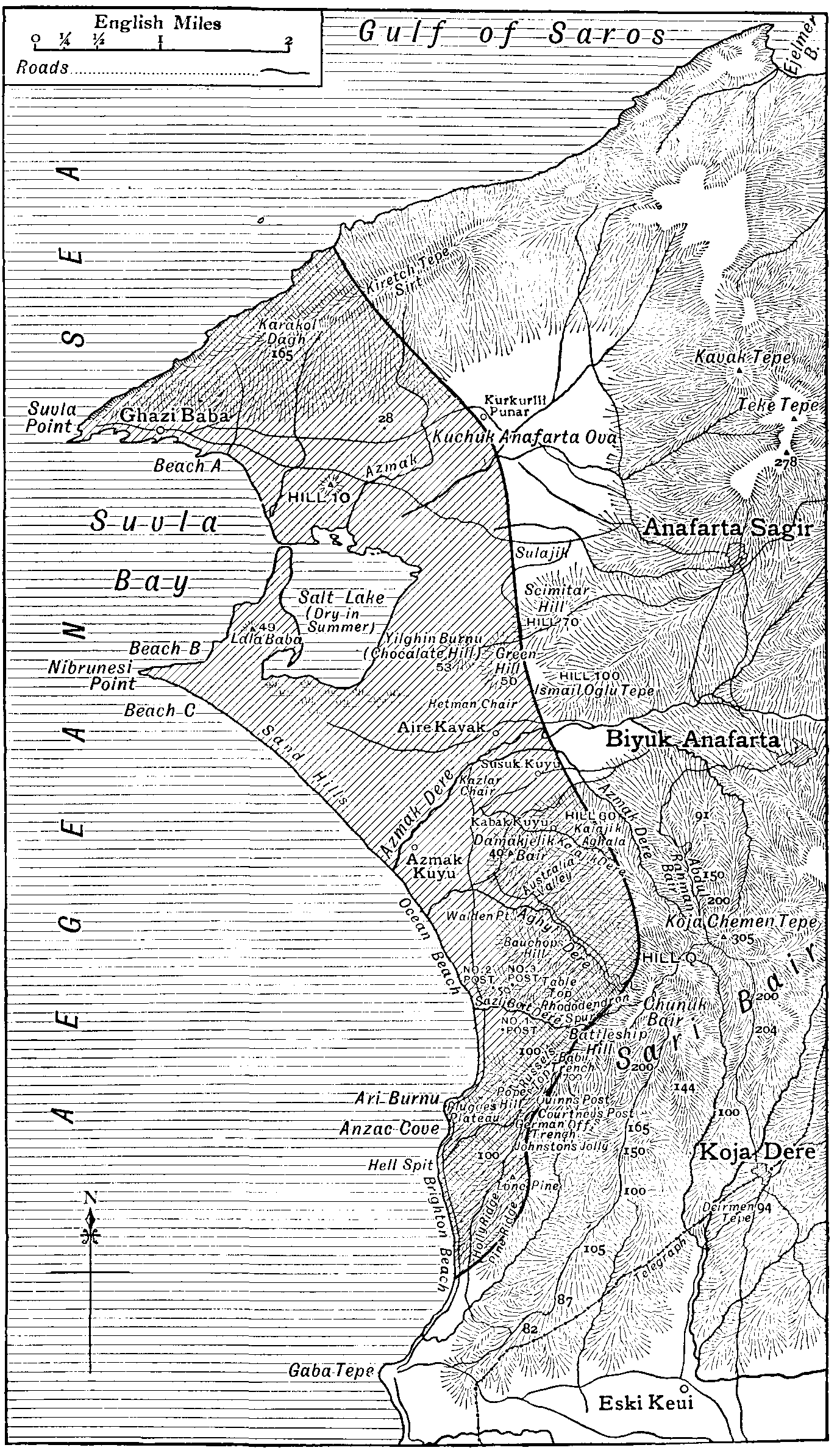
The fresh attack on the night of 6th Aug. was not completely successful, and the Anzac columns under General Godley were still short of the ridges at Koja and Chunuk on the night of 7th Aug. The Turks were then alive to the threat, and made continuous counter-attacks, so that by 10th Aug. all the efforts of the combined force of Anzacs, Gurkhas, and English regiments had failed to maintain more than a slippery hold on the ridges. The chief cause of the failure was that the contributory aid of the attack at Suvla Bay farther north had not been forthcoming, owing to various reasons. Lack of water had exhausted the unseasoned divisions landed in Suvla Bay; misunderstandings among the generals were other reasons; and when the Commander-in-Chief, on hearing of their failure, came up from Zimbros, he met a situation which it was too late to redeem. General Stopford was succeeded by General de Lisle (15th Aug.). Lord Kitchener declined to send further troops from home, and though Sir Ian Hamilton, bringing the veteran 29th Division up to Suvla, with reinforcements of yeomanry, made another attempt on 21st Aug., it was unavailing. After 24th Aug. the British campaign assumed a defensive character, and in spite of Sir Ian Hamilton's representations the War Office declined to waste further men and material on it. On 15th Oct. Sir Ian Hamilton was recalled, and Sir Charles Munro, who reported that the expedition should be abandoned, was supported by Lord Kitchener after personal inspection of the surroundings. The evacuation was carried out with remarkable success on 18th Dec. and 8th Jan. (1916). The cost of the expedition in men was 31,389 killed, 78,749 wounded, and 9708 missing.
Map showing approximately the area in the Southern Zone evacuated in Jan., 1916
Mesopotamian Campaign
The Mesopotamian campaign ran contemporaneously in part with the Dardanelles operations, and in part with the campaign between Erzerum and the Caucasus in Armenia, in which Russia co-operated. A small British force, sent out to the Persian Gulf in 1914, occupied Basra (22nd Nov.) and pushed outposts forward to the junction of the Tigris and Euphrates. General Sir John Nixon took command (Jan., 1915), and in April (11th to 14th), following a Turkish attack, the British force, now a division strong, advanced to Shaiba, and on 31st May took Kurna. Amara, on the Tigris, capitulated to General Townshend (3rd June), who was empowered to push forward an advance column, while another column, under General Gorringe, beat the Turks at Nasiriyeh (24th July). At this time the Russians were on the headwaters of the Euphrates.
Fired by these successes, General Nixon ordered Townshend to seize Kut if possible. It was so dangerous an enterprise that probably the Turks did not believe that it would be attempted. But Townshend traversed the difficult country in six weeks, arriving within striking distance of the Turkish forces under Nur-ed-Din Bey on 15th Sept., and, in a very capably devised and executed engagement on 27th and 28th Sept., drove them before him. Townshend, against his own better judgment, was then sent forward to attempt the impossible feat of pushing on to the Turkish base of Bagdad. He arrived in front of their advanced position, Ctesiphon, on 22nd Nov., and attacked it with his four brigades, one of which was a reinforcement, and his rather scanty cavalry and artillery. The first line of the defences was carried, but Nur-ed-Din, who had retired on his supports, counter-attacked, and in spite of Townshend's resistance compelled him to retreat (25th Nov.) by way of Azizieh, fighting heavy rear-guard actions all the way to Kut (3rd Dec.). Townshend's force suffered severely and lost part of its river transport. By 5th Dec. it was invested in Kut, and after two unsuccessful attempts to carry the town by force (8th and 23rd Dec.), the Turks sat down to starve it out. Townshend's mixed force of British and Indians, ill-fed and assailed by beri-beri and scurvy, endured the siege for 145 days, till 29th April, 1916, when it surrendered to Khalil Pasha. The prisoners were at first well treated, but most of them were compelled to march through Mesopotamia, Armenia, and Anatolia to prisoners' camps, and many died from their hardships.
An attempt to relieve Kut failed. It was made by Generals Aylmer and Younghusband, whose relief expedition set out on 3rd Jan., 1916. An engagement was fought on 8th Jan., and a pitched battle at the Shatt-el-Hai on 8th March. This failed, when on the brink of success, through want of luck or enterprise at the critical moment. Several changes were made in the Mesopotamia leadership after the impossibility of relieving Kut had become apparent, and in Aug., 1916, General Stanley Maude took over the command. The attention drawn to the blunders, and the scandals of medical assistance and transport, enabled General Maude to begin his task by rectifying them, and he built light railways from Basra. He made his first move forward on 12th Dec., 1916, and the history of the Mesopotamian campaign then entered on a brighter epoch, a result due to Maude's deliberate, bold, and prudent generalship. Contact began on 5th Jan.; the right bank below Kut was cleared by 15th-16th Jan.; and by 23rd Feb. Kut itself was so far encircled that the Turks had no option but to abandon it with guns and prisoners. Maude resumed his advance on 5th March, and by 11th March had manœuvred the Turks out of Bagdad as he had forced them out of Kut. The integrity of the Mesopotamian Turkish force had been destroyed, and its portions distributed at points believed to be out of Maude's reach. One of these was at Ramadie, but a dashing night-march captured the Turkish commander and 3400 prisoners (28th Sept., 1917). Other successes were gained at Tekrit and the Jebel Hamrin hills before Sir Stanley Maude died of cholera (18th Nov.). He was succeeded by General Marshall, who, in 1918, occupied Hit on the Euphrates, and ended the Mesopotamian campaign with a crushing victory at Mosul just before the Armistice.
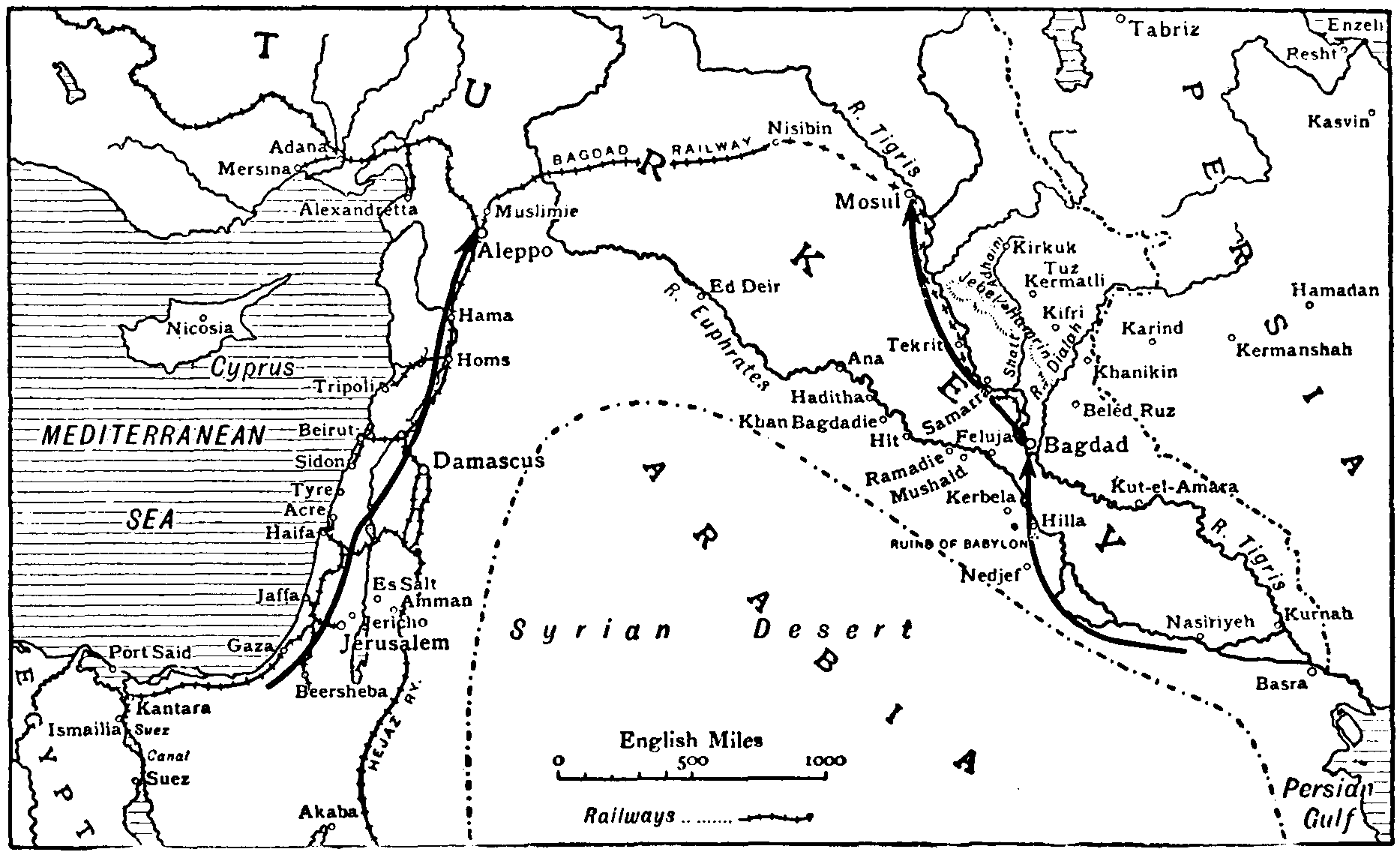
Map showing the converging lines of the main British advances in Mesopotamia and Palestine at the points reached on 31st Oct., 1918
Palestine Campaign
Turkey assumed the offensive against Egypt, of which the Sultans were nominally suzerains, by an attempt to force the Suez Canal in Feb., 1915. A force under Djemal Pasha made a dash across the 150 miles of the Sinai Peninsula from Palestine, and was in a position to attack Ismailia and the Bitter Lakes on 2nd Feb. The ample Imperial troops on the spot enabled General Marshall to beat off the attack with ease, but the raiders were not pursued. An attempt on a more concerted scale was made in 1916, though at this time the Turkish garrisons in the Hejaz were having difficulties with the Arabs. A base was established at El Arish, and on 3rd Aug. a well-equipped force of 18,000 advanced to attack Major-General Lawrence's outposts at Romani, in the north of the Sinai Peninsula. The attack was beaten off, and General Sir A. Murray's main body of Australians, New Zealanders, Yeomanry, Territorials, and the 52nd Division coming up, counter-attacked and drove the Turks back 18 miles, inflicting a loss of 4000 prisoners and 4 guns. Between the 6th and 12th Aug. General Murray improved on his victory, and advanced steadily to Mazar (16th Sept.) and El Arish, evacuated by the Turks (20th Dec.). On 22nd Dec. an attack was made by one of the desert columns on Magdhaba, and the whole Turkish force of 3000 destroyed or captured.
On 9th Jan., 1917, the columns under Generals Dobell and Chetwode reached Rafa, the Mediterranean port on the southern borders of Palestine. A pipe line conveying water and a railway followed close on General Murray's advance, and by the middle of March, 1917, these had reached Rafa, enabling an advance to be begun in Palestine, with Gaza as the immediate objective. The first battle of Gaza began on 26th March. It was a failure. Chetwode's mounted forces, including the Australians, moved in a wide detour round Gaza, which was entered while Dobell's infantry attacked the main Turkish positions. But the infantry thrust was not strong enough to penetrate the opposition offered to it, and after two days' fighting the attack was called off. Water was short, and General Murray suspended further attack till 19th April, when, as frequently happened, the Turks, having been reinforced and established in good positions, fought well and beat off the assailants.
Sir A. Murray and General Dobell left the Palestine operations, and General Sir E. Allenby was sent out to organize a subsequent advance when the opportunity was propitious. He was reinforced; the communications were improved through the summer; and on 31st Oct. he surprised the Turks by making a diversion towards Beersheba while demonstrating towards Gaza. Beersheba was rushed by the Australians, and Allenby's right secured. He then sent the 52nd Division to a point between Gaza and the sea while occupying Ali Muntar, and from these two vantage points shelled the Turks out (7th Nov.). It was the decision of the Allied War Council at Versailles in the autumn of 1917 that Allenby, strongly reinforced, should put the Turks out of the war by one decisive blow, since they were already in straits by reason of losses in their numerous campaigns, including those against the Arabs of the Hejaz, which had been organized by the Emir Feisul and Colonel T. E. Lawrence. Accordingly, the Turks were pursued through Ascalon and Ashdod to Jaffa (16th Nov.). Allenby's main columns pressed on more slowly between Beersheba and Hebron (7th Dec.), but entered Jerusalem on 9th Dec., after disposing of an ineffective Turkish stand on the day before. The operations were practically suspended after the Jordan had been crossed at the end of March, 1918, when it became necessary to recall some of the best British divisions to France to meet the last German onslaught in France and Flanders.
When this had been disposed of, Allenby, who had been supplied with Indian divisions, and who, in Sept., 1918, was much superior in forces and artillery to the Turks, resumed his attack (19th Sept.). Facing him were the Turkish Seventh and Eighth Armies in front of Shechem, and the Turkish Fourth Army east of Jordan. A heavy artillery preparation ushered in a frontal infantry attack which tore a gap in the Turkish right and right centre, and through it the cavalry swept north across the Plain of Sharon to reach and seize the passes at Megiddo. Another infantry attack pinned the Eighth Army on the Jordan. The Turks began to retreat too late, for the Imperial cavalry, pouring through the Megiddo passes, crossed the plain of Esdraelon and barred every avenue of retreat on the western side of Jordan. They only missed the capture of General Liman von Sanders at Nazareth by a few hours.
The Turkish armies were in effect destroyed, for on the eastern side of Jordan the Arab cavalry of the Emir Feisul had turned the line of retreat there, and had cut the Hejaz railway running to Damascus. In less than a week the Turkish Seventh and Eighth Armies were wiped out, and 10,000 of the Fourth Army surrendered at Rabboth Amman (29th Sept.). Haifa and Acre on the coast fell as fast as the Imperial cavalry could reach them. Damascus was entered by the Australians on 1st Oct. Beirut fell a few days later, and by the end of October General Allenby had reached Aleppo. The Turkish Cabinet immediately entered into negotiations, Enver Pasha and Talaat Pasha having been replaced. An armistice was signed on 30th Oct. at Mudros, and Turkey was out of the war. It may be added that Talaat Pasha, who was responsible for the massacres of the Armenians, was killed in Berlin by an Armenian student in 1921.
The War in Germany's Colonies
Within a few weeks of the outbreak of hostilities the war had been carried to all the scattered possessions of Germany in Africa, the Pacific, and the Far East. Among the first to fall were German Samoa (occupied by the New Zealand troops on 29th Aug.); the islands of the Bismarck Archipelago and German New Guinea (occupied by the Australians on 11th-13th Sept.); and the more northerly islands of the Pacific, surrendered at the beginning of October to a Japanese squadron. These last were at once handed over by Japan to Australia. Japan, faithful to her alliance with Great Britain, had declared war against Germany on 23rd Aug., and attacked the formidable German post of Kiao-Chau, 'the key to Northern China', which had been seized by Germany on the flimsiest pretext in 1898. Japan invested Kiao-Chau—garrisoned by 6000 well-armed men, with powerful defences—with a force of 23,000 troops under General Kamio, supported by a small British contingent of South Wales Borderers and Sikhs under General Bernardiston. After a six weeks' siege, and a preliminary bombardment preparatory to launching a final assault, the garrison capitulated (7th Nov.).[3]
The remainder of Germany's colonies were in Africa, where the campaigns resulting in their conquest varied from a few weeks to the whole length of the war. The shortest was in Togoland, which surrendered unconditionally to a Franco-British force under Colonel Bryant on 27th Aug., 1914, after a brisk little campaign lasting just three weeks. The Cameroons, larger than the Fatherland, took much longer to subdue, and the operations were of a more arduous nature. A false start was made from Nigeria with insufficient forces, which met with disaster towards the end of August. A more adequate expedition was then organized under General C. M. Dobell, in co-operation with French forces under General Aymerich. Duala, the capital, was occupied on 27th Sept., but it was only after desultory fighting for a year and a half that the Germans, realizing the hopelessness of further resistance, left the colony to its fate by retreating into the neighbouring Spanish territory of Rio Muni.
The campaign in German South-West Africa was held up at first by the revolt in South Africa, which had to be crushed before General Botha was free to give his undivided attention to the task which he had offered to undertake in proof of the Union's loyalty. A preliminary move had been made in September by the occupation of the coastal harbours, Luderitz Bay and Swakopmund, from which the Germans retired to concentrate in Windhoek, their capital inland. A 'regrettable incident' occurred on 26th Sept., 1914, when a British patrol was attacked at Sandfontein and a small relief force compelled to surrender. This was followed by news of the revolt of Maritz, who had been partly responsible for the reverse at Sandfontein; and the small civil war which followed in South Africa, though nipped in the bud by the sterling loyalty of most South Africans, served to postpone the conquest of German South-West Africa until the following year.
When the campaign began in earnest in the spring of 1915, the whole south-eastern part of the German colony had already been cleared by Colonel van Deventer, whose desert march with three separate columns in these preliminary operations was one of the outstanding achievements of the campaign. In the great converging march which followed, led in the south by General Smuts, and in the north by General Botha, with columns consisting largely of mounted burghers from the Transvaal and Orange Free State, the Germans were outfought and outmanœuvred throughout. The advance began on 27th April, and by 5th May Botha, building a light railway with supplies behind him, entered Karibib without opposition, and Windhoek a week later, the Germans, 5000 strong but greatly outnumbered, withdrawing the bulk of their forces to the north. Twice they proposed an armistice, offering terms, but the only terms that Botha would agree to implied unconditional surrender. Having rested and refitted his men after this trying trek across country from Swakopmund, he proceeded to enforce these terms by a series of remarkable marching feats, with his own columns in the centre and those of Brits and Myburgh to left and right respectively, starting on 18th June. In less than a week Botha's force had covered 100 miles and captured Otyiwarango; on 1st July, after a brief rest, his infantry were in touch with the enemy's main force, entrenched from Otavi to Tsumeb, with Brits and Myburgh sweeping round on either side. On 8th July all resistance collapsed with the total surrender of the Germans under Colonel Franks, the military commandant. The whole campaign in South-West Africa did not cost us more than 140 lives, and total casualties amounting to 1200.
The conquest of German East Africa was a very different affair. It was opposed by a force which, at its maximum, could muster 25,000 well-drilled troops—2000 of them Europeans—with 60 guns and machine-guns, and sufficient supplies of ammunition; the whole commanded by von Lettow-Vorbeck, a leader of resource and inflexible determination. When, at the outbreak of war, the British cruisers Astræa and Pegasus bombarded Dar-es-Salaam and destroyed the wireless station, the Germans retaliated by crippling the Pegasus, then lying at Mombasa, with their fast cruiser Königsberg, which had fled to East Africa after escaping the fate of the rest of von Spee's squadron off the Falkland Islands. They also raided the Uganda railway, occupied Taveta on the British East African border, and threatened an advance on Mombasa along the coast. This was checked by the arrival of British reinforcements, naval and military, the naval units of which forced the Königsberg to seek the shelter of the Rufigi River, where, as already stated, she was afterwards destroyed.
A second expeditionary force under General Aitken was brought from India in the closing months of the year, and ordered to land at the northern German port of Tanga, with the object of cutting off the enemy troops operating on the British border. The magnitude of the task had been gravely under-estimated. Landing on 4th Nov. in difficult bush country—familiar enough to the defenders, but an impenetrable maze to the landing force—the attempt ended in disaster, costing some 800 casualties before the expedition re-embarked. Another blow was dealt by von Lettow-Vorbeck early in 1915 (19th Jan.) when he recaptured Jassin, gallantly held to the last by Indian troops under Colonel Ragbir Singh; but in the same month he lost one of his chief ports on Victoria Nyanza; in the following May other British forces captured Sphinxhaven after an action by armed steamers; and a blockade was declared of the German East African coast, where the Island of Mafia, off the mouth of the Rufigi River, was also seized. Several blockade-runners succeeded in getting through to von Lettow-Vorbeck with much-needed supplies of ammunition; and with Britain's hands full to overflowing with other campaigns, the main German forces in East Africa had perforce to be left until Botha had completed the conquest of South-West Africa, and the Union was free to lend a hand in expelling the Germans from the last and most valuable of their colonies.
Map illustrating the blockade of the German East African Coast—the shaded area—and the military operations early in 1915
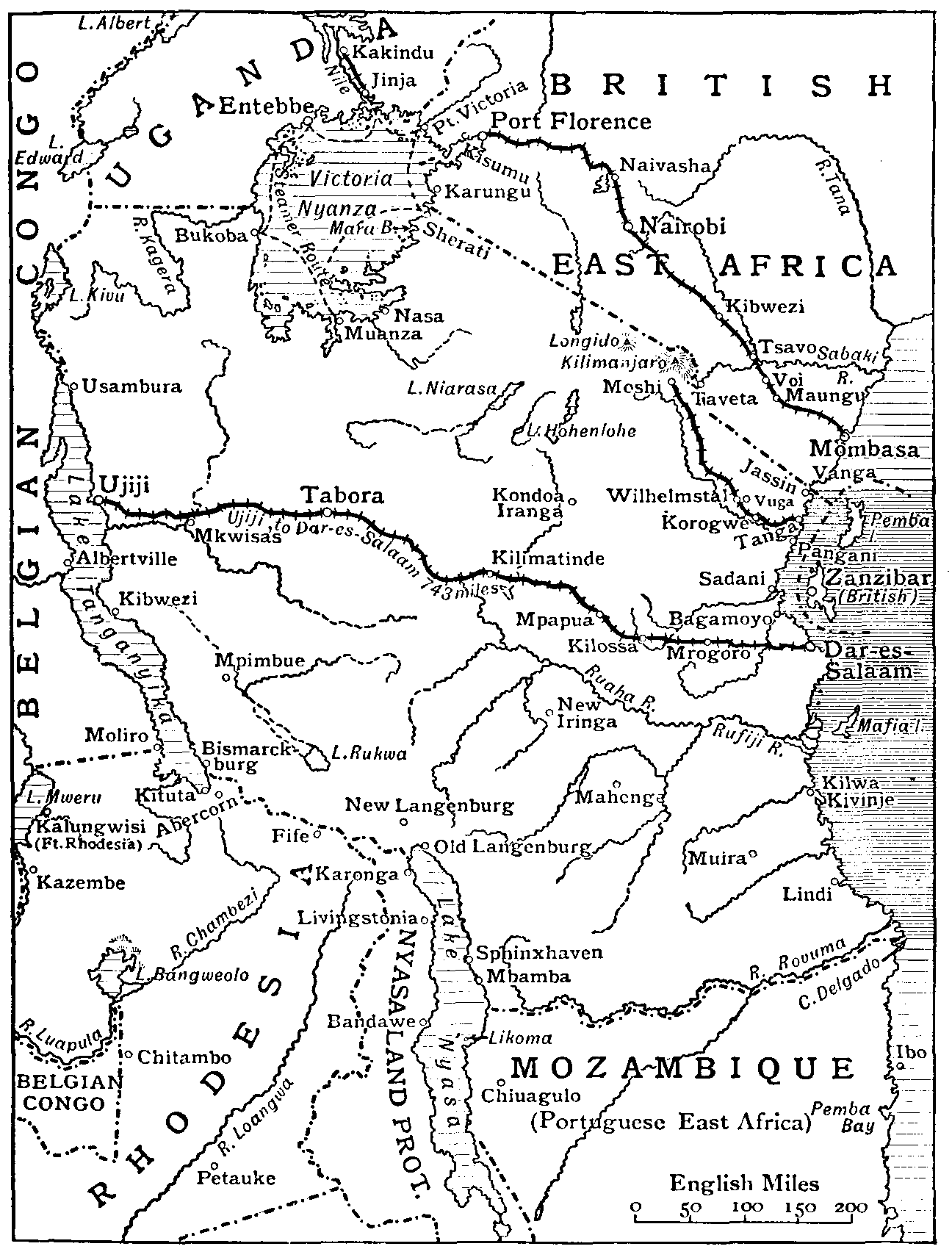
When at length the new expeditionary force was nearly ready, the command was given to General Smith-Dorrien, but he was forced to relinquish it through ill-health shortly after landing in Africa. His place was filled by General Smuts, who arrived on the scene in Feb., 1916, and started his campaign in the following month by clearing the enemy from the British borderland and the Kilimanjaro district. Much valuable spade-work had been previously done in this direction by General Tighe as a preliminary to sweeping the enemy's main forces southwards, while the Belgians from the Belgian Congo cleared his north-western province of Ruanad, and British forces drove his garrisons from the shores of Victoria Nyanza. The first stage in the new campaign was closed when Smuts established his head-quarters at Moshi, where he reorganized his force in three divisions, one (British and Indian) under Hoskins, the other two (South African) under van Deventer and Brits. Van Deventer's force had the hardest task in clearing the Germans from Kondoa Irangi on his march to the central railway, von Lettow-Vorbeck making his one great defensive stand in this direction. Van Deventer, however, was too quick for him; beat off his counter-attack after the capture of Kondoa Irangi (19th April, 1916); and struck hard when he attempted to bar the progress of Smuts's other two columns, which, after clearing the Gare and Usambara mountains in May and June, had pushed into the Nguru hills from Kangata. By this time the Germans realized that they were outmatched both in strategy and numbers, and the bulk of them would probably have shortened the war but for von Lettow-Vorbeck, who was determined to hold out, if possible, until the fate of Germany's 'place in the sun' had been decided on the battlefields of Europe. More than once it seemed as though he could not escape the wide net which Smuts flung out to trap him, but he proved as elusive as De Wet in the South African War, usually escaping with his diminishing forces through tracks unknown to his pursuers.
All the railways and ports were lost during the remainder of 1916. Dar-es-Salaam, the capital, surrendering on 3rd Sept. Towards the end of that year the Belgians from the Congo under General Tombeur drove the enemy from Tabora, on the central railway; British troops under General Northey helped in the converging movement from Northern Rhodesia—which had been invaded by the Germans at the beginning of the war—by advancing as far as Iringa. In the extreme south some Portuguese had also joined in the movement by an advance across the Rovuma River, but were forced back by a German column, and punished by raiding parties in their own territory.
The campaign seemed practically over at the beginning of 1917, when General Smuts was summoned to Great Britain to share in an imperial conference, and General Hoskins was left to account for the remainder of the enemy, now hemmed in on nearly all sides in the south-eastern corner of the colony, with von Lettow-Vorbeck's head-quarters at Mahenge. Torrential rains came to the Germans' rescue, and little progress had been made before Hoskins, called away to another theatre of war, was succeeded by General van Deventer in May (1917). Guerrilla warfare continued throughout the year, in which both sides suffered heavily, but it was not until 1st Dec. that van Deventer could report that the former Germany colony was at length clear of the enemy. Forced out of Mahenge (occupied by the Belgians on 9th Oct.), the Germans retired in two main bodies towards the Portuguese frontier, one under Tafel, which was cut off and compelled to surrender on 26th Nov., and the other under von Lettow-Vorbeck, which contrived to escape across the border and continue the war in Mozambique for nearly another year. Allied columns pursued the remnants unceasingly, but could never get to real grips with them in the difficult bush country between the Rovuma and the Zambesi. Towards the end of September, 1918, von Lettow-Vorbeck dashed back, recrossed the Rovuma, and coolly marched across the south-western corner of German East Africa into Northern Rhodesia, where he was being finally rounded up when news arrived of the Armistice. It was not, however, until 12th Nov. that the German leader was able to comply with the Armistice terms of unconditional surrender on his part, tendering his submission to the British magistrate at Kasama. In recognition of their "gallant and prolonged resistance", von Lettow-Vorbeck and his officers were permitted by General van Deventer to retain their swords, while the European rank and file were allowed to carry their arms as far as Dar-es-Salaam.
Bibliography: Earl French, Despatches; Earl Haig, Despatches (edited by Lieutenant-Colonel J. H. Boraston); Sir Julian Corbett, The Official History of the War: Naval Operations; Viscount Jellicoe, The Grand Fleet, 1914-1916, and The Crisis of the Naval War; Filson Young, With the Battle Cruisers; F. A. Mumby and others, The Great World War (9 vols.); The Times History and Encyclopedia of the War (21 vols.); A. F. Pollard, A Short History of the Great War; Lord Edward Gleichen, Chronology of the War; Thomas G. Frothingham, A Guide to the Military History of the World War, 1914-1918; Sir James Willcocks, With the Indians in France; W. T. Massey, How Jerusalem was Won, and Allenby's Final Triumph; John Masefield, Gallipoli; Sir Ian Hamilton, Gallipoli Diary; Sir Charles Townshend, My Campaign in Mesopotamia; V. J. Seligman, The Salonica Side-Show; Angus Buchanan, Three Years of War in East Africa; Boyd Cable, Airmen o' War; J. F. C. Fuller, Tanks in the Great War; Germany's Violation of the Laws of War, 1914-1915 (translated from the French Official Records); Ypres, 1914 (published by order of German General Staff, translated by G. C. W.); Theobald Bethmann-Hollweg, Reflections on the World War (translated by G. Young); General Ludendorff, My War Memories, 1914-1918; Marshal von Hindenburg, Out of my Life (translated by F. A. Holt); Count Czernin, In the World War.
Eurotium. See Plectascineæ.
Eurydice (ū-rid´i-sē), in Greek mythology, the wife of Orpheus (q.v.).
Euse´bius, of Cæsarea, the father of ecclesiastical history, a Greek writer, born in Palestine about A.D. 265, died about 340. About 315 he was appointed Bishop of Cæsarea. When the Arian controversy broke out, Eusebius showed considerable sympathy with Arius. At the Council of Nicæa (A.D. 325), when Arian doctrines were condemned, he took a leading part. His ecclesiastical history (Historia Ecclesiastica) extends from the birth of Christ to 324. Amongst his other extant works is a life of Constantine the Great, which may be said to continue his ecclesiastical history to within a few years of the writer's own death.
Eusporangiate Ferns, those in which the sporangium is a massive organ arising from several cells, whereas in leptosporangiate ferns it is a more delicate structure derived from a single superficial cell. The bulk of living ferns are leptosporangiate, the eusporangiate class comprising only two living families, viz. the Marattiaceæ and Ophioglossaceæ, as well as many extinct types. The eusporangiate types include the more primitive ferns; all the other main groups of Pteridophytes, and the seed-plants are also eusporangiate.
Eustachian Tube, in anatomy, a canal leading from the pharynx to the tympanum of the ear.
Eustachio, Bartolomeo, Italian physician and anatomist, born soon after 1500, died about 1574. He devoted himself to medical science and in particular to anatomy, which he much enriched by his researches. Amongst his discoveries were the eustachian tube and the eustachian valve of the heart.
Eustatius, St., or St. Eustache Island, a Dutch island in the W. Indies, one of the Leeward Islands, 11 miles north-west of St. Christopher's, pyramidal in form; area, 8 sq. miles. Sugar, cotton, and maize are raised; but the principal production is tobacco. The climate is healthy, but earthquakes are frequent. Pop. 1431.
Euter´pe, (1) one of the Muses, considered as presiding over lyric poetry, the invention of the flute being ascribed to her. She is usually represented as a virgin crowned with flowers, having a flute in her hand. (2) In botany, a genus of palms, natives of South America, sometimes nearly 100 feet in height.
Euthanasia, literally, a painless or easy death, a term often used in connection with the theory or proposal that it should be lawful to administer drugs to bring about a painless death, in the case of persons suffering from painful and hopeless diseases.
Eutro´pius, Flavius, a Latin historian, who flourished about A.D. 360. His abridgment of the history of Rome (Breviarium Historiæ Romanæ) is written in a perspicuous style, and is often read, or rather spelled out word by word, by beginners in Latin. It is of little or no authority as a history.
Eutyches (ū'ti-kēz), a Greek heresiarch who lived in the fifth century after Christ. He was superior of a monastery near Constantinople, and his heresy consisted in maintaining that after the incarnation there was only a divine nature in Christ under the appearance of a human body. The doctrines of Eutyches were condemned by the Council of Chalcedon in 451, and he was expelled from his monastery. He died not long afterwards. His followers were often called Monophysites (Gr. monos, single, physis, nature) as well as Eutychians.
Euxanthine, a substance supposed to be derived from the bile or urine of the buffalo, camel, or elephant. It comes from India under the name of purree or Indian yellow, and is used as a pigment.
Eux´ine (Pontus Euxīnus), the ancient name for the Black Sea.
Evangel´ical, a term often used to qualify certain theological views, especially strict views on the question of the atonement, justification by faith, the inspiration and authority of the Scriptures, and allied doctrines. In England the so-called Low Church party is evangelical in its views. In a more general sense the word implies a peculiar fervency and earnestness in insisting on such doctrines as regeneration and redemption. The 'Evangelical Church' is the official title of the Established Church of Prussia, formed in 1817 by the union of Lutherans and Calvinists.
Evangelical Alliance, an association of members of different sections of the Christian Church, organized in London in 1845, to lend its influence in favour of evangelical doctrines, religious union and liberty, and against superstition and unbelief. The Alliance, incorporated in 1912, has branches throughout the world, the American branch being especially strong, and has held meetings at Paris, Berlin, Amsterdam, Geneva, New York, Copenhagen, Florence, and London. A week of united prayer is held in London in the early part of January each year. The organ of the Alliance, Evangelical Christendom, is published in London.
Evangelical Association, a body of American Christians, chiefly of German descent, established about the beginning of the last century. In form of government and mode of worship it generally agrees with the Methodist Episcopal Church.
Evangelical Union, the name of a religious sect, also familiarly known as the Morisonians, from the Rev. James Morison, its originator. It took rise in Scotland in 1840, and three years afterwards organized itself as a separate Christian denomination. The Morisonians maintain the universality of the atonement, combining with this the doctrine of eternal personal and unconditional election, and denying that anyone will be condemned for Adam's fall. In point of government the individual Churches are independent. The body has now only a few adherents, the majority having united in 1896 with the Congregationalists.
Evan´gelists, the writers of the history or doctrines, precepts, actions, life, and death of Christ; in particular, the four evangelists, Matthew, Mark, Luke, and John. The ancient symbols of the four evangelists are: for Matthew, a man's face; for Mark, a lion; for Luke, an ox; and for John, a flying eagle.
Ev´ans, Sir Arthur John, born in 1851, son of Sir John Evans. He was educated at Harrow, Oxford, and Göttingen, is a distinguished archæologist, as well as an investigator into the history and affairs of Eastern Europe, and in particular has made important investigations and discoveries in Crete. He has travelled in Finland, Lapland, and the Balkan countries, and has written works connected with these travels and with his archæological researches. From 1884 to 1908 he was keeper of the Ashmolean Museum, Oxford. He was knighted in 1911, and was president of the British Association 1916-7. Among his works are: Through Bosnia, and Scripta Minoa.
Evans, Sir George de Lacy, a British general, born at Moig, in Ireland, in 1787, died 9th Jan., 1870. After some years of service in India, he joined the army of Wellington in the Peninsula in 1812, where he served with distinction. In 1814 he was sent to America, and was present at the battles of Bladensburg and New Orleans, returning to Europe in time to take part in Waterloo. In 1830 and 1831 he was elected member for Rye, and in 1833 for Westminster. In 1835 he was appointed to the command of 10,000 troops raised in Britain on behalf of the Queen of Spain. Under the training of Evans this force became an excellent army, and several times defeated the Carlists. During the Crimean War he distinguished himself as commander of the second division of the English army, and received the thanks of the House and other honours.
Evans, Sir John, English archæologist, born in 1823, died in 1908, was an active member of a firm of paper-makers, but eventually retired from business and devoted himself chiefly to scientific pursuits, being distinguished as a geologist, numismatist, and antiquarian. From 1878 till 1896 he was treasurer of the Royal Society; in 1897 he was president at the Toronto meeting of the British Association. He was created a K.C.B. in 1892. His chief works are: The Ancient Stone Implements, Weapons, and Ornaments of Great Britain and Ireland; and The Ancient Bronze Implements, Weapons, and Ornaments of Great Britain and Ireland.
Ev´anston, a city of the United States, Illinois, 13 miles from Chicago. It is pleasantly situated on Lake Michigan. It is the seat of the North-Western University and other institutions. Pop. 37,215.
Ev´ansville, a town in the United States, in Indiana, pleasantly situated on a height above the Ohio. It contains some handsome buildings, including custom-house and post office. Coal and iron abound in the vicinity, and there are numerous factories, flour-mills, and iron-foundries, and a large shipping trade. Pop. 85,264.
Evaporation, the process of changing a liquid into vapour, which goes on at the surface of the liquid. When evaporation takes place into a closed space above the liquid, a state is reached in which the space is saturated with vapour, and no further change is apparent. Certain conditions influence the rate at which evaporation takes place in the open, such as the extent of the exposed surface, the dryness, pressure, and temperature of the air, and the presence or absence of wind. The farmer looks for a drying wind to dry his corn-sheaves before they are carted from the field. Evaporation is always accompanied by an absorption of heat by the vapour, namely the latent heat necessary for the change of state from liquid to vapour. This heat is abstracted from the liquid, which, as a consequence, falls in temperature, and neighbouring bodies may also be cooled. A bather emerging from the water experiences this cooling as the water evaporates from his skin. In hot countries, water is kept cool by being placed in porous earthenware jars: the evaporation which takes place at the outer surface prevents the water in the jar from becoming too warm. The continual evaporation from land and water surfaces is the cause of the presence of water in the atmosphere, whether in the form of invisible vapour or of cloud, mist, fog, rain, hail, or snow. The cooling caused by evaporation is applied in industry in the case of the ammonia compression machine, in working refrigerating plant for the preservation of food-stuffs, and in the manufacture of artificial ice. When evaporation takes place at the surface of a dry solid, the process is called sublimation, and it may be observed in the cases of iodine, camphor, and ice.
Ev´elyn, John, an English writer of the seventeenth century, born at Wotton, in Surrey, 31st Oct., 1620, died there, 27th Feb., 1706. After completing his course at Oxford, he studied law at the Middle Temple, visited various parts of the Continent, and in 1659 prepared the way for the Restoration. He published numerous works, amongst which are: Sculptura, or the History and Art of Chalcography; Sylva, or a Discourse of Forest Trees; treatises on gardening and architecture. But by far his most important work is his memoirs, comprehending a diary and correspondence, which are interesting contributions to the history of the time. Evelyn's Diary was first published in 1818, and an edition by Austin Dobson appeared in 1906.—Cf. H. Maynard Smith, The Early Life of John Evelyn.
Evening-primrose, Œnothĕra, a genus of plants, nat. ord. Onagraceæ. Œ. biennis, an American species common in cottage gardens, is not infrequent as an escaped plant in England.
Ev´erest, Mount, the highest summit of the Himalayas and the loftiest mountain in the world, 29,002 feet. It was named after Sir George Everest (1790-1866), chief of the great Indian trigonometrical survey and Surveyor-General of India. In 1921 an expedition set out to climb the mountain.
Ev´erett, Alexander Hill, an American diplomatist, born at Boston in 1792, died at Canton in 1847. After studying at Harvard, in 1809 he accompanied John Quincy Adams to St. Petersburg (Petrograd) as Secretary of Legation. He afterwards filled successive diplomatic posts in the Netherlands, Spain, and elsewhere. He was the author, amongst other works, of Europe, or a General Survey of the Present Situation of the Principal Powers (1822); and a similar work on America.
Everett, Edward, an American statesman and author, brother of the preceding, born at Dorchester, Massachusetts, 11th April, 1794, died at Boston, 15th Jan., 1865. After travelling for some years in Germany and England, he returned to America in 1819 to occupy the chair of Greek literature at Harvard. He became editor of the North American Review, and entering the political world became successively member of Congress, Governor of Massachusetts, and Minister Plenipotentiary in England (1841-5). In 1845 he was appointed president of Harvard College; in 1852 Secretary of State; in 1853 a Senator. He wrote poems; a Defence of Christianity, and his speeches and orations have been published.
Evergreen, a plant that retains its verdure through all the seasons, as the fir, the holly, the laurel, the cedar, the cypress, the juniper, the holm-oak, and many others. Evergreens shed their old leaves in the spring or summer, after the new foliage has been formed, and consequently are verdant through all the winter season. They form a considerable part of the shrubs commonly cultivated in gardens, and are beautiful at all seasons of the year.
Everlasting Flower (Helichrysum sentii)
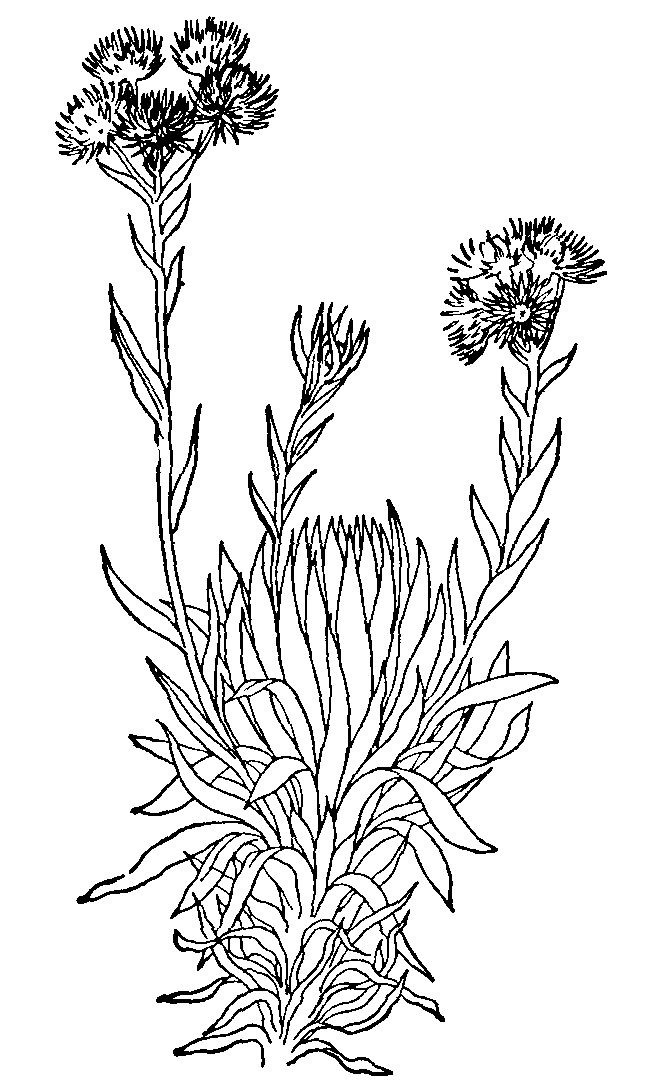
Everlasting-flowers, a name applied to certain plants which, when dried, suffer little change in their appearance. The plants to which this name is peculiarly applied belong to the genus Helichrysum, but it is also given to members of allied genera, such as Antennaria or Gnaphalium.
Everlasting-pea, a popular name for Lathyrus latifolius, cultivated in flower-gardens, and belonging to the same genus as the sweet-pea.
Eversion of the Eyelids (Ectropion), is a turning outward of the eyelids, and it may be congenital or acquired. The latter follows severe infection of the hair-follicles of the eyelashes.
Evesham (ēvz´am), a town in England, in the county and 15 miles S.E. of Worcester, beautifully situated on the Avon, and giving name to a parliamentary division of the county. It was the seat of a monastery as early as the eighth century. Simon de Montfort was defeated by the Royal troops at Evesham on 4th Aug., 1265. Pop. 8685.
Eviction, the dispossession of a person from the occupancy of lands or tenements. The term occurs most commonly in connection with the proceedings by which a landlord ejects his tenant for non-payment of rent or on determination of the tenancy. In the case of eviction of tenants in Ireland, generally for non-payment of rent, the tenants are frequently readmitted as care-takers, or under some other title. The Rent Restrictions Act, 1920, operative until 1923, severely curtails a landlord's common law rights to recover possession of certain premises at the time when, but for the Act, the tenancy would expire.
Evidence is that which makes evident, which enables the mind to see truth. It may be (a) intuitive, i.e. resting on the direct testimony of consciousness, of perception or memory, or on fundamental principles of the human intellect; or it may be (b) demonstrative, i.e. in a strict sense, proofs which establish with certainty as in mathematical science certain conclusions; or it may be (c) probable, under which class are ranked moral evidence, legal evidence, and generally every kind of evidence which, though it may be sufficient to satisfy the mind, is not an absolutely certain and incontrovertible demonstration.
In jurisprudence evidence is classified into that which is direct and positive and that which is presumptive and circumstantial. The former is that which is proved by some writing containing a positive statement of the facts and binding the party whom it affects; or that which is proved by some witness, who has, and avers himself to have, positive knowledge thereof by means of his senses. Whenever the fact is not so directly and positively established, but is deduced from other facts in evidence, it is presumptive and circumstantial only. The following are the leading rules regarding evidence in a court of law:
(1) The point in issue is to be proved by the party who asserts the affirmative. But where one person charges another with a culpable omission this rule will not apply, the person who makes the charge being bound to prove it. (2) The best evidence must be given of which the nature of the thing is capable. (3) Hearsay evidence of a fact is not admissible. The principal exceptions to this rule are—death-bed declarations, evidence in questions of pedigree, public right, custom boundaries, declarations against interest, declarations which accompany the facts or are part of the res gestæ, &c. (4) Insane persons and idiots are incompetent to be witnesses. But persons temporarily insane are in their lucid intervals received as witnesses. Children are admissible as witnesses as soon as they have a competent share of understanding and know and feel the nature of an oath and of the obligation to speak the truth.—Bibliography: Sir J. F. Stephen, Digest of the Law of Evidence; W. M. Best, Law of Evidence.
Evidences of Christianity. These may be divided broadly into two great classes, viz. external evidences, or the body of historical testimonies to the Christian revelation; and internal evidences, or arguments drawn from the nature of Christianity itself as exhibited in its teachings and effects, in favour of its divine origin. The first Christian apologies—those of Justin Martyr, Minucius Felix, and Tertullian, written in the second century—were mainly intended as justifications of the Christian religion against the charges of atheism and immorality commonly made at that time. Of a more philosophical kind, and dealing more comprehensively with the principles of religion and belief in general, are the works of Origen, Arnobius, and Augustine in the centuries immediately succeeding. During the Middle Ages, the scientific representation of Christianity is mostly the work of the schoolmen occupied in welding Aristotelian or Platonic philosophy with the fabric of Christian dogmatics, or writing attacks on the Jewish and Mohammedan faiths.
In the sixteenth and seventeenth centuries the influences of the Renaissance and the Reformation gave rise to a spirit of inquiry and criticism which developed English deism as represented by Herbert and Hobbes in the seventeenth century, and Collins and Bolingbroke in the eighteenth. The general position of English deism was the acceptance of the belief in the existence of God, and the profession of natural religion along with opposition to the mysteries and special claims of Christianity. It was in confutation of this position that the great English works on the evidences of Christianity of Butler, Berkeley, and Cudworth were written. In France the new spirit of inquiry was represented by Diderot, D'Holbach, and the encyclopedists in general, who assailed Christianity mainly on the ground that it was founded on imposture and superstition, and maintained by sacerdotal trickery and hypocrisy. No reply of any great value was produced in the French Church, although in the previous age Pascal in his Pensées had brought together some of the profoundest considerations yet offered in favour of revealed religion. The nineteenth century has been distinguished by the strongly rationalistic spirit of its criticism. The works of such writers as Strauss, Bauer, and Feuerbach, attempting to eliminate the supernatural and the mysterious in the origin of Christianity, have been answered by the works of Neander, Ebrard, and Ullmann on the other side. The historical method of investigation, represented alike by the Hegelian school and the Positivists and Agnostics in philosophy, and by the Evolutionists in science, is the basis of the chief attacks of the present time against the supernatural character of Christianity. The tendency of all the critics is to hold that while Christianity is the highest and most perfect development to which the religious spirit has yet attained, it differs simply in degree of development from any other religion. Notable amongst later apologists of Christianity have been Paley (Natural Theology), Chalmers (Natural Theology), Mansel, Liddon, and others.—Bibliography: J. R. Illingworth, Reason and Revelation; A. Garvie, Handbook of Christian Apologetics.
Evil, Origin of. The difficulty of the question lies mainly in this, that the existence of evil in the world seems inconsistent with the view that it was created and is maintained by an omnipotent and beneficent creator. The various theories on the subject have all sought to elude this difficulty either by the supposition of some principle of evil equally eternal with that of good, or by regarding evil as having only a relative existence, being a kind of good in an imperfect and immature stage. Perhaps the oldest theory upon this subject is that of Parseeism, or the religion of Zoroaster, according to which there were two original principles, one good (Ormuzd) and the other evil (Ahriman). This is the doctrine that is now very often spoken of as Manichæism, from the fact that it was adopted by Manes, who attempted to engraft it on the doctrines of Christianity. In contradistinction to this dualistic theory with reference to the origin of evil stand the Monistic theories of Brahmanism and Platonism. According to the Brahmanic doctrine of the emanation of all things from one original being (Brahma), this original being was regarded as the sole true existence, and the phenomenal world, with all the evils appearing in it, was held to be mere illusion. Similarly, Plato held that the good was the essence of all things, and that the evil and imperfect contained in them had no real existence. The theory enunciated by Leibnitz in his Theodicée resembles that of Plato. In that work he assigns to the evil existing in the world created by God, which he holds to be the best of all possible worlds, a merely relative existence. According to Plato, all that we call evil is only evil to us because we do not see it in relation to the rest of the universe, for in relation to the universe it is not evil but good, and accordingly cannot be evil in its own nature. Another view on the subject is that which neither assigns to the evil principle (as it does to God or the good principle) an original existence, nor denies the real existence of evil, but ascribes it to the exercise of man's free-will. Besides the theoretical problem of the origin of evil, there is the practical one of the elimination of evil which forms the subject of Ethics.—Bibliography: H. Rashdall, The Theory of Good and Evil; B. Bosanquet, The Value and Destiny of the Individual.
Evil Eye, a power which, according to an old and widespread superstition, resides in some people of doing injury to others by a mere look, or a look accompanied by certain words or charms. This belief, common amongst the ancients, is still prevalent among the more ignorant classes in Italy, Russia, Andalusia, the Highlands of Scotland, and other places. The Finns, Lapps, and Scandinavians, the Arabs and the Turks are all firm believers in the evil eye.
Ev´olute. The evolute of a curve is the curve which is the envelope of all its normals or the locus of all its centres of curvature. The first curve is called the involute of the second. These names are given to the curves because the end of a stretched thread unwound from the evolute will describe the involute.
Evolution, a term introduced into biological writings in the early part of the eighteenth century to denote the mode of generation of living things. At first it was used in the same sense as we now apply the word development, more especially with reference to the process whereby the germ of an animal or plant becomes transformed into the adult organism; but it is now used in biology for the process by which more complex plants or animals have been derived from a series of less specialized ancestors by transformation. In accordance with the teaching of modern biology, all living creatures are the progeny of one original group of microscopic unicellular organisms, different branches of which during many millions of years have become diversely modified in structure and function to form the vast multitudes of diverse species of plants and animals with which we are acquainted.
The idea of a transformation of one type of being into another is extremely ancient, and its origin was in all probability genetically related to the primitive conceptions which have survived to the present day in totemism (q.v.) and such myths as the story of the were wolf. For once it was believed that a totem-animal, like a cow or a pig, could give birth to human beings, or that the Great Mother could at will assume a great variety of living forms, ranging from a mollusc or a grain of barley to a higher mammal, it was a comparatively simple step to arrange these potential 'ancestors' in a series, and provide mankind with a mythical genealogy. It is possible that such beliefs may have suggested to the Greek philosophers, such as Aristotle, speculations as to the process by which custom and change of habit might modify the structure of animals. But it was not until the end of the seventeenth century that the trend of philosophical speculation, associated with the growing understanding of natural processes, started lines of investigation which, after many failures, eventually brought forth Charles Darwin's Origin of Species in 1859, and established once for all the fact that different species of animals and plants have been produced by the differentiation of the progeny of the same ultimate ancestors. The history of these events was admirably summarized by Huxley in 1878 in an article Evolution in Biology, republished in Darwiniana (1893, p. 187); in this account due credit is given to the pioneers of the eighteenth and early nineteenth centuries, such as Lamarck, and to Darwin's co-discoverer of the hypothesis of natural selection, Alfred Russell Wallace.
At the present time there is a general concensus of opinion among serious biologists, and, in fact, most educated men, as to the reality of evolution; but there is wide divergence of opinion as to the exact pedigrees of the various groups of plants and animals, and especially as to the mechanisms whereby the processes of transformation have been effected.
The evidence that establishes the proof of evolution is of manifold kinds. "The gradations of structure, from extreme simplicity to very great complexity, presented by living things, and of the relation of these graduated forms to one another. The existence of an analogy between the series of gradations presented by the species which compose any great group of animals or plants, and the species of embryonic conditions of the highest members of that group. Large groups of species of widely different habits present the same fundamental plan of structure; and parts of the same animal or plant, the functions of which are very different, likewise exhibit modifications of a common plan. Structures are found in a rudimentary or apparently useless condition in one species of a group which are fully developed and have definite functions in other species of the same group. These considerations, when studied in conjunction with the facts of the geological succession of the forms of life, of geographical distribution, and the effects of varying conditions upon living organisms, establish the truth of evolution" (Huxley).
The full meaning of these statements will be better understood if a concrete example is studied, and perhaps the case of man and his ancestry is most instructive for this purpose. The fact that man has a vertebral column, a brain and nervous system, a heart and blood-vessels, digestive and other systems of organs, built up in accordance with the arbitrary plan which is shared also by all mammals, birds, reptiles, amphibians, and fishes, proclaims that man belongs to the vertebrate group of animals, and that all such vertebrata must originally have sprung from the same common ancestors. The possession of four limbs with five fingers or toes on each, and a host of identical arrangements of bones, muscles, nerves, &c., in these limbs, reveals the fact that all the four-limbed creatures or Tetrapoda represent one group which developed from some fish-like ancestor to become an amphibian. The discovery of fossilized remains of extinct animals reveals that the fishes are much older than the amphibians, and that a number of intermediate stages demonstrate the process of gradual transformation which converted one group of fishes into four-limbed, semi-terrestrial amphibians. Geological evidence also proves that the reptiles came definitely later than the amphibians, and that only one small group of very primitive amphibians shared in the progressive modifications of brain, limbs, and organs of circulation, &c., to become reptiles—creatures able to live wholly on the dry land, and capable of a wider range of activities than the Amphibia. From the primitive reptiles were derived not only the highly specialized forms that have survived to the present day as lizards, tortoises, snakes, &c., creatures that differ profoundly from their earliest reptilian ancestors, but also the ancestors of birds and the ancestors of mammals. One particular group of primitive reptiles is known, from fossilized remains found in South Africa, that reveals many of the distinctive peculiarities of mammals not shared by other reptiles; and it is now certain that these cynodonts—so called from their dog-like teeth—include the parents of the mammals. The fact that all the Mammalia are provided with glands which in the female supply milk for the nutrition of their young, that they have a hairy coat, that they have a highly developed brain more fully adapted for learning by experience than is the case in other vertebrates, that they have limbs capable of a much more varied and active range of skilled movements, and a host of identical transformations of viscera, muscles, nerves, and vessels prove the common ancestry of mammals from some very primitive cynodont reptile. Different mammals have been specialized in structure for amazingly varied modes of life, on land, under the ground, in trees, in the air, or in rivers or the sea. Of the terrestrial animals some have been modified for fleetness, like the horse and the antelope; others for strength, like the elephant; others again, like the lion and the tiger, to prey upon their weaker relatives. At the dawn of the age of mammals one particular group was able to survive without any of the profound alterations of the structure of the limbs which such creatures as the horse and the ox, the elephant and the whale, the tiger and the bat had to adopt to avoid extinction, and retained the primitive type of limbs with their fingers and toes which became the most useful and plastic instruments for performing skilled movements and acquiring experience and knowledge as soon as the brain was sufficiently advanced in structure and capability to put these instruments to their full use. The group of mammals which delayed the time of specialization until it was able to profit by its greater adaptability was the Prosimiæ, the ancestors of the apes and man. These small creatures for a long time lived a life of obscurity in trees without submitting to those extreme adaptations of structure which are found in most arboreal and flying mammals. But the cultivation of their powers of vision, and the acquisition of skill in the use of their primitive but plastic hands, guided by vision, eventually conferred upon some of these Prosimiæ vastly enhanced powers of skilled action and of learning by experience and of acquiring knowledge, which culminated in the attainment of the supreme power of discrimination distinctive of human intelligence.
The fact that man belongs to the same order (Primates) as the apes is proved not merely by the possession of a body which in most respects is identical in structure with such of them as the gorilla and the chimpanzee, of a similar process of development characterized by identical stages up to a certain stage, but also by the fact that the blood of man and the apes react towards one another as those of relatives, and in a way not shared by the blood-reactions of other mammals. The apes, also, are subject to certain human diseases from which other mammals are immune. Man shares with the anthropoid apes (gorillas, chimpanzees, orangs, and gibbons) so many peculiarities which differentiate all of them from the tailed monkeys that there can be no doubt that the human family was derived from a primitive anthropoid ape, possibly a species that lived in the foothills of the Himalayas in Miocene times, as is suggested by fossils recently discovered by Dr. Pilgrim, director of the Geological Survey of India.
The vestigial remains of the muscles, blood-vessels, &c., of the tail reveal the fact that man's Primate ancestry began with a tailed form. In fact, the human embryo actually possesses a tail for some weeks of its existence. If India reveals the fossilized remains of a variety of Miocene anthropoid apes closely akin to the ancestors of man, the gorilla, the chimpanzee, and the orang, the Egyptian Fayum has provided the evidence of the origin of the anthropoid apes in Oligocene times as very diminutive creatures distantly akin to the gibbons, but bearing very obvious indications in the form of their teeth of an affinity with the Prosimian sub-order Tarsioidea, a very interesting group of Eocene Primates found in a fossilized condition in North America and France, one of the members of which has survived in the peculiar Spectral Tarsier still found living in the forests of Borneo, Java, and the Philippines. The detailed study of the structure and development of Tarsius, and comparisons with other Primates and mammals of other orders, provide the information necessary to fill in the gaps left in the geological record, and enable us to sketch out the general scheme of man's ancestry, and to appreciate the nature of the factors which determined the evolution of such an intelligent mammal as man.
Within recent years the increasing knowledge of embryology and comparative anatomy, and the recovery of fossilized remains of vast numbers of hitherto unknown animals, has established the truth of evolution and the exact line of ancestry of many animals. Professor Osborn's work on the evolution of the horse, and Dr. C. W. Andrews's revelation of the ancestry of the elephant, are striking recent illustrations of the exactness of the demonstration palæontology can give of the past history of mammals. Dr. Robert Brown and Professor D. M. S. Watson have given conclusive proofs of the origin of mammals and birds from primitive reptiles, and the latter zoologist has pushed back the ancestry of these higher vertebrates still further, and shown how the reptiles were derived from primitive Amphibia, and the changes that occurred in vertebrate anatomy when certain fishes crawled out of the water and developed into four-footed Amphibia. All of these conclusions are matters of fact and not of theory, even if we are still in the dark as to the exact mechanism whereby the variations which the forces of evolution use in effecting transformations were themselves brought about. Within recent years there has been a revival of interest in the problem whether characters acquired by parents as the result of their individual experience can be transmitted to their offspring. For the last thirty years biologists have been influenced by the teaching of Weismann that nothing happening to the parents can affect the morphological capabilities of the germ plasm from which the next generation is derived; but recent research suggests that this negative doctrine is too rigid, and makes it probable that certain influences brought to bear upon the parents may be transmitted also to the offspring. If this is so, it opens one avenue of explanation of how structural modifications are effected and the possibility of evolution is created. But at the present moment the whole question is being actively investigated and discussed.
Just as every complex animal can be shown to be derived during development from a simple microscopic cell or egg, so the study of evolution reveals the fact that all animals were originally derived from microscopic unicellular animals known as protozoa, which are with difficulty distinguishable from unicellular plants, from which all the varied forms of complex vegetable life were derived. It is equally certain that these unicellular plants and animals are themselves only the specialized descendants of common ancestors—unspecialized unicellular organisms which are neither strictly vegetable nor animal. But we are quite in the dark as to the processes whereby these most primitive living organisms were evolved from inorganic matter, and how they acquired these peculiar properties of growth and differentiation and their powers of reproduction, commonly called vital, which are their distinctive characteristics. Bibliographical references to most of the matters mentioned in this article will be found in the Presidential Address to Section H of the British Association for the Advancement of Science, Dundee meeting (see Report of British Association, 1912).
Ev´ora, a town in Portugal, capital of the province of Alemtejo, 75 miles east of Lisbon. It is an ancient place, poorly built, and its walls, citadel, and forts are all in a state of ruin. It has a Roman aqueduct still serviceable, a Gothic cathedral, and an ecclesiastical seminary. Pop. 17,900. The district of Evora has a pop. of 144,300.
Evremond, or Evremont. See St. Evremond.
Evreux (ev-reu), a town of N.W. France, capital of the department of Eure, in a fertile valley on the Iton. It is an ancient town with narrow streets and has many fine buildings, including an ancient Gothic cathedral. The town was frequently occupied by the English in the fifteenth century. Pop. 18,950.
Ewald (ā´va˙lt), Georg Heinrich August von, a German Orientalist and Biblical critic, born at Göttingen 16th Nov., 1803, died there 5th May, 1875. After studying at the university of his native town, in 1827 he became extraordinary, in 1831 ordinary professor of theology, and in 1835 professor of Oriental languages. In 1837 he lost his chair at Göttingen on account of his protest against the king's abrogation of the liberal constitution, became professor of theology at Tübingen, but in 1848 returned to his old chair at Göttingen. When Hanover was annexed by Prussia in 1866 he became a zealous defender of the rights of the ex-king. Among his chief works are the following: Complete Course of the Hebrew Language, The Poetical Books of the Old Testament, History of the People of Israel, Antiquities of the People of Israel. The History is considered his greatest work.
Ewald (ā´va˙lt), Johannes, Danish poet, born at Copenhagen in 1743, died in 1781. After studying theology at Copenhagen University he ran away and enlisted in the Prussian service, which he soon deserted for the Austrian. On his return to Copenhagen an elegy which he wrote on the death of Frederick V of Denmark was received with general admiration, and awoke in himself the consciousness of poetic talent. His reputation rapidly increased with the publication of his tragedies, The Death of Balder (English translation by George Borrow), Adam and Eve, and Rolf Krage; and his odes and songs, notable amongst which are: King Christian and Liden Gunver. Ewald, who had dissipated habits, died in utter poverty. His collected works were published in 1914.
Ewart, James Cossar, zoologist, was born at Penicuik, Midlothian, in 1851, studied medicine at Edinburgh University, graduated in 1874, and was soon after appointed demonstrator of anatomy in the university. From 1875 to 1878 he was Conservator of the museums of University College, London, in the latter year took his M.D. degree, and from 1878 to 1882 was professor of natural history in Aberdeen University, being then appointed to the natural history chair at Edinburgh. Since then (having been also connected with the Scottish Fishery Board for about ten years) he has devoted much attention to the question of fish-culture and preservation, and has visited North America, Denmark, and Norway for purposes of investigation. He has also carried out experiments in the hybridization of zebras and horses. His publications include: The Locomotor System of the Echinoderms (with G. J. Romanes, 1881); The Natural and Artificial Fertilization of Herring Ova (1884); On Whitebait (1886); On the Preservation of Fish (1887); The Electric Organ of the Skate (1888-9); The Cranial Nerves and Lateral Sense-organs of the Elasmobranchs (1889-91); The Development of the Limbs of the Horse (1894); The Penicuik Experiments (1899); Guide to Zebras, Hybrids, &c. (1900); Multiple Origin of Horses and Ponies (1904).
Exalbuminous Seeds, those which, when ripe, contain no endosperm, this having been entirely absorbed into itself by the developing embryo. Opposed to albuminous seeds. See Cotyledons.
Examiner of Plays, a British official and censor of plays, who acts for the Lord Chamberlain, under whose jurisdiction the theatres are placed. No play can be produced without the sanction of the examiner, to whom a copy of every new play intended for production must be sent seven clear days before the first performance. The examiner either grants or refuses his licence, and frequently insists upon an alteration of the text. The abolition of this censorship of plays is a subject which in recent years has given rise to much discussion in the theatre-loving world.
Exanthe´mata (eruption of the skin), a term applied to infectious diseases with skin eruptions, accompanied by general disturbances. The term includes scarlet fever, measles, German measles, smallpox, chicken-pox, and others.
Exarchate (egz-är´kāt), a name of a province or territory under an exarch, or viceroy. In the sixth century after Christ Justinian formed the middle part of Italy into a province of the Eastern Empire, and gave the government of it to an exarch. (See Ravenna.) Exarch was also the title of an ecclesiastical grade in the Greek Church, inferior to the patriarchs but superior to the metropolitans. Among the modern Greeks an exarch is a deputy of the patriarch, who travels about in the provinces and visits the bishops and churches.
Excam´bion, in Scots law, the name given to the contract by which one piece of land is exchanged for another.
Excavating the Culebra Cut, Panama Canal
Excavation, the process of removing soil or rock in engineering or exploration works, such as for docks, retaining-walls, railway cuttings, canals, foundations, &c. On a small scale, or in situations unsuitable for machinery, it is performed by hand, the soil being first loosened by the pick, and then shovelled into barrows. In rocky soils, drilling and explosives may be employed. In large works power shovels or 'steam-navvies' are employed, which are essentially cranes carrying a large shovel, or a system of steel buckets of the dredger type. These carry their own means of propulsion, and run on temporary rails laid down as the work proceeds. They work against the face of the excavation, and load directly into bogies or wagons.
Excavations. The forgotten history of the remote past has been reconstructed by those scientists who have explored the sites of ancient seats of civilization. Egyptian and Babylonio-Assyrian investigations date from the middle of the eighteenth century, but it was not until the middle of the nineteenth century, when modern scholars first penetrated the secrets of the lost languages (see Cuneiform Writing and Hieroglyphics) that the ancient civilizations were rendered more or less articulate. As the texts were being deciphered with increasing ease and accuracy, a basis was provided for archæology, and it became possible to frame chronological systems. During the latter years of the nineteenth and the early years of the present century, excavators, philologists, and ethnologists have provided a fairly continuous and detailed history of man from 3000 B.C. till classical times, thus bridging a gulf which used to be misty with doubtful legends and traditions. The most dramatic excavations were those begun by Heinrich Schliemann in 1871 at Hissarlik, the site of ancient Troy. On the hillock he dug through nine successive settlements. He afterwards excavated at Mycenæ and Tiryns in Greece and found evidence of a high pre-Hellenic culture. Following up the clues thus afforded, Sir Arthur Evans and others, excavating in Crete during the opening years of the present century, discovered abundant relics, including palaces and towns, of the earliest Ægean civilization now referred to as Minoan (see Crete). Of late years Central and Western Europe have yielded evidence of the 'drift' of Minoan culture to outlying parts. Excavations in Russian Turkestan and Chinese Turkestan have revealed traces of ancient culture centres dating back beyond 2000 B.C. In the Americas the excavators have thrown considerable light on the pre-Columbian civilizations of Peru, Central America (Maya), and Mexico, but the picture-writings have not been deciphered. See Babylonia; Crete; Egypt; Troy.