VOLUME IV PART 3 (continued 4)
Reading edition
Balkan Campaign, 1916
After the conclusion of Brussiloff's triumphant dissipation of the Austro-Hungarian armies in the early autumn of 1916, the way was open for Roumanian co-operation with the Allies, and Roumania, though neither united nor completely ready, was urged to enter the war. This she did on 28th Aug., when Germany declared war on her, and Italy made a belated declaration of war on Germany. On 29th Aug. von Hindenburg was appointed Chief of the German General Staff in succession to von Falkenhayn, to whom was relegated the task of dealing with Roumania. The Russians during the rest of the year advanced towards the foot of the Carpathian passes and to the junctions of the knot of railways in South-Eastern Galicia, in order to gain complete contact with the Roumanians through the Bukovina. Meanwhile the Roumanians, instead of concentrating on their southern front, where a mixed force of Bulgarians, Turks, and Germans under the command of von Mackensen was preparing to take them in the flank, pressed forward through the easterly passes of the Carpathians into Transylvania. They advanced here some distance, practically striking a blow in the air, but neither raising the Transylvanian population nor capturing any strategic points. On 2nd Sept. Russian forces in aid of Roumania crossed the Danube into the Dobrudja, while on 3rd Sept. Brussiloff's troops won a considerable victory in South-East Galicia, and on 7th Sept. took Halicz. But this success was more than offset by the loss to the Roumanians on their southern front of Tutrakan, on the Danube, with 20,000 prisoners. Occurrences were symptomatic of what was to come; and again, on the Eastern, as on the Western front, the Allies suffered from the lack of unity of command. The Russians and Roumanians joined hands on 10th Sept., but never concerted their strategy. Mackensen continued to advance along the Danube towards the vital Cernavoda Bridge, and so to threaten the whole of Southern Roumania, while the Russian forces which, on the east, had ventured into Roumania, found themselves by 18th and 19th Sept. faced with the new forces concentrated by the Germans against their eastern Transylvanian front. The rest of the Roumanian campaign is the history of the stages by which the two arms of these German-made 'nut-crackers' closed on the Roumanian armies, which had been placed in a false strategical position and were badly led. On neither front did the Roumanian soldiery, who fought well under very trying conditions, with inferior artillery and a poor medical service, give way without a struggle. Mackensen was stoutly held up on 20th Sept. in the Dobrudja, and on the Transylvanian side the Roumanians had a success on 27th Sept. But on 30th Sept. Falkenhayn developed his eastern attack near the Roter Turm Pass, and by 7th Oct. the whole Roumanian front in Transylvania was retiring by the way it had come. A week later it was out of Transylvania and defending the not very defensible passes.
On 20th Oct. Mackensen attacked on the whole line in the Dobrudja, and five days later he was on the vital Cernavoda Bridge. Constanza, the Roumanian Black Sea port, had fallen, and so far from ever being in a position to take Turkey or Bulgaria in the flank, the Roumanians were now themselves on the verge of being outflanked on the Danube. Meanwhile, on the other arm of the nut-crackers, von Falkenhayn, despite trifling set-backs, was pressing on. The Törzburg Pass (21st Oct.), Predeal Pass (23rd Oct.), Vulkan Pass (25th Oct.), Roter Turm Pass (31st Oct.) were all scenes of Roumanian reverses, and by 15th Nov. the bulletins were bringing the daily news that the Roumanian retreat continued. On 23rd Nov. Falkenhayn was advancing on Bucharest; Mackensen had crossed the Danube at Islatz and Simnitza; and farther west Orsova and Turnu-Severin had fallen. All the German composite forces could now be deployed in Roumania, and the end followed swiftly. Mackensen and Falkenhayn were in touch on 26th Nov.; Campolung was captured 29th Nov.; Bucharest, Ploeshti, and Sinaia fell on 6th Dec.; and with them went the Roumanian oil-fields, the wells of which had, however, been very thoroughly damaged by Captain Norton Griffiths and a small British party in order to prevent their use by the Germans. (They were restored in some eight months.)
On 8th Dec. the Germans estimated their Roumanian captures as 70,000 men and 184 guns; and it is true that only a portion, though a considerable one, of the Roumanian armies was able to effect a retreat with the Russians to the line of the Sereth defences. Fighting went on till the end of the year, and was continued into 1917 until the Roumanians were forced to sign the Treaty of Bucharest—revoked by the Allies at the end of the war.
Roumania's fate, following the tragedy of Serbia and the Allies' withdrawal from Gallipoli, strengthened the Greek military party round King Constantine, which was now openly pro-German. Against these influences M. Venizelos proved powerless, though Greek volunteers were at the same time joining the Venizelos party, and ready to fight with the Allies. This division of opinion in Greece was illustrated in the middle of August (1916), when two divisions of the 4th Greek Army Corps surrendered to the Bulgarians, who had advanced to the Greek port of Kavalla, while the 3rd Division of the same corps joined the Allies at Salonika. The pro-Germans had carried all before them at the last Greek elections (Dec., 1915), when the Venizelists declined to poll; and the danger of finding themselves suddenly attacked in the rear discouraged an Allied offensive against the Bulgarians until the autumn of 1916, when the newly equipped Serbian army arrived from Corfu, ready and eager to fight its way home, joining the force under General Sarrail, which already included Russian, Italian, and Portuguese contingents, besides French and British. Following pro-German riots against the Allied embassies in Athens, too, a 'pacific blockade' of the Greek coast had been enforced, and a firm Note presented to the Greek Government demanding the demobilization of the Greek army and a new general election, to be freely conducted. When these demands had been accepted and a new Government formed—though the king's pro-German sympathies remained as marked as ever—General Sarrail resumed, in September, the offensive against the Bulgarians. The main advance was undertaken by the French and Serbian divisions, with a Russian contingent, in the direction of Monastir, General Milne's British column meantime pushing the Bulgarians back from the Struma line. Two months' fighting saw the Serbians, who had borne the brunt of the attack at this point, marching back into Monastir in triumph, having turned the Bulgar-German forces out of it on 18th-19th Nov. The British, at the same time, kept the enemy busy at the other end of the line, occupying a number of villages, and pushing the Bulgarians back beyond the railway between Seres and Demir-Hissar. With their heavy commitments elsewhere the Allies were for the time being unwilling to extend their military operations beyond Monastir.
Italian Campaign, 1916
Italy, who for political as well as military reasons had declined further assistance in the Balkans, had her share of hard fighting within her own frontiers in 1916. Before she could resume her advance on Gorizia and Trieste (held up in the early winter of 1915) the Austrians attacked in turn from the Trentino under General Conrad von Hoetzendorff, who, planning a drive on the Mackensen scale, aimed a blow at the tempting Venetian plains. The grand attack, supported by upwards of 2000 heavy guns on a 30-mile front between Val Sugana and Val Lagarina, and delivered on 14th May by some 350,000 first-class troops, smashed a way through in the centre. Though the flanks held firmly, and the Italians, roused to fury by the invasion, fought magnificently among the mountain heights, General Cadorna ordered the line to be withdrawn from its untenable positions until it was south of Asiago. Pressing their advantage with every means at their disposal, the Austrians announced in an Army Order on 1st June that only one mountain intervened between their troops and the Venetian plains. Cadorna, however, had now been reinforced, and two days later was able to reply that the Austrian offensive had been checked. For the rest of the month he was content, in this sector, to sustain the continued but unavailing assaults of the enemy, while he prepared his own great counter-attack on the Isonzo front, with Gorizia, the gateway to the plateau of the Carso which led to Trieste, as his immediate objective. This dramatic move, heralded by an intense bombardment on 6th Aug., was entrusted to the Duke of Aosta, whose Third Army, after three days' fighting of the fiercest description, carried the last heights defending the town and entered Gorizia in triumph. Following the retreating enemy across the Carso, the Italians, whose enthusiasm for the war had been greatly stimulated by this fine feat of arms—Italy's belated declaration of war on Germany followed upon the Gorizia victory—continued their advance across the northern end of that formidable plateau, winning a number of considerable battles, and capturing before the end of the year between 30,000 and 40,000 prisoners, but never succeeding in mastering the Carso as a whole.
Naval War in 1916—Battle of Jutland
The battle of Jutland, which took place on 31st May, 1916, overshadows all other naval operations in that year; nevertheless, there were several other events of importance which preceded it, or were in some way related to its occurrence afterwards. For example, in the earlier months of the year the German raider Moewe was at large, and inflicted considerable damage on British shipping before returning safely to a German port; the mercantile submarine Deutschland left Germany for the United States and returned in safety; and another German submarine, U 53, also crossed the Atlantic with more belligerent intent, and sank several merchant vessels off Rhode Island on 8th Oct. The new development of the submarine war, in which Germany declared her intention of sinking merchant ships at sight, began on 1st March, and one of its most important consequences was the dispatch of a United States Note by President Wilson to Germany (18th April) in respect of the sinking without warning of the Sussex and other unarmed vessels. Another outcome of the German submarine warfare was the sinking of British hospital ships in the Mediterranean. Furthermore, following the battle of Jutland, and related in some respects to its only partially decisive character, the Hampshire, with Lord Kitchener and his Staff on board, was sunk off the north of Scotland (5th June) by striking a mine that is said by the Germans to have been laid by one of their submarines; and on 19th Aug. the German High Seas Fleet was able to come out again, though it sought no action, but avoided one. Two British light cruisers, the Nottingham and Falmouth, were sunk in the search for its whereabouts.
The 'partially decisive', or 'indecisive', character of the battle of Jutland are relative terms, and their exact implication has been, and must continue to be for a long time, a matter of controversy. On the one hand, the aim of Admiral von Scheer, the Commander-in-Chief of the German High Seas Fleet—to catch a portion of the British Grand Fleet and attack it while isolated and unsupported—was frustrated, and in that respect the German admiral failed. On the other hand, Admiral Sir John Jellicoe's purpose of destroying the German Fleet, if and when he succeeded in engaging it, also failed, as may be understood from its subsequent emergence from its harbour in August, and the later development of the German submarine campaign, which could not have taken place had not the Germans possessed the framework of a fleet to support the under-water vessels. Sir John Jellicoe justifiably claimed that his action preserved intact the main forces of the British Grand Fleet, and left them as before in command of the outer seas, while demonstrating to the Germans that they could not again engage in a naval battle on a large scale with any hope of success. Admiral von Scheer was entitled to claim that he had engaged a superior British force, had inflicted on it more material damage than he had sustained, and had withdrawn the bulk of his forces to remain, as before, a menace, not to British safety, but to British unfettered control of the seas. The details, in outline, of the battle of Jutland are as follows.
On 30th May the Grand Fleet under Sir John Jellicoe left its three Scottish bases for a sweep of the North Sea, Sir David Beatty, with the battle-cruiser squadron, Lion, Queen Mary, Princess Royal, Tiger, Indefatigable, and New Zealand, and Sir Evan Thomas, with the four battleships of the Queen Elizabeth class, Barham, Malaya, Warspite, and Valiant, setting out from the most southerly of these bases, Rosyth. At 2 p.m. on 31st May Sir John Jellicoe, with the Battle Fleet in 6 divisions, was steaming line-ahead between Aberdeen and the north end of Jutland, in order to meet Sir David Beatty at an appointed rendezvous in the North Sea. Sir John Jellicoe's 6 divisions were, lined east to west, 1st Division (Jerram), King George V, Ajax, Centurion, Erin; 2nd Division (Leveson), Orion, Monarch, Conqueror, Thunderer; 3rd Division (Jellicoe), Iron Duke, Royal Oak, Superb, Canada; 4th Division (Sturdee), Benbow, Bellerophon, Temeraire, Vanguard; 5th Division (Gaunt) Colossus, Collingwood, Neptune, St. Vincent; 6th Division (Burney), Marlborough, Revenge, Hercules, Agincourt.
Both Jellicoe's and Beatty's forces had their attendant suites of destroyers, light cruisers, and other cruisers. The British Grand Fleet in all was constituted of 41 'capital ships', made up of 28 battleships, 9 battle-cruisers, and 4 armoured cruisers. It had also 103 'ancillary craft', made up of 25 light cruisers and 78 destroyers. The German fleet consisted of 20 battleships and 5 battle-cruisers, or 28 'capital ships'; there were also 11 light cruisers and 88 destroyers. In gun power and weight of projectile the Grand Fleet had a striking superiority over the German fleet, and Admiral Jellicoe had apparently a valuable superiority in speed. In his own account of the battle he observes that the speed of some of the German ships had been underestimated.
There was no clear expectation on the British side of meeting the Germans when the Grand Fleet set out for its sweep on a line drawn from Wick to the opposite coast of Norway, with Beatty's 6 battle-cruisers and Evan Thomas's 4 battleships as advance-guard; and when von Scheer set out for the north from Heligoland Bight at daybreak, with an advance-guard of 5 cruisers, supported, 50 miles behind, by 16 Dreadnoughts and 6 slow pre-Dreadnoughts, he had no intention of seeking a general action.
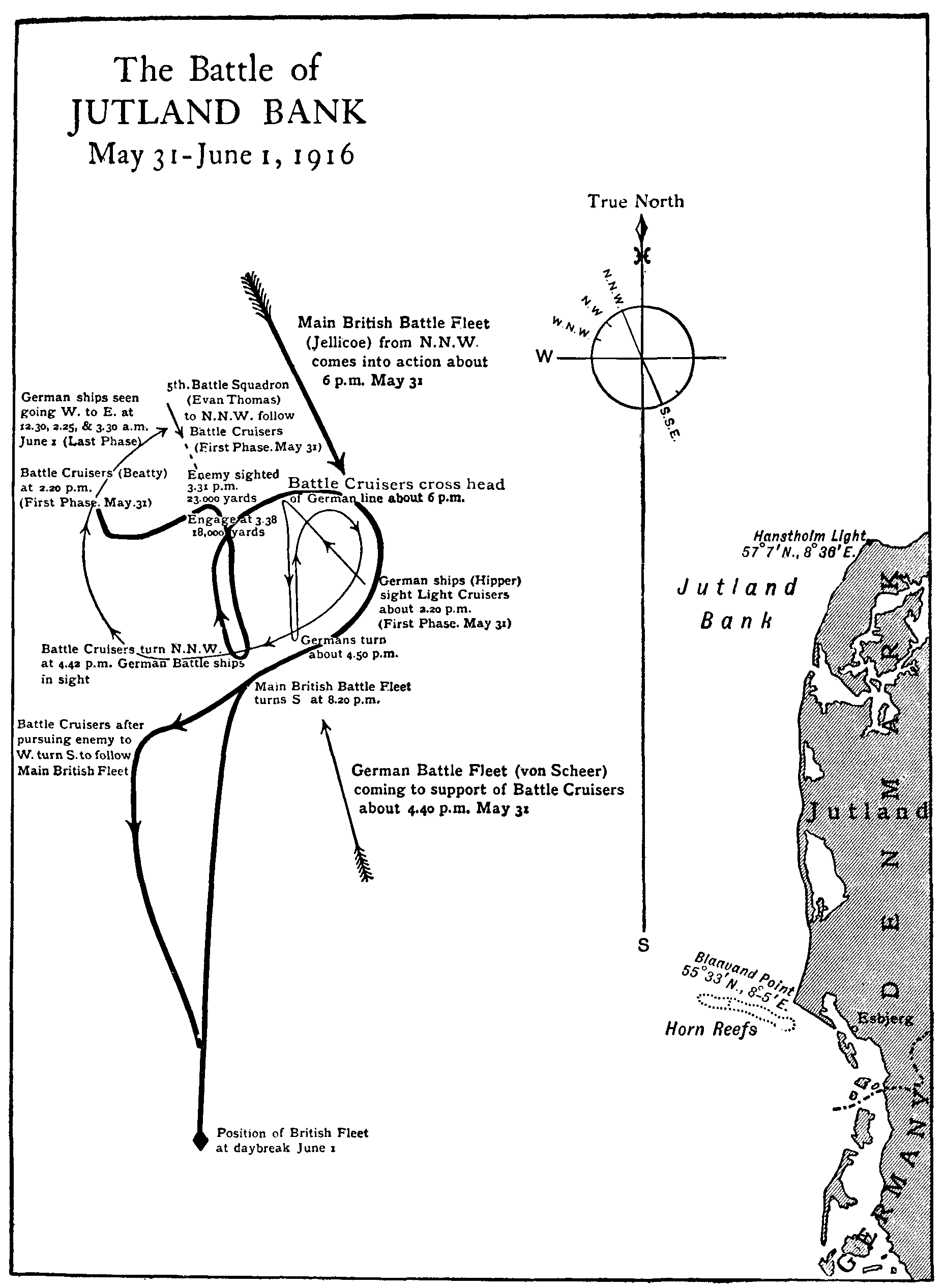
The Battle of JUTLAND BANK May 31-June 1, 1916
Map showing the approximate positions of the British and German Fleets at various stages of the battle.
The meeting of the advance squadrons began when both were on a level with the northern end of Jutland. Admiral Hipper, who commanded the German cruisers, turned round from north to south to rejoin his main fleet; he was then east of Admiral Beatty. Beatty followed him, at some disadvantage from smoke and haze. Evan Thomas's battleships were too far behind at this stage to join in the engagement. Hipper fended off Beatty with destroyers as best he could in the hour before the German main fleet could come up, and in that hour Queen Mary and Indefatigable blew up, shells from the German ships, on which the system of fire control appeared to be more accurate than the British, reaching their magazines.
When the German main fleet was seen to be approaching in support, Beatty turned with his 4 remaining cruisers, and Evan Thomas's 4 battleships fell in behind. These 8 were stronger than the German advance 5, and swifter, so that Beatty did not execute a mere retreat but pressed on Hipper, making him turn east, and thereafter placing the British ships on the German line of retreat to Heligoland—'crossing the T', as the manœuvre is called.
Meanwhile Jellicoe's 6 battle divisions were coming on in an oblong of 6 lines of 4 ships each—the long sides of the oblong north and south, the short, east and west. Thus steaming, Jellicoe came into contact with Beatty and Evan Thomas engaged on the east side of the German line, whose head they had faced round and were themselves going south. Beatty and Thomas were thus between Jellicoe and the Germans, and it behoved the British Commander-in-Chief to see that his ships did not hurt one another with their fire. Jellicoe effected the necessary deployment, not in the manner that he had premeditated, but in that which circumstances forced him to employ. It was the less simple way, and the Grand Fleet was not in line till half-past six.
The Germans had no prudent course but to retreat, which they did in the haze and chemically-created smoke—both fleets going to the south-west, curving to west. The fleets were hammering each other as hard as they could; but when darkness came down the German fleet, badly damaged but not seriously diminished in numbers, was still fighting in retreat. Admiral Jellicoe, in his own account of the battle, remarks: "At 9 p.m. the enemy was entirely out of sight, and the threat of torpedo-boat destroyer attacks during the rapidly approaching darkness made it necessary for me to dispose the fleet for the night with a view to its safety from such attacks, whilst providing for a renewal of action at daylight".
The opportunity for renewal at daybreak did not come; nor was it likely to have come, since von Scheer's first preoccupation was naturally not to fight a superior force under conditions least favourable to himself. It is therefore proper to state that the British Commander-in-Chief thought it wiser to break off action with his main fleet lest it should suffer too greatly in the turmoil and confusion of a night attack. The arguments in favour of this decision are several; the chief of them being that Admiral Jellicoe kept the British fleet and naval power intact, and another being those which the British admiral himself advanced, namely that he was not completely aware of how his own fleet and that of the enemy lay to one another, and that "the result of night actions between heavy ships must always be a matter of chance". Admiral Jellicoe did not feel justified in gambling on such a chance. He did what he told the Admiralty he should do in such circumstances, as recorded in a dispatch written on 30th Oct., 1914, and published at the end of the official Battle of Jutland in justification of his action: "If the enemy battle fleet were to turn away from an advancing fleet", he wrote on that occasion "I should assume that the intention was to lead us over mines and submarines, and should decline to be so drawn". The italics are Lord Jellicoe's own.
1917 on the European Fronts
The Russian Campaign.—On the Eastern front fighting on the grand scale had died down by the beginning of 1917, the Germans having exhausted the momentum of their advance under Mackensen, and accomplished their main purpose of putting Roumania out of account as a serious adversary. Along the line of the Sereth, and in the Bukovina, deadlock was reached in the spring of 1917. By that time the creeping paralysis which was seizing the Russian armies was making itself felt in this, their most distant tendon. Throughout April, May, and June the daily record of occurrences on the Eastern front is blank except for one attack by the Germans on the Stokhod (3rd April).
For the explanation of their quiescence the record of political events has to be scanned. It was well known on the Continent, though it was kept hidden from the British public during the winter of 1916-7, that the integrity of the Russian armies was crumbling, that soldiers were fraternizing with the enemy, and that a general revolution was being prepared by those forces of socialism and anarchy which had been thrust under, but had never lacked exponents, since the abortive revolution of 1905. The mismanagement, the corruption, and the bitter hardships of the war had given them their opportunity, and these were the 'Dark Forces', more than the rogue Rasputin, the parasite of the Russian Court, which undermined the influence of the monarchy, and extinguished Tsar and Court, bureaucracy, aristocracy, and army in a common ruin. It was said in Europe during the winter of 1916-7 that the Allies would have to choose between the Russian monarchy and the Russian people; but neither the inertia of the Russian army nor the postponement of the re-opening of the Russian Duma acquainted the British public with the depth of the mischief that was working. The first inkling came on 12th March, 1917, when, following food riots in Petrograd, the Tsar ordered the suspension of the Duma. The Russian Revolution was the reply. Three Guard Regiments joined the people—the army had failed the monarchy. A Provisional Government was formed. Petrograd, Moscow, Kharkov, and Odessa joined it; and on 15th March the Tsar abdicated under compulsion. Several figures emerged from the crisis. M. Miliukoff, of the Constitutional Party, and Kerensky, a link with the Socialists, but the real forces at work did not at first show themselves.
On 24th March the army declared its loyalty to the Provisional Government, which two days before had been recognized by the Allies. For a time hopes were entertained that under this Provisional Government Russia would carry out her obligations to the Allies, and that her armies would fight; and every sort of device, including interchange of visits with representatives of British Labour and French Socialism, was employed to foster cordiality. The first sign of the essential futility of such hopes appeared on 4th May, when it was evident that the Russian Provisional Government was failing. A new coalition was formed, with Kerensky at its head, and loyalty to the Allies was urged and asserted. French and American missions visited Petrograd and Moscow, but no real consolidation was effected, though in the latter end of May and the beginning of June there was a remarkably deceptive appearance of it.
Under the spur of great efforts by M. Kerensky the army was stimulated into action once more, and a new offensive prepared. On such an offensive the Allies had placed high hopes, for the Russian armies in the spring of 1917 were better equipped and better provided with guns and ammunition than ever before. At first some of these hopes seemed destined to be realized. General Brussiloff, who had succeeded General Alexieff as Commander-in-Chief of the Russian armies, consented rather reluctantly, under the insistence of Kerensky—at that time engaged in a life-and-death struggle with the forces of the Bolshevik party led by Lenin and Trotsky—to organize an attack on the Austro-Hungarian front south of the Pripet. It was believed that the soldiers of these southern armies were less tainted by Bolshevism than those in the northern armies, and that a success here might rally the country to its older standards of patriotism. Brussiloff entrusted the offensive to General Gutor, who had in his favour the facts that the Austro-Hungarian armies were as war-weary as the Russian, and that the German Head-quarters Staff, who were well acquainted with the extent of Russian disaffection, and had indeed been instrumental in inspiring and organizing it, were sceptical about the possibility of such an attack. Furthermore, in the sectors from Brody to the Dniester and beyond, where Lechitsky had halted in 1916, the Russians had a considerable numerical superiority—54 divisions to 30 composite Austro-Hungarian, Turkish, and German divisions, and were well equipped, well posted, and well supplied.
General Gutor directed three armies. The Eleventh, under General Erdelli, was to act along an 11-mile front from a point north-west of Tarnopol, and to get astride the railway which leads from Tarnopol through Zloczow to Lemberg. The Seventh Army, under General Belkovitch, facing Brzezany, was to cross the Zlota Lipa River, where von Bothmer had made his stand, and was then to wheel north-eastward in the same direction as Erdelli's army, with which it was to get in touch. If this movement succeeded, the combined armies were to advance towards Bobrka and the railway from Halicz to Lemberg. The whole of this task was through difficult country. Far to the south General Korniloff, with the Eighth Army, was entrusted with the turning movement. He was to overrun the Halicz region and to obtain control of the railway thence to Lemberg. If this wide turning movement succeeded, and if Belkovitch also did well, the Austro-Hungarian armies would be outflanked and in danger of being rolled up, while pinned down in the north by Erdelli.
The venture was audacious, and the Russian commanders scarce dare trust their men. The Seventh Army's task in assaulting the Zlota Lipa line was such as would have tried the bravest and most loyal troops. The attack began on 1st July, and Belkovitch's men advanced bravely enough, protected by good artillery. In the first assault they took the river line and 2000 prisoners. But between the Zlota Lipa and its tributary Tseniow was a death-trap, and the Russians were caught in a murderous cross-fire. The day was not lost; but at this critical moment occurred an incident which was symptomatic of Russia's disorders, and was the death sentence of Russia's continuance as a combatant. A division which might have turned the scale refused to advance.
Russia's Last Effort in 1917: map showing approximately the farthest line reached by the attacking armies, and the Russian positions after the retreat
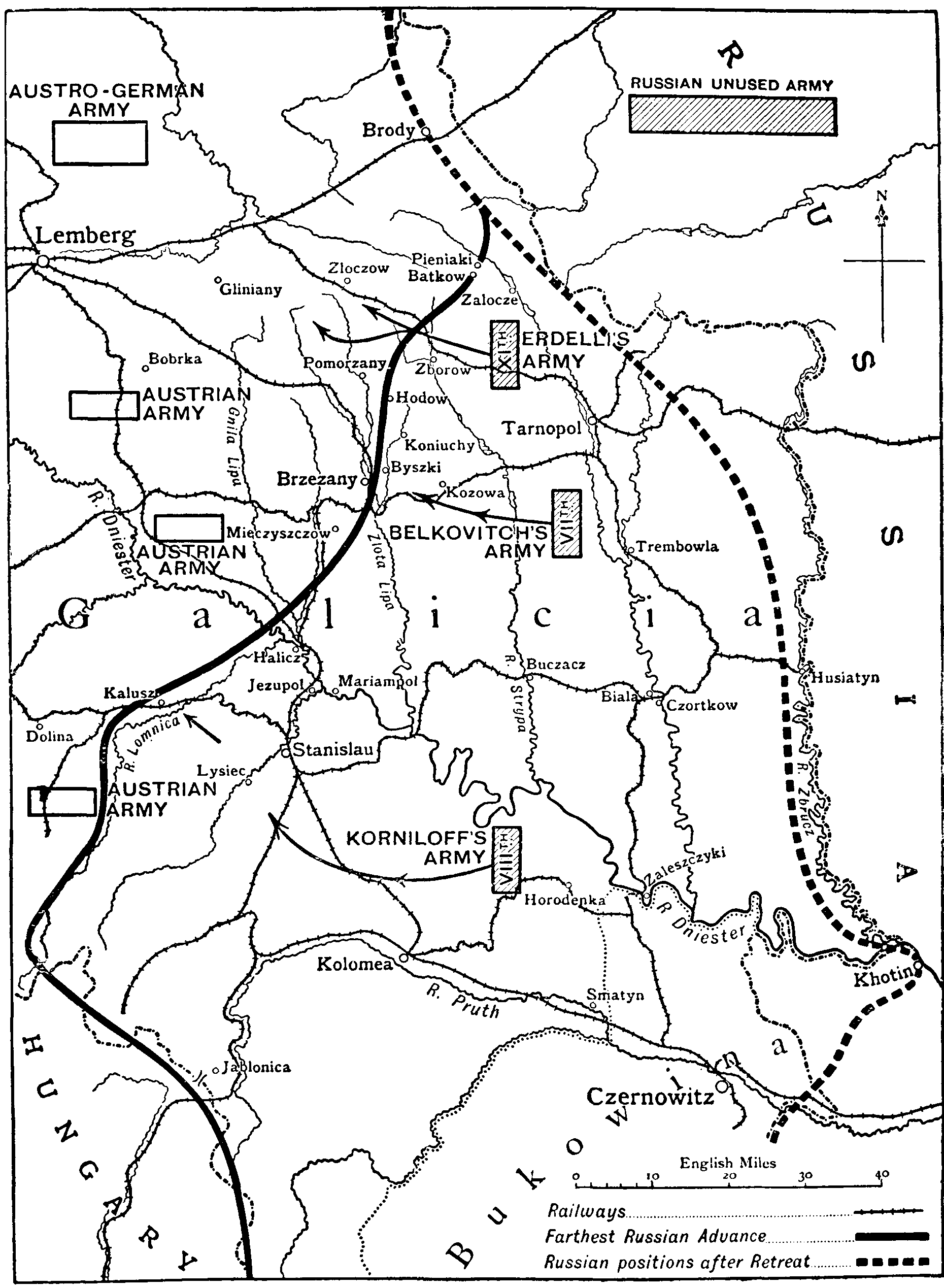
The ground won was with difficulty held, and in the days that followed, the Germans, awakened to an unexpected danger, steadily reinforced the weak point, while Russian battalions were refusing to stay in the front line. The situation reacted on Erdelli's troops farther north, where the Eleventh Army had done well at very little cost, and had captured 6000 prisoners by 3rd July. It became less difficult each day for the German directing staff to hold this attack in check, and it was stopped by 6th July. On the Dniester, Korniloff's army began to advance on this day—on which, according to plan, the enemy should have had all their attention concentrated on Erdelli and Belkovitch. Korniloff did very well. On 6th to 7th July he felt his way forward from Stanislau to Dolina, and on 8th July, joining battle with von Bothmer, broke down resistance at Jezupol with ease, and sent forward his best arm, his cavalry, to the River Lukwa, 8 miles behind von Bothmer's first-line defences. Realizing his danger, von Bothmer counter-attacked, but was again borne down, and Korniloff's van reached the Lukwa. In two days' fighting Korniloff had broken through on a 30-mile front, and his main body, in the wake of General Chermiroff's fighting division, poured into the plains of the Dniester. Theoretically a decisive victory had been won. It was in fact indecisive, because the leader's shock troops had been used up, and the situation was crumbling from within. His troops got intoxicated, mutinied, and he could use them no further.
But the rot now became dangerous to the point of mortality in the Eleventh Army of Erdelli. On 20th July, following a strong German counter-attack between Pienaki and Batkow, which was nearly the most northerly point of the advance, the 607th Mlynoff Regiment left the trenches voluntarily. They ran away, leaving the other regiments to bear the brunt of the attack. The breach widened as the Russians opened the gate. The German-Austrian attack, spreading to Zborow, found a Russian division ready to throw down its arms, and in a day the German-Austrian wedge was thrust in between the Eleventh and Seventh Russian Armies. The disaster was complete and irreparable. The command of the army group was hastily transferred from Gutor to Korniloff, but neither Korniloff's ruthless discipline nor Brussiloff's genius could alter the essentials of the situation, which were that the Russian armies would not fight, and were fleeing in panic.
All attempts to stop the flight were useless. On the night of 20th July the breach was 20 miles wide; on 21st July German guns were shelling Brussiloff's head-quarters at Tarnopol; on 23rd July the remnants of the Russian armies were retreating to the Sereth amid scenes of drunken brutality as disgraceful as any that the war has recorded, and only to be compared with those that were to become common in Russia and Siberia in the struggle to establish Bolshevism. Farther north the Russian front imitated the cowardice and treachery at Tarnopol. On 25th July whole Russian army corps deserted the Dvinsk front, on which depended the safety of Riga. On the same day Korniloff was compelled to begin the relinquishment of the ground he had won with the Eighth Army. Stanislau was abandoned; Kolomea followed on 27th July; Czernowitz went on 31st July; and the loss of the Bukovina followed that of Galicia.
For a time Korniloff seemed to have a chance of restoring coherence to some part of the Russian armies. He succeeded in wringing permission from Kerensky to enforce discipline. But the military-political understanding between these two, though it appeared to fail because of Kerensky's suspicions of Korniloff, whose arrest he ordered (on the 11th Sept.), was never a possibility. Russia was sick unto death. Her soldiers demanded peace; her peasants and townspeople asked for bread, and turned to Lenin and Trotsky, who promised both. During the summer there were many attacks by the Germans on the Riga front, which they used as a training-ground for their troops; and fighting of a similar character took place on the Russo-Roumanian front. But on 16th Oct. the Germans, capturing Oesel Island in the Dvina, took the first step to the subjugation of the northern armies, and continued to take numbers of willing prisoners on the Riga front during the rest of that month. The bulletins of the fighting are contradictory and obscure, but by 3rd Nov. Russians and Germans were fraternizing on the Riga front, and on 20th Nov. hostilities ceased. Lenin demanded (1st Dec.) the surrender of General Dukhonin, the then Commander-in-Chief, who was murdered two days later—the day after the negotiations between the Bolsheviks and the German peace delegation began at Brest-Litovsk.
British Front in the West, 1917
On the Western front it had been expected that the heavy hammering to which the Germans had been subjected during the battle of the Somme would be carried on in concert under the direction of Sir Douglas Haig and General Foch. But a change was made in the French High Command, General Joffre retiring, and his place being taken by General Nivelle, who had done so well at Verdun, while Foch was relegated to the task of preparing against a possible thrust of the Germans through Switzerland. Unity of command was not achieved, except in appearance. Nivelle's plan was to strike at the German centre; Haig was to aid him by simultaneous attack, though Haig's own prepossessions were in favour of freeing the Channel ports by a burst from the Ypres salient. In the result, neither plan succeeded. Nivelle failed because neither the French Government nor a section of the French soldiery would bear a repetition of the losses incurred in his thrust at the Chemin-des-Dames; Haig failed because he had neither the time nor the weather in which to drive his last blows home in the autumn of the year.
A contributory cause of the comparative failure of the Franco-British plan of campaign in 1917 was the want of perception of the intention of the Germans to withdraw from the positions in the Somme area which they had defended so stubbornly in 1916, and which the Allies were preparing to render untenable or to batter down. The want of perception was not complete, but both British and French plans were upset by the suddenness and extent of the withdrawal, which the Germans effected with much less loss than they should have been forced to sustain. The first symptom of the general withdrawal was discovered in March, when portions of St. Pierre Vaast Wood, near the junction of the French and British lines, were found to be evacuated. By 17th March the German voluntary retirement was in full swing, and their forces ruined everything as they retreated. By 17th March, also, the British front from Roye to Arras was moving forward, and on 2nd April the Fifth Army was within two miles of St. Quentin, while the Fourth Army on 5th and 6th April was at Ronssoy and Lempire. While the British armies were pushing towards the Cambrai-St. Quentin line the French were pushing on a 30-mile front from the north of the Upper Somme, towards the new German line from St. Quentin, behind Soissons, in front of the St. Gobain plateau, the Forest of Coucy, and the Chemin-des-Dames. Behind the new line Nivelle matured reconstructed plans for the great French attack towards Laon.
Of the new fortress line (the Hindenburg and Drocourt-Quéant line) which the Germans had constructed and continued to improve, the La Fère-Laon position and the Chemin-des-Dames were the southern bastion, and the Vimy Ridge the north-western pillar. Sir Douglas Haig's preconcerted plan had been to attack the Arras front, not in order to assault this line, but as preliminary to the Ypres salient thrust farther north. Nevertheless, the plan could be adapted and it was prosecuted. Preparations on a large scale, equivalent to building a counter-fortress front, had been made for the Arras operations, and the greatest precautions were taken to lend the attack all the support which mines and artillery could give. Two armies, the First (General Horne) and Third (General Allenby), were prepared for this action. Horne's army made its attack on the Vimy Ridge, with the Canadian Corps as shock troops, on 9th April, and the attack was extended on a 12-mile front from Hénin-sur-Cojeul, south-east of Arras, to Givenchy-en-Gohelle, north of Arras. The Canadians took the whole of Vimy Ridge, except its northern end, the conquest of which was completed next day. Five villages fell into British hands and 6000 prisoners. Subsequent days saw the extension of the victory, but though Vimy village, Givenchy-en-Gohelle, and other important points were taken, the fortified villages of Héninel and Wancourt held out by dint of machine-guns, and prevented the possibility of the Third Army's joining hands with the Fifth Army beyond the third line of the German defences until it was too late. The whole of the expected gains were therefore not realized, but the possession of the Vimy Ridge was invaluable, and became a most important factor in stemming Ludendorff's rush in 1918, when he attacked the Third Army after destroying the Fifth.
The British attacks did not end on 11th April, as they should have done, but were continued here, as well as at other portions of the British line to its junction with the French armies, in order to lend assistance to Nivelle while his attack in Champagne was in progress. It was a very costly procedure, and its scope may be inferred from the statement that on 23rd April a "second phase of the battle of Arras" began; another 12-mile front east of Arras was launched on 3rd May; and there were bloody encounters about Bullecourt or Fontaine-les-Croiselles on 7th and 12th, 15th and 16th, and 21st May. Some 20,000 German prisoners were captured in these preliminary spring operations, but the drainage in casualties to the British armies was heavy, and more damaging still was the loss of time by the postponement of Field-Marshal Haig's major plan farther north.
This, however, was at last begun on 7th June by the assault on the Messines-Wytschaete Ridge, which, under the name of the 'Battle of Messines' denotes one of the most completely successful actions fought in that year. It was undertaken by the Second Army (General Plumer), and the preparation for it, including the mining of the ridge, had been as near perfection as possible. The attack was launched; the mines which blew the German front line to pieces were exploded on the morning of 7th June at ten minutes past three. Nine miles of front were stormed and 6400 prisoners taken. In the next week the number of prisoners was considerably augmented; German counter-attacks were beaten off; and the captured position enlarged and firmly consolidated.
From this time forward the operations of the British armies may be envisaged as an attempt to enlarge the great bulge of the Ypres salient by fighting their way up to and along the ridges which enclosed it, so as to force the Germans to relinquish their hold on the coast near Nieuport, Zeebrugge, and Ostend. One very awkward spoke was put in the British wheel by an attack (10th July) on the extreme coastal sector of Lombaertzyde and the mouth of the Yser, by which any combined sea and land attack that might have been projected by the British was discounted. Most of the positions were recovered, but the amphibious plan had perforce to be postponed.
The putting into effect of Sir Douglas Haig's major plan, after the preliminary step of the capture of the Messines Ridge had been taken, did not operate till 31st July, when the 'Third Battle of Ypres' began, with a combined British and French attack on a 15-mile front beyond Boesinghe, on the Yser-Ypres Canal, to Zillebeke. The attack was conducted by the First French Army (General Anthoine); the bulk of the fighting fell on the Fifth British Army (General Gough). Twelve villages were taken and 5000 prisoners. There was, and could be, no break-through. The Germans rallied to a counter-attack, and were able to do so because their defences, their concrete pill-boxes, and their machine-gun effectiveness could, and did, hold up attacks before they progressed too far.
The rest of the British campaign in 1917 till it was arrested by the torrential rains of a wet October, and by the mud of the impossible declivities, may be summed up as a series of desperate forward thrusts which exacted each its toll of prisoners, ground, and positions, but none of which succeeded in its object of inflicting a lethal injury on the German resistance. In the end these attacks had to cease while the last fragment of coveted ridge, the Passchendaele spur, was still not won, because on that ridge, as elsewhere, though blood had been poured out like water, and losses endured with unflinching fortitude, flesh and blood could do no more. The chief actions were as follows:
15th Aug.—British attack on wide front from north-west of Lens to Bois Hugo, north-east of Loos. Enemy's position penetrated to 1 mile depth.
16th Aug.—Franco-British attack on 9-mile front north of Ypres-Menin road. British carry Langemarck.
15th to 21st Sept.—Second phase of third battle of Ypres. 3000 Germans captured.
4th Oct.—British advance on 8-mile front, anticipating German attack east of Ypres. 3000 German prisoners.
9th Oct.—Third phase of third battle of Ypres. One mile advance on Passchendaele Ridge. 2000 prisoners.
6th Nov.—British attack on Ypres Ridges. Canadians capture Passchendaele.
These attacks were interspersed with costly minor encounters, and by the repulse or endurance of counter-attacks. The battle may be said to have closed by stress of weather in mid-November.
It was followed on 20th Nov. by a British attack of an altogether different kind, in an unexpected quarter—at Cambrai. Here the Third Army, under General Byng, made an attack on a 10-mile front between St. Quentin and the River Scarpe—tanks being employed for the first time in large numbers to lead the advance without a preliminary bombardment. It was a complete surprise, and all but a complete success. The 'Hindenburg Line' was broken, numerous villages and 8000 prisoners were taken. If the cavalry had been up, as they ought to have been, a first-class disaster might have been inflicted on the Germans, and their railway communications at this point broken. But the cavalry were late; the next few days were spent in consolidation by peculiarly hard fighting; and on 30th Nov. the Germans counter-attacked and subjected the British defences of the newly-created salient at Bourlon Wood and Moeuvres to almost as severe a surprise as they had sustained ten days before. The British lost a number of prisoners, and had eventually to evacuate most of their hard-won positions.
French Front in the West, 1917
The history of the French armies in 1917 is largely the history of Nivelle's frustrated attempt to pierce the German centre between Soissons and Rheims in April; the pause necessitated by the fact that it was felt impossible to press the French armies too hard or too soon after the disappointment of the attenuated success at the Chemin-des-Dames, where the chief sacrifices of the attack took place; and the efforts on a more moderate scale by General Pétain, who succeeded Nivelle, to win tactical victories at a moderate cost on the terrain acquired in the April adventure. The second battle of the Aisne, as Nivelle's offensive was called, was planned over a length of 50 miles from La Fère, on the Oise, round the edges of the Forest of Gobain and Coucy, to Laffaux, thence below the line of the Chemin-des-Dames ridge and behind the Aisne to the crossing of the river at Berry-au-Bac, and Brimont, near Nogent-l'Abbesse, to the Moronvilliers heights on the other side of Rheims.
The attack on the larger part of this line began on 16th April; that on the Moronvilliers sector on 17th April. The attack on the 16th was extremely costly; it succeeded in only part of its objectives, but it captured 11,000 prisoners. The next day, one of pouring rain, improved on the positions won, especially at the western end of the Chemin-des-Dames, and on the 18th and 19th Nivelle so far enlarged his successes as almost to give them the appearance of a great victory. But the French bolt had been shot, and, to put it plainly, Nivelle was not encouraged to go on. By the 28th he had taken 28,000 prisoners, 175 guns, and some of the strongest points on the heights of the Aisne; but everywhere the positions had been only half-won, and the temper of the French army as a whole had suffered too severe a test. Nivelle was succeeded by Pétain and his plan was abandoned. The rest of the year was occupied by General Pétain in very skilled attempts, named limited offensives, to repel the Germans from disputing some of the positions won and to enlarge the French gains at other points. The chief engagements were as follows:
5th May.—The French, co-operating with the British on a 20-mile front north of the Aisne, take Craonne and 6000 prisoners.
20th Aug.—French carry enemy defences north of Verdun on 11-mile front; 6000 prisoners. By 28th Aug. the French were back at their original Verdun positions.
23rd Oct.—French advance on the Aisne north-east of Soissons on e-mile front; 8000 prisoners. By 25th Oct. further 3000 prisoners and 160 guns were taken.
The Balkans, 1917
In the Balkans the military situation during 1917 remained much as the end of 1916 had left it, the Germans, as already mentioned, completing their conquest of Roumania, and the Allies remaining comparatively inactive in the field while they cleared up the extremely unsatisfactory situation in Greece. The chief operations consisted of a Franco-Serbian attack north of Monastir, and attacks by General Milne on the British front in the Struma valley; but though the situation remained in the field virtually unchanged, the political situation was vitally affected in 1917 by the deposition of King Constantine in favour of his second son, Alexander—the king being induced to abdicate on 12th June—and the formation of a new Government under M. Venizelos. From 30th June, Greece, having formally severed diplomatic relations with Germany, was at length added to the list of countries fighting on the Allies' side.
Italian Campaign, 1917
Italy, who, meantime, had proclaimed Albania an independent state under Italian protection, and occupied Yanina in June, 1917, had committed herself wholly to the Allies' cause in 1916 by declaring war on Germany on 28th Aug. It was in Aug., 1917 that Ludendorff began his preparations for the terrific blow which was to lead to the Italian disaster at Caporetto in October. During the earlier months of the year the initiative had remained with the Italians, and Cadorna had used it in a series of offensives which, while carrying him farther across the Carso towards Trieste, and winning seemingly impregnable positions in the Trentino, together with upwards of 30,000 prisoners and 140 guns, were indecisive, and left his exhausted troops—reduced by some 150,000 casualties—ripe for the blow which Ludendorff had prepared for them. The Russian Revolution and the collapse of Roumania freed Austria-Hungary at the same time from any anxieties on her Galicia front, so that she could concentrate all her energies and the bulk of her armies against the Italians. When the enemy's great counter-stroke was delivered on 24th Oct., the control of the campaign was taken over by the German High Command. Ludendorff had been training picked troops in special tactics—to be developed at their full strength on the Western front in the following year—and von Below was transferred from the French front to take command. Following an intense bombardment, the Austro-German troops were launched against the Second Italian Army between Zaga and Auzza, in deep formations so closely packed that the way could not be lost amid the prevailing snow and rain. Taken by surprise, and seriously demoralized in parts by Bolshevist propaganda and enemy intrigue, the Second Italian Army, which had hitherto distinguished itself by its splendid courage, found the whole of its left wing giving way before the impact, thus opening a gap for the enemy 20 miles wide over the Julian and Carnic Passes. Having shattered both the first and second Italian lines at Caporetto and Vodil Vrh, the Germans and Austrians surged forward from the Tolmino bridge-head until the retreating Italians, becoming entangled with their own reserves, broke in disorder. Although the right wing of the Second Army held, and many heroic efforts were made by isolated units, General Cadorna decided that it was impossible to save the situation from irretrievable disaster except by a general retreat to the Piave line. This was ordered on 26th Oct., when the broken fragments of the Second Army, as well as the Italian Third Army, began the great retreat which will be remembered as one of the finest achievements in Italian military history. The territorial gains of over two years' fighting had already been lost, and the conquering invaders reached within 15 miles of Venice, but they never succeeded in making the disaster irremediable. General Cadorna's scathing Order of the Day denouncing the units of the Second Army which had let the enemy through, and the new sense of national unity inspired by the military crisis, did their work. By 8th Nov. the bulk of the Italian armies, now in orderly retreat, were across the Piave, and two days later were ready to turn on their pursuers. The danger was not yet over; the enemy succeeded in carrying several further heights dominating the Venetian plain between the Piave and the Brenta; but by 21st Nov., when a last German attack was made on the Monfenara Ridge, and defeated, the invaders were for the time being held. They claimed some 250,000 prisoners and 1800 guns of every calibre, besides immense quantities of munitions. They had also succeeded in diverting French and British divisions from the Western front, the Allies sending what assistance they could to stave off the defeat of Italy. The French and British troops arrived in time for the winter struggle, which began on 4th Dec., by which time General von Below had returned to France—being succeeded in command of the Austro-German operations by General Krobatin—and General Cadorna had been transferred to the Allied War Council, his place as Italian Commander-in-Chief being taken by General Diaz. Two British divisions, under Cavan, took up their positions in the Italian line at Montella; the French divisions at Monte Tomba; and they served to relieve the pressure while the enemy was making his last efforts to break through before the long-delayed snows put an end to the struggle for the year.
Naval War in 1917
At sea, where the British Grand Fleet was now commanded by Sir David Beatty in place of Sir John Jellicoe, who had succeeded Sir Henry Jackson as First Sea Lord in the previous November, the year 1917 passed without a single outstanding engagement. Since Jutland, the German High Seas Fleet had run no risk above water of again seriously challenging Britain's sovereignty of the sea, though her submarine campaign was pursued with ever-increasing vindictiveness. Risking rupture with the United States and other neutrals whose shipping and subjects were thus exposed to wanton attack, she inaugurated 'unrestricted' U-boat war on 1st Feb. "Give us two months of this", said the German Foreign Secretary to the American Ambassador in Berlin, "and we shall end the war and make peace." The argument was that the Allies' losses in tonnage, already more than they could bear, would increase to such an extent that they would be starved into submission. The United States, with President Wilson as spokesman, replied by severing diplomatic relations with Germany, but it was not until 5th April that she formally declared war against her. Cuba followed suit on 5th April; Panama three days later; Brazil on 2nd June. Germany could afford the risk of offending the smaller American republics, but her defiance of the United States was a fatal blunder. She relied on her submarines to prevent the transport of American troops across the Atlantic—at least until they were too late to affect the issue. The first American contingents crossed unharmed and arrived in France on 26th June. It was not until the following year, however, that the new American army was ready to throw its weight into the scales on the Western front. The naval resources of the United States were at once placed at the Allies' disposal, the American destroyer squadron in particular being of great service in helping in the protection of trade off the Irish coast. Proof of the closeness of co-operation between the British and United States navies was afforded in June, 1917, when Vice-Admiral Sims, commanding the United States Naval Forces in European Waters, was given the command of the Irish station during the absence of Vice-Admiral Bayley on sick leave. No foreign naval officer had ever previously held the command of British ships, as well as his own, off the British coast.
Apart from the relentless submarine campaign, which every week exacted heavy toll yet never brought the Allies within measurable distance of the starvation-point to which the Germans had been so sure of reducing them, the enemy's operations at sea were restricted to destroyer and torpedo-boat raids in the Channel from Zeebrugge. Some of these did a certain amount of damage to patrol boats, and bombarded Ramsgate, Broadstairs, and Margate (27th Feb. and 26th April) with little effect save the death of women and children. One memorable incident in these minor operations in 1917 was the raid on Dover on the night of 20th-21st April, when 6 German destroyers, after firing a number of rounds inland, were caught on their way back by the British destroyers Broke (Commander R. G. E. Evans) and Swift (Commander A. M. Peck)—the advance ships of the British destroyer guard in the Straits of Dover. The Swift, which was leading, dashed between two of the retreating destroyers and, turning, sent one of them to the bottom with a torpedo. The Broke rammed the third vessel, and while the two ships were locked, an old-fashioned hand-to-hand fight took place on the Broke's forecastle, in which the German crew were beaten back. Two minutes later the Broke wrenched herself free and the German destroyer sank. Ten German officers and 108 men were rescued at the close of this dashing affair.
1918 on the European Fronts
First Phase of Ludendorff's Offensive.—The Bolshevist betrayal of the Allies at Brest-Litovsk, the treaty of which took Russia irrevocably out of the conflict, and released Germany's Eastern forces for a concentrated assault in the West, gave the Central Powers their greatest opportunity of winning the war since their first hopes were shattered on the Marne in 1914. The crushing defeat of Italy at Caporetto afforded them further grounds for confidence. America, it was true, had thrown in her lot on the side of the Allies, but Germany counted on striking her decisive blow before the American troops could arrive in sufficient numbers to matter; and she had not yet lost faith in her submarines. All through the winter of 1917-8 Ludendorff, the German Commander-in-Chief, was secretly training his troops in the new tactics which were to bring open warfare into full play again, equipping them with Teutonic completeness, and massing guns and ammunition proportionate to the task in view.
The Allies on the Western front were meantime forced to remain on the defensive until such time as the American reinforcements should arrive in sufficient numbers to enable them to regain the initiative. Since April, 1917, the British army had borne the chief burden of the war in the West, and "the bloody struggles to conquer the Flanders ridges"—the words are those of Sir Douglas Haig himself—as well as the prolonged fight at Cambrai, "had left the army at low ebb in regard both to training and numbers". In view of the expected German offensive, it became imperative to fill up the ranks as rapidly as possible, and place the line in a sound state of defence. Late in Jan., 1918, Sir Douglas Haig took over a new stretch of French line, extending the front of the Fifth Army to cover the village of Barisis, 7 miles south of the Oise. The additional line, taken over somewhat against Haig's judgment, and giving the Fifth Army, which stretched on the left as far as Gouzeaucourt, no less than 42 miles to guard, extended the British front, all told, to 125 miles. The whole of this had to be greatly strengthened and supported by prepared positions to which the troops could retreat when the expected German drive took place, for it was regarded as inevitable that some dent must result in the Allies' line where the colossal blow was dealt. This constructional work called for every man who could be spared for the task, and seriously interfered with the necessary training of the troops in new tactics of defence.
The months preceding the 'hammer blow' were marked by intense raiding activity on both sides, chiefly undertaken to procure information, but sometimes to secure useful positions for subsequent events. The most important of these included the sanguinary struggles for Bullecourt in the early days of January, in which the Australians greatly distinguished themselves, and Germans attacks at Dixmude (6th March), and in the region of Houthulst Forest and the Menin road (8th March), for positions destined to play their part in the new attempt to reach the Channel ports. By the middle of February, when 28 additional German divisions had arrived from the Russian front, and 6 from Italy, and great supply dumps were springing up in all directions behind the German lines—but particularly opposite the British Third Army at Cambrai and the British Fifth Army to the south of it—Sir Douglas Haig had no doubt as to what was to come. The only questions were "Where?" and "When?"
All strategical considerations pointed to an attack on the Fifth Army south of Arras, with the object of separating the British and French armies and seizing the centre of communications at Amiens. Neither the British nor the French Head-quarters Staff, therefore, was taken unawares when the great offensive began on 21st March. Both had worked out plans to meet it. More than half Sir Douglas Haig's infantry and the whole of his cavalry were allocated to this sector's defence, and General Pétain had arranged to send a French army corps to their assistance in case of need. The final dispositions of the Germans were carried out with the utmost secrecy: sunken roads, bivouacs, and every device of camouflage being employed to conceal their last stages of concentration. Even so, Sir Douglas Haig learnt from his Intelligence Department on 19th March that the enemy was putting the finishing touches to his impending attack, and that it would be launched by the 21st, if not before.
It was heralded, in fact, at 5 a.m. on the 21st by an intense bombardment in a thick mist which made it impossible for the British batteries to render effective aid to the battered first-line trenches. The onslaught was organized in two parts, the northern advance being directed against Byng's Third Army from the Sensée River to the Cambrai road, and the southern attack from the Flesquières salient opposite Cambrai to St. Quentin. No fewer than 40 German divisions—nearly half a million men—specially trained for the new offensive, were launched against this southern half, and of these more than half were directed against the 16,500 yards of front held by Gough's Fifth Army nearest St. Quentin. All told, the German drive consisted of 64 divisions on the opening day of the offensive. To meet it the British had but 19 infantry divisions in line and 10 in reserve, with cavalry. From first to last the Germans employed in this attack some 78 divisions—exceeding in numbers the total fighting strength of the whole of the British armies in France. By the 9th of April, when the Germans, foiled in the opening move of their supreme offensive, had shifted the spear-head of their assault to Flanders, the total number of British divisions employed both in cavalry and infantry did not exceed 46.
Some part of the line was bound to give before the terrific impact of the infantry attack which followed the bombardment on 21st March. The plans made for repairing the breach in co-operation with the French broke down for a time because the British Fifth Army, attacked by a far greater force than had been anticipated—23 German divisions having been massed as secretly as possible in order to bring them into position at the critical hour—had been forced back sooner than was expected. There was no time either for the British reserves or the French reinforcements to repair the breach before the assaulting divisions under von Hutier, who had established his reputation for this form of operation on the Eastern front, were through it and extending it in all directions.
There were, in point of fact, two serious breaches along the 42-mile front held by the Fifth Army. One, the less dangerous of the two, was south of the Oise, where the line was held more lightly than elsewhere, owing to the marshes, which had been relied on to make any considerable attack at this point unlikely. As ill luck would have it, a long spell of dry weather had made the ground easily passable, and the Germans, well aware of the position, swept across it in overwhelming force, like a tidal wave. Heroic stands were made for the forward redoubts and battle positions, but the whole of the ground south of the St. Crozat Canal was so submerged in the flood that by nightfall there was nothing for it but to withdraw the divisions of the 3rd Corps, which had been defending it, to the line of the Somme Canal. Nevertheless, though the Germans made their greatest progress on the 21st at this point, it was not their most dangerous thrust, being nearest to French reinforcements.
The chief danger-point was farther north, on the Fifth Army's left, below the Flesquières salient. By noon, with the fog still so thick that it was impossible to see 50 yards ahead, the Germans had advanced as far as Ronssoy, inside the second zone of the British defensive positions, together with Hargicourt and Villeret to the south. This opened a gate to the third line 3 miles wide, and before the day was over the enemy had pushed towards this as far as Templeux-le-Gerard. But for the stubborn defence of Epéhy, to the north, and Le Verguier, to the south, the breach would have been perilously widened on the following day, but at both these points the German advance was temporarily checked. It could not be stayed long. Supplied with an overpowering weight of men to crush through anywhere, von Hutier was ready to pay the price exacted for every success by British artillery-fire at short range, and British machine-gun posts held to the last: and when St. Emilie and Hervilly finally fell on the 21st, Epéhy and Le Verguier could only hold out long enough for the general line of defence to be withdrawn from them. The retreat thence, hard-pressed as it was, left the Fifth Army's centre with a sagging flank to the south, of which the on-coming Germans did not fail to take full advantage. Thenceforward the tide swept on for days in ever-increasing volume, all the reinforcements that Sir Douglas Haig or Pétain could send serving only to stop gaps here and there. Ham, Bapaume, and Péronne had fallen by the 24th, and about two-thirds of the territory wrested from the Germans in 1916 regained by them. Germany was announcing to all the world that the 'Kaiser's Battle', as the emperor himself had caused it to be named, had already been won. To drive the news home, the enemy, on 23rd March, began bombarding Paris with long-range guns capable of firing 70 miles. Nesle and Noyon were the next to go, and by 26th March—save at Albert, which held out until the following day—the Allies were back beyond the line from which they started in 1916.
Elsewhere the enemy's progress along the 60-mile battle front had been slow and costly. He had least success in the north against the British Third Army, partly because the positions held were stronger, partly because his heaviest and most persistent blows had been reserved for the Fifth Army. Some isolated gaps were made on this front, but nothing beyond repair, and the ground lost was not vital. It is impossible in the space at our command to follow all the complications of attack and counter-attack in the fateful days which followed, until, by 26th March, the Germans were within a dozen miles or so of Amiens, with the British Fifth Army still retiring before them in a state of disintegration. At this critical juncture, when the reserves had all been thrown in, General Gough adopted a suggestion made by General Grant, Chief Engineer of the Fifth Army, that a last line of defence—a forlorn hope to save Amiens—should be formed from stragglers, army school personnel, tunnelling companies, Canadian and American engineers, anyone, in short, who could be roped in. The command of this heterogeneous force, after being organized by General Grant and posted according to General Gough's instructions, was handed over to General Sandeman Carey. 'Carey's force', as it came to be called, aided by the 1st Cavalry Division, which was rushed across the Somme from the north at the same time, earned a special tribute from Mr. Lloyd George in the House of Commons for the magnificent fight which it put up in this last line of defence.
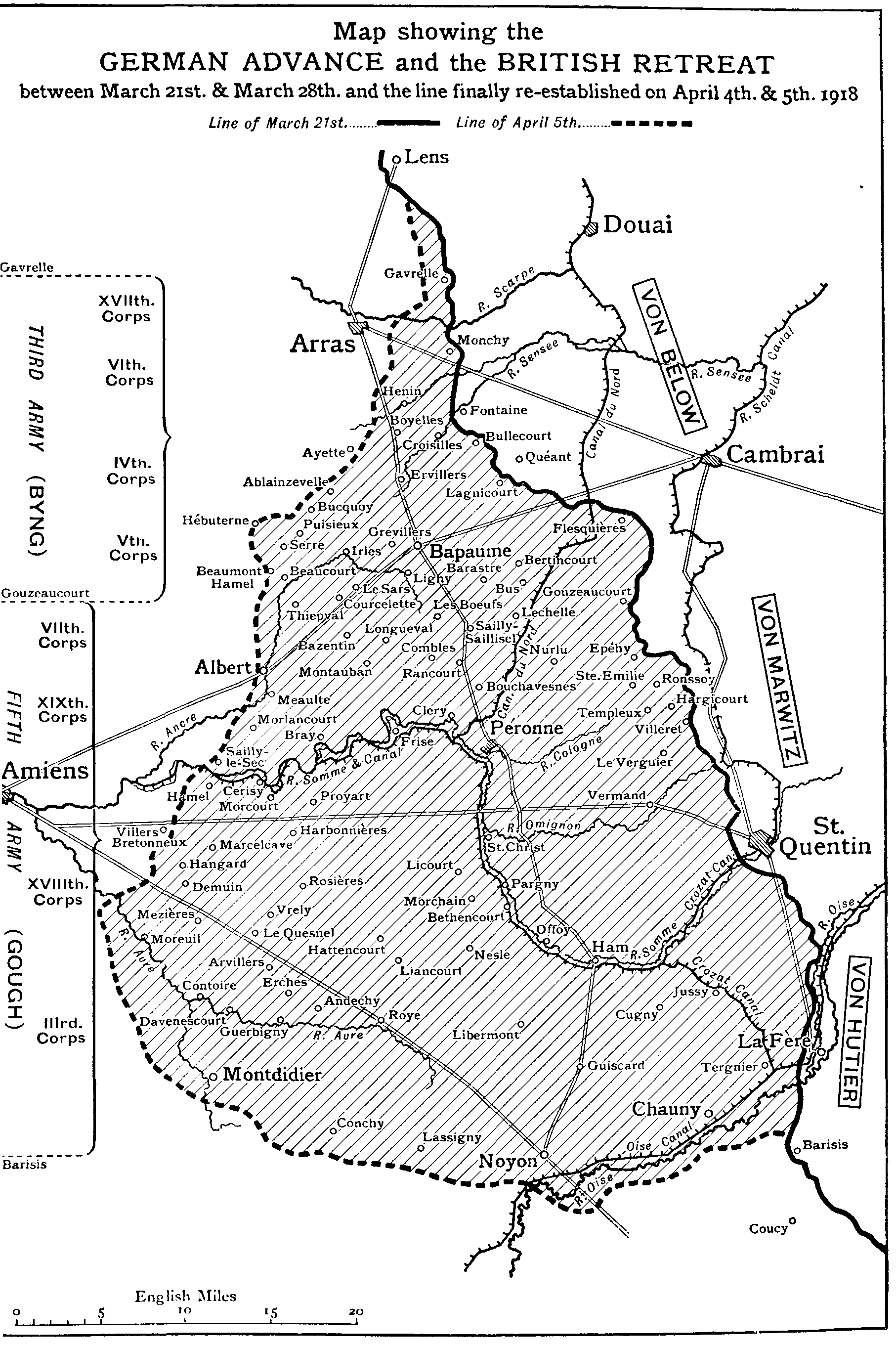
The German effort was becoming spent, though by broadening out the salient the enemy continued to press back the French as well as the British. The French Third Army, sent to the assistance of the British Fifth Army, played a lion's part in preventing him from extending his gains too dangerously in the south. On the 28th he concentrated his main energy against the stubborn British Third Army, which, conforming to the retreating line of the Fifth Army on its right, had fallen back to new battle positions, but in good order. Fresh shock-divisions were brought up to break this northern pivot of the British defence, and, after the usual full-dress bombardment, were launched as before in continual waves of assault. This time, however, there was no fog to handicap the British gunners, who were given the opportunity of a lifetime when they opened fire from hidden positions on serried ranks of German infantrymen, marching shoulder to shoulder at point-blank range. Six times the advance was renewed, and as many times mowed down, and when a final attempt was made, after a second bombardment in the afternoon, it met with similar failure. The Germans had shot their bolt. Their appalling losses on the 28th told on all their subsequent efforts in this first and greatest of Ludendorff's offensives in 1918.
It was on the 28th that General Gough relinquished the command of the British Fifth Army, General Rawlinson (Fourth Army) succeeding to the task of extricating its shattered divisions. Two days earlier the long-needed decision had been made by which the command of the Allied armies passed into the hands of General Foch as Generalissimo, who thenceforward, until the end of the war, held supreme control. Though several anxious days were to pass before the Allies could breathe freely again in the Amiens area, the position hourly improved as reinforcements, French and British, arrived on the scene. Counter-attacks recovered some of the ground on 30th March, and when the Germans resumed their advance towards Amiens on a more limited scale on 4th and 5th April, their losses were out of all proportion to their gains.
Second Phase of Ludendorff's Offensive
It is probable that the operations of 4th and 5th April were designed chiefly to pin the British armies to the southern area, while Ludendorff, finding his road barred to Amiens, prepared to strike a fresh blow in the north in a decisive bid for the Channel ports. Though well aware of a possible thrust in this direction, Sir Douglas Haig had been compelled to draw heavily on his Flanders front for reinforcements during the exhausting battle for Amiens, in which as many as 46 out of his total 58 divisions had been engaged. By the end of the first week in April the bulk of the British troops holding the Flanders line had passed through the furnace of the southern battlefield and were sadly in need of rest and reinforcement. Had the ground been in its usual condition of slush and mire at this season of the year they could have been relied upon to hold up any advance, but a dry spring had prepared the path for a German advance, and as soon as this was seen to be imminent it was reluctantly decided voluntarily to evacuate the Passchendaele salient, won at such frightful cost in the closing months of the previous year. Steps were also taken to relieve the Portuguese troops[2] who, though not seriously engaged, had been too long in the trenches south of the salient. Before either of these plans could mature the Germans upset both by launching their great attack at 4 a.m. on 9th April.
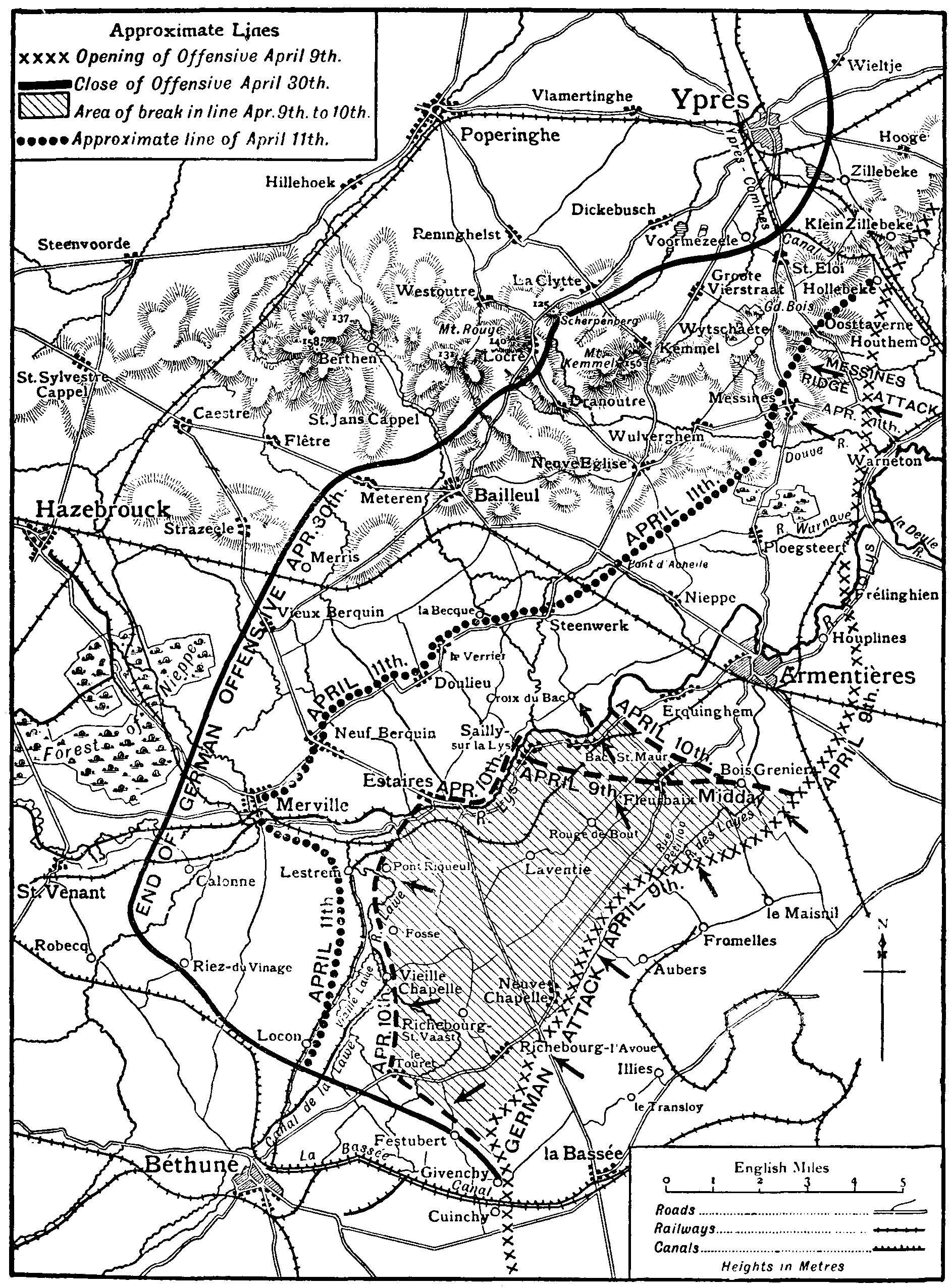
As in the opening move against the Fifth Army on 21st March, the assault—launched by the army of General von Quast in the direction of Festubert-Armentières against the northern portion of the front held by the British First Army (General Horne)—was favoured by an impenetrable early-morning fog. Through it came five columns of troops like the prongs of a fork, with an army corps as the central point to thrust into the weak spot where the Portuguese were sandwiched in between the British 40th and 55th Divisions. Bursting through the Portuguese sector, the attack spread swiftly to north and south—especially to the north, where the 40th Division, feeling the thrust which pierced the Portuguese line, was forced back on its right flank to the line of the Lys, 3½ miles in its rear. The rest of the 40th, with reinforcements from the 34th Division, formed a new line between Fort Rompre and Bois Grenier, covering Erquinghem and Armentières from the south, and held it the rest of the day. Had the southern pivot also given way when the Portuguese sector was broken the consequences would have been fatal to any hope of checking the German onrush. But the 55th Division never budged after its left flank, borne back by the first assault, succeeded in forming a defensive flank between Festubert and Le Touret, and the importance of its stout defence through the battle, as Sir Douglas Haig bore witness in his dispatches, could not be overestimated. This line was strengthened later in the day by the 21st Division, which, together with the 50th Division—both just relieved from the Somme fighting—had been hurried up as soon as the attack developed.
Next day the battle spread to the north, blazing up along the right of the British Second Army (General Plumer), the army of General Sixt von Armin attacking in another early-morning mist between Armentières and Hollebeke. The two German armies now acted in concert, and together pushed their advantage until the Lys was crossed in the south and the Messines Ridge carried in the north, with Laventie, Ploegsteert, and a dozen other historic landmarks in between. Outflanked on both sides, Armentières had perforce to be evacuated. Messines was recaptured by the South Africans, but had to be abandoned when the enemy's advance in the south pushed almost as far as Neuve Eglise. On the 11th, when the enemy continued to extend his gains with seemingly endless reinforcements, and had crossed the Lawe, a tributary of the Lys, Sir Douglas Haig issued his famous Order of the Day to his troops, which, while it reflected the gravity of the situation, inspired them to fight it out:
"Every position must be held to the last man.... With our backs to the wall, and believing in the justice of our cause, each one of us must fight on to the end. The safety of our homes and the freedom of mankind depend alike upon the conduct of each one of us at this critical moment."
The appeal, with its promise also of speedy reinforcements from the French army—"moving rapidly and in great force to our support"—heartened the battle-worn divisions when they sorely needed its encouragement. The pressure was still too great to prevent the Germans from taking Neuve Eglise on the 14th—after a struggle lasting two and a half days, from house to house—or Merris a day earlier, which brought them within 4 miles of Hazebrouck, where the 1st Australian Division, just detrained, kept them at bay; or Bailleul on the 15th. At midnight on the 15th the British line fell back to the defences between Meteren and Dranoutre, a move involving the simultaneous withdrawal from the Passchendaele Ridge.
These were the darkest hours of the last great battle for Ypres. There were already signs that the German advance, having again failed to break a way through by sheer weight and numbers, was slowing down, and the promised French reinforcements were close at hand. These took over the sector from Meteren to Wytschaete, where, on the 25th, before they had consolidated their positions, they were made to bear the brunt of a fresh German blow, delivered with 9 fresh divisions, from Bailleul to the Ypres-Comines Canal. The French fought desperately to save Kemmel Hill, commanding Ypres some six miles away; but in five hours the Germans had captured both the village and the crest of the hill. With the Ypres salient now dominated both from Kemmel and Messines it became necessary still further to shorten the line round Ypres. This was accordingly redrawn on the night of 26th-27th April through Pilkem, Wieltje, Zillebeke Lake, and Voormezeele.
One more effort was made by the Germans to push right through before the end of the month—on the 29th, when, in a fresh attack in force on the Franco-British front, they succeeded in reaching as far as Locre, behind Kemmel. But the French, who were in no mood to repeat their experience at Kemmel, flung the enemy back with sanguinary losses. The heaviest casualties of the Germans that day, however, were against the British 21st, 49th, and 25th Divisions, whose artillery—like the gunners of the Third Army on 28th March—had the range of them as they advanced in mass formation, and blew them to pieces. Only one of the waves of German infantry succeeded in reaching the British positions, where bomb and bayonet completed its destruction. This marked the last serious attempt on Germany's part to seize the Channel ports.
Though Ludendorff had failed to reach his objectives either on the Amiens or Flanders front he still had a sufficient superiority of force to retain the initiative. With every incentive to compel a decision before the new American army, which was now arriving at the rate of something like 150,000 a month, could enter the field in full strength, Ludendorff had either to throw up the sponge or strike again at the earliest moment in one final effort to beat the Allies to their knees. Meantime the obvious policy on the Franco-British part was to maintain an active defence until their own and American reinforcements made a counter-offensive possible. In the minor operations which marked this period of waiting, the Australians added Villers-Bretonneux to their battle honours. Villers-Bretonneux, which lies on the edge of the ridge facing Amiens—only 8 miles away—had been rushed and captured by the Germans in a surprise attack in thick fog on 23rd April. Before daybreak the next morning the Australians had surrounded the German garrison, and the end of a fierce house-to-house conflict left the place in British hands again, together with nearly 1000 prisoners.
Germany's Last Bid for the Channel Ports: approximate positions of the Allies' line before and after Ludendorff's offensive in April, 1918
Third Phase of Ludendorff's Offensive
Though every day added to the danger of delay, it was not until the end of May that the German army, its plans disorganized by its unexpectedly heavy commitments in the Amiens and Flanders battles, was launched on the third and final phase of Ludendorff's great offensive with a sudden attack on the Aisne front in the direction of Paris. It was along this front that the 9th British Corps (General Sir A. Hamilton-Gordon), consisting of the 8th, 21st, 25th, and 50th Divisions, and subsequently reinforced by the 19th Division, had been sent to the French armies under General Pétain for much-needed rest after sharing to the full the honours and sacrifices of the earlier battles. By their side were crack French divisions which had also earned the rest which it was felt they could count upon along the main stretch of the Chemin-des-Dames. holding as it did some of the strongest natural defences along the whole battle front. The French had taken months in the previous year, and spent countless lives, to recapture these positions.
The very unlikelihood of choosing such a formidable sector decided Ludendorff to select it for his dramatic attack on 27th May, moving up his specially trained divisions of shock troops at the last moment—with all possible secrecy, accompanied by other surprises in the vast number of guns and aeroplanes brought into action, as well as the largest fleet of German tanks which the enemy had ever employed. Only on the very eve of the new advance did the French learn of the impending blow—too late to avert disaster. Outnumbered by 6 to 1 the Allies, British and French alike, were borne back by the onrush of picked troops as soon as the preliminary bombardment ceased. Helped as usual by a thick early-morning mist the armies of von Böhn, von Hutier, and von Below—all nominally under the German Crown Prince—had carried the whole of the Chemin-des-Dames ridge by nightfall, and were fighting on the Aisne. Within two days they were not only across the Aisne on an 18-mile front, but had swept on to the Vesle, and were even across that river west of Fismes—a depth of 12 miles from their starting-point.
Reserving his stoutest resistance for the flanks, Foch strove hard to save Soissons, but it fell again into the enemy's hands on the 29th, by which date Rheims, on the Allies' right, was also pressed so hard that its outlying positions were carried on the 30th, and only the devoted bravery of Berthelot's Fifth Army—with Gouraud guarding the Champagne front on its right—saved the battered city. The British and French divisions which had meantime been driven back from the Chemin-des-Dames to the Aisne, and from the Aisne to the Vesle—the Allies often fighting side by side in hopeless rear-guard actions against immensely superior numbers—were now holding a line between the Vesle and the Ardre while the Germans continued to plunge deeper and deeper into the big salient which they had formed towards the Marne. The shattered divisions of the British 9th Corps now formed part of Berthelot's Fifth French Army guarding Rheims, and subsequently played a large part in repelling the enemy's attack on the north-east side of that city. In the words of General Berthelot himself: "They have enabled us to establish a barrier against which the hostile waves have beaten themselves in vain. This none of the French who witnessed it will ever forget."
By 31st May the German advance in the centre had spread as far as the Marne at Château-Thierry, extending thence along a 10-mile front to Dormans. It was at Château-Thierry on this day that the Americans began to play their part in the battle, linking up with a French colonial division on the south bank of the river and preventing the enemy from crossing. New French units were also coming into line, blocking the Germans' path south of Soissons on the road to Villers-Cotterets, as well as at Château-Thierry. Foiled in both these directions, Ludendorff turned to the Ailette front in order to get more elbow-room, and flattened out the French front between Soissons and Noyon. Again unable to make much further headway against the fierce French counter-attacks, he carried the battle still farther to his right, attacking between Noyon and Montdidier on 9th June in the hope of linking up the new Marne salient with the one already formed at Amiens, and so advancing on one immense front. The new 'drive' was again entrusted to von Hutier, whose 25 divisions, employing the same shock tactics as before, swept forward at first to a depth of some 5 miles in the centre; but, held on the wings, were fiercely counter-attacked on the 11th on their exposed right flank and robbed of most of their gains.
On the following day the German War Minister declared that "Foch's so-called Army of Reserve exists no more"; the truth being that Foch, with time and an ever-flowing stream of reinforcements on his side, was gradually becoming master of the situation, and could afford to wait until Ludendorff gave him the opportunity he wanted. Ludendorff, on the other hand, with the pick of his troops 'pocketed' in the great Marne salient, was forced to make another forward move or withdraw them. He made one more attempt on Rheims, three divisions being ordered on 18th June to take it at all costs; but the whole attack was an expensive failure. For the rest of the month, when the weather broke, and during the first half of July, Ludendorff left most of the fighting to the Allies while he prepared for one last herculean effort to burst through their line. On 28th June Foch felt his way towards his counter-stroke by a preliminary advance between Villers-Cotterets and the Aisne, when he won back over a mile of useful territory and took over 1000 prisoners. On 4th July further minor victories were recorded along both the French and British fronts, the British success being at Hamel, where American units celebrated Independence Day by helping the Australians to recover that fiercely-contested stronghold, with 1500 prisoners.
The First and Last Advances on Paris: map showing approximately (by the shaded area) the limit of the German gains in the final phase of Ludendorff's offensive in 1918, and (by the dotted line) the limit reached in the 1914 advance
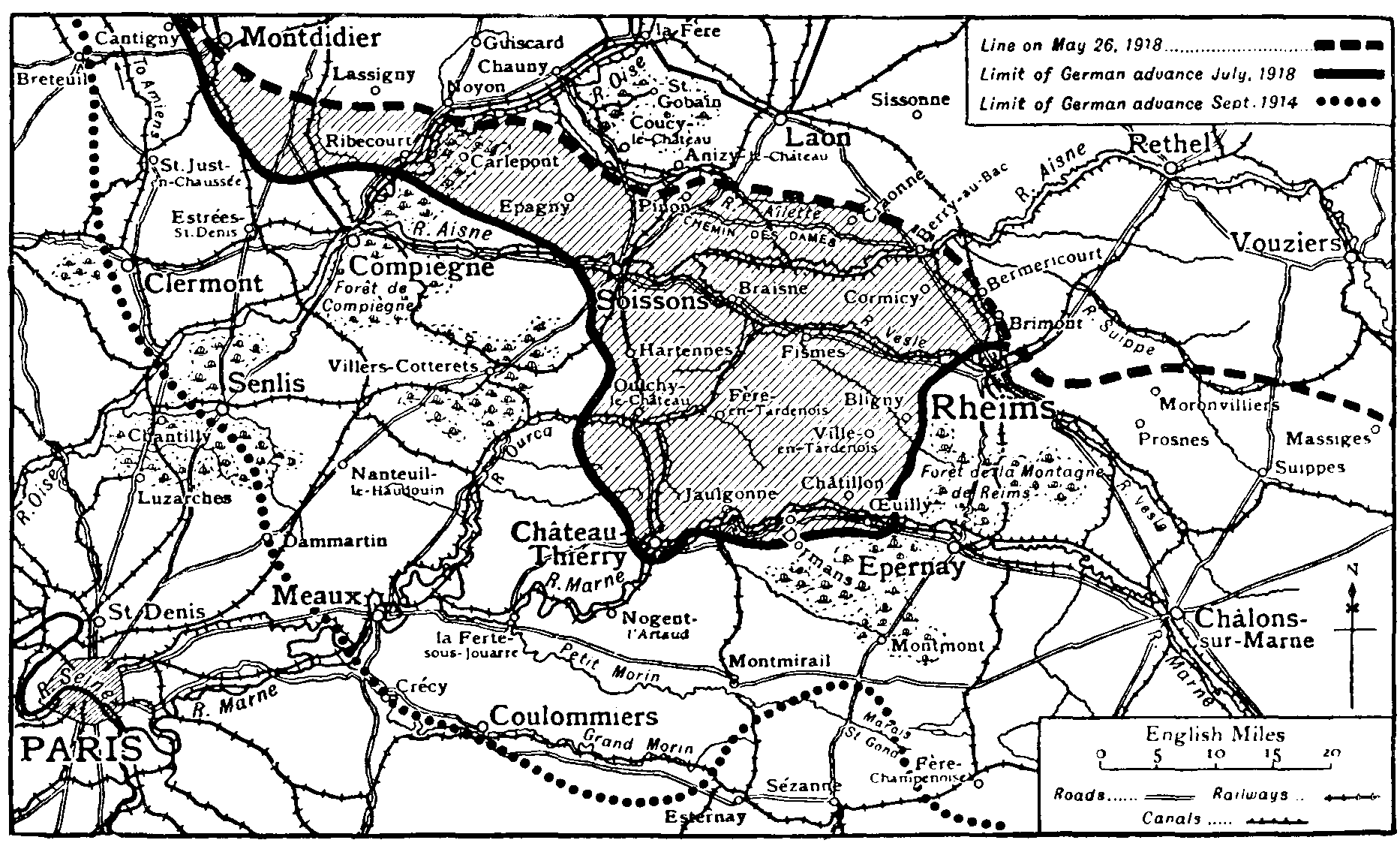
On 15th July Ludendorff launched his final effort on a 50-mile front on each side of Rheims. This time the Allies were warned of its direction in time. On the left, where immediate success was vital to the whole plan, the attack was flung into disorder at the very beginning by a deluge of shells from Gouraud's guns before even the German bombardment started; and when, this over, the attacking divisions of von Einem and von Mudra advanced, they found that Gouraud's army, save for volunteer garrisons in concrete forts, had returned undamaged to its main battle positions, to reach which they had to face a concentrated fire that tore their ranks to pieces. Some 50,000 German troops were admitted to have fallen that day before Gouraud's army. With the failure of the advance in Champagne the German attack on the right, where Italian as well as British and American troops were now fighting side by side with the French, was unavailing, though the line south-west of Rheims was pressed back some 3 or 4 miles, and eight divisions under von Böhn succeeded by 17th July in crossing the Marne at a number of points between Fossoy and Dormans.
Foch's Counter-stroke
They were only allowed to remain south of the Marne long enough for Foch to convert these river crossings into a death-trap. For Foch had now decided that the moment had come when the Germans, exhausted by their advance, were least in a condition to resist a counter-stroke aimed at their flank. The flank which Foch selected for attack was that on the western side of the salient created, from its most northerly point on the Aisne near Soissons, to its southern extremity, Château-Thierry on the Marne, where the symptoms of the exhaustion of the German momentum had been furnished by the ability of American and other contingents to resist further advance. In the earlier half of July a ceaseless stream of men and guns had flowed up from the French side to take cover in the forest of Villers-Cotterets on their flank, in preparation for the blow to come; and by 18th July two French armies were assembled along the 27-mile flank, that of General Mangin aligned between the Aisne and the Ourcq, which bisected the salient, and that of General Degoutte from the Ourcq to the Marne. Mangin's army contained some of the finest French shock divisions as well as two famous British ones, the 34th and the 15th, and a number of keen American troops. Degoutte's army had the more awkward task, judged by the country over which it had to travel, but Foch's plan here, as elsewhere, was to put his best fighting material where it would pierce farthest, and hold the enemy elsewhere. By the same token the army of General Berthelot, with two other supporting British divisions, was entrusted with the task on the other side of the salient, from Rheims to Épernay, not of thrusting at the Germans but of holding them hard.
Mangin's army was ordered to strike with all its force. It was equipped with new and speedier 'whippet' tanks, and its immediate onset was masked by the accident of a July thunderstorm on the eve of the fighting. On the morning of 18th July it went forward with nothing but a barrage, but with the effect of a thunderbolt, and its average advance on that day was 5 miles, with Fontenoy and the plateau of Pernay on the Aisne firmly secured. Degoutte's army went forward for 2 miles over difficult country. A blow of immense significance had been struck along the whole length of the salient's vulnerable side. Next day Mangin's movement continued; he tightened his hold on the Aisne and swung his right wing farther along the Ourcq so as to bring the whole line of the one good north-and-south road in the salient under the fire of his guns, and thus to hamper the German movements terribly. That alone would have forced the enemy to begin a retreat from the Marne, while it might yet be possible. Meanwhile Degoutte was advancing also, and was forcing the Germans away from the neighbourhood of Château-Thierry. The German commander, von Böhn, was not slow to recognize the implications of the situation into which Foch had forced him, and gave orders to recross the Marne. He was in time, but his retreating troops were roughly handled at the crossings, and despite all his attempts to hold up the attack on his western flank by counter-attack, the pressure of Mangin and Degoutte, added to that of de Mitry's army, which was now following him back over the Marne, became every hour more dangerous. By 20th July not only was the Marne itself in process of being abandoned by von Böhn but Château-Thierry had fallen. Degoutte's army was 3 miles north of it. De Mitry's divisions had secured ample crossings for future movement and Berthelot's mixed forces of French, British, and Italians had begun a disconcerting attack on the eastern side of the salient. In three days the Germans lost 20,000 prisoners, and, what was more significant, 450 guns. The first riposte of the French Generalissimo had been delivered. It was to be followed in unending succession by others.
The German Commander-in-Chief had to gain time. It was no easy thing to withdraw his 600,000 men crowded between the Aisne and the Marne, but he was obliged to support them lest the salient should collapse too suddenly. He aimed a counter-stroke at Gouraud's army east of Rheims, but the blow spent itself in the air, and Foch replied by setting in motion the army of General Debeney, where it stood opposite to that of General von Hutier, between Montdidier and Noyon. But he had not yet gathered the full fruits of the strength of his positional assault between the Aisne and the Marne, and did not in the least allow pressure here to relax. Mangin seized Oulchy-le-Château on the Ourcq (25th July); and on 26th July Gouraud, on the other side of Rheims, recovered the ground he had ceded under the German pressure. By Sunday (28th July) the Allied attack in the Aisne-Marne salient had swept convergingly on to the line of the Ourcq, and with that achievement the most important episode in the opening of Foch's campaign was consummated. Soissons fell to Mangin on 1st and 2nd Aug., a signal that the work was done, and Foch was now free to prosecute his larger plan of delivering successive blows at points where they would disperse and use up the German reinforcements most effectively.
The Allies' Victorious Offensive, 1918
The Freeing of Amiens: Map illustrating the recapture of the city's outer defence line on the opening day of the Battle of Amiens, 8th Aug., 1918.
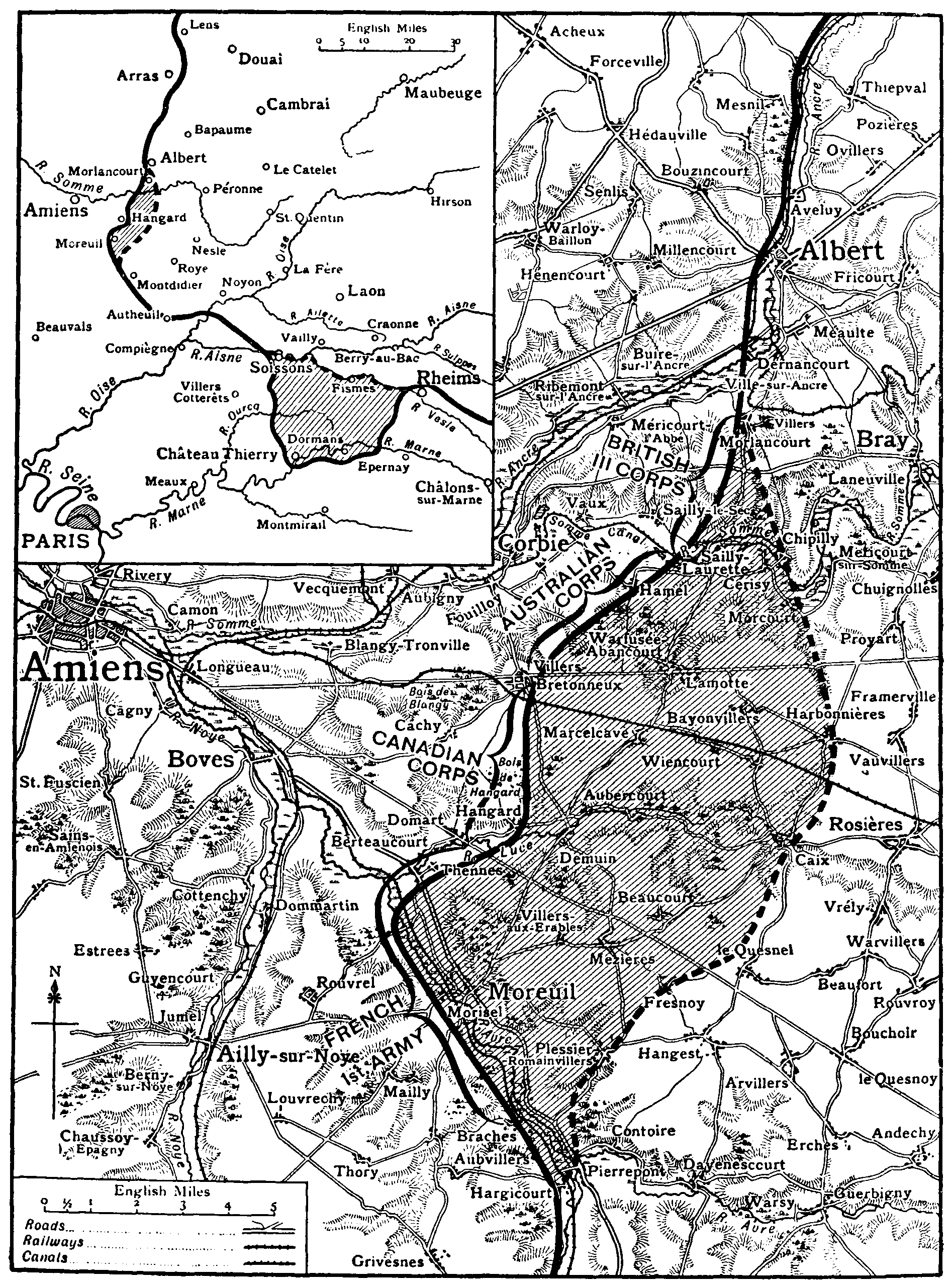
Marshal Foch, after consultation with the British Commander-in-Chief, had desired the commanders of all armies, British and French, to prepare plans of action and to be ready to put them into operation at short notice. He now more particularly addressed inquiry to Sir Douglas Haig as to his willingness to undertake a continuous offensive towards the German centre. Sir Douglas Haig assented to Marshal Foch's representations as to the superior advantages to be gained from an attack there, and, while continuing a show of preparation in the Ypres area, where Ludendorff, on an estimate of the psychology of the British commander, would expect the counter-attack to come, and was already taking steps to reduce its effectiveness by masked withdrawals, transferred forces steadily to Rawlinson's Fourth Army on the Somme. This army, and the First French Army under Debeney on the right, both directed by Haig, were set in motion on 8th Aug. on a 16-mile front from Morlancourt to Moreuil. The thrust was successful beyond expectation. The British Fourth Army, on the right wing, went through the German divisions of von Marwitz (Second Army) like paper, regaining the old outer-line defences of Amiens; and Debeney's men crushing the resistance of von Hutier's Eighteenth German Army, and reaching Fresnoy and Plessier, where they linked up with General Humbert's Third French Army on the road to Roye. The captures of the day amounted to 17,000 prisoners and 500 guns, an unmistakeable symptom that the German power of resistance was shaking.
On 9th Aug. Rawlinson pushed on still farther; on 10th Aug. General Humbert prolonged Debeney's still attacking line and took Montdidier, and a number of villages. These three armies continued to eat into the enemy's positions and to pin a number of German divisions down till 20th Aug., while Mangin's army at Soissons moved en échelon to take up contact with Humbert's right. Meanwhile Ludendorff, fully aware now that the initiative had passed out of his hands, and that the best course that lay open before him was a 'strategic retirement', began to effect one stage of it in the Ypres and Lys district under the direction of General Sixt von Armin, whose withdrawal was followed vigilantly by the British forces; and another stage in the German salient on the Ancre, where General von Below's Seventeenth Army was stationed. Von Below withdrew on the Bapaume line from Serre, Beaumont-Hamel, and Bucquoy to the shelter of the sector of the Hindenburg line behind it (13th, 14th, and 15th Aug.).
But whereas in 1917 Ludendorff had disconcerted both British and French Commanders-in-Chief by a sudden withdrawal on the Bapaume-Péronne line of the Somme, he was not now allowed to withdraw without injury. Haig's battle of Bapaume (21st Aug. and following days) was designed in two stages, the first of which brought up Byng's Third Army to a position in which it was aligned with Rawlinson's Fourth Army, and the second of which saw the Third and Fourth Army attack von Below in combination. The combined pressure of these two armies was continuously successful, though the Germans fell back stubbornly in many places. By 30th Aug. Bapaume was once again in British hands, and the line of attack was threatening the strongholds of the Hindenburg line, while its extension ran through Heudecourt and Fremiecourt to Cléry. Péronne fell to the Australian Corps by a most gallant feat of arms on 1st Sept. A more strategically significant victory was gained on the same day when the capture of Bullecourt, followed by that of Riencourt and Cagnicourt, opened up the first crevice in the ramifications of the Hindenburg defences known as the Drocourt-Quéant switch line. The battle of Bapaume drove thirty-five German divisions from the old Somme battlefield, and captured 34,000 men and 27 guns.
The crevice in the Drocourt-Quéant defences was still further widened on 1st Sept., when six British divisions of Horne's First Army, including two Canadian, attacked behind tanks a 5-mile front occupied by eleven German divisions and captured Dury Ridge and Quéant, together with 16,000 men and 200 guns. So far, therefore, from Ludendorff's strategic retreat being conducted 'according to plan', it cost the Germans, between 21st Aug. and 9th Sept., some 53,000 men and 470 guns; the French had been able to occupy Ham and Chauny, while the British were going forward; and General Sixt von Armin was forced cautiously to retire from the Ypres salient.
During these operations by the British armies Foch had never relaxed pressure with the three armies of Debeney, Humbert, and Mangin, while still threatening an advance beyond the Vesle in the deflating Aisne salient, west of Rheims, and preparing new blows elsewhere. At the beginning of September the position of the French armies of the centre, won by continuous fighting, was as follows: Debeney had crossed the Somme, taken Ham, and was threatening St. Quentin; Humbert was close to Tergnier and was pointing towards La Fère: Mangin was back in Coucy-le-Château and held the railway thence to Soissons; Degoutte was spreading from Soissons along the Aisne. These threats left General Ludendorff no choice but to shorten his line where he could do so with least risk. He decided on the Vesle front, where General de Mitry, with French and Americans, had been engaging his Seventh and Ninth Armies, and began to retire thence on 4th and 5th Sept. on a 19-mile front. The Americans occupied the Aisne thereupon from Condé to Viel-Arcy, and on 7th Sept. General Mangin crowned his long campaign at the Chemin-des-Dames by taking the ruined Fort de Condé. A week later Allemant and Laffaux Mill fell, and once again the French troops came in sight of Laon. Humbert and Debeney, both pushing forward, embarrassed Ludendorff in his intention of moving divisions to meet a new British movement known thereafter as the battle of Epéhy.
This battle was the preliminary movement in that great attack on the Hindenburg line which, more than any other single action, was the decisive 'blow at the heart' of the German defensive plan. The British advance, viewed as one movement, was made towards Cambrai, which was the northern bastion of the German defensive lines, as La Fère and Laon were the twin southern pillars. On 2nd Sept. the Third Army began a local attack on a 5-mile front which captured Havrincourt and Trescault, while on the extreme right of the Fourth Army the 9th Army Corps and the Australian Corps began a movement which by 17th Sept. placed them in Maissemy, where the Fifth Army in March had been pierced. These preliminary positions having been secured, the Third and Fourth Armies set in motion their important combined attack (18th Sept.) on a 17-mile front from Gouzeaucourt, through Havrincourt to Holnon Wood, where Debeney's First Army lent assistance. The hardest fighting was at Epéhy, which gives its name to the battle, on the left centre, but by nightfall the German defences had been pierced on a 3-mile front, 12,000 prisoners had been taken, and the British forces brought within striking distance of the main Hindenburg lines.
During the weeks in September while the plans for the battle of Epéhy were ripening, Foch had struck hard at another point in the German line, which had appeared invulnerable while the Germans were strong, but was now a menace to Ludendorff's own plans for retirement because it absorbed divisions which he badly needed elsewhere, namely the long-standing salient of St. Mihiel. It was held by seven German and two Austro-Hungarian divisions in September, and Ludendorff had been withdrawing its heavy artillery; but before his plans for withdrawal could be consummated, Foch sent in General Pershing with his young American divisions, aided by two French divisions, at the salient's apex. The Americans attacked on the two faces of the salient, west and south, the strongest thrust being made by two corps of seven divisions apiece on the southern face. The attack began on 12th Sept., and in thirty hours the salient had disappeared; while in spite of the haste with which the Germans had left it—the firmest resistance was offered by the two Austro-Hungarian divisions on the western face—10,000 prisoners and 450 guns were left behind. This victory, as symptomatic as others of German disorder, freed the Verdun-Commercy railway, and completed the attenuation of Ludendorff's reserves. The 207 German divisions which Ludendorff had commanded at the period of the greatest German strength had fallen to 185, and only 21 reserve divisions remained.