Volume 1 — B
Reading edition
B is the second letter and the first consonant in the English and most other alphabets. It is a mute and labial, pronounced solely by the lips, and is distinguished from p by being sonant, that is, produced by the utterance of voice as distinguished from breath.
B, in music, the seventh note of the model diatonic scale or scale of C. It is called the leading note, as there is always a feeling of suspense when it is sounded until the keynote is heard.
Baader, Franz Xaver von (fra˙nts-zä'fer fon bä'der), German philosopher and theologian, born in Munich, 1765, died 1841. He studied engineering, became superintendent of mines, and was ennobled for services. He was deeply interested in the religious speculations of Eckhart, St. Martin, and Böhme, and in 1826 was appointed professor of philosophy and speculative theology in the University of Munich. During the last three years of his life he was interdicted from lecturing for opposing the interference in civil matters of the Roman Catholic Church.
Ba´al, or Bel, a Semitic word, which primarily signified lord or proprietor, and was afterwards applied to many different divinities, or, with qualifying epithets, to the same divinity regarded in different aspects, describing him as an occupier of some physical object or locality, or as a possessor of some attribute. Thus in Hos. ii, 16 it is applied to Jehovah himself, while Baal-berith (the Covenant-lord) was the god of the Shechemites, and Baal-zebub (the Fly-god) the idol of the Philistines at Ekron. Baal was the sacred title applied to the Sun as the principal male deity of the Phœnicians and their descendants, the Carthaginians, as well as of the ancient Canaanitish nations, and was worshipped as the supreme ruler and vivifier of nature. The word enters into the composition of many Hebrew, Phœnician, and Carthaginian names of persons and places; thus, Jerubaal, Hasdrubal (help of Baal), Hannibal (grace of Baal), and Baal-Hammon, Baal-Thamar, &c.
Baalbek´ (ancient, Heliopŏlis, 'city of the sun'), a place in Syria, in a fertile valley at the foot of Antilibanus, 40 miles from Damascus, famous for its magnificent ruins. Of these the chief is the Temple of the Sun, built either by Antoninus Pius or by Septimius Severus. Some of the blocks used in its construction are 60 feet long by 12 thick; and its fifty-four columns, of which six are still standing, were 72 feet high and 22 in circumference. Near it is a temple of Jupiter, of smaller size though larger than the Parthenon at Athens, and there are other structures of an elaborately ornate type. Originally a centre of Sun-worship, it became a Roman colony under Julius Cæsar, was garrisoned by Augustus, and acquired increasing renown under Trajan as the seat of an oracle. Under Constantine its temples became churches, but after being sacked by the Arabs in 748, and more completely pillaged by Tamerlane in 1401, it sank into hopeless decay. The work of destruction was completed by an earthquake in 1759.
Baal-zebub. See Beelzebub.
Baba, a cape near the north-west point of Asia Minor.
Babadagh (ba˙-ba˙-däg'), a town of Roumania, capital of the Dobrudsha, carrying on a considerable Black Sea trade; it was bombarded by the Russians in 1854. Pop. 10,000.
Bab´bage, Charles, English mathematician and inventor of the calculating-machine, born 1792, died 1871. He graduated at Cambridge in 1814, and occupied the Lucasian chair of mathematics at Cambridge for eleven years, but delivered no lectures. As early as 1812 he conceived the idea of calculating numerical tables by machinery, and in 1823 he received a grant from Government for the construction of such a machine. After a series of experiments lasting eight years, and an expenditure of £17,000 (£6000 of which was sunk by himself, the balance voted by Government), Babbage abandoned the undertaking in favour of a much more enlarged work, an analytical engine, worked with cards like the jacquard-loom; but the project was never completed. The incompleted machine is now in the South Kensington Museum. Among the many treatises he published on subjects connected with mathematics and mechanics few can be regarded as finished performances. Babbage was instrumental in founding the Astronomical and Statistical Societies (1820 and 1834).
Babbit-metal, a soft metal resulting from alloying together certain proportions of copper, tin, and zinc or antimony, used with the view of as far as possible obviating friction in the bearings of journals, cranks, axles, &c., invented by Isaac Babbit (1799-1862), a goldsmith of Taunton, Massachusetts.
Ba´bel. See Babylon.
Ba´bel, Tower of, according to the 11th chapter of Genesis, a structure in the Plain of Shinar, Mesopotamia, commenced by the descendants of Noah subsequent to the deluge, but which was not allowed to proceed to completion. It has commonly been identified with the great temple of Belus, or Bel, that was one of the chief edifices in Babylon, and the huge mound called Birs Nimrud is generally regarded as its site, though another mound, which to this day bears the name of Babil, has been assigned by some as its site. Babel means literally 'gate of God'. The meaning 'confusion' assigned to it in the Bible really belongs to a word of similar form. See Babylon.
Bab-el-Mandeb ('gate of tears', from being dangerous to small craft), a strait, 15 miles wide, between the Indian Ocean and the Red Sea, formed by projecting points of Arabia in Asia, and Abyssinia in Africa. The Island of Perim is here.
Ba´ber, first Grand Mogul, the founder of the Mogul dynasty in Hindustan, born in 1483, died 1530. He was a grandson of the great Tartar prince, Timur or Tamerlane, and was sovereign of Cabul. He invaded Hindustan, and in 1525 overthrew and killed Sultan Ibrahim, the last Hindu emperor of the Pathan or Afghan race. He made many improvements, social and political, in his empire, and left a valuable autobiography (English translation, 1826).
Babeuf (ba˙-beuf), François Noel, a French political agitator, born in 1764; started a democratic journal in Paris, called Le Tribun du Peuple, par 'Gracchus' Babeuf, and wrote with great severity against the Jacobins. After the fall of Robespierre, to which he powerfully contributed, he openly attacked the terrorists, and advocated the most democratic principles. He was accused of a conspiracy against the directorial Government, condemned to death, and guillotined in 1797. He was one of the pioneers of Socialism in France.
Bab´ington, Anthony, a Catholic gentleman of Derbyshire, born 1561. He associated with others of his own persuasion to assassinate Queen Elizabeth, and deliver Mary, Queen of Scots. The plot being discovered, the conspirators were executed in 1586.
Babiroussa. See Babyroussa.
Bab´ism, the doctrines of a Mohammedan sect whose head-quarters is Persia, founded by Seyd Ali Mohammed in 1844. He took the name of Bab-ed-din, 'the gate of the faith', and afterwards that of Nokteh, 'the point', as not merely the recipient of a new divine revelation, but the focus in which all preceding dispensations would converge. One of his most successful disciples was a highly-gifted woman, Gurred-ul-Ayn, 'consolation of the eyes', who perished with many others during a persecution in 1852. The Bab himself had been executed about two years before this, and was succeeded by a noble youth, Mirza Yahya. The sect holds that all individual existence is an emanation from the supreme deity, by whom it will be ultimately reabsorbed. The morality of the sect is pure and cheerful, and it shows great advancement in the treatment of woman. Moses, Christ, and Mohammed are acknowledged as prophets, though only mere precursors of the Bab. A schism divided the followers of Babism into two sects, Bahais and Ezelis. The former have carried on an active propaganda in America.
Ba´boo, or Babu, a Hindu title of respect equivalent to sir or master, usually given to wealthy and educated native gentlemen, especially when of the mercantile class.
Family of Common Baboons (Cynocephălus babouin)
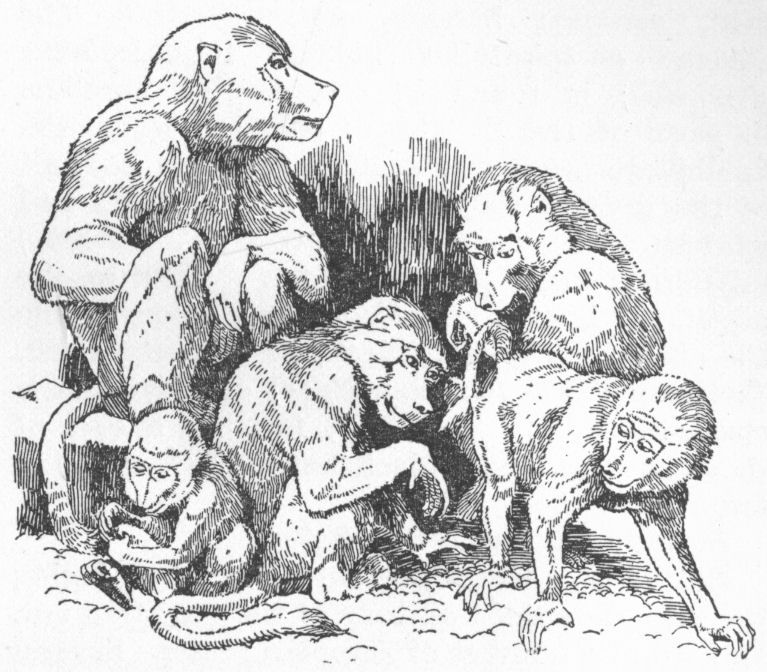
Baboon´, a common name applied to a division of old-world quadrumana (apes and monkeys), comprehending the genera Cynocephălus and Papio. They have elongated abrupt muzzles like a dog, strong tusks or canine teeth, usually short tails, cheek-pouches, small deep eyes with large eyebrows, and naked callosities on the buttocks. Their hind and fore feet are well proportioned, so that they run easily on all fours, but they do not maintain themselves in an upright posture with facility. They are generally of the size of a moderately large dog, but the largest, the mandrill, is, when erect, nearly of the height of a man. They are almost all African, ugly, sullen, fierce, lascivious, and gregarious, defending themselves by throwing stones, dirt, &c. They live on fruits and roots, eggs and insects. They include the chacma, drill, common baboon, and mandrill. The chacma or pig-tailed baboon (Cynocephălus porcarius) is found in considerable numbers in parts of the S. African colonies, where the inhabitants wage war against them on account of the ravages they commit in the fields and gardens. The common baboon (C. babouin) inhabits a large part of Africa farther to the north. It is of a brownish-yellow colour, while the chacma is greyish-black, or in parts black. The hamadryas (C. hamadryas) of Abyssinia is characterized by long hair, forming a sort of shoulder-cape. The black baboon (C. niger) is found in Celebes.
Babour (bä´bu¨r). See Baber.
Bab´rius, a Greek poet who flourished during the second or third century of the Christian era, and wrote a number of Æsopian fables. Several versions of these made during the Middle Ages have come down to us as Æsop's Fables. In 1840 a manuscript containing 120 fables by Babrius, previously unknown, was discovered on Mount Athos.
Babuya´nes Islands, a group in the Pacific Ocean, between Luzon and Formosa, belonging to United States. Pop. 12,000.
Baby-farming. The law relating to the protection of children and young persons has been subjected to amendment and consolidation by the Children Act of 1908, which wholly repealed the Infant Life Protection Act of 1897 dealing with baby-farming and infant life protection.
The Act of 1908 (Part I) deals with baby-farming, and requires that notice shall be given to the Local Authority (in Scotland the Parish Council) by the person undertaking for reward the nursing and maintenance of any infant or infants under seven years of age apart from their parents, within forty-eight hours after reception, unless the period for which it is received be only forty-eight hours or less. The notice requires the name, sex, date and place of birth of the child to be stated, where it is to be kept, and from whom it is received. The Act also provides that such a person shall notify any change in his residence or the removal or death of the infant to the Local Authority within forty-eight hours. In regard to all these matters the Act is retrospective, and necessitates persons who had undertaken nursing and maintenance of such infants before its coming into operation to comply with its provisions within a month after the commencement thereof. But it exempts any person who may have given the similar notice required by the Infant Life Protection Act of 1897, although it does not exempt any person whose duty it was to have given notice thereunder from any liability which such a person may have incurred thereunder.
A duty is imposed upon Local Authorities to inquire regarding persons willing to undertake the nursing and maintenance of infants, to appoint infant-protection visitors of either sex in so far as it provides for infant life protection and gives powers to such Local Authorities and visitors for fulfilling the requirements of the Act. It is an offence for the person undertaking the nursing to refuse to allow such visitors access to the infant or the premises in which it is kept; and, if need be, application may be made to the court for a warrant to enter the house in which an infant is farmed out, and where there is reason to believe that the Act is being contravened. It is an offence for any infant to be kept (1) by any person from whose care an infant has been removed under the Act or the Infant Life Protection Act, or (2) by any person convicted of any offence under Part II of the Children Act of 1908 or the Prevention of Cruelty to Children Act, 1904.
The Local Authority may fix the number of infants under the age of seven years which may be kept in any dwelling, and it is an offence to keep more. Provision is also made for the removal of an infant from overcrowded, dangerous, or insanitary premises, or from the custody of a person unfit to take charge of the child; and an application may be made by a visitor to a magistrate for a removal order enforceable by the visitor or a constable. Should the infant die, notice of the fact must be given by the person with whom it is farmed out to the Procurator-fiscal of the district, if in Scotland, and, if in England, to the Coroner of the district, within twenty-four hours. He shall hold an inquest unless a certificate by a medical practitioner specifying the cause of death shall be forwarded. Failure to give such notice is punishable under the Act.
A person nursing an infant for reward shall have no interest in the life of the child for the purposes of life assurance. It is not permissible for such a person or insurance company to insure the life of such a child. To do so renders both the person and the insurance company liable to prosecution.
Any person knowingly or wilfully making any false statement in any notice required to be given under the Act commits an offence under the Act.
Imprisonment for a term not exceeding six months, or a fine not exceeding £25, may be imposed upon any person found guilty upon summary conviction of an offence against Part I of the Children Act, 1908; in addition the court may order the removal of the infant to a place of safety. All fines are payable to the Local Authority for the purposes of the Act.
Legal guardians of an infant, as well as institutions established for the protection and care of infants, are exempted from the provisions of Part I of the Children Act, 1908.
Bab´ylon, the capital of Babylonia, on the left of the Euphrates, one of the largest and most splendid cities of the ancient world, now a scene of ruins, and earth-mounds containing them. Babylon was a royal city sixteen hundred years before the Christian era; but the old city was almost entirely destroyed in 683 B.C. A new city was built by Nebuchadnezzar nearly a century later. This was in the form of a square, each side 15 miles long, with walls of such immense height and thickness as to constitute one of the wonders of the world. It contained splendid edifices, large gardens and pleasure-grounds, especially the 'hanging-gardens', a sort of lofty terraced structure supporting earth enough for trees to grow, and the celebrated Tower of Babel or Temple of Belus, rising by stages to the height of 625 feet. (See Babel, Tower of.) After the city was taken by Cyrus in 538 B.C., and Babylonia made a Persian province, it began to decline, and had suffered severely by the time of Alexander the Great. He intended to restore it, but was prevented by his death, which took place here in 323 B.C., from which time its decay was rapid. Interesting discoveries have been made on its site, more especially of numerous and valuable inscriptions in the cuneiform or arrow-head character. The modern town of Hillah is believed to represent the ancient city, and the plain here for miles round is studded with vast mounds of earth and brick and imposing ruins. The greatest mound is Birs Nimrud, about 6 miles from Hillah. It rises nearly 200 feet, is crowned by a ruined tower, and is commonly believed to be the remains of the ancient Temple of Belus. Another great ruin-mound, called Mujellibeh, has also been assigned as its site.
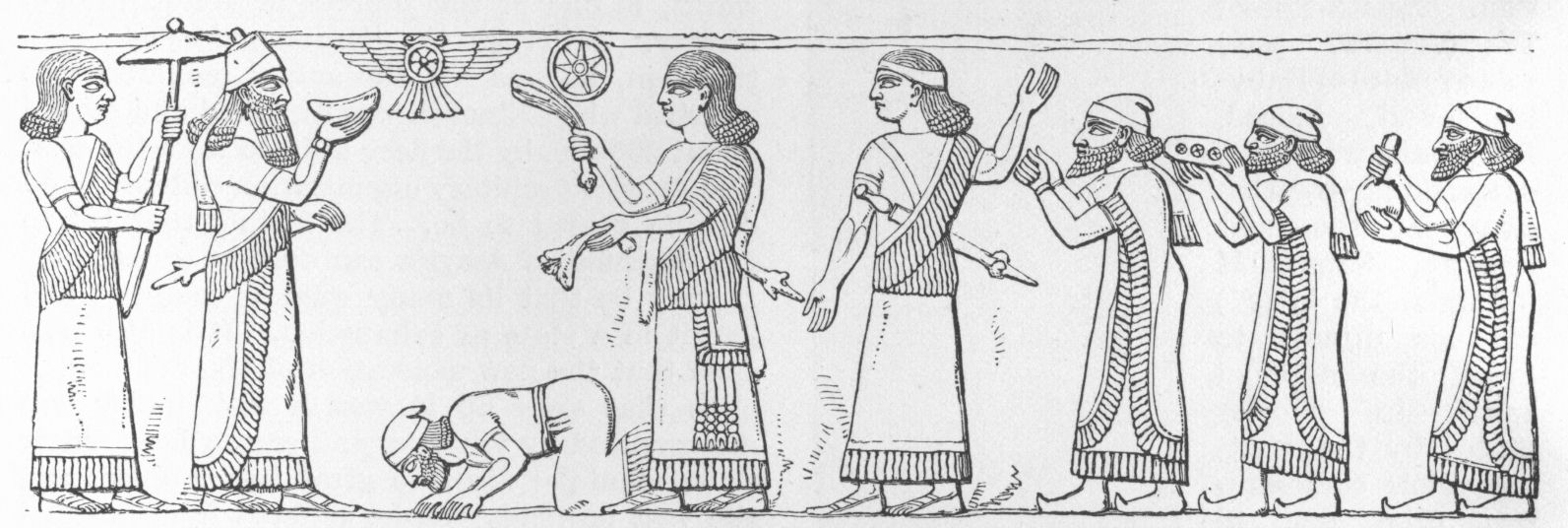
Babylonia and Assyria. These ancient seats of Mesopotamian civilization lay across the western Asian trade-routes, Babylonia being in the south and Assyria in the north. The area, in which they flourished is embraced by the Rivers Tigris and Euphrates, and extends from the head of the Persian Gulf to the frontiers of Armenia and Northern Syria, is bordered on the east by Persia and on the west by the Syro-Arabian desert. 'Mesopotamia' is a term borrowed by the ancient Greeks from the Semites, and was first applied to the north-western region. There was a Roman province of that name. The northern area of the Tigro-Euphrates valley is partly mountainous and partly steppe land, with wide stretches of elevated grazing-lands and fertile districts on the banks of rivers. Assyria, derived from A-usar ('the river-bank region'), had origin in north-eastern Mesopotamia. Its most ancient capital, Asshur (modern Kal'at Sherkat), was situated on the western bank of the River Tigris, between the tributaries the Upper Zab and the Lower Zab. Nineveh, the last capital of all, lay farther north on the eastern bank of the Tigris, and right opposite modern Mosul. The Assyrians called themselves Asshurai, and their national god was Ashur (earlier Ashir), written A-Shur, but confused in time with Ash-Shur, the name of the capital. The southern area of Mesopotamia, below Bagdad, where the Tigris and Euphrates come within 35 miles of one another, is a flat alluvial plain. Babylonia proper is that fish-shaped region between the rivers, which broadens out to about 100 miles and gradually narrows to the point at Kurnah where the rivers meet and form the Shatt-el-Arab. From Kurnah to the head of the Persian Gulf is the ancient area of Chaldea, which means 'Sea-land'. The inhabitants called themselves Kaldu (Sea-landers) and were known to the Hebrews as the Kasdim, and to the Greeks as the Chaldaioi. Babylonia, and the rest of the alluvial plain, is the 'gift' of the rivers which rise in flood each year when the snow melts on the Armenian mountains. Both the Tigris and the Euphrates bring down enormous quantities of sediment—indeed five times as much as does the Egyptian Nile—and they have withal more destructive tendencies. The accumulating silt tends to divert the flow of the rivers in the south, and a process of land-making which began at the close of the Ice Age is still in progress, thrusting back the head of the Persian Gulf. At one time the Tigris and Euphrates entered the gulf by separate mouths, and Chaldea was then a narrow fringe of steppe land, plain, and marshes. The River Tigris is about 1146 miles long, and begins to rise early in March, reaching its height in May, and subsiding before the end of June. The Euphrates is a slower river, about 1780 miles in length. It begins to rise a fortnight later than the Tigris, is longer in flood, and does not reach its lowest level until September. As there is a drop of only 120 feet between Bagdad and the sea, a distance, as the crow flies, of about 300 miles, the ancient Babylonians did their utmost to conserve the water which came down in such abundance and was rapidly drained away, after doing much damage. Near Bagdad the Tigris is on a higher level than the Euphrates, and could be run into it through a canal; farther south the Euphrates, being on the higher level, could be run by canal into the Tigris. The ancient engineers cut these and other canals; indeed, they covered the whole valley with a network of them. To store the Euphrates water for the season of drought and great heat, they formed canals which carried the roaring flood into two depressions in the western desert between the modern towns of Kerbela and Rama˙di. These depressions are utilized for the British irrigation scheme. The Babylonians did their utmost to control the Tigris by erecting earthen dams so as to hold up as much of the water as possible. Earthen dykes were also erected to raise its banks. The right bank protected the farms from disastrous flooding. These ancient irrigation works made Babylonia the greatest grain-yielding area in the ancient world. Its vast surplus of food stimulated trade and brought Babylonia immense wealth, while its strategic situation made it very powerful. Its cultural influence flowed along the trade routes, eastward across Persia and the Iranian plateau, northward through Assyria to Armenia (ancient Urartu) and beyond, and north-westward along the Euphrates banks into Syria and Palestine, and into Asia Minor, the land of the Hittites, and then along the highway to Europe, called later by the Persians 'the royal road'. The road to Egypt ran southward from North Syria through Palestine, skirting the maritime valley by 'the way of the Philistines'. The merchants of many nations met in the city of Babylon, the London of the ancient western Asian world, and in the trading centres of North Syria, including Carchemish.
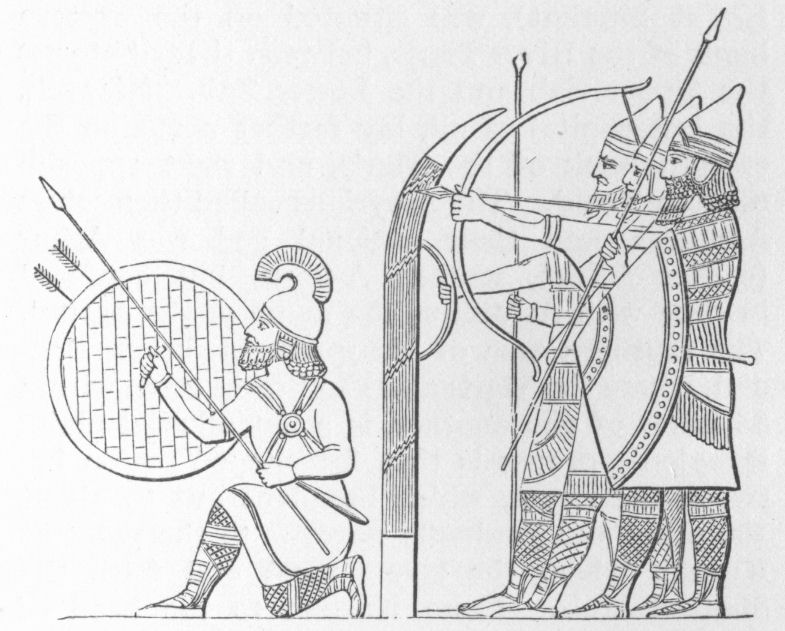
Assyrian Soldiers
The earliest agriculturists and traders of Babylonia were the Sumerians, a non-Semitic people, who built a number of cities in the irrigated valley and founded colonies in Assyria. No trace has been found of a Neolithic Age in Babylonia. Its civilization, so far as our knowledge goes, began after copper was introduced. At an early period Semites filtered into the valley. They absorbed Sumerian civilization, and ultimately became politically predominant in the northern part of the valley, which was called Akkad (the biblical Accad). The southern part was then known as Sumer or Sumeria (the biblical 'Plain of Shinar'). Akkad embraced the city States of Agade, Babylon, Borsippa, Sippar, Kish, Opis, and Kutha. The Sumerian city States included Eridu, Ur (later 'of the Chaldees' and the birthplace of Abraham), Lagash, Shuruppak, Erech, Umma, and Adab. Inter-state wars resulted time and again in the formation of confederacies which were more of political than racial character, and the predominance of one city or another. Religious ideas were fused, and local pantheons appear to have reflected local politics. The chief seat of early Sumerian civilization was the city of Eridu, a name signifying 'on the seashore'. Its site is marked by modern Abu-Shahrein on the eastern bank of the Euphrates, and south-east of Ur, modern Mukayyar. Eridu was originally a seaport on the Persian Gulf, from which it is now separated by about 125 miles of land formed by river silt. The chief god of Eridu was Ea, a name also rendered Ae and Aa, and apparently meaning 'waters' or 'house (region) of waters'. That the term 'waters' had a special significance for the inhabitants of a water-formed land is evident by the fact that the Semitic equivalent of Ea is Enki, which means 'lord of earth'. Other titles of the god were 'lord of Heaven and Earth', 'ruler of the land', 'the deep', 'god of the abyss', and 'king of the river'. He was withal the 'Creator', water having created Sumeria, and Nadimmud, 'lord of everything', as the Egyptian Osiris in his character of god of the Nile was 'Neb-er-Zer', also 'lord of everything'. Ea had a ship with a crew including his son Marduk (Merodach or Marad, the Ni-marad or Nimrod of legend) and In-ab, 'the pilot of Eridu'. The ship was hailed, in religious literature, as the bringer of fertility and joy. Evidently the beginning of Sumerian civilization had some connection with ancient seafarers. Of special interest in this connection are the references made by the Greek writer Berosus to Oannes, a sea-dweller who came daily from the Persian Gulf to instruct the early Babylonians how to irrigate the land, grow crops, erect houses, make laws, write, calculate and measure, and engage in trade. Texts have been discovered which tend to identify Oannes with the god Ea. As the early Sumerians bore a strong physical resemblance to the ancient Egyptians, and there were links between the early religious beliefs and customs of the two peoples, it is suspected that they represented two branches of the same ancient stock. Some think Sumerian civilization was founded by colonists from Egypt, while others believe that Egyptian civilization was stimulated by settlers from Sumeria. The question as to who first invented ships has an important bearing in this connection. When we turn to Sumero-Babylonian religious myths we find that some reflect local natural phenomena. In one the Euphrates is hailed as the River (god) "who didst create all things". Another, referring to the creation of man, says that Marduk (earlier the god Gilimma) "tied reeds on the face of the waters, he formed dust and poured it out beside the reeds ... he formed mankind". Another version is that man was created from the god's blood and bone, or, as Berosus has it, from the god's blood and earth. The oldest Sumerian creation myth states that all things came from primeval water. Then many deities were created by the pre-existing triad of gods, Anu (the sky-god), Enlil ('the elder Bel', the earth-god, and 'lord of grain'), and Ea, who was associated with the goddess Ninkharsagga. Ea had several other wives, including Ninshar or Ninkurra, Ninella, Nintu, and Damkina. These goddesses were ultimately all absorbed by Ishtar, the Semitic name of the love and mother goddess. In the later Babylonian 'Seven Tablets' version of the creation myth a conflict is introduced. The female chaos-dragon Tiamat is slain by Marduk, the chief god of Babylon, 'the later Bel', who cuts up her body and uses part to form the sky and part to keep the waters in their place. After a time a deluge took place. In the Sumerian myth a priest-king called Ziusudu (earlier named Tatug or Uttu) corresponds both to Adam and to Noah, and builds a large vessel, having been warned by Ea of the approaching disaster. The Gilgamesh Epic refers to the hero as Ut-na-pishtim (or Pir-na-pishtim). He and his wife afterwards become immortal, and they are visited on their island by Gilgamesh (the Babylonian Hercules), when, smitten by disease, he searches for the Plant of Life, which he finds and afterwards loses. Ishtar, the goddess who plays a part in this epic, is also the heroine of the poetic legend which tells of her descent to Hades in quest of Tammuz, whose story resembles somewhat that of Adonis and has Osirian characteristics. The Babylonian Persephone was Eresh-ki-gal with whom Tammuz dwelt in her underworld for part of the year. Associated with her was Nergal, chief god of Kutha, whose planet was Mars. He conquered Hades. He and other city gods appear to have been developed from attributes vaguely shared by the earlier triad Anu, Bel-Enlil, and Ea. The moon-god of Ur was Sin (Sumerian Nannara), whose name clings to the desert of Sinai. Shamash was the Semitic name of the sun-god of Sippar, the Sumerian being Utu; Gishnu, the Light, and Ma-banda-anna, 'the boat of heaven' (like the Egyptian Ra), and Mitra were among his other non-Semitic names. Dagan, the god of the Euphrates, is regarded as a form of Ea, and as probably the same deity as Dagon of the Philistines. In later times the astrologers coloured with their doctrines the religious beliefs of Babylonia.
Among the early empire-builders of Babylonia were Lugal-zaggisi of Sumerian Erech, who claimed to have subdued all lands from the Lower Sea (Persian Gulf) to the Upper Sea (the Mediterranean). He flourished about 2800 B.C. Another was Sargon of Akkad, who lived about a century and a half later. He must not be confused with the much later biblical Sargon of Assyria. His son or grandson, Naram-Sin, recorded his great trading activities and victories over his enemies, including the Elamites, whose chief stronghold was Susa in south-western Persia. Elam was a rival power of considerable strength. About 2200 B.C. it had overrun a great part of Sumeria, and Akkad fell to the invading bands of Amorites. These Amorites founded the Hammurabi Dynasty, of which the king of that name was sixth in succession; Hammurabi extinguished the last sparks of Elamite power in Sumeria, which, with Akkad, was united to form the kingdom of Babylonia, named after Babylon, the capital. It was during this period that Abraham migrated from Ur to Palestine. Hammurabi (c. 2123-2081 B.C.) codified the ancient Sumerian laws and did much to develop trade. The chief god of his kingdom was Marduk, 'the later Bel', whose temple was called Esagilla. Babylon became the greatest trading centre in Western Asia and a rival of the Egyptian Memphis. Sumerian gradually ceased to be a spoken language, being supplanted by Semitic, but remained, like Latin, in mediæval Europe, the language of law, culture, and religion, while the Babylonian language became the language of trade and diplomacy, and was used in international correspondence by all the great Powers. The Hammurabi dynasty came to an end about 1926 B.C., when the Hittites raided Babylonia and carried off the statues of Marduk and his consort. Kassites, assisted by Elamites, had been attacking Babylonia from the east, and the Sea-landers, who were Arabians mixed with Sumerians, established their independence. In the end the Kassites, who were probably Aryan by race, conquered Babylonia and established a new dynasty. Like the Trojans they were 'tamers of horses'. Their military successes are believed to have been due to the use of the horse, which was a rarity in Babylonia before their time, but became common as a beast of burden as soon as the Kassite dynasty was established. Kassite supremacy lasted for over 570 years, and during that period Babylonia was known as Karduniash. One of its early kings brought back from Khani (Mitanni) the statues of Marduk and his consort which had been carried off by the Hittites. Babylonian civilization was not changed by Kassite conquest, and its trade went on as of yore. The Kassites formed an aristocracy like the Normans in England. During the Kassite period Assyria was a growing power. It had origin as a Sumerian colony, but above the relics of the Sumerians at Asshur have been found those of a people whose kings had such non-Semitic and probably Aryan names as Ushpia, Kikia, and Adasi. The Amorites afterwards swept into Assyria, which they Semitized. During the Hammurabi dynasty it was subject to Babylonian overlordship. It grew independent during the latter period of the Kassite dynasty, and its kings formed compacts with the Kassites. Their western neighbours were by this time the Mitannians. An Aryan military aristocracy had formed a powerful State in north-western Mesopotamia, where they worshipped Indra, Varuna, and Mitra, gods which figure in the mythology of the Aryan invaders of India. Egypt, under Thothmes III, extended her Syrian empire to the borders of Mitannia and a friendship sprang up between the two Powers. Assyria was during the period subject to Mitanni. The Tell-el-Amarna letters reveal the fact that Egyptian monarchs had married princesses from Mitanni, and the famous Akhenaton had Mitannian blood in his veins.
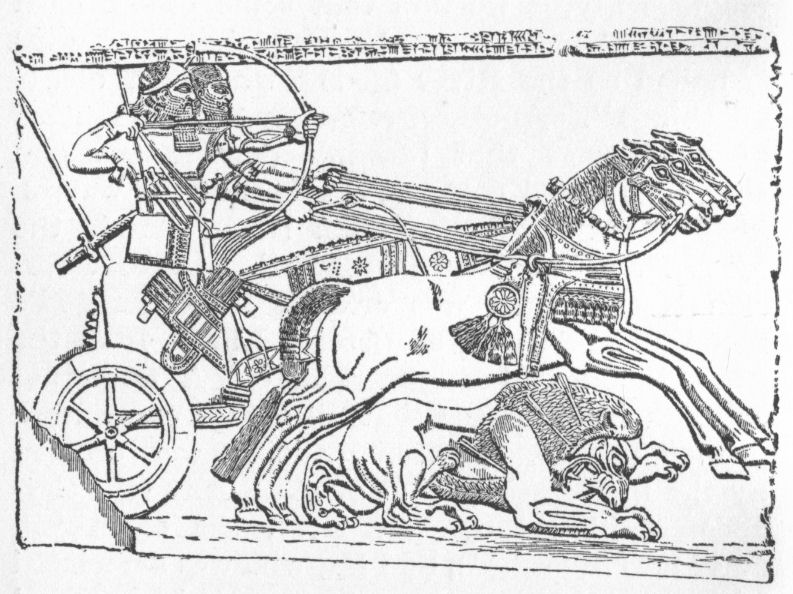
Ashur-natsir-pal in Chariot, hunting Lions about 884 B.C. From a relief in the Palace of Nimrod
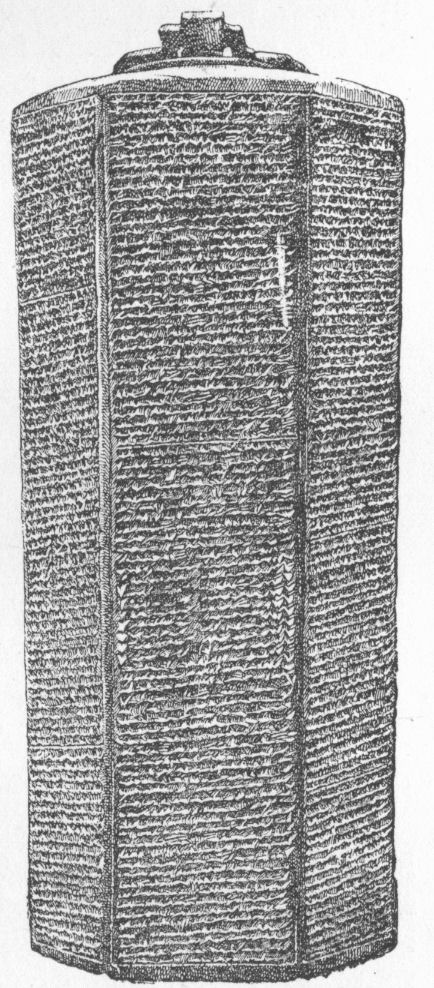
Tablet recording the Wars of Sennacherib
The Hittites conquered Northern Syria and overran Mitannia when the Egyptian Asian empire went to pieces. Assyria then became powerful and independent again, the first great king of its new age being Ashur-uballit, who was strong enough to interfere with Babylonia's domestic politics. Shalmaneser I of Assyria (c. 1300 B.C.) conquered the whole of the Mitanni kingdom and extended the Assyrian empire westward across the Babylonian caravan road to North Syria. He built a new capital at Kalah (Nimrud). His son, Tulkulti—Nineb I—(c. 1275 B.C.), conquered Babylonia and reigned over it for seven years. In the end he was murdered by political conspirators, with whom his son was associated. Civil war ensued, and Assyria's history is found to be obscure for a century afterwards. In Babylon the Kassite dynasty, under which trade flourished, came to an end as a result of an Elamite invasion about 1185 B.C. A new Babylonian dynasty then arose, and the third king, Nebuchadnezzar I, revived the old empire and waged war against Assyria. But the future lay with Assyria, which was organized as a military State. It did not have Babylonia's natural resources, and could only exist as a great Power by imposing tribute on weaker States. A standing army was the basis of its strength. The national god was Ashur, who was symbolized by a winged disk, an adaptation of the Egyptian winged disk of Horus. It was carried to battle with the king, so that wherever the king was, there was the national god of war. The heavily-bearded Assyrians were a fiercer and more war-like people than the mild shaven Babylonians, who were ever influenced by Sumerian modes of thought. The Assyrian temperament is reflected in its art, which at its best is characterized by vigorous realism and brilliant ferocity. Much of it is harsh, exaggerated, and pompous. A sharp contrast is presented by the calmer and more idealistic art of the Sumero-Babylonians. The records of Assyrian monarchs deal mainly with extensive conquests. They did their utmost to set up a reign of terror in Western Asia, and when subject States revolted the chief men in them were flayed alive or impaled on stakes. The wholesale destruction of trading city States and the massacres of thousands of innocents were fit subjects for an Assyrian conqueror to boast of in his inscriptions. Hittites, North Syrians, Babylonians, and Urartians (Armenians), were time and again plundered and subjected. A great conqueror of the Middle Period was Tiglath-Pileser I (c. 1100 B.C.), and other monarchs of the same name repeated his conquests and atrocities during the last century of Assyria's existence. The military glory of such a monarch as Ashur-natsir-pal III (885-860 B.C.), whose armies swept through western Asia like cyclones, has a lurid background of savage cruelty and oppression. He fought for no greater cause than plunder and the maintenance of Assyria's ability to wring tribute from the oppressed. His son, Shalmaneser III, extended the empire but died under a cloud of internal revolt. Subsequent rulers dominated Babylonia, and one, Adad-nirari IV (810-782 B.C.), married the Babylonian princess, Sammurammat, the Semiramis of tradition. Tiglath-Pileser IV (745-727 B.C.) was overlord of Babylon, and, indeed, Babylonia was more or less under Assyrian sway for the next century. Sargon II ('Sargon the later') did his utmost to break the national spirit in subject States by transporting whole communities from one to another. He removed a portion of the 'ten lost tribes' to the Median hills, and dispatched Babylonians from Kutha to Samaria, where they made Nergal their chief god. His campaigns extended to Phœnicia, Cilicia, and Armenia. Sennacherib, his son, defeated Egypt and her allies in Palestine and besieged Hezekiah in Jerusalem. A revolution in Babylonia broke out, and he swept into it and devastated Babylon, so that Nineveh might become the chief city in Mesopotamia. But Babylon had to be rebuilt by his son Esarhaddon, so that its dislocated trade might be restored. Esarhaddon, recognizing that the great commercial rival of Babylonia was Egypt, and that Egypt instigated the Palestinian and Syrian revolts against Assyria, invaded the Nile valley and captured and sacked Memphis. Ashur-bani-pal (668-626 B.C.), the next Assyrian emperor, punished the Egyptian rebels by sweeping southwards and capturing and sacking Thebes, which is referred to as No (Nu-Amon) in the Bible (Nahum, iii, 8-10): "Populous No ... Yet was she carried away ... her young children also were dashed in pieces at the top of all the streets: and they (the Assyrians) cast lots for her honourable men, and all her great men were bound in chains". Egypt became for a time an Assyrian province. Elam was similarly dealt with, the great capital Susa being treated like Thebes. On the north and east Assyrian power was established with characteristic Assyrian ferocity and thoroughness. The result was that the predatory nomadic tribes of Scythians and Medes were able to sweep through the devastated territories and strike at the very heart of the empire. Ashur-bani-pal was the last great monarch of Assyria. In private life he was cultured and scholarly, and his library, which contained copies of many ancient records and literary works, is one of the sources of Mesopotamian history. Although the Sardanapulus of Greek tradition, he was not the actual monarch who perished when Nineveh was captured and sacked about 606 B.C. by the fiery hillmen from the east. The Assyrian military organization collapsed and Assyria ceased to be. The factors that led to the downfall of Assyria can only be guessed at. It may be that its many wars of conquest had left it in a state of exhaustion. It is also possible that the new generation of the aristocratic class that grew up in wealth and luxury was disorganized by intrigues and corruption. After Ashur-bani-pal died, no great leader arose, and the vast unwieldy empire suffered from internal decay. Babylonia was the first to foster organized revolt. It was overrun by the Chaldeans from the south, who, two years after Ashur-bani-pal's death, set on the throne at Babylon their leader, King Nabopolassar. With him began the Neo-Babylonian dynasty which lasted for 86 years. He had an ambitious and capable son named Nebuchadnezzar, who set out, as soon as Nineveh fell, to seize the western portion of the Assyrian Empire—the Medes, with whom the Chaldeans had an agreement, being content to retain north-eastern Mesopotamia. The Egyptians, having overcome the Assyrian garrisons in the Nile valley, were by this time moving northward through Palestine with the idea of re-establishing their ancient empire in Asia. Memphis and Babylon were rival trading centres, and the struggle that ensued was one which was to decide which should have preeminence on the western Asian trade-routes, and especially the 'clearing-houses' of North Syria. In 604 B.C. Nebuchadnezzar met and defeated Pharaoh Necho's Egyptian army at Carchemish. The Egyptians retreated in confusion and were pursued to their frontier. Nabopolassar's death in Babylon caused Nebuchadnezzar to return home and ascend the throne. Eight years later, Israelites before Shalmaneser. From the Black Obelisk of Shalmaneser II. however, he was back in Palestine again. Judah had been plotting with Egypt, its ally, and the Babylonian monarch besieged and captured Jerusalem. Thousands of Jews were carried off as captives to Babylonia. In 587 B.C. Egypt involved Judah in a second revolt. Nebuchadnezzar II again captured Jerusalem. This time he destroyed the city and carried away the greater part of the remnant of the Jewish people to serve his artisans and agriculturists "by Babel's streams". Babylon was triumphant as a political and trading centre, and, during Nebuchadnezzar's long reign of 42 years, prospered greatly. Its products and its culture were carried far and wide, and Chaldean astrologers as well as merchants became known in Egypt and Greece. Babylonia was the birthplace of the science of astronomy, which developed from astrology. Nebuchadnezzar was a great builder. It is the ruins of his Babylon that have been excavated in our own day. Although Greek descriptions of the city have been found to be somewhat exaggerated, it was yet made very strong and impressive. The royal palace was rebuilt, and the Hanging Garden on its terraced platform became one of the seven wonders of the world. Trade flourished in the capital, and a harbour was built at the head of the Persian Gulf to promote sea traffic. In 539 B.C. Cyrus, the Persian conqueror, having defeated the Babylonian army, entered Babylon in state and was welcomed by the priests, Nabo-nidus, the last king of the Neo-Babylonian empire, having made them his enemies. The independence of Babylonia then came to an end, but the importance of its capital as a trading centre did not suffer sudden decline. When it was captured by Alexander the Great in 331 B.C. it had been much damaged in consequence of revolts against Persia. The Macedonian conqueror resolved to make it his capital, but his early death, and subsequent political developments, hastened its decay. The Greeks had removed the rocks that blocked the Tigris, which then could be navigated by vessels from the Persian Gulf. Seleucus built the new capital of Seleucia on the right bank of the Tigris, and the traders followed the officials to the new Babylon. In time Ctesiphon arose on the left bank, and after the fall of the Parthian empire it was the principal city of the province. The Moslem conquest of Mesopotamia in the seventh century of our era brought about the rise of Bagdad, a few miles to the north of Ctesiphon. It will be noted that all these cities are strategically situated in the neck of land, between the rivers, which is crossed by the caravan roads leading east and west. During the reign of the famous Harun al Rashid (786-809) Bagdad was at the height of its splendour. A portion of this ruler's great palace still remains, and the tomb of Zobiede, his queen, is a prominent feature on the outskirts of the city. Bagdad declined as a trading centre after Vasco da Gama discovered the sea-route to India, and diverted the merchandise previously carried to Europe across the overland routes across Persia and through Mesopotamia and Asia Minor. Bagdad afterwards depended chiefly on the traffic caused by pilgrim caravans to and from Mecca. The disastrous neglect of Babylonia's irrigation system occurred under Turkish rule. Towards the close of the nineteenth century Germany obtained concessions from the Turks and planned the Bagdad railway, so as to reopen the ancient overland trade-route for Indo-Persian trade. British interests in the Persian Gulf were seriously threatened by this scheme. When war broke out in 1914, a British force landed in ancient Chaldea and pushed northward. Bagdad, the modern Babylon, was captured in 1917, and Mosul (Nineveh) was occupied in 1918. The Peace Treaty between the Allied Powers and Turkey placed Mesopotamia under the protection of Great Britain, which thus secured control of the Bagdad railway. An extensive irrigation scheme in the southern alluvial valley promises to restore ancient Babylonia to its importance as one of the great grain-yielding areas of the world.—Bibliography: R. W. Rogers, History of Babylonia and Assyria; H. Winckler, History of Babylonia and Assyria; L. W. King and H. R. H. Hall, Egypt and Western Asia in the Light of recent Discoveries; P. S. P. Handcock, The Latest Light on Bible Lands; L. W. King, History of Babylon; D. A. Mackenzie, Myths of Babylonia and Assyria; T. G. Pinches, The Religion of Babylon and Assyria; The Old Testament in the Light of the Records of Assyria and Babylonia; A. H. Sayce, Religions of Ancient Egypt and Babylonia; M. Jastrow, Aspects of Religious Belief and Practice in Babylonia and Assyria; R. Koldeweg, The Excavations of Babylon.
Babyroussa (bab-i-ru¨s´a; a Malay word signifying stag-hog), a species of wild hog (Sus or Porcus Babyrussa), a native of the Indian Archipelago. From the outside of the upper jaw spring two teeth 12 inches long, curving upwards and backwards like horns, and almost touching the forehead. The tusks of the lower jaw also appear externally, though they are not so long as those of the upper jaw. Along the back are some weak bristles, and on the rest of the body only a sort of wool. These animals live in herds, feed on herbage, are sometimes tamed, and their flesh is well flavoured.
Bac´carat, a gambling card game of French origin, played by any number of players, or rather betters, and a banker. The latter deals two cards to each player and two to himself, and covers the stakes of each with an equal sum. The cards are then examined, and according to the scores made the players take their own stake and the banker's, or the latter takes all or a certain number of the stakes.
Baccarat (ba˙k-a˙-rä), a town of France, about 15 miles south-east of Lunéville, department Meurthe-et-Moselle, on the River Meurthe, with a handsome new church, and one of the largest works for plate-glass and crystal in France. Pop. 7277.
Bacchana´lia, or Dionysia, feasts in honour of Bacchus or Dionysus, characterized by licentiousness and revelry, and celebrated in ancient Athens. In the processions were bands of Bacchantes of both sexes, who, inspired by real or feigned intoxication, wandered about rioting and dancing. They were clothed in fawn-skins, crowned with ivy, and bore in their hands thyrsi, that is spears entwined with ivy, or having a pine-cone stuck on the point. These feasts passed from the Greeks to the Romans, who celebrated them with still greater dissoluteness till the Senate abolished them, 187 B.C.
Bacchante (bak-an´te), a person taking part in revels in honour of Bacchus. See Bacchanalia.
Bacchiglione (ba˙k-kil´yō-nā), a river of Northern Italy, rises in the Alps, passes through the towns of Vicenza and Padua, and enters the Adriatic near Chioggia, after a course of about 90 miles.
Bacchus (bak´us; in Greek, generally Dionўsus), the god of wine, son of Zeus (Jupiter) and Sĕmĕlē. He first taught the cultivation of the vine and the preparation of wine. To spread the knowledge of his invention he travelled over various countries and received in every quarter divine honours. Drawn by lions (some say panthers, tigers, or lynxes), he began his march, which resembled a triumphal procession. Those who opposed him were severely punished, but on those who received him hospitably he bestowed rewards. His love was shared by several; but Ariadne, whom he found deserted upon Naxos, alone was elevated to the dignity of a wife, and became a sharer of his immortality. In art he is represented with the round, soft, and graceful form of a maiden rather than with that of a young man. His long waving hair is knitted behind in a knot, and wreathed with sprigs of ivy and vine leaves. He is usually naked; sometimes he has a loose mantle hung negligently round his shoulders; sometimes a fawn-skin hangs across his breast. He is often accompanied by Silenus, Bacchantes, Satyrs, &c. See Bacchanalia.—Bibliography: Farnell, Cults of the Greek States; J. E. Harrison, Prolegomena to the Study of Greek Religion; Sir J. G. Frazer, The Golden Bough.
Bacchylides (bak-kil'i-dēz), born in the Island of Cos, about the middle of the fifth century B.C., the last of the great lyric poets of Greece, a nephew of Simonides and a contemporary of Pindar. The extant remains of his odes, hymns, pæans, &c., were augmented in 1897 by papyrus discoveries.
Bacciocchi (ba˙t-chok´ē), Maria Anne Eliza Bonaparte, sister of Napoleon, born at Ajaccio, 1777, died near Trieste, 1820; a great patroness of literature and art. She married Captain Bacciocchi, who in 1805 was created Prince of Lucca and Piombino. She virtually ruled these principalities herself, and as Grand-Duchess of Tuscany she enacted the part of a queen. She fell with the Empire.
Baccio Delia Porta (ba˙ch´ō). See Bartolommeo.
Bach (bah), Johann Sebastian, one of the greatest of German musicians, born in 1685 at Eisenach, died in 1750 at Leipzig. Being the son of a musician he was early trained in the art, and soon distinguished himself. In 1703 he was engaged as a player at the Court of Weimar, and subsequently he was musical director to the Duke of Anhalt-Köthen, and afterwards held an appointment at Leipzig. He paid a visit to Potsdam on the invitation of Frederick the Great. As a player on the harpsichord and organ he had no equal among his contemporaries; but it was not till a century after his death that his greatness as a composer was fully recognized. His compositions, many of which are pieces of sacred music, show great originality. They include pieces, vocal and instrumental, for the organ, piano, stringed and keyed instruments; church cantatas, oratorios, masses, passion music, &c. More than fifty musical performers have proceeded from this family. Sebastian himself had eleven sons, all distinguished as musicians. The most renowned were the following:—Wilhelm Friedemann, born in 1710 at Weimar, died at Berlin in 1784. He was one of the most scientific harmonists and most skilful organists.—Karl Philipp Emmanuel, born in 1714 at Weimar, died in 1788 at Hamburg. He composed mostly for the piano, and published melodies for Gellert's hymns; he also wrote The True Manner of Playing the Harpsichord.—Johann Christoph Friedrich, born at Weimar, 1732, died in 1795, a great organist, is known also by the music he published.—Johann Christian, born in 1735 at Leipzig, died in London, 1782, was a favourite composer and conductor with the English public.—Bibliography: P. Spitta, Johann Sebastian Bach; A. Pirro, L'Esthétique de Jean Sebastian Bach.
Bacharach (ba˙h´a˙-ra˙h), a small place of 2000 inhabitants on the Rhine, 12 miles S. of Coblenz. The vicinity produces excellent wine, which was once highly esteemed. The view from the ruins of the castle is one of the sublimest on the Rhine.
Bach´elor, a term applied anciently to a person in the first or probationary stage of knighthood who had not yet raised his standard in the field. It also denotes a person who has taken the first degree in the liberal arts and sciences, or in divinity, law, or medicine, at a college or university; or a man of any age who has not been married.—A knight bachelor is one who has been raised to the dignity of a knight without being made a member of any of the orders of chivalry such as the Garter, the Thistle, or the Bath.
Bachelor's Buttons, the double-flowering buttercup (Ranunculus acris), with white or yellow blossoms, common in gardens.
Bachian (ba˙ch´a˙n), one of the Molucca Islands, immediately S. of the equator, S.W. of Gilolo; area, 800 sq. miles. It is ruled by a native sultan under the Dutch.
Bachmut (ba˙h-möt'), a town in the Ukraine, government of Ekaterinoslav, with a trade in cattle, tallow, &c., and coal and rock-salt mines. Pop. 20,000.
Bacilla´ria, a genus of microscopic algæ, belonging to the class Diatomaceæ, the siliceous remains of which abound in cretaceous, tertiary, and more recent geological deposits.
Bacil´lus. See Bacteria.
Back, Admiral Sir George, eminent English Arctic discoverer, born 1796, died 1878. He accompanied Franklin and Richardson in their northern expeditions, and in 1833-4 headed an expedition to the Arctic Ocean through the Hudson Bay Company's territory, on which occasion he wintered at the Great Slave Lake, and discovered the Back or Great Fish River.
Backergunge. See Bakarganj.
Backgam´mon, a game played by two persons upon a table or board made for the purpose, with pieces or men, dice-boxes, and dice. The table is in two parts, on which are twenty-four black and white spaces called points. Each player has fifteen men of different colours for the purpose of distinction. The movements of the men are made in accordance with the numbers turned up by the dice.
Backhaus, Wilhelm, one of the greatest living pianists, born at Leipzig in 1884. At the age of twenty-one he was appointed a professor at the Royal College of Music, Manchester. This position, however, he soon gave up, and since 1905 has devoted his time to concert tours.
Backhuysen (ba˙k´hoi-zn), Ludolf, a painter of the Dutch school, particularly celebrated for sea pieces, born in 1631, died 1709. His most famous picture is a sea piece which the burgomasters of Amsterdam commissioned him to paint as a present to Louis XVI. It is still at Paris.
Backwarda´tion, a stock exchange term signifying the rate paid by a speculative seller of stock for the privilege of carrying over or continuing a bargain from one fortnightly account to another, instead of closing it on the appointed day.
Bacninh, a town of Tongking, on the Red River, fortified and containing a French garrison, being in an important strategic position. Pop. 7000.
Ba´con, Anthony, elder brother of the celebrated Lord Chancellor, was born in 1558 and died in 1601. He was a skilful politician, and much devoted to learned pursuits. He became personally acquainted with most of the foreign literati of the day, and gained the friendship of Henri IV of France. Francis Bacon dedicated to him the first edition of the Essays.
Bacon, Francis, Baron Verulam, Viscount St. Albans, and Lord High Chancellor of England, was born at London in 1561, died at Highgate in 1626. His father, Nicholas Bacon, was Keeper of the Great Seal under Queen Elizabeth. He was educated at Trinity College, Cambridge, and in 1575 was admitted to Gray's Inn. From 1576 to 1579 he was at Paris with Sir Amyas Paulet, the English ambassador. The death of his father called him back to England, and being left in straitened circumstances he zealously pursued the study of law, and was admitted a barrister in 1582. In 1584 he became member of Parliament for Melcombe Regis, and soon after drew up a Letter of Advice to Queen Elizabeth, an able political memoir. In 1586 he was member for Taunton, in 1589 for Liverpool. A year or two after he gained the Earl of Essex as a friend and patron. Bacon's talents and his connection with the Lord-Treasurer Burleigh, who had married his mother's sister, and his son, Sir Robert Cecil, First Secretary of State, seemed to promise him the highest promotion; but he had displeased the queen, and when he applied for the attorney-generalship, and next for the solicitor-generalship (1595), he was unsuccessful. Essex endeavoured to indemnify him by the donation of an estate in land. Bacon, however, forgot his obligations to his benefactor, and not only abandoned him as soon as he had fallen into disgrace, but without being obliged took part against him on his trial, in 1601, and was active in obtaining his conviction. He had been chosen member for the county of Middlesex in 1593, and for Southampton in 1597, and had long been a Queen's Counsel. The reign of James I was more favourable to his interest. He was assiduous in courting the king's favour, and James, who was ambitious of being considered a patron of letters, conferred upon him in 1603 the honour of knighthood. In 1604 he was appointed King's Counsel, with a pension of £60; in 1606 he married; in 1607 he became Solicitor-General, and six years after Attorney-General. Between James and his Parliament he was anxious to produce harmony, but his efforts were without avail, and his obsequiousness and servility gained him enmity and discredit. In 1617 he was made Lord-Keeper of the Seal; in 1618 Lord High Chancellor of England and Baron Verulam. In this year he lent his influence to bring a verdict of guilty against Raleigh. In 1621 he was made Viscount St. Albans. Soon after this his reputation received a fatal blow. A new Parliament was formed in 1621, and the Lord Chancellor was accused before the House of bribery, corruption, and other malpractices. It is difficult to ascertain the full extent of his guilt; but he seems to have been unable to justify himself, and handed in a 'confession and humble submission', throwing himself on the mercy of the Peers. He was condemned to pay a fine of £40,000, to be committed to the Tower during the pleasure of the king, declared incompetent to hold any office of State, and banished from Court for ever. The sentence, however, was never carried out. The fine was remitted almost as soon as imposed, and he was imprisoned for only a few days. He survived his fall a few years, during this time occupying himself with his literary and scientific works, and vainly hoping for political employment. In 1597 he published his celebrated Essays, which immediately became very popular, were successively enlarged and extended, and translated into Latin, French, and Italian. The treatise on the Advancement of Learning appeared in 1605; The Wisdom of the Ancients in 1609 (in Latin); his great philosophical work, the Novum Organum (in Latin), in 1620; and the De Augmentis Scientiarum, a much enlarged edition (in Latin) of the Advancement, in 1623. His New Atlantis was written about 1614-7; Life of Henry VII about 1621. Various minor productions also proceeded from his pen. Numerous editions of his works have been published, by far the best being that of Messrs. Spedding, Ellis, and Heath, 1857-9 (reprinted, 1879-90). Bacon was great as a moralist, a historian, a writer on politics, and a rhetorician; but it is as the father of the inductive method in science, as the powerful exponent of the principle that facts must be observed and collected before theorizing, that he occupies the grand position he holds among the world's great ones. His moral character, however, was not on a level with his intellectual, self-aggrandizement being the main aim of his life. We need do no more than allude to the preposterous attempt that has been made to prove that Bacon was the real author of the plays attributed to Shakespeare, an attempt that only ignorance of Bacon and Shakespeare could uphold and tolerate.—Bibliography: J. Spedding, Life and Letters of Francis Bacon; R. W. Church, Bacon (in English Men of Letters Series); Sir Sidney Lee, Great Englishmen of the Sixteenth Century; J. M. Robertson, Short History of Free-thought.
Bacon, John, English sculptor, born 1740, died 1799. Among his chief works are two groups for the interior of the Royal Academy; the statue of Judge Blackstone for All Souls College, Oxford; another of Henry VI for Eton College; the monument of Lord Chatham in Westminster Abbey; and the statues of Dr. Johnson and Mr. Howard in St. Paul's Cathedral.
Bacon, Sir Nicholas, father of Francis Bacon, Lord-Keeper of the Great Seal, born 1510, died 1579. Henry VIII gave him several lucrative offices, which he retained under Edward VI. He lived in retirement during the reign of Mary, but Queen Elizabeth appointed him Lord-Keeper for life. He was the intimate friend of Lord Burleigh, a sister of whose wife he married, and by her became the father of the great Chancellor.
Bacon, Roger, an English monk, and one of the most profound and original thinkers of his day, was born about 1214, near Ilchester, Somersetshire, died at Oxford in 1294. He first entered the University of Oxford, and went afterwards to that of Paris, where he is said to have distinguished himself and received the degree of Doctor of Theology. About 1250 he returned to England, entered the order of Franciscans and fixed his abode at Oxford; but having incurred the suspicion of his ecclesiastical superiors, he was sent to Paris and kept in confinement for ten years, without writing-materials, books, or instruments. The cause seems to have been simple enough. He had been a diligent student of the chemical, physical, and mathematical sciences, and had made discoveries, and deduced results, which appeared so extraordinary to the ignorant that they were believed to be works of magic. This opinion was countenanced by the jealousy and hatred of the monks of his fraternity. In subsequent times he was popularly classed among those who had been in league with Satan. Having been set at liberty, he enjoyed a brief space of quiet while Clement IV was Pope; but in 1278 he was again thrown into prison, where he remained for at least ten years. Of the close of his life little is known. His most important work is his Opus Majus, where he discusses the relation of philosophy to religion, and then treats of language, metaphysics, optics, and experimental science. He was undoubtedly the earliest philosophical experimentalist in Britain; he made signal advances in optics; was an excellent chemist; and in all probability discovered gunpowder. He was intimately acquainted with geography and astronomy, as appears by his discovery of the errors of the calendar, and their causes, and by his proposals for correcting them, in which he approached very nearly to truth.—Cf. E. Charles, Roger Bacon, sa vie, ses ouvrages, ses doctrines.
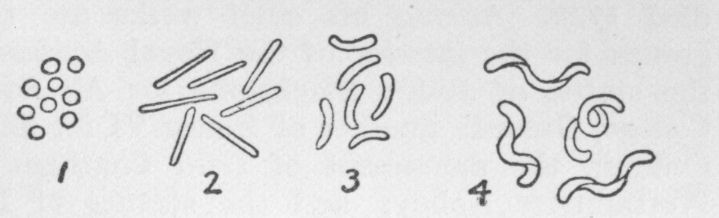
Bacteria—Forms of cells
1. Coccus. 2. Bacillus. 3. Spirillum (vibrio). 4. Spirillum (spirochæte).
Bacte´ria (Gr. baktērion, a rod), a general term applied to the lowest visible forms of life; other names given are germs or microbes. They are divided into three classes: (1) cocci—these are minute spheres about one twenty-five thousandth of an inch in diameter, arranged in chains or clusters; (2) bacilli—these are straight rods about the breadth of a coccus and two to four times as long; (3) spirilla—here there are two forms; one is like a bacillus, but curved (spirillum proper or vibrio); the other is a very fine spiral thread (spirochaete) often only half the thickness of a vibrio and two to six times as long. Bacteria consist of protoplasm surrounded by a membrane, and many show active movements; they all multiply asexually by splitting, and so rapidly may the process occur that 17,000,000 organisms or more may be formed from one bacterium in twenty-four hours. The chief part played by bacteria in nature is to cause putrefaction. They are found on all organic matter, and are therefore omnipresent. When grown artificially (see Bacteriology) they usually require organic matter for their food, and this they split up into simpler chemical compounds, some of which are very poisonous to animals (toxins); they can also split up sugars to produce various alcohols, acids, and gases. When certain of the bacilli are starved, the living matter gathers itself up into a spore surrounded by a very resisting membrane, and it can survive for a long time in this condition. All ordinary bacteria, including most of those which produce disease, can be killed by a few minutes' boiling, but the sporing varieties (e.g. many putrefactive forms) withstand much longer boiling—up to one and a half hours; they can also be killed by chemical means (see Disinfection). Many bacteria are useful to man, and a few give rise to disease (see Germ Theory).
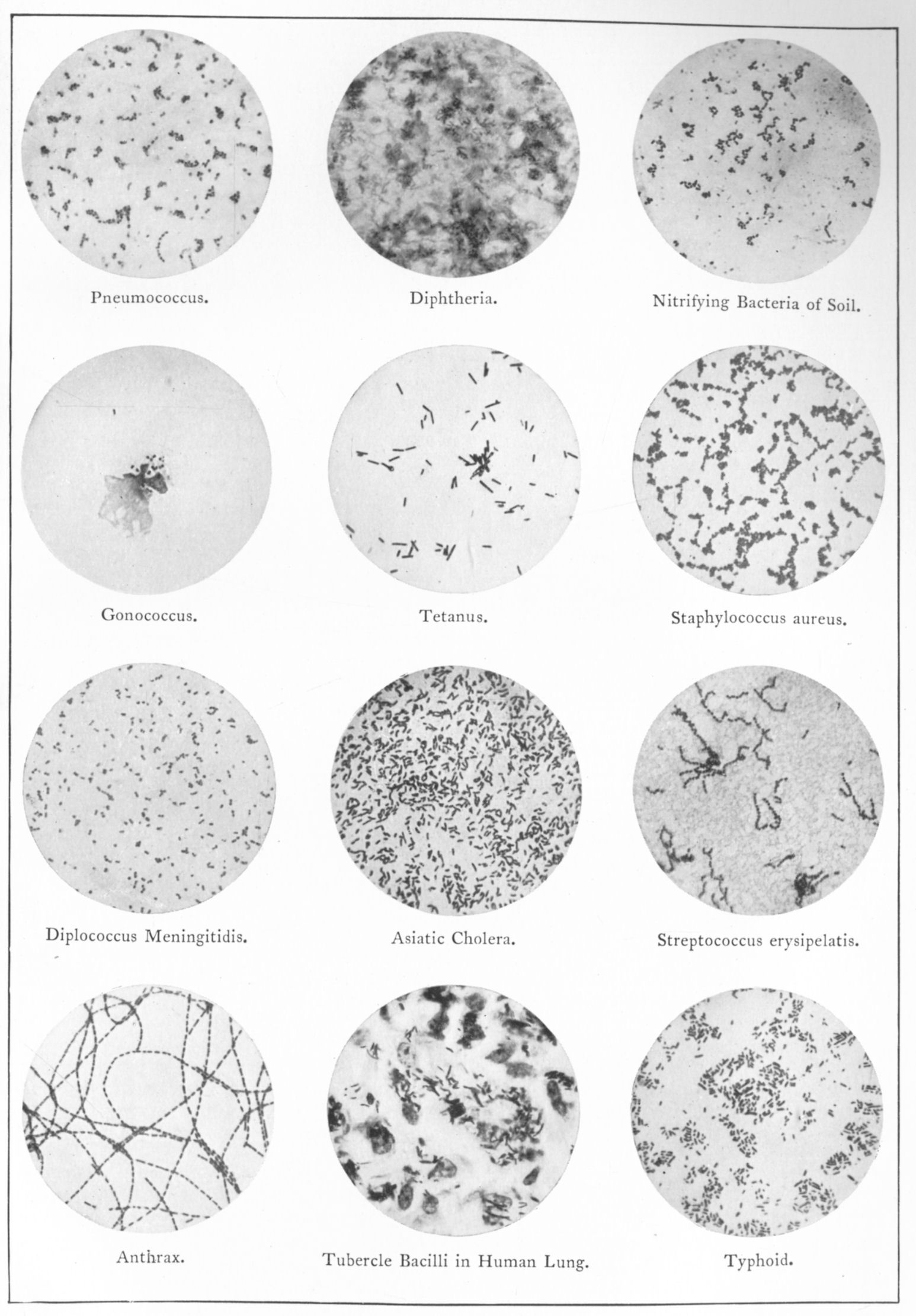
BACTERIA
All the above are magnified 560 times.
Bacteriology, the branch of science which deals with the structure and properties of bacteria. Though the existence of bacteria had been known from the time when Leeuwenhock arranged lenses so as to form a microscope, it was through the work of Pasteur that modern knowledge regarding the group originated. Pasteur's discovery that yeasts are the cause of the formation of alcohol from sugar was followed by his showing that bacteria are responsible for other processes of a similar character, e.g. the formation of vinegar from alcohol, the occurrence of the rancid change in butter, &c. When he went on to prove that a bacterium was the cause of a disease of silkworms, a stimulus was given to the germ theory of infection, and bacteriology was thus early brought intimately into contact with medical science. Another stimulus to bacteriological inquiry came from the controversy on spontaneous generation, and Pasteur was one of those who helped to establish the principle that the new development of living things, as represented by bacteria, out of non-living matter does not take place. This led to the inevitable deduction that all putrefactive processes are due to bacteria. On this Lister founded his antiseptic treatment of wounds, the practical effects of which focused attention on the important part played by bacteria in human affairs. The modern science of bacteriology really dates from 1877, when Koch proved that Bacillus anthracis is the cause of anthrax in cattle. The outstanding feature of Koch's research was that in it, for the first time, methods were employed whereby all extraneous organisms were excluded from the inquiry, and the way was thus opened up for the study of the properties and effects of one species of bacterium acting by itself. The chief aspects of his work were as follows: (1) the determination of the temperatures at which bacteria are killed; the knowledge of this enables investigators to render free from living organisms their apparatus and the food materials (usually called media) necessary to support bacterial life (this is called sterilization); (2) the discovery that the insertion of a plug of cotton-wool in the neck of a vessel (e.g. a flask or test-tube) before its sterilization constitutes a sufficient filter, which prevents bacteria in the outside air gaining access to its interior or to any food medium placed in it for sterilization; (3) the elaboration of a series of media capable of acting as food for all the commonly occurring bacteria; (4) the introduction of a simple method of separating from one another bacterial species which in nature are often growing side by side. This is effected by making media containing a jelly (e.g. gelatine) which melts at a relatively low temperature. The bacterial mixture is well diluted in the melted medium, and this is poured out in a thin layer on a sterile glass plate and allowed to set. Each individual bacterial cell can thus multiply apart from neighbouring cells, and, it may be, in a few hours the resulting growth (a 'colony') is visible to the naked eye. A minute part of the colony is picked off with a heated needle and placed on a mass of sterile medium. In this way a 'pure culture' of each species present in the original mixture can be obtained. Koch's work was chiefly concerned with disease bacteria, and between 1880 and 1895 many such organisms were isolated in pure culture and their properties investigated (see Germ Theory of Disease).
While in the evolution of knowledge the progress of bacteriology has been most associated with that of medicine and surgery, the science has fundamental relations with many other human interests, and the same methods are used in investigating such relationships. The adaptation of these methods on a commercial scale underlies all industrial processes concerned in the preserving of milk and in the canning and bottling of meat and fruit (apart from the addition of chemical preservatives). Since bacteriology came into existence, many of the most primitive domestic procedures have been improved and placed on a scientific basis. Thus, butter-making involves a previous souring of the milk; this is due to bacterial action, and standard mixtures of milk-souring bacteria are now regularly supplied by the laboratory as 'starters' of the process. It is recognized that the disorders of milk, e.g. 'ropiness', 'blue milk', &c., are due to certain 'wild' bacteria gaining access to the dairy. The ripening of such cheeses as Gorgonzola and Stilton is due to bacteria and allied organisms, and here again light has been shed on the 'diseases' of cheese by bacteriological investigation. The pickling of foods by salt, or vinegar, or nitre, is due to the action of these substances as antiseptics, and a similar principle, aided by boiling, underlies the making of jams. Again, certain kinds of bacteria which only flourish at high temperatures are responsible for the heating of hay and corn stacks, and for the production of ensilage. Bacteriology is also throwing important light on factors concerned in the fertility of soils. For example, it has been shown that the little nodules on the roots of plants of the pea tribe are caused by bacteria; these, in growing, take up nitrogen from the air, and form compounds which promote the growth of the plant on which they are parasites and remain to enrich the soil when the plant dies. In short, there is no industry, which depends on natural putrefaction being prevented or modified so as to stop at a particular stage, which bacteriology cannot guide towards securing the most perfect results.—Bibliography: Fischer, The Structure and Functions of Bacteria; Abbot, Principles of Bacteriology; Muir and Ritchie, Manual of Bacteriology; E. R. Stitt, Practical Bacteriology; P. H. Hiss and H. Zinsser, A Textbook of Bacteriology.
Bactria´na, or Bactria, a country of ancient Asia, south of the Oxus and reaching to the west of the Hindu Kush. It is often regarded as the original home of the Indo-European races. A Græco-Bactrian kingdom flourished about the third century B.C., but its history is obscure.
Baculi´tes, a fossil genus allied to the ammonites, characteristic of cretaceous strata, having a straight tapering shell. See Cephalopoda.
Ba´cup, a municipal borough of England, in Lancashire, 18 miles N. of Manchester. The chief manufacturing establishments are connected with cotton-spinning and power-loom weaving; there are also ironworks, Turkey-red dyeing-works, and in the neighbourhood numerous coal-pits and immense stone-quarries. Pop. (1921), 21,256.
Badagry, seaport in the British province of Southern Nigeria, West Africa, 50 miles E.N.E. of Whydah. Pop. about 10,000.
Badajoz (ba˙-da˙-hōth´; ancient, Pax Augusta), the fortified capital of the Spanish province of Badajoz, on the left bank of the Guadiana, which is crossed by a stone bridge of twenty-eight arches. It is a bishop's see, and has an interesting cathedral. During the Peninsular War Badajoz was besieged by Marshal Soult, and taken in March, 1811. It was twice attacked by the English, on 5th and 29th May, 1811, and was besieged by Wellington on 16th March, and taken 6th April, 1812. Pop. 37,600.—The province of Badajoz has an area of 8451 sq. miles. Pop. 644,220.
Badakshan´, a territory of Central Asia, tributary to the Ameer of Afghanistan. It has the Oxus on the north, and the Hindu Kush on the south, and has lofty mountains and fertile valleys; the chief town is Faizabad. The inhabitants profess Mahommedanism. Pop. 20,957.
Badalona (bä-da˙-lō´na), a Mediterranean seaport of Spain, 5 miles from Barcelona. Pop. 19,240.
Baden (bä´dėn), formerly a Grand-Duchy and one of the more important States of the German Empire, situated in the S.W. of Germany, to the west of Württemberg. It is divided into four districts, Constance, Freiburg, Karlsruhe, and Mannheim. It has an area of 5819 sq. miles, and a pop. of 2,142,833. It is mountainous, being traversed to a considerable extent by the lofty plateau of the Schwarzwald or Black Forest, which attains its highest point in the Feldberg (4904 feet). The nucleus of this plateau consists of gneiss and granite. In the north it sinks down towards the Odenwald, which is, however, of different geological structure, being composed for the most part of red sandstone. The whole of Baden, except a small portion in the S.E., in which the Danube takes its rise, belongs to the basin of the Rhine, which bounds it on the south and west. Numerous tributaries of the Rhine intersect it, the chief being the Neckar. Lakes are numerous, and include a considerable part of the Lake of Constance. The climate varies much. The hilly parts, especially in the east, are cold and have a long winter, while the valley of the Rhine enjoys the finest climate of Germany. The principal minerals worked are coal, salt, iron, zinc, and nickel. The number of mineral springs is remarkably great, and of these not a few are of great celebrity. The vegetation is peculiarly rich, and there are magnificent forests. The cereals comprise wheat, oats, barley, and rye. Potatoes, hemp, tobacco, wine, and sugar-beet are largely produced. Several of the wines, both white and red, rank in the first class. Baden has long been famous for its fruits also. Of the total area 55.4 per cent is under cultivation, 39.4 per cent under forest, and 5.2 per cent uncultivated (houses, roads, water, &c.). The farms are mostly quite small. The manufactures are important. Among them are textiles, tobacco and cigars, chemicals, machinery, pottery ware, jewellery (especially at Pforzheim), wooden clocks, confined chiefly to the districts of the Black Forest, musical boxes and other musical toys. The capital is Karlsruhe, about 5 miles from the Rhine; the other chief towns are Mannheim, Freiburg-im-Breisgau (with a Roman Catholic university), Baden, and Heidelberg. Baden has warm mineral springs, which were known and used in the time of the Romans. Heidelberg has a university (Protestant), founded in 1386, the oldest in Germany. The railways have a length of 1200 miles, and are all State property. In the time of the Roman Empire southern Baden belonged to the Roman province of Rhætia. Under the old German Empire it was a margraviate, which in 1533 was divided into Baden-Baden and Baden-Durlach, but reunited in 1771. The title of grand-duke was conferred by Napoleon in 1806, and in the same year Baden was extended to its present limits. Until 1918 the executive power was vested in the grand-duke, the legislative in a house of legislature, consisting of an upper and a lower chamber. The former consisted partly of hereditary members; the latter of elected representatives of the people. In the break-up of the German Empire in Nov., 1918, Baden was among the first States to feel the shock of revolution. The Grand-Duke Frederick I abdicated, and the Provisional Government, under the Socialist Herr Jeiss, proclaimed Baden a Republic. Two-thirds of the population are Roman Catholics, the rest Protestants.
Baden (or Baden-Baden, to distinguish it from other towns of the same name; German Bad, a bath), a town and watering-place, in the former Grand-Duchy of Baden, 18 miles S.S.W. of Karlsruhe, built in the form of an amphitheatre on a spur of the Black Forest, overhanging a valley, through which runs a little stream Oosbach. Baden has been celebrated from the remotest antiquity for its thermal baths; and it used also to be celebrated for its gaming-saloons. It has many good buildings, and a castle, the summer residence of the former grand-dukes. Pop. 22,066.
Baden, a town of Austria, 15 miles S.W. of Vienna. It has numerous hot sulphurous springs, used both for bathing and drinking, and much frequented. Pop. 19,000.
Baden, a small town of Switzerland, canton Aargau, celebrated for its hot sulphurous baths, which attract many visitors. Pop. 8318.
Baden-Powell. See Powell.
Badge (baj), a distinctive device, emblem, mark, honorary decoration, or special cognizance, used originally to identify a knight or distinguish his followers, now worn as a sign of office or licensed employment, as a token of membership in some society, or generally as a mark showing the relation of the wearer to any person, occupation, or order. See Cockade, Heraldry, Totems.
Common Badger (Meles vulgāris)
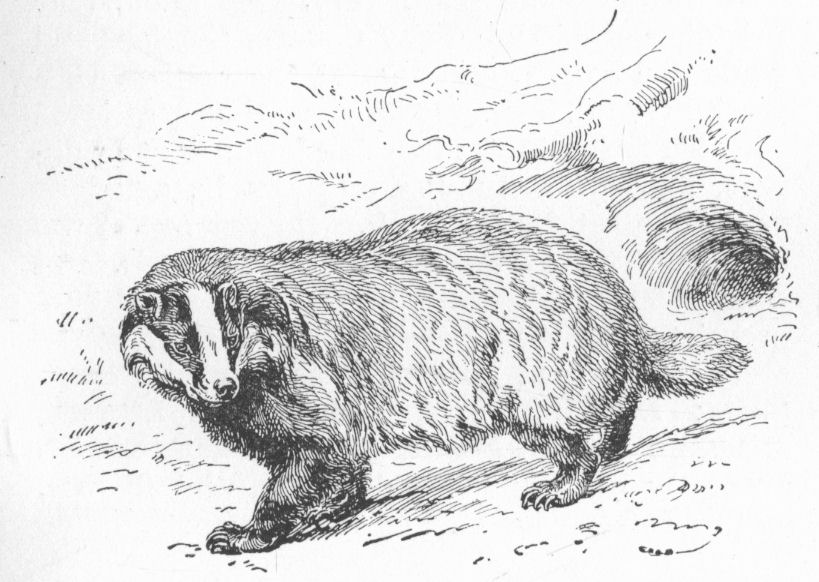
Badger (baj´ėr), a plantigrade, carnivorous mammal, allied both to the bears and to the weasels, of a clumsy make, with short thick legs, and long claws on the fore-feet. The common badger (Meles vulgāris) is as large as a middling-sized dog, but much lower on the legs, with a flatter and broader body, very thick tough hide, and long coarse hair. It inhabits the north of Europe and Asia, burrows, is indolent and sleepy, feeds by night on vegetables, small quadrupeds, &c. Its flesh may be eaten, and its hair is used for artists' brushes in painting. The American badger belongs to a separate genus. Badger baiting, or drawing the badger, is a barbarous sport, long a favourite amusement in England, but declared illegal in the middle of last century, and yet to some extent practised, generally as an attraction to public-houses of the lowest sort. A badger is put in a barrel, and one or more dogs are put in to drag him out. When this is effected he is returned to his barrel, to be similarly assailed by a fresh set. The badger usually makes a most determined and savage resistance.
Badger Dog, a long-bodied, short-legged dog, with rather large pendulous ears, usually short haired, black, and with yellow extremities; often called by its German name Dachshund.
Bad´minton, a game closely resembling lawn-tennis, but played with battledore and shuttle-cock instead of ball and racket: named after a seat of the Duke of Beaufort, in Gloucestershire.
Badrinath (-ät´), a peak of the main Himalayan range, in Garhwál District, in the United Provinces, 23,210 feet above the sea. On one of its shoulders, at an elevation of 10,400 feet, stands a celebrated temple of Vishnu, which some years attracts as many as 50,000 pilgrims.
Baedeker (bā´de-kėr), Karl, a German publisher, born 1801, died 1859; originator of a celebrated series of guide-books for travellers.
Baelz's Disease, an affection of the mouth characterized by swelling of the mucous glands of the mouth and lips, leading to the formation of small abscesses and ulcers.
Baena (ba˙-ā´na˙), a town of Spain, in Andalusia, province of Cordova, and 24 miles S.S.E. of the city of that name. Pop. 14,730.
Baeza (ba˙-ā´tha˙; anciently, Beatia), a town of Spain, in Andalusia, 22 miles E.N.E. of Jaen, with 15,843 inhabitants. The principal edifices are the cathedral, the university (now suppressed), and the old monastery of St. Philip de Neri.
Baffa (ancient, Paphos), a seaport on the S.W. coast of Cyprus. Pop. 1000. It occupies the site of New Paphos, which, under the Romans, was full of beautiful temples and other public buildings. Old Paphos stood a little to the south-east.
Baffin, William, an English navigator, born 1584, famous for his discoveries in the Arctic regions; in 1616 he ascertained the limits of Baffin Bay. He was killed at the siege of Ormuz, in the East Indies, 1622.
Baffin Bay, on the N.E. of North America, between Greenland and Baffin Land and other islands that lie on the N. of the continent; discovered by Baffin in 1616.
Bafulabe (ba˙-fu¨-lä-bā), a trading-place in French West Africa, on the Upper Senegal, and on the railway that runs from Kayes on the Senegal to Bammako on the Niger.
Bagamo´yo, a seaport of former German East Africa, a short distance north-west of Dar-el-Salaam. There is no proper harbour, only a shallow and rather exposed roadstead where ships have to anchor some distance from the shore, yet it is the chief trading-centre of the colony, and as the terminus of the caravan route to Tanganyika is a place of some importance. Pop. about 25,000. See European War.
Bagasse´, the sugar-cane in its dry crushed state as delivered from the mill, and after the main portion of its juice has been expressed; used as fuel in the sugar factory, and called also cane-trash.
Bagatelle´, a game played on a long flat board covered with cloth like a billiard-table, with spherical balls and a cue or mace. At the end of the board are nine cups or sockets of just sufficient size to receive the balls. These sockets are arranged in the form of a regular octagon, with the ninth in the middle, and are numbered consecutively from one upwards. Nine balls are used, generally one black, four white, and four red, the distinction between white and red being made only for the sake of variety. In the ordinary game, at starting, the black ball is placed on a point in the longitudinal middle line of the board, a few inches in front of the nearest of the sockets, and the player places one of his eight balls on a corresponding point at the other end of the board, and tries to strike the black ball into one of the sockets with his own. After this his object is to place as many of his balls as possible in the sockets. Each ball so placed counts as many as the socket is numbered for, and the black ball always counts double. He who first makes the number of points agreed on wins.
Bagdad´, or Baghdad, a city of a vilayet of same name (54,540 sq. miles; pop. 900,000) in what was anciently Mesopotamia. The greater part of it lies on the eastern bank of the Tigris, which is crossed by a bridge of boats; old Bagdad, the residence of the caliphs (now in ruins), was on the western bank of the river. The city occupies a large area. The houses are mostly built of brick, the streets unpaved and very narrow, and there are few buildings of any note. The palace of the governor is spacious. Of the mosques only a few attract notice, many are in ruins; the bazaars are large and well stocked; that of Dawd Pasha still ranks as one of the most splendid in the world. Manufactures: leather, silks, cottons, woollens, carpets, &c. Steamers ply on the river between Bagdad and Bassorah, and the town exports wheat, dates, galls, gums, mohair, carpets, &c., to Europe, the chief import being cotton goods. The estimated population is over 200,000; of these about 86,000 are Mahommedans, 52,000 Jews, and 7000 Christians. The city has been frequently visited by the plague. Bagdad was founded in 762 by the Caliph Almansur, and raised to a high degree of splendour in the ninth century by Harun Al Rashid. It is the scene of a number of the tales of the Arabian Nights. It was long the chief city of the Mahommedan world, and at one time is said to have had two millions of inhabitants. In the thirteenth century it was stormed by Hulaku, grandson of Genghis-Khan, who caused the reigning caliph to be slain, and destroyed the caliphate. It was again laid waste by Timur in 1401. For a considerable period it was the object of contention between the Persians and the Turks, until it was besieged and captured by Sultan Murad IV in 1638. Since that date it remained a part of the Turkish Empire. It was captured by the British on 11th March, 1917.
Bagdad Railway, a railway which, under arrangement with the Turkish Government, was intended to run from Konia, which is the terminus of the Anatolian railway system, to Bagdad, Basra (Bassorah), and the Persian Gulf. It was built chiefly by means of funds provided by German and French financiers, in association with the Anatolian Railway Company, a German company. The line has been constructed continuously as far as Kara Bunar in Cilicia. Farther on, the following sections have been completed: Dorak to Bagtché, on the Ordana side of the Taurus Mountains; Radjun, via Muslimié, to Jerablus, on the Euphrates, with a branch from Muslimié to Aleppo; Jerablus to El-Abiad, and Bagdad to Samara. A branch line has also been completed from Alexandretta to Toprak Kalé. Of the distance from Konia to Bagdad (1509 miles), 1117 miles (with gaps) are already working. In 1919 the railway system passed to the Allies, and in 1920 it was announced that the line between Basra and Bagdad had been completed.
Bagehot (bag´ot), Walter, English economist and journalist, born at Langport, Somerset, 1826, died at the same place 1877. He studied at Bristol, and at University College, London, and graduated as B.A. and M.A. at the London University (1848). He was for some time associated with his father in the banking business at Langport, and for a number of years he acted as London agent for the bank. He was one of the editors of the National Review (1855-64), and from 1860 till his death he was editor and part proprietor of the Economist. His chief works are: Physics and Politics; The English Constitution; Lombard Street; and Studies, Literary, Biographic, and Economic. He was a high authority on economics, banking, and finance, and was often consulted by public men.
Baggala
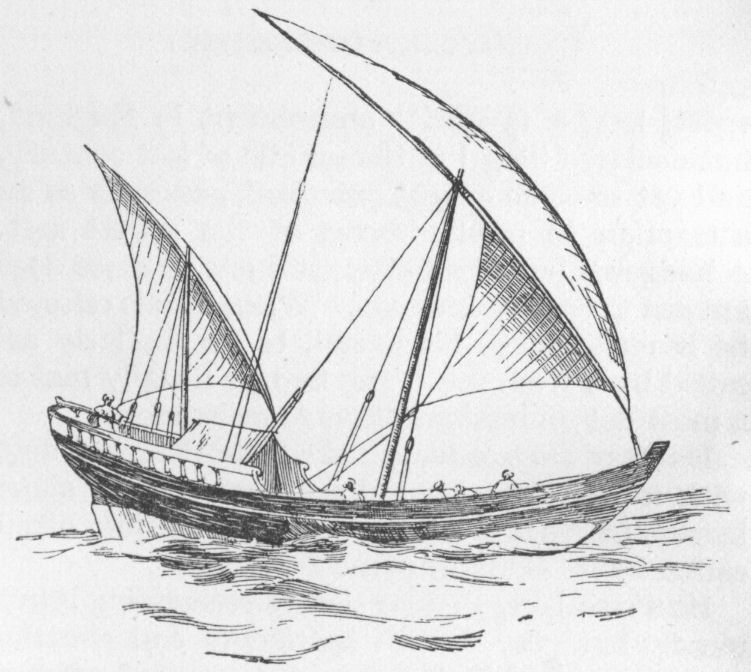
Bag´gala, a two-masted Arab boat, generally 200-250 tons burden, used for trading in the Indian Ocean, Red Sea, &c.
Baggesen (bag´e-sen), Jens, a Danish poet, who also wrote much in German, born 1764, at Korsör, died at Hamburg, 1826. He led a rather wandering and unsettled life, spending some time in England as well as in France and Germany. He tried lyric, epic, and dramatic poetry, but was most successful as a humorist and satirist. One of his best poems is his famous song There was a Time when I was very Little.
Bagging is the name of the textile material which is used in the making of bags. Baltic hemp was the first material used for the purpose, but now all kinds of fibres are used, though the majority of bags are made of jute fibre. The style of the bagging used depends, naturally, upon the requirements of the bag; for the export of raw cotton from the United States of America we find the coarsest of all cotton-bagging used. When intended to carry grain, spices, sugar, &c., the bag must be made of closely-woven material. In many cases bags to carry sugar are lined with paper.
Baghelkand, a tract of country in Central India, occupied by a collection of native States (Rewah being the chief), under the Governor-General's agent for Central India; area, 11,323 sq. miles. Pop. 1,772,574.
Bagheria (ba˙-gā´rē-a˙), a town of Sicily, province of Palermo, 9 miles by railway from the city of Palermo. Pop. 21,212.
Bagimont's Roll, a rent-roll of Scotland, made up in 1275 by Baiamund or Boiamond de Vicci, vulgarly called Bagimont, who was sent from Rome by the Pope, in the reign of Alexander III, to collect the tithe of all the church livings in Scotland for an expedition to the Holy Land. It remained the statutory valuation, according to which the benefices were taxed, till the Reformation. A copy of it as it existed in the reign of James V is in the Advocates' Library, Edinburgh.
Bagirmi (ba˙-gir´mē), or Baghermi, a Mohammedan Negro State in Central Africa, situated to the south-east of Lake Tchad. It is mostly a plain; has an area of about 20,000 sq. miles, and about 100,000 inhabitants. The people are industrious, and fairly civilized. The country is in the French sphere of influence, but the people are still under a native ruler.
Bagnara (ba˙-nyä´ra˙), a seaport near the S.W. extremity of Italy. Pop. 11,000.
Bagnères de Bigorre (ba˙n-yār dė bē-gorr), a watering-place, France, department Hautes-Pyrénées, on the left bank of the Adour. It owes its chief celebrity to its sulphurous and saline baths. The springs were known to and used by the Romans. The site is one of the most romantic in the Pyrénées, and the town is well built and well provided with accommodation for visitors. Pop. 8455.
Bagnères de Luchon (ba˙n-yār dė lu-shōn), a town, France, department Haute-Garonne, in a picturesque valley surrounded by wooded hills, one of the principal watering-places of the Pyrénées, having sulphurous thermal waters, beneficial in rheumatic complaints. There is a large bathing establishment, and a large and splendid casino building, comprising a theatre, concert and ball rooms, &c. Resident pop. 4000.
Bagni (bän´yē), Italian for 'baths', a name in Italy for various places which possess natural baths or thermal springs, with some designation added to mark the particular locality. Bagni di Lucca, in the province of Lucca, and about 13 miles north-east of the city of Lucca, is one of the most frequented of these bathing-places, its waters being recommended against gout, rheumatism, affections of the skin, &c.
Bagpipe, a musical wind-instrument of very great antiquity, having been used among the ancient Greeks, and being a favourite instrument over Europe generally in the fifteenth century. It still continues in use among the country people of Poland, Italy, the south of France, and in Scotland and Ireland. Though now often regarded as the national instrument of Scotland, especially Celtic Scotland, it is only Scottish by adoption, being introduced into that country from England. It consists of a leathern bag, which receives the air from the mouth, or from bellows; and of pipes, into which the air is pressed from the bag by the performer's elbow. In the common or Highland form, one pipe (called the chanter) plays the melody; of the three others (called drones) two are in unison with the lowest A of the chanter, and the third and longest an octave lower, the sound being produced by means of reeds. The chanter has eight holes, which the performer stops and opens at pleasure, but the scale is imperfect and the tone harsh. The Highland bagpipe is a powerful instrument, and calls for great exertion of the lungs in order that the air may be supplied in sufficient quantity. There are several other species of bagpipes, as the soft and melodious Irish bagpipe, supplied with wind by a bellows, and having several keyed drones and a keyed chanter; the old English bagpipe (now no longer used); the Italian bagpipe, a very rude instrument, &c. The Irish bagpipe is, musically speaking, the most perfect of all.—Bibliography: Sir J. G. Dalyell, Musical Memoirs of Scotland; E. de Bricqueville, Les Musettes.
Bagration (ba˙g-rä´tyōn), Peter, Prince, distinguished Russian general, descended from a noble Georgian family. He was born in 1765, entered the Russian army in 1782, and henceforth was constantly engaged in active service, distinguishing himself in many actions and gradually rising in military rank. He fought in Poland, in Italy, and against the Turks, was engaged in the battles of Austerlitz, Eylau, and Friedland, and at last was mortally wounded at the battle of Borodino, Sept., 1812.
Bagshot-sand, in geology, the collective name for a series of sands of the Eocene age, occupying extensive tracts round Bagshot, in Surrey, and in the New Forest, Hampshire, the whole reposing on the London-clay; generally devoid of fossils.
Bagster, Samuel, publisher, founder of the firm of Bagster & Sons, celebrated for their bibles, was born in 1772, and died in 1851. He began business as a London bookseller in 1794, and soon turned his attention to the publication of bibles, bringing out a Hebrew bible, the Septuagint (Greek) version, and the English version, with 60,000 parallel references, followed by his great polyglot bible, which in its final form showed eight languages at the opening of the volume. Separate versions in different languages were also brought out, with various other aids to the study of Scripture; a polyglot Book of Common Prayer, in eight languages; &c.
Baha´dur Shah, the last of the Grand Moguls of India, a descendant of Tamerlane. In 1857, during the Indian Mutiny, the Mahommedans, who wished to restore the Empire of the Moguls, placed him, then a very old man, at the head of the movement in Delhi; but the city was soon retaken by the British, and the Emperor was banished to Rangoon, where he died in 1862.
Baha´ma Islands, or Lucayos, a group of islands in the West Indies, forming a colony belonging to Britain, lying N.E. of Cuba and S.E. of the coast of Florida, the Gulf Stream passing between them and the mainland. They extend a distance of upwards of 600 miles, and are said to be twenty-nine in number, besides keys and rocks innumerable. The principal islands are Grand Bahama, Great and Little Abaco, Andros Islands, New Providence, Eleuthera, San Salvador, Great Exuma, Watling Island, Long Island, Crooked Island, Acklin Island, Mariguana Island, Grand Inagua. Of the whole group about twenty are inhabited, the most populous being New Providence, which contains the capital, Nassau; the largest being Andros, 100 miles long, 20 to 40 broad. They are low and flat, and have in many parts extensive forests. Total area, 4400 sq. miles. The soil is a thin but rich vegetable mould, and an important product is pineapples, which form a large export (both canned and green). Other fruits are also grown, with sisal hemp (a valuable export), cotton, sugar, maize, yams, ground nuts, coco-nuts, &c. Sponges are obtained in large quantity, and are at present the chief export. Total exports about £382,140 (1919). The Bahama Islands are a very favourite winter resort for persons suffering from lung trouble. San Salvador, or Cat Island, is generally believed to be the same as Guanahani, the land first touched on by Columbus (12th Oct., 1492) on his first great voyage. The first British settlement was made on New Providence towards the close of the seventeenth century. A number of loyal Americans settled in the islands after the War of Independence. Pop. 55,944, including 14,000 whites.
Baha´walpur, a town of India, capital of State of same name in the Punjab, 2 miles from the Sutlej; surrounded by a mud wall and containing the extensive palace of the Nawab. Pop. 18,700. The State has an area of 15,000 sq. miles, of which 10,000 is desert, the only cultivated lands lying along the Indus and Sutlej. Pop. 780,641.
Bahia (ba˙-ē´a˙; formerly St. Salvador), a town of Brazil, on the Bay of All Saints, State of Bahia. It consists of a lower town, which is little more than an irregular, narrow, and dirty street, stretching about 4 miles along the shore; and an upper town, larger and much better built, with various outlying suburbs. The harbour is one of the best in South America; and the export trade, chiefly in sugar, cotton, coffee, tobacco, hides, piassava, and tapioca, is very extensive. Pop. 348,000. The State, area 164,600 sq. miles, pop. 3,013,007, has much fertile land, both along the coast and in the interior.
Bahia Blanca, a seaport of the Argentine Republic, on a bay of same name opening into the Atlantic, about 350 miles south-west of Buenos Ayres; it is a rising place connected by railway with the capital, and a terminus of other railways from the interior. It carries on a considerable trade directly with Europe, exporting mutton, wheat, &c. Pop. 75,000.
Bahr (bär), an Arabic word signifying sea or large river; as in Bahr-el-Huleh, the Lake Merom in Palestine; Bahr-el-Abiad, the White Nile, Bahr-el-Azrek, the Blue Nile, which together unite at Khartoum.
Bahraich (bä-rāch´), a flourishing town of India, in Oudh, Faizabad division. It carries on a good local trade, and has a shrine that attracts many Hindu and Mohammedan pilgrims. It is the seat of an American Methodist mission. Pop. 27,304.
Bahrein (bä´rīn) Islands, a group of islands in the Persian Gulf, in an indentation on the Arabian coast, since 1867 under British protection. The principal island, usually called Bahrein, is about 27 miles in length and 10 in breadth. It is in general very flat and low, and the soil is not very fertile except in a few places; but irrigation is employed and excellent dates are grown. The principal town is Menamah or Manama; pop. 30,000. The smaller island of Moharrek, separated by a shallow strait 2 miles wide, contains the town of Moharrek, the present seat of government; pop. 25,000. The Bahrein Islands are chiefly noted for their pearl-fisheries, which were known to the ancients, and which employ in the season from 2000 to 3000 boats manned by from 8 to 20 men each. Total pop. estimated at 110,000.
Bahr-el-Ghazal, a large river of Central Africa, a western tributary of the White Nile (or Bahr-el-Abiad). It flows through a very swampy region, and is liable to inundations. The head of steam navigation is Meshra-er-Rek. The river gives its name to a province of the Anglo-Egyptian Sudan, yielding ivory, rubber, timber, &c., and suited for cotton growing.
Baiadeer. See Bayadere.
Baiæ (bī´ē), an ancient Roman watering-place on the coast of Campania, 10 miles west of Naples. Many of the wealthy Romans had country houses at Baiæ, which was a favourite resort of Horace. Ruins of temples, baths, and villas still attract the attention of archæologists.
Baikal (bī´ka˙l), a large freshwater lake in Eastern Siberia, 360 miles long, and about 50 in extreme breadth, interspersed with islands; in the line of the great Siberian Railway. It is surrounded by rugged and lofty mountains; contains seals, and many fish, particularly salmon, sturgeon, and pike. Its greatest depth is over 4000 feet. It receives the waters of the Upper Angara, Selenga, Barguzin, &c., and discharges its waters by the Lower Angara. It is frozen over in winter.
Baikie, William Balfour, born in the Orkney Islands 1824, died at Sierra Leone 1863. He joined the British navy, and was made surgeon and naturalist of the Niger Expedition, 1854. He took the command on the death of the senior officer, and explored the Niger for 250 miles. Another expedition, which started in 1857, passed two years in exploring, when the vessel was wrecked, and all the members, with the exception of Baikie, returned to England. With none but native assistants he formed a settlement at the confluence of the Benué and the Quorra, in which he was ruler, teacher, and physician, and within a few years he opened the Niger to navigation, made roads, and established a market.
Bail, the person or persons who procure the release of a prisoner from custody by becoming surety for his appearance in court at the proper time; also, the security given for the release of a prisoner from custody. In the United States bail is a matter of right in all cases where a sentence of death cannot be pronounced, and even in such a case it may be allowed by one of the judges.