Volume 1 — B (continued 3)
Reading edition
Balzac (ba˙l-za˙k), Honoré de, a celebrated French novelist, was born at Tours in 1799, died 1850. Before completing his twenty-fourth year he had published a number of novels under various assumed names, but the success attending all was very indifferent; and it was not till 1829, by the publication of Le Dernier Chouan, a tale of La Vendée, and the first novel to which Balzac appended his name, that the attention of the public was diverted to the extraordinary genius of the author. A still greater popularity attended his Physiologie de Mariage, a work full of piquant and caustic observations on human nature. He wrote a large number of novels, all marked by a singular knowledge of human nature and distinct delineation of character, but apt to be marred by exaggeration. Among his best-known works are: Scènes de la Vie de Province, Scènes de la Vie Parisienne, Le Père Goriot, Eugénie Grandet, and Le Médecin de Campagne. The publication of this last, in 1835, led to a correspondence between Balzac and the Countess Eveline de Hanska, a Polish lady whom, after about fifteen years, he visited and married. A collected edition of his works, under the title La Comédie Humaine, was published in 45 vols., Paris, 1856-9, and another in 1869. In 1899 appeared the first volume of Balzac's Œuvres Posthumes, and in 1906 the second.—Bibliography: F. Wedmore, Balzac; M. F. Sandars, Balzac; W. H. Helm, Aspects of Balzac; Taine, Essay on Balzac.
Balzac (ba˙l-za˙k), Jean Louis Guez de, French writer, born 1594, died 1654. His writings, which had a great reputation in their day owing to the elegance of his style, are now neglected. The most esteemed are his Familiar Letters, Le Prince, Le Socrate Chrétien, and Aristippe.
Bamako, capital of the French colony of Upper Senegal and Niger since 1904. It is an important trade-centre and the terminus of the Niger-Senegal railway. Pop. 8000.
Bamba, a district of the Congo, W. coast of Africa, lying to the south of the River Ambriz. It is thickly populated, and is rich in gold, silver, copper, salt, &c.
Bambar´ra, a territory of Western Africa, on the Upper Niger, first visited by Mungo Park, now in the French portion of the Sudan. The country is generally very fertile, producing wheat, rice, maize, yams, &c. The inhabitants are of negro or mixed race, and some are Mohammedans. Excellent cotton cloth is made. The chief town is Segou. Pop. estimated at 2,000,000. See Senegal.
Bam´berg, a town of Germany, Bavaria, charmingly situated on several hills, on the navigable River Regnitz, some 3 miles from its mouth in the Main. It is the seat of a Catholic archbishop; the cathedral, founded in 1004 (the present structure dates from 1111), is one of the finest churches in Germany. The royal library contains 100,000 volumes and valuable MSS. Bamberg carries on a large trade; its industries are cotton-spinning, tobacco-manufacture, brewing, &c. Pop. 48,063.
Bambino (ba˙m-bē´nō; It., an infant), the figure of our Saviour represented as an infant in swaddling-clothes. The Santissimo Bambino in the church of Ara Cœli at Rome, a richly-decorated figure carved in wood, is believed to be able to perform miracles and heal the sick. According to popular belief, the painting was miraculously done by St. Luke or by an angel. Bambinos are set up for the adoration of the faithful in many places in Catholic countries.
Bambocciades (bam-boch-ādz´), pictures, generally grotesque, of common, rustic, or low life, such as those of Peter Van Laar, a Dutch painter of the seventeenth century, who on account of his deformity was called Bamboccio (cripple). Teniers is the great master of this style.
Bamboo (Bambusa arundinacĕa)
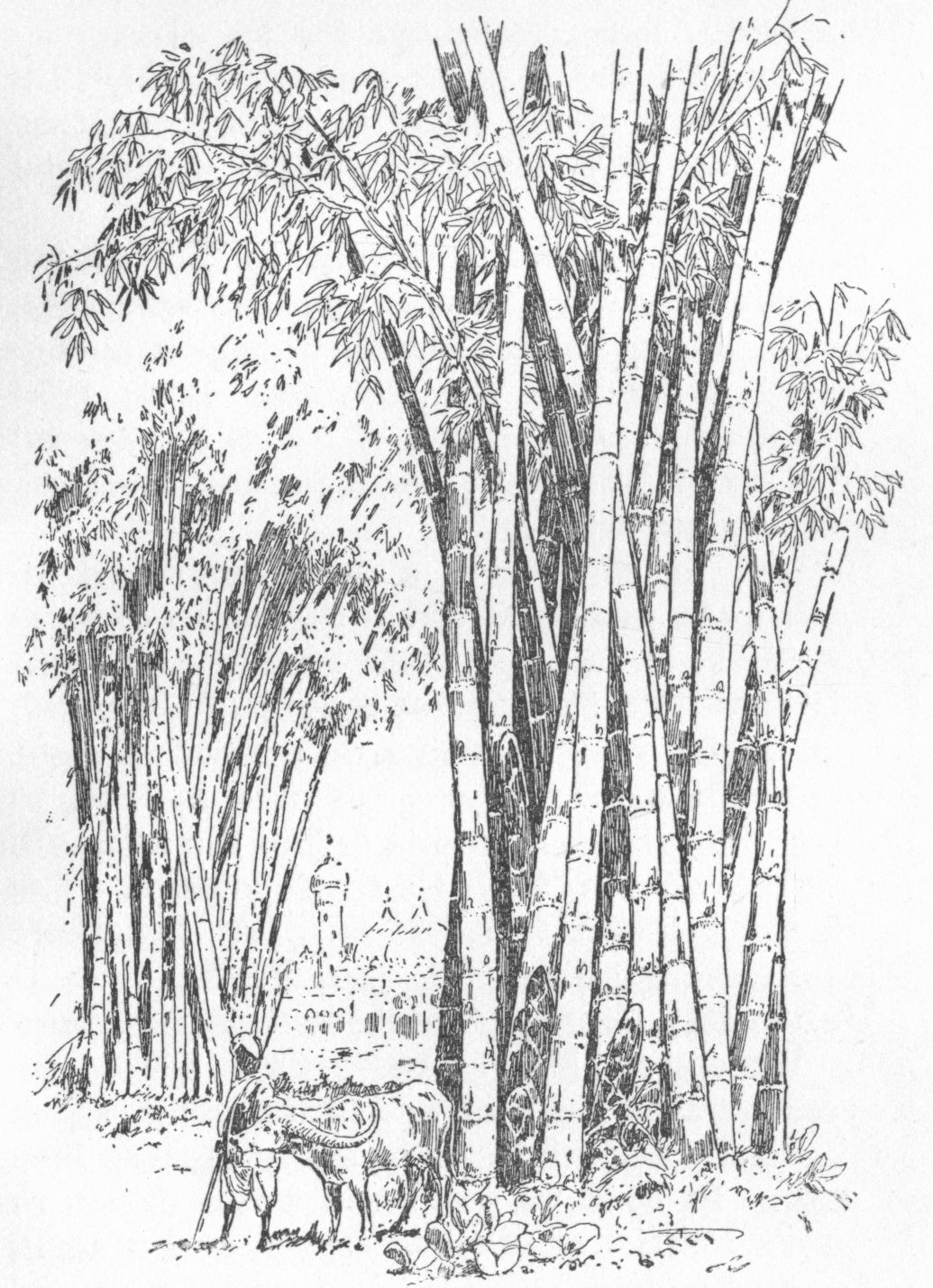
Bamboo´, the common name of the arborescent grasses belonging to the genus Bambūsa. There are many species, belonging to the warmer parts of Asia, Africa, and America, and growing from a few feet to as much as 100 feet, requiring much moisture to thrive properly. A peculiarity of the bamboo family is that they flower on reaching a certain age, generally about 130 years. The best-known species is B. arundinacĕa, common in tropical and sub-tropical regions. From the creeping underground rhizome, which is long, thick, and jointed, spring several round jointed stalks, which send out from their joints several shoots, the stalks also being armed at their joints with one or two sharp rigid spines. The oval leaves, 8 or 9 inches long, are placed on short footstalks. The flowers grow in large panicles from the joints of the stalk. Some stems grow to 8 or 10 inches in diameter, and are so hard and durable as to be used for building purposes. The smaller stalks are used for walking-sticks, flutes, &c.; and indeed the plant is used for innumerable purposes in the East Indies, China, and other Eastern countries. Cottages are almost wholly made of it; also, bridges, boxes, water-pipes, ladders, fences, bows and arrows, spears, baskets, mats, paper, masts for boats, &c. The young shoots may be either pickled or salted and eaten with rice, or candied and preserved in sugar; the seeds of some species are also eaten. The substance called tabasheer is a siliceous deposit that gathers at the internodes of the stems. The bamboo is imported into Europe for various purposes, and is grown in British gardens.
Bambook´, a country in Western Africa between the Falémé and Senegal Rivers, about 140 miles in length, by 80 to 100 in breadth. It is on the whole hilly and somewhat rugged. The valleys and plains are remarkably fertile. The natives are Mandingoes, mostly professed Mahommedans ruled by independent chieftains, most of whom acknowledge the supremacy of France. Gold and ivory are exchanged for European goods.
Bambook-butter, shea-butter (q.v.).
Bam´borough Castle, an ancient English castle on the coast of Northumberland, formerly with connected estate the property of the Forsters, and forfeited to the Crown in 1715, both being purchased by Lord Crewe, Bishop of Durham, and bequeathed by him for charitable purposes.
Bambu´sa. See Bamboo.
Bam´ian, a valley and pass of Afghanistan, the latter at an elevation of 8496 feet, the only known pass over the Hindu Kush for artillery and heavy transport. The valley is one of the chief centres of Buddhist worship, and contains two remarkable colossal statues and other ancient monuments.
Bamo. See Bhamo.
Bampton Lectures, a course of lectures established in 1751 by John Bampton, Canon of Salisbury, who bequeathed certain property to the University of Oxford for the endowment of eight divinity lectures to be annually delivered. The subjects prescribed are mainly connected with the evidences of Christianity, and the lecturer must have taken the degree of M.A. at Oxford or Cambridge. The first course of lectures was delivered in 1780, and they have been delivered every year since, with the exceptions of 1834, 1835, and 1841. Among the more remarkable lectures were those by Dr. White in 1784, by Dr. Mant in 1812, by Reginald Heber in 1815, Whately in 1822, Milman in 1827, Dr. Hampden in 1832, H.L. Mansel in 1858, Canon Liddon in 1866, Canon Gore in 1891, J. R. Illingworth in 1894, and W. R. Inge in 1899. A similar course of lectures, the Hulsean, is annually delivered at Cambridge.
Ban, in political law, is equivalent to excommunication in ecclesiastical. In Teutonic history the ban was an edict of interdiction or proscription: thus, to put a prince under the ban of the empire was to divest him of his dignities, and to interdict all intercourse and all offices of humanity with the offender. Sometimes whole cities have been put under the ban, that is, deprived of their rights and privileges.
Ban, anciently, a title given to the military chiefs who guarded the eastern marches of Hungary; till 1919 the title of the Governor of Croatia and Slavonia. A province over which a ban is placed is called banat, and is equivalent to the German term mark. During the European War, Serbia occupied the banat to the south of Hungary, and her claims to that region were disputed both by Hungary and Roumania. The territory is bounded almost entirely by the Danube, Theiss, and Maros Rivers, except on the east, where it is shut in by the Transylvanian Carpathians. The banat was ultimately divided between Yugo-Slavia and Roumania. See Temesvar.
Banana (Musa sapientum)
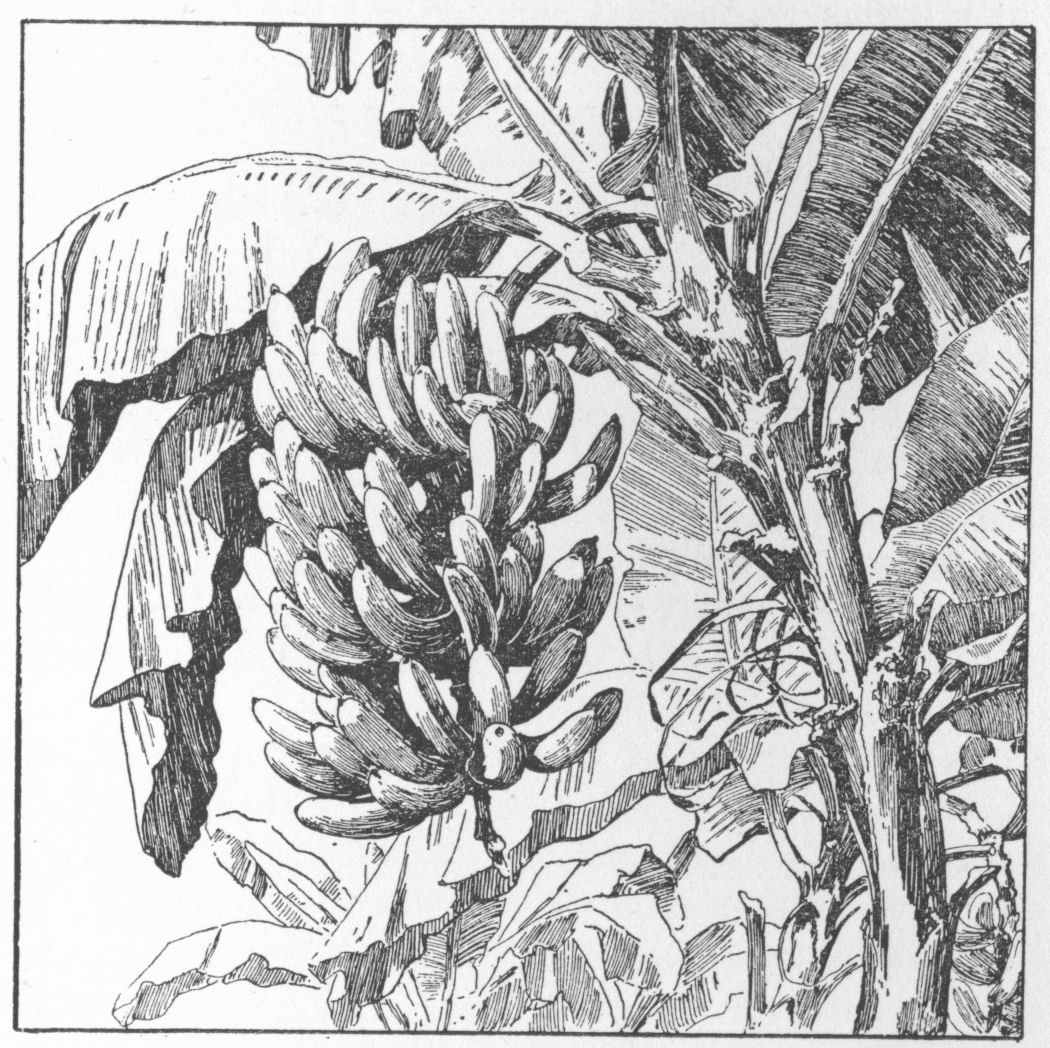
Bana´na, a plant of the genus Musa, nat. ord. Musaceæ, being M. sapientum, while the plantain is M. paradisiăca. It is originally indigenous to the East Indies, and an herbaceous plant with an underground stem. The apparent stem, which is sometimes as high as 30 feet, is formed of the closely-compacted sheaths of the leaves. The leaves are 6 to 10 feet long and 1 or more broad, with a strong midrib, from which the veins are given off at right angles; they are used for thatch, basket-making, &c., besides yielding a useful fibre. The spikes of the flowers grow nearly 4 feet long, in bunches, covered with purple-coloured bracts. The fruit is 4 to 10 or 12 inches long, and 1 inch or more in diameter; it grows in large bunches, weighing often from 40 to 80 lb. The pulp is soft and of a luscious taste; when ripe it is eaten raw or cooked. The banana is cultivated in tropical and sub-tropical countries, and is the food of millions. It is estimated that in Jamaica alone 40,000 acres are devoted to its culture. Excellent biscuits may be made from banana meal, but it is not suitable for bread. Vast quantities are imported by Britain and the United States. Manila hemp is the product of a species of banana.
Bana´na, an African port, in Belgian Congo, at the mouth of the Congo.
Banana-bird, a pretty insessorial bird (Ictĕrus leucoptĕryx), a native of the West Indies and the warmer parts of America. It is a lively bird, easily domesticated, tawny and black in colour, with white bars upon the wings.
Banat. See Ban.
Ban´bridge, a town of Ireland, County Down, 22 miles S.W. of Belfast, on the Bann. The manufacture of linen is carried on to a great extent in town and neighbourhood. Pop. 5101.
Banbury (ban'be-ri), a town of England, in Oxfordshire, long celebrated for its cheese, its cakes, and its ale; a parliamentary borough till 1885, and now giving name to a parliamentary division of the county. Pop. (municipal borough) (1921), 13,347.
Banca, an island belonging to the Dutch East Indies, between Sumatra and Borneo; area, 4446 sq. miles; pop. 113,658, of which a considerable proportion are Chinese. It is celebrated for its excellent tin, of which the annual yield is above 6000 tons; but it produces nothing else of any importance.
Banco, in commerce, a term employed to designate the money in which the banks of some countries keep or kept their accounts, in contradistinction to the current money of the place, which might vary in value or consist of light and foreign coins. The term was applied to the Hamburg bank accounts before the adoption (in 1873) of the new German coinage. The mark banco had a value of 1s. 5½d.; but there was no corresponding coin. See Bank.
Ban´croft, George, American historian, born near Worcester, Mass., 1800, died 1891. He was educated at Harvard and in Germany, where he made the acquaintance of many literary men of note. In 1823 he published a translation of Heeren's Politics of Ancient Greece, and a small volume of poems, and was also meditating and collecting materials for a history of the United States. Between 1834 and 1840 three volumes of his history were published. In 1845 he was appointed Secretary of the Navy, and effected many reforms and improvements in that department. He was American ambassador to Britain from 1846 to 1849, when the University of Oxford conferred on him the honorary degree of D.C.L. He took the opportunity while in Europe to perfect his collections on American history. He returned to New York in 1849, and began to prepare for the press the fourth and fifth volumes of his history, which appeared in 1852. The sixth appeared in 1854, the seventh in 1858, the eighth soon after, but the ninth did not appear till 1866. From 1867 to 1874 he was Minister Plenipotentiary at the Court of Berlin. The tenth and last volume of his great work appeared in 1874. An additional section appeared first as a separate work in 1882: History of the Formation of the Constitution of the United States, and the whole came out in 6 vols. in 1884-5. He has also published many essays in the North American Review and other periodicals, a selection from which was published in 1855 under the title of Miscellanies.
Ban´croft, Richard, born in Lancashire 1544, died 1610, studied at Cambridge, entered the Church, and rose rapidly during the reign of Elizabeth till he obtained the see of London in 1597. James I made him Archbishop of Canterbury on the death of Whitgift. He suppressed the Puritans mercilessly, and they in return never ceased to abuse him.
Ban´croft, Sir Squire, English actor, born in London in 1841. After playing in Dublin and elsewhere he made his first appearance in London, at the Prince of Wales's Theatre, in 1865. He married Miss Marie Effie Wilton in 1867, and was knighted in 1897. In collaboration with his wife he has written The Bancrofts: Recollections of Sixty Years (1909).
Banda, a town and district of India, in the United Provinces. The town stands on a plain on the right bank of the Ken River, 95 miles S.W. from Allahabad, and is a considerable cotton mart. Pop. 22,000.—Area of district 2965 sq. miles. Pop. 660,000.
Banda Islands, a group belonging to Holland, Indian Archipelago, south of Ceram, Great Banda, the largest, being 12 miles long by 2 broad. They are beautiful islands, of volcanic origin, yielding quantities of nutmeg. Goenong Api, or Fire Mountain, is a cone-shaped volcano which rises 2320 feet above the sea. Pop. 10,000.
Bandajan´, a pass over a range of the Himálaya, Kashmir State, 14,854 feet above sea-level.
Bandan´na, a variety of silk handkerchief having a uniformly-dyed ground, usually of bright red or blue, ornamented with white or yellow circular, lozenge-shaped, or other simple figures produced by discharging the groundcolour.
Banda Oriental. See Uruguay.
Bandel´lo, Matteo, an Italian writer of novelle or tales, born about 1480, died about 1562. He was, in his youth, a Dominican monk, and having been banished from Italy as a partisan of the French, Henry II of France gave him in 1550 the bishopric of Agen. He left the administration of his diocese to the Bishop of Grasse, and employed himself, at the advanced age of seventy, in the completion of his novelle. He also wrote poetry, but his fame rests on his novelle, which are in the style of Boccaccio's Decameron and the Queen of Navarre's Heptameron, and have been made use of by Shakespeare, Massinger, and Beaumont and Fletcher.
Bande Noire. See French Revolution.
Band-fish, the popular name of fishes of the genus Cepŏla, from their long, flat, thin bodies. C. rubescens, a very fragile creature, is sometimes cast up on British shores. Also called Snake-fish, Ribbon-fish.
Pig-footed Bandicoot (Chæropus castanotis)
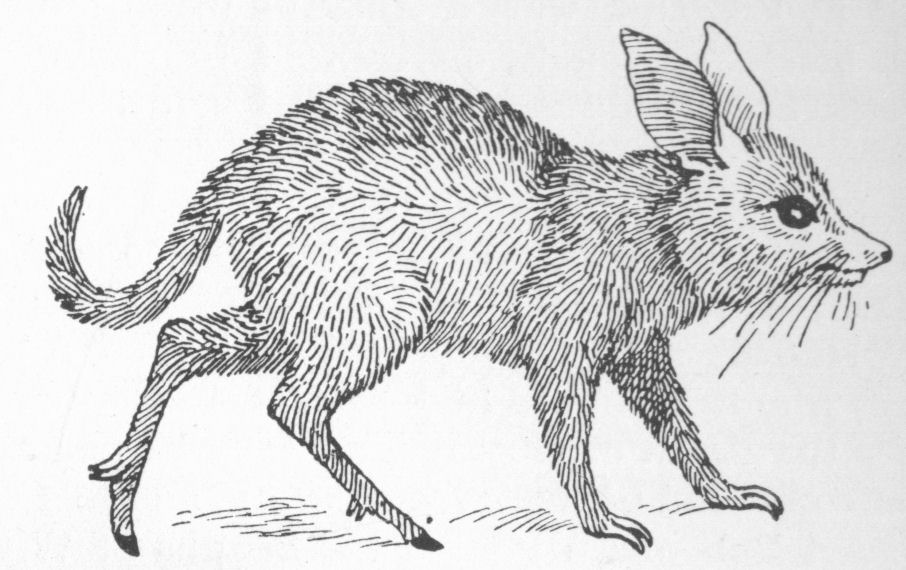
Ban´dicoot (Perameles), a genus of small Australian marsupials. The most common species (P. nasuta), the long-nosed bandicoot, measures about 1½ feet from the tip of the snout to the root of the tail. It is not unlike an overgrown rat, and is most destructive to farm-produce.
Ban´dicoot Rat, the Mus gigantēus, the largest known species of rat, attaining the weight of 2 or 3 lb., and the length, including the tail, of 24 to 30 inches. It is a native of India, and is very abundant in Ceylon. Its flesh is said to be delicate and to resemble young pork, and is a favourite article of diet with the coolies. It is destructive upon rice-fields and gardens.
Bandinelli, Baccio, Italian sculptor, born at Florence 1493, died there 1560. He was jealous of and strove to rival Michael Angelo. Among his works are a Hercules and Cacus, The Dead Body of Christ held up by an Angel, Adam and Eve, &c.
Ban´dit, It. bandito, originally an exile, banished man, or outlaw, and hence, as persons outlawed frequently adopted the profession of brigand or highwayman, the word came to be synonymous with brigand, and is now applied to members of the organized gangs which infest some districts of Italy, Sicily, Spain, Greece, and Turkey.
Band of Hope. See Temperance.
Ban´dolier, a large leathern belt or baldrick, to which were attached a bag for balls and a number of pipes or cases of wood or metal covered with leather, each containing a charge of gunpowder. It was worn by ancient musketeers, and hung from the left shoulder under the right arm with the ball bag at the lower extremity, and the pipes suspended on either side. The name is now given to a similar belt, worn by mounted troops, for carrying cartridges. Another form of the word is bandoleer.
Ban´doline, a gummy perfumed substance used to impart gloss and stiffness to the hair.
Ban´don, a town, Ireland, County Cork, on both sides of the Bandon. Pop. 3122.
Bands, a small article of clerical dress, made of linen, going round the neck and hanging down in front for a short distance in two pieces with square ends, supposed to be a relic of the amice.
Baneberry, or Herb Christopher (Actæa spicāta), a European plant, ord. Ranunculaceæ, local in England, with a spike of white flowers and black, poisonous berries. Two American species are considered remedies for rattlesnake bite.
Banér (ba˙-nār´), Johan Gustafsson, a Swedish general in the Thirty Years' War, born 1596, died 1641. He made his first campaigns in Poland and Russia, and accompanied Gustavus Adolphus, who held him in high esteem, to Germany. After the death of Gustavus in 1632 he had the chief command of the Swedish army, and in 1634 invaded Bohemia, defeated the Saxons at Wittstock, 24th Sept., 1636, and took Torgau. He ravaged Saxony again in 1639, gained another victory at Chemnitz, and in 1640 defeated Piccolomini. In Jan., 1641, he very nearly took Ratisbon by surprise.
Banff (bamf), county town of Banffshire, Scotland, a seaport on the Moray Firth at the mouth of the Deveron. It is well built, carries on some boat-building, and has ropeworks, a brewery, &c., fishing and shipping. Near the town are the county lunatic asylum, and Duff House, a seat of the Duke of Fife, now public property; on the east side of the Deveron is the town of Macduff, where an extensive fishing trade is carried on. Banff is one of the Elgin burghs, which together return a member to Parliament. Pop. 3517.—The county has an area of 403,053 acres. In the south it is mountainous; but the northern part is comparatively low and fertile; principal rivers, the Spey and Deveron; principal mountains, Cairngorm (4095 feet) and Ben Macdhui (4296 feet), on its southern boundary. Little wheat is raised, the principal crops being barley, oats, turnips, and potatoes. Fishing is an important industry; as is also the distilling of whisky. Serpentine abounds in several places, especially at Portsoy, where it is known as 'Portsoy marble', and Scotch topazes or cairngorm stones are found on the mountains in the south. Banffshire returns one member to Parliament. Pop. (1921), 57,293.
Banff, a town of N. W. Canada, at the foot of the Rocky Mountains, on the Canadian Pacific Railway, with National Park, hot springs, coal-mines, &c.
Bang. See Bhang.
Bangalore´, a town of Hindustan, capital of Mysore, and giving its name to a considerable district in the east of Mysore State. The town stands on a healthy plateau 3000 feet above sea-level, has a total area of nearly 14 sq. miles, and is one of the pleasantest British stations in India. In the old town stands the fort, reconstructed by Hyder Ali in 1761, and taken by Lord Cornwallis in 1791. Under English administration the town has greatly prospered in recent times. There are manufactures of silks, cotton cloth, carpets, gold and silver lace, &c. Pop. 189,485.—The Bangalore district has an area of 3070 sq. miles, of which more than half represent cultivable land. Pop. about 760,000.
Bangkok´, or Bankok, the capital of the kingdom of Siam, extending for several miles on both sides of the Menam, which falls into the Gulf of Siam about 15 miles below. The inner city occupies an island surrounded with walls and bastions, and contains the palace of the king and other important buildings. The dwellings of the common people are of wood or bamboo, often raised on piles; a large portion of the population, however, dwell in boats or wooden houses erected on bamboo rafts moored in the river, and forming a floating town. Temples are numerous and lavishly decorated. Houses in the European style have been erected in modern times, and the telegraph, telephone, gas, fire-engines, and omnibuses introduced. A university with eight faculties has recently been established. The trade, both inland and foreign, is very extensive, the exports consisting chiefly of rice, sugar, silk, cotton, tobacco, pepper, sesame, ivory, aromatic wood, cabinet woods, tin, hides, &c.; and the imports consisting chiefly of British cotton, woollen, and other goods. Pop. 628,675, of whom about a half are Chinese. See Siam.
Ban´gor, a city of North Wales, in Carnarvonshire, picturesquely situated near the northern entrance of the Menai Strait. It appears to have possessed a cathedral in the sixth century, which was destroyed by the Normans in 1071. The present cathedral—the third—only dates from the reign of Henry VII. It has a college of the University of Wales (founded in 1903), and a Normal College. Bangor has risen into importance as a popular resort; its principal trade is in the export of slates from the neighbouring quarries. Pop. (1921), 11,032.
Ban´gor, a seaport town, Ireland, County Down, on the south side of Belfast Lough. Principal trade: cotton, linen, and embroideries. Pop. 7776.
Ban´gor, a port of the United States, in Maine, on the W. side of Penobscot River, a flourishing and pleasantly-situated town, and one of the largest lumber depots in the world. The river is navigable to the town for vessels of the largest size. Pop. (1920), 25,948.
Bango´rian Controversy, a controversy stirred up by a sermon preached before George I in 1717 by Dr. Hoadly, Bishop of Bangor, from the text "My kingdom is not of this world" (John, xviii, 36), in which the bishop contended in the most pronounced manner for the spiritual nature of Christ's kingdom. The controversy was carried on with great heat for many years, and resulted in an enormous collection of pamphlets.
Bangs´ring. See Banxring.
Bangweo´lo, or Bangweulu, Lake, in South Africa, the southernmost of the great lake reservoirs of the Congo, heard of in 1798, was reached by Livingstone in 1868, an oval-shaped shallow sheet of water, said to be 150 miles in length along its greater axis, from east to west, and about 75 miles in width, but its exact limits are uncertain. It was first circumnavigated by Poulett Weatherley in 1896. See Congo.
Ban´ian, or Ban´yan, an Indian trader or merchant, one engaged in commerce generally, but more particularly one of the great traders of Western India, as in the seaports of Bombay, Kurrachee, &c., who carry on a large trade by means of caravans with the interior of Asia, and with Africa by vessels. They form a class of the Vaisya caste, wear a peculiar dress, and are strict in the observance of fasts and in abstaining from the use of flesh. Hence, Banian days, days in which sailors in the navy had no flesh meat served out to them. Banian days are now abolished, but the term is still applied to days of poor fare.
Banian Tree. See Banyan.
Ba´nim, John, an Irish novelist, dramatist, and poet, born in 1798, died 1842. His chief early work was a poem, The Celt's Paradise (1821). Having settled in London, he made various contributions to magazines and to the stage; but his fame rests on his novels, particularly the O'Hara Tales, in which Irish life is admirably portrayed. In these, as in some of his other publications, his brother, Michael Banim (born 1796, died 1874), had an important share, if not an equal claim to praise. The two brothers have been justly called 'the first national novelists of Ireland'.
Banishment. See Exile.
Ban´jarmassin, a district and town in the south-east of Borneo, under the government of the Dutch. The town is situated on an arm of the Banjar, about 14 miles above its mouth, in a marshy locality, the houses being built on piles, and many of them on rafts. Exports: pepper, benzoin, bezoar, ratans, dragon's-blood, birds'-nests, &c.; imports: rice, salt, sugar, opium, &c. Pop. 52,000, mostly Dyaks.
Ban´jo (a negro corruption of bandore; It. pandora, from Lat. pandura, a three-stringed instrument), the favourite musical instrument of the negroes of the Southern States of America. It is six-stringed, has a body like a tambourine and a neck like a guitar, and is played by stopping the strings with the fingers of the left hand and twitching or striking them with the fingers of the right. The upper or octave string, however, is never stopped. The banjo was introduced into England in 1846.
Banjoemas (ba˙n´yö-ma˙s), a town in Java, near the centre of the island, well built and of commercial importance; it is 22 miles from the coast, and is the residence of a Dutch governor. Pop. 6500.
Banking and Banks. Banks are establishments for the deposit, custody, and repayment on demand of money, and obtain the bulk of their profits from the investment of sums thus derived and not in immediate demand. The term is a derivative of the banco or bench of the early Italian money-dealers, being analogous in its origin to the terms trapezītai (trapeza, a bench or table) applied to the ancient Greek money-changers, and mensarii (mensa, a table) applied to the public bankers of Rome.
In respect of constitution there is a broad division of banks into public and private; public banks including such establishments as are under any special state or municipal control or patronage, or whose capital is in the form of stock or shares which are bought and sold in the open market; private banks embracing those which are carried on by one or more individuals without special authority or charter and under the laws regulating ordinary trading companies. In respect of function three kinds of banks may be discriminated: (1) banks of deposit merely, receiving and returning money at the convenience of depositors; (2) banks of discount or loan, borrowing money on deposit and lending it in the discount of promissory notes, bills of exchange, and negotiable securities; (3) banks of circulation or issue, which give currency to promissory notes of their own, payable to bearer and serving as a medium of exchange within the sphere of their banking operations. The more highly-organized banks discharge all three functions, but all modern banks unite the two first. For the successful working of a banking establishment certain resources other than the deposits are of course necessary, and the capital paid up by shareholders on their shares and forming the substantial portion of their claim to public credit is held upon a different footing from the sums received from depositors. It is usually considered that for sound banking this capital should not be traded with for the purpose of making gain in the same way as the moneys deposited in the bank; and it is for the most part invested in Government or other securities subject to little fluctuation in value and readily convertible into money. But in any case prudence demands that a reserve be kept sufficient to meet all probable requirements of customers in event of commercial crises or minor panics. The reserve of the banking department of the Bank of England is always in coin, or in notes against which an equivalent value of coin and bullion is lying in the issue department. In other English banks the reserve is usually kept partly in gold and partly in Government stocks and Bank of England notes; but it sometimes lies as a deposit in the Bank of England. The working capital proper of a bank is constituted by moneys on deposit, for which the bank may or may not pay interest; the advantages of security, of ease in the transmission of payments, &c., being regarded in the cases of banks little affected by competition as a sufficient return to the depositor. Thus the Bank of England pays no interest on deposits, while the contrary practice has prevailed in Scotland since 1729, where interest is paid on deposits although not on current accounts.
Of the methods of making profit upon the money of depositors, one of the most common is to advance it in the discounting of bills of exchange not having long periods (seldom more than three months with the Bank of England) to run; the banker receiving the amounts of the bills from the acceptors when the bills arrive at maturity. Loans or advances are also often made by bankers upon exchequer bills or other Government securities, on railway debentures or the stock of public companies of various kinds, as well as upon goods lying in public warehouses, the dock-warrant or certificate of ownership being transferred to the banker in security. In the case of a well-established credit they may be advanced upon notes of hand without other security. Money is less commonly advanced by bankers upon mortgages on land, in which the money loaned is almost invariably locked up for a number of years. To banks of issue a further source of profit is open in their note circulation, inasmuch as the bank is enabled to lend these notes, or promises to pay, as if they were so much money and to receive interest on the loan accordingly, as well as to make a profitable use of the money or property that may be received in exchange for its notes, so long as the latter remain in circulation. It is obvious, however, that this interest on its loaned notes may not run over a very extended period, in that the person to whom they are issued may at once return them to the bank to lie there as a deposit and so may actually draw interest on them from the bank of issue; or he may present them to be exchanged for coin, or by putting them at once into circulation may ensure a certain number speedily finding their way back through other hands or other banks to the establishment from which he received them. A considerable number of the notes issued will, however, be retained in circulation at the convenience of the public as a medium of exchange; and on this circulating portion a clear profit accrues. This rapid return of notes through other banks, &c., in exchange for portions of the reserve of the issuing bank, is one of the restraints upon an issue of notes in excess of the ability of the bank to meet them. In the United Kingdom a more obvious restraint upon an unlimited note issue, originating partly in a desire for greater security, partly in the belief that the note augmentation of the currency might lead to harmful economic results in its influence upon prices, is to be found in the Bank Acts of 1844 and 1845, which impose upon banks of issue the necessity of keeping an equivalent in gold for all notes issued beyond a certain fixed amount. The wisdom of these legal restrictions, which are not uniform throughout the kingdom, and the desirability of the acquisition and control by the State of the whole business of issue, are still matters of debate.
In specific relation to his customer the banker occupies the position of debtor to creditor, holding money which the customer may demand at any time in whole or in part by means of a cheque payable at sight on presentation during banking hours. For the refusal to cash a cheque from the erroneous supposition that he has no funds of his customer's in his hands, or for misleading statements respecting the position in which the bank stands, the banker is legally responsible. Moreover, the law regards him as bound to know his customer's signature, and the loss falls upon him in event of his cashing a forged cheque. In their relations to the community, the chief services rendered by banks are the following: By receiving deposits of money they are the means by which the surplus capital of one part of a country is transferred to another where it may be advantageously employed in stimulating industry; they enable vast and numerous money transactions to be carried on without the intervention of coin or notes at all, thus obviating trouble, risk, and expense. The mechanism by which the last of these benefits is secured is to be found in perfection in the London Clearing House.
The modern tendency of banks is towards amalgamation. The large English banking institutions have absorbed many of the smaller banks. They have also made working arrangements with Scotch and Irish banks and with similar institutions abroad.
The result of these amalgamations is to give control of immense financial resources to a smaller number of banks. In 1918 the Government appointed a Committee to inquire into the effect of such amalgamations and absorptions. The terms of reference were: "To consider and report to what extent, if at all, amalgamations between banks may affect prejudicially the interests of the industrial and mercantile community, and whether it is desirable that legislation should be introduced to prohibit such amalgamations or to provide safeguards under which they might continue to be permitted"; and the Committee reported: "That legislation be passed requiring that the prior approval of the Government must be obtained before any amalgamations are announced or carried into effect".
In order, however, that such legislation may not have the effect of producing secret amalgamations, the Committee decided that "all proposals for agreements which would alter the status of a bank as regards its separate entity and control, or for purchase by one bank of the shares of another bank, be also submitted for the prior approval of the Government before they are carried out".
Another development is the registration of the British Overseas Bank, Limited, with a nominal capital of £5,000,000. The principal object of this institution is to carry on general banking business in all parts of the world. Four banks—two English, one Scotch, and one having connections with South America—are financially interested in the Overseas Bank.
Banking operations on a considerable scale appear to have been conducted by the ancients, and recent excavations have proved that in the seventh century B.C. banking was practised at Bagdad by a firm of Egibi & Sons. Modern banking, however, must be regarded as having had an independent origin in the reviving civilization of the Middle Ages. In the twelfth century almost the whole trade of Europe was in the hands of the Italian cities, and it was in these that the need of bankers was first felt. The earliest public bank, that of Venice, established in 1171 and existing down to the dissolution of the Republic in 1797, was for some time a bank of deposit only, the Government being responsible for the deposits, and the whole capital being in effect a public loan. In the early periods of the operations of this bank deposits could not be withdrawn, but the depositor had a credit at the bank to the amount deposited, this credit being transferable to another person in place of money payment. Subsequently deposits were allowed to be withdrawn, the original system proving inconvenient outside the Venetian boundaries. It is, however, less from the Bank of Venice than from the Florentine bankers of the thirteenth and fourteenth centuries that modern banking specially dates, the magnitude of their operations being indicated by the fact that between 1430 and 1433, 76 bankers of Florence issued on loan nearly 5,000,000 gold florins. The Bank of St. George at Genoa also furnished a striking chapter in financial history. The important Bank of Amsterdam, taken by Adam Smith as a type of the older banks, was established in 1509, and owed its origin to the fluctuation and uncertainty induced by the clipped and worn currency. The object of the institution (established under guarantee of the city) was to give a certain and unquestionable value to a bill on Amsterdam; and for this purpose the various coins were received in deposit at the bank at their real value in standard coin, less a small charge for recoinage and expense of management. For the amount deposited a credit was opened on the books of the bank, by the transfer of which payments could be made, this so-called bank money being of uniform value as representing money at the mint standard. It bore, therefore, an agio or premium above the worn-coin currency, and it was legally compulsory to make all payments of 600 guilders and upwards in bank money. The deposits were supposed to remain in the coffers of the bank, but they were secretly traded with in the eighteenth century till the collapse of the bank in 1790. Banks of a similar character were established at Nuremberg and other towns, the most important being the Bank of Hamburg, founded in 1619. In England there was no corresponding institution, the London merchants being in the habit of lodging their money at the Mint in the Tower, until Charles I appropriated the whole of it (£200,000) in 1640. Thenceforth they lodged it with the goldsmiths, who began to do banking business in a small way, encouraging deposits by allowing interest for their use, lending money for short periods, discounting bills, &c. The bank-note was first invented and issued in 1690 by the Bank of Stockholm, founded by Palmstruck in 1688, and one of the most successful of banking establishments. About the same time the banks of England and Scotland began to take shape, opening up a new era in the financing of commerce and industry.
Bank of England.—The Bank of England, the most important banking establishment in the world, was projected by William Paterson, who was afterwards the promoter of the disastrous Darien scheme. It was the first public bank in the United Kingdom, and was chartered in 1694 by an Act which, among other things, secured certain recompenses to such persons as should advance the sum of £1,500,000 towards carrying on the war against France. Subscribers to the loan became, under the Act, stockholders, to the amount of their respective subscriptions, in the capital stock of a corporation, denominated the Governor and Company of the Bank of England. The company thus formed advanced to the Government £1,200,000 at an interest of 8 per cent—the Government making an additional bonus or allowance to the bank of £4000 annually for the management of this loan (which, in fact, constituted the capital of the bank), and for settling the interest and making transfers, &c., among the various stockholders. This bank, like that of Venice, was thus originally an engine of the Government, and not a mere commercial establishment. Its capital has been added to from time to time, the original capital of £1,200,000 having increased to £14,553,000 in 1816, since which no further augmentation has taken place. There exists besides, however, a variable 'rest' of over £3,000,000. The charter of the bank was originally granted for eleven years certain, or till a year's notice after 1st Aug., 1705. It was subsequently renewed for various periods in 1697, 1708, 1713, 1742, 1764, 1781, 1800, 1833, and 1844, certain conditions which the bank had to fulfil being specified at each renewal. On this last occasion it was continued till twelve months' notice from 1855. At the same time the issue department of the bank was established as distinct from the general banking department, the sole business entrusted to the former being the issue of notes. By this arrangement the bank was authorized to issue notes to the value of £14,000,000 upon securities specially set apart, the most important of the securities being the sum of £11,015,100 due to the bank by the Government, together with so much of the coin and bullion then held by the bank as was not required by the banking department. The bank has since been permitted to increase its issue on securities to £18,450,000, but for every note that the issue department may issue beyond the total sum of £18,450,000 an equivalent amount of coin or bullion must be paid into the coffers of the bank. For its special privileges the bank has to pay to the Government an annual sum of £180,000, and the profit derived from the issue of notes beyond £14,000,000. The Bank of England notes are practically equivalent to gold. They are (like all English bank-notes) of the value of £5 and upwards, and are legal tender throughout England. Notes once issued by the bank and returned to it are not reissued but are destroyed—a system adopted in order to facilitate the keeping of an account of the numbers of the notes in circulation, and so prevent forgery. On 7th Aug., 1914, Government notes for £1, and ten shillings, were issued convertible into gold at the Bank of England.
In compliance also with the Bank Charter Act of 1844 the bank is compelled to publish a weekly account, of which the following is a specimen:—
Dr. Issue Department. Week ending 11th August, 1920 Cr.
Notes issued £139,980,460 Government debt £11,015,100
Other securities 7,434,900
Gold coin and bullion 121,530,460
Silver bullion ——
£139,980,460 £139,980,460
Dr. Banking Department Cr.
Capital £14,553,000 Government securities £68,250,449
Rest 3,458,795 Other securities 73,805,565
Public deposits 15,999,059 Notes 14,452,665
Other deposits 124,018,988 Gold and silver coin 1,537,092
Seven-day and other bills 15,929
£158,045,771 £158,045,771
The total of the notes given out by the issue department is called the 'issue circulation', the portion of it in the hands of the public being the 'active circulation', and that still in the banking department being the 'note reserve'. This 'note reserve' represents really the amount of bullion in the issue department available for the use of the banking department. Of the other items in the account it may be noted that the proprietors' 'rest' is a varying surplus increased always by accumulated profits up to 5th April and 10th Oct., when the bank dividends are paid to the shareholders; and that the public deposits, which include sums lodged on account of the customs, inland revenue, &c., increase through revenue receipts until the dividend terms in January, April, July, and October. The other or private deposits comprise those of bankers, merchants, and other persons. An increase in these private deposits indicates an increase of monetary ease, while a decrease informs us that bankers, merchants, and traders have calls upon them for money. A better indication of the demand for money is furnished, however, by the advances on commercial securities, and it is by this and the condition of the reserve that the bank rate of discount is regulated. When the reserve is high and the advances moderate the discount rate is low, and it is raised according as the reserve falls and advances are more in request, especially during an adverse foreign exchange and drain of gold. Gold is thus restrained from going abroad, and its influx into the country is encouraged. In addition to the profit which the bank may make by ordinary banking business, by the Bank Act of 1892 and the Revenue Act of 1906, it receives an allowance for the management of the national debt, at the rate of £325 per million on 500 millions, and £100 per million on all debt above that sum. The annual sum is not to be less than £160,000. It also derives a profit from foreign gold coin and bullion brought to it, for which it pays £3, 17s. 9d., or 1½d. per ounce less than the real value.
The management of the bank is in the hands of a governor, deputy-governor, and twenty-four directors, elected by stock-holders who have held £500 of stock for six months previous to the election. A director is required to hold £2000, a deputy-governor £3000, and a governor £4000 of the stock. The court or board of directors meets every Thursday, when the weekly account is presented. The Bank of England has branches in Liverpool, Manchester, Newcastle, Birmingham, Leeds, Hull, Bristol, Plymouth, and Portsmouth.
The other English banks consist of numerous joint-stock and private banks in London and the provinces, many of the provincial establishments of both kinds having the right to issue notes. Private banks in London with not more than six partners have never been prevented from issuing notes, but they could not profitably compete with the Bank of England. The maximum issues of the provincial banks are limited to a certain amount, against which they are not compelled to hold gold in reserve, and they have no power to issue against specie in excess of the fixed circulation. Their actual issues are considerably below this amount. No union can take place between a joint-stock bank and a private bank, or between two joint-stock banks of issue, without one of them losing its issue. Their total authorized circulation is about £2,958,900, but the actual circulation of these banks is now only about £1,200,000, being distributed among about eighteen private and about twenty joint-stock banks. The notes of these banks are payable in Bank of England paper. The greater number of joint-stock banks are of limited liability, though their liability in respect of their notes is unlimited. Some of them have a large number of branches. All the joint-stock banks allow interest on money deposited with them. The total paid-up capital and reserves of the English joint-stock banks is about £100,000,000.
Scotland.—In Scotland there are no private banks, the only banks in that portion of the United Kingdom being eight joint-stock banks of issue, and their branches (the Mercantile and Savings not being banks of issue). By the Act of 1845 new banks of issue were prohibited, a monopoly being given to such establishments (nineteen in number) as existed in the year previous to 1st May, 1845. At the same time the issue of each was limited to the amount of its average circulation during that year, together with the specie held at the head office. Any bank issuing notes in excess of this limit is supposed to hold an equivalent amount of gold. The aggregate authorized circulation is now £2,676,350; the average actual circulation is fully £7,000,000. The Bank of Scotland, established by Act of Parliament in 1695, had for its original capital only £100,000, increased to £200,000 in 1744; but it now has a capital of £1,325,000 paid up. It remained the only bank in Scotland till the Royal Bank of Scotland was established in 1727, with an original capital of £151,000, which has grown to £2,000,000 paid up. The British Linen Company was incorporated in 1746, for the purpose of promoting the linen manufacture, but soon became a general banking company; capital, £1,250,000 paid up. These three banks claim to be by their charters banks of limited liability. All the other Scottish banks have been established within the nineteenth century. They are all incorporated by royal charter or Act of Parliament, which enables them to sue and be sued as a corporation, and latterly they have all become banks of limited liability, except that their liability is not to be limited in respect to their note issue. The total paid-up capital of the Scotch banks is £9,300,000. A large number of one-pound notes circulate in Scotland, thus tending to keep the requirements for gold low. From allowing a moderate rate of interest on deposit accounts (although not on current accounts) it is not uncommon for depositors in Scottish banks to lodge their money permanently as an investment; and the habit of keeping an account with a banker is much more general in Scotland than in England, branch offices of the banks being very numerous. Several of the Scotch banks have branch offices in London, but of course they cannot issue their own notes from these offices. The Scotch banks have enjoyed a high reputation for stability, and though public confidence was somewhat shaken by the failure of the Western Bank in 1857, and even more rudely by that of the City of Glasgow Bank in 1878, their shares are generally looked upon as a safe and remunerative investment. Their total deposits amount to fully £107,000,000.
Ireland.—The banks in Ireland consist of one public or national bank, the Bank of Ireland, and of sundry joint-stock and private banks. The authorized note circulation is arranged on the same footing as that of the Scotch banks. If any bank discontinues its issue and issues notes of the Bank of Ireland, the circulation of the latter may be to an equal amount increased. The authorized circulation is £6,354,494; the actual circulation is sometimes a little above, sometimes a little below. The Bank of Ireland, which was established by charter in 1783 with similar privileges to those granted to the Bank of England, has lent the greater portion of its capital to Government. Its capital is £2,769,230 (or £3,000,000 Irish); it has also a rest or reserve of over £1,000,000. The bank allows interest on deposits when lodged for a stated period.
Banque de France.—The Bank of France is second in importance only to the Bank of England. It was established in the beginning of the nineteenth century, at first with a capital of 45,000,000 francs, and with the exclusive privilege in Paris of issuing notes payable to bearer, a privilege which was extended in 1848 to cover the whole of France. It has numerous branches in the larger towns, a number of these having been acquired in 1848, when certain joint-stock banks of issue were by Government decree incorporated with the Bank of France, the capital of which was then increased to 91,250,000 francs (£3,650,000), in 91,250 shares of 1000 francs each. In 1857 the capital was doubled, and besides this it has a large surplus capital or rest. Like the Bank of England, it is a bank of deposit, discount, and circulation, and is a large creditor of the State. The Government appoints the governor and the two deputy-governors, who are all required to be stockholders. There is also a body of fifteen directors and three censors, nominated by the shareholders. The value of its note circulation in March, 1922, was 36,225,852,000 francs.
British Colonies.—With regard to the banks in British colonies little need be said. All the more important are joint-stock concerns, and they are carried on subject to Acts passed by the respective colonial legislatures. Some of them have their head-quarters in London, and have been established by English capital. In Canada the banks are not allowed to issue notes of lower denominations than five dollars, notes for one and two dollars and higher amounts being issued by the Dominion Government; and the banking laws are such that there is no possibility of holders of bank-notes being losers by them. The total paid-up capital of the Canadian banks is about £20,000,000; their total deposits about £135,000,000.
United States.—The more important of the banks of the United States are what are called national banks, established in accordance with an Act passed in 1863. Associations of this kind at starting must invest at least a third of their paid-up capital in Government bonds, which pay them an interest of 4 per cent more or less. They then obtain from the Government bureau, established for the purpose, 90 per cent of paper-money sheets, which they sign and pay out, this constituting their note circulation. These banks pay no interest to depositors. Besides the notes of these banks a large portion of the currency of the United States consists of Government notes issued from the national treasury. There are also banks chartered by the different States and private banks.
Savings-banks are banks established for the receiving of small sums, so as to be taken advantage of by the poorer classes, and they are carried on entirely for the benefit of the depositors. They are of comparatively recent origin, one of the earliest having been an institution in which small sums were received, and interest allowed on them, established by Mrs. Priscilla Wakefield, at Tottenham, near London, in 1803. The first savings-bank in Scotland was formed in 1810 by the Rev. Henry Duncan, of Ruthwell, Dumfriesshire. In 1814 the Edinburgh savings-bank was established on the same principles, and the system soon spread over the kingdom. The first Act relating to savings-banks was passed in 1817. By it all deposits in savings-banks, as soon as they reached £50, were placed in the hands of the National Debt Commissioners, who allowed interest on them. In 1824 it was enacted that the deposits for the first year should not exceed £50, nor those in subsequent years £30, the total deposits being limited to £150, and interest ceasing to be paid when accrued interest made the total £200. By the Act of 1893 the limit of annual deposit was raised to £50, and the interest is now rather less than 3 per cent. An Act of 1833 had provided for the purchase of Government annuities by depositors either for life or for a term of years; and an annuity of any amount up to £100 may now be obtained. Depositors in savings-banks (by an Act of 1880) can also have their money invested for them in Government stock, the banks collecting and paying the dividends; and when accrued interest raises an account above £200 the excess is now so invested for the depositor. The total amount invested by one person in Government stock is not to exceed £500, nor £200 in one year. These banks are managed by local trustees having no personal interest in the business, and by certain paid officers. A new class of savings-banks, namely, Post Office Savings-banks, was established in Britain in connection with the money-order department of the Post Office in 1861. Any sum not less than a shilling is received, provided that the total amount banked does not exceed £50 in one year, or more than £200 in all; the excess of accrued interest above this being invested in Government stock. Interest is paid on every complete pound at the rate of 2½ per cent. For the deposits the Government is responsible, and they may be drawn from any Post Office Savings-bank in the kingdom. These savings-banks have become very numerous, and much of the funds formerly in the trustees' savings-banks has been transferred to them. The total amount deposited in the old banks is now about £52,000,000, in the new about £157,600,000. The regulations regarding the purchase of Government stock and annuities correspond with those given above. Savings-banks are now well known in all civilized countries, and the good they have done is incalculable. In the United States there is an enormous amount of money deposited in them. Post Office Savings-banks have been proposed to be established in the States, but have not yet been so. In Canada, Australia, and other British colonies they are established, as well as savings-banks of several other kinds. School savings-banks are the most recent institutions of this kind, and have had a marked effect for good.
Bank Holidays, in England and Ireland, Good Friday, Easter Monday, Whit Monday, first Monday in August, Christmas and following day, or 27th (if next day is a Sunday); in Scotland, New-Year's Day, first Monday of May and August and Christmas.
Bankrupt (from It. banca rotta 'bank broken' or 'bench broken'. Dr. Johnson said that the word originated from the Italian custom of breaking the bench of an insolvent money-changer; but rotta also means 'interrupted' or 'stopped', and is here used more in the sense of our colloquial word broken, and means 'insolvent'), a person whom the law does or may take cognizance of as unable to pay his debts. Properly it is of narrower signification than insolvent, an insolvent person simply being unable to pay all his debts. In England up till 1861 the term bankrupt was limited to an insolvent trader, and such traders were on a different footing from other insolvent persons, the latter not getting the same legal relief from their debts. In all civilized communities laws have been passed regarding bankruptcy. At present bankruptcy in England is regulated by the Bankruptcy Acts of 1883 and 1890, which have as one chief feature the intervention of the Board of Trade in the proceedings, with the object of obtaining full official supervision and control. A bankruptcy petition may be presented either by a creditor or a debtor. A creditor's petition must be founded on a debt of not less than fifty pounds, due to one or more creditors, and on an 'act of bankruptcy' committed by the debtor within three months before the presentation of the petition. A debtor commits an act of bankruptcy if he makes a conveyance of his property to a trustee for the benefit of his creditors; if he makes a fraudulent transfer of any part of his property; if, to defeat or delay his creditors, he conceal himself either at home or abroad; if execution issued against him has been enforced by seizure and sale of his goods under process in an action in any court; if he files in court a declaration of inability to pay his debts, or presents a bankruptcy petition against himself; if a creditor has obtained a final judgment against him for any amount and he fail to pay the judgment debt without satisfactory reason; or if the debtor gives notice to any of his creditors that he has suspended, or is about to suspend, payment of his debts. In London jurisdiction in bankruptcy now rests with the High Court of Justice, while the county courts continue to have jurisdiction in bankruptcy outside the London district. When the court is satisfied as to the petition, a 'receiving order' is issued to protect the debtor's estate by constituting the official appointed by the Board of Trade receiver of the debtor's property, and to stay the remedies of all creditors until the meeting of creditors. The debtor must make out a full statement of his affairs, accounting as best he can for his insolvency. The official receiver summons the meeting of creditors, a summary of the debtor's affairs being sent to each creditor with the notice of the meeting, which is also advertised in the London Gazette. The creditors must send to the official receiver, one day before the meeting, sworn proofs of their claims to enable them to vote. At the meeting the creditors (unless the debtor's proposal for a composition or scheme be entertained) pass a resolution adjudging the debtor bankrupt, and appoint a trustee of the bankrupt's property, with a committee of inspection selected from their own body to superintend the administration of the bankrupt's property by the trustee, who divides the available realized assets amongst all creditors who have sent sworn proofs of claims. Rates, assessments, and taxes, and all wages or salary of a clerk, servant, labourer, or workman during four months before the date of the receiving order not exceeding £50 are paid in priority to all other debts. The trustee is required to give satisfactory security to the Board of Trade, by which his accounts are audited not less than twice in each year. All moneys received by the trustee under the bankruptcy must be paid forthwith to an account kept at the Bank of England by the Board of Trade, called the 'Bankruptcy Estates Account'. The debtor is bound to be publicly examined upon oath in court, and any creditor who has tendered a proof, or his representative, may take part in the examination. Until the debtor has passed his public examination he cannot apply for an order of discharge, and upon proof of misdemeanour the court refuses or suspends the discharge. A discharged bankrupt is disqualified for five years from acting as member of Parliament, justice of peace, alderman, overseer of the poor, county councillor, or as a member of any school, highway, or burial board. An undischarged bankrupt obtaining credit to the extent of £20 or upwards from any person, without informing such person of his status, is guilty of a misdemeanour. By the Act of 1883 the creditors may at the first meeting resolve to entertain a proposal for a composition or scheme of arrangement of the debtor's affairs, but the composition or scheme shall not be binding on the creditors, unless confirmed at a second meeting by a majority in number representing three-fourths in value of all the creditors who have proved. The composition or scheme has then to be formally brought before the court for approval, which may be refused. A composition or scheme may be sanctioned by the court after the debtor's adjudication as a bankrupt, and in this case the bankruptcy is annulled. Though imprisonment for debt has been abolished, fraudulent bankrupts may be punished, and the conduct of prosecutions for offences arising out of any bankruptcy proceeding falls to the public prosecutor. The estates of persons dying insolvent may be administered according to the law of bankruptcy. The Act of 1913 embodies suggestions of the Bankruptcy Law Amendment Committee of 1906. Thus, the Summary Jurisdiction Act can now be applied to offenders under the Debtors' Act. Whereas previously conviction for such offences as failure to keep proper accounts and concealment of debt could only be by trial before a jury, they are punishable after summary trial before a stipendiary magistrate or justice of the peace, the onus of proving innocence falling on the debtor. A married woman, too, may be made bankrupt even if not trading separately from her husband.
According to Scots law bankruptcy is notorious insolvency, that is, a public acknowledgment of inability to discharge obligations. By a judicial proceeding, called sequestration, authorized by the Court of Session or sheriff court, on the petition of the debtor himself with the concurrence of one creditor swearing to a debt of £50, two whose debts together amount to £70, or of any number of creditors whose debts together amount to £100; or on the petition of a creditor or creditors to the foregoing extent without the concurrence of the debtor, if he has clearly shown himself to be insolvent (or a notour bankrupt), the whole estates and effects of the debtor, real and personal, are legally taken for behoof of the creditors. The debtor's estate is then made over to a trustee chosen by the creditors, the trustee being charged to bring the whole estate into the form of money, with certain precautions, and to receive, investigate, and reject or admit the claims of the creditors, subject to review of the Court of Session or sheriff court by summary petition. The debtor, and all who can give information as to the estate, must submit to public examination on oath before the sheriff of the county, and the debtor may thereafter, or by petition after six, twelve, or eighteen months from sequestration, be discharged of all debts by the court with consent of the creditors or a number of them, or at the expiry of two years without consent. These proceedings may be partly superseded by 'composition' if such be assented to by a majority in number and nine-tenths in value of creditors, or by a majority in number and four-fifths in value of the creditors, according to the period at which such arrangement may be proposed. They may also be terminated by a deed of arrangement entered into between the bankrupt and a majority in number and four-fifths in value of his creditors, approved of by the court. Before a discharge is given there must be a report from the trustee as to the conduct of the bankrupt, whether he has complied with the provisions of the Act, whether his bankruptcy is culpable or not, &c. Before the abolition of imprisonment for ordinary civil debts by Act passed in 1880, an insolvent debtor often took advantage of a form of process by which, on making a complete cessio bonorum, or surrender to his creditors of all his property, he might obtain protection from imprisonment. Though no person can now be imprisoned for ordinary debts, a creditor of a notour bankrupt may present a petition to the sheriff, praying him to decern that the debtor assign over all his goods for behoof of his creditors and that a trustee be appointed; and this proceeding is still designated a process of cessio bonorum. The Act of 1880 also provides for the better punishment of fraudulent debtors in Scotland. If the debtor's liabilities exceed £200, the sheriff may award sequestration of the debtor's estate instead of cessio bonorum. There is no appeal from the sheriff's decision with respect to discharge.
In Ireland there is a special code of bankruptcy contained in special Acts, differing to some extent from the regulations prevailing both in England and Scotland. Thus in Ireland it is not an offence for an undischarged bankrupt to obtain credit to any amount without disclosing the fact of his bankruptcy. All bankruptcy business comes before the court at Dublin, Belfast, or Cork. Imprisonment for debt was abolished in 1872.
Official returns in Great Britain show a tendency towards a smaller number of failures, but a larger amount of money is involved.
In the different British colonies the laws regulating bankruptcy naturally differ, and the same is the case with the individual States of the American Union, though Congress has the power of legislating for the whole country in regard to this, and has oftener than once done so.—Bibliography: H. Goudy, Treatise of the Law of Bankruptcy in Scotland; Sir R. H. J. Palgrave, Dictionary of Political Economy; E. T. Baldwin, The Law of Bankruptcy and Bills of Sale; Sir R. L. V. Williams, The Law and Practice of Bankruptcy; R. Ringwood, The Principles of Bankruptcy.
Banks, Sir Joseph, Baronet, a distinguished naturalist, born in London 1743. After studying at Harrow and Eton he went to Oxford in 1760, and formed there amongst his fellow-undergraduates a voluntary class in botany, &c. He was elected Fellow of the Royal Society in 1766, and soon after went to Newfoundland and Hudson's Bay to collect plants. In 1768, with Dr. Solander, a Swedish gentleman, pupil of Linnæus, and then assistant librarian at the British Museum, he accompanied Cook's expedition as naturalist. In 1772 he visited Iceland along with Dr. Solander, and during this voyage the Hebrides were examined, and the columnar formation of the rocks of Staffa first made known to geologists. In 1777 Banks was chosen President of the Royal Society, and in 1781 was made a baronet, and in 1795 received the Order of the Bath. He wrote only essays, papers for learned societies, and short treatises. He died in 1820, and bequeathed his collections to the British Museum.
Banks, Thomas, an English sculptor, born in 1735, died in 1805. He studied sculpture in the Royal Academy, where he obtained the gold medal for a bas-relief of the Rape of Proserpine. In 1772 he went to Italy, where he executed several excellent pieces, particularly Cupid tormenting a Butterfly, which was afterwards purchased by the Empress Catherine. On leaving Italy he spent two unsatisfactory years in Russia, and then returned to England, where he was soon after made an Academician. One of his best-known works is Shakespeare attended by Painting and Poetry. Among his other works was a colossal statue—Achilles mourning the loss of Briseis—in the hall of the British Institution, and the monument of Sir Eyre Coote in Westminster Abbey. His bust of Warren Hastings is in the National Gallery.
Bank´sia (named after Sir Joseph Banks), a genus of Australian shrubs and trees, order Proteaceæ, with leathery leaves generally dark-green on the upper surface and pale below, often cultivated in conservatories for their peculiar foliage and flowers. They are named "honeysuckles" by the colonists, from the honey the flowers contain.
Banks´ring. See Banxring.
Bankura´, a town of Bengal, on the Dhalkisor River, healthy and with a considerable trade Pop. 21,000.
Bann, Upper and Lower, two rivers in the N. of Ireland, the former rising in the mountains of Mourne, County Down, and, after flowing 38 miles in a northerly direction, falling into Lough Neagh, the latter being the outlet of Lough Neagh, and falling into the Atlantic Ocean 4 miles below Coleraine, after a course of nearly 40 miles.
Ban´natyne Club, a literary society instituted in Edinburgh (1823) by Sir Walter Scott (its first president), David Laing (secretary till its dissolution in 1861), Archibald Constable, and Thomas Thomson. It started with thirty-one members, subsequently extended to 100, having as its object the printing of rare works on Scottish history, literature, geography, &c. It derived its name from George Bannatyne (1545-1609), the collector of the famous MS. of early Scottish poetry.
Ban´neret, formerly, in England, a knight made on the field of battle as a reward for bravery, with the ceremony of cutting off the point of his pennon and making it a banner. The first banneret in England was made by King Edward I, and the last (John Smith) by Charles I after the battle of Edgehill in 1642.
Ban´nock, a cake made of oatmeal, barley-meal, or peasemeal baked on an iron plate or griddle over the fire. From a supposed resemblance the turbot is sometimes called in Scotland the Bannock-fluke.
Bannockburn, a village of Scotland, in Stirlingshire, 2 miles S.E. Stirling, famous for the decisive battle in which King Robert Bruce of Scotland defeated Edward II of England, on the 24th June, 1314. It has manufactures of woollens, such as tartans, carpets, &c.; pop. 4103.
Banns of Marriage, public notice of the intended celebration of a marriage given either by proclamation, viva voce, by a clergyman, session-clerk, or precentor in some religious assembly, or by posting up written notice in some public place. Dissent of parents or guardians renders null and void the publication of the banns of minors. In France the banns must be published on two distinct Sundays, and the marriage cannot take place until three days after the second publication. In America the practice is confined to the Roman Catholics, although it is still recognized in the statutes of some of the States.
Bannu, a district in the north-west of Hindustan, traversed by the Indus; area, 3847 sq. miles; pop. 390,000, nearly half being Afghans.
Banquette (bang-ket´) in fortification, the elevation of earth behind a parapet, on which the garrison or defenders may stand. The height of the parapet above the banquette is usually about 4 feet 6 inches; the breadth of the banquette from 2½ or 3 feet to 4 or 6 feet, according to the number of ranks to occupy it. It is frequently made double, that is, a second is made still lower.
Banshee´, or Benshi´, a fairy woman believed in Ireland and some parts of Scotland to attach herself to a particular house, and to appear or make her presence known by wailing before the death of one of the family.
Ban´tam, a residency occupying the whole of the W. end of the Island of Java. It formed an independent kingdom, governed by its own sultan, till 1683, and the Dutch exercised suzerainty with brief intermission until its formal incorporation by them at the beginning of last century. It produces rice, coffee, sugar, cinnamon, &c. Serang is its capital. The town Bantam was the first Dutch settlement in Java (1595), and for some time their principal mart, though now not so prosperous.
Ban´tam Fowl, a small but spirited breed of domestic fowl, first brought from the East Indies, supposed to derive its name from Bantam in Java. Most of the sub-varieties have feathered legs; but these are not to be preferred. In point of colour the black and nankeen varieties are the best. A well-bred bantam does not weigh more than a pound.
Banteng´ (Bos Banteng or Sondaicus), a wild species of ox, native of Java and Borneo, having a black body, slender white legs, short sleek hair, sharp muzzle, and the back humped behind the neck.
Banting System, a course of diet for reducing superfluous fat, adopted and recommended in 1863 by W. Banting of London. The dietary recommended was the use of butcher-meat principally, and abstinence from beer, farinaceous food, and vegetables. See Corpulence.
Ban´try, a seaport near the head of Bantry Bay, County Cork, Ireland. Pop. 3159.—The bay, one of three large inlets at the S.W. extremity of Ireland, affords an unsurpassed anchorage, and is about 25 miles long by 4 to 6 broad, and from 10 to 40 fathoms deep, with no dangerous rocks or shoals.
Bantu (bän-tö´), the ethnological name of a group of African races below about 6° N. latitude, and including the Kaffirs, Zulus, Bechuanas, the tribes of the Loango, Congo, &c., but not the Hottentots.—Bibliography: Deniker, Races of Man; J. Roscoe, The Northern Bantu.
Banu. See Bannu.
Banx´ring (genus Tapaia), a quadruped belonging to the Insectivora, inhabiting the Indian Archipelago, bearing some resemblance externally to a squirrel, but having a long pointed snout.
Banyan (Ficus benghalensis)
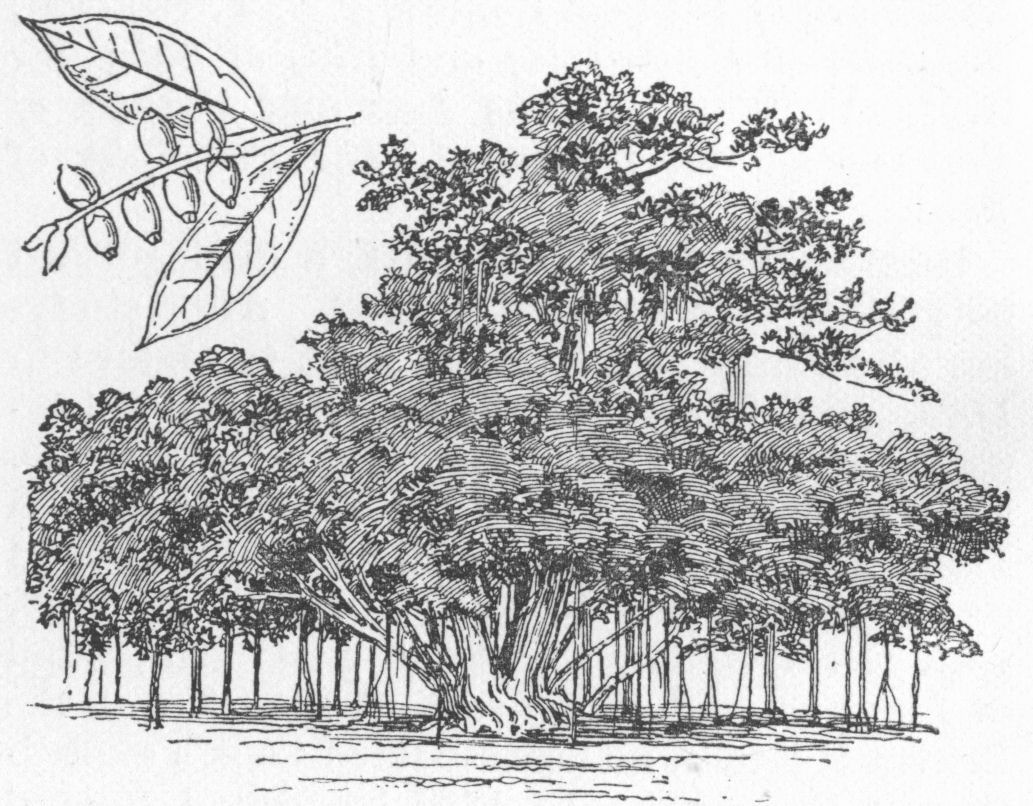
Ban´yan (Ficus benghalensis), a tree of India, of the fig genus. The most peculiar feature of this tree is its method of throwing out from the horizontal branches supports which take root as soon as they reach the ground, enlarge into trunks, and, extending branches in their turn, soon cover a prodigious extent of ground. A celebrated banyan tree has been known to shelter 7000 men beneath its shade. The wood is soft and porous, and from its white glutinous juice bird-lime is sometimes prepared. Both juice and bark are regarded by the Hindus as valuable medicines, and the tree itself is sacred. The banyan tree is described by Southey in his poem The Curse of Kehama.
Baobab or Monkey-bread Tree (Adansonia digitata)
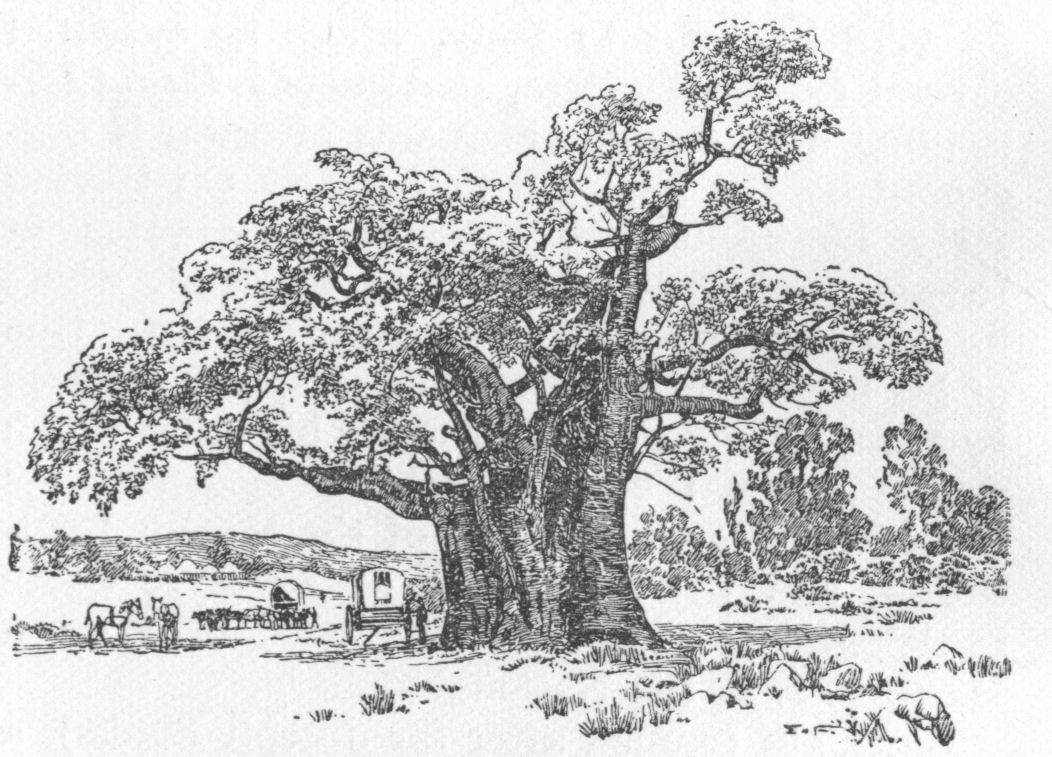
Ba´obab (Adansonia digitāta) or Monkey-bread Tree, a tree belonging to the nat. ord. (or sub-ord.) Bombaceæ, and the best-known species of its genus, which was named after the naturalist Adanson. Though not tall, it is one of the bulkiest of trees, its trunk sometimes measuring 30 feet in diameter, and as the profusion of leaves and drooping boughs sometimes almost hides the stem, the whole forms a hemispherical mass of verdure 140 to 150 feet in diameter and 60 to 70 feet high. It is a native of the African savannahs, and is cultivated in many of the warmer parts of the world. The roots are of extraordinary length, a tree 77 feet in girth having a tap-root 110 feet in length. The leaves are deep green, divided into five unequal parts lanceolate in shape, and radiating from a common centre. The flowers resemble the white poppy, having snowy petals and violet-coloured stamens; and the fruit, which is large and of an oblong shape, is said to taste like gingerbread, with a pleasant acid flavour. The wood is pale-coloured, light, and contains a large store of water, which enables the tree to withstand prolonged drought. The tree is liable to be attacked by a fungus which, growing in the woody part, renders it soft and pithlike. By the negroes of the west coast these trunks are hollowed into chambers, and dead bodies are suspended in them. There they become perfectly dry and well preserved, without further preparation or embalming. The baobab is emollient and mucilaginous; the pulverized leaves constitute lalo, which the natives mix with their daily food.
Bapaume, a French town in the department of Pas-de-Calais. It has been the scene of several battles. In 1793 the French were compelled by the allied troops to abandon the place, and in the Franco-German war one of the most closely-contested battles was fought there on 3rd Jan., 1871. Bapaume, occupied by the Germans in the European War, was recaptured by British troops on 29th Aug., 1918, the great battle of Bapaume having begun on 21st Aug. Pop. (1911) 2917.
Baph´omet, the imaginary idol or symbol which the Templars were accused of employing in their mysterious rites, and of which little is known. The word is supposed to be a corruption of Mahomet, to whose faith the Templars were accused of having a leaning. See Gnosticism.
Baptism (from the Gr. baptizō, from baptō, to immerse or dip), a rite which is generally thought to have been usual with the Jews even before Christ, being administered to proselytes. All that can be said, however, with some certainty is that the Jewish baptism was not of later origin than the Christian baptism. Anyhow, from this baptism that of St. John the Baptist differed, because he baptized Jews also as a symbol of the necessity of perfect purification from sin. Christ himself never baptized, but directed his disciples to administer this rite to converts (Mat. xxviii, 19); and baptism, therefore, became a religious ceremony among Christians, taking rank as a sacrament with all sects which acknowledge sacraments. It should, however, be borne in mind that among many peoples a rite is found which has considerable likeness to Christian baptism. In the primitive Church the person to be baptized was dipped in a river or in a vessel, with the words which Christ had ordered, generally adopting a new name further to express the change. Sprinkling, or, as it was termed, clinic baptism, was used only in the case of the sick who could not leave their beds. The Greek Church and Eastern schismatics retained the custom of immersion; but the Western Church adopted or allowed the mode of baptism by pouring or sprinkling, since continued by most Protestants. This practice can be traced back certainly to the third century, before which its existence is disputed. Since the Reformation there have been various Protestant sects called Baptists, holding that baptism should be administered only by immersion, and to those who can make a personal profession of faith. The Montanists in Africa baptized even the dead, and in Roman Catholic countries the practice of baptizing church bells—a custom of tenth-century origin—continues to this day. Being an initiatory rite, baptism is only administered once to the same person. The Roman and Greek Catholics consecrate the water of baptism, but Protestants do not. The act of baptism is accompanied only with the formula that the person is baptized in the name of the Father, Son, and Holy Ghost; but, among most Christians, it is preceded by a confession of faith made by the person to be baptized if an adult, and by his parents or sponsors if he be a child. The Roman Catholic form of baptism is far more elaborate than the Protestant. This Church teaches that all persons not baptized are damned, and that even unbaptized infants are not admitted into Heaven; but for those whose chief fault was that they had not been baptized, even St. Augustine himself believed in a species of mitigated damnation. Protestants hold that though the neglect of the sacrament is a sin, yet the saving new birth may be found without the performance of the rite which symbolizes it. Naming the person baptized forms no essential part of the ceremony, but has become almost universal, probably from the ancient custom of renaming the catechumen.—Bibliography: E. B. Tylor, Primitive Culture (vol. ii); S. Baring-Gould, Origin and Development of Religious Belief; J. E. Hanaver, Baptism, Jewish and Christian; Harnack, History of Dogma; article Baptism in Encyclopedia of Ethics and Religion; Corblet, Histoire du Sacrément du Baptême; P. Mauro, Baptism: its place and importance in Christianity.
Baptistery of S. Giovanni in Laterano, Rome
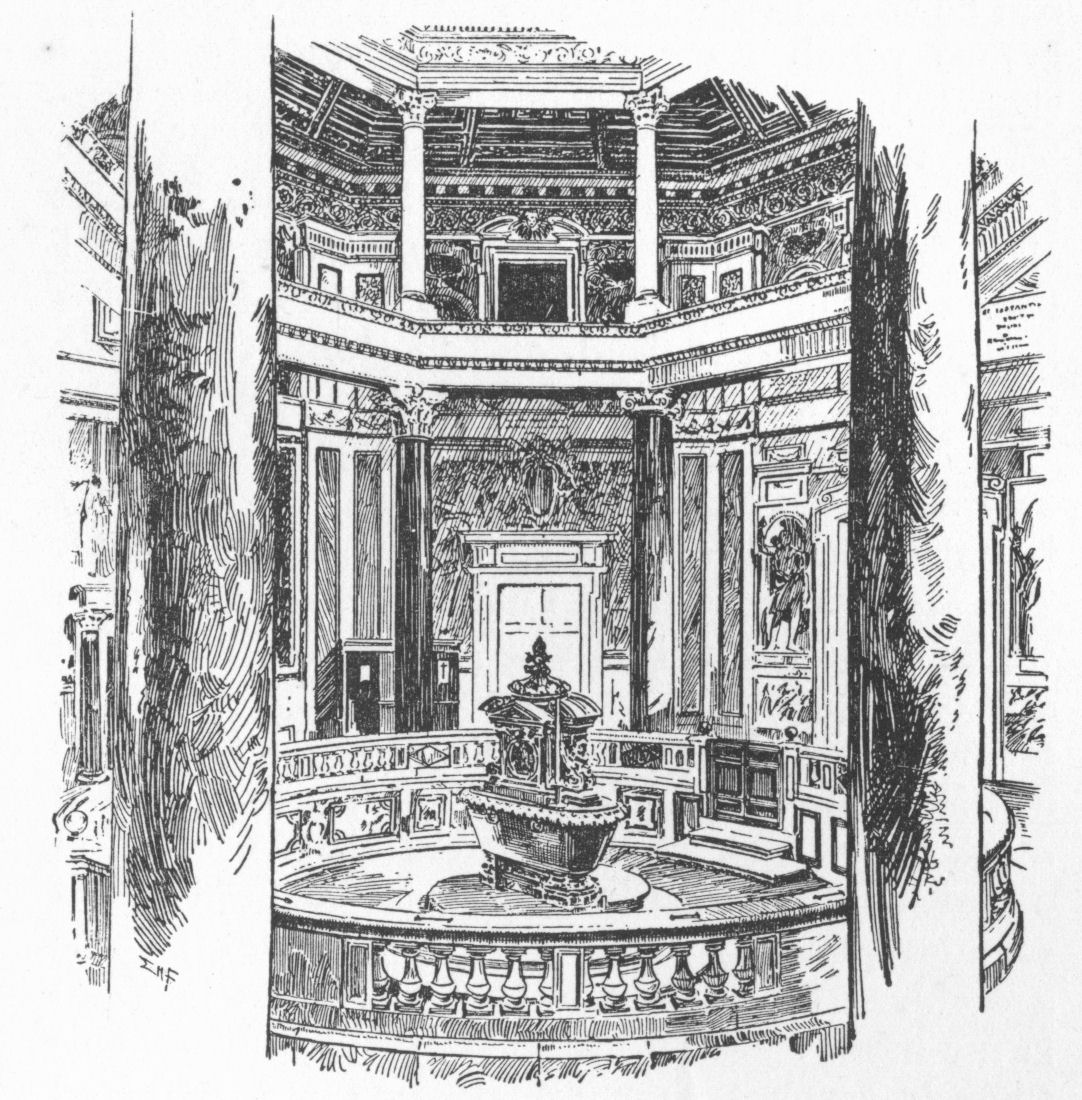
Bap´tistery, a building or a portion of a building in which is administered the rite of baptism. In the early Christian Church the baptistery was distinct from the basilica or church, but was situated near its west end, and was generally circular or octagonal in form, and dome-roofed. About the end of the sixth century the baptistery began to be absorbed into the church, the font being placed within and not far from the western door. Some detached baptisteries still remain in use, as those of the Lateran, Rome (the earliest in existence), at Pisa, Parma, Ravenna, Aquileia, Siena, Florence, &c., that of Florence being 108 feet in diameter externally, and richly decorated. Baptisteries were dedicated to St. John the Baptist.
Bap´tists, a Protestant sect, distinguished by their opinions respecting the mode and subjects of baptism. With regard to the mode, they maintain the necessity of immersion, and with regard to the subjects, they consider that baptism ought not to be administered to children at all, nor to adults in general, but to those only who profess repentance and faith. They are sometimes called Anti-pædobaptists, to express their variance from those who defend infant baptism, and who are called Pædobaptists. Apart from the special sect of that name, Baptists are to be found equally among Calvinists and Arminians, Trinitarians and Unitarians. The Baptists as a whole adopt the Independent or Congregational form of church government, and their ecclesiastical assemblies are held for the purpose of mutual stimulus and intercourse, and not for the general government of the body, or for interference with individual churches. The Particular Baptists of England (so called from believing that Christ died only for the elect), the Baptists of Scotland and Ireland, the Associated Baptists of America, and some of the Seventh-day Baptists, are Calvinistic. The other classes, such as the General Baptists (who believe that Christ died for all), are Arminian, or at least not Calvinistic. Most Baptists profess to be Trinitarians. The Free-will Baptists, the Christian Society, and most of the General Baptists of England admit of open communion; the other bodies decline communion with any Christians but Baptists. The Associated or Calvinistic Baptists long ranked in the United States as the most numerous denomination of Christians. The Seventh-day Baptists, or Sabbatarians, observe the seventh day of the week. The Free-will Baptists profess the doctrine of free salvation. The Anabaptists of the Reformation period are not to be confounded with the Baptists, by whom their principles were expressly disclaimed. The first regular Baptist Church appears to have been formed in the reign of Elizabeth, but we may date their first public acknowledgment as distinct from the Anabaptists from their petition to Parliament in 1620. The year 1633 provides the earliest record of the formation of a Particular Baptist Church in London. In 1689 a Baptist General Assembly, held in London, formulated a confession of thirty-two articles and a catechism. The Baptist Union, formed in 1832, comprehends the greater number of members of the sect in Great Britain and Ireland. In July, 1905, a world-congress of Baptists was held in London, and the Baptist World Alliance was constituted. The total number of members of Baptist Churches in the United Kingdom was 405,104 in 1922, and 408,029 in 1920. There are nine colleges for training ministers, of which the chief are: Bristol Baptist College; Regent's Park; Rawdon, Bradford; and the Metropolitan Pastors' College. The Regular Baptists in the United States numbered 7,504,447 members in 1922, and nearly 6,000,000 in 1920, in addition to which there are Anti-mission Baptists, Free-will Baptists, and Seventh-day Baptists. In Canada there are in all about 128,730 Baptists.—Bibliography: H. C. Vedder, A Short History of the Baptists; A. H. Newman, History of the Baptist Churches in the United States; The Baptist Handbook (annually); The American Baptist Year-book (annually); W. E. MacIntyre, Baptist Churches, 1500-1914.
Bar, in law, the railing that encloses the place which counsel occupy in courts of justice; hence the phrase, at the bar of the court, that is, in open court. Hence also persons duly admitted as pleaders or advocates before the courts of England are denominated barristers (see Barrister), and the whole body of such barristers or advocates are called the bar. The enclosed place or dock in which persons accused of crimes stand in court is also called the bar. Near the door of both Houses of Parliament there is also a bar, beyond which none but the members and clerks are admitted, and at which counsel, witnesses, offenders against privilege, &c., are heard.
Bar, in music, is a line drawn through the stave to mark the rhythm of small portions; the notes composing these are also called a bar.
Bar, in heraldry, an ordinary resembling the fesse, stretching like it horizontally across the shield but narrower.
Bar, Confederation of. See Poland.
Bar´aba, the name of a great steppe in the West Siberian governments of Tomsk, Akmolinsk, and Tobolsk.
Barabin´zians, a rude, uncultivated tribe of Tartars, living on the banks of the River Irtish, and subsisting chiefly on the produce of their herds and on fish supplied by the lakes of the Baraba steppe.
Baraguey-d'Hilliers (ba˙-ra˙-gā-dēl-yā),Louis, a distinguished French general under the first Empire, born in Paris, 1764. After serving under Custine and other generals he joined the army of Italy, and took Bergamo and Venice, of which he became Governor. He took part in the expedition to Egypt, served in the campaigns in Germany and Spain, and commanded a division of the "Great Army" in the Russian campaign of 1812. He was entrusted with the direction of the vanguard in the retreat, but was compelled to capitulate. Napoleon ordered him to return to France as under arrest, but, overcome with grief and fatigue, he died at Berlin on the way, Dec., 1812.
Baranovitchi, a town in Russia, government of Minsk. A battle was fought here between the Russians and the Germans in July, 1916. See European War.
Barb, a horse of the Barbary breed, introduced by the Moors into Spain, and of great speed, endurance, and docility.
Barbacan. Walmgate Bar, York
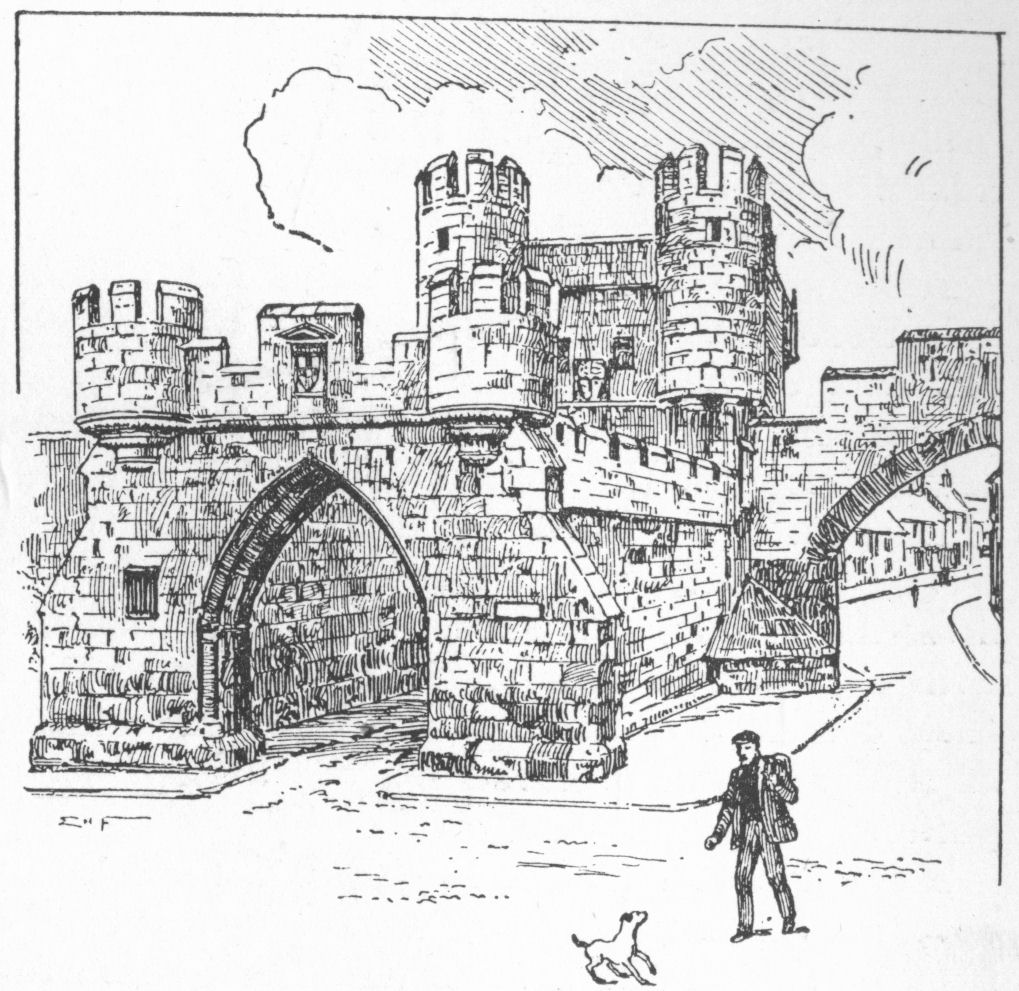
Bar´bacan, or Barbican, generally an advanced work defending the entrance to a castle or fortified town, as before the gate or drawbridge, and often of formidable size and strength.
Barba´does, or Barbados, the most eastern of the West India Islands, first mentioned in 1518, and occupied by the British in 1625. Length, 21 miles; breadth, 13; area, 106,470 acres or 166 sq, miles, about 74,000 being under cultivation. It is divided into eleven Church of England parishes; capital, Bridgetown. It is one of the most densely-populated areas in the world, the population in 1917 being estimated at 186,656, or nearly 1100 to the square mile. The climate is very hot, though moderated by the constant trade-winds; and the island is subject to dreadful hurricanes. The surface is broken, now without forests, and with few streams; the highest point is 1145 feet above the sea-level. There are few indigenous mammals or birds. The black lowland soil gives great returns of sugar in favourable seasons. The chief exports, besides sugar, are molasses and rum; imports: rice, salt meat, corn, butter, flour, &c. Both exports and imports were over £2,000,000 in 1918. Barbadoes has a considerable transit trade, being in some measure the central mart for all the Windward Islands. It is the see of a bishop and the head-quarters of the British forces in the West Indies. There is a railway across the island, also tramways, telephones, &c. The island forms a distinct government under a Governor, an Executive and a Legislative Council of 9 members, and a House of Assembly of 24 members. Liberal provision is made for education both by old foundations and by annual vote.
Barbadoes Leg, a form of elephantiasis.
Bar´bara, St., according to the legend, belonged to Nicomedia, in Asia Minor, and was beheaded by her father for having turned Christian, he being immediately thereafter struck dead by lightning. The latter part of this legend caused her, probably, to be invoked in storms, and to be considered the patron saint of artillerists.
Barbarelli. See Giorgione.
Barbarian (Gk. barbaros), a name given by the Greeks, and afterwards by the Romans, to everyone who spoke an unintelligible language; and hence coming to connote the idea of rude, illiterate, uncivilized. This word, therefore, did not always convey the idea of something odious or savage; thus a Greek character in Plautus calls Nævius a barbarous poet, because he had not written in Greek; and Cicero terms illiterate persons without taste 'barbarians'.
Barbarossa ('red-beard'), the name of two famous Turkish corsairs of the sixteenth century, who ravaged the shores of the Mediterranean, and established themselves in Algiers. The elder of the brothers, Aruch or Horuk, was killed in 1518; the younger and more notorious, Hayraddin, who captured Tunis, died in 1546. See Frederick Barbarossa.
Bar´bary, a general name for the most northerly portion of Africa, extending about 2600 miles from Egypt to the Atlantic, with a breadth varying from about 140 to 550 miles, comprising Morocco, Algeria, Tunisia, and Libya (Tripolitania, Barqa, and Fezzan). The principal races are: the Berbers, the original inhabitants, from whom the country takes its name; the Arabs, who conquered an extensive portion of it during the times of the caliphs; the Bedouins, Jews, Turks, and the French colonists of Algeria, &c. The country, which was prosperous under the Carthaginians, was, next to Egypt, the richest of the Roman provinces, and the Italian States enriched themselves by their intercourse with it. In the fifteenth century, however, it became infested with adventurers who made the name of Barbary corsair a terror to commerce, a condition of things finally removed by the French occupation of Algeria.
Barbary Ape (Inŭus ecaudātus), a species of ape, or tailless monkey, with greenish-brown hair, of the size of a large cat, remarkable for docility, also called the magot. It is common in Barbary and other parts of Africa, and some used to live formerly on Gibraltar Rock, being the only European monkey, though probably not indigenous. It has been the 'showman's ape' from time immemorial.
Bar´bastel, or Barbastelle, a bat with hairy lips (Barbastellus commūnis), a native of England.
Barbas´tro, a city, Spain, Arragon, province of Huesca, with an interesting cathedral, and some trade and manufactures. Pop. 7202.
Bar´bauld, Anna Letitia, English poet and general writer, was born in Leicestershire, 1743, daughter of a Presbyterian minister named Aikin. She published a small volume of miscellaneous poems in 1772, and in 1773, in conjunction with her brother, Dr. John Aikin, a collection of pieces in prose. In 1774 she married the Rev. Rochemont Barbauld. Her Early Lessons and Hymns for Children, and various essays and poems, won considerable popularity. She edited a collection of English novels, with critical and biographical notices; a selection from the British essayists of the reign of Anne, and another from Richardson's correspondence. Her last long poem, Eighteen Hundred and Eleven, appeared in 1812. She died at Stoke-Newington, 1825.
Bar´becue, a word of West Indian origin, meaning a hog, or other large animal, roasted whole. In the United States the word means a large gathering of people in the open air, for a social or political feast, where whole animals are roasted and eaten.
Barbed Wire, wire-rope for fencing or other purposes, having fixed in it short bent pieces of wire with sharp projecting points, which serve to keep animals from pressing against it. There is an Act of Parliament (1893) to prevent the use of barbed-wire fences that form a nuisance on a public road or path; and a person employing barbed wire for fencing may render himself liable for damages caused by it to another person who is legitimately using the adjoining ground. Barbed wire plays an important part in the construction of obstacles in modern warfare. During the European War, all systems of trenches were protected by thick belts of wire. This wire was laid out in various different ways, two of the best being known as the Concertina Fence and the Double-apron Fence.
Barbel (Barbus), a genus of freshwater fishes of the carp family, distinguished by the four fleshy filaments growing from the lips, two at the nose and one at each corner of the mouth, forming the kind of beard to which the genus owes its name. Of the several species the European Barbus vulgāris, common in most rivers, has an average length of from 12 to 18 inches, and in form and habits strongly resembles the pike. Its body is elongated and rounded, olive-coloured above and bluish on the sides, and covered with small scales. The upper jaw, which is much longer than the lower, forms a snout, with which it bores into the mud for worms, insects, aquatic plants, &c. It is common in the Thames, where it gives good sport to the angler; but its flesh is very coarse, and at the time of spawning the roe is dangerous to eat.
Barber, one whose occupation is to shave or trim the beard, or to cut and dress hair. The practice of surgery was formerly a part of the craft, and by an Act of Henry VIII the Company of Barbers was incorporated with the Company of Surgeons—the company being then known as the Barber-surgeons—with the limitation, however, that the surgeons were not to shave or practise 'barbery', and the barbers were to perform no higher surgical operation than blood-letting and tooth-drawing. This continued till the time of George II. The signs of the old profession—the pole which the patient grasped, its spiral decoration in imitation of the bandage, and the basin to catch the blood—are still sometimes retained. The barbers' shops, always notorious for gossip, were in some measure the news centres of classic and mediæval times. The ancient hall in London, formerly used by the Barber-surgeons, is still standing in Markwell Street, Cripplegate.
Barberini (ba˙r-be-rē´nē), a celebrated Florentine family, which, since the pontificate of Maffeo Barberini (Urban VIII, 1623-44), has occupied a distinguished place among the nobility of Rome. During his reign Urban was chiefly intent on the aggrandizement of his three nephews, of whom two were appointed cardinals, and the third Prince of Palestrina.
Barberry (Berbĕris aristata)
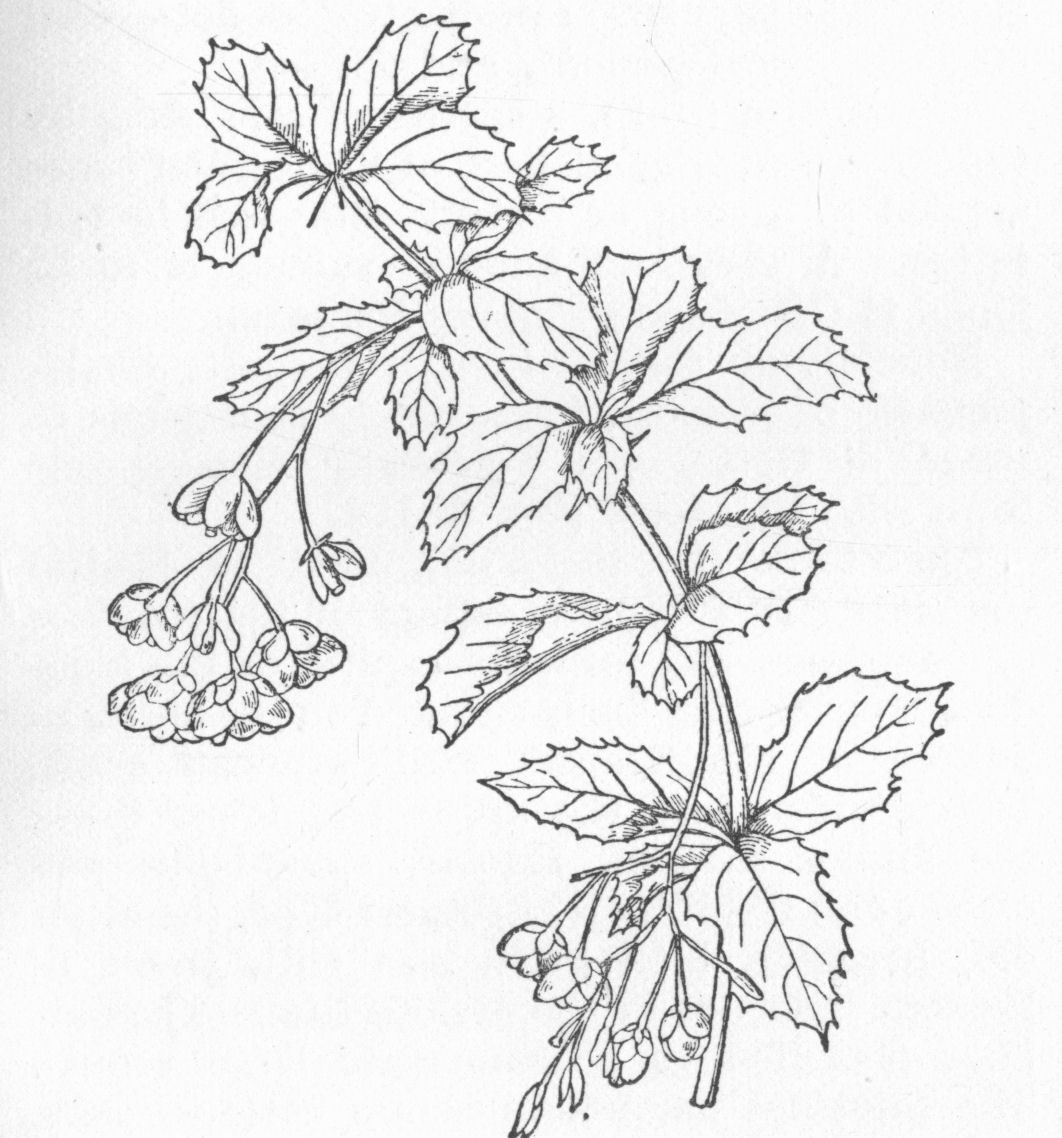
Bar´berry, a genus of shrubs, nat. ord. Berberidaceæ. The common barberry (Berbĕris vulgāris) has serrate, pointed leaves (the primary ones reduced to tripartite spines), hanging clusters of yellow flowers, and small, orange-red berries, which are sometimes made into preserves. The inner bark and roots yield a fine yellow dye (berberine). The shrub is a native of temperate Asia, but is now generally diffused through Europe and N. America. In Britain it has been almost universally banished from hedgerows, owing to its connection with the black rust of wheat. Numerous other species inhabit Asia and America; those of the section Mahonia have pinnate leaves. B. aristata is an erect bush, with furrowed red-brown branches, and pendulous clusters of yellow flowers; it thrives best in the south. See Irritability and Rust.
Bar´berton, the chief mining-centre of De Kaap gold-fields, Transvaal, about 80 miles from Lydenburg, and 150 to 160 from Delagoa Bay. British prisoners were confined here in the Boer War (1899-1902). Pop. about 2000 (whites).
Bar´bets (Bucconidæ), a family of climbing birds with a thick conical beak, having tufts of bristles at its base. Their wings are short and their flight somewhat heavy. They have been divided into three sub-genera: The barbicans (Pogonias), inhabiting India and Africa, and feeding chiefly on fruit; the barbets proper (Bucco), found in Africa and America, and nearly related to the woodpeckers; and the puff-birds (Tamatia), inhabiting America, and feeding on insects.
Barbette (ba˙r-bet´), an elevation of earth behind the breastwork of a fortification, from which the artillery may be fired over the parapet instead of through an embrasure. In ships of war the name is given to a strong breastwork of armour over which heavy guns are fired. See Fortification.