Volume 1 — B (continued 2)
Reading edition
Baildon, an urban district in the W. Riding of Yorkshire, about 5 miles north of Bradford, with worsted manufactures, chemical works, and quarries. Pop. (1921), 6527.
Bailen (bī-len´), a town of Southern Spain, province Jaen, with lead-mines. Pop. 8334.
Bailey (bā´li), the name given to the courts of a castle formed by the spaces between the circuits of walls or defences which surrounded the keep.
Bailey, or Baily, Nathaniel, an English lexicographer, school teacher at Stepney, and author of several educational works. His Dictionary, published in 1721, passed through a great many editions.
Bailey, Philip James, English poet, born near Nottingham, 1816, called to the bar 1840, died 1902. He published Festus, his best work, in 1839; The Mystic, 1855; The Age, 1858; and The Universal Hymn, 1867.
Bailie, or Baillie, a municipal officer or magistrate in Scotland, corresponding to an alderman in England. The criminal jurisdiction of the provost and bailies of royal burghs extends to breaches of the peace, drunkenness, adulteration of articles of diet, thefts not of an aggravated character, and other offences of a less serious nature.
Bailiff, a civil officer or functionary, subordinate to someone else. There are several kinds of bailiffs, whose offices widely differ, but all agree in this, that the keeping or protection of something belongs to them. In England the sheriff is the monarch's bailiff, and his county is a bailiwick. The name is also applied to the chief magistrates of some towns, to keepers of royal castles, as of Dover, to persons having the conservation of the peace in hundreds and in some special jurisdictions, as Westminster, and to the returning officers in the same. But the officials commonly designated by this name are the bailiffs of sheriffs, or sheriffs' officers, who execute processes, &c.
Bailleul (ba˙-yeul), an ancient French town, department of Nord, near the Belgian frontier, about 19 miles west of Lille. Much fighting took place in its vicinity during the European War, but it was not destroyed until the campaign of 1918. Pop. 12,828.—A village of the same name in department Orne gave its name to the Baliol family.
Baillie, Joanna, a Scottish authoress, born at Bothwell, Lanarkshire, in 1762, died at Hampstead, 1851. She removed in early life to London, where her brother, Matthew Baillie, was settled as a physician. Here in 1798 she published her first work, entitled A Series of Plays, in which she attempted to delineate the stronger passions by making each passion the subject of a tragedy and a comedy. The series was followed up by a second volume in 1802, and a third in 1812. A second series appeared in 1836, and a complete edition of her whole dramatic works in 1850. She also published a volume of miscellaneous poetry, including songs, in 1841. Her only plays performed on the stage were a tragedy entitled the Family Legend, brought out at Edinburgh under the patronage of Sir Walter Scott; and De Montfort, brought out by John Kemble, who acted in it with Mrs. Siddons.
Baillie, Matthew, M.D., physician and anatomist, brother of the preceding, was born 1761 at Shotts, Lanarkshire, died at Cirencester, Gloucestershire, in 1823. In 1773 he was sent to the University of Glasgow. He afterwards studied anatomy under his maternal uncles, John and William Hunter, and entered Oxford, where he graduated as M.D. In 1783 he succeeded his uncle as lecturer on anatomy in London, where he acquired a high reputation as a teacher and demonstrator, having also a large practice. In 1810 he was appointed physician to George III. His work on The Morbid Anatomy of Some of the Most Important Parts of the Human Body gave him a European reputation.
Baillie, Robert, an eminent Scottish Presbyterian clergyman, was born at Glasgow in 1599, died 1662. Though educated and ordained as an Episcopalian, he resisted the attempt of Archbishop Laud to introduce his Book of Common Prayer into Scotland, and joined the Presbyterian party. In 1638 he represented the presbytery of Irvine in the General Assembly at Glasgow, which dissolved Episcopacy in Scotland. In 1640 he was selected to go to London, with other commissioners, to draw up the accusation against Archbishop Laud. Of this, and almost all the other proceedings of his public life, he has left a minute account in his letters and journals, which form a most valuable collection for the history of his time. In 1642 he was appointed professor of divinity at Glasgow. He was a member of the Westminster Assembly of Divines, and attended its sittings from 1643-6. After the Restoration, though made principal of his college through Court patronage, he did not hesitate to express his dissatisfaction with the reintroduction of Episcopacy.
Baillie, Robert, of Jerviswood, in Lanarkshire, a Scottish patriot of the reign of Charles II. He brought himself into notice by opposing the tyrannical measures of Archbishop Sharpe against the Nonconformists, for which he was fined 6000 merks (or £500) and imprisoned for four months. In 1683 he went to London in furtherance of a scheme of emigration to South Carolina taken up by a number of Scottish gentlemen, as being the only way of escaping the tyranny of the Government. He became associated with Monmouth, Sydney, Russell, and the rest of that party, and was charged with complicity in the Rye-house plot. After a long imprisonment, during which vain attempts were made to obtain evidence against him, he was brought before the Court of Justiciary (23rd Dec., 1684), was found guilty, and condemned to be executed that afternoon.
Baillieston, a town of Scotland, in Lanarkshire, a few miles east of Glasgow, with extensive collieries, in which many of the inhabitants are employed. Pop. 5500.
Bailly (ba˙-yē), Jean Sylvain, French astronomer and statesman, born at Paris 1736. After some youthful essays in verse, he was induced by Lacaille to devote himself to astronomy, and on the death of the latter in 1753, being admitted to the Academy of Sciences, he published a reduction of Lacaille's observations on the zodiacal stars. In 1764 he competed ably but unsuccessfully for the Academy prize offered for an essay upon Jupiter's satellites, Lagrange being his opponent; and in 1771 he published a treatise on the light reflected by these satellites. In the meantime he had won distinction as a man of letters by his Éloges on Pierre Corneille, Leibnitz, Molière, and others; and the same qualities of style shown by these were maintained in his History of Astronomy (1775-87), his most extensive work. In 1784 the French Academy elected him a member. The revolution drew him into public life. Paris chose him, 12th May, 1789, first deputy of the tiers-état, and in the Assembly itself he was made first president, a post occupied by him on 20th June, 1789, in the session of the Tennis Court, when the deputies swore never to separate till they had given France a new constitution. As Mayor of Paris his moderation and impartial enforcement of the law failed to commend themselves to the people, and his forcible suppression of mob violence, 17th July, 1791, aroused a storm which led to his resignation and retreat to Nantes. In 1793 he attempted to join Laplace at Melun, but was recognized and sent to Paris, where he was condemned by the revolutionary tribunal, and executed on 12th Nov.
Bailment, in law, is the delivery of a chattel or thing to a person in trust, either for the use of the bailer or person delivering, or for that of the bailee or person to whom it is delivered. A bailment always supposes the subject to be delivered only for a limited time, at the expiration of which it must be re-delivered to the bailer, the responsibility of the bailee being dependent, in some degree, upon the contract on which the bailment is made. Pledging and letting for hire are species of bailment. Agistment, or the taking in of cattle or live stock to feed at a rate of so much per head, is a contract of bailment.
Baily, Edward Hodges, an English sculptor, born at Bristol 1788, died at London 1867. He became a pupil of Flaxman in 1807, gained the Academy Gold Medal in 1811, and was elected R.A. in 1821. Principal works: Eve at the Fountain, Eve Listening to the Voice, Maternal Affection, Girl Preparing for the Bath, The Graces, &c. The bas-reliefs on the south side of the Marble Arch, Hyde Park, the statue of Nelson on the Trafalgar Square monument, and other public works, were by him.
Baily, Francis, astronomer, born in Berkshire 1774; settled in London as a stockbroker in 1802. While thus actively engaged he published Tables for the Purchasing and Renewing of Leases, The Doctrine of Interest and Annuities, The Doctrine of Life Annuities and Assurances, and an epitome of universal history. On retiring from business with an ample fortune in 1825 he turned his attention to astronomy, became one of the founders of the Astronomical Society, contributed to its Transactions, and in 1835 published a life of Flamsteed. He died in 1844.
Baily's Beads, a phenomenon attending eclipses of the sun, the unobscured edge of which appears discontinuous and broken immediately before and after the moment of complete obscuration. It is classed as an effect of irradiation, and is caused by the sun shining through the depressions between the lunar mountains.
Bain, Alexander, Scottish philosopher and educationalist, was born at Aberdeen in 1818. He was educated at Marischal College (then a separate university), Aberdeen; was for some years a deputy professor in the university; subsequently held official posts in London; and in 1860 was appointed professor of logic and English in Aberdeen University, a post which he held till his resignation in 1881. His most important works are: The Senses and the Intellect (1855); The Emotions and the Will (1859), together forming a complete exposition of the human mind; Mental and Moral Science (1868); Logic, Deductive and Inductive (1870); Mind and Body (1873); Education as a Science (1879); James Mill, a Biography (1881); John Stuart Mill, a Criticism with Personal Recollections (1882); besides an English Grammar; English Composition and Rhetoric; an Autobiography, &c. Bain was at once grammarian, rhetorician, educationalist, and logician, but his fame rests on his contributions to psychology. He died in 1903.
Bainsizza Plateau. See European War.
Bairam (bī´ram), the Easter of the Mohammedans, which follows immediately after the Ramadan or Lent (a month of fasting), and lasts three days. This feast during the course of thirty-three years makes a complete circuit of all the months and seasons, as the Turks reckon by lunar years. Sixty days after this first great Bairam begins the lesser Bairam. They are the only two feasts prescribed by the Mohammedan religion.
Baird, Sir David, a distinguished British soldier, was born in Aberdeenshire in 1757, and entered the army 1772. Having been promoted to a lieutenancy in 1778 he sailed for India, distinguished himself as a captain in the war against Hyder Ali, was wounded and taken prisoner, and confined in the fortress of Seringapatam for nearly four years. He and his fellow-prisoners were treated with great barbarity, and many of them died or were put to death, but at last (in 1784) all that survived were set at liberty. In 1787 he became major, and in 1791 joined the army under Cornwallis as lieutenant-colonel, and was appointed to the command of a brigade in the war against Tippoo. After much hard service he was made a colonel in 1795, went in 1797 to the Cape of Good Hope as brigadier-general, and in 1798, on his appointment as major-general, returned to India. In 1799 he commanded the storming party at the assault of Seringapatam, and, in requital, was presented with the State sword of Tippoo Saib. Being appointed in 1800 to command an expedition to Egypt, he landed at Kosseir in June, 1801, crossed the desert, and, embarking on the Nile, descended to Cairo, and thence to Alexandria, which he reached a few days before it surrendered to General Hutchinson. Next year he returned to India, but being soon after superseded by Sir Arthur Wellesley (Wellington), he sailed for Britain, where he was knighted and made K.B. With the rank of lieutenant-general he commanded an expedition in 1805 to the Cape of Good Hope, and in 1806, after defeating the Dutch, he received the surrender of the colony. He commanded a division at the siege of Copenhagen, and after a short period of service in Ireland sailed with 10,000 men for Corunna, where he formed a junction with Sir John Moore. He commanded the first division of Moore's army, and in the battle of Corunna lost his left arm. By the death of Sir John Moore, Sir David succeeded to the chief command, receiving for the fourth time the thanks of Parliament, and a baronetcy. In 1814 he was made a general. He died in 1829.
Baird, Spencer Fullerton, American naturalist, born 1823, died 1887. From 1850 to 1878 he was assistant secretary, and then became secretary, of the Smithsonian Institution, Washington, and was also chief Government commissioner of fish and fisheries. He wrote much on natural history, his chief works being The Birds of North America (in conjunction with John Cassin), The Mammals of North America, Review of American Birds in the Smithsonian Institution, and (with Messrs. Brewer and Ridgeway) History of North American Birds.
Baireuth (bī´roit), a well-built and pleasantly-situated town of Bavaria, on the Red Main, 41 miles north-east of Nürnberg. The principal edifices, besides churches, are the old and the new palace, the opera-house, the gymnasium, and the national theatre, constructed after the design of the composer Wagner, and opened in 1876 with a grand performance of his tetralogy of the Nibelungen Ring. Industries: cotton-spinning, sugar-refining, musical instruments, sewing-machines, leather, brewing, &c. There is a monument to Jean Paul F. Richter, who died here. Pop. 34,547.
Baius, or De Bay, Michael, Catholic theologian, was born 1513, in Hainaut, educated at Louvain, made professor of theology there in 1552, and chosen a member of the Council of Trent in 1563. Leaving the scholastic method, he founded systematic theology directly upon the Bible and the Christian fathers, of whom he particularly followed St. Augustine. His doctrines of original sin and of salvation by grace led to his persecution as a heretic by the old Scotists, and the Jesuits, who succeeded in obtaining a Papal bull in 1567, condemning the doctrines imputed to him. Baius, however, remained in the possession of his dignities, was appointed in 1575 Chancellor of Louvain University; and the King of Spain even conferred upon him the office of Inquisitor-General in the Netherlands. He died in 1589. His Augustinian views descended to the Jansenists, while his doctrine of pure undivided love to God formed the staple of Quietism. His system is called Baianism.
Baize, a sort of coarse woollen fabric with a rough nap, now generally used for linings, and mostly green or red in colour.
Baja (bä´ya˙), a market town of Hungary, district of Bacs, on the Danube, with a trade in grain and wine, and a large annual hog fair. Pop. 20,361.
Bajaderes. See Bayaderes.
Bajazet (ba˙-ya˙-zet´), or Bayezid, I, Turkish emperor, who, in 1389, having strangled his brother Jacob, succeeded his father Murad or Amurath, who fell in the battle of Kossovo while fighting against the Serbians. From the rapidity of his conquests he received the name of Ilderim, the Lightning. In three years he overcame Bulgaria, part of Serbia, Macedonia, Thessaly, and the States of Asia Minor, and besieged Constantinople for ten years, defeating Sigismund and the allied Hungarians, Poles, and French in 1395. The attack of Timur (Tamerlane) on Natolia, in 1400, saved the Greek Empire, Bajazet being defeated and taken prisoner by him near Ancyra, Galatia, 1402. The story of his being carried about in a cage by Timur is improbable; but Bajazet died, in 1409, in Timur's camp, in Caramania. His successor was Soliman I.
Bajazet II succeeded his father, Mohammed II, Sultan of the Turks, in 1481. He increased the Turkish Empire by conquests on the N.W. and in the E., took Lepanto, Modon, and Durazzo in a war against the Venetians, and ravaged the coasts of the Christian States on the Mediterranean, to revenge the expulsion of the Moors from Spain. Having abdicated in favour of his younger son Selim, he died on his way to a residence near Adrianople in 1513. He did much for the improvement of his empire and the promotion of the sciences.
Bajimont's Roll. See Bagimonts Roll.
Bajocco, or Baiocco (ba˙-yok´o), was a copper coin in the Papal States, the hundredth part of a scudo, or rather more than a halfpenny. The name was also given in Sicily to the Neapolitan grano, the hundredth part of the ducato (3s. 4d.).
Bajus. See Baius.
Bajza (boi´za), Anton, Hungarian lyric poet, historian, and critic, born 1804, died 1858. As contributor to and editor of various periodicals he played an important part in the development of modern Hungarian literature and drama. A volume of his poems, of high merit, was published in 1835. He also translated a collection of foreign dramas, and edited a series of historical works.
Bakalaha´ri, a Bechuana tribe inhabiting the Kalahari Desert, S. Africa.
Bak´arganj, a maritime district and town in Eastern Bengal; chief rivers: Ganges, Brahmaputra, and Meghna. Area, 3649 sq. miles. Pop. 2,292,000. The town now lies in ruins. Pop. 7000.
Bakau (bä´kou), a town of Roumania, on the Bistritza. Pop. 16,187.
Bakchisarai (ba˙k-chi-sa˙-rī´), or Bagtcheserai (Bakh-chi-Sarai) (bäg-che-se-rī; Turk., 'Garden Palace'), an ancient town of Russia, in the Crimea, picturesquely situated at the bottom of a narrow valley, hemmed in by precipices. It contains the palace of the ancient Crimean khans, restored by the Russian Government. Pop. 15,000.
Baker, Sir Richard, an English historian, born in Kent in 1568, educated at Oxford, knighted in 1603 by James I, and in 1620 appointed High Sheriff of Oxfordshire, where he had estates. Having given security for a debt incurred by his wife's family, he was thrown into Fleet Prison, where, after remaining some years, he died in 1645. During his imprisonment he wrote some devotional books and his Chronicle of the Kings of England, first published in 1641, and afterwards continued by Edward Phillips, the nephew of Milton, and others—a work of great popularity in its day, though of no permanent value.
Baker, Sir Samuel White, a distinguished English traveller, born in 1821. He resided some years in Ceylon; in 1861 began his African travels, which lasted several years, in the Upper Nile regions, and resulted, among other discoveries, in that of Albert Nyanza Lake in 1864, and of the exit of the White Nile from it. In Africa he encountered Speke and Grant after their discovery of the Victoria Nyanza. On his return home he was received with great honour and was knighted. In 1869 he returned to Africa as head of an expedition sent by the Khedive of Egypt to annex and open up to trade a large part of the newly-explored country, being raised to the dignity of pasha. He returned in 1873, having finished his work, and was succeeded by the celebrated Gordon. His writings include: The Rifle and the Hound in Ceylon; Eight Years' Wanderings in Ceylon; The Albert Nyanza; The Nile Tributaries of Abyssinia; Ismailia: a Narrative of the Expedition to Central Africa; Cyprus as I saw it in 1879; also, Cast up by the Sea, a story published in 1868. He died 30th Dec., 1893.
Baker, Thomas, antiquary, born 1656, educated at Cambridge. As a non-juror he lost his living at Long-Newton in 1690, and was compelled to resign his fellowship on the accession of George I, but continued to reside at St. John's College till his death in 1740. His Reflections on Learning (1709-10) went through seven editions. He left in MS. forty-two folio volumes of an Athenæ Cantabrigienses, from which a History of St. John's College was edited by Professor Mayor in 1869.
Bakewell, an ancient market town, England, county of Derby, between Buxton and Matlock, possessing a fine Gothic church, a chalybeate spring, a cotton-mill erected by Arkwright, and a large marble-cutting industry. Pop. 3062.
Bakewell, Robert, an English agriculturist, celebrated for his improvements in the breeding of sheep, cattle, and horses, was born in Leicestershire in 1725, and died in 1795. He commenced experiments in breeding sheep, about 1755, upon his father's farm at Dishley, and for fifty years devoted himself to the acquisition and diffusion of information upon the subject. He was the originator of the new Leicestershire breed of sheep, which has since been so well known, and also of a breed of cattle very famous in their day. The demand for his rams increased so considerably, that whereas he let them for the season at £16 per head in 1755, by 1789 they were hired at 6000 guineas. Various improvements in farm management were also introduced by him.
Bakhmut. See Bachmut.
Bakhuisen. See Backhuysen.
Baking, a term meaning 'to cook by dry heat', and primarily applied to the baking of bread. A common application of the term is to a mode of cooking food in a close oven, baking in this case being opposed to roasting or broiling, in which an open fire is used. The oven should not be too close, but ought to be properly ventilated. Baking is also applied to the hardening of earthenware or porcelain by fire. See Bread.
Baking Powder, a mixture of bicarbonate of soda and tartaric acid, usually with some flour added. The water of the dough causes the liberation of carbonic acid, which makes the bread 'rise'.
Bakony (ba˙-kon´yė) Wald, a thickly wooded mountain range dividing the Hungarian plains, famous for the herds of swine fed on its mast.
Baksheesh´, an Eastern term for a present or gratuity. A demand for baksheesh meets travellers in the East everywhere from Turkey and Egypt to Hindustan.
Baku (bä-kö´), a Russian port on the western shore of the Caspian, occupying part of the Peninsula of Apsheron. The naphtha or petroleum springs of Baku have long been known; and the Field of Fire, so called from emitting inflammable gases, has long been a place of pilgrimage with the Guebres or Fire-worshippers. From the development of the petroleum industry, Baku has greatly increased, and is now a large and flourishing town. About 1500 oil-wells are in operation, producing immense quantities of petroleum (6,448,000 tons in 1917), much of which is led direct in pipes from the wells to the refineries in Baku, and it is intended to lay a pipe for its conveyance all the way to the Black Sea at Batoum, which is already connected with Baku by railway. Some of the wells have had such an outflow of oil as to be unmanageable, and the Baku petroleum now competes successfully with any other in the markets of the world. Baku, formerly the station of the Caspian fleet, is strongly fortified, and has a large shipping trade. The district of Baku lies within the limits of the new Republic of Azerbaijan. Pop. 237,000; pop. of the province, 1,119,600.
Baku´nin, Michael, Russian anarchist, the founder of Nihilism, born 1814 of a rich and noble family, entered the army, but threw up his commission after two years' service, and studied philosophy at Moscow, with his friends Hertzen, Turgeniev, Granovski (historian), and Byelinski (critic). Having adopted Hegel's system as the basis of a new revolution, he went in 1841 to Berlin, and thence to Dresden, Geneva, and Paris, as the propagandist of anarchism. Wherever he went he caused disturbance, and after undergoing imprisonment in various States, was handed over to Russia in 1851 by Austria, imprisoned for five years, and finally sent to Siberia. Escaping thence through Japan, he joined Hertzen in London on the staff of the Kolokol. His extreme views, however, ruined the paper and led to a quarrel with Marx and the Internationale; and having fallen into disrepute with his own party in Russia, he died suddenly and almost alone at Berne in 1878. He demanded the entire abolition of the State as a State, the absolute equalization of individuals, and the extirpation of hereditary rights and of religion, his conception of the next stage of social progress being purely negative and annihilatory.
Bala, a lake 4 miles long, and an urban district of N. Wales, in Merionethshire. Pop. 1408.
Balaam (bā'lam), a prophet, invited by Balak, King of Moab, to curse the Israelites, but compelled by miracle to bless them instead (Num. xxii-xxiv). In another account he is represented as aiding in the perversion of the Israelites to the worship of Baal, and as being, therefore, slain in the Midianitish war (Num. xxxi; Josh. xiii). He is the subject of many rabbinical fables, the Targumists and Talmudists regarding him, as most of the fathers did, in the light of an impious and godless man.
Bala Beds, or Bala Series, a deposit of Upper Ordovician Age, named from the Bala district, North Wales, consisting of slates, grits, sandstones, and limestones, there being two limestones separated by sandy and slaty rocks about 1400 feet thick. They contain trilobites of many species, and other marine fossils. The lower Bala limestone (25 feet thick) may be traced over a large area in North Wales. See Caradoc Series, Ordovician System.
Balachong´, an Oriental condiment, composed of small fishes, or shrimps, pounded up with salt and spices and then dried.
Balæ´na, the genus which includes the Greenland or right whale, type of the family Balænidæ, or whale-bone whales.
Balæ´niceps ('whale-head'), a genus of wading birds belonging to the Sudan, intermediate between the herons and storks, and characterized by an enormous bill, broad and swollen, giving the only known species (B. rex), also called shoe-bird, a peculiar appearance. It feeds on fishes, water-snakes, carrion, &c., and makes its nest in reeds or grass adjoining water. The bill is yellow, blotched with dark-brown, the general colour of the plumage dusky-grey, the head, neck, and breast slaty, the legs blackish.
Balænop´tera. See Rorqual.
Balagarh (bä-lä-gar'), town of Hindustan, in the Punjab. Pop. 11,233.
Balaghat´, a district of India, in the Central Provinces, Nagpur division; area, 3146 sq. miles; capital, Burha, a small place. The surface is diversified, comprising extensive uplands as well as lowlands; forests are extensive, and a comparatively small part of the area is under cultivation, rice being the chief crop. Iron exists in considerable quantities, and it is worked in a small way; gold is also worked. Pop. 330,000, almost entirely rural.
Balaguer (ba˙-la˙-gār'), Victor, Spanish author and politician, important writer in the Catalonian dialect, born 1824, died 1901. Born at Barcelona, he studied law there, and, becoming learned in Catalonian history, was appointed archivist and soon after professor of history. In 1869 he entered the Cortes as a Liberal; in 1872 was Minister of Public Works; from 1886 to 1888 Colonial Minister. He wrote much both in prose and verse, his prose comprising historical works, novels, &c., his verse lyrics, ballads, tragedies, odes, &c. His tragedies were partly on subjects taken from Catalonian history, partly on subjects connected with Greek and Roman history or literature. Among his lyrical and other poems are: El Trovador de Montserrat; Primavera de Ultimo Trovador Catalan; Poesias Completas (1874); Obras Poeticas (1880). Don Juan de Serrallonga is the most popular of his novels. Among other works of his are: Historia Politica y Literaria de los Trovadores; Historia de Cataluña; Los Pirineos; Cristobal Colon; Estudios Historicos y Politicos; Historias y Tradiciones; Instituciones y Reyes de Aragon. As a poet he was imitative, reminding us of Quintana, Zorilla, and Byron.
Balaklava (ba˙-la˙-klä'va), a small seaport in the Crimea, 8 miles S.S.E. Sevastopol. In the Crimean war it was captured by the British, who used the harbour as a base of supplies. The famous battle of Balaklava was fought some distance to the north of the seaport, on 25th Oct., 1854. The Russians brought a force of 25,000 men against the allies, a much larger force than they had to encounter, and the chief incidents in the battle were as follows: The Russians captured a series of positions occupied by the Turks in front of the British position; a Russian cavalry charge was repulsed by the 93rd Highlanders; a great mass of Russian cavalry was defeated by a charge of British heavy cavalry; the British light cavalry brigade charged and took a Russian battery, and put to flight the cavalry behind it, but were compelled by overpowering force to retreat with heavy loss, their retreat being covered by a brilliant charge of the French. The celebrated charge of the light brigade, or of the 'six hundred', though a brilliant feat of arms, was made under an erroneous interpretation of orders; that of the heavy brigade was equally glorious, and contributed far more to the final repulse of the enemy.
Balako´vo, a river-port of South-Eastern Russia, on the left bank of the Volga, government of Samara, with a very important trade in grain. Pop. 16,000.
Balalai´ka, a musical instrument of very ancient Slavonic origin, common among the Russians and Tartars. It is a narrow, shallow guitar with only two strings.
Bal´ance, an instrument for determining the relative weights of bodies. Balances are of various forms; in that most commonly used a horizontal beam rests so as to turn easily upon a fulcrum in the middle. From the extremities of the beam, called the centres of suspension, hang the scales; and a slender metal pointer between them, and in front of the fulcrum, indicates when the beam is level. The characteristics of a good balance are: (1) that the beam should rest in a horizontal position when the scales are either empty or loaded with equal weights; (2) that a very small addition of weight put into either scale should cause the beam to deviate from the level, which property is denominated the sensibility of the balance; (3) that when the beam is deflected from the horizontal position by inequality of the weights on the scales, it should have a tendency speedily to restore itself and come to rest in the level, which property is called the stability of the balance. To secure these qualities the arms of the beam should be exactly similar, equal in weight and length, and as long as possible; the centres of gravity and suspension should be in one straight line, and the fulcrum immediately above the centre of gravity; and the fulcrum and the centres of suspension should cause as little friction as possible. The fulcrum ought to be a knife-edge; and if the balance requires to be very delicate, the centres of suspension ought to be knife-edges also. If the balance has no tendency to one position more than another, when the scales are either loaded, empty, or off altogether, it is proof that the centre of gravity and the fulcrum coincide, and the remedy is to lower the centre of gravity. If the beam is disturbed by a small addition of weight to either scale, and exhibits no tendency to resume the horizontal position, we may infer that the centre of gravity is above the fulcrum. If it requires a considerable excess of weight to deflect the beam from the level, we may infer either that there is too much friction at the fulcrum, or that the centre of gravity is too low. If two weights are found to be in equipoise, one being in each scale, and if, when that which is in one scale is put into the other, there is no longer equilibrium, then we may infer that the arms of the beam are of unequal lengths. For purposes of accuracy, balances have occasionally means of raising or depressing the centre of gravity, of regulating the length of the arms, &c., and the whole apparatus is usually enclosed in a glass case, to prevent the heat from expanding the arms unequally, or currents of air from disturbing the equilibrium. A refinement in weighing is obtained by the use of the milligram rider, a short bent wire which can be moved along a scale engraved on the beam.
Of the other forms of balance, the Roman balance, or steel-yard, consists of a lever moving freely upon a suspended fulcrum, the shorter arm of the lever having a scale or pan attached to it, and the longer arm, along which slides a weight, being graduated to indicate quantities. It is commonly used for weighing loaded carts, for luggage at railway stations, &c. A variety of this, the Danish balance, has the weight fixed at the end of the lever, the fulcrum being movable along the graduated index. The spring-balance registers the weight of an article by the extent to which it draws out or compresses a spiral spring. It is of service where a high degree of exactness is not required, as in its domestic use, and it also finds application in the dynamometer for measuring horse-power of machinery. An extremely ingenious balance, used in the Mint and the Bank of England, for weighing 'blanks' and sovereigns, distributes them automatically into three compartments according as they are light, heavy, or the exact weight. The Roberval balance is a form in common use for weighing letters and parcels.—Bibliography: E. A. Brauer, The Construction of the Balance; E. Nicholson, Men and Measures: a history of weights and measures, ancient and modern.
Balance of Power, a political principle which first came to be recognized in modern Europe in the sixteenth century, though it appears to have been also acted on by the Greeks in ancient times, in preserving the relations between their different States. The object in maintaining the balance of power is to secure the general independence of nations as a whole, by preventing the aggressive attempts of individual States to extend their territory and sway at the expense of weaker countries. The first European monarch whose ambitious designs induced a combination of other States to counteract them was the Emperor Charles V, similar coalitions being formed in the end of the seventeenth century, when the ambition of Louis XIV excited the fears of Europe, and a century later against the exorbitant power and aggressive schemes of the first Napoleon. Since that time we have the instance of the Crimean War, entered into to check the ambition of Russia. Of late years there has been a marked tendency among British politicians to decry and impugn the principle of the balance of power, as calculated only to propagate a system of mutual hostility, and retard the cause of progress, by the expenditure both of money and life thus occasioned. An equilibrium between the various Powers is, of course, essential to the very existence of international law. The war of 1914-8 has proved to the world that in the absence of any central authority neither treaties nor signatures could prevent a State sufficiently powerful from ignoring the law and acting solely according to its interests and ambitious designs. See Society of Nations.—Bibliography: Hume, Essay on the Balance of Power; Von Gentz, Fragments on the Balance of Power; Professor L. Oppenheim, International Law, vol. i; Vattel, Le droit des gens.
Balance of Trade, the difference between the stated money values of the exports and imports of a country. The balance is erroneously said to be 'in favour' of a country when the value of the exports is in excess of that of the imports, and 'against it' when the imports are in excess of the exports. The phrases date from the days of the mercantile system, the characteristic doctrine of which alleged the desirability of regulating commerce with a view to amassing treasure by exporting produce largely, importing little merchandise in return, and receiving the balance in bullion. In certain conceivable political and industrial conditions this may have had beneficial results; but its importance was greatly overestimated, and the state of this balance came to be regarded as an invariable criterion of the industrial condition of a country. The false analogy of the successful merchant who gains more than he spends became the basis of popular reasoning, the products of a country being mistakenly identified with its exports, its consumption with its importation. It is now generally recognized that if bullion be exported from a country it is because it is at the time the cheapest commodity available for export; and further, that there are certain natural limits to its undue exportation, in that the increased scarcity of money is attended with a fall in the money-value of other commodities, which thus in turn become preferable objects of exportation, while bullion flows back. The excess of the value of imports over that of exports, which is regarded by some as an adverse and alarming symptom in British trade, is in large part readily accounted for on the ground of shipping receipts, insurance returns, interest on capital employed in foreign trade, merchants' profits, and the income derived from foreign investments.
Group of Balănus tintinnabŭlum
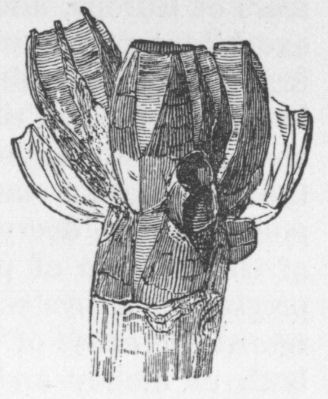
Bal´anus ('acorn-shells'), a genus of sessile cirripeds, family Balanidæ, of which colonies are to be found on rocks at low water, on timbers, crustaceans, shells of mollusca, &c. They differ from the barnacles in having a symmetrical shell, and being destitute of a flexible stalk. The shell consists of six plates, with an operculum of four valves. They pass through a larval state, in which they are not fixed, moving by means of swimming feet which disappear in the final state. All the Balanidæ are hermaphrodite. A South American species (Balănus psittăcus) is eaten on the coast of Chile, the Balănus tintinnabŭlum by the Chinese. The old Roman epicures esteemed the larger species.
Balapur´, town of India, in Akola district, Berar, with strong fort and fine pavilion of black stone. Pop. 10,500.
Bal´as, a name used to distinguish the rose-coloured species of ruby from the ruby proper.
Balasor´, a seaport town, Hindustan, presidency of Bengal, province of Orissa, head-quarters of a district and subdivision bearing the same name. It carries on a considerable traffic with Calcutta. Pop. 21,362.
Bala´ta, a gum yielded by Mimūsops Balata, a tree growing abundantly in British, French, and Dutch Guiana, Honduras and Brazil, obtained in a milky state by 'tapping' the tree, and hardening to a substance like leather. Used for similar purposes to india-rubber, and in the United States chewed as a masticatory.
Bal´aton, or Plattensee, a lake of Hungary, 55 miles S.W. of Pesth; length, 50 miles; breadth, 3 to 10 miles; area, about 390 sq. miles. Of its thirty-two feeders the Szala is the largest, and the lake communicates with the Danube by the Rivers Sio and Sarviz. It abounds with a species of perch.
Balbec. See Baalbek.
Balbi, Adrien, geographer and statistician, born at Venice in 1782. In 1808 his first work on geography, Prospetto Politico-Geografico, procured his appointment as professor of geography in the College of San Michele at Murano, and he became in 1811 professor of natural philosophy in the Lyceum at Fermo. In 1820 he proceeded to Portugal, and collected there materials for his Essai Statistique sur le Royaume de Portugal et d'Algarve and Variétés Politiques et Statistiques de la Monarchie Portugaise, both published in 1822 at Paris, where he resided till 1832. He then settled in Padua, where he died in 1848. Balbi's admirable Abrégé de Géographie was written at Paris, and translated into the principal European languages.
Balbi, Gaspāro, a Venetian dealer in precious stones, born about the middle of the sixteenth century, who travelled first to Aleppo and thence down the Euphrates and Tigris to the Malabar coast, sailing finally for Pegu, where he remained for two years. His Viaggio all' Indie Orientale, published on his return to Venice in 1590, contains the earliest account of India beyond the Ganges.
Balbo, Cesāre, Italian author and statesman, born in 1789 at Turin. After holding one or two posts under the patronage of Napoleon, he devoted himself to history, publishing a history of Italy prior to the period of Charlemagne, a compendium of Italian history, &c. His Speranze d'Italia (1843), a statement of the political condition of Italy, and of the practicable ideals to be kept in view, gave him a wide reputation. He died in 1853.
Balbo´a, Vasco Nuñez de, one of the early Spanish adventurers in the New World, born 1475. Having dissipated his fortune, he went to America, and was at Darien with the expedition of Francisco de Enciso in 1510. An insurrection placed him at the head of the colony, but rumours of a western ocean and of the wealth of Peru led him to cross the isthmus. On 25th Sept., 1513, he saw for the first time the Pacific, and after annexing it to Spain, and acquiring information about Peru, returned to Darien. Here he found himself supplanted by a new governor, Pedrarias Davila, with much consequent grievance on the one side, and much jealousy on the other. Balboa submitted, however, and in the following year was appointed Viceroy of the South Sea. Davila was apparently reconciled to him, and gave him his daughter in marriage, but shortly after, in 1517, had him beheaded on a charge of intent to rebel. Pizarro, who afterwards completed the discovery of Peru, served under Balboa.
Balbriggan, a seaport and favourite watering-place, Ireland, county of Dublin; celebrated for its hosiery. Pop. 2273.
Bal´cony, in architecture, is a gallery projecting from the outer wall of a building, supported by columns or brackets, and surrounded by a balustrade. Balconies were not used in Greek and Roman buildings, and in the East the roof of the house has for centuries served similar purposes on a larger scale. Balconies properly so styled came into fashion in Italy in the Middle Ages, and were introduced into Britain in the sixteenth century.
Baldachin: Church of St. Ambrogio, Milan
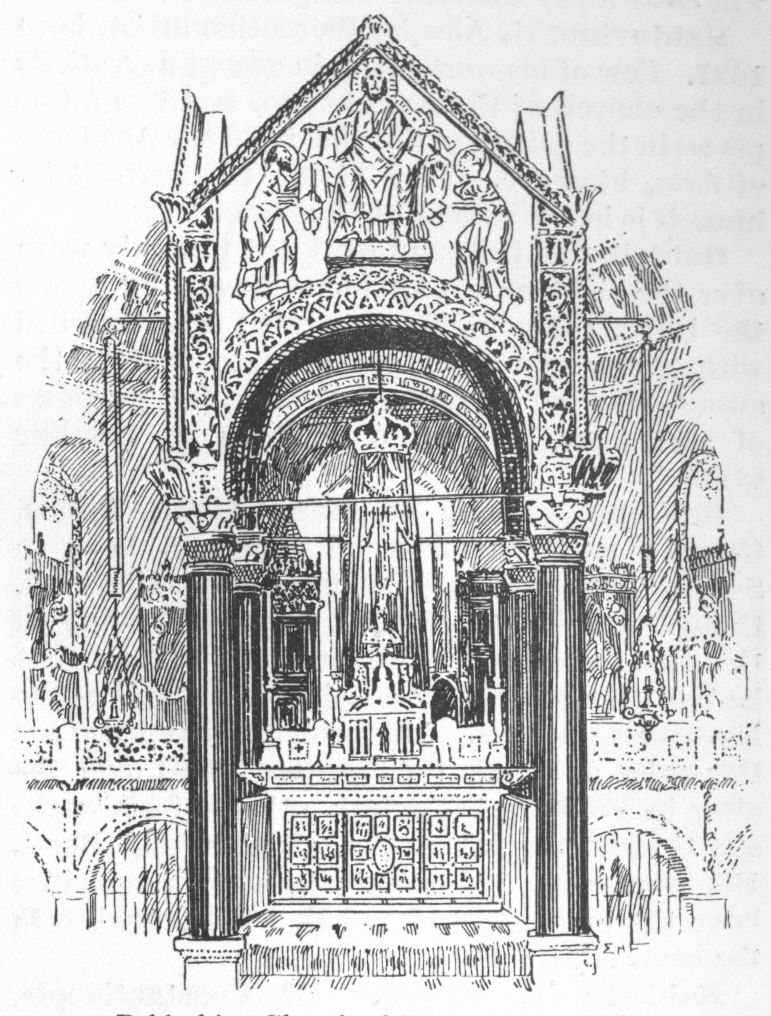
Bal´dachin (-kin; It. baldachino), a canopy or tent-like covering of any material, either suspended from the roof, fastened to the wall, or supported on pillars over altars, thrones, pulpits, beds, portals, &c. Portable baldachins of rich materials were formerly used to shield the heads of dignitaries in processions, and are still so used in the processions of the Roman Catholic Church, and in the East. The enormous bronze baldachin designed by Bernini for Pope Urban VIII, and placed over the tomb of the apostles in St. Peter's at Rome, is one of the most famous, though surpassed in beauty by many in other European cathedrals and churches.
Balder, or Baldur, a Scandinavian divinity, represented as the son of Odin and Frigga, beautiful, wise, amiable, and beloved by all the gods. His mother took an oath from every creature, and even from every inanimate object, that they would not harm Balder, but omitted the mistletoe. Balder was therefore deemed invulnerable, and the other gods in sport flung stones and shot arrows at him without harming him. But the evil god Loki fashioned an arrow from the mistletoe and got Balder's blind brother Hōder to shoot it, himself guiding his aim. Balder fell dead, pierced to the heart, to the deep grief of all the gods. He is believed to be a personification of the brightness and beneficence of the sun.
Baldi, Bernardino, mathematician, theologian, geographer, historian, poet, &c., born at Urbino 1533; studied at Padua; became abbot of Guastalla. He knew upwards of twelve languages, and is said to have written over a hundred works, most of which remain in MS. His works include a poem on Navigation, various translations and commentaries, Lives of Celebrated Mathematicians, &c. He died in 1617.
Baldness, loss of the hair, complete or partial, usually the latter, and due to various causes. Most commonly it results as one of the changes belonging to old age, due to wasting of the skin, hair-sacs, &c. It may occur as a result of some acute disease, or at an unusually early age, without any such cause. In both the latter cases it is due to defective nourishment of the hair, owing to lessened circulation of the blood in the scalp. The best treatment for preventing loss of hair seems to consist in such measures as bathing the head with cold water and drying it by vigorous rubbing with a rough towel and brushing it well with a hard brush. Various stimulating lotions are also recommended, especially those containing cantharides. But probably in most cases senile baldness is unpreventable. When extreme scurfiness of the scalp accompanies loss of the hair, an ointment that will clear away the scurf will prove beneficial.
Baldovinet´ti, Alessio, Florentine artist, born 1427. Few of his works remain except a Nativity in the church of the Annunziato, and two altarpieces in the gallery of the Uffizi and the Academy of Arts, Florence. Died 1499. His portrait by himself is in the gallery at Bergamo.
Baldric (ba¨ld´rik), a broad belt formerly worn over the right or left shoulder diagonally across the body, often highly decorated and enriched with gems, and used not only to sustain the sword, dagger, or horn, but also for purposes of ornament, and as a military or heraldic symbol.
Bal´dung, Hans, or Hans Grün (grün), German painter and wood engraver, born in Swabia 1470, died in Strasburg 1552. His work, though inferior to Dürer's, possessed many of the same characteristics, and on this account he has been sometimes considered a pupil of the Nuremberg master. His principal paintings are the series of panels (of the date 1516) over the altar in Freiburg Cathedral; others of his works are to be found at Berlin, Colmar, and Basel. His numerous and often fantastic engravings have the monogram H and B, with a small G in the centre of the H.
Baldwin I, Emperor of Constantinople, founder of the short-lived dynasty of Latin sovereigns of the Eastern Empire, was born in 1172, and was hereditary Count of Flanders and Hainault. His courage and conduct in the fourth crusade led to his unanimous election as Emperor of the East after the capture of Constantinople by the French and Venetians in 1204. In the absence of Baldwin's brother with a large part of the army, the Greeks rose in revolt under the instigation of Joannices, King of Bulgaria. Baldwin marched on Adrianople, but was taken prisoner and died in captivity, 1205. Baldwin was succeeded by his brother Henry.—Baldwin II, fifth and last Latin Emperor of Constantinople, was born 1217. During his minority John de Brienne was regent, but on his assuming the power himself the Empire fell to pieces. In 1261 Constantinople was taken by the forces of Michael Palæologus, and Baldwin retired to Italy, dying in 1270.
Baldwin I, King of Jerusalem, reigned 1100-18, having assumed the title which his elder brother, Godfrey de Bouillon, had refused. He subdued Cæsarea, Ashdod, Tripolis, and Acre.—Baldwin II, his cousin and successor, reigned from 1118-31. During his reign the reduction of Tyre and institution of the order of Templars took place.—Baldwin III, King of Jerusalem from 1143 to 1162, was son and successor of Foulques of Anjou, and the embodiment of the best aspects of chivalry. After defeating Noureddin in 1152, and again in 1157, he was enabled to devote himself to the hopeless task of improving the kingdom and establishing the Christian chivalry in the East. His death in 1162 was almost immediately followed by the total collapse of the kingdom.
Baldwin, James Mark, American philosopher, born in Columbia, 12th Jan., 1861. He was educated at Princeton College, Leipzig and Berlin Universities; was instructor of German and French at Princeton College, 1885-7; professor of philosophy in Lake Forest University, 1887-9; professor of psychology at Princeton University, 1893-1903. From 1903-9 he was professor of philosophy and psychology at the Johns Hopkins University, Baltimore. Professor Baldwin is best known by his experimental psychology and his theories of genetic logic. He distinguishes between genetic logic, as theory of thought, and genetic philosophy, as theory of reality. Genetic sciences, according to Baldwin, are psychology, sociology, ethics, &c., and his point of view he terms 'Æsthonomical Idealism'. Among his numerous works are: Handbook of Psychology (2 vols., 1891-2); Mental Development in the Child and the Race (3rd edition, 1906); Social and Ethical Interpretations in Mental Development (1904); Thought and Things, or Genetic Logic (1906-8). He also edited the Dictionary of Philosophy and Psychology (1901-9) and The Psychological Review (1894-1909).
Bâle (bäl). See Basel.
Bale, John, an English ecclesiastic, born in Suffolk in 1495, died in 1563. Although educated a Roman Catholic, he became a Protestant, and the intolerance of the Catholic party drove him to the Netherlands. On the accession of Edward VI he returned to England, was presented to the living of Bishop's Stoke, Southampton, and soon after nominated Bishop of Ossory, in Ireland. Here, on his preaching the reformed religion, the popular fury against him reached such a pitch that in one tumult five of his domestics were murdered in his presence. On the accession of Mary he lay some time concealed in Dublin, and after many hardships found refuge in Switzerland. At her death he was appointed by Elizabeth a prebend of Canterbury, where he died. His fame as an author rests upon his Scriptorum Illustrium Majoris Britanniæ Catalogus, or An Account of the Lives of Eminent Writers of Britain, commencing with Japhet the son of Noah, and ending with the year 1557. It is compiled from various writers, chiefly from the antiquary Leland. He was also the author of nineteen miracle plays, printed in 1558. One of his plays, Kynge Johan, is a link between the old morality plays and the historical drama.
Balear´ic Crane (Balearĭca pavonīna), a handsome species of crested crane inhabiting North-West Africa.
Balear´ic Islands, an archipelago of four large and eleven small islands, south-east of Spain, including Majorca, Minorca, Iviza, and Formentera. The popular derivation of the ancient name Baleares (Gr. ballein, to throw) has reference to the repute of the inhabitants for their skill in slinging, in which they distinguished themselves both in the army of Hannibal and under the Romans, by whom the islands were annexed in 123 B.C. After being taken by the Vandals, under Genseric, and in the eighth century by the Moors, they were taken by James I, King of Aragon, 1220-34, and constituted a kingdom, which in 1343 was united to Spain. The islands now form a Spanish province, with an area of 1935 sq. miles, and 330,167 inhabitants. See separate articles.
Baleen´. See Whale-bone.
Bale-fire, any great fire kindled in the open air, especially the fire of a funeral pile, or a beacon-fire.
Balen (bä´len), Hendrik van, painter, born at Antwerp 1560, died 1632. His works, chiefly classical, religious, and allegorical—some of them executed in partnership with Breughel—are to be found in most of the European galleries. He was the first master of Van Dyck and Snyders. Three of his sons also followed the art.
Balfe (balf), Michael William, composer, was born in Dublin, 15th May, 1808. In his seventh year he performed in public on the violin, and at sixteen took the part of the Wicked Huntsman in Der Freischütz at Drury Lane. In 1825 he went to Italy, wrote the music for a ballet, La Pérouse, for the Scala at Milan, and in the following year sang at the Théâtre-Italien, Paris, with moderate success. He returned to Italy, and at Palermo was given his first opera, I Rivali (1829). For five years he continued singing and composing operas for the Italian stage. In 1835 he came to England, and composed a number of operas, amongst others The Bohemian Girl (1843), The Rose of Castile (1857), Satanella (1858), and The Talisman (first performed in 1874). He died 20th Oct., 1870. His operas are melodious, and many of the airs are excellent.
Balfour (bal-för´), Sir Andrew, Bart., a Scottish botanist and physician, born in Fifeshire in 1630. After completing his studies at St. Andrews and London, and travelling on the Continent, he settled at Edinburgh, where he planned, with Sir Robert Sibbald, the Royal College of Physicians, and was elected its first president. He also laid the foundation of a hospital in Edinburgh, which expanded into the Royal Infirmary. He died in 1694. His familiar letters were published in 1700.
Bal´four, Right Hon. Arthur James, First Earl of (created 1922), son of J. M. Balfour of Whittingehame, Haddingtonshire, and of Lady Blanche Cecil, sister of the third Marquess of Salisbury, was born 25th July, 1848, and educated at Eton and Trinity College, Cambridge. He represented Hertford from 1874-5, East Manchester from 1885 to 1906, and has been representative for the City of London since 1906. For a time he was private secretary to his uncle, Lord Salisbury, under whom he was President of the Local Government Board, and afterwards Secretary for Scotland (1886-7), with a seat in the cabinet. He showed much firmness and ability as Chief Secretary for Ireland during Lord Salisbury's administration from 1887-91. He succeeded Rt. Hon. W. H. Smith as leader of the House of Commons and First Lord of the Treasury in 1891-2, and held the position again from 1895 till 1900, and from that year till 1902. On the retirement of Lord Salisbury in 1902 he became Prime Minister, a position which he retained till Dec., 1905. Under him as Premier was passed the new English Education Act (which owed much to his personal influence and exertions), that for London, and the new Licensing Act, and he advocated a change of our fiscal policy, at least as far as having recourse to retaliation, denying that he in any way favoured protection. He became First Lord of the Admiralty in the Coalition Government of 1915, and Foreign Secretary in 1916. He was one of the British delegates to the Peace Conference in 1919. He is given to studies bearing on philosophy and religion, and has published a Defence of Philosophic Doubt (1879), Essays and Addresses (1893), The Foundations of Belief (1895), Economic Notes on Insular Free-Trade (1903), Criticism and Beauty (1909), Theism and Humanism (1915), &c. He was President of the British Association in 1904, and Gifford Lecturer, Glasgow University, 1913-4. In 1919 he was elected to succeed Lord Rayleigh, O.M., as Chancellor of Cambridge University.
Balfour, Francis Maitland, writer on embryology, brother of the foregoing, born in 1851, early distinguished himself in his special study, and in 1874, in conjunction with Dr. M. Foster, published The Elements of Embryology; but the promise of his chief work, Comparative Embryology (1880-1) was unfulfilled, as in 1882 he was killed by a fall on Mont Blanc.
Balfour, Sir James, Scottish lawyer and politician, born about 1522, took part in the conspiracy against Cardinal Beaton, and was condemned with Knox to the galleys; but after his release found it to his interest to change his opinions, and was appointed, through the favour of Queen Mary, Lord of Session and member of the Privy Council. In 1567 he was appointed Governor of Edinburgh Castle, but had no scruple in surrendering it to Murray, who made him President of the Court of Session. He was charged with a share in the murder of Darnley, and helped to bring Regent Morton to his death. He died in 1583. The Practicks of Scots Law, attributed to him, was long a textbook.
Balfour, John Hutton, a distinguished botanist, born 1808, died 1884. He graduated at Edinburgh University in arts and in medicine; from 1841 to 1845 was professor of botany in Glasgow University; and in the latter year removed to Edinburgh to occupy a similar post, resigning his chair in 1879. He wrote valuable botanical textbooks, including Elements, Outlines, Manual, and Class-book, besides various other works.
Balfroosh´, or Barfurush´, a town, Persia, province of Mazanderan, about twelve miles from the Caspian, a great emporium of the trade between Persia and Russia. Pop. estimated at 50,000.
Ba´li, an island of the Indian Archipelago east of Java, belonging to Holland; greatest length, 85 miles, greatest breadth, 55 miles; area, about 2160 sq. miles. It consists chiefly of a series of volcanic mountains, of which the loftiest, Agoong (11,326 feet), became active in 1843 after a long period of quiescence. Principal products: rice, cocoa, coffee, indigo, cotton, &c. The people are akin to those of Java and are mostly Brahmans in religion. It is divided into eight provinces under native rajahs, and since 1882 has formed one colony with Lombok, the united pop. being 1,363,000, of whom about 900,000 belong to Bali.
Bal´iol, or Balliol, John de, of Barnard Castle, Northumberland, father of King John Baliol, a great English (or Norman) baron in the reign of Henry III, to whose cause he strongly attached himself in his struggles with the barons. In 1263 he laid the foundation of Balliol College, Oxford, which was completed by his widow Devorguila or Devorgilla. She was daughter and co-heiress of Allan of Galloway, a great baron of Scotland, by Margaret, eldest daughter of David, Earl of Huntingdon, brother of William the Lion. It was on the strength of this genealogy that his son John Baliol became temporary King of Scotland. He died 1269.
Bal´iol, or Balliol, John, King of Scotland, born about 1249, died 1315. On the death of Margaret, the Maid of Norway and grandchild of Alexander III, Baliol claimed the vacant throne by virtue of his descent from David, Earl of Huntingdon, brother to William the Lion, King of Scotland (see above article). Robert Bruce (grandfather of the king) opposed Baliol; but Edward I's decision was in favour of Baliol, who did homage to him for the kingdom, 20th Nov., 1292. Irritated by Edward's harsh exercise of authority, Baliol concluded a treaty with France, then at war with England; but after the defeat at Dunbar he surrendered his crown into the hands of the English monarch. He was sent with his son to the Tower, but, by the intercession of the Pope in 1297, obtained liberty to retire to his Norman estates, where he died.—His son, Edward, in 1332 landed in Fife with an armed force, and, having defeated a large army under the Regent Mar (who was killed), got himself crowned king, but was driven out in three months.
Balis´tidæ. See Trigger-fishes.
Balize (ba-lēz´). See Belize.
Bal´kan (ancient, Hæmus), a rugged chain of mountains extending from Cape Emineh, on the Black Sea, in Eastern Roumelia, westwards to the borders of Serbia, though the name is sometimes used to include the whole mountain system from the Black Sea to the Adriatic, the region south of Austria and Russia, or south of the Danube and Save, forming the Balkan Peninsula. The range, which is over 200 miles in length, forms the water-shed between the streams flowing northward into the Danube and those flowing southward to the Ægean, the chief of the latter being the Maritza. The average height is not more than 5000 feet, but the highest point, Tchat-al-dagh, is 8340 feet. In the Russo-Turkish war of 1877-8 the Russian troops managed to cross it without great difficulty, though they had to encounter a stubborn resistance at the Shipka Pass, where a Turkish army of 32,000 men ultimately surrendered to them.
Balkan League, The. After the annexation of Bosnia and Herzegovina by Austria, in 1908, the Balkan League of Bulgaria, Serbia, Montenegro, and Greece was formed, apparently at the instigation of the Powers of the Triple Entente, primarily to constitute a bulwark against Austrian aggression towards the southeast. The League, however, directed its activities against Turkey, taking advantage of Turkish embarrassments in Libya and of the success of an insurrection in Albania to attempt in 1912 the overthrow of the Turkish regime in Europe. The declaration of hostilities by the League in Oct., 1912, began the First Balkan War (q.v.). The League was maintained during the two campaigns of the war, but jealousy of Bulgarian pre-eminence led to its disruption in June, 1913, when Serbia, Montenegro, and Greece went to war with their former ally.
Balkan States. See Bulgaria, Greece, Roumania, Serbia, Turkey, and Yugo-Slavs.
Balkan War, The. The First Balkan War (Oct., 1912-May, 1913) was the effort of the Balkan League (q.v.) to dismember Turkey in Europe. Each member of the League was allotted a definite strategic object, and each gained a considerable measure of success. Bulgaria defeated the Turks at Kirk Kilisseh and Lule Burgas, and drove them behind the lines of Tchataldja. The Greeks captured Salonica; the Serbians forced their way to the sea at Durazzo. The Montenegrins invested Scutari. An armistice in December was followed by indecisive negotiations, in which the Great Powers took part. Renewed hostilities in the spring of 1913 (during which the Turks lost Adrianople) came to an end with the Treaty of London in May. Before its promises could be carried out, Serbia, Greece, and Roumania joined to crush Bulgaria in the Second Balkan War, alleging that her claims to conquered territory in Macedonia were excessive. The Treaty of Bucharest (Aug., 1913) finally concluded the war. The net results were: (1) to confine Turkey to Constantinople and the vilayet of Adrianople; (2) to extend Bulgarian territory to the Ægean and to increase greatly both Serbia and Montenegro; (3) to grant Salonica to Greece; (4) to create an autonomous Albania.—Bibliography: E. Ashmead-Bartlett, With the Turks in Thrace; The Balkan War Drama, by a Special Correspondent; D. J. Cassvetti, Hellas and the Balkan Wars; Sir J. R. L. Rankin, The Inner History of the Balkan War.
Balkash´, or Balkhash (ba˙l-ha˙sh´), a salt lake in Russian Central Asia, surrounded by steppes and plains; length about 330 miles, area 8500 sq. miles, depth nowhere more than 80 feet; formerly of much greater area and gradually growing smaller; receives the Ili and other smaller streams.
Balkh (bälk or bälh), a city in the north of Afghanistan, in Afghan Turkestan, at one time the emporium of the trade between India, China, and Western Asia. It was long the centre of Zoroastrianism, and was also an important Buddhist centre. In 1220 it was sacked by Genghis Khan, and again by Timur in the fourteenth century. The remains of the ancient city extend for miles. The town is now merely a village, but a new town has been built an hour's journey north of the old, the residence of the Afghan governor, with a pop. of about 20,000. The district, which formed a portion of ancient Bactria, lies between the Oxus and the Hindu-Kush, with Badakshan to the east and the desert to the west. In the vicinity of the Oxus, where there are facilities for irrigation, the soil is rich and productive, and there are many populous villages.
Bal´kis, the Arabian name of the Queen of Sheba who visited Solomon. She is the central figure of innumerable Eastern legends and tales.
Ball, Game of. Ball-playing was practised by the ancients, and old and young amused themselves with it. The Phæacian damsels are represented in the Odyssey as playing it to the sound of music; and Horace represents Mæcenas as amusing himself thus during a journey. In the Greek gymnasia, the Roman baths, and in many Roman villas, a sphæristerium (a place appropriated for playing ball) was to be found; the games played being similar to those of the present day. In the Middle Ages the sport continued to be very popular both as an indoor and outdoor exercise, and was a favourite Court pastime until about the end of the eighteenth century. In England football and tennis are mentioned at an early date, and a favourite game prior to the English revolution was one in which a mall or mallet was used, hence the name pall-mall (It. palla, Lat. pila, a ball) for the game and the place where it was played. The most popular modern forms are cricket, base-ball, football, golf, lawn-tennis, fives, and polo.
Ball, John, an itinerant preacher of the fourteenth century, excommunicated about 1367 for promulgating "errors, schisms, and scandals against the Pope, archbishops, bishops, and clergy". He was one of the most active promoters of the popular insurgent spirit which found vent under Wat Tyler in 1381, and the couplet
"When Adam delved and Eve span Who was then the gentleman?"
is attributed to him. He was hanged, drawn, and quartered on 15th July, 1381.
Ball, Sir Robert Stawell, astronomer, born at Dublin 1840, educated at Chester and Trinity College, Dublin. In 1865 he was appointed Lord Rosse's astronomer at Parsonstown, and subsequently held various official posts, including those of Andrews professor of astronomy in the University of Dublin and Astronomer Royal for Ireland (1874), Lowndean professor of astronomy and geometry in the University of Cambridge and director of the observatory (1892). He became F.R.S. in 1873, and was knighted in 1886. Besides many memoirs and articles, he published The Story of the Heavens, Starland, In Starry Realms, Time and Tide, The Story of the Sun, Great Astronomers, The Earth's Beginning, Popular Guide to the Heavens (numerous plates with accompanying text), Natural Sources of Power, &c. He died in 1913.
Bal´lad, a term loosely applied to various poetic forms of the song type, but in its most definite sense a poem in which a short narrative is subjected to simple lyrical treatment. It was, as indicated by its name, which is related to the Low Latin ballare and O. French baller, to dance, originally a song accompanied by a dance. The ballad, like the nursery tales and the Märchen, is probably one of the earliest forms of rhythmic poetic expression, constituting a species of epic in miniature, out of which by fusion and remoulding larger epics were sometimes shaped. Their present form is, of course, relatively recent. As in the folk-tales, so in the ballads of different nations, the resemblances are sufficiently numerous and close to point to the conclusion that they have often had their first origin in the same primitive folk-lore or popular tales. But in any case, excepting a few modern literary ballads of a subtler kind, they have been the popular expression of the broad human emotions clustering about some strongly-outlined incidents of war, love, crime, superstition, or death. It is probable that in the Homeric poems fragments of older ballads are embedded; but the earliest ballads, properly so called, of which we have record were the ballistea or dancing-songs of the Romans, of the kind sung in honour of the deeds of Aurelian in the Sarmatic war by a chorus of dancing boys. In their less specialized sense of lyric narratives, their early popularity among the Teutonic race is evidenced by the testimony of Tacitus, of the Gothic historian Jornandes, and the Lombard historian Paulus Diaconus; and many appear to have been written down by order of Charlemagne and used as a means of education. Of the ballads of this period, however, only a general conception can be formed from their traces in conglomerates like the Niebelungenlied; the more artificial productions of the Minnesingers and Meistersingers overlying the more popular ballad until the fifteenth century, when it sprang once more into vigorous life. A third German ballad period was initiated by Bürger, under the inspiration of the revived interest in the subject shown in Great Britain and the publication of the Percy Reliques; and the movement was sustained by Herder, Schiller, Goethe, Heine, Uhland, and others. The earlier German work is, however, of inferior value to that of Scandinavia, where, though comparatively few manuscripts have survived, and those not more than three or four centuries old, a more perfect oral tradition has rendered it possible to trace the original stock of the twelfth century.
Of the English and Scottish ballads anterior to the thirteenth century there are few traces beyond the indication that they were abundant, if indeed anything can be definitely asserted of them earlier than the fourteenth century. Among the oldest may be placed The Little Gest of Robin Hood, Hugh of Lincoln, Sir Patrick Spens, and the Battle of Otterbourn. In the fifteenth century specimens multiply rapidly: ballad-making became in the reign of Henry VIII a fashionable amusement, the king himself setting the example; and though in the reign of Elizabeth ballads came into literary disrepute and ballad singers were brought under the law, yet there was no apparent check upon the rate of their production. Except perhaps in the north of England and south of Scotland, there was, however, a marked and increasing tendency to vulgarization as distinct from the preservation of popular qualities. The value of the better ballads was lost sight of in the flood of dull, rhythmless, and frequently scurrilous verse. The modern revival in Britain dates from the publication of Allan Ramsay's Evergreen and Tea-table Miscellany (1724-7) and of the selection Reliques made by Bishop Percy from his seventeenth-century MSS. (1765), a revival not more important for its historic interest than for the influence which it has exercised upon all subsequent poetry.
The threefold wave discernible in German, if not in British, ballad history, is equally to be traced in Spain, which alone among the Latinized countries of Europe has songs of equal age and merit with the British historic ballads. The principal difference between them is, that for the most part the Spanish romance is in trochaic, the British ballad in iambic metre. The ballads of the Cid date from about the end of the twelfth and beginning of the thirteenth century; and then followed an interval of more elaborate production, a revival of ballad interest in the sixteenth century, a new declension, and finally a modern and still-persisting enthusiasm.
The French poetry of this kind never reached any high degree of perfection, the romance, farce, and lyric flourishing at the expense of the ballad proper. Of Italy much the same may be said, though Sicily has supplied a great store of ballads; and nearly all the Portuguese poetry of this kind is to be traced to a Spanish origin. The Russians have lyrico-epic poems, of which some, in old Russian, are excellent, and the Serbians are still in the ballad-producing stage of civilization. Modern Greece has also its store of ballads, published in several collections. In Greece, Russia, and elsewhere the old habit of improvising song as an accompaniment to dance still exists.—Bibliography: Professor Child, English and Scottish Popular Ballads; Professor Gummere, The Beginnings of Poetry; Sir W. Scott, Minstrelsy of the Scottish Border (edited by T. F. Henderson); T. F. Henderson, The Ballad in Literature.
Ballade (bal-a˙d´), the earlier and modern French spelling of ballad, but now limited in its use to a distinct verse-form introduced into English literature of late years from the French, and chiefly used by writers of vers-de-société. It consists of three stanzas of eight lines each, with an envoy or closing stanza of four lines. The rhymes, which are not more than three, follow each other in the stanzas thus: a, b, a, b; b, c, b, c, and in the envoy, b, c, b, c; and the same line serves as a refrain to each of the stanzas and to the envoy. There are other varieties, but this may be regarded as the strictest, according to the precedent of Villon and Marot.
Bal´lantyne, James, the printer of Sir Walter Scott's works, born at Kelso 1772, died at Edinburgh 1833. Successively a solicitor and a printer in his native town, at Scott's suggestion he removed to Edinburgh, where the high perfection to which he had brought the art of printing, and his connection with Scott, secured him a large trade. The printing firm of James Ballantyne & Co. included Scott, James Ballantyne, and his brother John (who died in 1821). For many years he conducted the Edinburgh Weekly Journal. His firm was involved in the bankruptcy of Constable & Co., by which Scott's fortunes were wrecked, but Ballantyne was continued by the creditors' trustee in the literary management of the printing-house. He survived Scott only about four months.
Ballantyne, Robert Michael, writer of books for boys, born at Edinburgh 1825, died in Rome 1894, was a nephew of James Ballantyne, the printer of Sir Walter Scott's works. He was for some years in North America in the service of the Hudson's Bay Company, and his experiences there supplied him with materials for some of his earlier books, especially Hudson's Bay, or Life in the Wilds of North America (1848); The Young Fur Traders; and Ungava, a Tale of Eskimo Land. For many years he continued to produce popular and instructive boys' books, dealing with scenes and subjects of the most varied kind; and he also published a volume entitled Personal Reminiscences of Book-Making (1893).
Ballarat´, or Ballaarat, an Australian town in Victoria, chief centre of the gold-mining industry of the colony, and next in importance to Melbourne, from which it is distant W.N.W. about 60 miles direct. It consists of two distinct municipalities, Ballarat West and Ballarat East, separated by the Yarrowee Creek, and has many handsome buildings, and all the institutions of a progressive and flourishing city, including hospital, mechanics' institute and library, free public library, Anglican and Roman Catholic cathedrals, &c. Gold was first discovered in 1851, and the extraordinary richness of the field soon attracted hosts of miners. The surface diggings having been exhausted, the precious metal is now got from greater depths, and there are mines as deep as some coal-pits, the gold being obtained by crushing the auriferous quartz. There are also foundries, woollen mills, flour-mills, breweries and distilleries, &c. Pop. 42,252.
Bal´last, a term applied (1) to heavy matter, as stone, sand, iron, or water placed in the bottom of a ship or other vessel to sink it in the water to such a depth as to enable it to carry sufficient sail without oversetting. (2) The sand placed in bags in the car of a balloon to steady it and to enable the aeronaut to lighten the balloon by throwing part of it out. (3) The material used to fill up the space between the rails on a railway in order to make it firm and solid.
Ball´ater, a village and favourite summer resort in Aberdeenshire, on the Dee, at the terminus of the Deeside Railway, about 43 miles from Aberdeen, a centre from which Balmoral, Lochnagar, Braemar, &c., are easily reached. The Pananich chalybeate springs are adjacent. Pop. (1921), 1542.
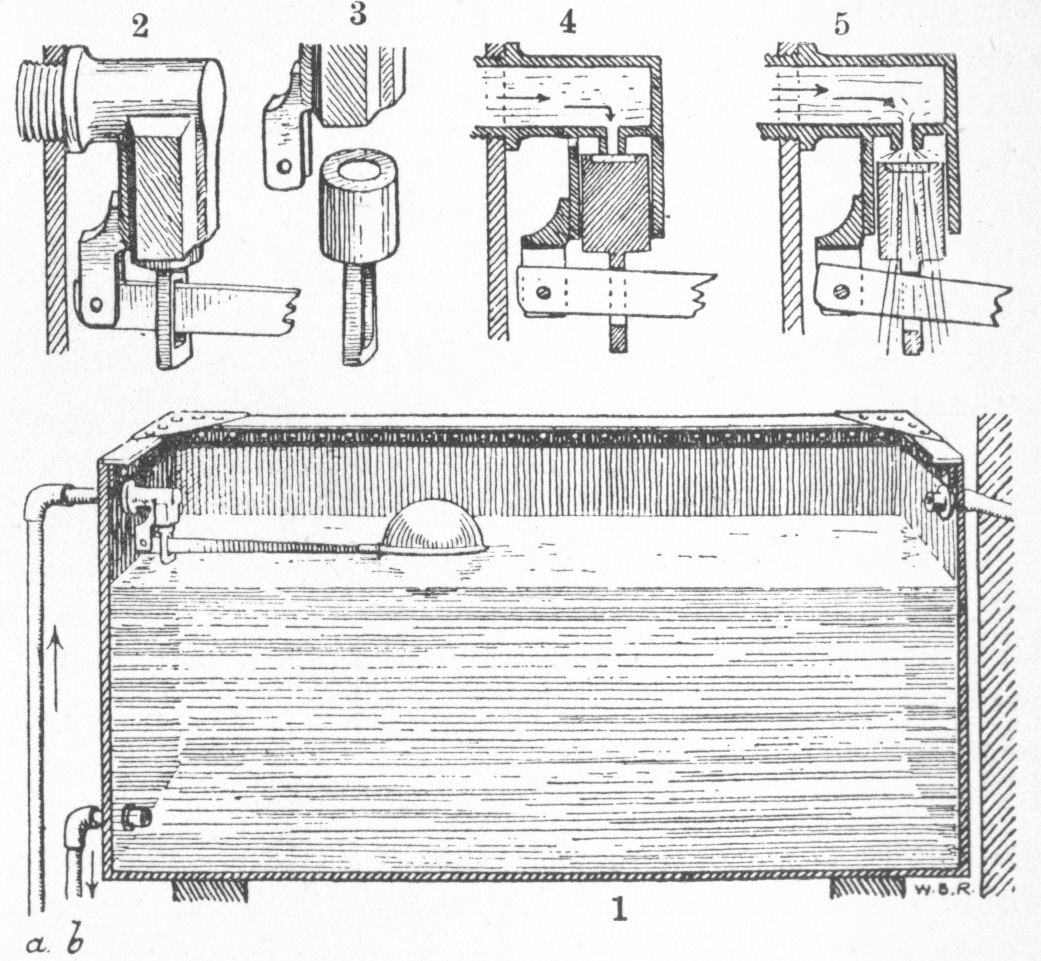
Ball-cock
1. Cistern with ball-cock attached: a, rising main; b, supply to house. 2. Outside view of valve (cistern full). 3. Piston with rubber disk. 4. Section of valve (cistern full). 5. Section of valve with piston pulled down.
Ball-cock, a kind of self-acting stopcock opened and shut by means of a hollow sphere or ball of metal attached to the end of a lever connected with the cock. Such cocks are often employed to regulate the supply of water to cisterns. The ball floats on the water in the cistern by its buoyancy, and rises and sinks as the water rises and sinks, shutting off the water in the one case and letting it on in the other.
Bal´lentyne, or Bellenden, John, a Scottish poet; was a native of Lothian, and appears to have been born towards the close of the fifteenth century. He was in the service of James V from the king's earliest years, and at his request he translated Boece's Latin History, which had been published at Paris in 1526, the translation being printed in 1536. As a reward he was made Archdeacon of Moray and a canon of Ross. He was a bitter opponent of the Reformation, and is said to have died at Rome in 1550.
Ballet (bal´ā), a species of dance, usually forming an interlude in theatrical performances, but principally confined to opera. Its object is to represent, by mimic movements and dances, actions, characters, sentiments, passions, and feelings, in which several dancers perform together. The ballet is an invention of modern times, though pantomimic dances were not unknown to the ancients. The dances frequently introduced into operas seldom deserve the name ballet, as they usually do not represent any action, but are destined only to give the dancers an opportunity of showing their skill. The modern ballet was developed and perfected in France, and introduced into England in the eighteenth century. From an artistic point of view, the modern ballet is often a very low-class entertainment.
Ball-flower
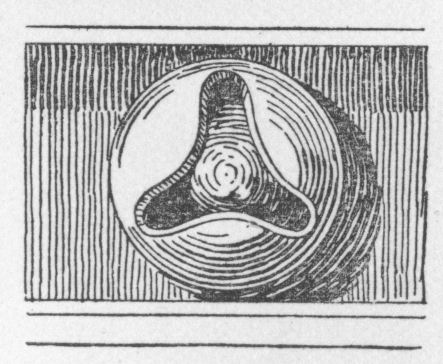
Ball-flower, an architectural ornament resembling a ball placed in a circular flower, the three petals of which form a cup round it; usually inserted in a hollow moulding, and generally characteristic of the Decorated Gothic style of the fourteenth century.
Ballia, a town of India, in the United Provinces, on the Ganges, the administrative head-quarters of a district of the same name. Pop. 16,680.
Ballina´, a town and river-port, Ireland, County Mayo, on both banks of the Moy, about 5 miles above its mouth in Killala Bay, with a considerable local and also a little coasting and foreign trade. Pop. 4662.
Ballinasloe´ (-slō), a town, Ireland, in Galway and Roscommon counties, 15 miles south-west of Athlone, on both sides of the Suck, noted for its cattle fair, from 5th till 9th Oct., the most important in Ireland. The town contains remains of a castle of Elizabethan date. Pop. 5170.
Ballista as used by the Romans
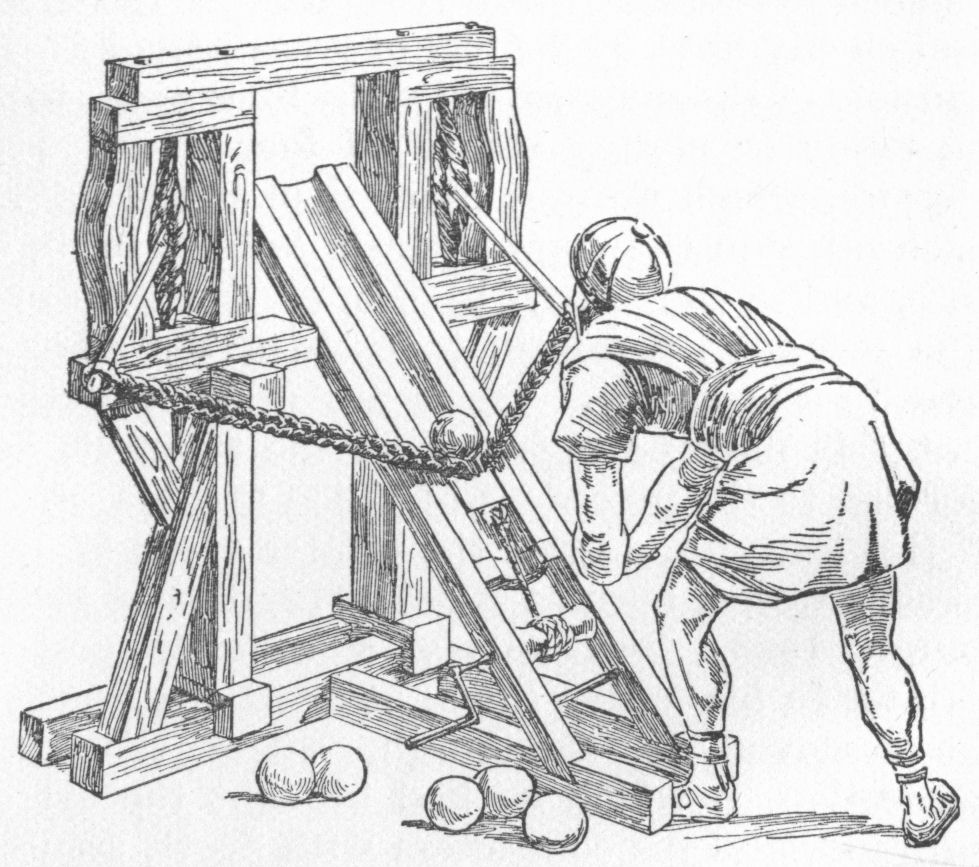
Ballis´ta, a machine used in military operations by the ancients for hurling heavy missiles, thus serving in some degree the purpose of the modern cannon. The motive power appears to have been obtained by the torsion of ropes, fibres, catgut, or hair. They are said to have sometimes had an effective range of a quarter of a mile, and to have thrown stones weighing as much as 300 lb. The ballistæ differed from the catapultæ, in that the latter were used for throwing darts.
Ballis´tic Pendulum, an apparatus for ascertaining the velocity of military projectiles, and consequently the force of fired gunpowder. A piece of ordnance is fired against bags of sand supported in a strong case or frame suspended so as to swing like a pendulum. The arc through which it vibrates is shown by an index, and the amount of vibration forms a measure of the force or velocity of the ball.
Ballistics, the science of the motion of projectiles. Interior ballistics deals with the motion of the shot while inside the gun, and with the results of the explosion of the charge. Exterior ballistics comprises a study of the trajectory or path of the projectile in the air, and the causes which affect the shape of this path, such as the density of the air, shape and weight of the shot, rifling of the barrel, angle of fire and speed of the projectile. If the air-resistance be neglected, it can be shown that the trajectory is a parabola. This result, given by Galileo, is of little use in gunnery except when taken along with a knowledge of air-resistance. Robins, in 1742, first measured the muzzle-speed of the shot by firing into a ballistic pendulum and noting the swing of the pendulum. Wheatstone, in 1840, suggested measuring the speed by causing the shot to cut successive wire screens, each of which formed part of an electric circuit. The Boulangé chronograph is a modern development of this idea. Rev. F. Bashforth's experiments, carried out between 1865 and 1880, form the basis of our knowledge of air-resistance. He found that the latter was proportional to the square of the diameter of the shot, and that, although the resistance is expressible in terms of a power of the speed, this power changes with the speed. The air-resistance is a maximum at about the speed at which sound travels, viz. 1100 feet per second. Artillerists employ ballistic tables based on the results obtained by Bashforth and others, by means of which, given the kind of projectile, its initial velocity, and angle of fire, they can calculate the range and time of flight of the projectile. See Gunnery.—Bibliography: F. Bashforth, The Motion of Projectiles; J. M. Ingalls, Interior Ballistics; P. Charbonnier, Balistique Extérieure.
Balloon-fish (Tetraŏdon lineātus), ord. Plectognathi, a curious tropical fish that can inflate itself so as to resemble a balloon.
Balloons, the most elementary form of lighter-than-air air-craft, unprovided with any means of propulsion or steering. Deriving its power of sustentation from the gas contained in the gas-bag, the free balloon is spherical in form. It is usually filled with coal-gas, which has a lifting-force of 35 lb. per 1000 cu. feet. Varying in size from 5000 to 20,000 cu. foot capacity, the gas-bag is covered with a 'net', from which is hung the 'basket' for the accommodation of the aeronaut, or pilot, and passengers. The spherical gas-bag has at the bottom an elongation, known as the 'neck', which is open to the air in order that the gas may escape as it expands during the rise into the rarefied atmosphere of the upper air. A 'valve' is fitted at the top, which may be opened by a cord from the basket when it is desired to allow gas to escape in order to descend. Bags containing sand are carried in order that ballast may be dropped when it is desired to rise. A free balloon is completely at the mercy of the wind, and simply drifts where the wind takes it. Balloons are usually constructed of cotton fabric, though occasionally of gold-beater's skin, in which case they are commonly filled with hydrogen in place of coal-gas. A 'trail-rope' is usually carried, with which the practice of 'trailing' may be effected over open country or the sea. This consists in allowing the end of the trail-rope to drag on the ground. As the balloon rises it raises more of the rope off the ground, the additional weight bringing it down again. Per contra, as it falls the weight of the trail-rope is taken by the ground and so lightens the balloon. This tends to maintain the balloon at a uniform height. The greatest height ever attained by a balloon is 37,000 feet, reached by Glaisher and Coxwell in Sept., 1862. Both aeronauts nearly perished from the effects of the cold and rarefaction of the atmosphere. In 1895 Parseval and Siegsfield, two officers of the Prussian army, invented the 'Drachen-ballon' or 'Kite-balloon' (Fr. Saucisse). This consists of a captive balloon comprising an elongated gas-bag fitted with an automatic air-chamber, or 'ballonet', for maintaining the pressure, and automatic stabilizers to prevent yawing off the wind, rolling from side to side, and pitching horizontally. This was improved upon by Captain Caquot of the French army, who in 1916 produced an improved type, offering many advantages, which was used in large numbers by the British, French, and American armies and navies during the Great European War of 1914-8. See also Aeronautics, Air-ships.—Bibliography: British Military Manual of Ballooning; Rev. J. M. Bacon, The Dominion of the Air; H. Coxwell, My Life and Balloon Experiences; J. Glaisher, Travels in the Air; G. Tissandier, Histoire de mes Ascensions.
Bal´lot, Voting by, signifies literally voting by means of little balls (called by the French ballottes), usually of different colours, which are put into a box in such a manner as to enable the voter, if he chooses, to conceal for whom or for what he gives his suffrage. The method is adopted by most clubs in the election of their members—a white ball indicating assent, a black ball dissent. Hence, when an applicant is rejected, he is said to be blackballed. The term voting by ballot is also applied in a general way to any method of secret voting, as, for instance, when a person gives his vote by means of a ticket bearing the name of the candidate whom he wishes to support. In this sense vote by ballot is the mode adopted in electing the members of legislative assemblies in most countries, as well as the members of various other bodies. In ancient Greece and Rome the ballot was in common use. In Britain it had long been advocated in the election of members of Parliament and of municipal corporations, but it was only introduced by an Act passed in 1872.
Ballyme´na, a town of Ireland, County Antrim, 22 miles from Belfast, with a considerable trade in linens and linen yarns, the manufacture of which is carried on to a great extent. Pop. 11,380.
Ballymo´ney, a town of Ireland, County Antrim, 38 miles N.W. of Belfast; linen, chemicals, tanning, and brewing. Pop. 3100.
Ballyshan´non, a small seaport of Ireland, County Donegal, on the Erne, about 1 mile from the S.E. shore of Donegal Bay. Pop. 2471.
Balm (bäm; Melissa officinālis), a plant, belonging to the Labiatæ;, formerly in great repute for its medicinal virtues. A native of the south of Europe, it is cultivated in English gardens. It is a herbaceous perennial, with an erect branching stem about 2 feet high. The leaves arise with the flower-stems from a thick joint at the extremity of the stalk. The flowers are whitish; they are produced in a round terminal umbel, and appear in June. The stems and leaves are slightly stimulating and tonic. They contain an essential oil of a yellowish colour and with a fragrant smell, called oil of balm.
Balm of Gilead, the exudation of a tree, Balsamodendron gileadense, nat. ord. Amyridaceæ, a native of Arabia Felix, and also obtained from the closely-allied species Balsamodendron Opobalsămum. The leaves of the former tree yield when bruised a strong aromatic scent; and the balm of Gilead of the shops, or balsam of Mecca or of Syria, is obtained from it by making an incision in its trunk. It has a yellowish or greenish colour, a warm, bitterish, aromatic taste, and an acidulous fragrant smell. It is valued as an odoriferous unguent and cosmetic by the Turks. It is frequently adulterated for market.—The balm of Gilead fir, which produces a turpentine called Canada balsam, is the Abies balsamifĕra, a North American species, whose range is from Virginia to Canada. The name is derived from Jeremiah, viii, 22.
Balmain´, a populous western suburb of Sydney, N.S.W., with extensive docks and various industrial works. Pop. 33,000.
Balmer´ino, Arthur Elphinstone, Lord, a Scottish Jacobite, born 1688, executed 1746. He took part in the Jacobite rebellion of 1715, and fought at Sheriffmuir. Having joined the young Pretender in 1745, he was taken prisoner at Culloden, tried at Westminster, found guilty, and beheaded. His title was from Balmerino in Fife.
Balmor´al Castle, a private residence of the British sovereign, beautifully situated on the S. bank of the Dee, in Aberdeenshire, 45 miles W. by S. of Aberdeen. It stands in the midst of fine and varied mountain scenery, is built of granite in the Scottish baronial style, mainly in two connected blocks, and has an imposing appearance. The estate, purchased by the Prince Consort in 1852 and bequeathed to Queen Victoria, extends to about 40,000 acres, mostly deer forest.
Balnaves´, Henry, of Halhill, a Scottish reformer, was born at Kirkcaldy, educated at St. Andrews, and became a lord of session and a member of the Scottish Parliament in 1538. He was one of the commissioners appointed in 1543 to treat of the proposed marriage between Edward VI and Mary. In 1547 he was one of the prisoners taken in the castle of St. Andrews and exiled to France. Recalled in 1554, he busily engaged in the establishment of the reformed faith, assisted in revising the Book of Discipline, and accompanied Murray to England in connection with Darnley's murder. He died in 1579.
Balrampur. See Bulrampur.
Balsa, a kind of raft or float used on the coasts and rivers of Peru and other parts of South America for fishing, for landing goods and passengers through a heavy surf, and for other purposes where buoyancy is chiefly wanted. It is formed generally of two inflated seal-skins, connected by a sort of platform on which the fisherman, passengers, or goods are placed.
Bal´sam, the common name of succulent plants of the genus Impatiens, family Balsaminaceæ, having beautiful irregular flowers, cultivated in gardens and green-houses. Impatiens balsamīna, native of the East Indies, is a common cultivated species. I. noli-me-tangere grows wild in Britain, but is not native. See Impatiens.
Balsam, an aromatic, resinous substance, flowing spontaneously or by incision from certain plants. A great variety of substances pass under this name. But in chemistry the term is confined to such vegetable juices as consist of resins mixed with volatile oils, and yield the volatile oil on distillation. The resins are produced from the oils by oxidation. A balsam is thus intermediate between a volatile oil and a resin. It is soluble in alcohol and ether, and capable of yielding benzoic acid. The balsams are either liquid or more or less solid; as, for example, the balm of Gilead, and the balsams of copaiba, Peru, and Tolu. Benzoin, dragon's-blood, and storax are not true balsams, though sometimes called so. The balsams are used in perfumery, medicine, and the arts. See Copaiba, &c.—Balsam of Gilead or of Mecca, balm of Gilead (q.v.).—Canada balsam. See Canada balsam.
Balsam Fir. See Balm of Gilead.
Balsa´mo, Joseph. See Cagliostro, Count.
Balsamoden´dron, a genus of trees or bushes, ord. Amyridaceæ, species of which yield such balsamic or resinous substances as balm of Gilead, bdellium, myrrh, &c.
Balta, a town in the Ukraine, government of Podolia, on the Kodema, an affluent of the Bug, 115 miles N.N.W. of Odessa. Pop. 18,450.
Baltic, Battle of the. See Copenhagen; Parker, Sir Hyde.
Baltic Provinces, a term commonly given to the former Russian governments of Courland, Livonia, and Esthonia (q.v.).
Baltic Sea, an inland sea or large gulf connected with the North Sea, washing the coasts of Denmark, Germany, Russia, and Sweden; nearly 900 miles long, extending to 200 broad; superficial extent, together with the Gulfs of Bothnia and Finland, 171,743 sq. miles. Its greatest depth is 126 fathoms; mean, 44 fathoms. A chain of islands separates the southern part from the northern, or Gulf of Bothnia. The water of the Baltic is colder and clearer than that of the ocean: it contains a smaller proportion of salt, and the ice obstructs the navigation three or four months in the year. Among the rivers that enter it are the Neva, Dwina, Oder, Vistula, and Niemen. Islands: Samsoe, Moen, Bornholm, Langeland, Laaland, which belong to Denmark (besides Zealand and Funen); Gottland and Oeland, belonging to Sweden; Rügen, belonging to Prussia; Dagoe and Oesel, belonging to Russia; and the Åland Islands. The Sound, the Great and the Little Belt lead from the Kattegat into the Baltic. The Baltic and North Sea were long connected by the Eider and a canal from it to the neighbourhood of Kiel, but this has been superseded by the great ship canal, starting from the Elbe near its mouth and ending in Kiel Bay.
Bal´timore, a city and port in Maryland, United States, finely situated on the N. side of the Patapsco, 14 miles above Chesapeake Bay. Baltimore takes its name from Lord Baltimore, the founder of Maryland; it was first laid out as a town in 1729; and was erected into a city in 1797. It is well built, chiefly of brick, and is known as the 'monumental city', from the public monuments which adorn it, the principal being the Washington monument. Among its buildings are the city hall, built in Renaissance style, of white marble, with a tower and dome rising 240 feet; the Peabody Institute, containing a library, art gallery, &c.; the Maryland Institute; the custom-house; the post office; the United States court-house and jail, the Johns Hopkins hospital, the Roman Catholic cathedral, &c. The chief educational institution, now one of the most important in the States, is the Johns Hopkins University, endowed with 3,500,000 dollars by its founder (whose name it bears). There is a Roman Catholic archbishop with the rank of primate, and a Protestant episcopal bishop. Industries: shipbuilding; manufactures of iron, wool, cotton, pottery, &c.; sugar-refining, distilling, tanning, the making of agricultural implements, canning oysters and fruits, &c. As a flour market Baltimore is an important centre; and it does an immense trade in exporting tobacco and other products. The harbour is very extensive. Pop. (1920), 733,826.
Baltimore, George Calvert, Lord, born in Yorkshire about 1580, died in London 1632. He was for some time Secretary of State to James I, but this post he resigned in 1624 in consequence of having become a Roman Catholic. Notwithstanding this he retained the confidence of the king, who in 1625 raised him to the Irish peerage, his title being from Baltimore, a fishing-village of Cork. He had previously obtained a grant of land in Newfoundland, but as this colony was much exposed to the attacks of the French he left it, and obtained another patent for Maryland. He died before the charter was completed, and it was granted to his son Cecil, who deputed the governorship to his brother Leonard (1606-47).
Baltimore Bird, an American bird, the Ictĕrus Baltimorii, family Icteridæ, nearly allied to the Sturnidæ, or starlings. It is a migratory bird, and is known also by the names of 'golden robin', 'hang-bird', and 'fire-bird'. It is about 7 inches long; the head and upper parts are black, the under parts of a brilliant orange hue. It builds a pouch-like nest, very skilfully constructed of threads deftly interwoven, suspended from a forked branch and shaded by overhanging leaves. It feeds on insects, caterpillars, beetles, &c. Its song is a clear, mellow whistle.
Baluchistan (ba-lö´chi-stän), a country in Asia, the coast of which is continuous with the north-western seaboard of India, bounded on the north by Afghanistan, on the west by Persia, on the south by the Arabian Sea, and on the east by Sindh. It has an area of about 135,000 sq. miles, and a population estimated at 834,703. The general surface of the country is rugged and mountainous, with some extensive intervals of barren sandy deserts, and there is a general deficiency of water. Various kinds of grain are cultivated, and there is abundance of excellent fruits. The main body of the inhabitants are divided into two great branches, the Baluchis and Brahuis, differing in language, figure, and manners. The Baluchi language resembles the modern Persian, the Brahui presents points of agreement with the Dravidian languages of India. The Baluchis in general have tall figures, long visages, and prominent features; the Brahuis have shorter, thicker bodies, with round faces and rather flat features. Both races are Mahommedans, hospitable and brave. There are also many Afghans and others in the country. The Khan of Khelat, the nominal ruler of the whole land, in 1877 concluded a treaty with Britain, in virtue of which he became a feudatory of India. Since then Quetta, in the north-east, occupying an important position, and certain portions of territory, have been absolutely annexed, and in 1887 a separate administration was constituted, and British authority established, under the Governor-General's agent. The area of British Baluchistan, including tribal areas, is 54,228 sq. miles; pop. 414,412. The country nominally under the Khan of Khelat has an area of 72,280 sq. miles; pop. 359,086. Under British administration roads and railways have been made, with telegraphs and a postal service. Wool, fruits, &c., are exported, cottons and other goods imported, and there is a fair transit trade.—Bibliography: Floyer, Unexplored Baluchistan; T. Thornton, Life of Sandeman.
Bal´uster, a small column or pilaster, of various forms and dimensions, often adorned with mouldings, used for balustrades.
Balustrade´, a range of balusters, together with the cornice or coping which they support, used as a parapet for bridges or the roofs of buildings, or as a mere ornament; also serving as a fence or enclosure for balconies, terraces, staircases, &c.
Baluze (ba˙-lüz), Étienne, French historian and miscellaneous writer, born 1630, died 1718. For more than thirty years he was librarian to M. de Colbert, and was appointed professor of canon law in the Royal College, but displeasing Louis XIV with his Histoire Générale de la Maison d'Auvergne, he was thrown into prison and his property confiscated. He recovered his liberty in 1713, but did not regain his position. He left some 1500 MSS. in the national library of Paris, besides forty-five printed works, including Regum Francorum Capitularia (2 vols.) and Miscellanea (7 vols.).