Volume 1 — B (continued 6)
Reading edition
Bay of Islands, a large, deep, and safe harbour on the N.E. coast of the N. Island of New Zealand. On it is Kororarika, the first European settlement in New Zealand.—Also a large bay formed by the Gulf of St. Lawrence, on the west coast of Newfoundland. See New Zealand.
Bay´onet (Fr. baïonnette), a straight, sharp-pointed weapon, invented by a Frenchman (probably a native of Bayonne) in the seventeenth century. A bayonet was originally screwed into the muzzle of the firelock, converting it into a short pike. This system, which practically precluded any further use of the firelock as such, was later improved by a Scotchman, who fitted the weapon with a socket and bolt, enabling it to be placed over the muzzle of the musket instead of being screwed into it. The firelock could then be used for both missile and shock action, according to requirements. The bayonet replaced the pike in the English army after the revolution of 1690. The length, shape, and weight of the bayonet have varied considerably at different periods and in different countries; that at present in use in the British army is a short sword-shaped weapon, 1 foot 6 inches long and weighing about 1 pound. In war it is considered that an attack with the bayonet or the immediate threat of one is a necessary preliminary to a successful assault.
Bayonne (ba˙-yon), a well-built fortified town, the largest in the French department Basses-Pyrénées, at the confluence of the Nive and the Adour, about 2 miles from their mouth in the Bay of Biscay; with a citadel commanding the harbour and city, a cathedral—a beautiful ancient building—shipbuilding and other industries, and a considerable trade. Among the lower class the Basque language is spoken. Catherine de' Medici had an important interview with the Duke of Alva in Bayonne, June, 1565, at which it is said the massacre of St. Bartholomew was arranged. It was also the scene of the abdication of Charles IV of Spain in favour of Napoleon (1808). In 1814 the British forced the passage of the Nive and invested the town, from which the French made a desperate but unsuccessful sortie. Pop. 27,886.
Bayonne City, a suburb of New York, in Hudson County, New Jersey. Pop. 76,754.
Bayou (bā-yö´), in the southern States of North America, a stream which flows from a lake or other stream: frequently used as synonymous with creek or tidal channel.
Bayreuth (bī´roit). See Baireuth.
Bay Rum, a spirit obtained by distilling the leaves of Myrica acris, or other West Indian trees of the same genus. It is used for toilet purposes, and as a liniment in rheumatic affections.
Bay-salt, a general term for coarse-grained salt, but properly applied to salt obtained by spontaneous or natural evaporation of sea-water in large shallow tanks or bays.
Bay-window at Bramhall Hall, Cheshire
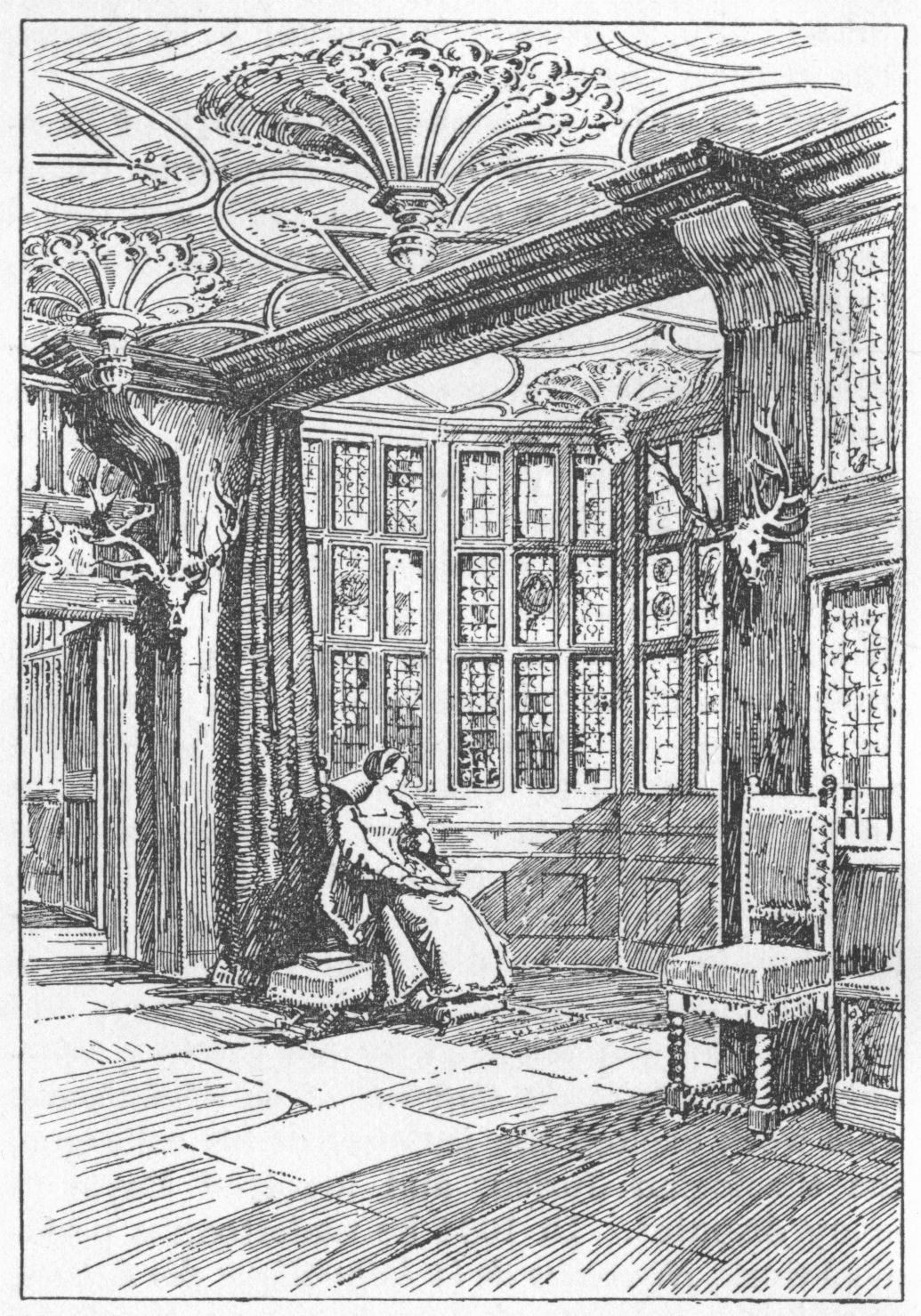
Bay-window, a window forming a recess or bay in a room, projecting outwards, and rising from the ground or basement on a plan rectangular, semi-octagonal, or semi-hexagonal, but always straight-sided. One of the finest examples of bay-windows is that of the banqueting-hall at Hampton Court. The term is, however, also often employed to designate a bow-window, which more properly forms the segment of a circle, and an oriel-window, which is supported on a kind of bracket, and is usually on the first floor.
Baza (bä´tha˙), an old town of Spain, Andalusia, province of Granada, formerly a large and flourishing city. In 1810 the French, under Marshal Soult, here defeated the Spaniards under Generals Blake and Freire. Pop. 15,964.
Bazaar. See Bazar.
Bazaine (ba˙-zān), François Achille, French general, born 1811, died 1888. He entered the army as a private soldier in 1831, and served in Algeria with distinction, gaining the cross of the Legion of Honour, and rising to the rank of lieutenant. He next went to Spain and fought in the Foreign Legion against the Carlists; and in 1839 returned to Algeria, where he eventually held the rank of colonel (1850). He was next engaged in the Crimean War, being at first commander of a brigade and then general of division, leading the French troops sent to attack the fortress of Kinburn (1855). He did good service also in the Italian war of 1859, being actively engaged in the battle of Solferino. His military reputation was increased by the part he took in the Mexican expedition (1862-4), in which he led the first division under Forey, and when this general was recalled became commander-in-chief of the French forces in Mexico and marshal of France. His loyalty, however, to the cause of the Emperor Maximilian was very doubtful. In 1870 he took command of the army of the Rhine, or the third army corps, in the Franco-German War, collected a very large army in the neighbourhood of Metz, and had the intention of joining his forces with those of MacMahon at Châlons. He found this impossible, however, especially after Gravelotte, and was forced into Metz, where he capitulated after a seven weeks' siege, with an army of 175,000 men. For this act he was tried by court-martial in 1871, found guilty of treason, and condemned to death. The sentence was commuted to twenty years' seclusion in the Isle of St. Marguerite, from which he escaped in 1874, and retired to Spain. He published Épisodes de la Guerre de 1870.—Bibliography: La Brugère, L'Affaire Bazaine; Comte d'Herisson, La Légende de Metz.
Bazar´, or Bazaar´, in the East an exchange, market-place, or place where goods are exposed for sale, usually consisting of small shops or stalls in a narrow street or series of streets. These bazar-streets are frequently shaded by a light material laid from roof to roof, and sometimes are arched over. Marts for the sale of miscellaneous articles, chiefly fancy goods, are now to be found in most European cities, bearing the name of bazars. The term bazar is popularly applied to a sale of miscellaneous articles, mostly of fancy work, and contributed gratuitously, in furtherance of some charitable or other purpose.
Bazar´jik, now officially called Dobritsh (q.v.).
Bazigars´, a tribe of Indians dispersed throughout the whole of Hindustan mostly in wandering tribes. They are divided into seven castes; their chief occupation is that of jugglers, acrobats, and tumblers, in which both males and females are equally skilful. They present many features analogous to the gipsies of Europe, and like these each clan has its king.
Bazin, René, French novelist, born 1853. For some time he was professor of law in the Catholic University of Angers. His literary reputation was established by Une Tache d'Encre. His other novels include La Terre qui meurt, De Toute son Âme, Les Oberlé, Les Noellet, Davidée Birot, all of which have been translated into English by Dr. A. S. Rappoport. He has also written Questions littéraires et sociales, &c. Bazin was elected a member of the Académie Française in 1903.
Bazoche (ba˙-zosh´), or Basoche (a corruption of Basilica), a brotherhood formed by the clerks of the Parliament of Paris at the time it ceased to be the grand council of the French king. They had a king, chancellor, and other dignitaries; and certain privileges were granted them by Philip the Fair early in the fourteenth century, as also by subsequent monarchs. They had an annual festival, having as a principal feature dramatic performances in which satirical allusions were freely made to passing events. These farces or satires were frequently interdicted, but they had a considerable influence on the French drama. The Bazoche took an active part in the French Revolution, but the order was suppressed by the decree of 13th Feb., 1791.
Bazzi (ba˙t´sē). See Sodoma.
Bdellium (del´i-um), an aromatic gum resin brought chiefly from Africa and India, in pieces of different sizes and figures, externally of a dark reddish brown, internally clear, and not unlike glue. To the taste it is slightly bitterish and pungent; its odour is agreeable. It is used as a perfume and a medicine, being a weak deobstruent. Indian bdellium is the produce of Balsamodendron Roxburghii; African of B. africanum; Egyptian bdellium is obtained from the doum palm; and Sicilian is produced by Daucus gummifer, a species of the genus to which the carrot belongs. The bdellium mentioned in Gen. ii, 12, was apparently a precious stone, perhaps a pearl. See Myrrh.
Beaches, Raised, a term applied to those long, terraced, level pieces of land, consisting of sand and gravel, and containing marine shells, now, it may be, a considerable distance above and away from the sea, but bearing sufficient evidences of having been at one time sea-beaches. In Scotland such a terrace has been traced extensively along the coasts at about 25 feet above the present sea-level.
Beachy Head, a promontory in the south of England, on the coast of Sussex, rising 575 feet above sea-level, with a revolving light, visible in clear weather from a distance of 28 miles. A naval battle took place here, 30th June, 1690, in which a French fleet under Tourville defeated an English and Dutch combined fleet under Lord Torrington.
Beacon (bē´kon), an object visible at some distance, and serving to notify the presence of danger; commonly applied to a fire-signal set on a height to spread the news of hostile invasion or other great event; and also applied to a mark or object of some kind placed conspicuously on a coast or over a rock or shoal at sea for the guidance of vessels, often an iron structure of considerable height.
Beaconsfield (bē´konz-fēld), a village of Buckinghamshire, the parish church of which contains the remains of Edmund Burke, whose seat was in the neighbourhood; while a marble monument to the poet Waller, who owned the manor, is in the churchyard. It gave the title of earl to the English statesman and novelist Benjamin Disraeli. Pop. (1921), 3642.
Beaconsfield, formerly known as Du Toit's Pan, a town of Cape Province about a mile to the east of Kimberley, of which it forms a suburb. Pop. 20,364.
Beaconsfield, Benjamin Disraeli, Earl of, an eminent English statesman and novelist, of Jewish extraction; eldest son of Isaac D'Israeli, author of the Curiosities of Literature; born in London in 1804, died there in 1881, buried at Hughenden. He attended for a time a private school, and was first destined for the law, but showing a decided taste for literature he was allowed to follow his inclination. In 1826 he published Vivian Grey, his first novel; and subsequently travelled for some time, visiting Italy, Greece, Turkey, and Syria, and gaining experiences which were afterwards reproduced in his books. His travels and impressions are embodied in a volume of letters addressed to his sister and his father. In 1831 another novel, The Young Duke, came from his pen. It was followed at short intervals by Contarini Fleming, Alroy, Henrietta Temple, Venetia, The Revolutionary Epic (a poem), &c. In 1832, and on two subsequent occasions, he appeared as candidate for the representation of High Wycombe, with a programme which included vote by ballot and triennial parliaments, but was unsuccessful. His political opinions gradually changed: in 1835 he unsuccessfully contested Taunton as a Tory. In 1837 he gained an entrance to the House of Commons, being elected for Maidstone. His first speech in the House was treated with ridicule; but he finished with the prophetic declaration that the time would come when they would hear him. During his first years in Parliament he was a supporter of Peel; but when Peel pledged himself to abolish the corn-laws, Disraeli became the leader of the protectionists. About this time he became a leader of what was known as the 'Young England' party, the most prominent characteristic of which was a sort of sentimental advocacy of feudalism. This spirit showed itself in his two novels of Coningsby and Sybil, published respectively in 1844 and 1845. Having acquired the manor of Hughenden, in Buckinghamshire, he was in 1847 elected for this county, and he retained his seat till raised to the peerage nearly thirty years later. His first appointment to office was in 1852, when he became Chancellor of the Exchequer under Lord Derby. The following year, however, the ministry was defeated. He remained out of office till 1858, when he again became Chancellor of the Exchequer, and brought in a Reform Bill which wrecked the Government. During the time the Palmerston Government was in office Disraeli led the opposition in the Lower House with conspicuous ability and courage. In 1866 the Liberals resigned, and Derby and Disraeli came into power, the latter being again Chancellor of the Exchequer. They immediately brought in, and carried, after a violent and bitter struggle, a Reform Bill on the basis of household suffrage. In 1868 he became Premier on the resignation of Lord Derby, but his tenure of office was short. In 1874 he again became Prime Minister with a strong Conservative majority, and he remained in power for six years. This period was marked by his elevation to the peerage in 1876 as Earl of Beaconsfield, and by the prominent part he took in regard to the Eastern question and the conclusion of the Treaty of Berlin in 1878. In 1880 Parliament was rather suddenly dissolved, and, the new Parliament showing an overwhelming Liberal majority, he resigned office, though he still retained the leadership of his party. Within a few months of his death the publication of a novel called Endymion (his last, Lothair, had been published ten years before) showed that his intellect was still vigorous. Among others of his writings, besides those already mentioned, are: A Vindication of the English Constitution (1834); Alarcos, a Tragedy (1839); and Lord George Bentinck, a Political Biography (1852).—Bibliography: Selected Speeches of the Earl of Beaconsfield (edited by T. E. Kebbel); T. Martin, Memorials of Lord Beaconsfield; the article Disraeli, by T. E. Kebbel, in Dictionary of National Biography; Sir William Fraser, Disraeli and his Day; Sichel, Disraeli; the best work, however, is W. F. Monypenny's Life of Disraeli, Earl of Beaconsfield (continued by G. E. Buckle).
Bead (bēd), originally a prayer; then a small perforated ball of gold, pearl, amber, glass, or the like, to be strung on a thread, and used in a rosary by Roman Catholics in numbering their prayers, one bead being passed at the end of each ejaculation or short prayer; finally any such small ornamental body. The use of beads among pagans is of greater antiquity than their Christian use, but there is no evidence to show that the latter is derived from the former. Glass beads are now the most common sort; they form a considerable item in the African trade.—In architecture and joinery the bead is a small round moulding. It is of frequent occurrence in architecture, particularly in the classical styles, and is used in picture-frames and other objects carved in wood.—St. Cuthbert's Beads, the popular name of the detached and perforated joints of encrinites.
Beadle (bē´dl), an officer in a university, whose chief business is to walk with a mace in a public procession: also, a parish officer whose business is to punish petty offenders, and a church officer (chiefly, although not exclusively, in Scotland) with various subordinate duties, as waiting on the clergyman, keeping order in church, attending meetings of vestry or session, &c. The primary meaning of the word (from O.E. beodan, to offer, announce) appears to be 'herald', one who announces or proclaims something.
Bead-snake (Elaps fulvus), a beautiful snake of North America, inhabiting cultivated grounds, especially plantations of the sweet-potato, and burrowing in the ground. It is finely marked with yellow, carmine, and black. Though it possesses poison-fangs it never seems to use them.
Beagle (bē´gl), a small hound, resembling a foxhound or harrier, and used to hunt rabbits and hares, being often kept in packs. The beagle is smaller than the harrier, compactly built, smooth-haired, and with pendulous ears. The smallest of them are little larger than the lap-dog.
Beale, Lionel Smith, English physician and biologist, born in 1828, died in 1906. He was educated at King's College School and King's College, London, and was a professor in the medical department of the latter institution for forty-three years, finally holding the chair of the principles and practice of medicine. His numerous published works treat of medical, anatomical, physiological, and biological subjects; the microscope; various questions of morality, &c. They include How to Work with the Microscope, The Structure of the Tissues, Protoplasm, Disease Germs, Life Theories and Religious Thought, The Mystery of Life, Bioplasm, On Slight Ailments, Religio Medici, Religio Scientiæ, Religio Vitæ, &c.
Beam, a long, straight, and strong piece of wood, iron, or steel, especially when holding an important place in some structure, and serving for support or consolidation; often equivalent to girder. In a balance it is the part from the ends of which the scales are suspended. In a loom it is a cylindrical piece of wood on which weavers wind the warp before weaving; also, the cylinder on which the cloth is rolled as it is woven. In a ship, one of the strong transverse pieces stretching across from one side to the other to support the decks and retain the sides at their proper distance: hence a ship is said to be 'on her beam ends' when lying over on her side. For calculations relating to beams, see Morley's Strength of Materials and Theory of Structures.
Beam Tree (Pyrus aria), a tree of the same genus as the apple, mountain-ash, and service tree found throughout Britain, having berries that are edible when quite mellow, and yielding a hard and fine-grained wood.
Bean, a name given to several kinds of leguminous seeds and the plants producing them, probably originally belonging to Asia. They belong to several genera, particularly to Vicia, garden and field bean; Phaseŏlus, French or kidney bean; and Dolichos, tropical bean. The common bean (Vicia Faba) is cultivated both in fields and gardens as food for man and beast. Beans were believed by some of the ancients to contain the souls of their ancestors, and Pythagoras would not eat beans for this reason. One of the bean family still retains the name of the Pythagorean bean. Beans were introduced by the Moors into Spain, whence they came to France and later to England. It is possible, however, that they were brought to Britain by the Romans. They are now largely imported from Egypt, Turkey, Greece, and the Netherlands. There are many varieties, as the Mazagan, the Windsor, the long-pod, &c., in gardens, and the horse or tick bean in fields. The soil that best suits is a good strong clay. The seed of the Windsor is fully an inch in diameter; the horse bean is much less, often not much more than half an inch in length and three-eighths of an inch in diameter. Beans are very nutritious, containing nearly 50 per cent of digestible carbohydrate and 25 per cent of nitrogenous matter. The bean is an annual, from 2 to 4 feet high. The flowers are beautiful and fragrant. The kidney bean, French bean, or haricot is the Phaseŏlus vulgāris, a well-known culinary vegetable. There are two principal varieties, annual dwarfs and runners. The beans cultivated in America and largely used as articles of food belong to the genus Phaseŏlus. The scarlet-runner bean (Phaseŏlus multiflorus), a native of Mexico, is cultivated on account of its long rough pods and its scarlet flowers.
Bean-goose (Anser segĕtum), a species of wild goose, a migratory bird which arrives in Britain in autumn and retires to the north in the end of April, though some few remain to breed. Being rather less in size than the common wild goose, it is sometimes called the small grey goose.
Bean-king, the person chosen king in Twelfth Night festivities in virtue of having got the piece of cake containing the bean buried in the cake for this purpose.
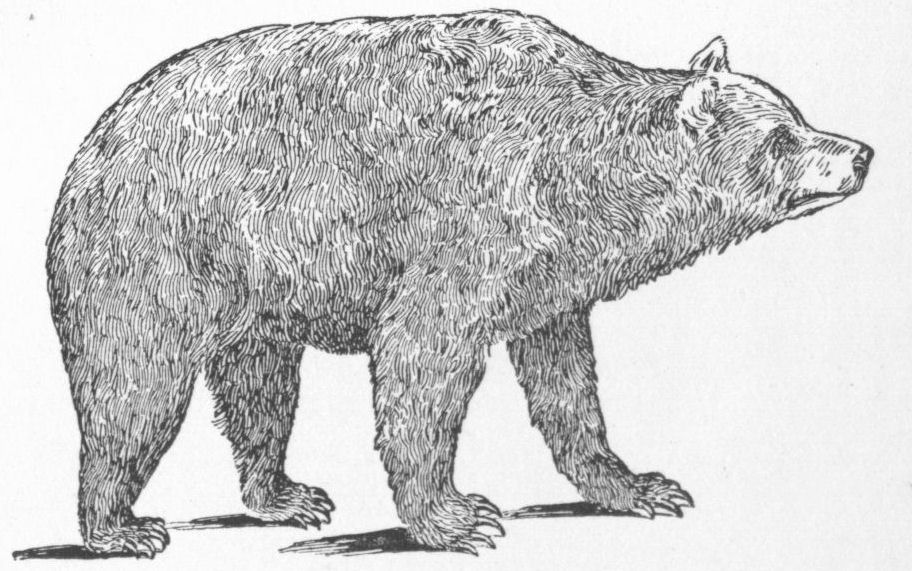
Brown or Black Bear (Ursus arctos)
The Polar or White Bear (Ursus marĭtimus)
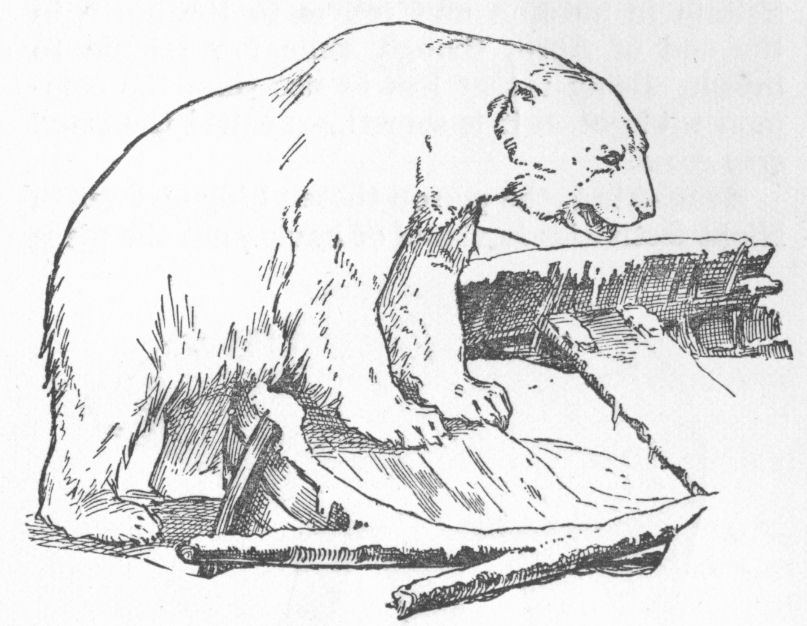
Bear, the name of several large plantigrade carnivorous mammals of the genus Ursus. The teeth are forty-two in number, as in the dog, but there is no carnassial or sectorial tooth, and the molars have a more tubercular character than in other carnivores. The eyes have a nictitating membrane, the nose is prominent and mobile, and the tail very short. The true bears are about ten in number, natives chiefly of Europe, Asia, and N. America. They generally lie dormant in their den during the winter months. The brown or black bear of Europe is the Ursus arctos. It is a native of almost all the northern parts of Europe and Asia, and was at one time common in the British Islands. It feeds on fruits, roots, honey, ants, and, in case of need, on mammals. It sometimes reaches the length of 7 feet, the largest specimens being found farthest to the north. It lives solitarily. The American black bear is the U. americānus, with black shining fur, and rarely above 5 feet in length. It is a great climber, is less dangerous than the brown bear, and is hunted for its fur and flesh. It is very amusing in captivity. The grizzly bear (U. ferox or horribilis) is an inhabitant of the Rocky Mountains; it is a ferocious animal, sometimes 9 feet in length, and has a bulky and unwieldy form, but is nevertheless capable of great rapidity of motion. The extinct cave-bear (U. spelæus) seems to have been closely akin to the grizzly. The Siberian bear (U. collāris) is perhaps a variety of the brown bear. The polar or white bear (U. maritĭmus) is an animal possessed of great strength and fierceness. It lives in the polar regions, frequents the sea, feeds on fish, seals, &c., and usually is 7 to 8 feet in length. The Malayan or coco-nut palm bear (U. malayānus) inhabits Cochin-China, Nepaul, the Sunda Islands, &c., lives exclusively on vegetable food, and is an expert climber. It is called also sun-bear and bruang. The Indian black bear or sloth-bear of India and Ceylon (U. labiātus) is reputed to be a fierce and dangerous animal.
Bear, or Bere, a species of barley (Hordĕum hexastichum), having six rows in the ear, cultivated in Scotland and the north of England.
The Constellation of the Great Bear. The two stars on the right are the Pointers
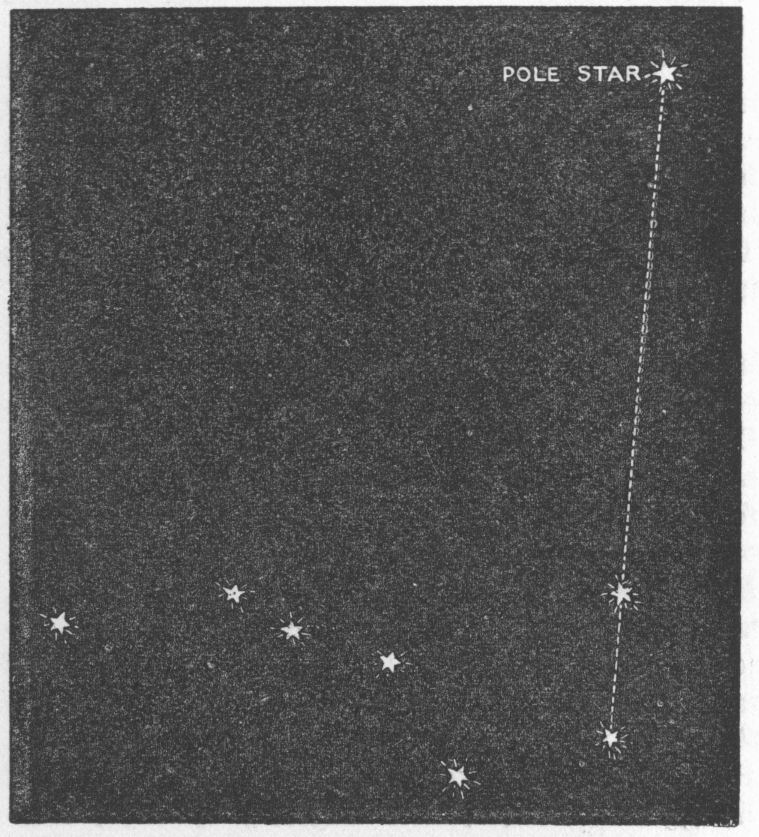
Bear, Great and Little, the popular names of two constellations in the northern hemisphere. The Great Bear (Ursa Major) is situated near the pole. It is remarkable for its well-known seven stars, by two of which, called the Pointers, the pole-star is always readily found. These seven stars are popularly called the Wagon, Charles's Wain, or the Plough. The Little Bear (Ursa Minor) is the constellation which contains the pole-star. This constellation has seven stars placed together in a manner resembling those in the Great Bear.
Bear-baiting, the sport of baiting bears with dogs, formerly one of the established amusements, not only of the common people, but of the nobility and even royalty itself. The places where bears were publicly baited were called bear-gardens. Butler gives a description of bear-baiting in his Hudibras. Bear-baiting was prohibited by Act of Parliament in 1835.
Bearberry (Arctostaphylos uva-ursi), an evergreen shrub of the heath family growing on the barren moors of Scotland, Northern Europe, Siberia, and N. America. The leaves, under the name of uva ursi, are used in medicine as an astringent and tonic.
Beard, the hair round the chin, on the cheeks, and the upper lip, which is a distinction of the male sex and of manhood. It differs from the hair on the head by its greater hardness and its form. Some nations have hardly any, others a great profusion. The latter generally consider it as a great ornament; the former pluck it out; as, for instance, the American Indians. The beard has often been considered as a mark of the sage and the priest. Moses forbade the Jews to shave their beards. With the ancient Germans the cutting off another's beard was a high offence. Even now the beard is regarded as a mark of great dignity among many nations in the East, as the Turks. Alexander the Great introduced shaving among the Greeks, by ordering his soldiers to wear no beards; among the Romans it was introduced in 296 B.C. The custom of shaving came into use in modern times during the reigns of Louis XIII and XIV of France, both of whom ascended the throne without a beard. Till then fashion sanctioned divers forms of moustaches and beards. In the reign of Henry VIII of England, the authorities of Lincoln's Inn prohibited wearers of beards from sitting at the great table unless they paid double commons. Taxation of beards was introduced in the reign of Elizabeth, beards of above a fortnight's growth being subject to a yearly tax of 3s. 4d. This impost was copied by Peter the Great in Russia. It is only in comparatively recent times that beards and moustaches have again become common.—Cf. Philippe, Histoire philosophique, politique, et religieuse de la barbe.
Beard-moss (Usnea barbāta), a lichen of grey colour, forming a shaggy coat on many forest trees.
Beardsley, Aubrey Vincent, artist in black and white, born 1872, died 1898; took up art as a profession at the age of nineteen, and executed a large number of drawings for books and periodicals, showing great technical skill, originality, and disregard of conventionality, with sometimes a tendency towards the repulsive or morbid. Consumption had marked him as its victim from the first. Collections of his drawings were published under the titles A Book of Fifty Drawings, The Early Work of Aubrey Beardsley, The Late Work of Aubrey Beardsley, &c. Under the Hill, with his letters and poems, was published in 1904. Cf. G. Derry, An Aubrey Beardsley Scrap-book.
Bearer Securities. See Stock Exchange.
Bearing, the direction or point of the compass in which an object is seen, or the situation of one object in regard to another, with reference to the points of the compass. Thus, if from a certain situation an object is seen in the direction of north-east, the bearing of the object is said to be N.E. from the situation.—To take bearings, to ascertain on what point of the compass objects lie.
Bear Lake, Great, an extensive sheet of fresh water in the North-West Territory of Canada, between about 65° and 67° 32´ N. lat.; and under the 120th degree of W. long.; of irregular shape; area about 14,000 sq. miles. The water is very clear and the lake abounds in fish.—Bear Lake River, the outlet at the S.W. extremity of Great Bear Lake, runs S.W. for 70 miles and joins the Mackenzie River.
Béarn (bā-a˙r), one of the provinces into which France was formerly divided, now chiefly included in the department of Lower Pyrénées. Pau is the chief town (pop. 35,000). There is a peculiar and well-marked dialect—the Béarnese—spoken in this district, which has much more affinity with Spanish than with French.
Bear-pit, a deep, open pit with perpendicular walls, built in a zoological garden for keeping bears, and having in the centre a pole on which they may exercise their climbing powers.
Bear River, a river of the United States, 400 miles long; rises in the north of Utah, and flows northward into Idaho; turns abruptly southward, re-enters Utah, and empties into Great Salt Lake.
Bears and Bulls. See Stock Exchange.
Bear´s-grease, the fat of bears, esteemed as of great efficacy in nourishing and promoting the growth of hair. The unguents sold under this name, however, are in a great measure made of hog's lard or veal fat, or a mixture of both, scented and slightly coloured.
Beas, river of India. See Bias.
Beat, in acoustics and music, the beating or pulsation resulting from the joint vibrations of two sounds of the same strength, and all but in unison. Also a short shake or transient grace-note struck immediately before the note it is intended to ornament. The word is also used for the movement of the hand or baton, by which the rhythm of a piece of music is indicated, and by which a conductor ensures perfect agreement in tempo and accent on the part of the orchestra or chorus.
Beath (bēth), a populous parish of Fifeshire, Scotland, containing the towns of Cowdenbeath, Kelty, and Hill of Beath. Pop. 24,350, (Cowdenbeath having 7908).
Beatification, in the Roman Catholic Church, an act by which the Pope declares a person beatified or blessed after his death. It is the first step to canonization, that is, the raising one to the honour and dignity of a saint. No person can be beatified till fifty years after his or her death. All certificates or attestations of virtues and miracles, the necessary qualifications for saintship, are examined by the Congregation of Rites. This examination often continues for several years; after which his Holiness decrees the beatification, and the corpse and relics of the future saint are exposed to the veneration of all good Christians. The present custom dates from a Bull of Urban VIII in 1634, although local veneration may be traced back to the earliest Christian ages.—In the Orthodox Eastern Church beatification is not distinguished from canonization.
Beating the Bounds, the periodical survey or perambulation by which the boundaries of parishes in England are preserved. It was the custom in some places that the clergyman of the parish, with the parochial officers and the boys of the parish school, should march to the boundaries, where the boys were struck with willow rods. A similar ceremony in Scotland was called riding the marches.
Bea´ton, David, Archbishop of St. Andrews, and cardinal, born 1494. Pope Paul III raised him to the rank of cardinal in Dec., 1538. On the death of his uncle, Archbishop James Beaton, he succeeded him in the see of St. Andrews in 1539. After the accession of Mary he became Chancellor of Scotland, and distinguished himself by his zeal in persecuting members of the Reformed party, among the rest the famous Protestant preacher George Wishart, whose sufferings at the stake he viewed from his window with apparent exultation. At length a conspiracy was formed against him, and he was assassinated at his own castle of St. Andrews, on the 29th May, 1546. His private character was marked by pride, cruelty, and licentiousness.
Beatrice Portinari (bā-a˙-trē´chā por-tē-nä´rē), the "glorious lady" of Dante, born about 1266, died 1290; the daughter of a wealthy citizen of Florence, and wife of Simone de Bardi. She was but eight years of age, and Dante nine, when he met her first at the house of her father. He altogether saw her only once or twice, and she probably knew little of him. The story of his love is recounted in the Vita Nuova, which was mostly written after her death.
Beattie (bē´ti), James, a Scottish poet and philosophical writer, born at Laurencekirk, Kincardineshire, in 1735, died at Aberdeen 1803. He studied at Marischal College, Aberdeen, for four years, and received the M.A. degree. In 1753 he was appointed schoolmaster at Fordoun, a few miles from his native place; from whence he obtained a mastership in the Grammar School of Aberdeen, and ultimately was installed professor of moral philosophy and logic in Marischal College. In 1760 he published a volume of poems, which he subsequently endeavoured to buy up, considering them unworthy of him. In 1765 he published a poem, The Judgment of Paris, and in 1770 his celebrated Essay on the Nature and Immutability of Truth, attacking Helvetius and Hume and advocating what was afterwards called the doctrine of Common Sense, for which the University of Oxford conferred on him the degree of D.C.L., and George III honoured him, when on a visit to London, with a private conference and a pension. He next published in 1771 the first book of his poem The Minstrel, and in 1774 the second; this is the only work by which he is now remembered. In 1776 he published dissertations on Poetry and Music, Laughter and Ludicrous Composition, &c.; in 1783 Dissertations, Moral and Critical; in 1786 Evidences of the Christian Religion; and in 1790-3 Elements of Moral Science. His closing years were darkened by the death of his two sons.—Bibliography: Margaret Forbes, Beattie and His Friends; A. Mackie, James Beattie, the Minstrel: Some Unpublished Letters.
Beattie, William, M.D., Scottish physician, poet, and miscellaneous writer, born in 1793, died at London 1875. He was author of the standard Life of Thomas Campbell, whose intimate friend he was; published several poems, including John Huss, The Heliotrope, and Polynesia; wrote a series of descriptive and historical works, beautifully illustrated by his friend and fellow-traveller, W. H. Bartlett, on Switzerland, Scotland, &c. He had a very extensive and lucrative medical practice.
Beatty, Admiral of the Fleet, Earl, born in 1871. He entered the navy in 1884, became Commander in 1898, Rear-Admiral in 1910, and Vice-Admiral in 1915. He served in the Sudan from 1896 to 1897, and in China in 1900. In 1912 he was Naval Secretary to the First Lord of the Admiralty, and from 1912 to 1916 commanded the First Battle Cruiser Squadron. He distinguished himself in the battle of Jutland in 1916, and until 1919, when he succeeded Admiral Sir Rosslyn Wemyss (now Lord Wester Wemyss) as First Sea Lord, he was in command of the Grand Fleet. When the entire German High Seas Fleet left port on 31st May, 1916, and steamed up the west coast of Denmark, it was quickly sighted by the British scouts, so that the main British fleet immediately steamed out from its base to engage the enemy. The British Battle Cruiser Squadron, under the command of Earl Beatty (then Sir David) was nearer the scene than the main battle fleet under Sir John Jellicoe (Viscount Jellicoe of Scapa since 1918). The admiral sighted the enemy fleet north-west of the Horn Reef, and about 3.30 in the afternoon the ships engaged. The Jutland battle lasted only a few hours. At the end of Nov., 1916, Admiral Sir John Jellicoe was made First Sea Lord of the Admiralty, and Vice-Admiral Sir David Beatty took over the supreme command of the Grand Fleet.
He is a D.S.O., an O.M., a G.C.B., a G.C.V.O., and a Grand Officer of the French Legion of Honour. He was knighted in 1914, and received a grant of £100,000 in Aug., 1919, when he was created an earl. He was elected Lord Rector of Edinburgh University in 1917.
Beaucaire (bō-kār), a small commercial city of Southern France, department Gard, on the Rhone opposite Tarascon, with which it communicates by a fine suspension-bridge. It is chiefly famous for its great fair (founded in 1217), held yearly from the 21st to the 28th July. Pop. 8488.
Beauchamp (bō-shän), Alphonse de, French historian and publicist, born at Monăco 1767, died at Paris 1832. Under the Directory he had the surveillance of the press, a position which supplied him with materials for his History of La Vendée. He contributed to the Moniteur and the Gazette de France. Among his chief works are the History of the Conquest of Peru, the History of Brazil, and the Life of Louis XVIII. The Mémoires de Fouché is also with good reason ascribed to him.
Beaufort, (bō´fort), Henry, cardinal, natural son of John of Gaunt and half-brother of Henry IV, King of England, born 1377, died 1447; was made Bishop of Lincoln, whence he was translated to Winchester. He repeatedly filled the office of Lord Chancellor, and took part in all the most important political movements of his times.
Beaufort Scale. See Wind Scale; Navigation.
Beaufort West, a town of Cape Province, capital of the division of that name, 339 miles by railway north-east of Cape Town, well built and well supplied with water, though in a district with a small rainfall, and chiefly yielding wool. It is a popular health resort. Pop. 4530.
Beaugency (bō-zha˙n˙-sē), an ancient town, France, department Loiret, on the Loire, of some historical interest. General Chanzy was defeated there by the Grand-Duke of Mecklenburg, 7th-8th Dec., 1870. Pop. 3532.
Beauharnais (bō-a˙r-nā), Alexandre, Viscount, was born in 1760 in Martinique. He married Joséphine Tascher de la Pagerie, who was afterwards the wife of Napoleon. At the breaking out of the French Revolution he was chosen a member of the National Assembly, of which he was for some time president. In 1792 he was general of the army of the Rhine. He was falsely accused of having promoted the surrender of Mainz, and was sentenced to death 23rd July, 1794.
Beauharnais, Eugène de, Duke of Leuchtenberg, Prince of Eichstädt, and Viceroy of Italy during the reign of Napoleon, was born 1781, died at Munich 1824. He was the son of Alexandre Beauharnais and Joséphine, afterwards wife of Napoleon and Empress of France. After his father's death he joined Hoche in La Vendée, and subsequently studied for a time in Paris. He accompanied Napoleon to Egypt in 1798, rose rapidly in the army, was appointed Viceroy of Italy in 1805, and married a daughter of the King of Bavaria in 1806. He administered the government of Italy with great prudence and moderation, and was much beloved by his subjects. In the Russian campaign he commanded the third corps d'armée, and greatly distinguished himself. To him and to Ney France was mainly indebted for the preservation of the remains of her army during the retreat from Moscow. After the battle of Lützen of 2nd May, 1813, where, by surrounding the right wing of the enemy, he decided the fate of the day, he went to Italy, which he defended against the Austrians until the deposition of Napoleon. After the fall of Napoleon he concluded an armistice, by which he delivered Lombardy and all Upper Italy to the Austrians. He then went immediately to Paris, and thence to his father-in-law at Munich, where he afterwards resided.—His sister, Hortense Eugénie, Queen of Holland, was born in 1783, died in 1837. She became Queen of Holland by marrying Louis Bonaparte, and after Louis's abdication of the throne she lived apart from him. She wrote several excellent songs, and composed some deservedly popular airs, among others the well-known Partant pour la Syrie. Napoleon III was her third and youngest son.
Beauly (bū´li), a small seaport of Scotland, Inverness-shire, near the mouth of the River Beauly, which enters the Beauly Firth, a sea loch branching off from Inverness Firth, with interesting ruins of an old priory. Pop. 882.
Beaumarchais (bō-mär-shā), Pierre Augustin Caron de, a French wit and dramatist, was born at Paris in 1732, died 1799. He was the son of a watchmaker named Caron, whose trade he practised for a time. He early gave striking proofs of his mechanical and also of his musical talents; attained proficiency as a player on the guitar and harp, and was appointed harp-master to the daughters of Louis XV. By a rich marriage (after which he added 'de Beaumarchais' to his name) he laid the foundation of the immense wealth which he afterwards accumulated by his speculations, and which was also increased by a second marriage. In the meantime he occupied himself with literature, and published two dramas—Eugénie in 1767 and Les Deux Amis in 1770. He first really distinguished himself by his Mémoires (Paris, 1774), or statements in connection with a lawsuit, which by their wit, satire, and liveliness entertained all France. The Barber of Seville (1775) and the Marriage of Figaro (1784) have given him a permanent reputation. His last work was Mes Six Époques, in which he relates the dangers to which he was exposed in the revolution. He lost about a million livres by his edition of the works of Voltaire (1785), and still more at the end of 1792 by his attempt to provide the French army with 60,000 muskets. He was a singular instance of versatility of talent, being at once an artist, politician, projector, merchant, and dramatist.—Bibliography: L. de Loménie, Beaumarchais et son temps (English translation by H. S. Edwards); Gudin de la Brenellerie, Histoire de Beaumarchais.
Beaumaris (bō-ma´ris), a seaport town, North Wales, Isle of Anglesey, on the Menai Strait. It is a favourite watering-place, and contains the remains of a castle built by Edward I about 1295. Pop. (1921), 1839.
Beaumont, a city of the United States, in Eastern Texas, in a region rich in cotton, timber, and petroleum, and an important railway centre. Pop. 28,851.
Beaumont (bō´mont), Francis, and Fletcher, John, two eminent English dramatic writers, contemporaries of Shakespeare, and the most famous of literary partners. The former, son of a common-pleas judge, was born at Grace-Dieu, in Leicestershire, in 1584, died in 1616, and was buried in Westminster Abbey. At the age of sixteen he published a translation, in verse, of Ovid's Fable of Salmacis and Hermaphroditus, and before nineteen became the friend of Ben Jonson. With Fletcher also he was early on terms of friendship. He married Ursula, daughter of Henry Isley of Sundridge, in Kent, by whom he left two daughters.—John Fletcher was born at Rye, Sussex, in 1579. His father was successively Dean of Peterborough, Bishop of Bristol, Worcester, and London. The Woman Hater, produced in 1606-7, is the earliest work known to exist in which he had a hand. It does not appear that he was ever married. He died in London of the plague, Aug., 1625, and was buried at St. Saviour's, Southwark. The friendship of Beaumont and Fletcher, like their literary partnership, was singularly close; they lived in the same house, and are said to have even had their clothes in common. The works that pass under their names consist of over fifty plays, a masque, and some minor poems. It is believed that all the minor poems except one were written by Beaumont. After the death of Beaumont, Fletcher continued to write plays alone or with other dramatists. It is now difficult, if not indeed impossible, to determine with certainty the respective shares of the two poets in the plays passing under their names. According to the testimony of some of their contemporaries, Beaumont possessed the deeper and more thoughtful genius, Fletcher the gayer and more idyllic. Four Plays in One, Wit at Several Weapons, Thierry and Theodoret, Maid's Tragedy, Philaster, King and no King, Knight of the Burning Pestle, Cupid's Revenge, Little French Lawyer, Scornful Lady, Coxcomb, and Laws of Candy have been assigned to Beaumont and Fletcher conjointly. To Beaumont alone—The Masque of the Inner Temple and Gray's Inn. To Fletcher alone—The Faithful Shepherdess, Woman Hater, Loyal Subject, Mad Lover, Valentinian, Double Marriage, Humorous Lieutenant, Island Princess, Pilgrim, Wild-goose Chase, Spanish Curate, Beggar's Bush, Rule a Wife and Have a Wife, Fair Maid of the Inn, &c. To Fletcher and Rowley—Queen of Corinth, Maid of the Mill, and Bloody Brother. To Fletcher and Massinger—False One and Very Woman. To Fletcher and Shirley—Noble Gentleman, Night-walker, and Love's Pilgrimage. To Fletcher and Shakespeare—Two Noble Kinsmen.—Bibliography: G. C. Macaulay, Francis Beaumont, a Critical Study; Sir A. W. Ward, History of English Dramatic Literature (vol. ii).
Beaumont, Sir George, born of an ancient family in Leicestershire in 1753, died 1827. He possessed considerable skill as a landscape-painter, but was noted more especially as a munificent patron of the arts. The establishment of the National Gallery was mainly owing to his exertions. He was a friend of Wordsworth, who dedicated to him the 1815 edition of his Poems.
Beaumont, Sir John, born 1582, died 1627, brother of Francis Beaumont the dramatist; was author of Bosworth Field, an historical poem, and various sacred and other poems. A poem in eight books, called The Crown of Thorns, has been lost.
Beaumont, Joseph, D.D., born 1615, died 1699; descended from an old Leicestershire family. In 1663 he became master of Peterhouse, Cambridge. He wrote Psyche, or Love's Mystery, a poem once very popular, and an attack on Henry More's Mystery of Godliness, for which he received the thanks of the university.
Beaumont, William, M.D., an American surgeon, born 1785, died 1853. His experiments on digestion with the Canadian St. Martin, who lived for years after receiving a gunshot wound in the stomach which left an aperture of about two inches in diameter, were of great importance to physiological science.
Beaumont-Hamel, village of France, department Somme, the scene of fierce fighting in 1918. See Somme, Battles of the.
Beaune (bōn), a town, France, department Côte d'Or, 23 miles S.S.W. of Dijon, well built, with handsome church, public library, museum, &c., and a trade in the fine Burgundy and other wines of the district. Pop. 13,409.
Beaune (bōn), Florimond, a distinguished mathematician and friend of Descartes, born at Blois 1601, died at the same place 1652. He may be regarded as the originator of the integral calculus.
Beauregard (bō´rė-ga˙rd), Pierre Gustavus Toutant, a general of the Confederate troops in the American Civil War, born in 1818 near New Orleans. He studied at the military academy, West Point, and left it as artillery lieutenant in 1838. He served in the Mexican War, and on the outbreak of the Civil War joined the Confederates. He commanded at the bombardment of Fort Sumter, gained the battle of Bull Run, lost that of Shiloh, assisted in the defence of Charleston, and aided Lee in that of Richmond. He was the author of Principles and Maxims of the Art of War (1863). He died in 1893.
Beausobre (bō-sō-br), Isaac, born in 1659 at Niort, in France, died at Berlin 1738. In 1683 he became Protestant minister of Chatillon-sur-Indre, but was compelled by persecution to go into exile in 1685. In 1694 he became minister to French Protestants at Berlin. He enjoyed much of the favour both of Frederick William I and of the Crown Prince, afterwards Frederick the Great, and died in 1738. His most remarkable work is the Histoire Critique de Manichée et du Manichéisme (1734).
Beauvais (bō-vā; ancient, Bellovacum), a town, France, capital of the department of Oise, at the confluence of the Avelon with the Thérain, 43 miles north of Paris, poorly built, but with some fine edifices, the choir of the uncompleted cathedral being one of the finest specimens of Gothic architecture in France. In 1472 Beauvais resisted an army of 80,000 Burgundians under Charles the Bold. On this occasion the women particularly distinguished themselves, and one of them, Jeanne Lainé, called La Hachette, seeing a soldier planting a standard on the wall, seized it and hurled him to the ground. The banner is preserved in the town hall, and an annual procession of young girls commemorates the deed. Manufactures: tapestry and carpets, trimmings, woollen cloth, cottons, &c. Pop. 20,250.
Beavers (Castor fiber)
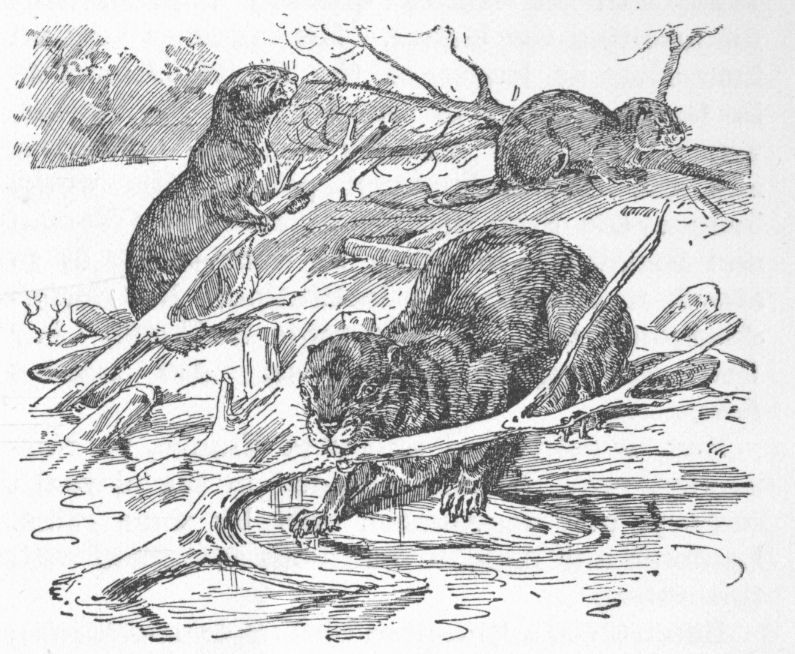
Beaver, the largest rodent quadruped now existing in the northern hemisphere, about 2 feet in length exclusive of the tail, genus Castor (C. fiber), is now found in considerable numbers only in North America, living in colonies, but occurring solitary in Central Europe and Asia. It has short ears, a blunt nose, small fore-feet, large webbed hind-feet, with a flat ovate tail covered with scales on its upper surface. It is valued for its fur, which used to be largely employed in the manufacture of hats, but for which silk is now for the most part substituted, and for an odoriferous secretion named castor, at one time in high repute, and still largely used in some parts of the world as an antispasmodic medicine. The food of the beaver consists of the bark of trees, leaves, roots, and berries. Their favourite haunts are rivers and lakes which are bordered by forests. In winter they live in houses, which are 3 to 4 feet high, are built on the water's edge, and, being substantial structures with the entrance under water, afford them protection from wolves and other wild animals. These dwellings are called beaver 'lodges', and accommodate a single family. They also live in burrows. They can gnaw through large trees with their strong teeth, this being done partly to obtain food, partly to get materials for houses or dam-building. When they find a stream not sufficiently deep for their purpose, they throw across it a dam constructed with great ingenuity of wood, stones, and mud. Beavers were fairly numerous in Britain in very early times, at least in Scotland and Wales. Their existence has been recorded in Wales till the thirteenth century, and in Scotland to a later date, but they are now extinct in Britain. A colony was some years ago introduced into the Island of Bute, but they died out again.—Bibliography: Harting, British Animals Extinct within Historic Times; E. A. Mills, In Beaver World; A. A. R. Dugmore, The Romance of the Beaver.
Beaver (from Fr. baviére, a child's bib, from bave, saliva), the movable face-guard of a helmet, so fitted on as to be raised and lowered at pleasure.
Beaver Falls, a town of the United States, Pennsylvania, on Beaver River, 30 miles north-west of Pittsburg, in the coal and natural-gas region. Pop. 12,191.
Beaver-rat (Hydromys chrysogaster), a Tasmanian rodent quadruped, inhabiting the banks both of salt and fresh waters. They are admirable swimmers and divers, and exceedingly shy.
Bebee´ru. See Greenheart.
Bebel (bā´bl), Ferdinand August, German Socialist, born in 1840, died in 1913. He became a master turner in Leipzig, was elected to the Reichstag or Diet of the new German Empire in 1871, in which he was prominent until his death. He opposed the leadership of Prussia in Germany and the establishment of the empire, and showed himself favourable to the Paris Commune and the International. Found guilty of treasonable practices, he was condemned to two years' imprisonment in a fortress in 1872, with six months' ordinary imprisonment for insulting the Kaiser. His influence kept on increasing as leader of the Social Democrats in Germany and in the German Parliament, where he spoke strongly against militarism and the emperor's naval policy. His works include Die Frau und der Socialismus (Woman and Socialism), in which he went so far as to attack marriage as an institution; Die Socialdemokratic und das allgemeine wahlrecht; Für Volkswehr gegen Militarismus; Aus meinem Leben; &c.
Bec, a celebrated abbey of France, in Normandy, near Brionne, founded in the eleventh century, now represented only by some ruins. Lanfranc and Anselm were both connected with this abbey.
Beccafi´co, a European bird (Sylvia hortensis), the garden-warbler. These birds are much esteemed as dainties in the autumn, when they have fattened on figs and grapes.
Beccafu´mi, Domen´ico, Italian painter, born near Sienna in the latter half of the fifteenth century, enriched the churches of Sienna with many noble frescoes and other paintings. He drew and coloured well, and possessed strong inventive powers. He died at Sienna in 1551, and was buried in its cathedral.
Beccaria (bek-a˙-rē´a˙), Cesare Bonesana, Marchese di, Italian economist and writer on penal laws, born 1738, died 1794. He is principally known from his treatise, On Crimes and Punishments, which was speedily translated into various languages, and to which many of the reforms in the penal codes of the principal European nations are traceable. He became professor of political economy at Milan, where he died.
Beccaria (bek-a˙-rē´a˙), Giovanni Battista, an Italian natural philosopher, born 1716, died 1781; was appointed professor of experimental physics at Turin, 1748; author of a treatise on Natural and Artificial Electricity, Letters on Electricity, &c. He contributed several articles to the Transactions of the Royal Society of London, and was commissioned in 1759 to measure an arc of the meridian in the neighbourhood of Turin.
Beccles (bek´lz), a municipal borough in Suffolk, England, 33 miles N.N.E. from Ipswich, on the right bank of the Waveney; has a fine church of the fourteenth century, and a good trade coastwise. Pop. (1921), 7077.
Becelære, town of Belgium, province of West Flanders. It was the scene of fighting in the third battle of Ypres (1917), and in the battle of Flanders (1918).
Becerra (be-ther´a˙), Gaspar, Spanish painter and sculptor, born 1520, died 1570. He studied under Michel Angelo at Rome, and is credited with the chief share in the establishment of the fine arts in Spain.
Beche (bāsh), Sir Henry de Ia, an English geologist, born 1796, died 1855. He founded the geological survey of Great Britain, which was soon undertaken by the Government, De la Beche being appointed director-general. He also founded the Jermyn Street Museum of Economic or Practical Geology, and the School of Mines. His principal works are: Geology of Jamaica, Classification of European Rocks, Geological Manual, Researches in Theoretical Geology, Geology of Cornwall, Devon, and West Somerset, &c.
Bêche-de-Mer (bāsh-dē-mār). See Trepang.
Becher (beh´er), Johann Joachim, German chemist, born in 1625 or 1635, died in London 1682. He became a professor at Mainz; was elected a member of the Imperial Council at Vienna, 1660, but fell into disgrace and subsequently resided in various parts of Germany, Holland, Italy, Sweden, and Great Britain. His chief work, Physica Subterranea, containing many of the fanciful theories of the alchemists, was published in 1669, and enlarged in 1681. Among his other works are Laboratorium portabile and Alphabetum minerale.
Bechstein (beh´stīn), Johann Matthäus, German naturalist, born in 1757, died in 1822. He wrote a popular Natural History of Germany, and various works on forestry, in which subject his labours were highly valuable. In Britain he is best known by a treatise on cage birds.
Bechuanas, or Betchuanas (bech-wan´az), a widely-spread race of people inhabiting the central region of South Africa north of Cape Province. They belong to the great Kaffir stem, and are divided into tribal sections. They live chiefly by husbandry and cattle-rearing, and they work with some skill in iron, copper, ivory, and skins. They were led to seek British protection owing to the encroachments of the Boers. The southern portion of their territory was first placed under British protection in 1885, and subsequently the whole Bechuana country up to the Zambezi was annexed. In 1895 the southern portion (then a Crown colony) was united to the Cape Colony; the remainder is still a protectorate partly under native chiefs. The head-quarters of the British administration are at Mafeking in the Cape Province. Bechuanaland Protectorate comprises the territory lying between the Molopo River on the south and the Zambezi on the north, and extending from the Transvaal Province and Matabeleland on the east to South-West Africa; area, 275,000 sq. miles; pop. 125,350, of whom about 1700 are Europeans. It is generally flat or slightly undulating, and is essentially a grass country, the grasses being nutritious and standing drought well. Surface water is scarce, but there is underground water, besides swampy lakes such as Ngami. Some parts are wooded and well watered. Gold, coal, and copper have been found. There is railway connection both with south and north.—Cf. G. W. Stow, The Native Races of South Africa.
Beck Case, The, a celebrated case of mistaken identity, which involved a grave miscarriage of justice. Adolf Beck, a Swede, had been sentenced in 1890 to seven years' penal servitude for a series of mean frauds committed against some women, and in 1904 he was again convicted and sentenced for a similar offence. Soon after his second trial a Jew named John Smith, who had been convicted of fraudulency in 1877, was arrested for similar frauds committed while Beck was in custody. The resemblance between the two men was remarkable, and it was eventually discovered that Beck was entirely innocent. He received two King's pardons, and the sum of £5000 from the Home Office as compensation. A commission which considered the case drew attention in its report to the carelessness of the police in identifying Beck with Smith, though the latter was a Jew; and stated that further legal training was desirable for the subordinate officials in the Home Office. Beck died in poverty in 1909. Cf. J. Kempster, Perversion of Justice as exhibited in the Beck Case.
Beckenham, a suburban locality on the south of London, in West Kent, now forming an urban district, lying south of Sydenham. Pop. 33,350.
Beck´er, Wilhelm Adolf, German archæologist, born at Dresden 1796, died at Meissen 1846. In 1828 he became a teacher at Meissen, in 1837 was appointed extraordinary professor of classical archæology at Leipzig, and in 1842 ordinary professor. Best-known works: Gallus, or Roman Scenes of the Time of Augustus; and Charicles, or Illustrations of the Life of the Ancient Greeks, which wonderfully reproduce the social life of old Rome and Greece.
Beck´et, Thomas (the form À Becket is also common), Archbishop of Canterbury, born in London 1117 or 1119, assassinated in Canterbury Cathedral, 29th Dec., 1170. He was educated at Oxford and Paris, and was sent, by the favour of Theobald, Archbishop of Canterbury, to study civil law at Bologna in Italy, and on his return made Archdeacon of Canterbury and Provost of Beverley. In 1158 Henry II appointed him High Chancellor and preceptor to his son, Prince Henry—the first instance after the Conquest of a high office being filled by a native Englishman. At this period he was a complete courtier, conforming in every respect to the humour of the king. He was, in fact, the king's prime companion, held splendid levees, and courted popular applause. On the death of Theobald, 1162, he was consecrated archbishop, when he affected an extraordinary austerity of character, and appeared as a zealous champion of the Church against the aggressions of the king, whose policy was to have the clergy in subordination to the civil power. Becket was forced to assent to the Constitutions of Clarendon, but a series of bitter conflicts with the king followed, ending in Becket's flight to France, when he appealed to the Pope, by whom he was supported. After much negotiation a sort of reconciliation took place in 1170, and Becket returned to England, resumed his office, and renewed his defiance of the royal authority. A rash hint from the king induced four barons, Reginald Fitz-Urse, William de Tracy, Hugh de Morville, and Richard Breto, to go to Canterbury and murder the archbishop while at vespers in the cathedral. He was canonized in 1172 by Pope Alexander III, and the splendid shrine erected at Canterbury for his remains was, for three centuries, a favourite place of pilgrimage.—Bibliography: J. C. Robertson and J. B. Sheppard, Materials for the History of Archbishop Becket (Rolls Series); Canon Morris, Life and Martyrdom of St. Thomas Becket; Lhuillier, Saint Thomas de Cantorbéry; Abbott, St. Thomas of Canterbury, His Death and His Miracles.
Beckett, Gilbert Abbot À. See À Beckett.
Beck´ford, William, an English writer famous in his time for his immense wealth and his eccentricities. He was born at Fonthill, his father's estate in Wiltshire, in 1759. In 1770 the death of his father left him in the possession of £1,000,000 of money, and an income of £100,000 a year. He travelled much, and for some time lived in Portugal. He expended an enormous sum in building and rebuilding Fonthill Abbey, near Salisbury, which he filled with rare and expensive works of art. Here he lived in seclusion for twenty years. In 1822 the abbey and greater part of its contents were sold, and he retired to Bath, where, with a much-diminished fortune, but one amply sufficient, he lived till 1844. His literary fame rests upon his Eastern tale The History of the Caliph Vathek, which he wrote in French, and a translation of which by the Rev. Samuel Henley appeared at London in 1786. The tale is still much read, and was highly commended by Lord Byron. He had two daughters, one of whom became Duchess of Hamilton, and brought his valuable library to this family.—William Beckford, his father, a London merchant and West Indian proprietor, was famous for a spirited speech made to George III when Lord Mayor of London.—Bibliography: Cyrus Redding, Memoir; R. Garnett, Vathek (with a critical essay); Melville, The Life and Letters of William Beckford of Fonthill.
Beckmann, Johann, German writer on the industrial arts and agriculture, born 1739, died 1811. He was for a short time professor of physics and natural history at Petrograd, and afterwards for almost forty-five years professor of philosophy and economy in Göttingen. His History of Inventions is well known in the English translation of it. This work entitled the author to be regarded as the founder of scientific technology.
Beckx (beks), Pierre Jean, general of the order of Jesuits, born near Louvain, Belgium, 1795, died 1887. The success of the Jesuits, especially in non-Catholic countries, was greatly due to his tact and energy.
Becquerel (bek-rel), Antoine César, French physicist, born 1788, died 1878. He served as an officer of engineers, and retired in 1815, after which he devoted himself to the study of electricity, especially electro-chemistry. In 1837 he was awarded the Copley medal of the Royal Society of London. He refuted the 'theory of contact' by which Volta explained the action of his pile or battery. Becquerel may be considered one of the creators of electro-chemistry.—His son, Alexandre Edmond (1820-91), was associated with him in much of his work. He was the author of a work La Lumière, ses causes et ses effets (1867-8).
Becquerel Rays (bek-rel), the rays given out by radium and other 'radioactive' substances, so named from their discoverer, the French physicist, Henri Becquerel (born 1852, died 1908), son of Alexandre Edmond Becquerel. They were first detected in 1896, as proceeding from uranium salts; and it is only by uranium, thorium, radium, and one or two other elements that they are emitted, these bodies giving them out spontaneously and without any apparent loss of radioactive power or change of any kind. The Becquerel rays are invisible, and only known by their effects, which are of various kinds: thus, like the Röntgen rays, they blacken a photographic plate, even after passing through glass or other intervening substances; they cause a number of different substances to give out a fluorescent light, and they render air a conductor of electricity. Like the Röntgen rays, they act strongly on the human skin. They consist of a mixture of α-, β-, and γ-rays. See Radio-activity; Radium.
Becse (bech´e), Old, a town of Hungary, 48 miles S. of Szegedin, on the right bank of the Theiss. Pop. 19,000.—New Becse, a market-town on the left bank of the Theiss, 5 miles E. of Old Becse. Pop. 7725, or, with the immediately adjoining village of Franyova, about 15,000. Both towns carry on an extensive trade in grain.
Becskerek (bech´ke-rek), two towns of South Hungary.—Great Becskerek, now in Yugo-Slavia, is on the Bega, 45 miles N. of Belgrade, with which it communicates by the Bega Canal. Trade in cattle and agricultural produce. Pop. 26,407.—Little Becskerek, now belonging to Roumania, is 11 miles by railway from Temesvar. Pop. 3660.
Bed, Bedstead, an article of furniture to sleep or rest on. The term bed properly is applied to a large flat bag filled with feathers, down, wool, or other soft material, and also to a mattress supported on spiral springs or form of elastic chains or wirework which is raised from the ground on a bedstead. The term, however, sometimes includes the bedstead or frame for supporting the bed. The forms of beds are necessarily very various—every period and country having its own form of bed. Air-beds and water-beds are much used by invalids.
Bed, in geology, a layer or stratum, usually a stratum of considerable thickness.
Beda. See Bede.
Bédarieux (bā-där-i-eu), a thriving town, Southern France, department Hérault, situated on the Orb. Pop. 6186.
Bed-bug. See Bug.
Bed-chamber, Lords of the, officers of the royal household of Britain under the Groom of the Stole. They are twelve in number, and wait a week each in turn. In the case of a queen regnant these posts are occupied by ladies, called Ladies of the Bed-chamber.
Beddoes (bed´ōz), Thomas, physician and author, born 1760; educated at Oxford, London, and Edinburgh. After taking his doctor's degree, and visiting Paris, he was appointed professor of chemistry at Oxford. There he published some excellent chemical treatises, and essays upon such subjects as the calculus, sea-scurvy, consumption, catarrh, and fever. His expressed sympathy with the French revolutionists led to his retirement from his professorship in 1792, soon after which he published his Observations on the Nature of Demonstrative Evidence, and the exceedingly popular History of Isaac Jenkins. In 1794 he married a sister of Maria Edgeworth; and in 1798, with the pecuniary aid of Wedgwood, opened a pneumatic institution for curing phthisical and other diseases by inhalation of gases. It speedily became an ordinary hospital, but was noteworthy as connected with the discovery of the properties of nitrous oxide, and as having been superintended by the young Humphry Davy. Beddoes' essays On Consumption (1779) and On Fever (1807), and his Hygeia (3 vols., 1807) had a high contemporary repute. He died in 1808.
Beddoes, Thomas Lovell, poet, son of above, born 1803, died 1849; published The Bride's Tragedy while a student at Oxford, studied medicine, and lived long abroad. His work was largely fragmentary, but his posthumous Death's Jest-book, or The Fool's Tragedy (1850), received the high praise of such judges as Landor and Browning. His Poems, with memoir, appeared in 1851.
Bede, Beda, or Bæda, known as the Venerable, English historian and theologian, born in 672 or 673 in the neighbourhood of Monkwearmouth, County Durham; educated at St. Peter's Monastery, Wearmouth; took deacon's orders in his nineteenth year at St. Paul's Monastery, Jarrow, and was ordained priest at thirty by John of Beverley, Bishop of Hexham. His life was spent in studious seclusion, the chief events in it being the production of homilies, hymns, lives of saints, commentaries, and works in history, chronology, grammar, &c. He was the most learned Englishman of his day, and in some sense the father of English history, his most important work being his Historia Ecclesiastica Gentis Anglorum (or Ecclesiastical History of England), afterwards translated by King Alfred into Anglo-Saxon. Besides his familiarity with Latin, he knew Greek and had some acquaintance with Hebrew. Most of his writings were on scriptural and ecclesiastical subjects, but he also wrote on chronology, physical science, grammar, &c., and had considerable ability in the writing of Latin verse. He died in 735, an interesting record of his closing days being preserved in a letter by his pupil Cuthbert. His body was after a lapse of time removed from Jarrow church to Durham, but of the shrine which formerly enclosed them only the Latin inscription remains, ending with the verse—'Hac sunt in fossa Bedæ venerabilis ossa'. On 13th Nov., 1899, Leo XIII decreed that the feast of the Venerable Bede should be celebrated in the Church on 27th May. An edition of the whole works of Bede (12 vols.), with an English translation, was prepared by Dr. Giles (1843-4).—Bibliography: Gehle. De Bedæ Venerabilis Vita et Scriptis; Browne, The Venerable Bede; C. Plummer's introduction to his edition of the Historia Ecclesiastica.
Bedeguar, or Bedegar (bed´e-gär), a spongy excrescence or gall, sometimes termed sweet-brier sponge, found on various species of roses, and produced by several insects as receptacles for their eggs, especially by the Cynips rosæ, It was once thought to be a diuretic and vermifuge.
Bedell´, William, a celebrated Irish bishop, born in Essex in 1570. In 1604 he went to Venice as chaplain to Sir Henry Wotton, and remained eight years. After holding the living of Horingsheath from 1615-27, he became Provost of Trinity College, Dublin, and in 1629 Bishop of Kilmore and Ardagh, though he resigned the latter of the united sees in 1630. He set himself to reform abuses and promote the spread of Protestantism, procured the translation of the Old Testament into Irish, and by his tact and wisdom conciliated the adherents of both creeds. He underwent a brief imprisonment on the breaking out of the rebellion in 1641, and died in the year following. His biography was written by Bishop Burnet.
Be´der Ware. See Bidery.
Bed´ford, a municipal and, until 1918, a parliamentary borough, England, county town of Bedfordshire, on the Ouse. The chief buildings are the law courts, a range of public schools, a large infirmary, county jail, &c., and the churches. The town is rich in charities and educational institutions, the most prominent being the Bedford Charity, embracing grammar and other schools, and richly endowed. There is an extensive manufactory of agricultural implements; lace is also made, and there is a good trade. John Bunyan was born at Elstow, a village near the town, and it was at Bedford that he lived, preached, and was imprisoned. Bedford gives its name to a parliamentary division of the county. Pop. 40,247.—Bedfordshire or Beds, the county, is bounded by Northampton, Bucks, Herts, Cambridge, and Huntingdon; area, 302,942 acres, of which 260,000 are under tillage or in permanent pasture. Chalk hills, forming a portion of the Chilterns, cross it on the south; north of this is a belt of sand; the soil of the vale of Bedford, consisting mostly of clay and loam, is very fertile; and the meadows on the Ouse, Ivel, and other streams furnish rich pasturage. Two-thirds of the soil is under tillage. Besides the usual cereal and other crops, culinary vegetables are extensively cultivated for the London market. Principal manufactures: agricultural implements, and straw-plait for hats, which is made up principally at Dunstable and Luton. The county returns three members to Parliament (divisions: Bedford, Luton, Midlands). Pop. (1921), 206,478.
Bedford, John, Duke of, one of the younger sons of Henry IV, King of England; famous as a statesman and a warrior. He defeated the French fleet in 1416, commanded an expedition to Scotland in 1417, and was lieutenant of England during the absence of Henry V in France. On the king's death he became Regent of France, and for several years his policy was as successful as it was able and vigorous, the victory of Verneuil in 1424 attesting his generalship. The greatest stain on his memory is his execution of the Maid of Orleans (Joan of Arc) in 1431. He died in 1435 at Rouen, and was buried in the cathedral of that city.
Bedford Level, a large tract of marshy land in England, of about 400,000 acres total area, comprising 63,000 in Norfolk, 30,000 in Suffolk, 50,000 in Huntingdon, the Peterborough fen in Northampton, the Holland district in Lincolnshire, and most of the Isle of Ely in Cambridge. It derives its name from Francis, Earl of Bedford, who in 1634 made an agreement with Charles I for the drainage of the Level, in consideration of receiving 95,000 acres of the reclaimed land. A great part of the Level is under cultivation, and produces grain, flax, and cole-seed; the remainder yields a winter harvest of wild-fowl for the London market. See Fenland.
Bedfordshire Regiment, The, raised in 1688 on the approach of the Prince of Orange, suffered severely at Blenheim, and distinguished itself in a marked manner at the siege of Lille. In 1797 it went to Scotland and there recruited 1000 'parish boys' under sixteen years old, who later made excellent soldiers. The regiment shared in the Chitral and South African (1900-2) campaigns; on going to the front in 1914, sustained heavy losses at Givenchy, and distinguished itself at Ypres and the Aisne.
Bedivere, the last knight of the Round Table (q.v.). See Morte d'Arthur.
Bed´lam, a corruption of Bethlehem (Hospital), the name of a religious house in London, converted, after the general suppression by Henry VIII, into a hospital for lunatics. The original Bedlam stood in Bishopsgate Street; its modern successor in St. George's Fields was opened in 1815, having been built on the site of the notorious tavern called 'The Dog and the Duck'. The lunatics were at one time treated as little better than wild beasts, and hence Bedlam came to be typical of any scene of wild confusion. The average number of patients is about 300.
Bed´lington, a town and urban district of England, in Northumberland, near the mouth of the Blyth, and not far from the seaport of Blyth, with collieries, ironworks, &c. Pop. 25,440.
Bedlington Terrier, an English Dog, deriving its name from Bedlington, in Northumberland, having first become well known as a favourite among the miners of that place. It is a dog of moderate size, head rather long, with a light, silky tuft on top, ears hanging close to the cheeks, legs moderately long and strong, tail tapering to the point, which is almost bare; colour, dark blue, blue and tan, liver, liver and tan, sandy, or sandy and tan; courageous, intelligent, and generally useful.
Bedlis. See Betlis.
Printed and bound in Great Britain