Volume 1 — B (continued 5)
Reading edition
Base-line, in surveying, a straight line measured with the utmost precision to form the starting-point of the triangulation of a country or district. See Geodesy.
Bash. See Mining.
Ba´shan, the name in Scripture for a singularly rich tract of country lying beyond the Jordan between Mount Hermon and the land of Gilead. At the time of the Exodus it was inhabited by the Amorites, who were overpowered by the Israelites, and the land assigned to the half-tribe of Manasseh. The district was, and yet is, famous for its oak forests and its cattle. Remains of ancient cities are common.
Bashaw, or Basha. See Pasha.
Bashee´ Islands, a group of islands in the Chinese Sea between Luzon and Formosa, long. 122° E.; lat. 20° 28´ to 20° 55´ N. They were discovered by Dampier in 1687, and belong to the United States. The largest island is Batan, with a population of 8000.
Bashi-Bazooks´, irregular troops in the Turkish army. They are mostly Asiatics, and have had to be disarmed several times by the regular troops on account of the barbarities by which they have rendered themselves infamous.
Bash´kirs, a tribe of Finno-Tartar origin, inhabiting the Russian governments of Ufa, Orenburg, Perm, and Samara. They formerly roamed about under their own princes in Southern Siberia, but in 1556 they voluntarily placed themselves under the Russian sceptre. They are nominally Mahommedans, and live by hunting, cattle-rearing, breeding of cattle and horses, and keeping of bees. They are rude and warlike and partially nomadic. They number about 1,000,000.—Cf. Ujfalvy, Les Bashkirs.
Bashkirtsev, Marie, Russian painter and authoress, born 1860, died 1884; educated mostly outside of Russia, in France, Germany, and Italy; became an accomplished linguist and musician, and studied art in Paris, attaining high success, but overtaxing her system, with fatal results. She is best known from her journal, an intimate personal record, interesting not only as revealing her own peculiar character and intellectual gifts, but also for notices of the notable personages with whom she came in contact. It has been translated into various languages—into English by Mathilde Blind (1890), who has also published A Study of Marie Bashkirtsev (1892). A number of her letters were also published in 1891.—Cf. The Journal of Marie Bashkirtsev, an Exposure and a Defence.
Basic Slag, the slag or refuse-matter which is got in making basic steel, and which, from the phosphate of lime it contains, is a valuable fertilizer. See Manures (Phosphatic).
Basic Steel. See Steel.
Basi´diomycetes, one of the two sub-classes of the Eumycetes or septate Fungi, including the bulk of the larger and more familiar saprophytic types, such as the Mushroom, Toad-stools, Shelf-fungi, Puff-balls, and Earth-stars, and also the important parasites known as the Rusts. They are characterized by their principal spores being produced externally, usually in fours, upon an organ called a basidium. The basidia are arranged in a continuous layer (hymenium), and are usually massed together upon a specialized fruit-body, of which an ordinary mushroom is a good example. The principal subdivisions of the group, with representative genera, are as follows:—
A. Basidia septate (Proto-Basidiomycetes).
1. Family Uredineæ (Rusts). Basidia transversely septate; teleutospores present; parasites. Puccinia, Phragmidium, Melampsora.
2. Family Auricularineæ. Basidia transversely septate; no teleutospores; saprophytes. Auricularia.
3. Family Tremellineæ. Basidia longitudinally septate; saprophytes. Tremella.
B. Basidia not septate (Auto-Basidiomycetes).
4. Family Exobasidiineæ. Parasites without fruit-body; basidia exposed on surface of host. Exobasidium.
5. Family Dacryomycetineæ. Fruit-body soft; hymenium on its surface; saprophytes. Dacryomyces, Calocera.
6. Group Hymenomycetes (several families). Hymenium generally on gills, in tubes, &c.; saprophytes or, less often, parasites. Agaricus Polyporus, Hydnum.
7. Group Gastromycetes (several families). Hymenium within a closed fruit-body, which does not open until the spores are ripe; saprophytes. Ithyphallus, Lycoperdon.
The Ustilagineæ (Smuts) are often regarded as Basidiomycetes of a low type, but it is more probable that they are allied to the Unicellular Chytridineæ. The Basidiomycetes are the highest members of the Fungoid alliance; their relations to the lower groups are obscure.
Basi´dium, the characteristic spore-producing organ of the Basidiomycetes. Typically, e.g. in the Toad-stools, it is a club-shaped structure, produced at its free end into four slender processes, the sterigmata, each of which bears a basidiospore at its tip. The young basidium contains two nuclei, which later fuse; the fusion-nucleus then undergoes two successive divisions, involving a reduction of chromosomes, and each of the four resultant nuclei passes through a sterigma into a basidiospore. These latter are thus seen to be carpospores, comparable to those of Red Algæ, and to the ascospores of Ascomycetes. The basidia of Uredineæ (Rusts) and of some other primitive Basidiomycetes are septate, but otherwise agree with the type described above. See Basidiomycetes; Carpospore; Rusts.
Basil. See Basilius.
Bas´il, a labiate plant, Ocĭmum basilĭcum, a native of India, much used in cookery, especially in France, and known more particularly as sweet or common basil. Bush or lesser basil is O. minimum; wild basil belongs to a different genus, being the Calamintha Clinopodium.
Basil, St., called the Great, one of the Greek fathers, was born in 329, and made in 370 Bishop of Cæsarea in Cappadocia, where he died in 379. He was distinguished by his efforts for the regulation of clerical discipline, and, above all, his endeavours for the promotion of monastic life. The Greek Church honours him as one of its most illustrious saints, and celebrates his festival on 1st Jan. The vows of obedience, chastity, and poverty framed by St. Basil are essentially the rules of all the orders of Christendom, although he is particularly the father of the Eastern, as St. Benedict is the patriarch of the Western orders.
Basilan´, the principal island of the Sulu Archipelago, now belonging to the Philippines, off the S.W. extremity of Mindanao, from which it is separated by the Strait of Basilan. It is about 30 miles in length by 20 miles in breadth. Pop. about 8000.
Basile´an Manuscripts, two manuscripts of the Greek New Testament now in the library of Basel. (1) A nearly complete uncial copy of the Gospels of the eighth century; (2) a cursive copy of the whole New Testament except the Apocalypse, tenth century.
Basil´ian Liturgy, that form for celebrating the Eucharist drawn up towards the close of the fourth century by Basil the Great, still used in the Greek Church.
Basilian Monks, monks who strictly follow the rules of St. Basil, chiefly belonging to the Greek Church.
Basilica di S'Apollinare in Classe, Ravenna
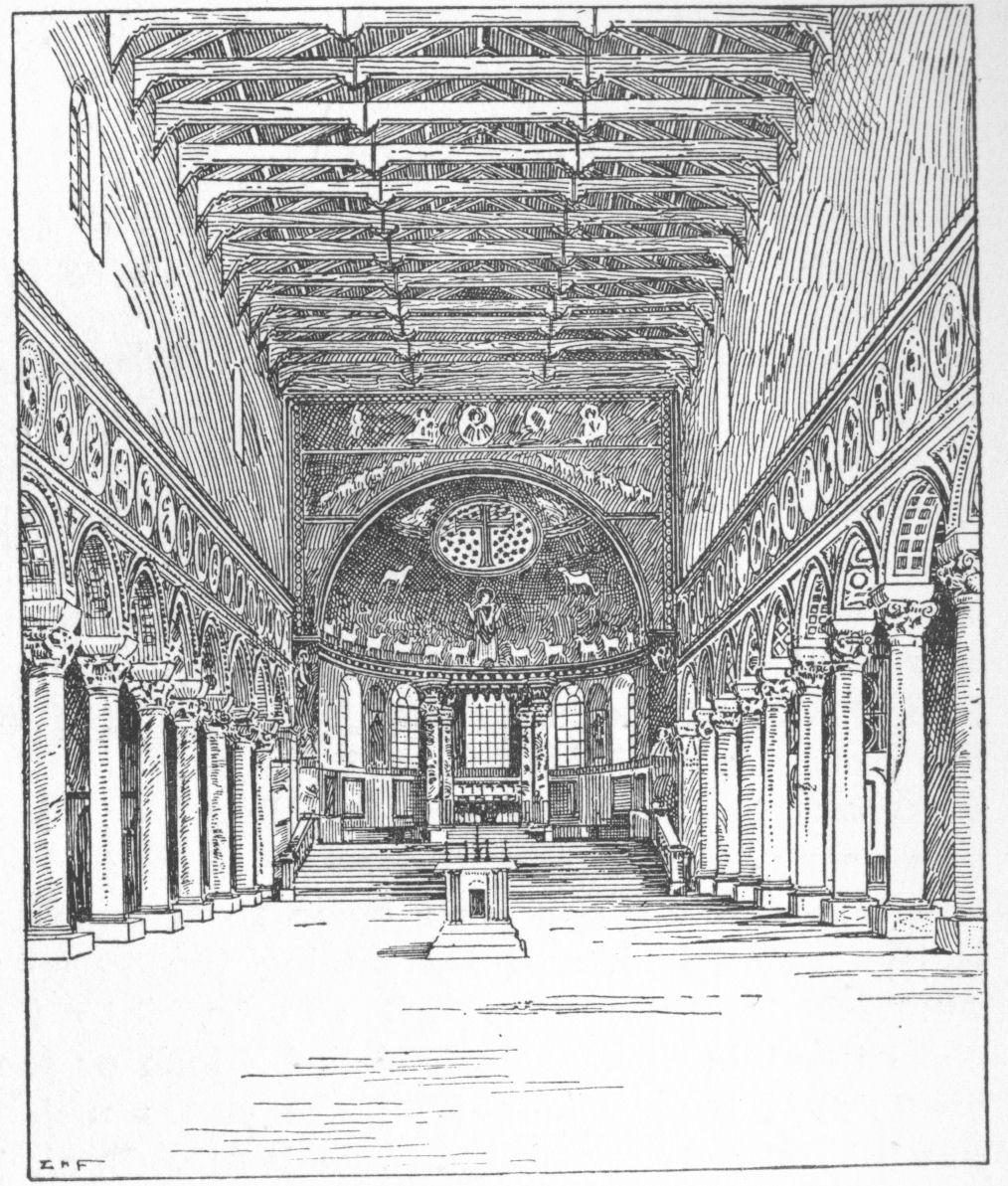
Basil´ica, originally the name applied by the Romans to their public halls, either of justice, of exchange, or other business. The plan of the basilica was usually a rectangle divided into aisles by rows of columns, the middle aisle being the widest, with a semicircular apse at the end, in which the tribunal was placed. The ground-plan of these buildings was generally followed in the early Christian churches, which, therefore, long retained the name of basilica, and it is still applied to some of the churches in Rome by way of distinction, and sometimes to other churches built in imitation of the Roman basilicas.
Basilica´ta, also called Potenza, an Italian province, extending north from the Gulf of Taranto, and corresponding pretty closely with the ancient Lucania. Area, 3855 sq. miles; pop. 489,574 (1915).
Basil´icon, a name of several ointments, the chief ingredients of which are wax, pitch, resin, and olive-oil.
Basil´icon Do´ron (the royal gift), the title of a book written by King James I in 1599, containing a collection of precepts of the art of government. It maintains the claim of the king to be sole head of the Church. Printed at Edinburgh, 1603.
Basil´ides (dēz), one of the most famous Gnostic teachers, a native of Alexandria, who lived under the reigns of Adrian and Antoninus Pius about A.D. 120-40. He was well acquainted with Christianity, but mixed it up with the wildest dreams of the Gnostics, peopling the earth and the air with multitudes of æons. He was also greatly influenced by Platonism and Zoroastrianism. His disciples (Basilidians) were numerous in Syria, Egypt, Italy, and Gaul, but they are scarcely heard of after the fourth century.
Bas´ilisk, a fabulous creature formerly believed to exist, and variously regarded as a kind of serpent, lizard, or dragon, and sometimes identified with the cockatrice. It inhabited the deserts of Africa, and its breath and even its look was fatal. The name is now applied to a genus of saurian reptiles (Basiliscus), belonging to the family Iguanidæ;, distinguished by an elevated crest or row of scales, erectable at pleasure, which, like the dorsal fins of some fishes, runs along the whole length of the back and tail. The mitred or hooded basilisk (B. mitrātus) is especially remarkable for a membranous bag at the back of the head, of the size of a small hen's egg, which can be inflated with air at pleasure. The other species have such hoods also, but of a less size. To this organ they owe their name, which recalls the basilisk of fable, though in reality they are exceedingly harmless and lively creatures. The B. amboinensis is a native of the Indian Archipelago, where it is much used for food. It frequents trees overhanging water, into which it drops when alarmed.
Basil´ius I, a Macedonian, Emperor of the East, born A.D. 820, died 886. He was of obscure origin, but having succeeded in gaining the favour of the Emperor Michael III, he became his colleague in the Empire, 866. After the assassination of Michael, 867, Basilius became emperor. Though he had worked his way to the throne by a series of crimes, he proved an able and equitable sovereign. The versatility, if not the depth, of his intellect is strikingly displayed in his Exhortations to his Son Leo, which are still extant.
Basilius II, Emperor of the East, born 958, died 1025. On the death of his father, the Emperor Romanus the Younger, in 963, he was kept out of the succession for twelve years by two usurpers. He began to reign in conjunction with his brother Constantine, 975. His reign was spent in almost perpetual warfare, his most important struggle being that which resulted in the conquest of Bulgaria, 1018.
Ba´sin, in physical geography, the whole tract of country drained by a river and its tributaries. The line dividing one river basin from another is the water-shed, and by tracing the various water-sheds we divide each country into its constituent basins. The basin of a loch or sea consists of the basins of all the rivers which run into it.—In geology a basin is any dipping or disposition of strata towards a common axis or centre, due to upheaval and subsidence. It is sometimes used almost synonymously with 'formation' to express the deposits lying in a certain cavity or depression in older rocks. The 'Paris basin' and 'London basin' are familiar instances.
Ba´singstoke, a town of England, county of Hants, 18 miles N.N.E. of Winchester. It has a good trade in corn, malt, &c., and now gives its name to one of the parliamentary divisions of the county. Pop. (1921), 12,718.
Bas´kerville, John, celebrated English printer and type-founder, born in 1706, died 1775. He settled at Birmingham as a writing-master, subsequently engaged in the manufacture of japanned works, and in 1750 commenced printing. From his press came highly-prized editions of ancient and modern classics, Bibles, prayer-books, &c., all beautifully-printed works. His first work was a Virgil, published in 1757, followed by his famous edition of Milton in 1758.
Basket, a vessel or utensil of wicker-work, made of interwoven osiers or willows, rushes, twigs, grasses, &c. The process of basket-making is very simple, and appears to be well known among the very rudest peoples. The ancient Britons excelled in the art, and their baskets were highly prized in Rome.—Cf. T. Okey, Introduction to the Art of Basket-making.
Basking-shark (Selăchē maxima or Cetorhīnus maximus), a species of shark, so named from its habit of basking in the sun at the surface of the water. It reaches the length of 40 feet, and its liver yields a large quantity of oil. It frequents the northern seas, and is known also as the sail-fish or sun-fish.
Basle. See Basel.
Basoche. See Bazoche.
Basques (ba˙sks), or Biscayans (in their own language, Euscaldunac), a remarkable race of people dwelling partly in the south-west corner of France (Basses-Pyrénées), but mostly in the north of Spain adjacent to the Pyrenees. They are probably descendants of the ancient Iberi, who occupied Spain before the Celts. They preserve their ancient language, former manners, and national dances, and make admirable soldiers, especially in guerrilla warfare. Their language is highly polysynthetic, and stands isolated from other tongues of Europe. There are eight principal dialects, which are not only distinguished by their pronunciation and grammatical structure, but differ even in their vocabularies. The Basques, who number about 600,000 (450,000 in Spain, and 150,000 in France), occupy in Spain the provinces of Biscay, Guipuzcoa, and Alăva; in France parts of the departments of the Upper and Lower Pyrenees, Ariége, and Upper Garonne. The Basques are very religious and conservative in their religious practices. Ignatius Loyola and Francis Xavier de Navarre were Basques.—Bibliography: Julien Vinson, Les Basques et le pays Basque; Le Folk-lore du pays Basque; Michel, Le pays Basque, sa population, sa langue, ses mœurs, sa littérature, et sa musique; Van Eys, Outlines of a Basque Grammar.
Basra, Bassora, or Basrah, a city in Lower Mesopotamia, on the west bank of the Shat-el-Arab (the united stream of the Tigris and Euphrates), about 50 miles from its mouth, and nearly 300 miles south-east of Bagdad. It is surrounded by a wall about 10 miles in circuit, from 20 to 25 feet thick; but much of the area enclosed is occupied by gardens, &c. The houses are generally mean. A considerable transit trade is carried on here between the Turkish and Persian dominions and India, and since communication by steamer has been established with Bagdad and Bombay the prosperity of the town has greatly increased. The chief exports are: dates, camels and horses, wool and wheat; imports: coffee, indigo, rice, tissues, &c. The inhabitants are estimated at 80,000; but in the eighteenth century they were said to number 150,000. The substitution of date and wheat cultivation for that of rice has rendered the place much more healthy. The ruins of the ancient and more famous Bassora—founded by Caliph Omar in 636, at one time a centre of Arabic literature and learning and regarded as 'the Athens of the East'—lie about 9 miles south-west of the modern town. The town was occupied by the British on 22nd Nov., 1914. The first through-train from Basra to Bagdad was run in Jan., 1920.
Bas-relief—Northern frieze of Parthenon
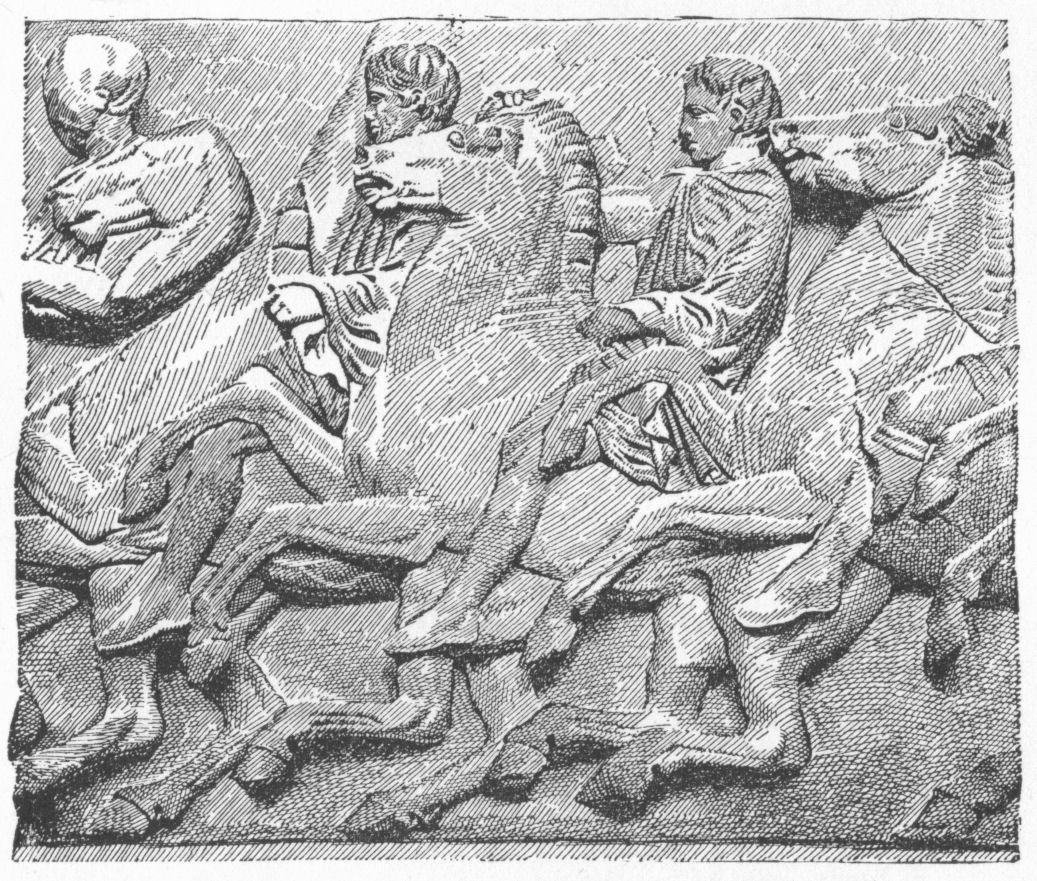
Bas-relief (bä´rē-lēf or bas´rē-lēf) or Basso-Rilievo, low-relief, a mode of sculpturing figures on a flat surface, the figures having a very slight relief or projection from the surface. It is distinguished from haut-relief (alto-rilievo), or high-relief, in which the figures stand sometimes almost entirely free from the ground. Bas-relief work has been described as 'sculptured painting', from the capability of disposing of groups of figures and exhibiting minor adjuncts, as in a painting. The finest specimen of bas-relief is the frieze around the cella of the Parthenon; large portions of it are to be seen in the British Museum.
Bass (bās; from the It. basso, deep, low), in music, the lowest part in the harmony of a musical composition, whether vocal or instrumental. According to some it is the fundamental or most important part, while others regard the melody or highest part in that light. Next to the melody, the bass part is the most striking, the freest and boldest in its movements, and richest in effect.—Figured bass, a bass part having the accompanying chords suggested by certain figures written above or below the notes—the most successful system of shorthand scoring at present in use among organists and pianists.—Fundamental bass, the lowest note or root of a chord; a bass consisting of a succession of fundamental notes.—Thorough bass, the mode or art of expressing chords by means of figures placed over or under a given bass. Figures written over each other indicate that the notes they represent are to be sounded simultaneously, those standing close after each other that they are to be sounded successively. The common chord in its fundamental form is generally left unfigured, and accidentals are indicated by using sharps, naturals, or flats along with the figures.
Bass (ba˙s), the name of a number of fishes of several genera, but originally belonging to a genus of sea-fishes (Labrax) of the perch family, distinguished from the true perches by having the tongue covered by small teeth and the preoperculum smooth. L. lupus, the only British species, called also sea-dace, and from its voracity sea-wolf, resembles somewhat the salmon in shape, and is much esteemed for the table, weighing about 15 lb. L. lineātus (Roccus lineātus), or striped bass, an American species, weighing from 25 to 30 lb., is much used for food, and is also known as rock-fish. Both species occasionally ascend rivers, and attempts have been made to cultivate British bass in freshwater ponds with success. Two species of black bass (Microptĕrus salmoides and M. dolomieu), American freshwater fishes, are excellent as food and give fine sport to the angler. The former is often called the large-mouthed black bass, from the size of its mouth. Both make nests and take great care of their eggs and young. The Centropristis nigricans, an American sea-fish of the perch family, and weighing 2 to 3 lb., is known as the sea-bass.
Bass (ba˙s), The, a remarkable insular trap-rock, at the mouth of the Firth of Forth, 3 miles from North Berwick, of a circular form, about 1 mile in circumference, rising majestically out of the sea to a height of 313 feet. It pastures a few sheep, and is a great breeding-place of solan geese. During the persecution of the Covenanters its castle, long since demolished, was used as a State prison, in which several eminent Covenanters were confined. It was held from 1691 to 1694 with great courage and pertinacity by twenty Jacobites, who in the end capitulated on highly honourable terms.
Bass. See Basswood.
Bassa´no, a commercial city of North Italy, province of Vicenza, on the Brenta, over which is a covered wooden bridge. It has lofty old walls and an old castle, and has various industries and an active trade. Near Bassano, 8th Sept., 1796, Bonaparte defeated the Austrian general Wurmser. Pop. (commune) 17,130.
Bassa´no (from his birth-place; real name Giacomo da Ponte), an Italian painter, born 1510, died 1592. He painted historical pieces, landscapes, flowers, &c., and also portraits. He left four sons, who all became painters, Francesco being the most distinguished.
Bassano Dam. See Dams.
Bas´saris. See Cacomistle.
Bassein (bas-sān'), a town in Lower Burma, province of Pegu, on both banks of the Bassein River, one of the mouths of the Irawadi, and navigable for the largest ships. It has considerable trade, exporting large quantities of rice, and importing coal, salt, cottons, &c. Pop. 37,081.—Bassein District has an area of 4127 sq. miles and a pop. of 9598 (1911).
Bassein (bas-sān'), a town in Hindustan, 28 miles north of Bombay. At the beginning of the eighteenth century it was a fine and wealthy city, with over 60,000 inhabitants; it has now only about 9598 (1911).
Basselin (ba˙s-lan), Olivier, an old French poet or song-writer, born in the Val-de-Vire, Normandy, about the end of the fourteenth century, died about 1450. His sprightly songs, famous under the name Vaux-de-Vire, have given origin and name to the modern Vaudevilles.
Basselisse Tapestry. See Hautelisse.
Basses-Alpes (bäs-a˙lp; 'Lower Alps'). See Alpes.
Basses-Pyrénées (bäs-pē-rā-nā; 'Lower Pyrenees'). See Pyrénées.
Bass´et, the name of a game at cards, formerly much played, especially in France. It is very similar to the modern faro. See Lansquenet.
Basset, or Basset-hound, a smooth-haired dog with short crooked legs, rather large head, and large pendulous ears, thus somewhat resembling a bloodhound and a dachshund. It is sometimes used in packs for hunting hares, or in beating and covert work generally.
Basseterre (bäs-tār), two towns in the West Indies.—1. Capital of the Island of St. Christopher's, at the mouth of a small river, on the south side of the island. Trade considerable. Pop. about 9000.—2. The capital of the Island of Guadeloupe. It has no harbour, and the anchorage is unsheltered and exposed to a constant swell. Pop. 8650.
Basset-horn, a musical instrument, now practically obsolete, a sort of clarinet of enlarged dimensions, with a curved and bell-shaped metal end. The compass extends from F below the bass staff to C on the second ledger-line above the treble. Mozart wrote several pieces for the basset-horn, and Beethoven employed it in his Prometheus overture.
Bassetlaw, a parliamentary division of the county of Nottingham.
Bassia, a genus of tropical trees found in the East Indies and Australia, nat. ord., Sapotaceæ. The seeds of B. butyracea, the Indian butter tree, yield a butter-like substance, which makes good soap. B. latifolia, the Mahwa of Bengal, furnishes a valuable hard timber, and has edible flowers, from which a potent spirit is distilled; a gutta-percha is obtained from B. pallida.
Bassompierre (bä-son-pyār), Francois de, Marshal of France, distinguished both as a soldier and a statesman, born 1579, died 1646. In 1602 he made his first campaign against the Duke of Savoy, and he fought with equal distinction in the following year in the imperial army against the Turks. In 1622 Louis XIII appointed him Marshal of France, and became so much attached to him that Luynes, the declared favourite, sent him on embassies to Spain, Switzerland, and England. After his return he became an object of suspicion to Cardinal Richelieu, and was sent to the Bastille in 1631, from which he was not released till 1643, after the death of the cardinal. During his detention he occupied himself with writing his memoirs, which shed much light on the events of that time.
Basso´on, a musical wind-instrument of the reed order, blown with a bent metal mouthpiece, and holed and keyed like the clarinet. Its compass comprehends three octaves rising from B flat below the bass staff. Its diameter at bottom is 3 inches, and for convenience of carriage it is divided into two or more parts, whence its Italian name, fagotto, a bundle. It serves for the bass among wood wind-instruments, as hautboys, flutes, &c.
Bassora Gum, an inferior kind of gum resembling gum-arabic.
Bass Rock. See Bass.
Bass Strait, a channel beset with islands, which separates Australia from Tasmania, 120 miles broad, discovered by George Bass, a surgeon in the Royal Navy, in 1798.
Basswood, or Bass, the American lime tree or linden (Tilia americāna), a tree common in N. America, yielding a light, soft timber.
Bast, a term originally applied to fibrous tissue external to the cambium; now used in two senses: (1) for Phloem (q.v.); (2) commercially, for the fibre of the lime or linden. The manufacture of lime-bast into mats, ropes, &c., is in Russia a considerable industry, bast-mats for packing furniture, covering plants, &c., being largely exported.
Bastar´, a feudatory State in Upper Godavari district, Central Provinces of India; area, 13,062 sq. miles; pop. 433,310. Chief town, Jagdalpur; pop. 4294.
Bas´tard, a child begotten and born out of wedlock; an illegitimate child. By the civil and canon laws, and by the law of Scotland, a bastard becomes legitimate by the intermarriage of the parents at any future time. In some of the United States, bastards can be legitimized by subsequent marriage, in addition to which, however, the father must also recognize the child as his. By the laws of England a child, to be legitimate, must at least be born after the lawful marriage; it does not require that the child shall be begotten in wedlock, but it is indispensable that it should be born after marriage, no matter how short the time, the law presuming it to be the child of the husband. The only incapacity of a bastard is that he cannot be heir or next of kin to any one save his own issue. In England the maintenance of a bastard in the first instance devolves on the mother, while in Scotland it is a joint burden upon both parents. The mother is entitled to the custody of the child in preference to the father. See Legitimation; Illegitimacy.—Bibliography: Bacquet, Traité de la Bâtardise; Nicholls and Mackay, History of the English Poor Law.
Bastard Bar
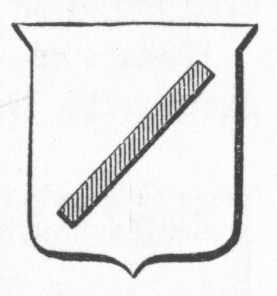
Bastard Bar, more correctly baton sinister, the heraldic mark used to indicate illegitimate descent. It is a diminutive of the bend sinister, of which it is one-fourth in width, couped or cut short at the ends, so as not to touch the corners of the shield.
Bastard Fallow. See Fallow Land.
Bastard Saffron. See Safflower.
Bastia (ba˙s-tē´a˙), the former capital of the Island of Corsica, upon the N.E. coast, 75 miles N.E. of Ajaccio, on a hill slope; badly built, with narrow streets, a strong citadel, and an indifferent harbour; with some manufactures, a considerable trade in hides, soap, wine, oil, pulse, &c. Pop. 29,412.
Bas´tian, Adolf, German traveller and ethnologist, born in 1826, died in 1905. His travels embraced various parts of Europe, the United States, Mexico, Peru, Australia and New Zealand, Southern and Western Africa, Egypt, Arabia, India, South-Eastern Asia, the Asiatic Archipelago, Japan, China, Mongolia, Siberia, &c. His numerous writings throw light on almost every subject connected with ethnology or anthropology, as well as psychology, linguistics, non-Christian religions, geography, &c. Some of his chief works are: Die Völker des östlichen Asien (Peoples of Eastern Asia); Ethnographische Forschungen; Ideale Welten; Die Völkerkunde u. der Völkerverkehr; &c.
Bas´tian, Henry Charlton, English physician and biologist, born at Truro in 1837, died on 17th Nov., 1915. He was educated at Falmouth and at University College, London, where he was assistant curator in the museum from 1860 to 1863. He obtained the degree of M.A. in 1861 from the University of London, graduating subsequently in medicine at the same university (M.B. 1863, M.D. 1866). From 1864 to 1866 he was a medical officer in Broadmoor Criminal Lunatic Asylum, and in 1866 was appointed lecturer on pathology and assistant physician in St. Mary's Hospital. In 1867 he became professor of pathological anatomy in University College, subsequently he was also professor of clinical medicine, and in the period 1887-95 he occupied the chair of medicine and clinical medicine. Apart from numerous contributions to medical and other periodicals, and to Quain's Dictionary of Medicine, he published The Modes of Origin of Lowest Organisms (1871); The Beginnings of Life (1872); Evolution and the Origin of Life (1874); Lectures on Paralysis from Brain Disease (1875); The Brain as an Organ of Mind (1880); which has been translated into French and German; The Nature and Origin of Living Matter; Evolution of Life; Origin of Life; &c.
Bastiat (ba˙s-tē-a˙), Frédéric, French economist, advocate of free-trade, and opponent of protection, born at Bayonne 1801, died at Rome 1850. He became acquainted with Cobden and the English free-traders, whose speeches he translated into French. Whilst combating protectionism, Bastiat was also an opponent of socialism. His chief works are: Sophismes Économiques (1846); Propriété et Loi; Justice et Fraternité (1848); Protectionisme et Communisme (1849); Harmonies Économiques (1849).
Bastien-Lepage (ba˙s-tyan˙-lė-päzh), Jules, French painter, born 1848, died 1884. He studied at Paris under Cabanel, and about 1874 began to attract some notice as a realistic painter of subjects connected with the country and everyday life, among his first pictures of note being Song of Spring, Portrait of My Grandfather, and The First Communion. Among his most important works are The Hayfield, The Potato Harvest, Portrait of Mme Sarah Bernhardt, The Beggar, and The Forge.—Cf. Marie Bashkirtsev, Journal Intime; Arnic, J. Bastien-Lepage, lettres et souvenirs.
Bastille (ba˙s-tēl´), a French name for any strong castle provided with towers, but as a proper name the State prison and citadel of Paris, which was built about 1370 by Charles V. It was ultimately used chiefly for the confinement of persons of rank who had fallen victims to the intrigues of the Court or the caprice of the Government. (See Cachet, Lettres de.) The capture of the Bastille by the Parisian mob, 14th July, 1789, was the opening act of the Revolution. On that date the Bastille was surrounded by a tumultuous mob, who first attempted to negotiate with the Governor, Delaunay, but when these negotiations failed, began to attack the fortress. For several hours the mob continued their siege without being able to effect anything more than an entrance into the outer court of the Bastille; but at last the arrival of some of the Royal Guard with a few pieces of artillery forced the Governor to let down the second drawbridge and admit the populace. The Governor was seized, but on the way to the Hotel de Ville he was torn from his captors and put to death. The next day the destruction of the Bastille commenced. Not a vestige of it exists, but its site is marked by a column in the Place de la Bastille.—Bibliography: François Ravaisson, Les Archives de la Bastille; Arnold, Histoire de la Bastille; Bingham, The Bastille; Funck-Brentano, The Bastille; M.J. de Staal, La Bastille sous la Régence (edited by Funck-Brentano).
Bastina´do, an Eastern method of corporal punishment, consisting of blows upon the soles of the feet, applied with a bamboo cane.
Bas´tion, in fortification, a large mass of earth, faced with sods, brick, or stones, standing out from a rampart, of which it is a principal part. A bastion consists of two flanks, each commanding and defending the adjacent curtain, or that portion of the wall extending from one bastion to another, and two faces making with each other an acute angle called the salient angle, and commanding the outworks and ground before the fortification. The distance between the two flanks is the gorge, or entrance into the bastion. The use of the bastion is to bring every point at the foot of the rampart as much as possible under the guns of the place.
Bast´wick, John, English physician and ecclesiastical controversialist, born in 1593, died 1654. He settled at Colchester, but, instead of confining himself to his profession, entered keenly into theological controversy, and was condemned by the Star Chamber for his books against Prelacy: Elenchus Religionis Papisticæ, Flagellum Pontificis, and The Letanie of Dr. J. Bastwick. With Prynne and Burton he was sentenced to lose his ears in the pillory, to pay a fine of £5000, and to be imprisoned for life. He was released by the Long Parliament, and entered London in triumph along with Prynne and Burton. He appears to have continued his controversies with the Independents and others to the very last.
Basu´toland, a native province and British South African possession, situated between the Orange Free State, Natal, Griqualand East, and the Cape Province. The Basutos belong chiefly to the great stem of the Bechuanas, and have made greater advances in civilization than perhaps any other South African race. In 1866 the Basutos, who had lived under a semi-protectorate of the British since 1848, were proclaimed British subjects, their country placed under the government of an agent, and in 1871 it was joined to Cape Colony. In 1879 the attempted enforcement of an Act passed for the disarmament of the native tribes caused a revolt under the chief Moirosi, which the Cape forces were unable to put down. When peace was restored Basutoland was separated from Cape Colony (1884), and is now governed by a Resident Commissioner under the High Commissioner for South Africa. Basutoland has an area of about 11,716 sq. miles, much of it covered with grass, and there is but little wood. The climate is pleasant. The natives keep cattle, sheep, and horses, cultivate the ground, and export grain. The Basuto ponies, which originally were brought from Batavia by the Dutch in the eighteenth century, are famous. It is divided into eight districts, each under a magistrate. Capital, Maseru. Pop. (European), 1396; (native), 404,507.—Bibliography: J. Widdicombe, Fourteen Years in Basutoland; M. Martin, Basutoland: Its Legends and Customs; Sir G. Lagden, The Basutos; Rev. D. F. Ellenberger, History of the Basuto.
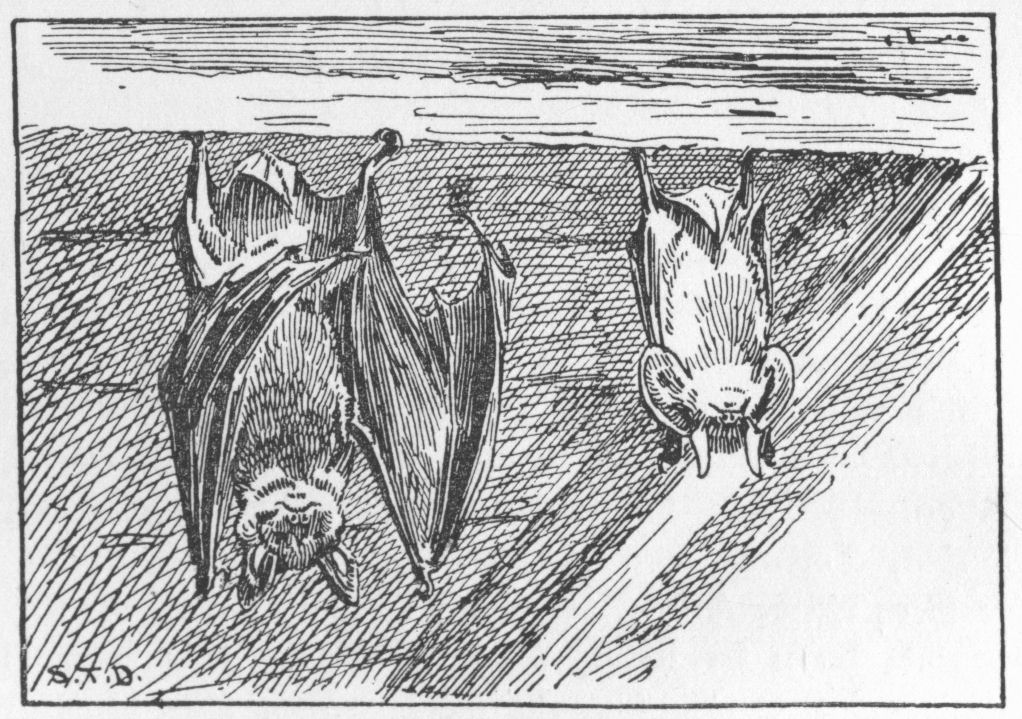
Bats Asleep
Left—Serotine (Vespertilio serotinus). Right—Long-eared bat (Plecotus auritus).
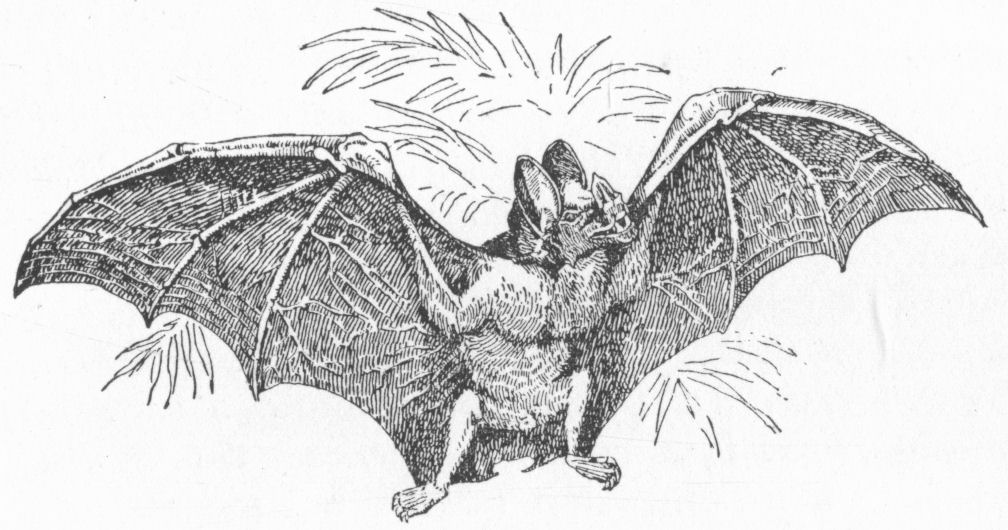
Bat, one of the group of wing-handed, flying mammals, having the fore-limb peculiarly modified so as to serve for flight, and constituting the order Cheiroptera. Bats are animals of the twilight and darkness, and are common in temperate and warm regions, but are most numerous and largest in the tropics. All European bats are small, and have a mouse-like skin. The body of the largest British species, Vespertilio noctŭla, is less than that of a mouse, but its wings stretch about 15 inches. During the day it remains in caverns, in the crevices of ruins, hollow trees, and similar lurking places, and flits out at evening in search of food, which consists of insects. Several species of the same genus are common in North America. Many bats are remarkable for having a singular nasal cutaneous appendage, bearing in some cases a fancied resemblance to a horse-shoe. Bats may be conveniently divided into two sections—the insectivorous or carnivorous, comprising all European and most African and American species; and the fruit-eating, belonging to tropical Asia and Australia, with several African forms. An Australian fruit-eating bat (Pterŏpus edūlis), commonly known as the kalong or flying-fox, is the largest of all the bats; it does much mischief in orchards. At least two species of South American bats are known to suck the blood of other mammals, and thence are called 'vampire-bats'. All the British bats belong to the insectivorous group, the fruit-eating and blood-sucking bats being confined to warmer regions. There are fifteen species on the British list, but of these three are very rare. Among the most noteworthy forms are the greater and the lesser horse-shoe bats, in which the ears are nearly as long as the whole body. As winter approaches, in cold climates bats seek shelter in caverns, vaults, ruinous and deserted buildings, and similar retreats, where they cling together in large clusters, hanging head downwards by the feet, and remain in a torpid condition until the returning spring recalls them to active exertions. Bats generally bring forth two young. The parent shows a strong degree of attachment to her offspring, and, when they are captured, will follow them, and even submit to captivity herself rather than forsake her charge.
Vampire-bat (Phyllostroma spectrum)
Bataille, Henry, French poet and dramatist, born at Nîmes in 1872. His first volume of poems, La Chambre Blanche, appeared in 1895. His other works include Le Beau Rivage, Maman Colibri, La Marche Nuptiale, La Femme Nue, La Divine Tragédie, &c.
Batalha (ba˙-ta˙l'ya˙), a village in Portugal, 69 miles north of Lisbon, with a renowned convent of Dominicans, a splendid building.
Batan´gas, a town of the Philippines, in the Island of Luzon, capital of a province of same name, 58 miles south of Manila. Pop. 33,131.
Bata´tas. See Sweet-potato.
Bat´avi. See Batavians.
Bata´via, a city and seaport of Java, on the north coast of the island, the capital of the Dutch East Indies. It is situated on a wide, deep bay, the principal warehouses and offices of the Europeans, the Java Bank, the exchange, &c., being in the old town, which is built on a low, marshy plain near the sea, intersected with canals and very unhealthy; while the Europeans reside in a new and much healthier quarter. Batavia has a large trade, sugar being the chief export. It was founded by the Dutch in 1619, and attained its greatest prosperity in the beginning of the eighteenth century. Its inhabitants are chiefly Malay, with a considerable admixture of Chinese and a small number of Europeans. Pop. 234,697 (1918).
Batavian Republic. See Belgium; Netherlands.
Batavians, an old German nation which inhabited a part of the present Holland, especially the island called Batavia, formed by that branch of the Rhine which empties itself into the sea near Leyden, together with the Waal and the Meuse. Tacitus asserts that they were a branch of the Catti. They were subdued by Germanicus, and were granted special privileges for their faithful services to the Romans, but revolted under Vespasian. They were, however, again subdued by Trajan and Adrian, and at the end of the third century the Salian Franks obtained possession of the Island of Batavia.
Batchian. See Bachian.
Bates, Henry Walter, traveller and naturalist, born at Leicester 1825, learned the hosiery trade, but in 1847 went to the Amazon with Russel Wallace, and remained there for eleven years studying the natural history of the region. Returning to England, he published in 1862 his Naturalist on the River Amazons, a work regarded as a classic. He was assistant secretary to the Royal Geographical Society from 1864 till his death in 1892. A large part of his collections is in the British Museum.
Bath (ba˙th), a city of England, in Somersetshire, on the Avon, which is navigable for barges from Bristol; is beautifully placed among the hills, and the houses are built of freestone, obtained from the neighbourhood. The Abbey Church, dating from the fifteenth century, ranks as one of the finest specimens of Perpendicular Gothic architecture. Bath is remarkable for its medicinal waters, the four principal springs yielding no less than 184,000 gallons of water a day; and the baths are both handsome and roomy. The temperature of the springs varies from 109° to 117° F. They contain carbonic acid, chloride of sodium and of magnesium, sulphate of soda, carbonate and sulphate of lime, &c. Bath was founded by the Romans, and called by them Aquæ Solis (Waters of the Sun). Amongst the Roman remains discovered there have been some fine baths. The height of its prosperity was reached, however, in the eighteenth century, when Beau Nash was leader of the fashion and master of its ceremonies. Since then, though it still attracts large numbers of visitors, it has become the resort of valetudinarians chiefly. Jointly with Wells it is the head of a diocese, and since 1918 returns one member to the House of Commons. Pop. (1921), 68,648.
Bath, a town, United States, Maine, on the west side and at the head of the winter navigation of the Kennebec, 12 miles from the sea. Chief industries: shipbuilding and allied crafts. Pop. 9396.
Bath, the immersion of the body in water, or an apparatus for this purpose.
Ancient Baths.—The use of the bath as an institution, apart from occasional immersion in rivers or the sea, is, as might be anticipated, an exceedingly old custom. Homer mentions the bath as one of the first refreshments offered to a guest; thus, when Ulysses enters the palace of Circe, a bath is prepared for him, and he is anointed after it with costly perfumes. No representation, however, of a bath as we understand it is given upon the Greek vases, bathers being represented either simply washing at an elevated basin, or having water poured over them from above. In later times, rooms, both public and private, were built expressly for bathing, the public baths of the Greeks being mostly connected with the gymnasia. Apparently, by an inversion of the later practice, it was customary in the Homeric epoch to take first a cold and then a hot bath; but the Lacedæmonians substituted the hot-air sudorific bath, as less enervating than warm water, and in Athens at the time of Demosthenes and Socrates the warm bath was considered by the more rigorous to be an effeminate custom. The fullest details we have with respect to the bathing of the ancients apply to its luxurious development under the Romans. Their bathing establishments consisted of four main sections: the undressing room, with an adjoining chamber in which the bathers were anointed; a cold room with provision for a cold bath; a room heated moderately to serve as a preparation for the highest and lowest temperatures; and the sweating-room, at one extremity of which was a vapour-bath and at the other an ordinary hot bath. After going through the entire course both the Greeks and Romans made use of strigils or scrapers, either of horn or metal, to remove perspiration, oil, and impurities from the skin. Connected with the baths were walks, covered race-grounds, tennis-courts, and gardens, the whole, both in the external and internal decorations, being frequently on a palatial scale. The group of the Laocoon and the Farnese Hercules were both found in the ruins of Roman baths.
Modern Baths.—With respect to modern baths, that commonly in use in Russia consists of a single hall, built of wood, in the midst of which is a powerful metal oven, covered with heated stones, and surrounded with broad benches, on which the bathers take their places. Cold water is then poured upon the heated stones, and a thick, hot steam rises, which causes the sweat to issue from the whole body. The bather is then gently whipped with wet birch rods, rubbed with soap, and washed with luke-warm and cold water; of the latter, some pailfuls are poured over his head; or else he leaps, immediately after this sweating-bath, into a river or pond, or rolls in the snow. The Turks, by their religion, are obliged to make repeated ablutions daily, and for this purpose there is, in every city, a public bath connected with a mosque. A favourite bath among them, however, is a modification of the hot-air sudorific bath of the ancients introduced under the name of 'Turkish' into other than Mahommedan countries. A regular accompaniment of this bath, when properly given, is the operation known as 'kneading', generally performed at the close of the sweating process, after the final rubbing of the bather with soap, and consisting in a systematic pressing and squeezing of the whole body, stretching the limbs, and manipulating all the joints as well as the fleshy and muscular parts. Public baths are now common in Europe, but the first English public baths and wash-houses of the kind now common in all cities were established in Liverpool and near the London docks in 1844. In 1846 an Act was passed for their encouragement, and a series of statutes, known as 'The Baths and Wash-houses Acts 1846 to 1896', followed. The establishment of cheap swimming-baths was authorized in 1878.
The principal natural warm baths in England are at Bath, in Somersetshire (the hottest), and Buxton and Matlock, in Derbyshire. The temperature of the Bath springs ranges from 109° to 117° F., while that of the Buxton and Matlock waters scarcely exceeds 82°. The baths of Harrogate, which are strongly impregnated with sulphuretted hydrogen gas, are also of great repute for the cure of obstinate cutaneous diseases, indurations of the glands, &c. The most celebrated natural hot baths in Europe are those of Aix-la-Chapelle, and the various Baden, in Germany; Toeplitz, in Bohemia; Bagnières, Baréges, and Dax, in the south of France; and Spa, in Belgium. Besides the various kinds of water-bath with or without medication or natural mineral ingredients, there are also milk, oil, wine, earth, sand, mud, and electric baths, smoke-baths and gas-baths; but these are as a rule only indulged in after specific prescription.
The practice of bathing as a method of cure in cases of disease falls under the head of hydropathy; but even when it is employed simply for pleasure or purification due regard should be paid to the physiological condition of the bather. In many cases cold bathing should be avoided altogether, especially by those who have any tendency to spitting of blood or consumption, by gouty people, or by those who have any latent visceral disease or apoplectic tendency. Wherever the bath is followed by shivering instead of by a healthy reactionary glow, it is undesirable; and a cold bath in the morning after any debauchery or excess in eating or drinking on the previous evening is exceedingly imprudent. Delicate persons and children ought not to bathe in the sea before ten or eleven o'clock in the morning, and in no case should bathing be indulged in after a long fast. In cold streams and rivers additional precautions should be taken, the cold plunge, when heated or fatigued, being frequently attended with fatal results. Even warm baths are not wholly free from danger; apoplexy and death having been known to follow a hot bath when entered with a full stomach. As a rule the temperature should not exceed 105°, and they should not be too long continued. Frequent indulgence in them has an enervating effect, though the majority of people need as yet no renewal of Hadrian's prohibitive legislation in this matter. See also Douches; Thermæ.—Bibliography: W. A. Becker, Gallus; J. Farrar, Baths and Bathing; W. P. Gerhard, Modern Baths and Bath Houses; R. F. Fox, Principles and Practice of Medical Hydrology.
Bath, Knights of the, an order of England, supposed to have been instituted by Henry IV on the day of his coronation, but allowed to lapse after the reign of Charles II till 1725, when George I revived it as a military order. By the book of statutes then prepared the number of knights was limited to the sovereign and thirty-seven knights companions; but the limits of the order were greatly extended in 1815, and again in 1847, when it was opened to civilians. It now consists of three classes, each subdivided into (1) military members, (2) civil members, and (3) honorary members, consisting of foreign princes and officers. The first class consists of Knights of the Grand Cross (G.C.B.); the second of Knights Commanders (K.C.B.); and the third of Companions (C.B.). The Dean of Westminster is dean of the order. In 1917 the Companions of the order were given the privileges and precedence of Commanders, the badge being now worn round the neck. In 1918 the statutes were amended in order to admit officers of the Royal Air Force to the military division. The ribbon of the order is crimson; the military badge a gold cross of eight points, with the lion of England between the four principal angles, and having in a circle in the centre the rose, thistle, and shamrock between three imperial crowns; motto: Tria juncta in uno. Stars are worn by the two first classes, with additional motto, Ich dien, for the military members only. See Knighthood.
Bath-brick, a preparation of siliceous earth found in the River Parret, in Somersetshire, in the form of a solid brick, used for cleaning knives, &c. See Sand.
Bath´gate, a town, Scotland, Linlithgowshire, pleasantly situated, and having in the vicinity the paraffin-works known as Young's, a paper-mill and other works, and coal and iron-stone mines. Pop. (1921), 8504.
Batholite, a mass of igneous rock having no visible floor, and presumed to pass down into some region of the earth's crust where molten rocks at one time prevailed over all others. Granite blocks, like those of the Cairngorm Mountains in Scotland, or the long ridge of the Leinster Chain, which have intruded into their surroundings, are regarded as batholites the crests of which have become exposed by denudation. A batholite in its original molten condition may exist under any large area of volcanic activity, and the similarity of the igneous rocks sent to the surface over broad regions of the earth, constituting what are called 'petrographical provinces', points to the existence of very considerable continuous rock-cauldrons in the crust.
Bathom´eter, an instrument, invented by C. Williams Siemens, for measuring the depth of sea beneath a vessel without casting a line. It is based upon the fact that the attraction exerted upon any given mass of matter on the ship is less when she is afloat than ashore, because of the less density of sea-water as compared with that of earth or rock.
Bathonian Stage, a division of the middle Jurassic series of rocks, including the beds between the Inferior Oolite and the Oxford Clay. The name is derived from its excellent development near Bath, in Somersetshire, and the most important member is the Oolitic limestone known as Bath-stone (q.v.). The Bathonian stage includes the following beds in ascending order:—
1. Stonesfield Slate, named from a village near Woodstock; a flaggy limestone used for roofing, with remains of ferns and cycads washed in from the Jurassic land, and of some of the earliest-known mammals, allies of the monotremes or the marsupials. 2. The Great or Bath Oolite, with marine fossils, and also remains of the large reptiles known as dinosaurs. 3. Bradford Clay. 4. Forest Marble. 5. Cornbrash, so called from its 'brashy' or rubbly nature, an earthy oolite yielding fair land for corn.
Bathori (bä'to-rē), or Bathory, a Hungarian family, which gave Transylvania five princes, and Poland one of its greatest kings. The more important members were:—1. Stephen, born in 1532, elected Prince of Transylvania in 1571, on the death of Zapolya, and in 1575 King of Poland. He accomplished many internal reforms, recovered the Polish territories in possession of the Czar of Moscovy, and reigned prosperously till his death in 1586.—2. Sigismund, nephew of Stephen, educated by the Jesuits, became Prince of Transylvania in 1581, shook off the Ottoman yoke, and had begun to give hopes of reigning gloriously when he resigned his dominions to the Emperor Rudolph II, in return for two principalities in Silesia, a cardinal's hat, and a pension. Availing himself, however, of an invitation by the Transylvanians, he returned, and placed himself under the protection of the Porte, but was defeated by the Imperialists in every battle, and finally sent to Prague, where he died almost forgotten in 1613.—3. Elizabeth, niece of Stephen, King of Poland, and wife of Count Nadasdy, of Hungary. She is said to have bathed in the blood of 600 young girls in the hope of renewing her youth, and to have committed other enormities. She was afterwards seized and confined till her death in 1614.
Bat-horse. See Batman.
Ba´thos, a Greek word meaning depth, now used to signify a ludicrous sinking from the elevated to the mean in writing or speech. First used in this sense by Pope in The Art of Sinking in Poetry (Scriblerus Papers, 1729).
Bath-stone (also called Bath-oolite and Roe-stone, from the small rounded grains of which it is composed), a species of English limestone. It is extensively worked near Bath for building purposes. When just quarried it is soft; but though it soon becomes hard on exposure to the atmosphere, and is of handsome appearance, it is not very durable.
Bath´urst, a British settlement on the west coast of Africa, on the Island of St. Mary's, near the mouth of the Gambia, with a trade in gum, bees-wax, hides, ivory, gold, rice, cotton, and palm-oil. Pop. 8000.
Bathurst, a town in the western district of New South Wales, on the Macquarie River, with wide, well-laid-out streets at right angles, and a central square, tanneries, railway workshops, breweries, flour-mills, and other industries. Pop. 9200.
Bathurst, Allen Bathurst, First Earl, a distinguished statesman in Queen Anne's reign; born 1684. He took part with Harley and St. John in opposing the influence of Marlborough, was raised to the peerage in 1711, impeached the promoters of the South Sea scheme, opposed the Bill against Atterbury, and was a leading antagonist of Walpole. He was created earl in 1772. His name is also associated with those of the leading writers and wits of the day. Died 1775.
Bathurst, Henry Bathurst, Third Earl, son of the second earl, a prominent Tory statesman, after whom various capes, islands, and districts were named. Born 1762; in 1807, President of Board of Trade; in 1809, Secretary for Foreign Affairs; and in 1812, Secretary for the Colonies, a post held by him for sixteen years. He was also President of the Council under Wellington, 1828-30. Died 1834.
Bathurst Island, on the North Australian coast, belonging to S. Australia, separated from Melville Island by a narrow strait; triangular in shape, with a wooded area of about 1000 sq. miles.—Also an island in the Arctic Ocean discovered by Parry, E. of Cornwallis and W. of Melville Island, 76° N., 100° W.
Bathyb´ius (Gr. bathys, deep, bios, life), the name given by Huxley to what was regarded as granular slimy masses of animal matter found covering the sea-bottom at great depths.
Batiste (ba-tēst'), a fine linen cloth made in Flanders and Picardy, named after its inventor, Jean Baptiste of Cambrai.
Bat´ley, a municipal and parliamentary borough of England, West Riding of York, about a mile from Dewsbury; principal manufactures: heavy woollen cloths, such as pilot, beaver, police, army, and frieze cloths, flushings, and blankets. Batley and Morley unite in returning one member to Parliament. Pop. 36,151.
Batman (bat'man or bä'man; from Fr. bât, a pack-saddle), in the British army, a person allowed by the Government to every company of a regiment on foreign service. His duty is to take charge of the cooking utensils, &c., of the company, and he has a bat-horse to convey these utensils from place to place.
Ba´ton, a short staff or truncheon, in some cases used as an official badge, as that of a field-marshal. The conductor of an orchestra has a baton for the purpose of directing the performers as to time, &c. In heraldry, what is usually called the 'bastard bar', or 'bar sinister', is properly a baton sinister. See Bastard Bar.
Bat´on Rouge (rözh), the capital of Louisiana, United States, on the left bank of the Mississippi, with an arsenal, barracks, military hospital, State house, State university, &c. On 5th Aug., 1862, the Confederates under General Breckenridge suffered a severe defeat before it. Pop. (1920), 21,782.
Batoum, or Batum (ba˙-töm´), a port on the east coast of the Black Sea, acquired by Russia by the Treaty of Berlin, on condition that its fortifications were dismantled and it was thrown open as a free port. It rapidly grew to be the main outlet for Transcaucasia; its harbour was enlarged for commercial reasons; an arsenal was built outside it; it was connected by a military road with Kars; and finally, in July, 1886, the Russian Government declared it to be a free port no longer. Its importance as a naval and military station to Russia was unquestionably great; it is of most importance commercially as an outlet for the mineral oil of Baku. The water is of great depth close inshore, and the shipping lies under protection of the overhanging cliffs of the Gouriel Mountains. Batoum was abandoned by the Bolshevik Government in March, 1918, and occupied by the Turks on 15th April of the same year. By the terms of the armistice concluded with Turkey in Nov., 1918, the Allies occupied the port, and in Nov., 1919, a military governor was appointed by the British Government. On 9th July, 1920, Batoum was evacuated by the British, and occupied by Georgian troops. Pop. 46,000.—The province of Batoum has an area of 2693 sq. miles. Pop. 186,000.
Batrachians (ba-trā´ki-anz; Gr. batrachŏs, a frog), the fourth order in Cuvier's arrangement of the class Reptilia, comprising frogs, toads, newts, salamanders, and sirens. The term is now sometimes employed as synonymous with amphibia, but is more usually restricted to the order Anura or tailless amphibia. See Amphibia.
Batshian. See Bachian.
Bat´ta, an allowance which military officers in India receive in addition to their pay. It was originally given only when the officers were on the march or in the field, but now half batta is paid when troops are in cantonments.
Battal´ion, the tactical unit of command in infantry, supposed to be of the maximum strength to be efficiently handled by one officer in chief command, with others under him. In most armies it is about 1000 to 1100 men. The former is about the strength of a battalion in the British army, in which battalions now correspond to what were formerly regiments, the chief commanding officer (in actual command) being the lieutenant-colonel. See Army.
Battalion of Death, the legion of Russian women and girls, belonging to all classes, organized in 1917 and commanded by the famous revolutionary Madame Botshkalova. The battalion took part in several engagements.
Bat´tas, or Battaks, a people belonging to the Malayan race inhabiting the valleys and plateaus of the mountains that extend longitudinally through the Island of Sumatra. They practise agriculture and cattle-rearing, and are skillful in various handicrafts; they have also a written literature and an alphabet of their own, their books treating of astrology, witchcraft, medicine, war, &c. They are under the rule of hereditary chieftains. In 1908 a Battak Institute was established at Leyden for the study of the Battak country, people, &c.
Bat´tenberg, a village in the Prussian province of Hesse-Nassau, from which the sons (by morganatic marriage) of Prince Alexander of Hesse, uncle of Louis, Grand-Duke of Hesse, the husband of Princess Alice of Britain, derived their titles of princes of Battenberg. One of them, Alexander, was Prince of Bulgaria from 1879 to 1886, and died in 1893. Another, Prince Henry, was married to Princess Beatrice of Great Britain in 1885, and died in 1896.
Battenberg, Prince Louis Alexander of, born 24th May, 1854, in Graz, son of Prince Alexander of Hesse. He became a naturalized British subject, entered the navy in 1868, and in 1884 married Princess Victoria, eldest daughter of Princess Alice Maud, Grand-Duchess of Hesse-Darmstadt, and second daughter of Queen Victoria. He became rear-admiral in 1904, was second admiral of the Mediterranean fleet from 1906 to 1908, commanded the Atlantic fleet from 1908 to 1910, the 3rd and 4th divisions of the Home fleet in 1911, and was appointed Second Sea Lord in Nov., 1911, and First Sea Lord in Dec., 1912, in succession to Sir Francis Bridgeman. In October, 1914, however, in consequence of a campaign against alien enemies which culminated in an attack in the Globe on the First Sea Lord, he tendered his resignation to Mr. Winston Churchill, then First Lord of the Admiralty, on the ground that his birth and parentage in some respects impaired his usefulness. In 1917 the king determined that those princes of his family who were his subjects and bore German names and titles should relinquish those titles and adopt British surnames, and Prince Louis adopted the title of Marquess of Milford Haven, and the surname of Mountbatten. He was the author of Men-of-war Names, their Meaning and Origin (1908). He was made a Privy Councillor in 1914, and was both a Civil and a Military Knight Grand Cross of the Bath. He died 11th Sept., 1921.
Roman Battering-ram
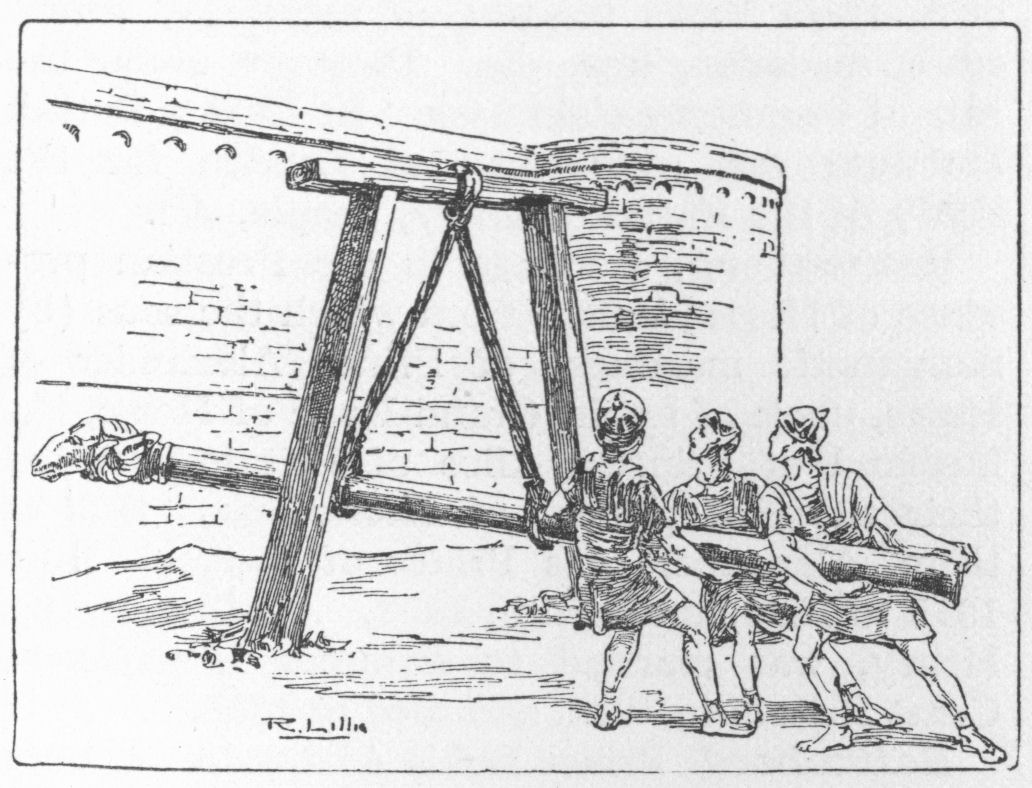
Battering-ram, an engine for battering down the walls of besieged places. The ancients employed two different engines of this kind—one suspended in a frame, the other movable on wheels or rollers. They consisted of a beam or spar with a massive metal head, and were set in motion either by a direct application of manual force or by means of cords passing over pulleys. Some are said to have been 120 feet or more in length, and to have been worked by 100 men. One is described as being 180 feet long, and having a head weighing 1½ tons. Smaller ones, manned by three or four soldiers, were also frequently employed. They were generally covered with a roof or screen for the protection of the workers. The battering-ram is mentioned by Ezekiel (iv, 2; xxi, 22), and the Romans learnt the use of it from the Greeks.
Bat´tersea, a municipal and parliamentary borough of London, in Surrey, in a low situation on the south bank of the Thames, nearly opposite Chelsea, with a fine public park extending over 185 acres. The district is associated with the names of Pope and Bolingbroke, and with the Wellington-Winchilsea duel. Battersea returns two members to Parliament. Pop. (municipal borough), (1921), 167,693.
Bat´tery, (1) any number of guns grouped for action in one place and under one control; (2) the tactical and administrative unit of the Royal Regiment of Artillery; (3) an entrenched work constructed as a position for guns in siege warfare.
The Royal Regiment of Artillery is organized in batteries of horse, field, heavy, siege, and mountain artillery. These differ in the weight and type of gun with which they have to do, but the general principles of organization are the same. (See Army.) Nominally a battery consists of six guns with their attendant ammunition wagons (12) and certain other transport. A major commands the battery, and has a captain and three subalterns to assist him. For all purposes a battery is permanently organized in three sections, each of two guns and four wagons, under subaltern officers; while in action it is divided into two parts, (a) the fighting battery of six guns and six wagons; (b) the wagon line of the remaining wagons, under command of the captain. The change from march formation to that necessary for firing is termed 'coming into action'.
Horse, field, and some heavy batteries are horse-drawn (six or eight horses to a gun), while other heavy batteries and siege-guns are drawn by mechanical transport or mounted on railway platforms. Mountain batteries are organized for pack transport only—either mules or carriers—all the material being specially constructed to this end. Among combinations with the word battery come the following: battery commander, the officer commanding a battery; battery leader, the senior subaltern, who receives and carries out the commander's orders in action; battery-fire, each gun of a battery firing in turn: as opposed to gun-fire, where each gun fires independently. See Artillery.
Battery, in criminal law, an assault by beating or wounding another. The least touching or meddling with the person of another against his will may be held to constitute a battery.
Battery, in electricity and galvanism, a combination of several jars or metallic plates. See Daniell's Cell; Electric Battery; Secondary Cell.
Batthyanyi (ba˙t-ya˙n´yē), one of the oldest and most celebrated Hungarian families, traceable as far back as the Magyar invasion of Pannonia in the ninth century. Among later bearers of the name have been—Count Casmir Batthyanyi, who was associated with Kossuth, was Minister of Foreign Affairs in Hungary during the insurrection of 1849, and died in Paris 1854; Count Louis Batthyanyi, born 1809, of another branch of the family, was leader of the opposition in the Hungarian Diet until the breaking out of the commotions of 1848, when he took an active part in promoting the national cause; but on the entry of Windischgrätz into Pesth he was arrested and shot, 1849.
Battle, a combat between two armies. In ancient times and the Middle Ages the battleground was often chosen by agreement, and the battle was a mere trial of strength, a duel en gros; and as the armies of the ancients were imperfectly organized, and the combatants fought very little at a distance, after the battle had begun manuœvres were much more difficult, and troops almost entirely beyond the control of the general. Under these circumstances the battle depended almost wholly upon the previous arrangements and the valour of the troops. In modern times, however, the finest combinations, the most ingenious manœuvres, are rendered possible by the better organization of the armies, and it is the skill of the general rather than the courage of the soldier that now determines the event of a battle. Battles are distinguished as offensive or defensive on either side, but there is a natural and ready transition from one method to the other. The purely defensive attitude is condemned by tacticians except in cases where the only object desirable is to maintain a position of vital consequence, the weight of precedent being in favour of the dash and momentum of an attacking force even where opposed to superior forces. Where the greatest generals have acted upon the defensive, it has almost always been with the desire to develop an opportunity to pass to the offensive, and, having discovered their opponent's hand, to marshal against the enemy, exhausted with attack, the whole strength of their resources. Napoleon won more than one great victory by this method, and Wellington's reputation was largely based upon his skill in defensive-offensive operations. Tacticians have divided a battle into three periods, which are disposition, combat, and the decisive moment. In some measure they require distinct qualities in a commander, the intellect which can plot a disposition being by no means always of the prompt judgment passing to instant action which avails itself of the crucial moment to crush an enemy. Cooperation and mutual support of all arms and services is essential to success in a modern battle, which may occupy many days or even weeks and embrace a large area of country, e.g. the battle of the Marne, the battle of the Somme. This co-operation is ensured by the most careful and detailed arrangements being made beforehand, such arrangements even including the rehearsal of more important phases over ground prepared to represent the country over which the operations will eventually take place. The modern battle may be, and probably will be, a continuation of many operations—offensive and defensive—carried out by distinct and separate formations. The general scope of the operations as a whole will be planned by the supreme commander, while the choice of the methods to be used is left to the commander of the formations affected. See Strategy; Tactics.
Battle, a town in Sussex, so named from the battle of Hastings having been fought there. An abbey built by William the Norman has disappeared, but important remains of a later building exist on the same site; and there is an old church of great interest. Pop. (1921), 2891.
Battle (or Battel), Wager of, an obsolete method, according to English law, of deciding civil or criminal cases by personal combat between the parties or their champions in presence of the court. A woman, a priest, a peer, or a person physically incapable of fighting could refuse such a trial. It was not abolished till 1819 (by the Statute of 59 George III, c. 46), but had long previously been in abeyance. See Ordeal.
Battle-axe, a weapon much used in war in the early part of the Middle Ages among knights. It is a weapon which affords hardly any guard, and the heavier the blow given with it the more the fighter is exposed; but its use was to some extent necessitated by the resistance of iron armour to all but heavy blows. In England and Scotland the battle-axe was much employed, the Lochaber-axe remaining a formidable implement of destruction in the hands of the Highlanders to a recent period.
Battle Creek, a town of the United States, in Michigan, at the junction of the Kalamazoo and Battle Creek, with a college, and manufactures of agricultural implements, &c. Pop. 25,267.
Battleford, a trading town of Canada, province of Saskatchewan, at the junction of the Battle and Saskatchewan (North Fork). Pop. 1335.
Bat´tlement, a notched or indented parapet of a fortification, formed by a series of raised parts called cops or merlons, separated by openings called crenelles or embrasures, the soldier sheltering himself behind the merlon, while he fires through the embrasure. Battlements were originally military, but were afterwards used freely in ecclesiastical and civil buildings by way of ornament, on parapets, cornices, tabernacle work, &c.
Battle-piece, a painting representing a battle. Some of the greatest pieces of this kind are the Battle of Constantine, of which the cartoons were drawn by Raphael, and which was executed by Giulio Romano; Lebrun's Battles of Alexander; and the Battles of the Amazons, by Rubens.
Battue (ba-tü´), a method of killing game by having persons to beat a wood, copse, or other cover, and so drive the animals (pheasants, hares, &c.) towards the spot where sportsmen are stationed to shoot them.
Battus, legendary founder of the Greek colony of Cyrene, in Libya, about 650 B.C. There were eight rulers of the family founded by him, bearing alternately the names Battus and Arcesilaus.
Batu Khan, Mongol ruler of the Western conquests of his grandfather, Genghis Khan, from 1224 to 1255. He overran Russia, Poland, Hungary, and Dalmatia, holding Russia for ten years.
Batum. See Batoum.
Baudelaire (bōd-lār), Charles Pierre, French poet, born 1821. His first work of importance was a series of translations from Poe, ranking among the most perfect translations in any literature. A volume of poems, Les Fleurs du Mal (1857), established his reputation as a leader of the Romanticists, though the police thought it necessary to deodorize them. Of a higher tone were his Petits Poèmes en Prose; followed in 1859 by a monograph on Théophile Gautier, in 1860 by Les Paradis Artificiels (opium and hashish studies), and in 1861 by Wagner et Tannhäuser à Paris. He died in 1867. The best English rendering of the Fleurs du Mal is by A. Symons (1905).—Bibliography: Henry James, French Poets and Novelists; Asselineau, Charles Baudelaire, sa vie et son œuvre; F. Gautier, Charles Baudelaire.
Baudry (bō-drē), Paul Jacques Aimé, a prominent modern French painter, born in 1828, died Jan., 1886. He took the grand prix de Rome in 1850, and exhibited many important works, of which the better known are his Charlotte Corday and La Perle et la Vague. The decoration of the foyer of the New Opera House at Paris was entrusted to him—an enormous work, occupying a total surface of 500 sq. metres, but admirably accomplished by him in eight years.
Bauer (bou´er), Bruno, German philosopher, historian, and Biblical critic of the rational school, born 1809, died 1882. Wrote Critique of the Gospel of John (1840); Critique of the Synoptic Gospels (1840); History of the French Revolution to the Founding of the Republic (1847); History of Germany during the French Revolution and the Rule of Napoleon (1846); Critique of the Gospels (1850-1); Critique of the Pauline Epistles (1850); Philo, Strauss, Renan, and Primitive Christianity (1874); Christ and the Cæsars (1877), &c.
Bauhin (bō-an), Gaspard, born at Basel in 1560; in 1580 elected to the Greek chair at Basel, and in 1589 to that of anatomy and botany. He died in 1624. His fame rests chiefly on his Pinax Theatri Botanici and Theatrum Botanicum. Linnæus gave his name to a genus of plants.
Bauhin´ia, a genus of plants, ord. Leguminosæ, usually lianes, found in the woods of hot countries, and often stretching from tree to tree like cables. Many are showy and interesting. The bark of B. variegāta is used in tanning; the bast fibres of some Indian species are made into ropes and twine.
Baumgarten (boum´ga˙r-tn), Alexander Gottlieb, a German philosopher, born in 1714 at Berlin; in 1740 was made professor of philosophy at Frankfort-on-the-Oder, and died there in 1762. He is the founder of æsthetics as a science, and the inventor of this name. His ideas were first developed in his De Nonnullis ad Poema pertinentibus (1735), and afterwards in the two volumes of his uncompleted Æsthetica, published 1750-8.
Baur (bour), Ferdinand Christian, German theologian, founder of the 'Tübingen School' of theologians and Hegelian thinkers, born in 1792. The publication of his first work, Symbolism and Mythology, or The Natural Religion of Antiquity, in 1824-5, led to his appointment as professor in the evangelical faculty of Tübingen University, a position occupied by him till his death in 1860. His chief works in the department of the history of Christian dogma are: The Christian Gnosis, or The Christian Philosophy of Religion (1835); The Christian Doctrine of the Atonement (1838); The Christian Doctrine of the Trinity and the Incarnation (1841-3); The Compendium of and Lectures on the History of Christian Dogmas (1847, 1865). To the department of New Testament criticism and the early history of Christianity belong the so-called Pastoral Epistles of the Apostle Paul (1835); Paul the Apostle of Jesus Christ (1845); Critical Inquiries Concerning the Canonic Gospels (1847); A History of Christian Doctrine to the End of the Eighteenth Century (1853-63). Baur's views in regard to the Church of the earliest times and the New Testament Scriptures have been very influential. He saw different and opposing tendencies at work in the Church of apostolic times, and believed that the New Testament mainly took form in the second century, the only genuine writings previous to A.D. 70 being the four great Pauline epistles and Revelation.
Bautzen (bout´sen), or Budissin, a German town in Saxony, upon a height on the right bank of the Spree, with some old and interesting buildings. The inhabitants are mostly Lutheran, and both Catholics and Protestants worship in the same cathedral. Chief manufactures: woollen goods, paper, gunpowder, machines. Napoleon defeated the united armies of the Russians and the Prussians at Bautzen on the 21st May, 1813. Pop. 32,754.
Bauxite (ba¨k´sīt), a rock resembling clay, but consisting of hydrated aluminium oxides, with, in good examples, a silica content of less than 2 per cent. Bauxite is mined at Les Baux in Provence, in Arkansas, and other places, including County Antrim, where it occurs between basaltic lavas. It is the source of commercial aluminium, and is also used for bricks for high-temperature furnaces, and in alum manufacture. Like laterite (q.v.), it results from tropical conditions of weathering acting on a variety of silicate rocks.
Bava´ria (Ger. Bayern; Fr. Bavière), previous to the changes caused by the European War (1914-8), a kingdom in the south of Germany, the second largest State of the Reich, composed of two isolated portions, the larger comprising about eleven-twelfths of the monarchy, having Würtemberg, Baden, &c., on the west, while the smaller portion, the Pfalz or Palatinate, is separated from the other by Würtemberg and Baden, and lies west of the Rhine; total area, 30,346 sq. miles. The main political divisions are: Upper Bavaria (pop. 1,532,065; chief town, Munich, the capital of the country, pop. 596,467); Lower Bavaria (724,331); Palatinate (937,085); Upper Palatinate and Regensburg (600,284); Upper Franconia (661,862); Middle Franconia (930,868); Lower Franconia and Aschaffenburg (710,943); Sehwaben and Neuburg (789,853); total in (1919), 7,150,146. Next towns after Munich are Nürnberg, Augsburg, Würzburg, and Ratisbon (Regensburg). The main portion of the country is hilly; in the south, where it belongs to the Alps, it is mountainous; but north of the Alps and south of the Danube, which flows east through the country from Ulm to Passau, there is a considerable plateau, averaging about 1600 feet above the sea-level. The south frontier is formed by a branch of the Noric Alps, offsets from which project far into the plateau; principal peaks: the Zugspitze, 10,394 feet, and the Watzmann, 9470 feet. The highest summits on the Bohemian (Austrian) frontier, belonging to the Böhmerwald Mountains, are the Rachel, 5102 feet, and the Arber, 5185 feet. Ranges of less elevation bordering on or belonging to the country are the Fichtelgebirge in the north-east, the Frankenwald, Rhöngebirge, and Spessart in the north, and the Steigerwald and Franconian Jura in the middle. The Palatinate is traversed by the north extremity of the Vosges Mountains, the highest peak being the Konigstuhl, 2162 feet. The greater part of the country belongs to the basin of the Danube, which is navigable, its tributaries on the south being the Iller, Lech, Isar, and Inn; on the north, the Wornitz, Altmühl, Nab, and Regen. The northern portion belongs to the basin of the Main, which receives the Regnitz and Saale, and is a tributary of the Rhine. The Palatinate has only small streams that flow into its boundary river the Rhine. The chief lakes of Bavaria are all on the higher part of the south plateau; the smaller within the range of the Alps. The Ammer-See is about 10 miles long by 2½ broad, 1736 feet above the sea; the Würm-See or Starnberger-See, about 12 miles long by 3 broad, 1899 feet; and Chiem-See, 9 miles long by 9 to 4 broad, 1651 feet. The climate in general is temperate and healthy, though somewhat colder than the other South German States; yearly average about 47° F.
As regards soil, Bavaria is one of the most fertile countries in Germany, producing the various cereals in abundance, the best hops in Germany, fruit, wine, tobacco, &c., and having extensive forests. Lower Franconia (the Main valley) and the Palatinate are the great vine-growing districts. The celebrated Steinwein and Leistenwein are the produce of the slopes of the Steinberg and Marienberg at Würzburg (on the Main). The forests of Bavaria, chiefly fir and pine, yield a large revenue, much timber being annually exported, together with potash, tar, turpentine, &c. The principal mineral products are salt, coal, and iron, some of the mining works belonging to the State. The minerals worked include copper, quicksilver, manganese, cobalt, porcelain clay, alabaster, graphite. Large numbers of horses and cattle are reared, as also sheep and swine. The return of cattle in 1917 showed 272,667 horses, 3,896,702 cattle, and 616,464 sheep. The manufactures are individually mostly on a small scale. The principal articles manufactured are linens, woollens, cottons, leather, paper, glass, earthen and iron ware, jewellery, &c. The optical and mathematical instruments made are excellent. A most important branch of industry is the brewing of beer, for which there are upwards of 7000 establishments, producing over 300 millions of gallons a year. The distilleries produce over 4 millions of gallons of alcohol. A number of the people maintain themselves by the manufacture of articles in wood, and by felling and hewing timber. The trade of Bavaria in home produce exported and goods imported for consumption in the country is not large. Principal exports: corn, timber, wine, cattle, glass, hops, fruit, beer, wooden wares, &c. The chief imports are sugar, coffee, cotton, rice, spices, dye-stuffs, silk and silk goods, lead, &c. From its position Bavaria has a considerable transit trade. The Konig Ludwig Canal connects the Main at Bamberg with the Altmühl a short distance above its embouchure in the Danube, thus establishing water communication between the North Sea and the Black Sea. The railway system has a total mileage of 5290, mostly belonging to the State.
Education is in a less satisfactory condition than in most German States. There are about 7500 elementary schools, at which attendance is compulsory up to fourteen years of age. There are three universities, two of which (Munich and Würzburg) are Roman Catholic, and one (Erlangen) Protestant. In art Bavaria is best known as the home of the Nürnberg school, founded about the middle of the sixteenth century by Albert Dürer. Hans Holbein is also claimed as a Bavarian; and to these have to be added the eminent sculptors Kraft and Vischer, both born about the middle of the fifteenth century. The restoration of the reputation of Bavaria in art was chiefly the work of Ludwig I, under whom the capital became one of the most prominent seats of the fine arts in Europe. The religion of the State is Roman Catholicism, over 70 per cent of the population being Roman Catholics. All citizens, whatever their creed, possess the same civil and political rights. The dioceses of Bavaria comprise two Roman Catholic archbishopries, Munich and Bamberg; and six bishopries, Augsburg, Ratisbon, Eichstädt, Passau, Würzburg, and Spires.
For over a century Bavaria was a kingdom, and the crown hereditary in the male line of the descendants of the ancient Counts of Wittelsbach. The executive power was vested in the king, but his ministers were responsible for his acts. The legislature consisted of two chambers—one of senators, composed of princes of the royal family, the great officers of the State, the two archbishops, the heads of certain noble families, and certain members appointed by the Crown; the other of deputies, 163 in number, elected by direct and secret vote, and calculated at the rate of 1 for every 38,000 inhabitants. The lower chamber was elected for six years. The Budget for each of the years 1916 and 1917 balanced at £12,183,411; for 1918 and 1919 at £42,639,595; the public debt on 1st July, 1917, was £128,719,000, £98,179,000 being railway debt. The army (peace footing, 72,000) was raised by conscription—every man being liable to serve from the 1st of January of the year in which he completes his twentieth year. In time of peace the army was under the command of the King of Bavaria, but in time of war under that of the Emperor of Germany, as commander-in-chief of the whole German army.
As a result of the revolutionary movement in Nov., 1918, the Bavarian dynasty was deposed and a republican form of government set up. The provisional constitution, made public on 7th Jan., 1919, established a Socialist Republic in Bavaria. The supreme power lies with the people; the Diet consists of one chamber; the suffrage is universal; the privileges of birth and caste are abolished. The supreme executive power is exercised by the ministry as a whole. The Church is separated from the State, and all religious associations have equal rights.
History.—The Bavarians take their name from the Boii, a Celtic tribe whose territory was occupied by a confederation of Germanic tribes, called after their predecessors Boiarii. These were made tributary first to the Ostrogoths, and then to the Franks; and on the death of Charlemagne his successors governed the country by lieutenants with the title of margrave, afterwards converted (in 921) into that of duke. In 1070 Bavaria passed to the family of the Guelphs, and in 1180 by imperial grant to Otho, Count of Wittelsbach, founder of the dynasty reigning until 1918. In 1623 the reigning duke was made one of the Electors of the empire. Elector Maximilian II joined in the War of the Spanish Succession on the side of France, and this led, after the battle of Blenheim, 1704, to the loss of his dominions for the next ten years. His son, Charles Albert, likewise lost his dominions for a time to Austria, but they were all recovered again by Charles's son, Maximilian III (1745). In the wars following the French revolution Bavaria was in a difficult position between France and Austria, but in the end joined Napoleon, from whom its Elector Maximilian IV received the title of king (1805), a title afterwards confirmed by the treaties of 1814 and 1815. King Maximilian I was succeeded by his son, Ludwig (or Louis) I, under whom various circumstances helped to quicken a desire for political change. Reform being refused, tumults arose in 1848, and Ludwig resigned in favour of his son, Maximilian II, under whom certain modifications of the constitution were carried out. At his death in 1864 he was succeeded by Ludwig II. In the war of 1866 Bavaria sided with Austria, and was compelled to cede a small portion of its territory to Prussia, and to pay a war indemnity of £2,500,000. Soon after Bavaria entered into an alliance with Prussia, and in 1867 joined the Zollverein. In the Franco-German War of 1870-1 the Bavarians took a prominent part, and it was at the request of the King of Bavaria, on behalf of all the other princes and the senates of the free cities of Germany, that the King of Prussia agreed to accept the title of Emperor of Germany. From Jan., 1871, to 1918 Bavaria formed part of the German Empire, and was represented in the Bundesrath by six, and in the Reichstag by forty-eight members. The eccentricity early displayed by Ludwig II developed to such an extent that in June, 1886, he was placed under control, and a regency established under Prince Luitpold (Leopold). The change was almost immediately followed by the suicide of the king, and as Prince Otto, the brother and heir of the late king, was insane, the regency was continued. Prince Luitpold died on 12th Dec., 1912, and his son, Ludwig, became regent. On 5th Nov., 1913, the prince was proclaimed king, under the name of Ludwig III, in succession to his cousin, King Otto, who was declared incapable of ruling. King Otto died on 12th Oct., 1916. Ludwig III abdicated in Nov., 1918, and the Bavarian Government was taken over by a cabinet under the leadership of Kurt Eisner. Eisner was assassinated in Feb., 1919, and a struggle ensued between the moderate Socialists and the extremists of the Left. The moderate party, however, returned to power in May, 1919.—Bibliography: S. Riezler, Geschichte Bayerns (4 vols.); R. Piloty, Die Verfassungsgeschichte des Königreichs Bayern; Götz, Geographisch-historisches Handbuch von Bayern; M. Docberl, Entwickelungsgeschichte Bayerns; C. P. Higby, Religious Policy of the Bavarian Government during the Napoleonic Period.
Baxter, Richard, the most eminent of the English nonconforming divines of the seventeenth century, born in Rowton, Shropshire, 1615; ordained in 1638; parish minister of Kidderminster in 1640. The imposition of the oath of universal approbation of the doctrine and discipline of the Church of England (the et cætera oath) detached him from the Establishment. After the battle of Naseby he accepted the chaplaincy of Colonel Whalley's regiment. He can scarcely be said, however, to have separated as yet in spirit from the Establishment. He upheld the monarchy, condemned the execution of the king and the election of Cromwell, preached against the Covenant and against separatists and sectaries, but his piety won him the respect of all parties. At the Restoration he became king's chaplain, but declined the bishopric of Hereford, and on the passage of the Act of Uniformity threw in his lot entirely with the nonconformists. In 1685 he was arrested, refused a hearing by Jeffreys, and imprisoned. After his release he lived in retirement till his death in 1691. He left about 150 treatises, of which his Saints' Everlasting Rest, Call to the Unconverted, and Reformed Pastor have been the most popular.—Bibliography: William Orme, Life and Times of Richard Baxter; J. Stalker, Lecture on Baxter in The Evangelical Succession; M‘Adam Muir, Religious Writers of England; Currier, Nine Great Preachers.
Baxterians, followers of Baxter in respect of his attempted compromise between Calvinism and Arminianism. They reject the doctrine of reprobation, admit a universal potential salvation, becoming actual in the case of the elect, and assert the possibility of falling from grace. The Baxterians never formed a sect or even a school, but were men of independent minds, distinguishing between essentials and non-essentials: in things necessary, unity; in things doubtful, liberty; in all things, charity. The two most eminent Baxterians were Dr. Isaac Watts and Dr. Philip Doddridge.—Cf. M‘Adam Muir, Religious Writers of England.
Bay, the laurel tree, noble laurel, or sweet-bay (Laurus nobĭlis); but the term is loosely given to many trees and shrubs resembling this. A fatty or fixed oil (used in veterinary medicine) and also a volatile oil are obtained from the berries, but what is called 'bayberry oil' is also obtained from the genus Myrica or candleberry. In N. America the fragrant-flowered Magnolia glauca is called sweet-bay, the red-bay being Laurus carolinensis, the loblolly-bay Gordonia lasianthus. See Laurel.
Bay, in geography, an indentation of some size into the shore of a sea or lake, generally said to be one with a wider entrance than a gulf.
Bay, in architecture, a term applied to a recessed division or compartment of a building, as that marked off by buttresses or pillars.
Nests of Baya (Ploceus philippīnus)
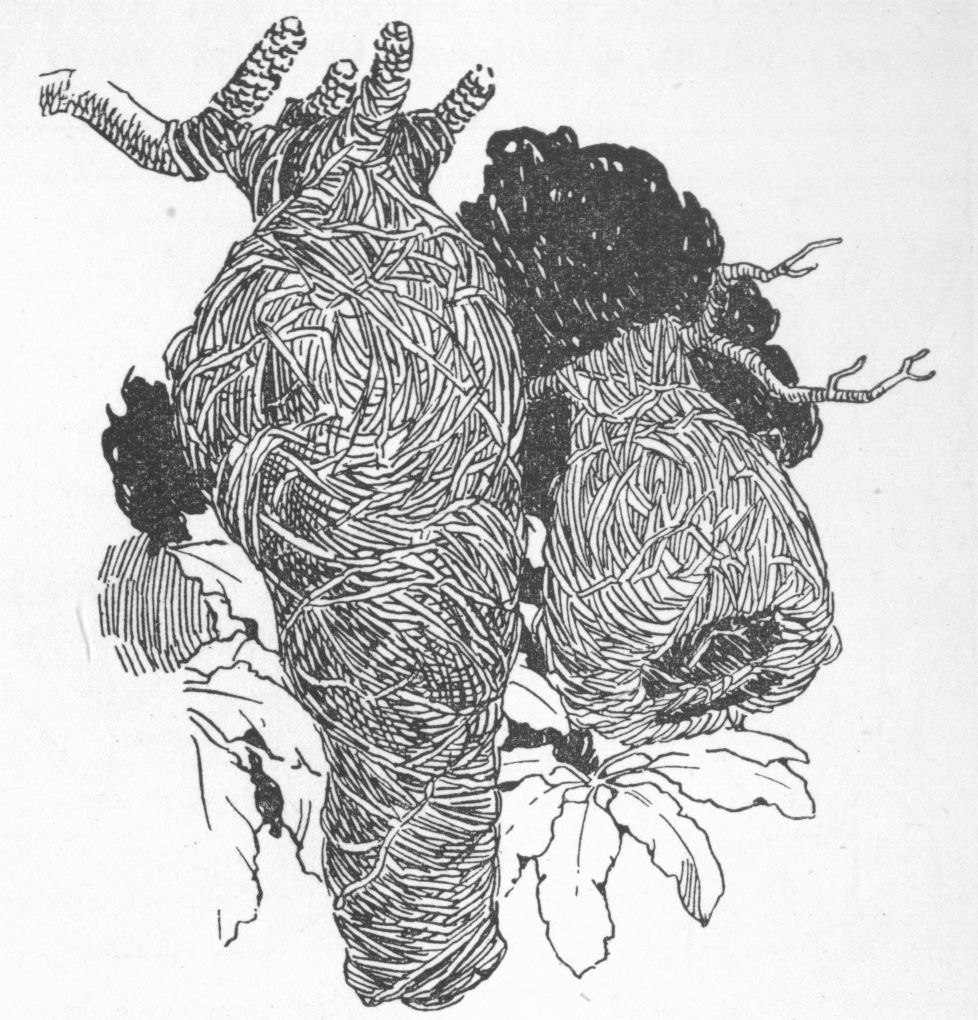
Ba´ya, the weaver-bird (Plocĕus philippīnus), an interesting East Indian passerine bird, somewhat like the bullfinch. Its nest resembles a bottle, and is suspended from the branch of a tree. The entrance is from beneath, and there are two chambers, one for the male, the other for the female. The baya is easily tamed, and will fetch and carry at command.
Bayaderes (bā-a-dērz´), the general European name for the dancing and singing girls of India, some of whom are attached to the service of the Hindu temples, while others travel about and dance at entertainments for hire. Those in the service of the temples are generally devoted to this profession (including that of prostitution) from their childhood.
Bayamo (ba˙-yä´mō), or St. Salvador, a town in the east of Cuba, near the Cauto. Pop. 18,180.
Bayard (ba˙-yär), Pierre du Terrail, Seigneur de, the Chevalier sans peur et sans reproche, born in 1476 in Castle Bayard, near Grenoble, in Southern France. At the age of eighteen he accompanied Charles VIII to Italy, and in the battle of Fornovo took a standard. At the beginning of the reign of Louis XII, in a battle near Milan, he entered the city at the heels of the fugitives, and was taken prisoner, but released by Ludovico Sforza without ransom. In Apulia he killed his calumniator, Sotomayor, and afterwards defended a bridge over the Garigliano singly against the Spaniards, receiving for this exploit as a coat of arms a porcupine, with the motto Vires agminis unus habet ('one has the strength of a band'). He distinguished himself equally against the Genoese and the Venetians, and, when Julius II declared himself against France, went to the assistance of the Duke of Ferrara. He was severely wounded at the assault of Brescia, but returned, as soon as cured, to the camp of Gaston de Foix, before Ravenna, and after new exploits was again dangerously wounded in the retreat from Pavia. In the war commenced by Ferdinand the Catholic he displayed the same heroism, and the fatal reverses which embittered the last years of Louis XII only added to the personal glory of Bayard. When Francis I ascended the throne he sent Bayard into Dauphiné to open a passage over the Alps and through Piedmont. Prosper Colonna lay in wait for him, but was made prisoner by Bayard, who immediately after further distinguished himself in the battle of Marignano. After his defence of Mézières against the invading army of Charles V he was saluted in Paris as the saviour of his country, receiving the honour paid to a prince of the blood. His presence reduced the revolted Genoese to obedience, but failed to prevent the expulsion of the French after the capture of Lodi. In the retreat the safety of the army was committed to Bayard, who, however, was mortally wounded by a stone from a blunderbuss in protecting the passage of the Sesia. He kissed the cross of his sword, confessed to his squire, and died, 30th April, 1524. He was buried in a church of the Minorites, at Grenoble.—Bibliography: "Le Loyal Serviteur" (supposed to be Jacques de Mailles), La très joyeuse ... histoire ... des faiz, gestes, triumphes et prouesses du bon chevalier sans paour et sans reproche, le gentil seigneur de Bayart (printed in 1527); modern edition of this work by M. J. Roman; A. de Terrebasse, Histoire de Pierre Terrail, Seigneur de Bayart.
Bayazid´, a ruined town in Armenia, 140 miles S.E. of Erzerum, S.W. of Mount Ararat, at various times the scene of warlike operations, and twice occupied by the Russians in 1877. Total pop. 4000.
Bayazid. See Bajazet.
Bayberry. See Bay (tree) and Candleberry.
Bay City, an American city, Michigan, on the east side of Saginaw River, near its mouth in Saginaw Bay, Lake Huron. Chief articles of trade, lumber and salt. Pop. (1920), 47,554.
Bayeux, (ba˙-yeu) an ancient town, France, department Calvados, 16 miles N.W. of Caen, with manufactures of lace, calico, and porcelain. In its cathedral, said to be the oldest in Normandy, the famous Bayeux tapestry was preserved for a long time. Pop. 7638.
A section of the Bayeux Tapestry showing the Norman cavalry attacking the English footmen at the Battle of Hastings
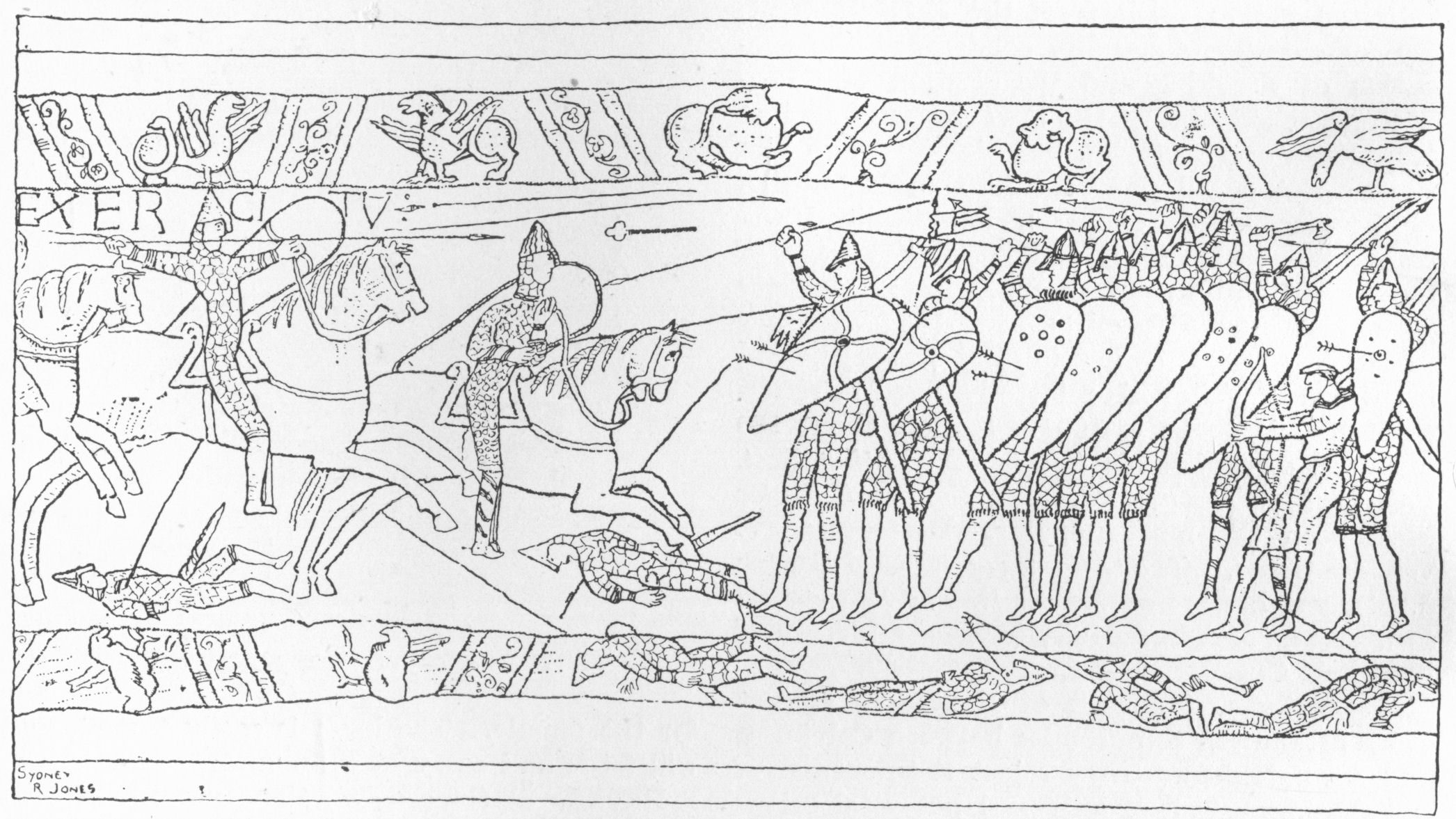
Bayeux Tapestry, so called because it was originally found in the cathedral of Bayeux, in the public library of which town it is still preserved. Formerly known as the 'Toile de St. Jean', it is supposed to have been worked by Matilda, Queen of William the Conqueror, and to have been presented by Odo, Bishop of Bayeux, the half-brother of William, to the church in which it was found. It is 231 feet in length and 20 inches in breadth, and is divided into seventy-two compartments, the subject of each scene being indicated by a Latin inscription. These scenes give a pictorial history of the invasion and conquest of England by the Normans, beginning with Harold's visit to the Norman Court, and ending with his death at Hastings.—Bibliography: Bolton Corney, Researches and Conjectures on the Bayeux Tapestry; Jules Comte, Tapisserie de Bayeux; F. R. Fowke, The Bayeux Tapestry.
Bay Islands, an island group, Bay of Honduras, off N. coast of State of Honduras, incorporated as a British colony in 1852, and ceded to Honduras in 1856. The largest is Ruatan, 30 miles long. Pop. about 5000.
Bayle (bāl), Pierre, French critic and miscellaneous writer, the son of a Calvinist preacher, born at Carlat (Languedoc) in 1647, died at Rotterdam 1706. A statue in his honour was erected at Pamiers in 1906. He studied at Toulouse, and was employed for some time as a private tutor at Geneva and Rouen. He went to Paris in 1674, and soon after was appointed professor of philosophy at Sedan. Six years after he removed to Rotterdam, where he filled a similar chair. The appearance of a comet, in 1680, which occasioned an almost universal alarm, induced him to publish, in 1682, his Pensées Diverses sur la Comète, a work full of learning, in which he discussed various subjects of metaphysics, morals, theology, history, and politics. It was followed by his Critique Générale de l'Histoire du Calvinisme de Maimbourg. This work excited the jealousy of his colleague, the theologian Jurieu, and involved Bayle in many disputes. In 1684 he undertook a periodical work, Nouvelles de la République des Lettres, containing notices of new books in theology, philosophy, history, and general literature. This publication, which lasted for three years, added much to his reputation as a philosophical critic. In 1693 Jurieu succeeded in inducing the magistrates of Rotterdam to remove Bayle from his office. He now devoted all his attention to the composition of his Dictionnaire Historique et Critique, which he first published in 1696, in 2 vols. fol. It is a vast storehouse of facts, discussions, and opinions, and though it was publicly censured by the Rotterdam consistory for its frequent impurities, its pervading scepticism, and tacit atheism, it long remained a favourite book both with literary men and with men of the world. The articles in his dictionary, in themselves, are generally of little value, and serve only as a pretext for the notes, in which the author displays, at the same time, his learning and the power of his logic. The best editions are that of 1740, in 4 vols. fol. (Amsterdam and Leyden), and that in 16 vols., published in 1820-4 at Paris.—Bibliography: L. A. Feuerbach, Pierre Bayle; F. Brunetière, Études Critiques (5th series); A. Cazes, Pierre Bayle, sa vie, ses idées, son influence, son œuvre.
Bay-leaf, the leaf of the sweet-bay or laurel tree (Laurus nobilis). These leaves are aromatic, and are used in cookery and confectionery. See Bay.
Baylen (bī-len´). Same as Bailen.
Bayly (bā´li), Thomas Haynes, English poet, novelist, dramatist, and miscellaneous writer, born 1797, died 1839. He was educated at Oxford, and intended for the Church. He wrote thirty-six pieces for the stage, most of which were successful; several novels: The Aylmers, A Legend of Killarney, &c.; and numerous songs. As a song-writer he was most prolific and most popular. The Soldier's Tear, We met—'twas in a Crowd, were the best known.
Bay Mahogany, that variety of mahogany exported from Honduras. It is softer and less finely marked than the variety known as Spanish mahogany, but is the largest and most abundant kind.
Baynes (bānz), Thomas Spencer, LL.D., born at Wellington, Somerset, in 1823, died suddenly in London, 1887. He studied under Sir William Hamilton at Edinburgh, and acted as his class assistant from 1851 to 1855. From 1857 to 1863 he was resident in London, where he acted as examiner in logic and mental philosophy in the University of London, and as assistant editor of the Daily News. In 1864 he was appointed to the chair of logic, rhetoric, and metaphysics in St. Andrews University, a post he held till his death. In 1873, when he became editor of the ninth edition of the Encyclopædia Britannica, his wide acquaintance with men of letters and learning assisted him greatly in the selection of suitable contributors. He translated the Port Royal Logic (see Arnauld), and was a frequent contributor to the principal reviews and literary journals.