Volume 1 — B (continued 4)
Reading edition
Barbeyrac (ba˙r-bā-ra˙k), Jean, an able writer on jurisprudence and natural law, translator of Grotius and Cumberland, and translator and annotator of Pufendorf. Born 1674; professor of law at Lausanne and Groningen; died 1744.
Barbican. See Barbacan.
Barbié du Bocage (ba˙rb-yā dü bō-käzh), Jean Denis, a distinguished geographer, born in Paris in 1760, who laid the foundation of his fame in 1788 by his Atlas to Barthélemy's Voyage du Jeune Anacharsis. His maps and plans to the works of Thucydides, Xenophon, &c., exhibit much erudition, and materially advanced the science of ancient geography. He also prepared many modern maps, and published various excellent dissertations. He held many honourable posts, and died in 1825.
Barbier (ba˙rb-yā), Antoine Alexandre, bibliographer (1765-1825). He was appointed keeper of the library of the Conseil d'État in 1798; Napoleon made him his librarian in 1807; and he was afterwards librarian to Louis XVIII. His Catalogue de la Bibliothèque du Conseil d'État (1801-3), and Dictionnaire des Ouvrages Anonymes et Pseudonymes (1806-9), are both valuable works.
Barbieri (ba˙r-bē-ā´rē), Giovanni Francesco (otherwise known as Guercino (the squinter) da Cento), an eminent and prolific historical painter, born near Bologna 1590, died in 1666. His style showed the influence of Caravaggio and of the Caracci, his best work being of the latter school. Chief work, a St. Petronilla in the Capitol at Rome; but most of the large galleries have pictures by him.
Barbieri, Paolo Antonio, a celebrated still-life and animal painter, was a brother of Guercino; born 1596, died 1640.
Barbitone. See Veronal.
Barbizon (ba˙r-bē-zōn), a French village about 25 miles south by east of Paris, on the borders of the Forest of Fontainebleau, and 6 miles north-west of the town of that name. It has given its name to a French school of painters, including Corot, Millet, Rousseau, Jules Dupré, and Daubigny.
Bar´bour, John, an ancient Scottish poet, contemporary with Chaucer, born about 1316. By 1357 he was Archdeacon of Aberdeen, and in the following year was appointed a commissioner to treat for the ransom of David II. He appears as Auditor of the Exchequer more than once; he travelled through England on several occasions, and was pensioned by Robert II. His chief poem, The Bruce (Brus), written about 1375, was first published in 1571, and the chief manuscripts of the poem are those in the Advocates' Library, Edinburgh, dated 1489, and in St. John's College, Cambridge. Of another long poem, setting forth the Trojan origin of the Scottish kings, no MS. remains, unless a portion of two Troy books in the Cambridge and Bodleian libraries may be ascribed to Barbour. He has also been credited with having compiled a Book of Legends of Saints, existing in a single MS. at Cambridge, and published in 1881-2 by Horstman in his Legenden Sammlung. He died in 1395. He was the father of Scottish poetry and history, and his Bruce is linguistically of high value. Though wanting in the higher qualities of poetry, it is truthful and natural, and often exhibits a high moral dignity.—Bibliography: Andrew Lang, History of Scotland; Irving, History of Scottish Poetry.
Barbuda (ba˙r-bö´da), one of the West Indies, annexed by Britain in 1628; about 15 miles long and 8 miles wide; lying north of Antigua; pop. 580. It is flat, fertile, and healthy. Corn, cotton, pepper, and tobacco are the principal produce, but the island is only partially cleared for cultivation. There is no harbour, but a well-sheltered roadstead on the west side. It is a dependency of Antigua.
Barbusse, Henri, a French author born at Asnières in 1874. He served in the French army during the European War, and his descriptions of the realities of modern warfare have made him famous. His works include Le Feu and Clarté.
Barby (bär´bē), a German town on the Elbe, in the government of Magdeburg, with an old castle. Pop. 5202.
Bar´ca, a division of N. Africa, between the Gulf of Sidra and Egypt, annexed by Italy in 1911-2; capital, Bengazi. It formed a portion of the ancient Cyrenaica, and from the time of the Ptolemies was known as Pentapolis from its five Greek cities. It became part of Tripoli, and later a separate province under Turkish dominion. On 18th Oct., 1912, it was formally recognized as a dependency of Italy, and forms with Tripoli the Italian colony of Libya. The country consists of a rocky plateau. A large portion of it is desert, but some parts, especially near the coast, are fertile, and yield abundant crops and excellent pasture, the chief being wheat, barley, dates, figs, and olives. Flowering shrubs, roses, honeysuckles, &c., occur in great variety. There are hardly any permanent streams, but the eastern portion is tolerably well watered by rains and springs. The exports are grain and cattle, with ostrich feathers and ivory from the interior. Next to Bengazi (pop. 35,000), the seaport of Derna is the chief town (pop. 8000). The population probably does not exceed 300,000. See Cyrenaica and Tripoli.
Barcarolle (-rol´), a species of song sung by the barcaruoli, or gondoliers, of Venice, and hence applied to a song or melody composed in imitation. A very well-known example is to be found in Offenbach's Tales of Hoffmann.
Barcellona (ba˙r-chel-ō´na˙), seaport, Sicily, province of Messina, immediately contiguous to Pozzo di Gotto, and practically forming one town with it. Joint pop. 26,172.
Barcelona (ba˙r-thel-ō´na˙), next to Madrid the chief city of Spain, capital of the province of Barcelona, and formerly capital of the kingdom of Catalonia; finely situated on the northern portion of the Spanish Mediterranean coast. It is divided into the upper and lower town; the former modern, regular, stone-built, and often of an English architectural type, the latter old, irregular, brick-built, and with traces of Eastern influence in the architecture. The harbour is suited to accommodate large vessels. The principal manufactures are cottons, silks, woollens, machinery, paper, glass, chemicals, stoneware, soap; exports manufactured goods, wine and brandy, fruit, oil, &c.; imports coals, textile fabrics, machinery, cotton, fish, hides, silks, timber, &c. The city contains a university, several public libraries, a museum, a large arsenal, cannon-foundry, &c. Barcelona was, until the twelfth century, governed by its own counts, but was afterwards united with Arragon. In 1640, with the rest of Catalonia, it placed itself under the French Crown; in 1652 it submitted again to the Spanish Government; in 1697 it was taken by the French, but was restored to Spain at the Peace of Ryswick. It has had several severe visitations of cholera and yellow fever, and has been the scene of many serious and sanguinary revolts, as in 1836, 1840, and 1909. Pop. 618,766.—The province has an area of 2968 sq. miles; pop. 1,191,386 (1918). It is generally mountainous, but well cultivated, and among the most thickly peopled in Spain.
Barcelona, a town of Venezuela, near the mouth of the Neveri, which is navigable for vessels of small size, but larger vessels anchor off the mouth of the river. Pop. 13,000.
Barcelona Nuts, hazel-nuts exported from the Barcelona district of Spain.
Bar´clay, Alexander, a poet of the sixteenth century, most probably a native of Scotland, born about 1475; for some years a priest and chaplain of St. Mary Ottery, in Devonshire; afterwards a Benedictine monk of Ely; subsequently a Franciscan, and also the holder of one or two livings; died 1552. His principal work was a satire, entitled The Shyp of Folys of this Worlde, part translation and part imitation of Brandt's Narrenschiff (Ship of Fools), and printed by Pynson in 1509. He also wrote The Myrrour of Good Maners, and some Egloges (Eclogues), both printed by Pynson, as well as translations, &c.
Barclay, John, poet and satirist, son of a Scottish father, born at Pont-à-Mousson (Lorraine) in 1582, and probably educated in the Jesuits' College there. Having settled in England, he published a Latin politico-satirical romance, entitled Euphormionis Satyricon, having as its object the exposure of the Jesuits. In 1616 he left England for Rome, received a pension from Pope Paul V, and died in 1621. His chief work is a singular romance in Latin, entitled Argenis (Paris, 1621), thought by some to be an allegory bearing on the political state of Europe at the period. Several seventeenth-century romances were indebted to this work, among others Fénelon's Télémaque and Calderon's Argenis y Poliarco. It has been translated into several modern languages. His shorter poems appeared in the Delitiæ Poetarum Scotorum,
Barclay, Robert, the celebrated apologist of the Quakers, born in 1648 at Gordonstown, Moray, and educated at Paris, where he became a Roman Catholic. He was recalled home by his father, whose example he followed in becoming a Quaker. His first treatise in support of his adopted principles, published at Aberdeen in the year 1670, under the title of Truth Cleared of Calumnies, together with his subsequent writings, did much to rectify public sentiment in regard to the Quakers. His chief work, in Latin, An Apology for the True Christian Divinity, was soon reprinted at Amsterdam, and quickly translated into German, Dutch, French, and Spanish, and, by the author himself, into English. His fame was now widely diffused; and, in his travels with William Penn and George Fox through England, Holland, and Germany, to spread the opinions of the Quakers, he was received everywhere with the highest respect. The last of his productions, On the Possibility and Necessity of an Inward and Immediate Revelation, was not published in England until 1686; from which time Barclay lived quietly with his family. He died, after a short illness, at his own house of Ury, Kincardineshire, in 1690. He was a friend of and had influence with James II.
Barclay, Sir Thomas, British barrister, born in 1853. Educated at the Universities of London, Paris, Bonn, and Jena, he was sent to Paris in 1876 as correspondent of The Times. He has been greatly instrumental in bringing about a better understanding between England and France. He was knighted in 1904, and entered Parliament in 1910. His works include: Problems of International Practice and Diplomacy; The Turco-Italian War and its Problems; Law and Usage of War.
Barclay de Tolly, Michael, Prince, a distinguished general and field-marshal of Russia, born in 1755. His family, of Scottish origin, had been established in Livonia since 1689. He entered the army at an early age, served in various campaigns against the Turks, Swedes, and Poles, and in 1811 was named Minister of War. On the invasion of Napoleon he was transferred to the chief command of the army, and adopted a plan of retreat; his forces did not greatly exceed 100,000 men, but the Court became impatient, and after the capture of Smolensk by the French he was superseded by Kutusov. Sinking all personal feeling, he asked leave to serve under his successor, commanded the right wing at the battle of the Moskwa, maintained his position, and covered the retreat of the rest of the army. After the battle of Bautzen, in 1813, he was reappointed to the chief command, which he had soon after to resign to Prince Schwarzenberg. He forced the surrender of General Vandamme after the battle of Dresden, took part in the decisive battle of Leipzig, and was made a field-marshal in Paris. In 1815 he received from the emperor the title of prince, and from Louis XVIII the badge of the Order of Military Merit. He died in 1818.
Bar-cochba (ba˙r-koh´ba˙), or Bar-cochebas, Simon, a Jewish impostor, who pretended to be the Messiah, raised a revolt, and made himself master of Jerusalem about A.D. 132, and of about fifty fortified places. Hadrian sent to Britain for Julius Severus, one of his ablest generals, who gradually regained the different forts and then took and destroyed Jerusalem. Bar-cochba retired to a mountain fortress, and perished in the assault of it by the Romans three years after, about 135.
Bar´coo. See Cooper's Creek.
Bard, one of an order among the ancient Celtic tribes, whose occupation was to compose and sing verses in honour of the heroic achievements of princes and brave men, generally to the accompaniment of the harp. Their verses also frequently embodied religious or ethical precepts, genealogies, laws, &c. Their existence and function was known to the Romans two centuries B.C.; but of the Gallic bards only the tradition of their popularity survives. The first Welsh bards of whom anything is extant are Taliesin, Aneurin, and Llywarch, of the sixth century. A considerable lacuna then occurs in their history until the order was reconstituted in the tenth century by King Howel Dha, and again in the eleventh by Gryffith ap Conan. Edward I is said to have hanged all the Welsh bards as promoters of sedition. Some modern attempts have been made in Wales to revive bardism, and the Cambrian Society was formed in 1818, for this purpose and for the preservation of the remains of the ancient literature. The revived Eisteddfodau, or bardic festivals, have been so far exceedingly popular. In Ireland there were three classes of bards: those who sang of war, religion, &c., those who chanted the laws, and those who gave genealogies and family histories in verse. They were famous harpists. In the Highlands of Scotland there are considerable remains of compositions supposed to be those of their old bards still preserved.—Bibliography: E. Jones, Relics of the Welsh Bards; Walker, Memoirs of the Irish Bards; Dottin, Manuel de l'Antiquité Celtique; John Rhys and D. Brynmor-Jones, The Welsh People; D. D. Evans, Ancient Bards of Britain.
Bardesa´nes, a Syrian Gnostic, poet, astrologer, and philosopher, born 154 or 164 at Edessa, died 222. His system started with the statement that from the union of God with matter sprang Christ and a female Holy Ghost, from whom in turn sprang various existences. He propagated his doctrines in Syrian hymns (Hymn on the Soul), the first in the language. His son, Harmonius, was also an able hymn-writer. The Bardesanists maintained themselves till the twelfth century, the later adherents having practically adopted Manichæism.
Bardwan´, or Burdwan´, a division of Bengal, upon the Hugli, comprising the six districts of Bardwan, Hugli, Howrah, Midnapur, Bankura, and Birbhum. Area, 13,850 sq. miles; pop. 8,245,000.—The district Bardwan has an area of 2697 sq. miles, and a pop. of 1,532,500. Apart from its products, rice, grain, hemp, cotton, indigo, &c., it has a noted coal-field of about 500 sq. miles in area, with an annual output of about half a million tons.—The town of Bardwan has a fine palace of the Maharajah and a pop. of 35,022.
Barebone, or Barbone, Praise-God, the name of a leather-seller in Fleet Street, London, who obtained a kind of lead in the convention which Cromwell substituted for the Long Parliament, and which was thence nicknamed the Barebone Parliament. After its dissolution he disappeared till 1660, when he presented a petition to Parliament against the restoration of the monarchy. In 1661 he was committed to the Tower for some time, but his subsequent history is unknown.
Barefooted Friars. See Monasticism.
Barége (ba-rāzh´), a light, open tissue of silk and worsted, or cotton and worsted, for women's dresses, originally manufactured near Baréges. It is now made chiefly at Bagnères-de-Bigorre.
Baréges (ba˙-rāzh), a watering-place, south of France, department Hautes-Pyrénées, about 4000 feet above the sea, celebrated for its thermal springs, which are frequented for rheumatism, scrofula, &c. The place is hardly inhabited except in the bathing season, June till September.
Baregine (ba-rāzh´in; from Baréges), a gelatinous product of certain algæ growing in sulphuric mineral springs, and imparting to them the colour and odour of flesh-broth.
Bareilly (ba-rā´li), a town of Hindustan, in the United Provinces, capital of a district of same name, on a pleasant and elevated site. It has a fort and cantonments, a Government college, and manufactures sword-cutlery, gold and silver lace, perfumery, furniture and upholstery. On the outbreak of the Indian Mutiny the native garrison took possession of the place, but it was retaken by Lord Clyde in May, 1858. Pop. 129,462.—The district has an area of 1595 sq. miles; pop. 1,089,550.
Bar´ents, William, a Dutch navigator of the end of the sixteenth century, who, on an expedition intended to reach China by the North-East Passage, discovered Novaya Zemlya. He wintered there in 1596-7, and died before reaching home.
Baret´ti, Joseph, an Italian writer, born at Turin, 1719. In 1748 he came to England, and in 1753 published in English a Defence of the Poetry of Italy against the Censures of M. Voltaire. In 1760 he brought out a useful Italian and English Dictionary. After an absence of six years, during part of which he edited the Frusta Letteraria (Literary Scourge) at Venice, he returned to England, and in 1768 published an Account of the Manners and Customs of Italy. Not long after, in defending himself in a street brawl, he stabbed his assailant and was tried for murder at the Old Bailey but acquitted, Johnson, Burke, Goldsmith, Garrick, Reynolds, and Beauclerk giving testimony to his good character. An English and Spanish Dictionary, and various other works, followed before his death in 1789.
Barfleur (ba˙r-fleur), at one time the best port on the coast of Normandy, and the reputed port from which William the Conqueror sailed. It was destroyed in the year 1346 by Edward III. Present pop. 1304.
Barfrush´, or Barfurush´, Same as Balfroosh.
Bargain and Sale, a legal term denoting the contract by which lands, tenements, &c., are transferred from one person to another. See Conveyancing.
Barge, a term similar in origin to barque, but generally used of a flat-bottomed boat of some kind, whether used for loading and unloading vessels, or as a canal-boat, or as an ornamental boat of state or pleasure.
Barge-board or gable-end of Manor House, Bramley, Hants.
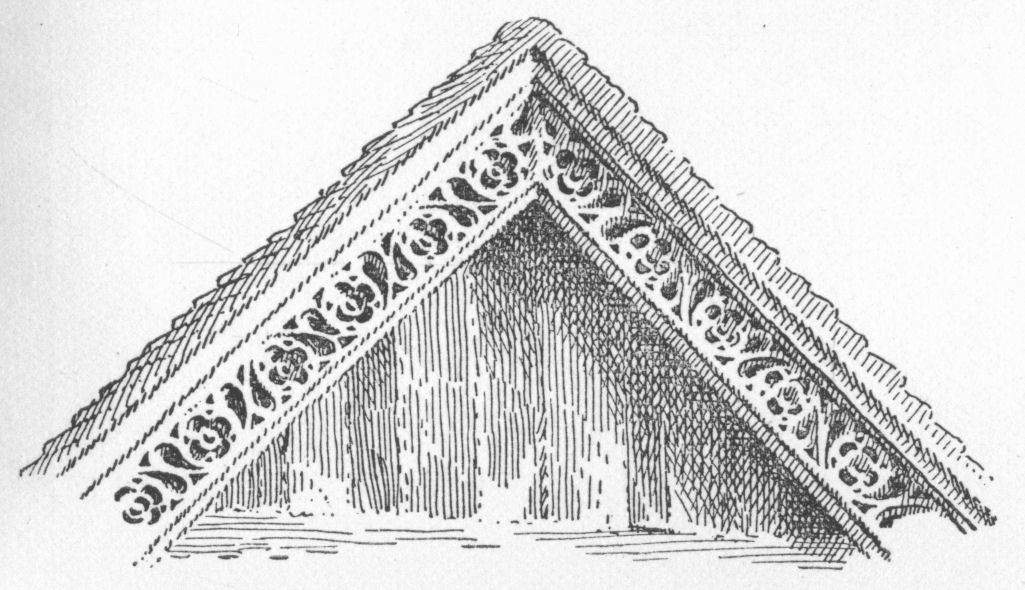
Barge-board (perhaps a corruption of verge-board), in architecture, a board generally pendent from the eaves of gables, so as to conceal the rafters, keep out rain, &c. They are sometimes elaborately ornamented. The portion of the roof projecting from the wall at the gable-end, and beneath which the barge-board runs, is termed the barge-course.
Barham (bar'am), Rev. Richard Harris, a humorous writer, born in 1788 at Canterbury; educated at St. Paul's School, London, and at Brasenose, Oxford; appointed in succession curate of Ashford, curate of Westwell, rector of Snargate in Romney Marsh, and one of the minor canons of St. Paul's Cathedral. He published two novels, Baldwin and My Cousin Nicholas, wrote nearly a third of the articles in Gorton's Biographical Dictionary, and contributed to Blackwood's Magazine. In 1824 he was appointed priest in ordinary of the Chapel Royal, and afterwards rector of St. Mary Magdalene and St. Gregory-by-St.-Paul, London. In 1837, on the starting of Bentley's Miscellany, he laid the main foundation of his literary fame by the publication in that periodical of the Ingoldsby Legends. He died in 1845.
Barhebræ´us. See Abulfaragius.
Bari (bä'rē; ancient, Barium), a seaport, S. Italy, on a small promontory of the Adriatic, capital of the province Terra di Bari. It was a place of importance as early as the third century B.C., and has been thrice destroyed and rebuilt. The present town, though poorly built for the most part, has a large Norman castle, a fine cathedral and priory, &c. It manufactures cotton and linen goods, hats, soap, glass, and liqueurs; has a trade in wine, grain, almonds, oil, &c., and is now an important seaport. In 1915 the town suffered considerably from floods. Pop. 109,218.—The province has an area of 2048 sq. miles, and is fertile in fruit, wine, oil, &c.; pop. 935,982.
Bari, a negro people of Africa, dwelling on both sides of the White Nile, between lat. 3° 30' and 6° N. They practise agriculture, cattle-rearing, smithwork, &c. Their country was conquered by Baker for Egypt.
Baril´la, is the commercial name for impure sodium carbonate imported from Spain and the Levant. At one time all sodium carbonate required for industrial purposes was prepared from barilla obtained by burning various marine plants (Salsola, Salicornia, and others). Only 25 per cent of the weight of the ash contained soda, and consequently its import was expensive and considerably added to the price of the manufacture of glass and soap. During the Napoleonic wars the price of barilla rose to such a height that Napoleon offered a reward for the discovery of a process for the manufacture of sodium carbonate. A chemist, Leblanc, in 1791 invented a new process by which sodium carbonate could be obtained from common salt, and this entirely superseded barilla. Plants are still grown in Southern France and Spain to obtain soda and other substances from the ash; but almost all the sodium carbonate of the present day is manufactured chemically.
Baring, the name of a famous English family of bankers and financiers, statesmen and diplomats, from which has arisen the financial house of Baring Brothers & Co., and of which members now hold four peerages, namely, two earldoms—Northbrook and Cromer—and two baronies—Ashburton and Revelstoke. The founder of the house was Francis Baring (1740-1810), whose father was a cloth manufacturer near Exeter, and grandfather pastor of the Lutheran Church at Bremen, the family being thus of German origin. Francis Baring settled in London, attained a high position in the mercantile and financial world, was long a member of Parliament and a director of the East India Company, and was made a baronet in 1793. Of his sons, one, Alexander, was created Baron Ashburton (in 1835), and rendered important political services in connection with the boundary treaty concluded between Britain and the United States, and known by his title (see Ashburton, Ashburton Treaty). His son, the second Lord Ashburton (1799-1864), held a position of some note in politics, and his first wife, a daughter of the sixth Earl of Sandwich, was fond of the society of both politicians and literary men, among those who were on friendly terms with her being Carlyle and Thackeray. Sir Francis Baring's eldest son, Thomas, was father of Francis Thornhill Baring, first Lord Northbrook (1796-1866), whose eldest son, Thomas, was created Earl of Northbrook in 1876, and held successively a number of high positions, among them that of Viceroy of India (1872-6) and First Lord of the Admiralty (1880-5). (See Northbrook.) Another son of Sir Francis, Henry Baring, was father of Edward Baring, the first Baron Revelstoke (born in 1828, died in 1897), who was long one of the most conspicuous members of the financial world of London, and was raised to the peerage as baron in 1885. He had full management of the great house of Baring Brothers, which under him was long most prosperous, but in 1890 fell into temporary difficulties. Henry Baring was father also of Evelyn Baring, Earl Cromer (q.v.).
Baring-Gould (bā-ring-gōld´), Sabine, English clergyman and author, born at Exeter, 1834. Educated at Cambridge, he held several livings in the English Church, and in 1881 became rector of Lew Trenchard, Devon. After publishing several books on theological and miscellaneous subjects, he distinguished himself as a novelist. Among his works are: Iceland, its Scenes and Sagas; Curious Myths of the Middle Ages; The Origin and Development of Religious Belief; Lives of the Saints (in 15 vols.); Village Sermons; The Vicar of Morwenstowe (an account of the Rev. R. S. Hawker); The Mystery of Suffering; History of the Church in Germany; The Tragedy of the Cæsars; Cliff Castles and Cave Dwellings; The Church Revival; &c.; besides the novels Mehalah, John Herring, Richard Cable, The Gaverocks, Court Royal, The Pennycomequicks, &c.; and short stories or novelettes.
Baringo, a lake in Africa, N.E. of the Victoria Nyanza, about 20 miles long.
Bar´itone, or Bar´ytone, a male voice, the compass of which partakes of those of the common bass and the tenor, but does not extend so far downwards as the one, nor to an equal height with the other. Its best tones are from the lower A of the bass clef to the lower F in the treble.
Ba´rium (from the Gr. barys, heavy), the metal of which baryta is the oxide; specific gravity 4; symbol Ba. It is only found in compounds, such as the common sulphate (or barytes) and carbonate, and was isolated by Davy in 1808. It is a yellow malleable metal, which readily oxidizes, decomposes water, and fuses at a low temperature. Its nitrate and chlorate are used in pyrotechny. Barium salts, when brought into a non-luminous flame, burn with a yellowish-green colour. See Baryta.
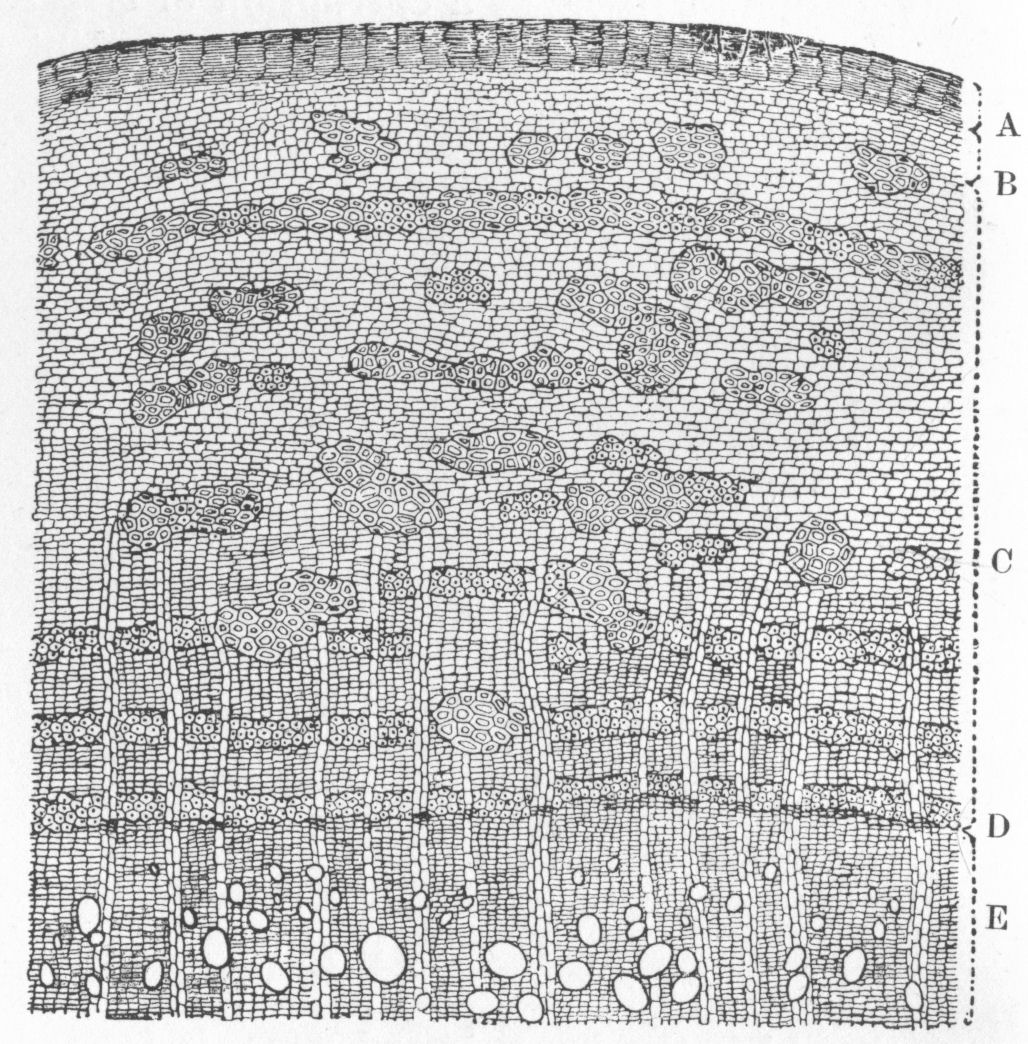
Magnified Section of Oak-bark.
A, Epidermis. B, Cells containing chlorophyll or colouring matter. C, Liber or Bast. D, Cambium. E, Sapwood.
Bark, properly the periderm, or outer covering, of woody stems and roots, composed of dead tissues cut off from the living parts of the organ by one or more layers of impervious cork. It serves to prevent loss of water, and also affords protection against animals and fungi. The outermost bark is continually sloughed in the form of scales (Scots Pine) or sheets (Common Birch), being regenerated from within by the activity of the cork-cambium (phellogen). Bark is usually rich in waste-products, many of which are of economic value, such as tannin, gums, &c. Bottle-cork is the bark of the cork-oak. Bark for tanning is obtained from oak, hemlock-spruce, species of acacia, &c. Peruvian and Angostura barks, cinnamon, &c., are other useful barks. As commonly used, bark denotes all the tissues external to the cambium.
Bark. See Barque.
Bark, Peruvian. See Cinchona.
Barker, Granville, playwright, was born in London in 1877. His principal plays are: The Voysey Inheritance (1905), Waste (1907), The Madras House (1910). He has published a book (in which William Archer collaborated) called A National Theatre, and another entitled The Red Cross in France. His revivals of Shakespeare have introduced some new ideas of mounting and stage-effects.
Barker's Mill, also called Scottish turbine, a hydraulic machine on the principle of what is known as the hydraulic tourniquet. This consists of an upright vessel free to rotate about a vertical axis, and having at its lower end two discharging pipes projecting horizontally on either side and bent in opposite directions at the ends, through which the water is discharged horizontally, the direction of discharge being mainly at right angles to a line joining the discharging orifice to the axis. The backward pressures at the bends of the tubes, arising from the two issuing jets of water, cause the apparatus to revolve in an opposite direction to the issuing fluid. The machine was invented by a Dr. Barker towards the end of the seventeenth century.
Barking, a town, England, county of Essex, on the Roding, 7 miles N.E. of London, with some important manufacturing works. Near it is the outfall of the sewage of a large part of London. Pop. (1921), 35,543.
Barkston Ash, a parliamentary division of the West Riding of Yorkshire.
Bark-stove, or Bark-bed, a sort of hothouse for forcing or for growing plants that require a great heat combined with moisture, both of which are supplied by the fermentation that sets up in a bed of spent tanner's bark contained in a brick pit under glass.
Bar´laam and Jos´aphat, a famous mediæval spiritual romance, which is in its main details a Christianized version of the Hindu legends of Buddha. The story first appeared in Greek in the works of Joannes Damascenus in the eighth century. It is, however, more probably the work of a monk of the Sabbas monastery, near Jerusalem, and written at the beginning of the seventh century. The compilers of the Gesta Romanorum, Boccaccio, Gower, and Shakespeare have all drawn materials from it.—Bibliography: Max Müller, Chips from a German Workshop; J. Jacobs, Barlaam and Josaphat, (There is a translation by Rev. G. R. Woodward and H. Mattingly in the Loeb Library).
Bar-le-duc (ba˙r-l-du˙k), a town of North-East France, capital of department Meuse, with manufactures of cotton and woollen stuffs, leather, confectionery, &c. Pop. 17,068.
Barlet´ta, a seaport in South Italy, province of Bari, on the Adriatic, with a fine Gothic cathedral; it has a considerable export trade in grain, wine, almonds, &c. Pop. 44,233.
Bar´ley, the name of several cereal plants of the genus Hordeum, ord. Gramineæ: (grasses), yielding a grain used as food and also for making malt, from which are prepared beer, porter, and whisky. Barley has been known and cultivated from remote antiquity, and beer was made from it among the Egyptians. It is mentioned in Exodus, in connection with the ten plagues; and it is referred to in ancient Chinese records. Excellent barley is produced in Britain. The species principally cultivated are Hordĕum distĭchum, two-rowed barley; H. vulgāre, four-rowed barley; and H. hexastichum, six-rowed, of which the small variety is the sacred barley of the ancients. The varieties of the four- and six-rowed species are generally coarser than those of the two-rowed, and adapted for a poorer soil and more exposed situation. Some of these are called bere or bigg. In Britain barley occupies more than 22½ per cent of the land under corn, but in N. America the extent of it as a crop is comparatively small, being in Canada, however, relatively greater than in the States, and the Canadian barley is of very high quality. Barley is better adapted for cold climates than any other grain, and some of the coarser varieties are cultivated where no other cereal can be grown. Russia devotes a surface of over 20,000,000 acres to barley, i.e. a little under 11 per cent of the cereal area of the country. Germany has 4,000,000 and France 1,800,000 acres of barley. Some species of the genus, three of which are natives of Britain, are mere grasses. Pot or Scotch barley is the grain deprived of the husk in a mill. Pearl barley is the grain polished and rounded and deprived of husk and pellicle. Patent barley is the farina obtained by grinding pearl barley. Barley-water, a decoction of pearl barley, is used in medicine as possessing emollient, diluent, and expectorant qualities.
Barley-sugar. See Confectionery; Sugar.
Bar´low, Joel, an American poet and diplomatist, born 1755. After an active and changeful life as chaplain, lawyer, editor, land-agent, lecturer, and consul, he went to Paris and acquired a fortune. On his return to America he was appointed Minister Plenipotentiary to France (1811), but died near Cracow in 1812 on his way to meet Napoleon. His principal poem, The Columbiad (The Vision of Columbus), dealing with American history from the time of Columbus, was published in 1807.
Barm. See Yeast.
Bar´mecides (-sīdz), a distinguished Persian family, whose virtues and splendour form a favourite subject with Mahommedan poets and historians. Two eminent members of this family were Khaled-ben-Barmek, tutor of Haroun al Rashid, and his son Yahya, grand vizier of Haroun. The expression Barmecide Feast, meaning a visionary banquet or make-believe entertainment, originates from the Barber's story of his Sixth Brother in the Arabian Nights' Entertainments.
Bar´men, a German city on the Wupper, in the Prussian Rhine Province, government of Düsseldorf, and forming a continuation of the town of Elberfeld, in the valley of Barmen. It has extensive ribbon and other textile manufactures; also dyeworks, manufactures of chemicals, metal wares, buttons, yarns, iron, machines, pianos, organs, soap, &c. In 1919 Barmen was the scene of Spartacist disorders. Pop. 169,214.
Barmouth, Welsh name Abermaw, a small seaport and watering-place of Wales, in Merionethshire, at the entrance of Barmouth Bay, a fine estuary. It is picturesquely situated, and has become a favourite resort of tourists and others. Pop. (1921), 3559.
Bar´nabas, the surname, according to Acts, iv, 36-7, given by the apostles to Joseph, a fellow-labourer of St. Paul, and, like him, ranked as an apostle. He is said to have founded at Antioch the first Christian community, to have been first Bishop of Milan, and to have suffered martyrdom at Cyprus. His festival is held on the 11th June.
Barnabas, Saint, Epistle of, an epistle in twenty-one chapters unanimously ascribed to Barnabas by early Christian writers, but without any support of internal evidence. It was probably written about A.D. 130 (or, according to others, between A.D. 70 and 79) by one who was not a Jew, and under the influence of Alexandrian Judaistic thought. See Codex (Sinaiticus).
Barnabites, an order of monks founded in Milan in 1530 and named after the Milan church of St. Barnabas which was allotted them to preach in. On their expulsion from France in 1905, the majority of the Barnabites sought refuge in England. A few monasteries of the order still exist in Italy, Belgium, Austria, and Spain.
Barnacles hanging from timber
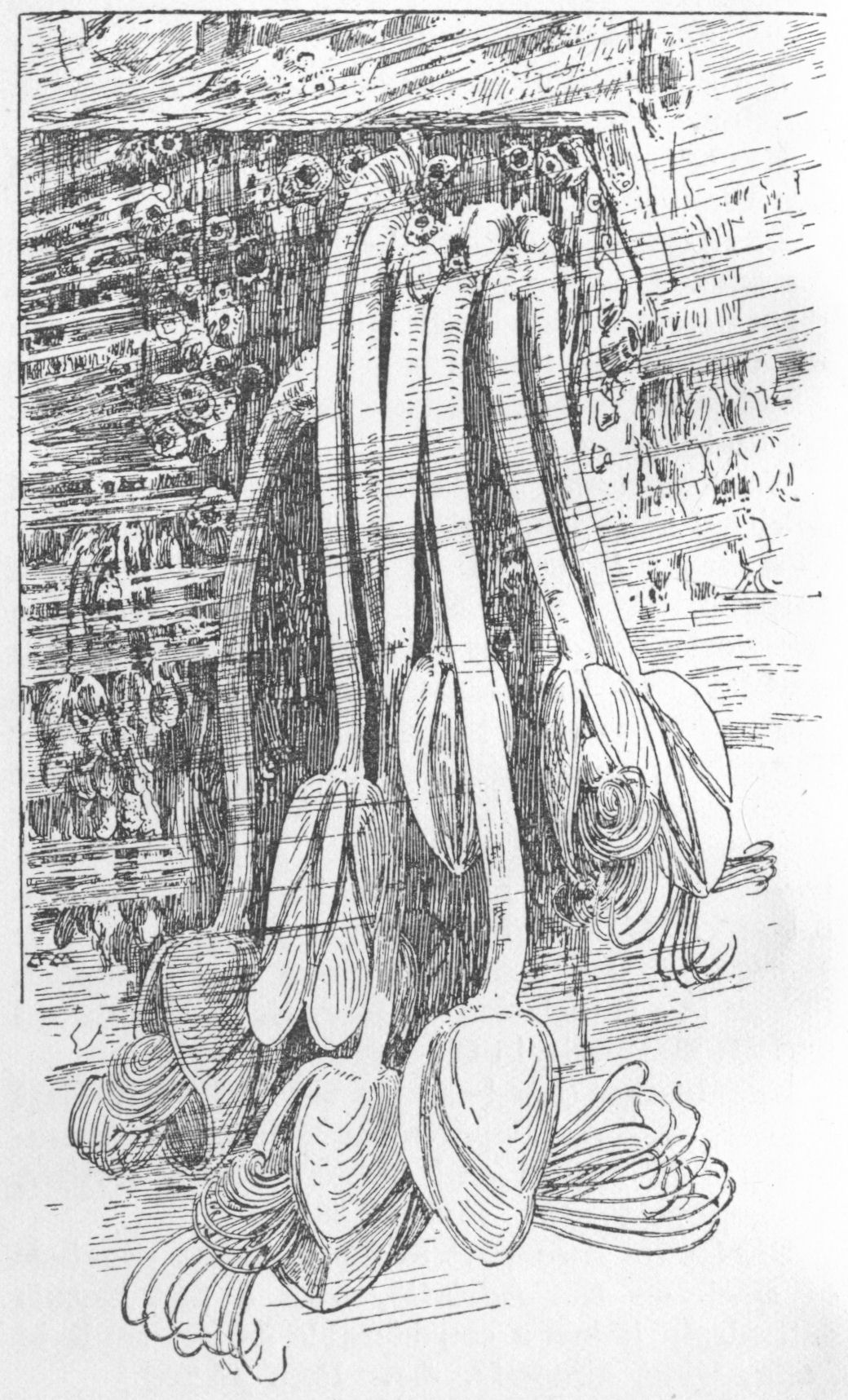
Bar´nacle, the name of a family (Lepadidæ) of marine crustaceous animals, ord. Cirripedia. They are enveloped by a mantle and shell, composed of five principal valves and several smaller pieces, joined together by a membrane attached to their circumference; and they are furnished with a long, flexible, fleshy stalk or peduncle, provided with muscles, by which they attach themselves to ships' bottoms, submerged timber, &c. They feed on small marine animals, brought within their reach by the water and secured by their tentacula. Some of the larger species are edible. According to an old fable, these animals produced barnacle geese.
Barnacle Goose (Anser Bernicla or leucopsis), a summer visitant of the northern seas, in size rather smaller than the common wild goose, and having the forehead and cheeks white, the upper body and neck black. A fable asserts that the crustaceans called barnacles changed into geese, and various theories have been framed to account for its origin. Max Müller supposes the geese were originally called Hiberniculæ or Irish geese, and that barnacle is a corruption of this; but the resemblance of a barnacle to a goose hanging by the head may account for it. The Brent Goose is also sometimes called the Barnacle Goose, but the two should not be confused.
Barnard-Castle, a town, England, County Durham, giving name to a parliamentary division of the county. There are a large thread-mill and carpet manufactories; the Bowes Museum and Art Gallery, endowed by private munificence, and costing over £80,000; and the Northern Counties School, richly endowed. The castle was originally built about 1178 by Bernard Baliol, grandfather of John Baliol. Pop. 4737.
Barnar´do, Thomas John, philanthropist, born in Ireland in 1845, qualified as a medical practitioner, studying in London, Edinburgh, and Paris, established his first home for neglected London children in 1867, and for the rest of his life was engaged in the same class of work. Up to his death in 1905 he had nearly 60,000 destitute waifs cared for and trained in the institutions with which his name is connected, many of the children having been sent to Canada or other colonies. The Barnardo homes and institutions have become very numerous, being established in various English counties as well as in London, a few being in Canada. A naval training-school for boys is included among them. It was a rule of the founder that no destitute child should be refused admission. The homes have since 1899 been under a council or body incorporated under the title of the National Incorporated Waifs Association, but continue to be managed on the same lines as before. Dr. Barnardo published Something Attempted, Something Done; The Rescue of Waifs; &c.—Cf. J. H. Batt, Dr. Barnardo, the Foster-father of Nobody's Children.
Barnaul´, a town of Siberia, government of Tomsk, on the Barnaulski, near its influx into the Obi. The town is of wood but well built, with museum, observatory, &c. It is an important mining centre for lead, copper, and silver, has a copper-mint, kilns, and factories. Pop. 61,330.
Barnave (ba˙r-näv), Antoine-Pierre-Joseph-Marie, a distinguished French revolutionist, born 1761, died 1793. He successfully maintained against Mirabeau the right of the National Assembly, as against that of the king, to declare for peace or war, but afterwards asserted the inviolability of the king's person. He was impeached, condemned, and guillotined.
Barnes, an urban district of England, in Surrey, on the right bank of the Thames, a short distance above London, connected with Middlesex by Hammersmith Suspension Bridge. There is here a common of 120 acres, one of the preserved open spaces of the metropolitan area. Pop. (1921), 34,281.
Barnes (bärnz), Albert, theologian, born in the State of New York, 1798. In 1825 he was ordained pastor of the Presbyterian Church of Morristown, New Jersey, and from 1830 till his death in 1870 had charge of the first Presbyterian Church in Philadelphia. He is chiefly known by his Notes on the New Testament and Notes on the Old Testament.
Barnes, Rt. Hon. George Nicoll, British Labour leader, born at Dundee, in Scotland, in 1859. After working as an engineer he became assistant secretary of the Amalgamated Society of Engineers in 1892, and was general secretary from 1896 to 1906. He entered Parliament in 1906, became Minister for Pensions in 1916, member of War Cabinet in 1917, and was Minister without portfolio from 1919 to Jan., 1920. He was a British representative at the Peace Conference in Paris.
Barnes, William, English dialect poet and philologist, born in Dorsetshire in 1800, died 1886. Of humble birth, he first entered a solicitor's office, then taught at a school in Dorchester, and having taken orders became rector of Winterbourne Came in his native county and died there. He acquired a knowledge of many languages, and published works on Anglo-Saxon and English, as An Anglo-Saxon Delectus, A Philological Grammar (grounded upon English), Grammar and Glossary of the Dorset Dialect, &c., but is best known by his Poems of Rural Life in the Dorset Dialect and Poems of Rural Life in Common English.
Bar´net, a town of England, in Herts, 11 miles from London, where was fought in 1471 a battle between the Yorkists and Lancastrians, resulting in the defeat of the latter and the death of Warwick, Edward IV being thus established king. Pop. (1921), 11,772.
Barnett, John, musical composer, son of Bernhard Beer, a German, born at Bedford 1802, died 1890. He composed music as a lad, and his songs and ballads soon had great vogue. In 1834 his opera The Mountain Sylph was produced with success, and three years after was followed by the less successful Fair Rosamond. For many years before his death he was little heard of.
Barnett, John Francis, nephew of the former, born in 1837, died in 1916, was also a distinguished musician and teacher, author of cantatas: The Ancient Mariner, Paradise and the Peri, The Raising of Lazarus, The Building of the Ship, and of various other works.
Barneveldt (bär'ne-velt), Johan van Olden, grand pensionary of Holland during the struggle with Philip II of Spain, born in 1547. After the assassination of William of Orange, and the conquest of the south provinces by the Spaniards under Parma, he headed the embassy to secure English aid. Finding, however, that the Earl of Leicester proved a worse than useless ally, he secured the elevation of the young Maurice of Nassau to the post of Stadtholder, at the same time by his own wise administration doing much to restore the prosperity of the State. After serving as ambassador to France and England, he succeeded in 1607 in obtaining from Spain a recognition of the independence of the States, and two years later in concluding with her the twelve years' truce. Maurice, ambitious of absolute rule and jealous of the influence of Barneveldt, was interested in the continuance of the war, and lost no opportunity of hostile action against the great statesman. In this he was aided by the strongly-marked theologic division in the State between the Gomarites (the Calvinistic and popular party) and the Arminians, of whom Barneveldt was a supporter. Maurice, who had thrown in his lot with the Gomarites, encouraged the idea that the Arminians were the friends of Spain, and procured the assembly of a synod at Dort (1618), which violently condemned them. Barneveldt and his friends Grotius and Hoogerbeets were arrested, and subjected to a so-called trial; and Barneveldt, to whom the country owed its political existence and the Commons their retention of legislative power, was beheaded on 13th May, 1619. His sons, four years later, attempted to avenge his death; one was beheaded, the other escaped to Spain.
Barnoldswick, an urban district of England, West Riding of Yorkshire, 9 miles south-west of Skipton, with cotton manufactures and other industries. Pop. (1921), 11,951.
Barns´ley, a municipal borough of England, West Riding of Yorkshire. Its staple industries are the manufacture of linens, iron, and steel, and there are numerous collieries in the neighbourhood. Created a parliamentary borough in 1918, Barnsley returns one member to Parliament. Pop. (1921), 53,670.
Barn´staple, a county and municipal borough in England, county of Devon, giving its name to a parliamentary division of the county on the right bank of the Taw, where it receives the Yeo; manufactures of lace, paper, pottery, furniture, toys and turnery, and leather. Pop. 14,409.
Baroach. See Broach.
Baro´da, a non-tributary State, but subordinate to the Indian Government, situated in the north of the Bombay presidency. It consists of a number of detached territories in the province of Guzerat, and is generally level, fertile, and well cultivated, producing luxuriant crops of grain, cotton, tobacco, opium, sugar-cane, and oil-seeds. There is a famous breed of large white oxen used as draught cattle. Area, 8182 sq. miles; pop. (1911) 2,032,798. The ruler is called the Gaekwár. The dissensions of the Baroda family have more than once called for British intervention, and in 1875 the ruling Gaekwár was tried and deposed in connection with the charge of attempting to poison the British Resident. Since 1908 there is a Legislative Council of 17 members.—Baroda, the capital, is the third city in the Bombay presidency. It consists of the city proper within the walls and the suburbs without, and is largely composed of poor and crowded houses, but has also some fine buildings, and is noted for its Hindu temples kept up by the State. Pop. 99,345.—Cf. E. St. C. Weeden, A Year with the Gaekwár of Baroda.
Barograph, a kind of aneroid barometer, which, by means of special mechanism and appliances, is made to furnish automatically a continuous record of the successive changes in atmospheric pressure. The paper that receives the record is made to move by clockwork while in contact with the index pencil, which rises and falls according to alterations of atmospheric pressure.
Barom´eter, an instrument for measuring the weight or pressure of the atmosphere and thus determining changes in the weather, the height of mountains, and other phenomena. It had its origin about the middle of the seventeenth century in an experiment of Torricelli, an Italian, who found that if a glass tube about 3 feet in length, open at one end only, and filled with mercury, were placed vertically with the open end in a cup of the same fluid metal, a portion of the mercury descended into the cup, leaving a column only about 30 inches in height in the tube. He inferred, therefore, that the atmospheric pressure on the surface of the mercury in the cup forced it up the tube to the height of 30 inches, and that this was so because the weight of a column of air from the cup to the top of the atmosphere was only equal to that of a column of mercury of the same base and 30 inches high. Pascal confirmed the conclusion in 1645; six years afterwards it was found by Perrier that the height of the mercury in the Torricellian tube varied with the weather; and in 1655 Boyle proposed to use the instrument to measure the height of mountains.
Common Upright Barometer; Marine Barometer
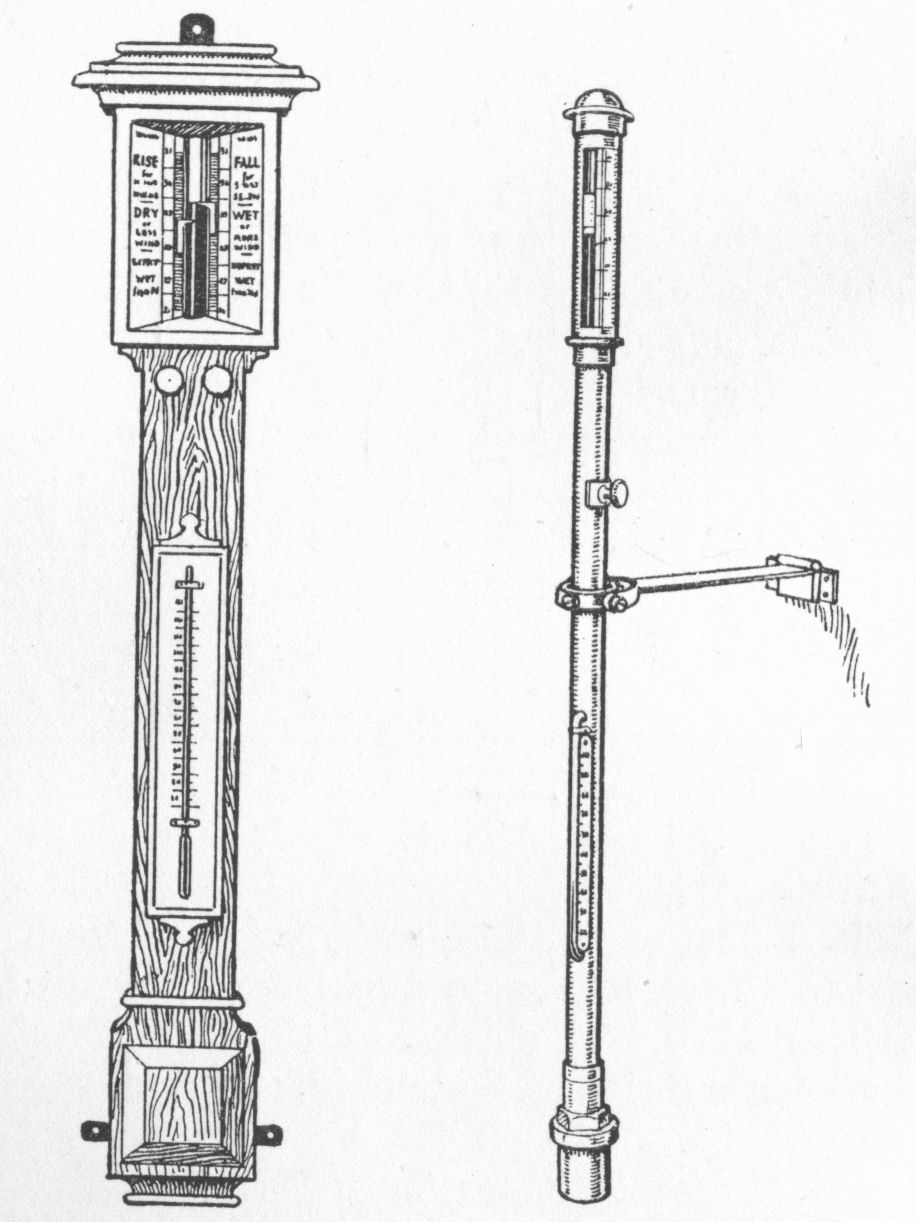
The common or cistern barometer, which is a modification of the Torricellian tube, consists of a glass tube 33 inches in length and about one-third of an inch in diameter, hermetically sealed at the top, and having the lower end resting in a small vessel containing mercury, or bent upwards and terminating in a glass bulb partly occupied by the mercury and open to the atmosphere. The tube is first filled with purified mercury, and then inverted, and there is affixed to it a scale to mark the height of the mercurial column, which comparatively seldom rises above 31 inches or sinks below 28 inches. In general the rising of the mercury presages fair weather, and its falling the contrary, a great and sudden fall being the usual presage of a storm. The weather-points on the ordinary barometric scale are as follows: At 28 inches, stormy weather; 28½, much rain or snow; 29, rain or snow; 29½, changeable; 30, fair or frost; 30½, settled fair or frost; 31, very dry weather or hard frost. Certain attendant signs, however, have also to be noted: thus, when fair or foul weather follows almost immediately upon the rise or fall of the mercury, the change is usually of short duration; while if the change of weather be delayed for some days after the variation in the mercury, it is usually of long continuance. The direction of the wind has also to be taken into account.
Siphon Barometer; Wheel Barometer
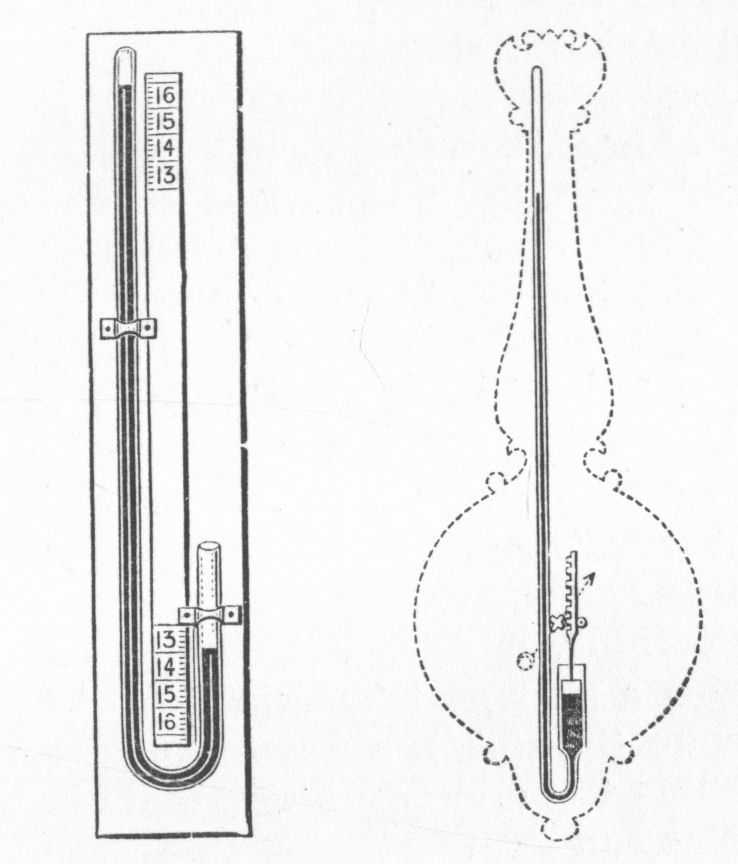
The siphon barometer consists of a bent tube, generally of uniform bore, having two unequal legs, the longer closed, the shorter open. A sufficient quantity of mercury having been introduced to fill the longer leg, the instrument is set upright, and the mercury takes such a position that the difference of the levels in the two legs represents the pressure of the atmosphere. In the best siphon barometers there are two scales, one for each leg, the divisions on one being reckoned upwards, and on the other downwards from an intermediate zero point, so that the sum of the two readings is the difference of levels of the mercury in the two branches.
The wheel barometer is the one that is most commonly used for domestic purposes. It is far from being accurate, but it is often preferred for ordinary use on account of the greater range of its scale, by which small differences in the height of the column of mercury are more easily observed. It usually consists of a siphon barometer having a float resting on the surface of the mercury in the open branch, a thread attached to the float passing over a pulley, and having a weight as a counterpoise to the float at its extremity. As the mercury rises and falls the thread and weight turn the pulley, which again moves the index of the dial.
The mountain barometer is a portable mercurial barometer with a tripod support and a long scale for measuring the altitude of mountains. To prevent breakage, through the oscillations of such a heavy liquid as mercury, it is usually carried inverted, or it is furnished with a movable basin and a screw, by means of which the mercury may be forced up to the top of the tube. For delicate operations, such as the measurement of altitudes, the scale of the barometer is furnished with a nonius or vernier, which greatly increases the minuteness and accuracy of the scale. For the rough estimate of altitudes the following rule is sufficient: As the sum of the heights of the mercury at the bottom and top of the mountain is to their difference, so is 52,000 to the height to be measured, in feet. (See also Heights, Measurement of.) In exact barometric observations two corrections require to be made, one for the depression of the mercury in the tube by capillary attraction, the other for temperature, which increases or diminishes the bulk of the mercury. In regard to the measurement of heights, the general rule is to subtract the ten-thousandth part of the observed altitude for every degree of Fahrenheit above 32°.
Aneroid Barometer
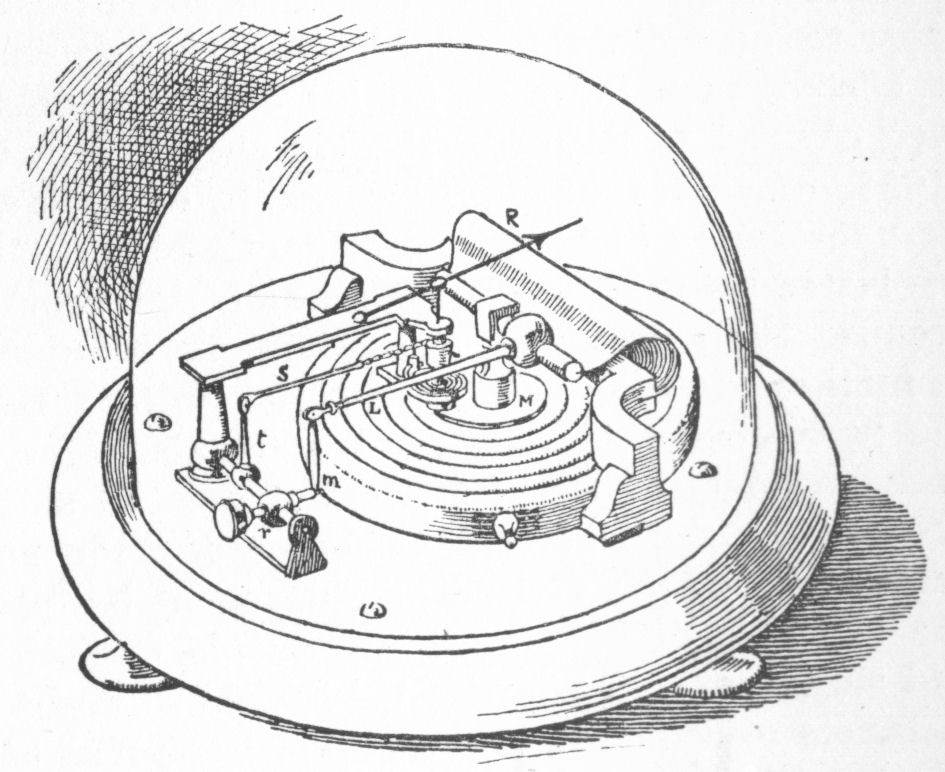
In the aneroid barometer, as its name implies (Gr. a, not, nēros, liquid), no fluid is employed, the action being dependent upon the susceptibility to atmospheric pressure shown by a flat circular metallic chamber from which the air has been partially exhausted, and which has a flexible top and bottom of corrugated metal plate. By an ingenious arrangement of springs and levers the depression or elevation of the surface of the box is registered by an index on the dial, by which means it is also greatly magnified, being given in inches to correspond with the mercurial barometer. Aneroids are, however, generally less reliable than mercurial barometers, with which they should be frequently compared. The illustration shows an aneroid without its case. At the centre of the partially exhausted metal chamber is a small pillar [M], connected with a steel spring [R]. The rise and fall of the top of the chamber, due to changing atmospheric pressure, is transmitted by means of the levers [L], and [m] to a metallic axis [r], and this axis carries a lever [t], whose end is attached to a chain [s], which turns a drum on whose axis the index needle is fixed.—Bibliography: C. Abbe, Meteorological Apparatus; Marvin, Barometers and the Measurement of Atmospheric Pressure.
Bar´on, originally, in the feudal system, the vassal or immediate tenant of any superior; but the term was afterwards restricted to the king's barons, and again to the greater of these only, who attended the Great Council, or who, at a later date, were summoned by writ to Parliament. It was the second rank of nobility, until dukes and marquesses were introduced and placed above the earls, and viscounts also set above the barons, who therefore now hold the lowest rank in the British peerage. The present barons are of three classes: (1) barons by writ, whose ancestors have long sat in the Upper House; (2) by patent; (3) by tenure, i.e. holding the title as annexed to land. The coronet is a plain gold circle with six balls or 'pearls' on its edge, the cap being of crimson velvet.
Baron and feme, a term used for husband and wife in English law.
Bar´onet, a hereditary dignity in Great Britain and Ireland, next in rank to the peerage, originally instituted by James I in 1611, nominally to promote the colonization and defence of Ulster, each baronet, on his creation, being then obliged to pay into the treasury a sum of £1095, exclusive of fees. Baronets of Ireland were instituted in 1620, and of Scotland in 1625, the latter being called baronets of Nova Scotia, because their creation was originally intended to further the colonization of Nova Scotia. But the baronets of Scotland and of England have been baronets of Great Britain if created since 1707; since 1801 all creations have been known as baronetcies of the United Kingdom. A baronet has the title of 'Sir' prefixed to his Christian and surname, and his wife is 'Lady' so-and-so. Baronets rank before all knights except Knights of the Garter, the Thistle, and St. Patrick. They have as their badge a 'bloody hand' (the arms of Ulster), that is, a left hand, erect and open, cut off at the wrist, and red in colour.—Bibliography: Pixley, History of the Baronetage; G. E. Cokayne, Complete Baronetage; The Baronetage under 27 Sovereigns, 1309-1910.
Baro´nius, or Baronio, Cæsar, Italian ecclesiastical historian, born 1538; educated at Naples; in 1557 went to Rome; was one of the first pupils of St. Philip of Neri, and member of the oratory founded by him; afterwards cardinal and librarian of the Vatican Library. He owed these dignities to the services which he rendered the Church by his Ecclesiastical Annals, comprising valuable documents from the papal archives, on which he laboured from the year 1580 until his death, 30th June, 1607. They were continued, though with less power, by other writers, of whom Raynaldus takes the first rank; others are Laderchi and Theiner.
Baron of beef, two sirloins not cut asunder.
Barons' War, the war carried on for several years by Simon de Montfort and other barons of Henry III against the king, beginning in 1263.
Barony, a manor or landed estate under a baron, who formerly had certain rights of jurisdiction in his barony and could hold special courts. In Ireland baronies are still the chief subdivisions of the counties.
Barosma. See Bucku.
Barot´seland, a former kingdom of South Africa, now a part of Rhodesia.
Barouche (ba-rösh'), a four-wheeled carriage with a falling top and two inside seats in which four persons can sit, two facing two.
Barque (bärk), a three-masted vessel of which the fore-mast and main-mast are square-rigged, but the mizzen-mast has fore-and-aft sails only.
Barquisimeto (ba˙r-kē-sē-mā'tō), a city in the north of the Republic of Venezuela, capital of the State of Lara. Pop. about 32,000.
Bar´ra, or Bar, a small kingdom in Africa, near the mouth of the Gambia. The Mandingoes, who form a considerable part of the inhabitants, are Mahommedans and the most civilized people on the Gambia. Pop. 200,000. The coast here belongs to Britain. The chief town is Barrinding, where the so-called king resides. See Gambia.
Barra, an island of the Outer Hebrides, west coast of Scotland, belonging to Inverness-shire; 8 miles long and from 2 to 5 miles broad, of irregular outline, with rocky coasts, surface hilly but furnishing excellent pasture. On the west coast the Atlantic, beating with all its force, has hollowed out vast caves and fissures. Large herds of cattle and flocks of sheep are reared on the island. The coasts of this and adjacent islands abound with fish, and fishing is an important industry. The inhabitants, about 2500, are Roman Catholics, and speak Gaelic.
Barra, a town about 3 miles east of Naples. Pop. 12,080.
Barracan´, or Barragan, strictly, a thick strong stuff made in Persia and Armenia of camel's hair, but the name has been applied, by Byron and others, to various wool, flax, and cotton fabrics.
Bar´rack (Sp. barraca), originally a small cabin or hut for troops, but now applied to the permanent buildings in which troops are lodged. Despite the obvious evils of the quartering system, the introduction of barracks by George III met with considerable opposition in the British Parliament as dangerous to liberty, by estranging the soldier from the citizen, and fitting him to become a tool of despotism.
Barrackpur (-pör'), a town and military cantonment, Hindustan, on the left bank of the Hughli, 10 miles N.N.E. of Calcutta. The suburban residence of the Viceroy is in Barrackpur Park. Pop. 31,907.
Barracoon´, a negro barrack or slave depot, formerly plentiful on the west coast of Africa, in Cuba, Brazil, &c.
Barracu´da, a name for certain large and ferocious fishes of the genus Sphyræna, and allied to the mullets, inhabiting southern seas, and caught in abundance for food.
Barrafran´ca, a town of Sicily, province Caltanissetta. Pop. 11,170.
Barramun´da. See Ceratodus.
Barranquilla (ba˙r-ra˙n-kēl'ya˙), a port of S. America, in Colombia, on a branch of the River Magdalena, near its entrance into the Caribbean Sea, connected by rail with the seaport Puerto Colombia. Pop. 64,543.
Barras (ba˙-rä), Paul François Jean Nicholas, Comte de, member of the French National Convention and of the Executive Directory, born in Provence 1755, died 1829. After serving in the army in India and Africa, he joined the revolutionary party and was a deputy in the tiers état. He took part in the attack upon the Bastille and upon the Tuileries, and voted for the death of Louis XVI. In the subsequent events he displeased Robespierre, and on this account joined the members of the committee, who foresaw danger awaiting them, and being entrusted with the chief command of the forces of his party he made himself master of Robespierre. On 4th Feb., 1795, he was elected president of the Convention, and on 5th Oct., when the troops of the sections which favoured the royal cause approached, Barras for a second time received the chief command of the forces of the Convention. On this occasion he employed General Bonaparte, for whom he procured the chief command of the army of the interior, and afterwards the command of the army in Italy. From the events of the 18th Fructidor (4th Sept., 1797) he governed absolutely until the 13th June, 1799, when Siéyès entered the Directory, and in alliance with Bonaparte procured his downfall in the revolution of the 18th Brumaire (9th Nov., 1799). He afterwards resided at Brussels, Marseilles, Rome, and Montpellier under surveillance. His Memoirs (in four volumes) were published in French and in English in 1895-6.
Bar´ratry, in commerce, any fraud committed by the master or mariners of a ship, whereby the owners, freighters, or insurers are injured; as by deviation from the proper course of the voyage, by the captain, for his own private purposes; fraudulent negligence; embezzlement of any part of the cargo, &c.
Barratry, Common, in law, the stirring up of lawsuits and quarrels between other persons, the party guilty of this offence being indictable as a common barrator or barretor. The commencing of suits in the name of a fictitious plaintiff is common barratry. In old Scots law it denotes the taking of bribes by a judge.
Barrel, a well-known variety of wooden vessel; but the term is also used as a definite measure and weight. A barrel of beer is 36 gallons, of flour 196 lb., of beef or pork 200 lb. The Italian barile varies from 7 to 31 English gallons; the French barrique of Bordeaux contains 50 English gallons = 228 French litres.
Barrel-organ, a musical instrument usually carried by street musicians, in which a barrel, studded with pegs or staples, when turned round, opens a series of valves to admit air to a set of pipes, or acts upon wire strings like those of the piano, thus producing a fixed series of tunes.
Barren Grounds, a large tract in the North-West Territories of Canada, extending northwards from Churchill River to the Arctic Ocean between Great Bear and Great Slave Lake and Hudson's Bay. It largely consists of swamps, lakes, and bare rock.
Barrhead´, a town, Scotland, Renfrewshire, on the Levern, 7 miles S.W. of Glasgow; chief industries: printing of cottons, the spinning of cotton yarn, dyeing, bleaching, iron and brass founding, and sanitary ware. Pop. 11,387.
Barrie, a town of Canada, province Ontario, 55 miles N.W. Toronto, picturesquely situated on Lake Simcoe, a favourite summer resort. Pop. 6420.
Barrie, Sir James Matthew, a novelist and playwright, born in 1860 at Kirriemuir, Forfarshire; studied at Edinburgh University, graduating as M.A. in 1882. After working on a Nottingham journal he was a journalist in London. His first book, Better Dead (1887), a satire on London life, was followed by the highly successful Auld Licht Idylls (1888), with its sequel A Window in Thrums (that is, Kirriemuir) (1889). Among his novels and tales are When a Man's Single, My Lady Nicotine, The Little Minister, Sentimental Tommy, Tommy and Grizel, The Little White Bird. Successful plays are Peter and Wendy, The Professor's Love Story, The Little Minister (based on the novel), The Admirable Crichton, Quality Street, Little Mary, Peter Pan, What Every Woman Knows, Dear Brutus, A Kiss for Cinderella, Mary Rose. His plays on the whole have been even more successful than his other works. He was created a baronet in 1913, and elected Rector of the University of St. Andrews in 1919.—Cf. J. A. Hammerton, J. M. Barrie and his Books.
Barrier Reef, a coral reef, or rather series of reefs, extending for 1260 miles off the N. E. coast of Australia, at a distance from land ranging from 10 to 100 miles. In sailing along this coast, steamers generally take the route inside the reef, where there is a channel about 12 fathoms deep throughout, protected by the reefs themselves; the outer channel is safer for sailing vessels.
Barrier Treaty, the treaty (1718) by which, when the Spanish Netherlands were ceded to Austria, the Dutch secured the right to garrison several border fortresses of the country at the expense of Austria, to serve as a barrier against France. It was declared void in 1781 by Joseph II.
Bar´rington, Daines, son of Viscount Barrington, lawyer, antiquarian, and naturalist, born 1727, died 1800. He wrote many papers for the Royal Society and the Society of Antiquaries; published some separate works, and was a correspondent of White of Selborne, who addressed to him a number of the letters in The Natural History of Selborne.
Bar´rister, in England or Ireland, an advocate or pleader, who has been admitted by one of the Inns of Court, viz. the Inner Temple, Middle Temple, Lincoln's Inn, or Gray's Inn, to plead at the bar. It is they who speak before all the higher courts, being instructed in regard to the case they have in hand by means of the brief which they receive from the solicitor who may happen to engage their services, and which has a certain fee endorsed upon it as the sum to be paid for the barrister's services in the case. Before a student can be admitted to the bar he must have been a member of one of those societies, and have kept twelve terms there. The examinations, which had dwindled into mere forms, have been revived and made more stringent. Barristers are sometimes called utter or outer barristers, to distinguish them from the king's counsel, who sit within the bar in the courts and are distinguished by a silk gown. Barristers are also spoken of as counsel, as in the phrase opinion of counsel, that is, a written opinion on a case obtained from a barrister before whom the facts have been laid. All judges are selected from the barristers. A barrister cannot maintain an action for his fees, which are considered purely honorary. A revising barrister is a barrister appointed to revise the list of persons in any locality who have a vote for a member of Parliament. The term corresponding to barrister is in Scotland advocate, in the United States counsellor-at-law; but the position of the latter is not quite the same.—Cf. J. R. V. Marchant, Barrister-at-law.
Bar´ros, João de, Portuguese historian, born 1496. He was attached to the Court of King Emmanuel, who, after the publication in 1520 of Barros' romance, The Emperor Clarimond, urged him to undertake a history of the Portuguese in India, which appeared thirty-two years later. King John III appointed Barros Governor of the Portuguese settlements in Guinea, and General Agent for these colonies, further presenting him in 1530 with the province of Maranham, in Brazil, for the purpose of colonization. For his losses by the last enterprise the king indemnified him, and he died in retirement in 1570. Besides his standard work, the Decadas, a history of the Portuguese in India (a complete edition of which appeared at Lisbon between 1778 and 1788), he wrote a moral dialogue on compromise, and the first Portuguese Grammar.
Barro´sa, a village, Spain, near the S. W. coast of Andalusia, near which General Graham, when abandoned by the Spaniards, defeated a superior French force in 1811.
Bar´row, a river in the south-east of Ireland, province Leinster, rising on the borders of the King's and Queen's Counties, and after a southerly course joining the Suir in forming Waterford harbour. It is next in importance to the Shannon, and is navigable for vessels of 200 tons for 25 miles above the sea. Its principal tributary is the Nore.
Bar´row, Isaac, an eminent English mathematician and divine, born in London in 1630; studied at the Charterhouse and at Trinity College, Cambridge, of which he became a fellow in 1649. After a course of medical studies he turned to divinity, mathematics, and astronomy, and took his M. A. degree in 1652, and, failing to obtain the Cambridge Greek professorship, went abroad. In 1659 he was ordained; in 1660 elected Greek professor at Cambridge; in 1662 professor of geometry in Gresham College; and in 1663 Lucasian professor of mathematics at Cambridge, a post which he resigned to Newton in 1669. In 1670 he was created D. D., in 1672 master of Trinity College, and in 1675 vice-chancellor of Cambridge University. He died in 1677. His principal mathematical works (written in Latin) were: Euclidis Elementa (1655); Euclidis Data (1657); Mathematicæ Lectiones (1664-6); Lectiones Opticæ (1669); Lectiones Geometricæ (1670); Archimedis Opera; Apollonii Conicorum lib. iv; Theodosii Spherica, (1675). All his English works, which are theological, were left in MS., and published by Dr. Tillotson in 1685, the best edition being that prepared by the Rev. A. Napier in 1859. As a mathematician Barrow was deemed inferior only to Newton. The Latin edition of his mathematical works was prepared by Whewell in 1860.
Barrow, Sir John, Bart., geographer and man of letters, born in 1764 in Lancashire. At the age of sixteen he went in a whaler to Greenland; and later on was teacher of mathematics in a school at Greenwich. In 1792 he was sent with Lord Macartney, in his embassy to China, to take charge of philosophical instruments for presentation to the Chinese emperor. His account of this journey was of great value, and not less so was the account of his travels in South Africa, whither he went in 1797 as secretary to Macartney. In 1804 he was appointed second secretary to the Admiralty, a post occupied by him for forty years. In 1835 he was made a baronet; and he died in 1848, three years after his retirement. Besides the accounts of his own travels, he published lives of Earl Macartney, Lord Anson, and Lord Howe; Voyages of Discovery and Research within the Arctic Regions; an Autobiography written at the age of eighty-three, &c.
Bar´row-in-Fur´ness, a seaport, county and parliamentary borough of Lancashire, in the district of Furness, opposite the Island of Walney, a town that has increased from a fishing-hamlet with 100 inhabitants in 1848 to a town of 74,254 inhabitants in 1921. Its prosperity is due to the mines of red hematite iron-ore which abound in the district, and to the railway rendering its excellent natural harbour available. It has several large docks, besides graving-docks, a floating dock capable of receiving vessels of 3000 tons, a large timber pond, &c. There is an extensive trade in timber, cattle, grain, and flour; and iron-ore and pig-iron are largely shipped. It has numerous blast-furnaces, and one of the largest Bessemer-steel works in the world. Besides ironworks, a large business is done in shipbuilding, the making of railway wagons and rolling-stock, ropes, sails, bricks, &c. A town hall, erected at a cost of £60,000, was opened in 1887. Barrow-in-Furness returns one member to Parliament.
Barrows
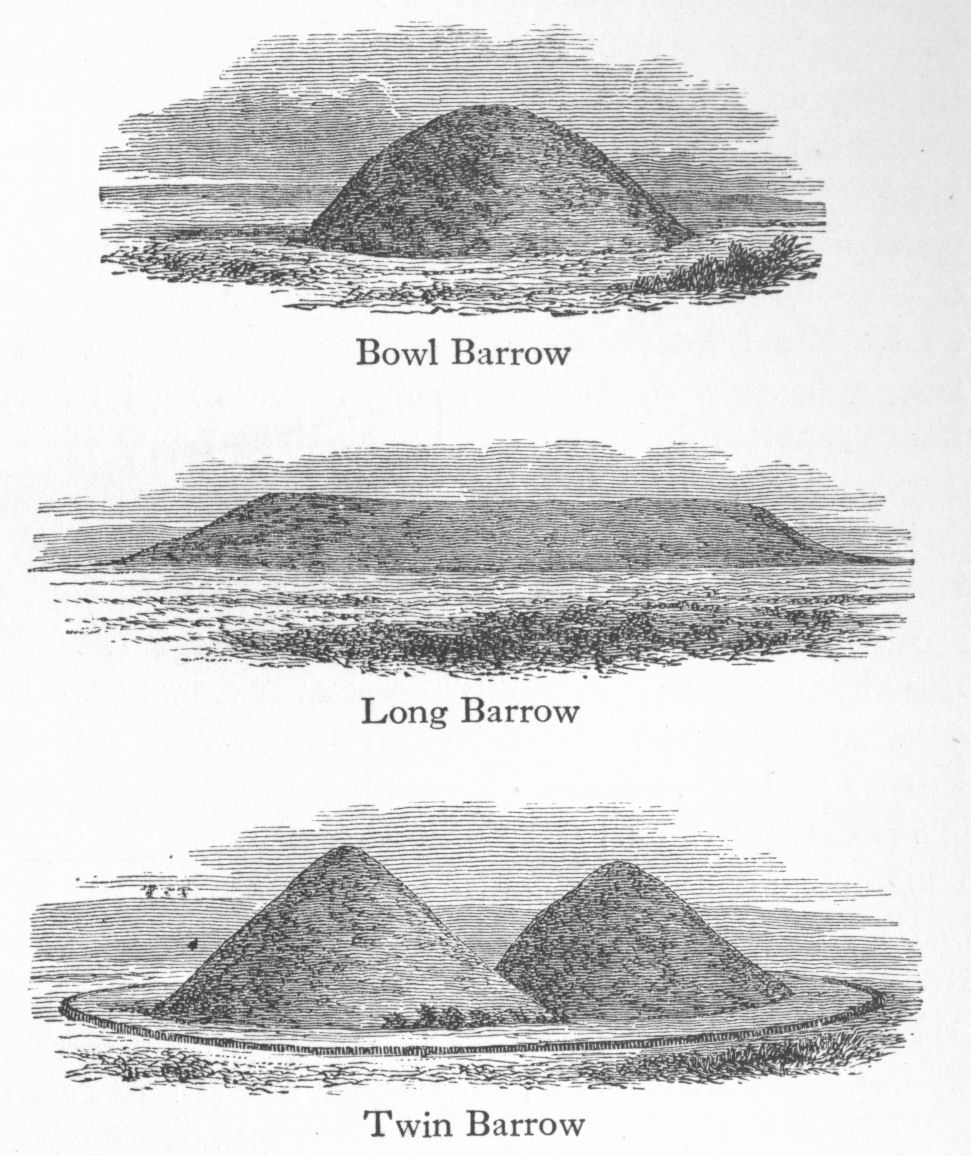
Bar´rows, mounds of earth or stones raised to mark the resting-place of the dead, and distinguished, according to their shape, as long, bowl, bell, cone, and broad barrows. The practice of barrow-burial is of unknown antiquity and almost universal, barrows being found all over Europe, in Northern Africa, Asia Minor, Afghanistan, Western India, and in America. In the earliest barrows the enclosed bodies were simply laid upon the ground, with stone or bone implements and weapons beside them. In barrows of later date the remains are generally enclosed in a stone cist. Frequently cremation preceded the erection of the barrow, the ashes being enclosed in an urn or cist. A detailed description of an ancient barrow-burial is given in the Anglo-Saxon poem Beowulf.—Bibliography: Canon W. Greenwell, British Barrows; J. Anderson, Scotland in Pagan Times; W. C. Borlase, The Dolmens of Ireland.
Barrow Strait, the connecting channel between Lancaster Sound and Baffin's Bay on the east and the Polar Ocean on the west. Named after Sir John Barrow.
Barry, a seaport of S. Wales, Glamorganshire, 7 miles south-west of Cardiff, with large docks, exporting much coal. Pop. (1921), 38,927.
Bar´ry, Sir Charles, an English architect, born in London, 1795. After executing numerous important buildings, such as the Reform Clubhouse, London, St. Edward's School, Birmingham, &c., he was appointed architect of the new Houses of Parliament at Westminster, with the execution of which he was occupied for more than twenty-four years. He was elected a Royal Academician in 1844, was knighted in 1852, and died suddenly in 1860.
Barry, Comtesse Du. See Du Barry.
Barry, Edward Middleton, R.A. (1830-80), son of Sir Charles Barry, was also a distinguished architect, and designed many important buildings, though he was disappointed in regard to his plans for the Albert Memorial, National Gallery, and New Law Courts.
Barry, James, a painter and writer on art, born at Cork, 1741; studied abroad with the aid of Burke; was elected Royal Academician on his return; and worked seven years on the paintings for the hall of the Society for the Encouragement of the Arts. His first picture which attracted attention was St. Patrick baptizing the King of Cashel. In 1773 he published his Inquiry into the Real and Imaginary Obstructions to the Increase of the Arts in England, and in 1782 was elected professor of painting to the Academy. He was expelled in 1797 on the ground of his authorship of the Letter to the Society of Dilettanti. His chief painting was his Victors at Olympia. He died in 1806.
Barry Cornwall. See Procter, Bryan Waller.
Bar´sabbas, surnamed Justus, son of Alpheus, brother of James the Less and of Judas, and one of the candidates for the apostolical office left vacant by Judas Iscariot. According to tradition, he was afterwards Bishop of Eleutheropolis, near Jerusalem, and suffered martyrdom. Another Barsabbas, surnamed Judas, supposed to be the brother of the above, is mentioned in the Acts as a companion of St. Paul and Barnabas at Antioch. He is supposed to have died in Jerusalem at a very advanced age.
Bar-shot, a double-headed shot consisting of two pieces connected by a bar.
Barsi, a town of India, in Sholapur district, Bombay, 43 miles north of Sholapur and 128 miles east of Poona, with a trade in cotton, oil, &c. Pop. 21,000.
Bar-sur-Aube (ba˙r-su˙r-ōb), an ancient town, France, department Aube, where, in 1814, a hotly-contested action was fought between Napoleon and the Allies. Pop. 4533.
Bart, Barth, or Baert (bärt), Jean, a famous French sailor, born at Dunkirk, 1650, the son of a poor fisherman. He became captain of a privateer, and after some brilliant exploits was appointed captain in the royal navy. In recognition of his further services he was made commodore, subsequently receiving letters of nobility. Brusque, if not vulgar, in manner, and ridiculed by the Court for his indifference to ceremony, he made the navy of the nation everywhere respected, and furnished some of the most striking chapters in the romance of naval warfare. After the Peace of Ryswick he lived quietly at Dunkirk, and died there while equipping a fleet to take part in the War of the Spanish Succession, 1702.
Bartas (ba˙r-tä), Guillaume de Salluste du, a French poet, termed 'the divine' by contemporary English writers, born 1544. Principal work, La Semaine ou la Création du Monde, a poem on the creation, translated into English by Joshua Sylvester. It is said to have had a considerable influence on Milton's Paradise Lost. He died of wounds received at Ivry, 1590.
Bartfeld (ba˙rt´felt), an old town in Czecho-Slovakia, formerly Hungary, county of Saros, on the Tepl, with mineral springs in the neighbourhood. Pop. 6160, mostly Slovaks.
Barth (bärt), Heinrich, African traveller, born at Hamburg, 1821, died in 1865. He graduated at the University of Berlin as Ph.D. in 1844, and set out in 1845 to explore all the countries bordering on the Mediterranean. The first volume of his Wanderungen durch die Küstenländer des Mittelmeeres was published in 1849, in which year he was invited by the British Government to join Dr. Overweg in accompanying Richardson's expedition to Central Africa. The expedition set out from Tripoli in Feb., 1850, and, in spite of the death both of Richardson and Overweg, Barth did not return to Tripoli till the autumn of 1855. His explorations, which extended over an area of about 2,000,000 sq. miles, determined the course of the Niger and the true nature of the Sahara. The English account of it was entitled Travels and Discoveries in North and Central Africa (5 vols., 1857-8). An important work on the African languages was left unfinished.
Barth, Jean. See Bart.
Barthélemy (ba˙r-tāl-mē), Jean Jacques, French author, born 1716. He was educated under the Jesuits, for holy orders, but declined all offers of clerical promotion above the rank of Abbé He gained considerable repute as a worker in philology and archæology; and after his appointment as Director of the Royal Cabinet of Medals, in 1753, spent some time travelling in Italy collecting medals and antiquities. His best-known work, not inaptly characterized by himself as an unwieldy compilation, was his Voyage du Jeune Anacharsis en Grèce (1787). It was very popular and was translated into various tongues. Though taking no part in the revolution, he was arrested on a charge of being an aristocrat in 1793, but was set at liberty, and subsequently offered the post of librarian of the National Library. He died in 1795.
Barthélmy-Saint-Hilaire (ba˙r-tāl-mē-san-tē-lār), Jules, French scholar and statesman, born 1805, died in 1895. He was professor of Greek and Latin philosophy in the Collège de France, but resigned the chair after the coup d'état of 1852 and refused to take the oath. He was reappointed in 1862; and in 1869 was returned to the Corps Législatif. After the revolution he was a member of the National Assembly; and was elected Senator for life in 1876. He published a translation of Aristotle, and works on Buddhism, Mohammed and Mohammedanism, the Vedas, &c.
Barthez (ba˙r-tā), Paul Joseph, an eminent French physician, born at Montpellier 1734, died 1806. At Montpellier he founded a medical school, which acquired a reputation throughout all Europe. Having settled in Paris, he was appointed by the king consulting physician, and by the Duke of Orleans his first physician. The Revolution deprived him of the greatest part of his fortune, and drove him from Paris, but Napoleon brought him forth again, and loaded him in his advanced age with dignities. Among his numerous writings may be mentioned Nouvelle Mécanique des Mouvements de l'Homme et des Animaux; Traitement des Maladies Goutteuses; Consultation de Médecine, &c. His Traité du Beau was published posthumously (1807).
Bartholdi (ba˙r-tol´dē), Auguste, French sculptor, born 1834, died 1904; best known for his colossal statue of Liberty, now overlooking the harbour of New York.
Bartholin (bär´to-lin), Kaspar, Swedish writer, born 1585, died 1630. He studied medicine, philosophy, and theology; was made doctor of medicine at Basel in 1610, rector of the University of Copenhagen 1618, and professor of theology 1624. His Institutiones Anatomicæ was for long a standard textbook in the universities.—His son, Thomas, born at Copenhagen 1616, died 1680, was equally celebrated as a philologist, naturalist, and physician. He was professor of anatomy at Copenhagen, 1648; physician to the king, Christian V, in 1670; and Councillor of State, 1675.—His sons, Kaspar (born 1654, died 1704) and Thomas (born 1659, died 1690) were also highly distinguished—the former as an anatomist, the latter as an archæologist.
Bartholomew, Massacre of St., the brutal slaughter of the French Protestants, which began on 24th Aug., 1572, by secret orders from Charles IX, at the instigation of his mother, Catherine de' Medici, and in which, according to Sully, 70,000 Huguenots, including women and children, were murdered throughout the country. During the minority of Charles and the regency of his mother, a long war raged in France between the Catholics and Huguenots, the leaders of the latter being the Prince of Condé and Admiral Coligny. In 1570 overtures were made by the Court to the Huguenots, which resulted in a treaty of peace. This treaty blinded the chiefs of the Huguenots, particularly Admiral Coligny, who was tired of the civil war. The king appeared to have entirely disengaged himself from the influence of the Guises and his mother; he invited Coligny to his Court, and honoured him as a father. The most artful means were employed to increase this delusion. The sister of the king was married to the Prince de Béarn (18th Aug., 1572) in order to allure the most distinguished Huguenots to Paris. On 22nd Aug. a shot from a window wounded the admiral. The king hastened to visit him, and swore to punish the author of the villainy; but on the same day he was induced by his mother to believe that the admiral had designs on his life. "God's death!" he exclaimed; "kill the admiral; and not only him, but all the Huguenots; let none remain to disturb us." The following night Catherine held the council, which fixed the execution for the night of St. Bartholomew, 24th Aug., 1572. After the assassination of Coligny, a bell from the tower of the royal palace at midnight gave to the assembled companies of burghers the signal for the general massacre of the Huguenots. The Prince of Condé and the King of Navarre saved their lives by going to mass and pretending to embrace the Catholic religion. By the king's orders the massacre was extended throughout the whole kingdom; and the horrible slaughter continued for thirty days in almost all the provinces.—Bibliography: Henry White, Massacre of St. Bartholomew and History of the Religious Wars; Lavisse, Histoire de France (vol. vi).
Barthol´omew, St., the apostle, is probably the same person as Nathanael, mentioned in the Gospel of St. John as an upright Israelite and one of the first disciples of Jesus. He is said to have taught Christianity in the south of Arabia, into which, according to Eusebius, he carried the Gospel of St. Matthew in the Hebrew language, and to have suffered martyrdom. The ancient Church had an apocryphal gospel bearing his name, of which nothing has been preserved. A festival is held in his memory on 24th Aug.
Bartholomew, St., or St. Barthélemy, an island, one of the West Indies, in the Leeward group, belonging to France, about 24 miles in circumference. It produces some tobacco, sugar, cotton, indigo, &c. Pop. 3000. The only town is Gustavia. The island, occupied by France in 1648, was ceded to Sweden in 1784, but was again acquired by France in 1877 at the cost of 275,000 francs.
Bartholomew Fair, a celebrated fair, established in the reign of Henry I (1133), formerly held in West Smithfield, London, on St. Bartholomew's Day (24th Aug., O. S.), but abolished since 1855.
Bartholomew's Hospital, St., one of the great hospitals of London, formerly the priory of St. Bartholomew, and made a hospital by Henry VIII in 1547. On an average over 6000 patients are annually admitted to the hospital, while about 150,000 out-patients are treated at its out-door dispensaries. A medical school is attached to it, attended by more than four hundred students.
Barthou, Louis, French statesman, born at Orloron-Sainte-Marie in 1862. He practised as an advocate until he entered the Chamber of Deputies in 1889. He was a member of several Cabinets, and was appointed Premier in March, 1913, but resigned in December of the same year. He was Minister of Foreign Affairs in Painlevé's Cabinet during the European War. In April, 1922, he headed the French delegation to the Genoa Conference. His works include Mirabeau; Lamartine, Orateur; Les Amours d'un Poète, &c.
Bartizan, Micklegate Bar, York.
a, a, Balistraria
Bar´tizan, a small overhanging turret pierced with one or more apertures for archers, projecting generally from the angles on the top of a tower, or from the parapet, or elsewhere, as in a mediæval castle. The word, probably a corruption of bratticing, was apparently first used by Sir Walter Scott.
Bart´lett, William Henry, an English artist, born 1809, died, on a voyage from Malta to Marseilles, 1854. He travelled extensively abroad, and the illustrated works descriptive of the countries visited by him (Switzerland, the Bosporus and the Danube, Syria and Palestine, Egypt, Canada, United States, &c.) obtained great success with the public, the engravings being from sketches by his own pencil.
Bartolini (ba˙r-to-lē´nē), Lorenzo, a celebrated Italian sculptor, born at Florence about 1778, died 1850. He studied and worked in Paris, and was patronized by Napoleon. On the fall of the Empire he returned to Florence, where he continued to exercise his profession. Among his greater works may be mentioned his groups of Charity, and Hercules and Lichas, a colossal bust of Napoleon, and the beautiful monument in the cathedral of Lausanne, erected in memory of Lady Stratford Canning. Bartolini ranks next to Canova among modern Italian sculptors.
Bartolommeo (-mā´o), Fra, or Baccio Della Porta (ba˙chō´), Italian painter, born at Florence 1475, died there 1517. He studied painting in Florence, and acquired a more perfect knowledge of art from the works of Leonardo da Vinci. He was an admirer and follower of Savonarola, on whose death he took the Dominican habit, and assumed the name of Fra Bartolommeo. He was the friend of Michael Angelo and Raphael; painted many religious pictures, among them a Saint Mark and a Saint Sebastian, which are greatly admired. His colouring, in vigour and brilliancy, comes near to that of Titian and Giorgione. His Holy Family is in the National Gallery, London.
Bartolozzi (-lot´sē), Francesco, a distinguished engraver, born at Florence in 1725, or, according to others, in 1730, died at Lisbon 1815. In Venice, in Florence, and Milan he etched several pieces on sacred subjects, and then went to London, where he received great encouragement. After forty years' residence in London, he went to Lisbon on the invitation of the Prince Regent of Portugal. He became director of the National Academy at Lisbon, where he remained till his death.
Bar´ton, Andrew, one of Scotland's first great naval commanders; flourished during the reign of James IV, and belonged to a family which for two generations had produced able and successful seamen. In 1497 he commanded the escort which accompanied Perkin Warbeck from Scotland. After doing considerable damage to English shipping, he was killed in an engagement with two ships which had been specially fitted out against him (1512).
Barton, Bernard, known as the Quaker poet, born at Carlisle 1784, died 1849. In 1806 he removed to Woodbridge, in Suffolk, where he was long clerk in a bank. He published Metrical Effusions (1812); Poems by an Amateur (1818); Poems (1820); Napoleon, and other Poems (1822); Poetic Vigils (1824); Devotional Verses (1826); A New-year's Eve, and other Poems (1828); besides many contributions to the annuals and magazines. His poetry, though deficient in force, is pleasing, fluent, and graceful. Barton is chiefly remembered as the friend of Charles Lamb, with whom he began to correspond in 1822.
Barton, Elizabeth, a country girl born in 1506 at Aldington, in Kent (commonly called the Holy Maid or the Nun of Kent), who gained some notoriety in the reign of Henry VIII. She was subject to epileptic fits, and was persuaded by certain priests that she was a prophetess inspired by God. Among other things she prophesied that Henry, if he persisted in his purpose of divorce and second marriage, would not be king for seven months longer, and would die a shameful death, and be succeeded by Catherine's daughter. On arrest the imposture was confessed, and Barton and six others were executed 5th May, 1534.
Barton-upon-Humber, a town of England, in Lincolnshire, on the Humber. It contains two old churches, one of which is an undoubted specimen of Anglo-Saxon architecture. Pop. (1921), 6454.
Bartsch (ba˙rch), Karl Friedrich, a German scholar, born in 1832, died in 1888, whose labours have been of immense service in elucidating the older literature and language of his native country as well as in the field of the Romance tongues. Among his publications were editions of the Nibelungenlied, Walther von der Vogelweide, Kudrun, &c.; Chrestomathie de l'ancien Français; Provençalisches Lesebuch; translations of Burns, of Dante, &c.
Bartsia, a genus of Scrophulariaceæ, green half-parasites upon roots of grasses. Three species are British; B. alpina has underground shoots, not unlike those of the allied Toothwort, with fleshy scale-leaves bearing water-secreting glands.
Baru (ba-rö´), a woolly substance used for caulking ships, stuffing cushions, &c., found at the base of the leaves of an East India sago palm.
Baruch (bā´ruk; literally, 'blessed'), a Hebrew scribe, friend and assistant to the prophet Jeremiah. At the captivity, after the destruction of Jerusalem, Jeremiah and Baruch were permitted to remain in Palestine, but were afterwards carried into Egypt, 588 B.C. His subsequent life is unknown. One of the apocryphal books bears the name of Baruch. The Council of Trent gave it a place in the canon, but its authenticity was not admitted either by the ancient Jews or the early Christian fathers.
Barwood, a dyewood obtained from Pterocarpus angolensis, a tall tree of West Africa. It is chiefly used for giving orange-red dyes on cotton yarns. See Camwood; Sandalwood.
Bary´ta, oxide of barium (BaO) is found in nature associated with sulphuric acid as barium sulphate, heavy-spar or Barytes (BaSO4), and with carbon dioxide as barium carbonate or witherite (BaCO3). Baryta is a heavy greyish powder of specific gravity 4.7, obtained by burning barium in oxygen or from barium nitrate or barium carbonate. It has a strong affinity for water, and combines with it in the evolution of lead and the formation of barium hydroxide (Ba(OH)2). Barium oxide is manufactured in quantity for the preparation of barium dioxide (BaO2), from which oxygen was at one time obtained. (See Oxygen.) Baryta forms white crystalline salts with acids, which are all poisonous with the exception of barium sulphate. Barium hydroxide is soluble in water, forming a strongly-alkaline solution, Baryta water, which is much used in chemical analysis. Barium sulphate is a white substance insoluble in water and in acids, and is the source of most of the barium compounds. Artificially-prepared barium sulphate is used as a pigment, Permanent White, also in the paper industry and in vulcanizing rubber. Other salts of barium of importance are barium chloride, barium nitrate, and barium carbonate, used in pyrotechny and in glass manufacture.
Barytes (American Barite), a rhombic mineral consisting of barium sulphate (specific gravity 4.5) occurring in veins and extensive masses as a subsequent deposit in various rocks. Colourless to brownish, the colourless massive examples being in great demand as a substitute for white lead in paint and for other purposes. Barytes is mined in the north of England and in County Cork.
Barytone. See Baritone.
Basaltic Columns, Fingal's Cave, Island of Staffa
Basalt (ba-sa¨lt´), a well-known igneous rock occurring in the ancient trap and the recent volcanic series of rocks, but more abundantly in the former. It is a fine-grained, heavy, crystalline rock, consisting of felspar, augite, and magnetic iron, and sometimes contains a little olivine. Basalt is amorphous, columnar, tabular, or globular. The columnar form is straight or curved, perpendicular or inclined, sometimes nearly horizontal; the diameter of the columns from 3 to 18 inches, sometimes with transverse hemispherical joints, in which the convex part of one is inserted in the concavity of another; and the height from 5 to 150 feet. The forms of the columns generally are pentagonal, hexagonal, or octagonal. When decomposed it is found also in round masses, either spherical or compressed and lenticular. These rounded masses are sometimes composed of concentric layers, with a nucleus, and sometimes of prisms radiating from a centre. Fingal's Cave, in the Island of Staffa, furnishes a remarkable instance of basaltic columns. The pillars of the Giant's Causeway, Ireland, composed of this stone, and exposed to the roughest sea for ages, have their angles as perfect as those at a distance from the waves. Basalt often assumes curious and fantastic forms, as, for example, those masses popularly known as 'Samson's Ribs' at Arthur's Seat, Edinburgh, and 'Lot' and 'Lot's Wife' near the south coast of St. Helena.
Baschi (ba˙s'kē), Matteo, an Italian Minorite friar of the convent of Montefalcone, founder and first general of the Capuchin branch of the Franciscans. He died at Venice, 1552.
Bas´cinet, or Bas´net, a light helmet, sometimes with, but more frequently without, a visor, in general use for English infantry in the reigns of Edward II and III and Richard II.
Base, in architecture, that part of a column which is between the top of the pedestal and the bottom of the shaft; where there is no pedestal, the part between the bottom of the column and the pavement. The term is also applied to the lower projecting part of the wall of a room, consisting of a plinth and its mouldings.
Base, in chemistry, a term applied to those compound substances which unite with acids to form salts. The most important bases are oxides of metals, and when brought in contact with acids their oxygen combines with the hydrogen of the acid to form water. They are divided into several sections, of which the most important are the alkalies. These substances are the hydrates of the so-called alkaline metals, and may be compared to water in which part of the hydrogen is replaced by a metallic radicle. Potash, for instance, is the hydrate of the metal potassium. The alkalies are readily soluble in water, restore the blue colour to reddened litmus, and give a green with red cabbage, dahlia, and other vegetable blues, and convert the yellow of turmeric into a brownish red. Most of the bases, however, are insoluble in water, and without any effect on vegetable colours. See Alkali; Acids.
Base, a term in tactics, signifying the original line on which an offensive army forms; or any safe position from which an army takes the field to invade an enemy's country; upon which it depends for its supplies, reinforcements, &c.; to which it sends back its sick and wounded; and upon which it would generally fall back in case of reverse and retreat.
Base-ball, the national game of the United States of America. It holds the position there that is held by cricket in England. It is a scientific development of the old English game of 'rounders', and is played by nine players a side. A diamond-shaped space of ground, 90 feet on the side, is marked out, the corners being the 'bases'. One side takes the field and the other sends a man to bat. When the field side takes its place, the 'pitcher', standing inside the ground near the centre and in front of the batsman, delivers a ball to the batsman, who stands at the 'home base' within a certain marked space, and who tries to drive it out of the reach of the fielders, and far enough out of the field to enable him to run round the bases, which scores a run. If he cannot run round all, he may stop at any one, and may be followed by another batsman. If the ball is caught by an opponent before touching the ground when the batsman is running, or if he is touched by the ball, he is out (also in several other cases), and when three on his side are put out, the field side take the bat. Nine of these innings make a game, which the highest score wins. The bat is of a cylindrical shape, not more than 2½ inches in diameter nor more than 42 inches long. The ball is about 9 inches in circumference and weighs 5 - 5¼ oz. Base-ball is not a very old game, having attained its present position only since about 1845. Many professional players now engage in it. Attempts have been made to introduce it into Britain and Australia, but with little success.—Bibliography: Official Base-ball Guide, in the Spalding Athletic Library (annually); R. H. Barbour, The Book of School and College Sports; A. G. Spalding, America's National Game; W. J. Clarke and F. T. Dawson, Base-ball.
Basedow (bä'ze-dō), John Bernhard, German educationalist, born in Hamburg 1723, died in 1790. After having gained considerable experience as a teacher, especially at the gymnasium of Altona, he published a number of works dealing with mental and moral philosophy, the teaching of religion and morality, &c., some of which roused a great amount of discussion. His watchword was "Everything according to nature". In 1771 he was called to Dessau by Prince Leopold, and in 1774 took charge of an educational institution in which his views were to receive practical exemplification. This institution, which he called the Philanthropinum, was a school free from sectarian bias, and in which the pupils were to be disciplined in all studies—physical, intellectual, and moral. This school led to the establishment of some similar ones, though Basedow retired from it in 1776, not having been very successful in the practical working out of his theories. His place was taken by Joachim Heinrich Campe (1746-1818). He henceforth devoted himself to authorship, writing especially on religious subjects. The chief feature of Basedow's system is the full development of the faculties of the young, in pursuance of the notions of Locke and Rousseau. His name still lives in the history of education, and his efforts were not without result.—Bibliography: J. C. Meyer, Leben, Charakter und Schriften Basedows (2 vols., 1791-2); A. Pinloche, La Réforme de l'Education en Allemagne au dix-huitième Siècle; O. H. Lang, Basedow, His Life and Work.
Basel (bä'zl; Fr. Bâle), a canton and city of Switzerland. The canton borders on Alsace and Baden, has an area of 177 sq. miles, and a pop. of 222,000 (1916), nearly all speaking German. It is divided into two half-cantons, Basel city (Basel-Stadt) and Basel country (Basel-Land). The former consists of the city and its precincts, the remainder of the canton forming Basel-Land, the capital of which is Liestal. The whole canton belongs to the valley of the Rhine. The soil is generally well cultivated; and the climate in the low grounds allows of the cultivation of the vine and other fruits.—The city of Basel is 43 miles N. of Bern, and consists of two parts on opposite sides of the Rhine, and communicating by three bridges, one of them an ancient wooden structure, besides a railway bridge. The older portions are irregularly built with narrow streets, and are now surrounded with pleasant promenades where the old fortifications existed. Basel has an ancient cathedral, founded 1010, containing the tombs of Erasmus and other eminent persons; the fine modern church of St. Elizabeth; town hall (1508); a university, founded by Pius II in 1460; a seminary for missionaries; a bible society; a museum containing the valuable public library, pictures, &c. The industries include silk ribbons (8000 hands), metal articles, tanning, paper, aniline dyes and other chemicals, brewing, &c.; and the position of Basel, a little below where the Rhine becomes navigable and at the terminus of the French and German railways, has made it the emporium of a most important trade. At Basel was signed the treaty of peace between France and Prussia, 5th April, and that between France and Spain, 22nd July, 1795. Pop. (with suburbs), 137,000 (latest estimate).
Basel, Council of, a celebrated œcumenical council of the Church, convoked by Pope Martin V and his successor Eugenius IV. It was opened 14th Dec., 1431, under the presidency of the Cardinal Legate Juliano Cesarini of St. Angelo. The objects of its deliberations were to extirpate heresies (that of the Hussites in particular), to unite all Christian nations under the Catholic Church, to put a stop to wars between Christian princes, and to reform the Church. But its first steps towards a peaceable reconciliation with the Hussites were displeasing to the Pope, who authorized the Cardinal Legate to dissolve the Council. That body opposed the pretensions of the Pope, and, notwithstanding his repeated orders to remove to Italy, continued its deliberations under the protection of the Emperor Sigismund, of the German princes, and of France. On the Pope continuing to issue bulls for its dissolution, the Council commenced a formal process against him, and cited him to appear at its bar. On his refusal to comply with this demand the Council declared him guilty of contumacy, and, after Eugenius had opened a counter-synod at Ferrara, decreed his suspension from the papal chair (24th Jan., 1438). The removal of Eugenius, however, seemed so impracticable that some prelates, who till then had been the boldest and most influential speakers in the Council, including the Cardinal Legate Juliano, left Basel, and went over to the party of Eugenius. The Archbishop of Arles, Cardinal Louis Allemand, was now made first President of the Council, and directed its proceedings with much vigour. In May, 1439, it declared Eugenius, on account of his disobedience of its decrees, a heretic, and formally deposed him. Excommunicated by Eugenius, they proceeded, in a regular conclave, to elect the Duke Amadeus of Savoy to the papal chair. Felix V—the name he adopted—was acknowledged by only a few princes, cities, and universities. After this the moral power of the Council declined; its last formal session was held 16th May, 1443, though it was not technically dissolved till 7th May, 1449, when it gave in its adhesion to Nicholas V, the successor of Eugenius. The decrees of the Council of Basel are admitted into none of the Roman collections, and are considered of no authority by the Roman lawyers. They are regarded, however, as of authority in points of canon law in France and Germany, as their regulations for the Reformation of the Church have been adopted in the pragmatic sanctions of both countries, and, as far as they regard clerical discipline, have been actually enforced.