Volume 1 — VOLUME I (continued 7)
Reading edition
Allenstein (a˙l′len-stīn), a town in East Prussia, 65 miles south of Königsberg, on the Alle, with breweries and manufactures of iron and lucifer matches. Pop. 24,295.
Allentown, a town in the United States, Pennsylvania, on Lehigh River, 18 miles above its junction with the Delaware. It has an important trade in coal and iron ore, with large blast-furnaces, rolling-mills, &c. Pop. (1920), 73,502.
Allep′pi. See Aulapolay.
Alleyn (al′len), Edward, an actor and theatre proprietor in the reigns of Elizabeth and James I, friend of Ben Jonson and Shakespeare; born 1566, died 1626. Nashe called him "the famous Ned". Having become wealthy, he built Dulwich College, under the name of "The College of God's Gift", between 1613-17, at a cost of £10,000. See Dulwich.
All-fours, a game at cards, which derives its name from the four chances of which it consists, for each of which a point is scored. These chances are high, or the ace of trumps, or next best trump out; low, or the deuce of trumps, or next lowest trump out; jack, or the knave of trumps; game, the majority of pips collected from the tricks taken by the respective players. The player who has all these is said to have all-fours. It is played by two or four persons with the full pack. The ace counts four, the king three, queen two, knave one, ten ten. The game is known in America as Seven-up, Old-sledge, or High-low Jack.
All-hallows, or All-hallowmas, a name for All-saints' Day.
Al′lia, a small affluent of the Tiber, joining it about 12 miles from Rome, famous for the victory won by the Gauls, under Brennus, over the Roman army. This battle resulted in the capture and sack of Rome in 390 B.C.
Allia′ceous Plants, plants belonging to the genus Allium (ord. Liliaceæ), that to which the onion, leek, garlic, shallot, &c., belong, or to other allied genera, and distinguished by a certain peculiar pungent smell and taste characterized as alliaceous. This flavour is also found in a few plants having no botanical affinities with the above, as in the Alliaria officinālis, or Jack-by-the-hedge, a plant of the order Cruciferæ.
Alli′ance, a league between two or more Powers. Alliances are divided into offensive and defensive. The former are for the purpose of attacking a common enemy, and the latter for mutual defence. An alliance often unites both of these conditions. Offensive alliances, of course, are usually directed against some particular enemy; defensive alliances against anyone from whom an attack may come. Among the more famous alliances in history are: The Triple Alliance of 1688 between Great Britain, Sweden, and the Netherlands; The Grand Alliance of 1689 between the Emperor, Holland, England, Spain, and Saxony; The Quadruple Alliance of 1814 between Great Britain, Austria, Russia, and Prussia; The Triple Alliance of 1882 between Germany, Austria, and Italy; and The Dual Alliance between Russia and France.
Alliance, Holy. See Holy Alliance.
Alliance Israélite Universelle, an association founded in Paris in 1860 for the protection of the Jews all over the world, but particularly with a view to advocating by various means the emancipation of the Jews in those countries where they did not enjoy equal civil and political rights with the other inhabitants. It was established by six Jews of Paris: Aristide Astruc, Isidore Cahen, Jules Carvallo, Narcisse Leven, Eugène Manuel, and Charles Netter. Adolphe Crémieux and Salomon Munk were among the first presidents of the association. It is managed by a central committee resident in Paris, and consisting of 62 members, 23 of whom live in Paris. The Alliance has done a great deal towards raising the status of the Jews in the East by establishing educational institutions and industrial and agricultural schools, especially in Turkey, Egypt, Morocco, Persia, Bulgaria, Tunis, and Abyssinia. The chief sources of its income are the subscriptions and donations of the members. Its annual income amounts to about 200,000 francs. It also manages a fund of about £400,000 founded by Baron and Baroness de Hirsch for the establishment of Jewish Schools in Turkey. The Alliance Israélite works in unison with the Anglo-Jewish Association and the Board of Deputies in London, two organizations pursuing the same aims.
Allia′ria, a genus of plants, ord. Cruciferæ, containing two species, one of which (A. officinālis), commonly called Jack-by-the-hedge, is widely spread in Europe, and often used as a pot-herb. See Alliaceous Plants.
Al′libone, Samuel Austin, LL.D., American author, born 1816, died 1889. He compiled a most useful Critical Dictionary of English Literature and British and American Authors (3 vols., 1859, 1870, 1871, containing 50,000 biographies, 2 vols. of supplement by J. F. Kirk, 1891).
Allice, a name of the common shad.
Allier (a˙l-lē-ā), a central department of France, intersected by the River Allier, and partly bounded by the Loire; its surface is diversified by offsets of the Cevennes and other ranges, rising in the south to over 4000 feet, and in general richly wooded. It has extensive beds of coal as well as other minerals, which are actively worked, there being several flourishing centres of mining and manufacturing enterprise; mineral waters at Vichy, Bourbon, L'Archambault, &c. Large numbers of sheep and cattle are bred. Area, 2848 sq. miles. Capital, Moulins. Pop. (1921), 370,950.—The River Allier flows northward for 200 miles through Lozère, Upper Loire, Puy de Dôme, and Allier, and enters the Loire, of which it is the chief tributary.
Alliga′tion, a rule of arithmetic, chiefly found in the older books, relating to the solution of questions concerning the compounding or mixing together of different ingredients, or ingredients of different qualities or values. Thus if a quantity of tea worth 10d. the pound and another quantity worth 18d. are mixed, the question to be solved by alligation is, what is the value of the mixture by the pound?
Alligators—1, Mississippi Alligator; 2, Banded Cayman; 3, Chinese Alligator
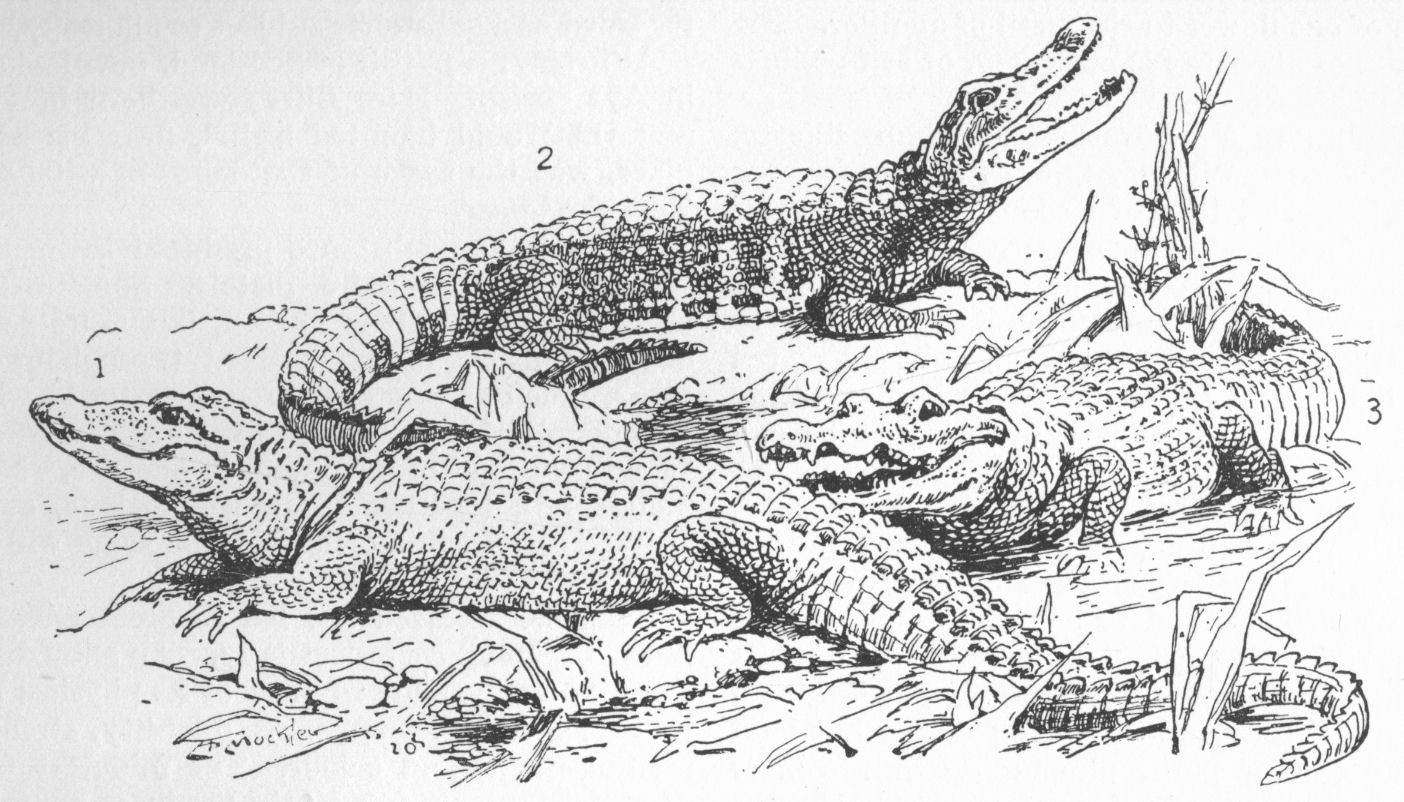
Alliga′tor (a corruption of Sp. el lagarto, lit. the lizard—Lat. lacertus), a genus of reptiles of the family Crocodilidæ, differing from the true crocodiles in having a shorter and flatter head, in having cavities or pits in the upper jaw, into which the long canine teeth of the under jaw fit, and in having the feet much less webbed. Their habits are less perfectly aquatic. They are confined to the warmer parts of America, where they frequent swamps and marshes, and may be seen basking on the dry ground during the day in the heat of the sun. They are most active during the night, when they make a loud bellowing. The largest of these animals grow to the length of 18 or 20 feet. They are covered by a dense armour of horny scales, impenetrable to a bullet, and have a large mouth, armed with strong, conical teeth. They swim with wonderful celerity, impelled by their long, laterally-compressed, and powerful tails. On land their motions are proportionally slow and embarrassed because of the length and unwieldiness of their bodies and the shortness of their limbs. They live on fish, and any small animals or carrion, and sometimes catch pigs on the shore, or dogs which are swimming. They even sometimes make man their prey. In winter they burrow in the mud of swamps and marshes, lying torpid till the warm weather. The female lays a great number of eggs, which are deposited in the sand or mud, and left to be hatched by the heat of the sun, but after this has taken place the mother alligator is very attentive to her young. The most fierce and dangerous species is that found in the southern parts of the United States (Alligator Lucius), having the snout a little turned up, slightly resembling that of the pike. The alligators of South America are there very often called Caymans. A. sclerops is known also as the Spectacled Cayman, from the prominent bony rim surrounding the orbit of each eye. The flesh of the alligator is sometimes eaten, the tail being considered a great delicacy by the negroes. Among the fossils of the south of England are remains of a true alligator (A. Hantoniensis) in the Eocene beds of the Hampshire basin.
Alligator-apple (Anōna palustris), a fruit allied to the custard-apple, growing in marshy districts in Jamaica, little eaten on account of its narcotic properties.
Alligator-pear (Persēa gratissima), an evergreen tree of the nat. ord. Lauraceæ, with a fruit resembling a large pear, 1 to 2 lb. in weight, with a firm marrow-like pulp of a delicate flavour; called also avocado-pear, or subaltern's butter. It is a native of tropical America and the West Indies.
Al′lingham, William, an Irish poet, born in Ireland in 1824 or 1828, died in 1889. He published his first volume (Poems) in 1850; Day and Night Songs in 1855; Lawrence Bloomfield in Ireland, narrative poem, in 1864; Songs, Poems, and Ballads in 1877 (including a number of new poems). He was a frequent contributor to periodicals, and for some time edited Fraser's Magazine.
Allitera′tion, the repetition of the same letter at the beginning of two or more words immediately succeeding each other, or at short intervals; as "many men many minds"; "death defies the doctor". "Apt alliteration's artful aid" (Churchill). "Puffs, powders, patches, bibles, billet-doux" (Pope). "Weave the warp and weave the woof" (Gray). In the ancient German and Scandinavian and in early English poetry alliteration took the place of terminal rhymes, the alliterative syllables being made to recur with a certain regularity in the same position in successive verses. In the Vision of William Concerning Piers the Ploughman, for instance, it is regularly employed as in the following lines:—
Hire robe was ful riche . of red scarlet engreyned, With ribanes of red gold . and of riche stones; Hire arraye me ravysshed . such ricchesse saw I nevere; I had wondre what she was . and whas wyf she were.
Alliteration was known to the Latin authors: "O Tite tute, Tati, tibi tanta, tyranne tulisti" (Ennius). In the hands of some English poets and prose writers of later times alliteration became a mere conceit. It is still employed in Icelandic and Finnish poetry. So far has alliteration sometimes been carried that long compositions have been written every word of which commenced with the same letter. It may also be employed in the middle of words: "Un frais parfum sortait des touffes d'asfodile" (Victor Hugo).
Al′lium, a genus of plants, ord. Liliaceæ;, containing numerous well-known species of pot-herbs. They are umbelliferous, and mostly perennial, herbaceous plants, but a few are biennial. Among them are garlic (A. satīvum), onion (A. Cepa), leek (A. Porrum), chives (A. Schœnoprăsum), shallot (A. ascalonĭcum). The peculiar alliaceous flavour that belongs to them is well known.
Al′loa, a river port of Scotland, on the north bank of the Forth (where there is now a bridge), 7 miles from Stirling, county of Clackmannan. It carries on brewing, distilling, and shipbuilding; has manufactures of woollens, bottles, &c., and a shipping trade. Pop. (1921), 12,421.
Allocu′tion, an address, a term particularly applied to certain addresses on important occasions made by the Pope to the cardinals, and through them to the Church in general.
Allo′dium (probably derived from all and odh, property), land held in one's own right, without any feudal obligation to a superior or lord. In England, according to the theory of the British constitution, all land is held of the crown (by feudal tenure); the word allodial is, therefore, never applied to landed property there.
Allogamy (from the Gr. allos, other, and gamos, wedding), meaning the transfer of the pollen of one flower to the pistil of another. The opposite of allogamy is autogamy, or self-pollination.
Allophane, a hydrous aluminium silicate, with the composition Al2SiO5 + 5H2O, forming crusts in the cavities of various rocks and commonly of a delicate blue colour.
Allot′ment System, the system of allotting small portions of land (an acre or less) to farm-labourers or other workers, to be cultivated after their regular work by themselves and their families, a system believed by many to be calculated greatly to improve their condition. An Allotment Act for England, passed in 1887, authorizes the sanitary authorities in any locality to determine if there is a sufficient demand for allotments there, and to acquire land to be let to the labouring population resident in their district. Such land may be compulsorily acquired, due compensation being given; but land belonging to a park, pleasure-ground, &c., is not to be so acquired. No person is to hold more than 1 acre as an allotment; and the rents are to be fixed at such amount as may reasonably be deemed sufficient to guarantee the sanitary authority from loss. No building is to be erected on any allotment other than a tool-house, pig-sty, shed, or the like. In the Allotment Acts of 1887 and 1892 (Scotland) the definition is applied to a plot of land not exceeding 1 acre, but the Local Government Act of 1894 authorized the letting of an allotment up to the area of 4 acres to one person, while the Small Holdings and Allotments Act of 1907 definitely extends the limit of an allotment to 5 acres. The distinction between allotments and small holdings has therefore been obliterated, at least as far as England and Wales are concerned. County councils will let plots of 1 to 5 acres as small holdings, and parish councils as allotments. During the European War 183,000 allotments were registered under the Cultivation of Lands Order, and the number of allotments in Great Britain not exceeding 1 acre now amounts to over 1,000,000. In proportion to the total agricultural area or population it is much smaller in Scotland than in England. The rents of allotments vary greatly, and near towns, or even villages, they are very high, often from £4 to £8 per acre. A measure corresponding to the English Small Holdings and Allotments Act of 1907 was passed for Scotland in 1911, and came into operation in 1912. In recent years a large number of co-operative allotment associations have come into existence.
Allot′ropy (Gr. allos, other, tropos, manner), a term used by Berzelius to express the fact that one and the same element may exist in different forms, differing widely in external physical properties. Thus carbon occurs as the diamond, and as charcoal and plumbago, and is therefore regarded as a substance subject to allotropy.
Al′loway, a parish of Scotland, now included in Ayr parish. Here Burns was born in 1759, and the "auld haunted kirk", near his birthplace, was the scene of the dance of witches in Tam o' Shanter.
Alloy′ is the substance produced by melting together two or more metals. Sometimes a chemical compound is formed, but more generally one metal is interspersed throughout the other, much as sugar is through water in which it is dissolved. In this case the alloy is called a 'solid solution' of one metal in another. Many metals mix together in all proportions, others only in certain proportions, while some will not mix in any proportion.
Scientific research has led to great advances in the use of alloys industrially. An alloy differs from its components in most of its physical properties, such as its hardness, ductility, strength, melting-point, and colour. The minutest trace of certain metals frequently produces an extraordinary change in the property of the body with which it is mixed. For instance, if bismuth is present in copper to the extent of more than 0.5 per cent, the copper cannot be used successfully in the construction of electrical machinery. Frequently the addition of a small proportion of a metal produces highly-desirable effects in one direction, but is deleterious in other directions. For instance, the presence of a small amount of manganese in cast-iron gives clean castings, but the magnetic qualities of the material are impaired.
Alloys are classified as ferrous and non-ferrous alloys.
Ferrous Alloys.—These alloys are of great industrial importance, as they include cast irons and steels. Pure iron is very little used in industry. Ordinary cast iron contains iron and about 3 per cent of carbon. The ordinary wrought iron of the blacksmith contains less than 0.25 per cent of carbon. Cast iron is brittle, and unreliable when used to sustain tensile stresses, and it cannot be forged; but wrought iron can be safely used in tension, is not brittle, and can be forged. The raw material from which steel is made is cast iron or wrought iron. (For manufacture of steel see Steel.) The properties of steel can be varied within very wide limits by adding to it traces of certain metals. For instance, the addition of nickel up to 5 per cent makes the steel much stronger and tougher; the addition of tungsten up to about 19 per cent makes it hard (tool-steel, magnet steel), while molybdenum has a similar effect. Chromium and vanadium have a 'stabilizing' effect, i.e. tend to make large masses of the alloy homogeneous, and to make the alloy retain its hardness over wide ranges of temperature. Cobalt has a similar stabilizing effect. Molybdenum high-speed steel is more expensive than tungsten high-speed steel, but is said to wear better.
Non-ferrous Alloys.—Of the non-ferrous alloys the most important have copper as the basic metal. They do not become rusty on exposure. Copper, when used for electrical purposes, must be nearly pure. It is deposited electrolytically (see Electrolysis) and then made into bars (electrolytic copper).
Brass is an alloy of copper and zinc and varies much in composition. The best-known varieties are:—
Best brass Copper 70%, Zinc 30%.
Admiralty brass Copper 70%, Zinc 29%, Tin 1%.
Ordinary brass Copper 67%, Zinc 30%, Lead 3%.
Gun-metal is a mixture of copper, tin, and zinc. The standard Admiralty mixture is copper 88, tin 10, zinc 2. It possesses a tensile strength of 14 tons per sq. inch.
Bronzes.—The bronzes are alloys of copper, with zinc or tin mainly. They can be cast easily, and when heated to a dull red the metal can be forged, stamped, rolled, pressed, or extruded. They are largely free from corrosion.
Phosphor Bronze.—This is a specially strong bronze. A typical composition is copper 89.5, tin 10, phosphorus 0.5. The tensile strength is higher than that of pure copper or brass (about 15 tons per sq. inch), and it has about one-half the electrical conductivity of pure copper. It is used for small castings, and it can be drawn into wire, which is used in alternating-current electric-railway construction for the overhead conductor.
Delta metals are bronzes of specially high tensile strength (30-50 tons per sq. inch).
Manganese bronzes are bronzes of high tensile strength and ductility, and are largely used for marine propellers. Manganese bronze is not affected by sea-water. It usually contains copper, zinc, and manganese, with a little aluminium and tin.
A recently-discovered copper alloy is known as monel metal. It is a naturally-occurring alloy of copper, nickel, iron, and manganese (copper 27-29 per cent, nickel 68-70 per cent, iron and manganese 4-5 per cent), and possesses, roughly, the qualities of a mild steel and copper. It has a high tensile strength, which it retains over a wide range of temperature change. It is ductile, is not affected by immersion in sea-water, and can be machined. It is used for pump-valves, pump-pistons, turbine blading, &c.
In the British silver coinage silver is alloyed with 7.5 per cent copper, which renders it harder and more durable. British gold coinage contains 8.3 per cent of copper.—Bibliography: Law, Alloys; Osmond and Stead, Microscopic Analysis of Metals; Mellor, Crystallization of Iron and Steel; Desch, Metallography.
All Saints' Day, a festival of the Christian Church, instituted in 835, and celebrated on 1st Nov. in honour of the saints in general.
All Souls' College, a college of Oxford University, founded in 1437 by Henry Chichele, Archbishop of Canterbury. Attached to it are the Chichele Professorship of International Law and the Chichele Professorship of Modern History.
All Souls' Day, a festival of the Roman Catholic Church, instituted in 998, and observed on 2nd Nov. for the relief of souls in purgatory.
Allspice (Myrtus Pimenta)
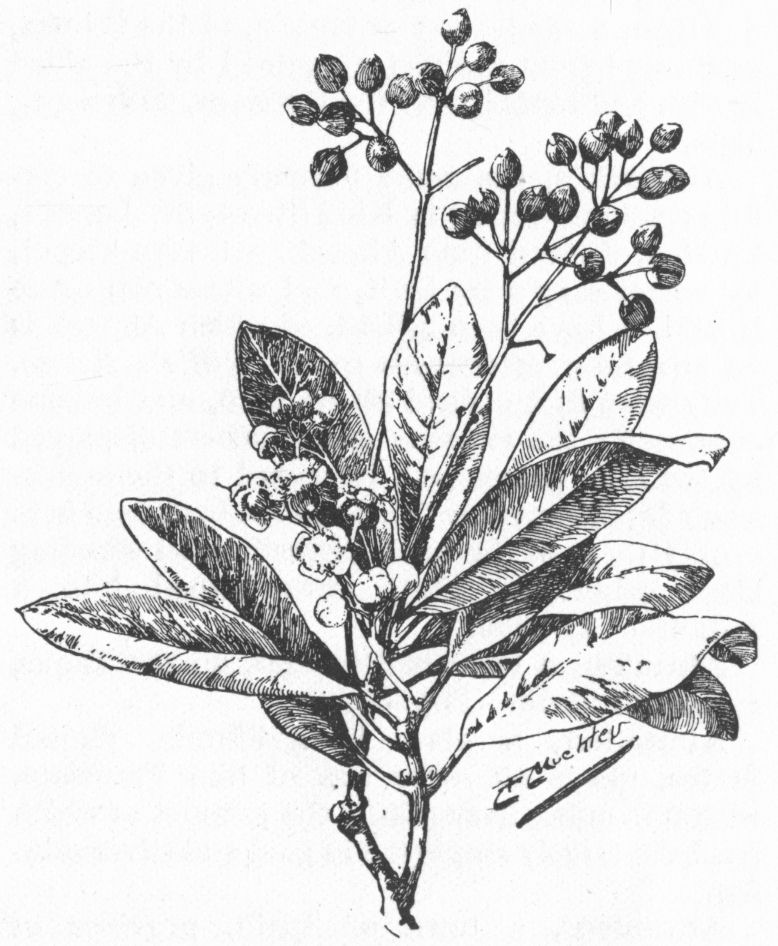
Allspice (a¨l′spīs), or Pimenta, is the dried and ground berry of a West Indian species of myrtle (Myrtus Pimenta), a beautiful tree with white and fragrant aromatic flowers and leaves of a deep shining green. The tree is often 30 feet high, and may yield 150 lb. of raw berries, equivalent to 100 lb. of dried spice. Pimenta is thought to resemble in flavour a mixture of cinnamon, nutmegs, and cloves, whence the popular name of allspice; it is also called Jamaica pepper, the trees being cultivated there extensively. It is employed in cookery, also in medicine as an agreeable aromatic, and forms the basis of a distilled water, a spirit, and an essential oil.
All′ston (äl′stun), Washington, an American painter, born 1779, died 1843. He studied in London and Rome, and is most celebrated for his pictures on scriptural subjects. Among his pictures The Angel Uriel is at Stafford House; The Prophet Jeremiah at Yale College, Newport. A portrait of Coleridge by Allston is in the National Gallery. He also wrote poems and a tragical romance (Monaldi).
Allu′vium (Lat. alluvium—ad, to, and luo, to wash), deposits of soil collected by the action of water, such as are found in valleys and plains, consisting of loam, clay, gravel, &c., washed down from the higher grounds. Great alterations are often produced by alluvium—deltas and whole islands being often formed by this cause. Much of the rich land along the banks of rivers is alluvial in its origin. There are great tracts of alluviums lying along the banks of the Derwent, the Ouse, and the Trent, and the Romney Marsh of Kent along the banks of the Thames.
Allygurh. See Aligarh.
Alma, a small river of Russia, in the Crimea, celebrated from the victory gained by the allied British and French over the Russians, 20th Sept., 1854.
Al′mack's, the name formerly given to certain assembly-rooms in King Street, St. James's, London, derived from Almack, a tavern-keeper, by whom they were built, and whose real name is said to have been M‘Call, of which Almack is an anagram; afterwards called Willis's Rooms. They were first opened about 1770, and became famous for the extreme exclusiveness displayed by the lady patronesses in regard to the admission of applicants for tickets to the balls held here—only those of the most assured social standing being admitted. They were turned into a restaurant in 1890.
Alma′da, a town of Portugal, on the Tagus, opposite Lisbon. Pop. 7913.
Al′maden, a place in California, United States, about 60 miles S.E. of San Francisco, with rich quicksilver-mines, the product of which has been largely employed in gold and silver mining.
Almaden′, a town of Spain, province of Ciudad-Real, celebrated both in ancient and modern times for its mines of quicksilver (in the form of cinnabar). Pop. 7410.
Almaden Process. See Mercury.
Al′magest (Ar. al, the, and Gr. megistē, greatest, sc. 'treatise') the name of a celebrated astronomical work composed by Claudius Ptolemy.
Alma′gro, an old town of Spain, province of Ciudad-Real (New Castile), with important lace manufactures. Pop. 7700.
Alma′gro, Diego de, Spanish 'Conquistador', a foundling, born in 1475, killed 1538. He took part with Pizarro in the conquest of Peru, and after frequent disputes with Pizarro about their respective shares in their conquests led an expedition against Chile, which he failed to conquer. On his return a struggle took place between him and Pizarro, in which Almagro was finally overcome, taken prisoner, strangled, and afterwards beheaded. He was avenged by his son, born in 1520, who raised an insurrection, in which Pizarro was assassinated, in 1541. The younger Almagro was put to death at Cuzco in 1542 by De Castro, the new Viceroy of Peru.
Almalee′, a town of Asia Minor, 50 miles from Adalia, with thriving manufactures and a considerable trade. Pop. 3500.
Al′ma Ma′ter (Lat., fostering or bounteous mother), a term familiarly applied to their own university by those who have had a university education.
Al-Mamun (ma˙-mön′), a caliph of the Abasside dynasty, son of Harun-al-Rashid, born 786, died 833. Under him Bagdad became a great centre of art and science.
Al′manac, a calendar, in which are set down the rising and setting of the sun, the phases of the moon, the most remarkable positions and phenomena of the heavenly bodies, for every month and day of the year; also the several fasts and feasts to be observed in the Church and State, &c., and often much miscellaneous information likely to be useful to the public. The term is of Arabic origin, but the Arabs were not the first to use almanacs, which indeed existed from remote ages. In England they are known from the fourteenth century, there being several English almanacs of this century existing in MS. They became generally used in Europe within a short time after the invention of printing; and they were very early remarkable, as some are still, for the mixture of truth and falsehood which they contained. Their effects in France were found so mischievous, from the pretended prophecies which they published, that an edict was promulgated by Henry III in 1579 forbidding any predictions to be inserted in them relating to civil affairs, whether those of the State or of private persons. In the reign of James I of England letters-patent were granted to the two universities and the Stationers' Company for an exclusive right of printing almanacs, but in 1775 this monopoly was abolished. During the civil war of Charles I, and thence onward, English almanacs were conspicuous for the unblushing boldness of their astrological predictions, and their determined perpetuation of popular errors. The most famous English almanac was Poor Robin's Almanack, which was published from 1663 to 1775. Gradually, however, a better taste began to prevail, and in 1828 the Society for the Diffusion of Useful Knowledge, by publishing the British Almanac, had the merit of taking the lead in the production of an unexceptionable almanac in Great Britain. The example thus set has been almost universally adopted. The circulation of almanacs continued to be much cramped by the very heavy duty of one shilling and threepence per copy till 1834, when this duty was abolished. About 200 new almanacs were started immediately on the repeal. Almanacs, from their periodical character, and the frequency with which they are referred to, are now more and more used as vehicles for conveying statistical and other useful information, some being intended for the inhabitants of a particular country or district, others for a particular class or party. Some of the almanacs that are regularly published every year are extremely useful, and are indeed almost indispensable to men engaged in official, mercantile, literary, or professional business. Such in Great Britain are Thom's Official Directory of the United Kingdom, The British Almanac, Oliver and Boyd's New Edinburgh Almanac, and Whitaker's Almanac, started in 1868. In the United States is published The American Almanac, a useful compilation. The Almanach de Gotha, which has appeared at Gotha since 1764, contains in small bulk a wonderful quantity of information regarding the reigning families and Governments, the finances, commerce, population, &c., of the different States throughout the world. Since 1871 it is published both in a French and in a German edition. Among French almanacs the most famous was the Almanach Liégeois, whilst the Almanach National, first published in 1679 as Almanach Royal, is the most important of modern almanacs in France. Almanacs that pretend to foretell the weather and occurrences of various kinds are still popular in Britain, France, and elsewhere.—The Nautical Almanac is an important work published annually by the British Government, two or three years in advance, in which is contained much useful astronomical matter, more especially the distances of the moon from the sun, and from certain fixed stars, for every three hours of apparent time, adapted to the meridian of the Royal Observatory, Greenwich. By comparing these with the distances carefully observed at sea the mariner may, with comparative ease, infer his longitude to a degree of accuracy unattainable in any other way, and sufficient for most nautical purposes. This almanac was commenced in 1767 by Dr. Maskelyne, Astronomer Royal. The French Connaissance des Temps is published for the same purpose as the English Nautical Almanac, and nearly on the same plan. It commenced in 1679. Of a similar character is the Astronomisches Jahrbuch published at Berlin.
Alman′dine, a mineral of a reddish or violet colour, a variety of precious or noble garnet.
Alman′sa, a town of south-eastern Spain (Murcia), near which was fought (25th April, 1707) a decisive battle in the War of the Spanish Succession, when the French, under the Duke of Berwick, defeated the Anglo-Spanish army under the Earl of Galway. Pop. 11,887.
Alman′zur, or Almansur, a caliph of the Abasside dynasty, reigned 754-75. He was cruel and treacherous and a persecutor of the Christians, but a patron of learning.
Alma-Tad′ema, Sir Lawrence, Dutch painter, born in 1836, resided since 1870 in England, where he became a naturalized subject. He was made A.R.A. in 1876, R.A. in 1879, knighted in 1899, and awarded the Order of Merit in 1905. He died at Wiesbaden, 25th June, 1912. He is especially celebrated for his pictures of ancient Roman, Greek, and Egyptian life, which are painted with great realism and archæological correctness.
Al′meh, the name given in Egypt to a class of girls whose profession is to sing for the amusement of the upper classes, as distinguished from the gawasi, who perform before the lower classes. They perform at feasts and other entertainments (including funerals), and many of them are skilful improvisatrici. One of their most famous dances is called 'The Bee'.
Almeida (a˙l-mā′i-da˙), one of the strongest fortresses in Portugal, in the province of Beira, near the Spanish border, on the Coa. Pop. 2350. Taken by Masséna from the English in 1810, retaken by Wellington in 1811.
Almeida (da˙l-mā′i-da˙), Francisco d', first Portuguese viceroy of India, son of the Conde de Abrantes, born about the middle of the fifteenth century. He fought with renown against the Moors, and being appointed governor of the new Portuguese settlements on the African and Indian coasts, he sailed for India in 1505, accompanied by his son Lorenzo and other eminent men. In Africa he took possession of Quiloa and Mombas, and in the East he conquered Cananor, Cochin, Calicut, &c., and established forts and factories. His son Lorenzo discovered the Maldives and Madagascar, but perished in an attack made on him by a fleet sent by the Sultan of Egypt, with the aid of the Porte and the Republic of Venice. Having signally defeated the Mussulmans (1508), and avenged his son, and being superseded by Albuquerque, he sailed for Portugal, but was killed in a skirmish on the African coast in 1510.
Almelo′, a town of Holland, province of Overyssel, on the Vechte; with manufactures of linen. Pop. 7360.
Almendralejo (-ā′hō), a town of Spain, province of Badajoz, in a district rich in grain, wine, and fruits, with many brandy distilleries. Pop. 12,587.
Almeria (a˙l-mā-rē′a˙), a fortified seaport of Southern Spain, capital of province of Almeria, near the mouth of a river and on the gulf of same name, with no building of consequence except a Gothic cathedral, but with a large trade, exporting grapes, iron ore, lead, esparto, &c. The province, which has an area of 3360 sq. miles, is generally mountainous, and rich in minerals. Pop. of town, 48,614; of province, 393,689.
Almodo′var, a town of Spain, province of Ciudad-Real (New Castile), near the Sierra Morena. Pop. 12,640.
Almohades (al′mo-hādz), a Moorish dynasty that ruled in Africa and Spain in the twelfth and thirteenth centuries, founded by Mohammed Ibn Tumart, a religious enthusiast, who assumed the title of Mahdi. They overthrew the Almoravides in Spain, but themselves received a defeat in 1212 from which they did not recover, and in 1269 were overthrown in Africa, when Idris El-Wathik, their last emir, was murdered by a slave.
Al-mokanna. See Mokanna.
Almond (a˙′mund), the fruit of the almond tree (Amygdălus commūnis), a tree which grows usually to the height of 20 feet, and is akin to the peach, nectarine, &c. (ord. Rosaceæ). It has beautiful pinkish flowers that appear before the leaves, which are oval, pointed, and delicately serrated. It is a native of Africa and Asia, naturalized in Southern Europe, and cultivated in England for its beauty, as it seldom produces edible fruit even in the warmer portions of Southern England. The fruit is a drupe, ovoid, and with downy outer surface; the fleshy covering is tough and fibrous; it covers the compressed wrinkled stone enclosing the seed or almond within it. There are two varieties, one sweet and the other bitter; both are produced from A. communis, though from different varieties. Most of the sweet almonds imported into Britain come from Southern Europe, the Levant, and California, the finest being the Valencian, Jordan, and Malaga. They contain a bland fixed oil, consisting chiefly of olein. Bitter almonds come from Mogador, and besides a fixed oil they contain a substance called emulsin, and also a bitter crystalline substance called amygdalin, which, acting on the emulsin, produces prussic acid, whence the aroma of bitter almonds when mixed with water. Almond-oil, a bland fixed oil, is expressed from the kernels of either sweet or bitter almonds, and is used by perfumers and in medicine. A poisonous essential oil is obtained from bitter almonds, which is used for flavouring by cooks and confectioners, also by perfumers and in medicine. The name almond, with a qualifying word prefixed, is also given to the seeds of other species of plants; thus Java almonds are the kernels of Canarium commune.
Almondbury (a˙′mund-be-ri), a town of England, West Riding of Yorkshire, S.E. of Huddersfield, in which it is now included, with manufactures of woollens, cotton and silk goods.
Al′moner, an officer of a religious establishment to whom belonged the distribution of alms. The grand almoner (grand aumonier) of France was the highest ecclesiastical dignitary in that kingdom before the revolution. The lord almoner, or lord high almoner of England, is generally a bishop, whose office is well-nigh a sinecure. He distributes the sovereign's doles to the poor on Maundy Thursday.
Almo′ra, a town and fortress of India, in the United Provinces, capital of Kumaon, 170 miles E.N.E. of Delhi, a thriving little place. Pop. about 10,560.
Almo′ravides (-vīdz), a Moorish dynasty which arose in North-Western Africa in the eleventh century, and reigned from 1055-1147. The town of Marrakesh, built in 1062, became the capital of this dynasty. Having crossed the Straits of Gibraltar, the family gained possession of all Arabic Spain, but was overthrown by the Almohades in the following century.
Al′mug (or Al′gum) tree, names which occur in 1 Kings, x, 11, 12, and 2 Chron., ii, 8, and ix, 10, 11, as the names of trees of which the wood was used for pillars in the temple and the king's house, for harps and psalteries, &c. They are said in one passage to be hewn in Lebanon, in another to be brought from Ophir. They have been identified by critics with the red sandalwood of India. Some of them may possibly have been transplanted to Lebanon by the Phoenicians.
Almuñecar (a˙l-mu¨n-ye-kär′), a seaport of Spain, Granada, on the Mediterranean. Pop. 8000.
Al′nager, formerly, in England, an official whose duty it was to inspect, measure, and stamp woollen cloth.
Al′nus. See Alder.
Alnwick (an′ik), a town of England, county town of Northumberland, 34 miles north of Newcastle, near the Aln. It is well built, and carries on tanning, brewing, and a general trade. The town is famous for the curious ceremonies which take place there annually during the election of the common council (25th March). Alnwick Castle, residence of the Dukes of Northumberland, for many centuries a fortress of great strength, stands close to the town. Pop. (1921), 6991.
Socotrine Aloe (Aloe socotrīna)
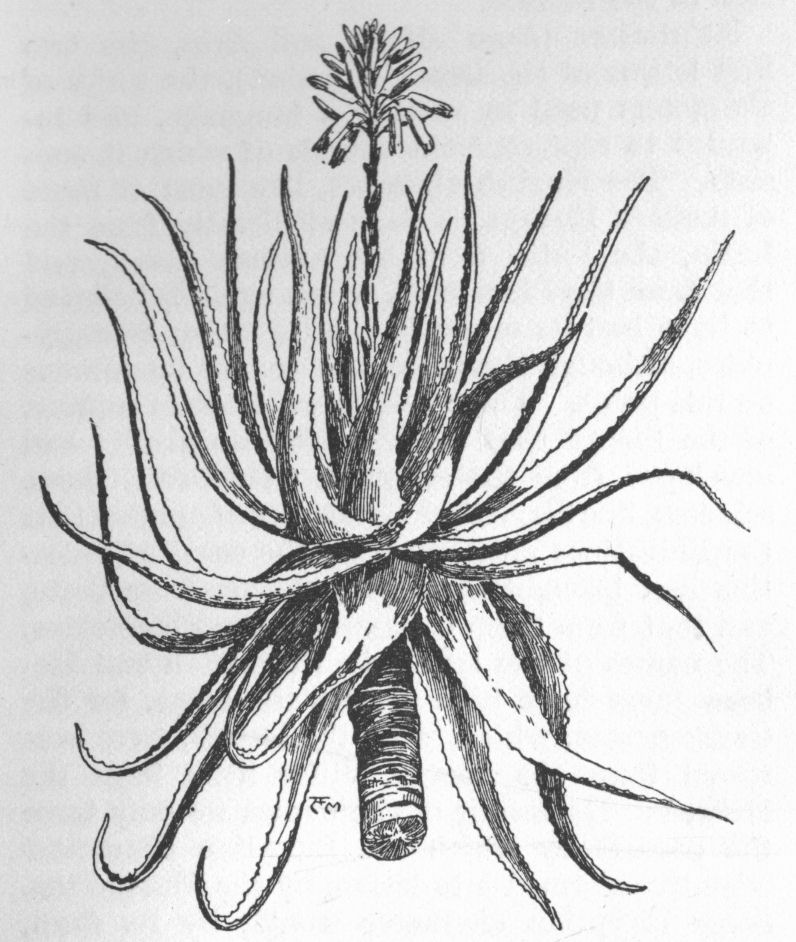
Aloe (al′ō), the name of a number of plants belonging to the genus Aloë (ord. Liliaceæ), some of which are not more than a few inches, whilst others are 30 feet and upwards in height; natives of South Africa and Socotra; leaves fleshy, thick, and more or less spinous at the edges or extremity; flowers with a tubular corolla. Some of the larger kinds are of great use, the fibrous parts of the leaves being made into cordage, fishing nets and lines, cloth, &c. The inspissated juice of several species is used in medicine, under the name of aloes, forming a bitter purgative. The medicinal value of bitter aloes was known to the Greeks in the fourth century B.C. According to the Arabian historian Edrisi, the occupation of Socotra by the Macedonians was due to Aristotle's persuading Alexander the Great to secure the monopoly of the supplies of the drug. The drug is said to have been commended to Alfred the Great by the Patriarch of Jerusalem, but a direct trade in it between Socotra and Britain was opened only in the seventeenth century. The principal drug-producing species are the Socotrine aloe (A. Socotrīna); the Barbados aloe (A. vulgāris), first imported into Britain in 1693; the Cape aloe (A. spicāta), 1780; and Natal aloes, 1870; &c. A beautiful violet colour is yielded by the leaves of the Socotrine aloe. The American aloe (see Agave) is a different plant altogether; as are also the aloes or lign-aloes of Scripture, which are supposed to be the Aquilaria Agallŏchum, or aloes-wood (q. v.). Aloe fibre is obtained from species of Aloë, Agave, Yucca, &c., and is made into coarse fabrics, ropes, &c.
Aloes-wood, Eagle-wood, or Agilawood, the inner portion of the trunk of Aquilāria ovāta and A. Agallŏchum, forest trees belonging to the ord. Aquilariaceæ, found in tropical Asia, and yielding a fragrant resinous substance, which, as well as the wood, is burned for its perfume. Another tree, the Aloexўlon Agallŏchum (ord. Leguminosæ), also produces aloes-wood. This wood is supposed to be the lign-aloes (a corruption of the Lat. lignum aloe) of the Bible.
Alope′cia, a variety of baldness in which the hair falls off from the beard and eyebrows, as well as the scalp.
Alopecu′rus, a genus of grasses. See Foxtail-grass.
Alo′ra, a town of Southern Spain, province of Malaga. Pop. 6200.
Alost, or Aalst (ä′lost, älst), a town of Belgium, 15 miles W.N.W. of Brussels, on the Dender (here navigable), with a beautiful, though unfinished, church, and an ancient town hall (thirteenth century); manufactures of lace, thread, linen and cotton goods, &c., and a considerable trade. In the market-place stands a statue of Thierry Maartens, who introduced the art of typography into the Netherlands in 1473. The town was occupied by the Germans in 1914. Pop. 35,603.
Alpaca (Auchēnia Paco)
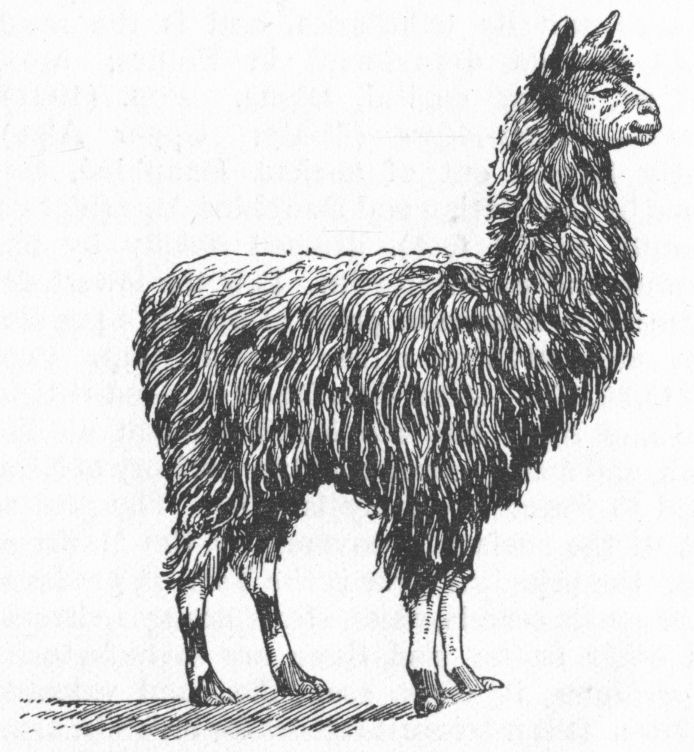
Alpac′a, a ruminant mammal of the camel tribe, and genus Auchēnia (A. Paco), a native of the Andes, especially of the mountains of Chile and Peru, and closely allied to the llama. Llamas and alpacas are mutually fertile when crossed, and this explains the existence of intermediate forms between the two breeds. It has been domesticated, and remains also in a wild state. In form and size it approaches the sheep, but has a longer neck. It is valued chiefly for its long, soft, and silky wool, which is straighter than that of the sheep, and very strong, and is woven into fabrics of great beauty, used for shawls, clothing for warm climates, coat-linings, and umbrellas, and known by the same name. Cloth made from imported alpaca wool is manufactured in England, principally in Yorkshire. Attempts have been made to introduce and acclimatize the alpaca in Europe and in Australia, but no measure of success has attended the experiments. Its flesh is pleasant and wholesome.
Alpe′na, a town of the United States, Michigan, at the entrance of the Thunder into Lake Huron, with saw-mills, woollen factories, &c. Pop. 12,706.
Alpen-horn, or Alp-horn (Ger.), a long, nearly-straight horn, curving slightly, and widening towards its extremity, used in the Alps to convey signals, or notice of something.
Alpen-stock (Ger.), a strong, tall stick shod with iron, pointed at the end so as to take hold in, and give support on, ice and other dangerous places in climbing the Alps and other high mountains.
Alpes (a˙lp), the name of three departments in the south-east of France, all more or less covered by the Alps or their offshoots:—Basses-Alpes (bäs-a˙lp; Lower Alps) has mountains rising to a height of 8000 to 10,000 feet, is drained by the Durance and its tributaries, and is the most thinly-peopled department in France; area, 2697 sq. miles; capital, Digne. Pop. (1921), 91,882.—Hautes-Alpes (ōt-a˙lp; Upper Alps), mostly formed out of ancient Dauphiné, traversed by the Cottian and Dauphiné Alps (highest summits 12,000 feet), drained chiefly by the Durance and its tributaries. It is the lowest department in France in point of absolute population; area, 2178 sq. miles; capital, Gap. Pop. (1921), 89,275.—Alpes-Maritimes (a˙lp-ma˙-ri-tēm; Maritime Alps) has the Mediterranean on the south, and mainly consists of the territory of Nice, ceded to France by Italy in 1860. The greater part of the surface is covered by the Maritime Alps; the principal river is the Var. It produces in the south, cereals, vines, olives, oranges, citrons, and other fruits; and there are manufactories of perfumes, liqueurs, soap, &c., and valuable fisheries. It is a favourite resort for invalids; area, 1443 sq. miles; capital, Nice. Pop. 357,759.
Al′pha and O′mega, the first and last letters of the Greek alphabet, sometimes used to signify the beginning and the end, or the first and the last of anything; also as a symbol of the Divine Being (Rev. i, 8; xxi, 6; xxii, 13). They were also formerly the symbol of Christianity, and engraved accordingly on the tombs of the ancient Christians. Some of these engravings are to be seen in the Louvre.
Al′phabet (from Alpha and Beta, the two first letters of the Greek alphabet), the series of characters used in writing a language, and intended to represent the sounds of which it consists. The English alphabet, like most of those of modern Europe, is derived directly from the Latin, the Latin from the ancient Greek, and that from the Phœnician, which again is believed to have had its origin in the Egyptian hieroglyphics, although Egyptologists are not unanimous on this point. There is little evidence in support of the theory that the Phœnician alphabet had developed from the Assyrian cuneiform. Some scholars, like Sir Arthur Evans, are of opinion that the Philistines established on the coast of Palestine had brought the alphabet over from Crete, and that from them it passed to the Phœnicians. The names of the letters in Phœnician and Hebrew must have been almost the same, for the Greek names, which, with the letters, were borrowed from the former, differ little from the Hebrew. By means of the names we may trace the process by which the Egyptian characters were transformed into letters by the Phœnicians. Some Egyptian character would, by its form, recall the idea of a house, for example, in Phœnician or Hebrew beth. This character would subsequently come to be used wherever the sound b occurred. Its form might be afterwards simplified, or even completely modified, but the name would still remain, as beth still continues the Hebrew name for b, and beta the Greek. Our letter m, which in Hebrew was called mim, water, has still a considerable resemblance to the zig-zag wavy line which had been chosen to represent water, as in the zodiacal symbol for Aquarius. The letter o, of which the Hebrew name means eye, no doubt was originally intended to represent that organ. While the ancient Greek alphabet gave rise to the ordinary Greek alphabet and the Latin, the Greek alphabet of later times furnished elements for the Coptic, the Gothic, and the old Slavic alphabets. The Latin characters are now employed by a great many nations, such as the Italian, the French, the Spanish, the Portuguese, the English, the Dutch, the German, the Hungarian, the Polish, &c., each nation having introduced such modifications or additions as are necessary to express the sound of the language peculiar to it. The Greek alphabet originally possessed only sixteen letters, though the Phœnician had twenty-two. The original Latin alphabet, as it is found in the oldest inscriptions, consisted of twenty-one letters; namely, the vowels a, e, i, o, and u (v), and the consonants b, c, d, f, h, k, l, m, n, p, q, r, s, t, x, z. The Anglo-Saxon alphabet had two characters for the digraph th, which were unfortunately not retained in later English; it had also the character æ. It wanted j, v, y (consonant), and z. The German alphabet consists of the same letters as the English, but the sounds of some of them are different. Anciently certain characters called Runic were made use of by the Teutonic nations, to which some would attribute an origin independent of the Greek and Latin alphabets. Wimmer, the Danish scholar, is, however, of opinion that the runes were developed from the Latin alphabet. While the alphabets of the west of Europe are derived from the Latin, the Russian, which is very complete, is based on the Greek, with some characters borrowed from the Armenian, &c; it is called azbouka, from the first two letters az, a, and bouki, b. Among Asiatic alphabets, the Arabian (ultimately of Phœnician origin) has played a part analogous to that of the Latin in Europe, the conquests of Mohammedanism having imposed it on the Persian, the Turkish, the Hindustani, &c. The Sanskrit or Devanāgari alphabet is one of the most remarkable alphabets of the world. As now used it has fourteen characters for the vowels and diphthongs, and thirty-three for the consonants, besides two other symbols. Our alphabet is a very imperfect instrument for what it has to perform, being both defective and redundant. An alphabet is not essential to the writing of a language, since ideograms or symbols may be used instead, as in Chinese. See Writing.—Bibliography: E. Clodd, The Alphabet (Useful Knowledge Series, Hodder & Stoughton); Canon J. Taylor, The Alphabet; Philippe Berger, Histoire de l'Écriture dans l'Antiquité.
Alphē′us (now Rufia), the largest river of Peloponnesus, flowing westwards into the Ionian Sea. In Greek mythology Alphēus is supposed to have been the son of Oceanus and Tethys.
Alphon′so, the name of a number of Portuguese and Spanish kings. Among the former may be mentioned Alphonso I, the Conqueror, first King of Portugal, son of Henry of Burgundy, the Conqueror and first Count of Portugal; born 1110, fought successfully against the Spaniards and the Moors, named himself King of Portugal, and was as such recognized by the Pope; died 1185.—Alphonso V, the African, born in 1432; succeeded his father, Edward I, 1438; conquered Tangiers in 1471; died 1481. During his reign Prince Henry the Navigator continued the important voyages of discovery already begun by the Portuguese. Under him was drawn up an important code of laws.—Among kings of Spain may be mentioned Alphonso X, King of Castile and Leon, surnamed the Astronomer, the Philosopher, or the Wise (El Sabio); born in 1226; succeeded in 1252. Being grandson of Philip of Hohenstaufen, son of Frederick Barbarossa, he endeavoured to have himself elected Emperor of Germany, and in 1257 succeeded in dividing the election with Richard, Earl of Cornwall. On Richard's death in 1272 he again unsuccessfully contested the imperial crown. Meantime his throne was endangered by conspiracies of the nobles and the attacks of the Moors. The Moors he conquered, but his domestic troubles were less easily overcome, and he was finally dethroned by his son Sancho, and died two years after, 1284. Alphonso was the most learned prince of his age. Under his direction or superintendence were drawn up a celebrated code of laws, valuable astronomical tables which go under his name (Alphonsine Tables), the first general history of Spain in the Castilian tongue, and a Spanish translation of the Bible.—Alphonso V of Aragon, I of Naples and Sicily, born in 1385, was the son of Ferdinand I of Aragon, the throne of which he ascended in 1416, ruling also over Sicily and the Island of Sardinia. Queen Joanna of Naples made him her heir, but after her death in 1435 her will was disputed by René of Anjou. Alphonso now proceeded to take possession of Naples by force, which he succeeded in doing in 1442, and reigned till his death in 1458. He was an enlightened patron of literary men, by whom, in the latter part of his reign, his Court was thronged.—Alphonso XII, King of Spain, the only son of Queen Isabella II and her cousin Francis of Assisi, was born in 1857 and died in 1885. He left Spain with his mother when she was driven from the throne by the revolution of 1868, and till 1874 resided partly in France, partly in Austria. In the latter year he studied for a time at the Royal Military College, Sandhurst, being then known as Prince of the Asturias. His mother had given up her claims to the throne in 1870 in his favour, and in 1874 Alphonso came forward himself as claimant, and in the end of the year was proclaimed by General Martinez Campos as king. He now passed over into Spain and was enthusiastically received, most of the Spaniards being by this time tired of the republican Government, which had failed to put down the Carlist party. Alphonso was successful in bringing the Carlist struggle to an end (1876), and henceforth he reigned with little disturbance. His minister Canovas del Castillo ruined, however, Alphonso's popularity when he advised the king to conclude an alliance with Bismarck and Germany. He married first his cousin Maria de las Mercedes, daughter of the Duc de Montpensier; second, Maria Christina, Archduchess of Austria, whom he left a widow with two daughters and a son.—Alphonso XIII, King of Spain, born in 1886, the posthumous son of Alphonso XII. His mother was appointed regent during his minority, and acted as such until 1902. On attaining his sixteenth year, the king assumed personal charge of the Government. In 1906 (31st May) he married Princess Ena, daughter of Princess Henry of Battenberg, a daughter of Queen Victoria.
Alpine Club, an association of English gentlemen, originating in 1856 or 1857, having as their common bond of union a delight in making the ascent of mountains, in the Alps or elsewhere, difficult to ascend, and in investigating everything connected with mountains. Similar associations now exist in Germany, Austria, Switzerland, and France.
Alpine Crow, or Alpine Chough (Pyrrhocŏrax alpīnus), a European bird closely akin to the chough of England.
Alpine Museum, a museum established at Munich in 1911 by the German and Austrian Alpine Club. Its purpose is to spread knowledge about the Alps, and to disseminate the results of scientific research by means of exhibits and literary publications. Not only alpine geology, botany, and zoology, but also industry, custom, and costumes are well demonstrated in the exhibits.
Alpine Plants, the name given to those plants whose habitat is in the neighbourhood of the snow, on mountains partly covered with it all the year round. As the height of the snow-line varies according to the latitude and local conditions, so also does the height at which these plants grow. The mean height for the alpine plants of Central Europe is about 6000 feet; but it rises in parts of the Alps and in the Pyrenees to 9000 feet, or even more. The high grounds clear of snow among these mountains present a very well marked flora, the general characters of the plants being a low dwarfish habit, a tendency to form thick turfs, stems partly or wholly woody, and large brilliantly-coloured and often very sweet-smelling flowers. They are also often closely covered with woolly hairs. In the Alps of Middle Europe the eye is at once attracted by gentians, saxifrages, rhododendrons, primroses of different kinds, &c. Ferns and mosses of many kinds also characterize these regions. Some alpine plants are found only in one locality. Considerable success has attended the attempt to grow alpine plants in gardens, the first necessity being a situation where there is plenty of sunlight, and which is free from the shade of trees.
Alpine Warbler (Accentor alpīnus), a European bird of the same genus as the hedge-sparrow.
Alpin′ia, a genus of plants. See Galanga.
Alps, the highest and most extensive system of mountains in Europe, included between lat. 44° and 48° N., and long. 5° and 18° E., covering great part of Northern Italy, several departments of France, nearly the whole of Switzerland, and a large part of Austria, while its extensive ramifications connect it with nearly all the mountain systems of Europe. The culminating peak is Mont Blanc, 15,781 feet high, though the true centre is the St. Gothard, or the mountain mass to which it belongs, and from whose slopes flow, either directly or by affluents, the great rivers of Central Europe—the Danube, Rhine, Rhone, and Po. Round the northern frontier of Italy the Alps form a remarkable barrier, shutting it off from the mainland of Europe, so that formerly it could hardly be approached from France, Germany, or Switzerland, except through high and difficult passes. In the west this barrier approaches close to the Mediterranean coast, and near Nice there is left a free passage into the Italian peninsula between the mountains and the sea. From this point eastward the chain proceeds along the coast till it forms a junction with the Apennines. In the opposite direction it proceeds north-west, and afterwards north to Mont Blanc, on the boundaries of France and Italy; it then turns north-east and runs generally in this direction to the Gross Glockner, in Central Tyrol, between the Rivers Drave and the Salza, where it divides into two branches, the northern proceeding north-east towards Vienna, the southern towards the Balkan Peninsula. The principal valleys of the Alps run mostly in a direction nearly parallel with the principal ranges, and therefore east and west. The transverse valleys are commonly shorter, and frequently lead up through a narrow gorge to a depression in the main ridge between two adjacent peaks. These are the passes or cols, which may usually be found by tracing a stream which descends from the mountains up to its source.
The Alps in their various great divisions receive different names. The Maritime Alps, so called from their proximity to the Mediterranean, extend westward from their junction with the Apennines for a distance of about 100 miles; culminating points Aiguille de Chambeyron, 11,155 feet, and Grand Rioburent, 11,142 feet; principal pass, the Col di Tende (6158 feet), which was made practicable for carriages by Napoleon I. Proceeding northward the next group consists of the Cottian Alps, length about 60 miles; principal peaks: Monte Viso, 12,605 feet; Pic des Écrins, 13,462; Pelvoux, 12,973. Next come the Graian Alps, 50 miles long, with extensive ramifications in Savoy and Piedmont; principal peaks: Aiguille de la Sassière, 12,326 feet; Grand Paradis, 13,300; Grande Casse, 12,780. To this group belongs Mont Cenis (6765 feet), over which a carriage road was constructed by Napoleon I, while a railway now passes through the mountain by a tunnel nearly 8 miles long. These three divisions of the Alps are often classed together as the Western Alps, while the portion of the system immediately east of this forms the Central Alps. The Pennine Alps form the loftiest portion of the whole system, having Mont Blanc (in France) at one extremity and Monte Rosa at the other (60 miles), and including the Alps of Savoy and the Valais. In the east the valley of the Upper Rhone separates the Pennine Alps from the great chain of the Bernese Alps running nearly parallel, the great peaks of the two ranges being about 20 miles apart. The principal heights of the Pennine Alps are Mont Blanc, 15,781 feet; Monte Rosa, 15,217; Mischabelhörner (Dom), 14,935; Weisshorn, 14,804; Matterhorn, 14,780. In the Bernese Alps, the Finsteraarhorn, 14,026; Aletschhorn, 13,803; Jungfrau, 13,671. The pass of Great St. Bernard is celebrated for its hospice. The most easterly pass is the Simplon, 6595 feet, with a carriage road made by Napoleon I, and a tunnel leading into Italy, fully 12 miles long. Farther east are the Lepontine Alps, which give off a number of streams that feed the Italian lakes—Maggiore, Como, &c. The principal pass is the St. Gothard (6936 feet), over which a carriage road leads to Italy, while through this mountain mass a railway tunnel more than 9 miles long has been opened. Highest peaks: Tödi, 11,887 feet; Monte Leone, 11,696. The Rhætian Alps, extending east to about lat. 12° 30′, are the most easterly of the Central Alps, and are divided into two portions by the Engadine, or valley of the Inn, and also broken by the valley of the Adige; principal peaks: Piz Bernina, 13,294 feet; Ortlerspitze, 12,814; Monte Adamello, 11,832. The Brenner Pass (4588 feet), from Verona to Innsbruck, and between the Central and the Eastern Alps, is crossed by a railway. On the railway from Innsbruck to the Lake of Constance is the Arlberg Tunnel, over 6 miles long. The Eastern Alps form the broadest and lowest portion of the system, and embrace the Noric Alps, the Carnic Alps, the Julian Alps, &c.; highest peak, the Gross Glockner, 12,405 feet. The height of the south-eastern continuations of the Alps rapidly diminishes, and they lose themselves in ranges having nothing in common with the great mountain masses which distinguish the centre of the system.
The Alps are very rich in lakes and streams. Among the chief of the former are the Lakes of Geneva, Constance, Zürich, Thun, Brienz, on the north side; on the south Maggiore, Como, Lugano, Garda, &c. The drainage is carried to the North Sea by the Rhine, to the Mediterranean by the Rhone, to the Adriatic by the Po, to the Black Sea by the Danube.
In the lower valleys of the Alps the mean temperature ranges from 50° to 60°. Half-way up the Alps it averages about 32°—a height which in the snowy regions it never reaches. But even where the temperature is lowest the solar radiation produced by the rocks and snow is often so great as to raise the photometer to 120° and even higher. The exhilarating and invigorating nature of the climate in the upper regions during summer has been acknowledged by all.
In respect to vegetation the Alps have been divided into six zones, depending on height modified by exposure and local circumstances. The first is the olive region. This tree flourishes better on sheltered slopes of the mountains than on the plains of Northern Italy. The vine, which bears greater winter cold, distinguishes the second zone. On slopes exposed to the sun it flourishes to a considerable extent. The third is called the mountainous region. Cereals and deciduous trees form the distinguishing features of its vegetation. The mean temperature about equals that of Great Britain, but the extremes are greater. The fourth region is the sub-Alpine or coniferous. Here are vast forests of pines of various species. Most of the Alpine villages are in the two last regions. On the northern slopes pines grow to 6000, and on the southern slopes to 7000 feet above the level of the sea. This is also the region of the lower or permanent pastures where the flocks are fed in winter. The fifth is the pasture region, the term alp being used in the local sense of high pasture grounds. It extends from the uppermost limit of trees to the region of perpetual snow. Here there are shrubs, rhododendrons, junipers, bilberries, and dwarf willows, &c. The sixth zone is the region of perpetual snow. The line of snow varies, according to seasons and localities, from 8000 to 9500 feet, but the line is not continuous, being often broken in upon. Few flowering plants extend above 10,000 feet, but they have been found as high as 12,000 feet.
At this great elevation are found the wild goat and the chamois. In summer the high mountain pastures are covered with large flocks of cattle, sheep, and goats, which are in winter removed to a lower and warmer level. The marmot, and white or Alpine hare, inhabit both the snowy and the woody regions. Lower down are found the wild-cat, fox, lynx, bear, and wolf; the last two are now extremely rare. The vulture, eagle, and other birds of prey frequent the highest elevations, the ptarmigan seeks its food and shelter among the diminutive plants that border upon the snow-line. Excellent trout and other fish are found; but the most elevated lakes are, from their low temperature, entirely destitute of fish.
The geological structure of the Alps is highly involved, and is far, as yet, from being thoroughly investigated or understood. In general three zones can be distinguished, a central, in which crystalline rocks prevail, and two exterior zones, in which sedimentary rocks predominate. The rocks of the central zone consist of granite, gneiss, hornblende, mica slate, and other slates and schists. In the western Alps there are also considerable elevations in the central zone that belong to the Jurassic (Oolite) and Cretaceous formations. From the disposition of the beds, which are broken, tilted, and distorted on a gigantic scale, the Alps appear to have been formed by a succession of disruptions and elevations extending over a very protracted period. Among the minerals that are obtained are iron and lead, gold, silver, copper, zinc, alum, and coal.
Extensive views of alpine scenery are now commanded by means of special railways climbing to the summit of Mont Blanc, the Jungfrau, and other mountains. The Rigi railway was one of the earliest constructed of these. Here there are hotels at the top, 5905 feet above the level of the sea, and 4468 above the Lake of Lucerne. A favourite view from hence is to watch the sun rise over the Bernese Alps. The Becca di Nona (8415 feet), south of Aosta, gives, according to some authorities, the finest panoramic view to be obtained from any summit of the Alps. The most accessible glaciers are those of Aletsch, Chamonix, and Zermatt.
Alpujarras (a˙l-pö-ha˙r′ra˙s), a district of Spain, in Andalusia, between the Sierra Nevada and the Mediterranean, mountainous, but with rich and well-cultivated valleys, yielding grain, vines, olives, and other fruits. The inhabitants are Christianized descendants of the Moors.
Alquifou (al′ki-fö), a sort of lead ore used by potters as a green varnish or glaze.
Alsace (a˙l-sa˙s; Ger. Elsass), before the French revolution a province of France, on the Rhine, afterwards constituting the French departments of Haut- and Bas-Rhin, and subsequently to the Franco-Prussian war of 1870-1 annexed by Germany, and incorporated in the province of Elsass-Lothringen (Alsace-Lorraine). Alsace is generally a level country, though there are several ranges of low hills richly wooded. The principal river is the Ill. Corn, flax, tobacco, grapes, and other fruits are grown. Area, 3202 sq. miles. Pop. 1,218,803. Alsace was originally a part of ancient Gaul. It afterwards became a dukedom of the German Empire. In 1268, the line of its dukes becoming extinct, it was parcelled out to several members of the empire. By the peace of Westphalia, in 1648, a great part of it was ceded to France, which afterwards seized the rest of it, this seizure being recognized by the peace of Ryswick, in 1697.
Alsace-Lorraine, the imperial territory, or Reichsland of Elsass-Lothringen, taken by Germany from France in 1871, and restored to France in 1919. The province is partly bounded by the Rhine; area, 5605 sq. miles. Pop. 1,874,014. Under the German system the province was divided into three districts, namely, Lorraine, Upper Alsace, and Lower Alsace, and governed by a Statthalter, having his seat at Strassburg. By the law of 31st May, 1911, a constitution was granted to Alsace-Lorraine, by which it received three votes in the Federal Council. After the signing of the armistice, French troops occupied Alsace-Lorraine, and the French Government, by a decree of 26th Nov., 1918, took over the administration of the restored territories, and French officials were installed. The three chief towns are Strassburg, Mulhausen, and Metz. About 76 per cent of the inhabitants are Roman Catholics, 22 per cent Evangelical, and between 1 and 2 per cent Jews. The chief crops are wheat, rye, barley, oats, potatoes, and hay; the potash deposits of Alsace are superior to and more extensive than those of Strassfurt, Germany. See France; Moselle.—Bibliography: M. Harrison, The Stolen Lands: a Study on Alsace-Lorraine; G. W. Edwards, Alsace-Lorraine.
Alsa′tia, formerly a cant name for Whitefriars, a district in London between the Thames and Fleet Street, and adjoining the Temple, which, possessing certain privileges of sanctuary, became for that reason a nest of mischievous characters who were liable to be arrested. These privileges were abolished in 1697. The name Alsatia is a Latinized form of Alsace, which, being on the frontiers of France and Germany, was a harbour for necessitous or troublesome characters from both countries.
Al′sen, an island on the east coast of Schleswig-Holstein; length, 20 miles, breadth, from 5 to 7 miles, diversified with forests, lakes, well-cultivated fields, orchards, and towns. Pop. 25,000.
Al Sirat (sē′rat), in Mahommedan belief the bridge extending over the abyss of hell, which must be crossed by everyone on his journey to heaven. It is finer than a hair, as sharp as the edge of a sword, and beset with thorns on either side. The righteous will pass over with ease and swiftness, but the wicked will fall into hell below.
Alstrœme′ria, a genus of South American plants, ord. Amaryllidaceæ, some of them cultivated in European greenhouses and gardens. A. Salsilla and A. ovāta are cultivated for their edible tubers.
Altaic Languages (also called Ural-Altaic and Turanian), a family of languages occupying a portion of Northern and Eastern Europe, and nearly the whole of Northern and Central Asia, together with some other regions, and divided into five branches, the Ugrian or Finno-Hungarian, Samoyedic, Mongolic, Turkic, and Tungusic.
Altai Mountains (a˙l′tī), an important Asiatic system on the borders of Siberia and Mongolia, partly in Russian and partly in Chinese territory, between lat. 46° and 53° N., long. 83° and 91° E., but having great eastern extensions. The Russian portion is comprised in the governments of Tomsk and Semipalatinsk, the Chinese in Dsungaria. The rivers of this region, which are large and numerous, are mostly headwaters of the Obi and Irtish. The mountain scenery is generally grand and interesting. The highest summit is Byeluka ('white mountain', from its snowy top), height 11,000 feet. The area covered by perpetual snow is very considerable, and glaciers occupy a large area. In the high lands the winter is very severe, but on the whole the climate is comparatively mild and is also healthy. The flora of the Altai Mountains greatly resembles that of the Alps, about five-sixths of the latter being found here. The mountain forests are composed of birch, alder, aspen, fir, larch, stone-pine, &c. The wild sheep has here its native home, and several kinds of deer are found. The Altai is exceedingly rich in minerals, including gold, silver, copper, and iron. The name Altai means 'gold mountain'. The inhabitants are chiefly Russians and Kalmuks. The chief town is Barnaul.
Altamu′ra, a town of South Italy, province of Bari, at the foot of the Apennines, walled, well built, and containing a magnificent cathedral. Pop. 25,616.
Altar (a¨l′tar), any pile or structure raised above the ground for receiving sacrifices to some divinity. Amongst the Semites the altar was primarily the place where the victim was slaughtered, and amongst the Indo-Germanic peoples the place where it was burnt. The Greek and Roman altars were various in form, and often highly ornamental; in temples they were usually placed before the statue of the god. In the Jewish ceremonial the altar held an important place, and was associated with many of the most significant rites of religion. Two altars were erected in the tabernacle in the wilderness, and the same number in the temple. In most sections of the Christian Church the communion-table, or table on which the eucharist is placed, is called an altar. In the primitive Church it was a table of wood, but subsequently stone and metal were introduced with rich ornaments, sculpture, and painting. After the introduction of Gothic art the altar frequently became a lofty and most elaborate structure. Originally there was but one altar in a church, but later on there might be several in a large church, the chief or high altar standing at the east end. Over an altar there is often a painting (an altar-piece), and behind it there may be an ornamental altar-screen separating the choir from the east end of the church.
Altaz′imuth (also called Universal Instrument), an astronomical instrument similar to a theodolite, having a telescope so mounted that it can be turned round in a plane perpendicular to the horizon, while it and the graduated vertical circle connected can also be turned horizontally to any point of the compass above a graduated horizontal circle. The altazimuth can thus determine the altitude and azimuth of objects, hence the name.
Altdorf. See Altorf.
Al′tena, a town of Prussia, Westphalia, 40 miles N.N.E. of Cologne; it has wire-works, rolling-mills, chain-works, manufactories of needles, pins, thimbles, &c. Pop. 14,579.
Al′tenburg, a town of Germany, capital of Saxe-Altenburg, 23 miles south of Leipzig. It has some fine streets and many handsome buildings, including a splendid palace; it manufactures cigars, woollen yarn, gloves, hats, musical instruments, glass, brushes, &c. Pop. 39,976.
Alteratives (a¨l′-), medicines, as mercury, iodine, &c., which, administered in small doses, gradually induce a change in the habit or constitution, and imperceptibly alter disordered secretions and actions, and restore healthy functions without producing any sensible evacuation by perspiration, purging, or vomiting.
Alter ego (Lat., 'another I'), a second self, one who represents another in every respect. This term was formerly given, in the official style of the Kingdom of the Two Sicilies, to a substitute appointed by the king to manage the affairs of the kingdom, with full royal power.
Alternate leaves
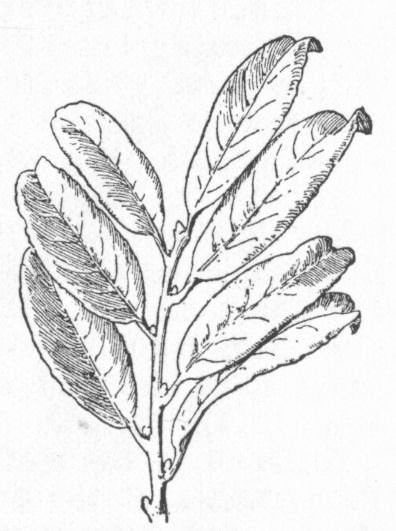
Alter′nate, in botany, placed on opposite sides of an axis at a different level, as leaves.—Alternate generation, the reproduction of young not resembling their parents, but their grandparents, continuously, as in the jelly-fishes, &c. See Generations, Alternation of.
Alternator. See Electricity.
Althæ′a, a genus of plants. See Hollyhock and Marsh-mallow.
Althorn, one of the instruments of the sax-horn family, the tenor sax-horn. See Sax-horn.
Al′tiscope, an instrument consisting of an arrangement of mirrors in a vertical framework, by means of which a person is enabled to overlook an object (a parapet, for instance) intervening between himself and any view that he desires to see, the picture of the latter being reflected from a higher to a lower mirror, where it is seen by the observer.
Al′titude, in mathematics, the perpendicular height of the vertex or apex of a plane figure or solid above the base. In astronomy it is the vertical height of any point or body above the horizon. It is measured or estimated by the angle subtended between the object and the plane of the horizon, and may be either true or apparent. The apparent altitude is that which is obtained immediately from observation; the true altitude, that which results from correcting the apparent altitude, by making allowance for parallax, refraction, &c. Altitude is one of the main determining influences of local climate. Its increase has the same effect on temperature as an increase of distance north or south of the equator.
Altitude-and-azimuth Instrument. See Altazimuth.
Alto, in music, the highest singing voice of a male adult, the lowest of a boy or a woman, being in the latter the same as contralto. The alto, or counter-tenor, is not a natural voice, but a development of the falsetto. It is almost entirely confined to English singers, and the only music written for it is by English composers. It is especially used in cathedral compositions and glees.
Altofts, a town of England, West Riding of Yorkshire, on the south of the Calder, 3 miles north-east of Wakefield, with a fourteenth-century Gothic church, and extensive collieries adjoining. Pop. (1921), 5050 (urban district).
Al′ton, a town of England, in Hampshire, 16 miles north-east of Winchester, famous for its ale. Pop. (1921), 5580.
Al′ton, a town of the United States, in Illinois, on the Mississippi near the mouth of the Missouri, with a state penitentiary, several mills and manufactories, and in the neighbourhood limestone and coal. Pop. 23,783.
Al′tona, an important commercial city of Schleswig-Holstein, on the right bank of the Elbe, adjoining Hamburg, with which it virtually forms one city. It is a free port, and its commerce, both inland and foreign, is large, being quite identified with that of Hamburg. Pop. (1919), 168,729.
Altoo′na, a town of the United States, in Pennsylvania, at the eastern base of the Alleghanies, 244 miles west of Philadelphia, with large machine-shops and locomotive factories. Pop. (1920), 60,331.
Al′torf, a small town of Switzerland, capital of the canton of Uri beautifully situated, near the Lake of Lucerne, amid gardens and orchards, and memorable as the place where, according to legend, Tell shot the apple from his son's head. A colossal statue of Tell now stands here. The town possesses a beautiful church containing a remarkable organ and a picture by Van Dyck. Pop. 3837.
Alto-rilievo.—Soldiers of the Prætorian Guard, the personal body-guard of the Emperor Augustus (in the Louvre, Paris).
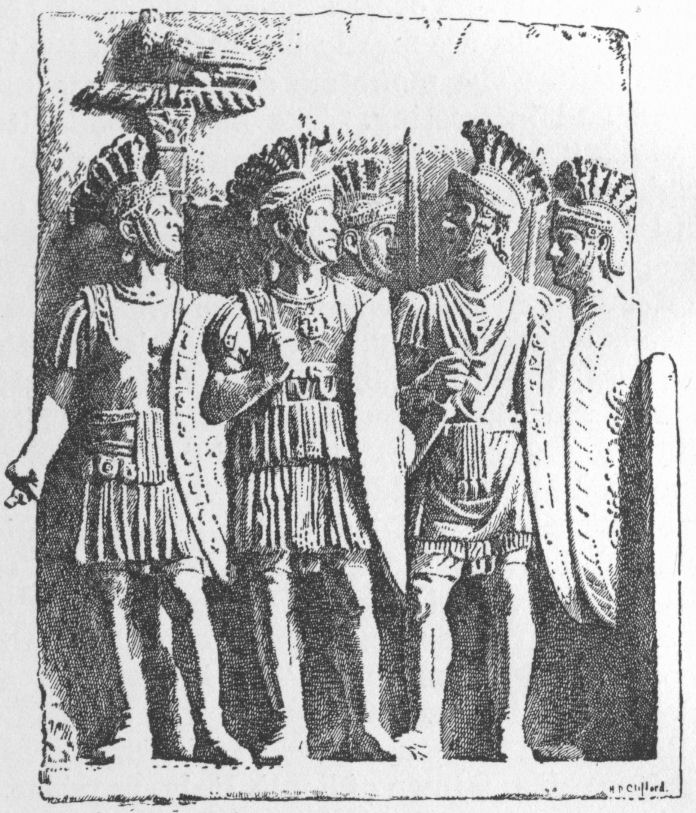
Alto-rilievo (a˙l′tō-rē-lē-ā″vo), high relief, a term applied in regard to sculptured figures to express that they stand out boldly from the background, projecting more than half their thickness, without being entirely detached. In mezzo-rilievo, or middle relief, the projection is one-half, and in basso-rilievo, or bas-relief, less than one-half. Alto-rilievo is further distinguished from mezzo-rilievo by some portion of the figures standing usually quite free from the surface on which they are carved, while in the latter the figures, though rounded, are not detached in any part.
Altötting (a˙lt-eut′ing), a famous place of pilgrimage, in Bavaria, 52 miles E.N.E. of Munich, near the Inn, with an ancient image of the Madonna (the Black Virgin) in a chapel dating from 696, and containing a rich treasure in gold and precious stones; and another chapel in which Tilly was buried. Pop. 5408.
Altranstädt (a˙lt′-ra˙n-stet), a village of Saxony, where a treaty was concluded between Charles XII, King of Sweden, and Augustus, Elector of Saxony and King of Poland, 24th Sept., 1706, by which the latter resigned the crown of Poland.
Alt′ringham, or Altrincham, a town of England, in Cheshire, 8 miles south-west of Manchester, resorted to by invalids; large quantities of fruit and vegetables are raised; and there are several industrial works. Pop. 20,461. Also a parliamentary division of the county.
Al′truism, a term first employed by the French philosopher Comte, to signify devotion to others or to humanity: the opposite of selfishness or egoism. It was adopted by the English positivists and applied to sociological problems of the physical theory of organic evolution. Herbert Spencer gives considerable space to the discussion of altruism and egoism in his Data of Ethics.
Altstätten (a˙lt′stet-n), a town of Switzerland, canton St. Gall, in the valley of the Rhine, 10 miles south of the Lake of Constance, with manufactures of cotton and woollen goods. Pop. 8743.
Altwasser (a˙lt′va˙s-ėr), a town of Prussia, in Silesia, 35 miles south-west of Breslau; here are made porcelain, machinery, iron, yarn, mirrors, &c. Pop. 17,321.
Al′um, a well-known crystalline, astringent substance with a sweetish taste, a double sulphate of potassium and aluminium with water of crystallization; formula, K2SO4.Al2(SO4)3.24 H2O. It crystallizes in colourless regular octahedra. Its solution reddens vegetable blues. When heated, its water of crystallization is driven off, and it becomes light and spongy with slightly corrosive properties, and is used as a caustic under the name of burnt alum. Alum is prepared in Great Britain at Whitby from alum-slate—where it forms the cliffs for miles—and was once manufactured near Glasgow from bituminous alum-shale and slate-clay, obtained from old coal-pits. It is also prepared near Rome from alum-stone. Common alum is strictly potash alum; other two varieties are soda alum and ammonia alum, both similar in properties. Iron alum (pale mauve) and chrome alum (deep purple) are compounds containing iron and chromium in place of aluminium. Alum is employed to harden tallow, to remove grease from printers' cushions and blocks in calico manufactories, and in dyeing as a mordant. It is also largely used in the composition of crayons, in tannery, and in medicine (as an astringent and styptic). Wood and paper are dipped in a solution of alum to render them less combustible.
Alumbagh (a-lam-bäg′), a palace and connected buildings in Hindustan, about 4 miles south of Lucknow. On the outbreak of the Indian Mutiny it was occupied by the revolted sepoys, and converted into a fort. On the 23rd Sept., 1857, it was captured by the British, and during the following winter a British garrison, under Sir James Outram, held out there, though repeatedly attacked by overwhelming numbers of the rebels, till in March, 1858, it was finally relieved. Sir Henry Havelock was buried within the grounds.
Alu′mina (Al2O3), the single oxide of the metal aluminium. As found native it is called corundum, when crystallized ruby or sapphire, when amorphous emery. It is next to the diamond in hardness. In combination with silica it is one of the most widely distributed of substances, as it enters in large quantity into the composition of granite, traps, slates, schists, clays, loams, and other rocks. The porcelain clays and kaolins contain about half their weight of this earth, to which they owe their most valuable properties. It forms compounds with certain colouring matters, which causes it to be employed in the preparation of the colours called lakes in dyeing and calico-printing. It combines with the acids and forms numerous salts, the most important of which are the sulphate (see Alum) and acetate, the latter of extensive use as a mordant.
Alumin′ium (symbol Al, atomic weight 27.1), a metal discovered in 1827, but nowhere found native, although its oxide, alumina (which see), is abundantly distributed. The minerals bauxite and cryolite are sources of aluminium, but the chief source is the pure oxide, from which the metal is obtained by means of a strong electric current. It is a shining white metal, of a colour between that of silver and platinum, very light (specific gravity, 2.56 cast, 2.67 hammered), not liable to tarnish nor undergo oxidation in the air, very ductile and malleable, and remarkably sonorous. It forms several useful alloys with iron and copper; one of the latter (aluminium gold) much resembles gold, and is made into cheap trinkets. Another, known as aluminium bronze, possesses great hardness and tenacity. Spoons, tea and coffee pots, dish-covers, musical and mathematical instruments, trinkets, &c., are made of aluminium.
Alum-root, the name given in America to two plants from the remarkable astringency of their roots, which are used for medical purposes: Gerānium maculātum and Heuchĕra americāna (nat. ord. Saxifragaceæ).
Alum-slate, or Alum-schist, a slaty rock from which much alum is prepared; colour greyish, bluish, or iron-black; often possessed of a glossy or shining lustre; chiefly composed of clay (silicate of alumina), with variable proportions of sulphide of iron (iron-pyrites), lime, bitumen, and magnesia.
Alum-stone. See Alunite.
Alunite, a mineral sulphate of aluminium and potassium, greyish or yellowish white, from which alum is prepared in Sicily by roasting and lixiviation. It is regarded as a possible source of potassium for agriculture and also of aluminium. A considerable vein occurs in Utah.
Alun′no, Niccolo (real name Niccolo de Liberatore), an Italian painter of the fifteenth century, the founder of the Umbrian School, born in Foligno about 1430, died 1502. Vasari, interpreting wrongly the passage "Nicholaus alumnus Fulginiæ", gave him the name of Alunno.
Al′va, a town of Scotland, in Clackmannanshire, 2½ miles north of Alloa, near the River Devon, at the foot of the Ochils. It manufactures woollen shawls, tweeds, yarn, &c. Pop. (1921), 4107.
Al′va, or Al′ba, Ferdinand Alvarez, Duke of, Spanish statesman and general under Charles V and Philip II, was born in 1508; early embraced a military career, and fought in the wars of Charles V in France, Italy, Africa, Hungary, and Germany. He is more especially remembered for his bloody and tyrannical government of the Netherlands (1567-73), which had revolted, and which he was commissioned by Philip II to reduce to entire subjection to Spain. Among his first proceedings was to establish the 'Council of Blood', a tribunal which condemned, without discrimination, all whose opinions were suspected, and whose riches were coveted. The present and absent, the living and the dead, were subjected to trial and their property confiscated. Many merchants and mechanics emigrated to England; people by hundreds of thousands abandoned their country. The Counts of Egmont and Horn, and other men of rank, were executed, and William and Louis of Orange had to save themselves in Germany. The most oppressive taxes were imposed, and trade was brought completely to a standstill. As a reward for his services to the faith the Pope presented him with a consecrated hat and sword, a distinction previously conferred only on princes. Resistance was only quelled for a time, and soon the provinces of Holland and Zealand revolted against his tyranny. A fleet which was fitted out at his command was annihilated, and he was everywhere met with insuperable courage. Hopeless of finally subduing the country he asked to be recalled, and accordingly, in Dec., 1573, Alva left the country, in which, as he himself boasted, he had executed 18,000 men. He was received with distinction in Madrid, but did not long enjoy his former credit. He had the honour, however, before his death (which took place in 1582) of reducing all Portugal to subjection to his sovereign. It is said of him that during sixty years of warfare he never lost a battle and was never taken by surprise.
Alvarado (a˙l-va˙-rä′dō), Pedro de, one of the Spanish 'conquistadores', was born towards the end of the fifteenth century, and died in 1541. Having crossed the Atlantic, he was associated (1519) with Cortez in his expedition to conquer Mexico; and was entrusted with important operations. In July, 1520, during the disastrous retreat from the capital after the death of Montezuma, the perilous command of the rear-guard was assigned to Alvarado. On his return to Spain he was received with honour by Charles V, who made him governor of Guatemala, which he had himself conquered. To this was subsequently added Honduras. He continued to add to the Spanish dominions in America till his death.
Alvarez (a˙l-va˙-reth′), Don José, a Spanish sculptor, born 1768, died 1827. His works are characterized by truth to nature, dignity, and feeling, one of the chief representing a scene in the defence of Saragossa. The Museo del Prado, in Madrid, contains some of his finest work.
Alve′olus, one of the sockets in which the teeth of mammals are fixed. Hence alveolar arches, the parts of the jaws containing these sockets.
Alverstoke. See Gosport.
Alverstone, Richard Everard Webster, first Viscount, eminent English lawyer, born in 1842, died in 1915. Educated at King's College School, the Charterhouse, and Trinity College, Cambridge, he was called to the bar in 1868, and made Q.C. in 1878. He was Member of Parliament for Launceston for a short time in 1885, and from that year to 1900 represented the Isle of Wight. He was Attorney-General from 1885-6, 1886-92, and 1895-1900, being then made Lord Chief Justice and elevated to the peerage: he had been created a baronet in 1899. He represented Britain in the arbitration with the United States regarding the Behring Sea (1893), in the affair of the Venezuelan and Guiana boundary (1898-9), and was one of three British commissioners who, with three from the United States, settled the Canada and Alaska boundary in 1903. Upon retiring in 1913 he was created viscount. His book Recollections of Bar and Bench was published in 1914.
Alwar (al-war′), a State of north-western Hindustan, in Rajputana; area, 3141 sq. miles; surface generally elevated and rugged, and much of it of an arid description, though water is generally found on the plains by digging a little beneath the surface, and the means of irrigation being thus provided, the soil, though sandy, is highly productive. This semi-independent State has as its ruler a rajah with a revenue of £232,000; military force, about 5000 infantry and 2000 cavalry. Pop. 791,688.—Alwar, the capital, is situated at the base of a rocky hill crowned by a fort, 80 miles S.S.W. of Delhi. It is surrounded by a moat and rampart, and is poorly built, but has fine surroundings; it contains the rajah's palace and a few other good buildings. Pop. 41,305.
Alys′sum (A. saxatile, L.), a native of Crete, a genus of cruciferous plants, several species of which are cultivated on account of their white or yellow coloured flowers; madwort.
Alyth (ā′lith), a town of Scotland, Perthshire, near the eastern boundary, with linen and jute manufactures. Pop. (1921), 1710.
Amad′avat (Estrilda amandāva), a small Indian singing bird allied to the finches and buntings; the female is olive-brown, and the male, in summer, largely crimson.
Amade′us, the name of several counts of Savoy. The first was the son of Humbert I, and succeeded him in 1048, dying about 1078; others who have occupied an important place in history are the following:—Amadeus V, 'the Great', succeeded in 1285; gained great honour in defending Rhodes against the Turks; increased his possessions by marriage and war; was made a prince of the empire; died in 1323.—Amadeus VIII succeeded his father, Amadeus VII, in 1391, and had his title raised to that of duke by the Emperor Sigismund. He was chosen regent of Piedmont; but after this elevation retired from his throne and family into a religious house. He now aspired to the papacy, and was chosen by the Council of Basel (1439), becoming Pope, or rather anti-Pope, under the name of Felix V, though he had never taken holy orders. He was recognized as Pope by only a few princes, and resigned in 1449, being the last of the anti-Popes. He died in 1451.
Amade′us, Duke of Aosta, for a short time King of Spain, second son of Victor Emanuel of Italy, and brother of Humbert I, King of Italy. He was born in 1845, and, thanks to the influence of Marshals Prim and Serrano, was chosen by the Cortes King of Spain in 1870, Queen Isabella having had to leave the country in 1868. He made his entrance into Madrid as king on 2nd Jan., 1871, and took the oath to the constitution. His position was far from comfortable, however, and, having little hope of becoming acceptable to all parties, he abdicated in 1873 (11th Feb.). He died in 1890.
Amade′us, Lake, a large salt lake or salt swamp in South Australia, and nearly in the centre of Australia. It was discovered by Giles in 1872, and is seldom visited, being in a dreary, arid region.
Am′adis, a name belonging to a number of heroes in the romances of chivalry, Amadis de Gaul being the greatest among them, and represented as the progenitor of the whole. The Spanish series of Amadis romances is the oldest. It is comprised in fourteen books, of which the first four narrate the adventures of Amadis de Gaul, this portion of the series having originated about the end of the thirteenth or beginning of the fourteenth century, and the subsequent books being added by various hands. An abridged English translation of Amadis of Gaul was published by Southey in 1803.
Amadou (am′a-dö), a name of several fungi, genus Polypŏrus, of a leathery appearance, growing on trees. See German Tinder.
Amager (a˙m′a-ger), a small Danish island in the Sound, opposite Copenhagen, part of which is situated on it. Rural pop. 25,000.
Amako′sa, one of the Kaffir tribes of S. Africa.
Amalasun′tha, daughter of Theodoric, king of the Ostrogoths, and after his death regent of Italy for her son Athalarich. Athalarich died in 534, after which Amalasuntha married her cousin Theodahad, but retained the power in her own hands. Mainly on this account she was imprisoned and strangled in her bath by order of her second husband, A.D. 535.
Amal′ekites, an ancient tribe occupying the peninsula between Egypt and Palestine, named after a grandson of Esau. They were denounced by Moses for their hostility to the Israelites during their journey through the wilderness, and they seem to have been all but exterminated by Saul and David. The Kenites seem to have been a branch of the Amalekites.
Amal′fi, a seaport in Southern Italy, on the Gulf of Salerno, 23 miles from Naples, the seat of an archbishop. In the early part of the Middle Ages it was a place of great commercial importance, and it long enjoyed a republican constitution of its own. Quarrels with its neighbours, encroachments of the sea, and other causes led to its downfall, but it is still much visited by tourists. The road from Salerno to Amalfi is a magnificent carriage-way, partly hewn in the cliffs, and affords charming views. Amalfi is surrounded by rocky heights, and its harbour was choked up by a landslip in 1900. Here arose the Amalfian Code of maritime law, composed in 1010 and containing 66 articles, which once had great influence in the maritime affairs of the Mediterranean trading peoples. The MS. was discovered by the Prince of Andorra, in 1844, in the imperial library at Vienna. Pop. 7472.
Amal′gam, a name applied to the alloys of mercury with the other metals. One of them is the amalgam of mercury with tin, which is used to silver looking-glasses. Mercury unites very readily with gold and silver at ordinary temperatures, and advantage is taken of this to separate them from their ores, the process being called amalgamation. The mercury dissolves and combines with the precious metal and separates it from the waste matters, and is itself easily driven off by heat. An amalgam made of cadmium and copper is frequently used in dentistry, and an amalgam of zinc and tin is used for the rubbers of frictional electric machines.
Amanita.—Two forms of fly-agaric
Amani′ta, a genus of fungi, one species of which, A. muscāria, or fly-agaric, is extremely poisonous.
Ama′nus, a branch of the Taurus Mountains in Asia Minor.
Amapala (a˙-ma˙-pä′la˙), a seaport of Central America, State of Honduras, on a small island.
Amarantha′ceæ, the amaranths, a nat. ord. of apetalous plants, chiefly found in tropical countries, where they are often troublesome weeds. They are remarkable for the white or sometimes reddish scales of which their flowers are composed. Amaranthus, the typical genus, comprises A. caudātus, or love-lies-bleeding, a common plant in gardens, with pendulous racemes of crimson flowers; and A. hypochondriăcus, or prince's feather. The blossoms keep their bloom after being plucked and dried (hence the name: Gr. a, not, and marainō, to wither).
Amarapura (a-ma-ra-pö′ra), a deserted city, once the capital of the Burmese Empire, on the left bank of the Irawadi, quite close to Mandalay. In 1810, when the city had about 175,000 inhabitants, it was completely destroyed by fire; in 1839 it was visited by a destructive earthquake. In 1857 the seat of government was removed to Mandalay. Pop. 6500.
Amaryllida′ceæ, an order of monocotyledonous plants, generally bulbous, occasionally with a tall, cylindrical, woody stem (as in Agave); with a highly-coloured flower, six stamens, and an inferior three-celled ovary; natives of Europe and most of the warmer parts of the world. The order includes the snowdrop, the snow-flake, the daffodil, the belladonna-lily (belonging to the typical genus Amaryllis), the so-called Guernsey-lily (probably a native of Japan), the Brunsvigias, the blood-flowers (Hæmanthus) of the Cape of Good Hope, different species of Narcissus, Agave (American aloe), &c. Many are highly prized in gardens and hot-houses; the bulbs of some are extremely poisonous.
Amasia (a˙-ma˙-sē′a˙), a town in the north of Asia Minor, on the Irmak, 60 miles from the Black Sea, surmounted by a rocky height in which is a ruined fortress; has numerous mosques, richly-endowed Mahommedan schools, and a trade in wine, silk, &c. Amasia was a residence of the ancient kings of Pontus. A few miles from Amasia, on the road leading to Zilleh, is the famous battle-field where Cæsar defeated Pharnaces, King of Pontus, and whence he sent his famous message to Rome: Veni, vidi, vici. Pop. 30,000.
Ama′sis, King of Egypt from 569 to 526 B.C., obtained the throne by rebelling against his predecessor and benefactor Apries, and is chiefly known from his friendship for the Greeks, and his wise government of the kingdom, which, under him, was in the most prosperous condition. He was succeeded by his son Psammetik.
Amati (a˙-mä′tē), a family, almost a dynasty, of Cremona who manufactured violins in the sixteenth and seventeenth centuries. Andrea (about 1540-1600) was the founder of the business, which was carried on by his sons Geronimo and Antonio, and by Niccolo the son of Geronimo. The first instrument signed Amati bears the date 1546. Most of the violins made by them are of comparatively small size and flat model, and the tone produced by the fourth or G string is somewhat thin and sharp. Many of Niccolo Amati's violins are, however, of a larger size and have all the fulness and intensity of tone characteristic of those manufactured by Stradivario and Guarnerio.
Amatit′lan, a town in Central America, State of Guatemala, about 15 miles south of the city of Guatemala, a busy modern town, the inhabitants of which are actively engaged in the cochineal trade. There is a small lake of the same name close to the town. Pop. 12,000.
Amauro′sis (Gr. amauros, dark), a species of blindness, formerly called gutta serena (the 'drop serene', as Milton, whose blindness was of this sort, called it), caused by disease of the nerves of vision. The most frequent causes are a long-continued direction of the eye on minute objects, long exposure to a bright light, to the fire of a forge, to snow, or irritating gases, overfulness of blood, disease of the brain, &c. If taken in time it may be cured or mitigated; but, unless caused by loss of blood, by lead-poisoning, or debility, it is usually incurable.
Amaxichi (a˙-ma˙ks′ē-hē), the chief town and seaport of Santa Maura (Leukadia), one of the Ionian Isles, the seat of a Greek bishop; manufactures cotton and leather. Pop. 5500.
Am′azon, or Am′azons, a river of South America, the largest in the world, formed by a great number of sources which rise in the Andes, the two head branches being the Tunguragua or Marañon and the Ucayali, both rising in Peru, the former from Lake Lauricocha, in lat. 10° 29′ S., the latter formed by the Apurimac and Urubamba, the headwaters of which are between lat. 14° and 16° S.; general course north of east; length, including windings, between 3000 and 4000 miles; area of drainage basin, 2,500,000 sq. miles. It enters the Atlantic under the equator by a mouth 200 miles wide, divided into two principal and several smaller arms by the large island Marajo and a number of smaller islands. In its upper course navigation is interrupted by rapids, but from its mouth upwards for a distance of 3300 miles (mostly in Brazil) there is no obstruction. It receives the waters of about 200 tributaries, 100 of which are navigable and seventeen of these 1000 to 2300 miles in length; northern tributaries: Santiago, Morona, Pastaça, Tigre, Napo, Putumayo, Japura, Rio Negro (the Cassiquiare connects this stream with the Orinoco), &c.; southern: Huallaga, Ucayali, Javari, Jutay, Jurua, Coary, Purus, Madeira, Tapajos, Xingu, &c. At Tabatinga, where it enters Brazilian territory, the breadth is 1½ miles; below the mouth of the Madeira it is 3 miles wide, and where there are islands often as much as 7; from the sea to the Rio Negro, 750 miles in a straight line, the depth is nowhere less than 30 fathoms; up to the junction of the Ucayale there is depth sufficient for the largest vessels. The Amazonian water system affords some 50,000 miles of river suitable for navigation. The rapidity of the river is considerable, especially during the rainy season (Jan. to June), when it is subject to floods; but there is no great fall in its course. The tides reach up as far as 400 miles from its mouth. The singular phenomenon of the bore, or as it is called on the Amazon the pororoca, occurs at the mouth of the river at spring-tides on a grand scale. The river swarms with alligators, turtles, and a great variety of fish. The country through which it flows is extremely fertile, and is mostly covered with immense forests; it must at some future time support a numerous population, and be the theatre of a busy commerce. Steamers and other craft ply on the river, the chief centre of trade being Para, at its mouth. The Amazon was discovered by Vicente Yañez Pinzon in 1500, but the stream was not navigated by any European till 1541, when Francis Orellana descended it. Orellana stated that he found on its banks a nation of armed women, and this circumstance gave the name to the river.