Volume 1 — VOLUME I (continued 4)
Reading edition
Agave (Agave americana)
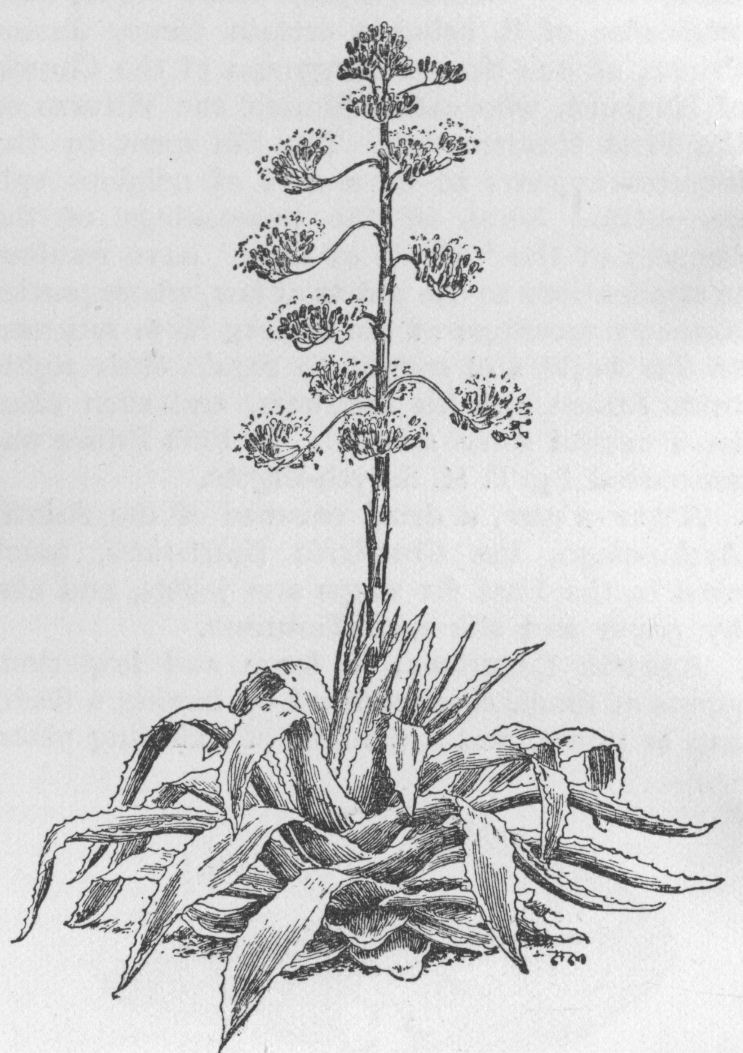
Agave (a-gā′vē), a genus of plants, nat. ord. Amaryllidaceæ (which includes the daffodil and narcissus), popularly known as American aloes. They are generally large, and have a massive tuft of fleshy leaves with a spiny apex. They live for many years—ten to seventy according to treatment—before flowering. When this takes place, the tall flowering stem springs from the centre of the tuft of leaves, and grows very rapidly until it reaches a height of 15, 20, or even 40 feet, bearing towards the end a large number of flowers. The best-known species is A. americāna, known as the Maguey or 'tree of wonders', introduced into Spain in 1561, and now extensively grown in the warmer parts of this continent as well as in Asia (India in particular). This and other species yield various important products, the chief being the fibre obtained by maceration from the leaves and roots, and known commercially as American aloe, pita flax, or vegetable silk. The sap when fermented yields a beverage resembling cider, the pulque beer of the Spaniards, or is distilled into an intoxicating spirit (Mezcal or Aguardiente). The leaves are used for feeding cattle; the fibres of the leaves are formed into thread, cord, and ropes, and are also good material for paper-making; an extract from the leaves is used as a substitute for soap; slices of the withered flower-stem are used as razor-strops.
Agde (a˙gd), a seaport of southern France, department of Hérault, with a cathedral, an ancient and remarkable structure. The trade, chiefly coasting, is extensive. Pop. 9265.
Age, a period of time representing the whole or a part of the duration of any individual thing or being, but used more specifically in a variety of senses. In law age is applied to the periods of life when men and women are enabled to do that which before, for want of years and consequently of judgment, they could not legally do. A male at twelve years old may take the oath of allegiance; at fourteen is at years of discretion, and therefore may choose his guardian or be an executor, although he cannot act until of age; and at twenty-one is at his own disposal, and may alienate and devise his lands, goods, and chattels. In English law a male at fourteen and a female at twelve may consent or disagree to marriage, but it cannot be celebrated without the consent of the parents or guardians until the parties are of age. A female at fourteen is at years of legal discretion, and may choose a guardian; at seventeen may be an executrix; and at twenty-one may dispose of herself and her lands. So that full age in male or female is twenty-one years, which age is completed on the day preceding the anniversary of a person's birth, who till that time is an infant, and so styled in law. In France majority is attained at twenty-one, whilst the marriageable age is eighteen for males and fifteen for females, subject to consent of parents or guardians. In England no one can take a seat in Parliament under twenty-one, be ordained a priest under twenty-four, nor made a bishop under thirty. In France a seat in the Chamber of Deputies may be taken only at twenty-five and in the Senate at forty. The law of Scotland divides life into three periods—pupilarity, minority, and majority. The first extends up to the time of legal puberty, that is, twelve years for a female and fourteen for a male, when they may marry; the second extends from this point up to twenty-one years, which is the time when majority is attained.
The term is also applied to designate the successive epochs or stages of civilization in history or mythology. Hesiod speaks of five distinct ages:—1. The golden or Saturnian age, a patriarchal and peaceful age. 2. The silver age, licentious and wicked. 3. The brazen age, violent, savage, and warlike. 4. The heroic age, which seemed an approximation to a better state of things. 5. The iron age, when justice and honour had left the earth. The term is also used in such expressions as the dark ages, the middle ages, the Elizabethan age, &c.
The Archæological Ages or Periods are three—the Stone Age, the Bronze Age, and the Iron Age, these names being given in accordance with the materials chiefly employed for weapons, implements, &c., during the particular period. The Stone Age of Europe has been subdivided into two—the Palæolithic or earlier, and Neolithic or later. The word age in this sense has no reference to the lapse of time—or not necessarily so—but simply refers to the stage at which a people has arrived in its progress towards civilization; thus there are races still in their stone age. The Palæolithic or earlier stone age in Europe was doubtless immensely earlier than the Neolithic, the latter being marked by implements of much greater finish than the former. See Stone Age.
Agen (a˙-zhan˙), one of the oldest towns in France, capital of department Lot-et-Garonne on the Garonne, 74 miles south-east of Bordeaux; see of a bishop; manufactures sailcloth and other articles, and has an extensive trade. The river is here crossed by a stone bridge, a suspension bridge, and a canal aqueduct. Pop. 23,294.
Agenor (a-jē′nor), a mythical Greek hero, King of Phœnicia, and father of Europa and Cadmus. Also one of the bravest among the Trojans, slain by Neoptolemus.
A′gent, a person appointed by another to act for or perform any kind of business for him, the latter being called in relation to the former the principal. Ambassadors were originally styled diplomatic agents.—In India, it is the name for an officer to whom political power is given to deal with native states.—Army Agent is a kind of military banker, authorized by the Government to manage the monetary affairs of a regiment. There are only a few of these agents, and consequently each has in charge the affairs of a number of different regiments.—Crown Agents are officials appointed by the secretary of state for the colonies to act as commercial and financial agents in this country for the different British colonies that are not self-governing; those that are self-governing appoint their own agents, who are designated agents-general.—Agent in mechanics is the general force producing a movement.
Ageratum (a-jer′a-tum), a genus of composite plants of the warmer parts of America, one species of which, A. mexicānum, is a well-known flower-border annual with dense lavender-blue heads. From it have been derived several varieties with flowers of different colours used chiefly as bedding plants.
Ager Publicus. See Agrarian Law.
Agesilaus (a-jes-i-lā′us), a king of Sparta, born in 444 B.C., and elevated to the throne after the death of his brother Agis II. He acquired renown by his exploits against the Persians, Thebans, and Athenians. Though a vigorous ruler, and almost adored by his soldiers, he was of small stature and lame from his birth. He died in Egypt in the winter of 361-360 B.C. His life has been written by Xenophon, Plutarch, and Cornelius Nepos.
Agglom′erate, in geology, a collective name for masses consisting of angular fragments ejected from volcanoes. When a rock mass consists largely of fragments worn and rounded by water it is called a conglomerate, and such masses were originally, no doubt, gravels and shingles on sea beaches and river channels.
Agglu′tinate Languages, languages in which the modifying suffixes are, as it were, glued on to the root, both it and the suffixes retaining a kind of distinctive independence and individuality, as in the Japanese, Turkish, and other Turanian languages, and the Basque language.
Agg′regate, a term applied in geology to rocks composed of several different mineral constituents capable of being separated by mechanical means, as granite, where the quartz, felspar, and mica can be separated mechanically.—In botany it is applied to flowers composed of many small florets having a common undivided receptacle, the anthers being distinct and separate, the florets commonly standing on stalks, and each having a partial calyx.
Aggry Beads, glass beads of various forms and colours, prized by the natives of West Africa as ornaments, and as having magical and medicinal virtues. Their origin and history are not well known. Such beads have been found in various parts of the world, including North and South America, and often in graves. Some authorities believe that the oldest of them are the work of the ancient Egyptians, or the Phœnicians, while the later are probably of Venetian origin.
Agha, see Aga.
Aghrim, see Aughrim.
Agincourt (a˙-zhan˙-kör), a village of Northern France, department Pas de Calais, famous for the battle of 25th Oct., 1415, between the French and English. Henry V, King of England, eager to conquer France, landed at Harfleur, took the place by storm, and wished to march through Picardy to Calais, but was met by a French army under the Constable d'Albret. The English numbered about 15,000 men, while the French numbers are variously given as from 50,000 to 150,000. The confined nature and softness of the ground were to the disadvantage of the French, who were drawn up in three columns unnecessarily deep. The English archers attacked the first division in front and in flank, and soon threw them into disorder. The second division fled on the fall of the Duc d'Alençon, who was struck down by Henry himself; and the third division fled without striking a blow. Of the French 10,000 were killed, including the Constable d'Albret, with six dukes and princes. The English lost 1600 men killed, among them the Duke of York, Henry's uncle. After the battle the English continued their march to Calais.
Agio (ā′ji-ō), the difference between the real and the nominal value of money, as between paper money and actual coin. It is used to denote both the difference between two currencies in the same country and the variations in the currencies of different countries. The term is derived from the It. aggiungere, to add, augment, hence agiotage. See Disagio and Balance of Trade.
Agira (a˙-jē′ra˙), (ancient Agyrium), a town of Sicily south-west of Etna. Pop. 22,485.
Agis (ā′jis), the name of four Spartan kings, the most important of whom was Agis IV, who succeeded to the throne in 244 B.C., and reigned four years. He attempted a reform of the abuses which had crept into the State—his plan comprehending a redistribution of the land, a division of wealth, and the cancelling of all debts. Opposed by his colleague Leonidas, advantage was taken of his absence, in an expedition against the Ætolians, to depose him. Agis at first took sanctuary in a temple, but he was treacherously seized and strangled, after going through the form of a trial.
Agistment (from the Lat. ad, to, and Fr. giste, lodging), a term designating the pasturing of horses, cattle, or sheep of another. See Bailment.
Agitators, an alternative form of Adjutators, a name given to the representatives elected in 1647 by the different regiments of the English parliamentary army.
Aglaia (a-glā′ya), wife of Hephaistos, in Greek mythology, one of the three Graces, the other two being Euphrosyne and Thalia.
Aglossa, a sub-order of anurous amphibia, the frogs, without a tongue.
Agnano (a˙-nyä′nō), until 1870 a lake of Italy, west of Naples, occupying probably the crater of an extinct volcano, but now drained.
Ag′nates, in the civil law, relations on the male side, in opposition to cognates, relations on the female side.
Agnello Pass, see European War.
Agnes, St., a virgin martyr who, according to the story, suffered martyrdom because she steadfastly refused to marry Sempronius, the prefect of Rome, and adhered to her religion in spite of repeated temptations and threats, A.D. 303. She was first led to the stake, but as the flames did not injure her she was beheaded. Her festival is celebrated on 21st Jan. For superstitions connected with St. Agnes' Eve see Keats's poem The Eve of St. Agnes. Tintoret's most remarkable picture is The Martyrdom of St. Agnes.
Agnes, St., the most southerly of the Scilly Islands. A lighthouse was erected here as early as 1680; another on the Wolf Rock near the island was completed in 1858.
Agnesi (a˙-nyā′sē), Maria Gaetana, a learned Italian lady, born at Milan in 1718. In her ninth year she was able to speak Latin, in her eleventh Greek; she then studied the oriental languages, and at the age of thirteen mastered Hebrew, besides French, Spanish, and German. She was called the 'Walking Polyglot'. She next studied geometry, philosophy, and mathematics. She was appointed, in 1750, professor of mathematics in the University of Bologna, ultimately took the veil, and died in 1799. Her sister, Maria Theresa, composed several cantatas and three operas.
Agni—Moore's Hindoo Pantheon
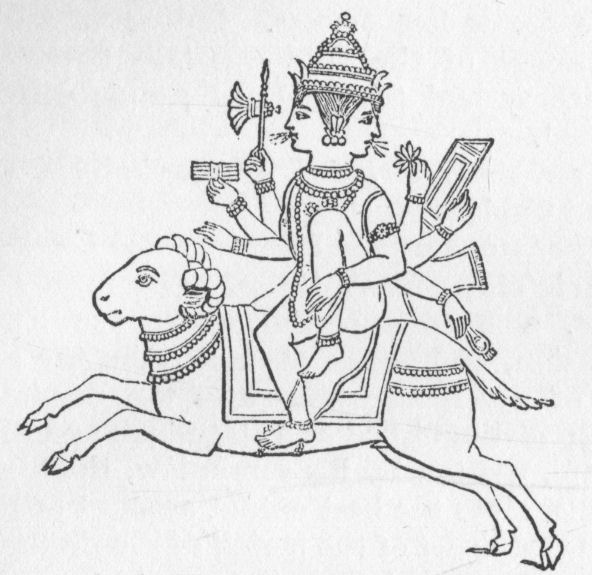
Ag′ni, the Hindu god of fire, second only to Indra, and one of the eight guardians of the world, and especially the lord of the south-east quarter. He is celebrated in many of the hymns of the Rig Veda. He is often represented as of a red or flame colour, and rides on a ram or a goat. He is still worshipped as the personification of fire, and the friction of two sticks for procuring the temple fire is still regarded as the symbol of Agni's miraculous rebirth.
Agnœtæ, a monophysitic sect of the sixth century.
Agnolo, Baccio d' (ba˙ch′ō da˙n′yo-lō), a Florentine wood-carver, sculptor, and architect; designed some of the finest palaces, &c., in Florence, such as the Villa Borghese, the Palais Bartolini, &c.; born 1460, died 1543.
Agno′men (Lat.), an additional name given by the Romans to an individual in allusion to some quality, circumstance, or achievement by which he was distinguished, as Africanus added to P. Cornelius Scipio.
Agnone (a˙-nyō′nā), a town of S. Italy, province of Molise, famous for the excellence of its copper wares. Pop. 6000.
Agnostics (ag-nos′tiks; Gr. a, not, gignōskein, to know), a modern term invented by Huxley in 1869 and applied to those who disclaim any knowledge of God, the origin of the universe, immortality, &c. The agnostics, or adherents of this doctrine, hold that the mind of man is limited to a knowledge of phenomena and of what is relative, and that, therefore, the infinite, the absolute, and the unconditioned, being beyond all experience, are consequently beyond its range. Agnosticism is therefore the attitude of 'solemnly suspended judgment', and cannot be identified with atheism. The agnostics do not deny the existence of a Divine Being, but merely maintain that we have no scientific ground for either belief or denial.—Bibliography: Sir Leslie Stephen, An Agnostic's Apology; R. Flint, Agnosticism; J. Ward, Naturalism and Agnosticism.
Agnus Castus, a shrub, Vitex Agnuscastus, nat. ord. Verbenaceæ, a native of the Mediterranean countries, with white flowers and acrid, aromatic fruits. It had anciently the imagined virtue of preserving chastity—hence the term castus (Lat., chaste).
Agnus Dei (dē′ī; Lat., 'the Lamb of God'), a term applied to Christ in John, i, 29, and in the Roman Catholic liturgy a prayer beginning with the words 'Agnus Dei', generally sung before the communion. The term is also commonly given to a medal, or more frequently a disk of wax, round, oblong, or oval, consecrated by the pope, stamped with the figure of a lamb supporting the banner of the cross; supposed to possess great virtues, such as preserving those who carry it in faith from accidents, &c. Jean Châtel, the assassin of Henri IV, was found covered with such medals.
Agon′ic Line (Gr. a, not, and gōnia, an angle), in terrestrial magnetism a name applied to the line which joins all the places on the earth's surface at which the needle of the compass points due north and south, without any declination. See Magnetism.
Ag′ony Column, a column in the advertising sheet of some of the daily journals, in which disappearances, losses, mysterious appeals and correspondence, and generally any advertising eccentricity appear.
Ag′ora, the market-place of a Greek town, corresponding to the Roman forum. The Agora of Athens is situated in a valley partially enclosed by the Acropolis, Areopagus, Pnyx, and Museum.
Agos′ta. See Augusta.
Agouara (a˙-gu¨-ä′ra˙), a name given to the crab-eating racoon (Procўon cancrivŏrus) of S. America.
Agoult (a˙-gö), Marie de Flavigny, Comtesse d', a French writer of fiction, history, politics, philosophy, and art; daughter of Vicomte de Flavigny; born at Frankfort in 1805, died at Paris 1876. She contributed many articles to the Revue des Deux-Mondes, &c., under the pseudonym of Daniel Stern, and wrote Lettres Républicaines (1848); Histoire de la Révolution de 1848; Esquisses Morales et Politiques; Trois Journées de la Vie de Marie Stuart; Florence et Turin (a series of artistic and political studies); Dante et Goethe; dialogues, and numerous romances, &c.
Agouta (a-gö′ta), Solenŏdon paradoxus, an insectivorous mammal peculiar to Hayti, of the tanrec family, somewhat larger than a rat. It has its tail devoid of hair and covered with scales, its eyes small, and an elongated nose like the shrews. Another species (S. cubānus) belongs to Cuba.
Agouti (a-gö′ti), the name of several rodent mammals, forming a family by themselves, genus Dasyprocta. There are eight or nine species, all belonging to S. America and the W. Indies. The common agouti, or yellow-rumped cavy (D. agouti), is of the size of a rabbit. It burrows in the ground or in hollow trees, lives on vegetables, doing much injury to the sugar-cane, is as voracious as a pig, and makes a similar grunting noise. Its flesh is white and good to eat.
Agra (ä′gra), a city of India, in the United Provinces, on the right bank of the Jumna, 841 miles by rail from Calcutta. It is a well-built and handsome town and has various interesting structures, among which are the imperial palace, a mass of buildings erected by several emperors; the Motí Masjid or Pearl Mosque (both within the old and extensive fort); the mosque called the Jama Masjid (a cenotaph of white marble); and, above all, the Taj Mahal, 'a dream in marble', a mausoleum of the seventeenth century, built by the Emperor Shah Jehan (1628-58) for his favourite queen, Mumtaz Mahal. It is made of white marble, and is adorned throughout with exquisite mosaics. Its cost is estimated at £800,000, and 20,000 workmen, under the direction of Austin of Bordeaux, were engaged on it for twenty-two years. There are several Protestant and Roman Catholic churches, a government college, and three other colleges or high schools, besides a medical college. Agra has a trade in grain, sugar, &c., and some manufactures, including beautiful inlaid mosaics. It was founded in 1566 by the Emperor Akbar, and was a residence of the emperors for over a century. Pop. 185,449. The Agra division has an area of 10,078 sq. miles, and a pop. of 5,007,900.
Agraffe′, a sort of ornamental buckle, clasp, or similar fastening for holding together articles of dress, &c., often adorned with precious stones.
Agram, or Zagreb, a city in Yugo-Slavia, capital of the former Hungarian province of Croatia and Slavonia, near the River Save; contains the residence of the ban or governor of Croatia and Slavonia, Government buildings, cathedral (being the see of a Roman Catholic archbishop), university, theatre, &c.; carries on an active trade, and manufactures tobacco, leather, and linens. Pop. 79,038.
Agra′phia. See Aphasia.
Agrarian Laws, laws enacted in ancient Rome for the division of the public lands, that is, the lands belonging to the State (ager publicus). As the territory of Rome increased, the public land increased, the land of conquered peoples being always regarded as the property of the conqueror. The right to the use of this public land belonged originally only to the patricians or ruling class, but afterwards the claims of the plebeians on it were also admitted, though they were often unfairly treated in the sharing of it. Hence arose much discontent among the plebeians, and various remedial laws were passed with more or less success. Indeed an equitable adjustment of the land question between the aristocracy and the common people was never attained.
Agravaine, Sir, one of the knights of the Round Table.
Agreement of the People. See Levellers.
Agric′ola, Gnæus Julius, lived from A.D. 37 to 93, a Roman consul under the Emperor Vespasian, and governor in Britain, the greater part of which he reduced to the dominion of Rome; distinguished as a statesman and general. His life, written by his son-in-law, the historian Tacitus, gives the best extant account of Britain in the early part of the period of the Roman rule. He was the twelfth Roman general who had been in Britain, but was the only one who effectually subdued the southern portion of it and reconciled the Britons to the Roman yoke. This he did by teaching them the arts of civilization and to settle in towns. He constructed the chain of forts between the Forth and the Clyde, defeated Galgacus at the battle of Mons Graupius, and sailed round the island, discovering the Orkneys.
Agric′ola, Georg (originally Bauer, that is, peasant = Lat. agricola), born in Saxony 1490, died at Chemnitz 1555, German physician and mineralogist. Though tinged with the superstitions of his age, he made the first successful attempt to reduce mineralogy to a science, and introduced many improvements in the art of mining. A complete edition of his works was published at Basel in 1550 and 1558.
Agricola, Johann, the son of a tailor at Eisleben, was born in 1492, and called, from his native city, master of Eisleben (magister Islebius); one of the most active among the theologians who propagated the doctrines of Luther. In 1537, when professor in Wittenberg, he stirred up the Antinomian controversy with Luther and Melanchthon. He afterwards lived at Berlin, where he died in 1566, after a life of controversy. Besides his theological works he composed a work explaining the common German proverbs.
Agricola, Johann Friedrich, German musician and composer, born near Altenburg 1720, died at Berlin 1774; pupil of Sebastian Bach; wrote several operas, including Iphigenia in Tauris. He wrote under the pseudonym of 'Olibrio'.
Agricola, Rodolphus, German scholar, born at Groningen 1443, died at Heidelberg 1485. After travelling in France and Italy he was appointed professor of philosophy at Heidelberg, and did good service in transplanting the revived classical learning into Germany.
Ag′riculture is the art of cultivating the ground, more especially with the plough and in large areas or fields, in order to raise grain and other crops for man and beast; including the art of preparing the soil, sowing and planting seeds, removing the crops, and also the raising and feeding of cattle or other live stock. This art is the basis of all other arts, and in all countries coeval with the first dawn of civilization. At how remote a period it must have been successfully practised in Egypt, Mesopotamia, and China we have no means of knowing, but there is sufficient evidence of agriculture having attained considerable development many centuries before the Christian era. Egypt was renowned as a corn country in the time of the Jewish patriarchs, and had probably been so for centuries before. The hieroglyphics on ancient monuments furnish records of the early development of agriculture in Egypt and of the use of the plough and other agricultural implements. The advanced methods of the Egyptians and Syrians were introduced into Europe by the Saracens. Land culture also attained a more or less considerable development in ancient China and Hindustan. Among the ancient Greeks the implements of agriculture were very few and simple. Hesiod, who wrote a poem on agriculture as early as the eighth century B.C., mentions a plough consisting of three parts, the share-beam, the draught-pole, and the plough-tail, but antiquarians are not agreed as to its exact form. The ground received three ploughings, one in autumn, another in spring, and a third immediately before sowing the seed. Manures were applied, and the advantage of mixing soils, as sand with clay or clay with sand, was understood. Seed was sown by hand, and covered with a rake. Grain was reaped with a sickle, bound in sheaves, thrashed, then winnowed by wind, laid in chests, bins, or granaries, and taken out as wanted by the family, to be ground. Agriculture was highly esteemed among the ancient Romans, and very full accounts are contained in the works of Pliny, Virgil, Cato, Varro, and Palladius. The Romans used a great many different implements of agriculture. The plough is represented by Cato as of two kinds, one for strong, the other for light soils. Varro mentions one with two mould-boards, with which, he says, "when they plough, after sowing the seed, they are said to ridge". Pliny mentions a plough with one mould-board, and others with a coulter, of which he says there were many kinds. Fallowing was a practice rarely deviated from by the Romans. In most cases a fallow and a year's crop succeeded each other. Manure was collected from various sources, and irrigation was practised on a large scale.
The Romans introduced their agricultural knowledge among the Britons, and during the most flourishing period of the Roman occupation large quantities of corn were exported from Britain to the Continent. During the time that the Angles and Saxons were extending their conquests over the country agriculture must have been greatly neglected; but afterwards it was practised with some success among the Anglo-Saxon population, especially, as was generally the case during the Middle Ages, on lands belonging to the Church. Swine formed at this time a most important portion of the live stock, finding plenty of oak and beech mast to eat. The feudal system introduced by the Normans, though beneficial in some respects as tending to ensure the personal security of individuals, operated powerfully against progress in agricultural improvements. War and the chase, the two ancient and deadliest foes of husbandry, formed the most prominent occupations of the Norman princes and nobles. Thriving villages and smiling fields were converted into deer forests, vexatious imposts were laid on the farmers, and the serfs had no interest in the cultivation of the soil. But the monks of every monastery retained such of their lands as they could most conveniently take charge of, and these they cultivated with great care, under their own inspection, and frequently with their own hands. The various operations of husbandry, such as manuring, ploughing, sowing, harrowing;, reaping, thrashing, winnowing, &c., are incidentally mentioned by the writers of those days; but it is impossible to collect from them a definite account of the manner in which those operations were performed.
While there is much in the writings of the old English chroniclers concerning the tenure of land, upon which subject the Domesday Book gives much enlightenment, there is a great lack of information as to the manner in which the land was cultivated. Information began to be recorded in the middle of the thirteenth century, but only one treatise is known to have been written, namely, La Dite de Husbanderye, an essay in Norman French by Walter de Henley. This work was superseded by another treatise, the best of the early works on the subject, and published in the reign of Henry VIII (in 1523) by Sir A. Fitzherbert, judge of the Common Pleas. It is entitled the Book of Husbandry, and contains directions for draining, clearing, and enclosing a farm, for enriching the soil, and rendering it fit for tillage. Lime, marl, and fallowing are strongly recommended. The subject of agriculture attained some prominence during the reign of Elizabeth. The principal writers of that period were Tusser, Googe, and Sir Hugh Platt. Tusser's Five Hundreth Pointes of Good Husbandry (first complete edition published in 1580) conveys much useful instruction in metre, but few works of this time contain much that is original or valuable. The first half of the seventeenth century produced no systematic work on agriculture, though several on different branches of the subject. About 1645 the field cultivation of red clover was introduced into England, the merit of this improvement being due to Sir Richard Weston, author of a Discourse on the Husbandry of Brabant and Flanders, to whom also belongs the credit of first growing turnips in England. The Dutch had devoted much attention to the improvement of winter roots, and also to the cultivation of clover and other artificial grasses, and the farmers and proprietors of England soon saw the advantages to be derived from their introduction. Potatoes had been introduced during the latter part of the sixteenth century, but were not for long in general cultivation. A number of writers on agriculture appeared in England during the Commonwealth, the most important works on the subject being Blythe's Improver Improved and Hartlib's Legacy. The former writer speaks of a rotation, or rather alternation of crops, and well knew the use of lime, as also of other manures. In the eighteenth century the first name of importance in British agriculture is that of Jethro Tull, a gentleman of Berkshire, who began to drill wheat and other crops about the year 1701, and whose Horse-hoeing Husbandry was published in 1731. Tull was a great advocate of the system of sowing crops in rows or drills with an interval between every two or three rows wide enough to allow of ploughing or hoeing to be carried on. This enabled the ground to be cleared with crops still growing, thus obviating the necessity for 'bare fallow' and leading to the four-course or Norfolk Rotation of Charles, second Viscount Townshend, the first agriculturist to cultivate turnips on a large scale. After the time of Tull and Townshend no great alteration in British agriculture took place till Robert Bakewell and others effected some important improvements in the breeds of cattle, sheep, and swine in the latter half of the eighteenth century. The raising and maintenance of live stock, especially of sheep, was a characteristic of English farming from a very early time, and for several centuries the country had almost a monopoly in the supply of wool. To Bakewell we owe the well-known breed of Leicester sheep. By the end of the century it was a common practice to alternate green crops with grain crops, instead of exhausting the land with a number of successive crops of corn. A well-known writer on agriculture at this period, and one who did a great deal of good in diffusing a knowledge of the subject, was Arthur Young. Scotland was for a long time behind England in agricultural progress. Great progress was made during the eighteenth century, however, especially in the latter half of it, turnips being introduced as a field-crop, and new implements such as the swing-plough and the thrashing-machine coming into general use. The construction of good roads through the country also gave agriculture a great impulse. During the wars caused by the French revolution (1795-1815) the high price of agricultural produce led to an extraordinary improvement in agriculture all over Britain. The establishment of the institution called the National Board of Agriculture was also of very great service to British husbandry at this period. Though a private association, it was assisted by an annual parliamentary grant, and prizes were given by it for the encouragement of experiments and improvements in agriculture. It existed from 1793 to 1816.
Among other societies which have greatly furthered the progress of agriculture in Britain, the chief in existence at the present day are the Smithfield Club, inaugurated in 1798; the Royal Agricultural Society of England, established in 1838; the Highland and Agricultural Society of Scotland, founded in 1783; and the Royal Agricultural Society of Ireland, instituted in 1841. The objects of these and similar societies are such as the following: To encourage the introduction of improvements in agriculture; to encourage the improvement of agricultural implements and farm buildings; the application of chemistry to agriculture; the destruction of insects injurious to vegetation; to promote the discovery and adoption of new varieties of grain, or other useful vegetables; to collect information regarding the management of woods, plantations, and fences; to improve the education of those supported by the cultivation of the soil; to improve the veterinary art; to improve the breeds of live stock, &c. Shows are held, at which prizes are distributed for live stock, implements, and farm produce.
Through the efforts of the above-mentioned and other societies, the investigations of scientific men, the general diffusion of knowledge among all classes, and the necessity of competing with producers in foreign countries, agriculture made vast strides in Britain during the nineteenth century and the beginning of the twentieth. Among the chief improvements we may mention deep ploughing and thorough draining. By the introduction of new or improved implements the labour necessary to the carrying out of agricultural operations has been greatly diminished, and advancement in this direction has been promoted by the necessities of the Great War. Labour-saving machinery is likely to be used in future on an increasingly large scale. Science, too, has been called in to act as the handmaid of art, and in its application we owe very much to the researches conducted at the Rothamsted Experimental Station, founded in 1834 by Lawes, who endowed the Lawes Trust in 1889. Gilbert and he worked together from 1843 to the end of last century. It is primarily by the investigations of the chemist and physicist that agriculture has been put on a really scientific basis. The physiology of plants and animals, and the complex properties of soils, have all been investigated, and most important results obtained. Artificial manures, in great variety to supply the elements wanted for plant growth, have come into common use, and the free nitrogen of the air is now worked up into various substances by which the nitrate of soda imported from South America can be replaced. An improvement in all kinds of stock is becoming more and more general, feeding is conducted on more scientific principles, and improved varieties of crop-plants are created by applying the principles of Mendel and other scientists. Much attention is also devoted to seed-testing, and the applications of electricity to agriculture are being developed.
As a result of the new conditions, to be a thoroughly-trained and competent agriculturist requires a special education, partly theoretical, partly practical. In many countries there are now agricultural schools or colleges supported by the State, and many such institutions exist in Britain. In Scotland, the Edinburgh chair of Rural Economy was founded in 1790; in Ireland, the Glasnevin Institution was inaugurated in 1838; and the establishment of the Royal Agricultural College, Cirencester, dates from 1845. In the United States nearly all the States have now colleges, or departments of colleges, devoted to the teaching of agriculture, and large allotments of public land have been made for their support. There are also numerous experimental stations. In Britain there has been a Board of Agriculture since 1889, under a cabinet minister, which was constituted a ministry in 1919; previously there was only a department under a committee of the Privy Council.
It is probable that on the whole the agriculture of Britain is farther advanced than that of any other region of similar size. Wheat, barley, and oats are the chief cereals in Britain; the chief roots are turnips and potatoes; other crops (besides grass and clover) are beans, peas, mangold, hops, and flax. In Europe at large the principal cereals are wheat, oats, barley, and rye, wheat being mostly grown in the middle and southern regions, such as France, Spain, part of Germany, Austria, Hungary, Italy, and southern Russia, the others in the more northern portion, while maize is grown in the warmest parts. Turnips are comparatively little grown out of Britain, beet-root in some sense taking their place; potatoes, however, are largely cultivated, except in the south. In the United States maize is the chief corn crop, next to which comes wheat, then oats; potatoes are an important crop, but turnips are only grown to a very small extent. In Canada large quantities of wheat are grown (more especially in Manitoba and the North-West), much is also now produced in the Australian colonies, in India, Argentina, &c.—Bibliography: W. Fream, Elements of Agriculture; C. W. Burkett, Agriculture for Beginners; Encyclopædia of Agriculture (Gresham Publishing Company).
Agrigentum (-jen′tum) (modern Girgenti), an ancient Greek city of Sicily, founded about 580 B.C., and long one of the most important places on the island. The town is also famous as the birthplace of the philosopher Empedocles. Extensive ruins of splendid temples and public buildings yet attest its ancient magnificence. See Girgenti.
Ag′rimony (Agrimonia), a genus of plants, nat. ord. Rosaceæ, consisting of slender perennial herbs found in temperate regions. A. Eupatoria, or common agrimony, was formerly of much repute as a medicine in England. Its leaves and rootstock are astringent, and the latter yields a yellow dye. The plant is a common weed on the borders of cornfields and on roadsides.
Agrippa, Herod. See Herod Agrippa.
Agrippa, Marcus Vipsanius, a Roman statesman and general, the son-in-law of Augustus; born 63 B.C., died 12 B.C. He was prætor in 41 B.C.; consul in 37, 28, and 27; ædile in 33; and tribune from 18 till his death. He commanded the fleet of Augustus in the battle of Actium. To him Rome is indebted for three of her principal aqueducts, the Pantheon, and several other works of public use and ornament.
Agrip′pa, von Nettesheim, Cornelius Henry, born in 1486 at Cologne, soldier, doctor, and, by common reputation, a magician. In his youth he was secretary to the Emperor Maximilian I; he subsequently served seven years in Italy, and was knighted. On quitting the army he devoted himself to science, became famous as a magician and alchemist, and was involved in disputes with the churchmen. After an active, varied, and eventful life he died at Grenoble in 1534 or 1535. His works were published at Lyons in 1550.
Agrippi′na, the name of several Roman women, among whom we may mention: 1. The youngest daughter of Marcus Vipsanius Agrippa, and wife of C. Germanicus; a heroic woman, adorned with great virtues. Tiberius, who hated her for her virtues and popularity, banished her to the Island of Pandataria, where she starved herself to death in A.D. 33. 2. A daughter of the last mentioned, and the mother of Nero, by Domitius Ahenobarbus. Her third husband was her uncle, the Emperor Claudius, whom she subsequently poisoned to secure the government of the Empire through her son Nero. After ruling a few years in her son's name he became tired of her ascendency, and caused her to be assassinated (A.D. 60).
Agropyron, a genus of grasses most of which are perennials. The root-stalks of Agropyron repens (Radix Graminis) have aperient and diuretic properties.
Agrostem′ma. See Corncockle.
Agros′tis, a genus of grasses, consisting of many species, and valuable as pasture-grasses. The bent-grasses belong to the genus.
Ag′telek, a village in Hungary, near the road from Pesth to Kassa, with about 600 inhabitants, celebrated for one of the largest and most remarkable stalactitic caverns in Europe.
Agua (a˙g′wa˙), an active volcano of Central America, in Guatemala, rising to the height of 15,000 feet. It has twice destroyed the old city of Guatemala, in its immediate vicinity.
Aguara (a˙-gwä′ra˙). See Agouara.
Aguardiente (a˙-gwär-dē-en′te), a popular spirituous beverage of Spain and Portugal, a kind of coarse brandy, made from red wine, from the refuse of the grapes left in the wine-press, &c., generally flavoured with anise; also a Mexican alcoholic drink distilled from the fermented juice of the agave.
Aguas Calientes (a˙g′wa˙s ka˙-lē-en′tās; lit. 'warm waters'), a town 270 miles N.W. of Mexico, capital of the State of its own name, named from the thermal springs near it; has manufactures of cottons and a considerable trade. Pop. 45,198.—Aguas Calientes State has an area of 2,968 sq. miles, and a pop. of 124,500.
Ague (ā′gū), a kind of fever, which may be followed by serious consequences, but generally is more troublesome than dangerous. According to the length of the interval between one febrile paroxysm and another, agues are denominated quotidian when they occur once in twenty-four hours, tertian when they come on every forty-eight hours, quartan when they visit the patient once in seventy-two hours. Ague arises from marsh miasmata, a temperature above 60° being, however, apparently required to produce it. To cure the disease and prevent the recurrence, quinine and various other bitter and astringent drugs are given with complete success in the majority of cases.
Ague-cake, a tumour caused by enlargement and hardening of the spleen, often the consequence of ague or intermittent fever.
Aguesseau (a˙-ges-ō), Henri François d', a distinguished French jurist and statesman, born at Limoges in 1668; was in 1690 advocate-general at Paris, and at the age of thirty-two procureur-général of the Parliament. He risked disgrace with Louis XIV by successfully opposing the famous papal bull Unigenitus. He was made chancellor in 1717, was deprived of his office in 1718 on account of his opposition to Law's system of finance, but had to be recalled in 1720. In 1722 he had to retire a second time; but was recalled in 1727 by Cardinal Fleury, and in 1737 again got the chancellorship, which he held till 1750. He died in 1751.
Aguilar (a˙-gē-lär′), a town of Spain, province of Cordova, in Andalusia, in a good wine-producing district, and with a trade in corn and wine. Pop. 12,635.
Aguilar (a-gi-lär′), Grace, an English writer, born at Hackney 1816, died at Frankfort 1847. Of Jewish parentage, she at first devoted herself to Jewish subjects, such as The Women of Israel, The Jewish Faith, &c.; but her fame rests on her novels, Home Influence, A Mother's Recompense, Home Scenes and Heart Studies, &c., most of which were published posthumously by her mother.
Aguilas (a˙-gē′la˙s), a flourishing seaport of Southern Spain, province of Murcia, with copper and lead smelting works. Pop. 15,967.
Agulhas (a˙-gu¨l′ya˙s), Cape, a promontory, forming the most southern extremity of Africa, about 90 miles south-east of the Cape of Good Hope, rising to 455 feet above the sea, with a lighthouse.
Agu′ti. See Agouti.
A′hab, the seventh King of Israel, succeeded his father Omri, 918-897 or 875-853 B.C. At the instigation of his wife Jezebel he erected a temple to Baal, and became a cruel persecutor of the true prophets. He was killed by an arrow at the siege of Ramoth-Gilead. He was succeeded by his son Ahaziah.
Ahag′gar, a mountainous region of the Sahara, south of Algeria, with some fertile valleys, inhabited by the Tuaregs.
Ahanta. See Gold Coast, West Africa.
Ahasue′rus, in Scripture history, a king of Persia, probably the same as Xerxes, the husband of Esther, to whom the Scriptures ascribe a singular deliverance of the Jews from extirpation.—Ahasuerus is also a Scripture name for Cambyses, the son of Cyrus (Ezra, iv, 6), and for Astyages, King of the Medes (Dan. ix, 1). Ahasuerus is also the traditional name of the wandering Jew.
A′haz, the twelfth King of Judah, succeeded his father Jotham, 742-727 or 734-715 B.C. Forsaking the true religion, he gave himself up completely to idolatry, and plundered the temple to obtain presents for Tiglath-Pileser, King of Assyria.
Ahazi′ah.—1. Son of Ahab and Jezebel, and eighth King of Israel, died from a fall through a lattice in his palace at Samaria after reigning two years (896, 895 B.C.).—2. Fifth or sixth King of Judah, and nephew of the above. He reigned but one year, and was slain (884 B.C.) by Jehu.
Ahith′ophel, privy-councillor to David, and confederate and adviser of Absalom in his rebellion against his father. When Hushai's advice prevailed, Ahithophel, despairing of success, hanged himself.
Ahmedabad, or Ahmadabad (ä-mad-ä-bäd), a town of India, presidency of Bombay, in district of its own name, on the left bank of the Sábarmatí, 310 miles north of Bombay. It was founded in 1412 by Ahmed Shah, and was converted by him into a great capital, adorned with splendid edifices. It came finally into the hands of the British in 1818. It is still a handsome and populous place, enclosed by a wall, with many noteworthy buildings; manufactures of fine silk and cotton fabrics, cloths of gold and silver, pottery, paper, enamel, mother-of-pearl, &c. There were disturbances here in 1919. (See Rowlatt Act.) Pop. 216,777.—Area of district, 3949 sq. miles; pop. 795,094.
Ahmed Mirza, Shah of Persia, born in 1898. He succeeded his father, Mohammed Ali, when the latter was deposed on 16th July, 1909.
Ahmednag′ar, a town of India, presidency of Bombay, in district of its own name, surrounded by an earthen wall; with manufactures of cotton and silk cloths. Near the city is the fort, built of stone and 1½ miles round. Pop. (including military) 42,032.—Area of district, 6645 sq. miles; pop. 945,305.
Ahmed Shah, born 1724, died 1773, founder of the Durâni dynasty in Afghanistan. On the assassination of Nadir he proclaimed himself shah, and set about subduing the provinces surrounding his realm. Among his first acts was the securing of the famed Koh-i-noor diamond, which had fallen into the hands of his predecessor. He crossed the Indus in 1748, and his conquests in Northern India culminated in the defeat of the Mahrattas at Panipat (6th Jan., 1761). Affairs in his own country necessitated his withdrawal from India, but he extended his empire vastly in other directions far beyond the limits of modern Afghanistan. He was succeeded by his son Timur.
Ahriman (ä′ri-man; in the Zend Angromainyus, 'spirit of evil or annihilation'), according to the dualistic doctrine of Zoroaster, the origin or the personification of evil, sovereign of the Devas or evil spirits, lord of darkness and of death, being thus opposed to Ormuzd (Ahuramazda), the spirit of good and of light.
Ah′waz, a small Persian town on the River Karun, province of Khuzistan, at the head of river navigation, a place of some commercial note. In the neighbourhood are the vast ruins of a city supposed to date from the time of the Parthian Empire.
Ai (ä′ē). See Sloth.
Aid, a subsidy paid in ancient feudal times by vassals to their lords on certain occasions, the chief of which were: when their lord was taken prisoner and required to be ransomed, when his eldest son was to be made a knight, and when his eldest daughter was to be married and required a dowry. From the Norman Conquest to the fourteenth century the collecting of aids by the Crown was one of the forms of taxation, being afterwards regulated by Parliament.
Ai′dan, Saint, Bishop of Lindisfarne, was originally a monk of Iona, in which monastery Oswald I, who became king of Northumberland in 635, had been educated. At the request of Oswald, Aidan was sent to preach Christianity to his subjects, and established himself in Lindisfarne as the first Bishop of Durham. He died in 651.
Aide-de-camp (ād-dė-ka˙n˙), a military officer who conveys the orders of a general to the various divisions of the army on the field of battle, and at other times acts as his secretary and general confidential agent.
Aidin (a˙-i-dēn′), or Guzel Hissar, a town in Asia Minor, about 60 miles south-east of Smyrna, with which it is connected by rail; has fine mosques and bazaars, is the residence of a pasha, and has an extensive trade in cotton, leather, figs, grapes, &c. Pop. 35,000.
Aigrette′ (French), a term used to denote the feathery crown attached to the seeds of various plants, such as the thistle, dandelion, &c. (called in botany pappus).—It is also applied to any head-dress in the form of a plume, whether composed of feathers, flowers, or precious stones.
Aigues Mortes (āg mort; Lat. Aquæ Mortuæ, 'dead waters'), a small town of Southern France, near the mouths of the Rhone, department of Gard; with ancient walls and castle; near it are lagoons, from which great quantities of salt are extracted. Pop. 4000.
Aiguille (ā′gwil; Fr., lit. a needle), a name given in the Alps to the needle-like points or tops of granite, gneiss, quartz, and other crystalline rocks and mountain masses; also applied to sharp-pointed masses of ice on glaciers and elsewhere.—It is also the name given to a peculiarly-shaped French mountain in Isère, 6500 feet high.
Aigun (ī-gu¨n′), a town of China, in Manchuria, on the Amur, with a good trade. Pop. 15,000.
Ai′kin, John, M.D., an English miscellaneous writer, born 1747, died 1822. He practised as physician at Chester, Warrington (where he taught physiology and chemistry at the Dissenters' Academy), and London; turned his attention to literature and published various works of a miscellaneous description, some in conjunction with his sister Mrs. Barbauld, including the popular Evenings at Home (1792-5), written with the view of popularizing scientific subjects. His General Biographical Dictionary (in 10 vols.) was begun in 1799 and finished in 1815. He was editor of the Monthly Magazine from 1796 till 1807.
Ai′kin, Lucy, daughter of the preceding, was born in 1781, and died 1864. In 1810 she published Poetical Epistles on Women, which was followed by a number of books for the young and a novel Lorimer (1814). In 1818 appeared her Memoirs of the Court of Queen Elizabeth, a very popular work. She afterwards produced similar works on the reigns of James I (1822) and Charles I (1833), and a Life of Addison (1843). In 1824 she had published the literary remains and biography of her father. She carried on an interesting correspondence with Dr. Channing from 1826-42, which was published in 1874.
Aikman, William, an eminent Scottish portrait-painter, born in Forfarshire in 1682, died in 1731. He studied at Edinburgh and in Italy, visited Turkey, and spent the later portion of his life in London, where he enjoyed the friendship of most of the distinguished men of Queen Anne's time. The portrait of President Duncan Forbes (1685-1747) in the National Gallery is attributed to him.
Ailan′to, or Ailanthus (meaning tree of the gods), a tree, genus Ailantus, nat. ord. Simarubaceæ. The A. glandulōsa, a large and handsome tree, with pinnate leaves 1 or 2 feet long, is a native of China, but has been introduced into Europe and North America. A species of silk-worm, the ailanthus silk-worm (Saturnia cynthia), feeds on its leaves, and the material produced, though wanting the fineness and gloss of mulberry silk, is produced at less cost, and is more durable. The wood is hard, heavy, yellowish-white, and will take a fine polish. The tree has been in cultivation in England since 1751.
Aileron. See Aeronautics, Aeroplane.
Ail′red (contracted form of Ethelred), a religious and historical writer, supposed to have been born in 1097, but whether in Scotland or in England is not known, died 1166; abbot of Rievaulx, in the North Riding of Yorkshire. Wrote lives of Edward the Confessor and St. Margaret, Queen of Scotland, Genealogy of the Kings of England, The Battle of the Standard, &c.
Ailsa Craig, a rocky islet in the Firth of Clyde, 10 miles from the coast of Ayr, of a conical form, 1097 feet high, and about 2 miles in circumference, precipitous on all sides except the north-east, where alone it is accessible, frequented by innumerable sea-fowl, including solan-geese, and covered with grass. On it is a lighthouse.
Ailu′rus. See Panda.
Aimard (ā-mär), Gustave, French novelist, born 1818, died 1883. He lived for ten years among the Indians of North America, and wrote a number of stories dealing with Indian life, such as Les Trappeurs de l'Arkansas (1858), La Loi de Lynch (1859), Les Nuits Mexicaines (1863), Les Bohèmes de la Mer (1865), which have been popular in English translations. His work is not unlike that of Fenimore Cooper.
Ain (an˙), a south-eastern frontier department of France, mountainous in the east (ridges of the Jura), flat or undulating in the west, divided into two nearly equal parts by the River Ain, a tributary of the Rhône; area, 2248 sq. miles; pop. (1921), 315,757. Capital, Bourg.
Ainger (ān′jėr), Rev. Alfred, born in 1837, died in 1904, was educated at King's College, London, and Trinity Hall, Cambridge, took orders after gaining his degree, and in 1866 was appointed reader of the Temple Church, London. He was made Master of the Temple in 1893, while holding also a canonry in Bristol Cathedral, to which he had been appointed in 1887. He was highly successful as a preacher, but is chiefly known by his literary labours, especially those connected with Lamb and Hood, whose works he edited. The volumes on Lamb and on Crabbe in the 'English Men of Letters' series are by him, and he wrote a memoir of Hood for his edition of the works. A volume of his sermons under the title of The Gospel of Human Life was published after his death in 1904. Cf. Edith Sichel, Life and Letters of Canon Ainger.
Ainmiller (īn′mil-er), Max Emanuel, a German artist who may be regarded as the restorer of the art of glass-painting, born 1807, died 1870. As inspector of the State institute of glass-painting at Munich he raised this art to a high degree of perfection by the new or improved processes introduced by him. Under his supervision this establishment (which afterwards became his own) produced a vast number of painted windows for ecclesiastical and other buildings, among the principal being a series of forty windows, containing a hundred historical and scriptural pictures, in Glasgow Cathedral. Some of his work is in St. Paul's Cathedral, and his finest productions are the windows in the Cathedrals of Cologne and Regensburg.
Ainos (ī′nōz; that is, men), the native name of an uncivilized race of people inhabiting the Japanese island of Yesso, as also Sakhalien, and the Kurile Islands, and believed to be the aboriginal inhabitants of Japan. They do not average over 5 feet in height, but are strong and active. They are very hairy, wear matted beards, and have black hair which they allow to grow till it falls over their shoulders. Their complexion is dark brown, approaching to black. They support themselves by hunting and fishing. There are numerous legends relating to the Ainos. According to one of these, of Japanese origin, they descended from the constellation of the Bear, whilst another mentions as their ancestor a certain Okikurumi who came down from heaven. The Ainos call themselves Ainu Utara, and the Chinese refer to them as the Tungi (barbarians of the East). They are very superstitious, and worship a number of gods, such as the universal god (Opitta-Kamui), the sun (Tsup-Kamui), the bear (Isho-Kamui), &c. Cf. J. Batchelor, The Ainu and their Folklore.
Ainsworth, Henry, a Puritan divine and scholar, born 1571, died 1622. He passed great part of his life in Amsterdam, being from 1610 pastor of a 'Brownist' church there (the Brownists being forerunners of the Independents). He was a voluminous writer, a controversialist and commentator, and a thorough Hebrew scholar.
Ainsworth, Robert, born in Lancashire, 1660, earned his living by keeping a private school in or near London, and died there in 1743. Among other learned works he compiled the well-known Latin and English Dictionary, first published in 1736, which passed through many editions, but is now entirely superseded.
Ainsworth, William Francis, an English physician, geologist, and traveller, born 1807. He was surgeon and geologist to the Euphrates expedition under Colonel Chesney, and published Researches in Assyria, Babylonia, and Chaldæa (1838); Travels in Asia Minor, Mesopotamia, and Armenia (1842); Travels in the Track of the Ten Thousand Greeks (1844), &c. Died 1896.
Ainsworth, William Harrison, an English novelist, born 1805, died 1882. He was the son of a Manchester solicitor and intended for the profession of law, but devoted himself to literature. He wrote Rookwood (1834), Jack Sheppard, illustrated by Cruickshank (1839), and about forty other novels, including Guy Fawkes, Tower of London, Windsor Castle, Lancashire Witches, Flitch of Bacon, &c. His literary models were at first Sir Walter Scott and afterwards Victor Hugo's Nôtre Dame de Paris.
Ain-Tab (a˙-in-täb′), a town of Northern Syria, 60 miles north of Aleppo; with manufactures of cottons, woollens, leather, &c., and an extensive trade. There is here an American Protestant mission. Pop. 45,000.
Ainu. See Ainos.
Air, the gaseous substance of which our atmosphere consists, being a mixture mainly of about 78 per cent by volume of nitrogen and 21 per cent of oxygen. The latter is absolutely essential to animal life, while the purpose chiefly served by the nitrogen appears to be to dilute the oxygen. Oxygen is more soluble in water than nitrogen, and hence the air dissolved in water contains about 10 per cent more oxygen than atmospheric air. The oxygen therefore available for those animals which breathe by gills is somewhat less diluted with nitrogen, but it is very much diluted with water. For the various properties and phenomena connected with air see such articles as Atmosphere, Aeronautics, Air-pump, Barometer, Combustion, Respiration, &c.
Air, in music (in It. aria), a continuous melody, in which some lyric subject or passion is expressed. The lyric melody of a single voice, accompanied by instruments, is its proper form of composition. Thus we find it in the higher order of musical works; as in cantatas, oratorios, operas, and also independently in concertos.—Air is also the name often given to the upper or most prominent part in a concerted piece, and is thus equivalent to treble, soprano, &c.
Aïr, or Asben. See Asben.
Aira. See Hair-grass.
Air Beds and Cushions, often used by the sick and invalids, are composed of india-rubber or of cloth made air-tight by a solution of india-rubber, and when required for use filled with air, which thus supplies the place of the usual stuffing materials. They tend to prevent bed-sores from continuous lying in one position. They are also cheap and easily transported, as the bed or cushion, when not in use, can be packed in small compass, to be again inflated with air when wanted.
Air-bladder. See Swimming-bladder.
Air-brake, a brake operated by air pressure, usually applied to brake, simultaneously, all the wheels of a moving train. In the Westinghouse type, by means of an ingenious 'triple valve' carried one on each carriage, the train pipe is made to serve the dual purpose of supply and control. An air-pump on the engine compresses air into the main receiver, from which it flows through a reducing valve into the train pipe. The pressure, acting on the under side of the triple valve, moves the valve to its extreme position, thereby opening a passage to an auxiliary receiver on the carriage and also putting the brake cylinder into communication with the atmosphere. A spring in the brake cylinder keeps the brakes in the 'off' position.
To apply the brakes, the pressure is lowered in the train pipe. The air pressure in the auxiliary receiver reverses the triple valve, thus admitting air to the brake cylinder and closing the outlet to atmosphere.
To remove the brakes, air from the main receiver is passed into the train pipe, and the triple valve is restored to the 'off' position. See Traction.—Bibliography: W. W. Wood, Westinghouse Air-brake; R. H. Blackhall, Air-brake Catechism.
Air-cells, cavities in the cellular tissue of the stems and leaves of plants which contain air only, the juices of the plants being contained in separate vessels. They are largest and most numerous in aquatic plants, as in the Vallisneria spirālis and the Victoria regia, the gigantic leaves of which latter are buoyed up on the surface of the water by their means.—The minute cells in the lungs of animals are also called air-cells. There are also air-cells in the bodies of birds. They are connected with the respiratory system, and are situated in the cavity of the thorax and abdomen, and sometimes extend into the bones. They are most fully developed in birds of powerful and rapid flight, such as the albatross.
Aird, Thomas, a Scottish poet and miscellaneous writer, friend of Professor Wilson, De Quincey, and Carlyle, long editor of a newspaper in Dumfries; born 1802, died 1876. He wrote The Devil's Dream on Mount Aksbeck; The Old Bachelor, &c.
Airdrie, a municipal and parliamentary burgh of Scotland, in Lanarkshire, near the Monkland Canal, 11 miles east of Glasgow, in the centre of a rich mining district, with a large cotton-mill, foundries and machine shops, breweries, &c., and collieries and ironworks in its vicinity. Pop. 24,160.
Air-engine, an engine in which air heated, and so expanded, or compressed air is used as the motive power. A great many engines of the former kind have been invented, some of which have been found to work pretty well where no great power is required. They may be said to be essentially similar in construction to the steam-engine, though of course the expansibility of air by heat is small compared with the expansion that takes place when water is converted into steam. Engines working by compressed air have been found very useful in mining, tunnelling, &c., and the compressed air may be conveyed to its destination by means of pipes. In such cases the waste air serves for ventilation and for reducing the oppressive heat.
Aire (ār), a river of England, W. Riding of Yorkshire, rising to the south-east of Penyghent and flowing in a south-easterly direction to join the Ouse above Goole, having passed through Leeds on its way; length, 70 miles. It is navigable up to Leeds, and forms an important portion of the Aire and Calder Navigation system, which connects Goole, Hull, &c., with Liverpool. The Calder enters the Aire at Castleford. The district specially known as Airedale is the valley of the Aire above Leeds.—A large breed of terrier, of which there are several varieties, is known as the Airedale terrier, a strongly-built animal, rather long in the legs, with a hard, close coat.
Aire, a river of France, in the Argonne region, a tributary of the Aisne.
Aire-sur-l'Adour (ār-su˙r-la˙-dör), a small but ancient town of France, department of Landes, the see of a bishop. Pop. 3000.
Aire-sur-la-Lys (ār-su˙r-la˙-lē), an old fortified town of France, department of Pas de Calais, 10 miles south-east of St. Omer. Pop. 5000.
Air-gun, a gun from which the bullet is propelled by means of compressed air. Until about the middle of the nineteenth century air-guns were made with a metal reservoir in the butt; this reservoir was charged with air by means of a pump, and although one pumping put in enough air for six or seven shots, the process of loading was awkward and laborious. The well-known 'Gem' air-gun was worked by means of a spring, which compressed the air; the great defect of this gun was that the barrel was used as a cocking-lever, and so was apt to become bent and inaccurate. The 'Gem' was a smooth-bore gun, and early attempts at rifled air-guns failed, as the pellet was apt to stick in the barrel, owing to the low velocity not allowing it to take the grooves. The 'Quackenbush' air-gun made an attempt to get over this difficulty; its slugs were felted, and the felt took the rifling and greatly increased the accuracy of the weapon, but, of course, the ammunition was much more expensive than ordinary air-gun pellets. The B.S.A. air-rifle is an excellent weapon which has overcome all the early difficulties of construction. It has a fixed barrel, a separate cocking-lever, and a rotating breech-plug, and the muzzle velocity of its 16-grain pellet is 600 feet per second, which compares not unfavourably with the 1000 feet per second of the 40-grain bullet of a .22 long-rifle cartridge. An air-gun is a splendid weapon for practising markmanship, as it is almost noiseless, and as its ammunition costs little. It does not need to be elaborately cleaned, as a miniature rifle does; an occasional oiling is all that it requires to keep it in order, and with care it should fire an indefinite number of shots without losing its accuracy.
Airolo (a˙-i-rō′lō), a small town of Switzerland, canton Ticino, at the southern end of the St. Gothard Tunnel, and the first place on this route at which Italian is spoken. Pop. 2000.
Air-plants, or Epiphytes, are plants that grow upon other plants or trees, apparently without receiving any nutriment otherwise than from the air. The name is restricted to flowering plants (mosses or lichens being excluded) and is suitably applied to many species of orchids. The conditions necessary to the growth of such plants are excessive heat and moisture, and hence their chief localities are the damp and shady tropical forests of Africa, Asia, and America. They are particularly abundant in Java and tropical America.
Fig. 1.—Air-pump (sectional view)
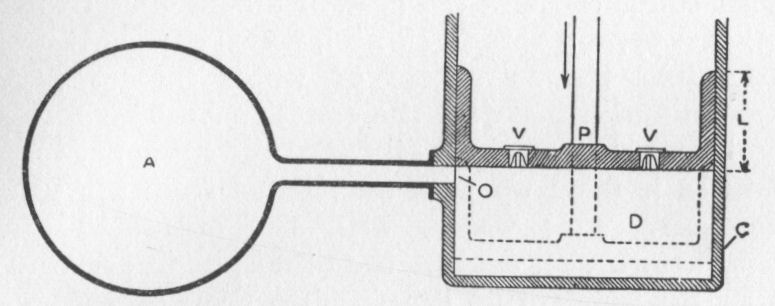
Air-pump, an apparatus by means of which air or other gas may be removed from or compressed into an enclosed space. It was invented by Otto von Guericke of Magdeburg about the year 1654, and described in 1657 by Gaspar Schott. An ordinary suction-pump for water is on the same principle as the air-pump; indeed, before water reaches the top of the pipe the air has been pumped out by the same machinery which pumps the water. An ordinary air-pump (see fig. 1) consists essentially of a cylinder or barrel with a piston and valves. The barrel is connected to the vessel from which the air is to be pumped. A is the vessel to be exhausted, C the air-pump cylinder, P the piston, VV valves in the piston, and O the connection to the vessel A. When the piston moves downwards from the position shown, it cuts off the connection with A by passing over O. The length L is made long enough so that O is kept covered up during the downstroke. The air filling the space D is compressed, and so lifts the valves VV and passes out through them. This goes on till the end of the downward stroke, when the volume is very small indeed. When the upward motion begins, the valves VV close, and the piston rises and creates a vacuum in D. When the piston rises sufficiently to uncover O (as in figure), air rushes from A into the highly-exhausted space D and fills it. The process is repeated indefinitely, and A is gradually exhausted.
Fig. 2.—Toepler Pump Fig. 3.—Sprengel Pump
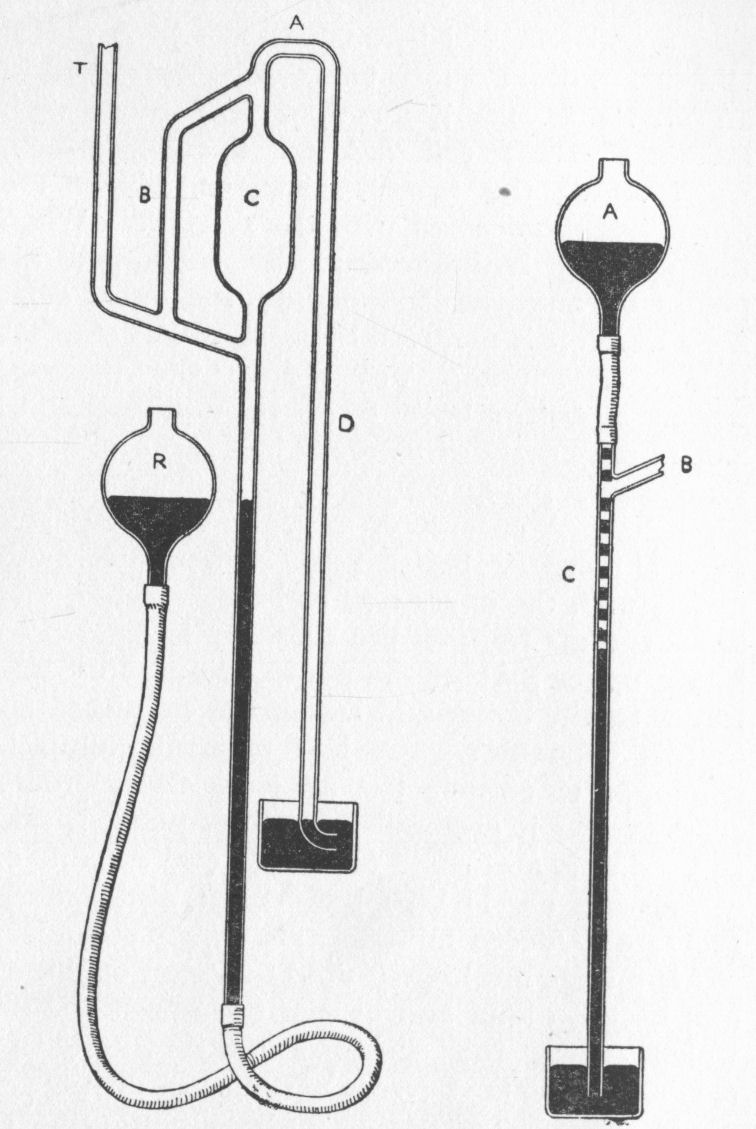
Air-pumps for compressing air are constructed on the same principle, but the valves act the reverse way. The bicycle pump is a well-known example of this form of pump. In the Fleuss or Geryk pump greater efficiency is attained by having layers of oil in the barrel and above the piston. In nearly all pumps for producing the high vacua necessary, e.g. for the electric glow-lamp and the X-ray tube, mercury is employed. In one form, the Toepler pump, a reservoir containing mercury is connected by a flexible tube to the receiver. (See fig 2. T tube connecting pump to vessel to be exhausted; R, reservoir, raised above A to drive air in B and C through D and out into open air; R is then lowered, and B and C fill with air from receiver. Process then repeated.) By alternately lowering and raising the reservoir, gas is first withdrawn from the receiver and then expelled through D, which also acts as a barometer. The process is repeated until the desired degree of exhaustion is reached. In a second type, the Sprengel pump, a stream of mercury from a reservoir situated above the vessel to be exhausted falls in drops through a narrow vertical tube which communicates with the vessel. (See fig. 3. A, reservoir; B, tube leading to vessel to be exhausted; C, bubbles of air carried down by mercury.) The air is entrapped between the falling drops of mercury, and is carried down and expelled with it. In the filter-pump, water is used instead of mercury, the pump being connected to an ordinary water-tap.
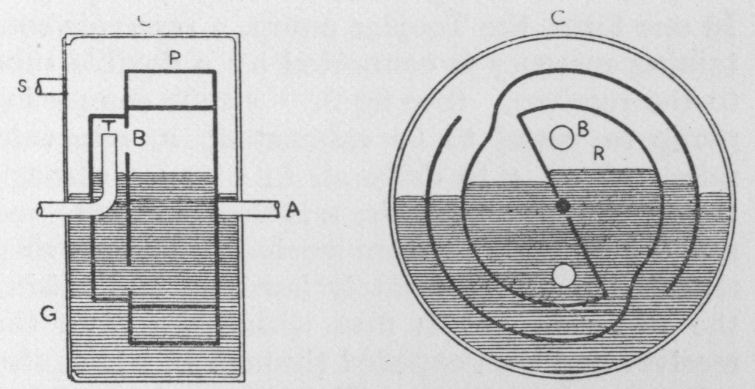
A more recent form, the Gaede pump, is of the rotary type. (See fig. 4. C, iron case; G, glass front; P two-chamber porcelain drum rotated counter-clockwise about axle A. As mercury leaves chamber R, air enters from receiver by tube T and opening B. When B is immersed, mercury enters and air is driven into case C and removed through tube S.) A porcelain drum, divided into two cells, rotates within an air-tight case more than half filled with mercury. Each cell has an opening which, when above the mercury surface, places the cell in communication with the receiver. When the opening is immersed, the entrapped air passes by another channel into the outer case, from which it is removed by another less efficient pump. The pump will reduce the pressure within a 6-litre bulb from 10 millimetres to .00001 millimetre of mercury in fifteen minutes. Langmuir's pump employs the principle of the aspirator. A current of mercury vapour passes from a mercury boiler past a tube communicating with the apparatus to be exhausted, and sucks the air from it; the mercury is condensed in the upper part of the pump, returns by side tubes to the boiler and leaves the extracted air in this condenser. A less efficient pump is employed to remove the air from the mercury condenser as it accumulates. This pump is said to be simple and rapid in action, and capable of exhausting an 11-litre bulb from atmospheric pressure to .00001 millimetre in eighty seconds.
Fig. 4.—Gaede Pump
Air-pumps are largely used in steam engineering, both on land and at sea, to extract the air which enters the condenser with the steam (see Condenser). Several varieties of air-pumps are in use. 1. The ordinary piston-pump (fig. 1) in which the piston extracts air by first sucking it into the cylinder and then expelling it to the atmosphere. The opening leading to the condenser is closed during the stroke in which the air is expelled. Two or three cylinders are usually provided on each air-pump set, the former type being known as a 2-throw pump and the latter a 3-throw pump. One of the best-known makes is the Edwards air-pump. Piston air-pumps are driven either by the main engine through a suitable mechanism, or by a separate electric motor. The amount of power required to drive them varies with the size of the set, and with large engines of over 10,000 h.p. it is about ½ per cent or less. Vacua as high as 29 inches (Bar. 30 inches) can be readily maintained on large plants by this type of pump, provided the condenser is suitably designed. In well-maintained plants bad vacua are commonly due to deficient air extraction, which may arise from the low-pressure air-piping not being air-tight, or from the air-pump being too small. 2. The water-ejector type uses the momentum of a jet of water to extract the air entrained with it. Well-known types of this plant are the ordinary barometric jet-condenser and the Leblanc air-pump. In the latter type, a rotating wheel, which carries vanes, forcibly throws sheets of water into a pipe communicating with the condenser. The sheets of water lie across the pipe, and the space between them is filled up with air sucked from the condenser. This water, with the entrained air, is thrown out, against the atmospheric pressure, by the momentum imparted to the water sheets by the rotating wheel. Very high vacua can be obtained with the Leblanc pump, but the power required to drive it is more than is required with a 3-throw piston-pump. (Cp. Sprengel pump above). 3. A steam-ejector is also used, a jet of steam taking the place of the sheets of water in the Leblanc type. Parsons' augmentor condenser works on this principle. A small jet of steam sucks the air from the main condenser and compresses it into a small so-called augmentor condenser. The pressure in this condenser is a little higher than the pressure in the main condenser, but it is sufficient to enable an ordinary 3-throw pump to be used efficiently. The steam used to extract the air is condensed in the augmentor condenser by cold water, and the interior of the augmentor condenser is connected to the inlet of an ordinary 3-throw pump. The 3-throw pump is called upon to deal with the air at a slightly higher pressure than the condenser pressure, and the vacuum in the main condenser is improved by the drop of pressure which exists between the augmentor condenser and the main condenser. In a well-designed plant, for instance, a 3-throw pump might be used to maintain a vacuum of 29 inches in the augmentor condenser, while the steam jet would provide another ½ inch of vacuum, giving 29½ inches vacuum in the main condenser. The pressure in the main condenser is thereby reduced from 1 inch Hg. to ½ inch Hg.; a reduction of one-half. (Cp. Langmuir's pump above—using a mercury-vapour jet instead of a steam jet.)—Bibliography: S. P. Thompson, The Development of the Mercurial Air-Pump; E. Hausbrand, Evaporating, Condensing, and Cooling Apparatus.
Air-raids. Apart from various sporadic bomb-dropping attacks by the Italians in Tripoli in 1913, the first air-raid proper was made by a Zeppelin on Antwerp during the investiture of that city by the Germans in 1914. Later on this new method of warfare was developed to a considerable extent by both sides during the Great European War, both air-ships and aeroplanes being used. Air-craft for this purpose have been likened to long-range guns, with the advantage of greater precision, because the target is in view, and very much longer effective range—the Germans, for example, used to raid London, and on one occasion Edinburgh, from bases situated in North Germany and on the Schleswig coast. Air-raids are of great value in affecting the moral of the enemy country by bringing home the effects of war in its most terrifying aspect to the civilian population at home, and thus causing the dislocation of traffic and diminishing the output of munitions. Their practical value is in attacking and destroying munition-factories, army head-quarters, naval bases, &c., in addition to such important work as the demolition of ammunition-dumps, and cutting lines of communication behind the front.
Various protective devices against raiding aircraft have been invented. Among these are high-angle guns, capable of throwing shells to a height of some 30,000 feet, though possibly the most effective defence is small high-speed aeroplanes armed with machine-guns and capable of reaching great heights in a short space of time. For use at night, kite-balloons (see Balloons) are sent up in clumps connected together by cables. From the cables is suspended a network of steel wires, which is invisible to the hostile air-craft, and in which they may become entangled and so brought down. These have been raised to a height of as much as 12,000 feet. For raiding purposes two types of aeroplane—in addition to air-ships—have been developed. 'Day bombers' carry out raids in daylight at heights of 12,000 to 20,000 feet on points from 50 to 100 miles behind the lines. 'Night-bombers' are slower machines which raid well into the enemy's territory—up to 200 or more miles—at heights varying from 8000 to 12,000 feet. It is usual for night-raids to be carried out by squadrons of machines flying in formation, each machine carrying about a ton of bombs (in 1918). Air-ships can carry 5-10 tons of bombs to places up to 1000 miles distant from their bases.
During the last months of the war, our Independent Air Force dropped 500 tons of bombs on German objectives, and this raiding over a wide area of industrial Germany played no small part in causing that loss of spirit among the enemy which led eventually to their request for an armistice, and their virtual capitulation.
AIR-SHIPS
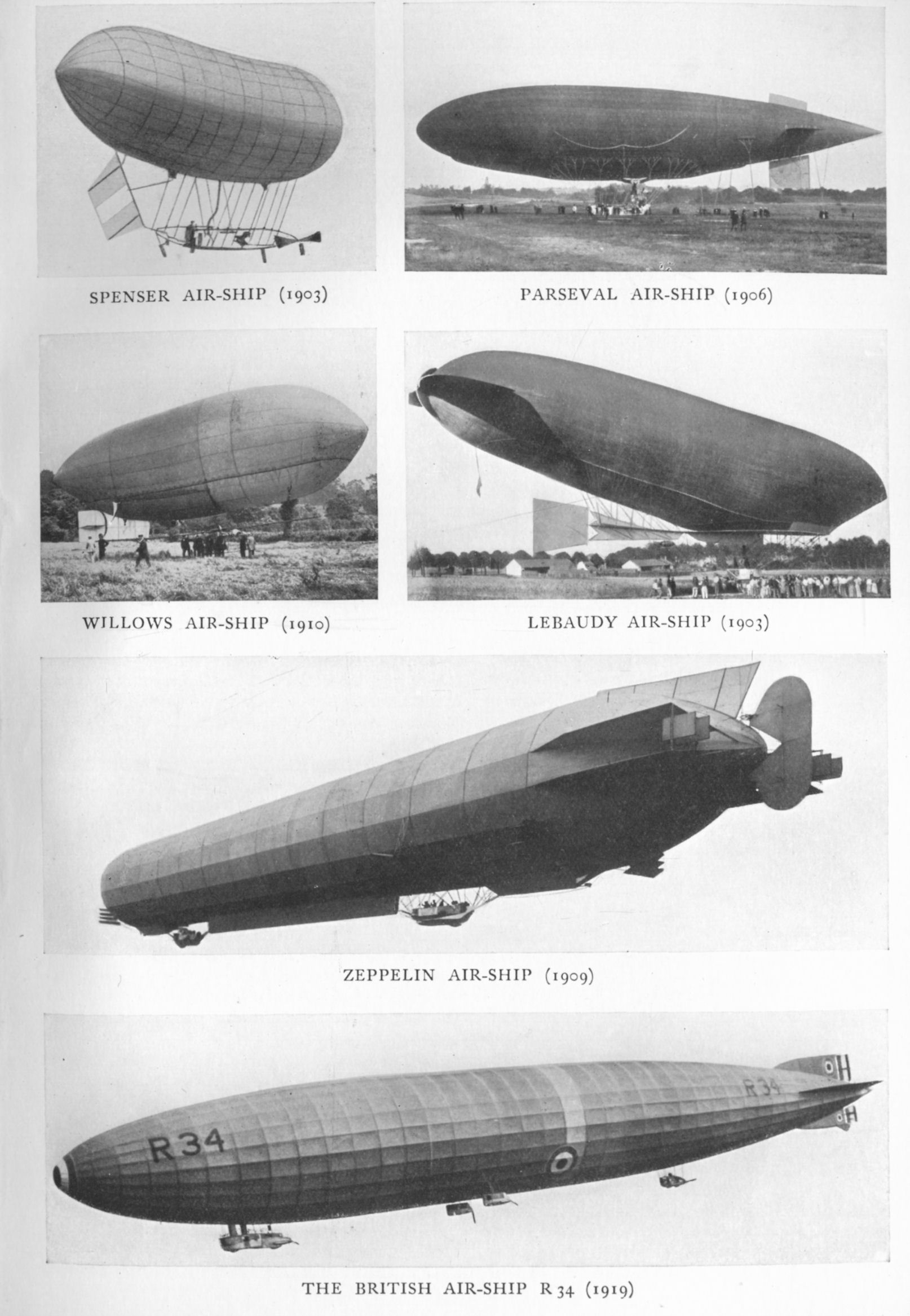
Air-ships, lighter-than-air craft provided with means of propulsion and steering. The air-ship, unlike the aeroplane, is not dependent upon its engines for its power to remain in flight, but derives its sustentation from the hydrogen gas with which it is filled. Hydrogen, first weighed by Henry Cavendish in 1766, is the lightest gas known, being 14.47 times lighter than air. In the pure state it has a lifting force of 71.155 lb. per 1000 cu. feet, but for calculation purposes is usually assumed to contain 5 per cent of impurities, giving a 'lift' of approximately 68 lb. per 1000 cu. feet. Hydrogen is, when mixed with air, highly inflammable, and helium has therefore been suggested as a substitute. This has a lift, when pure, of about 65 lb. per 1000 cu. feet, but is only found in a few places in America and is therefore at present too expensive to be used in quantities. The lift of any given quantity of hydrogen depends upon the difference between its weight and that of an equal volume of air. As the amount, and therefore weight, of air contained in a given space varies with the barometric pressure and temperature, the lift of hydrogen given above varies also. These figures are based upon a temperature of 60° F. and a barometric pressure of 30 inches. As an air-ship rises from the ground, the density, and therefore pressure, of the air decreases, which causes the hydrogen in the envelope to expand proportionately. Rise in temperature has the same effect. When an air-ship ascends, the gas therefore expands, and at a certain point would burst the envelope were valves not provided to allow some of the gas to escape. It is important to realize that as the expansion occurs at a rate corresponding to the decrease in density no alteration in lift occurs so long as gas is not lost through the valves. This would continue indefinitely if the gas-chamber were capable of stretching indefinitely, but with the cotton-fabric used in practice a height is reached when gas commences to escape from the automatic valves. From this moment the lift of the air-ship begins to decrease. At a certain point this decrease will have reached such a point that the air-ship is 'in equilibrium', i.e. she weighs precisely the same as the volume of air she displaces. This is known as the 'maximum height'. Up to 10,000 feet it is roughly true that 1/30 of the lift is lost per 1000 foot rise.
The simplest form of air-ship is the non-rigid, which consists of a rubberized cotton-fabric gas-container (the 'envelope'), from which the 'car', containing engines, crew, &c., is hung by flexible steel-wire ropes. To resist the bending moment introduced by the weight of the car, the envelope is inflated with hydrogen under pressure—usually about 25 mm. of water. So long as this pressure is greater than any local compression due to bending or loading in the fabric, the envelope will retain its shape. On coming down from a height, owing to the loss of gas, as already explained, the pressure will be reduced, and something must be done to restore it or the envelope will buckle. Fabric bags, known as 'ballonets', are therefore fitted inside the envelope, and as the air-ship descends air is forced into these bags, which supplies the lost pressure and maintains the shape of the envelope. The height to which a non-rigid air-ship can go, on returning from which the ballonets will be just full of air and the pressure the same as at starting, is known as the 'maximum ballonet height'. Ballonets are usually equivalent in volume to rather less than a quarter of the total volume of the air-ship—giving a maximum ballonet height of 6000 to 7000 feet. Usually from two to three ballonets are provided, according to the size of the air-ship. During the Great European War British non-rigid air-ships were constructed varying in size from a capacity of 70,000 cu. feet to 360,000 cu. feet. The former had one 75-h.p. engine, and the latter two of 375 h.p. each. Owing to difficulties in maintaining the shape and distributing the weight of the car over a long envelope, it is generally considered that 500,000 cu. feet probably represents the maximum size in which the non-rigid form of construction can be used. Above this size the semi-rigid type is used. In this case the envelope remains as in the non-rigid, but a girder or 'keel' is introduced between the envelope and the car, the weight of which is therefore taken by the keel and thence distributed to the envelope instead of being taken direct from the envelope as in non-rigids. There has been little development of non-rigids in Great Britain. The most prominent types are the Italian 'Forlanini', 'Verduzzio', and military air-ships. The keel, in all these examples, is not a rigid girder in the vertical sense, as it consists of a number of sections connected together by links. It is designed to resist compression only so long as it is held straight by the pressure of the envelope, and is not capable of taking a bending moment. When a size of about 1,000,000-cu.-foot-hydrogen capacity is reached it becomes economical to use the rigid method of construction. This is totally distinct from the other two types, as the non-rigid envelope is replaced by a rigid hull of sufficient strength to retain its shape without the assistance of any internal gas-pressure. The hull consists of a number of longitudinal members—usually built-up girders of 'duralumin', an aluminium alloy—connected together at distances of 25-30 feet by a number of 'transverse frames', or rings, forming bulkheads. The transverse frames are also of duralumin girders, and are braced by 'radical wires' running from the joints of these girders to a ring in the centre. Between each pair of these transverse frames is a gas-bag containing hydrogen. The gas-bags are made of rubberized cotton on to which is stuck 'gold-beater's skin', made from the lining of the intestines of an ox. This is done to prevent hydrogen leakage. This is necessary, as the fabric of the gas-bags of a rigid air-ship is lighter and contains less rubber than the envelope of a non-rigid.
A 'Δ'-shaped keel runs along the interior of the ship, its weight being taken on the two bottom longitudinal girders. The chief function of the keel is to distribute the load of the various weights to the transverse frames of the air-ship. In it are slung the petrol-tanks, water-ballast tanks, bombs, &c., and living accommodation for the crew is also provided there. Along the bottom runs a walking-way from which access is gained to the cars and various parts of the air-ship. The cars containing the engines, wireless-cabin, and pilot's cabin are suspended from the transverse frames. Some of the cars, instead of being slung below the centre-line, are slung in pairs some little way up the side of the air-ship.
All air-ships are steered by means of rudders and, in the vertical sense, elevators, in precisely the same way as aeroplanes. Up to the end of 1919 speeds of 84 miles per hour had been reached and air-ships had climbed to 24,000 feet. The greatest distance covered in one flight was 4500 miles, while the longest time in the air was effected by R34 on her voyage to America, which occupied 108 hours—4 days 8 hours. Rigid air-ships of 2,750,000-cu.-foot capacity had been built with a length of nearly 300 feet and a gross lift of 60 tons. See also Aeronautics, Balloons.—Bibliography: L. Sazerac de Forges, La Conquête de l'Air; Santos Dumont, My Airships; Hildebrandt, Airships: Past and Present; Major G. Whale, British Airships: Past, Present, and Future.
Airy, Sir George Biddell, a distinguished English astronomer, was born at Alnwick, 27th July, 1801, and educated at Hereford, Colchester, and Trinity College, Cambridge, where he was senior wrangler in 1823. At Cambridge he was Lucasian professor of mathematics, and subsequently Plumian professor of astronomy and experimental philosophy, in the latter capacity having charge of the observatory. In 1835 he was appointed Astronomer Royal, and as such his superintendence of the observatory at Greenwich was able and successful. He resigned this post with a pension in 1881. His important achievement is the discovery of a new inequality in the motions of Venus and the earth. He wrote much and made numerous valuable investigations on subjects connected with astronomy, physics, and mathematics. Among separate works published by him may be mentioned Popular Astronomy, On Sound and Atmospheric Vibrations, A Treatise on Magnetism, On the Undulatory Theory of Optics, On Gravitation. He died 2nd Jan., 1892. He left an autobiography, published in 1896.
Aisle (īl; from Lat. ala, a wing), in architecture, one of the lateral divisions of a church in the direction of its length, separated from the central portion or nave by piers or pillars. There may be one aisle or more on each side of the nave. The cathedrals at Chichester, Milan, and Amiens have five aisles, Antwerp and Paris seven, and that of Cordova nineteen aisles in all. The nave is sometimes called the central aisle. See Cathedral.
Aisne (ān), a north-eastern frontier department of France; area, 2838 sq. miles. It is an undulating, well-cultivated, and well-wooded region, chiefly watered by the Oise in the north, its tributary the Aisne in the centre, and the Marne in the south. It contains the important towns of St. Quentin, Laon (the capital), Soissons, and Château Thierry. In the European War (1914-18) severe fighting took place on the Aisne, and a great battle was fought on 12th Sep., 1914. General Nivelle's offensive on the Aisne began in April, 1917. Pop. (1921), 421,575.
Aïva′lik, or Kidonia, a seaport of Asia Minor, on the Gulf of Adramyti, 66 miles north by west of Smyrna, carrying on an extensive commerce in olive-oil, soap, cotton, &c. Pop. 21,000.
Aix (āks), a town of Southern France, department Bouches-du-Rhône, on the River Arc, the seat of an archbishop. It is well built, has an old cathedral and other interesting buildings, including a university, a library (over 100,000 vols.), museum, &c.; manufactures cotton and woollen goods, oil, soap, hats, flour, &c.; warm springs, now less visited than formerly. Aix was founded in 123 B.C. by the Roman consul Gaius Sextius Calvinus, and from its mineral springs was called Aquæ Sextiæ (Sextian Waters). Between this town and Arles, Marius gained his great victory over the Teutons, 102 B.C. In the Middle Ages the counts of Provence held their court here, to which the troubadours used to resort. Pop. 29,836.
Aix, or Aix-les-Bains (āks-lā-ban˙), a finely-situated village of France, department of Savoie, 8 miles north of Chambéry, on the side of a fertile valley, with much-frequented hot springs known to the Romans by the name of Aquæ Gratianæ, and with ruins of a Roman triumphal arch, and of a temple of Diana. Pop. 8900.
Aix-la-Chapelle (āks-la˙-sha˙-pel; Ger. Aachen), a city of Rhenish Prussia, 38 miles west by south of Cologne, pleasantly situated in a fine vale watered by the Wurm, formerly surrounded by ramparts, now converted into pleasant promenades. It is well built, and though an ancient town has now quite a modern appearance. The most important building is the cathedral, the oldest portion of which, often called the nave, was erected in the time of Charles the Great (Charlemagne) as the palace chapel about 796. It is in the Byzantine style, and consists of an octagon, surrounded by a sixteen-sided gallery and surmounted by a cupola, in the middle being the tomb of Charlemagne. The adjoining Gothic choir, begun in 1353 and finished in 1413, forms the other chief division of the cathedral; it is lofty and of great elegance, and has fine painted windows. Another noteworthy building is the Rathaus (town hall), erected in the fourteenth century. Aix-la-Chapelle, with the adjoining Burtscheid, which may be considered a suburb, is a place of great commerce and manufacturing industry, the chief productions being woollen yarns and cloths, needles, machinery, cards (for the woollen manufacture), railway and other carriages, cigars, chemicals, silk goods, hosiery, glass, soap, &c. A considerable portion of its importance and prosperity arises from the influx of visitors to its sulphur and chalybeate springs and baths.—Aix-la-Chapelle was known to the Romans as Aquisgranum. It was the favourite residence of Charles the Great, who made it the capital of all his dominions north of the Alps, and who died here in 814. During the Middle Ages it was a free imperial city and very flourishing. Thirty-seven German emperors and eleven empresses have been crowned in it, and the imperial insignia were preserved here till 1795, when they were carried to Vienna. The town was in possession of France from 1794 to 1814. Pop. 156,143.—Congress of Aix-la-Chapelle, a congress held in 1818, by which the army of the allies in France was withdrawn after France had paid the contribution imposed at the peace of 1815, and by which independence was restored to France.—A treaty of peace concluded at this city, 2nd May, 1668, as a result of the Triple Alliance, put an end to the war carried on against Spain by Louis XIV in 1667, after the death of his father-in-law, Philip IV, in support of his claims to a great part of the Spanish Netherlands, which he urged in the name of his queen, the infanta Maria Theresa. By this France obtained Lille, Charleroi, Douai, Tournai, Oudenarde, &c. The second peace of Aix-la-Chapelle, 18th Oct., 1748, terminated the Austrian war of succession.
Ajaccio (a˙-ya˙ch′ō), the capital of Corsica, on the south-west coast of the island, on a tongue of land projecting into the Gulf of Ajaccio, the birthplace of Napoleon and the seat of a bishop, with coral and sardine fisheries, and a considerable trade. There are here a cathedral, a college with library and museum, marble statue of Napoleon, monument of the Bonaparte family, &c. Ajaccio is connected by railway with Bastia and other places, and is becoming a winter resort for people with weak lungs. Pop. 20,946.
Ajan′ta, a village and ravine of India, in the north-west of the Nizam's dominions, about 50 miles north-north-east of Aurangabad. The ravine, 4 miles N.W. of the village, is celebrated for its cave temples and monasteries, twenty-nine in number, excavated out of a wall of almost perpendicular rock about 250 feet high. They are all richly ornamented with sculpture, and covered with highly-finished paintings, representing subjects of almost all kinds. The oldest are assigned to about 200 B.C., the most modern to about A.D. 600, and they may be said to furnish a continuous record of Buddhist art during 800 years, the faith at the latter date being practically expelled from India.
A′jax (Gr. Aias), the name of two Grecian chiefs who fought against Troy, the one being son of Oĭleus, King of Locris, surnamed the Little, the other son of Telamon, the Great or Telamonian Ajax. The latter was from Salamis, and sailed with twelve ships to Troy, where he is represented by Homer as the boldest and handsomest of the Greeks, after Achilles. He had more than one combat with Hector, against whom he was well matched. On the death of Achilles, when his arms, which Ajax claimed, were awarded to Ulysses, he became insane and killed himself. This is the subject of Sophocles' tragedy Ajax. The other Ajax was hardly of less importance as a champion on the Greek side in the Trojan war. At the fall of Troy he entered the temple of Pallas Athena and seized Cassandra. He lost his life during his homeward voyage, either by shipwreck or by a flash of lightning sent by Athena, who was offended at the violation of her temple.
Ajmere, Ajmir, or Ajmer, a British commissionership or province in India, Rajputána, divided into the two districts of Ajmere and Mairwara (or Merwara); area, 2711 sq. miles. The surface of the province, which is entirely surrounded by native States, is hilly in the north and west, where there is a branch of the Aravali range, but level in the south and east. The soil is partly fertile, but there are large barren sandy plains, and there are no rivers of any importance. There are a large number of tanks which collect the water of small streams, and are useful for irrigation. The province suffered severely from famine in 1899-1900, the population being reduced by 12 or 13 per cent. Pop. 501,395.—Ajmere, the capital, an ancient city, a favourite residence of the Mogul emperors, is 279 miles S.W. of Delhi, at the foot of Taragarh Hill (2853 feet), on which is a fort. It is surrounded by a wall, has well-built streets, and possesses a Government college, as also Mayo College for Rajput nobles, a Scottish mission, a mosque that forms one of the finest specimens of early Mahommedan architecture extant, and an old palace of Akbar, now the treasury. There is a trade in cotton, sugar, salt, &c., and the town is an important station on the Rajputána railway. Pop. 86,200.
Ajowan′ (Ptychōtis Ajowan), an umbelliferous plant cultivated in India, Persia, and Egypt, the seeds of which are used in cookery and in medicine, having carminative properties. The seeds much resemble caraway seeds, have a strong smell of thyme, and are exported in some quantity to Europe as a source of thymol, now so well known.
Aju′ga, a genus of plants belonging to the labiate family. See Bugle.
Aj′utage, a short tube of a tapering shape fitting into the side of a reservoir or vessel to regulate the discharge of water from it. Also, the nozzle of a tube for regulating the discharge of water to form a jet d'eau.
Akabah′, Gulf of, an arm of the Red Sea, on the east side of the Peninsula of Sinai, which separates it from the Gulf of Suez; nearly 100 miles long. The village of Akabah, at the northern extremity of the gulf, is supposed to be near the site of the Ezion-geber of the Old Testament; and here also was Elath, long a place of note. Akabah still carries on a small trade. It was captured by the Arabs in 1917.
Akagamaseki. Same as Simonoseki.
Akaroid Resin, a resin obtained from some of the grass-trees of Australia, used in varnishes.
Akassa, a seaport of Southern Nigeria, on a small island nearly opposite the chief mouth of the Niger. There are here engineering and other works, at which ships may be repaired, belonging to the Government.
Ak′bar (that is 'very great'), a Mogul emperor, the greatest Asiatic prince of modern times. He was born at Amerkote, in Sind, in 1542, succeeded his father, Humayun, a grandson of Sultan Baber, at the age of thirteen, and governed first under the guardianship of his minister, Beyram, but took the chief power into his own hands in 1560. He fought with distinguished valour against his foreign foes and rebellious subjects, conquering all his enemies, and extending the limits of the empire farther than they had ever been before, although on his accession they embraced only a small part of the former Mogul Empire. Although a Mohammedan by birth, he abandoned Islam and founded a new religion which he called 'Divine Faith' (Diu-i-Olahi). His contemporaries bestowed upon him the title of 'Guardian of Mankind'. He was also a generous patron of literature, and commissioned the Jesuit missionary, Jerome Xavier, to translate the four gospels into Persian. His government was remarkable for its mildness and tolerance towards all sects; he was indefatigable in his attention to the internal administration of his empire, and instituted inquiries into the population, character, and productions of each province. The result of his statistical labours, as well as a history of his reign, were collected by his minister, Abul Fazl, in a work called Akbar-Nameh (Book of Akbar), the third part of which, entitled Ayini-Akbari (Institutes of Akbar), was published in an English translation at Calcutta (1783-6, 3 vols.), and reprinted in London. He died in 1605. His mausoleum at Secundra, near Agra, is a fine example of Mohammedan architecture. Cf. V. A. Smith, Akbar, The Great Mogul.
Akee′ (Blighia sapĭda), a tree of the nat. ord. Sapindaceæ, much esteemed for its fruit. The leaves are somewhat similar to those of the ash; the flowers are small and white, and produced in branched spikes. The fruit is lobed and ribbed, of a dull orange colour, and contains several large black seeds, embedded in a succulent and slightly bitter arillus of a pale straw colour, which is eaten when cooked. The akee is a native of Guinea, from whence it was carried to the West Indies by Captain Bligh in 1793.