Volume 1 — VOLUME I (continued 3)
Reading edition
Advertis′ing. Advertising on a small scale is a practice as old as commerce; but modern advertising on a large scale cannot be dated further back than 1785, when the Times was founded. The last thirty years have witnessed a great increase in the importance of advertisements as part of the policy of a progressive business. Much more intelligence and vastly more money is now spent on advertising than ever was before. America led the way, but the British are not now far behind in the number and ingenuity of their advertisements.
There are roughly speaking five distinct types of advertisement:—
(1) Press advertising, under which heading is included daily and weekly newspapers, monthly magazines and year books, directories, &c.
(2) Mail-order advertising, which comprises form-letters, catalogues.
(3) Poster and showcard advertising. This includes large and small posters, on hoardings, in railway stations or tubes, &c.
(4) Illuminated signs either outside buildings on a large scale or in frames of various sizes inside business premises, theatres, &c.
(5) Cinema advertising—a recent development which has proved extremely effective.
Advertising to be successful must be carefully organized. A firm wishing to advertise must first of all settle how much money it is willing to spend on this object. A common practice is to devote a fixed proportion of the profits—at least five per cent—to advertising. The firm must then carefully consider the period of time over which the expenditure agreed upon is to be spread. Occasional or spasmodic advertising does not produce satisfactory results; advertising must be constant and must move with the times in order to be effective. A firm not uncommonly reviews the results of its advertising every six months, when it also arranges its plans for future advertisements. Mistakes in policy can thus be corrected and successful schemes can be readopted or improved upon. Advertising on any large scale must be handled by experts. Many thousands of pounds are wasted yearly by firms which hand over this work to a director who has no knowledge of how to advertise. The proper way for a firm to act, if it wishes to enter upon a campaign of publicity, is to engage an efficient advertising staff or to employ a reliable advertising agent. These agents in many cases obtain their profits from the commission given to them by newspapers—this often being about ten per cent of the cost of the space booked. In return for this they give their advice and copy—everything, indeed, except blocks and sketches.—Bibliography: Henry Sampson, A History of Advertising; Edinburgh Review, Feb., 1843, On the Advertising System. A good account of the more recent developments of advertising is to be found in H. G. Wells's novel Tono-Bungay; T. Russell, Commercial Advertising.
Ad vitam aut culpam (Lat., for life or till a fault), a formula often used in regard to appointments to posts or offices, intimating that they are held for life or till the person forfeits his position by some fault or misdeed.
Ad′vocate (Lat., advocatus—ad, to, voco, to call), a lawyer authorized to plead the cause of his clients before a court of law. It is only in Scotland that this word seems to denote a distinct class belonging to the legal profession, the advocates of Scotland being the pleaders before the supreme courts, and corresponding to the barristers of England and Ireland. These advocates all belong to the Faculty of Advocates, Edinburgh, to whom the oral pleadings in the Court of Session are for the most part limited, while they are also competent to plead in all the inferior Scottish courts and in the House of Lords in cases of appeal from the Court of Session. The supreme judges in Scotland, as well as the sheriffs of the various counties, are always selected from among them. Candidates for admission must undergo two separate examinations, one in general scholarship and the other in law.—The Lord-Advocate, called also the King's or Queen's Advocate, is the principal law officer of the crown in Scotland. He is the public prosecutor of crimes in the Supreme Court, and senior counsel for the crown in civil causes. Being appointed by the crown, he goes out of office with the administration to which he belongs. As public prosecutor he is assisted by the solicitor-general and by four junior counsel called advocates-depute. The lord-advocate and the solicitor-general, in addition to their official duties, accept of ordinary bar practice.
Advocates' Library, the chief library in Scotland, located in Edinburgh, and founded about 1682 by the Faculty of Advocates. It was increased by donations and by sums granted by the Faculty from time to time. As the donations were not confined to advocates the library was considered a kind of public library, and it has continued to retain this character. In 1709 it obtained, along with eight other libraries, the right to demand a copy of every new book published in Britain, which right it still possesses. The number of volumes is over 600,000 and MSS. over 3200.
Advoca′tus Diab′oli (Devil's advocate), in the Roman Catholic Church, a functionary who, when a deceased person is proposed for canonization, brings forward and insists upon all the weak points of the character and life of the deceased, endeavouring to show that he is not worthy of sainthood. The first formal mention of such an officer occurs under Pope Leo X (1513-21). The opposite side is taken by the Advocatus Dei (God's advocate).
Advow′son, in English law, a right of presentation to a vacant benefice, or, in other words, a right of nominating a person to officiate in a vacant church. Those who have this right are styled patrons. Advowsons are of three kinds—presentative, collative, and donative: presentative, when the patron presents his clerk to the bishop of the diocese to be instituted; collative, when the bishop is the patron, and institutes or collates his clerk by a single act; donative, when a church is founded by the king, or any person licensed by him, without being subject to the ordinary, so that the patron confers the benefice on his clerk without presentation, institution, or induction. An advowson cannot be held by either a Roman Catholic or an alien.
Ad′ytum, a secret place of retirement in the ancient temples, esteemed the most sacred spot; the innermost sanctuary or shrine. From this place the oracles were given, and none but the priests were permitted to enter it. The Holy of Holies or Sanctum Sanctorum of the Temple at Jerusalem was of a similar character.
Adze, a cutting instrument used for chipping the surface of timber, somewhat of a mattock shape, and having a blade of steel forming a portion of a cylindrical surface, with a cutting edge at right angles to the length of the handle.
Ædiles (ē′dīlz), Roman magistrates who had the supervision of the national games and spectacles; of the public edifices, such as temples (the name comes from ædes, a temple); of private buildings, of the markets, cleansing and draining the city, &c.
Æ′dui, one of the most powerful nations of Gaul, between the Liger (Loire) and the Arar (Saône). On the arrival of Julius Cæsar in Gaul (58 B.C.) they were subject to Ariovistus, but their independence was restored by Cæsar. Their chief town was Bibracte (Mont Beuvray, near Autun).
Ægade′an Islands, a group of small islands lying off the western extremity of Sicily, and consisting of Maritimo, Favignana, Levanso, and Le Formiche.
Grecian Ibex (Capra ægagrus)
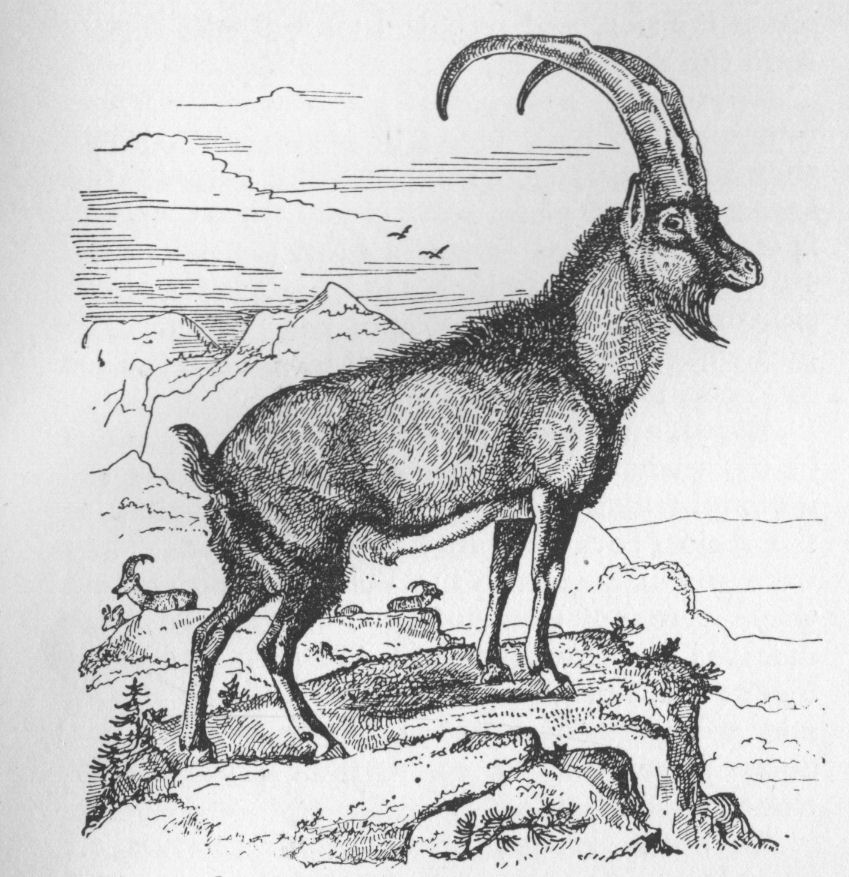
Ægag′rus, a wild species of ibex (Capra ægagrus), found in herds on the Caucasus, and many Asiatic mountains, believed to be the original source of at least one variety of the domestic goat.
Ægean Civilization, a term applied to the pre-Hellenic civilization of south-eastern Europe, including Crete, Greece and the Cyclades, and the Danubian or Mid-European area. See Crete and Danubian Civilization.
Ægean Sea (ē-jē′an), that part of the Mediterranean which washes the eastern shores of Greece, and the western coast of Asia Minor. See Archipelago.
Æ′gilops, a genus of grasses, very closely allied to wheat, and somewhat remarkable from the alleged fact that by cultivation one of the species becomes a kind of wheat.
Ægina (ē-jī′na), a Greek island in the Gulf of Ægina, south of Athens, triangular in form; area about 32 sq. miles; pop. 8500. It forms part of the nomarchy of Attica and Bœotia. Except in the west, where the surface is more level, the island is mountainous and unproductive. The inhabitants are chiefly engaged in trade, seafaring, and agriculture, the chief crops being almonds, olives, and grain. The greater number of them reside in the seaport town of Ægina. Ægina was anciently colonized by Dorians from the opposite coast of Peloponnesus. In the latter half of the sixth century B.C. it had a flourishing commerce, a large navy, and was the seat of a distinct school of art. At the battle of Salamis (480 B.C.) the Æginetans behaved with great valour. In 456 the island fell under the power of the Athenians, and in 431 the Æginetans were expelled to make room for Athenian settlers, but were afterwards restored. On a hill are the remains of a splendid temple of Athena (Minerva), many of the columns of which are still standing. Here was found in 1811 a considerable amount of sculpture from the pediments (the Æginetan marbles), which is now at the Glyptothek at Munich, and is prized as throwing light on the early history of Greek art. Though in these figures there is a wonderfully exact imitation of nature, yet there is a certain stiffness about them and an unnatural sameness of expression in all. They should probably be assigned to the period 500-480 B.C.
Ægis (ē′jis), the shield of Zeus, according to Homer, but according to later writers and artists a metal cuirass or breastplate, in which was set the head of the Gorgon Medusa, and with which Athena (Minerva) is often represented as being protected. In a figurative sense the word is used to denote some shielding or protecting power.
Ægle (ē′glē), a genus of plants. See Bel.
Ægospot′ami ('goat-rivers'), a place on the Hellespont, of some note in Greek history, the Athenian fleet being here completely defeated in 405 B.C. by the Spartan Lysander, thus ending the Peloponnesian war.
Ælfric (al′frik), Abbot, called Grammaticus (the grammarian), was a celebrated English author of the eleventh century. He became a monk of Abingdon, was afterwards connected with Winchester, and died Abbot of Eynsham. His principal works are two books of homilies, a Treatise on the Old and New Testaments, a translation and abridgment of the first seven books of the Bible, a Latin Grammar and Glossary, &c. He has been frequently confounded both with Ælfric, Archbishop of Canterbury, and Ælfric, Archbishop of York, surnamed Putta, who lived about the same time. There was also an Ælfric of Malmesbury.
Ælia′nus, Claudius, often called simply Ælian, a Roman author who lived about A.D. 221, and wrote in Greek a collection of stories and anecdotes and a natural history of animals.
Ælia′nus Tacticus, so called to distinguish him from Claudius Ælianus, lived at Rome, and wrote a work On the Military Tactics of the Greeks, which he dedicated to the Emperor Hadrian, who was emperor from A.D. 117 to 138. This book was closely studied by soldiers of the sixteenth and seventeenth centuries.
Aelst (älst), Belgian town, same as Alost.
Æne′as, the hero of Virgil's Ænēid, a Trojan, who, according to Homer, was, next to Hector, the bravest of the warriors of Troy. When that town was taken and set on fire, Æneas, according to the narrative of Virgil, with his father, son, and wife Creusa, fled, but the latter was lost in the confusion of the flight. Having collected a fleet he sailed for Italy, but after numerous adventures he was driven by a tempest to the coast of Africa, where Queen Dido of Carthage received him kindly, and would have married him. Jupiter, however, sent Mercury to Æneas, and commanded him to sail to Italy. Whilst the deserted Dido ended her life on the funeral pile, Æneas set sail with his companions, and after further adventures by land and sea reached the country of King Latinus, in Italy. The king's daughter Lavinia was destined by an oracle to wed a stranger, this stranger being Æneas, but was promised by her mother to Turnus, King of the Rŭtŭli. This occasioned a war, which was ended by Æneas slaying Turnus and marrying Lavinia. His son by Lavinia, Æneas Sylvius, was the ancestor of the kings of Alba Longa, and of Romulus and Remus, the founders of the city of Rome.
Æolian Harp, or Æolus' Harp, a musical instrument, generally consisting of a box of thin fibrous wood (often of deal), to which are attached from eight to fifteen fine catgut strings or wires, stretched on low bridges at either end, and tuned in unison. Its length is made to correspond with the size of the window or other aperture in which it is intended to be placed. When the wind blows athwart the strings it produces very beautiful sounds, sweetly mingling all the harmonic tones, and swelling or diminishing according to the strength or weakness of the blast.
Æolians (Gr. Aioleis), one of the four races into which the ancient Greeks were divided, originally inhabiting the district of Æŏlis, in Thessaly, from which they spread over other parts of Greece. In early times they were the most numerous and powerful of the Hellenic races, chiefly inhabiting Northern Greece and the western side of Peloponnesus, though latterly a portion of them went to Lesbos and Tenedos and the north-west shores of Asia Minor, where they possessed a number of cities. Their language, the Æolian dialect, was one of the three principal dialects of the Greek. It was cultivated for literary purposes chiefly at Lesbos, and was the dialect in which Alcæus and Sappho wrote.
Æol′ipile (Lat. Æŏli pila, the ball of Æŏlus), a spherical vessel of metal, with a pipe of small aperture, through which the vapour of heated water in the ball passes out with considerable noise; or having two nozzles so placed that the steam rushing out causes it to revolve on the principle of the Barker's mill. It was known to the ancient Greeks.
Æ′olus, in Greek mythology, the god of the winds, which he kept confined in a cave in the Æolian Islands, releasing them when he wished or was commanded by the superior gods.
Æ′on, a Greek word signifying life, an age, and sometimes eternity, but used by the Gnostics to express spirits or powers that had emanated from the Supreme Mind before the beginning of time. They held both Christ and the Holy Spirit to be æons; but as they denied the divine origin of the books of Moses, they said that the spirit which had inspired him and the prophets was not that exalted æon whom God sent forth after the ascension of Christ, but an æon very much inferior, and removed at a great distance from the Supreme Being.
Æpyor′nis, a genus of gigantic birds whose remains have been found in Madagascar, where they are supposed to have lived perhaps not longer than 200 years ago. It had three toes, and is classed with the cursorial birds (ostrich, &c.). Its eggs measured 14 inches in length, being about six times the bulk of those of the ostrich. The bird which laid them may well have been the roc of Eastern tradition.
Æ′qui, an ancient people of Italy, conspicuous in the early wars of Rome, and inhabiting the mountain district between the upper valley of the Anio (Teverone) and Lake Fucĭnus. They were probably akin to the Volscians, with whom they were in constant alliance. They were defeated by Cincinnatus in 458 B.C., and again by the dictator Postumius Tubertus in 428 B.C., and were finally subdued about 304-302 B.C. Soon after they were admitted to Roman citizenship.
A′erated Bread, bread which receives its sponginess or porosity from carbonic acid supplied artificially, and not produced by the fermentation caused by leaven or yeast.
A′erated Waters, waters impregnated with carbonic acid gas, and forming effervescing beverages. Some mineral waters are naturally aerated, as Vichy, Apollinaris, Rosbach, &c.; others, especially such as are used for medicinal purposes, are frequently aerated to render them more palatable and exhilarating. Water simply aerated, as soda-water, or aerated and flavoured with lemon or fruit syrups, is largely used, especially in summer, as a refreshing beverage. There are numerous varieties of apparatus for manufacturing aerated waters. The essential parts of an aerated-water machine are a generator in which the gas is produced, a vessel containing the water to be impregnated, and an apparatus for forcing the gas into the water. This last may be effected by force-pumps or by the high pressure of the impregnating gas itself. The quantity of gas with which the water is charged is usually equal to a pressure of 5 atmospheres. See also Mineral Waters.—Cf. W. Kirkby, Evolution of Artificial Mineral Waters.
Aerial Ropeways or Cableways, a means of transport or carriage in which a great rope or cable, elevated above the ground on fixed supports, is made use of in conveying from place to place materials or articles of various kinds. Such a cable may be said to serve the purpose of a rail, from which are suspended the carriages, buckets, or carriers of whatever sort are employed to convey the materials dealt with, the cable being actuated by means of a steam-engine and winding-gear of suitable construction. Such cables are now much used in carrying materials over a comparatively short space, as in quarries, excavations for canals, docks, &c.; in the construction of bridges, in shipbuilding, &c. Besides being employed in such works—not to mention the coaling of a battleship at sea from a coal transport standing by—elevated ropeways miles in length have also been constructed between places where no roads exist, or where road carriage is much more expensive. The greatest aerial line yet in existence is in the Argentine Republic, being built to connect a mining locality in the Andes, about 15,000 feet above sea-level, with a station on the Northern Railway 11,500 feet lower down and about 22 miles off, the line running across deep chasms and hollows, and being in places supported on iron towers 130 feet high. The wire rope is said to have a length of 87 miles.
Aë′rians, the followers of Aërius of Pontus, who in the fourth century originated a small heretical sect, objecting to the established feast-days, fasts or abstinences, the distinction between bishops and presbyters, prayers for the dead, &c.
Aerodynam′ics, a branch of physical science which treats of the properties and motions of elastic fluids (air, gases), and of the appliances by which these are exemplified. This subject is often explained in connection with hydrodynamics. See also Meteorology.
Aeröe, or Arröe (är′eu-e), an island of Denmark, in the Little Belt, 15 miles long by 5 broad, with 12,000 inhabitants. Though hilly, it is very fertile.
A′erolite, a meteoric stone, meteorite, or shooting-star. See Meteoric Stones.
"Montgolfière", or Hot-air Balloon, above Furnace
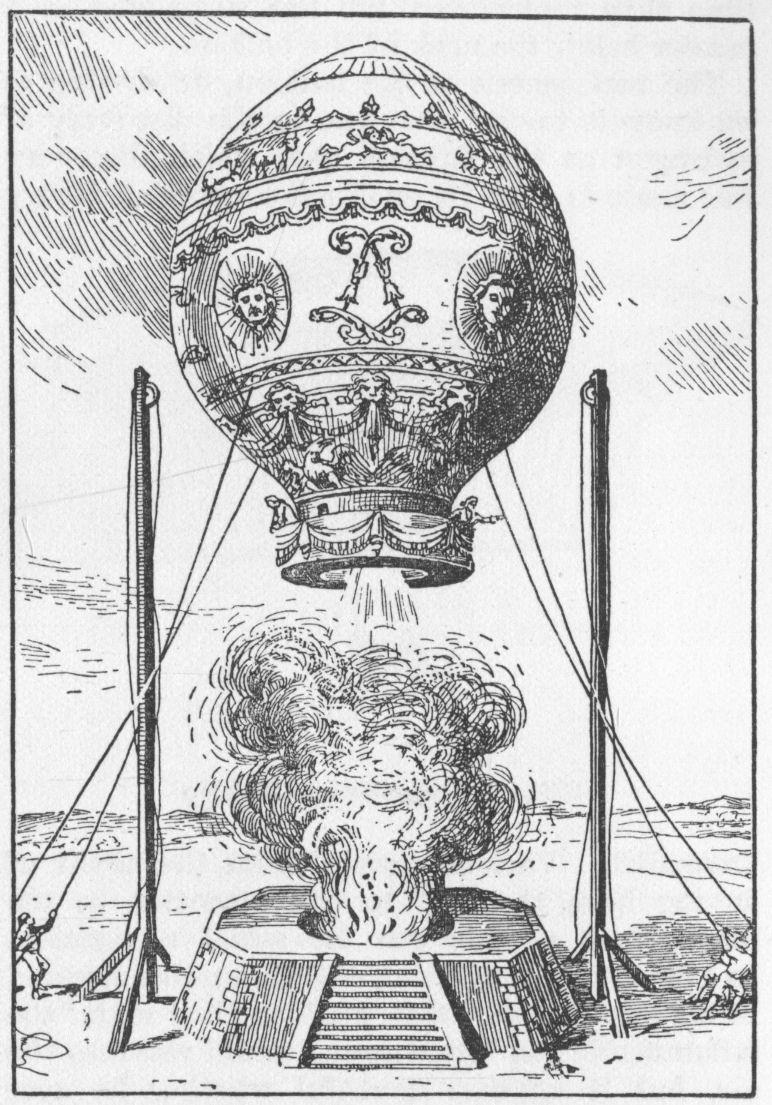
Aeronau′tics, the art or science of navigating the air, including Aviation (see Aeroplane and Sea-planes) and Aerostation (see Balloons and Air-ships). From the days of the mythical exploit of Dædalus and Icarus, students of 'experimental philosophy', or scientists, of all ages, turned their thoughts and inventive genius to the evolution of a machine by means of which man could fly. Most of the early schemes of which any details have survived were based upon the observation of birds and embodied the flapping of wings affixed to the arms or legs. Among the very early experimenters may be mentioned the monk Oliver of Malmesbury (A.D. 1050), de Pérouse (1420), who is said to have succeeded in flying over Lake Trasimene, and the great Leonardo da Vinci. All these produced designs for what are known as Ornithopters, or flapping-wing machines. There was, however, another school which believed in the future of machines which would be themselves lighter than air. The idea in the minds of the experimenters of this school was in the early days the replacing of the air in brass globes by a vacuum. If the brass were thin enough it was believed that the globe would then be sufficiently light to rise. It was, however, not realized that under such circumstances the globe would inevitably collapse under the pressure of the atmosphere with no corresponding internal pressure to withstand it. Among this 'lighter-than-air' school of experimenters were the famous Roger Bacon (twelfth century), Robert Hooke of the Royal Society (1644), and Francesco de Lana, a Jesuit priest (1660). It was this school which ultimately achieved success by providing the first machine of any sort to leave the ground and rise into the air. On 5th June, 1783, the first balloon ascended from the village of Annonay in France. It owed its inception to the genius of two brothers, paper-makers by trade, named Etienne and Joseph Montgolfier. Struck by the sight of smoke ascending from a chimney, after many failures with flapping-wing models, they conceived the idea of filling a receptacle with smoke and seeing if it would rise. They built a balloon or 'globe' of paper and canvas, and lit a fire of wood and straw below the aperture in it. The balloon gradually filled and rose into the air to a height reported to be 6000 feet, though this is probably an exaggeration. It remained in the air for ten minutes and landed 1½ miles away. This was the forerunner of the 'Montgolfières', or hot-air balloons, which are a feature of fêtes and Guy Fawkes' Day celebrations. It was followed by the sending up of a 'Montgolfière' from Versailles on 18th Sept. of the same year, carrying a basket containing a sheep, a cock, and a duck. The first human beings to make an ascent were Pilâtre de Rozier and the Marquis d'Arlande, who went away from Paris on 21st Nov., 1783. They passed right over Paris, and were in the air for twenty-five minutes, during which time they replenished the fire suspended in a brazier below the neck of the balloon.
The real genesis of the balloon, or air-ship as we know it to-day, was due to the discovery of hydrogen as the lightest gas, which discovery was made in 1766 by an English chemist, Henry Cavendish. Various people claim the credit of having been the first to call attention to the possibilities of this gas for aerial navigation. In 1781 Dr. Joseph Black of Edinburgh suggested to his pupils that a thin bladder filled with 'the inflammable gas' (hydrogen) would rise into the air, but it appears doubtful whether he ever actually made the experiment. Tiberius Cavallo the same year, before the Royal Society, demonstrated that soap-bubbles filled with hydrogen would rise and float in the air. The honour of building the first hydrogen balloon belongs, however, to three Frenchmen—the brothers Robert, and Charles, a physicist. They sent up a hydrogen-filled balloon of varnished silk from the Champ de Mars, Paris, on 7th Aug., 1783. One of the Roberts and Charles themselves made the second human ascent in their balloon—the first in a hydrogen balloon as opposed to a Montgolfière (as above)—on 1st Dec. the same year. In 1784 the same Frenchmen constructed the first 'air-ship' or navigable balloon to the order of the Duc de Chartres (Philippe Egalité). The gas container of this was elongated in form, and it could be propelled to some small extent by means of oars, and steered by a rudder. In the same year a French military officer, named Meusnier, produced a completely detailed design for an air-ship. This embodied the first suggestion of screw-propellers, to be worked by man-power, and also provided for a 'ballonet' into which air could be driven to replace hydrogen lost owing to expansion during the ascent. Meusnier's design was the genesis of the modern non-rigid air-ship, all the essential features remaining. This air-ship was, however, never built.
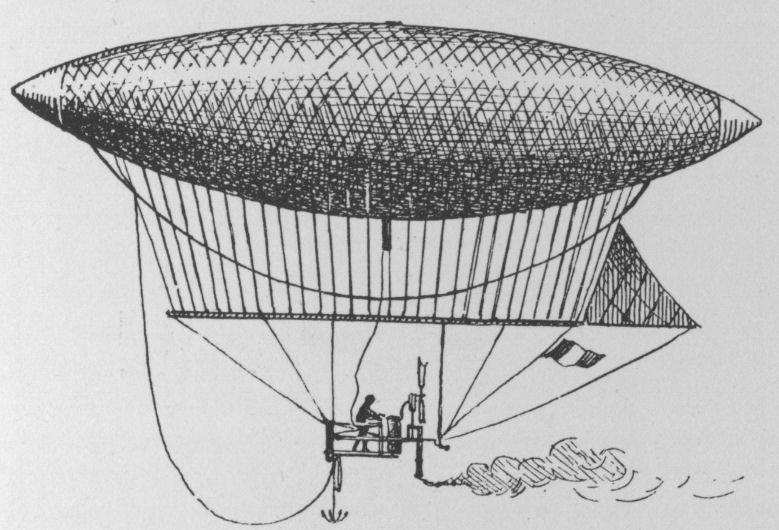
Giffard's Steam-driven Air-ship
The first ascent in the British Isles was made in a Montgolfière by James Tytler at Edinburgh, on 27th Aug., 1784, though he travelled only a few hundred yards. He was followed by Vincent Lunardi, an Italian, who ascended from the artillery ground in London three weeks later (Sept., 1784), landing near Ware in Hertfordshire. The first Channel crossing by air was made in a hydrogen balloon from Dover to Calais on 7th Jan., 1785, by Blanchard and Dr. Jeffries.
Subsequent developments in air-ships are due to the pioneer work of Giffard (1852) (the first steam-driven air-ship), Dupuy de Lôme (1872), the brothers Tissandier (electric propulsion) (1883), Rénard and Krebbs (1884), Wölfert (1897), Santos Dumont (1898-1905), Zeppelin (1900), Lebaudy (1903), Barton (English) (1905), Willows (English) (1910).
In the meantime experimental work was being carried on by the exponents of the heavier-than-air school, who soon abandoned the flapping-wing principle and eventually evolved the modern aeroplane. The modern aeroplane was evolved from the brain of an Englishman, Sir George Cayley, who in 1809 contributed an article to Nicholson's Journal in which he outlined the outstretched wings, vertical and horizontal steering surfaces, screw-propeller, 'explosion' motor, and 'stream-line' form of the modern aeroplane. In 1842 Henson and Stringfellow, both Englishmen, constructed a steam-driven model on this principle, which is now in the South Kensington Museum. Wenham in 1866 contributed a valuable paper to the Royal Aeronautical Society on the subject. In 1896 Lillienthal in Germany carried out a number of glides with rigid wings, provided with a movable tail, fixed to his body. He was followed by Chanute, who in America emphasized the biplane principle in his glider. In 1896 Ader, a Frenchman, built an 'avion' which is claimed to have risen from the ground at Satory, but this is doubtful. In 1895 a huge steam-propelled aeroplane built by Sir Hiram Maxim burst the rails holding it down and lifted for a few feet.
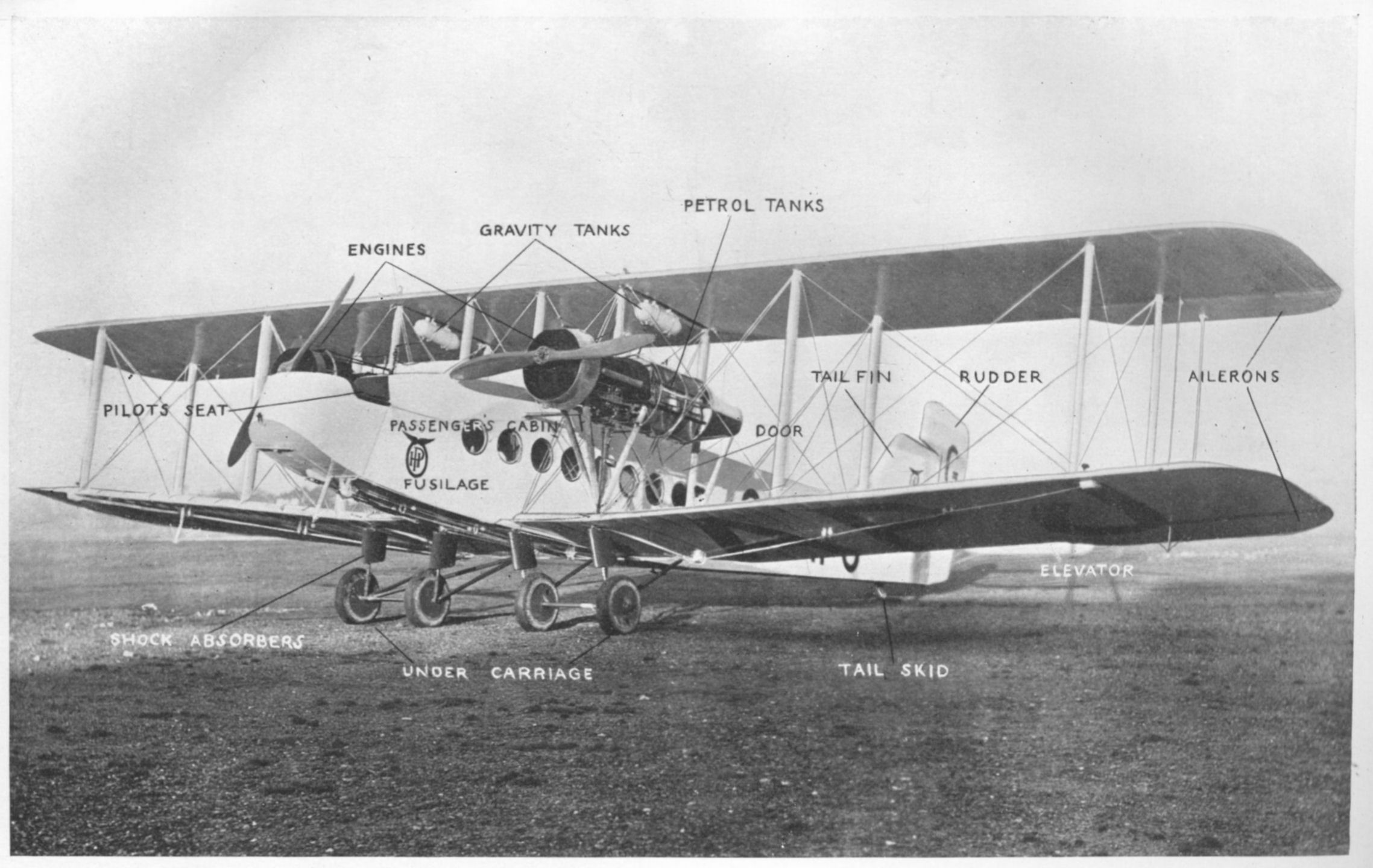
A Handley Page Biplane, showing the principal parts
Wright's Biplane Glider
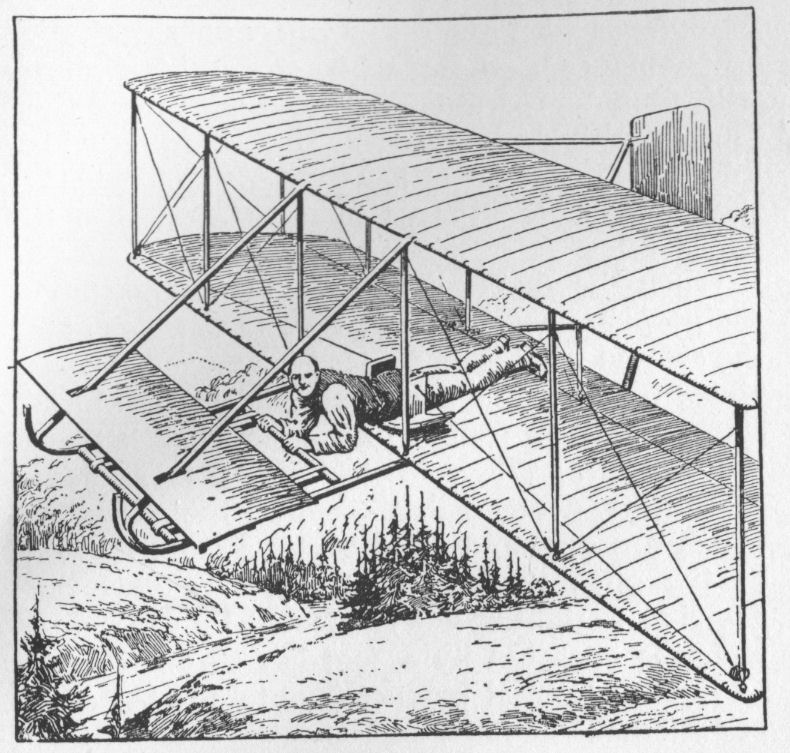
The real credit for the evolution of a man-carrying aeroplane is, however, due to the American brothers Wilbur and Orville Wright of Dayton, Ohio. Encouraged by the advice of Chanute, they commenced experimenting with biplane gliders on the sand-hills at Kittyhawk. Meeting with considerable success, they fitted a petrol motor of their own design in 1903 and made several straight flights during the same year. In 1904 they succeeded in making the first turn in the air. These experiments were carried out in great secrecy, and it was not until 1908 that their first public flights were made in France, the first taking place in October of that year. The first aviator to fly in Europe was Santos Dumont, who, on 12th Nov., 1906, covered 220 metres, having previously in the same year flown for shorter distances. At this time and during the two or three ensuing years many experiments were carried out, and flights made, by Farman, Voisin, Esnault-Pelterie, and Blériot in France; Wright and Curtiss in America; and Roe, Ogilvie, and Moore-Brabazon in England. A prize of £2000 offered by MM. Deutsch de la Meurthe and Ernest Archdeacon for the first circular flight over a distance of 1 kilometre, returning to the point of starting, was won in Jan., 1908, by Henry Farman.
The second crossing of the Channel, and the first by a 'heavier-than-air' machine, was effected by Louis Blériot in a machine of his own construction with an Anzani engine from Calais to Dover on 25th July, 1909. From that date the science of aviation (flight by heavier-than-air machines) may be said to have begun, and progress was merely a record of improvements. By the end of 1919 the Atlantic had been crossed four times; once by sea-plane, once by a non-stop aeroplane flight, and twice (outward and return) by non-stop air-ship flights. Aeroplanes had achieved a speed of 190 miles an hour, had attained to a height of over 34,000 feet, and had covered upwards of 1900 miles in one non-stop flight.—Bibliography: De St. Fond, Description de la Machine Aerostatique; Cavallo, History and Practice of Aerostation; Lunardi, The First Aerial Voyage in England; Moedebeck, Pocket Book of Aeronautics; Santos Dumont, My Air-ships; The Aeronautical Classics (Aeronautical Society); G. Tissandier, Histoire des Ballons; A. Berget, The Conquest of the Air.
Early Types of Aeroplanes (a) Wright Biplane (1908). (b) Blériot Monoplane (1909). (c) Santos Dumont Biplane (1906).
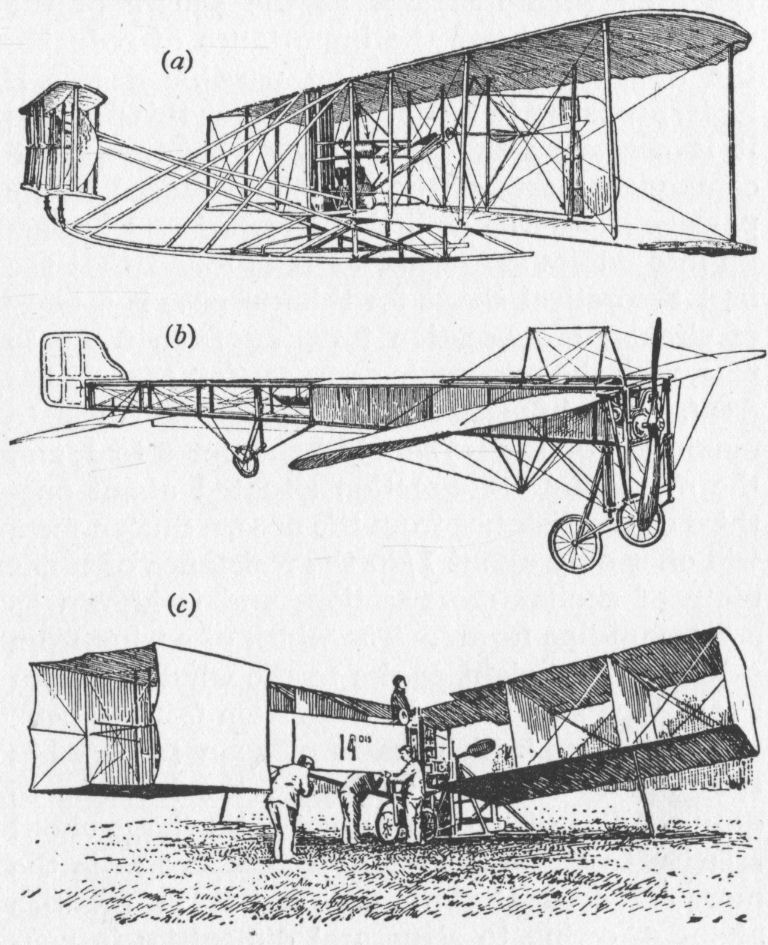
Aeroplane, a flying-machine deriving its power of sustentation from the reaction of the air driven downwards by the rapid transit of fixed wings or 'planes' through the air. The term 'plane' for the wing of an aeroplane is strictly a misnomer, as the word implies a flat plate, whereas a wing is 'cambered' or curved in section from front to back. This is due to the discovery of Lillienthal (see Aeronautics) that a cambered 'aerofoil' when set at an angle to a wind current gives more 'lift' than a flat plane. The wing of an aeroplane is normally set at an angle horizontally (or rather at an angle to the relative wind) varying from 0° to 4°. This angle is known as the 'angle of incidence'. As the wing is driven through the air under the influence of the propeller, the air meets the 'leading' or 'entering' edge and is divided into two streams along the top and bottom surfaces. It does not, however, follow the surface closely, but in the case of the lower stratum is deflected downwards at an angle to the surface, which results in an upward reaction. The upper of the two streams of air is correspondingly deflected upwards at an angle to the surface for a short distance. This causes an 'area of discontinuity of flow', or eddy, which results in 'negative pressure', causing an upward suction. This fact was first discovered by Sir Hiram Maxim, though it was G. Eiffel who measured the effects of the positive pressure on the lower surface and the negative pressure on the upper surface, and found, contrary to all expectation, that the latter is responsible for three-quarters of the total lifting effect of the wing. In addition to the lift, the wings offer resistance to progress through the air, which effect is known as 'drag'. The ratio of lift to drag is a measure of the efficiency of a wing-section. A well-designed wing will have a L/D ratio at an angle of incidence of 4° of about 16, i.e. the lift effect in pounds will be 16 times that of the drag. The fundamental equation of an aeroplane is R = KSV2, where R = the resistance, K = a constant (usually 0.003), S = area of surface, and V = the velocity in feet per second. From this it will be seen that the resistance for the same area increases as the square of the speed, which shows the importance of reducing the resistance to the lowest possible degree if high speeds are to be obtained. For this purpose it is necessary that the flow of air round the component parts of the aeroplane caused by its passage should be as little disturbed and broken up into eddies as possible. It is found that the best theoretical shape for this purpose is a body of circular cross-section tapering from front to rear, with the maximum cross-section toward the front. The 'fineness ratio' (ratio of length to maximum diameter) should be about 6 to 1, and the maximum cross-section situated about one-third of the distance from the nose. Such a form will offer only about 1/20 the resistance of a flat plate of similar cross-section, and is known as a 'stream-line form'. The width of a wing from side to side at right angles to the wind is known as the 'span', and the breadth from front to back as the 'chord'. The ratio of span to chord is the 'aspect ratio'. Owing to the increase in drag resulting from low aspect ratio (large chord relative to span) the higher the aspect ratio the more efficient the wing. This is in practice about 6, owing to structural difficulties in constructing a wing of larger relative span. The essential parts of an aeroplane are the wings, fuselage (body), tail (comprising fixed vertical and horizontal surfaces behind which are hinged movable rudders and elevators), and chassis, or landing-carriage. The majority of modern machines are biplanes, i.e. with one set of wings superposed on the other and connected by upright wooden members called 'struts'. Aeroplanes with one set of wings only are called 'monoplanes'; those with three, 'triplanes'; with four, 'quadruplanes'; and with more than four, 'multiplanes'. Aeroplanes are also divided into 'tractor' and 'pusher', according to whether the propeller is situated in front or rear of the wings.
When the engine is started, the revolution of the propeller causes the aeroplane to move along the ground until such a speed is reached (usually about 35-50 miles per hour) that it is able to support its own weight in the air when it leaves the ground. When in the air it is made to ascend or descend by moving the elevators, which are operated by a vertical stick in front of the pilot through control cables or levers. Steering to right or left is effected by the rudder, which is operated by a foot-bar through cables or levers. Lateral balance is obtained by means of 'ailerons' or flaps on the outer extremities of the wings. If one wing tends to dip, the aileron on that side is depressed. This increases the resistance of that wing and so causes it to rise. By a combination of movements of the elevators, rudder, and ailerons almost any evolution can be performed with a modern aeroplane. A well-designed machine will, on cutting off the engine-power, turn its nose slightly down and automatically assume its own 'gliding-angle' to the ground. The gliding-angle is the ratio of descent to forward travel and is usually 1 in 12 to 1 in 14.
Speeds of 190 miles per hour have been attained and a height of 34,600 feet reached. The greatest distance covered in one flight is the crossing of the Atlantic—slightly more than 1900 miles—while an aeroplane has remained in the air for 24 hours. Aeroplanes range in size from small single-seater 'scouts' with a duration of only some three hours, to large multiple-engined machines with a weight, fully loaded, of from 15 to 20 tons. The essential feature of the aeroplane is, as already stated, that it is heavier than air and therefore subject to the laws of gravity in the event of engine failure. Its choice of a landing-ground is then dependent upon its height at the moment and gliding-angle.
Aeroplanes are normally constructed throughout of wood, though steel is occasionally used. The wings are built of wooden 'spars', of which there are usually two along the length of each wing, connected together by wooden 'ribs'. The wings of a biplane are braced by the struts (see above) and by wires. 'Landing-wires' support the weight of the wing on the ground, while 'flying-wires' prevent them folding upwards under the influence of the lift in flight. 'Drift-wires' are to prevent the wings folding backwards under the pressure of the air in flight. See also Aeronautics, Sea-planes.—Bibliography: H. Barber, The Aeroplane Speaks; H. Barber, Aerobatics; Hamel and Turner, Flying; Borlase Mathews, Aviation Pocket Book; Pippard and Pritchard, Aeroplane Structures; Judge, Design of Aeroplanes; Judge, Properties of Aerofoils; Loening, Military Aeroplanes.
Aerostatic Press, a contrivance for extracting the colouring matter from dye-woods and for similar purposes. A liquid intended to carry with it the extract is brought into contact with the substance containing it, and a vacuum being made by an air-pump suitably applied, the pressure of the atmosphere forces the liquid through the intervening mass, carrying the colour or other soluble matter with it.
Aerostat′ics, that branch of physics which treats of the weight, pressure, and equilibrium of air and gases. See Air; Air-pump; Barometer; Gases, Properties of; Hydrostatics; Meteorology; &c.
Aerotherapeutics is the treatment of disease by atmospheres artificially prepared and differing from the normal in compression or pressure or temperature. It is divided into:
1. Medical atmospheres artificially produced by changing the proportions of the normal gases of the atmosphere, or by adding gases to the atmosphere. These are applied by inhalation in various ways:
(a) By the inhalation of gases—ether; chloroform; nitrous oxide (see Anæsthetics). Oxygen under pressure in a cylinder, with outlet applied close to the patient's mouth and nose, is used in severe cases of pneumonia, cardiac disease, or wherever breathing is difficult. Amyl nitrate is inhaled on the breaking of the glass capsules in which it is contained close to the patient's mouth; this treatment is used in cardiac disease and other conditions to recover blood pressure. Chlorine and iodine are used in cases of throat and bronchial affections by inhaling the vapour itself for a short time, or by inhaling air strongly impregnated with the substance.
(b) By inhalation of substances requiring heat for volatilization, e.g. mercury and sulphur. The patient, enveloped in a sheet, sits on a chair, while the substance, placed in a vessel on the floor inside the enveloping sheet near the patient, is heated by a spirit lamp or similar method. Mercury is used for chronic and syphilitic laryngitis and pharyngitis; sulphur for scabies and other skin diseases.
(c) By inhalation of steam or warm-water vapour with a drug added. Apparatus of various kinds is used, the simplest of which is a wide-mouthed jug filled with boiling water to which the drug has been added. The patient takes a deep breath, drawing the vapour into his mouth up a napkin arranged in the form of a tube. More complicated forms of apparatus are steam-sprays and nebulizers for laryngeal and bronchial troubles.
(d) Cold medicated sprays and inhalations. Throat- and nose-sprays are much used, also sprays for the administration of local anæsthetics (ethyl chloride). Respirators are made of wire gauze with cotton wool or a sponge; the substance is poured on and inhaled by the patient.
For (c) and (d) the following drugs are used: carbolic acid, creosote, terebine, thymol, eucalyptol, zinc sulphate, in phthisis and bronchial affections; and eusol, izal, lysol, &c., for disinfection and fumigation.
2. Changes produced by variation in barometric pressure considered in treatment of disease:
Normal barometric pressure at sea-level, 29-30 inches; at Davos (5200 feet), 25 inches; at summit of Pike's Peak, Colorado (14,000 feet), 17½ inches; in balloon ascent (Glaisher and Coxwell) of 29,000 feet, 9¾ inches.
The effects of high pressure are seen in divers, caisson workers, miners. The effects of low pressure are seen in balloonists, airmen. The effect of sudden return to normal from high pressure is seen in cases of caisson disease (q.v.). The effects of low pressure were first applied to the human body in 1835 by V.T. Junot. He contrived a hollow copper ball, 4 yards in diameter, capable of containing a man, and by pumping out air gradually, produced the effects of low pressure. This principle was then applied by him locally by cupping-glasses similar in shape to the upper part of a wineglass. There are two types of cupping:
(a) In wet cupping an incision is made in the skin of the part to be treated. The air inside the glass is exhausted by introducing a lighted match, then the open end of the glass is immediately applied to the surface of the skin.
(b) In dry cupping the treatment is similarly carried out, but no incision is made.
The low pressure (partial vacuum) draws blood to the part. Cupping is used in congestion of internal organs, e.g. lungs, kidneys.
The artificial application of air to lungs at varying pressure is carried out by inspiring rarefied air or compressed air and expiring into rarefied air or into compressed air. Only inspiring compressed air, or expiring into rarefied air, can be practically applied. There are many kinds of apparatus for this. The best is the compressed-air bath (seen at Brompton Hospital, London), consisting of three parts—the engine, receiver, and air-chamber.
The patient is placed in this air-chamber, where he remains for two hours, during which time the pressure is usually raised from half again to double normal. For the first half-hour the pressure is gradually raised, and is maintained at the same abnormal height for one hour; for the last half-hour it is reduced again gradually to normal. The patient first experiences an unpleasant sensation in the throat. This is relieved by swallowing or by drinking water; then pain in the ear-drums; the voice becomes shriller. These are early signs of the effects of high pressure, and are seen to a more marked degree in cases where a man has descended suddenly into a mine, caisson, &c. Compressed air-baths are used in cases of asthma, bronchitis, emphysema, anæmia.
Respiratory gymnastics are of value for defective breathing due to badly formed chests or injury and disease of the lungs. There are various forms of artificial breathing exercises and many ways of using artificial aids, e.g. breathing into bottles connected together by tubes and partly filled with water. The water is forced from one bottle to another by the respiratory effort of the patient.
Aerschot, town in Belgium, province of Brabant, on the Demer, a tributary of the Dyle. It was occupied by the Germans in Aug., 1914. Pop. 7800.
Æschines (es′ki-nēz), a celebrated Athenian orator, the rival and opponent of Demosthenes, was born in 389 B.C. and died in 314. He headed the Macedonian party in Greece, or those in favour of an alliance with Philip, while Demosthenes took the opposite side. Having failed in 330 B.C. in a prosecution against Ctesiphon for proposing to bestow a crown of gold upon Demosthenes for his services to the State (whence the oration of Demosthenes 'On the Crown') he left Athens, and subsequently established a school of eloquence at Rhodes. Three of his orations are extant. Æschines should not be confounded with his namesake, the Athenian philosopher and intimate friend of Socrates.
Æschylus (es′ki-lus), the first in time of the three great tragic poets of Greece, born at Eleusis, in Attica, 525 B.C., died in Sicily 456. Before he gained distinction as a dramatist he had fought at the battle of Marathon (490), as he afterwards did at Artemisium, Salamis, and Platæa. He first gained the prize for tragedy in 484 B.C. The Persians, the earliest of his extant pieces, formed part of a trilogy which gained the prize in 472 B.C. In 468 B.C. he was defeated by Sophocles, and then is said to have gone to the Court of Hiero, King of Syracuse. Altogether he is reputed to have composed ninety plays and gained thirteen triumphs. Only seven of his tragedies are extant: The Persians, Seven against Thebes, Suppliants, Prometheus, Agamemnon, Choephori, and Eumenides, the last three forming a trilogy on the story of Orestes, represented in 458 B.C. Æschylus may be called the creator of Greek tragedy, both from the splendour of his dramatic writings and from the scenic improvements and accessories he introduced. Till his time only one actor had appeared on the stage at a time, and by bringing on a second he was really the founder of dramatic dialogue. His style was grand, daring, and full of energy, and his choruses, though difficult, are among the noblest pieces of poetry in the world. His plays have little or no plot, and his characters are drawn by a few powerful strokes. There are English poetical translations of his plays by Blackie, Plumptre, Swanwick, Campbell, Robert Browning, and Elizabeth Barrett Browning.—Bibliography: Bishop Copleston, Æschylus, in English Classics for Modern Readers Series (Blackwood & Son); Miss J. Case, Translation of Prometheus Vinctus (Dent).
Æscula′pius (Gr. Asklēpios), the god of medicine among the Greeks and afterwards adopted by the Romans, usually said to have been a son of Apollo and the nymph Coronis. He was worshipped in particular at Epidaurus, in the Peloponnesus, where a temple with a grove was dedicated to him. The sick who visited his temple had to spend one or more nights in the sanctuary, after which the remedies to be used were revealed in a dream. Those who were cured offered a sacrifice to Æsculapius, commonly a cock. He is often represented with a large beard, holding a knotty staff, round which is entwined a serpent, the serpent being specially his symbol. The staff and serpent have been adopted as a badge by the Royal Army Medical Corps. Sometimes Æsculapius is represented under the image of a serpent only.—Bibliography: L. Dyer, The Gods of Greece; W. H. D. Rouse, Greek Votive Offerings.
Æs′culus, the genus of plants to which belongs the horse-chestnut.
Æsir, in Scandinavian mythology, the eleven chief gods, besides Odin. They are: Thor, Balder, Ty or Tyr, Bragi, Heimdal, Hod, Vidar, Vali, Ull, Forseti, and Loki or Lopt. See Scandinavian Mythology.
Æ′sop, the Greek fabulist, is said to have been a contemporary of Crœsus and Solon, and thus probably lived about the middle of the sixth century (620-550) B.C. But so little is known of his life that his existence has been called in question. He is said to have been originally a slave, and to have received his freedom from a Samian master, Iadmon. He then visited the court of Crœsus, and is also said to have visited Pisistratus at Athens. Finally he was sent by Crœsus to Delphi to distribute a sum of money to each of the citizens. For some reason he refused to distribute the money, whereupon the Delphians, enraged, threw him from a precipice and killed him. No works of Æsop are extant, and it is doubtful whether he wrote any. Bentley inclined to the supposition that his fables were delivered orally and perpetuated by repetition. Such fables are spoken of both by Aristophanes and Plato. Phædrus turned into Latin verse the Æsopian fables current in his day, with additions of his own. In modern times several collections claiming to be Æsop's fables have been published. Cf. J. Jacobs, The Fables of Æsop.
Æsthet′ics (Gr. aisthētikos, pertaining to perception), the philosophy of the beautiful; the name given to the branch of philosophy or of science which is concerned with that class of emotions, or with those attributes, real or apparent, of objects generally comprehended under the term beauty, and other related expressions. The term æsthetics first received this application from Baumgarten (1714-62), a German philosopher, who was the first modern writer to deal systematically with the subject, though the beautiful had received attention at the hands of philosophers from early times. Socrates, according to Xenophon, regarded the beautiful as coincident with the good, and both as resolvable into the useful. Plato, in accordance with his idealistic theory, held the existence of an absolute beauty, which is the ground of beauty in all things. He also asserted the intimate union of the good, the beautiful, and the true. Aristotle treated of the subject in much more detail than Plato, but chiefly from the scientific or critical point of view. In his treatises on Poetics and Rhetoric he lays down a theory of art, and establishes principles of beauty. His philosophical views were in many respects opposed to those of Plato. He does not admit an absolute conception of the beautiful; but he distinguishes beauty from the good, the useful, the fit, and the necessary. He resolves beauty into certain elements, as order, symmetry, definiteness. A distinction of beauty, according to him, is the absence of lust or desire in the pleasure it excites. Beauty has no utilitarian or ethical object; the aim of art is merely to give immediate pleasure; its essence is imitation. Plotinus agrees with Plato, and disagrees with Aristotle, in holding that beauty may subsist in single and simple objects, and consequently in restoring the absolute conception of beauty. He differs from Plato and Aristotle in raising art above nature. Baumgarten's treatment of æsthetics is essentially Platonic. He made the division of philosophy into logic, ethics, and æsthetics; the first dealing with knowledge, the second with action (will and desire), the third with beauty. He limits æsthetics to the conceptions derived from the senses, and makes them consist in confused or obscured conceptions, in contradistinction to logical knowledge, which consists in clear conceptions. Kant, in his Critique of the Power of Judgment, defines beauty in reference to his four categories, quantity, quality, relation, and modality. In accordance with the subjective character of his system he denies an absolute conception of beauty, but his detailed treatment of the subject is inconsistent with the denial. Thus he attributes a beauty to single colours and tones, not on any plea of complexity, but on the ground of purity. He holds also that the highest meaning of beauty is to symbolize moral good, and arbitrarily attaches moral characters to the seven primary colours. The value of art is mediate, and the beauty of art is inferior to that of nature. The treatment of beauty in the systems of Schelling and Hegel could with difficulty be made comprehensible without a detailed reference to the principles of these remarkable speculations. English writers on beauty are numerous, but they rarely ascend to the heights of German speculation. Shaftesbury adopted the notion that beauty is perceived by a special internal sense; in which he was followed by Hutcheson, who held that beauty existed only in the perceiving mind, and not in the object. Numerous English writers, among whom the principal are Alison and Jeffrey, have supported the theory that the source of beauty is to be found in association—a theory analogous to that which places morality in sympathy. The ability of its supporters gave this view a temporary popularity, but its baselessness has been effectively exposed by successive critics. Dugald Stewart attempted to show that there is no common quality in the beautiful beyond that of producing a certain refined pleasure; and Bain agrees with this criticism, but endeavours to restrict the beautiful within a group of emotions chiefly excited by association or combination of simpler elementary feelings. Herbert Spencer has a theory of beauty which is subservient to the theory of evolution. He makes beauty consist in the play of the higher powers of perception and emotion, defined as an activity not directly subservient to any processes conducive to life, but being gratifications sought for themselves alone. He classifies æsthetic pleasures according to the complexity of the emotions excited, or the number of powers duly exercised; and he attributes the depth and apparent vagueness of musical emotions to associations with vocal tones built up during vast ages. Among numerous writers who have made valuable contributions to the scientific discussion of æsthetics may be mentioned Winckelmann, Lessing, Richter, the Schlegels, Gervinus, Helmholtz, Ruskin, Home, Hogarth, Burke, Taine, and others.—Bibliography: Herbert Spencer, Principles of Psychology; Grant Allen, Physiological Æsthetics; A. Bain, Emotions and Will; B. Bosanquet, History of Æsthetics; W. Knight, Philosophy of the Beautiful.
Æstiva′tion, a botanical term applied to the arrangement of the parts of a flower in the flower-bud previous to the opening of the bud.—The term is also applied to the summer sleep of animals. See Dormant State.
Æth′eling. See Atheling.
Æ′ther. See Ether.
Æthio′pia. See Ethiopia.
Æ′thrioscope (Gr. aithrios, clear, cloudless), an instrument (devised by Sir John Leslie) for measuring radiation towards a clear sky, consisting of a metallic cup with a highly-polished interior of paraboloid shape, in the focus of which is placed one bulb of a differential thermometer, the other being outside. The inside bulb at once begins to radiate heat when exposed to a clear sky, and the extent to which this takes place is shown by the scale of the thermometer. The æthrioscope also indicates the presence of invisible aqueous vapour in the atmosphere, radiation being less than when the air is dry.
Æthu′sa, a genus of umbelliferous plants. See Fool's Parsley.
Ætiology (Gr. aitia, cause, and logos, discourse), the theory of the physical causes of any class of phenomena, or the science of causation. It is, however, mainly used in medicine, and deals with the causes and origin of disease.
Aë′tius, a general of the western Roman Empire, born A.D. 396; murdered 454. As commander in the reign of Valentinian III he defended the empire against the Huns, Visigoths, Franks, Burgundians, &c., completely defeating the Huns under Attila in a great battle at Châlons in 451. For twenty years he was at the head of public affairs, and in the end was murdered by Valentinian, who was jealous of his power.
Æt′na. See Etna.
Æto′lia, a western division of northern Greece, separated on the west by the Achelous from Acarnania and washed by the Corinthian Gulf on the south. The inhabitants are little heard of in Greek history till the Peloponnesian war, at which time they were notorious among the Greeks for the rudeness of their manners. Ætolia, in conjunction with Acarnania, now forms a nomarchy of the kingdom of Greece.
Afanasiev, Alexander Nicolaievitsh, Russian folklorist, born in 1826. Besides numerous articles and essays he wrote several monumental works: The Ancient Slav's Poetic View of Nature (3 vols., 1866-9), Russian Tales and Fables for Children (3 vols., 1870), &c. He died in 1871.
Affida′vit, a written statement of facts upon oath or affirmation. Affidavits are generally made use of when evidence is to be laid before a judge or a court, while evidence brought before a jury is delivered orally. The person making the affidavit signs his name at the bottom of it, and swears that the statements contained in it are true. The affidavit may be sworn to in open court, or before a magistrate or other duly qualified person; it may be made abroad before a qualified British state official.
Affin′ity, in chemistry, the force by which unlike kinds of matter combine so intimately that the properties of the constituents are lost, and a compound with new properties is produced. Of the force itself we know little or nothing. It is not the same under all conditions, being very much modified by circumstances, especially temperature. The usual effect of increase of temperature is to diminish affinity and ultimately to cause the separation of a compound into its constituents; and there is probably for every compound a temperature above which it could not exist, but would be broken up. Where two elements combine to form a compound, heat is almost always evolved, and the amount evolved serves as a measure of the affinity. In order that chemical affinity may come into play it is necessary that the substances should be in contact, and usually one of them at least is a fluid or a gas. The results produced by chemical combination are endlessly varied. Colour, taste, and smell are changed, destroyed, or created; harmless constituents produce strong poisons, strong poisons produce harmless compounds.
Affinity, in law, is that degree of connection which subsists between one of two married persons and the blood relations of the other. It is no real kindred (consanguinity). A person cannot, by legal succession, receive an inheritance from a relation by affinity; neither does it extend to the nearest relations of husband and wife so as to create a mutual relation between them. The degrees of affinity are computed in the same way as those of consanguinity or blood. All legal impediments arising from affinity cease upon the death of the husband or wife, excepting those which relate to the marriage of the survivor.
Affirma′tion, a solemn declaration by Quakers, Moravians, Dunkers, and others, who object to taking an oath, in confirmation of their testimony in courts of law, or of their statements on other occasions on which the sanction of an oath is required of other persons. In England the form for Quakers is, 'I do solemnly, sincerely, and truly declare and affirm'. Affirmation is generally allowed to be substituted for an oath in all cases where a person refuses to take an oath from conscientious motives, if the judge is satisfied that the motives are conscientious. False affirmation is subjected to the same penalties as perjury.
Affreightment means the contract of carriage of goods by sea, by which the shipowner undertakes to carry goods in his ship for hire or freight. Unless otherwise stipulated, the merchant or freighter is only bound to pay the freight upon delivery of the goods at the agreed destination. If the voyage is abandoned, the merchant may claim his goods without any payment. The merchant must load and discharge his cargo within the lay-days or stipulated time, if any; otherwise within a reasonable time. Failure entails liability in damages—known as demurrage—for undue detention of the ship. The merchant will also be liable in damages—known as dead-freight—if he fails to furnish the full cargo promised. The shipowner has a lien on the goods for their own freight and charges, but not for a general balance. Nor has he any lien for dead-freight or demurrage. All such liens may be validly stipulated for in the contract. They are purely possessory as contrasted with the so-called maritime liens for seamen's and shipmasters' wages, which are valid without possession. There is no lien for advance freight, which in Scotland is repayable if the cargo is lost at sea or delivery otherwise prevented, but not so in England. In Scotland, accordingly, the burden of insuring advance freight falls upon the shipowner, in England upon the merchant.
The main obligations upon the shipowner are to provide a seaworthy vessel, carry without undue delay, and deliver the goods in the same condition as they were shipped. Unless otherwise agreed, he is liable for damage or loss through negligence, and if he be a common carrier, as he frequently is, even the absence of negligence may not save him. There is nothing in British law, however, to prevent him from contracting out of all responsibility for the safety of goods committed to his care, and he generally does so, either by inserting what is known as an 'exception clause' in the document evidencing the contract, viz. the Bill of Lading, or by giving public notice that he only accepts goods upon that footing. In this respect the position of shipowners is more favourable than that of railway companies and other land carriers, whose freedom of contract is curtailed by statute.—Bibliography: T. G. Carver, Carriage by Sea; Sir T. E. Scrutton, Contract of Affreightment.
Affrique (a˙f-rēk), St., a town of southern France, department of Aveyron.
Afghanistan (a˙f-gän′i-stän), that is, the land of the Afghans, a country in Asia, bounded on the east by the N. W. Frontier Province, &c., on the south by Baluchistan, on the west by the Persian province of Khorasan, and on the north by Bukhara and Russian Turkestan. The eastern and southern boundaries were settled in 1893, whilst the boundary towards Persia was demarcated between March, 1903, and May, 1905. The area may be set down at about 250,000 sq. miles. The population is estimated at 6,000,000. Afghanistan consists chiefly of lofty, bare, uninhabited tablelands, sandy barren plains, ranges of snow-covered mountains, offsets of the Hindu Kush or the Himálaya, and deep ravines and valleys. Many of the last are well watered and very fertile, but about four-fifths of the whole surface is rocky, mountainous, and unproductive. The surface on the north-east is covered with lofty ranges belonging to the Hindu Kush, whose heights are often 18,000 and sometimes reach perhaps 25,000 feet. The whole north-eastern portion of the country has a general elevation of over 6000 feet; but towards the south-west, in which direction the principal mountain chains of the interior run, the general elevation declines to not more than 1600 feet. In the interior the mountains sometimes reach the height of 15,000 feet. Great part of the frontier towards India consists of the Suleiman range, 12,000 feet high. There are numerous practicable avenues of communication between Afghanistan and India, among the most extensively used being the famous Khyber Pass, by which the River Kabul enters the Punjab; the Gomul Pass, also leading to the Punjab; and the Bolan Pass on the south, through which the route passes to Sind. Of the rivers the largest is the Helmund, which flows in a south-westerly direction more than 400 miles, till it enters the Hamoon or Seistan swamp. It receives the Arghandab, a considerable stream. Next in importance are the Kabul in the north-east, which drains to the Indus, and the Hari Rud in the north-west, which, like other Afghan streams, loses itself in the sand. The climate is extremely cold in the higher, and intensely hot in the lower regions, yet on the whole it is salubrious. The most common trees are the pine, oak, birch, and walnut. In the valleys fruits, in the greatest variety and abundance, grow wild. The principal crops are wheat (forming the staple food of the people), barley, rice, and maize. Other crops are tobacco, sugar-cane, and cotton. The chief domestic animals are the dromedary, the horse, ass, and mule, the ox, sheep with large fine fleeces and enormous fat tails, and goats; of wild animals there are the tiger, bears, leopards, wolves, jackal, hyena, foxes, &c. The chief towns are Kabul (the capital), Kandahar, Ghuzni, and Herat. The inhabitants belong to different races, but the Afghans proper form the great mass of the people. They are allied in blood to the Persians, and are divided into a number of tribes, among which the Duranis and Ghiljis are the most important. The Afghans, claiming descent from King Saul, are called by their own ancient chroniclers Beni-Israel. They are bold, hardy, and warlike, fond of freedom and resolute in maintaining it, but of a restless, turbulent temper, and much given to plunder. Tribal dissensions are constantly in existence, and seldom or never do all the Afghans pay allegiance to the nominal ruler of their country. Their language (Pushtu) is distinct from the Persian, though it contains a great number of Persian words, and is written, like the Persian, with the Arabic characters. In religion they are Mahommedans of the Sunnite sect.
After having been subjugated by Alexander the Great, the country of the Afghans fell successively under the sway, actual or nominal, of Parthians, Seleucidæ, Persians, and Arabs. Djinghiz Khan conquered Afghanistan in the twelfth century and Timur in the fourteenth. In 1504 Sultan Baber took Cabul and founded the Mogul dynasty in India; Afghanistan thus formed part of the great empire of Delhi. In 1738 the country was conquered by the Persians under Nadir Shah. On his death in 1747 Ahmed Shah, one of his generals, obtained the sovereignty of Afghanistan, and became the founder of a dynasty which lasted about eighty years. At the end of that time Dost Mohammed, the ruler of Cabul, had acquired a preponderating influence in the country. On account of his dealings with the Russians the British resolved to dethrone him and restore Shah Shuja, a former ruler. In April, 1839, a British army under Sir John Keane entered Afghanistan, occupied Cabul, and placed Shah Shuja on the throne, a force of 8000 being left to support the new sovereign. Sir W. Macnaghten remained as envoy at Cabul, with Sir Alexander Burnes as assistant envoy. The Afghans soon organized a widespread insurrection, which came to a head on 2nd Nov., 1841, when Burnes and a number of British officers, besides women and children, were murdered, Macnaghten being murdered not long after. The other British leaders now made a treaty with the Afghans, at whose head was Akbar, son of Dost Mohammed, agreeing to withdraw the forces from the country, while the Afghans were to furnish them with provisions and escort them on their way. On 6th Jan., 1842, the British left Cabul and began their most disastrous retreat. The cold was intense, they had almost no food—for the treacherous Afghans did not fulfil their promises—and day after day they were assailed by bodies of the enemy. By the 13th 26,000 persons, including camp-followers, women and children, were destroyed. Some were kept as prisoners, but only one man, Dr. Brydon, reached Jelalabad, which, as well as Kandahar, was still held by British troops. In a few months General Pollock, with a fresh army from India, retook Cabul and soon finished the war. Shah Shuja having been assassinated, Dost Mohammed again obtained the throne of Cabul, and acquired extensive power in Afghanistan. He joined with the Sikhs against the British, but afterwards made an offensive and defensive alliance with the latter. He died in 1863, having nominated his son Shere Ali his successor. Shere Ali entered into friendly relations with the British, but in 1878, having repulsed a British envoy and refused to receive a British mission (a Russian mission being meantime at his Court), war was declared against him, and the British troops entered Afghanistan. They met with comparatively little resistance; the Ameer fled to Turkestan, where he soon after died; and his son Yakoob Khan having succeeded him concluded a treaty with the British (at Gandamak, May, 1879), in which a certain extension of the British frontier, the control by Britain of the foreign policy of Afghanistan, and the residence of a British envoy in Cabul, were the chief stipulations. Not long after this settlement, the British resident at Cabul, Sir Louis P. Cavagnari, and the other members of the mission were treacherously attacked and slain by the Afghans, and troops had again to be sent into the country. Cabul was again occupied, and Kandahar and Ghazni were also relieved; while Yakoob Khan was sent to imprisonment in India. In 1880 Abdur-Rahman, a grandson of Dost Mohammed, was recognized by Britain as ameer of the country. He was on friendly terms with the British during his reign, which ended with his death in 1901, his son Habibullah being his successor. He had adopted the title of Sirajul-Millat wa ud-din, 'Lamp of the Nation and Religion'. In a treaty signed on 21st March, 1905, the Ameer recognized the engagements which his father had entered into with the British Government. Encroachments by the Russians on territory claimed by Afghanistan almost brought about a rupture between Britain and Russia in 1885, and led to the delimitation of the frontier of Afghanistan on the side next Russia. On 31st Aug., 1907, an Anglo-Russian Convention relating to Afghanistan was signed. The Russian Government recognized Afghanistan as outside the Russian sphere of influence, whilst Great Britain undertook neither to annex nor occupy any portion of Afghanistan. In spite of German intrigues, the Ameer refused, in 1915, the inducements held out to him to abandon his British ally. He was assassinated on 20th Feb., 1919, and was succeeded by his third son Amanullah. The new Ameer sought to gain popularity with his subjects by embarking on an unprovoked war of aggression upon India. Hostilities broke out in May, 1919, and ended with a peace treaty signed at Rawalpindi on 8th Aug., 1919. In 1922 the first Afghan minister was appointed to London (instead of to Delhi).—Bibliography: MacGregor, Gazetteer of Afghanistan; Malleson, History of Afghanistan; Forbes, The Afghan Wars; Field-Marshal Earl Roberts, Forty-one Years in India; J. G. Lyons, Afghanistan: the Buffer State.
Afium-Kara-Hissar ('opium-black-castle'), a city of Asia Minor, 170 miles E.S.E. of Constantinople, with manufactures of woollen goods, and a trade in opium (afium), &c. Pop. about 20,000.
Afrag′ola, a town of Italy, about 6 miles N.N.E. of Naples. Pop. 23,155.
Afra′nius, Lucius, a Roman comic dramatist who flourished about the beginning of the first century B.C., and of whose writings only fragments remain.
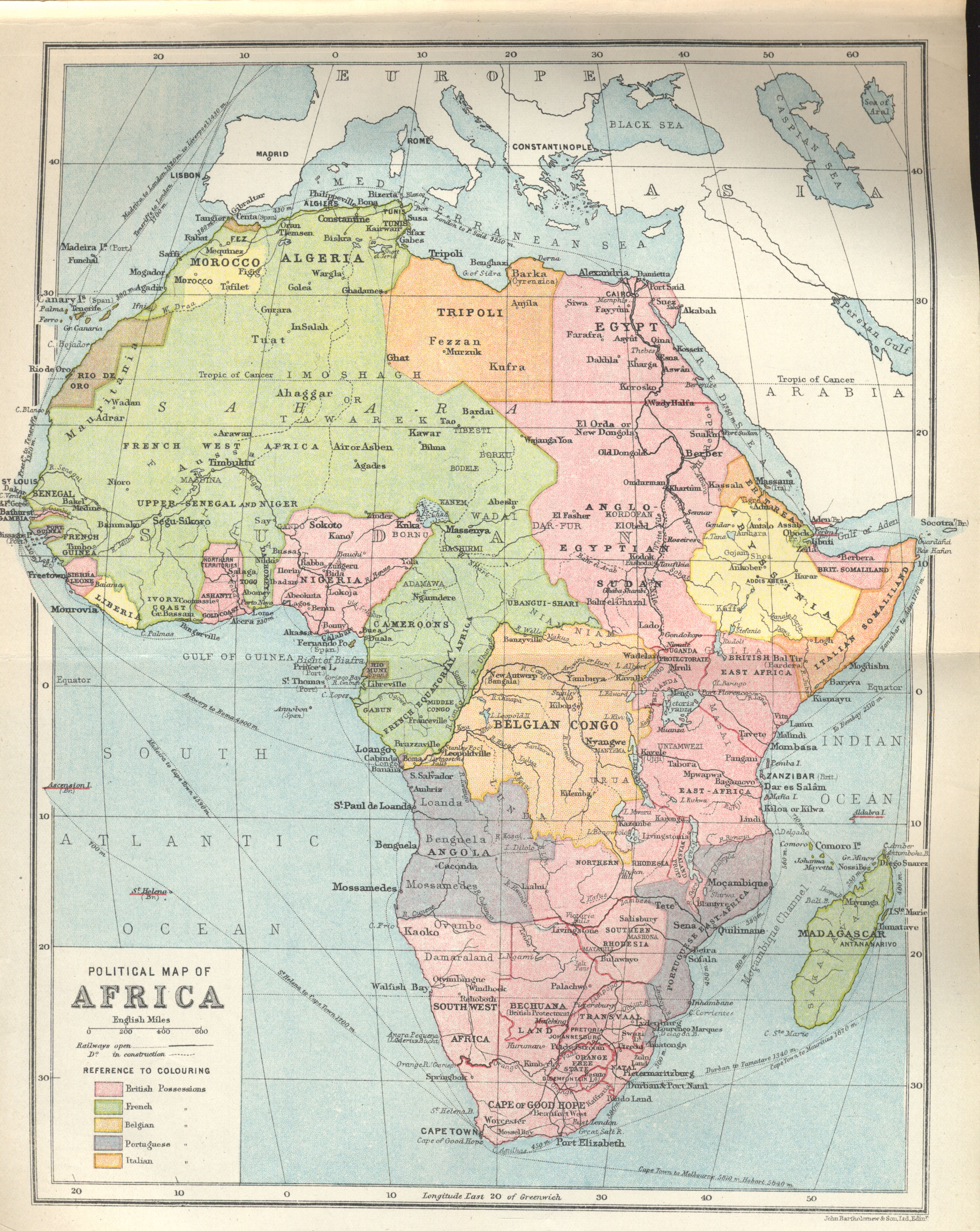
Af′rica, one of the three great divisions of the Old World, and the second in extent of the five principal continents of the globe, forming a vast peninsula joined to Asia by the Isthmus of Suez. It is of a compact form, with few important projections or indentations, and having therefore a very small extent of coast-line (about 16,000 miles, or much less than that of Europe) in proportion to its area. This continent extends from 37° 21′ N. lat. to 34° 51′ S. lat., and the extreme points, Cape Blanco and Cape Agulhas, are nearly 5000 miles apart. From west to east, between Cape Verde, lon. 17° 34′ W., and Cape Guardafui, lon. 51° 16′ E., the distance is about 4600 miles. The area is estimated at 11,500,000 sq. miles, or more than three times that of Europe. The islands belonging to Africa are not numerous, and, except Madagascar, none of them are large. They include Madeira, the Canaries, Cape Verde Islands, Fernando Po, Principe, São Thomé, Ascension, St. Helena, Mauritius, Réunion, the Comoros, Socotra, &c.
The interior of Africa is as yet imperfectly known, but we know enough of the continent as a whole to be able to point to some general features that characterize it. One of these is that almost all round it at no great distance from the sea, and, roughly speaking, parallel with the coast-line, we find ranges of mountains or elevated lands forming the outer edges of interior plateaux. The most striking feature of Northern Africa is the immense tract known as the Sahara or Great Desert, which is enclosed on the north by the Atlas Mountains (greatest height, 12,000 to 15,000 feet), the plateau of Barbary and that of Barqa, on the east by the mountains along the west coast of the Red Sea, on the west by the Atlantic Ocean, and on the south by the Sudan. The Sahara is by no means the sea of sand it has sometimes been represented: it contains elevated plateaux and even mountains radiating in all directions, with habitable valleys between. A considerable nomadic population is scattered over the habitable parts, and in the more favoured regions there are settled communities. The Sudan, which lies to the south of the Sahara, and separates it from the more elevated plateau of Southern Africa, forms a belt of pastoral country across Africa, and includes the countries on the Niger, around Lake Tchad (or Chad), and eastwards to the elevated region of Abyssinia. Southern Africa as a whole is much more fertile and well watered than Northern Africa, though it also has a desert tract of considerable extent (the Kalahari Desert). This division of the continent consists of a tableland, or series of tablelands, of considerable elevation and great diversity of surface, exhibiting hollows filled with great lakes, and terraces over which the rivers break in falls and rapids, as they find their way to the low-lying coast tracts. The mountains which enclose Southern Africa are mostly much higher on the east than on the west, the most northerly of the former being those of Abyssinia, with heights of 10,000 to 14,000 or 16,000 feet, while the eastern edge of the Abyssinian plateau presents a steep unbroken line of 7000 feet in height for many hundred miles. Farther south, and between the great lakes and the Indian Ocean, we find Mounts Kenya and Kilimanjaro (19,500 feet), the loftiest in Africa, covered with perpetual snow. Of the continuation of this mountain boundary we shall only mention the Drakenberg Mountains, which stretch to the southern extremity of the continent, reaching, in Cathkin Peak, Natal, the height of over 10,000 feet. Of the mountains that form the western border the highest are the Cameroon Mountains, which rise to a height of 13,000 feet at the inner angle of the Gulf of Guinea. The average elevation of the southern plateau is from 3000 to 4000 feet.
The Nile is the only great river of Africa which flows into the Mediterranean. It receives its waters primarily from the great lake Victoria Nyanza, which lies under the equator, and in its upper course is fed by tributary streams of great size, but for the last 1200 miles of its course it has not a single affluent. It drains an area of more than 1,000,000 sq. miles. The Indian Ocean receives numerous rivers; but the only great river of South Africa which enters that ocean is the Zambezi, the fourth in size of the continent, and having in its course the Victoria Falls, one of the greatest waterfalls in the world. In Southern Africa also, but flowing westward and entering the Atlantic, is the Congo, which takes its origin from a series of lakes and marshes in the interior, is fed by great tributaries, and is the first in volume of all the African rivers, carrying to the ocean more water than the Mississippi. Unlike most of the African rivers, the mouth of the Congo forms an estuary. Of the other Atlantic rivers, the Senegal, the Gambia, and the Niger are the largest, the last being third among African streams.
With the exception of Lake Tchad there are no great lakes in the northern division of Africa, whereas in the number and magnificence of its lakes the southern division almost rivals North America. Here are the Victoria and Albert Nyanza, Lakes Tanganyika, Nyasa, Shirwa, Bangweulu, Moero, and other lakes. Of these the Victoria and Albert belong to the basin of the Nile; Tanganyika, Bangweulu, and Moero to that of the Congo; Nyasa, by its affluent the Shiré, to the Zambezi. Lake Tchad on the borders of the northern desert region is now known to be much smaller than was formerly believed, but varies in area according to the season. Lake Ngami in the far south is now a mere swamp.
The climate of Africa is mainly influenced by the fact that it lies almost entirely within the tropics. In the equatorial belt, both north and south, rain is abundant and vegetation very luxuriant, dense tropical forests prevailing for about 10° on either side of the line. To the north and south of the equatorial belt the rainfall diminishes, and the forest region is succeeded by an open pastoral and agricultural country. This is followed by the rainless regions of the Sahara on the north and the Kalahari Desert on the south, extending beyond the tropics, and bordering on the agricultural and pastoral countries of the north and south coasts, which lie entirely in the temperate zone. The low coast regions of Africa are almost everywhere unhealthy, the Atlantic coast within the tropics being the most fatal region to Europeans.
Among mineral productions may be mentioned gold, which is found in the rivers of West Africa (hence the name Gold Coast), and in Southern Africa, most abundantly in the Transvaal; diamonds have been found in large numbers in recent years in the south; iron, copper, lead, tin, and coal are also found.—Among plants are the baobab, the date-palm (important as a food plant in the north), the doum-palm, the oil-palm, the wax-palm, the shea-butter tree, trees yielding caoutchouc, the papyrus, the castor-oil plant, indigo, the coffee-plant, heaths with beautiful flowers, aloes, &c. Among cultivated plants are wheat, maize, millet, and other grains, cotton, coffee, cassava, ground-nut, yam, banana, tobacco, various fruits, &c. As regards both plants and animals, Northern Africa, adjoining the Mediterranean, is distinguished from the rest of Africa in its great agreement with Southern Europe.—Among the most characteristic African animals are the lion, hyena, jackal, gorilla, chimpanzee, baboon, African elephant (never domesticated, yielding much ivory to trade), hippopotamus, rhinoceros, giraffe, zebra, quagga, antelopes in great variety and immense numbers.—Among birds are the ostrich, the secretary-bird or serpent-eater, the honey-guide cuckoo, sacred ibis, guinea fowl.—The reptiles include the crocodile, chameleon, and serpents of various kinds, some of them very venomous. Among insects are locusts, scorpions, the tsetse-fly whose bite is so fatal to cattle, and white-ants.
The great races of which the population of Africa mainly consists are the Eastern Hamites (who are not a distinct race but a blend), the Semites, the Negroes, and the Bantus. To the Semitic stock belong the Arabs, who form a considerable portion of the population in Egypt and along the north coast, while a portion of the inhabitants of Abyssinia is of the same race. The Hamites are represented, according to Sergi, by the Copts of Egypt, the Berbers, Kabyles, &c., of Northern Africa, and the Somâli, Danâkil, &c., of East Africa. The Negro races occupy a vast territory in the Sudan and Central Africa, while the Bantus occupy the greater part of Southern Africa from a short distance north of the equator, and include the Kaffirs, Bechuanas, Swahili, and allied races. In the extreme south-west are the Hottentots and Bushmen (the latter a dwarfish race), distinct from the other races as well as, probably, from each other. In Madagascar there is a large Malay element. To these may be added the Fulahs on the Niger and the Nubians on the Nile and elsewhere, who are of a brownish colour, and are often regarded as distinct from the other races, though sometimes classed with the Negroes. In religion a great proportion of the inhabitants are heathens of the lowest type; Mohammedanism numbers a large number of adherents in North Africa, and is rapidly spreading in the Sudan; Christianity prevails only among the Copts, the Abyssinians, and the natives of Madagascar, the last-named having been converted in recent times. Elsewhere the missionaries seem to have made but little progress. Over a great part of the continent civilization is at a low ebb, yet in some parts the natives have shown considerable skill in agriculture and various mechanical arts, as in weaving and metal working. Of African trade two features are the caravans that traverse great distances, and the trade in slaves that still widely prevails, though it has been greatly restricted in recent years. Among articles exported from Africa are palm-oil, diamonds, ivory, ostrich feathers, wool, cotton, gold, esparto, caoutchouc, &c. The population is estimated at 180,000,000. Of these a small number are of European origin—French in Algeria and Morocco, British and Dutch at the southern extremity.
Great areas in Africa have been apportioned among European Powers as protectorates or spheres of influence. Among native States still more or less independent are Egypt, Abyssinia, Waday, Bagirmi, Liberia. To Britain belong the Cape Province, Natal, the Orange Free State and Transvaal, with Rhodesia, &c., farther north, a region in Eastern Africa extending from the sea to Lake Victoria and the headwaters of the Nile, Nigeria, Gold Coast, and other tracts on the west, with Mauritius, &c.; to France belong Algeria and Tunis, Senegambia, Zone of Morocco, territory north of the Lower Congo, Madagascar, &c.; the Portuguese possess Angola on the west coast and Mozambique on the east; Italy has a territory on the Red Sea, and part of Somaliland; Spain has a part of the coast of the Sahara; the Congo State is a colony of Belgium; Zanzibar is merged in Kenya Colony. Germany was deprived of her possessions in Africa during the European War, and the Peace Conference of 1919 appointed Great Britain, France, and Belgium to act as mandatories of the League of Nations.
The name Africa was given by the Romans at first only to a small district in the immediate neighbourhood of Carthage. The Greeks called Africa Libya, and the Romans often used the same name. The first African exploring expedition on record was sent by Pharaoh Necho about the end of the seventh century B.C. to circumnavigate the continent. The navigators, who were Phœnicians, were absent three years, and according to report they accomplished their object. Fifty or a hundred years later, Hanno, a Carthaginian, made a voyage down the west coast and seems to have got as far as the Bight of Benin. The east coast was probably known to the ancients as far as Mozambique and the island of Madagascar. Of modern nations the Portuguese were the first to take in hand the exploration of Africa. In 1433 they doubled Cape Bojador, in 1441 reached Cape Blanco, in 1442 Cape Verde, in 1462 they discovered Sierra Leone. In 1484 the Portuguese Diego Cam discovered the mouth of the Congo. In 1486 Bartholomew Diaz rounded the Cape of Good Hope and reached Algoa Bay. A few years later a Portuguese traveller visited Abyssinia. In 1497 Vasco da Gama, who was commissioned to find a route by sea to India, sailed round the southern extremity as far as Zanzibar, discovering Natal on his way. The first European settlements were those of the Portuguese in Angola and Mozambique, soon after 1500. In 1650 the Dutch made a settlement at the Cape. In 1770 James Bruce reached the source of the Blue Nile in Abyssinia. For the exploration of the interior of Africa, however, little was done before the close of the eighteenth century.
Modern African exploration may be said to begin with Mungo Park, who reached the upper course of the Niger (1795-1805). Dr. Lacerda, a Portuguese, about the same time reached the capital of the Cazembe, in the centre of South Africa, where he died. During 1802-6 two Portuguese traders crossed the continent from Angola, through the Cazembe's dominions, to the Portuguese possessions on the Zambezi. During 1822-4 extensive explorations were made in Northern and Western Africa by Denham, Clapperton, and Oudney, who proceeded from Tripoli by Murzuq to Lake Tchad, and explored the adjacent regions; Laing, in 1826, crossed the desert from Tripoli to Timbuktu; Caillié, leaving Senegal, made in 1827-8 a journey to Timbuktu, and thence through the desert to Morocco. In 1830 Lander traced a large part of the course of the Niger downward to its mouth, discovering its tributary the Benue. In the south Livingstone, who was stationed as a missionary at Kolobeng, setting out from that place in 1849 discovered Lake Ngami. In 1851 he went north again, and came upon numerous rivers flowing north, affluents of the Zambezi. In 1848 and 1849 Krapf and Rebmann, missionaries in East Africa, discovered the mountains Kilimanjaro and Kenya. An expedition sent out by the British Government started from Tripoli in 1850 to visit the Sahara and the regions around Lake Tchad, the chiefs being Richardson, Overweg, and Barth. The last alone returned in 1855, having carried his explorations over 2,000,000 sq. miles of this part of Africa, hitherto almost unknown. During 1853-6 Livingstone made an important series of explorations. He first went north-westwards, tracing part of the Upper Zambezi, and reached St. Paul de Loanda on the west coast in 1854. On his return journey he followed pretty nearly the same route till he reached the Zambezi, and proceeding down the river, and visiting its falls, called by him the Victoria Falls, he arrived at Quelimane at its mouth on 20th May, 1856, thus crossing the continent from sea to sea. In 1858 he resumed his exploration of the Zambezi regions, and in various journeys visited Lakes Shirwa and Nyasa, sailed up the Shiré to the latter lake, and established the general features of the geography of this part of Africa, returning to England in 1864. By this time the great lakes of equatorial Africa were becoming known, Tanganyika and Victoria having been discovered by Burton and Speke in 1858, and the latter having been visited by Speke and Grant in 1862 and found to give rise to the Nile, while the Albert Nyanza was discovered by Baker in 1864. In 1866 Livingstone entered on his last great series of explorations, the main object of which was to settle the position of the watersheds in the interior of the continent, and which he carried on till his death in 1873. His most important explorations on this occasion were west and south-west of Tanganyika, including the discovery of Lakes Bangweulu and Moero, and part of the upper course of the River Congo (here called Lualaba). For over two years he was lost to the knowledge of Europe till met with by H. M. Stanley at Tanganyika in 1871. Gerhard Rohlfs, in a succession of journeys from 1861 to 1874, traversed the Sahara in different directions, and also crossed the continent entirely from Tripoli to Lagos by way of Murzuq, Bornu, &c. During 1873-5 Lieutenant Cameron, who had been sent in search of Livingstone, surveyed Lake Tanganyika, explored the country to the west of it, and then travelling to the south-west, finally reached Benguella on the Atlantic coast. During 1874-7 Stanley surveyed Lakes Victoria Nyanza and Tanganyika and explored the intervening country; then going westward to where Livingstone had struck the Congo he followed the river down to its mouth, thus finally settling its course and completing a remarkable and valuable series of explorations. In 1879 Serpa Pinto completed a journey across the continent from Benguella to Natal, and in 1881-2 Wissman and Pogge crossed it again from St. Paul de Loanda to Zanzibar. In recent years our knowledge of all parts of Africa has been greatly increased, thanks to the efforts of travellers, missionaries, and commercial agents. Steamers now ply on the Congo, and on Lakes Tanganyika, Nyasa, and Victoria, and numerous railways ('Cape to Cairo', &c.) extend far into the continent.—Bibliography: Mungo Park, Travels; D. Livingstone, Missionary Travels; Sir H. M. Stanley, In Darkest Africa; Sir H. H. Johnston, Africa.
Afridis (a˙-frē′diz), a tribe or clan on the north-west frontier of India, about the Khyber Pass, who have at various times given trouble to the British, and are included in a new (1922) scheme of Khassadars (irregulars). In 1897-8 a campaign ('the Tirah campaign') had to be undertaken against them, costly both in men and money, before British authority was asserted. In 1905 the Afridis of the force called the Khyber Rifles formed an escort for the Prince and Princess of Wales on their visit to the famous pass, which was long in their charge.—Cf. Holdich, The Indian Borderland.
Afrikander Bund, an association dating from 1880 and founded for the purpose of consolidating Afrikander influence in South Africa. For a time it supported the policy of Cecil Rhodes, but after 1895 separated itself from him. After the war in 1902 the Bund was reorganized, and identified with the South African party whose policy is to further the federation of the South African colonies under the British crown.
A′ga, formerly title of Turkish officers of a lower military rank, now of men of great wealth and influence except learned men and ecclesiastics, to whom the corresponding title of effendi, meaning 'elder brother' and subsequently 'master', is given.
Ag′ades, a town of Africa, near the middle of the Sahara, capital of the Saharan oasis of Aïr or Asben; at one time a seat of great traffic, probably containing 60,000 inhabitants, now with a pop. of about 7000.
Agadir, a little town on the Atlantic coast of Morocco, the Santa Cruz May of the Spaniards. It was seized by the Portuguese in the sixteenth century, and captured by Mulai Ahmed in 1536. It was once one of the most important seaports of Morocco, but is now closed to commerce and only used as a customs station, its place being taken by Mogador. In July, 1910, the appearance of a French cruiser in the port of Agadir gave rise to a Franco-German dispute, and in 1911 Germany sent the gunboat Panther, and a few days later the Berlin, to Agadir for the protection of German subjects. See France, Germany.
Agallochum (a-gal′o-kum), a fragrant wood obtained from Aloexўlon Agallŏchum, a leguminous tree of Cochin-China, and Aquilāria Agallŏcha, a large tree found in north-east Bengal, abounding in resin and an essential oil which yields a perfume used as incense.
Agal′matolite (Gr. agalma, image), a kind of stone, a clay-slate altered by heat and by the addition of alkalies, which is carved into images, &c., by the Chinese.
Ag′ama, a name of several lizards allied to the iguana, natives of both hemispheres.
Agamem′non, in Greek mythology, son of Atreus, King of Mycenæ and Argos, brother of Menelaus, and commander of the allied Greeks at the siege of Troy. Returning home after the fall of Troy, he was treacherously assassinated by his wife, Clytemnestra, and her paramour, Ægisthus, Agamemnon's cousin. He was the father of Orestes, Iphigenīa, and Electra.
Ag′ami. See Trumpeter.
Agamogenesis (-jen′e-sis; Gr. a, priv., gamos, marriage, genesis, reproduction), the production of young without the congress of the sexes, one of the phenomena of alternate generation. See Generation and Parthenogenesis.
Aganippe (-nip′ē), daughter of the river-god Parmessos, or Termessos, nymph of a fountain on Mount Helicon, in Greece, sacred to the Muses, which had the property of inspiring with poetic fire whoever drank of it. The name is often given to the wife of Acrisius and mother of Danae.
Agape (ag′a-pē; Gr. agapē, love), in ecclesiastical history, the love-feast or feast of charity, in use among the primitive Christians, when a liberal contribution was made by the rich to feed the poor. For a time the agape coincided with the eucharist, which, at its origin, was clearly funerary in its intention. "For as often as ye eat this bread and drink this cup, ye do show the Lord's death till he come." During the first three centuries love-feasts were held in the churches without scandal, but in after-times they acquired a bad reputation, not undeservedly, and they were condemned at the Council of Carthage in 397. Some modern sects, as the Wesleyans, Sandemanians, Moravians, &c., have attempted to revive this feast.
Agapemone (ag-a-pem′o-nē; lit. 'the abode of love'), the name of a singular conventual establishment which has existed at Spaxton, near Bridgewater, Somersetshire, since 1859, the originator of it being a certain Henry James Prince, at one time a clergyman of the Church of England, who called himself the Witness of the First Resurrection. The life spent by the inmates appears to be a sort of religious epicureanism. Some of the proceedings of the inmates of the 'Abode of Love' have resulted in applications to the courts of law, where parties formerly members of the society have returned to the world and sought to regain their rights from Prince and his followers, and such cases have caused some scandal. In 1902 Prince was succeeded by T. H. Smyth-Pigott.
A′gar-a′gar, a dried seaweed of the Asiatic Archipelago, the Gracilaria lichenoides, much used in the East for soups and jellies, and also by paper and silk manufacturers.
Agaricus campestris, the Common Mushroom
Agar′ic (Agarĭcus), a large and important genus of fungi, characterized by having a fleshy cap or pileus, and a number of radiating plates or gills on which are produced the naked spores. The majority of the species are furnished with stems, but some are attached to the objects on which they grow by their pileus. Over a thousand species are known, and are arranged in five sections according to whether the colour of their spores is white, pink, brown, purple, or black. The chief British representatives are the common wild mushroom (A. campestris, L.), the Horse mushroom (A. arvensis, Schæff.), A. elvensis, B. and Br., A. silvaticus, Schæff., &c. Many of the species are edible, like the common mushroom, and supply a delicious article of food, while others are deleterious and even poisonous.
Agaric Mineral, or Mountain-meal, one of the purest of the native carbonates of lime, found chiefly in the clefts of rocks and at the bottom of some lakes in a loose or semi-indurated form resembling a fungus. The name is also applied to a stone of loose consistence found in Tuscany, of which bricks may be made so light as to float in water, and of which the ancients are supposed to have made their floating bricks. It is a hydrated silicate of magnesium, mixed with lime, alumina, and a small quantity of iron.
Aga′sias, a Greek sculptor of Ephesus, about 400 B.C., whose celebrated statue, known as the Borghese Gladiator, representing a soldier contending with a horseman, is now in the Louvre, Paris.
Agassiz (ag′as-ē), Louis John Rudolph, an eminent naturalist, born 1807, died 1873, son of a Swiss Protestant clergyman at Motiers, near the eastern extremity of the Lake of Neufchâtel. He completed his education at Lausanne, and early developed a love of the natural sciences. He studied medicine at Zürich, Heidelberg, and Munich. His attention was first specially directed to ichthyology by being called on to describe the Brazilian fishes brought to Europe from Brazil by Martius and Spix. This work was published in 1829, and was followed in 1830 by Histoire Naturelle des Poissons d'eaux douces de l'Europe Centrale (Fresh-water Fishes of Central Europe). Directing his attention to fossil ichthyology, five volumes of his Recherches sur les Poissons Fossiles appeared between 1834 and 1844. His researches led him to propose a new classification of fishes, which he divided into four classes, distinguished by the characters of the skin, as ganoids, placoids, cycloids, and ctenoids. His system has not been generally adopted, but the names of his classes have been taken as useful terms. In 1836 he began the study of glaciers, and in 1840 he published his Études sur les Glaciers, in 1847 his Système Glaciaire. From 1838 he had been professor of natural history at Neufchâtel, when in 1846 pressing solicitations and attractive offers induced him to settle in America, where he was connected as a teacher first with Harvard University, Cambridge, and afterwards with Cornell University as well as Harvard. After his arrival in America he engaged in various investigations and explorations, and published numerous works, including: Principles of Zoology, in connection with Dr. A. Gould (1848); Contributions to the Natural History of the United States (4 vols., 1857-62); Zoologie Générale (1854); Methods of Study in Natural History (1863). In 1865-6 he made zoological excursions and investigations in Brazil, which were productive of most valuable results. Agassiz held views on many important points in science different from those which prevailed among the scientific men of the day, and in particular he strongly opposed the evolution theory. Cf. Letters and Recollections, edited by G. R. Agassiz.
Agassiz (ag′a-sē), Mount, an extinct volcano in Arizona, United States, 10,000 feet in height; a place of summer resort, near the Great Cañon of the Colorado.
Ag′ate, a semi-translucent compound mineral mass formed in the cavities of rocks by the successive deposition of various types of silica, or by the staining of a siliceous mass thus deposited along concentric zones. Bands or layers of various colours blended together, the base generally being chalcedony, and this mixed with variable proportions of jasper, amethyst, quartz, opal, heliotrope, and carnelian. The varying manner in which these materials are arranged causes the agate when polished to assume some characteristic appearances, and thus certain varieties are distinguished, as the ribbon agate, the fortification agate, the zone agate, the star agate, the moss agate, the clouded agate, &c. In Scotland they are cut and polished under the name of Scottish pebbles.
Agathar′chus, a Greek painter, native of Samos, the first to paint a scene for the acting of tragedies. The view, however, that he applied the rules of perspective to theatrical scene-painting is doubtful. He flourished about 480 B.C.
Agath′ias, a Greek poet and historian, born at Myrina, Asia Minor, about A.D. 530; author of an anthology, a collection of love poems, and a history of his own times, which is our chief authority for the period 552-8, during which time the Byzantine army was struggling against the Goths, Vandals, and Franks.
Agathocles (a-gath′o-klēz), a Sicilian Greek, one of the boldest adventurers of antiquity, born 361 B.C. By his ability and energy, and being entirely unscrupulous, he raised himself from being a potter to being tyrant of Syracuse and master of Sicily. Wars with the Carthaginians were the chief events of his life. He died at the age of seventy-two.
Ag′athon, a Greek tragic poet, a friend of Euripides, and contemporary with Socrates and Alcibiades, born about 445 B.C., died about 402 B.C. The banquet which he gave to celebrate his first dramatic victory was made the groundwork of Plato's Symposium.