Volume 1 — VOLUME I (continued 6)
Reading edition
Alexander, the name of eight popes, the earliest of whom, Alexander I, is said to have reigned from 108 to 119. Alexander III, elected 1159, died 1181, exercised his authority with great vigour against Henry II when the latter was accused of the assassination of Thomas Becket. The most famous (or infamous) is Alexander VI (Borgia), who was born at Valencia, in Spain, in 1431, and died in 1503. When he was only twenty-five years of age his uncle, Pope Calixtus III, made him a cardinal, and shortly afterwards appointed him to the dignified and lucrative office of vice-chancellor. By bribery he prepared his way to the papal throne, which he attained in 1492, after the death of Innocent VIII. Both the authority and revenues of the popes being at this time much impaired, he set himself to reduce the power of the Italian princes, and seize upon their possessions for the benefit of his own family. To effect this end he is said not to have scrupled to use the vilest means, including poison and assassination. His policy, foreign as well as domestic, was faithless and base, and his private life was stained by immorality. He understood how to extract immense sums of money from all Christian countries under various pretexts. He sold indulgences, and set aside, in favour of himself, the wills of several cardinals. His excesses roused against him the powerful eloquence of Savonarola, who, by pen and pulpit, urged his deposition, but had to meet his death at the stake in 1498. Not long after his election Alexander had the honour of deciding the dispute between the kings of Portugal and Castile concerning their respective claims to the foreign countries recently discovered. It must, however, be admitted that Pope Alexander, whilst striking the wealthy and powerful, interested himself in the welfare of the people, and that he was a patron of arts and letters. His son, Cesare Borgia, and his daughter, Lucrezia, are equally notorious with himself.
Alexander, the name of three Scottish kings. Alexander I, a son of Malcolm III, Canmore, and Margaret of England, succeeded his brother Edgar in 1107, and governed with great ability till his death in 1124. He was a great benefactor of the Church, and a firm vindicator of the national independence.—Alexander II was born in 1198, and succeeded his father, William the Lion, in 1214. He was a wise and energetic prince, and Scotland prospered greatly under him, though disturbed by the Norsemen, by the restlessness of some of the Celtic chiefs, and by the attempts of Henry III of England to make Alexander do homage to him. He helped Robert FitzWilliam to capture London and compel King John to sign Magna Charta. Alexander married Henry's sister, Joan, in 1221, who lived till 1238. In 1244 war with England almost broke out, but was fortunately averted. Alexander died in 1248 at Kerrera, an island opposite Oban, when on an expedition in which he hoped to wrest the Hebrides from Norway. He was succeeded by his son, Alexander III, a boy of eight, who in 1251 married Margaret, eldest daughter of Henry III of England. Like his father, he was eager to bring the Hebrides under his sway, and this he was enabled to accomplish in a few years after the defeat of the Norse King Haco at Largs, in 1263. The mainland and islands of Scotland were now under one sovereign, though Orkney and Shetland still belonged to Norway. Alexander was strenuous in asserting the independence both of the Scottish kingdom and the Scottish Church against England. He died in 1285 by the falling of his horse while he was riding in the dark between Burntisland and Kinghorn. He left as his heiress Margaret, the Maid of Norway, daughter of Eric of Norway, and of Alexander's daughter, Margaret. Under him Scotland enjoyed greater prosperity than for generations afterwards.
Alexander I, Emperor of Russia, son of Paul I and Maria, daughter of Prince Eugene of Würtemberg, was born in 1777, and died in 1825. On the assassination of his father, in 1801, Alexander ascended the throne, and one of his first acts was to conclude peace with Britain, against which his predecessor had declared war. In 1803 he offered his services as mediator between England and France, and two years later a convention was entered into between Russia, England, Austria, and Sweden for the purpose of resisting the encroachments of France on the territories of independent States. He was present at the battle of Austerlitz (1805), when the combined armies of Russia and Austria were defeated by Napoleon. In the succeeding campaign the Russians were again beaten at Eylau (8th Feb., 1807) and Friedland (14th June), the result of which was an interview between Alexander and Napoleon, and the treaty at Tilsit. The Russian emperor now for a time identified himself with the Napoleonic schemes, and soon obtained possession of Finland and an extended territory on the Danube. The French alliance, however, he found to be too oppressive, and his having separated himself from Napoleon led to the disastrous French invasion of 1812. In 1813 he published a manifesto which served as the basis of the coalition of the other European powers against France, which was followed by the capture of Paris (in 1814), the abdication of Napoleon and the restoration of the Bourbons, and the utter overthrow of Napoleon the following year. After Waterloo, Alexander, accompanied by the Emperor of Austria and the King of Prussia, made his second entrance into Paris, where they concluded the treaty known as the Holy Alliance. The remaining part of his reign was chiefly taken up with measures of internal reform, including the gradual abolition of serfdom, and the promotion of education, agriculture, commerce, and manufactures, as well as literature and the fine arts.
Alexander II, Emperor of Russia, was born 29th April, 1818, and succeeded his father Nicholas in 1855, before the end of the Crimean war. After peace was concluded, the new emperor set about effecting reforms in the empire, the greatest of all being the emancipation of the serfs in 1861, a measure which gave freedom, on certain conditions, to 50,000,000 of human beings who were previously in a state little removed from that of slavery. Under him, too, representative assemblies in the provinces were introduced, and he also did much to improve education, and to reorganize the judicial system. During his reign the Russian dominions in Central Asia were extended, a piece of territory south of the Caucasus, formerly belonging to Turkey, was acquired, and a part of Bessarabia restored to Russia. The latter additions resulted from the Russo-Turkish war of 1877-8. He was killed by an explosive missile flung at him by a Nihilist in a street in St. Petersburg (now Petrograd), 13th March, 1881. He was succeeded by his son, Alexander III. His only daughter was married to the Duke of Edinburgh.
Alexander III, Emperor of Russia, son of Alexander II, born in 1845, became heir to the throne on the death of his eldest brother, Nicholas (1865). In 1863 he married Princess Dagmar of Denmark; he succeeded to the throne in 1881, on the assassination of his father, being crowned in Moscow in 1883. He gave up the reforms begun by his father, and ruled in the old autocratic fashion, restricting the liberties of Finland and the Baltic Provinces, and encouraging persecution of the Jews. He spent much time in the closely-guarded castle of Gatchina, to be safe from Nihilistic attempts, several of which he narrowly escaped. He endeavoured to put down corruption and underhand dealing among the bureaucracy, and in his own habits gave an example of simplicity and economy. While showing himself suspicious of Germany and Austria-Hungary, he entered on friendly relations with France. He began to suffer from disease of the kidneys in 1893, and died at Livadia on 1st Nov., 1894. He was succeeded by his eldest son, Nicholas II.
Alexander I, King of Serbia, born in 1876. He was the son of King Milan, and on the abdication of his father in 1889 was proclaimed king under a regency. He married Madame Draga Mashin, a widow, who was much older than himself. Both were assassinated on 11th June, 1903.
Alexander of Hales. See Hales, Alexander de.
Alexander, Boyd, British explorer and naturalist, born in 1873. He led many expeditions for research and exploration to the Cape Verde Islands, the Zambesi River, and various parts of the world. He also discovered many new birds when he ascended the Mount St. Isabel. In 1908 he received the gold medal of the Royal Geographical Society. He was murdered by natives in May, 1910, while exploring the French Congo. He wrote From the Niger to the Nile (1907), &c. Boyd Alexander's Last Journey was published in 1912.
Alexander Nevskoi, a Russian hero and saint, son of the Grand-Duke Jaroslav, born in 1219, died in 1263. He fought valiantly against assaults of the Mongols, the Danes, Swedes, and Knights of the Teutonic Order. He gained the name of Nevskoi in 1240, for a splendid victory, on the Neva, over the Swedes. The gratitude of his countrymen commemorated the hero in popular songs, and raised him to the dignity of a saint. Peter the Great built a splendid monastery at St. Petersburg (Petrograd) in his honour, and in memory of him established the Order of Alexander Nevskoi.
Alexander Seve′rus, a Roman emperor, born in 208, died A.D. 235. He was raised to the imperial dignity in A.D. 222 by the prætorian guards, after they had put his cousin the Emperor Heliogabalus to death. He governed ably both in peace and war; and also occupied himself in poetry, philosophy, and literature. He was very tolerant in religious matters, and although not professing Christianity intended to erect a temple to Christ, but was prevented by the pagan priests from carrying out this plan. In 232 he defeated the Persians under Artaxerxes, who wished to drive the Romans from Asia. When on an expedition into Gaul, to repress an incursion of the Germans, he was murdered with his mother in an insurrection of his troops, headed by the brutal Maximin, who succeeded him as emperor.
Alexanders (Smyrnium Olusātrum), an umbelliferous biennial plant, a native of the Mediterranean region, but found in Great Britain and Ireland. It was formerly cultivated for its leaf-stalks, which, having a pleasant aromatic flavour, were blanched and used instead of celery—a vegetable that has taken its place.
Alexandra, the queen mother, widow of Edward VII, daughter of Christian IX, King of Denmark, was born at Copenhagen on 1st Dec., 1844, and was married on 10th March, 1863, being Princess of Wales up to the death of Queen Victoria and the accession of King Edward in Jan., 1901. She was highly popular from the first in the country of her husband, as she constantly showed an interest in all benevolent causes. She has been the mother of six children, one of whom died in infancy, while the eldest, Edward, Duke of Clarence and Avondale, died in 1892 at the age of twenty-eight. Cf. S. A. Tooley, Queen Alexandra.
Alexandret′ta, or Iskanderoon (ancient Alexandria ad Issum), a small seaport in Asia Minor, on the Gulf of Iskanderoon, the port of Aleppo and Northern Syria. Named after Alexander the Great, and founded in memory of the battle of Issus. In 1832 Mehemet Ali won a victory over the Turks near Alexandretta. There is a large export and import trade. It was occupied by British and French troops in Nov., 1918. Pop. 10,000.
Alexan′dria, an ancient city and seaport in Egypt, at the north-west angle of the Nile delta, on a ridge of land between the sea and Lake Mareotis. Ancient Alexandria was founded by, and named in honour of, Alexander the Great, in 332 B.C., and was long a great and splendid city, the centre of commerce between the east and west, as well as of Greek learning and civilization, with a population at one time of perhaps 1,000,000. It was especially celebrated for its great library, and also for its famous lighthouse, one of the wonders of the world, standing upon the little island of Pharos, which was connected with the city by a mole. Under Roman rule it was the second city of the empire, and when Constantinople became the capital of the East it still remained the chief centre of trade; but it received a blow from which it never recovered when captured by Amru, general of Caliph Omar, in 641, after a siege of fourteen months. Its ruin was finally completed by the building of Cairo (969) and the discovery of the passage to India by the Cape of Good Hope (1498) which opened up a new route for the Asiatic trade. See Alexandrian Library, Alexandrian School.—Modern Alexandria stands partly on what was formerly the island of Pharos, partly on the peninsula which now connects it with the mainland and which was formed by the accumulation of soil, and partly on the mainland. The streets in the Turkish quarter are narrow, dirty, and irregular; in the foreign quarter they are regular and wide, and it is here that the finest houses are situated. Here also are the principal shops and hotels, banks, offices of companies, &c.; this part of the city being supplied with gas, and with water brought by the Mahmudieh Canal from the western branch of the Nile. Alexandria is connected by railway with Cairo, Rosetta, and Suez. A little to the south of the city are the catacombs, which now serve as a quarry. Another relic of antiquity is Pompey's Pillar, 98 feet 9 inches high. Alexandria has two ports, on the east and west respectively of the isthmus of the Pharos peninsula, the latter having a breakwater over 3000 yards in length, with fine quays and suitable railway and other accommodation. The trade of Alexandria is large and varied, the exports being cotton, beans, pease, rice, wheat, &c.; the imports chiefly manufactured goods, machinery, timber, and coal. The origin of its more recent career of prosperity it owes to Mohammed Ali. In 1882 the insurrection of Arabi Pasha and the massacre of Europeans led to the intervention of the British, and the bombardment of the forts by the British fleet in July. The administrative district has an area of 19 sq. miles; pop. 444,617 (or 23,401 per square mile).
Alexandria, a town and port of the United States, in Virginia, on the right bank of the Potomac (which is of sufficient depth for large vessels), 7 miles south of Washington, carries on a considerable trade, chiefly in flour. Pop. (1920), 18,060.
Alexandria, a town of Scotland, in Dumbartonshire, on the Leven, 4 miles north of Dumbarton, with extensive cotton-printing and bleaching works. Pop. 9850.
Alexandria, a town of the Ukraine, in the former Russian government of Kherson, on a tributary of the Dnieper. Pop. 10,521.
Alexandrian Library, the largest and most famous of all the ancient collections of books, founded by Ptolemy Soter (died 283 B.C.), King of Egypt, and greatly enlarged by succeeding Ptolemies. The first librarian was Zenodotus (234 B.C.). At its most flourishing period it is said to have numbered 700,000 volumes, accommodated in two different buildings, one of them being the Serapeion, or temple of Jupiter Serapis. The other collection was burned during Julius Cæsar's siege of the city, but the Serapeion library existed to the time of the Emperor Theodosius the Great, when, at the general destruction of the heathen temples, the splendid temple of Jupiter Serapis was gutted (A.D. 391) by a fanatical crowd of Christians, and its literary treasures destroyed or scattered. A library was again accumulated, but was burned by the Arabs when they captured the city under the caliph Omar in 641. Amru, the captain of the caliph's army, would have been willing to spare the library, but Omar is said to have disposed of the matter in the famous words: "If these writings of the Greeks agree with the Koran they are useless, and need not be preserved; if they disagree they are pernicious, and ought to be destroyed". This story, however, which rests solely on the authority of Abulfaragius, a writer who lived six centuries later, is now generally discredited.
Alexandrian School or Age, the school or period of Greek literature and learning that existed at Alexandria in Egypt during the three hundred years that the rule of the Ptolemies lasted (323-30 B.C.), and continued under the Roman supremacy. Ptolemy Soter founded the famous library of Alexandria (see above) and his son, Philadelphus, established a kind of academy of sciences and arts. Many scholars and men of genius were thus attracted to Alexandria, and a period of literary activity set in, which made Alexandria for long the focus and centre of Greek culture and intellectual effort. It must be admitted, however, that originality was not a characteristic of the Alexandrian age, which was stronger in criticism, grammar, and science than in pure literature. Among the grammarians and critics were Zenodotus, Eratosthenes, Aristophanes, Aristarchus, and Zoilus, proverbial as a captious critic. Their merit is to have collected, edited, and preserved the existing monuments of Greek literature. To the poets belong Apollonius, Lycophron, Aratus, Nicander, Euphorion, Callimachus, Theocritus, Philetas, &c. Among those who pursued mathematics, physics, and astronomy was Euclid, the father of scientific geometry; Archimedes, great in physics and mechanics; Apollonius of Perga, whose work on conic sections still exists; Nicomachus, the first scientific arithmetician; and (under the Romans) the astronomer and geographer Ptolemy. Alexandria also was distinguished in philosophical speculation, and it was here that the New Platonic school was established by Ammonius of Alexandria (about A.D. 193), whose disciples were Plotinus and Origen. Being for the most part Orientals, formed by the study of Greek learning, the writings of the New Platonists are strikingly characterized—for example, those of Ammonius Saccas, Plotinus, Iamblicus, Porphyrius—by a mixture of Asiatic and European elements. The connection of Neo-Platonism with Alexandria is, however, less than is commonly supposed.—Bibliography: Mahaffy, Greek Life and Thought from the Age of Alexander to the Roman Empire; Kingsley, Alexandria and her Schools; Vacherot, Histoire critique de l'école d'Alexandrie (3 vols.).
Alexandrian Version. See Codex Alexandrinus.
Alexandrine, in prosody, the name given, from an old French poem on Alexander the Great, to a species of verse, which consists of six iambic feet, or twelve syllables, the pause being, in correct Alexandrines, always on the sixth syllable; for example, the second of the following verses:—
A needless Alexandrine ends the song, That, like a wounded snake, drags its slow length along.
In English Drayton's Polyolbion is written in this measure, and the concluding line of the Spenserian stanza is an Alexandrine. In France the verse fell into disuse during the early part of the sixteenth century, but was again revived by Jean Antoine de Baïf, one of the poets of the Pléiade. Jodelle introduced the verse into the drama, and Ronsard made it very popular. French epics and dramas being confined to this verse, it is therefore called the heroic.
Alexandro′pol, formerly a Russian town and fortress in the Transcaucasian government of Erivan, near the highway from Erivan to Kars; now belonging to Armenia; it has silk manufactories. Pop. 48,938.
Alexan′drov, a town of Russia, government of Vladimir, with a famous convent, in the church of which are interred two sisters of Peter the Great; manufactures of steel and cotton goods. Pop. 7179.
Alex′isbad, a bathing-place of Germany, Anhalt, in the Harz Mountains, with two mineral springs strongly impregnated with iron.
Alex′is Mikhai′lovitsh (son of Michael), second Russian Tsar of the line of Romanov, born in 1629, succeeded his father Mikhail Feodorovitsh in 1645, and died in 1676. He did much for the internal administration and for the enlargement of the empire; reconquered Little Russia from Poland, and carried his authority to the extreme east of Siberia. He was father of sixteen children, the most famous of them being Peter the Great and his sister Sophia.
Alexis Petro′vitsh, eldest son of Peter the Great and Eudoxia Lopukhina, repudiated in 1698, was born in Moscow, 1690, and died in 1718. He opposed the innovations introduced by his father, who on this account disinherited him by a ukase in 1718, and when he discovered that Alexis was paving the way to succeed to the crown he had his son tried and condemned to death. A few days afterwards Alexis died, after having received twenty-five strokes with the knout, leaving a son, afterwards the Emperor Peter II.
Alex′ius Comne′nus, Byzantine Emperor, was born in 1048, and died in 1118. He was a nephew of Isaac the first emperor of the Comneni, and attained the throne in 1081, at a time when the Empire was menaced from various sides, especially by the Turks and the Normans. From these dangers he managed to extricate himself by policy or warlike measures, and maintained his position till the age of seventy, during a reign of thirty-seven years. His daughter Anna wrote a life of him (The Alexiad), which is one continuous eulogy, but all the Latin historians are very severe on him.
Al′fa. See Esparto.
Alfal′fa, generally known in Britain as lucerne, a prolific forage plant largely grown in California, &c.
Alfara′bi, an eminent Arabian scholar of the tenth century; died at Damascus in 950; wrote on Aristotelian philosophy, and compiled a kind of encyclopedia.
Al′fenid, an alloy of nickel plated with silver, used for spoons, forks, candlesticks, tea services, &c.
Alfieri (a˙l-fē-ā′rē), Vittorio, Count, Italian poet, was born at Asti in 1749, and died in 1803. After extensive European travels he began to write, and his first play, Cleopatra (1775), being received with general applause he determined to devote all his efforts to attaining a position among writers of dramatic poetry. At Florence he became intimate with the Countess of Albany, wife of Prince Charles Edward Stuart, and on the death of the prince she lived with him as his mistress. This connection he believed to have served to stimulate and elevate his poetic powers. He died at Florence and was buried in the church of Santa Croce, between Macchiavelli and Michael Angelo, where a beautiful monument by Canova covers his remains. He wrote twenty-one tragedies and six comedies. His theatrical work has been rightly styled a creation of his pride as much as of his genius; he endeavoured to turn the theatre into a platform and was constantly preaching from the stage. Anxious to use his characters as exponents of his theories, and to make them talk, he often forgot to make them act. Alfieri himself admitted that he was writing with a view to "teaching men how to become free, strong, generous, and passionate for real virtue", but such an attitude is opposed to true art. His tragedies are full of lofty and patriotic sentiments, but the language is stiff and without poetic grace, and the plots poor. Nevertheless he is considered the first tragic writer of Italy, and has served as a model for his successors. Alfieri composed also an epic, lyrics, satires, and poetical translations from the ancient classics. He left an interesting autobiography. The best edition of his works is that published at Pisa (1805-13) in 22 vols.
Alfon′so. See Alphonso.
Al′ford, Henry, D.D., Dean of Canterbury, an English poet, scholar, and miscellaneous writer, was born in London in 1810. After attending various schools he entered Trinity College, Cambridge, in 1827, graduated B.A. in 1832, was elected fellow in 1834, and next year became vicar of Wymeswold, Leicestershire. In 1842 he was appointed examiner in logic and moral philosophy to the University of London, and held the appointment till 1857. He early began the great work of his life, his edition of the Greek Testament with commentary, which occupied him for twenty years, the first volumes being published in 1849, the fourth and last in 1861. In 1853 he was transferred to Quebec Chapel, London, and in 1857 was appointed Dean of Canterbury. He was the first editor of the Contemporary Review (1866-70). He died in 1871. Among other works he wrote Chapters on the Poets of Ancient Greece, Sermons, Psalms and Hymns, Homilies on the Acts of the Apostles, Letters from Abroad, Poetical Works, Plea for the Queen's English.
Al′fred (or Æl′fred) the Great, King of England, was born at Wantage, in Berkshire, A.D. 849, his father being Ethelwulf, son of Egbert, King of the West Saxons. He succeeded his brother Ethelred in 872, at a time when the Danes, or Northmen, had extended their conquests widely over the country, and they had completely overrun the kingdom of the West Saxons by 878. Alfred was obliged to flee in disguise. At length he gathered a small force, and having fortified himself on the Isle of Athelney, formed by the confluence of the Rivers Parret and Tone, amid the marshes of Somerset, he was able to make frequent sallies against the enemy. It was during his abode here that he went, according to legend, disguised as a harper into the camp of King Guthrum (or Guthorm), and, having ascertained that the Danes felt themselves secure, hastened back to his troops, led them against the enemy, and gained such a decided victory that fourteen days afterwards the Danes begged for peace. This battle took place in May, 878, near Edington, in Wiltshire. Alfred allowed the Danes who were already in the country to remain, on condition that they gave hostages, took a solemn oath to quit Wessex, and embraced Christianity. Their king, Guthrum, was baptized, with thirty of his followers, and ever afterward remained faithful to Alfred. They received that portion of the east of England now occupied by the counties of Norfolk, Suffolk, and Cambridge, as a place of residence. The few years of tranquillity (886-93) which followed were employed by Alfred in rebuilding the towns that had suffered most during the war, particularly London; in training his people in arms and no less in agriculture; in improving the navy; in systematizing the laws and internal administration; and in literary labours and the advancement of learning. He caused many manuscripts to be translated from Latin, and himself translated several works into Anglo-Saxon, such as the Psalms, Æsop's Fables, Boethius on the Consolation of Philosophy, the History of Orosius, Bede's Ecclesiastical History, &c. He also drew up several original works in Anglo-Saxon. These peaceful labours were interrupted, about 894, by an invasion of the Northmen, who, after a struggle of three years, were finally driven out. Alfred died in 901. He had married, in 868, Alswith or Ealhswith, the daughter of a Mercian nobleman, and left two sons: Edward, who succeeded him, and Ethelwerd, who died in 922.—Bibliography: Plummer, Life and Times of Alfred the Great; A. Bowker, Alfred the Great, Chapters on his Life and Times; B. A. Lees, Alfred the Great.
Algæ (al′jē), a nat. ord. of cryptogamic or thallogenous plants, found for the most part in the sea and fresh water, or on the surface of damp walls, rocks, the bark of trees, and in similar moist situations. They are either some shade of bluish-green, green, brown, or red colour. The higher forms have stems bearing leaf-like expansions, and they are often attached to the rocks by roots, which, however, do not derive nutriment from the rocks. A stem, however, is most frequently absent. The plants are nourished through their whole surface by the medium in which they live. They vary in size from the microscopic diatoms to forms whose stems resemble those of forest trees, and whose fronds rival the leaves of the palm. They are entirely composed of cellular tissue, and many are edible and nutritious, as carrageen or Irish-moss, dulse, &c. Kelp, iodine, and bromine are products of various species. The Algæ are also valuable as manure. They are often divided into five orders: Diatomaceæ, Confervaceæ, Fucaceæ, Ceramiaceæ, and Characeæ.
Algar′di, Alessandro, one of the chief Italian sculptors of the seventeenth century; born 1602, died 1654. He lived and worked chiefly at Rome; executed the tomb of Leo XI in St. Peter's, a bronze statue of Innocent X, and a marble relief with life-size figures over the altar of St. Leo there.
Algaro′ba-bean. See Carob Tree.
Al′garot, a violently purgative and emetic white powder, precipitated from chloride of antimony in water; it was used in medicine by the physician Victor Algarotus in the sixteenth century.
Algarot′ti, Francesco, Count, born in 1712, died in 1764, an Italian writer on science, the fine arts, &c. He lived for some years in France and for a long time in Germany, Frederick the Great of Prussia having made him chamberlain and count. He wrote Neutonianismo per le donne; Saggi sopra le belle arti, his principal work on art; poems, letters, &c. Algarotti's works published at Venice in 17 vols. (1791-4) and illustrated by Tesi and Novelli are a chef-d'œuvre of typography. Frederick the Great erected at Pisa a monument to his memory.
Algarve (al-ga˙r′vā, meaning the land situated in the west), a maritime province of Portugal occupying the southern portion of the country, mountainous but with some fertile tracts. The title King of Algarve was held by the Kings of Portugal. Area, 1937 sq. miles; pop. 274,122.
Algau (a˙l′gou), a name for the south-western portion of Bavaria and the adjacent parts of Würtemberg and Tyrol, intersected by the Algau Alps. The Algau breed of cattle is one of the best in Germany.
Algazzali (a˙l-ga˙z-ä′lē), Abu Hamed Mohammed, an Arabian philosopher, Persian by birth; born 1058, died 1111. He was a most prolific author; an opponent of the prevailing Aristotelian philosophy of the day, and wrote against it the Destruction of the Philosophers, answered by Averroes in his Destruction of the Destruction.
Al′gebra (from the Arabic al, definite article, and jabbara, to make equal), a kind of generalized arithmetic, in which numbers or quantities and operations, often also the results of operations, are represented by symbols. Thus the expression xy + cz + dy2 denotes that a number represented by x is to be multiplied by a number represented by y, a number c multiplied by a number z, a number d by a number y multiplied by itself (or squared), and the sum taken of these three products. So the equation (as it is called) x2 - 7x + 12 = 0 expresses the fact that if a certain number x is multiplied by itself, and this result made less by seven times the number and greater by twelve, the result is 0. In this case x must either be 3 or 4 to produce the given result; but such an equation (or formula) as (a + b)(a - b) = a2 - b2 is always true whatever values may be assigned to a and b. Algebra is an invaluable instrument in intricate calculations of all kinds, and enables operations to be performed and results obtained that by arithmetic would be impossible, and its scope is still being extended.
The beginnings of algebraic method are to be found in Diophantus, a Greek of the fourth century of our era, but it was the Arabians that introduced algebra to Europe, and from them it received its name. The first Arabian treatise on algebra was published in the reign of the great Caliph Al Mamun (813-33) by Mohammed Ben Musa. Italian merchants were the first algebraists in Europe, and in 1202 Leonardo Fibonacci of Pisa, who had travelled and studied in the East, published a work treating of algebra as then understood in the Arabian school. From this time to the discovery of printing considerable attention was given to algebra, and the work of Ben Musa and another Arabian treatise, called the Rule of Algebra, were translated into Italian. The first printed work treating on algebra (also on arithmetic, &c.) appeared at Venice in 1494, the author being a monk called Luca Pacioli da Bergo, a Minorite friar. Rapid progress now began to be made, and among the names of those to whom advances are to be attributed are Tartaglia and Geronimo Cardano. About the middle of the sixteenth century the German Stifel introduced the signs +, -, √, and Robert Recorde the sign =. The last-named wrote the first English work on algebra in 1557. François Vieta, a French mathematician (1540-1603), first adopted the method which has led to so great an extension of modern algebra, by being the first who used general symbols for known quantities as well as for unknown. It was he also who first made the application of algebra to geometry. Albert Girard, a Flemish mathematician in the seventeenth century, extended the theory of equations by the introduction of imaginary quantities. The Englishman Harriot, early in the seventeenth century, discovered negative roots, and established the equality between the number of roots and the units in the degree of the equation. He also invented the signs < >, and Oughtred that of ×. Descartes, though not the first to apply algebra to geometry, has, by the extent and importance of his applications, commonly acquired the credit of being so. The same discoveries have also been attributed to him as to Harriot, and their respective claims have caused much controversy. He obtained by means of algebra the definition and description of curves. Since his time algebra has been applied so widely in geometry and higher mathematics that we need only mention the names of Fermat, Wallis, Newton, Leibnitz, De Moivre, MacLaurin, Taylor, Euler, D'Alembert, Lagrange, Laplace, Fourier, Poisson, Gauss, Horner, De Morgan, Sylvester, Cayley. Boole, Jevons, and others have applied the algebraic method not only to formal logic but to political economy.—Bibliography: Chrystal, Algebra (2 vols.); Hobson, Trigonometry; Hardy, Pure Mathematics; Whittaker and Watson, Modern Analysis.
Algeciras (a˙l-he-thē′ra˙s) (perhaps Portus Albus of the Romans), a seaport of Spain, on the west side of the Bay of Gibraltar, a well-built town carrying on a brisk coasting trade. It was the first conquest of the Arabs in Spain (711), and was held by them till 1344, when it was taken by Alphonso XI of Castile after a long siege. Near it, in 1801, Admiral Sir James Saumarez defeated a Franco-Spanish fleet. Differences between France and Germany regarding Morocco led to a conference of European Powers here from 16th Jan.-7th April, 1906. Pop. 15,800.
Alge′ria, a French dependency in N. Africa, having on the north the Mediterranean, on the east Tunis, on the west Morocco, and on the south the Desert of Sahara; area, 122,878 sq. miles, or including the Algerian Sahara 343,500. The country is divided into three departments—Algiers, Oran, and Constantine. The coastline is about 550 miles in length, steep and rocky, and though the indentations are numerous, the harbours are much exposed to the north wind. The country is traversed by the Atlas Mountains, two chains of which—the Great Atlas, bordering on the Sahara, and the Little, or Maritime Atlas, between it and the sea—run parallel to the coast, the former attaining a height of 7000 feet. The intervals are filled with lower ranges, and numerous transverse ranges connect the principal ones and run from them to the coast, forming elevated tablelands and enclosed valleys. The rivers are numerous, but many of them are mere torrents rising in the mountains near the coast. The Shelif is much the largest. Some of the rivers are largely used for irrigation, and artesian wells have been sunk in some places for the same purpose. There are, both on the coast and in the interior, extensive salt lakes or marshes (Shotts), which dry up to a great extent in summer. The country bordering on the coast, called the Tell, is generally hilly, with fertile valleys; in some places a flat and fertile plain extends between the hills and the sea. In the east there are Shotts that sink below the sea-level, and into these it has been proposed to introduce the waters of the Mediterranean. The climate varies considerably according to elevation and local peculiarities. There are three seasons: winter from November to February, spring from March to June, and summer from July to October. The summer is very hot and dry. In many parts of the coast the temperature is moderate and the climate so healthy that Algeria is now a winter resort for invalids.
The chief products of cultivation are wheat, barley, and oats, tobacco, cotton, wine, silk, and dates. Early vegetables, especially potatoes and pease, are exported to France and England. A fibre called alfa, a variety of esparto, which grows wild on the high plateaux, is exported in large quantities. Cork is also exported. There are valuable forests, in which grow various sorts of pines and oaks, ash, cedar, myrtle, pistachio-nut, mastic, carob, &c. The Australian Eucalyptus globŭlus (a gum tree) has been successfully introduced. Agriculture often suffers much from the ravages of locusts. Among wild animals are the lion, panther, hyena, and jackal; the domestic quadrupeds include the horse, the mule, cattle, sheep, and pigs (introduced by the French). Algeria possesses valuable minerals, including iron, copper, lead, sulphur, zinc, antimony, marble (white and red), phosphate, and lithographic stone.
The trade of Algeria has greatly increased under French rule, France, Spain, and England being the countries with which it is principally carried on, and three-fourths of the whole being with France. The exports (besides those mentioned above) are olive-oil, raw hides, wood, wool, tobacco, oranges, &c.; the imports, manufactured goods, wines, spirits, coffee, &c. The manufacturing industries are unimportant, and include morocco leather, carpets, muslins, and silks. French money, weights, and measures are generally used. The chief towns are Algiers, Oran, Constantine, Bona, and Tlemsen. There are about 2800 miles of railways opened; there is also a considerable network of telegraph lines.
The two principal native races inhabiting Algeria are Arabs and Berbers. The former are mostly nomads, dwelling in tents and wandering from place to place, though a large number of them are settled in the Tell, where they carry on agriculture and have formed numerous villages. The Berbers, here called Kabyles, are the original inhabitants of the territory and still form a considerable part of the population. They speak the Berber language, but use Arabic characters in writing. The Jews form a small but influential part of the population. Various other races also exist. Except the Jews, all the native races are Mahommedans. There are now a considerable number of French and other colonists, provision being made for granting them concessions of land on certain conditions. There are over 260,000 colonists of French origin in Algeria, and over 200,000 colonists natives of other European countries (chiefly Spaniards and Italians). Algeria is governed by a governor-general, who is assisted by a council appointed by the French Government. The settled portion of the country, in the three departments of Algiers, Constantine, and Oran, is treated much as if it were a part of France, and each department sends two deputies and one senator to the French chambers. The rest of the territory is under military rule. The colony costs France a considerable sum every year. Pop. of Algeria proper in 1911, 5,523,449; of the Algerian Sahara, 40,379.
The country now called Algeria was known to the Romans as Numidia. It flourished greatly under their rule, and early received the Christian religion. It was conquered by the Vandals in A.D. 430-1, and recovered by Belisarius for the Byzantine Empire in 533-4. About the middle of the seventh century it was overrun by the Saracens. The town of Algiers was founded about 935 by Yussef Ibn Zeiri, and the country was subsequently ruled by his successors and the dynasties of the Almoravides and Almohades. After the overthrow of the latter, about 1269, it broke up into a number of small independent territories. The Moors and Jews, who were driven out of Spain by Ferdinand and Isabella at the end of the fifteenth century, settled in large numbers in Algeria, and revenged themselves on their persecutors by the practice of piracy. On this account various expeditions were made by Spain against Algeria, and by 1510 the greater part of the country was made tributary. A few years later the Algerians invited to their assistance the Turkish pirate Horush (or Haruj) Barbarossa, who made himself Sultan of Algiers in 1516, but was not long in being taken by the Spaniards and beheaded. His brother and successor put Algiers under the protection of Turkey (about 1520), and organized the system of piracy which was long the terror of European commerce, and was never wholly suppressed till the French occupation. Henceforth the country belonged to the Turkish Empire, though from 1710 the connection was little more than nominal. The depredations of the Algerian pirates were a continual source of irritation to the Christian Powers, who sent a long series of expeditions against them. For instance, in 1815 a United States fleet defeated an Algerian one and forced the Dey to agree to a peace in which he recognized the American flag as inviolable. In 1816 Lord Exmouth with an English fleet bombarded Algiers, and exacted a treaty by which all the Christian slaves were at once released, and the Dey undertook for the future to treat all his prisoners of war as the European law of nations demanded. But the piratical practices of the Algerians were soon renewed.
At last the French determined on more vigorous measures, and in 1830 sent a force of over 40,000 men against the country. Algiers was speedily occupied, the Dey retired, and the country was without a government, but resistance was organized by Abd-el-Kader, an Arab chief whom the emergency had raised up. He began his warlike career of fifteen years by an attack on Oran in 1832, and after an obstinate struggle the French, in Feb., 1834, consented to a peace, acknowledging him as ruling over all the Arab tribes west of the Shelif by the title of Emir of Maskara. War was soon again renewed with varying fortune, and in 1837, in order to have their hands free in attacking Constantine, the French made peace with Abd-el-Kader, leaving to him the whole of Western Algeria except some coast towns. Constantine was now taken, and the subjugation of the province of Constantine followed. Meanwhile Abd-el-Kader was preparing for another conflict, and in Nov., 1838, he suddenly broke into French territory with a strong force, and for a time the supremacy of the French was endangered. Matters took a more favourable turn for them when General Bugeaud was appointed governor-general in Feb., 1841. In the autumn of 1841 Saida, the last fortress of Abd-el-Kader, fell into his hands, after which the only region that held out against the French was that bordering on Morocco. Early in the following year this also was conquered, and Abd-el-Kader found himself compelled to seek refuge in the adjoining empire. From Morocco Abd-el-Kader twice made a descent upon Algeria, on the second occasion defeating the French in two battles; and in 1844 he even succeeded in raising an army in Morocco to withstand the French. Bugeaud, however, crossed the frontier, and inflicted a severe defeat on this army, while a French fleet bombarded the towns on the coast. The Emperor of Morocco was at length compelled to agree to a treaty, in which he not only promised to refuse Abd-el-Kader his assistance, but even engaged to lend his assistance against him. Reduced to extremities Abd-el-Kader surrendered on 27th Dec., 1847, and was at first taken to France a prisoner, but was afterwards released on his promise not to return to Algeria. The country was yet far from subdued. The Kabyles, and the Arabs in the south, made protracted resistance, and rose again and again against the yoke which it was attempted to impose upon them. The numerous risings that successively took place thus rendered Algeria a school for French generals, such as Pélissier, Canrobert, St. Arnaud, and MacMahon. In 1864 MacMahon succeeded Pélissier as governor-general, and had as his first work to put down an insurrection. About this time the Emperor Napoleon III, who had visited the colony, introduced considerable modifications into the government, recognizing that the native races had grievances to complain of, and that the French rulers were in various ways astray in the methods of government adopted. Fresh disturbances broke out in the south nearly every year till 1871, when, owing to the Franco-Prussian war, a great effort was made to throw off the French yoke, the colony being nearly denuded of French soldiers. It was, however, completely suppressed, and in order to remove what was believed to be one principal cause of the frequent insurrections, a civil government was established instead of the military government in the northern parts of the colony. The southern parts, inhabited by nomadic tribes, are still subject to military rule. When the French took in hand the occupation of Tunis, a rising took place (in 1881) in the west of Algeria, under a chieftain who was able to inflict some loss and damage on the French forces and colonists, but with no permanent result. Since then quietness has generally prevailed in the colony, where the French, however, continue to maintain a considerable military force. Owing to this and other expenditure Algeria has always formed a burden on the resources of France. The great aid rendered by Algeria to France during the European War led the French Government to introduce new laws. The law of 4th Feb., 1919, gives French citizenship to all Algerian natives under certain conditions.—Bibliography: M. D. Stott, The Real Algeria; Sir R. Lambert Playfair, Handbook for Travellers in Algeria (Murray's Handbooks).
Algesi′ras. See Algeciras.
Alghero, or Algheri (a˙l-gā′rō, a˙l-gā′rē), a fortified town and seaport on the north-west coast of the island of Sardinia, 15 miles south-west of Sassari; the seat of a bishop, with a handsome cathedral. One of the remarkable edifices of Alghero is the Casa Arbia, where Charles V was lodged. The necropolis of Anghelu Ruju, situated in the vicinity, was excavated in 1904.
Algiers (al′jērz; Fr., Alger), a city and seaport on the Mediterranean, capital of the French colony of Algeria, is situated on the west side of the Bay of Algiers, partly on the slope of a hill facing the sea. The old town, which is the higher, is oriental in appearance, with narrow, crooked streets, and houses that are strong, prison-like edifices. Its crowning point is the Kasbah, or ancient fortress of the Deys, about 500 feet above the sea, now serving as barracks. The modern French town, which occupies the lower slope and spreads along the shore, is handsomely built, with broad streets and elegant squares. It contains the Government buildings, the central military and civil establishments, the residence of the governor-general and the officials of the general and provincial Government, the superior courts of justice, the archbishop's palace and the cathedral, various other churches, including an English church and library, the great commercial establishments, &c. A fine boulevard built on a series of arches, and bordered on one side by handsome buildings, runs along the sea-front of the town overlooking the bay, harbour, and shipping. Forty feet below are the quay and railway-station, reached by inclined roads leading from the centre of the boulevard. The harbour is good and capacious, enclosed by piers or jetties, and otherwise improved at great expense, and it and the city are defended by a strong series of fortifications. Algiers is well provided with educational institutions, including high schools or colleges for law, medicine, literature, mathematics, and natural science; besides normal schools, an observatory, public library, &c. Algiers is in every way far the most important place in Algeria. There is a large shipping trade carried on, especially with Marseilles, Cette, and some of the Spanish ports. Trade routes from the interior and also railways centre in Algiers, and the exports include grain, wine, cattle, wool, ore, tobacco, fruit, olive-oil, &c. Algiers is now an important coaling station The city possesses widely-extended suburbs. The climate, though variable, makes it a very desirable winter residence for invalids and others from colder regions. Though warm, it is bracing. There is a considerable rainfall (average 29 inches), but the dry air and absorbent soil prevent it from being disagreeable. The winter months resemble a bright, sunny English autumn, while the heat of summer is not so intense as that of Egypt. The sirocco or desert wind is troublesome, however, during summer, but in the winter it is merely a pleasant, warm, dry breeze. Hailstorms are not infrequent, but frost and snow in Algiers are so rare as to be almost unknown. Pop. 172,397.
Algin, a viscous, gummy substance obtained from certain seaweeds, more especially those of the genus Laminaria. It can be utilized for all purposes where starch or gum is now required; may be used in cookery for soups and jellies; and in an insoluble form it can be cut, turned, and polished, like horn or vulcanite.
Algo′a Bay, a bay on the south coast of the Cape Province, 425 miles east of the Cape of Good Hope, the only place of shelter on this coast for vessels during the prevailing north-west gales. It was the first landing-place of British immigrants in 1820. The usual anchorage is off Port Elizabeth, on its west coast, a place of large and increasing trade, but open on the east and south-east.
Algol′, Arabic name of a star in the constellation Perseus (head of Medusa), remarkable as a variable star, changing in brightness from the second to the fifth magnitude.
Algo′ma, a district of Canada, on the north of Lake Superior, forming part of the north-west portion of Ontario, rich in silver, copper, iron, &c.
Algon′kins, or Algonquins, a family of North American Indians, formerly spread over a great extent of territory, and still forming a large proportion of the Indians of Canada. They consisted of four groups, namely—(1) the eastern group, comprising the Massachusetts, Narragansets, Mohicans, Delawares, and other tribes; (2) the north-eastern group, consisting of the Abenakis, &c.; (3) the western group, made up of the Shawnees, Miamis, Illinois, &c.; and (4) the north-western group, including the Chippewas or Ojibbewas, the largest of all the tribes.
Algorism, or Algorithmus, in arithmetic, a word derived from the name of Algoritmi or Al-Khowarizmi, from whose works European scholars received much of their early information concerning Hindu numerals. The word is now used to designate any particular arrangement of numerical work.
Algraphy. See Lithography.
Alguacil, or Alguazil (a˙l-gwa˙-thēl′), in Spain, an officer whose business it is to execute the decrees of a judge; a sort of constable. In ancient times the Alguacil was the great provost of the palace.
Algum. See Almug.
Alha′gi. See Camel's-thorn.
Alhama (a˙-lä′ma˙; that is, 'the bath'), a town of Southern Spain, province of Granada, on the Marchan, 25 miles south-west of Granada, celebrated for its warm medicinal (sulphur) baths and drinking waters. It formed a Moorish fortress, the recovery of which in 1482 by the Spaniards led to the entire conquest of Granada. It was occupied by the French from Feb., 1810-Aug., 1812, and thrown into ruins by an earthquake in Dec., 1884. Pop. 8000.—There is also an Alhama in the province of Murcia, with a warm mineral spring. Pop. 6000.
Alhambra—The Court of the Lions
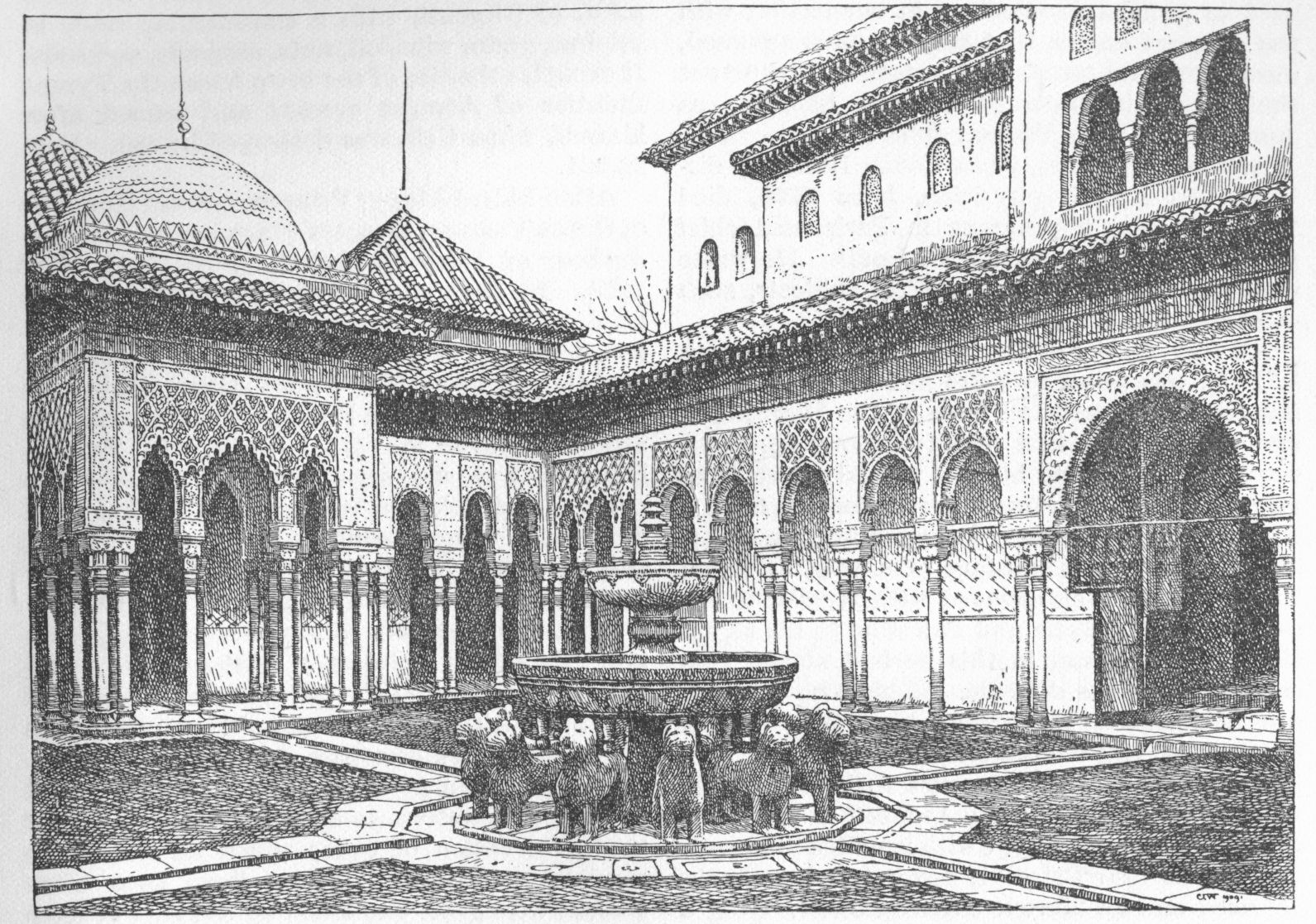
Alham′bra (Ar. al and hamrah, 'the' and 'red'), a famous group of buildings in Spain, forming the citadel of Granada when that city was one of the principal seats of the empire of the Moors in Spain, situated on a height, surrounded by a wall flanked by many towers, and having a circuit of 2¼ miles. Within the circuit of the walls are two churches, a number of mean houses, and some straggling gardens, besides the palace of Charles V and the celebrated Moorish palace which is often distinctively spoken of as the Alhambra. This building, to which the celebrity of the site is entirely due, was the royal palace of the Kings of Granada. The greater part of the present building belongs to the first half of the fourteenth century. In the course of centuries, both through neglect and acts of vandalism, the beauty of the Alhambra has suffered considerably. The work of restoration was, however, undertaken in 1824 by the architect José Contreras, and continued by his son Rafael from 1847-90. It consists mainly of buildings surrounding two oblong courts, the one, called the Court of the Fishpond (or of the Myrtles), 138 by 74 feet, lying north and south; the other, called the Court of the Lions, from a fountain ornamented with twelve lions in marble, 115 by 66 feet, lying east and west, described as being, with the apartments that surround it, "the gem of Arabian art in Spain, its most beautiful and most perfect example". Its design is elaborate, exhibiting a profusion of exquisite detail gorgeous in colouring, but the smallness of its size deprives it of the element of majesty. The peristyle or portico on each side is supported by 128 pillars of white marble, 11 feet high, sometimes placed singly and sometimes in groups. Two pavilions project into the court at each end, the domed roof of one having been restored. Some of the finest chambers of the Alhambra open into this court, and near the entrance a museum of Moorish remains has been formed. On the opposite side of the Court of the Lions is the Hall of the Abencerrages. The prevalence of stucco or plaster ornamentation is one of the features of the Alhambra, which becomes especially remarkable in the beautiful honeycomb 'stalactite vaulting'. Arabesques and geometrical designs with interwoven inscriptions are present in the richest profusion. Cf. Owen Jones's work, The Alhambra (2 vols., London, 1842-5.
Alhaurin (a˙l-ou-rēn′), a town of Southern Spain, province of Malaga, with sulphureous baths. Pop. 7000.
Ali (a˙′lē), cousin and son-in-law of Mahomet, the first of his converts, and the bravest and most faithful of his adherents, born A.D. 602. He married Fatima, the daughter of the prophet, but after the death of Mahomet (632) his claims to the caliphate were set aside in favour successively of Abu-Bekr, Omar, and Othman. On the assassination of Othman, in A.D. 656, he became caliph, and after a series of struggles with his opponents, including Ayesha, widow of Mahomet, finally lost his life by assassination at Kufa in 661. A Mahommedan schism arose after his death, and has produced two sects. One sect, called the Shiites, put Ali on a level with Mahomet, and do not acknowledge the three caliphs who preceded Ali. They are regarded as heretics by the other sect, called Sunnites. The Turks hold his memory in abhorrence, whilst the Persians call him the Lion of God, and venerate him as second only to the prophet. The Maxims and Hymns of Ali are yet extant. See Caliph.
Ali, Pasha of Yanĭna, generally called Ali Pasha, a bold and able, but ferocious and unscrupulous Albanian, born in 1741, son of an Albanian chief, who was deprived of his territories by rapacious neighbours. Ali by his enterprise and success, and by his entire want of scruple, got possession of more than his father had lost, and made himself master of a large part of Albania, including Yanĭna, which the Porte sanctioned his holding, with the title of pasha. Among the travellers who visited his Court at Yanĭna was Byron, who has left a record of his impressions in Childe Harold's Pilgrimage. Ali Pasha was an apostle of European culture in the East, and the first to feel the necessity for energetic reforms in the old Moslem institutions. He displayed excellent qualities, putting an end to brigandage and anarchy, making roads, and encouraging commerce. He still farther extended his sway by subduing the brave Suliotes of Epirus, whom he conquered in 1803, after a three years' war. Aiming at independent sovereignty, he intrigued alternately with England, France, and Russia, and became almost independent of the Porte, which at length determined, in 1820, to pronounce his deposition. Ali resisted several pashas who were sent to carry out this decision, only surrendering at last in 1822, on receiving assurances that his life and property would be granted him. Faith was not kept with him, however; he was killed, and his head was cut off and conveyed to Constantinople, while his treasures were seized by the Porte.
Al′ias (Lat., 'at another time'), a word often used in judicial proceedings in connection with the different names that persons have assumed, most likely for prudential reasons, at different times, and in order to conceal identity, as Joseph Smith alias Thomas Jones.
Alibert (a˙-lē-bār), Jean Louis, Baron, a distinguished French physician, born 1766, died 1837. He was a professor in Paris, and chief physician at the Hospital St. Louis. He wrote many valuable works on medical subjects, such as Description des maladies de la peau.
Ali Bey, a ruler of Egypt, born in the Caucasus in 1728, was taken to Cairo and sold as a slave, but having entered the force of the Mamelukes, and attained the first dignity among them, he succeeded in making himself virtual governor of Egypt. He then refused the customary tribute to the Porte, and coined money in his own name. In 1769 he took advantage of a war, in which the Porte was then engaged with Russia, to endeavour to add Syria and Palestine to his Egyptian dominion, and in this he had almost succeeded, when the defection of his own adopted son Mohammed Bey drove him from Egypt. Joining his ally Sheikh Daher in Syria, he still pursued his plans of conquest with remarkable success, till in 1773 he was induced to make the attempt to recover Egypt with insufficient means. In a battle near Cairo his army was completely defeated and he himself taken prisoner, dying a few days afterwards either of his wounds or by poison.
Al′ibi (Lat., 'elsewhere'), a defence in criminal procedure, by which the accused endeavours to prove that when the alleged crime was committed he was present in a different place.
Alicante (a˙-lē-ka˙n′tā), a fortified town and Mediterranean seaport in Spain, capital of the province of the same name, picturesquely situated partly on the slope of a hill, partly on the plain at the foot, about 80 miles south by west of Valencia. The lower town has wide and well-built streets; the upper town is old and irregularly built. The principal manufactures are cotton, linen, and cigars; the chief export is wine, which largely goes to England. Alicante is an ancient town. In 718 it was taken by the Moors, from whom it was wrested about 1240. In modern times it has been several times besieged and bombarded, as by the French in 1709, and in 1812, and by the federalists of Cartagena in 1873. Pop. 58,088.—The province is very fruitful and well cultivated, producing wine, silk, fruits, &c. The wine is of a dark colour (hence called vino tinto, deep-coloured wine), and is heavy and sweet. Area, 2185 sq. miles. Pop. 502,607.
Alicata, or Licata (a˙-lē-kä′ta˙, lē-kä′ta˙), the most important commercial town on the S. coast of Sicily, at the mouth of the Salso, 24 miles E.S.E. of Girgenti, with a considerable trade in sulphur, grain, wine, oil, nuts, almonds, and soda. It occupies the site of the town which the Tyrant Phintias of Acragas erected and named after himself, when Gela was destroyed in 280. Pop. 22,931.
Alice Maud Mary, Princess, second daughter of Queen Victoria, Duchess of Saxony, and Grand-duchess of Hesse-Darmstadt, born 1843, died 1878. In 1862 she married Frederick William Louis of Hesse, nephew of the grand-duke, whom he succeeded in 1877. She showed exemplary devotion to her father Prince Albert during his fatal illness and to the Prince of Wales during his attack of fever in 1871. During the Franco-Prussian war she organized hospitals for the relief of the sick and wounded. She died from diphtheria caught while nursing her husband and children. A selection of her letters to her mother was published in 1883 by Dr. Carl Sell.
A′lien, in relation to any country, a person born out of the jurisdiction of the country, and not having acquired the full rights of a citizen of it. The position of aliens depends upon the laws of the respective countries, but generally speaking aliens owe a local allegiance, and are bound equally with natives to obey all general rules for the preservation of order which do not relate specially to citizens. Aliens have been often treated with great harshness by the laws of some States. Thus in France there long existed what was known as the droit d'aubaine, a law which claimed for the benefit of the State the effects of deceased foreigners leaving no heirs who were natives. Aliens have been repeatedly the objects of legislation in Britain, and the tendency at the present day is to communicate some of the rights of citizenship to aliens, and to widen the definition of subjects. According to the Act of 1870 that now regulates the matter, real and personal property of every description may be acquired, held, and disposed of by an alien, in the same manner in all respects as by a natural-born British subject. No other right or privilege (such as the right to hold any office or any municipal, parliamentary, or other franchise) is by this Act conferred on an alien except such as are expressly given in respect of property. Previously aliens could hold only personal property; they were incompetent to hold landed property, except under certain conditions of residence or business occupancy for a term of years not exceeding twenty-one. The children of aliens born in Britain are natural-born subjects. Formerly the only mode of naturalization was by Act of Parliament; but now an alien who has resided in the United Kingdom for not less than one year immediately preceding his application, and has previously resided in any part of His Majesty's dominions for four years during the last eight years before the application, or who has been in the service of the Crown for not less than five years, and intends to reside in the kingdom, or to serve the British Crown, may apply to the Secretary of State for a certificate of naturalization, and on giving evidence of particulars may obtain it, being thereby entitled to almost all the political and other rights of a natural-born British subject. At present the law is laid down in the British Nationality and Status of Aliens Act, 1914 and 1918. It used to be a principle in English law, that a natural-born subject could not divest himself of his allegiance by becoming naturalized in a foreign State (nemo potest exuere patriam); but it is now laid down that a British subject who has voluntarily become naturalized in a foreign State thereby ceases to be a British subject. Any British subject who has become an alien may apply for a certificate of readmission to British nationality on the same terms as those provided for aliens in general. In the United States the position of aliens as regards acquisition and holding of real property differs somewhat in the different States, though in recent times the disabilities of aliens have been removed in most of them. Personal property they can take, hold, and dispose of like native citizens. Individual States have no jurisdiction on the subject of naturalization, though they may pass laws admitting aliens to any privilege short of citizenship. A naturalized citizen is not eligible for election as president or vice-president of the United States, and cannot serve as senator until after nine years' citizenship, nor as a member of the House of Representatives until after seven years' citizenship. Five years' residence in the United States and one year's permanent residence in the particular State are necessary for the attainment of citizenship.
Alien Immigration. In various countries certain classes of aliens have long been prohibited from gaining admission. In the United States, for instance, admission is refused to such persons as idiots, epileptics, persons suffering from loathsome or dangerous contagious diseases, paupers, criminals (except political criminals), illiterate persons, &c. Chinese labourers as a whole are excluded, and even any persons coming to America under a definite agreement to engage in any kind of labour or service. Similar laws are in force in Australia, where there is a test that a person proposing to settle in the country must be able to write fifty words of a European language. Towards the end of last century the great influx of foreigners into Britain, and into London in particular, drew public attention to the matter. A select committee appointed in 1888 reported in favour of the exclusion of destitute aliens, in 1894 a bill was introduced into the House of Lords, while in 1898 a bill to regulate the immigration of aliens was passed in the Lords, but made no further progress. In 1902 a royal commission was appointed, and drew up a report, published in 1903, containing valuable information and various recommendations. Among these were the establishment of an immigration department, and the granting of powers to deport criminals, prostitutes, and other undesirable aliens, and to prevent the landing of persons mentally unfit or suffering from infectious or loathsome diseases. In 1904 an Aliens Immigration Bill was introduced and read a second time in the House of Commons. It was based on the recommendations of the commission, and in its favour it was argued that a large amount of British labour had been displaced by aliens, in London especially, that the prevalence of crime among aliens was out of proportion to their numbers, that many of them were paupers, criminals convicted in their own country, or other undesirables. In 1905 another bill on the subject was introduced by the Government, which succeeded in passing it, so that the matter can now be dealt with, and undesirable aliens kept out. Since the European War (1914-8) and the new passport regulations it is easy to ascertain the number of aliens that enter the country and settle. At the census of 1901 the whole alien population was set down at 286,925, as against 219,523 in 1891, but there has been a very large influx from 1901 to 1914, by far the largest number consisting of Russian and Polish Jews. The restrictions imposed upon aliens during the European War are still in force, so far as they prohibit landing by any alien, except at specified ports by leave of an immigration officer, and, in case of former enemy aliens, by special permission of the Home Secretary. Cf. J. M. Landa, The Alien Problem.
Aliganj (a-lē-ganj'), a town of Bengal, 54 miles from Dinapur, noted for its pottery. It has a trade in grain, indigo-seed, and cotton, and contains two mosques, and a large mud fort. Pop. 7436.
Aligarh (a-lē-gar'), a fort and town in India, in the United Provinces, on the East Indian railway, 84 miles south-east of Delhi. The town, properly called Koel or Coel, is distant about 2 miles from the fort, and is connected with it by a beautiful avenue. It is handsome and well situated, and has a trade in cotton, &c. The fort, which had been skilfully strengthened by French engineers in the service of the Mahrattas, was taken by storm after a desperate resistance in 1803 by the British forces under Lord Lake, when the whole district was added to the British possessions. Pop. 64,825. The district has an area of 1946 sq. miles. Pop. 1,165,680.
Align′ment (a-līn′ment), a military term, signifying the act of adjusting to a straight line or in regular straight lines, or the state of being so adjusted.
Al′iment, food, a term which includes everything, solid or liquid, serving as nutriment for the bodily system. Aliments are of the most diverse character, but all of them must contain nutritious matter of some kind, which, being extracted by the act of digestion, enters the blood, and effects by assimilation the repair of the body. Alimentary matter, therefore, must be similar to animal substance, or transmutable into such. All alimentary substances must, therefore, be composed in a greater or less degree of soluble parts, which easily lose their peculiar qualities in the process of digestion, and correspond to the elements of the body. The food of animals consists for the most part of substances containing little oxygen and exhibiting a high degree of chemical combination, in which respects they differ from most substances that serve as sustenance for plants, which are generally highly oxidized and exhibit little chemical combination. According to the nature of their constituents most of the aliments of animals are divided into nitrogenous (consisting of carbon, hydrogen, and oxygen along with nitrogen, and also of sulphur and phosphorus) and non-nitrogenous (consisting of carbon, hydrogen, and oxygen without nitrogen). Water and salts are usually considered as forming a third group, and, in the widest sense of the word aliment, oxygen alone, which enters the blood in the lungs, forms the fourth. The articles used as food by man do not consist entirely of nutritious substances, but with few exceptions are compounds of various nutritious with indigestible and accordingly innutritious substances. The only nitrogenous aliments are albuminous substances, and these are contained largely in animal food (flesh, eggs, milk, cheese). The principal non-nitrogenous substance obtained as food from animals is fat. Sugar is so obtained in smaller quantities (in milk). While some vegetable substances also contain much albumen, very many of them are rich in starch. Among vegetable substances the richest in albumen are the legumes (peas, beans, and lentils), and following them come the cereals (wheat, oats, &c.). Sugar, water, and salts may pass without any change into the circulatory system; but albuminous substances cannot do so without being first rendered soluble and capable of absorption (in the stomach and intestines); starch must be converted into sugar and fat emulsified (chiefly by the action of the pancreatic juice). One of the objects of cooking is to make our food more susceptible of the operation of the digestive fluids.
The relative importance of the various nutritious substances that are taken into the system and enter the blood depends upon their chemical constitution. The albuminous substances are the most indispensable, inasmuch as they form the material by which the constant waste of the body is repaired, whence they are called by Liebig the substance-formers. But a part of the operation of albuminous nutriments may be performed equally well, and at less cost, by non-nitrogenous substances, that part being the maintenance of the temperature of the body. As is well known, the temperature of warm-blooded animals is considerably higher than the ordinary temperature of the surrounding air, in man about 98° F., and the uniformity of this temperature is maintained by the heat which is set free by the chemical processes (of oxidation) which go on within the body. Now these processes take place as well with non-nitrogenous as with nitrogenous substances. The former are even preferable to the latter for the keeping up of these processes; by oxidation they yield larger quantities of heat with less labour to the body, and they are hence called the heat-givers. The best heat-giver is fat. Albuminous matters are not only the tissue-formers of the body; they also supply the vehicle for the oxygen, inasmuch as it is of such matters that the blood corpuscles are formed. The more red blood corpuscles an animal possesses, the more oxygen can it take into its system, and the more easily and rapidly can it carry on the process of oxidation and develop heat. Now only a part of the heat so developed passes away into the environment of the animal; another part is transformed within the body (in the muscles) into mechanical work. Hence it follows that the non-nitrogenous articles of food produce not merely heat but also work, but only with the assistance of albuminous matters, which, on the one hand, compose the working machine, and, on the other hand, convey the oxygen necessary for oxidation.
The wholesome or unwholesome character of any aliment depends, in a great measure, on the state of the digestive organs in any given case, as also on the method in which it is cooked. Very often a simple aliment is made indigestible by artificial cookery. In any given case the digestive power of the individual is to be considered in order to determine whether a particular aliment is wholesome or not. In general, therefore, we can only say that that aliment is healthy which is easily soluble, and is suited to the power of digestion of the individual. Man is fitted to derive nourishment both from animal and vegetable aliment, but can live exclusively on either. The nations of the North incline generally more to animal aliments; those of the South, and the Orientals, more to vegetable. The inhabitants of the most northerly regions live almost entirely upon animal food, and very largely on fat on account of its heat-giving property. See Dietetics, Digestion, Adulteration, &c.
Alimentary Canal, a common name given to the œsophagus, stomach, and intestines of animals. See Œsophagus, Intestine, Stomach.
Ali-Mirza, Shah of Persia, son of Muzaffar-ed-Din, born in 1872. He succeeded his father on 8th Jan., 1907. Although his European education had given him sympathies for Western civilization, he showed himself despotic, and became very unpopular. He was deposed by the National Assembly or Mejliss in July, 1909, and his son proclaimed Shah in his place.
Al′imony (Lat. alere, to nourish), in law, the allowance to which a woman is entitled while a matrimonial suit is pending between her and her husband, or after a legal separation from her husband, not occasioned by adultery or elopement on her part. It is either temporary or permanent, the former being the provision made by the husband pending the suit, the latter after the decree.
Al′iquot Part is such part of a number as will divide and measure it exactly without any remainder. For instance, 2 is an aliquot part of 4, 3 of 12, and 4 of 20.
Alisma′ceæ, the water-plantain family, a natural order of endogenous plants, the members of which are herbaceous, annual or perennial; with petiolate leaves sheathing at the base, hermaphrodite (rarely unisexual) flowers, disposed in spikes, panicles, or racemes. They are floating or marsh plants, and many have edible fleshy rhizomes. They are found in all countries, but especially in Europe and North America, where their rather brilliant flowers adorn the pools and streams. The principal genera are Alisma (water-plantain) Sagittaria (arrow-head), Damasonium (star-fruit), and Butomus (flowering-rush).
Al′ison, Rev. Archibald, a theologian and writer on æsthetics, born at Edinburgh in 1757; died there in 1839. He studied at Glasgow and at Balliol College, Oxford, entered the English Church, and finally (1800) settled as the minister of an Episcopal chapel at Edinburgh. He published 2 volumes of sermons, and a work entitled Essays on the Nature and Principles of Taste (1790), in which he maintains that all the beauty of material objects depends upon the associations connected with them.
Al′ison, Sir Archibald, lawyer and writer of history, son of the above, was born in Shropshire in 1792, and died in 1867, near Glasgow. He was educated at the University of Edinburgh, and in 1814 was admitted to the Scottish bar. He spent the next eight years in Continental travel. On his return he was appointed advocate depute, which post he held till 1830. In 1832 he published Principles of the Criminal Law of Scotland, and in 1833 The Practice of the Criminal Law. He was appointed sheriff of Lanarkshire in 1834, and retained this post till his death. He was made a baronet in 1852. His chief work—The History of Europe, from 1789 to 1815—was first issued in 10 vols., 1833-42, the narrative being subsequently brought down to 1852, the beginning of the second French Empire. This work displays industry and research, and is generally accurate, but not very readable. It has been translated into French, German, Arabic, Hindustani, &c. Among Sir Archibald's other productions are Principles of Population; Free-trade and Protection; England in 1815 and 1845; Life of the Duke of Marlborough, &c.
Al′ison, General Sir Archibald, G.C.B., son of the above, was born 1826, entered the army in 1846, and served in the Crimea, in India during the mutiny, and in the Ashantee expedition of 1873-4. In Egypt, in 1882, he led the Highland Brigade at the battle of Tel-el-Kebir, and in 1882-3 remained in command of the army of occupation (of 12,000 men). He retired from the army in 1893, and died in 1907.
Aliwal′, a village of Hindustan in the Punjab, on the left bank of the Sutlej, celebrated from the battle fought in its vicinity, 28th Jan., 1846, between the Sikhs and a British army commanded by Sir Harry Smith, resulting in the total defeat of the Sikhs.
Aliwal North, a town in the eastern part of Cape Province, on the Orange River, which here forms the boundary with the Orange Free State, and is crossed by a fine bridge—the Frere Bridge. It stands at the height of 4350 feet, in a locality said to be highly suitable for consumptives, and the warm sulphur springs in the neighbourhood also attract many invalids. It is a well-built place, with churches, hotels, golf links, race-course, &c.; and has railway connection with East London, Port Elizabeth, &c. Pop. 5557.—Aliwal South was a name formerly given to Mossel Bay, the small seaport midway between Cape Town and Port Elizabeth.
Aliz′arine, a substance contained in the madder root (Rubia tinctorum), and largely used in dyeing reds of various shades, as Turkey red, &c. Until 1868 it was obtained entirely from madder root, but the use of the root has been almost superseded by the employment of alizarine itself, prepared artificially from one of the constituents of coal-tar. It forms yellowish-red prismatic crystals, nearly insoluble in cold, but dissolved to a small extent by boiling water, and readily soluble in alcohol and ether. It possesses exceedingly strong tinctorial powers.
Al′kahest, the so-called universal solvent or menstruum of the alchemists. The word is believed to have been invented by Paracelsus.
Al′kali (from Ar. al-qali, the ashes of the plant from which soda was first obtained, or the plant itself), a term first used to designate the soluble parts of the ashes of plants, especially of seaweed, and designated fixed alkali, as marking a distinction from ammonia, which was termed volatile alkali. Now the term is applied to various classes of bodies having the following properties in common: (1) solubility in water; (2) the power of neutralizing acids, and forming salts with them; (3) the property of corroding animal and vegetable substances; (4) the property of altering the tint of many colouring matters—thus, they turn litmus, reddened by an acid, into blue; turmeric, brown; and syrup of violets and infusion of red cabbages, green. The alkalies may be regarded as water in which part of the hydrogen is replaced by a metallic radicle. The caustic alkalies are strong alkalies which have a powerful corrosive action on the skin, and the common ones are potassic hydroxide or caustic potash, sodic hydroxide or caustic soda, and lithic hydroxide. Volatile Alkali, or ammonic hydroxide, is a much feebler alkali than the others, and when the solution is heated all the ammonia is driven off. Other alkalies are calcic hydroxide or slaked lime, a solution of which in water is known as lime-water; baric hydroxide and strontic hydroxide, derived from the metals barium and strontium. Quicklime is the only alkali extensively used in agriculture.
Alkalim′eter, an instrument for ascertaining the quantity of free alkali in any impure specimen, as in the potashes of commerce. These, besides the carbonate of potash, of which they principally consist, usually contain a portion of foreign salts, as sulphate and chloride of potassium, and as the true worth of the substance, or price for which it ought to sell, depends entirely on the quantity of carbonate, it is of importance to be able to measure it accurately by some easy process. This process depends on the neutralization of the alkali by an acid of known strength, the point of neutralization being determined by the fact that neutral liquids are without action on either red or blue litmus solution. The alkalimeter is merely a graduated tube—a burette—with a stopcock at the lower extremity, from which the standard acid is dropped into water in which a known weight of the substance is dissolved. The quantity required to produce neutralization being noted, the strength of the liquid tested is easily arrived at. A process of neutralization, exactly the same in principle, may be employed to test the strength of acids by alkalies, the one process being called alkalimetry the other acidimetry.
Al′kaloid, a term applied to a class of nitrogenous compounds having basic properties, found in living plants, usually in combination with organic acids. They are usually given names ending in -ine, as morphine, quinine, aconitine, nicotine, caffeine, &c. Most alkaloids occur in plants, but some are formed by decomposition. Most natural alkaloids contain carbon, hydrogen, nitrogen, and oxygen, but a few contain no oxygen. The nitrogen they contain imparts to them basic properties—they are organic bases—and hence they all form salts with acids. They all possess a pronounced bitter taste, and the poisonous nature of many plants, e.g. hemlock, yew, deadly nightshade, &c., are due to the alkaloids they contain. Although formed originally within the plant, it has been found possible to prepare several of these alkaloids by artificial means.
Al′kanet, a dyeing drug, the bark of the root of the Anchūsa or Alkanna tinctoria, a plant of the order Boraginaceæ, with downy and spear-shaped leaves, and clusters of small purple or reddish flowers. The plant is sometimes cultivated in Britain, chiefly on the east coast of England, but most of the alkanet of commerce is imported from the Levant or from southern France. It imparts a fine deep-red colour to all unctuous substances and is used for colouring oils, plasters, lip-salve, confections, &c.; also in compositions for rubbing and giving colour to mahogany furniture, and to colour spurious port-wine.
Alkan′na, a name of henna. See also Alkanet.
Alkar′sin, an extremely poisonous liquid containing kakodyle, together with oxidation products of this substance, and formerly known as Cadet's fuming liquor, characterized by its insupportable smell and high degree of spontaneous combustibility when exposed to air.
Al-katif, a town of Arabia, on the Persian Gulf, carrying on a considerable trade. Pop. 6000.
Alkmaar (a˙lk′mär), a town of the Netherlands, province of North Holland, on the North Holland Canal, and 20 miles N.N.W. of Amsterdam; regularly built, with a fine church (St. Lawrence) and a richly decorated Gothic town-house; manufactures of salt, sail-cloth, vinegar, leather, &c., and an extensive trade in cattle, corn, butter, and cheese. Pop. 22,685.
Al-Ko′ran, or Qu‛ran. See Koran.
Alla breve (brā′vā), a musical direction expressing that a breve is to be played as fast as a semibreve, a semibreve as fast as a minim, and so on. It is also called a capella, as it is employed in church music.
Al′lah, in Arabic, the name of God, a word of kindred origin with the Hebrew word Elohim. Alla Akbar (God is great) is a Mahommedan war-cry.
Allahabād′ ('city of Allah'), an ancient city of India, capital of the United Provinces, on the wedge of land formed by the Jumna and the Ganges, largely built of mud houses, though the English quarter has more of a European aspect. Among the remarkable buildings are the fort, occupying the angle between the rivers, and containing the remains of an ancient palace, and now also the barracks, &c.; the mausoleum and garden of Khosru, the tomb being a handsome domed building; the Government offices and courts; Government house; the Roman Catholic cathedral; the Central College for the United Provinces; the Mayo Memorial and town hall. Allahabad is one of the chief resorts of Hindu pilgrims, who have their sins washed away by bathing in the waters of the sacred rivers Ganges and Jumna at their junction; and is also the scene of a great fair in December and January. There are no manufactures of importance, but a large general and transit trade is carried on. The town is as old as the third century B.C. In the mutiny of 1857 it was the scene of a serious outbreak and massacre. Pop. 171,697.—The division of Allahabad contains the districts of Cawnpur, Futtehpur, Hamirpur, Banda, Jaunpur, and Allahabad; area, 17,265 sq. miles. Pop. 5,535,803.—The district contains an area of 2852 sq. miles, about five-sixths being under cultivation. Pop. 1,487,904.
Allaman′da, a genus of American tropical plants, ord. Apocynaceæ, with large yellow or violet flowers; some of them are grown in European greenhouses. A. cathartica has strong emetic and purgative properties.
Allan, David, a Scottish painter, born 1744, died 1796. He studied in Foulis's academy of painting and engraving in Glasgow, and for sixteen years in Italy; finally establishing himself at Edinburgh, where he succeeded Runciman as master of the Trustees' Academy. His illustrations of the Gentle Shepherd, The Cotter's Saturday Night, and other sketches of rustic life and manners in Scotland are his best-known works.
Allan, Sir William, a distinguished Scottish artist, born in 1782, died in 1850. He was a fellow student with Wilkie in Edinburgh, afterwards a student of the Royal Academy, London. After residing in Russia for ten years, he returned to Scotland, and publicly exhibited his pictures, one of which (Circassian Captives) made his reputation. He now turned his attention to historical painting, and produced Knox admonishing Mary Queen of Scots, Murder of Rizzio, Exiles on their way to Siberia, The Slave Market at Constantinople, &c.; and afterwards also battle scenes, as the Battle of Prestonpans, Nelson boarding the San Nicolas, and two pictures of The Battle of Waterloo, the one from the British, the other from the French position, and delineating the actual scene and the incidents therein taking place at the moment chosen for the representation. One of these Waterloo pictures was purchased by the Duke of Wellington. He travelled extensively, visiting Italy, Greece, Asia Minor, Spain, and Barbary. In 1835 he became a Royal Academician, in 1838 president of the Scottish Academy, and in 1842 he was knighted.
Allan′tois, a structure appearing during the early development of vertebrate animals—Reptiles, Birds, and Mammalia. It is largely made up of blood-vessels, and, especially in Birds, attains a large size. It forms the inner lining to the shell, and may thus be viewed as the surface by means of which the respiration of the embryo is carried on. In Mammalia the allantois is not so largely developed as in Birds, and it enters largely into the formation of the placenta.
Alleghany (al-le-gā′ni), a river of Pennsylvania and New York, which unites with the Monongahela at Pittsburg to form the Ohio; navigable nearly 200 miles above Pittsburg.
Alleghany Mountains, or the Alleghanies, a name sometimes used as synonymous with Appalachians, but also often restricted to the portion of those mountains that traverses the states of Virginia, Maryland, and Pennsylvania from south-west to north-east, and consists of a series of parallel ridges for the most part wooded to the summit, and with some fertile valleys between. Their mean elevation is about 2500 feet; but in Virginia they rise to 4473.
Allegheny (al-le-gen′i), a city of the United States, in Pennsylvania, on the River Allegheny, opposite Pittsburg, of which it may be considered virtually to be a suburb, and with which it is connected by six bridges. The principal industries are connected with iron and machinery. Pop. 132,283. Also called Allegheny City.
Alle′giance (from mid-Eng. ligeaunce, formed from liege), according to Blackstone, is "the tie or ligamen which binds the subject to the sovereign in return for that protection which the sovereign affords the subject", or, generally, the obedience which every subject or citizen owes to the Government of his country. It used to be the doctrine of the English law that natural-born subjects owe an allegiance which is intrinsic and perpetual, and which cannot be divested by any act of their own (Nemo potest exuere patriam); but this is no longer the case since the Naturalization Act passed in 1870, A British subject, however, or a child who has acquired a British domicile by the naturalization of an alien parent, cannot in time of war divest himself of British nationality for the purpose of becoming an enemy alien. Aliens owe a temporary or local allegiance to the Government under which they for the time reside. Usurpers in undisturbed possession of the Crown are entitled to allegiance; and thus treasons against Henry VI were punished in the reign of Edward IV, though the former had, by Act of Parliament, been declared a usurper.
Al′legory, a figurative representation in which the signs (words or forms) signify something besides their literal or direct meaning. In rhetoric, allegory is often but a continued simile. Parables and fables are a species of allegory. Sometimes long works are throughout allegorical, as Spenser's Faerie Queene and Bunyan's Pilgrim's Progress. When an allegory is thus continued it is indispensable to its success that not only the allegorical meaning should be appropriate, but that the story should have an interest of its own in the direct meaning apart from the allegorical significance. Allegories are frequent in the Old Testament, whilst in the New they take the form of parables. One of the best-known allegories in classical literature is the story of the stomach and the members of the body in the speech attributed to Menenius Agrippa by Plutarch and Livy. (Cf. Shakespeare, Coriolanus, i, 1.) Allegory is often made use of in painting and sculpture as well as in literature.
Allegri (a˙l-lā′grē), Gregorio, an Italian composer, born at Rome in 1560 or 1585, died there about 1650; celebrated for his Miserere, a setting of the fifty-first psalm (the fiftieth in the Vulgate), which in the Latin version begins with that word. Allegri's Miserere is annually performed in the Sistine Chapel at Rome.
Allegro (It., a˙l-lā′grō), a musical term expressing a more or less quick rate of movement, or a piece of music or movement in lively time. Allegro moderato, moderately quick; allegro maestoso, quick but with dignity; allegro assai and allegro molto, very quick; allegro con brio or con fuoco, with fire and energy; allegrissimo, with the utmost rapidity.
Allein (al′en), Joseph, English Nonconformist divine; born 1633, died 1668; the author of a popular religious book entitled, An Alarm to Unconverted Sinners, or The Sure Guide to Heaven (1672).
Allein (al′en), Richard, English Nonconformist divine; born in 1611, died 1681; rector for twenty years of Batcombe (Somerset); deprived of his living at the Restoration, and imprisoned for preaching. He wrote, among other things, Vindiciæ Pietatis ('A Vindication of Godliness'), published in 1660, which was condemned to be burned in the royal kitchen.
Alleluia. See Halleluia.
Allemande (a˙l-ma˙n˙d), a kind of slow, graceful dance, invented in France in the time of Louis XIV, and again in vogue in the time of the First Empire. The name is also given to pieces of music based on the dance movement. Bach and Handel have composed a great number of Allemandes, and Beethoven has written twelve for orchestra.
Allen, Bog of, the name applied to a series of bogs in Ireland (not to one continuous morass), dispersed, often widely apart, with extensive tracts of dry cultivated soil between, over a broad belt of land stretching across the centre of the country, the bogs being, however, all on the east side of the Shannon.
Allen, Ethan, an American revolutionary partisan and general; born 1737, died 1789. He surprised and captured Ticonderoga Fort (1775); attacked Montreal, and was captured and sent to England, being exchanged in 1778; wrote against Christianity, Reason, the only Oracle of Man (1784).—His younger brother, Ira (1751-1814), was also prominent in the revolutionary era.
Allen, Grant, writer on scientific subjects and novelist, was born at Kingston, Canada, 1848, died in 1899. His earlier education he received in America, but he also studied in France and graduated at Oxford with honours in 1870. From 1873 to 1879 he was connected with Queen's College, Jamaica, but afterwards resided chiefly in England, and became well known as an exponent of evolutionary science, and as a novelist. His first important work, Physiological Æsthetics, appeared in 1877; his other scientific or semi-scientific works include The Colour Sense; The Evolutionist at Large; Colin Clouts Calendar (the record of a summer); Vignettes from Nature; The Colours of Flowers; Flowers and their Pedigrees; and Force and Energy, a Theory of Dynamics. Other works by him are: Anglo-Saxon Britain; Charles Darwin; and The Evolution of the Idea of God. His novels, about thirty in number, include: The Devil's Die; The Woman Who Did, &c.
Allen, John, a Scottish political and historical writer; born in 1771, died in 1843. He studied medicine, and became M.D. of Edinburgh University. In 1801 he went abroad with Lord Holland and family, and henceforth he maintained this connection, being long an inmate of Holland House (London) and a member of the brilliant society that assembled there. He contributed many articles to the Edinburgh Review; and wrote An Inquiry into the Rise and Growth of the Royal Prerogative in England; Vindication of the Ancient Independence of Scotland; &c.
Allen, Ralph, celebrated as a philanthropist, and as the friend of Pope, Fielding, and the elder Pitt, was born in 1694, died in 1764. He lived mostly at Bath, where he made a large income as farmer of a system of posts and as owner of quarries. He is the prototype of Squire Allworthy in Fielding's Tom Jones; and after the novelist's death he took charge of his family. Pope, who received many kindnesses at his hands, referred to him in the lines:
Let humble Allen, with an awkward shame, Do good by stealth, and blush to find it fame.
With Pitt he was on intimate terms, and left him £1000 in his will. Hurd, Sherlock, and Warburton were also his friends.
Allen, Thomas, an English mathematician, philosopher, antiquarian, and astrologer, born in 1542, died in 1632. He studied at Oxford, and lived the greater part of his life in learned retirement, corresponding with many of the famous men of his time. In his own day he was generally reputed a dealer in the black art.
Allen, William, cardinal, an English Roman Catholic of the time of Queen Elizabeth. Influenced by the Jesuit Robert Parsons, he became a strenuous opponent of Protestantism and supporter of the claims of Philip II to the English throne; born 1532, died 1594. It was by his efforts that the English college for Catholics at Douai was established. He was made cardinal in 1587. His numerous writings include: The Declaration of the Sentence of Sixtus V, and An Admonition to the Nobility and People of England.
Allen, William, D.D., American clergyman and author; born 1784, died 1868. He was president of Bowdoin College, 1820-39; author of American Biographical and Historical Dictionary; Junius Unmasked; &c.
Allenby, Viscount, Edmund Henry Hynman, British soldier, born on 23rd April, 1861, and educated at Haileybury. He joined the Inniskilling Dragoons, and in 1884 served with that regiment in the Bechuanaland Expedition. He was with the British forces in Zululand in 1888, took part in the South African war, and commanded the 4th Cavalry Brigade, 1905-10. In the European War he at first commanded the British Third Army, contributing largely to the victories of the Somme and the Aisne. After a reverse, south of Gaza, suffered on 26th March, 1917, by the British troops under the command of Sir Archibald Murray, the latter was relieved, and General Allenby was placed in command of the operations. He made thorough preparations for the next offensive, and his progress was very rapid. Beersheba and Gaza were captured, and on 9th Dec., 1917 Jerusalem, the Holy City, was surrendered to the general by the mayor. His formal entry took place on the 11th. He was awarded the G.C.M.G. on 16th Dec., 1917, and is a Grand Officer of the Legion of Honour. In Aug., 1919, he was voted a sum of £50,000 and created a viscount, adopting the title of Viscount Allenby of Megiddo and of Felixstowe in Suffolk. In Oct., 1919, he was appointed High Commissioner for Egypt.