Volume 1 — VOLUME I (continued 2)
Reading edition
Ac′cra, a British settlement in Africa, in a swampy situation, capital of Gold Coast, about 75 miles east of Cape Coast Castle. Exports gold-dust, ivory, gums, palm-oil; imports cottons, cutlery, &c. Pop. 20,000.
Ac′crington, a municipal borough of England, Lancashire, 5 miles east of Blackburn, with large cotton factories, print-works and bleaching-greens, and coal-mines. Pop. 43,610. Accrington was created a parliamentary borough in 1918.
Accu′mulator, a name applied to a kind of electric battery by means of which electric energy can be stored and rendered portable. In the usual form each battery forms a cylindrical leaden vessel, containing alternate sheets of metallic lead and minium wrapped in felt and rolled into a spiral wetted with acidulated water. On being charged with electricity the energy may be preserved till required for use.
Accu′sative Case, in Latin and some other languages, the term applied to the case which designates the object to which the action of any verb is immediately directed, corresponding, generally speaking, to the objective in English.
Ace, in aviation the name 'ace' is given to a flying-man who has distinguished himself by bringing down a large number (sometimes given as ten) of enemy machines. The word is used colloquially, and was borrowed from the French Air Force during the European War.
Aceph′ala, in zoology, the headless Mollusca or those which want a distinct head, corresponding to those that have bivalve shells and are also called Lamellibranchiata.
A′cer, the genus of plants (nat. ord. Aceraceæ) to which belongs the maple.
Acerra (a˙-cher′a˙), a town in South Italy, 9 miles north-east of Naples, the see of a bishop, in a fertile but unhealthy region. Pop. 17,878.
Acetab′ulum, an anatomical term applied to any cup-like cavity, as that of a bone to receive the protuberant end of another bone, the cavity, for instance, that receives the end of the thigh-bone.
Acetates (as′e-tāts), salts of acetic acid. The acetates of most commercial or manufacturing importance are those of aluminium and iron, which are used in calico-printing; of copper, which as verdigris is used as a colour; and of lead, best known as sugar of lead. The acetates of potassium, sodium, and ammonium, of iron, zinc, and lead, and the acetate of morphia, are employed in medicine.
Acet′ic Acid, an acid produced by the oxidation of common alcohol, and of many other organic substances. Pure acetic acid has a very sour taste and pungent smell, burns the skin, and is poisonous. From freezing at ordinary temperatures (58° or 59°) it is known as glacial acetic acid. Vinegar is simply dilute acetic acid. Acetic acid is largely used in the arts, in medicine, and for domestic purposes. See Vinegar.
Acet′ic Ethers, or Acetic Esters, acetates of alcohol radicals. The common ester—ethyl acetate—is a volatile colourless liquid, manufactured by distilling a mixture of alcohol, oil of vitriol, and acetic acid, and used for flavouring purposes.
Acetone (as′), a constituent of ordinary wood spirit, a colourless volatile liquid used as a solvent, the simplest of the ketones.
Acet′ylene, C2H2, is a substance composed of two elements, carbon and hydrogen, and belonging to a class of compounds known as hydrocarbons. It is formed in the incomplete combustion of many hydrocarbons and also of coal-gas, and may be produced in a variety of ways, but is now made almost entirely from calcium carbide. Acetylene has been known for a long time, but only since 1870 has it been produced in any quantity. After the development of the electric furnace it was found that calcium oxide, quicklime, heated with carbon to the high temperature possible in such a furnace, is transformed into calcium carbide, and this compound reacts with water, generating acetylene. A great deal of heat is developed on adding water to calcium carbide, so that care has to be taken in generating acetylene. Various devices are in use for bringing the two substances in contact slowly, and for keeping the temperature low. When carbon and hydrogen combine to form acetylene a large amount of heat is used up, so that much heat is evolved when acetylene decomposes again, and once decomposition starts sufficient heat is developed to decompose the whole volume of gas.
Acetylene is a colourless gas slightly soluble in water and very sparingly soluble in brine. When pure it has little or no odour, but as ordinarily prepared it has a strong unpleasant odour due to traces of impurities such as sulphuretted hydrogen, phosphine, &c. The gas can be liquefied easily, and in the liquid state is highly explosive. It burns with an exceedingly sooty flame, but if it is allowed to pass through a very small orifice the carbon liberated becomes incandescent and acetylene burns with an intense white flame. It is largely used as an illuminant and for the production of great heat. As an illuminant the gas is produced in specially-constructed generators. It is led through iron pipes and burned from an acetylene burner, or it may be used with special types of incandescent mantles. Acetylene readily combines with copper and with silver to form metallic acetylides which are very explosive, hence pipes through which acetylene is passing must not be made of brass or copper. Acetylene mixed with air and brought in contact with an ignited body explodes even more violently than a mixture of air and coal-gas.
Large quantities of acetylene are generated and stored for oxy-acetylene welding. Acetylene, burning in oxygen, gives an intensely hot flame (about 2000°-3000° C.), sufficiently hot to melt iron. Although liquid acetylene is unstable, and even the gas, under slight pressure, is also unstable, it may be transported safely if dissolved in acetone. Acetone dissolves a large volume of acetylene, and this solution is quite stable and may be stored in iron cylinders and used for various purposes. If it is to be stored it must be carefully purified from phosphine, which is apt to cause sudden decomposition. Recently, numerous patents have been taken out for the preparation of compounds such as acetaldehyde, acetic acid, acetic anhydride, &c., using acetylene as starting-point, so that many substances may be prepared from acetylene just as many substances may be prepared from benzene.
Achæans (a-kē′anz), one of the four races into which the ancient Greeks were divided. In early times they inhabited a part of Northern Greece and of the Peloponnesus. They are represented by Homer as a brave and warlike people, and so distinguished were they that he usually calls the Greeks in general Achæans. Afterwards they settled in the district of the Peloponnesus, called after them Achaia, and forming a narrow belt of coast on the south side of the Gulf of Corinth. From very early times a confederacy or league existed among the twelve towns of this region. After the death of Alexander the Great it was broken up, but was revived again, 280 B.C., and from this time grew in power till it spread over the whole Peloponnesus. It was finally dissolved by the Romans, 147 B.C., and after this the whole of Greece, except Thessaly, was called Achaia or Achæa. Achaia with Elis now forms a nomarchy of the kingdom of Greece. Pop. 254,728. Cf. Freeman, History of Federal Government in Greece and Italy, London, 1893.
Achæmenidæ (ak-ē-men′i-dē) a dynasty of ancient Persian kings, being that to which the great Cyrus belonged.
Achaia (a-kā′ya). See Achæans.
Achalzik. See Akhalzik.
Achard (a˙h′a˙rt), Franz Karl, a German chemist, born 1753, died 1821, principally known by his invention (1789-1800) of a process for manufacturing sugar from beetroot. In 1801 the first beet-sugar factory ever established was started by him in Silesia.
Achard (a˙-shär), Louis Amédée Eugène, born 1814, died 1875, French journalist, novelist, and playwright. He was best known as a novelist; wrote the novels Belle Rose, La Chasse royale, Châteaux en Espagne, Robe de Nessus, Chaînes de fer, &c. His Lettres Parisiennes were published in 1838 under the pseudonym of Grimm.
Achates (a-kā′tēz), a companion of Æneas in his wanderings subsequent to his flight from Troy. He is always distinguished in Virgil's Æneid by the epithet fidus, 'faithful', and has become typical of a faithful friend and companion.
Acheen, or Atchin (a˙-chēn′) (Du. Atjeh), a native State of Sumatra, with a capital of the same name, in the north-western extremity of the island, now nominally under Dutch administration. Though largely mountainous, it has also undulating tracts and low fertile plains. By treaty with Britain the Dutch were prevented from extending their territory in Sumatra by conquest; but this obstacle being removed, in 1871 they proceeded to occupy Acheen. It was not till 1879, however, after a great waste of blood and treasure, that they obtained a general recognition of their authority. But they have not been able to establish it firmly, and have had to put down many determined risings, sometimes costing them losses both in men and guns. In the seventeenth century Acheen was a powerful State, and carried on hostilities successfully against the Portuguese, but its influence decreased with the increase of the Dutch power. The principal exports are rice and pepper. Area, 20,471 sq. miles; pop. 789,664.
Achelous (ak-e-lō′us) (now Aspropotămo), the largest river of Greece, rising on Mount Pindus, separating Ætolia and Acarnania, and flowing into the Ionian Sea. In Greek legend, Achelōus, the son of Oceanus and Tethys, was the river-god.
Achenbach (a˙′hen-ba˙ch), Andreas, was a distinguished German landscape and marine painter, born in 1815, died in 1910.
Achenbach, Oswald, born 1827, died 1905, brother of above, was also a distinguished landscape painter. Both are of the Düsseldorf school, and pupils of the famous painter Schadow.
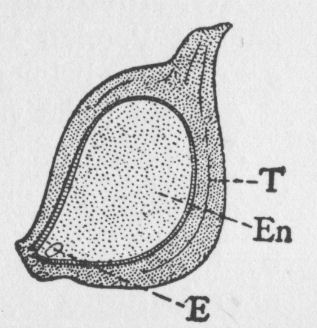
Achene of Buttercup (magnified)
E, Embryo. En, Endosperm. T, Testa and pericarp.
Achene, or Achenium (a-kēn′, a-kē′ni-um), in botany, a small, dry carpel containing a single seed, the pericarp of which is closely applied but separable, and which does not open when ripe. It is either solitary, or several achenia may be placed on a common receptacle as in the buttercup.
Achensee, a lake in Tyrol, 20 miles north-east of Innsbruck and 3018 feet above sea-level. On its shores are beautiful villas and hotels frequented as summer resorts.
Acheron (ak′e-ron) (modern Fanarioticos), the ancient name of several rivers in Greece and Italy, all of which were connected by legend with the lower world. The principal was a river of Thesprotia in Epirus, which passes through Lake Acherusia and flows into the Ionian Sea. Homer speaks of Acheron as a river of the lower world, and late Greek writers use the name to designate the lower world.
Acheulian, a term applied by archæologists to the late stage of Chellean civilization in the Pleistocene Age. It is named after St. Acheul in the Somme valley, where relics of it were found. The geological horizon, according to Professor James Geikie, is late Second Interglacial and Third Glacial periods.
Ach′iar, or At′char, an Indian condiment made of the young shoots of the bamboo pickled.
Achievement (a-chēv′ment), in heraldry, a term applied to the shield of armorial bearings generally, or to a hatchment (q.v.).
Achill (ak′il), the largest island on the Irish coast, separated from the mainland of Mayo by a narrow sound, now bridged over. The chief occupation is fishing. The island is mountainous, has fine scenery, and is visited by many tourists, there being now a railway terminus here, and many recent improvements. Pop. nearly 7000.
Achillæ′a, the milfoil genus of plants.
Achilleion, famous castle at Corfu, which used to belong to the Empress Elizabeth of Austria. It was acquired by the ex-Kaiser William II, who bought it from the Archduchess Giséla, wife of Prince Leopold of Bavaria.
Achilles (a-kil′ēz), a Greek legendary hero, the chief character in Homer's Iliad. His father was Peleus, ruler of Phthia in Thessaly, his mother the sea-goddess Thetis. When only six years of age he was able to overcome lions and bears. His guardian, Cheiron the Centaur, having declared that Troy could not be taken without his aid, his mother, fearing for his safety, disguised him as a girl, and introduced him among the daughters of Lycomedes of Scyros. Her desire for his safety made her also try to make him invulnerable when a child by anointing him with ambrosia, and again by dipping him in the River Styx, from which he came out proof against wounds, all but the heel, by which she held him. His place of concealment was discovered by Odysseus (Ulysses), and he promised his assistance to the Greeks against Troy. Accompanied by his close friend, Patroclus, he joined the expedition with a body of followers (Myrmidons) in fifty ships, and occupied nine years in raids upon the towns neighbouring to Troy, after which the siege proper commenced. On being deprived of his prize, the maiden Briseïs, by Agamemnon, he refused to take any further part in the war, and disaster attended the Greeks. Patroclus now persuaded Achilles to allow him to lead the Myrmidons to battle dressed in his armour, and he having been slain by Hector, Achilles vowed revenge on the Trojans, and forgot his anger against the Greeks. He attacked the Trojans and drove them back to their walls, slaying them in great numbers, chased Hector, who fled before him three times round the walls of Troy, slew him, and dragged his body at his chariot-wheels, but afterwards gave it up to Priam, who came in person to beg for it. He then performed the funeral rites of Patroclus, with which the Iliad closes. He was killed in a battle at the Scæan Gate of Troy by an arrow from the bow of Paris which struck his vulnerable heel. In discussions on the origin of the Homeric poems the term Achilleid is often applied to those books (i, viii, and xi-xxii) of the Iliad in which Achilles is prominent, and which some suppose to have formed the original nucleus of the poem. See Iphigenia.
Achilles' Tendon, or Tendon of Achilles, the strong tendon which connects the muscles of the calf with the heel, and which may be easily felt with the hand. The origin of the name will be understood from the above article.
Achilles Tatius (a-kil′ēz tā′shi-us), a Greek romance writer of the fifth century A.D., belonging to Alexandria; wrote a love story in 8 books called Leucippē and Cleitophon.
Achimenes (a-kim′e-nēz), a genus of tropical American plants, with scaly underground tubers, nat. ord. Gesneraceæ, now cultivated in European greenhouses on account of their white, blue, and red flowers.
Achlamydeous (ak-la-mid′i-us), in botany, wanting the floral envelopes, that is, having neither calyx nor corolla, as the willow.
Achor (ā′kor), a disease of infants, in which the head, the face, and often the neck and breast become incrusted with thin, yellowish or greenish scabs, arising from minute, whitish pustules, which discharge a viscid fluid.
Achromat′ic (Gr. a, priv., and chrōma, chrōmatos, colour), in optics, transmitting colourless light, that is, not decomposed into the primary colours, though having passed through a refracting medium. A single convex lens does not give an image free from the prismatic colours, because the rays of different colour making up white light are not equally refrangible, and thus do not all come to a focus together, the violet, for instance, being nearest the lens, the red farthest off. If such a lens of crown-glass, however, is combined with a concave lens of flint-glass—the curvatures of both being properly adjusted—as the two materials have somewhat different optical properties, the latter will neutralize the chromatic aberration of the former, and a satisfactory image will be produced. Telescopes, microscopes, &c., in which the glasses are thus composed are called achromatic.
Acid (Lat. acidus, sour), a name applied to a number of compounds, having more or less the qualities of vinegar (itself a diluted form of acetic acid). Their general properties are sour taste, the power of changing vegetable blues into reds, of evolving hydrogen in presence of magnesium, of decomposing chalk with effervescence, and of being in various degrees neutralized by alkalies. An acid has been defined as a compound of hydrogen, the whole or a part of which is replaceable by a metal when this is presented in the form of a hydroxide; being monobasic, dibasic, or tribasic, according to the number of replaceable hydrogen atoms in a molecule. See Chemistry.
Acierage (ā′sē-ėr-āj), (Fr. acier, steel), a process by which an engraved copper-plate or an electrotype from an engraved plate of steel or copper has a film of iron deposited over its surface by electricity in order to protect the engraving from wear in printing. By this means an electrotype of a fine engraving, which, if printed directly from the copper, would not yield 500 good impressions, can be made to yield 3000 or more; and when the film of iron becomes so worn as to reveal any part of the copper, it may be removed and a fresh coating deposited so that 20,000 good impressions may be got.
Acipenser (as-i-pen′sėr), the genus of cartilaginous ganoid fishes to which the sturgeon belongs.
Aci Reale (ä′chē rā-ä′lā), a seaport of Sicily, north-east of Catania, a well-built town, with a trade in corn, wine, fruit, &c. Pop. 35,587.
A′cis, according to Ovid, a beautiful shepherd of Sicily, loved by Galatea, and crushed to death by his rival the Cyclops Polyphemus. His blood, flowing from beneath the rock which crushed him, was changed into a river bearing his name, and renowned for the coldness of its water. It has been identified as the Fiume di Jaci.
Aclin′ic Line (Gr. priv. a, klinō, to incline), the magnetic equator, an irregular curve in the neighbourhood of the terrestrial equator, where the magnetic needle balances itself horizontally, having no dip. See Magnetism.
Acne (ak′nē), a skin disease, consisting of small hard pimples, usually on the face, caused by congestion of the follicles of the skin.
Acolyte
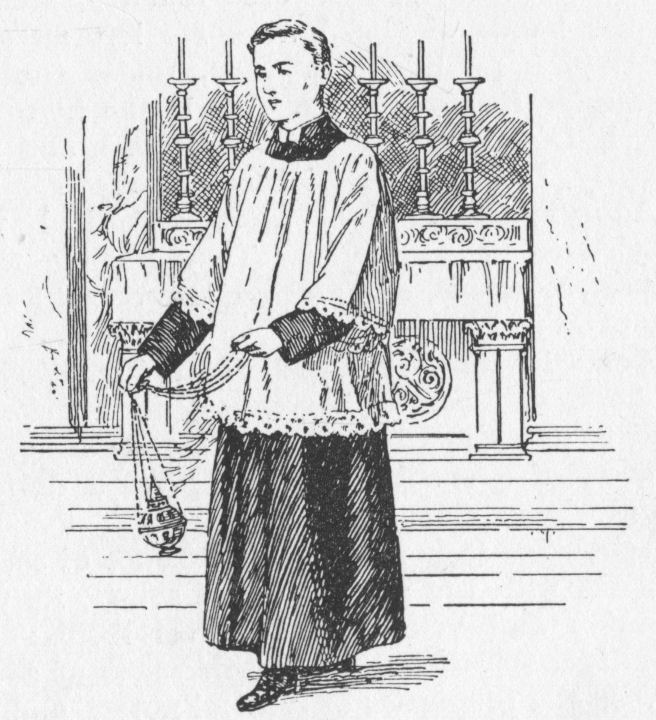
Acolytes (ak′o-līts), in the ancient Latin and Greek Churches, persons of ecclesiastical rank next in order below the subdeacons, whose office it was to attend the officiating priest. The name is still retained in the Roman Church. Cf. Duchesne, Christian Worship, its Origin and Evolution.
Aconcagua (a˙-kon-kä′gwa˙), a province, a river, and a mountain of Chile. The peak of Aconcagua, whose summit is just within the Argentine Republic, rises to the height of 23,080 feet, and is probably the highest mountain of the western hemisphere. Area of province, 5406 sq. miles. Pop. (1919), 132,165.
Ac′onite (Aconītum), a genus of hardy herbaceous plants, nat. ord. Ranunculaceæ, represented by the well-known wolf's-bane or monk's-hood, and remarkable for their poisonous properties and medicinal qualities, being used internally as well as externally in rheumatism, gout, neuralgia, &c.
Acon′itine, an alkaloid extracted from monk's-hood and some other species of aconite; used medicinally, though a virulent poison.
Aconquija (a˙-kon-kē′ha˙), a range of mountains in the Argentine Republic; the name also of a single peak, 17,000 feet high.
A′corn, the fruit of the different kinds of oak. The acorn-cups of one species are brought from the Levant under the name of valonia, and used in tanning.
Acorn-shell. See Balanus.
Ac′orus, a genus of plants, including the sweet-flag. See Sweet-flag and Calamus.
Acos′ta, Gabriel, afterwards Uriel, a Portuguese of Jewish descent, born at Oporto in 1590, died by his own hand 1640. Brought up a Christian, he afterwards embraced Judaism. Having gone to Amsterdam, where he attacked the practices of the Jews, and denied the divine mission of Moses, he suffered much persecution at the hands of the Jews. He left an autobiography, published in 1687, under the title Exemplar Humanæ Vitæ. He is the hero of a novel, Die Sadducäer von Amsterdam, and of a tragedy, Uriel Acosta, both by Gutzkow.
Acotyle′dons, plants not furnished with cotyledons or seed-lobes. They include ferns, mosses, seaweeds, &c., and are also called flowerless plants or cryptogams.
Acousimeter, or Acoumeter (Gr. akouein, to hear, and metron, measure), an instrument used to determine the acuteness of hearing. It consists of a small bar which gives a uniform sound when struck by a hammer.
Acoustics (a-kou′stiks), the science of sound. It deals with the production of sound, its propagation and velocity in various media; the reflection, refraction, and interference of sound waves; the properties of musical notes; and the general phenomena of such vibrations of elastic bodies as affect the organ of hearing.
In order that a sound may be heard, it is necessary that an uninterrupted series of particles of elastic matter should extend from the sounding body to our ear. Sound is propagated by a longitudinal wave-motion in the medium (gaseous, liquid, or solid), that is, the particles oscillate along the line in which the wave is travelling, giving rise to regular series of condensations and rarefactions.
The velocity of sound varies directly as the square root of the elasticity, and inversely as the square root of the density, of the medium in which it is propagated. The velocity of sound in air at 0° C. is 330.6 metres per second, or 1085 feet per second; in water 1.49 kilometres per second, or 0.926 mile per second; in copper 5.01 kilometres per second, or 3.12 miles per second.
The intensity of sound varies inversely as the square of the distance from the sounding body. Recently sound-ranging instruments have been produced by means of which the position of a gun can be determined.
A note produced by a musical instrument consists of a fundamental of a certain frequency, together with a number of overtones of various higher frequencies and much smaller amplitude. The timbre of a note depends on the overtones present, the loudness depends on the amplitude of the vibrations, and the pitch depends on the frequency. The musical scale consists of eight notes, C D E F G A B C, whose frequencies are in the proportion of the numbers 24, 27, 30, 32, 36, 40, 45 and 48. The interval between two notes is the ratio of the frequency of the higher note to the frequency of the lower note. In order that the intervals may be the same in all keys, a tempered scale is used in music. (See Table, p. 25.)
Bibliography: Lord Rayleigh, Theory of Sound; H. Smith, The Making of Sound in the Organ and Orchestra; J. W. Capstick, Sound (Cambridge Natural Science Manuals); E. H. Barton, Text-book of Sound.
Acqui (a˙k′wē), a town of Northern Italy, 18 miles S.S.W. of Alessandria, a bishop's see. It has warm sulphurous baths, which were known to the Romans, and which still attract a great many visitors. Pop. 16,500.
Acre, a standard British measure of land, also used in the colonies and the United States. The imperial statute acre consists of 4840 sq. yards, divided into 4 roods. The old Scotch acre contains 6146.8 sq. yards, the old Irish acre 7840 sq. yards.
Acre (ā′kėr) (ancient Accho and Ptolemais), a seaport of Syria, in Northern Palestine, on the Bay of Acre, early a place of great strength and importance. Taken from the Saracens under Saladin in 1191 by Richard I of England and Philip of France; bravely defended by the Turks, assisted by Sir Sidney Smith, in 1799 against Napoleon; in 1832, taken by Ibrahim Pasha; in 1840, bombarded by a British, Austrian, and Turkish fleet, and restored to the Sultan of Turkey. The town was occupied by British troops under General Allenby in September, 1918. Pop. 10,000.
MUSICAL INTERVALS.—See Acoustics
Intervals in Perfect Diatonic Scale. Perfect Diatonic Scale Diatonic Scale. on System of Equal Temperament. Intervals in Tempered Scale— Mean tone. (21/6 = 1.123). Semitone. (21/12= 1.059).
C 1 1.000
9/8 major tone tone.
D 9/8 = 1.125 22/12 = 1.123
10/9 minor tone tone.
E 5/4 = 1.250 24/12 = 1.260
16/15 limma semitone.
F 4/3 = 1.333 25/12 = 1.335
9/8 major tone tone.
G 3/2 = 1.500 27/12 = 1.498
10/9 minor tone tone.
A 5/3 = 1.667 29/12 = 1.682
9/8 minor tone tone.
B 15/8 = 1.875 211/12 = 1.888
16/15 limma semitone.
C′ 2 2.000
Major tone ratio = 9/8 = 1.125 Limma tone ratio = 16/15 = 1.067
Minor " " = 10/9 = 1.111 Semitone " = 21/12= 1.059
Mean " " = 22/12= 1.123
NOTES OF PERFECT DIATONIC SCALE (with their Frequencies)
C″ 64. Ut1 C′ 128. Ut2 C 256. Ut3 C′ 512. Ut4
D″ 72 D′ 144 D 288 D′ 576
E″ 80 E′ 160 E 320 E′ 640
F″ 85.3 F′ 170.7 F 341.3 F′ 682.7
G″ 96 G′ 192 G 384 G′ 768
A″ 106.6 A′ 213.3 A 426.7 A′ 853.2
B″ 120 B′ 240 B 480 B′ 960
C″ 1024. Ut5
PERFECT DIATONIC SCALES (Transition to Key of Dominant)
Example—Key of C to Key of G
C D E F G A B C′ D′ E′ F′ G′
1 9/8 5/4 4/3 3/2 5/3 15/8 2 9/4 5/2 8/3 3
GA’B C′D′E′F′#G′
19/8 5/44/3 3/2 5/3 15/8 2
A = 10/9 G. F′ = 16/9 G.
A’ = 9/8 G. F′# = 15/8 G.
A’ = 81/80 A. = 15/8 × 9/16 F′.
= (1 + 1/182/7) F′.
Acri (ā′krē), a town of S. Italy, province of Cosenza. Pop. 4000.
Ac′rita (Gr. akritos, undistinguishable, doubtful), a name sometimes given to the animals otherwise called Protozoa.
Acroceph′ali, tribes of men distinguished by pyramidal or high skulls.
Acrocerau′nia (thunder-smitten peaks) (now Cape Glossa or Linguetta), a promontory of Western Greece, in Epirus, running into the Adriatic.
Acrocorin′thus, a steep rock in Greece, nearly 1900 feet high, overhanging ancient Corinth, and on which stood the acropolis or citadel, the sacred fountain of Pirēnē being also here. This natural fortress has proved itself of importance in the modern history of Greece.
Ac′rogens (-jenz), lit. summit-growers, a term applied to the ferns, mosses, and lichens (cryptogams), as growing by extension upwards, in contradistinction to endogens and exogens.
Ac′rolith, an early form of Greek statuary in which the head, hands, and feet only were of stone, the trunk of the figure being of wood draped or gilded.
Acrop′olis (Gr. akros, high, and polis, a city), the citadel or chief place of a Grecian city, usually on an eminence commanding the town. That of Athens contained some of the finest buildings in the world, such as the Parthenon, Erechthēum, &c.
Acros′tic, a poem of which the first or last, or certain other, letters of the line, taken in order, form some name, motto, or sentence. A poem of which both first and last letters are thus arranged is called a double acrostic. In Hebrew poetry, the term is given to a poem of which the initial letters of the lines or stanzas were made to run over the letters of the alphabet in their order, as in Psalm cxix.—Acrostics have been much used in complimentary verses, the initial letters giving the name of the person eulogized. They were very popular among French poets of the sixteenth and seventeenth centuries. In modern times Edgar Allen Poe has written quite remarkable acrostic verses.
Act, in special senses: (1) In dramatic poetry, one of the principal divisions of a drama, in which a definite and coherent portion of the plot is represented; generally subdivided into smaller portions called scenes. The Greek dramas were not divided into acts. The dictum that a drama should consist of five acts was first formally laid down by Horace, and is generally adhered to by modern dramatists in tragedy. In comedy, especially since the time of Molière, more freedom is allowed, and a division into two or three acts is common.—(2) Something formally done by a legislative or judicial body; a statute or law passed.—(3) In universities, a thesis maintained in public by a candidate for a degree. See Act of God, of Parliament, of Settlement.
Acta Diur′na (Lat., proceedings of the day), a daily Roman newspaper which appeared under both the republic and the empire.
Actæ′a. See Baneberry.
Actæ′on, in Greek mythology, a great hunter, turned into a stag by Artĕmis (Diana) for looking on her when she was bathing, and torn to pieces by his own dogs.
Acta Erudito′rum (Lat., acts of the learned), the first literary journal that appeared in Germany (1682-1782). It was started by Otto Mencke, after the model of the Journal des Savants. Among the contributors, the most distinguished was Leibnitz.
Acta Sanctorum (Lat., acts of the saints), a name applied to all collections of accounts of ancient martyrs and saints, both of the Greek and Roman Churches, more particularly to the valuable collection begun by John Bolland, a Jesuit of Antwerp, in 1643, and which, being continued by other divines of the same order (Bollandists), now extends to sixty volumes, the lives following each other in the order of the calendar.
Actin′ia, the genus of animals to which the typical sea-anemones belong. See Sea-anemone.
Ac′tinism, the property of those rays of light which produce chemical changes, as in photography, in contradistinction to the light rays and heat rays. The actinic property or force begins among the green rays, is strongest in the violet rays, and extends a long way beyond the visible spectrum.
Actinium, an element or elementary substance obtained in minute quantities in connection with the study of radioactivity. It was discovered by Debierne in 1899. In 1902 Giesel discovered another substance which he called emanium, and which was considered to be identical with actinium. Marckwald, however, came to the conclusion that these two substances are not identical but closely related to each other. See Radium, Chemistry.
Actin′olite, a mineral nearly allied to hornblende.
Actinom′eter, an instrument for measuring the intensity of the sun's actinic rays. See Actinism.
Actinozo′a (lit. ray-animals), a class of animals belonging to the sub-kingdom Cœlenterata, and including sea-anemones, corals, &c., all having rayed tentacles round the mouth.
Action, the mode of seeking redress at law for any wrong, injury, or deprivation. Actions are divided into civil and criminal, the former again being divided into real, personal, and mixed.
Ac′tium (now La Punta), a promontory on the western coast of Northern Greece, not far from the entrance of the Ambracian Gulf (Gulf of Arta), memorable on account of the naval victory gained here by Octavianus (afterwards the Emperor Augustus) over Antony and Cleopatra, 2nd Sept., 31 B.C., in sight of their armies encamped on the opposite shores of the Ambracian Gulf. Soon after the beginning of the battle Cleopatra escaped with sixty Egyptian ships, and Antony basely followed her, and fled with her to Egypt. The deserted fleet was not overcome without making a brave resistance. Antony's land forces soon went over to the enemy, and the Roman world fell to Octavianus. In 1538 a victory was gained at Actium by the Turks over the Spanish and Venetian fleets.
Act of God, a legal term defined as "a direct, violent, sudden, and irresistible act of nature, which could not, by any reasonable cause, have been foreseen or resisted". No one can be legally called upon to make good loss so arising.
Act of Parliament, a law or statute proceeding from the Parliament of the United Kingdom passed in both houses, and having received the royal assent. Before it is passed it is a Bill and not an Act. Acts are either public or private, the former affecting the whole community, the latter only special persons and private concerns. The whole body of public Acts constitutes the statute law. An Act of Parliament can only be altered or repealed by the authority of Parliament. Acts are usually cited in this way, "13 and 14 Vict. c. (or chap.) 21", which means the 21st Act in succession passed in year 13th-14th of the queen's reign (that is, 1850). Short titles, such as "the Merchant Shipping Act, 1854", are also used. Up to the time of Edward I Acts of Parliament were in Latin; then French was introduced, and for some time was exclusively employed. It was not till Henry VII's reign that all Acts were in English.
Act of Settlement, an Act passed by the English Parliament in 1700, by which the succession to the throne of the three kingdoms, in the event of King William and Princess (afterwards Queen) Anne dying without issue, was settled on the Princess Sophia, electress of Hanover, and the heirs of her body, being Protestants. The Princess Sophia was the youngest daughter of Elizabeth, Queen of Bohemia, daughter of James I. By this act George I, son of the Princess Sophia, succeeded to the crown on the death of Queen Anne.—Another Act of Settlement was that by which, under Cromwell's government, a new allotment was made of almost all landed property in Ireland, in 1652.
Act of Toleration, an Act of Parliament Passed in 1689, by which Protestant dissenters from the Church of England, on condition of their taking the oaths of supremacy and allegiance, and repudiating the doctrine of transubstantiation, were relieved from the restrictions under which they had formerly lain with regard to the exercise of their religion according to their own forms.
Act of Uniformity, an English Act passed in 1662, enjoining upon all ministers to use the Book of Common Prayer on pain of forfeiture of their livings. See Nonconformity.
Quilted Acton of the fifteenth century
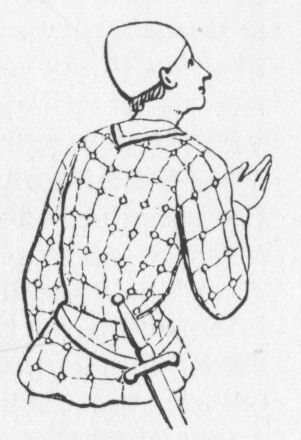
Acton, a kind of padded or quilted vest or tunic formerly worn under a coat of mail to save the body from bruises, or used by itself as a defensive garment. Jackets of leather or other material plated with mail were also so called. Gambeson was an equivalent term.
Acton, a name of various places in England, one of them a western suburb of London, pop. (1921), 61,314. Since 1918 Acton gives its name to a parliamentary division of Middlesex, returning one member to Parliament.
Acton, John Emerich Edward Dalberg, first Baron Acton, born 1834, died 1902, was son of Richard Acton (seventh baronet) and the daughter of the Duc de Dalberg, afterwards wife of Earl Granville, Mr. Gladstone's colleague. As a Roman Catholic he was educated at Oscott, and afterwards on the Continent, partly under Döllinger, and acquired a special taste for and profound knowledge of history. He conducted the Home and Foreign Review from 1862 to 1864, and, in doing so, showed himself a strong opponent of ultramontane pretensions. He next edited the North British Review, which under him was rather overweighted with learning, and soon came to an end. In 1869 he was raised to the peerage. He strongly opposed the papal-infallibility movement, and took the side of Mr. Gladstone in his attacks on Vaticanism. In 1895 he accepted the professorship of modern history at Cambridge, delivered lectures, and planned and undertook the editorship of the great work on modern history, The Cambridge Modern History, comprising a series of contributions by various scholars, and issued by the university press. Except essays, letters, or articles for periodicals, he himself wrote little. Since his death have been published: Lectures in Modern History (1906); The History of Freedom and other Essays (1907); Lectures on the French Revolution (1910). His library of 60,000 volumes he left to Mr. (now Lord) Morley, who handed it over to the University of Cambridge.
Actor, one who represents some part or character on the stage. Actresses were unknown to the Greeks and Romans in the earliest times, men or boys always performing the female parts. They appeared under the Roman empire, however. Charles II first encouraged the public appearance of actresses in England; in Shakespeare's time there were none. See Drama.—Bibliography: C. F. Armstrong, Century of Great Actors; H. Simpson, Century of Great Actresses.
Acts of the Apostles, fifth of the books of the New Testament, written in Greek and assigned to the author of the gospel of St. Luke. Its date is probably A.D. 63 or 64. It embraces a period of about thirty years, beginning immediately after the resurrection, and extending to the second year of the imprisonment of St. Paul in Rome. Very little information is given regarding any of the apostles, excepting St. Peter and St. Paul, and the accounts of them are far from being complete. It describes the gathering of the infant Church; the fulfilment of the promise of Christ to his apostles in the descent of the Holy Ghost; the choice of Matthias in the place of Judas, the betrayer; the testimony of the apostles to the resurrection of Jesus in their discourses; their preaching in Jerusalem and in Judea, and afterwards to the Gentiles; the conversion of Paul, his preaching in Asia Minor, Greece, and Italy, his miracles and labours.—Bibliography: R. T. Knowling, The Expositor's Greek Testament; J. Moffatt, The Historical New Testament; J. M. Wilson, Origin and Aim of the Acts of the Apostles.
Ac′tuary, an accountant whose business is to make the necessary computations in regard to a basis for life assurance, annuities, reversions, &c.
Acu′leus, in botany, a prickle, or sharp-pointed process of the epidermis, as distinguished from a thorn or spine, which is of a woody nature.
Acupress′ure, a means of arresting bleeding from a cut artery introduced by Sir James Simpson in 1859, and consisting in compressing the artery above the orifice, that is, on the side nearest the heart, with the middle of a needle (Lat. acus, a needle) introduced through the tissues.
Acupunc′ture, a surgical operation, consisting in the insertion of needles into certain parts of the body for alleviating pain, or for the cure of different species of rheumatism, neuralgia, eye diseases, &c. It is easily performed, gives little pain, causes neither bleeding nor inflammation, and seems at times of surprising efficacy.
Adagio (It. a˙-dä′jō), a musical term, expressing a slow time, slower than andante and less so than largo, lento, and grave.
Adâl′, a country in Africa, east of Abyssinia and north-westward of Tajurrah Bay, inhabited by a dark-brown race of the same name, a tribe of the Danakils, Mahommedans in religion; towns Aussa and Tajurrah. Part of the coast here is held by the French.
Ad′albert of Prague, called the apostle of the Prussians, son of a Bohemian nobleman named Slavnik, born about 939. His real name was Voitech, but he assumed the name of the Archbishop Adalbert, under whom he studied at Magdeburg. He was appointed Bishop of Prague in 983, laboured in vain among the heathenish Bohemians, resolved to convert the pagans of Prussia, but was murdered in the attempt (997). Boga-Rodzica, a Polish war-song, is said to have been composed by him.
Ada′lia, a seaport on the south coast of Asia Minor. Pop. 28,000. The district of Adalia has a population of over 200,000.
Adam (a˙-da˙n˙), Adolphe Charles, a French composer, more especially of comic operas; born 1803, died 1856. Wrote Le postillon de Longjumeau, Le Brasseur de Preston (Brewer of Preston), La Rose de Peronne, Le roi d'Yvetot, &c.
Adam, Albrecht, a German painter of battles and animals, born 1786, died 1862. Three sons of his have also distinguished themselves as painters, especially Franz, born 1815, died 1886, among whose best pictures are several representing scenes of the Franco-Prussian war.
Adam, Alexander, a Scottish classical scholar, born in 1741; became in 1768 rector of the High School of Edinburgh, and died there in 1809. Wrote Principles of Latin and English Grammar; Roman Antiquities, a useful school-book; Summary of Geography and History; Classical Biography, &c.
Adam, Robert, an eminent Scottish architect, born in 1728, a son of William Adam, architect. He resided several years in Italy, visited Spalatro, in Dalmatia, and published a work on the ruined palace of Diocletian there. In conjunction with his brother James he was much employed by the English nobility and gentry in constructing modern and embellishing ancient mansions. Among their works are the Register House and the University Buildings, Edinburgh, and the Adelphi Buildings, London. Robert Adam died in 1792, and was buried in Westminster Abbey; his brother James died in 1794.
Adam and Eve, the names given in Scripture to our first parents, an account of whom and their immediate descendants is given in the early chapters of Genesis. Cain, Abel, and Seth are all their sons that are mentioned by name; but we are told that they had other sons as well as daughters. There are numerous Rabbinical additions to the Scripture narrative of an extravagant character, such as the myth of Adam having a wife before Eve, named Lilith, who became the mother of giants and evil spirits. Other legends or inventions are contained in the Koran.
Adam de la Hale, an early French writer and musician, born 1235, died 1287. His Jeu de Robin et de Marion (first produced at Naples), may be regarded as the first comic opera ever written. Cf. H. Guy, Bibliographie Critique du Trouvère, Paris, 1900.
Ad′amant, an old name for the diamond; also used in a vague way to imply a substance of impenetrable hardness.
Adaman′tine Spar, a name of the mineral corundum or of a brownish variety of it.
Adama′wa (also called Fumbina), a region of West Africa, between lat. 6° and 10° N., and lon. 11° and 17° E. Much of the surface is hilly or mountainous, Mount Atlantika being 9000 or 10,000 feet. The principal river is the Benue. A great part of the country is covered with thick forests. The oil palm and bananas are staple products. Chief town Yola (Nigeria).
Adamello. See European War.
Ad′amites, a religious sect dating from the second century, probably of Gnostic origin. It was so called because both men and women were said to appear naked in their assemblies, either to imitate Adam in the state of innocence or to prove the control which they possessed over their passions. Practices similar to those of the Adamites arose several times in later ages. See Beghards.
Adam′nan, St., born in Ireland about 624, was elected abbot of Iona in 679, and died there about 703 or 704. He is best known from his Life of St. Columba, valuable as throwing light on the early ecclesiastical history of Scotland. (There are editions by Reeves, 1857; reissued with English translation 1874; and by Fowler, 1895.) His feast is celebrated on 23rd Sept.
Adams, Charles Francis, American litterateur and statesman, was a son of John Quincy Adams, and was born in 1807. His boyhood was spent in Europe, partly in England; but he finished his education at Harvard, and afterwards studied law. After serving some years in the Massachusetts legislature he was sent to Congress in 1859. In 1861 Lincoln sent him to England as American minister, and here he remained for seven years, performing the arduous duties of his office with the utmost tact and ability. Between 1874 and 1877 he edited a complete edition of his grandfather's works in 12 vols. He was one of the arbitrators on the Alabama claims. Died in 1886.
Adams, John, second president of the United States, was born at Braintree (now Quincy), Massachusetts, 19th Oct., 1735. He was educated at Harvard University, and adopted the law as a profession. His attention was directed to politics by the question as to the right of the English Parliament to tax the colonies, and in 1765 he published some essays strongly opposed to the claims of the mother country. As a member of the new American congress in 1774, 1775, and 1776 he was strenuous in his opposition to the home Government, and in organizing the various departments of the colonial Government. On 13th May, 1776, he seconded the motion for a declaration of independence proposed by Lee of Virginia, and was appointed a member of committee to draw it up. The declaration was actually drawn up by Jefferson, but it was Adams who fought it through Congress. In 1778 he went to France on a special mission, but soon came back and again returned, and for nine years resided abroad as representative of his country in France, Holland, and England. After taking part in the peace negotiations he was appointed, in 1785, the first ambassador of the United States to the Court of St. James. He was recalled in 1788, and the following year elected vice-president of the republic under Washington. In 1792 he was re-elected vice-president, and at the following election in 1797 he became president in succession to Washington. The commonwealth was then divided into two parties, the Federalists, who favoured aristocratic and were suspected of monarchic views, and the Republicans. Adams adhered to the former party, with which his views of government had always been in accordance, but the real leader of the party was Hamilton, with whom Adams did not agree, and who tried to prevent his election. His term of office proved a stormy one, which broke up and dissolved the Federalist party. His re-election in 1801 was again opposed by the efforts of Hamilton, which ended in effecting the return of the Republican candidate Jefferson. Thus it happened that when Adams retired from office his influence and popularity with both parties were at an end, and he sunk at once into the obscurity of private life. He had the consolation, however, of living to see his son president. He died 4th July, 1826, the fiftieth anniversary of the declaration of independence, and on the same day as Jefferson. His works have been ably edited by his grandson Charles Francis Adams.
Adams, John Couch, English astronomer, born 1819, died 1892, studied at Cambridge, and was senior wrangler in 1843. His investigations into the irregularities in the motion of the planet Uranus led him to the conclusion that they must be caused by another more distant planet, and the results of his labours were communicated in September and October, 1845, to Professor Challis and Airy the Astronomer Royal. The French astronomer Leverrier had by this time been engaged in the same line of research, and had come to substantially the same results, which, being published in 1846, led to the actual discovery of the planet Neptune by Galle of Berlin. In 1858 Adams was professor of mathematics at Aberdeen University, and in 1859 was appointed Lowndean professor of astronomy and geometry at Cambridge.
Adams, John Quincy, sixth president of the United States, son of John Adams, second president, was born 11th July, 1767. Accompanying his father to Europe he received part of his education there, but graduated at Harvard in 1788. Having adopted the legal profession, in 1791 he was admitted to the bar. He now began to take an active interest in politics, and some letters that he wrote having attracted general attention, in 1794 Washington appointed him minister to the Hague. He afterwards was sent to Berlin, and also on a mission to Sweden. In 1798 he received a commission to negotiate a treaty of commerce with Sweden. On the accession of Jefferson to the presidency in 1801 he was recalled. The Federalist party (that of his father), which was now declining, had sufficient influence in Massachusetts to elect him to the senate in 1803. On an important question of foreign policy, that of embargo, he abandoned his party, and having lost his re-election on this account, he retired to the professorship of rhetoric at Cambridge, which he held from 1806 to 1809. In 1809 he went as ambassador to Russia. He assisted in negotiating the peace of 1814 with England, and was afterwards appointed resident minister at London. Under Monroe as president he was secretary of state, and at the expiration of Monroe's double term of office he succeeded him in the presidency (1825). He was not very successful as president, and at the end of his term (1829) he was not re-elected. In 1831 he was returned to Congress by Massachusetts, and continued to represent this State till his death, his efforts being now chiefly on behalf of the Abolitionist party. He died 21st Feb., 1848.
Adams, Samuel, an American statesman, second cousin of President John Adams, was born in Boston, 27th Sept., 1722, and was educated at Harvard College. He early devoted himself to politics, and in connection with the dispute between America and the mother country he showed himself one of the most unwearied, efficient, and disinterested assertors of American freedom and independence. He was one of the signers of the declaration of 1776, which he laboured most indefatigably to bring forward. He sat in congress eight years; from 1789-94 was lieutenant-governor of Massachusetts; from 1794-7 governor, when he retired from public life. He died 2nd Oct., 1803.
Adam's Apple, the popular name of the prominence seen in the front of the throat in man, and which is formed by the portion of the larynx known as the thyroid cartilage. It is much smaller and less visible in females than in males, and is so named from the supposition that it was caused by a piece of the forbidden fruit having stuck in Adam's throat. In botany it is the name given to the plantain tree and the Citrus pomum. It is the Heb. Ethrog, which, according to Hebrew legend, was the fruit Adam and Eve ate in the garden of Eden.
Adam's Bridge, a chain of reefs, sandbanks, and islands stretching between India and Ceylon; so called because the Mohammedans believe that when Adam was driven from paradise he had to pass by this way to Ceylon (where is also Adam's Peak). The Brahmans call it the bridge of Rama, the hero of the Indian Epic, the Ramayana.
Adam's Needle, a popular name of the Yucca plant.
Adam's Peak, one of the highest mountains in Ceylon, 45 miles east-south-east of Colombo, conical, isolated, and 7420 feet high. On the top, a rocky area of 64 feet by 45, is a hollow in the rock 5 feet long bearing a rude resemblance to a human foot, which the Brahmans believe to be the footprint of Siva; the Buddhists, who call it Sri-pada (sacred footmark), that of Buddha; the Mahommedans that of Adam. The last-named believe that Adam stood here on one foot for a thousand years, lamenting his exclusion from Eden. Devotees of all creeds meet here and present their offerings (chiefly rhododendron flowers) to the sacred footprint. The ascent is very steep, and towards the summit is assisted by steps cut and iron chains riveted in the rock.
Adamson, Patrick, a Scottish divine and Latin poet, born 15th March, 1536, died 19th Feb., 1592. He was educated at St. Andrews, lived some years in France, was minister of Paisley, and afterwards Archbishop of St. Andrews, in which position he made himself very obnoxious to the Presbyterian party. Deprived of the revenues of the see, he died in indigence. He turned portions of the Bible into Latin verse.
Ad′ana, town and capital of Adana vilayet, Asia Minor, on the Seihun-Irmak; served by the Bagdad Railway. The district is claimed by Armenia. Cotton, rice, wine, and fruit are exported. Pop. (town), 70,000; (vilayet), 1,000,000.
Adanson (a˙-da˙n-sōn˙), Michel, French naturalist and traveller (of Scottish extraction), born 1727; died 1806. He lived five years in Senegal, and wrote a natural history of this region as well as works on botany. The baobab genus is named Adansonia after him. Adanson's statue was erected in the Jardin des Plantes, Paris, in 1856.
Adanso′nia. See preceding article and Baobab.
Adaptation (from the Lat. ad, to, and aptāre, to fit), the process of modification or alteration of a thing so as to change its original purpose and adapt it to other uses. Adaptation in biology is the power and process by which an organism or species of animals or plants changes and becomes modified, so as to suit the conditions of its life. In other words it is the adjustment, or favourable reaction, of the living world to its environment, the advantageous variation of animals and plants under changed conditions. The term now includes both that which is hereditary and that which is acquired. The powers of lower forms of life to adapt themselves to changes of environment are limited, and frequently, when the conditions vary suddenly, they are either arrested in their development or die altogether.—In literature it is the process by which an author modifies the work of another not in its essence but in its form and details, either in the original or in a foreign language.
A′dar, the twelfth month of the Hebrew sacred and sixth of the civil year, answering to part of February and part of March.
Adda (ancient Addua), a river of North Italy, which, descending from the Rhætian Alps, falls into Lake Como, and leaving this joins the Po, after a course of about 170 miles. On the banks of the Adda Napoleon won the battle of Lodi in 1796.
Adda, a species of lizard, more commonly called Skink.
Ad′dax, a species of antelope (Hippotrăgus nasomaculātus) of the size of a large ass, with much of its make. The horns of the male are about 4 feet long, beautifully twisted into a wide-sweeping spiral of two turns and a half, with the points directed outwards. It has tufts of hair on the forehead and throat, and large broad hoofs. It inhabits the sandy regions of Nubia and Kordofan, and is also found in Caffraria.
Adder (Vipera communis)
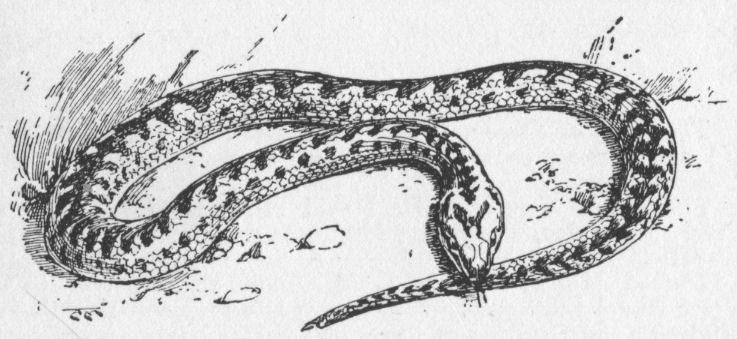
Adder, a name often applied to the common viper as well as to other kinds of venomous serpents. See Viper.
Adder-pike (Trachīnus vipĕra), a small species of the weever fish, called also the Lesser Weever or Sting-fish. See Weever.
Adder-stone, the name given in different parts of Britain to certain rounded perforated stones or glass beads found occasionally, and supposed to have a kind of supernatural efficacy in curing the bites of adders. They are believed to have been anciently used as spindle-whorls, that is, a kind of small fly-wheels to keep up the rotatory motion of the spindle.
Adder's-tongue, a species of British fern (Ophioglossum vulgātum), whose spores are produced on a spike, supposed to resemble a serpent's tongue.
Adder's-wort, a name of snakeweed or bistort (Polygŏnum Bistorta), from its supposed virtue in curing the bite of serpents.
Ad′dington, Henry, Viscount Sidmouth, born 1757, died 1844. Entered Parliament, 1783, as a warm supporter of Pitt. Was elected speaker of the House of Commons, 1789, and in 1801 invited by the king to form an administration, chiefly signalized by the conclusion of the Peace of Amiens. Quarrelled with Pitt, whom he bitterly attacked. Was home secretary from 1812 till 1822, his repressive policy making him remarkably unpopular with the nation at large. Retired from official life in 1824.
Addis Abe′ba, or Adis Abba′ba, a town in the south of Abyssinia, in Shoa, ranking as capital of the country, being chief residence of the negus or sovereign. It stands among mountains, at the height of 10,000 feet, and is a primitive place, but now has telegraphic connection with Jibouti and Massawa, and since 1917 is the terminus of the railway running inland from Jibouti by way of Harar. Pop. 50,000.
Ad′dison, Rt. Hon. Christopher, P.C., M.D., Cabinet Minister. Dr. Addison was born 19th June, 1869, and educated at Trinity College, Harrogate, and St. Bartholomew's Hospital, London, where he was a lecturer for a time. He was elected Member of Parliament for the Hoxton Division, Shoreditch, in 1910, and was parliamentary secretary to the Board of Education from 1914 to 1915. From 1916 to 1917 he was Minister of Munitions; he was President of the Local Government Board from January to June, 1919, when he became Minister of Health. He has written and edited several works on medical subjects.
Ad′dison, Joseph, an eminent English essayist, son of the Rev. Lancelot Addison, afterwards Dean of Lichfield, born at Milston, Wiltshire, 1st May, 1672, died 17th June, 1719. He was educated at the Charterhouse, where he became acquainted with Steele, and afterwards at Oxford. He held a fellowship from 1697 till 1711, and gained much praise for his Latin verse. He secured as his earliest patron the poet Dryden, who inserted some of his verses in his Miscellanies in 1693. A translation of the fourth Georgic, with the exception of the story of Aristæus, by Addison, appeared in the same collection in 1694, and he subsequently translated for it two and a half books of Ovid. Dryden also prefixed his prose essay on Virgil's Georgics to his own translation of that poem, which appeared in 1697. An early patron of his was Charles Montague, afterwards Earl of Halifax; another was Lord Somers, who procured him a pension of £300 a year to enable him to qualify for diplomatic employments by foreign travels. He spent from the autumn of 1699 to that of 1703 on the Continent, where he became acquainted with Malebranche, Boileau, &c. During his residence abroad his tragedy of Cato is supposed to have been written. During his journey across Mont Cenis he wrote his Letter from Italy, esteemed the best of his poems, and in Germany his Dialogues on Medals, which was not published till after his death. His Remarks on Several Parts of Italy in the Years 1701-3 was published in 1705. His political friends lost power on the death of William III, but The Campaign, a poem on the battle of Blenheim, procured him an appointment as a commissioner of appeal on excise. In 1706 he received an under-secretaryship, in 1707 accompanied Halifax on a mission to Hanover, in 1709 became secretary to the Viceroy of Ireland, and keeper of the records. In 1708 he was elected Member of Parliament for Lostwithiel, a seat he exchanged in 1710 for Malmesbury, which place he continued to represent till his death. From Oct., 1709, to Jan., 1711, he contributed 75 papers to the Tatler, either wholly by himself or in conjunction with Steele, thus founding the new literary school of the Essayists. For the Spectator (2nd Jan., 1711, to 6th Dec., 1712) he wrote 274 papers, all signed by one of the four letters C., L., I., O. His tragedy of Cato, produced April, 1713, ran for twenty nights, and was translated into French, Italian, German, and Latin. His other contributions to periodicals included 51 papers to the Guardian (May to Sept., 1713), 24 papers to a revived Spectator conducted by Budgell, and 2 papers to Steele's Lover. On the death of Queen Anne he successively became secretary to the lords justices, secretary to the Irish viceroy, and one of the lords commissioners of trade. He published the Freeholder (23rd Dec., 1715, to 9th June, 1716), a political Spectator. In August, 1716, he married the Countess of Warwick, a marriage which did not increase his happiness. He retired from public life, March, 1718, with a pension of £1500 a year. He formed a close friendship with Swift, and was chief of a distinguished literary circle. He had literary quarrels with Pope and Gay, the former of whom in revenge wrote the satire contained in his lines on Atticus in the Epistle to Dr. Arbuthnot. He also had a paltry quarrel over politics with his old friend Steele. His death took place at Holland House, its cause being dropsy and asthma. He was buried in Westminster Abbey. Of his style as a writer so much has been said that nothing remains to say but to quote the dictum of Johnson: "Whoever wishes to attain an English style, familiar but not coarse, and elegant but not ostentatious, must give his days and nights to the volumes of Addison". He had great conversational powers, and his intimates speak in the strongest terms of the enjoyment derived from his society, but he was extremely reserved before strangers. His Dialogues on Medals and Evidences of the Christian Religion were published posthumously in Tickell's collected edition of his works.—Bibliography: W. J. Courthope, Addison (English Men of Letters Series); Essays from the Spectator, edited by Henry Morley.
Addison's Disease (from Dr. Addison, Guy's Hospital, London, who traced the disease to its source), a fatal disease, the seat of which is the two glandular bodies placed one at the front of the upper part of each kidney, and called suprarenal capsules. It is characterized by anæmia or bloodlessness, extreme prostration, and the brownish or olive-green colour of the skin. Death usually results from weakness, and commonly takes place within a year.
Addled Parliament, a Parliament called 5th April, 1614, in order to legalize the customs duties imposed by James I, but which, proceeding to the redress of grievances instead of granting supply, was dissolved, 7th June, without passing a single Bill.
Address, a document containing an expression of thanks, congratulation, satisfaction, or dissatisfaction, &c. It is the custom of the British Parliament to return an address to the speech delivered by the Sovereign at the commencement of every session.
Address, Forms of. The following are the principal modes of formally addressing titled personages or persons holding official rank in Great Britain:—
The King or Queen.—Address in writing: To the King's (Queen's) most excellent Majesty. Say: Sire or Madam, Your Majesty.
The Royal Family.—His Royal Highness (H.R.H.) the Prince of Wales, His Royal Highness the Duke of C——, His Royal Highness Prince A——. A royal duke should be addressed as Sir, not My Lord Duke; and referred to as Your Royal Highness. A princess is addressed Her Royal Highness the Duchess of ——, Her Royal Highness Princess A——; and personally as Madam, Your Royal Highness.
Duke and Ducal Family.—His Grace the Duke of ——; My Lord Duke, Your Grace. Her Grace the Duchess of ——; Madam, Your Grace. The duke's eldest son is in law only an esquire, but in courtesy takes a secondary title of his father, and is addressed as if he held it by right. A younger son is addressed Lord J—— B——; My Lord, Your Lordship; a daughter, Lady M—— B—— (Christian and surname); Madam, Your Ladyship. A duke's, marquis's, or earl's daughter marrying a commoner simply changes her surname for his.
The Lord-lieutenant of Ireland is styled His Excellency, or, if a duke, His Grace, and addressed according to his titular rank.
Marquess.—The Most Honourable the Marquess of ——; My Lord Marquess, My Lord. The eldest son has a secondary title of his father, as in the case of a duke's eldest son; the younger sons and the daughters are all addressed as the younger sons and daughters of a duke.
Earl.—The Right Honourable the Earl of ——; My Lord, Your Lordship. The Right Honourable the Countess of——; Madam, Your Ladyship. The eldest son is addressed by a secondary title of his father; younger son, The Honourable G—— T——; Sir; the daughter, as duke's and marquess's daughter.
Viscount.—The Right Honourable the Viscount ——; My Lord, Your Lordship. The Right Honourable the Viscountess ——; Madam, Your Ladyship. Son: The Honourable A—— B—— (Christian and surname); Sir. Daughter: The Honourable J—— C—— (Christian and surname); Madame; if married, The Honourable Mrs. —— (married name).
Baron.—The Right Honourable Lord ——; My Lord, Your Lordship. The Right Honourable the Lady ——; Madam, your Ladyship. Son: The Honourable J—— C——; Sir. Daughter: The Honourable M—— H——; if married, The Honourable Mrs. ——, same as viscount's daughter.
Baronet.—Sir A—— B——, Baronet; Sir; more familiarly Dear Sir A——.
Knight.—Sir C—— D——, Kt., or K.C.S.I., K.C.B., G.C.B., &c., according to rank. The wives of baronets and knights are styled Lady, Lady ——.
Archbishop.—His Grace the Lord Archbishop of ——; My Lord Archbishop; Your Grace. An archbishop is also styled Most Reverend.
Bishop.—The Right Rev. the Lord Bishop of ——; My Lord. The wives of prelates have no special title. Bishops not connected with the English established church may be addressed—The Right Reverend Bishop ——; Right Reverend Sir.
Dean.—The Very Reverend; Sir; Mr. Dean.
Members of the Privy Council, members and ex-members of cabinet, the Speaker of the House of Commons, the Lord Chancellor, the Lord Chief Justice and the Lords Justices, the Lord Advocate, the lords of the treasury and admiralty, are called Right Honourable; the justices (not being lords justices) are styled Honourable. Ambassadors, governors of colonies, &c., are styled Excellency.
The Lord Mayors of London, York, Dublin, &c., and the Lord Provost of Edinburgh, are styled Right Honourable; the Lord Provost of Glasgow, Honourable. A Mayor is addressed as Right Worshipful. Lords of Session (Scotland) have the courtesy title of Lord, are addressed as My Lord, Your Lordship, and also called Honourable. Sheriffs and their substitutes are addressed in their courts in Scotland as My Lord.
In the United States persons holding official rank are similarly addressed; thus the President is styled His Excellency, as are also governors of states and foreign ministers; the vice-president, lieutenant-governors, senators, representatives, judges, and mayors are styled Honourable.
Adduc′tor, a muscle which draws one part of the body towards another: applied in zoology to one of the muscles which bring together the valves of the shell of the bivalve molluscs.
Adel′. See Adal.
Adela, born 1062, died 1137, fourth daughter of William the Conqueror, wife of Stephen, Count of Blois and Chartres, and mother of Stephen, King of England. She proved herself an able ruler and a generous patroness of learning while her husband was abroad with the First Crusade; and after his death she acted as regent for his sons.
Adelaide (ad'e-lād), the capital of South Australia, 6 miles east from Port Adelaide (on St. Vincent Gulf), its port, with which it is united by railway, founded in 1837, and named after the queen of William IV. Situated on a large plain, it is built nearly in the form of a square, with the streets at right angles, and is divided into North and South Adelaide, separated by the river Torrens, which is crossed by several bridges, and by means of a dam is converted into a fine sheet of water. The public buildings comprise the Government House, the town hall, the post and telegraph offices, the Government offices, court-houses, the houses of legislature, the University, South Australian Institute, &c. There is a good service of tramway cars. Adelaide is connected by railway with Melbourne, and is the terminus of the overland telegraph to Port Darwin. It has a large trade. Pop. (including suburbs), (1919), 256,660.
Adelaide, daughter of George, Duke of Saxe-Coburg-Meiningen, and wife of the Duke of Clarence, afterwards William IV, King of England; born 1792, died 1849; married 11th July, 1818, had two daughters, who died in infancy. She became queen-consort on William attaining the throne in 1830, and was for a time unpopular from being supposed to be averse to reform. On the death of William she passed into private life, with an allowance of £100,000 a year.
Adelard of Bath, an English philosophical writer of the twelfth century. He travelled through Spain, the north of Africa, Greece, and Asia Minor, and acquired from the Arabs much knowledge, which he put in systematic shape. Chief works, Perdifficiles Quæstiones Naturales and De Eodem et Diverso.
Adelsberg (ä'dėlz-berh), a small town of North Italy, in Carniola, midway between Trieste and Laibach, remarkable for the wonderful stalactite cave in its vicinity. The most extended of the ramifications which compose it reaches to over 2 miles from the entrance, at which the River Poik disappears, and is heard rushing below. The stalactites and stalagmites are of the most varied and often beautiful forms, and have received fanciful appellations, as they resemble columns, statues, &c.
Adelung (a˙d'e-lu¨ng), Friedrich von, nephew of J. C. Adelung, was a distinguished philologist. He was tutor to the Grand-duke Nicholas, afterwards Emperor of Russia, and became president of the Academy of Sciences at St. Petersburg (now Petrograd). Born 1768, died 1843.
Adelung, Johann Christoph, a German philologist, born 1732, died 1806. In 1759 he was appointed professor in the Protestant academy at Erfurt, and two years after removed to Leipzig, where he applied himself to the works by which he made so great a name, particularly his German dictionary, Grammatisch-kritisches Wörterbuch der hochdeutschen Mundart (Leipzig, 1774-86), and his Mithridates, a work on general philology. In 1787 he was appointed librarian of the public library in Dresden—an office which he held till his death.
A′den, a seaport town and territory belonging to Britain, on the south-west coast of Arabia, in a dry and barren district, the town being almost entirely closed in by an amphitheatre of rocks, and possessing an admirable harbour. Occupying an important military position, Aden is strongly fortified and permanently garrisoned. It is of importance also as a coaling station for steamers, and carries on a great amount of commerce, forming an entrepôt and place of transhipment for goods valued at £6,000,000 a year. Its greatest drawback is the scarcity of fresh water, which is obtained partly from wells, partly from rock-cisterns that receive the rain, and partly by condensation from salt water—the only unfailing means of supply. The peninsula on which it stands somewhat resembles the rock of Gibraltar, and could be rendered as formidable. Aden was a Roman colony, and in the Middle Ages it was a great entrepôt of the Eastern trade. It was acquired by Britain in 1839, after which it was attacked repeatedly by the Arabs. With the additional territory latterly acquired, the total British area is 75 sq. miles (or with the island of Perim, 80); while a large tract is under British influence. Aden is attached to the Bombay Presidency. Pop. 46,165.
Adenanthe′ra, a genus of trees and shrubs, natives of the East Indies, nat. ord. Leguminosæ. A. pavonīna is one of the largest and handsomest trees of India, and yields hard solid timber called red sandal-wood. The bright scarlet seeds, from their equality in weight (each=4 grains), are used by goldsmiths in the East as weights.
Adeni′tis (Gr. adēn, a gland), in medicine, inflammation of one or more of the lymphatic glands.
Ad′enoids, small growths often occurring in the back wall of the throat in children, blocking the nostrils and commonly causing deafness. They can be removed by a simple operation.
Aderer′. See Adrar.
Aderno′, a town of Sicily, 18 miles N.W. of Catania and about 10 miles W.S.W. of Mount Etna. Pop. 25,000.
Adessena′rian, one of a sect of Christians which holds that there is a real presence of Christ in the Eucharist, but denying that it is effected by transubstantiation.
Adhesion, the tendency of two bodies to stick together when put in close contact, or the mutual attraction of their surfaces; distinguished from cohesion, which denotes the mutual attraction between the particles of a homogeneous body. Adhesion may exist between two solids, between a solid and a fluid, or between two fluids. A plate of glass or of polished metal laid on the surface of water and attached to one arm of a balance will support much more than its own weight in the opposite scale from the force of adhesion between the water and the plate. From the same force arises the tendency of most liquids, when gently poured from a jar, to run down the exterior of a vessel or along any other surface they meet.
Adian′tum, a genus of ferns; the maiden-hair fern.
Adiaph′orist (Gr. adiaphoros, indifferent), a name given in the sixteenth century to Melanchthon's party, who held some opinions and ceremonies to be indifferent which Luther condemned as sinful or heretical.
Adige (ä′dē-jā), Ger. Etsch (ancient Athĕsis), a river of Northern Italy, which rises in the Rhætian Alps, and after a south and east course of about 180 miles, during which it passes Verona and Legnago, falls into the Adriatic, forming a delta connected with that of the Po.
Ad′ipocere (-sēr) (Lat. adeps, fat, and cera, wax), a substance of a light-brown colour formed by animal matter when protected from atmospheric air, and under certain circumstances of temperature and humidity. It was first observed by Fourcroy, and a quantity discovered at the Cimetière des Innocents, Paris. A similar substance is found in peat-bogs in Wales and Ireland.
Ad′ipose tissue, the cellular tissue containing the oily or fatty matter of the body. It underlies the skin, surrounds the large vessels and nerves, invests the kidneys, &c., and sometimes accumulates in large masses.
Adiron′dack Mountains, in the United States, a group belonging to the Appalachian chain, extending from the N.E. corner of the State of New York to near its centre. The scenery is wild and grand, diversified by numerous beautiful lakes, and the whole region is a favourite resort of sportsmen and tourists.
Ad′it, a more or less horizontal opening, giving access to the shaft of a mine. It is made to slope gradually from the farthest point in the interior to the mouth, and by means of it the principal drainage is usually carried on. See Mine.
Ad′jective, in grammar, a word used to denote some quality in the noun or substantive to which it is accessory. The adjective is indeclinable in English (but has degrees of comparison), and generally precedes the noun, while in most other European languages it follows the inflections of the substantive, and is more commonly placed after it, though in German it precedes it, as in English.
Adjudica′tion, in English law, is the decree of the court in bankruptcy declaring a person bankrupt.
Adjust′ment, in marine insurance, is the settling of the amount of the loss which the insurer is entitled under a particular policy to recover, and if the policy is subscribed by more than one underwriter, of the amounts which the underwriters respectively are liable to pay.
Ad′jutant, an officer appointed to each regiment or battalion, whose duty is to assist the commander. He is charged with instruction in drill, and all the interior discipline, duties, and efficiency of the corps. He has the charge of all documents and correspondence, and is the channel of communication for all orders.
Adjutant-bird (Leptoptĭlus argăla)
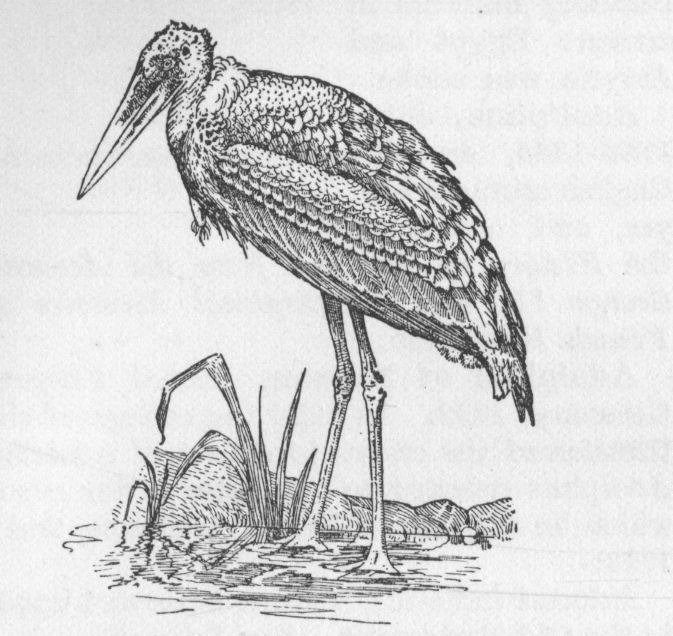
Adjutant-bird (Leptoptĭlus argăla), a large grallatorial or wading bird of the stork family, native of the warmer parts of India, where it is known as Hurgĭla or Argăla. It stands about five feet high, has an enormous bill, nearly bare head and neck, and a pouch hanging from the under part of the neck. It is one of the most voracious carnivorous birds known, and in India, from its devouring all sorts of carrion and noxious animals, is protected by law. From underneath the wings are obtained those light downy feathers known as marabou feathers, from the name of an allied species of bird (L. marabou) inhabiting Western Africa, and also producing them.
Adjutant-general, in Great Britain the second military member of the Army Council, and styled Adjutant-general to the Forces. He is a general officer, and at the head of his department at the War Office, which is charged with all duties relative to personnel.—Among the Jesuits this name was given to a select number of fathers, who resided with the general of the order, and had each a province or country assigned to him.
Ad′jutators, in English history, representatives elected by the parliamentary forces in 1647 to act with the officers in compelling Parliament to satisfy the demands of the army.
Adler, Victor, Austrian socialist leader, born in 1852. Educated as a physician, he gave up his profession for socialist propaganda. He visited England, and wrote a book on factory inspection in this country. He was the founder and editor of the Arbeiter-Zeitung; was a member of the Lower Austrian Diet and of the Imperial Council in 1907. His son, Dr. Friedrich Adler, assassinated Count Stuergkh, the Austrian premier, on 20th Oct., 1916. He died in 1918.
Ad′lington, a straggling place in Lancashire to the south-east of Chorley, engaged in the cotton manufacture. Pop. (1921), 4393.
Adme′tus, in Greek mythology, King of Pheræ, in Thessaly, and husband of Alcestis, who gave signal proof of her attachment by consenting to die in order to prolong her husband's life. See Alcestis.
Administra′tion, in politics, the executive power or body, the ministry or cabinet.
Admin′istrator, in law, the person to whom the goods of a man dying intestate are committed by the proper authority, and who is bound to account for them when required.
Ad′miral, the commander-in-chief of a squadron or fleet of ships of war, or of the entire naval force of a country, or simply a naval officer of the highest rank. In the British navy admirals are of four ranks—admiral of the fleet, admiral, vice-admiral, and rear-admiral. They were also divided formerly into three classes, named after the colours of their respective flags, admirals of the red, of the white, and of the blue. In 1864, however, this distinction was given up, and now there is one flag common to all ships of war, namely, the white ensign divided into four quarters by the cross of St. George, and having the union in the upper corner next the staff.—The title admiral of the fleet is conferred on a few admirals, and carries an increase of pay along with it.—A vice-admiral is next in rank and command to the admiral: he carries his flag at the foretop-gallant-mast head, while an admiral carries his at the main. A rear-admiral, next in rank to the vice-admiral, carries his flag at the mizzentop-gallant-mast head.—Lord high admiral, in Great Britain, an officer who (when this rare dignity is conferred) is at the head of the naval administration of Great Britain. There have been few high admirals since 1632, when the office was first put in commission. James Duke of York (afterwards James II) held it for several years during Charles II's reign. In the reign of William and Mary it was vested in lords commissioners of the admiralty, and since that time it has been held for short periods only by Prince George of Denmark (1702-8) in the time of Queen Anne, and by William IV, then Duke of Clarence, in 1827-8.
Ad′miralty, that department of the Government of a country that is at the head of its naval service. In Britain the board of Admiralty now consists of the First Lord of the Admiralty and seven other commissioners, four of them being Sea Lords, and one a Civil Lord. The First Lord is always a member of the cabinet, and it is he who principally exercises the powers of the department. Under the 1912 Admiralty Organization Scheme, the various members of the board are responsible for special business. Several changes in Admiralty organization were made during the European War, but after the cessation of hostilities the system reverted to that of peace time.
Admiralty Charts are charts issued by the hydrographic department of the Admiralty of Britain; they are prepared by specially appointed surveyors and draughtsmen, and besides being supplied to every ship in the fleet, are sold to the general public at prices much less than their cost. In connection with these charts there are published books of sailing directions, lists of lights, &c. The navigating charts are generally on the scale of half an inch to a mile, and show all the dangers of the coasts with sufficient distinctness to enable the seamen to avoid them; the charts of larger size exhibit all the intricacies of the coast.
Admiralty Court, a court which takes cognizance of civil and criminal causes of a maritime nature, including captures made in war, and offences committed on the high seas, and has to do with many matters connected with maritime affairs. In England the Admiralty Court was once held before the Lord High Admiral, and at a later period was presided over by his deputy or the deputy of the Lords Commissioners. It now forms a branch of the Probate, Divorce, and Admiralty division of the High Court of Justice. There is a separate Irish Admiralty Court. In Scotland Admiralty cases are now prosecuted in the Court of Session, or in the Sheriff Court. In the United States, Admiralty cases are taken up in the first instance by the district courts.
Admiralty Island, an island belonging to the United States off the north-west coast of North America, 80 or 90 miles long and about 20 broad, covered with fine timber and inhabited by Sitka Indians.
Admiralty Islands, a cluster of 40 islands, north of New Guinea, in what was once called the Bismarck Archipelago. Discovered by the Dutch explorer Shouten in 1616, they were in German possession from 1884 to 12th Sept., 1914, when they were occupied by an Australian force. They have since been in British occupation. The largest is about 60 miles in length; the rest are much smaller. They are covered with a luxuriant vegetation, and possess dense groves of coco-nut trees. There are valuable pearl and other shell fisheries. Capital, Lorengau. Pop. (native), 4000; (European), 50.
Stipule adnated to Leaf-stalk of Rose
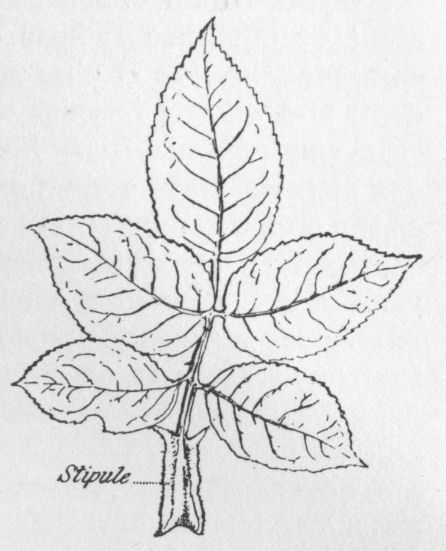
Ad′nate, in botany, applied to a part growing attached to another and principal part by its whole length, as stipules adnated to the leaf-stalk.
Adobe (a˙-dō′bā), the Spanish name for a brick made of loamy earth, containing about two-thirds fine sand and one-third clayey dust, sun-dried; in common use for building in Mexico, Texas, and Central America. Building material in ancient Egypt and Assyria was adobe.
Adol′phus, John, 1768-1845, an able English criminal lawyer, and author of the History of England from the Accession of George III and Biographical Memoirs of the French Revolution.
Adolphus of Nassau, elected Emperor of Germany, 1292. In 1298 the college of electors transferred the crown to Albert of Austria, but, Adolphus refusing to abdicate, a war ensued in which he fell, after a heroic resistance, 2nd July, 1298.
Adonai (ad′o-nī), a name bestowed upon God in the Old Testament. See Jehovah.
Ado′ni, a town and district in Madras; pop. of former 30,416, of latter 179,418. It is well known for excellent silk and cotton fabrics.
Ado′nis, son of Myrrha, a mythological personage, originally a deity of the Phœnicians, but borrowed into Greek mythology. He was represented as being a great favourite of Aphroditē (Venus), who accompanied him when engaged in hunting, of which he was very fond. He received a mortal wound from the tusk of a wild boar, and when the goddess hurried to his assistance she found him lifeless, whereupon she caused his blood to give rise to the anemone. The worship of Adonis, which arose in Phœnicia, was afterwards widely spread round the Mediterranean. He is the reproductive principle, nature's decay in winter and its revival in spring. The name Adonis is akin to the Heb. Adonai, Lord. See Tammuz.
Ado′nis, a small river rising in Lebanon and flowing to the Mediterranean. When in flood it is tinged with a red colour, and so is connected with the legend of Adonis.
Ado′nis, a genus of ranunculaceous plants. In the corn-adonis or pheasant's eye (A. autumnālis) the petals are bright scarlet like the blood of Adonis, from which the plant is fabled to have sprung.
Adoptianism, the theory according to which Christ as a man is the adopted Son of God. Elipandus, Archbishop of Toledo, and Felix, Bishop of Urgella, asserted this double sonship in Christ, maintaining that He was indeed the Son of God in His divine nature, but as man He was the Son of God only by grace and adoption. 'The Man Christ' is therefore only the adopted and not the natural Son of God. The doctrine was vigorously opposed by Alcuin, and condemned by the councils of Ratisbon (792) and Frankfort (794). The theory, however, found advocates during the Middle Ages, and has given rise to theological disputes in modern times. Adoptianism was attributed both to Abelard and Duns Scotus.
Adop′tion, the admission of a stranger by birth to the privileges of a child. Among the ancient Greeks and Romans, and also some modern nations, adoption is placed under legal regulation. In Rome the effect of adoption was to create the legal relation of father and son, just as if the person adopted was born of the blood of the adopter in lawful marriage. The adopted son took the name of his adopter, and was bound to perform his new father's religious duties. Adoption is not recognized by the law of England and Scotland; there are legal means to enable a person to assume the name and arms, and to inherit the property of another. In some of the United States adoption is regulated by laws not very dissimilar to those which prevailed among the Romans.
Adour (a˙-dör), a river of France, rising in the Hautes Pyrenees, and falling into the sea a little below Bayonne; length about 200 miles; partly navigable.
Ado′wa, a town of Abyssinia, in Tigré, at an elevation of 6270 feet; the chief commercial depot on the caravan route from Massawa to Gondar. Pop. about 4000. Here the Italians suffered a crushing defeat at the hands of the Abyssinians, 1st March, 1896.
Adra (ä′dra˙), a seaport of Southern Spain, in Andalusia, near the mouth of the Adra, on the Mediterranean; with marble quarries and lead works. Pop. 9000.
Adramit′ti (ancient Adramyttium; Turk. Edremid), a town of Turkey in Asia, near the head of the gulf of the same name, 80 miles north of Smyrna. Pop. about 5000.
Adrar′, a district in the Western Sahara, peopled by Berbers possessing camels, sheep, and oxen, and cultivating dates, wheat, barley, and melons. Chief towns, Wadan and Shingit, which has inexhaustible beds of rock-salt.
Adren′alin, or Suprarenin, a crystalline substance obtained from the adrenals or suprarenal capsules of cattle and sheep, which possesses the property of checking bleeding by its styptic or contractive powers, and is used in medical practice, more especially in the case of bleeding at the nose and nervous catarrh.
Adria (ä′dri-a˙), a cathedral city of Northern Italy, province of Rovigo, between the Po and the Adige, on the site of the ancient town of same name, whence the Adriatic derives its appellation. Owing to alluvial deposits the sea is now 17 miles distant. Pop. 11,878.
A′drian, the name of six Popes. The first, a Roman, ruled from 772-795; a contemporary and friend of Charlemagne. He expended vast sums in rebuilding the walls and restoring the aqueducts of Rome.—Adrian II, a Roman, was elected Pope in 867, at the age of seventy-five years. He died in 872, in the midst of conflicts with the Greek Church.—Adrian III, a Roman, elected 884, was Pope for one year and four months only. He was the first Pope who changed his name on the occasion of his exaltation.—Adrian IV, originally named Nicolas Breakspear, the only Englishman who ever occupied the papal chair, was born about 1100, and died 1159. He is said to have been a native of Hertfordshire, studied in France, and became abbot of St. Rufus in Provence, cardinal and legate to Norway. Chosen Pope in 1154, his reign is chiefly remarkable for his almost constant struggle for supremacy with Frederick Barbarossa, who on one occasion had been forced to hold his stirrup, and had been crowned by him at Rome (1155). He issued the famous bull (1158) granting the sovereignty of Ireland, on condition of the payment of Peter's pence, to Henry II.—Adrian V, previously called Ottobuono Fieschi, of Genoa, settled, as legate of the Pope, the dispute between King Henry III of England and his nobles, in favour of the former; but died a month after his election to the papal chair (1276).—Adrian VI (the last pontifice barbaro), born at Utrecht in 1459, was elected to the papal chair, 9th Jan., 1522. He tried to reform abuses in the Church, but opposed the zeal of Luther with reproaches and threats, and even attempted to excite Erasmus and Zuinglius against him. Died 1523, after a reign of one year and a half.
A′drian, a town of the United States, in Michigan, 70 miles W.S.W. of Detroit. Its extensive water-power is employed in works of various kinds. Pop. 9654.
A′drian, Publius Ælius Hadrianus. See Hadrian.
Adriano′ple (Turk. Edreneh), an important city in the Balkans, about 135 miles W.N.W. from Constantinople, on the Maritza (ancient Hebrus), at its junction with the Tundja and the Arda. It has a great mosque, among the most magnificent in the world; a palace, now in a state of decay; a grand aqueduct, and a splendid bazaar; manufactures of silk, woollen, and cotton stuffs, otto of roses, leather, &c., and an important trade. Adrianople received its present name from the Roman emperor Adrian (Hadrian). In 1361 it was taken by Amurath I, and was the residence of the Turkish sovereigns till the conquest of Constantinople in 1453. In 1829 it was taken by the Russians, and here was then concluded the peace of Adrianople, by which Russia received important accessions of territory in the Caucasus and on the coast of the Black Sea. The Russians occupied it also in 1878. Adrianople was bombarded by the Balkan allied forces in Feb., 1913, and fell 28th March; it was recaptured by the Turks, under Enver Bey, 20th July. Pop. 83,000.
Adrian's (or Hadrian's) Wall. See Roman Walls.
Adriat′ic Sea, or Gulf of Venice, an arm of the Mediterranean, stretching in a north-westerly direction from the Straits of Otranto, between Italy and the Balkan Peninsula (Yugo-Slavia). Length, about 480 miles; average breadth, about 100; area, about 60,000 sq. miles. The rivers which it receives, particularly the Po, its principal feeder, have produced, and are still producing, great geological changes in its basin by their alluvial deposits. Hence Adria, between the Po and the Adige, which gives the sea its name, though once a flourishing seaport, is now 17 miles inland. An oceanographic investigation of the Adriatic Sea took place in Feb. and March, 1911. The principal trading ports on the Italian side are Brindisi, Bari, Ancona, Sinigaglia, and Venice; on the east side Ragusa, Fiume, Pirano, Pola, and Trieste (Italian).
Adscripti Glebæ (Lat., persons attached to the soil), a term applied to a class of Roman slaves attached in perpetuity to and transferred with the land they cultivated. Colliers and salt workers in Scotland were in a similar position till 1775.
Adula′ria, a very pure, limpid, translucent variety of the common felspar, called by lapidaries moonstone, on account of the play of light exhibited by the arrangement of its crystalline structure. It is found on the Alps, but the best specimens are brought from Ceylon. It is so called from Adula, one of the peaks of St. Gothard, where fine specimens are got.
Adul′lam, Cave of, a cave to which David fled when persecuted by Saul, and whither he was followed by "every one who was in distress, in debt, or discontented" (1 Sam. xxii, 1, 2).—The name Adullamites was given to an English political party, consisting of R. Lowe, Lord Elcho, and other Liberals, who opposed the majority of their party on the Franchise Bill of 1866. The term originated from a speech of John Bright on 13th March, 1866.
Adultera′tion, a term applied to the fraudulent mixture of articles of commerce, foods, drugs, beverages, seeds, &c., with inferior ingredients, and also to any accidental impurity found in a substance. The chief objects of adulteration are to render a substance more pleasing in appearance, to increase the weight, to make an inferior article appear as good as the article of superior quality. Any substance added to an article to increase its bulk, weight, colour, &c., is spoken of as an adulterant. Milk is often adulterated with water and with colouring-matter. Butter may be adulterated by mixing with it other fats or by the addition of colouring-matter. Nearly every article of food can be adulterated in some way to make it appear of finer quality. Preservatives added to foods and drugs generally may be classed as adulterants. Thus cream is preserved by adding small quantities of boric acid. Beer sometimes contains salicylic acid added as a preservative. Chloroform contains a small quantity of alcohol to prevent decomposition. Methylated spirits is alcohol adulterated in several ways to render it unfit for human consumption. Tobacco contains benzoic acid as preservative, and sometimes saltpetre to aid burning. Many of these adulterants are harmful, so that such added to foods and beverages must be present only in very small quantities. Food and Drug Acts lay down the limits of the quantities of foreign matter permitted either as preservative or impurity. Practically every article of commerce is adulterated in some way, and pure substances are seldom used. Cf. Walker, The Food Inspector's Encyclopædia.
Adul′tery, the voluntary sexual intercourse of a married person with any other than the offender's husband or wife; when committed between two married persons, the offence is called double, and when between a married and single person, single adultery. The Mosaic, Greek, and early Roman law only recognized the offence when a married woman was the offender. By the Jewish law it was punished with death. In Greece the laws against it were severe. By the laws of Draco and Solon adulterers, when caught in the act, were at the mercy of the injured party. In early Rome the punishment was left to the discretion of the husband and parents of the adulteress. The punishment assigned by the Lex Julia, under Augustus, was banishment or a heavy fine. Under Constantius and Constans, adulterers were burned or sewed in sacks and thrown into the sea; under Justinian the wife was to be scourged, lose her dower, and be shut up in a monastery; at the expiration of two years the husband might take her again; if he refused she was shaven and made a nun for life. By the ancient laws of France this crime was punishable with death. In Spain personal mutilation was frequently the punishment adopted. In several European countries adultery is regarded as a criminal offence, but in none does the punishment exceed imprisonment for a short period, accompanied by a fine. In England formerly it was punishable with fine and imprisonment, and in Scotland it was frequently made a capital offence. In Great Britain at the present day, however, it is punishable only by ecclesiastical censure. The aggrieved husband, however, can obtain damages against his wife's seducer. In England a man can obtain a dissolution of his marriage on the ground of his wife's adultery, and a wife can obtain a judicial separation on the ground of her husband's adultery, or a dissolution of the marriage if the offence is coupled with cruelty, desertion, or bigamy. In Scotland it is not necessary to prove cruelty. In the United States the punishment of adultery has varied materially at different times. It is, however, very seldom punished criminally in the States. A person divorced for adultery is by the laws of France and Scotland prohibited from intermarrying with the co-respondent.
Ad valo′rem (Lat., according to the value), a term applied to customs or duties levied according to the worth of the goods, as sworn to by the owner, and not according to number, weight, measure, &c.
Advance-note, a draft on the owner of a vessel, generally for one month's wages, given by the master to the sailors on their signing the articles of agreement. The granting of such notes to British sailors was made illegal by an Act passed in 1880.
Ad′vent (Lat. adventus, an arrival, 'the coming of our Saviour'), the name applied to the holy season which occupies the four or, according to the Greek Church, six weeks preceding Christmas, and which forms the first portion of the ecclesiastical year, as observed by the Anglican, the Roman Catholic, and the Greek Church.
Ad′ventists, a group of six American religious sects who believe in the speedy coming of Christ, and generally practise adult immersion. The first sect of Adventists was founded by William Miller in 1831.—There is also a sect called Seventh-day Adventists, who hold that the coming of Christ is at hand, and maintain that the Sabbath is still the seventh day of the week.
Ad′verb, one of the parts of speech used to limit or qualify the signification of an adjective, verb, or other adverb; as, very cold, naturally brave, much more clearly, readily agreed. Adverbs may be classified as follows: (1) Adverbs of time, as, now, then, never, &c.; (2) of place, as, here, there, where, &c.; (3) of degree, as, very, much, nearly, almost, &c.; (4) of affirmation, negation, or doubt, as, yes, no, certainly, perhaps, &c.; (5) of manner, as, well, badly, clearly, &c.