Volume 1 — VOLUME I (continued 5)
Reading edition
À Kempis, Thomas. See Thomas à Kempis.
Aken (ä′ken), a Prussian town, province of Saxony, on the left bank of the Elbe, with manufactures of tobacco, cloth, beetroot sugar, leather, &c. Pop. 7358.
A′kenside, Mark, a poet and physician, born in 1721, at Newcastle-upon-Tyne, died in London in 1770. He was the son of a butcher, and was sent to the University of Edinburgh to qualify for the ministry, but chose the study of medicine instead. After three years' residence at Edinburgh he went to Leyden, and in 1744 became Doctor of Physic. In the same year he published the Pleasures of Imagination, which he is said to have written in Edinburgh, and which was translated into French by Baron d'Holbach (1769). In 1746 he wrote his much-praised Hymn to the Naiads. Having settled in London, he became a fellow of the Royal Society, and was admitted into the College of Physicians. In 1759 he was appointed first assistant and afterwards head physician to St. Thomas's Hospital. In his later days he wrote little poetry, but published several medical essays and observations. The place of Akenside as a poet is not very high, though Dr. Johnson praised the blank verse of his poems, and his somewhat cumbrous Pleasures of Imagination was once considered one of the most pleasing didactic poems in our language.
Akermann′, a fortified town and seaport in Bessarabia, near the mouth of the Dniester, with a good port. The vicinity produces quantities of salt, and also fine grapes from which excellent wine is made. A treaty was signed here, 6th Oct., 1826, between Russia and the Porte, by which Moldavia, Walachia, and Serbia were released from all but nominal dependence on Turkey. Pop. 40,000.
Akhalzik, or Achalzik (a˙-ha˙l′tsik), a town of Russia in Asia, in the Trans-Caucasian government of Tiflis, 97 miles west of Tiflis, with a citadel. It was taken by the Russians in 1828. Pop. 15,977.
Ak-Hissar ('white castle'), a town in Asia Minor, 46 miles N.E. of Smyrna, occupying the site of the ancient Thyatira, relics of which city are here abundant. Here the Emperor Valens defeated the usurper Procopius in 366, and Murad defeated the Prince of Aïdin in 1425. Pop. 20,000.
Akhtyrka (a˙h-tir′ka˙), a cathedral town of the Ukraine, government of Kharkov, with a good trade and some manufactures. Pop. 31,918.
Akjermann (a˙k-yer-ma˙n′). Same as Akermann.
Akkad, the northern portion of ancient Babylonia occupied by the earliest Semitic invaders when the southern portion was Sumer (or Sumeria) and occupied by non-Semites. There was also a city of the same name, the Biblical Accad (Gen. x), which was prominent before 2000 B.C. Its ruins were unearthed between 1917 and 1919. See Babylonia.
Akkas, a dwarfish race of Central Africa, dwelling in scattered settlements to the north-west of Lake Albert Nyanza, about lat. 3° N., lon. 29° E. Their height averages about 4½ feet; they are of a brownish or coffee colour; head large, jaws projecting (or prognathous), ears large, hands small. They are timid and suspicious, and live almost entirely by the chase, being exceedingly skilful with the bow and arrow. They were first seen by the traveller G. A. Schweinfurth in 1870.
Akmolinsk′, a Russian province in Central Asia, largely consisting of steppes and wastes; the chief rivers are the Ishim and Sari-Su; and it contains the larger part of Lake Balkash. Capital, Omsk. Area, about 225,070 sq. miles. Pop. 1,523,700.—Akmolinsk is a place of some importance for its caravan trade. Pop. 11,000.
Ako′la, a town of India, in Berar, the residence of the commissioner of Berar, on the River Morna, 150 miles W. by S. of Nagpur; with walls and a fort, and some trade in cotton. Pop. 29,289.
Ak′ron, a town of the United States, in Ohio, 100 miles N.E. of Columbus, on an elevated site. Being furnished with ample water-power by the Little Cuyahoga, it possesses large flour-mills, woollen factories, manufactures of iron goods, &c. In the vicinity extensive beds of mineral paint are worked. Pop. (1920), 208,435.
Aksu′ ('white water'), a town of Eastern or Chinese Turkestan, 300 miles from Kashgar, in the valley of the Aksu. It is an important centre of trade between Russia, China, and Tartary, and has manufactures of cotton cloth, leather, and metal goods. Formerly the residence of the kings of Kashgar and Yarkand. Pop. 30,000.
Akyab′, a seaport of Lower Burmah, capital of the province of Arracan, at the mouth of the River Kuladan or Akyab, of recent upgrowth, well built, possessing a good harbour, and carrying on an important trade, its chief exports being rice and petroleum. Pop. 35,680.
Al, the article in the Arabic language. It appears in English words derived from the Arabic, such as Algebra, Alchemy, Alcove.
Alabama (al-a-ba˙′ma), one of the United States, bounded by Tennessee, Georgia, Florida, the Gulf of Mexico, and Mississippi; area, 51,998 sq. miles. The southern part, bordering on the Gulf of Mexico and Florida, is low and level, and wooded largely with pine, hence known as the 'pine-woods region'; the middle is hilly, with some tracts of level sand or prairies; the north is broken and mountainous. The State is intersected by the Rivers Alabama, Tombigbee, Mobile, Coosa, Tallapoosa, Tennessee, &c., some of them navigable for several hundred miles. The soil is various, being in some places, particularly in the south, sandy and barren, but in most parts is fertile, especially in the river valleys and in the centre, where there is a very fertile tract known as the 'cotton belt'. The climate in general is warm, and in the lowlying lands skirting the rivers is rather unhealthy. In the more elevated parts it is healthy and agreeable, the winters being mild and the summers tempered by breezes from the Gulf of Mexico. The staple production is cotton, especially in the middle and south, where rice and sugar are also grown; in the north the cereals (above all maize) are the principal crops. Alabama possesses extensive beds of iron ore and coal, with marble, granite, and other minerals; and coal and iron mining, and the smelting and working of iron, are now important industries. The manufacture of cotton goods is extensively carried on. The foreign trade is concentrated in Mobile, whence cotton is the principal export. The State sends eight representatives to Congress. Its principal towns are Montgomery, the seat of government, and Mobile, the chief port. There is a State university at Tuscaloosa, a university connected with the Methodist Episcopal body, several State normal colleges, besides professional schools, &c., in the principal towns. Alabama became a State in 1819. It was one of the slave States. Pop. (1920), 2,348,174.
Alabama, a river of the United States, in the State of Alabama, formed by the junction of the Coosa and the Tallapoosa. After a course of 300 miles it joins the Tombigbee and assumes the name of the Mobile.
Alabama, The, a ship built at Birkenhead to act as a privateer in the service of the Confederate States of North America during the civil war begun in 1861. She was a wooden screw steamer with two engines of 350 h.p. each, 1040 tons burden, and carried eight 32-pounders. Before she was launched her destination was made known to the British Government, but owing to some legal formalities the orders given for her detention did not reach Liverpool till the day after she had left that port (29th July, 1862). She received her armament and stores at the Azores, and entered on her destructive career, capturing and burning merchant vessels, till she was sunk in a fight with the Federal war steamer Kearsarge, off Cherbourg, 19th June, 1864. As early as the winter of 1862 the United States Government declared that they held themselves entitled at a suitable period to demand full compensation from Britain for the damages inflicted on American property by the Alabama and several other cruisers that had been built, supplied, or recruited in British ports or waters. After a long series of negotiations it was agreed to submit the final settlement of the question to a court of arbitration, consisting of representatives of Britain and the United States, and of three other members, appointed by the King of Italy, the President of Switzerland, and the Emperor of Brazil. This court met at Geneva, 17th Dec., 1871, and a claim for indirect damages to American commerce having been abandoned by the United States Government, the decree was given in Sept., 1872, that Britain was liable to the United States in damages to the amount of 15,500,000 dollars (about £3,229,200). After all awards were made to private claimants about 8,000,000 dollars still remain unclaimed.
Alabandite, or Manganblende, a black submetallic mineral.
Alabas′ter, a name applied to a granular variety of gypsum or hydrated sulphate of lime. It was much used by the ancients for the manufacture of ointment and perfume boxes, vases, and the like. It has a fine granular texture, is usually of a pure white colour, and is so soft that it can be scratched with the nail. It is found in many parts of Europe; in great abundance and of peculiarly excellent quality in Tuscany. From the finer and more compact kinds, vases, clock-stands, statuettes, and other ornamental articles are made, and from inferior kinds the cement known as plaster of Paris. A variety of carbonate of lime, closely resembling alabaster in appearance, is used for similar purposes under the name of Oriental alabaster. It is usually stalagmitic or stalactitic in origin and is often of a yellowish colour. It may be distinguished from true alabaster by being too hard to be scratched with the nail.
Alac′taga (Alactăga jacŭlus), a rodent mammal, closely allied to the jerboa, but somewhat larger in size, with a still longer tail. Its range extends from the Crimea and the steppes of the Don across Central Asia to the Chinese frontier.
Aladdin, son of Mustafa, a poor tailor of China. A magician, who pretended to be his uncle, gave him a magic ring and sent him to fetch 'the wonderful lamp' from a cave. Aladdin secured the lamp, but refused to give it to the magician, who shut him in the cave. Aladdin was rescued by the Genie of the Ring, and by means of the Genie of the Lamp acquired great wealth, built a magnificent palace, and married the Sultan's daughter. Afterwards the magician got possession of the lamp, and caused the palace to be transported into Africa. Aladdin was arrested, but was again saved by the Genie of the Ring. He poisoned the magician, recovered the lamp, and by its means restored his palace to its original site.
Alago′as, a maritime State of Brazil; area, 22,577 sq. miles; pop. 946,617.—Alagoas, the former capital of the province, is situated on the south side of an arm of the sea, about 20 miles distant from Maceio, to which the seat of government was transferred in 1839. Pop. about 4000.
Alais (a˙-lā), a town of Southern France, department of Gard, 87 miles N.W. of Marseilles, with coal, iron, and lead mines, which are actively worked, and chalybeate springs, which have many visitors during the autumn months. The treaty of Alais, signed on 28th June, 1629, ended the Huguenot wars in France. Pop. 29,800.
Alajuela (a˙-la˙-hu-ā′la˙), a town of Central America, in the State of Costa Rica. Pop. 12,000.
Ala-Kul, a lake in Russian Central Asia, near the borders of Mongolia, in lat. 46° N. lon. 81° 40′ E.; area, 660 sq. miles.
Alamanni. See Alemanni.
Alaman′ni, Luigi, an Italian poet, of noble family, born at Florence in 1495. Suspected of conspiring against the life of Cardinal Giulio de' Medici, who then governed Florence in the name of Pope Leo X, he fled to Venice, and when the cardinal ascended the papal chair under the name of Clement VII he took refuge in France, where he henceforth lived, being employed by Francis I and Henry II in several important negotiations. He died in 1556. His principal works are a didactic poem, La Coltivazione, a splendid imitation of Virgil's Georgics (1546); a comedy entitled Flora; two epics, Girone il Cortese (1548) and L'Avarchide, an imitation of the Iliad (1570); and a collection of eclogues, satires, psalms, &c., partly in blank verse, the invention of which is contested with him by Trissino, a contemporary.
Al′amo, a fort in Bexar county, Texas, United States, celebrated for the resistance its occupants (140 Texans) made to a Mexican force of 4000 from 23rd Feb. to 6th March, 1836. At the latter date only six Texans remained alive, and on their surrendering they were slaughtered by the Mexicans.
Al′amos, a town of Mexico, State of Sonora, the capital of a mining district. Pop. 12,000.
Åland (o′land) Islands, a numerous group of islands and islets, about eighty of which are inhabited, formerly in Russia, situated in the Baltic Sea, near the mouth of the Gulf of Finland; area, 468 sq. miles. The principal island, Åland, distant about 30 miles from the Swedish coast, is 18 miles long and about 14 broad. The fortress of Bomarsund, here situated, was destroyed by an Anglo-French force in Aug., 1854. The inhabitants, who are of Swedish extraction, employ themselves mostly in fishing. The islands were ceded by Sweden to Russia in 1809, and proclaimed a province of Finland in 1918. A referendum of the inhabitants, taken in Dec., 1918, decided in favour of union with Sweden, but on 22nd Oct., 1921, an agreement for the neutralization of the islands was signed at Genoa. Pop. 18,000.
Ala′ni, or Alans, one of the warlike tribes which migrated from Asia westward at the time of the decline of the Roman Empire. They are first met with in the region of the Caucasus, where Pompey fought with them. From this centre they spread over the south of modern Russia to the confines of the Roman Empire. About the middle of the fifth century they joined the Vandals, among whom they became lost to history.
Alarcon′ Y Mendo′za, Don Juan Ruiz de, one of the most distinguished dramatic poets of Spain, born in Mexico about the end of the sixteenth or the beginning of the seventeenth century. He came to Europe about 1622, and in 1628 he published a volume containing eight comedies, and in 1634 another containing twelve. One of them, called La Verdad Sospechosa (The Truth Suspected), published in 1630 in a collection bearing the name of Lope de Vega, furnished Corneille with the groundwork and greater part of the substance of his Menteur. Hence Corneille's declaration in the preface to that play that he had borrowed the subject from Lope de Vega. His Tejedor de Segovia (Weaver of Segovia) and Las Paredes Oyen (Walls have Ears) are still performed on the Spanish stage. He died in 1639.
Al′aric I, King of the Visigoths, was born about the middle of the fourth century, probably in 370, and is first mentioned in history in A.D. 394, when Theodosius the Great gave him the command of his Gothic auxiliaries. The dissensions between Arcadius and Honorius, the sons of Theodosius, inspired Alaric with the intention of attacking the Roman Empire. In 396 he ravaged Greece, from which he was driven by the Roman general Stilicho, but made a masterly retreat to Illyria, of which Arcadius, frightened at his successes, appointed him governor. In 400 he invaded Italy, but was defeated by Stilicho at Pollentia (403), and induced to transfer his services from Arcadius to Honorius on condition of receiving 4000 lb. of gold. Honorius having failed to fulfil this condition, Alaric made a second invasion of Italy, during which he besieged Rome three times. The first time (408) the city was saved by paying a heavy ransom; the second (409) it capitulated, and Honorius was deposed, but shortly afterwards restored. His sanction of a treacherous attack on the forces of Alaric brought about the third siege, and the city was taken 24th Aug., 410, and sacked for six days, Alaric, however, doing everything in his power to restrain the violence of his followers. He quitted Rome with the intention of reducing Sicily and Africa, but died at Cosenza in 410. Legend has it that he was buried beneath the river-bed of the Busenzo, the course of which was temporarily turned aside for the purpose.
Al′aric II, King of the Visigoths from A.D. 484 to 507. At the beginning of his reign the dominions of the Visigoths were at their greatest extent, embracing three-fourths of the modern Spain and all Western Gaul to the south of the Loire. His unwarlike character induced Clovis, King of the Franks, to invade the kingdom of the Visigoths. In a battle near Poitiers (507) Alaric was slain and his army completely defeated. The Breviarium Alaricianum, a code of laws derived exclusively from Roman sources, was compiled by a body of Roman jurists at the command of this King Alaric.
Alarm, in military language, a signal, given by beat of drum, bugle-call, or firing of a gun, to warn a camp or garrison of a surprise intended or actually made by the enemy. A place, called the alarm-post, is generally appointed at which the troops are to assemble when an alarm is given.—Alarm is also the name given to several contrivances in which electricity is made use of, as a fire-alarm, by which intelligence is at once conveyed to the proper quarter when a fire breaks out; a burglar-alarm, an arrangement of wires and a battery in a house intended to set a bell or bells ringing should a burglar attempt to gain entrance.
Alarm-clock, one which can be set so as to ring loudly at a certain hour to wake from sleep or excite attention.
Ala-Shehr (a˙-la˙-shār′) (ancient Philadelphia), a town in Asia Minor, 100 miles east of Smyrna, famous as the seat of one of the first Christian churches, and still having a vast number of interesting remains of antiquity, consisting of fragments of beautiful columns, sarcophagi, fountains, &c. It is a place of some importance, carrying on a thriving trade, chiefly with Smyrna, to which runs a railway. Pop. 15,000.
Alas′ka, a territory belonging to the United States, comprising all that portion of the north-west of North America which lies west of the 141st meridian of west longitude, together with an irregular strip of coast-land (and the adjacent islands), extending south to lat. 54° 40′ N., and lying between Canada and the Pacific (the boundary being adjusted in 1903); total area, about 590,884 sq. miles. The chief river is the Yukon, a great stream, now navigated in summer for most of its course. The principal mountains (among which are several volcanoes) are Mounts M‘Kinley (20,470 feet) and Wrangell (17,400 feet). The climate of the interior is very severe in winter, but in summer the heat is intense; on the Pacific coast it is mild but moist. Alaska produces excellent timber. Numbers of fur-bearing animals abound, such as the fur-seal, sea-otter, beaver, fox, mink, marten, &c.; and the fur trade has long been valuable. The coasts and rivers swarm with fish, and salmon and cod are caught and exported. Gold is now mined in several localities, especially Cape Nome, where a town has sprung up. The aboriginal inhabitants consist of Esquimaux and Indians. Alaska, called Russian America until 1867, was sold to the United States for 7,200,000 dollars, the acquisition being ratified by Congress on 20th June, 1867. It has a legislative assembly consisting of eight senators and sixteen representatives, and the legislature meets biennially since 1913. The capital was formerly Sitka, on Baranoff Island, but is now Juneau, on Gastineau Channel. Pop. 64,356, latest estimate being 75,000.—Bibliography: A. W. Greely, Handbook of Alaska; J. Muir, Travels in Alaska.
Alaskite, an igneous rock consisting of quartz and felspar. See Granite.
Alas′sio, a seaport of North Italy, on the Gulf of Genoa, a winter resort of people from England. Pop. 5000.
Alastor, in Greek mythology, is a surname of Zeus (cf. Lat. Jupiter Vindex) describing him as the avenger of evil deeds. The name or epithet is also used to designate any deity or demon who avenges wrongs committed by men. Alastor is the title of a poem by Shelley.
Alatau (a˙-la˙-tou′), the name of three considerable mountain ranges of Central Asia, on the Russian and Chinese frontiers.
Alatyr (a˙-la˙-tir′), a town in Russia, government Simbirsk, at the confluence of the Alatyr with the Sura, with a considerable trade. Pop. 11,000.
Alau′da, a genus of insessorial birds, which includes the larks. See Lark.
A′lava, a hilly province in the north of Spain, one of the three Basque provinces; area, 1175 sq. miles; covered by branches of the Pyrenees, the mountains being clothed with oak, chestnut, and other timber, and the valleys yielding grain, vegetables, and abundance of fruits. There are iron and copper mines, and inexhaustible salt springs. Capital, Vittoria. Pop. 97,692.
A, Alb with its Apparels a, b, and Girdle c; B, Amice; C, Stole
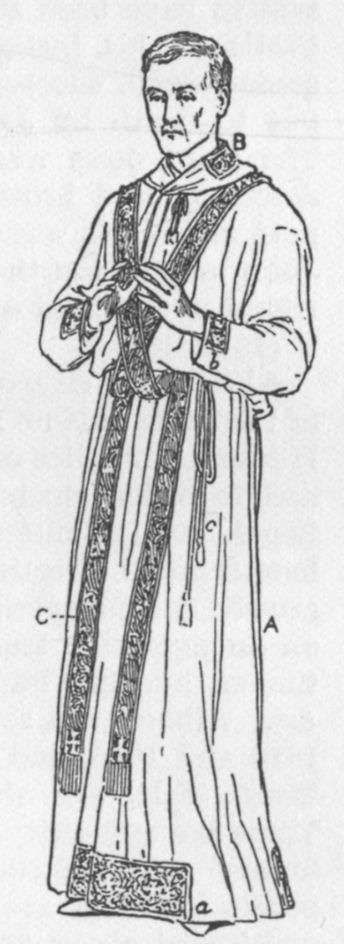
Alb (from Lat. albus, white), a clerical vestment of the Catholic Church worn by priests while officiating in the more solemn functions of divine service. It is a long robe of white linen reaching to the feet, bound round the waist by a cincture, and fitting more closely to the body than the surplice. It is now little used except during Mass. After the Reformation the alb was not used in the Church of England, but since the ritualistic revival in the nineteenth century it has again been introduced into a number of churches.
Alba, the name of several towns in ancient Italy, the most celebrated of which was Alba Longa, a city of Latium, according to tradition built by Ascanius, the son of Æneas, 300 years before the foundation of Rome, at one time the most powerful city of Latium. It ultimately fell under the dominion of Rome, when the town was destroyed, it is said. In later times its site became covered with villas of wealthy Romans.
Alba (anciently Alba Pompeia), a town of Northern Italy, about 30 miles S.E. of Turin, is the see of a bishop, has a cathedral, bishop's palace, church with fresco paintings by Perugino, &c. Pop. 6872.
Alba, Duke of. See Alva.
Albacete (a˙l-ba˙-thā′tā), a town in Southern Spain, capital of the province of the same name, 106 miles N.N.W. of Cartagena, with a considerable trade, both direct and transit, and manufactures of knives, daggers, &c. Pop. 24,805.—The province has an area of 5737 sq. miles, and a pop. of 273,380.
Alba Longa. See Alba.
Alban, St., the earliest British martyr, flourished in the third century, and was, it is said, converted from Paganism by a confessor whom he had saved from his persecutors. He refused to sacrifice to the gods, and was executed outside the city of Verulamium (St. Albans) in 285 or 305.
Albani (a˙l-bä′nē), Francesco, a famous Italian painter, born at Bologna in 1578, died in 1660. He studied with Guido Reni under the Flemish painter Calvaert and the Caracci. It is said that his second wife, Doralice Fioraventi, bore him twelve children of such beauty that they served him as models for his paintings. Among the best known of his compositions are The Sleeping Venus, Diana in the Bath, Danaë Reclining, Galatea on the Sea, Europa on the Bull.
Alba′ni, Madame, maiden name Marie Louise Emma Cecile Lajeunesse, famous singer, was born near Montreal in 1852, was trained at home by her father, and studied also in Paris and Milan. She made her first public appearance in Europe at Messina, in Bellini's La Sonnambula, and in 1872 sang in the Royal Italian Opera in London. Since then she has attained the position of one of the world's foremost singers, both in opera and oratorio. In 1878 she was married to Mr. Ernest Gye, the operatic manager. She adopted the professional name of Albani from Albany, in the United States, where as a girl she sang in the Roman Catholic cathedral. In 1911 she published her memoirs under the title of Forty Years of Song.
Alba′nia, an extensive region stretching along the coast of the Adriatic for about 290 miles, and having a breadth varying from about 90 to about 50 miles. The boundary on the east is formed by a range of mountains, and the country is composed of at least nine ridges of hills, of which six are in Lower or Southern Albania (ancient Epirus) and the remainder in Central and Upper or Northern Albania. There are no large rivers, and in summer many of the streams are completely dry. The Drin or Drino is the largest. The most beautiful lake is that of Ochrida, 20 miles long, 8 broad at the widest part. The Lake of Scutari, in Upper Albania, is the largest. Among trees Albania has many species of oak, the poplar, hazel, plane, chestnut, cypress, and laurel. The vine flourishes, together with the orange, almond, fig, mulberry, and citron; maize, wheat, and barley are cultivated. Its fauna comprises bears, wolves, and chamois; sheep, goats, horses, asses, and mules are plentiful. The chief exports are live stock, wool, hides, timber, oil, salt-fish, cheese, and tobacco. The chief ports are Prevesa, Valona, and Durazzo. The population, about 850,000, consists chiefly of Albanians or Arnauts, or, as they call themselves, Skupetars, i.e. inhabitants of the mountains (by the Turks they are called Arnauts, by the Greeks Arbanites, and by the Serbs Arbanasi). They are spread along the coasts of the Adriatic and Ionian Seas. History and legend afford little or no record of the arrival of the Albanian race in the Balkan Peninsula. It may, however, be safely asserted that the Albanians are the direct descendants of the earliest Aryan immigrants, who were represented in historical times by the kindred Illyrians, Macedonians, and Epirots. The majority live in Albania, the rest in Montenegro, Greece, Southern Italy, Sicily, Bessarabia, and Asia Minor. As regards religion they are either Christians or Mohammedans. They are divided into several tribes, among whom the Suliotes are partly of Greek origin. The Albanian language is a branch of the Indo-European languages, and related to the long-ago extinct language of the Messapians. The language consists of numerous dialects, which may be divided into those of the Tosks in the south and the Gheggas in the north. Though their country became a province of the Turkish dominions in 1431, they maintained for centuries a certain degree of independence, which the Porte never found it possible to overcome. On 28th Nov., 1912, the complete independence of Albania was proclaimed at Valona, a provisional government was founded under Ismail Kemal Bey, and Albanian autonomy was agreed to at the Ambassadorial Conference in London on 20th Dec. On 21st Feb., 1914, the crown was offered to Prince William of Wied, who arrived at Durazzo on 7th March. The prince was supported and advised by an International Commission of Control, but he left the country at the outbreak of hostilities in 1914. Attempts made by Essad Pasha to establish a military government failed, and the country was overrun by the Austrians, who captured Durazzo on 28th Feb., 1916. On 3rd June, 1917, the general in charge of the Italian forces proclaimed Albania an independent country, and a provisional government was set up at Durazzo. Albanian independence was recognized by the Powers and Albania admitted to the League of Nations in Dec., 1920.—Bibliography: H. F. Tozer, Researches in the Highlands of Turkey; W. Peacock, Albania, The Foundling State.
Alba′no, a city and lake in Italy, the former about 15 miles south-east of Rome, and on the west border of the lake, amid beautiful scenery. An ancient tomb in the Etruscan style was for a long time looked upon as the sepulchre of the Horatii and Curiatii. Here are also the ruins of the villas of Pompey and Domitian. Pop. 8000.—The lake, situated immediately beneath the Alban Hill, is of an oval form, 6 miles in circumference, surrounded by steep banks of volcanic tufa 300 or 400 feet high, and discharges its superfluous waters by an artificial tunnel at least 2000 years old.
Albans, St. See St. Albans.
Al′bany, the original Celtic name probably at first applied to the whole of Britain, but afterwards restricted to the Highlands of Scotland. It gave the title of duke formerly to a prince of the blood-royal of Scotland. The first duke was Robert Stuart (1345-1420), son of Robert II by his mistress Elizabeth Mure, and brother of Robert III. He was virtual ruler of the kingdom during the latter years of his brother's reign, and acted as regent for his nephew James I (kept a prisoner in England) till his own death. Another nephew, David, Duke of Rothesay, is said to have been starved to death in Falkland Castle at his instigation. His son Murdoch, second duke, succeeded him as regent, and was put to death by James for maladministration. The third duke was Alexander, second son of James II and brother of James III. A large part of his life was passed in France. His son John was the fourth who bore the title. He was regent of Scotland during the minority of James V (1515-23).
Al′bany, a city of the United States, capital of the State of New York on the west bank of the Hudson, 132 miles north of New York city, from and to which steamboats run daily. The Erie Canal and the numerous railway lines centring here from all directions greatly contribute to the growth and prosperity of the city, which carries on an extensive trade. It is a great mart for timber, and has foundries, breweries, tanneries, &c. Albany was settled by the Dutch between 1610 and 1614, and the older houses are in the Dutch style, with the gable-ends to the streets. There is a university, an observatory, and a State library with 90,000 volumes. The principal public buildings are the capitol or State-house, which cost about £5,000,000, and the State-hall for the public offices, a State arsenal, and numerous churches. Pop. (1920), 113,344.
Al′bany, Louisa Maria Caroline, Countess of, a princess of the Stolberg-Gedern family, was born in 1753, and married, in 1772, the pretender, Charles Edward Stuart, after which event she bore the above title. To escape from the ill-treatment of her husband she retired, in 1780, to the house of her brother-in-law at Rome, where she met the poet Alfieri, whose mistress she became. After the death of Alfieri in 1793 she opened her famous political and literary salon frequented by the Duchess of Devonshire, the Duchess of Hamilton, Cardinal Consalvi, Samuel Rogers, Thomas Moore, Lamartine, and Chateaubriand. She died at Florence in 1824, where she was buried at the Church of Sta Croce, by the side of Alfieri, whom she is supposed to have married secretly.
Alba′ta, a name sometimes given to German silver.
Wandering Albatross (Diomēdea exŭlans)
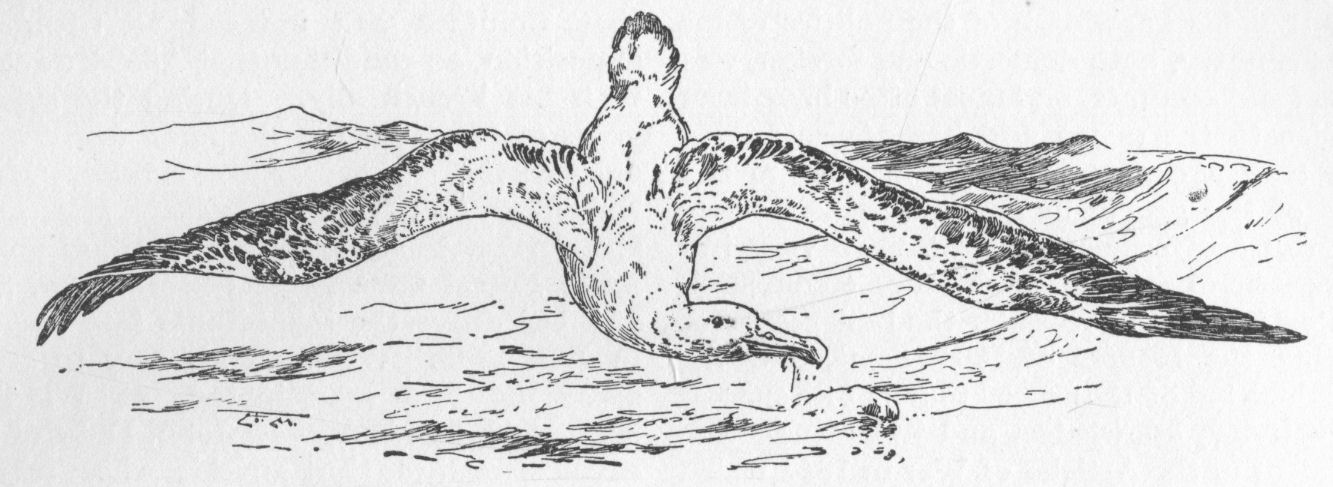
Al′batross, a large marine swimming bird of several species, of which the wandering albatross (Diomedēa exŭlans) is the best known. The bill is straight and strong, the upper mandible hooked at the point and the lower one truncated; there are three webbed toes on each foot. The upper part of the body is of a greyish brown, and the belly white. It is the largest sea-bird known, some measuring 17½ feet from tip to tip of their expanded wings. They abound at the Cape of Good Hope and in other parts of the southern seas, and in Behring's Straits, and have been known to accompany ships for whole days without ever resting on the waves. From this habit the bird is regarded with feelings of attachment and superstitious awe by sailors, it being reckoned unlucky to kill one. Coleridge has availed himself of this feeling in his Ancient Mariner. The albatross is met with at great distances from the land, settling down on the waves at night to sleep. It is exceedingly voracious, whenever food is abundant, gorging to such a degree as to be unable to fly or swim. It feeds on fish, carrion, fish-spawn, oceanic mollusca, and other small marine animals. Its cry is harsh and disagreeable. Its nest is a heap of earth; its eggs are larger than those of a goose.
Albatross, a name applied to a certain type of German aeroplanes, much used for scouting purposes during the European War.
Albay (a˙l-bī′), a province, town, bay, and volcano in the south-east part of the Island of Luzon, one of the Philippines. The province is mountainous but fertile; the town regularly built, with a pop. of 34,000; the bay capacious, secure, and almost landlocked; and the volcano, which is always in activity, forms a conspicuous landmark.
Albemarle, Duke of. See Monk, George.
Al′bendorf, a village in Prussia, province of Silesia, 50 miles S.W. of Breslau, remarkable for the pilgrimages made to its church, chapels, statues, &c. Pop. 1800.
Alberoni, Cardinal Giulio (jū′li-o a˙l-bā-rō′nē), born in 1664 in North Italy, and educated for the Church. In his youth he laboured as a gardener, but thanks to the protection of the Duc de Vendôme, whose secretary he became, and afterwards of the Duc de Parma, he rose to high position. The latter sent him as his minister to Madrid, where he gained the affection of Philip V. He rose by cunning and intrigue to the position of Prime Minister, became a cardinal, was all-powerful in Spain after the year 1715, and endeavoured to restore it to its ancient splendour. In pursuance of this object he invaded Sardinia and Sicily, and indeed entertained the idea of stirring up a general war in Europe. The alliance of France and England, however, rendered his schemes abortive, and led to his dismissal and exile in 1720. He wandered about a long time under false names, but on the accession of Pope Innocent XIII he was restored to all the rights and honours of a cardinal. He died in 1752, and was buried at Piacenza.
Albert, Prince, Albert Francis Augustus Charles Emmanuel, Prince of Saxe-Coburg-Gotha, and Prince Consort of England, second son of Ernest I, Duke of Saxe-Coburg, was born at the Rosenau, a castle near Coburg, on 26th Aug., 1819. In 1837 he entered the University of Bonn, where he devoted himself to the studies of political and natural science, history, philosophy, &c., as well as to those of music and painting. On leaving the university he made a tour through the chief cities of Italy with Baron Stockmar. On 10th Feb., 1840, he married his cousin, Queen Victoria of England. Leopold I, King of the Belgians and uncle of Queen Victoria, was greatly instrumental in bringing about the marriage. An allowance of £30,000 a year was settled upon the prince, who was naturalized by Act of Parliament, received the title of Royal Highness by patent, was made a field-marshal, a Knight of the Garter, of the Bath, &c. Other honours were subsequently bestowed upon him, the chief of which was the title of Prince Consort (1857). His foreign birth at first caused him to be regarded with some suspicion, but his unfailing tact and genuine ability were not long in gaining their due recognition. He always carefully abstained from party politics, but his knowledge of the politics of his adopted country, both domestic and foreign, was profound and accurate, and must often have been of service to the queen and her advisers. He always took a deep and active interest in the welfare of the people in general. His services to the cause of science and art were very important; he presided over the commission appointed in 1841 to consider the best means of rebuilding the Houses of Parliament, and the great exhibition of 1851 owed much of its success to his activity, knowledge, and judgment. The amendment of the Articles of War in 1844 which ultimately put an end to duelling was due to his suggestion. Cambridge University conferred upon him the degree of LL.D., and in 1847 he was elected Chancellor. He presided and delivered the inaugural address at the meeting of the British Association at Aberdeen in 1859. He died of typhoid fever on 14th Dec., 1861, after a short illness. A collection of his speeches and addresses was published in 1862. A biography of the prince by Sir Theodore Martin was published in 5 volumes, London, 1875-80.
Albert, first Duke of Prussia, and last grand-master of the Teutonic Order, was born in 1490; died in 1568. In 1511 he was chosen by the Teutonic knights grand-master of their order. Being nephew of Sigismund, King of Poland, the knights hoped by his means to be freed from the feudal superiority of Poland, and placed under the protection of the empire. This superiority, however, Sigismund refused to surrender, and war broke out between uncle and nephew. He subsequently became reconciled to his uncle, and obtained his investiture as hereditary Duke of Prussia under the Polish Crown, the territorial rights of the Teutonic Order being thus set aside. The latter years of his reign were spent in organizing the government and promoting the prosperity of his duchy; he founded schools and churches, established a ducal library, and opened the University of Königsberg in 1543.
Al′bert I, Duke of Austria, and afterwards Emperor of Germany, son of Rudolph of Hapsburg, was born in 1248. On the death of his father in 1292 he claimed the Empire, but his arrogant conduct drove the electors to choose Adolphus of Nassau emperor. Adolphus, after a reign of six years, having lost the regard of all the princes of the Empire, Albert was elected to succeed him. A battle ensued near Göllheim, in which Adolphus was slain by his adversary, who was elected and crowned. Pope Boniface VIII, however, refused to acknowledge him as emperor, and ordered the electoral princes to renounce their allegiance to him. On the other hand, Albert formed an alliance with Philip le Bel of France, and offered so determined and successful a resistance to the papal authority that Boniface was induced to withdraw his opposition, on condition that Albert would break with his French ally. During the subsequent years of his reign the Emperor was engaged in unsuccessful wars with Holland, Hungary, Bohemia, and other States. His measures still further to strengthen his authority over the Swiss Forest Cantons of Unterwalden, Schwyz, and Uri drove the inhabitants into open revolt in Jan. 1308. While on his way to crush the Swiss he was assassinated, at Windisch in May, 1308, by his nephew John, Duke of Suabia, called afterwards the Parricide, whose inheritance he had seized upon.
Albert I, King of the Belgians, born on 8th April, 1875, at Brussels. He is the son of Prince Philippe, Count of Flanders (died 17th Nov., 1905), and of Princess Marie of Hohenzollern (born 17th Nov., 1845). After the death of his cousin, the Duke of Brabant, and of his father in 1905, Prince Albert became heir apparent. In 1906 he became member of the Belgian Senate and in 1907 was appointed by his uncle, Leopold II, Lieutenant-General. On 2nd Oct., 1900, he married Princess Elizabeth, daughter of Duke Charles Theodor of Bavaria; there are three children. He ascended the Belgian throne in Nov., 1909, after the death of his uncle Leopold II.
Albert Edward, or simply Edward, one of the equatorial lakes of Africa, otherwise known as Muta Nzige (q.v.).
Albert Hall, an amphitheatre in the Italian Renaissance style in Kensington, London, built during 1867-71 for concerts and assemblies. It can seat 9000 people, and its organ, which has nearly 9000 pipes, is one of the largest in the world.
Albert Memorial, the monument erected in Kensington Gardens, London, in memory of Prince Albert, consort of Queen Victoria. It is the work of Sir Gilbert Scott, and its style is Victorian Gothic.
Albert Nyan′za, a lake of Africa, one of the headwaters of the Nile, lying (approximately) between lat. 2° 30′ and 1° 10′ N., and with its north-east extremity in about lon. 28° E.; general direction from north-east to south-west, surface about 2500 feet above sea-level. It is surrounded by precipitous cliffs, and bounded on the west and south-west by great ranges of mountains. It abounds with fish, and its shores are infested with crocodiles and hippopotami. It receives the Victoria Nile from the Victoria Nyanza, and the White Nile issues from its northern extremity.
Albert-Bapaume. Along the great trunk road from Albert to Bapaume and on either side of it, fierce fighting took place during the Somme offensive of 1916, marked by the stages La Boiselle, Pozières and Le Sars. When, in Feb., 1917, the Germans began the great retreat, the fortified village of Pys on the left of the road was seized at a rush. On the 26th the village of Warlencourt fell, and two days later Thilley village 1½ miles from Bapaume, was taken. The British troops, avoiding direct assaults, gradually encircled the town, forcing the Germans to withdraw. It was entered on 17th March.
Alberta, a province of Canada, established on 1st Sept., 1905, and comprising the former territory of Alberta and the part of the former territory of Athabasca lying west of the meridian 110°, and having the new province of Saskatchewan on the east, British Columbia on the west, the United States on the south, and Mackenzie territory on the north; area, 255,285 sq. miles. A large part of the area on the west is occupied by the Rocky Mountains, which are shared in common with Alberta and British Columbia, and consist mostly of a series of more or less parallel ridges. One or two of the loftier summits are in the province, others on the boundary. There is much valuable timber in this district. The general slope of the surface is from west to east and north-east. The province is intersected by numerous rivers and streams that have their sources in the Rockies, some of them, such as the Peace River and the Athabasca, sending their waters to the Arctic Ocean, while the others, such as the North and South Saskatchewan and their tributaries, belong to the Hudson Bay basin. In the extreme south are one or two small tributaries of the Missouri. There are a number of lakes, the largest being the Lesser Slave Lake and Lake Athabasca (partly in this province). Notwithstanding the number of the streams, there are districts, especially in the south, where agriculture cannot be successfully carried on without irrigation. Farther to the north there are areas highly suitable for agriculture, and timber is also abundant. Cattle ranching is successfully carried on in the south, but tillage, with and even without irrigation, is also carried on, fine crops of wheat being grown. The most valuable mineral is coal, which is found at various places, but is chiefly mined in the south at Lethbridge, and farther north in the Banff district. Here there are hot springs and grand scenery, and a large tract of land has been set apart as a national park. Near Edmonton, the capital, coal is found on the bank of the North Saskatchewan, and is readily worked. Iron, petroleum, and other minerals are found. The climate is very warm in summer, and in winter less severe and prolonged than might be supposed. The warm chinook winds from the Pacific often blow in winter, and speedily melt the snow. The province is crossed in the south by the Canadian Pacific Railway, running by way of Calgary and Banff, and crossing the Rockies. From Calgary one branch runs north to Edmonton, another runs south to M‘Leod, where other lines make a connection with the States railroads and British Columbia. Edmonton, being also on the Canadian Northern and the Grand Trunk Pacific, is bound to become a great centre of trade and provincial development. It and Calgary are the chief towns. The population in 1911 was returned at 374,663, the latest estimate being nearly 500,000.
Albertite, an asphaltic hydrocarbon compound, a soft black material, obtained in Canada.
Alber′tus Magnus, or Albert the Great, Count of Bollstädt, a distinguished German scholar of the thirteenth century, born in 1193, or 1205, studied at Padua, became a monk of the Dominican order, teaching in the schools of Hildesheim, Ratisbon, and Cologne, where Thomas Aquinas became his pupil. In 1245 he went to Paris and publicly expounded the doctrines of Aristotle, notwithstanding the prohibition of the Church. He is called Doctor Universalis, for he was one of the most proficient scholars of his day, second only to Roger Bacon in his knowledge of nature. He became rector of the school of Cologne in 1249; in 1254 he was made provincial of his order in Germany; and in 1260 he received from Pope Alexander IV the appointment of Bishop of Ratisbon. In 1263 he retired to his convent at Cologne, where he composed many works, especially commentaries on Aristotle. He died in 1280. Owing to his profound knowledge he did not escape the imputation of using magical arts and trafficking with the Evil One.
Al′bi. See Alby.
Albigenses (al-bi-jen′sēz), a neo-Manichæan sect which spread widely in the south of France and elsewhere about the twelfth century, and which differed in doctrine and practice from the Roman Catholic Church, by which they were subjected to severe persecution. They are said to have been so named from Albi, on the banks of the Tarn, a tributary of the Garonne, where, and about Toulouse, Narbonne, &c., they were numerous. They were also known as Catharists (q.v.) and their doctrines were similar to those of several other religious sects such as the Gnostics, Manichæans, and Bogomils. Among the principal doctrines of the Albigenses was the belief in the existence of two principles, good and evil, the creators of the spiritual and material worlds. Since all matter is under the control of the evil principle, maintained the Albigenses, all flesh is evil. The extinction of bodily life, therefore, the deliverance of the soul from the prison-house of the body, should be the aim of man. Suicide by means of starvation was consequently highly meritorious. It is admitted even by Catholic writers (see Catholic Encyclopædia, vol. i, p. 268) that the Albigenses were principally antisacerdotal and opposed to the Roman Church on account of the scandalous life led by the Catholic clergy. A crusade was begun against them, and Count Raymond VI of Toulouse for tolerating them, in 1209, the army of the cross being called together by Pope Innocent III. The war was carried on with a cruelty which reflected deep disgrace upon the Catholic Church. Béziers, the capital of Raymond's nephew Roger, was taken by storm, and 20,000 of the inhabitants, without distinction of creed, were put to the sword. Simon de Montfort, the military leader of the crusade, was equally severe towards other places in the territory of Raymond and his allies. After the death of Raymond VI, in 1222, his son, Raymond VII, was obliged, notwithstanding his readiness to do penance, to defend his inheritance against the papal legates and Louis VIII of France. When hundreds of thousands had fallen on both sides, a peace was made in 1229, by which Raymond was obliged to cede Narbonne with other territories to Louis IX, and make his son-in-law, a brother of Louis, his heir. The heretics were now delivered up to the proselytizing zeal of the Dominicans, and to the courts of the Inquisition, by which means it was brought about that the Albigenses disappeared after the middle of the thirteenth century. Cf. C. Schmidt, Histoire et doctrine de la Secte des Cathares ou Albigeois (2 vols.)
Albinos (al-bī′nōz), the name given to those persons from whose skin, hair, and eyes, in consequence of some defect in their organization, the dark colouring matter is absent. The skin of albinos, therefore, whether they belong to the white, Indian, or negro races, is of a uniform pale milky colour, their hair is white, while the iris of their eyes is pale rose colour, and the pupil intensely red, the absence of the dark pigment allowing the multitude of blood-vessels in these parts of the eye to be seen. For the same reason their eyes are not well suited to endure the bright light of day, and they see best in shade or by moonlight. The peculiarity of albinism or leucopathy is hereditary and not confined to the human race, having been observed also in horses, rabbits, rats, mice, &c., birds (white crows or blackbirds are not particularly uncommon), and fishes. Albinos are not of necessity lacking in mental vigour or capacity. Cf. Karl Pearson, A Monograph on Albinism in Man.
Al′bion (Celtic Albainn), the earliest name by which the island of Great Britain was known, employed already by writers of the sixth century B.C., who speak not of Britannia but of the land of the Albiones, and in poetry still used for Great Britain. It is connected with Lat. albus, white, on account, perhaps, of the chalk cliffs of Dover. The same word as Albany, Albyn.
Al′bite, or Soda-felspar, a mineral, a kind of felspar, usually of a white colour, to which property it owes its name (Lat. albus, white), but occasionally bluish, greyish, greenish, or reddish white.
Albizzia (al-bit′si-a), a genus of leguminous trees and shrubs, allied to the genus Acacia, with doubly-pinnate leaves and white, yellow, or red flowers often in globular heads, and broad, straight, flat pods. They number over fifty species, and inhabit tropical and subtropical Asia, Africa, and Australia. A. lophanta, a native of south-western Australia, has a bark that contains tannin. A. Lebbek, a native of Asia and Africa, yields valuable timber, and in Egypt is much cultivated as a shade tree. A. Julibrissin, a tree with rose-red flowers, is found in Asia and Africa, and has been introduced into Southern Europe.
Al′boin, King of the Lombards, succeeded his father Audoin in 561, and reigned in Noricum and Pannonia. Narses, the general of Justinian, sought his alliance, and received his aid, in the war against Totila, King of the Ostrogoths. Alboin afterwards (in 568) undertook the conquest of Italy, where Narses, who had subjected this country to Justinian, offended by an ungrateful Court, sought an avenger in Alboin, and offered him his co-operation. After a victorious career in Italy he was slain at Verona, in 573 or 574, by an assassin, instigated by his wife Rosamond, whose hatred he had incurred by sending her, in one of his fits of intoxication, a cup wrought from the skull of her father, and forcing her to drink from it.
Alborak, in Mohammedan mythology, the animal said to have been brought by the angel Gabriel to carry Mohammed to the seventh heaven. It had the face of a man, the body of a horse, the wings of an eagle, and spoke with a human voice.
Albrecht (a˙l′breht), the German form of Albert (q.v.).
Albrechtsberger (a˙l′brehts-ber-gėr), Johann Georg, a German composer and writer on music; a teacher of Beethoven, Moscheles, &c. Born 1736, died 1809.
Albret, Jeanne d' (zha˙n da˙l-brā), Queen of Navarre, wife of Antoine de Bourbon and mother of Henri IV of France, a zealous supporter of the reformed religion, which she established in her kingdom; born 1528, died (probably poisoned) 1572, shortly before the massacre of St. Bartholomew.
Albuera (a˙l-bu¨-ā′ra˙), a village of Spain, in Estremadura, 12 miles S.S.E. of Badajoz. A battle was fought here, 16th May, 1811, between the army of Marshal Beresford (30,000) and that of Marshal Soult (25,000), when the latter was obliged to retreat to Seville, leaving Badajoz to fall into the hands of the allies.
Albu′go, an affection of the eye, consisting of a white opacity in the cornea; called also leucoma.
Al′bum, in ancient Rome a board painted white, on which edicts and public notices were inscribed in black. It is now a name generally given to a blank book for the reception of pieces of poetry, autographs, engravings, photographs, &c. In law it is applied to rent paid in silver (white money).
Albu′men, or Albumin (Lat., from albus, white), a substance, or rather group of substances, so named from the Latin for the white of an egg, which is one of its most abundant known forms. It may be taken as the type of the protein compounds or the nitrogenous class of food-stuffs. One variety enters largely into the composition of the animal fluids and solids, is coagulable by heat at and above 160°, and is composed of carbon, hydrogen, nitrogen, and oxygen, with a little sulphur. It abounds in the serum of the blood, the vitreous and crystalline humours of the eye, the fluid of dropsy, the substance called coagulable lymph, in nutritive matters, the juice of flesh, &c. The blood contains about 7 per cent of albumen. Another variety, called vegetable albumen, exists in most vegetable juices and many seeds, and has nearly the same composition and properties as egg albumen. When albumen coagulates in any fluid it readily encloses any substances that may be suspended in the fluid. Hence it is used to clarify syrupy liquors. In cookery, white of eggs is employed for clarifying, but in large operations, like sugar-refining, the serum of blood is used. From its being coagulable by various salts, and especially by corrosive sublimate, with which it forms an insoluble compound, white of egg is a convenient antidote in cases of poisoning by that substance. With lime it forms a cement to mend broken ware.
In botany the name albumen is given to the farinaceous matter which surrounds the embryo, the term in this case having no reference to chemical composition. It constitutes the meat of the coco-nut, the flour or meal of cereals, the roasted part of coffee, &c.
Albuminu′ria, a condition in which the urine contains albumen, evidencing a diseased state of the kidneys.
Albuñol (a˙l-bu¨-nyol′), a seaport of Southern Spain, province Granada, on the Mediterranean. Pop. 7451.
Albuquerque (a˙l-bu¨-kerk′ā), Affonso de, surnamed 'the Great', an eminent Portuguese admiral, born 1453, died in 1515. Portugal having subjected to its power a large part of the western coast of Africa, and begun to extend its sway in the East Indies, Albuquerque was appointed viceroy of the Portuguese acquisitions in this quarter, and arrived in 1503 with a fleet on the coast of Malabar. His career here was extremely successful, he having extended the Portuguese power over Malabar, Ceylon, the Sunda Islands, and the Peninsula of Malacca, and made the Portuguese name respected by all the nations and princes of India. Notwithstanding his services and his virtues, he was unjustly superseded in his commands by his personal enemy Lopez Soarez, and so severely did he feel the ingratitude of his sovereign, King Emanuel, that he died a few days after receiving the intelligence. His famous letter to the king was discovered and published in 1542 by J. M. de Fonseca. The first volume of his letters was published in 1884 by the Royal Academy of Lisbon.
Alburnum a a, Alburnum or sapwood. b b, Heart-wood. c, Pith. d, Bark
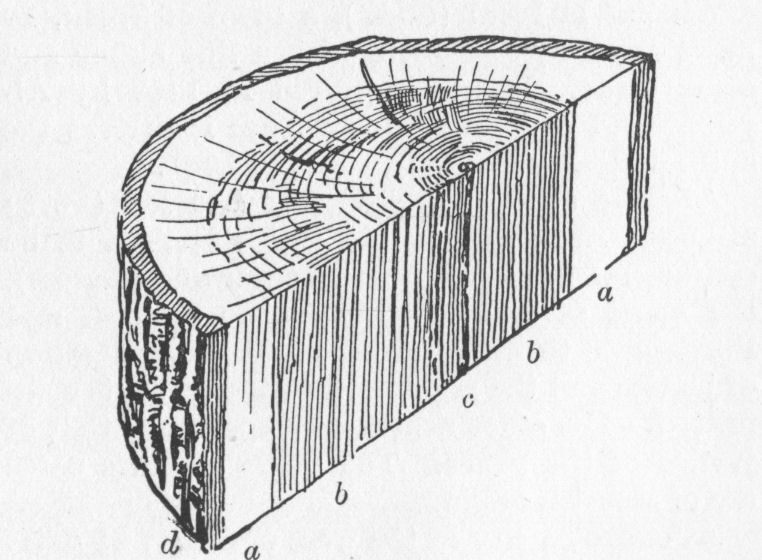
Albur′num, the soft white substance which, in trees, is found between the liber or inner bark and the wood, and, in progress of time acquiring solidity, becomes itself the wood. A new layer of wood, or rather of alburnum, is added annually to the tree in every part just under the bark.
Albury (al′ber-i), a rising town of New South Wales on the borders of Victoria, on the right bank of the Murray, 190 miles north-east of Melbourne, in a good agricultural and wine-producing district. Pop. 6750.
Alby, or Albi (a˙l′bē), an old town of southern France, department of Tarn, 42 miles north-east of Toulouse, on the Tarn, in an extensive plain. It has a cathedral, a Gothic structure, begun in 1282. It manufactures linens, cottons, leather, &c. Alby is said to have given the Albigenses their name. Pop. 18,262.
Alcæ′us, one of the greatest Grecian lyric poets, was born at Mitylene, in Lesbos, and flourished there at the close of the seventh and beginning of the sixth centuries B.C.; but of his life little is known. A strong manly enthusiasm for freedom and justice pervades his lyrics, of which only a few fragments are left. He wrote in the Æolic dialect, and was the inventor of a metre that bears his name (Alcaics), which Horace has employed in many of his odes.
Alcala′ de Guadaira (gwa˙-dī′ra˙; 'the castle of Guadaira'), a town of southern Spain, on the Guadaira, 7 miles east of Seville, chiefly celebrated for its manufacture of bread, with which it supplies a large part of the population of Seville. Pop. 8930.
Alcala′ de Henares (en-ä′res), a beautiful city of Spain, 16 miles E.N.E. of Madrid, 1 mile from the Henares. It has an imposing appearance when seen from some distance, but on nearer inspection is found to be in a state of decay. There was formerly a university here, at one time attended by 10,000 students; but in 1836 it was removed with its library to Madrid. Cervantes was born here. Pop. 11,728.
Alcala′ la Real (rā-a˙l′), a town of Spain, 18 miles south-east of Jaen, with a fine abbey and some trade. It was captured in 1340 by Alphonso XI of Leon, from whence it derives the epithet Real ('Royal'). Pop. 15,901.
Alcalde (Sp.; a˙l-ka˙l-dā), or Alcaide (Port.; al-kī′dā; Ar. alqadi (Cadi), the judge, not to be confused with alcaide, the governor of a fortress), the name of a magistrate in the Spanish and Portuguese towns, to whom the administration of justice and the regulation of the police is committed. His office nearly corresponds to that of justice of the peace. The name and the office are of Moorish origin.
Al′camo, a city in the west of Sicily, 2½ miles south of the Gulf of Castellamare, near the site of the ancient Segesta, the ruins of which, including a well-preserved Doric temple and a theatre, as well as the remains of Moorish occupation, are still to be found here. The district is celebrated for its wine. Pop. 32,200.
Alcañiz (a˙l-ka˙n-yēth′), a town of north-eastern Spain (Aragon). Pop. 8750.
Alcan′tara (Ar., 'the bridge'), an ancient town and frontier fortress of Spain, on the Tagus, on a rocky acclivity, and enclosed by ancient walls. Pop. 3224.—Order of Alcantara, an ancient Spanish order of knighthood instituted for defence against the Moors in 1156, and made a military religious order in 1197.
Alcarraza (a˙l-ka˙r-rä′tha˙), a vessel made of a kind of porous, unglazed pottery, used in Spain to hold drinking-water, which, oozing slightly through the vessel, is kept cool by the evaporation that takes place at the surface. Similar vessels have been long used in Egypt and elsewhere.
Alcazar de San Juan (a˙l-kä′tha˙r dā sa˙n-hwän), a town of Spain, province of Ciudad-Real (New Castile), with manufactures of soap, saltpetre, gunpowder, chocolate, &c. Pop. 13,645.
Alce′do. See Kingfisher.
Alces′tis, in Greek mythology, wife of Admetus, King of Thessaly. Her husband was ill, and, according to an oracle, would die unless someone made a vow to meet death in his stead. This was secretly done by Alcestis, and Admetus recovered. After her decease Hercules brought her back from the infernal regions.
Al′chemy, or Alchymy, the art which in former times occupied the place of and paved the way for the modern science of chemistry (as astrology did for astronomy), but whose aims were not scientific, being confined solely to the discovery of the means of indefinitely prolonging human life, and of transmuting the baser metals into gold and silver. Among the alchemists it was generally thought necessary to find a substance which, containing the original principle of all matter, should possess the power of dissolving all substances into their elements. This general solvent, or menstruum universale, which at the same time was to possess the power of removing all the seeds of disease out of the human body and renewing life, was called the philosophers' stone, lapis philosophorum, and its pretended possessors were known as adepts. Alchemy flourished chiefly in the Middle Ages, though how old such notions might be as those by which the alchemists were inspired it is difficult to say. There are many stories about the mystic origin of alchemy. The art is said to have been taught by the fallen angels, by Isis, or by Miriam, sister of Moses, or by John the Baptist. According to Suidas, Egypt was the home of alchemy, and the mythical Hermes Trismegistus of pre-Christian times was said to have left behind him many books of magical and alchemical learning, and after him alchemy received the name of the hermetic art. At a later period chemistry and alchemy were cultivated among the Arabians, and by them the pursuit was introduced into Europe. Many of the monks devoted themselves to alchemy, although they were afterwards prohibited from studying it by the popes. Thus Albertus Magnus is said to have been the author of a work De Alchimia, and several treatises on the subject are attributed to Thomas Aquinas. But even Pope John XXII is said to have worked at the science at Avignon. Raymond Lully, or Lullius, a famous alchemist of the thirteenth and fourteenth centuries, is said to have changed for King Edward I a mass of 50,000 lb. of quicksilver into gold, of which the first rose-nobles were coined. Among other alchemists may be mentioned John Cremer, Abbot of Westminster (1327-77), Nicholas Flamel (1330-80), Basilius Valentinus, Isaac of Holland, and Paracelsus (1493-1541). With the growth of chemistry, the recognition of the chemical elements as forming a large number of distinct substances, and the conception of the fixed unalterable nature of the atoms, attempts to transform the base metals into gold were largely abandoned as being unscientific. But the most modern view of matter, namely, that the atoms of all elements are composed of numerous electrons, favours the idea of the transmutability of elements, and the production of helium from radium (see these articles) by Ramsay shows the possibility of this transmutation.—Bibliography: Pattison-Muir, Alchemy, or the Beginnings of Chemistry (Hodder & Stoughton: Useful Knowledge Series); H. S. Redgrove, Alchemy, Ancient and Modern.
Alcibi′ades (-dēz), a famous Athenian statesman and general of high family and of great abilities, but of no principle, was born at Athens in the 82nd Olympiad, 450 B.C., being the son of Cleinias, and a relative of Pericles, who also was his guardian. In youth he was remarkable for the beauty of his person, no less than for the dissoluteness of his manners. He came under the influence of Socrates, but little permanent effect was produced on his character by the precepts of the sage. He acquired great popularity by his liberality in providing for the amusements of the people, and after the death of Cleon attained a political ascendancy which left him no rival but Nicias. Thus he played an important part in the long-continued Peloponnesian war. In 415 he advocated the expedition against Sicily, and was chosen one of the leaders, but before the expedition sailed he was charged with profaning and divulging the Eleusinian mysteries, and mutilating the busts of Hermes, which were set up in public all through Athens. Rather than stand his trial he went over to Sparta, divulged the plans of the Athenians, and assisted the Spartans to defeat them. Sentence of death and confiscation was pronounced against him at Athens, and he was cursed by the ministers of religion. He soon left Sparta and took refuge with the Persian satrap Tissaphernes, ingratiating himself by his affectation of Persian manners, as he had previously done at Sparta by a similar affectation of Spartan simplicity. He now began to intrigue for his return to Athens, offering to bring Tissaphernes over to the Athenian alliance, and after a while he was recalled and his banishment cancelled. He, however, remained abroad for some years in command of the Athenian forces, gained several victories, and took Chalcedon and Byzantium. In 407 B.C. he returned to Athens, but in 406, the fleet which he commanded having suffered a severe defeat, he was deprived of his command. He once more went over to the Persians, taking refuge with the satrap Pharnabazus of Phrygia, and here he was assassinated in 404 B.C. The authorities for his life are Thucydides, Xenophon, Plutarch, and Cornelius Nepos.
Alcinous (al-sin′o-us), King of the Phæacians. See Ulysses.
Alcira (a˙l-thē′ra˙), a town of Spain, province of Valencia, on the Jucar, founded by the Carthaginians. Fruits, rice, &c., are grown. Pop. 22,050.
Alc′man, the chief lyric poet of Sparta, a Lydian by birth, flourished between 671 B.C. and 631, and wrote (in the Doric dialect) love songs, hymns, pæans, &c., of which only fragments remain.
Alcme′na. See Amphitryon.
Alco, a small variety of dog, with a small head and large pendulous ears, found wild in Mexico and Peru, and also domesticated.
Alcobaça (a˙l-kō-bä′sa˙), a small town of Portugal, 50 miles north of Lisbon, celebrated for a magnificent Cistercian monastery founded in 1148 by Don Alphonso I, and completed in 1222. It contains the tombs of Alphonso II, Alphonso III, Pedro I and his wife Ines de Castro.
Al′cohol, or Ethyl Alcohol, C2H6O, is a substance obtained by allowing the juice of the grape to undergo a change known as fermentation. It is only in modern times that alcohol has been isolated and its properties examined. Alcohol is now prepared in enormous quantities, both for industrial purposes and for the preparation of alcoholic beverages, from substances rich in sugar or in starch. Potatoes and maize form the main source of alcohol. These are treated with steam under pressure in specially-constructed tanks to extract starchy materials. The starch so liberated is then fermented by means of a substance diastase. This treatment transforms sugar into alcohol and carbonic acid gas. The solution is then filtered to remove all insoluble matter, proteids, &c., and from this solid residue, cattle-feeding cakes are made. This treatment yields a solution containing 9-10 per cent alcohol. The solution is fractionally distilled, using a special form of distilling column. The most volatile part of the distillate, first runnings, contains acetaldehyde, the second fraction contains the bulk of the alcohol and some water, and the least volatile portion, last runnings, fusel oil and higher alcohols. By this means a liquid containing 80-95 per cent alcohol, rectified spirits, is obtained. For preparation of beverages, fusel oil must be carefully separated from alcohol, as fusel oil has an injurious effect physiologically. The removal of the last traces of water from alcohol is very troublesome. It is repeatedly distilled over quicklime or freshly-ignited potassium carbonate, giving an alcohol containing 98-99 per cent alcohol. The small quantity of water still contained is removed by leaving it in contact with metallic calcium. An alcohol containing more than 96 per cent alcohol is known as absolute. Pure alcohol is a colourless poisonous liquid boiling at 78° C., possessing a strong odour and a burning taste. It is inflammable and mixes with water in all proportions and has a specific gravity 0.80625 at 0° C. Very low temperatures convert it into a glassy solid, melting at -117° C., hence it may be used in thermometers for low-temperature measurements. Alcohol burns with a non-luminous flame and gives out great heat; it is used, therefore, in various types of lamps for heating purposes. It is also used as a fuel for motors and is a very valuable solvent for many substances such as resin, oils, colouring-matter, varnishes, and ethereal essences. The so-called 'solid alcohol' can be obtained by dissolving 30 to 40 parts of collodion in 100 parts of alcohol, a solid which separates and burns like alcohol, leaving no residue. Alcohol is the important constituent of all alcoholic beverages and it is due to its presence that wine, whisky, &c., have a stimulating and intoxicating effect on the nervous system. Beverages such as beer, wine, cider, &c., are prepared by direct fermentation of sugars obtained in fruit juices in the case of wine and cider and from barley in the case of beer. These contain varying amounts of alcohol, thus wine may contain from 8 to 10 per cent of alcohol, whilst beer contains 3 to 5 per cent. Whisky, brandy, &c., contain more alcohol, 50-70 per cent, and for the preparation of these the alcohol used must be distilled and purified after fermentation. The alcohol content of an aqueous solution may be deduced from a determination of the specific gravity of the solution or directly by the Alcoholometer. This gives percentage by volume. The amount of alcohol present in any alcoholic beverage cannot be obtained directly, but if ⅓ of the liquid be distilled and the distillate made up to the original volume, then the alcohol may be determined by the Alcoholometer. The name alcohol is applied generally in chemistry to a large group of substances, containing carbon, hydrogen, and oxygen, which have chemical properties analogous to those of ethyl alcohol.
Al′coholism, a morbid condition of the body (especially of the nervous system) brought on by the immoderate use of alcoholic liquors.
Alcoholom′eter, an instrument constructed on the principle of the hydrometer, to determine from the specific gravity of spirituous liquors the percentage of alcohol they contain, the scale marking directly the required proportion. If the liquor contain anything besides water and alcohol, previous distillation is necessary.
Alco′ran. See Koran.
Al′cott, Louisa May, a distinguished American authoress, born in 1833. She wrote a number of books chiefly intended for the young: Little Women (1867), An Old-fashioned Girl (1869), Little Men (1871), Jack and Jill (1880), &c. Died in 1888.
Alcove. French; late sixteenth century
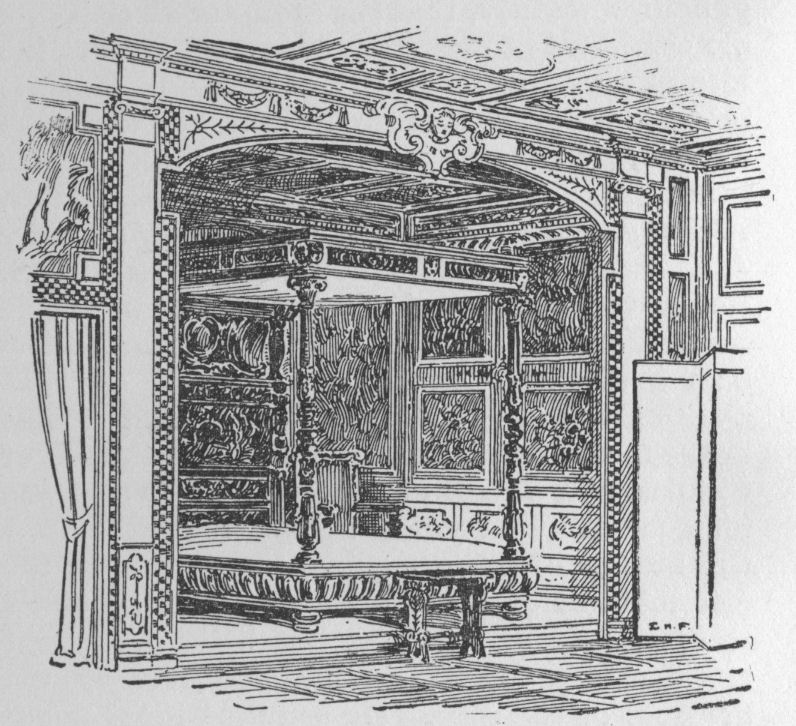
Al′cove, a recess in a room, usually separated from the rest of the room by columns, a balustrade, or by curtains, and often containing a bed or seats.
Alcoy′, a town of Spain, in Valencia, 24 miles north by west of Alicante, in a richly-cultivated district. There is a Roman bridge over the river, and the town has a very picturesque appearance; its chief manufactures are paper and woollen goods. On the 22nd of April an annual feast is celebrated by the inhabitants of the town commemorating a victory over the Moors in 1257. Pop. 33,896.
Alcudia, Duke of. See Godoy.
Alcuin (alk′win; in his native tongue Ealhwine), a learned Englishman, the confidant, instructor, and adviser of Charles the Great (Charlemagne). He was born at York in 735, and was educated at York School, of which he subsequently was head master. Alcuin having gone to Rome, Charlemagne became acquainted with him at Parma, invited him in 782 to his Court, and made use of his services in his endeavours to civilize his subjects. To secure the benefit of his instructions, Charlemagne established at his Court a school, called Schola Palatina, or the Palace School. In the royal academy Alcuin was called Flaccus Albinus. Most of the schools in France were either founded or improved by him; thus he founded the school in the abbey of St. Martin of Tours, in 796, after the plan of the school in York. Alcuin left the Court in 801, and retired to the abbey of St. Martin of Tours, but kept up a constant correspondence with Charles to his death in 804. He left works on theology, philosophy, rhetoric, also poems and letters, all of which have been published. His letters, 232 of which were addressed to Charlemagne, form the most important part of his work. As a philosopher, Alcuin, though lacking in originality, exercised a considerable influence over his contemporaries. The expression of 'scholasticism' is attributed to him.—Bibliography: C. J. B. Gaskoin, Alcuin, His Life and his Work, J. B. Mullinger, The Schools of Charles the Great.
Alcyona′ria, cœlenterate animals forming a great division of the class Actinozoa (see Sea-anemone). These animals are nearly all composite, and the individual polyps have mostly eight tentacles. They include the organ-pipe corals, sea-pens, fan-corals, &c., as also the red coral of commerce. The polyps resemble those of the genus Alcyonium in structure, and in the number and arrangement of the tentacles. See Alcyonium.
Alcyo′nium, a genus of cœlenterate animals, one familiar species of which, dredged around the British coasts—A. digitātum—is named 'Dead-Men's Fingers', or 'Cow's Paps', from its lobed or digitate appearance. It grows attached to stones, shells, and other objects. It consists of a mass of little polyps, each polyp possessing eight little fringed tentacles disposed around a central mouth. The Alcyonium forms the type of the Alcyonaria.
Al′dan, a river of Eastern Siberia, a tributary of the Lena, 1200 miles in length. The Aldan Mountains run along parallel to it on the left for 400 miles.
Aldeb′aran, a star of the first magnitude, forming the eye of the constellation Taurus or the Bull, the brightest of the five stars known to the Greeks as the Hyades. Spectrum analysis has shown it to contain antimony, bismuth, iron, mercury, hydrogen, sodium, calcium, &c.
Aldeburgh (a¨ld′bu-ru), a municipal borough of England, on the coast of Suffolk, more important formerly than it is now, having suffered from encroachments of the sea. The poet Crabbe was born there in 1754. Pop. 2892.
Al′dehyde, in chemistry, the generic name given to the compounds of alcohol intermediate between the alcohols and the acids. Common aldehyde (C2H4O) is derived from spirit of wine by oxidation, and is a colourless, limpid, volatile, and inflammable liquid, with a peculiar ethereal odour, which is suffocating when strong; specific gravity, 0.79. Atmospheric oxygen converts it into acetic acid. It decomposes oxide of silver, depositing a brilliant film of metallic silver; hence it is used in silvering curved glass surfaces.
Common Alder (Alnus glutinosa)
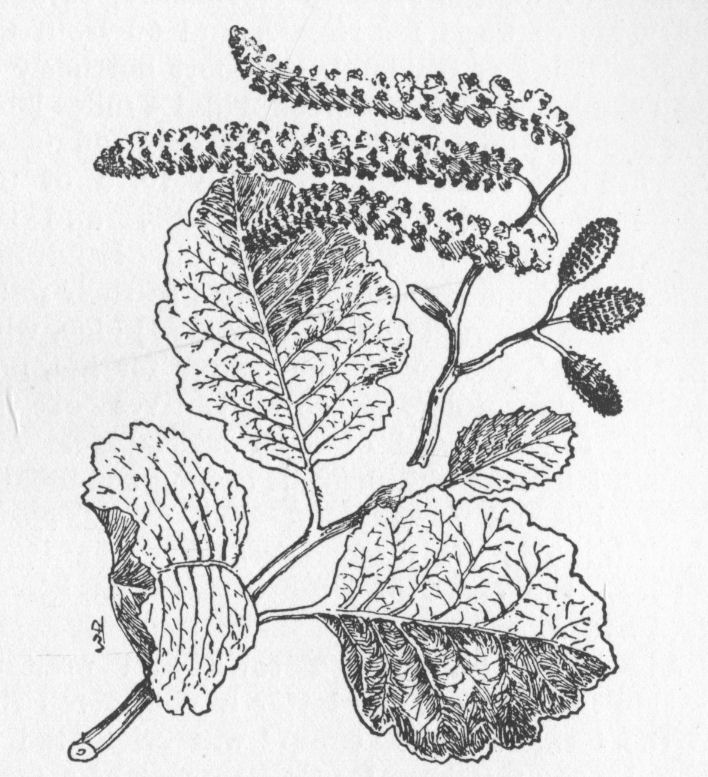
Alder (a¨l′dėr; Alnus), a genus of plants of the sub-ord. Betulaceæ (Birch), (nat. ord. Amentaceæ). Fourteen species are known as small trees or shrubs indigenous to temperate and colder regions of the globe; eight of these are found in Central and Western Europe. The only species indigenous to Britain is the common alder (Alnus glutinōsa), a tree growing in wet situations in Europe, Asia, and the United States. Its wood, light and soft and of a reddish colour, is used for a variety of purposes, and is well adapted for work which is to be kept constantly in water. Alder is still largely used in gunpowder manufacture, and the roots and knots furnish a beautifully-veined wood well suited for cabinet work; it is used for cigar-boxes in East Prussia and West Russia. The bark is used in tanning and leather-dressing, and by fishermen for staining their nets. This and the young twigs are sometimes employed in dyeing, and yield different shades of yellow and red. With the addition of copperas it yields a black dye.
Alderley Edge, a town of England, Cheshire, about 8 miles south-west of Stockport. Pop. (1921), 3072.
Al′derman (a¨l′dėr-; Anglo-Saxon ealdorman, from ealdor, older, and man), among the Anglo-Saxons a person of a rank equivalent to that of an earl or count, the governor of a shire or county, and member of the witena-gemót or great council of the nation. Aldermen played an important rôle already before the Constitution of Egbert, but reached their highest power during the reign of Alfred the Great, who had married the daughter of an alderman. Aldermen, at present, are officers associated with the mayor of a city for the administration of the municipal government in England and the United States.
Al′derney (Fr. Aurigny), an island belonging to Britain, off the coast of Normandy, 10 miles due west of Cape La Hogue, and 60 from the nearest point of England, the most northerly of the Channel Islands, between 3 and 4 miles long, and about 1¼ broad. The coast is bold and rocky; the interior is fertile. About a third of the island is occupied by grass lands; and the Alderney cows, a small-sized but handsome breed, are famous for the richness of their milk. The climate is mild and healthy. A judge, with six 'jurats', chosen by the people for life, and twelve 'douzainiers', representatives of the people, form a kind of local legislature. The French language still prevails among the inhabitants, but all understand and many speak English. The Race of Alderney is the strait between the coast of France and this island. Pop. 2561.
Aldershot (äl′dėr-), a town and military station in England, the latter having given rise to the former. The 'camp' was originated in 1854 by the purchase by Government of a tract of moorland known as Aldershot Heath, on the confines of Surrey, Hampshire, and Berkshire. The object was to accustom both officers and soldiers to act more readily when drawn up in brigades and divisions, their practice having been limited for the most part, since the termination of the French war, to the movements of battalions and companies. It was also deemed advisable to accustom the army to camp life, and to exercise the men in all the evolutions and movements which they might be required to perform when brought into actual contact with the enemy. The accommodation provided for the army, officers as well as men, consisted at first of wooden huts; but these have been superseded by brick barracks, and altogether the money expended on the camp has amounted to over £3,000,000. The men are exercised in marching, skirmishing, and similar field operations, which are carried on during the summer months with great activity; they are also instructed in the camp in cooking and other duties. The troops at Aldershot in summer include a number of Territorials, Senior and Junior O.T.C., &c. The town is in the neighbourhood of the barracks, immediately beyond the Government ground, and in Hampshire. It contains several churches, and has schools, newspapers, literary institutes, music-halls &c. Aldershot gives its name to a parliamentary division of Hants. Pop. (1921), 28,756.
Ald′helm, an Anglo-Saxon scholar and prelate, Abbot of Malmesbury and Bishop of Sherborne, born 640 (?), died 709. He was a great fosterer of learning and builder of churches, and has left Latin writings on theological subjects.
Al′dine Editions, the name given to the works which proceeded from the press of Aldus Manutius and his family at Venice (1494-1592), Rome (1562-70), and Bologna. (See Manutius.) Recommended by their value, as well as by a splendid exterior, they have gained the respect of scholars and the attention of book-collectors. Many of them are the first printed editions (editiones principes) of Greek and Latin classics. Others are texts of the modern Italian authors. These editions are of importance in the history of printing. The editions printed by Aldus Manutius the Elder are, however, much more valuable than those issued by his descendants. Among the former are the first edition of the works of Aristotle in 5 vols., and the works of Virgil, Horace, and Petrarch. Aldus had nine kinds of Greek type, and no one before him printed so much and so beautifully in this language. Of the Latin character he procured fourteen kinds of type.
Aldobrandi′ni, the name of a Florentine family, subsequently of princely rank (now extinct), which produced one Pope (Clement VIII) and several cardinals, archbishops, bishops, and men of learning.—Aldobrandini Marriage, one of the most beautiful ancient fresco paintings, belonging probably to the time of Augustus, discovered in 1606 on Mount Aquilinus at the very spot where once were the gardens of Mæcenas, and acquired by Cardinal Aldobrandini, nephew of Clement VIII, now in the Vatican. It represents a marriage scene in which ten persons are portrayed. There is a beautiful copy of this fresco by Poussin in the Galleria Doria at Rome.
Al′dred, or Ealdred, Anglo-Saxon prelate, Bishop of Worcester and Archbishop of York, born 1000(?), died 1069. He improved the discipline of the Church and built several monastic churches. On the death of Edward the Confessor he is said to have crowned Harold. Having submitted to the Conqueror, whose esteem he enjoyed and whose power he made subservient to the views of the Church, he also crowned him as well as Matilda.
Ald′rich, Henry, Dean of Christ Church, Oxford; born in 1647, died in 1710; distinguished as a philosopher, an architect, and as a musician. His Compendium of Logic was a textbook till long past the middle of last century. He adapted many of the works of the older musicians, such as Palestrina and Carissimi, to the liturgy of the Church of England, and composed many services and anthems, some of which are still heard in English cathedrals.
Aldrich, Thomas Bailey, the most conspicuous American poet of his generation. Born at Portsmouth, New Hampshire, on 11th Nov., 1836; died at Boston in March, 1907. He edited Every Saturday in Boston from 1865 to 1874, and the Atlantic Monthly from 1881 to 1890. He was a poet of some skill, the chief characteristic of his lyrics being refinement and finish. Some of his short stories have been rarely surpassed by other American writers. Among his volumes of verse are: The Ballad of Babie Bell (1856); Cloth of Gold (1874); Lyrics and Sonnets (1880); Friar Jerome's Beautiful Book (1881); Unguarded Gates and other Poems (1895), &c. His prose works include: Story of a Bad Boy (1870); Marjorie Daw and other People (1873); The Stillwater Tragedy (1880); Two Bites of a Cherry (1893).
Aldrovan′di, Ulysses, a distinguished Italian naturalist; born 1522, died 1607. He was professor at Bologna, and established botanical gardens and a museum of natural history there; wrote a work on natural history in 14 vols. His Antidotarii Bononiensis epitome (1574) has served as a model for all Pharmacopœias published in later years.
Ale and Beer, well-known and extensively-used fermented liquors, the principle of which is extracted from several sorts of grain but most commonly from barley, after it has undergone the process termed malting. Beer is a more general term than ale, being often used for any kind of fermented malt liquor, including porter, though it is also used in a more special signification. See Brewing.
Aleardi (a˙-lā-a˙r′dē), Aleardo, a distinguished Italian lyrical and political poet and patriot, born 1812, died 1878; he was a member of the Italian board of higher education and a senator. His best work is his poem Il Monte Circello (1844).
Ale-conner, formerly an officer in England appointed to assay ale and beer, and to take care that they were good and wholesome, and sold at a proper price. The duty of the ale-conners of London was to inspect the measures used in public-houses, to prevent frauds in selling liquors. Four of these were chosen annually by the liverymen, in common hall, on Mid-summer's Day.
Ale-cost. See Costmary.
Alec′to, in Greek mythology, one of the Furies (q.v.).
Aleman (a˙-le-ma˙n′), Mateo, a Spanish novelist, born about the middle of the sixteenth century, died in 1610. His fame rests on his Life and Adventures of the Rogue Guzman de Alfarache (translated into French in 1600 and into English in 1623), one of the best of the picaresque or rogue novels, which give such a lively picture of the shady classes of society in Spain during the sixteenth and seventeenth centuries. The hero becomes in succession stable-boy, beggar, porter, thief, man of fashion, soldier, valet, merchant, student, robber, galley-slave, and lastly his own biographer.
Aleman′ni, or Alamanni, a confederacy of several German tribes which, at the commencement of the third century after Christ, lived near the Roman territory, and came then and subsequently into conflict with the imperial troops. Caracalla first fought with them in 213, but did not conquer them; Severus was likewise unsuccessful. About 250 they began to cross the Rhine westwards, and in 255 they overran Gaul along with the Franks. In 259 a body of them was defeated in Italy at Milan, and in the following year they were driven out of Gaul by Postumus. But the Alemanni did not desist from their incursions, notwithstanding the numerous defeats they suffered at the hands of the Roman troops. In the fourth century they crossed the Rhine and ravaged Gaul, but were severely defeated by the Emperor Julian and driven back. Subsequently they occupied a considerable territory on both sides of the Rhine; but at last Clovis broke their power in 496 and deprived them of a large portion of their possessions. Part of their territory was formed into a duchy called Alemannia or Swabia, this name being derived from Suevi or Swabians, the name which they gave themselves. It is from the Alemanni that the French have derived their names for Germans and Germany in general, namely, Allemands and Allemagne, though strictly speaking only the modern Swabians and northern Swiss are the proper descendants of that ancient race.
Alembert (a˙-la˙n˙-bār), Jean le Rond d', a French mathematician and philosopher, born in Paris, 16th Nov., 1717, and died there 29th Oct., 1783. He was the illegitimate son of Madame de Tencin and Chevalier Destouches, and was exposed at the Church of St. Jean le Rond (hence his name) soon after birth. He was brought up by the wife of a poor glazier, and with her he lived for more than forty years. His parents never publicly acknowledged him, but his father settled upon him an income of 1200 livres. He showed much quickness in learning, entered the College Mazarin at the age of twelve, and studied mathematics with enthusiasm and success, but received little encouragement from his teachers. Having left college he studied law and became an advocate, but did not practise, and long continued to occupy himself with mathematics, in which he made immense advances by his own efforts, often arriving at results that other mathematicians had previously arrived at unknown to him. A pamphlet on the motion of solid bodies in a fluid, and another on the integral calculus, which he laid before the Academy of Sciences in 1739 and 1740, showed him in so favourable a light that the Academy received him in 1741 into the number of its members. He soon after published his famous work on dynamics, Traité de Dynamique (1743) and another work dealing with fluids, Traité des Fluides. His Réflexion sur la cause générale des vents was also a work that added to D'Alembert's reputation. He also took a part in the investigations which completed the discoveries of Newton respecting the motion of the heavenly bodies, and published at intervals various important astronomical dissertations—on the perturbations of the planets, for instance, and on the precession of the equinoxes—as well as on other subjects. He also took part, with Diderot and others, in the celebrated Encyclopédie in 33 vols., for which he wrote the Discours Préliminaire, as well as many philosophical and almost all the mathematical articles. Literature, history, and philosophy also received attention from him, and his Éléments de Philosophie (1759), in which he agrees with the theories of Condillac and Locke, was a work of much value. His great philosophical aim seems to have been the idea of secularizing morality upon a rational basis. Among his miscellaneous works are Mélanges de Philosophie, d'Histoire, et de Littérature; Traduction de quelques Morceaux choisis de Tacite; Sur la Destruction des Jésuites; Histoire des Membres de l'Académie Française; Éléments de Musique théorique et pratique. He received an invitation from the Russian empress Catherine II to go to St. Petersburg (now Petrograd) as tutor to her son, a very large sum being offered; and Frederick the Great invited him to settle in Berlin, but in vain. From Frederick, however, he accepted a pension, and he also paid a visit to Berlin. There was an intimate friendship between him and Voltaire. He never married, but he was on terms of the closest friendship with Madame L'Espinasse, and they occupied the same house for a number of years. He was held in high esteem by David Hume, who left him a legacy of £200.
Alem′bic, a simple apparatus sometimes used by chemists for distillation, and consisting of three main parts, body, head, and receiver. The cucurbit, or body, contains the substance to be distilled, and is usually somewhat like a bottle, bulging below and narrowing towards the top; the head, of a globular form, with a flat under-ring, fits on to the neck of the cucurbit, condenses the vapour from the heated liquid, and receives the distilled liquid on the ring enclosing the neck of the lower vessel, and thus causes it to find egress by a discharging-pipe into the third section, called the receiver. See Distillation.
Alemtejo (a˙-lān˙-tā′zhō; 'beyond the Tagus'), the largest province of Portugal, and the most southern except Algarve; area, 9219 sq. miles; pop. 478,584. The capital is Evora. It has about 30 miles of coast, but no good harbour and no navigable river. Large areas are devoted to pasturage, and the cultivated portions are comparatively limited, though in the east there are fertile valleys where grain, fruits, &c., are cultivated. There are valuable cork forests in this portion also. Excellent horses are reared. Copper and iron mines are worked; but on the whole this province is in a backward condition, and is the most thinly inhabited in the country.
Alençon (a˙-la˙n˙-sōn˙), a town of France, capital of department Orne, and formerly of the Duchy of Alençon, on the right bank of the Sarthe, 105 miles west by south of Paris; well built; has a fine Gothic church (fifteenth century) and interesting remains of the old castle of the ducs d'Alençon. Alençon was long famed for its point-lace, called 'point d'Alençon', an industry established at the instigation of Colbert in 1673 but now much fallen off; it has cotton and flax spinning and weaving, &c. Fine rock-crystal, yielding the so-called 'diamants d'Alençon', is found in the neighbouring granite quarries. Alençon is mentioned as a city for the first time in 717. Pop. 16,590.—Alençon, originally a county, later a dukedom, became united with the crown in 1221, and was given by Louis XI as an appanage to his fifth son, with whom the branch of the Alençon-Valois commenced. The first duke of the name lost his life at the battle of Agincourt in 1415; another, called Charles IV, married the celebrated Margaret of Valois, sister of Francis I. He commanded the left wing of the French army at the battle of Pavia, where, instead of supporting the king at a critical moment, he fled at the head of his troops, the consequence of which was the loss of the battle and the capture of the king.
Alep′po, a city in North Syria, on the River Koik, in a fine plain 60 miles south-east of Alexandretta, which is its port, and 129 miles N.N.E. of Damascus. It has a circumference of about 7 miles, and consists of the old town and numerous suburbs. Its appearance at a distance is striking, and the houses are well built of stone. On a hill stands the citadel, and at its foot the governor's palace. Previous to 1822 Aleppo contained about 100 mosques, but in that year an earthquake laid the greater part of them in ruins, and destroyed nearly the whole city. The aqueduct built by the Romans is the oldest monument of the town. Among the chief attractions of Aleppo are its gardens, in which the pistachio-nut is extensively cultivated. The branch railway to Hamah from the Beyrout-Damascus line has been continued to Aleppo. Formerly the city was a great centre of trade and manufactures, but the earthquake and other causes have combined greatly to lessen its prosperity. It has still a trade, however, in the products of the country, such as wool, cotton, silk, wax, skins, soap, tobacco, &c., and imports a certain quantity of European manufactures.—Aleppo was a place of considerable importance in very remote times. By the Greeks and Romans it was called Berœa. It was conquered by the Arabs in 638, and its original name Chalybon was then turned into Haleb, whence the Italian form Aleppo. The town was occupied by British troops on 27th Oct., 1918. Its population, 200,000 at the beginning of last century, is now estimated at over 250,000. The language generally spoken is Arabic. The vilayet of Aleppo has a pop. of 1,500,000.
Alesh′ki, a town of Southern Russia, government Taurida. Pop. 8915.
Ale′sia, a town and fortress of ancient Gaul, at which in 52 B.C. Julius Cæsar inflicted a crushing defeat on the Gauls under Vercingetorix. It is now represented by the village of Alise, department Côte d'Or, near which Napoleon III erected a colossal statue of Vercingetorix in 1865.
Alessan′dria, a town and fortress in North Italy, capital of the province of the same name, in a marshy country, near the junction of the Bormida and the Tanaro. It was built in 1168 by the Cremonese and Milanese, and was named in honour of Pope Alexander III, who made it a bishop's see. It has a cathedral, important manufactures of linen, woollen, and silk goods, and an active trade. It ranks as one of the first fortresses of Europe, the fortifications including a surrounding wall and bastions, and a strong citadel on the opposite side of the Tanaro, connected by a bridge with the town. Pop. (with suburbs) 78,159.
Ales′si, Galeazzo, a distinguished Italian architect, born at Perugia, 1512, died there in 1572. Many palaces, villas, and churches were erected after his designs, and at the request of Philip II of Spain he drew a plan for the Escurial.
Aletsch′-glacier, the greatest glacier in Switzerland, canton Valais, a prolongation of the immense mass of glaciers connected with the Jungfrau, the Aletschhorn (14,000 feet), and other peaks; about 15 miles long.
Aleurites, a tree belonging to the nat. ord. Euphorbiaceæ, is found in tropical and subtropical parts of the world. Aleurites triloba, the 'candleberry tree', is cultivated in the Moluccan Islands for its fruit. The oil extracted from its seeds is valuable both for food and light.
Aleurom′eter, an instrument for indicating the bread-making qualities of wheaten flour. The indications depend upon the expansion of the gluten contained in a given quantity of flour when freed of its starch by pulverization and repeated washings with water.
Aleu′tian Islands, a chain of about eighty small islands belonging to the United States, separating the Sea of Kamchatka from the northern part of the Pacific Ocean, and extending nearly 1000 miles from east to west between lon. 172° E. and 163° W.; total area, 6391 sq. miles; pop. 1220. They are of volcanic formation, and in a number of them there are volcanoes still in activity. Their general appearance is dismal and barren, yet grassy valleys capable of supporting cattle throughout the year are met with, and potatoes, turnips, and other vegetables are successfully cultivated. They afford also an abundance of valuable fur and of fish. The natives belong to the same stock with those of Kamchatka.
Ale′wife (corruption of the Indian name), the Alōsa tyrannus, a fish of the same genus as the shad, growing to the length of 12 inches, and caught in great quantities in the mouths of the rivers of New England, New Brunswick, and Nova Scotia, being salted and exported.
Coin of Alexander the Great
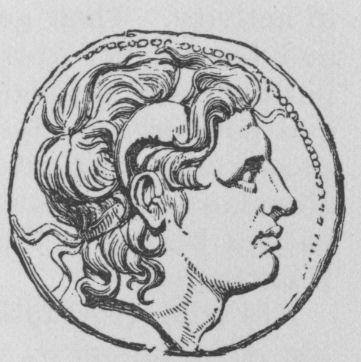
Alexander, surnamed the Great, was the son of Philip of Macedon and his queen Olympias, and was born at Pella, 356 B.C. In youth he had Aristotle as instructor, and he early displayed uncommon abilities. The victory of Chæronea in 338, which brought Greece entirely under Macedonia, was mainly decided by his efforts. Philip having been assassinated, 336 B.C., Alexander, not yet twenty years of age, ascended the throne. His father had been preparing an expedition against the Persians, and Alexander determined to carry it out; but before doing so he had to chastise the barbarian tribes on the frontiers of Macedon as well as quell a rising in Greece, in which he took and destroyed Thebes, put 6000 of the inhabitants to the sword, and carried 30,000 into captivity. Leaving Antipater to govern in his stead in Europe, and being confirmed as commander-in-chief of the Greek forces in the general assembly of the Greeks, he crossed over the Hellespont into Asia, in the spring of 334, with 30,000 foot and 5000 horse. His first encounter with the Persian forces (assisted by Greek mercenaries) was at the small river Granīcus, where he gained a complete victory. Most of the cities of Asia Minor now opened their gates to the victor, and Alexander restored democracy in all the Greek cities. In passing through Gordium he cut the Gordian knot, on which it was believed the fate of Asia depended, and then conquered Lycia, Ionia, Caria, Pamphylia, and Cappadocia. A sickness, caused by bathing in the Cydnus (333 B.C.), checked his progress; but scarcely was he restored to health when he continued his advance, and this same year defeated the Persian emperor Darius and his army of 500,000 or 600,000 men (including 50,000 Greek mercenaries) near Issus (inner angle of the Gulf of Alexandretta). Darius fled towards the interior of his dominions, leaving his family and treasures to fall into the hands of the conqueror. Alexander did not pursue Darius, but proceeded southwards, and secured all the towns along the Mediterranean Sea, though he only got possession of Tyre (taken 332 B.C.) after besieging it for seven months. Palestine and Egypt now fell before him, and in the latter he founded Alexandria, which became one of the first cities of ancient times. Hence he went through the desert of Libya, to consult the oracle of Zeus Ammon, and it was said that the god recognized him as his son. On his return Alexander marched against Darius, who had collected an immense army in Assyria, and rejected the proposals of his rival for peace. A battle was fought at Gaugamela, about 50 miles from Arbela, 331 B.C., and notwithstanding the immense numerical superiority of his enemy, Alexander (who had but 40,000 men and 7000 horse) gained a complete victory. Babylon and Susa opened their gates to the conqueror, who marched towards Persepolis, the capital of Persia, and entered it in triumph. He now seems for a time to have lost his self-command. He gave himself up to arrogance and dissipation, and is said in a fit of intoxication to have set fire to the palace of Persepolis, one of the wonders of the world. Rousing himself up, however, he set out in pursuit of Darius, who, having lost his throne, was kept prisoner by Bessus, satrap of Bactriana. Bessus, on seeing himself closely pursued, caused Darius to be assassinated (330 B.C.). Continuing his progress he subdued Bessus, and advanced to the Jaxartes, the extreme eastern limit of the empire, but did not fully subdue the whole of this region till 328, some fortresses holding out with great tenacity. In one of these he took prisoner the beautiful Roxana, daughter of Oxyartes, a nobleman of Sogdiana, and having fallen in love with her he married her. Meantime disaffection had once or twice manifested itself among his Macedonian followers and had been cruelly punished; and he had also, to his lasting remorse, killed his faithful friend Cleitus in a fit of drunken rage. Alexander now formed the idea of conquering India, then scarcely known even by name. He passed the Indus (326 B.C.), marched towards the Hydaspes (Jhelum), at the passage of which he conquered a king named Porus in a fierce battle, and advanced victoriously through the north-west of India, and intended to proceed as far as the Ganges, when the murmurs of his army compelled him to return. On the Hydaspes he built a fleet, in which he sent a part of his army down the river, while the rest proceeded along the banks. By the Hydaspes he reached the Acesines (Chenab), and thus the Indus, down which he sailed to the sea. Nearchus, his admiral, sailed hence to the Persian Gulf, while Alexander directed his march by land to Babylon, losing a great part of his troops in the desert through which he had to pass. In Susa he married Statira, the eldest daughter of Darius, and rewarded those of his Macedonians who had married Persian women, because it was his intention to unite the two nations as closely as possible. At Opis, on the Tigris, a mutiny arose among his Macedonians (in 324), who thought he showed too much favour to the Asiatics; by firmness and policy he succeeded in quelling this rising, and sent home 10,000 veterans with rich rewards. Soon after, his favourite, Hephæstion, died at Ecbatana, and Alexander's grief was unbounded. The favourite was royally buried at Babylon, and here Alexander was engaged in extensive plans for the future, when he became suddenly sick, after a banquet, and died in a few days (323 B.C.), in his thirty-third year, after a reign of twelve years and eight months. His body was after a time conveyed to Egypt with great splendour by his general Ptolemy. He left behind him an immense empire, which was divided among his chief generals, and became the scene of continual wars. The reign of Alexander constitutes an important period in the history of humanity. His career was not merely a series of empty conquests, but was attended with the most important results. The language, and much of the civilization of Greece, followed in his track; large additions were made to the sciences of geography, natural history, &c.; a road was opened to India; and the products of the farthest east were introduced into Europe. Greek kingdoms, under his generals and their successors, continued to exist in Asia for centuries.—Bibliography: B. I. Wheeler, Alexander the Great (Heroes of the Nations Series: Putnam); Grote, History of Greece; Holm, History of Greece; Dodge, Alexander (Great Captains Series).