PART I. (continued 9)
Reading edition
1. The system of prefixes.—Every Kaffre noun is preceded by an adventitious syllable, apparently destitute of any separate meaning; just as if, in English, we said, instead of—
Father, al-father.[174]
Son, el-son.
Mother, em-mother.
So far is this principle carried that the words introduced by the missionaries, from our own language, all become thus modified. Hence priest changes to um-priest; pharisee, um-pharisee. I imagine that without this prefix the simple root would be as impossible a form for a Kaffre or Bechuana as a word like ὀρνιθ- (i. e. a root without any concomitant inflection) would be to a Greek. Nevertheless, the Kaffre prefix is no sign of case or number.
In the following words the syllables in italics are the prefixes, wholly independent in origin from the root, and wholly non-radical:—
ENGLISH. KAFFRE.
Person umtu.
Horse ihashe.
Chief inkosi.
Servant isikaka.
Infant usana.
River umlambo.
Face ubuso.
Ford akutya.
People abantu.
Words amaswe.
Cattle inkomo.
Trees imiti.
2. The euphonic or alliterational concord.—This is a point of Kaffre syntax, and occurs when certain words come together; e. g. in the case of a substantive governing another in the possessive case, or an adjective agreeing with a substantive. In either of these cases the secondary word changes its initial sound into that of the primary one, or into some sound allied to it.
If in English we expressed the relation between the nominative and possessive cases on the same principle that occurs in the Kaffre and Bechuana, we should say instead of—
Man's dog—dan dog.
Sun's beam—bun beam.
Father's daughter—dather daughter, &c.
It may easily be imagined that languages thus characterised, taken along with undoubted points of physical difference, have supplied the grounds for a somewhat broad line of demarcation between the Kaffre and the other Africans. That such a line is natural, is certain; whether it has not been made too broad, is another question.
KAFFRE NATIONS AND TRIBES.
Physical conformation.—Modified Negro.
Language.—Prefixional and alliterational.
Area.—Western, Central(?), and Eastern Africa, from the north of the Equator to the south of the Tropic of Capricorn.
Chief divisions.—1. Western. 2. Southern Kaffres. 3. Eastern Kaffres.
That there is no broad line between the Kaffre and non-Kaffre Africans, on the western side of Africa at least, is shown by the following populations; whereof both the languages, as known by vocabularies, and the physical conformations are intermediate or transitional.
1. WESTERN KAFFRES.
Beginning with the parts south of the Bimbia area we have between the river of that name and the Portuguese kingdom of Loango—
THE BATANGAS.
Native name.—Bânâka.
Locality.—Sea-coast of Western Africa 3° north latitude, half way between the Camaroons and Gaboon.
Physical appearance.—More Kaffre than Negro; skin more copper-coloured than black; sclerotica clear.
THE PANWES.
Locality.—Eastward to, and more in the interior than the Batangas; from 3° north latitude to 3° south latitude, on the Head-waters of the Gaboon.
THE MPOONGAS.
Locality.—Mouth of the Gaboon.
Then follow the nations of—1. Loango; 2. Congo; 3. Angola; and 4. Benguela; closely allied both in language and appearance, and nations whose place in the Kaffre division has long been recognised.
That there is, however, considerable difference in respect to the physical conformation of the different tribes, is certain; some writers, reducing the native of Portuguese Africa to the Negro, others to the proper Kaffrarian, or South Kaffre, type.
If the difference between these two extremes be rightly estimated by the present writer, the former should prevail along the courses, the latter on the watersheds of the rivers. His information, however, is imperfect upon this point.
2. SOUTHERN KAFFRES.
Area.—The extra-tropical portion of South Africa, minus the parts south, Walvisch Bay on the west, and the water-system of the Orange River.—Encroaching.
Chief divisions.—1. Amakosas, nearest the Cape. 2. Bechuanas, north of the head-waters of the Orange River. 3. Zulus, north of the Bechuanas, with an undetermined extent inland. Numerous sub-divisions.
Physical conformation.—Cranium, more vaulted and less prognathic than the Negro; hair, tufted, and as such approaching that of the Hottentot; zygomatic development, outwards rather than downwards, so that the cheek-bones become projecting, and the forehead and chin tapering; lips, generally thick, and nasal profile less generally depressed than with the Negro; colour, black, dark brown, clear brown; stature, tall.
Habits.—Pastoral rather than agricultural.
Religion.—Paganism.
Customs.—Circumcision and tattooing.
The Dammaras.—Are the Dammaras Kaffre? This will be noticed in p. 495.
The Kaffres of Lagoa Bay, darker and more Negro-like than the typical Kaffres of Kaffraria, form the transition between the southern Kaffres and the eastern divisions of the tribes of Inhambane, Sofala, and Botonga, and the water-system of the river Yambezi. They are Negro rather than Kaffrarian, their languages being but imperfectly known.
3. EASTERN KAFFRES.
So are those of Mozambique and Zanzibar; chiefly represented by the Makuas, the Monjous, and the tribes speaking the Suaheli language. A vast accession to our philological data for these parts proves incontestably the Kaffre structure of the languages of the coast from the Cape of Good Hope to nearly 5° north latitude.
But the tribes of the unknown parts of Central Africa, south of the equator, are also, probably, either wholly, or almost wholly, Kaffre. It is this which has induced me to pass sicco pede over the numerous details of the Kaffres of the coast, so as to allow space for a short notice of the newer additions to our knowledge of the inland Kaffres, west and east.
a. West.—The Kazumbi, said to live at such a distance from the coast, as to be obliged to travel three or four moons, before they reach any of the possessions of the Portuguese and to speak a language which resembles, in many words (especially the numerals), the Congo. This is probably the Cazambe of the maps, nearly in the centre of Africa, in 13° south latitude.
The Koniunki.[175]—From some captured Negroes examined by the Rev. T. Arbousset, of the Paris Missionary Society, a few words have been collected of the Koniunki language. They are apparently of the Kaffre class.
English, eyes
Koniunki, maro
Kaffre, amehlo
Sechuana, matlo
Makua, meto
Monjou, mezo
Suaheli, matsho
English, water
Koniunki, mose
Kaffre, amanzi
Sechuana, metse
Delagoa Bay, amate
Makua, amazi
Monjou, mizi
English, tree
Koniunki, mote
Kaffre, umti
Sechuana, sefate
English, two
Koniunki, mapele
Kaffre, amabini
Sechuana, maberi
Delagoa Bay, mabizi
Suaheli, mabizi
English, three
Koniunki, mataru
Suaheli, madato
Kaffre, amatatu
Sechuana, mararu
Delagoa Bay, mararu
The locality of the Koniunkis was also said to be so far in the interior, as for the gang to have been three or four months in reaching the Mozambique coast.
This indicates that they were east of the Kazumbi, whilst the affinity of the language with the Bechuana gives them a southward direction.
The Mazenas, mentioned along with the Koniunkis, as lying between them and the Makuas.[176]
Hence, the Congo, the Kazumbi, Koniunki, and Mazena areas, probably, carry us across the whole continent in (about) 13° south latitude; whilst the likelihood of the southern Koniunki and northern Bechuanas being conterminous, helps to fill up the void spaces north of the parts about Litakú.
b. East.—Parts about Mombaz, Formosa Bay, Lama, Patta, &c.
POCOMO.
Locality.—River Pocomosi (Maro).
Conterminous with the southernmost section of the Gallas.
WANIKA.
Locality.—North and west of Mombaz.
The Mahometanism of the Wanikas, if it exist at all, is of the most imperfect kind. They practise circumcision, it is true; but this is a general African, quite as much as a particular Semitic, rite—"They bury their dead, placing the head to the east; and it is customary, after waiting ten days, to kill a bullock and make a feast, pouring the blood upon the grave." The Wanika man seen by Pickering, "bore the marks of a national designation; consisting of a single notch, filed between the two upper front teeth, with numerous small scars on the breast."
WAKAMBA.
Synonym.—Merremengo.
Locality.—Mixed with, and conterminous with the Wanika.
WATAITA(?).
Locality.—Five days from the coast; conterminous with the Wakamba.
TAVAITI(?).
Locality.—Westward of the Wataita.
Language.—Different from the Chaga and M'Kuafi. Probably akin to the Wanika.
M'SIGUA.
Locality.—Pungany River. Scattered among the Wanika.
M'SAMBARA.
Language.—As known from a vocabulary of Krapf's, closely akin to the Pocomo, Wakamba, Wanika, and M'Sigua.
This last sentence suggests the nature of our reasons for making the tribes just enumerated Kaffre. The dialects of five of them are known by specimens, collected by Krapf, and are very nearly Suaheli. The evidence of the Kaffre origin of the Tavaiti and Wataita is less conclusive.
The M'Kuafi.—Are the M'Kuafi Kaffre? This question will be noticed in p. 501.
It has been suggested that the import of the peculiarities in the structure of the Kaffre languages may have been exaggerated; the effect of such an over-valuation being to isolate the class beyond its proper limit. The following facts are corrective to this view:—
1. The Woloff language is at least one other African tongue, which exhibits the phænomenon of an initial change, a process allied to the euphonic concord.
2. The Celtic tongues of Europe do the same.
3. Apparent instances of prefixed syllables, occur in the Howssa, Yarribean, and probably in other African languages.
Now there are many good reasons for believing that although the effect of such and such-like processes is to give the languages in which they occur a very remarkable external appearance—an appearance which, if we classed tongues and nations on the same principles upon which we class minerals, i.e. irrespective of descent and affiliation, would throw them into solitary and independent groups—they by no means denote the necessity of any inordinately long period for the evolution. All that they do denote is the greater intensity of what may be called the euphonic instinct, combined with a tendency to incorporate elements which, elsewhere, would be kept separate.
A doctrine laid down by Mr. Hales in his Philology to the United States Exploring Expedition, indicating a different classification from the present, deserves notice.
That inquirer considers that the line of affinity runs west and east, rather than north and south; so that the Kaffres of Inhambane, Zanzibar, and Mozambique are more closely allied to those of Loango and Angola than the Kosas, Bechuanas and Zulus of the Cape. The published evidence of the proposition is certainly insufficient.
FOOTNOTES:
C. HOTTENTOT ATLANTIDÆ.
The Hottentot stock has a better claim to be considered as forming a second species of the genus Homo than any other section of mankind. It can be shown, however, that the language is no more different from those of the world in general than they are from each other.
THE HOTTENTOT ATLANTIDÆ.
Area. The southern extremity of Africa. Encroached upon by a. the Kaffres; b. the Dutch and English of the Cape.
Divisions. 1. The Hottentots. 2. The Saabs.
Physical conformation. Stature, low; limbs, slight; colour, more brown or yellow than black (that of new-born children said to be nearly white); cheek-bones, prominent; nasal profile, depressed; hair, in tufts rather than equally distributed over the head.—Thus described by Barrow: "It does not cover the whole surface of the scalp, but grows in small tufts, at certain distances from each other, and when clipped short, has the appearance and feel of a hard shoe-brush, except that it is curled and twisted into small, round lumps, about the size of a marrow-fat pea. When suffered to grow, it hangs on the neck in hard, twisted tassels, like a fringe."[177]—Eyes, oblique; vision, acute; cranium, Mongoliform with wide orbits, brakhykephalic, nasal profile extremely flat, broad at the root; and the chin, long, forward, and thin.
Pelvis, with a maximum difference in structure according as it is male or female; that of the former being strong and dense, that of the latter, light, and delicate. In both cases a minimum of diploe between the bony plates; ossa ilii, vertical; sacrum, narrow; conjugate diameter, short; neck of the thigh-bone, short, and with an oblique direction.[178]—Vrolik.—Oftener wedge-shaped or oblong, than oval, round, or square.—Weber.
Buttocks often steatomatous.[179]
Physical condition of area.—Karroos, i.e. elevated terraces and table-lands, with the soil dry, hard, clayey, fissured, rarely moistened with rain, and chiefly productive of the succulent classes of the vegetable kingdom.
Language.—Containing two inarticulate elements, viz. h (like other tongues), and a peculiar and characteristic click.
Intermixture.—Dutch, the Griquas of the Orange River being a mixed stock.
Habits.—Pastoral and hunter state; the latter exhibiting the lower forms of the type (i.e. the Saabs, or Bushmen, once disconnected from the others, and considered as forming a separate and more degraded class).
1. HOTTENTOTS.
The extinct sections of the Hottentot division are:—
Gunyeman, nearest the Cape.
Kokhaqua, north of the Gunyeman.
Sussaqua, Saldanha Bay.
Odiqua.
Khirigriquas, on Elephants' River.
Koopmans.
Hessaquas.
Sonquas, east of the Cape.
Dunquas.
Damaquas.
Guariquas.
Honteniquas.
Khantouers.
Heykoms, as far on the north-east as Natal. Now replaced by Amakosah Kaffres.
Extant.—1. Gonaquas, south-east, on the Great Fish River. Probably replaced by Amakosah Kaffres.
2. Koraquas (Kora, Korana), north-east frontier, on the upper part of the Orange River.—In the more favourable localities the Koraquas are the tallest and best-looking men of the Hottentot stock. On the other hand, the Koras of the Hartebeest River, who formerly possessed, but have since lost their cattle, "exhibit the obvious process by which the Bushmen race have been originally driven back from the pastoral state, to that of the huntsman and robber."—Thompson's Travels in Southern Africa.—Prichard, vol. ii. p. 274.
3. Namaquas, separated from the Koranas by the Saabs. Occupants of the lower part of the Orange River, i. e. Little Namaqualand to the south, and Great Namaqualand to the north of its mouth.
2. SAABS.
Locality.—The country between the Roggeveld and the middle portion of the Orange River; preeminently a Karroo.
Habits.—Hunters.
Language.—Wholly or nearly unintelligible to the other Hottentots.
Area.—Encroached upon the Koranas, who are their deadly enemies, and continually at war with them.
Are the Dammaras Kaffre or Hottentot? This has already been asked.
On the authority of Mr. Barrow, Prichard corrects Vater and Maltebrun for making the Dammaras Hottentot instead of Kaffre. The term, however, is a geographical rather than an ethnological one, comprising the tribes inhabiting those parts to the north and south of Waalvisch Bay, which are marked in the maps as sterile country, and lying between Benguela (where the languages belong to the Congo class of the Kaffre languages), and Namaqualand, where the inhabitants are Hottentots.
Now, geographically speaking, the Dammaras fall into two divisions: a,[180] the Dammaras of the Plains, or cattle Dammaras, and b, the Hill Dammaras. These latter inhabit the parts to the north and north-east of Namaqualand, and are Namaqua Hottentots. The former only belong to the Kaffre division, and extend as far north as 17° south latitude.
Forced downwards by the stronger tribes of the Kaffres, with their periphery overlaid, the Hottentots probably represent a population whose original area was extended much more towards the north—possibly as far as the central range of mountains. Nay, more—fragments of the stock may still, in central Africa, interrupt the Kaffre area, and form future discoveries in ethnology.
This possible northward extension of the Hottentot area has a bearing upon the questions connected with the population of Madagascar.
Overlaying of the periphery of an ethnological area.—Let two divisions of a certain class pass into each other by imperceptible degrees, and let one of the central portions of either class spread itself at the expense of the parts belonging to its circumference.
The effect which follows is, that those portions of this area, which represent the phænomena of transition, are overlaid, or overlapped; and that instead of two populations coming into contact by imperceptible degrees, they meet as separate classes, with as broad a line of demarcation between their respective representatives at the circumferences (peripheries) of their respective areas, as there was between their central or typical portions.
North-western America illustrates this. The more southern Algonkins have overlaid both the Algonkins of their own section, which approached the Eskimo, and the Eskimo of the opposite section, which approached the Algonkin. Hence the two populations meet as widely-separated, and broadly distinguished varieties of mankind.
FOOTNOTES:
D. NILOTIC ATLANTIDÆ.
This is a far less simple group than the last, and one which may, probably, require the value of some of its divisions to be raised. Besides which, it probably comprizes, if classed according to the strict rules of ethnology, the eastern Negroes of our first division. Again, it passes into the Kaffre, Coptic, and Semitic groups by imperceptible gradations. At the same time, as far as it goes, it is ethnological, i.e. it embraces populations actually affiliated to each other rather than populations exhibiting the common effects of common social or climatological conditions.
NILOTIC NATIONS AND TRIBES.
Physical conformation.—Modified Negro, in certain cases approaching the Arab conformation.
Area.—The water system of the Upper and Middle Nile.
Chief divisions.—1. Gallas. 2. Agows. 3. Nubians. 4. Bisharis(?).
As it is the southern portion of the Nilotic area, which is conterminous with the northern Kaffre, the southern populations will be noticed first.
THE GALLAS.
Area.—Preeminently encroaching. From 4° to (there or thereabouts) 16° north latitude. Irregular.
Chief divisions.—1. Galla Proper, or Ilmorma—south and east of Abyssinia.
2. Somauli—The parts between the Sea of Bab-el-Mandeb, the Indian Ocean, and (there or thereabouts) 45° east latitude.
3. The Danakil, or Afer—The coast of the Red Sea from Adel to Suakin.
Religion.—Paganism, Mahometanism. According to Dr. Beke, fragmentary Christianity among the Gallas.
Habits.—Chiefly pastoral. Partially mercantile.
Physical appearance.—Colour varying from a deep black to a brownish-yellow. Stature, tall; bodies, spare, wiry, and muscular; frontal profile vaulted; nose, often straight or even arched; lips, moderate; hair, often hanging over the neck in long twisted plaits.
It is the wilder tribes of the Ilmorma Gallas that have broken up the kingdom, and disturbed the ethnology of Abyssinia, both in respect to its Semitic populations, and the earlier and more aboriginal—
AGOWS.
Divisions and localities.—1. Agows of Damot.
2. Agows of Lasta; Troglodyte Pagans.
3. Falasha—a. Lowlanders of Dembea. b. Highlanders of Samien. c. Christianized Falashas (Kimmont) of the hill country, north-east of Gondar.—Bruce from Prichard, vol. ii. p. 135.
The fact that both the Galla and Agow languages pass through the Amharic into the more typical Semitic tongues, and that the former (over and above many undeniable points of affinity with the Coptic) is quite as sub-Semitic as the Berber, is one of the many phænomena which break down the broad line of demarcation that is so often drawn between the Semitic and the African nations.
Again, the extent to which the Falashas exhibit a variety of customs common to themselves and the Jews has long been recognized. It by no means, however, follows that they are a result of Jewish influence. The criticism that applied to the Ghás applies here. Many of the so-called Jewish peculiarities are African as well—irrespective of intercourse, and independent of imitation.
THE NUBIANS.
Locality.—Valley of the Nile, Nubia, and Dongola.
Dialects.—a. North Nubian, or Kensi. b. Middle Nubian, or Nub. c. Dongolawi of Dongola.
Synonym.—Barabbra, or Berber.
Antiquities.—Monuments of a. an Ægyptian, in the Lower, b. an Æthiopian type in the Upper Nubia.
Political relations.—Subject to Ægypt.
Intermixture.—Arab. Negro from slaves.
Religion.—Paganism and Mahometanism.
Habits.—Agricultural and trading.
Physical appearance.—Eyes, deep set and sparkling; nose, pointed; nostrils, large; mouth, wide; lips, moderate; hair and beard, thin; body, slender; colour, shining jet black.—Denon.[181]
Hair, long, slightly crisp, not woolly. Colour, intermediate between the ebon-black of Sennaar Negroes, and the brown of Ægyptians.[181]—Costaz.
Extract from Rüppell[181] as to the Dongolawi.—"An attentive inquiry will enable us to distinguish amongst the old national physiognomies, which their forefathers have marked upon colossal statues, and the bas-reliefs of temples and sepulchres, a long oval countenance, beautifully-curved nose, somewhat rounded towards the top, proportionately thick lips, but not protruding excessively, a retreating chin, scanty beard, lively eyes, strongly frizzled but never woolly hair, and remarkably beautiful figure, generally of middle size, and a bronze colour, as the characteristics of the genuine Dongolawi."
Descent.—From the ancient Nobatæ.
The relation between the Nubian of Nubia, and the Koldagi language of Kordofan, was first indicated by Rüppell, and has been generally admitted.
On the other hand, the relations of the Koldagi not only to the Furians of Darfúr, but to the more truly Negro Shilluks, &c., are equally manifest.
From the Ægyptian, therefore, to the Eastern Negro, the transition is through the Nubian.
BISHARI (BEJAS).
Area.—The high country, and table-land between the Nile and the Red Sea.
Divisions.—1. Northern Bishari or Ababde, from the latitude of Kosseir, north; to Deir, south.
2. Southern Bishari (=the Hadendoa, Hammadab, and other tribes) from the Danakil, Æthiopic and portions of the Shankala area to the Ababdes.
Language.—With definite affinities with both the Nubian and Coptic.
Descent.—Probably from the ancient Blemmyes.
Physical appearance.—Nearly that of Nubians.
Habits.—Pastoral and wandering.
What are the M'Kuafi? This was asked in p. 493. The M'Kuafi west of Mombaz, are conterminous with the Southern Gallas, and with the Kaffre Wanika, &c.
From these last, however, the only known vocabulary of their language disconnects them.
Hence they are at present unplaced; since they may be Kaffre, Gallas, Gongas, or, finally, the representatives of a separate class altogether. The only description is the following one of Pickering's:—
"The information respecting them was derived from young persons seen at Zanzibar, where, according to the Arabs, slaves of this class were formerly cheap, and much esteemed, but now bring high prices.
"A M'Kuafi girl stated, that she had been captured by the Mussai; who killed her father and mother, and who sold her to the Chaga. She was twenty-five days in reaching the coast. Formerly, her nation was powerful above others, so that one woman with a stick would stop a thousand persons from passing through the country unless a present was first made; but her people are broken, and at present they would not fight the M'Sigua.
"Her people do not cultivate the ground, and they eat only milk and meat. Children, when hungry, help themselves by direct application to the cow. Cattle are killed by piercing the spine; numbers of them every day, until each family is supplied. The M'Kuafi have not fixed meal times, but they eat whenever they feel inclined, inviting their neighbours of the same village to partake with them. Each family has its own cattle, which all go to pasture together, and outside the town is a place to receive them at night. The men marry as many women as they please; and each wife has a separate house. These habitations are tents of bullock-skin, supported by poles set around. The men decorate themselves with large beads, and their dress is made of skin, and consists of a painted cincture full of openings and hanging strips, and of a long cloak worn over one shoulder. Cloth, however, now is brought by traders. The women, by way of ornament, coil brass wire about the arm as far as the elbow. The beads and brass wire are procured at Pemba, by selling ivory, obtained from elephants, some of which are found dead, while others are purposely killed.
"The M'Kuafi do not bury, but they put their dead in the bush, for the wild beasts to eat. The friends afterwards cry from ten to twenty days, and then kill three bullocks and make a feast. The M'Kuafi have neither prayers nor religion, but they eat and sleep. The name of their deity is Angayai; and on some big days they take feathers and dance. They have cows, goats, donkeys, sheep, and dogs; but neither cats, nor horses. They take off the fleece of the sheep, and spin yarn, with which they sew the skins together. They have gourd shells for holding water, which are bought of the Chaga. They go out to fight with the Mussai, frequently, sometimes every day; and they take cattle; they fight, also, with the Wampugo, and the Wataita, but not with the Chaga. The country of the M'Kuafi, consists of mountains and plains, and produces some trees which supply tent-poles, but there are no fruits. Persons while sleeping, are sometimes eaten by leopards.
"On another occasion, the same girl brought two of her companions, and they sang together some simple and plaintive airs, such as are used 'in getting children to sleep.' Their dancing was not graceful, but was somewhat violent and not altogether decent. Their language was soft, and I heard terminal vowels only, the two syllables 'goonga,' frequently recurring. I read to them some translations in the Galla; but this proved to be a different language, and they did not recognise a word. On being questioned on the subject, the first girl said, 'she did not wish to return home, for her relations were all dead;' and some tears followed the allusion to the subject. Beads being offered, she preferred the red to the blue, according to the general taste in this part of Africa. Of the other girls, one came from Kaputa, and the third from Aseta.
"A fourth girl, whom I interrogated, was too young to give much information, and she, besides, had not yet learned the Soahili language. It appeared that she 'had been stolen by some Chaga;' that she came from the vicinity of the Kilmungaro mountain (which is visible from the sea), and that she understood the language of the other girls when they were brought together.
"A highly intelligent lad, who had the lobe of one ear perforated, stated, that the size of this opening, among the M'Kuafi, 'indicates the rank of the individual, the king having one of very remarkable dimensions.' With regard to his own history he stated, that, 'on the occasion of an attack by some foreign tribe,' he, with other children, hid themselves; but the circumstance had been observed at some distance by some Wampugo, who came to the spot and carried them away. The towns of the M'Kuafi are not fixed; but when the grass fails, a new one is made in another place. The M'Kuafi ride donkeys; they eat beef and sheep, and drink water and milk. It is customary, when a man kills a bullock, to send a piece to the king, to give another on account of circumcision, and then to call his friends to eat the remainder. There are camelopards in the country; and poor people, who have no bullocks, kill them for food, taking them in pitfalls, or sometimes with poison.
"The mode of circumcising differs from that prevailing among the Moslim. The government likewise differs; and if one man kills another, the price of blood is from ten to twenty bullocks.
"The M'Kuafi put on a cap of ostrich feathers when they go out to fight. On a former occasion they beat the M'Sigua, taking all the cattle, which they sold at Zanzibar. They fight with the Wakamba towards sunrise; and they are so warlike that they would fight even with their nearest relations. They sometimes go to the Monomoisy country to fight and take property; but not into the country of the Chaga, with whom they do not fight, unless meeting by accident. They fight, however, with the Lupalaconga, who live on a mountain, and speak the same language with the Chaga; and who, according to his description, must be a Negro tribe.
"His people once went towards sunrise to fight with the Sikir-washi, who are the nation called Galla at Zanzibar. They saw a large river which 'came dry,' and men carrying large spears, who spoke a different language from their own. They took all the cattle and donkeys, and the fat-tailed sheep; but they disdained taking the horses, an animal they had never before seen. The king of the Sikir-washi wears a large beard, while the rest of the people shave: using for the purpose a sort of small iron chisel; and these practices prevail equally with the M'Kuafi.
"When the lad was asked about the Mussai, he rejoined with some emotion,—'They who break my country: he knew them well; they dwell farther inland than the M'Kuafi.'
"He did not know how old he was, and asked, 'if any one could tell him.' His people have no prayers: he could not speak lies. He did not wish to return to his native-country—he had got no bullocks; he was now a slave: no matter, he should soon die. He did not know where he should go to after death. He had heard that God had made him, that was all."
MUSSAI(?).
Locality.—West of the M'Kuafi; to which tribes they are allied. Probably M'Kuafi.
CHAGA(?).
Locality.—South-west of the Wanika, on the upper part of the Pungany River.
Habits.—Circumcision. Probably M'Kuafi.
WAMPAGO(?).
Locality.—On the Ruvu, a feeder of the Pungany, within half a day's journey of the M'Kuafi country. Probably M'Kuafi.
M'KINDO(?).
Locality.—Two days west of Quiloa. Probably M'Kuafi,
M'HIAO.
Locality.—Uncertain. Most likely to the west of the M'Kindo. Probably M'Kuafi.
The M'Hiao markings "vary in different individuals, but often consist of raised sears or welts crossing each other, like stars. Many of the females have the upper lip perforated."—Pickering.
FOOTNOTES:
E. THE AMAZIRGH ATLANTIDÆ.
The Amazirgh, a native name of one of the Cabyle tribes of Algiers, is here used in a general sense, instead of the more usual term Berber; a term which is nowhere recognized by any Amazirgh population, and which, under a modified form, is recognized by portions of the non-Amazirgh Nubians.
AMAZIRGH NATIONS AND TRIBES.
Physical conformation.—Sometimes a modification of the Negro, sometimes of the Arab type.
Languages.—With a vocabulary generally considered to be peculiar, but with a grammatical structure considered to be (if not absolutely Semitic) sub-Semitic.
Distribution.—Speaking roughly, the whole north-western quarter of Africa plus a narrow strip along the Mediterranean from about 15° east latitude to the confines of Ægypt.
Descent.—From the ancient Gætulians, Numidians, Mauritanians, and Cyrenæans.
Area.—Encroached upon along the coast of the Mediterranean—
1. In ancient times by—a. Phœnicians. b. Greeks. c. Romans.
2. In modern times by—Mahometan Arabs.
Physical conditions.—Occupants of—a. The mountain range of Atlas. b. The Sahara. c. The Canary Isles.
Chief Divisions.—1. Siwans, of the Oasis of Siwah, the ancient Ammonium. 2. Cabyles, of the range of Atlas. 3. Tuaricks, of the Sahara. 4. Guauches, of the Canary Islands. These last either extinct or incorporated.
Dialects as known from specimens.—1. Of Siwah. 2. Augila. 3. Fezzan. 4. Ghadamis. 5. Algeria (numerous). 6. Morocco. 7. The Sahara. 8. The Canaries.
Alphabets.—1. Arabic. 2. Tuarick.
Antiquities.—The Bilingual inscription, Carthaginian and Berber(?) of Dugga, known as the Inscriptio Tuggensis.
The aboriginal character of the Amazirgh tribes, taken with the likelihood of their representing the tributaries of Carthage, and the subjects of Masinissa, Syphax, Juba, Jugurtha, and Bocchus, has commanded the attention of scholars, and has led to important results.
That its grammatical structure is Semitic (or at least sub-Semitic) has been shown by Mr. F. Newman, who has also shown that the Haussa has Amazirgh elements. The fact, however, of its vocabulary having fewer Semitic forms than its grammar has complicated the philology. Nevertheless it does contain numerous Semitic words; whilst its isolation from the other tongues of Africa has been most gratuitous. So far from such being the case, it supplies a long list of words with miscellaneous affinities.[182]
With the Guanches of the Canaries we find the Ægyptian habit of desiccating the bodies of the dead into mummies.
With the Tuaricks of Wadreag, Mr. Hodgson found hair so crisp and skin so black, as to look like Negroes. There was, however, no suspicion of Negro intermixture.
On the other band, so light-complexioned are the Amazirghs of the ancient Mons Aurasius, that the hypothesis of an intermixture of Vandalic blood from the subjects of Genseric has been entertained.
FOOTNOTES:
F. ÆGYPTIAN ATLANTIDÆ.
By Ægyptian Atlantidæ are meant the Old Ægyptians; the subjects of the Pharaohs and the Ptolemies; and the modern Copts so far as they are (what is rarely the case) of unmixed blood; the present dominant population of Ægypt being Arab.
COPTS.
Area.—The valley and delta of the Nile, from Essouan to the Mediterranean.
Physical conformation.—A. Of the Old Ægyptians preserved as mummies.—Hair, fine, and either waved or curly; skull, with an upright frontal, and a moderately depressed nasal profile; maxillary profile, moderately prognathic; teeth, much worn; colour, undetermined. According to the testimony of ancient writers and paintings, darker than that of the Greek, lighter than that of the Nubian. Perhaps brown, with tinges of yellow and red.
B. Of the Modern Copts.—Hair, black and crisp, or curled; cheek-bones, projecting; lips, thick; nose, somewhat depressed; nostrils, wide; complexion, varied, from a yellowish to a dark brown; eyes, oblique; frame, tall and fleshy; physiognomy, heavy and inexpressive.
Religion of the Modern Copts.—Christianity.
Pantheon of the Ancient Ægyptians.—Osiris, Isis, Anubis, Horus, Typhon, Phtha, Neith, &c.
Language.—Coptic in three dialects. 1. The Memphitic, 2. Sahitic. 3. Bashmuric.
Alphabets.—1. Hieroglyphic, of unknown, 2. Coptic, of Greek origin.
The researches of Benfey and others, have shown the extent to which the Ægyptian language, those of Morton (in the Crania Ægyptiaca) the extent to which the Ægyptian osteology is Semitic; indeed this side of the question has gained quite as much admission as the evidence justifies.
The determination of what may be called the other aspect of the Ægyptian language has been attempted with less success.
Klaproth compared it with the Caucasian languages: the evidence of Herodotus as to the Ægyptian origin of the Colchians indicating this relation.
The Chevalier Bunsen has connected it with the Indo-European; the early development of Ægyptian civilization dicating this.
The real affinities are those which its geographical situation indicates, viz. with the Berber, Nubian, and Galla tongues, and through them with the African languages altogether,[183] Negro and non-Negro.
FOOTNOTES:
G. SEMITIC ATLANTIDÆ.
No error is greater than to imagine that connection with the Semitic is synonymous with separation from the African stock, a remark which leads us from the Copts to—
THE SEMITIC TRIBES AND NATIONS.
Area.—Abyssinia, Arabia, Palestine, Syria, Mesopotamia, parts of Kurdistan.
Physical conformation.—Light-complexioned Atlantidæ, with dolikhokephalic capacious crania, straight or prominent nasal and orthognathic maxillary profiles. Referable to three types. 1. The Arab. 2. The Jew. 3. The Kaldani.
Influence on the History of the World.—Preeminently moral—spiritually as well as intellectually. In the case of the Arabs, material as well.
Religion.—Preeminently monotheistic for the later part of their history. For the earlier part, Paganism.
Social and civilizational development.—Early, influential, and probably as much self-developed as that of either the Ægyptians or the Hellenic Iapetidæ.
Alphabet.—With the exception of the Æthiopic, written from right to left. The earliest in the world.
Divisions.—More or less artificial.—Syrians, Assyrians, Babylonians, Phœnicians, Beni Terah, Arabs, Æthiopians, Solymi(?), Cappadocians(?), Elamites(?), Cyprians(?), Philistines(?), Canaanites(?).
SYRIANS.
Area.—Syria, Cœlosyria, part of Mesopotamia, the northern and eastern frontier being undetermined.
Divisions.—1. Syrians of Syria, either extinct or incorporate.
2. Syrians of Mesopotamia, ditto.
3. Syrians of Kurdistan or Kaldani.
Physical appearance of the Kaldani.—Mountaineers, with fair complexions, grey eyes, and reddish beard.
Religion of—a. The ancient Syrians, chiefly Nestorian Christianity. b. Of the Kaldani, the same.
Pantheon of the Pagan Syrians.—Thammuz, Rimmon, &c.
Languages.—1. Syriac of Syria. 2. Chaldee of Mesopotamia. 3. Kaldani of Kurdistan.
The Syrian influence as an element of civilization has, probably, been undervalued. It was through the Syriac that two contiguous nations received much of their knowledge of what was to be learned from Greece, the Armenian and the Arabian; the latter, whose civilizational influence has been proportionately over-rated, being in many cases translators of Syriac translations rather than students of the original Greek.
More important still was the propagandism of the Nestorian Christians in the direction of Central and Eastern Asia. Without hazarding an opinion as to the extent to which their teaching may be the real epoch of the civilization of the Chinese, the fact of the Uzbek Turk alphabet, itself the prototype of the Manchu, being Syrian, is a pregnant one. The alphabet of Palmyra is the alphabet of the wall of China.
ASSYRIANS.
Area.—Assyria, east of the Tigris.
Language.—Known to be Semitic from the remains of it in the Arrow-headed inscriptions of Nimrúd, Khorsabad, &c., deciphered by Major Rawlinson.
Original Pagan Pantheon.—Nisroc (Assarac), Belti, Bar, Ani, Dagon, Bel, Nebo, &c.
BABYLONIANS.
So far as they were Semitic what applies to the Assyrians applies to the Babylonians also; the differences between them being matters of history and archæology rather than strict ethnology.
Among the first if not first builders of cities, among the first if not the first organizers of empires, the inhabitants of both the Lower Tigris and the Lower Euphrates, were one of the earliest influences in civilization, much in the way of Art; more, however, in the way of politics and commerce than either intellectually or morally. It is not, however, for the sake of enlarging upon these points that the notice of the Babylonians detains us.
Gesenius has given reasons for considering the Chaldees to have been other than a Semitic population: thus either disconnecting the Babylonians from them, or else both from the Phœnicians and Hebrews.
Without giving an opinion on the fact, I satisfy myself with indicating its bearings.
The Chaldees (Khasdim), if not Semitic, were either Persian Kurds or Armenians, from the highlands of the Upper Tigris; and if so, their language was Iranian, their religion Fire-worship, and their affiliation with the Iapetidæ.
As far as we may venture to distribute the outward exponents of civilizational development amongst the Semitic nations, the first application of weights and measures seems to have been Babylonian, just as the paramount achievement of alphabetic writing is apparently the work of the—
PHŒNICIANS.
Divisions.—a. Of Phœnicia (Tyre and Sidon). b. Africa (Carthaginian), c. Spain.
Language.—Closely akin to both the Syriac and the Hebrew. Known only from inscriptions, and two scenes in the Pœnulus of Plautus.
BENI TERAH (SONS OF TERAH).
I can think of no better collective name for that portion of the Semitic nations which comprises not only the Jews, but those other tribes which, allied in blood, though separated by belief, are necessary to be noticed in order to give the more important Hebrew nation its due position, than the one at the head of this section; Terah, the father of Abraham, being the eponymus.
AMMONITES (BENI AMMON).
Habits.—Agricultural.
Locality.—East of the Israelites, on the north. Conterminous with, and closely allied to—
THE MOABITES (BENI MOAB).
Habits.—-Pastoral.
Locality.—East of the Israelites on the south.
Chief deity.—Chemosh.
The Moabites and Ammonites were, probably, transitional between the Hebrews and the Syrians; the next families being transitional between the Hebrews and the Arabs.
ISHMAELITES (BENI ISHMAEL.)
Locality.—Probably migratory tribes on the frontier of the Desert.
EDOMITES.
Area.—From the Dead to the Red Sea.
Habits.—Partly pastoral, partly commercial and industrial.
BENI ISRAEL (HEBREWS, THE TWELVE TRIBES).
Area.—Palestine.
Divisions.—1. Samaritans (The Ten Tribes). 2. Jews (the tribes of Judah and Benjamin).
SAMARITANS.
Divisions.—1. Samaritans Proper. 2. Galileans.
Canonical books.—The Pentateuch.
Alphabet.—A nearer approach to the Phœnician than the Jewish, and probably an older form.
Æra.—National existence terminated A.D. 721. Since then either extinct or incorporated. Equivocal remains in the neighbourhood of Nablous.
JEWS.
Æra.—National existence terminated, A.D. 89. Since then dispersed, but not incorporated.
Physical Conformation.—Differing from that of the Arab in a. greater massiveness of frame; b. thicker lips; c. nose more frequently aquiline; d. cranium of greater capacity.
Intellectual culture.—Preeminently early, and preeminently continuous, i.e. from the time of the Prophets to that of the Rabbinical writers of the Middle Ages, and from these to the present moment; in the latter case the medium generally being languages other than the Hebrew, i.e. those of the respective countries of the different writers.
Moral influence.—1. As manifested by Jewish writers of modern Europe, identified with that of the literature of the particular country which produced it.
2. As manifested by the Rabbinical writers anterior to the revival of literature, and subsequent to the dispersion, limited, or nearly limited, to the Semitic nations.
3. As manifested in the evolution of monotheistic creeds co-extensive with a. Judaism Proper. b. Christianity. c. Mahometanism.
ARABS.
Physical conformation.—Face, oval; forehead, vaulted; nose, straight or aquiline; lips, thin, even when thick not projecting; hair, wavy or curled; complexion, various shades of brown; limbs, spare.
With the Arab of Africa, the colour is sometimes nearly black, the frame more massive, and limbs more fleshy than in the Peninsula.
Religion.—Originally Sabæanism; since the Hejirah, Mahometanism.
Alphabets.—1. That of the Koran, based on the Cufic forms of the Syriac 2. That of the Himyarite inscriptions, akin to the Æthiopic.
Languages.—1. Arabic Proper.—A. Ancient—of the Koran. B. Modern—of a. The greater part of the Arabian peninsula. b. Syria. c. Ægypt. d. Western Africa.
2. Himyaritic Arab.—a. Ancient—of the Himyaritic Inscriptions. b. Modern=the Ekhili.
Intellectual culture.—Later in origin than that of either the Jews or Syrians. Less continuous than that of the former.
Moral influence.—1. As manifested by the non-religious portion of the Arabic literature, considerable in amount and diffused in area.
2. As manifested in the propagation of a creed, co-extensive with Mahometanism—the religion of many sections of the Mongolidæ and Atlantidæ, but of none of the Iapetidæ.
The remarks upon the extent to which Syria has been one of the intellectual influences of the world, anticipated the notice that would otherwise have been required for Arabia.
The love of learning which appreciated, and the zeal which diffused the valuable sections of Greek science and philosophy have taken the garb of the power of originating; the extent to which this latter was the case, even in the departments most generally admitted to have been developed by Arabian cultivation, being by no means ascertained.
In the way of minute ethnology, the spread of the Arabs has engendered numerous complications; though the facts of a nation speaking the Arabic language, and exhibiting an Arabic physiognomy are primâ facie evidence of Arab extraction, they are anything but conclusive. Thus, the extent to which the old Ægyptian stock may still survive in Ægypt has been indicated in the notice of the Copts, although the Coptic language has ceased to be spoken. Here, however, as the physical appearance bore a marked difference, the recognition of a Copt population was safe.
Perhaps the same might have been done in Syria, where there is special testimony to the two separate ranges of Lebanon and the Amanus retaining remnants of the original Syrian. I do not, however, know the evidence on which the statements rest; indeed, in order to be conclusive, it would require to be of a very peculiar kind.
Physical form would not be likely to supply any evidence at all, since no one can say how an Arab naturalized in Syria would differ from an absolute Syrian.
Language, too, if only used as the language of religion, would be inconclusive; since the Syriac being the tongue of the Nestorian Christians, might be retained by even an Arab population, if previously Christianized.
Again, the same intermixture which a certain amount of the Arab stock has undergone in combining with Coptic, Syriac, and other imperfectly-incorporated populations, occurs in the history of the primitive, ante-Mahometan religion of Arabia. Without, at present, being enabled to separate the Mahometan, Christian, and other elements from the anomalous creeds of the Yezids, as described by Layard; of the Mendajaha, of Chesney; and, perhaps, of the Druses, as well, it is nearly certain that Sabæanism is the oldest element in them all. The ground, however, here is full of ethnological problems.
The immigrant Arabs of Africa may be viewed under four aspects:—
1. In respect to their geographical distribution.—a. Of Ægypt. b. Nubia. c. Dongola. d. Mauritania. e. The Northern and Middle Sahara. f. The Southern Sahara.
2. In respect to their origin.—a. Arabs direct from Arabia. b. Arabs from tribes already occupants of Africa.
3. In respect to their habits.—a. Beduins, or wandering, pastoral, or predatory Arabs. b. Settled agricultural Arabs.
4. In respect to the purity or intermixture of blood.—From what I collect from Prichard, purity of blood is the rule rather than the exception; the chief Africans by which it is crossed being those of the Tuarick division of the Amazirgh. The Southern Sahara, to the north of the Niger and the Sahara, and the ethnological frontier of the Woloff, Mandingo, Fulah, Sungai, and Howssa Negroes form the great area of the Arab and Tuarick intermixture.
ÆTHIOPIANS.
Area.—Abyssinia.
Physical condition of area.—An elevated table-land, or system of terraces—disconnected from the other portions of the Semitic area by the Red Sea (geographically), and by the Nubian and Ægyptian areas (ethnologically).
Division, Languages, and Religion.—1. Tigré, of the province of Tigré, speaking a language generally admitted to be derived from the Gheez or ancient Æthiopic. Christians.
2. Amharic Æthiopians of South-western Abyssinia, speaking a language not generally admitted to be derived from the Gheez, but still so like the Tigré as most probably to be so descended. Christians.
3. The Gafat Æthiopians, Pagans, nearly displaced by the Gallas, but whose language is considered to be allied to the Amharic.
Alphabet of the Christian Æthiopians.—Written from left to right, not (like the Syriac, Hebrew, and Arabic) from right to left. Closely allied to the Himyaritic Arabian of the inscriptions.
Antiquities.—Chiefly of the ancient Gheez capital, Axum.
The ethnology of the Semitic Abyssinians has the following complications.
1. The Gheez language is too closely allied to the Arabic and Hebrew to lead to the belief that it is aboriginal, i. e. other than of comparatively recent introduction.
2. The Amharic, on the other hand, and, à fortiori, the Gafat, have too many African elements to lead to the belief that the first Semitic immigration was that which introduced the Tigré.
The hypothesis, which would reconcile these discrepancies, would be—
That the Gafat represented a primary, the Tigré a secondary migration; and this is much the same view which was taken concerning the relations between the island of Sumatra and the Peninsula of Malacca. It is also one which arises from the circumstance of the Isthmus of Suez being only one of the passages from Asia to Africa—the Straits of Bab-el-Mandeb being the second.
Hence, the present classification is provisional, since if we admit the Gafat to be primarily Semitic, the Tigré to represent a secondary influx of population, and the Amharic to be fundamentally the same as the Gafat, only containing a greater admixture of the Gheez, we have a class into which other sections of the Abyssinian populations should be admitted; e.g. the Agows, truly considered by Dr. Beke to be the aborigines of Æthiopic Africa.
In order to exhibit in full the elements of the ethnology of the Semitic class, notice must be taken of—
1. The Hittites, Hivites, &c.—The earlier inhabitants of Palestine, Canaanitish idolaters, geographically, but not genealogically, Semitic.
2. The Philistines.—Uncircumcised idolaters, of which a portion remained unconquered at and beyond the date of the Jewish Captivity. Language, probably unintelligible to the Hebrews; on the other hand, they seem to have been closely related to the Phœnicians—facts not easily reconciled.
3. Solymi.—Cilicians. The question involved in the Semitic character of the Solymi, is the difficult question as to the north-western frontier of the Semitic area.
4. Elamites.—These have the same import with the Solymi, mutatis mutandis, i.e. in the consideration of the south-eastern Semitic frontier.
5. Cyprians.—Almost certainly Semitic; probably Phœnician.
6. Cappadocians.—Stated by Strabo to have been white Syrians.
Throughout the whole of the present volume the complex question of descent, or the relation between the people of antiquity and the modern populations of the same area is only indicated. Truly a part of ethnology, it is the one most liable to extreme differences of opinion, as well as the one which involves the most subtle and minute criticism.
THE MALAGASI.
Locality.—Madagascar.
Physical Conformation.—Generally speaking, African rather than Amphinesian; in some cases Amphinesian rather than African.
Language.—Amphinesian rather than African.
Religion.—Feticism.
Name of one of the Malagasi Deities.—Vintana. Compare this with the Australian Wandong.
The Malagasi have already been enumerated amongst the Oceanic Mongolidæ. Why were they, then, only mentioned by name, and why do they now find a place at the end of the Atlantidæ? The reason lies in the antagonism between the evidence of their language and the evidence of their physical conformation; the first pointing exclusively towards Malacca, the latter partly towards Malacca and partly towards the opposite coast of Africa. The phænomenon of intermixture is, in this ease, so likely, that the doctrine that the Malagasi are Africans speaking a Malay language, or, at least, that there is a strong African intermixture, almost forces itself upon the investigator.
There is nothing, however, in what has hitherto been noticed which induces me to admit any African element at all; since after considerable reflection and hesitation I have come to the conclusion that the differences in physical form, as described by many excellent observers, are not greater than those which occur within the pale of the Amphinesian populations themselves.
On the other hand it is difficult to imagine that the first human pair who set foot in Madagascar, were from beyond India rather than from the coasts of Mozambique, or Zanzibar. To which must be added the tradition—perhaps we may say the existence—of the Vazimbers.
Drury writes that in his time the interior of the island was inhabited by undersized Negroes, called Verzimbers.
Of these—as living occupants—no trace now remains. Instead thereof, the Hovas of the Vazimber localities pay a superstitious reverence to certain upright stones, the graves of the Vazimbers.
This, in my mind, points towards Africa as the birth place of the Madagascar aborigines; and considering the degree to which the extent of their extermination is evidence of physical inferiority, combined with what has been said concerning the original northward extension of the Hottentots, it is, on the whole, more probable that such aborigines—provided they really existed at all—were of the stock of the Koranas, or Gonaquas, rather than of the Koosas or Bechuanas, i.e. Hottentot rather than Kaffre.
Are all the alphabets, that have ever been used, referable to one single prototype, as their ultimate original, or has the process of analysing a language into its elementary articulations, and expressing these by symbols, been gone through more than once? The answer to this is, partially a measure of the intellectual influence of the Semitic nations. Great would be that influence, even if only the Greeks and Romans had adopted the alphabet of the Phœnicians. How much greater if the world at large had done so.
The doctrine of a single prototype is the most probable. For the present alphabets of Europe the investigation is plain enough—indeed they are all so undeniably of either Greek or Roman origin, that doubt upon the matter is out of the question.
For others, however, the affiliation is less clear; and lest the extent to which many of them differ from each other, as well as from their assumed original, be over-valued, the following principles of criticism are suggested.
1. That considering the undeniable differences in form, order, number, and direction of writing between alphabets so undeniably connected as (say) the Hebrew, and (say) the English, no objections to the doctrine of a common origin is to be taken from mere points of dissimilarity in any of the above-named characters.
2. That, considering the probability that such alphabets as the Hieroglyphic and Arrow-headed are just as likely to be artificial derivations from some simpler ones—either in way of cypher alphabets, or in way that the illuminated letters of the Middle Ages differ from common manuscript—no arguments in favour of their antiquity are to be drawn from their undoubted peculiarity of structure.
3. That an alphabet, however much it may differ from others in the arrangement of the lines and points which form its letters, is not to be considered original if it has been framed within the literary period, and with a knowledge of previous ones—the idea of the analysis of a sentence into words, and of words into elementary articulations, being the really great achievement in the invention of an alphabet, and this, in such cases, not being original.
4. That the question of the affiliation or originality of alphabets be considered not only with a view to the particular alphabet, but with a due recognition of the fact that, taking the world at large, the derivation of one alphabet from another, rather than the repetition of the very remarkable process of the analysis of words, and the symbolization of their articulate elements, is the rule, and that the apparent instances of the reverse are the exceptions.
With these, as preliminaries, we may enumerate the alphabets which most put on the garb of original inventions, and most appear to invalidate the doctrine that alphabetic writing was but once, and once for all, invented.
1. 2. The hieroglyphic and arrow-headed[184] modes of writing—Subject to Rule 2.
Fig. 16.
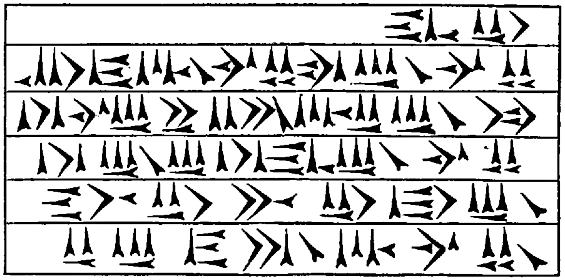
3. The Runes of the Gothic nations.—Deficient in proof of antiquity, not remarkably unlike the older Greek characters, and not originating in either an age or country where alphabets that might serve as models were inaccessible.
Fig. 17.

4. The Irish Ogham.—Shown to be of a very limited antiquity—See two papers of Professor C. Graves on the subject.
5. 6. Georgian and Armenian.—Not generally considered to be derivations from the Syriac, only from the differences of their characters; a ground of separation subject to the application of Rule 1.
7. The alphabets of Southern India.—Subject to Rule 1;
8. The alphabets of Northern India.—Subject to Rule 1; except so far as they rest upon the two following assumptions:—1st, That portions of the Hindu literature (the Vedas) are of an antiquity so remote as to be previous to either the invention or the diffusion of the first Semitic alphabet. 2d, That an Indian alphabet of equal antiquity, was necessary to embody them.
Admitting the latter of these two assumptions, I agree with those who doubt the first; and so far from inferring the existence of an ancient alphabet from the Vedaic writings, am inclined to infer a recent date for the Vedaic writings from the absence of an undeniably old and original alphabet.
9. The original alphabets of the Malays of Sumatra, Celebes, the Philippines, &c.—Subject to Rules 1 and 4.
10. The Tuarick alphabet of Oudney and Richardson.—So deficient in signs of antiquity as to come under Rule 3.[185]
11. 12. The[186]Cherokee and Vei Alphabets.—Manifestly subject to Rule 3.
Fig. 18.
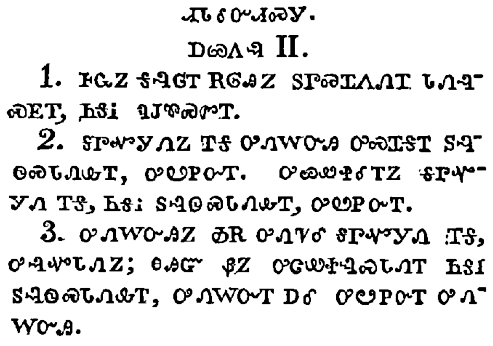
14. The Chinese and its derivatives.—It is chiefly on the strength of Rule 4, taken along with the general unsatisfactory character of the evidence as to the antiquity of the Chinese civilization, that I allow no greater claims to originality to this than to any of the preceding alphabets.
Upon the whole, it may safely be said that no known alphabet, except the Semitic, has any very strong claims to be considered as an original and independent invention, by any one who admits the validity of the four foregoing rules, and recognizes the full difficulty and complexity of the notation of sounds addressed to the ear, by lines and points addressed to the eye.
The accumulation of climatologic influences, and the angle of the line of migration.—Other conditions being equal, why do two tribes under the same degree of latitude differ? e.g. Why are not all tribes under the equator like the Negro of the Niger, and vice versâ?
Without venturing upon the enumeration of all the elements of this difference, I will indicate one, assuming only that the climatological influences of a certain degree of latitude have some effect, and that some effect must be the result of the force in question. I call it the accumulation of climatologic influences.
Let a certain locality under a given degree of latitude (say the west-coast of Africa, under the equator) be peopled by a line of population migrating from Denmark, under one supposition, and from Bombay, under another, the line of migration being, for convenience sake, supposed to be a straight one.
From Denmark, such a line, at its junction with the point in question (say the mouth of the Gaboon River), would form with the equinoctial line, and with each intermediate degree of latitude, a right one.
From Denmark, the angle would be, a very acute one.
Now, just as the angle formed by the line of latitude and the line of migration is acute, the approach made by a moving population towards any particular point under that line (of latitude) is gradual, and in proportion as such an approach is gradual, the number of generations over which a condition of climate, like that of the final point, has been acting is increased; and in this way its influences become accumulated.
Thus, assuming Bombay to be the original cradle of our species—
The Gaboon Negro is the descendant of ancestors who, before they reached their present abode, had moved in a line lying almost wholly within the tropics; whereas—
The American of Quito, is the descendant of ancestors who passed through the tropics by the shortest cut (i. e. at nearly a right angle with the equator), themselves descended from progenitors upon whom the influences of the several North-American, Arctic, and Siberian climates had been at work.
In the latter case how great have been the changes and how rapid the transitions from the conditions of one latitude to another; how different, too, the effects upon a series of generations moving along a line a thousand miles long, from north to south, from those upon a stream of population propagated along an equal distance east and west.
The former takes them through half the latitudes of the world. The latter keeps them within a single zone—Arctic, Equatorial, or temperate, as the case may be, the climatologic influences seconding, instead of counteracting those of blood, and that in a ratio progressing geometrically.
FOOTNOTES:
IAPETIDÆ. DIVISIONS.
A.—Occidental Iapetidæ.
B.—Indo-Germanic Iapetidæ.
This is the section of our species which is the best known, and which has been the earliest described. Preeminently lying within the department of the historian and archæologist, the natural historical questions connected with it, are those of the minute rather than the systematic ethnographist.
Thus—the information, which would be so valuable in Africa or America, as to the general relations of a particular population, is useless here. All such facts are known; and in dealing with areas like Britain, or Italy, we ask—not to what great primary class the Englishman or the Italian belongs, but the subtler questions as to the differentiæ of their mental and physical characteristics, or the amount of foreign intermixture which in one case traverses the original Saxon, and in the other the primitive Roman stock—each stock itself being a complex product.
Ethnology of this sort has its proper exposition in a series of monographs, rather than in a work like the present.
So thoroughly are the Iapetidæ, populations who have encroached upon the frontiers of others rather than admitted encroachments on their own, that, with the exception of the Arab dominion in Spain, which has not, and the Turk and Majiar in Rumelia and Hungary, which have lasted till our own times, there is no instance of their permanent displacement by either Mongolidæ or Atlantidæ of any sort.
Within their own pale, the Celts were the encroaching family of the oldest, the Romans of the next oldest, and the Anglo-Saxons and Slavonians of the recent periods of history.
A. OCCIDENTAL IAPETIDÆ.
Languages.—Separated from the common mother-tongue subsequent to the evolution of the persons of verbs, but anterior to the evolution of the cases of nouns. Evidently agglutinate.
Here, as with the Atlantidæ, we begin with an extreme, rather than a transitional division of the stock.
CELTS (KELTS).
Name.—Either native, Ligurian, or Iberian. In its limited sense confined to the southern Gauls. Possibly to some of the Iberians as well. At present, a general term comprizing populations very different from the original Keltæ (Κέλται). And adopted by the Greeks rather than the Romans.
Present area.—Brittany, Wales, the Highlands of Scotland, the Isle of Man, Ireland.—In Brittany it is doubtful whether the Keltic occupancy represent original distribution or immigration.
Original area.—a. Undoubted.—The present the Scottish Low-lands, England, Gaul north of the Loire (there or thereabouts), and parts of Switzerland.
b. Probable.—Parts of Baden, and Bavaria, Northern Italy. In this latter case it is doubtful whether the Keltic occupancy represent original distribution or immigration.
c. Accredited (either in way of original distribution or migration).—The Tyrol (Taurisci), Illyria (Scordisci), Asia Minor (the Galatians), Spain (the Celt-Iberians), Jutland (Cimbri).
Frontier.—Preeminently receding; the encroaching populations being (1st) Roman, (2nd) Gothic.
Conterminous with—a. in the original area; Iberians, Italians, German Goths. b. in the present; English Goths, and French.
Chief divisions.—1. Kelts of Gaul, falling into, a. The proper Celtæ. b. The Belgæ. Extinct(?) or incorporate.
2. British Kelts, falling into, a. The Cambrians. b. The Picts. The latter either extinct or incorporate.
3. Gaels. a. Scotch Gaels. b. Irish Gaels. c. Manxmen, or Gaelic Kelts of the Isle of Man.
4. The Cisalpine Kelts of Northern Italy.
5. The Ligurians(?) extended from the Etruscan to the Iberian frontier.
Sub-divisions (more or less artificial) of the Cambrian Kelts.—a. Cumbrians of the kingdom of Strath-Clyde. b. Cymry of North Wales. c. Cymry of South Wales. d. Cornish Kelts.
Philological Classification of the known Keltic languages.—
Keltic Stock. | ----------------------------------------- | | Cambrian (British) Branch. Gaelic Branch. | | ------------------------------- ------------------------------------ | | | | Welsh. Cornish. Armorican. Scotch Gaelic. Irish Gaelic. Manx.
Descent.—From the ancient tribes of Ireland, Scotland, England, Gaul (north of the Loire, and west of the Rhine), Helvetia, and the Agri Decumates(?). The Cimbri[187] and Teutones.
Physical conformation.—Preeminently (according to Retzius) dolikhokephalic. Cheek-bones, prominent; complexion, referable to—
a. The Silurian type.—Eyes and hair, black; complexion, dark, with a ruddy tinge; chiefly found in South Wales.
b. The Hibernian type.—Eyes, grey; hair, yellowish, red, or sandy; complexion, light.
Pantheon.—Teutates, Taranis, Hesus, Belenus (Belis), Abellio, Belatucadrus, Attis, Aufaniæ (Goddesses), Aventia, Bacurdus, Camulus, Onuava, Ogmius, Nehalunnia, Dusius (the Deuce), Salivæ (Sylphs)—Mithridates vol. iii.
To this, add the phænomena involved in the system of a. The Druids. b. The Bards. c. The monumental remains of the character of Stonehenge=Máenhír=long stones.
Antiquities.—Coins, images, tumuli, and their contents, Máenhír.
Habits.—In southern and central Gaul, and in southern and central England, at least, agricultural and industrial. On the coast, maritime.
Probable line of population.—To Ireland from the nearest part of Scotland, to Scotland from England, to England from the parts about Calais and Dunkirk.
This last observation has been made in order to guard against any false impression arising from the statement of Bede that the Scots came from Ireland. The evidence of this is, at best, but a tradition, apparently founded upon an inaccurate etymology. Even if true, it would apply only to some secondary migration, and be subject to the criticism applied to the relations between the Island of Sumatra, and the Peninsula of Malacca, as Malay areas.
FOOTNOTES:
B. INDO-GERMANIC IAPETIDÆ.
Languages.—Separated from the common mother-tongue subsequent to the evolution of the cases of nouns. Less evidently agglutinate than the Keltic.
The previous and the forthcoming groups are generally placed in one and the same class—that class being called Indo-European. The material fact of the Kelts having broken-off from the mother-stock at an appreciably early stage in the evolution of the common language, has led the present writer to refine upon the usual arrangement. To prove that the Kelts and Goths are related, is a very different matter from proving that their relationship is within a certain degree.
The Indo-Germanic Iapetidæ fall into two classes—
1. The European; 2. The Iranian Indo-Germans.
I. EUROPEAN INDO-GERMANS.
Of this class the sub-divisions are three—1. The Gothic. 2. The Sarmatian. 3. The Mediterranean Indo-Germans.
1. GOTHS.
Physical conformation.—a. Blue eyes, flaxen hair, ruddy complexion, smooth skin, fleshy limbs.
b. Eyes, gray, dark, or hazel; hair, brown or black; complexion, sallow or swarthy; bulk, varied.
Area.—Preeminently encroaching.
a. Original.—Western Germany, Denmark(?), southern part of Scandinavia(?).
b. Present.—Germany and Scandinavia in general, Switzerland, Holland, Belgium, Great Britain and Ireland, the United States of America, Canada, Australia.
Descent.—From the Germans of that part of the ancient Germania which lay (there or thereabouts) between the rivers Rhine and Elbe.—Batavi, Chamavi, Caninifates, Frisii, Chauci, Angrivarii, Bructeri, Catti, Cherusci, Fosi, Marcomanni, &c.
Primary Divisions.—a. Teutons. b. Scandinavians.
a. TEUTONS.
Area.—Germany.
Language.—Without a middle (or passive voice) and with the definite article separate from and preceding its noun.
Primary divisions.—α. Mœso-Goths. β. High Germans, γ. Low Germans.
α. MŒSO-GOTHS.
Original area.—The water-system of the Upper Danube, probably parts of Bavaria and Thuringian Saxony.
Area in the third and fourth centuries.—The Roman province of Mœsia.
Language.—Partially preserved in the Translation of the Scriptures, by Ulphilas, in the reign of Valens.
Divisions.—1. Ostrogoths (=East-Goths), of which the royal line was that of the Amalungs. 2. Visi-Goths (=West-Goths); of which the royal line was that of the Baltungs.
Current names.—Probably not given till after the occupation of the country by the Getæ.
Native names.—Probably Grutungs and Tervings (Thuringians).
Reasons for believing that the so-called Goths of the Lower Danube were not indigenous to the country in which we find them in the reign of Valens, that they were in no wise descendants of the Getæ, and that they were not known by the name Goth until they took possession of the country of the Getæ, are given in the Transactions of the British Association for 1849, and in The English Language of the present writer.
He now arrives at their probable home in Germany by the method of exclusion, i.e. by determining what portions of Germany were most certainly occupied by non-Mœso-Gothic populations.
These he places in the country, drained by the northern feeders of the Upper Danube, believing that from this point the migration took place by the waters of the Danube rather than by land.
The two following facts are the chief reasons for this latter view:—
1. Their subsequent maritime career on the Euxine.
2. Their non-occurrence at intermediate points.—The first place whereat we hear of them is Marcianopolis, as far east as the vicinity of the Euxine. From this they afterwards move westward, i.e. towards Rome and Spain.
β. HIGH GERMANS.
Area.—Hesse and parts of Thuringia and Bavaria; conterminous (though by frontiers hitherto imperfectly investigated) with the Kelts of the Upper Rhine, the Slavonians of the Upper Elbe, and the original area of the Mœso-Goths.
Language.—Forming the plurals of nouns in -n rather than in -s, and those of verbs in -n, -m, or -nt, rather than in -th (dh).
High Germans of the Roman period.—Alemanni, Suevi(?), Burgundians(?).
The spread of the Teutonic populations, as contrasted with the Keltic, Slavonic, and Roman, in general, combined with the numerous displacements of particular portions of the German tribes themselves, makes the question of descent excessively complicated. Perhaps the best present representatives of the High-Germanic division are the modern—
HESSIANS.
Locality.—Hesse, conterminous with the Franks, Saxons, and Thuringians.
Descent.—The Catti.
And after these the—
THURINGIANS.
Area.—Bounded, east and west, by the rivers Werra and Saal, the latter a Slavono-Germanic limit. In its southern extension, probably, passing into some language representing the Mœso-Gothic.
Conterminous with the Hessians on the west, either a nation, or a confederacy, and transitional between the High and Low Germans; the—
FRANKS.
Language.—More Dutch than Saxon or Frisian, and (perhaps) more High German than Dutch.
Area.—Indeterminate, but ethnologically bounded by those of the Batavians, Old Saxons, and High Germans. Encroaching; being that of the population which either displaced or incorporated the Old and the Hanoverian Saxons, as well as the greater part of the Slavonians of the Elbe.
Descent.—Usipetes, Ripuarii, Sicambri.
γ. LOW GERMANS.
Languages.—With the plural forms generally ending in -a, or -s rather than -n.
Area.—The Lower Rhine, Ems, Weser; the Elbe near its mouth.
Divisions.—1. Batavians. 2. Saxons, 3. Frisians.
BATAVIANS.
Locality.—Holland minus Friesland.
Language.—Low German, with the plurals ending in -n, rather than -s, -a, or -r.
Descent.—From the Batavi, Chamavi, Tubantes, Salii(?), Caninifates.
SAXONS.
Language.—Forming the infinitive mood in -an (not in -a), certain plurals in -as (not in -n), and the plural of the present tense in -þ (not in -n, or -a).
Divisions.—1. Nordalbingians (=north of the Elbe) of Holstein. Most probably Saxons. Extinct, or incorporated.
2. Saxons of Hanover.—Extinct, or incorporated in Germany. The Anglo-Saxons of England.
3. Saxons of Osnaburg and Westphalia.—Extinct or incorporated. Descendants of the Cherusci.
FRISIANS.
Language.—Low German, with the infinitives ending in -a.
Physical appearance.—Preeminently of the first type.
Divisions and localities.—1. West Frisians, of Friesland and Groningen; the latter speaking the Dutch of Holland. Descendants of the Frisii.
2. East Frisians of East Friesland, Oldenburg, and Hanover.
Language.—Except in Saterland, replaced by the German. Descent from the Chauci.
3. North Frisians of Heligoland, and the parts about Husum and Bredsted, in Sleswick.
The date of the occupancy of the North Frisians is uncertain. Probably, they are emigrants from Hanoverian Friesland rather than aborigines.
The Frisian is the most unmixed, and typical portion of the Gothic population. It is also transitional between the Teutons and the—
b. SCANDINAVIANS.
Area.—Denmark and Scandinavia.
Languages.—With a middle voice, and with the definite article incorporated with, and appended to, its noun. (Thus, whilst sol=sun and bord=table, hin=the for the masculine, and hitt=the for the neuter gender, sol-en=the sun, and bord-et=the table.)
Divisions more or less artificial.—1. Icelander. 2. Feroe Islanders. 3. Norwegians. 4. Swedes. 5. Danes.
What is the import of the differences just indicated between the Scandinavian tongues and the Teutonic; are they of such slow growth as to denote a very early separation of the Dane and Swede from the Northern German, or might they be evolved in a comparatively short space of time? The answer to this involves the question as to date of the Scandinavian migration into the parts north of the Eyder.
My own opinion is that a common mother-tongue might, within the space of a few centuries, develop itself into the languages represented by the present Frisian on the South, and the Scandinavian dialects on the North respectively. If so, the Gothic occupation of the Scandinavian area need not amount to any very remote antiquity. Probably, I am singular in this opinion. It will be noticed again within a few pages.[188]
2. SARMATIANS.
As this class comprises the Lithuanic as well as Slavonic members of the so-called Indo-European class, the term Sarmatian has been preferred to either of the more sectional denominations.
Physical conformation.—According to Retzius, brakhykephalic rather than dolikhokephalic, Indo-Germans. In many cases approaching the Turanian type.
Intermixture.—Turanian, arising from the so-called Tartar invasions. How far the Tartar intermixture coincides with the brakhykephalic formation of the cranium requires investigation.
Extent of area.—West and east from (about) 10° to (about) 40° west latitude. From (about) 40° north latitude to (about) 60° north latitude.
Primary divisions.—1. Lithuanians. 2. Slavonians (Slaves).
The point most open to objection in the present section is extent, to which the original area of the Sarmatians is brought westwards.
a. LITHUANIANS.
Philological Divisions.—1. Prussian (or Old Prussian).—Dialects of Samland, Nattangen, Tolkemir—Extinct, and known only through a pater-noster and a vocabulary of A.D. 1521, a catechism of A.D. 1545, and a pater-noster of A.D. 1561. Spoken in West and East Prussia from (there or thereabouts) the Vistula to the Pregel.
2. Lithuanic.—Spoken from the Pregel to the frontier of Courland.—Dialects of Insterburg and Nadrau in Prussia, and the Shamaitic dialect in Polish Lithuania.
3. Lettish.—Courland, Southern Livonia, parts of Wilna, and Witepsk.—Dialects—numerous, i.e. for the parts about Liebau (corrupt), Mittau (pure), Riga (pure), Dunaburg (corrupt).
Descent.—A. From nations of tribes of the Middle Ages—
a. The Galanditæ, Sudowitæ, Pomerani, Pogesani, Warmienses (Hermini, Jarmenses), Nattangi, Barthi, Nadrovitæ, Sambitæ, Scalovitæ.
b. Jaswingi, Pollexiani.
c. Lettones, Samogitæ, Semgalli, Carsowitæ.
d. Curi (Curanii), Lami (Lamonii), Lettgalli (Letti), Ydumei, Selones,—Zeuss, pp. 674—683.
B. From the nations or tribes of classical antiquity.—The Ὠστίωνες of Stephanus Byzantinus=the Ὠστίαιοι of Artemidorus= the Κόσσινοι of Pytheas=the Gothones (Guttones) of Tacitus; the Lemovii.
Pantheon.—Perkunos, Potrimpos, Picollos.
Native name of a certain section.—Guddon (=Guttones).
The main points connected with the Lithuanian branch of the Sarmatian stock are the following:—
1. Of all the Iapetidæ they preserved their original paganism the longest.
2. Of all the Iapetidæ they have had the least influence on the history of mankind.
3. Of all the Iapetidæ they speak a language nearest in structure to the Sanskrit. It is the latter fact which has given prominence to the Philological Divisions of so important a tongue.
Prominence, too, has been given to their relations in the way of descent, since the denial of the existence of any nations, other than Sarmatian, as occupants of the water-systems of either the Vistula or the Oder, anterior to the tenth century, notwithstanding the numerous statements as to the occurrence of Gothic tribes in the present countries of Mecklenburg, Pomerania, Prussia, Courland, and even Esthonia, is a point to which I have no hesitation in committing myself; a series of papers upon the subject being in the course of delivery and publication, for the Philological Society.
Furthermore, whoever will so far divest himself of his prepossessions as to admit the possibility of the Jute of Jutland, and the Goth of Gothland being something other than Gothic in the usual sense of the term, will find that no provisional hypothesis will explain so many of the difficulties created by the conflicting evidence involved in the terms Jute, Eote, Goth, Reid-Goth, Gaut, &c., as that of an extension of the Lithuanian Vitæ, or Guttones, to the southern parts of Sweden and to Jutland.
I say, Lithuanian Vitæ and Guttones, because whatever may be the value of other supposed applications of the roots Goth-, Jut-, and Vit-, the only families to which any of them have undeniably been brought home as a native name are the Lithuanic.
Besides this, I am so far from attributing either an over-high antiquity, or a preeminent independence of origin to the Scandinavian mythology, that I see in the God Ymer, the Finnic Yumala, and in the Fiorgyn, the Lithuanic Perkunos.
Lastly, the combination k-l-m (as in Kalmar) is not the only geographical root common to the two sides of the Baltic, Lithuanic and Swedish.
Still, the hypothesis is, at present, little beyond a mere suggestion.
b. SLAVONIANS.
Divisions.—A. Extent.—Chiefly philological. α. Russians. β. Servians, γ. Illyrians. δ. Tsheks. ε. Poles. ϛ. Serbs. ζ. Polabi.
B. Extinct or incorporate, but undoubtedly Slavonic.—The Slavonians of Mecklenburg, Brandenburg, Uckermark, Altmark, Luneburg, Holstein, &c.
C.—Extinct or incorporate, but not undoubted Slavonic.—The following nations of antiquity.—1. Scoloti (Σκόλοτοι), Getæ, Daci, Thracians, Pannonians, original inhabitants of Noricum and Dalmatia, Crobyzi (whence Chrobati and Croatian), &c.
Descent.—a. From nations and tribes mentioned by the authors of Classical Antiquity.—Thracians (?), Getæ(?), Daci(?), Pannonii(?), Iazyges, Limigantes, Quadi, Ligii (Lekhs=Poles), Silingæ, Bastarnæ, Suardones, Rugii, Buri, Sciri, Turcilingi, Venedæ, &c.
b. From nations and tribes mentioned by Slavonic authors.—Morawa (Moravians), Czeczi (Bohemians), Chorwati bjelii (= White Croatians), Serb', Chorutane (Carantanians), Ljachowe (Lekhs=Poles), Luticzi, Masowszane (Masovians), Pomoranje (Pomeranians), Derewljane, Poloczane (probably Lithuanians), Sjewera, Radimeczi, Wjaticzi.—Zeuss.
Earliest introduction of Christianity.—The eighth century.
Pagan Pantheon.—a. Of the Middle Age writers.—Veli-bog=White God, Czerne-bog (Tshernibog)=Black God, Perown, Sviatowit (Swantevit), Radegast, Vitislav, Krasopani, Pogwist, Jessa, Laicon, Nia, Marzana, Zievonia, Lelus, Potetus, Liadu, Djedijielia, Pogoda.
b. Of the Classical writers.—Zamolxis, Gebeleixis(?).
α. RUSSIANS.
Original area.—-Roughly speaking, the eastern part of the water-system of the Dnieper.
Conterminous with—a. Lithuanians on the Middle Pripet, and Upper Duna (i.e. in Mensk and Viteskp). b. Ugrians along the Valdai range, and on the Oka. c. Ugrians, Turks, or Caucasian, south-east.
Dialects.—a. Russian Proper, b. Susdalian, spoken in the government of Moscow. c. Olonetz. d. Malo-Russian (Little Russian) of the Ukraine, probably passing into the e. Russniak of Bukowina, Lodomir, and Gallicia and f. the White Russian of Volhynia.
Alphabets.—Derived directly from the Old Slavonic, indirectly from the Greek.
Christianity.—Greek Church. Introduced between A.D. 980, and A.D. 1015.
β. SERVIANS.
Divisions.—1. Servians of Servia, Slavonia, Transylvania, and New Servia (a Russian colony on the Dnieper, settled A.D. 1754).[189] 2. Bosniaks of Bosnia and Herzegovina (Mahometans). 3. Dalmatians, Ragusans, and Montenegriners of Monte Negro, conterminous with the Albanians.
Alphabet.—Old Slavonic, of Cyrillus and Methodius for Servia. Glagolitic for Dalmatia. Both of Greek origin.
Christianity.—Greek Church. Introduced anterior to 800 A.D. Old Slavonic, the church language.
γ. ILLYRIANS.
Divisions.—a. Croatian. b. Slovenzi of Carinthia, Carniola, Steyermark, South-western Hungary.
Alphabet.—Originally of Greek origin, or Glagolitic. Replaced by the Roman.
Christianity.—Originally of the Greek Church; replaced by Romanism.
δ. TSHEKS.
Native name.—Tshekh (Czech)=foremost(?).
Descent.—The Western Daci (=Czech?).
Divisions.—a. The Czesky Gazyk=Tshekh language of Bohemia. b. The Morawsky Gazyk=Moravian language of Moravia. c. Slovac, Upper Hungary, i.e. the water-systems of the rivers Waag and Gran.
Alphabet.—Roman.
Christianity.—Roman Catholic, introduced in the ninth century.
ε. POLES.
Philological divisions.—1. Of Poland, Posen, and parts of Lithuania and Gallicia.
2. Kassubic.—a. Of West Prussia. b. Pomerania.
Descent.—From the Lygii of Tacitus.
Alphabets.—Roman.
Christianity.—Roman Catholic and Protestant.
Native name of at least one tribe—Lekh, the term Pole, being the geographical rather than ethnological, and=level plains.
ϛ. SERBS.
Localities and divisions.—a. The Sserske (a native name) of Lower, b. The Srbie (do) of Upper, Lusatia.
Partial descent.—The Silingi.
ζ POLABIC SLAVONIANS.
The word po=on, and Labe=Elbe, so that the Polabic Slavonians means the Slavonians on the Elbe. The importance of this section arises from the fact that at the time of Charlemagne they were, with the exception of the tract occupied by the Saxons of Holstein, and the north-west part of Hanover, not only the occupants of Mecklenburg, and the parts east of that river, but of Lauenburg, Luneburg, Altmark, and a vast section of Germany to the west of it.
To suppose that the Slavonic frontier was not equally extended westwards, in the eighth, seventh, sixth, fifth, fourth, third, second, or first centuries, is, in the first instance, to admit the accuracy of an author like Tacitus.
On the other hand, however, it involves the assumption of so vast an amount of migration, displacement, and other unlikely ethnological processes, that a writer who weighs conflicting probabilities is led to the conclusion that a great historian is more likely to be wrong in the ethnology of countries like Prussia and Poland—countries which could be known to Tacitus only as the interior of Africa can be known to Mr. Hallam or Macaulay—than that, between A.D. 100, and 900, a whole Gothic population, extending from the Niemen to the Elbe, should have been replaced by a Slavonic one, without leaving a single trace of its existence in any intermediate locality; the same encroaching Slavonians, when we first find them mentioned by cotemporary historians, being themselves in a state of displacement by the same previously-displaced Germans.
This, however, is but a very general and superficial view of the difficulties that attend the belief that the Oder and Vistula were originally German. Nevertheless, it is all that room can be found for here.
As to the tribes themselves the chief were—
The Wagrians.—Occupants of the country between the Trave and the upper portion of the southern branch of the Eyder.
The Polabi.—Conterminal with the Wagrians and the Saxons of Sturmar, from whom they were separated by the river Bille.
The Obodriti.—This is a generic rather than a specific term. It means, however, the tribes between the Trave and the Warnow; chiefly along the coast. Zeuss makes Schwerin their most inland locality.
Varnahi.—This is the form which the name takes in Adam of Bremen. It is also that of the Varni, Varini and Veruni of the classical writers; as well as the Werini of the Introduction to the Leges Anglorum et Werinorum, hoc est Thuringorum.
Linones.—Luneburg. Language spoken during the last century. Known through a pater-noster. Slavonic, modified by German.
Such are the chief western Slavonians of the time of Charlemagne. If they were not also the western Slavonians of the first and second centuries, they must have emigrated between the two periods;[190] "must have done so, not in parts but for the whole frontier; must have, for the first and last time, displaced a population which has ever been the conqueror rather than the conquered; must have displaced it during one of the strongest periods of its history; must have displaced it everywhere, and wholly; and (what is stranger still) that not permanently—since, from the time in question, these same Germans, who, between A.D. 200 and A.D. 800, always retreated before the Slavonians, have from A.D. 800 to A.D. 1800, always reversed the process, and encroached upon their former dispossessors."
3. MEDITERRANEAN INDO-GERMANS.
Physical conformation.—Dolikhokephalic, high facial angle; hair, eyes, and complexion, dark; frame, more slender than bulky.
When we consider that the aborigines of Spain were Iberic, that they probably extended as far as the Rhone, and that the ancient Ligurians of the Gulf of Genoa are not absolutely known in respect to their ethnological relations, the apparent impropriety of restricting the term Mediterranean to the classical nations of Greece and Italy becomes diminished; to which it may be added that the undoubted civilizational influence of the land-and-water conditions of these two peninsulas requires some term to suggest it. The term, nevertheless, is open to amendment.
So much of what belongs to Greece and Italy is historical, that the brevity of the preceding and following notices may be excused.
MEDITERRANEAN FAMILIES AND NATIONS.
Localities.—Greece and Italy.
Area.—Discontinuous.
Divisions.—1. The Hellenic branch. 2. The Italian (Ausonian) branch.
Historical Influence.—Preeminently moral. Material as well.
The discontinuity of the Greek and Italian areas is a difficulty which requires more investigation than it has met with, and is a purely ethnological question.
So is the archæological part of both the Greek and Roman ethnology, i.e. the relations of the Hellenes and Latins to the early inhabitants of their respective peninsulas.
So is the analysis of their present representatives, e. g. the question as to the amount of Slavonic, Italian, or Albanian blood in the modern Greek, or the determination of the Keltic, Roman, and Gothic elements amongst the French.
Of the sub-divisions of the—
ITALIAN BRANCH
the following classification is, perhaps, the most convenient; to which the previous arrangement of the ethnological elements into a, the Original; b, the Roman; and c, the Superadded, gives precision.
1. Italians.—Original Elements—a, Samnite, Etruscan, Keltic(?), Ligurian, &c.; b, Roman of Rome; c, German.
2. Hesperians. (Spanish and Portuguese).—a, Iberian, Celtic(?); b, Roman of the time of the second Punic war; c, Gothic, Arabian.
3. French.—a, Celtic for the North, Iberian for the South; b, Roman, chiefly from the time of Cæsar; c, German.
4. Swiss of Graubündten.—a, Undetermined; b, Roman of an uncertain, though probably late, period; c, German.
5. Wallachians.—a, Undetermined; probably Slavonic; b, Roman of the time of Trajan; c, Turk (Hun, Comanian, and Bulgarian), Slavonic, German, Ottoman, Turk.
II. IRANIAN INDO-GERMANS.
The whole of this class is hypothetical. Such as it is, however, it comprises the populations of Kurdistan, Persia, Beloochistan, Affghanistan, and Kafferistan.
In order to understand the complications which leave so large a section of the human species in an unsatisfactory ethnological position, a notice of the Sanskrit language, and of the history of opinion concerning it, is necessary.
The language called Sanskrit has a grammar of the same copiousness and complexity as the Greek, and a vocabulary which places it in the Indo-European class of tongues.
It is the language of the religious and literary writings of the Brahminical Hindus; the Ramayana and Mahabharata (epic poems) being referred by Sanskrit scholars to the second century B.C.
A more archaic form of it is the language of the Vedas, referred by some Sanskrit scholars to 1400 B.C.
A form said to approach the archaic character of the Veda. Sanskrit is the language of the arrow-headed inscriptions—so far as they are Persian; the date of these being the reign of Darius.
A form (the Pali) less archaic than the Sanskrit of the Mahabharata has been found upon inscriptions of the æra of the Seleucidæ in Babylon, and as such in records older than that of the Non-Vedaic Sanskrit literature.
The same Pali is the language of the Buddhist religion and literature in India, in Ceylon, in the Trans-Gangetic Peninsula, in Tibet, and in the Sub-Himalayan range.
The Zend, a form closely allied to the proper Sanskrit is the language of the oldest Parsi religious books, the Zendavesta.
Lastly—The inscriptions upon the Indo-Bactrian coins of the successors of Alexander are either Sanskrit or nearly Sanskrit.
It is convenient in speaking of these several forms of speech as a class, to designate them by the term Iranian.
It is convenient, also, to indicate the extent to which the approach made by the Persepolitan of a period so late as the reign of Darius, to the Vedaic dialect, said to be about one thousand years older, subtracts from the value of a common argument in favour of the antiquity of the Vedas, viz. the extent to which the language is more archaic than the Sanskrit of the Epics.
It is well too, to indicate as a further disturbance to the current opinions, the bearing of the Pali character of the inscriptions; whereby the oldest records are embodied in the newest form of language.
All these, however, are subordinate questions; the main point being the enumeration of the Iranian Indo-Germans.
The Iranian Indo-Germans are those nations and tribes, whatever they may be, who are descended from the speakers of the Iranian languages—be they Sanskrit Proper, the Sanskrit of the Vedas, Pali, Zend, or Persepolitan; languages, which, it must be observed, are, in the present state of our inquiry, dead languages.
What, then, are these tribes and nations? The answer to this gives us the Iranian Indo-Germans.
When the Sanskrit literature of India first commanded attention, the answer to this question was—all the nations of Hindostan.
The first researches (those of Ellis and others) upon the languages of southern India showed that the Tamul tongues, at least, were not in this category.
Further researches (those of Dr. Stevenson and others) gave reasons for making the Mahratta language Tamul rather than Iranian—not that the vocabulary was not Sanskritic, but that the grammar was such as could never have been evolved out of the grammar of that tongue.
Prominence being thus given to the non-Sanskritic character of the grammar of one Indo-Gangetic language, the undeniable fact of a vast per-centage of the vocables being Sanskrit, fell in value, as a sign of philological relation.
Thence came an application of the criticism which had unfixed the Mahratta language to the other (apparently) more undoubtedly Iranian dialects of Northern India—the Udiya, the Gujerati, the Hindi, and the Bengali.
The present writer believes that it unfixes these also; an opinion to which he has been led quite as much by what has been said by the defenders as by what has been said by the impugners of their Sanskritic origin. It is not likely any better case will be made out for this, than the one contained in a very able Dissertation of Dr. Max Müllers.[191] Yet it is so unsatisfactory, that it almost proves the question the other way.
Now all this goes to show that Iranian Indo-Germans are not to be looked for in India; except, of course, as a foreign element to the originally Tamul population.
Whether they are to be looked for elsewhere, and (if anywhere) in what quarters, follows the notice of the—
PERSIAN STOCK.
Physical conformation.—Cranium, dolikhokephalic; complexion, varied, fair with the mountaineer tribes, dark with those of the sandy deserts of the south; features, sometimes regular and delicate, sometimes bold and prominent; in the one case approaching the character of the high-caste Indians, in the other Semitic or sub-Semitic.
Area.—Persia, Beloochistan, Affghanistan, Bokhara, Kafferistan.
Languages.—Undeniably Sanskrit in respect to a great per centage of the vocables. Not undeniably Sanskrit in respect to their grammatical structure.
The last sentence contains the reason for the provisional character of the present classification. The criticism, or rather scepticism, which has been extended by others to the Indo-Gangetic languages of Hindostan, is extended by the present writer to the Persian.
If so—the nation that is at one and the same time Asiatic and Indo-Germanic, remains to be discovered; it being remembered that it is only Indo-Germanic through its relations with the speakers of the Sanskrit.
The divisions (more or less artificial) of the Persian family are—
1. The Persians of Northern and Western Persia.—Mahometans. Occupants of elevated plateaux, the alluvial banks of great rivers being exceptional.
2. The Kurds of Kurdistan.—Mountaineers. Mahometans.
3. The Beluchi of Beloochistan.—Dark-complexioned, occupants of sandy steppes.
4. The Patans (Affghans).—Physiognomy frequently Semitic or sub-Semitic.
5. The Tajiks of Bokhara.—Here the dominant population is that of the Uzbek Tartars.
6. The Siaposh.—Fair-complexioned; pagan mountaineers, speaking a language with a great per centage of slightly-altered Sanskrit words.
I have no wish to undervalue the import of this last fact—a fact to which great prominence has been given.
Unaccompanied, however, with any proof that the grammar is Sanskritic, it leaves the question but little altered.
Kafferistan the Siaposh locality, is (roughly speaking) the watershed between the rivers Cabúl and Oxus. In these parts we find conterminous with the Siaposh, and doubtless in the same category—
1. The Lughmani.—Conterminous with the Affghans.
2. The Dardoh.—Conterminous with the Cashmirians.
3. The natives of Wokhan.—On the sources of the Oxus, conterminous with the Turks of Pamer.
More desirous of directing attention to the numerous ethnological difficulties which have arisen, and must yet arise from the adoption of the current opinion respecting the relations between the undoubted Indo-Germans of Europe, and the equivocal Indo-Germans of Asia (meaning thereby a native and aboriginal population), I abstain from any positive expression of opinion as to the quarter from which the Sanskrit language originated. That the language which stands in the same relation to it, as the Italian does to the Latin, has yet to be discovered I firmly believe; to which I may add that, except in Asia Minor or Europe, I do not know where to look for it.
In justice to the classification of the so-called Indian Mongolidæ, I must here remark that the position of the Indo-Gangetic portion of it as Tamulian by no means stands or falls with the relation of its languages to the Sanskrit; since, even if an undeniably Sanskrit origin were proved for them, the evidence of physical form would still justify the inquirer in asking whether they might not still be Tamulians whose language had been replaced by an imported one.
Fig. 19.
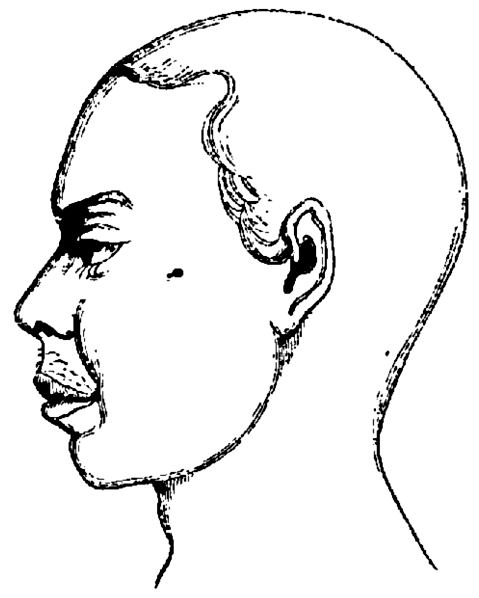
Fig. 20.
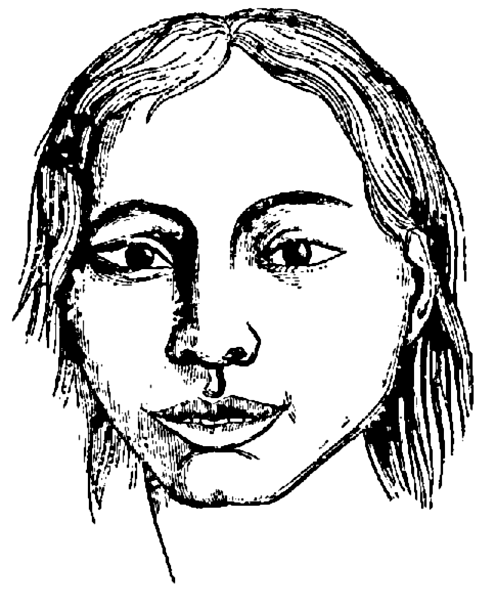
The term quasi-Pulinda now finds an explanation. The key to half the complexities of the ethnology of Hindostan lies in the fact of the Brahminical portion of the population being an invading one, whilst the degree to which it altered the physical and moral character of those who were invaded, has a great range of variation, from a general change to an inappreciable modification.
Fig. 21.
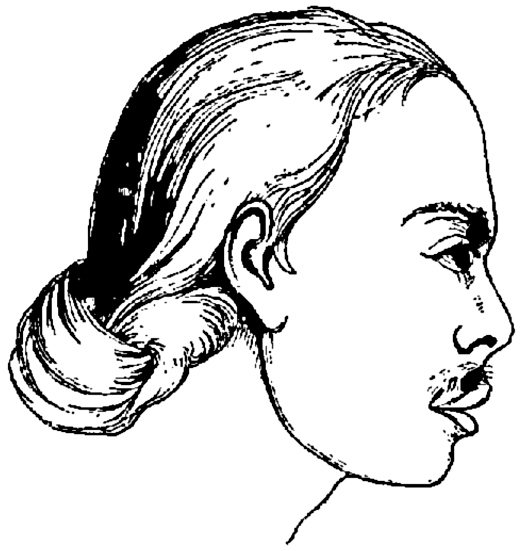
Now—where the invaded have been so little changed as to preserve both their original habits and their original language, they are full or true Pulindas; whilst, where they have lost their language, but retained enough of their habits to show their probable Pulinda relations, they are called quasi-Pulindas.
The "original[192] population of the country which now separates the nearest point of the Dioscurian area from the Seriform" must, in its earliest epoch, have been intermediate or transitional between the two stocks. However, long before the dawn of history, this was displaced. By what nations? Most probably, by one of the two following—The Turks, by means of a southern, the Persians by means of a northern extension.
UNPLACED STOCKS.
In the present state of our knowledge it is safest to leave the following stocks unplaced.
1. ARMENIANS.
That the Armenian language has Indo-Germanic elements is undoubted. Whether, however, they are sufficient to make it Indo-Germanic is questionable.
Sub-Semitic in appearance, and conterminous with the Semitic area, the Armenian has much in common with the tribes with which he is so often and so naturally associated, the Dioscurian Georgians; and it is through the Armenian that the transition from the Mongolidæ to the Atlantidæ is most likely to be recognized.
2. IBERIANS.
Native Name.—Euscaldunac.
Localities.—The provinces of Biscay and Navarre, in Spain; the department of the Basses Pyrenees in France. Conterminous with the French and Spanish.
Compared with the Spanish and Portuguese of the Peninsula, and (to a certain extent) with the French of France, the Basque language has the same relation as the Welsh has to the English. It is the remains of the ancient language of the whole country.
Considering its mountain locality and its position at the north-western extremity of the country, on the one hand, and the undeniably recent origin of the present Spanish and Portuguese, on the other, this is no more than is expected à priori.
Further proof, however, has been supplied by the researches of ethnographical philologists, most especially by those of W. Humboldt. In an elaborate essay, first published in Vater's Appendix to the Mithridates, that writer analyzes the names of the ancient Spanish rivers, mountains, and tribes, and shows that, whenever they have a meaning at all, that meaning is to be found in the Basque.
He shows more, viz. that not only Spain and Portugal, but that the Aquitanian province of Southern Gaul was Basque as well; in other words, that the present language of Bilbao and Navarre was extended southwards, and that of Les Basses Pyrenees northwards. Thus far the views of Humboldt have been generally received.
The extension of the Basque to Sardinia and Corsica, to Sicily and part of Italy, is more problematic. Nevertheless, it has been suggested; and, in the way of colonization, although not as an aboriginal language, it is probable.
A geographical extension, however, is not necessary to create an interest in the Basque language. Its antiquity is that of the oldest tongues of Europe. Before Rome, before Greece, before Tyre or Carthage had been attracted by the mineral wealth of the far west, the mother-tongue of the Basque was spoken on the Douro, the Tagus, the Ebro, and the Guadalquiver. Afterwards it was the language of those who defended Numantia and Saguntum; of those who dealt with the Greeks at Emporiæ, and of those who bought and sold with the Phœnicians at Gades and Tartessus. The Lusitani, the Turdetani, the indomitable Cantabri, were Euskaldunac. It is better, however, when speaking of the Basque in its oldest form to call it Iberic or Iberian.
That the general ethnological relations of the Basque are undetermined is denoted by the place it takes in the present volume. The principle, however, which is most likely to determine it deserves to be noticed. It arises out of a bold conception of (I believe) Arndt's, adopted in its fullest extent by Rask, and, serving, at the present moment, as one of the best methods which honourably characterize the Scandinavian school of ethnology.
Just as, in geology, the great primary strata underlie the more recent super-imposed formations, so does an older and more primitive population represent the original occupancy of Europe and Asia, previous to the extension of newer, and (so to say) secondary—the Indo-Germans.
And just as, in geology, the secondary and tertiary strata are not so continuous but that the primary formations may, at intervals, show themselves through them, so also do fragments of the primary population still exist—discontinuous, indeed, but still capable of being recognized.
With such a view—the earliest European population was once comparatively homogeneous, from Lapland to Grenada, from Tornea to Gibraltar. But it has been overlaid and displaced; the only remnants extant being the Finns and Lapplanders, protected by their arctic climate, the Basques by their Pyrenæan fastnesses, and, perhaps the nation next in order of notice.
The Euskaldune is only one of the isolated languages of Europe. There is another—the Albanian.
The notion that the Albanian is a mere mixture of Greek and Turkish, has long been superseded by the conviction that, although mixed, it is essentially a separate substantive language. The doctrine, also, that it is of recent introduction into Europe has been similarly abandoned. There is every reason for believing that, as Thunmann suggested, it was, at dawn of history, spoken in the countries where it is spoken at the present moment.