PART I. (continued 8)
Reading edition
Present locality.—With Saravecas, at Santa Ana and Casalvalco.
Numbers.—100 at Santa Ana, 50 at Casalvalco. All Christian.
Language.—Almost or wholly extinct. Out of a few words collected by D'Orbigny, five out of fourteen resembled the Otuké.
CURAVÉ.
Present locality.—The Mission of Santa Corazon.
Original locality.—The neighbourhood of the Saravecas and Curuminacas.
Numbers.—50.
Language.—Extinct. Said to have been peculiar. If so, the only important distinction between them and the other Chiquitos.
TAPII.
Present locality.—The Mission of St. Jago de Chiquitos.
Original locality.—The neighbourhood of the Otukés.
Numbers.—50.
Language.—Extinct. Said to have been peculiar. If so, the only important distinction between them and the other Chiquitos.
CURUCANECA.
Present locality.—Mission of San Rafael.
Original locality.—That of the Saravecas, Otukés, &c.
Numbers in 1832, about 50.
Language.—Extinct. Said to have been peculiar. If so, the only important distinction between them and the other Chiquitos.
CORABECA.
This nation was conducted by the Jesuits to the Mission of San Rafael; its original locality having been to the south of that settlement, on the borders of the Gran Chaco. Here they became unmanageable, and escaped to the woods—it is supposed to those of their original home. At present, the numbers were put by D'Orbigny's informants at 100: their language being said to be peculiar.
PAIOCONECA.
Present locality of the Christian Paioconecas.—The Mission of Conception.
Original locality.—The head-waters of the Rio Blanco and Rio Verde; 16° south latitude, 63° west latitude from Paris. Hither, it is supposed, some of the more intractable Paioconecas of Concepcion have escaped.
Conterminous with the Chiquitos, Saravecas, and the Chapacuras of Moxos.
Numbers of the Paioconecas of Concepcion, 360.
Particular Tribe.—Paunacas, 250 in number.
SAMUCU.
Localities.—South and south-east portions of the province of Chiquitos, on the limits of the Gran Chaco.
Conterminous with the Guanos, Guatos, Curaves, Xarayes, Otukés, Saravecas, Curuminacas, Paunacas, and Paioconecas.
Name.—That of a particular tribe extended to the whole nation. Other Samucu tribes, still existing, are the Morotocos, the Potureros, and the Guaranocos.
Habitat.—Forests, subject to inundations, when they retire to the hills.
The last three or four families have illustrated a common phænomenon in the ethnology of these parts; indeed, of many other parts of America as well, especially the United States.
It by no means follows that the existing locality of any section of the aboriginal population is the real natural and original one. On the contrary, wherever we find them Christianized, or semi-civilized, the chance is in favour of their having been moved from the original habitat to some so-called Reserve or Mission, and vice versâ. Now the Indians of the Reserves and Missions are almost always modificated in character as well as frequently mixed in blood. On the other hand, although less typical in the way of ethnological characteristics they are the best known, on account of the greater opportunities of intercourse; the laborious and successful Jesuit Missionaries of Spanish America being the chief authorities.
II. THE INDIANS OF THE CHACO.
Politically the Chaco, or Gran Chaco, is the tract nominally belonging to the inland and northern republics of the so-called Argentine Confederation, rather than to Bolivia; whilst geographically it is the water-system of the Paraguay and Upper La Plata, rather than of the Amazons. Ethnologically it is characterized by being the area of a civilization, which even when compared with that of Moxos and Chiquitos, is imperfect,—of a still more imperfect and partial Christianity, and of tribes which are at once nomadic, warlike, and independent; approaching, in their moral characters, the Charruas and Patagonians rather than the Peruvian.
The Indians of this part are either equestrian and nomadic, or else partially settled in villages; this latter being generally the case where the forests are densest, and where the river-sides afford tracts of alluvial (and often half inundated) soil. Our knowledge of them is preeminently scanty; still such vocabularies as are known exhibit miscellaneous affinities with the languages of other tribes of South America in general.
THE ABIPONIANS.
Divisions.—1. Abiponians Proper. 2. Mbocobis and Tobas. 3. Lenguas. 4. Payaguas. 5. Mataguayos. 6. Mbayas.
Sub-divisions.—Of the Mataguayos. The Chaès (Qu.? Guanas), the Yoes, the Matacos, Begosos, Chunipis, and Oeolis.
Localities.—a. Of the Abiponians, the central parts of the Chaco, conterminous with b, the Mbocobis and Tobas conterminous with the Araucanians of Chili. c. Of the Lenguas, the central parts of the Chaco. d. Of the Payaguas, the banks of the Paraguay as far as its junction with the Parana, e. Of the Mataguayos, the parts between the Pilcomayo and Vermejo. f. Of the Mbayas, the eastern shore of the Paraguay.
The Guayanas.—I am unable to say how far this is the same tribe as the Chanès and Guanas.
The Calchaquis.—In the time of Dobrizhofer, nearly extinct at present, most likely wholly so.—Equestrian.
Malbalaes, Mataras, Palomos, Mogosnas, Oregones, Aquilotes, Churumates, Ojotades, Tanos, Quamalcas,—probably extinct; at least they are placed by Dobrizhofer in the same category with the Calchaquis. Like the Calchaquis, also, they were equestrian.
Natekebits.—Equestrian. Probably Abiponian.
Amokebits.—Ditto.
Yapetalecas.—Ditto.
Oekakakalots.—Ditto.
The Lules.—Pedestrian; speaking the same language with
The Vileles and—
The Ysistines.—Pedestrian.
The Tonocote.—Converted and partially settled in towns.
The Homoampas, the Ocoles, the Pazaines,—Christianized.
The Caypotades and the Ygaronos, like the Zamucus, removed to the Missions.
III. BRAZILIAN TRIBES NOT GUARANI.
Explanatory of the words not Guarani, it is necessary to state that in Brazil begins a distribution of nations and tribes which, tested by the evidence of language, present the same phænomenon which is exhibited by the Algonkins of North America, i.e. a single area of language covering a vast space, in contrast with numerous areas covering a small one; a phænomenon which will be repeated when we reach Guiana and Essequibo. To clear, therefore, the ground, the non-Guarini Brazilians will be disposed of first.
THE BOTOCUDOS.
Synonym.—Aimorés, Guaymarés.
Native name.—Engcraecknung.
Locality.—The Sierra dos Aimorés, between the rivers Pardo and Doce, from 18° to 20° south latitude.
Divisions.—1. The Gherens. 2. The Kinimures.
Language.—Peculiar.
Inhabitants of shady forests, the Botocudos are light-coloured or yellow-coloured cannibals, with oblique eyes.
THE CANARINS.
Locality.—A small tribe very little known, between the river Mucury and the river Caravellas, in the Comarca de Porto Seguro.
THE GOITACAS.
Synonyms.—Goyatacaz, Waytaquases.
Called by the Portuguese.—Coroados=tonsured. By the Coropos—Chakwibu.
Divisions.—1. Coroados or Goïtacas Proper. 2. Puris. 3. Goaïnases(?) 4. Cariyos(?).
Sub-divisions.—Of the Goïtacas. a. Goitacamope. b. Goïtaca-asu. c. Goïtacá-Iacorito.
Locality.—The rivers Macabé, Cabapuana, and Xopoti for the Goïtacas. The upper part of the river Paraiba, and the interior of the province of Esperito Santo for the Puris.
The evidence that the Goaïnases, inhabitants of subterranean caves, and more incompletely known than the partially-civilized Goïtacas, belong to this group is inconclusive. So is the evidence as to the Cariyos. That the Puris speak a language closely akin to the Coroados may be seen in the Atlas Ethnologique.
The unsubdued remnants of the Cariyos, "still wander about in small bodies in the woods of Sierra dos Orgaos and in the meadows of the province of San Paulo. Descendants of them, settled in villages, are probably found in the Mission of Aldea da Escada, in the environs of Macabé, Ilha Grande, and the islands of San Sebastian and San Catharina."—Von Martius.
THE MACHACARI-CAMACAN (of Balbi).
Divisions.—1. The Machacari. 2. The Patacho. 3. The Camacan. 4. The Malali.
Sub-divisions.—(?) a. Of the Machacari—the Machacari Proper and the Macuari. b. Of the Camacan—the Camacan Proper, the Menieng, and the Cutachós.
Localities.—Of the Machacaris, the Rio Belmonte, formerly the Rio Mucury.—Of the Macuani (Maconi), originally the woody mountains on the boundaries of Minas Geraes, Porto Seguro, and Bahia; at present, the neighbourhood of Caravellas.—Of the Patacho, the river Mucury, and the head-waters of the rivers Pardo and Contas.—Of the Camacan, Bahia, between the rivers de Contas and Pardo.—Of the Menieng, a domiciled section of the Camacan, the Villa de Belmonte.—Of the Malali, Minas Geraes, on the Rio Senchy Pequeno, a northern tributary of the river Doce.
Synonyms of the Camacans—Mongoyós, Mongxocos, or Mangajas.
This is a class taken from the Atlas Ethnologique of Balbi, wherein we find a short specimen of the language or dialect of each nation enumerated as belonging to it.
Besides these, however, there is, in the same area, i.e. the parts about the watershed of the rivers Doce, Pardo Da Contas, &c., on one side, and that of the river San Francisco on the other.
THE COROPOS(?).
Locality.—Living along with the Coroados, on the river Xipoto.
Language.—Placed by Balbi with the Coroados, by Spix and Martius with the Macuani.
The discrepancy between the evidence of the two authors just named, explains the note of interrogation, and induces me to leave the Coropos as an unplaced tribe.
THE CHACRIABAS(?).
Original locality.—The river Preto, in Pernambuco.
Present locality.—In the district of Desemboque, in Goyaz.
Numbers in 1830, about 800.
In the paper of Von Martius, the Chacriabas, although placed geographically in the province of Goyaz, are stated to be, "probably at first a part of the same nation with the Malali."
THE KIRIRI.
Divisions.—1. Kiriri Proper. 2. Sabujah.
Locality.—Formerly in the interior of the province of Bahia, now settled in villages in Caranqueyo, and Villa de Pedra Branca.
THE CAPOJOS (CAPOXOS).
Locality.—Mountains between Minas Geraes and Porto Seguro. Migratory.
THE PANHAMI.
Locality.—Head-waters of the river Mucury, on the Sierra das Esmeraldas. Migratory.
THE CUMANACHÓS.
Locality.—Conterminous with the Capojos.
THE CACHINESES.
Locality.—Minas Geraes, on the Sierra Mantiquiera. Probably either extinct or incorporated.
THE ARARIS.
Locality.—Minas Geraes, on the river Preto. Probably either extinct or incorporated.
THE CHUMETÓS.
THE PITTÁS.
Locality.—Rio de Janeiro, at Valença. Present existence doubtful.
THE VOTURONGS (VOTUROES).
THE TACTAYAS.
THE CAMEŚ.
Locality.—The province of San Paolo. Probably conterminous with the Charruas and the tribes of the Chaco.
The next area which will be noticed is the province of Goyaz, lying to the west of the watershed which separates the system of the river Tocantins from that of the river San Francisco, a tract watered by the first-named of these two rivers, and also by the river Araguaya; its southern part belonging to the system of the river Plata.
THE GÉS AND TIMBIRAS.
Probable divisions.—1. The Gés Proper. 2. The Crans.
Sub-divisions, a. of the Gés.—The Norogua-Gés, the Apina-Gés, the Canacata-Gés, the Mannacob-Gés, the Poncata-Gés, the Pacacab-Gés, the Ao-Gés, the Cricata-Gés.
b. Of the Crans.—The Saccame-Crans, the Corrume-Crans, the Crurecame-Crans, the Aponegi-Crans, the Poni-Crans, the Purecame-Crans, the Paragramma-Crans, the Macame-Crans, the Sape-Crans, and the Jocamè-Crans.
Area.—Northern part of Goyaz, on each side of the river Tocantins.
Synonym.—Of the Crans.—Timbiras, Embiras, or Imbiras.
Other tribes of the province of Goyaz, wholly unknown in respect to their ethnological affinities, are—
1. The Goyaz(?).—These gave the name to the province. Extinct, or incorporated.
2. The Anicun.—Extinct, or incorporated.
3. The Cayapos(?).—In 1830, about 800 in number, on the river Grande, a feeder of the river Parana.
4. The Bororos.—On the head-waters of the Araguya. Falling into two divisions, the Coroados and the Barbadoes of the Portuguese.
5. The Aroes.
6. The Tapirakés.
7. The Chimbiwás.
8. The Guapindayás.
9. The Javaés.—Extinct.
10. The Chavantes.
11. The Cherentes(?)
12. The Pochetys.—Cannibals.
13. The Carayas(?).
14. The Cortys.
15. The Tapacoas.
The watershed of the rivers San Francisco and Parahyba, comprising part of the provinces of Piauhy, Maranham is the area of—1. The Acroas; 2. the Masacaras; 3. the Jaicos; 4. the Pimenteiras (Pimento Indians, the native name being unknown); 5. the Garanhuns; 6. the Ceococes; 7. the Romaris; 8. the Acconans; 9. the Carapotos; 10. the Pannaty.
The whole ethnography here is most obscure. The Acroa, probably represent a large class. In Martius's paper they fall into two divisions, the Acroa-assu (Great), and the Acroa-ming (Little) Acroa. Besides this, however, separate mention is made of the Acrayás, with the remark that they are probably the same as the Acroa. If so, three fresh tribes become Acroa; viz., the Aracujás, the Pontás, and the Goghés—these being specially stated to be Acrayá.
Again, in the "Atlas Ethnologique" we have a Ge or Geic vocabulary. It is marked, however, with a note of interrogation(?), which casts a shade over the light it would otherwise give. As it is, however, it has considerable affinity to the Timbiras, a fact which, perhaps, identifies it with the Gés, though it complicates the ethnology still more.
The table-land which contains the head-waters of the river Tabajos, amid the primeval forests of the Mata Grosso, is the Campos dos Parecis, or the Plain of the Parecis. This is a convenient centre for the complicated ethnology of the area next in question, an area bounded (there or thereabouts) by the rivers Amazons, Madera, and Xingu, with the Tapajos in the middle of it.
Southward and Westward.—Here the Brazilian populations come in contact with those of Paraguay, the Chaco, and the Mission of Chiquitos; so that probably the ethnology is, partially at least, the same as for those areas.
Here, too, the list of tribes (all unfixed in respect to their ethnology) is as follows:—1. The Caupeses; 2. the Pacalekes (Flat-heads); 3. the Guaxis; 4. the Cabijis; 5. the Red Cabijis; 6. the Ababas; 7. the Puchacas; 8. the Guajejus; 9. the Mequens; 10. the Patitins; 11. the Aricorones; 12. the Lambys; 13. the Tumarares; 14. the Coturiás; 15. the Pacas.
Eastward and Northward.—1. The Maturares; 2. Mambares; 3. the Uyapas; 4. the Mambriacas; 5. the Tamares; 6. the Sarumás; 7. the Ubaivas; 8. the Jacuriunas; 9. the Juajajas; 10. the Bacuris; 11. the Camarares; 12. the Quariteres; 13. the Baccahyris; 14. the Junienas; 15. the Cuchipos, probably extinct.
The Parecis formerly the predominant nation of the Mata Grosso is now nearly extinct, and from want of data, its ethnological import is undetermined. It is probable, however, that at least, the Cabijis, the Mambares, and the Baccahirys, a tribe of Goyaz, are, or were, Pareci.
The southern bank of the Amazons, including the lower portions of the rivers Tocantins, Xingu, and Tabajos, a line coinciding with the northern boundary of the province of Para, is even more of a terra incognita than the Mata Grosso, the list of tribes whereof contain no less than fifty-two names. Of these, but three will be noticed.
THE MUNDRUCUS.
Locality.—Between the rivers Mauhé and the Tabajos.
Synonym.—Paighize=Decapitators; so-called by their neighbours.
Language.—Known by a vocabulary, with general, but without particular, affinities.
THE MAUHÉS.
Locality.—The rivers Mauhé and Furo Trana.
Divisions.—a. The Tatus (=Armadillo Indians) b. The Tasiwas. c. The Jurupari Pareira (Devil's Indians). d. The Mucuings (named from an insect). e. The Jubaras. f. The Writapwuas. g. The Guaribas (Roaring Ape Indians). h. The Inambus (from a bird so-called). i. The Jawareté (Ounce Indians). j. The Saucanés. k. Pira-Pereiras (Fish Indians).
The Caribunas are placed by V. Martius in this list, with the remark that they are probably Caribs. If so, the rest are, probably, Caribs also.
The Caribunas are also said to be monorchides, but whether artificially or naturally, is unexplained.
THE MURUS.
Original locality.—The upper part of the river Madera.
Present locality.—The lower part of ditto. Migratory.
Language.—Known by a vocabulary. With general, but without particular affinities.
And now come the parts over which hangs a darker obscurity than that which envelopes the ethnology of the rest of Brazil, viz. the water-system of the river Negro, and that part of the Amazons which lies east of the Madera. Geographically, this falls into three divisions—
1. The parts between the Rivers Madera and Ucayale.
2. The parts north of the Amazons, and west of the river Negro.
3. The parts north of the Amazons, and east of the river Negro.
1. The parts between the Rivers Madera and Ucayale.—Here the known frontier westwards is that of the Quichua area.
The Puru-Purus.—Not known in detail, but said to have pie-bald skins. Settled on the Lower Puru.
The Yameos.—Speaking a language which, from a Paternoster in Hervas, seems to be peculiar. Inhabitants of the river Yavari, and conterminous with a tribe which politically belongs to Peru, and which (perhaps) brings the Brazilian tribes in contact with the Quichuan. This is—
The Mainas.—Speaking a language which, from a Paternoster in Hervas, seems to be peculiar.
The Chimanos.—On the upper Yavari, speaking an apparently peculiar language, but one with miscellaneous affinities.
Thirty-three other tribes are enumerated as inhabiting the area.
2. The parts north of the river Amazons and west of the river Negro.—Here the known frontier northwards is that of the tribes of the water-system of the Orinoko, hereafter to be noticed.
For one of these, out of forty, we have a vocabulary of the
CORETU.
Locality.—The Upper Apuré.
Language.—With general, but without particular affinities.
The Yupuas, on the Totá, a feeder of the Apuré, are said, by V. Martius, to be Coretu.
3. The parts north of the river Amazons, and east of the river Negro.—Here, as far as the politico-geographical division which gives a boundary to the empire of Brazil is concerned, we have nothing but the names of upwards of a dozen unknown tribes. By remembering, however, that the eastern frontier of this area is British Guiana, and by learning that some of the tribes are common to the two territories we derive some light; since, for British Guiana, the researches of Sir Robert Schomburgk have converted a (comparatively speaking) terra incognita, into an area as well understood as some of the better known parts of North America.
In British Guiana, the tribes not of Carib origin will be first enumerated; since in British Guiana the words not Carib have the same import as the words not Guarani have in Brazil. Like this last-named language in South, and the Algonkin and others in North America, the Carib is the single language of a large area, and like the Guarani and Algonkin it, as such, stands in remarkable contrast with numerous languages covering a small area which are spoken around it.
THE WAROWS.
Locality.—Sea-coast to the north of the Pomeroon river, mixed with the Arawaks.
Two points give prominence to the Warow tribe—the existence of a decidedly maritime turn of mind, and the use of a language which hitherto stands isolated. It has, however, numerous miscellaneous affinities. A remarkable want of taste for the enlivening effects of music has been attributed to many of the tribes of South America. Now, whatever may be the case with those of Brazil, it is not so with the Indians of Guiana. Not only does Sir R. Schomburgk especially notice the music of the Carib Macusi, but that of other tribes as well; amongst which are the Warow, who "possess several instruments, chiefly flutes, made upon primitive principles; some of reeds or bamboo, others of the thigh-bones of animals. The Warau Indians have, in large settlements, the band-master, or hohohit, whose duty it is to train his pupils to blow upon flutes made of reeds and bamboo, in which a small reed, on the principle of the clarionet, is introduced, and, according to the size of the opening, it causes a higher or deeper sound, and this is in some instances powerfully increased by a hollow bamboo, often five feet long, which is called wauawalli. These rude musicians are taught, according as their band-master makes a sign, to fall in with their instruments, and thus produce an effect similar to the Russian horn-bands. The effect, chiefly at a short distance, resembles strikingly that peculiar music of the Russians, and the favourite melody of the Waraus has something musical in its composition surpassing all others."
TARUMAS.[163]
Locality.—Upper Essequibo.
Numbers.—400.
Measurements of a Taruma about fourteen years of age.—Height, four feet eleven inches, three-tenths; circumference of pelvis, two feet, ten inches; length of hand six inches, six-tenths; breadth of hand, three inches.
Notice of three Taruma Skulls, by Professor Owen.—"All female; two have rather more prominent foreheads than the Carib; in the third it curves backward in the same degree from the interorbital prominence: the nasal bones are broader and flatter, in other respects they closely agree with the Carib skull: one of them, a young female about fourteen, presents an abnormal elevation of the upper and right side of the frontal bone."
WAPITYAN (WAPISIANA).[163]
Locality.—The Savannahs of the Upper Rupununi, and the banks of the Parima.
Numbers.—About 400: reduced by small-pox.
Sub-tribes.—a. Atorais and Dauris; nearly extinct. Number 100. Mixed. b. Amaripas; extinct.
Notice of a Wapisiana Skull, by Professor Owen.—"The Wapisiana skull presents the ovate form, but the occiput is rather more prominent, and the prominent part more circumscribed: the interorbital space is slightly depressed, owing to the projection of the supraorbital ridges: the forehead is a little more convex than in the Carib; but the general resemblance is as close as that which usually obtains between the skulls of two individuals of the same race."
MEASUREMENTS.
Supposed age. Twelve years. Fifteen years. Sixteen years.
ft. in. 10th. ft. in. 10th. ft. in. 10th.
Height of figure 4 8 5 4 6 0 5 1 1
Circumference of pelvis 2 6 7 2 8 0 2 11 5
Length of hand 0 6 7 0 6 0 0 6 6
Breadth of ditto 0 3 0 0 2 8 0 3 6
I still postpone the notice of the Carib tribes. The western extremity, however, of their area leads to the following geographical subsection, viz. that of the Indians of the Upper and Middle Orinoco.
The most eastern of these are:
SALIVA.
Divisions.—1. Saliva Proper. 2. Atures. 3. Quaquas (Mapoye)(?). 4. Macos (Piaroas).
Area.—The rivers Vichada, Guaiare, Meta, Ventuari, and other feeders of the Orinoco.
The Maco (Piaroa) at the mission of Canichana, have unlearned their vernacular language, and speak (or rather have been taught by the Missionaries) the Maypure instead.
The Atures, now extinct, give their name to the Atures cataracts of the Orinoco. It is also the Atures whose mode of sepulture and burial-cavern is thus described by Humboldt:—"The most remote part of the valley is covered by a thick forest. In this shady and solitary spot, on the declivity of a steep mountain, the cavern of Ataruipé opens itself. It is less a cavern than a jutting rock, in which the waters have scooped a vast hollow; when, in the ancient revolutions of our planet, they attained that height. We soon reckoned in this tomb of a whole extinct tribe, nearly six hundred skeletons, well preserved, and so regularly placed that it would have been difficult to make an error in their number. Every skeleton reposes in a sort of basket made of the petioles of the palm-tree. These baskets, which the natives call mapires, have the form of a square bag; their sizes are proportioned to the age of the dead; there are some for infants cut off the moment of their birth: we saw them from ten inches to three feet long, the skeletons in them being bent together. They are all ranged near each other, and are so entire that not a rib or a phalanx is wanting. The bones have been prepared in three different manners, either whitened in the air and the sun, dyed red with arnotto, a colouring matter extracted from the bixa orellana; or, like real mummies, varnished with odoriferous resins, and enveloped in leaves of the heliconea, or the plantain tree. The Indians related to us, that the fresh corpse is placed in damp ground in order that the flesh remaining on the bones may be scraped off with sharp stones. Several hordes in Guyana still observe this custom. Earthen vases, half-baked, are found near the mapires, or baskets: they appear to contain the bones of the same family. The largest of these vases, or funeral urns, are three feet high, and five feet and a half long. Their colour is greenish grey, and their oval form is sufficiently pleasing to the eye. The handles are made in the shape of crocodiles, or serpents; the edge is bordered with meanders, labyrinths, and real grecques, in straight lines variously combined."
The Saliva seems to have been a class whose area has been one of a receding frontier. The Atures are extinct, and the last words of the Ature language are said to have been heard, not from the lips of a human remnant of the nation, but from a parrot. In respect to their extension eastward, Raleigh enumerates among the inhabitants of Trinidad the Salivi, a nation dwelling on the Continent also, and that to the south of the Quaquas.
Then as to the western area:—on the Orinoko, above the mouth of the Meta, Humboldt often heard of the Quaquas, and adds, that it is asserted that the missionary Jesuits have found them as far as Popayan.
MAYPURE.
Divisions.—1. Maypure Proper. 2. Cavri (Caveri, Cabre). 3. Pareni. 4. Guipunavi (Poignavi). 4. Meppurys(?). 5. Avani. 6. Chirupa.
Area.—The banks of the rivers Orinoco (middle part), Amazons, and Negro.
Conterminous with the Caribs, Salivi, and other unplaced tribes.
The mission of Maypure is the centre of the language.
It is spoken also at the mission of Atures, by tribes other than Maypures, i.e. by the Maco (Piaroa), who are Saliva, and by the Guahivi, belonging to a third division of the Orinoko Indians.
THE ACHAGUA.
Locality.—The river Casanare, a feeder of the river Meta.
The relation of the Achagua to the Maypure, is undetermined. That there are many words common to the two tongues is certain. According, however, to Gumilla, this is only from intercourse and intermixture.—Mithridates.
Their habits, manners, and civilization are nearly those of the Saliva, i.e. imperfectly agricultural.
THE YARURA.
Divisions.—1. Yarura Proper. 2. Betoi. 3. Situfa. 4. Airico. 5. Ele. 6. Quaquaro(?)
Area.—The water-system of the river Casanare.
Native name.—Yupuin.
THE OTTOMACAS.
Locality.—Middle Orinoco, at its junction with the river Sinaruco.
Dialects.—1. Ottomaco Proper. 2. Taparita.
The Ottomacas are that tribe of South American Indians who have so often been described as The Dirt-eaters. They fill their stomachs with an unctuous clay found in the alluvium of their district; and this, irrespective of the plenty or scarcity of other provisions. The accurate chemical composition of this clay has yet to be ascertained. The current statement that it is so full of organic matter as to partake of the nature of animal or vegetable food, is probably unfounded.
THE CHIRICOAS.
Divisions.—1. The Guahivi. 2. The Chiricoas.
Locality.—Left bank of the Orinoco. South of the Saliva.
It is nearly certain that this list of families is anything but exhaustive for the Middle and Upper Orinoco. Thus, partly from the notices of the Mithridates, and partly from the maps of Humboldt, we find the following additional names of tribes:
Curacicanas.—River Ventuari.
Javaranas.—Ditto.
Daricavaris.—River Inirida; cannibals.
Pucherinavis.—River Inirida; cannibals.
Manitivitaris.—Ditto, ditto.
Equinabis.—Between the Rivers Negro and Orinoco.
Manivas.—Ibid.
Cheruvichahena.—Ibid.
Maquitares.—River Ventuari.
Aberianas.—Ibid.
Marepizanos.—River Negro.
Guareken.—Removed to the mission of Maypures, and now speaking the Maypures language.
The Massanau, the Kaju-Kussianu, the Assawanu, the Wagudu.—Described by the Arawaks to Quandt, as residing far in the interior on the Orinoco.
The Sagidaqueres.—Perhaps Chiricoas.
The Guaneros, and the Guama.—On the River Apuré. Fluviatile manners. Said to have descended the stream.
The two great stocks of the eastern side of South America may now be considered the Guarani, the great family of Brazil, and the Carib, the great family of Guiana—the South American analogues of the Algonkin and Sioux groups of the Northern continent.
THE GUARANI.
Synonyms.—Tupi, Brazilian, Guarani-Brazilian, Tupi-Guarani.
Area.—From the mouth of the river Plata, south-east, in 35° south latitude, to the river Napo, on the opposite side of the continent, in 3° south latitude, north-west, in, or over, the Empire of Brazil, and in the Republics of Buenos Ayres(?), Entre Rios, Corrientes, Monte Video, Paraguay (the chief locality of the true Guarani), Bolivia (in the province of Santa Cruz), Guiana(?), Ecuador(?), Bolivia and Venezuela.
Distribution.—Discontinuous.
Divisions.—A. Tupi-Guaranis—
1. Southern Guaranis.—In the southern provinces of Brazil, and in the Republics of Buenos Ayres, Entre Rios, Corrientes, Monte Video and Paraguay.
a. The Pinarés (or Pinarís).—South of the sources of the river Uraguay.
b. The Patos.—Fishermen on the Laguna de los Patos.
c. The Tapés (or Tapis).—Monte Video, and the Brazilian province of Rio Grande del Sul.
d. The Guïcanáns.—In the Campos de Vaccaria of the last-named province.
e. The Biturunas=Blackfaces or Nightmen.—South of the river Curubita.
f. The Guaranis Proper.—Between the rivers Parana and Paraguay.
2. Tupis (Tupinambas) or Brazilian Guarani.—Scattered along the coast of Brazil from (there or thereabouts) 30° south latitude to the mouth of the Amazons.
a. The Tamoyas.—Formerly very numerous, on the bay of the Rio de Janeiro, at present almost extinct.
b. The Tupinakis.—Formerly in Porto Seguro and the Comarca dos Ilheos, now occupying villages in Belmonte, Camamú, Valença, &c.
c. The Tupinaes.—In Bahia.
d. The Tupinambases.—Ditto.
e. The Obacatuwaras=Good Woodsmen.—Islands of the river San Francisco.
f. The Potiwaras.—Parahyba and Maranham.
g. The Cahatés.—Once numerous in Pernambuco, now either extinct or incorporate. Falling into sub-divisions, viz., the Guanacás, the Yaguaranas, the Teremembes, the Kitarioris, the Viatanis, the Cahy-cahys(?)
h. The Tupagaros, (or Tupiwaras).—Para and the northern parts of Maranham.
i. The Guajojaras.—Head-waters of the river Mearim.
j. The Manajós.—Ibid.
3. North-eastern Tupis.—In the Island of Marajó, and about the junction of the rivers Amazons and Tocantins.
a. The Taramambases.
b. The Nhenga-hibas, of Marajó Island.
c. The Pacajases.
d. The Apantos.
e. The Mamayamases.
f. The Anajases.
g. The Guayanases, or Boatmen.
h. The Tocantinos.
i. The Cuchewaras (or Tochi).
j. The Cambocas (or Bocas).
k. The Cupewaras(?) (or Ant-Indians).
l. The Yuruúnas(?).
4. The Guarani (or Tupi) of the river Tabajos.—
a. The Apiacases.
b. The Cahahivas.
5. Bolivian Tupi (or Guarani).—In the province of Santa Cruz de la Sierra, and conterminous with the Indians of the Missions of Moxos and Chiquitos, by which, as well as by the Indians of the Chaco, they are isolated from the other Guaranis.
a. The Chiriguanos.
b. The Sirionos.
c. The Guarayos.
B. Omaguas—
1. Of the rivers Napo and Putumayo, speaking the Yete, the Putumayo, and the Zeokeyo dialects of the Sucumbia language.
2. Omaguas of the river Japura, or Omaguas Proper.
3. Omaguas to the west of the river Ucayale, and to the south of the river Amazons, on the borders of Peru, speaking the Cocamello and Uebo dialects of the Cocamo language.
The limits of the Omaguas are preeminently uncertain: so that it is possible that in the foregoing notice I may, in carrying them so far as the neighbourhood of Quito, have gone too far west. On the other hand, good authorities have even extended their geographical area further north, and their ethnological affinities to the Achagua. That they are really connected with the Guarani is a well substantiated doctrine; at least such is the evidence of the languages, although Vater objected to it.
Whether, however, the Guarani descended from the Omaguas, of the north and west, or the Omaguas from the Guarani of the south-east, is uncertain. There are facts and opinions both ways.
Preeminently fluviatile (we can scarcely use the word marine) in their habits, the Omaguas have been called the Phœnicians of the western world; a fact which, perhaps, should be taken along with their distribution on the coast, the Amazons, the Paraguay, and the Orinoco.
The Omaguas, and many others of the Guaranis, are Flat-heads.
THE CARIBS.
Area.—From the mouth of the Amazons to parts about the Lake Maracaybo; perhaps farther. The territories and republics of Portuguese, French, Dutch, British and Spanish Guiana, Venezuela. The Lesser Antilles.
Divisions.—1. Caribeans Proper. 2. Tamanaks. 3. Arawaks.
Sub-divisions of unascertained value.—Proceeding from south to north or north-west—
1. Caribs of Portuguese Guiana, between the rivers Amazons and Oyopok.
2. Galibi of French Guiana. Language more Carib than either Tamanak or Arawak.
3. Arawaks.—Dutch and British Guiana.
4, 5, 6, 7, 8, 9, 10, 11, 12, 13, 14, 15.—Accaways, Waikas, Macusi, Zaparas, Arecunas, Soerikong, Guinau, Wayamara, Makakwa (or Maopetyan), Woyawai, Maongkong, Pianoghotto, Drio, Zaramata, Tiverighotto.
16. Guayanos.—Spanish Guiana.
17. Yaoi—Aborigines of Trinidad.
18. Pariagotos.—On the Gulf of Para.
19. Cumanagotos.—Mission of Piritu, in Caraccas. Of this the following are dialects—a. The Tomuzas. b. The Piritu. c. The Cocheyma. d. The Chacopatas. e. The Topocuares. This is probably an approach to the—
20. Chayma.—The highlands which, in the eastern part of Cumana, form the northern watershed of the Orinoco. Tamanak rather than Proper Carib. The fixation of the Chaymas as Carib, is Humboldt's.
21. Palenca.—Province of Barcelona.
22. Guarive.—Ibid. Intermediate to the Carib Proper, and the Tamanak.
23, 24, 25, 26, 27, 28, 29, 30, 31, 32.—The Pareche, Uocheari, Uaracapaccili, Uaramucuru, Paiure, Achericoto, Oje, Chirichiripi, Macchiritari, Areveriani.—Subsections of the Tamanak spoken to the south of the Orinoco.
33.—Caribs of the Lesser Antilles.—Extinct.
Like the Iroquois and Algonkins of North America, the Caribs were one of the first tribes of South America, which were known to Europeans; so that it is they from whom the earliest and most current notions of the intertropical American were taken.
That they were the aborigines to the Lesser Antilles is certain; and it is nearly certain that, as a pure race, this section of them is extinct; since the so-called black Caribs of St. Vincent, although partially descended from the insular division of the class, are mixed with Negro blood, and are not the aborigines of the island, but immigrants from Barbadoes and elsewhere.
How far they extended further than the Lesser Antilles is doubtful. Father Raymond, who, in considering the subject, during the existence of the Caribs of the Islands, but subsequent to the expulsion of the aborigines from Cuba, Jamaica, Puerto Rico, and St. Domingo (i.e. early in the seventeenth century), remarks that an unequivocal remnant (the only one) of those Indians who escaped from the massacres and cruelties of the Spaniards, the refugee Indians of Curaçoa, had no Carib words in their language.
Again, the same writer, on the authority of Mr. Brigstock, a gentleman well versed in the Floridian and Virginian languages, attributes to the whole stock a North American origin; their progenitors, the Colfachi, having availed themselves of a Mexican migration of the Appalachians to take possession of a portion of Florida. Thence, after a time, a part was ejected, and so found its way to both the Islands and the Southern Continent. Upon the tradition itself I lay little stress. Upon the fact of certain words being common to the Colfachi who remained in Florida, and the true Caribs, I lay more. Probably, the existence of certain points common to the two populations originated the tradition—the connexion (if real) being different from what is described in the legend.
It should be remembered that the series of islands from Trinidad to Florida forms a second line of connexion between North and South America.
That a nation so widely spread as the Caribs should have migrated from North America as a body of fugitives, and that within the traditional epoch, is improbable, the unlikelihood being increased by the number of dialects into which the languages are divided. It is far more likely that a part of them conquered their way from South to North. On their own hemisphere they are preeminently the people of an encroaching area, and the frontier-fights between the Caribs and the Caveri of the Middle Orinoco are the analogues of the wars of the Iroquois and Algonkins in Pennsylvania.
In the ethnography of Polynesia certain peculiar customs in respect to the language of caste and ceremony were noted. The Carib has long been known to exhibit a remarkable peculiarity in this respect. The current statement is—that the women have one language and the men another; so that while the husband talks (say) French, the wife answers in English. The real fact is less extraordinary. Certain objects have two names; one of which is applied by males, the other by females only. Raymond says that the latter terms are Arawak, and that the Arawaks were the older inhabitants of the islands, the men whereof were exterminated and the women adopted as wives. No explanation is more probable than this, and it is applicable in other parts of the world besides America.[164]
That many of the Carib tribes are flat-headed, and that they are also cannibals, is well known. A nation of women, however, forming a section of their population, has yet to be discovered.
Necdum finitus Orestes.—Vast as is the area already disposed of, the whole of South America has not yet been exhausted. There are tracts which have still to be filled up.
I. The eastern slope of the Andes from about 17° south latitude to the Equator.—It is only where the American continent begins to contract in breadth (i.e. about 17° south latitude), that the western limits of any of the tribes already noticed, such as those of the Missions and the Chaco, come in contact with the eastern Peruvians of the Andes.
Beginning, then, with the parts north-east of Potosi, we have between them and the parts east of Lima, as the most southern tribes, between Cochabamba west, and Santa Cruz de la Sierra, east—
THE YURACARES.
Conterminous with the Quichua Peruvians, the isolated Guarani (Chiriguanos and Sirionos), the Indians of the Mission of Chiquitos, and the Mocéténès. From 17' to 16' south latitude.
Name.—Quichua. Yurak=white+kari=men.
Divisions.—1. Solostos on the east. 2. Mansinos on the west. Other sections of them extinct, or incorporate, or else mentioned under different names—Oromos, Conis, Cuchis, Enétés.
Synonym.—For the Solostos, Mages—so called by the people of Santa-Cruz.
Religion.—1. Of the Mansinos, Paganism. 2. Of the Solostos, Christianity.
Numbers in 1832. 1. Mansinos, 1000. 2. Solostos, 337.
MOCÉTÉNÈS.
Synonyms.—Manaquiés; so-called by the Yuracares. Chunchos, by the Bolivian-Spaniards. Also, Magdalenos, Chimanisas (or Chimanis), Muchanis, Tucupi.
Locality.—North of Cochabamba, on the head-waters of the river Beni. From 16' to 15' south latitude.
Conterminous with the Aymaras, Quichuas, Moxos Indians, Yuracares, and Apolistas.
Religion and numbers.—1. Christian, about 1600. 2. Pagan, about 800.
Language.—Different (according to D'Orbigny) from the Yuracares.
TACANA.
Synonyms or partial terms.—Atenianos, Isiamas, Cavinas, Toromonas.—This last is the name of the still savage tribes speaking the Tacana, which is the name of a language rather than of a section of population.
Conterminous with the Aymaras, Mocéténès, Apolistas, Maropas, and (to the north), the Huacanahuas and Suriguas.
Numbers.— Of the Mission of Aten 2,033
————————— Tsiamas 1,028
————————— Cavinas 1,000
————————— Tumapasa 1,170
————————— San José 73
Pagans Toromonas 1,000
Total 6,304
Original locality.—The head-waters of the Beni, north of the Tacanas.
Present locality.—The Mission de Reyes, of Moxos.
Language.—Not known from a vocabulary, but one which, to D'Orbigny, seemed different from that of the Mocéténès.
APOLISTAS.
Present locality.—Apolobamba, on the river Apolo. Probably the original locality also.
Numbers and religion.—In 1832, A.D., 3,616 Christians, i.e. 841 in Santa Cruz, and 2,775 in Apolobamba.
The Yuracares, Mocéténès, Tacana, Apolista and Maropa sections form a division of the South American population characterised by the remarkable fairness of its complexion, a fact indicated by the very term Yuracares = white men. D'Orbigny, who raises the section to a class under the name of Antisien, and who is the writer to whom we owe nearly all our information, makes this lightness of colour coincide with the woody and shady character of the quarters inhabited; the Maropas, who are in the most exposed countries, being also the darkest in hue.
Northwards we have only the names of tribes to fill up the two following vast geographical gaps, i. e.
A. The water-system of the Upper Ucayale.
B. The Eastern Andes north of the Amazons. They are taken from the Mithridates, the oldest authorities on these points being the best.
A. 1. The Heresilocana, allied to the Orocotana and Rocotane(?).
2. The Chiriba, allied to the Chomana.
3. The tribes speaking the Caniscana language.
4. The Mopeziana.
5. The Icabizizi.
6, 7, 8, 9. The Caisina, Capingel, Caliciono, and Ucoiño.
10. The Cavinæ, who built stone houses.
11. The Collæ, makers of roads.
12. The Carapuchos, whose language was so guttural as to be the bark of a dog rather than the speech of a man. Cannibals; as were also—
13. The Casibos.
14. The Sipibos.
15, 16, 17, 18, 19. The Panos, the Piri, the Canibi, the Campa, the Comavi, who, in A.D. 1695, threw off the control of the Missionaries.
20. The Chipeos, part of the Panos.
21, 22, 23, 24. The Cunivos, the Mananahuas, the Mochovos, the Remos.
25. The Chamicunos, speaking a language allied to that of the Chipeos and Panos.
B. 1. The Aguanos.
2. The Xeberos, of which the a, Cutinanas; b, the Paranapuras; c, the Chaybitas; d, the Muniches(?), are sections.
3. The Andoas.
4. The Ayacore.—Language peculiar.
5. The Parana.—Ditto.
6. The Encapelladas.—This is a Spanish name, applied as a collective term to the following tribes of the Upper Napo.—a, the Abicheres; b, the Angateres; c, the Cunchies; d, the Ycahuates; e, the Payaguas.
The most eastern of these are probably Omagua.
II. French Guiana.—For French Guiana I find the following tribes, or nations, in the Atlas Ethnologique, being unable to give them any ethnological position:—
1. Rocouyenne.—Nearly annihilated by—
2. The Oampi—The most numerous and powerful nation of French Guiana, occupants of the Upper Oyapok.
3. Emerillons.—A numerous and independent nation of French Guiana, on the River Inini. Stature tall; language not known through any vocabulary.—Balbi: Atlas Ethnologique, xxix.
The details of the ethnology of America having been thus imperfectly exhibited, the first of the two questions indicated in pp. 351, 352, still stands over for consideration.
A. The unity (or non-unity) of the American populations one amongst another, and—
B. The (unity or non-unity) of the American populations as compared with those of the Old World.
In p. 351, it is stated that the two (three?) sections of the American aborigines which interfere with the belief that the American stock is fundamentally one, are—
I. The Eskimo.
II. The Peruvians (and Mexicans).
I. Taking the Eskimo first, the evidence in favour of their isolation is, physical and moral.
The latter I think is worth little except in the way of cumulative evidence, i. e. when taken along with other facts of a more definite and tangible sort. The Eskimo civilization (such as it is) is different from that of the other Americans; and how could it be otherwise when we consider their Arctic habitat, their piscatory habits, and the differences of their Fauna and Flora? It is not lower; i. e. not lower than that of the ruder Indians; a point well illustrated in Dr. King's paper[165] on the Industrial Arts of the Eskimo.
The physical difference is of more importance.
And, first as to stature.—Instead of being shorter, the Eskimo are, in reality, taller than half the tribes of South America.
Next, as to colour.—The Eskimo are not copper-coloured. Neither are the Americans in general. It is only those best known that are typical of the so-called Red race; there being but little of the copper tinge when we get beyond the Algonkins and Iroquois.
Lastly, as to the conformation of the skull, a point where (with great deference) I differ from the author of the excellent Crania Americana.—The Americans are said to be brakhy-kephalic, the Eskimo dolikho-kephalic. The American skull is of smaller, the Eskimo of larger dimensions. I make no comment on the second of these opinions. In respect to the first, I submit to the reader the following extracts from Dr. Morton's own valuable tables, premising that, as a general rule, the difference between the occipito-frontal and parietal diameters of the Eskimo is more than seven inches and a fraction as compared with five inches and a fraction, and that of the other Indians less than seven and a fraction, as compared with five and a fraction. Now, the following extract from Dr. Morton's tables shows the approach to the dolikhokephalic character on the part of twenty-four American specimens—
Long. diam. Parietal diam.
[166]E. 1. Eskimo 5.7 5.4
2. " 7.3 5.5
3. " 7.5 5.1
4. Eskimo 6.7 5.
A. 5. Ojibbwa 7.3 5.8
6. " 7.2 5.5
7. Potowatomi 7.8 5.7
8. Sauk 7.5 5.9
9. Missisaugi 7. 5.2
10. Lenapé 7. 5.5
11. " 7.8 5.4
12. Manta(?) 7. 5.1
13. Quinnipeak(?) 7. 5.7
I. 14. Iroquois 7.5 5.5
15. " 7.1 5.4
16. " 7.1 5.5
17. Oneida 7.5 5.6
18. Cayuga 7.8 5.1
S. 19. Assineboin 7.6 5.8
20. Minetari 7.3 4.4
21. Mandan 7.1 5.4
22. " 7. 5.3
C. 23. Choctah 7.2 5.
24. Seminole 7.1 5.6
25. " 7.3 5.9
26. " 7. 5.5
27. " 7.3 5.6
28. " 7. 5.9
The language, as before stated, is admitted to be the American, in respect to its grammatical structure, and can be shown to be so in respect to its vocables.
II. The Peruvians.—Here the question is more complex, the argument varying with the extent we give to the class represented by the Peruvians, and according to the test we take, i.e. according as we separate them from the other Americans on the score of a superior civilization, or on the score of a different physical conformation.
a. When we separate the Peruvians from the other Americans, on the score of a superior civilization, we generally take something more than the Proper Peruvians, and include the Mexicans in the same category.
I do not trouble the reader with telling him what the Peruvio-Mexican (or Mexico-Peruvian) civilization was; the excellent historical works of Prescott show this. I only indicate two points:—
1. The probability of its being over-valued.
2. The fact of its superiority being a matter of degree rather than kind.
Phraseology misleads us. We find certain phænomena in the social and political constitution both of Mexico and Peru which put us in mind of certain European customs, e.g. (two amongst many) the dependence of subordinate chiefs on a superior one, and the use of certain ceremonies previous to the warrior's first achievements in war. How easy is it, in such cases, to take a false impression if we illustrate the habits in question by comparisons drawn from European feudalism and chivalry, instead of from their truer analogues, the probationary tortures of tribes like the Mandans, and the constitution of such an empire as Powhattans in Virginia.
Again, phrases, like picture-writing, are only safe so long as we compare them with their real equivalents; and these are not the painted and sculptured walls of Ægypt, but the rude hide of the Pawni, whereon he scratches or daubs a sketch of his exploits.
More exceptionable still is the term hieroglyphics;[167] of which the following is said to be a specimen. The sign denoting Cimatlan, the name of a place, was compounded of the symbol of Cimatl, a root, and tlan, signifying near. Surely this is no example of phonetic spelling. C-i-m-a-tl-tl-a-n, consists of eight elementary articulate sounds. How then can two signs spell it phonetically: eight are required to do it properly; and unless it can be shown that the symbol=cimatl be in the same category with the letter x (ks), and that it is a compendium for two or more (in this case eight) simple single signs, the phonetic character either falls to the ground, or the term changes its meaning. Again, the spelling is not even syllabic. Cim-atl-an, consists of three syllables; which have only two signs to express them.
The real spelling is neither more nor less than rhæmatographic, with one sign for one word, and two signs for two; just as if in English we spelt the word representing the idea of a shore by one combination of points and lines, that of a ham by another, and that of the town Shore-ham by a combination of the two. Now no one would say that this spelt Sh-o-re-h-a-m.
One more instance—since I am indicating rather than exhausting lines of criticism—shall be taken from the account of a so-called remarkable phænomenon in the arithmetic of the tribes akin to the Mexican.
Some of the rudest tribes of South America, like the generality of the Australians, are unable to count beyond five. The Mexicans, however, have a simple term for twenty. Nay more, for 400 and 8000, they have simple terms also, i.e. for the first and second powers of twenty; just as we have in the words hundred and thousand, simple undecompounded names for the first and second powers of ten. A great contrast this! exhibiting multiplicational as well as mere numerational arithmetic.
What else?—there is a Notation as well, and certain symbols stand for 20, 800, and 4000.
Gallatin observes, that the symbols thus standing for these numbers also express words equivalent to company, regiment, and army, in the military system, and, thence, he argues that the vigentesimal system determined the organisation of the legions of Montezuma. I do not say that such was not the case. I believe, however, that it is much more likely that the organisation of the army determined the so-called vigentesimal numeration, and that, just as the word for 20=man (i.e. 10 fingers and 10 toes), so the word for 400 was the name of 20 companies of 20, and that for 8,000 the name for 20 regiments of 400.
If this be true, so far from the Mexican multiplying 20 by 20, he might be unable to count to 45; having names for the higher numbers furnished him by an accident, but without terms for the intermediate ones.
As for the agricultural condition of the Mexicans, contrasted, as it may be, with the hunter-state of the Sioux and others, it is no contrast, except in degree, with the habits of the Diggers and other tribes of California and Oregon, where game is scarce and esculent roots abundant; and whilst the archæology of the Valley of the Mississippi shows rudiments of their architecture, the more important confederations, such as the Creek, are analogues of what may be somewhat grandiloquently called their imperial organisation.
Then as to the Casas Grandes, surely these show Mexican architecture beyond the area of Mexico (i. e. Aztek Mexico). But what if they also show the extent to which the Mexican civilisation extended itself? In such a case they prove nothing as to the independent civilisational development of the nation on the area where they occur. But is this the only inference that they suggest? No. It is not even the most legitimate one. Casas Grandes, in localities a thousand miles from Mexico, indicate, not that the Mexican influence was spread so far beyond the Valley of Mexico, but that more nations than one built with stone and brick. To assume colonisation from community of characteristics is inadmissible.
I have now only to add, that if this sort of criticism—such as it is—has not been shown to be applicable to the Mexican astronomy and the Mexican chronology, it is only because the magnitude of the subject excludes it from the present volume.
b. When we separate the Peruvians from the rest of the Americans, on the score of a different physical conformation, we take something less than the whole nation, i. e. only a particular section of it. How this happens is explained by the following statements:—
1. In the parts about the Lake Titicaca, within the Aymara area, are found, along with vast stone ruins and other remarkable relics of an early age, several burial places of the ancient inhabitants; the skulls of which are flattened in front, behind, or laterally, as the case may be, with the suture of the cranium obliterated.
2. The present inhabitants of this area are not in the habit of flattening the skull.
3. The old race of the flattened skulls is the race which appears to have been the executors of the oldest portion of the Peruvian architectural antiquities, and as such, civilised or semi-civilised.
4. The present Aymaras exhibit no traces of being the descendants of a people more civilised than themselves.
These facts are generally admitted. It is also, perhaps, as generally admitted that, taken by themselves, they are not sufficient to disconnect what may be called the old Peruvians of Titicaca, from the modern Aymaras; since civilisation may become retrograde, and the habit of flattening skulls, like any other habit, may be abandoned.
But what if the flatness of the old Titicacan skulls be not artificial, but natural? In this case the Aymaras are anything but the descendants of the civilised flat-head ancestors in question, and the ancient stock itself is extinct—extinct without congeners, and without posterity.
This is no more than what follows from the position that the cranial depression is natural. On the other hand, if artificial, it falls to the ground.
Now, notwithstanding the very high authorities on the other side, I am not prepared to admit the necessity of a skull having been flattened in utero and in the way of normal development, simply and solely because the traces of artificial manipulation are not discoverable. All that any facts of the kind prove, is that Art can imitate Nature most skilfully.
The conclusive proof that the old Titicacans were naturally flat-headed would be the not impossible discovery of a mummied fœtus, with a facial angle preternaturally acute. Such, however, has yet to be discovered. Till then the Aymaras, who can be proved by historical evidence to have once flattened the forehead, must pass for the descendants of the Titicacans.
What breaks down the distinctions between the Peruvian and Eskimo, breaks down à fortiori all those lesser ones by which the other members of the American population have been separated from each other. Still, as a sample of arrangement, and as a practical exhibition of the differences in physical conformation which are found within the limits of South America, I conclude the section upon the American Mongolidæ with a view of D'Orbigny's classification of the Indians between the Isthmus of Darien and Cape Horn; at the same time referring the reader to his valuable monograph (L'Homme Americain).
SOUTH AMERICAN INDIANS.
Colour, yellow, brown, or copper-red; height, variable; hair, thick, coarse, black, smooth, and long; beard, thin, coarse, black, never wavy, late in making its appearance; chin, short; eyes, small, deep-set; jaws, prominent; teeth, nearly vertical; eyebrows, prominent.
1. Primary divisions, or races (so-called)—
A. Ando-Peruvian.—Colour, olive-brown; stature, low; forehead, either depressed, or but slightly vaulted; eyes, horizontal, never bridés at their outer angle.
B. Pampa.—Stature, often considerable; forehead, vaulted; eyes, sometimes bridés at the outer angle.
C. Brazilio-Guarani.—Colour, yellowish; forehead, not retreating; eyes, oblique.
A. Ando-Peruvians—
a. Peruvian branch.—Colour, deep olive-brown; form, massive; trunk, long in proportion to the limbs; forehead, retreating; nose, aquiline; mouth, large; physiognomy, sombre.—Aymara and Quichua Peruvians.
b. Antisian branch.—Colour, varying from a deep olive to nearly white; form, not massive; forehead, not retreating; physiognomy, lively, mild.—Yuracares, Mocéténès, Tacanas, Maropas, and Apolistas.
c. Araucanian branch.—Colour, light olive; form, massive; trunk, somewhat disproportionately long; face, nearly circular; nose, short and flat; lips, thin; physiognomy, sombre, cold.—Indians of Chili and the Chonos Archipelago. The Fuegians.
B. Pampas—
a. Pampa branch.—Colour, deep olive-brown, or marron; form, Herculean; forehead, vaulted; face, large, flat, oblong; nose, short; nostrils, large; mouth, wide; lips, large; eyes, horizontal; physiognomy, cold, often savage.—Indians of the Chaco and Patagonia.
b. Chiquito branch.—Colour, light olive; form, moderately robust; mouth, moderate; lips, thin; features, delicate; physiognomy, lively.—Indians of the Mission of Chiquitos.
c. Moxos branch.—Form, robust; lips, thickish; eyes, not bridés; physiognomy, mild.—The Indians of the Mission of Moxos.
C. Brazilio-Guarani.—A simple branch.—Colour, yellowish, with a slight tinge of red; form, massive; height, moderate; face, circular; nose, short and straight; nostrils, narrow; mouth, moderate; lips, thin; eyes, oblique; eyebrows, prominent; features, delicate (efféminés); physiognomy mild.—Guarani, Caribs(?), and all the unplaced tribes of Paraguay, Brazil, the Guianas, and Venezuela(?).
FOOTNOTES:
G. INDIAN MONGOLIDÆ.
The present notice of the Mongolidæ of Hindostan will contain little beyond an enumeration of their chief divisions. The further questions—too numerous, even in their proper place, to be considered in detail—will be found in the ethnography of the Iapetidæ.
THE INDIAN STOCK.
Area.—Hindustan, Cashmere, Ceylon, the Maldives and Laccadives, part of Beloochistan.
Conterminous with the Iapetidæ(?) of Beloochistan and Cabúl, the Seriform tribes of Little Tibet and the Sub-Himalayan countries of Bisahur, Nepaul, Sikkim, the Koch and Bodo country, the Garo country, Assam, and Aracan.
Political relations.—Chiefly either English or Independent. Partially French, Dutch, Danish, and Portuguese.
Religions.—Brahminism, Buddism, with a variety of eclectic and intermediate creeds, Parsi fireworship, Mahometanism, with creeds intermediate to it and Brahminism or Buddhism, Paganism, fragments or rudiments of Judaism and Christianity.
Physical condition of country.—Chiefly intertropical, with a. Fluviatile alluvia (deltas of the Indus and Ganges). b. Mountain and forest ranges (the Ghants, &c.). c. Sandy steppes (Ajmeer and the Punjaub). d. Portions of the Himalayan range (Cashmere).
Social and civilizational influences.—a. Ante-Mahometan; Persian, and Greek. b. Mahometan; Arabic, Persian, Turk, Mongol. c. Recent; Portuguese, Dutch, French, Danish, British.
Physical conformation.—The two extreme forms.—a. Colour dark, or even black, skin coarse, nasal profile flattened, cheek-bones prominent, lips thick, hair coarse and generally straight, beard scanty, limbs oftener slender than massive, stature oftener short than tall.
b. Colour brunette, sometimes of great clearness and delicacy, skin delicate, nose aquiline, eyebrows arched and delicate, frontal profile perpendicular, cranium dolikhokephalic, zygomatic development moderate, lips thin, stature sometimes tall, limbs often powerful, the whole body being well-formed, even when not muscular, and the face oval, with regular and expressive features.
Habits.—Agricultural and industrial. More rarely pastoral. Sometimes predatory.
Nutrition.—Varied. Sometimes nearly wholly vegetable; sometimes almost exclusively animal.
Social constitution.—Castes; the higher the caste, the more predominant the second type of physical conformation.
Intermixture.—Arabs on the western, Malays, Indo-Chinese, on the eastern coast. In earlier time, Turanian Turks, Mongols, Scythians(?), Persians.
Emigrant and Indians.—1. The Gypsies. 2. Hindu traders in different parts of Asia.
Frontier.—Partly encroaching on that of the Sub-Himalayan Seriform tribes (i.e., in Kumaon, Gurhwhal, and Bisahur), partly receding, i.e. in Nepaul.
Antiquities.—Rock temples, tombs, columns, coins, inscriptions in the Pali. Ancient literature in the Sanskrit language.
Epochs.—1. Ante-historical Persian, i.e. the epoch of the introduction of the languages represented by the Sanskrit, and the germs of the Brahminical system. 2. Macedonian, from the time of Alexander to the breaking-up of the Indo-Bactrian kingdom. 3. Mahometan. 4. European.
Alphabets.—1. With the letters more square than round, manifestly derived from the Sanskrit. 2. With the letters more round than square, derived from the Sanskrit, but not so visibly as the former.
Divisions.—1. The Tamul. 2. The Pulinda. 3. The Brahúi. 4. The Indo-Gangetic. 5. The Purbutti. 6. The Cashmirian. 7. The Cingalese. 8. The Maldivian.
THE TAMUL.
Area.—Continuous. The Dekhan, from Cape Comorin to an irregular line from Goa, west, to Chicacole, east.
Physical appearance.—Chiefly referable to the first type. Complexion oftener a black than a clear brunette; the latter, however, the case with certain hill-tribes (the Tudahs of the Nilgherries). A high stature and aquiline nose rarer than with Indo-Gangetic tribes. Lips often thick. Skull probably more dolikhokephalic than brakhykephalic. Maxillary profile often prognathic. The general physiognomy exhibiting many points common to the African.
Religion.—Paganism, and in the cases of Brahminism, with a considerable amount of the original Paganism intermixed.
Language.—Containing Sanskrit words in proportion to the non-Pagan character of the tribe by which it is spoken; in no case, however, are they so numerous as to prevent the original non-Sanskritic character of the language from being admitted.
Alphabets.—Of the second class.
Quasi-Pulinda[168] sections of the population.—Tudahs, Buddugurs, Erulars, Curumbars, Cohatars.
Languages.—a. The Tamul Proper.—Falling into two varieties, a. The High Tamul or Literary Dialect, and, b. The Low Tamul.
Spoken. From the parts about Pulicat to Cape Comorin, and as far west as Coimbatoor, the south portion of Mysore.
Conterminous with the Telinga (Teluga), Kanara, and Malayálam.
b. Tbelinga (Telugu). a. High. b. Low.
Spoken, immediately to the north of the Tamul from Pulicat to about 18° north latitude on the coast, and as far inland as Bangalore south, and the head-waters of the river Tapti, north.
Conterminous with the Udiya, the Mahratta, certain Pulinda dialects(?), and the Kanara.
c. Kanara.—a. High, b. Low.
Central part of the Deccan from Beder, north, to the lower-third of Mysore, south.
Conterminous with the Mahratta, Telinga, certain Pulinda dialects, the Udiya, the Telugu, the Kanarese, and the Tamul.
d. Tulava.—A dialect of the Kanarese. Spoken on the western coast between Goa and Mangalore, i.e. chiefly in the province of Kanara.
e. Malayálam.—South-west coast, from the limits of the Kanara to Cape Comorin.
f. Coorgi.—Spoken in Coorg. Unwritten.
g. Tudah.—Mountaineers of the Nilgherri Hills. Unwritten.
The remarkable custom of polyandria,[169] which has been noticed as one of the characters of the Seriform Tibetans, reappears among the Tamuls of Malabar. "The marriages of the Nayrs" (the caste next in dignity to the Brahmins), "so termed, are contracted when they are ten years of age; but the husband never lives with his wife, who remains in the home of her mother or brother, and is at liberty to choose any lover of a rank equal to her own. Her children are not considered as her husband's, nor do they inherit from him. Every man looks upon his sister's children, who alone are connected with him by ties of blood, as his heirs."—Prichard, iv. 161.
THE PULINDAS.
Area.—Irregular, and in the present state of our knowledge, discontinuous. Nearly encompassed by that of the Indo-Gangetic Indians. Chiefly mountain-ranges.
Physical appearance.—Exclusively of the first type, approaching by an increased zygomatic development, with the northern tribes, that of the Seriform Mongolidæ.
Religion.—Absolute Paganism, or Paganism with the minimum amount of Brahminical influences.
Languages or dialects.—Numerous. All unwritten, and but partially known. Even when mutually unintelligible, evidently connected with each other. Evidently, also, connected with the Tamuls. Proportion of Sanskrit at the minimum.
Vocabularies.—1. Kol. 2. Larka-Kol. 3. Sontal. 4. Soar. 5. Bhumij. 6. Mandala. 7. Rajmahal. 8. Goandi.
Divisions.—A. Northern Pulindas. B. Eastern Pulindas. C. Central Pulindas.
Distribution.—A. The Ganges on the confines of Bahar and Bengal, in the mountain-range between Baghulpur and Rajmahal.
B. Orissa, the Northern Circars, and the Eastern part of Gundwana—Kóls, Khonds, and Soárs.
C. Western Gundwana—Goands.
RAJMAHALI.
Locality.—Mountains in the neighbourhood of Rajmahal, on the confines of Orissa and Bengal.
Physical appearance.—Average height about five feet three inches. "A flat nose seems the characteristic feature, but it is not so flat as that of the Cafirs of Africa, nor are their lips so thick, though generally thicker than the inhabitants of the plain." "Fairer than the Bengalese; have broad faces, small eyes, and flattish or rather turned-up noses; but the Malay, or Chinese character of their features, from whom they are said to be descended, is lost in a great degree on closer inspection."—Asiatic Researches.
Pantheon.—Bedo Gossaik, Pow Gossaik, Davary Gossaik, Kali Gossaik, &c.
The tables of Hodgson show the affinity of the Rajmahali with the Kol, Bhumij, and the true Khond dialects of Orissa; as well as with the Goandi of Central India.
THE BRAHÚI.
Locality.—Beloochistan.
Conterminous with the Indians of Scinde and the Balooches (Biluchi) of Persia.
That the Brahúi numerals were liker those of Southern India than any others, is indicated by Lassen. That the language, in general, is Tamul, may be seen by a comparison of the vocabularies at large. To this fact the Brahúi locality, so far west and north, gives great importance. The date, however, of their occupancy still remains unsettled. They may be recent settlers, or they may be aborigines, for anything known from history.
THE INDO-GANGETIC INDIANS.
Area.—The systems of the Indus, and of the Ganges, Northern India. Continuous, but not uninterrupted; Pulinda populations being interspersed.
Physical appearance.—Often of the second type, and almost exclusively supplying the standard specimens of it.
Religion.—Brahminism, with a minimum amount of Paganism, Buddhism, Mahometanism. Sects, and intermediate creeds. Parseeism.
Language.—Non-Sanskritic in respect to its grammar, but so full of Sanskrit vocables as to appear to be Sanskritic in origin.
Alphabets.—Of the first class.
Quasi-Pulinda populations.—a. Bhils.—In the wider parts of the Vindhya chain, and northern part of the western Ghauts.
Kulis.—South of the Bhils of the Ghauts.
Ramusis, Berdars.—The Ghauts of the Mahratta country, south of the Kulis.
Waralis and Katodis.—The wilder part of the Concan.
Languages.—1. The Punjabi.—Conterminous with the Pushtú of Affghanistan. Literature recent, and of Hindu origin. The language of the Sikhs.
2. The Multani (Ooch).—Moultan; no native literature.
3. The Gipsy.—Considered here because, although spoken by Indians who are spread over Europe and Asia in general, rather than occupants of their natural soil, the Multan is the Indian dialect to which it is most allied.
4. The Sindi.—Locality Sinde; native literature little or none.
5. The Cutch.—Probably a dialect of the Sindi, or else of—
6. The Gujerati.—Spoken in Gujerat. Native literature considerable, especially in respect to writings on the Parsi religion, of which Gujerat is the chief seat.
7. Bikhaneer (Vikaneer).—Rajasthana.
8. Odipoor.—Ditto.
9. Jeypoor.—Ditto.
10. Haroti.—Ditto.
11. Mewar.—Ditto.
12. Malwah.—The province so-called.
13. Bundelcund.—Country round Allahabad.
14. The Hindi.—Agra, Delhi, Oude, said to form the basis of the Sub-Himalayan languages of Gurwhal, Sirmor, Kumaon, Bisahur, and Nepaul(?).
15. The Hindostani.—The Hindi proper converted by the introduction of Persian and other words into a sort of lingua Franca.
16. The Maithili.—Spoken in South Bahar.
17. The Bengali.—Bengal.
18. The Assamese.—South-western part of Assam. Not the indigenous language even to that district. Closely akin to the Bengali, of which it is, perhaps, scarcely more than a dialect. This and the Bengali are conterminous with the monosyllabic languages of the eastern Sub-Himalayan range, and the northern portion of the Transgangetic Peninsula.
19. The Udiya.—Spoken in Cuttack and Orissa, as far south as 18° south latitude (there or thereabouts); conterminous with the Bengali on the north.
The southern part of the Udiya area is irregularly bounded by portions of the country belonging to the first class, and its western by portions belonging to the second class of Indian languages. As the Udiya is the most southern of the Indian tongues belonging to the first division on the east, the—
20. Mahratta.—Is the most southern on the west side of the Peninsula; bounded on the north by the Satpura Mountains, as far as Nagpore; thence it follows the course of the Nagpore river as far as its junction with the River Wurda. Westward, the boundary between it and the Kanara (of the second division) runs in an irregular line to Goa.
21. The Concani.—The strip of coast between the western Ghauts and the sea between Bombay north, and Goa south. The district of Concana interrupting the area of the Mahratta language, of which, perhaps, it is a dialect.
THE PURBUTTI(?) (MOUNTAINEERS).
Distribution.—The Sub-Himalayan range between Cashmir west, and the River Teesta on the borders of Sikkim, east.
Area.—Kumaon, Gurwhal, Sirmor, part of Bisahur, Kulu, Chambá, Mandi, Kangrah, Sukhet, Gulihur, Lahoul.
Physical appearance.—Hindu, modified by either Seriform intermixture or influences of climate and altitude, or both.
Language.—Indo-Gangetic(?). In many cases a near approach to the Hindi; in others, probably, to the Punjabi and the Cashmirian.
Religion.—Chiefly Brahminic.
Divisions.—1. Central Purbutti, or Khasiyas, in Gurwhal and Kumaon. 2. Eastern Purbutti, from Nepaul to the Bodo frontier; few and equivocal. 3. Western Purbutti, in the parts between the Sutlege and Cashmir.
The character of these populations is, as stated above, derived from either the influences of a mountain climate, or from intermixture with Seriform Tibetans, or both.
Admitting the latter as an important element, it then remains to be considered which of the two stocks is the original one. Were the sub-Himalayan terraces originally Seriform and afterwards peopled by Indians, or was the population originally Pulinda, with which was subsequently intermixed an Indo-Gangetic element. This is the uncertainty which is denoted by the note of interrogation(?).
The question which it involves is by no means answered by saying that the advent of the Brahminical Hindus of Gurwhal, Sirmor, and Kumaon, as conquerors and colonists, is a matter of history. Even, then, the nature of the primitive race remains uncertain, i. e. it is an open question whether they were southern branches of the Seriform stock, or northern Pulindas; to say nothing about the likelihood of their being intermediate to the two, or different for different parts of the frontier.
That they were Seriform is the likelier doctrine of the two. Still when we see, on the eastern side of the peninsula, how nearly the northern Pulindas of Rajmahal approach the southern Seriform Garos, the difficulties of the question become apparent.
The division of the Purbuttis into three groups is natural. The Khasiyas, in Kumaon and Gurwhal, are Indo-Gangetic Indians with the minimum of intermixture, it being stated that in those two countries the aboriginal impure race is extinct. On the east the extreme tribes are likely to pass into the Bodo and Dhimál, on the west into the Cashmirian type.
Again, the political relations of the eastern Purbutti are with Nepaul. Those of the west with Cashmir and the Punjâb.
As to the real phænomena of intermixture, they can only be ascertained by a great increase of our information for the parts in question; since they are preeminently irregular in their distribution, e. g. in Konawer, where the language is Seriform, and the physiognomy Tibetan, the religion is an imperfect Brahminism; whilst in Jobool (and probably elsewhere) we find by the side of a Hindu language and physiognomy the custom of Polyandria, common to both the Seriform Tibetans and the Tamul Malabars.
THE CASHMIRIAN(?).
Locality.—The Valley of Cashmir.
Language.—Indo-Gangetic.
Religion.—Mahometanism.
Physical appearance.—Referable to the second type, with clearness of complexion and regularity of features at its maximum.
The note of interrogation denotes that the non-Indo-Gangetic element of the Cashmirians is uncertain. It may be Tamul; it may be Seriform; it may, on the other hand, belong to the class represented by the Siaposh, and other Quasi-Iranian, or Iranian, populations.
THE CINGALESE.
Locality.—Ceylon.
Language.—So full of Sanskrit vocables as to be classed with the Indo-Gangetic rather than with the Tamul tongues.
Religion.—Buddhism rather than Brahminism. Paganism.
Quasi-Pulinda population.—The Vaddahs.
THE MALDIVIAN(?).
Localities.—The Maldive and Laccadive islands.
The note of interrogation indicates that the Maldivians are, perhaps, a sub-division of the Cingalese rather than a separate substantive section of the Indian Mongolidæ.
FOOTNOTES:
ATLANTIDÆ. DIVISIONS.
A.—The Negro Atlantidæ.
B.—The Kaffre Atlantidæ.
C.—The Hottentot Atlantidæ.
D.—The Nilotic Atlantidæ.
E.—Amazirg—Atlantidæ.
F.—The Ægyptian Atlantidæ.
G.—The Semitic Atlantidæ.
In respect to the general phænomena of ethnological distribution, we are now fully prepared for all that will be presented in Africa. Large areas covered by single nations, and small ones parcelled out amongst many, are what we have already seen both in Asia and America. The influences of a climate, at once tropical and continental, we shall find at their maximum; those of extended river-systems, and of mountain-ranges of the first magnitude, being less important. So also is the influence of the ocean; the insular system of Africa being the smallest in the world, and the African sea-board being the one least indented.
From the greater heat of climate, the steppes of High Asia become sandy deserts in Africa: whilst the central portion of the continent where the highest table-land is to be expected, has yet to be explored.
Still the effect of a high level above the sea as manifested (for instance) in Abyssinia, is to be taken into our consideration of the physical conditions of Africa, i.e. as a condition that, to a certain degree, in certain cases, counteracts the effects of excessive heat. On the other hand, alluvial tracts, like the valleys of the Nile and Niger are to be placed in the opposite scale, as assistant to the influences of a tropical and equatorial sun.
The region, however, of the Atlantidæ is not Africa alone; it is Africa and something else—Africa plus the African side of Asia, i.e. Syria and Arabia; and here, in attending to the African character of the latter of these two areas, we must not lose sight of their physical relations to the sterile table-land of Persia, and the true steppe-country of Turkestan and Mongolia; for such is the line of continuity, in the way of steppes or desert, from Sahara to Siberia.
Strictly adhering to the order of the supposed affinities, it would be proper to take the Atlantidæ of Asia first; in which case we should begin with the Arab and Jew, and proceed with the Ægyptian, the Berber, and Abyssinian, when the arrangement would be strictly natural.
Nevertheless, a different and more artificial arrangement will be adopted here, and the portion of the Atlantidæ, which will be dealt with first, will not be those who are most closely allied to the Mongolidæ or the Iapetidæ, but those who least resemble either; in other words, those who exhibit the Atlantidean type in its most remarkable form. Hence, it is its typical character rather than its affiliation and descent, which places the Negro division at the head of the Atlantidæ.
A. NEGRO ATLANTIDÆ.
Physical conformation.—Skin black, unctuous, and soft. Hair woolly, lips thick, maxillary profile prognathic, frontal retiring, nasal depressed.
Distribution.—Low-lands, sea-coasts, and the delta and courses of rivers, chiefly of the rivers Senegal, Gambia, Niger, and Upper Nile. Nearly limited to the Tropic of Cancer.
Area.—Western Africa from the Senegal to the Gaboon, Sudan. The alluvial portions of the system of the Upper Nile.
Divisions.—1. Western Negroes. 2. Central Negroes. 3. Eastern Negroes.
No fact is more necessary to be remembered than the difference between the Negro and African; a fact which is well verified by reference to the map. Here the true Negro area, the area occupied by men of the black skin, thick lip, depressed nose, and woolly hair, is exceedingly small; as small in proportion to the rest of the continent as the area of the district of the stunted Hyperboreans is in Asia, or that of the Laps in Europe. Without going so far as to maintain that a dark complexion is the exception rather than the rule in Africa, it may safely be said that the hue of the Arab, the Indian, and the Australian is the prevalent colour. To realize this we may ask, what are the true Negro districts of Africa? and what those other than Negro? To the latter belong the valleys of the Senegal, the Gambia, the Niger, and the intermediate rivers of the coast, parts of Sudania, and parts about Sennaar, Kordofan, and Darfúr; to the former, the whole coast of the Mediterranean, the Desert, the whole of the Kaffre and Hottentot areas south of the line, Abyssinia, and the middle and lower Nile. This leaves but little for the typical Negroes. Such, however, as it is, it will be dealt with—taking the Senegal as a starting-point.
Again, sub-typical deviations from the true Negro type will be found within the group in question; since the Sudanian Blacks have the characters of their class in a less degree than the more extreme Negroes of the Niger and the Gambia.
Lastly; the class in question is not strictly ethnological, and that for the following reasons:—It is based upon elements other than those of affiliation and descent. Thus in respect to descent, the Negro of Sennaar has his closest relations in the way of language, manners, and blood, with the Africans of Kordofan, Abyssinia, and the parts about his own country. Not so, however, his physical conformation. These are with the Africans of Senegambia and Guinea; a fact brought about by the common conditions of heat, moisture, and a low sea-level; conditions, however, which render the group artificial and provisional rather than natural and permanent. The same would be the case if we threw all the mountaineers of Europe in one and the same class, irrespective of their real ethnological differences, simply on the ground of their all exhibiting certain common phænomena of colour, stature, and habits.
I repeat the statement, therefore, that the class of the Negro Atlantidæ is only partially an ethnological one.
The chief area of the Negro is Western Africa, and the point at which the notice of the Negro group most conveniently begins is the mouth of the Senegal, the most northern locality of the Western Negro Atlantidæ.
WESTERN NEGRO ATLANTIDÆ.
Area.—The Lower Senegal and Gambia, the coast as far as the Kong Mountains, the Lower Niger, and the coast south of that river.
Chief divisions.—1. The Woloffs. 2. The Sereres. 3. The Serawolli. 4. The Mandingo. 5. The Sapi-Felúp. 6. The Ibo-Ashantí.
Of these the most northern are—
THE WOLOFF (IOLOF, JOLOFF, OUOLOFF).
Locality.—The Lower Senegal, i.e. Cayor on its north, and the coast as far as Cape Verde on its south bank. Conterminous with the Fulahs, Sereres, Serawolli, Mandingos, Berbers, and Moors of the Western Sahara.
Religion.—Feticism.
Physical conformation.—Tall, well-made Negroes, with the nasal profile less depressed, and the lips less prominent than is the case with the more typical tribes.
THE SERERES.
Locality.—Cape Verde, conterminous with and surrounded by the Woloffs.
The Sereres are considered (and that upon fair grounds) to have been the original inhabitants of a great part of the Woloff country. Consequently, they are tribes of a receding area.
The affinities of the language are problematical; being with the Woloff and the Fulah almost equally. It has also many words common to it and—
THE SERAWOLLI (SERACOLET).
Locality.—Senegambia in the kingdoms of Galam, Kaarta, in parts of the Bambarra country, and in parts of Ludamar, north of the Senegal.
The affinities of the Serawolli language are, perhaps, most with the Sereres, and, after that, with the Mandingo.
THE MANDINGO.
Area.—North and south (south-east).—From the parts about Cape Verde to Liberia; with an extension, inland, beyond Sego and the Kong Mountains.
Conterminous with the Woloff, Fulah, Sungai, Howssa, Grebo, and Fantí areas.
Divisions.—1. Mandingo Proper. 2. Mandingos of Bambouk. 3. Bambarrans. 4. Yallonkas. 5. Susu. 6. Bullom. 7. Timmani. 8. Kossa.(?) 9. Pessa. 10. Vei. 11. Mendi. 12. Kissi. 13. Sokko. 14. Sulimana. 15. Sangara. 16. Kooranko.
Vocabularies.—For the first thirteen of the preceding divisions.
Physical conformation.—Hair, woolly; nose, depressed; lips, thick; stature, high; skin, black, with a tinge of yellow; sclerotica, tinged with yellow.
Religion.—Mahometanism and Paganism.
Alphabets.—1. The Arabic of the Mandingos Proper. 2. The Vei (syllabic).
Fig. 15.
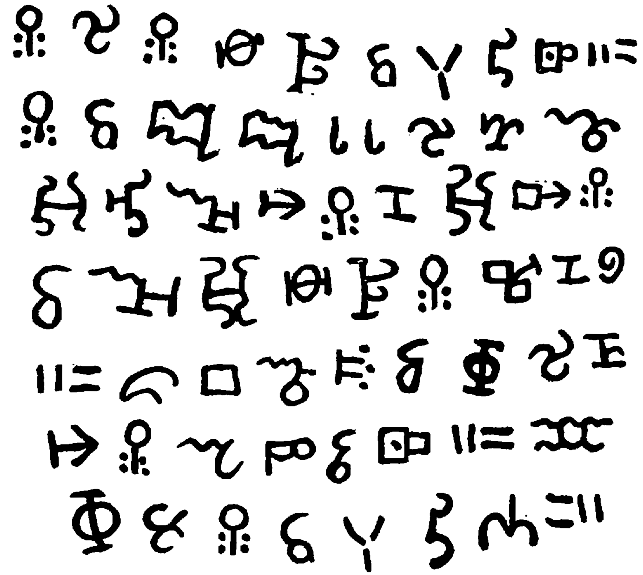
This last deserves special notice. About the middle of January, 1849, Lieutenant Forbes, Commander of H.M.S. Bonetta, inquired of the missionaries of Sierra Leone, whether they had heard of a written language amongst the natives of those parts, since he himself possessed a book in the language of the natives near Cape Mount. The Rev. S. W. Koelle, a missionary of Sierra Leone, undertook a personal investigation of the matter. He found that it was not only composed within the memory of man, but that the composer was alive; a man of the Vei country, named Doala Bukara. Doala Bukara, although an imperfect Mahometan, had seen Arabic books, and, though no Christian, an English Bible. The fact of these being written, haunted him in a dream, wherein he was shown a series of letters adapted to his native tongue—the Vei.
Nevertheless, the real alphabet was a joint production—i.e. of Doala and others; since, in the morning, he could not remember the signs shown him by night. Therefore, he and his friends put their heads together, and coined new ones. The king of the country made its introduction a matter of state, and built a large house in Dshondu, as a day-school. But a war with the Guru people disturbed both the learners and teachers, so that the latter removed to Bandakoro, where all grown-up people, of both sexes, can now read and write.
The Vei alphabet is a syllabarium; of which the preceding was a specimen.[170]
South of the Gambia, the Mandingo area, although extended so far in the interior, does not quite reach the coast, so that the lower portions of the rivers Caçamanca, Cacheo, Nunez, &c., are occupied by tribes not as yet distinctly recognised to be Mandingo. Neither are they as yet considered as allied either to the Woloff, or to each other. Speaking languages, mutually unintelligible, they are typical Negroes of the rudest and savagest kind; all being pagans. At Sierra Leone, the Mandingo reappears on the coast, i.e. amongst the Bullom and Timmani tribes.
SAPI-FELÚPS.
Of these the most northern are—
THE FELÚP.
Locality.—The forests and low-lands at the mouth of the Caçamanca.
Language.—With miscellaneous, but without special affinities.
THE PAPEL.
Locality.—River Cacheo, south of the Felúps.
Language.—Said to be peculiar; the only vocabulary of it, however, has been lost.
THE BISSAGO ISLANDERS.
Locality.—The Bissago Isles. Probably the same stock as the Papels.
THE BALANTES.
Locality.—Isle of Bassi and the opposite coast South of the Papels.
Language.—Said to be peculiar, but not known from any vocabulary.
THE IOLAS.
THE BASARES.
Locality.—Between the Balantes and—
THE BAGNON.
Locality.—The river Cacheo.
THE NALOO.
Locality.—The Nunez.
THE SAPI.
Locality.—Sea-coast in the neighbourhood of the Nunez.
BAGOES.
Locality.—South of the Nalus, on the coast. Conterminous with the Susu Bullom, and Timani Mandingos to which they perhaps belong.
A convenient transition is now made to the area of—
THE IBO-ASHANTÍ.
Here come, first in order—
THE FANTÍ.
Area.—The Gold-Coast, and the Ashantí country. From the river Asinese, west, to the river Volta, east. Inland extension uncertain. Continuous, but not uninterrupted.
Conterminous with the Mandingo Súsús, and the Whidahs of Dahomey.
Within the Fantí area are spoken several unclassed tongues, i.e.
THE AKVAMBU(?)
THE ADAMPI(?)
and, more important than any, that of—
THE GHÁ.
Synonym.—Acra or Inkra.
Locality.—Cape Coast.
The Ghá are Negroes in appearance; speaking a language unintelligible to the Fantí populations, but with undoubted general and miscellaneous affinities. They have the appearance of being derived from some country in the interior of Africa, a fact which Mr. Hanson—himself a native preacher, who has studied the ethnology of his country with great zeal—thinks can be verified by the comparison of an Acra vocabulary with one from the parts near Timbuctú.
More important still, is the unequivocal occurrence of numerous well-marked Jewish characters in their religious and other ceremonies. A paper of Mr. Hanson's[171] on this subject, leaves no doubt of the fact. The interpretation, however, is more uncertain. The present writer believes that such phænomena, i.e. points of similarity with the Semitic nations, is the rule rather than the exception with the African tribes—Negro and non-Negro; a fact which makes the Jews, Arabs, and Syrians, African, rather than the Africans Semitic.
THE WHIDAH.
Area.—Kingdom of Dahomey. From the river Volta to the river Lagos.
Physical conformation.—Typically Negro.
Religion.—Feticism in its lowest form.
THE MAHA.
Locality.—North of Dahomey, at the foot and on the sides of the Kong Mountains.
THE BENIN TRIBES.
Locality.—The sea-coast on the Bight of Benin. Conterminous with the Whidah and Yarriba.
The peculiar distribution of the Mandingos must now be considered, along with the configuration of the Guinea coast, and, the imperfectly-known range of highlands, which, at irregular distances from the ocean, runs nearly parallel with it; this range of highlands being the assumed watersheds of the following rivers between Sierra Leone and the western frontier of the Fantí country—the rivers Jong, Gallinas, Cape Mount, St. Paul's, St. John's, Cestos, Lagos, Negros, Costa. All these are inconsiderable, indicating that the elevations in which they rise are near the coast. On the other hand, in Ashantí and Dahomey, the rivers are of considerable magnitude, and indicate that the mountain range in which they rise (the Kong mountains) is far inland.
Now the low coast is the area of the following sections of a typically Negro population.
THE GREBO.
Synonym.—Cru, or Cruman.
Locality.—The Grain Coast.
Conterminous with the Vei, and other South-Mandingo dialects, north; with the Avekvom, south.
Religion.—Paganism.
Physical conformation.—Typically Negro.
I am far from being sure that the Grebo is not a section of the Mandingo class.
THE AVEKVOM.
Synonym.—Quaqua.
Locality.—Ivory Coast.
Conterminous with the Grebo tribes, west, the Fantí, east, and probably, certain Mandingo tribes of the Sokko section, inland.
Dialects.—1. Frisco. 2. Bassam. 3. Asini. 4. Apollonia.[172]
Religion and appearance.—Pagan Negroes.
We now pass over the Fantí, Whidah, and Benin areas (already considered) to the typical Negroes of the Delta of the Niger.
BONNY.
Locality.—The river Bonny or New Calabar.
Language.—Unintelligible to the natives of—
OLD CALABAR.
Locality.—The Old Calabar river.
Language.—Different from—
THE IBO.
Area.—The Lower Niger, nearly as far as Funda.
Conterminous with the Whidah(?), Benin(?), Bonny, Old Calabar, Bimbia(?), Yarriba, and Tapua tribes.
ADIYAH.
Locality.—Fernando Po.
Language.—Not identical with any tongue of the Continent; though with miscellaneous affinities.
THE BIMBIA.
Locality.—The Lower Cameroons.
In the Bimbia country the low coast is at its minimum breadth, the foot of the Cameroons Mountain nearly reaching the sea.
CENTRAL NEGRO ATLANTIDÆ.
By following the course of the Niger, we are again brought in contact with the Mandingo area, i.e. with the northern portion of it. Hence, the populations which will now be noticed encompass and surround the Mandingo nations, much as the Mandingo nations encompassed and surrounded the Grebo and Avekvom tribes.
THE YARRIBA.
Locality.—The right and left(?) bank (banks) of the Niger to the back of the Ibo and Benin countries.
Area.—Borgho, Wawa, Boussa, Yaouri.
Religion.—Paganism.
Physical conformation.—Sub-typical Negroes.
Habits.—Tattooed.
THE TAPUA.
Synonym.—Nyffe.
Locality.—The country between the rivers Niger, Makumnee, and Coodoonia.
Conterminous with the Ibo (south), the Yarriba (south-west), the Fellatah country (east and north-west), the Haussa(?) country, north.
Religion.—Paganism. Nearly that of Yarriba.
Physical conformation.—Sub-typical Negroes; with better shapes and clearer skins than even the Yarribians.
HAUSSA (HOWSSA).
Area.—Irregular, being deeply indented by that of the Fellatahs.
Conterminous with the Tapua(?), Yarriba, Fellatahs, Bornúi, the Berber Tuaricks.
Philological divisions.—Haussa Proper, Guberi, Kashna, Mallowa(?), Quollaliffa(?), Kallaghi(?).
Religion.—Mohametanism and Paganism.
Physical appearance.—Sub-typical Negroes.
THE FULAHS.
Area.—In the present state of our knowledge, discontinuous. Encroaching.
Divisions.—1. Senegambian Fulahs. 2. Fellatahs.
Localities.—1. Of the Senegambian Fulahs. a. The northern bank of the Senegal, about Lake Kayor, conterminous with the Moors of the Sahara and Woloff. b. Fouta-Torra, south of the Senegal, in the same longitude, probably conterminous with the first locality; conterminous with the Woloff, Sereres, Mandingos, and Serawollis. c. Bondou, west of Fouta-Torro (with which it is probably conterminous), on the Rio Nerico. d. Foota-jallo and Tembu, on the head-waters of the Rio Grande, between the Nalus and the Susu and Solimana Mandingos. How close these come to sea is uncertain. The Susu, although said to be Fulah, are certainly Mandingo. e. Brooko and Fuladu, between the great eastern feeders of the Senegal north of Jallonka Mandingos. f. Wassela(?), south-east of Fuladu. g. Massina, on the Niger, between Jenne and Timbuktú.
2. Of the Fellatahs—Cubbi, Ader, Guber; parts of Borgu, Boussa, Kano, Zegzeg, as far as 10° north latitude, and 10° east latitude, i.e. parts, probably, occupied by encroachment on the Haussa, Yarriba, and Nufi areas.
Religion.—Mahometanism, Paganism.
Physical appearance.—Sub-typical Negroes.
The civilization of the Mahometan Fulahs is on the same level with that of the most civilized (or Proper) Mandingos.
The departure from the Negro type is, in some instances, greater than has been the case with any of the sub-typical Negroes enumerated; so much so, that the Fulahs of the Gambia have been called the red Fulahs.
Their extension over Howssa, the Yarribian and the Tapua countries, has taken place within the historical period, under a leader named Danfodio.
Nevertheless, the exact original locality of the stock has yet to be determined.
CUMBRI.
Locality.—Forests, mountain fastnesses and swamps of Borgho, Bowssa, Youri, and Wawa.
Language.—Not known by a vocabulary, but said to differ from that of the neighbouring tribes, Tapua and Yarriba.
Physical conformation.—That of the Yarriba.
Religion.—Pagan.
The Cumbri appear to be in the same relation to the Yarribeans and Fellatahs that the Pulindas are to the Indo-Gangetic Indians, i.e. the representatives of a dispossessed population.
SUNGAI.
Locality.—From the parts east of Sego (Sansangding) on the Niger to the parts about Timbuctú. Probably in Timbuctú itself.
KISSÚR.
Locality.—Parts about Timbuctú. Probably Timbuctú itself.
As the Sungai vocabulary of Hodgson represents a different language from the Kissour of Caillié (both professing to represent the language of Timbuctú) I leave the investigation for future inquiry.
BORNÚ.
Locality.—Bornú, on the Lake Tshad.
Divisions.—1. Bornúi, semi-civilised and Mahometan. 2. Bedi, rude and Pagan.
Physical conformation.—More truly Negro, and less sub-typically Negro than any of the populations of the interior already enumerated.
BIDDUMA.
Locality.—Islands of Lake Tshad. Known by name only.
BEGHARMI.
Locality.—The River Shary, South of Lake Tshad.
Political relations.—Subject to Bornúi.
Language.—Known by a vocabulary, and different from both the Bornúi and the—
MANDARA(?)
Locality.—South and south-west of Begharmi.
Language.—Known by a vocabulary, and different from both the Begharmi and Bornúi.
Extract from Denham and Clapperton.—"On penetrating a short distance in this direction, with some people from Mandara, we saw the inhabitants run up the mountains quite naked, with ape-like agility. On another occasion, a company of savages were sent from a Kerdy, or Pagan village, termed Musgow, as a peace-offering, to deprecate the Sultan, who was on the eve of making a kidnapping expedition into their country. On entering his palace they threw themselves upon the ground, pouring sand upon their heads, and uttering the most piteous cries. On their heads, which were covered with long, woolly, or rather bristly hair, coming quite over their eyes, they wore a cap of the skin of a goat or some animal like a fox; round their arms and in their ears were rings of what appeared to be bone, and around the necks of each were from one to six strings of the teeth of the enemies they had slain in battle; teeth and pieces of bone were also pendent from the clotted locks of their hair; their bodies were marked in different places with red patches, and their teeth were stained of the same colour. Their whole appearance is said to have been strikingly wild and truly savage. Endeavours to set on foot intercourse with them were in vain; they would hold no communication, but having obtained leave, carried off the carcase of a horse to the mountains, where the fires that blazed during the night, and the savage yells which reached the valley, proved that they were celebrating their brutal feast."
This, short as it is, is a notice which would apply to no Negro tribe yet mentioned; indeed, there are many reasons for believing that south of the Mandaras the type changes, and that the populations represented by them are the almost unknown tribes of Central and Equatorial Africa. At any rate, the Mandaras are the most southern tribes hitherto known of the longitude of Bornú.
And now the comment upon the words typical, and sub-typical Negroes finds place. The two divisions coincide closely with the physical character of the area to which each applies; the departure from the true Negro features being greatest where the approach to a high-land or a table-land is the closest; the Bornúi being, at one and the same time, the most like the Negroes of the Coast, and the occupants of the most notable basin of Central Africa, i. e. the basin of Lake Tshad.
Due east of Lake Tshad we have, according to a variety of imperfect descriptions, a series of Negro districts; and here it must be admitted that the coincidence between the Negro conformation and the existence of fluviatile, lacustrine, or oceanic low-lands is not found to occur; the greater part of the tract being, according to all accounts, a table-land.
MOBBA.
Locality.—East of Lake Tshad.
Synonyms.—Called by the Arabs Dar-Saleh and Waday; Darfurians, Bergú.
Religion.—Chiefly Mahometanism.
Intermixture.—Arab.
FURIANS.[173]
Locality.—Dar-Fúr.
Religion.—Mahometanism.
Intermixture.—Arab.
KOLDAGI.[173]
Locality.—Kordofan.
EASTERN NEGRO ATLANTIDÆ.
South and east of the country of the Koldagi we come to the Negroes of the White Nile (Bahr el Abiad); where the fluviatile character of the soil and the physical appearance of the occupants coincide.
THE SHILLUK.[173]
THE DENKA.[173]
THE TUMALI.[173]
THE SHABÚN.[173]
Locality.—South, or south-west, of the Koldagi.
THE FERTIT.[173]
Locality.—South of the Shabún.
All these agree in being Pagan Negroes, south and south-west of Obeyd, the capital of Kordofan.
They also agree in being slave countries, the markets they supply being those of Ægypt.
Lastly, their languages have undoubted affinities with those of the Nubian class, a fact which verifies the statement at the beginning of the present section, viz. that the group of African Negroes was artificial rather than natural, since tested by physical form, the Denkas, &c., fall in the same class with the Ibos, &c., whereas their real affiliation is with the Nubians.
Through the researches of Dr. L. Tutshek, one of these languages is known grammatically, i. e. the Tumali; and it may be as well to remark that it has (amongst others) as a Semitic character, the method of expressing grammatical relations by means of internal change rather than by the addition of prefixes, postfixes, or inter-fixes, and also that such changes (as in the Semitic tongues) fall upon the vowel rather than the consonantal elements of the word.
More undoubted Negroes of the Nile are—
THE QÁMAMYL.
Locality.—Fazoglo, or Fazoel, south of Sennaar.
Language.—Peculiar, but with miscellaneous affinities.
THE DALLAS.
Locality.—The Tacazze; called by Salt, the Shangalla (Shankali) of the Tacazze.
Language.—Peculiar, but with miscellaneous affinities.
THE DOBA.
I presume that these are the Dar-Mitchegan Shangallas of Salt, and the Agaumider Shankalas of Beka. If so, they are occupants of the interior of Abyssinia, and conterminous with the Agows of that country; their language being peculiar, but with miscellaneous affinities.
And now follow two sections which I place amongst the Negroes provisionally; the first because its characteristics, although pretty well known, are aberrant; the second, because our information concerning them is preeminently imperfect.
They are separated from one another by a large area, one being north-west, the other south-east of Darfúr and Kordofan, and have little in common except the uncertainty of their position.
THE TIBBOO(?).
Area.—The Eastern Sahara; bounded by the Tuaricks, Ægypt, Kanem (of which the ethnology is uncertain), Mobba, and the Furian and Nubian tribes.
Divisions.—1. Rechádeh, or Tibboos of the rocks, to the southward and south-east of Fezzan. The towns of Abo and Tibesty belong to them.
2. The Febabos, situated about ten days' journey towards the south, south-west of Augelah.
3. The tribe of Borgou, placed further southward, nearly on the parallel of the southern part of Fezzan.
4. The tribe of Arno.
5. The tribe of Bilma, which is the greatest tribe of the Tibboo nation, and occupies the country between Fezzan and Bomon.
6. Nomadic Tibboos, on the borders of the empire of Bornú.
Physical appearance.—Lips, thick; hair, curly rather than woolly; complexion, varied, from jet-black to a copper colour; nose, in some tribes, flat, in others aquiline; frame, slender.
Language.—With no special, but with numerous miscellaneous affinities. Improperly considered to be Berber.—From Prichard, vol. ii.
THE GONGAS(?).
Present locality.—The valleys of the Rivers Abai and Godjeb.
Original locality.—Enarea, and a large tract south of Abyssinia.
Area.—Discontinuous; the division being effected by the invasion of Galla tribes.
Dialects.—1. Kaffa. 2. Woratta. 3. Wolaitso, 4. Yangaro.
Vocabularies.—Those of Dr. Beke, published in the Transactions of the Philological Society.
The Gonga tribes are in the same relation to the Abyssinians as the Mandara to the Bornúi, i. e. the occupants of the most southern part of the geographical area known; the parts immediately beyond either being terræ incognitæ.
If, however, the current notions respecting the geographical structure of Central Africa be correct, and if the views here exhibited respecting the coincidence between the Negro type in the way of physical conformation and the geographical conditions of a fluviatile low-land be well-founded, the tribes of the interior should depart materially from the tribes already described; a probability which has been indicated in the notices of the Mandara and Mobba Africans.
Nay more, inasmuch as the stock next in order of notice is a stock with a preeminently encroaching frontier, it is probable that the true affiliations of the southern Abyssinians may be lost through the encroachments of the Gallas and Kaffres, and the consequent extinction of the tribes representing them.
FOOTNOTES:
B. KAFFRE ATLANTIDÆ.
The preliminary facts of most importance in the ethnology of the great Kaffre area are two—connected with the language, and from their combined effects giving it the appearance of differing in kind from any other African tongue.
These two peculiarities, which are illustrated from Boyce's Kaffre, and Archbell's Bechuana Grammars, are as follows:—