PART I. (continued 4)
Reading edition
Pantheon.—Chief deity Yaris. Progenitor Pita-kat.
The account of Horace Holden,[62] an American sailor, who, with eleven others, reached the island of Tobi, in a boat, and who was detained there two years, is our only source of information for this important locality—the nearest point of contact between Polynesia and Protonesia.
No tribes have a harder struggle for existence. During the whole of Holden's residence, only five turtle were taken; fish being also scanty. Hence coco-nuts and the taro formed the chief food. It is reasonable, as well as charitable, to refer the churlishness of their tempers to this state of indigence. Perhaps, also, it is the reason why the men, as compared with the women, take a fair share of the labour of cultivation—a custom rare in other parts of Polynesia.
The effects of hunger in reducing the population are seconded by those of war. And here, the only weapons are the spear and club—no bows and no arrows.
The houses "are built of small trees and rods, and thatched with leaves. They have two stories, a ground-floor, and a loft, which is entered by a hole or scuttle through the horizontal partition or upper floor.
"For ornament they sometimes wear in their ears, which are always bored, a folded leaf; and round their necks a necklace made of the shell of the coco-nut, and a small white sea-shell."
All this merely connects them with the Micronesians. The tradition respecting Pita-kat is more important. He "came many years ago from the island of Ternati, and gave them their religion, and such simple arts as they possessed."
SONSORAL.—JOHANNES ISLAND.
Locality.—West of the Pelews. Nearest point to the Philippines.
THE PELEW GROUP.
Synonym.—Palaos.
Chief Islands.—Corror, Babelthouap, Pelelion.
Native quadrupeds.—Rats.
Vegetable products.—Coco-nut, bread-fruit, yam, batata, taro, ebony, sugarcane, orange, banana, bamboo, paper-mulberry. Rice and pulse wanting.
The paucity of quadrupeds, and the abundance of tropical vegetables is common to the Pelew Islands, and the whole of Polynesia. Hence, it is mentioned once for all. The chief exception, however, is an important one. The hog will be found to be partially distributed; and the partial character of its distribution has been one of the instruments of ethnological criticism (especially in the hands of the French naturalists), by means of which the order of succession in which the different islands have been peopled has been investigated.
CLUSTER OF GOULOU.[63]
Direction.—North-east from the Pelews.
Locality.—Between the Pelews and the—
CLUSTER OF YAP. OULUTHY OR EGOY ISLANDS. THE MARIANNES.
Synonym.—Ladrones.
Name of Natives.—Chamorros.
Chief islands.—Guam, Rota, Tinian.
Physical appearance of Natives.—Stature higher than that of the other islanders, tendency to corpulence greater.
Intermixture.—Considerable, i.e. with Polynesians, Philippine islanders, Spaniards.
Rota and Tinian are remarkable for containing the remains of massive stone buildings; the original use of which is wholly unknown to the present natives. The same phenomenon will be repeated in Tonga-tabú and Easter Island.
The Mariannes form the most northern portion of Micronesia. The direction will now be due east from the cluster of Goulou; about mid-way between the Pelews and Yap.
OULUTHY GROUP.
Synonym.—Egoy Islands.
LAMOURSEK AND SATAWAL GROUPS.
Direction.—West to east.
Extent.—From 140° to 15° E. L. from Paris. Under 5° N. L.
Particular islands.—Lamoursek, Satawal, Faroilep (the most northern), Aurupig (the most southern).
PROPER CAROLINE GROUP.
Direction.—From the Lamoursek and Satawal group fifteen degrees westward.
Particular islands.—Hogoleu, Lougounor, Pounipet, Ualan.
A distinction which will often be applied in Polynesian ethnology may now be made. It is the difference between the geological structure of the different islands. Whether they are what is called high or low is important. In the high islands, where the structure is primitive, metamorphic, or volcanic, the conditions for social development are more favourable than in the low islands, of a coralline structure. In these last the food is less abundant, the sun more scorching, and, generally, the complexion of the inhabitants darker.
Again, the inhabitants of the low islands are generally at peace amongst themselves: those of the high islands at war.
In the ethnology of the Paumoto Archipelago, this distinction will be repeated. So it will elsewhere.
LOUGOUNOR.
Synonym.—Lougoullos. Mortlock island.
Physical conformation.—Stature, above the average; colour, chestnut, lips thick, beard long but thin, hair black, long, thick, slightly curling (un peu crépu), sometimes frizzy—Lütke, from Prichard.
Language.—Allied to, but different from, the Ualan.
POUNIPET.
Structure.—Volcanic.
Population.—About two thousand.
Physical Appearance.—Face broad and flat, nose flat, lips thick, hair crisp. Colour, between chesnut and olive. Height, average.—Lütke from Prichard.
UALAN.
The chief island of the Central Caroline group, or of the Caroline Islands in the more general sense of the term.
Structure.—Volcanic.
Physical conformation of the natives.—Stature average, hair black, beard scanty, only in some cases thick, forehead narrow, eyes oblique, nose somewhat flattened, face broad, complexion clear yellow (citron), lightest in the case of the chiefs.—Lesson.
As the succession of islands now becomes less regular, and as the interval of sea between Ualan and the Archipelagoes east of it is considerable, it is necessary to consider the lines of passage between the proper Carolines and the Ralik and Radak chains to the north-west. These are two.
1. From Pounipet to the Isles of Brown; with Providence Isles half-way between.
2. From Ualan to the Radak chain, or Mulgrave's Islands.
ISLES OF BROWN.—RALIK CHAIN.
Synonym.—Marshall's Islands.
RADACK CHAIN.
Synonym.—Mulgrave's Islands.
The Radack and Ralik people are dark.
The direction is now south, and south-west, to an Archipelago lying under the Equator.
KINGSMILL'S GROUP.
GILBERT ISLANDS.
SCARBOROUGH ISLANDS.
General name.—The Tarawan group.
Latitude.—North and south of the Equator.
Longitude.—Nearly that of the Fiji islands.
Population.—Perhaps sixty thousand. In Drummond's Island six thousand.
Physical appearance.—Complexion dark copper. More Protonesian than Polynesian. Cheek-bones projecting, nose slightly aquiline. Average height five feet eight inches.
In Pitt Island, the most northern of the group, the natives are lighter in colour than the other islanders, taller, stronger, and better-limbed; with smooth bodies, oval faces, and regular and delicate features.
THE PROPER POLYNESIAN BRANCH OF THE POLYNESIAN STOCK.
Area.—The Navigators, Society, Friendly, and other groups of the Pacific. The Marquesas; the Dangerous Archipelago; Easter Island; the Sandwich Isles; New Zealand, &c. With the exception of the Sandwich Isles and New Zealand, south and east of Micronesia. Nearer to Kelænonesia than to any part of Protonesia.
Physical conformation.—Maximum and, perhaps, average stature higher than in Micronesia. Aquiline nose commoner. Varieties both of hair and complexion. The former wavy and curled as well as straight; sometimes chestnut-coloured. Skin, often fairest in the parts nearest the Equator; becoming darker as the distance increases. Oftener, also, darker in the coralline than in the volcanic islands.
Face oval. Ears generally large.
Zygomatic development moderate. Occipito-frontal profiles truncated behind, elevated at the vertex.
Nostrils generally spreading.
Language.—Dialects mutually intelligible; probably unintelligible to the Micronesians.
Political relations.—Wholly independent, colonized, or protected.
Religion.—Paganism, Romanism, Protestantism, Imperfect Christianity.
European intermixture.—Chiefly English, American, and French.
Habits.—The superstition of the tabu; the use of kava as a drink. See the notice of Micronesia. Cannibalism, tattooing, circumcision, more or less, common.
With the view of saving repetition, a notice of the Polynesian mythology will precede the enumeration of the islands; for each and all of these the creed being, in its general principles, as truly one and the same as is the language, the same divinities appearing with the same functions and under similar, or but slightly-changed, denominations. Hence, sometimes the difference between two Pantheons is merely verbal. Generally, however, it is real. Even then, however, we find no new element; but one of two things. Either the same story appears in a varied form; or else some portion of the mythology which is but slightly prominent in one group of islands, takes unusual importance in another; the fundamental identity of character being manifest throughout.
Of the common elements of the general Polynesian creed the following are the most important; those which are most special, and least general or abstract, being taken first in order.
The supernatural spirits that interfere directly with human concerns.—Mischievous beings, imps or goblins, that play so prominent a part in the superstitions of all countries, play a prominent part in those of Polynesia. These may appear under any out of a multiplicity of forms. There may be the spirit protective to a certain family; the spirit protective to a certain pursuit; the god of the sailor, the fisherman, or the tiller of the soil. Good they may do and mischief they may do—either in a material or an immaterial form, in their own shape or in the shape of sharks, lizards, storks, snipes, or any other dumb animal. From a belief of this kind to the superstition of omens is but a single step, so that rats that squeak, and comets that show their beards, and noses that sneeze, and birds that fly the wrong way, all become the expositors from Powers beyond those of mortality. Then the rock, and glen, and above all the volcano and earthquake, become palpable objects to be connected with a presiding divinity.
To these and to the like of these all the islanders look. Some look beyond them.
Múoi (Mawi) is more man than God; the supporter, or rather the support, of the earth. This lies on the gigantic extension of his body; and earthquakes result from its movements. Where he is either more or less than the comparatively passive substructure of all things material, he is a wise wizard who foretells events; or else the maker rather than foundation-stone of the world. Just as Tangaloa did in the other parts of Polynesia, Mawi did in New Zealand. What this was will be soon seen.
The Cosmogony.—The Polynesian world—how much beyond it is uncertain—was fished up from sea by Tangaloa; Tahiti was the first part that appeared. Just as its rocks showed above water, the line broke. However, the rock in which the hook stuck can still be seen in the island of Hoonga; and the family of Tuitonga, until very lately, were in possession of the hook. There was enough land, however, to be worth filling with human beings and human food. And this was done by Tangaloa.[64]
Such is the Tonga account. In New Zealand, as already stated, the artificer is changed; and Mawi does the work of Tangaloa. In Tahiti, and Samoa, the workman is the same, but the work different. The Tahitian Tangaloa formed the ocean from the sweat of his brow—so hard did he work in making the land. The Samoan sent down his daughter Tali, in the shape of a snipe, to survey the world below. As she saw nothing but sea, her father rolled down a stone which became one island, and another which became a second, and so on. The first growth of such islands were wild vines. These were pulled out of the ground, and heaped up to rot, so that worms were produced. Out of these worms grew men and women.
The Happy Island.—In an island like their own, only more beautiful, live the higher gods, and the souls of chiefs, kings, and councillors. In Tonga this island is Bolotoo. It was once visited; but those who visited it died, having breathed its air.
The residents and visitors of the Happy Island.—First amongst these are the gods themselves and their servants; not, however, Mawi—
The souls of the chiefs after death—
The souls of the councillors after death—
Caste-system.—The list of the inhabitants of Bolotoo stops at a certain line of nobility. The people are the servants of the chiefs, and the servants of the chiefs have no share of enjoyment after death.
At this point, the mythology and the social constitution of the Polynesians act and react upon each other. Those who have no political rights in life, have no existence after death (or vice versâ); and the result is a system half caste, and half feudalism.
Whether the king or priest be paramount, depends upon their respective individual characters. There is room for the subtle brain as well as for the strong hand. So it is, as between king and chief. The vassalage is perfect or imperfect according to the strength of the parties. Whatever, however, may be the relative position of the king, the priest, or the chiefs, the people are sure of their thraldom; a thraldom to their immediate superior, the chief.
Add to these elements of social subordination and insubordination, the existence of tribes and the influence of descent. A family may be descended from some god that took an earthly island for his residence. This will give it a precedence even over the kings.
From the feeling of pedigree, and from the belief that the nobler families become spirits after death, we have the belief in ghosts, and the reverence for the dead. Whoever studies the details of the Polynesian creeds and traditions will find abundant instances of this; and in such detail they should be studied. To exhibit them (as has just been attempted) in a general point of view, can only be done by applying terms adapted to a different system, and, as such, only partially appropriate. It can only be done at the sacrifice of those special elements which give life and individuality to a description. Such, however, as it is, the previous sketch is the only one that could be admitted into a work like the present.
Beginning with the fourteenth degree S. L., the distribution of the Polynesian islands runs off in three different directions.
1. From west to east; i.e. from the Navigators' Islands to Easter Island.
2. North-east; to the Sandwich Islands in 20° N. L.
3. South-west; to New Zealand in 35° S. L.
NAVIGATORS' ISLANDS.
Synonym.—Archipelago of Samoa.
Islands.—Opoun, Leone, Sanfoue, Maouna, Oiolava, Pola.
Complexion.—Dark bronze.
Numbers.—According to Captain Wilkes, 56,000: of which 14,850 are Christians. Majority of the remainder attending the missionary schools.
Pantheon.—Tangaloa-lagi, Tamafaiga, Sinleo, Onafanna, Mafuie, Salefu, Merua Fuana, Tinitini, Lamanau, Tuli, &c.
Real or supposed peculiarities.—Use of the bow; which is used also in De Peyster's island. Rare elsewhere.
THE TONGA GROUP.
Synonym.—The Hapai Islands; the Friendly Islands.
ISLANDS. POPULATION.
Eooa 200
Hapai 4,000
Vavao 4,000
Keppell's Islan 1,000
Boscawen's Islan 1,300
Tonga-tabú 8,000
Total 18,500
Said to be on the increase. Number of Christians, about 4,500.
Pantheon.—Múoi.—The Hotooas, Táli-y-tobú, Higooléo, Tooboo-toti, Alaivaloo, Ali-ali, Tangaloa—Tangaloa's sons, Toobó, and Váca-ácow-ooli, &c. Bolotoo=the Happy Island.
Term for the Tonga chiefs—Egi.
" " councillors—Mataboulai.
" " king—How.
" " lower classes—Mooa.
" " lowest—Tooa.
Real or supposed peculiarities.—Infant sacrifices; the cutting off of a finger on the death of relatives; domestic architecture on a scale approaching that of Borneo. Remains of stone architecture; probably the tombs of the chiefs.
HERVEY ISLES.
Names.—Rarotonga, Atiu; Mangaia, Aitutaki, Mauke, Mitiaro, Manuai.
Population.—About fourteen thousand; of which one-half belongs to Rarotonga.
AUSTRAL ISLANDS.
Names.—Rimatara, Rurutu, Tupuai, Raivavai.
Population.—About one thousand. Decreasing.
RAPA.
Locality.—South of any island yet named, and isolated.
THE TAHITIAN GROUP.
Synonym.—The Society Islands.
Islands.—Ulietea, Otahá, Bolabola, Huaheine, Tabai, Maurua.
Pantheon.—The Tii Maaraauta=the spirit reaching toward the land. The Tii Maaraatai=the spirit reaching toward the sea. Eatooa=gods in general. Tii Hina, Taaroa (= Tangaloa). Maui Raiatea (the analogue of Bolotoo).
Terms for the Tahiti chiefs—Eree, or Tiara.
" " councillors—Manahounis.
" " lower classes—Toutous.
PAUMOTU.
Meaning.—Cloud of islands.
Synonym.—The Low Islands. Dangerous Archipelago.
Structure.—Generally coralline.
Particular islands and groups—
AURA.
Locality.—S. L. 15° 40´ W. L. 146° 30´ The most savage of all the islands of the Archipelago, and the one that has most rarely been visited with impunity.
CHAIN ISLAND.
Locality.—S. L. 17° 30´ W. L. 45° 30´ Described as being like Aura, to Captain Fitzroy, by Mr. Middleton, who had passed some time on the island. Cannibals. Conquerors of the rest of the Archipelago, except Aura. The first ship they had manned by a black crew.
GAMBIER ISLANDS.
Names.—Mangareva, Akena, Akamaru, Tarawari, &c.
Structure.—Volcanic.
Population.—About two thousand.
PITCAIRN ISLAND.
Locality.—South of the Gambier group.
DUCIE'S ISLAND.
Locality.—West of the Gambier group.
There is a great difference in physical conformation between the inhabitants of different members of the Paumotu group. Some are well-made, nearly on a level with the measurements of European, and with a "fine Asiatic countenance, with beards and mustaches, but no whiskers—men who might pass for Moors."[65] Others approach the character of the Negroes.
We know now the doctrine that this difference will engender; and we know the exception that it will call for. More than one writer have seen in Paumotu islanders specimens of a second race. More than one have seen only the same race under different conditions.
Now, Captain Beechey has found that this difference in the inhabitants coincides with the difference of the islands. The well-grown tribes of the Polynesian type are the tribes of the volcanic Islands, Pitcairn's and the Gambier group. The blacker variety is found on the low islands.
EASTER ISLAND.
Synonym.—Teape.
Locality.—The most eastern island of Polynesia. Solitary.
In Easter Island there stood in the year 1722, and there stand now, statues of colossal proportions, sometimes on the level ground, sometimes on platforms of hewn stone, representing (or misrepresenting) the upper half of the human figure, with enormous ears, shapen out of lavas, some soft, and some too hard for any tool known to the present natives, objects of wonder to them, but not objects of worship.
That they are not objects of worship is inferred from the extent to which they are neglected. When fallen, or broken they are not repaired; neither are they connected with the burial-places.
These seem to have an existence in another form, in that of cylindrical heaps of stone; the meaning of which a native explained to M. de Langle by laying himself down on the ground, and then lifting his hands towards the sky.
The mystery of these statues is increased by a remark of Captain Beechey's. He had seen the like of them elsewhere; but he had seen them on uninhabited islands.
The eastern extremity of the Paumotu Archipelago points towards Easter Island; the northern line is the nearest point to—
THE MARQUESAS.
Names.—Hivaoa, Tahuata, Fatuhiva, Easter=the south-eastern group. Nukahiva, Uahuka, Uapou=the north-western.
Population.—Perhaps two thousand.
The natives of the Marquesas are considered as the handsomest men of Polynesia.
The natives of the Marquesas are most at war with one another of all the Polynesians. Their chief island is intersected by a mountain-ridge; and the mountain-ridge (like most mountain-ridges) supplies a fierce body of quarrellers.
The natives of the Marquesas speak a greater variety of dialects (or sub-dialects) than the natives of any other group. This has engendered the doctrine that they were colonized from more quarters than one.
Distant though it be the Nukahiva group is the nearest point to—
THE SANDWICH ISLANDS.
Names of islands according to the dialect or orthography followed by Prichard.—Hawaii, Maui, Tahaurawe, Morokini, Ranai, Morokai, Oahu, Tauai, Niihau, Taura.
Names of the islands according to the dialect or orthography followed by Simpson.—Hawaii, Mowee, Kakoolawe, Lanai, Molokoi, Woahoo, Kanai, Niihau.
Structure.—Volcanic.
Physical appearance of the natives.—Height above the average. Mouth square and heavy.
Extract from M. Chloris: "Les enfans, en venant au monde, sont complêtement noirs; la jeune fille la plus jolie, et la plus delicate, qui s'expose le moins à l'action de l'air et du soleil, est noire; celles qui sont obligées de travailler constamment à l'ardeur du soleil, sont presque de couleur orangée." This orange tint is noticed by Mr. Simpson, who describes the Hawaiians as intermediate to the black Negro and the Red American—more, however, red than black.
The majority of the Polynesian islands present the phenomenon of an imperfect and recent civilization engrafted upon a state of comparative barbarism; and none more than the Hawaiian group. No area is, at once, so European and so Polynesian. Neither in any area are the influences more mixed. The population is mixed also. White and half-breeds constitute a large and increasing proportion of the population; the white being from England, from America, and from France.
This is the way in which the admixture of foreign blood takes place within the island itself. But it is not the only way. The Sandwich Islanders are themselves emigrants, and they are found upon the opposite coast of America; thus giving admixture to the Californian and Oregon Indians. They do the same in South America on the coast of Peru and Ecuador.
It is this determination of the Sandwich Islands to America, that gives us the phænomenon of the American and Oceanic admixture—a new and imperfectly studied form of union.
This dispersion of the Sandwich Islanders tells a story on more matters than one. It speaks to their enterprize, maritime capacity, and value as industrial assistants. This is what they are at home, and this is what they are abroad.
Since the discovery of the Sandwich Islands by Cook, the three great influences that have been at work, are—
The wars, and policy of Kamehamehu.
Missionary influences.
Commercial and political influences.
1. At the accession of Kamehamehu, as now, the system of caste that determines the social state of New Zealand, Tahiti, and other parts of Polynesia, regulated that of the Sandwich group. The chiefs, however, held but nominally under the sovereign. Each in his own island, was practically an independent ruler. The wars of Kamehamehu coerced the chiefs of the smaller islands, and left him the sovereign of a consolidated empire. This he administered in the spirit of a Pagan, and a conqueror. Of the god of the volcano and earthquake that had helped him to his early victories, he lived and died the constant worshipper and support.
By the further favour of the same, he hoped to reduce the Tahitian group; an idea that raises his assemblage of canoes to the dignity of a fleet. At any rate, the force for land, and the force for sea underwent an incipient organization in the reign of Kamehamehu.
Then again, he was not only a great merchant, but the only great merchant in his dominions. The chief export was the sandal-wood, which, bearing a high price in the China market, and growing chiefly on the more inaccessible mountains, could only be collected at the expense of grinding labour, and fatal suffering as the portion of the helot population. This decimated the islands as much, or even more, than his wars.
At the death of Kamehamehu a weak tyranny succeeded a strong one. The monopoly of the sandal-wood was divided between the chiefs; and the multitude of masters increased the amount of suffering. I am writing from what I find in Sir G. Simpson, and add that the extremes of bloodshed and oppression brought with them their own remedy. The coercion was too successful to leave an enemy to fight against; and the sandal-wood became too nearly exhausted to command its previous price of life and labour.
In 1819, the great father of his dynasty died; and his idols died with him. Pagan as he was himself, his nation had outgrown Paganism; and there was a tabula rasa for any better creed.
2. With the reign of Liho-Liho began the influence of the missionaries—American, English, and French; the American and English with their respective forms of Protestantism, the French with Romanism. I have no inclination to meddle with the distasteful details of these mischievous contests. The ethnological result is the triple character of the influence now in operation. In politics, Hawaii is independent; independent and semi-constitutional; with its independence guaranteed by England, America, and France. In religion it is Protestant—with Romanism tolerated and something more; tolerated and making way amongst the people.
3. The improvement of the agriculture of the Sandwich Islands is going on steadily. Silk and sugar are beginning to be grown; and a healthier trade is replacing the sandal-wood monopolies.
I have admitted the previous notice of the character of Hawaiian civilization for the sake of comparing it with the present state and actual prospects of the islands. Cook, when he visited them, put the population at four hundred thousand—an exaggeration. Perhaps it came to half as much. In 1832 and 1836, there were censuses; of which the result was as follows:—
POPULATION.
NAME. AREA. 1832. 1836.
Hawaii 4,600 45,792 39,364
Mowee 620 35,062 24,199
Lanai 100 1,600 1,200
Molokoi 190 6,600 6,000
Kakoolawe 60 80 80
Woahoo 530 29,755 27,809
Kanai 500 10,977 8,934
Niihau 90 1,047 995
Whole group 6,090 130,313 108,579
This gives us a reduction; a reduction which has increased by 1840. This, I suppose, is the one from which Prichard takes his numbers, for two of the islands—
For Maui 18,000
—— Woahoo 20,000
Emigration will not account for this decrease. This we may see at once, from the proportion in 1840—the figures and reasoning are Sir G. Simpson's—in the single island of Kanai, between that part of the population which was under, and that part which was above, eighteen years of age.
1ST DISTRICT. 2ND. DO. 3RD DO. 4TH DO.
Under eighteen 706 309 372 685
Above eighteen 2,229 1,043 1,178 2,134
Total 2,935 1,352 1,550 2,819
"Here," Sir G. Simpson continues, "is an average of one person under eighteen, to rather more than three persons above it—a state of things which would carry depopulation written on its very face, unless every creature, without exception, were to attain the good old age of seventy-five." To this we add a remark upon the bearing of the early period of marriages throughout Polynesia. Not one—but two—generations are included in the population under eighteen years; since before that time boys and girls have begun to have boys and girls of their own.
This disproportion accounts for the decrease. But what accounts for the disproportion?
In 1824, Mr. Stuart wrote that—"in those parts of the islands where the influence of the mission had not extended, two-thirds of the infants born perish by the hands of their own parents before attaining the first or second year of their age."
In 1840, there were found in Kanai out of 5,541 adults, only sixty-eight, and sixty-five women who had more than two children each, and that with a bounty, in the shape of an exemption from certain taxes, upon a number to that amount; whilst in Woahoo the births were sixty-one, the deaths one hundred and thirty-two.
Distant though it be, the Tahitian group is the nearest point to—
NEW ZEALAND.
Native name of northern island.—Ikana, Mawi.
Native name of southern island.—Tavai, Punamu.
Native name of the language.—Maori.
CHATHAM ISLAND.
Locality.—Twelve degrees east of New Zealand.
Appearance of the natives.—Colour dark; so much so as to be called by the New Zealanders, Blafello=Black-fellow, a term adopted from the English.
Such are the larger islands and archipelagoes of Polynesia. To these must be added the following smaller groups.
UNION GROUP.
Locality.—Five degrees due north of the Navigators' Islands.
Names.—1. Bowditch Isle, or Fakaafo. 2. Duke of York's Island, or Oatafu. 3. Duke of Clarence's Island, or Nukunono.
Population.—About one thousand.
Structure.—Coralline.
Language.—Intelligible to the Samoans.
Food.—Coco-nuts, pandanus-nuts, fish.
Although so near the Equator, the Fakaafo people are the fairest of the Polynesians.
VAITUPU GROUP.
Name.—1. De Peyster I., or Nukufetau.
2. Tracy's I., or Vaitupu.
3. Ellice's I., or Funafati.
Language.—Intelligible to the Samoans.
Real or supposed peculiarity.—The bow used in De Peyster's Island. Except in the Navigators' Isles; rare elsewhere.
These islands have importance as connecting Northern Polynesia with Southern Micronesia. The people are dark-coloured and bearded.
PENRHYNN ISLAND.
Locality.—Midway between the Marquesas and Union Isles. Inhabitants numerous as compared with the size of the island.
ROTUMA.
Synonym.—Granville Island.
Locality.—Lat. 12° 30´ N. Long. 177° 15´ E. Three hundred miles from any other land.
COCO ISLAND. TRAITOR'S ISLAND.
Locality.—North of the Friendly Islands. Lat. 15° 50´ S. Long. 174° W. i.e., between the Tonga and Samoan groups.
HORN ISLAND. WALLIS ISLAND.
Locality.—Between Rotuma and the Samoan Archipelago.
SAVAGE ISLAND.
Locality.—Four degrees east of the Friendly group; i.e., between the Tonga Isles and the Hervey and Austral groups.
TIKOPIA.
Locality.—-Lat. 12° 30´ S. Long. 169° E.
Population.—About five hundred.
In Tikopia the locality is nearly Kelænonesian; whilst the physiognomy and language are Amphinesian; and of the two Amphinesian branches, most probably Polynesian.
On the other hand, they use the bow and arrow, and raise cicatrices by burning—both of which habits are Kelænonesian.
FOTUNA.
Synonym.—Erronan. A few miles east from Tanna, a Kelænonesian Island.
IMMER.
Synonym.—Muia. Ditto.
The locality creates the interest for these two islets. They are not only isolated from the other parts of Polynesia, but are portions of another geographical area.
FREE-WILL ISLAND.
Locality.—Fifty minutes north of line, to the west (or north-west) of New Guinea.
Natives.—Copper-coloured, with long black hair.—Carteret from Prichard.
The natives of Free-will Island require further description. It is nearly certain that they are Amphinesian—but whether Protonesian or Micronesian is uncertain. Laying aside, for the present, Madagascar, and the Fiji Islands, we shall find that the more important questions connected with the ethnology of Polynesia are as follows—
1. The affinities with Protonesia.
2. The differences between Polynesia Proper and Micronesia.
3. The extent to which one of these last-named divisions is more Protonesian than the other.
4. The details of the dispersion within the limits of a single division; Micronesia or Polynesia, as the case may be.
5. The general dispersion and distribution.
6. The inferences arising from the existence of the darker coloured, and more Negrito-like population.
7. The date of the Polynesian dispersion.
1. The affinities with Protonesia.—Much has to be done in this department; especially in regard to the indication of similar habits and customs; and in respect to the explanation of undoubted and important points of difference. Indeed, at the present moment, the proof of the Protonesian affinities with Polynesia is almost wholly philological. Still, of its kind, it is satisfactory and scientific. That isolated Malay words were to be found far beyond the proper Malay area was known as early as the time of Reland. By Marsden, Crawfurd, and others, the list was enlarged. The evidence, however, that the grammatical structure of the South-Sea languages was equally Protonesian with the vocabularies, forms the most valuable part of a late publication—the posthumous dissertation of W. Von Humboldt on the Kawi language of Java. In this the Tagala of the Philippines is taken as the sample of a Protonesian grammar in its most elaborate and complex form; a starting-point which explains the structure of the Polynesian and Malagasi tongues in a manner far beyond any amount of elucidation that could have been drawn from the comparatively simple structure of the proper Malayan.
For all questions of this sort the great work just named is the thesaurus and repository. It is also the thesaurus and repository for all facts connected with the history of the Hindu influences on Protonesia.
The other ethnological phænomena, not philological, that naturally belong to this part of the subject, will be noticed under the third head.
2. The differences between Polynesia and Micronesia.—Some of these have been noticed. None, however, have been of equal importance with the difference of language. The exact appreciation of their import is difficult.
The fact of the bow and arrow being either not used at all, or used but little (according to the American explorers in their games, but not in their wars), must be taken as relative, rather than as a simple negative, fact.
a. It is used in Kelænonesia.
b. The parts of Polynesia where it is used (Samoa, De Peyster's Islands, and Tikopia) are the parts nearest to Kelænonesia.
The absence of the tabu in Micronesia is, probably, less of an unqualified fact than it seems to be. In the Proper Polynesian form, and with the Polynesian name, it has probably no existence. In more than one Micronesian island, however, certain objects are held sacred, certain objects are generally prohibited, and certain objects are prohibited under certain conditions.
The Polynesian custom of drinking kava not Micronesian.—What applies to the tabu applies here. Kava, under the name of kava, and prepared, as in Polynesia, from the fermentation of the root of the piper methusticon, is not drunk in Micronesia. Shiaka, however, is a beverage at Ualan (and probably elsewhere); and shiaka is a fermentation of the leaves of the piper methusticon.
The differentiæ, then, between Polynesia Proper and Micronesia are subject to criticism; so much so that instead of saying that a Polynesian custom is wanting in Micronesia (or vice versâ), we should rather say that the Polynesian habit takes a modified form. Above all, the criticism applicable to all negative statements is preeminently applicable here.
Facts of the same sort with the kava, and tabu observations, are to be found in other matters, e.g. the Micronesian sails by the stars, the Polynesian by the flight of birds. The Micronesian canoe is an amphisbæna, i.e. it can be paddled either way, and it is generally simple. The Polynesian, on the other hand, is often double, and almost always an outrigger: so much so that the appearance of Cook's vessels, on the discovery of Tahiti, was hailed by the natives as a fulfilment of one of the prophecies of Mawi; which was to this effect:—That a canoe such as never had been seen by any native before—a canoe without out-riggers, should at some future time visit the island. Now so impossible a thing was a canoe without out-riggers in the eyes of the Tahitians, that the prophecy was laughed to scorn. So in order to gain credence, Mawi launched his wooden dish upon the waters, which swam as he said the strange canoe should swim. Afterwards, when Cook sailed towards the islands, his ship was held to be the prophesied canoe; and at the present moment English vessels have been called Mawi's canoes.
The sum, perhaps, of all the distinctions of the sort already indicated, will give between Polynesia and Micronesia, the difference between a Dutchman and an Englishman; certainly not less—probably more. Probably more, because the very considerable difference in the details of the two mythologies has yet to be added. A brief notice of these may be found in Prichard's chapter on the Marianne Islanders; and this reference is all that our space allows. That the difference, however, of the superstitions is not less (probably greater) than the difference between the languages is a safe conclusion.
The differences in the general moral character of the two divisions lie within a small compass. Coldness of manner in general, less tendency to bloody warfare, less laxity amongst the female part of the population, and less cannibalism, are points wherein the Micronesian character has the advantage. The Micronesian domestic arts also, such as dyeing and weaving, are in advance of the Polynesians.
3. Distribution of Protonesian characteristics.—Which of the two divisions has the most of these? This is partially answered by some of the observations which have just preceded: two other facts answer it more fully.
a. The opinions of MM. Durville and Lesson, as to the connexion of the Micronesians with the Mongolians—without being evidence in favour of the Micronesian branch being the more Protonesian, of the two, this is, certainly, a fact in favour of its being the more continental.
b. The opinion of Le Gobien, one of the early Missionaries, "that the Caroline Islanders came from the Philippines."
4. Details of the distribution within the limits of a single division.—The question as to the particular part of Micronesia, or the particular part of Polynesia, from which the rest of the respective areas was peopled, is so much a part and parcel of the broader question as to the origin of the population en masse, that it belongs, in its entirety, to a latter stage of our inquiries. Still there are a few facts which may be noticed at once; and these apply to Polynesia Proper.
Assuming as a postulate, that the direction of the line of population is from east to west (or vice versâ), from north to south (or vice versâ), &c., it is reasonable to suppose that each isle has been peopled from the one nearest to it, and that exclusively. Hence no second source of population is to be assumed gratuitously. Upon reasonable grounds, however, it may be assumed; e.g. in the Marquesas, it is said, that the difference of dialects for the different islands is scarcely consistent with a population from the Paumoto group exclusively. So also, in the Sandwich Islands, although Nukahiva is the primâ facie source of the population, Tonga elements occur in a degree beyond that in which they are found in Nukahiva itself. Here, also, the inference of a second element is legitimate.
Missionaries and ethnologists, who have applied a sagacious criticism to the problem of the immediate population of Polynesia, have found good reasons for believing that the first archipelago of Polynesia Proper that received a population from some other quarter, and which transmitted it, in different streams elsewhere, was the Samoan or Navigators' Islands. This opinion, the grounds of which may be found in full in the ethnological portion of the United States Exploring Expedition, is, probably, the right one; at any rate it is the proper inference, from the facts known to the investigators.
The last three questions will be better considered after the notice of the Oceanic Negritos of the Kelænonesian area.
THE MALEGASI BRANCH(?).
The consideration of the Malegasi Amphinesians is deferred until we treat upon the ethnology of Africa.
II. THE KELÆNONESIAN STOCK.[66]
Physical conformation.—Modified Amphinesian Negrito. Skin rough and harsh, black rather than brown or olive. Hair crisp, curly, frizzy, and woolly(?) rather than straight; black. Stature from five feet, or under, to six(?).
Languages.—Not generally admitted to contain a certain proportion of Malay words—but really containing it.
Distribution.—Wholly insular; islands often large.
Area.—New Guinea, New Ireland, Solomon's Isles, Louisiade, New Hebrides, New Caledonia, Australia, Tasmania.
Aliment.—Mammalian fauna considerable. In parts, deficient in ruminants and pachydermata.
Religion.—Paganism.
Social and physical development.—Maritime habits rare and partial. Industrial arts limited. Foreign influences of all sorts inconsiderable.
Divisions.—1. The Papua Branch. 2. The Australian Branch. 3. The Tasmanian Branch(?).
The first question which may present itself to the reader is one as to the difference between the tribes that are now about to be described as Kelænonesian, and those which have already been described as Blacks of the Malay area. Both are really Negrito; and it has already been stated that both may be called so. The answer is—that Negrito is an ethnological, Kelænonesian, a geographical term. The first denotes black, or Black-like oceanic tribes wherever found; the latter black or Black-like tribes when found in definite areas, wherein they form the bulk of the population. Thus, in Amphinesia the Negrito is exceptional, in Kelænonesia normal, and vice versâ.
THE PAPUA BRANCH OF THE KELÆNONESIAN STOCK.
Latitude.—Southern tropic.
Area.—The islands off the north-west corner of New Guinea(?), New Guinea, New Britannia, New Ireland, Admiralty Isles, Louisiade, Solomon's Isles, Vanikoro(?), New Hebrides, New Caledonia, The Fiji Archipelago(?).
Direction.—South-east from New Guinea.
Physical conformation.—Kelænonesians with crisp, curly, frizzy, and woolly(?) rather than straight hair.
Probable origin.—North-eastern Protonesia.
Whether we take the Protonesian islands in the line from Timor to Moa, Sermatty, Timorlaut, the Keys, and the Arrus, or begin with the Northern Moluccas, Gilolo, and Morty, we equally reach the great island of New Guinea; and in each case the ethnological change coincides with the geographical one.
THE ARRU ISLES.
Extract from Mr. Earle.—"I do not here" (i.e., in the Timor group), "include the Arru isles, for there I have no doubt a considerable mixture of Papuan will be found."
The probable source, however, of the Papuan population must be sought for in the parts about Gilolo. Here the distinction between those islands which constitute the more eastern and northern portions of the Moluccas, and those which are considered to belong to New Guinea, is difficult to be drawn. In Guebé, for instance, the natives are described by M. Freycinet as having flat noses and projecting lips. To this it may be added, that their colour is dark. On the other hand, however, the facial angle is from ten to twelve degrees higher than that of the Negrito of New Guinea. Mr. Crawford, who rarely either overlooks or undervalues physical distinctions, adopts Freycinet's notice as descriptive of a second variety of the true Malay type, and suggests the likelihood of there being an intermediate race between the lank and the woolly-haired families.
More immediately, however, in the neighbourhood of New Guinea, we have the islands of Waigiú and Rawak. These are so thoroughly considered by the French geographers as belonging to the Negrito area, that they are called the Isles des Papous. With these, then, the proper Kelænonesian or Negrito area begins.
WAIGIÚ AND RAWAK.
Physical appearance.—According to M. Pellion, in Freycinet—Forehead flat, facial angle 75°, mouth large, nose flattened, beard scanty, lower extremities slender. Hair frizzed and spread out.
According to MM. Quoi and Gaimard—Face broad, frontal and occipital profile flat, vertex elevated, cheek-bones prominent, temporal bones convex, the coronal suture farming a ridge. Nasal bones broad and flat, and alæ nasi spreading. Frontal and maxillary sinuses largely developed. Molar portion of the alveolar arch thick. Transverse diameter of the palate large; anterior palatine foramen large.—Voyage sur L'Uranie et La Physicienne: Zoologie, par Quoy et Gaimard.
Such are the details. An opinion, however, often gives a better notion than a description; and it is the opinion of the French naturalists that the islanders in question are a hybrid breed between the Papua and Protonesian. This speaks to the intermediate character of the physical appearance.
On the other hand, Mr. Earle, admitting both the difference and the likeness, denies that intermixture is the cause of it; the real and undoubted hybrids (which he has seen and describes) being different from the Papuas of the islands.
Under either case, however, we have the phænomenon of a transition in form.
NEW GUINEA.
Physical appearance of the natives of the north-west extremity, i.e., from Waigiú to Dorey.—1st Variety—Undersized, slender, with oval features, and skin more brown than black, hair elaborately frizzed.
Fig. 6.
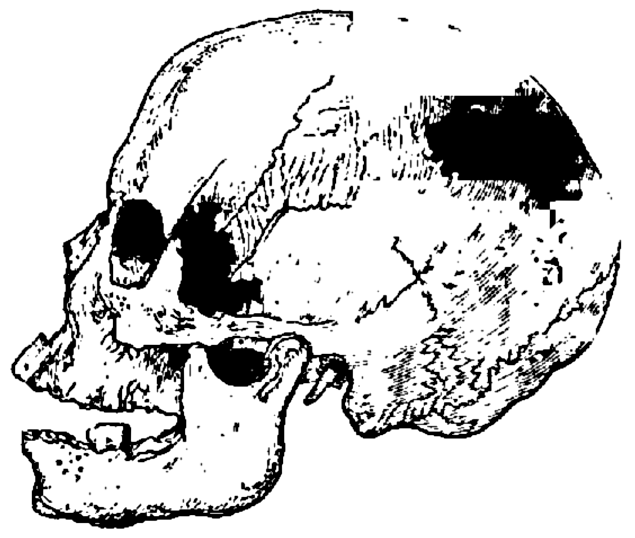
Fig. 7.
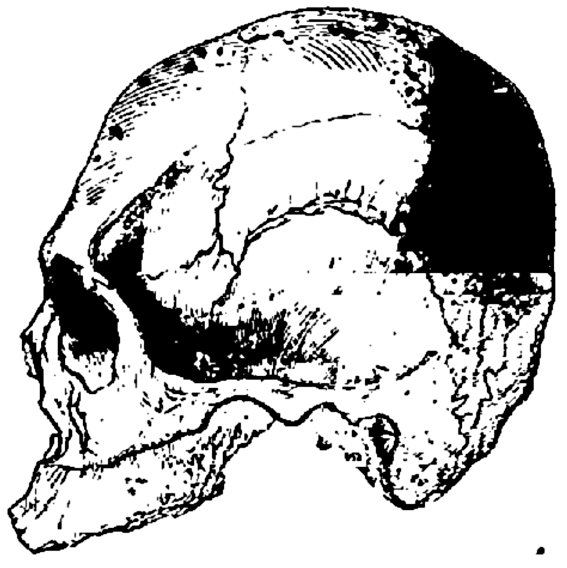
2nd Variety.—Form squat, faces square and angular, cheek-bones prominent, lips thick, skin rough and black, hair simply tied up.
South-western coast.—Portions of the south-western coast of New Guinea were visited by H.M.S. Fly, in 1842-1846, under Captain Blackwood. The notices of Mr. Jukes upon the natives thus seen are short, and chiefly limited to the points wherein they differed or agreed with the islanders of Torres Straits—a portion of the human species that has been described fully for the first time by that writer. Tall and muscular, with the hair tied back behind, sometimes with the head shaved, the skin dark brown or copper-coloured, with ornaments like the people of Erroob, and without out-riggers to their canoes, or with out-riggers on one side only, they spoke a language different from that of the Torres Straits islanders.
In appearance, however, they agreed. Their huts were raised on piles, of moderate dimension, and with small plots of imperfectly-cleared ground around them. The coast was low, and intersected by numerous freshwater channels; and the name given to the country by the Erroobians was Dowdee.
In Darnley Island, a female from the Dowdee coast was seen and described by Mr. Jukes, she was lighter coloured than the Erroobians, being of a yellowish-brown; had the septum narium pierced, and was tattooed, which the females of the island are not.
Masseed.—The natives were "a well-made, fine-looking people, of a different type from the Australians, with muscular limbs and frizzled hair. They had the oval epaulet-like mark on the shoulders, but no other scars. Their hair was dressed into long, narrow, pipe-like curls, smeared with red ochre and grease, and they wore a band round the forehead."—Vol. 1. p. 159.
Murray Island.—Native name maær—Volcanic. Covered with cocoa-nuts, and having a language almost identical with the Erroob.
Darnley Island.—Native name, Erroob—Volcanic. The natives here "were fine, active, well-made fellows, rather above the middle height, of a dark brown or chocolate colour. They had frequently almost handsome faces, aquiline noses, rather broad about the nostril, well-shaped heads, and many had a singularly Jewish cast of features. The hair was frizzled, and dressed into long, pipe-like ringlets, smeared sometimes with red ochre, sometimes left of its natural black colour; others had wigs not to be distinguished from the natural hair, till closely examined. The septum narium was bored, but there was seldom anything worn in it. Most of their ears were pierced all round with small holes, in which pieces of grass were stuck, and in many the lobe was torn and hanging down to the shoulder. Their only scars were the faint oval marks on the shoulder. The hair of their bodies and limbs grew in small tufts, giving the skin a slightly woolly appearance. They were entirely naked, but frequently wore ornaments made of mother-of-pearl shells, either circular or crescent-shaped, hanging round their necks. Occasionally, also, we saw a part of a large shell, apparently a cassis, cut into a projecting shield-shape, worn in front of the groin. The women wore a petticoat round the waist, reaching nearly to the knees, formed of strips of leaves sown on to a girdle. These formed a very efficient covering, as one or two were worn over each other. The grown-up woman's petticoat, or nessoor, was formed, we afterwards found, of the inside part of the large leaves of a bulbous-rooted plant, called by them teggaer, of which, each strip was an inch broad. The girl's nessoor was made of much narrower strips from the inside of the leaf of the plantain, which they call cabbow.
"The younger women were often gracefully formed, with pleasing expressions of countenance, though not what we should consider handsome features. The girls had their hair rather long, but the women had almost all their hair cut short, with a bushy ridge over the top, to which they, singularly enough, give the same name as to pieces of tortoise-shell, namely, kaisu. Many of the elder women had their heads shaved quite smoothly, and we never saw a woman wearing a wig, or with the long ringlets of the men. At our first landing, all the younger women and girls kept in the back-ground, or hid themselves in the bush. On strolling to the back of the huts, we found a small native path, along which we went a short distance till we came to a rude fence in front of a plantain-ground, where the men objected to our going further, and we heard the voices of the women among the trees beyond.
"There were four huts at this spot, all bee-hive shaped, sixteen feet in diameter, and as much in height. They stood in small court-yards, partially surrounded by fences formed of poles of bamboo, stuck upright in the ground, close together, and connected by horizontal rails, to which they were tied by withies. Inside the huts were small platforms covered with mats, apparently bed-places; and over head were hung up bows and arrows, clubs, calabashes, rolls of matting, and bundles apparently containing bones, which they did not like our examining. Outside the huts were one or two small open sheds, consisting merely of a raised flat roof, to sit under in the shade, and a grove of very fine cocoa-nut trees surrounded the houses."
The arms of the natives were the bow and arrow, and in holding the former, especial care was taken that the part of the wood which was uppermost as the tree grew, should be uppermost when used as a weapon. Rough imitations of the human figure were common; but whether they served as idols or not was uncertain. The use of tobacco was general. The language was different from that of the Australians, and the willingness of the people to communicate, greater, also. On the part of the females, the reserve and decorum of manner formed a striking contrast with the very different habits of the Polynesians.
Turtle-backed Island.—Primitive—Cocoa-nut trees; no gum trees—"We came one day on the first symptoms of cultivation of the ground we had ever seen among the aborigines of this part of the world. This was a little circular plot of ground, not more than four or five yards in diameter; but it had evidently been dug, though in a rude manner, and in it were set several young plantain-trees, one or two other plants, and two trailing plants, somewhat like French beans in appearance, which we afterwards found were a kind of yam. The huts on this island had the appearance of a first attempt at a house, having side walls about two feet high, and a gable-shaped roof rising four feet from the ground. They were about ten feet long and six feet wide, made principally of bamboo and thatched with grass and leaves."
Mount Ernest.—Primitive—Cocoa-nuts—Captain Blackwood "landed upon Mount Ernest (807 feet high), and found a group of huts much superior to any we ever saw in Australia, a small grove of cocoa-nuts and another of large bamboos. The natives did not show themselves till after he left the island; and though he spent a night on it he did not suspect their presence at the time. In the huts were found parcels of human bones, ornamented with red ochre, a mask or hideous face made of wood and ornamented with the feathers of some struthious bird, and one or two bundles of small wooden tubes, eight inches long and half an inch in diameter, the use of which we never could discover. The feathers so abundantly used as ornaments on their canoes and other articles by all these islanders, were at first taken by us for emu feathers, as a matter of course, and supposed to be procured from the mainland of Australia. I was afterwards, however, induced to doubt the correctness of that supposition; and on comparing them (in company with my friend Mr. George Bennett, of Sydney,) with the feathers of the emu, in the Sydney Museum of Natural History, we found them to be totally distinct from any emu feathers. They are probably, therefore, feathers of the cassowary or some similar bird, and are derived from New Guinea instead of Australia."
Of all the islands of Torres Straits, this is the one nearest to Australia, whereof the population is apparently derived from New Guinea.
Dalrymple Island.—Native name, Damood—"The huts were by far the neatest and best erections of the kind we had yet seen. Each one occupied a quadrangular space, six to eight feet wide, and from ten to fifteen feet long. They had gable-shaped roofs, eight feet high in the centre, and sloping on each side nearly to the ground. The frame of the house was made of bamboo, and thickly covered or thatched with grass and palm-leaves; the front and back walls were also made of small bamboo sticks, upright and fastened close together, the front wall having a small triangular opening for a door, over which hung loose strips of palm leaf. The door looked into a little court-yard, of about ten feet square, in front of the house, strongly fenced with stout posts and stakes, interlaced with palm leaves and young bamboos, and accessible only by a very narrow opening between two of the strongest posts. In this court-yard was the cooking fire. The different huts and fences were rather irregularly disposed, but placed closely together, so as to leave only narrow winding passages between them. They occupied a space fifty or sixty yards long by ten or fifteen broad. Behind them was the open place of meeting, on the other side of which, against an old tree was a semicircular pile or wall of dugongs' skulls about three feet high, many of which were quite fresh, but others rotting with age; in the middle of this was a conical heap of turtles' skulls in a similar state. There must, altogether have been some hundreds of skulls of each kind of animal.
"When they had conducted us into this open space, several of them seated themselves on small well-made mats, like those used by the Malay nations; and two or three went and brought a large roll of matting, at least twelve feet by six, which they spread for us to sit down on. These really well-made fabrics greatly surprised us after being accustomed to the non-manufacturing Australians. They then brought us young cocoa-nuts, tortoise-shell, and ornaments, and a great barter commenced. They gave us cocoa-nut water without waiting to receive anything for it, but for the other things they would only accept tobacco and iron implements, paying no regard to our beads and gaudy handkerchiefs. They brought us two small bananas or plaintains, but we could not see the trees on which they grew. They suffered Captain Blackwood and myself to stroll about the huts unattended, while they bartered with the boat's crew. We found in the court-yard of one hut, a ship's cabin-door, painted green, and not very old; in another a quaker gun, set upright in the ground, and the men said they saw pieces of 'Queen's line' among them. They had used pieces of iron hoops, and a long iron spike, to open the cocoa-nuts, but these they might have procured from passing vessels. The door and the wooden gun, however, must have come from a wreck.
"At the south end of the huts we came to a building much superior to, and differing from, any of the rest. It was like a Malay house unfinished, or one of their own smaller huts raised on posts to a height of six or seven feet. The point of the gable was at least fifteen feet from the ground, the roof being supported at each end by two stout posts about a yard apart, having their tops ornamented by carved grotesque faces, painted red, white, and black, with much carving and painting below. The lower part, or ground-floor, of this building was open all round except at one end, where a broad, rudely-constructed staircase led to a platform, from which went the entrance to the upper story; this was floored with stout sticks, and at this end covered with mats; this part was also partitioned off from the other by a bamboo screen. Under the roof hung old cocoa-nuts, green boughs, and other similar things, but nothing to give a decided clue to the object of the building. Whether this was their temple, their place for depositing the dead, or a chief's house, we could not make out. We, however, saw no appearance of any chief, or of one man exercising authority among them, neither could we discover any traces of religious belief or observance.[67]
"We now struck off for a walk across the island, one of the natives coming with us as a guide. Many narrow paths crossed in all directions, among shrubs and bushes, some of which resembled laurels and myrtles, in their leaves and modes of growth. Groves of lofty forest trees occurred here and there, with matted creepers and thick jungle. Several trailing briars, with thorns like the European bramble, were observed; and in short, the whole vegetation had a totally different aspect from that of Australia, and a much greater resemblance to that of Europe or Asia."
These minutiæ, in the way of description of particular localities, have a value for two reasons. In the first place they are the only (or nearly the only) notices of the parts in question. In the next, the parts themselves are important as belonging to the quarters where Australia and New Guinea are nearest each other.
In the north of New Guinea, the fact that has most struck inquirers has been the apparently peculiar style of the buildings. These are of vast size, capable of containing whole families, and often raised on piles. Hence, as long as the existence of similar erections in Borneo[68] was unknown, this form of domestic architecture passed for one of the characteristics of the Negritos in opposition to the Malays. At present, its diagnostic value is considerably lowered.
Another industrial art exercised by the Kelænonesians, and (according to most writers), not exercised by the unmixed Amphinesians, is the art of pottery. How far, however, it is general on the one side, or non-existent on the other, remains for further investigations to prove. The qualification denoted by the word unmixed, will be explained when we come to the ethnology of the Fiji Islands.
NEW BRITAIN.
NEW IRELAND.
NEW HANOVER.
SANDWICH ISLE.
ADMIRALTY ISLANDS.
HERMIT ISLANDS.
These islands have been mentioned in detail for the sake of indicating the probable line of population—first towards the east, and next (backwards) to the north-west. Where any of the natives of these islands differ from one another, or from the New Guinea people, it is in having stronger limbs, lighter-coloured skins, hair more or less woolly, and faces more or less angular. All the differences, however, lie within a small compass. All the tribes, too, seem to agree in chewing the betel-nut, going naked (or nearly naked), and painting their bodies.
BOUKA. BOUGAINVILLE ISLAND.
Natives.—Heads large, faces flat, chin prominent, mouth large, lips thin. Muscles well-marked.—Labillardière.[69]
SOLOMON'S ISLANDS.
Vocabulary.—From Port Praslin.—Voyage de l'Astrolabe.
NITENDI, INDENDI, INDENNI.
Name.—Native.
Synonyms.—Santa Cruz, Egmont's Island.
Direction.—Nearly due east (not south) of Christoval, the most southern of the Solomon Isles.
VANIKORO.(?)[70]
Description from Durville.—"We have already said that the inhabitants of Vanikoro belong to the black race of the Great Ocean. They may be considered as a variety of that race of blacker colour than others, and of a conformation approaching more nearly to that of proper Negroes. They are generally small and rather meagre. What is most remarkable in their shape is an appearance of lateral compression of the temples, produced by a very arched forward protuberance of the middle part of the forehead. The hair does not advance low on the forehead, and the care taken to throw it back renders all these parts very visible. The cheek-bones being salient give the face a greater developement than that of the cranium. Another character not less remarkable is the small projection of the nasal bones, which gives the nose an appearance of being flattened at its root, and to the countenance a singular resemblance to that of the orang utang. Owing to this the orbital arch, itself prominent, appears still more projecting. The nostrils are wide, and are rendered still more so by the custom of wearing a stick fixed transversely through the septum narium. The lower jaw is not remarkable. The form of the forehead causes the facial angle to be not particularly acute. The lobes of the ears are perforated by a hole large enough to pass the hand through it. The eyes are large, oval, and deeply set; the balls salient, round, and resembling in form and colour those of the Negro. The lips are large, the chin small. The lower extremities are in some instances very lean, but tolerably fleshy in others. The calf is rather high, and the heel is in many individuals remarkably projecting, a character not existing in the Polynesian race to the same extent. This is another approximation to the Negro. The hair is crisp, but although not cut, it never becomes bushed and matted. They are nearly naked. The use of the betel-nut destroys their teeth, and gives them a red tinge round the mouth. The women are horribly ugly; the old men are bald."
The position of Nitendi and Vanikoro gives them interest.
a. Although not lying due south-east of the Solomon Isles, and due north-east of the next Archipelago, they form the insular continuity between the two groups.
b. Vanikoro is the Kelænonesian Island, which, by its vicinity, gives to[71] Tikopia, which is Polynesian, its peculiarity of distribution.
Lastly, although the fact be not ethnological, the Vanikoro cluster is the locality where La Perouse perished.
THE NEW HEBRIDES.
Particular islands—
ISLE OF LEPERS.
Synonym.—Australia del Espiritu Santo.
MALLICOLLO.
For each of these islands we have special evidence—that of Bougainville and Cook—to the general Negrito character of the natives. In the voyages of the latter the ill-favoured monkey-like appearance of the Mallicollese is prominently mentioned.
API.
Direction.—Continuation from Mallicollo to—
SANDWICH ISLE.
Direction.—Continuation from Api to—
ERROMANGO.
Erromango Native as described by Hales.—"He was about five feet high, slender and long limbed. He had close woolly hair, and retreating arched forehead, short and scanty eyebrows, and small snub-nose, thick lips (especially the upper), a retreating chin, and that projection of the jaws and lower part of the face, which is one of the distinctive characteristics of the Negro race. His limbs and body were covered with fine short hairs, made conspicuous by their light colour. On his left side were many small round cicatrices burnt into the skin, which he said was a mode of marking common amongst his people. Placed in a crowd of African blacks, there was nothing about him by which he could have been distinguished from the rest."—Vol. 6. p. 44.
TANNA.
A grammar of the Tanna language, the only one of the Papua division that has ever been sufficiently known to Europeans, was seen by Dr. Prichard—
"I have seen a grammar of the language of Tanna in manuscript, written by the Rev. T. Heath, a missionary, who resided in that island. It is much to be regretted that this work has not been published. From this grammar it appears that the language of Tanna is entirely distinct in character from the Polynesian. It abounds with inflections and has four numbers, viz. singular, dual, trinal, there being a particular form in the verb when three persons are spoken of, which is distinct from the plural."
ANNATOM.
The direction of the Kelænonesian Islands now changes from south-east to south-west.
THE LOYALTY ISLES. NEW CALEDONIA.
With a general character like that of the islanders already mentioned, Cook states that they are better-looking than the Tanna people, and that they bury their dead like the Australians. La Billardière adds, that they are like the Van Diemen's Land natives.
The whole of the Papua area will not have been exhausted until we return to the parts described by Mr. Jukes, on the south-eastern side of New Guinea. These lead, in the way of geographical continuity, to—
LOUISIADE.
Of this Island I have seen no definite account. Such notices, however, as I have met with, make the population what we should expect it to be—Papua-Kelænonesian.
THE FIJI (FEEJEE) ISLANDS.(?)
Situation.—Eastward of the New Hebrides, the most eastern part of Kelænonesia. Westward of the Tonga Isles, the most western part of Polynesia.
The physical conformation of the Fiji natives is Negrito as well as Polynesian.
The language of the Fiji natives is more Polynesian than Negrito.
The social institutions, manners, and customs of the Fiji natives are partly Polynesian, partly Negrito, and partly neither one nor the other.
These statements, combined with their geographical position, give importance and prominence to the Fiji group of islands. Fortunately our information concerning them is not altogether disproportionate to the difficulties that they introduce. The language has been investigated by Mr. Norriss, whose trust-worthy opinion, adopted in the present work, may be found, in extenso, in the 5th volume of Prichard.
The moral and physical features are exhibited in the following extract from the American Exploring Expedition:—
"The Feejeeans are a people of the medium stature, with nearly as great variety of figure as is found in nations of the Caucasian race. The chiefs are usually tall and well formed, owing probably to the care taken of their nurture, and to the influence of blood. The common people are somewhat inferior, yet there are fewer small and ungainly figures among them than among the lower orders of Europeans. On the other hand, the Feejeeans contrast very unfavourably with their neighbours of the Polynesian stock. They lack the full rounded limbs and swelling muscles which give such elegance to the forms of the Friendly and Navigators Islanders. They are generally large-jointed, and the calf is small in proportion to the thigh. The neck is also too short for due proportion, and the whole figure wants elegance and softness of outline. Their movements and attitudes are, consequently, less easy and graceful than those of the Polynesians. They are, nevertheless, a strong race; their war-clubs are ponderous, and are wielded with great power, and they can carry very heavy burdens.
"The Feejeean physiognomy differs from that of the Polynesians, not so much in any particular feature, as in a general debasement of the whole, and a decided approximation towards the forms characteristic of the Negro race. The head is usually broad in the occipital region (which they consider a great beauty), and narrows towards the top and in front,—the forehead, though often of good height, appearing compressed at the sides. The eyes are black and set rather deep, but never obliquely. The nose is not large, and is generally a good deal flattened; the nostrils are often larger laterally than forwards, and the nose is then much depressed at the upper part between the eyes. The mouth is wide, and the lips, particularly the upper one, thick. The chin varies, but is most commonly short and broad. The jaws are larger, and the lower part of the face far more prominent than in the Malay race. The cheek-bones, also, project forwards as in the Negro, and not laterally, as in the Mongol variety; notwithstanding which, the narrowness of the forehead at the temples gives a greater width to the face at the malar portion than elsewhere. The whole face is longer and thinner than among the Polynesians. The hair is neither straight nor woolly, but may be properly designated as frizzled. When allowed to grow without interference, it appears in numerous spiral locks, eight or ten inches in length, spreading out on all sides of the head. Sometimes these curls are seen much longer, falling down to the middle of the back. It is, however, very seldom allowed to grow naturally. The young boys have it cut very close, and sometimes shaved to the skin, like the Tahitians. In girls, before marriage, it is allowed to grow long, and is coloured white by washing it with a solution of lime, except a portion around the crown, which is plastered with a black pigment. After marriage, it is either cut to the length of one or two inches, or frizzled out like that of the men: in both cases it is frequently soaked in colouring liquids, either red or black. The men in general have their hair dressed so as to form an immense semiglobular mass, covering the top, back, and sides of the head. The arrangement of this chevelure is performed for the chiefs by professional barbers, and is a work of great labour. Six hours are sometimes occupied in dressing a head; and the process is repeated at intervals of two or three weeks. It is probably to guard against disarranging this work that the piece of bamboo which is placed under the neck in sleeping is employed, instead of the ordinary pillow. For the same purpose the natives usually wear, during the day, a sala or kerchief, of very thin gauze-like paper cloth, which is thrown over the hair and tied closely around the head, so as to have very much the appearance of a turban.
"The colour of the Feejeeans is a chocolate-brown, or a hue mid-way between the jet-black of the Negro, and the brownish yellow of the Polynesian. There are, however, two shades very distinctly marked, like the blonde and brunette complexions in the white race; besides all the intermediate gradations. In one of these shades the brown predominates, and in the other the copper. They do not belong to distinct castes or classes, but are found indiscriminately among all ranks and in all tribes. The natives are aware of the distinction, and call the lighter coloured people, Viti ndamundamu, "red Feejeeans;" but they do not seem to regard it as anything which requires or admits of explanation. These red-skinned natives must not be confounded with the Tonga-Viti, or individuals of mixed Tongan and Feejeean blood, of whom there are many on some parts of the group."
Their ferocious and suspicious character is described in very unfavourable terms; to which it may be added, that their cannibalism is undoubted, and that they are skilful in the art of pottery—a fact of which the import has already been noticed.
The problem that is suggested by the intermediate character of the Fijis is manifest: it is the question as to whether we have intermixture or transition. Further notice, however, of this point, will stand over until the next divisions have been disposed of.
THE AUSTRALIAN BRANCH OF THE KELÆNONESIAN STOCK.
Area.—Australia.
Physical appearance.—Kelænonesians with hair generally straight, or waved, sometimes frizzy.
Fauna.—Absence of ruminants and pachydermata.
Divisions.—1. Australians. 2. Tasmanians(?).
The differences between the different Australian languages have long been known and definitely insisted upon.
Less marked differences in frame and physiognomy between the different Australian tribes, have also been long known and definitely insisted upon.
Differences of customs and manners have been similarly noticed and considered. Notwithstanding all this, however, there is no opinion more generally admitted than the fundamental unity of the Australian population from Swan River to Botany Bay, from the Gulf of Carpentaria to Bass's Straits. Captain Grey, Schurman, Teichelman, and all who have devoted average attention to the language, have given their evidence to this; and they have supplied facts of various kinds, of their own collection, towards the proof of it. No man is less inclined to disturb this view than the present writer. In the Fourth Number of the Philological Transactions,[72] he enumerated the whole of the vocabularies then known to him, and added some short lists of the words wherein the more distant ones agreed with each other. Thus a scanty vocabulary from the Gulf of Carpentaria, which had seventeen words in common with one from Endeavour River, had three (perhaps four) identical.
ENGLISH. CARPENTARIAN. ENDEAVOUR RIVER.
Eye meal meul.
Hair marra morye.
Fingers mingel mungal bah.
As the Endeavour River was the nearest point to the Gulf of Carpentaria from which we possessed a vocabulary, the circumstance that no more than three words out of seventeen coincided, was a good measure of the extent to which the Australian dialects exhibited the phænomenon of difference. Still the likeness, as far as it went, was a fact to be admitted on the other side. Now, if we go round the whole coast of Australia, and compare the vocabulary from one point with the vocabulary of the next known locality to it, we shall find that, allowing for difference of distance, the similarity or dissimilarity is, there or thereabouts, the similarity or dissimilarity between the two vocabularies just mentioned, i.e., that the former is shown by the identity between a few fundamental terms, the latter by a discrepancy between the majority.
The comparison, however, of contiguous dialects—gives but one series of facts. It merely shows that we can go all round the island, and find that, of three dialects compared, the last shall have a partial agreement with the second; by no means showing that such (or, indeed, that any) similarity shall exist between the third and first. Nevertheless, for philological reasoning, such a similarity as the last is required. This we get at by two methods,—firstly, by comparing the vocabularies of distant points; secondly, by taking one, or more, particular vocabularies, and comparing them with some, or all, of the others en masse. By each of these processes, applied to Australian languages, we arrive at the same conclusion. The second will be considered in the sequel. A simple instance of the first is, that out of sixty words from Jervis's Bay, compared with sixty from Gulf St. Vincent, the following coincide:
ENGLISH. JERVIS'S BAY. GULF ST. VINCENT.
Forehead holo ioullo.
Man mika meio.
Milk awanham ammenhalo.
Tongue talen talein.
Hand maramale malla.
Nipple amgnann amma.
Nails berenou pere.
Premising now, that (as all the published grammars exhibit an agglutinate structure) the evidence taken from the grammatical character of the Australian languages is confirmatory rather than derogatory to the evidence taken from the comparison of vocabularies, we come to a fourth class of facts, viz., the extent to which two or more Australian dialects agree or disagree with some third language or class of languages; and as this involves the still more general question of the external relations of the Australian languages as a class, its consideration will be deferred for the present. At present it is sufficient to say that it is affirmative to a fundamental unity of tongue.
The kind of evidence from which we predicate this unity, is evidently of a cumulative kind; and it is merely the statement of its being of this sort that has been laid before the reader: the details would require either a larger volume than the present, or a special monograph. It may also be added, that as the Australian tribes differ more from one another in language than in any other respect, it is the philological portion of their ethnography that presents the most difficulties.
In respect to their manners, morals, and social customs, the similarity, lying less below the surface than it does with respect to their languages, has drawn less attention on the part of investigators. Still the way in which it shows itself is the same. Two neighbouring tribes shall differ more than two distant ones: so that similar customs shall re-appear in distant localities.
As to the physical conformation of the Australians, I believe that it is so uniform throughout the island, that it has never been made the basis of a division;—indeed I am inclined to believe that (like the dissimilarity of language) the similarity of external appearance has been over-rated; nevertheless, it is certain that there are deviations from the general slim and underfed condition of the body; and (what is of more importance), from the usual straight character of the hair. Such is the case, according to Mr. Earle, with the trepang fishers of Arnhem Bay who are bulky men, with broad chests, the lower extremities being but indifferently formed, and the crooked shin being common. Then as to the hair—with the Jaako, or Croker Island tribe, it is coarse and bushy (the whiskers being thick, and curly) and so short, crisp, and abundant about the breast and shoulders as to conceal the skin; whereas on the other hand, the Oitbo, or Bidjenelumbo, have straight silky hair, arched eyebrows, fair complexion, and occasionally the oblique eye.
The lowest form of humanity has been sought for in Australia, whilst the physical condition of the country and the absence of those animals and herbs that supply human food, have made it a likely quarter to exhibit it. Whether, however, so low a rank in scale of human development be, upon the whole, a fact or exaggeration, it is certain that, upon several points, there has been considerable overstatement. One sample of this sort is the accredited opinion as to the absolute incapacity of the Australian of forming even the rudest elements of a mythology—an opinion which engenders the notion that their intellects are too sluggish for even the evolution of a superstition.
That this was not the case was indicated some years back by Captain Gray, and that there is some exponent of the religious feeling in the shape of a rude form of shamanism, has been shown in the account of the American Exploring Expedition; where the first[73] published details of the Australian mythology, if so it may be called, are to be found—"It is not true, however, as has been frequently asserted, that the natives have no idea of a Supreme Being, although they do not allow this idea to influence their actions. The Wellington Tribes, at least, believe in the existence of a Deity called Baiamai, who lives on an island beyond the great sea to the East. His food is fish, which come up to him from the water when he calls to them. Some of the natives consider him the maker of all things, while others attribute the creation of the world to his son Burambin. They say of him, that Baiamai spoke, and Burambin came into existence. When the missionaries first came to Wellington, the natives used to assemble once a year, in the month of February, to dance and sing a song in honour of Baiamai. This song was brought there from a distance by strange natives, who went about teaching it. Those who refused to join in the ceremony were supposed to incur the displeasure of the god. For the last three years the custom has been discontinued. In the tribe on Hunter's River, there was a native famous for the composition of these songs or hymns; which, according to Mr. Threlkeld, were passed from tribe to tribe, to a great distance, till many of the words became at last unintelligible to those who sang them.
"Dararwirgal, a brother of Baiamai, lives in the far west. It was he who lately sent the small-pox among the natives, for no better reason than that he was vexed for want of a tomahawk. But now he is supposed to have obtained one, and the disease will come no more. The Bálumbal are a sort of angels, who are said to be of a white colour, and to live on a mountain at a great distance to the south-east: their food is honey, and their employment is to do good 'like the Missionaries.'
"It is possible that some of these stories owe their origin to intercourse with the whites, though the great unwillingness which the natives always evince to adopt any customs or opinions from them, militates against such a supposition. But a being who is, beyond question, entirely the creation of Australian imagination, is one who is called in the Wellington dialect, Wandong; though the natives have learned from the whites to apply to him the name of devil. He is an object not of worship, but merely of superstitious dread. They describe him as going about under the form of a black man of superhuman stature and strength. He prowls at night through the woods around the encampments of the natives, seeking to entrap some unwary wanderer, whom he will seize upon; and, having dragged him to his fire, will there roast and devour him. They attribute all their afflictions to his malevolence. If they are ill, they say Wandong has bitten them. No one can see this being but the núrjargir, or conjurors, who assert that they can kill him, but that he always returns to life. He may, however, be frightened away by throwing fire at him (though this statement seems inconsistent with that respecting his invisibility), and no native will go out at night without a firebrand to protect him from the demon.
"There is some difference in the accounts given of this character. By the tribe of Hunter's River he is called Koin or Koen. Sometimes, when the Blacks are asleep, he makes his appearance, seizes upon one of them and carries him off. The person seized endeavours in vain to cry out, being almost strangled. At daylight, however, Koin disappears, and the man finds himself conveyed safely to his own fireside. From this it would appear that the demon is here a sort of personification of the nightmare,—a visitation to which the natives, from their habits of gorging themselves to the utmost when they obtain a supply of food, must be very subject.
"At the Muruya River the devil is called Túlugal. He was described to us, by a native, as a black man of great stature, grizzled with age, who has very long legs, so that he soon overtakes a man; but very short arms, which brings the contest nearer an equality. This goblin has a wife who is much like himself; but still more feared, being of a cruel disposition, with a cannibal appetite, especially for young children. It would hardly be worth while to dwell upon these superstitions, but that they seem to characterise so distinctly the people, at once timid, ferocious, and stupid, who have invented them.
"Their opinions with regard to the soul vary: some assert that the whole man dies at once, and nothing is left of him; others are of opinion that his spirit still survives, but upon this earth, either as a wandering ghost, or in a state of metempsychosis, animating a bird or other inferior creature. But the most singular belief is one which is found at both Port Stephens and Swan River, places separated by the whole breadth of the Australian continent. This is, that white people are merely blacks who have died, passed to a distant country, and having there undergone a transformation, have returned to their original homes. When the natives see a white man who strongly resembles one of their deceased friends, they give him the name of the dead person, and consider him to be actually the same being."
It is difficult to take an exact measure of the extent to which one superstition is grosser than another;—hence, all that can be said respecting the Pantheon, of which Baiamai and Wandong are portions, is that it is as low in the scale of mythologies as any that has fallen under the notice of the writer. Still, those of the Blacks of the Malaccan Peninsula, of Madagascar, and of parts of Africa, are much on the same level.
No sound of s in the Australian languages.—The distribution of the different elementary articulations over the different languages of the earth, has not been sufficiently studied to enable us to predicate anything concerning the absence or presence of particular sounds, as a measure of the perfection or imperfection of human speech; nevertheless, it is clear that the power of pronouncing a number of elementary sounds sufficient to allow of that difference between word and word, which is necessary for clear and precise language, is one of the great conditions of articulate and distinct speech; and hence, a language of which the elementary sounds are too few, or one wherein the power of combining them to their full extent, is wanting, is the exponent of a low degree of humanity. Still more so would one be wherein a large proportion of the sounds is inarticulate—like the sound of the letter h in English, which is a mere breathing rather than a true articulation. In respect to this latter class of facts, the admission of inarticulate elements of speech, there are two only in the whole range of language; one of which is so common as to occur in almost all the dialects of the world, the other is so rare as to be found in one class of tongues only. These are, the power of h as already stated, and the peculiar click which will be noticed in the languages of Southern Africa.
The inability to combine articulations, which, when taken singly, are sufficiently easy of pronunciation, is another sign of deficiency of power over language, as an instrument, or medium, and, in some form or other, it is a common phænomenon; e.g., the sound of s, and the sound of[74]tsh, are pronounceable enough when taken singly; since we can say shest, and we can say tshest. The combination, however, of stsh is difficult—at least to English organs. There is none such in our language; yet it is a favourite juxtaposition in the Slavonic tongues. Again, to a person unused to comparative philology, it may seem strange to be told that in the Finlandic dialects the combination of any two consonants in the same syllable, is rare: and that such words as stab, &c., in order to become pronounceable must be converted into setab, or estab, &c. Yet this inability to combine consonants with one another is, perhaps, the rule rather than the exception in language.
Again, without admitting the notion of an aristocracy amongst the elements of the alphabet, and calling sounds like r and s the noble letters, just as gold and silver are designated as the noble metals, we may ask whether their absence in some of the more uncivilized languages, is not a fact of some import in the natural history of Man. It seems so to the present writer.[75]
These episodical observations, however, form a long prelude to a very simple fact, viz.: that, as far as we are enabled to make a negative statement, the sound of s, wanting in many of the Polynesian dialects, is wanting in all the Australian ones.
Incomplete numeration of the Australians.—The import of an Australian having no more than the three, four, or five first numerals, and being thereby as unable to count the number of the fingers of his hands, as that of the hair of his head, is less equivocal. It speaks, at once, to a minimum amount of intellectual power. Nevertheless, the same inability occurs elsewhere; especially in certain languages of South America. The only vocabulary of Australia, where the numerals run beyond five, is that of King George's Sound, as given in Mitchell's Australia.
The political constitution (if so it can be called) of the Australians is preeminently simple, exhibiting a society of families rather than of tribes; and one of the facts connected with the evidence in favour of the unity of the Australian division of mankind is the remarkable distribution of families bearing the same name. The principal of these are the Ballaroke, the Tdondarup, the Ngotok, the Nagarnook, the Nogonyuk, the Mongalung, and the Narrangar.[76] Now, persons bearing one or the other of these names, may be found in parts of the country five hundred miles apart. Nor does this appear to be the effect of migration, since each tribe is limited by the jealousy of its neighbours to its own hunting-ground, beyond which it seldom passes.
Polygamy, in Australia, is what we find and expect to find. The practice of circumcision is what we find, perhaps, without expecting it. The habit of the children taking the name of the mother, will occur again in the south of India. The rule that a man cannot marry a woman of his own family-name will also re-appear, and that amongst the Indians of North America.
The Kobong[76]—"Each family among the Australians, adopts some animal or plant, as a kind of badge or armorial emblem, or, as they call it, its kobong. A certain mysterious connection exists between a family and its kobong, so that a member of the family will not kill an animal, or pluck any plant of the species to which his kobong belongs, except under particular circumstances. This institution again, which in some respect resembles the Polynesian tabú, though founded on a different principle, has its counterpart in the customs of the native Americans. Captain Gray observes, citing Mr. Gallatin, that among the Hurons,[77] the first tribe is that of the bear; the two others, those of the wolf and turtle. The Iroquois have the same divisions, and the turtle family is divided into the great and little turtle. The Sioux are named on a similar principle. According to Major Long, one part of the superstition of these savages, consists in each man having some totem, or favourite spirit, which he believes to watch over him. The totem assumes the shape of some beast, and therefore they never kill or eat the animal whose form they suppose their totem to bear."
"The ceremony of initiation.—When the boys arrive at the age of puberty (or about fourteen), the elders of a tribe prepare to initiate them into the duties and privileges of manhood. Suddenly, at night, a dismal cry is heard in the woods, which the boys are told is the Bubu calling for them. Thereupon all the men of the tribe (or rather of the neighbourhood) set off for some secluded spot previously fixed upon, taking with them the youths who are to undergo the ceremony. The exact nature of this is not known, except that it consists of superstitious rites, of dances representing the various pursuits in which men are engaged, of sham fights, and trials designed to prove the self-possession, courage, and endurance of the neophytes. It is certain, however, that there is some variation in the details of the ceremony, in different places; for among the coast tribes, one of these is the knocking out of an upper front tooth, which is not done at Wellington, and farther in the interior. But the nature and object of the institution appear to be everywhere the same. Its design unquestionably is, to imprint upon the mind of the young man, the rules by which his future life is to be regulated; and some of these are so striking, and, under the circumstances, so admirable, that one is inclined to ascribe them to some higher state of mental cultivation than now prevails among the natives. Thus, the young men, from the time they are initiated, till they are married, are forbidden to approach or speak to a female. They must encamp at a distance from them at night, and if they see one in the way, must make a long detour to avoid her. Mr. Watson told me that he had often been put to great inconvenience in travelling through the woods, with a young man for his guide, as such a one could never be induced to approach an encampment where there were any women. The moral intent of this regulation is evident.
"Another rule requires the young men to pay implicit obedience to their elders. As there is no distinction of rank among them, it is evident that some authority of this kind is required, to preserve the order and harmony of social intercourse.
"A third regulation restricts the youth to certain articles of diet. They are not allowed to eat fish, or eggs, or the emu, or any of the finer kinds of opossum and kangaroo. In short, their fare is required to be of the coarsest and most meagre description. As they grow older, the restrictions are removed, one after another; but it is not till they have passed the period of middle age that they are entirely unrestrained in the choice of food. Whether one purpose of this law be to accustom the young men to a hardy and simple style of living may be doubted; but its prime object and its result certainly are to prevent the young men from possessing themselves, by their superior strength and agility, of all the more desirable articles of food, and leaving only the refuse to the elders.
"2. The ceremony of marriage, which, among most nations, is considered so important and interesting, is with this people one of the least regarded. The woman is looked upon as an article of property, and is sold or given away by her relatives without the slightest consideration of her own pleasure. In some cases she is betrothed, or rather promised, to her future husband in the childhood of both; and in this case, as soon as they arrive at a proper age, the young man claims and receives her. Some of them have four or five wives, and in such a case, they will give one to a friend who may happen to be destitute. Notwithstanding this apparent laxity, they are very jealous, and resent any freedom taken with their wives. Most of their quarrels relate to women. In some cases, the husband who suspects another native of seducing his wife, either kills or severely injures one or both of them. Sometimes the affair is taken up by the tribe, who inflict punishment after their own fashion. The manner of this is another of the singularities of their social system.
"3. When a native, for any transgression, incurs the displeasure of his tribe, their custom obliges him to "stand punishment," as it is called; that is, he stands with a shield, at a fair distance, while the whole tribe, either simultaneously or in rapid succession, cast their spears at him. Their expertness generally enables those who are exposed to this trial to escape without serious injury, though instances occasionally happen of a fatal result. There is a certain propriety even in this extraordinary punishment, as it is very evident that the accuracy and force with which the weapons are thrown will depend very much upon the opinion entertained of the enormity of the offence.
"When the quarrel is between two persons only, and the tribe declines to interfere, it is sometimes settled by a singular kind of duello. The parties meet in presence of their kindred and friends, who form a circle round them as witnesses and umpires. They stand up opposite one another, armed each with a club about two feet long. The injured person has the right of striking the first blow, to receive which the other is obliged to extend his head forward, with the side turned partially upwards. The blow is inflicted with a force commensurate with the vindictive feeling of the avenger. A white man, with an ordinary cranium, would be killed outright, but, owing to the great thickness of their skulls, this seldom happens with the natives. The challenged party now takes his turn to strike, and the other is obliged to place himself in the same posture of convenience. In this way the combat is continued, with alternate buffets, until one of them is stunned, or the expiation is considered satisfactory.
"4. What are called wars among them may more properly be considered duels (if this word may be so applied) between two parties of men. One or more natives of a certain part of the country, considering themselves aggrieved by the acts of others in another part, assemble their neighbours to consult with them concerning the proper course to be pursued. The general opinion having been declared for war, a messenger or ambassador is sent to announce their intention to the opposite party. These immediately assemble their friends and neighbours, and all prepare for the approaching contest. In some cases, the day is fixed by the messenger, in others not; but, at all events, the time is well understood.
"The two armies (usually from fifty to two hundred each) meet, and after a great deal of mutual vituperation, the combat commences. From their singular dexterity in avoiding or parrying the missiles of their adversaries, the engagement usually continues a long time without any fatal result. When a man is killed (and sometimes before), a cessation takes place; another scene of recrimination, abuse, and explanation ensues, and the affair commonly terminates. All hostility is at an end, and the two parties mix amicably together, bury the dead, and join in a general dance.
"5. One cause of hostility among them, both public and private, is the absurd idea which they entertain, that no person dies a natural death. If a man perishes of disease, at a distance from his friends, his death is supposed to have been caused by some sorcerer of another tribe, whose life must be taken for satisfaction. If, on the other hand, he dies among his kindred, the nearest relative is held responsible. A native of the tribe at Hunter's River, who served me as a guide, had not long before beaten his own mother nearly to death, in revenge for the loss of his brother, who died while under her cure. This was not because he had any suspicions of her conduct, but merely in obedience to the requirements of a senseless custom."[78]
In the notice of the physical appearance of the natives of Waigiú and Rawack (p. 212), the statement that the molar portion of the alveolar arch is thick, is printed in Italics. This was for the sake of preparing the reader for an observation of Professor Owen's upon a peculiarity of the structure of the teeth of the tribes in question.