PART I. (continued 6)
Reading edition
"They are almost entirely clothed in the skins of rabbits, tagged together after the rudest fashion with the ends of sinew; hence the name of Hare Indians applied to the tribe. They have neither tents nor huts of any kind, living all the year round in the open air. As might be expected, they are a puny and stunted race, and are rapidly decreasing in numbers, and must soon disappear altogether."
The Dog-ribs.—Due-east of the Hare Indians.—"They live upon the rein-deer, which frequent their lands in great numbers, following the migrations of these animals as closely as if they formed part and parcel of the herd. They are almost entirely independent of the whites, and present a marked contrast with their neighbours of the Hare Tribe. They are well-clothed in the skins of the rein-deer, and have all the elements of comfort and Indian prosperity within their reach. They are a healthy, vigorous, but not very active race, of a mild and peaceful disposition, but very low in the mental scale, and apparently of very inferior capacity. There is no reason to think that they are decreasing in numbers. They receive the name of the Dog-ribs, from a tradition that they are descended from the dog."
The Yellow Knives.—Called also the Copper Indians, from occupying, like the Dog-ribs, a portion of the river so called.
The Carriers, Tahkali, or Taculli.—These occupy the greater portion of New Caledonia, and, of all the Athabaskans, they are those that are best known. They are divided into "eleven clans, or minor tribes, whose names are, beginning at the south, as follows:—(1) the Taūtin, or Talkótin; (2) the Tsilkótin, or Chiltokin; (3) the Naskótin; (4) the Thetliótin; (5) the Tsatsnótin; (6) the Nulaáutin; (7) the Ntshaáutin; (8) the Natliáutin; (9) the Nikozliáutin; (10) the Tatshiáutin; and (11) the Babine Indians. The number of persons in these clans varies from fifty to three hundred. All speak the same language, with some slight dialectical variations. The Sikani (or Secunnie) nation has a language radically the same, but with greater difference of dialect, passing gradually into that of the Beaver and Chippewyan Indians.
"The Tahkali, though a branch of the great Chippewyan (or Athabascan) stock, have several peculiarities in their customs and character which distinguish them from other members of that family. In personal appearance they resemble the tribes on the Upper Columbia, though, on the whole, a better-looking race. They are rather tall, with a tendency to grossness in their features and figures, particularly among the women. They are somewhat lighter in complexion than the tribes of the south.
"Like all Indians, who live principally upon fish, and who do not acquire the habits of activity proper to the hunting tribes, they are excessively indolent and filthy, and, as a natural concomitant, base and depraved in character. They are fond of unctuous substances, and drink immense quantities of oil, which they obtain from fish and wild animals. They also besmear their bodies with grease and coloured earths. They like their meat putrid, and often leave it until the stench is, to any but themselves, insupportable. Salmon roes are sometimes buried in the earth and left for two or three months to putrefy, in which state they are esteemed a delicacy.
"The natives are prone to sensuality, and chastity among the women is unknown. At the same time, they seem to be almost devoid of natural affection. Children are considered by them a burden, and they often use means to destroy them before birth. Their religious ideas are very gross and confused. It is not known that they have any distinct ideas of a God, or of the existence of the soul. They have priests, or doctors, whose art consists in certain mummeries, intended for incantations. When a corpse is burned, which is the ordinary mode of disposing of the dead, the priest, with many gesticulations and contortions, pretends to receive in his closed hands something, perhaps the life of the deceased, which he communicates to some living person, by throwing his hands towards him, and at the same time blowing upon him. This person then takes the rank of the deceased, and assumes his name in addition to his own. Of course the priest always understands to whom this succession is properly due.
"If the deceased had a wife, she is all but burned alive with the corpse, being compelled to lie upon it while the fire is lighted, and remain thus till the heat becomes beyond endurance. In former times, when she attempted to break away, she was pushed back into the flames by the relations of her husband, and thus often severely injured. When the corpse is consumed, she collects the ashes and deposits them in a little basket, which she always carries about with her. At the same time she becomes the servant and drudge of the relations of her late husband, who exact of her the severest labour, and treat her with every indignity. This lasts for two or three years, at the end of which time a feast is made by all the kindred; and a broad post, fifteen or twenty feet high, is set up, and covered on the sides with rude daubs, representing figures of men and animals of various kinds. On the top is a box in which the ashes of the dead are placed, and allowed to remain until the post decays. After this ceremony the widow is released from her state of servitude, and allowed to marry again. The Carriers are not a warlike people, though they sometimes have quarrels with their neighbours, particularly the tribes of the coast. But these are usually appeased without much difficulty."[107]
The Tsikanni, or Sikani.—The evidence that these are Athabaskan is taken exclusively from their language. In the United States Exploring Expedition, the same sentence which speaks to the similarity of tongue, speaks also to the difference of manners and customs.—
"The Sikani, though speaking a language of the same family, differ widely from the Tahkali in their character and customs. They live a wandering life, and subsist by the chase. They are a brave, hardy, and active people, cleanly in their persons and habits, and in general agreeing nearly with the usual idea of an American Indian. They bury their dead, and have none of the customs of the Tahkali with respect to them."
A tabulated vocabulary of Mr. Howse, publishing by the Philological Society, is further evidence to the Athabaskan character of the Tsikanni language.
The Sussees, or Sarsees.—On the head-waters of the Saskatchewan.
It is not certain that the previous list is exhaustive of the northern Athabaskans. In Gallatin's enumeration we have, besides those enumerated—
1. The Northern Indians on Hudson's Bay.—As these are mentioned in addition to the Chippewyans Proper, it is fair to suppose that they constitute a variety under that division.
2. The Birch-rind Indians, living near the Slave Lake, and probably most closely akin to the Hare Indians.
3. The Thickwood Hunters.
4. The Sheep Indians.
5. The Brushwood Indians.
6. The Nauscud-dennies of M'Kenzie's River.
7. The Slaoucud-dennies of M'Kenzie's River.
8. The Naotetains to the west of Tacullis.
9. The Nagail, or Chin Indians; are probably Tacullis under another name.
In the Athabaskan language, dinne=man; so that we now understand the prevalence of that termination.
The Chippewyans Proper are called Saweesaw-dinneh.
The Birch-rind Indians are called Tan-tsawhot-dinneh.
The Dog-ribs are called Thlingeha-dinneh.
On the other hand, the Thickwood, Sheep, and Brushwood Indians are called Edch-tawoot, Ambah-tawoot, and Tsillaw-awdoot, respectively; whilst the Hare Indians are called Kancho.
Lastly, it should be added that, although Mr. Isbister makes the Nehannies Kolúch, Gallatin places them amongst the Athabaskans. A vocabulary of their language would probably settle the point. Such, however, is yet wanting.
SOUTHERN ATHABASKANS.
Area.—A narrow strip at the mouth of the river Columbia, and along the sea-coast to the river Umkwa.
Divisions.—1. Kwalioqwa. 2. Tlatskanai. 3. Umkwa.
1. The Kwalioqwa, north of the river Columbia, from which, and from the Tlatskanai, they are separated by the Tshinúks. Number, about 100.
2. The Tlatskanai, south of the river Columbia, from which, and from the Kwalioqwa, they are separated by the Tshinúks. Number, about 100.
3. The Umkwa, occupying the upper part of the river so-called, about lat. 43°. Number, about 400.
The first vocabulary of this section (one of the Umkwa language) was collected by Mr. Tolmie. The notice, however, of its affinities with the Tlatskanai and Kwalioqwa, and the more important discovery of its Athabaskan character, is one of many valuable additions made to Ethnographical Philology by Mr. Hales. I consider, for my own part, that the following table[108] justifies his classification.
ENGLISH. CHIPPEWYAN. TLATSKANAI. UMKWA.
Man dinnie khanane titsun.
Woman chequois tseukeia ekhe.
Father yitah (my) mama stanli.
Mother yinah (my) naa unla.
Son yiayay (my) sikute-teintsu nusla shashai.
Daughter yilengai (my) slku-tsukaisla éte.
Head edthie khustuma sugha.
Hair thiegah khotsusea zugha.
Ear " khotskhe tshigha.
Eye nackhay khonakhai naghe.
Nose " khointsus mintshesh.
Mouth " khokwaitshaále ta.
Tongue edthu khotshutkhltshikhltsaha lásom.
Tooth goo (pl) khotsiakatatkhltsin uo.
Hand law kholáa shláa.
Fingers " tkhlakhakhatesa schlatsune.
Feet cuh (sing.) khoakhastlsukai shke.
Blood dell tutkhl shtule.
House cooen kuntukh ma.
Axe thylne katstun senutl.
Knife bess tekhe natlmi.
Shoes kinchee ke khe.
Sky " ià ishtshi.
Sun sah tause sha.
Moon sah tause ighaltshi.
Star " " khatlatshe.
Day " khautkhlkante shaitltiti.
Night " kleakut khutli.
Fire counn tkhlkane khong.
Water tone to tkho.
Rain thinnelsee natkakh natkhlhika.
Snow yath yakhs tatkhliyitkhl.
Earth " neé nanee.
River tesse taseke khanee.
Stone thaih tshetse seh.
Tree " tukun sintshunata.
Meat bid tsutsun isung.
Dog sliengh tkhlin tkhli.
Beaver yah " sha.
Bear yass tulsunu shtetkhlshu (black).
Bird " tsheuse naake.
Great unshaw wane mintshaghe.
Cold edyah kwatsakhutowa skais.
White " itesina halukai.
Black dellzin tkhlsune huldji.
Red delicouse tkhltsohwe tutkhl.
I ne sik shi.
Thou nee nannuk na.
He " ianuk hatake.
One slachy tkhlie aitkhla.
Two naghur natuke nakhuk.
Three taghy tage tak.
Four dengky tuntshe tuntshik.
Five sasoulachee tsukwalae shwullak.
Six alkitarhyy kwustanahe wusthane.
Seven " shostshita hoitahi.
Eight olkideinghy tshanivaha nakanti.
Nine cakinahanothna tkhleweet aitkhlanti.
Ten canothna kwunéshin kwuneza.
We now come to a series of languages which, like the Kolúch, and unlike the Athabaskan and Eskimo, have no great extension from west to east, and which are spoken on the western side of Rocky Mountains only. Hence we get a great geographical line of demarcation; whilst the river systems with which we deal are those of Frazer's River and the Columbia, rather than of the Peace, the M'Kenzie, the Saskatchewan, and the Missinissi rivers.
West of the Rocky Mountains, the ethnological affinities run from north to south (or vertically) until we reach the area of the great Paduca family; one, in respect to its direction and distribution, of the most remarkable in America.
The ethnology of the parts between the Pacific, the Rocky Mountains, the Northern Athabaskan, and the Paduca area, is very nearly the ethnology of Oregon. Here we find two great families; and by their sides four or five isolated, or nearly isolated, languages, a phenomenon for which we are now prepared.
The first of the great divisions is one that is conveniently called—
THE TSIHAILI.
Synonym.—Tsihaili-Selish. Hales.
Area.—Discontinuous. Chiefly the lower part of Fraser's River, and the parts between that and the Columbia.
Divisions.—1. Tribes to the north of the Columbia, continuous. 2. Tribes to the south of the Columbia, either wholly or nearly isolated.
Sub-divisions.—Value of the classification unascertained. a. Continuous Tsihaili. 1. Shushwap. 2. Salish. 3. Skitsuish. 4. Piskwaus. 5. Kawitchen. 6. Skwali. 7. Checheeli. 8. Kowelits. 9. Noosdalum.
b. Isolated, or nearly isolated, Tsihaili.—The Nsietshawus, or Killamucks(?).
Conterminous, with the a. Hailtsa, b. Nass, c. Athabaskan Taculli and Tsikunni on the north; d. Kitunaha, on the east; e. Sahaptin; f. Tshinúk on the south. The isolated Tsihaili surrounded by Tshinúks, Tlatskanai (discontinous Athabaskans) and Jakons.
The Shushwap, or Atnahs, are the northernmost of the Tsihaili, and are conterminous with the Taculli. Their number, according to Mr. Hales, is about 1200, increased from 400.
The Salish.—The Salish language falls into three dialects; those of a, the Kullelspelm or Ponderays (Pend' oreilles), b, the Spokan, improperly called Flat-heads (since they have no such habit as the one suggested by the name), and c, the Okanagan.
A fair sample of the Salish traditions is the following. A ceremony called by them (the Salish) Sumash, "deserves notice for the strangeness of the idea on which it is founded. They regard the spirit of a man as distinct from the living principle, and hold that it may be separated for a short time from the body without causing death, or without the individual being conscious of the loss. It is necessary, however, in order to prevent fatal consequences, that the lost spirit should be found and restored as quickly as possible. The conjuror, or medicineman, learns, in a dream, the name of the person who has suffered this loss. Generally there are several at the same time in this condition. He then informs the unhappy individuals, who immediately employ him to recover their wandering souls. During the next night they go about the village from one lodge to another singing and dancing. Towards morning they enter a separate lodge, which is closed up, so as to be perfectly dark; a small hole is then made in the roof, through which the conjuror, with a bunch of feathers, brushes in the spirits in the shape of small bits of bone, and similar substances, which he receives on a piece of matting. A fire is then lighted, and the conjuror proceeds to select out from the spirits such as belong to persons already deceased, of which there are usually several; and should one of them be assigned by mistake to a living person he would instantly die. He next selects the particular spirit belonging to each person, and causing all the men to sit down before him, he takes the spirit of one (i.e., the splinter of bone, shell, or wood, representing it), and placing it on the owner's head, pats it, with many contortions and invocations, till it descends into the heart and resumes its proper place. When all are thus restored the whole party unite in making a contribution of food, out of which a public feast is given, and the remainder becomes the perquisite of the conjuror.
"Like the Sahaptin, the Salish have many childish traditions connected with the most remarkable natural features of the country, in which the prairie-wolf generally bears a conspicuous part. What could have induced them to confer the honours of divinity upon this animal cannot be imagined; they do not, however, regard the wolf as an object of worship, but merely suppose that in former times it was endowed with preternatural powers, which it exerted after a very whimsical and capricious fashion. Thus, on one occasion, being desirous of a wife (a common circumstance with him), the wolf, or the divinity so called, visited a tribe on the Spokan River and demanded a young woman in marriage. His request being granted, he promised that thereafter the salmon should be abundant with them, and he created the rapids which give them facilities for taking the fish. Proceeding further up, he made of each tribe on his way the same request, attended with a like result; at length he arrived at the territory of the Skitsuish (Cœur d'alène); they refused to comply with his demand, and he therefore called into existence the great falls of the Spokan, which prevent the fish from ascending to their country."[109]
In the Salish tribes we have the best sample of a true inland Oregon family, a section of the American Indians distinguished by certain negative as well as positive characters which require notice.
a. As contrasted with the Indians to the north of them they have a milder climate, are south of the true fur-bearing countries, and below the line of the rein-deer.
b. From the islanders and coast tribes of the Pacific they are distinguished by the necessary absence of maritime habits, and a diet consisting to a great extent of sea fish.
c. To the families on the east of the Rocky Mountains they stand in the remarkable opposition of being imperfect agriculturists rather than hunters. In other words, in getting beyond the range of the Rocky Mountains we get beyond the country of the prairie and the localities of the buffalo; as a set-off to which, although the botany of the Oregon is at present but imperfectly known, the whole district is described as being preeminently productive of edible roots; not, however, in respect to the number of individuals (for the land is poor), but in respect to the variety of their species.
Oregon, then, at least in its central parts, is the area of an undeveloped agriculture; and (probably like other tribes besides) the Salish look to the returning seasons not, as in Siberia, Arctic America, and the parts to the east of the Rocky Mountains, with a view to the migrations of the buffalo and the rein-deer, but with respect to the production of their successive vegetable esculents; added to which their river-system gives them, in its season, a supply of fish.
Upon this point, even if external evidence were wanting, we might find proof in the Salish names of the seasons (with which the Piskwaus agree), a list which gives us in the months of the camass-root and the exhausted salmon the extreme seasons of want and plenty.
MEANING IN PISKWAUS. SALISH. ENGLISH. ENGLISH MONTH.
Skwusús Siistikwo December and Jan.
Skiniramun Skwusus cold January and Feb.
Skuputskiltin Skiniramun a certain herb February & March.
Skasulku Skaputru snow gone March and April.
Katsosumptun Spatlom bitter-root April and May.
Stsaok Stagamawus going to root-ground May and June.
Kupukkalotltin Ittlwa camass-root June and July.
Silump Saanttllkwo hot July and August.
Tshepomtum Silamp gathering berries August and Sept.
Parpattllitlen Skilues exhausted salmon September and Oct.
Skaai Skaai dry October and Nov.
Siistkwu Keshmakwaln snow November and Dec.
The Piskwaus.—"On the main Columbia, between the Salish proper, and the Wallawallahs below Fort Okanagan. A miserable, beggarly people, great thieves. Their country very poor in game and roots."—Transactions of the American Ethnological Society, p. 13.
The Skitsuish.—Cœur d'alène.—"About 400 souls live on the lake of that name above the falls of the Spokan, have no salmon, raise potatoes, and have a tendency to cultivate."—Transactions of the American Ethnological Society, p. 13.
The Kawichen, Skwali, Checheeli, Kowelits, Kwaintl, Kwenawitl and Núsdalum.—The exact relations of these tribes to each other, as well as their position in the Tsihaili family, is unascertained.
Geographically they agree in forming the south-western division of the stock, and in occupying the peninsula (or acté) between the mouth of the Columbia, Puget's Sound, and Cape Flattery; where, in the latter locality, they are in contact with the Wakash Klassets and Klallems, and, in the former, with the Tshinúks.
Philologically the Atna, as tested by the first known vocabulary of the language, a short one of M'Kenzie's, is closely allied to the Núsdalum. But, then, on the other hand the Núsdalum, Kawichen and Skwali (or Squallyarnish) are by no means so like each other as are the two vocabularies first mentioned.
Again, Dr. Scouler gives reasons against disconnecting this branch of the Tsihaili from the Wakash dialects of Quadra and Vancouver's Island, with which he shows that they have at least the following words in common.
ENGLISH. CHEKEELI. WAKASH.
Plenty haya aya.
No wake wik.
Water chuck tchaak.
Good closh hooleish.
Bad peshak peishakeis.
Man tillicham tchuckoop.
Woman cloochamen tlootsemin.
Child tanass tannassis.
Now clahowiah tlahowieh.
Come sacko tchooqua.
Slave mischemas mischemas.
What are you doing? ekta mammok akoots-ka-mamok.
What are you saying? ekta-wawa au-kaak-wawa. .
Let me see nannanitch nannanitch.
Sun ootlach opeth.
Sky saya sieya.
Fruit camas chamas.
To sell makok makok.
Understand commatax commatax.
For the particular dialect spoken by another Tsihaili tribe, and placed by Dr. Scouler in the present section, we have no vocabulary, viz.: the Commagsheak in the northern part of the Gulf of Georgia.
ISOLATED (or nearly Isolated) TSIHAILI.(?)
The Nsietshawuss.—Occupants of the sea-coasts to the south of the Columbia. Numbers in 1840 about 700. Conterminous with the Tshinúks, on the north, the Jakon on the south, and the Tlatskanai on the east.—Appearance and manners of the Tshinúks.
Synonym.—Killamuk.
The elements of doubt denoted by the note of interrogation(?) consist in the discrepancy between the evidence of the Killamuk language, and the evidence of the Killamuk physiognomy; the former being Tsihaili, the latter Tshinúk. Hence, whilst Mr. Hales makes them the former, Dr. Scouler classes them with the latter.
Now comes a small family, falling into no minor divisions, and spread over an area of but third-rate magnitude.
THE KÚTANIS (KITUNAHA).
Synonym.—Flat-bows.
Locality.—Banks of the Kútani River, one of the feeders of the Columbia.
Conterminous.—with the Blackfoots, Ponderay, Salish, Shushwap, and Carrier Athabaskans.
The Kútanis are described by Simpson as undersized, irregularly fed, poor, and squalid; the women being plainer than the men. Irregularly fed upon fish and venison, they dig up the kammas and mash it into a pulp. This, in times of unusual scarcity, they flavour with a sort of moss or lichen collected from the trees. On the other hand they are sharp-sighted in making bargains, prudent enough to be the best economisers in their district of the fur-animals, steady in their fidelity to the whites, and so brave, under attacks, as to hold their own against the powerful Blackfoots of the eastern side of the Rocky Mountains.
According to Mr. Hales their numbers are about 400; they are great hunters, furnishing much peltry, and in appearance and character resembling the Indians east of the Rocky Mountains rather than those of the Oregon.
These accounts agree; whilst the evidence of language as known from the vocabularies of the American Exploring Expedition, and a MS. vocabulary of Mr. Howse's disconnect them from the tribes around them.
In physical appearance they are contrasted by Simpson with the Salish Ponderays. These last struck him with the stateliness of their manners; and so much did they show to advantage, that he considered them as the finest-looking men he had seen, next to the Indians of the plains.
CHINÚKS (TSHINÚK).
Locality.—Mouth of the Columbia.
Divisions.—1. Chinúks Proper, on the southern bank of the Columbia, at its mouth. 2. Klatsops, at Point Adams, south of the Chinúks. 3. Kathlamut, on the south bank of the Columbia, above the Chinúks. 4. Wakáikam. 5. Watlala, or Upper Chinúk, farthest up the river. 6. Nihaloitih.
Physical Appearance.—"The personal appearances of the Chinook differs so much from that of the aboriginal tribes of the United States, that it was difficult at first to recognise the affinity. Taking them collectively, they are even inferior in stature to the tribes of Interior Oregon; the general form is shorter and more squat, and the face is rounder and broader when viewed in front. Instances occurred of a fairness of complexion, which I have not seen in other parts of aboriginal America; and in young children, the colour was often not strikingly deeper than among Europeans.
"The oblique eye I have scarcely noticed in other parts of America; nor such frequent difficulty in distinguishing men from women, whether in youth or age. The arched nose, was, however, very prevalent among the Chinooks. The beard was not always absolutely wanting, but it occasionally attained the length of an inch or more. One man had both beard and whiskers, quite thin, but full two inches long; and in other respects he much resembled some representations I have seen of the Esquimaux." * * * "The head is artificially flattened in infancy; but as the children grow up, the cranium tends to resume its natural shape, so that the majority of grown persons hardly manifest the existence of the practice. One effect, however, seemed to be permanently distinguishable, in the unusual breadth of the face."—Pickering, p. 27.
We have already, in speaking of the Salish, met with the word Flat-head, and, although in that particular case, it was misapplied, it is still an important term in American ethnology, since more than one family of American Indians has the practice of artificially flattening the head. This we meet with, for the first time, amongst the Tshinúks, the true Flat-heads of those parts.
The process itself was witnessed by Pickering. In one of the stockaded villages of the Chinúks, where the influence of the missionaries had so far found its way as for some of the houses to stand in a small cultivated enclosure, of about a quarter of an acre in size, an infant was confined to a wooden receptacle, with a pad tightly bandaged over the forehead and eyes, so that it was alike impossible for it to see or move. He also observed that when the child was suspended according to usage, the head was actually lower than the feet.
So much for the children. The adults improve upon Nature by piercing the septum of the nose and putting a ring through it, by earrings, and by painting the face—in default of paint, by smearing it with soot, the marks being after a pattern. A black and dull red paint, with which they ornament their canoes, hats, and masks, are aboriginal, the others procured from traders. A sail, also, seen in one of the larger boats was considered not native, but copied from the Russians. In other respects the management of their canoes, as well as the construction, was skilful; so were some of the contrivances both for fowling and fishing. For the former purpose tall masts were set up to intercept by means of connecting nets(?) the water-fowl at night. Sturgeon were speared or noosed; the darts used for killing fish being double-headed. The capture of whales, an exploit never attempted by even the most enterprising of the Polynesians, is attempted by the Chinúks.
The art, however, of platting, or weaving, seems to be that wherein the Chinúks have the best claim for excellence. Still it is doubtful whether, in this respect, they are above the level of the American tribes in general. The mats are made of the scirpus lacustris placed side by side, and strung at intervals. The wool of the mountain goat is woven into blankets, marked, in the way of pattern, with angular figures, coloured black and red. The former seem to be made by changing the material, and substituting the black hair of the dog for that of the goat.
Carving in claystone is another Chinúk art. So many, however, of the specimens in museums are made in imitation of imported articles that the original patterns, consisting generally in the representation of grotesque imaginary quadrupeds, are nearly extinct.[110]
I shall close the account of the Tshinúks with a notice of the Lingua Franca, taken from Mr. Hales, which is now in the actual process of formation in the parts about the mouth of the Columbia. It first began to be developed in the harbour of Nútka Sound; from the language of which district a few words were adopted by the early English traders. When the intercourse with the inhabitants of the Columbia began, these Nútka words became transferred to the Chinúk country; and the three languages which then contributed elements to the so-called jargon, were the Nútka, the Chinúk, and the English. From the second of these tongues were taken, besides certain substantives and adjectives, the first ten numerals, the word for a hundred, twelve pronouns, and about twenty adverbs and prepositions. Additions were also supplied from the French of the Canadian voyageurs.
Some of the processes by which this medium of communication has been formed deserve study; and they have been well exhibited in the philological portion of the United States Exploring Expedition, the source of the present information.
1. For a language to be spoken by three different nations it is convenient to admit only such articulations as are common to the three languages. An approach to this occurs here. The harsh Chinúk sounds are modified. The French nasal is dropped. The English tsh becomes dzh; perhaps, in the mouth of a Frenchman, zh.
2. In names of objects common to both languages, the choice seems to be determined by the hardness or easiness of the pronunciation. For man, sun, moon, stick, snow, warm, &c., the terms are English; although the equivalents were part and parcel of the Chinúk and Nútkan, equally. They were, however, preeminently unpronounceable, being kottllelikum, ottllatl, &c. On the other hand where the Indian is moderately adapted to European organs terms from both languages become current, e.g.
ENGLISH. JARGON.
Water tsok and wātā
Cold tsis " kol
Fire olapitski " paia.
3. Grammar is, as we should expect it to be, at its minimum amount.
a. b. There are no signs of either the possessive case or the plural number. The former is determined by the construction only—kata nēm maika papa=what name thou father=wh(-at) is (the) name (of) th(-y) father. The latter is sometimes denoted by haiu=many.
c. In general the tense of verbs is to be discovered by the context. When it is absolutely necessary to fix the time, certain adverbs are resorted to; as, now, formerly, tomorrow. The future sense is expressed by tuké=wish.
d. The notion of condition is expressed by the Chinúk klunas=perhaps, or by the English pos=suppose. The only other conjunction in the language is pi =the French puis=and, or, then, &c.
e. The substantive verb is generally (as in the normal state of the Semitic languages) omitted—maika pilton = thou art foolish.
The changes that European words undergo may be collected from the following vocabulary.
WORDS OF ENGLISH ORIGIN.
Boston, American[111]
Bōt—boat.
Hakatshum—handkerchief.
Haus—house.
Klai—clay.
Klas—glass.
Kintshosh—Englishman.[112]
Kitl—kettle.
Kōl—coal.
Lēk—lake.
Lēsi—lazy.
Lûm—rum.
Oluman[113]—father.
Paia—fire.
Pilton[114]—foolish.
Pēpa—paper.
Pōs—suppose.
Shŭt—shirt.
Stutshin—-sturgeon.
Tala—silver, dollar.
Tlai—cry.
Tshaket—jacket.
Tumola—tomorrow.
Wām—warm.
Wata—water.
Win—wind.
WORDS OF FRENCH ORIGIN.
Kapo—capot.
Kasét—casette.
Kuli—courir.
Labúsh—la bouche.
Lahásh—la hache.
Laklés—la graisse.
Lalán—la langue.
Lamestin—la médecine.
Lamontai—le montaigne.
Lasuai—la soie.
Latapl—la table.
Lawie—la vieille.
Lebiskwi—le biscuit.
Liman—la main.
Letan—les dents.
Loup-marin—loup marin[115].
Pasianks—Français.
Putāli—poudre.
Sawash[116]—Indian.
Shante—chanter.
Seápot—chapeau.
Siápul—ditto.
ONOMATOPŒIC WORDS.
Hehe—laugh.
Liplip—boil.
Tiktik—watch.
Ting-ting—bell.
Tum—heavy noise.
Tum-wata—cataract.
The power of combination is greatly developed. Almost every verb and adjective may receive a modification in its meaning by the prefixion of the word mamúk=make or cause. Thus—
Tsháko[117] = come mamúk tsháko = bring.
Klátawa[117] = go " klátawa = send.
Kikwili[118] = below " kikwili = bury.
Pepa = paper " pepa = write.
That of composition is equally so; e.g. ship-man=sailor, ship-stik=spar, stik-skin=bark, sél-haus (sail-house) = tent, &c.
"The place at which the jargon is most in use is at Fort Vancouver. At this establishment five languages are spoken by about five hundred persons—namely, the English, the Canadian French, the Tshinúk, the Cree or Knisteneau, and the Hawaiian. The three former are already accounted for; the Cree is the language spoken in the families of many officers and men belonging to the Hudson's Bay Company, who have married half-breed wives at the posts east of the Rocky Mountains. The Hawaiian is in use among about a hundred natives of the Sandwich Islands, who are employed as labourers about the fort. Besides these five languages there are many others—the Tsihailish, Wallawalla, Kalapuya, Naskwali, &c., which are daily heard from natives who visit the fort for the purpose of trading. Among all these individuals, there are very few who understand more than two languages, and many who speak only their own. The general communication is, therefore, maintained chiefly by means of the jargon, which may be said to be the prevailing idiom. There are Canadians and half-breeds married to Chinook women, who can only converse with their wives in this speech; and it is the fact, strange as it may seem, that many young children are growing up to whom this factitious language is really the mother tongue, and who speak it with more readiness and perfection than any other."
CATHLASCOU.
Locality.—From the Falls of the Columbia to Wappatoo Island, falling into a number of small tribes.
The third of the larger divisions of the Oregon Indians is that of the—
SAHAPTIN.
Area.—The northern bank of the Columbia from the Tshinúk country, at the mouth, to the junction of the river Lewis. The valley of the river Lewis (or Snake River). As far east as the Rocky Mountains.
Conterminous with the Salish Tsihaili to the north, the Upsaroka (Crows) to the east, the Paducas and Wailatpu to the south, the Skwali Tsihaili and the Watlala Tshinúks to the west.
Divisions.—1. Wallawallas, Kliketat. 2. Proper Sahaptin or Nez-percés. 3. Pelús. 4. Yakemas. 5. Cayús(?).
Numbers.—About 4000.
Aliment.—Roots, salmon.
Extract from Mr. Hales.—"Both the Sahaptin and Wallawallas compress the head, but less than the tribes on the coast."
The Kliketat are distinguished by having the lower part of the septum of the nose cut away.[119]
The imperfect industry of the Sahaptin tribes is considered to be on a higher level than that of either the Tshinúks or Tsihaili; so that, in this respect, they stand the first of the Oregon aborigines.
The same applies to their susceptibility of religious influences. With no family have the efforts of the missionaries been more successful than with the Nez-percés.
In physical appearance they are more like the Indians to the east of the Rocky Mountains, than any tribes hitherto described.
Lastly, the easternmost Sahaptin are on the limits of the buffalo area; and as such are partially hunters, as well as common to the two sides of the Rocky Mountains.
It is now convenient to return to the Pacific, and to follow from west to east the tribes that lie south of the area already described.
THE YAKON.
Locality.—A strip of sea-coast between the Nsietshawus (Tsihaili) the Tlatskanai, the Kalapuya, the Umkwa, and the Saintskla.
Numbers.—About 700.
KALAPUYA.
Locality.—Valley of the Upper Willamet.
Conterminous with the Watlala Tshinúks, the Molele, the Tlatskanai and Umkwa Athabaskans.
Numbers.—About 500.
Dialects.—1. Proper Kalapuya. 2. The Tuhwallatie or Follatie. 3. Yamkallie of Mr. Tolmie.—How far are these the same?
MOLELE.
Locality.—Parts about Mount Hood and Mount Vancouver, south of the Columbia.
Conterminous with the Watlala Tshinúks, the Kalapuya, the Cayús, and the Lutuami.
Numbers.—"Reduced in 1841, by disease, to twenty souls. Probably now extinct."—Hales.
Divisions.—1. Molele. 2. Cayús(?)
CAYÚS.(?)
Locality.—South bank of the Columbia, between the Molele and the Paduca Shoshonis.
Numbers.—About 500 good warriors, with extensive pasturage and large droves of horses, one chief having 2,000.—Hales.
The note of interrogation denotes that the ethnological position of the Cayús is ambiguous. Mr. Hales makes them Molele, Dr. Scouler, Sahaptin.
LUTUAMI.
Synonym.—Tlamatl or Clamet.
Locality.—Head-waters of the river Clamet, due south of the Molele, and conterminous with the Umkwa on the west, the Wihinast Shoshonis on the east, and the Palaiks and Shastis on the south.
We are now approaching a series of tribes known by little more than their names. Beginning at the sea-coast to the south of the strip occupied by the Yakon, and in the immediate neighbourhood of the Umkwa country, we find in proceeding from west to east—
THE SAINTSKLA.
Locality.—South of the Yakon, between the Umkwa and the sea.
THE TOTOTUNE.
Locality.—Sea-coast south of the Saintskla.
THE KILLIWASHAT.
Locality.—Mouth of the Umkwa.
THE TSALEL.
Locality.—Middle course of the Umkwa.
THE KAUS.
Locality.—Between the river Umkwa and the river Clamet, or (ethnologically) between the Killiwashat and the Lutuami.
SHASTI.
Locality.—South-west of the Lutuami.
PALAIK.
Locality.—South-east of the Lutuami, and conterminous with the Shasti.
The list of the tribes and families of the Oregon territory, is now, with one exception, complete, at least according to the present state of our knowledge; whilst the section that still stands over for notice, extends so far beyond it, and is in other respects so remarkable in its distribution, that it forms an ethnological break.
Hence, although in a purely descriptive ethnography it would be advisable to take the tribes of California in immediate succession to those of Oregon, and those of Mexico next in order to the Californian, the present arrangement will be different, and the transition will be from the Oregon Indians to the Indians on the east of the Rocky Mountains. This departure from the strict line of ethnological continuity, is demanded in the present volume; because the question as to the origin of the American population, being considered of so much more importance than the mere description of different tribes, the arrangement follows the order, in which the reader requires facts as a basis for his reasoning, rather than the absolute sequence of ethnological relationship. This accounts for certain departures, which may possibly have been noticed, from the form and method of description adopted in the ethnology of Asia; it also is a reason for sometimes placing together groups on the score of difference rather than likeness. Such is the case here. The classes about to be noticed follow those that have already been considered, not because they are closely related, but because they present marks of disconnection which are necessary to be known and appreciated previous to any argument upon subjects like the unity or non-unity of the American population, or its connexion or non-connexion with the population of the Old World. In other words, as the nearest affinities of the Oregon tribes are with the Californian, the present order of sequence is artificial rather than natural.
As to the line itself which thus diverts our inquiries from the true ethnological sequence, it is the area of a family already[120] mentioned—the area of the Paduca tribes. Of this the peculiarity is as follows. It begins with the country of the Wihinast, is separated from the Pacific by the comparatively small areas of the Wailatpu, Molele, Kalapuya, and Yakon, and extends in a south-east direction as far as the Gulf of Mexico. Hence, with the exception of a narrow tract on the Lower Columbia, it runs from sea to sea; so separating all the numerous sections of the Indians of the United States and Canada from those of Spanish America, i.e. from those of Mexico wholly, and from those of California partially.
This gives us a limit for the parts about to be noticed, which, roughly speaking, constitute—
Politically.—the United States and Canada—
Physically.—the river-systems of the St. Lawrence, the Red River, and the Mississippi, and also of those rivers which, like the Potomac, fall into the Atlantic—
Ethnologically.—the country included between the Eskimo, Athabaskan, Kútani, Salish, Sahaptin, and Paduca areas.
Concerning this it may be said that the ocean on one side is hardly a more definite boundary than the Rocky Mountains on the other, so truly do they, as a physical division, coincide with the ethnological one,—at least for the parts between the Athabaskans and Paducas.
The climate of the area may be measured by the fact of its containing Florida on the South, and Labrador on the North, the coasts of the Gulf of Mexico, and the coasts of Hudson's Bay.
The east-and-west conditions are less self-evident; the two most important differences being that between the parts east, and that between the parts west of the Mississippi. Speaking roughly, the former is the country of the forest, the latter of the prairie; the former the seat of an incomplete agriculture, the latter the range of the buffalo.
The divisions of the American population that occupy, or occupied, this area, are of unascertained value; I shall give them, in the first instance, nearly according to the classification and nomenclature of Gallatin's standard dissertation in the Archæologia Americana. Some of these will be large, some small; some like the Turk, some like the Dioscurian; phænomena for which we are now prepared. The first in the list, single handed, takes up more than half the whole area.
ALGONKINS.
Synonyms.—Lenapian, Wapanachki=men of the east. This is said by Heckewelder to have been their national and collective name. Probably, however, it was so only for the tribes on the Atlantic.
Distribution.—East and west from the Rocky Mountains to Newfoundland; north and south, from Labrador to the Carolinas. Breadth greatest in its northern part, decreasing towards the south.
Area.—Newfoundland, part of Labrador, Cape Breton, Nova Scotia, Upper and Lower Canada, New Brunswick, south-eastern part of the Hudson's Bay territory, the boundary line between British North America and the United States, the north-western part of the Missouri territory, part of the Wisconsin territory, parts of Illinois, Indiana, Ohio, Pennsylvania, New York, &c., the New England States, Virginia, Kentucky(?), North Carolina.
Divisions.—a. Bethucks. b. Central Algonkins. c. Shiennes. d. Blackfoots. Classification provisional.
a. Bethucks.—Locality Newfoundland. Probably extinct. Not hitherto recognised as Algonkin.
b. Central Algonkins.—1. The Crees, Knisteneaux, Klisteno, or Kilistheno. Native name, Nĕhethowuck=exact people. Situation, the river-system of the rivers Nelson, Salmon, and Albany, falling into Hudson's Bay.
2. Ojibways, on the south and west sides of Lake Superior, south of the Crees.
3. Algonkins Proper.
4. Nipissing.—Closely allied tribes on the sides of the Lake of the Two Mountains, in the district of Montreal.
5. Ottawas.—On the river Ottawa, in the islands of Lake Superior. Northern part of Michigan, Closely allied to the Proper Algonkins.
6. Montagnards, Mountaineers.—The French name and its translation, of the name of the tribes between Montreal and the mouth of the St. Lawrence.
7. Scoffis—Nascopies.—The Algonkins of Labrador. Conterminous with the Eskimo.
8. Sheshatapoosh.—Ditto.
9. Abenakis.—In the state of Maine, in the valley of the Kennebec.
10. Etchemin.—-From whom the state of Maine, took its name. A tribe of these occupy the valley of the St John's River, in New Brunswick.
11. Passamaquoddy.—Maine. A branch of the Etchemin.
12. Micmacs.—New Brunswick, Nova Scotia, Cape Breton, parts of Labrador and Newfoundland.
13. Penobscot.—Maine.
14. Messisaugis.—North of Lake Ontario, at its junction with the St. Lawrence.
15, 16. Pequod and Mohicans.—Extinct. In 1674, in Connecticut.
17. Narraganset.—Extinct. In 1674, in Rhode Island.
18. Massachusetts.—Extinct. In 1674, in the state so called.
19, 20, 21, 22, 23.—The Pawkunnawkuts (or Wampanoag), the Pawtucket, the Pennakuk, the Nipmuk, the Montaug.—Extinct. In 1674, in Long Island. The language of these Indians is represented by Jonathan Edwards' Grammar of the Mohican, and by Eliot's translation of the Bible.
24. Lenni-Lenapi or Delawares.—Three tribes, a. the Unami, or Turtle. b. The Minsi or Wolf. c. The Unalachtigo, or Turkey.
25. The Monakans(?)—Extinct. Virginia, one day's journey beyond the Falls, at Richmond. People of the high country as opposed to the Powhattans of the low—said to build stone houses.
The Indians of Virginia, especially the Powhattans, will be noticed in the sequel as affording a measure of the civilization of the Algonkins.
26. The Pamticoes (Pamticoughs).—South Carolina. This is the southernmost limit of the Eastern Algonkins.
The list is now continued from the south-eastern boundary of the Ojibways, and from the parts south of Lake Superior, and west of Lake Michigan.
27. The Menomeni.—Due south of Lake Superior, from which they are separated by the Ojibways.
28, 29. The Sauks=white-clay and the Ottogami=foxes. These last are also called Musqkuakuik=red-clay.
30. The Kickapoos.—Southern part of Illinois. Closely allied to the Sauks and Foxes.
31. The Potawotomi.—South of Lake Michigan.
32. The Shawno.—The most south of the Western Algonkins, being south of the Ohio, in the state of Kentucky. Now removed to the west of the Mississippi, to a reserve immediately south of that of the Delawares.
33, 34, 35, 36, 37.—Illinois Indians=the Miami, Piankeshaws, Kaskkaias(?)[121], Cabokias, Tamaronas, Peorias, and Mitchigami.
c. Shyennes.—Between the head-waters of the Yellow-stone River and the River Platte. Conterminous with the Upsaroka, Pawnees, and probably the northern Shoshonis. As such, isolated from the other Algonkins.
d. Blackfoot Algonkins.—Head-waters of the south branch of the Saskatchewan, and extended as far west as the Rocky Mountains, by which they are divided from the Kútanis. Bounded on the north by the Athabaskans, the south by the Upsarokas (Sioux), the east by the Ahnenin and Crees. The Blackfoots have been but recently recognised as Algonkin.
The numerous details of this great division prevent anything beyond the doubtful points of the classification being noticed. These apply to three members of it, the Bethuck, the Shyennes, and the Blackfoots.
1. The Bethuck.—The particular division to which the aborigines of Newfoundland belonged, has been a matter of doubt; some writers considering them to have been Eskimo, others to have been akin to the Micmacs, who have now a partial footing in the island.
Reasons against either of these views are supplied by a hitherto unpublished Bethuck vocabulary with which I have been kindly furnished by my friend Dr. King, of the Ethnological Society. This makes them a separate section of the Algonkins,[122] and such I believe them to have been.
2. The Shyennes.—It has been already stated that the present Shyenne area is isolated. This had a tendency to mislead inquirers and to originate the notion that the Shyennes were Sioux.
Again,—in a treaty between the United States and the Shyennes, in 1825, the names of the chiefs who signed are Sioux. This misled also.
Still, on the evidence of Mr. Kennet M'Kenzie, of the St. Louis Fur Company, who informed Mr. Gallatin that "there was not at that time any European interpreter for the Shyenne, that the treaty was carried on through the medium of some Sioux, and that he had reason to believe that the names subscribed to it were Sioux translations of those of the Shyenne chiefs," their position was left as doubtful by that philologist.
However, a vocabulary of Lieutenant Abert has since settled the matter, "in which no affinity whatever is discovered with the Sioux. Although from its nature it contains but a small number of primitive words, or of those for which we have equivalents in other languages, there are enough to establish the fact that the Shyennes are, like the Black-feet, an Algonkin tribe. Out of forty-seven Shyenne words for which we have equivalents in other languages, there are thirteen which are indubitably Algonkin, and twenty-five which have affinities more or less remote with some of the languages of that family. Of these last I would have rejected more than one half had they stood alone, but they corroborate, to some extent, the evidence afforded by the words, the etymology of which is clear. The nine remaining words (out of the forty-seven), which have no apparent affinity with the Algonkin, are hill, mountain, stone, little, white, and the numerals VI, VII, VIII, IX, on comparing the vocabulary with those of other families, I could discover no other words which had any resemblance but the following:—little=nakee, Shyenne, okeye, Wyandott; fire=sist, Shyenne; ojishta, ojista, Seneca, Oneida."[123]
Furthermore, the evidence of Lewis and Clarke, confirmed by that of M'Kenzie and Gallatin, shows that the separation of the Shyennes from the other Algonkins, took place within the historical period. "They were originally settled on a stream called Chayenne, or Cayenne, an upper branch of the Red River of Lake Winnepeg, from which they were driven away by the Sioux; an account which is confirmed by Alexander M'Kenzie. They retreated west of the Missouri, below the river Warreconne, where their ancient fortifications still existed in 1804. Thence they were again compelled to retreat farther west, near the Black Hills, on the head branches of the river which now bears their name."[124]
That the evidence of the Shyenne numerals, the only part of Lieut. Abert's vocabulary then known to him, made the Shyennes Algonkin, was also stated by the present writer at the meeting of the British Association, in 1847, at Oxford.—Transactions of the Sections, p. 123.
3. The Blackfoots.—Until lately all that was known of the Blackfoot language was from two short vocabularies, one of Humphreville's and one of Mr. Catlin's.
The addition of a third in MS. has fixed the language as Algonkin; such being the opinion formed independently by both Mr. Gallatin[125] and the present writer, who was favoured by Dr. Prichard with the MS. It is further confirmed by a tabulated vocabulary of Mr. Howse's, now in the press.[126]
With the exception of the Shyennes, who seem to have moved within the historical period, the Algonkin area is continuous; but though continuous, it is not uninterrupted. The important class of the Mohawk, or Iroquois, tribes, is different from the Algonkin. It lies within the Algonkin area, surrounded by Algonkins, but not itself Algonkin.
THE IROQUOIS.
Measured by the extent of ground that it covers the Iroquois class is of less importance than the Algonkin. Measured by its prominence in history it is equal or greater. The Five Nations were Iroquois. The once formidable Mohawks were Iroquois. Before the arrival of the Europeans the Five Nations were dominant over their Algonkin neighbours; and after the arrival of the Europeans the Iroquois warriors were more feared than those of the Algonkins. At one time the head of the Algonkin confederacy was an Iroquois chieftain.
It has been stated above that the Iroquois are, at present, encompassed (or nearly encompassed) by Algonkins; so as to have become isolate in respect to the other classes of Indians, and cut off from contact with them. This, and more than this, is the case. Portions of the Iroquois family are cut off from each other, so that in coming to the details we shall expect to hear of the Northern division of the Iroquois, and of the Southern division of the Iroquois. At present it is sufficient to state that such a division exists, and that the localities for the Northern Iroquois are the parts about Lake Huron; for the Southern, North Carolina. In the latter locality alone are they in contact with tribes other than the Algonkin.
Area.—Discontinuous.
Divisions.—a. Northern Iroquois. b. Southern Iroquois.
Sub-divisions.—a. Northern Iroquois. 1. The Five Nations=The Mohawks, the Oneidas, the Onondagoes, the Senecas, and the Cayugas. 2. The Confederacy (?) of the Hurons (or Wyandots), the Erigas, the Andastes, and the Attiondarons, the Tionontates, the Anies(?), &c.
b. Southern Iroquois.—The Tutelo, Nottoway, Meherrin, and Tuscaroras.
Localities.—a. For the Northern Iroquois the parts about and between Lakes Huron, Ontario, and Erie. b. For the Southern Iroquois.—North Carolina. Separation effected by tribes of the Algonkin division, especially the Delawares.
The Iroquois and Algonkins exhibit in the most typical form the characteristics of the North American Indians as exhibited in the earliest descriptions, and are the two families upon which the current notions respecting the physiognomy, habits, and moral and intellectual powers of the so-called Red Race are chiefly founded.
THE SIOUX.
Area.—Central North America, between the Mississippi and the Rocky Mountains, east and west. Between Lake Winebago and the Arkansas, north and south. The valley of the Missouri. The water-system of Lake Winebago. One division east of the Mississippi.
Divisions.—1. Winnebagoes, Hochungohrah=Trout Nation. 2. Dakotas, Sioux, or Nadowessiou. 3. Assineboins, or Stone Indians. 4. Upsaroka, or Crows. 5. Mandans. 6. Minetari. 7. Osage.
Sub-divisions.—a. Of the Dahcota—1. Yanktons. 2. Yanktoanans(?) 3. Tetons. 4. Proper Sioux.
b. Of the Osage.—1. Konzas. 2. Missouris. 3. Ottos. 4. Omahaws. 5. Puncas. 6. Ioways. 7. Quappas. 8. Osage Proper.
The Sioux is the third great division of the North American Indians, and it is the division which comprises the tribes of the interior, of the Far West in opposition to the sea-coast, of the prairie country in opposition to the tracts that are or have been forest, and of the foot of the Rocky Mountains. The country of the buffalo is shared between them and the Western Algonkins.
Broadly speaking, we may say between these three nations the basins of all the feeders of the Upper Mississippi are distributed: the exceptions being insignificant. This they have and more; since the Canadian population is, in great part, Algonkin.
The Sioux tribes are essentially inland or continental.
CATAWBA.
Locality.—The Santee, or Catawba River, in North Carolina.
WOCCOON.
Locality.—North Carolina. Extinct.
The Catawba and Woccoon languages, which are allied to each other, probably represent those aboriginal languages of North Carolina, which were not of the Algonkin class.
Besides these, however, there occur the following names, concerning which we only know that they belonged to North Carolina. The extent to which they spoke mutually unintelligible dialects is uncertain. 1. Cheraws; 2. Waterees; 3. Congarees; 4. Enoes;(?)[127] 5. Sewees; 6. Santees; 7. Wyniaws; 8. Waxsaws; 9. Esaws; 10. Toteros; 11. Keyauwees; 12. Sissispahaws; 13. Machapanga; 14. Connamox; 15. Coramines; 16. Chowans; 17. Wyanokes; 18. Sawara.
Add to these for South Carolina:—1. The Saluda; 2. Stonoes; 3. Edistoes; 4. Westoes; 5. Yamassees.
This indicates a new branch of research, viz.: the ethnology of the extinct tribes; and the extent to which it may be carried in the way of minute investigation is shown by the length of the list of the divisions or sub-divisions of the population of the Carolinas alone. It is nearly as long for the original colony of Virginia, where the first settlers mention amongst others—
1. Kecoughtans.—At the mouth of James River. A colony of this people was transplanted by Powhattan in 1608 to the banks of the Montgomery.
2. Paspaheghes.—James River, just above the Kecoughtans.
3. Arrohatecks.—James River, just above the Paspaheghes.
4, 5, 6, 7, 8.—Appamatucks, Quiyoughcohanocks, Warraskoyacks, Nandsamunds, Chesapeaks.—All on the south-east side of James River. On York River we find the names of Youghtamund and Mattapament; but whether these be the names of districts, or of tribes, is uncertain.
9. The Bocootawwonaukes.—So called by the Powhattans, situated to the north-east of the Falls, and said to smelt copper and other metals.
10, 11, 12.—Indians of the Rappahannock.—In the high-country at its head-waters the Mannahoacks, the Cuttatawoman(?), the Nandtaughtacund; these last numbering 150 men.
13, 14, 15, 16, 17, 18, 19, 20, 21.—Indians of the Potomack.—The Wighcocomoco with 100 fighting men; the Cekakawwon with 30; the Onawmament with 100; the Satawomeck with 160; the Taxenent with 40; the Potapoco with 20; the Pamacoack with 60; the Moyoones with 100; and, lastly, Nacothtank with 80.
22, 23, 24.—Indians of the Pawtuxunt.—The Aquintanacsuck, the Pawtuxunt, and Mattapament. Number of fighting men about 200.
Besides the following are mentioned as surrounding the Powhattan's territories—
1. The Chawonocks, bounded on the north by
2. The Mangoangs.
3. The Mannohocks conterminous with the Mannoacks.
4. The Acquanachuk.
5. The Tockwoghs.
6. The Nuskarawaok.
Of all these there is the special evidence of Strachey, from Captain Smith, that none understand each other except by interpreters; an observation which applies to the Monacans and Susquehannas as well.
Besides these names we collect from the map the additional ones of the (1) Massawomecks, and (2) Kuskarawaoks.
Some of these spread northward, and represented part of the population of the Northern States (which, however, was chiefly Minsi), just as some of the Carolina tribes reached into Florida. Still, the great number of sub-divisions, for comparatively small areas, constitutes one of the difficulties of American ethnology. For none of these lost families do we possess vocabularies; so that, although from external evidence we are sometimes able to give them an ethnological position, the evidence is not conclusive. That conclusive evidence is necessary, and that we can by no means at once assume any given tribe to be Algonkin, simply because it is within the Algonkin area, is well known to every investigator for these parts.
Again, not only have whole tribes become extinct since the settlement of Europeans, but at the very beginning of the American historical period, tribes were found mutually exterminating each other. The empire of Powhattan was founded upon the annihilation of some tribes, and the incorporation of others. The Huron Iroquois were nearly extinguished by the Five Nations. The Mandans, within the last decennium, after being thinned and weakened by the small-pox, were, as a separate tribe, destroyed by the Sioux, who incorporated with themselves those who were not killed in the attack.
The Catawbas and Waxas are said to have flattened the head.
THE CHEROKEES.
Locality.—Valley of the Tennessee River.
Conterminous with the Southern Algonkins, the Southern Iroquois, the Catawbas, and the Choctahs.
The Cherokee is one of the few so-called savage nations which is increasing, and not decreasing, in numbers. It is, also, the most industrial of all the American families; the Cherokee landholder having, in some cases, as much as five hundred acres under tillage, and possessing slaves as well. Lastly, a native Cherokee has reduced the language to writing—the alphabet (which will be noticed in the sequel) being syllabic.
THE CHOCTAHS.
Area.—Florida, Mississippi, Alabama, parts of Louisiana, Georgia, South Carolina, and Tennessee.
Bounded by the Mississippi, the Gulf of Mexico, the Atlantic, the Catawba, the Cherokee, and the South Algonkin areas.
Divisions.—a. Choctahs b. Muscogulges, Muskohges, or Creeks.
Sub-divisions.—a. Of the Choctahs, the Chikkasahs. b. Of the Creeks, the Hitchittee and Seminoles.
The Choctahs flatten the head.
The Choctah civilization is partially industrial, differing but little from that of the Cherokee.
The Choctah family has, probably, been a family of encroaching area, the population which it displaced being represented by—
THE UCHÉ.
Locality.—The Coosa River.
Synonym.—Probably the Apalaches of De Soto.
Language.—as known from a single vocabulary, peculiar.
Also by—
THE COOSADA.
Conterminous with the Uché, and said to speak a peculiar language, but which is not known from any vocabulary.
Also by—
THE ALIBAMONS.
Conterminous with the Uché, and said to speak a peculiar language; but which is not known from any vocabulary.
We now see that a separate group of tribes or families, aboriginal to Florida, but now replaced by Creeks, has existed within a recent period.
We also see that these groups may have been as many as three in number; since it by no means follows that, because the Uché, Coosadas, and Alibamons are different from the Choctahs, they must be allied to each other.
Again,—one or more of the extinct tribes of South Carolina may have been an element (and a fresh one too) in the population of Florida. That such was the case with the Yamassis is almost certain, since they were destroyed by the Seminoles during the last century.
Hence, when we hear that the Creek confederacy was formed upon either the extermination or incorporation of fifteen families, we have a measure of the multiform character of the ethnology of Florida and Alabama.
CADDOS.
Locality.—Between the rivers Mississippi and Sabine.
Language.—Known by a vocabulary. Not closely connected with any other. Most like the Cherokee.
The provisional character of all these groups has been noticed. This is so great that scarcely two inquirers would give the same answer to the question, "What is the difference between a member of (say) the Algonkin and one of (say) the Cherokee, Choctah, or Iroquois class?" The most extreme opinions are, perhaps, those of Gallatin, as expressed in the Synopsis, and the present writer. According to the former, the Algonkin, Iroquois, Sioux, Catawba, Cherokee, Choctah, and Caddo, and Uché languages differ from one another, as the English and Turkish, or the Greek and Lapplandic, i.e. as languages reducible to no common class, a view which makes divisions so large as the Algonkin, and so small as the Uché, equally equivalent to the great class denominated Indo-European—a doctrine by no means improbable in itself, since it differs in degree rather than in kind, from the similar juxtaposition of large and small, simple and sub-divided classes, which we find in Europe; where the isolated Basque and Albanian are, in the present state of our knowledge, co-extensive in the way of classification with the wide and varied Indo-European, Semitic, and Ugrian groups.
The present writer allows a value, equal to that expressed by the term Indo-European to three groups only, the first of which contains the Algonkin, which is apparently more different from the others than they are from each other; the second, the Uché, which, although it has several miscellaneous affinities, is not at present subordinated to any other class; and the third, the remainder, i.e. the Iroquois, Sioux, Catawba, Cherokee, Choctah, and Caddo, or (probably) the Iroquois, Sioux, and Cherokee, as primary divisions, to the last of which the Catawba, Choctah, and Caddo are subordinate. This is the very utmost he would do, in the way of recognising differences. He will, however, hereafter give reasons for doing less. At present the notification of fresh divisions of the population is continued.
THE NATCHEZ.
Locality.—Banks of the Mississippi, in the parts about the present city of the same name. Extinct, or incorporated. The last remnant of the Natchez occupied a small village on the River Talipoosa, in Alabama.
Language.—Known through a single vocabulary. Not closely connected with any other; but with miscellaneous affinities.
Great prominence in Indian history has been given to the Natchez from the destruction, at their hands, of the first French colony planted within their territory, in 1729, followed by an almost exterminating revenge on the part of the French, in the following year.
And great prominence is no more than is required for them in Indian ethnology.
They flattened the head.—There is evidence to this in the account of Du Pratz; and there is evidence to it in the fact of the disinterred skulls from the Natchez area, examined by Morton, bearing marks of compression. This, however, is what we have already seen, to the east of them, i.e. amongst the Choctahs.
They practised human sacrifices on the death of their chief.
They not only worshipped the sun, but (like the ancient Romans) kept burning an eternal fire.
Their religion so far acted upon their social or political constitution, as to develop a sort of caste-system, the principal chief being the Great Sun, and his children, suns; whilst the portion of the tribe not supposed to be so descended, were destitute of civil power.
Their nobility was transmitted through the female.
Such is a brief notice of the customs of the Natchez, which more or less differentiate them from the neighbouring tribes, with which (the Chetimachas excepted) they are said to have had but little intercourse.
Competent investigators consider that more than one of these peculiarities point to a Mexican origin, a view which is considered to be confirmed by the Natchez traditions doing the same; these being to the effect that their nation migrated from Mexico at two different periods.
TAENSAS (TENSAWS?).
Locality.—Originally conterminous with the Natchez. If the same as the Tensaws, they are, at present, on the west of the Mississippi. Special evidence to their temples being of the same kind with those of the Natchez in A. D. 1682.—Gallatin's Synopsis, p. 115.
PASCAGOULAS.
Locality.—Red River of Louisiana; originally on the River Pascagoula. If the same as the Bayagoulas, there is special evidence to their worship of the sun and fire.—Gallatin's Synopsis, p. 114.
COLAPISSAS.
Locality.—In 1721 near the present site of New Orleans. Extinct or incorporated.
BILUXI.
Present locality.—Below Natchitoches. Originally east of the Mississippi. Probably in the same class with the two preceding.
The notion that the Taensas, Pascagoulas, Colapissas, and Biluxi, belong to the Natchez family, is favoured by certain facts and traversed by none. This is not the case with—
THE CHETIMACHAS.
Conterminous.—with the Natchez, from whom they differed in language, and (probably) in customs as well, but with whom they were united in the way of political confederation. Extinct or incorporated.
Language.—Known through a single vocabulary. Not closely connected with any other, but with miscellaneous affinities.
Of two skulls exhumed from a cemetery within the Chetimacha area, and examined by Morton, neither gives evidence of artificial compression.
HUMAS.
Original locality.—East of the Mississippi, above New Orleans, "of whom a few are said to remain below Manchac, and others to be found in the vicinity of the Attacapas."—Gallatin, p. 115.
TUNICAS.
Original locality.—Opposite the mouth of the Red River.
Present locality.—Avoyelle, on the Red River.
PACANAS.
Present locality.—West of the Mississippi.
Original locality.—West Florida.
There is the special evidence of Dr. Sibley, the chief authority for the Indians west of the Mississippi, that the Humas, Tunicas, Biluxas, and Pascagoulas, each speak (or spoke) a different language.
The tribes which now follow are considered by Dr. Sibley to be indigenous to the country west of the Mississippi; those last-mentioned having moved thither from the present states of Mississippi, Alabama, and West Florida, within the memory of man, or at least within the period of authentic history.
They chiefly lie to the east of the River Sabine; (i.e. between that river and the Mississippi), so as to belong to the original area of the United States, rather than to Texas, a distinction of importance; inasmuch as, whilst the ethnology of the parts which belonged to the United States in A. D. 1836,[128] is, comparatively speaking, well understood, that of Texas is still fragmentary and imperfect.
As far, however, as the Sabine, Dr. Sibley is the chief first-hand authority.
NATCHITOCHES.
Divisions.—1. Natchitoches. 2. Yatassis.
Numbers.—In 1836, about 150, together.
Language.—Stated by Dr. Sibley to be different from any other.—Gallatin, p. 116.
ADAHI.
Conterminous with the Natchitoches and Yatassis.
Language.—Known by a vocabulary. With no particular, but with miscellaneous affinities.—Gallatin's Synopsis.
Numbers.—In 1836, about fifty.
APELUSAS.
Numbers.—In 1836, about 40. Said by Dr. Sibley to speak a distinct language.
Locality.—The district so called.
ATTACAPAS.
Numbers.—In 1836, about 50. Said to have been cannibals and flat-heads.
Language.—Known by a vocabulary. With no special but with miscellaneous affinities.
Divisions.—1, Attacapas; 2, Carankuas. At least this latter tribe, according to Dr. Sibley, speaks the same language with the Attacapas.—Gallatin, 116.
Now if the Karanchuhuas of Texas be the Carankua Attacapas, the extension of that family is remarkable, since the locality of the Karanchuhuas is sea-coast about Matagorda Bay. Again,—the Cokes are a branch (extinct or nearly so) of the Karanchuhuas.
Having reached the River Sabine, we may look both west and east. Eastward the question lies as to the extent to which the present list has been exhaustive—if not of individual tribes, at least of families and groups. Now the Creeks and Choctahs have been tribes of an encroaching area; whilst as special fact, we find that in A.D. 1763, the Colooses retreated before the Creeks: first to the extremity of Florida, and afterwards to the Havannah. Upon good grounds, then, it has been believed that the natives of Florida, anterior to the spread of the Creeks, were other than Creek or Choctah. Into how many divisions this Floridian population fell, and amongst what known families (if any) it was divided, is unascertained. It might be one. It might be distributable amongst many—Uché, Catawba, Natchez, &c. It might, too, be represented by a wholly extinct family. Probably it was Uché on the south-west, and Catawba on the north. The Yamassis may have been the latter, the Colooses the former. Still the question is wholly open.
Westward we come to Texas. Now the imperfect and fragmentary character of our information makes the consideration of the Texian Indians (known by little beyond their names) most conveniently follow the enumeration of the tribes to the north and west of them—besides which, four unplaced families have still to be enumerated as belonging to, and interrupting the great Algonkin and Sioux areas.
THE AHNENIN.
Synonym.—Arrapahoes(?)—Fall Indians, from their locality.
Locality.—The Falls of the River Saskatchewan.
Language.—Peculiar.
ARRAPAHOES.
A tribe of this name is placed in Mr. Catlin's map, in California, on one of the eastern feeders of the Colorado, in the latitude of Santa Fé.
The Arrapahoes, again, according to Gallatin, are a detached tribe of the Ahnenin, who have wandered as far south as the Platte and Arkansas Rivers.
The identity, when ascertained, of name, is primâ facie of this. Still it is not much more. On the other hand the fact is by no means improbable. A vocabulary of the southern Arrapahoes has yet to be collected.
RICCAREES.
Locality.—The Missouri, about 150 miles below the Mandans.
The Riccarees have been classed in the section next following. The scanty vocabulary, however, of the two languages, by no means justifies us in making this affinity a very close one. On the other hand, they are kept distinct in the present work, provisionally.
PAWNEES (PANIS).
Locality.—-Valley of River Platte, extending as far west as its sources, and as far south as the Arkansas.
Divisions.—a. The Loup Pawnees. b. The Republican Pawnees.
The Towiatch[129] of Texas are also called Pawnees; probably improperly.
Conterminous with the Pawnees are the Paducas. Paduca is a name given to a division of the Indians, but imperfectly known, and concerning which the information found in Prichard seems to be chiefly from Pike. It is the name given, collectively, to those tribes who, on the almost unexplored parts about the head waters of the River Platte, succeed the Sioux on the south, and the Pawnees on the west. That they are conterminous with this last-named family is inferred from the name; Paduca, being no native designation, but the one given by the Pawnees.
As great extension is now given to the tribes represented by those of the parts in question, the word will be used as a general name of a class.
The most important fact, however, connected with the Paducas, is their distribution, or the configuration of the area which they occupy. The inland projection of the Gulf of Mexico so narrows the southern part of North America, that the phenomenon of a family extending, like the Eskimo and Athabaskans, across the continent, may now be expected.
Farthermore, a family thus spread from the Atlantic to the Pacific, would be of greater ethnological significance than even the similarly extended Athabaskans and Eskimo; since from its central position (central in respect to its north and south relations) it would disconnect the northern and southern populations.
Still more remarkable would be the distribution if the parts thus separated geographically, were also separated by marked contrasts in the way of language, manners, or civilization.
Now all this is the case with the great Paduca area. Spreading from the Pacific to the Atlantic, it has to the north developments like those of the Oregon and the valley of the Mississippi: to the south those of Mexico, Guatimala, and Yucatan.
The physical geography of the northern part of the Paduca area is as remarkable as is its ethnology; since it is a table-land from which four great rivers rise, to run their course in four opposite directions. There, within a small distance of each other, are the sources of the Saptin, a feeder of the Columbia running in a north-westernly direction, of the Colorado running south-west, of the Yellow-Stone branch of the Missouri, and of the Rio del Norte of Texas. This latter running in an elevated narrow valley, from about 41° N. L., through the whole of New Mexico, is preeminently the river of the Cumanch tribes; tribes of which the exact east and west direction is not ascertained, but of which the north and south area is one of the longest in America.
PADUCAS.
Direction of the Paduca area.—Oblique; i.e. from N.W. to S.E., or vice versâ.
Longitudinal Extension.—From the Pacific to the Gulf of Mexico; from the water-system of the River Columbia to that of the River Sabine; from north of 45° N.L. to south of 25° S.L.
Conterminous.—a. On the north with the Tototune(?), Shasti(?), Palaiks(?), Lutuami, Molele(?) Wailatpu, Sahaptins, Sioux (chiefly Upsarokas), Pawnees, Sioux (chiefly Osages), Towiach, and the non-Paduca Indians of Texas. b. On the south, with the non-Paduca Indians of California and Mexico.
Divisions.—Value undetermined.—Wihinast, Bonaks, Diggers, Utahs, Sampiches, Shoshonis, Kiaways, Kaskaias(?), Keneways(?), Bald-heads(?), Cumanches, Navahos, Apaches, Carisos.
Wihinast.—Called by Mr. Hales, Western Shoshonis, and unequivocally members of that division. Locality 45° N.L. 117° W.L., on the southern bank of the Snake or Lewis River, and conterminous with the Wailatpu. Of the Northern Paducas, these are the nearest to the Pacific, from which they are separated by the Lutuami, Umkwa and Saintskla. The evidence that the Wihinast are Shoshoni is derived from a vocabulary of their language.—Philology of the U.S.E.E.
Bonaks.—Classed with the Shoshonis on the strength of external evidence only.—Between them and the Wihinast.
Diggers.—Classed with the Shoshonis on the strength of external evidence only.—They are a poverty-stricken tribe of the Californian Desert, who live by digging for roots.
Utahs.—Classed with the Shoshonis, &c.—Occupants of the parts about the Utah Lake.
Sampiches.—Classed with, &c.—South of the Utahs. Manner of life like that of the Diggers.
Shoshonis.—These are the Paducas which are at once the most northern and the most eastern of the group. They also are remarkable for occupying both sides of the Rocky Mountains, and are bounded on the north by the Sahaptin, and on the east by the Sioux, west by the Bonaks and Wihinast, and south by the Proper Paducas of Pike.
Kiaways, Kaskaias, Keneways, Bald-heads.—Of these I know little, except that they seem to fill up the area between the Shoshonis and the—
Cumanches.—The chief Indians of Texas.—It is the ethnological position of the Cumanches that determines the extent of the Paduca group. That the Kiaways, &c., are Cumanche is believed on external evidence, and on the a priori probability. That the Cumanche are Shoshoni is believed upon external evidence by those Americans who have had means of forming an opinion, and also upon the evidence of a short MS. vocabulary of the Cumanche, with which the present writer was favoured by Mr. Bollaert, compared with an equally short one of the Shoshoni in Gallatin's Synopsis. This was in 1844;[130] since which time, although the data for the Shoshoni have greatly increased, those of the Cumanche are as imperfect as ever. Still the author has but little doubt as to the truth of the opinion of the Shoshoni affinity with the Cumanche, or (changing the expression) of the common Paduca character of the two.
Navahos.—Considered Paduca, because they are stated to be akin to the—
Apaches.—who are stated to be akin to the Cumanche, and who are widely spread both westward and southward of the area of the Proper Cumanche, between the River Puercos and the Rio Del Norte. In Chihuahua, and Cohuahuila (especially in the Bolson de Mapimi), we find tribes under the names of Apaches Farones, and Apaches Mescaleros, extending—in their incursions at least—as far as the interior of Durango. Of the Apaches, the—
Carisos.—are said to be a branch.
Such are the members of the great Paduca family, to which it is safest, in the present imperfect state of our knowledge, to give an ethnological position, subject to correction from future investigations; which, necessary in most departments of the science, are preeminently necessary here.
How far the prominence thus given to a section of the American population, which is generally disposed of in a short notice, is necessary, is to be found in its geographical relations to Mexico and California on the one hand, and to the Indians of Oregon and the Mississippi on the other.
The Cumanches are the chief Indians of Texas; hence, from the north and west of that state they form an ethnological boundary. The names (all that the author can give) of the Texian tribes not already included in the several extensions of the Cumanche, Pawnee, Sioux, Cherokee, Choctah, Natchez, and other smaller families, are—
COSHATTAS.
Knowing of no vocabulary of the Coshatta language, I am unable to say what it is or is not. The tribe is a member of the Creek confederacy. It is not indigenous to its present locality, having immigrated from the east of the Mississippi. In a notice of the earlier Creek confederation we find mention of Cussetahs, and in connection with the Alibamons, Coosadas on the River Coosa. The former of these facts suggests a Creek, the latter a Uché, affinity. Still, it gives nothing more than a suggestion.
TOWIACHS.
Divisions.—1. Towiach; 2. Tawakenoes; 3. Towecas(?); 4. Wacos.
Localities.—1. Of the Towiach,—two villages, Nitehata and Towahach, on the Red River; 2. Of the Tawakenoes,—200 miles of Nacogdoches, south of the Red River. Said by Dr. Sibley to speak the same language as the Towiachs; 3, 4. The Towecas and Wacos are in villages north of Red River.
The Towiachs of Texas are sometimes called Pawnees,[131] probably improperly. Perhaps they form a branch of the Paducas rather than a separate substantive family; since there is the express statement of Kennedy, that the Texian Towacanis, or Tahuacanos, are Cumanche; and that the Wacos on the upper River Brazos, are the same.
LIPANS (SIPANS).
Locality.—Between the River Aransas and River Grande.
Numbers.—In 1845 about 500.
ALICHE.
Synonym.—Eyeish.
Locality.—Near Nacogdoches. Name only known. Enumerated in the Mithridates.
ACCOCESAWS.
Locality.—West of the Red River, 200 miles from Nacogdoches. Name only known. Enumerated in the Mithridates.
NAVAOSOS(?).
Of the Navaosos, I only know that they are said to be a branch of the Lipans. If so, and if also they are Navahos, we are enabled to fix the Lipans as Paduca. They are extinct in Texas.
MAYES.
Locality.—St. Bernard's Bay. Name only known. Enumerated in the Mithridates.
CANCES.
Locality.—Ditto, ditto.
TONCAHUAS.
The Toncahuas, or Tonkeways, are mentioned by Kennedy as being, like the Lipans, the hereditary enemies of the Cumanches, and as retreating before them from the hunting grounds of the upper country.
On the other hand, I find that Mr. Bollaert makes them an offset of the Cumanches. In 1845 they numbered about 300 souls.
TUHUKTUKIS (TAHOOKATUKES).
The Tuhuktukis are members of the Cherokee confederacy; within, but not considered indigenous to, Texas.
UNATAQUAS.
Synonym.—Anadarcos.
The Unataquas are members of the Cherokee confederacy; within, but not indigenous to, Texas.
MASCOVIE.
IAWANIS (Ionis).
Each of these divisions (of which the value is unascertained) are members of the Cherokee confederacy.
WICO(?)[132]
Locality.--Head waters of the upper Red River, conterminous with the Kioways and Cumanch.
AVOYELLES.
WASHITAS.
Original Locality.—West of the Mississippi. Extinct or incorporated.
KETCHIES.
XARAMENES.
CAICACHES.
Extinct.
BIDIAS.
Locality.—Middle part of Trinity River. Numbers.—In 1845, ten families only.
A MS. of Mr. Bollaert's, and the work of Kennedy, on Texas, have been the chief authorities for the previous. The notes of interrogation show the extent to which it may be amended. Data for doing this are probably more abundant in America than here.
For the whole area between the three oceans—(Arctic, Pacific, and Atlantic)—and the break formed by the Paducas, the chief groups have now been enumerated—perhaps exhaustively, or nearly so.
Not, however, finally. Although the details of even the wider groups have been so numerous as to make the present notice of them classificational rather than descriptive, there are still a certain series of facts which, from having a significance beyond that of their mere occurrence, require notice.
Whatever has an important bearing upon the following two great problems comes under this category—
1. The unity or non-unity of the American populations, one amongst another.
2. The unity or non-unity of the American populations as compared with those of the Old World.
1. The unity or non-unity of the American populations one amongst another—a short history of the different opinions upon this point will give two things at once—a, the history itself, and, b, the chief facts by which changes in it were brought about.
The broad differences between the American Indians, as a body, when compared with even the most anomalous of the tribes of the Old World, were such as would naturally engender on the part of the earliest investigators—those of the sixteenth and seventeenth centuries—an opinion in favour of a general fundamental unity amongst the several sections of them. This was the effect of the natural tendency of the human mind to connect with each other those things which disagree with certain others rather than the result of any definite series of comparisons. The Brazilian and the Mohawk equally agreed in disagreeing with the Laplander, or Negro; and this common difference was enough to bring them within the same class.
The observed facts which first had a tendency to disturb this notion, were, most probably, those connected with the languages. These really differ from each other to a very remarkable extent—an extent which to any partial investigator seems unparalleled; but an extent which the general philologist finds to be no greater than that which occurs in Caucasus, in the Indo-Chinese frontier, and in many parts of Africa.
The phænomena, however, which the multiplicity of mutually unintelligible tongues spoken within limited areas exhibited, were first made known in the case of the languages of America; and, as new facts, they were not likely to be undervalued. On the contrary, another natural tendency of the human mind, viz., a readiness to exaggerate difference in cases where similarity had been expected, was allowed full play; and not only were the really remarkable phænomena of philological diversity overstated, but the inferences from them rather exceeded than fell short of their legitimate compass. A measure of the extent to which this was carried may be collected from the following extract from Prichard,—"We owe the earliest information respecting the languages of America to the missionaries sent from time to time by the kings of Spain at the instigation of the Pope, with the view of converting the native inhabitants to the Christian religion. Many of these persons devoted immense labour to the acquisition of the idioms of various tribes, with the intention of qualifying themselves for the effectual performance of their duties. They represent the number of distinct languages spoken in the New World as very great. Abbé Gilii, who wrote a history of the Orinoco and collected specimens of the languages spoken in different districts with which he was acquainted, says that if a catalogue were formed of all the idioms of the continent, they would be found to be 'non molte moltissime,' but 'infinite, innumerabili.' Abbé Clavigero declares that he had cognisance of thirty-five different idioms spoken by races within the jurisdiction of Mexico. Father Kircher, a celebrated philologer of his time, after consulting the Jesuits assembled in Rome on the occasion of a general congregation of the order in 1676, informs us that those missionaries who had been in the New World supposed the number of languages, of which they had some notices in South America, to be five hundred. But the Abbé Royo, who had made diligent inquiries about the language of Peru, where he had dwelt, asserts that the whole people of America spoke not less than two thousand languages. The learned Francisco Lopez, a native of South America, who had extensive knowledge of that country as well as of the northern continent, a great part of which was traversed by the Jesuits, thought it no rash assertion to say that the idioms, 'notabilmente diversi,' of the whole country were not less than fifteen hundred."
It is difficult to say what would have been the natural growth, in the way of opinion from these strong (and not much overstated) phænomena, as to the apparently radical differences between the languages in question if they had come down to the present generation of scholars in an unmodified and unqualified form. This, however, was not the case. A most important disturbing element was soon indicated, which I follow Prichard in ascribing to Vater.
It was this—viz.: that different as may be the languages of America from each other, the discrepancy extends to words or roots only, the general internal or grammatical structure being the same for all.
Of course this grammatical structure must, in and of itself, be stamped with some very remarkable characteristics. It must differ from those of the whole world. Its verbs must be different from other verbs, its substantives other than the substantives of Europe, its adjectives unlike the adjectives of Asia. It must be this, or something like this—otherwise its identity of character goes for nothing; inasmuch as a common grammatical structure in respect to common grammatical elements is nothing more than what occurs all the world over.
At present it is enough to say, that such either was or appeared to be the case. "In Greenland,"[133] writes Vater, "as well as in Peru, on the Hudson river, in Massachusetts as well as in Mexico, and as far as the banks of the Orinoco, languages are spoken, displaying forms more artfully distinguished and more numerous than almost any other idioms in the world possess." "When we consider these artfully and laboriously contrived languages, which, though existing at points separated from each other by so many hundreds of miles, have assumed a character not less remarkably similar among themselves than different from the principles of all other languages, it is certainly the most natural conclusion that these common methods of construction have their origin from a single point; that there has been one general source from which the culture of languages in America has been diffused, and which has been the common centre of its diversified idioms."
"In America," says Humboldt,[133] "from the country of the Eskimo to the banks of the Oronoco, and again, from these torrid banks to the frozen climate of the Straits of Magellan, mother-tongues, entirely different with regard to their roots, have, if we may use the expression, the same physiognomy. Striking analogies of grammatical construction are acknowledged, not only in the more perfect languages, as that of the Incas, the Aymara, the Guarani, the Mexican, and the Cora, but also in languages extremely rude. Idioms, the roots of which do not resemble each other more than the roots of the Sclavonian and Biscayan, have those resemblances of internal mechanism which are found in the Sanscrit, the Persian, the Greek, and the German languages. Almost everywhere in the New World we recognise a multiplicity of forms and tenses in the verb, an industrious artifice to indicate beforehand, either by inflection of the personal pronouns which form the terminations of the verb, or by an intercalated suffix, the nature and the relation of its object and its subject, and to distinguish whether the object be animate or inanimate, of the masculine or the feminine gender, simple or complex in number. It is on account of this general analogy of structure; it is because American languages, which have no words in common, the Mexican for instance, and the Quichua, resemble each other by their organisation, and form complete contrasts with the languages of Latin Europe, that the Indians of the missions familiarise themselves more easily with other American idioms than with the language of the mistress country."
Lastly, definitude was given to these and similar somewhat too general expressions as to the difference in grammatical structure on the part of the American languages from those of the Old World, and their likeness to each other by the analytical investigations of Du Ponceau,[134] whose term polysynthetic, as descriptive of the characteristic and peculiar complicated grammar of the American idioms from Greenland to Cape Horn, has been generally received.
We now see in a general way (and this is as much as in a work like the present can be shown), the meaning of a statement made in a former page,[135] viz.: that "where the American languages differ from each other they differ in a manner to which Asia supplies no parallel," whilst when they "agree with each they agree in a way to which Asia supplies no parallel"—i. e., whilst they agree grammatically they differ glossarially; so exhibiting what may be called a philological paradox.
At present we are neither doubting the reality nor measuring the amount of this paradox; we are only asking in which of two ways it has been interpreted. What has been the effect of the antagonism between the philologico-grammatical and the philologico-glossarial test? Which has told most? the difference or the likeness? Has the first determined investigators to separate what the latter unites, or has the latter united what the former separates?
The answer to this is—that the likeness in the grammars has been generally considered to over-ride the difference in the vocabularies; so that the American languages are considered to supply an argument in favour of the unity of the American population stronger than the one which they suggest against it.
The evidence of language, then, is in favour of the unity of all the American populations—the Eskimo not excepted.
The evidence, however, of language, forms but a fraction of the argument; indeed, it is only one part of the great division which contains the moral elements of ethnological difference or likeness in opposition to the physical. The complementary question as to the unity or non-unity of the general social or mental development of the aboriginal American still stands over.
What are the facts which chiefly influence opinion here?
In which direction is their influence?
The facts are of two kinds—
1. Those which disconnect the Eskimo—
2. Those which disconnect the Mexicans and Peruvians from the other Americans—the former on the strength of an inferior, the latter on the score of a superior civilizational development. What is their value? This will be best ascertained when all the sections of the American population involved in the question have been noticed. At present the Eskimo only have been dealt with; the Mexicans and Peruvians still remaining to be described. Enough, however, has been said to show that the question has taken a complication; since the evidence of the non-philological moral and mental phænomena is against the unity of the American population—the Mexicans and Peruvians on one side, and the Eskimo on the other being isolated.
The evidence, however, of the moral and mental phænomena (philological and non-philological combined), is but one division of the argument. The complementary question as to the unity or non-unity of the physical conformation of the aboriginal American still stands over. What are the facts which chiefly influence opinion here?
Mutatis mutandis, the statements which have just been made may very nearly be made here. The test of physical conformation is considered to exclude the Eskimo; and the test of physical conformation is considered to exclude, if not the Mexican, at least the Peruvian.
Notwithstanding the convenience of deferring the more general discussion of the question until the Peruvians—indeed, until the whole of the American tribes have been considered—the present is, nevertheless, a convenient time for taking in, by means of a retrospect, some of the more material facts connected with the social and civilizational capacity of the Indians which have last been described—i.e. the non-Eskimo tribes of the parts between the Rocky Mountains and the Paducas. This is to be measured by what is called the Indian biography of their men of mark like Thyandeeeya (Brandt), Tecumseh, or Powhattan, by the history of the Indian wars and confederations, and, better still, by an exponent which, because it has a special application upon the problems last indicated, will find a place amongst our present investigations—their architectural archæology.
The Trustees of the Smithsonian Contributions to Knowledge have broken ground with the publication of a careful, elaborate, and critical description of the ancient monuments of the Mississippi Valley, the result of original surveys and explorations, by Mr. Squier and Dr. Davis; and it is only the contemporary publication of the Ethnology and Philology of the United States Exploring Expedition, that makes this the second of the great contributions to ethnological science, which have been supplied by the same country within the same year.
And first, as to the area over which these remains are spread.—West of the Rocky Mountains,[136] the most that has hitherto been found is a few mounds, tumuli, or barrows. They will be called mounds. North, too, of the Great Lakes, the remains are but few, and imperfectly described. On Lake Pepin, on Lake Travers (in 46° N.L.), we find notices of them; so we do for the Missouri, as much as 1000 miles above its junction with the Mississippi. Eastward, they decrease as we approach the Atlantic; i.e. on the Atlantic aspects of Pennsylvania, New York, and Virginia, they become scarcer. They become scarce, too, on the other side of the River Sabine; not that they are wanting in Texas, but that they either fall off in number or change in character as we approach Mexico.
The great centre of their development is the vast valley of the Mississippi, and amongst the valleys of its feeders—that of the Ohio preeminently. Here the accumulation is at its maximum. In Ross country alone, 100 enclosures and 500 mounds have been noticed; whilst the whole amount for the state of Ohio has been reckoned at 10,000 of the former, and 1,000 or 1,500 of the latter.
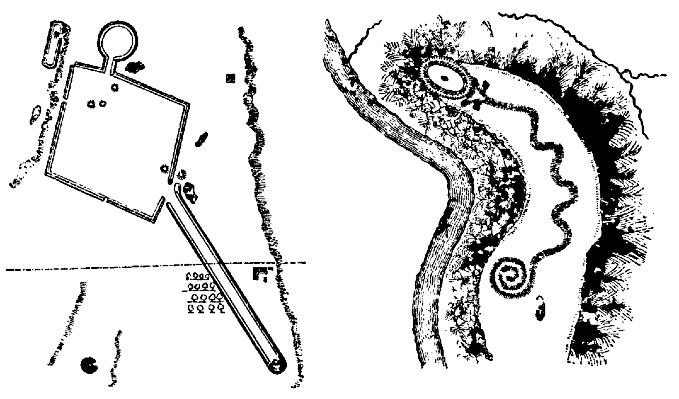
This indicates their locality and distribution. It has also indicated their nature and character. Oftener earthworks than buildings of stone, they are generally (but not exclusively) either raised mounds or embankments forming enclosures,—mounds in some cases 70 feet in height, and 1000 in circumference at the base, and embankments (with ditches corresponding) enclosing spaces of 300 acres. Such are some of the greatest measurements.
In form both the mound and embankment are very varied. The enclosure may be a square, a circle, a parallelogram, an ellipse, a polygon, or a wholly irregular outline, following the inequalities of the soil or the configuration of the country in which it occurs. The ditch may be either exterior or interior to it; the entrance simple or complex. Sometimes the square and circle are combined; so that a round inclosure leads into a quadrangle, or vice versâ. Sometimes a quadrangle is enclosed with a square.
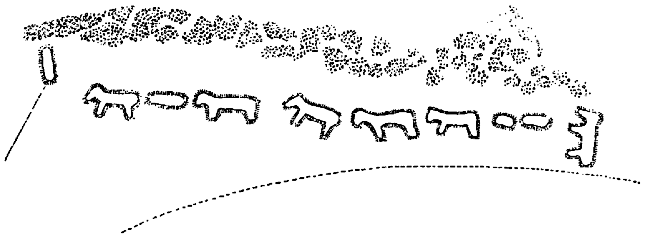
The mounds are sometimes simple cones; sometimes (an important difference) truncated pyramids; often simple slopes; often terraced. More remarkable, however, than any others, is "a succession of remains, entirely singular in their forms, and presenting but slight analogy to any others of which we have an account, in any portion of the globe. The larger proportion of these are structures of earth, bearing the forms of beasts, birds, reptiles, and even of men; they are frequently of gigantic dimensions, constituting huge basso-relievos upon the face of the country. They are very numerous, and in most cases occur in long and apparently dependent ranges. In connection with them are found many conical mounds and occasional short lines of embankment, in rare instances forming enclosures."[137]
The reader anticipates the object for which these works were undertaken—the purposes of war and the purposes of religion. This is the most general way of stating it; those for the latter purposes falling in the divisions of sepulchral and sacrificial.
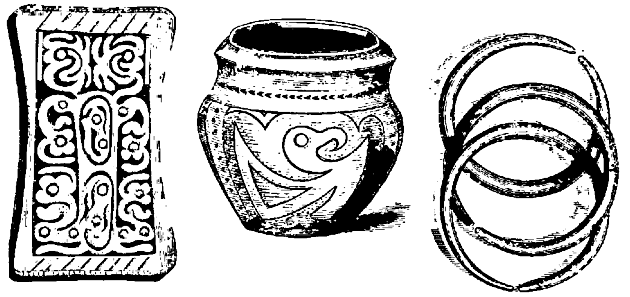
Besides the usual human remains which are found in the sepulchral mounds, works in stone, earthenware, and metal are frequent; relics which, taken along with the vast and numerous works which contain them, give us the elements of the ante-historical civilization of the northern section of the North American Indians.
The prevalence of works of a certain type varies with the area. The animal bas-reliefs are chiefly characteristic of Wisconsin, the truncated pyramids of the southern States, the simple mound and enclosure of Ohio, and the midland parts.
It should now be added, that where a square is attempted, it is truly rectangular, and that the circles are generally perfect; also that, in several cases, either the sides or the entrances accurately coincide with the east, west, north, and south points of the compass.
Other customs, such as the Indian council of war, the Indian calumet of peace, the stoic fortitude of the Indian warrior, the patient bearing of the Indian squaw, their scalpings during war, their probationary tortures during peace, preeminently interesting objects of description, have a subordinate value in ethnology. Value, however, they have. The list of them is a long one, and out of it may be selected numerous characteristics of a twofold import.
1. American, or general characteristics, viz.: those which (without being universal) are general in the new world, whilst (without being absolutely non-existent) they are rare in the old.
2. Sectional characteristics, or those which distinguish one American tribe from another.
Of the first series, there are two divisions, the positive and the negative. In respect to the positively characteristic practices of America, the use of the scalping-knife is, perhaps, the most typical. Horrible modes of mutilation are common in Asia and Africa (in Africa most especially); but the exact method in question I have not found except in America. Next to this, the habit of artificially flattening the head deserves notice. It is not, however, wholly unknown in the old world; since in Arakan we find traces of it.