PART I. (continued 7)
Reading edition
The negative characteristics are, perhaps, more important than the positive ones—preeminent amongst these being the utter absence (with the exception of a partial approach to it in the care bestowed by the Peruvians upon the llama and vicugna) of the true pastoral state throughout the whole length and breadth of America. Agriculture there is, and hunting there is,—the former developing an approach to an industrial development, and the latter determining a semi-nomadic form of life—but the absence of a true pastoral state wherein horses are used for riding, oxen for draught, and cows, ewes, or mares, for milking, is a remarkable negative characteristic which distinguishes the aboriginal American from the Arctic Sea to Cape Horn.
That the appreciation of differentiæ of this kind is wholly incapable of being arrived at à priori, but that it must be the result of a special induction by which we historically determine how one (or more) of certain undoubtedly allied divisions of the human species may want characteristics which occur in the others (and vice versâ) is a truth which requires a fuller recognition than it has found; since it is far easier for a writer to show in what customs two great sections of a population differ from one another, than to ascertain what that discrepancy imports. Whilst one, therefore, makes it a difference in kind, another considers it as one in degree only. The present writer, who has bestowed some pains on the special question of valuation or appreciation, generally speaking puts them low.
As the criticism respecting the general characteristics, has its bearing upon the relations of the American aborigines to those of the world at large, so that of the sectional ones determines our views as to their unity or non-unity among themselves. It is the same in both cases. It is an easy matter to say that the Athabaskans (for instance) burn their dead to ashes, whilst the Peruvians desiccate them into mummies; that the Nehannis treat their women with respect, whilst servitude, on the part of the female, is the rule elsewhere; or that (enterprise and industry being exceptional phænomena in the western hemisphere), the Waraws are navigators, and the Haidah islanders tradesmen; and easier still is it to discover that in populations which live on fishing, we miss certain elements of the social state of the hunter or agriculturist. The real difficulty is to take the exact measure of their value. Failing the data for doing this, the parallel statement of the points of agreement becomes a duty on the part of the ethnologist.
Now, in this respect, the phenomenon which has been noticed in Australia, reappears in America, viz.: a habit or custom, which shall not be found in more than one or two tribes in the neighbourhood of each other, shall appear, as if wholly independent of mutual imitation, at some other (perhaps some distant) part of the island. Such, in Australia, was the case of similar family names; and such in America is the remarkable distribution of the habits of flattening the head, and burying on elevated platforms; to say nothing of the two parallel forms of semicivilization in Mexico and Peru, so concordant on the whole, yet differing in so many details, and, evidently, separate and independent developments rather than the results of an extension of either one or the other as the original.
The same reasons which prevent us, in the present state of our knowledge, from drawing any inferences into the higher problems of ethnology from those manners and customs of the American Indians, which in the mere way of simple description give so much interest to the writings of the adventurous traveller, save us the necessity of exhibiting them in detail. No such economy, however, of time and paper is allowed in respect to a question which has already been more than once alluded to, viz.: the peculiarities of the American languages; peculiarities which are as remarkable in respect to the points wherein they agree, as they are in respect to the points wherein they differ—peculiarities, however, which, remarkable as they are, may easily be over-rated.
No preliminary is more necessary for this question than the distinction between a, the American languages as considered in respect to their roots or words, and b, the American languages as considered in respect to their grammatical structure. The clear perception of this is required on the part of the reader. On the other hand, the writer must remember that he is composing a work not on philology in general, but only upon such points of that science as illustrate ethnography. Hence the peculiarities of the American languages will not be considered in full; but all that will be done with them will consist in the selection of those phænomena which explain what has already been called the philological paradox of the American grammars being alike, whilst the American vocabularies differ.
1. And first in respect to the facts which account for the difference between the vocabularies. Here arise two questions—the determination of the extent to which such a difference really takes place, and the reasons for its reaching that extent whatever it is ascertained to be.
What follows, is a table representing the degree in which languages lying within so small a geographical area as the Uché, Natchez, and Adahi, may differ in their vocabularies.
ENGLISH. UCHÉ. NATCHEZ. ADAHI.
Man cohwita tomkuhpena haasing.
Woman wauhnehung tahmahl quaechuke.
Father chitung abishnisha kewanick.
Mother kitchunghaing kwalneshoo amanie.
Son tesunung (my) akwalnesuta tallehennie.
Daughter teyunung (my) mahnoonoo quolasinic.
Head ptseotan tomne apoo tochake.
Hair ptsasong etene calatuck.
Ear cohchipah ipok calat.
Eye cohchee oktool analca.
Nose cohtemee shamats weecoocat.
Mouth teaishhee heche wacatcholak.
Tongue cootincah itsuk tenanat.
Tooth tekeing int awat (pl.)
Hand keanthah ispeshe secut
Feet tetethah hatpeshé (sing.) nocat (sing.)
Blood wace itsh pchack.
Sky houpoung nasookta ganick.
Sun ptso wah (fire) naleen.
Moon shafah kwasip nachaoat.
Star yung tookul otat.
Day uckkah wit nestach.
Night pahto toowa arestenet.
Fire yachtah wah nang.
Water tsach koon holcut.
Rain chaāh nasnayobik ganic.
Snow stahae kowa towat.
Earth ptsah wihih caput.
River tauh wōl gawichat.
Tree yah tshoo tanaek.
Meat colahntha wintsé hosing.
Bear ptsaka tso kohp solang.
Bird psenna shankolt washang.
Fish potshoo henn aesut.
White quecah hahap testaga.
Black ishpe tsokokop hatoua.
Red tshulhuh pahkop pechasat.
He coheetha akoonikia (this here) nassicon.
One sāh witahu nancas.
Two nowāh ahwetie nass.
Three nokah nayetie colle.
Four taltlah ganooetie tacache.
Five chwanhah shpedee seppacan.
Six chtoo lahono pacanancus.
Seven latchoo ukwoh pacaness.
Eight peefah upkutepish pacalcon.
Nine 'tah'thkah wedipkatepish sickinish.
Ten 'tthklahpee ōkwah neusne.
Furthermore, had the two other conterminous languages of the Attacapas and the Chetimachas been added, the difference between the five would have been just the same as that between the three, i. e., they would have all differed from each other, as much as the Natchez and Uché, the Uché and Adahi, the Adahi and Natchez differ.
This is a fair measure of the glossarial separation between contiguous languages as determined by what may be called the simple comparison (inspection or collation) of vocabularies; and it is by no means strange that, such being the case, writers should have regarded it with something approaching to surprise.
I am not aware that much has been done to bring down this feeling to a reasonable limit; a result which might easily have been brought about by one or both of the two following processes.
a. The value of the mere simple comparison of vocabularies may be tested by seeing what would be the result of placing side by side two languages known to be undoubtedly, but also known to be not very closely, allied. Such, for instance, might be the German and Greek, the Latin and Russian, the English and Lithuanic, all of which are Indo-European, and all of which, when placed in simple juxtaposition, by no means show themselves in any very palpable manner as such. This may be seen from the following table, which is far from being the first which the present writer has compiled; and that with the special view of ascertaining by induction (and not a priori) the value of comparisons of the kind in question.
ENGLISH. LATIN. CAYUSE. WILLAMET.
Man homo yúant atshánggo.
Woman mulier pintkhlkaiu pummaike.
Father pater píntet sima.
Mother mater penín sinni.
Son filius wái tawakhai.
Daughter filia wái tshitapinna.
Head caput talsh tamutkhl.
Hair crinis tkhlokomot amutkhl.
Ear auris taksh pokta.
Eye oculus hăkamush kwalakkh.
Nose nasus pitkhloken unan.
Mouth os sumkhaksh mandi.
Tongue lingua push mamtshutkhl.
Tooth dens tenif púti.
Hand manus epip tlakwa.
Fingers digiti épip alakwa.
Feet pedes tish puüf.
Blood sanguis tiweush méënu.
House domus nisht hammeih (—fire.)
Axe securis yengthokinsh khueshtan.
Knife culter shekt hekemistāh.
Shoes calcei taitkhlo ulumóf.
Sky cœlum adjalawaia amiank.
Sun sol huewish ampiun.
Moon luna katkhltóp utap.
Star stella tkhlitkhlish atuininank.
Day dies eweiu umpium.
Night nox ftalp atitshikim.
Fire ignis tetsh hamméih.
Water aqua iskkainish mampuka.
Rain pluvia tishtkitkhlmiting ukwíï.
Snow nix poi nukpeik.
Earth terra lingsh hunkhalop.
River rivus lushmi mantsal.
Stone lapis ápit andi.
Tree arbor lauik huntawatkhl.
Meat caro pithuli umhók.
Dog canis náapang mantal.
Beaver castor pieka akaipi.
Bear ursa limeaksh alotufan.
Bird avis tianiyiwa pōkalfuna.
Great magnus yaúmua pul.
Cold frigidus shunga pángkafiti.
White albus tkhlaktkhláko kommóu.
Black niger shkupshkúpu maieum.
Red ruber lakaitlakaitu tshal.
I ego ining tshii.
Thou tu niki máha.
He ille nip kak.
One unus na wáän.
Two duo leplin kéën.
Three tres matnin upshín.
Four quatuor piping táope.
Five quinque táwit húwan.
Six sex nóiná taf.
Seven septem nóilip pshinimua.
Eight octo nōimát kēëmúa.
Nine novem tanáuiaishimshin wanwaha.
Ten decem ningitelp tínifia.
Again—the process may be modified by taking two languages known to be closely allied, and asking how far a simple comparison of their vocabularies exhibits that alliance on the surface, e.g.:—
ENGLISH. BEAVER INDIAN. CHIPPEWYAN.
One it la day ittla hē.
Two onk shay day nank hay.
Three ta day ta he.
Four dini day dunk he.
Five tlat zoon e de ay sa soot la he.
Six int zud ha l'goot ha hé.
Seven ta e wayt zay tluz ud dunk he.
Eight etzud een tay l'goot dung he.
Nine kala gay ne ad ay itla ud ha.
Ten kay nay day hona.
A man taz eu dinnay you.
A woman iay quay tzay quay.
A girl id az oo ed dinna gay.
A boy taz yuz é dinnay yoo azay
Interpreter nao day ay dinnay tee ghaltay.
Trader meeoo tay ma kad ray
Moose-deer tlay tchin tay tunnehee hee.
Rein-deer may tzee ed hun.
Beaver tza tza.
Dog tlee tlee.
Rabbit kagh kagh.
Bear zus zus.
Wolf tshee o nay noo nee yay.
Fox e yay thay nag hee dthay.
I hunt na o zed naz uz ay.
Thou huntest nodzed nan ul zay.
He hunts nazin zed nal zay.
We hunt naze zedeo na il zay.
Ye hunt nazin zedeo nal zin al day.
They hunt owadié tzed na hal zay.
I kill uz éay gha zil tir.
Thou killest uz éay ghan zil hil tir.
He kills ud zeay gha tla in il tir.
We kill uz ugho-ghay uzin tla in il dir.
Ye kill uz ugho ghay uzin zee ool dir.
They kill utza ghay agho tla in il tay.
I laugh utzay rad lotsh naz-lo.
Thou laughest utlint lotsh na-id-lo.
He laughs utroz lotsh nad-lo.
We laugh utlo wod lotshay tlo a-ee-el-tee.
Ye laugh tlodzud udzee tlo gha ee-ol-tee.
They laugh tlodzud udzee tlo-gha-ee-el-tee.
I trade mata oz lay naz nee.
Thou tradest mata an eelay na el nee.
He trades kita od eenla na el nee.
We trade mata ad oz id la na-da-ell nee.
Ye trade mata a la ozayo na ool nee.
They trade ma ta a leeay la eghon a el nee.
Now there is no doubt here as to the difference appearing to be considerable. Yet the two languages—or, rather, dialects—are mutually intelligible.
b. The method of indirect comparison—although by some considered illegitimate—supplies us with another means of checking the tendency towards over-valuing glossarial differences as tested by simple collation; since, a language of which the isolation goes beyond a certain point must not only be unlike any single given language, but unlike other languages altogether. Now, taking the Adahi as an illustration, the following table shows its miscellaneous or general affinities.
English, man
Adahi, haasing
Otto, wahsheegae
Onondago, etschinak
Abenaki, seenanbe=vir
" arenanbe=homo
English, woman
Adahi, quaechuke
Muskoge, hoktie
Choctah, hottokohyo
Osage, wako
Sack and Fox, kwyokih
Ilinois, ickoe
Nanticoke, acquahique
Delaware, okhqueh
Algonkin, &c., squaw
Taculli, chaca
English, girl
Adahi, quoâtwistuck
Chikkasaw, take
Choctah, villa tak
Caddo, nuttaitesseh
Oneida, caidazai
Micmac, epidek
English, child
Adahi, tallahening
" tallahache=boy
Omahaw, shinga shinga
Otto, cheechinga
Quappa, shetyïnka
English, father
Adahi, kewanick
Chetimacha, kineghie
Chikkasaw, unky
Choctah, aunkke
English, mother
Adahi, amanie
Caddo, ehneh
Sioux, enah, eehong
Tuscarora, ena
Wyandot, aneheh
Kenay, anna
Eskimo, amama
English, husband
Adahi, hasekino
Chetimacha, hichehase
Winebago, eekunah
Taculli, eki
Tchuktchi, uika
English, wife
Adahi, quochekinok
" quaechuke=woman
Tuscarora, ekening=do
Cherokee, ageyung=woman
Chetimacha, hichekithia
" hichechase=man
English, son
Adahi, tallehennie
Caddo, hininshatrseh
Omahaw, eeingyai
Minetare, eejinggai
Winebago, eeneek
Oneida, yung
English, brother
Adahi, gasing
Salish, asintzah
Ottawa, sayin=elder
Ojibbeway, osy aiema
English, head
Adahi, tochake
Caddo, dachunkea=face
" dokundsa
English, hair
Adahai, calatuck
Chippewyan, thiegah
Kenway, szugo
Miami, keelingeh=face
English, face
Adahi, annack
Chetimacha, kaneketa
Attacapa, iune
Eskimo, keniak
English, ear
Adahi, calat
Cherokee, gule
Passamaquoddy, chalksee
English, nose
Adahi, wecoocat
Montaug, cochoy
Micmac, uchichun
English, beard
Adahi, tosocat
Attacapa, taesh=hair
Natchez, ptsasong=hair
Chetimacha, chattie
English, arm
Adahi, walcat
Taculli, olâ
Chippewyan, law
English, nails
Adahi, sicksapasca
Catawba, ecksapeeah=hand
Natchez, ispeshe=hand
English, belly
Adahi, noeyack
Winebago, neehahhah
Eskimo, neiyuk
English, leg
Adahi, ahasuck=leg
Chetimacha, sauknuthe=feet
" saukatie=toes
" sau=leg
Osage, sagaugh
Yancton, hoo
Otto, hoo
Pawnee, ashoo=foot
Sioux, see, seehah=do.
Nottoway, saseeke=do.
Dacota, seehukasa=toes
Nottoway, seeke=do.
English, mouth
Adahi, wacatcholak
Chetimacha, cha
Attacapa, katt
Caddo, dunehwatcha
Natchez, heche
Mohawk, wachsacurlunt
Seneca, wachsagaint
Sack and Fox, wektoneh
Mohican, otoun
English, tongue
Adahi, tenanat
Chetimacha, huene
Uché, cootincah
Choctah, issoonlush
Ojibbeway, otainani
Ottawa, tenanian
English, hand
Adahi, secut
" sicksapasca=nails
Choctah, shukba=his arm
Chikkasaw, shukbah=do.
Muskoge, sakpa=do.
Kenay, skona
Attacapa, nishagg=fingers
Omahaw, shagai
Osage, shagah
Mohawk, shake
Yancton, shakai=nails
Otto, shagai=do.
English, blood
Adahi, pchack
Caddo, baaho
Passamaquoddy, pocagun
Abenaki, bagakkaan
Mohican, pocaghkan
Nanticoke, puckeuckque
Miami, nihpeekanueh
English, red
Adahi, pechasat
Natchez, pahkop
English, feet
Adahi, nocat
Micmac, ukkuat
Miami, katah
Taculli, oca
Chippewyan, cuh
Ilinois, nickahta=leg
Delaware, wikhaat=do.
Massachusetts, muhkout=do.
Ojibbeway, okat=do.
English, bone
Adahi, wahacut
Otto, wahoo
Yancton, hoo
Dacota, hoohoo
Ojibbeway, okun
Miami, kaanih
Eskimo, heownik
" oaeeyak
English, house
Adahi, coochut
Natchez, hahit
Muskoge, chookgaw
Choctah, chukka
Catawba, sook
Taculli, yock
English, bread
Adahi, okhapin
Chetimacha, heichepat chepa
English, sky
Adahi, ganick
Seneca, kiunyage
English, summer
Adahi, weetsuck
Uché, waitee
English, fire
Adahi, nang
Caddo, nako
Eskimo, ignuck
" eknok
" annak
English, mountain
Adahi, tolola
Taculli, chell
English, stone, rock
Adahi, ekseka
Caddo, seeeeko
Natchez, ohk
English, maize
Adahi, ocasuck
Natchez, hokko
English, day
Adahi, nestach
Muskoge, nittah
Chikkasaw, nittuck
Choctah, nittok
English, autumn
Adahi, hustalneetsuck
Choctah, hushtolape
Chikkasaw, hustillomona
" hustola=winter
English, bird
Adahi, washang
Choctah, hushe
Sack and Fox, wishkamon
Shawnoe, wiskiluthi
English, goose
Adahi, nickkuicka
Chetimacha, napiche
Ilinois, nicak
Ojibbeway, nickak
Delaware, kaak
Shawnoe, neeake
English, duck
Adahi, ahuck
Eskimo, ewuck
English, fish
Adahi, aesut
Cherokee, atsatih
English, tree
Adahi, tanaek
Dacota, tschang
Ilinois, toauane
Miami, tauaneh=wood
English, grass
Adahi, hasack
Chikkasaw, hasook
Choctah, hushehuck
Uché, yahsuh=leaf
Chikkasaw, hishe=do.
English, deer
Adahi, wakhine
Uché, wayung
English, squirrel
Adahi, enack
Sack and Fox, aneekwah
Nanticoke, nowckkey
Abenaki, anikesses
Knistenaux, annickochas
English, old
Adahi, hansnaie
Caddo, hunaisteteh
Nottoway, onahahe
English, good
Adahi, awiste
Dacota, haywashta
Yancton, washtai
English, I
Adahi, nassicon
Cherokee, naski
English, kill
Adahi, yoeick
Caddo, yokay
Catawba, eekway
English, two
Adahi, nass
Algonkin, &c., nis, ness, nees
Now the Adahi is so far from being a singular instance of an American language having miscellaneous affinities that there are not half-a-dozen vocabularies for either North or South America for which I have not similar lists.[138]
Such is the imperfect sketch of my reasons for believing that any statement which places the glossarial differences between the American languages, as ascertained by the simple inspection of their vocabularies, so high as to involve the idea of a unique and unparalleled philological phænomenon is an over-statement.
In thus limiting the extent of a remarkable characteristic I am not denying its existence. That the difference, even when cut down to its proper dimensions, is still more considerable than the usual investigations of philologists prepare them to expect, is shown by the necessity (which I freely admit) of resorting in America to the indirect method of comparison, where in many (perhaps most) other parts of the world, simple collation would suffice.
Why is this? The following facts help us to an answer—fragmentary and partial though it be.
The paucity of general terms.—What shall we say to a language where a term sufficiently general to denote an oak-tree is exceptional; a language where the white-oak has one specific name, the black-oak another, the red-oak a third, and so? Yet such is the ease with the Choctah;[139] where, a fortiori, the still more general name for tree is more exceptional still. This is the case with a noun.
Verbs, however, are equally specialized. Where we in England talk of fishing, the Eskimo has a distinct name for every mode of fishing; and this is only part and parcel of the system which "designates with a peculiar name animals of the same species according to their age, sex, or form."
This is a character, which, though illustrated from two languages, is common to all the American ones.
Now the more specific the name the less extensive its application, and the less extensive its application the smaller the probability of its appearing in more languages than one. No one would expect the word brother to occur in the Gaelic (brathair), and in the Latin (frater), if Gaels, Englishmen, and Romans, without any name for brother in general, had merely known an elder brother by one separate single name, and a younger one by another, as is really the fact in America. What we should look for in such a case would be the equivalents to words like cadet, and these might differ in languages otherwise allied.
Names, then, for common objects are often of so specific a kind in the American languages, that they differ in cases where, if more general, they would agree.
The numerals.—Another class of words, which in many languages agree, differs in the American, viz., that of the numerals. In the Indo-European tongues these agree even where other words differ.[140] The converse, however, takes place with the tongues in question. Languages, alike in other points, shall count differently. Can this be explained? I submit the following doctrine, based upon the difference between absolute numerals like two and three (words which mean two units, and three units exclusively and irrespectively), and concrete numerals like brace and leash.
Between these two classes of words there is the following difference. Absolute numerals give no choice, concrete numerals do. Out of two tribes, wherein the intelligence of each is so little capable of generalization as not to have evolved abstract and absolute numerals like those of the Indo-European nations (one, two, &c.), the only way of counting is by the adoption of some material object in which the number of its parts is a striking characteristic; in which case there is so much room for arbitrary selection that allied languages may take up different words. It is not to be supposed that unless the English, Greeks, Gaels, Slavonians, and the members of the Indo-European stock in general, had broken off from the common stem at a period subsequent to the evolution of absolute numerals that their names for the first ten units would be so like as they are. On the contrary, there would most certainly have been a difference; two being expressed in one quarter by a word like brace, in another by such a term as couple, in a third by pair, and so on. Now this latitude exists and bears fruit with the American languages. One takes the name for (say) two from one natural dualism, another from another—one calls it by the name for a pair of hands, another by that of a pair of feet, a third by that of a pair of shoes, &c.
Names, then, for numerals in the American languages differ as much as the natural objects from which they may be derived, the separation from the parent-stock of the tongues in which they occur having taken place before the evolution of fixed absolute and abstract terms.
The verb-substantive.—In the Indo-European languages the verb-substantive agrees even where other words differ; the English be is the Latin fu-; the German ist is the Greek ἐστ-ι; the English am is the Latin sum, and the Greek εἰμι. This induces us, in languages where there is no such agreement, to argue in favour of a fundamental dissimilarity. And naturally. Tongues as far apart as the English and Sanskrit agree, where tongues as close to each other as the Adahi and Chetimacha differ. But to expect likeness on this point simply because we find it in Europe and Asia, is to make bricks without straw. In most of the American languages, an idea so abstract as that conveyed by the verb-substantive has yet to be evolved; in other words, there is no verb-substantive at all in the generality of them: according to some writers, it is wanting in all.
Such are some of the facts and suggestions which help to account for the glossarial difference between the American languages, a phænomenon which, even though occasionally overstated, is still a reality to a certain degree. I am fully aware that, at the first view, they seem to prove too much; i.e. they seem, by accounting for the differences, to admit them; just as, in common life, the person who excuses himself for an imputed action, admits the truth of the imputation. How far this is the true view will be seen after the notice of some of the antagonistic phænomena of agreement in the way of grammatical structure.
Negative points of agreement.—Case-endings, properly so called, are either rare or wanting throughout the American tongues. Possession is expressed by the pronouns; just as if we said, father his, or pater suus instead of patri-s, ather-'s. In like manner the pronoun expresses the objective relation; I strike him horse=ferio equu-m.
Signs of number, properly so called, are wanting. The general American equivalent for such a form as the -s in patre-s, or father-s, is a word signifying number, as father many=father-s.
Signs of gender, properly so called, are wanting. This, however, is no more than what occurs in the English adjective.
Signs of the degrees of comparison are wanting. This, however, is no more than what occurs in the French adjective.
Notwithstanding, however, this list of negations—a list capable of being considerably increased—the American grammar is complex; a fact which brings us to the positive characteristics of the language in question. These, also, are very general.
a. The distinction between animate and inanimate objects.—The plural of the name of such an object as a star is of one form; the plural of the name of such an object as a sheep, another. In some languages this distinction extends farther, and applies to the rational and irrational divisions of the animate class.
b. The incorporation of the possessive pronoun.—Certain words like hand, father, son, express, all the world over, objects which are rarely mentioned except in relation to some other object to which they belong—a hand, for instance, is mine, thine, his, and so is a father, a son, a wife, &c. In other words there is almost always a pronoun[141] attached to them. Now in the American languages this is almost always incorporated with the substantive; so that an American can only talk of my father, thy father, &c., being incapable of using the substantive in a sense sufficiently abstract to dispense with the pronoun.
c. The incorporation of the objective pronoun with the verb. The Latin word a-ma-nt contains, beside the part which represents the action, a second element representing the agent. An American verb would, besides this, contain an element representing the object, so that what the Latin expressed by amant illas (two words) would be denoted in most Indian tongues by a single form. Now when we remember that the name of the object is thus reduced to an inflection, and also that the pronoun expressive of it, varies with the sex, we see how American tongues may be both copious in the way of grammar and complex as well. And such, notwithstanding many facts to the contrary, is really the case.
Inclusive and exclusive plurals.—A word like we in English, is a much more abstract word than it appears to be at first sight. What should we say if instead thereof we only said I+thou, or I+they? What if both these expressions were used? In such a case we should have two plurals one exclusive of the person spoken to (I+they), and one inclusive of him (I+thou). Now the phænomenon of the exclusive and inclusive plural is very general throughout the aboriginal languages of America.
Such are the chief points wherein languages differ in respect to their lexicons, and agree in respect to their grammars.[142]
The Californias, New Mexico, and the provinces of Sonora, Sinaloa, Chihuahua, Cohuahuila, Durango, Zacatecas, and the northern part of the Anahuac, will now conduct us to the centre of the Aztek civilization—or semi-civilization of the city of Montezuma. And here the enumeration of the divisions and sub-divisions of the population must be almost exclusively geographical, i.e. we must take the tribes as they come in their order on the map, and not in the order wherein they are related to each other. The reason of this lies in the unsatisfactory character of our knowledge. Preeminently scanty, it is unsystematic as well. What follows then is but little better than an undigested list of references, more than one of which may refer to the same tribes under different names, and more than one of which may be incorrect. Still it is a contribution towards a monograph, the necessity of which gives it place in a systematic work, which it would not have otherwise; and lest the value of such a monograph, if properly drawn up, be undervalued, the reader is reminded that most of the elements of our criticism in regard to the civilizational phænomena presented by Mexico, Guatimala and Yucatan, depend upon the facts known concerning the Californias and the parts to the south of them.
New California.—For the parts between the mouths of the rivers Clamet (or Lutuami) and Sacramiento.—Physical geography gives us for these parts three divisions: a, the coast and western boundary of the valley of the Sacramiento; b, the valley of the Sacramiento itself; c, the eastern watershed of the Sacramiento.
a. For the coast we have a notice as to the miserable condition of the natives about Trinity Bay in N. L. 41° with the special statement that they file their teeth. Probably they constitute an extension of the Southern Tototunes. On the other hand, the later writers have remarked, that the boundary between the Oregon and California is not only a political but an ethnological one as well; in other words, that the physical appearance of the Indians changes as soon as the frontier is passed. Except so far as there is a difference in the physical geography, this coincidence is unlikely.
b. In respect, however, to the valley of the Sacramiento, such a difference exists. The Desert of California, like that of the Sahara, has its oases, and these are the valleys of its rivers. However narrow these may be, the conditions of physical and social development which they afford, are always improvements upon those of the desert table-land. Here our only data are Mr. Dana's, which consist of—
1. A vocabulary of the occupants of the river about 250 miles from its mouth, and 60 miles south of the Shasti, whom they resemble, being a mirthful race, with no arms but bows and arrows, and with little intercourse with foreigners.
2, 3, 4. Four vocabularies from the occupants of the river, about 100 miles to its mouth, i.e. of the Puzhune, Sekumne, and Tsamak dialects. Allied to these and like them occupants of the western bank, are the Yasumnes, the Nemshaw, the Kisky, the Yalesumnes, the Yuk, and the Yukal.
5. A Talatui vocabulary. Captain Suter, a settler in these parts, informed Mr. Dana, that the Talatui and the Indians just named, resembled each other in every thing but language, and that the Talatui was spoken by the following bands:—The Ochekamnes, the Seroushumnes, the Chupumnes, the Omutchumnes, the Secumnes(?), the Walagumnes, the Cosumnes, the Sololumnes, the Turealemnes, the Saywaymenes, the Nevichumnes, the Matchemnes, the Sagayayumnes, the Muthelemnes, and the Lopotalemnes. Probably the Chochouyem tribe of the Mithridates belongs to this quarter. Probably, also, the Youkiousme of Mofras(?)
6. A notice of Major Sand's, in Gallatin,[143] carries us over the eastern watershed of the Sacramiento to one of the streams of the great Californian Desert, which have no outlet to the ocean, called Salmon-trout River. Here the chief sustenance is of a lower order than that of tribes on the Sacramiento. With the latter it is nearly exclusively acorns made into a not unpalatable bread; with the former grass-hoppers or locusts dried and pounded, mixed with the meal of grass-seeds, and baked.
Parts about San Francisco.—a. A Youkiousme(?) Paternoster of Mofras, seems to belong to the same division with—
b. A vocabulary of the language of San Rafael in the United States' Exploring Expedition. If so, and if also the position of the Youkiousme just suggested be correct, further information will bring the languages enumerated by Dana, to the neighbourhood of San Francisco; for which parts we also find in Mofras—
c. A Tularena Paternoster.
d. A notice of a MS. Tularena grammar by Arroyo.
e. f. The Santa Inez, and Santa Barbara, Paternosters of Mofras.
g. h. The Severnow and Bodega vocabularies (apparently representing mutually unintelligible languages) of Baer's Beiträge.
Lastly, in the Mithridates[144] we find enumerated, as inhabitants of these parts, the Matalan, the Salsen, and the Quirotes, followed by the statement of Lasuen, that between San Francisco and San Diego seventeen languages are spoken, which cannot be considered as dialects of a few mother-tongues. On the other hand, however, in respect to the three sections just mentioned, Humboldt expressly states that, whilst they are separated as peoples (Völkerschaften), their speech is from a single source.
Parts about Monterey.—The vocabularies of the Mithridates, taken from the Voyage of the Sutil and Mexicana of—
a. The Eslen or Ecclemachs.
b. The Rumsen—East of the Eslen. To which add a notice of—
c. The Achastlier probably a section of the Rumsen, or vice versâ.
Parts about N.L. 35°.—Vocabularies of the American Exploring Expedition for—
a. La Soledad.
b. San Miguel, about fifty miles south-east of La Soledad.
c. The San Antonio of Dr. Coulter. Published in the paper of Dr. Scouler's, already quoted.
d. The San Luis Obispo.—Ditto.
e. The Santa Clara of the Mithridates.
For the parts between N.L. 35° and N.L. 32½°.—Here, as hitherto, our knowledge is limited to the tribes on the coast.
a. The Santa Barbara, of Dr. Coulter.—Journal of Geographical Society.
b. c. The San Juan Capistrano, the same as the Netela of the United States' Exploring Expedition.
d. The San Gabriel of Dr. Coulter, the same as the Kij of the United States' Exploring Expedition.
e. The San Diego of Dr. Coulter.
The SS. Gabriel and Juan Capistrano, are more closely allied than any other two of Dr. Coulter's. Besides which there seems to be between them, a regular letter-change of the l and r. In San Juan Capistrano, whilst but one word ends in r, maharr=five, several end in l; as shul=star, ul=arrow, nol=chief, amaigomal=boy, shungal=woman; whereas, the San Gabriel has no terminations in l, but many in r, as touarr=arrow, tomearr=chief, tokor=woman, &c.
ENGLISH. SAN JUAN CAPISTRANO. SAN GABRIEL.
Moon. mioil. muarr.
Water. pal. paara.
Earth. ekhel. ungkhur.
Salt. engel. ungurr.
Hot. khalek. oro(?).
South of San Diego, the land narrows itself into the peninsula of Old California. Here we have—
1. The Cochimi.—If the area of the Cochimi dialects (of which there are four, said to differ from each other as much as the Spanish and the French) extend as far north as N.L. 33°, the San Diego vocabulary most probably represents one of them.
2. The Waikuru.—called also the Monk[145] or Moqui(?), and of which the following dialects are enumerated—
a. The Cora(?)[145]. Extinct, or nearly so.
b. The Uchitee, or Utshi. Extinct.
c. The Aripe. Probably extinct.
d. The Layamon of Loretto, known to us by a vocabulary.
3. The Pericu.—Probably extinct. Spoken at the southern extremity of the island from N.L. 24°, to Cape St. Lucas.
4(?). The Ikas.—By the unknown author of the "Nachrichten von der Amerikanischen Halbinsel Kalifornien" (Mannheim, 1773), who was a Jesuit missionary in the Peninsula, the Ikas, a fourth family, is enumerated amongst the Old Californians.
5(?). The Picos, too, or Ficos, of Bägert, may possibly represent a separate family. More probably, however, they are Ikas, or sections of some better known division of the Old Californian population.
If we now take a review of what has been investigated, it is only a coast and a peninsula. What, however, is the state of the interior of that great tract which, politically, lies between Mexico, the United States, and the Pacific, and of which we have the ethnological limits in the areas of the Tototune, the Shasti, the Palaiks, the Paducas, and lastly the Indians of Sonora—for thus far south must we go before we get clear of the terra incognita of California?
I am better prepared with suggestions as to the method of investigating these parts than with facts concerning them.
1. In the way of physical geography it is convenient to draw a distinction. The great interior basin (or table-land) of California is one division; the great triangular watershed between the rivers Gila and Colorado another.
2. In the way of new facts we must expect the phænomena of stone architecture, as manifested in the ruins of ancient buildings.
3. In the way of inference we must guard against over-valuing the import of them. They are not upon light grounds to be considered as the measures of a civilization so different from that of the tribes hitherto enumerated, as to suggest the machinery of either unnecessary migrations, or unascertained degradations or annihilations of race.
The difference between the great interior basin of California, and the valleys of the rivers Gila and Colorado, with their feeders, is that of a desert and the oases that lie within it. The tribes that inhabit the former are under some of the most unfavourable conditions for sustenance in the world. Some of them, such as those to the east and north, are known to be the more miserable members of the Paduca class. Those of the west are probably extensions of the imperfectly known tribes of the coast, and their analogues in the way of physical influences are to be sought for in Australia rather than in America.
It is not surprising that the water-system of two considerable rivers should furnish strong elements of contrast to those which exist in what is either a table-land or a basin, according as the attention of the investigators is struck by its elevation above the sea, or by its depressions forming salt-lakes—Dead Seas in the way of ethnology. Nor yet is it surprising that such contrasts should have full justice done them in description. Ruins in stone, too, in districts where the most we expect is the embankment or tumulus, strike even the cautious observer with surprise; and fragments of art, however imperfect, create wonder when they represent an industry different from what is found amongst the existing populations of their locality. Whatever may be the exaggeration as to particular descriptions, however, the ethnological deduction is well summed up in the following extract. In describing the tribes of the Gila, the Colorado, and of New Mexico, Gallatin writes, "At the time of the conquest of Mexico, by Cortes, there was northwardly, at the distance of 800 or 1,000 miles, a collection of Indian tribes, in a state of civilization, intermediary between that of the Mexicans and the social state of any of the other aborigines."[146]
What was the civilization? what the tribes? It is best to express both these facts in as general a way as possible. The Casas Grandes represent the first. The Pimos Indians the second.
The Casa Grande, or Great House.—On the south bank of the Gila, in the midst of a large and beautiful plain, are the ruins of what was called by its discoverers, Fathers Garcias and Font,[147] the Casa Grande, a building 445 feet in length, and 270 feet in breadth, with three stories and a terrace; the walls being built of clay, and a wall interrupted with towers investing the principal edifice.
Fig. 13.
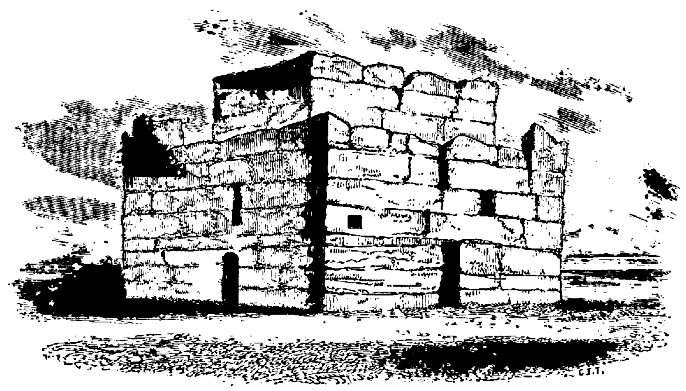
Later descriptions of Casas Grandes, by eye-witnesses, are those of Lieutenant Emory and Captain Johnston. That of the latter, of one on the River Gila, is as follows:—
"Still passing plains which had once been occupied,[148] we saw to our left the 'Casa de Montezuma.' I rode to it, and found the remains of the walls of four buildings, and the piles of earth showing where many others had been. One of the buildings was still quite complete, as a ruin; the others had all crumbled, but a few pieces of broken wall remaining. The large casa was fifty feet by forty, and had been four stories high; but the floors and roof had long since been burnt out. The charred ends of the cedar joists were still in the wall. I examined them and found they had not been cut with a steel instrument. The joists were round sticks about two feet in diameter. There were four entrances—north, south, east, and west,—the doors about four feet by two; the rooms as below, and had the same arrangement in each story. There was no sign of a fire-place in the building. The lower story was filled with rubbish, and above it was the open sky. The walls were four feet thick at the bottom, and had a curved inclination inwards to the top. The house was built of a sort of white earth and pebbles, probably containing lime, which abounded on the ground adjacent. The walls had been smoothed outside, and plastered inside; and the surface still remained firm, although it was evident it had been exposed to great heat from the fire. Some of the rooms did not open to all the rest, but had a hole a foot in diameter to look through; in other places were smaller holes. About two hundred yards from this building was a mound, in a circle one hundred yards around the mound. The centre was a hollow, twenty-five yards in diameter, with two ramps or slopes going down to its bottom. It was probably a well, now partly filled up. A similar one was seen near Mount Dallas.
"A few yards further, in the same direction, northward, was a terrace one hundred yards by seventy, about five feet high. Upon this was a pyramid about eight feet high, twenty-five yards square at the top. From this, sitting on my horse, I could overlook the vast plain lying north-east and west, on the left bank of the Gila. The ground in view was about fifteen miles—all of which, it would seem, had been irrigated by the waters of the Gila. I picked up a broken crystal of quartz in one of these piles. Leaving the casa I turned towards the Pimos, and travelling at random over the plain (now covered with mezquite), the piles of earth and pottery showed for miles in every direction. I also found the remains of a zequia (a canal for irrigation) which followed the range of houses for miles. It had been very large."
The Pimos.—Without at present fixing their locality, it is sufficient for the sake of showing the character of their civilization, to make the following extracts, directly from Mr. Squier's paper on New Mexico and California, but indirectly, or in the way of first-hand evidence, from Lieutenant Emory:—
"At the settlement of the Pimos, we were at once impressed with the beauty and order of the arrangements for irrigating and draining the land. Corn, wheat, and cotton are the crops of this peaceful and intelligent race of people. At the time of our visit, all the crops had been gathered in, and the stubble showed that they had been luxuriant. The cotton had been picked and stacked for drying in the sheds. The fields are sub-divided by ridges of earth into rectangles of about 200 feet by 100, for the convenience of irrigation. The fences are of sticks wattled with willow and mezquite, and in this particular give an example of economy in agriculture worthy to be followed by the Mexicans, who never use fences at all.
"The dress of the Pimos consists of a cotton serape, of native manufacture, and a breech cloth. Their hair is worn long and clubbed up behind. They have but few cattle, and these are used in tillage. They possess a few horses and mules, which are prized very highly. They were found very ready to barter, which they did with entire good faith. Capt. Johnson relates that when his party first came to the village they asked for bread, offering to pay for the same. The bread was furnished by the Pimos, but they would receive no return, saying, 'Bread is to eat, not to sell; take what you want.'
"'Their houses,' says Lieut. Emory, 'were dome-shaped structures of wicker-work, about six feet high, and from twenty to sixty feet in diameter, thatched with straw or corn-stalks. In front is usually a large arbour, on top of which is piled the cotton in the pod for drying. In the houses were stored water-melons, pumpkins, beans, corn, and wheat, the three articles last named usually in large baskets; sometimes these baskets were covered with earth and placed on the tops of the domes. A few chickens and dogs were seen, but no other domestic animals except horses, mules, and oxen. Their implements of husbandry were the axe (of steel, and obtained through the Mexicans), wooden hoes, shovels, and harrows. The soil is so easily pulverized as to make the plough unnecessary.'
"Among their manufactures is a substance which they call pinole. It is the heart of Indian corn, baked, ground up, and mixed with sugar. When dissolved in water it is very nutritious, and affords a delicious beverage. Their molasses, put up in large jars, hermetically sealed, is expressed from the fruit of the pitahaya.
"In manufacturing cotton they display much skill, although their looms are of the simplest kind. 'A woman was seated on the ground under one of the cotton sheds. Her left leg was turned under, and the sole of her foot upwards. Between her large toe and the next was a spindle, about eighteen inches long, with a single fly of four or six inches. Ever and anon, she gave it a twist in a dexterous manner, and at its end was drawn a coarse cotton thread. This was their spinning machine. Led on by this primitive display, I asked for their loom, pointing first to the thread, and then to the blanket girded about the woman's loins. A fellow stretched in the dust, sunning himself, rose up leisurely, and untied a bundle which I had supposed to be a bow and arrows. This little package, with four stakes in the ground, was the loom. He stretched his cloth and commenced the process of weaving.
"They had salt among them, which they obtained from the plains. Wherever there are 'bottoms' which have no drainage, the salt effloresces, and is skimmed from the surface of the earth. It was brought to us both in the crystallized form, and in the form when first collected, mixed with earth.
"The plain upon which the Pimos village stands, extends fifteen or twenty miles in every direction, and is very rich and fertile. The bed of the Gila, opposite the village, is said to be dry, the whole water being drawn off by the zequias of the Pimos for irrigating their lands; but their ditches are larger than necessary for the purpose, and the water which is not used returns to the river, with little apparent diminution in its volume.
"It is scarcely to be doubted, that the Pimos are the Indians described by Father Garcias and Pedro Font, as living on the south bank of the Gila, in the vicinity of the Casas Grandes. They lived in two villages, called Utuicut and Sutaquisau, and are described by these explorers to have been peaceable and industrious cultivators of the soil. When Father Font tried to persuade them of the advantages which would result from the establishment of Christian missions, where an Indian alcalde would govern with strict justice, a chief answered that this was not necessary for them. 'For,' said he, 'we do not steal, we rarely quarrel; why should we want an alcalde?'"[149]
This is enough for a characteristic; to which it should be added that the area of the Casas Grandes, and that of the agricultural (or semi-agricultural) industry of the Pimos and other tribes coincide.
So little, however, are these parts known, that our evidence comes almost exclusively from two quarters—the early Spanish explorers of the sixteenth and seventeenth centuries, and the very recent American surveyors, the circumnavigators (to use an expression of Gallatin's) of the Californian Desert of the last decennium.
Some of the most western of the tribes that have any (though not all) of the elements which make the Pimos the representatives of a provisional ethnological division, are:—
1. The Yumas.—These are placed near the junction of the rivers Gila and Colorado, and although at enmity with, are stated to speak the same language as, the—
2. Coco-maricopas.—Except that the Coco-maricopas are the taller, that their noses are more aquiline, that their intelligence is, perhaps, superior, and that their language is different, they agree in all respects with—
3. The Pimos.—Both the Pimos[150] and the Coco-maricopas are on the south bank of the River Gila, bounded on the south by Apaches. The former are considered as aboriginal to their present locality. Not so, however, the Coco-maricopas, whose immigrations are said to be recent, and whose language is akin to the Californian of San Diego.
ENGLISH. COCO-MARICOPAS.[151] SAN DIEGO.
Horse quactish ——
Man apache epatch
Woman seniact seen
Child comerse jacuel
Corn tarichte ———
Water ha-ache kha.
Fire house ———
Foot ametche ———
Hand issalis eshall.
Eyes adoche ———
One sandek siha.
Two haveka khahuac.
Three hamoka khamoc.
Four champapa tchapap.
Five sarap khetlacai.
Six mohok khentchapai.
Seven pakek ———
Eight sapok tchapap-tchapap.
Nine humcamoke sinhtchahoi.
Ten shahoke namat.
4. The Moqui.—The peculiarities of the Moqui have had full prominence given to them; being, though not the best authenticated, some of the first described. No living writer seems to have seen them; whilst the evidence of Mr. Gregg, and Lieutenant Emory, which in both cases is especially stated to be founded on the communications of others, simply places them in the same category with the tribes which have preceded them. By more sanguine writers, however, they have had attributed to them white skins, long beards, towns containing from 2000 to 3000 inhabitants, public squares, parallel streets, and stone houses.
5. Zuni.—East of the Moqui, in numbers from 1,000 to 1,500 souls, and about 150 miles west of the Rio del Norte. Evidence modern. "They profess the Catholic faith, cultivate the soil, have manufactures, and possess considerable quantities of stock."—Gregg. "The Soones build houses in the solid rock. Many of them are Albinos, the probable origin of the report of a race of white Indians in this quarter. They resemble the Pimos in habits."—Lieut. Emory, from the communication of a Coco-maricopas Indian.
The Zuni, or Soones, bring us out of California, and into New Mexico. The character of the civilisation is, however, the same. So are the difficulties of the ethnography.
Conterminous with the Zuni, and amongst the most western, though not the most northern of the New Mexican aborigines, are—
6. The Indians of the Rio San José.—-This is a feeder of the River Puerco, itself a westernly feeder of the upper part of the Rio del Norte. Their villages are seven in number—1. Cibólleta,[152] 2. Moquino,[152] 3. Poquaté, 4. Covero, 5. Laguna, 6. Rito (now deserted), and 7. Acomo.
7. The Indians of the parts about Abo and Quarra.—South-east of the Indians of the San José, and on the opposite bank of the Rio del Norte, lie the seven villages of 1. Chititi, 2. Tageque, 3. Torreon, 4. Mansana, 5. Quarra (deserted, and with ruins), 6. Abo (the same), 7. Quivira.[152] The ruins, both of Quarra and Abo, are of stone, with foundations above 100 feet in length, and in the shape of crosses. One of the easiest passages across the ridge that divides the prairie country belonging to the water-system of the Mississippi is along the stream on which Abo is situated.
North of these, and nearer the head-waters of the Rio del Norte (or Rio Grande) come—
8. Indians speaking the Piro language.—These are the Taos, Picuri, and others.
9. Indians who speak (or spoke) the Hemez[153] (or Yemez) languages.—The Pecos, Cienega, and others in the highlands east of the Rio del Norte, and between that river and the River Pecos. These were anciently known as Tagnos, whilst their language is said to be that of the Hemez.[153]
Now the names Taos, Tagnos, Tigue, and Tegua, create a difficulty. Gallatin remarks that the last two are forms of the same words. I think so, too. But then I also think that all four words are the same, or, if not, that Taos and Tagnos are, at least, so. If this be true, the Taos are made to speak the Piro language and the Hemez as well. Nay more, a third language distinguished from both (the Piro and Hemez) is mentioned, viz., the Tegua, spoken by a large portion of the others, all of whom had, originally, this general name, though some seem to have been distinguished as Queres, probably the Quivix or Quirix of Castañeda.
Be this, however, as it may, the northernmost Indians of New Mexico bring us in contact with a section of the Indians of the Mississippi system already mentioned, the Arrapahos, whilst the southern are in contact with the ill-ascertained tribes of Texas. In Texas, however, we have traces of the Casas Grandes; in the high-land between New Mexico and Texas we have the famous Llano Estocado. This means a trail or line of road marked out by stakes placed in nearly a straight line, and at intervals to indicate its course. Under the name of the Cross-Timbers, this has attracted the notice of several travellers, and has been especially described in a paper laid before the Geographical Society, by Mr. Catlin.
The reason why certain names have been printed in italics, a fact to which the reader's attention was directed by notes,[153] will now be explained. They all agree in introducing complications in the ethnology from the fact of their occurring elsewhere. Thus—
a. The term Moqui, as a synonym to Waikuru, appears as the name of the Monki of the Gila.
b. The name Moquino does the same.
c. The Cora, of California, is the name of a language in New Galicia.
d. The Yemez of New Mexico reappears in California. And—
e. Lastly, the word Cibólleta, the name of a village on the Rio del Norte, is inconveniently, like the term Cibola, expressly applied by the early Spanish writers to a country on the Rio Colorado.
This last remark suggests a new train of facts, viz., the comparison between the early Spanish and the recent American accounts. Upon the whole they agree. At any rate, the former bear evidence that the civilization—such as it is—which is under notice, is of home growth, rather than European in its origin, a view that cross-shaped ground-plans, as well as other circumstances, might suggest.
Finally, we find by comparing one account with another either real additions to our divisions of the populations, or else new names. Such are, probably, amongst others—
1. The Nijoras.—Mentioned by Sedelmayer, in 1748, as occupying the River Azule(?) a feeder of the River Gila.
2. The Tompiras.—Mentioned by Benavides, Superior to the Franciscan mission in New Mexico, in a work printed in 1630, and stated to amount to 10,000 souls, in fifteen villages. Conterminous with the Taos and—
3. The Pecos.—On the head-waters of the river so-named, inhabitants to the amount of 2000, of a single village. This also is on the authority of Benavides.
4. 5. 6. The Xumana, Lana, and Zura.—Mentioned by Prichard, whose list is taken from Hervas rather than from the Mithridates, as being New-Mexican languages.
We are now free to return to the south of the Gila, or rather south of the Pimos and Coco-maricopas of its southern bank.
Due south of these come an irregularly distributed branch of the Paducas—the Apaches.
South of these, and engendering a complication which arises from the name, come
The Pima.—Of these we find, in the Mithridates,[154] notice of three dialects or languages—a. The Pima Proper, b. the Opata, c. the Eudeve. Said to be allied to—
THE TARAHUMARA.
Locality.—New Biscay, Eastern part of Sinaloa, north part of Durango, Chihuahua as far as 30° N.L., i.e. the upper portion of the Sierra Madre, or the watershed to the western feeders of the Rio Grande and River Yaqui, and others falling into the Gulf of California.
Casas Grandes occur in the Tarahumara area. The following descriptions, probably applying to the same building, certainly apply to a very remarkable one.
"This edifice is constructed on the plan of those of New Mexico, that is, consisting of three floors, with a terrace above them, and without any entrance to the lower floor. The doorway is in the second story, so that a scaling ladder is necessary; and the inhabitants of New Mexico build in this manner, in order to be less exposed to the attacks of their enemies. No doubt the Azteks had the same motives for raising their edifices on this plan, as every mark of a fortress is to be observed about it, being defended on one side by a lofty mountain, and the rest of it being defended by a wall about seven feet thick, the foundations of which are still existing. In this fortress there are stones as large as a mill stone to be seen: the beams of the roof are of pine, and well-finished. In the centre of this vast fabric is a little mount, made on purpose, by what appears, to keep guard on, and observe the enemy. There have been some ditches found in this place, and a variety of domestic utensils, earth pans, pots, jars, and little looking-glasses of itztli (obsidian)."
"Casas Grandes is one of the few ruins existing in Mexico, the original owners of which are said to have come from the north, and I, therefore, determined to examine it. Only a portion of the external walls is standing; the building is square, and of very considerable extent; the sides stand accurately north and south, which gives reason to suppose that the builders were not unversed in astronomy, having determined so precisely the cardinal points. The roof has long lain in the area of the building, and there are several excavations said to have been made by the Apache Indians to discover earthenware jars, and shells. A specimen of the jars I was fortunate enough to procure, and it is in excellent preservation. There were also good specimens of earthen images in the Ægyptian style, which are to me at least so perfectly uninteresting, that I was at no pains to procure any of them. The country here, for an extent of several leagues, is covered with the ruins of buildings capable of containing a population of at least 20,000 or 30,000 souls. Casas Grandes is, indeed, particularly favourable for maintaining so many inhabitants. Situated by the side of a large river which periodically inundates a great part of the low surrounding lands, the verdure is perpetual. There are ruins also of aqueducts, and, in short, every indication that its former inhabitants were men who knew how to avail themselves of the advantages of nature, and improve them by art; but who they were and what became of them, it is impossible to tell. On the south bank of the Rio Gila there is another specimen of these singular ruins; and it may be observed, that wherever these traces are found, the surrounding country invariably possesses great fertility of soil, and abundance of wood and water."[155]
The Papagos, or Papabi-cotam.—These speak the same language as the Pimas, by whom they are, nevertheless, despised.
The Tahu, Pacasca, and Acasca.—Mentioned by Castelnada, writing about A.D. 1560, as being spoken near the Culiacan.
TEPEGUANA.
Locality.—The coast of Sinaloa, north of the Cora area.
Dialects(?)—Tepeguana, Topia (Tubar), Acaxee(?) Xixime, Sicuraba, Hina, and Hiumi.
The Tubar occupied the head-waters of the River Sinaloa; as such they were conterminous with the western Tarahumaras.
The Acaxee is, probably, the Acasca of Castelnada.
MAYA(?).[156]
Locality.—Coast between the River Sinaloa and River Yaqui.
Language.—Spoken by the natives of the River Yaqui, Zuaque(?), and Maya.
Guazave.—The Guazave language is mentioned as being that of the coast of Sinaloa. Whether it was different from the Maya dialects is doubtful.
The Ahome was a dialect of the Guazave.
ZOE(?).
HUITCOLE(?).
Probably the same as the Huite, stated by Hervas to speak a different language from the—
CORA.
Locality.—Southern part of Sinaloa; i.e. the valley of the Culiacan.
Dialects.—Three.
The Cora and Tarahumara have each been recognized as presenting signs of philological affinity with the Astek of Mexico.
PIRINDA.
TARASCA.
Localities.—Mechoacan.
TOTONACA.
Locality.—Parts about the present city of Vera Cruz.
Although lying nearly within the same latitude as Mexico, the Totonaca area is that of the low coast, rather than of the lofty table-land, consequently it is part of the Sierra Calida, with a tropical climate, rather than of the Sierra Templada or Fria, where the elevation of the Anahuac mountain-range effects a change in the physical conditions within the same latitude, which has doubtless been a considerable ethnological influence.
The Huasteca, spoken between the Totonaca area and the Texian frontier, in the parts about the present town of Tampico, has yet to be noticed. It is, however, a language whereof the geographical and ethnological positions are at variance; its affinities of the latter kind being with a language spoken far south of it, and separated from it by the Totonaca area.
Is the preceding list exhaustive, i.e. for the parts between Mexico Proper and California, for Sonora, Sinaloa, Chihuahua, Cohuahuila, Tamaulipas, Zacatecas, and Durango? I am not able to say. The following may be, a. the names of mere dialects; b. of separate substantive languages; c. or, finally, synonyms for some tongue already noticed.
The Guaima.—Mentioned by Prichard—whose list of the Mexican languages is taken from Hervas, rather than the Mithridates—as being spoken in Sinaloa.
Pame.—Mentioned by Prichard, &c., as being spoken in Huastecapan, or the country of the Huasteca language. If other than the latter, it has a place in the present part of the work. If not, it comes, more properly, amongst the Maya tongues.
Matlazinga.—Mentioned by Prichard as being spoken in the valley of Toluca in Mexico.
Cuitlateca.—Mentioned by Prichard as being spoken in the diocese of Mexico.
The Mokorosi.—This term is noticed because I find, in Jülg, a "Vocabolario de la Lengua Mocorosi. Mexico, 1599."
The Capita.—This term is noticed because an Arte de la Lengua Capita (Mexico, 1737), is mentioned in Jülg, accompanied with the notice that it represents a language (or dialect) of the north of Mexico.
THE OTOMI.
Localities.—N.E. parts of Mechoacan, Head-waters of the River Santiago.
Dialects.—1. Otomi Proper. 2. Mazahui.
Casas Grandes occur in all the parts lately enumerated.
A great complication in the philological ethnography, is introduced by the Otomi dialects.
In a dissertation of Don Emmanuel Naxera's,[157] the author gives reasons for considering the Otomi to be a remarkable exception to the general character of the American languages. It is so far from being polysynthetic that it is monosyllabic. A fact like this was not likely to be underrated. The vicinity of the Otomi area to the Aztek, the semi-Asiatic character of the Mexican civilization, the analogies between it and the Japanese, were all circumstances likely to bring the populations of the Chinese type into the field of comparison. Hence the Otomi, after being in the first place disconnected with the American family of languages, ran the chance of being specially, and to the exclusion of the other tongues of the New World, connected with the Asiatic; and, herein, with those of the Seriform tribes and nations.
With his accustomed caution, Gallatin satisfies himself with saying what others have thought upon the matter, more especially the author of the dissertation in question; evidently, in his own mind, admitting no more than an analogy, not an affinity, with the Chinese.
The present writer doubts much whether even the facts of the case are yet ascertained, much less the true appreciation of their import.
1. He thinks that it has yet to be determined whether the comparative absence (if real) of inflections has arisen from the loss of forms previously existing, or from the nondevelopment of them in toto. In the latter case only the language would be in the predicament of the Seriform tongues, or aptotic; whereas in the former its parallel would be the English, an anaptotic language.
2. He thinks that the whole aspect of the question might be materially altered by changing the manner of putting it; i.e. by asking not whether the Otomi differs from the other American languages in being monosyllabic rather than polysynthetic, but by inquiring whether the other American tongues may not agree with the Otomi in being more monosyllabic than is generally supposed.
This latter point is one of great importance;—the fact of two such extreme forms of language as the monosyllabic and polysynthetic meeting has been shown by Schoolcraft in his remarks upon the structure of the Algonkin languages; the à priori likelihood of such a phænomenon being very great. The details of the transition itself, however, we see but imperfectly. That they are to be found, however, in the comparative philology of the Seriform tongues is undoubted. Here, even the difference, so important in the American tongues, between the animate and inanimate plural is foreshadowed; whilst the other so-called peculiarity of the polysynthetic tongues—the incorporation of the pronoun expressing the object with the verb, is only a fuller development of the principle which gives us, in the common languages of Europe, the reflective and middle forms. In the Icelandic kallast (=kalla sig=calls himself, originally kalla-sc), the incorporation of the name of the object is as truly a part of the grammar as it is in any American tongue whatsoever.
Again, more than one philologist has suggested that many American agglutinations are (like such forms as je l'aime, if written jelaime), instances of what may be called a mere printer's polysyntheticism, i.e. points of spelling rather than of real language.
Such are fragments of the criticism which breaks down two classes of differences at once; those between the Otomi and the other languages of America, and those between the American and non-American tongues in general.
On the other hand, it should be added that if, irrespective of such criticism, the Otomi language be, in its vocables, wholly un-American, the evidence in favour of its philological isolation is just as good as if, over and above the fact of its being monosyllabic, the transition from monosyllabicism to polysyntheticism were a philological impossibility; still more so, if its affinities are with any other language, e.g. the Chinese.
Now, upon this point I have made three series of comparisons.
1. The Otomi with the Seriform languages, en masse.
2. The same words from another American language (the Maya) with the same Seriform languages.
3. The Otomi and a variety of other American languages.
Of these the first two are as follows:—
(1)
English, man
Otomi, nanyehe
Kuanchua, nan
Canton, nam
Tonkin, nam
English, woman
Otomi, nitsu
.... nsu
Kuanchua, niu
Canton, niu
Tonkin, nu
English, son
Otomi, batsi
.... iso
Kuanchua, dsu
Canton, dzi
Mian, sa
Maplu, possa
Play, aposo
.... naputhæ
Passuko, posaho
English, hand
Otomi, ye
Siuanlo, he
Cochin China, ua=arm
English, foot
Otomi, gua
Pey, ha=leg
Pape, ha, ho=do.
Kuanchua, kio
Canton, koh
Moitay, kcho
English, bird
Otomi, ttzintey
Maya, chechetch
Tonkin, tcheni
Cochin China, tching
English, sun
Otomi, hiadi
Canton, yat
English, moon
Otomi, rzana
Siuanlo, dzan
Teina, son
English, star
Otomi, tze
Tonkin, sao
Cochin China, sao
Maplu, shia
Play, shâ
.... sha
Passuko, za
Colaun, assa
English, water
Otomi, dehe
Tibet, tchi
Mian, zhe
Maplu, ti
Colaun, tui
English, stone
Otomi, do
Cochin China, ta
Tibet, rto
English, rain
Otomi, ye
Chuanchua, yu
Canton, yu
Colaun, yu
English, fish
Otomi, hua
Chuanchua, yu
Canton, yu
Tonkin, ka
Cochin China, ka
Play, ya
Moan, ka
English, good
Otomi, manho
Teilung, wanu
English, bad
Otomi, hing
.... hio
Chuanchua, o
Tonkin, hu
Play, gyia
English, great
Otomi, nah
.... nde
.... nohoc
Chinese, ta, da
Anam, dai
Play, do, uddo
Pey, nio
English, small
Otomi, ttygi
Passuko, tchcka
English, eat
Otomi, tze tza
Chinese, shi
Tibet, shie
Mian, tsha
Myamma, sa
English, sleep
Otomi, aha
Chuanchua, wo, uo
(2)
English, son
Maya, lakpal
.... palal=children
Myamma, lugala
Teilung, lukwun
English, head
Maya, pol, hool
Kalaun, mollu
English, mouth
Maya, chi
Chuanchua, keu
Canton, hou
Tonkin, kau
Cochin China, kau
Tibet, ka
English, hand
Maya, cab
Huasteca, cubac
Maplu, tchoobah=arm
Play, tchoobah=do.
Passuko, tchoobawh=do.
English, foot
Maya, uoc, oc
Chuanchua, kio
Canton, kon
Moitay, cho
English, sun
Maya, kin
Colaun, koni
Moan, knua
Teiya, kawan
Teilung, kangun
Pey, kanguan
English, moon
Maya, u
Chuanchua, yue
English, star
Maya, ek
Mean, kie
Myamma, kyi
English, water
Maya, ha
Myamma, ya
English, rain
Maya, chauc
Maplu, tchatchung
Passuko, tatchu
English, small
Maya, mehen
Tonkin, mon
English, eat
Maya, hanal
Tonkin, an
Play, ang
English, bird
Maya, chechitch
Tonkin, tchim
English, fish
Maya, ca
Tonkin, ka
English, great
Maya, noh
Pey, nio
The third, so far from isolating the Otomi from the other languages of America, exhibits more than an average number of miscellaneous affinities, especially with the languages of California.
As to the Chinese and the other Seriform tongues, the question is not how like they are to the Otomi, but how much more like they are to the Otomi than to the Maya. And here the difference in favour of the Otomi is even less than we expect; since (merely from the doctrine of chances) two (or more) languages with short words will have a greater number of similarities (real or accidental) than two (or more) dissyllabic or polysyllabic languages.
So far, then, from isolating the Otomi as much as Naxera has done, I am disinclined to adopt, to their full extent, the far more moderate views of Molina and Gallatin; admitting at the same time that, of all the tongues of the New World, its structure, from being either anaptotic or imperfectly agglutinate, is the most remarkable.
The rude and imperfect civilization of the Otomis has often been contrasted with the better developed character of the—
MEXICANS (ASTEK).
Strictly speaking, this is a geographical rather than an ethnological term; perhaps it is more political than geographical. It means, as nearly as can be, the kingdom of Montezuma, as it was found by the Spanish conquerors of the fifteenth century. This seems, historically speaking, to have consisted of several states, more or less incorporated with that of the sovereign city; incorporated either in the way of confederation, as was the case with Tescuco, or as subject nations like the more distant dependencies. In the consolidation of the Mexican empire, I see nothing that differs in kind, from the confederacies of the Indians of the Algonkin, Sioux, and Cherokee families, although in degree, it had attained a higher development than has yet appeared; and I think that whoever will take the trouble to compare Strachey's[158] account of Virginia, where the empire of Powhattan had, at the time of the colonization, attained its height, with Prescott's Mexico, will find reason for breaking down that over-broad line of demarcation which is so frequently drawn between the Mexicans and the other Americans.
I think, too, that the social peculiarities of the Mexicans of Montezuma are not more remarkable than the external conditions of climate, soil, and land-and-sea relations; for it must be remembered that, as determining influences, towards the state in which they were found by Cortez, we have—
1. The contiguity of two oceans.
2. The range of temperature arising from the differences of altitude produced by the existence of great elevation, combined with an intertropical latitude, and the consequent variety of products.
3. The absence of the conditions of a hunter-state; the range of the buffalo not extending so far as the Anahuac.
4. The abundance of minerals.
Surely these are sufficient predisposing causes for a very considerable amount of difference in the social and civilizational development.
South of Mexico we have several languages of a small and one of a large area. The former are as follows:—
Mixteca—Spoken in Oaxaca.
Zapoteca—Ditto.
Popoluca—Ditto.
Chiapa—Spoken in Chiapa.
Zoques—Spoken on the sea-coast, about Tobasco.
Tzendales—Spoken from Comitan to Palenque.
Lacandona—Chiapa.
Chonchona—Ditto.
Mazateca—Ditto.
The Mam—Guatemala, in the province of Vera Paz.
The Pochonchi—Chorti—Quiche—Spoken in Guatemala. Allied languages, or dialects.—Gallatin.
Kachiquel—Ibid.
Sinca—Guatemala, on the Pacific, from Escuintla to the Rio des Esclavos.
Utlateca—Guatemala.
Subtugil—Ditto.
Chorotega—Nicaragua.
Chontal—Ditto.
Orotina—Ditto.
Respecting the locality of the last three languages there is, at least, a tradition that, over and above the original population, there was also, at the time of the conquest, a colony of Mexicans in Nicaragua. I say, at least a tradition, because it is stated that the so-called Pipil Indians, on the coast of the Pacific, speak a Mexican dialect, and also that the remains of Mexican art in Nicaragua are both numerous and definite; in which case the evidence is improved: still it is by no means conclusive.
Such are the minor groups, all of uncertain value, for central America, i.e. for the parts between Mexico and the Isthmus, with two exceptions.
THE MAYA.
Divisions.—1. The Maya Proper. 2. The Huasteca.
Localities.—1. The Maya Proper in Yucatan. 2. The Huasteca, in the parts about Tampico.
Area.—Discontinuous.
The discontinuity of the Maya area is effected by the interposition of Totonaca and other languages; the discovery of the community of origin between populations so different as those of Yucatan and country round Tampico being one of the valuable notices of the Mithridates.
The value of the Maya-Huasteca (or Huasteca-Maya) group, is wholly undetermined. Probably it should extend to the inclusion of the Poconchi and several other tongues of Guatemala.
The further we approach the narrowest part of the Isthmus the more fragmentary is our ethnology. It loses, however, none of its importance, since it is by the way of the Isthmus that we find the most direct geographical transition from North to South America.
And here the division must be made between—a, those Indians who seem to have partaken of a civilization of the Mexican type,—and b, those who do not.
The former alternative was probably the case (more or less) with all the divisions already enumerated; the latter with the Indians of Panama, the islands, and the Moskito Coast.
The following is a notice of a tribe on the sea-coast, at present either extinct or incorporated with some other, but well known to the old buccaneers. [159] "The next day we got ashore in one of them [the islands] in hopes of getting some corn, but met with none but a few poor wretches, who had been stripped of all by the privateers, who also frequently made them their slaves; for they are very fit for that purpose, being of a low stature but strong limbed; for the rest they are of a dark olive colour, with round faces, black hair, and small eyes of the same colour: with eyebrows hanging over their eyes, low foreheads, short, thick, and flat noses, full lips, and short chins. They have a peculiar fashion of cutting holes in the lips of the boys whilst yet infants, which they keep open with small pegs till they are fourteen or fifteen years of age; then they put in them something resembling a long beard made of tortoise-shell. Both boys and girls have holes bored in their ears, which by degrees they stretch to the bigness of a crown-piece, and wear in them round and smooth pieces of wood, so that their ears seem wood, unless only in a small skin. As they have very little feet (notwithstanding they are bare-footed), so the females take a great pride in their legs, which they tie very hard from the ankle to the beginning of the calf with a piece of calico, which renders their calfs very round and beautiful. They have no other clothing but a clout about their middle."
The nearest remaining representatives of the aborigines thus described are the—
MOSKITO INDIANS.
Locality.—The Moskito Coast.
Language.—Peculiar.
Like the Indians of the original territory of the United States and Canada, the Europeans with which the Moskito Indians come in contact are of English, rather than Spanish, extraction; besides which, there is a considerable intermixture of Negro blood.
The language, for which we have a fair amount of data, has fewer miscellaneous affinities than any hitherto examined. Still, this is nothing more than what its geographical position leads us to expect. The nearest languages of which we have specimens are those of Guatemala on one side, and the northern part of South America on the other. For the contiguous areas of Honduras, San Salvador, and Costa Rica we have no specimens.
The Isthmus of Panama leads us from North to South America. Here the first tribe of importance which presents itself is—
THE MUYSCA.
Locality.—New Granada. Extinct.
Language.—Peculiar; known, however, only from a few words collected by the Abbate Gilii.—See Mithridates.
Civilization.—The same (or nearly the same) with that of Mexico and Peru.
1. Besides the Muysca, however, there were, most probably, two or three mutually unintelligible languages spoken in the Isthmus of Darien, and the following ten (all now extinct), in New Grenada. 1. The Agnala; 2. the Caivana; 3. the Chimeca; 4. the Kurumene; 5. the Gorrane; 6. the Guaraepoana; 7. the Guarica; 8. the Natagaima; 9. the Cueca; and 10. the Chiaczake.—Mithridates.
We now follow the line of the Andes, omitting for the present the consideration of their eastern declivity, and limiting ourselves to the mountain-range itself and the narrow strip between it and the Pacific. This brings us, probably, through the districts of the 1. Masteles; 2. Chorri; 3, Pichilumbuy; and, 4. Quillacingæ, to the country of the ancient
QUIXOS (QUITOS).
Locality.—Quito.
At the present moment, and even in the sixteenth century, the language of Quito was the Quichua. It is considered, however, although I have not investigated the evidence, that the aboriginal languages of the country, spoken before the conquest of the Incas, belonged to a different class of tongues; and that the Quiteno dialect of the Peruvian is a recent introduction.
Be this as it may, the population which now comes next is—
THE QUICHUA.
Locality.—From the Equator to 28° south latitude discontinuously; the Quichua area being interrupted about 15° south latitude by the Aymaras. Limited almost exclusively to the plateau of the Andes and to its western slope.
Numbers, according to D'Orbigny, 934,707 pure, 458,572 mixed.
THE AYMARA.
Locality.—From 15° to 20° south latitude. The parts around the Lake Titicaca, and the ruins of Tiaguanaco. Conterminous with and (almost?) surrounded by the Quichuas.
Numbers, according to D'Orbigny, 372,397 pure, 188,237 mixed.
YUNGA.
Locality.—The valley of Cincha, in the diocese of Truxillo. Extinct.
Synonym.(?)—Mochika. Perhaps the name for a separate dialect.
PUQUINA.
Locality.—The diocese of La Paz. Extinct.
Probably these, with the Quixos, may represent the earlier population of the Andes anterior to the spread of the Peruvian Incas of the Quichua stock.
THE ATACAMAS.
Locality.—The Provinces of Taracapa and Atacama. Conterminous with the Aymaras, Quichuas; and Moluché.
Synonyms.—Olipes, Llipi.
Numbers, according to D'Orbigny, 7348 pure, 2170 mixed.
THE CHANGOS.
Locality.—The Coast of Peru, from 22° to 24° south latitude, conterminous with the Moluché.
Numbers, according to D'Orbigny, 1000.
Thus far we have followed the line of the Western Andes in the direction from north to south, along a tract forming the narrow line between the Cordilleras and the Pacific, a tract that, politically and historically speaking, nearly coincides with the empire of the Peruvian Incas, as it was found by the Spanish conquerors under Pizarro. For the history of this remarkable empire the reader is referred to Prescott's History of Peru; the criticism that applies the facts therein found, being, in a great degree, the criticism which applies to similar civilization of Mexico.
In Chili we find the north-western branch of one of the great and definite divisions of the South American population, which may be called Chileno, Patagonian, Fuegian, Chileno-Patagonian, &c. as seems most convenient; the main fact requisite to be remembered being, that it comprises the population of three areas. 1. Chili; 2. Patagonia; 3. Tierra del Fuego.
Although for this group of Indians we have no general and collective names, the subordinate branches are conveniently denominated, Moluché, Puelché, Huilliché.
MOLUCHÉ.
Locality.—(roughly speaking)—Chili. The word Molu=Western,. Molu-che=Western People.
Synonym.—Chileno, Araucanian.
PUELCHÉ.
Locality.—(roughly speaking)—south of the Chaco, and east of the Andes, as far as the Atlantic. The parts east of Chili. The word Puel=Eastern. Puel-che=Eastern People.
Synonym.—Pampa Indians.
HUILLICHÉ.
Locality.—Patagonia and Tierra del Fuego.
Divisions.—a. Patagonians. b. Fuegians.
Extracts respecting the physical appearance of the Patagonians:—
1. "One of them, who afterwards appeared to be chief, came towards me; he was of gigantic stature, and seemed to realise the tales of monsters in a human shape; he had the skin of some wild beast thrown over his shoulders, as a Scotch Highlander wears his plaid, and was painted so as to make the most hideous appearance I ever beheld. Round one eye was a large circle of white; a circle of black surrounded the other, and the rest of his body was streaked with paint of different colours. I did not measure him; but if I may judge of his height by the proportion of his stature to my own, it could not be less than seven feet."—Byron.
2. "They have a fine shape; among those whom we saw not one was below five feet ten inches and a quarter (English), nor above six feet two inches and a half in height. Their gigantic appearance arises from their prodigiously broad shoulders, the size of their heads, and the thickness of all their limbs. They are robust and well fed; their nerves are braced, and their muscles strong, and sufficiently hard, &c."—Bougainville.
3. "The medium height of the males of these southern tribes is about five feet eleven inches. The women are not so tall, but are in proportion broader and stouter: they are generally plain-featured. The head is long, broad and flat, and the forehead low, with the hair growing within an inch of the eyebrows, which are bare; the eyes are often placed obliquely, and have but little expression; the nose is generally rather flat and turned up, but we noticed several with that feature straight and sometimes aquiline; the mouth is wide, with prominent lips, and the chin is rather large; the jaws are broad, and give the face a square appearance; the neck is short and thick; the shoulders are broad; the chest is broad and very full; but the arm, particularly the forearm, is small, as are also the foot and leg; the body long, large, and fat, but not corpulent. Such was the appearance of those who came under my observation."—King.
The previous extracts have been given because the great size of the Patagonians has been noticed by most of the voyagers who have described them—in some cases with considerable exaggeration. Illegitimate inferences, moreover, have been drawn from their supposed contrast to the Fuegians. These last, more undersized than over-sized, and ill-fed fish-eaters, like the Eskimo and Hottentot, have been separated too far from the populations nearest to them, and have been considered, by even good writers, as sufficiently distinct from the Indians of the Continent to form a separate division. Nay more, so much has been made of their sallow complexion that, in some cases, the Fuegian has been placed among the Black sections of the human species, i.e. amongst the Kelænonesians.
Nevertheless, it is doubtful whether the extreme sections of the group in question exhibit greater contrasts in physical appearance than those which the difference of their physical and social conditions would lead us to expect; since the mountain range of the southern Andes, the nomadic extension of the Pampas, and the insular localities of the Chonos Archipelago, and the Tierra del Fuego, account for full as much difference as we find—to say nothing of the difference of latitude between Cape Horn and the Peruvian frontier of Chili, in the way of climate. Add to this the opposition between the vicinity of a semi-civilized kingdom like that of Peru on the north, and the absolute isolation of the Tierra del Fuego on the south, as influences which seriously affect the phænomena of the social and civilizational developments. That the typical features of the so-called copper-coloured Indian of America become lost as we approach Cape Horn, is a fact of more importance than the height or size of individual families. The Fuegian is Eskimo in appearance, and the Patagonian approaches the Fuegian.
In Chili we find special notice of a preeminently light-haired and blue-eyed population—the Boroanos.[160]
Fig. 14.
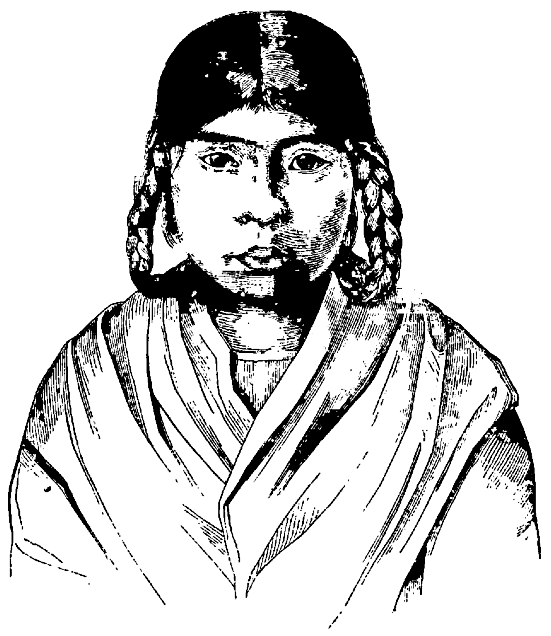
Having now reached the Ultima Thule of the New World we may look back and ask how far the general phænomena and problems connected with the ethnology of South, resemble those of North America: they do so in many respects. There are the same physical divisions of elevated table-land, of open pasture, of steppe, and of forest; the same low levels along similar large rivers, and the same swamps on the sea-shore. And so it is with the distribution of tribes and races. Large areas, like those of the Algonkins and Iroquois, are conterminous with groups of unfixed and almost isolated languages: so that what we have found in Mexico, as opposed to Canada, we shall find in Central South America, as opposed to Brazil and Peru.
Still there are important points of difference. South America, like Africa, lies not only between the tropics, but under the equator. Like Africa, too, only farther than Africa, it extends towards the Antarctic Circle; so that hence we may call the natives of Tierra del Fuego either the Eskimos of the south, or the Hottentots of the west.
In respect to the abundance and value of its ethnological materials, South America, especially for its interior, is one of the dark spots of the world—it is better known than Central Africa, and better known than New Guinea: and saying this we have said all.
And here it may be well to indicate an ethnological method. In Tierra del Fuego we have one of the six extreme points of population; i.e. points from which no population has been supposed to have been determined elsewhere; Easter Island, Van Dieman's Land, the Cape of Good Hope, Lapland, and Ireland, being the other five. In working the problem as to the original centre of population—the birthplace of the human kind—it is these six points with which we should begin, and so seek their point of convergence. This is of two kinds, geographical and philological. The first is that part of the earth's surface where the distance from each is equal (or where it nearest approaches equality); the second, the locality of that language which has, at one and the same time, the greatest likeness to the Teapi,[161] the Tasmanian, the Fuegian, the Hottentot, the Lapponic, and the Gaelic. Of course such centres would be conventional, and liable to the influence of disturbing causes. Still they involve a principle that is both safe and scientific; and, if the land were one vast circular island, in the midst of the ocean, and the changes that affect language had taken place at a uniform rate throughout the domain of speech, such a state of things would supply a conventional ethnological centre.
Such a conventional centre would be the mean point between the geographical and the philological ones.
That the Chileno, Patagonian, and Fuegian populations are sections of a single stock I have no doubt. Whether, however, this stock may not contain other branches is uncertain.
There are three frontiers to the northern part of the area in question—the western, the central, and the eastern. The western has been already noticed: it is the country of the Changos, Atacamas, and other portions of the old Peruvian empire. Nevertheless it is probable, that the population may be Chileno, and still more likely that it may be transitional to the Peruvian and Moluché groups.
The central division has yet to be studied in detail; since we have yet to learn at what part of Central South America the Pampa population changes for that of the Gran Chaco,[162] and of what nature this change is. Nay, the Southern Indians of the Gran Chaco may, like the southern members of the Peruvian empire, be either Patagonian (or Pampa-Patagonian) or transitional.
The eastern portion of the division in question is the parts about the mouth of the River Plata.
The population, which I suppose to have been conterminous with the Patagonians (i.e. the Puelché portion of them) is that of—
THE CHARRUAS.
Of the language I have seen no vocabulary. In physical appearance the Charruas approach the Patagonians; and equally akin are they to the fiercer tribes of that division in their habits and characters.
The Charrua population—for we are now within the territory of the Spanish Republic, and in areas where the displacement of the aborigines has been the consequence of contact with the European—is known only in fragments; whole sections of it being, at the present moment, either extinct or incorporated. The original divisions, however, were as follows:—
1. The Charruas Proper; 2. the Chayos; 3. the Chanás; 4. the Guenoas; 5. the Martedanes; 6. the Niboanes; 7. the Yaros; 8. the Minoanes; 9. the Caaiguas; 10. the Bagaez; 11. the Tapés. Of these the Chanás and Niboanes inhabited, at the arrival of the Spaniards, the islands of the Uruguay, at the junction of the Rio Negro. The Guenoas and Martedanes connected themselves with the Portuguese of the Colonia del Sacramiento, and were at enmity with the Yaros and Minoanes. The Chayos are the first that disappear from history, probably from having become amalgamated with the Yaros.
The Charruas proper, from the time of Solis to the year 1831, have lived the life of a nation of warriors, with their hand against every man, and every man's hand against them. Uninterrupted as was their hostility to the Spaniards, it was equally so against the other aborigines; so much so, that in no case do we find a common alliance against the common enemy to have existed;—on the contrary, the war against the Mamaluco, the Tupi, and the Arachanes, were wars of extermination. And so was the war against the Spaniards; except that the Spaniards were the exterminators. In 1831 the President of Uraguay, Rivera, destroyed the Charruas root and branch; so that at the present moment a few enslaved individuals are the only remains of that once terrible nation.
From eighty to one hundred families lived under the direction of a Tubicchó, or semi-hereditary chief, and when danger threatened, the Tubicchós met and chose amongst themselves a leader. Whoever is chosen commands the obedience of the rest—the election is half counsel, half feast. Chicha is drunk; wounds are exhibited; exploits are recounted: the most worthy is selected from his peers.
After this fires are lighted as beacons, and the warriors of tribes meet from all parts. When they can make the attack, they do it by night, and at the full-moon. How they treat their captives is a matter upon which there is a conflict in the evidence. Ruy Diaz de Guzman denies that they are cruel to their prisoners. I have no wish to disturb Ruy Diaz de Guzman's evidence. Others, however, have controverted it. Against the fact of their being cannibals there is the same, and (perhaps) better testimony. Where they taste human flesh at all, it is done in the spirit of vengeance, and not to satisfy appetite. They tasted of the body of Solis; and they had good reason to hate him.
Their chief ornaments are the tattoo and the feathers of the ostrich; and the favourite colour for their incisions is blue.
Now I believe that this savage semi-heroic character of the Charruas is a fair sample of the wilder and more unsubdued Indians of Chili, Patagonia, and the Gran Chaco; also, that it is equally true of the Araucanians as described by Ercilla, and the Pampa Indians of Sir E. Head. And what is this but a repetition of the same features which we see in the corresponding part of North America? Here, when we have got beyond the tropics, we find the Algonkin, Sioux, and Iroquois warriors, conterminous with, and (as the present writer believes) passing into the feebler Eskimo—these latter bearing the same relation to their southern neighbours as the Fuegians do to the northern ones.
Like the Paduca area for North America, the Pampas and the parts to the north of them are preeminently the country of the horse—so that the ethnology of Mongolia and Tartary partially reappears here.
In looking back to consider what parts of South America have been described, we find that the long but narrow strip of the western coast bounded by the Andes and the Pacific, has been nearly (perhaps wholly) distributed between three stocks—the Muysca, the Peruvian, and the Chileno-Patagonian. I say perhaps wholly, because the Atacamas and Changos are probably referable to one of these two latter divisions. Again—it is likely that future researches may throw these three great groups into one; at least such is the inference to be drawn from a comparison of the Patagonian and Peruvian languages.
To a certain extent, the southern part of the peninsula is disposed of along with the western; since it is safe to say that as far as 30° south latitude (perhaps farther) the Chileno-Patagonian stock, like the Eskimo and Athabaskan, stretches across the breadth as well as along the side of the continent.
The parts still standing over—two-thirds or more of the whole peninsula—are those bounded by the ocean, the Andes, and 30° south latitude.
Premising that of these three boundaries the last is artificial and conventional, whilst the two former are natural, I shall take first in order those areas which, being geographical or political rather than ethnological, exhibit the phænomenon, so often met with already, of numerous groups within narrow compasses. This being done, the remaining part of the continent will exhibit the contrast of the wide extension of single families.
For the miscellaneous and imperfectly described sections of the South American population about to be noticed, the chain of the Andes, in its extension from Panama to Cape Horn, and in its remarkable parallelism to the coast of the Pacific, taken along with the three great water-systems of the Orinoko, the Amazons, and the La Plata, is the great geographical point of prominence.
Herefrom, about 20° south latitude, a western extension of mountains and highlands separates the water-system of the Amazons on the North from that of the Rio de la Plata on the South.
Distinguishing, then—
1. The Indians of the water-system of the Amazons, from—
2. The Indians of the water-system of the Plata, and both from—
3. The Indians of the water-system of the Orinoco—the first section of the first division consists of the—
I. INDIANS OF THE MISSIONS.
The distinction here is so far from being ethnological that it is scarcely geographical. Political, however, as it is, it is convenient—since the term itself indicates what we shall find, viz., a more or less imperfect Christianity throughout.
A. Indians of the Mission of Moxos.
MOXOS.
Localities.—a. Missions of Carmen de Moxos, Concepcion de Moxos, San Joaquin de Moxos.
b. Loreto de Moxos, Trinidad, San Xavier, San Ignacio.
c. To the east of the Missions of Concepcion and Carmen, near the river Guaporé.
Divisions.—a. Muchojéonès.
b. Baurès.
c. Moxos Proper.
Numbers.—
Muchojéonès of Carmen 230
Christian Baurès 4,178
Pagan Baurès 1,000
Moxos 8,212
Total 13,620
ITONAMA.
Locality.—North-east of the province of Moxos. Missions of Magdalena and San Ramon.
Name.—Native.
Numbers in 1830.—At Magdalena, 2,831, at San Ramon, 1,984. Total, 4,815. All Christian.
Conterminous with the Iténès, Baurès, Canichanas, Moxas.
CANICHANA.
Present locality.—The Mission of San Pedro.
Name.—Native.
Numbers in 1830, 1939. All Christian.
MOVIMA.
Present locality.—Mission of Santa Anna.
Original locality.—Banks of the Yacuma.
Conterminous with the Moxos, Canichanas, and Cayuvavas.
Name.—Native.
Numbers in 1830, 1238. All Christian.
Language.—Between the Movima and the Moxas the language is the only important distinction.
CAYUVAVA.
Present locality.—Mission of Exaltacion, at the northern part of the river Mamoré. Originally conterminous with the Movimas, Iténès, the Maropas, and Pacaguaras.
Numbers in 1831, 2073. All Christian.
Language.—Between the Cayuvava and the Moxas the language is the only important difference.
ITÈ (ITÈNÉS).
Locality.—The junction of the Iténès and Mamoré.
Name.—Native.
Probable number.—From 1,000 to 1,200.
PACAGUARA.
Locality.—The junction of the Beni and Mamoré.
SAPIBOCONI.
Locality.—The province of Moxos.
The Sapiboconi are mentioned by Hervas, and, from him, in the Mithridates. They are not, however, mentioned by D'Orbigny, and are probably extinct. Their language is evidently different from any known tongue of either Moxos or Chiquitos; and judging from the comparison of the Mithridates, consisting only of seven words, it seems to be Quichuan rather than aught else.
ENGLISH. SAPIBOCONI. QUICHUA.
Head emata matti
Lightning ilapa illapo.
Stone tumu rumi.
Year mara mara.
B. Indians of the Mission of Chiquitos.
CHIQUITOS.
Locality.—Centre of the Province of Chiquito.
Name.—Spanish.
Tribes, both existing and extinct, numerous.
Numbers in 1830, 14,925. All Christianized.
Conterminous with the Samucos, Guanos, Guatos, Tobas, Siriones, Guarayos, Saravecas, Otukés, Tapiis, Covarecas, Paioconecas, Tapacuras.
SARAVÉCA.
Present locality.—The Mission of Santa Ana, and Casalvalco.
Original locality.—North-eastern limits of the Chiquito tribes.
Numbers.—At Santa Ana, 250; at La Reduction de Casalvalco, 100. All Christianized.
Except by language, scarcely distinguishable from the Chiquitos.
OTUKÉS.
Present locality.—The Mission of Santo-Corazon.
Original locality.—North-eastern parts of Chiquitos, on the frontiers of Brazil.
Numbers.—150. All Christians.
Except by language, scarcely distinguishable from the Chiquitos.
COVARECA.
Present locality.—The Mission of Santa Ana.
Original locality.—The neighbourhood of the Saravecas and Curuminacas.
Numbers.—About 50.
Language.—Extinct, or almost extinct. Out of a few words collected by D'Orbigny, one-third Otuké.
CURUMINACA.
Original locality.—North-east of the province of Chiquitos, between the Saravecas and the Otukés.