PART I. (continued 5)
Reading edition
a. In the second upper molar, the connate character of the lateral fangs, which is common in Europeans, is extremely exceptional in Australians.
b. In the third upper molar three separate and well-developed fangs, exceptional with the European, are normal with the Australian.
THE TASMANIAN BRANCH OF THE KELÆNONESIAN STOCK.
Area.—Van Dieman's Land.
Physical appearance.—Negritos, with curly, frizzy, or woolly hair; i.e., with the character of the Papua, but not within the Papua geographical area.
The native population is nearly extinct; and but few specimens exist of their language.
Fig. 8.
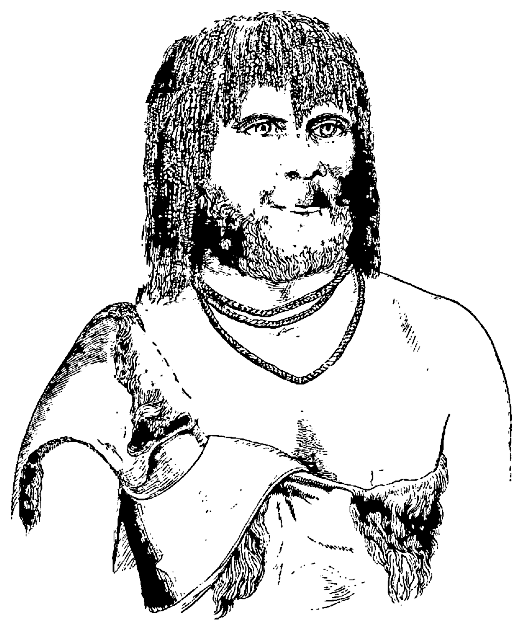
It fell into, at least, four dialects—mutually unintelligible: probably into more.
Writers who are not, otherwise, over-prone to exaggerate differences, have separated the Tasmanians from the Australians; and this arrangement is followed in the present work. The physical difference is chiefly that of the hair. The language, as far as the imperfect vocabularies have allowed me to examine it, has fewer affinities with the southern dialects of Australia than even the known amount of dissimilarity between fundamentally allied languages prepares us for.
Furthermore—it was my impression, that such philological affinities as existed were with New Caledonia rather than Australia. If so, the philology and the physical appearance go together; and the Tasmanian population came round Australia rather than across it.
The present position, therefore, of the Tasmanians is provisional.
Necdum finitus Orestes.—There are two other Negrito localities; which, geographically speaking, are scarcely Amphinesian, and not at all Kelænonesian. From the latter area they lie wholly apart. With the Protonesian portion of Amphinesia they are less disconnected; indeed they seem, at first, to form a prolongation of the northern extremity of Sumatra.
I allude to two groups in the portion of the Bay of Bengal, on the Siamese side, almost parallel with the line of the continent, and forming a series of stepping-stones from Cape Negrais, in the Môn country, to the Malay island of Sumatra.
These are—1. The Andaman Islands. 2. The Nicobar Islands.
THE ANDAMAN ISLANDS.
Native name of the inhabitants.—Mincopie.
Nearest point of the Continent.—Cape Negrais.
Language.—Apparently not monosyllabic. Not considered to be Protonesian.
Native Fauna.—Rats, hogs, dogs.
Religion and habits.—Pagan cannibals.—Lieutenant Colebrook's Asiatic Researches, vol. iv.
Physical appearance.—Colour extremely dark, perhaps black. Heads woolly, lips thick, noses flat. Stature small, limbs ill-formed and slender, bellies prominent.
Little as the Andamans, from the ferocious character of the inhabitants, are known, they are noticed by the Arabian travellers of the twelfth century, and also by Marco Polo; the early accounts being quite as unfavourable as the late ones. "Angaman is a very large island, not governed by a king. The inhabitants are idolators, and are a most brutish and savage race, having heads, eyes, and teeth resembling those of the canine species. Their dispositions are cruel, and every person, not being of their own nation, whom they can lay hands on, they kill and eat."—Marco Polo, Marsden's Translation.
THE NICOBAR ISLANDS.
Locality.—Between the Andamans and Sumatra.
Nicobar.—Inhabitants copper-coloured, with oblique eyes, yellowish sclerotica, small flat noses, large mouth, thick lips, and black teeth; undersized. Hair strong and black; beard scanty. Ears large and perforated. Occipito-frontal profile brakhykephalic, the hinder part of the head being flat and compressed.
The Nicobars are the people who, from the year A.D. 1647, until a recent period, had the credit of having tails, like those of cats, which they moved in a similar manner. This arose from a mistake of Keoping, a Swede, who mistook for a caudal appendance a stripe of cloth hanging down behind. That there is no real prolongation of the os coccygis is expressly stated by Fontana. The people now supposed to present this anatomical peculiarity are a tribe from the interior of Africa.
The evidence of Keoping as to the cannibalism of the Nicobarians is more conclusive than his assertion as to their tails. Having "sent a boat on shore with five men, who did not return at night, as expected, the day following a larger boat was sent, well manned, in quest of their companions, who, it was supposed, had been devoured by the savages, their bones having been found strewed on the shore, the boat taken to pieces, and the iron of it carried away."
Their huts are raised from the ground, and entered by a ladder; inhabited by more families than one, and ornamented with boar-skulls. Marriages are easily formed, and easily dissolved.[79] The dead are buried; and for every person that dies a cocoa-nut tree is cut down; and his name is never afterwards mentioned.
The changes of the moon are productive of their great festivities; and it is by these only that they reckon; seven to each monsoon. At the beginning of the north-east monsoon a brisk trade, carried on by means of large canoes, begins with the other islands. The extent of this, and the amount to which it has introduced European articles of commerce is considerable; indeed, in the Carnicobar Island the Portuguese has partially become a lingua franca.
The habit of artificially flattening the back of the head is of more importance. It is a custom "to compress with their hands the occiput of the new-born child, in order to render it flat. By this method the hair remains close to the head; as nature intended it, and the upper fore-teeth very prominent out of the mouth." This is, apparently, so exclusively an American custom that its presence here is remarkable; and it is equally remarkable that the only other approach to it, is to be found in these parts. It is mentioned as being a practice of certain Arakan tribes.
The most characteristic disease is the Cochin-leg, a form of elephantiasis; arising, perhaps, from the extent to which their aliment is either fish or pork, to the exclusion of other sorts of animal food. Instances, too, of longevity, are said to be rare.
Malabar and Bengal settlers to a considerable extent make the Nicobarians a mixed, rather than a pure population.
Carnicobar.—Inhabitants well made, but undersized, with Malay features.
Chowry.[80]—South of Carnicobar. Trade between the Chowrians and Carnicobarians; the former selling canoes, the latter cloth.
Nancowry is described by Marco Polo, as being under the government of no king, the people being "little removed from the condition of brutes, all of them both males and females going naked, without a covering to any part of the body. They are idolators."[81]
One of the most remarkable of their customs is the way in which they celebrate the anniversary of the burial of any near relation, when "their houses are decorated with garlands of flowers, fruits, and branches of trees. The people of each village assemble, dressed in their best attire, at the principal house in the place, where they spend the day in a convivial manner; the men, sitting apart from the women, smoke tobacco and intoxicate themselves, while the latter are nursing their children, and employed in preparations for the mournful business of the night. At a certain hour of the afternoon, announced by striking the coung, the women set up the most dismal howls and lamentations, which they continue without intermission till about sunset; when the whole party gets up, and walks in procession to the burying-ground. Arrived at the place, they form a circle around one of the graves, when the stake, planted exactly over the head of the corpse, is pulled up. The woman who is nearest of kin to the deceased, steps out from the crowd, digs up the skull, and draws it up with her hands. At sight of the bones, her strength seems to fail her; she shrieks, she sobs, and tears of anguish abundantly fall to the mouldering object of her pious care. She clears it from the earth, scrapes off the festering flesh, and laves it plentifully with the milk of fresh coco-nuts, supplied by the bystanders; after which she rubs it over with an infusion of saffron, and wraps it carefully in a piece of new cloth. It is then deposited again in the earth, and covered up; the stake is replanted, and hung with the various trappings and implements belonging to the deceased. They proceed then to the other graves, and the whole night is spent in repetitions of these dismal and disgustful rites."[82]
By referring to p. 209, the reader will find that three questions connected with the distribution of the Polynesians—and, through them, with that of the Oceanic tribes, altogether stand over for consideration; these being—
A. The general question, as to their origin and distribution in respect to their connection with the Continent, and with each other. B. The date of the migrations. C. The inferences to be drawn from the existence of a darker-coloured population in areas more especially belonging to the brown and olive-coloured tribes.
A. Connection with the Continent of (1) The Kelænonesians, (2) The Polynesians.
1. A. Of the Papua Kelænonesians.-The Papuans of New Guinea are, more probably, a continuation of the population of the Eastern Moluccas than aught else. This is what their geographical position indicates; and (such being the case) it is the primâ facie doctrine. At the same time, they are a continuation of the black or black-like portion of the Moluccan area, rather than of the Mahometan Malays. The chief difference lies in the texture of the hair, a difference which has, most likely, been over-rated.
B. Of the Australian Kelænonesians.—The a priori view as to the source of the Australian population is complicated, as may be understood by looking at the distance between Cape York and New Guinea on one side, and that between Cape Van Dieman and Timor on the other. The difference in breadth between the interspaces of ocean in these two parts is nearly the same: that, however, of Torres Straits is the smaller;—besides which, there is a numerous series of islands which would serve as stepping-stones to emigrants from New Guinea; assuming that to be the line. Now as it is a general rule to derive the population of islands forming part of a series from the nearest inhabited point between the area under consideration and the Continent, unless reasons can be shown to the contrary, the apparent primâ facie view is in favour of the south of New Guinea having peopled the north of Australia. Nevertheless, it not only is highly probable that such is not the case, but it is by no means certain that, all conditions considered, it is a correct view even a priori. In many instances those reasons for believing that one particular island has supplied a population to another, which are based on the principle of simple contiguity, are modified by the relations of the supposed immediate source of population to the supposed remote one; in which case, although the land and sea conditions between the two last links of the chain may be of the most favourable kind, those between the last link but one and the first, may be the contrary. Thus, in the case before us, the fact of Torres Straits being the narrowest portion of Ocean between Australia and the inhabited land, on the side of the continent next to it, taken by itself, constitutes a reason for deriving the Australians from the Papuans. It is complicated, however, by the circumstance of the line between New Guinea and the Continent being by no means of the most direct and straightforward sort. Hence, if there were any other point of inhabited land which should at one and the same time be not much farther from some part of Australia than New Guinea is from Cape York, and much nearer the remote source (assumed to be on the Continent) of the Australian population, such a locality would divide with New Guinea the claims for having been the immediate origin of the occupants of the great island in question; inasmuch as the slight difference between the favourable conditions of one kind, would counterbalance the preponderating conditions of another.
Now such a locality is really found in the case before us in the relations already noticed between the north-east point of Timor and Cape Van Diemen; so that, upon the whole, the a priori views are as much in favour of the Timor range of islands, being the connecting link between Australia and the Continent, as they are in favour of New Guinea being so.
The distinction just indicated is of more importance, as illustrative of a general principle, than as a fact affecting the particular point in question. The special facts of the case are, in the mind of the present writer, in favour of Timor and not New Guinea, having been the quarter from whence Australia was peopled, the particular part of the Timorian stock being, of course, the darker, wilder, and, apparently, more ancient tribes of the west and of the interior.
2. Of the Polynesians.—In investigating the relations between Polynesia and the Continent, with an exclusive view to the land-and-sea conditions between the different portions of the connecting series of islands, we should at once derive the population of the Eastern Archipelagoes from the islands which lay nearest to them on the west, and so proceed until we came to the Samoan Archipelago, to the Tonga group, or to the Fijis. These we should connect with the New Hebrides, or Solomon's Isles, and these last with New Guinea, the Moluccas, and the Continent. We should then assume a spread of the population, as far to the North and East as it had been found to occur westwards; and so derive the Micronesians from the northern Polynesians. We should not be afraid of even deriving the people of the Pelew Islands from the same quarter; the similarity of language and habits having already been recognised, and the distance between the Pelews and the nearest portion of Protonesia being greater than (or at least as great as) any interspace of ocean between Polynesia and the Continent. I say that this is what we should do if we looked exclusively to the discovery of that line of connexion where the land-and-sea conditions should be the most favourable; in other words, where the interspaces of sea should be the smallest. Nevertheless, in so doing we should, probably, commit an error in our inference, and certainly violate a principle in our method; a principle which has been suggested in a previous[83] part of the present Volume, and which is founded upon the circumstance of the population of the line of the Papuan Islands, being not Amphinesian but Negrito: so that the ethnological continuity, and the geographical continuity, disagree; a fact which throws us upon a line of greater geographical, but of less ethnological complexity; and in favour of which the probabilities arise out of a composition of the conflicting difficulties. This is the line from either the Philippines, or the northern Moluccas to the Pelews (via Lord North's Isle, Sonsoral, or Johannes I.), the cluster of Goulou, the cluster of Yap, the Egoy Isles, the Lamoursek and Satawal groups; the Proper Caroline group, the Chains of Ralik, and Radak, the Tarawan group, the Navigators' Isles or Samoan Archipelago.
Now the Samoan Archipelago is very nearly the point from which we should have derived the proper Polynesian population, had we taken the course of the Papuan islands; so that it constitutes a point wherein the two lines meet. Hence, if upon historical, philological, or any other points of external evidence, we gave a preference to the Samoan Archipelago, over the Tonga group, as the source of the population for other parts of Polynesia Proper, we should reduce the general question as to the original of South Pacific islanders to that of the origin of the Samoans. This, however, is a matter of detail, of less importance than the recognition of the necessity of making the geographical continuity of the chain which connects the Polynesians with the Continent, agree with the ethnological. This can only be done by deriving the Polynesian population from Micronesia. In this case the stream of migration goes round the Kelænonesian area, and not across it.
The rule of taking, as lines of insular migration, those series where the maximum interspaces of ocean are the smallest, has already been twice insisted on, and in both cases it has been qualified by the indication of particular reasons, which might, in certain cases, lead us to depart from it. These reasons have not been exhibited in detail. Two sorts, however, of them have occurred, as it were spontaneously, i.e., in the natural course of our investigations. These showed themselves, first in the preference given to Timor over New Guinea, as the origin of the Australian population; and next, in the case of Polynesia, just discussed. A third sort will now present itself, i.e., the effect of winds and currents; since it is clear that it is easier to pass over a large interspace of sea with wind and current (one or both) in your favour, than over a small one with either one or both against you.
The prevailing winds in the Pacific are against a line of insular migration, being from west to east, at all; since for three fourths of the year they blow from America towards Amphinesia rather than from Amphinesia to America.
Valeat quantum. All that can possibly be got would be a chance of three to one in favour of an American origin for the Polynesians, provided that all other conditions were equal. But this is not the case; the a priori probabilities are neutralized by a vast difference in the maximum interspaces of ocean, and by the non-American character of both Micronesia and Polynesia.
It is most likely, then, that Polynesia Proper was peopled from Micronesia, and Micronesia from either the Philippines or the Moluccas.
C. The date of the migrations. This is either relative or absolute: relative when we ascertain whether one division of the Oceanic populations migrated before or after another; absolute when we fix the chronological date of a migration. As a general rule the latter is unattainable—Iceland and a few other areas, peopled within the historical period, forming the exceptions.
Respecting, then, the absolute date of the Polynesian migration, there is no reason why it should not be known in particular islands; for instance, in the Dangerous Archipelago, where only a small proportion of the clusters is peopled even at present, any given island may receive a population so late as this, the eleventh hour of the extension of the human species; yet it is evident that the knowledge of such a migration would throw but little light upon the broader question of the date of the Polynesian population en masse. Of this it may safely be said, that no important group has received its first occupants within the Polynesian historical period. This, however, is but a short one.
Will the longer range of the traditionary period supply any such information? I think not. Nevertheless it must be added, that in Nukahiva pedigrees run up to the eighty-fifth generation, the founders of them being connected with the first occupancy of the island. Even, however, if we admit so long a genealogy as an historical fact, it only gives the date for one particular island.
Proper ethnological reasoning is, from its very nature, inapplicable to the investigation of a definite epoch in chronology; since it only begins where the evidence of testimony ends. Furthermore, it is only approximate, since it simply calculates, by means of an imperfect induction, the minimum period required to account for differences; and the maximum period that will account for resemblances; e.g. for the Polynesians to differ as they do from the Micronesian, a certain time must have elapsed; and for them to differ no more than they do, that time must have a limit.
Applied to the relative date of the Oceanic migrations, ethnological reasoning gives for even the most recent of them, a geological rather than an historical epoch; and this is as much as it is safe to say. Its other probable conclusions are more definite.
1. Occupancy had begun in Australia before migration across Torres Strait had commenced in New Guinea.
2. Occupancy had begun in New Guinea before Polynesian migration had commenced in Protonesia. The first of these facts we infer from the physical differences between the Australian and the Papuan, taken with the fact that it is scarcely likely that the Papuans of Torres Straits would have failed in extending themselves to Australia had that island been unoccupied.
The second is an inference from the diversion of the Protonesian population from New Guinea to the Micronesian line, since the best reason that can be assigned for the Protonesians not having taken possession of the Papuan isles, is to be found in the assumption that they were previously inhabited.
This brings us to the third question, as to the import of the darker coloured populations in areas more especially belonging to the brown and olive-coloured tribes.—I do not see how we can consider these as aught else but the lighter-coloured populations in a ruder stage of society; since unless we take this view we must look upon them as the representatives of a separate section of the human kind; a supposition against which there are the two following objections.
a. That the difficulties respecting the population of the Polynesian area are just doubled by such an assumption; since instead of having to account for the undoubted Polynesians alone (a matter quite difficult enough of itself) we should then have to account for an earlier migration of Negritos as well.
b. That if such a previous migration had taken place, we should expect to find—considering the vast number of Polynesian islands—at least one island where the blacker race remained unmixed, and (as such) speaking the original non-polynesian language, which is implied in the assumed independence of origin; since it is exceedingly unlikely that a second migration should have so nearly coincided with a former one as to people and leave unpeopled exactly the same areas. Now out of all the isles of the South Sea none presents the phenomenon of a pure black population, as determined by the double test of colour and of language.
On the other hand, it may be urged—a. That, although it may be a matter of doubt with competent judges whether improved physical and social conditions have so great an influence upon the colour of the skin and the texture of the hair as is imagined by some extreme thinkers on the point, it is generally admitted that they have some influence.
b. That in some groups (and sometimes in particular islands) the identity of the darker and lighter-coloured population is beyond a doubt; coinciding, as it does, with such differences.
c. That transitional forms occur where it is wholly gratuitous to assume the influence of intermixture.
With this opinion our view of the relations between the continuous Kelænonesian areas and the areas of the mixed population would be as follows:—
a. That at a period anterior to the development of the proper Malay and Polynesian characters of the typical Protonesians, New Guinea and Australia were peopled from the Moluccas and Timor respectively; the immigrants having a type which might lose or gain Kelænonesian characters according to circumstances.
b. That the conditions of Protonesia and Polynesia favoured the change from dark to fair; those of New Guinea and Australia from fair to dark.
I will now add a remark of Mr. Blaxland from Mr. Jukes's Voyage of the Fly, which will further illustrate this position:—"The geographical boundary of the Papuan islander is precisely coincident with that of the north-west monsoon. This wind, from the months of November to March inclusive, is the prevalent one over all the space extending from the equator to 10° or 15° south latitude, and in longitude from Sumatra to the Fejee Islands. It is sometimes experienced to the west of Sumatra as far as the north of Madagascar, and it sometimes also extends to the east of the Fejee Islands into the Pacific Ocean; but these extensions are irregular, and its usual eastern boundary is precisely that of the Papuan race before described. Mr. Blaxland deduces from this fact, coupled with the little skill of that race in navigation, the inference, that they have travelled from the west into the Pacific Ocean, and extended their migration only as far as the monsoon allowed them."[84]
This gives us the following theory:—
1. That Kelænonesia was peopled when navigation was so much in its infancy as for the Protonesians to be limited in their migrations by the north-west monsoon.
2. That Polynesia was peopled when it was sufficiently advanced for the same people to be independent of it.
3. That the differentiæ between the lighter and darker Protonesians is referable to the influences of Asiatic civilization.
The observations of Mr. Blaxland, taken along with the colour of the people, lead to the inference that the Fijis were peopled from Kelænonesia. The language, however, is against this. The conflict of difficulties is best reconciled by considering them a mixed race; of which the older element belongs to the line of population which supplied Kelænonesia with its inhabitants, the newer to the Polynesian system.
If this view be unsatisfactory we must consider them as members of the darker Polynesian population, with its differential characteristics at their maximum—a view probable enough of itself, but rendered suspicious by the fact of its occurring so precisely in the neighbourhood of Kelænonesia.
That they form a true transition between the Kelænonesians and Polynesians, as a continuation of a line of population from the New Hebrides to Polynesia, is of all views the most improbable.
In the opinion of the present writer, the Fiji Islands are the localities where the stream of population which went round New Guinea met, and amalgamated with the extremity of the line that came across that country; the antagonism between the evidence of the language, the evidence of the physical conformation being the effect of the intermixture.
Respecting the ethnological relations of the Andaman and Nicobarian islanders, I am not prepared with an opinion.
The following facts connected with the Polynesian languages, are laid before the reader, less for the sake of enlarging the list of Polynesian peculiarities than as a preparation for certain philological phænomena, which will occur in the ethnology of America, and with the view of showing a process by which language, over and above the changes which are brought about by natural changes, may be modified artificially—a point upon which we have few data, but plenty of extreme opinions.
Ceremonial language of parts of Polynesia.—The Samoans, ceremonious to each other, are preeminently so towards their chiefs; one of their methods of showing respect being to eschew certain words in common use, when addressing a superior, and to substitute for them others, which are considered more refined. Hence, a careful speaker will never address a higher personage in the terms appropriate to an inferior one. To a common man, on entering a house, the salutation is ua mai=you have come.
To a householder, ua alala mai.
To a low chief, ua malui mai.
To a high chief, ua susu mai.
To the sovereign, ua afio mai.
In Tonga there are traces of a second order of ceremonial synonyms; i.e. over and above those ordinarily in use, there is a series for the particular divine chief Tiutonga.[85]
CEREMONIAL. TIUTONGA. COMMON. ENGLISH.
Fofonga langi mata face.
Ilo taumafa kai eat.
Mamata taka tio see.
Ofai hala mate dead.
Tengitangi buluhi mahaki sick.
Toka tofa moe sleep.
In Tahitian, an excessively figurative manner of speech is said to supersede the proper system of ceremonial synonyms, the houses of the chief being the clouds of heaven; his canoe, the rainbow; his voice, the thunder, and so on.
The names too of the chiefs are almost always significant, and almost always compound, and, in some cases, they run to a very considerable length, as Tai-ma-le-langi=sea and sky; Tau-i-te-ao-bu=suspended in the blue heavens; Ta-lana-tupu-a-pai-ta-lani-nui=the sky increasing and striking the great heaven. Now the owners of any such names as these are supposed to be complimented by the Tahitians ceasing to employ, in the language of their daily intercourse, one, or more, of the words which formed parts of them; so that, in the case of Tai-ma-le-langi, the syllables tai, mai, le, or langi, are lost to the common language, until the death of the chief, so designated. After his decease, however, they return to the language. In this way, between the voyages of Cook and Vancouver, no less than forty or fifty words had been superseded by new ones: indeed, of the first ten numerals, four are now different from what they were in Cook's time.
Original form. Present form.
2. Rua piti.
4. Ha maha.
5. Rima pae.
6. Ono fene.
Note 1.—Since the notice of the Fiji Islands was written a youth of that group—i.e. from the island of Lafu—has been brought over to England by Mr. James Boyd, been presented at the Ethnological Society, and is now in London. The most remarkable point is a reddish tinge, clearly perceptible under a cross light, in his otherwise black and frizzy hair. If I am right in referring this shade to the use of alkaline washes used in youth for the purposes of whitening the hair, it shows the unsafeness of talking about naturally red hair for any of Oceanic islands; since, in the case in question, it was upwards of five years since any alkaline wash had been applied.
Note 2.—In p. 184. I have overstated the extent to which the notion that Polynesia Proper was peopled from Kelænonesia rather than from Micronesia was general. Although not found (as far as I know) in any of the systematic works on the subject of human migration, it is by no means singular. It is the opinion of Mr. Norriss, and—subject to an alternative—the recorded opinion of Mr. Jukes, who writes,—
"The Papuan race exclusively possesses the islands on the north-east of Australia, namely, New Guinea with New Britain and New Ireland, the Solomon Islands, the islands called Tierra Austral del Espiritu Santo, and the New Hebrides, and New Caledonia. It extends also to the Feejee Islands, where it is more or less mingled with the Polynesian race, and where the language appears to be of Polynesian origin. It is probable that from New Caledonia proceeded the colony, or whatever it was, that reached Tasmania, and there mingled with the Australian race. To the westward of New Guinea scattered tribes, apparently of Papuan race, are said to occur in the interior of many islands as far west as that called Endé Flores or Mangeray, and as far north as the Philippine Islands. It has even been said that the Andaman Islands, in the Bay of Bengal, are inhabited by a people much resembling the Papuans, and I have been struck with the similarity of many of their customs to those which are said to characterize some of the wild hill tribes in the centre of India. I believe, however, that many of the stories of tribes of people being found in the various parts of the Archipelago, must be received with much caution, and that most of the wild people so described will be found, like the Dyaks of Borneo, or the wild tribes of the Malacca Peninsula, to be really of Polynesian race. A mingling of the Papuan race with the Australian, probably takes place at the present day in the neighbourhood of Torres Strait, but not, perhaps, to so great an extent as might be expected, for I am inclined to think that the Australians give way and retreat before the islanders. * * * * Whatever may have been the origin of the Polynesians, it is certainly most probable that their reason for going round these Papuan islands (whether from the east or west), and not taking possession of them, was the fact of their being previously inhabited by the Papuans."[86]
FOOTNOTES:
D. HYPERBOREAN MONGOLIDÆ.
We are now in Siberia rather than in Central Asia; along the courses of large rivers rather than at their head-waters; and in a region of tundras, or flat barren morasses, rather than on elevated steppes. We are also in the country of the rein-deer and dog rather than the horse and sheep. Fishing and fur-hunting, too, will form a portion of the occupations of the Hyperborean Mongolidæ. These conditions, different as they are in many respects from the general conditions of the Turk and Mongolian Turanians, have still been met with before, i.e. with the Northern Ugrians, the Northern Tungusians, and the Yakuts. One of the nations about to be enumerated, occupies the most northern portion of the inhabited world, i.e. the Samöeids of the Northern promontory of Asia.
HYPERBOREAN NATIONS AND TRIBES.
Physical conformation.—Undersized Mongols.
Languages.—-Agglutinate; neither monosyllabic nor pauro-syllabic.
Political relations.—Subject to either Russia or China.
Religion.—Shamanism or imperfect Christianity.
Distribution.—The coasts of the Arctic Ocean; the courses of the Yenisey and Kolyma. Area discontinuous.
Divisions.—1. The Samöeids, 2. The Yeniseians. 3. The Yukahiri.
The discontinuity of the Hyperborean area is to the following extent:—
a. The Samöeid class falls into two divisions, a northern and a southern; and these are separated from one another by Turk, Yeniseian, and Ugrian tribes.
b. The Yeniseians are surrounded by Ugrians, Turks, and Tungusians, with which they have less affinity than with the Samöeids, from whom they are separated.
c. The most western Yukahiri are separated from the most eastern Samöeids by Yakut Turks and Tungusians.
This discontinuity of area must be taken along with two other facts.
a. That the Hyperborean nations are nations of a receding frontier.
b. That the Turks, Tungús, and (in relation to the Hyperborean), the Ugrians, are nations of an encroaching frontier. These give, as an inference, the probability of the three separate divisions having once been continuous; so that the original Hyperborean populations must be considered to have been broken up, and partially superseded by the Turks and Tungusians, and to exist, at present, only in the form of fragments.
SAMÖEIDS.
SOUTHERN DIVISION (SOIOT).
Localities.—a. The parts around Lake Ubsa, within the limits of the Chinese Empire; the river Bashkus, which expands into the Lake Altin, or Teleakoi, and becomes one of the sources of the Obi.
b. Tunkinsk, on the south-west extremity of the Lake Baikal, within the Russian territory.
c. Abakansk on the left branch of the Upper Yenisey. From Abakansk, they moved eastwards in A.D. 1618.
d. The River Uda between the two branches of the Upper Yenisey.
Tribes.—a. Of the Lake Ubsa, the Uriangchai or Soiot.
b. Of the Uriangchai, the Bagari, the Matlar, the Tozhin, the Ulek.
c. Of Abakansk; the Matorzi, or Motori, and Koibal. Probably now extinct; since in 1722, only ten families of the Modori remained. The Kamash.
d. Of the Uda; the Karakash.
Conterminous with the Mongols, Tungusians, Yeniseians, and Turks. Separated by the last two from the Northern Samöeids.
Vocabularies.—Of the Motori, Koibal, and Kamash.
NORTHERN DIVISION (KHASOVO).
Area.—From the Mezene, between the Petchora and Archangel, and falling into the White Sea, to the Chatunga in 105° east longitude, along the coast of the Arctic Ocean, and on the lower courses of the Petchora, Obi, and Yenisey.
Southwards; on the Yenisey to Turokansk, on the Obi, as far as Tomsk. This is their nearest point to the Southern Samöeids.
Conterminous with the Yakuts and Tungusians(?) on the east, the Yeniseians and Turks on the south, and the Ostiaks and Russians on the west.
Name.—Of the northern Samöeids on the River Tas, between the Yenisey and the Obi, Mokase. Of those of the Lower Obi and White Sea, Khasovo=men.
Some of the Samöeid tribes are improperly called Ostiaks.
Called by themselves Nyenech=men.
" —————— Khasovo=men.
" the Obi Ostiaks Jergan-yach.
" Tungusians Dyândal.
" Syranians Yarang.
" Woguls Yorran-kum.
" Russians Samöeid.
Vocabularies.—1. From Pustoserk, at the mouth of the Petchora. The north-westernmost locality.
2. From Obdorsk, at the mouth of the Obi.
3. From the River Tym, on the right side of the Obi.
4. From the River Ket, ibid.
5. From Narym between the two.
6. From Pumpokolsk north of the Tym.
7. From Tomsk, the southernmost locality.
8. From the parts between the Obi and Yenisey, the Yurass, the Tas, Mangaseia vocabularies.
9. From Turuchansk.
10. From the east of Turuchansk. The Karass vocabulary.
11. From the parts about the Chatunga. The Tawgi vocabulary. These the most easterly specimens.
12. The Laak vocabulary.
Of all the tribes of Siberia the Samöeids are nearest to the Eskimo, or Greenlanders, in their physical appearance. Varieties, however, have been described; some tribes having been called tall, others fair. The general character is that of the Laplander, and the Eskimo—the other circumpolar divisions of the human species.[87]
The Koibals are in all probability the most advanced of the Samöeids—being the owners of herds, flocks, horses, and camels(?).
Fig. 9.
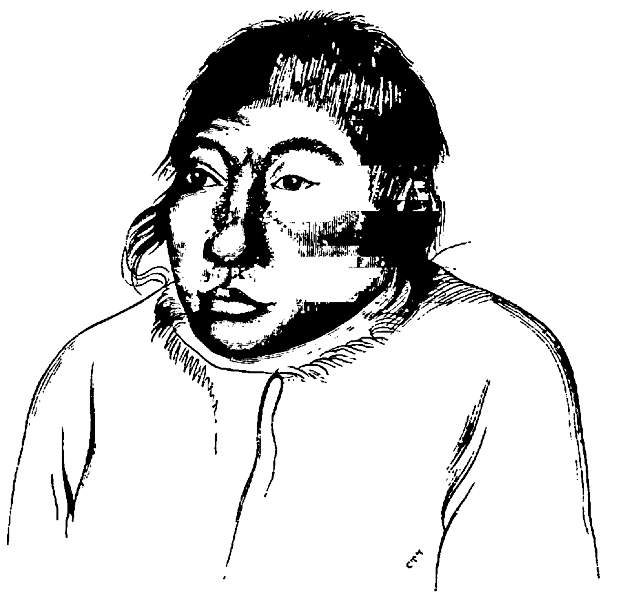
As early as A.D. 1096, the term Samöeid appears in the Russian chronicles, and it is to be found again in the Travels of Plan Carpin, a hundred and fifty years later.
YENISEIANS.
Locality.—Each side of Yenisey, limited by the Northern Samöeids between Inbask and Turuchansk, and by the Southern Samöeids and Turks, in the neighbourhood of Krasnoiarsk. On the west are the south-eastern tribes of the northern Samöeids. On the east Tungusians and Turks.
Native name.—Könniyüng.
Vocabularies.—1. Inbask. 2. Pumpokolsk. 3. Assan. 4. Kott. 5. Arinzi. 6. Denka.
YUKAHIRI.
Native name.—Andon-Domni. Called by the Koræki Atal=spotted, from wearing rein-deer skins.
Locality.—Valley of the Kolyma, originally of the Yana and Indijirka also.
Particular tribes.—1. Tsheltiere, on the River Omolon. 2. Omoki, on the Atasey. 3-4. Tshuvantsi and Kudinski on the Anisey. 5. Konghini, on the Kolyma. 6. Shelagi, on the promontory of Shelagskoi Noss.
Conterminous with the Yakut Turks, the Lamut Tungusians, and the Koriaks.
The Yukahiri, although said to have been, even as late as the beginning of the last century, a powerful people, are at present rapidly diminishing. The Omoki and Shelagi are either extinct, or nearly so. So also, most probably, are the Tseltiere, the Kudinski, and the Konghini. Laying out of the account the influence of Russia, the northern Koriaks on the east, the Yakuts on the west, and the Lamut Tungusians on the south, have been the chief encroaching tribes.
The writer who has paid most attention to the language of these three divisions of the Siberian population is Klaproth; who, I believe, was also the first who separated the Yeniseians from the Ugrians. With these they were confounded, from the fact of their being denominated by the Russians, Ostiaks; a term, which from being already applied to the Ugrians of the Obi, was equivocal. To obviate this ambiguity, it was necessary to speak of two kinds of Ostiaks, those of the Obi, and those of the Yenisey; and so the nomenclature became confused. All this, however, is remedied by adhering to Klaproth's term Yeniseian. And such is the present custom of philologists.
Respecting the extent to which the Yeniseian, the Samöeid, and Yukahiri, are isolated languages; the classification of the present writer is opposed to that of the Asia Polyglotta. Klaproth raises each to the rank of a separate family, and neither admits any definite relationship between the three, as compared with each other, nor yet between any one of them and any of the neighbouring languages. Still he indicates some important general and miscellaneous affinities; and Prichard does the same. The following table helps to verify the present classification.
A.
The Yeniseian of the Asia Polyglotta, and the Yukahiri of the Asia Polyglotta.
English, beard
Inbask, kulye, kulgung
Pumpokolsk, clépuk
Assan, culup, chulp
Kott, hulup
Arinzi, korolep
Yukahiri, bu-gylbe
English, head
Inbask, tshig
Yukahiri, yok
English, mouth
Pumpokolsk, khan
Yukahiri, anya
English, nose
Inbask, olgen, olen
Pumpokolsk, hang
Assan, ang
Yukahiri, yongul, iongioula.
English, tongue
Assan, alûp
Kott, alûp
Arinzi, alyap
Yukahiri, andzhub
English, ear
Assan, kologan, klokan
Kott, kalogan
Yukahiri, golondzhi
English, man
Inbask, çet, blet
Pumpokolsk, ilset
Kott, hatket
Yukahiri, yadu
English, dog
Inbask, tsip, tip
Yukahiri, tabaha
English, thunder
Arinzi, esbath-yantu
Yukahiri, yendu
English, lightning
Inbask, yakene-bok
Yukahiri, bug-onshe
English, egg
Inbask, onge
Arinze, ang
Pumpokolsk, tanyangeeg
Yukahiri, langdzhango
English, leaf
Assan, yepan
Kott, dipang
Yukahiri, yipan
English, eat
Assan, rayali
Yukahiri, lagul
English, yellow
Kott, shuiga
Yukahiri, tshakatonni
English, moon
Pumpokolsk, tui
Arinzi, shui
Yukahiri, kinin-shi
B.
The Yeniseian of the Asia Polyglotta, and the Samöeid of the Asia Polyglotta.
English, arm
Arinzi, khinang
Mangaseia, kannamunne
English, finger
Inbask, tokan
Pumpokolsk, tok
Tawgi, fyaaka
Yurass, tarka
English, flesh
Arinzi, is
Assan, iç, içi
Pumpokolsk, ziç
Mangaseia, osa
Turuchansk, odzha
Narym, &c., ueç
Karass, hueç
English, fir-tree
Inbask, ei
Arinzi, aya
Obdorsk, ye
English, egg
Inbask, ong
Arinzi, ang
Pumpokolsk, eg
Tas, iga
English, egg
Assan, shulei
Kott, shulei
Motorian, shlok
English, tree
Assan, atsh
Kott, &c., açshe
Motorian, &c., cha
English, brother
Assan, pobesh
Koibal, pabim=younger
English, butter
Assan, &c., kayak
Motorian, chayak
English, moon
Assan, shui
Koibal, kui
English, sun
Assan, &c., ega
Motorian, kaye
English, stone
Inbask, çijgs, tyes
Pumpokolsk, çys, kit
Assan, shish
Kott, shish
Arinzi, khes
Motorian, dagia
English, summer
Assan, shega
Kott, chushshega
Arinzi, shei
Motor, daghan
Koibal, taga
English, they
Assan, hatin
Arinzi, itang
Motor, tin
English, woman
Inbask, bgim
Arinzi, byk-hamalte
Obdorsk, pug-utsu
Pustoserk, pug-iça
English, river
Denka, chuge
Pustoserk, yaga
English, great
Assan, paça
Arinzi, birkha
Pustoserk, pirçe
English, evening
Inbask, bis
Pumpokolsk, biçidin
Assan, pidziga
Yurass, pausema
Obdorsk, paus-emya
Pustoserk, paus-emye
English, hill
Inbask, &c., chai
Samöeid, syeo, ko
English, bed
Inbask, chodzha
Obdorsk, choba
Tawgi, kufu
English, birch-tree
Inbask, uusya
Assan, uça
Kott, uça
Pustoserk, chu
Tawgi, &c., kuie
Ket, tiue
English, leaf
Yeniseian, yp-an
Pumpokolsk, efig
Pustoserk, wyba
Obdorsk, wiibe
Yurass, newe
Tomsk, tyaba
Narym, çabe
Kamash, dzhaba
Nevertheless, the present class is provisional. All that is at present asserted, is that the three divisions which it contains, are not sufficiently distinct to be separated. Whether, however, the whole section may not, hereafter, become a sub-division of either the Turanian, or the Peninsular Mongolidæ, is doubtful. Most probably it will.
FOOTNOTES:
E. PENINSULAR MONGOLIDÆ.
This division comprises tribes which, I believe, have not hitherto been thrown in the same class, tribes separated from each other by considerable breaks in the geographical, and even in the ethnological continuity. Some of these lie within the Arctic Circle; others as far south as 26° north latitude. Not less distant are the two extremes of their social development; one section of the group partaking of the civilization of China, another exhibiting the rudeness of the Samöeid, and Yeniseian.
PENINSULAR NATIONS AND TRIBES.
Physical conformation.—Mongol.
Languages.—Agglutinate. In some cases excessively poly-syllabic.
Area.—Islands and peninsulas of the north-eastern coast of Asia.
Divisions.—1. The Koreans. 2. The Japanese. 3. The Aino. 4. The Koriaks. 5. The Kamskadales.
After indicating the points of difference, it is necessary to justify the present classification by showing in what way the divisions of the Peninsular Mongolidæ agree.
1. They agree in their land and water relations—being, as is expressed by the epithet applied to them, the inhabitants of either peninsulas or of islands that form an extension of them; a fact wherein we have, to a certain extent, common conditions in the way of physical, and common conditions in the way of social development.
2. They lie within a few degrees of the same longitude. This, however, is a mere consequence of their position on the same side of the same continent.
3. They are more maritime in locality than in habit; the Japanese being the chief navigators of the group. Compared, however, with the Chinese and Malays, the Japanese are but moderate navigators.
4. Although at present interrupted, there is good reason for believing that the original area was continuous. The parts that are broken are the tracts between Korea and the mouth of the Amur, and the south-west coast of the sea of Okhotsk. Now this interval is filled up by the Tungusian tribes; tribes whose area has certainly been an encroaching one.
5. As compared with the Chinese, the Japanese and Korean languages are not monosyllabic.
6. As compared with the Yakut Turk, and the Lamut Tungusian, the Kamskadale and Koriak are not Turanian.
7. What applies to the language of the Peninsular tribes applies to their physical appearance also.
All this, however, may be the case without affording the least proof of a true ethnological connection, i.e. of a connection in the way of descent and affiliation; since even the similarity of physical appearance, which, making allowance for differences of latitude and civilization, is, from all accounts, very close, may merely be the effect of common climatologic conditions, wholly independent of relationship.
To prove this a fresh set of facts is required. Nor are they wanting.
1. The Peninsular languages have a general glossarial connection with each other; the grammatical structure of only one of them (the Japanese) being known.
2. The Peninsular languages have a general glossarial connection with a third class.
In the opinion of the present writer the Peninsular languages agree in the general fact of being more closely akin to those of America than any other; and this, of itself, he considers to be a sufficient reason for placing them in a separate division. It also, to a certain extent, removes the evidence of their mutual affinity to another part of the work, i.e. that which treats of the origin of the American population; inasmuch as the same tables which connect the American languages with the Peninsular ones, connect these last with each other. In a series of monographs these proofs could have been given separate; in a systematic work, however, it is necessary to economise space by making the same lists prove two points at once. Hence, they will appear in the sequel.
THE KOREANS.
Locality.—The peninsula of Korea; in Chinese, Kao-li.
Political relations.—Subject to China.
Religion.—That of Fo, modified.
Alphabet.—Not rhæmatographic.
Chief foreign influences.—Chinese, Mantshu, and Japanese; in the thirteenth century, Mongolian.
Physical appearance.—"The Kooraïan is superior in stature to the Japanese; yet his height seldom exceeds five-and-a-half Parisian feet: he is of strong, vigorous make, his figure well-proportioned, active, and full of life. The shape of his features bears in general the impress of the Mongolian race: the coarse broad countenance; the projecting cheek-bones; the strong under-jaw; the nose depressed at the root or upper part, and broadly-spread alæ; the large mouth, with broad lips; the peculiar position of the eyes, apparently angular in the direction of their opening; the rough, thick, black hair of the head, often inclined to a red brown colour; thick eyebrows; thin beard; with a reddish-yellow, wheat-coloured (weitzen-farbich), or straw-coloured complexion, announce him at once and at the first look, as an inhabitant of the north-eastern parts of Asia. This type is common to most of the Kooraïans observed by us, and they recognise it as that which is most distinctive of their nation."—Siebold.[88]
The political relations towards China, the great amount of Chinese influences upon the civilization of Korea, and the physical likeness between the Koreans and the Chinese have had, in many instances, the effect of diverting the attention of ethnologists from the true affinities of this division of the Peninsular Mongolidæ; and it should be added that the last of the three facts just enumerated is a legitimate ground for looking, in the first instance, to China.
It is one which the present writer has no wish to conceal. The question, however, must be viewed in all its bearings; in which case we meet with the important fact that the Korean language is anything rather than monosyllabic. Siebold, as I learn from Prichard, thought that he perceived some analogies between the Japanese, the Korean, and the Aino. He might have done more. He might have been sure of their existence—and that to an extent sufficient to throw the three tongues in the same category.
According to Klaproth,[89] speaking on the authority of Chinese writers, the present inhabitants of Korea represent the mixture of two separate populations; the true aborigines being the Koreans of the south, called by the Chinese, the Sam Han=the three tribes of Han. The northern are a people who came originally from a country lying to the northward of the Chinese province of Tshy-li, called by the Chinese writers Sian-pi. Whether this mixture, supposing it to be real, represents the juxtaposition of tribes, widely different or different in little more than name, is uncertain. Prichard, however, has truly remarked that the physical characters of both must have been nearly alike, inasmuch as they were each within the region where the Turanian type prevails. It may also be added that no traces of a second philological element in the difference between the Northern and the Southern Korean dialects have yet been pointed out. In a language, however, so imperfectly understood, this is not saying much.
In regard to the physical difference between different Korean individuals no such negative statement can be made. Dr. Siebold[90] writes as follows:—"In the countenances of the Kooraïans we may recognise the characteristics of two different races of people. The nose pressed down near the inner angle of the orbit and expanding itself into broad alæ; the eyes obliquely placed, with the inner angles widely separated from each other; the greater projection of the cheek-bones; are marks of the race first described. But when the root of the nose is more raised and the nose more straight, the configuration of the countenance approaches to the stamp of the Caucasian type, and the form of the eyes is more like that of Europeans; the cheek-bones, too, are less prominent, and the sharp profile, which is wanting to the Mongolian race, now makes its appearance. The more the countenance belongs to the former cast the less beard does it display, whereas, in persons of a sharp profile, the beard is often rather strong. The skull is in these instances less compressed, the forehead, which elsewhere retreats, is straight, and the whole aspect of the countenance displays a certain noble expression which is looked for in vain in the rough traits of the Mongolian type."
As evidence, however, to the presence of a foreign element of the kind implied in the Chinese account, this is imperfect—indeed I have no reason to believe that it is meant to be such—since it is not said by Dr. Siebold that this difference of feature coincides with the northern and southern portions of the population.
THE JAPANESE.
Localities.—From south to north—the Lú Chú Islands, Kiúsiú, Sikoko, Nipon, the southern part of Jesso.
Political relations.—Independent.
Alphabet.—Not rhæmatographic.
Religion.—a. Of Chinese origin—1. That of Fo, modified; 2. The philosophical system of Confucius, modified.
b. The original Paganism.
Physical Appearance.—"The people of this nation are well made, active, free, and easy in their motions, with stout limbs, although their strength is not to be compared with that of the northern inhabitants of Europe. The men are of the middling size, and in general not very corpulent; yet I have seen some that were fat. They are of a yellowish colour all over, sometimes bordering on brown, and sometimes on white. The lower class of people, who in summer, when at work, lay bare the upper part of their bodies, are sun-burnt, and consequently brown. Ladies of distinction, who seldom go out in the open air without being covered, are perfectly white. It is by their eyes that, like the Chinese, these people are distinguishable. These organs have not that rotundity, which those of other nations exhibit, but are oblong, small, and are sunk deeper in the head, in consequence of which these people have almost the appearance of being pink-eyed. Their eyes are dark-brown, or rather black, and the eyelids form in the great angle of the eye a deep furrow, which makes the Japanese look as if they were sharp-sighted, and discriminates them from other nations. The eyebrows are also placed somewhat higher. Their heads are in general large, and their necks short; their hair black, thick, and shining, from the use they make of oils. Their noses, although not flat, are yet rather thick and short."—Thunberg.[91]
"The population of Fizen, as well as that of the whole island of Kiúsiú, is divided between the dwellers on the coast, and those of the interior and of the towns, who differ from each other in their physical aspect, language, manners, and character.
"The coasts, and the numberless islands which border on them, are inhabited by fishers and seafaring people, men small but vigorous, of a deeper colour than those of the other classes. Their hair, more frequently black than of a red brown colour,—brun-rougeâtre,†—is crisped in some individuals who have also the facial angle strongly marked,—très prononcée,—their lips puffed,—enflées,—the nose small, slightly aquiline, and depressed at the root,—renfoncée à la racine.
"Address, perseverance, boldness, a frankness which never amounts to effrontery, a natural benevolence and a complaisance which approaches to the abject; such are the characteristic qualities of the sea-coast people.
"The natives of the interior of Kiúsiú, who devote themselves chiefly to agriculture, are a larger race, and are distinguishable by a broad and flattened countenance; by the prominence of their cheek-bones, and the distance between the inner canthi; by their broad and very flat nose, their large mouth; by their hair, which is of a deep brown colour, inclining to red-brown, tirant sur le brun-rougeâtre,—and by the clearer colour of their skin. Among the cultivators, who are perpetually exposed to the air and sun, the skin becomes red: the women, who protect themselves from the influence of the atmosphere, have generally a fine and white skin, and the cheeks of the young girls display a blooming carnation.
"This agricultural race is laborious, sober, pious, cordial, and consequently hospitable. The savage nature, tempered from infancy by the constant observance of the forms of politeness and the etiquette of the country, does not exclude a certain nobility, and never degenerates into grossness as among the peasantry of Europe. The husbandmen of Fizen are even too ceremonious."—Siebold.[92]
Of the nobles of Japan, Kæmpfer says, they "are somewhat more majestic in their shape and countenance than the generality, and are more like Europeans."[93]
The notices of tribes darker in colour than the dominant part of the population, of which we have seen so much in the oceanic area, re-appear in the history of Japan. They are stated to belong to either the interior or to the southern portion of the empire. This, however, may be the case without involving the necessity of assuming a second source for the population; at the same time such a second source is no ethnological improbability. The darker Amphinesians of Formosa, may possibly have tended farther northward.
The Japanese Alphabet is of Chinese origin; changed from a rhæmatographic to a syllabic form. Indeed the great civilizing influence in Japan has been from China. This, according to the doubts expressed in a previous[94] part of the present work, limits the antiquity of the Japanese history, and the value of the Japanese traditions.
The original paganism of Japan is probably to be studied in the Kurile Islands. Siebold's notice of it (extracted from Prichard)[95], is as follows:—
"The Kamis or gods of the original Japanese, were, according to a collection of the national traditions, not eternal. The first five gods originated at the separation of elements in which the world began: they are the Amatsukami. A bud, similar to that of the Asi, the Erianthus Japonicus, expanded itself between heaven and earth and produced Kuni-soko-tatsino-mi-koto, or the 'Maker of the dry land,' who governed the world, as yet unfashioned, during an immeasurable space of time, which was more than a hundred thousand millions of years. This kami had many successors whose reigns were nearly as long. Their temples are still places of worship in Oomi and Ise, districts of Japan. There were seven dynasties of celestial gods. The last, Iza-na-gi, standing on a bridge that floated between heaven and earth, said to his wife, Iza-na-mi, 'Come on; there must be some habitable land: let us try to find it.' He dipped his pike, ornamented with precious stones, into the surrounding waters and agitated the waves: the drops which fell from his pike when he raised it thickened and formed an island, named 'Ono-koro-sima.' On this island Iza-na-gi and his wife descended, and made the other provinces of the Japanese empire. From them descended the five dynasties or reigns of earthly gods. From the last of these originated Zin-moo-teu-woo, the ruler of men, who, as above mentioned, founded the empire of Japan, and conquered the aboriginal tribes. From Zin-moo's reign is dated the first year of the epoch of Japanese chronology, coinciding with the seventh year of the Chinese emperor Hoéï-wâng, B. C. 660. Such is the cosmogony of the Japanese. Their highest adoration is given to the deity of the sun, offspring of Iza-na-gi and Iza-na-mi: to him are subordinate all the genii or demons which govern the elements and all the operations of nature, as well as the souls of men, who after death go to the gods or to an infernal place of punishment, according to their actions on earth. Sacred festivals are held at certain seasons of the year and at changes of the moon. The whole number of kamis or gods worshipped by the Japanese amounts to three thousand one hundred and thirty-two. These gods are worshipped in different temples without idols."
THE LÚ-CHÚ ISLANDS.
Name.—Chinese, Lieou-Khieou. Native, Oghii.
Religion.—Buddhism.
Political relations.—Tribute paid both to China and Japan.
Language.—Akin to the Japanese.
Alphabets.—Chinese and Japanese.
Physical appearance.—"Their hair, which is of a glossy black, is shaved off the crown. Their beards and mustachios are allowed to grow. They are rather low in stature, but are well formed, and have an easy, graceful carriage. Their colour is not good, some being very dark, and others nearly white, but in most instances they are of a deep copper. This is fully compensated by the sweetness and intelligence of their countenance. Their eyes, which are black, have a placid expression."[96]
THE AINO.
Locality.—a. On the Continent.—1. The mouth of the Amur. 2. The southernmost extremity of Kamskatka. b. The Kurile Islands, and the northern part of Jesso. c. The island, or peninsula of Saghalin.
Political relations.—Subject to China, Russia, and Japan.
Religion.—Imperfect Buddhism. The doctrine of Siúdú. Paganism.
Physical appearance.—Skin darker than that of the Japanese, but, probably (from the iris being lighter) this is through being more exposed.
An Aino tribe occupying the banks of the Amur, and noticed by Timkowski,[97] under the name of Kileng, or Kilerzi, is probably the same with the Gilacken[98] of Von Middendorf. Of these the appearance is varied, sometimes Japanese, sometimes Caucasian.
The moral character of the Aino has generally been described in highly favourable terms. Their religion is probably allied to the original paganism of Japan.
"The sun, the moon, the sea, and other striking objects of nature, are the divinities of the Aino: they represent them under rude symbols and offer sacrifices to them. The men of Karafto burn upon the shore the heads of animals which they have caught, as a gift to the sea. Daily the Aino addresses the following words to the divinity who protects his cabin:—'We thank thee,[99] Kamoï, for having dwelt here in our coast and watched for us,' and he repeats after the prayer, 'Kamoï ever take care of us.' They believe likewise that there is a God of heaven and of hell; this is the residence of Nitsul Kamoï. They have also little wooden temples containing images of their idols carved in wood. Yearly they have a festival termed Omsia, when all the family regale themselves with saké and bear's flesh. In their marriages the Aino are careful to avoid too near relationship. In Karafto, the inhabitants of the north take wives from the southern part. The chief of the village confirms the marriage, which is concluded on the dowry or price being paid to the father of the betrothed. The women are free, and in Karafto rule their husbands.
"Before funerals the Aino puts on a new coat made of fine bark. The Smerenkow burns the body and collects the ashes which are kept in a little chapel, makes offerings to the presiding idol, and covers with branches the spot where the body was consumed. They erect stakes in honour of the defunct, from the wood of the house, which is always pulled down. Bodies of the rich receive honours of a different kind: they are embalmed, filled with odoriferous herbs, and dried during a year, then placed in a sepulchre, where they are annually visited by their relatives. Yet the Aino have no calendar and reckon time by the fall of the leaf. They have neither letters nor money. They apply two remedies in case of all sickness, a 'boletus laricis' and the root ikeme, supposed to be a sort of asclepias."[100]
Two statements have been made concerning the Aino, which are curious if true.
1. That of all men they are the most covered with hair; even their backs being covered with it. I am inclined to class this with the tails of the Nicobar islanders.
2. That they ride upon bears; which the females suckle when young, and so tame; a fact, when verified, of equal novelty in zoology and ethnography.
The Peninsula of Sagalin, and the island of Jesso are the probable lines by which Japan was peopled; at least so far as the simple land-and-water conditions are concerned. And I know nothing that counteracts them.
The Kachhall.—This is a tribe mentioned by Von Middenorf as inhabiting the south bank of the Amur. He knows it, however, only from the description given by the Ainos. Their stature is short; the lower extremities disproportionately so.
THE KORIAKS.
Present area.—The parts between the Omolon, an eastern branch of the Kolyma, the Arctic Ocean, Behring's Straits, and the Gulf of Anadyr, except only a tract of coast in the two latter localities, inhabited by the Namollos. Southwards, to the middle of the Peninsula of Kamskatka, across the northern portion of which it extends. The head of the Gulf of Penjinsk, in the Sea of Okhotsk. Conterminous with the Yukahiri, Lamut Tungusians, Kamskadales, and Namollos.
Supposed ancient area.—As far west as the Kolyma, possibly farther. Probably also farther south. On the other hand, not so far east as at present; the Namollos being believed to have extended so far as Shelagskoi Noss.
Divisions.—a. Northern Koriaks, or Tshuktshi; b. Southern Koriaks, or Koræki. The two divisions separated by the river Anadyr.
Habits.—Nomadic. Kora, which is said to mean a rein-deer, is held to be the root of the term Koræki, a name which, for the southern Koriaks, is stated to be indigenous.
Religion.—Shamanism. In some cases an imperfect Christianity.
Political relations.—The Southern Koriaks tributary to Russia; the Northern, (or Tshuktshi) independent.
Physical appearance.—The Koræki are taller, and with eyes less sunken, and noses less depressed than the Kamskadales; differential points which are still more marked in the Tshuktshi.
The southern Koriaks have probably encroached upon the Kamskadales, and been encroached upon by the Lamut Tungusians. The Tshuktshi have, in like manner, receded in one quarter and encroached in another. Before the Russians they have retreated towards the east and north. The Yukahiri tribes, however, they have displaced and, in some cases, exterminated. They still hold their independence.
This, in some measure, accounts for our imperfect knowledge of them, little being ascertained except their uncivilized, nomadic character, their political independence, the Shamanistic nature of their religion, and their general resemblance in respect to physical conformation to the American Indians.
Polygamy is general amongst them, and according to Von Matiushkin, the chief authority upon the subject, the women, although certainly slaves, are allowed more influence, and are subjected to less labour than is the case amongst most other rude tribes. Deformed children are destroyed, and so are those which, for other reasons, are likely to become difficult to rear. So also are such aged and infirm persons, as have become unfit for wear and tear of a nomadic life within the Arctic circle.
So great is the influence of the Shamans, or so low is the value set upon human life, that in 1814, after a terrible storm, followed by a fatal epidemic, and by a murrain among the cattle, the result of a general consultation having been, that one of the most respected of the chiefs, named Kotshen, must be sacrificed, to appease the irritated spirits, the sacrifice took place accordingly. In the first instance, indeed, the commands of the Shamans were rejected. The plague, however, continued, when Kotshen at last declared his willingness to submit. No one, however, could be found to be his executioner; until his own son plunged a knife in his heart, and gave his body to the Shamans.
The Tshuktshi habitations consist of an outer and larger tent, under which are two or three smaller ones; these last being made of skins stretched over laths, and so low, that the persons inside can only sit upon the ground. It has no opening for air or light, and is entered by an aperture barely large enough for the body of the owner. An earthen vessel filled with train oil, and with a wick of moss, serves as a lamp rather as a fire; and so close is the atmosphere, that the heat which it affords is sufficient. Here the family sit, during the intense cold of an Arctic winter, either wholly naked, or with the very scantiest clothing.
They call themselves Tshekto=people. "They are distinguished from the other Asiatic races, by their stature and physiognomy, which appears to me to resemble that of the Americans,[101] but the language is different."
THE KAMSKADALES.
Locality.—The southern half (or third) of the Peninsula of Kamskatka, with the exception of the extreme point of the peninsula; which is inhabited by the Aino.
Native name.—Itülmen.
Dialects.—Four. That of Tigil, so much mixed with Koriak, as to be sometimes quoted as the Koriak of Tigil.
Physical appearance.—Undersized Mongols, with little beard, sunken eyes and depressed noses.
The true Kamskadales are a nearly extinct race. Amongst the causes of their rapid diminution a kind of death, rare amongst savage nations, is enumerated—suicide.
"According to Steller, the Kamtschatkans have no idea of a Supreme Being, but this must have been true only in some peculiar sense of the expression, for he adds an account of their mythology, which in part contradicts the above statement. They believe, as he says, in the immortality of souls. All creatures, even to the smallest fly, are destined, as they believe, to another eternal life under the earth, where they are to meet with similar adventures to those of their present state of existence, but never to suffer hunger. In that world there is no punishment of crimes, which, in the opinion of the Kamskadales, meet their chastisement in the present life, but the rich are destined to become poor and the poor here are to be enriched. The sky and stars existed before the earth, which was made by Katchu, or, as others say, brought by Katchu and his sister Katligith with them from heaven and fastened upon the sea. After Katchu had made the earth he left heaven and came to dwell in Kamtschatka. He had a son, Tigil, and a daughter, Sidanka, who married and became parents of offspring: the latter clothed themselves with the leaves of trees and fed upon the bark, for beasts were not yet made, and the gods knew not how to catch fish. When Katchu went to drink, the hills and valleys were formed under his feet, for the earth had till then been a flat surface. Tigil finding his family increase invented nets and betook himself to fishing. The Kamtschatkans have, like other pagans, images of their gods."[102]
Now Tigil is the name of the chief river of Kamskatka; the one which divides the Kamskadales from the Korki; so that, in Tigil the god, we have the eponymus of what in the Bodo, as in many other countries besides, is a common object of reverence.[103]
FOOTNOTES:
F. AMERICAN MONGOLIDÆ.
The phænomena which occur in Asiatic ethnology, in Caucasus and High Asia, prepare us for those of the ethnology of America. In Asia we found, on one side, the Turk tribes spread over a space nearly as large as Europe, and that with but little variation—a typical instance of what constitutes a large ethnological area. Then, on the other hand, were the fastnesses of Caucasus, where we found, packed up within a very limited area, a multiplicity of mutually unintelligible languages, languages that were counted by the dozen and the score—the Circassian, Georgian, Lesgian, Mizjeji, and their subordinate dialects. So that within a small geographical range we had, in juxtaposition with each other, the maximum of extension and the maximum of limitation.
Now this is what we shall find in America—large areas, like the Turk, in contact with small ones, like the Ossetic.
But, in America, there are two points of difference—
1st. The multiplicity of languages within a limited area is the rule rather than the exception.
2nd. There is not always so peculiar a class of physical conditions as is to be found in the mountain fastnesses of Caucasus to account for it; since in America we find steppes and prairies, like those of Turkestan and Mongolia, inhabited by tribes as different from each other as those of the most isolated and isolating mountain-valleys.
Furthermore—when the American languages differ from one another, they differ in a manner to which Asia has supplied no parallel.
Also—when the American languages agree with one another, they agree in a manner to which Asia has furnished no parallel. This, however, is at present only indicated. Its explanation will find place when we have treated of the Eskimo, Kolúch, and certain other families.
THE ESKIMO.
Unimportant as are the Eskimo in a political and historical view, their peculiar geographical position gives them an importance in all questions of ethnology: since one of the highest problems turns upon the affinities of this family.
It has long been known that the nation which inhabits Greenland and Labrador is the nation which inhabits the North-western parts of Russian America as well. It is found on the American side of Behring's Straits, and it is found on the Asiatic side also. So that the Eskimo is the only family common to the Old and New World; an important fact in itself, and one made more important still by the Eskimo localities being the only localities where the two continents come into proximity.
Now, if these facts had stood alone, unmodified by any phænomena that detracted from their significance, the peopling of America would have been no more a mystery than the peopling of Europe. Such, however, is not the case. They neither stand alone, nor stand unmodified.
The reasons that lie against what is, at the first blush, the common sense answer to the question, how was America peopled? are, chiefly, as follows—
1. The distance of the north-eastern parts of Asia from any probable centre of population—cradle of the human race—so-called. For these parts to have been the passage, Kamskatka must have been full to overflowing before the the Mississippi had been trodden by the foot of a human being.
2. The physical differences between the Eskimo and the American Indian.
3. The difficulties presented by the Eskimo language.
It is only these two last reasons to which I attribute much validity. The first of the three I put low in the way of an objection; i. e., not much higher than I put the systems founded upon the Icelandic and Welsh traditions, the drifting of Japanese junks, and the effects of winds and currents upon Polynesian canoes. Without, at present, doubting whether the occurrences here alluded to have happened since America was peopled by the present race, I limit myself to an expression of dissent from the doctrine that by any such unsatisfactory processes the original population found its way: in other words, I believe that our only choice lies between the doctrine that makes the American nations to have originated from one or more separate pairs of progenitors, and the doctrine that either Behring's Straits or the line of Islands between Kamskatka and the Peninsula of Aliaska, was the highway between the two worlds—from Asia to America, or vice versâ. I say vice versâ, since it by no means follows that, because Asia and America shall have been peopled by the same race, the original of that race must, necessarily, have arisen in Asia; inasmuch as the statement that the descendants of the same pair peopled two continents, taken alone, proves nothing as to the particular continent in which that pair first appeared. Against America, and in favour of Asia being the birthplace of the Human Race—its unity being assumed—I know many valid reasons; reasons valid enough and numerous enough to have made the notion of New World being the oldest of two a paradox. Nevertheless, I know no absolutely conclusive ones.
Omitting, however, this question, the chief primâ facie objections to the view that America was peopled from North-eastern Asia, lie in the—
1. Physical differences between the Eskimo and the American Indian.—Stunted as he is in stature, the Eskimo is essentially a Mongol in physiognomy. His nose is flattened, his cheek-bones project, his eyes are often oblique, and his skin is more yellow and brown than red or copper-coloured. On the other hand, in his most typical form, the American Indian is not Mongol in physiognomy. With the same black straight hair, he has an aquiline nose, a prominent profile, and a skin more red or copper-coloured than either yellow or brown. Putting this along with other marked characteristics, moral as well as physical, it is not surprising that the American should have been taken as the type and sample of a variety in contrast with the Mongolian.
2. Philological arguments.—Few languages, equally destitute of literature, have been better or longer known than the Eskimo. For this we have to thank the Danish missionaries of Greenland—Egede, most especially. From the grammar of Fabricius, the Eskimo was soon known to be a language of long compound words, and of regular, though remarkable, inflections. It was known, too, to be very unlike the better-known languages of Europe and Asia. Finally, it has been admitted to be, in respect to its grammatical structure at least, American.
So much for the ethnographical philology of the Eskimo language as determined by its grammatical structure; upon which we may notice the remarkable antagonism of the two tests. Physically, the Eskimo is a Mongol and Asiatic. Philologically, he is American—at least in respect to the principles upon which his speech is constructed.
And now we may examine the details of the geographical area occupied by the Eskimo. Its direction is double.
From east to west (or vice versâ) it runs along the shores of the Arctic Sea, in a line of irregular breadth; a line which is either wholly continuous or else broken at one point only—a point which will be noticed in the sequel. On the coast of the Atlantic the line widens, and in Greenland it attains its maximum breadth.
From north to south it equally keeps the line of coast, extending to irregular distances inland, but rarely very far.
However, between the direction in latitude, and the direction in longitude, as this distribution of the Eskimo area may be called, there is a difference which is a very important one. The Eskimos of the Atlantic are not only easily distinguished from the tribes of American aborigines which lie to the south or west of them, and with which they come in contact, but they stand in strong contrast and opposition to them—a contrast and opposition exhibited equally in appearance, manners, language, and one which has had full justice done to it by those who have written on the subject.
It is not so with the Eskimos of Russian America, and the parts that look upon the Pacific. These are so far from being separated by any broad and trenchant line of demarcation from the proper Indians or the so-called Red Race, that they pass gradually into it; and that in respect to their habits, manner, and appearance, equally. So far is this the case that he would be a bold man who should venture, in speaking of the southern tribes of Russian America, to say here the Eskimo area ends, and here a different area begins.
Whenever this has been done, it has been done on the strength of an undue extension of the phenomena of the Eskimo area on the Atlantic; it being supposed that as the Eskimo and Indians differ unequivocally on one side of the continent, they must needs do so on the other also—a natural, but a hasty and incorrect assumption.
Beginning with the Eskimo of the parts between Asia and America, the first we meet with are—
The Aleutians.—The inhabitants of the Aleutian Islands, properly so-called (i.e., of Behring's and Copper Islands), of the Rat-Islands, of the Andreanowsky Islands, of the Prebülowüni-Islands, of Unalashka, and of Kadiak, are all Eskimo; a fact which numerous vocabularies give us full means of ascertaining. In respect to the difference of speech between particular islands, there is external evidence that it is considerable. The people of Atcha have a difficulty in understanding the Unalashkans, and vice versâ. Again, the Kadiak vocabulary, as found in Lisiansky, differs very notably from the Unalashkan of the same author; indeed, I doubt whether the two languages are mutually intelligible.
The Namollos.—These are the Asiatic Eskimo of the Continent. The distribution is along the coast from Tshuktshi-Noss to the mouth of the Anadyr; from each of which we have vocabularies in Klaproth's Asia Polyglotta. In respect to their position in Asia, two views may be taken.
1. That they are the aborigines of the country which they inhabit, and, consequently, that they are an older stock than those of America.—This is favoured by the fact, that habitations of a Namollo character have been found in the country of Tshuktshi, and even in that of the Yukahiri.
2. That they are of comparatively recent date as Asiatics, and, as such, but offsets from the parent stock in America.—This is favoured by the similarity of language; since the differences between the Namollo and the American Eskimo are not such as indicate a very long separation.
The Konægi.—Occupants of the Island of Kadiak, and of the Peninsula of Aliaska.
The Tshugatsi.—These are the natives of Prince William's Sound, closely allied to the Kadiaks. According to tradition, they came from the North.
This is the proper place for noticing an element in the traditions, or rather in the mythology, of the Eskimo of these parts. All or most of them agree in deriving their origin from one or two animals—the raven or dog. Now the Tshugatsi take their descent from the dog.
The name Tshugatsi is so like that of the northern Koriaks (Tshuktshi) that it is unlikely that both are native. In which quarter it is applied correctly, is a point that some future investigator must decide.
The Kuskokwim.—Locality from Cape Rodney to the Peninsula of Aliaska. Numbers, according to Baer, about 7,000.
Such is the direction of the Eskimos of the Asiatic side of America. It is, however, inconvenient to say that they form the eastern branch of the stock, because, when we begin with the Atlantic side of America, we find that they become western; indeed, they are either one or the other, according to the point from which we begin to describe them.
We now take the other extremity of the Eskimo area, which is the southernmost point of Greenland, Cape Farewell, within a few days' sail of the European island of Iceland. Doing this, we move from east to west, and determine where the two divisions meet.
Greenlanders.—The language of the natives of Greenland, and those of the coast of Labrador, is mutually intelligible; the similarity in physical appearances and in manners being equally close.
Proper Eskimo.—These are the inhabitants of the shores of Hudson's Bay, and the coast of Labrador. Their dialect is understood at least as far as the Mackenzie-river, in 137° W. L.; where Captain Franklin's interpreter, who came from Hudson's Bay, found no difficulty in being understood by the natives of the parts last mentioned. About three degrees westward, however, the Eskimo of Greenland and Labrador comes to be understood with difficulty at first. Here, then, it is, where the two divisions of the Eskimo dialects meet.
THE KOLÚCH.
I adopt this term in deference to the usage of ethnologists, without professing to give a value to it in the way of classification, since I think it much more likely that the so-called Kolúch languages form a sub-division of the Eskimo than a separate substantive class of their own. Geographically, however, the term means the languages spoken along the coast of the North-Pacific from Cook's Inlet to the parts immediately north of Queen Charlotte's Islands; languages which are distinguished from the Eskimo to the north, the Athabascan to the east, and the Nas and Haidah to the south, and languages which politically belong to Russian America; since the Tungaas, which is the southernmost (so-called) Kolúch dialect, is the most northern with which the traders of the Hudson-Bay Company come in contact. The extension towards the interior seems limited. The particular Kolúch dialect best known is that of Sitka, which, in Lisiansky's Voyage, is compared with the Kenay, Kadiak, and Unalashkan. Now it is a fact upon which the present author lays considerable stress, that the affinities between the Sitka and Kenay, which are both considered as Kolúch, are but little more numerous than those between the Sitka and Kadiak, the Kenay and Unalashkan, &c., where only one is considered as Kolúch. The chief Kolúch dialects are as follows:—
The Kenay of Cook's Inlet.—These are about 460 families strong. They assert that they are derived from the hills of the interior, whence they moved coastwards. In the way of mythology, they are descended from the raven.
The Atna of the Copper River.—Here the reader must be cautioned against being misled by the name; as it will appear again, applied to another division of Indians, the Atnas or Shushwap, who are a distinct people from the Atnas of the Copper River. These last occupy the river last-named; where they work in iron, as well as in copper, burn their dead, and derive their descent from the raven.
The Koltshani.—These are the Kolúches of the interior, falling into two divisions; the language of one of which is intelligible to the Atnas, and the Kenays equally. The more distant one is savage and inhospitable, with the credit of indulging in cannibalism. The name seems to belong to the Atna language; where Koltshani=stranger. It also seems the word on which the scientific term, Kolúch, has been founded.
The Ugalents, or Ugalyakhmutsi.—About thirty-eight families. Locality, King William's Sound, and the parts around Mount Elias.—The Ugalyakhmutsi are conterminous with the Tshugatsi Eskimo, and as (on the sea-coast at least) the Kenays lie to the north of these last, there is a partial discontinuity of the Eskimo area. The difference between the Ugalyakhmutsi, and the Eskimo tongues is exhibited in the Mithridates. The present writer considers that it is exceedingly over-rated. Indeed, from the first investigations which he made upon the subject, where he compared the Ugalyakhmutsi of the Mithridates with the Sitka, Kenay, Kadiak, and Unalashkan of Lisiansky, he was inclined to place the Ugalents in the Eskimo class at once—and that in its more limited extent. Nevertheless, the tables of Baer's Beyträge sufficiently show that it has a closer resemblance to the Atnah and Kolooch. At all events, its transitional character is undoubted. In manners and appearance the Ugalentses are Kolúch, and in their manner of life, migratory nomades and fishers.
The Sitkans.—Of the Sitka dialect we have numerous vocabularies; one by Cook, under the name of the Norfolk Sound language. The number who speak this, is put by Mr. Green, an American missionary, at 6500.
The Tungaas.—Of this we have only a short vocabulary of Mr. Tolmic, which is stated by Dr. Scouler, to exhibit affinities with the Sitkan. This is the case. Whether, however, these affinities with the languages to the north of the Tungaas localities, are so much greater than those with the tongues spoken southwards, as to justify us in drawing a line between the true Kolúch dialects and those that will soon be enumerated, has yet to be ascertained. Assuming, however, that this is the case, and, again, insisting upon the conventional character of the present class, and the transitional nature of the Kolúch languages, I consider that the undoubted Kolúch dialects end in the neighbourhood of Queen Charlotte's Islands.
Still there are tribes to the back of those on the coast which have yet to be noticed:—
The Inkhuluklait.—Dwelling on the river Chulitna, and allied to the—
Magimut.—who are allied to the—
Inkalit.—These, in one village alone, are 700 strong; their language has been said to be a mixture of the Kenay, Unalashkan, and Atna. The Inkalit are neighbours of the Kuskokwim, with whom they are continually at war.
It is highly probable that the Inkalit language, when better known, will present the same phenomenon of transition with the Ugalyakhmutsi.
DOUBTFUL KOLÚCHES.
1. THE DÍGOTHI(?)
Synonym.—Loucheux.
Locality.—The Peel River, a feeder of the M'Kenzie.
The ethnological position of the Dígothi, Loucheux, or Squinters, is uncertain. Mr. Isbister, who in 1847 laid before the British Association for the Advancement of Science a short notice of them, stated that their language was soon learned by the Eskimo, and vice versâ. It was also soon learned by the Chippewyans, and vice versâ. This was primâ facie evidence of its intermediate or transitional character. More important, however, is the following short vocabulary; which is Mr. Isbister's also. Here the closest affinities are with the Kenay, itself a language of so doubtful a position, that although the present writer considers it to be Kolúch, most others isolate it.
ENGLISH. LOUCHEUX. KENAY.
White man Manah-gool-ait
Indian Tenghie[104] teena=man.
Eskimo nak-high "
Wind etsee "
Head wind newatsee "
Fair wind jeatsee "
Water tchon[105] thun-agalgus.
Sun shethie channoo.
Moon shet-sill tlakannoo.
Stars kumshaet ssin.
Meat beh kutskonna.
Deer et-han "
Head umitly aissagge.
Arm tchiegen skona.
Leg tsethan "
Coat chiegee "
Blanket tsthee "
Knife tlay kissaki.
Foot jetly "
Yes eh "
No illuck-wha "
Far nee-jah "
Near neak-wha "
Strong nehaintah "
Cold kateitlee ktckchuly.
Long kawa "
Enough ekcho, ekatarainyo "
Eat beha "
Drink chidet-leh "
Come chatchoo "
Go away eenio "
I see su
Thou nin nan.
(My) father (se) tsay stukta.
(My) son (se) jay ssi-ja.
(My) daughter (se) zaa ssx-za.
(My) wife (te) chiliquah "
(My) brother-in-law sundayee "
In physical appearance the Dígothi are athletic fine-looking men, considerably above the average stature, most of them above six feet high, and well-proportioned. They have black hair, fine sparkling eyes, moderately high cheek-bones, regular teeth, and a fair complexion. Their countenances are handsome and expressive.
2. THE NEHANNI.(?)
Extract from Mr. Isbister.—These range the country between the Russian settlements on the Stikine River and the Rocky Mountains, where they are conterminous with the Carriers of New Caledonia on the south, and the Daho-dinnies of M'Kenzie's River on the west. They are a brave and warlike race; the scourge and terror of the country round. It is a curious circumstance, and not the less remarkable from the contrast to the general rule in such cases, that this turbulent and ungovernable horde were under the direction of a woman, who ruled them, too, with a rod of iron, and was obeyed with a readiness and unanimity truly marvellous. She was certainly a remarkable character, and possessed of no ordinary share of intelligence. From the fairness of her complexion and hair, and the general cast of her features, she was believed to have some European blood. Whether through her influence or not, the condition of the females among the Nehannies stands much higher than among the American Indians generally. The proper locality of the Nehanni tribe is the vicinity of the sea-coast, where they generally pass the summer. In the winter they range the country in the interior for the purpose of bartering, or plundering, furs from the inland tribes; acting as middlemen between them and the Russian traders. They agree in general character with the Koloochians, having light complexions, long and lank hair, fine eyes and teeth, and many of them strong beards and moustaches. They are not generally tall, but active and vigorous, bold and treacherous in disposition; fond of music and dancing, and ingenious and tasteful in their habits and decorations. They subsist principally on salmon, and evince a predilection for a fish diet, which indicates their maritime origin. Like all the north-west tribes, they possess numerous slaves; inhabitants, it is understood, of some of the numerous islands which stud the coast, and either taken in war or bought of the neighbouring tribes.[106]
The languages which now follow are known but imperfectly; so that the classes which they form are all provisional, and of uncertain value. It is certainly not safe to call them Kolúch, although they all contain a notable per-centage of Kolúch words; nor yet is it advisable to throw them all together as members of a separate division—equivalent to, but distinct from, the Kolúch. For this, they are hardly sufficiently like each other, and hardly sufficiently unlike those spoken to the north of them. In other words we are now in one of those difficult ethnological areas, where we have no broad and trenchant lines of demarcation, but the phenomena of intermixture instead. This is the coast and a little beyond the coast of the Pacific, where the common climatologic conditions presented by a deeply-indented sea-board, make this arrangement natural as well as convenient.
THE HAIDAH DIALECTS OR LANGUAGES.
Locality.—Queen Charlotte's Islands, and the southern extremity of the Prince of Wales's Archipelago.
Spoken by.—a, the Skittegats; b, Massets; c, Kumshahas; d, Kyganie.
CHEMMESYAN.
Locality.—N.L. 55°, sea-coast and islands.
Divisions.—1. Naaskok, inhabiting Observatory Inlet; 2. Chemmesyan, in Dundas's Island, and Stephenson's Island; 3, 4, Kitshatlah and Kethumish, in Princess Royal Islands.
BILLECHÚLA.
Locality.—The mouth of the Salmon River.
In M'Kenzie's Travels we find a few words from a tribe on the Salmon River. Their locality is called by M'Kenzie the Friendly Village. By the aid of Mr. Tolmie's vocabularies we can now place this hitherto unfixed dialect. It belongs to the Billechoola tongue.
ENGLISH. FRIENDLY VILLAGE. BILLECHOOLA.
Salmon zimilk shimilk.
Dog watts watz.
House zlaachle shmool.
Bark mat yemnez "
Cedar-bark blanket " tzummi.
Beaver couloun couloun.
Stone aichts quilstolomick.
Water ulkan kullah.
Mat gitscom stuchom.
Bonnet ilcaette kayeete.
HAELTZUK AND HAILTSA.
Locality.—Sea-coast from Hawkesbury Island to Broughton's Archipelago; the northern part of Quadra's and Vancouver's Island(?).
Tribes.—Hyshalla, Hyhysh, Esleytuk, Weekenoch, Nalatsenoch, Quagheuil, Tlatla-Shequilla, Lequeeltoch.
The language of Fitz-Hugh Sound, of which we find the numerals in the Mithridates, seems to be Hailtsa. On the other hand, the termination, -scum, reappears in the Blackfoot numerals.
ENGLISH. Two.
F. Sound malscum.
Haeltzuk malook.
English three.
F. Sound utascum.
Haeltzuk yootook.
English four.
F. Sound moozcum.
Haeltzuk moak.
Billechoola moash.
English five.
F. Sound thekaescum.
Haeltzuk skeowk.
Billechoola tzeiuch.
English six.
F. Sound kitliscum.
Haeltzuk katlowk.
English seven.
F. Sound atloopooskum.
Haeltzuk malthlowsk.
English ten.
F. Sound nighioo.
Haeltzuk aikas.
By Mr. Hales, the Hailtsa, of which he gives a vocabulary, differing in some several points from the Haeltzuk (although the two words are most likely the same), is placed, along with the Chemmesyan and Billechúla in a single section, called the Nas class of languages, and probably this is the right view. The difficulty, however, in these parts is not to connect one tongue with another, but to disconnect it from others. The Hailtsa has certainly affinities with the Chemmesyan, &c., but whether these are greater than those with the Atna, Skittegat, or Wakash tongue is doubtful. Probably, however, it is as Mr. Hales' tables make it.
THE NÚTKANS.
Localities.—a. The greater portion of Quadra and Vancouver's Island; b. The parts about Cape Flattery, on the continent.
Divisions.—a. Insular. 1. The Naspatle; 2. Proper Nutkans; 3. Tlaoquatsh; 4. Nittenat. b. Continental.—1. Klasset; 2. Klallems. General name for the language.—Wakash.
Such is the line of languages from Behring's Straits to the parts opposite Quadra and Vancouver's Island, as they are spoken along the sea-coast as far south as Frazer's River; concerning which it may also be predicated that they are spoken along the sea-coast almost exclusively—i.e. that none of them extends far inland.
Of those spoken inland, the distribution is very different. It is, at first, over large areas.
THE ATHABASKANS.
The geographical distribution of the Athabaskans should be studied along with that of the Eskimo; since, like this last, it has an east-and-west, or (if the expression may be allowed) a horizontal extension. It has, however, an extension from north to south, or what may be called a vertical one as well. As a general rule, the southern limit of the Eskimo is the northern limit of the Athabaskan area.
ATHABASKANS.
Area.—Discontinuous.
Divisions.—Northern and southern.
NORTHERN ATHABASKANS.
Conterminous with the Algonkins on the south-east, the Shushwap on the south-west, the Kolúches and Hailtsa west, and the Eskimos north.
Area.—From Hudson's Bay to about 100 miles from the Pacific in 50° 30´ N.L.; on the Misinissi (Churchill) Peace, Fish, and M'Kenzie's Rivers; on the Athabaska, Slave and Bear Lakes; on the northern portion of the Rocky Mountains, and on each side of them.
Political Relations.—Hudson's Bay Company—Russia(?).
Divisions (according to Mr. Isbister).—1. The Chippewyans Proper. 2. The Beaver Indians. 3. The Daho-dinnis. 4. The Strong Bows. 5. The Hare Indians. 6. The Dog-ribs. 7. The Yellow Knives. 8. The Carriers.
The Chippewyans Proper.—From Hudson's Bay to the Lake Athabaska; speaking a harsh and meagre dialect, and calling themselves See-eessaw-dinneh=Rising Sun Men. These were the first Athabaskans known to Europeans. The name Chippewyan is probably misapplied; at any rate, the See-eessaw-dinneh are a different people from the Chippeways or Ojibbways. In even the early Chippewyan vocabularies of Dobbs and M'Kenzie there is a sufficiency of Eskimo words to throw suspicion over the current doctrine as to the great breadth of the line of demarcation between the Athabaskans and Eskimos.
The Beaver Indians.—The valley of the Peace River, from the Lake Athabaska to the Rocky Mountains. Their dialect is the softest and most copious of the Athabaskan tongues. It is also most mixed with words from the Cree dialect of the Algonkin.
The Daho-dinnis.—Called from their warlike disposition the Mauvais Monde, and inhabiting the head-water of the Rivière-aux-liards.
The Strong Bows.—Mountaineers of their upper part of the Rocky Mountains; slightly differing in dialect from the Daho-dinnis, and still more slightly from the—
Hare, or Slave Indians.—Occupants of the valley of the River M'Kenzie, from Slave Lake to Great Bear Lake. These extend to the Arctic Circle, and consequently, along with the Dog-ribs, are the most northern of the Athabaskans. "Their condition is the most wretched and deplorable that can be imagined. Cannibalism, almost justified by the extreme necessity of the case, exists to a frightful extent. It is but just, however, to say, that this practice is looked upon with horror by the tribe generally; and many, rather than resort to this dreadful expedient, put an end to their own lives. Instances have been known of parents destroying their own families, and afterwards themselves, to avoid this fatal alternative.