Part IV. Examination and Analysis of Cacao Preparations.
Reading edition
A. Chemical and microscopical examination of cacao and cacao preparations.
The following observations will serve as an introduction to the chemical and microscopical examination of cacao preparations calculated to be of special value to the food chemist, corresponding as they do to the state of scientific progress at the present day and special attention being paid to the critical treatment of the methods of analysis etc. adopted.
a) Testing.
This is a point of great importance, inasmuch as it directly influences the result of the analysis of cacao goods. This is especially the case when dealing with cocoa powders, as the test is liable to vary considerably according to the amount of moisture contained in the preparation and the degree of fineness of the powder. In the case of cocoa powders, the sample should be taken repeatedly from a large supply, and from all parts of the material to ensure getting an average sample. The samples taken should be of uniform volume and should, before proceeding to apply the test, be closely mixed together, being, if possible, first passed through a fine sieve. The material ready for the following experiments should then be placed in tin, or better still, glass receptacles with well-fitting corks or stoppers. Paper wrappings or cardboard-boxes are not to be recommended, as the powder is apt to become drier or moister according to the state of the atmosphere to which the packets are exposed.
The most suitable quantity for experimental purposes is, in the case of both chocolate and cocoa powder, as well as butter and covering material, 100 kilogrammes. When determining the amount of foreign fat in cacao preparations, however, as well as estimating the ash content of powder, up to 250 kilogrammes of sample material can be used. In Germany the regulations of the Commercial Agencies of the government public food chemists obtain when sampling and analysing cacao preparations.162
b) Chemical Analyses.
The analyses of all cacao preparations from a chemical point of view are conducted, almost without exception, with the object of determining the values for moisture—mineral matter (estimation of the amount of the carbonic acid alkalis and the silicic acid)—fat (estimation of foreign fat)—theobromine and coffeine—sugar—starch (foreign starches)—albuminous matter and raw fibre. The last regulation may also be extended to the estimation of the quantity of shell present.
Estimation of moisture.
1. Estimation of moisture. 5 grammes of material (i. e. fine-crushed chocolate mass) are left to dry (if possible in a double-walled glycerine drying chamber) for about 6 hours at a temperature of 105 Deg. C., the loss of weight of the material being estimated as moisture. The drying should not be continued longer than 6 hours, as fatty material is liable after the expiration of this time to recover some of its weight, owing to the oxygen of the air entering into chemical combination with the fat which rises to the surface or detaches itself from the material. When analysing chocolate, great care should be taken to prevent the mass from melting down and running together at one point. If this occurs, the following treatment must be adopted: A shallow watch-glass is filled with about 10 grammes of sand, well washed and dried, a very fine sand such as so-called sea-sand being preferable to others, the glass then transferred to the drying closet, cooled, and finally 5 grammes of the fine-crushed chocolate added. The mixture is then deposited for a period of 6 hours in the drying chamber, at a temperature of 105 Deg. as indicated above and the weight of the sand deducted when finally calculating the value of the moisture.
If as low a quantity as 5 percent of gelatine has been added to the chocolate, as much as 10 percent of water can be added without in any way affecting the appearance of the material, although such a proceeding is exceedingly detrimental to the taste and durability of the preparation. Such chocolates usually have a dull surface and, if stored in a warm place, are apt to break up and become paler in colour; this result can, however, be prevented by an extra addition of fat. Too high a163 fat content points in any case of additions of gelatine. P. Onfroy164 determines the addition of gelatine by boiling 5 grammes of chocolate chips in 50 cubic centimetres of water, adding 5 cubic centimetres of a solution containing 10 percent of lead acetate, and then filtering the whole. If gelatine is present in the chocolate, the liquid, on a few drops of saturated picric acid being added, leaves a yellow, amorphous sediment. If the addition of gelatine is very trifling, the gelatine is held in check or neutralised by the tannic acid. The defatting is then effected by ether and the chocolate stirred up with 100 cubic centimetres of hot water. 5-10 cubic centimetres of a solution of lye containing 10 percent of alkali and about 10 cubic centimetres of the above-mentioned lead acetate solution are added. The compound of gelatine and tannic acid is soluble in the hydrate of the alkali, and is afterwards re-deposited by the action of the lead acetate, so that it can easily be detected by means of picric acid in the neutralised filtrate. As picric acid is incapable of effecting the deposition of the theobromine, the deposition observed can only be caused by the presence of gelatine.
Like gelatine and glue, the addition of a quantity of adraganth has the power of binding the moisture and saving the fat. A method of estimating the quality of this vegetable gum, of which at the most 2 percent should be present, has recently been described by Welmans; this method is explained on page ... in the microscopic section.
Estimation of ash
2. Estimation of ash165: 5 grammes of material are heated in a platinum vessel, pan or flat tray, the latter or other similar shallow receptacle being the most suitable, holding from 25 to 30 cubic centimetres. Care should be taken when heating that the extremity of the Bunsen flame only touches the bottom of the vessel. The resulting gases are then ignited, and the completely charred mass pressed or stirred to a powder by means of a platinum wire or rod hammered flat at the end; the pan should be frequently made to revolve and its contents continually stirred during heating, care being taken, too, to hold it slanting the whole time. The pan should be held in this way over a moderate flame until the ash assumes almost a white colour. As soon as this occurs, the pan should be cooled down and the ash uniformly saturated with a concentrated watery solution of carbonate of ammonia, whereon the vessel is placed in the drying chamber and dried at a temperature of 100 Deg. C. The contents of the pan are then heated again very cautiously over the Bunsen flame, care being taken that the bottom of the vessel is only allowed to become red-hot very gradually and to remain so for a very short time; the pan is then covered up and transferred to the dessicator to be cooled, and, on the completion of this process, its weight determined.
After repeating the saturating process with the solution of carbonate of ammonia, drying and heating for a short time as previously described, the accuracy of the weight first obtained is again tested.
Estimation of silicic acid in the ash
3. Estimation of silicic acid in the ash: When examining cocoa powders and chocolate mass, the determination of the silicic acid content of the ash is sometimes a necessity, as this facilitates the detection of any shells which may have been added.166 The ash of the cacao bean contains only between 0·25 and 1·0 percent of silicic acid, while that of the shell shows on analysis as much as 9 percent; it must, however, be taken into consideration that an unusually high value for silicic acid in the finished powder might be caused by impurities in the chemical or other agents used to effect the disintegration of the cacao. The signs of the presence of an extraordinary quantity of silicic acid are, according to C. R. Fresenius (Introduction to quantitative analysis)167 a higher percentage of the ash itself than usual, and the quantity of ash used for the test should not be too small; it should further be remembered that certain cacao preparations, such as, for instance, the Dutch cocoa powders, contain large quantities of carbonic mineral matter, and the special treatment explained by Fresenius when dealing with such preparations separately should be applied.
Estimation of alkalis remaining
4. Estimation of alkalis remaining in cocoa powders. The ash obtained from 5 grammes of cocoa powder is washed out of the platinum pan into an ordinary water glass or tumbler, distilled water only being used for this purpose, afterwards finely crushed with a glass rod and heated to boiling point. The liquid is then allowed to settle, filtered and re-washed. At this stage 5 cubic centimetres of n/1 sulphurous acid are added, the liquid again heated to boiling point and titrated with 2/n or n/4 alkaline lye. In this way the quantity of added carbonic mineral matter is determined, in addition to the amount of carbonate present in ordinary cocoa powders, which is formed from the organic acid minerals when the ash is produced. Welmans has determined these values in the commonest varieties of beans and placed the results obtained at our disposal for the second edition of this book. These results are as follows:
a) Unshelled roasted beans
Per cent. Ariba I Ariba II Caracas I Caracas II
Ash 4·198 4·02 7·52 4·376
Soluble in water 1·698 1·66 1·34 1·676
Insoluble in water 2·5 2·36 6·18 2·70
Alkali (considered as potash) 0·6417 0·6417 0·596 0·9936
Per cent. Guayaquil Trinidad St. Thomé
Ash 5·12 3·6 3·92
Soluble in water 2·11 1·565 1·604
Insoluble in water 3·01 2·035 2·32
Alkali (considered as potash) 0·84 1·125 0·67
b) Shelled, roasted beans:
Per cent. Puerto Cabello Ariba I Aribav II Caracas I
Ash 3·62 3·701 3·49 3·845
Soluble in water 1·72 1·423 1·315 1·76
Insoluble in water 1·90 2·273 2·175 2·08
Alkali (potash) 0·603 0·323 0·388 0·8725
Alkali in powdered cacao with 33⅓ percent of fat calculated 0·808 0·436 0·52 1·169
Ash, calculated as above 4·822 4·959 4·676 5·152
Per cent. Caracas II Guayaquil Trinidad St. Thomé
Ash 3·62 3·926 3·277 3·27
Soluble in water 1·62 1·476 1·727 1·34
Insoluble in water 2·00 2·45 1·55 1·93
Alkali (potash) 0·4478 0·402 0·4209 0·4048
Alkali in powdered cacao with 33⅓ percent of fat calculated 0·600 0·54 0·594 0·542
Ash, calculated as above 4·85 5·26 4·39 4·38
These tables show that:
1. The ash of cocoa powder (containing 33-1/3 percent of fat) is never more than 5·5 percent.
2. The maximum amount of alkali (calculated as potash) is 1·2 percent.
3. The ash soluble in water is always less than that insoluble in water. A reverse proportion shows a larger amount of alkali, that is, alkali has been added.
In addition to the importance of determining the amount of alkali in cocoa powder, it is very desirable that analytical chemists should agree as to the methods to be adopted, since the determinations of alkali seldom agree and may differ as much as 0·3 percent.168 The method of calculating the results should also be defined, that is to say, an agreement should be arrived at as to whether the alkali should be expressed as K2O, K2CO3 or Na2CO3.169
Cacao which has been rendered miscible by means of ammonia, sometimes contains a small amount of ammonia, probably in combination with an organic acid. To detect it, the Cocoa powder should be distilled with water, which gives an alkaline distillate, as the ammonia salt would be decomposed at the temperature of boiling water. The ammonia can be volumetrically determined in the distillate with sulphuric acid.170
Determination of the Fatty Contents
5. Determination of the Fatty Contents. In this operation 5 grammes of the finest powdered bean i. e. the finest cocoa powder (in the case of chocolate, which must be finely flaked, 10 grammes) should be mixed with an equal quantity of evenly grained quartz sand in a warmed mortar, and then transferred per filter to a Soxhlet’s apparatus, wherein it can be extracted with ether for from 10 to 12 hours at a stretch. The previously weighed carboy, which now contains the fatty contents in solution, is placed on a water bath, and the ether extracted as far as possible, after which the fatty residue remaining is dried by first introducing the vessel in a water oven and afterwards allowing it to stand for 2 hours in a dessicator. The increase of weight in the flask is due to ether extract, consisting almost exclusively of fat. It is true that small proportions of theobromine will have been simultaneously dissolved (perhaps about 0·1 g.) but no special significance need be attached to them. If it should seem advisable to avoid even this slight drawback, petroleum ether with a boiling point of 50° C. should be employed instead of the ordinary variety.
Welmans171 has further described a quick and practical method for determining fat in cacao and its preparations, which is not only of value as a check on the extraction method, but also serves as a determination of the constituents soluble in water. It is carried out as follows:
5 grammes of Cocoa powder or cacao mass, which need not be very fine, or 10 grammes of chocolate are stirred for some minutes in a separator or cylinder with 100 ccm of ether (saturated with water) until coherent particles are no more visible, that is to say, until the factory degree of fineness has been attained. In two minutes all will have gone to powder even if the chocolate has not been rubbed down but is in pieces; 100 ccm of water (saturated with ether) are then added, and the mixture agitated until a complete emulsion takes place. With powdered cacao, especially those kinds rich in fat, that occurs in ½ to 1 minute, and with chocolate in 2 minutes. It is then allowed to rest until the emulsion separates, which at the ordinary temperature of 15-20° C. usually occurs in 6-12 hours in the case of chocolate, and 12-24 hours with cacao. The greater part of the water separates first and, usually, amounts to 90-98 ccm with chocolate and 70-86 ccm with cocoa. The powdery portion of the cocoa or chocolate floats on the surface of the aqueous layer at the bottom of the ether layer. Only husk, sand, particles of cacao beans, added starch, etc. accumulate at the bottom of the separator and are to be removed with the aqueous layer, which in the case of chocolate contains the sugar, but usually no trace of fat. The ether layer, which freely separates from the emulsion in the time mentioned, is quite clear and from 25 to 50 ccm can generally be pipetted off and an aliquot part poured into a measuring cylinder or graduated tube, or into a 25 or 50 ccm flask. If the ether solution of fat is not sufficient in quantity, the separation can be effected after removing the aqueous liquid by twirling round the separator. The turbidity soon disappears and the non-fatty particles quickly sink to the bottom. The ether solution of fat can also be examined aräometrically, as with milk fat, by Soxhlet’s aräometric method, after forcing it by means of an india rubber ball, into a pipette or burette, but the constants to be used in that case have not been ascertained. After the ether has been distilled off, in the normal manner, the weight obtained must be calculated for 100 ccm and a small correction made. For example, if 50 ccm of the ether solution of fat give a residue of 0·8 gramme, then 100 ccm represents 1·6 gramme. But this 1·6 gramme has not been obtained from 100 ccm of the original (water saturated) ether, but from 100-x ccm, x representing the number of cubic centimetres corresponding to 1·6 gramme of cacao butter and, as the specific gravity of cacao butter is nearly = 1; the equation becomes (100-1·6): 100 = 1·6: x; x = 160/98·4 = 1·627 gramme; so that the 5 grammes of substance would contain 1·627 gramme of fat or 32·54 percent.
The remaining aqueous solution contains the whole of the constituents of cacao or chocolate which are soluble in water. It is measured into a graduated cylinder and its volume ascertained. Then, after the entire amount has been evaporated to dryness, the residue is calculated on a percentage basis. The following procedure, however, is preferable. 10 ccm of the liquid are evaporated and the residue well dried in a vacuum before it is weighed. Multiplying the ascertained weight by 10, we obtain the amount of cacao or chocolate soluble in water and present in 5 and 10 grammes of either substance respectively. The amount of sugar in the aqueous extract can be determined in the following manner. 50 ccm of the extract are heated in a water bath and thus separated from ether; afterwards 2 ccm of lead acetate are added and the whole immediately transferred to a special kind of filter paper. The solution is now polarised in the usual way and the number of grammes of sugar thus ascertained converted into ccm by division (1·55 being the unit) and then the result subtracted from 100, which gives the volume of water present in 100 ccm of sugar solution, and so by further division until the percentage of sugar in chocolate is finally obtained. If the polarisation yields more sugar than the weight of the total residue, it is an indication that dextrine is present as an adulteration. The quantitative determination of dextrine, which is sometimes added to cocoa powder as well as to chocolate, for like gelatine and tragacanth it holds water together and so ensures a saving of fat, is best carried out in P. Welman’s polarising method.172
As the amount of fat obtained from 5 grammes of a cacao preparation does not suffice for tests of purity, a larger quantity must be extracted in order to carry out the following investigations. This has reference to
1. The determination of the melting point;
2. The determination of the iodine value (Welman)173;
3. The determination of the saponification value;
4. The determination of the acid value;
5. The determination of the Reichert-Meissl value;
6. Polen’s value174;
7. Cohn’s investigation175;
8. Melting point of the fatty acids;
9. Refraction of the fatty acids;
10. Iodine value of the fatty acids;
11. Determination of the refractive index at 40° C. in Zeiss’ butter refractometer.
The following process is usually adopted in the determination of the melting point of cacao fat:
The melted fat is sucked up a glass capillary tube, the internal diameter of which does not exceed 2 mm (fluctuating between 1·8 mm and that measurement) to somewhat above the part of the tube which is graduated into tenths, and then so much of the capillary tube cut off as suffices to make the fat column there half the height of the bulb of the mercury thermometer used in the experiment.
As fresh molten fat has a very variable melting point, it is absolutely essential that the fat in this experiment be allowed to cool about a week in some dark chamber, and, because only after the expiration of this period can the melting point be designated as a constant, not to proceed with the further determination until this necessary stage has been reached.
To carry out this determination the capillary tube is attached to the bulb of the mercury thermometer by means of a rubber ring in such a manner that the column of fat occurs directly in the middle.
The whole apparatus is now hung in a test tube of 2½ cm internal diameter, which is just so far filled with water that this can only penetrate to the fat in the capillary tube which is open at both ends from the under side. To regulate the flow of heat, this test tube is further introduced into a beaker also filled with water, which is heated first. As soon as the fat is melted, the water penetrates to the capillary tube and pushes along the fat column.
The reading is now taken at once the degree registered, the thermometer showing the melting point of the fat.
We need not here launch on an exact description of the above mentioned determination, but will only stay to point out the oft-mentioned book of R. Benedikt’s, entitled “Analyses of Kinds of Fat and Wax”, as enlarged and issued by F. Ulzer after the death of the author (Berlin edition, J. Springer).
Should a doubt arise in comparing the results given by these six tests, which may happen with some kinds of ordinary cacao butter, the employment of Björklund’s empirical ether test176 or Filsinger’s alcohol-ether test is to be recommended, which latter is carried out as follows.177
3 grammes of cacao butter are dissolved in 6 grammes of ether at 10° C. Should the resulting solution be clear, this is an indication that no wax is present. The solution is then introduced in its test tube into water at 0° C. and the length of the time which transpires before it begins to become cloudy or to deposit flocculent matter, observed, also the temperature when the solution again becomes clear.
If the solution becomes turbid before ten minutes have elapsed the cacao butter is not quite pure. Pure cacao butter becomes turbid in from 10 to 15 minutes at 0° C. and clear again at from 19-20° C.; an admixture of 5 percent of tallow renders the solution turbid at 19-20° C. in 8 minutes and it becomes clear again at 22° C.; 15 per cent of tallow give a turbid solution in from 4-5 minutes at 0° C. that becomes clear again at 22·5-28·5 ° C. Filsinger178 has suggested a modification of Björklund’s test. In his method 2 grammes of the fat are dissolved in a graduated tube in a mixture of 4 parts of ether (S. G. 0·725)) and 1 part of alcohol (S. G. 0·810). Pure cacao butter should remain clear after some lapse of time, whereas foreign fats and more especially tallow preparations cause a separation. But Lewkowitsch179 maintains that this test is not be relied on, as genuine kinds of cacao butter will crystallise out from the ether alcohol solution at 9° C. and some at 12° C.
Yet we are nevertheless of the opinion that liquid fats are of no great moment at the present time, for they always involve a considerable lowering of the melting point and so greatly impair the fracture of the chocolate. Fats such as tallow, or the like, must be used, and these are detected both by their flavour and by Björklund’s test. Adulteration is therefore very rarely met with in the German chocolate industry, thanks to these facts and the rigid self-control practised by the Association of German Chocolate Manufactures and the sharp supervision exercised by the inspectors of articles of consumption in that country. The only regularly occurring adulterations are connected with the preparation of Cocoa powder and consist in substitutions of finely ground cacao husk; the detection of which still remains most difficult and uncertain; and even here it is rather the Dutch firms which are culpable; and generally speaking it is a trick of smaller manufacturers, who consider such an admixture as quite the normal procedure.
Determination of Theobromine and Caffeine
6. Determination of Theobromine and Caffeine. Methods for the ascertainment of the quantity of theobromine are so numerous that it would be impossible here to enter into the detail of their advantages and disadvantages. Of the different processes adopted in the determination of the cacao diureide perhaps only Eminger’s is worthy of consideration at present, and this is described fully in the following paragraphs, as best corresponding to our present knowledge of the subject and its requirements, and most deserving recommendation to chemists and food analysts on account of its reliability.
For the practical testing of cacao preparations the splitting up of the diureide has no special advantage and so we can at once proceed to treat of the compound particle, though rather inclined to maintain that the diureide has very little importance on the whole, for it establishes no basis from which we can judge of the quality of the various products.
The procedure in Eminger’s process is as follows:
10 grammes of powdered bean of cacao preparation are placed in a weighed glass flask, then stirred up with 100 grammes of petroleum ether and allowed to settle. The petroleum ether is next carefully poured off, without disturbing the sediment, and the treatment repeated several times. After the last decantation, the residue is well drained, then dried in the flask and weighed. The difference in weight of the residue and the former figure represents the amount of fat. An aliquot portion of the residue (about 5 grammes) is then boiled with 100 grammes of a 3-4 percent strong sulphuric acid in a flask connected with a reflux condenser, until cacao red is given as a resultant, a task which occupies three quarters of an hour. The contents of the flask are then poured into a beaker, and neutralised, whilst hot, with barium hydroxide. The whole is then mixed with sand in a basin and evaporated to dryness; afterwards the dry residue is introduced into a Soxhlet apparatus on a paper cone, and there extracted for 5 hours with 150 grammes of chloroform. The latter is carefully distilled off and the residue dried for a period of one hour at 100° C. As previously stated, the separation of the two diureides is not necessary and in commercial analyses it is sufficient to state the amount of each separate substance after the removal of fat by means of some suitable solvent. But should the splitting up be desired, then Eminger’s method should be adopted, which depends on the solubility of caffeine in carbon tetrachloride.180 With that object, the mixture of fat, theobromine and caffeine is treated in the flask with 100 grammes of carbon tetrachloride and repeatedly agitated for one hour. After filtration, the carbon tetrachloride, which now contains fat and caffeine, is distilled off. The theobromine left undissolved in the flask and the filter used to filter the carbon tetrachloride solution are then extracted with boiling water, the solution is filtered and evaporated to dryness, the residue representing theobromine. The separation of caffeine and theobromine can also be effected by cautious treatment with caustic soda, so dissolving the theobromine and leaving the caffeine untouched in its entirety.181 (Cf. Riederer.)
Determination of Starch
7. Determination of Starch. This can only be of importance in rarer instances, as the starch naturally present in raw cacao generally varies between 9 and 10 percent, and there is no chemical method of separating foreign matter from cacao starch. But should the necessity arise, a determination can be carried out as follows.
In order to render the starch more easily gelatinisable, the fat is first removed by treating 5 grammes of cocoa powder or 10 grammes of a cacao preparation with ether and then with an 80% solution of alcohol to separate any sugar, theobromine and cacao red. The residue is then mixed with water and subjected to a steam pressure of from three to four atmospheres, which converts the starch into a soluble body known as amylo-dextrine. This operation is generally carried out in an autoclave or strong copper vessel182 provided with an air-tight and removable cover, the open flask, containing the sample to be gelatinised (1 part of cacao and 20 parts of water) being placed in the vessel half immersed in water.
After screwing on the lid, the temperature of the interior of the vessel is raised to 133-144° C. corresponding to a pressure of 4 atmospheres, and maintained at that pressure for three or four hours in order to allow the action to proceed on the mass for gelatinisation of the starch. The flask is then removed from the apparatus and the contents allowed to settle for a few minutes; the liquid is filtered hot, the filtrate amounting to about 250 or 300 ccm after the filter has been washed a few times with hot water. Only the cell fibre remains on the filter, whilst the starch is dissolved in the filtrate. This is now heated with 20 ccm of hydrochloric acid in a flask connected with a reflux condenser, whereby the starch is converted into dextrose. The sugar solution is neutralised with sodium carbonate, clarified with basic lead acetate, any excess of the latter being removed with sodium sulphate, finally filtered, and the whole made up to 500 ccm. The sugar is determined in this solution by titration with alkaline copper sulphate solution and from the number of cubic centimetres required for the precipitation of the red cuprous oxide, the quantity of sugar can be ascertained. As 99 parts of starch are equal to 108 parts of dextrose or grape sugar, the following calculation must be made.
dextrose starch = { dextrose } :x
108:99 found
In the determination of sugar with copper sulphate it is more advantageous to follow up F. Allihin’s183 method, in which the cuprous oxide is reduced by hydrogen gas to metallic copper, weighed as such, and so the sugar calculated, or the cuprous oxide can be collected on an asbestos filter and weighed in that condition. The cuprous oxide must be previously washed with hot water, alcohol and ether, which must be completely removed by subsequent drying in the air bath, since an error of even 1 milligramme would seriously affect the final result. Then again, the amount of sugar may be determined by polarisation, a process which has also its own particular advantages.
The chemical determination of starch is only in a limited degree effectual in a recognition of an admixture of foreign starch in cacao preparations. If more than 10-15 percent of starch, as calculated on the crude bean, has been found, it must certainly be assumed that there is an admixture of foreign starch, but chemistry affords no assistance by which foreign starch may be separated from the genuine starch of the cacao bean. For that purpose the foreign starch must be observed under the microscope, which not only serves to detect its presence but affords a means of estimating the amount present to an approximate degree, and its characteristics. Great care should be exercised, or the result may be easily exaggerated. Standard preparations, i. e. which have a known percentage of starch constituent, prove very serviceable when comparing.
If Welman’s agitation method has been used for determining the fat, the starch will be found in the sediment. The amount of foreign starch can also be determined by Posetto’s184 method, which depends on the intensity and permanency of the iodine reaction. In the latter test 2 grammes of the powdered or finely divided cacao preparation are boiled with 20 ccm water in a test tube for 2 minutes, cooled, and without disturbing the liquid, 20 ccm of water and 5 ccm of iodine solution (5 grammes of iodide and 10 grammes of potassium iodide in 100 ccm of water) are added. The liquid from genuine cacao, according to the variety used, turns brownish or light blue, changing in a short time (12 minutes at the most) to brown and red. On the other hand, chocolate or a cacao preparation adulterated with not more than 10% wheaten or potato starch, chestnut, maize or commercial dextrine, will give a blue coloration lasting for 24 hours. It must be noted that the result in Posetto’s test is influenced by the amount of alkali, so that with disintegrated cacao, for instance, a considerable quantity of iodine has to be added before the blue coloration takes place, and this more especially if the potassium carbonate employed contained caustic alkali. Such preparations finally become coloured, but generally show a mixed colour (blue and yellow): green to greenish brown.
Determination of crude Fibre
8. Determination of crude Fibre. This can be carried out in two ways; either by König’s new process as employed by Filsinger for cacao or by the older method of Weender’s185 as follows:
3 grammes of the defatted and atmospherically dried substance are boiled for ½ hour with 200 ccm of a 1·24 percent solution of sulphuric acid. It is allowed to settle, then decanted, and the residue boiled twice with the same volume of water. The decanted liquids are allowed to settle in cylinders and the sediment added to the rest of the substance, which is then boiled half an hour with 200 ccm of a 1·25 percent solution of caustic potash, filtered through a weighed filter and the residue twice boiled with 200 ccm of water. The cellulose-like substance collected on the filter is washed first with hot water, then with cold, afterwards with alcohol, and finally with ether.
After being dried and weighed, it is incinerated and the necessary corrections made for ash.
The process worked out by Henneberg is the one usually adopted for the determination of crude fibre in vegetable matter. Recently H. Suringer and B. Tollens186 and more particularly König187 have pointed out that in Weender’s process the so-called pentosan (sugar derivative) of the composition C5 H10 O5, which comprises a not inconsiderable portion of crude fibre, would undergo a disproportionate alteration, so that the analytical results thus obtained would not represent the amount of cellulose correctly. The crude fibre must therefore be treated in such a manner as to eliminate the pentosan. König attains that result by treating 3 grammes of the defatted substance with 200 ccm of glycerine (1·23 sp. gr.) containing per litre 20 grammes of concentrated sulphuric acid, under a pressure of three atmospheres, for one hour. It is then filtered through an asbestos filter whilst hot, and after being successively washed with hot water, alcohol and ether, it is weighed, incinerated and the ash weighed. The difference between the two weighings expresses the amount of ash-free crude fibre.
Filsinger has determined by König’s method the amount of crude fibre in a series of different varieties of bean, the results of which have already been given on page 72. Which process is the better has yet to be established, and in issuing results as data the method employed has always to be indicated owing to the many variations which arise.
The determination of cacao husk
9. The determination of cacao husk, which will be for the most part a matter of ascertaining the amount of raw or crude fibre, could formerly only be effected by means of the microscope. In 1899 Filsinger188 proposed a method of levigation which according to P. Welman’s189 gives trustworthy results. Manifold treatises have been devoted to the subject, and it would be advisable to turn a few of these up and compare the details of the accounts.190 In this method, which works best with the modifications suggested by Drawe (see below) 5 grammes of cocoa or chocolate are defatted with ether and dried, then ground in a mortar after a little water has been added, and levigated with about 100 ccm of water in a cylinder. The liquid is allowed to rest for some time and the suspended matter poured off almost to the sediment, which is again shaken up with fresh water, allowed to settle, and the operation repeated until all the fine particles have been floated off and the water over the sediment no longer becomes cloudy, but remains clear after the coarse and heavy particles have settled down.
The powdery sediment is collected on a watch glass, dried in the water bath, and after being cooled down in a desiccator, weighed. The weighed residue is then softened with caustic soda and glycerine and examined under the microscope. The presence of any cotyledon particles must be carefully observed, such as have escaped separation in the grinding and levigation, and whether particles of husk or epidermis or germ preponderate. With proper levigation only traces of cacao substance, especially here recognisable by the cacao starch, should be present. The sand, which always adheres to the shells in the fermenting and drying operations, is also easily recognised and many indications as to the nature of the article under investigation can be noted by the use of a simple magnifying glass applied to the washed residue on the watch glass before drying.
Examined in that way, a sample of so-called Cocoas from unshelled beans gave from 6 to 8 percent of husk; usually good cacao powder shows a maximum of 2·5% husk. It is true that from this Filsinger-Drawe procedure the correct percentage of shell can only be estimated in very rare instances, for when it is necessary to be absolutely fair to all concerned in the manufacture, the cacao must be so often washed until no grains of cacao starch are visible under the microscope; and so the result is often too small, more especially in the case of the finer qualities. But when all particles of starch have been removed, the finer particles of shell have often been taken along with them. Yet when the residue certainly exceeds the standard percentage of shell, it may be taken for granted that adulteration with husks has been carried to excess, or that the cleansing processes have not been effectively carried out. There is no other method which yields the same degree of certainty.
The result obtained by the levigation method can be controlled by the previously mentioned methods of Weender or Filsinger, as well as by the determination of any silica in the ash (page 256).
Latterly the admixture of cacao husk with the cheaper kinds of cocoa powder has largely increased, therefore the determination of the amount of husk in cacao preparations has become of special importance.
>Determination of sugar
10. Determination of sugar. There are three methods for the quick determination of sugar, two of them polarimetric and the third consisting of taking the specific gravity of the solution obtained by shaking up the cacao with water. It is as well to note that in all these methods the result includes the normal amount of sugar in cacao, which Welmans191 gives at 0·75-2 in cocoa and 0·4-1·0 percent in chocolate. That source of error is of no special significance, for, as Welmans has shown, it is compensated for in the course of the succeeding operations, so that these methods are of service.
For official investigations under this head the statutes of May 31st 1891 and May 27th 1896 respectively together with the instructions issued by the council concerning the carrying out of the process (Berlin, July 9th 1896, and Nov. 8th 1897, E) constitute a standard.
They read as follows: “Half the normal weight (13·024 g) of chocolate is damped with alcohol and then warmed for 15 minutes with 30 ccm of water on the water bath. While still hot, it is poured on to a wet filter, the residue again treated with hot water, and until the filtrate nearly amounts to 100 ccm. The filtrate is to be mixed with 5 ccm of basic lead acetate solution, allowed to stand for a quarter of an hour, then clarified with alum and a little alumina, made up to a definite volume (110 ccm) and polarised.” But it is to be noted that these instructions are not exhaustive enough, and prove particularly deficient as regards the employment of water, also through their non-observation of the errors which can arise in using basic lead acetate, though it is true that these are only of a minor character.
The Berlin chemist Jeserich (ex officio) had a rather hot dispute with the official over the matter, who declared that his results were false in spite of all protest, until he finally proved that it was not these results but the process advised by law which lacked correctness. He described the rencontre in very lucid if drastic detail to an assembly of official chemists.
Something similar happened to the present editor, who in his office of sworn chemist was called upon to determine the amount of sugar and starch present in certain crumb chocolates on the one hand, and the amount of cacao material on the other. As the official inspectors insist on their prescriptions being carried out with scrupulous exactitude, he found it necessary to give a double result, the one in accordance with these prescriptions, and the other when double the amount of water was used, taking care to explain the whole matter at length. But it occasioned some surprise, and finally the task of investigating and testing was withdrawn and given to another.
Another polarimetric method, recommended by Woy192, is carried out as follows. Two portions of half the normal weight (13·024 grammes) of rasped or shaved chocolate are placed in 100 ccm and 200 ccm flasks respectively, moistened with alcohol, then treated with hot water and stirred up till the sugar is dissolved. 4 ccm of basic lead acetate solution are added to each flask, by which means the chocolate in suspension loses its viscosity. After being cooled, the solutions are made up to the marks, well mixed and filtered. Two quickly filtering liquids are thus obtained, which are then polarised in 200 mm tubes. With chocolate containing meal, the temperature must not exceed 50° C. From the two polarisations, the following equation results: a (100-x) = b(200-x), in which a and b are the results of polarising, and x the volume of the insoluble substances, including the lead precipitate, contained in the half normal weight. The product of the equation gives the amount of sugar present. Woy’s method has the great advantage of avoiding the error due to the volume of the undissolved cacao and lead precipitate.
The third method, as adopted by Zipperer193, is as follows: 50 grammes of chocolate, finely divided with an iron grater or rasp, are treated with exactly 200 ccm of cold water, frequently stirred for 4 hours, then poured on to a previously moistened and well wrung pointed bag. The specific gravity of the filtrate is taken in an araeometer, specially constructed for the purpose by Greiner of Munich on lines suggested by Zipperer himself. On the scale of the araeometer is given the percentage amount of sugar in the chocolate, from 5 to 5 percent, with subdivisions of one percent, so that the reading can be quickly taken, without correction.
In the determination of sugar by weight, the chocolate is first defatted with ether, the sugar extracted with alcohol, then inverted, the inverted solution treated with Fehling’s solution and the copper precipitate weighed. The process has little to recommend it, being troublesome and admitting of a large margin of errors.
Here again much has been written of late194 concerning the two former methods, their liabilities to error and the avoidance of these, yet without bringing to light anything which calls for a specially detailed treatment in this book.
Determination of Albuminates
11. Determination of Albuminates. The determination of albumin is frequently required in the analysis of cacao powder and is necessary to the ascertainment of its nutritive value. The determination of nitrogen is determined by mixing 0·5 grammes of finely powdered bean with soda lime and burning the mixture in a tube. (This determination of nitrogen is a necessary part of the process.) Thus ammonia is formed, which is passed through a known quantity of sulphuric acid. When the combustion is finished, the acid solution is titrated with a standard solution of barium hydroxide, and from the quantity consumed the percentage of nitrogen is calculated. But as the diureides also contain nitrogen (31·1 % of the theobromine and caffeine present) the nitrogen corresponding to this amount must be deducted from the total quantity of nitrogen yielded by combustion and the remainder multiplied by 6·25 will indicate the amount of albumen present as a constituent.
Another and better method of determining the nitrogen is by Kjeldahl’s195 process. It has been frequently subjected to modifications, but was originally carried out as follows. 0·25 grammes of the nitrogenous substance (cacao preparation) is heated on the sand bath together with 20 ccm of concentrated sulphuric acid and a little quicksilver, till the solution becomes colourless or only of a very pale yellow. After diluting with about 200 ccm of water, it is made alkaline by the addition of soda lye (which must of course be entirely free from nitrogen, the same remark applying to the sulphuric acid used) and, potassium or sodium sulphide being added, it is then distilled, and the ammonia given off collected and determined as above described. As this method also determines the total amount of nitrogen, an allowance must be made for the nitrogen in the theobromine and caffeine before multiplying the result by 6·25. This modification is still to be recommended as the best and most reliable.
In rare cases an excessive amount of albumen may be due to the admixture of earth-nut cake or gelatine. As to the detection of the latter adulteration, see page 254. Bileryst196 says that earth-nut cake can be recognised by its high percentage of albumen content, amounting to between 45 and 47 percent.
Investigation of Milk and Cream Chocolate
12. Investigation of Milk and Cream Chocolate. The tests bearing on these products really constitute a chapter in themselves, which has acquired special importance owing to the great popularity they enjoy and the consequently greatly increased production. According to the unanimous opinion of the Association of German Chocolate Manufacturers and the Free Union of German Food Chemists, expressed when considering the respective claims of such chocolates, it is chiefly if not exclusively a matter of determining the percentage of milk or cream, which ought not to be below 12·5 or 10%, always supposing the milk or cream to be a substitute for sugar, and this means therefore that the quantity of cacao material in the chocolate product should on no account sink below 32%. (Cf. p. 283 No. 3. Abs. 5.) The method employed in the investigation is generally the same as that suggested by Laxa in his treatise on “Milk Chocolates”197 although it has been considerably improved by Baier and his colleagues.198 It is here a matter of working backwards from the determination of the fatty and nitrogenous components (or caseine) to the amount of milk or cream in the chocolate. This presents a certain amount of difficultly as it is not only necessary to determine the milk, but also to establish that neither skimmed or whipped material (either in part or entirely) has been employed. Yet it is possible here to proceed with absolute certainty, as Baier199 convincingly demonstrates, by taking into consideration the relative proportion of milk fat, called caseum or caseine.
If it is desired finally to characterise the respective chocolates, determinations of the quantity of milk fat present and the amount of milk product used become essential. Baier gives both as calculable (cf. footnote 1)200, the Reichert-Meissl number of the total fat being ascertained, and from this, subtracting the R.-M. number of the cacao fat present201 the quantity of milk fat, finally the amount of caseine, milk sugar, mineral matter and other factors. No details of this somewhat extensive calculation are proved in the original.202 We give the following regulations (Laxa-Baier) for carrying out the determination of the caseine, together with the necessary formula.
20 grammes of fine divided chocolate are loosely introduced into a Soxhlet’s extracting apparatus, and there extracted with ether for a period of 16 hours. Of the residue, 10 grammes are used for testing in connection with caseine, and this after the ether has evaporated. These are mixed up in mortar with gradual and even addition of a 1% solution of sodium oxalate, so that no lump formations occur, and then brought into a marked carboy of 250 ccm capacity, until 200 ccm of the sodium oxalate solution have been used. The carboy is then provided with an asbestos net, and heated by means of a flame from the under side, until its contents are brought to boil. The mouth of the carboy is covered with a small funnel which has been hermetically sealed at its narrower end. Then boiling oxalate solution is poured into the vessel up the bend, and it is then allowed to stand over till another day, shaking however being often repeated, then filled with sodium oxalate solution up to the mark, agitated with a regular motion, and then filtered through an ordinary filter. To 100 ccm of this solution 5 ccm of an uranous acetate solution (5% strong) and drop by drop and with repeated stirring a 30% solution of acetic are added until there is a deposit. (This will require from 30 to 120 drops, according to the amount of caseine present.) Then an extra 5 drops of acetic acid can be added. This causes the deposit to stand out clearly from the liquid matter and it can be readily separated by centrifugalising. Afterwards it can be washed out with 100 ccm of solution, of which 5 ccm are uranous acetate and 3 ccm acetic acid 3 % strong, until the sodium oxalate can no longer be seen on adding calcium chloride (i. e. after about three repeated centrifugalisations). The contents of the tube are then rinsed on to the small filter by means of the wash fluid, stirred in a Kjeldahl carboy with concentrated sulphuric acid and copper oxide, and the quantity of nitrogen found converted into caseine by multiplying with the factor k = 6·37.—Bearing in mind the quantity of fat, the percentage of caseine in the original chocolate is calculated.203
In the following:
b = signifies the total of fatty content of the chocolate204, a = the Reichert-Meissl number of the total fat, and K = the amount of caseine as established by the Laxa-Baier method (nitrogen contents times 6·37).
1. F = (a-1) b / 27 Further: 1. The desired quantity of fat equal is to the R.M.N. a, of the total fat less that of the cacao fat (1·0) multiplied by the total amount of fat and divided by the average R.M.N. for butter fats = 27.
2. a) E = 1·11 K 2. The total amount of albumen E is equal to the amount of caseine K multiplied by 1·11, as this constitutes about 90% of the former; and as the albumen E, milk sugar M and the mineral constituents A (Ash V) are present in the milk in the proportion of 100 : 132 : 21·4, this yields the formula given in b & c.
b) M = ( 1·11 K - 132) / 100
c) A = (1·11 K - 21.4) / 100
3. T = F + E + M + A 3. The total quantity of milk stuff T is equal to the total of fatty contents, albumen, milk, sugar and ash.
4. x = Q · k 4. The fatty constituency of the original milk or cream to be calculated from the formula x = Q times k, where Q is the quotient resulting when the amount of fat F is divided by that of caseine K, and k the normal caseine consistency of average milk preparation. Or it varies as the numbers k1 etc. indicate in the case of 10% cream and so forth. Higher percentages than those given do not come into consideration.
Q = F / K
k = const.
In the case of milk:
k1 = 3·15
k2 = 3·05
k3 = 2·7
k4 = 2·5
c. Microscopic-botanical investigation.
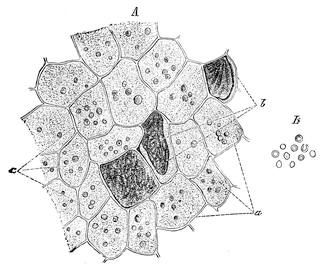
Fig. 100.
A. Parenchyma of the cotyledon after removal of fat and treatment with Iodine chloral hydrate, a: parenchyma cells with starch, b: with cacao red.
B. Aleuron particles with globois (Molisch) from parenchyma cells.
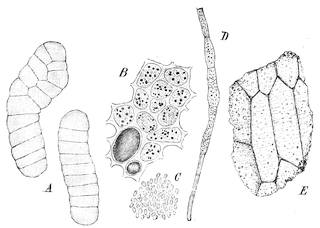
Fig. 101.
A. Mitscherlich particles.
B. Seed cells, above with starch bodies, underneath with violet colouring matter (cacao red) lying in chloral.
C. Series of yeast germs.
D. Threads of extraneous growth.
E. Epidermis and layer of cells occurring on the outer shell (enlarged 340 times).
Cacao is to no great extent particularly characterised anatomically. The parenchyma cells fig. 100 are chiefly to be noticed, containing either fat, albumin (protoplasm) aleuron granules, pigment, or cacao starch. The starch, as already remarked, consists of especially small globular granules, mostly separate, but also two or three adherent. It is somewhat more difficult to gelatinise than other kinds of starch, and it is coloured blue by iodine somewhat more slowly than many other starch granules, especially in the preparations containing fat. Cacao preparations which have been disintegrated by fixed alcalis, differ in this respect; according to Welmans, iodine first forms colourless iodine compounds, and not until the alkali has been saturated, is the blue colour developed. In such cases, care must be taken, that an excess of iodine is present. In estimating the amount of foreign starch, great care must be taken that the conspicuous bluish-black granules of the foreign starch, which immediately strike the eye, are not over estimated, which may easily occur. For control observations, mixtures containing various known amounts of starch should be tried comparatively. The pigment cells and the epidermis with the Mitscherlich’s particles (figs 101 and 102) should be noticed as well as the characteristic globoids, which occur in the ash of the cotyledon tissues (compare page 67). The outside shell, more or less woody according to the origin of the bean, consists of four layers of cells; this is best recognised by the large cells of the principal tissue, which are distinguished by their form as well as by their thickened side walls from the tissue of the cotyledon. Another characteristic of this layer consists of the large number of coarse spiral vessels, which exceed those of the seed lobes in size, and finally, the inner elements of the stone cell layer, which, however, on account of their limited development are seldom to be discovered. The smooth, fine brown coloured, and light refracting fragments, which frequently appear quite structureless and have their fibrous character made perceptible only after treatment with caustic alkali, must be regarded as characteristic of the inner part of the husk or the seed membrane. The best observing medium is a solution of chloral hydrate or almond oil, as well as dilute sulphuric acid and glycerine.205 The substance is always to be defatted with ether, before the microscopical examination. A complete extraction of the fat, according to Welmans, can occur only with exceedingly thin cuttings, in which every cell of the section would be operated on, or in powdered preparations, when the cells have been completely torn asunder by mechanical pulverisation. The fat is not extracted by solvents from intact cells, as the cell walls are impermeable by them.206
The detection of foreign starch is possible only by use of the microscope; by means of standard preparations an approximate estimate may be made as to the amount and kind of meal added.207 The examination of starch is especially facilitated by H. Leffmann and W. Beam’s208 centrifugal method: the sample suspended in water is subjected to rotation for a short time in the centrifugal apparatus. The presence of foreign starch is shown by a white layer in the resulting sediment. This layer can be collected and microscopically examined for foreign starch and husk. In the case of cacao preparations, it is always well to distinguish between unimportant traces and quantities that justify objection.209
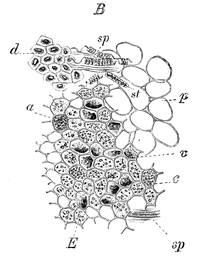
Fig. 102.
A. Silver membrane with the hairs (Mitscherlich particles) tr, and the crystals f and K.
B. Cocoa powder: c Cotyledon tissue with cells of fat and colouring matter, p shell parenchyma, sp speriods, d layer of dry cells.
A means of detecting tragacanth in cacao preparations, has lately been described by Welmans210. 5 grammes of the cacao preparation are to be mixed with sufficient dilute sulphuric acid (1: 3) to form a thick pulp, then with 10 drops of solution of iodine (in potassium iodide) and some glycerine. A portion of the mixture is examined under the microscope (enlarged 160 times). The entire field of view now appears to be thickly sown with countless blue dots, some globular, others irregular, among which are especially to be noticed the large tragacanth cells, resembling potato starch, which are not seen in cocoa powder that is free from tragacanth, when similarly prepared as an object; the small blue dots, due to cacao starch, are visible only in the densely occupied portions.
An admixture of the carob, which has been seldom observed, can be easily recognised under the microscope by the characteristic reddish wrinkled tubes of the fruit pulp, which are also coloured violet by treatment with a warm solution of caustic potash.
The presence of earth-nut or earth-nut cake can be detected by the aid of the microscope on treatment with chloral hydrate, by the characteristic saw toothed epidermis cells of the husk of arachis seed.
Hazelnut and walnut pulp, so far as they are to be met with in cacao preparations, can be distinguished under the microscope by shreds of the tissue of the seed husks, in which broad streaks of spiral vessels, lying close on one another, are distinctly prominent. If in addition the woody fruit shell be admixed, it can be detected by the great number of cells.
B. Definitions of Cacao Preparations.
The following formulae have been compiled by the Association of German Chocolate Manufacturers for the purpose of fixing the definition of cacao, and we may say that we agree with same in the main, as they satisfy all just claims, and keep pace with the progress made in consequence of the introduction of the modern machinery now in use, both from a scientific and practical point of view. Only in a few points are we of different opinion, and have referred to such clearly in their place.
a) Regulations of the Association of German Chocolate Manufacturers relating to the Trade in Cacao Preparations (cocoa, chocolate and chocolate goods). (Revision of September 16th 1907.)
I.
1. Cacao mass is the product obtained by simply grinding and moulding roasted and shelled cacao beans and no substance handled under this name may contain any admixtures of foreign matter.
2. Disintegrated cacao mass is cacao which has been treated either with alkalis, alkaline earth, or steam.
3. Cocoa powder, freed of oil (also soluble, disintegrated cacao) is the resulting product when the cacao bean is decorticated, roasted and more or less freed from its oil or also disintegrated in powder form. Cocoa powder, cacao from which oil has been extracted, disintegrated and soluble cacao may on no account contain foreign ingredient other than an addition of roots and spices.
In the case of cacaos disintegrated with alkalis or alkali earths, not more than 3 % of alkali or alkali earth may be used in the process; they may not contain more than 8 % of ash, reckoned on cacao material with 56 % of cacao butter.
4. Chocolate. The designation “Chocolate” may only be applied to those confections which are prepared by the addition of cacao butter, vanilla, vanillin, cinnamon, cloves or other spices to roasted and shelled beans or to a disintegrated mixture of cacao and sugar.
The percentage amount of sugar may not exceed 70, and the occasional addition of other substances (medicinal, meals, and the like) is admissible, but the total percentage of these and the sugar may not exceed 70.211
5. Food chocolates, chocolates for immediate consumption, and dessert chocolates. For these confections the same principles hold good, with the exception that here additions of nuts, almonds and milk stuffs are permissible, up to a percentage not exceeding 5 in total, without any declaration of the goods being necessary.
6. Chocolate powder is a mixture of cacao material which may be disintegrated and more or less freed from oil, with an amount of sugar not exceeding 70% at the most. Spices as in the case of chocolate.211
7. Cacao butter is the fat obtained from the decorticated bean or cacao material.
II.
The following are especially to be regarded as adulterations of the goods mentioned under I. from 1 to 7.
1. Foreign fats;
2. Shells and other waste cacao products (dust or seed);
3. Meal, though this is not expressly given;
4. Colouring matter; the colouring of the surface of figures is permissible;
5. So-called fat economisers, such as adraganth, gelatine, and dextrine.
An addition of substances for medicinal or dietetic purposes is permissible, though in such cases the goods must be declared. The addition of any fats other than cacao butter (i. e. of any foreign fat) or of shells or waste products to cacao or chocolate or to cacao or chocolate goods is also not permissible even when these are designated in such a manner that the words chocolate and cacao do not occur in their description.
III. Declaration of Added Ingredients.
The declaration must be transcribed in legible script and form, as e. g. “Meal” so as to be readily understood by all, and composed in German.
The declaration must occur together with the description of contents and as part of the same on despatching original packages in retail transactions.
In wholesale trade the declaration must occur on all offers, quotations, bills and all boxes, etc. provided with description of contents.
When offered for sale or exhibited in an unpacked condition, every box etc. containing the goods must have such a declaration introduced so as to be visible to every buyer in the premises, where possible; or the declaration shall be placed on the goods themselves.
1. Skimmed milk chocolates must be literally described as such, and must be manufactured with at least 10 % of skimmed milk powder or the corresponding quantity of skimmed milk proper. Addition of ordinary milk or its powder is permissible and need not be declared;
2. Milk chocolate must be manufactured with ordinary milk containing at least 3 % of fat, and in such a manner that at least 10 % of milk powder or the corresponding quantity of milk proper are employed;
3. Cream chocolate must be prepared from cream containing at least 10 % of fat, and in such a manner that at least 10 % of a cream powder or the corresponding amount of cream, in each case containing 50 % of milk fat, are employed. It may be varied to taste with milk proper or its powder, without any further declaration being necessary.
These percentages represent a minimum. It remains at the manufacturer’s choice whether he shall employ larger quantities of cream or milk.
The associated firms are further recommended to annex the following guarantees:
a) that the powder of milk proper contain at least 26 % of fat and be prepared from a milk guaranteed as pure;
b) that the cream powder contain at least 40 % of milk or be prepared from cream containing at least 10% of fat.
It is especially emphasised that these quantities are minimums, and every manufacturer is free to add as much cream or milk as he pleases.
We particularly recommend the procuring of a guarantee from the milk purveyor as to its purity for every delivery in order to be covered against fines in case the product should prove to contain an insufficient amount of fat. Analytical testings of trial samples are also to be recommended.
By way of comparison we refer to the “Principles for Estimating Cacao Products and their Food Value” determined by the Free Union of German Food Chemists in their 8th annual assembly at Heidelberg (1909) and finally established in their 10th held at Dresden (1911), which are said to have found general acceptance from the 1st July, 1912.
b) Final Wording of the Principles of the Free Union of German Food Chemists for the estimation of the Value of Cocoa and Cacao Preparations.
I.
Cacao mass is the product which is purely and simply obtained from the roasted and shelled cacao bean by grinding and moulding.
Cacao mass may not contain any kind of foreign substance. Traces of shell may only be present in minor quantity. The waste product falling in the cleansing of the bean must not be added to the cacao mass, nor may it be worked up into cacao material separate and apart from other cacao.
Cacao mass shows 2·5-5% of ash and contains 52-58 % of fat.
Disintegrated cacao is such material as is treated with alkalis or alkaline earths, ammonia or its salts, under pressure of steam.
II.
Cocoa powder, cacao that has been pressed and its oil removed, soluble Cocoa and disintegrated cacao are synonyms for cacao mass which has been reduced to powder form after they have been partially separated from fat by expression under heat; and generally treatment with alkalis or their carbonates, alkaline earths, ammonia, and ammonia salts under a strong steam pressure are presupposed.
Cocoa powder containing under 20% of fat, as well as that treated with spices (aromatised or scented) must be declared accordingly.
Cocoa powder may not contain any kind of foreign substance. Traces of shell may only be present in minor quantity. The waste product falling in the cleansing of the bean may neither be added to the cocoa powder nor itself worked up into such a powder.
The added alkali or alkaline earths may not exceed 3 % of the raw material.
Only powdered cacao and cocoa powder which has been treated with ammonia and its salts under strong steam pressure shows from 3 to 5 % of ash on cacao mass containing 55 % of fat.
Cocoa powders disintegrated with alkalis and alkaline earths must not show more than 8 % of ash on cacao containing 55 % of fat.
The percentage of water must not rise above 9.
III.
Chocolate is a mixture of cacao material with beetroot or cane sugar and a proportionate admixture of spices (vanilla, vanillin, cinnamon, cloves and so forth). Many chocolates contain apart from that an addition of cacao butter.
The percentage of sugar may not amount to more than 68.
Addition of substances for dietetic and medicinal purposes is permissible, and then the total of sugar and such addition must not exceed 68% of the whole.
Apart from the addition of spices no other vegetable admixtures are permissible. Nor may chocolate contain any foreign fat or foreign mineral constituents. Cacao shells may only be present in faint traces. The waste product falling in the cleansing of the bean must not be added to the cacao mass, nor may it be worked up into cacao material itself.
Chocolates which contain meal, almonds, walnuts, hazelnuts and milk stuffs must be provided with a declaration indicating such addition precisely, and here again the total addition of foreign ingredients shall not exceed 68 %.212
The percentage of ash constituent shall not exceed 2.5.
IV.
Covering or coating material must satisfy the requirements holding good for chocolate even when the coated goods bear declarations in which the words cacao or chocolate do not expressly occur, although admixtures of nuts, almonds and milk stuffs not exceeding a total of 5% may be made without declaration.
V.
Chocolate powder may not contain more than 68 % of sugar.
VI.
Cacao butter is the fat obtained from the hulled bean or cacao mass.
Milk and Cream Chocolates.
1. Cream, milk and skimmed milk-chocolates are products which are manufactured with addition of cream, milk (skimmed or unskimmed) in a natural, thickened or dry form. They must be declared as cream, milk or skimmed milk chocolates.
2. The fat content of full milk should amount to at least 3 per cent., and that of cream itself 10 percent. If the full milk or cream is added in a condensed or dried state, these ingredients must be in corresponding proportions. As it is at present not possible to produce a cream powder containing at least 55 percent of fat, the normal preparation of this class is, for the time being, represented by a production containing 5.5 percent of milk fat in the form of cream and milk.
3. Milk chocolate prepared from skimmed milk must contain at least 12.5 percent of dried milk or skim-milk, and “Cream” chocolates not less than 10 percent of cream or full-cream powder.
4. The percentage of the milk or cream preparation added must in all chocolates be deducted only from the percentage of the sugar, i. e. the cacao content of all chocolates containing these ingredients must be the same as in the case of the commoner varieties.
Special notice. In the case of butter chocolates, in which the cream is replaced by pure cacao fat, the same regulations naturally obtain; thus the amount of butter added must be not less than 5.5 percent of the whole, and the butter should be used in place of the sugar only.
(Regulations relating to the manner of examining chocolates as to the presence of the prescribed quantities of the above ingredients will probably be issued in the course of a year or two.)
c. Vienna Regulations.
The Assembly of Microscopical and Food Chemists in Vienna, held on the 12th-13th October 1897, the object of which was to fix a “Codex Alimentarius Austriacus”, also arrived at some just and appreciable definitions, which are well worthy of repetition here:213
1. Chocolate should consist of a mixture of cacao, Austrian sugar capable of fermentation, further an addition of spices (cinnamon, cloves, vanilla or vanillin) amounting to as much as 1 percent of the whole.
2. Cacao mass should consist of the roasted and shelled cacao bean, ground and moulded, only.
3. Cocoa Powder should be a preparation obtained from cacao mass only by the partial expression of the 50 percent of fat which the latter contains and frequently treated with alkalis. The alkalis may reach 2 percent of the whole, and the object of the treatment with them is to effect the disintegration of the tissues of cacao or to render the cacao “soluble
d) International Definitions.
An International Congress of Chocolate and Cocoa Manufacturers was finally held in Berne on August 21st-23rd 1911, which, unlike the meeting held by the White Cross in Geneva (1908), the object of which was the prevention of food adulterations, was really international and attended by numerous manufacturers from Belgium, Germany, England, France, Holland, Italy, Mexico, Austria, Hungary, Russia and Switzerland, the total number of visitors amounting to 250.214
1. Cacao Mass.
§ 1. Cacao mass is obtained by roasting or drying215 cacao beans which have previously been well cleaned and freed from the shells and dust. Cacao mass can either be disintegrated, i. e. “soluble” or untreated with disintegrating agents, i. e. “insoluble
Cacao which has been treated according to § 5 is in the real and business sense of the term to be regarded as a pure article of food, seeing that the treatment with alkaline carbonates or pure alkali is a purely chemical, or technical, operation. Such cacao may therefore be justly termed “pure
§ 2. Cacao mass may contain a quantity of added cacao butter proportionate to the prescribed, or suitable, fat content of the cacao preparation to be made.
2. Cocoa Powder.
§ 3. Cocoa powder should consist of defatted, or fatty, pulverised cacao mass.
§ 4. Cocoa powder which has been opened up by means of alkalis or otherwise is termed “soluble” or disintegrated cacao.
Disintegrated cacao which has been treated as described under § 5 may in the real and business sense of the word be regarded as a “pure” article of food, as the treatment with alkaline carbonates or pure alkalis is a purely chemical, or technical, operation. Such cacao may, therefore, be justly termed “pure
§ 5. The quantity of alkali used to effect the treatment described should not exceed 5·75216 grammes of potash or the equivalent of another alkaline carbonate, to 100 grammes of dry defatted cacao.
III. Cacao Butter.
§ 6. Cacao butter consists of the fat obtained from either untreated or disintegrated cacao.
IV. Chocolate and Chocolate Powder.
§ 7. Chocolate is a mixture of cacao mass and sugar, with or without the addition of cacao butter. On pulverising chocolate, chocolate powder is obtained.
§ 8. Both chocolate and chocolate powder may, if the methods of manufacture require it, be prepared from partially defatted cacao mass.
§ 9. The amount of cacao mass and cacao butter contained in chocolates and chocolate powders should be at least 32 percent217 of the whole.
V. Milk Chocolate.
§ 10. Milk chocolate should consist of a mixture of cacao mass, cacao butter, sugar and milk or milk powder. The quantity of cacao mass and cacao butter contained in such preparations should amount together to at least 25 percent218 of the whole.
§ 11. All chocolates which are brought on to the market under the name of milk chocolate, must contain at least 12·5 percent of milk or milk powder.
§ 12. No milk used for the preparation of milk chocolate may contain any preserving agent.
VI. Covering Matter.
§ 13. The definitions of chocolate proper apply also to covering material.
§ 14. Covering chocolate may, without special designation, contain up to 5 percent of its weight as sold of almonds, nuts, milk or milk powder. All other additions must be clearly declared on the packages in which the covering material is sold, or in the invoices referring to it.
VII. Flavouring matter (Spices).
§ 15. All material (spices etc.) used for flavouring cacao preparations must be harmless.219
Name of cacao preparation Adulteration Mode of Detection Reference
Chocolate Meal (kind not stated) a) Microscopically 277
Cacao mass b) By excess in glucose 264
Coated Goods Covering c) By decreasing the amount of ash —
Chocolats fondants
Cacao husks and sawdust a) By increasing the amount of ash and the amount of silicic acid in the ash 256
b) Method of levigation 267
c) Determination of fibre 266
d) Microscopically 275
Foreign fats and oils a) Melting point 260
b) Iodine value —
c) Saponification value —
d) Refractometer test —
e) Björklund’s test 261
Bad (rancid) cacao-butter a) Acid value 260
b) Reichert-Meissl number —
Forbidden colouring matters Yellow ochre Increase in the amount of ash —
Red ferric oxide
Brickdust
Coal
only observed in soup powders; Cacaolol —
only used to imitate the ash of chocolate cigars; Zinc white and heavy spar Analytically in the ash —
Besides inorganic weighting material Increase in the amount of ash —
Sand Clay
Dextrine Polarisation by Welmans’ process 258
Excess of sugar a) Polarimetric test 269
b) Aräometric test 270
c) Decrease in ash —
Excess of cacao butter Determination of amount of fat 258
Excess of water Determination of moisture 254
Gelatine Picric acid test and albumin determinatio —
Tragacanth Microscopically 277
Earth-nut Microscopically 278
Earth-nut-cake Determination of albumin 271
Walnut- and hazelnut pulps Microscopically 278
Cocoa-Powder Husk As with chocolate —
Foreign fat
Meal
C. Adulterations of Cacao wares and their Recognition.
a) Introductory.
Cacao preparations are subject to manifold and various kinds of adulteration. The following table gives a list of proved adulterating agents, and contains in the last column but one hints as to how such foreign additions can be detected, which hints are given in more detail on various pages in this edition, the numbers of which are annexed in the last column.
Bases for the judgment of cacao preparations appear on the one hand in the definitions and formulas previously given, and on the other in the rougher and finer adulterations which we had the opportunity of detecting. We give these bases once more, at least such as we deem necessary to a proper estimation of the purity of cacao goods, and in general rather incline to the principles which Filsinger has worked out for the Imperial Health Office (Germany) and which received a hearty reception at the hands of the various unions connected with the trade.
b) The Principles.
Chocolate, Cacao material, and cocoa powder (defatted and disintegrated cacao) may on no account contain any kind of foreign vegetable mixtures like starch, meal, peanut cake, hazel nut and walnut admixtures, nor cacao shells nor yet waste products, neither may it contain any mineral stuffs or foreign fats. Chocolates with meal addition must contain on the wrapper a concise and definite declaration of such addition on the wrapper. The presence of cacao shells is detrimental to the nutritious value of the cacao preparation, being little suited for human consumption, as they contain a large quantity of woody substance, and apart from this, always occur with adhering sand and earth. The removal of such shells is since the perfecting of the cleaning machinery intended for the purpose, become a very easy matter, and so none but very inferior quantities are permissible. Any additional shells (even when declared, and very fine ground) are illegal. The addition of spices or their corresponding ethereal oils are allowed, and as such may be considered almonds and nuts, more especially in the case of coating material and so forth, although they are subject to compulsory declaration.
The same conditions prevail in the case of chocolate enamelling and coating material as for ordinary chocolate, and in particular they must be free from all kind of foreign fats and cacao shells.
The use of dyes (earth-and tar-colouring matter) which are intended as substitutes for a percentage of cacao, and not merely as ornamental, is not permissible; and such dyes as are objectionable from a hygienical standpoint are impossible, even when they are used for decorating purposes. Cacao material contains on an average from 3-4 % of ash and from 50-55 % of fat.
Admixtures of glue, tragacanth or dextrine are not permissible, when they are intended to conceal an addition of water or to save the use of expensive cacao fat.
Cocoa powder contains arbitrary quantities of fat, and shows accordingly a varying quantity of ash to correspond with the amount of fat expressed. It is therefore necessary to declare the quantity of fat contained in quite a general manner and something in the following grade: skimmed milk cacao under 25 % of fat, cacao freed from oil, fatty and ordinary milk chocolate up to a percentage not exceeding 35.220 For the same reason it is necessary to convert the established ash contents, possibly of cacao material with 50% of fat, or none at all. It is most to the purpose to convert in the case of dry material which has been freed of fat, as occasionally considerable amounts of moisture remain over from the processes of preparation. Cocoa powder which has been disintegrated without the use of potassium, sodium or magnesia agents (carbonic acid) will therefore show the same ash contents as the corresponding material freed from oil, whilst that of cacao disintegrated by means of the fixed alkalis will be greater. The ash contents of powder freed of oil may nevertheless not exceed 3 %, corresponding to a total 7 %. The mixture of cocoa powder and sugar is not permissible.
Chocolates, chocolate fondants and coating mass contain variable quantities of sugar and fat; accordingly no limits can be assigned to the ash contents of these preparations.
A unanimity of opinion as to the least possible amount of cacao for the chemical estimation of chocolate has become an urgent necessity. Hereby it should be established that in good chocolate the fatty contents, apart from the sugar,221 exceed a definite percentage.222 A minimum percentage of 35% of cacao mass in chocolate destined for export, which must possibly be covered, has been fixed by the council of commerce.
As percentage of chocolate in cacao the double quantity of non-fatty cacao material must be taken, on the supposition that raw cacao contains on an average 50% of fat.
c) Laws and Enactments as to Trade in Cacao Preparations.
So far traffic in cacao has only been brought under legal control in three European countries, namely Belgium, Roumania, and Switzerland. We annex in the following pages a resumé of the legal prescriptions appertaining thereto, as being of especial importance to exporting manufacturers.
1 Belgium.
The Belgian royal decree of the 18th November 1894 established on the basis of the law for articles of consumption, August 4th 1890, and article 454 to 457, 500 to 503, and 561 of the penal code book runs (according to the “Moniteur Belge” of the 3rd and 4th December, 1894, as follows:
Art. 1. It is illegal to sell, expose or hold in possession for sale, or to transmit, any other product as “all cocoa” than the fruit of the cacao tree, raw and prepared by roasting, hulling and grinding with or without addition of spices, and finally moulded into tablets or reduced to powder form.
It is permissible to sell, expose or have in possession for sale, or to transmit such cacao as has suffered a loss of butter by expressing, provided that the amount of this ingredient is not diminished by more than 20 % of the whole, under the designation “cocoa or cocoa powder”; and again under the designation “alkalinised cacao” (cacao alcalinisé) such as has had its alkali content increased in special treatment by not more than 3% of the total weight. The declaration “alkalinised” is not, if a matter of mere possession or transmittance in export, to be considered as necessary.
Cacao which has been prepared other than as above described may only be sold, exposed or held in possession for sale, or transmitted, under a special label which declares this special manner of preparation next to the word “cacao” or under a label that does not contain the word “cacao” at all.
The word “alkalinised” or any other words which indicate alterations or additions in the natural composition of the cacao must be introduced on the label in distinct and similar type to the word “cacao
Cacao in which the proportion of alkali amounts to more than 3% is regarded as injurious, and the sale, having and holding in possession or despatch of same for sale is illegal.
Art. 2. It is illegal to sell, have in possession or expose for sale, or to transmit any product whatever, under the designation “chocolate”, that is not manufactured exclusively from shelled cacao, and that in a minimum proportion of 35%, and ordinary sugar, with or without admixture of spices.
Products which though containing the requisite 35% of shelled cacao are also made of other substances than those above signified may only be sold, held in possession, exposed or transmitted for sale under a label that clearly describes the nature of such ingredients next to the word “chocolate” and in the same type, or under a label that does not contain the word “Chocolate” at all. In the case indicated by impressing them on each separate tablet.
Products which contain less than 35% of cacao may only be sold, held in possession, exposed, or transmitted for sale under the designation “cacao bonbons” or some similar description, from which the word chocolate has been rigidly excluded.
Art. 3. Entries of the labels prescribed for the products of irregular composition in articles 1 and 2 must be made on the invoices despatched with the goods.
Art. 4. The box, case or wrapper etc. containing cacao or chocolate which is sold, exposed, held in possession or transmitted for sale must bear the name and address of the manufacturer or seller, or at least some regular and authorised trade mark.
Art. 5. The articles of this decree, as far as they refer to chocolate, are only applicable to ordinary chocolates in tablet, block, spherical or powder form, not however to cream and various sugar confections in chocolates (such as pralinés, pastilles etc.).
Art. 6. Any infringement of the articles of this decree will incur a fine in accordance with the code of fines issued on Aug. 4th 1890, over and above the ordinary penalties.
Art. 7. Our Board of Trade and Agriculture is hereby entrusted with the carrying out of this decree, which shall come into force on April 1st 1895.
2. Roumania.
The royal enactment of this land respecting the health supervision of foods and drinks and the trade in foods and drinks, articles 154, 155, 156 and 157 of the Health act of the 11th September, 1895, says the “Buletinul directiunei generale a serviciului sanitar” 1895, No. 18 and 19, pages 277 et seq.
No. XIII, Article 137.
No product may be sold, exposed or held in possession or transmitted for sale, under the designation cacao, other than the seed of the fruit obtained from the tree “Theobroma Cacao It may be brought on the market raw, roasted, or powdered after roasting.
Under the designation “Cocoa powder, defatted”, such may be sold as has suffered loss of butter by extraction, provided that there still remains a minimum 22% of cacao butter in the product. As disintegrated cacao may be sold such powder as does not contain more than a maximum 2% of sodium or potassium carbonate.
Art. 138. It is illegal to sell or expose for sale artificially dyed and pulverised cacao, and also such as has been mixed with starch meals, foreign fats or any other foreign ingredients. It is in like manner illegal to mix cocoa powder with shells, and the former may not contain more than a maximum 15% of powdered shell.223
Art. 139. Under the designation “Chocolate”, only the foodstuff prepared from a mixture of roasted and powdered bean and sugar, with or without admixture of aromatic ingredients, as vanilla, cinnamon and the like substances, may be sold and exposed for sale.
Art. 140. The manufacture and sale, as also the exposure for sale of chocolate from cacao that does not answer the several demands of this decree, articles 137 and 138, as well as of chocolate that is mixed with starch, meals, mineral and artificially coloured substance, is illegal.
3. Switzerland.
The association of analytic chemists in this country have issued a book entitled “The Swiss Book of Nutritious Stuffs and Articles of Sustenance”, where the methods and standards prevailing in research work connected with such substances are finally established for Switzerland. This work served as a guide as regards articles of sustenance up to the time when the Swiss food act came into force, and we accordingly annex a few extracts from it, dealing with our subject, cacao preparations.
Definitions.
1. Cacao mass is obtained by grinding and moulding the shelled and roasted cacao bean, without any admixture whatever, or extraction of butter.
2. Cacao freed of oil is cacao that has been reduced by from 20% to 35% as regards its butter contents by means of pressure under heat.
3. Disintegrated cacao. The roasted beans are treated with carbonic acid alkalis (generally potassium) subjected to pressure under ammonia or steam, and so the cellular tissue of the albuminous substance disintegrated or broken up and converted into a soluble modification (peptone and alkalinous albuminate).224 The so treated beans are next dried, reduced, defatted and pulverised.
4. Chocolate is the description of a mixture of cacao and sugar which comes into commerce either moulded or in powder form. The percentage of sugar amounts to between 40 and 70%. Admixture of other substances than cacao, sugar and the usual spices must be regarded as adulterations.225
5. Chocolate and cacao (powdered or moulded) may be aromatised with the following substances: vanilla, benjamin gum, tolu and peru balsam, cinnamon, cloves and nutmeg.
6. Chocolate fondants are chocolates with an unusually large proportion of sugar and fatty contents.
7. Milk chocolate is a preparation prepared from milk, sugar and cacao. It may not contain the preserving materials dis-allowed for milk, such as boracic acid, borax, formic aldehyde and derivatives of the aromatic series. It comes into commerce in powder form.
8. Covering or coating material is a mixture of cacao, sugar, spices, with almonds and hazel nuts. This preparation is almost exclusively employed for bonbon confectionery.
9. Medicinal Chocolate is a chocolate or cacao preparation containing additions of medicaments.
Tests and Definitions always to be applied.
1. Touch test.
2. Reaction.
3. Microscopical examination.
4. Examination of the fat.
5. Estimation of cacao butter.
6. Determination of sugar.
7. Determination of ash.
Tests and Definitions eventually necessary.
8. Determination of moisture.
9. Determination of theobromine.
10. Determination of starch.
11. Determination of cellulose.
Guide to Classification:
Unripe, badly fermented cacao beans and those which have been attacked by insects or mould or have suffered during transport from the influence of salt-water, should never be used for manufacturing purposes.
Goods prepared from such beans have an unpleasant taste, which it is impossible to get rid of by the various operations in the course of manufacture. The use of all such beans is to be regarded as adulteration. The tests to be applied for determining them are tasting, microscopical examination and perhaps the estimation of the common salt contained in them.
All good chocolates are of a fine brown colour. Grey-coloured or spotted chocolate are objectionable. Spots or the grey colour alluded to may be caused either by damp or heat. At an ordinary temperature the fracture of the chocolate is hard, glassy and even. The quality of the fracture constitutes an excellent basis in judging of the manner and methods employed in working up the raw material.
Cacao and chocolate that become thick and pulpy on boiling are in all probability adulterated with meal, starch, dextrine or resin.
The following are to be considered as adulterations:
1. Admixtures of cacao or other shells, and sawdust.
2. Admixtures of foreign starch, meals, castania and resin.
3. Admixtures of mineral substances like ochre, clay and sand.
4. The substitution of cheaper fats, such as beef and pork dripping, almond, poppy seed, cocoa-nut and vaseline oils.
Limitations.
1. For cacao material.
Ash Maximum: 5% (Porto Cabello 4·65%)226
Minimum: 2% (Surinam 2·25%)
Cacao butter Maximum: 54·5% (Machalla 54·06)
Minimum: 48·0% (Porto Cabello 45·87).226
2. For cacao fat. Melting point 29 to 33·5° C.; freezing point 24 to 25° C.; refraction at 40° C., 46 to 49226; iodine value 34 to 37; point of saponification, 192 to 202.
3. Disintegrated cacao: the amount of added alkali is not to exceed 3%. In no case shall the ash content be more than 8%. This figure is not inconsistent with the above stated maximum ash content, as disintegrated or soluble cacao is manufactured from a mixture of several sorts of cacao, in each of which (although they have been defatted) there is not more than 5% of ash.
4. Chocolate: although at the present time there are no limits fixed for cacao and sugar, it may nevertheless be safely assumed that the fat and sugar together may not exceed 80 to 85%, and that the rest shall be pure non-fatty cacao material, in the proportion of from 15-20%. The ash in a good chocolate does not exceed 3·5%.
5. Milk chocolate: here the separate ingredients require a thorough drying. If the percentage of moisture amounts to as much as five percent, the whole preparation is objectionable and liable to lose its hard consistency.
6. Chocolate à la noisette, oat, meat and medicinal chocolates. The testing of these takes two chief directions:
1. It must be established that the ingredients given on the label are of good quality, and
2. that only the ingredients there mentioned occur in the packet.
The constituents and their proportions shall be declared on the wrappers in the case of medicinal chocolate.
On the 1st July then, in the year 1909, the act passed in connection with foods and articles of consumption December 5th, 1905 came into force in Switzerland. Thereby the whole of Swiss trade in such foodstuffs and articles of consumption is systematically controlled. Of the 268 articles which are generally representative, we annex here those concerning cacao, powder and chocolate, namely, nos 146 to 149.
Art. 146. Under the designation cacao or cacao powder only the pure, unaltered or only partially defatted natural product may be brought into commerce.
A cacao powder may only be described as soluble when it has been treated with carbonic acid alkalis or disintegrated with steam.
Soluble cacao may only contain 3% added alkalis on the outside.
Art. 147. Under the designation chocolate, only a mixture of cacao and sugar with or without addition of cacao butter and spices is to be understood, and no other may be brought on the market as such.
The percentage of sugar in chocolate may not exceed 68.227
Art. 148. Cacao and chocolate may not contain starch, meal, foreign fat, mineral substances, colouring matter and so-called fat economisers (dextrine, gelatine, resin and tragacanth) and only traces of cacao shell. They may not be gritty nor foul smelling nor otherwise spoilt.
Art. 149. Special products of cacao and chocolate with addition of oats, milk, acorns and hazel nuts must be declared accordingly (as oat cacao, milk chocolate etc.). Fancy confections fall also under this obligation.
Cacaos and chocolates which are put on the market in packets, boxes and packages must contain the name of the firm on the wrapper, or some mark of the manufacturer or salesman which is recognised in Switzerland.
If saccharine, dulcine or other artificial sweetstuffs are added to chocolate, such admixture must be declared on the wrapper.228
4. Austria.
Legal control of the traffic in cacao preparations in this country may be expected in the near future.
Austria is indeed already in possession of a law (dated January 19th, 1896) concerning the traffic in articles of consumption, although the special determinations have hitherto not reached perfection, and the treatment of the separate detailed articles must proceed gradually. As in Switzerland, the Association of Food Chemists and Analysts here have worked out designs for a “Codex alimentarius austriacus The work of this code commission is of a purely private nature and accordingly no official importance accrues to it, but it is none the less recognised by all Austrian chemists and has indirectly (and even in law courts) about the same weight as the opinion of an expert, especially as the single articles of consumption are almost exclusively limited to specialists in this country. We therefore introduce the most important points of this code which bear on our subject, although various alterations must be made in these as they succeed to legal recognition, for since the appearance of the code many changes have developed as regards the methods of research.
I. Cacao Mass.
Definition. Under cacao mass is to be understood the material constituting a regular and uniform dough when warmed, which has been exclusively prepared and manufactured from the shelled cacao bean.
Ingredients. Cacao material contains the same ingredients chemically as the shelled bean.
Microscopical investigation should only reveal the presence of seed kernel, and not particles of root, which should be removed in the course of preparation.
The ash may not exceed 3·5%229, the fibre 3%229, and the starch 10·5%. The amount of fat figures at between 48 and 52 percent.
II. Cocoa powder.
(Pulverised cacao, defatted, and disintegrated.)
Definition. Hereby is understood the steamed preparations or the powder obtained by expressing at least half the total fat from ordinary cacao material and further grinding and sifting.
Characteristics. The cocoa powder shall on boiling with 20 to 30 times its volume of water yield a suspension, in which there are no traces of lumpy formation, and which does not show a sediment after the expiration of a few minutes.230 Should there be any such sediment, it shall be examined under the microscope.
Cocoa powder shall be sifted and ground free from meal, and may not, on sifting through a miller gauze (No. 12) show more than 5% of material on the sieve.