Part II. The Manufacture of Cacao Preparations.
Reading edition
A. Manufacture of Chocolate.
The Preparation of the Cacao Beans.
Up to the end of the eighteenth century the manufacture of chocolate was carried on entirely by hand, a method at once laborious and inefficient. The workman used to kneel down on the ground, and crush the beans in iron mortars. It was not until 1732105 that Buisson introduced the use of a bench and so rendered that inconvenient and unwholesome practice unnecessary. Even to-day, the Chinese cooks on the Philippine islands carry their chocolate “Factory” about with them, in which the trestle is essential. It further comprises a small marble mortar and warmed pestle, and by means of these utensils and implements the hulled beans are pounded, and the triturated mass so obtained spread out. It is then flavoured with sugar and spices. With that exception, hand labour in the chocolate manufacture has since the year 1778 been entirely displaced by machinery, when Doret exhibited the first specimen before the medical faculty of Paris. According to Belfort de la Roque,106 a Genoese named Bozelly had already constructed a mill by means of which he was able to prepare from six to seven hundred pounds of chocolate daily, comparing favourably with the thirty pound output yielded by hand labour. Pelletier107, in 1819, describes a machine for the mechanical preparation of chocolate of his own construction, capable of doing the work of seven men. The machines used in the chocolate manufacture have since that time been repeatedly improved and re-constructed, although always with this one end in view, namely to obtain a fine even cacao mass, and afterwards mix it as thoroughly as possible with the other ingredients employed.
The first machines of the modern type were constructed by the Parisian mechanic George Hermann (1801-1883) in the year 1830, to which inventor we are indebted for the principle of fine grinding with varying velocities, on which manufacture of chocolate is based to-day. There is at the present time a rather large circle of manufacturers engaged in the putting together of special machines for the preparation of cacao and cacao products, chocolate apart.
Whether chocolate manufacture be carried out on a large or small scale, it always involves the subjecting of the cacao bean to a regularly succeeding series of operations, before the resulting product known as “Chocolate” (in the strict commercial sense of the term) can be obtained.
The respective operations succeed each other as follows:
I. Preparation of the Beans.
1. Storing, cleansing and sorting of raw beans.
2. Roasting the cleansed beans.
3. Crushing, shelling and cleansing the roasted bean (removing the radicles etc.)
4. Mixing different kinds of beans.
II. Production of the Cacao Mass.
5. Grinding the beans till they yield a homogenous paste on heating.
6. Mixture of the liquefied cacao mass with sugar, spices, etc.
7. Trituration by rollers.
III. Preparation of the resulting Chocolate.
8. Extraction of air, division and moulding.
9. Cooling.
10. Packing and storing.
This represents the general course of manufacture, which we will now proceed to describe in more detail, following the headings given above.
1. Preparation of the Beans.
1. Storing, cleansing and sorting.
Right up to the moment when they are to be used in the manufacture, the raw cacao beans must be kept as originally packed, and stored in an airy sun-lit room; although if they have accumulated moisture during transport or sustained any manner of damage in harvesting, they should then be emptied out of the sacks, spread out over the floor of such a room as above described, and dried as effectively as possible. It has also been recommended that such beans be washed with a dilute solution of caustic potash (1 in 5000), and afterwards dried rapidly.
Unfermented beans, those damaged in the harvest, and those which have received no proper fermentation, develop a greyish white colour with occasional tints of violet and an unpleasant, bitter herbal flavour, properties which unfortunately penetrate to the resulting cacao products. Attempts have been made to meet this evil with a so-called “Secondary Fermenting Gordian108 proposes in this connection that the beans be filled in water-butts, and steeped in warm water for at least 48 hours (so that obviously the butts must be kept in a warm room), at the expiration of which time it can be poured off, and the beans dried in a chamber heated to a temperature of between forty and fifty degrees centigrade. There is said to ensue an appreciable improvement as to flavour and colour, when this process is carried out.
The magazines in which cacao beans are stored have sometimes an unwelcome visitor, to wit, a grub which according to W. Hauswaldt109 happens to attack just the best kinds of Caracas and Trinidad. As eggs of the grub have on several occasions been found on the interior of the still unshelled bean, we may assume that they were deposited by a butterfly (species unknown, but possibly Ephestia cahiriteller, cf. von Faber loc. cit. page 335) either before or immediately after fermentation, and no later. Sometimes these grubs appear on the surface of the sacks, which they overspread in a few days. Removal of the infected packages, opening the sacks, and exposure to the sun, as well as a thorough cleansing of the storehouses, is attended with a qualified amount of success. The best plan is to destroy the moths during their period of activity in the summer months June, July, and August.
According to Hauswaldt, Stollwerck110 and G. Reinhardt111, this can be effected by placing in the store rooms large, shallow basins of water, near which burning petroleum lamps are introduced on the approach of dusk, favourably placed on a pile of bricks and stone, so that they clearly illuminate the reflecting water. The moths assemble round the light en masse and either perish in the water or flame, a fate which sometimes overtakes even the larvae, for they display the same fatal attraction for any light, real or apparent. The water must be changed every day, as otherwise the wing-dust collecting on its surface affords a means of escape to the insects coming later. As the weather becomes cooler, the doors and windows of the store-rooms should be left open, so that when frost sets in, the rest of the maggots may be destroyed.
The cleansing and sorting of the raw cacao bean is the most important factor in the manufacture of chocolate, and yield a manifold return, for inferior and cheaper kinds of bean which have passed through these processes can be advantageously mixed with finer varieties. The chief object of cleansing and sorting is the removal of foreign bodies and such chance admixtures as sand, pebbles, and fragments of sacking, which are liable to damage the stones used in grinding at a later stage of the preparation, or communicate an unnatural and disagreeable smell to the subsequent roast products. These admixtures are so multiform and various that they cannot be removed solely by the aid of machinery, but must be finally picked out by hand. Mechanical appliances are limited to the removal of pebbles, dust, and possible fragments of iron, after which preliminary cleaning the beans are thrown on straps, where they can be picked by hand. The collector of these foreign bodies would find himself with a rather interesting stock at the end of a few years, as Wilhelm Schütte-Felsche points out.
The cleansing of the raw beans was formerly carried out in so-called roller casks, placed horizontally, and revolving round an axle fitted in the floor, whence it passed upward, cutting them slantwise. In this apparatus the beans were rolled and vigorously rubbed together, and afterwards the hand-picking succeeded. More recently, the roller casks have been displaced by rotary cylindrical sieves, driven by motor power.
Such a machine is illustrated in fig. 12. The beans are lifted to a rotatory cylindrical sieve by means of an elevator, where they are freed from dust and dirt; in other sections of the sieve fragments of blossom, sacking, or cloth are isolated, whilst occasional splinters of iron are removed by a large magnet. So prepared, the beans are cast on running belts, and here the hand-picking above-mentioned is carried out.
Fig. 13 shows a cleansing machine for the same purpose, which has recently become rather popular. Here the dust passing from the sieve is sucked up into a dust chamber, by means of an exhauster, whilst pebbles, blossom fragments, and small beans are separately isolated. The cleansed beans pass likewise under magnetic influence, which removes traces of iron, and finally succeed to the running belting.
Often the beans are introduced into an extensive brushing machine before roasting, to cleanse them from dirt etc. These are generally found in such factories as have circular and cylinder roasters with direct heating apparatus. Fig. 13 a shows such a brushing machine for cacao beans.
2. Roasting the Beans.
The cleansed and sorted beans are now subjected to a high temperature, that is to say, they are now roasted. This roasting answers many purposes;
1. The aroma and flavour of the bean is so developed.
2. The starch granules are gelatinised.
3. The herbal constituents are so transformed that the flavour of the beans becomes milder; a distinct improvement.
4. In the consequent drying, the shells are rendered brittle, and more easily removeable.
5. The beans themselves can afterwards be better ground.
The roasting of the cacao bean does not demand so high a temperature as that of coffee, to effect the above chemical and physical changes. Experience has shown that the best temperature lies between 130-140 ° C., though deviations from this standard have recently become frequent and considerable, according to the uses for which the cacaos are intended, and roasting has sometimes taken place at a temperature even as low as 100 ° C.
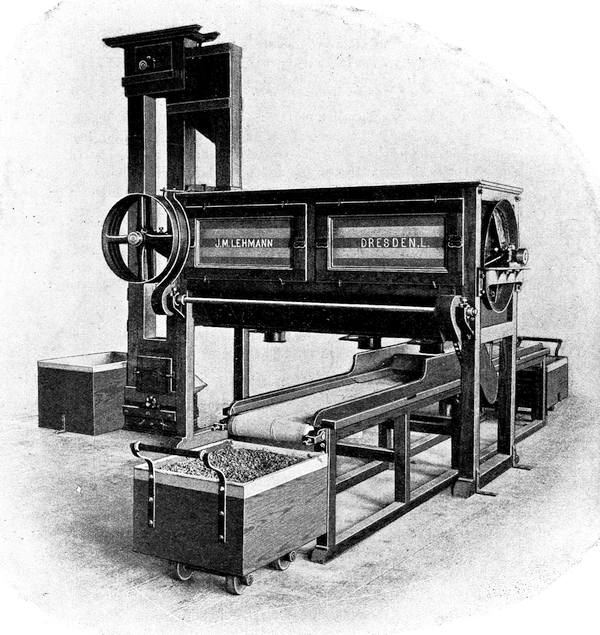
Fig. 12.
The process of roasting can be carried out in the roasting drum or machine in a variety of ways, as:
1. Direct roasting over a coal fire,
2. Passing of a hot-air stream over the beans,
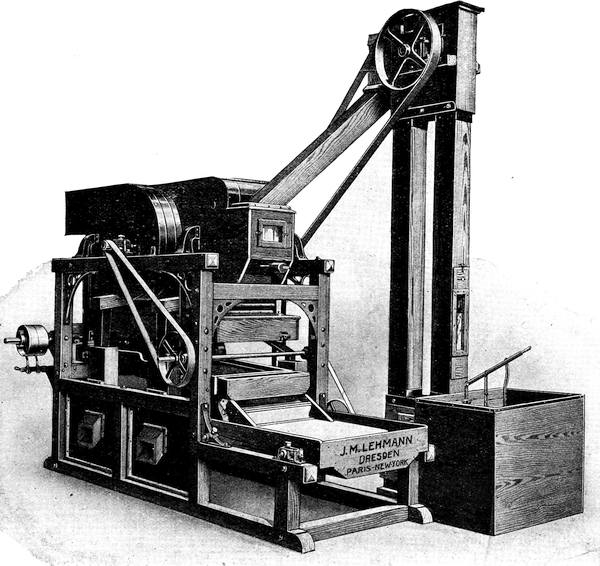
Fig. 13.
3. Roasting by means of gas, with compressed air, as far as sources of heat are concerned; and as regards shape of the drum, it is to be noted that the cylindrical are most in use. The separation of the shells from the kernel was still effected at the beginning of the present century by stirring the beans in water and so detaching the inner coating of the seeds, the method adopted by Weisched (Mitscherlich page 112). Not till this stage had been reached were they subjected to a strong heat, causing the shells to spring off.
This method has at the present time only historical interest, for the so-called roasting drums, as used in the preparation of coffee, are now universal.
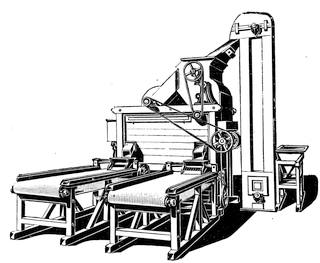
Fig. 13a.
Roasting must be attended with the greatest care, in order that it may neither be too thorough nor insufficient. It is a great mistake to think that the roasting machine can be handed over to the care of any apprentice. That nicety of roasting which corresponds to the variety and its subsequent utilisation constitutes the qualitative basis of the chocolate manufactured later. It is impossible for even the best chocolate maker to retrieve what has been spoilt in this important preliminary operation, wherefore a skilled workman, endowed with a keen sense of taste and smell, is always to be seen at the roasting machine.
It has already been attempted to provide a means of security against over-burning by the construction of the so-called safety-roaster, about which will be spoken later.
Overroasting is immediately indicated by a disagreeable empyreumatic odour (resembling that of roasted coffee); the husks char and the kernels crumble, also betraying a charring on the outside. There is a correspondingly increasing keenness of flavour, and a transference of theobromine from the kernel to the husks (cf. page 65). From the destructive distillation of the cacao fat arises that volatile and pungent acroleine which is the principal cause of the empyreuma of the over-roasted bean.
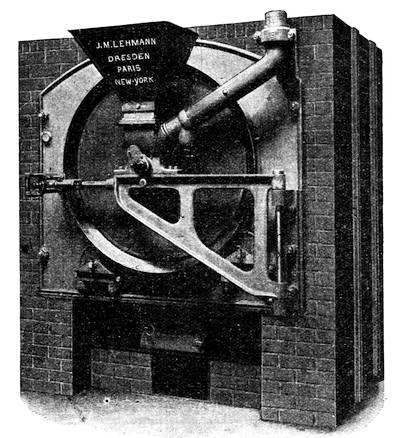
Fig. 14.
The following general precautions in roasting cacao are worthy of note; 1. the beans should not remain too long in the roasting drum; 2. they should be kept on the stir, for which reason the apparatus is made revolvable on its axles; 3. the heat applied should be carefully regulated; and 4. to guard against a loss of aroma, the roasted beans should be cooled as rapidly as possible.
As the cacao must be more or less roasted according to its quality and ultimate destination, which entails the acquisition of considerable empirical knowledge on the part of the workman entrusted with this process, it would be neither advisable nor practicable to annex definite instructions as to time and temperature requirements.
In the following we describe a machine which is to be found in most factories and which corresponds to all the demands of technique. From its heating system, it belongs to the class of hot-air current roasters—direct coal fire assisting—and in shape to the cylindrical roasters.
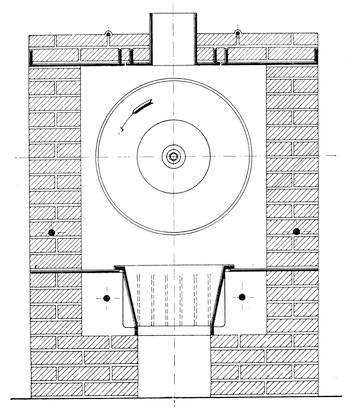
Fig. 14 a.
This machine is illustrated in fig. 14 and shown in section in figs. 14 a and 14 b. To prevent loss of heat by radiation, to save fuel, and preclude possibilities of danger from fire, the whole installation is walled in. Driving shafts occur at the back of the machine, and the charging apparatus is introduced in front. A furnace lies directly under the drum, whilst on either side are chambers accessible to currents of fresh air, which are provided with heating tubes and which admit of a regulation of the air supply. They are shut off from connection with the gases from the fire, so that only the fresh air heated here can penetrate to the roasting products in the charged drum. There are winnowing shovels fitted in this, calculated to keep the beans in motion and facilitate the access of air. When the hopper is closed, the gases arising from the roast product can be led off by an annexed outlet pipe, and thereupon condensed and the resulting liquid drained off at the foot of the machine. For the attainment of the proper degree of roasting, as well as for controlling the whole process, there is a sampler to every machine. The drum is emptied whilst in motion, its door-like front being turned aside and the roasted beans transferred by the winnowing shovels before mentioned to trolleys wheeled underneath.
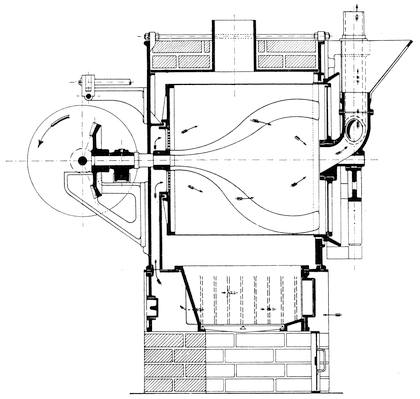
Fig. 14 b.
The loss of heat by radiation is very insignificant, as the machine is completely walled in. Any kind of fuel may be used. Since the stoking as well as the removal of soot takes place at the front, several of these roasters can be set up side by side. It is a great advantage of this installation, that by removal of the front of the drum its interior is laid quite open, admitting of a thorough overhauling which is attended with every disadvantage for the flavour of subsequent roasting lots.
The machine here described is constructed in varying sizes, with an outside capacity of four hundred kilograms.
As already mentioned the so-called safety-roaster offers a certain security against the burning of the beans as the roasting boiler is lifted out of the fire by means of an automatically working safety regulator. Figs. 15 a and b show a spherical roaster open and closed.
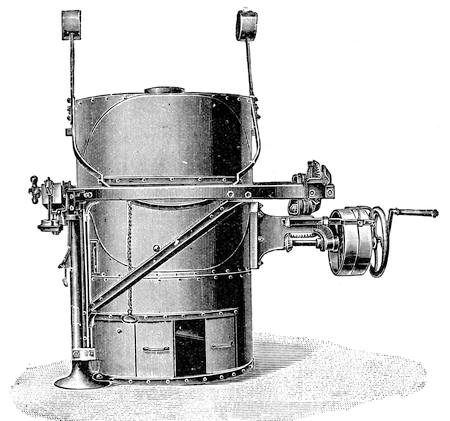
Fig. 15 a.
The principal of construction is founded on the fact that each roasting is connected with a loss of weight and it is logical that the same quality of beans always yields the same loss of weight at a certain degree of roasting. On an average cacao yields a loss of 6-7 %. According to this, the loss of weight which can at first be empirically ascertained, for example by a new kind of bean, can be calculated and can be indicated on a regulator, on the principle of the Roman scale. When the beans have lost the weight in question the counterpoise of the regulator raises the axle of the roasting sphere by means of which the working of the whole machine is set in motion.
There is no exception to the rule that only beans of one and the same kind should be roasted and broken up together, as thickness or thinness of the shells determines to a large extent the time required for roasting, and also an even size of bean is necessary to the smooth operation of the breaking machine. The husks of the roasted cacao bean are hygroscopic, and consequently the roasted unshelled beans contain more moisture after having been kept for a time, than they do in the raw state; but the drier the bean is, the easier it shells. The cacao is therefore to be worked up as quickly as possible, or at least kept in well covered metal boxes till further treatment can be proceeded with.
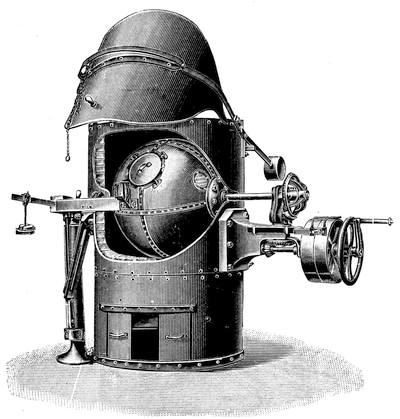
Fig. 15 b.
As sources of heat we find direct and indirect stoking with house coal and coal gas, and besides these, for the installations of larger factories Dowson gas is especially suitable, as it does not involve too high a temperature, and the outlay is not so great as when coal-gas is used.
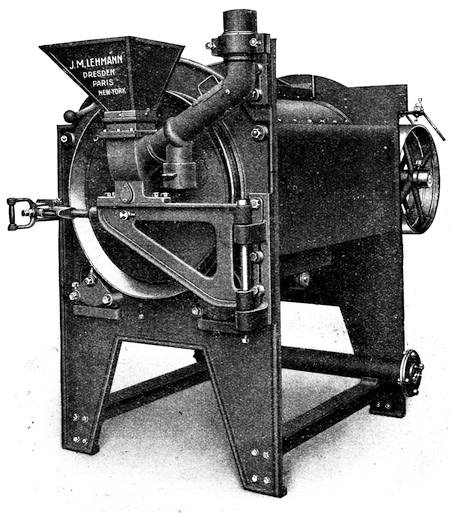
Fig. 16.
The roasting machine in fig. 16 for Dowson or coal gas belongs to the class of roasters with direct firing. It corresponds to the one diagrammed in Fig. 15 as regards charging and emptying. Here also the front wall of the drum can be removed, and the interior consequently laid completely open. The transmission of gas is effected at an air pressure of one atmosphere, for the attainment of which an air pump is fitted up in the vicinity, capable of feeding four machines at the same time. The drum holds about 150 kilos. It goes without saying that the regulating of the requisite heat is in this instance of the utmost ease and nicety. Another preponderating advantage of this machine as compared with those heated with coke or ordinary coal is its clean operation and the extraordinary speed with which it can be both started and stopped. Form 3-4 cbm. of coal gas are needed for 100 kilos of beans, whilst for Dowson gas, which has not such a high heating value, much larger quantities are required, and consequently a stronger framework becomes necessary, though here no air pumps need be put in operation.
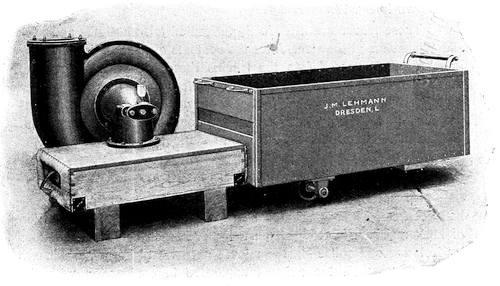
Fig. 17.
Steam roasting apparatus have not proved particularly successful, as has been evident in all experiments hitherto made with them, and steam agency does not appear to be suitable for the cacao bean, it admitting of no thorough and at the same time even roasting.
Yet on the other hand the hot air-current roasters described enjoy an ever increasing popularity, partly because they are heated indirectly, and again because they appreciably diminish the time taken up in the actual process, which in other cases approaches to as much as thirty or forty minutes, without exposing the beans to the danger of burning or getting charred.
As just stated, the beans should be passed on to the next process as speedily as possible, yet on the other hand be completely cooled off, so as to loosen their shells before they arrive in the breaking machine. There are also special constructions for this cooling. If the roasting drums are fitted up directly on the ground, it is effected by disposing the beans issuing from these machines in wide baskets or sieves, and letting them cool there before bringing them to the next process. Should they be situated at a sufficient height, the beans can be slowly transferred down a shoot connected with the rooms below, where crushing mills await them, and cooled on the journey by a play of fresh air currents.
Very much to the purpose and well adapted as regards most of the requisite conditions, are the cooling trucks with exhaust apparatus shown in fig. 17.
These trucks are fitted with perforated false bottoms and with sliding shutters at the side. After the contents of the roasting machine have been discharged into the trucks, these are wheeled over to the exhaust apparatus easily recognisable in the diagram, where the cacao is so far cooled that subsequent “after-roasting” is impossible, whilst the gases given off are conducted by the ventilator. This exhaust chamber can be made to work from both sides.
3. Crushing, hulling and cleansing.
Up to ten years ago, the crushing and shelling of cacao beans had not been so far perfected as to effect the complete separation of husk and radicle from all particles of kernel, or to prevent loss by isolating and collecting the minute particles of kernel, which are drawn up through the exhaust apparatus in conjunction with the lightest of the cacao shells. Yet the requirements demanded of a satisfactory machine advanced to such an extent that not only cacao nibs free from shell were postulated—an end scarcely hard to attain—but shells free from cacao nibs were made a further essential. A machine which performs both these objects not only works excellently, but is also economical. For a solution of this problem the Association of German Chocolate Manufacturers, which is specially interested in all that concerns the chocolate industry, offered a prize years ago; the firm of J. M. Lehmann were the first to construct a machine answering every call made on it to perfection.
Fig. 18 illustrates a crushing and cleansing machine averaging an output of 2500-3000 kilos, of the latest and most modern type.
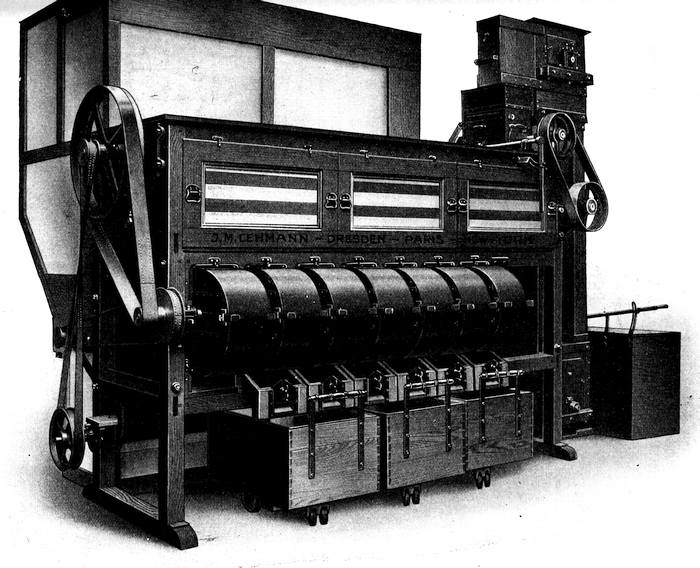
Fig. 18.
The beans are first broken into smaller pieces in all machines now employed as crushing, shelling or cleansing apparatus, and the one at present under consideration provides no exception. An air-current is made to play on these fragments, which finally isolates and transfers the loosened shells to another part of the apparatus. The cacao next succeeds to a crusher of regular capacity lodged in the upper part of the machine, being despatched on an elevator. The fragments fall into a cylindrical sieve, dust being detached in the first compartment, whilst the meshes of subsequent compartments gradually increase in size and sort the products therein transmitted in corresponding sizes. There is a groove traversed by air-currents—proceeding from a ventilator—immediately under each compartment. This current of air can be regulated, i. e. made weaker for lighter and stronger for heavier fragments, and there is a ventilator for every compartment to make this regulation of the easiest, and in this way shells of equal size but specifically lighter than, the cacao fragments are most efficaciously separated. Contrasting with the older type of machine, it works almost noiselessly, all shakings of grooves and sieves being entirely avoided; in addition to which there is a perfect exclusion of dust, when the shells are transferred into the dust-removing chamber. A further advantage is that there is no wearing out of the machine, except as regards the direct crushing apparatus, which occasionally need renewing.
The dust particles before mentioned, which possibly comprise as much as one half of the cacao fragments, require a special kind of working up, on different machines, before the cacao still contained therein can be obtained. It is a fact obvious and apparent, that the smaller the fragments of shell mixed with this crushed cacao, the more difficult will be their separation, a fact of equal importance to technical and analytical science, and the more scrupulously this process is to be carried out, the greater the lavishment on sieves and ventilating compartments entailed.
To effect this operation on the breaking machine is seriously to overtask the latter, and defeats its own end, as experiments carried out in the Chocolate factory of Schütte-Felsche have proved, inasmuch as it leads very easily to mixing of the products which are to be kept separate.
Fig. 19 shows such a machine for the cleansing of this so-called cacao “dust
The particles are raised to a large flat sieve by means of an elevator, again sorted in different sizes, and submitted to air currents of corresponding strength. The quantity obtained varies according to the variety of cacao, though in some cases it may amount to 50 or 54 percent. What remains after this process is absolutely worthless and can only be considered as refuse, at least as far as the chocolate manufacturer is concerned.
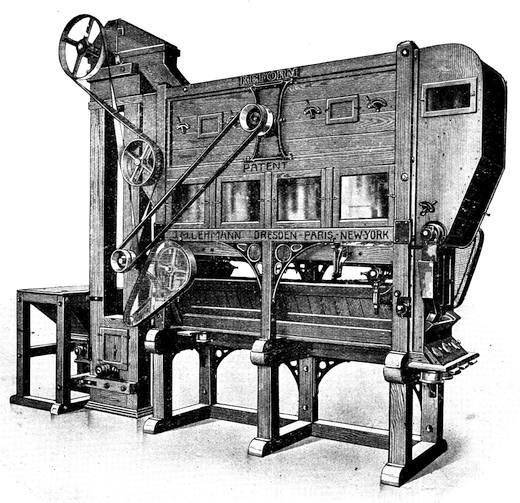
Fig. 19.
It has become necessary in modern manufacture that iron fragments occurring in the machine not only be separated by distinct magnetic fields in the respective machines, but that this also be effected in a machine specially constructed for the purpose. Fig. 20 illustrates such an electromagnetic apparatus. The advantages of this system are that it avoids magnets limited in strength, and by the functioning of strong electro-magnets perfect cleansing even in the case of the largest output, as well as machines of the most simple construction, can be guaranteed.
We submit the following description of the machine and its method of working.
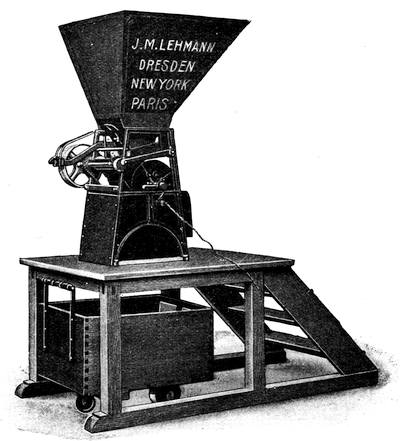
Fig. 20.
The machine contains a hopper with sloping groove to obtain an even introduction of the beans to be cleansed. At the end of this there is an electro-magnet roller, consisting of a non-magnetised mantle and a magnetic compartment round which it turns.
After traversing the sloping groove, the beans succeed to the roller, meeting it at a tangent. As soon as they reach the field of magnetism, all iron fragments are appropriated by the revolving mantle, whilst the beans themselves do not come into contact with this, but pass directly underneath. The iron fragments are disposed of separately, and outside the magnetising area.
It is of prime importance in the preparation of chocolate and more particularly of cocoa powder (easily soluble cacao), that the crushed material proceeding from the crushing machine should undergo a further purification, with a view to separating, and removing the hard radicles. These constitute the gritty sediment of insufficiently prepared cacao powder, when dissolved. J. M. Lehmann effects the complete removal of the radicle by means of his machine D. R. G. M. No. 24,989 (Fig. 21).
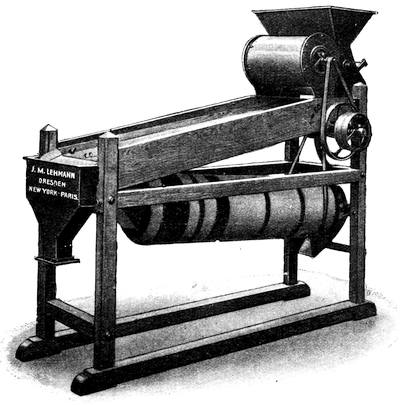
Fig. 21.
Here the finer siftings from the crusher are transferred to the controlling feeder, under which a small ventilator occurs, which provides for the removal of any still remaining portions of husk. Cacao and radicle descend to a shaking sieve, the finer particles passing through its meshes, whilst the larger grains fall into a pocket attached to the end, as cleansed product. The former fragments now succeed to a cylinder, having its inner surface punched with small cavities (fig. 22) and while the cacao particles remain in those cavities during the rotation of the cylinder, the radicles of more elongated form are caught up by a special separator (1) and so prevented from being carried round with the rest. The cacao particles are then made to fall into a trough (3) by a brush (2) working against the cylinder, and subsequently urged forward by a conveyor (4). That process is enacted all along the cylinder, so that finally cacao and radicle issue from the machine completely separated.
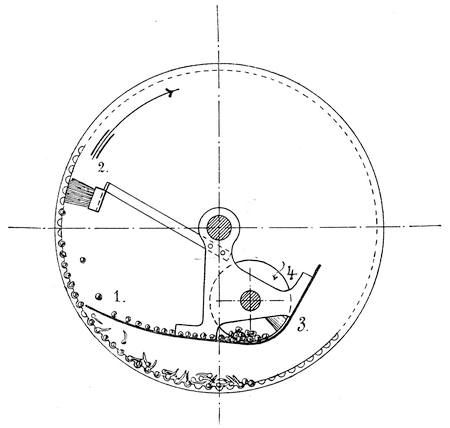
Fig. 22.
The advantages, economical and otherwise, attending the use of the above breaking and cleansing machines become apparent when the following figures, registering results obtained in several experiments, are considered. Formerly the loss experienced in sorting, roasting, crushing and hulling averaged about 30 % of the total beans, but now the employment of the above machines shows the following satisfactory improvements.
The loss of 823 kg Machala beans, unroasted, amounted to a total:
a) in picking 3·6 kg
b) " roasting 63·5 "
c) " shelling 61 "
d) " dust 34 "
162·1 kg or 20%,
without taking into account the application of the waste; 2267 kg of St. Thomé raw cacao lost:
a) in picking 5 kg
b) " roasting 170 "
c) " shelling 152 "
d) " dust 79 "
406 kg or 20%.
According to these data the use of these machines admits of a saving of about 10 percent more material than in former work.
In connection with these particulars it is also of interest to consider the qualitative and quantitative composition of the various waste products of the manufacture. Filsinger112 has at the instance of the Association of German Chocolate manufacturers, examined a mixture of 50 pounds of large Machala beans with an equal quantity of small beans, after passing it through a shelling machine of the most modern construction, and he thus obtained:
70 pounds of large kernels,
9·2 " " medium kernels,
0·8 " " radicles,
10 " " husk (outer woody shell),
4 " " cacao waste,
6 " " other loss,
The 4 pounds of cacao waste yielded by further sifting:
a) kernel I. sort 250 grammes,
II. " 50 "
III. " 220 "
IV. " 25 "
b) husk I. " 185 "
II. " 55 "
III. " 370 "
IV. " 80 "
c) cacao dust 725 "
d) waste 30 "
e) loss 10 "
2000 grammes.
Chemical analysis of these portions gave the following results:
Percentages
Ash Sand Fat Fibre113
1. Husk 10% of the raw cacao 11·15 1·90 4·50 21·36
2. Cacao waste 4% of the raw cacao 4·80 0·35 15·40 16·31
3. Seed shells I. sort ;0·37% of the raw cacao 6·70 — 21·64 10·29
4. Seed shells II. sort 0·11% of the raw cacao 7·10 — 18·39 8·75
5. Seed shells III. sort 0·74% of the raw cacao 7·20 — 15·76 12·16
6. Seed shells IV. sort 0·16% of the raw cacao 7·80 — 16·40 12·74
7. Cacao dust 1·45% of the raw cacao 11·75 — 22·06 8·40
8. Waste 0·06% of the raw cacao 7·05 — 20·44 9·81
From these data it is evident that there is a great difference between the chemical composition of the so called cacao waste and that of the exterior ligneous shells. From the large amount of fat present in the former material it might be regarded, in the full sense of the term, as a cacao constituent and, for that reason, its presence in cacao preparations should not be objected to, while the husk containing as much as 20 percent of woody fibre cannot be considered a cacao constituent in the same sense.
4. Mixing different kinds.
Stress has already been laid on the variations in taste incidental to different species of bean. It has further to be noted that they develop a milder and more aromatic flavour according as they have been more properly fermented, and in contrary instances possess an astringent and even acid taste. It therefore becomes an aim of the manufacturer so to improve the flavour of inferior varieties by mixing with the finer as to produce a resultant cacao giving perfect satisfaction to every taste. Nevertheless the general rule still holds good that for the preparation of the finest qualities of chocolate only the better sorts of bean (as Caracas, Ariba, Puerto Cabello etc.) should be employed. For inferior and less expensive ware other varieties of bean suffice, the mixture being obviously regulated by the prevailing market prices.
In many instances the proportions of such mixtures are kept secret by the manufacturer as matters of importance, and every individual manufacturer has his own method and specialities as regards such blends.
We compare here a few verified blends:
1. 2.
Caracas }of each 1 part Caracas = 1 part
Guayaquil Bahia = 5 parts
3. 4.
Maracaibo }each 1 part Trinidad }equal parts
Maragnon Maragnon
5. 6.
Caracas = 1 part 1 part Ariba
Maragnon = 2 parts 1 part Surinam
1 part Trinidad
7. 8.
1 part Ariba 3 parts Ariba
1 part Trinidad 1 part Trinidad
1 part Surinam 1 part Surinam
1 part Caracas 1 part Caracas
9.
1 part Machala
1 part St. Thomas
Ceylon cacaos are not used so much as mixing varieties, but almost exclusively as covering agents, to make other cacaos lighter coloured (sometimes almost approaching yellow).
The beans are weighed off in these proportions on a sensitive scale, and then passed on to be ground and triturated into cacao paste.
II. Production of the Cacao Mass.
5. Fine grinding and trituration.
Formerly the roasted, crushed, and decorticated beans were frequently ground before being transferred to the “Melangeur”,—a machine that will be described later—, in which they were then reduced to a finer state of sub-division and lastly mixed with sugar. For this grinding, mills of various construction were employed (as Weldon, Pintus etc.). But as time rolled on the Melangeur took the place of these preliminary grinding mills, and in this it was endeavoured to effect that fine division of the cacao mass which is essential to the production of a homogeneous cacao and sugar intermixture, but without complete success. Cylinder rolling machines (French method) were the first to attain this result.
At the present time, the roasted and cleansed kernels are ground so fine as to become a semi-liquid when subjected to heat, and that is done whatever the ultimate destiny of the cacao, whether it be intended for chocolate or cocoa powder. This object is obtained by means of special mills, constructed with “Over-runners
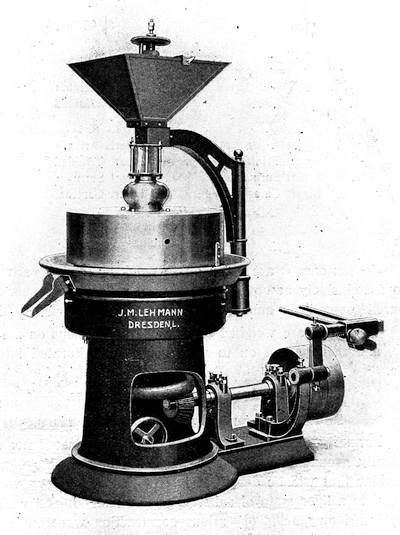
Fig. 23.
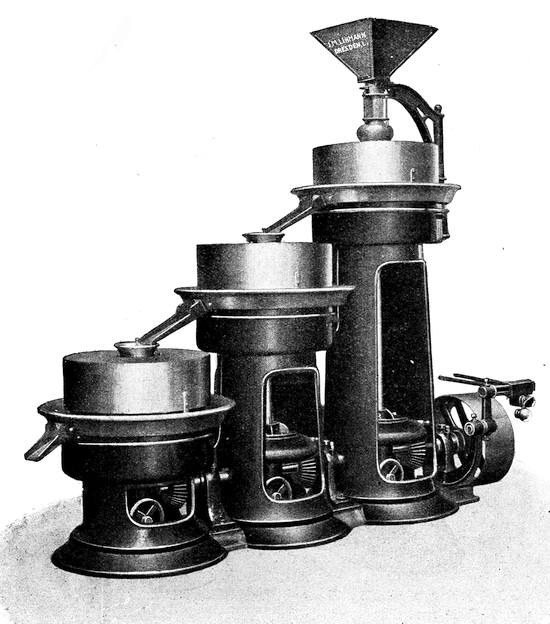
Fig. 24 a.
These cacao mills, which were formerly but seldom met with in chocolate factories, have now become indispensable necessaries, since they have the advantage:
1. of rendering the cacao mass in this semi-glucose form more easily miscible with sugar, a factor of the highest importance for the commoner and cheaper qualities of chocolate;
2. of grinding the cacao as fine as possible in one operation and the simplest manner.
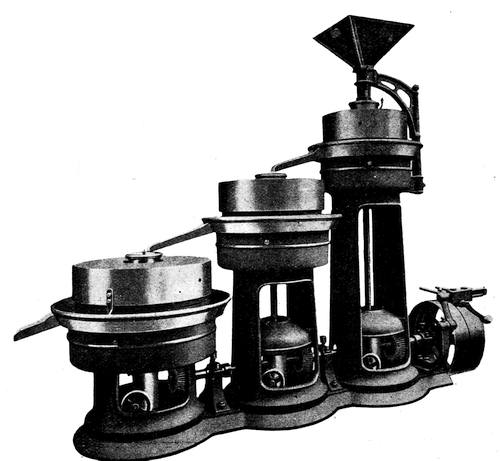
Fig. 24 b.
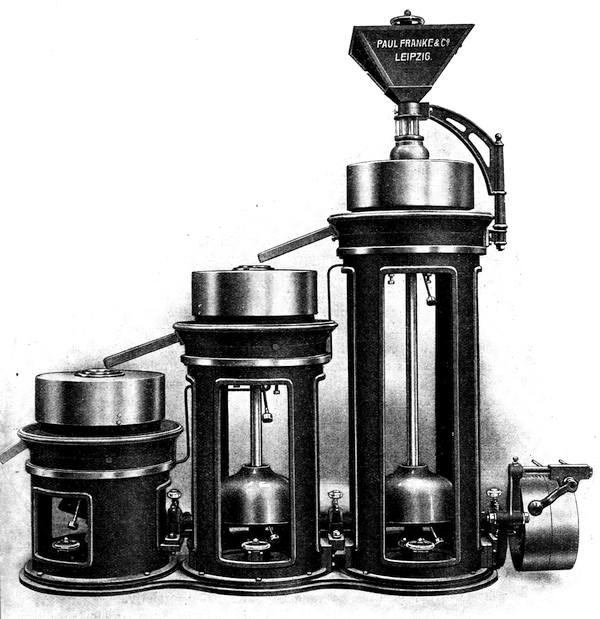
Fig. 24 b.
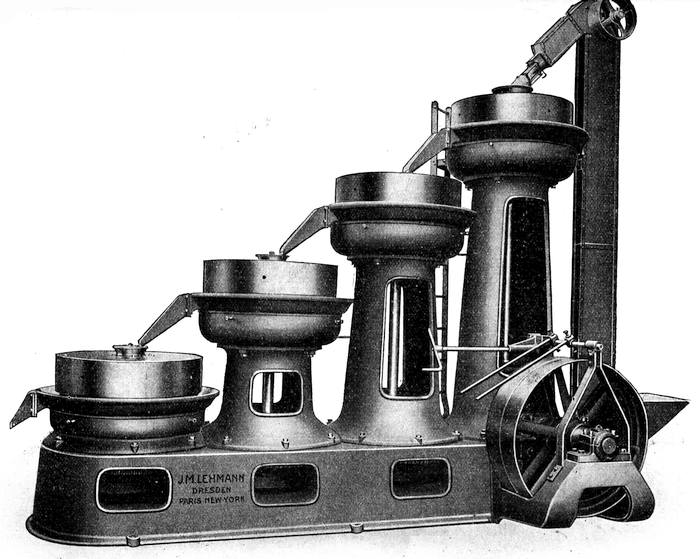
Fig. 24 c.
But side by side with the appreciation which these mills met with, there arose a corresponding increase in the demands made on them, such as the utmost nicety, greatest possible output, and least possible necessity of after-heating, and these have been successively answered by twin, triple and at the present time even quadruple mills. fig. 23 shows a simple grinding mill which can only come into consideration in connection with the smallest of branches, whilst Fig. 24 a and b illustrates another with three successive stones arranged one above the other, such as will be found in all the larger factories of to-day. Also a triple mill but with grindstones of increasing size pictured in fig. 24 c. A mill possessing four pairs of grinding stones is given in fig. 25, and is calculated to meet each and every conceivable demand.
Whilst simple, double and triple mills are brought on the market in different sizes, corresponding to the outputs required, these quadruple mills are only constructed in the largest sizes. They grind perfectly, and without detriment to the flavour, deliver quantities of cacao figuring at from 1000 to 1200 kilos daily. There is naturally a larger output if the fatty contents of the cacao are considerable, a thorough roasting being always presupposed.
The axles occurring on these quadruple grinding mills are connected with one another by means of spur-wheels, and the axles themselves run in ball-bearings, which not only permits a perfectly noiseless operation of the machine, but also makes the action very easy, that is to say, dependent on only very little motor power. The cacao is raised to the hopper by means of an elevator, where the quantity introduced into the machine is regulated, and then passes between crushers occurring in the middle of the first pair of grinding stones, which it subsequently leaves as a pasty mass. It is then conducted along a groove into the second mill, and here undergoes further grinding, and so to the third and fourth, where the process can be described as trituration, for the cacao leaves the machine in liquid form. Only in this manner is it possible to obtain the finest ground product, without any disastrous accompaniment of excessive heating.
Cacao mills with one stone suffice for the production of chocolate mass on a small scale, but for the manufacture of cocoa powder, twin or triple grinders must be employed.
All these are of the “Over-runner” type, act by their own weight, and consequently do not involve the disastrous consequences which were entailed by the “Under-runners” tried formerly.
About the middle of the nineties of the last century, experiments were made with a view to superseding these types with mills having stones of varying sizes, and first larger upper stones of a grinding pair were tried, then larger under stones, but neither have been able to maintain themselves in the workshop, and the grinders of equal size still hold good as the fittest and most popular.
Fig. 25.
Attempts have recently been made to introduce a machine combining mill and roller. Its value lies in the fact that with a relative increase in the grinding rapidity, it does not involve a greater than requisite heat, and on emerging from the machine the cacao shows no deficiencies as to flavour, and is withal much finer than that produced in other processes.
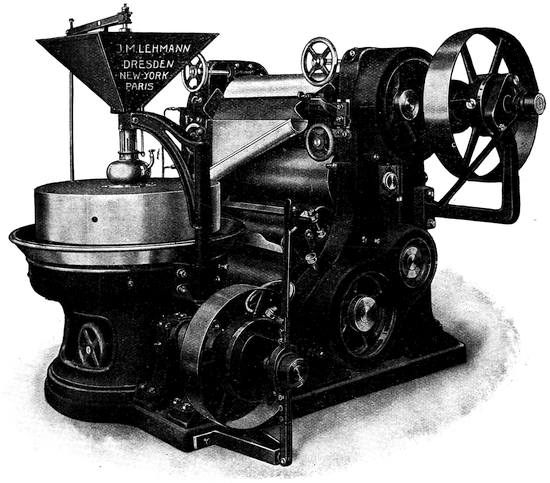
Fig. 26.
Fig. 26 shows such a machine. The mill on this serves merely to reduce the hard kernel to a pulp, and this admits of the grinding stones being placed farther apart, and so occasions no heat. Trituration is then effected by a roller apparatus, for which operation machines with four rollers have been proved most satisfactory. As such roller machines are furnished with water-cooling systems, it is possible for the cacao to be kept cool even on these.
6. Mixture with sugar and spices.
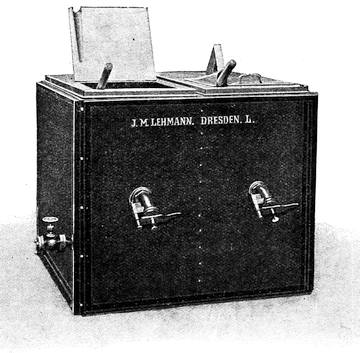
Fig. 27.
A thorough mixing with sugar can only be effected when the cacao paste is heated to a temperature rather above the melting point of cacao butter, that is to say, as high as from 35° to 40° C., and consequently the incorporating machine in which that operation is carried on is provided with a steam jacket. For this process it is advisable to have the chocolate in a semi-liquid condition, wherefore the ground cacao issuing from the mills is transferred to steam-heated vessels (fig. 27) fitted with taps suitable for drawing off the mass as it is required. Formerly the cacao mass was fed into the melangeur in lumps and there liquefied. But as this necessitated the application of heat to the melangeur, attended with the risk of cracking its under-plating, and also a postponement of the mixing processes, whereby considerable time was lost, this method no longer obtains to-day. It is at present usual not only to warm the cacao mass beforehand, but the sugar also, by storing it in warm chambers, so that the whole paste possesses a uniform temperature, lowering of temperature in the melangeur is avoided, and there is consequently no waste of the heating steam.
In some large factories the actual incorporation of cacao and sugar is preceded by a preliminary mixing of large quantities, which considerably relieves the strain on the melangeur, whilst it keeps the machine rooms as far as possible free from superfluous dust.
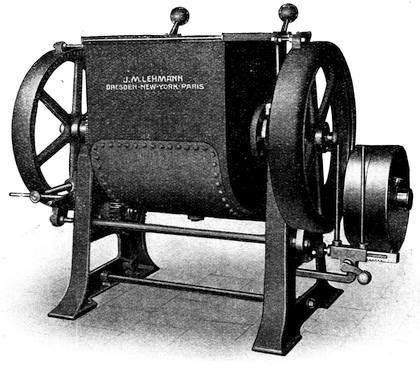
Fig. 28.
The mixing machine shown in fig. 28 can here be used with advantage. As will be seen on comparing the illustration, it is provided with a shifting trough. Such a machine, when closed down, is capable of mixing from 100-500 kilos of chocolate. The mixing is effected by means of two suitably shaped blades, and the heating by a steam jacket. After the operation is completed, the mixed material is turned out into portable troughs, and after having been kept in a warm chamber for some length of time, transferred to the melangeur for further treatment.
It has been found advantageous to keep the chocolate mass so obtained in suitable receptacles for several days114, at a temperature of not less than 20° C. and between that figure and 40° C. So the sugar is enabled to penetrate the entire mass, which now proceeds to the rolling processes carried out in the melangeur and rolling machines. Shortly before its discharge from the latter, it is mixed with spices, vanillin, eatherial oils and so forth.
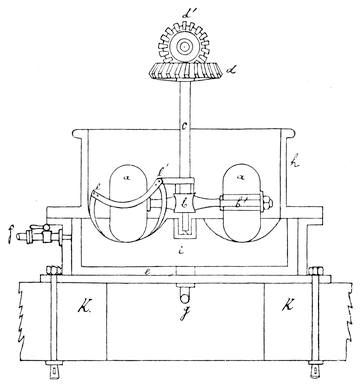
Fig. 29.
7. Treatment of the Mixture.
a) Trituration.
In describing the mixing machines, we do not intend to enter into details regarding the machines formerly in use, but merely to give a brief outline of the principles illustrated in their construction.
Trituration was formerly produced;
1. by rollers running backwards and forwards on a grinder; 2. by several cones rotating in a circle on a disc-shaped bed; 3. by means of rotating stones running in a trough; 4. by means of several cylindrical rollers; 5. by means of grooved cone moving in a grooved casing.115
At the present time only the type mentioned under 1. and 4. are in general use. 3. is met with less frequently, and will be described at greater length in a subsequent paragraph.
The machines 1. and 3. are put into operation prior to the cylinder rolling mills, which finish off the incorporation of chocolate and sugar and the levigation process only begun in the first-named.
The machines constructed in the manner described under 3., to which we now turn, were introduced by G. Hermann of Paris, but are at present almost obsolete. Since they have some historical interest and are typical of the development of the melangeur, we annex a rough sketch showing their general construction in fig. 29.
The ellipsoid runners a made of granite work in the trough i which is also of granite and is fitted with the casing h. The runners rotate on their axles b so as to move in a circle. The two arms of the axis b have at the centre an elliptical ring with a quadrangular opening, into which fits the similar shaped part of the vertical shaft c fitted with the toothed wheels, d and d′, which are set in motion by power transmitted to the shaft and its connections. The arm b has some play downwards, so that it can adjust itself vertically according to the greater or less quantity of material in the mill. The two steel blades, e and e′, are shaped to fit the cavity of the trough; being connected with the shaft c they revolve with it and sweep down the cacao mass adhering to the sides of the mill. Between the foundation k and the trough i there is a space l into which steam can be introduced through f, the condensed water passing away by g.
All machines of this kind have now been displaced by the melangeur which is capable of turning out a much larger quantity of material with a relatively smaller expenditure of power. The operation of mixing chocolate is not a mere mixing, for the pressure exerted by the runners is also an indispensable factor. On that account the ordinary mixing machines have not proved serviceable, especially in the case of chocolates containing a small amount of fat, such as the cheaper kinds, while the addition of cacao butter to facilitate the working of the machine would considerably increase the cost of production. Melangeurs are generally constructed on the same principle as the edge runner grinding mills which are so much used; but they differ from them in so far as the bed-stone revolves, while the runners merely rotate on their axles without revolving.
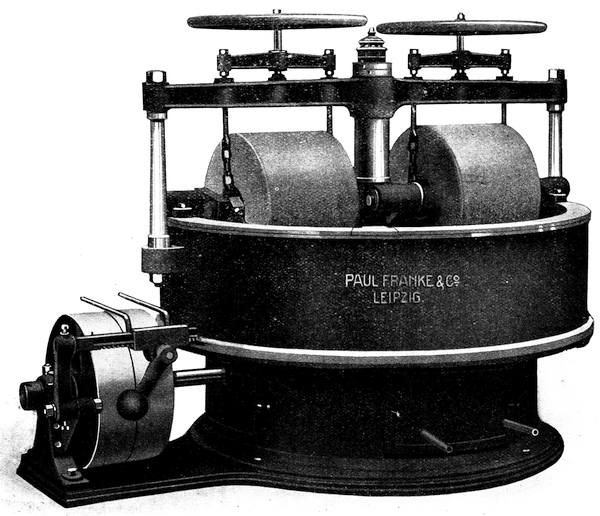
Fig. 30.
The melangeur with travelling bed-stone, as constructed by Lehmann, is shown at fig. 30; it is fitted with an arrangement for lifting out the runners.
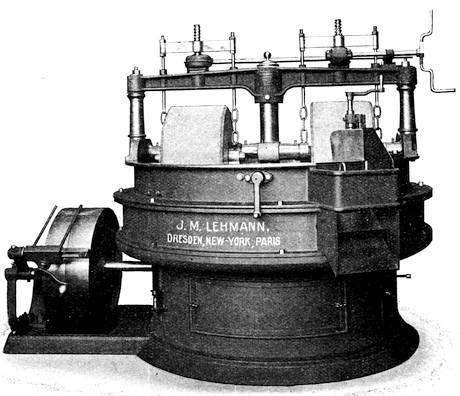
Fig. 31.
The bed-stone as well as the runners are made of granite. Each runner has an axis working in plummer blocks, so that it can be lifted out independently of the other one. By that construction the runners are prevented from taking an oblique position as was the case with the mills formerly made, since one runner would be forced downwards or tilted on its outer edge whenever the other one was raised up somewhat. The bed-stone of this machine revolves and it is easily heated by steam pipes from below. One important advantage of this machine is that being low it can be very easily charged and emptied. The contrivance for lifting out the runners prevents them thumping upon the bed-stone that might otherwise readily happen when starting the machine, and it also lessens the wear of the driving bands; moreover, large lumps of sugar or cacao are very readily crushed down and, so, the working is much facilitated. The emptying of the melangeur is readily and safely effected, while the bed stone is revolving, by holding a shovel so that the cacao is thrown up against the shovel. A melangeur of this construction is represented by fig. 31; it has three runners and underneath the bed-stone is fitted a steam engine which supplies driving power, the exhaust steam being used for heating the machine.
Although this emptying by hand is not attended with any serious drawbacks, yet it involves loss of time and is rather inconvenient, so that the demand for mechanical automatism in this operation was very considerable. It is now some years since Messrs. J. M. Lehmann patented an apparatus for the mechanical discharging of the chocolate mass from these machines, but their invention still holds good. A melangeur provided with such apparatus is shown on fig. 31. Here a vertically moving shovel is sunk behind the outlet, gradually damming the material, and causing it to rise above the edge of the tank and fall through the opening. A second but horizontally working arrangement, which in this case as in the last is controllable by means of a crank, conducts the remainder of the material to the same shovel. So the material is discharged within a few minutes.—These melangeurs are built for varying outputs. Fig. 32 illustrates one of the largest yet constructed. Its base has a diameter of 2 metres, and the machine itself has a capacity of 5 cwts. To avoid the mixing of dust with the sugar as far as possible, the whole melangeur is provided with a dust-proof protector.
b) Levigation.
An extreme fineness and homogeneity of the chocolate mass is obtained in the employment of cylindrical rolling machines, for the construction of which we are indebted to G. Hermann of Paris. Every kind of chocolate must be passed through the rolling machine at least once or twice even when finely powdered sugar is used, though in this case it is less a question of sub-division than of incorporation and intermixture. The best qualities are passed through the machine from six to eight times, or even more. The mass is finally fed into the machine in cold blocks and so ground off. Granite is the material chiefly employed in making the rollers, although it is not every variety which can be adapted to this purpose. Apart from the fact that granite, or indeed any other mineral stone, seldom occurs in compact masses and free from flaws, neither porphyry nor the stone generally described as granite is suitable for employment in the construction of mill rollers. A kind is generally preferred which intermediates between granite and porphyry as to hardness and possesses excellent grinding capacities, and which goes by the name of diorite. No other stone can compare with this diorite in respect to the above qualities, and the chief firms engaged in the construction of roller machines possess their own quarries. But we shall return to this later, for recently experiments with case-hardened casting rollers (Krupp steel) and hard porcelain have yielded very flattering results.
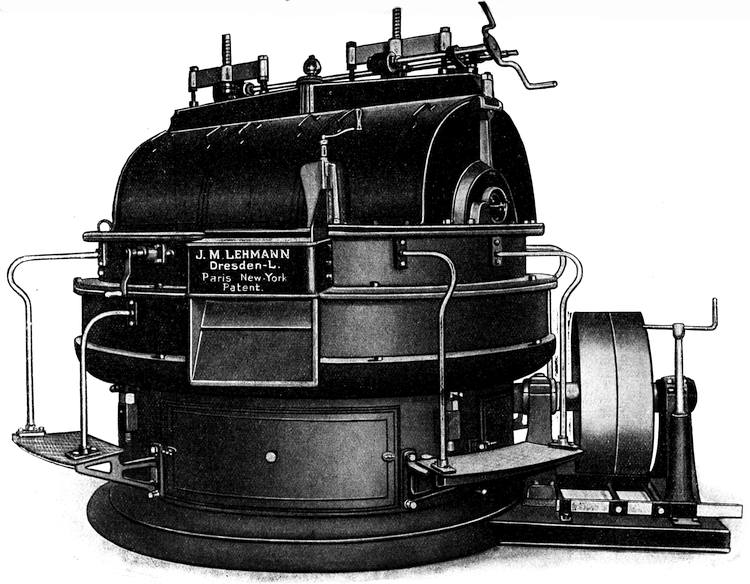
Fig. 32.
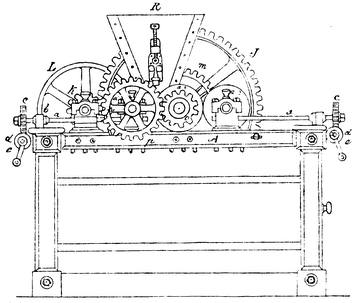
Fig. 33 a.
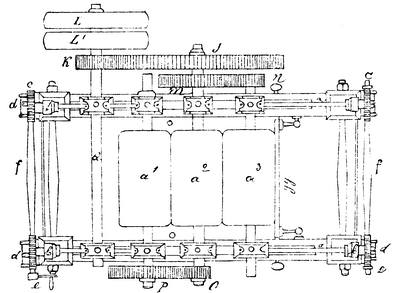
Fig. 33 b.
We shall now enter into more detail respecting the principle illustrated by these rolling machines. The plasticity of the chocolate mass necessitates a rotation of the cylinder surfaces in opposite directions with dissimilar velocities. Accordingly two or more rollers are caused to work against each other, and in compliance with this principle of sub-division with differential velocities, their axles are fitted with wheels, of which each has a different number of cogs.
So those rollers furnished with the greater number of teeth revolve more slowly, whilst in opposite instances there is a corresponding acceleration.
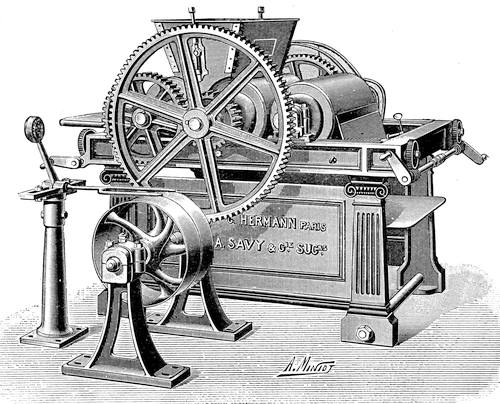
Fig. 34.
The construction of the machines now in use differs more or less from that of the type first invented by Hermann, plan and elevation of which appear in figs. 33 a and 33 b respectively.116
The granite rollers at a1, a2, a3 are fitted with an octagonal iron axle that is somewhat thicker at the interior part and they are mounted upon a frame as shown in the drawing. The sockets of the central rollers a2 are fixed and each one is held in position by three sets screws; those of the two other rollers can be shifted along grooves in the frame and when the cylinders a1 and a3 have been brought into proper position relatively to the cylinder a2 they are held fast by the set screws p.
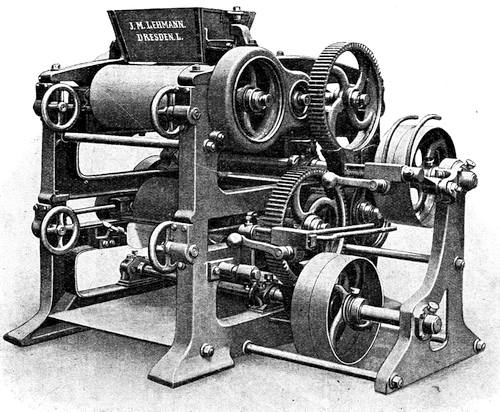
Fig. 35.
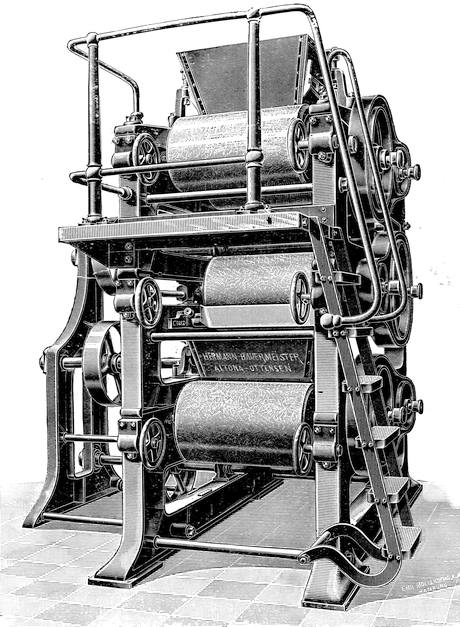
Fig. 36.
For the purpose of this adjustment, there is at each end of the machine a horizontal wrought iron shaft f that can be turned by the winch e, and these shafts are fitted with two endless screws d working in the corresponding wheels c. These occur on the spindles a, which screw in and out of the bearing blocks of the rollers a1 and a2, but turn only in the fixed collars b without being shifted from their place. The result is that on turning the cranks e the corresponding cylinder a1 or a3 is moved nearer to, or further from, the central cylinder a2, while the position of all of them always remains parallel. The shaft Q is set in motion by the driving wheel L fitted with the loose wheel L1. It acts first upon the cog wheel K which works in the larger wheel J on the axle of the central roller a2. That works in the cog wheel O and the wheel P fitted to the roller a1 driving them as well as the wheel M and the pinion N of the roller a3 The result is that the axle a2 makes 1¾ revolutions and a3 6-1/8 revolutions while a1 in the same time makes only one revolution.
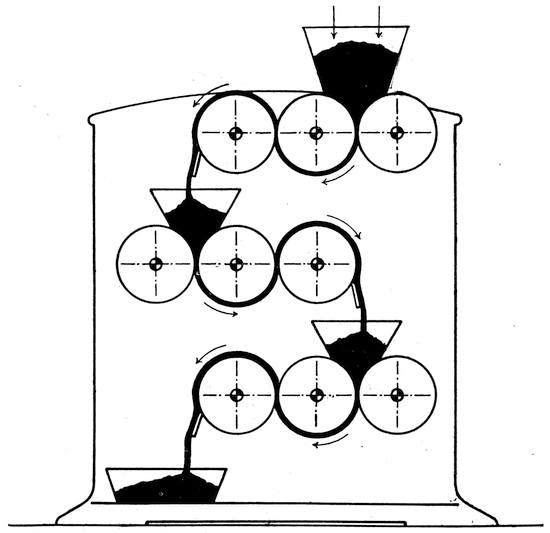
Fig. 37.
The cacao or chocolate is supplied to this machine by the hopper R which is placed between the rollers a1 and a2. The pasty mass adhering to the rollers is carried forward by the quicker moving roller a2 and it is ground finer between the rollers a2 and a3, after which the material is removed from a3 at the outer side by an adjustable blade gg and then falls down into a receptacle below.
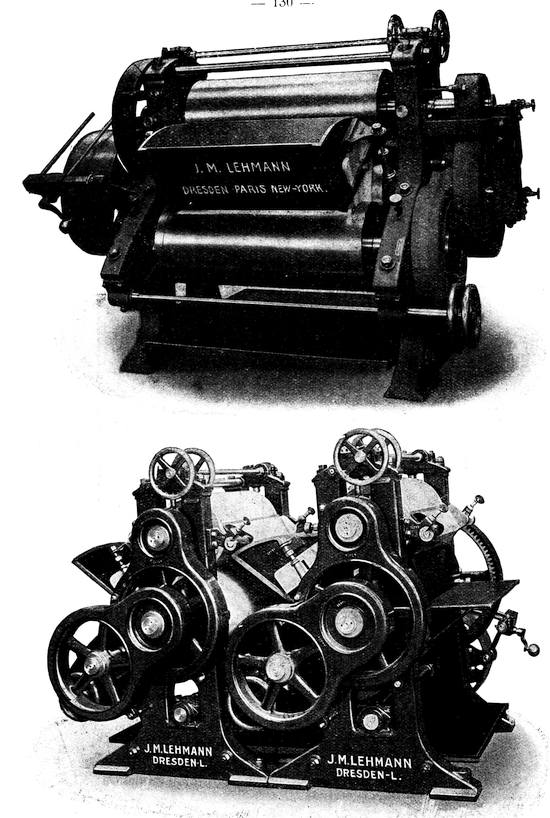
Figs. 38 and 39.
On the design fig. 3434 we see a machine of more modern construction ready mounted. The receptacle parts of the same are arranged and connected in full agreement with the above mentioned except that the motion is effected by the driving power fitted to the machine on the ground on the left side.
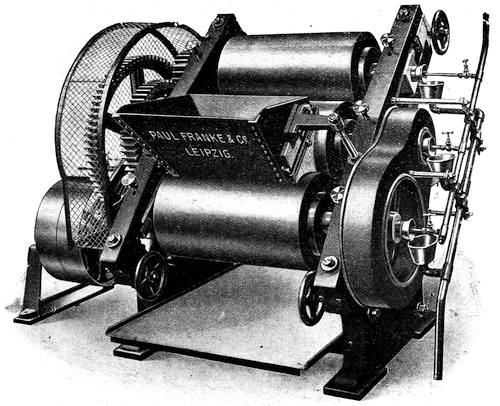
Fig. 40.
The principle of this roller machine has long been applied in the building of other types, and we find that these, variously altered, renovated and improved, are to-day an indispensable equipment in every chocolate factory. In the following pages we give a description of some of the best-known constructions of refiner.
The so called battery rolling mills constitute a remarkable innovation. It is apparent that the more rollers a cylinder machine contains, and the greater their length and diameter, all the more efficacious will the working of the machine be. Batteries have accordingly been constructed, whereby two, three or more roller systems are combined, one to every three rollers, and rising one above the other, so that they slant upwards much as shown in Fig. 40.
As the battery rolling mills possessed the disadvantages that they took up too much room and could not be well fed and regulated, they are generally replaced by rolling machines of from 6 to 9 rollers, first constructed by J. M. Lehmann. These rolling machines of 6 to 9 rollers which we see before us in Figs. 3535 and 3636 are really systems of 3 rollers fitted one over the other. They therefore take up the room of a 3-roller machine and are quite as easy to work.
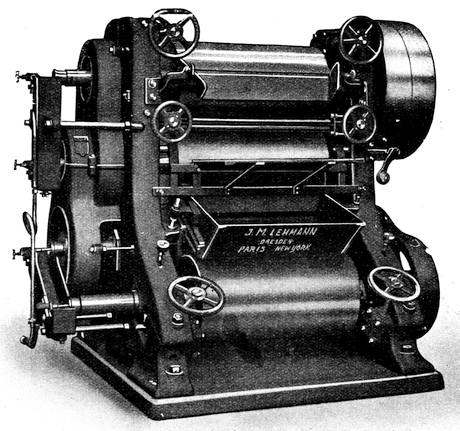
Fig. 41 a.
As will be seen from the design of a nine-roller apparatus, fig. 37, the chocolate mass descends from one roller system to the other, and is fine rolled in a third of the time otherwise required, and at one operation, with corresponding saving of labour. The nine roller apparatus are provided with landing stage and steps, and fed either by means of elevators, or from above.
Fig. 38 shows a recent construction, three roller apparatus (case castings, cf. below) standing vertically, which accordingly takes up little room. The hopper is low-lying, whilst the discharging is effected from the upper roller, and accordingly admits of the occasional use of a somewhat larger size of transport trolley. This type also occurs with 6-9-12 rollers, as apparent from fig. 39.
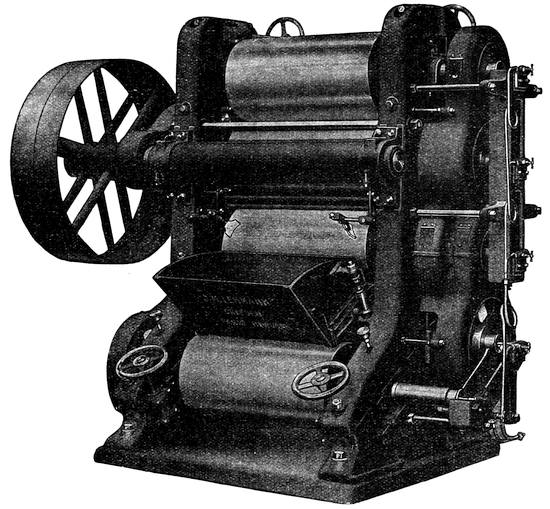
Fig. 41 b.
Whilst these systems were exclusively supplied with rollers made of granite or hard porcelain up to a few years ago, it has been found that good results are obtained by the use of cast rollers, and they have been for some time employed on machines of three, four and five rollers. (Figs. 38, 40, 41 a-c.) In consequence of the non-porous surface of these steel rollers, it is possible to grind to a finest powder, merely in one operation, without passing the chocolate through the machine several times; and the so-called “Burning” of masses which have not been properly mixed cannot arise in this case, though it is true that the apparatus must be provided with water cooling arrangements to avoid a too excessive heat. They are specially adapted to the preparation of the more ordinary qualities, and are even occasionally employed for finer chocolates, for obviously these must be again submitted to a rolling process, when granite or porcelain rollers are preferred.
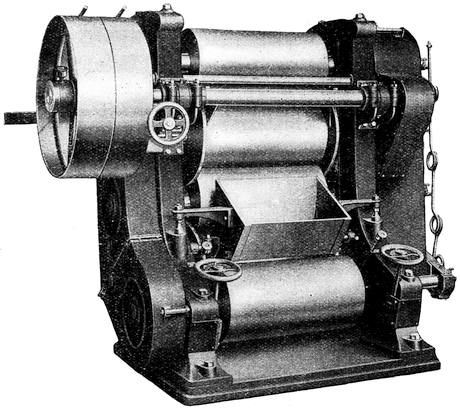
Fig. 41 c.
For this reason the 6, 9 or even 12 roller mills have been more discarded since the last grinding process has been performed by granite rollers (cold process).
In order to avoid the disadvantages of the pulley drive, it is in certain cases advisable to drive each machine direct from an electric motor. Fig. 42 illustrates a refining machine driven in this manner.
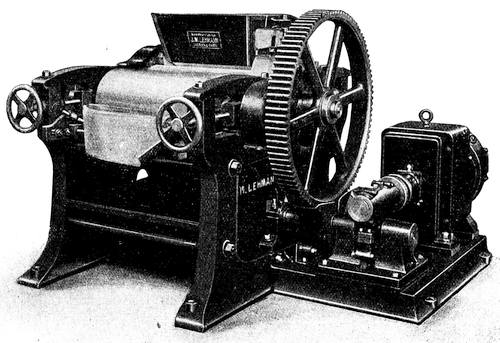
Fig. 42.
c) Proportions for mixing cacao mass, sugar and spices.
The relative proportions of cacao, sugar, and spices, as well as of starch as in the manufacture of the cheaper sorts, vary considerably. Generally speaking 50 or 60 parts of sugar are added for 50 or 40 parts of cacao mass; the following are a few formulae applicable for the production of those kinds of pure chocolate that are most used.
A. Hygienic chocolate.
Cacao mass } equal parts of each.
Powdered sugar
B. Spiced chocolate.
a) b)
Cacao mass 4 kg Cacao mass 4 kg
Sugar 6 kg Sugar 6 kg
Cinnamon 72 g Cinnamon 130 g
Cloves 38 g Coriander 8 g
Cardamoms 16 g Cloves 88 g
Oil of lemons 2 g
Cardamoms 16 g
c) d)
Cacao mass 5 kg Cacao mass 5 kg
Sugar 5 kg Sugar 5 kg
Cloves 80 g Cinnamon 100 g
Cinnamon 220 g Vanilla 100 g
Mace 8 g or Vanillin 2·5 g
Mace 2 g
Cardamoms 4·2 g
e) Spanish spiced chocolate.
Cacao mass 5 kg Cardamoms 82 g
Sugar 5 kg Mace 44 g
Cinnamon 116 g Vanilla 40 g
Cloves 50 g or Vanillin 1 g
Oil of lemons 1 g
C. Vanilla chocolates.
a)
Cacao mass 5 kg
Sugar 5 kg
Cinnamon 160 g
Vanilla 50 g
(or Vanillin 1·2 g)
b) c)
Cacao mass 4½ kg Cacao mass 4 kg
Sugar 5½ kg Sugar 6 kg
Cinnamon 150 g Cinnamon 120 g
Vanillin 1·5 g Cloves 20 g
Vanillin 1·6 g
The powdered spices as given above may be replaced by corresponding essential oils, but see page 237 for remarks on this point.
If the chocolates made from beans rich in oil contain too much fat to mould properly, a small percentage of their constituent cacao mass can be replaced by cocoa powder made from the same kind of bean, but defatted, in the case of the finer qualities; and when inferior varieties are under consideration, the same result may be attained by a sufficient increase in the proportion of their other constituent, sugar, as e. g. 55-60 parts of to 45 or 40 parts of cacao mass, so disturbing the usual equality of the two ingredients mixed together. Very cheap chocolates in particular are prepared from a smaller percentage of cacao mass and show a corresponding increase in their sugar content. But if the sugar exceeds 65 percent, it is no longer possible to mould these chocolates, and the addition of fresh cacao butter becomes a necessary preliminary to this operation, cf. also the first part in section IV. Such varieties would have a composition somewhat like the following:
Cacao mass 25 parts
Sugar 67 "
Cacao butter 7 "
Spices and vanillin as above 1 "
In the experimental preparation of samples of chocolate mass it is not advisable to employ large quantities of ingredients, when a waste of material is bound to ensue, but to begin with mixing small quantities of one or two kilos. The small Universal Kneading and Mixing Machines, Patent Werner & Pfleiderer, Type 1, Class BS, can here be used with advantage. They are specially intended for small outputs and experimental work; but we shall return to their description later, after stating that they are furnished with heating apparatus, stuffing boxes and air-tight lid, and can easily be taken to pieces, greatly facilitating the removing of the mass.
III. Further Treatment of the Raw Chocolate.
8. Manufacture of “Chocolats Fondants
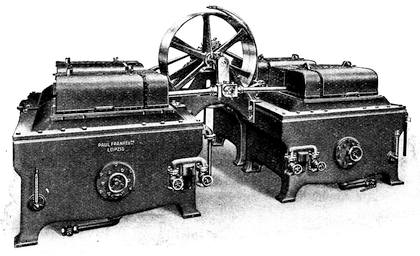
Fig. 43.
Recently the creams sometimes described as in the heading have enjoyed a vast popularity, and are sold as eatable chocolates in ever-increasing quantities. As far as can be ascertained, they were first manufactured in Switzerland, melt readily, and have a correspondingly large amount of fat, resulting from the addition of cacao butter, which distinguishes them from ordinary chocolates. When readily melting chocolates were first introduced, it was a prevailing opinion that the required property could only be obtained by increasing the amount of fatty content. Now the excessive evidence of fat in chocolates is very objectionable, both as regards taste and digestibility. To avoid this, therefore, the chocolates are treated mechanically, to attain the required character of readily melting. The machines used for that purpose are termed “Conches”, because the trough, in which the chocolate is rubbed into a long cylinder, has somewhat the shape of a long shell. For the working up of chocolates in conches, the necessary conditions are;
1. that the chocolate should have been ground perfectly fine,
2. it must contain such an amount of fat as to become glucose on warming, not indeed so thin as that used as coating material, but nevertheless softer than the ordinary cake-chocolate of good quality.
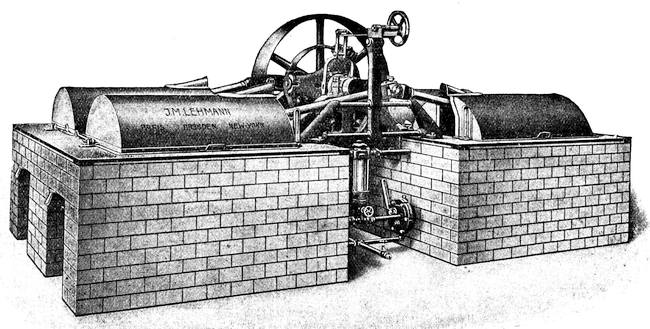
Fig. 43 a.
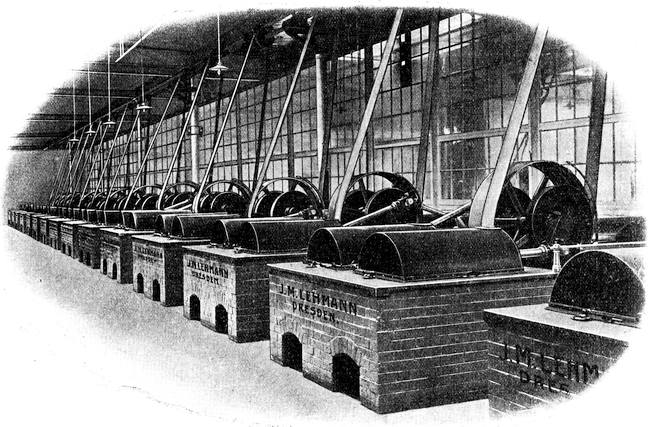
Fig. 44.
The machine can be heated by means of steam, hot water pipes, gas or charcoal stoking, according as they are available in the place of installation, and the temperature should rise above 70-80° C. for fondants, and 50° C. for milk chocolates. In factories with water power or electricity, continuous fondant machines can be worked day and night, but when only worked during the day, must be kept warm overnight. Constant tending of the machine is unnecessary, as it works automatically. After a treatment of from 40-48 hours, the chocolate attains the requisite character (i.e. it melts readily), and a rounding off of taste, which are the properties of all good brands. Milk chocolates can also be advantageously prepared in the conche, as also covering or coating cacaos of all kinds, which harden considerably in consequence of this treatment.
Figs. 43 and 43 a show quadruple conches of the modern type with hot water, wherein four troughs are arranged in pairs, and one opposite the other. Conches with only 1 and 2 troughs are also constructed, and in various sizes, the troughs sometimes having a capacity of 125 and 200 kilos, so that the quadruple conche is capable of holding five or eight hundred kilograms in all. The curved bottom of the troughs, as well as the rollers fitted in them, are made of granite, and the front wall strongly bent in at the corner, so that the mass is forced over the border of the front wall, where there are openings for its discharge as well. To prevent radiation as far as possible, it is best that the troughs be walled in, the troughs are either walled. Fig. 44 shows the room of a modern chocolate factory, with 15 conches.
“Chocolats fondants” are from a gastronomic point of view, the finest chocolate product on the market, and it is not remarkable that this branch of the chocolate manufacture has witnessed a considerable extension, and is likely to extend still more.
9. Heating chambers and closets.
The manufacture of chocolate has been very considerably facilitated by the introduction of heating chambers and closets, which have now become an indispensable feature of every factory in the industry. In these chambers the chocolate which has still to be rolled, as well as that already submitted to this operation, is stored and kept at a temperature of 60° C. until it can be further treated (moulded). This manner of heating involves an appreciable cheapening of the production, for masses which are dry and apparently require an addition of fat recover in such a manner during a twenty four hours’ storing in the heating chambers that such addition becomes unnecessary. But especially when chill casting rollers are employed, which the mass leaves in a very dry state, the use of these heating chambers is indispensable. They should be available in every factory to such an extent as to find room for the total output of one day, though even twice or three times this amount might very well be provided for. Closets heated by steam are best adapted for small factories, such as are illustrated in Fig. 45. They possess double doors, are walled in, and are capable of holding from 300-400 kilos of chocolate mass for each metre of length. Larger factories should furnish themselves with chambers, which are more open to access and on the walls of which iron shelves can be introduced, heated by steam pipes arranged underneath. A typical chamber, measuring 2·8 metres in breadth (including passage) and 5 metres in length would hold about 2,500 kg of chocolate.
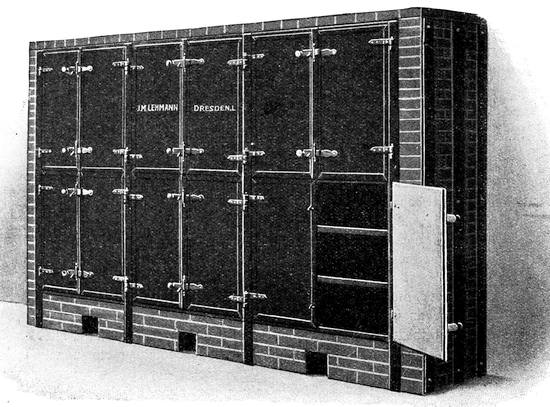
Fig. 45.
10. Removal of Air and Division.
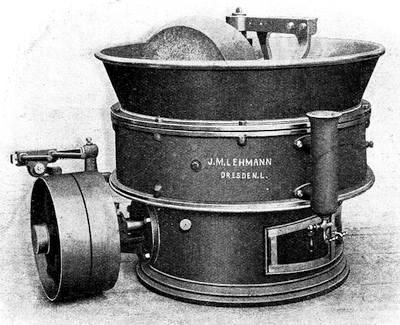
Fig. 46.
After emerging from the final rolling process, the chocolate is stored up in heating chambers until it is ready to succeed to the moulding, prior to which, however, it must be freed from air and cut up into small portions. Until recently, it usually came next in a melangeur provided with a dish-shaped bed-stone made of granite, as illustrated in fig. 46, where it was kneaded and reduced to a uniform plasticity and heated to the temperature required for moulding. The melangeurs devoted to this purpose are now superseded by special tempering machines.
A machine of this recent construction, used for working solid and semi-liquid material, is shown in fig. 47. The tank intended as a receptacle for the chocolate mass is in this case made of iron and, to facilitate cleaning, smooth in the interior. It runs in a water-bath, the supply in which can be controlled by steam or cold water. The granite runner is provided with a lifting device, admitting of the working up of material containing foreign ingredients like nuts, whole and fine-split.
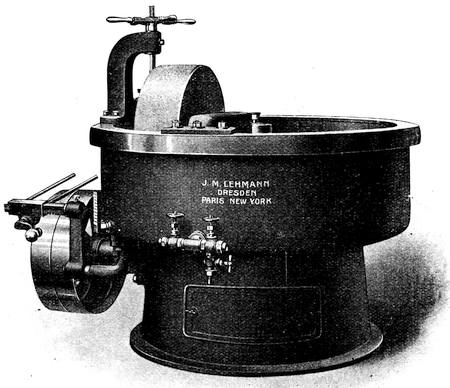
Fig. 47.
The mass is taken out of the machine in lumps, and in order that it may be reduced to a temperature suitable for the removal of air (about 26-32 ° C. on the outside) it is laid to cool on wooden, marble or iron tables. When this temperature is arrived at, large lumps of chocolate are introduced either into the air-extracting or the dividing machines.
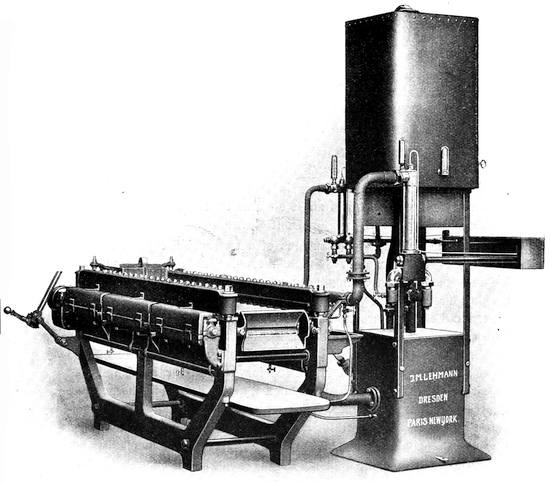
Fig. 48.
After the importance of the tempering processes had at length been recognised, inasmuch as the maintenance of the temperature prescribed is of immense influence on the chocolate subsequently produced, and it had on the other hand been ascertained that such machines as described above could not be absolutely relied upon, for the shaking tables involve an occasional excess of tempering, the idea of a machine which should completely and automatically perform this task was finally conceived. This new machine, given in fig. 48, and already differing from all other tempering machines in external appearance, ushers in an entirely fresh process respecting the modus operandi prevailing in the present manufacture of chocolate, which does not fail to satisfy the highest expectations. It may be said to work continuously, for no matter what the temperature of chocolate passing into it may be, the material leaves the machine at the temperature desired within a lapse of one minute. According as more or less chocolate has to be turned over in the moulding department, the machine can be stopped or set in motion without detriment to its efficacy. Besides this, it cleans almost automatically, so that a quick change of quality is always possible. The special virtue of this machine is that it turns out the material with such a degree of homogeneity as has never before been known, making moulding at much higher temperatures a possibility. There is yet another side issue, namely a doubling of the life of the moulds, and finally, owing to the fact that the often considerable amount of waste material is done away with in this process, the moulding shop is spared to some extent. The series of rollers through which the chocolate passes is maintained at a proper temperature by means of automatic water apparatus. The daily output of the machine figures at 3000-4000 kilograms. The material is passed on out of this machine to the dividing and moulding processes.
The necessary extraction of air follows immediately on the tempering process, for the blades of the scraper then release the chocolate mass from the rollers in thin layers, between which air penetrates. The removal of air is effected by machines, an old type of which is shown in fig. 49 (in front elevation).
It can be warmed by means of a charcoal fire placed in the space i, or by any other suitable means. The chocolate mass is fed into the cylindrical hopper a, at the base of which occurs an archimedian screw b, which is propelled by the shaft and cog-wheel system c d e in the direction indicated by the arrow. Thus the chocolate mass is forced into the box f, leaving which in cylindrical form, it succeeds to the travelling band h. It is now almost entirely freed from air. As the material is pushed forward on the band, it is cut off either by a knife g fixed to the box f, or divided as far as possible into equal parts by a double knife with adjustable blades corresponding to the weight required for a chocolate square. This manipulation presupposes a fair amount of skill on the part of the machinist, but this once attained, the division ensues as precisely and simply as can be desired.
Air-extracting machines of recent construction, although still partially built on the above principle, are at the same time generally developed as automatic dividing machines.
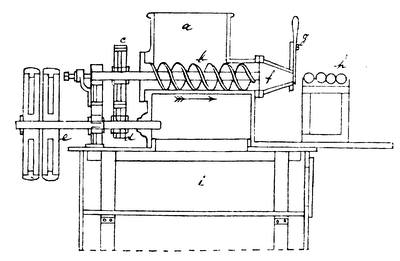
Fig. 49.
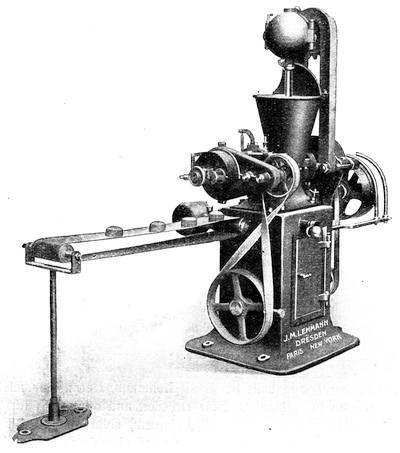
Fig. 50.
Fig. 50 shows such a machine for solid and semi-liquid chocolates. By means of this, the material is next conducted along a vertical screw path in even mass to the horizontal screw, and so a second filling with the hand is rendered unnecessary. After it has been freed from air in this, it enters a revolverlike cutter, which discharges the divided portions on a travelling belt. On the latter it is conducted to a table standing near, where it is laid into moulds. The machine is of very strong make, and puts out from 15-250 gr, divided into approximately 10-25000 squares, within a space of ten hours.
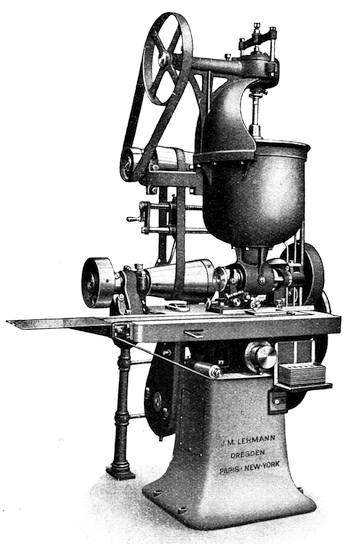
Fig. 51 a.
Figs. 51 a and b give finally two of the best known types which have a very extensive application, protected by patent imperial (Germany), and built by J. M. Lehmann, Herm. Baumeister, J. S. Petzholdt in Döhlen, G, near Dresden and others. With this patent dividing machine of J. M. Lehmann, solid and semi-liquid chocolate material, as also nut and almond chocolates are divided exactly, in any weight from 18 to 250 grammes, and then conducted in strips of equal size to the mould previously mentioned. As far as cleanliness, purity, and easy management are concerned, it fulfills all the demands which can be expected of the most modern machine.
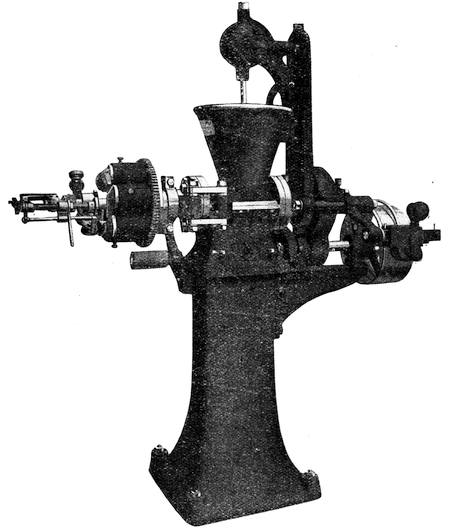
Fig. 51 b.
IV. Moulding of the Chocolate.
11. Transference to the Moulds.
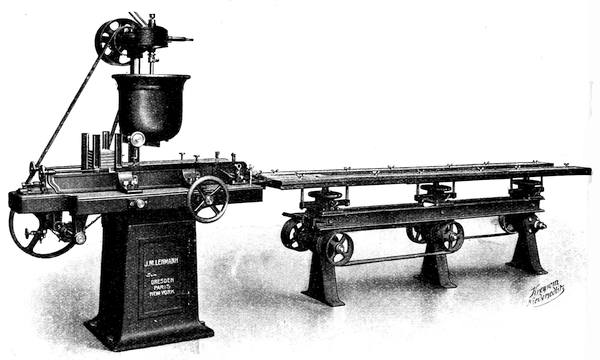
Fig. 52.
The pieces of chocolate, on emerging from the dividing processes, are placed separately in iron moulds, that is to say, as far as this has not already been done in the dividing machine. It is important that these should have the same temperature as the chocolate mass, in order to prevent the formation of spots on the surface of the cakes, and to obtain a good and non-greyish fracture. The temperature for moulding smaller objects can be fixed at between 27° and 32° C. and for the larger may be considerably lower. In summer also, moulding may be proceeded with at a lower temperature than in winter. According to a note in the Gordian (1895, No. 4) the moulding may be carried out in summer, when the atmospheric temperature is;
from 25-31° C, at 26-27·5° C
" 18·5-25° C, at 28·5-30° C
" 12·5-18·5° C, at 31-32·5° C
In cold weather, the cakes may be moulded at a temperature of from 32·5-35° C., according to their thickness. When not manufactured in the automatic machine shown in fig. 48, the mass should be otherwise controlled as regards temperature, which should be registered by a thermometer introduced therein. The moulds are for the most part filled with plastic and liquid chocolates, and their depths determined and modified by the weight of material which they are destined to receive.
Fig. 52 shows a machine which conducts the semi-fluid mass to the moulds in the following manner. The moulds are automatically introduced under the apparatus, and filled from the small stirrer above. They then succeed to the shaking table and are finally transported to the cooling room. On this machine moulds of from 75-350 mm long and 75-225 mm broad can safely be employed.
There are two different forms in which chocolate is sold, namely, that intended for domestic purposes, and that which is to be consumed as an article of luxury. The kinds known as cake, rock and roll chocolate belong to the first class, the several pieces weighing 50, 100, 200, 250, 500 up to 5000 grammes. Tin-plate is the only material of which moulds are made; and these generally have a capacity rather greater than is necessary for holding the particular quantities to be moulded. The chocolate is therefore, as described above, divided into given weights, and generally deposited direct in the moulds by the dividing machine. The divided portions of chocolate are pressed down in the moulds by hand, equally distributed in the latter, and then transferred in the moulds to the shaking table or combination of shaking tables to be described later. On the shaking table the soft chocolate soon penetrates completely into all the corners and impressions of the stamped tin moulds. The removal of the cooled cakes from the moulds is easily effected by pressing.
These moulds are generally provided with from four to ten ridges or indentations, so that the chocolate can be conveniently divided, and as required for use. Others again have a similar number of compartments.
The compartments may be impressed with any kind of inscription, so that such information as the name of a firm can always be reproduced on the cakes.
Broken chocolate is generally of inferior quality, brought on the market without any protective covering.
In those kinds of chocolate which are known as articles of luxury a distinction is to be made between;
1. Those moulds which are in one piece and completely filled with chocolate, so that the superfluous mass can be removed by a knife. In such cases the weight of the cakes is exactly regulated by the capacity of the moulds.
2. Those intended for moulding various figures of fruit etc. in which two or three parts make a closed space which is of the form desired.
Among the moulds of the first type must be numbered those used in the preparation of small tablets and sticks, and the sweetmeats known as Napolitains and Croquettes.
The second class comprises moulds for making chocolate cigars and chocolate eggs, and also the double moulds.
The moulds for the smaller tablets, cream sticks, napolitains and croquettes are also made exclusively from tin-plate, and the separate parts are enclosed in a stout iron frame, the top of which is ground down smooth, so that any superfluous portion of the filling can easily be scraped away. In that way from six to thirty pieces can be cast in one mould at the same time: the cooled chocolate can be released from the moulds by gently tapping one corner against a table. In napolitain moulds protecting hooks are attached, to avoid their sustaining any injury in this operation.
Examples of the more frequent moulds.
1. Chocolate Cigars.
These are made either by introducing the chocolate mass between the two halves of a double mould, of which each corresponds to a half of the cigar shape to be moulded and which each fit exactly one on the other; or else by pouring it into hollow moulds stamped out of one complete piece. Moulding presses117 are utilised in the manufacture of material en masse. In these the cigars are filled into iron moulds, afterwards held together by means of iron combs, and so introduced in to the press. For each size and shape special moulds and plates are essential. Neither barium sulphate nor zinc white may be employed to produce an imitation of the ash on ordinary cigars, as both are objected to by health inspectors; nor are they necessary, for in phosphate of lime (tricalcium carbonate) we possess a perfectly harmless and at the same time efficient substitute, when it is mixed up with starch syrup.
Other figures, such as fish etc., may also be produced in chocolate, by means of the moulding press, when it is furnished with stamped moulds, corresponding to the forms required.
2. Chocolate eggs.
These are generally made hollow, unless they are very small, by pressing chocolate in two halves of an egg-shaped mould and then uniting the two parts. Another method patented by Th. Berger of Hamburg118 seems less practical. A mould is made of soft sheet caoutchouc blown out; this is dipped into liquid chocolate and, after the adhering coating has hardened, the air is let out of the mould. The use of caoutchouc moulds would render this method too costly, since the alternation of temperature soon makes the caoutchouc unserviceable.
3. Various figures, fruits, animals, and other small objects.
Double moulds are used for making these objects in chocolate, consisting sometimes of three or four parts; they are made either of sheet iron, tinned, or, for more complicated forms, the moulds are cast in tin, but these latter are not so durable as those of tinned sheet iron with strong iron frames.
The several parts of the moulds, after having soft chocolate mass pressed into them, are put together and excess of material is removed by requisite pressure by the use of a press of the kind made by A. Reiche in Dresden, which will admit of a large number of moulds being placed in it at a time. By the use of such a press the moulds are protected from injury, and the objects moulded have a better appearance, as a result of the uniform as well as strong pressure exerted.
After cooling, the moulded objects are readily detached from the moulds and they only require to be scraped clean, or further ornamented as may be desired. That is done in various ways, for example by painting with coloured cacao butter.
4. Crumb Chocolate.
This term is applied to the small pieces of chocolate of truncated conical shape, with from 4 to 5 smooth surfaces. They are made by a machine specially constructed for the purpose by A. Reiche (No. 1550); it consists of a four-cornered box with a removable bottom. Inside the box there is a false bottom, from 1 to 2 cm above the other bottom, which is fitted with a removable sheet iron plate, in which pentagonal holes are stamped. A knife can be introduced at one corner of the bottom of the box. After sufficient chocolate has been made to penetrate through the pentagonal holes by agitating the box on the table, the knife is rapidly drawn across the bottom and the box raised up. The sheet iron plate is then taken out, and by gently tapping one corner the small pieces of chocolate are shaken out.
5. Small tablets, sticks, fruits or figures filled with cream.
These are prepared by pouring the cream contents in either wooden or iron moulds, previously dusted with a little flour, and then moulding round them chocolate in whatever form is required, always taking care that this is kept as soft and plastic as possible, a suitable addition of cacao butter proving invaluable for the purpose.
In former times chocolate moulds were manufactured exclusively in France, where the firm Létang of Paris enjoyed what was to all intents and purposes a world monopoly. But since the year 1870 the oft-mentioned firm of Reiche in Dresden-Plauen has taken up the manufacture, and has succeeded in conquering the market in a remarkably short time. The moulds of this firm satisfy each and every possible requirement, although it would be no disadvantage if the old type of pattern mould were cleared away at one and the same time with the old routine, to make room for a little artistic skill and embellishment.
Recently Reiche has brought out a special machine intended as an easy and practical cleanser of his many moulds, which include bonbon cutters and cutting rollers, numbering stamps, chocolate slicers, roller machine boxes etc. He has lately brought on to the market a special machine for quickly and efficiently cleaning the moulds, which is illustrated in fig. 53.
In one end, a circular brush is introduced, and against this the moulds to be cleaned are firmly pressed. In consequence of the large number of revolutions which this brush passes through, the moulds are cleansed of still adhering masses of chocolate in a half or third of the time occupied when hand labour is employed. At the other end of the shaft occurs a duster, sprinkled with Vienna white (a lime), which polishes off the moulds previously and thoroughly cleaned by the circular brush. The great advantage of this machine is that the daily expenditure on polishing is considerably reduced One girl can do the work of two hand workers, when this machine is employed. In addition, it makes possible a continual touching up of the material used in the making of the moulds, a ventilating apparatus removing all traces of dust.
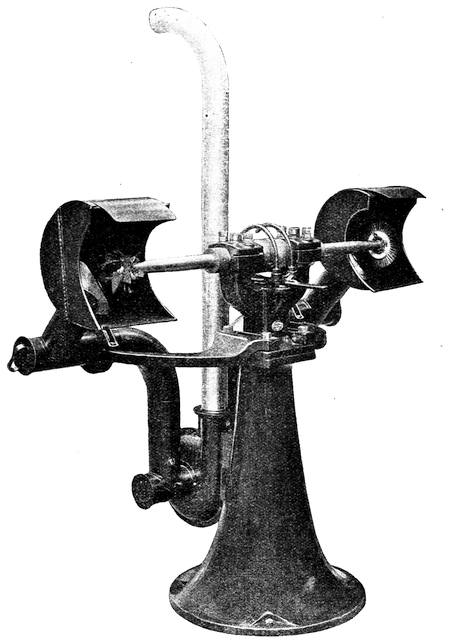
Fig. 53.
12. The Shaking Table.
The pasty chocolate mass fills itself into the chocolate moulds spontaneously, in consequence of its soft consistency. Yet to share it evenly throughout the mould, so that it adapts itself to every bend and hollow there occurring, and further to bring to the surface any possible bubbles of air evident in the mass, the chocolate is whilst still in the moulds subjected to brisk shaking.
This is effected by placing the chocolate on trays and transferring these to the shaking table, of which types and construction are at the present time manifold and various, the best and oldest being given in front elevation below (Fig. 54).
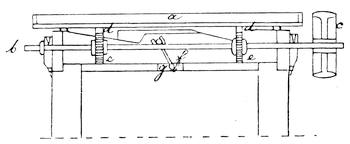
Fig. 54.
The movable slab a, fitted with an upright rim at its edges, has underneath two projecting pieces d, working against deeply toothed wheels e, which fastened on the shaft b, are driven round by the pulleys c. The teeth of the wheels catch on the projecting pieces at every revolution of the shaft and push them rather gently on one side, and when the tooth-points slide from under the slab, it drops down as much as it has been previously raised. Each tooth of the wheel coming into contact with the projections, the same motion is repeated several times, causing the slab to oscillate up and down.
This oscillation of the slab is controlled by means of a hand lever f, occurring on the shaft g, and fixed crosswise thereon, so that we can only show it in cross section on the diagram. The lever f attaches itself to the under part of the slab, raises it, and so throws the wheels out of contact with the projecting pieces, but without stopping the rotation of the shaft b.
Shaking tables have also witnessed considerable improvements with the lapse of time, and we shall now proceed to treat these in more detail, especially as several recent constructions offer and illustrate many interesting mechanical points.
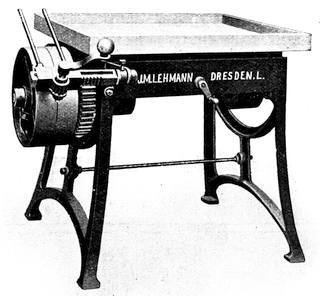
Fig. 55.
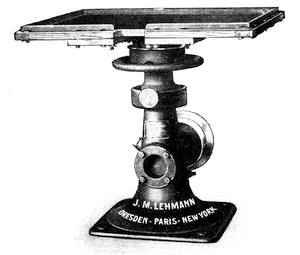
Fig. 56.
An old type of machine, that is nevertheless still much employed, is illustrated in fig. 55. Here the slab is caused to osculate by shaking wheels introduced underneath, each possessing six, eight, or more teeth. The slab is raised and lowered by contact with wedge-shaped parts, the effect produced being greater or less according as the moulds are large or small, heavy or light, and in proportion to the consistency of the chocolate mass which they contain, e. g. whether it is solid or semi-liquid.
Quite an improved construction is shown in fig. 56. Here the table is attached to a vertical axle, which is moved up and down by means of a toothed wheel fixed on its bottom end. There is also a cylinder arrangement under the whole machine to assist in controlling the vertical motion of the shaft, and as it is provided with automatic lubrication, there is no danger of any wearing out of the apparatus and consequent irregularity of functioning.
The shaking and jerking of the slabs is in itself attended by a considerable amount of noise, and when to this is added that caused by the tables, it will be seen that a chocolate factory may become to its neighbours a very serious source of objection. For years attempts have therefore been made to construct shaking tables, so that they would not cause any greater noise than is absolutely inevitable. Pneumatic contrivances and caoutchouc have met with right royal success in this connection.
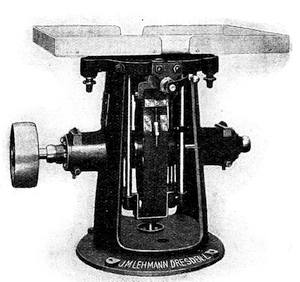
Fig. 57.
The most recent and probably the most perfectly constructed shaking table is given in figs. 57 and 57 a. It embodies all the latest improvements and is self lubricating, a fact of the highest importance as releasing the strain on the attendance, which would need to be very perfect to ensure absence of noise in the case of a machine making 800 strokes a minute. When it is considered that the moulding room is generally managed by girls who neither possess knowledge of, nor interest in, the machines, the advantages of such automatic lubrication become even more apparent.
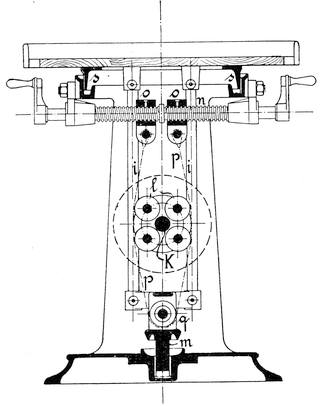
Fig. 57 a.
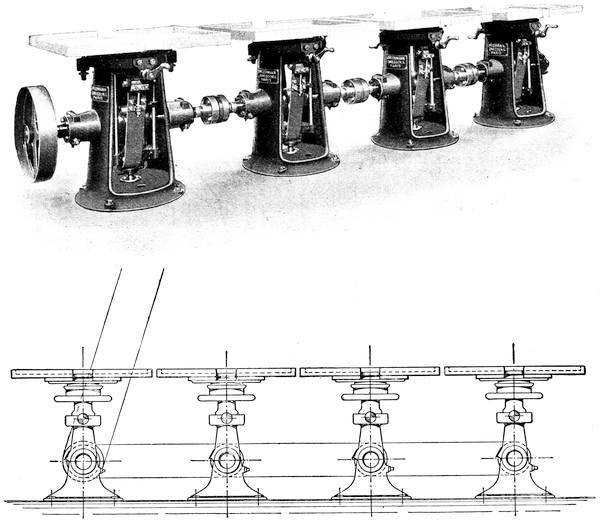
Figs. 58 and 58 a.
Apart from the automatic lubrication, in itself a sufficient guarantee for the efficiency of the machine, screws and nuts are entirely avoided on this machine. The motive mechanism is also interesting. By a special arrangement, the number of revolutions in relation to the number of the elevations of the slab is reduced to one fourth, viz., from 760 to 190. Since the elevation of the slab can be regulated to zero, a loose pulley for shifting the driving belt is unnecessary; in addition, the driving shaft makes only a small number of revolutions, and works in oil. The round shaped upright serves to carry the vertically moving frame i, which supports the slab moving in an oiled groove at s, and which is supported underneath by the pivot m. Both at m and s there is automatic lubrication. The bearings of the spindle n, attached to the upright, work into left and right screw threads at oo, to which points the ends of a broad leather belt p are attached, passing over the roller g, by which the frame i is suspended. The driving pulley k, running in oil, carries in its centre the four rollers l, which turn round and round the pulley k, so as to come into contact with the belt p and press it outwards on both sides. At the same time it shortens the belt in the vertical axle, so raising up the table slab i. This is repeated four times by one revolution of the driving pulley, so that working with 190 revolutions a minute, the slab is raised 760 times. According as the screws oo are moved to or from the centre, the vertical movement of the slab can be increased or decreased to a point when the slab is completely out of action, i. e. when the rollers l no longer touch the belt p. Under favourable local conditions, a number of such tables can be driven by one shaft, so that only one pulley and a single driving belt would be needed, though each table would work quite independently of the others. Such an arrangement is shown in figures 58 and 58 a.
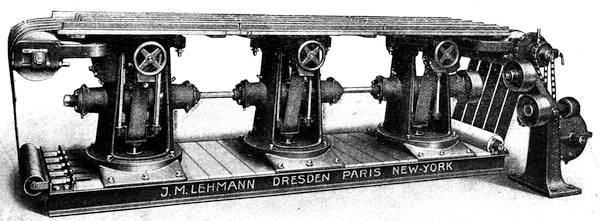
Fig. 58 b.
This shaking table, though only recently introduced, has quickly made itself popular, and is especially suitable for the preparation of readily liquefiable chocolate. The gentle vibratory motion produced by this shaking table and its exact adjustability admit of the thinnest cakes being made in a perfectly uniform thickness, without any objectionable projections round their edges. Besides the shaking tables of this construction there are others made in such a way that whether the moulds are light or heavy, small or large, the slab is always raised to the same height, the working of the slab being adjusted by altering the number of revolutions. The manipulation of these tables is much more difficult than that of tables constructed as above described, and that is probably the reason why these have for decades been scarce on the market.
The moulded chocolate spread out on trays is transferred as rapidly as possible to the cooling chamber, with which we shall conclude section IV.
Instead of several shaking tables alternately receiving the moulds, which involve frequent changes, so-called shaking systems (fig. 58b) have been generally adopted of late. They consist of a number of shaking tables, having their frames attached to each other, possessing a common motor control, and having their slabs arranged one after the other in such a way that the filled moulds slowly proceeding from the dividing machine can be automatically conducted over them. The shaken moulds are then passed on to further processes, or they enter the cooling chambers at once. The advantage of the shaking table system lies in a reduction of the number of hands, who only need to be in attendance at each end of the system, and further in the regularity, both as regards time and strength, which prevails in connection with the shaking of each mould.
13. Cooling the chocolate.
Experience has shown that the more rapidly the moulded chocolate is cooled the finer is its texture and the more uniform the appearance of the fractured surface. That is due to the formation of smaller crystals of the fat when the cooling is rapid, while in slow cooling larger crystals are formed and the fracture consequently becomes dull and greyish.
Formerly it was possible to distinguish chocolate made in summer from that made in winter by the more uniform appearance of the fracture, that was, in the latter case, the result of more rapid cooling.
At present, however, manufacturers are no longer dependent upon favorable atmospheric conditions in that respect, for by suitable arrangements it is now possible to produce the reduced temperature requisite by artificial means.
The most suitable cooling chamber is an underground space which should, however, be so situated as to be in convenient communication with the moulding room. The cheapest and simplest place for a cooling chamber is a cellar, if it be properly constructed and dry, as well as large enough to contain the quantity of chocolate made in one day’s working. The best temperature to be kept up ranges from 8° to 10° C. Within those limits there is no danger of the chocolate being coated with moisture, or that it will acquire a coarse grained texture by lying too long. The following rules will serve for guidance in regard to this point:
Generally, chocolate presents the finest fracture when it has been fully levigated and when it contains a considerable amount of fat, provided that the fat present is only cacao butter. Those kinds which are not so well levigated, or have had some addition of foreign fat of higher melting point, show an inferior fracture. It is possible to obtain an equally vitreous fracture in a less cold cellar (16° C. and upwards) when the chocolate is moulded at a temperature corresponding to that of the cellar; to effect that, the chocolate should be moulded at a proportionally lower temperature the warmer the cellar is. The difference can be seen by the appearance of pale red spots on the surface. When it is desired to dispense with artificial cooling, the cellar should be as much as possible below the surface of the ground; it should also be of sufficient height, not less than 3 m. If the situation and height of the cellar be properly adjusted, the requisite area for disposing of a daily production amounting to 5000 kilos would be 400 sq. m. The cellar must be well ventilated and furnished with double windows, so placed as to open towards the north and east. Discharges of warm waste water, as well as steam pipes or furnaces should be kept as far distant from the cellar as possible. The internal arrangement of the cellar should be of such a nature that the whole of the chocolate to be cooled can be deposited upon the floor, since that is the place where cooling takes place most rapidly. With that object in view it is desirable to construct brickwork pillars about 25 cm high, covered with white tiles. Passages are arranged between these pillars. The cellar should be entered by as few persons as possible and, therefore, the cooled cakes of chocolate should be taken at once, in the moulds, to an adjoining room to be turned out and passed on to the packing room and store.
Most of the existing factories, that have been established for any time (large and small) have had to adopt artificial means of cooling, because in most instances the quantity of chocolate to be cooled daily has, in course of time, increased tenfold. The machine rooms have been enlarged, the number of machines has also been increased, while the cooling cellar has remained in its formerly modest proportions. But those circumstances are not the only reasons for having recourse to artificial refrigeration, which is often necessary in consequence of the inconvenient situation of the cellar and the high underground water level.
In the application of artificial refrigeration in a chocolate factory it is not advisable to hasten the cooling of large quantities by producing too low a temperature in small chambers. The cakes of chocolate mass by that means come out of the moulds as hard as glass, but it is questionable whether the consumer using the chocolate many months afterwards, will make the same observation. Great care would have to be taken with such rapidly cooled chocolate, to pass it gradually through chambers of a medium temperature and thus prepare it for exposure in the packing rooms and warehouses. Even when employing artificial means for cooling, the reduction of the cellar temperature and cooling upon pillars is to be preferred to the more direct cooling upon a system of pipes, which after all is nothing else than a cooling upon ice, as may be in some instances the only alternative. Consequently, a well constructed cellar for cooling, furnished with a system of cooling pipes on the roof is perhaps the most advantageous arrangement, especially for large factories.
In carrying out artificial refrigeration various kinds of machines are used for reducing temperature, in which the desired effect is produced either directly by the condensation and evaporation of suitable materials, such as liquid carbonic acid, ammonia, sulphurous acid, or indirectly by making saline solutions (calcium chloride), cooled below the freezing point, circulate through a system of pipes fitted on the roof or walls of the space to be cooled. As the cold liquid is pumped through the pipes, it takes up heat from the air in contact with them, correspondingly reducing the temperature of the cooling chamber. The cooling installations of the firm of C. G. Haubold, junior, Chemnitz, are among the best and have long been extensively used in the chocolate industry. Their cooling apparatus is a compressing machine, in which coolness is obtained by the evaporation and recondensation of such liquid gases as carbonic acid or ammonia. Like all compressing machines, it is comprised of three main parts.
I. The evaporator or refrigerator, consisting of a wrought iron system of pipes. The latter are placed in the spaces of the plant to be cooled, with a so-called direct evaporation arrangement, and are either arranged on the walls and ceiling, or built in a special chamber as dry or moist air coolers, according to the quality of the chocolate to be cooled, or the use for which it is destined. Whilst in the former case cooling is effected directly in the rooms, in the latter the air of the cooling room is conducted to the air coolers by means of ventilator, in order to be cooled and dried there, and then again introduced in the chamber.
II. The compressor, a gas suction and pressure pump, working both simply and complex, which draws the refrigerating medium out of the evaporator, compresses it, and forces it along to the condenser.
III. This condenser consists of a coil of wrought iron or copper pipes, which are enclosed in a barrel and are often described as the immersion condenser. There is another type, in which the pipes are united to one or more pipe-walls, introduced in a vessel which collects and drains off the condensations. In both cases the coil of pipes is played upon by a continual stream of water, in order that the gases which they contain may be condensed. The immersion condenser is generally employed when there is a plentiful supply of cheap water at hand, and the other in contrary cases. This latter condenser is provided with a separate liquid “after-cooler”, constructed on analogy with the before mentioned immersion condenser. The counter current principle holds good in both types, and admits of a better using up of the cooling water. The liquid gas then passes on to the evaporator, where it is responsible for further refrigeration.
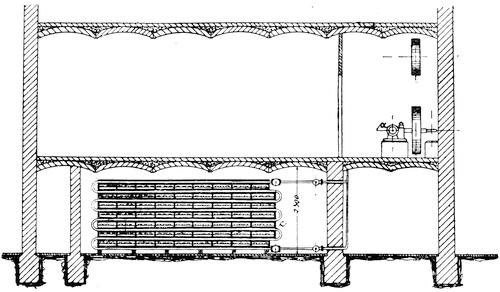
Fig. 59a.
The refrigerator also occurs in the form of a brine cooler. In this construction the evaporating pipes are likewise enclosed in a barrel, containing a high percentage of salt brine. In consequence of the refrigerating apparatus occurring on the interior of the pipes, the brine contained therein is cooled down to a very low temperature, pumped along to the cooling chambers, and after delivering its alloted refrigeration unit re-conducted to the cooling apparatus, where it is once more subjected to the same series of processes.