Part 4 / Book 5 — Book 5. Appendix.
Reading edition
A. Installation of a chocolate and cacao powder factory.
In constructing a new factory and fixing the situation of the buildings, the first thing to be considered is their convenient arrangement. It is therefore advisable to rely upon an experienced person for the plan to be adopted, and then to leave the proper construction of the works in the hands of the architect. Small operations can be carried on in any building, but in the case of larger works a well devised arrangement of the machines and appliances must be decided upon before hand, that will admit of rational and, to some extent, automatic working. In case of erecting small works which will require only one manager, the best plan would be to have the whole manufacture carried out on one story, or at the most two stories, to facilitate supervision.
The case is different with large works, in which the different departments are controlled by especially qualified persons.
Tables I and II236 represent, in section, a chocolate factory and a cacao powder factory. As both plans represent only a model section, they serve only to show the most convenient arrangement of the machines with each other. In reality there would be more or less machines of the same kind placed together. Such arrangements might, with modifications, serve for medium sized works, as well as for larger ones. In that sense the following explanations of the two plans are to be understood.
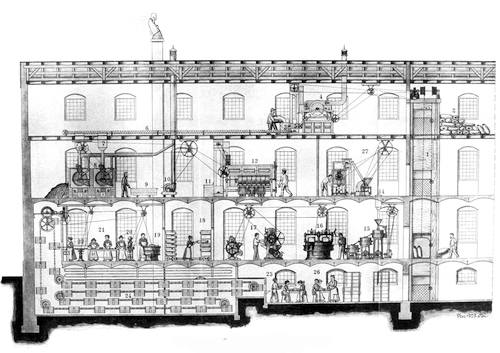
PLATE II
Longitudinal Section of a model Chocolate Factory For explanation of figures see text.
Zipperer, Manufacture of Chocolate etc. 3rd edition. Verlag M. Krayn, Berlin W. 10.
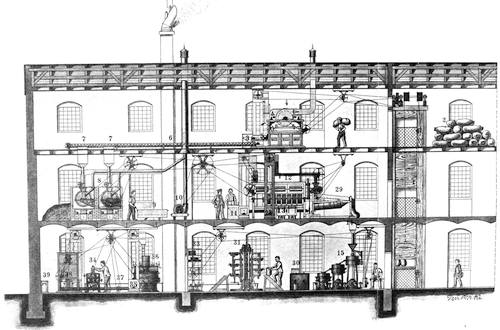
PLATE III
Longitudinal Section of a model Cocoa Factory For explanation of figures see text.
Zipperer, Manufacture of Chocolate etc. 3rd edition. Verlag M. Krayn, Berlin W. 10.
1. Chocolate factory (Table I).
By means of the lift (1) all the raw materials, sugar, cacao, packing materials, etc. are carried up to the store rooms (2). In these occur the machines for cleansing and picking the raw cacao beans. The raw cacao is fed into the elevator boxes (3), above the cleansing machine (4) where it is freed from dust; it passes to the continuous band (5) where it is picked and then falls into the movable boxes (6). It is then transferred to the hoppers (7) and is fed, by opening a slide in the hoppers, into the roasting machine (8). The capacity of the hoppers is sufficiently large for holding the quantity of beans for charging the roasting machine. After the roasting is completed, the cacao is emptied into the trucks (9) and carried to the exhaust arrangement (10) where the beans are cooled down and the vapour given off is passed out into the open air. At the same time, the roasting chamber is sucked out through the funnel shaped tube fitted to the cover of the chamber. The roasted cacao is then passed to the boxes (11) to be conveyed by the elevator to the crushing and cleansing machine (12). After being cleansed, the cacao is carried in trucks (13) to the hoppers (14) by which they are fed into the mills (15) in the lower floor. The sugar mill and the sifting apparatus (27) placed near the crushing and cleansing machines are also fed by a hopper from above. The dust sugar, there produced, is carried by the lift (1) to the machine room on the first floor. Cacao and sugar are there supplied to the incorporator (16) to be worked together, before being passed to the rolling mill (17), where the final rubbing is effected. After passing once or oftener through the mill, the finished chocolate mass is then taken to the hot room (18) where it remains in boxes until further treated and it is then taken to the moulding room. In the incorporator (19) the mass acquires the consistence necessary for moulding and also the requisite temperature. The mass is then taken in lumps to the dividing machine (20) and cut into pieces of the desired size and weight. On the table (21) the moulds, lying upon boards, are filled with the pieces of chocolate and they are then taken to the shaking table (22).
From this they succeed to the cooling arrangement, which consists of an endless chain provided with travelling stages at definite and regular intervals. The latter moves slowly through the artificially cooled room and finally brings the moulds to the outlet (25) where the chocolate is removed. It is then transferred on the lift to the packing and despatching apartments specially reserved for these operations, but not distinctly noticeable on our section.
2. Cacao powder factory (Table II).
The course of manufacture of cacao powder is the same as in the manufacture of chocolate, up to the point where the cacao has passed through the crushing and cleansing machines (12). The broken beans are then taken by the elevator (27) to the machine for separating the radicles (28) and thence through the hopper (14) to the mills (15). The liquid cacao mass, passing from these mills, runs into the pans (29) from which as much required for charging the hydraulic presses as is can be drawn up by cocks. The accumulator (31) supplies all the presses with water. The pressed cakes are first put into the boxes of the frame (32). In an adjoining room is the automatic cacao pulverizing apparatus. It is fed through the preliminary crusher (34) from which the cacao is taken by the worm and elevator (35) to the pulveriser (36). The powdered cacao is then taken by a worm and elevator to the sifting machine (38).
The sifted powder falls into the tub (39) while the coarser portion is carried back again to the pulveriser (36). The arrangements for treating and the disintegrating cacao powder can be provided in the manner already described.
In both plans, the boiler and engine house are to be understood as placed in an adjoining building.
Appendix
Containing an account of the methods of preparation and the composition of some Commercial dietetic and other Cacao preparations.
The following statements and recipes have no pretension to be complete; they are only introduced to serve as a brief summary of those commercial cacao preparations, now in commerce, which are mixtures of various kinds of substances with cacao or chocolate and are largely used for dietetic purposes. Notwithstanding its necessary incompleteness, the following account, which has been collected from various sources, will satisfy practical requirement, since the manufacturer, as well as the food chemist, frequently desires to obtain information at once, that even a complete technical library is not always able to supply. Medicinal chocolates have not been considered in the following list, since they belong to the province of pharmacy.
>
Acorn-cacao Michaelis’ contains according to an analysis by R. Fresenius: Total nitrogen 2·29 percent, albumin 8·13 percent, sugar 25·17 percent, starch 23·39 percent, fat 14·42 percent, tannin, expressed as gallotannic acid 1·96 percent, cellulose 1·88 percent.
Acorn-cacao of Hartwig & Vogel of Dresden contains water 7·5 percent, ash 3·88 percent, fat 16·54 percent, albumin 11·25 percent, carbohydrates 38·76 percent, tannin 2·50 percent.237
Acorn-cacao of Th. Timpe of Magdeburg contains in the dry substance: albumin 13·88 percent, tannin and cacao-red 5·37 percent, carbohydrates etc. 66·41 percent, fat 10·62 percent, ash 3·73 percent.238
Acorn-cacao can be prepared by mixing 10 parts of pure cacao mass, 20 parts defatted cacao powder, 5 parts roasted barley meal, 35 parts of the meal from shelled and roasted acorns (or 10 parts of an aqueous extract of roasted acorns), 30 parts powdered sugar, and 2 parts pure calcium phosphate.
Acorn-chocolate is a mixture of 100 parts shelled and roasted acorns with 500 parts sugar and 400 parts cacao mass in addition to spices.
Acorn-malt-cacao (Dieterich) is prepared by mixing 1 kilo of acorn malt extract (Dieterich-Helfenberg) with 6 kilos of sugar (dust), and 3 kilos defatted cacao.
Acorn-malt-chocolate (Dieterich) is prepared by accurately mixing 2 kilos acorn malt extract (Dieterich-Helfenberg) with 3½ kilos of powdered sugar and 4½ kilos of cacao mass.
Albuminous chocolate and cacao. Riquet & Co. of Leipsic have protected a process by various patents239 for “The production of a tasty and genuine chocolate or cocoa powder240 rich in albuminous constituents.” The kernels of the thoroughly roasted bean are worked up with a mixture (?) of water and dry albumen, allowed to stand for some time, the water evaporating, and then the beans are worked up once more. Instead of water an aqueous sugar solution may also be employed, and further the addition of albumen may occur at any stage241 and in particular when sugar solution is first taken, then the albumen and sugar necessary for the chocolate mixed up, and finally the cacao material (with additions of cacao oil) added. Still better (than the sugar solution) would it be, if the albumen were incorporated in the chocolate or cocoa material in the form of a mixture with some emulsion (!), especially a mixture with milk.
Barley-chocolate is prepared by mixing 1 kilo of prepared barley meal242 4½ kilos powdered sugar and 4½ kilos cacao mass. The moulded chocolate is to be coated with varnish.
Cacao and chocolate preparations containing milk are prepared according to A. Denayer, Brussels (German patent No. 112220, 4 February 1899) by evaporating, in the open air, a mixture of milk and sugar to the consistency of cream, and to the hot mass, defatted or not defatted cacao is added in the form of powder. The resulting mixture is spread out in thin layers and exposed to the influence of a temperature of 80-100°C. in a rarefied atmosphere, then finally completely dried at a lower or ordinary temperature under the same conditions.
Cacao-egg-cream (so called African punch) is thus prepared: 10 yolks of eggs are beaten up with 300 grammes of syrup (1 part sugar to 2 parts water) and, whilst being continually whisked up, 500 grammes of cacao essence (see next paragraph) are added. The whole is to be iced before being consumed.
Cacao-essence is prepared by macerating 125 grammes of defatted cacao, 2 grammes vanilla, 2 grammes cinnamon, 0·75 gramme cloves, 0·3 gramme mace and 0·10 gramme of ginger with 750 grammes of proof spirit and 250 grammes of water for 8 days, and then filtering into hot syrup, which is prepared with 550 grammes of sugar and 750 grammes water.
Cacao-liqueur. A well tested recipe for the preparation of this liqueur is to the following effect: Defatted cacao 200 grammes, cinnamon powder 5 grammes, vanillin 0·2 gramme, are digested for 6 days with 1500 grammes of water and 1700 grammes of alcohol (90%) and then mixed with 2600 grammes syrup (1400 parts sugar and 1200 parts of water) and filtered.
Cacaol, 70 parts cocoa powder, 10 parts oatmeal, 17·5 parts sugar, 2·5 parts common salt.
Cacao-malt is a mixture of 200 parts defatted cacao, 500 parts sugar with an aqueous extract of 300 parts of kiln dried malt.
Cacaophen Sieberts (Cassel) is a mixture of cacao powder with flour, sugar and milk albumin. It shows the following numbers on analysis: fat 13·23 percent, water 7·7 percent, albumin 24·25 percent, soluble carbohydrates 17·95 percent, insoluble carbohydrates (starch) 26·66 percent, woody fibre 2·27 percent, ash 5·5 percent (calcium oxide 0·82 percent, phosphoric acid (P3O5) 0·54 percent).
Children’s-Nährpulver (Lehmann-Berlin) is a mixture of meat extract, cacao powder, salep, sugar and specially treated oyster shells.
Chocleau, (Reichardt) a glucose chocolate material in tin tubes.
Chocolate-cream-syrup (for aërated waters): 125 grammes of rasped chocolate, 62 grammes cacao powder and 325 grammes of water are well mixed and to this add 148 grammes infusion of quillaia (1·8). After standing some time add the contents of a pot of condensed milk with 7·5 grammes of boric acid and make up with 3·8 litres of sugar syrup (american recipe).
Chocolat digestif (Vichy chocolate) is a mixture of chocolate with about 5 percent of sodium bicarbonate.
Chocolate-health-beer, J. Scholz (German patent No. 28819). An extract is prepared from 10 kilos of cacao beans, which have been kiln-dried at 75° C., shelled, broken in small pieces and digested for half an hour with twice their weight of distilled water at 62° C., then boiled for another half an hour and finally allowed to stand for 48 hours at a temperature of 75° C., with an addition of a solution of 10 kilos of sugar in distilled water, then once more boiled until one half of the water, originally added, has been evaporated. It is filtered, in as warm a condition as possible, in order to separate pieces of cacao and fat, and the extract is ready for use. The brewing process is similar to that of brewing Bavarian beer. After the finished wort obtained in that process has been boiled for 3 hours, 100 litres are taken, for which 35 kilos of pale kiln-dried barley meal have been used, and to this are added 200 grammes of the best Bavarian hops and 12 kilos of cacao extract. The whole is once more boiled and the subsequent operation then carried out as usual. The fermentation (at 7·5° C.) occupies 7-8 days and the storage in the fining vats 3-4 weeks.
Chocolat rétablière, a Vienna speciality, contains reduced metallic iron, dried meat, pea and wheat flour, sugar and cacao in uncertain proportions.
Chocolate-syrup (for soda and seltzer water). 250 grammes of defatted cacao powder are rubbed down with 2½ litres of boiling water in a porcelain basin on a steam bath, until it is in the condition of an uniformly thick mass and then 1 kilo pot of condensed milk and 2·5 kilos of powdered sugar are added, and when the sugar is dissolved the vessel is cooled. After cooling, the fatty particles on the surface are carefully removed, and then 30 grammes of commercial vanilla extract and 30 grammes of mucilage (from gummi arabicum) are added, and the whole filtered through a stout cotton cloth (american recipe).
Chocolate-tincture (cacao-tincture) is prepared by macerating 1½ kilos of defatted cacao powder with 10 kilos of dilute alcohol for 8 days and then filtering.
Corn-cacao contains according to Notnagel243: water 6·10 percent, fat 16·96 percent, albuminoids 19·81 percent, theobromine 0·68 percent, fibre 3·30 percent, non-nitrogenous extractives 48·69 percent, ash 4·46 percent. The preparation under the microscope is shown to contain, in addition to the constituents of cacao, a large amount of oat starch, and it may be regarded as corresponding to a mixture of equal parts of defatted cacao and oat meal, based on the above analysis and König’s mean value.
Covering or coating materials have the following composition: 50% sugar, 30-35% fat and 20-15% cacao material free from fat, whereby (especially in Belgium, e. g. Brussels) it is in part supplanted by almonds, nuts etc. In such cases the iodine value of the fat is equal to 41-42.
Diabetic chocolate has the following composition.244 Nitrogenous substance 10·07 percent, fat 25·47 percent, levulose 19·38 per cent, starch and cellulose 25·19 percent, besides non nitrogenous substances 14·54 percent, saccharin 0·5 percent, mineral constituents 2·15 percent.
In this formula there is a disproportionately high percentage of starch and cellulose and, in that respect, the composition appears to be irrational, since the introduction of carbohydrates into food for diabetics should be avoided as much as possible. A more rational preparation would be a simple mixture of:
50 parts levulose | 50 parts cacao mass, and 0·25 parts vanillin.
Aufrecht’s recipe for diabetic cacao is as follows:
cocoa powder 500 grammes
levulose 200 "
wheat flour 280 "
saccharin 5 "
aromatic substances 15 "
In this recipe, also, the substitution of levulose for wheat meal is to be recommended.
Diabetic cacao can be prepared according to J. Apt of Berlin by the following patented process (German patent No. 116 173, 30. 1. 1900). The starch is first gelatinised by long boiling of the coarsely powdered cacao, the mass then dried in a vacuum and heated, or roasted at 130 to 140° C. in order to caramelise the gelatinised starch (!). Before being boiled, it is recommended to de-fat the cacao (with petroleum ether, for example!). Instead of caramelising the gelatinised starch by heat direct, it can be first converted into sugar by means of acid, then heated to caramelisation and as much cacao fat added as may be desirable. In order to increase its capability of emulsifying, dried albumin is to be added.245
Dictamnia of Groult and Boutron-Russel is composed of cacao, prepared wheat flour, starch, sugar and vanilla.
v. Donat’s albumin chocolate (German patent No. 82 434) is prepared by mixing dried albumin in powder or in pieces with chocolate or cacao mass, damped with a liquid medium, which does not dissolve albumin, such as benzol, petroleum ether, ether, acetone, methyl or ethyl alcohol. The mass is further treated in the mixer and finally after being completely mixed, the added liquid is allowed to evaporate.
Eucasin-chocolate and cacao are preparations containing 20 percent of eucasin (ammonium caseinate). Eucasin is prepared by Majert & Ebers of Grünau-Berlin.
Galactogen-Cacao, Thiele & Holzhause-Barleben near Magdeburg, contains 30-32 percent of galactogen, an easily soluble and natural preparation of milk albumin, which is prepared from skimmed milk and contains 70 percent albumin, 3·5-4 percent fat as well as 1·5-1·79 percent phosphoric acid. Galactogen-amylaceous cacao, contains wheaten flour in addition to 20-22 percent galactogen. Galactogen-Speise-Schokolade (eating chocolate with 30 percent galactogen and Galactogen-Koch-Schokolade (cooking chocolate) are also prepared.
Plasmon, Jropon, Somatose and lacto-egg-powder are similar products to galactogen, and are met with in commerce combined with cacao mass and chocolate (see plasmon cacao).
Gaugau is a children’s tea (Vienna) and consists of cacao husk.
Haema chocolate: 25-30 parts cocoa powder, 25-20 parts meal (potato starch), 45 parts sugar, 5 parts haemoglobin and common salt.
Hansa-Saccharin-Cacao is defatted cacao, which contains about 0·5 percent saccharin (270 times as sweet as sugar), 30 percent fat and 20 percent albuminoids (Hahn-Holfert).
Hardidalik, an Asiatic chocolate, is composed according to Chevallier of 42 parts cacao, 180 parts sugar, 112 parts starch flour, 64 parts rice flour and 3 parts vanilla.
Hensel’s Nähr-Cacao, is a mixture of defatted cacao-powder with various inorganic salts, such as calcium carbonate and phosphate; the ash of this preparation was found to contain a larger amount of sulphuric acid, soda and iron, than is present in normal cacao. The fat amounted to only 5·3 percent.
Homeopathic-Chocolate of E. Kreplin, Lehrte, consists of 35 percent pure cacao mass, 20 percent slightly roasted wheat flour and 45 percent sugar (Hager).
Husson’s Mixture contains the following materials: Arrow root 500, oat meal 500, powdered sugar 500, powdered sago 400, cacao 50, calcium phosphate 50, vanilla 1.
Hygiama resembles cacao in appearance and flavour and was introduced into commerce by Dr. Theinhardt’s Nahrungsmittel-Gesellschaft of Cannstatt (Wurtemberg). It is prepared from condensed milk with the addition of a specially prepared cereal and defatted cacao. It contains 22·8 percent of albumin, 6·6 per cent. fat, 52·8 percent soluble carbohydrates, 10·5 percent insoluble carbohydrates, 2·5 percent food salts, 4 percent moisture.
Iceland-moss-chocolate contains 10 percent of iceland moss gelatine.
Kaïffa (Fécule orientale) is a mixture of 500 parts cacao mass, 1250 parts rice flour, 250 parts groats, 250 parts Iceland moss gelatine, 2300 parts starch, 750 parts salep, 1000 parts sago, 6000 parts sugar and 50 parts vanilla.
Kola-Chocolate is prepared by mixing 400 grammes of cacao mass, 450 grammes sugar, 100 grammes kola seeds in powder, 40 grammes cacao fat and 5 grammes vanillin sugar (3 percent).
Kraft-Chocolate (Mering’s). This is a trade preparation in which cacao butter is converted into an emulsion, probably by means of oleic acid, and is thus rendered more digestible. Kraft-chocolate should contain 21 percent of easily digestible fat.
Lipanin-Chocolate contains 42·38 percent fat, albumin 8·07 percent, starch 2·7 percent, sugar 31·44 percent, in addition to non-nitrogenous substances 18·19 percent, ash 0·68 percent, as well as some vanillin and Peruvian balsam (Aufrecht).
Malt-cacao according to Franz Abels (German patent No. 96 318, 9. May 1896) is prepared in the following manner: The cacao mass after being mixed with malt meal is defatted by strong hydraulic pressure in order that the malt may be permeated with cacao fat. It is then pulverized.
Malt-cacao-syrup or malted chocolate is prepared by mixing 240 grammes malt extract and 24 ccm vanilla extract with about 950 grammes of chocolate syrup. Vanillin or essence of cinnamon may be used instead of vanilla extract. This preparation serves for the making of american effervescing lemonade.
Malt-chocolate. 2 kilos of finely powdered malt and 3½ kilos powdered sugar, both well dried, are mixed in small quantities with 4½ kilos cacao mass in the mixing machine. The tablets are to be coated with varnish to preserve them. (E. Dieterich.)
Malt-extract-chocolate. 4½ kilos of the finely rubbed down cacao mass, contained in the mixing machine, are intimately mixed with 1 kilo dried malt extract and 4½ kilos powdered sugar. The finished tablets are to be coated with varnish. (E. Dieterich.)
Malto-leguminose-cacao gives the following numbers on analysis: water 7·38 percent, nitrogenous substance 19·71 percent (18·26 percent digestible), theobromine 0·71 percent, maltose 1·88 per cent., dextrin etc. 3·53 percent, starch 27·82 percent, besides non-nitrogenous extractives 13·8 percent, fibre 2·36 percent, ash 4·94 percent potash 1·74 percent, phosphoric acid 1·51 percent.
Meat-extract-chocolate is prepared by placing 500 grammes of meat extract (Cibil’s or Liebig’s) in a porcelain basin and evaporating as much as possible on the water bath: 4·7 kilos of powdered sugar are then added and the whole rubbed down with the pestle until the extract is homogeneous. 5 kilos of cacao mass are added and the chocolate finished in the mixer. The moulded tablets must be coated with varnish (Dieterich).
Milk-cacao is prepared with 1 kilo of condensed milk (prepared in a vacuum with the addition of 10 percent of milk-sugar246 500 grammes milk sugar and sufficient powdered arrowroot to produce a paste, which is then rolled out, broken up and lightly baked. This milk biscuit is ground and passed through a fine hair sieve. 750 grammes of the pulverized milk biscuit are then carefully mixed with 250 grammes of defatted cacao and 10 grammes of an aromatic mixture and the preparation finally preserved in metallic boxes.
A more bitter milk-cacao can also be prepared with 50 kilos cacao powder and 50 kilos pure milk powder. This proportion may also be varied, so that more milk powder may be used, as for example 40 kilos cacao powder and 60 kilos pure milk powder or 30 kilos cacao powder and 70 kilos pure milk powder.
A sweet-milk-cacao can be obtained thus:
a) 30 kilos cacao powder,
20 " powdered sugar,
50 " pure milk powder
b) 20 kilos cacao powder,
30 " powdered sugar,
50 " pure milk powder,
c) 15 kilos cacao powder,
35 " powdered sugar,
50 " pure milk powder.
Milk-chocolate is prepared with 28 kilos of cacao mass, 36 kilos of powdered cane sugar, 24 kilos of milk powder and 12 kilos of cacao butter. The material is very finely rolled at 60-70°C. in the grinding machine described on page 000, and the finished mass not allowed to remain in the hot closet, but almost immediately moulded and packed. The mild kinds of cacao (Ariba, Caracas, Ceylon, Java) are the most suitable for making milk chocolate.
In the manufacture of pure milk cacao, the cacao powder is worked up for some time in the warmed mixing machine, the sugar and the milk powder being added successively. Cacao preparations, which are only used as beverages with water, should have at least two parts of pure milk powder to one part of cacao powder in order to yield a suitable preparation.
Mutase-cacao with 20 percent mutase: contains water 5·66 percent, fat 25·24 percent247, albumin 28·31 percent, fibre 3·81 percent, theobromine 1·67 percent, non-nitrogenous extractives 30·72 per cent., ash 6·26 percent.
Mutase-chocolate (with 20 percent mutase) contains 16-17 percent of albumin. Mutase is an albumin preparation obtained, without the use of chemical reagents, from nutritive plants, also containing the nutritive salts of the plant (10 percent). Mutase contains 60 percent of albumin.
Nährsalz-cacao (Lahmann), i. e. “Food-salt cacao It contains water 8 percent, nitrogenous substance 17·5 percent, theobromine 1·78 percent, fat 28·26 percent, starch 11·09 percent, non-nitrogenous extractives 26·24 percent, fibre 4·21 percent, ash 4·7 percent (potash 1·66 percent, phosphoric acid 1·56 percent). Nährsalz-cacao or chocolate is prepared by mixing a vegetable extract (from leguminous plants) with cacao or chocolate. The analysis of Lahmann’s Nährsalz-chocolate gave the following numbers: fat 24·5 percent, ash 1·36 percent, water 1·08 percent, albumin 6·25 percent, phosphoric acid (P2O5) 0·44 percent.
Nähr-und Heilpulver. (Food and health-powder) of Dr. Koeben contains sugar, cacao, pollards and acorn coffee. (Hager’s Handbuch der Pharmaceutischen Praxis.).
Natur-cocoa and natur-chocolate (natural cacao etc.) Spindler, Stuttgart (German patent No. 47226) are obtained by mixing cacao mass with hot honey. This effects a defatting of the cacao mass by spontaneous separation of the fat. The defatting can be suitably carried further by pressing. Instead of using honey, the defatting can be carried out with syrups, malt extract, condensed milk, fruit juices or plant mucilage (extracts from pulse).248
Nuco-cocoa is a mixture of cacao with “nuco”, which is a highly praised preparation of albumin. The analysis of nuco cacao gave ash 4·06 percent, moisture 6 percent, fat 15·23 percent, albumin 47 percent, the iodine value of the fat is = 86. The fragments of tissue under the microscope appear completely analogous to that of earth nut (arachis hypogaea). Nuco-cacao is consequently nothing more than a mixture of defatted cacao with defatted earth nut (earth nut cake).
Oat-cocoa, Hallenser (half and half) contains 6·5 percent moisture, 4·1 percent mineral constituents, 89·4 percent organic substances (containing 4·3 percent nitrogenous matter) digestible albumin 14·7 percent, fat 17·2 percent, theobromine 0·77 percent, starch and other non-nitrogenous extractives 48·93 percent, cellulose 3·5 percent. This is evidently a mixture of equal parts of oat meal and cacao powder as the name implies.
Oat-cacao Kasseler (Hansen & Co.) is prepared according to the German patent No. 93500, 28th June 1896, by mixing oat meal with cacao. This mixture is moulded, pressed and, after being wrapped in perforated tin foil, defatted by ether. It contains 7·2 percent moisture, 3·5 percent mineral substances, 89·3 percent organic substances, which are composed of nitrogenous substance 3·9 percent digestible albumin 18·8 percent, fat 18·3 percent, theobromine 0·46 percent, starch and other non-nitrogenous extractives 44·94 percent, cellulose 2·9 percent.249 It is likewise a mixture of 50 percent of oat meat with 50 percent of cacao.
Oat-cocoa can be simply prepared by mixing cacao powder with an equal part of prepared oat meal, such as is produced by Hohenlohe’s Präservefabrik, by Knorr of Heilbronn and by the Quaker Oats Company. In order to cover the taste of the oat meal 1-2 percent of sodium chloride is to be added.
J. Berlit, German patent No. 72449, describes the following method for the preparation of oat-cacao, Oats are cleaned, bruised, slightly roasted and ground. The powder is wetted and by means of a kneading machine worked up to a paste which is dried in a vacuum, finally ground and mixed with defatted cacao in the required proportions.
Palamoud des Turcs consists of cacao mass, rice-meal, starch and sandal wood.
Peptone-cocoa contains: water 4·08 percent, nitrogenous substance 20·56 percent, albumose 8·25 percent, peptone 4·41 percent, theobromine 1·03 percent, sugar 49·51 percent, besides non-nitrogenous constituents 9·37 percent, woody fibre 1·43 percent, mineral substance 4·17 percent (potash 1·97 percent, phosphoric acid 1·21 percent).
Peptone-powder-cocoa (20 percent) is prepared by mixing 20 parts of Koch’s meat peptone in the form of extract with 50 parts of sugar and 40 parts cacao powder.
Peptone-chocolate contains 10 percent of dry peptone.
Plasmon-chocolate and cocoa contains 20 percent plasmon250 (Siebold).
Racahout des Arabes see page 00, note.
Raspberry chocolate (Sarotti), German patent 181760 and 204603, prepared with addition of the juice of the raspberry.
Saccharin-cocoa gives the following results on analysis: water 7·26 percent, nitrogenous substance 20·5 percent, theobromine 2·09 percent, fat 32·25 percent, saccharin 0·4 percent, starch 13·02 percent, non-nitrogenous extractives 13·51 percent, woody fibre 5·27 percent, ash 5·93 percent, (potash 2·16 percent, phosphoric acid 1·69 percent). See also Hansa-Saccharin-cacao on page. 00.
Somatose-cocoa with sugar and somatose-chocolate contains about 10 percent somatose251; the first preparation contains 20·71 per cent total nitrogenous substance, and the latter 10·24 percent, of which about 1/3 consists of soluble nitrogenous compounds. (Mansfeld.) The first preparation could be readily prepared by mixing 10 parts of somatose (Farbwerke Bayer &. Cie., Elberfeld) with 50 parts of sugar and 40 parts of cocoa powder.
Theobromade (theobromine) is a dry extract from cacao husks.
Dr. Thesen’s Proviant comes into commerce in the form of chocolate and is chocolate with an addition of albumin. Its analysis gives the following results: Albumin 20·5 percent, theobromine 0·56 percent, fat 39·79 percent, carbohydrates a) (soluble) 26·95 per cent, b) (insoluble) 5·66 percent, ash 2·25 percent, water 1·57 percent. A similar product to Thesen’s Proviant results from mixing: albumin 12·5 parts, fat (cacao butter) 10 parts, fat (cocoa nut butter 7·5 parts, sugar 25 parts, cacao 45 parts.
Tropon-cocoa is a varying mixture of tropon, 15-33-1/3 percent, with cacao powder. A tropon cocoa containing 20 percent of tropon gave on analysis: water 5·75 percent, albumin 38·49 per cent., fat 27·77 percent, fibre 3·76 percent, ash 4·51 percent, theobromine 1·6 percent, extractives 22·78 percent.
Tropon-chocolate is a chocolate containing 25 percent tropon.252
Tropon-Oat-cocoa contains 20 percent of tropon, 30 percent of oat meal and 50 percent of cocoa powder.
Wacaca des Indes consists of 60 parts cacao powder, 165 parts sugar, 8 parts cinnamon, 2 parts vanilla and some tincture of ambergris.
White chocolate contains sugar 3000 parts, rice meal 860 parts, potato flour 250 parts, cacao butter 250 parts, gum arabic 125 parts and vanilla tincture 15 parts.253
A. Index to literature.
In the following list are specified in chronological order only those works and memoirs which refer to the culture of cacao and the manufacture of cacao preparations. The remaining literature on the subject, so far as it refers to the scientific side, has already been mentioned in the form of footnotes.
a) Cultivation.
Jumelle Henry, Le Cacaoyer, sa culture et son exploitation dans tous les pays de production, Paris 1900.
J. Hinchley Hart, F. L. S., Cacao, A treatise on the cultivation and curing of cacao. II. Edition. Trinidad 1900.
b) Technology.
Dictionnaire technologique ou nouveau Dictionnaire universel des arts et métiers et de l’économie industrielle par une société de savans et d’artistes. Paris 1823 et 1824. Tomes 4 et 5.
J. J. R. von Prechtl’s Technologische Encyclopädie, Stuttgart Bd. III und Supplement-Bd. II. Stuttgart 1859.
Mitscherlich, A., Der Kakao und die Schokolade. Berlin 1859.
Zipperer, P., Die Neuerungen in der Fabrikation von Schokoladen und diesen verwandten diätetischen Produkten. Chemiker-Zeitung 1892 No. 58; 1893 No. 54; 1895 No. 21.
Gordian, A., Die deutsche Schokoladen-und Zuckerwaren-Industrie. Hamburg 1895.
Gordian, Zeitschrift für die Kakao-, Schokoladen und Zuckerwaren-Industrie etc., Hamburg, seit 1896.
De Belfort de la Roque, L., Guide practique de la Fabrication du chocolat. Paris 1895.
Filsinger, F., Fortschritte in der Fabrikation von Schokolade und ihr verwandten diätetischen Präparaten in den Jahren 1895-1899, Chemiker-Zeitung 1897, No. 22 des Jahres 1897; ibid. 1898, No. 42 des Jahres 1898; des Jahres 1899, ibid. 1899, No. 48.
Spamer’s, O., Buch der Erfindungen, Gewerbe und Industrieen. Leipzig 1897, Band IV.
Muspratt’s Theoretische, praktische und analytische Chemie in Anwendung auf Künste und Gewerbe, begonnen von F. Stohmann und B. Kerl, herausgegeben von H. Bunte. Braunschweig 1898, Bd. VI.
Villon, A. M., Dictionnaire de Chimie industrielle, contenant les applications de la chimie à l’industrie, à la metallurgie, à l’agriculture, à la pharmacie, à la pyrotechnie et aux arts et métiers. Paris 1898, Tome premier.
Luegers, O., Lexikon der gesamten Technik und ihrer Hilfswissenschaften. Stuttgart und Leipzig 1899.
Ettling, Der Kakao, seine Kultur und Bereitung, Berlin 1903.
Kindt, Die Kultur des Kakaobaues und seine Schädlinge. Hamburg 1904.
Faber, Dr. F. C. von, Die Krankheiten und Parasiten des Kakaobaums. Berlin 1909. (Arb. aus der Kais. Biolog. Anstalt f. Landund Forstwissenschaft).
B. Tables.
Table
1. German Imports and Exports of cacao products 1907-1910 35
2. Imports in Germany 1900-1908 37
3. Imports or Consumption in the various countries 38
4/5. Analysis of hulled bean 43/44
6/7. Analysis of raw shelled bean (kernel) 44/45
8. Analysis of Ridenour 45
9. Analysis of roasted, shelled cacao (Matthes & Müller) 46
10. Analysis of commoner varieties of cacao (Matthes & Müller) 47
11. Analysis of cacao (defatted and free from alcali) 48
12. Physical and chemical analysis of the various kinds of pressed Stollwerck Cacao Butter (Fritzsche) 56
13. Constituents of different fats and oils contained in cacao 58
14. Analysis of the ash of cacao beans by R. Bensemann 74
15. Composition of cacao shells (Laube & Aldendorff) 76
16. Analysis of unroasted cacao husks (Zipperer) 76
17. Constituents contained in the ash of roasted cacao husks by R. Bensemann 77
18. Fodder value of cacao husks (Maercker) 83
19. Percentage of butter to be extracted 203
20. Percentage of butter remaining in the finished cacao powder 204
21. Adulteration and their detection 289
C. Illustrations.
Page
Fig. 1. Branch of cacao tree with blossom and leaves 2
Fig. 2. Fruit and single seeds in long and cross section 3
Fig. 3. Cross section of the cacao shell (enlarged) 14
Fig. 4. Cross section of edge of seed leaf (enlarged) 15
Fig. 5. Graph showing consumption of raw cacao 40/41
Fig. 6. Graph per head of population in Germany 42
Fig. 7. Grains and starch in cacao bean (section of ariba, enlarged 750 times) 70
Fig. 8. Plan of cacao shell (enlarged) 80
Fig. 9. Spongy paranchyma (enlarged) 80
Fig. 10. Dry cells or skereides (enlarged) 80
Fig. 11. Silver membrane with Mitscherlich particles (enlarged) 81
Fig. 12. Preliminary cleansing machine (J. M. Lehmann) 90
Fig. 13. Preliminary cleansing machine (J. M. Lehmann) 91
Fig. 13a. Brushing machine for cacao beans (Bauermeister) 92
Fig. 14. Cylindrical roasting machine (Lehmann) 93
Fig. 14. and b. Same in section 94/95
Fig. 15. a and b. Spherical safety roasters (Bauermeister) 96/97
Fig. 16. Roaster with gas heating (Lehmann) 98
Fig. 17. Cooling carriage with exhauster (Lehmann) 99
Fig. 18. Crusher and cleanser (Lehmann) 101
Fig. 19. Dust cleanser (Lehmann) 103
Fig. 20. Electro-magnetic selecting machine (Lehmann) 104
Fig. 21. Seed picking machine (Lehmann) 105
Fig. 22. Seed picking (sectional drawing) 106
Fig. 23. Simple cacao mill (Lehmann) 110
Fig. 24a. Triple cacao mill (Lehmann) 111
Fig. 24b. Triple cacao mill (Bauermeister) 112
Fig. 24c. Triple cacao mill (Franke) 113
Fig. 25. Fourfold cacao mill (Lehmann) 115
Fig. 26. Cacao mill and roller apparatus combined (Bauermeister) 116
Fig. 27. Warming through (Lehmann) 117
Fig. 28. Preliminary mixing machine (Lehmann) 118
Fig. 29. First melangeur (Hermann) 119
Fig. 30. Design of modern melangeur (Franke) 121
Fig. 31. Modern melangeur with outlet at side (Lehmann) 122
Fig. 32. Larger melangeur with cover and outlet (Lehmann) 124
Fig. 33a. Design of first roller machine, front elevation (Savy) 125
Fig 33b. do. Plan 125
Fig. 34. Later machine (Savy) 126
Fig. 35. Modern six roller machine by Lehmann 127
Fig. 36. Nine roller apparatus (Bauermeister) 128
Fig. 37. Same in design 129
Fig. 38. Three roller machine with cast iron rollers (Lehmann) 130
Fig. 39. 2 three roller machines, attached to a “Battery” 130
Fig. 40. Three roller machine with cast iron rollers (Franke) 131
Fig. 41. and b. Four and five roller machines with cast iron rollers (Lehmann) 132/3
Fig. 41c. Five roller machine with cast iron rollers (Bauermeister) 134
Fig. 42. Three roller machine with electric motor (Lehmann) 135
Fig. 43. Front elevation of triturating machine (Conche) by Franke 138
Fig. 43a. Conche (Lehmann) 139
Fig. 44. Conche room (Lehmann) 140
Fig. 45. Warming closet with steam heating (Lehmann) 142
Fig. 46. Small melangeur with one runner (Lehmann) 143
Fig. 47. Do. modern construction (Lehmann) 144
Fig. 48. Modern tempering machine (Lehmann) 145
Fig. 49. Design of air exhausting machine (Lehmann) 147
Fig. 50. Air exhausting machine (Lehmann) 147
Fig. 51. and b. Chocolate dividing machines (Lehmann and Bauermeister) 148/9
Fig. 52. Moulding and layering machine (Lehmann) 150
Fig. 53. Reiche’s mould cleansing and polishing machine 155
Fig. 54. Design of shaking table 156
Fig. 55. do, (Lehmann) 157
Fig. 56. do, (Lehmann) 157
Fig. 57. do, modern construction (Lehmann) 158
Fig. 57a. do, Front elevation 159
Fig. 58, 58 a. and b. Shaking table batteries (Lehmann) 160/1
Fig. 59. a. and b. Cooling plant (Wegelin & Hübner) 1655/6
Fig. 60. do, perspective 167
Fig. 61. Modern air cooling apparatus (Escher, Wyss & Co.) 169
Fig. 62. Cooling plant of Cole’s Arctic Patent Dry Cold Air Machine 170
Fig. 63. a. and b. Cooling chambers by Lehmann 173/4
Fig. 63c. Automatic moulding and cooling plant by Lehmann 175
Fig. 64/65. Pastille machines (Reiche) 177
Fig. 66a-i. Moulds to these machines 178
Fig. 67. Pastille machines for thin chocolate material (Reiche) 179
Fig. 68. Pastille and praliné metal hurdle (Reiche) 180
Fig. 69. Mould metal Durabula Reiche 181
Fig. 70. Fondant machine (Lehmann) 183
Fig. 71. do, modern construction (Lehmann) 184
Fig. 72. Fondant casting machine (Lehmann) 185
Fig. 73. Fondant powdering off machine, for hurdles (Lehmann) 186
Fig. 74. do, non-stop (Lehmann) 187
Fig. 75. Coating machine (Lehmann) 188
Fig. 76. Stirring apparatus for coating material (Lehmann) 188
Fig. 77/78. Coating or dipping machines (Reiche) 189
Fig. 79/80. Grating to these 190/1
Fig. 81. Modern dipping machine constructed by Lehmann 193
Fig. 82. Cacao press, 400 atmospheres (Lehmann) 201
Fig. 83a. Cacao butter filter, design (Hänig & Co.) 202
Fig. 84. Cacao press on larger scale (Lehmann) 205
Fig. 84a. Pump for cacao press (Lehmann) 206
Fig. 84b. Cacao cake crusher (Seek) 207
Fig. 85a. do, (Bauermeister) 208
Fig. 85b. do, (Lehmann) 209
Fig. 86. Pulveriser (Lehmann) 210
Fig. 87. Pulverising and sifting machine (Lehmann) 211
Fig. 88. Centrifugal sifting machine, modern construction (Lehmann) 213
Fig. 89. Automatic pulverising plant (Lehmann) 215
Fig. 90a. Mixing machine (Lehmann) 217
Fig. 90b. Universal kneading and mixing machine (Werner & Pfleiderer) 218
Fig. 91a. Vacuum kneader, closed (Werner & Pfleiderer) 219
Fig. 91b. Vacuum kneader, open and upturned (Werner & Pfleiderer) 221
Fig. 92. Filling and packing machine 229
Fig. 93. do, “Triumph” (Fritz Kilian) 229
Fig. 94. Edge-runner mill 231
Fig. 95. Drum sifting machine (Lehmann) 232
Fig. 96. Combined sugar-grinding and sifting apparatus (Lehmann) 233
Fig. 97. Spice and stamping apparatus (Lehmann) 239
Fig. 98. Pulverising mill (Savy) 240
Fig. 99. Sifting machine (Savy) 241
Fig. 100. Parenchyma of the cotyledon, enlarged 275
Fig. 101. Cocoa powder, enlarged 276
Fig. 102. do, enlarged 277
Plate I. The Cacao Tree
Plate II: Chocolate factory (design) 305
Plate III: Cocoa powder factory (design) 306
D. Authors. Alphabetical index.
Abels, Franz, 313
Albanese, 64
Aldendorf & Laube, 44, 76, 77
Allihn, F., 265
Altschul, J., 244
Abt, J., 311
Arning, 243
Aufrecht, 310, 311
Baier, 272, 273
Bastin, E. S., 70
Baudrimont & Chevalier, 50
Baudonin, 59
Bauermeister, H., 148, 214
Bayer & Co., 317
Beam & Leffmann, 276
Beckurts, H., 74, 228, 236, 261
Beddies, Alfr., 316
Benedict, 55, 57, 59, 261
Bensemann, R., 74, 77
Berg & Schmidt, 2, 3
Berger, Th., 153
Berlit, J., 316
Beythien, 277
Bilterist, 272
Björklund, 53, 261, 262
Boehme, Dr. Rich., 258, 285
Börnstein, 236
Bondzynski & Gottlieb, 64
Bonnema, 245
Bonteköe, 6
Bordas & Touplain, 271
Bourot & Jean, 59
Boussignault, 83
Bozelli, 85
Branlatio, 6
Brissemoret, 65
Buchat, 6
Buisson, 85
Burstyn, 53, 54, 55
Busse, W., 241, 243
Carletti, Antonio, 6
Chalot, C., 7
Charles V., 5
Chevalier & Baudrimont, 50
Cibil, 314
Clusius, 6
Cohn, 56, 260
Cole, 170
Cortez, Fernando, 5
David & Söhne, 271
Dekker, 65, 267
Denayer, A., 308
Desprez, 199
Dieterich, E., 307, 308, 313, 314
Dietrich, K., 51, 249, 250
Dingler, 53
Donat, von, 311
Dove, 85
Dowson, 97
Dragendorff, 66
Drave, 267, 268
Ducleaux, 75
Eminger, 65, 263, 264
Escher Wyss & Co., 168
Ester, 264
d’Estrées, 6
Ettling, K., 320
Faber, Dr. F. C. von, 8, 87, 320
Faelli, Prof., 83
Fahlberg, 234
Farnsteiner, 255, 256, 258
Fehling, 71, 237,, 271
Filsinger, 44, 52, 53, 54, 57, 72, 81, 83, 107, 261, 267, 268, 269, 288, 299,, 319
Filsinger & Henking, 52
Fischer, B. & Grünhagen, 267
Fischer, Emil, 63, 68
Forster, 69
Franke, Paul & Co., 233
Fresenius, C. R., 256
Freudenberg, Ph., 4
Freudenberg, W., 5
Fritzsche, Dr., 55
Gädke, 225
Galippe, 75
Gérard, 264
Gieseler, 243
Goethe, J. W., 16
Gordian, 87, 319
Gottlieb & Bondzynski, 64
Graf, 50
Gram, Chr., 64
Greiert, 39
Greiner, 270
Groult & Boutron-Russel, 311
Grünhagen, B. & Fischer, 267
Gruson, 239
Guenez, E., 277
Guerin, 243
Haarmann, W., 244
Haarmann & Reimer, 244
Hänig, Volkmar & Co., 202
Härtel, 273
Hager, 51, 312
Hahn-Holfert, 307, 312
Hanausek, J. V., 12, 238
Hausen & Co., 312, 316
Hart, J. Hinchley, 10
Hartwig & Vogel, 307
Haubold, C. G., 164
Hauswaldt, W., 87, 88
Hefelmann, 245
Heisch, C., 44
Henking & Filsinger, 52
Henneberg, 72, 267
Henning, 246
Hensel, Dr. & Co., 222
Hermann, G., 86, 120, 123, 126
Hess & Prescott, 245
Hesse, William, 243
Hilger, 11, 60, 61
Hilger & Lazarus, 61
Hockauf, 74
Hohenlohe, 316
van Houten, C. J., 59, 195
von Hübl, 53, 56
Husson, 312
Jean & Bourot, 59
Jeserich, 269
Kathreiner, 82
Keller, C. C., 65
Kilian, Fritz, 229
Kindt, L., 9, 10, 320
Kingzett, 50
Kjeldahl, 171
Klimont, 50
Knorr, 316
Knoch, 317
Koeben, Dr., 315
König, 72, 76, 266, 267
Köttsdorfer, 54
Kreplin, E., 312
Krupp, 125, 239
Lahmann, 315
Lagerheim, G., 267
de Laire, G., 244
Lampadius, 43
Laube & Aldendorff, 44, 76, 77
Laxa, 273, 274
Lazarus & Hilgers, 61
Leffmann & Beam, 277
Lehmann, Berlin, 309
Lehmann, J. M., 100, 105, 121, 132, 148, 172, 202, 210, 233
Létang, 154
Lewkowitsch, 50, 51, 262
Leys, 271
L’Hôte, 74
Liebig, 314
Linné, 6
Lobeck & Co., 224
Loher, 11
Louis XIV., 182
Louis XVI., 6
Lueger, O., 320
Lührig, H., 267, 271
Macquer, 199
Maerker, 82
Majert & Ebers, 311
Mansfeld, 317
Matthes, 72
Matthes & Fritz Müller, 45, 74, 77
Maupy, 66
Mayfarth, 10
Meissl-Reichert, 53, 55, 260, 273, 274
Merck, E., 252, 264
Mering, 313
Merz, 54
Meyer-Finkenburg, 302
Michaelis, 306
Michel, Alfr., 82
Mitscherlich, A., 5, 13, 43, 63, 85, 92, 126, 199, 276
Moeller, 15, 16, 79, 237, 241
Molisch, 16, 67, 75
Moser & Co., 216
Müller, Matthes & Fritz, 45, 74, 77
Muspratt, 120, 126, 320
Nencki, L., 235
Neumann, R. O., 203, 226
Notnagel, 310
Oldam & Withe, 52
Onfroy, P., 255
Paris, G., 76
Payen, 43
Peckoldt, Th., 12
Pelletier, 86
Petzholdt, J. S., 148
Pieper, 198
Pintus, 109
du Plessis, 182
Polenske, 56
Posetto, 266
Pralin, 182
von Prechtl, 319
Prescott & Hess, 245
Preyer, Dr. A. von, 11
Py, 277
Rammsberger, 51
Rauch, F., 6
Reichardt, 309
Reiche, Anton, 119, 152, 153, 178, 182, 189
Reichert-Meissl, 53, 55, 260, 273, 274
Reinhardt, G., 88
Ridenour, 44, 45
Riederer, 264
Rimbach, Dr. C., 13
Riquet & Co., 307
Rocques, 55
Roque, Belfort de la, 85, 319
Rost, 64
Rouché, 244
Royer, 228
Rüger, Otto, 217, 224
Ruffin, A., 57
Savy, A. & Co., 228
Sarotti, 317
Schimper, A. F. W., 13, 16
Schmidt, 51
Schmidt & Berg, 2, 3
Schrader, 62
Scholz, J., 309
Schröder, W. von, 64
Schütte-Felsche, Wilh., 102
Schweitzer, C., 11, 60, 61,, 73
Seck, Gebr., 207
See, G., 64
Sévigné, Madame de, 6
Sieberts, 309
Siebold, 317
Skalweit, 75
Soltsien, 71
Soxleth, 259, 264, 273
Spamer, O., 320
Spindler, 315
Stähle, C., 197
Steinmann, A., 271
Stollwerck, Dr. W., 34
Stollwerck Broth., 56, 88, 258
Strecker, 62
Streitberger, 72
Strohl, 54
Strohschein, 82
Stutzer, A., 69
Suringar & Tollens, 72, 267
Theinhardt, Dr., 312
Theresia of Austria, 6
Thesen, Dr., 317
Thiele & Holzhause, 312
Timpe, Th., 307
Tollens & Suringar, 72, 267
Touplain & Bordas, 271
Trojanowsky, 74
Tschirch, 14
Tuchen, 74
Ulzer, Benedict-, 57, 261
Villon, 320
Villon-Guichard, 169
Wagner, L., 229
Weender, 72, 108, 266
Wegelin & Hübner, 165
Weldon, 109
Welmans, 5, 53, 55, 245, 258, 260, 266, 268, 269, 271, 275, 276, 277
Wendt, G., 198
Werner & Pfleiderer, 137, 219
White, 51
White & Oldam, 52
William, Prince of Lippe, 6
William of Brandenbourg, 6
Wolfram, 66
Woseressenzky, 62
Woy, Rud., 270, 271
Zeiss, 55, 261
Zipperer, 16, 44, 52, 74, 76, 77, 83, 229, 270
E. Index.
Accra-Cacao, 17, 29
Acid benzoic, 243
Acid hydrochloric, 16
Acid yellow, 251
Acids, solid, fatty, 53
Acids volatile, 53
Acids, sugar and plant—, 73
Acid value, determination of, 54
Acorn-Cacao, Michaelis, 306
Acorn-Cacao, Hartwig & Vogel, 307
Acorn-Cacao, Th. Timpe, 307
Acorn-Chocolate, 307
Acorn-Malt-Cacao, Dieterich, 307
Acorn-Malt-Chocolate, 307
Acrolein, formation of, 50, 93
Adraganth, 255
Adulteration of cocoa goods and its detection, 288
African cacao varieties, 28
Air, removal of, 143
Air extracting machines, 144
Albumin, 67
Albuminates, determination of, 271
Albuminous chocolate and cocoa, 307
Albumoses, 67
Alcohol ether test, Filsinger’s, 262
Aleuron granules, 67
Alizarin blue, 251
Alkali solution, 222, 224
Alkalis for soluble cocoa, 196, 216, 222
Alkalis fixed, 198
Alkalis remaining in the cocoa, estimation of, 256
Alkaloids, 63
Amaranth, 251
American cacao varieties, 19
Ammonia, 164
Analysis of cacao, 48
Analysis of cacao-butter, 58
Analysis of mixtures of different blends, 109
Analysis of the raw shelled bean, 44, 45
Analysis of the various kinds of pressed Stollwerck cocoa butter, 56
Analysis of waste products, 108
Analysis and examination of cocoa preparations, 253
Anilin blue, 251
Anilin colours permissible, 250
Antifebrin, 245
Aroma of the bean, 59
Arriba cacao, 17, 20
Arrowroot, 237
Arctic Machines, Cole’s, 170
Artificial refrigeration, 163
Ash, estimation of, 255
Ash or mineral constituents, 73
Ash remaining in raw and shelled cacao beans, 74
Asiatic cacao varieties, 32
Aspergillus, 242
Australian cacao varieties, 33
Automatic dividing machines, 146
Automatic filling and packing machine 229
Bahia Cacao, 22
Bahia de Caraquez, 21
Balao, 21
Barley-Chocolate, 308
Battery-Refiners, 132
Battery-Shaking Tables, 160
Beans, in general, 1
Beans, description of, 12
Beans, preliminary treatment of, 197
Beans, preparations of, 85
Bean meal, 238
Benzoic acid, 243
Benzoic tincture, 243
Benzoin, gum-, 249
Björklund’s ether test, 262
Bordeaux red, 251
Botanical definition of the cacao tree, 5
Brazil cacao, 22
Brilliant blue, 251
Brine for cooling purposes, 165
Brushing machine for cacao beans, 89
Burning of chocolate mass, avoiding it, 134
Butter of Cocoa, 58, 138, 187, 195, 284, 286
Buttneriaceae, 5
Butyro-refractometer, 55
By-products in the cocoa industry, 81
Cacaohoatel, 5
Cacao beans, 1
Cacao beans, description of, 12
Cacao beans, preparation of, 85
Cacao beans, preliminary treatment of, 197
Cacao blanco, 13
Cacao butter, 58, 138, 187, 195, 284, 286
Cacao butter filters, 202
Cacao butter, percentage to be extracted, 203
Cacao butter, remaining in the finished cocoa, 204
Cacao cake crusher, 210
Cacao egg-cream, 308
Cacao essence, 308
Cacao fruit and flowers, 1, 2
Cacao glycoside, 60
Cacao husk, determination of, 267
Cacao liqueur, 308
Cacao, malt, 308
Cacao mass, production of, 109, 282, 285
Cacao mills, 110
Cacao plantation, 7
Cacao powder, 105, 187, 195, 210, 282, 285, 290
Cacao powder-factory, installation of, 306
Cacao preparations, definition of, 279
Cacao presses, 199
Cacao red, 43, 59
Cacao shells, 1, 2, 76, 82
Cacao soluble, 105, 195
Cacao, substances of, 49
Cacao tincture, 310
Cacao tree, cultivation, diseases and parasites, 7
Cacao tree, description of, 1
Cacao tree, distribution and history, 4
Cacao and chocolate preparations containing milk, 308
Cacaol, 308
Cacaophen Sieberts, 309
Cacap, 5
Cacava-quahitl, 5
Cacogna, 195
Caesalpina, 7
Caffeine, determination of, 263
Caracas, 17, 25
Caraquez, 21
Carbonic acid for cooling purposes, 164
Cardamoms, 248
Cardamom oil, 249
Carob in the cacao, 278
Carupano cacao, 25
Castilloa, 7
Cauca bean, 20
Cellulose or crude fibre, 72, 266
Centrifugal sifting machine, 210
Ceylon Cacao, 5, 32
Chemical and microscopical examination of cocoa preparations, 253
Chemical constitution of the bean, 43
Chestnut meal, 238
Children’s Nährpulver, 309
Chilled metal rollers, 125, 130
Choclean, 309
Chocolate, manufacture of, 85, 283
Chocolate-cigars, 152
Chocolate cooling plants, 166
Chocolate cream syrup, 309
Chocolate croquettes, 181
Chocolate, crumb-, 153
Chocolate digestif, 309
Chocolate, dividing it, 143
Chocolate eggs, 153
Chocolate factory, installation of, 305
Chocolate, Fondants-, 138, 189
Chocolate, health-beer-, 309
Chocolate, hygienic, 136
Chocolate lozenges and pastilles, 176
Chocolate, milk-, 141, 222, 272, 284, 286
Chocolate, moulding it, 150
Chocolate moulds various, 151, 152, 153, 154
Chocolate powder, 283, 286
Chocolate raw, treatment of, 138
Chocolate rétablière, 309
Chocolate spiced, 136
Chocolate syrup, 310
Chocolate tincture (cacao tincture), 310
Chocolate vanilla, 136
Chocolate varnish, 250
Chocolatl, 5
Christmas tree articles, 181
Cinchona red, 60
Cinnamon, 246
Cinnamon oil, 249
Cleaning machine for moulds, 154
Cleaning machine for beans, 90, 91
Cleaning, storing and sorting of the beans, 87
Cloves, 247
Clove oil, 249
Coated chocolates, 182, 187
Coating materials, 138, 141, 182, 187, 283, 286, 310
Coffie-mama, 7
Cole’s Arctic Machines, 170
Colour of the cotyledon, 9
Colouring of cocoa powder, 204
Colouring materials, 250
Coloration of starch with iodine, 71
Columbia, 19
Combined cocoa mill and refiner, 116
Commercial kinds of cacao, 12, 16
Commercial value of raw cacao, 17
Compressor, 164
Composition of the hulled bean, 43
Conches, 138
Condenser, 165
Constituents, mineral or ash-, 73
Constituents of cacao husks, 76
Constituents in ash of cacao husks, 77
Constitution of the bean, chemical, 43
Consumption of cocoa products, 33, 38, 42
Consumption of coffee, cocoa and tea, comparison, 39
Cooling cellars, 168
Cooling chambers, 162
Cooling the chocolate, 162
Cooling the roasted beans, 100
Cooling trucks with exhaust apparatus, 100
Copper in the ash of beans and husks, 75
Coriander oil, 249
Corn cacao, 310
Costa Rica, 19
Cotyledon, 15
Covering or coating materials, 138, 141, 182, 187, 283, 286,, 310
Cream chocolate, examination of, 272, 284
Criollo, 18
Crude fibre, 72, 266
Crumb chocolate, 153
Crushing of cocoa and sugar lumps, 122, 210
Crushing, hulling and cleaning of the beans, 100
Crushing, hulling and cleaning machines, 101
Crystal sugar, 231
Cuba, 28
Cultivation of the cacao tree, 7
Cumarin, 244, 245
Declaration of added ingredients, 281
Defatted cocoa, 203, 208
Definitions of cocoa preparations, 279
Depositing machine, 186
Description of the beans, 12
Dextrin, 237
Dextrose, 71, 265
Diabetic chocolate, 310
Diabetic cocoa, 311
Dictamnia, 311
Dietetic cocoa preparations, 306
Diorit rollers, 125
Dipping machine, 192
Dipping of pralinés, 187, 189
Diseases of the cocoa tree, 7
Disintegrating the cocoa tissues, 195
Disintegration, methods of, 197
Disintegration before roasting, 197
Disintegration after roasting, 216
Disintegration prior to pressing, 217
Disintegration after pressing, 224
Disintegrators, 233
Distribution of the cacao tree, 4
Diureides, 62
Diuretin, 64
Dividing machines, 148, 149
Division of chocolate, 143
v. Donat’s albumin chocolate, 311
Double cocoa mills, 114
Dowson gas, 97
Dry cocoas, 208
Dulcin, 235
Durabula-moulds, 182
Dust particles in cacao beans, 102
Dutch cocoas, 195, 203
Dutch IIa cocoa butter, 82
Earth nut in the cocoa, 278
Easin, 251
Ecuador, 20
Electric motors, 134, 168
Electro-magnetic metal extracting machine, 103
Erythrina indica, 7, 8
Erythrosin, 251
Esmeraldas, 22
Estates, 26
Estimation of alkalis remaining in the cocoa powder, 256
Estimation of albuminates, 271
Estimation of ash, 255
Estimation of cocoa husk, 267
Estimation of crude fibre, 266
Estimation of the fatty contents, 258
Estimation of moisture, 254
Estimation of silicic acid in the ash, 256
Estimation of starch, 264
Estimation of theobromine and caffeine, 263
Ether oils, 248
Ether test, Björklund’s, 262
Eucasin chocolate and cocoa, 311
Evaporator, 164
Examination and analysis of cocoa preparations, 253
Exports from Germany, 35
Extraction of cocoa butter, 195, 199, 203, 204
Fair shipping cocoa, 26
Fat contained in cocoa, 49
Fat contained in cocoa shells, 57
Fat, extraction of, 195, 199, 203, 204
Fatty contents, determination of, 258
Fermentation of the beans, 9, 60, 198
Fermentation secondary, 87
Fermentation tanks, 10
Fernando Po, 32
Fibre, determination of, 108
Fibre crude, 72, 254, 266
Fibre woody, 108
Filsinger’s alcohol ether test, 262
Filters for cocoa butter, 202
Flavour of the finished cocoa powder, 206, 226
Flavouring matter (spices), 287
Flour, 236
Fodder value of the husks, 83
Fondant chocolate, 138, 182
Fondant machines, 183, 184
Food salt cocoa, 315
Food and health powder, 315
Forastero, 19
Fuchsin, 251
Galactogen cocoa, 312
Gathering and fermentation of the beans, 9
Gauga, 312
Gelatine, 255
Geographical distribution and history of the cacao tree, 4
Germ separating machine, 105
Globoids, 75, 276
Globulins, 68
Glucin, 235
Glucose, 71, 138
Glycoside, 11, 60, 253
Gold Coast, 28
Granite rollers, 123
Granulated sugar, 231
Grinding and trituration of the cocoa mass, 109
Guadeloupe cacaos, 26
Guarana paste, 16
Guayaquil cacaos, 17, 20
Guiana, 23
Gum benzoin, 249
Gum disease, 8
Haema chocolate, 312
Haiti cacaos, 27
Hansa saccharin cocoa, 312
Hardidalik, 312
Hazelnut pulp in cocoa, 278
Heating of the cocoa mass, 117
Heating trough, 117
Heating chambers and closets, 141, 142
Heliotropium, 242
Hensel’s Nähr-cacao, 312
Hetero albumose, 68
Hetero xanthine, 64
History of the cacao tree, 4
Homeopathic chocolate, 312
Hulled bean, composition of, 43
Hulling the cacao beans, 100
Husks of cocoa, 76, 82, 267
Husks, fodder value of, 83
Husson’s mixture, 312
Hydraulic presses, 199
Hygiama, 312
Hygienic chocolate, proportions for mixing it, 136
Iceland moss chocolate, 313
Imports to Germany, 35, 37
Imports or consumption in the various countries, 38
Index, refractive-, 55
Indigo, 60
Indigosulfone, 251
Induline, 251
Ingredients added, declaration of, 281
Ingredients condemned, 230
Ingredients used for chocolate, 230
Iodine value, 53, 54
Java cacao, 17, 33
Kaiffa, 313
Kameroon cacaos, 19, 29
Kernels, analysis of, 44, 45, 76
Kneading and mixing machines, 217
Kola chocolate, 313
Kola nut, 60
Kongo, 30
Kraft chocolate, 313
Lagos, 29
Leguminous meals, 238
Levigation of chocolate, 81, 123
Lipanin chocolate, 313
Loss of weight by roasting, 96
Lozenges, 176
Mace, 247
Mace oil, 249
Machalla, 20
Malachite green, 251
Malt cacao, 313
Malt cacao-syrup or malted chocolate, 313
Malt chocolate, 313
Malt extract-chocolate, 313
Malto-leguminose cacao, 313
Manioc, 7
Manufacture of cocoa powder and soluble cocoa, 195
Manufacture of cocoa preparations 85, 282
Manufacture of chocolate, 85, 283
Maracaibo, 25
Martinique cacaos, 26
Meat-extract-chocolate, 314
Melangeurs, 121, 122, 124, 209,, 217
Melting kettle, 187, 188
Melting point of the cocoa butter, 52, 117, 261
Methylviolet, 251
Mexican cacaos, 19
Microscopic-botanical investigation, 275
Microscopic-chemical examination of cocoa preparations, 253
Milk chocolate, manufacture of, 141, 222, 286, 314
Milk cocoa, 314
Milk and cream chocolate, examination of, 272, 284
A more bitter milk cocoa, 314
Milk cocoa sweet, 314
Mill and refiner combined, 116
Mineral or ash constituents, 73
Mitscherlich particles, 13
Mixing cocoa powder with alkalis, 223
Mixing different kinds of cocoa, 108, 109
Mixing machines, 118, 210, 217
Mixture with sugar and spices, 117
Moisture, contained in cocoa, 49
Moisture in cocoa powder, 222
Moisture, estimation of, 254
Monomethyl xanthine, 64
Motors, electric, 134, 168
Moulds, 151, 152
Mould cleaning machines, 154
Moulding the chocolate, 149
Moulding machines, 150
Mucor circinelloids, 242
Murexide reaction, 66
Mutase-cacao, 315
Mutase-chocolate, 315
Nährsalz-cacao (Lahmann), 315
Nähr- und Heilpulver, 315
Naphtolyellow, 251
Naranjal, 21
Natural cocoa and chocolate, 315
Nicaragua cacao, 19
Nips, 11
Nuco-cacao, 315
Nutmeg, 247
Nutmeg oil, 249
Oat-cocoa Berlit, 316
Oat-cocoa Hallenser, 316
Oat-cocoa Kasseler, 316
Official enactments respecting the trade in cocoa preparations, 280
Official enactments respecting the trade in cocoa preparations Belgium, 291
— Roumania], 293
— Switzerland, 294
— Austria, 298
— Germany, 301
Oidium of cocoa, 228
Oils, ether-, 248
Oil sugar, 249
Opening up the cacao tissues, 195
Orange I, 251
Orange L, 251
Ornamented goods, 181, 189
Oscuros, 21
Packet filling machine, 228
Packing and storing of finished cocoa preparations, 227
Palamoud des Turcs, 316
Para cacao, 23
Parasites of the cacao tree, 7
Pastilles, 176
Pastille machines, 177, 179
Paternoster, 192
Pegados, 21
Pelatos, 21
Peptons, 68
Peptone-cocoa, 316
Peptone-chocolate, 317
Peptone-powder-cocoa, 317
Percentage of butter to be extracted, 203
Percentage of butter remaining in the finished cocoa, 204
Peru, 22
Peru balsam, 249
Peruviol, 249
Phloxin, 123
Pigment, 59
Plansieves for cocoa powder, 214
Plantation, 26
Plasmon chocolate and cocoa, 317
Polen’s value, 260
Ponceau red, 251
Porcelain rollers, 215, 133
Porphyry rollers, 123
Potato starch, 236
Powder, chocolate-, 283
Pralinés, 182, 187, 189
Preliminary crushers, 212
Preparation of the cacao beans, 85
Presses, hydraulic-, 199
Production of the cocoa mass, 109
Proportions for mixing cocoa mass, sugar and spices, 136
Proteins, 67
Proteoses, 68
Puerto Cabello, 25
Pulverisation of the cocoa, 195
Pulverisation of the seeds, 199
Pulverisers, 210, 233, 239
Pulverising plant, 211, 212
Pulverising and sifting the defatted cocoa, 209
Pulverising the sugar, 233
Quadruple cocoa mills, 115 348
Racahout des Arabes, 317
Raspberry chocolate, 317
Raw fibre, 254
Raw shelled bean (kernel) analysis of, 44, 45
Refining machines (rollers), 126, 134
Refiner and mill combined, 116
Refractive index, 55
Refractometer-butyro, 55
Refrigeration, artificial-, 163
Reichert-Meissl value, 55
Removal of air and division of the chocolate, 143
Rice starch, 237
Roasting the cacao beans, 89, 199
Roasting machines, 93
Root bark of cacao, the use of it, 11
Roscellin, 251
Saccharin, 234
Saccharin-cocoa, 317
Salep, 238
Samana, 17
Samoa, 33
San Antonio, 26
San Thomas, 30
Sanchez, 17, 27
Santo Domingo, 27
Saponification of cocoa fat, 53, 54
Secondary fermenting, 87
Seed membrane of the bean, 11, 15
Semi-dipped goods, 192
Shaking tables, 156
Shaking table-batteries, 160
Shellac bleached, 250
Shell of the cacao bean, 14, 76
Shelling of the cacao beans, 100
Sifting the defatted cocoa, 209
Sifting machines, 210, 232
Silicic acid in the ash of cocoa, 256
Silver membrane, 79
Simple cocoa mills, 110
Soconusco, 26
Soluble cocoa, 105, 195
Somatose-cocoa with sugar, 317
Somatose-chocolate, 317
Spices and sugar, 117, 238, 287
Spiced chocolate, proportions for mixing it, 136 349
Starch cleaning machines, 186, 187
Starch, coloration of, with iodine, 71
Starch determination of, 264, 277
Starch foreign in cocoa, 275
Starch granules, 16, 70, 275
Starch, kinds of, 236
Starch powder, 185
Starch sugar, 71
Statistics of the cocoa trade, 35
Steel rollers, 125, 130
Stirring machines, 187
Storing and packing of finished cocoa preparations, 227
Storing and sorting of the beans, 87
Substances albuminous, 67
Substances occurring] in cacao, 49
Sucramin, 235
Sugar, determination of, 269
Sugar and plant acids, 73
Sugar and spices, 117, 231, 238, 287
Sugar, boiling it, 183
Sugar dust, 231
Sugar flour, 231
Sugar pulverising machines, 233
Sugar sifting machines, 232
Suisse Fondant machines, 138
Surinam cacao, 23
Sweetmeats, 186
Sweetening stuffs, 231
Sweets laquer, 250
Sykorin, 234
Sykose, 234
Syrup, 183
Temperature in cooling chambers, 172
Temperature in heating chambers, 141
Temperature for chocolate fondant and milk chocolate, 141
Temperature for moulding chocolate, 150
Temperature for roasting the beans, 89
Tempering machines, 144, 145, 188
Tenguel, 21
Testing the cocoa powder and chocolate, 253
Theobroma cacao, 5, 12
Theobromade, 317
Theobromine, 16, 43, 62, 263
Dr. Thesen’s Proviant, 317
St. Thomas, 30
Tin boxes, 227
Tincture of benzoin, 243
Togo, 29
Trade in cocoa, 32
Tragacanth in cocoa goods, 277
Treatment of the cocoa mixture, 119
Trinidad-Criollo, 26, 32
Triple cocoa mills, 111
Trituration of the cocoa mass, 109, 119
Tropaedlin, 251
Tropon-cocoa, 317
Tropon-chocolate, 318
Tropon-oat-cocoa, 318
Trough, heating-, 117
Tumaco-cacaos, 20
Ureides, 62
Uropherin, 64
Vacuum kneader, 220
Vanilla, 241
Vanilla-chocolate, proportions for mixing it, 136
Vanillin, 119, 241, 243
Vascular bundles, 16
Venezuelan cacao, 17, 24
Volatile acids, 53
Wacaca des Indes, 318
Walnut pulp in the cocoa, 278
Waste products in cleaning, 106
Waste products in sifting, 107
Waste products in sorting, roasting, crushing and hulling, 107
Water blue, 251
Water cooling of steel rollers, 131
Water or moisture contained in the cacao, 49, 254
Weighing-machines, 148, 149
Wheat starch, 236
White chocolate, 318
Woody fibre, 108
Yellow acid R, 251
Zuckerin, 234
FOOTNOTES:
German Text to Fig 5.
Ausgestellt vom Verband deutscher Chocoladefabrikanten.
Sitz Dresden
Verbrauch von Rohkakao 1896-1901 in Frankreich. Grossbrittanien. Holland den Verein. Staaten v. N-A. und Deutschland in 1000 Dz. (100 kg). Einfuhr von Rohkakao über die Deutsche Zollgrenze 1883-1901 in Doppelzentnern. Prozentuale-Steigerung des durchschnittl. Verbrauchs von Kakao (in Bohnen) Kaffee u. Tee in Deutschland verglichen mit dem Stande von 1840.
ANTONREICHE A. G. :DRESDEN:
Manufacturer of Chocolate Moulds, decorated tin Boxes etc.
ESTABLISHED 1870
Chocolate Moulds of every description latest are
“Plattinol” Moulds which impart a rich lustre and finish to the chocolate
Chocolate Drop Presses for Paste Chocolate for hand and for liquid chocolate, Automatic Power
Chocolate Covering Apparatus
Machine for granulated Chocolate (Streussel-Machine)
Decorated Tin Boxes
WRITE FOR CATALOGUES AND PRICES About 2000 employees
J. M. LEHMANN ∘ DRESDEN Founded 1834
Oldest and largest Engineering Works for the construction of modern Machines for the Manufacture of Cocoa and Chocolate
PARIS, 1, Passage St. Pierre Amelot. NEW YORK, 13/15, Laight Street.
Sole Agents for Great Britain: Bramigk & Co., London E, 5, Aldgate
Hydraulic Cocoa Presses
Total Pressure over 1000 Tons
Pressure on the Cocoa over 4 Tons per square inch.
Strongest Press in the market for the Extraction of Cocoa Butter
Automatically working Pulverising Plants for the Manufacture of Pure and Soluble Cocoa
Execution of complete installations. Alterations in existing systems carried out after the most approved methods.
Plans and Estimates at request.
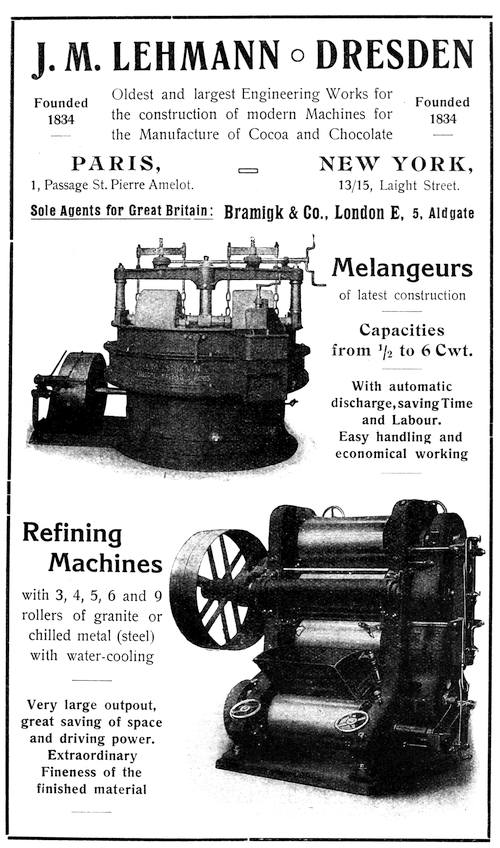
J. M. LEHMANN ∘ DRESDEN Founded 1834
Oldest and largest Engineering Works for the construction of modern Machines for the Manufacture of Cocoa and Chocolate
PARIS, 1, Passage St. Pierre Amelot. NEW YORK, 13/15, Laight Street.
Sole Agents for Great Britain>: Bramigk & Co., London E, 5, Aldgate
Melangeurs of latest construction
Capacities from ½ to 6 Cwt.
With automatic discharge, saving Time and Labour.
Easy handling and economical working
Refining Machines
with 3, 4, 5, 6 and 9 rollers of granite or chilled metal (steel) with water-cooling
Very large output, great saving of space and driving power. Extraordinary Fineness of the finished material
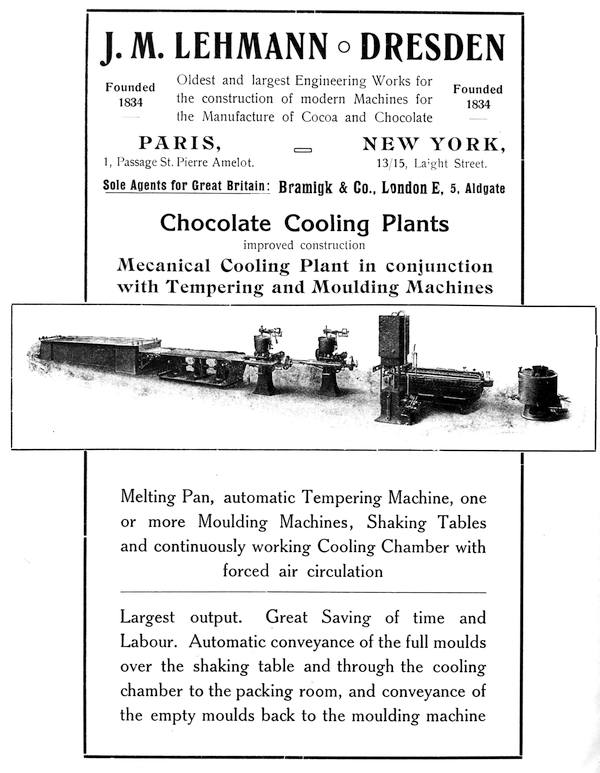
J. M. LEHMANN ∘ DRESDEN Founded 1834
Oldest and largest Engineering Works for the construction of modern Machines for the Manufacture of Cocoa and Chocolate
PARIS, 1, Passage St. Pierre Amelot. NEW YORK, 13/15, Laight Street.
Sole Agents for Great Britain: Bramigk & Co., London E, 5, Aldgate
Chocolate Cooling Plants improved construction
Mechanical Cooling Plant in conjunction with Tempering and Moulding Machines
Melting Pan, automatic Tempering Machine, one or more Moulding Machines, Shaking Tables and continuously working Cooling Chamber with forced air circulation
Largest output. Great Saving of time and Labour. Automatic conveyance of the full moulds over the shaking table and through the cooling chamber to the packing room, and conveyance of the empty moulds back to the moulding machine
Kunstanstalt vorm. ETZOLD & KIESSLING A.-G.
CRIMMITSCHAU, SAXONY
The Chromolithographic Institute
Patent Folding & Fancy Paper Boxes of all kinds, for commercial and other purposes, Showcards, Labels, Wrappers etc., Calendars, Catalogue Covers, Reproduction of articles of merchandise in actual colours, Insets and Advertising Novelties
Specialists in Chocolate Wrappers and Boxes
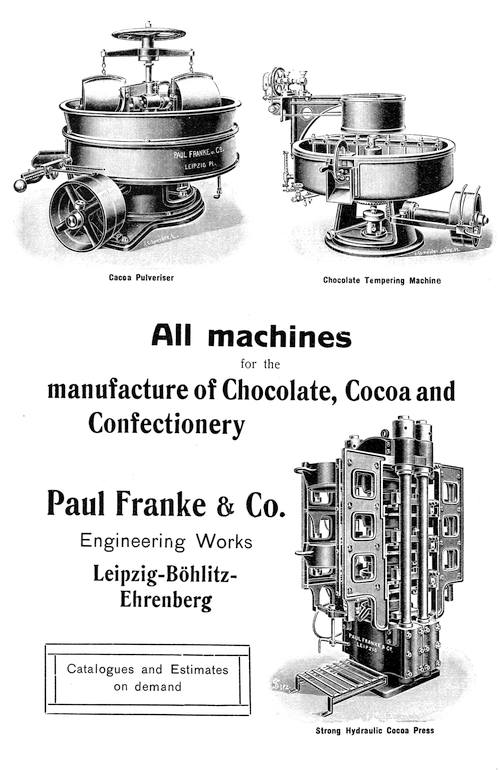
All machines for the manufacture of Chocolate, Cocoa and Confectionery
Paul Franke & Co. Engineering Works Leipzig-Böhlitz-Ehrenberg
Catalogues and Estimates on demand
M. KRAYN, Verlagsbuchhandlung, BERLIN W. 10
In meinem Verlage erschienen:
Die Chemie in industrie, Handwerk und Gewerbe von Joseph Spennrath, weil. Direktor der gewerblichen Schulen der Stadt Aachen. Fünfte vermehrte und verbesserte Auflage, bearbeitet von Dr. L. Sender. Ein Lehrbuch zum Gebrauch an Schulen, sowie zum Selbstunterricht. Preis brosch. Mk. 3.60, kart. Mk. 3.90.
Die Bedienung und Wartung elektrischer Anlagen und Maschinen von Joseph Spennrath, weil. Direktor der städt. gewerbl. Schulen und der Kgl. Baugewerbeschule in Aachen. Zweite, vollständig neu bearbeitete u. bedeutend erweiterte Auflage v. Dipl.-Ing. Franz Menge. I. Einführung in die Grundlagen der Elektrotechnik. Mit 207 Abbildungen und 1 Tafel. II. Einführung in den Bau und die Wirkungsweise der Stromerzeuger. Mit 210 Abbildungen. Preis pro Band brosch. Mk. 2.80, kart. Mk. 3.25. Preis komplett I./II. brosch. Mk. 5.50, kart. Mk. 6.—.
Temperaturmeßmethoden. Handbuch zum Gebrauch bei praktischen Temperaturmessungen von Bruno Thieme. 35 Figuren im Text. Preis brosch. Mk. 4.—[, geb. Mk. 5.—.
Rechenhilfsbuch. Berechnungstabellen für Handel und Industrie, insbesondere für jede Lohn-und Akkordberechnung, nach langjähriger Erfahrung herausgegeben von G. Schuchardt. D. R. G. M. Dritte verbesserte Auflage. Preis geb. Mk. 5.—. Für größere Betriebe unentbehrlich! Durch eine ganz neuartige, geschützte Register-Anordnung vermittelt das Schuchardt’sche Rechen-Hilfsbuch schnellste Auffindung der gewünschten Zahlen.
Der Praktische Lohnrechner. Handbuch für jede Lohnberechnung von G. Schuchardt. Preis geb. Mk. 2.—. Es sind in diesem Buche die Lohnsätze von 7½-75 Pf. in Intervallen von 2½ Pf. aufgenommen, ferner auch die häufig üblichen Lohnsätze von 18, 22, 28, 32 Pf. Die Stundeneinteilung ergibt die Uebersicht von ¼ bis 99¾ Stunden. Für kleinere und mittlere Betriebe unentbehrlich!
Die Kontrolle industrieller Betriebe. Praktische Anleitung zur Durchführung einer modernen Betriebskontrolle von G. Schuchardt. Preis brosch. Mk. 1.60.
Der praktische Maschinenwärter. Anleitung für Maschinisten und Heizer sowie zum Unterricht in technischen Schulen von Paul Brauser, Oberingenieur des Dampfkessel-Revisions-Vereins für den Regierungsbezirk Aachen und Joseph Spennrath, weil. Direktor der gewerblichen Schulen der Stadt Aachen. Vierte verbesserte und vermehrte Auflage. Mit 42 Holzschnitten. Preis kart. Mk. 1.50.
Der praktische Heizer und Kesselwärter von Paul Brauser, Oberingenieur des Dampfkessel-Revisions-Vereins für den Regierungsbezirk Aachen und Joseph Spennrath, weil. Direktor der gewerblichen Schulen der Stadt Aachen. Siebente verbesserte Auflage mit 60 Holzschnitten. Preis kart. Mk. 1.80.
Zu beziehen durch jede Buchhandlung oder direkt vom Verlag
M. KRAYN, Verlagsbuchhandlung, BERLIN W. 10
Für alle Kalkulationsbüros!
Rechen-Resultate
Tabellen zum Ablesen der Resultate von Multiplikationen und Divisionen (in Bruchteilen und ganzen Zahlen)
von 1 bis 1000
Zum praktischen Gebrauch für Stückzahl-, Lohn-und Prozentberechnungen, sowie für jede Art Kalkulation
Preis gebunden 10 Mark
Herausgegeben von F. TRIEBEL, Kaiserlicher Revisor der Reichsdruckerei
Die Papierverarbeitung von MAX SCHUBERT weiland Fabrikdirektor a. D., Prof. a. d. Königl. techn. Hochschule zu Dresden
I. Band:
Die Kartonnagen-Industrie
Praktisches Handbuch für Techniker, Kartonnagen-Fabrikanten und Buchbinder
Mit 479 Illustrationen und 2 Musterbeilagen
Preis broschiert 10.—Mark, gebunden 11.50 Mark
II. Band:
Die Buntpapier-, Tapeten-, Briefumschlag-, Düten-oder Papiersack-, Papierwäsche-und photographische Papier-Fabrikation
Praktisches Handbuch für Techniker, Buntpapier-, Tapeten-und Dütenfabrikanten-Direktoren
Mit 278 Illustrationen
Preis broschiert 10.—Mark, gebunden 11.50 Mark
I. u. II. Band, zusammen bezog., brosch. 18.—M., geb. 20—M.
Ausführlicher Prospekt gratis
Zu beziehen durch jede Buchhandlung oder direkt vom Verlag