Chapter VI
Reading edition
OPERATIONS IN THE WEST INDIES, 1778-1779. THE BRITISH INVASION OF GEORGIA AND SOUTH CAROLINA
Conditions of season exerted great influence upon the time and place of hostilities during the maritime war of 1778; the opening scenes of which, in Europe and in North America, have just been narrated. In European seas it was realised that naval enterprises by fleets, requiring evolutions by masses of large vessels, were possible only in summer. Winter gales scattered ships, impeded manœuvres, and made gun-fire ineffective. The same consideration prevailed to limit activity in North American waters to the summer; and complementary to this was the fact that in the West Indies hurricanes of excessive violence occurred from July to October. The practice therefore was to transfer effort from one quarter to the other in the Western Hemisphere, according to the season.
In the recent treaty with the United States, the King of France had formally renounced all claim to acquire for himself any part of the American continent then in possession of Great Britain. On the other hand, he had reserved the express right to conquer any of her islands south of Bermuda. The West Indies were then the richest commercial region on the globe in the value of their products; and France wished not only to increase her already large possessions there, but also to establish more solidly her political and military tenure.
Leeward Islands (West Indies) Station
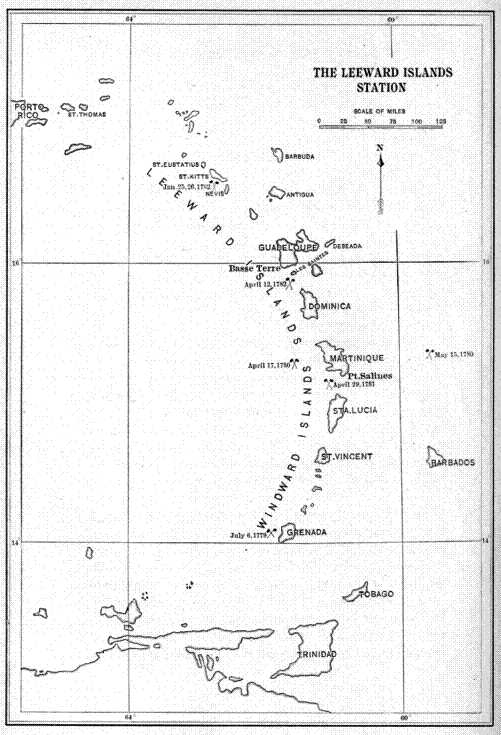
In September, 1778, the British Island of Dominica was seized by an expedition from the adjacent French colony of Martinique. The affair was a surprise, and possesses no special military interest; but it is instructive to observe that Great Britain was unprepared, in the West Indies as elsewhere, when the war began. A change had been made shortly before in the command of the Leeward Islands Station, as it was called, which extended from Antigua southward over the Lesser Antilles with headquarters at Barbados. Rear-Admiral the Hon. Samuel Barrington, the new-comer, leaving home before war had been declared, had orders not to quit Barbados till further instructions should arrive. These had not reached him when he learned of the loss of Dominica. The French had received their orders on the 17th of August. The blow was intrinsically somewhat serious, so far as the mere capture of a position can be, because the fortifications were strong, though they had been inadequately garrisoned. It is a mistake to build works and not man them, for their fall transfers to the enemy strength which he otherwise would need time to create. To the French the conquest was useful beyond its commercial value, because it closed a gap in their possessions. They now held four consecutive islands, from north to south, Guadeloupe, Dominica, Martinique, and Santa Lucia.
Barrington had two ships of the line: his flagship, the Prince of Wales, 74, and the Boyne, 70. If he had been cruising, these would probably have deterred the French. Upon receiving the news he put to sea, going as far as Antigua; but he did not venture to stay away because his expected instructions had not come yet, and, like Keppel, he feared an ungenerous construction of his actions. He therefore remained in Barbados, patiently watching for an opportunity to act.
The departure of Howe and the approach of winter determined the transference of British troops and ships from the continent to the Leeward Islands. Reinforcements had given the British fleet in America a numerical superiority, which for the time imposed a check upon d'Estaing; but Byron, proverbially unlucky in weather, was driven crippled to Newport, leaving the French free to quit Boston. The difficulty of provisioning so large a force as twelve ships of the line at first threatened to prevent the withdrawal, supplies being then extremely scarce in the port; but at the critical moment American privateers brought in large numbers of prizes, laden with provisions from Europe for the British army. Thus d'Estaing was enabled to sail for Martinique on the 4th of November. On the same day there left New York for Barbados a British squadron,—two 64's, three 50's, and three smaller craft,—under the command of Commodore William Hotham, convoying five thousand troops for service in the West Indies.
Barrington knew already what he wanted to do, and therefore lost not a moment in deliberation. The troops were kept on board, Hotham's convoy arrangements being left as they were. On the morning of December 12th the entire force sailed again, the main changes in it being in the chief command, and in the addition of Barrington's two ships of the line. On the afternoon of the 13th the shipping anchored in the Grand Cul de Sac, an inlet on the west side of Santa Lucia, which is seventy miles east-north-east from Barbados. Part of the troops landed at once, and seized the batteries and heights on the north side of the bay. The remainder were put on shore the next morning. The French forces were inadequate to defend their works; but it is to be observed that they were driven with unremitting energy, and that to this promptness the British owed their ability to hold the position.
Island of Santa Lucia
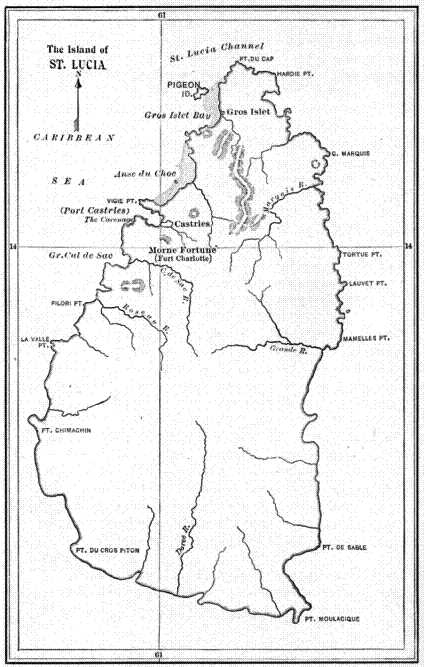
Three miles north of the Cul de Sac is a bay then called the Carénage; now Port Castries. At its northern extremity is a precipitous promontory, La Vigie, then fortified, upon the tenure of which depended not only control of that anchorage, but also access to the rear of the works which commanded the Cul de Sac. If those works fell, the British squadron must abandon its position and put to sea, where d'Estaing's much superior fleet would be in waiting. On the other hand, if the squadron were crushed at its anchors, the troops were isolated and must ultimately capitulate. Therefore La Vigie and the squadron were the two keys to the situation, and the loss of either would be decisive.
D'Estaing had twelve ships of the line, and two days after this was able to land seven thousand troops. With such a superiority it is evident that the British would have been stopped in the midst of their operations, if he had arrived twenty-four hours sooner. To gain time, Barrington had sought to prevent intelligence reaching Fort Royal, less than fifty miles distant, by sending cruisers in advance of his squadron, to cover the approaches to Santa Lucia; but, despite his care, d'Estaing had the news on the 14th. He sailed at once, and, as has been said, was off Santa Lucia that evening. At daybreak of the 15th he stood in for the Carénage; but when he came within range, a lively cannonade told him that the enemy was already in possession. He decided therefore to attack the squadron in the Cul de Sac, and at 11.30 the French passed along it from north to south, firing, but without effect. A second attempt was made in the afternoon, directed upon the lee flank, but it was equally unavailing. The British had three men killed; the French loss is not given, but is said to have been slight. It is stated that that day the sea breeze did not penetrate far enough into the bay to admit closing. This frequently happens, but it does not alter the fact that the squadron was the proper point of attack, and that, especially in the winter season, an opportunity to close must offer soon. D'Estaing, governed probably by the soldierly bias he more than once betrayed, decided now to assault the works on shore. Anchoring in a small bay north of the Carénage, he landed seven thousand men, and on the 18th attempted to storm the British lines at La Vigie. The neck of land connecting the promontory with the island is very flat, and the French therefore labored under great disadvantage through the commanding position of their enemy. It was a repetition of Bunker Hill, and of many other ill-judged and precipitate frontal attacks. After three gallant but ineffectual charges, led by d'Estaing in person, the assailants retired, with the loss of forty-one officers and eight hundred rank and file, killed and wounded.
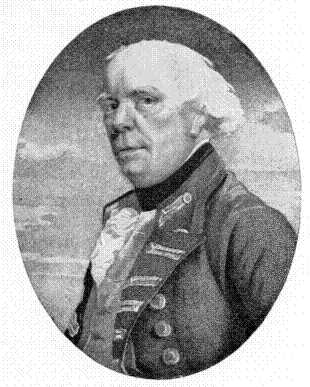
Admiral, the Honourable Samuel Barrington
D'Estaing reëmbarked his men, and stood ready again to attack Barrington; a frigate being stationed off the Cul de Sac, to give notice when the wind should serve. On the 24th she signalled, and the fleet weighed; but Barrington, who had taken a very great risk for an adequate object, took no unnecessary chances through presumption. He had employed his respite to warp the ships of war farther in, where the breeze reached less certainly, and where narrower waters gave better support to the flanks. He had strengthened the latter also by new works, in which he had placed heavy guns from the ships, manned by seamen. For these or other reasons d'Estaing did not attack. On the 29th he quitted the island, and on the 30th the French governor, the Chevalier de Micoud, formally capitulated.
This achievement of Barrington and of Major-General James Grant, who was associated with him, was greeted at the time with an applause which will be echoed by the military judgment of a later age. There is a particular pleasure in finding the willingness to incur a great risk, conjoined with a care that chances nothing against which the utmost diligence and skill can provide. The celerity, forethought, wariness, and daring of Admiral Barrington have inscribed upon the records of the British Navy a success the distinction of which should be measured, not by the largeness of the scale, but by the perfection of the workmanship, and by the energy of the execution in face of great odds.
Santa Lucia remained in the hands of the British throughout the war. It was an important acquisition, because at its north-west extremity was a good and defensible anchorage, Gros Ilet Bay, only thirty miles from Fort Royal in Martinique. In it the British fleet could lie, when desirable to close-watch the enemy, yet not be worried for the safety of the port when away; for it was but an outpost, not a base of operations, as Fort Royal was. It was thus used continually, and from it Rodney issued for his great victory in April, 1782.
During the first six months of 1779 no important incident occurred in the West Indies. On the 6th of January, Vice-Admiral Byron, with ten ships of the line from Narragansett Bay, reached Santa Lucia, and relieved Barrington of the chief command. Both the British and the French fleets were reinforced in the course of the spring, but the relative strength remained nearly as before, until the 27th of June, when the arrival of a division from Brest made the French numbers somewhat superior.
Shortly before this, Byron had been constrained by one of the commercial exigencies which constantly embarrassed the military action of British admirals. A large convoy of trading ships, bound to England, was collecting at St. Kitts, and he thought necessary to accompany it part of the homeward way, until well clear of the French West India cruisers. For this purpose he left Santa Lucia early in June. As soon as the coast was clear, d'Estaing, informed of Byron's object, sent a small combined expedition against St. Vincent, which was surrendered on the 18th of the month. On the 30th the French admiral himself quitted Fort Royal with his whole fleet,—twenty-five ships of the line and several frigates,—directing his course for the British Island of Grenada, before which he anchored on the 2d of July. With commendable promptitude, he landed his troops that evening, and on the 4th the island capitulated. Except as represented by one small armed sloop, which was taken, the British Navy had no part in this transaction. Thirty richly laden merchant ships were captured in the port.
At daybreak of July 6th, Byron appeared with twenty-one sail of the line, one frigate, and a convoy of twenty-eight vessels, carrying troops and equipments. He had returned to Santa Lucia on the 1st, and there had heard of the loss of St. Vincent, with a rumor that the French had gone against Grenada. He consequently had put to sea on the 3d, with the force mentioned.
D'Estaing and Byron, July 6, 1779
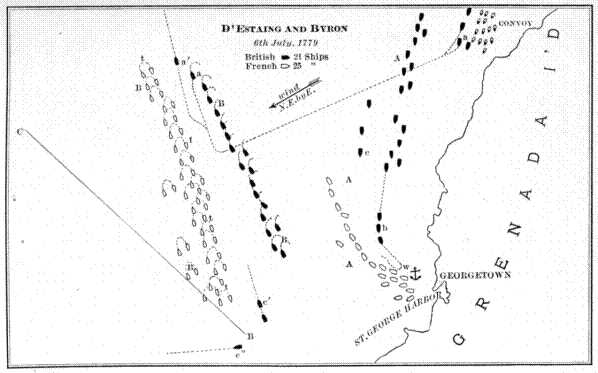
When the British ships in general had got round, and were in line ahead on the starboard tack,—the same as the French,—ranging from rear to van of the enemy (Positions B, B, B), Byron signalled for the eight leading ships to close together, for mutual support, and to engage close. This, which should have been done—not with finikin precision, but with military adequacy—before engaging, was less easy now, in the din of battle and with crippled ships. A quick-eyed subordinate, however, did something to remedy the error of his chief. Rear-Admiral Rowley was still considerably astern, having to make up the distance between the convoy and the fleet. As he followed the latter, he saw Barrington's three ships unduly separated and doubtless visibly much mauled. Instead, therefore, of blindly following his leader, he cut straight across (aa) to the head of the column to support the van,—an act almost absolutely identical with that which won Nelson renown at Cape St. Vincent. In this he was followed by the Monmouth, 64, the brilliancy of whose bearing was so conspicuous to the two fleets that it is said the French officers after the battle toasted "the little black ship." She and the Suffolk, 74, Rowley's flagship, also suffered severely in this gallant feat.
The enemies were now ranged on parallel lines, some distance apart; still on the starboard tack, heading north-north west. Between the two, but far astern, the Cornwall, Grafton, Lion, and a fourth British ship, the Fame, were toiling along, greatly crippled. At 3 P.M., the French, now in good order, tacked together (t, t, t), which caused them to head towards these disabled vessels. Byron at once imitated the movement, and the eyes of all in the two fleets anxiously watched the result. Captain Cornwallis of the Lion, measuring the situation accurately, saw that, if he continued ahead, he would be in the midst of the French by the time he got abreast of them. Having only his foremast standing, he put his helm up, and stood broad off before the wind (c"), across the enemy's bows, for Jamaica. He was not pursued. The other three, unable to tack and afraid to wear, which would put them also in the enemy's power, stood on, passed to windward of the latter, receiving several broadsides, and so escaped to the northward. The Monmouth was equally maltreated; in fact, she had not been able to tack to the southward with the fleet. Continuing north (a'), she became now much separated. D'Estaing afterwards reestablished his order of battle on the port tack, forming upon the then leewardmost ship, on the line BC.
It is important to consider this, because, while Keppel must be approved for attacking in partial disorder, Byron must be blamed for attacking in utter disorder. Keppel had to snatch opportunity from an unwilling foe. Having himself the lee-gage, he could not pick and choose, nor yet manœuvre; yet he brought his fleet into action, giving mutual support throughout nearly, if not quite, the whole line. What Byron did has been set forth; the sting is that his bungling tactics can find no extenuation in any urgency of the case.
The loss of the two fleets, as given by the authorities of either nation, were: British, 183 killed, 346 wounded; French, 190 killed, 759 wounded. Of the British total, 126 killed and 235 wounded, or two thirds, fell to the two groups of three ships each, which by Byron's mismanagement were successively exposed to be cut up in detail by the concentrated fire of the enemy. The British loss in spars and sails—in motive-power—also exceeded greatly that of the French.
After the action d'Estaing returned quietly to Grenada. Byron went to St. Kitts to refit; but repairs were most difficult, owing to the dearth of stores in which the Admiralty had left the West Indies. With all the skill of the seamen of that day in making good damages, the ships remained long unserviceable, causing great apprehension for the other islands. This state of things d'Estaing left unimproved, as he had his advantage in the battle. He did, indeed, parade his superior force before Byron's fleet as it lay at anchor; but, beyond the humiliation naturally felt by a Navy which prided itself on ruling the sea, no further injury was done.
These operations, which during 1779 extended as far as the neighbourhood of Charleston, depended upon the control of the water, and are a conspicuous example of misapplication of power to the point of ultimate self-destruction. They were in 1778-79 essentially of a minor character, especially the maritime part, and will therefore be dismissed with the remark that the Navy, by small vessels, accompanied every movement in a country cut up in all directions by watercourses, big and little. "The defence of this province," wrote Parker, "must greatly depend on the naval force upon the different inland creeks. I am therefore forming some galleys covered from musketry, which I believe will have a good effect." These were precursors of the "tin-clads" of the American War of Secession, a century later. Not even an armored ship is a new thing under the sun.
In the southern States, from Georgia to Virginia, the part of the Navy from first to last was subsidiary, though important. It is therefore unnecessary to go into details, but most necessary to note that here, by misdirection of effort and abuse of means, was initiated the fatal movement which henceforth divided the small British army in North America into two sections, wholly out of mutual support. Here Sir William Howe's error of 1777 was reproduced on a larger scale and was therefore more fatal. This led directly, by the inevitable logic of a false position, to Cornwallis's march through North Carolina into Virginia, to Yorktown in 1781, and to the signal demonstration of sea power off Chesapeake Bay, which at a blow accomplished the independence of the United States. No hostile strategist could have severed the British army more hopelessly than did the British government; no fate could have been more inexorable than was its own perverse will. The personal alienation and official quarrel between Sir Henry Clinton and Lord Cornwallis, their divided counsels and divergent action, were but the natural result, and the reflection, of a situation essentially self-contradictory and exasperating.
As the hurricane season of 1779 advanced, d'Estaing, who had orders to bring back to France the ships of the line with which he had sailed from Toulon in 1778, resolved to go first upon the American coast, off South Carolina or Georgia. Arriving with his whole fleet at the mouth of the Savannah, August 31st, he decided to attempt to wrest the city of Savannah from the British. This would have been of real service to the latter, had it nipped in the bud their ex-centric undertaking; but, after three weeks of opening trenches, an assault upon the place failed. D'Estaing then sailed for Europe with the ships designated to accompany him, the others returning to the West Indies in two squadrons, under de Grasse and La Motte-Picquet. Though fruitless in its main object, this enterprise of d'Estaing had the important indirect effect of causing the British to abandon Narragansett Bay. Upon the news of his appearance, Sir Henry Clinton had felt that, with his greatly diminished army, he could not hold both Rhode Island and New York. He therefore ordered the evacuation of the former, thus surrendering, to use again Rodney's words, "the best and noblest harbour in America." The following summer it was occupied in force by the French.