Chapter IV
Reading edition
WAR BEGINS BETWEEN FRANCE AND GREAT BRITAIN. BRITISH EVACUATE PHILADELPHIA. NAVAL OPERATIONS OF D'ESTAING AND HOWE ABOUT NEW YORK, NARRAGANSETT BAY, AND BOSTON. COMPLETE SUCCESS OF LORD HOWE. AMERICAN DISAPPOINTMENT IN D'ESTAING. LORD HOWE RETURNS TO ENGLAND. 1778
These delays occasioned a singular and striking illustration of the ill effects upon commerce of inadequate preparation for manning the fleet. A considerable number of West India ships, with stores absolutely necessary for the preservation of the islands, waited at Portsmouth for convoy for upwards of three months, while the whole fleet, of eighty sail, was detained for five weeks after it had assembled; "and, although the wind came fair on the 19th of May, it did not sail till the 26th, owing to the convoying ships, the Boyne and the Ruby, not being ready." Forty-five owners and masters signed a letter to the Admiralty, stating these facts. "The convoy," they said, "was appointed to sail April 10th." Many ships had been ready as early as February. "Is not this shameful usage, my Lords, thus to deceive the public in general? There are two hundred ships loaded with provisions, etc., waiting at Spithead these three months. The average expense of each ship amounts to £150 monthly, so that the expense of the whole West India fleet since February amounts to £90,000."
Three days after Byron had sailed, Admiral Augustus Keppel also put to sea with twenty-one ships of the line, to cruise off Brest. His instructions were to prevent the junction of the Toulon and Brest divisions, attacking either that he might meet. On the 17th of June, two French frigates were sighted. In order that they might not report his force or his movements, the British Admiral sent two of his own frigates, with the request that they would speak him. One, the Belle Poule, 36, refused; and an engagement followed between her and the British ship, the Arethusa, 32. The King of France subsequently declared that this occurrence fixed the date of the war's beginning. Although both Keppel's and d'Estaing's orders prescribed acts of hostility, no formal war yet existed.
Byron had a very tempestuous passage, with adverse winds, by which his vessels were scattered and damaged. On the 18th of August, sixty-seven days from Plymouth, the flagship arrived off the south coast of Long Island, ninety miles east of New York, without one of the fleet in company. There twelve ships were seen at anchor to leeward (north), nine or ten miles distant, having jury masts, and showing other signs of disability. The British vessel approached near enough to recognise them as French. They were d'Estaing's squadron, crippled by a very heavy gale, in which Howe's force had also suffered, though to a less extent. Being alone, and ignorant of existing conditions, Byron thought it inexpedient to continue on for either New York or Narragansett Bay. The wind being southerly, he steered for Halifax, which he reached August 26th. Some of his ships also entered there. A very few had already succeeded in joining Howe in New York, being fortunate enough to escape the enemy.
So far as help from England went, Lord Howe would have been crushed long before this. He owed his safety partly to his own celerity, partly to the delays of his opponent. Early in May he received advices from home, which convinced him that a sudden and rapid abandonment of Philadelphia and of Delaware Bay might become necessary. He therefore withdrew his ships of the line from New York and Narragansett, concentrating them at the mouth of Delaware Bay, while the transports embarked all stores, except those needed for a fortnight's supply of the army in a hostile country. The threatening contingency of a superior enemy's appearing off the coast might, and did, make it imperative not to risk the troops at sea, but to choose instead the alternative of a ninety-mile march through New Jersey, which a year before had been rejected as too hazardous for an even larger force. Thus prepared, no time was lost when the evacuation became necessary. Sir William Howe, who had been relieved on the 24th of May by Sir Henry Clinton, and had returned to England, escaped the humiliation of giving up his dearly bought conquest. On the 18th of June the British troops, twelve thousand in number, were ferried across the Delaware, under the supervision of the Navy, and began their hazardous march to New York. The next day the transports began to move down the river; but, owing to the intricate navigation, head winds, and calms, they did not get to sea until the 28th of June. On the 8th of July, ten days too late, d'Estaing anchored in the mouth of the Delaware. "Had a passage of even ordinary length taken place," wrote Washington, "Lord Howe with the British ships of war and all the transports in the river Delaware must inevitably have fallen; and Sir Henry Clinton must have had better luck than is commonly dispensed to men of his profession under such circumstances, if he and his troops had not shared at least the fate of Burgoyne."
Had Howe's fleet been intercepted, there would have been no naval defence for New York; the French fleet would have surmounted the difficulties of the harbour bar at its ease; and Clinton, caught between it and the American army, must have surrendered. Howe's arrival obviated this immediate danger; but much still needed to be done, or the end would be postponed only, not averted. A fair wind carried the fleet and the whole convoy from the Delaware to Sandy Hook in forty-eight hours. On the morning of the 29th, as Howe was approaching his port, he spoke a packet from England, which not only brought definite news of d'Estaing's sailing, but also reported that she herself had fallen in with him to the southward, not very far from the American coast, and had been chased by his ships. His appearance off New York, therefore, was imminent.
Howe's measures were prompt and thorough, as became his great reputation. To watch for d'Estaing's approach, a body of cruisers was despatched, numerous enough for some to bring frequent word of his movements, while others kept touch with him. The ships at New York were ordered down to Sandy Hook, where the defence of the entrance was to be made. Clinton, who had been hard pressed by Washington throughout his march, arrived on the 30th of June—the day after Howe himself—on the heights of Navesink, on the seacoast, just south of Sandy Hook. During the previous winter the sea had made a breach between the heights and the Hook, converting the latter into an island. Across this inlet the Navy threw a bridge of boats, by which the army on the 5th of July passed to the Hook, and thence was conveyed to the city.
On the same day the French fleet was sighted off the coast of Virginia by a cruiser, which reached Howe on the 7th; and two days later another brought word that the enemy had anchored on the 8th off the Delaware. There d'Estaing again tarried for two days, which were diligently improved by the British Admiral, who at the same time sent off despatches to warn Byron, of whose coming he now had heard. Despite all his energy, his preparations still were far from complete, when on the morning of the 11th a third vessel arrived, announcing that the French were approaching. That evening they anchored outside, four miles south of Sandy Hook. Howe, who during all these days was indefatigable, not only in planning but also in personal supervision of details, hastened at once to place his vessels according to the disposition which he had determined, and which he had carefully explained to his captains, thus insuring an intelligent coöperation on their part.
"At eight o'clock," wrote an eye-witness in the British fleet, "d'Estaing with all his squadron appeared under way. He kept working to windward, as if to gain a proper position for crossing the bar by the time the tide should serve. The wind could not be more favourable for such a design; it blew from the exact point from which he could attack us to the greatest advantage. The spring tides were at the highest, and that afternoon thirty feet on the bar. We consequently expected the hottest day that had ever been fought between the two nations. On our side all was at stake. Had the men-of-war been defeated, the fleet of transports and victuallers must have been destroyed, and the army, of course, have fallen with us. D'Estaing, however, had not spirit equal to the risk; at three o'clock we saw him bear off to the southward, and in a few hours he was out of sight."
Four days later, Howe, reporting these occurrences, wrote: "The weather having been favourable the last three days for forcing entrance to this port, I conclude the French commander has desisted." It is clear that the experienced British admiral did not recognise the impossibility of success for the enemy.
After the demonstration of the 22d, d'Estaing stood to the southward, with the wind at east. The British advice-boats brought back word that they had kept company with him as far south as the Capes of the Delaware, and there had left him ninety miles from land. When their leaving freed him from observation, he turned, and made for Narragansett Bay, an attack on which, in support of an American land force, had been concerted between him and Washington. On the 29th he anchored three miles south of Rhode Island, and there awaited a suitable moment for forcing the entrance.
Narragansett Bay contains several islands. The two largest, near the sea, are Rhode Island and Conanicut, the latter being the more westerly. Their general direction, as that of the Bay itself, is north and south; and by them the entrance is divided into three passages. Of these, the eastern, called Seakonnet, is not navigable above Rhode Island. The central, which is the main channel, is joined by the western above Conanicut, and thus the two lead to the upper Bay. The town of Newport is on the west side of Rhode Island, four miles from the main entrance.
Narragansett Bay
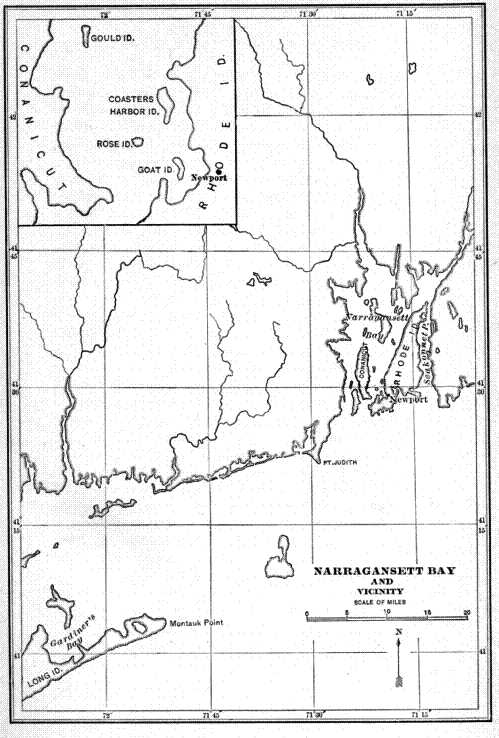
On the 1st of August, forty-eight hours after the Cornwall had come in from a stormy passage of fifty-two days, the squadron was ready for sea, and Howe attempted to sail; but the wind hauled foul immediately after the signal to weigh had been made. It did not become fair at the hour of high water, when alone heavy ships could cross the bar, until the morning of the 6th. "Rhode Island was of such importance," says the narrator already quoted, "and the fate of so large a portion of the British army as formed the garrison was of such infinite consequence to the general cause, that it was imagined the Admiral would not lose a moment in making some attempt for their relief." He had learned of the detachments made from the French fleet, and hoped that some advantage might be taken of this division. In short, he went, as was proper and incumbent on him in such critical circumstances, to take a great risk, in hope of a favourable chance offering. On the 9th, as before stated, he anchored off Point Judith, and opened communications with the garrison, from which he learned the events that had so far occurred, and also that the enemy was well provided with craft of all kinds to make a descent upon any part of the Island.
The French had suffered much more severely. The flagship Languedoc, 90, had carried away her bowsprit, all her lower masts followed it overboard, and her tiller also was broken, rendering the rudder unserviceable. The Marseillais, 74, lost her foremast and bowsprit. In the dispersal of the two fleets that followed the gale, each of these crippled vessels, on the evening of the 13th, encountered singly a British 50-gun ship; the Languedoc being attacked by the Renown, and the Marseillais by the Preston. The conditions in each instance were distinctly favourable to the smaller combatant; but both unfortunately withdrew at nightfall, making the mistake of postponing to to-morrow a chance which they had no certainty would exist after to-day. When morning dawned, other French ships appeared, and the opportunity passed away. The British Isis, 50, also was chased and overtaken by the César, 74. In the action which ensued, the French ship's wheel was shot away, and she retired;—two other British vessels, one of the line, being in sight. The latter are not mentioned in the British accounts, and both sides claimed the advantage in this drawn action. The French captain lost an arm.
Howe had quitted New York the instant he heard of d'Estaing's reappearance off Rhode Island. He took with him the same number of vessels as before,—thirteen of the line,—the Monmouth, 64, of Byron's squadron, having arrived and taken the place of the Isis, crippled in her late action. Before reaching Newport, he learned that the French had started for Boston. He hoped that they would find it necessary to go outside George's Bank, and that he might intercept them by following the shorter road inside. In this he was disappointed, as has been seen, and the enemy's position was now too strong for attack. The French retreat to Boston closed the naval campaign of 1778 in North American waters.
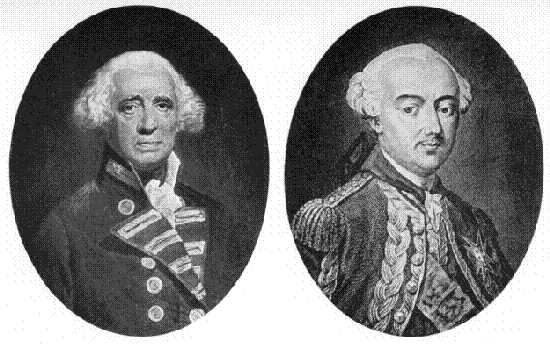
Richard, Earl Howe Charles Henri, Comte d'Estaing
The inability or unwillingness of d'Estaing to renew the enterprise against Rhode Island accords the indisputable triumph in this campaign to Howe,—an honour he must share, and doubtless would have shared gladly, with his supporters in general. That his fleet, for the most part two years from home, in a country without dockyards, should have been able to take the sea within ten days after the gale, while their opponents, just from France, yet with three months' sea practice, were so damaged that they had to abandon the field and all the splendid prospects of Rhode Island,—as they already had allowed to slip the chance at New York,—shows a decisive superiority in the British officers and crews. The incontestable merits of the rank and file, however, must not be permitted to divert attention from the great qualities of the leader, but for which the best material would have been unavailing. The conditions were such as to elicit to the utmost Howe's strongest qualities,—firmness, endurance, uninterrupted persistence rather than celerity, great professional skill, ripened by constant reflection and ready at an instant's call. Not brilliant in intellect, perhaps, but absolutely clear, and replete with expedients to meet every probable contingency, Howe exhibited an equable, unflagging energy, which was his greatest characteristic, and which eminently fitted him for the task of checkmating an enemy's every move—for a purely defensive campaign. He was always on hand and always ready; for he never wearied, and he knew his business. To great combinations he was perhaps unequal. At all events, such are not associated with his name. The distant scene he did not see; but step by step he saw his way with absolute precision, and followed it with unhesitating resolution. With a force inferior throughout, to have saved, in one campaign, the British fleet, New York, and Rhode Island, with the entire British army, which was divided between those two stations and dependent upon the sea, is an achievement unsurpassed in the annals of naval defensive warfare. It may be added that his accomplishment is the measure of his adversary's deficiencies.
Howe's squadron had been constituted in 1776 with reference to the colonial struggle only, and to shallow water, and therefore was composed, very properly, of cruisers, and of ships of the line of the smaller classes; there being several fifties, and nothing larger than a sixty-four. When war with France threatened, the Ministry, having long warning, committed an unpardonable fault in allowing such a force to be confronted by one so superior as that which sailed from Toulon, in April, 1778. This should have been stopped on its way, or, failing that, its arrival in America should have been preceded by a British reinforcement. As it was, the government was saved from a tremendous disaster only by the efficiency of its Admiral and the inefficiency of his antagonist. As is not too uncommon, gratitude was swamped by the instinct of self-preservation from the national wrath, excited by this, and by other simultaneous evidences of neglect. An attempt was made to disparage Howe's conduct, and to prove that his force was even superior to that of the French, by adding together the guns in all his ships, disregarding their classes, or by combining groups of his small vessels against d'Estaing's larger units. The instrument of the attack was a naval officer, of some rank but slender professional credit, who at this most opportune moment underwent a political conversion, which earned him employment on the one hand, and the charge of apostasy on the other. For this kind of professional arithmetic, Howe felt and expressed just and utter contempt. Two and two make four in a primer, but in the field they may make three, or they may make five. Not to speak of the greater defensive power of heavy ships, nor of the concentration of their fire, the unity of direction under one captain possesses here also that importance which has caused unity of command and of effort to be recognised as the prime element in military efficiency, from the greatest things to the smallest. Taken together, the three elements—greater defensive power, concentration of fire, and unity of direction—constitute a decisive and permanent argument in favor of big ships, in Howe's days as in our own. Doubtless, now, as then, there is a limit; most arguments can be pushed to an absurdum, intellectual or practical. To draw a line is always hard; but, if we cannot tell just where the line has been passed we can recognise that one ship is much too big, while another certainly is not. Between the two an approximation to an exact result can be made.