Chapter I
Reading edition
THE NAVAL CAMPAIGN ON LAKE CHAMPLAIN 1775-1776
At the time when hostilities began between Great Britain and her American Colonies, the fact was realised generally, being evident to reason and taught by experience, that control of the water, both ocean and inland, would have a preponderant effect upon the contest. It was clear to reason, for there was a long seaboard with numerous interior navigable watercourses, and at the same time scanty and indifferent communications by land. Critical portions of the territory involved were yet an unimproved wilderness. Experience, the rude but efficient schoolmaster of that large portion of mankind which gains knowledge only by hard knocks, had confirmed through the preceding French wars the inferences of the thoughtful. Therefore, conscious of the great superiority of the British Navy, which, however, had not then attained the unchallenged supremacy of a later day, the American leaders early sought the alliance of the Bourbon kingdoms, France and Spain, the hereditary enemies of Great Britain. There alone could be found the counterpoise to a power which, if unchecked, must ultimately prevail.
Nearly three years elapsed before the Colonists accomplished this object, by giving a demonstration of their strength in the enforced surrender of Burgoyne's army at Saratoga. This event has merited the epithet "decisive," because, and only because, it decided the intervention of France. It may be affirmed, with little hesitation, that this victory of the colonists was directly the result of naval force,—that of the colonists themselves. It was the cause that naval force from abroad, entering into the contest, transformed it from a local to a universal war, and assured the independence of the Colonies. That the Americans were strong enough to impose the capitulation of Saratoga, was due to the invaluable year of delay secured to them by their little navy on Lake Champlain, created by the indomitable energy, and handled with the indomitable courage, of the traitor, Benedict Arnold. That the war spread from America to Europe, from the English Channel to the Baltic, from the Bay of Biscay to the Mediterranean, from the West Indies to the Mississippi, and ultimately involved the waters of the remote peninsula of Hindustan, is traceable, through Saratoga, to the rude flotilla which in 1776 anticipated its enemy in the possession of Lake Champlain. The events which thus culminated merit therefore a clearer understanding, and a fuller treatment, than their intrinsic importance and petty scale would justify otherwise.
In 1775, only fifteen years had elapsed since the expulsion of the French from the North American continent. The concentration of their power, during its continuance, in the valley of the St. Lawrence, had given direction to the local conflict, and had impressed upon men's minds the importance of Lake Champlain, of its tributary Lake George, and of the Hudson River, as forming a consecutive, though not continuous, water line of communications from the St. Lawrence to New York. The strength of Canada against attack by land lay in its remoteness, in the wilderness to be traversed before it was reached, and in the strength of the line of the St. Lawrence, with the fortified posts of Montreal and Quebec on its northern bank. The wilderness, it is true, interposed its passive resistance to attacks from Canada as well as to attacks upon it; but when it had been traversed, there were to the southward no such strong natural positions confronting the assailant. Attacks from the south fell upon the front, or at best upon the flank, of the line of the St. Lawrence. Attacks from Canada took New York and its dependencies in the rear.
Lake Champlain and Connected Waters
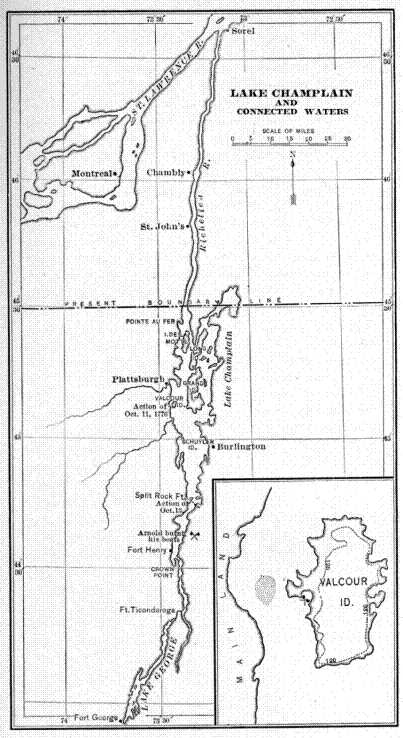
These elements of natural strength, in the military conditions of the North, were impressed upon the minds of the Americans by the prolonged resistance of Canada to the greatly superior numbers of the British Colonists in the previous wars. Regarded, therefore, as a base for attacks, of a kind with which they were painfully familiar, but to be undergone now under disadvantages of numbers and power never before experienced, it was desirable to gain possession of the St. Lawrence and its posts before they were strengthened and garrisoned. At this outset of hostilities, the American insurgents, knowing clearly their own minds, possessed the advantage of the initiative over the British government, which still hesitated to use against those whom it styled rebels the preventive measures it would have taken at once against a recognised enemy.
The seizure of the two posts, being an act of offensive war, was not at once pleasing to the American Congress, which still clung to the hope of reconciliation; but events were marching rapidly, and ere summer was over the invasion of Canada was ordered. General Montgomery, appointed to that enterprise, embarked at Crown Point with two thousand men on September 4th, and soon afterwards appeared before St. John's, which after prolonged operations capitulated on the 3d of November. On the 13th Montgomery entered Montreal, and thence pressed down the St. Lawrence to Pointe aux Trembles, twenty miles above Quebec. There he joined Arnold, who in the month of October had crossed the northern wilderness, between the head waters of the Kennebec River and St. Lawrence. On the way he had endured immense privations, losing five hundred men of the twelve hundred with whom he started; and upon arriving opposite Quebec, on the 10th of November, three days had been unavoidably spent in collecting boats to pass the river. Crossing on the night of the 13th, this adventurous soldier and his little command climbed the Heights of Abraham by the same path that had served Wolfe so well sixteen years before. With characteristic audacity he summoned the place. The demand of course was refused; but that Carleton did not fall at once upon the little band of seven hundred that bearded him shows by how feeble a tenure Great Britain then held Canada. Immediately after the junction Montgomery advanced on Quebec, where he appeared on the 5th of December. Winter having already begun, and neither his numbers nor his equipments being adequate to regular siege operations, he very properly decided to try the desperate chance of an assault upon the strongest fortress in America. This was made on the night of December 31st, 1775. Whatever possibility of success there may have been vanished with the death of Montgomery, who fell at the head of his men.
Upon the arrival of the ships of war, the Americans at once retreated. During the winter, though reinforcements must have been received from time to time, they had wasted from exposure, and from small-pox, which ravaged the camp. On the 1st of May the returns showed nineteen hundred men present, of whom only a thousand were fit for duty. There were then on hand but three days' provisions, and none other nearer than St. John's. The inhabitants would of course render no further assistance to the Americans after the ships arrived. The Navy had again decided the fate of Canada, and was soon also to determine that of Lake Champlain.
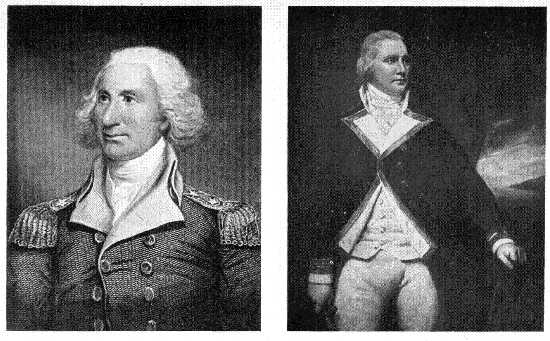
Major-General Philip Schuyler Edward Pellew, afterwards Admiral, Lord Exmouth
When two hundred troops had landed from the ships, Carleton marched out, "to see," he said, "what these mighty boasters were about." The sneer was unworthy a man of his generous character, for the boasters had endured much for faint chances of success; and the smallness of the reinforcement which encouraged him to act shows either an extreme prudence on his part, or the narrow margin by which Quebec escaped. He found the enemy busy with preparations for retreat, and upon his appearance they abandoned their camp. Their forces on the two sides of the river being now separated by the enemy's shipping, the Americans retired first to Sorel, where the Richelieu enters the St. Lawrence, and thence continued to fall back by gradual stages. It was not until June 15th that Arnold quitted Montreal; and at the end of June the united force was still on the Canadian side of the present border line. On the 3d of July it reached Crown Point, in a pitiable state from small-pox and destitution.
Both parties began at once to prepare for a contest upon Lake Champlain. The Americans, small as their flotilla was, still kept the superiority obtained for them by Arnold's promptitude a year before. On the 25th of June the American General Schuyler, commanding the Northern Department, wrote: "We have happily such a naval superiority on Lake Champlain, that I have a confident hope the enemy will not appear upon it this campaign, especially as our force is increasing by the addition of gondolas, two nearly finished. Arnold, however,"—whose technical knowledge caused him to be intrusted with the naval preparations,—"says that 300 carpenters should be employed and a large number of gondolas, row-galleys, etc., be built, twenty or thirty at least. There is great difficulty in getting the carpenters needed." Arnold's ideas were indeed on a scale worthy of the momentous issues at stake. "To augment our navy on the lake appears to me of the utmost importance. There is water between Crown Point and Pointe au Fer for vessels of the largest size. I am of opinion that row-galleys are the best construction and cheapest for this lake. Perhaps it may be well to have one frigate of 36 guns. She may carry 18-pounders on the Lake, and be superior to any vessel that can be built or floated from St. John's."
As Arnold's more ambitious scheme could not be realised, he had to content himself with gondolas and galleys, for the force he was to command as well as to build. The precise difference between the two kinds of rowing vessels thus distinguished by name, the writer has not been able to ascertain. The gondola was a flat-bottomed boat, and inferior in nautical qualities—speed, handiness, and seaworthiness—to the galleys, which probably were keeled. The latter certainly carried sails, and may have been capable of beating to windward. Arnold preferred them, and stopped the building of gondolas. "The galleys," he wrote, "are quick moving, which will give us a great advantage in the open lake." The complements of the galleys were eighty men, of the gondolas forty-five; from which, and from their batteries, it may be inferred that the latter were between one third and one half the size of the former. The armaments of the two were alike in character, but those of the gondolas much lighter. American accounts agree with Captain Douglas's report of one galley captured by the British. In the bows, an 18 and a 12-pounder; in the stern, two 9's; in broadside, from four to six 6's. There is in this a somewhat droll reminder of the disputed merits of bow, stern, and broadside fire, in a modern iron-clad; and the practical conclusion is much the same. The gondolas had one 12-pounder and two 6's. All the vessels of both parties carried a number of swivel guns.
Amid the many difficulties which lack of resources imposed upon all American undertakings, Arnold succeeded in getting afloat with three schooners, a sloop, and five gondolas, on the 20th of August. He cruised at the upper end of Champlain till the 1st of September, when he moved rapidly north, and on the 3d anchored in the lower narrows, twenty-five miles above St. John's, stretching his line from shore to shore. Scouts had kept him informed of the progress of the British naval preparations, so that he knew that there was no immediate danger; while an advanced position, maintained with a bold front, would certainly prevent reconnoissances by water, and possibly might impose somewhat upon the enemy. The latter, however, erected batteries on each side of the anchorage, compelling Arnold to fall back to the broader lake. He then had soundings taken about Valcour Island, and between it and the western shore; that being the position in which he intended to make a stand. He retired thither on the 23rd of September.
When the British were first made out, Arnold's second in command, Waterbury, urged that in view of the enemy's superiority the flotilla should get under way at once, and fight them "on a retreat in the main lake;" the harbour being disadvantageous "to fight a number so much superior, and the enemy being able to surround us on every side, we lying between an island and the main." Waterbury's advice evidently found its origin in that fruitful source of military errors of design, which reckons the preservation of a force first of objects, making the results of its action secondary. With sounder judgment, Arnold decided to hold on. A retreat before square-rigged sailing vessels having a fair wind, by a heterogeneous force like his own, of unequal speeds and batteries, could result only in disaster. Concerted fire and successful escape were alike improbable; and besides, escape, if feasible, was but throwing up the game. Better trust to a steady, well-ordered position, developing the utmost fire. If the enemy discovered him, and came in by the northern entrance, there was a five-foot knoll in mid-channel which might fetch the biggest of them up; if, as proved to be the case, the island should be passed, and the attack should be made from leeward, it probably would be partial and in disorder, as also happened. The correctness of Arnold's decision not to chance a retreat was shown in the retreat of two days later.
Valcour is on the west side of the Lake, about three quarters of a mile from the main; but a peninsula projecting from the island at mid-length narrows this interval to a half-mile. From the accounts, it is clear that the American flotilla lay south of this peninsula. Arnold therefore had a reasonable hope that it might be passed undetected. Writing to Gates, the Commander-in-Chief at Ticonderoga, he said: "There is a good harbour, and if the enemy venture up the Lake it will be impossible for them to take advantage of our situation. If we succeed in our attack upon them, it will be impossible for any to escape. If we are worsted, our retreat is open and free. In case of wind, which generally blows fresh at this season, our craft will make good weather, while theirs cannot keep the Lake." It is apparent from this, written three weeks before the battle, that he then was not expecting a force materially different from his own. Later, he describes his position as being "in a small bay on the west side of the island, as near together as possible, and in such a form that few vessels can attack us at the same time, and those will be exposed to the fire of the whole fleet." Though he unfortunately gives no details, he evidently had sound tactical ideas. The formation of the anchored vessels is described by the British officers as a half-moon.
At nightfall the Inflexible dropped out of range, and the British squadron anchored in line of battle across the southern end of the passage between the island and the main; some vessels were extended also to the eastward, into the open Lake. "The best part of my intelligence," wrote Burgoyne next day from St. John's, to Douglas at Quebec, "is that our whole fleet was formed in line above the enemy, and consequently they must have surrendered this morning, or given us battle on our own terms. The Indians and light troops are abreast with the fleet; they cannot, therefore, escape by land." The British squadron sharing this confidence, a proper look-out was not kept. The American leader immediately held a conference with his officers, and decided to attempt a retreat, "which was done with such secrecy," writes Waterbury, "that we went through them entirely undiscovered." The movement began at 7 P.M., a galley leading, the gondolas and schooners following, and Arnold and his second bringing up the rear in the two heaviest galleys. This delicate operation was favoured by a heavy fog, which did not clear till next morning at eight. As the Americans stole by, they could not see any of the hostile ships. By daylight they were out of sight of the British. Riedesel, speaking of this event, says, "The ships anchored, secure of the enemy, who stole off during the night, and sailing round the left wing, aided by a favourable wind, escaped under darkness." The astonishment next morning, he continues, was great, as was Carleton's rage. The latter started to pursue in such a hurry that he forgot to leave orders for the troops which had been landed; but, failing to discover the fugitives, he returned and remained at Valcour till nightfall, when scouts brought word that the enemy were at Schuyler's Island, eight miles above.
In three days of fighting and retreating the Americans had lost one schooner, two galleys, and seven gondolas,—in all, ten vessels out of fifteen. The killed and wounded amounted to over eighty, twenty odd of whom were in Arnold's galley. The original force, numbering seven hundred, had been decimated. Considering its raw material and the recency of its organisation, words can scarcely exaggerate the heroism of the resistance, which undoubtedly depended chiefly upon the personal military qualities of the leader. The British loss in killed and wounded did not exceed forty.
The little American navy on Champlain was wiped out; but never had any force, big or small, lived to better purpose or died more gloriously, for it had saved the Lake for that year. Whatever deductions may be made for blunders, and for circumstances of every character which made the British campaign of 1777 abortive and disastrous, thus leading directly to the American alliance with France in 1778, the delay, with all that it involved, was obtained by the Lake campaign of 1776. On October 15th, two days after Arnold's final defeat, Carleton dated a letter to Douglas from before Crown Point, whence the American garrison was withdrawn. A week later Riedesel arrived, and wrote that, "were our whole army here it would be an easy matter to drive the enemy from their entrenchments," at Ticonderoga, and—as has been quoted already—four weeks sooner would have insured its fall. It is but a coincidence that just four weeks had been required to set up the Inflexible at St. John's; but it typifies the whole story. Save for Arnold's flotilla, the two British schooners would have settled the business. "Upon the whole, Sir," wrote Douglas in his final letter from Quebec before sailing for England, "I scruple not to say, that had not General Carleton authorized me to take the extraordinary measure of sending up the Inflexible from Quebec, things could not this year have been brought to so glorious a conclusion on Lake Champlain." Douglas further showed the importance attached to this success by men of that day, by sending a special message to the British ambassador at Madrid, "presuming that the early knowledge of this great event in the southern parts of Europe may be of advantage to His Majesty's service." That the opinion of the government was similar may be inferred from the numerous rewards bestowed. Carleton was made a Knight of the Bath, and Douglas a baronet.
Benedict Arnold
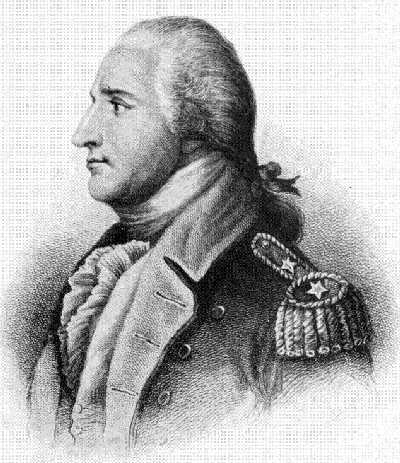
In conduct and courage, Arnold's behavior was excellent throughout. Without enlarging upon the energy which created the flotilla, and the breadth of view which suggested preparations that he could not enforce, admiration is due to his recognition of the fact—implicit in deed, if unexpressed in word—that the one use of the Navy was to contest the control of the water; to impose delay, even if it could not secure ultimate victory. No words could say more clearly than do his actions that, under the existing conditions, the navy was useless, except as it contributed to that end; valueless, if buried in port. Upon this rests the merit of his bold advance into the lower narrows; upon this his choice of the strong defensive position of Valcour; upon this his refusal to retreat, as urged by Waterbury, when the full force of the enemy was disclosed,—a decision justified, or rather, illustrated, by the advantages which the accidents of the day threw into his hands. His personal gallantry was conspicuous there as at all times of his life. "His countrymen," said a generous enemy of that day, "chiefly gloried in the dangerous attention which he paid to a nice point of honour, in keeping his flag flying, and not quitting his galley till she was in flames, lest the enemy should have boarded, and struck it." It is not the least of the injuries done to his nation in after years, that he should have silenced this boast and effaced this glorious record by so black an infamy.
With the destruction of the flotilla ends the naval story of the Lakes during the War of the American Revolution. Satisfied that it was too late to proceed against Ticonderoga that year, Carleton withdrew to St. John's and went into winter-quarters. The following year the enterprise was resumed under General Burgoyne; but Sir William Howe, instead of coöperating by an advance up the Hudson, which was the plan of 1776, carried his army to Chesapeake Bay, to act thence against Philadelphia. Burgoyne took Ticonderoga and forced his way as far as Saratoga, sixty miles from Ticonderoga and thirty from Albany, where Howe should have met him. There he was brought to a stand by the army which the Americans had collected, found himself unable to advance or to retreat, and was forced to lay down his arms on October 17th, 1777. The garrison left by him at Ticonderoga and Crown Point retired to Canada, and the posts were re-occupied by the Americans. No further contest took place on the Lake, though the British vessels remained in control of it, and showed themselves from time to time up to 1781. With the outbreak of war between Great Britain and France, in 1778, the scene of maritime interest shifted to salt water, and there remained till the end.