Chapter V
Reading edition
THE NAVAL WAR IN EUROPE. THE BATTLE OF USHANT 1778
The Brest fleet also put to sea, the day before Keppel, under the command of Admiral the Comte d'Orvilliers. It contained thirty-two ships of the line. Of these, three—64, a 60, and a 50—were not considered fit for the line of battle, which was thus reduced to twenty-nine sail, carrying 2098 guns. To these the British opposed an aggregate of 2278; but comparison by this means only is very rough. Not only the sizes of the guns, but the classes and weight of the vessels need to be considered. In the particular instance the matter is of little importance; the action being indecisive, and credit depending upon manœuvres rather than upon fighting.
The French admiral was hampered by vacillating instructions, reflections of the unstable impulses which swayed the Ministry. Whatever his personal wishes, he felt that he was expected to avoid action, unless under very favourable circumstances. At the moment of sailing he wrote: "Since you leave me free to continue my cruise, I will not bring the fleet back to Brest, unless by positive orders, until I have fulfilled the month at sea mentioned in my instructions, and known to all the captains. Till then I will not fly before Admiral Keppel, whatever his strength; only, if I know him to be too superior, I will avoid a disproportionate action as well as I can; but if the enemy really seeks to force it, it will be very hard to shun." These words explain his conduct through the next few days.
D'Orvilliers and Keppel, off Ushant, July 27, 1778 Figure 1
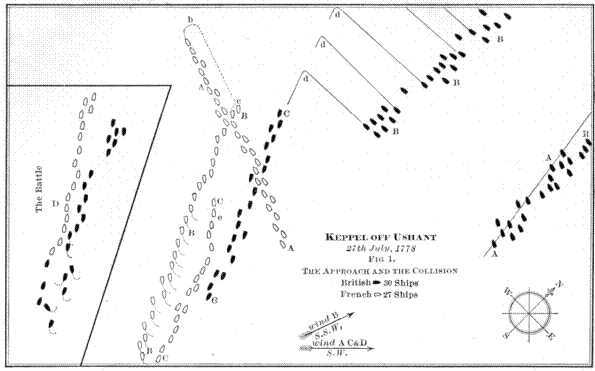
Keppel so far had made no signal for the line of battle, nor did he now. Recognising from the four days' chase that his enemy was avoiding action, he judged correctly that he should force it, even at some risk. It was not the time for a drill-master, nor a parade. Besides, thanks to the morning signal for the leewardly ships to chase, these, forming the rear of the disorderly column in which he was advancing, were now well to windward, able therefore to support their comrades, if needful, as well as to attack the enemy. In short, practically the whole force was coming into action, although much less regularly than might have been desired. What was to follow was a rough-and-ready fight, but it was all that could be had, and better than nothing. Keppel therefore simply made the signal for battle, and that just as the firing began. The collision was so sudden that the ships at first had not their colours flying.
At this time six or seven of Harland's division were on the weather bow of the Victory, to windward (westward), but a little ahead, and standing like her after the French; all on the port tack (Fig. 2). None of the centre division succeeded in joining the flagship at once. At 2.30 Palliser's ship, the Formidable (R), on the starboard tack, passed the Victory to leeward, apparently the last of the fleet out of action. A half-hour after this the Victory had been joined by three of the centre, which were following her in close order, the van remaining in the same relative position. Astern of these two groups from van and centre were a number of other ships in various degrees of confusion,—some going about, some trying to come up, others completely disabled. Especially, there was in the south-south-east, therefore well to leeward, a cluster of four or five British vessels, evidently temporarily incapable of manœuvring.
D'Orvilliers and Keppel, off Ushant, July 27, 1778 Figures 2 and 3
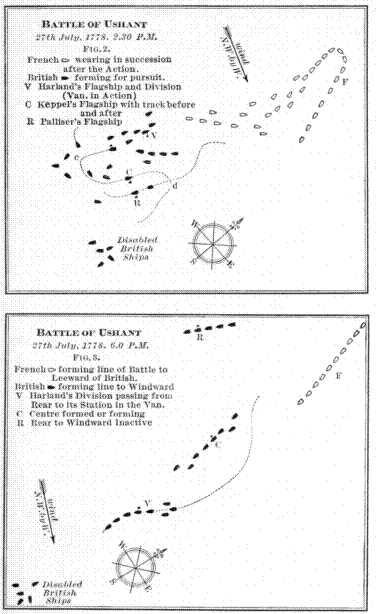
As soon as Keppel recognised his opponent's intention, he wore the Victory again, (d), a few minutes after 3 P.M., and stood slowly down, on the starboard tack off the wind, towards his crippled ships in the south-south-east, keeping aloft the signal for the line of battle, which commanded every manageable ship to get to her station (Fig. 3, C). As this deliberate movement was away from the enemy, (F), Palliser tried afterwards to fix upon it the stigma of flight,—a preposterous extravagancy. Harland put his division about at once and joined the Admiral. On this tack his station was ahead of the Victory, but in consequence of a message from Keppel he fell in behind her, to cover the rear until Palliser's division could repair damage and take their places. At 4 P.M. Harland's division was in the line. Palliser's ships, as they completed refitting, ranged themselves before or behind his flagship; their captains considering, as they testified, that they took station from their divisional commander, and not from the ship of the Commander-in-Chief. There was formed thus, on the weather quarter of the Victory, and a mile or two distant, a separate line of ships, constituting on this tack the proper rear of the fleet, and dependent for initiative on Palliser's flagship (Fig. 3, R). At 5 P.M. Keppel sent word by a frigate to Palliser to hasten into the line, as he was only waiting for him to renew the action, the French now having completed their manœuvre. They had not attacked, as they might have done, but had drawn up under the lee of the British, their van abreast the latter's centre. At the same time Harland was directed to move to his proper position in the van, which he at once did (Fig. 3, V). Palliser made no movement, and Keppel with extraordinary—if not culpable—forbearance refrained from summoning the rear ships into line by their individual pennants. This he at last did about 7 P.M., signalling specifically to each of the vessels then grouped with Palliser, (except his own flagship), to leave the latter and take their posts in the line. This was accordingly done, but it was thought then to be too late to renew the action. At daylight the next morning, only three French ships were in sight from the decks; but the main body could be seen in the south-east from some of the mastheads, and was thought to be from fifteen to twenty miles distant.
Though absolutely indecisive, this was a pretty smart skirmish; the British loss being 133 killed and 373 wounded, that of the French 161 killed and 513 wounded. The general result would appear to indicate that the French, in accordance with their usual policy, had fired to cripple their enemy's spars and rigging, the motive-power. This would be consistent with d'Orvilliers' avowed purpose of avoiding action except under favourable circumstances. As the smoke thickened and confusion increased, the fleets had got closer together, and, whatever the intention, many shot found their way to the British hulls. Nevertheless, as the returns show, the number of men hit among the French was to the British nearly as 7 to 5. On the other hand, it is certain that the manœuvring power of the French after the action was greater than that of the British.
Both sides claimed the advantage. This was simply a point of honour, or of credit, for material advantage accrued to neither. Keppel had succeeded in forcing d'Orvilliers to action against his will; d'Orvilliers, by a well-judged evolution, had retained a superiority of manœuvring power after the engagement. Had his next signal been promptly obeyed, he might have passed again by the British fleet, in fairly good order, before it re-formed, and concentrated his fire on the more leewardly of its vessels. Even under the delay, it was distinctly in his power to renew the fight; and that he did not do so forfeits all claim to victory. Not to speak of the better condition of the French ships, Keppel, by running off the wind, had given his opponent full opportunity to reach his fleet and to attack. Instead of so doing, d'Orvilliers drew up under the British lee, out of range, and offered battle; a gallant defiance, but to a crippled foe.
Time was thus given to the British to refit their ships sufficiently to bear down again. This the French admiral should not have permitted. He should have attacked promptly, or else have retreated; to windward, or to leeward, as seemed most expedient. Under the conditions, it was not good generalship to give the enemy time, and to await his pleasure. Keppel, on the other hand, being granted this chance, should have renewed the fight; and here arose the controversy which set all England by the ears, and may be said to have immortalised this otherwise trivial incident. Palliser's division was to windward from 4 to 7 P.M., while the signals were flying to form line of battle, and to bear down in the Admiral's wake; and Keppel alleged that, had these been obeyed by 6 P.M., he would have renewed the battle, having still over two hours of daylight. It has been stated already that, besides the signals, a frigate brought Palliser word that the Admiral was waiting only for him.
The immediate dispute is of slight present interest, except as an historical link in the fighting development of the British Navy; and only this historical significance justifies more than a passing mention. In 1778 men's minds were still full of Byng's execution in 1757, and of the Mathews and Lestock affair in 1744, which had materially influenced Byng in his action off Minorca. Keppel repeatedly spoke of himself as on trial for his life; and he had been a member of Byng's court-martial. The gist of the charges against him, preferred by Palliser, was that he attacked in the first instance without properly forming his line, for which Mathews had been censured; and, secondly, that by not renewing the action after the first pass-by, and by wearing away from the French fleet, he had not done his utmost to "take, sink, burn, and destroy." This had been the charge on which Byng was shot. Keppel, besides his justifying reasons for his course in general, alleged and proved his full intention to attack again, had not Palliser failed to come into line, a delinquency the same as that of Lestock, which contributed to Mathew's ruin.
Another indication of still surviving pedantry was the obligation felt in the rear ships to take post about their own admiral, and to remain there when the signals for the line of battle, and to bear down in the admiral's wake, were flying. Thus Palliser's own inaction, to whatever cause due, paralysed the six or eight sail with him; but it appears to the writer that Keppel was seriously remiss in not summoning those ships by their own pennants, as soon as he began to distrust the purposes of the Vice-Admiral, instead of delaying doing so till 7 P.M., as he did. It is a curious picture presented to us by the evidence. The Commander-in-Chief, with his staff and the captain of the ship, fretting and fuming on the Victory's quarter-deck; the signals flying which have been mentioned; Harland's division getting into line ahead; and four points on the weather quarter, only two miles distant, so that "every gun and port could be counted," a group of seven or eight sail, among them the flag of the third in command, apparently indifferent spectators. The Formidable's only sign of disability was the foretopsail unbent for four hours,—a delay which, being unexplained, rather increased than relieved suspicion, rife then throughout the Navy. Palliser was a Tory, and had left the Board of Admiralty to take his command. Keppel was so strong a Whig that he would not serve against the Americans; and he evidently feared that he was to be betrayed to his ruin.
Keppel was cleared of all the charges preferred against him; the accuser had not thought best to embody among them the delay to recall the ships which his own example was detaining. Against Palliser no specific charge was preferred, but the Admiralty directed a general inquiry into his course on the 27th of July. The court found his conduct "in many instances highly exemplary and meritorious,"—he had fought well,—"but reprehensible in not having acquainted the Commander-in-Chief of his distress, which he might have done either by the Fox, or other means which he had in his power." Public opinion running strongly for Keppel, his acquittal was celebrated with bonfires and illuminations in London; the mob got drunk, smashed the windows of Palliser's friends, wrecked Palliser's own house, and came near to killing Palliser himself. The Admiralty, in 1780, made him Governor of Greenwich Hospital.
On the 28th of July, the British and French being no longer in sight of each other, Keppel, considering his fleet too injured aloft to cruise near the French coast, kept away for Plymouth, where he arrived on the 31st. Before putting to sea again, he provided against a recurrence of the misdemeanor of the 27th by a general order, that "in future the Line is always to be taken from the Centre." Had this been in force before, Palliser's captains would have taken station by the Commander-in-Chief, and the Formidable would have been left to windward by herself. At the same time Howe was closing his squadron upon the centre in America; and Rodney, two years later, experienced the ill-effects of distance taken from the next ahead, when the leading ship of a fleet disregarded an order.
Although privately censuring Palliser's conduct, the Commander-in-Chief made no official complaint, and it was not until the matter got into the papers, through the talk of the fleet, that the difficulty began which resulted in the trial of both officers, early in the following year. After this, Keppel, being dissatisfied with the Admiralty's treatment, intimated his wish to give up the command. The order to strike his flag was dated March 18th, 1779. He was not employed afloat again, but upon the change of administration in 1782 he became First Lord of the Admiralty, and so remained, with a brief intermission, until December, 1783.