Chapter XII
Reading edition
THE FINAL NAVAL CAMPAIGN IN THE WEST INDIES. HOOD AND DE GRASSE. RODNEY AND DE GRASSE. THE GREAT BATTLE OF APRIL 12, 1782
The year 1781 closed with an incident more decisive in character than most of the events that occurred in European waters during its course; one also which transfers the interest, by natural transition, again to the West Indies. The French government had felt throughout the summer the necessity of sending de Grasse reinforcements both of ships and of supplies, but the transports and material of war needed could not be collected before December. As the British probably would attempt to intercept a convoy upon which the next campaign so much depended, Rear-Admiral de Guichen was ordered to accompany it clear of the Bay of Biscay, with twelve ships of the line, and then to go to Cadiz. Five ships of the line destined to de Grasse, and two going to the East Indies, raised to nineteen the total force with which de Guichen left Brest on the 10th of December. On the afternoon of the 12th, the French being then one hundred and fifty miles to the southward and westward of Ushant, with a south-east wind, the weather, which had been thick and squally, suddenly cleared and showed sails to windward. These were twelve ships of the line, one 50, and some frigates, under Rear-Admiral Richard Kempenfelt, who had left England on the 2d of the month, to cruise in wait for this expedition. The French numbers were amply sufficient to frustrate any attack, but de Guichen, ordinarily a careful officer, had allowed his ships of war to be to leeward and ahead of the convoy. The latter scattered in every direction, as the British swooped down upon them, but all could not escape; and the French ships of war remained helpless spectators, while the victims were hauling down their flags right and left. Night coming on, some prizes could not be secured, but Kempenfelt carried off fifteen, laden with military and naval stores of great money value and greater military importance. A few days later a violent storm dispersed and shattered the remainder of the French body. Two ships of the line only, the Triomphant, 84, and Brave, 74, and five transports, could pursue their way to the West Indies. The rest went back to Brest. This event may be considered as opening the naval campaign of 1782 in the West Indies.
The original intention of de Grasse and de Bouillé had been to capture Barbados, the most important of the Eastern Antilles still remaining to the British; but the heavy trade-winds, which in those days made a winter passage to windward so long and dreary a beat, twice drove them back to port. "The whole French fleet," wrote Hood, "appeared off Santa Lucia on the 17th of last month, endeavouring to get to windward, and having carried away many topmasts and yards in struggling against very squally weather, returned to Fort Royal Bay on the 23d, and on the 28th came out again with forty transports, manœuvring as before." On the 2d of January it disappeared from Santa Lucia, and, after a short stay again at Martinique, proceeded on the 5th to St. Kitts, anchoring in Basse Terre Roads on the 11th. The British garrison retired to Brimstone Hill, a fortified position at the north-west of the island, while the inhabitants surrendered the government to the French, pledging themselves to neutrality. The adjacent island of Nevis capitulated on the same terms on the 20th.
St. Kitts being less than fifty miles from Antigua, Hood doubtless now got accurate information of the enemy's dispositions, and could form a definite, well-matured plan. This seems to have been carefully imparted to all his captains, as was the practice of Nelson, who was the pupil of Hood, if of any one. "At 9.15 A.M. the Admiral made the signal for all flag-officers," says the log of the Canada; "and at 4 P.M. the Admirals and Commodore made the signals for all captains of their divisions." At 5 P.M. of the same day, January 23d, the fleet weighed and stood over for Nevis, round the southern point of which Basse Terre must be approached; for, the channel between Nevis and St. Kitts being impracticable for ships of the line, the two islands were virtually one, and, their common axis lying north-west and south-east, the trade-wind is fair only when coming from the south.
Basse Terre, where de Grasse then was, is about fifteen miles from the south point of Nevis. The roadstead lies east and west, and the French fleet, then twenty-four of the line and two fifties, were anchored without attention to order, three or four deep; the eastern ships so placed that an enemy coming from the southward could reach them with the prevailing trade-wind, against which the western ships could not beat up quickly to their support. This being so, we are told that Hood, starting shortly before sunset with a fair, and probably fresh wind, from a point only sixty miles distant, hoped to come upon the French by surprise at early daybreak, to attack the weather ships, and from them to sail along the hostile order so far as might seem expedient. His column, thus passing in its entirety close to a certain exposed fraction of the enemy, the latter would be cut up in detail by the concentration upon it. The British then, wearing to the southward, would haul their wind, tack, and again stand up to the assault, if the enemy continued to await it.
This reasonable expectation, and skilful conception, was thwarted by a collision, during the night, between a frigate, the Nymphe, 36, and the leading ship of the line, the Alfred, 74. The repairs to the latter delayed the fleet, the approach of which was discovered by daylight. De Grasse therefore put to sea. He imagined Hood's purpose was to throw succours into Brimstone Hill; and moreover the position of the enemy now was between him and four ships of the line momentarily expected from Martinique, one of which joined him on the same day. The French were all under way by sunset, standing to the southward under easy sail, towards the British, who had rounded the south point of Nevis at 1 P.M. Towards dark, Hood went about and stood also to the southward, seemingly in retreat.
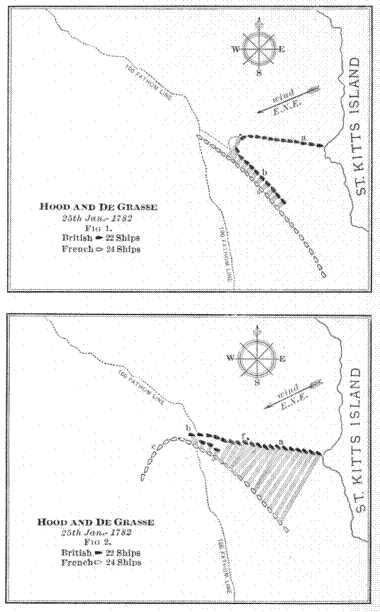
During the following night the British tacked several times, to keep their position to windward. At daylight of January 25th, the two fleets were to the westward of Nevis; the British near the island, the French abreast, but several miles to leeward. Foiled in his first spring by an unexpected accident, Hood had not relinquished his enterprise, and now proposed to seize the anchorage quitted by the French, so establishing himself there,—as he had proposed to Graves to do in the Chesapeake,—that he could not be dislodged. For such a defensive position St. Kitts offered special advantages. The anchorage was a narrow ledge, dropping precipitately to very deep water; and it was possible so to place the ships that the enemy could not easily anchor near them.
Hood and De Grasse, January 25, 1782, Figures 1 and 2
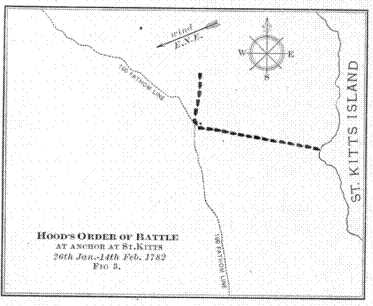
Naturally, an order taken up under such conditions needed some rectifying before further battle. As the proper stationing of the fleet depended in great measure upon the position of the van ship, Hood had put a local pilot on board her; but when the action ceased, he found that she was not as close to the shore as he had intended. The rear, on the other hand, was naturally in the most disorder, owing to the circumstances attending its anchorage. Three ships from the rear were consequently directed to place themselves ahead of the van, closing the interval, while others shifted their berths, according to specific directions. The order as finally assumed (Fig. 3) was as follows. The van ship was anchored so close to the shore that it was impossible to pass within her, or, with the prevailing wind, even to reach her, because of a point and shoal just outside, covering her position. From her the line extended in a west-north-west direction to the fifteenth ship,—the Barfleur, 98, Hood's flagship,—when it turned to north, the last six ships being on a north and south line. These six, with their broadsides turned to the westward, prevented a column passing from south to north, the only way one could pass, from enfilading the main line with impunity. The latter covered with its guns the approach from the south. All the ships had springs on their cables, enabling them to turn their sides so as to cover a large arc of a circle with their batteries.
Hood and De Grasse, January 26, 1782, Figure 3
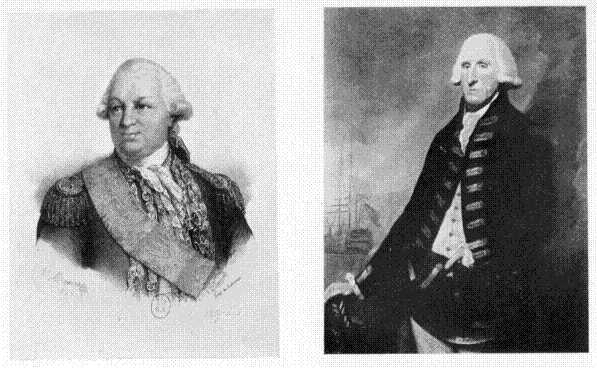
François-Joseph-Paul, Comte de Grasse, Marquis de Tilly Admiral, Lord Hood
Though most gallantly done, no such routine manœuvre as this could shake Hood's solidly assumed position. The attempt was repeated in the afternoon, but more feebly, and upon the centre and rear only. This also was ineffectual; and Hood was left in triumphant possession of the field. The losses in the several affairs of the two days had been: British, 72 killed, 244 wounded; French, 107 killed, 207 wounded. Thenceforth the French fleet continued cruising to leeward of the island, approaching almost daily, frequently threatening attack, and occasionally exchanging distant shots; but no serious encounter took place. Interest was centred on Brimstone Hill, where alone on the island the British flag still flew. De Grasse awaited its surrender, flattering himself that the British would be forced then to put to sea, and that his fleet, increased by successive arrivals to thirty-two of the line, would then find an opportunity to crush the man who had outwitted and out-manœuvred him on January 25th and 26th. In this hope he was deceived by his own inaptness and his adversary's readiness. Hood was unable to succour Brimstone Hill, for want of troops; the French having landed six thousand men, against which the British twenty-four hundred could effect nothing, either alone or in coöperation with the garrison, which was but twelve hundred strong. The work capitulated on the 13th of February. De Grasse, who had neglected to keep his ships provisioned, went next day to Nevis and anchored there to empty the storeships. That evening Hood called his captains on board, explained his intentions, had them set their watches by his, and at 11 P.M. the cables were cut one by one, lights being left on the buoys, and the fleet silently decamped, passing round the north end of St. Kitts, and so towards Antigua. When de Grasse opened his eyes next morning, the British were no longer to be seen. "Nothing could have been more fortunately executed," wrote Lord Robert Manners, "as not one accident happened from it. Taking the whole in one light, though not successful in the point we aimed at, nevertheless it was well conducted, and has given the enemy a pretty severe check; and if you give him half the credit the enemy does, Sir Samuel Hood will stand very high in the public estimation."
Hood's intention had been to return to Barbados; but on the 25th of February he was joined, to windward of Antigua, by Rodney, who had arrived from England a week earlier, bringing with him twelve ships of the line. The new Commander-in-Chief endeavoured to cut off de Grasse from Martinique, but the French fleet got in there on the 26th. Rodney consequently went to Santa Lucia, to refit Hood's ships, and to prepare for the coming campaign, in which it was understood that the conquest of Jamaica was to be the first object of the allies. An important condition to their success was the arrival of a great convoy, known to be on its way from Brest to repair the losses which Kempenfelt's raid and subsequent bad weather had inflicted in December. Hood suggested to Rodney to halve the fleet, which then numbered thirty-six of the line, letting one part cruise north of Dominica, between that island and Deseada, while the other guarded the southern approach, between Martinique and Santa Lucia. Rodney, however, was unwilling to do this, and adopted a half-measure,—Hood's division being stationed to windward of the north end of Martinique, reaching only as far north as the latitude of Dominica, while the center and rear were abreast of the centre and south of Martinique; all in mutual touch by intermediate vessels. It would seem—reading between the lines—that Hood tried to stretch his cruising ground northwards, in pursuance of his own ideas, but Rodney recalled him. The French convoy consequently passed north of Deseada, convoyed by two ships of the line, and on the 20th of March reached Martinique safely. De Grasse's force was thus raised to thirty-five of the line, including two 50-gun ships, as against the British thirty-six. At the end of the month Rodney returned to Santa Lucia, and there remained at anchor, vigilantly watching the French fleet in Fort Royal by means of a chain of frigates.
The problem now immediately confronting de Grasse—the first step towards the conquest of Jamaica—was extremely difficult. It was to convoy to Cap François the supply vessels essential to his enterprise, besides the merchant fleet bound for France; making in all one hundred and fifty unarmed ships to be protected by his thirty-five sail of the line, in face of the British thirty-six. The trade-wind being fair, he purposed to skirt the inner northern edge of the Caribbean Sea; by which means he would keep close to a succession of friendly ports, wherein the convoy might find refuge in case of need.
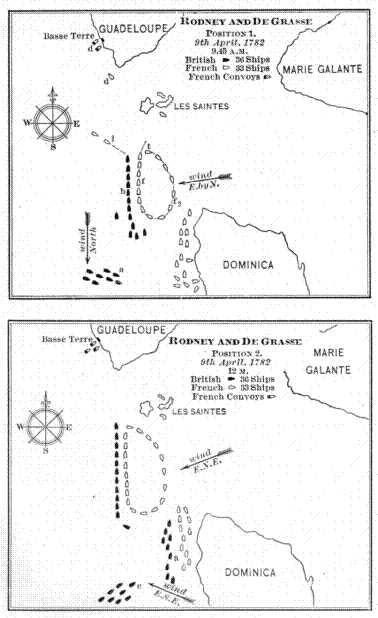
Large bodies of ships commonly will move less rapidly than small. By 2.30 P.M. of the day of starting, Rodney's look-outs had sighted the French fleet; and before sundown it could be seen from the mastheads of the main body. At 6 next morning, April 9th, the enemy, both fleet and convoy, was visible from the deck of the Barfleur, the flagship of Hood's division, then in the British van. The French bore north-east, distant four to twelve miles, extending from abreast of the centre of Dominica northwards towards Guadeloupe. The British had gained much during the night, and their centre was now off Dominica to leeward of the enemy's rear, which was becalmed under the island. Some fourteen or fifteen of the French van, having opened out the channel between Dominica and Guadeloupe, felt a fresh trade-wind, from east by north, with which they steered north; and their number was gradually increased as individual ships, utilising the catspaws, stole clear of the high land of Dominica. Hood's division in like manner, first among the British, got the breeze, and, with eight ships, the commander of the van stood north in order of battle. To the north-west of him were two French vessels, separated from their consorts and threatened to be cut off (i). These stood boldly down and crossed the head of Hood's column; one passing so close to the leading ship, the Alfred, that the latter had to bear up to let her pass. Rodney had hoisted a signal to engage at 6.38 A.M., but had hauled it down almost immediately, and Hood would not fire without orders. These ships therefore rejoined their main body unharmed. At 8.30 the French hoisted their colours, and shortly afterwards the vessels which had cleared Dominica tacked and stood south, opposite to Hood.
De Grasse now had recognised that he could not escape action, if the convoy kept company. He therefore directed the two 50-gun ships, Expériment and Sagittaire, to accompany it into Guadeloupe, where it arrived safely that day (Position 1, dd); and he decided that the fleet should ply to windward through the channel between Dominica and Guadeloupe, nearly midway in which lies a group of small islands called Les Saintes,—a name at times given to the battle of April 12th. By this course he hoped not only to lead the enemy away from the convoy, but also to throw off pursuit through his superior speed, and so to accomplish his mission unharmed. The French ships, larger, deeper, and with better lines than their opponents, were naturally better sailers, and it may be inferred that even coppering had not entirely overcome this original disadvantage of the British.
At the very moment of beginning his new policy, however, a subtle temptation assailed de Grasse irresistibly, in the exposed position of Hood's column (h); and he met it, not by a frank and hearty acceptance of a great opportunity, but by a half-measure. Hood thoroughly crushed, the British fleet became hopelessly inferior to the French; Hood damaged, and it became somewhat inferior: possibly it would be deterred from further pursuit. De Grasse decided for this second course, and ordered part of his fleet to attack. This operation was carried out under the orders of the Marquis de Vaudreuil, the second in command. The ships engaged in it bore down from the windward, attacked Hood's rear ships, stood along northward (f) on the weather side of his column at long range, and, having passed ahead, tacked (t) in succession and formed again in the rear, (f^2) whence they repeated the same manœuvre (Positions 1 and 2). Thus a procession of fifteen ships kept passing by eight, describing a continuous curve of elliptical form. They were able to do this because Hood was condemned to a low speed, lest he should draw too far away from the British centre (a) and rear (c), still becalmed under Dominica (Position 2). The French, having choice of distance, kept at long gunshot, because they were deficient in carronades, of which the British had many. These guns, of short range but large calibre, were thus rendered useless. Could they have come into play, the French rigging and sails would have suffered severely. This first engagement (Position 1) lasted, by Hood's log, from 9.48 to 10.25 A.M. It was resumed in stronger force (Position 2) at 14 minutes past noon, and continued till 1.45 P.M., when firing ceased for that day; Rodney hauling down the signal for battle at 2. Between the two affairs, which were identical in general character, Hood's column was reinforced, and great part of the British centre also got into action with some of the French main body, though at long range only. "Except the two rear ships," wrote Rodney to Hood that night, "the others fired at such a distance that I returned none."
Rodney and De Grasse, April 9 and 12, 1782 Figures 1 and 2
The injuries to the British ships engaged were not such as to compel them to leave the fleet. The Royal Oak lost her main topmast, and that of the Warrior fell two days later, not improbably from wounds; but in these was nothing that the ready hands of seamen could not repair so as to continue the chase. Rodney, therefore, contented himself with reversing the order of sailing, putting Hood in the rear, whereby he was able to refit, and yet follow fast enough not to be out of supporting distance. This circumstance caused Hood's division to be in the rear in the battle of the 12th. One of the French ships, the Caton, 64, had been so injured that de Grasse detached her into Guadeloupe. It must be remembered that a crippled ship in a chased fleet not only embarrasses movement, but may compromise the whole body, if the latter delay to protect it; whereas the chaser keeps between his lame birds and the enemy.
During the night of the 9th the British lay-to for repairs. The next morning they resumed the pursuit, turning to windward after the enemy, but upon the whole losing throughout the 10th and the 11th. At daylight of the 10th the French, by the logs of Hood and Cornwallis, were "from four to five leagues distant," "just in sight from the deck." During that night, however, the Zélé, 74, had collided with the Jason, 64; and the latter was injured so far as to be compelled to follow the Caton into Guadeloupe. At sunset of that day Rodney signalled a general chase to windward, the effect of which was to enable each ship to do her best according to her captain's judgment during the dark hours. Nevertheless, on the morning of the 11th the French seem again to have gained, for Hood, who, it will be remembered, was now in the rear, notes that at 10 A.M. twenty-two French sail (not all the fleet) could be counted from the masthead; Cornwallis, further to windward, could count thirty-three. Troude, a French authority, says that at that time nearly all the French had doubled The Saintes, that is, had got to windward of them, and it looked as though de Grasse might succeed in throwing off his pursuer. Unluckily, two ships, the Magnanime, 74, and the Zélé, 74, the latter of which had lost her main topmast, were several miles to leeward of the French main body. It was necessary to delay, or to drop those vessels. Again, trivial circumstances conspired to further a great disaster, and de Grasse bore down to cover the crippled ships; so losing much of his hard-won ground, and entailing a further misfortune that night. Rodney hung doggedly on, relying on the chapter of accidents, as one who knows that all things come to him who endures. To be sure, there was not much else he could do; yet he deserves credit for unremitting industry and pluck. During the afternoon, the signals noted in the British logs—to call in all cruisers and for the fleet to close—attest mutely the movement of de Grasse in bearing down,—coming nearer.
Rodney and De Grasse, April 9 and 12, 1782 Figure 3
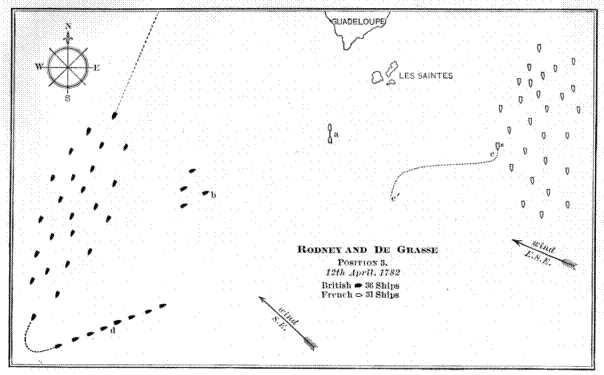
The British appear to have been standing to the south on the port tack at daylight; but, soon after sending out the chasers, Rodney had ordered the line of bearing (from ship to ship) to be north-north-east to south-south-west, evidently in preparation for a close-hauled line of battle on the starboard tack, heading northerly to an east wind. Somewhat unusually, the wind that morning held at south-east for some time, enabling the British to lie up as high as east-north-east on the starboard tack (Position 3, d), on which they were when the battle joined; and this circumstance, being very favourable for gaining to windward,—to the eastward,—doubtless led to the annulling of the signal for the line of bearing, half an hour after it was made, and the substitution for it of the line of battle ahead at one cable. It is to be inferred that Rodney's first purpose was to tack together, thus restoring Hood to the van, his natural station; but the accident of the wind holding to the southward placed the actual van—regularly the rear—most to windward, and rendered it expedient to tack in succession, instead of all together, preserving to the full the opportunity which chance had extended for reaching the enemy. In the engagement, therefore, Hood commanded in the rear, and Rear-Admiral Drake in the van. The wind with the French seems to have been more to the eastward than with the British,—not an unusual circumstance in the neighbourhood of land.
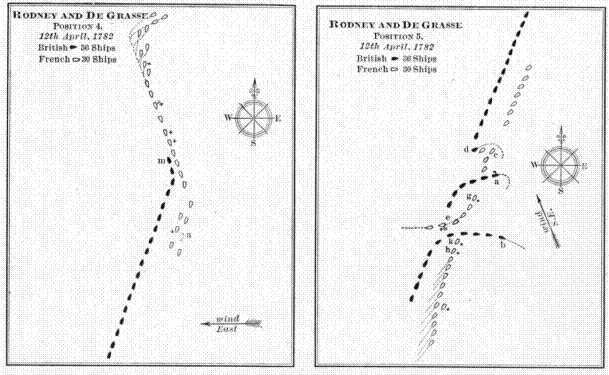
Rodney and De Grasse, April 9 and 12, 1782 Figures 4 and 5
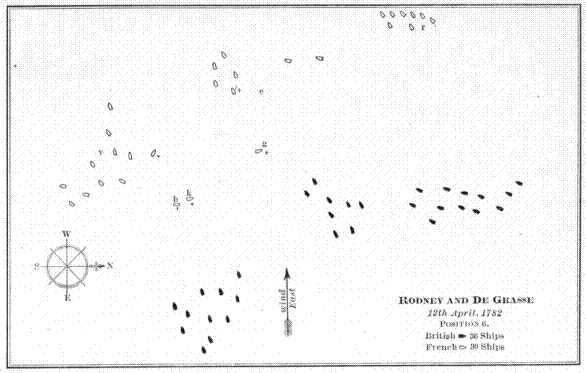
Rodney and De Grasse, April 9 and 12, 1782 Figure 6
The British ships ahead of the Duke, the van and part of the centre, in all sixteen sail, had continued to stand to the northward. At the time Rodney broke the line, several of them must have passed beyond the French rear, and out of action. One, the America, the twelfth from the van, wore without signals, to pursue the enemy, and her example was followed at once by the ship next ahead, the Russell, Captain Saumarez. No signal following, the America again wore and followed her leaders, but the Russell continued as she was, now to windward of the French; by which course she was able to take a conspicuous share in the closing scenes. At 11.33 Rodney signalled the van to tack, but the delay of an hour or more had given the Russell a start over the other ships of her division "towards the enemy" which could not be overcome.
The effect of these several occurrences had been to transfer the weather-gage, the position for attack, to the British from the French, and to divide the latter also into three groups, widely separated and disordered (Position 6). In the centre was the flagship Ville de Paris with five ships (c). To windward of her, and two miles distant, was the van, of some dozen vessels (v). The rear was four miles away to leeward (r). To restore the order, and to connect the fleet again, it was decided to re-form on the leewardmost ships; and several signals to this effect were made by de Grasse. They received but imperfect execution. The manageable vessels succeeded easily enough in running before the wind to leeward, but, when there, exactitude of position and of movement was unattainable to ships in various degrees of disability, with light and baffling side airs. The French were never again in order after the wind shifted and the line was broken; but the movement to leeward left the dismasted Glorieux, (g), Hector, (h), and César, (k), motionless between the hostile lines.
Rodney did not make adequate use of the great opportunity, which accident rather than design had given him at noon of April 12th. He did allow a certain liberty of manœuvre, by discontinuing the order for the line of battle; but the signal for close action, hoisted at 1 P.M., was hauled down a half-hour later. Hood, who realised the conditions plainly visible, as well as the reasonable inferences therefrom, wished the order given for a general chase, which would have applied the spur of emulation to every captain present, without surrendering the hold that particular signals afford upon indiscreet movements. He bitterly censured the Admiral's failure to issue this command. Had it been done, he said:—
To make signal for a general chase was beyond the competence of a junior admiral; but Hood did what he could, by repeated signals to individual ships of his own division to make more sail, by setting all he could on the Barfleur, and by getting out his boats to tow her head round. Sir Gilbert Blane unintentionally gives a similar impression of laxity.
At 6.45 Rodney made the signal for the fleet to bring-to (form line and stop) on the port tack, and he remained lying-to during the night, while the French continued to retreat under the orders of the Marquis de Vaudreuil, who by de Grasse's capture had become commander-in-chief. For this easy-going deliberation also Hood had strong words of condemnation.
Rodney stayed at Jamaica until the 10th of July, when Admiral Hugh Pigot arrived from England to supersede him. This change was consequent upon the fall of Lord North's ministry, in March, 1782, and had been decided before the news of the victory could reach England. Admiral Keppel now became the head of the Admiralty. Rodney sailed for home from Port Royal on the 22d of July; and with his departure the war in the West Indies and North America may be said to have ended. Pigot started almost immediately for New York, and remained in North American waters until the end of October, when he returned to Barbados, first having detached Hood with thirteen ships of the line from the main fleet, to cruise off Cap François. It is of interest to note that at this time Hood took with him from New York the frigate Albemarle, 28, then commanded by Nelson, who had been serving on the North American station. These various movements were dictated by those of the enemy, either actually made or supposed to be in contemplation; for it was an inevitable part of the ill-effects of Rodney's most imperfect success, that the British fleet was thenceforth on the defensive purely, with all the perplexities of him who waits upon the initiative of an opponent. Nothing came of them all, however, for the war now was but lingering in its death stupor. The defeat of de Grasse, partial though it was; the abandonment of the enterprise upon Jamaica; the failure of the attack upon Gibraltar; and the success of Howe in re-victualling that fortress,—these had taken all heart out of the French and Spaniards; while the numerical superiority of the allies, inefficiently though it had been used heretofore, weighed heavily upon the imagination of the British Government, which now had abandoned all hope of subduing its American Colonies. Upon the conclusion of peace, in 1783, Pigot and Hood returned to England, leaving the Leeward Islands' Station under the command of Rear-Admiral Sir Richard Hughes, an officer remembered by history only through Nelson's refusing to obey his orders not to enforce the Navigation Acts, in 1785.