Book 2 — CHAPTER II
Reading edition
1610
A temporary calm—Louis XIII—Marie de Medicis purchases the Marquisate of Ancre for Concini—Rapid rise of his fortunes—His profusion—He intrigues to create dissension among the Princes of the Blood—His personal endowments—The Duc de Bouillon endeavours to induce M. de Condé to revolt—He fails—He disposes of his office at Court to the Marquis d'Ancre—Marie de Medicis continues the public edifices commenced and projected by Henri IV—Zeal of the Duc de Mayenne—Cupidity of the Court—M. de Condé and his advisers—The Prince and the Minister—Forebodings of Sully—He determines to resign office—His unpopularity—The Regent refuses to accept his resignation—The war in Germany—The Regent resolves to despatch an army to Clèves—The Duc de Bouillon demands the command of the troops—Is refused by the Council—Retires in disgust to Sedan—The command is conferred on the Maréchal de la Châtre—A bootless campaign—The French troops return home—New dissensions at Court—The Duc d'Epernon becomes the declared enemy of the Protestants—Apprehensions of the reformed party—Quarrel of Sully and Villeroy—The Regent endeavours to effect a reconciliation with the Prince de Conti—Princely wages—M. de Conti returns to Court—The Princes of the Blood attend the Parliament—The Marquis d'Ancre is admitted to the State Council—Sully and Bouillon retire from the capital—Sully resolves to withdraw from the Government, but is again induced to retain office—The King and Père Cotton—The Court leave Paris for Rheims—Coronation of Louis XIII—His public entry into the capital—The Prince de Condé and the Comte de Soissons are reconciled—Quarrel between the Marquis d'Ancre and the Duc de Bellegarde—Cabal against Sully—The Huguenots petition for a General Assembly—Reluctance of the Regent to concede their demand—She finds herself compelled to comply—M. de Villeroy garrisons Lyons—Sully retires from the Ministry—Demands of the Princes—Sully's last official act—His parting interview with Louis XIII—The Minister and the Mountebanks.
Then it was that his talent for intrigue boldly developed itself. In vain did his wife warn him of the danger of further forcing his fortunes, and thus drawing down upon himself the hatred and envy of the native nobility; in vain did she represent that by indulging his passion for power and display he must eventually create enemies who were certain to prove fatal to his prosperity; Concini, as weak and vain as he was greedy and ambitious, disregarded her advice, and strenuously turned his attention to fomenting a misunderstanding among the most influential of the nobles, in order to prevent a coalition which threatened to diminish his own importance. He was well aware of his unpopularity with the Princes of the Blood, who could not without indignation see themselves compelled to treat with him almost upon equal terms, protected as he was by the favour of the Queen; and he consequently lived in perpetual apprehension of their forming a cabal to effect his ruin. Skilfully, therefore, with a smiling countenance, but an anxious heart, he availed himself of every opportunity to foment the jealousies and hatreds which policy had for a brief while laid to rest. To each and all he appeared zealous in their several interests, but to each and all he was alike a traitor.
Nature had been lavish to Concini; his person was well-formed and graceful, while his countenance beamed with intelligence, and gave promise of far greater intellect than he in reality possessed. It was this handsomeness which had inspired Leonora Galigaï with a passion that was destined to be her destruction, for no doubt can be entertained that had she never become his wife her career might have been one of happiness and honour; but while Concini, absorbed in his wild schemes of self-aggrandizement, trampled upon every consideration of honour and honesty in order to attain his object, Leonora, conscious of her own want of personal attractions, and loving her husband with a devotion made up of gratitude and admiration, suffered herself to be overruled by his vanity and arrogance, and sacrificed her reason and her judgment to her affection.
One of the first decisions arrived at by the Regent was the completion of all the public edifices commenced by the late King, and the erection of such as he had resolved upon, but had not lived to commence; an admirable act of policy by which she at once evinced her respect for the memory of her husband, and procured employment for hundreds of workmen, who must otherwise have been severe sufferers from want of occupation. Those which were originated under her auspices were the castle of Vincennes and the Royal College, the latter of which she caused to be built strictly according to the design executed by Henry himself; and the first stone was laid on the 28th of August by the young King, assisted by his whole Court. It bore the arms of France and Medicis, and beneath them was inscribed in deeply-chiselled characters: "In the first year of the reign of Louis XIII, King of France and Navarre, aged nine years, and of the regency of the Queen Marie de Medicis his mother, 1610." Four medals, bearing the same inscription, two of gold, and two of silver gilt, having been placed at the corners of the stone, which was then lowered, the Due de Sully presented the silver trowel, while two of the attendant nobles alternately offered the hammer and the silver trough containing the mortar.
It was not long ere the parties most interested in these donations became aware of the attempt made to limit the liberality of the Queen, and they did not affect to disguise their indignation at what they designated as an interference with their just claims. It appeared to have grown into an admitted opinion that all who had not revolted against her authority should be recompensed for their forbearance, as though it had been some signal service rendered to the state; and immediate deliberations were held as to the best measures to be adopted in order to silence the prudent counsels to which she could not finally fail to yield. As regarded the Duc de Mayenne, he was beyond the reach of the cabal; while Jeannin and Villeroy could oppose nothing save words; with Sully, however, the case was widely different; he was not only finance minister, but also keeper of the royal treasury, and his fearless and sturdy nature was so well understood and appreciated, that none who knew him doubted for an instant that should the Regent persevere in her generosity in opposition to his advice, he would not hesitate to adopt the most extreme measures to limit her power in the disposal of the public funds.
Sully, meanwhile, like a generous adversary, had not only endeavoured to restrain the liberality of the Queen, but had even ventured to expostulate with many of the applicants upon the ruinous extravagance of their demands; a proceeding which was resented by several of the great nobles, and by none more deeply than the Prince de Condé, who was upheld in his pretensions by his adherents, all of whom alleged that as the royal treasury was daily suffering diminution, and must soon become entirely exhausted, he had a right to claim, as first Prince of the Blood, the largest portion of its contents after their Majesties. They also reminded him of the offices and honours of which he had been despoiled by the late King, when he would not consent to retain them as the price of his disgrace; and, finally, they bade him not to lose sight of the fact that liberal as the Queen-Regent might have appeared on his return to France, he did not yet possess the revenues necessary to maintain his dignity as the first subject in the realm. M. de Condé was haughty and ambitious, and he consequently lent a willing ear to these representations; nor was it long ere he became equally convinced that his power was balanced by that of Sully; that a Bourbon was measured with a Béthune; a Prince of the Blood with a parvenu minister; and that such must continue to be the case so long as he permitted money to be poised against influence.
The effect of these insidious counsels soon made itself apparent in the altered manner of the Prince towards the man whom he had thus been taught to consider as the enemy of his greatness; for although he endeavoured to conceal his growing dislike, his nature was too frank, and moreover too impetuous, to second his policy; and Sully, on his side, was far too quick-sighted to be easily duped on so important a matter. The resolution of the Duke was therefore instantly formed; eager as he had been for office under the late King, he had, at the death of that monarch, ceased to feel or to exhibit the same energy. He already saw many of the favourite projects of Henry negatived; much of his advice disregarded; and as he looked into the future he taught himself to believe that he contemplated only a long vista of national decline and personal disappointment. While he had preserved the confidence and affection of his sovereign, he had held popularity lightly, too lightly it may be, for he was conscious of his strength, and scorned to seek for support where he believed that he ought only to afford it; but the knife of Ravaillac had changed the whole tenor of his existence: he saw that he was regarded with suspicion and distrust by those who envied the greatness which he had achieved; that however the Queen might veil her real feelings in the garb of esteem and kindness, she shrank from the uncompromising frankness of his disapproval, and the resolute straightforwardness of his remonstrances; that his desire to economize the resources of the country rendered him obnoxious to the greedy courtiers; and that his past favour tended to inspire jealousy and misgiving in those with whom he was now called upon to act. He was, moreover, no longer young; his children were honourably established; and, whatever it may have accorded with the policy of his enemies to assume, there can be no doubt that M. de Sully was perfectly sincere in the desire which he at this period expressed to retire from the cares and responsibilities of office to the comfort and tranquillity of private life. That such a resolution was most unpalatable to the Duchess is equally certain; but Sully nevertheless persisted in his intention, and even announced his proposed resignation to the Regent, entreating at the same time that she would not oppose the measure.
The moment was one of extreme difficulty for Marie. On all sides she was pursued by complaints of the finance minister, whose want of deference wounded the pride of the Princes, while the ministers reproached him with an undue assertion of authority, and the nobles murmured at his interference in matters unconnected with his official character. The Marquis d'Ancre and his wife were, moreover, among the most bitter of his enemies, and at this precise period their influence was all-sufficient with the Queen, who had so accustomed herself to be guided by their advice, and led by their prejudices, that they had obtained a predominance over her mind which invested them with a factitious power against which few ventured to contend. She endeavoured, nevertheless, to temporize, for she was aware of the absolute necessity of securing the services of Sully until he could be satisfactorily replaced; and although there were not wanting many about her who would readily have undertaken to supersede him in his ministry, Marie herself doubted that, wherever her selection of a successor might be made, its duties would be as efficiently fulfilled. She was, moreover, at that particular time earnestly occupied with the preparations necessary for the coronation of her son, and the retirement of Sully could not fail to involve her in embarrassment and difficulty; she consequently sought to conciliate the veteran minister, expressed her resentment at the annoyances of which he complained, declared her perfect satisfaction with everything that he had done since the recognition of her regency, and finally entreated him to take time and to reflect calmly upon the subject before he pressed her to accede to his request.
Sully complied with her wishes, but he did so without the slightest feeling of exultation. He was convinced that his favour was undermined and his removal from office already determined, and he accordingly experienced no sensation of self-gratulation at the expressed reluctance of the Queen to deprive herself of the oldest and ablest servant of her late consort. He was, perhaps, proud of being so acknowledged, but he was also aware that what he had been to the murdered King he could never hope to become to the Regent, who had already suffered herself to be governed by greedy sycophants and ambitious favourites.
The most important subject which occupied the Council at the commencement of the Regency was the question of the expediency or non-expediency of pursuing the design of the late King relative to the duchies of Juliers and Clèves. During the time which had elapsed since the levy of the French troops the several pretenders to the succession had not been idle, and hostile measures had already been adopted. The Catholic Princes of Germany were opposed to the claims of the Protestant party, the Dutch and the Spaniards siding with the former and the English with the latter; several towns had already been taken by each faction, and the virulence displayed on both sides threatened the infraction of the truce with Flanders, if not a universal war throughout Christendom. Nevertheless, the general voice was against any interference on the part of France, the ministers being anxious to avoid an outlay which under the then circumstances of the kingdom they deemed alike useless and impolitic, while the nobles, fearing to lose the advantages which each promised himself by confining the attention of the Queen to the internal economy of the state, came to the same decision. Sillery alone combated this resolution, declaring that as the protection of the Princes who had appealed to him for aid had been one of the last projects of the late King, his will should be held sacred and his intentions fully carried out.
The brave old soldier was not, however, fated on this occasion to add to his well-earned laurels, the words of Sully having been verified to the letter. Juliers was invested in the beginning of August, and on the 18th of the same month, when the French troops arrived before the city, the Prince of Orange had already made himself master of the fortress; and although the Imperial general gallantly persisted in his defence, he found himself at its close compelled to capitulate, being no longer able to resist the cannonade of the enemy, who had effected an irreparable breach in one of the walls, by which they poured an unceasing fire into the streets of the town.
Conscious of the cabal which was organizing against them, and having been apprised that M. d'Epernon had doubled the number of his guards, the Ducs de Bouillon, de Guise, and de Sully adopted similar precautions, and even kept horses ready saddled in their stables in order to escape upon the instant should they be threatened with violence. The minor nobility followed the example of their superiors, and soon every hôtel inhabited by men of rank resembled a fortress, while the streets resounded with the clashing of arms and the trampling of horses, to the perpetual terror of the citizens.
Hitherto M. de Condé had taken no part in the dissensions which were going on about him, but on the night of the 10th of July he in his turn received a warning to be upon his guard, and in consequence he caused a strong patrol to keep watch on all sides of his palace. Not an hour passed in which the gallop of a party of horsemen was not heard clattering over the rough and ill-paved streets. At midnight the Marquis d'Ancre waited upon the Prince to convey to him an invitation from the Regent to take up his abode in the Louvre should he not consider himself safe in his own house, but M. de Condé coldly declined to avail himself of the offer, alleging that the manner in which her Majesty had replied on the previous day, when he had informed her of his having been assured of her intention to cause his arrest, had given him no encouragement to become her guest; an answer which by no means tended to relieve the increasing apprehensions of the Queen, who felt the necessity of appeasing at any sacrifice the discontent of the Princes. She accordingly desired the presence of M. de Condé at the Louvre, a summons which he reluctantly obeyed; and it was long before the urbanity of her welcome assured him of the sincerity with which she entreated him to endeavour in her name to conciliate the Prince de Conti, who, on the refusal of the coveted government, had quitted Paris in disgust, and to induce his return to the Court.
It was not the fashion of that period even for Princes of the Blood to make concessions whence they derived no personal benefit, and it was accordingly without any compunction that M. de Condé declared the terms upon which he would undertake the proposed mission. He was to receive as recompense for his condescension the sum of fifty thousand crowns, with the first government which should become vacant, and was authorized to promise two hundred thousand crowns to the Duc de Guise for the payment of his debts, as well as several lesser sums to others of the Princes, on condition that they should return to their allegiance and forego their personal animosities.
These preliminary arrangements concluded, M. de Condé hastened to represent to his uncle the necessity of his immediate return to Paris before the departure of the King for Rheims, whither he was about to proceed for his coronation; and the Prince de Conti having with considerable difficulty been induced to comply with his request, the princely relatives entered the capital with so numerous a retinue of nobles and gentlemen that it excited general remark.
On the 27th the Marquis d'Ancre was admitted into the Council of State, and took the customary oaths at the Louvre; but he received few congratulations on this new honour, the arrogance in which he indulged tending to disgust the higher nobles, and to alarm those who had reason to deprecate his daily-increasing influence.
Thus the weight of government pressed heavily upon Marie both from within and without; and meanwhile the young King began to betray symptoms of that suspicious and saturnine temper by which he was afterwards so unhappily distinguished. On one occasion when all the efforts of Père Cotton, his confessor, had failed to overcome his gloom and reserve, the priest inquired in a tone of interest the nature of the annoyance by which he was thus oppressed. "I shall not tell you," was the resolute reply; "for you will immediately write to Spain to inform them."
The confessor, whose intimate connection with the ministers of Philip had rendered him obnoxious to the French people, was startled by this unexpected answer, and immediately complained to the Queen of the affront that had been offered to him; upon which Marie summoned the offender, and insisted upon his immediately informing her who had dared to suggest such an idea, when with considerable reluctance the boy-King stated that his nurse had warned him to be cautious because the reverend father was in correspondence with that country.
"Since she permits herself to play the politician," said the Queen, "she shall be dismissed."
"Be it so," retorted the young Prince; "but," turning towards the Jesuit, "I shall remember that it was his work, and I shall not always be a child."
A short time subsequently, while playing with a favourite fawn, he hid himself among the shrubs in the gardens of the Tuileries, and remained so long in his concealment that his attendants became alarmed and were compelled to inform the Queen that although they had sought the King everywhere, to entreat him to return, they could not ascertain where he had gone. Marie in great alarm caused all around her to join in the search, while she remained at one of the windows in a state of agonizing anxiety. At length the retreat of the fugitive was found, and M. de Souvré threatened him with the rod.
On the morrow the young sovereign was invested with the Order of the Holy Ghost, which he immediately afterwards conferred upon the Prince de Condé, and on Tuesday the 19th he stood sponsor
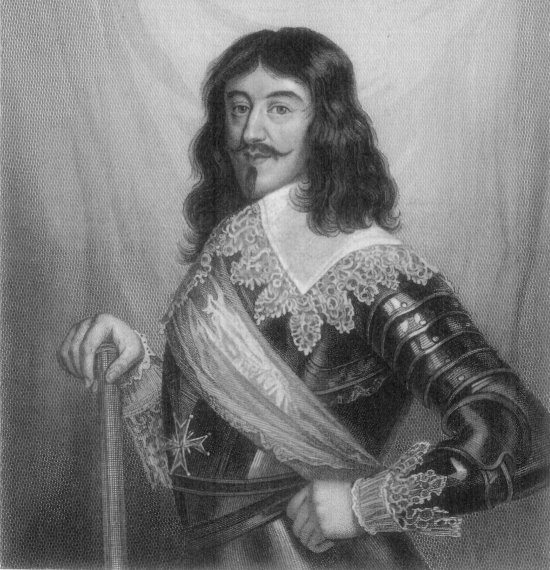
LOUIS XIII, KING OF FRANCE.
for the child of the Baron de Tour; after which he proceeded to St. Marcou, where he touched a number of persons suffering under the loathsome disease which it was the superstition of the age to believe could be removed by contact with the royal hand.
On the 30th of the month the Court returned to Paris, and was met at the Porte St. Antoine by the civic authorities, at the head of two hundred mounted citizens, amid a cannonade from the Bastille, and ceaseless flourishes of trumpets and hautboys. The Regent had, however, preceded her son to the city, and stood in a balcony at the house of Zamet to see him pass, where he no sooner perceived her than he withdrew his plumed cap, which he did not resume until having halted beneath the window he had saluted her with a profound bow. He then proceeded by torchlight to the Louvre, accompanied throughout his progress by the same acclamations of loyalty and enthusiasm as had greeted the ears of his dead father only a few months previously.
It had been a great relief to Marie de Medicis that before the departure of the Court for Rheims a reconciliation had been effected between the Prince de Condé and the Comte de Soissons; but her tranquillity was not destined to last, the attendants of the Cardinal de Joyeuse and those of the Marquis d'Ancre having had a violent altercation during the journey on the subject of the accommodation provided for their respective employers; and this quarrel was no sooner appeased than the new-made Marquis originated another with the Duc de Bellegarde, alleging that as First Lord of the Bedchamber he had a right to take precedence of the Duke, who was Grand Equerry of France. M. de Bellegarde, irritated by this presumption, complained loudly of the affront, and was supported in his indignation by the Duc d'Epernon and by the Comte de Soissons, who was becoming weary of the Italian adventurer.
Even the Queen herself could neither support nor justify such undue pretensions; and M. d'Ancre, reluctantly convinced that he had on this occasion swooped at too high a quarry, swallowed his mortification as best he might, and endeavoured to redeem his error; an attempt in which he was seconded by the Queen, in obedience to whose wishes M. le Grand somewhat contemptuously consented to forego any further demonstration of his resentment; while the Duc d'Epernon agreed, with even more facility, to follow his example. The Comte de Soissons was not, however, so easily to be appeased; and he accordingly, with the ever-wakeful policy for which he was proverbial, made his reconciliation with the mortified Marquis conditional upon his promise of assistance in his two darling projects of obtaining the hand of the heiress of Montpensier for his son the Comte d'Enghien, and of accomplishing the ruin of the Duc de Sully.
In this attempt she, however, failed; the Duc de Bouillon being well aware that should the prescribed period be suffered to elapse without some pledge upon the part of the Government, the demand would be evaded by a declaration that the allotted time was past; and accordingly the Protestants persisted in their claim with so much pertinacity that the Regent found herself compelled to authorize their meeting at Saumur in the course of the ensuing year.
Every circumstance, moreover, conspired to strengthen the Duc de Sully in his resolution. He had, as we have shown, returned to the capital at the express invitation of the Regent; but he had no sooner arrived there than he discovered how little his tenure of office was really desired. As, however, both his public and private interests required his presence in Paris for a time, he considered it expedient to suppress his indignation, and to hasten his arrangements, in order to be at liberty to withdraw whenever he should be prepared to do so; and he had accordingly no sooner recovered from the fatigue of his journey than he proceeded to pay his respects to the King and his august mother.
On reaching the Louvre he was informed that Louis was at the Tuileries, where he would spend the morning, and that the Regent dined at the Hôtel de Zamet; upon which the Duke determined to proceed thither, where he found her attended by the Duc de Villeroy, Bassompierre, M. and Madame d'Ancre, and the principal members of her household. As Sully was announced Marie uttered a gracious welcome, and ungloving her hand, presented it to him to kiss; which he had no sooner done than she assured him of her continued regard and requested that he would talk no more of retiring from the service of the King, whose youth and helplessness rendered the good offices of those who had enjoyed the confidence of his royal father doubly necessary to himself; and finally, despite all that had previously occurred, the Duke took his leave almost shaken in his belief that Marie had been induced to sanction his dismissal. This illusion was, moreover, encouraged by the conduct of the courtiers, who had no sooner ascertained the nature of his reception by the Queen, than they flocked to the Arsenal to compliment him upon his return to Court; and Zamet took an opportunity of impressing upon him that he was indebted for the undisguised favour of Marie to the influence of the Marquis d'Ancre; who subsequently visited him in his turn, but so visibly with the intention of inducing him to uphold the extravagant pretensions which he was about to advance, that Sully did not disguise his disgust, and they separated mutually dissatisfied.
On the morrow the Duke proceeded, according to appointment, to the Louvre, where he was immediately admitted to the private closet of Marie; but he had scarcely crossed the threshold ere he became aware that his contention with Concini had induced a coldness on the part of the Regent, which she strove in vain to conceal. She, however, made no allusion to their interview, confining her complaints to the extortionate importunities of the great nobles, which she declared her resolution to resist; and, by referring them to the Council, cause them to be subjected to so rigorous an examination as must tend to their diminution. She then placed in the hands of the finance minister a list of the demands which had been made upon her, entreating him to assist her in opposing claims that would end, if satisfied, by ruining the interests alike of the King and of the nation; and she concluded by pledging her royal word that she would uphold the Duke in his opposition, as resolutely as ever he had been supported in his former measures by the deceased monarch. More and more bewildered by this apparent inconsistency, Sully respectfully took possession of the document, declaring his perfect willingness to serve both her Majesty and the state by every means in his power; and he then awaited her pleasure upon other matters of more public importance; but on all else Marie was silent, and the disappointed minister at length withdrew to examine the paper which had been delivered to him, and of which we will transcribe the principal contents as singularly illustrative of the venal state of the Court at that period.
Such, and much more of the same description, were the contents of the documents upon which the wrath of Sully scarcely permitted him to dwell with patience. It was a chaos whence he dreaded even to attempt to draw the elements of order, feeling as he did that every concession made to one of the parties must necessarily evoke the jealousy and indignation of another, while it was utterly impossible, and would, moreover, be dangerously impolitic in any case, to satisfy the pretensions of all. The enormous sums produced by the imposts, whose transfer from the Crown to individuals was thus unblushingly demanded, would have rendered the Princes to whom they might be granted more wealthy than many of the petty sovereigns of Europe; while the governments and provinces sought to be obtained by others must inevitably make them independent of the King, and thus place the subjects who should have been the support of the throne in direct rivalry with their sovereign. The finance minister was aghast; and the more earnestly he considered the subject, the more he became convinced that there was no alternative save to negative all these egregious claims en masse; a conviction which satisfied him that by fearlessly adopting this course, his tenure of office would, had he still desired to contend with the cabal which had already been formed against him, become utterly impossible.
To the Princes of the Blood, the ministers of state, and the nobles of the Court, Sully that day added to the list of his enemies the boy-courtiers of the royal circle.
Thus in heart-burning and uncertainty closed the year which had commenced with the assassination of the King. An arrogant and unruly aristocracy, a divided and jealous ministry, and a harassed and discontented population were its bitter fruits.
FOOTNOTES: