Book 2 — CHAPTER VII
Reading edition
1615-16
Close of the States-General—The Bishop of Luçon—Declaration of the royal marriages—Ballet of Madame—State of the Court—Cabal of Concini— Death of Marguerite de Valois—Condé seeks to gain the Parliament— Distrust of Marie de Medicis—Condé leaves Paris—He refuses to accompany the King to Guienne—Perilous position of the Court party— The Maréchal de Bois-Dauphin is appointed Commander-in-Chief—The Court proceed to Guienne—Illness of the Queen and Madame Elisabeth —The Court at Tours—Enforced inertness of M. de Bois-Dauphin— Condé is declared guilty of lèse-majesté—He takes up arms—Murmurs of the royal generals—The Comte de St. Pol makes his submission—The Court reach Bordeaux—The royal marriages—Sufferings of the troops— Disaffection of the nobility—Irritation of the Protestants—Pasquinades —Negotiation with the Princes—The Duc de Guise assumes the command of the royal army—Singular escape of Marie de Medicis—Disgrace of the Duc d'Epernon—He retires to his government—The Queen and the astrologer.
The States-General had no sooner closed than Marie de Medicis resolved to terminate the double alliance which had been concluded with Spain, and in honour of this event she determined that Madame, the promised bride of Philip, should appear in a ballet, which by the sumptuousness of its decorations, the beauty of its machinery, and the magnificence of its entire arrangements, should eclipse every entertainment of the kind hitherto exhibited at the French Court.
"It is necessary," she said, "that my daughter should give a public festival before her departure for Spain, and that the Parisians should remember a Princess who is about to be lost to France."
That the worthy citizens were on their part most anxious so to do, is evident from the testimony of Bassompierre, who states that the Court officials, being unprepared for so great a crowd as that which
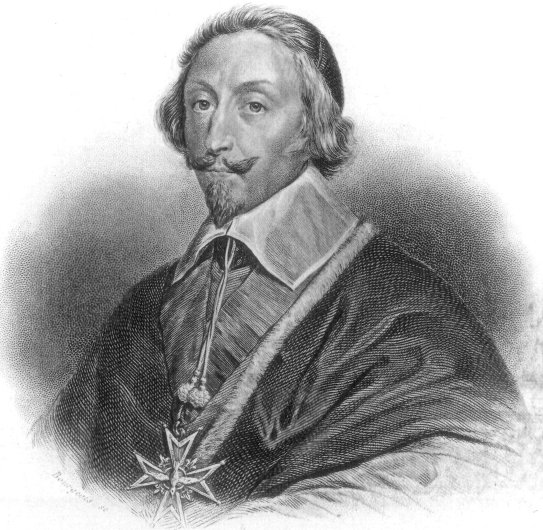
RICHELIEU.
This entertainment was followed by another of a similar description at the Hôtel de Condé; but although they affected to be equally engrossed by the festivities in which they shared, neither the Queen nor the Prince were so indifferent to their personal interests as they endeavoured to appear. Marie de Medicis was striving to discover some means of frustrating the cabals which were perpetually thwarting her designs, and threatening her authority, while M. de Condé was as eager as ever to undermine her power. The Maréchal d'Ancre was intriguing to effect the disgrace of the ministers, particularly that of Villeroy, whose alliance he no longer coveted; and the great nobles were busied in searching for some pretext sufficiently plausible to cause the ruin of the domineering favourite who presumed to treat them rather as inferiors than as equals. Thus the gilded surface of the Court concealed a mass of hatred, jealousy, and unrest, which threatened every instant to reveal itself, and to dispel an illusion as false as it was flattering: and while the foreign guests of the young monarch danced and feasted, and the native nobility struggled to surpass them in magnificence and frivolity, the more thoughtful spectators of the glittering scene trembled at its instability, and every instant anticipated an outbreak.
The attempt of Concini proved successful, and the deportment of Marie towards M. de Villeroy became so chilling that he withdrew from the Court, without seeking to ascertain the cause of his disgrace.
On the 27th of March the ex-Queen Marguerite breathed her last, but for some time previously she had appeared so seldom at Court that her death did not tend to disturb the gaieties of the royal circle, who had almost ceased to remember her existence. She had outlived even the reputation of her vices.
When the Prince de Condé and his faction demanded a meeting of the States they were far from anticipating its results; the unanimous loyalty of the deputies having greatly subserved the interests of the Queen, and thus weakened their own position. Aware too late of the error which they had committed, they were consequently compelled to seek elsewhere for support, and it was at length decided that they should excite the disaffection of the Parliament, by representing that all the services which its members had rendered to Marie on her assumption of the regency had been repaid by ingratitude and neglect; and that they no longer commanded that authority in the Government to which they were justly entitled. Coupled with these insidious arguments were profuse offers of assistance to enable them to enforce their rights, and the object of the faction was at once gained; the ambition and the vanity of the Parliament being alike engaged in a question which involved their own influence and importance. Strong in the support of the Princes, they, however, overacted the part assigned to them, and proceeded so arrogantly to remonstrate with the sovereign upon what they termed the abuses of the Government, that the King issued a decree in Council, by which he abrogated both their own decree and their remonstrances, declaring that they had exceeded the power accorded to them by the law; and commanding that those documents should be cancelled, torn from the registers, and delivered to his Majesty on the receipt of the royal decree. The Parliament, however, expostulated, and although they were again commanded to deliver up the obnoxious records, they failed to obey; and thus, by their determination, overruled the will of the sovereign.
In accordance with this declaration he left Paris by the Porte St. Antoine, followed by the acclamations of the populace, who, weary of the rule of the Queen, and exasperated by the arrogance of her favourites, regarded M. de Condé as a victim, and thus rendered his retreat a new subject of anxiety to the Court party. Nor was their annoyance decreased when they ascertained that throughout his journey to Creil, where he possessed an estate on the banks of the Oise, he was met by numerous bodies of armed citizens from Senlis, Mantes, Beaumont, and other towns, and was accompanied by the Duc de Longueville and the nobles attached to his cause. Within a league of Creil the harquebusiers were drawn up to receive him, with drums beating and colours flying, and thus escorted he finally entered the city.
These demands not being conceded, the Prince de Condé refused to accompany the King to Guienne, an example which was followed by many of the high nobility; and the faction became ere long so formidable that a civil war appeared inevitable.
Blinded by vanity, Concini, who was a soldier only in name, did not fail to listen with greedy ears to this unexpected proposition; and while his seeming friends were speculating upon his ruin, and calculating that during his absence they should have time to impress upon Marie de Medicis that, by the sacrifice of her favourite, she might reconcile the disaffected Princes. Concini himself foresaw that the increase of influence which so important a command could not fail to secure to him must tend to diminish that of the Duc d'Epernon, whose overthrow had been for some time his greatest wish. Moreover, by quartering his troops in the neighbourhood of M. de Condé, an opportunity would present itself of effecting his reconciliation with that Prince, which he ardently desired; and this end accomplished, he flattered himself with the hope that his vision of becoming first minister of France could not fail to be realized.
The impatience of the Queen to conclude the double alliance with Spain was so great that she disregarded the advice of Jeannin and Villeroy; who, in conjunction with Concini and his wife, had endeavoured to induce her to delay her departure for Guienne, and to proceed either to Laon or St. Quentin, in order to secure the Isle of France and Picardy, and to prevent the Prince de Condé and his adherents from concentrating their forces in the vicinity of the capital; while, on the contrary, she was urged by the Chancellor and his brother, the Commandeur de Sillery, who was her first-equerry and gentleman-usher, to carry out her original design. The 17th of August had been already fixed for the commencement of the royal journey; and Marie eagerly availed herself of their advice to persist in her purpose; contenting herself with giving orders to the Maréchal de Bois-Dauphin to cover Paris, to impede the approach of the disaffected forces, and, at all risks, to avoid coming to an engagement. She then withdrew from the Bastille eight hundred thousand crowns for the purpose of defraying the expenses of the Court during its progress.
The delay consequent upon the recovery of the Queen and her daughter enabled the Prince de Condé to strengthen his party, and to advance towards Paris, with an army of five thousand infantry and two thousand horse. His troops were, however, badly armed, and might at once have been beaten or dispersed by the Maréchal de Bois-Dauphin, had that general marched against them; but, fettered by the stringent orders which he had received not to give battle to the enemy, he remained inactive; and the Duc de Bouillon profited by his inertness to seize Château Thierry, whence he marched to Méré-sur-Seine.
In addition to this misfortune the Queen-mother had other and still more serious motives for anxiety. Although her personal ambition had been gratified by the accomplishment of that close alliance with Spain which she had so long and so earnestly desired, she could not conceal from herself that as regarded the nation over which she had been called to govern, the irretrievable step thus taken was one of extreme impolicy. On every side she was surrounded by difficulties. The first Prince of the Blood, and nearly the whole of the high nobility, were not only disaffected, but actually in arms against the Crown. The Protestants, to whom she had repeatedly promised that she would observe the Edict of Nantes, incensed by her breach of faith, had revolted against her authority; her troops had failed to offer any effective resistance; and meanwhile foreign soldiers had traversed Champagne, and advanced into Berry to join Condé, without any impediment from the royal army. The intelligence that she received from Paris was equally alarming; scarcely a day passed in which pamphlets and pasquinades of the grossest description were not published and circulated among the population, assigning the most foul and degrading motives for her journey to Guienne under the protection of the Ducs d'Epernon and de Guise; while her anxiety for the Spanish alliance was represented as arising from her desire to conciliate those who were accused of being the assassins of her husband.
The Court left Bordeaux at the close of the year 1615; and in the month of January following proceeded to take up its abode at Tours, there to await the close of a negotiation into which the Queen-mother had entered with the Princes; while at the same time her agents secretly exerted all their efforts to induce the allies of M. de Condé to abandon his cause. The command of the troops was taken from the Maréchal de Bois-Dauphin and conferred upon the Duc de Guise, with the title of lieutenant-general of the King's army; and an immediate attempt was made to gain over the Duc de Mayenne and the Maréchal de Bouillon, as being the most influential of the revolted nobles. James I offered to Marie de Medicis his services as a mediator on the occasion; they were gratefully accepted, and the English Ambassador was forthwith despatched to the Prince de Condé at St. Jean-d'Angély, with instructions to avert, by every argument in his power, the horrors of a civil war. Convinced that no better opportunity could possibly occur for securing to himself and his party the advantageous conditions which he coveted, Condé received the royal envoy with great courtesy, declaring that he had acted throughout the whole affair solely in the interests of his country, and that he was ready to write respectfully to his Britannic Majesty, to offer to him the same assurance.
While preparations were making for this important event, the Queen-mother, on the 29th of January, summoned the nobles of her Court to her apartment, in order to discuss the necessary measures to be adopted for securing the allegiance of the disaffected Princes; and on this occasion she nearly lost her life by a singular accident. The young Comte de Soissons, the Ducs de Guise and d'Epernon, Bassompierre, Jeannin, and many others who held office about the Court or in the Government were scarcely assembled when the flooring of the room gave way, and twenty-eight persons were precipitated into the hall beneath. The arm-chair of Marie herself had fortunately been placed above a beam which held firm, and to which the President Jeannin resolutely clung, thus breaking his fall; but MM. de Soissons, d'Epernon, de Bassompierre, de Villeroy, and several others were less fortunate, and all were more or less gravely injured. With great presence of mind the Queen retained her seat; and with the help of the Duc de Guise ultimately contrived to reach her bed, over which she passed, and thus escaped into an adjoining apartment; and meanwhile the unfortunate victims of the accident were conveyed to their respective residences, where her Majesty caused them to be immediately visited by one of the officers of her household, who was commissioned to inquire into their condition, and to express her regret at the event.
There was one exception, however, to this royal act of sympathy and consideration, and that one was the Duc d'Epernon; who, although the greatest sufferer on the occasion, was entirely overlooked; a marked and threatening want of courtesy on the part of the Queen-mother, which convinced the arrogant courtier that his period of favour was past, and that his enemies had triumphed. This conviction at once determined him to retire voluntarily from the Court before he should be compelled to do so by an order which he felt satisfied would not be long delayed; and he was accordingly no sooner sufficiently recovered to leave his bed than he waited upon their Majesties to take leave, alleging that his shattered health having received so violent a shock, he felt it necessary to withdraw for a time from all participation in public affairs, and to endeavour by perfect repose to overcome the effects of his accident.
Marie de Medicis, who possessed the most implicit confidence in the so-called science of astrology, and who was always anxious to penetrate the mystery of the future, having been informed on her return to Paris that a certain Giorgio Luminelli, a native of Ragusa who was celebrated as a soothsayer, had recently arrived in the capital, and taken up his abode in the Place Royale, immediately expressed a wish to consult him; for which purpose she despatched a messenger to his residence, by whom he was invited to wait upon a person of high rank who, attracted by his renown, was desirous of testing his skill. To this somewhat imperious summons Luminelli, however, simply replied by declaring that he never quitted his own apartments for any one, whatever might be the station of the person who required his services; but that those, who sought his aid were at liberty to visit him whenever they saw fit to do so. This answer only increased the eagerness of the Queen-mother; nevertheless, previously to seeking him in person, she requested M. de Créquy, the Duc de la Force, Bassompierre, and Rambure to go to his house in disguise, in order to ascertain whether he were indeed worthy of the reputation by which he had been preceded.
While they were making the necessary arrangements, and deciding to exchange dresses with their confidential valets in the hope of being enabled to mystify the necromancer, to whom they were entirely unknown, the Maréchal d'Ancre arrived to pay his respects to his royal mistress; and, upon being made acquainted with the project, he determined to join the party in the character of a Venetian noble, of whom there were at that moment several residing in Paris. On the completion of their preparations the merry masquers set forth, and soon reached the abode of Luminelli; where, on their arrival, they found a servant stationed at the door, as if awaiting the advent of expected guests, who no sooner saw them pause beside him than, addressing Concini and the disguised serving-men, he politely requested them to follow him; coupling the invitation with an assurance that his master had desired him to watch for the arrival of five great nobles who were about to consult his art. Lavallée, the lackey of M. de Bassompierre, assuming an air of importance, expressed both for himself and his companions their sense of this attention; and then, somewhat startled by the coincidence, for as such they simply considered it, the whole party followed their guide upstairs.
On reaching the apartment of the astrologer the four disguised courtiers remained respectfully upon the threshold, while their unliveried representatives advanced to the middle of the room; and courteously saluting their host, informed him that they had been induced by his great renown to solicit a display of his skill, and to claim from him a knowledge of their future fortunes. Lavallée was once more their spokesman; and the eyes of Luminelli remained fixed upon him until the conclusion of his address, when he turned away abruptly, without vouchsafing any reply, and drew back a curtain behind which was placed a large globe of polished steel. He looked earnestly upon this for a few moments; and then rising, he put on a cap of dark velvet which lay beside him, took Lavallée by the hand, and approaching Bassompierre placed his valet a few paces behind him, saying as he did so:
Luminelli then consulted his magic globe a second time; led the lackey of M. de Créquy to the rear of his master; made a profound salutation to the latter; and addressing him in his turn, detailed, as he had previously done in the case of Bassompierre, all the leading events of his past and future life. He next went through the same ceremony with the Duc de la Force and M. de Rambure; and ultimately he turned towards the Maréchal d'Ancre, exclaiming: "You, Sir, are no Venetian, although you have sought to appear such; but it would be well for you if you were so. As it is, if you will follow my advice, you will leave Paris to-morrow for Venice; for should you long delay your departure, it will be too late to effect it. When you arrived in France you were alike poor and obscure, although you are now rich both in gold and honours. Leave the country, nevertheless, or these advantages will avail you nothing. With few exceptions, you are detested by all classes; and you will find your native air of Florence more wholesome than that of the country which you have adopted. You possess governments, and wield the bâton of a Maréchal de France, but your tenure of these dignities is unstable; and you will do well to save yourself while you have yet the opportunity. You place your reliance on the favour of a crowned head, but that very favour shadows forth your ruin."