Book 2 — CHAPTER IX
Reading edition
1617
The royal forces march against the insurgent Princes—Indignities offered to the young sovereign—Louis XIII and his favourite—Arrogance of the Maréchal d'Ancre—Indignation of the King—Confiscation of the property of the rebel Princes—Household of Louis XIII—Cabal of De Luynes—Infatuation of the Maréchal d'Ancre—An evil counsellor—Marie de Medicis resolves to withdraw from the Government, but is dissuaded from her purpose—Popular discontent—Precautions of Concini—Alarm of Louis XIII—The Duc de Nevers is declared guilty of Use-majesté—Firmness of the Queen-mother—Insolence of Concini and Richelieu—Condé is refused permission to justify himself—Success of the royal forces—Louis XIII consents to the arrest of the Maréchal d'Ancre—Bassompierre warns Marie de Medicis of her danger—She disregards the warning—Concini and Leonora prepare to leave France—Old grievances renewed—A diplomatic Janus—Blindness of Marie and her ministers—A new conspirator—How to be made a marshal—Incaution of De Luynes—Treachery of Richelieu—A narrow escape—A morning mass—Singular position of the Court—Assassination of Concini—Public rejoicings—Imprisonment of the Queen-mother—Barbin is sent to the Bastille—The seals are restored to Du Vair—A royal reception—Anguish of Marie de Medicis—She demands to see the King, and is refused—Her isolation—A Queen and her favourite—A mother and her son—Arrest of Madame d'Ancre—The Crown jewels—Political pillage—The Maréchale in the Bastille.
In the month of January the Comte d'Auvergne, who had recently been liberated from the Bastille, was despatched at the head of fourteen thousand men against the insurgent Princes; and his departure was made a pretext for depriving the young King of the gentlemen of his household and of his bodyguard, an insult which he deeply although silently resented. He had been attacked in the November of the preceding year by an indisposition which for a time had threatened the most serious consequences, and from whose latent effects he had not yet recovered. As time wore on, moreover, he was becoming more and more weary of the insignificance to which he was reduced by the delegated authority of his mother; and had easily suffered himself to be persuaded by De Luynes that her repeated offers to resign it had merely been designed to make him feel the necessity of her assistance. As we have already shown, Louis XIII derived little pleasure from the society of his young and lovely wife; he made no friends; and thus he was flung entirely into the power of his wily favourite, who, aware that the King could hate, although he could not love, was unremitting in his endeavours to excite him against Marie de Medicis and her favourite. The infatuated Concini seconded his efforts but too well; for, unable to bear his fortunes meekly, he paraded his riches and his power with an insolence which tended to justify the aversion of his enemies. On one occasion, shortly after the dismemberment of his little Court, the monarch of France having refused to join a hunting-party organized by the Queen-mother, found himself entirely deserted save by De Luynes and a single valet; and overcome by mortification and melancholy, he leant his head upon his hand and wept bitterly. For some time not a sound was heard in the Louvre save the soughing of the wind through the tall trees of the palace-garden, and the measured tread of the sentinels, when suddenly a tumult arose in the great court; the trampling of horses, the voices of men, and the clashing of weapons were blent together; and dashing away his tears, Louis desired his favourite to ascertain the cause of the disturbance.
"It is the Maréchal d'Ancre, Sire, who has just alighted," said De Luynes as he approached the window.
In a few minutes the Italian was announced, and entered the royal apartment followed by a train of forty gentlemen all magnificently attired. At this spectacle Louis started from his seat; and with a bitter smile inquired of the arrogant Marquis his motive for thus parading before his sovereign a state which could only be intended as a satire upon his own privations.
"I will revenge myself!" exclaimed Louis with a sudden assumption of dignity.
"And how?" demanded the favourite emphatically. "You are called a King, but where are your great nobles? where are the officers of your household? where are your barons? So many princes, so many powers. France has no longer a King."
"And my people?" shouted the excited youth.
"You have no people. You are a mere puppet in the hands of an ambitious woman and an unprincipled adventurer."
"A puppet!" echoed Louis haughtily. "Do I not wear the crown of France?"
"Enough, enough, Sir," said Louis, clutching the hilt of his sword; "I will hear no more, lest it should make me mad!"
De Luynes bowed in silence; he knew that the poisonous seed was sown, and he was content to wait until it should germinate.
No wonder that her tenderness as a mother, joined to her ambition as a Queen, induced Marie de Medicis to yield to the representations of one of her most trusted counsellors, even while the cloud was deepening around her. As the great nobles murmured at the insolence and tyranny of the audacious Italian, their murmurs were echoed by the curses of the people; and in every murmur and in every curse the name of the Queen-mother was coupled with that of Concini and his wife. Even the Maréchal himself at length betrayed tokens of alarm; he never ventured to traverse the streets of Paris without a numerous retinue, and even so attended he cowered beneath the menacing looks and gestures which he encountered on all sides. Again and again he urged Leonora to leave France; but he urged in vain; and finally he resolved to take measures for securing a safe retreat in his government of Normandy, should he be compelled to escape from the capital. As a preliminary and important step towards the accomplishment of this purpose, he caused the fortifications of Quilleboeuf to be put into a state of perfect repair, and endeavoured to purchase the governments of several other places upon the Loire and the Seine; which, had he been enabled to carry out his object, could not have failed to render him independent of the royal authority. He also lavished large sums on every side, in order to secure partisans; and so excited the apprehensions of the citizens that bitter complaints were made, and threats uttered against himself, his royal mistress, and the new ministry.
All these, many of which had been fomented by themselves, were faithfully reported by De Luynes and his agents to the young King, to whom they pointed out the probability of a general insurrection.
"What is to be done?" exclaimed Louis on one occasion; "the Maréchal d'Ancre has, as it would seem, undertaken the ruin of my kingdom, and yet I dare not expostulate with my mother, for I cannot encounter her rage."
This puerile avowal decided the measures of the confederates; and ere long they succeeded in convincing the King that it would be quite possible to accomplish the overthrow of Concini without exposing himself to the anger which he dreaded.
On the 17th of January a royal declaration was confirmed by the Parliament against the Duc de Nevers, who, although not yet in open revolt, was condemned as guilty of rebellion and lèse-majesté; and this premature act of severity caused general discontent throughout the capital. In vain did his sister the Dowager Duchess of Longueville and Bentivoglio the Papal Nuncio endeavour to effect his reconciliation with the Court. At the instigation of Richelieu, Concini, and Barbin, Marie de Medicis imperiously refused to revoke, the sentence.
"The period of forbearance is gone by," she said coldly in reply to the persevering representations of the prelate. "Indulgence has proved ineffectual hitherto; and it has consequently become imperative upon the King to adopt more rigorous measures. These gentlemen are enacting the petty sovereigns in their respective governments, but I shall take steps to repress their insolence. Things have now been pushed to extremity; and we must either crush these rebellious and restless spirits, or permit the royal authority to be wrested from the sovereign."
Still, aware of the fatal consequences which must result from the uncompromising condemnation of one of the first Princes in the land, Bentivoglio would not be discouraged; and on retiring from the presence of the Queen-mother he reiterated his expostulations to Concini and Richelieu. With them, however, the zealous Nuncio achieved no better success.
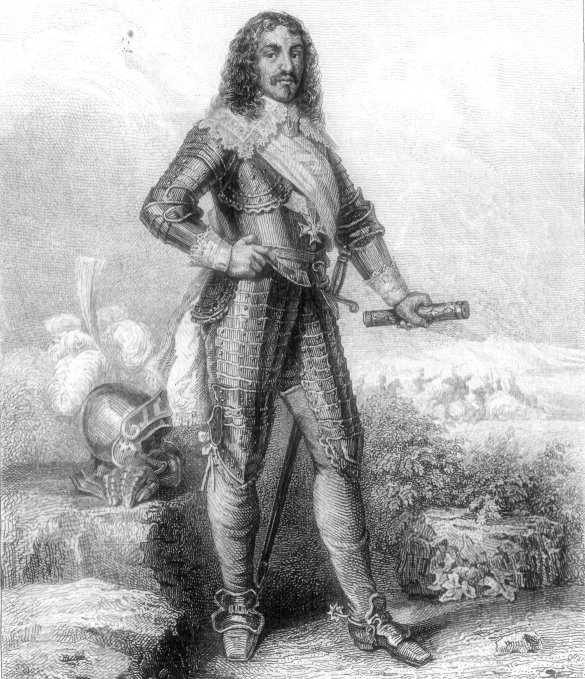
MARSHAL SCHOMBERG.
In addition to the discontent created among the people by this ill-judged pertinacity on the part of Marie and her Government, a new cause of disaffection was elicited by the harshness with which the Queen-mother refused to comply with the demand made by the two Princesses of Condé, that the Prince should either be released from the Bastille, or put upon his trial, in order that he might prove his innocence of the crime of which he was accused. Compliance with this request would have placed Marie and her ministers in a position of such difficulty and danger that it was, moreover, refused with an abruptness which not only betrayed their alarm, but which also tended still further to aggravate the irritation of his friends; and thus at a moment when the interests of the young King required that none but conciliatory measures should be adopted, the reckless ambition of a few individuals threatened to shake the very foundations of his throne, and to reduce the nation to a state of anarchy and convulsion.
The time was ripe for the project of De Luynes. The royal forces were everywhere victorious against the insurgent nobles; and Concini openly attributed to his own counsels a success which promised to make him all-powerful at Court.
"You see, Sire," said the favourite, "that this arrogant Italian, not content with insulting your royal person, also claims the merit due to your brave army, and to your faithful generals. Will you continue to suffer this presumption to degrade you in the eyes of your people, and to undermine your authority over your barons? Take the reins of government into your own hands, and prove that you are a worthy descendant of St. Louis. Reform the Government, and you will soon restore tranquillity to France; but do not any longer submit to see a base-born foreigner openly play the sovereign at your very Court."
"Show me the means of doing this," was the sullen reply; "I am as anxious as yourself to escape my present state of slavery. Devise some sure method of ridding me of the thrall to which I have been so long condemned, and I will second your designs as earnestly as you can decide them."
"You have but to assert yourself, Sire, and to exert your authority." "Were I to do so," retorted Louis, "I should only incur the hatred and ill-offices of my mother, for I should forthwith visit my vengeance upon her favourite; but we have had brawls enough in France, and I am weary of all these conflicting murmurs. Induce the Maréchal and his wife to quit the country; let them carry away all their wealth, and even bribe them, by new gifts should it be necessary. Impoverished as she is, France will still be able to find a few thousand crowns with which to purchase their departure."
Although this extraordinary leniency by no means fulfilled the wishes of De Luynes, he dared not venture further at the moment; and he accordingly induced the Bishop of Carcassonne to propose to the Queen-mother that she should herself suggest the return of Concini and Leonora to Italy. A year or two previously Marie de Medicis would have repelled such a proposition with anger and impatience, but she had begun to feel that her own authority had been invaded by the Maréchal; and she consented to act upon the advice of the prelate.
Heart-stricken by misfortune, the Maréchale listened without one expostulation to the order of her royal foster-sister; her ambition had long been crushed, and she pined for rest. Aware, moreover, that by obeying the wishes of the Queen-mother she should also fulfil those of her husband, she promised immediate compliance with the will of Marie, and forthwith commenced the necessary preparations. This unqualified acquiescence in the pleasure of the Queen did not, however, satisfy the views of De Luynes, who could not brook that the immense wealth of the Maréchal d'Ancre should pass into other hands than his own; and he consequently laboured to impress upon the King that the apparent obedience of Concini was a mere subterfuge, as he publicly boasted that France contained not a single individual who would dare to attempt anything to his prejudice.
"Convince him to the contrary, Sire," said one of his confidential friends to the young monarch. "Declare to the Queen-mother your determination to be governed no longer in your own kingdom, although you are still willing to be guided by her advice; and then command the instant departure of her dissimulating favourites. Do this, and you will not fail to be obeyed."
"What is to be done then, if the Italian refuses to quit France? I am in no position to compel his obedience, nor am I inclined to issue an order which I cannot enforce."
"Sire," said De Luynes approaching the monarch, the querulousness of whose manner warned him that unless he caused him to fear for his personal safety Louis would rather retire from the struggle than brave the anger of his mother, of whom he even now stood as much in awe as he had done during his childhood, "I see that the moment is at length come in which I must peril my own security in order to ensure that of your Majesty. You have no longer an alternative if you desire to escape the machinations of the Maréchal d'Ancre. I have sure information that an attempt is about to be made to seize your person, and to take you out of the country."
"You rave, De Luynes!" exclaimed Louis, whose cheeks blanched at this unexpected announcement.
"Would that I did, Sire," was the reply; "but should you not adopt immediate measures for circumventing the traitor whom I have denounced to you at the hazard of my own life, you will find that I have only too much foundation for the assertion that I have made."
"In that case," vehemently retorted the young King, grasping the hilt of his sword, "it is indeed time that France should recognize her legitimate ruler, and that her monarch won his golden spurs. I will leave Paris, and place myself at the head of my army."
"Concini will then remain in undisputed possession of the capital," remarked De Luynes coldly. "What is my alternative, Albert?" demanded Louis, utterly discouraged. "Name it, and I will no sooner have become in fact as well as name the sovereign of France than you shall receive the bâton of a marshal,"
"Commit M. d'Ancre to the Bastille, Sire. It is difficult to conspire within the gates of that fortress."
"Where shall I find an individual hardy enough to undertake such an enterprise?"
"I will present him to your Majesty within an hour, Sire."
"So be it, M. le Maréchal," said Louis as he turned away. "My mother had the courage to provide a lodging for the first Prince of the Blood in the same prison, and I do not see why I should shrink from compelling him to share his dungeon with the husband of Leonora Galigaï."
While this plot was forming in the closet of the young King, Marie de Medicis was warned on her side that should she not adopt the most stringent measures to counteract the intrigues of De Luynes, she would soon lose all her authority over the mind of her son, who had latterly betrayed increased impatience of her control; and who was evidently desirous to emancipate himself from the thraldom to which he had hitherto so patiently submitted. Bassompierre among others, with his usual frankness, replied to his royal mistress, when she urged him to declare his sentiments upon the subject: "You have been well advised, Madame; you do not sufficiently consider your own interests; and one of these days the King will be taken from beneath your wing. His adherents have commenced by exciting him against your friends, and ere long they will excite him against yourself. Your authority is only precarious, and must cease whenever such may be the will of the sovereign. He will be easily persuaded to annul it, for we know how eagerly youth pants for power; and should his Majesty see fit one day to remove to St. Germain, and to command his principal officers, both Frenchmen and foreigners, no longer to recognize your rule, what will be your position? Even I myself, whose devotion to your Majesty is above suspicion, should be compelled to take my leave, humbly entreating your permission to obey the orders of the King. Judge therefore, Madame, if such must inevitably be the case with those who are deeply attached to your royal person, what may be the bearing of the rest. You would find yourself with your hands empty after a long regency."
In order to hasten the resolution of the King De Luynes next resolved to impress upon his mind that his former warning was about to be realized, and that ere long he would find himself a prisoner in his own capital; while, with a view to render this declaration plausible, he took means to have it reported to Marie de Medicis that Louis was about to escape from Paris, to cast off her authority, and to form a coalition with the insurgent Princes. In consequence of this information the counsellors of the Queen-mother induced her to double the guard at the Louvre, and to prevent the King from passing the city gates, either for the purpose of hunting, or of visiting, as he was frequently in the habit of doing, the suburban palaces. This was a crowning triumph for the cunning favourite, who thus saw his royal master reduced to seek all his recreation in the gardens of the Tuileries; and he soon became convinced that his project had succeeded. For a few days Louis was too indignant to make any comment upon the treatment to which he was subjected, and he even affected to derive amusement from constructing miniature fortresses, bird-hunting, and other similar pursuits; but it was not long ere he became disgusted with these compulsory pastimes, and wandered moodily through the avenues of the gardens, communing with his own thoughts, and nursing the bitter feelings which were rapidly sapping his better impulses.
When he had thus convinced himself that the King's powers of endurance had reached their extreme limit, De Luynes and his confederates on one occasion entered his chamber in the evening, but instead of suggesting to the young monarch, according to their usual habit, some method of whiling away the time until he retired to rest, they approached him with a melancholy and almost frightened deportment which at once aroused alike his curiosity and his apprehension. "What is the meaning of your manner, gentlemen?" asked Louis. "What has occurred?"
His attendants glanced at each other, as if trusting that some one of their number would be bold enough to take the responsibility of a reply upon himself; but no one spoke.
"I have asked a question, and I demand an answer," said Louis with a threatening frown. "Do the very members of my household—those who call themselves my friends—forget that, spite of all my trials, and all my privations, I am still the King of France?"
"Sire," murmured the one upon whom his eye had rested as he spoke, "it is because we are devoted heart and soul to your Majesty that you see us in this mortal anxiety. In losing you we should lose everything; but since it is your command that we should tell you all, it is our duty to obey. The citizens of Paris are in a state of consternation. All your loyal subjects fear for your life. Tears and sobs are to be heard on every side. You are in the hands of Italians—of the countrymen and countrywomen of Catherine de Medicis; and everything is to be apprehended from people who know so well how to work out their ends by poison."
"Is it come to this?" gasped the young King as he sank back upon his chair. "Am I to die mocked as I have lived? A sovereign without a will, a king without a throne, a monarch without a crown? The tool of needy adventurers and intriguing women? the victim of treachery and murder?" and the credulous boy leant his head upon his hands, and wept.
Before the chamber of Louis was closed that night upon his confidential friends it was decided that the weapon of the assassin and the axe of the executioner should rid him of Concini and his wife; and that his mother should be banished from the Court.
When the King awoke on the following morning De Luynes was already at his bedside, in order to counteract by his specious arguments and gloomy prognostics any less violent and criminal decision at which his royal master might have arrived during the solitude and silence of the night; and ably did the tempter perform his task. An increase of devotion and respect was skilfully blended with an apparent anxiety and alarm, which flattered the self-esteem and vanity of Louis, at the same time that they renewed all the terrors of the previous evening. His feeble remonstrances were overruled; his filial misgivings were stifled; and the favourite at length quitted his presence satisfied that he would not seek to retract his orders.
The mind is a species of moral daguerreotype; surround it with images of order, virtue, and beauty, enlighten it by the sun of truth, and every object will trace itself unerringly upon the surface, remaining engraven there for ever; but, on the other hand, if the accessories be evil, it will in like manner become invested with the attributes amid which it exists, and the luminous spark will be darkened by the pernicious atoms that have been suffered to collect about it.
Louis XIII of France was at this moment an illustration of the principle. His boyhood and his youth had alike been familiar only with intrigue, deception, jealousy, and falsehood. His habits were at once saturnine and selfish; his temper gloomy and distrustful, and his feelings cold and self-centred. His youth had already shadowed forth his manhood.
De Vitry was a soldier of fortune, dependent upon his sword, and the little sentiment that he possessed was at once awakened by so unexpected a communication. As a natural consequence, therefore, he protested his readiness to risk life and limb at the pleasure of his Majesty; and declared that, whatever might be the nature of the service required of him, he would execute it without hesitation or remonstrance.
On receiving this pledge, De Luynes, after exacting an oath of secrecy and obedience, beckoned to his companion to follow him; and throwing open the door of the royal closet, which was never closed against him, he introduced De Vitry without further preamble into the presence of the King.
"M. de Vitry," said Louis, when the favourite had explained the errand of the captain of the royal guard, "I thank you for your zeal, and I have faith in its sincerity. The Maréchal d'Ancre has conspired against my life. He must sleep to-morrow night in the Bastille."
"He shall be there, Sire, should the fortress still possess a bolt to draw upon him, if it be your royal will that I accomplish his arrest."
"M. de Vitry, you will have earned a marshal's bâton."
"Sire!" exclaimed the soldier, dropping on his knee before the King, "I will obey you to the death."
"I must never again be insulted by his presence," said Louis, fixing his eyes, which flashed for an instant with a threatening light, full upon the upturned countenance of De Vitry. "Rise, Sir," he added as he turned suddenly away, "I have perfect confidence in your fidelity."
"But—should he resist, Sire?" asked the new conspirator, anxious not to exceed his orders.
"Kill him!" replied De Luynes in a hoarse whisper. "Do you not yet understand how you are to earn your bâton?"
The two friends exchanged glances; and after a profound bow, De Vitry withdrew from the royal closet.
Anxious to strengthen his party, De Luynes received the advances of Richelieu with great courtesy, although he was far from desiring the co-operation of so dangerous an ally; and a day or two subsequently the treacherous prelate was introduced into the private closet of Louis; where, in addition to his previous professions, he went so far as to pledge himself to the young monarch that he would give him timely intimation of the most hidden designs of the Queen-mother and the Maréchal d'Ancre.
It was at length decided that Concini should die on Sunday the 23rd of April; but as the day approached Louis became terrified at his own audacity, and it required all the influence of De Luynes and his brothers to prevent his retracting the fatal order which he had given. He was too young coldly to contemplate treachery and murder, and withal so helpless in the event of failure, that his conscience and his timidity alike urged him to revoke the sentence of the unsuspecting victim; nor was he ultimately induced to persevere, until reminded by his insidious advisers that too many persons were now aware of his intentions for them to remain secret, should their execution be long delayed.
On this occasion, however, although every preparation had been made, Concini was saved by a mere accident. He chanced to be delayed as he was about to leave his house, and did not in consequence reach the Louvre until the King had quitted the palace in order to attend mass at the chapel of the Petit Bourbon. Instead, therefore, of proceeding in the first place to the apartments of his Majesty, as had been anticipated, the Maréchal no sooner ascertained that Louis was already gone than he hastened to pay his respects to the Queen-mother, for which purpose he took a different direction. This unexpected impediment greatly embarrassed the conspirators, who, secure of success, had displayed an extraordinary want of caution. In addition to his brother M. du Hallier, Vitry had assembled a great number of his friends in the court of the palace, who, although they all wore their cloaks, had nevertheless allowed it to be perceived that they carried pistols in their belts, contrary to the edict forbidding the use of such weapons within the limits of the royal residence. In compliance with the commands of Louis himself, moreover, the bodyguard were under arms; and the unwonted movement in the immediate vicinity of his apartments was so evident, and withal so threatening in its aspect, that a rumour soon spread through the palace that some serious enterprise was in contemplation.
And meanwhile the young monarch was on his knees before the altar of his God, praying, or seeming to pray; asking that his trespasses might be forgiven as he forgave those who trespassed against him; although he anticipated that before his return to his desecrated palace-home the deed of blood would be accomplished. Suddenly, however, his devotions were interrupted by the entrance of De Vitry into the chapel, who, approaching De Luynes, whispered to him the tidings of his disappointment. In another second the lips of the favourite touched the ear of his royal master, to whom he hurriedly murmured—
"Sire, the man you wot of is now in the apartment of the Queen-mother. What do you decide? All is in readiness."
"Touch him not in her presence as you value your lives," was the agitated reply; "we shall find him at the Louvre on our return."
A brief interval of suspense succeeded. The prelate who had officiated then uttered the final blessing; and as the carriage which contained the King and his favourite entered the palace by one gate, that of Concini quitted it by another. Inexperienced as he was, however, Louis at once perceived that he was no longer in a position to recede; and hasty orders were issued to Vitry and his friends to accomplish their fatal project on the following day, while the King at the same time secretly commanded that the light horse of his bodyguard, and the members of his household, should be in attendance at an early hour in the morning, as well as a coach and six, at the entrance of the grand gallery. The pretext for this arrangement was a hunting-party; but its actual intention was to ensure and protect the King's flight, should his purpose prematurely transpire or prove abortive. And meanwhile Marie de Medicis slept, wholly unsuspicious of the change which was about to be effected in her fortunes!
There is something singularly appalling in all the circumstances which formed the prelude to this contemplated tragedy. Hitherto the Queen-mother had created dangers for herself—had started at shadows—and distrusted even those who sought to serve her; while her son, silent, saturnine, and inert, had patiently submitted to the indignities and insults which had been heaped upon him, as though he were either unconscious or reckless of their extent; and the Italian adventurer had braved his enemies, and appeared to defy fate itself. Now, however, when the blow was about to be struck, when the ball and the blade were alike ready to do their deadly office, all the principal personages in the bloody drama had suddenly assumed new characters. Marie slept; the boy-King had become the head of a conspiracy; and the Maréchal d'Ancre, enriched and ennobled beyond the wildest dreams of his ambition, was preparing to quit the country of his adoption, and to seek rest and peace in his own land. Another month, perhaps another week, and he would have left France, probably for ever.
History presents few such anomalies; and it appears scarcely credible that so ill-organized a plot, hatched, moreover, under the very eyes of those who were to become its victims, and revealed to upwards of a score of persons, many of whom were incited to join it from merely venal motives, should ever have attained its accomplishment. The fiat had, however, gone forth; and the unfortunate Concini, whose tragical fate compels sympathy despite all his faults, entered the court of the Louvre at ten o'clock in the morning of the 24th of April 1617, there to meet his death.
An hour or two after dawn one of the gentlemen of the royal bedchamber announced that the King having been indisposed throughout the night, the great gates of the Louvre were to remain closed, and the public excluded, in order that his Majesty might not be disturbed. This order did not, however, affect the Maréchal d'Ancre, as he was no sooner seen to approach, followed by a numerous retinue of gentlemen, and attended by several of his friends, than the bolts were withdrawn, and he was permitted to pass the barrier, which was instantly closed again, to the exclusion of the greater number of his suite. A man who had been stationed over the gate then waved his hat three times above his head, upon which De Vitry, who had until that moment been seated in one of the windows of the guard-room calmly conversing with the officers on duty, immediately rose, and drawing his cloak closely about him, hurried down the staircase, at the foot of which he was joined as if accidentally by Du Hallier and others of the conspirators, who, apparently engaged in conversation, slowly approached their intended victim. Among the persons who surrounded Concini there chanced to be several who were acquainted with De Vitry, and greatly to his annoyance he was compelled to allow the Maréchal to pass on while he returned their greetings; in a few moments, however, he again found himself at liberty, when he discovered that amid the crowd he had lost sight of the Italian.
"Where is he?" he inquired hurriedly of one of his confederates.
"Yonder," was the reply; "he has stopped at the foot of the bridge to read a letter."
De Vitry sprang towards his prey; and as Concini, absorbed in his occupation, still read on, he felt the grasp of a strong hand upon his arm, and on looking up he saw the Captain of the Guard standing at his side. Before he had time to inquire the meaning of this affront, De Vitry had already uttered the ominous words, "I arrest you in the King's name."
"Arrest me!" exclaimed the Maréchal, with astonishment, as he clutched the hilt of his sword.
Meanwhile De Vitry, by the direction of De Luynes, proceeded to the hall occupied by the bodyguard of the Queen-mother, and demanded their weapons, which they refused to deliver up without an express order to that effect from their own officers; upon which the latter were commanded in the name of the King to withdraw their men, and to remain in the antechamber of their mistress. The royal guards then took possession of all the approaches to the Louvre; and horsemen were despatched with instructions to traverse the streets of the capital, and to apprise the citizens of the death of Concini. A dense crowd soon collected in the court of the Louvre, and cries of "Vive le Roi!" resounded on all sides.
Shortly afterwards the King encountered the Bishop of Luçon-Richelieu, whose confident deportment betokened his conviction of a gracious reception, as he prepared to pay his court in his turn; but the compliments of the prelate were abruptly broken in upon by an imperative command to quit the palace, and the announcement of his discontinuance in office. No wonder that Richelieu murmured under his breath at this unlooked-for severity; for he had in truth that very morning striven to merit the royal smile—striven against conscience, however, and all the holiest and most sacred feelings of humanity. One of the friends of Concini, alarmed by the ominous proceedings at the Louvre, and instinctively persuaded that the life of the Italian was threatened, had hurriedly despatched a letter to Richelieu, in which he stated his reasons for the apprehensions he expressed; and urged the prelate, in memory of the many services for which he was indebted to the intended victim, to interpose his influence in his behalf, and to endeavour to avert the blow. The Bishop, who had not yet left his bed, glanced over the missive, thrust it beneath his pillow, desired the messenger to withdraw, and remained quietly in his chamber until he was apprised by the tumult without that all was over. Then, and not till then, he hastened to the Louvre; where we have already stated the nature of his reception.
But it is now time that we should return to the Queen-mother.
Alarmed by the report of firearms within the boundary of the palace, Marie de Medicis, who had not yet completed her toilet, desired Caterina Selvaggio to throw open one of the windows, and to demand the cause of so singular and unpardonable an infraction of the law. She was obeyed; and the Italian waiting-woman no sooner perceived De Vitry advancing below the apartments of her royal mistress than she inquired of him what had occurred.
"The Maréchal d'Ancre has been shot," was his abrupt reply.
"Shot!" echoed Caterina; "and by whom?"
"By myself," said De Vitry composedly; "and by the command of the King."
"Madame!" exclaimed the terrified attendant, as she rushed to the side of the Queen-mother, "M. le Maréchal has been killed by order of his Majesty."
Marie de Medicis started from her seat; her cheeks were blanched, her lips quivered, and she wrung her hands convulsively, as she gasped out, "I have reigned seven years. I must now think only of a crown in heaven."
Her attendants, stupified with terror, rapidly gathered round her; and ere long she learnt that her guards had been disarmed, and replaced by those of the King. She listened vaguely to each successive report, and paced the room with rapid but uncertain steps. At length she exclaimed vehemently, "I do not regret that my son should have taken the life of Concini, if he believed it necessary to the safety of his kingdom; but his distrust of myself in concealing such a project from my knowledge is more than I can bear."
Her command was obeyed, and in a few moments De Bressieux found himself in the presence of the King, to whom he delivered his message.
"I am occupied at present," was the cold reply; "and the visit of the Queen must be delayed until a better opportunity. Tell her, however, from me that I shall always honour her, and that I feel towards her all the sentiments of a good son; but God willed that I should be born a King, and I am resolved henceforth to govern for myself. It is desirable that the Queen should have no other guards but mine. Let her know that such is my will."
Still Marie de Medicis would not be discouraged. She felt that in order to avert the ruin which impended over her she must put every instant to its use; and accordingly M. de Bressieux was a third time despatched to solicit in still more urgent terms that she might be permitted to see his Majesty, were it only for a few moments. But, unfortunately for the agonized Queen, the triumphant favourite was as fully aware as herself of the value of time at so critical a juncture; and he had accordingly profited so well by the opportunities which he was enabled to command, that on this last occasion the Marquis was rudely ordered to abstain from all further intrusion upon his Majesty unless he wished to repent his pertinacity within the walls of a prison.
Convinced at last that there was no hope through her own agency of effecting her object, the Queen-mother next endeavoured to secure its accomplishment through the medium of her daughter-in-law, the two Princesses, and the Duc d'Anjou; but when she summoned them to her apartment, she was informed that each and all had been forbidden to hold any intercourse with herself until the pleasure of the King should be made known.
While the Queen-mother was still writhing under this new indignity, the unfortunate Leonora, who had been apprised of the murder of her husband, rushed into the apartment, and flinging herself at the feet of her royal foster-sister, implored her protection for herself and her young son; but sudden adversity had steeled the heart of Marie de Medicis, and sternly upbraiding her former favourite as the cause of her own overthrow, she refused to afford her any aid, and commanded her instantly to retire. The wretched woman obeyed without comment or remonstrance; and having regained her own apartment, which was immediately contiguous to that of the Queen, she hastened to conceal the Crown jewels which were in her keeping between the mattresses of her bed, with the exception of the rings, which were of great value, and which she habitually wore. This task accomplished, she threw herself upon her miserable couch to await in trembling and in tears the next act of the frightful tragedy in which she was called upon to play so conspicuous a part. Her suspense was not of long duration, as only a few minutes had elapsed when a tumult was heard without, amid which cries of "Vive le Roi!" "Vive M. de Luynes!" and "Death to the Italian!" were distinctly audible.
Leonora bounded from her recumbent position like a lioness at bay. Her parted lips were bloodless, her breath came quick and hard, and her heart heaved by its violent pulsations the rich velvet of the robe in which she was attired.
"My child!" she at length gasped out, as her attendants gathered about her—"save my child! He at least is guiltless."
It was, however, already too late; for as Du Rouvray ceased speaking, De Vitry, still reeking with the blood of Concini, stood upon the threshold of the chamber, attended by a troop of halberdiers.
"You are my prisoner, Madame," he exclaimed harshly: "prepare to accompany me to the Bastille."
"I am ready, Sir," replied the Maréchale, with the composure of utter despair, "All is as it should be. The murderer of the husband is well fitted to be the gaoler of the wife."
The rings belonging to the Crown were then removed from the fingers of the Marquise; and upon her refusal to reveal where the remainder of the jewels were secreted, her apartments were strictly searched; and not only were the royal ornaments carried off by De Vitry and his companions, but also every other article of value which fell into their hands. While this unmanly outrage was going on around her, the Maréchale d'Ancre passively permitted her women to fasten her mantle, and to adjust her mask and hood; her thoughts were evidently elsewhere. Within a few yards of where she was then seated, and within hearing of the tumult occasioned by the reckless insolence of the men-at-arms by whom she was surrounded, her foster-sister, the playmate of her girlhood, the friend of her youth, and the protectress of her latter years—whose tears she had so often wiped away, whose sorrows she had so often soothed, and whose hopes and fears she had equally shared throughout so long a period—remained cold and unmoved by her misery. It was a bitter pang: and drops of anguish, wrung from the deepest recesses of a bursting heart, fell large and heavy upon the cheek of the new-made widow and the abandoned favourite, and moistened her clasped hands. None, however, heeded her agony; each of her attendants, whatever might have been the previous attachment of all to her person, was absorbed by her own terrors; while the strangers who had invaded her privacy were eager, under the specious pretext of performing their duty to the King, to avail themselves to the uttermost of so favourable an opportunity of furthering their individual interests.
At length all was over: every cabinet and chest had been ransacked to its deepest recesses; every article of use or ornament had been displaced in search of plunder; and the wretched Leonora was warned that it was time to depart. She rose silent and rigid; and as De Vitry preceded her from the room, his guards closed up behind her. A carriage was in waiting at the foot of the staircase by which she descended; the twilight was rapidly deepening into night, and her melancholy path was lighted at intervals by the torches of the numerous attendants who were hurrying through the corridors in the service of their several employers. The long dark shadows of the Louvre lay heavy on the dull pavement of the court, save where they were broken at intervals by the resinous flambeaux which glared and flickered against the walls of the building. All looked wild, and sad, and strange; and not one kindly accent fell upon the ear of the unhappy captive as she was hurried onward. A few harsh words were uttered in a tone of authority: she was lifted into the conveyance which had been prepared for her: the cavalcade slowly traversed the enclosure; and then as the iron gates of the palace were passed, the horses were lashed into a gallop; and in less than an hour the life-long companion of Marie de Medicis, husbandless, childless, and friendless, was an occupant of the gloomy prison-chamber which had recently been vacated by the Prince de Condé.
The noise created by the entrance of the new prisoner, the clashing of arms, the grating of the heavy portcullis, as it groaned and strained in its ascent, the dull fall of the drawbridge, the voices of men, and the rattling of wheels, awakened the Prince; who, with the natural weariness of a captive, had already retired to rest. Summoning an attendant he demanded to know the cause of the disturbance.
"It is M. de Vitry, Monseigneur," was the reply; "who has just transferred the Maréchale d'Ancre to the safe keeping of the governor."
This rapid succession of misfortunes produced an extraordinary effect upon the sensitive organization of Leonora Galigaï. As we have already hinted, she had for a considerable period suffered under mental hallucination; and the disease had latterly fastened so tenaciously upon her system that she had even shunned the presence of the Queen, believing that every eye which rested on her produced some baneful result; while her very attendants were dismissed from her presence when they had terminated their duties, and she thus remained hour after hour in solitude, brooding over the sickly fancies of her disordered brain. The sight of her husband's murderer had, however, instantly and for ever restored the healthful tone of her mind. She did not weep, for she had already exhausted all her tears; she asked no mercy, for she was aware that, whatever might be her fate, she was alike prejudged and pre-condemned; but she resigned herself passively into the hands of her persecutors, with a Spartan firmness which she maintained to the last hour of her existence.
Who shall venture to follow her to her prison-cell, and to trace the tide of back-flowing thought which rolled like a receding wave from the present to the past? Now, indeed, she left little behind her to regret. From the husband to whom she had once been devoted with a love which blinded her to all his errors and to all his egotism, she had, during the last two years, been almost utterly estranged; her first-born and idolized daughter was in her grave; the royal friend and almost relative, to whom she had clung from her youth up, had refused even a tear to her sufferings, or a shelter to her peril; her hoarded wealth was in the hands of her enemies; and of all that she once boasted there remained only her son. And what might be his fate?
But memory held wider stores than these; and who can doubt that throughout that first long night of captivity they were probed to their very depths! What palace-pageants—what closet-conspiracies—what struggles for pre-eminence and power—what heart-burnings at defeat, and exultation at success—must have swept hurricane-like across her awakened soul, to be forgotten in their turn as she recalled the childish sports of her early and hopeful years, under the sunny sky and among the orange-groves of her native Florence, where, with her royal playmate, she chased the hours along as though they were made only for the happy!
Did she sleep the weary and outworn sleep of the wretched while those sweet and soothing visions were still busy at her heart? And if so, breathes there one who would have roused her, whatever may have been her faults, from such a slumber?
FOOTNOTES: