Book 2 — CHAPTER VIII
Reading edition
1616
Conference of Loudun—Venality of the Princes—Mutual concessions—Indisposition of M. de Condé—He signs the treaty—Concini is insulted by a citizen of Paris—The Court return to the capital—Schism in the cabal—The seals are transferred to M. du Vair—Disgrace of the ministers—Triumph of Concini—Mangot is appointed Secretary of State, and Barbin Minister of Finance—The young sovereigns—Court costumes—Anne of Austria and Marie de Medicis—Puerility of Louis XIII—The Maréchal de Bouillon and the Duc de Mayenne return to Court—They seek to ruin Concini—The Prince de Condé effects a reconciliation with the Queen-mother—James I. sends an embassy to Paris to negotiate a marriage between the Prince of Wales and the Princesse Christine—Gorgeous reception at the Louvre—Court festivities—Concini returns to Paris—He is abandoned by the Prince de Condé—He is compelled to retire—His forebodings—He endeavours to induce Leonora to leave France—She refuses—Increasing influence of De Luynes—Death of Mademoiselle d'Ancre—Despair of Concini—Ambitious projects of the Prince de Condé—Devotion of Sully—His advice is disregarded—Popularity of Condé—Marie de Medicis resolves to arrest him—He disbelieves the rumour—The other Princes withdraw from the capital—The King is induced to sanction the arrest—Dissimulation of Louis XIII—Arrest of Condé—Fearless reply of M. du Vair—The Prince is conveyed to the Bastille—A batch of Marshals—Noble disinterestedness of Bassompierre—The Dowager Princess of Condé endeavours to excite the populace to rescue her son—The mob pillage the hôtel of the Maréchal d'Ancre—The Queen-mother negotiates with the Guises—The council of war—The seals are transferred from Du Vair to Mangot—Richelieu is appointed Secretary of State—Concini returns to Court—The Maréchale d'Ancre becomes partially insane—Popular execration of the Italian favourites—Subtle policy of Richelieu—Threatening attitude assumed by the Princes.
Meanwhile both armies were suffering so severely from extreme cold and scarcity of provisions, that more than ten thousand men fell victims to exposure and famine; and the bodyguard of the King became at length so much weakened that he found himself compelled to summon the Swiss under Bassompierre for the protection of his person.
Concini, who had remained in Paris during the absence of the Court, had meanwhile been subjected to a mortification which, to his haughty spirit, far exceeded a more important evil. The citizens who had continued to keep watch and ward, despite the cessation of hostilities that had taken place, persevered in requiring that all who entered or quitted the capital should be provided with passports; a formality with which the arrogant Italian considered it unnecessary to comply; and, accordingly, when on one occasion he was about to proceed to his house in the faubourg attended by some of the gentlemen of his suite, he had no sooner reached the Porte de Bussy, where a shoemaker named Picard was on guard, than this man compelled his carriage to stop, and demanded his passport. Enraged by such a mark of disrespect, the Maréchal imperiously ordered his coachman to proceed, but this was rendered impossible by the threatening attitude of the well-armed guardian of the gate.
"Rascal!" shouted Concini, showing himself at the door of the carriage; "do you know who I am?"
"Right well, Sir," was the unmoved reply; "and nevertheless you shall not stir a step beyond the walls without a passport."
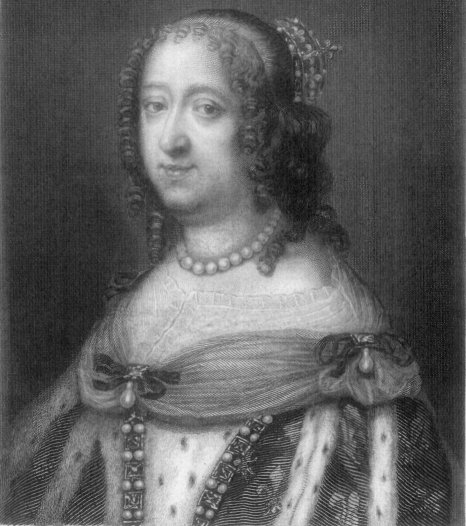
ANNE OF AUSTRIA.
At once regal and elegant as such a costume must have been, it is deplorable to contrast it with those which she adopted in after-years, when the most monstrous caprices were permitted at her Court; and when it was by no means uncommon to see women of the highest rank, about to ride on horseback, present themselves in the royal circle in dresses reaching only to the knee, with their legs encased in tight pantaloons of velvet, or even in complete haut-de-chausses; while the habitual attire of the sex was equally bizarre and exaggerated. There were the vasquines or rollers which encircled the waist and extended the folds of the petticoats, thus giving additional smallness to the waist; the brassards-à-chevrons or metallic braces for expanding the sleeves; and the affiquet of pearls or diamonds coquettishly attached to the left breast, and entitled the assassin. Added to these absurdities there were, moreover, bows of ribbon, each of which had its appropriate name and position; the galant was placed on the summit of the head; the mignon on the heart; the favori under and near the assassin; and the badin on the handle of the fan. Short curls upon the temples were designated cavaliers; ringlets were garçons; while a hundred other inanities of the same description compelled the great ladies of the period to adopt a slang which was perfectly unintelligible to all save the initiated; and when we add to these details the well-authenticated fact that the royal apartments were fumigated with powdered tobacco (then a recent and costly importation into France), in lieu of the perfumes which had previously been in use for the same purpose, it will scarcely be denied that caprice rather than taste dictated the habits of the Court under Louis XIII.
To revert, however, to the earlier years of Anne of Austria, it would appear that the troubles of the royal bride did not await her womanhood. Like Marie de Medicis, she clung to all which appeared to link her to her distant home, and caused her to forget for a time that it was hers no longer; and under this impulse it was by no means surprising that she attached herself with girlish affection to the individuals by whom she had been followed in her splendid exile; but even as her predecessor had been compelled to forego the society of her native attendants, so was Anne of Austria in her turn deprived of the solace of their presence. With the exception of Doña Estefania, her first waiting-woman, to whom she was tenderly attached, and who had been about her person from her infancy, all were dismissed by Marie de Medicis, who, anxious to retain her authority over the wife of her son, dreaded the influence of Anne's Spanish followers.
Nor was this her only disappointment. We have already shown with what eagerness she looked forward to her first meeting with her intended bridegroom, whose grave but manly beauty so fully realized all her hopes that, as she ingeniously confessed, she could have loved him tenderly had he possessed a heart to bestow upon her in return. But she soon discovered that such was not the case; and that Louis XIII saw in her nothing more interesting than a Princess who was worthy by her rank and quality to share with him the throne of France.
Louis, on his side, although the sovereign of a great nation, was also exposed to privations; merely physical, it is true, but still sufficiently irritating to increase his natural moroseness and discontent. While the Maréchal d'Ancre displayed at Court a profusion and splendour which amounted to insolence, the young King was frequently without the means of indulging the mere caprices common to his age; but although he murmured, and even at times appeared to resent the neglect with which he was treated, he easily consoled himself amid the puerile sports in which he frittered away his existence; and attended by De Luynes and his brothers, found constant occupation in waging war against small birds, and in training their captors. In such pursuits he was moreover encouraged by the Queen-mother and her favourites; who, anxious to retain their power, did not make any effort to awaken him to a sense of what he owed to himself and to the kingdom over which he had been called upon to rule. The only occasions upon which he appeared to feel the slightest pleasure in the society of his beautiful young wife was when he engaged her to share in his rides and hawking-parties, in order to excite her admiration of his skill, an admiration of which Anne was lavish, as she trusted by flattering his vanity to awaken his affection; while she moreover enjoyed, with all the zest of girlhood, so agreeable an escape from the etiquette and formalities of a Court life.
Ten days subsequently to the return of M. de Condé to Paris a new embassy arrived from James I., to renew the negotiation of marriage between the Prince of Wales and Madame Christine de France, upon which occasion the Court of Louis XIII displayed all its magnificence, without, however, eclipsing that of the English nobles to whom the embassy had been entrusted. The hôtel of the late Queen Marguerite was prepared for their reception, where they were visited by all the great nobles and foreign ministers; and finally, on the following Sunday, they were received in state at the Louvre. Lord Hay (afterwards Earl of Carlisle) was the accredited ambassador; while Mr. Rich (subsequently Lord Holland), Goring, and other individuals of mark contributed to increase the splendour and importance of his mission.
Nothing could be more sumptuous than the spectacle which was presented by the Louvre upon this occasion. The halls and galleries were alike thronged by all that was noble and beautiful at the Court of France. Princes of the Blood, nobles, marshals, and prelates were mingled with the great ladies of the household in their state dresses, rustling in silks, velvets, and cloth of gold and silver, and glittering with diamonds. Amid this galaxy of magnificence the Queen-mother shone conspicuous. Still remarkable for her stately beauty and dignified deportment, she had left no means untried to enhance their effect, and she had been eminently successful. She was attired in a long robe of amaranth velvet, of which the wide and open sleeves were slashed with white satin, and looped together by large pearls, save at the wrists and elbows, where they were fastened by immense brilliants. Her ruff of rich Alençon lace rose half a foot in height at the back of her neck, whence it decreased in breadth until it reached her bosom, which was considerably exposed, according to the fashion of the period. A coronet of diamonds surmounted her elaborately curled hair, which was drawn back, so as to exhibit in its full dimensions her broad and lofty brow; and the most costly jewels were scattered over her whole attire, which gave back their many-coloured lights at every movement of her person.
The Prince de Joinville, the Ducs de Guise and d'Elboeuf, the Marquises de Rosny and de Créquy, and M. de Bassompierre, accompanied by a numerous train of nobles, escorted the English envoys to the palace; while more than fifty thousand persons crowded the streets through which the glittering train was compelled to pass.
The arrival of M. de Condé in Paris, and the pledge given by that Prince to support him with his influence, determined Concini once more to hazard his own return to the capital under the escort of Bassompierre; but he found the popular irritation still so great against him, that when he visited the Prince he was accompanied by a suite of a hundred horse. His reception by his new ally was, moreover, less cordial than he had hoped; for Condé had already begun to regret his promise, and to feel apprehensive that by upholding the interests of the Italian favourite he should lose his own popularity. He also believed that the amount of power which he had at length succeeded in securing must render him independent of such a coalition; and he resolved to seize the earliest opportunity of impressing upon Concini the unpalatable fact.
Meanwhile Marie de Medicis made no effort to compel the restitution of the captured towns; the insult to which Concini had been subjected by Picard remained unavenged, and the Italian could no longer conceal from himself that he had outlived his fortunes. It is scarcely doubtful, moreover, that, with the superstition common to the period, the prediction of Luminelli had pressed heavily upon his mind; as from that period he became anxious to abandon the French Court, and to retire with his enormous wealth to his native city. It was in vain, however, that he sought to inspire Leonora with the same desire; in vain that he represented the prudence of taking the initiative while there was yet time; the foster-sister of Marie de Medicis peremptorily refused to leave Paris, alleging that it would be cowardly to abandon her royal mistress at a period when she was threatened alike by the ambition of the Prince de Condé and the enmity of De Luynes, whose power over the mind of the young sovereign was rapidly making itself felt.
"I am no longer in office, Madame," he replied proudly; "and you have your chosen counsellors about you. I have done my duty, and leave it to others to do theirs."
He then made his parting obeisance, and had already reached the door of the apartment, leaving the Queen-mother in a state of agitation and alarm which she made no effort to disguise, when, suddenly pausing upon the threshold, he once more turned towards her, saying impressively:
Under these circumstances it appeared impossible to proceed openly against him, while it was equally essential to deliver the Crown from so formidable an adversary; his arrest offered the only opportunity of effecting so desirable a result, but even to accomplish this with safety was by no means easy. In his own house he was surrounded by friends and adherents who would have rendered such an attempt useless; and after mature deliberation it was accordingly agreed that he must be made prisoner in the Louvre.
All being in readiness, Bassompierre was awakened at three o'clock in the morning of the 1st of September by a gentleman of the Queen-mother's household, and instructed to proceed immediately to the Louvre in disguise. On his arrival he found Marie only half-dressed, seated between Mangot and Barbin, and evidently in a state of extraordinary agitation and excitement. As he entered the apartment she said hurriedly:
"You are welcome, Bassompierre. You do not know why I have summoned you so early; I will shortly explain my reason."
Then, rising from her seat, she paced to and fro across the floor for nearly half an hour, no one venturing to break in upon her reverie. Suddenly, however, she paused, and beckoning to her companions to follow her, she entered her private closet; and the hangings no sooner fell behind the party than, turning once more towards him, she continued with bitter vehemence:
The final arrangements were then discussed, and Marie de Medicis was left to her own thoughts until the hour of eight, when M. de Thémines was announced.
"Ha! you are come at length," she exclaimed joyfully; "I was awaiting you with impatience. The Council is about to open, and it is time that we were all prepared. Can you depend on those by whom you are accompanied?"
"They are my sons, Madame."
"Bravely answered!" said Marie forcing a smile, as she extended her hand, which the Marquis raised to his lips. "Go then, and remember that the fate of France and of her monarch are in your keeping."
"If there be indeed any hostile intention on the part of the Crown," he said disdainfully, "it probably regards M. de Bouillon, whose restless spirit excites the alarm of the Queen-mother. Let him look to himself, if he see fit to do so. Should he be committed to the Bastille my interests will not suffer."
Meanwhile at the Louvre nothing remained to be done but to communicate to the young King the project which was about to be realized, and to induce him to sanction it by his countenance; an attempt which offered little difficulty, the jealousy of Louis having been excited by the assumed authority of the Prince, and his dissimulating nature being gratified by this first participation in a state intrigue.
At ten o'clock a great clamour upon the quay near the gate of the palace attracted the attention of the Queen-mother, who commanded silence, and in another moment distinct cries of "Long live the Prince!" "Long live M. de Condé!" were heard in the apartment. Marie de Medicis rose from her seat and approached an open window, followed by the Maréchale d'Ancre.
"The Prince is about to open the Council," said Leonora with a bitter smile.
When he alighted at the palace Condé proceeded to the hall of the Council, which was on the ground-floor; and at the termination of the sitting ascended, as was his custom, to the apartments of the Queen-mother, where Louis, who had entered eagerly into the part that had been assigned to him, and who had just distributed with his own hands the arms which had been prepared for the followers of M. de Thémines, met him in the gallery, entered into a cheerful conversation, and, finally, invited him to join a hawking-party which was to take place within an hour. Condé, however, whose thoughts were otherwise engaged, declined to participate in the offered pastime, and the young King, having accomplished all that had been required of him, accepted his excuses, and returned to the apartment of his mother. At the same moment Thémines and his two sons issued from a small passage, and, approaching the Prince, announced that they had received an order to arrest him.
"Arrest me!" exclaimed Condé in astonishment. "It is impossible!"
"Such are my instructions," said the Marquis, as he extended his hand to receive the forfeited sword, while his two sons placed themselves on each side of the prisoner. "You are aware that I am the first Prince of the Blood."
"I know, Monseigneur, the respect which is your due," was the reply, "but I must obey the King."
"I must see their Majesties," persisted the Prince.
"It is impossible. Come, sir, suffer me to conduct you to the apartment to which I have been directed to escort you."
"How!" vehemently exclaimed Condé, looking round upon the nobles who were collected in the hall of which he had just reached the entrance, "is there no one here who has sufficient courage to spare me this outrage? You, Monsieur," he continued, addressing himself to Du Vair, "you at least I know to be a man of probity. Did you counsel this violation of all the solemn promises which have been made to me?"
"I was not consulted upon the subject, Monseigneur," replied the Keeper of the Seals; "nor shall it be my fault if so grievous an error be not speedily redeemed. The more brief the folly the better the result."
The Prince was then conducted by a back staircase to an upper chamber strongly barred, where he remained guarded by M. de Thémines until he was conveyed to the Bastille.
The exultation of Marie de Medicis was at its height. She embraced her son as fervently as though by the imprudence of which she had just been guilty she had ensured the security of his throne, and received the congratulations of the courtiers with undisguised delight. "See, Sire," she exclaimed, as with one hand resting upon the shoulder of the young King she advanced to the centre of the great hall, "here is our brave M. de Thémines, to whom we are so greatly indebted. Can you not offer him a royal recompense? He is not yet a Marshal of France."
"I salute you, M. le Maréchal," said Louis with regal gravity. "In an hour I will sign your brevet."
M. de Thémines bowed low, and kissed the hand of the King.
"And I," smiled Marie de Medicis, "present you with a hundred thousand crowns. Your elder son the Marquis de Thémines is henceforth captain of my bodyguard, and your younger the Baron de Lauzière equerry of Monsieur."
Again the captor of M. de Condé bent low and uttered his acknowledgments.
Low murmurs were heard among the nobles.
"Advance, M. de Montigny," continued Marie, turning graciously towards an individual who had only just reached the capital, having on his way provided the Duc de Vendôme with a relay of horses in order to facilitate his escape. "Sire, the Comte de Montigny was a faithful and devoted follower of your father. You owe him also some mark of favour."
"M. de Montigny shall be a marshal," said Louis XIII, delighted with his new and unchecked exhibition of power.
"With all my heart," replied the Marquis gaily. "The ladies do not refuse us their smiles, nor the Queen-mother the festivities in her honour by which we impoverish our estates; why, therefore, should the King deprive us of our share of the easily-won distinctions of the day?" So saying, the two courtiers moved a pace nearer to Marie de Medicis, who did not fail to observe and to comprehend the action.
"Happy is the monarch who sees himself surrounded by loyal subjects and by faithful friends," pursued the exulting Princess; "your Majesty has not yet completed the good work so royally commenced?"
"M. de Créquy has already a bâton," said Louis, somewhat bewildered by the new part he was called upon to enact on so large a scale.
"But you have forgotten, Sire, that he is neither duke nor peer."
"I salute you, M. le Duc et Pair," said the young King.
The Marquis acknowledged his new honours, and made way for his companion.
"Our list of marshals is full, M. de Saint-Géran," said Louis coldly.
The disappointed courtier bowed, and was about to retire, when Marie de Medicis met his eye, and its expression was far from satisfactory.
"MM. de Praslin and de Saint-Géran have both, nevertheless, merited high distinction, Sire," she said anxiously. "Your pledge for the future will suffice, however, as they are both young enough to wait."
"Be it so, Madame," rejoined her son, who was becoming weary of the rapacity of his loyal subjects and faithful friends. "Gentlemen, your services shall not be forgotten on the next vacancy." And thus, as Bassompierre has recorded, did M. de Saint-Géran "extort the promise" of a bâton.
"And you, M. de Bassompierre," exclaimed the Queen-mother, as in advancing up the hall their Majesties found themselves beside him, "unlike the others, you have put in no claim."
"Madame," was the dignified reply, "it is not at such a moment as this, when we have merely done our duty, that we should seek for reward; but I trust that when by some important service I may deserve to be remembered, the King will grant me both wealth and honours without any claim upon my own part."
Louis hesitated for a moment, and then, with a slight bow, passed on; and he had no sooner entered his private closet, still accompanied by his mother, than a herald announced in a loud voice that a great public council would be held on the following day at the meeting of the Parliament.
During this time the Dowager-Princess of Condé had been apprised of the arrest of her son; and, maddened by the intelligence, she had immediately rushed out of her house on foot, and hurried to the Pont Neuf, crying as she went, "To arms! To arms!"
"It is Madame de Nemours!" shouted the crowd which gathered about her. "Long live Madame de Nemours!"
"Long live Madame de Nemours!" echoed a voice, which was immediately recognized as that of the shoemaker Picard, who had, since his insult to the Maréchal d'Ancre, been the idol of the mob. "Concini has assassinated the first Prince of the Blood in the Louvre!"
Even this announcement, however, failed in the effect which had been anticipated by the Princess, whose object was to accomplish the rescue of her son; for while the respectable citizens hastened to close their shops and to place their families in safety, the lower orders rushed towards the hôtel of the Maréchal d'Ancre in the Faubourg St. Germain. The doors were driven in, furniture and valuables to the amount of two hundred thousand crowns were destroyed, and lighted torches were applied to the costly hangings of the apartments, which soon caused the carved and gilded woodwork to ignite; while a portion of the mob at the same time attacked the house of Corbinelli his secretary; and soon the two residences presented only a mass of bare and blackened walls. M. de Liancourt, the Governor of Paris, opposed his authority in vain; he was hooted, driven back, and finally compelled to retire. Couriers were despatched to the Louvre to inform the Queen-mother of the popular tumult, but no orders were issued in consequence; the counsellors of Marie de Medicis deeming it desirable that the populace should be permitted to expend their violence upon the property of Concini, rather than turn their attention to the rescue of the Prince, until the public excitement had abated.
More than once, during the delivery of this discourse, many of the nobles who were attached to the faction of the Princes gave utterance to a suppressed murmur; but it was not until its close that they openly and vociferously expressed their dissatisfaction. Then, indeed, the hall became a scene of confusion and uproar which baffles all description; voice was heard above voice; the clang of weapons as they were struck against the stone floor sounded ominously; and the terrified young King, after glancing anxiously towards De Luynes, who returned his look by another quite as helpless, fastened his gaze upon his mother as if from her alone he could hope for protection. Nor was his mute appeal made in vain, for although an expression of anxiety could be traced upon the noble features of Marie de Medicis, they betrayed no feeling of alarm. She was pale but calm, and her eyes glanced over the assembly as steadily as though she herself played no part in the drama which was enacting before her. For a few moments she remained motionless, as if absorbed in this momentous scrutiny; but ultimately she turned and uttered a few words in a low voice to Bassompierre, who was standing immediately behind her; and she had no sooner done so than, accompanied by M. de Saint-Géran, the captain of the King's Guard, he left the hall. In an instant afterwards both officers re-appeared, followed by a company of halberdiers, who silently took up their position in the rear of the sovereign and his mother; and the Queen no sooner saw the gleam of their lances than she caused it to be intimated to the President Jeannin that she desired to address the meeting.
When her purpose was communicated to the assembly silence was by degrees restored; and then the clear, full voice of Marie de Medicis was heard to the furthest recesses of the vast apartment.
"Nobles and gentlemen," she said with a gesture of quiet dignity, "as Regent of France I have also a right to speak on an occasion of this importance; for since the death of Henry the Great, my lord and husband, it is I who have constantly borne the burthen of the Crown. You know, one and all, how many obstacles I have had to oppose, how many intrigues to frustrate, how many dangers to overcome. An intestine war throughout the kingdom; disaffection alike in Paris and in the provinces; and amid all these struggles for the national welfare, I had to combat a still more gnawing anxiety. I had to watch over the safety of the King my son, and that of the other Children of France; and never, gentlemen, for one hour, did my dignity as a Queen cause me to forget my tenderness as a mother. I might have been sustained in this daily struggle—I might have found strong arms and devoted hearts to share in my toils, and in my endeavours—but that these have too often failed me, I need scarcely say. Thus, then, if any among you complain of the past, they accuse me, for the King my son having delegated his authority to myself can have incurred no blame, nor do I wish to transfer it to another. Every enterprise which I have undertaken has had the glory and prosperity of France as its sole aim and object. If I have at times been mistaken in my estimate of the measures calculated to ensure so desirable a result, I have at least never persisted in my error; I have surrounded myself with able and conscientious counsellors; MM. de Villeroy and de Jeannin were chosen by the most ancient and noble families in the kingdom—the Cardinal de la Valette and the Bishop of Luçon-Richelieu are my advisers—the estimable Miron, Provost of Paris, in conjunction with Barbin represent the tiers-état—while as regards the people, I have ever been careful to mete out justice to them with an equal hand."
Marie paused for an instant, and she had no sooner done so than loud shouts echoed through the cloistral arches, as the crowd vociferously and almost unanimously responded, "You have—you have. Long live the Queen!"
"Nor did I limit the sacred duties of my mission here," pursued the Regent; "I had work to do without as well as within the kingdom; and it has not been neglected. I undertook and accomplished a successful negotiation for the marriage of the King my son with the Infanta of Spain; our ancient rival England has become our ally; Germany has learnt to fear us; and the Princes of Italy have bowed their heads before our triumphant banners. Have I not then, gentlemen, consulted in all things the honour of France, and increased her power? Have I not compelled respect where I have failed to secure amity? Can you point to one act of my authority by which the interests of the nation have been compromised, or her character tarnished in the eyes of foreign states? I boldly await your answer. Thus much for our external relations, and now I appeal to your justice; I ask you with equal confidence if, when within the kingdom faction after faction was detected and suppressed, I yielded to any sentiment of undue vengeance? Has not every outbreak of unprovoked disaffection rather tended to exhibit the forbearance of the King my son and my own? Need I recall the concessions which we have made to those who had sought to injure us? Need I ask you to remember that we have bestowed upon them governments, titles, riches, high offices of state, and every honour which it was in our power to confer? What more then could you require or demand, gentlemen? And yet, when the King my son has pardoned where he might have punished, you have responded by seditious shouts, by wilful disrespect, and even by attempts against his royal person! It was time for him to exert his prerogative, gentlemen,—you have compelled him to assert his power, and yet you murmur! Now, with God's help, we may hope for internal peace. France must have lost her place among the European nations had she been longer permitted to prey upon her own vitals. One individual alone could have condemned her to this self-slaughter, and we have delivered her from the peril by committing that individual to the Bastille."
As the Queen-mother uttered these words her voice was drowned in the universal burst of fury and violence which assailed her on all sides; nobles, citizens, and people alike yelled forth their discontent, but the unquenchable spirit of Marie de Medicis did not fail her even at this terrible moment. Rising with the emergency, she seemed rather to ride upon the storm than to quail beneath it; her eyes flashed fire, a red spot burned upon her cheek, and scorn and indignation might be read upon every feature of her expressive countenance. When the tumult was at its height she rose haughtily from her seat, and striking her clenched hand violently upon the table before her, she exclaimed in a tone of menace: "How now, Counts and Barons! Is it then a perpetual revolt upon which you have determined? When pardon and peace are frankly offered to you, and when both should be as welcome to all good Frenchmen as a calm after a tempest, you reject it? Do you hold words less acceptable than blows? Do you prefer the sword to the hand of friendship? Be it even as you will then. If friendship does not content you we will try the sword, for clemency exerted beyond a certain limit degenerates into weakness. You shall have no reason to deem your rulers either feeble or cowardly. You have here and now defied me, and I accept the defiance. Do you desire to know how I respond? It is thus. In the name of the King my son and in my own, in the name of my offended dignity and in the name of France, I, in my turn, declare the most stringent and unsparing war against rebellion, be it the work of whom it may. Neither high blood nor ancient title shall suffice to screen a traitor; war, war to the death, shall be henceforward my battle-cry against the malcontents who are striving to decimate the nation; and do not delude yourselves with the belief that I shall be single-handed in the struggle, for I will call the people to my aid, and the people will maintain the cause of their sovereigns. We will try our strength at last, and the strife will be a memorable one; our sons shall relate it with awe and terror to their descendants, and it will be a tale of shame which will cleave to your names for centuries to come. Ah, gentlemen, the rule of a woman has rendered you over-bold; and you have forgotten that there have been women who have wielded a sceptre of iron. Look to England—is there no sterner lesson to be learnt there? Or think you that Marie de Medicis fears to emulate Elizabeth? You have mistaken both yourselves and me. My forbearance has not hitherto grown out of fear; but the lion sometimes disdains to struggle with the tiger, not because he misdoubts his own strength, but because he cares not to lavish it idly. I also feel my strength, and when the fitting moment comes, it shall be put forth. To your war-cry I will answer with my war-cry; to your leaders I will oppose my leaders; and when you shout Condé and Mayenne! I will answer triumphantly Louis de France and Gaston d'Orléans! Draw the sword of rebellion if it be too restless to remain in the scabbard; you will not find me shrink from the flash of steel; and should you take the field I will be there to meet you. Rally your chiefs; the array can have no terrors for me, prepared as I am to confront you with some of the best and the bravest in all France. Deny this if you can, you who seek to undermine the throne, and to sacrifice the nation to your own ambitious egotism, and I will confound you with the names of Guise, Montmorency, Brissac, Sully, Bassompierre, Lesdiguières, Marillac, and Ornano; these, and many more of the great captains of the age, will peal out my war-cry, and rally round the threatened throne of their legitimate sovereign. My son will be in the midst of them; and mark me well, gentlemen, the struggle shall no sooner have commenced than every pampered adventurer who has poisoned the ear of the monarch, and steeled his heart against his mother, shall be crushed under her heel; and should he dare to raise his head, I will assign to him as his armour-bearer the executioner of Paris." Never before had the Regent evinced such an amount of energy; never before had she so laid bare the secret workings of her soul. The adherents of the Princes trembled as they discovered with how formidable an enemy they should be called thenceforward to contend; while the majority of the nobles who were faithful to the royal cause, and above all those whose names she had so proudly quoted, uttered loud acclamations of delight and triumph.
Bewildered by the daring of his mother, Louis once more sought for support from his favourite, but De Luynes was in no position to afford it. The allusion to himself with which Marie de Medicis had concluded her harangue was too palpable to be mistaken, and he felt that should she maintain her purpose he was lost. Even Richelieu, as if crushed beneath the impassioned eloquence of the Regent, sat with drooping head and downcast eyes; and meanwhile Marie herself, after having glanced defiantly over the assembly, calmly resumed her seat, and desired that the business of the meeting might proceed.
Before the sitting closed it was determined that the army should be placed upon the war footing, and that a levy of six thousand Swiss should immediately be made; and this arrangement completed, the Queen-mother proceeded to attempt by every means in her power a reconciliation with the Guises.
FOOTNOTES: