Volume 2 — CHAPTER VToC
Reading edition
CHAPTER VToC
LEIGHTON AS PRESIDENT OF THE ROYAL ACADEMY
1878-1896
Leighton was at Lerici in the autumn of 1878, visiting his dear old friend Giovanni Costa ("an artist in a hundred—a man in ten thousand," were Leighton's words describing him), when he received a telegram stating that Sir Francis Grant was dead. "The President is dead! Long live the President!" exclaimed Costa. Leighton remained in Italy, sketching landscapes and painting heads—one, the portrait of Costa—till his holiday was over, the end of October. On the 18th of November he was elected President of the Royal Academy. Thirty-five Academicians voted for Leighton, five for Mr. Horsley.
Leighton wrote to his younger sister:—
1878.
Dearest Gussy,—You perhaps have heard from Lina that I had an overwhelming majority, and that the outer world beyond artistic has warmly received my election, which is of course infinitely gratifying, but fills me with a dread of disappointing everybody. Monday I go to Windsor to be knighted. Yes, I got a first-class gold medal for my statue[58]—at least, it was awarded, and I shall get it some time. I also don't mind telling you in strict confidence—because it is not yet a fait accompli—that I am, I believe, to have the "ruban" of an Officier de la Légion d'Honneur. I am so glad, dear, your wrists are better—may they keep so. Love to old Joseph (Joseph Joachim) when you see him.
Most treasured of all congratulations were doubtless these lines from his beloved master, Steinle:—
Translation.]
Frankfurt am Main, December 1, 1878.
Dear and honoured Friend,—To-day I have read in the paper that the choice of President of the Royal Academy has fallen upon you, and since I am convinced that this distinguished position is both appropriate to your services to art, and also certainly well merited, you must permit an old friend, who remains bound to you in love only, to offer you his dearest and warmest good wishes upon this honour. I pray God, that your position may provide you with great power in your country for good so as to enable you to encourage the noblest things in art. I am convinced that you, dear friend, will make a right and fruitful use of it. I often set my pupils to make enlarged drawings of single groups from your medieval Equipment for the Defence of the Town,[59] and rejoice in the admirable studies which you made for that cartoon. I, dear friend, am in my old age still active and industrious, and would gladly go on learning. Should God grant life, I shall next year complete my work on the Strassburg master, which will demand all my love and strength. Here we have now built a new gallery, on the other side of the river Main, and a new studio. The collections are good, and more suitably accommodated than heretofore, and there is no want of space for future additions. Perhaps one of your journeys will bring you again to the old Main town, and so to the arms of your old friend. My dear President, I repeat my good wishes, and remain with all my heart, your truly devoted,
Edw. Steinle.
From his birthplace Leighton received the following announcement:—
BOROUGH OF SCARBOROUGH.
At a meeting of the Council of the Borough of Scarborough, in the County of York, held in the Town Hall in the said Borough, on Monday the ninth day of December, 1878,—
Present,— The Mayor (W.C. Land, Esq.) in the chair,—
It was moved by the Mayor, seconded by Alderman Woodall, and resolved unanimously: "That this Council learns with peculiar satisfaction and pleasure of the election of a native of Scarborough, in the person of Sir Frederic Leighton, to the Presidency of the Royal Academy, and respectfully offers to Sir Frederic its warm congratulations, and records its conviction that his great talents as an artist, his attainments as a scholar, and his many striking qualifications, eminently fit him to adorn the high position to which he has been called."
W.C. Land, Mayor.
Robert Browning wrote:—
19 Warwick Crescent, W., November 14, 1878.
Dear Leighton,—I wish you joy with all my heart, and congratulate us all on your election. There ought to have been no sort of doubt as to the result, but the best of us are misconceived sometimes, though in your case never was a right more incontestable. All I hope is that your new duties will in no way interfere with the practice of your Art. I only venture to write, now, as one who, so many a year ago, saw your beginning with "Cimabue," and from that time to this remained confident what your career would be. But you know all this, and it requires no answer, being rather a spurt of satisfaction at my own original discernment than any assurance which I can fancy you need from,—Yours very truly,
Robert Browning.
Pen's letter to me, two days since, contained his earnest wishes for what has just happened, and he will be delighted accordingly.
From Matthew Arnold:—
Athenæum Club, Pall Mall, S.W., November 15.
My dear Leighton,—One line (which you need not answer) to say how delighted I am to see what an excellent choice the Royal Academy has made.
I only hope poor O'Conor may not take advantage of the occasion to plant an ode and a letter.—Ever sincerely yours,
Matthew Arnold.
From Hubert Herkomer:—
November 27, 1878.
My dear Sir Frederic Leighton,—I am just recovering from an attack of brain fever, and although I am not allowed yet to write, I can no longer wait without dictating a letter to express my own individual pleasure at your being the new President.
Three years ago you wrote me a letter after seeing my "Chelsea Pensioners." Perhaps you little dreamt of the tears of joy that that letter caused in a young painter, who will always feel that he owes you a debt of gratitude; and now he glories in your being the chief of that body which attracts to it all the principal art of the country. All England feels that you, from your new position, will give new life to it. Perhaps you will allow me, when I am sufficiently recovered, to come and see you.
In the meantime believe me to be, with most heartfelt congratulations,—Sincerely yours,
A.H., pro Hubert Herkomer.
Sir Frederic Leighton, P.R.A.
A friend writes:—
November 15.
Dear Mr. Leighton,—I have tried to keep silence, telling myself that it cannot matter what I think or feel on the subject (and that it may seem to you a very unnecessary proceeding!); but I cannot resist the temptation to tell you how warmly I rejoice, and how earnestly I congratulate myself and all other hungerers after wholesome beauty of colour and form, and high ideals of greatness and purity, on your acceptance of a position that one may hope will, nay must, influence the Art of this time for good in every sense. One takes a great breath of relief as one thinks of it!
Were I to describe to you the effect your works produce on me, and the feeling of real reverence I have for them, I should appear to exaggerate, and should certainly bore you, so I will say no more! and I am not given to that sort of thing.
My beloved Lady Waterford was much disappointed that you could not come and meet her; I need not say, so were we: it was a great enjoyment to have her, she is like no one else; and I yet hope you may come and meet here some day. Pray do not answer this; of course you are overwhelmed with business, and it would hurt me to have it considered and acknowledged as a complimentary civility! whereas it is nothing but an involuntary overflowing to relieve my mind.
From Lord Coleridge:—
1 Sussex Square, W., November 24, 1878.
My dear Leighton,—Let me add one voice more, small but true, to the great chorus of applause with which your election has been greeted. It might seem left-handed praise to say that your election was the only possible one; but it is very true praise to say it was the only possible one if the highest interests of English Art, and of the Academy itself, were the sole object of the electors.
It would have pleased and touched you to hear old Boxall speak of it. I dined with him alone on Friday, and he was just and generous, as he always is, in his appreciation of you, and looked forward to your reign as likely to be one of high aims and noble motives. It is a small thing to say, but I venture to agree with him.—Ever sincerely yours,
Coleridge.
These are a few among many hundred congratulatory letters Leighton received on his election. One from Mrs. Fanny Kemble he answered in the following March, when already he was beset by requests to use his influence to get friends' friends' work hung on the walls of the Academy:—
March 20, 1879.
Dear Mrs. Kemble,—Many thanks for your very amiable words of congratulations on the honour done me by the Royal Academy. The kind sympathy shown towards me by my friends had added very greatly indeed to the pleasure my election gave me. The belief entertained by Miss —— that the admission of works to an exhibition is a simple matter of personal favour, is shared by all foreigners—and I fear by many English people—and places me at this time of year in much and often painful embarrassment. So robust is this belief, that those who, having applied to me, fail to find their works on our walls ascribe their absence to personal unfriendliness or discourtesy on my part, or, to say the least, to lukewarmness. As a matter of fact each work of art is admitted or rejected by a separate vote of the Council, and that in complete ignorance (except where authorship saute aux yeux) of the artist's name. This applies equally to English painters and foreign artists who reside here. In regard, however, to foreigners sending from abroad, whilst the vote is taken in the same way, admission is much more difficult. We have so many Anglo-foreign painters who live amongst us that, our Exhibition not being international, we can only admit a very limited number of really prize works. These works are therefore brought before us separately, and a small number of them selected, according to the space we have to deal with; I myself as a rule dissuade my foreign friends from sending except in cases where their merit is really very great; this may be Miss —— case; you will best know. I am quite sure, my dear Mrs. Kemble, that you do not doubt the pleasure it would give me to serve you in the person of your friend, and will not misinterpret these lengthy explanations.
And now I have a favour to ask of you. On Wednesday the 26th, at 3 o'clock in the afternoon, Joe will, I hope, play at my studio, and with him Miss Janotha and Piatti; Henschel will, I hope, sing. Will you give me the great pleasure of seeing you amongst my friends on that occasion?—Believe me always, yours very truly,
Fred Leighton.
On December 10, 1879, Leighton delivered his first address to the students of the Royal Academy—one of the finest of the many fine achievements of Leighton's life. "Purely practical and technical matters" he put aside to look into a wider and deeper question, that of the position of Art in its relation to the world at large in the present and in the past time, in order to gather something of its prospects in the future. If the question why Leighton held indisputably the great position he did were asked me by one who for a first time had heard his name, I should be inclined to answer, "Because he contained within him the combined powers to execute completely the art which he created, and to think out and feel such profound, sympathetic, and wise truths as those to be found in this address."[60]
Among the large number of appreciative letters Leighton received were the following.
Millais wrote:—
2 Palace Gate, Kensington, December 11, 1879.
Dear Leighton,—I was suffering all yesterday with tooth-ache, otherwise I would have attended the distribution last night. The ceremony is always most interesting to me, awakening as it does many anxious and happy recollections. My object in writing to you is to say I have read your address, which I think so beautiful, true, and useful that I cannot but obey an impulse of congratulating you upon it. For some time past I have been putting down notes on Art which some day may be put into form, and I find we are thinking precisely in the same way. I have used identical words in what I have written to those you delivered yesterday.
The exponents of Art surround it in such a cloud of mystery that it is a real gain when a practical authority is able to say something definite and clear the way.—Yours sincerely,
J.E. Millais.
His poet-friend wrote:—
Woodberrie, Loughton, Essex, December 11, 1883.
My dear Sir Frederic,—Have any of the multitude of men who love you ever called you Chrysostom? It seems so natural after reading yesterday's address. Will it be published by itself and obtainable in some handier form than the broadsheet of the Times? I want it as part of the education of my daughter, who now, at sixteen, is beginning to take a new interest in whatsoever things are lovely and of good report, and I want it for myself, for in its lovely suggestiveness and exquisite English I could often find refreshment when I wanted (and needed) to "travel in the realms of gold," and forget my own invalided personality under the magic of such guidance.
My wife desires me to say a word of gracious remembrance to you, and I am ever, faithfully yours,
Robin Allen.
Mr. Briton Rivière:
Flaxley, 82 Finchley Road, N.W., December 11, 1879.
Dear Sir Frederic,—After hearing your admirable address last night, I came home in despair, for what little basis of thought is contained in my lectures (more especially in the second one) is built chiefly upon two or three of the lines of argument that you have already expressed so beautifully: Sincerity in the student—The effect of his own time upon him—That time in its relation to the time of the Old Masters, and the temper of mind in which the Old Masters should be studied; on these points my lectures are but a feeble echo of what I heard last night.
My first thought was to change my whole line of battle, and re-write them, but the extreme limitation of my powers of work would make this too great a sacrifice. To throw them up altogether, which I should much like, is impossible, for I am pledged to the Academy to do my best.
Clearly, I must go on, but I shall do so more easily now that I have explained my position, so that if any one who hears me should tell you that my lectures were only a parody of what you had already said so well, you will believe that it has been the misfortune and not the fault of yours very truly,
Briton Rivière.
Don't trouble to answer this.
Matthew Arnold:—
Athenæum Club, Pall Mall, April 19, 1880.
My dear Leighton,—You have been better than your word, for I see you have made me the actual possessor of your "address." From the glance I have already taken at it, I see that I shall both like it and you with it; but of this I might have been sure beforehand. A thousand thanks, and believe me, always sincerely yours,
Matthew Arnold.
The scheme Leighton formed, when first considering the duty among all others he undertook,[61] of addressing the students at the biennial meetings, was begun and continued in the nine addresses he gave, but unfortunately it could not be completed, a fact he sorely regretted when discussing the question with me three months before his death. On December 10, 1879, "The position of Art in the World" was the subject. In 1881, "Relation of Art to Time, Place, and Racial Conditions; Underlying Mystery of its Growth and Decay." In 1885, "Summary of Foregoing Lecture." In 1887, "Art in Mediæval and Modern Italy." In 1889, "Relation of Artistic Production to Surrounding Conditions considered in reference to Spain." In 1891, "The Art of France: its uninterrupted development; its wide field; eminent achievement in Architecture; the Gothic style." In 1893, "The Art of Germany: its high qualities; deficient Æsthetic Inspiration." The tenth was to have consisted, Leighton told me, in a summing up of the nine former addresses, in order to prove how they had affected the past and present condition of Art in England. To any thoughtful artist these utterances, delivered by so great and accomplished an authority, cannot fail to prove profoundly interesting and invaluable as references, on account of the sound knowledge and the absolutely reliable quality of the facts given; but it may be doubted whether the more informative matter, contained in the six later lectures, suited Leighton's style of oratory so happily as did the more abstract quality of the three first. There appeared to be too many names crowded into the comparatively short time which Leighton allotted to himself for the delivery of these discourses, for the normal taking-in power of an audience; the very finished rhetoric, moreover, in which the enormous amount of information contained in each was disclosed, did not seem quite appropriate to their condensed form. In conversation I have heard Leighton far more convincing, on the same subjects as those he treated in the last six discourses. The same intense sense of the duty he felt to do the thing as completely as it was possible, which he evinced in painting, cropped up again in his oratory, no less than the intense modesty—which would not recognise how great he could be if he relaxed all effort, and was simply himself.
Mr. Briton Rivière, in the notes he furnishes for this book, writes:—
"Those perhaps sometimes too perfectly built-up sentences, of which his admirable addresses and speeches were formed, were the outcome of this same quality of mind. One of his most intimate friends, when we were talking about the mental strain occasioned by these, once said to me: 'Leighton would never get over a slight lapse of grammar,' and I can believe it. The accidental was hateful to him when considered in reference to his own work of any kind, though probably no one knew better than he did its value in a work of art; but, as Watts deplored, he never would use it or admit it into his own pictures. This quality and its strain upon him was illustrated by an accident which occurred at his last R.A. Banquet speech, the last he ever made, and which gained immensely from the fact that in one place he forgot for a moment the next sentence, and came to a pause (as he told me afterwards), in fear that he had broken down altogether; but his suspense, painful as it must have been to him, looked perfectly natural and spontaneous, and gave to his speech that touch of something which his better remembered periods did not express so well. This system of speaking entirely from memory added much to the constant strain of his Academy work. He had what he called a 'topical memory,' viz. he remembered the place of each word in his written speech and used to read it off in the air with never-failing accuracy, but did so always with the belief that a forgotten sentence would shipwreck the whole. If he would have been content now and then to lapse from this high pitch of the accuracy he aimed at in all his work, few could have reached a safer or higher standard spontaneously, as he proved in the Royal Academy, General Assembly, and Council meetings, when he never failed to speak admirably on the spur of the moment; and his summing up of a debate there on any subject was invariably marked by the same elegance and cleverness as his prepared speeches, but with more vitality and flexibility, which, however, never led him into anything that was not almost fastidiously exact and precise. I have always felt that no one who had heard only his elaborately prepared speeches knew his real power as a speaker."
There rang out perhaps, at times, just a note reminding one of the German pedant in these discourses—a note singularly discordant when sounding together with an ornate diction; but this was only heard when Leighton was not deeply moved by his subject; when, on the other hand, the not over-tutored, bigger instinctive self had full sway, as, in the subjects he chose for the first three discourses, the glowing style harmonised most rightly as the appropriate language for the earnest and lofty feeling in the thought. If, as suggested above, it is only facts and information of an historical character which words have to convey, much eloquence and an ornate style seems inappropriate. Each mood is obviously best expressed when the style is adjusted to it by an intuitive instinct. Leighton, though possessing abnormally flexible and subtle æsthetic instincts when he allowed himself to be his natural self, seemed at times to force himself into a theoretic rigidity when he was at his lessons. And all his official duties he viewed as lessons, which, after he left his easel, it was his first duty in life to learn to perform as correctly as he could. But whatever criticisms may be made on the style of the later discourses, students desiring to possess something more than a merely provincial knowledge of the special power of the magnates in whose work culminates the great Art of the world, should surely not neglect to possess themselves of the wisdom to be acquired from these discourses.
Throughout their pages are to be found most suggestive passages, inspiring new thoughts and, to any but experts, new facts on vitally interesting art matters. For instance, take the description of Velasquez:—
"For a long period Italian painting did not cease to enjoy the favour of the Court; it ceased, however, towards the beginning of the seventeenth century to exercise that paralysing influence which had marked its first advent, and the ground was cleared for a new impulse from within. At this conjuncture a man of commanding genius and fearless initiative was given to Spain in the person of Diego Velasquez. It may perhaps have surprised you that with such a name before my mind I should have spoken of Zurbaran, a man so vastly his inferior in the painter's gift, as perhaps the most representative of Spanish artists. I have done so because beyond any other artist he sums up in himself, as I have pointed out to you, all the complex elements of the Spanish genius. In Velasquez, Spanish as he is to the finger-tips, this comprehensiveness is not found. Of Velasquez all was Spanish, but Zurbaran was all Spain.
"Viewed simply as a painter, the great Sevillian was, as I have just said, vastly the superior of the Estremeño. He was in more intimate touch with Nature, and none, perhaps, have equalled the swift magic of his brush. On the other hand, depth of feeling, poetry, imagination were refused to him. The painter of the 'Lanzas,' the 'Hilanderas,' the 'Meninas'—works in their kind unapproached in Art by any other man—painted also, be it remembered, the 'Coronation of the Virgin' and the 'Mars' of the Madrid Gallery—types of prosaic treatment. In one work, indeed, Religion seems for a moment to have winged his pencil; but striking and pathetic as is his famous 'Crucifixion,' it does not equal in poignancy and imaginative grasp the presentment of the same subject by Zurbaran in Seville. But if we miss in Velasquez the higher gifts of the imagination, we find him also free from all those blemishes of extravagance which we have so often noted in this land of powerful impulses unrestrained by tact. Whatever gifts may have been refused to Velasquez, in his grave simplicity he is unsurpassed. If fancy seldom lifts him above the level of intimate daily things, neither does she obstruct for him with purple wings the white light of sober truth. In days in which the young Herrera could find favour; in a country in which Churriguera was possible, and euphuism was applauded, he never overstepped the modesty of Nature, nor forgot in Art the value of reticent control. I have not here to follow his career, nor the evolution of his unique and dazzling genius. Still less need I, before young artists of the present day, dwell on the wizardry and the luscious fascination of the brush of this most modern of the old masters. I will only, in conclusion, touch briefly on one or two points that are of interest, and one that is, perhaps, of warning.
"First, I would notice the purity and decorum of his art; a decorum not, I think, due to the characteristically Spanish laws under which the Inquisition visited with heavy penalties every semblance even of impurity in a work of art, but to a spirit dwelling in the people itself, of which those laws were but the somewhat exaggerated expression. It may be worth while also to note that yet another virtue of the Spaniards is, in one of his works, reflected in an unexpected manner, namely, their sobriety. It is a curious thing that in a certain class of Spanish literature a peculiar relish is shown for the portraying of moral squalor and the grovelling criminality of social outcasts. In Spanish Art, on the other hand, the picturesqueness alone of low life seems to have sought expression. You know what gentle Murillo made of his melon-eating beggar boys. Again, you saw not long ago upon these walls, in the 'Water-Carrier of Seville,' how at the outset of his career Velasquez turned his thoughts to subjects drawn from humble life, and you know how to the end he dwelt with peculiar gusto on the fantastic physiognomy of the privileged buffoons, dwarfs, and hombres de placer who haunted the Palace in his day. You know further that one of the most powerful works painted by him before reality of atmospheric effect had become his chief preoccupation, and when he sought exclusively after truth of character, a picture known as 'Los Borrachos,' represents a group of drunkards doing homage to Bacchus. It is a work of the most naked realism. Bacchus (Dionysos!), showing his repulsive vulgarity (what a blank to Velasquez was the poetic side of classic myths), is surrounded by a circle of kneeling rascals, rude and ragged enough, and supposed, no doubt, to be carousing; but here is the strange peculiarity of this work—in spite of all the accessories of a revel, and the flash of grinning teeth, we are unable to persuade ourselves that any one of the disreputable crew could ever be drunk. Imagine the subject treated by a Fleming.
"And now, though I am loth to touch one leaf of the laurels of so dazzling and so great an artist, I cannot pass in silence a circumstance which must be weighed in estimating Velasquez as a man, and which is not without bearing on his art. The virtues of his race, as we have seen, purified his work and gave it dignity; a Spanish foible, though it could not dim his genius, cramped, no doubt, and curtailed its production—namely, a tendency to subordinate everything to the pursuit of royal favour. I said a Spanish foible; for a superstitious rendering up of will and conscience to the sovereign, such as is, I believe, without example, had long been a growing characteristic of the Spaniard. On a memorable occasion Gonzalo de Cordoba himself, one of the noblest figures recorded in Spanish history—a man of a mind so fearless that he was bold to rebuke Pope Borgia himself face to face in the Vatican for the scandals of his life—did not scruple to break, in deference to what he considered this higher duty of obedience to his king, his solemn pledge and oath to the unfortunate young Duke of Calabria. So all but divine did majesty appear to the Spaniards, that divinity and majesty became almost as one in their eyes, and they spoke, in all solemnity, as 'Su Majestad,' not only of the Divine persons of the Trinity, but also of the sacrificial wafer. The prevalence of this feeling must plead to some extent in mitigation of the tenacity with which Velasquez canvassed—with success, alas!—to obtain at Court a post of an onerous and wholly prosaic character—the office of 'Aposentador Mayor,' a sort of purveyor and quartermaster, who, when his Majesty moved from one place to another, had to convey, to house, to feed, not the sovereign only, but all his suite. A post demanding all his attention, says Polomino, who goes on to deplore that this exalted office (which he has just told us any one could fill) should have deprived the world of so many samples of the painter's genius. We shall agree with our sententious friend, not, perhaps, in the satisfaction he derived from the honour conferred, as he imagines, on his calling, but in his sorrow over the loss we have sustained! And in the sight of canvases in which the execution of a sketch is carried out on the full scale of life we shall at once bow before the product of a splendid genius, and regret the signs of haste, the evidence of too scanty leisure, by which its expression has been marred. Truly it has been said, 'Art requires the whole man.'"[62]
Again, the seventh discourse is replete with inspiring suggestions about French architecture,[63] and in the last discourse the description of Albert Dürer is one which, in a few lines, gives a complete and vividly interesting setting to the great name.
"Albert Dürer may be regarded as par excellence the typical German artist—far more so than his great contemporary Holbein. He was a man of a strong and upright nature, bent on pure and high ideals; a man ever seeking, if I may use his own characteristic expression, to make known through his work the mysterious treasure that was laid up in his heart; he was a thinker, a theorist, and, as you know, a writer; like many of the great artists of the Renaissance, he was steeped also in the love of science. His work was in his own image; it was, like nearly all German art, primarily ethic in its complexion; like all German art it bore traces of foreign influence—drawn, in his case, first from Flanders and later from Italy. In his work, as in all German art, the national character asserted itself above every trammel of external influence. Superbly inexhaustible as a designer, as a draughtsman he was powerful, thorough, and minute to a marvel, but never without a certain almost caligraphic mannerism of hand, wanting in spontaneous simplicity—never broadly serene. In his colour he was rich and vivid, not always unerring as to his harmonies, not alluring in his execution—withal a giant."
When the last addresses were given Leighton was getting very tired. The wheels were running down—vitality was waning. The great mental machine had begun to work more mechanically. We trace this in the manner in which he tackled his last discourse. While writing it at Perugia he wrote to his elder sister:—
Perugia, Thursday, October 12, 1893.
You have misconstrued my knee; I have no pain in it, at most occasionally a dull ache in the muscles and a slight soreness in the joint; but it is an incapacitating and depressing nuisance, and it won't move on. (I am writing near a window opening on to a clear, star-bright sky; far below, in the paese, I hear the tinkle of a wandering, nocturnal mandoline—how I like it!) You do me the honour to appreciate my having, during my recent precipitate odyssey, visited thirty towns in thirty days, noting things of which I had already accurate knowledge d'avance; but I can "go one better" than that: ten of the towns were absolutely new to me, and of the whole subject on which I am preaching, I knew as good as nothing when you last saw me. I suspect that, in spite of a lack of memory which baffles belief, I have a certain "uptaking" knack. My preachment will bore you, but you will (if you read it) detect an ensemble; but, for goodness' sake, zitti! They'll think, when they hear the P.R.A., that, Lor' bless him! he'd known it all his life. Nevertheless, enough for the day, &c. Best love to Gussy.—Affect. bro.,
Fred.
I remember—when my husband and I were sitting with him one afternoon after his return home that autumn—his saying, "I feel distinctly I have dropped one step down off of the ladder," and it was truly about that time that his doctor, Doctor Roberts, discerned the beginning of the disease which proved fatal. Already in 1888 he wrote:—
"The reasons which have now for a good many years impelled me to decline any 'public utterances' outside Burlington House have increased in weight and force as life and strength wanes, and as demands on me grow in every direction. I am sometimes asked to speak in public, not only in London, but all over the country, and in all cases the demand is grounded on strong claims in so far as I am an 'official' artist. Assent once is assent always—assent in half the cases would mean the gravest injury to my work, and I am a workman first and an official afterwards. Things have their humorous side, for those who press me most are sometimes those who on other occasions most earnestly assure me that I 'do too much.' How tired I am of hearing it."
The speeches at the yearly banquets of the Royal Academy were extraordinary tours de force. Wherever Leighton took the lead—and he was seldom anywhere when he did not take the lead,[64]—he raised the tone of the proceedings, and convinced the outside world, no less than those taking a part in them, that the matter in hand was important and essentially worth doing. Personally I have always felt that the finished form of Leighton's diction tended rather to hide than to explain the real nature of the power which had this vitalising, elevating influence. This influence emanated, I believe, from the greatness of his "magnificent intellect" (to use Watts' words) being united with extraordinary will-force invariably employed in the service of the principles in which he had a profound faith. It was his persistent loyalty to these principles—backed by this abnormal will-force, giving it extra weight—which lifted Leighton's work in all directions on to so distinguished a level—and not—in the case of his speeches—his rounded periods, or his power over words, or his gift of facility in grasping a subject, though the Banquet speeches are also remarkable on account of the versatility he displayed in grasping many subjects from the point of view of the expert. Whether it was the Army, the Navy, Politics, Music—whatever, in fact, was the affair of the moment, he proposed the toast from what might be called the inside of the question, not merely treating his text as a matter of form.[65]
On asking Gladstone to the Banquet of 1880, Leighton received the following characteristic answer:—
My dear President,—I have received your letter with mixed feelings. You do me great honour, and I must obey you. But I long for the return of the good old times, lying within the long range of my memory, when the dinners of the Academy did not suffer the contamination of political toasts, and kept us all for three precious hours in purer air. Can you tell me when the practice was changed? I am not, I think, under the dominion of a pleasant delusion.—Yours most faithfully,
W.E. Gladstone.
In 1883 Leighton found it impossible to continue his duties as Lieutenant-Colonel of the 20th Middlesex (Artists) Volunteers, which post he had held since 1876, and he therefore resigned. He was then made Hon. Colonel and holder of the Volunteer Decoration.[66]
A few years later he made the following speech at a dinner given by his Corps, in response to a toast proposed to himself:—
We live in times so hustling and breathless, times in which so much happens in so short a space, that a few years seem to divide men and habits like a deep gulf, and I feel that in the eyes of many of you the toast that your C.O. has invited you in such friendly terms to drink is one possessing an almost antiquarian flavour interest; the more grateful therefore am I for the cordial response with which, not, I hope, solely in a spirit of discipline, but from a more human point of view, you have given to the call of Colonel Edis.
The sight of the old uniform recalls to me, in a vivid manner, a period when not only my years, but my circumferencial inches, were fewer, during which it was my pride, first in one grade, then successively in others, from the ranks to the command, to take my share in the doings of and the life of what I hope I may call, without egotism, one of the finest corps in the Volunteer service. I have now for some years laid by the coat, to be furbished up only for these annual gatherings, not without misgivings as to my power of getting into it; but I have not laid by, nor shall I lay by while I have life, my deep interest and my high respect for that great defensive force of which it is the sign, and which, having sprung into existence in a moment of emergency and national excitement, has shown through over more than a quarter of a century that it requires no excitement to sustain it, and is fed by no transitory fires.
But whilst I watch this great sign of national vitality with unchanging interest, there is of course an inmost corner of my heart in which that national movement appears to me clad in grey and silver, and the old corps still sits in the warmest place; praise of its performance is always to me the most grateful praise; strictures on its shortcomings, if like other human things it has any, will always find me sensitive, and the account which your excellent Colonel furnishes on these occasions of your year's growth, comes home to me more than other like utterances. Gentlemen, I have named your energetic and efficient commanding officer; there is this year a special reason why his name should be on my lips; he is about shortly to acquire by length of service the full colonelcy of which his long devotion to the cause makes him so worthy a recipient; and I should wish before sitting down to offer him an old comrade's hearty congratulation, and the expression of my confident hope that his advanced rank will only confirm him in his loyal and faithful efforts to promote the honour of the corps to which he, more fortunate than I, is still privileged to belong as an active member.
In 1894, on the occasion of fêting his friend Joseph Joachim and presenting the gift to the great master of a Stradivarius violin and bow from his friends, in recognition of the fiftieth anniversary of his first performance in London, Leighton made the following speech:—
1894.
Ladies And Gentlemen,—It was necessary that the motives and feelings which have drawn us together to-night should find brief expression on somebody's lips; and, in obedience to a command which has been laid on me by this Committee, I have to ask you to accept me, for a few moments, as your mouthpiece. Of the varied duties which life lays on us, there are some which we perform in simple discharge of conscience and with little joy; some, if few, into the discharge of which we can pour all our hearts; and such a duty is this which I have risen to perform.
I have said that I shall only ask your attention for a few moments, and you will feel with me the fitness of brevity; for besides that, in every case, taste imposes restraint in praise of those who are present before us, long drawn and redundant eulogy would clash strangely with that rare simplicity which is one of the qualities by which Joachim, the Man, compels the esteem of all whose fortune it is to know him. But there would be in it, I think, also a further deeper-lying incongruity, for we know that Joachim, the Artist, has risen to the heights he occupies, perhaps alone, by fixing his constant gaze on high ideals, and lifting and sustaining his mind in a region above the shifting fickle atmosphere of praise or blame. Well, it is now fifty years since he took his first step along the upward path, which he has trodden in wholeness of heart and singleness of purpose from earliest boyhood to mellow middle age. During these fifty years he has not only ripened to the full his splendid gifts as an interpreter, ever interpreting the noblest works in the noblest manner, leading his hearers to their better comprehension; not only marked his place in the front ranks of living composers by works instinct with fire and imagination; but shown us also, as a man, how much high gifts are enhanced by modesty, and how good a thing to see is the life of an Artist who has never paltered with the dignity of his Art.
Deep appreciation of these titles to respect and admiration has, as you know, led in Germany, the country of his adoption and his home, to an enthusiastic celebration of this, the fiftieth year of his artistic career; and we, his English friends, living in a country which we hope, nay, believe, is, after his own, not the least dear to him, have felt strongly impelled to express to him also in some form our gratitude, our sympathy, and our esteem. It has seemed to your Committee that these sentiments could not take a more fitting outward shape than that of the instrument over which he is lord: such an instrument, signed with the famous name of Stradivarius, and, as I am told, not unworthy of his fame, flanked with a bow the work of Tourte, and once the property of Kiesenwetter—such a fiddle and such a bow I now offer to him in your name. Its sensitive and well-seasoned shell will acknowledge and respond to the hand of the master, and the souls of many great musicians will, we hope, often speak through it to spellbound hearers. But we nourish another hope—the hope that, through the great waves of melody that shall roll forth from it under his compelling bow, a still small voice may now and again be interfused which, reaching his heart through his ears, shall speak to it of the many friends who, in spirit or in the body, are gathered round him affectionately to-night.
In 1888 Leighton delivered the superb Address at the Art Congress held at Liverpool on December 3 (see Appendix). No Life of this great man would be complete were his utterances on this occasion not given in full, for therein is found his creed on Art, and the records of those principles on which it was founded, expounded with clear force, fine analysis, and, above all, with supreme courage. The subject, moreover, as touching England's condition respecting Art, is one directly affecting English readers.
A matter of interest to the general Art world came under discussion at the Council meetings of the Academy in the winter of 1879 and 1880, namely, whether women were to be admitted as members of their body. A correspondence took place between Leighton and the late Mr. Henry Wells, R.A., on the subject. Leighton's personal inclination was certainly for admitting women into the body of the elect, as I know from conversations he had with me on the subject. He invariably sought to extend all art privileges to those who were, as artists, worthy to receive them. He told me, however, that the majority of votes against the inroad of women would be given as having regard to a question of convenience rather than to one of principle, namely, the difficulty the Academicians foresaw in admitting only one or two lady artist Academicians to the yearly Banquets, and the greater difficulty of extending invitations to lady guests.[67]
The following letters from Leighton to Mr. Wells give an insight into the kind of work which his office of President entailed, and of the characteristically thorough manner in which Leighton fulfilled them.
Thursday Evening, 1879 or 1880.
Dear Wells,—I have noticed during my last two sittings at your studio, that, whenever the deeply interesting subject of our Academy appeared on the tapis, it stood in the way of your work, and I have therefore purposely abstained, as you no doubt remarked, from going beyond the merest surface in the discussion of any of the points on which we have touched. I felt that the sittings I gave you being so few and so scantily measured out, the least I could do was not, wittingly, to make you lose your time. That is to say, I did not tell you to-day orally what I now write, namely, my impression on your proposed question concerning the Chantrey purchases. The characteristic straightforwardness and loyalty with which you wished me to be informed on the point beforehand will not permit me to be silent in regard to your view. I have looked with the greatest care into the extract from the will which we all have, and have given the matter that thought which is due to your earnest conscientiousness, and I have satisfied myself that the General Assembly is wholly without a locus standi in claiming to control the expenditure of the Chantrey trust moneys in any way whatever; those moneys never pass into its hands or come under its cognisance; they are paid into the hands of the president and treasurer, against their receipt, and are dealt with solely by the president and council for the time being. An attempt, therefore, on the part of the General Assembly to assume control in this matter is in my view out of order, and it would therefore be out of order to ask or answer a question based, as yours is, on that assumption. I think you will find this view in harmony with the opinion of the body; if it is largely challenged, I shall postpone the answer till I have taken a legal opinion, as the point is very important. Here are my cards on the table.—In haste, yours sincerely,
Fred Leighton.
Private.]
Monday.
Dear Wells,—The usual stress of business has prevented me till now from thanking you for your note and valuable information; I shall, with great interest, turn to the passages you allude to as soon as I get a good opportunity, and what I read will have the greatest weight with me when I vote again on a purchase. It would not, however, touch my point in regard to the General Assembly, which can only interfere with a past purchase if it can be shown to be illegal; this can, of course, only be established by legal authority, and I am, myself, sorry that your first resolution does not run thus: That the President be requested to consult high legal authority as to whether such and such purchases are barred by the will of Sir F. Ch. If your misgivings on that head are shared by a majority the thing would pass immediately and undiscussed, almost.
As concerns your motion on the pension resolution, I own to much misgiving; I should not dream of alluding to this had you not yourself taken me aside about it the other day. I am so far at one with you in principle that I feel, I can't say how deeply, that it is our paramount duty to interpret in the largest and most elevated sense our duty to the art of the country that we may be worthy in the eyes of the enlightened portion of the community of our high place, and that it is equally incumbent on us to keep our personal interests vigilantly in sub-ordination. I think that one of the present resolutions militates against this last view, and I need not conceal from you that it has not my sympathy. I am, however, very strongly of opinion that the form of your opposition to it will not be supported, and that in your desire for a logical comprehensiveness, you will fail of your end, which by simple direct opposition to the particular measure on the principle you have already enunciated and explained, you might very probably, I believe, achieve. I need not, I think, assure you, my dear Wells, that nothing is further from my thoughts than any interference with a member's freedom; indeed, on that head my views are known to you; but I can't refrain from saying thus much to give you an opportunity of quietly thinking matters over (don't answer this) before Wednesday. After all, you want primarily to get rid of paragraph 6, not to ensure a dialectical triumph. If the alternative is between your Committee and the resolution as it stands, I feel absolutely convinced that you will be left in a very cold minority; but if you point out that paragraph 6 takes our bounties off the ground of necessity, our only tenable ground, in fact commutes a bounty into an unconditional claim (of a formidable pecuniary nature, too), you will march in, I can't help thinking, with flying colours.
Don't, I repeat, be at the trouble to answer this expression of the opinion of,—Yours sincerely,
Fred Leighton.
Monday, February 1, (?) 1881.
Dear Wells,—Since receiving your letter I have been so absolutely engrossed with business and work that I have not had time till now to answer it. I am sincerely glad you have asked for a little modification in the terms of the Lucy petition; meanwhile I have written to Gladstone, and my letter has been acknowledged with a promise to note its contents.
In regard to your Chantrey resolution, I feel that, after the manner of very busy men, I have written in haste and not made myself quite clear. I should like, first, to remove one apprehension which you seem to have entertained; however strongly I may be convinced of the correctness of my own view on the matter under discussion, I cannot too emphatically say that as long as the points at issue were still sub judice I should not countenance a purchase which should assume my view to be the right one; but no such postponement as would lead to this dilemma is to be feared; what I propose is this: as soon as ever we have closed the discussion on the schools, and whilst they are being printed in their amended form for final consideration, therefore, on Friday next, if we get through on Wednesday, or failing that on the 22nd or 23rd of February, the resolutions of Council will be put on the table in their rotation; as, however, the next step in the Chantrey affair is to merely hear my answer to your memorandum, and as I understand that discussion on it will not be expected till members shall have had it to consider at their leisure, I will read it and lay it on the table before I take up the resolutions of Council which stand on the paper before it, so that when it comes up for final discussion, presumably in the first days of March, it can be discussed and voted on with full mastery of the subject. It is on the agenda paper of THAT meeting that your affirmative motion will stand; it does not come into force till then, since it is contingent on the effect produced on your mind by my answer of Friday (or of the next meeting after).
With respect to Redgrave's motion, it may lead to a technical "censure" of the Council; but there are censures and censures, and nobody will suppose, certainly I never dreamt, that you meant to imply moral obliquity to us in regard to what we have done. I have not a word to object to what you advance about the right of complaint, but it does not exactly cover the case: if you caught us, say, taking our friends to the Exhibition (or ourselves) on Sunday, a matter on which no two opinions are admissible, then "a complaint" would be in its place; but in the matter of payment to Treasurer, two opinions may and do exist, and they can only be measured against one another by a vote, and a vote can only be taken on a motion.
Lastly, as to the new codification committee, I think with you, in strictest confidence, that —— was not a good choice; but he was chosen in the usual manner by a majority of votes: that your labours were not remunerated in the usual manner is an oversight, which, of course, must and shall be set right. There seems altogether, and your letter corroborates that impression, to have been much vagueness about the doings of the Committee as a Committee, though, as usual, much zealous work on your part. I do not gather that attendances were entered in a book, which is the machinery by which payment is generally regulated, and the Committee having lapsed without reporting to the Council on its labours (being a sub-committee of the Council of 1878, it lapsed by a natural death with that Council), the whole thing had fallen out of notice. I hope that the old sub-committee will put in their claims, which will very certainly be satisfied. The codification has frequently been in my mind, for I consider it of very great importance, but as it is my impression that I am considered to drive the work of the Academy full hard as it is, I have hesitated to impose more labours on my colleagues, even though I am always ready to share them.—Sincerely yours,
Fred Leighton.
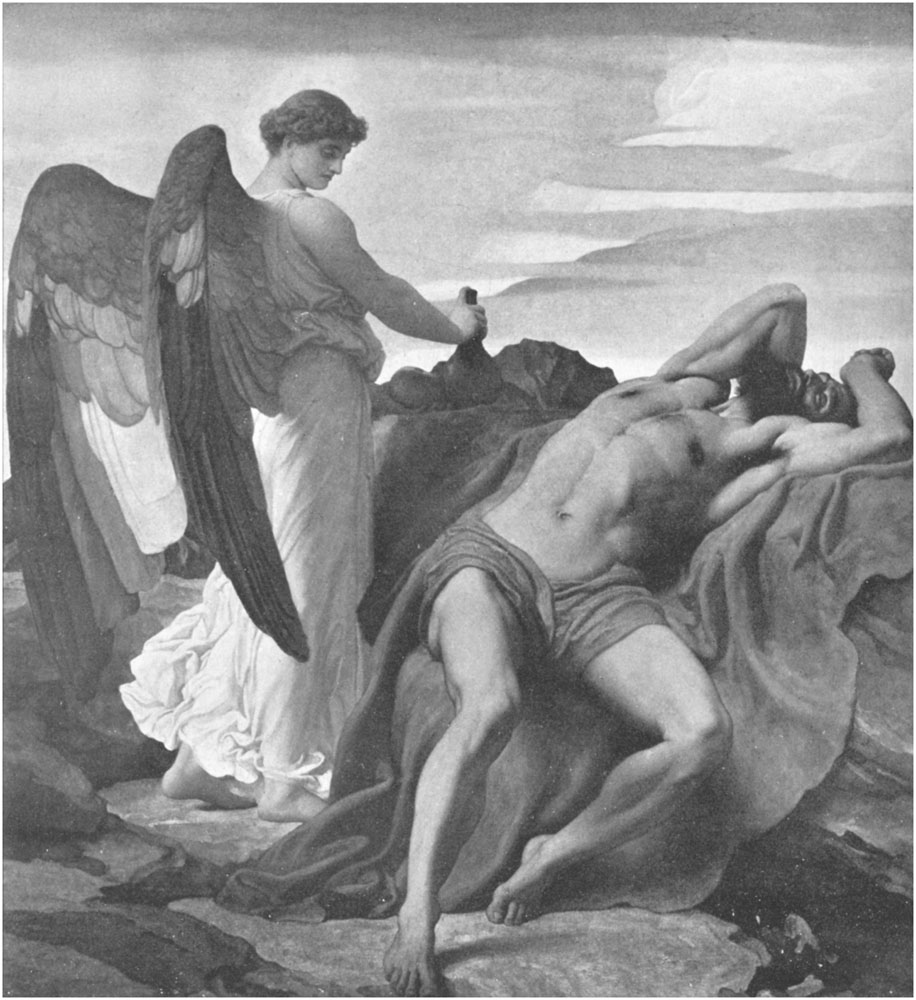
"ELIJAH IN THE WILDERNESS." 1879ToList
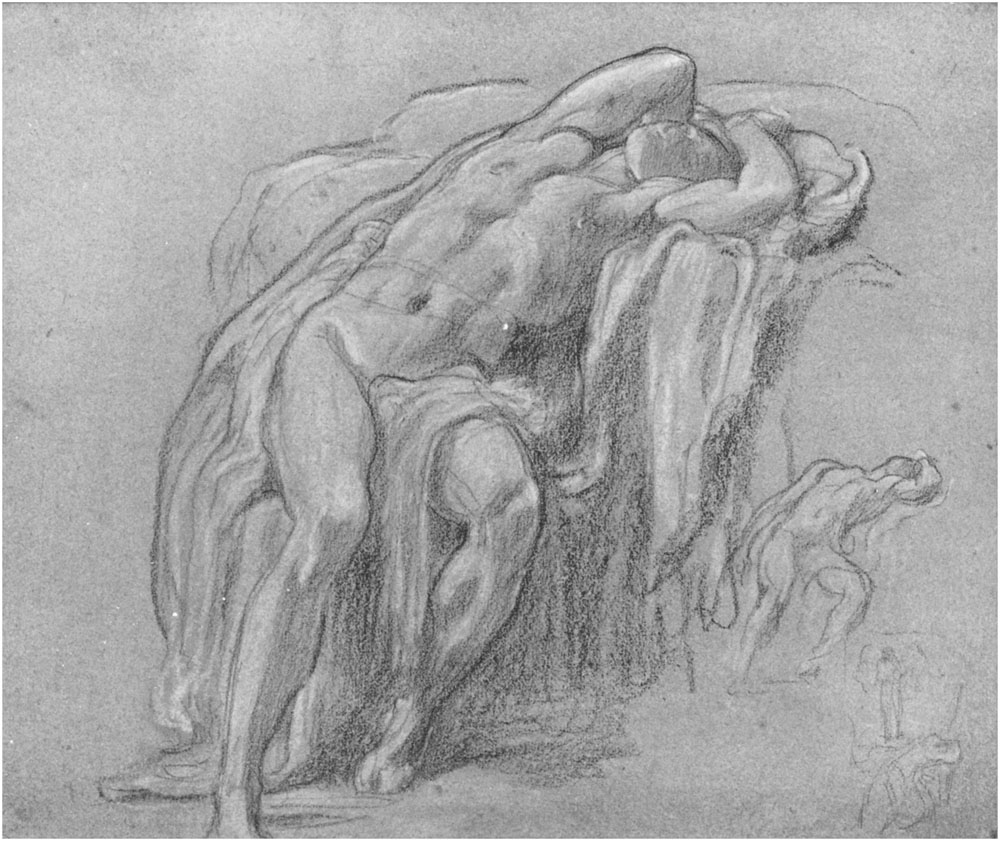
SKETCH FOR "ELIJAH IN THE WILDERNESS." 1879 Leighton House CollectionToList
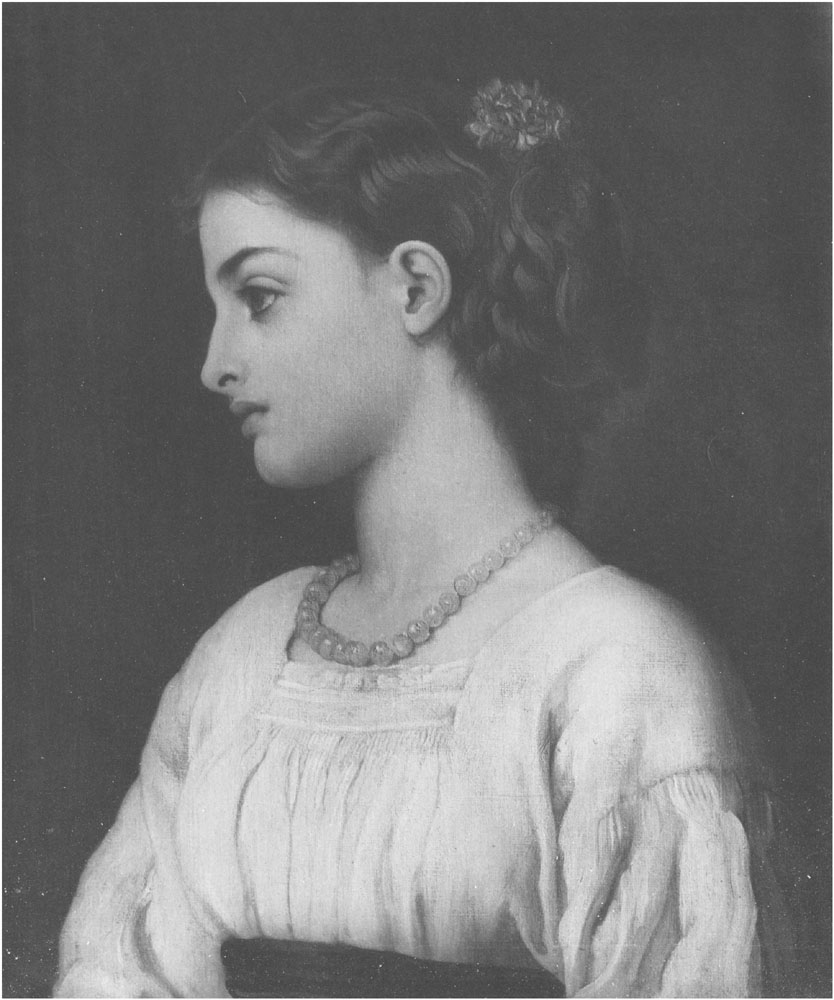
"NERUCCIA." 1879 By permission of Mrs. LeesToList
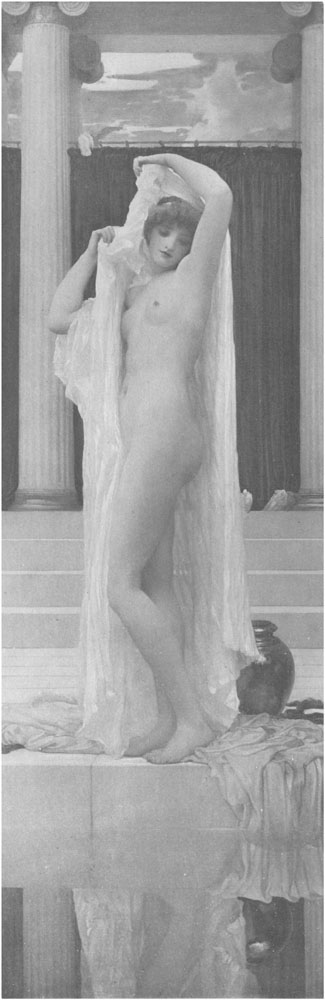
"THE BATH OF PSYCHE." 1890 National Gallery of British Art (Tate Gallery)ToList
Tuesday Morning, 2 Holland Park Road, Kensington, W., March 18, 1884.
Dear Wells,—Thank you for your letter received yesterday, which only lack of time prevented me from answering at once. I am happy to say that Richmond cheerfully acceded to my wish in regard to clauses 6 and 7. I do not think with Calderon, who has written to me, that the words of a man so high-minded as Richmond will indispose members in this matter, and, though I feel the importance of raising no prejudice against the proposal as keenly as ever, still wish him to initiate it. It is, I agree with you, a pity that the question of the retiring pensions must come off first; but that is, I fear, quite unavoidable, and it connects itself with the very first resolution. I assure you, my dear Wells, that I see the bearing of all you say on this head as plainly as possible, and have done so all along; but it does not prevail with me, because it does not cover the whole ground, and because I do not anticipate the dangers for which you think it might be used as a precedent.
In view of my own personal painful position in this matter, I shall ask the Assembly not to ratify the clause which affects me.—In great haste, yours sincerely,
Fred Leighton.
Leighton's official life, as understood and carried out by him, entailed infinitely more strain and occupation than can be described in these pages, but, notwithstanding, unless the call away from his easel was imperative, he kept certain hours in the day sacred to his art. These were from 9 A.M. till noon, and from 1 P.M. till 4. It was only in the off hours that he got through his other labours, which he performed, nevertheless, with most assiduous conscientiousness.
Among his duties outside the Academy were those at the British Museum. Mr. H.A. Grueber, Keeper of the Coins and Medals, writes: "Sir Frederic Leighton was elected a Trustee of the British Museum on May 14, 1881. He was an active member of the Standing Committee, who practically manage the affairs of the Museum, and he took great interest in the place. He was also a member of the Sub-committees on Buildings, on Antiquities, Prints and Drawings, also of those on Coins and Medals."
In the first R.A. Exhibition after his election, three pictures of the eight Leighton sent have, I think, a special interest—"Elijah in the Wilderness" (the picture into which he said he put more of himself than into any other he had painted up to that time); the portrait of his very dear friend Professor Costa, painted in the previous autumn at Lerici, and the head "Neruccia." Leighton with Costa studied the methods used in painting by the Venetians and Correggio, and Costa wrote the following with reference to them:—
The result of these studies and of the experience of years was that Leighton and I definitely adopted the following method. Take a canvas or panel with the whitest possible preparation and non-absorbent—the drawing of the subject to be done with precision and indelible. On this seek to model in monochrome so strongly that it will bear the local colours painted with exaggeration, and then the grey, which is to be the ground of all the future half-tones; on this paint the lights, for which use only white, red, and black, avoiding yellow, and, stabbing (botteggiando) with the brush while the colour is wet, make the half-tints tell out from the grey beneath, which should be thoroughly dry. When all is dry, finish the picture with scumbles (spegazzi), adding yellow to complete the colour.
Leighton formed his method of painting from these general maxims, and he painted my portrait at Lerici on these principles as an experiment, and then in 1878 we adopted the system definitely. For this portrait he had four sittings—one for the drawing and the monochrome chiaroscuro, one for the local colours; then, having covered all with grey, he painted the lights with red, white, and black, making use of the thoroughly dried grey beneath for his half-tints. With scumbles he completed the colour and the modelling.
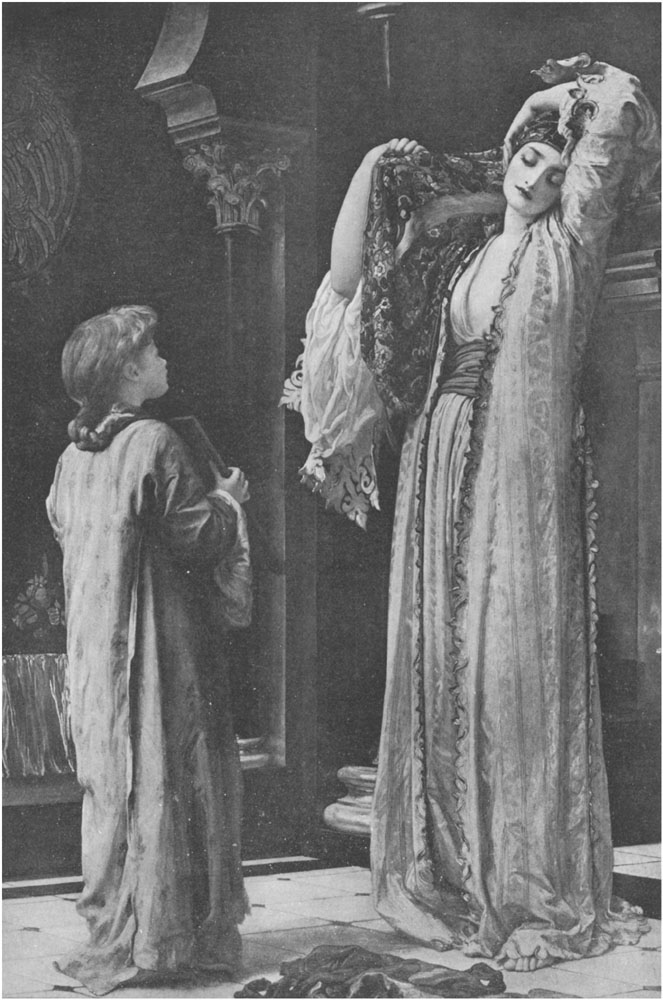
"THE LIGHT OF THE HAREM." 1880 By kind permission of the Directors of the Leicester GalleryToList
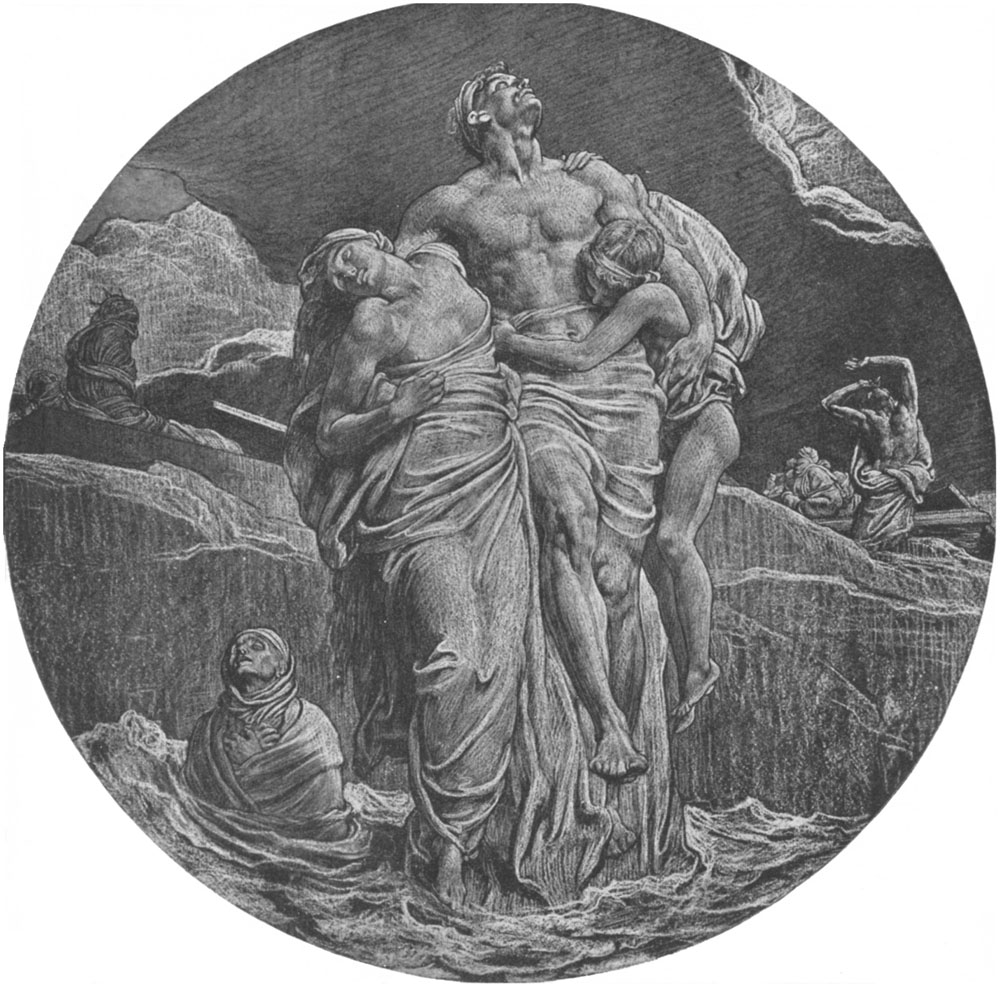
"AND THE SEA GAVE UP THE DEAD WHICH WERE IN IT" Sketch for Complete Design, 1892ToList
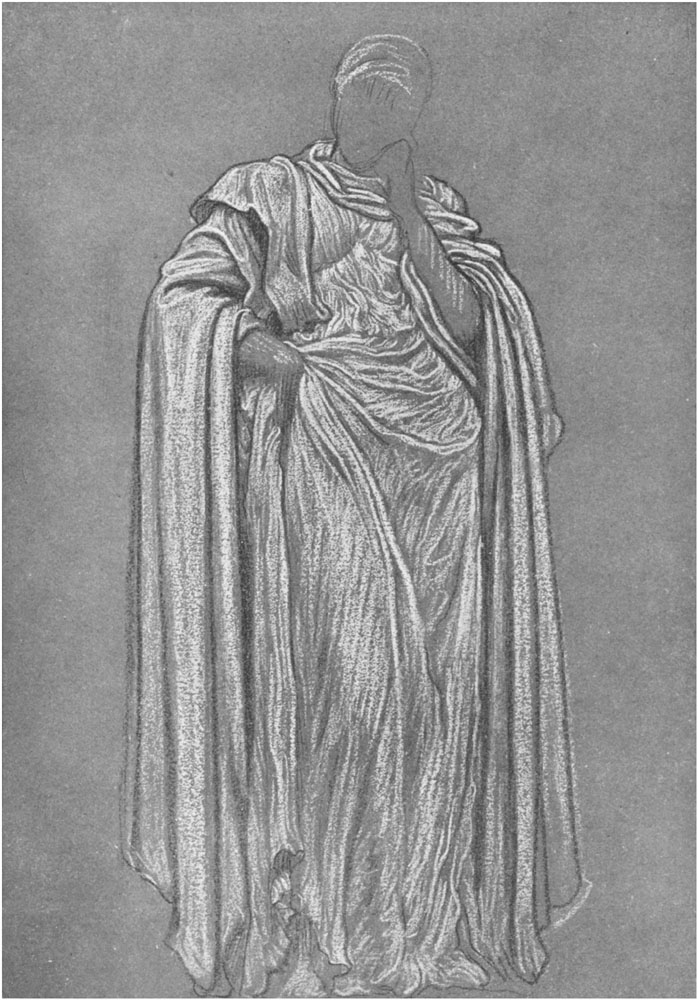
STUDY FOR FIGURE IN FRIEZE, "MUSIC." 1886 Leighton House CollectionToList
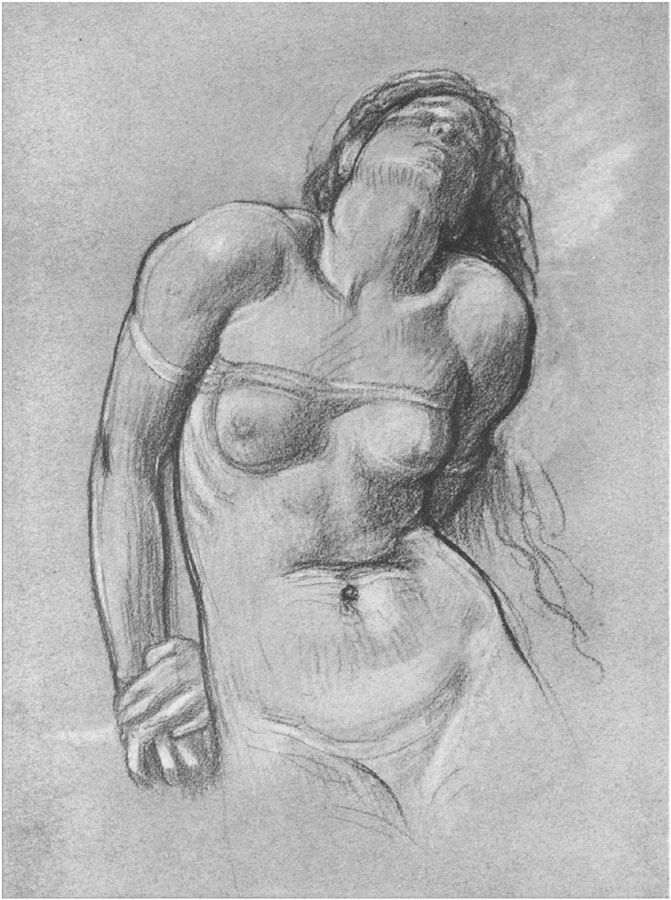
STUDY FOR "ANDROMEDA." 1890 Leighton House CollectionToList
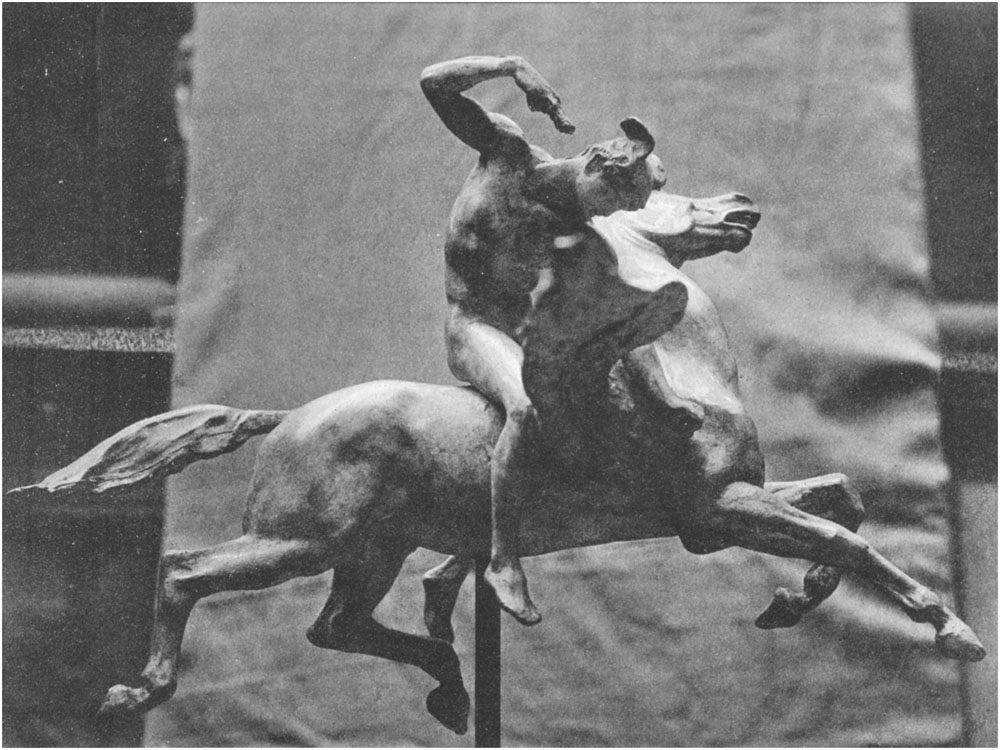
FROM SKETCH IN CLAY FOR PERSEUS, IN THE PICTURE "PERSEUS AND ANDROMEDA." 1891ToList
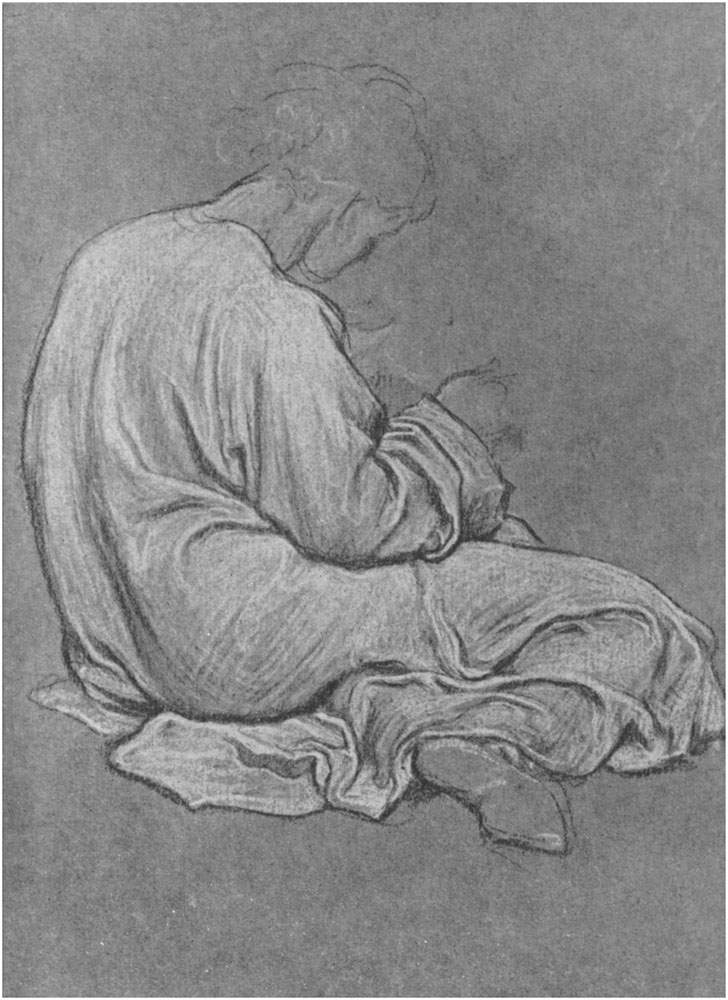
STUDY FOR FIGURE IN PANEL IN ROYAL EXCHANGE—"PHŒNICIANS BARTERING WITH BRITONS" Leighton House CollectionToList
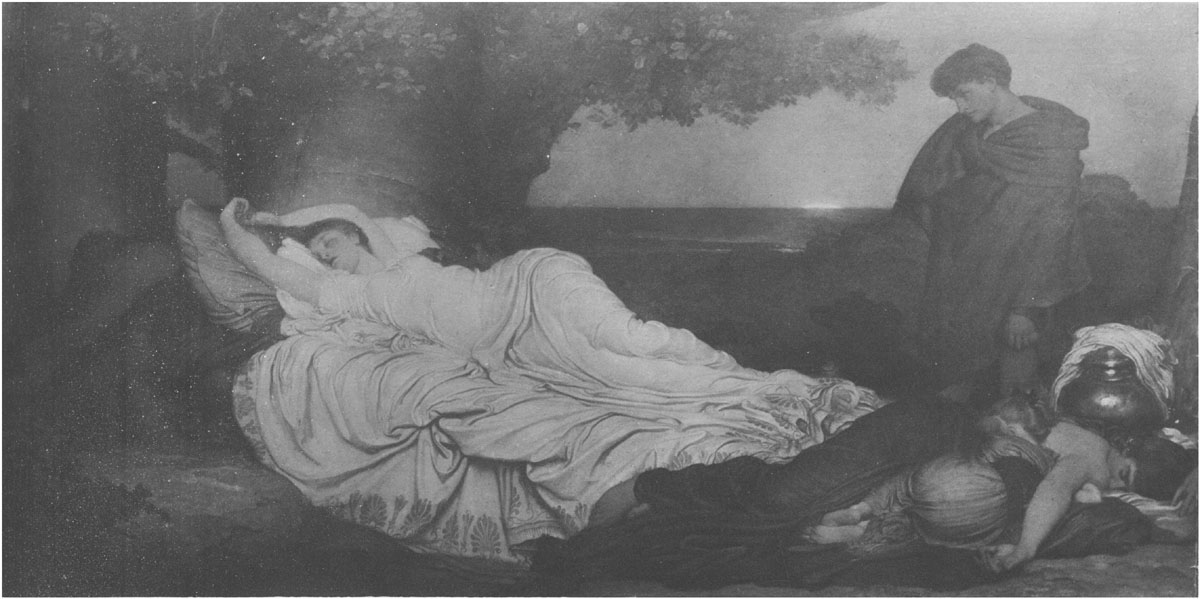
"CYMON AND IPHIGENIA." 1884 The Corporation of LeedsToList
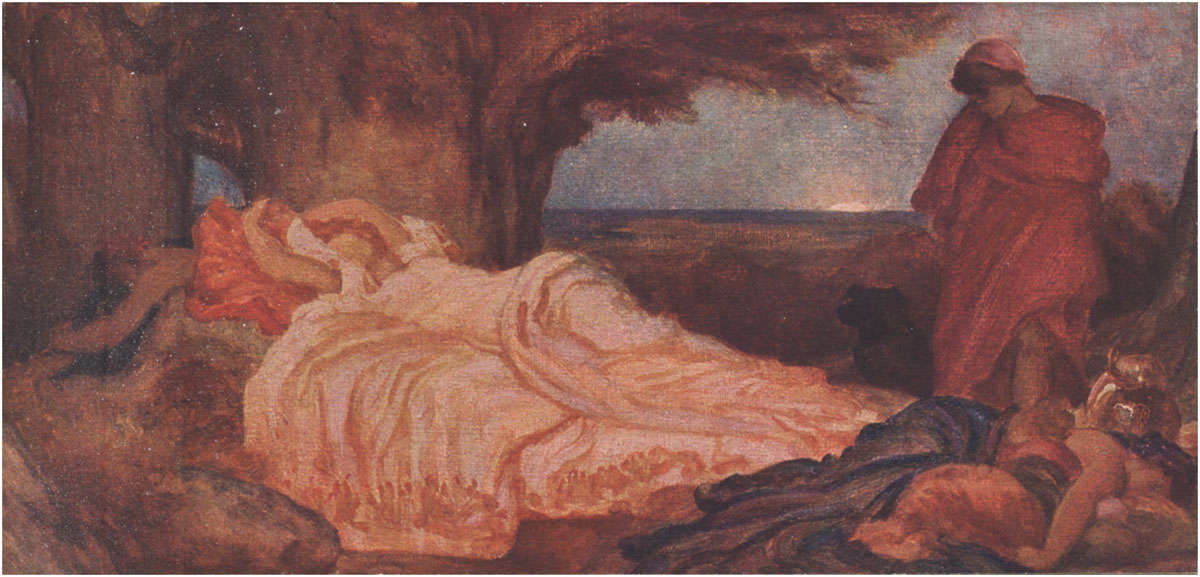
STUDY IN COLOUR FOR "CYMON AND IPHIGENIA." 1884 By permission of Mrs. Stewart HodgsonToList
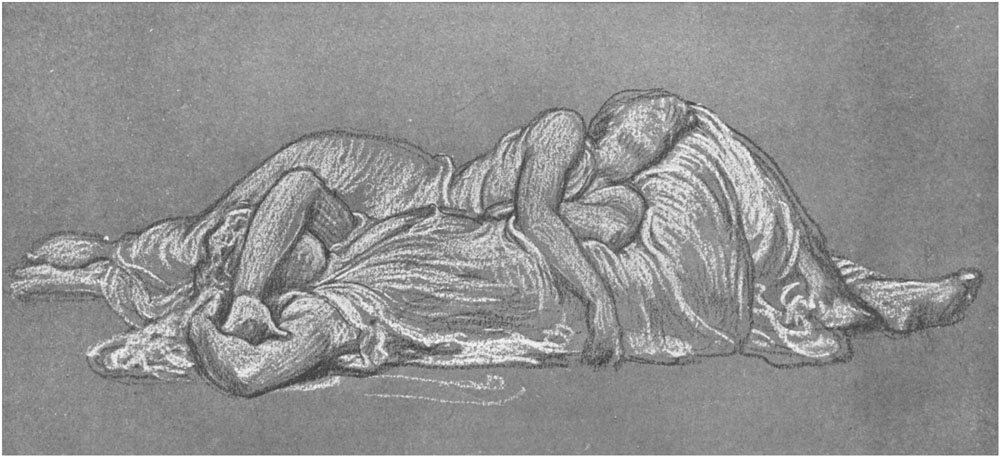
STUDY FOR SLEEPING GROUP FOR "CYMON AND IPHIGENIA" Given by Lord Leighton to G.F. Watts, O.M., and given by the latter to the Collection in Leighton House, 1883ToList
As the exquisite fragments in pencil of cyclamen, bramble and vine branch,[68] explain most intimately Leighton's genius as a draughtsman, so this head of Neruccia appears to me, together with one other work, to explain most explicitly his genius as a painter—a modeller with the brush. In 1890 Leighton painted "The Bath of Psyche."[69] The modelling in the torso of this figure, and in the head of Neruccia, reach the zenith as exemplifying Leighton's individuality as a painter. They might truly earn for him the title—Praxiteles of the brush.
It would be tedious for writer and reader alike to describe too minutely the special characteristics of even the most notable pictures painted during the seventeen years when Leighton occupied the position of President of the Royal Academy. Words are but poor interpreters of painting such as his. Eighty canvases, two statues, and two designs—the reverse of the Jubilee Medallion, "And the sea gave up its dead which were in it"—were exhibited at the Royal Academy; eighteen slighter works at the Suffolk Street, and twenty-three at the Grosvenor Galleries. On referring to the list in the Appendix it will be realised how great was the amount of labour involved in the achievement of many of these works, considering their size, the complication of their designs, and also the completeness of their finish. It must also be remembered that Leighton made many hundreds of studies for his pictures. More especially numerous were these for the designs "And the sea gave up the dead which were in it," "The Dance, Decorative Frieze"; "Cymon and Iphigenia"; "Music, a Frieze"; "Design for the reverse of the Jubilee Medallion," "Captive Andromache," "Perseus and Andromeda," "Return of Persephone," "The Garden of the Hesperides," "Rizpah," "Summer Slumbers," "The Spirit of the Summit," "Flaming June," "Phœnicians Bartering with Britons," and "Clytie." When all these achievements are taken into account it will be realised that Leighton, to the end, however important his duties outside his studios, was true to his vocation, and proved himself the "workman first and the official after."
As a work combining poetic feeling, power of design, and great beauty in the arrangement of line, while at the same time expressing most explicitly Leighton's creed of creeds—namely, the ennobling and elevating influence of beauty in the lives of men and women—"Cymon and Iphigenia" is perhaps the picture he himself would have chosen as the most representative among these later works. He chose it as the one he wished sent to the Berlin Exhibition in 1885. When beginning it he described to me the moment of the day he wished to catch for the scene—"the most mysteriously beautiful in the whole twenty-four hours, when the merest lip of the moon has risen from behind the sea horizon, and the air is haunted still with the flush of the after-glow from the sun already hidden in the west."[70]
The study for the group of sleeping figures reproduced here is almost identical in design with the sketch in plaster from the clay, so lamentably destroyed when Watts lent it to be cast in bronze after Leighton's death. Leighton also gave the drawing of this group to his fellow artist, so enthusiastically did Watts admire it. He, in his turn, gave it to the Leighton House Collection in the year 1897, together with the fine painting which Leighton exchanged for his own portrait, painted about 1863, and which greeted friends as they mounted the staircase in Leighton House during all the years he lived in Holland Park Road (see frontispiece to Vol. I.). The study for "Cymon and Iphigenia" is particularly valuable now as an example of Leighton's rapid sketches where every touch reflects a mine of knowledge, because it was put under glass before any of the crispness of the touch was blurred by rubbing.[71]
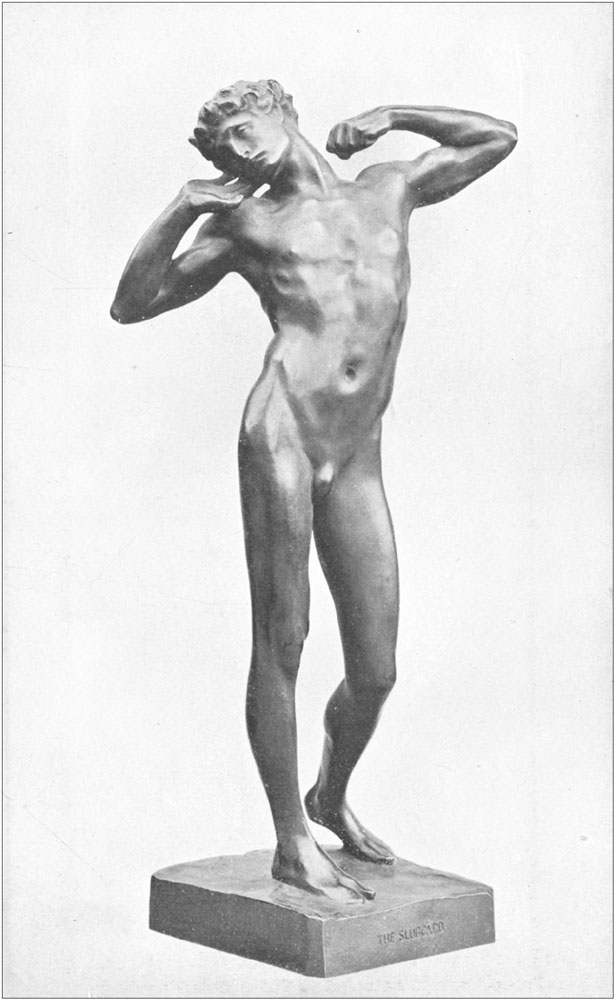
"THE SLUGGARD" From the Bronze Statuette—a direct reproduction from Lord Leighton's small sketch, 1886. Leighton House CollectionToList
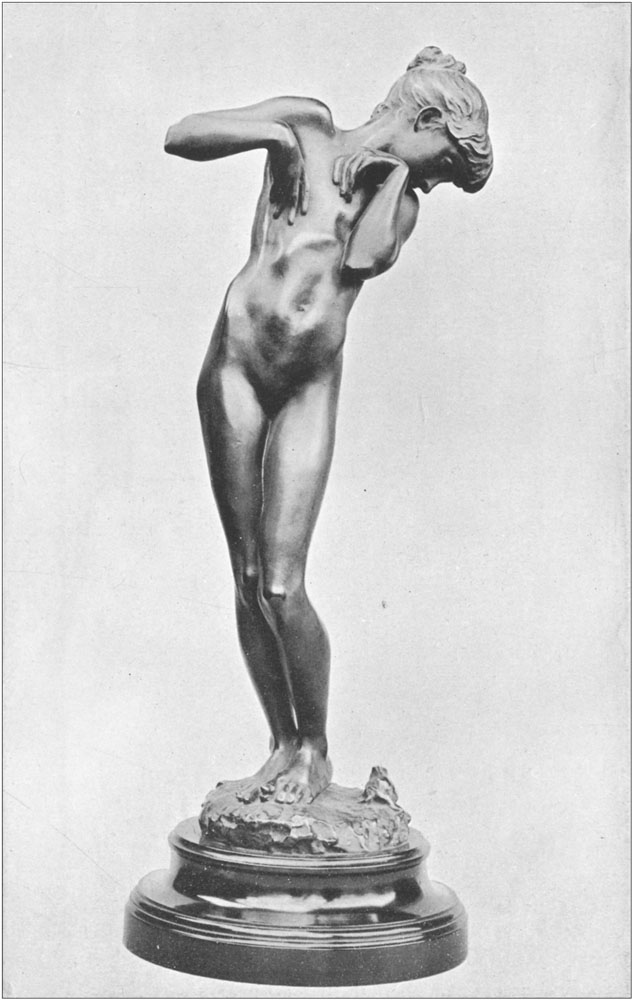
"NEEDLESS ALARMS" From Bronze Statuette, 1886. Leighton House CollectionToList
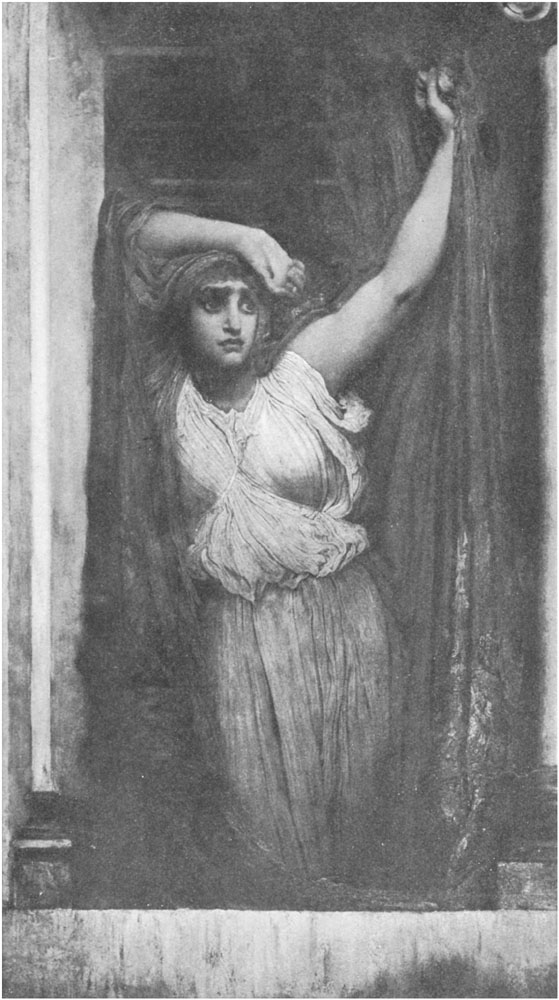
"THE LAST WATCH OF HERO." 1887ToList
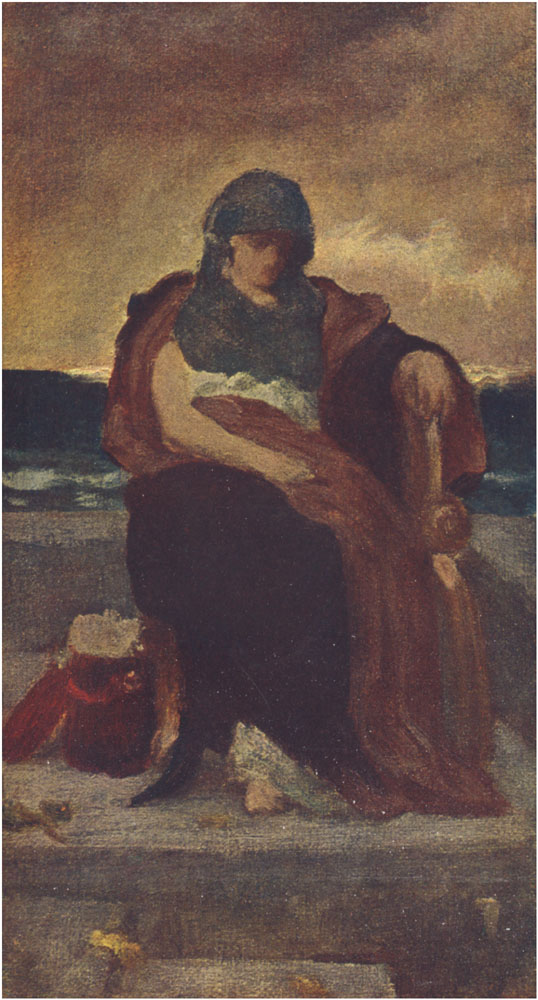
STUDY IN COLOUR FOR "TRAGIC POETESS." 1890 By permission of Mrs. Stewart HodgsonToList
In a letter dated 1886 Watts wrote: "Leighton will carry off all the honours this year with his ceiling[72] and his two statues."
"An Athlete Awakening from Sleep" (given to the Tate Gallery by Sir Henry Tate) is generally known as "The Sluggard," a name bestowed on it by Leighton himself. The victor's garland lies at the feet of the athlete, a garland which does not preserve the owner from a sad weariness. Mr. Brock, R.A., in whose studio "An Athlete" was modelled, executed the fine bust of Leighton which was deposited in the Academy as Mr. Brock's diploma work.[73]
Sir John Millais admired greatly the other work alluded to in Watts' letter, "Needless Alarms." Leighton gave him this statuette, and Millais, desiring to show his gratitude in a tangible form, painted the picture "Shelling Peas" for Leighton.
In at least fourteen of the eighty pictures shown at the Academy during the last seventeen years of Leighton's life, there can be traced an earnest sentiment beyond the "sincerity of emotion" for beauty which all evince. This feeling is, however, always guarded by a marked reticence from sentimentalism. "Elijah in the Wilderness," "Elisha Raising the Son of the Shunammite," "The Jealousy of Simœtha, the Sorceress," "The Last Watch of Hero," "Captive Andromache," "Return of Persephone," "Rizpah," "Tragic Poetess," "Sibyl," "Farewell," "The Spirit of the Summit," "Fatidica," "Lachrymæ," and the last passionate figure of "Clytie." The most popular pictures Leighton painted during these years appear to be "Sister's Kiss," "The Light of the Harem" (developed into a picture from the design of a group in the fresco, "The Industrial Arts of Peace"), "Idyll," "Whispers," "Wedded" (now in Australia), "Memories," "Letty," "Invocation," "Solitude," "The Bath of Psyche," "Bacchante," "Corinna of Tanagra," "The Bracelet," "Summer Slumber," "Atalanta," "Flaming June," and "The Fair Persian" (unfinished). Two sketches in the Leighton House Collection record effects which greatly fascinated Leighton in Scotland—"A Pool, Findhorn River," deep tortoiseshell brown; and "Rocks in the Findhorn," pink and grey enriched by lichen, and it was in Scotland that the Lynn of Dee inspired the subject of "Solitude." Leighton described to me the deep impression this Lynn of Dee had made on him. "It is the veriest note of solitude! a wonderful spot, full of poetic inspiration." In order to transmit a vivid record of this sentiment to his canvas, he took a second journey to the place.[74]
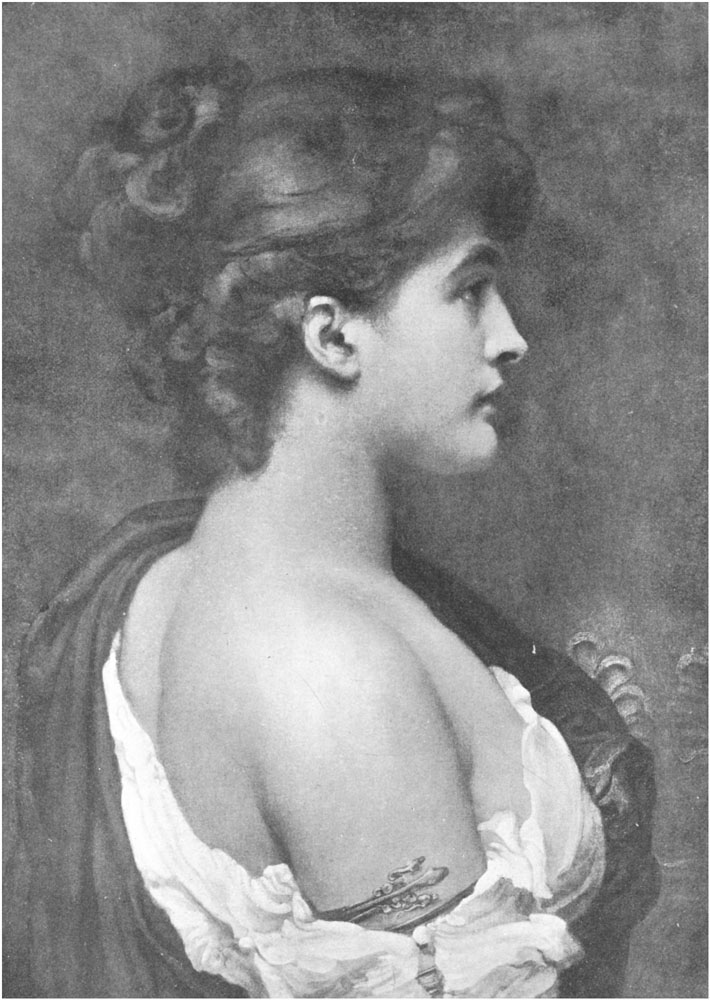
"ATALANTA." 1893 By permission of the Berlin Photographic Co., the owners of the CopyrightToList
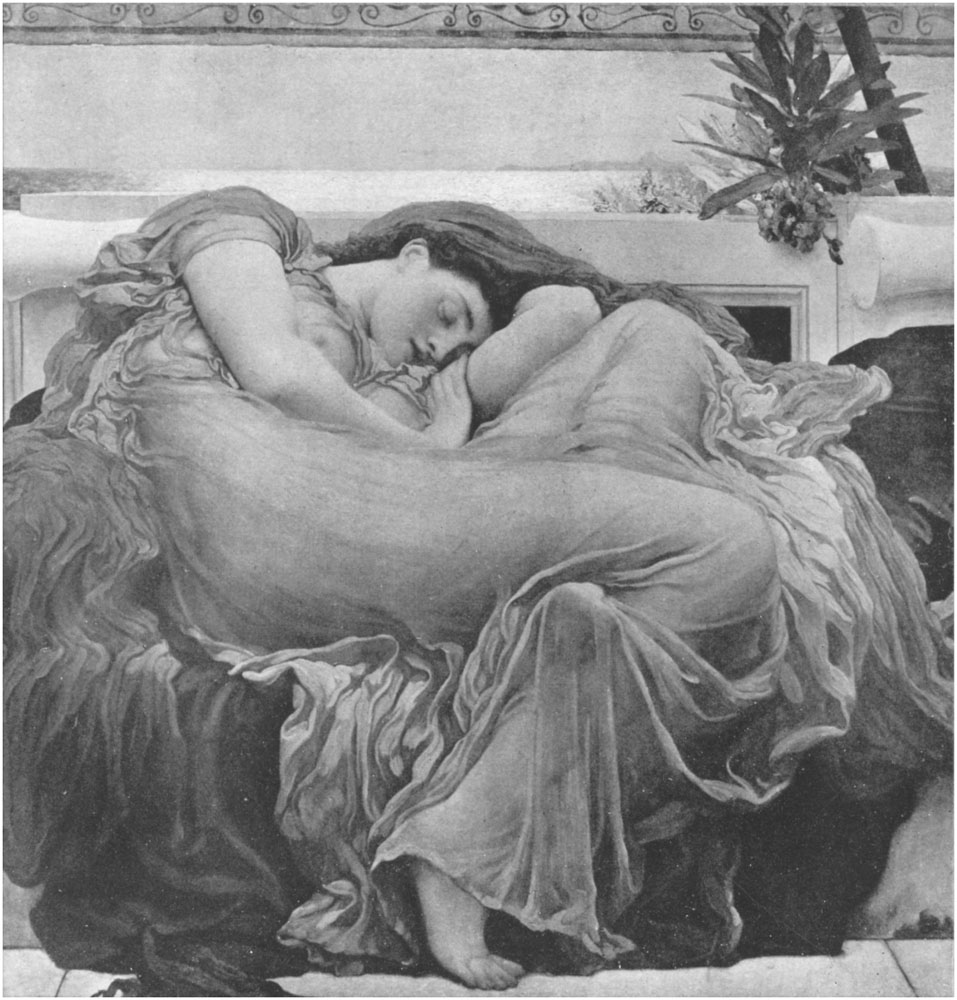
"FLAMING JUNE." 1895 By permission of Mrs. WatneyToList
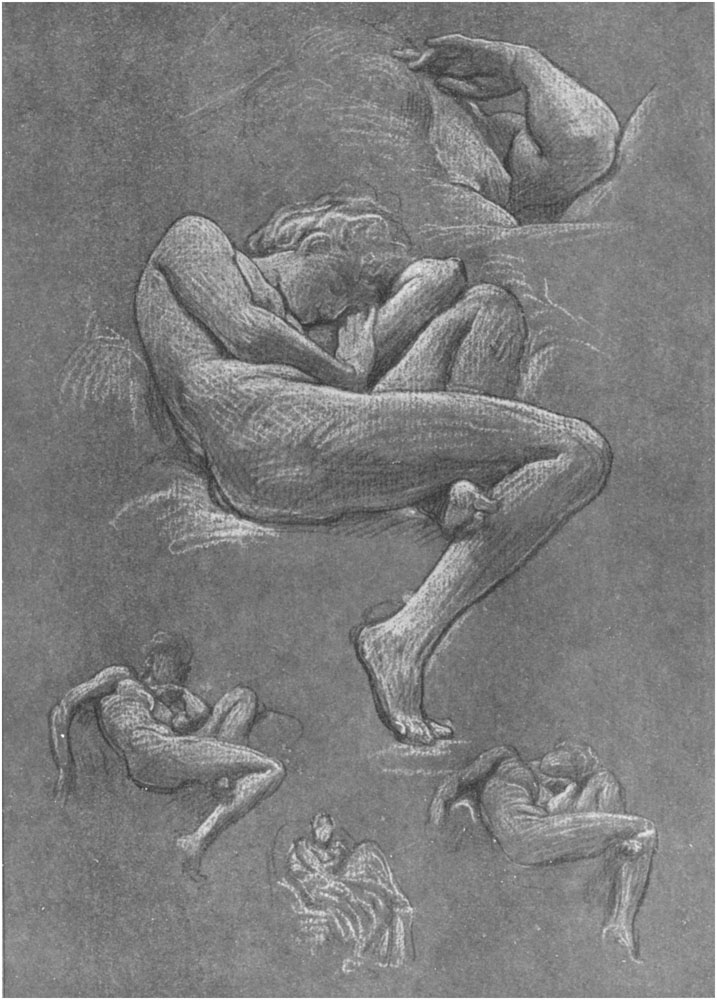
STUDY FOR "FLAMING JUNE." 1895ToList
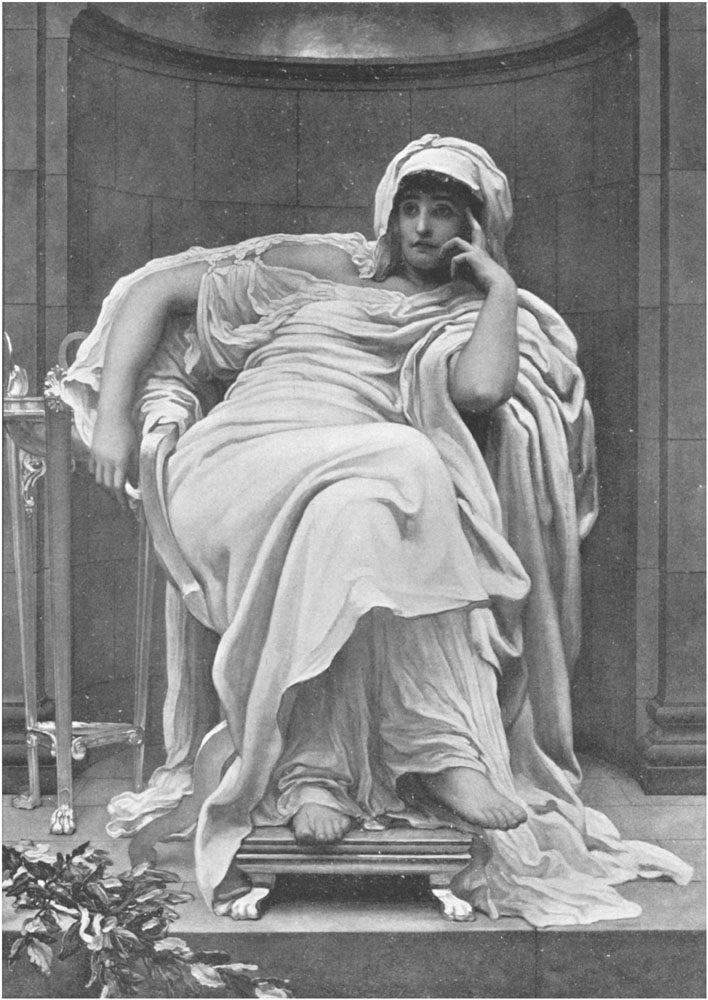
"FATIDICA." 1894 By permission of Messrs. T. Agnew & Son, the owners of the CopyrightToList
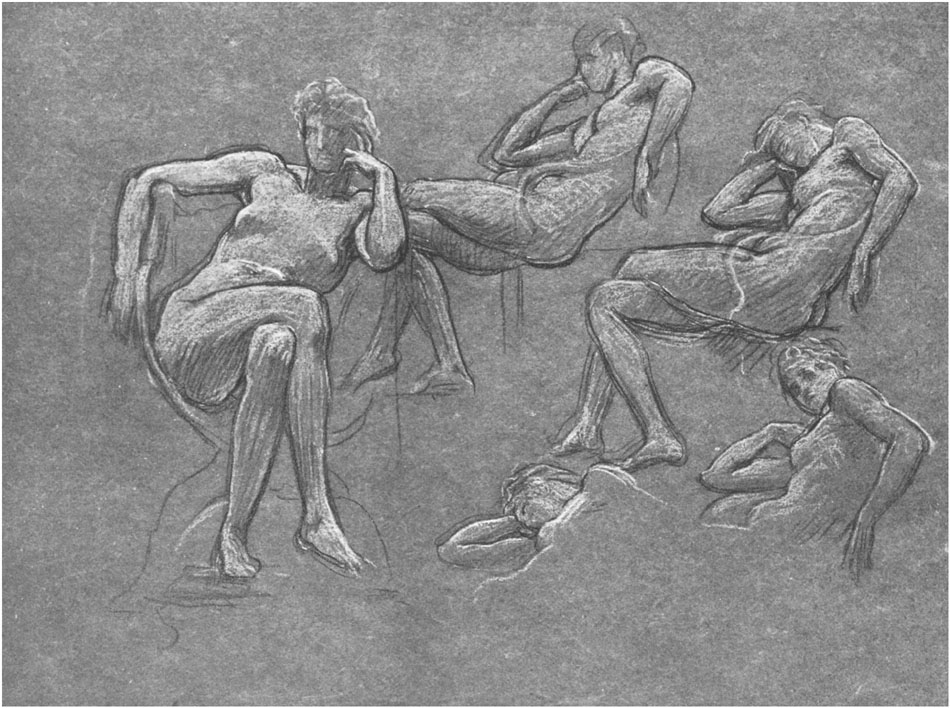
STUDIES FOR "FATIDICA." 1894 Leighton House CollectionToList
Leighton wrote the following letter to his father when first visiting Forres, in which he described the "craze" he had for these "dark brown Scotch rivers":—
Royal Station Hotel, Forres, N.B.
I drove over to Dunkeld (twelve and a half miles) to lunch at the Millais'; I think the drive one of the most enchanting things I know, and I was favoured, moreover, by a few of those divine glimpses of blue and silver sky of which Scotland has the monopoly (a monopoly which she uses, perhaps, just a trifle too modestly). This is Forres, as the paper shows you; if Macbeth's witches really did live in this neighbourhood, it is just as well they had their hands pretty full, for they would have found the place uncommonly dull otherwise, especially on the "Sawbath." On the other hand, the drive to and the walk along the banks of the Findhorn—the excursion for which one comes here—is quite delightful, and indeed surpassed my expectations. I must tell you that I have nothing short of a craze for your dark brown Scotch (and Irish) rivers, as dark as treacle, and as clear as a cairngorm. This particular stream contrives to rush part of the way through fantastic rocks of pink granite—you may imagine the effect. Here again from the heights over the river I ought to have seen the sea and the coast of Sutherlandshire; but the weather was sulky and I had to draw on my imagination for the view.
In the forenoon I went over by train to Elgin, to see the ruined cathedral, which is fine, but, like all Scotch architecture that I have seen, crude and barbaric. As I stood on the platform before starting, I heard a gruff, good-humoured voice hailing me from a train on the other side; it was the voice which goes so well with the rubicund face of the Duke of Cambridge. I was going by the same train, so he made me get into his compartment; he was going to Balmoral or Aberfeldie. He was very comic about B—— and his article in the Nineteenth Century—"A fellow who fouls his own nest is always a d——d bad lot—a d——d bad lot," with which sentiment I close a d——d long letter.—From your affectionate son,
Fred.
"Atalanta" may be noted, perhaps, as the strongest work achieved by Leighton. Here is "enormous power," though shown on a comparatively small canvas. For noble beauty of the Pheidian type in the grand and simple pose and modelling of the throat and shoulder, it would be difficult to find its peer in Modern Art, and yet it was only the worthy record of the beauty of an English girl. "Flaming June" (a design first made to decorate as a bas-relief the marble bath on which the figure in "Summer Slumber" reposes), is equally perfect in the fine fulness of the modelling, but it lacks the direct simplicity which gives such a distinguished strength to the "Atalanta." In the sketch for "Flaming June" reproduced in these pages the pose is better explained than in the completed picture, the foreshortened line of the back and shoulder being confused somewhat by the drapery in the painting.
At the age of twenty-five, in the wing-like petals of a cyclamen, Leighton had succeeded in securing with the pencil the quality towards which he aimed from the beginning to the end of his studies—and these only ended with his life—namely, absolute completeness as far as human eye and hand can reach completeness in rendering the perfection of nature's forms. Notably in "Neruccia" and in "Psyche" he reached that aim with the brush, but in "Atalanta," and in such studies as those for "Flaming June," "Fatidica," and—imbued with a yet further interest of dramatic feeling—for "Clytie," his aim was reached with more freedom and power of touch. The quality of beauty in these works was no invention of his—only, as has been noted before, a discernment and echo in the artist's apprehension of nobler truths in nature than are discovered by the many. They are nobler, because possessing the germ of life and movement. In all nature's forms, beauty and style result from the spring and moving on—the development of growth, whether it requires æons to develop the form as in mountains, years as in trees, or only days as in flowers. In the human limbs there is the further power of varied movement, and in the countenance of varied expressions. The greatest art stamps a suggestion of this power of growth and movement into the form and line expressing the facts it records; and, making it harmonise graciously with perfect structure in nature, the great artist evolves a thing of beauty. In our northern climes, and in our modern civilisation, beauty of form and line excite little genuine emotion. That is reserved for colour, tone, texture, and, in these very latter days, for the cleverness of the executant. The greatest opposer Leighton's teaching has had is laziness. Students will not take the trouble to go through irksome labour to secure knowledge, therefore they only aim at those qualities which are made comparatively easy by an emotional preference; and such emotional preference is rarely excited by form. There are exceptions, such as Watts, whose greatest artistic emotion was excited when he seized the beauty and style in Pheidias. He felt also the same enthusiastic excitement over Leighton's studies, stamped with a like Pheidian quality of style. Because the modern eye is so often blind to these qualities, therefore Leighton's work has been disposed of by many as merely academical and the result solely of taking inordinate pains! Surely those desirous of any true culture might learn one lesson at all events of Leighton: the value of Catholicity through learning "to master what they reject as fully as what they adopt ... the better motives of men" with whom they are not in sympathy. Catholicity is the outcome of the best natures, the best understandings, the best educations. It overrides those subtle egoisms and commercial interests which so often guide while distorting a true judgment in art matters, keeping the preferences of the public wriggling about without any definite instinct or principal on a never truly-convincing dead level. The mainspring of catholicity in art is a fervent reverence for nature. All works in which such fervent reverence is found, in whatever direction it is displayed, are worthy to be admitted into the fold, whether it be form, colour, or tone in nature's aspect—whether it be the stirring whirls of northern tempests, the rural peace of English glades, or the fineness of rarefied atmosphere in the south, as in Greek isles and sea. Whichever mood of nature appeals to a true artist and inspires in him the sacred fire, and consequently the expression in his touch, should find a place in the heart of the true lover of art. Because the æsthetic pores of a music-lover are open to the rapturous tumult of the wildly whirling Schumann symphony in A minor, is he, therefore, incapable of being entranced by the rare refinement of Palestrina's cameo-like phrases? Because he feels a rapturous excitement as the curtain falls at the end of the first act of "Lohengrin," can he not also feel a soul-satisfaction in the elevated serenity of Bach's "Christmas Oratorio"? Does it not rather denote a want of elasticity in the æsthetic perceptions, a want of flexibility in the sensibilities flavouring somewhat of the Philistine, to be touched by a limited range of emotions? Because Leighton is not Whistler, or Watts is not Sargent, why must the one be admired at the expense of the other? With Leighton's rare intellectual acumen he knew well that these limitations in viewing various outlooks on art arose chiefly from a want of wide culture and experience. In the great galleries of Europe, among the treasures in the churches of Italy, his own vision had been enlarged, and he had felt how nourishing to his own best instincts such enlargement had proved. Hence his earnest endeavours when first entering the Academy to establish the Winter Exhibitions of Old Masters, and later, when President, to give as many facilities as possible for students to travel abroad. Probably, it never will be fully realised how greatly Leighton's initiations in starting new ventures for young students and artists have helped the real progress of English art. His great modesty and rare tact prevented this initiation from being fully appreciated even at the time. When such an one as Leighton is working on great lines, the last thing he thinks of is, Who is really achieving the work? The aim has to be accomplished; it matters little who is used as the tool to achieve the work. The real satisfaction to such a nature is the fact that the work has been achieved.
Perhaps of all the ways in which Leighton helped to forward the condition of art in England, the most valuable was his industry in searching out unknown work, discovering what merit existed in it, hunting up the artist, and, by becoming personally acquainted with him, encouraging in every manner his onward progress. What he effected in Mason's case with such a rich harvest to the world as the result, he did in many other cases when the artist was a perfect stranger to him. Mr. Alfred East, the President of the Royal Society of British Artists, writes: "Lord Leighton was a man of broad sympathies in his appreciation of Art, an earnest worker with a lofty purpose and a high ideal. He liked to see these qualities in others, and spoke of the dignity and privilege of being an artist, and lived up to it in his own house. To those who knew him well he was singularly modest about his work, soliciting criticism with a frankness which was as unaffected as it was sincere. He never posed, but was a fellow-worker and a comrade. Such were the characteristics of the artist at home. I owe more to his encouragement than to any other influence of my life. Our acquaintanceship grew into friendship; he helped me to speak to him as I could speak to no other, of my own aims and ideals. This is the great artist as I knew him."
Singularly chary of accepting favours or putting himself under any obligation where he did not feel certain he could requite it by any feeling or action of his own, the response Leighton's nature made when any person, thing, or place gave him delight was that of a spontaneous, unstinting gratitude. Never did any one enjoy more fully the best of blessings—a grateful heart. Moreover, once the tender spot of pity touched, a self-ignoring energy of helpfulness and desire to benefit arose, which was at once the most beautiful and the least fully understood trait in his character. It is difficult for many to understand a passion for unselfishness. "We bear with resignation the sorrows of others," is one of the good sayings of Walter Bagehot. No rule without an exception—Leighton did not bear with resignation the sorrows of his friends, nor of those he pitied as overweighted and in any need of help which he could give. No better proof exists of the fineness, the distinction of a nature, or the reverse, than the effect which misfortune or suffering produces on it. Pity with Leighton was ever allied with profound respect. He gave help as one indulging himself in a privilege rather than as one conferring a benefit. A beautiful story, for which I happen to be the best authority, is interwoven with the last years of his life.
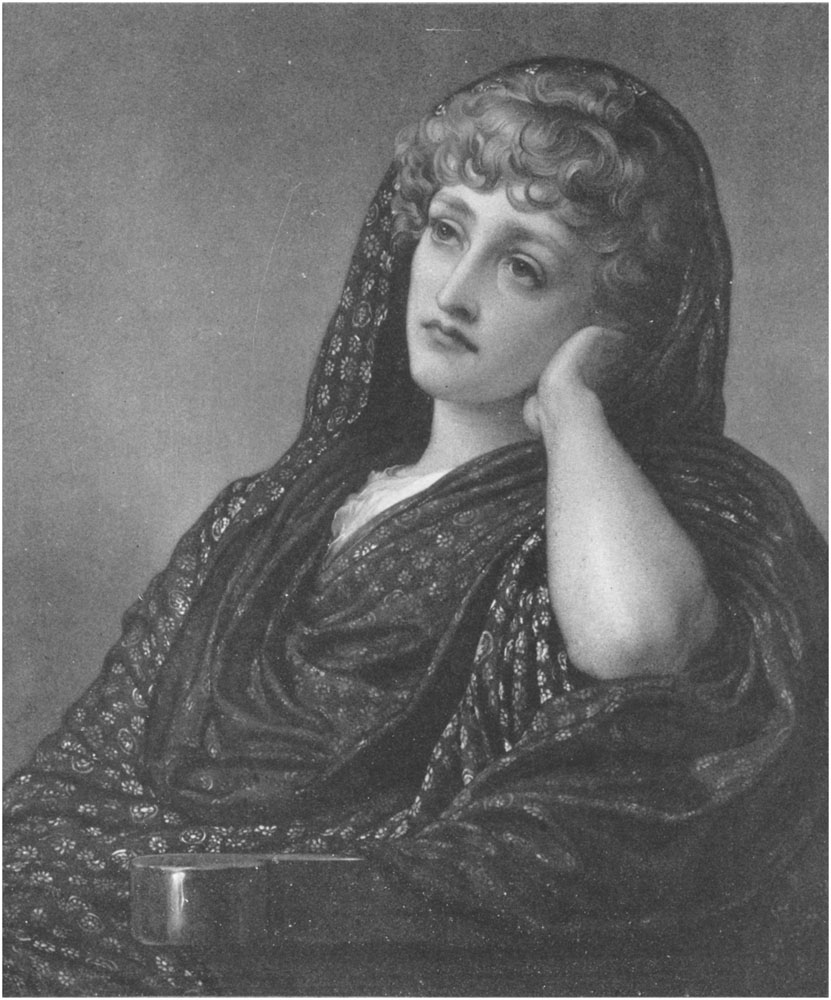
"MEMORIES." 1883 By permission of Messrs. P. & D. Colnaghi, the owners of the CopyrightToList
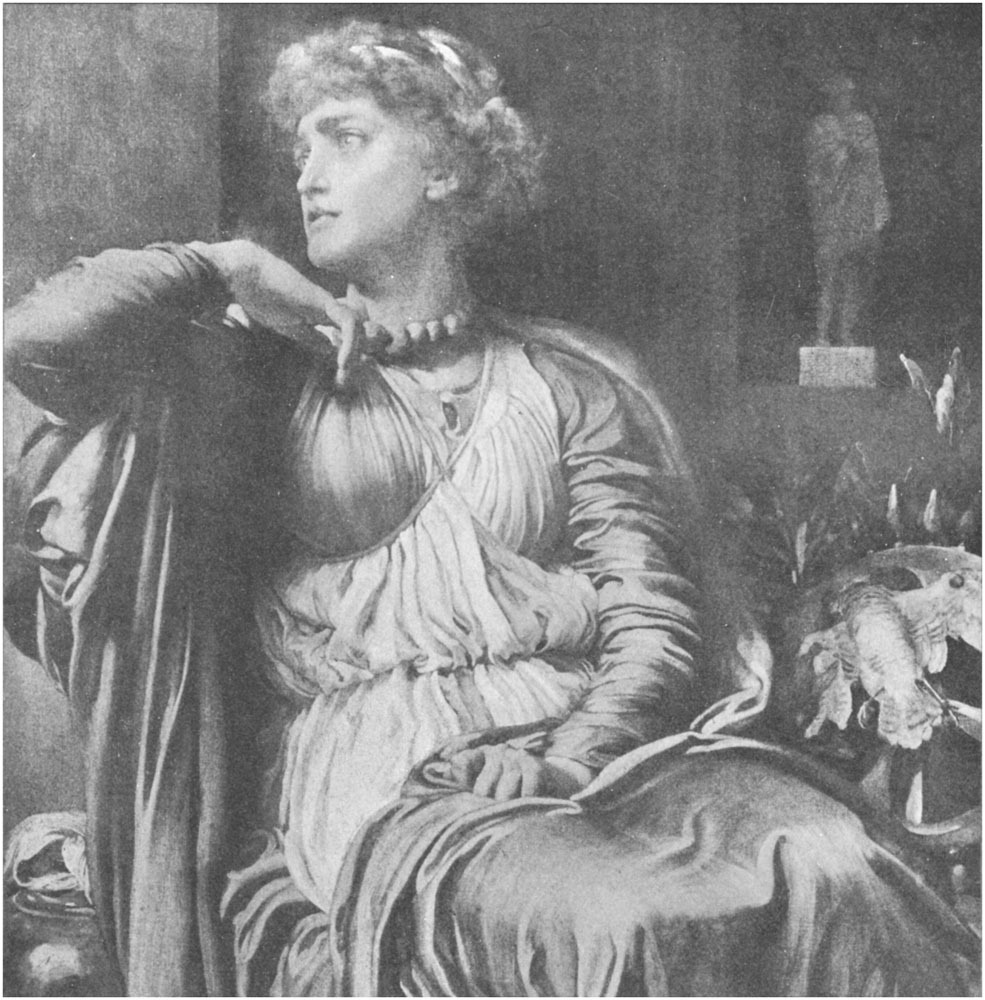
"THE JEALOUSY OF SIMŒTHA, THE SORCERESS." 1887ToList
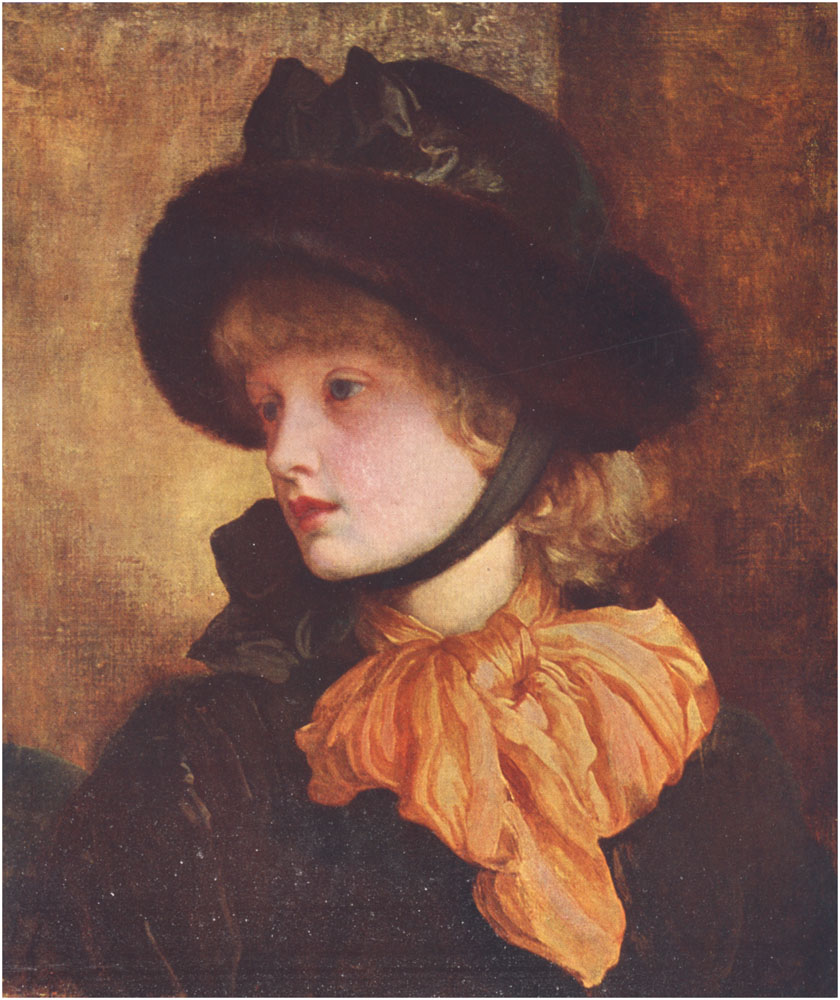
"LETTY." 1884 By permission of Mrs. Henry JoachimToList
One day, somewhere in the winter of 1879, on opening a gate which leads from our garden to the Holland Park Studios, I saw standing at one of the studio doors a figure which I described to Leighton as a "vision of beauty"—a young girl with a lovely white face, dressed in deepest black, evidently a model. Needless to say, Leighton, ever eager to procure good models, obtained her name from the artist to whom she was sitting when I first saw her, and engaged her as a model for the head. Shortly after she began to sit to Leighton, he wrote to me saying the young girl was in sad circumstances, and he would be very glad if I could help her by making some studies from her. I agreed, and he arranged with her to give me sittings. She told me that she had recently lost her mother, her father had deserted his family of five girls and two boys, and she with her elder brother were left to support them. She was endeavouring to act the part of mother to her younger sisters and brother. As Leighton and I grew to know her better we found her very intelligent and conscientious in acting this part, and she enlisted our sympathies entirely. She confided to me, while sitting one day, that she longed greatly to find something to do more interesting and remunerative than spending her days as a model. She thought she could act. I consulted Leighton. His first exclamation was, "Impossible! with that voice! How could she go on the stage?" I thought the voice, which had a singularly unpleasant Cockney twang in it, might be trained, as I had observed how very eager she was to learn to speak in a more educated manner, quite realising her own shortcomings. Leighton came round to my opinion; and, once having made up his mind that she was bent on educating herself for the stage, showed himself as ever the most unselfish and untiring befriender. Meanwhile four of these beautiful children became useful to him as models. From the second daughter, who afterwards married an artist, Leighton painted "Memories," reproduced here; from the third, Hetty, he painted "Simœtha the Sorceress" and "Farewell"; but it was the youngest, Lina, quite a small child, who delighted him most, and who had a rare, refined charm which must have captivated any child-lover. She took the place of little Connie Gilchrist of the "Cleobouline," the "Music Lesson," and other of the earlier paintings, in the later pictures. She sat for "Sister's Kiss," "The Light of the Harem," "Letty," the sleeping group in "Cymon and Iphigenia," "Kittens," in the friezes "The Dance" and "Music," and "A little girl with golden hair and pale blue eyes"—
"Yellow and pale as ripened corn Which Autumn's kiss frees—grain from sheath Such was her hair, while her eyes beneath, Showed Spring's faint violets freshly born." Robert Browning.
—also the child in "Captive Andromache." Of the sister-mother of this little family, beautiful as she was, Leighton declared he never could paint a successful likeness, notwithstanding his attempts in "Viola,"[75] "Bianca," "Serenely wandering in a trance of sober thought," and "Miss Dene." Her very beautiful throat, however, was reproduced worthily in many of his subject-pictures, and the true dramatic instinct she undoubtedly possessed enabled her to be of help in such pictures as "Antigone," "Return of Persephone," and the last picture, the passionate "Clytie." But however useful she proved as a model, Leighton never for a moment thought of his own interests before the serious welfare of the young girl's life. He realised that if she was to make a successful actress, it involved serious and concentrated study. One morning I received the following note:—
Dear Mrs. Barrington,—Miss Pullen will be very happy to sit to you on Monday, and will talk over the rest when you meet. You are very kind about it all, as is, indeed, your wont.
P.S.—You see my harassed old head does sometimes remember what I promise.
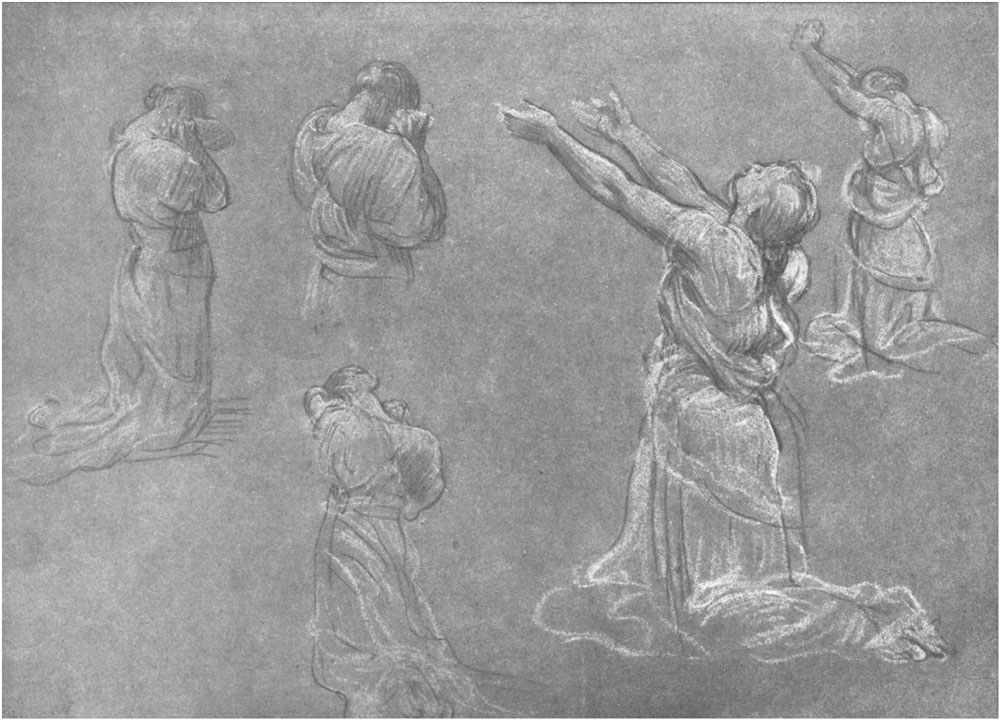
STUDIES FROM DOROTHY DENE FOR "CLYTIE." 1895 Leighton House CollectionToList
And later:—
2 Holland Park Road, Kensington, W.
Dear Mrs. Barrington,—I want you to help me in a little conspiracy against (?) our young tragic friend. Mrs. Glyn frequently urges that she ought, at all events for a time, to give her whole mind and being to the study of her art. I need not say I share that opinion, and I have at last, after infinite trouble and persistence (my nose, you know)[76] induced her to leave off sitting for a month, in the hope, if you will all help, of making it a quarter. This would, I am confident, be of the greatest value to her, giving her time also to read a little and concentrate her thoughts. I am quite prepared to give up painting from her for three months; but she is in mortal dread lest her other friends should think her unkind and ungrateful for their sympathy. I have told her I believe no such thing, and that I feel sure that Schmaltz and you (who work most from her) will, as willingly as I, postpone your studies in order to aid her in so important a matter. She is going to call on you to-day; if you agree with me, be very firm—have a nose! Refuse to paint from her for three months.
We succeeded in making the little girl work exclusively at her acting, and Leighton, Watts, and I frequently visited the school where she was being trained under Mrs. Glyn, to hear her and her fellow-students perform the pieces they had studied. Eventually she appeared in London and in the provinces, and quickly communicated all her successes and failures to Leighton and to me. Constant notes passed between us as we each received news from our young protégée, or when we thought some fresh step might be taken for her advantage. For instance, one of these notes runs as follows:—
Dear Mrs. Barrington,—It has occurred to me that I perhaps seemed this morning what I certainly did not mean to seem, churlish in regard to that letter from Irving.[77] If Miss Pullen is now ripe for him to hear her—this is the most important point (for to go to him too soon would be the most unwise thing possible in view of her getting a good engagement)—and if, having declined a letter on a previous occasion, she has any unnecessary scruple about now asking for one, it will be quite enough for you to tell me from her that she wishes for one, and I will at once write it. Kemp will always be able to tell you where to get at me. I can write as easily from Vienna or Constantinople as from here.
From Exeter Dorothy Dene wrote to Leighton after recounting an unwonted success:—
"Don't be frightened that I shall let all this praise turn my head. I know how much better it could be done, and after every scene a great weight falls on my heart that I have done no better. But I like you to warn me; it is good for me, so don't leave off, please. I am sorry that your friend, Lord Mount-Edgcumbe, will not see me, and that you had the bother of writing for nothing. Please do not fash yourself about finding out any one else. I must leave off now, as it is time to go to the theatre, and you will not get this any sooner if it were posted to-night than to-morrow.
Sunday, 24th.
"To continue, our lodgings are very comfortable, and nearly opposite the theatre; the food is good, and very fairly cooked, but I am very pleased with the tuck parcel; we had one of the birds when we arrived, the other things we have hardly touched. I thought it better to save them for places where the food may be bad. Please send me Mr. B. Tree's letter. I thought as you think about its advice. Thank you so much for your kind advice and gentle reminders, I shall try so hard to remember all you have said to me at different times; and if I do become anything in the future, I shall owe all the best part of it to you."
An engagement for two matinées was made for her début in London.
"Dear Mrs. Barrington, 'Dorothy' acts at the Globe on Monday and Tuesday afternoons," wrote Leighton; "I mean to go on Monday." I took a party of eight to see her, including the late Lord Lytton, who took much interest in the stage. After the performance Leighton wrote to me, "Poor Dorothy was paralysed with terror yesterday—but I hope intelligent people will have seen through that." Again, later, "she is adding, as she deserves, to the number of her friends, several of whom treat her with really maternal kindness." I can indeed very truly endorse Leighton's good opinion. Dorothy and three of her sisters were worthy of all the interest shown in them. They were entirely self-respecting, conscientious children, most affectionately devoted to one another, and striving their utmost to improve in every sense, and make themselves worthy of the help they received. Naturally they adored their chief benefactor, Leighton. Unfortunately, Dorothy, notwithstanding dramatic gifts, great perseverance and intelligence, lacked charm on the stage. Her very beautiful face and throat were not seen to advantage, as they were hardly in proportion with her figure, which was short and too stiffly set to move gracefully on the stage. Leighton in fun always called her "the little tee-to-tum," or when she wore a large hat, "the mushroom." As he felt vitality waning and mental effort a greater strain, the little family of Pullens had to Leighton somewhat the same resting charm that Italy had in early days, when he turned from the German austerity in study to the relaxation of the dolce far niente of Italian national life. "I go to see them," he used to say, "when I want to let my back hair down and get off the stilts." When Leighton was dying, his sister, Mrs. Sutherland Orr, took Dorothy into his room. He was too ill to speak, but only smiled to her in answer to her saying, "If I have or ever will do anything worth doing, I owe it all to you—everything I owe to you." It is almost unnecessary, as it is distasteful, to mention that this beautiful paternal attitude Leighton displayed towards these orphans was made the subject of ugly gossip—for are there not always the misérables of the world who seek the ugly rather than the beautiful? misinterpreting the beautiful so that it should come within the range of their scandalous arrows, more especially when the darts attack a man in the high position Leighton held. Some of these offshoots of envy and jealousy came within earshot of Leighton's sisters, who thought it well to warn him in a letter that such malice was in the air. He wrote a lengthy answer, ending with the following sentence: "But let me turn away from the whole thing, it has pained me more than enough. I implore you not to reopen it. On the only thing that matters, you are absolutely assured, if you believe in my honour. If you hear these rumours again, meet them with a flat, ungarnished denial. Let that suffice—it does for me." To a lady friend he wrote still more explicitly, in order, as he said, that there should exist in his own handwriting an implicit and unmitigated denial of the malicious falsehood. Leighton never knew under whose auspices this scandal was conducted. As is the case invariably, it was impossible to put the finger exactly on the culprit—for these fulsome things have to be propagated under the rose, in order that they should get a firm root before an authoritative denial can be given. However, after Leighton's death, the lie was stated more boldly—even directly to his two sisters. It is necessary, therefore, to include in the account of his life the full and truthful version of the kind and fatherly protection Leighton gave to this family.
The interests of the Kyrle Society were another cause which I had in common with Leighton. He spoke at the first public meeting that was held in the Kensington Town Hall on January 27, 1881, and I possess an interesting correspondence with him on the subject, which space will not allow me to quote. The important matter contained in it appears in the following correspondence between Mr. T.C. Horsfall, the chief mover in establishing the Art Museum and Galleries in Manchester, and Leighton, together with a discussion on other vital points connected with Art:—
April 7, about 1880.
Dear Sir,—I am probably too late to be of any use, but have nevertheless much pleasure in assuring you once again of the sympathy with which I view your endeavours to bring the refining influences of Art in all its forms, and, so to speak, in co-operation on the masses in the vast industrial centre from which you write. I believe that in seeking to elicit and to cultivate their sense of what is beautiful you are opening up to them a deep source of enjoyment, and by opposing good to bad influences, rendering them great and lasting service.—Yours very faithfully,
Fred Leighton.
February 17, 1881.
I have carefully read over the programme of your enterprise, and there is much in it with which I can warmly sympathise. I desire nothing more deeply than to see the love and knowledge of Art penetrate into the masses of the people in this country—there is no end which I would more willingly serve; but there is in your programme a paragraph which I cannot too emphatically repudiate—that, namely, which excludes from Art, as far as the public is concerned, that which is the root of the finest Art as Art, the human form, the noblest of visible things. That you should sternly and stringently exclude all work which reveals an offensive aim or prurient mind is what I should be the first to claim, but that you should lay down as a corner-stone of your scheme an enactment which would exclude by implication more than half the loftiest work we owe to Art—nearly all Michael Angelo, much of Raphael's best, Sebastiano del Piomba's "Raising of Lazarus," Titian's "Bacchus and Ariadne," Botticelli's "Birth of Venus"—this is indeed a measure from which I must most distinctly dissociate myself, and which makes it impossible for me to connect my name with an enterprise which would else command my sympathy.
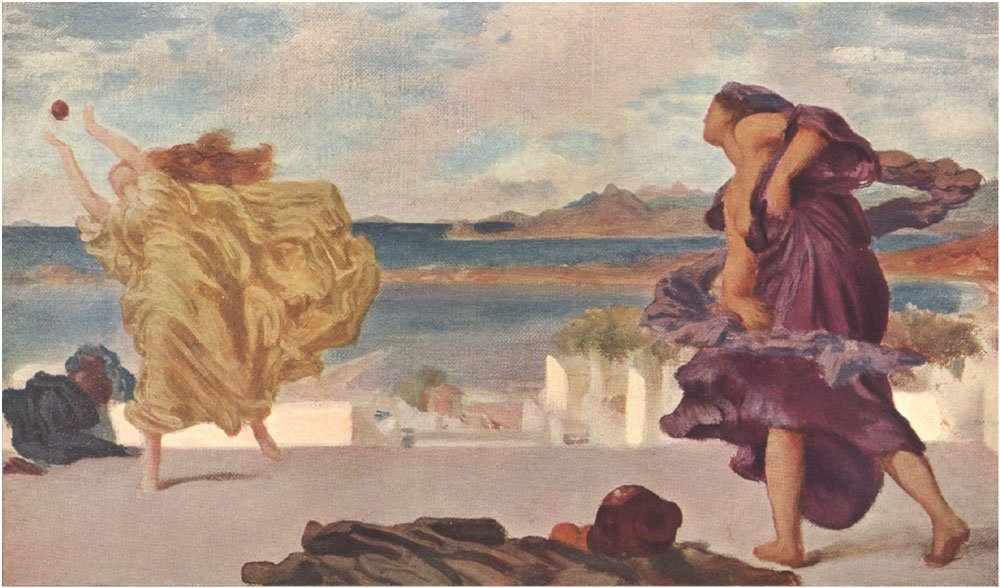
STUDY IN COLOUR FOR "GREEK GIRLS PLAYING AT BALL." 1889 By permission of Mrs. Stewart HodgsonToList
From the "Manchester Courier," August 30, 1890.
Sir Frederic Leighton on the Management of Art Galleries.
To the Editor of the Manchester Courier.
Sir,—On the 4th and 6th inst. I published two long letters on the management of art galleries, of some part of which this is a summary:—No one can intelligently and fully enjoy any picture or statue unless he has some measure of three kinds of knowledge. (1) He must know something about the subject represented, or he cannot enjoy the expression by the work of the artist's feeling and thought; (2) he must know something of the processes of the art in which the artist has worked, or he cannot know what effects the artist sought or might have sought; (3) he must know something of the history of the art, or he cannot understand what elements in the work are due to the artist himself and what to his time and place; or enjoy at all some of the finest works ever produced. For the giving of the second and third of these three kinds of knowledge there ought to be subsidiary collections in our Manchester galleries, kept distinct from the principal collection, and for the giving of the first kind there ought to be several distinct subsidiary collections, of which some should be for the purpose of giving knowledge of flowers, birds, trees, and the other beautiful objects which are "elements of landscape." As a very large proportion of the people of all large towns are ignorant of all that is interesting in nature, and of all that is noblest and most interesting in history and in contemporary life, and as pictures can very effectively give some knowledge both of nature and of the deeds of men while fulfilling their special function, which is to give certain kinds of æsthetic pleasure, the principal collections in our galleries ought to be used for the purpose of giving knowledge of nature and of noble human nature. A gallery of good pictures of the kind would, by reason of the interest of the subjects represented, attract so much attention that the public would to a far larger extent than now feel the influence of the artistic qualities of pictures. In order to obtain pictures of suitable subjects, the directors of art galleries, instead of only buying pictures in exhibitions and studios as they now do, should, as a rule, revert to the custom which prevailed in the ages when art influenced life deeply, and should ask artists to paint pictures of prescribed subjects. I believe that they would get thus better pictures and at lower prices. Many artists certainly would be at their best when they knew they were working to enlighten a great community, and would gladly accept a moderate price for a picture ordered for a public gallery.