Volume 2 — CHAPTER IToC
Reading edition
CHAPTER IToC
FIRST STUDIO IN LONDON
1859-1863
In 1858 Leighton was represented on the Royal Academy walls by two pictures, "The Fisherman and the Syren"—a subject from Goethe's ballad,
"Half drew she him, Half sunk he in, And never more was seen"—
and by a scene from "Romeo and Juliet," both small canvases painted in Rome and in Paris.[8]
Leighton at this time received an encouraging letter from Robert Fleury, from whom he had learned much:—
Que parlez vous de reconnaissance, mon cher Monsieur Leighton? de l'amitié je le veux bien, et je reçois, à ce titre seulement, le dessin que vous m'avez envoyé. Ne me suis je pas fait plaisir en vous reconnaissant du talent et en vous rendant la justice qui vous est due? si vous m'avez donné l'occasion de vous faire part de ma vieille espérance n'est ce pas une preuve de l'estime que vous faites de mes conseils? Puisque vous m'offrez généreusement votre amitié, je l'accepte de bien bon cœur, et votre petit dessin me restera comme un gracieux souvenir de vous.
Robert Fleury.
Paris, le 18 Mars 1858.
In the autumn of 1858 Leighton was back in Rome, and it was at that time the King, then Prince of Wales, first visited his studio. "I myself had the advantage of knowing him (Leighton) for a great number of years—ever since I was a boy—and I need hardly say how deeply I deplore the fact that he can be no more in our midst," were the words spoken by the King—thirty-nine years after this first meeting—at the Royal Academy banquet, which took place after Leighton's death, 1st May 1897.
He worked in Rome till his pictures were finished for exhibition in the spring, 1859.
He wrote to his mother:—
It is my particular object and study to go to no parties, in the which I have succeeded admirably. I go often to Cartwright's in the evening, that don't count; now and then to Browning, now and then to the play, see a good deal of Lady Hoare; and that reminds me that Hoare sent you some game the other day, which, however, was returned, as you were not forthcoming. By-the-bye, when I say I have made no acquaintances of interest, that is not true; Odo Russell, son and brother of my friends, Lady William and Arthur Russell, and our diplomatic agent here, is a great friend of mine, and particularly sympathetic. I see him often at Cartwright's, who is his alter ego; also I know and like Miss Ogle, who wrote that (I hear) exceedingly remarkable novel, "A Lost Love." She is a country clergyman's daughter in a remote corner of Yorkshire, and wrote this book when she had, I believe, never lived out of a circle of "kettles." She is not young, but agreeable and quaint.
I am just finishing the largish studies of a very handsome model here, and am about to send them off for exhibition. They seem very popular with all who see them, and are, I think, my best things.
1859.
Dearest Mammy,—I find to my annoyance that I have mislaid your kind letter, so that I must answer as best I can from memory.
That the French and Austrians have been formally requested by the Pope to withdraw their troops from the States of the Church is, I have ascertained from good authority, true, though how on earth you can have known in Florence so long ago a thing which has only just happened, and which is still in great measure a secret here, is what I can't make out; but, dear Mamma, I trust this won't prevent your coming to Rome in April, as there is no chance of the evacuation being carried into effect by that time. There will be particularly (indeed exclusively) on the side of Austria a great demur and pourparler, inasmuch as the consequences of this step will probably be most serious to her; so that for the next few months we need fear nothing. I trust you will come; however, of course I dread the responsibility of insisting too much. You will see how matters look in a few weeks. I am just about to despatch to the Royal Academy some studies from a very handsome model, "La Nanna." I have shown them to a good many people, artists and "Philistines," and they seem to be universally admired. Let us hope they will be well hung in the Exhibition. Talking of exhibitions, you will be rather amused to hear that my "Samson" has been refused at the British Institution, which this year is particularly weak and insignificant. It is gone in to the Suffolk Street now, unless too late. Neither I nor anybody else has the least idea what is the cause of this strongish measure. I have sent my "Negroes" to Paris, and if it is not too late the "Juliet" and "Paris" will go there also. I think they will be well hung, as they are godfathered by Mr. Montfort, my kind and valuable friend. This afternoon the Prince of Wales came to my studio, with Colonel and Mrs. Bruce, Gibson, &c. &c. Gibson spoke in the very highest terms of my pictures, so of course all the others were delighted!
Tuesday Morning.
I have not been able to answer your letter till now, and indeed even now I am interrupting my work to do it; I will answer all your questions categorically. First, about the brigands—I have made inquiries, and have heard of nothing new since these two cases about five weeks back, and am told that now the roads may be considered safe; indeed, no time is generally so good for travelling as just after an accident of that kind, as the authorities are on the look out: if you go by vetturino, there will in all probability be other vetturini on the road, and you will start together and arrive together from and to the different stations on the road. You quite misunderstood the sense of my letter, dear Mamma, if you imagined that I knew nothing of rumours of war, &c. &c.—so far from not knowing what is going on, I live in a hot-bed of politics, what with Cartwright and what with Odo Russell. I expressed my surprise that you should speak with confidence of the withdrawal of the French troops when the official news of the Pope's formal request to that effect could not yet have reached Florence, for the reason that it had not taken place; with the Florentine politicians the wish must have been father to the thought. What really will happen is impossible to say; they won't withdraw till the Austrians do—that is pretty certain; the French, I think, like to mislead people about it. A French general told a friend of mine that in six weeks they would all be gone, but Antonelli, who ought to be the best authority, told Odo Russell they would not go for six months, though the occupation has already ceased (as the Moniteur expresses it) "en principe." You see, dear Mamma, that it is entirely impossible for me to give you any definite information at a moment when nobody seems to know what is coming next. I should be very much disappointed if you could not come; if you settle to come, let me know in time to look for rooms at an Hôtel, and tell me what you expect to give. My work would not allow me to go to Florence. My pictures for the R.A. this year are three portraits in different sizes and attitudes from the same model, all dressed—one a small half-length, the other a kit-cat, the third a small head the size of my hand—this I have sold to Lady Hoare for forty guineas. It has been much coveted—Lady Stratford de Redcliffe wanted a repetition (I never do repetitions), and Mrs. Phipps seemed quite distressed it was sold. The Prince and his party told O. Russell they liked my studio better than any they had seen in Rome. My "Pan" and "Venus" are stowed away in London.
Besides the three portraits of a model mentioned in his letter, exhibited at the Royal Academy, 1859, Leighton sent "Samson and Delilah" to Suffolk Street. For studies of this picture, see Leighton House Collection.
Later, from Naples, he wrote:—
Wednesday Morning, 1859.
I scribble two lines in haste before starting to Capri to announce my safe arrival here in the middle of the day on Monday. I found here several letters from England; but, as I had presumed, that report about the sale of all my pictures was a canard. Lord Lansdowne wishes very much for a repetition of my small profile of Nanna, but as I refused to make one for Lady Stratford, I of course can't for him. George de Monbrison has very kindly consented to give up his Nanna to the Prince,[9] but is evidently sadly disappointed—so much so, that I have written to offer to do what I could not under any other circumstances, i.e. copy it for him.
This place is in great beauty. I have been received with the greatest hospitality by the Hollands, with whom I have dined and supped both days.
Yesterday I breakfasted with Augustus Craven,[10] who photographed me. He is a great adept at this art, and devotes much time to it. He has a most lovely house here, looking out on to the sea.
I have nothing to add for the present, and I will write again from Capri.
This visit to Capri produced the famous drawing of the Lemon Tree.[11] Mr. Ruskin wrote: "Two perfect early drawings are of 'A Lemon Tree' and of a 'Byzantine Well'" (see List of Illustrations), "which determine for you without appeal the question respecting necessity of delineation as the first skill of a painter. Of all our present masters, Sir Frederic Leighton delights most in softly-blended colours, and his ideal of beauty is more nearly that of Correggio than any since Correggio's time. But you see by what precision of terminal outline he at first restrained and exalted his gift of beautiful vaghezza." In letters to Leighton, Ruskin refers to these drawings:—
1860.
Dear Leighton,—Unless I write again I shall hope to breakfast with you on Friday, and see and know evermore how a lemon differs from an orange leaf. In cases of doubtful temper, might the former more gracefully and appropriately be used for bridal chaplet?—Most truly yours,
J. Ruskin.
15th December 1882.
Dear Leighton,—Of course I want the lemon-tree! but surely you didn't offer it me before? May I come on Tuesday afternoon for both? and I hope to bring "Golden Water," but I hear there's some confusion between the Academy and the Burlington Club. "Golden Water" is perhaps too small a drawing for the Academy—but you'll see.
I wish the lecture on sculpture you gave that jury the other day had been to a larger audience, and I one of them.—Ever affectionately yours,
J. Ruskin.
17th November.
Dear Leighton,—I brought up the "Byzantine Well,"[12] but was forced to trust my friend, John Simon, to bring it across the Park to you, and then forbid him till I wrote you this note, asking you to spare a moment to show him the "Damascus Glass and Arab Fountain." He is, as you know, a man of great eminence, with a weakness for painting, which greatly hinders him in his science.—Ever your loving,
J.R.
I can't get lectures printed yet.
With reference to differences of opinion which had arisen between them on certain art questions, Ruskin wrote in 1879: "I expected so much help from you after those orange (lemon) trees of yours!" Later (1883) he wrote: "The Pre-Raphaelite schism, and most of all, Turner's death, broke my relations with the Royal Academy. I hope they may in future be kinder; its President (Leighton) has just sent me two lovely drawings (the 'Lemon Tree' and the 'Byzantine Well') for the Oxford Schools, and, I think, feels with me as to all the main principles of Art education."
After his visit to Capri Leighton returned to London. He stayed with Mr. Henry Greville, and while there wrote to his mother the following letters:—
19 Queen Street, Wednesday Morning, 1859.
I have so far altered my plans that I stay on until Saturday morning instead of going to-morrow with Mrs. Sartoris as I had intended. I have still a call or two to make, and, besides, am going to dine to-morrow with Mario and spend the evening of Friday at Lord Lansdowne's, whose invitation I got though I had not called on him. I suppose that a card was sent me because my name was on the old list. I have since met him (at Henry's party), and he made himself very amiable, renewing the invitation by word of mouth. I have just been spending two or three days at Old Windsor with Miss Thackeray, who has been kindness itself as usual; the weather was divine, and we took exquisite drives. Chorley[13] also has been a kind friend to me; he took me twice to the Handel Festival, seating me, conveying me, breakfasting me, and, but that I was engaged, would have dined me. The Festival was, as you have no doubt read in the papers, most successful, the choruses, considering the enormous difficulty of training such masses of people (2000!) were excellent; the quantity of sound produced was, of course, enormous, still there was no din, nothing stunning, only an exceedingly dense and close-textured quality of sound. The solo singers varied in excellence. Clara Novello shone by the quality of her voice, which carries any distance, and by the correctness of her singing, but to me she is entirely without charm, and left me as cold after the great song of the Nativity in the "Messiah" as if she had not sung at all. Miss Dolby sang well throughout; she was remarkable for the excessive decorum and simplicity of her singing. She finishes a phrase with great breadth; her voice, to some people disagreeable, is to me very simpatica, and she gave me altogether the greatest pleasure. Sims Reeves, whom but a few days back I heard sing so badly at Liverpool, astounded me here by the remarkable care and study he brought to bear on his solos. He sang in the "Messiah," beginning with "Behold and see if there be any sorrow," &c. He sang exquisitely; and in the "Israel" he sang "The enemy said" (a very ungrateful song) as well as possible. He was vociferously encored, and well deserved it. —— was simply abominable, without a redeeming point. ——, though less aggressively bad, was too insignificant to say much about at all. Of course, altogether, the solos, especially the more vigorous ones, were too weak for the choruses; that could not be otherwise short of having four pair of Lablache lungs. Costa led to perfection; it was a sight to see him.
Friday, Paris.
Dearest Mamma,—I write you a few lines just to announce my safe return to Paris. You have no doubt by this time got the box back again. Henry was, as always, very kind to me, and I spent three days very simply at his house. I had intended, when I left this, to stay only two days in London, but those days being Saturday and Sunday, I remembered that all the Galleries were shut, and therefore, being most anxious to see the new Veronese, I stayed over Monday. I was delighted with the pictures in the National Gallery and also at Marlborough House, but the annual exhibition at the British Institution is deplorable. I have decided, on the advice of Buckner, Colnaghi, and others, to send my "Niggers" ("A Negro Dance"—water-colour—from sketch made in Algiers) to the Suffolk Street Exhibition (where I shall be well hung through Buckner's intervention) if I get done in time: it will be a hard race, as the Exhibition opens a month sooner than the R.A.
I reached home Tuesday evening at 10½ o'clock, after a good passage; I was, however, suffering from a shocking indigestion, and, to crown all, was kept awake till four in the morning by a ball immediately under my bed. Next morning I had to paint away at Gallatti (my model) willy nilly (particularly nilly), feeling seedy and frightfully cross. However, my "Gehazi" is now as near as possible finished, and to-morrow I go in for the "Niggers." I hope, dear Mamma, you will let me hear at once what Lina or Suth. write; I am most anxious to hear more.
Good-bye, dear Mamma. Best love to all from your most affectionate
Fred.
Friday, 26th.
I am happy to say I have just done my "Niggers," and though too late for the ordinary mode of conveyance on account of an accident in the papers, I am saved by the exceeding kindness of a secretary of the Sardinian Embassy, a great friend of mine; it will be taken over on Monday night by a messenger under the seals of the Embassy, and will just arrive in time. On Sunday I hope to show it to Monfort, Fleury, and Scheffer. I will let you know their verdict.
From America I have good and bad news. The bad is that my "Pan" and "Venus" are not being exhibited at all on account of their nudity, and are stowed away in a cupboard where F. Kemble with the most friendly and untiring perseverance contrived to discover them. This is a great nuisance. I have sent for them back at once; they know best whether or no it is advisable to exhibit such pictures in America, but they certainly should have let me know. I have written to Rossetti about it to-day, expressing my regret and desires, and have added "my pictures have been exposed to the wear and tear of several long journeys not only entirely for no purpose, but, being shut out from the light, they are even suffering an injury; meanwhile I am neglecting the opportunity of showing and disposing of them in England, a possibility which I might willingly forego for the sake of supporting an enterprise in which I am interested, but not to adorn a hidden closet in the United States." Fanny Kemble was charmed with the pictures, went often and pluckily to the forbidden cupboard, and said she only wished she could afford to buy them.
Friday.
Since I last wrote I have had a note from Rossetti, the Secretary of the American Exhibition, giving me a piece of information about my "Romeo" which can't fail to gratify you. He said that, had my picture not been bought by Mr. Harrison, a public subscription would have been opened to procure it for the Academy of Arts at Philadelphia. Rossetti answers me (as indeed I did not doubt) that he had not the remotest notion of the fate of "Pan" and "Venus." He has written on my request to beg they may be sent back at once to Europe. By Henry Greville's urgent advice I have given notice that I shall send the "Orpheus," as they have applied for more pictures; things were selling so satisfactorily that there was scarcely anything left to exhibit in Boston. I am glad to be able to reassure you about the "Niggers." Sartoris did like them exceedingly even before they were anything like as good as they are now. Cartwright, who is not géné to dislike, is enchanted with them, and says if they are not sold at once people are fools, for he has not for some time seen anything he likes so much. Puliza Ricardo and other "publics" like it extremely. Robert Fleury considered it highly original, and said that if he only saw one little head in it he would say, "c'est d'un coloriste." R. Fleury, you know, blames very roundly what he does not like. Montfort, my most candid adviser, was delighted, and said of a particular bit "je vous assure c'est tout à fait comme Decamps." This is unconditional praise. Again I consulted him about its chances of success in the gallery of water-colours. He said, "Comme aquarelle je vous promets qu'il n'y en a pas beaucoup qui font comme cela;"—about water colour being infra. dig., showing myself competent in two materials can only raise me. Poor Scheffer was unwell and could not come. You see, dear Mammy, you need not be so uneasy. I fully appreciate your and Papa's anxiety about my pictures; but it has too great a hold on you when it makes you think that I am entirely reckless and foolish, and that rather than give in I should tell a lie and say it was too late to withdraw a picture when it might still be done. Many thanks for the extract about Sutherland which, however, I had already seen, Henry Grev. having sent it me a week ago. My "Niggers" arrived in time by great luck. Buckner godfathers them.
In haste with very best love, your affectionate boy,
Fred.
19 Queen Street, 1859.
I have got, through the kindness of Elmore (R.A.), a sort of studio at the other end of the world; I believe I told you this in my last note; I suppose my things will come over in a week or less. I am in great doubt about being able to paint in that studio, and about its having been any use to come over to London without the possibility of a really good locale: however, here I am. I shall brush up my acquaintances and see a good deal of my friends. Don't reckon on my selling anything—I don't at all. My picture is hung so that it is virtually impossible to see it. I went to look at my "Niggers" in Suffolk Street, and am confirmed in the idea (that also of my friends) that it is my best work. I have as yet nothing worth writing about, so good-bye, dearest Mamma, best love to all.
2 Orme Square, Sunday, 1859.
Having got on Monday last into my studio and been very busy ever since, this is absolutely the first moment I have found to sit down and write to you.
You will wish to know some particulars about my studio. Of course after Paris and Rome it is a sad falling off—narrow and dark, though I believe, for London, very fair; when I live here I must have a much larger light or I shall go blind—however, I must not look a gift horse in the mouth. I have had to furnish—this costs me about nine or ten shillings a week; I keep a servant (a stupid, pompous, verbose, dirty, willing, honest scrub) to run my errands and clean my brushes, &c. &c., at half-a-crown a day; models are five shillings a sitting here—ruination!—men with good heads there are none—women, tol-lol!—a lay figure, twenty-five shillings a month; in short, historical painting here is not for nothing; I am working at my "Samson" picture; God knows how I shall finish it in so short a time! Dearest Mammy, I shall have but a very short peep at you this year, I am very sorry to say—I lost a full month waiting for this wretched studio. I don't see my way through my work before the middle or even end of the second week in August, and I cannot well give up going to Scotland though only for a very few days, as I have accepted so long ago. I am to go there on the 20th; after that I must rush back post-haste to Stourhead to finish Lady Hoare; all this will make me very late for Italy, as I am anxious to revisit the north of that country and study the Correggios a little at Parma before going south. I shall be obliged to scamper across the country. I must be in Rome or the neighbourhood in October; I am going to finish my Cervara landscape on the spot.
I am in very fair health, London decidedly agrees with me, and I don't suffer as much as I expected from the obligato spleen of blue devildom. I need not say this is a source of immense congratulation to me.
When the picture "Nanna" returned from the Royal Academy, where it was exhibited in 1859, Leighton sent it to Bath, writing to his mother to announce its arrival.
London, 1859.
Dearest Mammy,—I scribble a word in haste to announce to you that I have sent "Nanna" off to Bath for you to see, she wants varnish very badly as you see, but is not dry enough for that yet. You must mind and put her in the right light, the window must be on the left of the spectator—the more to the left of the picture you stand yourself the less you will see the want of varnish. If you stand to the right of the painting you won't see it at all. Please send "Nanna" back when you have shown to whom you wish, as she is overdue at Paris.
Saturday Morning, 1859.
I returned yesterday from the Highlands, and have at last time to write you a little word. My stay in the North has been most satisfactory, I have enjoyed myself thoroughly, and have felt particularly well in the keen bracing air of the mountains. My time has been spent exclusively in walks, rides, and drives, for the weather was great part of the time too uncertain to allow of sitting out to paint (even had there been time), whereas no amount of showers prevented our going out, and indeed to those showers I owe seeing some of the most superb effects of colour, light and shade, that I ever beheld. We used sometimes to have three or four duckings in one ride, drying again in the sun, or not as the case might be, and never catching even the phantom of a cold, so healthy and invigorating is the breath of those healthy hills. I said I painted nothing and bring home an empty portfolio (all but a flower I drew one very wet morning), but I have studied a great deal with my eyes and memory, and come back a better landscape painter than I went. On my road home, at Dunkeld, where I lingered a day (exquisite spot), I jotted down in oils two reminiscences of effects observed at Kinrara with which I am rather well pleased—one is a stormy Scandinavian bit of cloud and hill, the other a hot sunny expanse of golden corn and purple heather, which looks for all the world like a bit of Italy. Mind, they are the merest little sketches, but accurate in the impression of the effect.
I go on Monday morning to Stourhead, where I stay till Saturday, and start Monday week for the Continent. Please send me a line to Stourhead. How are you, darling? and Lina and Gus? and Papa? Have you had any more drives?—Your loving boy,
Fred.
On returning to England Leighton took up his abode in his first studio in England. Hitherto he had paid visits to London,—Rome, and subsequently Paris, being his real home, for an artist's true home is in his studio. In the autumn of 1859 he settled in 2 Orme Square, and from that time to his death London became his headquarters.
After having settled into his studio in Orme Square in the winter of 1859, he wrote to Steinle and to Robert Browning the following letters:—
Translation.]
2 Orme Square, Bayswater, London, December 5, 1859.
My dear Friend and Master,—What a long time it is since I heard from you! my last letter, despatched from Rome, has had no answer.
I enclose a photograph of a memorial tablet which I executed in Rome last winter for my poor widowed sister. The monument is of white marble with black mosaic decoration; the four dark circles are bronze nails, which secure the marble tablet to the wall.
When I had finished work in Rome, I went south and spent five weeks in Capri. You would hardly believe, dear Friend, how this wonderful island delighted me. I made vigorous use of my visit and executed a fairly large number of conscientious studies. I also took the opportunity to visit Paestum for the first time. I may say that the Temple of Neptune gave me the most exalted architectonic impression that I have ever received; I shall never forget that morning. The two neighbouring temples, however, are not worth looking at, except from a painter's point of view.
Meanwhile, the season being advanced, I was obliged, with real regret, to give up my plan of going to Frankfurt, and to hurry back to England. Here I am now permanently established. I confess that I did not pitch my tent here without some anxiety; I had not spent a single winter in England since my earliest childhood, and I had good reason to fear that to me, with my love of sunshine, it would prove a little harsh. I also feared the climate for my bodily health. However, "native air" appears to be not altogether an empty phrase, but I find myself, notwithstanding the fog, well and in good spirits. Man must indeed carry the sun in his heart—if he is to have it. Of work in particular, I have nothing much to say. Later, in the course of the winter, I will report more at length.
Meanwhile, dear Master, write to me very soon. Tell me whether you still think of your pupil, and especially tell me about your certainly numerous works.—Your grateful pupil,
Leighton.
Translation.]
2 Orme Square, Bayswater, London, January 12, 1860.
I spoke little in my last letter of my present work, partly perhaps because of the feeling I have already described, but partly also because I intend to send you a photograph directly the picture is finished, which will not be till spring. It is a commission, and the subject is religious. There is only a single figure, and I would describe it to you now, but that I fear you would imagine the picture much more beautiful than I can paint it, and you would consequently suffer a disappointment later on in my work which would be painful to me. For the rest, I am striving as hard as I can to make it fine and simple. You will perhaps be surprised, but, in spite of my fanatic preference for colour, I promised myself to be a draughtsman before I became a colourist.
And now adieu, my dear Friend. Directly I can show you anything in "black and white" you shall hear from me again, and I shall expect from you, as my old master, the most unsparing criticism; that is the greatest proof of love you can give me.
Fred Leighton.
2 Orme Square, Bayswater, January 29, '60.
Dear Browning,—It is not till the other day that I at last received from Cartwright your Rome address, or I should have written to you some time ago; before it was too late to wish you a merry Xmas and health, happiness, and all prosperity for yourself and Mrs. Browning in the present year. I don't know that I have anything worth telling you to write about, for all the little incidents which have their importance for the space of a day, all appear too trivial to write about after a lapse of a week or two. Still I write to assure you I keep up my most affectionate remembrance of you, and to beg that you won't entirely forget me. I received your kind letter at the beginning of the winter, and was truly concerned to hear that Mrs. Browning had been so alarmingly unwell; I trust that the air of Rome, which once before was so beneficial to her, will have strengthened and recruited her again this time. Dear old Rome! how I wish I could fly over and spend a week or so with you all in my old haunts. I suppose I shall never be entirely weaned of that yearning affection I entertain for Italy, and particularly for Rome and the "Comarea." You must have it all to yourselves this year. What a delight it must be to see neither Brown, Jones, nor Robinson.
I suppose Cartwright, Pantaleone, and Odo Russell are the staple of your convivial circle; and, by-the-bye, how much more freely Mrs. Browning must breathe this winter without certain daily visitations which I remember last year. I wonder whether you will write to me and tell me what you are doing, socially and artistically; everything about you will interest me.
As for myself, you would not believe it, in spite of my old habits of continental life and sunshine, I take very kindly to England; it agrees with me capitally, really better than Rome. I am fattening vue d'œil. The light is certainly not irreproachable, still I can work, and don't find that my ideas get particularly rusty. On the contrary, for colour, certainly my sense seems to be sharpened in this atmosphere.
I am soldiering too. I drill three times a week, and make as bad a soldier as anybody else. The Sartoris, you know, are no longer in London—a great loss to all their friends—but I go pretty often to see them in the country, and have spent many a happy day there in the course of the winter. By-the-bye, do you hear or know anything of those two drawings I did of you and Mrs. Browning? If so, will you give the one of you to Hookes that he may send with some other things he has? And now, dear Browning, "vi leverò l'incomodo," and will bring this very tedious epistle to a close. Remember me most kindly to Mrs. Browning, to Cartwright and his wife, to Odo Russell, B——, Pantaleone with better half, Storeys, and last, but not least, dear little Hatty! Love to Cerinni; tell me about him. Good-bye.—Believe me, very affectionately yours,
Fred Leighton.
I am hand-and-glove with all my enemies the pre-Raphaelites. Woolner sends his affectionate remembrances.
Leighton writes to his sister in Italy:—
2 Orme Square, Bayswater, March 12.
My dear Gussykins,—You may have heard from Mamma that I went to Paris to hear Madame Viardot in "Orphée." What wonderful singing! what style! what breadth! what pathos! You would have been enchanted, I am sure. Do you know the music? It is wonderfully fine and pathetic, the first chorus particularly is quite harrowing for the accent of grief about it. Madame Viardot's acting, too, is superb—so perfectly simple and grand, it is really antique. And when you consider all she has to overcome—a bad, harsh voice, an ugly face, an ungainly person; and yet she contrives to look almost handsome. She enters heart and soul into her work; she said it was the only thing she ever did that (after fifty performances) had not given her a moment's ennui. I am afraid there is no chance of her singing it in England this year, if at all; I don't believe the Covent Garden audience would sit through it.[14]
I also saw Gounod's new opera, "Philémon et Baucis," and was disappointed. Nothing but the care and distinction of the workmanship redeems it from being a bore; the subject is ill adapted for the stage, and is dragged through three acts with portentous efforts. Striking melodies there are few, charming accompaniments many; all the pretty music (or nearly) is in the orchestra—c'est la sauce qui fait avaler le poisson. The introductions to the first and second acts, but particularly the latter (a little motif on the oboë), are charming; there is also a capital chorus. All this, however, is an impression after one hearing; I might alter my mind on hearing it oftener, but I think not.
In the Royal Academy Exhibition of 1860 Leighton sent one picture only, "Sunrise—Capri."
Translation.]
2 Orme Square, September 15, 1860.
My very dear Friend,—I was almost afraid that you would think that I had entirely forgotten you, but this would be a very undeserved interpretation of my long silence. No, my dear Master, you still live in my constant memory, in my most grateful recollection.
When I last wrote, I promised to send you a photograph of my large picture. This work has taken up my time far beyond my expectations, and I always put off writing in order not to send you an empty letter. At last it is thus far, and I enclose both the large photograph and some little ones, in the hope that you, dear Master, will be interested also in the unimportant works of your old pupil.
Have I already told you the subject of my religious picture? I think not. At the turning-point of a very critical illness, the lady who commissioned my picture dreamt that she, as a disembodied spirit, soared up heavenwards in the night.[15] Suddenly she was aware of a point of light in the far vault of heaven. This light grew, developed, and soon she saw coming forth from the night the shining form of the Saviour. Full of confidence she approached the holy apparition. Jesus, however, raised His hands and, gently repulsing her, enjoined her to return to earth, and during her life to make herself worthier to enter the company of the blessed. She awoke, recovered, and ordered the picture.
You will be able to imagine, my dear Friend, how little contented I am with my work; however, I am accustomed to show you my weaknesses, and I therefore send you also this unsatisfactory work. As regards the photograph, it is in certain respects successful, although it makes the whole picture four times too dark.
I send also a portrait of my sister; a head of an English soldier, who lost an arm at Balaclava, and recently died of consumption; and finally a photograph after a drawing on wood, which I drew for a book, but which has been incredibly disfigured by the engraver. Fortunately I had the drawing (although bad) photographed before I sent it to be engraved.
But enough of me and my affairs.
And you, dear Master, what are you working at? Are your cartoons all finished? Shall you soon begin your frescoes? What other beautiful things have you composed?
Do not punish my long silence, but send me a couple of lines to tell me what interests me so deeply. So soon as I have finished anything new (and I have many pictures in prospect) I will send you another specimen of my handiwork.
Meantime I beg you will remember me most cordially to your wife and daughters, and to my other friends in Frankfurt. And yourself do not altogether forget, your loving pupil,
Fred Leighton.
It was in 1860 Leighton joined the Artist Rifle Corps. It was also then he first made the acquaintance of Sir William B. Richmond (now Chairman of the Leighton House Committee).
December 12, 1860.
Dearest Mammy,—I have deferred until now answering your kind letter that I might be able to announce to you a little circumstance which took place yesterday, and which, though not of any real importance, may give you and Papa pleasure. I was yesterday raised to the rank of Captain; I command the 3rd Company—Lewis was at the same time made Captain of the 2nd—his election of course came before mine; he has done three times more for the Corps than I have or could have done—he lives very near and goes every day—as a man of business, and a very clever one, he has entirely organised the bookkeeping department, and in fact has been altogether the vital principle of the Corps. I was chosen next for having shown some zeal in this service and some little capability for teaching. The vacant lieutenancies go to Nicholson (the musician) and Talfourd. One of the ensigncies has been given to Perugini, contingent on its being lawful for him to hold such commission; another to old Palmer. So much for our volunteering. I wish we had a commander. The next question in your letter I thought I had answered in my last—however, though Ruskin stayed about three hours and was altogether very pleasant, he did not say anything that I could quote about my paintings. He was immensely struck by my drawing of a lemon-tree, and was generally complimentary, or rather, respectful, that is more his genre. I don't think, however, that he cared for Sandbach's picture—which leads me to the third point in your letter. Neither of the S.'s have seen their picture; last time they were in London, having made no definite appointment, I missed them. He wrote to say that when he came up to town again, he would fix a day to call on me. Gibson, the old traitor, never turned up at all. By-the-bye, I see you ask whether I shoot much—no, not often; I am an ordinary, average shot—my unsteady hand prevents my shooting well. My general health is pretty fair. Many thanks, dearest Mammy, for your kind wishes and congratulations on that melancholy occasion, my birthday—it is a day I always hate—fancy my being thirty!!! About marrying, dear Mamma, you must not forget it requires two to play at that game. I would not insult a girl I did not love by asking her to tie her existence to mine, and I have not yet found one that I felt the slightest wish to marry; it is no doubt ludicrous to place this ideal so high, but it is not my fault—theoretically I should like to be married very well.
In another letter to his mother Leighton writes on the subject of marriage: "If I don't marry, the reason has been that I have never seen a girl to whom I felt the least desire to be united for life. I should certainly never marry for the sake of doing so." The same subject is again alluded to in a letter written in 1863, from Leighton's mother to her younger daughter who was in Italy. The letter begins by referring to a servant who was dismissed by Leighton.
"He has such an effect on him by his profound stupidity and intense conceit he can't keep him, for if he did, the irritation would render him wicked if he indulged it, and ill if he repressed the same—at least that's Fred's feeling just now. He means to take an Italian servant if he can find one.
"Fred has received an invitation to Sandringham (the Prince of Wales). If he has not found a suitable servant we are to lend him ours—Ellen's husband, a very superior person. I must not forget to tell you that we saw ——'s new baby, a very dear little thing. Freddy was enchanted with it. He noticed him more than ——, who is a delightful little chap, and after caressing it several times with exceeding tenderness, he suddenly grew red in the face, and said, 'I must nurse him,' which he did for a long time, to the wonder and admiration of Miss —— and the nurse. For my part, it gave me actual pain to see that proof of his strong love for children, believing that he will never have any of his own. He declares he has never seen a girl he could marry. Of course this shows he is unreasonably fastidious; more's the pity!"
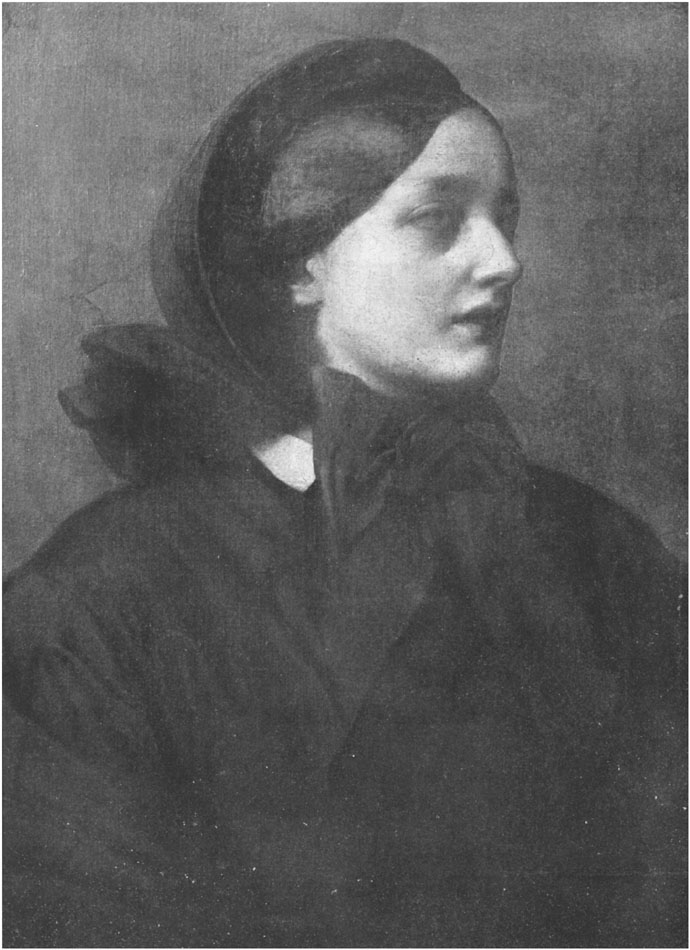
PORTRAIT OF MRS. SUTHERLAND ORR. 1861ToList
2 Orme Square, April 10, 1861.
Dearest Mammy,—I have deferred writing until now that I might be able to tell you the result of my little "private view," now over. I am happy to say I have a great success. The "Vision" pleased many people much, but was altogether, as I expected, the least popular; the subject, though very interesting, was less attractive to the many, and besides I have progressed in painting since the date of that picture. My little girl at the fountain, christened for me by one of my visitors, "Lieder ohne Worte," has perhaps had the greatest number of votes.[16] The "Francesca,"[17] on the other hand, has had, I think, the advantage in the quality of its admirers. Watts, for instance, and Mrs. Sartoris think it by far my best daub.
By-the-bye, you will be particularly pleased to hear that Lina's portrait has had an immense success, and indeed, on second thoughts, perhaps it was more admired than anything else. The "Capri" and the "Aslett" were also much liked. Mind, dear Mamma, this letter is "strictly confidential," because although, of course, you want to know what people say of my pictures, anybody else seeing this letter would (or might) suppose I was devoured with vanity.
I have just made an unexpected acquaintance in the Gladstones, who sent me, I don't know why, a card for two parties. It was very polite of them, and of course I went. This is a very egotistical letter, dear Mamma, but I know that is what you want.
I am very sufficiently well, not strong, but never ill. I marched to Wimbledon with the Volunteers last Monday, and got wet several times but did not catch cold.[18]
London. 1861.
Dear Papa,—If the Public receives my pictures as favourably as the Private has done, I shall have no cause to complain; as far, at least, as the maintenance and increase of my reputation is concerned. I should, however, have liked the "market" to be a little more "brisk."
Tom Taylor and Rossetti (Wm.), the only critics that came (as far as I know) besides Stephens, were, as far as I can judge, both of them much pleased with what they saw. I know at least that both spoke well of my pictures behind my back.
As for Ruskin, he was in one of his queer moods when he came to breakfast with me—he spent his time looking at my portfolio and praised my drawings most lavishly—he did not even look at the pictures. However, nothing could be more cordial than he is to me.
I bolted out into the passage after you when you left the other day to tell you that one of the gentlemen you saw come in was Sir Edwin Landseer, but you had disappeared.
Paris. Monday.
Dearest Mother,—I must wind up with bad news, which I hope you will bear well: my pictures are badly hung, ill lighted, and almost entirely ignored by the press.[19] Of course this is au fond, a bitter disappointment to a man of my temperament, especially after all the praise my work got before the Exhibition. However, I shall wear a brave face, and who knows but that some good may arise to me out of this? My little energies will be sharpened up and my tenacity roused. I trust in some future day, as long as hope lives. God bless you, Mammy; best love to dear Gussy. From your affectionate son,
Fred.
May 1, 1861.
Dearest Mammy,—Life being a pump handle, first up then down, you won't be too much surprised to hear that after the real success my pictures had on "private view" they are with one exception (the landscape) badly hung, "The Vision" over a door, the others above the line, which will make it impossible to see the finish or delicacy of execution which is an important feature in them. I have not seen them myself, but am told this by those who have. Don't take on, dear Mammy, nor let Papa worry himself about it. Things come right in the end, and I know that many people will be much annoyed at this treatment of me. Millais, like a good fellow that he is, spoke up for me like a man, though he himself feels so differently on art from what I do. My good friend Aïdé is furious. After all perhaps, though badly hung, the pictures may still be seen well enough to be judged, that is all I really want, then perhaps some of the papers will speak up for me. I am glad I let so many people see them at the studio, those at least know what the pictures are like. Of one thing be sure: if my works have real value, public opinion will in the long run force the Academy to hang me—but enough of this subject.
The Prince of Wales saw a photo-portrait of me in Valletort's book the other day and begged him to ask me for one. I have had some new ones done, and mean at the same time to send H.R.H. a photograph of each of my larger pictures, "The Vision," the "Francesca," and "The Listener," which, by-the-bye, I have christened on the suggestion of a lady friend of mine (a sister of Cockerell's) "Lieder ohne Worte."
Landseer said nothing that was worth repeating, though he gave me one or two useful practical hints. He is eminently a practical man, and I suspect in his heart sneers at style. He was, however, I believe, pleased with my things.
9 Park Place, St. James's, Sunday, May 5, 1861.
Dear Mrs. Leighton,—I know that the news of the bad hanging of your son's pictures has reached you (unpleasant tidings generally travel fast) and I hasten to tell you, what I hope may a little mitigate the annoyance you must have felt about it, that they are spoken of in terms of great eulogium by both the Times and Athenæum. I was afraid that their unfortunate placing might have prevented the possibility of any justice being done them by the public critics, but after all the Times and Athenæum are the most influential and leading of all our public journals. Mrs. Orr's portrait is consistently praised by all the papers, even by those which review the others less favourably. Fortunately, the pictures were well seen in the studio by numbers of people of all classes before they went to the Academy, and excited very general admiration in those who felt no particular interest either in art or in your son; while his friends, and those who know, were delighted not only with the works themselves, but at the visible indications in them of increased power in all ways. They have been thought by all whose opinion is of value a great advance upon what he has hitherto done. All this will, I hope, be pleasant to you; what will be so most of all will be to know that he took the exceeding trial and vexation of the abominable hanging of his pictures with the most perfect temper, and an admirable desire to be just about those who were doing him this ill turn. You will care for this, as I do, more than for any worldly success his talent could have brought him. I think he is looking well, although he complains a little of feeling tired. I daresay it is nothing but the weariness that must make itself a little felt after a great and all-engrossing exertion. His volunteering occupation is quite invaluable to him, giving him the exercise he never would otherwise get. I think he seems to like his life in London, where he has many friends, so many that if you were here you would no longer feel as jealous about me as you once owned to feeling—do you remember? I do not apologise for writing all this to you, for although excess of zeal may be a sin in the eyes of others, and even indeed of those whom one would die to serve, a mother will hardly count it as such when her child is in question. With best remembrances to Mr. Leighton and your daughters, I am, ever faithfully yours,
Adelaide Sartoris.
To his father Leighton wrote:—
1861.
As to the article in Macmillan, I don't in the least deny its value as far as it goes and quo ad the public; it is in that sense very gratifying to be spoken of in such flattering terms in a periodical of some standing, but I can't individually feel much elated at the praise of a critic who in other parts of his article shows he is not au fond a judge; as for what he says in interpretation (I am not now alluding to the praise), it is so verbatim what I said myself to those who visited my studio, that I suspect he must have been of that number. I remember, it is true, telling you before I began to paint "Lieder ohne Worte" that I intended to make it realistic, but from the first moment I began I felt the mistake, and made it professedly and pointedly the reverse. I don't think, however, that we understand the word realistic alike; the Fisherman and Syren which you quote was as little naturalistic as anything could be, and, while you urge me to take up some subject possessing that quality, I would point out that the Michael Angelo and the Peacock Girl both fulfil that condition—to my mind to a fault. I have sent in (or am about to) a formula which I received to fill up, stating what I would contribute to the Great Exhibition of 1862 (International). I have offered the Cimabue, four "Nannas," the "Lieder ohne Worte," "Francesca," and the "Syren." I have obtained permission for all.
Translation.]
2 Orme Square, Bayswater, 30th April 1861.
My dear Friend and Master,—When I last wrote you I promised in the spring to send you photographs of my pictures for the exhibition. I have just received some prints and hasten to enclose them.
One of them (the girl by the fountain) gives, as is so often the case, an entirely false impression of the picture, in that the drapery of the principal figure should be much darker, and that of the retreating figure much lighter. I have called this picture "Lieder ohne Worte." It represents a girl, who is resting by a fountain, and listening to the ripple of the water and the song of a bird. This subject is, of course, quite incomplete without colour, as I have endeavoured, both by colour and by flowing delicate forms, to translate to the eye of the spectator something of the pleasure which the child receives through her ears. This idea lies at the base of the whole thing, and is conveyed to the best of my ability in every detail, so that in the dead photograph one loses exactly half, also the dulling of the eyes, which are dark blue in the picture, gives a look of weakness in the photograph that is not quite pleasant.
The second subject is, as you will know well, the old, ever-new motive of Paolo and Francesca. I endeavoured to put in as much glow and passion as possible without causing the least offence; this picture also would, perhaps, have pleased you in colour. How I should like to show it to you, my dear master! However, you will no doubt send me your candid opinion of the photographs in a few lines, and not spare criticism.
I am exceedingly curious to know how your work is getting on. What are you working at just now? When is the fresco to be begun? What easel pictures have you undertaken? I want to know all that. I also hope with all my heart, my dear master, that your health keeps good, that your wife and children are all well. Please remember me most kindly to your family and all in Frankfurt who remember me. And yourself, my dear friend, keep in remembrance.—Your grateful pupil,
Fred Leighton.
Translation.]
2 Orme Square, Bayswater, London, June 30, 1861.
My dear Friend,—Forgive my not having thanked you sooner for your kind note. The same thing has happened to me as to you: work has left me but little leisure for writing. Now, however, my hearty thanks for the open sincerity with which you have spoken of my latest work, I am only sorry that you have not gone into it even more closely. I shall endeavour in my present works to diminish the excessive mannerism of the lines, which will be all the easier for me as I am now painting principally from nature; in my last picture the subject permitted that but little. In any case I hope, dear master, that you will always speak to me with the same candour; it is the best proof to me that I still possess your friendship.
I am extremely eager to see how far your works have got on. Amongst them, however, my dear friend, keep in remembrance your grateful pupil,
Fred Leighton.
P.S.—I notice with regret that already I do not write a German letter with my former fluency.
In a letter to his sister, Mrs. Matthews, January 24, 1860, Leighton wrote: "I am horrified to hear the account you give of Mrs. Browning. I knew she was a confirmed invalid, but had no idea that one of her lungs was already gone! What will poor Browning do if she dies? He adores her, you know."
London, July 1861.
Dearest Mammy,—Thanks for your kind letter, which I have been unable to answer till now. I had heard of poor Browning's bereavement; we were all very much shocked at it, knowing, as we do, how entirely irreparable his loss is. I wrote a few lines to him that he might know how sincerely I grieved with him; I don't at all know what were the circumstances of her death, we have no particulars.
Leighton undertook to design the monument over Mrs. Browning's grave in the English Cemetery at Florence. The work appealed to him in every sense, and remains as a permanent memorial of those friendships which made the years spent in Italy so full, so rich, so entrancing. With reference to the monument Browning writes:—
Chez M. Laraison, Ste. Marie, Près Pornic, Loire Inférieure, August 30, 1863.
My dear Leighton,—Don't fret; you will do everything like yourself in the end, I know; wait till the end of October, as you propose. I cannot return before the beginning of it, though I would do so were it necessary, but it is not, for I have only this morning received the notification of which I told you, that "the marble is in the sculptor's studio." We shall therefore be in full time.
The portrait you saw was the autotype which I lent to Mr. Richmond, and concerning which I wrote to him before leaving London, directing that it should be sent to you. He engaged to let you have it whenever you desired. I therefore enclose (oh, fresh attack on your envelopes and postage stamps!) a note which I presume he will attend to, and which you will of course burn should he have sent the portraits meanwhile. I have also two others nearly like that portrait, taken the same day with it, which I was unable to find, but which shall be found on my return.
Dear Leighton, I can only repeat, with entire truth, that you will satisfy me wholly. I don't think, however, you can make me more than I am now—Yours gratefully and lovingly,
Robert Browning.
Continuation of letter to his mother:—
I am glad to hear Papa reported favourably of my work, and that you like the photographs of my pictures now in the Exhibition. I am very glad also that Gussy liked the receding figure in the "Lieder ohne Worte," as it was a favourite also with me, the tallness of said figure was inseparable from the sentiment of it in my mind. I have a photograph of that picture still remaining; I will give it to Gus when she comes through, I can get myself another some future day. I am getting on tol-lol with my pictures, but am rather anxious just now about the extreme difficulty of getting a peacock. I want to buy one to have the skin prepared, and if I don't get one soon they will all lose their tails; and there I shall be—in a fix! A friend of mine has written to Norfolk, and hopes to get me one. The season, even in the extremely moderate form in which I take it, is a fatiguing affair. I get up late and never feel fresh and vigorous. I have serious thoughts of entirely giving it up next year. I will go now and then to stay at people's houses, but not to their parties—le jeu ne vaut pas la chandelle. A propos of country houses, I am going to spend a few days with Lady Cowper at Wrest Park towards the end of this month; there are to be theatricals and great hilarity. And now about Bath, I hope, dearest Mammy, you won't be hurt if I propose to come at the end of the first week in September instead of the last week in August. The fact is I have a great "giro" I want to make, and if I could take Bath in the regular progress it would be both a great convenience and a saving of expense. I mean to stay three weeks in Bath and have thoughts of painting a pot-boiler of little Walker if he is still handsome. I wish Papa would look after him, and let me know what he is doing and how he is looking. These are my plans: I want, whilst the summer is still hot and green, to visit South Hampshire, New Forest, Isle of Wight, South Devon, North Devon, and so work my way round to Bath, whence to Stourhead for a few days; then to Mason in Staffordshire, and then back to London. My pictures will be done long before the Exhibition next opening, so I can manage all this. I shall visit the following people: Sartoris, Aïdés, perhaps Morants, I hope Tennyson, Lady E. Bulteel, and look in at Mount Edgcombe—the rest of the journey will be purely artistic.
Clovelly, Sunday.
Dearest Mammy,—I could not find time to answer your note (for which best thanks) before I left Ventnor. I am now in one of the most picturesque spots on the north coast of Devon—the rendezvous of painters and tourists, the pays de cocagne of Hook and one of the chief lions of my trip.
The places I have visited so far are Salisbury, Exeter, and Bideford; with the latter I was much disappointed, and think it far below its reputation; not so Salisbury, which is a most interesting town, full of quaintness and character beyond my expectations; it has, however, a look of decay and depopulation about it which makes me feel awfully low-spirited. The Cathedral, perhaps, altogether rather disappointed me—though of course much about it is very beautiful; then, too, its general (internal) aspect is entirely marred by a brutal coat of whitewash laid on in the last century, covering up the marble columns and killing out all life and colour. Unfortunately, it would cost very many thousands to restore the church and its ancient glories.
To-morrow I start for Ilfracombe—the next day for Lynton.
Again, later:—
Many thanks for your letter just received and for all the kind wishes therein contained, which I most warmly return for you all—a double portion to dear Taily in honour of her birthday.
I will come on the 8th if I possibly can, and bring some little sketches to show you.
I shall exhibit this year IF I get done in time, but I can't hurry—it is entirely immaterial whether I exhibit or not—I would rather, of course.
We have begun drilling, but it will be many weeks before we get to rifle-shooting—this is the sort of thing we are doing now. Our uniform is plainness itself, all grey, and the cheapest in London.
I weather the cold so-so—I have a gas-stove beside my fireplace, but am still tolerably cold when it comes very sharp.
My dinner with Millais was put off till Monday next—I think Millais charming and so handsome.
I am exceedingly sorry, dear Mamma, you have reckoned on me for cotillon figures—with the exception of the one I led at Bath once, I have not seen one for years, and have not the faintest notion what is done—I will, however, back anybody else with great zeal.
I was indeed truly sorry to hear of Lord Holland's death—I had expected it for some time; nothing could exceed their kindness to me, and the House is an irreparable loss to me.
I hope to have a very merry Christmas Day. I am running down to Westbury (the Sartoris); there is to be a tree; I come up again of course Monday morning.
I am never ill. I take my human frailty out in never being very well—never equal to much fatigue.
London 1861.
My dinner at Millais' yesterday was very pleasant. I like him extremely, and his wife appears an agreeable person. I met there John Leech, the man who does all those admirable caricatures in Punch—he is a very pleasant and gentleman-like person.
I don't feel sure whether I told you that I am about shortly to send my "Paris and Juliet" with the "Samson" to America on spec. Mrs. Kemble will do all she can to godmother them; I got a very kind letter from her from Boston the other day—she has asked me to send her a little sketch of Westbury with the pictures—of course I shall.
The following letters from Mrs. Fanny Kemble reveal the interest which this friend took in Leighton and his pictures, also the genius of the writer in penning delightful epistles:—
Revere House, Boston, Friday, December 9, 1861.
Dear Mr. Leighton,—It was very kind and amiable of you to write to me of Westbury and my sister; you cannot imagine the forlornness one feels when, to the loss of the sight of those one loves, is added that bitter silence which leaves one almost ignorant, as death does, of all the conditions in which our friends remain. God knows, written words are a poor substitute for the sound of a voice and the look of living eyes; still, when they are all that can reach us of those towards whom our hearts yearn, it is miserable not to be able to obtain them. The friends with whom I constantly correspond see and know little or nothing of her, and so no one of them can in any degree supply me with the news that I most desire from across the sea—how it is faring with my sister; so I am very grateful to you for your intelligence, which was just what I would give anything for (though not in itself, perhaps, very satisfactory) out here, where I think you have none of you an idea how banished I feel. Now, my dear Mr. Leighton, to your business, about which I began my inquiries almost immediately after my return to this country, but only received the last of these communications last night, and you perceive the other was incomplete without it. You must command me entirely in any and every thing that I can do to forward your aims, and I will promise to be severe in my obedience to any instructions you may like to give me. New York is undoubtedly a better market for pictures, and therefore a better place to exhibit them than this, but I do not know anybody whom I trust there. Mr. Ordway, however, seems inclined to take charge of your pictures if they are exhibited there.
Good-bye. Do not fail to employ me in this matter to the fullest extent that I can be of the least use to you; it will be a great pleasure to me to help you in any way that I possibly can.—Yours very truly,
Fanny Kemble.
I wish you would send me out some sketch of Westbury with your pictures, if they come. I wish for one very much. I wish you could see the world here just now—a sky as pure and brilliant as it is possible to conceive, and every bough, branch, blade of grass and withered leaf coated with clear crystal and blazing with prismatic colours. There are, every now and then, sentiments in this sky that I have seen in none other. There are certain points of view in which Boston, rising beyond broad sheets of water that repeat them still more tenderly, seems to me worthy of a great painter. But do not come out and try unless you are quite sure of going back, or you will break your heart.
Revere House, Boston, Friday, February 7.
I feel terrified, when you speak of my determining what is to be done with your pictures when they arrive in Boston, for assuredly I am utterly incompetent to any such decision, and can only refer myself to the judgment of my friend Mr. Cabot, who will certainly advise for the best in the matter, but who, nevertheless, is not infallible. I should think it rather late in the season for exhibiting them here, but again would not take upon myself to say. I do not know what the percentage on sale here is, but presume it is not higher than in London. But here people exhibit their pictures at a shilling a head, i.e. put them in a room hung round with black calico, light up a flare of gas above them, and take a quarter of a dollar from every sinner who sees them. Two of Churche's pictures (he is a great American artist, though you may never have heard of him) have been, or rather are, at this moment so exhibiting—his "Falls of Niagara," and a very beautiful landscape called the "Heart of the Andes." Both these pictures were exhibited in London, I know not with what success; they have both considerable merit, but the latter I admire extremely. Page had a "Venus" here the other day, exhibited by gas-light in a black room; but indeed, dear Mr. Leighton, it sometimes seems to me as if you never could imagine or would consent to the gross charlatanry which is practised—how necessarily I do not know—here about all such matters. Certainly your gold medal should be trumpeted—and your profession of art and your confession of faith, and anything most private and particular that you would not wish known, had better be published in several versions in all the newspapers of the United States. Your pictures must be placarded over all the walls in all the sizes of type conceivable, and all the colours of the rainbow. If you will write me your personal history, and rampant puffs of your own performances, I will copy them and send them to those sources of public instruction, the enlightened public press. Moreover, I will go and sit before them daily and utter exclamations of admiration on every note in my voice, and if anything else remains to be done I will do it; but you must not make me in any way responsible for the result, because it is not in the least likely that you will write yourself up to the mark of puffing as practised here. Basta—I will take the very best advice and do the very best I can about the pictures, and rejoice in my heart to see them myself, that I can assuredly promise you. By-the-bye, I gave your address only a few days ago, to be sent to a person now in Europe negotiating with French and English artists for pictures to exhibit. I wonder if he will find you and enlighten your mind about art in America. Thank you for the account of Westbury and its Christmas festivities, and thank you, thank you for the sketch of the home you are so very kind as to promise me; it will be a blessed treasure to see, for you cannot conceive the dreary heart-sickness that utterly overcomes me here sometimes. To-day I was singing the quartette in "Faust" that we used to sing, and was obliged to stop for crying. I wished extremely to have a photograph of the house, and, if I could only have afforded it, should have asked you to sell me every sketch you took about the place. The skies here are beautiful, wonderful in their transparent purity. They seem to me of a different texture from any other I ever saw, more diaphanous, and there is a colour in them when they are quite free from clouds that surpasses in delicacy all other skies I have seen. It is like the complexion of the young girls here, a miracle of evanescent brilliant softness. My winter is wearing along pretty tolerably. My Christmas was passed entirely alone, but I am quite used to that. I am beginning to be much occupied about the plans and drawings for a house, which I am thinking of building on some land I own in Massachusetts. It is a great undertaking, and really at fifty years old seems hardly worth while, and yet, till I am ready for my coffin, I must have some place in which to rest my head. Perhaps some fine day—who knows?—you will come to see me there. That would be a very pretty plot, and I think I need not say how welcome you would be, dear Mr. Leighton, to yours very truly,
Fanny Kemble.
Lenox, Tuesday.
A thousand thanks, my dear Mr. Leighton, for the minute account of Westbury—as I cannot know anything about my sister, it is something to know how her house is settled and decorated, and how the place where she lives looks. The red velvet drawing-room sounds gorgeous, and it must be very becoming to the pictures. Of your pictures that have "wandered west" you may be sure I should have written you, if I had had the good news to give you that either of them was sold, but I am sorry to say this is not the case. The New York Exhibition is now closed, and the pictures have been sent back to Boston, where they are at present hanging in the Athenæum under the care of Mr. Ordway, who wishes, but does not much hope, to be able to sell them. It seems that one or two people asked the price of the pictures in New York, but considered it, when they received the information, "rather a tall price." I am a little consoled at the ill success of this venture of yours, by Henry Greville's writing me that your hands are full of orders, for which you are to be well paid. Your small acquaintance, Fanny, who left me this morning after a visit of a month, propounded to me the expediency of desiring the purchaser of the reconciliation of old Capulet and Montague to buy as its pendant the "Paris and Juliet"; and though she has no personal acquaintance with the lover of art in question, she said, when she got to Philadelphia she should set about intriguing to that effect; and she had my full permission to try and to succeed. I wish I could tell you anything pleasant in return for your description of the rooms at Westbury, but I have nothing very cheerful to impart. I have been quite unwell, and am still very far from flourishing; my spirits are much depressed, and the life I lead, of incessant worry and discomfort with servants and all one's domestic arrangements, is something quite too tedious to relate—and that indeed it would be impossible to realise, as the Yankees say, unless you witnessed it. I saw Hetty Hosmer three days after her arrival in Boston. Her father is a hopeless invalid, and she will certainly not leave him while he lives; but I suspect that he is likely to die before this year ends, and then she will return to live in Italy. The State of Missouri has voted two thousand pounds for a statue of Colonel Benton, one of its "great men," to be erected by her, which, of course, is a whole plume of feathers in her cap.
Good-bye, dear Mr. Leighton; believe me always yours most truly,
Fanny Kemble.
You must not fail to write to me any directions that you wish observed about your pictures, while they remain here. I am only too glad to try to serve you.
Lenox, Berkshire, Massachusetts, Monday, March 12.
Pictures of very high pretensions are exhibited, like the scenes in a theatre, by gas-light, and advertised in coloured posters all over the streets like theatrical exhibitions. However, it is no use vexing your soul with what neither of us can help. I cannot and will not accept the responsibility of disposing of your pictures; but I will get the best advice I can about them and follow it, and spare no personal pains to have them advantageously dealt with; only, I hope it will not be very long before they arrive, because my own stay in Boston is now drawing to a close, and after the end of the present month I shall be at Lenox, a remote village in a lonely hill district one hundred miles from Boston, or rather I should say seven hours distant from the nearest railroad station, which is six miles away again from Lenox. When once I come here—for I write at this moment from this snowy wilderness—it will be to remain for the next nine or ten months, so you see I must make all arrangements about your pictures before taking my leave of civilised communities. I came up to this place from Boston yesterday to look at a house that I think of hiring for a year, and shall return to the city next week. I have left your pictures (should they arrive during my absence) to the charge of a friend of mine who is one of the directors of the Athenæum, and will see that they are properly received. Thank you a thousand times for the promised likeness of Westbury, which will be a treasure to me. What a contrast is my recollection of that charming place, to the abomination of desolation of the dreary savage winter landscape of low black hills, bristling with wintry woods and wide, bare, snow-covered valleys, that stretch before me here at this moment. I am well, but much worn out with my last course of public readings, which I had just ended in Boston. My daughters are well, and write to me tolerably frequently; the eldest seems happy and contented in her marriage; your small acquaintance, Fanny, writes to me from Savannah of sitting with the doors and windows wide open, and wiping the perspiration from her face in the meantime; and here everything is buried in snow. I shall wait till I return to Boston to finish this, as I shall hope to send you then news of the arrival of your pictures.
Wednesday, March 14.
Your pictures are arrived, my dear Mr. Leighton; they reached Boston last week while I was absent at Lenox. I only returned yesterday evening, and found a letter from Mr. Cabot announcing that they were at the Athenæum; thither I went this morning, and spent a most delightful half-hour in looking at them. I like the "Samson" very much indeed; I think it is beautiful, and am charmed with the treatment of the subject, though you have chosen a different moment for illustration from the one I had imagined. This evening I have been having a long conversation with Mr. Ordway about the future destinations of the pictures. I am little sanguine, I regret to say, about their being bought here, for the only rich picture purchaser that I know here has a predilection for French works of art, small tableaux de genre, and Troyon's landscapes. However, it must be tried. Mr. Ordway says he will exhibit your pictures in the Athenæum, which (should they be sold while there) will save you your commission, because, being an artist himself, he will not charge you any. If after due experiment they do not seem likely to sell here, we will send them to New York, and then to Philadelphia; in short, the best that can be done for them shall, as far as my agency is concerned, you may be sure.
Boston, Thursday, March 15.
I have this moment received your letter of the 25th February, for which I thank you very much. It does not require any further answer with regard to your pictures, of the safe arrival of which I wrote you word last night. I did not tell you, by-the-bye, that they are both slightly streaked across from side to side with what Mr. Ordway thinks must have been small infiltrations of sea-water; he says the pictures are not injured by them, nor do they indeed appear to be so in the least, and that he can wipe off the stains with no damage whatever to them. Thank you for all you tell me of my sister; it is not much, indeed, nor very cheerful, but it is more than reaches me through any other channel, and far better than the miserable conjectures of absolute ignorance. Dear Mr. Leighton, thank you a thousand times for the portrait of Westbury—it is exactly what I wished for—but, oh, why could there not be the lovely upland beyond, and the sheep slowly rolling up and down the slopes, and the tinkle of the bell, and you and she and they and all of us. Oh dear, if you could conceive what it is to me to be here, you would know a thousand times better than I can tell you how precious such a memento of there is to me. Thank you, too, for the good inspiration of telling me about the change of place of the pictures at Westbury; it is wonderful how much one small particular has power to bring the whole of what surrounds it, back to the mind, and what vividness it gives to the picture that, in spite of the distinctness with which it was stamped upon the memory, becomes so soon, and yet so unconsciously, obliterated in the minor parts that give it charm and vitality. I spent a long hour to-day again looking at your pictures and wishing most heartily that I could afford to buy them both. Good-bye, dear Mr. Leighton; I shall leave this open till to-morrow, in case I should hear anything more about them before I go. I enclose the receipts for what I have paid. I suppose it is all right, but it seems a most monstrous price for mere conveyance, and indeed reminds us that our humorous forefathers called stealing conveying.
Lenox, Berkshire, Massachusetts, Friday, April 27.
Your pictures are at present in the New York Exhibition. Mr. Ordway tells me that it is extremely rare for pictures to sell without the intervention of dealers. In this country they cry down and undervalue all pictures that are not expressly committed to them, and the ignorance of the rich shopkeepers who purchase works of Art, is so excessive that they do not feel safe in making any acquisition without the advice and permission of some charlatan of a dealer, to whom these wiseacres come saying (verbatim, so Mr. Ordway informed me), "I want some pictures; can't you recommend any to me?" and then, of course, the picture-dealer recommends what brings him the highest percentage; and the man who buys pictures exactly like looking-glasses, window-curtains, or any other furniture for a new house, departs satisfied that he possesses a work of Art. The things that are bought and sold here in the shape of pictures, and the things that are said about them, vous feraient pouffer de rire, if you did not live in this country. If you did, they would be like many other proofs of the semi-civilisation of the people, that would be rather doleful than otherwise to you. Thank you for all you tell about my sister and her children. I feel very much both for my sister and Anne in their separation. I have just parted with my maid Marie, who has lived with me fifteen years, and who leaves me now because her health is so much broken down that her physician tells her, she must go to some other climate or she will die. So she is gone, and here I remain absolutely alone, looking, not for the "wrath to come," but what may be supposed no bad instalment of it—the advent of four new servants with whom I am to begin housekeeping in my small cottage next week. Just before leaving Boston I saw Hetty Hosmer. She has come home to her poor old paralytic father, who, I suppose, is not likely to live very long. Whenever the event of his death happens, Hetty will gather up her substance, and depart hence for the rest of her natural or artistic life. She is very little changed in appearance, and only a little in manner. She seemed very glad to see me, and so was I to see her, for she represented to my memory a whole world of things and places and people that I am fond of. I have not seen Lord Lyon, and do not expect to do so, as I understand he does not mean to stir from Washington all the summer, and thither I shall assuredly not go, though I would go a good way to see him. I'm told he lives in dread of being married by some fair American, and it is not always a thing that a man can escape; but he is too good for that, and I trust will not succumb to these intrepid little flirts. Good-bye, dear Mr. Leighton; I have a settled nostalgia, which is the saddest thing in the world. Your sketch of Westbury is always before me, and your letters are the most kindly return you could possibly make, for any service that you could require of me. I wish with all my heart I might have the great pleasure of writing you, now that one of your pictures was sold.
Addio.
Lenox, Friday, June 7.
Thank you, dear Frederic Leighton, for your letter and the photographs, by means of which, and your description, I have a sort of vision (not quite what the Yankees call a "realising sense") of your pictures. The girl at the fountain is charming,[20] the other beautiful and terrible, as it should be.[21] I can well imagine the beautiful effect the sentiment of the picture must receive from that regretful return, as it were, of the daylight that has set upon the poor people for ever. In the English newspapers that are sent to me I looked eagerly among the notices of the Exhibition for your name, and read the meagre little bit allotted to each picture. I was especially delighted with the critic who thinks your "Paolo and Francesca" too earthly in the intensity of their passions. The gentleman apparently forgets that it was not in Heaven that Dante met these poor things. With regard to your other pictures, dear Mr. Leighton, I think you are right to withdraw them from America. I wish with all my heart that I could have presented myself with one of those pictures; however, that is one of the vainest of all human desires. My income is already docked of two hundred pounds this year by the disastrous state of public affairs; but, of course, if one is in the midst of a falling house, one can hardly hope to avoid bruises and broken bones. The attitude of England is highly unsatisfactory to the North, who now choose to consider the whole action of the Government a crusade against slavery—which it is not, and was not, and will not be except in the New England state where the Abolitionist party has always been strongest, and where the character of the people is more of the nature to make fighters for abstract principles. The Southerners hate the Yankees, and vice versâ, for this very reason; and if the crisis comes really to anything like fighting, the New England, especially the Massachusetts men, will probably fight very maliciously as against slaveholders, and the slaveholders against them as Abolitionists, which they now are, pretty much to a man. A huge volunteer force is levying and being prepared for action; but in spite of the very unanimous feeling of the North and North-West, and the warlike attitude of the South, I shall not believe in anything deserving the name of war till I see it. The South is without resources that can avail for a six months' struggle. The North has a huge, unarmed, undisciplined force of men at its command; but the Southerners do not want to fight, and neither do the Northerners; but if any combination of circumstances (and of course matters cannot stand still, especially with the border states all au pied en l'air) should occasion any collision accompanied with considerable effusions of blood, I believe the North would pour itself upon the Southern States and annihilate the secessionist party. It is extremely difficult to foresee the probable course of events, but I believe eventually the Southern States will be obliged to return to their allegiance, and then I believe the North will, once for all, legislate for the future limiting of the curse of slavery to those states where it now exists, and where, of course, under such circumstances, it would very soon cease to exist, as if it cannot extend itself it must die. In one sense slavery is undoubtedly the cause of the present disastrous crisis—and in the profoundest sense, for the character of the Southerners is the immediate result of these infernal "institutions"; and but for Southern slavery Southern "Chivalry," that arrogant, insolent, ignorant, ferocious and lawless race of men, would never have existed.
Oh, how thankful I shall be to be at home once more! Farewell, dear Mr. Leighton; pray, if there is anything special to be done about your pictures, write to me and let me have the pleasure of doing something for you. Oh, I am so enraged that I could not get them sold; and yet though you may not think it, I should have thought it a pity for them to have to live the rest of their lives here. Thank you again for the photographs; I look at them constantly. All such things are like being lifted into another atmosphere from that which surrounds and stifles one here. Believe me always your obliged and sincere friend,
Fanny Kemble.
Emil Devrient's was the best Hamlet I ever saw. It would not have been if my father's had not been too smooth and harmonious. I hope I shall see Fechter's.
Lenox, Thursday, October 11.
How good an inspiration it was that made you send that beautiful photograph to me! It came to me really like a special providence, on the day when I had parted from my children for an indefinite time, and with more than usual sadness and anxiety; for my eldest child's health has failed completely since her confinement, and she came to me for a visit of ten days only, looking like the doomed, wan image of some woman whose enemies were wasting her by witchcraft. My small comfortless home was intolerably lonely to me, and towards sunset I went out to find some fortitude under the open sky. I wandered into a copse of beech trees that clothe the steep sides of a miniature ravine with a brook at the bottom, and here gathered a handful of the beautiful blue fringed gentian (do you know that exquisite flower that grows wild in the woods here?). The little glen with its clusters of mysterious blue blossoms was all but dark, but, emerging from it, I stood where I saw a wide valley flooded with the evening light, and hills beyond rising in waves of amber and smoke colour and dark purple; it was so beautiful that it cannot be imagined. The autumn has turned all the trees into gold and jewels, like the enchanted growth of fairy-land, and the whole world, as I saw it from the entrance of that shadowy dell, looked as if it was made of precious metals and precious stones. I was very sad, and stood thinking of our Saviour and the widow of Nain, and how pitiful He was to sorrowful human creatures, and with some sparks of comfort in my heart I returned home, where I found your letter waiting for me. I have told you all this of my previous state of mind and feeling, because—without knowing that—you could not conceive how like an express message of consolation your work appeared to me. May it be blessed to many hearts for admonition and for consolation as it was to mine, dear Mr. Leighton. It is no wonder that it seemed to me beautiful, and I do not think I shall ever sufficiently disconnect it with this first impression, to be able to judge of its merit as a work of art; it was, as I said before, a special Providence to me. I long to have it framed and hung where I can see it constantly. I have within the last few days moved into a house which I have hired for the next two years. It is all but in the village of Lenox, and yet so situated that it commands from the windows of every room a most beautiful prospect. The whole landscape is a harmonious confusion of small valleys and hills, rolling and falling within and around and beyond each other, like folds of rich and majestic drapery. Oh, what lights and shadows roam and rest over these hill-sides and in the hollows between them! The country is very thickly wooded, and the woods are literally of every colour in the rainbow, all mixed together under a sky, the peculiar characteristic of which is not so much softness or brightness, as a transparent purity that seems as if there was no atmosphere betwixt oneself and the various objects one sees. I expect this would make it difficult to paint these beautiful aspects of nature here; but, oh, how I do wish you could see it, for, in the matter of American autumnal colouring, seeing alone is believing. The house itself is very tolerably comfortable, but hideous to behold both within and without; and I have begun my residence in it under rather depressing circumstances, i.e. without being able to obtain the necessary servants for the decent comfort of my daily existence. Ever since the beginning of May I have been endeavouring, in vain, to procure and keep together a decent household. Not for one single week have I had my proper complement of people in the house, and I have done every species of house-work myself, from cleaning the cellar and kitchen to washing the tea-cups; it is a state of things as incredible as the colour of the autumn woods, and as peculiar, thank God, to America. I am now making my last experiment by trying coloured servants. Their manners and deportment are generally much better than those of either the Irish or American, and they seem capable of personal attachment to their employers, which neither of the other races are. The incessant worry, discomfort, and positive fatigue that I have undergone during the whole summer has completely shaken my nerves, so that I have been in a sort of hysterical condition of constant weeping for some time past. I trust, however, it will not be so wretched now, for I am at any rate close to the village inn, and if I am left without servants, can go there and get some food; it is a state of existence qu'on ne s'imagine pas. You will not wonder, after all this, to hear that I declined a ticket to the Prince's ball at New York, to which the whole population of the United States are struggling to get admittance; but at the best of times "I am not gamesome," and feel as if I had swept my own rooms quite too recently to be fit company for my Queen's son. Thank you, dear Mr. Leighton, for all you tell me about my sister and the children; she never writes, you know, and so I am thirsty all the time for some tidings of her. It is very sad to be so far away and hear so seldom from those one loves. Good-bye, God bless you; and thank you once more for the "Vision." I am sorry I cannot tell you of the sale of either of your pictures; they are in the Boston Athenæum, very safe, and highly ornamental to it, but not, I regret to say, sold. If you wish me to do anything more about them, you must write me your directions, which I will fulfil with every attention and accuracy of which I am capable.