Volume 2 — CHAPTER IIToC
Reading edition
CHAPTER IIToC
ILLUSTRATIONS FOR CORNHILL MAGAZINE—FRESCO FOR LYNDHURST CHURCH—ASSOCIATE OF THE ROYAL ACADEMY—MRS. LEIGHTON'S DEATH
1863-1865
In 1860 Leighton drew his first illustration for the Cornhill Magazine:—
Translation.]
Friday, 30th November 1860.
My dear Friend and Master,—Best thanks for your dear letter of the 7th, thanks also especially, because in your kind praise you do not spare criticism also; you could give me no better proof that you still esteem and love your old pupil. I feel the justice of your remarks about the drapery of the Saviour very much, and can only say in my excuse that I have treated this kind of subject very little, for I am only really a profane fellow; but should I at some future time again treat such a theme, I should endeavour to avoid similar faults. I send you this time, for fun, a proof impression of a woodcut after a drawing I made for one of our good monthly periodicals (The Cornhill Magazine). It seems to me to be not bad for wood. It illustrates a poem, and represents Ariadne kneeling on an eminence, looking out for Theseus. This as a preliminary; I hope to send you something in April.
Dearest Mammy,—My wretched picture is causing more delays! I am very sorry to say I shan't be able to get to Bath before Wednesday evening. I am due at Stourhead the 27th; this I cannot defer any more, as I must be on duty with the Rifle Corps at the beginning of September, and can't do all I have to do in less than a week—this will, however, still leave me three weeks, all but two days, at Bath.
I enjoyed myself at Panshanger very much—did I write to tell you who our party was? In case I did not, it was as follows: Henry Greville, Lord and Lady Katherine Valletort, Lord and Lady Spencer, Mrs. Leslie, Lord Listowel, Mr. Clare Vyner, and Mr. E. Lascelles—all young people; so that it was very pleasant.
There are, as you know, most beautiful pictures at Panshanger—a magnificent Vandyke, a splendid Rembrandt, Correggio, Andrea del Sarto, and two beautiful Raphaels.
G. Smith sent me a kind note and a cheque to fill up for drawing in the Cornhill ("Ariadne"). I put ten guineas, telling him that I could not, as a general rule, interrupt my work for that sum, but that I would not take more because the cut had turned out so extremely bad.
I am going to expend the money, adding a few pounds, on a cup, to be shot for in the spring by our Rifle Corps. Arthur Lewis has already given one, and another of our men has promised a second prize to go with my cup. My picture will be finished by the time I go to Bath. My eye is too accustomed to it to know whether it is successful; I shall know better when I return from the country.
I have no news, so good-bye, dear Mammy. Best love to all.—From your very affectionate boy,
Fred.
I go to Windsor (to Miss Thackeray) for two days next week; that also is an old invitation; I have no time for it, but must go. I keep my parties going tolerably, but shall give that up with a few exceptions when I settle here; it makes work impossible from unavoidably late hours, and produces a general deterioration of mind and body, mostly the former; the Hollands I shall always keep up—they are most kind; I dine there frequently and meet interesting and remarkable people.
Very remarkable drawings in pencil on other lines followed the celebrated "Lemon Tree"—surpassing in dramatic truth of expression any Leighton had executed since the early design he drew of the "Plague in Florence in 1850."[26]
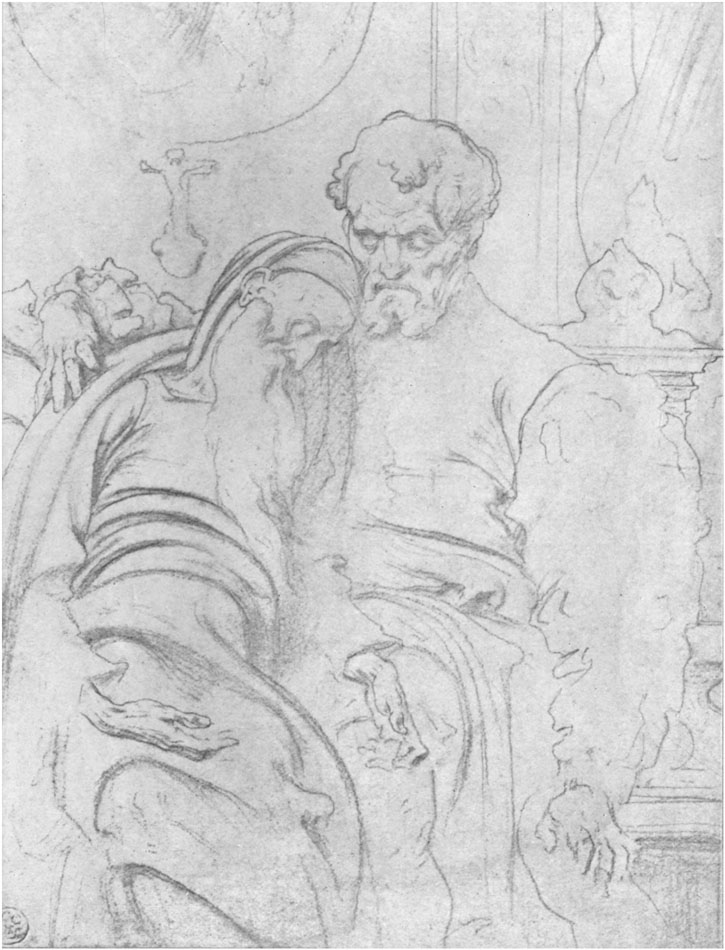
SKETCH FOR "MICHAEL ANGELO NURSING HIS DYING SERVANT." 1862 Leighton House CollectionToList
The group of drawings for "Michael Angelo Nursing his Dying Servant" are among those preserved in the Leighton House collection, but were not seen by the public before Leighton's death. Though slight, they are among the most admirable he ever achieved in subtle tenderness of feeling and expressive truth of drawing. The feeble twitching clutch of the hands of the old man—announcing the speedy approach of Death—is a convincing proof of imaginative realism of a high order. This group of sketches, however, exemplify the curious artistic discrepancy which at times existed, especially before and about the time when the Michael Angelo was painted, between Leighton's pictures and the studies he made for them—a discrepancy which had no reference to his feeling for colour, but simply arose from an absence of sensitiveness for texture. In turning from the drawings to the painting, we find the noble feeling and conception, the lines and forms of the design much the same in all; but the heavy and yet insufficient texture of the actual surface mars the full conveying, even in the completed painting, of the feeling of the motive—so imperative is a simultaneous union of the idea with a happy echo of it in the touch of the human hand, if a work of art is fully to convey its message. Leighton's genius for using the point is referred to in a letter from Mrs. Browning, on the subject of a drawing he had made of her husband:—
Copy.]
Dear Mr. Leighton,—The portrait is beautiful, and would satisfy me entirely except for a want of strength about the brow, which I must write of, because I can't trust Robert himself with the message. I think the brow is feeble, less massive than his, with less fulness about the temples. In fact, your temple is hollow, instead of full. Will you look at it by the original? The eyes and mouth are exquisite. Your pencil has the expressiveness of another's brush.
How much I thank you for having put so much of my husband on paper is proved by the very insolence of my criticisms.—Most truly yours,
Elizabeth Barrett Browning.
April 1.
In the same category as the Michael Angelo studies may be placed the first sketch of "Samson Wrestling with the Lion," designed as an illustration for Dalziel's Bible. This drawing is also in the Leighton House Collection, also the original drawings for "The Spies' Escape" and "Samson at the Mill." The following was written with regard to it: "An animal model never 'sits.' The artist must catch the action he wants from fleeting suggestions. His imagination alone can guide his pencil when he depicts such action with realistic power. It is in a pencil drawing of a lion that we find the work that evinces, more distinctly perhaps than does any other of Leighton's utterances in art, the highest kind of imagination in the drawing of form in action, namely in the sketch of 'Samson Wrestling with the Lion' for the illustrations in Dalziel's Bible. Where, indeed, for vigour of invention, can we find a drawing to surpass these few pencil lines? The sinews in the legs and claws of the animal are drawn up, clenching the vacant air with a quivering grip; the tail straightened stiffly through the strain of the wrestling; the whole animal convulsed with the force of the struggle. This is treatment of form no model could suggest, no knowledge evolve, no labour or industry produce. A true imagination alone can inspire such vivid realism." The other subjects Leighton illustrated were "Death of Abel," "Moses Viewing the Promised Land," "Samson Carrying the Gates," "Abraham and the Angel," "Eliezer and Rebecca at the Well," "The Slaying of the First-born."
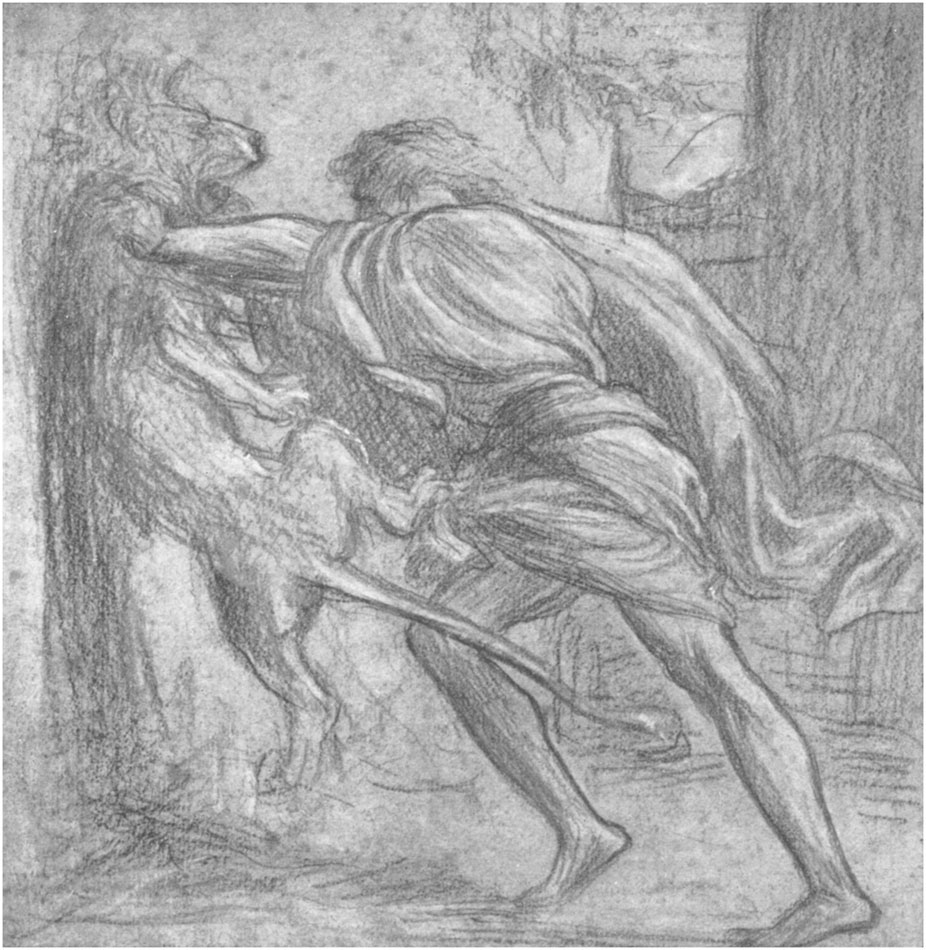
ORIGINAL DRAWING FOR "SAMSON AND THE LION" IN DALZIEL'S BIBLE Leighton House CollectionToList
In 1862 Leighton illustrated George Eliot's great novel "Romola." He writes to his father:—
Tuesday.
Dear Papa,—Though I am not able, I am sorry to say, to report the sale of any more of my pictures, you will be glad to hear of a commission just given me by G. Smith of the Cornhill which is very acceptable to me. I am to illustrate (by-the-bye this is "strictly confidential") a novel about to appear in the Cornhill from the hand of Adam Bede. It is an Italian story, the scene and period are Florence and the fifteenth century, nothing could "ganter" me better. It is to continue through twelve numbers, in each of which are to be two illustrations.
I am to have for each number £40; for the whole novel, therefore, £480. I have conferred with the authoress to-day, and am to get the first-proof sheets this week. The first number will be published in July. Miss Evans (or Mrs. Lewes) has a very striking countenance. Her face is large, her eyes deep set, her nose aquiline, her mouth large, the under jaw projecting, rather like Charles Quint; her voice and manner are grave, simple, and gentle. There is a curious mixture in her look; she either is or seems very short-sighted. Lewes is clever. Both were extremely polite to me; her I shall like much.
I have no other news; no one asks about my pictures, though their success is decidedly great; hard times! Are you writing to Gussy? if so will you tell her that I mean to give her some lessons with Hallé when she comes to London? she shall have three a week for a month. Tell Lina with my love not to be jealous, it will be her turn next. How is she? and how is Mamma? Give them my best love, and believe me, your affectionate boy,
Fred.
That George Eliot should write a Florentine story at a time when Leighton was available to illustrate it, was certainly a most fortunate coincidence. Each scene which he represents is impregnated with a feeling which records the strong hold Italy had on his artistic resources. With a few exceptions, these illustrations for "Romola" are the last examples of his art, when a dramatic or a humorous treatment was a prominent feature of the designs. The last picture exhibited at the Royal Academy in 1897—the passionate, despairing figure of "Clytie"—was notably one of these exceptions. Unfortunately Leighton's letters to George Eliot respecting the "Romola" drawings cannot be found, and were probably destroyed before the author's death. The following were preserved by Leighton:—
16 Blandford Square, N.W., Friday.
Dear Mr. Leighton,—Thanks for the sight of the Vignettes. They are satisfactory.
Your delicious drawing was with me all day yesterday and made the opera more delightful to me in the evening. I never saw anything comparable to the scene in Nello's shop as an illustration. There could not be a better beginning.
I should very much like to have a little conversation with you, and will arrange to see you at any hour that will best suit you, in the evening if you like, any time after the morning working hours, which last till two o'clock. I know your time is very precious to you just now, but I think we shall both benefit by a little talk together after you have read the second proof.—Yours very truly,
M.E. Lewes.
F. Leighton, Esq.
16 Blandford Square, N.W., Wednesday.
Dear Mr. Leighton,—I feel for you as well as myself in this inevitable difficulty—nay, impossibility of producing perfect correspondence between my intention and the illustrations.
I think your sketch is charming, considered in itself, and I feel now with regret that if we had seen each other and talked a little together after you had read the proof, the only important discrepancy might have been prevented. It is too late for alterations now. If it had not been, I should have wished Bardo's head to be raised with the chin thrust forward a little—the usual attitude of the blind head, I think—and turned a little towards Romola, "as if he were looking at her."
Romola's attitude is perfect, and the composition is altogether such as gives me a very cheering prospect for the future, when we have more time for preparation. Her face and hair, though deliciously beautiful, are not just the thing—how could they be? Do not make yourself uneasy if alteration is impossible, but I meant the hair to fall forward from behind the ears over the neck, and the dress to be without ornament.
I shall inevitably be detestable to you, but believe that I am
(Unfinished)
16 Blandford Square, N.W., Thursday.
Dear Mr. Leighton,—Unmitigated delight! Nello is better than my Nello. I see the love and care with which the drawings are done.
After I had sent away my yesterday's note, written in such haste that I was afterwards uncomfortable lest I had misrepresented my feelings, the very considerations you suggest had occurred to me and I had talked them over with Mr. Lewes—namely, that the exigencies of your art must forbid perfect correspondence between the text and the illustration; and I came to the conclusion that it was these exigencies which had determined you as to the position of Bardo's head and the fall of Romola's hair. You have given her attitude transcendently well, and the attitude is more important than the mere head-dress. I am glad you chose Nello's shop; it makes so good a variety with Bardo and Romola. In a day or two you will have the second part, and I think you will find there a scene for Tessa "under the Plane Tree." But perhaps we shall see each other before you begin the next drawings.—Ever yours truly,
M.E. Lewes.
16 Blandford Square, N.W., Monday.
Dear Mr. Leighton,—Your letter comforts me particularly. I am so glad to think you find subjects to your mind. I have no especial desire for the view from S. Miniato, and indeed a plan we started in conversation with Mr. Smith this morning, namely, to have moderately sized initial letters—the opening one being an old Florentine in his Lucco and generally the subjects being bits of landscape or Florentine building—seems to do away with any reason for having the landscape to begin with. The idea of having Tessa and the mules, or Nello's sanctum, smiles upon me, so pray feel free to choose the impression that urges itself most strongly. Your observation about the "che, che" is just the aid I besought from you. With that exception, I have confined myself, I believe, to such interjections as I find in the writers of the fourteenth and fifteenth centuries, and in them, curiously enough, this exclamation now said to be so constant and "to mean everything" (according to our authority) does not seem to occur.
Thank you. Pray let me have as many criticisms of that kind as you can. I am more gratified, I think, by your liking these opening chapters than I have yet been by anything in these nervous anxious weeks of decision about publication.—Very truly yours,
M.E. Lewes.
F. Leighton, Esq.
16 Blandford Square, N.W., Tuesday Evening.
Dear Mr. Leighton,—I am enchanted! purely delighted! which shall I begin with, to tell you that I delight in Baby's toes or that exquisite poetry in the scene where Romola is standing? Is it not a pleasant change to have that opening made through the walls of the city, so as to see the sky and the mountains? In the scene with Baldassarre and Tessa, also, the distant view is charming. Tessa and her Babkin are perfect—Baldassarre's is, as you say, an impossible face to draw, but you have seized the framework of the face well, both in this illustration and the previous one.
I want to tell you that a man of some eminence in art was speaking of your drawings to a third person the other day as "remarkable" in a tone of genuine admiration. I don't know whether you care about that, but it is good to know that there is any genuine admiration in one's neighbours.
I am glad to have the drawings left. I shall go now and have a long look at them. The February number will soon be out of my hands, but you will have it when it pleases the pigs—or printers.—Ever yours truly,
M.E. Lewes.
Park Hotel, Little Hampton, Sussex, September 10, '62.
Dear Mr. Leighton,—Thanks for your letter, which I have received this morning.
My copy of Vasari has a profile of Piero di Cosimo, but it is of no value, a man with a short beard and eyes nearly closed. The old felt hat on his head has more character in it than the features, but the hat you can't use.
Of Niccolo Caparra it is not likely that any portrait exists, so that you may feel easy in letting your imagination interpret my suggestions in the First and the Fifth Parts of Romola. There is probably a portrait of Piero di Cosimo in the portrait room of Uffizi, but in the absence of any decent catalogue of that collection it was a bewildering and headachy business to assure oneself of the presence or absence of any particular personage.
If you feel any doubt about the new Romola, I think it will be better for you to keep to the original representation, the type given in the first illustration, which some accomplished people told me they thought very charming. It will be much better to continue what is intrinsically pretty than to fail in an effort after something indistinctly seen. If you prefer the action of taking out the crucifix, instead of the merely contemplative attitude, you can choose that with safety. In the scene with Piero di Cosimo, I thought you might make the figures subordinate to those other details which you render so charmingly, and I chose it for that reason.
But I am quite convinced that illustrations can only form a sort of overture to the text. The artist who uses the pencil must otherwise be tormented to misery by the deficiencies or requirements of the one who uses the pen, and the writer, on the other hand, must die of impossible expectations. Apropos of all that, I want to assure you again of what I had said in that letter, which your naughty servant sent down the wind, that I appreciate very highly the advantage of having your hand and mind to work with me rather than those of any other artist of whom I know. Please do not take that as an impertinent expression of opinion, but rather as an honest expression of feeling by which you must interpret any apparent criticism.
The initial letter of the December part will be W. I forgot to tell you how pleased I was with the initial letter of Part V.
I am very much obliged to you for your critical doubts. I will put out the questionable "Ecco!" in deference to your knowledge. I have a tremulous sense of my liability to error in such things.
I don't wonder at your difficulty about the modification of com into ciom. The writers of the fifteenth century, speaking of the insurrection of the Ciompi which occurred in the previous century, say that the word was a corruption of the French compère, the same word of course as compare, constantly on the lips of the numerous French who were present in Florence during the dictatorship of the Duke of Athens. The likelihood of the derivation lies in the analysis of transition in the meaning of words compère and compare, like the English "gossip," beginning with the meaning of godfather and ending with, or rather proceeding to that of companion. Our "gossip" has at least parted with its secondary meaning as well as its primary one.
The unlikelihood of the derivation lies in the modification of the sounds, and I felt that unlikelihood as you have done. But in the absence of a Max Müller to assure me of a law to the contrary, I thought the statement of Tuscan writers a better authority than inferences. I ought to have written "is stated by the old historians."
I am really comforted by the thought that you will mention doubts to me when they occur to you. My misery is the certainty that I must be often in error.
Mr. Lewes shares my admiration of the two last illustrations.—Ever yours truly,
Marian E. Lewes.
F. Leighton, Esq.
16 Blandford Square, N.W., Tuesday.
Dear Mr. Leighton,—Since I saw you I have confirmed by renewed reference my conclusion that gamurra was the equivalent of our gown, i.e. the constant outer garb of femininity, varying in length and cut according to rank and age. The poets and novelists give it alike to the peasant and the "city woman," and speak of the girdle around it. Perhaps it would have been better to call Tessa's gown a gamurrina, the word sometimes used and indicating, I imagine, just that abbreviation of petticoat that active work demands.
If you are going to see Ghirlandajo's frescoes—the engravings of them I mean—in the choir of Santa Maria Novella, I wish you would especially notice if the women in his groups have not that plain piece of opaque drapery over the head which haunts my memory. We were only allowed to see those frescoes once, because of repairs going on; but I am strongly impressed with a belief—which, au reste, may be quite false—in the presence of my "white hood" there. As to the garb of the luxurious classes at that time, a point which may turn up in our progress, I think the painters can hardly be believed to have represented it fully, since we know, on strong evidence, that it ran into extravagances, which are even in contrast with the general impression conveyed not only by the large fresco compositions but by the portraits. You must have had sufficient experience of the eclecticism in costume which the artist's feeling forces upon him in the presence of hideous or extreme fashion. We have in Varchi a sufficiently fit and clear description of the ordinary male costume of dignified Florentines in my time; but for the corresponding feminine costume the best authority I have seen is the very incomplete one of a certain Ginevra's trousseau in the Ricordi of the Rinuccini family of rather an earlier period, but marking even there the rage for embroidery and pearls which grew instead of diminishing.
I imagine that the woman's berretta, frequently of velvet embroidered with pearls, and apparently almost as prevalent as our bonnet, must have been that close-fitting cap, square at the ears, of which we spoke yesterday. I trouble you with this note—which pray do not think it necessary to answer—in order to indicate to you the very slight satisfaction my anxiety on this subject can meet with, and the obligation I shall be under to you if you will ever give me a positive or negative hint or correction.
Approximative truth is the only truth attainable, but at least one must strive for that, and not wade off into arbitrary falsehood.—Ever, dear Mr. Leighton, yours very truly,
Marian E. Lewes.
Leighton preserved the records of a friendship with Mr. Robin Allen,[27] established and for most part continued through a correspondence which lasted for many years from the early 'sixties. The letter sent with the following poem refers to Leighton's illustration to Mrs. Browning's poem, "Musical Instrument," of which the original drawing is reproduced. (See List of Illustrations.)
Trinity House, E.C.
My dear Sir,—If I send this to the author of a lovely illustration to a lovely poem, it is not for its worth, but to give me an excuse for saying that I go out of town for a month next Wednesday, and hope that I may call on you on my return, perhaps get leave to show you over Loughton Woods in the autumn.—Believe me, my dear sir, yours truly,
Robin Allen.
F. Leighton, Esq.
Sequitur To Mrs. Browning's "Musical Instrument" in the "Cornhill Magazine" of July 1860.
A greater God than the great god Pan Planted the reed in the river, And he is the only God who can Break through its heart without killing the reed, And make of its very life indeed An organ, to utter His psalm as the Giver. This greater God than the beast-god Pan, As He watches the reeds in Time's river, Counts for best poet that perfect Man Who holds lightly his song, at its loftiest strain, So he live a man's life!—and at all cost and pain Is a reed among reeds in the river. R.A.
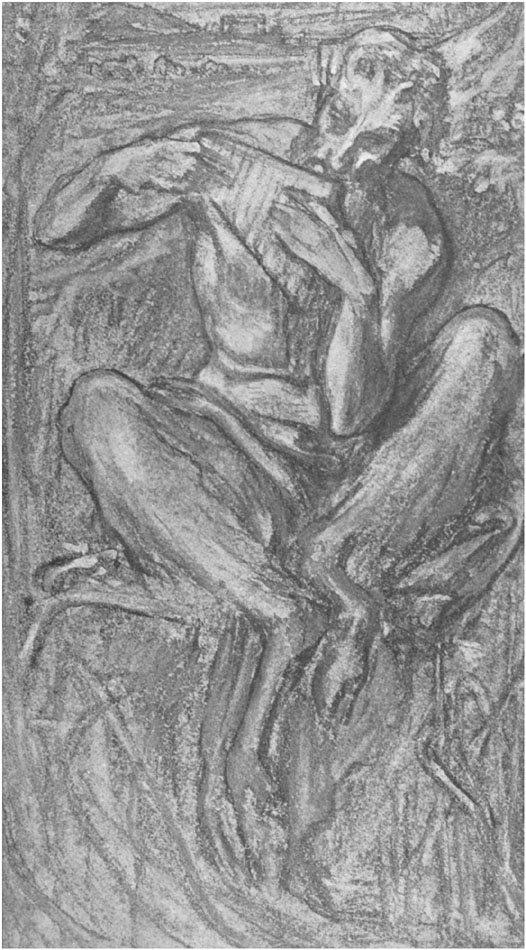
"THE GREAT GOD PAN" Original Sketch for Illustration to Mrs. Browning's Poem in the Cornhill Magazine, 1861ToList
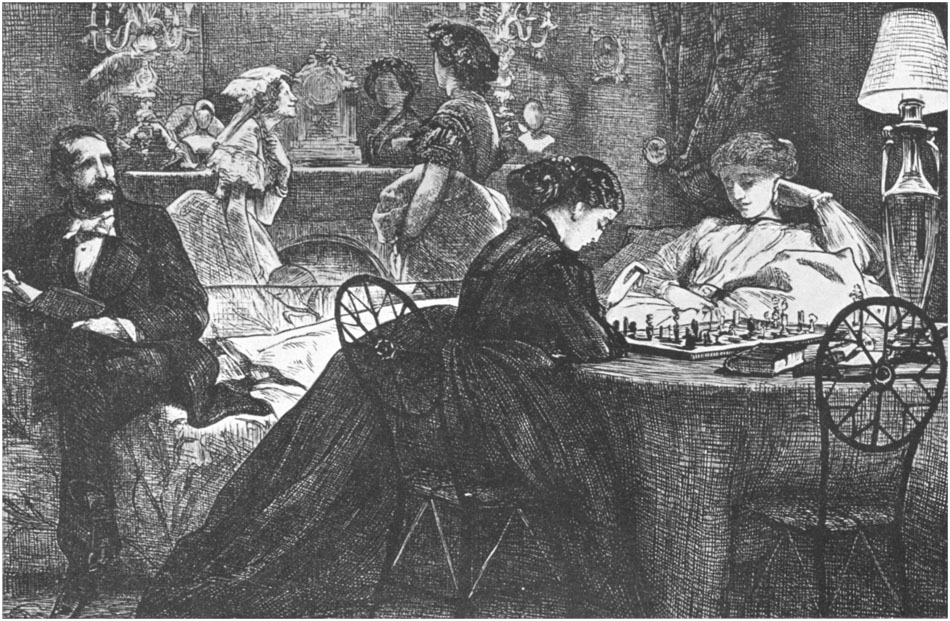
"AN EVENING IN A FRENCH COUNTRY HOUSE" Illustration for Mrs. Adelaide Sartoris's story, "A Week in a French Country House," published in the Cornhill Magazine, 1867 By permission of Messrs. Smith, Elder, & Co.ToList
In a letter to his mother Leighton expresses a warm admiration for these lines by Mr. Robin Allen.
In the autumn of 1863 the following letter to his mother mentions a notable visit to Compiègne. The charming story Mrs. Edward Sartoris wrote, which appeared some years later in the Cornhill Magazine, "A Week in a French Country House," owes its local colour to this home at Compiègne to which Leighton refers. It belonged to Mr. Edward Sartoris' brother-in-law, the Marquis de l'Aigle. For this story Leighton made two admirable illustrations—"An Evening in a French Country House" and "Drifting." Leighton is supposed to have suggested the character of Monsieur Kiowski, the Polish artist in the story; and the figure in the boat holding the rudder in "Drifting" he certainly meant to represent himself, while the figure singing is Adelaide Sartoris—drawn, as shown by the head-dress, from the sketch Leighton made in 1856. (See List of Illustrations.)
Commencement of letter missing.]
1862.
I have a fit of the blues instead.
I hope for the sake of my pictures that I shall soon get over them (the blues, not the pictures). I believe if I could find models I should recover at once; but I foresee that I shall have no such luck.
I had a delightful time at Compiègne—the place is charming, the house comfortable in the extreme, and the life the perfection of unconstraint (if that is English); I have told you already how hospitable and kind my host and hostess were. I have, of course, no news to give you yet, except, by-the-bye, that the bailiffs were in the house the other day because Mr. and Mrs. Gedy had not paid £3, 5s. 6d. taxes; they stayed two days in the house, and if the money had not come, would have walked off with some of my furniture. I wish I had a house; they are beginning a house on Campden Hill, and would build it for an artist after his own designs.
Mr. and Mrs. Alfred Sartoris, the admirer of "Eastern King," were also among the visitors during this week in a French country house, and write the following anecdote:—
"Those who knew Lord Leighton require no record of his kindness and unselfishness. For those who had not that privilege the following little anecdote may be interesting. In the late autumn of 1863 we were all staying with my sister-in-law, the Marquise de l'Aigle, at Francport, near Compiègne. Mrs. Sartoris was also there and Mr. Leighton. There was to be a service on the Sunday in a little neighbouring village church for some children who had made their first communion, and it occurred to Mme. de l'Aigle to have some special music on the occasion, and profit by the glorious voice of Mrs. Sartoris, who kindly offered to sing. Mr. Leighton also volunteered to take the tenor part in various sacred pieces. We were all to help in the concerted music, and the old curé was in the seventh heaven of delight at the prospect of such a grand service. Our dismay can be imagined when three days before the service Mr. Leighton announced that he must leave us as business required his presence in London. 'Oh!' we all exclaimed, 'what shall we do? the tenor pieces must be given up; the curé will die of grief,' &c. ... 'No, no,' said Mr. L., in his cheery way, 'don't change anything; I shall be back all right on Sunday morning in time to sing;' and so, sure enough, he did return, having travelled two nights to London and back. He never would tell us why he had gone; and it was not till long afterwards that it transpired that he had made the hurried double journey to help a struggling artist, whose work he wished to bring forward and introduce to some influential person. He attained his object, and thought nothing of the time and trouble involved, only glad to have been a help to one who needed assistance, and also to keep his promise by singing in the little village church."
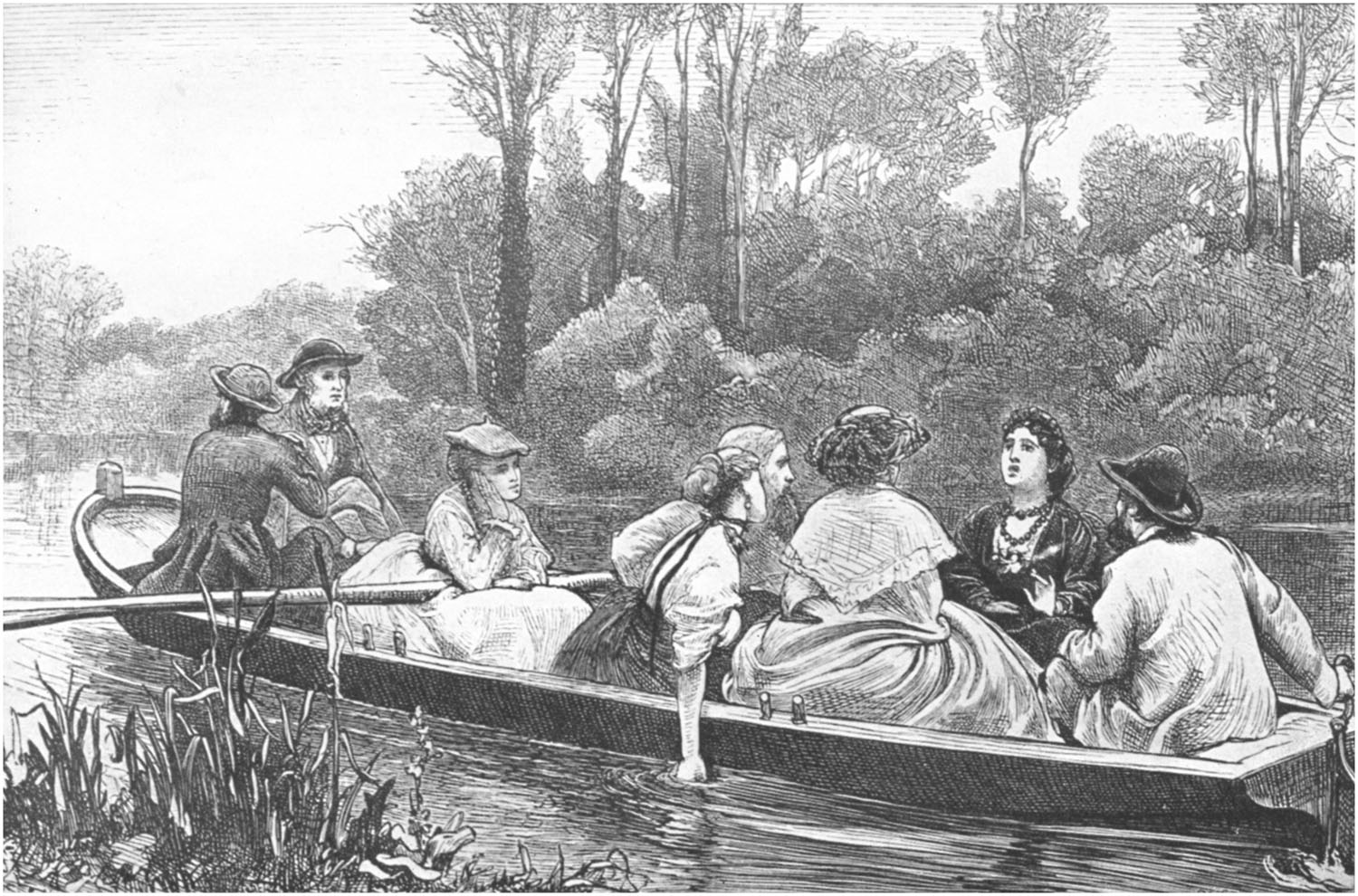
"DRIFTING" Illustration for Mrs. Adelaide Sartoris's story, "A Week in a French Country House," published in the Cornhill Magazine, 1867 By permission of Messrs. Smith, Elder, & Co.ToList
In 1863 Leighton began painting the fresco of "The Wise and Foolish Virgins," which he presented to the Church at Lyndhurst. It was painted on the plaster wall above the altar at the east end. While at work on it, he stayed with his old friend Mr. Hamilton Aïdé, who formed one of the happy company of intimes of the Roman and Lucca days. Several visits to this charming home in the New Forest were made before the work was finished.
In the following letter to Steinle he mentions his first experiment in Mr. Gambier Parry's medium for painting in fresco.
Translation.]
2 Orme Square, Bayswater.
My Very Dear Friend,—When I last wrote I asked you when the German exhibition of which you spoke was to take place, and whether it was to be held in Cologne itself; but as I received no answer I supposed that this exhibition either had not come to anything (as I have seen nothing about it in the newspapers), or that it did not seem sufficiently important to you for me to go specially to Germany for it. Nevertheless, I would have gone to Cologne, if it had been in any way feasible, exclusively on account of you and your works, which I am very anxious to see; unfortunately, however, I could not arrange it, and must content myself with learning from a letter (if you will write me one) how your work succeeds, and how far you have got with it. Two walls are already finished, are they not?
As for myself, I am fairly industrious. Amongst other things, I am painting at present the composition which you have already seen, of Michael Angelo and his old servant Urbino. I have endeavoured to keep the action of the figures simpler and smoother than in the first sketch; and, in fact, I think the picture will please you better than the drawing. For the rest, I am sick of painting small pictures, and would like to undertake something large; but it is not very agreeable to paint pictures which will probably remain always hanging round one's neck.
I think I shall very soon test the public again in this respect—but what I shall paint I do not know. A friend of mine (Mr. Gambier Parry), a great art devotee and first-rate amateur, has discovered a medium to replace fresco painting in our damp climate. I have seen his experiments, and have myself painted a head under his rules,[28] and to my complete satisfaction. The result is scarcely to be distinguished from fresco, and is quite as easy, indeed even easier to achieve. At the same time this method has advantages which buon fresco does not possess; it dries exactly as one lays it on (and is then flat), it has no deposit (Ansätze), and one can go over it as often as one likes. The wall (a granular lime wall) is saturated with the same preparation as you paint with. This preparation, which is stone hard against water, can always dissolve itself with moisture, so that one can retouch it perpetually, at the same time the whole of one's palette is available. My friend is going to publish his system; I will then, if you like, tell you exactly about it.
And now, farewell, dear Master. Remember me most kindly to your wife and children, and keep in remembrance your friend and pupil,
Fred Leighton.
He wrote to Steinle in 1862 that he was making studies for the Lyndhurst fresco, and expected to finish it that summer; but it was apparently only begun in August 1863.
Translation.]
2 Orme Square, Bayswater, April 22, 1862.
My very dear Friend,—When I last wrote to you, I promised and hoped that this time I should be able to send you some photographs of my latest works, but unfortunately at the last moment time ran short. My pictures are only just ready for exhibition, and I must send them off unphotographed. In order that you may not think I have been idle, I write these lines; also because I am unwilling, my dear Master, to fade entirely from your memory. I am exhibiting eight pictures this year, an unusually large number. But the case is not so bad as it looks at the first glance. Two only of these pictures are important in size and subject. One of them you already know from a former composition. It represents Michael Angelo with his dying servant Urbino. In the principal idea I have not deviated much from the first sketch, but have endeavoured to treat the whole with more unity and the details with more simplicity than in the drawing which you saw, and the faults of which you pointed out to me. This picture is life-size, and extends down to the knees.
The other is of a somewhat fanciful description. I have imagined one of the three holy kings, when he sees the Star in the East from the battlements of his palace. The picture is curious and open to much fault-finding, but I think it will please you by a certain poetry in the conception. The shape is long and narrow. The king, half life-size, almost turns his back upon the spectator, and is, in the midst of the dark night, only lit by the mystic rays of the Star. In contrast to this pure light one sees, quite at the bottom, through an arch, into the hot lamp-light, which illuminates a gay orgy. I have allowed myself a certain amount of pictorial licence, which may well surprise the general spectator at first glance, but which to me heightens the poetical impression of the whole.
Five other pictures are smaller, and three of the subjects are idyllic or fanciful (e.g. a shepherd playing on a flute, an Oriental girl with a swan, &c. &c.), all carried out with great love, and certainly my best works.
At present I am busy making studies for a large wall painting (the "Wise and Foolish Virgins"), which I am giving to a church. I shall execute it this summer, and tell you more about it.
Now, my dear Friend, I have given you a long and full report of myself; I hope you also will tell me what you are doing. I am very anxious to know how the Cologne frescoes get on. How I should like to see them! Perhaps I may manage it this autumn. In the meantime, however, write to me, and believe me to be, your devoted pupil,
Fred Leighton.
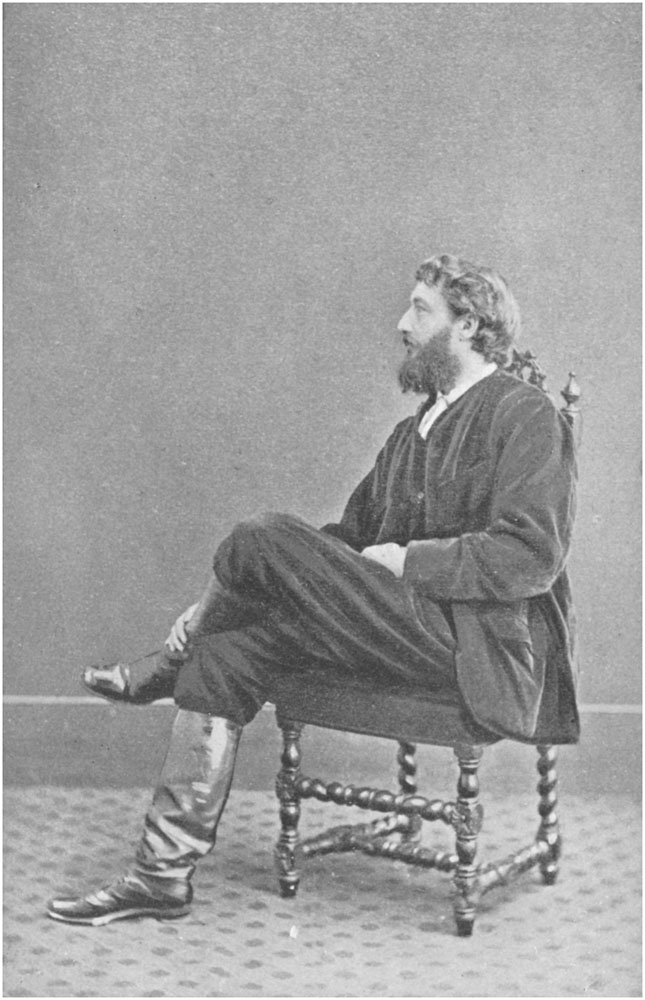
PORTRAIT FROM A PHOTOGRAPH OF LORD LEIGHTON TAKEN IN 1863ToList
April 1863, Saturday.
Dearest Mamma,—You have seen in the papers that the Review at Brighton went off capitally. I enjoyed my day very much, and though I was a little tired and very sleepy for two days after, was altogether the better for it. It was a stiff day's work too—nine or ten hours without sitting down, and with the additional responsibility of having the command of the Artists' Company. I was sure you would be pleased at the reception of my "Fruit Girl"[29] by my brother artists—you must understand, though, that this applies chiefly to the younger men (and not to all of them), for there are several of the older painters who strongly object to my style of painting and are bent on suppressing it.
Will you thank Papa for his hint about the Athenæum—I am pretty sure he is mistaken about it, but I shall take measures about it—indeed I have.
I spoke to Charles Greville (Henry's brother) and told him I thought I should be coming on before very long; he very kindly overhauled the lists and said he thought I might be up by the end of the summer, and, what was still more kind, seeing me unseconded, he put his name down as seconder.
Forest Bank, Lyndhurst, Thursday, August 6, 1863.
If I was not more explicit about being with Aïdé, it was because I made sure you knew it. You will be pleased to hear that when after many péripéties I did begin my fresco I got on capitally; I have now finished the task for this year, having painted three life-size figures, with a good bit of background, in four days. I worked hard for it, and am rather tired—head and eyes; otherwise flourishing.
I am delighted with my new fresco material (Parry's)—the effect is excellent—nearly as fine as real fresco. Everybody seems much pleased with what I have done, particularly the parson. I like it myself; I enjoy working at it immensely; it is my real element. I find it (for mere manipulation bien entendu) absurdly easy.
The following letter from Mr. Gambier Parry explains the "fresco material" Leighton used.
Highnam, Gloucester, August 3, 1863.
My dear Leighton,—In reply to your last note about the use of the wall itself rather than of canvas, there can be no doubt on the subject, if only the plaster is good and well put on. You speak of two or three months to get it dry. I assure you that that is not near enough. When the surface feels dry to your hand you must not suppose that it is all dry inside, and if the wall is new, I doubt a year being enough to dry it. The water must evaporate somewhere—it is drawn to the surface of interiors because they are the warmest.
You ask whether the rough cast on the wall must be scraped off before you wash the wall for painting. If by the rough cast you mean rough plaster, which is a totally different thing to rough cast, certainly use it as it is. The coarser the plaster the better, because it is all the more porous, so long only that it is of the best materials (viz. perfectly washed sand, and good lime), and well put on a good wall. Nothing in the world could equal it for painting upon, except a surface of coarse clean Bath stone, with all its pores open. If you have such plaster as I have just described, and both it and the wall thoroughly dry, nothing could be better. The smooth surface, with what granulated texture you please, can be got according to the directions in my paper—viz. after two or three washes of pure diluted medium, give another or two more of the same, with dry whiting and a little white-lead, then go ahead while it is all fresh, viz. two or three days after the process of preparation has been completed.
Take care in painting not to rub it up too much, for fear of drawing up the glossy resins to the surface away from the wax. Paint right into your prepared surface solidly and with decision in the way of fresco painting, not as oil. Keep the brush clean, and the volatile oil in the dipper clean, and then, oh! how shall I envy you your power to use them all![30]
At the Ely ceiling, which is of hard wood not porous, but prepared with three coats of oil white-lead, I am painting with
Liquid Measure.
Pale drying oil 2
Japan gold size 2
Turpentine 2
Artist copal 1
well shaken up every time it is used. The colours are all ground up in it, and then painting is done as in water-colour, using pure spirits of turpentine as a vehicle. Colours dry extremely rapidly and with a dead surface. The stuff looks horribly black, but the colours are not materially affected by it. Of course it is not to be compared with my former medium, because there is that bane of the palette oil in it, but I used it because of its great facility (used transparent like water-colour on a white ground), and because the surface was hard, so that wax might (in great heat) shrink or play tricks on it, as it has done in Murillo's pictures and many others.—Ever most sincerely yours,
T. Gambier Parry.
If I can do anything for you, command me; we go to Scotland on the 14th.
London, April 26, 1863.
Dearest Mamma,—You were no doubt surprised to see a sock arrive in Bath in solitary grandeur, unaccompanied by any sort of note. The fact is, for some days past I have been working at a rate which made me altogether unfit for correspondence. I have just returned from Lyndhurst, where I have been doing a bit more fresco—and very stiff work it was—up and at work at seven, and at it best part of the day, perched generally on an uncomfortably narrow ladder, and with my head almost blown off by the agreeable but overpowering smell of the vehicle with which I painted. The result is as far as it goes tolerably satisfactory—everybody there is delighted, and though that, of course, does not prove much, it is at all events agreeable to me that they derive so much pleasure from my work. The stained-glass window, too, which has been executed at my desire from Jones' designs, gives great satisfaction—is a lovely piece of colour, and (which was, to me, of paramount importance) does not hurt my fresco, though, of course, in the nature of things, it outshines tenfold in point of brilliancy; hence the folly, to my mind, of ever putting glass and wall painting in immediate juxtaposition. I shall go and paint another slice in June, after which Aïdé leaves, so I may not be able to finish my work till he returns in autumn. On my road to Lyndhurst, I paid a visit to Lady Dorothy Neville (Lady Pollington's sister) at Dangstein—a very beautiful place near Petersfield.
On Monday week the Royal Academy opens—I shall be curious to see what pictures they have taken; my work at present will be a woodcut for Dalziel—then that for the Cornhill—then a drawing for Cundall's Bible—Mrs. Magniac's portrait—the cartoon for the remainder of the Lyndhurst fresco—then perhaps a new picture. I wish some one would buy the old ones!
Have you read "Sylvia's Lovers"? Don't read "Salammbo"—it is hideous.
Dearest Mamma,—My chair has arrived safe and sound; once more, my very best thanks for it.
Aïdé is one of the most excellent men that ever lived—I like him extremely.
By-the-bye, I am made one of the ensigns in our Rifle Corps, so that when you come to town you have a chance of seeing me strutting about with a sword.
I write in haste. Good-bye, best love to all.—From your very affectionate boy,
Fred.
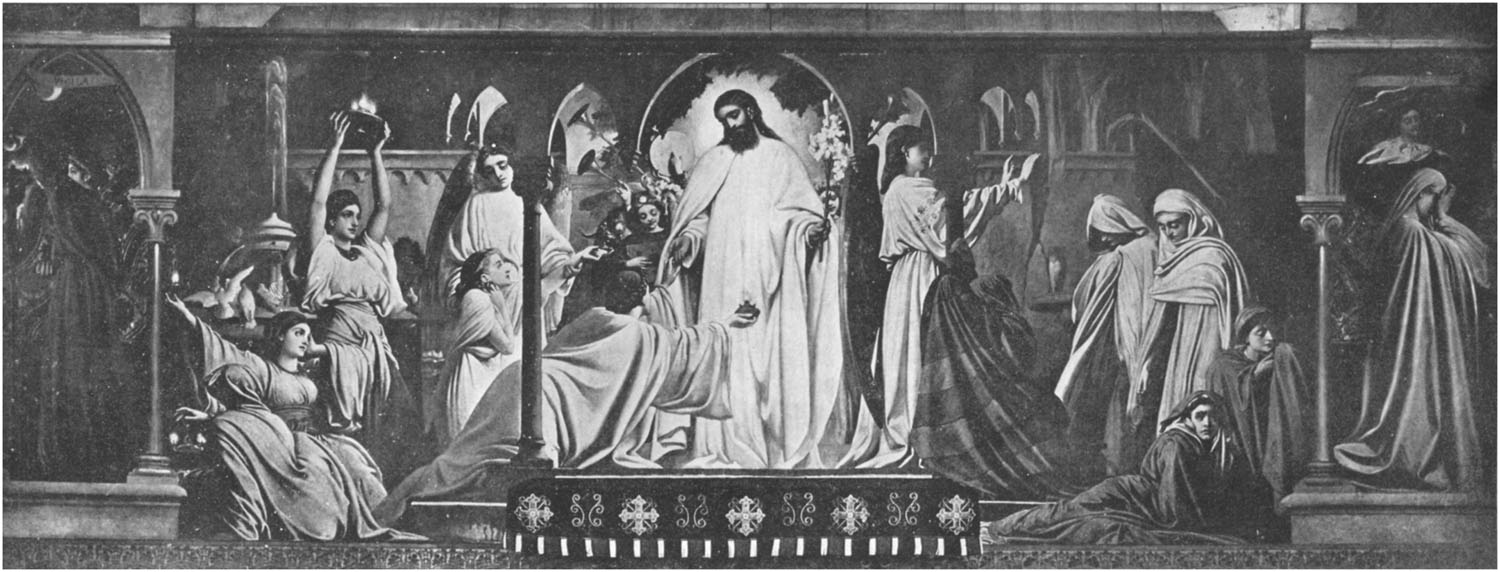
THE FRESCO PRESENTED BY LORD LEIGHTON TO LYNDHURST CHURCH—"THE WISE AND FOOLISH VIRGINS." Completed 1864ToList
In a letter to his father dated 1864 Leighton announced the completion of the fresco, "The Wise and Foolish Virgins." The design of the whole and the lines of the draperies in each figure are all admirable, and the work is one which proves Leighton's powers of achieving rapidly, and under great difficulties, a complete work and one in which his great sense of beauty is very salient. There is also sufficient dramatic feeling in the gestures and expressions of the faces. Perhaps the most interesting (because the most spontaneous) attitude in the figures of the wise virgins is that which is kneeling, profile-wise, under the figure of the angel, who is indicating to her the presence of her Saviour. She seems dazed with awe and rapture. Her arm is caught up with a sudden unstudied angularity of movement which, though not so beautiful intrinsically as are most of those in Leighton's work, is very expressive, and produces a happy effect amid the more obviously arranged lines in the rest of the design. Among the many drawings preserved in the Leighton House Collection made for this fresco there is a slight but very sensitive sketch for this figure, also a finished pencil drawing for the head of Christ. The model who sat for this head was the Italian whom Leighton painted in "Golden Hours," and whom Watts used for the picture he (many years after its execution) entitled "A Prodigal." The type of this model may be felt by some to have been an unfortunate one to choose for the central imposing figure in the design of the fresco. It is, perhaps, weak—too good-looking in a commonplace style for such a subject.
Ruskin, on seeing the photograph of this work, wrote to Leighton (a postscript to a letter): "I was much struck—seriously—by the photograph from your fresco; it is wonderfully fine in action."
Leighton wrote to Steinle on receipt of his criticisms on the Lyndhurst fresco:—
Translation.]
3rd December.
My dear Friend,—Just now returned from a long journey (to Constantinople and Athens), I find two very welcome letters from you, by which I see with great pleasure that your old pupil may still reckon upon your invaluable friendship and sympathy, and I see it all the more certainly because you enclose a kind but pertinent criticism of the photographs I sent you.[31] I agree entirely, and can only pretend in my defence that it was difficult, with the long space (all having to be filled) and the altar standing in the middle of it, not to fall into rather a panic. That, after all, is but a lame excuse, and I hope that you will always rap me over the knuckles with the same friendly sincerity.
My dear Friend, the idea of appearing as a collaborator beside you, my master, would be in the very highest degree delightful and flattering to me. It is therefore only after mature deliberation, and in the firm confidence that you will at least appreciate the sincerity of your Leighton, that I have to decline with real regret Herr Bruckmann's flattering invitation. You, more than any one else, will agree with me that an artist can execute no first-rate work, indeed dare undertake no work, that is not a genuine expression alike of his feelings and his convictions. I must candidly confess I cannot agree about a complete illustration of the Shakespearian plays, those masterpieces already in existence as exhaustively finished works of art; it seems to me that in literature only those subjects lend themselves to pictorial representation which stand in the written word more as suggestion. Subjects perhaps which are provided in the Bible or in mythology and tradition in great variety, or are not already generally in possession of the minds of the spectators of living plays (e.g. the Greek Tragedies). It is for the most part a struggle with the incomparable, already existing complete—which is quite intimidating to my capabilities. Do not take this ill, my dear Friend, and do not consider it too great a presumption that I, your pupil, declare so plainly against you where you think so differently. To go back over one detail, I must also confess that to me a coloured cartoon is not a natural mode of expression; a drawn, or a grey in grey (grau in grau) painted cartoon—well enough. A size five feet high is to me, for a suggestion of colour, at least five times too large; just as little could I give a suggestion of form in this size. Colour is not necessary; but if one should use it in half life-size, it is too noble and poetic, I think, for one to venture, so to speak, to clarify it. Will you forgive me for all this, dear master? However, I shall see with deep interest the progress of the beautiful work which you will certainly execute.
I have heard with some sorrow of the burning of the venerable Dome, and am just writing to Otto Cornhill in respect to a lottery which is to be arranged for the re-erection of the tower.
I have read what you tell me of your dear family with great pleasure; please remember me most kindly to your wife and children; also to my old comrades V. Müller, Wecker, and the rest. I am very glad to hear that G. Wecker, the apostate, has returned to art. He was, undoubtedly still is, a very gifted man, but had to guard somewhat, had he not? against the ornamental.
But my letter is becoming too long.
Farewell, my dear Master; take nothing amiss from your grateful, devoted pupil,
Fred Leighton.
Friday 10, 1864.
Dear Papa,—You will be disappointed, after waiting so long, to receive no paper after all, and a skimpy note instead. I am amused at the studied ill-nature of the Spectator; I wonder who V. is. The author of an article on sensation pictures in the Realm, in which I am flatteringly quoted, is by Mrs. Norton. En somme I think my "Golden Hours" is the most successful of my pictures (perhaps more than anything since "Cimabue") and the "Orpheus" (deservedly) the least. I am about to begin two new pictures. Mrs. Guthrie's portrait—a full length—is postponed for her health till the winter.
1864.
I should not leave the place I am in except to build; a mended house would be most unsatisfactory and temporary. I feel sure I shall nowhere get standing room for a house for less than £28, still less room for a house and large garden. If I find the terms exactly as I expect and my lawyer (Nettleship) satisfied with the title I shall, I think, close the bargain, the more so that another painter (I don't know who) is after it.[32] I am staying for a day or two at Dangstein (Lady Dorothy Neville's). I met here last night Mr. Henry Woolfe, who very kindly offered me introductions to one or two charming Venetian families (Mocenigo) which will be very pleasant for me, as I want to see a Venetian interior. Gambart has paid the £1050 for "Dante." The "Honeymoon" was bought by a Cornhill dealer yclept Moreby.
I will let you know how all goes off on Saturday at the Council, meanwhile best love to Mamma.—From your affectionate son,
Fred.
August 23, 1864.
I found your letter on returning from Lyndhurst this morning. I may as well tell you at once that I have finished my fresco, retouching a great deal of what was already painted, and I think I may add, greatly improving it—so much for that.
With regard to the draft, my assent was only general and preliminary (besides being subject to the approval in the details of my solicitor) and bound me to nothing. My surveyor and solicitor have conferred together and with Lady H.'s agent, and though the agreement is not yet signed, the matter is virtually settled. I have several minor clauses altered which had been inserted originally in the general draft to meet cases different from my own. With regard to the title, I was surprised and vexed to hear that it was stipulated that no title should be called for. My lawyer told me that this was frequently the case—that he would go to Doctors' Commons to see the Will to ascertain the truth of the statement that the property was Lady H.'s in fee simple (as it is). Even this he said did not legally exhaust the matter, as there might be encumbrances not alluded to in the Will. He said, however, that many other leases had been granted on that property on precisely the same terms, that the matter turned on the character of the landlord, and that, en somme, I ran but little risk. Since then I have seen him, and he tells me that he has fortunately been able to ascertain through a very respectable firm of solicitors, who have seen the titles, that it is all right; he has therefore not thought it desirable to put me to the expense of investigating the Will—so far so good. As to the possible expense of the house, my dear Papa, you have taken, I assure you, false alarm. I shall indeed devote more to the architectural part of the building than you would care to do; but in the first place architecture and much ornament are not inseparable, and besides, whatever I do I shall undertake nothing without an estimate.
You need never fear that I shall take otherwise than it is meant the advice that your experience and interest in me suggest to you. You will also, I am sure, allow for the difference of feeling between yourself and an artist who lives by his eyes.
A line will find me at Venice, poste restante, all September. I am just off.
Best love to Mammy.—From your affectionate son,
Fred.
I knew neither Poole nor Jones. Grant said he thought it probable I should be an R.A. before long.
Venice, September 20, '64.
My dear Papa,—Many thanks for your letter, which reached me safely a few days ago. I do indeed contemplate building my house so as to be enlarged at a future day. I find, however, that I shall probably be obliged to build at once rather more than I absolutely require for practical building reasons, but I need not therefore furnish more than I require. About the well I am now entirely in the dark. It would never have occurred to me to ask myself the question, Are there not pipes or something? With regard to the Will, if the perusal of it only cost a guinea, it might have been worth while to look at it, though Palmer and Nettleship thought it superfluous; but then P. and N. tell me it would cost £20! to have it gone over, and as my expenses with Browne (Lady H.'s agent) are already very great—he makes a preposterous charge, which I can't dispute, for the agreement—I don't think I shall care to add to them.
My architect is Aitchison, an old friend.
I wrote to the Academicians (Poole, Grant, and Jones) almost immediately on hearing from them, and expressed a hope, vague but polite, that we might meet on my return. Poole I should like to know; he is a man of poetic mind. I need scarcely tell you that the idea of my being elected President (!!!) for many years to come is simply ludicrous, even if there is a chance of my ever having the offer of that dignity.
I am quite aware that people do talk of it laughingly, but I don't think it goes beyond "chaff" yet. No doubt many other young artists are chaffed in the same way with imaginary dignities. I am delighted that Mamma is better; I should have said this before but that I have answered your letter systematically. I trust the improvement will be lasting.
I congratulate you on Colenso's visit, and shall be very anxious to hear from you how it went off.
As for myself, I am very snugly ensconced in a little mezzanino on the Grand Canal, with a sort of passage which I use as a studio and a bath-room, inasmuch as it opens straight on the water, and enables me to take a very jolly swim every day. I am not attempting a picture, but am making a sketch for one which I shall probably paint on the spot next autumn, staying here a couple of months or so. Meanwhile I have got several heads in hand—studies, not for sale, for use—and a few sketches in Saint Mark's, which I think promise well. Et voilà.
I stay here a fortnight longer, so that a letter written on receipt of this would still catch me; after that Rome is the safest address. I shall be there from the 20th to the 28th of October.
Best love to Mamma, and believe me, your affectionate son,
Fred.
In the preceding letters mention is made of the final arrangements for the building of Leighton's house in Holland Park Road. Mr. George Aitchison, R.A., his old friend, undertook to be the architect. It was begun in 1865, and first occupied by Leighton in 1866.
Referring to opinions expressed regarding Florentine Art, past and present, Leighton wrote to his younger sister: "——'s remark about ——, if I remember it, was utter bosh and pedantry. The Florentines of the end of the fifteenth century were emphatically realists, though their realism was animated by a higher genius and a deeper humanity than the modern Italians exhibit, though they, by-the-bye, are mostly not realists but mannerists. The chief characteristic of English Art is (I speak of course of the better men) originality and humanity on the one hand, and on the other, absence of acquired knowledge and guiding taste. Some day I will write you a lot more about it."
Fully launched into the English art world, deeply interested in every phase of sincere work produced by contemporary brother artists, Leighton nevertheless adhered in his own practice to the views and principles which he held from the time he became Steinle's devoted pupil. To a question which referred to his art development, asked by Mrs. Mark Pattison when she was about to write an account of his life in 1879, Leighton answered, "I can only speak of what is not a change but virtually a growth, the passage from Gothicism to Classicism (for want of better words) i.e. a growth from multiplicity to simplicity. Artists' manners are not changed by books!" "As regards English artists," he writes in the same letter, "I can only of course speak with great reserve. Elmore treated me with marked kindness, lending me a studio. Millais, Rossetti, Hunt were most cordial and friendly, though I openly told them I was wholly opposed to their views; but, indeed, few men have more cause to speak well of their brethren."
The artistic events of the years 1862, 1863, and 1864 culminated in Leighton being elected an Associate of the Royal Academy. His old friend, Mr. George Aitchison, wrote at the time of Leighton's death: "In 1860 he took a studio at Orme Square, Bayswater. It was during this time that his conversation was so brilliant and so free from restraint. I remember a summer afternoon I spent with him, Mason, and Murch on the terrace at the Crystal Palace, when he gave vent to the freest criticism on books, artists, philosophy, science, and the methods of teaching, and deplored the waste of time to students of making large chalk studies, when everything that was wanted could be shown on a sheet of smooth paper, seven inches high, with a hard pencil. He was a great admirer of Boxall and his delicate painting, of Mr. Watts' and Sir E. Burne-Jones' work, and persuaded the last two to join the Royal Academy. In 1864 he was made an A.R.A., and after this he became very cautious of expressing any but the most general opinions on contemporary English art, as his remarks generally got into the papers."
"Eucharis," 1863; "Dante at Verona," and "Golden Hours," 1864, are three works which might be placed in the first rank of Leighton's achievements. In the following letters references are made to the pictures:—
April 29, 1863.
Dear Mammy,—I have just been to the R.A., having been invited to the "Varnishing Day." Four pictures are hung—"Elijah," high, of course, but in a centre place; it looks well, but much darker than in the studio. "Peacock Girl,"[33] very well hung, exactly where "The Vision" was a few years ago; it looks well. "The Crossbowman" and "The Girl with the Fruit"[34] are fairly hung, but look, to me, less well than in the studio. The "Salome"[35] is the one not taken. Altogether I am well treated.
In the following letters from Ruskin his interest is expressed in the pictures exhibited in the Academy of 1863, and for the "Romola" illustrations:—
My dear Leighton,—I've only just had time to look in, yesterday, at R. Ac., and your pictures are the only ones that interest me in it; and the two pretty ones, peacocks and basket, interest me much. Ahab I don't much like. You know you, like all people good for anything in this age and country (as far as Palmerston), are still a boy—and a boy can't paint Elijah. But the pretty girls are very nice—very nearly beautiful. I can't say more, can I? If once they were beautiful, they would be immortal too. But if I don't pitch into you when I get hold of you again for not drawing your Canephora's basket as well as her head and hair! You got out of the scrape about the circle of it by saying you wanted it hung out of sight (which I don't). But the meshes are all wrong—inelegantly wrong—which is unpardonable. I believe a Japanese would have done it better. Thanks for nice book on Japan with my name Japanned. It is very nice too. I wish the woodcuts were bigger. I should like it so much better in a little octavo with big woodcuts on every other page. But I never do anything but grumble.—Faithfully yours,
J. Ruskin.
My dear Leighton,—The public voice respecting the lecture you are calumniously charged with, is as wise as usual. The lecture is an excellent and most interesting one, and I am very sorry it is not yours.
I am also very sorry the basket is yours, in spite of the very pretty theory of accessories. It is proper that an accessory be slightly—sometimes even, in a measure, badly—painted, but not that it should be out of perspective; and in the greatest men, their enjoyment and power animated the very dust under the feet of their figures—much more the baskets on their heads: above all things, what comes near a head should be studied in every line.
There is nothing more notable to my mind in the minor tricks of the great Venetians than the exquisite perspective of bandeaux, braids, garlands, jewels, flowers, or anything else which aids the roundings of their heads.
It is my turn to claim Browning for you, though I know what your morning time is to you. I must have you over here one of these summer mornings, if it be but to look at some dashes in sepia by Reynolds, and a couple of mackerel by Turner—which, being principals instead of accessories, I hope you will permit to be well done, though they're not as pretty as peacocks.
I have been watching the "Romola" plates with interest. The one of the mad old man with dagger seemed to me a marvellous study (of its kind), and I feel the advancing power in all.
Will you tell me any day you could come—any hour—and I'll try for Browning.—Ever faithfully yours,
J. Ruskin.
I'm always wickeder in the morning than at night, because I'm fresh; so I'll try, this morning, to relieve your mind about the peacocks. To my sorrow, I know more of peacocks than girls, as you know more of girls than peacocks—and I assure you solemnly the fowls are quite as unsatisfactory to me as the girl can possibly be to you; so unsatisfactory, that if I could have painted them as well as you could, and had painted them as ill, I should have painted them out.[36]
Monday.
Dear Leighton,—I saw Browning last night; and he said he couldn't come till Thursday week: but do you think it would put you quite off your work if you came out here early on Friday and I drove you into Kensington as soon as you liked? We have enough to say and look at, surely, for two mornings—one by ourselves?
I want, seriously, for one thing to quit you of one impression respecting me. You are quite right—"ten times right"—in saying I never focus criticism. Was there ever criticism worth adjustment? The light is so ugly, it deserves no lens, and I never use one. But you never, on the other hand, have observed sufficiently that in such rough focussing as I give it, I measure faults not by their greatness, but their avoidableness. A man's great faults are natural to him—inevitable; if very great—undemonstrable, deep in the innermost of things. I never or rarely speak of them. They must be forgiven, or the picture left. But a common fault in perspective is not to be so passed by. You may not tell your friend, but with deepest reserve, your thoughts of the conduct of his life, but you tell him, if he has an ugly coat, to change his tailor, without fear of his answering that you don't focus your criticism. Now it so happens that I am in deep puzzlement and thought about some conditions of your work and its way, which, owing to my ignorance of many things in figure painting, are not likely to come to any good or speakable conclusion. But it would be partly presumptuous and partly vain to talk of these; hence that silence you spoke of when I saw you last. I wish I had kept it all my life, and learned, in place, to do the little I could have done, and enjoy the much I might have enjoyed.—Ever faithfully yours,
J. Ruskin.
Send me a line saying if you will give me the Friday morning, and fix your own hour for breakfast to be ready; and never mind if you are late, for I can't give you pretty things that spoil for waiting, anyhow.
Leighton writes to his mother:—
I had a kind note this morning from Ruskin, in which, after criticising two or three things, he speaks very warmly of other points in my work and of the development of what he calls "enormous power and sense of beauty." I quote this for what it is worth, because I know it will give you pleasure, but I have NOT and never shall have "enormous power," though I have some "sense of beauty." The "Orpheus" and "Golden Hours" are not in the great room but in the next to it. I have not seen Gambart lately, and do not, therefore, know whether he has got rid of any more of my pictures (by-the-bye, I have sent the "duet"—"Johnny"—to America to an Exhibition for the Sanitary Commission, on the request of Mrs. Kemble's daughter). He will, I think, engrave the "Honeymoon," but probably only photograph the others; by-the-bye (again), Mammy, tell Gussy with my love that I shall present her with a copy of each and shall not "think her greedy," having no thoughts for her but affectionate ones. With regard to the money paid me by Gambart, I invested as soon as I got it £1000 in Eastern Counties Railway debentures, at par, 4½ per cent., this on the advance of Coutts' stock clerk. Lord Ashburton's portrait was scarcely begun.[37] I have offered to try to finish tant bien que mal from photographs, and to give it to Lady A. She is very grateful. The child's picture also goes to the wall, as she won't be able to sit for some time, and would then be changed. Lady A. wanted to pay the price of the sketch as it stood; this I of course refused. She has commissioned me to paint her a fancy picture for £300.
Leighton was for five years an Associate before being elected a full member of the Royal Academy in 1869. During these years the number of important pictures he exhibited each season notably increased. In at least twelve of these works the many-sided Leighton is worthily represented—"Dante at Verona,"[38] "Golden Hours," "David," "Syracusan Bride" (exhibited at the Royal Academy in 1866 and in the Paris International Exhibition in 1868), "Helen of Troy,"[39] "Greek Girl Dancing," "Venus Disrobing from the Bath," "Ariadne Abandoned by Theseus, Ariadne Watches for his Return, Artemis Releases Her by Death," "Actæa, the Nymph of the Shore," "Dædalus and Icarus," "Electra at the Tomb of Agamemnon," "Helios and Rhodos." The extreme variety from every point of view which exists in this group of twelve pictures, chosen from the twenty-six paintings and the numerous sketches executed in these five years, would be a proof in itself, if one were needed, of Leighton's extraordinary versatility as regards the motives of his pictures.
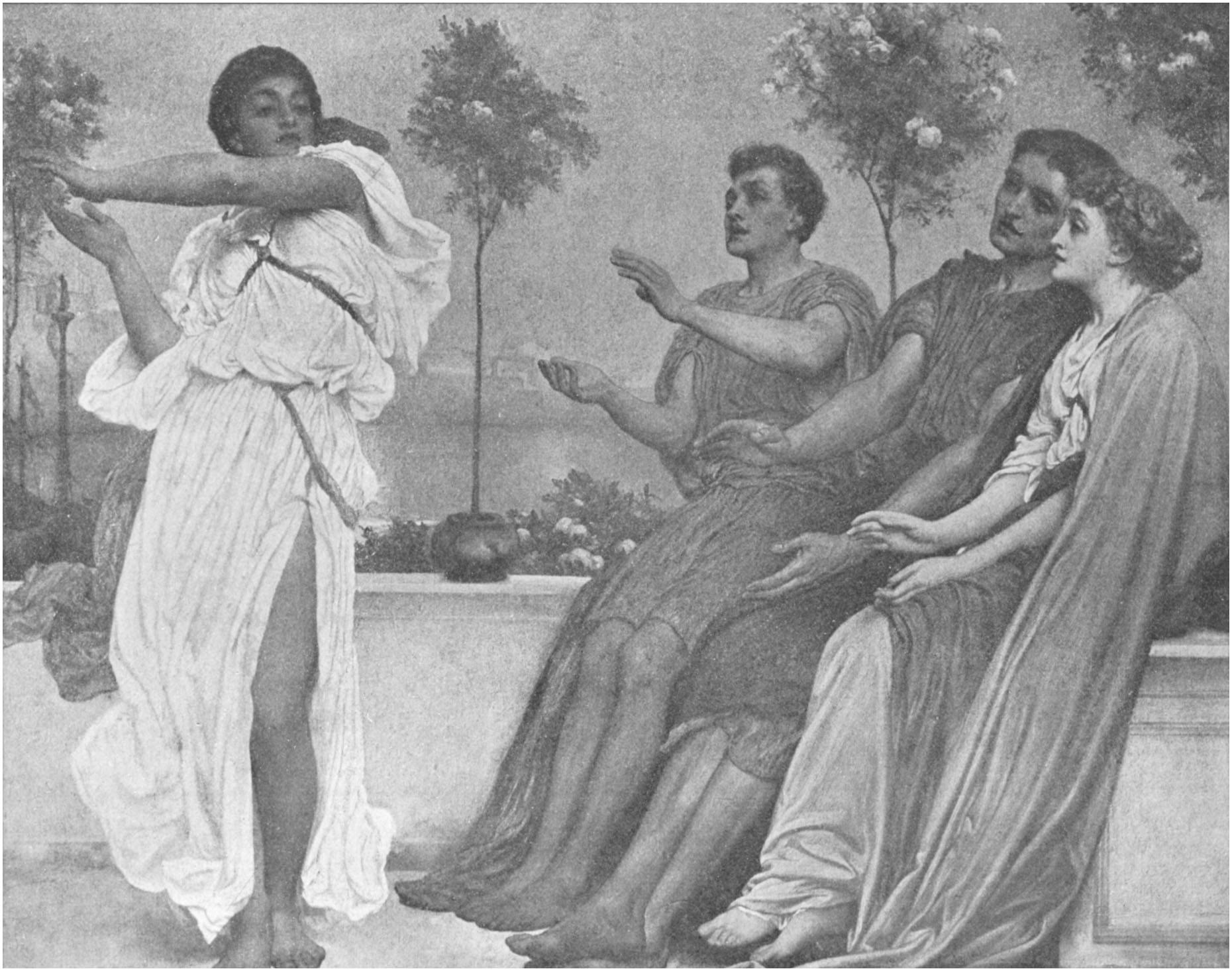
"GREEK GIRL DANCING." 1867 By permission of Mr. PhillipsonToList
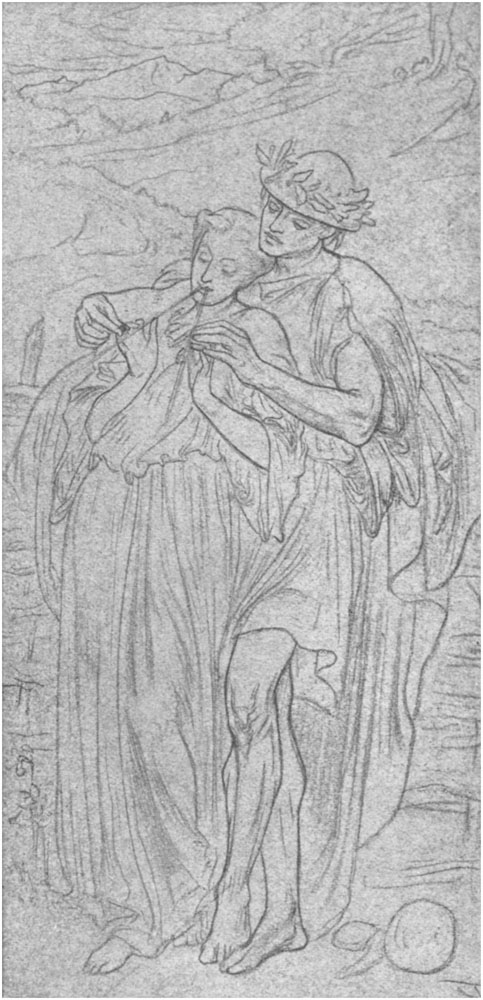
DRAWING FOR THE PAINTING "A PASTORAL." 1866 Leighton House CollectionToList
In the spring of 1865, after years of delicate health, Mrs. Leighton at the last died suddenly, at her home in Bath. At the time Leighton was staying at Sandringham where he received a telegram announcing her death, and on the same day he joined his family at Bath. It has been said that, as long as a man is blessed by possessing a mother, he still retains the blessing of being—in the eyes of one person at least—a child. To Leighton's tender-hearted nature this blessing was a very real one, as is testified by his correspondence with his mother.[40] The first chapter of Leighton's life seems, in a sense, only to end with this great sorrow.
Translation.]
Frankfurt am Main, April 30, 1865.
Dearest Friend,—As your last friendly lines of 14th March did not bring your address, I grasp the opportunity offered me by Mr. Tobie André to express to you my heartfelt sympathy on the loss of your dear mother. I remember that you often spoke to me of this mother with true filial affection, and I have secretly blessed you for it; I know now also that you will treasure her memory!—Always, your truly devoted,
Steinle.