Volume 2 — CHAPTER VToC (continued 2)
Reading edition
I sent a copy of my letters to Sir Frederic Leighton, and asked him if he would let me have his opinion respecting the principal suggestions contained in them. With the great kindness which distinguishes him, Sir Frederic Leighton has written me the following letter, which contains advice so valuable that I am sure every person in Manchester who cares for art will be glad to have an opportunity of reading it:—
"Dear Mr. Horsfall,—I must apologise for my very long delay in answering your letter—a delay due in great part to lack of time, but in part also to the fact that your questions could not be answered hastily, or without due consideration. I may say at the outset that I very warmly appreciate the depth of your interest in the subject of art, and the constancy of your efforts to spread its influence in Manchester; and I am glad to be able to add that on not a few points, I find myself in harmony with your views.
"It is evidently not possible for me to touch, within the compass of a letter, upon more than one or two of the matters with which you deal in your two long communications to the Manchester press; and, indeed, the question on which you mainly dilate, and in regard to which I am not wholly at one with you, would require to be dealt with at far greater length than is possible to me here. I must content myself with saying what little seems to me sufficient to indicate the grounds of my dissent from you. But first I should like to say a word in passing on the vexed subject of copies.
"There can be no doubt that it would be an immense advantage to those who cannot travel—that is to say, to the enormous majority of men—to bring before their eyes, through reproductions—if these reproductions were absolutely faithful—the masterpieces to which distance deprives them of access. This is, in the case of sculpture and architectural detail, in a large measure achieved by the means of plaster casts, though it is needless to point out that the capacity of the material robs the reproduction of much of the life and light of the original. With pictures the case is different. The subtle and infinite charm which resides in the handiwork of a master, and in the absence of which half the personality of his work is lost, can hardly ever be rendered by a copyist. For this reason the overwhelming majority of even reasonable copies is to my mind worse than useless. Such copies can kindle no enthusiasm, and they virtually misinform the student. It has always seemed to me that the best way to acquaint young people with pictures which they are not able to see is to put before them photographs of the originals, which, besides giving design, form, and light and shade, with absolute fidelity, render, in a wonderful way, the executive physiognomy of the work; and by the side of these photographs free, but faithful, coloured sketches of the pictures should hang, giving the scheme, harmony, and tone of the colour, but not, like finished copies, professing an identity with the original, which is never achieved.
"Turning now to what you say on the subject of the acquisition of works for a public gallery, I should at once dissuade you from any idea of giving definite commissions—I mean commission to paint specially selected subjects. I have always felt very strongly that artistic work, to be of real value, must be the outcome of entirely spontaneous impulse in an artist. I believe that in the immense majority of cases work done under any other conditions lacks vitality and sincerity, and will not show the worker at his best. A subject which does not impose itself unbidden on the artist will never elicit his full powers. I have myself on that ground for many years past invariably declined to paint under any kind of restriction.
"Neither does your idea of—practically—refusing encouragement to any work which does not commemorate a noble deed, and, if possible, the noble deed of a well-known personage, commend itself to me. It seems to me, on the contrary, to be a harmful one, inasmuch as it misdirects the mind of a people, already little open to pure artistic emotion, as to the special function of Art. This can, of course, only be the doing of something which it alone can achieve. Now, direct ethical teaching is specially the province of the written and the spoken word. A page or two from the pen of a great and nobly-inspired moralist—a Newman, say, or a Liddon, or a Martineau—can fire us more potently and definitely for good than a whole gallery of paintings. This does not, of course, mean that a moral lesson may not indirectly be conveyed by a work of art, and thereby enhance its purely moral value. But it cannot be the highest function of any form of expression to convey that which can be more forcibly, more clearly, and more certainly brought home through another channel. You may no more make this direct explicit ethical teaching a test of worth in a painted work than you may do so in the case of instrumental music; indeed by doing so you will turn the attention of those before whom you place it from the true character of its excellence—you will, so to speak, mis-focus their emotional sensibility. It is only by concentrating his attention on essentially artistic attributes that you can hope to intensify in the spectator that perception of what is beautiful in the highest, widest, and fullest sense of the word, through which he may enrich his life by the multiplication of precious moments akin to those which the noblest and most entrancing music may bestow on him through different forms of æsthetic emotion. It is in the power to lift us out of ourselves into regions of such pure and penetrating enjoyment that the privilege and greatness of art reside. If, in a fine painting, a further wholly human source of emotion is present, and if that emotion is more vividly kindled in the spectator by the fact that he is attuned to receive it by the excitement of æsthetic perception through the beauty of the work of art as such, that work will gain no doubt in interest and in width of appeal. But it will not therefore be of a loftier order than a great work in architecture or music—than the Parthenon, for instance, or a symphony of Beethoven, neither of which preaches a direct moral lesson.
"But I am being led away into undue length without the possibility, after all, of doing more than roughly indicate the grounds of my dissent from a rather vital article of your creed—a dissent which will, I am afraid, jar on you in proportion to the great sincerity with which you hold your faith. I may say, by the way, that I dwelt at rather greater length on this very subject in my first presidential address to the Royal Academy, delivered on 16th December 1879.—And, herewith, I remain, dear Mr. Horsfall, yours very truly,
Fred Leighton.
"2 Holland Park Road, Kensington, "August 18, 1890."
Examples of the kind of copies which Sir F. Leighton recommends can be seen in the Art Museum in No. 1 Room. We have there a photograph of the "Adoration of the Magi" of Paul Veronese, with a series of studies by Mr. F. Shields of the composition, the light and shade, and the arrangement of colour in the picture. These copies suffice to prove that such a collection as Sir F. Leighton recommends would be of the greatest value and interest. May I say with regard to two points in the letter, that my proposal to use some parts of the collections in our galleries for the purpose of revealing the beauty of nature and the greatness of human nature, does not involve any belief that the giving of ethical teaching ought to be one of the functions of pictures, and that the proposal is made partly for the purpose of increasing the width of appeal of works of art. While trying to make that appeal reach a large part of the community, we may usefully teach, by means of other parts of the collections, that the excellence of paintings has no relation to ethical teaching.
With regard to the influence on the artist of the choice by others of his subjects, I think that Sir F. Leighton is misled by his own great gifts. A man of remarkably wide culture, and of great poetical power, he has been enabled, by the great range and strength of his imagination, to choose subjects giving ample scope for the exercise of the qualities peculiar to the painter, and yet appealing strongly to the powers of thought and feeling of all fairly educated people. To such a man, and to such a man only, spontaneous impulse can now be a sufficient guide in the choice of his subject; and to such a man, and only to such a man, the choice of his subject by other persons of intelligence would be a harmful restriction. In every picture gallery it is but too obvious that the majority of even able painters, though unrestricted by the will of any committee, are impeded by more hampering restrictions than any intelligent committee would impose, and are unable to find subjects interesting both to themselves and to others. For many able painters the intelligent choice by others of subjects for their work would remove, and not impose, restrictions. It must be remembered that the subjects of the works of Pheidias, of Cimabue, of Giotto, and indeed those of most of the works which have been much cared for, were chosen for, and not by, the artists.—Yours, &c.,
T.C. Horsfall.
The following letter is Mr. Horsfall's answer to the one published in the Manchester Courier, August 30, 1890:—
Swanscoe Park, near Macclesfield, August 20, 1890.
Dear Sir Frederic Leighton,—It is most kind of you to answer my letter so fully. I shall show my gratitude by doing my best to make your counsel as useful as possible to Manchester.
The system which you suggest for giving some idea of masterpieces which are too distant to be visited seems to me to be admirable, and I cannot but believe that it will be adopted in one of our Manchester Galleries.
With regard to the advisableness of choosing for public galleries chiefly pictures of noble subjects respecting which most people have, when they see the pictures, or can be expected to gain, some knowledge, though I feel the great weight of your argument, I am still of the same opinion. I may say this without presumption, because the great question which we are discussing: "How can Art be made most useful to England?" involves the two other questions: "What are the best conditions under which artists can work?" and "How can the best work of artists be made to influence the rest of the community?" In considering the second of these questions an artist is, I think, impeded by his special gifts, while I, not an artist, aided by the qualités de mes défauts, and by the results of several years of experiment in the use of pictures, believe myself to have gained much trustworthy knowledge! Speaking from the standpoint which I have thus reached, I should say that whilst the artist is most conscious of the analogy which exists between painting and instrumental music, there is really a much closer analogy between painting and poetry, or between painting and song, and that it is this closer analogy which should guide the action of the directors of public galleries. Painting deals, while instrumental music does not, with subjects respecting which we think and feel, and it must accept the results for good and evil of this; its products cannot be, as instrumental music is, without definite relation to our feeling and thought, and a simply neutral relation being impossible, the relation must be ennobling or debasing in some degree. I think that my analysis of the conditions which must be fulfilled if the relations is to be an ennobling one was sound.
In asking that painters shall choose subjects pure and lovely "and of good report," I am not asking that painting shall leave its special function—shall cease to do that which it can do better than any other art; but only that it shall recognise that its function differs from that of instrumental music, and is the creation in us of a symphony of feeling or emotional thought and enjoyment of form and colour, and human skill, and love of beauty.—With very many thanks, I am, dear Sir Frederic Leighton, yours sincerely,
T.C. Horsfall.
2 Holland Park Road, Kensington, W., August 22, 1890.
Dear Mr. Horsfall,—I have to thank you for your kind and interesting letter of the 20th.
Knowing of old the views you entertain, and the radical divergence which exists between them and my own, I had fully anticipated the spirit of your answer; in fact, it almost seemed to me when I wrote at some length the other day that I ought to explain that it was out of deference to your wish and in high appreciation of the long and earnest thought which you have given to a grave subject that I did so, rather than in the hope that my views would carry conviction or commend themselves to you.
The divergence between us is, as I said, at the root of things, and is one on which I do not think experience either qualifies or disqualifies us to judge. The question is not what effect pictures may have had on certain people, but what the proper function of Art is. The question is theoretic rather than practical. If the primary function of Art is definitely didactic, if its first duty is to inculcate a specific moral truth, then, indeed, there is, as you very rightly say, no neutral ground. Either the teaching is wholesome or it is mischievous.
Meanwhile, our brief correspondence only throws into stronger light the impossibility to which I believe I alluded in my first letter, of dealing with such a subject within the compass of a letter, and in broad and sweeping outlines. So, for instance, when I used instrumental music as a parallel, I did not for a moment mean to describe its province as being identical with that of painting. Neither, on the other hand, would you, I presume, in instancing song on your side wish to be taken too literally; for you would have, according to your theory, to excommunicate, let us say, for instance, Schubert, the king of song-writers, who has played on more varied chords of feeling and imagination than any other musician of his kind, and of whom I am not aware that he ever inculcated (I feel pretty certain that he never meant to inculcate) a definite moral lesson.
But I am beginning again. Let me at once draw rein, and abandoning a barren, however interesting controversy, remain, dear Mr. Horsfall, yours sincerely,
Fred Leighton.
2 Holland Park Road, Kensington, W., August 28, 1890.
Dear Mr. Horsfall,—Before starting for my holiday, of which I stand in much need, I write one line to acknowledge and thank you for your amiable and interesting letter, which shows me, I am very glad to see, that we are much less divided in opinion than I should have gathered from what you had previously written, and indeed printed.
Judgments given as absolute in your letters to the Manchester press are shown by the commentary which your last letter furnishes to be in a manner conditional, and without that commentary your words were rather misleading. I was not unnaturally a little startled—I, who do not think a "subject" in the ordinary sense of the word imperative at all—to find you condemn the purchase of Yeames's "Arthur and Hubert" (which, for the element of human emotion, certainly satisfies the Aristotelian demand in reference to tragedy), because the emotion does not turn on an heroic act; and I may say, in passing, that I am unable to see how a scene in which deep pity for the helpless is aroused, can be justly described as a "horror which it is foolish to try to realise."
Meanwhile, I fully feel the practical difficulty which your last letter describes. It is a difficulty of the most perplexing kind. For it must be evident that whilst with a people of strong moral fibre and an almost entire absence of æsthetic sensibility—at all events, on the side of form—you may indirectly insinuate some perception of the beautiful—of that essence which lifts us out of ourselves—under the cover and pretext of a moral emotion—we cannot ignore the danger of producing the exactly opposite effect of confirming the dully-strung spectator in the belief that the stirring of that moral emotion is in fact the raison d'être of the work. One is, of course, glad, as the world goes, that the doors of righteousness should be opened, even by the wrong key; but one would still more desire that the door which yields only to that key should not itself remain closed.
Pray do not take the trouble to acknowledge these parting words: but believe me, very truly yours,
Fred Leighton.
With regard to Leighton's acute artistic sense of fitness when it was a matter of chosing a site for buildings or monuments, so that such placing should give them their full value of effect, I remember, after a site had been decided on for Cleopatra's Needle in London, Leighton vehemently denouncing the idea of placing it where it now stands. The conversation we had respecting it was recalled by finding the following letter:—
Dear Sir,—It is a source of regret to me that I am unable to be present as a listener at the discussion to-morrow. Meanwhile the question of the base, though a very important one, is in my mind very secondary to that of the site, and the (in my poor opinion) radical wrongness of the present selection much mars my interest in the whole affair. A monument which, intended to be conspicuous, is not the focus of the avenues that lead to it, I think against the most primary perceptions of effect. Two magnificent avenues give access to Cleopatra's Needle, the finest river and the finest embankment in Europe; both of these run past it as if they had forgotten it. I may add that what would only have been feeble is rendered worse than feeble by the (of course accidental) semblance of matching with the short tower over the way.
Pray excuse the great haste in which I write and the consequent abruptness of my expressions, and believe me, yours very truly,
Fred Leighton.
Mr. J. Goodall, in his Reminiscences, says: "Many years before it was removed from Egypt I used to see it lying on the seashore near Alexandria. I agree with Lord Leighton's opinion that it was not erected on a suitable site. It is a pity it was not put up in front of the British Museum."
Leighton, needless to say, took infinite interest in Sir Henry Tate's splendid scheme for memorialising the success of a commercial life, by presenting to his nation a gallery in which the best British works of art might find a home, and, moreover, by the gift to the public of the nucleus of such a collection. It was truly amazing to see the amount of time and trouble which Leighton devoted to this scheme, considering how full to overflowing his life already appeared to be. But, whether it was a question of a splendid enterprise, or a struggling artist of whom the world had never heard, or even an earnest amateur, once his sense aroused that he could be of help, Leighton manufactured time somehow to give that help.[78] But the high-minded, public-spirited view Sir Henry Tate took of the responsibilities of wealth specially enlisted Leighton's sympathies, and he evinced an intense interest in helping to work out the great idea.
Another matter which concerned him very seriously was the fact that a work by the greatest sculptor England can claim—Alfred Stevens—purporting to memorialise our great warrior, the Duke of Wellington, was allowed to remain unfinished and shunted away in a side chapel of St. Paul's Cathedral, instead of being completed and placed in the position for which it was designed. The following letters to Mr. Henry Wells show that in 1888 Leighton had induced others to view the matter in the same light:—
2 Holland Park Road, August 12, 1888.
Dear Wells,—The list for the Memorial Committee is practically complete, and though it is not in every particular the list which you or I might have drawn up, it is a good one, and as I told you I think in a previous note, I have not liked to interfere too much, as Agnew has so zealously taken the work on himself. I meant to send you the list, but have cleverly come away from home (I am writing at the Senior United Service Club) without it. I have of course asked Agnew to add his own name; for the Academy I have proposed to him the four Trustees—not as Trustees, but because they offer a ready-made group in a body where none is afore or after—Sir J. Gilbert, Linton, and Coutts Lindsay will complete the artistic section for the present. The next step, as I have suggested to Agnew, is to get at the Dean of St. Paul's—this I have offered to do. A chairman will have to be appointed; I should suggest, or rather have suggested, the D. of Cleveland—if he joins; I believe his answer has not yet come in. And there must be a banker: then a letter from the Committee should appear in the Times inviting adhesions and subscriptions, to be published from time to time: is all this in harmony with your own view? Are you not afraid that the moment when "everybody" (for our purposes it is everybody) is leaving town or has left it—I go myself in a few days—is a very bad one? Many people lose sight of their Times, or would not write from the country or foreign parts. How would it strike you to wait a month or two, having now laid the foundation? It is a nice point. There are pros, but there are also cons. With all good wishes, yours sincerely,
Fred Leighton.
You have seen no doubt in your Times that we mean to exhibit our lamented friend's work in a worthy manner.
P.P.S.—By-the-bye, S. Kensington ought to be represented. I will ask Agnew to write to T. Armstrong.
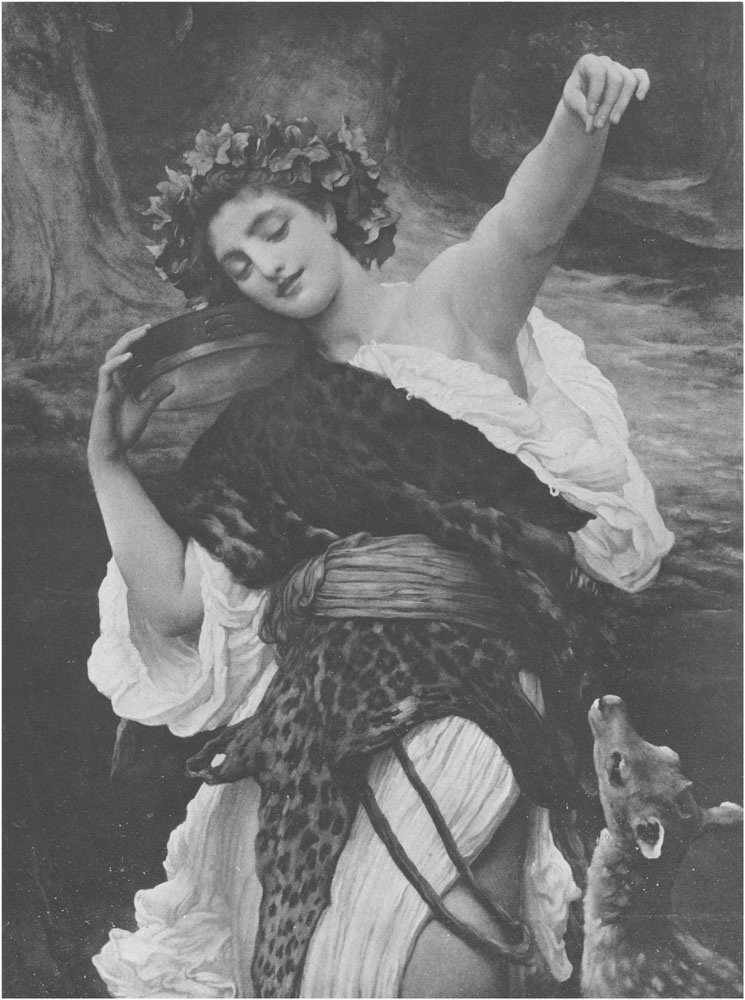
"BACCHANTE." 1892 By permission of Messrs. Henry Graves & Co., the owners of the CopyrightToList
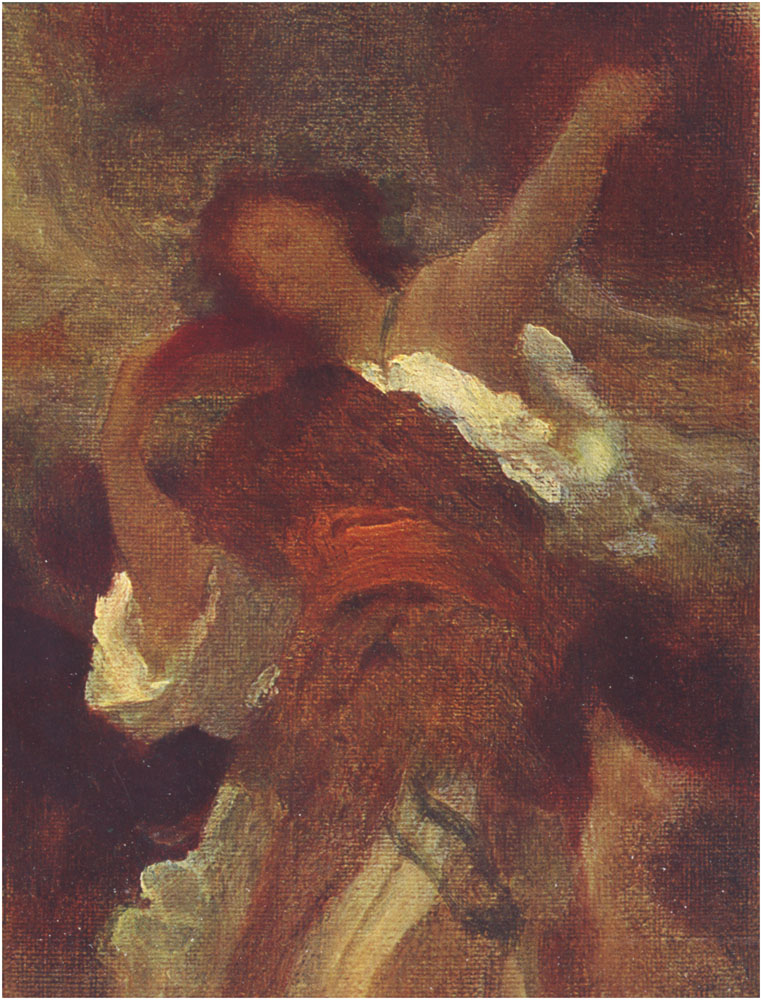
STUDY IN OILS FOR "BACCHANTE." 1892 By permission of Mrs. Stewart HodgsonToList
2 Holland Park Road, Kensington, W., November 2, 1892.
Dear Wells,—Best thanks for your cheque and kind note. You will be glad to hear that the removal is going on capitally. I did not wait for the full money-promise; I had determined to do the thing, and I set it going on my personal guarantee when we were £300 short of the full sum. Now we have the money, young Lehmann munificently sending a cheque for that amount.
The great monument having been moved to its right position, the next question was to raise funds for the completion of the work. This was perplexing Leighton during the last weeks of his life. Having written a letter to the Times in 1895, and the donations having come in but scantily, he was puzzled to know what further steps to take.
Leighton himself, so distinguished a sculptor, took a special interest in all efforts to promote the knowledge and love of plastic art. When, therefore, his old friend Mr. Walter Copland Perry called a meeting at Grosvenor House—at which the late Duke of Westminster presided—to lay before it his scheme for the formation of a gallery of casts from all the best Greek and Roman statues, Leighton was one of the most zealous and active promoters of the scheme.[79]
Leighton was commissioned by the Government to execute the medallion for Queen Victoria's Jubilee in 1887. M. Edouard Lantéri, now Professor of Modelling at the South Kensington schools, assisted him in carrying out the design, and became an ardent admirer of the President. M. Lantéri described to me how certain difficulties occurred in the casting. Leighton said they must work on till these were set right—and they did work eighteen hours on end.
All to whom the work of Watts, Burne-Jones, and Rossetti has appealed, owe Leighton a debt of gratitude. Before the Grosvenor Gallery Exhibition of his work took place in 1882, Watts, in talking to me of the unpopularity of the pictures he felt most inspired to paint, would often give as a proof of this that, with one exception, no one had ever cared to engrave his pictures; and truly, without Mr. Fred Hollyer's photographs the general public would have known little of the special value of this work, nor of the art of Rossetti and Burne-Jones. Mr. Hollyer's photographs are not merely copies—they have as art an atmosphere of charm in themselves; they render what may be called the soul of a picture. He writes:—
"About 1875 I received a letter from Baroness ——, requesting me to call upon her in order to arrange to photograph the collection of works of art in her country house. She had employed other photographers, but the results had not been satisfactory. I carried the matter through, and not only received a considerable amount in remuneration, but was given great encouragement to persevere with my work at a time when I had nearly decided on going to America. The Baroness never mentioned who it was that had recommended me, and though I had been constantly working for him during many years, it was not till six months after his death that I discovered it was Lord Leighton who had been my good friend. I should be glad to bear testimony to his great heart and loving kindness, and do regret not having been able to thank him myself."
Leighton was made a Baronet in 1886. The following letter from Gladstone, written in 1885, refers to Leighton having submitted to him the names of Millais and Watts as artists worthy to receive the honour, at the same time begging him earnestly not to include his own:—
Private.]
10 Downing Street, Whitehall, June 17, 1885.
My dear Sir F. Leighton,—Your letter has given me much pleasure. I can assure you that I in return highly appreciate the generous spirit you have shown, and I value the advice you kindly tendered in this matter of Art Honours. I am reporting rather fully to Her Majesty on our conversation of Monday, and on the personal abnegation on your own part, which commands my cordial respect.—I remain always, very faithfully yours,
W.E. Gladstone.
On Watts declining the honour, Leighton was at first much vexed; but Watts, having explained to him the reason which made it inadvisable for him to accept a baronetcy, Leighton fully, as he told my husband and myself, saw the necessity of his declining.
Since the first years when Leighton settled in London he had been favoured by the personal friendship of many members of the Royal family, who very greatly esteemed him. He not only attended the State banquets and entertainments to which he was summoned, but was frequently the guest at receptions of a private and a more intimate character at Marlborough House and elsewhere.
In these pages there is only space to note a few, among the very many directions in which he served the Art interests of his country. In foreign lands, and in the Colonies no less than in England, he extended the knowledge and appreciation of the best English Art by his unwearying exertions; and yet it must always be remembered he ever remained "a workman first, an official after."
Professor Church, appointed in 1879 to the Professorship of Chemistry in the Royal Academy of Arts in London, has preserved letters and notes from Leighton on the subject of pigments.[80] It is almost incredible that his mind could have penetrated with such accuracy into all the details of his craft as fresh questions arose as to the value of new vehicles and colours, considering his endless labours connected with the wider interests of Art, and the absorbing nature of his own work. But there exist over sixty letters, and more than twenty cards, dating from 1880 to November 1895, two months before his death, in which he proves his insistency to master thoroughly every detail of his craft. He wrote: "It is, I feel, rather a duty in me to ascertain about these various new vehicles."
The following extracts may prove of interest and value to painters.[81]
8th.
Dear Prof. Church,—I write to acknowledge your letter of the 6th, the information in which (Jaune de Naples) is to me of very great importance indeed. I believe Hills to be really anxious to help us in the matter of medium. I should be peculiarly glad if we could send forth a thoroughly trustworthy, hard-drying, supple, and not yellowing vehicle. Let us consider it. I find myself using a mixture, roughly, of equal parts of amber varnish (Roberson's) and oil of spike; and, say, a sixth of the whole of poppy oil (Roberson's): that is, 3/7 amber, 3/7 spike, 1/7 poppy; but I vary according to the work; and again I don't know what Roberson's amber varnish is, it does not seem very drying. Of course one would want a good middle drying power, to which, mixing the ingredients, one might add any one at will. I think that "Siccatif de Haarlem" has about that middle quality, if I remember it rightly. It is, I think, copal, poppy oil, and turps.; but it seemed to me to yellow a little, why, I don't know; poppy should not darken. Chromophile is delightful up to a certain point, and then the work sinks extraordinarily blind and tallowy; and as you want something in the way of varnish at the end, it seems desirable to carry that or some varnish in a moderate degree right through. Chromoph. becomes a little milky in a bottle with spir. of turp., and turns bright green when left in a dipper.
Your proposal to report to us annually is very valuable, and could be worked to the general advantage.
I am delighted to find that you are in co-operation with my friend Mr. Hills, who has a warm and genuine desire to serve Art and his friends the artists. I find his poppy oil clarified with charcoal very delightful stuff. Am I wrong in thinking the action of the charcoal on it has been to render it more drying? I think that a vehicle made with that oil, amber varnish, and oil of spike will be a very satisfactory vehicle indeed; particularly if you can, between you, bleach the oil yet more. Chromophile is quite colourless. The mastic varnish that won't bloom will be a great triumph. Pace our detractors, it shall, I hope, be seen in time that the R.A. is not unmindful of the needs of artists even in the matter of material appliances.
I observe that you speak in your valuable manual of Aureolin as a very slow-drying colour when ground with oil; finding, in use, that Roberson's Aureolin dries, on the contrary, extremely quick—it is always absolutely dry the next day, and I use no vehicle but Bell's Medium, i.e. linseed and oil of spike and turps.—I wrote to ask him what he grinds the colour in. He answers "pure linseed oil without the addition of any drier." This puzzles me. Where is the solution? Are there different kinds of Aureolin? When you have a leisure moment send me a post-card.
Among the madders in your handbook scarlet madder does not appear; I hope it is not a treacherous colour; I use it freely, but only mixture with other dark colours, to give them richness. I also use cadmium red; is that wrong? A line on a post-card will greatly oblige.
P.S.—Of course I only use cadmium red when I want a very deep orange in drapery or sky—nothing could replace it.
Feb. 2, 1885.
Here is a little problem: I thought all burnt colours were ipso facto sound. Roberson tells me that burnt white (Chremnitz do.), a lovely colour like ivory, plays most amazing tricks, darkens and lightens again in rapid succession. WHY? When you are in Long Acre make him show you his samples.
Thanks for your letter. I don't use any particular colours other than those you mentioned in your lectures, although I thought of trying deep yellow madder again; I used to like it very much. I suppose you have the list—it is a very long one—of Edouard's colours. Smith is his agent here (14 Charles Street, Middlesex Hospital). I use one or two colours (Tadema I think all) from Mommen's in Brussels; his burnt sienna is superb. Asphaltum would reward study; it was universally used by the Venetians, and seems never to have cracked with them. I am very glad that you are steadily pursuing your collection of specimens and experiments, which I hope will by degrees become an exhaustive one, and of infinite value to the profession. Grounds, too, will deserve much attention.
Kindly tell me whether there is any harm in putting a thin coat of mastic, softened perhaps with a drop or two of oil, over works finished quite recently but begun a year or more ago? If I understand rightly, cracking is caused by atmospheric action through the back of the canvas, by distension of underlying partially soft paint and, consequent disruption of the upper, harder layer of varnish. If the first painting is a year old, is it not tough enough to resist the atmosphere, and is it not anyhow pretty safe when the canvas is backed?
I suppose "Mutrie yellow" is quite safe alone and mixed with other pigments?
Thanks for your note. Yes, I do like the white oil, but I add copal to it if I want it to be very drying, or mix copal on the palette with a slow-drying colour, say a lake. This, I suppose, is all right; if so, don't trouble to acknowledge this. The oil of orange is delightful on account of its smell, but dries less quickly than turpentine (rectfd. spirit). Is it not always better to have some resin in a picture throughout since it has to be varnished at the end?
April 21, 1888.
I am so much enamoured with the method, so far as vehicle is concerned, which I have used during the last year, that I should like to feel quite certain that it is absolutely safe. I use a "single-primed" canvas, and underpaint with "Bell's medium" and rect. spir. turps., which, under your advice, I have in small bottles, so that using it freely a bottle lasts a very short time, and the stuff is therefore always fresh. The mixture I use up to the end (except when I now and then use the pigment alone), and letting the turps. rather preponderate as I advance. I have found to my amazement that this mixture dries even in winter weather excellently, and that I can use with it even scarlet madder and aureolin, which, at least the former, hitherto I never attempted to use except stiffened with amber or copal; and I further find that this mixture, though of course it "sinks" to some extent (and especially with the blues), in the main bears up very fairly, incomparably better than I should have expected, and in fact quite enough. Before beginning to paint I rub over the part each time with Bell's medium and saliva nearly equal parts, or say five oil to four saliva beaten up with the knife on the palette to a white mucilage. This, if left alone, makes a good varnish, and is delightful to paint into. So far, so good; at least I suppose so. (Do you see any elements of danger? cracking? darkening?) But at the end something must go over it all, if only to lock it up (I suppose), certainly to get uniform gloss and strength. I propose in the Academy to put Roberson's medium over the whole of my large one and to retouch with the same. A portrait on to which I don't intend to work I should cover with mastic and a little poppy oil; there is no harm in this, I suppose, and the small quantity of mastic is not likely to yellow, is it? I know this mixture won't come off, but why should it?
May 30, 1889.
Messrs. Reeves send me a colour in which I delight, but which I have hitherto always avoided as being unsafe, to wit, indigo. I suppose one ought not to use it, ought one? although my old friend, and in some ways my master, Robert Fleury, employed it extensively in underpainting blue draperies.
December 23, 1889.
I have got a recipe—a very simple one—from a friend of mine in Italy, who paints a good deal in distemper, and who in technical matters is quite the most leery person I ever came across. In this recipe he mentions what he calls "Gum Damar," which he, in his characteristic ignorance of spelling (for Italians are not very strong in orthography), writes with an apostrophe, D'Amar. Now I presume he means "Gum Dammar" (I believe there is such a thing, is there not?), but I should like to feel sure. Perhaps you will kindly enlighten me on a post-card.
The distemper itself is the simplest thing in the world. It is only a proportion of water and yolk of egg (he deprecates the use of vinegar), to which he adds a certain number of drops (I have not the recipe by me) of this gum. Of course it would be important not to use the wrong gum. Hence the trouble I am giving you.
January 27, 1890.
I have just received from Perugia the enclosed sample of Gum Dammar, which you were kind enough to say that you would report upon to me. A few drops of this (by-the-bye, I do not know how it is to be dissolved) and the yolk of an egg stirred in water, form the distemper used by my friend Mariani.
I don't know whether I told you that he is rather an interesting fellow. He is one of those extremely dexterous Italian workmen-artists who know and can work in every material, and whose forgeries of sixteenth century bric-à-brac, cassoni, reliefs in pastiglia, &c. &c., have, I am afraid, not infrequently been purchased as original by very crafty persons.
Several friends of mine who use distemper, and he amongst the number, tell me that by putting a preparatory coating of distemper over thoroughly dry oil, you can with perfect safety interpose a layer of painting in distemper between two paintings in oil—an extremely valuable thing for us for recovering quality.
January 31, 1890.
Many thanks for your valuable letter. I have had the information entered in a little book, where I keep the outpourings of your wisdom on matters chemical.
Thanks also for the card, in which you give me a somewhat long name for my Gomme Dammar. I suppose in an appeal to a chemist the first portion would suffice.
February 14, 1890.
Many thanks for your valuable note. I may say in passing that the specimen of "Ruby Madder" sent by Mr. Laurie appears to me to be inferior in brilliancy to both the Rose Madder and the Madder Carmine furnished by Messrs. Roberson; and I have no reason to doubt that the latter colours are perfectly trustworthy.
It will give me great pleasure to receive the dedication of your book, which I look forward to seeing with pleasure, and using with profit.
May 19, 1890.
Many thanks for your note, which seems to open up an interesting point. I gather from what you say that the mode of manufacture of a colour may affect its drying properties over a range extending from drying very slowly to drying very rapidly; and I shall be much interested in hearing what your experiments lead to under this head.
January 30, 1891.
Many thanks for your letter. I see that I had better wait for a final opinion until the few months have expired which you still require as tests of permanence. Meanwhile, I am a little unhappy to see in the case of colour after colour the expression "semi-permanent." I do not quite know what that means. Let me know at your leisure whether it means permanent under certain conditions, and, if so, what; or merely in a general way that the pigment stands, but only pretty well. The Rosso Saturno I quite understand is to be set aside.
Another perplexity is in regard to the Burnt Madder. If the madders are in themselves sound colours, as I have always understood them to be, how do they lose their permanence by burning? I should like to use the Gialetto, and I rather gather from what you say that I may do so. I hear with interest what you tell me of your new varnish. As for myself, I have got to dislike the use of any resins in my work to such an extent that I have completely set them aside. Of course when a picture is finished it requires some gum, not only to protect it, but to bring up the colour to its full value. Will you let me know—but this will do at your leisure, for the time has not come yet—whether a picture being painted as I paint mine, exclusively with Bell's medium and turpentine from first to last, and, I may add, worked on up to the last moment of sending in, i.e. a fortnight later, may on the walls of the Academy be safely varnished with this new material of yours, either alone or diluted with a little poppy oil? I look forward with interest to Heyl's Madder Green.
December 5, 1891.
I shall certainly try the Heyl's Madder Green, which I hear of through you for the first time. Laurie's daffodil cadmium is very pretty. I have got some; but my new delight now is yellow cobalt, which you have found to be absolutely safe, and which is absolutely delightful as a colour.
My tempera is come from Italy, and I am told that it is made of the tails (feelers?) of the cuttle-fish (sepia). Would you like to look at it again from curiosity? I understand that with the reservation that it darkens, I may use it with impunity in, under, and with the oil—that is enough for my purpose.
October 16, 1894.
Will you kindly advise me on the tempera, of which I send a tube? It is used by my friend, Prof. Costa, who gave it me; he likes it vastly. It coalesces with oil; he uses it also by itself between two paintings in oil. I have often longed for something to keep down the greasiness and slipperiness of oil paint when correcting or going over a surface often, oil and water do coalesce sufficiently. The most luminous thing I ever painted (and it has stood like a rock) was painted (or certainly thickly underpainted) with a vehicle made of starch and oil. What this medium is, I don't know. Please advise.
March 7, 1894.
Forgive secretary again.
I am much obliged by your note, and read with great satisfaction what you say about Newman's golden ochre. I shall now, until I hear from you further, adopt the motto "Ex uno disce omnes," and assume that the yellow ochre is equally sound and serviceable; although the colour is so much finer than any yellow ochre of my acquaintance that I cannot quite close my mind to a lurking suspicion that it is stimulated or refreshed by some foreign ingredient.
March 13, 1894.
Many thanks. You send me good tidings. The yellow ochre is by far the finest I have ever seen.
I enclose, because we think (Watts and I) that it will interest you, a specimen of purple lake (not madder), such as Watts has used all his life, which has been baking in the sun for two years; it is slightly browner, but more beautiful than ever, and has, you see, retained its full body; this is remarkable.
June 22, 1894.
Very many thanks for your interesting and exhaustive investigations on the French lakes. I observe that in several cases you mention lakes having cracked. I presume, however, there is no reason to suppose they would do this when embodied with other colours, and that if otherwise safe they might therefore be used. The purple lake used by our friend Watts is furnished to him, I have always understood, by Messrs. Newton of Rathbone Place. I am glad to hear so good an account of the pale boiled linseed oil from May & Baker, Ltd., of Battersea. I do not, however, gather from what you say that there can be any reason for substituting it for Bell's medium, to which I am much attached, and which, as you know, is, with the admixture of one-third rectified essence of turpentine, the only vehicle I use. This note, of course, requires no acknowledgment—anything you may have to say on these various points will abundantly keep until I get a further account of your investigations on the purple lake.
Many thanks for your valuable caution. Amongst the lakes you tried, did you include the garance nuance brun and do. brun foncé? Both are superb colours, and it would be nice to think one might use them. It is very comfortable to feel that one has a conscience one can tune at Shelsley.
April 19, 1894.
I am about now to take up a large decorative painting for the Exchange, a work which cannot be done on the spot on account, inter alia, of the darkness of the place, and will, therefore, be carried out here at the studio on canvas, and then "marouflé" on the wall. Macbeth (A.R.A.), who is also doing one, is using Parris's "Marble medium," in which, a thousand years ago, I painted two figures for mosaic at South Kensington; great brilliancy is obtainable, but I rather fear a certain tendency to look waxy and almost shiny. I myself incline to use Gambier Parry's material, which I have used on the wall at South Kensington and greatly like. But now the question arises, ought the canvas to be prepared? and on this I shall be grateful for your opinion, as the matter is very important. G. Parry told me that canvas either could or should be prepared for his medium, I don't remember which. Roberson's man tells me that Madox Brown and Fredk. Shields (I think) both had canvases prepared for a similar purpose. I shall postpone ordering mine till I have your instructions; till when, and always, I am, in much haste.
April 23, 1894.
Many thanks for your letter. I shall, of course, obey your instructions punctually, and substitute paraffin wax for the ordinary Brecknell and Turner beeswax, as prescribed by Parry himself. I will see Roberson immediately, for I should not think it right, as he ground the colours and prepared the medium throughout for my two large frescoes at South Kensington, to abandon him in favour of Laurie, or anybody else.
You suggest that I should make a little experiment on a small canvas. Do you think that would be necessary? I presume that the material will work exactly as it did before, and that the surface will be—bar the granulation—very much the same as on a wall. I ask this question, because I ought to get to work immediately, and I gather from a reference to your work that it will take several weeks before the process of preparation is complete.
I wish I could throw light for you on the verb "maroufler," and should like to know what subterranean connection there is, or can be, between it and the word "maroufle" which is, as you say, being interpreted, a "rascal."
At all events, when the moment comes for the operation, I must endeavour to obtain information from France, where the process is in very frequent use.
February 27, 1895.
A contretemps has occurred of which I think I ought to inform you, as it relates to the very interesting subject of grounds and pigments.
Robersons, when they came to roll up my fresco to transport it to the Exchange, found that either the ground or the pigment—probably both, as they are of the same substance—was extremely brittle and cracked right across, cracking at a rather abrupt tangent from the circumference of the circle; so that they immediately struck work, and declined to go any further.
As far as the painting itself is concerned, I do not believe that any serious damage is done, because on re-straining it flat, the cracks are barely perceptible, and probably would not be at all perceptible in situ.
Meanwhile, if any question arises as to the ground, it has occurred to me, and it is on this point I wish to consult you, that the cause may be the substitution of paraffin wax for the ordinary wax hitherto used in Gambier Parry's material, which, though perhaps not absolutely so durable as paraffin, is sufficiently so, and very malleable. One does not see what else could have cracked in that abrupt and sharp manner—certainly not the copal, which has oil in it and is further made supple by the oil of spike. If it turned out that the paraffin was the peccant element, I should be, entre nous, rather glad, because it diminished the facility of the work.
With reference to the cracking of this work Professor Church writes:—
This unrolling was begun in very cold weather; if the temperature had been a little higher, nothing of this kind would have taken place. The picture now shows no sign of defect or injury, and is in perfect condition. By substituting ceresin, a paraffin obtained from ozokerite or earthwax, for crystalline paraffin, the chance of cracking is obviated. The ceresin, which should have a melting-point of 150° or 160° Fahrenheit, constitutes a safe substitute for the beeswax commonly employed in Gambier Parry's Spirit Fresco Medium.
Foggia, October 15, 1895.
You will be surprised to get a letter from me with an Italian superscription; I am writing thus early before my return to save time. When I was in Venice the other day, Van Haanen spoke to me, with approval, of a certain vehicle, of which I had already heard before vaguely, the invention of the French painter, Vibert. You probably know of it, as the subject of media has occupied you. There are, it appears, three forms of this medium: the vehicle for painting, the medium for painting into in retouching, and the final varnish. As far as I understood Van Haanen in a hurried conversation—he was a little vague—the painting medium contains no gum, only, he seemed to think, petroleum and oil; I assume that in the final "vernis" there is gum of some kind.
I am perfectly satisfied with Bell's medium and fresh turpentine for the very little use I make of vehicle in painting; but there is always the difficulty of the final varnish in the Academy. I don't like risking mastic or copal so soon on work which contains nothing but oil (and if I ever do use a little, I put poppy oil with it), and the result is that I generally varnish with Roberson's medium, which is safe, but I fear a little inclined to yellow in time.
Now what I want you kindly to tell me, my dear Church, is the exact composition of the three Vibert media, and your opinion about the safety of using all three in the prescribed order; and this I should like to know on my return at the beginning of November (hence my haste in writing), and also whether I can safely use these vehicles on work begun in my usual medium.
It is just possible you may not have heard of the Vibert vehicles; if so, I would ask you to be so kind as to obtain (of course at my expense) a bottle of each of the mixtures and to test them carefully.
A line to say this has reached you would find me at the Hôtel Royal Mazzeri, Via 20 Settembre, Rome.
With kind regards and anticipated thanks.
Hôtel Royal Mazzeri, Rome, October 22, 1895.
Many thanks for your prompt and amiable answer. I shall be interested to hear on my return the upshot of your analysis; but I hate vernis in painting, as Bocchini tells us the Venetians did, comme la peste.
I am very glad you are getting on so satisfactorily with your work on the frescoes.
In haste (for I have many letters before me).
P.S.—No; I am sorry to say I am no better of my special ailment though my general condition is good.
2 Holland Park Road, Kensington, W., November 8, 1895.
Excuse the hand of my secretary.
Many thanks for your note about Vibert's varnishes, which I shall accordingly dismiss from my mind—the varnishes, I mean, not your note.
One chapter in which is revealed Leighton's serious inner life closed during the years he was President. The last letter which has been preserved from his beloved master, Steinle, is dated 22nd November 1883, Frankfurt:—
Dear Friend,—Yesterday evening I received your letter from Florence, and answer at once, partly to tell you how delighted I am at the result of the consultation with Quarfe, as also at your comfort and well-being, and partly because this part of your letter has greatly roused my curiosity for a second, which shall also tell me something about Vienna, Verona, and Florence. At the same time, however, I want to make use of a pause in my work to tell you that the first three coloured contours are completed. To the painting I dedicated all my small skill, and would have died in order to secure that the drawing and composition should produce a life-like effect; I believe also that these pictures will look like frescoes in their surroundings.
Some time after this Leighton wrote to Mrs. Pattison the following letter, which proves that to the end he retained his great affection for Eduard von Steinle. This friend and master died in 1886, but whether Leighton made this inquiry before or after that date I do not know, as his letter is not dated:—
Dear Mrs. Pattison,—I saw a paragraph not long ago in the Academy which concerned me deeply; it did not say, but it implied that my dear old friend and master, Ed. Steinle (professor at Frankfurt a/M) is dead. Did you by chance write the note? and do you know when or how he died, if he be indeed dead? His wife has not written to me. I am anxious to have some certainty in the matter.
(Influenced) "—for good far beyond all others by Steinle, a noble-minded, single-hearted artist, s'il en fut ... Steinle's is the indelible seal." In making any estimate of Leighton's character these words should ever be remembered. They prove how deeply rooted were those feelings on which his principles were grafted. These words were no mere outlet for youthful enthusiasm and affection, but were noted with reference to an account of his life about to be written for publication; therefore we may consider them to be a deliberate statement made for a purpose, when he had reached the zenith of his fame and was already President of the Academy. The design by Steinle here produced, called Der Winter, in which the artist has drawn his own portrait when old, throws a light on the mind and nature of Leighton's master, whose influence on him for good was greater "far beyond all others."
Written on the drawing are these lines, penned by Steinle:—
Giunto è gia 'l corso della vita mia, Che tempestoso mar per fragil barca Al comun porto ov 'a render si varca Giunto ragion d'ogni opera trista e pia. Indi l'affettuosa fantasia Che l'arte si fece idola e monarca Conosco ben quant 'era d'error carca Ch' errore è ciò che l'uom quaggiù desia. . . . . . . . . I pensier miei già de' miei danni lieti Che fian se s'a due morti m'avvicino L'una m' è certa, l'altra mi minaccia? . . . . . . . . Ne pinger ne scolpir fin più che queti L'anima volta a quell' amor divino Ch'aperse a prender noi in croce le braccia.
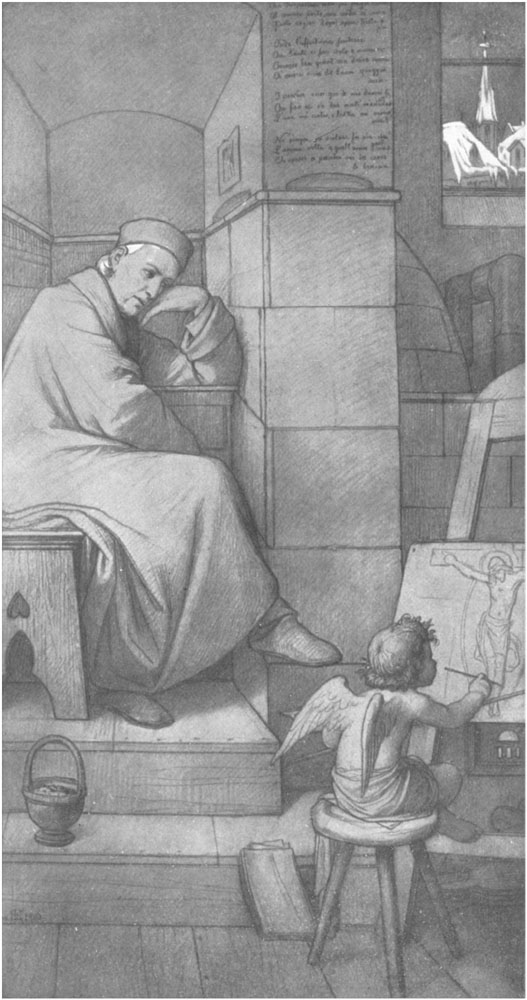
"DER WINTER" Drawing by Eduard von SteinleToList
No other member of Leighton's family was ever known to have been an artist, and neither his parents nor his sisters pretended to any knowledge of painting; but respecting literature he had an interest in common with both his sisters, also a very strong sympathy existed between Mrs. Matthews and Leighton in their love for music. In answer to a letter from Mrs. Orr relating to Mr. Augustine Birrell's well-known book, Leighton wrote, "I have read 'Obiter Dicta,' and am much charmed with its delicate humour and ease of its style. I thought 'Truth Seekers' charmingly written." With reference, however, to the Browning chapter he continues:—
Browning's obscurity hides a shorthand of which he keeps the key in his pocket. A matter of form, not of matter, as "O.D." hath it. Browning is not abstruse; he is a deep thinker, who therefore (vide "O.D.") requires obscure language; he is a most ingenious dialectician and a subtle analyst; but he is not a great poet on that account—he is a great poet because of his magnificent central heat, and the surface of interests over which he sheds it. All this is rather late in the day to remark, and one would not be exasperated by his friends if one had not a sort of feeling that they have done something to mar him. You say he would not be obscure if he knew it?—distinguons. His obscurity is not intentional—of course—it is inherent in a style which is strongly personal, and therefore sincere—but is it in no degree wilful?—does he not accept, virtually, some such (absolutely false) view of his obscurity as "O.D.'s"? A pity it certainly is; Browning is the last man who in his heart wishes to touch only the few—nobody knows better than he does that that is not the characteristic of the greatest poets, and that not for that is a poet's soul kindled to a white heat. Meanwhile, here is the fact that men of average culture and average brains (I claim both, for an example), and desirous of understanding, as well as full of admiration for his powers, often get at his meaning only by considerable effort, and sometimes not at all, and that not because the thought is obscure, but because it is wilfully written in cypher.
The following letter to a friend of his sister's contains a criticism of Leighton's on Goethe's Sprüche under the head of "Kunst":—
Private.]
2 Holland Park Road, Kensington, W., 17/8/91.
Dear Mr. Bailey Saunders,—Complying with your wish, expressed through my sister, Mrs. Orr, I have gone carefully through the Sprüche under the head "Kunst," and have marked certain passages. I have, however, deferred writing till the last moment (I am starting presently for the Continent), partly because I have been overwhelmingly busy, and partly because I am a good deal "exercised" on the whole matter. To speak with entire frankness, I cannot feel sympathy with the idea of the publication, and feel that the connection of my name with it would imply an adhesion which does not exist. On re-reading more than once the maxims and sayings in question, which I had not seen for many years, I find myself confirmed in my earlier impression of them, that their value is in no way commensurate to the authority of Goethe's great name. Some of them are, in my opinion, wholly misleading and some obscure; some commonplace, some irrelevant to the subject. Again, my markings do not by any means always mean assent; and, on the other hand, the discrimination between the value of a marked paragraph is often a nice one, and is not represented by the difference between selection and omission, which, on the face of it, seems assent and dissent. In sum, I ask myself what the outcome is—what is the selection? it does not give to the world an important or instructive intellectual possession; it seems to express the selection of the best by a particular individual (who does not spontaneously desire to make such selections), and in reality does not represent anything that he assents to throughout.
But why a selection at all? I cannot refrain from asking myself. The interest of these particular Sprüche lies in the fact that they are utterances of Goethe's (and he gave them with a context)—but then what is the meaning of a selection?
You see I speak very bluntly in the matter, but also sincerely; and I have at all events shown my good will.—In much haste, yours faithfully,
Fred Leighton.
I am, as I said, just off, but if you wished especially to communicate with me, a line sent here would reach me after some delay.
Though Leighton persisted in affirming that he hardly ever read, the number of letters, and answers to letters from scholars, referring to poems and general literature, which exist in the correspondence he preserved, prove that if he did not read he nevertheless somehow got a knowledge of the inside of books. To a question having reference to the Nine Muses (he was then painting his frieze "Music") which he asked Swinburne, he received the answer:—
The Pines, Putney Hill, S.W., August 21, 1885.
Dear Leighton,—I doubt very much whether Shelley himself could have answered your question to your satisfaction. His scholarship was that of a clever but idle boy in the upper forms of a public school. His translation from Plato, as Mr. Jowett tells me, and his translation from Euripides, as I know by personal experiment, having carefully collated it with the original text, absolutely swarm with blunders, sometimes, certainly, resulting in sheer nonsense. I fancy he may have been thinking of Aphrodite Urania, and perhaps confounding (as indeed it seems to me that a Greek poet might possibly and pardonably have done) the goddess of divine love with the Muse who was not the Muse of astronomy when she first made her appearance in the Theogony of Hesiod, but simply the "heavenly one" in a general way, as I gather from a reference to the lexicon. I should have thought Calliope or Euterpe a fitter head mourner for Keats: but probably Shelley wished to introduce the most distinguished in the rank of the Muses in that capacity, on such an occasion. And if Urania was in a certain sense the chief of the Nine, she would naturally be most musical of mourners.—Ever yours sincerely,
A.C. Swinburne.
As years went on, Leighton became more and more enamoured of the beauty to be found in our own islands, and longed, as can be traced in his letters, that his sisters should share with him his intense love of nature.
To his elder sister, who was in Yorkshire, he wrote in 1887:—
"A broad shoulder of moor, lifted against a great field of sky, is one of the grandest and most pathetic things in nature (see Leopardi). The beauty of moorland is that it has a particular poetry and impressiveness for every condition of atmosphere and weather."
Again:—
"I am very glad you like Ilkley so much—moors have an immense fascination for me, but all English scenery of whatever kind has charm for me. It has two immense virtues: first, being entirely of its own kind, it never suggests a, to itself, disparaging comparison with the scenery of any other country, and secondly, it is steeped, every fold and nook of it, in English poetry, and is haunted with the murmur of the prettiest of peace-suggesting words: home. I wonder whether you both feel as I do the endearing quality in our old green-brown country."
It became his habit, in these later years, to visit Scotland in September before flying off to his second home. More and more did he realise the marvellous beauty of the scenery there. He told me, shortly before he died, that the most beautiful vision he had ever beheld on earth was the one he saw when approaching Skye by sea from the south, when the sun was setting and illuminating the range of the Cuillin Hills with magic light and colour. He wrote to his father from:—
The Highland Railway Company's Station Hotel, Inverness.
Accurately the charmingness of Scotland, it is the starting-point for everything. But I observe that at the rate of writing I should fill a volume before I had given you the hastiest account of my journey, so I will e'en cut it short and simply say that, taking it altogether, my too brief stay in the Highlands has been a source of very great enjoyment to me, if not of any particular benefit to my health, for which indeed it has been too short. I have had more than the usual proportion of fine weather, and am corroborated in my old opinion that for beauty of colouring nothing north of the Alps will compare with this most lovely country, and that the wealth and variety of effects of light and shade is altogether unrivalled. Unfortunately, working here is very difficult, all the effects are so bafflingly fugitive; nevertheless, I have made three little sketches which, though hasty, will be of value if only to revive my recollections of the effects they very feebly render; they were all done in one day; and no one day since I did them has been such as to make sketching possible—except this the last and one of the most enchanting, which I have spent delightfully but fruitlessly on the top of a coach.
From Gressoney, St. Jean, September 1, 1891, he wrote to Mrs. Matthews:—
Many thanks for your letter received last night; as it crossed one from me to the Dad, which I hope he could read (it was writ large), I should not write again at once (having, of course, nothing to say—except that it is, pour changer, a splendid afternoon, and I ought to be out of doors) but that I want you at once to tell the poor old Dad how concerned and sorry I am to hear that he has been so ailing, and ailing so long, and how I wonder at his superb power of recuperation. I don't ask in this letter how the Dad is, because I am sure he will send me a line in answer to my note to him. But I have another reason for writing at once; I want you, please, to thank Lina with best love, for her nice long letter (she does not want a letter written from here), and tell her, before it is too late, that I hope she won't give up her Ballater without a very full trial, because I know that it takes many people a considerable time to get acclimatised to that bracing air. Tell her also that I was myself going to suggest an Ausflug to Braemar; if she goes to the Invercauld Arms let her use my name, and she will be well treated. I should peculiarly like her to see the Lynn of Dee—she will only have to scramble five or six yards off the main road to look down into the stream from under some of the grandest old Scotch firs in Scotland; and I verily believe that the watching for a silent bit of those dark, dark, seemingly bottomless, noiselessly swirling pools, tiny as they are under the hollow grey craig, will, somehow, whisper a big peace and a strange wondering fascination into her being; the whole thing is not bigger than an expensive toy, but it lays a never-failing grip on me.[82]—Affectionate brother,
Fred.
To Mrs. Orr when in Scotland:—
August 22, 1891.
If you can manage it go to a favourite haunt of mine, the Lynn of Dee, quite a tiny tumble of green waters in fantastically scooped grey rocks, no higher than a cottage, under astounding old Scotch firs (by-the-bye the grandest tree in the world to my thinking), where I have sat interminably long looking down into the dark deep pools, from which now and then a salmon leaps. To me no spot about there is so fascinating.
Grand Hotel, Brufani, Perugia, October 3, 1891.
Dear Lina,—Well, I am glad you got to the Lynn of Dee, though sorry that you could not be there in solitude and see it without sitting in a pool of water. I am glad, too, that you saw the salmon leap; I did not mention that most exciting spectacle because it is not by any means always on view—you were in luck; but what you must make for another time is the bit three or four yards below the fall where the vehemence of the winter torrent has scooped and worn pools so deep that as your eye is drawn down past half-hidden submerged rocky shapes you come at last to absolute dark brown night, and whilst you are conscious of a rapid, swirling current, no sound, no faintest gurgle even, reaches your ear; the silent mystery of it all absolutely invades and possesses you; that is what I faintly tried to put into my "Solitude," of which a photogravure embellishes your staircase. I am vexed that you had so much rain; however, you had a few fine glimpses, and if a rainy day in Scotland is like the Scotch Sawbath, a fine one throws you the gates of Heaven. It is curious how much clearer the air is (when clear) than we get it south of the Tweed.
I am glad that the Dad has rallied so satisfactorily; tell him, with my love, that I have heard from the gentleman in Copenhagen for whom I carved the marble "Athlete." He is benighted enough to say that in his opinion it is one of the most important statues of modern times; and he wants my bust, if there is one, for his collection of portraits.
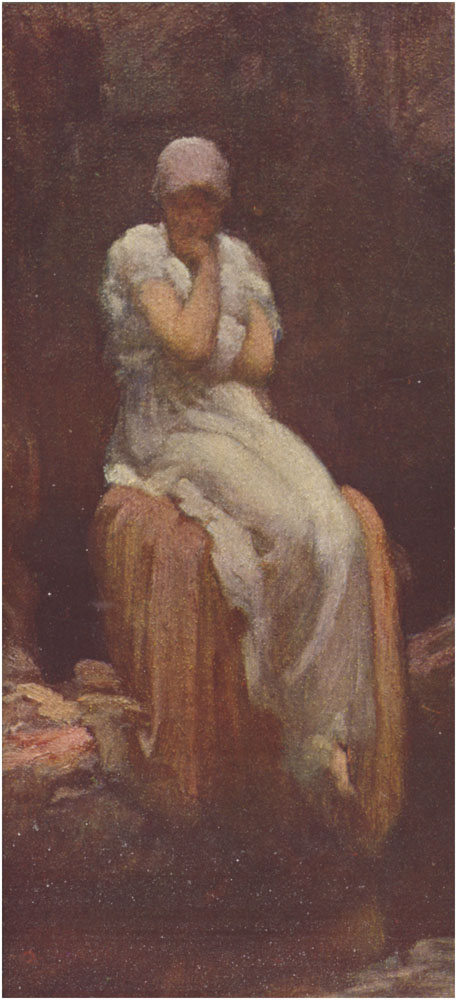
STUDY IN COLOUR FOR "SOLITUDE." 1890 By permission of Mrs. Stewart HodgsonToList
Leighton also particularly desired that his sister should see Malinmore, County Donegal, when visiting Ireland. He wrote from Kensington, "I am bent on your seeing Malinmore."
And again, from Scotland:—
Inverness, September 13.
Dear Lina,—I can't help feeling a good deal of responsibility about the melancholy, treeless wilds to which I have sent you, because I happen to like them vastly; and I particularly feel that everything will turn on your seeing, not indeed all or nearly all I saw—that is impossible—but as much as your strength will allow; take your courage, therefore, in one hand, your goloshes in another, and your umbrella in a third, and from the car—abseits—see the whole coast-line close to the rocks overlooking the sea; there is not an inch that won't reward you. There is a bit not more than half a mile from Malinmore (to'ards Malinhead), that is, though small, quite Dantesque in its grim blackness (a few wet feet im Nothfall won't hurt you). Of course, to do this well you must be in cars every day to take you in all directions to the point from which to make your Abstecher—sometimes towards Glencolumskill and the Hog's Back beyond (magnificent), sometimes towards Malinhead, where you must see every little bay, including the Silver Strand.
At first sight the breaking up of the weather is a bore, mit Seitenblick auf Ihnen—but is not as bad as it seems; bad (dirty) weather suits these parts, and the day will not dawn in which I shall have forgotten certain dramatic sunsets and the swooping of certain storm-clouds like the flight of huge fiery birds of prey, more than once witnessed and deposed to on canvas by me, over this treeless tract of moor.