Umi, the Peasant Prince of Hawaii.
Reading edition
CHARACTERS.
Kiha, king of Hawaii.
Ika, chief of a band of demi-demons.
Puapua-lenalena, a demon dog.
Liloa, afterwards king of Hawaii.
Pinea, wife of Liloa.
Hakau, son and successor of Liloa.
Kapukini, daughter of Liloa.
Akahia-kuleana, a peasant girl loved by Liloa.
Umi, son of Akahia-kuleana.
Maakao, husband of Akahia-kuleana.
Kukulani, wife of Hakau.
Kulamea, the betrothed of Umi.
Maukaleoleo, the giant friend of Umi.
Laeanui, the high-priest of Hawaii.
Kaoleioko, a warrior-priest.
Nuna and priests of Waipio. Kalohe,

Omaukamau, brother of Kulamea, and lieutenants of Umi. Piimaiwaa,
UMI, THE PEASANT PRINCE OF HAWAII.
THE HISTORIC LEGENDS OF LILOA, HAKAU, AND THE “KIHA-PU.”
I.
Nowhere on the island of Hawaii do the palms grow taller than in the valleys of Waipio, and nowhere is the foliage greener, for every month in the year they are refreshed with rains, and almost hourly cooled in the shadows of passing clouds.
And sweet are the waters that sing through the valleys of Waipio. They are fed by the tears of the trade-winds gathered in the shaded gorges of the mountains where they find their source, and are speeded to the ocean by hurrying and impatient cascades through black channels fretted with bowlders and fringed with everlasting green.
Tradition says the waters of Waipio, after their first descent from the hills, at one time crawled quite sluggishly to the sea; but a great fish—larger than the island of Kaula—whose home was in the depths off the coast of Hamakua, required more fresh water than was furnished by the principal stream of the valley, and Kane, who was friendly with the monster, increased the volume of the little river by creating new springs at its sources, and accelerating the flow by raising the bed in places and providing additional riffles and cascades. The great fish no longer frequents that part of the coast of Hamakua, but the cascades and riffles remain, with the broad finger-marks of Kane upon the rocks hurled into the gorge to create them.
Although but thinly populated now, Waipio was for many generations in the past a place of great political and social importance, and the tabus of its great temple were the most sacred in all Hawaii. For two hundred years or more it was the residence of the kings of that island, and was the scene of royal pageants, priestly power and knightly adventure, as well as of many sanguinary battles.
Waipio valley was first occupied as a royal residence by Kahaimoelea, near the middle or close of the thirteenth century, and so continued until after the death of Liloa, about the end of the fifteenth century. For some reason not clearly stated the successor of Liloa removed his court from Waipio to the opposite coast of the island. Although the glory of the old capital departed with its abandonment as the royal residence, the tabus of its great temple of Paakalani continued to command supreme respect until as late as 1791, when the heiau was destroyed, with all its sacred symbols and royal associations, by the confederated forces of Maui and Kauai in their war with Kamehameha I.
Although the story about to be related opens in the reign of Liloa, which closed with his death in about 1485, it is pertinent to refer, as briefly as the strange circumstances of the time will permit, to the father of that sovereign—the great Kiha—concerning whose career many curious traditions survive. The reign of Kiha was long and peaceful. He was endowed not only with marked abilities as a ruler, but with unusual physical strength and skill in the use of arms. In addition to these natural advantages and accomplishments, which gave him the respect and fear of his subjects, it was popularly believed that he possessed supernatural resources, and could call to his aid, in an emergency, weird forces in opposition to which mere human endeavor would be weak and fruitless. Under the circumstances, it is not strange that the chiefs of the neighboring islands deemed it prudent to court his friendship, and that no great wars distracted the kingdom during his reign.
Among the means at the command of Kiha for summoning to his assistance the invisible forces subject to his call, the most potential was a curious war-trumpet, the notes of which, when blown by Kiha, could be heard a distance of ten miles, even from Waipio to Waimea. According to the character of the blast, its voice was either a summons to unseen powers, a rallying-cry to the people, or a dreadful challenge to battle. This trumpet was a large sea-shell. It was a native of foreign waters, and another like it could not be found in the Hawaiian group. It was ornamented with rows of the teeth of distinguished chiefs slain in battle, and could be so blown as to bring forth the dying groans or battle cries of all of them in dreadful diapason.
Many legends are related of the manner in which Kiha became possessed of this marvellous shell, but the most probable explanation is that it was brought from some one of the Samoan or Society Islands three or four centuries before, and had been retained in the reigning family of Hawaii as a charm against certain evils. In the hands of the crafty Kiha, however, it developed new powers and became an object of awe in the royal household. Whatever may have been the beneficent or diabolic virtues of this shell-clarion of Kiha—of the Kiha-pu, as it is called—its existence, at least, was a reality, since it is to-day one of the attractions of the Royal Hawaiian Museum of Honolulu, brought down by the Kamehameha branch of the Kiha line. When vigorously blown it still responds in sonorous voice, suggestive of the roar of breakers around the jutting cliffs of Hamakua; but Lono no longer heeds the mandate of its call, and brown-armed warriors come no more at its bidding. Of the many strange stories still retained of the Kiha-pu, one is here given, nearly in the language in which it has come down in Hawaiian chant and song. a story of the kiha-pu.
For a period of eight years, during the reign of Kiha, the Kiha-pu was missing from the cabinet of royal charms and treasures. A new temple was to be dedicated to Lono, not far from Waipio, and feathers of the mamo, oo and other birds were required to weave into royal mantles and redecorate Kaili and other gods of the king’s household. But one of the Kahu alii, constituting the five classes of guardians of the royal person, was permitted to touch the Kiha-pu, nor did any other know of its depository in the king’s chamber. His name was Hiolo. He was the son of a distinguished chief, and his office was that of ipukuha, or spittoon-bearer—a position of peculiar responsibility, which could be filled only by persons of noble blood and undoubted attachment to their sovereign.
Desirous of hastily assembling and despatching to the neighboring sea-shores and mountains a large party of feather-hunters, the king, reclining in the shade of the palms in front of the royal mansion, commanded Hiolo to bring to him the Kiha-pu, that he might with a single blast summon his subjects throughout the valleys of Waipio. Hiolo proceeded to the chamber of the king, and a few minutes after returned pale and speechless, and threw himself at the feet of Kiha, tearing his hair, lacerating his flesh with his nails, and exhibiting other evidences of extreme agony and desperation.
Nothing ever startled a sovereign of the line of Pili. Under all circumstances he acted with apparent deliberation. It was a natural trait, strengthened by example and education.
Kiha calmly regarded his ipukuha for a moment, and then said:
“What spirit of evil possesses you? Rise, Hiolo, and speak!”
Hiolo rose to his feet, and, with a look of despair, exclaimed:
“It is no fault of mine; but tear out the tongue that tells you the Kiha-pu is gone!”
Without replying, the king, with a terrible scowl upon his face, rose and strode into his chamber. Parting the curtains of kapa which secluded the back portion of the apartment, he stepped to an elaborately carved and ornamented ipu, a container shaped and hollowed from the trunk of a koa tree. He found the vessel open, and beside it on the matted floor the several folds of kapa in which the Kiha-pu had been wrapped; but instead of the sacred trumpet he discovered at the bottom of the ipu a hideously-carved head and face of stone. The shell had been adroitly abstracted, but the image that had been left in its place saved the life of Hiolo, for by it Kiha discerned that the theft and substitution had been achieved through supernatural agencies.
The loss of the Kiha-pu was a great grief to the king. But he did not deem it prudent to admit that he no longer possessed the sacred talisman, and therefore announced to Hiolo that the trumpet had been found. Under the pretence that it had been carelessly misplaced by Hiolo, Kiha declared that he would be its sole guardian thereafter.
There was great joy at the court when it was learned from the lips of the king that the Kiha-pu had been found; yet it was observed that it was not used to summon the feather-hunters, and after the sun went down that evening many thought they faintly heard the music of its voice coming in from the sea. And the king detected the familiar sound, and, fearful that others might hear it as well, called together his poets and hula dancers, and permitted their boisterous merriment far into the night.
Early in the evening, while the palace grounds were a scene of revelry, the king repaired alone to the great temple of Paakalani, not far from the royal mansion, to consult with the high-priest and put in motion the weird forces of the heiau for the recovery of the Kiha-pu. He took with him the image left in the ipu, as a possible means of assistance, and enjoined a solemn secrecy upon every kahuna taken into the confidence of the high-priest.
The most noted kilos, seers and prophets of the temple were ordered to apply their arts, and a kaula, inspired by incantation, was questioned from within the anu of the inner sanctuary. The clouds were noted, the flights of birds observed, and the dreams of drugged priests interpreted, but nothing satisfactory was developed. Prayers were offered to the gods, sacrifices were laid upon the altar, and the vitals of freshly-slain pigs and fowls were carefully examined; but the only information obtained was that the Kiha-pu had been stolen by the chief of a band of demi-demons, or human beings controlled by evil spirits; that it was no longer on the island of Hawaii, but somewhere on the ocean beyond the eight Hawaiian seas; that it would one day be recovered by a being without hands and wearing neither mantle nor maro, but not until a cocoa-tree, planted in the next full of the moon, should yield its first fruit, to be eaten by the king.
So far as concerned the theft of the Kiha-pu, the seers of the temple had spoken correctly. For some months a dense forest in the mountains back of Waipio, interspersed with marshes and patches of rank undergrowth, had been inhabited by a small band of wild-looking men, who boldly helped themselves to the pigs, fowls and fruits of the neighboring farmers, and held noisy festivals almost nightly within the gloomy recesses of their mountain retreat. They were said to be only half-human, and capable of assuming other than their natural forms. They had occasionally visited Waipio in parties of from two to five, and entertained the people by telling fortunes and exhibiting strange feats of posturing and legerdemain. In the guise of an old woman the chief of the band had entered the royal mansion and stolen the Kiha-pu, leaving in its place the hideous stone image mentioned; then, as if the object of their stay near Waipio had been attained, the entire band embarked the evening of the next day in stolen canoes for Kauai. When safely off the coast of Hamakua the demon-chief had defiantly wound a blast from the Kiha-pu, which the king had sought to drown in the tumult of the hula.
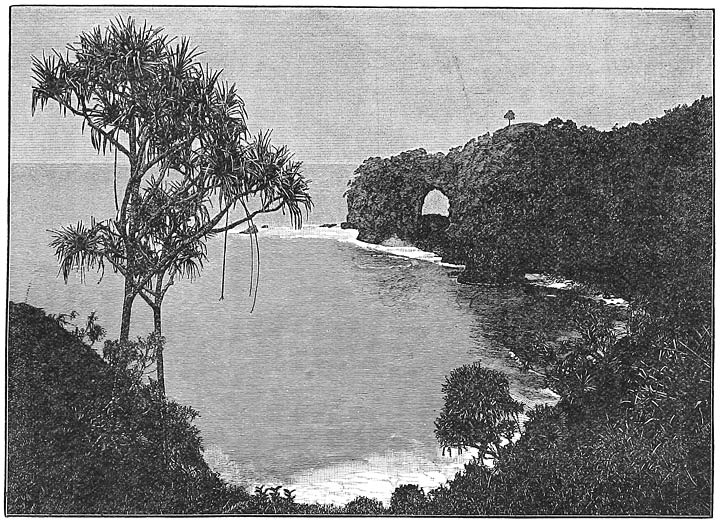
Type of Scenery.
Kiha departed gloomily from the temple. The loss of the sacred trumpet afflicted him sorely. It had long been an heirloom in the royal family of Hawaii, and its powers had been increased during his reign. In obedience to the revelation of a kaula of great sanctity, he had secretly deposited it in a cave near the summit of Mauna Kea and retired to a valley below. Near the middle of the following night a sound unearthly and terrible came echoing down the mountain-side, followed by a hurricane which uprooted trees and tore great rocks from their fastenings and hurled them into the gorges below. The earth trembled as if a volcano was about to burst forth, and a ruddy light hung about the summit. The sound ceased, the wind fell to a whisper, and Kiha rose to his feet in the darkness and said: “It is well. The great Lono has kept faith. He has blown the sacred trumpet, and henceforth it will have the voice of a god!” The next morning he repaired to the cave, and found the shell, not where he had left it, but on the top of a huge rock with which the entrance had been for ever closed. He raised the trumpet to his lips, and such sound as his heart desired came forth at the bidding of his breath. He breathed a simple call to his subjects, and it was heard the distance of a day’s journey. He gave a battle-blast, and his ears were stunned with the mingled cries and groans of conflict. He ventured an appeal to the unseen, and to a weird music around him rose gnomes, fairies and grinning monsters. He returned elated to the palace, and more and more, as its strange voices were heard, did the Kiha-pu become an object of awe and wonder.
Although he took every possible precaution to keep from the people all knowledge of the loss of the Kiha-pu, the king had little faith in the assurances of the seers of the great temple that it would in time be recovered. The conditions of its recovery were too vague, distant and unsatisfactory to be entitled to serious consideration. However, within a few days, with his own hands he planted a cocoa-tree near the door of his chamber, and had a strong fence placed around it. He visited the spot daily and saw that the ground was kept moist, and in due time a healthy shoot came forth to reward his watchfulness. The members of the royal household wondered at the interest taken by the king in a simple cocoa sprout; but when it was intimated that he was making a new experiment in planting, his care of the little tree ceased to attract remark.
And now, while the king is anxiously watching the growth of his cocoa-tree, and carefully guarding it from accident and blight, let us follow the travels of the Kiha-pu. Instead of sailing for Kauai through the island channels, the band of demi-demons took a northwest course, intending to reach their destination without touching at any intermediate point. The powers of the Kiha-pu were known to them, and their chief amused himself and his graceless companions by testing its virtues. When off the coast of Maui a blast of the trumpet brought near Ukanipo, a terrible shark-god, sent by Kuula, the powerful but exacting god of the fishermen of that island. On a jutting headland could be seen a heiau dedicated to him and his wife, Hina. Hundreds of sharks followed in the train of Ukanipo. They surrounded the canoes and lashed the sea into foam. Separating, they formed a great circle around the little fleet, and, swiftly approaching, drove a school of flying-fish across the canoes, many striking the sails and falling into the open boats and thus providing an opportune supply of favorite food.
Sighting Molokai, they thought of landing to replenish their water-calabashes; but as the coast was rugged and the wind unfavorable, a blast of the trumpet was blown to Kuluiau, the goddess of rain. Instantly there was a commotion in the heavens. Black clouds began to gather around them, and they had barely time to arrange their kapa sheds and funnels before the rain poured down in torrents and filled their calabashes to overflowing.
Believing the Kiha-pu would bring them anything they desired, and returning thanks for nothing received, when off the northern coast of Molokai, near Kaulapapa, they sounded a call to Laamaomao, god of the winds, who since the days of Moikeha, more than two centuries before, had occupied a cave on that island. Enraged at an appeal for favoring winds from such a source, Laamaomao opened the mouth of the ipu in which he kept the winds imprisoned, and turned it toward the sea. A few minutes after a hot, fierce hurricane struck the canoes of the miscreants, upsetting two of them and tearing their sails in tatters. The chief had sufficient presence of mind to call through the trumpet for Maikahulipu, the god who assists in righting upset canoes, and the foundered boats were soon restored to their proper positions and partially freed from water. But there was no abatement in the violence of the wind. For more than a day and a night the canoes were driven before it almost with the speed of a shark, until finally their drenched and wearied occupants heard before them through the darkness the sound of breakers against a rock-bound shore. The danger was imminent, for paddles were useless. Raising the trumpet to his lips, the chief called for Uhumakaikai, a powerful fish-god. No response came, and the cliffs frowned before him as he hastily trumpeted for Apukohai, another fish-god of Kauai, whose acts were usually cruel and malicious. The spray of shattered waves against the rocks began to wet the canoes, when they were seized by a force unseen, drawn away from the cliffs, swept around a northward point, and flung by the waves upon a sandy beach not far from Koloa.
Thus escaping with their lives, the party traveled overland and joined a band of congenial spirits in the mountains back of Waimea, where they remained until they were driven from the island for their misdemeanors. Leaving Kauai, they crossed the channel, and, after moving from place to place for some years, finally took up their abode in a secluded spot near Waolani, on the island of Oahu.
In the possession of the Kiha-pu, Ika, the chief of the band, who claimed it as his individual property, became cruel and dictatorial to his companions. He esteemed himself little less than a god, and demanded a full half of all the earnings and pilferings of his associates. As the Kiha-pu was the cause of this exaction, one of the friends of Ika, not daring to destroy or purloin the shell, resolved to despoil it of its magic powers. To this end, with great offerings of pigs and fowls, he consulted a priest of Lono at Waianae, and was told that a tabu mark, placed somewhere on the shell with the approval of Lono, would accomplish what was desired. As the priest alone could place the mark upon the shell, he consented to visit Waolani, and remain in the neighborhood until the trumpet could be brought to him. Everything having been arranged, one evening Ika, without great persuasion, was made drunk with awa, when the shell was stolen and conveyed to the priest, who, with a point of flint, hastily scratched near the outer rim a pea mark, or tabu cross, meantime burning incense and chanting a low prayer to Lono.
“Can its powers be restored?” inquired the friend of Ika, as the tabued trumpet was returned to him.
“Not while the tabu mark remains,” replied the priest; “not until—but no matter; its magic voices are silent now.”
Before Ika awoke from his drunken stupor the Kiha-pu had been restored to its usual place of deposit.
The next morning Ika partook of more awa, threw over his shoulders a cape of red—a color sacred to the gods—suspended the Kiha-pu from his neck with a cord of human hair, and went proudly forth to receive the homage of his companions. But they refused to accord him the honors to which he imagined he was entitled, and in his wrath he raised the trumpet to his lips to blast them with a proclamation of his superiority. A natural and monotonous sound issued from the shell. He regarded it for a moment with amazement, then replaced it to his lips and poured his breath into it with the full force of his lungs; but its many voices were silent; its thunder-tones had been hushed.
He hastily re-entered his hut to escape the comments of his companions, and discovered, after repeated trials, that the Kiha-pu had lost its magic powers, and in his hands was nothing more than a simple shell. Not doubting that it had been deprived of its virtues through supernatural agencies, Ika visited a renowned kilo, or wizard, living near Waialua, taking with him the Kiha-pu, which was enclosed in a pouch of kapa, that it might not be observed. The age of the kilo was a hundred and twenty-four years, and he was totally blind, subsisting upon the bounty of those who sought his counsel. Finding his hut after some difficulty, Ika presented him with a roll of kapa which he had brought with him from Waolani, and a pig which he had stolen in the valley below, and implored him to ascertain, if possible, the cause of the disenchantment of the Kiha-pu. Taking the trumpet from Ika, the kilo passed his wrinkled hands over it for some minutes, and then retired with it behind a screen of mats, leaving his visitor under the eye of an old crone, who had admitted him without a word and seated herself beside the opening.
It was a long time before the kilo reappeared, and it was then to inform Ika that little could be learned concerning the Kiha-pu. He had employed every means known to his art, and finally appealed to Uli, the supreme god of sorcery, when the reluctant answer came that the Kiha-pu had been silenced by a power greater than his. “I dare not inquire further,” said the kilo, returning the trumpet.
“Will its voices ever return to it? Will your cowardice allow you to answer that question?” inquired Ika, in a sneering tone.
“Yes,” replied the kilo, with an effort restraining his wrath and speaking calmly—“yes; its voices will be heard again in Hawaii, among the hills that have sent back their echoes.”
Ika would have questioned the kilo farther, but the old woman rose and pointed toward the door, and with a look of disappointment he replaced the shell in its pouch of kapa and sullenly left the hut.
Returning to Waolani, Ika abandoned his lofty pretensions and mingled again with his companions on terms of comparative equality. This restored him to their friendship, and, remembering the words of the kilo, he prevailed upon a majority of them to accompany him to Hawaii. Stealing boats at Waikiki, the party set sail for Hawaii, and the fourth day landed at Kawaihae, in the district of Kohala. There they abandoned their canoes, or exchanged them for food, and in parties of four or five proceeded across the island by way of Waimea, and soon after took possession of their old quarters in the mountains back of Waipio, after an absence of eight years.
In all these years what had become of the cocoa-tree planted by Kiha, with the coming of the first-fruits of which the magic trumpet was to be restored by a being without hands and wearing neither mantle nor maro? For seven years he had watched and nurtured its growth, staying it against wind and storm, and guarding its every leaf and stem. It was a vigorous and shapely tree, and its leaves were above the touch of a battle-spear in the hands of the king. But no signs of fruit appeared, and the heart of Kiha was troubled with the thought that the tree might be barren, and that the gods had mocked him. The seventh year of its growth had come and was going, when one morning he descried among its branches three young cocoanuts, scarcely less in size than his clenched fist. He thought it strange that he had not seen them before, and then wondered that he had seen them at all, for they were closely hidden among the leaves. But there they were, to his great joy, and he watched them day by day until they attained an age and size at which they might be eaten. He then sent for the high-priest, and, pointing to the fruit, said:
“Behold the fruit of the tree planted by the hands of Kiha. At the rising of the sun to-morrow I shall eat of it. Will the gods fulfil their promise?”
“O chief!” replied the priest, “I do not see the means; but you planted the tree; the fruit is fit for food; eat of it to-morrow, if you will. The gods are all-powerful!”
At daylight the next morning the fruit was taken from the tree, and the king drank the milk of the three cocoanuts, and ate of the meat of all, first giving thanks to the gods. He then threw himself upon his kapa-moe until the sun was well up in the heavens, when he rose and went forth to meet his chief adviser, as was his daily custom, and learn from his spies and other confidential officers what of importance had transpired since the day before. The only information that seemed to interest him was that a lawless band of strange men—apparently the same who infested the neighborhood some years before—had reoccupied the marshy forest in the mountains back of Waipio, and would doubtless become a scourge to the planters in the upper part of the valley.
“It was through such a band that I was robbed of the Kiha-pu,” thought the king. “It may be that the very same have returned and brought back with them the sacred trumpet. The ways of the gods are mysterious.”
Communicating the thought to no one, Kiha despatched a discreet messenger to reconnoitre the camp of the marauders, and in the afternoon secretly visited the temple of Paakalani, where he learned through the kaulas that the Kiha-pu was somewhere on the island of Hawaii.
The sun was sinking in the west when the messenger returned, with the information that the chief of the demon band was Ika, who, with many of his followers, had been seen in and around Waipio many years before.
These tidings had scarcely reached the ears of the king when a tumult was discovered at the main gate of the palace enclosure, and a few minutes after an old man, with his arms bound behind his back, and followed by a strange-looking dog, was being dragged by a crowd of officers and others toward the royal mansion, in front of which Kiha was sitting, surrounded by a number of distinguished chiefs and titled retainers. The man was well advanced in years, and was clad in a maro and kihei, or short mantle of kapa, while from his neck was suspended an ivory charm rudely carved into the form of a dog’s foot. He was above the average height, and around his stooped shoulders hung a tangled mass of grizzled hair. His beard was unshorn, and from beneath his shaggy brows peered a pair of small and malignant-looking eyes. He glowered savagely at his captors, and resented anything that seemed like unnecessary force in urging him along. The dog was a large, misshapen brute, with human-looking ears and a bluish coat of bristling hair. It had a long, swinish tail, and one of its eyes was white and the other green. The animal followed closely and sullenly at its master’s heels, uttering an occasional low growl when too roughly jostled by the crowd.
When within a hundred paces of the mansion the officers halted with their prisoner, and an attendant was despatched by the king to ascertain the cause of the excitement. Learning that the officers were desirous of bringing before him a man suspected of pilfering from the royal estates, the king consented to listen to the accusation in person, and ordered the prisoner to appear in his presence. Approaching, the old man prostrated himself at the feet of Kiha, and the dog, giving voice to a dismal howl, crouched upon the earth, laid his nose between his paws, and bent his green eye upon the king. Kiha regarded both for a moment with an amused expression; but there was something demoniac in the appearance of the dog, and after catching a glimpse of it he could scarcely remove his gaze from the green eye that glared upon him.
Commanding one of the officers to speak for himself and the rest, that the matter might be briefly determined, the king was informed that the prisoner was a native of the island of Kauai, and some months before had landed with his dog in the district of Kau; that he was an awa thief and had trained his fiendish-looking dog to do his pilfering; that the animal possessed the intelligence of a kahuna and the instincts of a demon, and could almost steal the mantle from a man’s shoulders without detection; that the prisoner had been driven for his thefts from Kau to Kona, and thence to Hamakua; that he had been living for some months past at Kikaha, where his dog, Puapua-lenalena, as he was called, had become noted for his thefts; that awa had been missed by the luna of one of the king’s estates in the upper part of the valley; that the night before a watch had been placed, and the demon dog had been detected in the act of leaving the royal plantation with a quantity of awa in his mouth; that the animal had been followed to the hut of his master, who was found asleep under the influence of awa, which the dog had doubtless ground with his teeth into an intoxicating drink, since on being aroused the man denied that he had either stolen or chewed it; and, finally, after some resistance, the prisoner had been brought to Waipio, followed by his dog, and was now before the king for examination and sentence.
After the officer had concluded his account of the misdemeanors of the prisoner, by permission of the king the old man rose to his feet, and was about to speak in his own defence when Kiha, turning his gaze with an effort from the green eye of the dog, abruptly inquired:
“What manner of animal is this, and how came he in your possession?”
“O king!” replied the prisoner, “the dog was given to me by my uncle, a distinguished kaula of Kauai, and it is believed that he was cast up from the sea.”
“Enough!” exclaimed the king, with a gesture of impatience. “Take them both to the temple of Paakalani,” he continued, addressing a chief with a yellow cape and helmet, “and there await my coming.”
The prisoner and his green-eyed companion were removed to the temple, and in the dusk of the evening Kiha proceeded thither alone. Entering the royal retreat with which the heiau enclosure was provided, he sent for the high-priest, and soon after for the prisoner and his dog. They were conducted to the apartment, and the door was closed, a kukui torch held at another opening throwing a glare of light into the room.
The king sat for a few breaths in silence, while the priest was scanning the prisoner and his strange companion. Finally, pointing to the dog, Kiha turned to the priest and said:
“A wonderful animal—a being without hands, and wearing neither mantle nor maro!”
“True,” returned the priest, recalling the promise of the gods; “and should he be the messenger, his services must not be slighted.”
“Listen,” said the king, addressing the prisoner. “I have faith that this animal can do me a service. In a marshy forest in the mountains back of Waipio a band of conjuring outlaws have lately found a retreat. A magic shell of great power, stolen from me many years ago, is now in the possession of some one of them—probably of Ika, their chief. Can you prompt this animal to recover the Kiha-pu?”
“Perhaps,” replied the prisoner.
“Then do so,” returned the king, “and I will not only give you the life you have forfeited, but will see that you are provided henceforth with all the awa you have an appetite to consume.”
With these words of the king the dog rose to his feet, uttered a growling sound which seemed to be half-human, and approached the door.
“No instructions are required,” said the old man; “he understands, and is ready to start upon his errand.”
“Then send him forth at once,” returned the king; “the night is dark and will favor him.”
The door was opened, and like a flash the dog sprang from the room, leaped the closed gate of the outer wall, and in the darkness dashed up the valley toward the mountains.
“I will await his return here,” said the king, looking inquiringly toward the prisoner.
“He will be back a little beyond the middle of the night,” replied the old man.
“With the Kiha-pu?” inquired the king.
“Either with or without it,” was the answer.
Leaving the prisoner in the custody of the high-priest and his attendants, Kiha walked out into the starlight. His face was feverish, and the kiss of the trade-winds was cool. The heiau of Paakalani was a puhonua, or sacred place of refuge—one of the two on the island of Hawaii—and he wondered whether, under any circumstances, he could properly demand the life of the prisoner were he to claim the protection of the temple. Had he voluntarily sought refuge in the puhonua, there would have been no doubt; but as he was forcibly taken there by royal order, his right to exemption from seizure was a question of doubt.
Dismissing the subject with the reflection that the life or death of the prisoner was of little consequence, Kiha strolled toward the inner temple and reverently bowed before an image of Lono near the entrance. Remains of recent sacrifices still smelt rank upon the altar, and scores of gods of almost every grade and function looked grimly down upon him from the walls. Dim lights were seen in some of the quarters of the priests constructed against the outer wall of the enclosure, and a torch was burning at the main entrance.
As the evening wore on the silence of the heiau was broken only by the hooting of the sacred owls from the walls of the inner temple, and Kiha threw himself at the foot of a pepper-tree, and was soon wafted out into the boundless sea of dreams.
After leaping the gate of the heiau the dog started up the valley with the speed of the wind. As he swept past the thatched huts in his course, those who caught sight of him for an instant were sure that they beheld a demon, and the dogs that pursued speedily returned, to crouch whiningly behind their masters.
Reaching the upper end of the valley, the dog followed an ascending trail through a steep ravine coming down from the northward, and in a short time, considering the distance traveled, stood snuffing the air at the verge of the forest within which the outlaws had found a temporary refuge. Distant lights were seen flickering through occasional openings among the trees and tangled undergrowth, and at intervals strange voices, as if of song and merriment, were heard.
For some time the dog remained motionless, and then stealthily crept into the forest. What form he assumed, how he learned of the hiding-place of the Kiha-pu, and through what means he escaped discovery, are details which tradition has left to conjecture. It is told only that he succeeded in finding in the unguarded hut of Ika, seizing in his mouth, and escaping undiscovered from the forest with, the sacred trumpet.
So adroitly had the theft been committed that it seemed that the dog would surely escape without detection; but in plunging down the steep ravine through which he had finally ascended to the forest, he dropped the Kiha-pu, breaking from the rim a piece embracing the small pea or tabu mark of silence placed upon it by the kaula of Waianae. In an instant the liberated voices of the trumpet poured forth in a blast which echoed through the hills and started the night-birds to screaming.
The sound was heard by the reveling demi-demons of the forest, and, ascertaining that the shell had been stolen, they poured down the mountain-side in pursuit of the plunderer. Their speed was something more than human, and the darkness did not seem to impede their steps. From time to time the voice of the trumpet came back to them; but it grew fainter and fainter in the distance, until they finally abandoned the chase as hopeless, Ika himself suggesting that the Kiha-pu, with its voices in some manner restored to it, had taken wings and escaped.
The king slept under the pepper-tree until past the middle of the night, when the hooting of an owl almost at his ear awoke him, and he rose and re-entered the royal retreat, where he found the high-priest with a number of his attendants, and the prisoner intently listening at the half-open door.
Kiha was about to inquire the time of the night—for he had neglected to look at the stars before entering—when a noise was heard at the outer gate. The prisoner stepped forward and threw back the door, and the next moment the dog sprang into the room, laid the Kiha-pu at the feet of the king, and then dropped dead beside it.
The overjoyed king raised and placed the trumpet to his lips, and with a swelling heart roused the people of Waipio with a blast such as they had not heard for more than eight years. Liberating the prisoner, who was grief-stricken at the death of his dog, Kiha ordered that he henceforth be fed from the royal table.
Winding another blast upon the trumpet, the king returned to the palace, around which were congregated hundreds of excited people. Among them were chiefs in yellow capes and helmets, and warriors armed with spear and battle-axe. Summoning his alii-koa, or principal military leader, a brief council was held, followed by the sending forth of the plumed aids of the king, and the speedy concentration within the palace grounds of a picked body of three or four hundred warriors armed with short javelins and knives for close encounter.
The little army moved rapidly but noiselessly up the valley, and at early daylight surrounded and attacked the camp of the demon band. A desperate hand-to-hand conflict ensued; but the miscreants were overpowered, and all slain with the exception of Ika and two others, who were reserved alive for the altar.
On the evening following, in the midst of great rejoicing, the Kiha-pu was rededicated to Lono, and Ika and his companions were slain without the walls and sacrificed, with a host of other offerings, in the temple of Paakalani.
II.
The reign of Liloa was as peaceful as that of Kiha, his distinguished father. He did not lack ability, either as a civil or military leader, however his pleasant and mirthful ways may have impressed to the contrary. He was fond of good living, fine apparel and comely women; yet he held the sceptre firmly, and was prompt to punish wrong-doing in his chiefs or infringement of any of his prerogatives. Nevertheless, his heart was kind, and he frequently forgave the humble who had crossed his shadow, and the thoughtless who had violated the spirit of a royal tabu.
As he was distracted neither by domestic disturbance nor wars with neighboring kings, Liloa made frequent visits to the several districts of the island, sometimes with an imposing retinue of chiefs and retainers, but quite as often with no more than two or three trusty attendants. Sometimes he traveled incognito, visiting suspected district chiefs to observe their methods of government, and, when occasion for rebuke occurred, to their great confusion making himself known to them.
Near the close of the year 1460, before the annual festival of Lono, which inaugurated the beginning of a new year, Liloa went with a large and brilliant party, in gaily-decked double canoes carrying the royal colors, from Waipio to Koholalele, in Hamakua, to assist in the reconsecration of the old temple of Manini, the restoration and enlargement of which had just been completed. He took with him his high-priest, Laeanui, a band of musicians and dancers, and his chief navigator and astrologer, and the heiau was consecrated with unusual display. Laeanui recited the kuawili—the long prayer of consecration—and twenty-four human victims were laid upon the altar.
Ordering the party to return in the double canoes without him, Liloa resolved to make the journey overland to Waipio with a single attendant; and it is quite probable that it was something more than accident that prompted the royal traveler to deviate from the shortest path to Waipio, and tarry for some hours in a pleasant grove of palms near Kealakaha, where dwelt with her old father one of the most beautiful maidens in all Hamakua.
The name of the girl was Akahia-kuleana. She was tall and slender, and her dark hair, which rippled down in wavelets, shrouded her bare shoulders like a veil. Her eyes were soft, and her voice was like the music of a mountain rivulet, and when her bosom was bedecked with leis of fragrant blossoms it seemed that they must have grown there, so much did she appear to be a part of them.
Although in humble life, Akahia was really of royal blood, since six generations back her paternal ancestor was Kalahuamoku, a half-brother to Kalapana, from whom Liloa drew his strain. She knew the rank of her royal visitor, and felt honored that he should praise her beauty; and when he kissed her lips at parting he left with her his maro and the ivory clasp of his necklace, at the same time whispering words in her ear which in a generation later transferred the sceptre of Hawaii from the direct line to humbler but worthier hands.
Before the trade-winds came and went again the gentle Akahia, unwedded, became a mother. At first her father frowned upon the child; but it was a strong and healthy boy, who looked as if he might some day wield with uncommon vigor a laau-palau if not a battle-axe, and he soon became reconciled to the presence of the little intruder. In those days, it is proper to mention, such events occasioned but little comment, and entailed upon the mother neither social ostracism nor especial reproach.
The child was named Umi, and, to give it a stronger protector than herself, Akahia became the wife of her cousin Maakao, a strong, rough man, who had always shown great affection for her, and who felt honored in becoming the husband of one who might have taken her choice among many.
The father of Akahia cultivated a kalo patch larger than his necessities really required, and was abundantly supplied with pigs, poultry, yams, bananas, cocoanuts and breadfruit, which he was at all times enabled to exchange for fish, crabs, limpets and other products of the sea.
All land titles at that time vested either in the sovereign or the chiefs subject to him, and the producer was frequently required to return to his landlord a full third or half of all his labor yielded. Sometimes the land-owner was more liberal with his tenants; but quite as often he took to the extent of his need or greed, with no one to challenge the injustice of his demands.
But the bit of land occupied by the father of Akahia was part of a large tract reserved for the benefit of the king, and because of the alii blood with which he was credited, but of which he made no boast, the rent he returned was merely nominal.
When Umi was about ten years of age the father of Akahia died, leaving his little estate to his daughter. She had two brothers living, both older than herself. But the cultivation of the soil was not congenial to them, and, as there had been no wars of moment in Hawaii for nearly two generations, one of them, who had been a dreamer from his youth, had been inducted into the service of the gods by the high-priest Laeanui, to whom Liloa had given in perpetuity the possession of Kekaha, in the district of Kona, and was otherwise influential; while the second brother, on reaching manhood, had gone with spear and sling to Maui, and risen to distinction in the military service of the moi of that island.
So Akahia and her husband continued to occupy unmolested the old plantation. But the agents who collected the revenues of the king were less liberal with Maakao than they had been with the father of his wife, and he was compelled to make the same rent returns as other royal tenants. Nor this alone. A portion of their land had been given to another, embracing a little grove of hawane or cocoa-trees, some of which, it was averred, had been planted by the stewards of Pili nearly four centuries before, and their depleted stocks of pigs and fowls ceased to be the envy of their neighbors.
This harsh dealing with Akahia and her husband, it is needless to say, was done without the knowledge of the king; but they feared to complain, lest they might be despoiled of the little left them, and deemed it prudent to suffer in silence rather than arouse the wrath of an agent of whose powers they knew not the extent.
There were other little mouths to feed besides Umi’s, and, as the years came and went with their scant harvests, Maakao became more and more discontented; but, with a hope in her heart of which Maakao knew nothing, Akahia toiled on without complaint. Year by year she saw Umi developing into manhood, and noted that in thought, habit and bearing he was different from others.
Umi loved his mother and was not unkind to Maakao; but he spent much of his time by the sea-shore where the great waves thundered against the cliffs, and in the hills where, among the ohia and sandal trees, the trade-winds whispered to him of the unknown. He would climb to the crown of the tallest cocoa-tree because there was danger in it, and buffet the fiercest waves in his frail canoe; but neither threat nor persuasion could ever induce him to delve in the slime of the kalo patch or plant a row of yams. He would bring fish from the sea and fruits from the mountains, but could not be prevailed upon to till the soil. He fashioned spears of cunning workmanship, and from the teeth of sharks made knives of double edge, but to the implements of husbandry he gave but little note.
At the age of sixteen Umi had reached almost the proportions of a man. His limbs were strong, his features manly and handsome, his eyes clear and full of expression, and in athletic sports and the use of arms he had no equal among his companions. His habits brought around him but few friends, yet his kindness to all left no pretext for enmity; and while some said he absented himself from home in a spirit of idleness, others shook their heads and ventured the opinion that he visited the recesses of the wooded hills alone to converse with the kini-akua and learn wisdom from the gods. And his strange conduct, it may well be imagined, was made the subject of frequent discussion in the neighborhood, for Maakao complained continually of his idleness, and but for the intercessions of the mother, who alone was able to account for his peculiarities, would have closed his doors against him.
But Umi had a few friends to extol his goodness and defend him against unkind insinuation, and among them were Piimaiwaa and Omaukamau, youths of about his own age, and Kulamea, the younger and only sister of the latter. From childhood these friends had been his frequent companions, and as he grew to manhood, strong-limbed, resolute and gentle, they learned to regard him with a love prepared for any sacrifice.
Kulamea was a bright-eyed, dusky little fairy, who often accompanied Umi and her brother in their rambles. They petted her until she became an exacting little tyrant, and then Umi, at her command, made toys for her, climbed the tallest cocoa-trees, and scaled the steepest cliffs in search of flowers and berries that she liked; and, in return for these kindnesses, what, at the age of fifteen, could Kulamea do but love almost to idolatry the brave and gentle companion who had developed into a splendid manhood? And what could Umi do at twenty but return in kind the devotion of one now ripening into a charming womanhood, whose childish friendship was the brightest sunshine that had ever flecked the landscape of his dreamy life?
With a feeling of uneasiness Akahia watched Umi’s growing love for Kulamea, and when at twenty he would have married her, much to the gratification of Maakao, she kindly but firmly said to her son: “Be not in haste to fetter your free limbs. Be patient, as I have been for twenty years. Kulamea is worthy—but wait.”
“Why wait?” exclaimed Maakao, suddenly appearing. He had been listening without the door. “Why should he wait?” he continued; “he has all his life been idle, and it is time that he should have a house of his own.”
“You have spoken well!” replied Umi, drawing himself up to his full height, and looking scornfully down upon the husband of his mother—“you have spoken well, Maakao! It is time, indeed, that I stopped this dreaming! I will never eat food again under your roof. Now get you to your kalo patch; you will find occupation there befitting you! I will seek other means of living!”
With these scornful words Umi strode haughtily from the house. Enraged at the insult, Maakao seized a laau-palau, or large kalo-knife, and sprang after him. Umi turned and reached for his pahoa. Maakao raised his weapon to strike, but it dropped to the earth as if a paralysis had seized his arm as Akahia sprang before him, exclaiming: “Do not dare to strike! He is not your son; he is your chief! Down on your knees before him!”
To the dismay of Maakao and profound astonishment of Umi, Akahia then revealed the secret of Umi’s birth, and, taking from their hiding-place the keepsakes left with her by Liloa, said, as she handed them to her son:
“Your father is king of Hawaii. Go to him in person and place these mementoes before him. Tell him Akahia-kuleana returns them to him by the hands of his and her son, who is worthy of him, and he will own you to be the child of his love. He is noble and will hold sacred his royal pledge. This should have been done long ago, but I could not bring my heart to part with you. Go, and may the gods be your protection and your guide!”
The strange revelation was soon known throughout the neighborhood, and Umi prepared for his journey to Waipio. How should he appear before Liloa, whose will was law and whose frown was death? In what guise should he seek the presence of his royal father?
“As an alii-kapu!” answered Akahia, proudly. Then from an ipu she brought forth a plumed helmet and cape of the feathers of the oo, which she had secretly fabricated with her own hands, and placed them upon the head and shoulders of her son.
To Kulamea alone was the news of what had befallen Umi unwelcome. She would have been more than content to share with him the common lot; but now that he was about to be recognized as the son of the great Liloa, she felt that they were soon to part for ever. Other alliances would be found for him, and he would forget the humble playmate of his youth, who loved him, not because his father was a king, but because they had grown up together and neither of them could help it. So when, two days after, Umi started overland for Waipio, accompanied by his two trusty friends, Piimaiwaa and Omaukamau, Kulamea secreted herself to avoid the agony of a parting farewell from Umi; but he found her, nevertheless, and made her happy by kissing and telling her that, whatever might be his future, she should share it; and she believed him, for he had never deceived her.
Umi and his companions arrived in Waipio valley at nightfall. There they remained during the night, and the next morning crossed the little stream of Wailoa, near which was the royal mansion. There Umi left his companions and proceeded alone to the palace enclosure. His head was adorned with a helmet surmounted with white and scarlet plumes, and from his broad shoulders hung a cape of yellow feathers, such as an alii alone was permitted to wear, while around his loins was fastened the maro left with Akahia by the king, and the ivory clasp ornamented a necklace of rare and beautiful shells. In his hand he bore an ihe, or javelin, of unusual weight and exquisite finish, and many eyes followed him as he approached the palace; for, although a stranger, it was manifest from his dress and bearing that he did not belong to the makaainana, or common people.
His mother had instructed him to seek the presence of the king in the most direct manner that occasion presented, and without asking the permission or assistance of any one, fearing, no doubt, that, to gain admission to the royal hale, he might exhibit and in some manner lose possession of the sole evidences of his paternity, and thus receive the punishment of an impostor. He therefore passed by, without seeking to enter, the gate of the enclosure, around which were lounging a score or more of sentinels and retainers, and, proceeding to the rear of the mansion, leaped over the high wall immediately back and within a hundred paces of the private apartments of the king.
Having thus violated a rule of royal etiquette, the penalty of which was death, unless mitigated by satisfactory explanation, Umi grasped his ihe firmly, determined, should he be opposed, to fight his way to the royal presence. It was a desperate resolution, but he had faith in himself, and was without fear.
His movements had been watched as he passed the gate of the enclosure without a word, and as he sprang over the wall he found a number of uplifted spears between him and the entrances to the mansion. Nerving himself for the worst, he strode past the interposing weapons, strongly hurling their points aside when too closely presented, and in a moment stood at the back entrance of the palace, through which no one but of the royal household was permitted to enter.
This audacity saved him from more determined opposition, since it seemed incredible that any one not possessing the confidence of the king would take such double hazard of his life. Stepping within the entrance, Umi turned, and, with a half-amused smile at the baffled guard now clamoring around the door, struck the handle of his javelin firmly into the ground, and walked unarmed into the presence of the king.
As Umi entered unannounced, the king had just finished his morning repast, and was lounging on a couch of many folds of kapa, unattended except by his spittoon-bearer and two half-grown boys with kahilis.
Astounded at the intrusion, the king rose to a sitting posture, and, with a frown upon his face, was about to speak, when Umi stepped to the couch and boldly seated himself in the lap of Liloa.
Although past sixty, the king still retained a goodly share of his earlier vigor, and, throwing Umi from his knees, angrily exclaimed:
“Audacious slave! how dare you!”
Umi rose to his feet, and, standing proudly before the king with folded arms, replied:
“The son of Liloa dare do anything!”
For a moment the king did not speak. He looked into the face of the undaunted young stranger, and noted that it was noble; and then his thoughts went back to Kealakaha, and to the fair young girl of better than common blood whom he had met there many years before while journeying to Waipio after consecrating the temple of Manini, and finally, almost as in a dream, to the pledge he had given and the tokens he had left with her. When all this came back to him he cast his eyes over the comely youth, and beheld his maro around the loins of Umi, and the ivory clasp of his necklace upon his breast. He could scarcely doubt, yet, as if he had recollected nothing, seen nothing, he calmly but kindly said:
“Young man, you claim to be my son. If so, tell me of your mother, and of the errand that brings you here.”
Umi bowed and answered: “My mother, O king, is Akahia-kuleana, of Kealakaha, and my years were twenty at the last ripening of the ohias. For the first time, four days ago, she told me I was the son of the king of Hawaii, and to take to him this maro and this ivory clasp, and he would not disown me. You are Liloa, the honored sovereign of Hawaii. I am Umi, the humble son of Akahia-kuleana. From the hands of my mother I have brought to you this maro and this ornament of bone. If I am your son, seat me beside you on the kapa; if not, order my body to the heiau as a sacrifice to the gods.”
There was a struggle in the breast of the king, and his eyes were bent upon the bold youth with an expression of pride and tenderness as he said:
“How did you gain admission here alone and unannounced?”
“By leaping over the wall of the pahale and beating down the spears of your guards,” replied Umi modestly.
“It was a dangerous undertaking,” suggested the king, feigning a frown which wrinkled into a smile upon his lips; “had you no fear?”
“I am still young and have not yet learned to fear,” returned Umi, with an air of self-reproach.
“Such words could come alone from a heart ennobled by the blood of Pilikaeae! You are indeed the son of Liloa!” exclaimed the king, with emotion, stretching forth his hand and seating Umi beside him. “Not these tokens alone but your face and bearing show it.” And he put his arms around the neck of his son and kissed him, and ordered a repast, which they ate together, while Umi related to his royal father the simple events of his humble life.
As the strange entrance of Umi into the royal mansion had attracted much attention, many of the privileged retainers and officers of the court soon gathered in and around the palace; and the rank and possible purposes of the visitor were undergoing an earnest discussion—especially after it was learned that he was breakfasting with the king—when Hakau, the only recognized son of Liloa and heir-presumptive to the throne, suddenly appeared and sought the presence of his royal father.
There was a dark scowl on the face of Hakau on entering the room and observing a stranger in close conversation with the king and eating from the same vessels, nor did it disappear when Liloa presented Umi to him as his own son and Hakau’s half-brother. Umi rose and frankly offered his brother the hand of friendship and affection; but the grasp and recognition of Hakau were cold, and when he was invited to sit down and partake of meat with his newly-found brother he excused himself with the falsehood that he had just risen from his morning meal. After a few words with the king, during which he closely scrutinized Umi’s handsome face and manly form, Hakau withdrew, leaving no token in word or look of any feeling of joy at the meeting.
Although the kings of the Hawaiian group at that time usually had from two to six wives—either marriages of the heart or alliances with the families of neighboring kings to strengthen their dynasties—tradition has given to Liloa but one recognized wife. She was Pinea, a Maui chiefess of family distinction, who gave to Liloa a son and one daughter—Hakau and Kapukini. Hakau had reached his thirtieth year and had married the daughter of the chief and high-priest Pae. They had one child, a daughter, who had been given the name of her grandmother, Pinea. Kapukini had not quite reached womanhood, and was the idol of the court.
Hakau was a large, well-visaged man, but was haughty, selfish and cruel. Having been, until the sudden appearance of Umi at the court, the only recognized son of Liloa, his caprices had been humored until his heartlessness and tyranny had become almost a by-word in Hamakua. But the truth seems to be that he was naturally vicious and barbarous, and tradition speaks of no greater tyrant among all the rulers of Hawaii. Heedless of the rights of property, without return he took from others whatever he coveted, and in an insanity of pride and criminal envy caused to be secretly slain or disfigured such as were reputed to surpass him in personal beauty. Without giving note or credence to the many tales of barbarism with which tradition has connected his name, it is doubtless true that his cruelty and contempt for the rights of his subjects rendered him an unfit successor of the gentle and sagacious Liloa, under whose reign the humblest were protected, and peace and prosperity prevailed throughout the six districts of the island.
No further explanation of Hakau’s freezing reception of Umi is required. He was envious of his handsome face and noble bearing, and hated him because of the love with which his father manifestly regarded him. But Hakau’s feelings in the matter were not consulted, and the day following Umi was conducted to the temple of Paakalani in great pomp, where, to the solemn music of chant and sacred drum, the officiating priest with the newly-found son of the king went through the form of oki-ka-piko—a ceremony attending the birth of the children of royalty—and Umi was formally and publicly recognized as his son by the king of Hawaii.
Hakau was compelled, with great bitterness of heart, to witness this ceremony, but was too discreet to openly manifest his displeasure. Returning to the palace, Umi was formally presented to the royal household, and heralds proclaimed his rank and investiture of the tabus to which he was entitled.
Although the mother of Hakau, Pinea received him kindly, and Kapukini was more than delighted with her new and handsome brother. She clung to his hand, and artlessly declared that Hakau was cross with her and that she had prayed to the gods to send her another brother, just such a one as Umi, and they had done so.
Soon after a great feast was given by the king in honor of the new heir, and all the leading chiefs in the kingdom were invited to come and pay their respects to him. Twelve hundred chiefs were present, and the feasting and rejoicing continued for three days, interspersed with games and athletic sports, in which Umi shone with great splendor. In feats of strength and the skilful handling of arms he had few equals in all that great and distinguished gathering, and in conversations with the old he exhibited so much wisdom and prudence of speech that they wondered who had been his tutors; and when they learned that he had been taught by no one and that the greater part of his young life had been passed in solitude, some of them thought the gods must have instructed him, and all admitted that he was a worthy son of Liloa and an honor to the royal line.
Umi was thus firmly established at the court of his royal father, and adequate revenues were set apart for his proper maintenance and that of a retinue befitting his high rank. His friends Piimaiwaa and Omaukamau, who were overjoyed at his good fortune, entered his service as his personal and confidential friends, and thenceforth became identified with his career, always appearing as the most faithful and self-sacrificing of his adherents.
In a week after his arrival at Waipio, Umi sent Omaukamau back to their old home with news of his recognition by the king. He also bore an order enlarging the area of Maakao and Akahia’s possessions, and relieving them from rent and all other tenant charges. Nor did he forget Kulamea. He sent her a little present in token of his love, and word that, although it could not safely be so then, some day in the future she should be nearer to him, even though he might become the king of Hawaii. The token was dear to her, and dearer still his words, for she knew the heart of Umi and did not doubt; and thenceforth she lived and patiently waited for him, keeping her own secret, and firmly saying “no” to the many who sought her in marriage.
Umi’s affability and intelligence soon made him a great favorite at the court and steadily endeared him to his father. But in proportion as he grew in the favor of others Hakau’s hatred for him increased, and but for the fear of his father would have manifested itself in open hostility; but Liloa, who was growing old and feeble through a cureless malady, had not yet designated his successor, and Hakau deemed it prudent to make no outward showing of the intense envy and dislike of his brother which he was secretly nursing, and which he resolved should be gratified when the reins of government passed into his hands.
In a little less than two years after the recognition of Umi the black kapa covered Liloa. When he felt the end approaching he called his two sons before him, and publicly gave the charge of the government and title of moi to Hakau, and the custody of the gods and temples to Umi. “You are to be the ruler of Hawaii,” he said to Hakau, “and Umi is to be your counselor.”
There was grief all over the kingdom when the death of Liloa became known, for he was greatly beloved; and, that his bones might never be desecrated, the high-priest Pae, whose daughter Hakau had married, secretly conveyed them to the Kona coast, and consigned them to the deep waters off Kekaha.
This was in accordance with the custom of the time—in fact, with the custom of earlier and later years, for the resting-place of the bones of Kamehameha I., who died in 1819, is unknown. A story survives that the remains of this eminent chief were entombed in the sea, but the more popular belief is that they were secretly conveyed to a cave or other place prepared for them in the hills back of Kailua, on the island of Hawaii, and there hidden for ever from mortal gaze. In connection with this belief it is stated that just before daylight on the morning following the night of the death of Kamehameha, one of his nearest friends, while the guard had been removed to afford the opportunity, took the bones of his beloved chief upon his shoulders, and, alone and unseen, conveyed them to their secret sepulchre. Returning, he encountered two natives who were preparing for the labors of the day. Fearing that he had been followed, he inquired whether they had observed any one passing toward the hills that morning. They declared that they had seen no one. Had they answered differently he would have slain them both on the spot, that their secret might have died with them.
The name of this chief was Hoolulu. He has been dead for many years; and although he left children, to one of whom the secret may have been imparted, in accordance with native custom in such matters, it is now believed that all knowledge of the depository of the remains of the first Kamehameha is lost. In 1853, when the necessity of hiding the bones of distinguished chiefs was no longer recognized, Kamehameha III. visited Kailua and almost prevailed upon Hoolulu to point out the spot. They even started toward the hills for that purpose, but, as quite a number of persons were observed to be following, Hoolulu declined to proceed, and could never after be induced to divulge anything.
So fearful were the ancient chiefs of Hawaii that some indignity might be offered to their remains after death—for instance, that charmed fish-hooks or arrow-points for shooting mice might be made from their bones—that they were invariably hidden by their surviving friends, sometimes in the depths of the ocean, and quite as frequently, perhaps, in the dark recesses of volcanic caverns, with which the islands abound.
Immediately after Kamehameha I. had breathed his last his friend Kalaimoku assembled the principal chiefs around the body to consider what should be done with it. In his great admiration for the dead chief one of them solemnly said: “This is my thought: we will eat him raw!” But the body was left to Liholiho, son and successor of the dead king who, with his queen, Kamamalu, died while on a visit to England in 1824.
The bones of no Hawaiian chief were ever more securely hidden than were those of the distinguished alii-nui Kualii, who ruled with a strong arm the turbulent factions of the island of Oahu some two centuries back. After the flesh had been stripped from the bones they were given in charge of a trusty friend to be secreted, and most effectually did he accomplish the delicate task assigned him. He had them pulverized to a fine powder, which he mixed with the poi to be served at the funeral feast to be given to the principal chiefs the day following. At the close of the repast, when asked if he had secreted the bones of the dead chief to his satisfaction, he grimly replied: “Hidden, indeed, are the bones of Kualii! They have been deposited in a hundred living sepulchres. You have eaten them!”
But we are wandering somewhat from our story. The day after the death of Liloa, Hakau was ceremoniously invested with supreme authority, while the high-priest Laeanui gave formal recognition to Umi as guardian of the gods and temples. Both events were celebrated with display and sacrifice; but it is said that the scream of the alae, a sacred bird of evil omen, was heard around the palace all through the night that Hakau first slept there as king, and that as Umi entered the temple of Paakalani to assume the guardianship of the gods the head of the great image of Lono, near the door of the inner temple, nodded approvingly.
Independently of Umi’s position as prime minister or royal adviser, his authority as guardian of the gods and temples was second only to that of the king, and Hakau chafed under a bequest that had clothed his brother with a power little less than his own and placed him so near the throne. The consequence was that he seldom invited him to his councils, and secretly sought to cast discredit upon his acts as the nominal head of the priesthood. But Umi bore himself so nobly that Hakau’s venom brought no poison to him, and the petty persecutions to which he was subjected not only failed to injure him, but actually added to his popularity with those who had felt the barbarity of his brother, whose first acts on coming to power were to dismiss, disrate and impoverish many of the old and faithful servants and counselors of his father, and surround himself with a party of unscrupulous retainers as cruel and treacherous as himself.
Enraged that his secret and cowardly slanders of Umi failed to bring him into disrespect, Hakau’s hostility began to assume a more open and brutal form. He publicly reviled his brother for his low birth, and assumed not only that Liloa was not his father, but that his mother was a woman without any distinction of blood.
Unable to bear these taunts, and not deeming it prudent to precipitate an open rupture with his brother, Umi quietly left Waipio with his two friends Piimaiwaa and Omaukamau, and, traveling through Hamakua without stopping at Kealakaha, where dwelt his mother and Kulamea, proceeded at once to Waipunalei, near Laupahoehoe, in the district of Hilo, where he concluded to remain for a time and await the development of events.
To support themselves Umi and his two friends devoted a portion of their time to fishing, bird-catching and the making of canoes, spears and other weapons; and although the rank of Umi was studiously concealed, his intelligence, skilful use of arms and general bearing could not fail to attract attention and excite the curiosity of his humble associates. Not unfrequently strangers would prostrate themselves before him, so profoundly were they impressed with his appearance, but he declined to accept their homage and smilingly assured them that he was born and reared, like themselves, in humble life. As a further precaution against recognition, he carefully avoided the prominent chiefs of the district, deeming it probable that some of them had seen him in Waipio, or even witnessed the ceremonies attending his acceptance as the son of Liloa.
III.
It was not destined that Umi should remain long unknown among the hills of Hilo. His sudden disappearance and continued absence from the court had excited apprehensions of foul dealing, and Hakau himself, who had thus far failed in his efforts to discover the retreat of Umi, began to fear that he was somewhere secretly planning a deep scheme of retaliation. But Umi had as yet marked out for himself no definite plan of action. He smarted under the persecutions of Hakau, and did not doubt that, sooner or later, he would triumph over them and be restored to the rights and privileges bequeathed to him by his royal father; but exactly when and how all this was to be accomplished were problems which he expected the future to assist him in solving.
And he was not disappointed. The future for which he had patiently waited was near at hand, and he was about to become the central figure of a struggle which would test to their utmost his courage and ability. One day, while strolling alone in the hills back of Waipunalei, there suddenly appeared before him a man of stupendous proportions. Umi regarded the object for a moment with amazement, and was about to speak when the monster dropped on his knees before him. In that position he was a head and shoulders above Umi, and the spear in his hand was of the measure in length of ten full steps. Although more than eleven feet in height, he was well proportioned, and the expression of his face was intelligent and gentle. He was young in years, yet his hair fell to his shoulders and was streaked with gray.
“Who are you, and why do you kneel to me?” said Umi, looking up into the face of the giant with a feeling of awe. “If I had your limbs I would kneel alone to the gods.”
“I am Maukaleoleo, of Kona, and the most unfortunate of men,” replied the monster in a ponderous but not unpleasant tone. “My mother was Nuuheli; but she is now dead, and, having grown to the height of the trees, I live in the mountains among them, for men seem to fear and hate me, and women and children scream with fright at my approach.”
“And who was your father?” inquired Umi, kindly.
“As he died when I was young,” returned the giant, “and that was more than thirty years ago, I know not, except that his name was Mano, and that he claimed lineage from Kahaukapu, the grandfather of the great Liloa, whose unworthy son now rules in Hawaii.”
“Hist!” exclaimed Umi, reaching up and placing his hand gently upon the shoulder of the monster. “There is death in such words, even to a man of Maukaleoleo’s girth. The trees are listeners as well as myself.”
“The trees will say nothing,” was the reply, “for they often hear such words of Hakau. But why should I fear death? I was not born to be slain for speaking the truth. Listen, and then tell me why Maukaleoleo should fear anything that is human. When a boy a stranger met me one day on the cliffs overlooking the sea, where I was searching for the feathers of the oo. He was mighty in stature, and in fear I fell upon the ground and hid my face. He called me by name, and I looked up and saw that he held in his hand a small fish of the color of the skies at sunset. Handing the fish to me, he said: ‘Eat this, and to see your face all men will look toward the stars.’ I knew he was a god—Kanaloa, perhaps—and I feared to refuse. So I took the fish and ate it, and the stranger stepped over the cliffs with a smile on his face and disappeared. The fish was pleasant to the taste, and I could have eaten more. A strange sense of increasing strength seized me, and on my way home I lifted large rocks and felt that I could uproot trees. I said nothing to my mother of what had happened, but the next morning she looked at me with fright and wonder, for during the night I had grown an arm’s length in height. Except upon my hands and knees I could no longer enter the door of the house where I was born, and everything with which I was familiar had a dwarfed and unnatural look. I was ashamed to meet my old associates, and only ventured from the house when it was too dark for me to be plainly seen. Larger and larger I grew, until at the age of fifteen I reached my present proportions, when my mother died, and I made my home in the mountains, where I have since spent the most of my time. What should one so treated by the gods fear from man?” And Maukaleoleo rose to his feet, towering like a cocoa-tree above his companion.
“A strange story, indeed! But if the trees, which are speechless, do not betray you, why should not I?” said Umi, curious to learn something farther of the strange being in whose veins possibly coursed the blood of kings.
“Because,” answered the giant, slowly, “you are Umi, the son of Liloa, and Hakau is your enemy!”
Umi listened to these words in amazement, and then frankly said:
“You are right. I am Umi, the son of Liloa, and Hakau is not my friend. And now that you know so much, you cannot but also know that it is prudent for me to remain at present unknown. Let me ask in return that you will not betray me.”
“I know all, and you may fear nothing,” said Maukaleoleo. “Before the moon grows large again I shall be with you, spear in hand, on your way to Waipio. Meantime you may lose sight of me, but I shall be near you when my arm is needed. You have powerful friends. Be guided by them, and all will be well.”
Umi held up his hand, and Maukaleoleo folded it in his mighty palm as he dropped upon his knees and exclaimed:
“Umi, son of Liloa! here in the hills, among the listening leaves, let Maukaleoleo be the first to hail you moi of Hawaii!”
Before Umi could rebuke the untimely utterance Maukaleoleo rose to his feet and with a low bow disappeared among the trees.
With whatever feeling of fear the makaainana, or laboring classes, of Waipunalei may have regarded Maukaleoleo, as he occasionally appeared among them like a moving tower, he was not without friends. He was well known to the priests and kaulas of the district, who believed that his huge proportions were due to the special act of some god, and was always a welcome visitor at the home of Kaoleioku, a high-priest of great influence both in Hilo and Hamakua. It is therefore probable that this meeting with Umi was not entirely accidental, for the day following Kaoleioku despatched a messenger to Umi, who was found not without some difficulty, inviting him to a conference in a secluded spot near the head of a neighboring valley.
The object of the meeting was not stated, and Umi’s first thought was that the emissaries of his brother were seeking to lure him to his death; but no danger ever appalled him, and, seizing his javelin and thrusting a pahoa into his girdle, he followed the messenger.
A brisk walk of an hour brought them to a small grass hut partially hidden among the trees and undergrowth of an almost dry ravine abruptly jutting into the valley. At that point the valley was too narrow to admit of cultivation, although a broken stone wall across the mouth of the ravine showed that at one time three or four uneven acres behind it had been tilled. The grass grew rank within the enclosure, and, in addition to several varieties of forest trees that had taken root since the ground had last been disturbed, a half-dozen or more cocoa-trees lifted their heads above the surrounding foliage, and the broad leaves of as many banana-stalks swayed lazily in the wind.
It was a lonesome-looking spot, and no sign of life in or around the hut was visible as the messenger stopped at a gap in the crumbling wall and awaited the approach of Umi. The chirp of the crickets in the grass seemed to be a note of warning, and the whistle of a solitary bird hidden among the leaves sounded like a scream to Umi in that deserted and otherwise silent nook; but he grasped his ihe firmly and beckoned the messenger to proceed. As he stepped over the broken wall he caught a glimpse of the ponderous form of Maukaleoleo through the branches of a sandal-tree on the side of the hill overlooking the hut. Under the eye of that mighty and friendly sentinel Umi dismissed all thought of treachery or danger.
Reaching the door of the hut, he was met by the high-priest Kaoleioku, who promptly extended his hand and invited him to enter, while the messenger withdrew from the enclosure and took a position where he commanded a view of the valley above and below the mouth of the ravine.
There was no furniture in the hut beyond two or three rickety shelves, and on one side a raised platform of earth, which, with a kapa covering, might have been used either as a bed or seat. On entering the priest requested Umi to be seated, and then bowed low and said:
“I cannot doubt that I am standing before Umi, son of Liloa, and guardian of our sacred temples and our fathers’ gods.” To these words the priest silently awaited an answer.
Umi did not reply at once; but after giving the face of the priest a searching glance, and recalling his meeting with Maukaleoleo the day before, and the vision through the branches of the sandal-tree, he frankly answered:
“I cannot deny it.”
“No; you cannot, indeed!” returned the priest, fervently; “for so have the clouds told me, and so has it been whispered in my dreams. Word has come to me from Waipio that Hakau knows you are in Waipunalei, and his emissaries are already here with orders to assassinate you.”
“Then further disguise would be useless, further delay cowardly!” exclaimed Umi, rising from his seat and grasping his ihe. “His cruelty forces me at last to strike! The time for action has come, and, spear in hand, as befits a son of Liloa, I will face the royal murderer in Waipio, and the black kapa shall be his or mine!”
“Spoken like a king and a son of a king!” returned the priest with enthusiasm, grasping Umi by the hand. “But you will not go alone. Come to me with your friends to-morrow—if possible to-night. Under my roof you will be safe, and there we will gather the spears that will make your journey to Waipio a triumphal march.”
“Thanks are the only payment I can now make to your friendship,” said Umi, in turn pressing the hand of the priest. “You may expect me and a few of my friends before another rising of the sun.”
With a few hasty words of explanation Umi left the hut with his heart on fire, and the priest watched him with a smile until he passed the broken wall. There he was rejoined by the messenger, who silently preceded him down the valley.
As he started to return Umi looked toward the sandal-tree above the hut. Maukaleoleo was no longer there, but he frequently discerned a mighty form moving down the valley along the wooded hillside, and knew that his great friend was not far away.
The northeastern coast of the island of Hawaii presents an almost continuous succession of valleys, with intervening uplands rising gently for a few miles, and then more abruptly toward the snows of Mauna Kea and the clouds. The rains are abundant on that side of the island, and the fertile plateau, boldly fronting the sea with a line of cliffs from fifty to a hundred feet in height, is scored at intervals of one or two miles with deep and almost impassable gulches, whose waters reach the ocean either through rocky channels worn to the level of the waves, or in cascades leaping from the cliffs and streaking the coast from Hilo to Waipio with lines which seem to be of molten silver from the great crucible of Kilauea.
In the time of Liloa, and later, this plateau was thickly populated, and, requiring no irrigation, was cultivated from the sea upward to the line of frost. A few kalo patches are still seen, and bananas grow, as of old, in secluded spots and along the banks of the ravines; but the broad acres are green with cane, and the whistle of the sugar-mill is heard above the roar of the surf that beats against the rock-bound front of Hamakua.
In the first of these valleys south of Waipunalei was the estate of the high-priest Kaoleioku, which was thickly dotted with the huts of his tenants, and embraced some of the finest banana, cocoa and breadfruit groves in the district. For the accommodation of himself and family were two large mansions, constructed of heavy timbers and surrounded by a substantial stone wall. The priest was learned and hospitable, and his influence was second in the district only to that of the alii-okane.
Anticipating the arrival of Umi and his friends during the night, the priest had placed a watchman at the gate on retiring, with instructions to wake him should any one unknown to the sentinel apply for admission before morning. But Kaoleioku could not sleep, for his mind was filled with the shadows of coming events. He had discovered a son of Liloa, the rightful guardian of the temples and his gods, secreted among the makaainani to escape the persecutions of his tyrannical and heartless brother; and as a reconciliation between them did not seem to be possible, he had resolved to urge Umi into open revolt at once, and to assist him to the full extent of his power in organizing a force to contest with Hakau the right to the sovereignty of Hawaii. This he was moved to do, not more because Hakau was a tyrant, than that he had sought to degrade the priesthood, of which Umi was the nominal head, and in the dedication of a temple in Waimea had sacrilegiously usurped the powers and privileges of the high-priest. Should the revolt prove unsuccessful, his life, he well knew, would be one of the forfeits of the failure; but the priest was a courageous man, and did not hesitate to accept the hazard of the perilous undertaking. Although reared in the priesthood, he could wield a spear with the best, and when in arms his fifty years sat lightly upon him.
With his mind filled with the details of the dangerous labors before him, the priest tossed restlessly upon his couch of kapa until past midnight, when he rose and strolled out among the palms. Wearied with walking, he stretched himself upon the grass, and, fanned by the trade-winds and soothed by the stars which seemed to smile upon him through the branches of the trees, he followed his troubled thoughts into the land of dreams; and there a voice said to him thrice: “Let the spears of Hakau be sent beyond the call of the Kiha-pu, and the victory of Umi will be bloodless!”
A voice beside the sleeper awoke him, and he was informed by the watchman that a considerable number of strangers were at the gate and desired admission. The priest rose to his feet, and, with the mysterious words of the dream still ringing in his ears, proceeded to the gate, where the tall form of Umi loomed up in the darkness. Giving him his hand with a warm word of welcome, the priest was about to conduct him within when he was startled at the sudden appearance at the gate of a party of armed and resolute-looking men—how many he was unable to distinguish.
The priest was about to speak when Umi laid his hand upon his shoulder and said in a low voice: “All trusty friends.”
“Then all are welcome,” replied the priest, and, giving an order to the watchman, he stepped aside with Umi, when two hundred warriors, appareled for battle, silently filed in double rank through the opening, following Omaukamau and Piimaiwaa to quarters evidently prepared for a much greater number.
“Truly, a good beginning!” exclaimed the priest, with enthusiasm, as the last of the little army passed the gate.
“A few that my good friends have been sounding since yesterday,” said Umi, modestly. “They do not know me yet as Umi, but are inspired with a hatred for Hakau. The number could have been greatly increased, but I feared your ability to accommodate more without warning.”
“It was thoughtful; but ten times their number can be secreted within these walls. But come,” continued the priest, taking the arm of Umi and proceeding toward the larger mansion; “there is red in the east, and you must have rest and sleep. When you awake I will give you a dream to interpret. It relates to the business before us.”
“Tell me of the dream before I sleep, good Kaoleioku,” urged Umi, pleasantly, “and perhaps some god may whisper an answer to it in my slumbers.”
“Well thought,” replied the priest; and he related his dream to Umi as he conducted him to a room in the large hale and pointed to a pile of soft kapa on a low platform.
The priest bowed and retired, and Umi, who had rested but little for three days, threw himself upon the kapa-moe and slept soundly until the sun was high in the heavens.
The young chief awoke greatly refreshed, and, after his morning bath, sought the presence of the priest, who since daylight had been busily engaged in despatching messengers to his friends in various parts of the district, and even to Puna and Hamakua, and arranging for supplies of arms, provisions and other warlike stores. Against the walls of the enclosure a number of long sheds had been hastily constructed, under which, screened from observation from without, men were repointing spears and ihes, and repairing slings, daggers and other weapons. In fact, the enclosure began to assume the appearance of a military camp rather than the peaceful habitation of a priest; and as Umi looked around him he appreciated for the first time that a step had been taken which could not be retraced, and that the lives of himself and many of his friends could be saved alone by destroying Hakau, in whose heart lived no feeling of mercy. But, as the conflict had been forced upon him, he accepted it without fear or regret, and his courage would not permit him to doubt the result.
Umi greeted and thanked the priest for the warlike preparations visible on all sides, and over their morning meal together were discussed the resources and details of the coming struggle. It was not believed that a sufficient force could be rallied in the district to make head against the battalions of the king in open fight, for news of the ripening rebellion was spreading in the neighborhood and would soon reach Waipio.
“What we lack in spears must be made up in cunning,” said the priest, confidently. “The gods are with us, and the means of victory will be pointed out.”
“Perhaps,” replied Umi, thoughtfully; “but sometimes the direction is vague and we are apt to mistake it. Olopana failed to interpret correctly the will of Kane, as sent to him through his high-priest, and was driven by the floods from Waipio, and compelled to return to Kahiki, the land of his fathers.”
“True,” returned the priest, not a little astonished at Umi’s knowledge of the ancient chiefs of Hawaii, “and we must not fall into the same error. The gods, perhaps, have already spoken. ‘Let the spears of Hakau be sent beyond the call of the Kiha-pu,’ are the words that have come to me, but I can find no interpretation of them. We must make sacrifice at once, and consult the kaulas.”
“That would be well,” said Umi; “yet it may be that a hint of their meaning, if nothing more, has been sent to me. I slept with the words this morning, you will remember, and now I recall that a whisper advised that we should take to our counsel Nunu and Kakohe, of Waipio.”
“You have made the way clear!” exclaimed the priest, earnestly. “I know the men well. They are priests of influence and large learning. They were the advisers of Liloa, and are now the enemies of Hakau.”