Kaiana, the Last of the Hawaiian Knights.
Reading edition
CHARACTERS.
Kalaniopuu, king of Hawaii.
Kolale, wife of Kalaniopuu.
Kiwalao, son of Kalaniopuu, and his successor.
Liliha, wife of Kiwalao.
Keopuolani, daughter of Kiwalao.
Keoua, half-brother of Kiwalao.
Keawemauhili, uncle of Kiwalao.
Kamehameha I., successor of Kiwalao.
Keeaumoku, brothers and chiefs of Hawaii. Kameeiamoku and Kamanawa,

Kaahumanu, one of the wives of Kamehameha I.
Kahekili, king of Maui.
Kalanikupule, king of Oahu, son of Kahekili.
Kaeo, king of Kauai.
Kamakahelei, queen of Kauai.
Imakakaloa, chief of Puna.
Kalaimoku, a distinguished chief.
Kakuhaupio, a counsellor of Kamehameha I.
Kaiana, one of the captains of Kamehameha I.
Kepupuohi, wife of Kaiana.
Nahiolea, brother of Kaiana.
KAIANA, THE LAST OF THE HAWAIIAN KNIGHTS.
KAMEHAMEHA, KAAHUMANU, CAPTAIN COOK, AND THE FINAL CONQUEST.
I.
Among the distinguished Hawaiian chiefs connected with the final conquest and consolidation of the group by Kamehameha the Great, and standing in the gray dawn of the close of the eighteenth century, when the islands were rediscovered by Captain Cook and tradition began to give place to recorded history, was Kaiana-a-Ahaula. He was one of Kamehameha’s greatest captains, and the events of his life, which closed with his death in the last battle of the conquest, embrace one of the most interesting periods in Hawaiian history. After giving to the conqueror his best energies for years, and faithfully assisting in cementing the foundations of his greatness, he turned against him on the very eve of final triumph, and perished in attempting to destroy by a single blow the power he had helped to create.
What was it that caused Kaiana to turn his spear in hopeless desperation against his victorious chief, to whom the gods and their prophets had promised everything? Had not Pele destroyed his enemies with fire and smoke? and had not Keaulumoku, the inspired bard of Naohaku, chanted the fadeless glory of his triumphs? The war-god of Liloa—the fateful Kaili—led the van of his conquering columns, and Kalaipahoa, the poison god of Molokai, was among the deities of his household. The high-priest Hewahewa, who traced his sacerdotal line back to Paao, was his mediator in the temples, and every voice from the anu was a note of encouragement and promise of victory. The great chiefs of Hawaii were his friends, and his war-canoes cruised almost unopposed throughout the eight Hawaiian seas. Musket and cannon had been added to his weapons of war, and white men had enlisted to some extent in his service. But, with all these advantages and assurances of success, Kaiana suddenly threw defiance in his face and became his open enemy.
By some the defection of Kaiana has been attributed to cold-blooded and unprovoked treachery; by others to an assumption by Kaiana that by blood Kamehameha was not entitled to the sovereignty of the group, and that his defeat in Oahu would dispose of his pretensions in that direction, and possibly open to himself a way to supreme power; and by still others to the jealousies of Kamehameha, which rendered the life of Kaiana no longer safe in his service. By these it is claimed that Kamehameha was jealous, not only of the growing military fame of Kaiana, but of a suspected regard of his favorite wife, Kaahumanu, for the handsome and distinguished chief. And this, indeed, as shown by native and other testimony, seems to have been the leading if not sole cause of the estrangement between Kamehameha and his great captain.
In the council of chiefs on the island of Molokai, to which Kaiana was not invited, and which he had reason to believe had decreed his death, ambition was the crime which Kamehameha imputed to him, when in truth the real and unmentioned offence was his suspected intimacy with Kaahumanu. And so it will appear that women’s eyes in Hawaii, as elsewhere, have in all ages swayed the hearts and nerved the arms of the greatest, and not unfrequently changed the current of vital political events.
But, before bringing Kaiana full into the light, it is proper that some reference should be made to the great chief under whose banners he so stubbornly fought, and against whose authority he finally rebelled; and in doing so it will be interesting, perhaps, to glance briefly at certain prominent events connected with the rediscovery of the islands by Captain Cook, the assumption of the sovereign authority of Hawaii by Kamehameha, and the final consolidation of the several islands of the group under one central government.
Kamehameha was a man of tremendous physical and intellectual strength. In any land and in any age he would have been a leader. The impress of his mind remains with his crude and vigorous laws, and wherever he stepped is seen an imperishable track. He was so strong of limb that ordinary men were but children in his grasp, and in council the wisest yielded to his judgment. He seems to have been born a man and to have had no boyhood. He was always sedate and thoughtful, and from his earliest years cared for no sport or pastime that was not manly. He had a harsh and rugged face, less given to smiles than frowns, but strongly marked with lines indicative of self-reliance and changeless purpose. He was barbarous, unforgiving and merciless to his enemies, but just, sagacious and considerate in dealing with his subjects. He was more feared and admired than loved and respected; but his strength of arm and force of character well fitted him for the supreme chieftaincy of the group, and he accomplished what no one else could have done in his day.
Kamehameha was born at Kohala, Hawaii, in November, 1740. His father was Keoua, half-brother of Kalaniopuu, and nephew of Alapainui, who was at that time king of Hawaii. His mother was Kekuiapoiwa, a granddaughter of Kalanikauleleiaiwi, who was a sister of Keawe, the previous moi of the island. This sister was the mother of Alapainui by a chief of the Mahi family of Kohala. With another husband—Lonoikahaupu, a tabu chief of Kauai—she became the mother of Keawepoepoe, who was the father of Keeaumoku, Kameeiamoku and Kamanawa, who, with Keawe-a-Heulu, were the principal chiefs and supporters of Kamehameha in his conquest of the group. By a Kauai wife Lonoikahaupu became the grandfather of Kaumualii, the last independent sovereign of Kauai, and grandfather of Kapiolani, the present queen of the islands.
Keawe, the previous king of Hawaii, had four recognized wives, and two others whose names have not been preserved by tradition. One of them was the mother of Ahaula, who was the father of Kaiana. On the death of Keawe his two elder sons lost their lives in a struggle for the mastery, and Alapainui, the son of the sister of Keawe, and who through his father was chief of Kohala, assumed the moiship, and, after a few battles, peacefully maintained his claim to it. Having secured the sovereignty of the island, he invited to court the elder sons of his two deceased half-brothers, and there maintained them until one of them died and the other rose in rebellion against him. These two sons were Kalaniopuu, who was king of the island at the time of the arrival of Captain Cook in 1778, and Keoua, the father of Kamehameha. The mother of these wards of Alapainui was Kamakaimoku, a chiefess of Oahu. Their fathers having been brothers, and Kamakaimoku being the mother of both, they bore to each other the mixed relationship of half-brother and cousin. She also became the wife of Alapainui, and by him the mother of Manoua, who was the grandmother of Kekuaokalani, the last distinguished champion of idolatry in 1819.
To this record of the tangled relationships of the chiefly families of the group at that period may be added the intimations of tradition that Peleioholani, a chief of Kauai, was the actual father of Kalaniopuu, and that Kahekili, the moi of Maui, was the real father of Kamehameha; and in proof of the latter the acts and admissions of Kahekili are cited. But these scandals may very properly be dismissed as the offspring of the hatred and jealousies of later years.
Kamehameha was born at Kohala while Alapainui was there with his court, superintending the collection of a mighty fleet for the invasion of Maui. It was a stormy night, and the first sounds that greeted the ears of the infant chief were the howling of the winds and the din of warlike preparations. On the night of its birth the child was stolen from its mother’s side and carried away by Naeole, the chief of Halawa, and for some days nothing was heard of it. The father searched and the mother wailed, but the infant could not be found. It was finally discovered, however, and Naeole, instead of being punished for the theft, was allowed to keep possession of the child until it was five years old, when it was taken to the court of Alapainui and there reared as became a prince. Tradition assigns no reason for the theft of the child, or for the retention of it for five years by the kidnapper; but, whatever may have been the reason, it is manifest that Naeole’s offence was considered neither flagrant nor unusual.
When Kamehameha reached the age of twelve or fourteen years, his father, Keoua, suddenly died, and a suspicion became current that he had been either poisoned or prayed to death through the instrumentality of Alapainui. This suspicion seems to have been shared by Kalaniopuu, and believing, or assuming to believe, that his own life was in danger, he withdrew from the court and attempted to take with him Kamehameha; but in this he was frustrated. A fight occurred at Piopio while the body of Keoua was lying there in state, and Kalaniopuu was driven to his war-canoe, in which he escaped. This act placed him in open revolt against his royal uncle, and he prepared to sustain it. Forces were hastily gathered on both sides, and after a few battles, in which Kalaniopuu was generally unsuccessful, he retired to the district of Kau, and declared himself the independent sovereign of the southern portion of the island. For some reason Alapainui did not disturb his rebellious nephew farther, but spent the two remaining years of his life in Hilo and Waipio, the residence of many of the ancient mois.
When Alapainui died he was succeeded by his son Keaweopala. Dissatisfied with his allotment of lands, Keeaumoku, a nephew of the dead king, rebelled against the new moi, but was defeated and compelled to seek safety with Kalaniopuu, whom he found already in the field, intent upon contesting the sovereignty of the island with Keaweopala. The two joined forces, and met and defeated the royal army in Kona. Keaweopala was slain in battle, and Kalaniopuu was declared moi of Hawaii. Young Kamehameha was taken to the court of his royal uncle, and educated in all the princely accomplishments of the period.
Although it is probable that Kamehameha took part in some of the earlier wars of Kalaniopuu, he makes his first prominent appearance in tradition as a military leader in about 1775, in a battle on Maui, between Kalaniopuu and Kahekili, the moi of that island, or of the greater portion of it. Kalaniopuu was defeated, but the conduct of Kamehameha was notably cool and sagacious. It is reasonable to believe that he also took part in the disastrous campaign of the following year, when the army of Kalaniopuu was almost annihilated on the lowlands near Wailuku.
This battle was one of the most sanguinary spoken of in Hawaiian tradition. Kalaniopuu invaded the island with six heavy divisions of warriors of all arms. The members of the royal family were formed into a life-guard called Keawe, while the nobles entitled to the privilege of eating at the same table with the king composed two distinct brigades, known as Alapa and Piipii. A landing was effected on the southern side of the island. The headquarters of Kahekili were at Wailuku, between which and the coast stretched a slightly elevated sandy plain.
The Alapa took the advance, and, without waiting for support, pushed boldly on toward Wailuku. This brigade was the flower of the Hawaiian army. It was composed of eight hundred men, each one of whom was of noble blood. They were all large men of nearly equal stature, and their spears were of equal length. Marching shoulder to shoulder, with feather capes and plumed helmets, tradition describes their advance as a spectacle such as had never before been witnessed. But Kahekili was not appalled at the sight. He permitted them to approach within a mile or more of Wailuku, when he suddenly precipitated upon them a force of four or five thousand spears. The battle was a slaughter. The Alapa refused to yield or retreat, and of the eight hundred helmeted chiefs but two escaped to tell the tale of the slaughter of their comrades. But a single prisoner was taken, and he died of his wounds before he could be despatched in form and offered in sacrifice. It was historic ground. On the sandy plain many battles had before been fought, and near and above it was the sacred burial-place of Iao, where had been deposited the bones of many of the ancestors of the battling chiefs.
The next day a general battle was fought on the same ground, and Kalaniopuu was defeated. But he was not crushed. The loss of life had been great on both sides, and a temporary peace was established on the condition that the Hawaiian army should at once be withdrawn from Maui. The suspension of hostilities was secured partly through the instrumentality of the wife of Kalaniopuu, Kalola, who was the full sister of Kahekili.
But this peace was of short duration. Scarcely a year elapsed before Kalaniopuu again invaded Maui, where he continued to hold a fortified possession in Hana, and began to ravage its coasts. Without decisive results, the campaign extended into months, Kalaniopuu maintaining a foothold in Hamakualoa, but being unable to extend his conquests greatly beyond it.
II.
It was during the indecisive campaign just referred to that Captain Cook—having a few months before touched at Kauai and Niihau—returned to the Hawaiian group from the Arctic Ocean, and anchored off the coast of Maui, where he freely communicated with the wondering natives, and exchanged courtesies with Kalaniopuu and his principal chiefs, including Kamehameha.
It is now admitted that the Hawaiian group was first discovered by Juan Gaetano, a Spanish navigator, in 1555, while on a voyage from the western coast of Mexico to the Moluccas, or Spice Islands; but the secret was kept from the world, and the first European to touch at the islands, to communicate with the natives and make his discovery known, was Captain Cook.
In the hydrographic bureau of the naval department of the Spanish government exists an old manuscript chart pretty correctly locating the group and crediting Gaetano with the discovery. He named the islands Islas de Mesa, or Table Islands. It is probable that he made a landing on one of the islands with a few of his crew, since tradition refers to the sudden appearance of white men at about that period; but if he did land he left no record of the circumstance, and it is not shown that he ever returned to the group, or that any of his countrymen profited by the discovery. It has been claimed that Captain Cook was directed to the islands by an old Spanish chart of which he had in some manner become possessed; but his own evidence, as well as that of his officers, favors the assumption that the rediscovery of the islands by him was accidental.
Early in December, 1777, Captain Cook, with the British national ships Resolution and Discovery, left the Society group for the northwest coast of America. On inquiry the natives of Bolabola Island informed him that they knew of no lands north or northwest of them, and it is not probable that he expected to meet with any; but after a voyage of sixteen days he discovered Christmas Island, and on the 18th of January, 1778, sighted Oahu, of the Hawaiian group, and to the northward of it Kauai. He first landed at the latter island, where he was well received by the natives. He was believed to be their god Lono, whose return to the group had been promised, and divine honors were accorded him. His ships were provided with everything they required, and the fairest women of the island, including the daughter of the queen, were sent to greet and welcome him.
He next visited Niihau, where he was received in the same hospitable manner, and on the 2d of February, without visiting the other islands of the group, proceeded on his voyage toward Behring’s Strait in search of a northwest passage to the Atlantic. The approach of winter putting an end to further explorations in the north, he returned to the islands, and on the 26th of November, 1778, sighted Maui, and the next day his ships were visited by hundreds of natives. The news of his previous visit to Kauai and Niihau had spread throughout the group, and he was treated with the greatest friendship and hospitality.
Three days later, when off the northwest coast of Maui, he was ceremoniously visited by Kalaniopuu, and six or eight chiefs, Kamehameha among them, accompanied him almost to Hawaii, when they left in their canoes, which had been taken in tow, and returned to Maui, to the great relief of their friends.
Beating around the coasts of Hawaii, it was not until the 17th of January, 1779, that the vessels came to anchor in Kealakeakua Bay, on the western side of the island. They were at once crowded with natives, and the high-priest came aboard, recognized Cook as the god Lono, and threw over his shoulders the sacred mantle of red. In the afternoon Cook went ashore, and in a neighboring temple permitted himself to be publicly and ceremoniously worshipped. Meantime the vessels were abundantly and gratuitously supplied with pigs, poultry, fruits and vegetables, and the officers and crews were treated with the greatest kindness.
On the 24th of January Kalaniopuu returned from Maui, and on the 26th paid the ships a formal visit. The visit was returned, and Cook, as before, was received on shore with divine honors, against which he offered no protest. He was placed among the gods in the temple, and sacrifices were offered to him as one of the Hawaiian Trinity.
How were the devotion and kindness of the simple natives requited? By eating out the substance of the people, violating the tabus of the priests and trampling upon the edicts of the king. Cook became exacting, dictatorial and greedy, and from his conduct it almost seemed that he began to consider himself in reality the god for whom he was mistaken by the superstitious natives.
Under the circumstances, his departure for the leeward islands of the group, on the 4th of February, was regarded with satisfaction by the natives; but the vessels encountered a storm, and on the 11th returned to Kealakeakua Bay for repairs. Their reception was much less jubilant than before, and not a canoe went off to greet their return. However, Kalaniopuu visited the ships the next day, and permitted the natives to resume intercourse with them.
But it was plain that the feelings of the people had undergone a change. They found that the white strangers had appetites like themselves, and were just as subject to bodily ills. They also discovered that they were selfish, unjust and overbearing, and were not entitled to the consideration with which they had been treated. Petty bickerings began to occur, and finally a young chief named Palea was knocked down with a paddle by an English sailor while attempting to save his canoe from wanton damage.
In retaliation Palea stole a boat from one of the ships. Cook demanded its restoration, but, as it had been hastily broken up for its iron nails and fastenings, Kalaniopuu could not, of course, return it. Thereupon Cook ordered a blockade of the harbor, resulting in the killing of a prominent chief who attempted to enter it, and then landed with an armed boat’s crew with the view of seizing and holding the king as security for the return of the missing boat.
Kalaniopuu was in the act of peacefully accompanying Cook to one of his vessels in the harbor, and had reached a point not far from the landing, when the brother of the chief who had been killed in attempting to enter the harbor angrily approached to demand an explanation. By this time a large crowd of natives had surrounded the king, and believing, no doubt, that the intentions of the chief were hostile, Cook drew a pistol and fired upon him, and the next moment shot and killed a native who had assaulted him with a stone. He also struck with his sword a chief named Kanaina. The latter seized and held him.
Believing Cook to be a god, it was not thought that he could be killed. Struggling to free himself, he must have received a wound from some quarter, for he sank to the earth with a groan. The groan was fatal to him. “He is not a god! he groans!” exclaimed the people, and without hesitation they slew him at once.
Fire was immediately opened upon the natives from the boat, and shortly after with cannon from the vessels in the harbor. Consternation seized the people huddled on the beach. Many were killed, and the most of the remainder fled to the hills, taking with them the body of Cook. A party of carpenters and sail-makers, at work some distance away, became involved in the struggle, but the most of them escaped to the ships through the kind offices of friendly chiefs.
The bones of the unfortunate captain were stripped of their flesh, as was then the custom, and divided among a few prominent chiefs. Kamehameha, it is said, received the hair. A few days after, in response to the request of Captain King, such of the bones as could be recovered were brought on board the Resolution, by order of Kalaniopuu, and committed to the deep with military honors. The ships then left Kealakeakua Bay, and after touching at Oahu, Kauai and Niihau, finally sailed northward on the 15th of March, leaving behind them a train of evils which a full century of time has failed to eradicate.
III.
Abandoning his campaign in Maui, Kalaniopuu, who was nearly eighty years of age and quite feeble, removed his court to Kohala after the death of Captain Cook, and subsequently to Waipio, where he remained for some months. Desiring to settle the succession while he lived, he called his high chiefs together and proclaimed his son Kiwalao as his heir and successor in the government and the supervision of the tabus, and Kamehameha as the custodian of his war-god Kaili, to which duty the heiau of Moaula, in Waipio, was formally dedicated after extensive repairs. A temple was also consecrated to the same god in Hilo.
Shortly after Imakakaloa, who had raised the standard of revolt in Puna, was captured after a stubborn war and condemned to be sacrificed at the temple of Pakini. In the absence of Kalaniopuu the performance of the ceremonies devolved upon Kiwalao. First in order came the offerings of pigs and fruits, to be followed by the body of the rebel chief; but while Kiwalao was making the first of the offerings, Kamehameha seized the body of the chief, offered it in sacrifice and then dismissed the assembly.
As the sacrifice was to the war-god Kaili, of which he was the custodian, Kamehameha doubtless claimed and boldly assumed the right to conduct the ceremonies himself. But the daring act of insubordination created an intense excitement at the royal court, many regarding it as little less than rebellion, and Kalaniopuu advised Kamehameha to retire to Kohala for a season, as he could not answer for his safety in Waipio. He accepted the advice of his uncle, and, taking with him his wife Kalola, his brother Kalaimamahu and the war-god Kaili, removed to his patrimonial estates at Halawa, in Kohala, where he remained until the death of Kalaniopuu, which shortly occurred.
Early in 1782 Kalaniopuu died, and his body was brought to Honaunau for interment in the sacred burial-place of Hale-a-Keawe. Fearful that the division of lands which usually followed the installation of a new moi would not be satisfactory, several prominent chiefs, among them Kamehameha, repaired to Honaunau to assist in the interment of the dead king and listen to the proclamation of Kiwalao. After the body had been deposited Kiwalao ascended a platform and informed the assembled chiefs that, by the will of his royal father, the sovereignty of Hawaii had been bequeathed to him, and the custody of the war-god Kaili to Kamehameha. No other chief was mentioned as having been provided for, and profound dissatisfaction followed.
At an awa party in the evening Kiwalao declined to drink of the awa prepared by Kamehameha, as custom rendered it proper that he should do. By Kekuhaupio, the aged counsellor of Kamehameha, the bowl was struck from the hand of another to whom it had been passed untasted by Kiwalao, and Kamehameha and his friend abruptly left the house. An open rupture followed the division of lands soon after made, and Kamehameha was forced to take up arms against Kiwalao by the disaffected chiefs. He was made their leader, and around him rallied the chiefs of Kona, Kohala and Hamakua, while Kiwalao was generally sustained by the chiefs of Hilo, Puna and Kau.
After hasty preparations on both sides a battle was fought at Hauiki, in which Kiwalao was slain. The royal army was routed, and Keoua, the half-brother of Kiwalao, fled to Kau, where he declared himself king of Hawaii, while Keawemauhili, the uncle of the dead king, who was allowed to escape owing to his extremely high rank, retired to Hilo and set up an independent government of his own. After the death of Kiwalao, Keopuolani, his infant daughter, whose mother had fled with her to Kahekili, moi of Maui, was the only one whom Keawemauhili was willing to recognize, and three distinct factions began to struggle for the mastery of the island.
While a desultory warfare was being carried on by the three rival chiefs of Hawaii, during which Kamehameha was steadily growing in strength, a new element of military and naval power made its appearance in the group, and became an important factor in the political changes that speedily followed. In 1786 the first foreign vessels, after the departure of the Resolution and Discovery, touched at the islands, and during the year following American, English, French, Spanish and Portuguese merchant-men in considerable numbers visited the group, and the people began to supply themselves with knives, axes, cloths, beads and other articles of foreign manufacture, and the chiefs with swords, guns, powder and lead and other warlike materials. Payment for these articles was made to some extent in pigs, fowls, fruits and vegetables, but principally in sandal-wood, in which the mountainous districts of the islands abounded, and which found a ready market in China. Many deserting sailors entered the service of the chiefs of Oahu and Hawaii, and to a less extent of the other islands, and became the instructors of the natives in the use of fire-arms; and Kamehameha was especially fortunate in securing the services of Isaac Davis and John Young, who took an active part in the campaigns of the final conquest. Young married into a native family of consequence, and became the grandfather of the late queen-dowager Emma, widow of Kamehameha IV.
In 1790 Kamehameha, during a temporary cessation of hostilities on Hawaii, invaded Maui with a large force. To the expedition Keawemauhili had been in some manner induced to contribute a battalion of warriors. In retaliation for this showing of friendship for Kamehameha, Keoua invaded Hilo, defeated and killed Keawemauhili, and assumed the sovereignty of that district. Nor did he stop there. During the absence of Kamehameha he overran the districts of Hamakua and Kohala, and was in the act of possessing himself of the whole island when Kamehameha abruptly left Maui, which he had completely subjugated, and returned to Hawaii.
Kaiana had been left to guard the district of Kona during the absence of Kamehameha, and that was the only division left unoccupied by Keoua. Kamehameha landed with his forces at Kawaihae, and Keoua fell back with his army to Paauhau. There and at Koapapa a two days’ battle was fought, when Keoua retreated to Hilo, and Kamehameha retired to Waipio to recruit his losses.
Stopping for a few days to divide the lands of the district among his chiefs, Keoua started on his return to Kau. His path led by the crater of Kilauea. His army, marching in three divisions, encamped on the mountains, the central division finding quarters not far from the crater. Before morning an eruption occurred, and four hundred warriors were suffocated. This was considered a special visitation of the wrath of Pele, the goddess of the volcano, and she was thereafter deemed to be the friend of Kamehameha.
For a year or more continuous efforts to crush the power of Keoua were made by Kamehameha. Kaiana operated against him in Kau, and Keeaumoku in Hilo, but he stubbornly and successfully resisted. Availing himself of this condition of affairs, Kahekili, moi of Maui, assisted by Kaeo, king of Kauai, invaded Hawaii, probably for the purpose of creating a diversion in favor of Keoua, but the combined armies were driven from the island by Kamehameha.
Keoua, however, remained unsubdued, and Kamehameha resolved at every sacrifice to crush him, as a preliminary step toward the conquest of the entire group, which at that time he began to meditate. Some time before he had sent the grandmother of Kaahumanu to Kauai to consult the prophets of that island, and word was brought back to him from the renowned Kapoukahi that if he would rebuild the heiau of Puukohola and dedicate it to his war-god, he would become the master of Hawaii. Some work had been done on the temple, and Kamehameha determined to complete it at once. He therefore ordered large relays of people from the surrounding districts to repair to Kawaihae and assist in the building of the heiau. Many thousands responded. With the exception of Keliimaikai, a brother of Kamehameha, who was left uncontaminated for the consecration, every chief took part in the labor, and the temple was soon completed, with sacrifices embracing a large number of human beings as the work progressed.
Thus was the temple of Puukohola completed, but, pending its formal consecration, Keawe-a-Heulu and Kamanawa, two of the principal counselors of Kamehameha, were despatched to Kau under a flag of truce, to invite Keoua to visit Kamehameha, with the view of arranging terms of peace. Keoua received the ambassadors kindly, and consented to the conference. His actions show that he suspected the motives of Kamehameha, but he resolutely accepted the hazard of placing himself at the mercy of his enemies.
Proceeding in state in a double canoe, Keoua arrived at the landing of Mailekini, in Kawaihae. Observing Kamehameha on the beach, Keoua called to him, and was invited to land. Several canoes were around him, and as he leaped ashore Keeaumoku, from one of them, treacherously drove a spear through his body, killing him at once. An attack was then made upon his attendants, and all but two of them were slain. As this, and many other events noted in this chapter, are briefly referred to in the legend of “The Prophecies of Keaulumoku,” it will be sufficient to mention that the body of Keoua was taken to the temple of Puukohola, and there sacrificed to Kaili with ample pomp and ceremony. The possessions of the unfortunate chief passed into the hands of Kamehameha, who at once became the acknowledged sovereign of the entire island. This was in 1792.
In Kamehameha’s previous campaign against Maui, from which he had been recalled by the successes of Keoua at home, that island, as already stated, had been completely subjugated. At the time of the invasion, Maui, Oahu, Molokai and Lanai were all in the possession of Kahekili, who had taken up his residence in Oahu, leaving his son Kalanikupule in charge of Maui. In a single mighty battle on the plains between East and West Maui, Kamehameha had destroyed the army of Kalanikupule, who had escaped to Oahu and joined his father, while the most of the chiefs of Maui had sought refuge on the other islands.
After this victory Kamehameha despatched a messenger to Kahekili, informing him of his intention to invade Oahu, and the old king returned to him this answer: “Tell Kamehameha to return to Hawaii, and when the black kapa covers the body of Kahekili the whole group shall be his.” This answer seems to have been hardly honest, however, for, soon after Kamehameha returned to Hawaii, Kahekili entered into a combination with Kaeo, king of Kauai, and made war upon Kamehameha in his own home, with the disastrous results to the confederates already mentioned.
In 1794 Kahekili died, leaving Kalanikupule as his successor, and a claimant to the sovereignty of Oahu, Maui, Molokai and Lanai. Kaeo, the younger brother and ally of Kahekili, and who had become the king of Kauai by marrying Queen Kamakahelei, and had shared in the government of Maui after the withdrawal of the forces of Kamehameha, concluded to return temporarily to Kauai after the death of Kahekili. Taking with him a portion of his army, he first touched at Molokai to collect tribute, and then landed on Oahu for further supplies. Although his visit was friendly, he met with opposition from Kalanikupule, and a battle followed, in which Kaeo was slain.
The Oahu king was assisted by the seamen of two English vessels lying in the harbor of Honolulu, the Jackal and Prince Leboo. After the victory a feast was given on board the vessels, to which the king and a number of his chiefs were invited. Some of the boats of the vessels, returning from the shore with their crews, grounded on the reef. Perceiving this, Kalanikupule and his chiefs seized the vessels, killing their captains and a number of others. Elated with the possession of these vessels and their armaments, the king resolved to invade Hawaii. Embarking his army in canoes, he took passage in one of the vessels, on board of which had been stored the most of his guns and war materials.
The crews of the vessels had been retained to manage them, and Kalanikupule sailed out of the harbor in high glee. But he did not proceed far. After reaching deep water the foreigners sent him and his attendants back to Waikiki in a boat, and then sailed for Hawaii, where they delivered Kalanikupule’s war supplies to Kamehameha, who was even then preparing for a descent upon Oahu and the final conquest and consolidation of the group. This was in the latter part of 1794. The amount of war material delivered to Kamehameha was not large, but all of it proved of service to him.
IV.
With this somewhat extended reference to Kamehameha and the prominent chiefs of his time, which brings the tracings of public events down to the eve of the concluding struggle of the conquest, we will now return to Kaiana, through whose relations with Kamehameha some curious glimpses of the domestic life of the latter are brought to view. We have thus far seen him as a warrior. We will now observe him as a husband, whose peace was disturbed by jealousies, and whose heart, stern in all things else, was not proof against the tender influences of love.
At the close of his unsuccessful campaign against the chiefs of Hilo and Kau, in 1785, Kamehameha took up his residence at Kauhola, where he devoted himself for a time to more peaceful pursuits. To stimulate his people to industry he gave his personal attention to agriculture, and the piece of ground cultivated with his own hands is still pointed out. Continuous wars had impoverished his possessions, and he was anxious to restore to productiveness his neglected lands.
Up to this time Kamehameha had two recognized wives, Kalola and Peleuli. This Kalola was not the widow of Kalaniopuu, although bearing a similar name. She was a granddaughter of Keawe, king of Hawaii. Peleuli was the daughter of Kamanawa, brother of Keeaumoku, and one of his stanchest supporters.
For some months Kamehameha lived quietly at Kauhola. The inspired song of Keaulumoku, who had died the year before, predicting that he would become the sovereign of the group, still rang in his ears, and in the midst of their labors his people were encouraged in the practice of the manly games and pastimes which added to their strength, skill and endurance in war. Sham fights on land and sea, and swimming, diving, wrestling, running and leaping contests, were frequent; and during the annual feast of Lono, beginning with the winter solstice and continuing for five days, a tournament was given which brought to Kauhola the leading chiefs of Hamakua, Kohala and Kona. Among them was the famous Keeaumoku, who had charge of the district of Kona. He was accompanied by his family, of which his daughter, Kaahumanu, was the most attractive feature.
Twenty years before Keeaumoku, who was of the royal line, rebelled against Kalaniopuu, and was defeated and forced to find refuge on Maui, whose moi, Kamehamehanui, had died but a few days before, leaving the government to his brother Kahekili. Keeaumoku, whose fortunes were desperate, succeeded in captivating and marrying Namahana, the widow of the deceased king, very much to the chagrin and disappointment of Kahekili, whose claim to the dowager was sustained by the royal custom of the time. A difficulty followed, and Keeaumoku and his wife took up their residence on the northern side of the island. But they were not permitted to remain there in peace. Through the hostility of Kahekili they were driven to Molokai, and thence to the district of Hana, in eastern Maui, which was then held by the king of Hawaii, and there, through the mercy of Kalaniopuu, they were allowed for some years to reside; and there, in 1768, Kaahumanu was born. On the death of Kalaniopuu, in 1782, Keeaumoku returned to Hawaii, and in the war for the succession espoused the cause of Kamehameha and became one of his chief counselors and captains.
Kaahumanu was one of the most attractive women of her time, and inherited something of the restless and independent spirit of her warlike father. She was in her eighteenth year when she made her appearance at the court of Kamehameha, during the festival of Lono, in 1785. The wives of Kamehameha were well along in years, Peleuli being the mother of a full-grown son, and Kaahumanu charmed the great chief with her freshness and independence. His warlike soul yielded to the fascination, and to win her smile he took part in the contests of the festival and overcame all competitors. He then proposed to make her his wife. Keeaumoku readily consented, but Kaahumanu could only be won by the promise that her children should become the political heirs of Kamehameha. This promise was given, and Kaahumanu became the wife of Kamehameha. It is probable that he intended to observe the compact at that time, but as Kaahumanu died childless he was in the end left to dispose of the succession through other and more distinguished channels.
Kaahumanu became the wife of Kamehameha’s heart. He loved her as well as he was capable of loving any woman, and she was the only one whose indiscretions were regarded by him with feelings of jealousy. His other wives were not restricted by him to his sole attentions, and even the blue-blooded Keopuolani, whom he subsequently married, and who became the mother of his heirs to the throne, had a joint husband in Hoapili.
But in the affections of Kaahumanu Kamehameha would brook no joint occupant or rival. She doubtless sought to avail herself of the privileges of the times, but Kamehameha objected with a frown which would have meant death to another, and for years their relations were the reverse of harmonious.
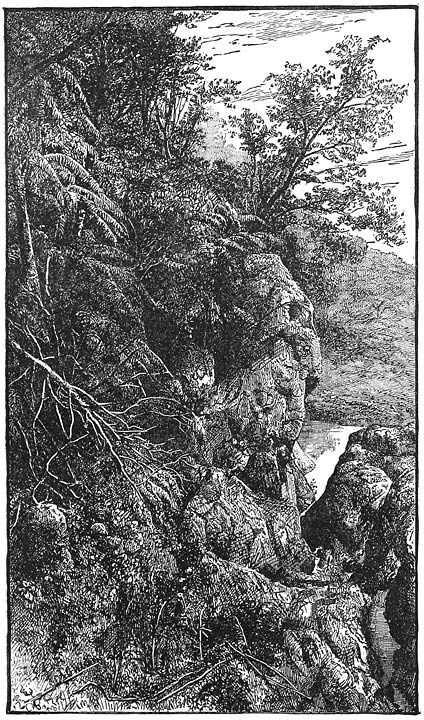
The God “Kumauna,” Four Miles above Hilea, Hawaii.
(HUGE FACE DELINEATED IN THE CLIFF.)
Kaiana’s father was Ahaula, who was the son of Keawe, king of Hawaii, by a mother whose name is now unknown. The mother of Kaiana was Kaupekamoku, a granddaughter of Ahia, of the family of Hilo, from whom the present sovereign of the islands draws his strain. The birthplace of Kaiana is not recorded, but he was probably reared in the neighborhood of Hilo, and thoroughly instructed in all the chiefly accomplishments of the period. He grew to a splendid manhood. He was nearly six and a half feet in height, was well proportioned, and possessed a strikingly handsome face. This is the testimony of Captain Meares, with whom he made a voyage to China in 1787.
Kaiana was of high rank and boundless ambition, and in early manhood cast his fortunes with Kahekili, the warlike moi of Maui, to whom he was related. He was among the prominent chiefs who assisted Kahekili in his conquest of Oahu in 1783, and took a distinguished part in the decisive battle of Kaheiki. Kahahana, the unfortunate king of Oahu, escaped to the hills, where he remained secreted for nearly two years, when he was betrayed by the brother of his wife and slain by order of Kahekili.
This cruel treatment of Kahahana, together with the rapacity of the invaders, created a revulsion of feeling among the Oahu chiefs, and a wide-spread conspiracy was organized by the father of Kahahana and others against Kahekili and the Maui chiefs to whom had been assigned lands in the several districts of the island. The plan was to rise in concert and kill them all in one night, including Kahekili. But the murderous project miscarried. By some means it became known to Kahekili, and he despatched messengers to the threatened chiefs, warning them of their danger. All but one of them were notified. The messenger failed to reach Hueu, who was at Waialua, and he was killed. But fearfully was his death avenged. Kahekili collected his forces for a war for blood. Men, women and children were butchered without mercy, and the native Oahu chiefs were almost extirpated. So great was the slaughter that one of the Maui chiefs built a house at Lapakea, the walls of which were laid up with the bones of the slain.
In this rebellion a number of Kahekili’s own chiefs turned against him, among whom were Kaiana and Kaneoneo, the latter being the first husband of Kamakahelei, queen of Kauai. What incited the defection of Kaiana is not known, but he was probably dissatisfied with the lands apportioned to him by Kahekili, and hoped to profit by the restoration of the island to native rule.
Kaneoneo was killed, but Kaiana managed to escape to Kauai. Kaneoneo was of the royal line of Kauai, and, as already stated, the first husband of the queen of that island. How he came to be a supporter of Kahekili in his conquest of Oahu, or what prompted his subsequent espousal of the cause of the Oahu chiefs, are matters which tradition has left to conjecture.
Kamakahelei’s second husband, whom she had selected some years before while her first was living, as was then the custom, was the gallant Kaeo, or Kaeokulani, the younger brother of Kahekili. He was commended to her not more through his princely blood than his many accomplishments and graces of person, and she appears to have been greatly attached to him.
She had two daughters with Kaneoneo, both of whom were of marriageable age when she became the wife of Kaeo. She was the granddaughter, it may be mentioned, of Lonoikahaupu, a prince of Kauai, who in his younger years visited Hawaii, was accepted as the temporary husband of Kalani, the sister of Keawe, and through her became the grandfather of Keeaumoku and his two distinguished brothers. The daughters of the queen were Lelemahoalani and Kapuaamohu, the latter of whom, in marriage with Kaumualii, the last independent king of Kauai, became the grandmother of the present queen, Kapiolani.
Kaeo took no part in the conquest of Oahu by his brother, but remained at Kauai, assisting the queen in her government, while Kaneoneo found occupation first in aiding and then in opposing Kahekili. Escaping from Oahu after the defeat of the rebellious chiefs and death of Kaneoneo, Kaiana presented himself before the queen of Kauai, who was a distant relative, and Kaeo, who was of closer kinship, and related to them the story of Kahekili’s merciless operations on Oahu. He sought to create an active sympathy in favor of the unfortunate Oahuans, but Kaeo was too sagacious to place himself in hostility to his warlike brother, who had extended his sway over all the islands between Kauai and Hawaii.
However, Kaiana was kindly received at the court of Kauai, and given lands for his proper maintenance. But he could not remain quiet. While the clash of arms was heard on the other islands, he chafed under the restraints of his exile, and attempted to organize a force of warriors for a descent upon Oahu. Kaeo prevented the departure of the expedition, however, and a mutual feeling of suspicion and antagonism was soon developed between him and his reckless and restless cousin.
As the avenues to advancement through the chances of war seemed to be temporarily closed to him, Kaiana donned his best attire, gave entertainments and began vigorously to play the courtier. He first sought to supplant Kaeo in the affections of the queen. Failing in that, he next paid court to her daughter Kapuaamohu. The latter was disposed to regard his suit with favor, but Kaeo, through the pretended advice of a kaula, objected to the alliance, and in a spirit of recklessness Kaiana embarked in the ship Nootka for China late in 1787. That vessel, in the course of trade, touched at Kauai just as the fortunes of Kaiana seemed to be the most desperate, and Captain Meares was easily prevailed upon to permit the handsome Hawaiian to accompany him to the Asiatic coast.
Arriving in Canton, Kaiana spent some months in studying the arts of war and mingling with the people of strange races, and in the latter part of 1788 returned in the Iphigenia to Kauai, bringing with him a very considerable supply of muskets, powder, lead and other munitions of war. As the manner in which he secured these supplies is not stated, we are constrained to believe that he must have taken with him to China a quantity of sandal-wood, which was readily marketable in that country.
But Kaeo would not permit him to land on Kauai. The clouds had indicated approaching danger the day before, and Kaiana was told that he would be slain and sacrificed if his foot touched the shore. The vessel, therefore, sailed for Hawaii, where Kaiana landed and offered his services to Kamehameha. They were promptly accepted. His supply of arms and knowledge of other lands rendered him a valuable ally at the time, and Kamehameha gave him an important command and took him into his fullest confidence. This was early in 1789, and, in the succeeding wars with Keoua, Kaiana became an active leader, as already mentioned. The knives, hatchets, axes and swords brought by him from China were found to be useful, but the fire-arms were generally of old patterns, and the most of them were soon rendered entirely unserviceable through the inability of the natives to keep them in repair.
V.
Very soon after her marriage Kaahumanu was detected in flagrant flirtations with certain chiefs whose business brought them to the court of her husband, and Kamehameha set a close watch upon her actions. This led to bitter words between them, and in time it became a matter of gossip that Kamehameha was jealous of his young wife. The arrival of Kaiana added another to the list of Kaahumanu’s admirers, and in time another wrinkle to the stern face of her warrior-husband. Kaiana was one of the handsomest chiefs of his day, and Kaahumanu could not disguise her infatuation for him. But, whatever may have been the temptation, he was too discreet to awaken the jealousy of Kamehameha, and was not displeased when he was despatched with an army against Keoua in the distant district of Kau.
After the death of Kalaniopuu, in 1782, and the defeat and death of Kiwalao, the widow of the former, whose name was Kalola, left for Maui, taking with her the widow and infant daughter of Kiwalao. Kahekili, brother of Kalola, provided for the family and gave them his protection. After the conquest of Oahu by Kahekili he removed his court to that island, taking with him his sister and her family. In 1785 they returned to Maui with Kalanikupule, the son of Kahekili, who had been appointed viceroy of the island, and there remained, principally at Olowalu, until 1790, when Kalanikupule was driven from Maui by Kamehameha, and they sought refuge at Kalamaula, on the island of Molokai.
Seeing his way clear to the conquest of the group, and anxious to ally himself to the superior blood which came through Kalola and Kiwalao, Kamehameha despatched a messenger to Molokai, requesting Kalola not to return to Oahu, but to place herself and family under his protection. Following the messenger to Molokai, and learning that Kalola was ill and not expected to recover, Kamehameha paid her a visit in person, and received the assurance of the dying dowager that, when she passed away, her daughter and granddaughter should be his.
The granddaughter was Keopuolani, then a girl of fourteen. She subsequently became the wife of Kamehameha and the mother of the ruling princes of his dynasty. In recognition of her superior rank Kamehameha always approached her on his knees, even after she had become his wife and he the undisputed sovereign of the group. Such was the deference invariably paid to rank at that time and earlier.
Kalola did not live but a few days after her meeting with Kamehameha. At her death he manifested his sorrow by knocking out two of his front teeth, and then formally took charge of and removed to Hawaii her daughter and granddaughter, not only as a sacred legacy from Kalola, but as a token of reconciliation and alliance between himself and the elder branch of the Keawe dynasty.
Kaahumanu well understood the meaning of this reconciliation, and it was with little pleasure that she welcomed Liliha and her daughter to Hawaii. She knew it was the purpose of Kamehameha to marry Keopuolani as soon as she reached a proper age; but she was childless and could urge no valid objection to the union. The thought of it, however, did not sweeten her temper or quicken her sense of propriety. She became more reckless, and her husband more and more suspicious, until they finally separated, when Kaahumanu returned to her father, where she remained for more than a year, and where, it is said, Kaiana frequently visited her.
Of these visits Kamehameha was apprised by Kepupuohi, the wife of Kaiana, of whom tradition makes but spare mention. She was jealous of her husband’s attentions to Kaahumanu, and it was through her that Kamehameha became aware of their secret meetings. His spies had overlooked what the jealous eyes of the wife had discovered, and it is intimated that they retaliated in kind upon the recreant couple. Be that as it may, Kamehameha sent for Kaahumanu, and through the offices of Captain Vancouver, whose vessel was at that time anchored in Kealakeakua Bay, a reconciliation was effected between them.
But Kamehameha did not forgive Kaiana. His thoughts were bent upon the conquest of Oahu, and he needed his assistance in that important enterprise; but he determined to crush him whenever he could do so without injury to himself. Kaiana felt the coldness of his chief, and had observed unmistakable evidences of his hatred; but he neglected no duty, and resolved that, if an open rupture could not be avoided, Kamehameha should not be in a position to urge a reason for it that would command the respect and approval of his supporting chiefs.
Summoning his district chiefs to muster their quotas of canoes and armed men, Kamehameha prepared for the conquest of Oahu and a final struggle for the mastery of the group. It is said that his army numbered sixteen thousand warriors, some of them armed with muskets, and that so great was the number of his canoes that they almost blackened the channels through which they passed.
The army embarked from Hawaii early in 1795, and, after touching at Lahaina for refreshments, landed for final preparation on Molokai, the fleet of canoes being distributed for miles along the coast. Kaiana had promptly responded to the call of his chief, and was there with a heavy quota of warriors and canoes.
A council of war was called at Kaunakakai to discuss the plans of the campaign, but Kaiana was not invited to participate in its proceedings. His exclusion from the council alarmed Kaiana, and he suspected that he was the principal subject of discussion. He left his quarters, and calling at the house of Namahana, the mother of Kaahumanu, learned from her that the council was discussing some private matter, the nature of which she did not know. He next visited Kalaimoku, after the adjournment of the council, and endeavored to ascertain what had been done, but the answers of the chief were evasive and unsatisfactory. He did not dare to tell Kaiana, who was allied to him in blood, that Kamehameha had charged Kaiana before the council with meditated treason, which implied his death, and that his advisers had prevailed upon him to allow the matter to rest until after the conquest of Oahu.
On his way back to Hamiloloa, where his warriors were encamped, Kaiana again passed the house of Namahana. It was past sunset, and he was striding through the dying twilight, his thoughts a tumult of doubt and indignation, when from behind a clump of bushes he heard his name pronounced in a low tone. He stopped and listened, and “Kaiana!” again came to him in a soft voice.
Fearful of treachery, he hesitated for a moment, then drew a knife from a scabbard hanging from his neck, and cautiously walked around the screening undergrowth.
“Who calls?” inquired Kaiana, observing a crouching figure among the bushes.
“Your friend,” was the answer; and Kaahumanu rose and stood before him.
What passed between them can only be conjectured; but Kaahumanu must have satisfied Kaiana of Kamehameha’s hostile purposes concerning him, for when he reached his quarters he promptly informed his brother Nahiolea of the danger awaiting both of them, and apprised him of his resolution to abandon Kamehameha on the passage to Oahu and join forces with Kalanikupule. “The movement is hazardous,” explained Kaiana, “but it will enable us, at least, to die like chiefs, with arms in our hands, instead of being slain like dogs.”
As the several divisions were preparing to embark for Oahu the next morning, Kaiana visited the squadron of canoes set apart for the accommodation of the wives and daughters of Kamehameha and his principal chiefs, and secretly informed his wife of his purpose to join Kalanikupule. She expressed surprise at the announcement, but declined to follow him, declaring that she preferred to cast her fortunes with Kamehameha. “But,” she continued, bitterly, “perhaps Kaahumanu would follow you, if asked to do so!” Kaiana made no reply to this cutting suggestion, but waved his wife a hasty farewell, and joined his embarking warriors.
The other divisions of the invading army were well out to sea before Kaiana’s sails were set, and he found no difficulty in making his way unobserved to Kailua, on the northern side of the island, while Kamehameha landed with the main body of his forces in the neighborhood of Honolulu, his canoes extending along the beach from Waialae to Waikiki.
Disembarking his warriors at Kailua, to the number of perhaps fifteen hundred, Kaiana offered his services to Kalanikupule, whose army was rapidly occupying positions in the valleys back of Honolulu. The moi received him with open arms, promising him the sovereignty of Maui should they succeed in destroying Kamehameha; and the united armies, climbing over the Nuuanu and Kalihi passes, confronted the advancing lines of Kamehameha.
Learning of the desertion of Kaiana and the warriors under his command, Kamehameha exhibited but little surprise. He did not doubt his ability to defeat the combined armies of his opponents, for the auguries had been favorable and he had faith in his gods; nor did he regret that through his defection Kaiana had at last placed himself in a position to be dealt with as an open enemy.
With his war-god Kaili in the van, Kamehameha, at the head of a mighty force, marched up Nuuanu Valley, where, three miles back of Honolulu, behind a stone wall stretching from one hill to the other of the narrowing gorge, was entrenched the main body of the allied armies. And behind the wall stood Kaiana, grim, silent and desperate, with a musket in his hand, awaiting the approach of Kamehameha.
Nearer and nearer advanced the attacking column, with shouts that were repaid by yells of defiance from behind the defences. A few volleys of musketry were exchanged by the hundred or more of warriors in possession of fire-arms on each side, but Kaiana took no part in the noisy conflict. He was watching for the approach of one whose life he longed for more than all the rest, and for which he was willing to exchange his own.
But he watched in vain. A field-piece, under the direction of John Young, was brought to bear upon the wall, and Kaiana fell with the first shot, mortally wounded. After a few more shots the Hawaiians charged up the hill, their shouts drowning the roar of the breakers against the reef below. Kaiana drew himself up against the wall. His heart had been laid almost bare, and his eyes were growing dim. With an effort he raised his musket, fired it at random in the direction of the storming column, hoping the bullet might by chance find the heart of Kamehameha, and then fell dead.
The rout of the Oahuans and their allies was complete. They broke and fled in all directions. Some were driven over the pali, a precipice six or seven hundred feet in height at the head of the valley, and others escaped over the hills. Kalanikupule found refuge for a time in the mountains, but he was finally captured, slain and offered as a sacrifice to Kamehameha’s war-god at Waikiki.
This was the last battle of the conquest, and the victory gave to Kamehameha the sovereignty of the group, for the king of Kauai, recognizing his power, soon after yielded to him his peaceful allegiance. But it brought to a close the career of one of the most noted of modern Hawaiian chiefs—Kaiana-a-Ahaula—over whose death Kamehameha rejoiced, and Kaahumanu mourned in silence. Her love proved fatal to more than one, but he was the grandest and brightest of all who perished by the sweet poison of her smiles.