Umi, the Peasant Prince of Hawaii. (continued 2)
Reading edition
“The same,” said Umi; “I have met them both.”
“Then will we despatch a discreet messenger for them at once,” returned the priest, rising abruptly. “Every moment is precious, and their counsel may be the voice of the gods.”
And now, while the messenger is on his way to Waipio, it may be in place to make some further mention of the two priests in search of whom he was sent, as they contributed in no small measure to Umi’s final success, and were thereafter rated among his confidential counsellors.
Nunu and Kakohe were chiefs of distinction and belonged to the priesthood. They were both learned in the lore of the gods and the traditions of the people, and were so highly esteemed by Liloa that he frequently invited them to the royal mansion, and late in life spent one or more evenings with them in each month, when he listened to recitals of the traditions of his fathers, and mistier lines of demi-gods and heroes stretching backward in unbroken thread to the morning of creation. They were among the few who could recite the sacred genealogical mele of Kumuhonua, the Hawaiian Adam, and he loved to listen to the naming of the generations from the first man to Nuu, of the great flood, and thence to Wakea, and downward still nearly sixty generations to himself. Some differences existing between the genealogies of Hawaii and Maui, Liloa had sent them to the latter island to confer with its priests and historians, with the view of reconciling their disagreements. Their mission was successful, and what is known as the Ulu genealogy was the result of the learned conference.
These were among the friends of Liloa who, for the sake of the father and the honor of the royal line, had patiently and earnestly sought to divert Hakau from his barbarous practices. But he had scorned their kind offices, made light of their learning, and finally denied them admission to the palace. He hoped by his cruelty to drive them from Waipio; but in the prophetic flames they had read their future, and from within the sacred anu of the temple voices had come to them enjoining patience; so they sat down and waited.
Arriving at Waipio, the messenger of Kaoleioku had but little difficulty in finding the two priests of whom he was in search. It was some hours after nightfall, but on inquiry he was directed to their humble dwelling on the south side of the stream, and soon stood at their door. It was dark within, and on making his presence known two men appeared at the opening. The messenger saluted them politely, and, observing but a single person, they cautiously stepped from the door and inquired of the visitor his business with them.
By their garb and bearing he knew them to be priests, but that was not enough; he could afford to make no mistake, so he dissembled and said:
“I have probably been misinformed; this is not the house of Monana, the fisherman?”
“My friend,” said Nunu, “your words do not mislead us. Whether for good or evil I know not, but you are in search of Kakohe and Nunu, and they are here. If you have business with them, speak; there are no listeners.”
The messenger answered by unfolding from a piece of kapa an ivory talisman carved from a whale’s tooth, which he handed to Nunu, with a request that he would examine it. Stepping to a fire still smouldering near the oven of the hut, the priest threw upon it a handful of dry bark, which in a moment burst into a flame and enabled him to inspect the palaoa. Returning and addressing a few words to his companion, the priest said to the messenger:
“You are from Kaoleioku, of Waipunalei.”
“I am from Kaoleioku, of Waipunalei,” repeated the messenger, bowing.
“How long since?” inquired the priest.
“Late this morning,” was the answer.
“You must have traveled swiftly, for the paths are rough and the distance is a long day’s journey,” suggested the priest, cautiously.
“My feet have known no rest,” was the brief reply.
“What news bring you of Kaoleioku?”
“None.”
“Then why are you here with this palaoa?”
“Because so commanded by Kaoleioku.”
“There are rumors of coming troubles on the borders of Hamakua. Has Kaoleioku sent you to tell us of them?”
“I am here to say nothing of Kaoleioku, but to say for him, and to say only, that he prays that Nunu and Kakohe will meet him under his own roof at Waipunalei without delay.”
“And nothing more?”
“Nothing more.”
“You are discreet.”
“I am simply the bearer of a message; and now that I have delivered it, I am waiting for such answer as you may desire to send back with me to Kaoleioku.”
“When will you return?”
“To-night.”
“Then tell Kaoleioku that his friends Nunu and Kakohe will be with him by this time to-morrow. Now come,” continued the priest, “there is meat in the mua, and you must eat, for there is a wearying journey before you.”
The messenger was led into an adjoining hut, where meat and poi were set before him, and half an hour after he was scaling the hills east of the valley of Waipio.
Although the messenger was silent, the priests felt assured that there was a gathering of spears in the neighborhood of Waipunalei, and that Kaoleioku was secretly inciting a revolt. They knew that Umi was somewhere among the hills of Hilo, and felt strong in hoping that at the proper time he would be found at the head of the movement.
Hakau had very much underrated the power of the priesthood, and did not discover until too late that in seeking to persecute and degrade Umi, who had been given charge of the gods and temples by Liloa, he had provoked the hostility of a class which at that period of Hawaiian history no sovereign could safely defy. If the tabus of the moi were sacred, those of the high-priests were none the less inviolable, and the strongest chiefs in the group were those who held in greatest respect and enjoyed the largest friendship of the priesthood. Like the temporal rulers, the priests inherited their functions, and were as jealous of their prerogatives as royalty itself. It was through them that the civil as well as the religious traditions of the people had been brought down and perpetuated, and through their prayers and sacrifices only that the gods could be persuaded to accord success to important undertakings.
In the veins of some of the priests ran royal blood, and from time to time they left their heiaus and became distinguished as warriors; but under no circumstances did they ever relinquish their sacred rights. They not unfrequently possessed large landed estates, the title to which remained inalienably in the family. Such, for example, was the Kekaha estate, in the district of Kona, Hawaii, which was the gift of Liloa to Laeanui, and which remained with the descendants of that eminent high-priest until the days of Kamehameha I.
Such a warrior-priest of goodly possessions was Kaoleioku, of Waipunalei. He was the high-priest of the temple of Manini, at Koholalele, which was consecrated, as before related, in the time of Liloa. Although for some years he had seldom officiated, except on important occasions—preferring the quieter life of his estate at Waipunalei—he was greatly respected by the people of the district, and his influence proved a tower of strength to Umi.
IV.
True to the answer returned to Kaoleioku by his messenger, Nunu and Kakohe reached Waipunalei the following night; and when they saw the warlike preparations, and learned that Umi was present and that the acclaim of revolt was to be raised in his name, they wept for joy. It was past midnight, and their limbs were weary, but they could not sleep. At their request the door of Umi’s room was pointed out to them, and they went and sat down beside it. For an hour or more they did not speak. Then, when all was still within the walls, in a low tone they began the legendary chant of the kings of Hawaii. As they proceeded with a record which few on the island beside themselves could correctly repeat, their voices rose with their enthusiasm, and in a few minutes hundreds of half-naked men crept from their barrack lodgings and stood listening to the metric sentences of the learned historians. As they reached the name of Kiha, Umi stepped without the door. The priests recognized him and rose to their feet. Then, continuing the mele, they chanted the name of Kiha, of Liloa, of Hakau, and finally of Umi, represented as having wrested the sceptre from his unworthy brother, who was hated by his subjects and abandoned by the gods. With this they dropped on their knees before him and boldly saluted him as moi of Hawaii.
This acquainted many of the warriors present for the first time of Umi’s rank, and the wildest enthusiasm seized them. They asked to be led at once to Waipio, and were only quieted when Kaoleioku appeared and assured them that their patriotic wishes would soon be gratified.
At first Kaoleioku deemed this early development of the purposes of the movement untimely, if not, indeed, unfortunate. Many preparations remained to be made. It had been a suggestion of Umi that a part of the rebel forces should be sent to Waipio by water; but the canoes necessary for the expedition had not been secured, and not more than a thousand warriors had reported. Secrecy could no longer be maintained, and immediate and open action appeared to be now unavoidable. Yet it was through Nunu and Kakohe that his plans had been thwarted, and while he felt annoyed at what they had done, he retired, hoping they had acted advisedly in the matter.
The conduct of the priests was explained and approved the next morning. They urged immediate action. Hakau was not prepared for a sudden attack. For many years there had been no wars of consequence, and such of his supporters as the king could hastily summon to his assistance would be improperly armed and without discipline.
Their advice was for Umi to raise the standard of revolt at once. This news they would take to Waipio, with the further information that, although preparing for rebellion, Umi would not be strong enough to act for some time. Alarmed, Hakau would consult the high-priest Laeanui, who, notwithstanding their relations, was secretly his enemy, and a plan could be devised to induce the king to send his household guards and immediate followers to the mountains on some religious errand, when Umi, apprised of the situation by fires kindled at intervals on the hill-tops between Waipio and Waipunalei, could swoop down with a few hundred resolute warriors and seize the king and the capital, and thus with a bold stroke achieve a bloodless triumph.
When the priests had developed this plan of action Kaoleioku rose to his feet and exclaimed with excitement:
“The gods have instructed you!”
“You have spoken truly; the gods have indeed instructed our friends!” said Umi, impressively; “for was it not said in your dreams that the victory would be bloodless if the spears of Hakau were sent beyond the call of the Kiha-pu?”
“The meaning is now plain,” returned the priest, reverentially. “The gods are with us, and we will be directed by them.”
All the details were then carefully arranged, and the two priests returned to Waipio. It was soon rumored that they brought news of Umi, and Hakau sent for them, as had been expected. Fear had somewhat humbled him, and he greeted them with what seemed to be the greatest friendship and cordiality. He even chided them for absenting themselves so long from the royal mansion, where their visits, he assured them, would always be welcome. They assumed to be greatly gratified at his protestations of good-will, but secretly despised him for his shallow hypocrisy.
When questioned by the king the priests frankly informed him that they had left Umi and Kaoleioku together no longer than the day before, and advised him to lose no time in despatching to the mountains all the men he could summon, to gather fresh feathers of rare birds with which to redecorate his god of war.
Hakau was startled by this advice, for the ceremony of kauilaakua was never performed except in times of war or other imminent peril.
“What!” he exclaimed, with assumed astonishment, “shall this be done because Umi lives, and you have seen him with the high-priest of Manini?”
“No; not because Umi lives,” replied Nunu quietly, “but because he is preparing for rebellion.”
“Rebellion!” repeated Hakau, angrily. “Does he expect to be able to maintain himself in Hilo?”
“His aims reach beyond Hilo,” ventured the priest.
“To Puna?”
“Beyond Puna.”
“To Kau?”
“Beyond Kau.”
“Then he must aim at the whole island,” exclaimed Hakau, savagely.
“At the whole island,” repeated the priest, maliciously.
“He shall have land enough to bury him, and no more!” hissed the king. “But you are croakers, both of you. Before considering your advice I shall consult Laeanui and the seers of Paakalani, and hear what the gods say of this wide-spread conspiracy, as your fears and cowardice tell the story.”
Hakau abruptly dismissed the priests, and despatched a messenger for the high-priest Laeanui, but it was late in the afternoon before he could be found. He was old and venerable in appearance, and his hair, white as the snows of Mauna Kea, fell to his knees, covering his shoulders like a veil.
They had met but rarely since the death of Liloa, for the old priest seldom left the temple grounds, and Hakau as seldom visited them; and as the bearded and white-haired prophet entered the royal mansion, all bent respectfully before him, and a feeling of awe crept over the king as the priest stood silently and with folded arms before him.
“My greeting to you, venerable servant of the gods!” said the king.
The priest bowed, but remained silent, and Hakau resumed abruptly:
“I have learned that Umi and a priest named Kaoleioku are plotting treason together in Hilo, near the borders of Hamakua. What know you of Kaoleioku?”
“A man to be feared if he is in earnest,” replied the priest curtly.
“Have auguries of the movement been invoked?” inquired the king.
With a gesture the priest replied in the negative.
“And why not?” continued Hakau, impetuously. “What are priests and temples for, if not to guard the kingdom against coming dangers?”
“If it so please them, the gods answer when they are asked through sacrifice,” replied the priest; and then, with rising anger, he continued: “Your father respected the gods, and came to the temple when he would consult them, and his son must do the same.”
“Well, then,” said Hakau, discovering that the priest neither loved nor feared him, “I will be at the temple to-night, some time after sunset, and have you there the best of your diviners.”
“I shall await your coming,” replied Laeanui, briefly, as he bowed low and retired.
“Although he gave me his daughter,” muttered Hakau, as Laeanui left the room, “he has no love for me, and I as little for him. But no matter; I must not quarrel with him now. Wait until I have dealt with Umi and his confederates, and then—” But he did not finish the sentence, for he suddenly recollected that the high-priesthood was an inherited position, like his own, and its bestowal was not a royal prerogative. There were bloody means of creating vacancies, however, and these flashed through the wicked brain of Hakau.
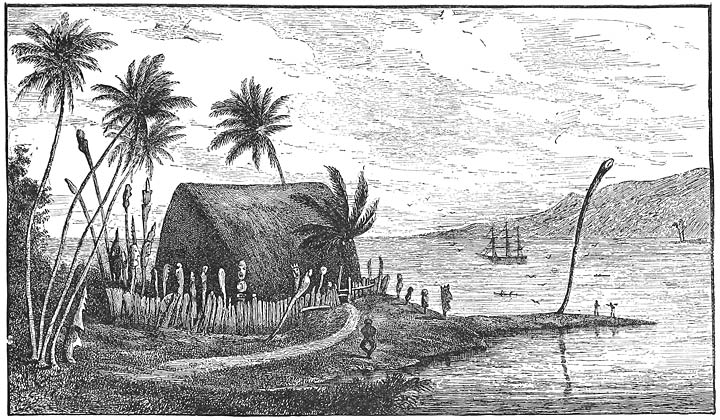
Small Temple on Kauai, 1793.
The night that followed was dark, with a steady wind from the northwest and occasional showers. It was some time after sunset before the king entered the outer gate of the heiau of Paakalani. He was accompanied by four attendants, two of whom bore a muzzled pig and two fowls; the others were trusty friends. A kukui torch was kept burning in front of the house of the high-priest, another between the altar and inner court, and a third near the entrance of the royal retreat, with which that heiau, like many others, was provided. Toward the latter Hakau and his party proceeded, and were soon joined by Laeanui and a number of officiating priests and kilos.
Entering the royal hale, a few words passed between the king and Laeanui, when the attendants of Hakau were relieved of their burdens and sent without the enclosure. The kaika, or large sacrificial drum, was then sounded with three measured strokes, and in a few minutes six officiating priests, three of them with knives in their hands and the others bearing torches, made their appearance. To them the pig and fowls were entrusted, and, preceded by the torch-bearers, the king and high-priest, followed by the attendants of the temple, with measured pace moved toward the altar.
Reaching the place of sacrifice, the high-priest uttered a prayer to the godhead, and separate supplications to Kane, Ku and Lono, intoned by the assisting priests, when the fowls were decapitated and their headless bodies placed upon the altar. The priest watched them until they were motionless, and then opened them and carefully examined the heart, liver and entrails of each.
The king glanced anxiously at the priest, but the latter made no response. The pig was then ordered to be slain. The throat of the animal was cut and its bleeding body was also placed upon the altar. The flow of the blood was scrupulously noted, and, after the respirations had been counted and the animal ceased to breathe, the body was hastily opened. The spleen was removed and held above the head of the priest while another prayer was spoken, and then the other organs were separately examined.
Completing the inspection, Laeanui stepped back from the altar.
“Well,” said the king, impatiently, “what say the gods?”
“The gods are angry, and the portents are evil,” replied the priest.
“Then promise them a hundred human sacrifices,” exclaimed Hakau. “If their favor is to be purchased with blood, I will drown the heiau with an ocean of it. But,” he continued, “I am not satisfied with these auguries. Let me hear from the anu.”
Immediately behind the altar was the entrance to the inner court of the temple. Within, and about three paces back from the door, which was covered with a wide breadth of kapa, was placed the anu, a wicker enclosure four or five feet in diameter, in which stood the oracle. On each side of the entrance were carved images of Kane, Ku, Lono and other Hawaiian deities, while at intervals of three or four feet along the walls a score or more of gods of lesser potency stood guard above the sacred spot.
To the last request of Hakau the priest replied: “The king shall hear from the anu.”
The lights were then extinguished, and all except the king and high-priest retired some distance from the altar, that no whisper of the oracle might reach them. Hakau was nervous as he stepped with the priest in front of the entrance to the inner temple. A prayer was uttered by the priest; the kapa screen was drawn aside by hands unseen, and the king stood looking into the intense darkness of the sanctum sanctorum of the temple.
“Speak!” said the priest, withdrawing behind the altar, and leaving the king alone before the anu.
“Speak!” repeated a hollow voice from within the sacred enclosure.
For some minutes Hakau remained awed and silent; then, in a voice which scarcely seemed to be his own, he said:
“Great power, I hear that dangers threaten.”
“Dangers threaten!” came like an echo from within.
“How may they be averted?” inquired the king.
For a time there was no answer. Finally a voice from the anu replied:
“Do homage to Kane; make glad the war-god of Liloa!”
“So do I promise,” answered the king; “but will that give me victory?”
“Victory!” was repeated from the anu.
Elated at what he had heard, Hakau continued:
“Now tell me, mighty spirit, whether Umi—”
“Nothing more!” interrupted the voice from within, as the kapa suddenly dropped before the entrance.
“Well, thanks for so much,” said Hakau, turning and joining the priest at the altar, and repeating to him, with some favorable additions, the words that he had heard. Darkness hid the smile upon the lips of Laeanui.
“The day after to-morrow we will hold here a festival to Kane, and the altar shall be heaped with offerings,” said the king. “To-morrow I will send my people to the mountains to gather feathers of sacred and royal colors, and Kaili, the neglected war-god of Liloa, shall be made glorious in new plumage and glad with abundant sacrifice.”
“It is well,” replied the priest.
“Now let the conspirators marshal their spears!” continued Hakau, confidently, “and we will make short work of them. They cannot be punished in the hills of Hilo. With a showing of weakness we will lure them to Waipio, and not one of them shall escape. We will cut off their retreat, and close in their faces the gates of the puhonui!”
As already mentioned, of the two puhonuis, or places of refuge, on Hawaii at that time, one was an adjunct of the heiau of Paakalani, at Waipio. In times of war their gates, with white flags to mark them, were always open, and those who succeeded in passing into the enclosure were safe from assault, even though pursued by the king himself.
This savage proposal to close the gates of the puhonui was promptly resented by Laeanui. He would as soon have thought of tumbling the gods from their pedestals and consigning them to the flames.
“You suggest what is impossible,” said the priest. “Since the days of Wakea the puhonui has been sacred. Its gates cannot be closed to the defenceless, and the gods have said that he who shuts them against the weak shall seek in vain their shelter from the arm of the strong.”
“Well, then, keep them open!” retorted the king, sharply. “They will run swiftly who enter them!”
Torches were relighted, and the king and his attendants left the heiau. They had not passed beyond the outer wall before Nunu emerged from the inner court. His was the voice that had answered the king from the anu. Thus in the temple of Paakalani was shaped the destruction of Hakau, and the priests whom he had insulted and defied opened broadly and surely the way to his death.
The next morning an unusual commotion was observed in and around the royal mansion, and as party after party left the inclosure—some proceeding toward the sea-coast, and others up the valley and into the mountains beyond—the villagers wondered at the proceeding, and predicted that a strict tabu would soon follow, whatever might be the occasion. But when they learned that the war-god was to be redecorated, and an imposing religious festival was to follow the day after, they knew that trouble of some kind was anticipated by the king, and soon found a correct explanation of the movement in the rumors which they, too, had heard concerning Umi and his friends in Hilo and eastern Hamakua. The possibility of an uprising against Hakau gave them no uneasiness, however, for his cruelties had secured for him their hatred, while the name of Umi was to all classes a synonym of strength and gentleness.
The king was not indifferent to the danger with which he was about to be confronted, and promptly despatched lunapais to the district chiefs of Kohala, Kona, and Hamakua, ordering them to report without delay at Waipio with two thousand warriors each, while the governor of Hilo was commanded by a special lunapai to march at once with a body of warriors to Waipunalei, with the view of precipitating the movement of Umi upon Waipio, where, it was not doubted, he would be overwhelmed and crushed.
All these were proper precautions, but they were taken too late; for at the time the feather-hunters and lunapais were leaving on their respective missions, Umi, at the head of over two thousand well-armed and resolute warriors, had reached a point within a two hours’ march of Waipio, and was awaiting a signal to swoop down upon the valley.
And now let us return to Waipunalei, and note what had been occurring there during the preceding forty-eight hours. As soon as the priests left for Waipio, two days before, trusty and intelligent sentinels followed and took their respective stations, designated by Maukaleoleo, on the summits of seven different hill-tops discernible from each other from Waipunalei to Waipio. The first, coming eastward from Waipio, was three miles, perhaps, from the temple of Paakalani; the last was a rocky pinnacle about four miles from Waipunalei. This was the station of Maukaleoleo.
The sentinels were instructed to gather large heaps of dry grass and bark; to keep small fires smouldering and ready for use; to vigilantly watch the peaks in the direction of Waipio; to apply the torch the instant a signal-fire was seen, and keep the pile burning until it was plainly answered by the next station toward Waipunalei.
All that day and through the following night armed men were arriving at the rendezvous at Kaoleioku’s, until something more than two thousand warriors had reported, and every spare moment of the next day was devoted to forming them into companies and battalions, giving them leaders and preparing them for a rapid march.
Many of the warriors were accompanied by their wives, daughters or sisters; for in those days, and later, women not unfrequently followed their fathers, brothers and husbands to battle, generally keeping in the rear to furnish them with food and water, but sometimes, in a close and desperate conflict, mingling bravely in the fight. In such cases they gave and received blows, and expected and were accorded no consideration because of their sex.
Instances are given in Hawaiian tradition of the tide of battle being turned, on more than one occasion, by desperate women transformed from camp-followers into warriors; and as late as 1819 we behold Manona, wife of Kekuokalani, the last sturdy champion of the gods of his fathers, falling lifeless in battle upon the body of her dead husband at Kuamoo, while Kaahumanu and Kalakau, widows of the great Kamehameha, commanded the fleet of canoes operating with the land forces under Kalaimoku.
After the visit of the priests from Waipio the purpose of the revolt was no longer disguised, and whenever Umi made his appearance among the assembled and assembling warriors he was greeted with the wildest enthusiasm. His romantic history was known to them, and had been made the theme of song. His many triumphs at the festival given by Liloa in honor of his formal recognition were recited by those who had witnessed them, and his grand proportions and noble bearing stamped him as of chiefly blood; and when his friends Piimaiwaa and Omaukamau spoke of the great learning displayed by him when questioned by the priests, and intimated that he had been instructed by the gods and was under their care, every doubt of success vanished, and the order for an advance upon Waipio was awaited with impatience.
Maukaleoleo mysteriously came and went, but always at night, and seldom remaining longer than a few minutes. He was known to all within the enclosure, and allowed to pass unchallenged, as he could be mistaken for no one else. As he strode through the gateway, bearing a spear scarcely less than thirty feet in length, the sentinels regarded him with awe; and when they saw him converse with Umi and then silently depart, they shook their heads and said, “Perhaps he is Lono!”
The temple of Manini, dedicated by Liloa just before his meeting with the mother of Umi, and of which Kaoleioku was the high-priest, was a reconstruction and enlargement of an old heiau which was in existence certainly as early as the time of the warlike Kalaunuiohua, who reigned between the years 1260 and 1300. With a large army and proportionate fleet of canoes he invaded Maui, Molokai and Oahu, and, taking their captured sovereigns with him, made a descent upon Kauai. But his triumphs ended there. After an obstinate battle he was defeated and taken prisoner, but was subsequently released and permitted to return to his own kingdom.
It was during the reign of this sovereign that the prophetess Waahia lived. She accompanied him in his expeditions as far as Oahu, but refused to proceed with him to Kauai. She declared that the gods would bring calamity upon him if he invaded that island, and sought to persuade him to consolidate his conquests and return to Hawaii. But the warrior-king cared but little for priests or temples, and was in the habit of destroying both when they failed to subserve his purposes. Enraged at the unfavorable auguries of Waahia, and fearful that they might come to the ears of and demoralize his warriors, the king induced her to return to Hawaii. One tradition says she voluntarily abandoned Kalaunuiohua, while another relates that she consented to return only on condition that the war-god of the king be sent back with her. This god had been in the reigning family of Hawaii since the days of Paao, and had been sanctified by that father of the priesthood. To distinguish it from other war-gods it was known as Akuapaao, and was held in great veneration. When asked for an explanation of the strange request, the prophetess boldly declared that, if the god was taken to Kauai, it would never return except at the head of a conquering army that would make of Hawaii a tributary kingdom.
“Then take it with you!” exclaimed the king, savagely, “and if I return to Hawaii alive I will burn you both together!”
“You will burn neither,” said Waahia. “When you return to Hawaii you will think better of the gods and their servants; and in generations to come, when angry spears shall be crossed in the hale of the kings of Hawaii, the hand will be stronger that places the fresh lei upon the shoulders of Akuapaao.”
The prophetess prepared to embark. The god, wrapped in a fold of kapa, so that it might not be recognized, was brought to the beach and delivered to the departing seeress. The canoe, which was large enough to accommodate thirty persons, was shoved into the surf. It was provided with food and a calabash of water. Declining all assistance or companionship in her journey, Waahia stepped into the canoe with the image in her arms, and, after carefully depositing it in the bow of the boat, returned and seated herself near the stern. Half a dozen men were waiting for the word to launch the canoe from the sands upon which the stern was lightly resting. But the seeress raised no sail, touched no oar. For some minutes she sat, silent and motionless, with bent head and clasped hands, as if in prayer, while hundreds of curious eyes watched her in amazement, wondering what would become of her, even should the unmanned craft be successful in passing the breakers. Then she slowly rose to her feet, and the canoe began to glide toward the reef. Faster and faster it moved, until, mounting a retreating wave, it was borne swiftly out into the calmer waters; then, slightly turning in its course, it dashed southward with the speed of the wind, and was soon lost to the view of the awe-stricken beholders.
Waahia looked beneath the waves and smiled, for Ukanipo, the shark-god, with scores of assistants, was bearing her onward; and then from his ipu Laamaomao, the Hawaiian Æolus, let loose the imprisoned winds, and refreshing zephyrs cooled the face of the prophetess and accelerated the speed of the canoe, until it seemed to leap from wave to wave; and great sea-birds screamed with fright as it dashed past and awoke them from their billowy slumbers, leaving behind it a long trail of troubled waters.
Passing to the southward of the intervening islands, the canoe was borne with undiminished speed through the channel of Alenuihaha to the northeastern coast of Hawaii, and before sunset was beached at Koholalele. The prophetess knew the meaning of this. Near by was the old heiau of Manini, and thither, as she felt instructed, was taken and deposited the war-god Akuapaao, with the solemn injunction to the high-priest in charge that it was never to be removed from the inner court unless the life of the moi was in peril or the kingdom was invaded by a foreign foe.
The old heiau had given place to a more imposing structure during the reign of Liloa. Its outer walls had been enlarged, raised and repaired, and its inner belongings improved and redecorated; but its sacred relics had not been disturbed, and its many gods remained where they had been for generations.
Among the most sacred idols of the temple, even after the death of Liloa, was the Akuapaao. Its name indicated alike its age and sanctity; and while the legends connected with it had become vague and distorted in their transmission through a long line of priests, the prophecy of Waahia still clung to it, and it was especially reverenced by the few to whom was entrusted the secret of its functions.
Hakau had learned of this god from his royal father, and the same morning that his retainers were sent to the hills for feathers two priests were despatched to Koholalele, with orders to bring to Waipio, in the king’s name and without delay, the war-god Akuapaao. Should the priests of the temple refuse to surrender the idol, then the messengers were instructed to call upon the district chiefs for assistance, and take it by force, no matter at what cost of life.
But the king was too late, for at early daylight of the morning of the day before his messengers left Waipio, Maukaleoleo strode into the rebel headquarters with the Akuapaao in his arms. Kaoleioku had, of course, instructed the giant where and how to secure the image, for in years past he had been its custodian, and his orders continued to be obeyed by the priests of Manini. The idol, completely wrapped in kapa, was deposited in the private heiau of the high-priest, and Maukaleoleo left the enclosure as quietly as he had entered it a few minutes before. The sentinels wondered, as usual, but bowed in silence as he came and went.
The priest rose with the sun, and learned that Maukaleoleo had already been a visitor that morning. He hastened to the heiau, and there found the Akuapaao. He was overjoyed. He removed the kapa covering from the idol, placed it upon a pedestal between the images of Ku and Lono, and then found Umi and brought him to the heiau. Entering, Kaoleioku closed the door and pointed to the Akuapaao. Umi bowed reverently before it.
“Listen, O Umi!” said the priest; “listen, O son of Liloa! Behold the war-god of your fathers! It was sanctified by the touch of Paao, and for generations, in the inner chamber of Manini, has awaited your coming. From Waahia, the prophetess, have come down, through the chief priests of the heiau, these words: ‘When angry spears shall be crossed in the hale of the kings of Hawaii, the hand will be the stronger that places the fresh lei upon the shoulders of Akuapaao.’ The spears are about to be crossed; the god is here; let yours be the hand, and not Hakau’s, to place the lei-ai upon the shoulders of Akuapaao!”
The words of the prophecy came to Umi as a dream. Overwhelmed with their significance, he fell upon his knees and exclaimed:
“God of my fathers! be you my guide until I prove unworthy of your protection!”
“Your realm is yet small,” said the priest, “and is enclosed within these walls. Let us pay respect to the gods, that its boundaries may be enlarged.”
Thereupon a strict tabu was ordered to all within the walls, to begin at midday and continue until the setting of the sun. The time was brief, but events were pressing, and it could not safely be extended.
The tabu, or kapu, as it is sometimes written, was strictly a prerogative of the high chiefs and priests of olden Hawaii. There were fixed tabus of custom, and declared tabus of limited duration by the temporal and spiritual rulers. The penalty for the violation of all tabus was death. It was tabu of custom for men and women to eat together, or for women to eat of the flesh of swine, fowls, turtle and many kinds of fish. Everything belonging to the kings, priests and temples was tabu, or sacred, and springs, paths, fishing-grounds, water-courses, etc., were frequently thus kept from the use of the people. Declared general tabus, for the propitiation of the gods or the amelioration of a public evil, were either strict or common, according to the emergency. During the time of a common tabu the people were required to abstain from their usual avocations and attend at the heiau, where morning and evening prayers were offered. A strict tabu was more sacred. While it continued—generally one or two days—all, with the exception of the alii-nui and priests, were compelled to remain within doors. Every fire and every light was extinguished; no canoe was launched; all noises ceased; the pigs and dogs were muzzled, and fowls were placed under calabashes. These tabus were proclaimed by heralds, and their wanton violation was an unpardonable offence.
In preparation for the tabu to be declared by Umi, flowers and feathers were brought, and leis of both were woven. Everything being in readiness, heralds proclaimed the tabu and its duration, with the further announcement that the occasion was the arrival of the mighty war-god Akuapaao and its coming decoration by Umi.
As the sun touched the mark of meridian, the gates of the enclosure were barred and guarded by the religious attendants of the priest; the fires were everywhere extinguished; the few animals within the walls were either muzzled or hidden; men, women and children suddenly disappeared within their dwellings or quarters, and mats were hung at the openings; Umi and the priest retired alone to the heiau and closed the door, and silence, disturbed only by low whispers and the muffled footfalls of the watching priests, reigned over the twenty-five hundred persons gathered within the enclosure.
In the heiau, or apartment of the gods, to which Umi and the high-priest retired, were a number of images and sacred relics. Near the centre of the room was a small altar, upon which had been deposited the leis provided for the decoration of Akuapaao. They sat down beside it, and for an hour or more nothing was heard but the whispered prayers of the priest, addressed in turn to the several gods before him. Then, rising and leading Umi by the hand to the Akuapaao, in a low voice he formally presented him to the god as the son of Liloa and rightful ruler of the Hawaiian people. Another prayer was uttered, and then Umi, with the words, “Accept this, O Akuapaao, with the homage of Umi!” proceeded reverently to place around the head and neck of the image a number of fragrant leis of flowers and wreaths of brilliant feathers.
The priest watched the act intently. As the last wreath of feathers, resembling a crown in appearance—the lei-hula-alii—was placed upon the head of the image, a sunbeam flashed through what seemed to be a small rent in the thatched roof, and for a moment haloed the heads of Umi and the god. The priest read the answer and smiled. He felt as assured of the favor of the gods as if it had been pledged in a voice of thunder, and Umi bent low in acknowledgment of the joyful revelation.
The sun dropped behind the hills; twilight turned to bronze the gold of the valleys, and the tabu was at an end. It was proclaimed that the auguries were highly favorable, and the silence of the tabu was broken by wild strains of music and shouts of rejoicing.
V.
As darkness settled upon the camp of the insurgents Umi felt that the hour for action was closely at hand. He therefore gave orders that preparations for instant departure be maintained throughout the night. The moon was waning, with a promise of rising some time before morning, and the night set in dark and cloudy, with occasional showers.
About two hours before midnight Maukaleoleo suddenly and silently strode past the sentinels. Seeking Umi, he found him in council with his friends Omaukamau, Piimaiwaa and the high-priest. They were arranging the order of march by the four narrow paths at that time leading to Waipio.
The giant stooped low and looked in upon the council through the doorway. He could scarcely distinguish the faces within by the light of the flambeau kept burning near the entrance. He did not attempt to enter, but stood silent and motionless, with his hands upon his knees, peering into the room as if to attract attention. Umi smiled as he recognized the huge object, and stepped to the door. The giant rose until his head was above the ridge-pole, and then bowed like the bending of a tree before the wind.
“Well, my good friend,” said Umi, “after thanking you for your last night’s work, let me ask what word you bring.”
“None,” replied the giant. “There is no light yet, but I am impressed that it will be seen before morning.”
“And so am I, good Maukaleoleo,” returned the chief, “and your signal will find us prepared.”
“That is what I came to learn,” answered the giant, bowing and turning to depart.
“But do not mistake for a signal the rising moon, which will soon set its torch upon the hill-tops,” suggested Umi, pleasantly.
“Unless the moon should rise in the west, which it has not done since the days of Maui, the mistake would scarcely be possible,” replied Maukaleoleo, with a smile upon his great face, and then, with a few long strides, disappearing in the darkness.
It must have been at about the time of this interview that Hakau was leaving the heiau at Waipio, after having invoked the auguries of sacrifice and listened to the voice of Nunu from the darkness of the inner temple. The king had scarcely passed the gate of the temple leading to the sacred pavement of Liloa, which connected the heiau with the royal mansion, and which privileged feet alone could tread, when Nunu, after exchanging a few words with the high-priest, also left the enclosure, but neither over the sacred pavement nor toward the palace. Taking a path which did not seem to be new to him, from the facility with which he traveled it by the light of the stars, he crossed the valley and mounted the high ridge of hills enclosing it on the southeast. Ascending the ridge for some distance, and until the lights of the valley could no longer be seen, he proceeded slowly upward, at intervals striking together two stones and listening for a response. At length it came, like an echo of his own signal, and a few minutes’ walk brought him to a large heap of dry leaves and limbs, from behind which Kakohe rose and greeted him.
“Fire it at once!” said Nunu. “I will explain all when the signal is answered.”
Behind a rock, a few paces away, a small fire was smouldering. Kakohe sprang and seized a burning brand, which he applied to the heap, and in a moment the red flames reached heavenward, throwing a lurid light upon the surrounding hills.
With their backs to the fire the two priests looked anxiously toward the south and east, and in a few minutes far in the distance gleamed an answering flame. Satisfied that their signal had been seen and responded to, they permitted the fire to die out, and then returned to the valley to await the important events of the morrow.
Leaving the rendezvous of the rebels, Maukaleoleo slowly returned to his station, for even his mighty limbs at times grew weary, and the path leading up the mountain was obscure and narrow. Reaching the summit, he examined a small fire hidden among the rocks, and was about to stretch himself upon the ground, with his face turned eastward, when he discerned a strange, star-like speck upon the horizon. For a moment it paled, and then grew brighter and brighter. He stepped to a tree near a huge pile of combustibles, and, glancing along a horizontal limb that had been previously trimmed for the purpose, discovered that it pointed directly toward the light. All doubt at once disappeared. He knew it was the signal. Springing for a brand, the heap was lighted, and by its wild glare in the darkness Maukaleoleo rapidly descended to the valley. His fatigue had vanished, for the signal of Hakau’s death had been lighted by his own hands, and his great heart was in arms.
The signal was at once discerned by the watchmen at Umi’s quarters, and in a few minutes all was quiet commotion within the walls. Torches were lighted, armed warriors sprang with alacrity into line, and half an hour after Umi, in feather mantle and helmet plumed with royal colors, and preceded by the war-god Akuapaao, borne upon a manele, or palanquin, resting upon the shoulders of kahunas, with Kaoleioku as high-priest, marched out of the enclosure, followed by two thousand well-armed and devoted supporters. His address to his warriors was brief. “The moments are precious,” said Umi, “and must not be wasted in words. Let our spears speak, and at sunset to-morrow we will eat meat in peace in Waipio!”
As a measure of precaution, in case of disaster, a force sufficient to hold the premises of the high-priest was left within the walls. The advancing army was formed into three divisions, the right commanded by Omaukamau and the left by Piimaiwaa, while Umi remained with the centre. Their orders were to move rapidly, but as quietly as possible, by three different routes, and form a junction at their intersection with the alanui, or great path, leading from the coast to the inland village of Waimea. This junction it was expected the left division, traveling a difficult mountain-path, would be able to reach two or three hours after sunrise.
It was, perhaps, an hour short of midnight when the last of the little army left the enclosure, followed by two or three hundred women bearing food, water, extra weapons and a variety of camp necessaries. The warriors were full of enthusiasm, and when Maukaleoleo stepped in among them from the mountains like a protecting deity their shouts could scarcely be restrained. His appearance was most welcome to Umi, who thanked him warmly for what he had done, and expressed a desire that he would remain near him during the march, as his familiarity with the mountains and their paths would render his advice valuable.
“But I see another mighty friend has opportunely reported,” said Umi, pleasantly, as he pointed toward the east. “As the moon is about to look over the hills, the torches may soon be extinguished, for the paths will be plainer without them.”
The divisions separated, and, dispensing with their torches, soon swarmed the several paths leading to Waipio. Each division was preceded some distance in its march by a party of scouts, with instructions to let no one pass to their front, lest he might be a messenger of warning.
The paths were rough and in places almost choked with undergrowth, and the advance was exceedingly laborious; but no word of complaint was heard, and about the middle of the forenoon the left division, and the last to arrive, reached the Waimea trail at a point leaving the entire force but a short march to Waipio. A brief halt was ordered, and the food and water brought by the women were served to their relatives, and to others if any remained.
Taking no thought of himself, Umi advised his attendants to eat if they could find food, declaring that he required nothing, and then threw himself under the shade of a tree for a few minutes of much-needed rest. A cool breeze fanned his heated face, on which the beard had as yet grown but lightly, and his heavy eyelids closed, dropping him gently into the land of shadows, where he bathed in cool waters and partook of food that was delicious—more delicious, it seemed, because it was served by Kulamea.
Something awoke him—he scarcely knew what—and his eyes caught the form of a woman as it vanished behind the tree under which he was lying. He smiled, and, partially rising, discovered on the ground beside him a calabash of poi, reduced with water to the consistency of thick gruel. His mouth and throat were parched, and, without stopping to learn who had provided it, he raised the vessel to his lips and drained it to the bottom. It was a goodly draught, and refreshed him greatly.
Holding the empty calabash in his hand, he began to examine it, at first carelessly, and then with greater interest, for it was not a common vessel. Nor was it the first time that he had seen it. It was the calabash he had carved with images of birds and flowers for Kulamea before he went to Waipio to become the son of a king.
He beckoned to Maukaleoleo, who was leaning against a tree a few paces distant, with his head among the branches. The giant smiled as he approached, as if divining the question Umi was about to ask.
“Did you see the person who left this calabash?” inquired Umi, exhibiting the vessel.
“I saw her,” replied the giant.
“Then it was left by a woman?”
“By a woman.”
“Did you observe her?”
“As closely as I ever observe any woman.”
“What was her appearance?”
“Ordinary men would describe her, I presume, as being young, graceful and attractive.”
“And you?”
“I would call her a plaything, as I would any other woman whose head did not touch my beard.”
“True,” said Umi, smiling as his fancy pictured a becoming mate for the giant; “you can know but little of women. But would you recognize the plaything who left this calabash, were you to see her again?”
The giant intimated that he would probably recognize her.
“Then seek among the women of the camp, and, if found, say to her for Umi that if she prizes the calabash he will return it to her, if she will claim it after the sun sets to-day and show that she is the rightful owner.”
Maukaleoleo bowed and departed on his errand, and Umi hung the calabash at his girdle.
Another advance was ordered, and in an hour or less the little army lay hidden along the brow of the ragged hills overlooking the valley of Waipio on the south and east and extending to the sea. A fleet messenger was despatched over the hills to a waterfall, the sound of which could be heard dropping into the valley from a great height in an unbroken cataract. He returned, bringing with him a strangely-marked piece of kapa which he had found suspended from a limb near the verge of the fall.
It was the final signal of Nunu, and implied that the king’s attendants had been sent to the mountains and sea-shore, and the palace was defenceless. Preparations were made for an immediate descent into the valley. As the paths leading down were tortuous and narrow, the warriors were ordered to break ranks and make the descent as rapidly and as best they could, and promptly re-form on reaching the valley.
The word was given, and the advance began. First the summit bristled with spears, then down the hillsides swept a swarm of armed men. In their rapid descent they seemed to be hopelessly scattered, but they re-formed on reaching the valley, and in good order advanced toward the little stream, across which was the royal mansion, and not far from it the temple of Paakalani.
The wildest excitement prevailed in the village. Some seized their arms, and others ran toward the hills, but no opposition was offered. At the head of the little army marched Umi, himself almost a giant, and by his side the mighty Maukaleoleo, naked but for the maro about his loins, and bearing a ponderous spear, the ivory point of which could be seen above the tree-tops.
Plunging into and crossing the stream, detachments were despatched at a running pace to surround the royal enclosure and cut off all escape, especially to the puhonui, while with the main force Umi advanced to the great gate of the outer wall, which had been hastily closed and fastened, and demanded admission. No reply being made, although a confusion of voices could be heard from within Umi was about to order up a force to beat down the gate when Maukaleoleo leaned his spear against the wall, and, laying hold of a rock which no two other men could lift, hurled it against the gate, and it was torn from its fastenings as if struck by a missile from Kilauea. He then seized the broken obstruction and flung it from the entrance as if it had been a screen of matting, and Umi and his followers poured into the enclosure. Driving before them a score or two of hastily-armed attendants of the king, they raised a wild battle-shout and rushed toward the palace.
So secret had been the movement of the insurgents, and so rapid was their advance after reaching the valley, that Hakau was not made aware of their presence until they began to cross the stream near the royal mansion. The first information bewildered him. Recovering, he ordered the gates to be closed and barred, and every one to arm within the grounds. A messenger was sent to mount the walls and report the probable number of the assailants; but the most of them were in the stream at the moment of observation, and the king was relieved with the assurance that the force did not number more than one or two hundred.
“Then we can beat them off until assistance comes,” said Hakau, confidently. “Hold the gates with your lives!” he shouted; then, hastily entering the mua, he took from the ipu in which it was deposited the Kiha-pu, the sacred war-trumpet of the Hawaiian kings, and sprang to the front of the palace. He placed the shell to his lips to sound a blast of alarm, which with the breath of Liloa was wont to swell throughout a radius of ten or twelve miles. Filling his lungs for a mighty effort, which he doubted not would bring to his assistance the villagers and feather-hunters despatched to the hills, he wound a blast through the shell. But no such voice ever issued before from the mysterious chambers of the Kiha-pu. Instead of a note of alarm swelling over the hills in wild and warlike cadence, they gave forth a dreadful discord of torture-wrung screams and groans, horrifying all within the walls, but scarcely audible beyond them.
Hakau dropped the shell to the earth as if his lips had been burned with its kiss, and with a feeling of desperation seized a javelin and grimly awaited the onset at the gate. His suspense was brief. The gate went down with a crash; and when he saw his handful of defenders retire before the incoming flood of warriors led by Umi, Hakau retreated to the mua with three or four of his attendants, where he resolved to defend himself to the death.
The door of the mua was scarcely barred before Umi reached it. A hundred warriors pressed forward, but he waved them back. He looked at Maukaleoleo, and the next moment the door was a mass of splinters. Umi resolutely stepped within, Kaoleioku, the warrior-priest, at his side. As he entered, with a hiss Hakau made a thrust at him with his javelin. Umi caught and wrenched the weapon from his grasp, and was about to strike when Kaoleioku stayed every uplifted hand by exclaiming:
“Hold! Let this be a sacrifice, and not a murder! In the name of the gods I slay him!”
With these words the high-priest drove his ihe through the heart of Hakau, and he fell dying at the feet of Umi.
Hakau strove to speak, but his words were bitter and choked him.
“Bear him with respect to a couch,” said Umi. “He is the son of a king, and so let him die.”
His orders were obeyed, and Hakau, the tyrant king of Hawaii, breathed his last as Umi turned and left the mua.
The palace was now in the possession of Umi, with its gods, its sacred emblems, its royal regalia and all the paraphernalia of supreme authority; but he appreciated that much remained to be done, and that, too, without delay. The feather-hunters would soon return from the hills and sea-shore; but they could be dealt with in detail as they arrived in small parties, and were, therefore, not greatly to be feared. The distant chiefs summoned by the lunapais of the dead king were the principal cause of anxiety. Some time during the next day they would begin to arrive with their quotas of warriors, and Umi was not quite confident that they would accept the situation peacefully.
To be prepared for any emergency, he ordered his entire force to quarters within the palace grounds, despatched parties to procure supplies of food, received the allegiance of the attendants and guards found in and around the royal mansion, and sent out heralds to proclaim the death of Hakau by the will of the gods, and the assumption of sovereign authority by Umi, the son of Liloa.
The Kiha-pu was discovered near the door, where it had been dropped by Hakau. No one dared to touch it. It was recognized by a chief who had seen it before, and who guarded it until Umi appeared. The chief pointed to the sacred shell, and with an exclamation of joy Umi raised it to his lips and sounded a vigorous blast, which swept over the valleys and echoed through the hills with its old-time voice of thunder.
All within the walls were startled. Kaoleioku approached, and Umi raised the shell and repeated the sonorous blast. “It is not the breath of Umi,” said the priest, impressively; “it is the voice of the gods proclaiming their approval of the work of this day!”
The body of Hakau was removed to a small structure within the enclosure, where it was given in charge of his wife and mother, Kukukalani and Pinea, and their attendants, to be prepared for burial. And Kapukini, the sister of Hakau and half-sister of Umi, mourned with them; but her grief was not great, for Hakau had been unkind even to her.
Before nightfall the feather-hunters began to come in; but the situation was made known to them on reaching the valley, and such of them as were not deterred by fear proceeded to the palace and gave their adherence to Umi, thus relieving him of some slight cause of apprehension, and considerably augmenting the strength of his little army.
Umi’s promise to his warriors was made good, for that night they ate their meat in peace within the palace-walls at Waipio. All needed rest, but not one of them more than Umi himself. The night was dark, but the air was cool without, and after his evening meal Umi strolled out and threw himself down on a fold of kapa under the palms in front of the mansion. He was soon joined by Kaoleioku, his trusty lieutenants Omaukamau and Piimaiwaa, and several chiefs of distinction.
The events of the day were being discussed, and the possibilities of the morrow, when Maukaleoleo loomed up in the darkness like the shadow of a palm, and requested permission to approach the group. It was granted, of course, for the giant had proven himself to be one of the stanchest and most valuable of Umi’s friends. But he was not alone. Behind him, and almost hidden by his burly form, walked Kulamea. She wore a pau of five folds, and over her shoulders a light kihei of ornamented kapa. Her black hair fell below her waist, and a woven band of blossoms encircled her head.
“By your instruction,” said the giant, bowing before Umi, “I sought out the woman who left with you beyond the hills to-day a curiously-carved calabash, and acquainted her with your wish that she should come to you and claim it. But she feared to do so, because you are now the king of Hawaii.”
“Were I the king of the eight Hawaiian seas she should not fear,” replied Umi. “Seek and say to her—”
“Let Umi speak the words himself,” interrupted the giant; saying which, he advanced a few paces into a better light, and, stepping aside, Kulamea stood revealed before the group.
“Kulamea!” exclaimed Umi, rising.
“Kulamea!” repeated Omaukamau, in astonishment, for he did not know before that his sister was in Waipio. “What evil spirit prompted you to venture here at such a time as this?”
“Do not chide her, Omaukamau,” said Umi, placing his hand tenderly upon the shoulder of the fair playmate of his youth. “The triumph of to-day is as much to her as it is to her brave brother, and no one could be more welcome.”
Omaukamau was silent, and Kulamea sank on her knees before Umi. He raised her to her feet and kissed her; then, taking from his girdle and placing in her hands the calabash she had come to claim, he said:
“In the presence of all here Umi returns this calabash to Kulamea, his wife!” Then, leading her to her brother, he continued: “Give her attendants, and see that she is provided with all else that befits her station.” Omaukamau kissed his sister, and led her into the mansion.
During this scene Maukaleoleo stood looking down upon the group with folded arms and an amused expression upon his face.
“Perhaps I should have asked your consent,” said Umi, smiling and looking up into the face of the giant.
“Umi is now in a condition to take from his subjects without asking,” pertinently replied the monster; “but in this instance there seems to be no other claimant, and the title is unquestioned.”
“And have I your approval as well?” inquired Umi, more seriously, addressing Kaoleioku.
“Better than mine,” replied the priest, warmly: “you have the approval of the gods; for in fulfilling your pledge to a simple and confiding woman you have kept faith with them.”
The rest of the prominent events leading to, and connected with, the accession of Umi to the moiship of Hawaii, will be very briefly referred to. As the district chiefs and their warriors arrived at Waipio in response to the call of the dead king, they accepted the changed conditions without protest, and promptly tendered their allegiance to Umi.
The second day after his death Hakau’s remains were quietly and without display taken to the hills and entombed, and the day following Umi was publicly anointed king of Hawaii in the presence of nearly ten thousand warriors. The games and festivities of the occasion continued for ten days.
The Akuapaao was placed in the temple of Paakalani, and at the death of the venerable Laeanui, which occurred shortly after, Kaoleioku, who was of the family of Paao, was created high priest.
Omaukamau and Piimaiwaa became the confidential advisers of Umi, as well as his favorite military captains, and Maukaleoleo served in his many campaigns, his strength and prowess furnishing subjects for numerous strange stories still living in Hawaiian tradition.
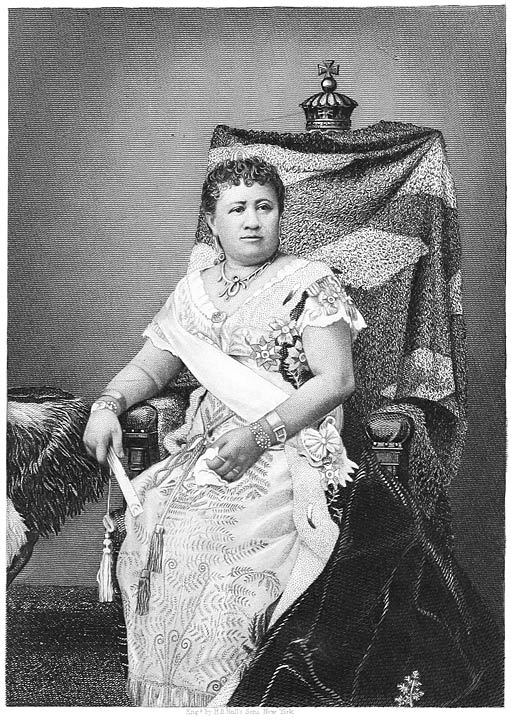
Kapiolani
