HAWAIIAN LEGENDS: INTRODUCTION. (continued 2)
Reading edition
During festival seasons brilliant feasts, tournaments and hula and musical entertainments were given in the royal grounds, and the court was splendid in displays of flowers, feathers and other gaudy trappings. The king not unfrequently took part in the manly games and exercises of the chiefs, and sometimes complimented the hula dancers and musicians by joining in their performances.
To render the kings and higher nobility still more exclusive, they had a court language which was understood only by themselves, and which was changed in part from time to time as its expressions found interpretation beyond the royal circle. Some portions of this court language have been preserved.
ARTS, HABITS AND CUSTOMS.
All implements of war or industry known to the early Hawaiians were made either of wood, stone, or bone, as the islands are destitute of metals; but with these rude helps they laid up hewn-stone walls, felled trees, made canoes and barges, manufactured cloths and cordage, fashioned weapons, constructed dwellings and temples, roads and fish-ponds, and tilled the soil. They had axes, adzes and hammers of stone, spades of wood, knives of flint and ivory, needles of thorn and bone, and spears and daggers of hardened wood. They wove mats for sails and other purposes, and from the inner bark of the paper mulberry-tree beat out a fine, thin cloth called kapa, which they ornamented with colors and figures.
Their food was the flesh of swine, dogs and fowls; fish, and almost everything living in the sea; taro, sweet potatoes and yams, and fruits, berries and edible sea-weed of various kinds. Poi, the favorite food of all classes, was a slightly fermented paste made of cooked and pounded taro, a large bulbous root, in taste resembling an Indian turnip. They made a stupefying beverage by chewing the awa root, and from the sweet root of the ti plant fermented an intoxicating drink. The soft parts of the sugar-cane were eaten, but, with the exception of the manufacture of a beer called uiuia, no other use seems to have been made of it. Their food, wrapped in ti leaves, was usually cooked in heated and covered pits in the earth. Their household vessels were shells, gourd calabashes of various shapes and sizes, and platters and other containers made of wood.
The dress of the ancient Hawaiian was scant, simple and cool. The principal, and generally the only, garment of the male was the maro, a narrow cloth fastened around the loins. To this was sometimes added, among the masses, a kihei, or cloth thrown loosely over the shoulders. The females wore a pau, or skirt of invariably five thicknesses of kapa, fastened around the waist and extending to the knees. When the weather was cool a short mantle was sometimes added. Ordinarily the heads of both sexes were without coverings, and in rare instances they wore kamaas, or sandals of ti or pandanus leaves.
With the maro, which was common to the males of all ranks, the king on state occasions wore the royal mamo, a mantle reaching to the ankles, and made of the yellow feathers of a little sea-bird called the mamo. When it is mentioned that but a single yellow feather is found under each wing of the mamo, and that tens of thousands, perhaps, entered into the fabrication of a single mantle, some idea of the value of such a garment may be gathered. A few of these royal cloaks are still in existence, one of which was worn by King Kalakaua during the ceremonies of his late coronation. Pure yellow was the royal color. The shorter capes or mantles of the chiefs were of yellow feathers mixed with red. The color of the priests and gods was red.
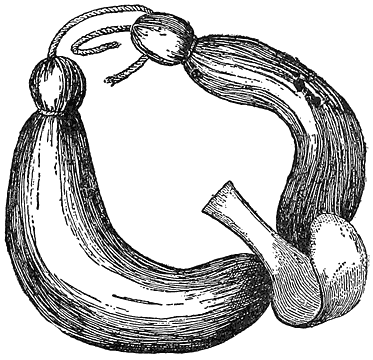
Palaoa, a Talisman worn around the Neck.
The ornaments of the nobility consisted of head-dresses of feathers, palaoas, or charms of bone suspended from the neck, and necklaces and bracelets of shells, teeth and other materials. Many of them were tattooed on the face, thighs and breast, but the practice was not universal. Flowers were in general use as ornaments, and at feasts, festivals and other gatherings garlands of fragrant leaves and blossoms crowned the heads and encircled the necks of all. This is among the beautiful customs still retained by the Hawaiians.
The dwellings of the masses were constructed of upright posts planted in the ground, with cross-beams and rafters, and roofs and sides of woven twigs and branches thatched with leaves. The houses of the nobility were larger, stronger and more pretentious, and were frequently surrounded by broad verandas. It was a custom to locate dwellings so that the main entrance would face the east, the home of Kane. The opposite entrance looked toward Kahiki, the land from which Wakea came.
The homes of well-conditioned Hawaiians consisted of no less than six separate dwellings or apartments: 1st, the heiau, or idol-house; 2d, the mua, or eating-house of the males, which females were not allowed to enter; 3d, the hale-noa, or house of the women, which men could not enter; 4th, the hale-aina, or eating-house of the wife; 5th, the kua, or wife’s working-house; and 6th, the hale-pea, or retiring-house or nursery of the wife. The poorer classes followed these regulations so far as their means would admit, but screens usually took the place of separate dwellings or definite apartments.
When war was declared or invasion threatened, messengers, called lunapais, were despatched by the king to his subject chiefs, who promptly responded in warriors, canoes, or whatever else was demanded. A regular line-of-battle consisted of a centre and right and left wings, and marked military genius was sometimes displayed in the handling of armies. Sea-battles, where hundreds, sometimes thousands, of war-canoes met in hostile shock, were common, and usually resulted in great loss of life. Truces and terms of peace were ordinarily respected, but few prisoners were spared except for sacrifice.
The weapons of the islanders were spears about twenty feet in length, javelins, war-clubs, stone axes, rude halberds, knives, daggers and slings. The slings were made either of cocoa fibre or human hair. The stones thrown were sometimes a pound or more in weight, and were delivered with great force and accuracy. The spears were sometimes thrown, while the javelins were reserved for closer encounter. Shields were unknown. Hostile missiles were either dodged, caught in the hands, or dexterously warded. The chiefs frequently wore feather helmets in battle, but the person was without protection.
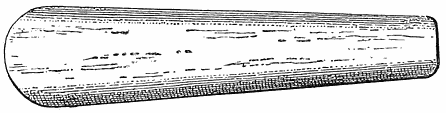
Surf Board.
The athletic sports and games of the people were numerous. The muscular pastimes consisted in part of contests in running, jumping, boxing, wrestling, swimming, diving, canoe-racing and surf-riding. Rolling round stone disks and throwing darts along a prepared channel was a favorite sport; but the most exciting was the holua contest, in which two or more might engage. On long, light and narrow sledges the contestants, lying prone, dashed down long and steep declivities, the victory being with the one who first reached the bottom. The goddess Pele enjoyed the game, and frequently engaged in it. But she was a dangerous contestant. On being beaten by Kahavari, a chief of Puna, she drove him from the district with a stream of lava. Sham battles and spear and stone throwing were also popular exercises.
Among the in-door games were konane, kilu, puhenehene, punipiki, and hiua. Konane resembled the English game of draughts. Puhenehene consisted of the adroit hiding by one of the players of a small object under one of several mats in the midst of the party of contestants, and the designation of its place of concealment by the others. Kilu was a game somewhat similar, accompanied by singing. Punipiki was something like the game of “fox and geese,” and hiua was played on a board with four squares. These were the most ancient of Hawaiian household games.
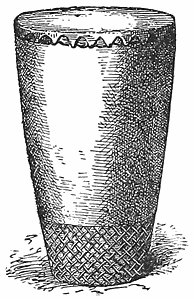
Pahu, or Drum.
The musical instruments of the islanders were few and simple. They consisted of pahus, or drums, of various sizes; the ohe, a bamboo flute; the hokio, a rude clarionet; a nasal flageolet, and a reed instrument played by the aid of the voice. To these were added, on special occasions, castanets and dry gourds containing pebbles, which were used to mark the time of chants and other music. They had many varieties of dances, or hulas, all of which were more or less graceful, and a few of which were coarse and licentious. Bands of hula dancers, male and female, were among the retainers of the mois and prominent chiefs, and their services were required on every festive occasion.
The mourning customs of the people were peculiar. For days they wailed and feasted together over a dead relative or friend, frequently knocking out one or more teeth, shaving portions of their heads and beards, and tearing their flesh and clothes. But their wildest displays of grief were on the death of their kings and governing chiefs. During a royal mourning season, which sometimes continued for weeks, the people indulged in an unrestrained saturnalia of recklessness and license. Every law was openly violated, every conceivable crime committed. The excuse was—and the authorities were compelled to accept it—that grief had temporarily unseated the popular reason, and they were not responsible for their misdemeanors.
The masses buried their dead or deposited the bodies in caves, but the bones of the kings were otherwise disposed of. There were royal burial-places—one at Honaunau, on the island of Hawaii, and another, called Iao, on Maui—and the tombs of many of the ancient mois and ruling chiefs were in one or the other of those sacred spots; but they probably contained but few royal bones. In the fear that the bones of the mois and distinguished chiefs might fall into the hands of their enemies and be used for fish-hooks, arrow-points for shooting mice, and other debasing purposes, they were usually destroyed or hidden. Some were weighted and thrown into the sea, and others, after the flesh had been removed from them and burned, were secreted in mountain caves. The hearts of the kings of the island of Hawaii were frequently thrown into the crater of Kilauea as an offering to Pele. The bones of the first Kamehameha were so well secreted in some cave in Kona that they have not yet been found, and the bones of Kualii, a celebrated Oahuan king of the seventeenth century, were reduced to powder, mingled with poi, and at the funeral feast fed to a hundred unsuspecting chiefs.
GROUP OF NATIVE IMPLEMENTS.

Hand Kahili.
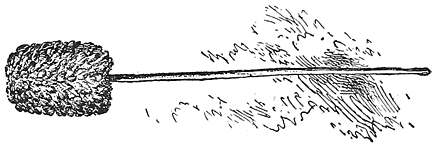
Kahili, or Royal Feather Standard.
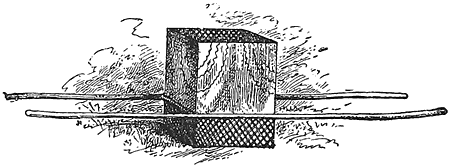
Mauele, or Native Palanquin.
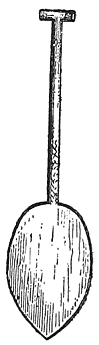
Paddle.
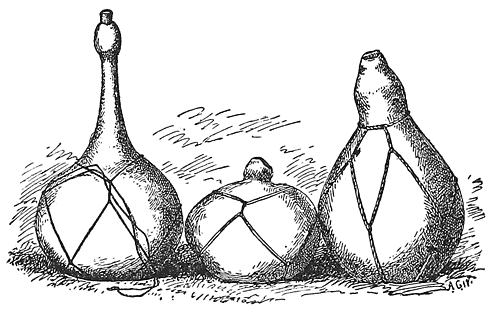
Gourds.
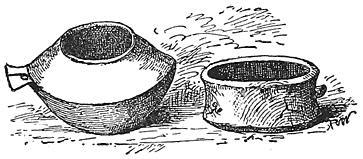
Spittoons.

Kepie, or Sledge used in the Game of Holua.
The ancient Hawaiians divided the year into twelve months of thirty days each. The days of the month were named, not numbered. As this gave but three hundred and sixty days to their year, they added and gave to their god Lono in feasting and festivity the number of days required to complete the sidereal year, which was regulated by the rising of the Pleiades. The new year began with the winter solstice. They also reckoned by lunar months in the regulation of their monthly feasts. The year was divided into two seasons—the rainy and the dry—and the day into three general parts, morning, noon and night. The first, middle and after parts of the night were also designated.
As elsewhere mentioned, they had names for the five principal planets, which they called “the wandering stars,” and for a number of heavenly groups and constellations. It was this knowledge of the heavens that enabled them to navigate the ocean in their frail canoes.
In counting, the Hawaiians reckoned by fours and their multiples. Their highest expressed number was four hundred thousand. More than that was indefinite.
After what has been written it would seem scarcely necessary to mention that the Hawaiians were not cannibals. Their legends refer to two or three instances of cannibalism on the islands, but the man-eaters were natives of some other group and did not long survive.
THE HAWAII OF TO-DAY.
With this somewhat extended reference to the past of the Hawaiian Islands and their people, it is deemed that a brief allusion to their present political, social, industrial and commercial condition will not be out of place. The legends presented leave the simple but warlike islanders standing naked but not ashamed in the light of civilization suddenly flashed upon them from across the seas. In the darkness behind them are legends and spears; in the light before them are history and law. Let us see what the years since have done for them.
The Hawaiian government of to-day is a mild constitutional monarchy, the ruling family claiming descent from the most ancient and respected of the chiefly blood of Hawaii. The departments of the government are legislative, executive and judicial.
The Legislative Assembly, which meets every two years, consists of representatives chosen by the people, nobles named by the sovereign, and crown ministers. They act in a single body, choosing their presiding officer by ballot, and their proceedings are held jointly in the English and Hawaiian languages, and in both are their laws and proceedings published. As the elective franchise is confined to native and naturalized citizens, the most of the representatives chosen by the people are natives, all of whom are more or less educated, and many of whom are graceful and eloquent debaters. White representatives of accepted sympathy with the natives are occasionally elected, and a majority of the nobles and ministers are white men. The English common law is the basis of their statutes, and their civil and criminal codes are not unlike our own. The Legislature fixes tax, excise and customs charges, and provides by appropriation for all public expenditure. The representatives are paid small salaries, and the Legislature is formally convened and prorogued by the king in person.
Although the present sovereign was elected by the Legislature, for the reason heretofore mentioned, the naming of a successor is left to the occupant of the throne. The king is provided at public expense with a palace and royal guard, and appropriations of money amounting to perhaps forty thousand dollars yearly. He has also some additional income from what are known as crown lands. The two sisters of the king and the daughter of one of them receive from the treasury an aggregate of fifteen thousand five hundred dollars yearly. The king entertains liberally, is generous with his friends and attendants, and probably finds his income no more than sufficient to meet his wants from year to year. His advisers are four Ministers of State and a Privy Council. The Ministry is composed of a Minister of Foreign Affairs, who ranks as premier, Minister of Finance, Minister of Interior, and Attorney-General. The Privy Council is composed of thirty or forty leading citizens appointed by the Crown. In certain matters they have original and exclusive powers. They are convened in council from time to time, but receive no compensation. The most of the Privy Councillors are white men, and embrace almost every nationality. The majority of the ministers of state are usually white men of ability, and their salaries are six thousand dollars per annum each.
The judiciary is composed of a Supreme Court of three members, one of whom is chief-justice and chancellor, Circuit Courts holden in different districts, and minor magistrates’ courts in localities where they are required. The Supreme and Circuit judges are all white men, and but few magistrates are natives. The salaries of the superior judges are respectable, and the most of them are men of ability. The laws, as a rule, are intelligently administered and promptly executed, and life and property are amply protected.
Public schools are numerous throughout the islands, and are largely attended by native children. A considerable proportion of the adult natives are able to read and write their own language, and a number of native newspapers and periodicals are sustained. The English press of Honolulu—the only point of publication—is respectable in ability and enterprise.
Leprosy was brought to the islands by the Chinese about forty years ago, and has become a dangerous and loathsome scourge. Lepers are seldom encountered, however, as they are removed, whenever discovered, to the island of Molokai, where they are humanely cared for by the government. It is a cureless but painless affliction, and is doubtless contagious under certain conditions. Nine-tenths or more of the lepers are either natives or Chinese, and the whole number amounts to perhaps twelve hundred. It is not thought that the malady is increasing, and it is hoped that a careful segregation of the afflicted will in time eradicate the disease from the group.
The commerce of the islands is largely in the hands of foreigners, and the sugar plantations are almost exclusively under their control. There are but few native merchants, the large dealers being Americans, Germans, English and French, while the smaller traders are generally Portuguese and Chinese. There are native lawyers, clerks, mechanics, magistrates and police-men; but the most of the race who are compelled to labor for their support find employment as farm and plantation laborers, stevedores, sailors, coachmen, boatmen, fishermen, gardeners, fruit-pedlars, waiters, soldiers and house-servants, in all of which capacities they are generally industrious, cheerful and honest.
The products of the islands for export are sugar, molasses, rice, bananas, fungus, hides and wool, of an aggregate approximate value of eight million dollars annually. The principal product, however, is sugar, amounting to perhaps one hundred thousand tons yearly. Nine-tenths of the exports of the group find a market in the United States, and four-fifths or more of the imports in value are from the great Republic. The receipts and expenditures of the government are a little less than one million five hundred thousand dollars annually, derived principally from customs duties and direct taxation.
The population of the islands is a little more than eighty thousand, of which about forty-five thousand are natives. The Americans, English, Germans, Norwegians and French number perhaps ten thousand, and Chinese, Japanese and Portuguese from the Azores constitute the most of the remainder.
The postal facilities of the islands are ample and reliable. Inter-island steamers, of which there are many, convey the mails throughout the group at regular intervals, and the San Franciscan and Australian steamers afford a punctual and trustworthy service with the rest of the world. The islands have a postal money-order system reaching within and beyond their boundaries, and are connected with the Universal Postal Union.
Over twenty thousand of the inhabitants of the group are centred in Honolulu, the capital of the kingdom, and its beautiful and dreamy suburb of Waikiki. The business portions of the city, with their macadamized and lighted streets, and blocks of brick and stone buildings, have a thrifty and permanent appearance, while the eastern suburbs, approaching the hills with a gentle ascent, abound in charming residences embowered in palms. Small mountain streams run through the city and afford an abundant supply of sweet water, which is further augmented by a number of flowing artesian wells. With a temperature ranging from seventy to ninety degrees, Honolulu, with its substantial churches and public buildings, its air of affluence and dreamy quiet, is a delightful place of residence to those who enjoy the heat and languor of the tropics.
In the midst of these evidences of prosperity and advancement it is but too apparent that the natives are steadily decreasing in numbers and gradually losing their hold upon the fair land of their fathers. Within a century they have dwindled from four hundred thousand healthy and happy children of nature, without care and without want, to a little more than a tenth of that number of landless, hopeless victims to the greed and vices of civilization. They are slowly sinking under the restraints and burdens of their surroundings, and will in time succumb to social and political conditions foreign to their natures and poisonous to their blood. Year by year their footprints will grow more dim along the sands of their reef-sheltered shores, and fainter and fainter will come their simple songs from the shadows of the palms, until finally their voices will be heard no more for ever. And then, if not before—and no human effort can shape it otherwise—the Hawaiian Islands, with the echoes of their songs and the sweets of their green fields, will pass into the political, as they are now firmly within the commercial, system of the great American Republic.
February, 1887.