The Triple Marriage of Laa-mai-kahiki.
Reading edition
CHARACTERS.
Mulielealii, chief of western Oahu.
Kumuhonua, sons of Mulielealii. Olopana, and Moikeha,

Laa-mai-kahiki, adopted son of Moikeha.
Luukia, wife of Olopana.
Laamaomao, god of the winds.
Mookini, a high-priest.
Kamahualele, an astrologer and poet.
Puna, the principal chief of Kauai.
Hooipo, daughter of Puna.
Kila, son of Moikeha and Hooipo.
Hoakanui, the three brides of Laa. Waolena, Mano,
Ahukini-a-Laa, the three children of Laa. Kukona-a-Laa, and Lauli-a-Laa,
THE TRIPLE MARRIAGE OF LAA-MAI-KAHIKI.
THE LEGENDS OF MOIKEHA AND THE ARGONAUTS OF THE ELEVENTH AND TWELFTH CENTURIES.
I.
Tradition abounds in bold outlines, here and there interspersed with curious details, of the many prominent expeditions to the Hawaiian Islands, from the beginning of the eleventh to the latter part of the twelfth centuries, of adventurous Tahitian, Samoan and Georgian chiefs. Learning of the existence and approximate location of the group, and perhaps guided to an extent by intervening islands and atolls that have since disappeared, they came with large fleets of barges and double canoes, bearing their families and attendants, their priests, astrologers and musicians, and by degrees possessed themselves or their immediate descendants with the fairest portions of the little archipelago. For a century or more bitter feuds and frequent wars followed; but in the end the invaders and the invaded, both of the same Polynesian race, became assimilated through concession, intermarriage and fundamental identity of religious cult, and thenceforth in a united and homogeneous stream flowed down the years. The genealogies of the prominent chiefs and priests were alone preserved; and while, in after-generations, some of them traced their lines of rank to the native stock of Nanaula, and others to the chiefs of the second migratory influx from the south, the ruling families of the entire group had become so united in blood by intermarriage that it was difficult to find a chief of distinction who could not trace his lineage back to both.
But during the migratory period referred to, especially marked by the coming of Nanamaoa, Pili, Paao and the Oahu and Maui Paumakuas, the Hawaiian group was not the only scene of foreign adventure among the central islands of the Pacific. The native chiefs of Hawaii, whose ancestors had reached the group more than five hundred years before, were quite as adventurous and skilled in navigation as their southern invaders; and thus while the latter, continually augmented in numbers by fresh arrivals, were steadily possessing themselves of the lands and governing forces of the Hawaiian Islands, a few resolute chiefs of the old line, either in a spirit of retaliation or because the way had been pointed out, boldly spread their sails for the abandoned homes of their aggressors, and by conquest or other means acquired lands and influence in the distant islands of the south.
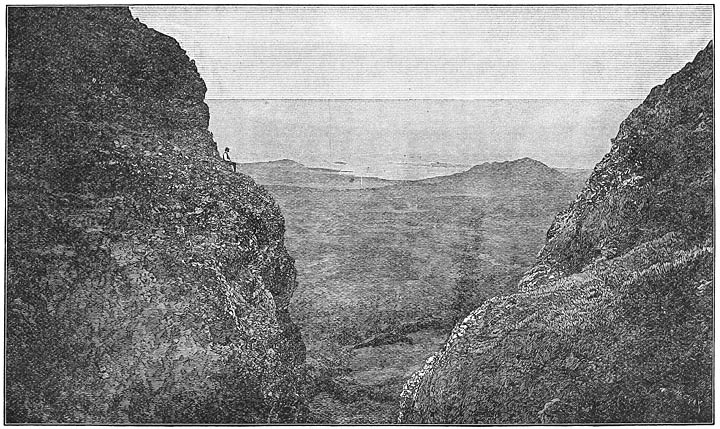
The Pali, near Honolulu.
The mooolelo about to be related embraces the romantic story of one of these expeditions of native Hawaiian chiefs to the southern islands, and presents an interesting picture of the manners, customs and aspirations of the mid-Pacific Argonauts of that period.
Somewhere about the year A.D. 1040 Maweke, a native chief of the line of Nanaula—the first of the family that is brought prominently to view in the chronology of the second influx—was the alii-nui, or nominal sovereign, of the island of Oahu. He had three sons—Mulielealii, Keaunui and Kalehenui. On the death of Maweke, the eldest son, Mulielealii, acceded to the title of alii-nui, occupying the western side of the island. Kalehenui was given possessions at Koolau, and Keaunui was established in the district of Ewa. The latter became the ancestor of a line of powerful chiefs in that district, and is credited with having cut or opened the navigable channel near the Puuloa salt-works, by which the estuary now known as Pearl River, not far from Honolulu, was rendered accessible to navigation. No further reference need here be made to this branch of the family beyond the remark that Keaunui became the father of Lakona, and also of Nuakea, the wife of Keoloewa, King of Molokai, and of the prophet Moi, who fell with Kaupeepee in defence of the fortress of Haupu, as related in the legend of “Hina, the Helen of Hawaii.”
Mulielealii had three sons—Kumuhonua, Olopana and Moikeha—and one daughter, named Hainakolo. As the eldest son and successor of his father, Kumuhonua in time acceded to the patrimonial estates and titles; but the younger brothers, not content, as they grew to manhood, with the small allotments which must necessarily have been accorded them, concluded to seek for ampler and more inviting possessions elsewhere.
The Paumakua family occupied a large part of the eastern side of the island, and, although they were of the stock of the second influx, their relations with the native chiefs and people seem to have been peaceful and satisfactory. Paumakua, who first appeared in native annals two generations before the time of Olopana and his brothers, either as an immigrant from one of the southern islands or the son or grandson of a chief of recent arrival, was one of the most restless and dashing of the prominent leaders of that period. The legends of the time glow with stories of his marvellous exploits and adventures in foreign lands, and the friendly feeling entertained for his immediate successors was doubtless due in a great measure to the respect established for them through his rank and prowess.
It is claimed by tradition that Paumakua visited all the foreign lands then known to the Hawaiians, and brought back with him many things that were strange. From one of his voyages he returned with two white priests, Keakea and Maliu, from whom several ecclesiastical families subsequently claimed descent and authority. At another time he brought back Malela, a noted prophet and sorcerer, and three other persons of a strange race, one of whom was a woman. Tradition somewhat minutely describes them as “foreigners of large stature, bright, staring, roguish eyes, and reddish faces.”
As the voyages of this adventurous chief were sometimes of many months’ duration, and he is said to have prosecuted his researches in almost every direction, it is not impossible that the foreigners with “roguish eyes and reddish faces” were aborigines of North America. But, leaving this to conjecture, tradition permits no doubt that Paumakua was a skilful and fearless explorer, and through his enterprise acquired renown for himself and respect for his descendants, one of whom is about to be presented to the reader.
As already stated, the younger sons of Mulielealii, Olopana and Moikeha, not content with their prospects in Oahu, resolved to seek fame and fortune elsewhere. Both were unmarried, but, through some circumstance or for some purpose not mentioned by tradition, Moikeha had adopted a young son of Ahukai, the great-grandson and successor of Paumakua. The name of the boy was Laa, or Laa-mai-kahiki, to which it was subsequently extended. The child-chief could not have been without political prospects, for he is referred to in the chants as “Chief of Kapaahu and Lord of Nualaka.” Although the custom was common then, as now, among Hawaiians of every rank and condition, of exchanging and adopting children, the adoption of so promising a scion of the Paumakua line by a grandson of Maweke must have been the result of some extraordinary compact, all reference to which has disappeared from tradition.
Taking leave of their relatives on Oahu, Olopana and Moikeha, with a considerable number of attendants, embarked for the island of Hawaii, and established themselves at once in the beautiful valley of Waipio, in the district of Hamakua. What chief, if any, they found in possession there is not stated; but it was not long before the valley was ruled by Olopana, with Moikeha as his principal captain and adviser. The young chief Laa accompanied his foster-father to Waipio, and there Moikeha began to instruct him in the manly accomplishments for which in after-years he became distinguished.
To strengthen his rule and protect himself against the encroachments of neighboring chiefs, Olopana married Luukia, granddaughter of Hikapaloa, chief of Kohala, and a descendant of the ancient line of Nanaula, to which Olopana himself belonged by lineage still more direct. He urged his brother to follow his example and connect himself by marriage with some one of the ruling families of Hamakua. Such an alliance could have been readily made by Moikeha, for his strain was undoubted, and in manly beauty and courtly graces he had scarcely a peer in all the group; but he declared that he had a wife in his spear and an heir in Laa, and would not create a jealousy in the family by adding to either.
But the brothers did not remain long in Waipio. A terrible hurricane, followed by storms and floods, completely devastated the valley, compelling the inhabitants to abandon their homes and seek refuge elsewhere. Moikeha had never been satisfied with Waipio, and in the midst of the ruin around them found little difficulty in persuading his brother to make a bold push for the misty and far-off land of Kahiki. Preparations for the journey were immediately made, and in five large double canoes the brothers, with Laa and a considerable body of attendants, set sail for the islands of the south. They knew the general direction, and the sun and stars guided them in their course.
A prosperous wind wafted them to the Society group, and they finally landed on the island of Raiatea, and forcibly took, or in some other manner secured, possession of the district of Moaula. Olopana was accepted as sovereign of the district, and soon became a ruler of opulence and distinction. Moikeha, still his chief adviser, built a sumptuous residence and heiau for himself, called Lanikeha, or “the heavenly resting-place,” and became noted for his hospitality.
For some time—perhaps for four or five years—the brothers dwelt together in harmony, and then misunderstanding and trouble came between them—it need scarcely be said, through a woman—which drove Moikeha again to the sea and separated them for ever. A meddlesome native chief named Mua, who was jealous of the popularity of Moikeha and desirous of supplanting him in the favor of Olopana, called the attention of Luukia on several occasions to Moikeha’s affluent style of living, and intimated that his purpose was to thereby secure the friendship of influential chiefs, and in the end wrest the sovereignty of the district from his brother. Alarmed at last, she bore the tale to her husband, and at length succeeded in arousing his suspicions. A coldness toward Moikeha very naturally followed. Olopana could not help but note his brother’s increasing popularity, and one day took occasion to rebuke him for his extravagance and love of display, suggesting, at the same time, that a more modest style of living would comport better with his position. Moikeha, who had never harbored a thought that was not loyal to his brother, was profoundly grieved at these words of suspicion, and resolved to leave Raiatea at once and return to the Hawaiian Islands. Feeling that he had gone too far in thus indirectly accusing his brother of meditated treachery, Olopana endeavored to persuade him to remain; but Moikeha’s resolution could not be shaken, and he set about preparing at once for his return to the Hawaiian group.
The number of canoes manned and provisioned for the voyage is not stated; but tradition avers that the fleet was equipped under the superintendence of Moikeha’s famous prophet and astrologer, Kamahualele; and, with the priest Mookini, Laamaomao, the director of the winds, and a large party of chiefs and retainers, the expedition set sail for Hawaii, the young chief Laa being left behind with Olopana.
It was one of the most imposing fleets that had ever sailed out of the harbor of Opoa. The large double canoe bearing Moikeha and his priests, gods, astrologer, principal navigator, wind director and personal attendants, was the same in which he had sailed for Kahiki. The kaulua was nearly a hundred feet in length, and afforded ample accommodations for the forty or more persons assigned to it. It was painted red, and at the masthead floated the pennon of a Polynesian alii.
Moikeha embarked with a number of distinguished companions, but the most noted was Laamaomao—a name signifying, perhaps, the sacred bluish green or wind clouds. He was the director of the winds, which were stored in his ipu, or calabash, and went forth at his bidding. He bore a close resemblance to the Æolus of the Greeks. After accompanying Moikeha to the Hawaiian Islands he took up his abode near a place called Hale-a-Lono, a well-known eminence of Kaluakoi, on the island of Molokai, and was subsequently deified and worshipped as an aumakua, or god of the winds.
With musicians and drummers to enliven the spirits of the voyagers, and favoring winds from the ipu of Laamaomao, the journey seems to have been prosperous, and no incident of note occurred until the island of Hawaii was sighted. As the green hills of Kau came to view songs and shouts of joy went up from the canoes. A voyage of over twenty-five hundred miles in open boats had tested the patience of the party, and land at last was a joyous sight to them all. Many leaped into the water and swam beside the canoes. Mookini, the high-priest, burned incense before the gods, at the same time addressing them a prayer of thanksgiving, and Kamahualele, the astrologer and poet, recited an inspiring chant in further celebration of the occasion. The chant has been preserved by tradition.
Some of the early poetic accounts of the first appearance of the islands of Hawaii above the surface of the ocean mention Hawaii, the largest of the group, as suddenly rising from the great deep and becoming a part of a row or cluster of islands “stretching to the farthest ends of Kahiki,” from which it is conjectured that, centuries back in the past, islands now no longer existing marked the way at intervals between the Society and Hawaiian groups. The other islands of the Hawaiian cluster are referred to as natural births, their parents being demi-gods or distinguished chiefs. Thus, in the language of an old chant:
“Rising up is Hawaii-nui-akea!
Rising up out of the night (Po)!
Appeared has the island, the land,
The string of islands of Nuuamea,
The cluster of islands stretching to the farthest ends of Kahiki.
To Kuluwaiea of Haumea, the husband,
To Hina-nui-a-lana, the wife,
Was born Molokai, a god, a priest,
The first morning light from Nuuamea.
Up stands Akuhinialaa,
The chief from the foreign land;
From the gills of the fish
From the overwhelming billows of Halehale-kalani,
Born is Oahu, the wohi,
The wohi of Akuhinialaa,
And of Laamealaakona the wife.”
Kamahualele began by repeating an ancient story of the origin of the several islands of the group, and concluded his chant with these hopeful words:
“O Haumea Manukahikele.
O Moikeha, the chief who is to reside,
My chief will reside on Hawaii—a!
Life, life, O buoyant life!
Live shall the chief and priest,
Live shall the seer and the slave,
Dwell on Hawaii and be at rest,
And attain old age on Kauai.
O Kauai is the island—a!
O Moikeha is the chief!”
Thus sang the poet, with his face toward the verdant slopes of Kau, while the canoes of the fleet gathered around him, that all might hear the words of one who read the fate of mortals in the stars.
II.
The prediction of Kamahualele, inspired by a sudden view of the coast of Hawaii, was verified. A landing was made in the district of Kau, the most southerly point of the island. There securing supplies of provisions and water, the next landing was effected at Cape Kumukahi, in the district of Puna; but a recent eruption from the crater of Kilauea, or a subterranean channel connected with it, had devastated a wide strip of country near the coast, and after a brief stay sail was made for Kohala. Landing in that district, Moikeha and his party were well received by Kaniuhi, the alii-nui and grandson of Pili, and permission to offer sacrifices in behalf of the expedition in the great heiau of Mookini was accorded the high-priest of Moikeha, whose name, by singular coincidence, was identical with that of the temple, erected by the high-priest Paao more than two generations before.
Leaving Kohala, Moikeha next touched at Hanuaula, on the island of Maui; but, without stopping to exchange courtesies with Haho, the noted moi of that division of the island, he sailed immediately for Oahu. His purpose was to visit his royal father, Mulielealii, whose residence was at Ewa; but his priest and seer so strongly protested against the visit, declaring it to be contrary to the will of the gods, that he directed his course around the northern side of the island, touching at Makapuu and Makaaoa, and then sailing directly for the island of Kauai.
On the evening of the second day after leaving Oahu, Moikeha anchored his canoes in a roadstead not far from Kapaa, Kauai, where Puna, the governing alii of the island, held his court, surrounded by the chiefs of his family and a large number of retainers. Puna was one of the most popular rulers in the group, and, strict as he may have been in the exercise of his prerogatives, was always merciful in dealing with offences thoughtlessly or ignorantly committed. He would pardon the humble laborer who might inadvertently cross his shadow or violate a tabu, but never the chief who deliberately trespassed upon his privileges or withheld a courtesy due to his rank. His disposition was naturally warlike, but as the condition of the island was peaceful, and military force was seldom required except in repelling occasional plundering raids from the other islands, he kept alive the martial spirit of his chiefs and subjects by frequent sham fights, marine drills, and the encouragement of athletic games and friendly contests at arms, in which he himself sometimes took part. Feasting and dancing usually followed these warlike pastimes, and the result was that the court of Puna became somewhat noted for the chivalry of its chiefs and the splendor of its entertainments.
Puna had but one child, a daughter named Hooipo. Tradition describes her as having been, like the most of royal daughters painted by the poets, a very comely maiden. She was therefore the pride and glory of the court, and as she grew to a marriageable age her favor was sought by a number of aspiring chiefs whose rank entitled them to consideration; but, flattered by the contest for her smiles, and naturally vain of a face which the unruffled waters told her was attractive, she evinced no haste in making choice of a husband.
This tardiness or indecision was but very gently rebuked by Puna. Although one tradition gives him two daughters, Hooipo was doubtless his only child, and he was therefore indisposed to hasten an event which would probably lead to their separation. But, as time passed, the suitors of the young chiefess became so persistent, and the rivalry for her assumed so bitter and warlike an aspect, that Puna deemed it prudent for her to restore harmony among the rivals by making a choice at once. But for no one of them did she seem to entertain a decided preference, and therefore suggested that, since a choice must be made, she was willing to leave it to the arbitrament of such manly contest between the rivals as might comport with their dignity and the character of the prize at stake. Puna eagerly accepted the suggestion, as it opened the way to a selection without incurring the enmity of all but the one chosen.
But what should be the nature of the contest? Each of the rival chiefs was probably noted for his skill in some especial accomplishment, and the difficulty was in naming a trial that would seem to be just to all. Unable to decide the matter himself, Puna appealed to the high-priest, and the next day announced that his palaoa—a talisman consisting of a whale’s tooth, carved and sanctified—would be sent by a trusty messenger to the little island of Kaula; that four days thereafter the rival chiefs should, each in his own canoe, start at the same time and place from Kauai, and the one who returned with the palaoa, which the messenger would be instructed to give to the first of the contesting chiefs to land and claim it on the rocks of Kaula, should be the husband of Hooipo, and the others must remain his friends. The size of the canoes was left to the discretion of the several contestants, but as no more than four assistants would be allowed to each, very large canoes, of course, would not be used. Any means of speed might be employed, including oars, paddles and sails.
The contest was admitted to be as fair as any that could be devised, and the rival chiefs declared themselves satisfied with it, and began to prepare for the race by securing suitable canoes and skilful and stalwart assistants. It promised to be an exciting contest, and the whole of Kapaa was on tiptoe to witness the start.
After a few days of preparation the messenger of Puna was despatched with the palaoa to Kaula, with instructions to place it in the hands of the first of the contesting chiefs to claim it on that island. The messenger had been gone two days, and had probably reached his destination, as the distance to be travelled was but little more than a hundred miles, and the rival chiefs had everything in readiness to bend their sails for Kaula, when Moikeha, as already stated, anchored his fleet in the evening off Kapaa.
Early next morning, with his double canoe flying the standard of his rank and otherwise becomingly dressed, Moikeha went ashore, where he was cordially received by the chiefs of the district, and in due time escorted to the sovereign mansion and presented to Puna. Without referring to his family connections, he simply announced that he was a chief from the distant land of Kahiki, and was traveling through the Hawaiian group on a tour of observation and pleasure. He wore a maro fringed with shells, a kihei or mantle of finely-woven and decorated cloth, and on his head a lei-alii of brilliant feathers, while from his neck was suspended by a cord of plaited hair a curious ornament of mother-of-pearl set in ivory. He was a handsome representative of savage manhood, and his bearing was dignified, correct and courtly.
During his audience with Puna, Moikeha met Hooipo—most likely by accident, but he was so charmed by her bright eyes that he did not leave the mansion until he found occasion to exchange a few pleasant words with her. They seemed to be mutually pleased with each other, and Moikeha accepted the invitation of the chief to consider himself his guest until the next day, at the same time allowing him to send fresh provisions to his people, whose canoes had been drawn up on the beach.
A brilliant entertainment of feasting, music and dancing in honor of the distinguished stranger followed in the evening, during which Moikeha was favored with the companionship of Hooipo, and learned of the contest about to take place between the rival chiefs of Kauai to determine to whom she should be given in marriage.
Hilarity and feasting were the order of the next day and evening, for on the morning following the contesting chiefs were to start for Kaula under the eye of Puna. Their well-equipped canoes were on the beach, and their crews, drilled to work sail and oar together, were in readiness.
Morning came, and with it a large concourse of people to witness the departure of the chiefs. The canoes and their attending crews were examined, and many wagers laid on the result of the race. Finally the contesting chiefs made their appearance, followed shortly after by Puna and the most of his household, including Hooipo, who was conveyed to the beach in a manele borne on the shoulders of four stout attendants. She was attired in an embroidered pau—a short skirt of five thicknesses of thin kapa cloth reaching to the knees—and a cape or short mantle trimmed with feathers. Her hair was braided in a single strand at the back; her head and neck were adorned with leis of flowers and feathers, and her limbs were ornamented with circlets of shells and tinted seeds.
Everything being in readiness, the contending chiefs, eight in number, appeared before the alii-nui, and, bowing low, proceeded in turn to recite their kuauhaus, or genealogies, as they had been called upon to do, to show in a formal manner that all their strains were noble. As each concluded he again bowed, giving Hooipo a smile and look of confidence, and stepped back to await the signal of departure.
The last of them had given his pedigree, the terms of the contest had again been announced in form by a herald, and Puna was about to order the simultaneous launching of the canoes, when Moikeha, whose presence had not before been observed by the chiefs, suddenly presented himself before the alii-nui, and, bowing first to him and then courteously to the chiefs, said:
“Great chief, as this trial seems to be free to all of noble blood, I accept the terms, and ask permission to present myself as a contestant for the prize.”
The chiefs exchanged glances of surprise, and a pleased expression lighted up the face of Hooipo, who until that moment had manifested but little interest in what was transpiring around her.
Puna hesitated a moment, and then graciously replied:
“Noble stranger, if your rank is level with the conditions, and the chiefs now ready for departure urge no objection, my consent will not be withheld.”
A hurried consultation among the chiefs showed that some of them objected; but as the stranger, with no knowledge of the coast and apparently no canoe or crew in readiness, did not seem to be a competitor to be feared, it was finally agreed that, should he be able to establish his rank, which a few of them doubted, he might be admitted to the contest.
This resolution having been communicated, Moikeha gracefully bowed his thanks, and then began to recite his genealogy. Curious to learn the strain of the courtly stranger, the chiefs pressed around him, eagerly listening to every word. He began with Wakea, away back in the past, when his ancestors were residents of other lands referred to in Hawaiian story. Giving the record of thirteen generations, he brought the connection down to Nanamaoa, the pioneer of the first migratory influx to the Hawaiian group seven hundred years before. Thence, generation by generation, naming father, mother and heir, he traced down a line of sixteen successors to Maweke. Pausing a moment, while a look of surprise and wonder was exchanged by the listening chiefs, Moikeha continued:
“Maweke the husband,
“Naiolaukea the wife;
“Mulielealii the husband,
“Wehelani the wife;
“Moikeha the husband,
“Hooipo the wife.”
Applause followed this announcement by the stranger that he was the son of Mulielealii, the alii-nui of Oahu, and the jesting and good-natured manner in which he concluded the kuauhau by predicting his success in the coming contest, and marriage with Hooipo, made him no enemies among the competing chiefs. Hooipo was now sure that she could make a choice without the trouble and excitement of a race to Kaula; but the canoes were ready, and all she could do was to hope and pray that Moikeha would bring back the palaoa.
But what were Moikeha’s preparations for the race? When asked by Puna, he pointed to a small canoe with an outrigger drawn up on the beach, and a single long-haired man of strange aspect standing motionless beside it with a paddle in his hand. Puna shook his head doubtingly, and Hooipo looked disappointed. Others who noted the stranger’s slim preparations for the race imagined that he was treating the contest as a jest; but he announced himself in readiness, and the signal for departure was given.
The chiefs sprang toward the beach, and in a few minutes had launched their canoes and passed through the heavy surf, when with strong and steady pulling the race began in earnest for the open sea. Moikeha alone seemed to be in no haste. He took formal leave of Puna, and, noting Hooipo’s look of impatience, smilingly said to her as he turned toward the beach: “I will bring back the palaoa!” The assurance contented her. The other canoes were beyond the surf, but she believed him and was happy.
Satisfying himself that the sail was ready for use and everything required for the voyage aboard, Moikeha and his assistant shoved their canoe into the water, and with a few vigorous strokes of their paddles dashed through the surf. The passage was so adroitly made as to attract the attention of the many who witnessed it from the shore. For a few minutes the canoe remained almost motionless, except as it was tossed from wave to wave. Then the sail was spread. This movement was unaccountable to those on shore, for the little wind stirring was directly from the west, to which point the canoe was bearing for an offing to round the southern capes of the island. But if the witnesses were surprised at the spreading of a sail under such circumstances, they were little less than astounded when they saw the sail fill with wind and the canoe suddenly speed out to sea as if driven by a hurricane.
Moikeha’s long-haired companion was Laamaomao, god of the winds, who had accompanied him from Raiatea. Behind the sail sat the friendly deity, from whose exhaustless ipu of imprisoned winds a gale was sent forth which carried the canoe to Kaula before daylight the next morning. Effecting a landing soon after sunrise, Puna’s messenger was found, and at once delivered to Moikeha the palaoa, which he had been instructed to surrender to the chief first demanding it. Content in the possession of the talisman, Moikeha and his companion remained on the island for refreshment until past midday, and then started on their return to Kauai, favored by the same winds that had borne them to Kaula, but proceeding with less haste. Toward night the eight other chiefs landed within a few hours of each other, and great was their astonishment on learning that the palaoa had been delivered to a chief claiming it early that morning.
“He must have had wings,” said one of them.
“He was surely helped by the gods,” suggested another, who had been the first to land after Moikeha. “But for that the palaoa would have been mine, as you all know. But who can struggle with the gods? Let us not incur their anger by complaint.”
As it was easy for the others to reconcile themselves to Moikeha’s success, good-humor was soon restored, and the next morning, in company with the messenger, they all re-embarked for Kauai. On the evening of the same day Moikeha landed at Kapaa, and hastened to place in the hands of Puna the talisman which made him the husband of Hooipo. Now assured of the rank of the victor, Puna was gratified at his success, and Hooipo made no disguise of her joy. Tradition says she fell in love with the handsome stranger on first beholding him; but be that as it may, when he returned from Kaula with the palaoa she was frank enough to confess that his success had made her happy.
In the course of a few days all of the defeated chiefs returned to Kapaa, and Moikeha invited them to a feast, over which they forgot their rivalry and renewed the pledges of friendship embraced in the terms and made a condition of the contest. They sought by many ingenious ways to draw from Moikeha the secret of his success; but he failed to enlighten them, and they were compelled to content themselves with the belief that he had been assisted by some supernatural power, possibly by Apukohai, the great fish-god of Kauai, who sometimes seized canoes and bore them onward with almost incredible velocity.
In due time Hooipo became the wife of Moikeha, who, on the death of Puna, succeeded him as the alii-nui of Kauai, where he remained to the end of his life. He was blessed with a number of sons, through one of whom, it may be mentioned, the sovereignty of the island was continued in the family after Moikeha was laid under the black kapa.
III.
Tradition next refers to Moikeha about twenty-five years after his marriage with Hooipo. The death of Puna had left him the sovereignty of Kauai, and his principal residence was at Waialua. He had seven sons, and his court, like that of his predecessor, was noted for the distinguished chiefs, priests, prophets and poets connected with it.
As the life of Moikeha was drawing to a close a strong desire possessed him to see once more his foster-son Laa, whom, on his departure from Raiatea, he had left with his brother Olopana, whose presumptive heir and successor the young chief had become. In preparation for a journey thither he ordered a number of large double canoes to be repaired and put in order for the open sea, and had some time before despatched a large party of hunters to the cliffs along the coast for the feathers of the mamo, from which to fabricate a royal mantle for the ward of his youth.
As but a single small yellow feather of the kind used in a royal mantle is found under each wing of the mamo, the task of securing the many thousands required was by no means a brief or easy service; but in time the feathers were gathered and the cloak was completed. As the choicest feathers alone were used, the garment was one of the most brilliant and elaborate ever made on Kauai, and represented the labor of a hundred persons for a year.
But when everything was in readiness for his departure for the south, Moikeha concluded that he was too old and feeble to undertake the voyage. In this conclusion he was sustained by the auguries of the prophets and the persuasion of his sons. His third son was Kila. He was distinguished for his capacity and courage, and especially for his skill as a navigator, and it was finally decided that he should make the journey to Raiatea as the messenger of Moikeha, and invite Laa to revisit the Hawaiian group, assuring him of the feeble health of his foster-father and of his anxiety to embrace him before death separated them for ever.
Kila was delighted with the mission. For several years intercourse between the Hawaiian and southern groups had been almost completely suspended, but from boyhood his dreams had been of visits to the far-off and misty shores of Kahiki, of which he had heard Moikeha speak; and now that an opportunity was presented for gratifying his appetite for adventure in unknown seas, his joy was boundless, and so vigorously did he push the work of preparation that in a few days the canoes were equipped and provisioned for the voyage. The provisions consisted, in long voyages of that period, of dried fish, dried bananas and plantains, cocoanuts, yams and potatoes, with poi and paiai, fresh fruits and cooked fowls and pigs, for early consumption. Large calabashes of fresh water were also provided, but frequent baths largely diminished the craving for that necessity.
Sacrifices were offered, the auguries were pronounced favorable, and the fleet of double canoes set sail for the south. Kila was accompanied by three of his brothers, and, more important still, by the venerable Kamahualele, the friend and astrologer of Moikeha, who had borne him company from Raiatea more than a quarter of a century before, and chanted his inspired visions of the future off the coast of Kau. He went as Kila’s chief navigator and especial counsellor.
The fleet passed through the group and took its final departure from the most southern point of the island of Hawaii. Wind and weather were both favorable, and without a mishap of consequence the expedition arrived in due time at Raiatea, first touching for guidance at some of the other islands of the southern group.
Kila landed at Opoa through the sacred entrance of Avamoa. His flag and state were recognized by Olopana, who was still living, and the sons of Moikeha and their personal attendants were ceremoniously conducted to the royal mansion, where Kila made known the purpose of his visit. Olopana was greatly interested in the story of Moikeha’s successful establishment on Kauai, but refrained from referring to the circumstances which led to their separation many years before. He was also informed of the death of his father, Mulielealii, and the succession of his brother Kumuhonua to the rank and authority of alii-nui of Oahu.
With the affectionate greetings of Moikeha, Kila presented to Laa the brilliant mamo, or royal mantle, of which he was made the bearer, and expressed the hope that he would comfort the few remaining days of his foster-father by returning with him on a visit to Kauai. Olopana strongly objected to the proposed journey, urging his advanced years and the probability of his early death; but when assured by Laa of his speedy return he reluctantly consented, and after a round of hospitable feasts and entertainments, in his own double canoes, and attended by his priest, astrologer, master of ceremonies, musicians, and a number of knightly and noble friends, Laa accompanied Kila and his party back to Hawaii.
The voyage was made in good time, and as the combined fleet, with canoes of royal yellow and pennons flying, coursed through the group to Kauai, stopping at several points to exchange courtesies with the ruling chiefs, it attracted unusual attention; and when Laa landed at Waialua, on the island of Oahu, to greet his relatives, and the people learned that the son of Ahukai had returned from the distant land of Kahiki rich in honors and possessions, they strewed his path with flowers and welcomed him as if he were a god.
Proceeding to Kauai, after a brief stay at Waialua, Laa was affectionately received by Moikeha, his foster-father, who had left him a child in Kahiki, and for a month or more the Kauaian court blazed nightly with feasts and festivals given in his honor.
Returning to Oahu, Laa took up his residence for a time at Kualoa. A large mansion was constructed for him, with ample accommodations for his friends and retainers, and the chiefs of the island esteemed it an honor to share his friendship and accept his hospitality.
There was no jealousy of Laa, for it was known that he would soon return to Raiatea, there to permanently remain as the heir and successor of Olopana. In his veins ran the noblest blood of Oahu. He was the son of the great-grandson of the great Paumakua in direct and unchallenged descent, and the adopted heir of the grandson of Maweke, the proud descendant of the Nanaula dynasty of kings.
It was not deemed well that the line of Paumakua, through so distinguished a representative as Laa, should be perpetuated solely on a foreign soil. From a suggestion the matter came to be seriously discussed by the leading chiefs, and finally Laa was approached on the subject. Being a young man, the patriotic proposal of the chiefs very naturally accorded with his tastes, and, without great persuasion, he expressed a willingness to comply with what seemed to be a general request.
But the approval of Laa did not quite settle the delicate question, as the chiefs at once observed on casting around for a suitable wife for so desirable a husband. The most of them had daughters or sisters of eligible rank and age. But which one of them should they select? Whose family should be so honored? They were willing to leave the choice to Laa, but, sagaciously anticipating the result, he declined to make the selection.
As usual in momentous cases of doubt, the high-priest was consulted, and the matter was settled in a manner quite satisfactory to Laa. It was agreed that he should marry three wives, all on the same day, and the maidens selected were Hoakanui, daughter of Lonokaehu, of Kualoa; Waolena, daughter of a chief of Kaalaea; and Mano, daughter of a chief of Kaneohe. All were noted for their beauty and distinguished blood.
The three brides were brought to the mansion of Laa, at Kualoa, on the day fixed for the triple marriage, and the event was celebrated with splendor and enthusiasm. The hoao, or marriage agreement, was made public by a herald, as was then the custom among the nobility; the brides, attired becomingly and decked with garlands, were delivered in form to the bride-groom, and in the evening a feast was served on the grounds to more than a thousand guests, with hula, mele, and other festive accompaniments, including mele-inoas, or songs of personal application to the new wives and their husband.
This triple marriage is one of the most thoroughly-established incidents of remote Hawaiian tradition. After his marriage Laa remained a year at Kualoa, and then began to prepare for his return to Raiatea. He looked forward to his departure with mingled feelings of regret and satisfaction, for his brief married life had been singularly as well as most bountifully blessed. On the same day he had been presented with a son by each of his three wives, and an ancient chant thus refers to the event:
“O Ahukai, O Laa-a, O Laa,
O Laa from Kahiki, the chief;
O Ahukini-a-Laa,
O Kukona-a-Laa,
O Lauli-a-Laa, the father
The triple canoe of Laa-mai-kahiki,
The sacred first-born children of Laa,
Who were born on the same one day.”
Moikeha died soon after, and Laa bade farewell to the Hawaiian Islands and returned to Raiatea just in time to receive the dying blessing of Olopana. As he had promised, he left his three wives and their sons in Oahu, where they were well cared for. The names of the children, as mentioned in the chant quoted, were Ahukini-a-Laa, Kukona-a-Laa, and Lauli-a-Laa, from whom it was in after-generations the pride and glory of the governing families of Oahu and Kauai to trace their lineage. From Ahukini-a-Laa Queen Kapiolani, wife of Kalakaua, the present sovereign of the islands, is recorded in descent through a line of Kauaian chiefs and kings.
Kila, after his return from Raiatea, established himself in the valley of Waipio, on the island of Hawaii, and became prosperous in the possessions abandoned by his uncle Olopana a generation before. He was the ancestor of several prominent Hawaiian families, who traced their descent to him as late as during the reign of Kamehameha I.
With the return of Laa to Raiatea all communication between the Hawaiian and southern groups seems to have abruptly terminated, and for a period of about six hundred years, or until the arrival of Captain Cook in 1778, the Hawaiians learned nothing of the great world beyond their little archipelago, and knew that lands existed elsewhere only through the mysterious mooolelos of their priests, and a folk-lore consisting of broken chains of fables and tales of the past in which the supernatural had finally become the dominant feature.