APPENDIX II1
Reading edition
APPENDIX II1
To the stories taken by Mr. Endle from my little collection of Kachári folk-tales, I have ventured to add the following three tales, with an interlinear literal translation and some brief linguistic notes. This I have done in order to follow the example set in Sir C. J. Lyall’s edition of Mr. Edward Stack’s work on the Mikirs. A transcription followed by a loose translation is not of much use to linguistic students unless they have already some knowledge of the language. I ought to explain that I have not followed Mr. Endle’s system of transliteration. In a language which has no written character, it is best to trust to one’s own ear. In such languages dialect springs up quickly and local differences of pronunciation abound. I have merely tried, therefore, to record what I have myself heard. With the aid of the literal versions I now give, and by carefully reading Mr. Endle’s Grammar, anyone who wishes to compare Kachári with other Bodo languages, such as Garo and Tippera, ought to be able to make out the remainder of the stories in my little collection without much difficulty.
The vowels are recorded as follows:—
a is pronounced like u in English hut
ā is ,, pronounced ,, like ,, a in ,, English ,, father
e is ,, pronounced ,, like ,, a in ,, English ,, mason
i is ,, pronounced ,, like ,, i in ,, English ,, fit
ī is ,, pronounced ,, like ,, ee in ,, English ,, green
o is ,, pronounced ,, like ,, o in ,, English ,, hot
ō is ,, pronounced ,, like ,, o in ,, English ,, lo! alone
u is ,, pronounced ,, like ,, u in ,, English ,, pull
ū is ,, pronounced ,, like ,, oo in ,, English ,, school
ai is ,, pronounced ,, like ,, i in ,, English ,, bite
au is ,, pronounced ,, like ,, ow in ,, English ,, how.
The sound represented by ŭ is rather difficult to describe to Europeans. To my ear, it seems rather guttural, something like the u in “ugh!” or the vulgar pronunciation of girl as “gurl.” Or, again, it may be said to be like the French eu in peu, as pronounced by English people. Or perhaps a still nearer approximation is the Englishman’s “er” when he pauses in making an after-dinner speech. The sound is of some importance, as -ŭi is the suffix by which the adverb in modern Kachári is formed from the adjective. Thus ga-hām, good; gahām-ŭi, well. Also the continuative participle, as, thāng-ŭi, thāng-ŭi; going, going—as he went.
When ā is added to a noun, it is, as in Assamese, the sign of the nominative. If the word ends in a vowel, and especially in the vowel ā, an euphonic i is inserted between the two vowels. Thus hingzau-sā, is “woman.” Hingzau-sā-i-ā is “the woman,” in a narrative. Similarly -au is the inflexion marking the locative case. If the word ends in ā, this letter is divided from au by an euphonic i.
Words borrowed from Assamese or other Indian languages are printed in Roman letters. Some such may have escaped me. If so, they have probably been so transmuted by Bodo habits of pronunciation as to have become completely naturalised.
Ā inserted or “infixed” in the middle of a verb (between stem and inflexion) is the sign of the negative. Sometimes the euphonic i precedes it. Sometimes, especially before a guttural sound, it is converted into e.
No other supplementary explanations beyond those given in Mr. Endle’s note on grammar seem required here.
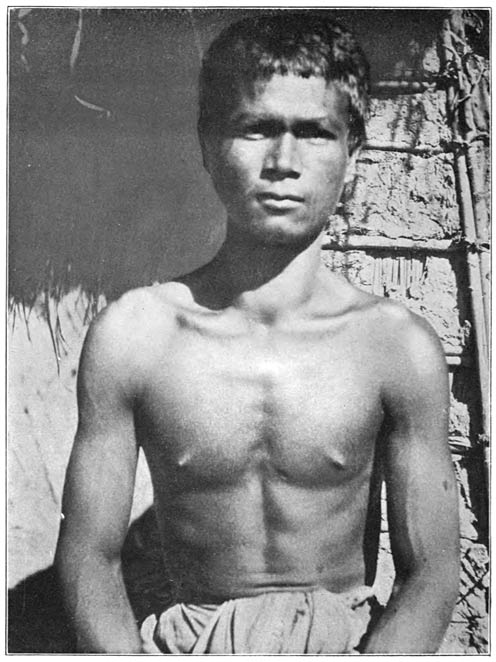
Kachári Man (Kamrup District).
From a photograph by Mrs. H. A. Colquhoun.
(I) Ābrā-nī khorāng.
FREE TRANSLATION.
The story of the simpleton.
There was once an old man and an old woman, and they had an only son. One day he begged rupees of the old people to buy a bullock, but they, seeing the lad was an innocent, refused his request. However, on his importuning them, they gave him sixteen rupees. On which he marched off to purchase his bullock, and finding a fine one where three roads met, he put down his money on the road and led the beast away, but as he was going, he tied his new acquisition to a branch, and, as he was looking another way, it escaped. On which he started in search of it, and seeing a stag, hunted that, until by chance its horns stuck in a thicket. Thereon he tied a cord round its neck, and joining other cords to the first, finally reached his home. On which his father and mother asked, “Did not you set out to buy a bullock?” “To be sure I did,” he replied, “and if you help me to pull this cord, you will see the bullock I have bought.” So they all three tugged, and presently the stag appeared, kicking and struggling, to the great fear of the old people. They killed it, nevertheless, and sent its flesh round to the adjacent villages for sale. After which the boy went about saying that the villagers had eaten cow’s flesh. But seeing him to be a fool, no one paid much attention to what he said.
Another day, some time after, when the silly boy was rather bigger, he asked for money again to buy a wife with. And again, overcome by his obstinacy, they gave him sixteen rupees, taking which he set out in search of a maiden, and, after going some distance, took up his station at a place where the villagers draw water from the river. Presently a pretty girl came tripping down to get water, on which, as before, he put down his money and seized and carried off the girl. And since she was plump, he soon grew tired and rested under a tree. Presently a man leading a plough ox came that way, and he too joined the party and sat down. But the girl sat weeping and lamenting and crying her eyes out. Seeing which, the man said to the simpleton, “Where did you get that girl? And did you have a good look at her before you took her?” “Yes, I did,” said the lad, “I saw that she was a pretty girl, so I put down sixteen rupees at the village watering place and carried her off.” On which the cunning fellow said, “You must be blind, my friend; she may be a pretty girl, but both her eyes are burst. Did you not see that? Why, look at them now. The water is running from them in streams. What are you going to do with a girl like that?”
On hearing that, the lad wanted to exchange the girl for the plough ox, and the man cunningly pretended to be unwilling, but was finally persuaded by the simpleton’s importunacy, and said, “There, take it, and begone.” So the exchange was effected, and each quickly went his own way, mightily pleased with his bargain.
After going some way, the boy met a man with a goat. This man too sat down. After a while the ox eased itself, and the man with the goat said, “That beast’s belly is burst, and in a day or two it will die.” The simpleton, believing every word he said, exchanged his ox for the goat, and went his way. Presently he met a man carrying a bunch of bananas, and sat down beside him. But the goat was hungry for grass and kept wandering about and crying “Ba! ba!” so that his master got no peace. Now the word “bā” in Kachári means “Carry me on your back.” So the boy was vexed, and crying “How shall I carry you on my back when I am so tired?” exchanged the goat for the bunch of bananas. And again each went his way.
By chance there came a man that way snapping his fingers. And he asked for the bananas. But the simpleton said, “I got those bananas in exchange for a goat, and you ask me for them! However, if you really want to eat the fruit, teach me the art of snapping the fingers, and you shall have them.” After an hour’s teaching, he had learned the difficult art, more or less, and, giving up the bananas, departed snapping his fingers.
Presently he came to a fine field of rice, and there forgot his new art. Fancying he had lost it in the rice, he began searching for it in the crop as women search for lice in one another’s hair, and the rice-field was all trodden down. And then the owner of the field came up and asked, “What are you looking for there?” The simpleton said, “I have lost something for which I gave sixteen rupees. If you will join me in my search, I shall be greatly obliged.” So the man searched too, and the crop suffered greatly. But finding nothing, the man, in pure vexation, snapped his fingers. On which the lad, crying, “That is just what I lost!” danced away gaily.
Soon after he paused on the bank of a pond, and again forgot his art, and began wading about in the mud looking for it. And a man asked him, as before, what he had lost. So he replied, “Something for which I gave sixteen rupees.” And the man joined him in the search, and both became covered with mud from head to foot. And, since they found nothing, the man grew angry, and snapped his fingers. On which the boy cried in joy, “Good sir, that is what I lost!” and danced away to his home. And when his old parents saw him covered with mud, they burst out laughing, and, until they heard his voice, did not know who he was. And when they asked what he had done with his money, he explained that he had bought a girl, whom he had exchanged for an ox, which he gave in exchange for a goat, which angered him by ordering him to carry it on his back, so that he exchanged it for a bunch of bananas, which he gave in exchange for the art of snapping his fingers. “And what else did you expect me to do?” said the simpleton! And that’s all!
II. Mŭkhrā ārŭ sessā-nī khorāng.
FREE TRANSLATION.
The Monkey and the Hare.
A monkey and a hare were great friends. They ever lived together, ate together, and went about together. One day meeting a man from Darrang going to a feast with a load of bananas and other delicacies, they said to one another, “We must get what that man is carrying by some trick or other.” Whereupon the monkey bade the hare stay on the road, while he himself hid in the forest. Presently the man, seeing the hare, put down his load and ran after it. On which the monkey, coming out from the jungle, carried off the bananas and other things. And for fear the hare should come and ask his share, the monkey hastily gobbled up the bananas and betel-nuts and kept the skins only for his friend.
The man, not being able to catch the hare, went home, and then the hare, shouting aloud, searched for the monkey, and, when he found him, demanded his share of the spoil, and only got the skins. So, being vexed, he determined to have his revenge. And first he went and hid under some acrid kachu plants. And when the monkey came and asked what he was doing, he replied, “My friend, I have the honour to be in charge of the king’s sugar-canes.” So the monkey said, “Ah, give me just a bit, do.” But the hare replied, “And what do you suppose the king will say?” But the monkey was importunate. So the hare gave him a stalk of kachu to chew, and when the acrid juice stung his tongue, the monkey began dancing about howling. But the hare coolly said, “It’s all your own fault! You would have a stick of the king’s sugar-cane, and what could I do?”
Then the hare went and took up his post under a hornet’s nest, and the monkey came along, shouting for his friend, and, finding him asked, “What may you be doing there?” And the hare replied, “I am guarding the king’s drum, so there!” “Ah,” said the monkey, “do let me beat the king’s drum!” “Oh, but I cannot,” said the hare, “the king will be angry.” But the monkey insisted, and said, “I will play on the drum very gently; you see!” So the hare consenting, the monkey clapped his two palms on the hornet’s nest and broke it, so that the hornets emerged, and stung him sore, so that he screamed with pain. But the hare only said, “You would have your way, and what was I to do?”
Next the hare went and sat down near a gowal snake. And the monkey came shouting, and asked, “What are you about now, my friend?” The hare replied, “I am now in charge of the king’s sceptre!” On which the monkey said, “Ah, let me just wield the king’s sceptre for a moment!” But the hare answered, “I cannot do that, for the king will be angry.” But the monkey being importunate, he consented. Whereupon, of course, the snake bit him, and he howled with pain.
Then the hare went and sat in a marshy place, and the monkey came shouting in search of him, and asked what he was doing. And the hare told him he was sitting on the king’s litter. “Ah,” prayed the monkey, “let me too sit on the king’s litter.” But the hare said angrily, “And what do you suppose the king will say? It strikes me you are a fool, my friend, and listen to no warning!” But the monkey, insisting, leaped into the marsh, sank up to his neck, and stuck there miserably. On which the hare leaped out and cried, “Now, my kind friend, you who eat bananas and give me the skins, you can just stay where you are! My compliments! I am off!” So saying, he left him to his fate.
Presently a rhinoceros came that way, and the monkey begged him to extricate him. But the rhinoceros remarked that he was hungry and thirsty and on his way home to dinner, and went his way. And a buffalo also passed by and refused to help. Finally a tiger came, extremely ravenous. And the monkey entreated him respectfully to pull him out; but the tiger said he did not see how it would profit him to come to his rescue. But when he had gone some two paces, the monkey called after him, “Look here, if you will drag me out of the marsh, you can clean me of the mud, and eat me!” And since the tiger was extremely hungry, he consented and said, “It is not that I have any particular desire to eat you, but if I do a good deed, I shall get virtue. However, as you are good enough to insist, I am willing to make a meal of you.” So saying, he put his tail into the marsh, and the monkey, catching hold of it, was slowly dragged forth. On which the monkey said, “Now let me dry myself in the sun, and when the mud is dry you can scrape it off and eat me.” So he sat in the sun, and the tiger waited hungrily. But the monkey seized the opportunity when the tiger chanced to look another way, and clambered up a tree. At that the tiger was very angry, and waited two or three days at the foot of the tree. Finally he pretended to die of starvation and lay there with his mouth open and his great teeth showing. So the monkey climbed down, slowly and cautiously. And the tiger lay quite still, so that the flies came and buzzed in his mouth. And first the monkey carefully put his tail in the tiger’s mouth. But he never stirred. Then the monkey thrust his leg in the tiger’s mouth, and still he did not move. “Ah,” said the monkey, in great glee, “you would have gobbled up my tail, and scrunched up my limbs, would you?” And so saying, the silly creature thrust his head in the tiger’s mouth. And the jaws closed with a scrunch, and the monkey died, and that’s all!
III.—Sā-se phālāngī gotho-nī khorāng.
FREE TRANSLATION.
The story of the merchant lad.
There was a certain lad whose father died before he was born. And, one day, when he had grown a big boy, he asked his mother, “What did my father do for his living?” And his mother, drawing a long breath, said, “Your father used to travel about selling things. Ah, if he were alive we should have no trouble to endure!” But the boy replied, “Do not you think that I too could earn money in that way? Bring out what money there is, and let me see what I can do.” But his mother said, “Ah, my son, you must not talk like that! If you go away into foreign lands and die there, what will become of me?” But her son would not listen to her, and by importunity induced her to give him money, with which he bought goods, and procured a boat, and hiring two or three men, took leave of his mother, and went into a far country to trade. Finally he came to a certain place where he moored his boat, at the place where men draw water, and sent his men to hawk his wares from village to village while he himself stayed in the boat. It happened that there lived hard by an old couple who possessed a white swan, which they fed and tended as though it were their own child. One day, the lad saw this swan strip itself of its swan plumage and become a beautiful maiden, and bathe. From that time forth he paid great attention to the owners of the swan, and gave them presents of the oil and other things he had in his boat. And when the merchandise had been sold and the time was come to go home, he went to the old people’s house and offering much money begged them to sell him their swan. But they were for giving him their swan for nothing. He, however, feared to commit a sin if he took it as a gift, and, because it was the old man’s property, compelled him to take much money in exchange for it, and went away.
But when he came home with his boat, behold, the swan remained a swan, and, for disappointment, the lad pined and wasted away. Seeing which, his old mother consulted various people, but got no help. Finally, she went to a certain wise woman, who said, “Sister, do not you understand? Something has happened to him while he was away trading. You must use a device to find out what it is.” To which the mother replied, “Tell me plainly what it is, and you will do a good deed.” So the wise woman gave this advice. “Some day do you direct a maiden to search for lice in his hair. And while she is doing this, let her pretend to be mightily grieved, and let her ask him what is the matter. And he will feel flattered and will open out his heart to her.” And the mother did as the wise woman directed her. The girl she sent wept and snuffled as she tended the lad and said, “Tell me why you pine and grow thin; else I too will give up food and drink.” And so he, heaving a sigh, explained thus: “While I was away trading, I saw the white swan which is in my boat turn into a maiden. But now she remains a swan, and for her love I am pining.”
When her task was done, she told the lad’s mother, who sent word to the wise woman. The wise woman said, “Let the girl tell him that the swan maiden worships her own gods in the dead of night. Let him pretend to lie asleep, and when she divests herself of her swan plumage, let him seize it and thrust it into the hearth, and then she will always remain a girl.” The old mother directed the girl accordingly, and the girl told the lad. One day he mixed ashes and oil in a vessel, and procured a yak’s tail, and, when night was come, he lay down and pretended to be fast asleep. Presently the swan crept out, and feeling his hands, feet, and body with her beak, was satisfied that he slept. Then slowly taking off her swan skin, she became absorbed in the worship of her country’s gods. And the lad seeing his opportunity, grasped the swan plumage and thrust it into the hearth, so that it was singed, and the smell of the feathers filled the place. And the maiden, smelling the burning feathers, cried, “What have you done to me? What have you done to me?” So saying, she fell down in a faint and seemed as one dead. But the lad, taking his vessel of oil, anointed her with it, and fanned her gently with the yak’s tail, till she came to. And so they married, and begat many sons and daughters, and lived happily ever after. And that’s all!
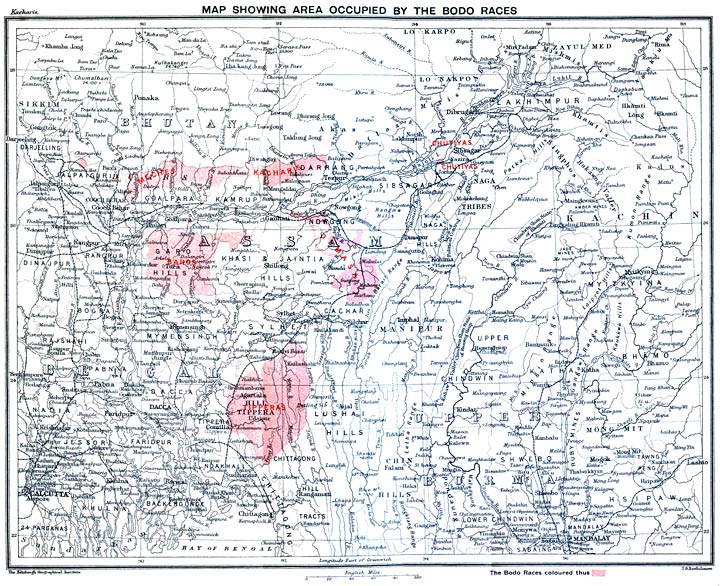
MAP SHOWING AREA OCCUPIED BY THE BODO RACES