Laws and Customs
Reading edition
1. Swarga-ároi (Swarga = heaven). The heaven-folk. This sub-tribe is said to be the highest of all; none of its members ever worked as cultivators, for as a rule all deoris, ojhas, and others who took a leading part in religious ceremonials, were chosen from this subdivision; and the offerings made by worshippers were held to be sufficient for their maintenance.
2. Basumati-ároi (Basumati = earth). The earth-folk. This clan has a certain privilege not possessed by any other, i.e., its members can bury their dead without in any way purchasing ground for the grave or for the erection of the funeral pyre.
3. Mosá-ároi (Mosá = tiger), otherwise known in Darrang as Bāgh-l-aroi (Bāgh-l-aroi, the l is probably inserted for reasons of euphony). The tiger-folk. The members of this sub-tribe claim kindred with the tiger, and all the inhabitants of a village peopled by them go into mourning on hearing that a tiger has died in the neighbourhood.
4. Khángkhlo-ároi. The Khangkhlo-folk. Khangkhlo is apparently the name of a certain jungle grass, used freely both at religious ceremonials and at festive gatherings and merry-makings, of which the Kacháris are very fond.
5. Sibing-ároi (Sibing, sesamum, the Assamese til). The sesamum-folk. This sub-tribe is said to be the only one which in olden time was allowed to cultivate sesamum plant, and its members still hold this plant in special honour.
6. Gándret-ároi (Gándret, a leech or slug, Assamese Kumzeluka). The leech-folk. This sub-tribe holds the leech in high regard and cannot under ordinary circumstances kill it; though on occasions of certain religious ceremonials, e.g., purification after a death in the family, its members were required to chew a leech with vegetables for a certain limited period, though apparently only once in a life-time.
7. Nárze-ároi (nárze = jute). The jute-folk. This sub-tribe held jute in special honour, and on occasions of great religious ceremonials its members were bound to chew a certain quantity of jute (see No. 6).
8. Doimá-roi (Doimá = a large river) (cf. Dimásá [doimá-sá], the usual designation of the people of the North Cachar Hills). The river-folk. These in olden time were the fisherman class, though its surviving members are now merged among the mass of ordinary cultivators.
9. Bibiziyá-ároi (Bibína = to beg). The begging-folk. Professional mendicants having no fixed home or regular occupation, much like the modern Fakirs, Vairagis, &c.
10. Bing-bing-ároi (Bing-bing, probably an onomatopoetic word indicating a sound more or less musical). Itinerant musicians, subsisting on the voluntary offerings of those to whom they ministered. The writer has occasionally seen one or two members of this class in Kachári villages.
In addition to the above sub-tribes, all at one time strictly endogamous, though now no longer so, the following may be mentioned. It may be noted that these are recognised, in Kamrup at least, mostly to the north of the great earthwork embankment known as the “Gossain Kamla Ali,” though the writer has been unable to find any trace of their separate existence in this (Darrang) district.
14. Brahm-ároi. Brahma folk. Said to be a quasi-priestly class, found chiefly in Upper Assam. This name, like the preceding, is obviously of Hindu origin.
16. Dhekiábári-ároi. (Dhekiá fern), the fern-folk. The totem of this sub-tribe was probably the fern, still sometimes used in the preparation of the fatiká spirit.
19. Fadam-ároi. The fadam folk. The fadam is said to be identical with the tree known as sáchi in Assamese.
20. Mohilá-roi. Mohilá folk. Mohilá is a word of uncertain origin and meaning. It is said to be the equivalent of Maháldár, and to be applied to fishery lessees, and petty traders in areca-nut and betel-leaves and dried fish (nā-grān).
Swarg-ároi,
Masá-roi,
Doimá-roi,
Goibári-roi,
which seems to be practically identical with class-names Nos. 1, 3, 8 and 12, given above.
Marriage, Endogamy, Exogamy
It is said that each of the sub-tribes mentioned above was in early times strictly endogamous; for though members of all these subdivisions might freely eat and drink together, intermarriage between them was absolutely forbidden. But all such restrictions on marriage seem to have passed away long since, so that the whole subject has nowadays little more than an antiquarian interest.
No formal hypergamy is recognised, though Kacháris occasionally take wives from the cognate tribes known as Rábhas (Totlás), Koches (Madáhis), and Saraniyas, &c. But such alliances are as a rule not looked upon with favour, and the bridegroom in such cases has generally to make his peace with his fellow-villagers by providing them with a feast in which rice-beer (Zu) and pork are certain to take a prominent place. Children born of such mixed marriages become in all cases members of the father’s subdivision of the Bodo race.
There is little or nothing specially distinctive in the laws of consanguinity or affinity in their bearing on the marriage relationship. A widower may marry his deceased wife’s younger sister, but not the elder, whom he is taught to regard conventionally in the light of a mother. Much the same principle holds good in the case of the re-marriage of widows, which is freely permitted, the one limitation being that a widow may marry her deceased husband’s younger brother, but not the elder.
Polygamy
As a rule the Kacháris are a strictly monogamous race, though cases of men having two wives have occasionally come under the writer’s notice. These cases are, however, almost invariably limited to men of a somewhat high social position or great wealth, such as Mauzadárs, Mandals, &c. Where, too, a first wife proves childless, Kachári custom sanctions the taking of a second, mainly with a view to handing down the father’s name to posterity. On the other hand, polyandry would seem to be absolutely prohibited, though it is known to prevail in the adjoining regions of Bhutan, Tibet, &c.
Adoption
Children, more especially orphans, are occasionally adopted, usually by near relatives, but sometimes by absolute strangers. In such cases the children so adopted are treated as full members of the family, and the foster-parents are considered by the community to have done a highly meritorious act. Several pleasing instances of adoption of this character have come under the writer’s notice, and in all such cases the adopted children seem to have found a very happy home.
Female Chastity
As stated above, the standard of chastity among the Kacháris, both men and women, is by no means a low one. As a rule the young people, in the villages at least, lead pure lives before marriage, and are faithful to their marriage vows in after-life. In cases where there are several unmarried girls in a family, and one of them is suspected of having broken the law of chastity, the following plan for detecting the offender is sometimes adopted. The whole family gathers in the evening around the sacred siju tree (Euphorbia splendens), which is often to be seen growing in the court-yard, surrounded by a fence of split bamboo. At the foot of this revered tree a quantity of rice (uncooked) is solemnly buried and allowed to remain there over night. Early next morning this rice is carefully disinterred, and a certain quantity given to each grown-up girl (sikhlá) to be masticated. The offender, under the pressure of the fear of imminent detection, is unable to masticate her portion of rice, the faculty of secreting saliva failing her in her terror of discovery and disgrace.
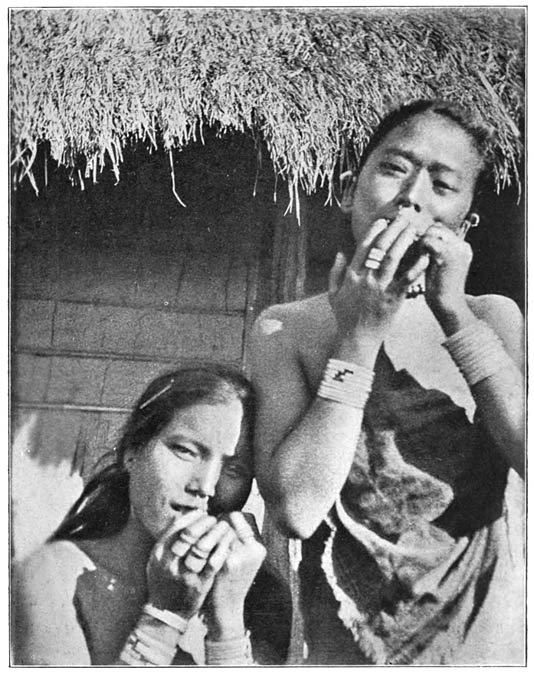
Kachári Girls Playing Jew’s Harp (Gongina).
From a Photograph by Mrs. H. A. Colquhoun.
She is then made to disclose the name of her paramour, whom Kachári public opinion compels to marry his victim forthwith, the bride-price (pan: see below) being in this case considerably enhanced as some slight compensation to the girl’s parents for the injury done to the honour of the family. A similar procedure is sometimes resorted to in cases of suspected theft or other like misdemeanours in the family circle.
In some cases where the parents are unwilling to part with their daughter to a prospective son-in-law of somewhat objectionable character, the matter is referred for decision to the village elders, who impose a fine of Rs. 20/- to Rs. 25/- on the offender. But whenever pregnancy follows offences against the law of chastity, marriage becomes absolutely compulsory, and the seducer is made to feel that he has brought disgrace upon the village, and is distinctly under a cloud. In this way a wholesome respect for chastity is maintained, and Kachári domestic life is kept comparatively pure.
Divorce
Divorce sometimes takes place by mutual consent, but cannot be effected without a certain formality. Man and wife appear before the village elders and state their case, concluding by tearing a pan-leaf into two pieces, fáthoi fesínai, (K.) pán chirá (Assamese), a symbolic act indicating that, as the sundered leaf can never reunite, so their own married life is severed for ever. Should the husband divorce his wife for causes which seem to the village elders inadequate or capricious, he forfeits all claim to reimbursement of his marriage expenses, and even when the divorce is approved of, he must pay a certain small sum (Rs. 5/- to 10/-) for his freedom, the amount being divided between the village pancháyat and the divorced woman. On the other hand, if the woman is divorced for just and sufficient reasons, e.g., for unfaithfulness to her marriage obligations, the injured husband is entitled to recover whatever he may have expended at his marriage, a sum amounting sometimes to Rs. 140/- or upwards to Rs. 200/-. The man who may afterwards marry the divorced woman is held to be responsible for the payment of this money; and so long as this latter condition is duly fulfilled, the divorcée is fully at liberty to live with a second husband.
Inheritance of Property
Among the Kacháris the laws and customs relating to the inheritance of property seem to be very vague, and it is not at all easy to obtain any definite information on the subject. Generally speaking, on the decease of the head of the household the eldest son takes charge of all property, making a home for the time for his widowed mother and his brothers and sisters. In this way the family may be kept together for some years; but eventually it breaks up as the children grow up and marry, in which case the father’s property is broken up into equal shares, the eldest son taking one share and a half, while what remains is divided fairly among the other brothers. The daughters, especially if married, can claim nothing. When a man dies without sons, the property usually passes to his eldest surviving brother, who generally makes some provision for the deceased man’s widow and daughters.
Disputes, whether matrimonial or otherwise (e.g., inheritance of property, &c.), are almost invariably referred to the council of village elders, whose members are not necessarily limited to five or other definite number; and the decision of this rural council is very rarely questioned or opposed in any way. It might be well to develop and enlarge this simple and very effective way of settling disputes, so that the villagers may be to a great extent saved from the necessity of coming under the contaminating, demoralising influence of our civil and criminal courts. As all the Kacháris of this district (Darrang) are ordinary cultivators, holding land directly under Government like their Hindu and Musulman neighbours, no remarks are needed under the head of “tenure of land, and laws regarding land.” So too with the sections dealing with “war, and head-hunting,” it is only necessary to say that the latter practice (head-hunting) is quite unknown here, though it would seem to have been very common in earlier days among the closely cognate race known to us as Garos.