Social and Domestic Life
Reading edition
Dwellings, houses, &c. In their domestic life, the Kacháris of this district (Darrang) do not differ very materially from their Hindu neighbours, to the subordinate castes of whom they are no doubt very closely allied. The houses are of the usual type, one-storied only, the walls being of ekrá reed or of split bamboo, and the roof of thatch fastened by cane. Each hut commonly contains two rooms, one for eating, &c., and the other for sleeping. There is no trace here of the practice which prevails among some tribes of the Province who are undoubtedly very nearly related to the Kacháris, i.e., the provision of bachelor-barracks (Dekáchángs), where all the young unmarried men of the village have to sleep apart from the dwellings of settled householders. It is probable, indeed, that this custom formerly obtained here, but all trace of it seems to have passed away long since.
Villages. A Kachári village is as a rule much more compact than a Hindu one, the houses being built more closely together. Usually, too, there is comparatively little foliage in the way of trees, &c.; and occasionally even something like a street separates the two or more lines of houses which compose a village. One prominent feature in the typical Kachári village cannot fail to strike the attention of any casual visitor at first sight. Each house, with its granary and other outbuildings, is surrounded by a ditch and fence, the latter usually made of ekrá reeds, jungle grass or split bamboo, &c. The ditch, some three or four feet in depth, surrounds the whole homestead, the earth taken from it being thrown up on the inner side, i.e., that nearest to the dwelling-house; and on the earthworks, some two or three feet in height, so thrown up are firmly inserted the reeds or split-bamboo work forming the fence itself, this latter often inclining outwards at a very obtuse angle; so that the ditch and fence are not easily surmounted from the outside by would-be intruders. A Kachári village usually abounds in domestic live-stock of various kinds, e.g., ducks, fowls, goats, pigs, cattle, &c.; and it can hardly be doubted that the fence and ditch above spoken of are largely intended to prevent the cattle, pigs, &c., from getting into the rice-fields at night, and so doing serious damage to the paddy and other crops. With the abundance of live-stock, especially hogs, reared and kept by the Kacháris, it need hardly be said that the villages can scarcely be described as being cleanly; though as a rule they do not differ so much as might be supposed in this respect from their Hindu neighbours, separate buildings being provided for the pigs, goats, &c., at an appreciable distance from the family dwelling-house.
Furniture, Implements and Utensils
Little need be said under this head, as the equipment of the Kachári householder for dealing with domestic or field work is almost identical with that of his Hindu neighbours. But it may be stated that in a Kachári house there will usually be found an exceptionally large number of earthenware vessels (pottery, &c.) which are used freely and frequently in the preparation and distribution of the much-prized rice-beer (Zu).
Occupation, crops, &c. Agriculture is still the great industry of the Kacháris of this district, both the hot weather (áus) and the cold season (sáli) varieties of rice being largely cultivated, especially the latter. In carrying out this work the people show both application and skill, so much so, that, failing some very overwhelming convulsion of Nature, it would seem to be hardly possible that a famine could take place in the Kachári Duars. This part of the district is abundantly supplied with water by the numerous streams issuing from the lower spurs of the Bhutan Hills, streams which for the most part flow in very shallow beds, and therefore admit of being easily used for irrigation purposes, whenever the seasonal rainfall may be at all scanty. Moreover, the people are especially skilful in the construction of irrigation canals and earthwork embankments for diverting water from river-beds into their rice-fields: and their efforts in this direction are very largely aided by their closely clannish organisation. Whenever the rainfall threatens to be below the average, the village headman with his associated elders fixes on the spot whence water is to brought from the nearest river to the rice-fields. At this spot very rude and primitive shelters of jungle grass, &c., are put up: and here all the manhood strength of the village, each man armed with hoe, dao, &c., are compelled to take up their abode until the necessary work has been fully carried out. In this way it will be obvious that the Kacháris have a highly efficient and very inexpensive “Public Works Department” of their own; and vigorous efforts of self-help of this character would seem to be worthy of high commendation and hearty support.
But it is not only in constructing embankments and irrigation canals, &c., that the people work together in this way. Very much the same plan is adopted in carrying out other enterprises in the success of which all are alike interested, e.g., in harvesting the great cold weather rice-crop in December and January each year. When this important work is in full swing, it is but rarely that the owner of a rice-field is found cutting his paddy alone and single-handed. He summons his neighbours to come and help him in this work—a summons which usually meets with a ready and cheerful response. It is quite common to see in December and January organised bodies of labourers, varying in number from ten to fifty or more, all in line and busy with the sickle in one man’s field at the same time. Every man as a rule works for the time being at high pressure, his toil being lightened by much merry talk and laughter, and many jests and jokes—these last, it must be admitted, not always of a highly refined character. There is a pleasing absence of the mercenary element in the whole transaction; for as a rule no money payments whatever are made to the workers. On the other hand, the wife of the proprietor of the rice-field is almost always present in person, and busies herself in keeping ever ready an abundant supply of wholesome and highly appetising cooked food, to be eaten on the spot, the nearest grove of plantain trees providing ready-made plates and dishes. Her post is no sinecure, as the hungry reapers make very frequent raids on the good things she provides; and she has above all to be careful to see that the much prized rice-beer (Zu) shall be at all times forthcoming in unstinted quantity. Her lord and master is usually content to wield a sickle with the reapers, like Boaz of old; and, of course, he holds himself ready to lend a hand in the same unpaid fashion in carrying out his neighbours’ harvesting operations, whenever his services in this direction may be called for. This whole system of mutual help in time of pressure is a marked feature of Kachári social and domestic life, and tends in no small degree to develop and strengthen that clannish temperament of which it may be considered to be in some sense the natural outcome.
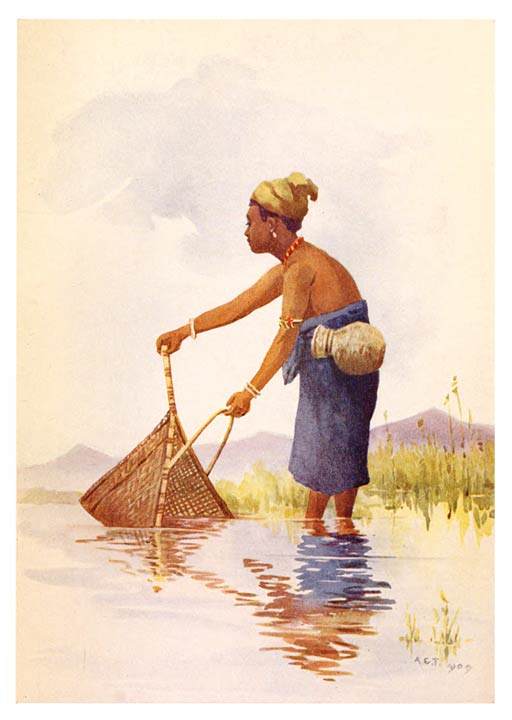
KACHARI GIRL FISHING
A second popular method of catching fish is the use of the pālhā, which is not very unlike an ordinary circular hen-coop. It is made of split bamboo fastened together by cane-work, and is about 4 or 4–1/2 feet in height and about 3 feet in diameter at the base. The upper portion is drawn somewhat closely together, leaving an open space at the top sufficient to allow the admission of a man’s hand, the whole structure being quite light and easily manipulated by one hand. Armed with this, the fisherman quietly enters the shallow water at any likely spot, and whenever his quick eye detects the presence of prey, the pālhā is at once placed over it, the lower surface of the basket-work closely clutching the ground, and the fish so enclosed are then withdrawn by the hand through the opening in the upper part of the instrument. This too, like the zakhái, seems a very primitive, unsuitable contrivance, but in the hands of men trained to its use from earliest childhood it is quite capable of being made to bring about very useful results.
A third instrument used by Kacháris in fish-catching is a small, pointed, metallic spearhead attached to a light bamboo. This is thrust rapidly and firmly into soft mud or other like places where eels, &c., are supposed to be concealed; and the fisherman occasionally succeeds in transfixing and drawing out one or more of these, which form a welcome addition to his daily diet.
As mentioned above, rice-beer is not used as a daily beverage, but is prepared as required, especially for use at marriages, funerals, harvest homes and other occasions that break the monotony of village life. A common method of preparation is as follows:—A quantity of selected rice, about 3 or 4 seers, is carefully boiled in an iron or brass cooking vessel, the contents of which are then spread out on a bamboo mat and allowed to become cold. Two cakes of the emáo described above are then broken up into powder, which is carefully mixed with the boiled rice; and the whole is then stored in a thoroughly dry earthenware vessel (kalas). This vessel with its contents is then placed upon a platform some five feet high over a slow fire, in which position it is allowed to remain for some three or four days, the mouth of the vessel remaining open for the first day or two, though it is afterwards covered. It only then remains to add water ad libitum, and to pour out the beer, after well shaking the vessel, through a rude straining apparatus composed of rice-straw. It is said that the direct action of fire is not really needed in the preparation of this beer and that exposure to the sun is sufficient for the purpose, though the application of fire undoubtedly quickens the process. Rice prepared in this way may be kept in the earthenware vessel for six or twelve months, a fresh supply of boiled rice and condiment (emáo) being added to the old from time to time; but the beer is rarely kept in this way for any very prolonged period, though its quality is said to be improved by such keeping.
The loom employed for weaving the eri silk is of very simple construction, and most, if not all, the material needed for the purpose can be provided by the villagers themselves from local resources.
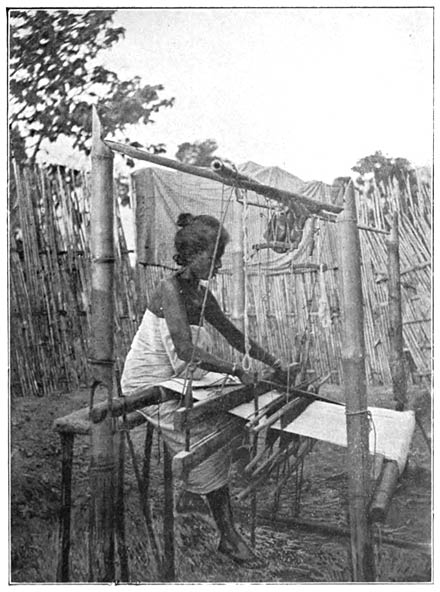
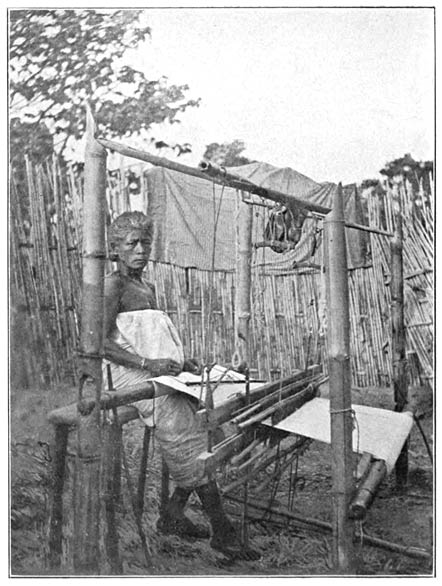
Kachári Woman Weaving (Kamrup).
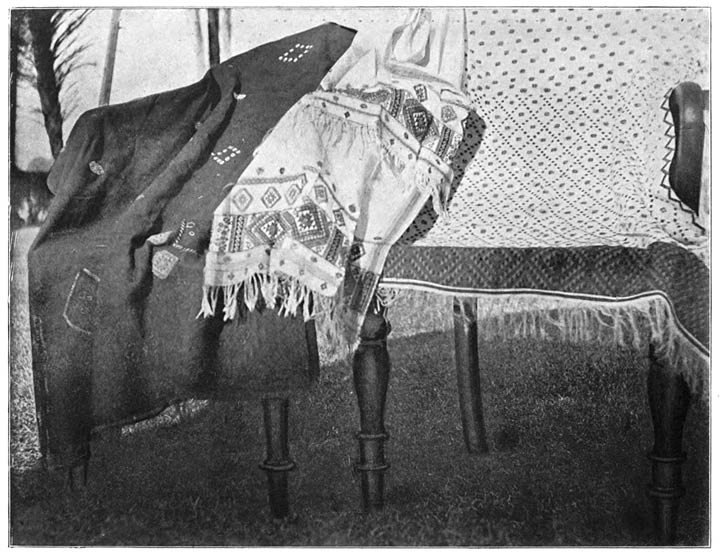
Kachári Clothes.
The market value of a loom of this character is said to be about five rupees. It is usually set up on a shady side of the dwelling-house, or, where this is impracticable, a rude structure of thatch and bamboo work is provided to shield the weaver from the sun. The actual work is always carried out either by the lady of the house, or by one of her grown-up daughters; and it is in every way suitable to women workers, as it requires very little exertion of physical strength, but only a certain quickness and readiness of eye and hand. The conditions under which the industry is carried on are in all respects pleasing and satisfactory. Indeed, a Kachári woman working placidly and contentedly at the eri loom, singing quietly to herself in sheer happiness of heart, offers perhaps one of the most complete illustrations of the benevolent influence of the Pax Britannica to be found in the wide realm of India, especially when it is borne in mind that less than seventy years ago these Kachári Duars were subject to the Bhutan Rajas, who seem to have harried and plundered the people in the most cruel and lawless way. Soon after the master of the house, with one or more grown-up sons, has betaken himself to the rice-fields, and this he does almost at sunrise, his goodwife seats herself at the loom, and works away steadily until about 8 or 9 a.m., when she may be seen carrying a well-cooked and appetising meal, carefully shielded from rain and sun by plantain leaves, to her goodman, who from an early hour has been toiling in the fields for the good of the family. This duty discharged, she resumes her position at the loom for the greater part of what may remain of daylight. Immediately in front of the loom there are probably two or three small children (the Kachári race is a wholesomely prolific one) gambolling and tumbling over each other in high delight. To these the mother now and then devotes a word or two of remonstrance, whenever their gambols seem to threaten an infantile breach of the peace; and she may occasionally rise from her seat to administer some little corporal chastisement, though always “more in sorrow than in anger”; but otherwise she devotes herself steadily and assiduously to the work in hand. It is said that a Kachári woman, if not greatly or frequently interrupted in her work, can weave about half a yard each day; and, as this eri cloth, woven in long strips about two yards wide, can always command a ready sale at about Rs. 2/- per yard, it will be at once evident that a good worker can in this way, without neglecting other urgent domestic duties, easily make a substantial addition to the family income.
The fabric itself (eri cloth), so produced, is one of great value, especially for use in the cold season, being at once soft and warm as well as remarkably strong and durable. Of its very great merit in this last-mentioned respect (durability) the writer has good reason to hold a very high opinion. Some twelve or fifteen years ago he was presented with a piece of eri cloth by one Leah Khángkhuáh, a good Kachári churchwoman, living not far from St. Paul’s Mission Church, at Bengbari, whose payment of her “Church dues” (tithe) took this very pleasing and highly practical form. The quantity of cloth given (the donor declined all money payment) was sufficient to make two ample bed-sheets, and in this character they have been in use now for at least a dozen years past. During that period they have of course been subjected to many and frequent barbarous washings; but even the rough treatment they have so often received at the hands of the Assamese dhobi has as yet failed to make any impression for injury on the warp and woof of this sound material; so substantial and conscientious is the work done by this good Kachári churchwoman and gentlewoman.
Position, social and domestic, of women. Among the Kacháris women do not perhaps occupy quite the same influential position as seems to be enjoyed by their sisters in the Khasi Hills, where something like a matriarchate apparently holds the field of social and domestic life. Still, with this interesting race the position of the wife and mother is far from being a degraded one. The Kachári husband and householder has neither sympathy with, nor tolerance for, that degrading and demoralising creed “which says that woman is but dust, a soul-less toy for tyrant’s lust.” On the contrary, he usually treats his wife with distinct respect, and regards her as an equal and a companion to an extent which can hardly be said to be the rule among many of the Indian peoples. Kachári women, both in early life and as matrons, enjoy a large measure of freedom, a freedom which is very rarely abused for evil purposes. On being spoken to on the wayside, the Kachári woman will generally reply at once with absolute frankness, looking the questioner straight in the face and yet with the most perfect modesty. It has often happened to the writer during the last forty years to enter a Kachári village for preaching purposes, or with a view to opening a school. On asking for the village headman, that personage is usually not slow in making his appearance; and after a few friendly words he will, quite as a matter of course, introduce his wife, and that with no small pride and pleasure. In discharging this social duty, he will very commonly use much the same language as may be heard among the working classes in England. The phrase most common is “Be áng-ni burui,” literally “This (is) my old woman.” The words are not used jeeringly at all, but with much real respect and affection; and are obviously so regarded by the speaker’s life-partner, whose face and features, somewhat homely in themselves, may often be seen to light up at once with a very pleased and pleasing smile on hearing herself thus referred to by the sharer of her life’s joys and sorrows. There is, too, another consideration, not perhaps altogether unknown in other parts of the world, which has great weight with the Kachári paterfamilias, viz., that his goodwife for the most part does not a little to provide for the family needs in the matter of food and raiment. Her prowess at the loom has been mentioned before; and besides this, the actual planting out of the young rice-seedlings is for the most part carried through by the women. And all this is habitually done without in any way neglecting or slurring over the usual duties more strictly appropriate to the goodwife and mother.
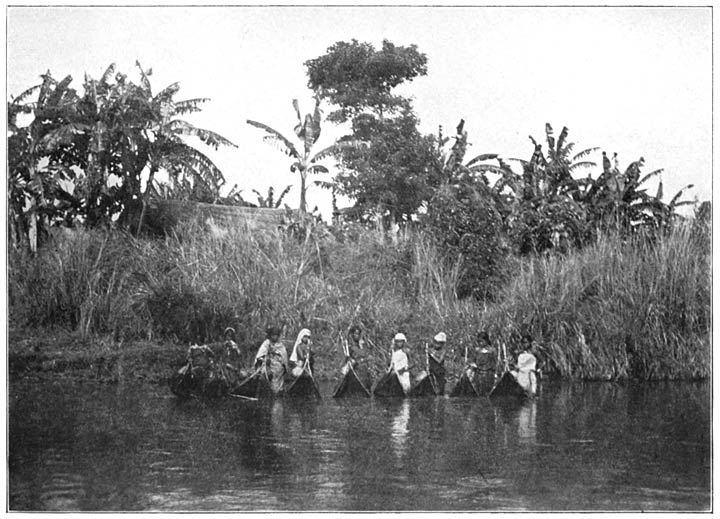
Kachári Women Fishing (Kamrup).
From a Photograph by Mrs. H. A. Colquhoun.
On the whole it may perhaps be safely said that the social and domestic life of the Kachári is not without its pleasing and satisfactory features. It is probably for the most part far sounder and more wholesome than the life of great cities, whether in Asia or Europe; and it is with no little dismay and sorrow that the writer would see any hasty ill-considered attempts made to supplant or override this simple, primitive, patriarchal life through the introduction of a one-sided, materialistic civilisation.