APPENDIX I
Reading edition
I.—Tribes closely allied to Kacháris.
In a former section, something has been said in favour of the idea that the Kachári race is a much more widely distributed one than was supposed to be the case some years ago; and members of this race under different names still occupy large areas in north-eastern India. It may be useful to add a few brief notes on some of the principal of these closely cognate tribes, confining our notice mainly to those points and details wherein they differ more or less from the Kacháris of Darrang, whose language, habits, religion, etc., as described above, may perhaps be provisionally taken as a standard.
2. Mech (Mes). 70,000.—Nor is it necessary to do much more for the people known as Mech (Mes) who are undoubtedly merely a branch (the western one) of the Bårås of Darrang. The name is almost certainly a corruption of the Sanskrit word mleccha, i.e., an outcast from the Brahmin point of view, a non-observer of caste regulations; such persons being in the light of modern Hinduism very much what the barbarian was to the Greek, or the “Gentile” to the Jew, some twenty centuries ago. This term mlech (mech) is not in use here (Darrang) or in Kamrup.
Subdivision. The uncomplimentary epithet “mlech padre” has sometimes been hurled at the writer when preaching to Brahmins or other high caste Hindus, though it would seem to be the recognised name for the Bårå race from the Manás river westwards to the neighbourhood of Jalpaiguri. They would seem to be especially numerous in Goalpara district, where one of the principal landholders is known as the “Mech-párá zamindár.” Some sixteen exogamous septs are recognised among the Meches, of which the most important would seem to be the following:—
1. Meshá-árŏi—the tiger folk
2. Bánsbár-árŏi—bamboo folk
3. Dŏim-árŏi—water folk
4. Goibár-árŏi—betelnut folk
5. Swarg-árŏi—heaven folk.
Of these the last-mentioned, which is obviously of Hindu origin, is looked upon as the highest, whilst the names of the remaining four are apparently of totemistic origin. The first on the list, Mashá-arŏi (tiger folk; Mashá, tiger), still retains a certain hold on the regard of the members of its sept, all of whom go into a kind of mourning (see above) when a tiger is found lying dead near one of their villages.
Origin. Nothing definite is known as to the origin of the Meches; by some they are said to be descended from Bhim and Hidamba, whilst others maintain that they are the descendants of Turbasu, son of Raja Jajáti, who fell under his father’s curse, his children thus becoming outcasts (Mlecchas).
Religion. Their religion is distinctly of the Animistic type with a tendency towards Hinduism, Batháu being replaced by Śiva in some cases. The siju tree is regarded with much reverence, and is to be seen in the courtyard of most Mech houses, much more frequently than among the Kacháris of this district. This sacred tree is sometimes used as a means of divination or detecting crime or other misdoings in domestic life.
Marriage and funeral ceremonies.
In all ceremonies relating to marriage and funerals, what has been already said of the Kacháris holds good almost word for word of the Meches. But speaking generally it may be said that the marriage rites among the Meches are more simple than among the Kacháris, the essential features being the exchange of betel-leaves and areca-nuts between bride and bridegroom followed by the offering of a cock and hen in sacrifice to Batháu or Śiva. The funeral ceremonies, on the other hand, among the Meches are perhaps somewhat more elaborate than is the case with the Kacháris (Bårå), as an informal Shrádh has to be performed by them, by the son or daughter of the deceased Mech, seven or nine or eleven days after death, and sometimes on the day of the funeral itself, an indication that Hindu customs are creeping in among this portion of the Bårå race.
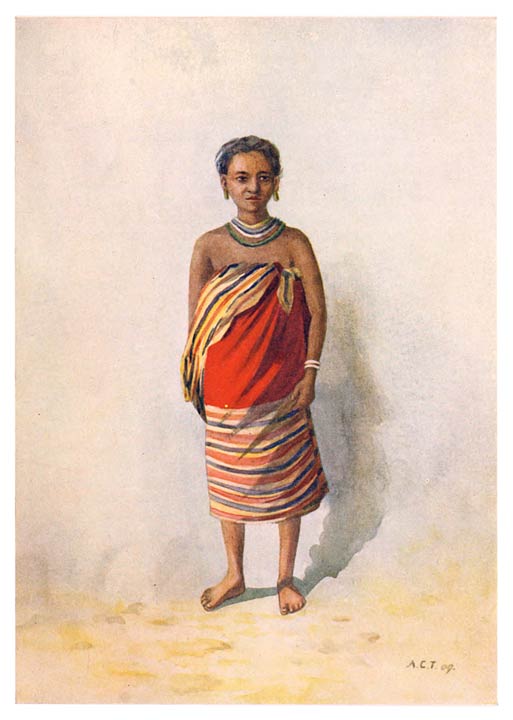
MECH GIRL
Religion. Very little need be said under the head of religion; for in this respect they are but little separated from the closely-cognated Kachári (Bårå) race. The general type of the Rábhá religion is distinctly animistic; but one or two of the higher subdivisions, especially the Pátis, are said to show a leaning towards Hinduism of the Śákta form, the deity chiefly worshipped being known as Bhalli (? Bhareli), to whom puja is done in Kārtik, Māgh and Baisākh. There are no temples or fixed places of worship, nor are Brahmins employed; the deori (deosi) doing all that is deemed necessary in public religious ceremonies.
4. Hajongs—Haijongs. (8,000). About the small tribe (8,000 souls) known as Hajongs or Haijongs only very little definite information can at present be obtained; but it seems probable on the whole that they are a branch of the widely spread Bårå race. The tribal name is of uncertain derivation, but it is not unlikely that it is connected with the Kachári word for mountain or hill (ha-jo); and this supposition receives, perhaps, some little confirmation from their present known habitat, i.e., the southern slope of the Garo Hills, and the sub-montane tract immediately adjoining it. It is possible that these people may be the modern representatives of the inhabitants of the old kingdom of Koch Hajo, which corresponds roughly with the present district of Goalpara. It is known that during the period 1600–1700 this part of the country was overrun by Musalmán invaders, when many of the inhabitants probably took refuge in the Garo Hills, returning therefrom, and settling in the adjoining plains at the foot of these hills, when the pax Britannica gave them a certain amount of security for life and property. In appearance and dress the people are said to have a close resemblance to the well-known Kachári type, but this resemblance hardly holds good of their language as now spoken, for this is little more than a medley of Assamese and Bengali.
Religion. There are said to be two recognised subdivisions among them, i.e., (1) Byabcháris and (2) Paramárthis. The latter are largely Hinduized (Vaishnabs) and abstain from pork and liquor, etc.; whilst the former, who are Śáktas to a large extent, follow the practice of their Garo neighbours in matters of diet, etc. In spite, however, of this distinction of meats, it is said that members of the two sections of the tribe freely intermarry with each other. No Brahmins seem to be employed among them, any leading member (adhikári) of the village pancháyat doing what is customary at all marriages, etc. It may be added that the siju tree (euphorbia splendens) which occupies so important a place in the social and religious life of the Bårå, Meches, etc., on the north of the Brahmaputra does not seem to enjoy any special regard or respect among the cognate tribes (Haijangs, Dimásá, etc.) who have their homes on the south and east of that great river.
Relations of the sexes, marriage, &c. As among other members of the Bårå race, the relations of the sexes are on the whole sound and wholesome; ante-nuptial unchastity is but of rare occurrence, but when it does take place and pregnancy follows, the seducer is compelled to marry the girl, and to pay a certain fine of no great amount to the village elders. This form of union is known as a dái-márá marriage. But generally, as among the Kacháris of Darrang, the parents of bride and bridegroom arrange for the marriage of the young people, which always includes the payment of a bride-price (pån) of from 20 to 100 rupees to the bride’s parents, or the equivalent in personal service. It is said that among the “Paramárthi” subdivision, who are largely Hinduized, the betrothal of children is coming into vogue, but as a rule marriage is still adult, and for the most part monogamous. A second wife is allowed when the first proves to be childless, but polyandry is quite unknown. Divorce is permitted for adultery but is very rare, and under no circumstances can a woman be divorced when in a state of pregnancy. The divorce itself is effected in the usual way by the husband and wife tearing a betel-leaf in the presence of the village elders, and formally addressing each other as father and mother, showing that the relation of husband and wife has ceased. Widows can marry again, and do so freely, the one restriction being that no widow can marry her deceased husband’s brother, whether older or younger than her first partner. Here again, too, it would seem that Hindu influence is making itself felt, for it is said that the remarriage of widows is looked upon with growing disfavour. Property, both movable and immovable, is usually divided equally among the sons of a family (cf. the old Saxon law of “gavelkind”), anything like primogeniture being unknown. In a formal marriage among well-to-do people a certain ceremonial is observed. A square enclosure is formed by planting a plantain-tree at each corner, and within this enclosure are placed sixteen lighted lamps, and sixteen earthenware pots full of water, the bridegroom taking his stand in their midst. The bride then formally walks around him seven times, and then finally takes a seat at his left side, her face being turned towards the east. No mantras, etc., are recited, nor is any Brahmin present; but some village elder (adhikári) sprinkles water over the couple from one of the water pots, and the ceremony is held to be complete.
Disposal of dead. The bodies of the dead are occasionally buried or committed to the jungle, but this is done but rarely, probably only under the pressure of panic during an epidemic of cholera, etc. Cremation is almost universal, the head of the deceased being placed towards the north, the face looking upwards in the case of a man, and downwards in that of a woman. A Sráddha usually follows either on the tenth, or the thirtieth, day after the cremation.
Religion. In the census of 1891 only 100 Moráns are returned as animistic, the great bulk of them being described as Hindus of the Vaishnab.Vaishnab type. Their Hinduism, however, would seem to be of a somewhat lax character; for though they do not eat beef, pork, or monkeys, or drink madh and photiká, yet they freely partake of all kinds of poultry and fish, with the tortoise, grasshopper, etc. No social stigma, too, attaches to the catching and selling of fish to others. No idols are to be seen in their villages, nor are Brahmins ever employed in religious ceremonials, certain officials known as Medhis and Bhakats doing all that is deemed necessary on these occasions. On certain great social gatherings known as Sabhá (Samáj), which are apparently not held at any fixed periods, there is much singing, beating of drums (Mridang) and cymbals (tál) in honour of Krishna, to whom offerings of rice, salt, plantains, betel-nuts, are freely made. In earlier times it is said that there were three chief centres (satras) of the religious life of the Moráns; each presided over by an elder known as the burá or dángariyá. These were the (1) Dinja (Kachári burá), (2) Garpará (Áhom burá), and (3) Puranimáti (Khátwál burá). These dángariyás are said still to retain a position of some spiritual influence among the Moráns, all religious teaching being in their hands. Each family may freely choose its own dángariyás, but followers of one dángariyá will not eat food cooked by those of another, even when the worshippers are closely connected with each other by family ties, as father, son, brother, etc.
Marriages, etc. Infant betrothals would seem to be absolutely unknown, all marriages being restricted to adults, as a rule monogamous, though a second wife may be taken when the first proves childless. Occasionally the bridegroom carries off his bride by force, especially during the April Bihu, the union formed in this way being afterwards recognised by the girl’s parents. Sometimes the bride goes to her lover’s house of her own free will, without payment of the usual bride-price (pån). But as a rule as among other portions of the Bårå race, matrimonial engagements are entered into after negotiations between the parents of the persons concerned. The essential elements of a marriage in this case are (1) the payment of a bride-price (pån) of some Rs 20–100 to the girl’s parents, and (2) the giving of a feast at the bridegroom’s expense to the parents, relatives, and friends of the bride. The marriage ceremony is always non-Shástric, nor are Brahmins present, a Bhakat or dángariyá doing all that is deemed necessary. The ceremony itself may perhaps be described as “semi-chacklang,” some, though not all, of the rites practised among the Áhoms at what is called a chaklang marriage being frequently carried out.
Divorce. Divorce is permitted occasionally, but only when the wife is guilty of adultery with a man of lower caste-standing than her own. In these cases the husband brings back the erring wife to her father’s house with some betel-nuts and one rupee in an earthenware sarái; the father receives her and gives back a portion of the betel-nuts to the husband, and the woman is at once free to marry again. Widows are at liberty to remarry, but not with the deceased husband’s brother; but little or no ceremonial is observed at such a remarriage, a widow taking a substantially lower position than a virgin bride.
6. Chutiyas (87,691). Deori Chutiyas, 4,000. Habitat. This once very powerful race, which still numbers almost 90,000 souls, has its chief home and habitat in the districts of Lakhimpur and Sibsagar, though a not inconsiderable number are found in the Darrang district (Mangaldai subdivision). Their general appearance and physical and mental characteristics prove clearly that they belong to the widely spread Bårå race, and this view is borne out by the language still spoken to some extent by one of the subdivisions of the race (the Deoris), which has very much in common with the Kachári of Darrang, and still more with the speech of the people (Dimásá) of the north Kachar Hills.
Traditional origin and history. Their origin is far from being clearly known. According to one tradition—probably the outcome of Hindu imaginativeness—they claim to be descendants of Khetrias who fled into Assam for refuge from the destroying arm of Paraśu-Ram (battle-axe Ram). But according to a tradition embodied in an old Assamese chronicle of uncertain date, the founder of the Chutiya kingdom, for some 200 years a very powerful one, was one Bihar (? Virapála), who is said to have had his home on “Golden Hill” (Suvarṇa-giri) in the mountains to the north of the modern Sadiya, which place was for a lengthened period the centre of Chutiya power, before the advent of the Áhoms in the 15th century. It is said that Kuvera (the Hindu Pluto) appeared to this Bihar, who was simply an ordinary peasant, and urged him to be reconciled to his wife (Rupavati), with whom he had quarrelled, as she was about to present him with a son who should make a name in history. Moreover, he was directed to make search under a certain tree where he would find a shield, a sword, and a spear; and underneath the shield a golden cat, which latter he was to preserve with the utmost care, as it was to be the talisman of his family’s fortunes. Kuvera’s instructions were duly carried out by Bihar, to whom a son was born, named Ratnadhwaj, who through force of character established his influence in the mountains; and then descending to the plains established a powerful kingdom at Sadiya which maintained itself there for over two centuries, when it fell before the rapidly growing influence of the warlike Áhoms. In order finally to break up the power of the Chutiyas their Áhom conquerors are said to have distributed the subjugated race over Assam and north-east Bengal. One not inconsiderable portion of the Mangaldai subdivision is still known as Chutiya deś; otherwise Kaupáti. To this Machiavellian policy of the Áhom rulers is perhaps due the present widely scattered condition of the once powerful Kachári race.
Subdivisions (modern).
There are four subdivisions of the Chutiya race still recognised, viz.:
1. Hindu Chutiya.
2. Áhom Chutiya.
3. Deori Chutiya—the Levite or priestly clan.
4. Baráhi Chutiya—the pig-eating clan.
Each of these subdivisions is said to have been in early days endogamous, though this is hardly so now, for members of the two upper clans can intermarry, and the same statement holds good of the two lower (Deori and Baráhi); but outside these limits marriage is said to be prohibited. The Hindu and Áhom Chutiyas have very largely adopted Hinduism of the Vaishnava type; but it is said that occasionally they indulge in secluded midnight revels known as “ráti soá khoá,” at which almost all kinds of food (beef alone excepted) are very freely consumed. The Deoris and Baráhis, however, still follow largely certain animistic rites; so far as they have adopted Hinduism at all, it would seem to be of a depraved type, Tantric rather than Vedic.
The Deoris. By far the most interesting, because the most primitive, characteristic of the four subdivisions of the Chutiya race mentioned above, is that which holds the third place in the list; i.e., the Deoris. It has been stated before more than once that this term Deoris is thus used to designate the recognised ministers of religion throughout the Bårå race; and this points to the fact that they are essentially what indeed their tribal name implies, a Levite or priestly body, and one in earlier days possessed of large influence which even yet has not been wholly lost. In point of mere numbers they are certainly not a powerful body, somewhat less than 4,000 all told. Their chief habitat is on and near the Dikrang river some thirty miles west of the subdivisional station of North Lakhimpur, while other villages may be found in the Májuli, the “Holy Land” of the modern (Hindu) Assamese, where they would seem to lead a very simple primitive life. A Deori Chutiya village has been well described as follows:
“It consists of some thirty houses built on bamboo platforms raised about five feet from the ground. A single house will often contain a family of forty persons, living in one great room without any compartments, though with separate fireplaces, with a verandah in front where visitors are entertained. The villagers are a tall, large, well-nourished folk, with features bearing a strong resemblance to that of the Kacháris. They drink strong liquor (home-made) and eat all kinds of flesh except beef.”
The religion of the Deori Chutiyás is still largely animistic. There are a number of domestic gods, who hold a prominent place in family worship, and puja is often performed under big trees and by the side of rivers, as among the Darrang Kacháris. The Brahmaputra is held in special reverence and is spoken of as the mother of water (ji chimá, or chimá jimá) much as the Darrang Kacháris regard this huge volume of water as “Mater magna” (Hodgson).
(1) Girasi-girá (Burá-buri), i.e., “the old ones,” always spoken of as a wedded pair (cf. the “Bathau and the Mainau” of the Darrang Kacháris and the “Warang-Berang,” ‘the old one’ of Hodgson’s Dhimals); they are specially worshipped by the Dibongiá khel, and their original temple was on the Kundil river, a little east of Sadiya.
(2) Pisha-dema (Bohza-hemata), “the elder son” worshipped by the Tengá pániya khel. His temple stood on Tengápáni river.
(3) Pisha-si, “the daughter,” known as (1) Támeshwari mái, the “mother of the copper temple,” and (2) Kechá-kháti, the “raw-flesh eater,” to whom human sacrifices were offered. She was worshipped by the Bargaya (Borgoniya) khel and her temple stood somewhere near “Chunpura” (‘lime-kiln’) on the Brahmaputra a few miles east of Sadiya.
Marriage, etc. As among other branches of the Bårå race, infant betrothal is unknown, no marriage being permitted until puberty is attained. Monogamy is the rule among Deoris and Baráhis; but a second wife is allowed where the first proves childless. Polygamy is common among Hindu and Áhom Chutiyas, but polyandry is quite unknown. Marriages are generally planned and arranged by the parents of the young people concerned, a bride-price varying from Rs. 10 to Rs. 100 being paid to the bride’s parents by those of the bridegroom, or an equivalent given in service in the bride’s household (cf. Genesis, xxix. 15–20: Jacob serving Laban seven years for Rachel).
Divorce, widow, remarriage, etc. Divorce, which would seem to be not very common, may and usually does follow adultery on the part of the wife, the adulterer paying a fine of Rs. 500 to the injured husband, and further being compelled to provide a home for the erring woman, whom no respectable man of the tribe would consent to marry. The form used in cases of divorce is the usual one of tearing a betel-leaf (pán-chirá) together by the husband and the wife. The remarriage of widows is permitted with few, if any, restrictions; but as a rule the full marriage ceremonial, whether ‘hom’ or ‘chaklang,’ is not observed in such widow remarriages.
Disposal of the dead. The bodies of the dead are usually disposed of by burning, except in cases of epidemics, when, through panic or like cause, they are thrown into the jungle, or left to perish where they fall. The cremation is generally followed by a funeral feast, lasting for a period of from five to nine days, either at the deceased’s house or at the river-side where the body was burnt. A shrádh with feasting of the dead man’s relatives takes place usually at the end of a month after the cremation. This shrádh marks the closing of the period of mourning, which in the case of an adult extends over about thirty days, during which period no flesh or fish may be eaten, though rice, ghi and potatoes are allowed. In the case of those who die in childhood no shrádh is observed, though the bereaved family usually go into mourning for some three days.
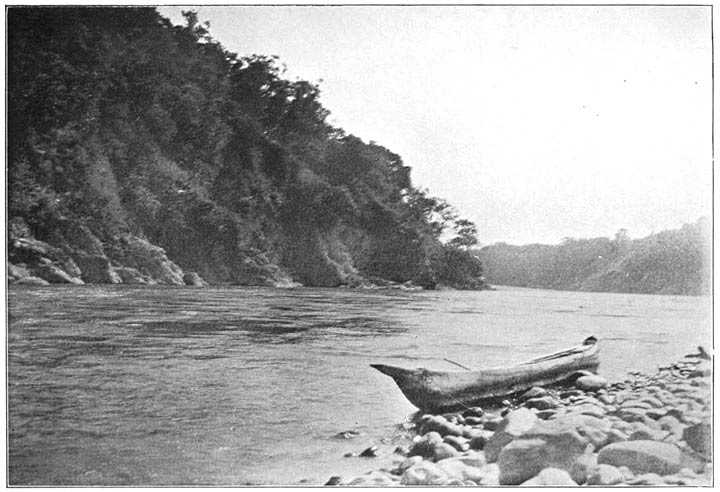
Gorge of the River Manas.
From a Photograph by Mrs. H. A. Colquhoun.